<?xml version="1.0" encoding="ISO-8859-1"?><article xmlns:mml="http://www.w3.org/1998/Math/MathML" xmlns:xlink="http://www.w3.org/1999/xlink" xmlns:xsi="http://www.w3.org/2001/XMLSchema-instance">
<front>
<journal-meta>
<journal-id>0872-1904</journal-id>
<journal-title><![CDATA[Portugaliae Electrochimica Acta]]></journal-title>
<abbrev-journal-title><![CDATA[Port. Electrochim. Acta]]></abbrev-journal-title>
<issn>0872-1904</issn>
<publisher>
<publisher-name><![CDATA[Sociedade Portuguesa de Electroquímica]]></publisher-name>
</publisher>
</journal-meta>
<article-meta>
<article-id>S0872-19042015000400002</article-id>
<article-id pub-id-type="doi">10.4152/pea.201504209</article-id>
<title-group>
<article-title xml:lang="en"><![CDATA[Experimental Investigation of Nickel Electrodeposits Brightness in the Presence of Surfactants: Modeling, Optimization and Polarization Studies]]></article-title>
</title-group>
<contrib-group>
<contrib contrib-type="author">
<name>
<surname><![CDATA[Djaghout]]></surname>
<given-names><![CDATA[I.]]></given-names>
</name>
<xref ref-type="aff" rid="A01"/>
</contrib>
<contrib contrib-type="author">
<name>
<surname><![CDATA[Affoune]]></surname>
<given-names><![CDATA[A. M.]]></given-names>
</name>
<xref ref-type="aff" rid="A01"/>
</contrib>
<contrib contrib-type="author">
<name>
<surname><![CDATA[Chelaghmia]]></surname>
<given-names><![CDATA[M. L.]]></given-names>
</name>
<xref ref-type="aff" rid="A01"/>
</contrib>
<contrib contrib-type="author">
<name>
<surname><![CDATA[Bendjaballah]]></surname>
<given-names><![CDATA[M.]]></given-names>
</name>
<xref ref-type="aff" rid="A01"/>
</contrib>
</contrib-group>
<aff id="A01">
<institution><![CDATA[,Universite 8 Mai 1945 Guelma Faculte des Sciences et de la Technologie Departement de Genie des Procedes]]></institution>
<addr-line><![CDATA[Guelma ]]></addr-line>
<country>Algeria</country>
</aff>
<pub-date pub-type="pub">
<day>00</day>
<month>07</month>
<year>2015</year>
</pub-date>
<pub-date pub-type="epub">
<day>00</day>
<month>07</month>
<year>2015</year>
</pub-date>
<volume>33</volume>
<numero>4</numero>
<fpage>209</fpage>
<lpage>222</lpage>
<copyright-statement/>
<copyright-year/>
<self-uri xlink:href="http://scielo.pt/scielo.php?script=sci_arttext&amp;pid=S0872-19042015000400002&amp;lng=en&amp;nrm=iso"></self-uri><self-uri xlink:href="http://scielo.pt/scielo.php?script=sci_abstract&amp;pid=S0872-19042015000400002&amp;lng=en&amp;nrm=iso"></self-uri><self-uri xlink:href="http://scielo.pt/scielo.php?script=sci_pdf&amp;pid=S0872-19042015000400002&amp;lng=en&amp;nrm=iso"></self-uri><abstract abstract-type="short" xml:lang="en"><p><![CDATA[Nickel coatings were obtained from Watts bath containing sodium dodecyl sulfate (SDS) or polyvinylpyrrolidone (PVP) surfactants by direct current plating. The influence of electrolysis parameters, temperature, current density, concentration of surfactants and pH on the nickel deposits brightness is investigated through a multiple linear regression model with interaction. The models obtained fitted very well the experimental data. ANOVA statistical analysis shows that all design factors are significant, and the brightness of nickel deposits obtained from bath containing PVP is more sensitive to the changes in the factors levels. The electrochemical behaviour of baths was discussed; the results revealed an inhibitive effect exerted by both SDS and PVP. We have also found that the brightness and the inhibition are well linked and directly proportional. In addition, the corrosion resistance of the nickel coatings was slightly improved, especially with PVP. Finally, the optimization analysis showed that PVP could efficiently and eco-friendly substitute SDS as an additive of nickel electroplating.]]></p></abstract>
<kwd-group>
<kwd lng="en"><![CDATA[Nickel electrodeposition]]></kwd>
<kwd lng="en"><![CDATA[surfactants]]></kwd>
<kwd lng="en"><![CDATA[brightness]]></kwd>
<kwd lng="en"><![CDATA[experimental design]]></kwd>
<kwd lng="en"><![CDATA[cyclic voltammetry]]></kwd>
</kwd-group>
</article-meta>
</front><body><![CDATA[ 

<!--     <p>&nbsp;</p>
    <p>doi: 10.4152/pea.201504209</p> -->

    <p><b>Experimental Investigation of Nickel Electrodeposits Brightness in the Presence of Surfactants: Modeling, Optimization and Polarization Studies</b></p>

    <p>
<b>I. Djaghout</b>
, <b>A. M. Affoune</b><sup><a href="#0">*</a></sup>
, <b>M. L. Chelaghmia</b>
 and <b>M. Bendjaballah</b>
</p>

    <p><i> Laboratoire d'Analyses Industrielles et Genie des Materiaux, Departement de Genie des Procedes, 
Faculte des Sciences et de la Technologie, Universite 8 Mai 1945 Guelma, BP 401, Guelma 24000, Algeria</i></p>


    <p>&nbsp;</p>
    <p><b>Abstract</b></p>

    <p>Nickel coatings were obtained from Watts bath containing sodium dodecyl sulfate 
(SDS) or polyvinylpyrrolidone (PVP) surfactants by direct current plating. The 
influence of electrolysis parameters, temperature, current density, concentration of 
surfactants and pH on the nickel deposits brightness is investigated through a multiple 
linear regression model with interaction. The models obtained fitted very well the 
experimental data. ANOVA statistical analysis shows that all design factors are 
significant, and the brightness of nickel deposits obtained from bath containing PVP is 
more sensitive to the changes in the factors levels. The electrochemical behaviour of 
baths was discussed; the results revealed an inhibitive effect exerted by both SDS and 
PVP. We have also found that the brightness and the inhibition are well linked and 
directly proportional. In addition, the corrosion resistance of the nickel coatings was 
slightly improved, especially with PVP. Finally, the optimization analysis showed that 
PVP could efficiently and eco-friendly substitute SDS as an additive of nickel 
electroplating.</p>

    <p><b><i>Keywords:</i></b> Nickel electrodeposition; surfactants; brightness; experimental design; cyclic 
voltammetry.</p>


    ]]></body>
<body><![CDATA[<p>&nbsp;</p>
    <p><b>Introduction</b></p>

    <p>Nickel electrodeposition has attracted great interest these decades and became 
one popular surface treatment technology. Nickel coatings can be produced from 
a variety of electrolytes; the Watts bath is the basis for most decorative nickel 
plating solutions [1, 2]. It has several advantages such as inexpensive compared 
to sulfamate bath, less aggressive for the work equipment than chloride bath, and 
deposits obtained have lower internal stress than those obtained from chloride 
bath. Properties of nickel deposits can be improved by addition of special organic 
compounds to the baths, like surfactants, refiners, brighteners, and levelling 
agents [3].</p>

    <p>Surfactants reduce surface tension of the cathode which facilitates the removal of 
hydrogen by reducing the size of the bubbles, and consequently reduces the risk 
of pitting, thereby improving the quality of the deposit. Among many surfactants 
varieties, sodium dodecyl sulfate (SDS) is the most used in the electrodeposition 
of nickel [4-7]. In addition to its role of wettability, several authors have studied 
its influence on the morphology and the brightness of nickel coatings [4, 5], 
electrochemical properties of zinc [8] and the stress of electroplated copper [9]. 
Nevertheless, this additive presents the disadvantage of incorporating sulphur in 
coatings. While the presence of sulphur in the nickel coatings enhances the 
superplasticity [10] and improves the microhardness[11], its incorporation is 
detrimental regarding the corrosion resistance because it promotes a localized 
corrosion [12]. Besides, the sulphur causes catastrophic embrittlement at elevated 
temperature as low as 200 &deg;C [11] and deteriorates the colour of deposits when it 
exceeds certain limits [13]. Another downside of SDS is its toxicity which may 
cause environmental problems. In the aim to avoid the presence of sulphur and 
the toxicity of SDS, we are interested in finding a surfactant substitute. 
Polyvinylpyrrolidone (PVP) is a famous macromolecule surfactant with many 
advantages such as low toxicity, biocompatibility, high surface activity, and 
strong adsorption ability [14]. Up to now, PVP has brought substantial interest 
and has been widely used in different fields, such as anticorrosion [15-17], 
chemical deposition [18, 19] and electrodeposition [20-23]. PVP was used as a 
wetting agent and a refiner in plating baths of ZnO [20] and PbO2 [21]. Recently, 
in a comparative study between five additives [22], the PVP is found to be the 
best additive which decreased grain size of the copper powder to a minimum 
threshold. To the best of our knowledge, a very few studies have been dedicated 
to the study of PVP effect on nickel electrodeposition [24]. Furthermore, and 
unlike SDS, no report has been published on the effect of PVP on the brightness 
of nickel electrodeposition.</p>

    <p>The study of the electrolysis parameters effects on the performance of nickel 
electroplating was the subject of different investigations. Most of these works 
were made by the conventional methodology [25-27], wherein one factor varies 
while others are set at constant levels. These traditional methods often ignore the 
effects of interaction between factors, and lead to less accurate optimal values. 
To overcome this problem, experimental design methods have been used; these 
latter serve to optimize the organization of experiments in order to minimize the 
time, cost and increase reliability [28-31]. While response surface methodology 
(RSM) is one of the most used experimental design methods, only a very few 
works [32] used it to study the electrodeposition of pure nickel. 
In this work, a comparative study on the effect of electrolysis parameters on the 
nickel deposits brightness in the presence of SDS and PVP was achieved. Results 
were analyzed using response surface methodology via full factorial design 
modelling. A complementary polarization study was also conducted to evaluate 
the electrochemical behaviour of baths and deposits.</p>


    <p>&nbsp;</p>
    <p><b>Experimental</b></p>

    <p><i><b>Electrodeposition</b></i></p>

    <p>Nickel coatings were prepared by direct-current galvanostatic deposition onto 
copper substrate (60 mm &times; 20 mm), from a conventional Watts bath composed 
of 250 g L<sup>-1</sup> NiSO4.6H2O, 45 g L<sup>-1</sup> NiCl2.6H2O, and 40 g L<sup>-1</sup> H3BO3. An 
appropriated amount of sodium dodecyl sulfate and polyvinylpyrrolidone was 
added to the electrolytic bath and dilute solutions of sodium hydroxide (NaOH) 
and sulphuric acid (H2SO4) were used for pH adjustments. All solutions were 
prepared with analytical grade chemicals and ultrapure water. Prior to nickel 
electrodeposition, the substrate surface was subjected to mechanical treatment 
with metallurgical papers of 800, 1200 and 2000 grits, then cleaned with 1.0 M 
HCl and rinsed by ultrapure water. All the electrodeposition experiments were 
conducted for 120 s by applying current from an AX 501 METRIX regulated 
power supplier (0-30 V/2.5 A). After electrolysis, the samples were removed 
from the cell and thoroughly washed with ultrapure water and dried.</p>


    <p><i><b>Brightness measurements</b></i></p>

    ]]></body>
<body><![CDATA[<p>The brightness of the metallic deposits was evaluated using a BYK-Gardner 
micro-gloss meter with an extended beam white light. Sample surface was 
carefully cleaned before measurement, in order to obtain consistent results. The 
calibration was performed automatically by means of a highly polished black 
standard integrated in the gloss meter. Measurements were performed in three 
replicates for each coating, in which the mean was considered the final value.</p>


    <p><i><b>Kinetics study</b></i></p>

    <p>Cyclic voltammetry experiments were carried out in a conventional three-
electrode glass cell using an EG &amp; G Princeton Applied Research 
potentiostat/galvanostat model 273A controlled by Power Suite software. A 
copper substrate and platinum wire of 0.5 mm diameter were used as working 
and auxiliary electrodes, respectively, and a saturated calomel electrode (SCE) 
served as the reference electrode. Voltammograms were obtained in the potential 
range between -1200 mV and +50 mV, with a scan rate of 20 mVs<sup>-1</sup>. The 
corrosion resistance of the nickel coatings was studied in 3.5 % NaCl. Prior to 
experiments, samples were immersed in solution for 30 min, at room 
temperature. The polarization curves were performed from -500 to 0 mV at scan 
rate of 5 mVs<sup>-1</sup> , using an EG &amp; G Princeton Applied Research 
potentiostat/galvanostat model VersaSTAT 3 controlled by VersaStudio 
software.</p>


    <p>&nbsp;</p>
    <p><b>Results and discussion</b></p>

    <p><i><b>Statistical study</b></i></p>

    <p>In a full factorial design, we combine all the factors in a common experience 
design in which each factor takes two levels, low and high levels, symbolized by 
(-1) and (+1), respectively.</p>

    <p>The relationship between the input, called electrolysis parameters, temperature 
(T), current density (i), concentration of surfactant (C) and (pH) of the solution, 
and the output Y defined as a nickel deposits brightness (Br) is given as:</p>


    <p>&nbsp;</p>
<a name="e1">
<img src="/img/revistas/pea/v33n4/33n4a02e1.jpg">
    
<p>&nbsp;</p>


    ]]></body>
<body><![CDATA[<p>where f is the response function.</p>

    <p>The approximation of Y was established by multiple linear regression model with 
interaction. The coded mathematical model can be given by:</p>


    <p>&nbsp;</p>
<a name="e2">
<img src="/img/revistas/pea/v33n4/33n4a02e2.jpg">
    
<p>&nbsp;</p>


    <p>where b<sub>0</sub> is the free term of the regression equation, b<sub>i</sub>
coefficient represents the effect of the factors X<sub>i</sub>, and b<sub>ij</sub>
is the coefficient of regression which represents the effects of interactions of factors 
X<sub>i</sub> and X<sub>j</sub>. Design and statistical analysis 
were performed using Design Expert software, version 9.0.3 (Stat-Ease, USA).</p>


    <p><i>Modelling for the nickel deposits brightness</i></p>

    <p>The choice of the studied factors levels is based on data from industrial 
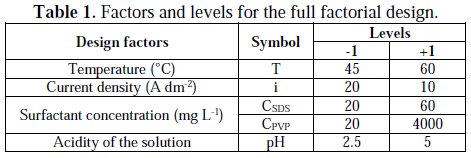
applications and research works [2, 4, 22]. <a href="#t1">Table 1</a> summarizes the factors 
notations, their actual and reduced values.</p>


    <p>&nbsp;</p>
<a name="t1">
<img src="/img/revistas/pea/v33n4/33n4a02t1.jpg">
    
<p>&nbsp;</p>


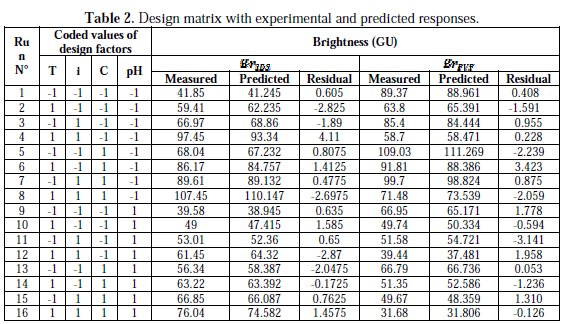
    <p>Based on two-level four factor full 
factorial design (24), a total number of 16 trials were carried out for each 
surfactant. The design matrix and the corresponding experimental responses of 
the brightness are given in <a href="#t2">Table 2</a>.</p>


    ]]></body>
<body><![CDATA[<p>&nbsp;</p>
<a name="t2">
<img src="/img/revistas/pea/v33n4/33n4a02t2.jpg">
    
<p>&nbsp;</p>


    <p>The regression equations related to the brightness of nickel deposits as a function 
of the studied factors are as follows:</p>

    <p>For nickel deposits in presence of SDS:</p>


    <p>&nbsp;</p>
<a name="e3">
<img src="/img/revistas/pea/v33n4/33n4a02e3.jpg">
    
<p>&nbsp;</p>


    <p>For nickel deposits in presence of PVP:</p>


    <p>&nbsp;</p>
<a name="e4">
<img src="/img/revistas/pea/v33n4/33n4a02e4.jpg">
    
<p>&nbsp;</p>


    <p>The values of the brightness predicted from the regression equations are given in 
<a href="#t2">Table 2</a>. The coefficients of determination (R<sup>2</sup>) of Br<sub>SDS</sub>
and Br<sub>PVP</sub> are, 
respectively, 98.98 % and 99.38 %; these denote that only 1.02 % and 0.62 % of 
the total variability of both Br<sub>SDS</sub> and Br<sub>PVP</sub>
are not explained by the regressors in the models.</p>


    ]]></body>
<body><![CDATA[<p><i>Analysis of variance (ANOVA)</i></p>

    <p>Analysis of variance of the nickel deposits brightness was made in order to 
analyze the effect of temperature, current density, concentration of surfactants 
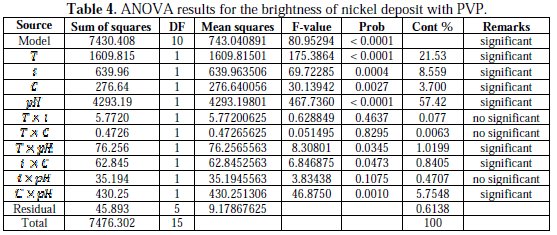
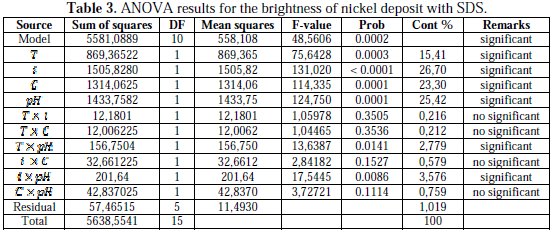
and the pH of the solution on the brightness. <a href="#t3">Tables 3</a> and <a href="#t4">4</a> show ANOVA 
results for Br<sub>SDS</sub> and Br<sub>PVP</sub>, respectively.</p>


    <p>&nbsp;</p>
<a name="t3">
<img src="/img/revistas/pea/v33n4/33n4a02t3.jpg">
    
<p>&nbsp;</p>
<a name="t4">
<img src="/img/revistas/pea/v33n4/33n4a02t4.jpg">
    
<p>&nbsp;</p>


    <p>The analyses were carried out for a 5 % 
significance level, i.e., for a 95 % confidence level. In these tables, the degrees of 
freedom (DF), sum of squares (SC sq), mean square (MS), F-values, probabilities 
(Prob) and the contribution (Cont %) of each factor and interactions are shown [33].</p>

    <p>Fisher-values of Br<sub>SDS</sub> and Br<sub>PVP</sub> were 48.36 and 80.95, respectively. According 
to the Fisher-Snedecor statistical tables [34], the F<sub>models</sub> &gt;&gt; F<sub>0.05</sub> = 4.74, this 
means that both F-values are extremely significant. We also note that F-value of Br<sub>PVP</sub> 
&gt; F-value of Br<sub>SDS</sub>, indicating that Br<sub>PVP</sub> 
is more sensitive to the changes in the factors levels than Br<sub>SDS</sub>. Furthermore, 
ANOVA tests show that all the studied factors are significant, i.e., 
they affect the brightness of nickel deposits.</p>

    <p>Concerning the interactions, only five are significant (two for SDS and three for 
and PVP) among possible binary interactions. We also noted that the interactions 
(T &times; i) and (T &times; C) are not significant with both surfactants. Consequently, and 
after discarding the insignificant terms, the above regression equations (<a href="#e3">Eqs. 3</a> 
and <a href="#e4">4</a>) related to the brightness of nickel deposits could be reduced as follows.</p>

    <p>For nickel deposits in presence of SDS:</p>


    <p>&nbsp;</p>
<a name="e5">
<img src="/img/revistas/pea/v33n4/33n4a02e5.jpg">
    
]]></body>
<body><![CDATA[<p>&nbsp;</p>


    <p>For nickel deposits in presence of PVP:</p>


    <p>&nbsp;</p>
<a name="e6">
<img src="/img/revistas/pea/v33n4/33n4a02e6.jpg">
    
<p>&nbsp;</p>


    <p>The values of R<sup>2</sup> and Fisher test for the reduced models are as follows: 
R<sup>2</sup>(Br<sub>SDS</sub>) = 97.21 %, R2(Br<sub>PVP</sub>) = 98.38 %, 
F (Br<sub>SDS</sub>) = 52.32 and F (Br<sub>PVP</sub>) = 96.69.</p>

    <p>The values of Fisher test and R squared of full and reduced models indicated that 
the derivative models are very satisfactory. We can then conclude that a multiple 
linear regression model with interaction is adequate and can be used as a 
prediction equation in this study.</p>

    <p>The last but one column of Tables (<a href="#t3">3</a> and <a href="#t4">4</a>) shows the factors contribution, 
indicating the degree of influence on the nickel brightness deposits. In the case of 
SDS, it is observed that the contributions of factors are in the order of magnitude &simeq; 20 &pm; 5 %,
while the contribution of pH interaction with the current density 
and the bath temperature does not exceed 4 %. Concerning the nickel deposits 
produced in the presence of PVP, it seems clearly that pH affects considerably 
the brightness; its contribution is Cont &simeq; 57.42 %, and this is due to the high 
sensitivity of the PVP adsorption with the pH [35]. The temperature, the current 
density, and the concentration of PVP are also significant, but their contributions 
are not the same. Besides the main effect of pH, its interaction with the PVP 
concentration and the temperature is also significant. There is also a low 
contribution of the interaction between the current density and the concentration 
of PVP. It appears from the above results that the values of the factors 
contribution in the case of SDS are near, which is not the case with PVP; this 
finding explains the sensitivity of the brightness to the changes in the levels of 
factors in the case of PVP.</p>


    <p><i>Main effect</i></p>

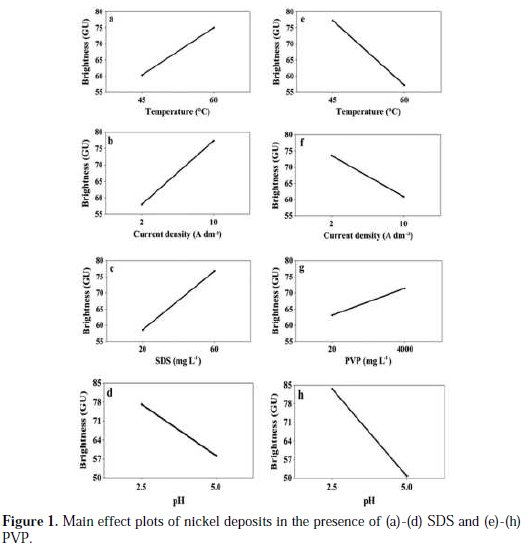
    <p>The effect of a factor is defined as the change in response produced by a change 
in the level of the factor. <a href="#f1">Fig. 1</a> shows the main effects of the factors for 
Br<sub>SDS</sub> and Br<sub>PVP</sub>.</p>


    <p>&nbsp;</p>
<a name="f1">
<img src="/img/revistas/pea/v33n4/33n4a02f1.jpg">
    
]]></body>
<body><![CDATA[<p>&nbsp;</p>


    <p>It can be seen from <a href="#f1">Fig. 1(a)-(d)</a> that the temperature, the current 
density and the concentration of SDS have a positive effect on the brightness, 
whereas the pH has a negative effect. For Br<sub>PVP</sub>, <a href="#f1">Fig. 1(e)-(h)</a>, the temperature, 
the current density and the pH of the solution have a negative effect, while PVP 
concentration has a positive effect.</p>

    <p>Researchers have different opinions about what determine the brightness of the 
electrodeposits; grain size and/or their orientations along a direction promoting 
the reflection of the light. Many authors [36, 37] have reported that the brightness 
of electrodeposits increases remarkably with decreasing grain size. Furthermore, 
and according to the pattern presented by Dini [38], it is generally expected that 
the grain size decreases by either decreasing the temperature or increasing the 
current density and the concentration of added additives. Taking into account the 
above statements, we have projected the results of the main effect (<a href="#f1">Fig. 1</a>), which 
link brightness versus factors, to the Dini pattern. It appears that the majority of 
plots <a href="#f1">(b)</a>, <a href="#f1">(c)</a>, <a href="#f1">(e)</a> and <a href="#f1">(g)</a> 
are consistent with the scheme of Dini. However, the 
effects of temperature in the case of SDS (<a href="#f1">Fig. 1(a)</a>), and the effect of the current 
density in the case of PVP (<a href="#f1">Fig. 1(f)</a>), are not in agreement with Dini pattern. It is 
known that the increase of the temperature favours from one part the kinetics 
driving forces [26] and, the surface diffusion [39] from another part. These two 
phenomena have opposite effects on the particle size. We conclude that 
increasing brightness as function of the temperature in the case of SDS is due to 
the domination of the kinetics driving force. Regarding the effect of the current 
density in the case of PVP, we believe that the interactions of PVP to the surface 
are reduced at high current densities, as mentioned recently by Hai et al. [40]. 
Concerning the pH effect, <a href="#f1">Fig. 1(c)</a> and <a href="#f1">(h)</a> shows that the brightness of deposits 
decreases with increasing pH values in both baths. This is expected since the 
increase of pH reduces the adsorbed amount of SDS [41] and PVP [35]. In 
addition, it is reported [42] that at pH &simeq; 5, the amount of PVP adsorbed decreases 
compared to that of SDS, which could explain the greater slope of pH in the case 
of PVP (<a href="#f1">Fig. 1(h)</a>).</p>

    <p>As conclusion of this part, the brightness of nickel deposits in the presence of 
surfactants is not only dependent on the kinetics of discharge but also on the 
adsorption of surfactants and the diffusion of adatoms.</p>


    <p><i>Response surface plots</i></p>

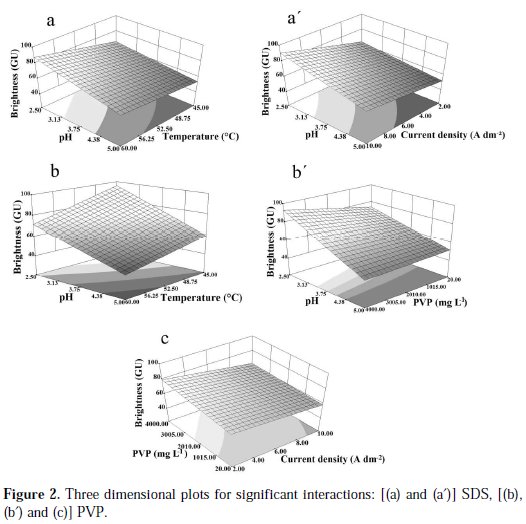
    <p>Response surface plots are drawn in order to investigate the effects of factors 
interactions on the brightness (<a href="#f2">Fig. 2</a>).</p>


    <p>&nbsp;</p>
<a name="f2">
<img src="/img/revistas/pea/v33n4/33n4a02f2.jpg">
    
<p>&nbsp;</p>


    <p>Brightness is represented as function of 
two factors, holding the two other factors in the middle level.</p>

    <p><a href="#f2">Fig. 2(a)</a> and <a href="#f2">(a')</a> illustrates the response surface 
plots in case of Br<sub>SDS</sub>. At 
higher pH values, the increase in both temperature (<a href="#f2">Fig. 2(a)</a>) and current density 
(<a href="#f2">Fig. 2(a')</a>) leads to a slight increase in Br<sub>SDS</sub>, 
while for lower pH values, the 
growth of both temperature and current density conducts to a very significant 
increase in the response. So the best response surface could be obtained by the 
combination of the highest value of temperature and current density with the 
lowest pH value.</p>

    ]]></body>
<body><![CDATA[<p><a href="#f2">Fig. 2(b)</a> and <a href="#f2">(b')</a> highlights the effects 
of the factors interaction on Br<sub>PVP</sub>. At 
higher pH values, the decreasing of temperature (<a href="#f2">Fig. 2(b)</a>) or the increment in 
concentration of PVP (<a href="#f2">Fig. 2(b')</a>) resulted in a slight increase in the response, but 
at lower pH values, the decreasing of temperature or the increasing of PVP 
concentration leads to an improve in the brightness. Thus, the best brightness 
could be obtained by the combination of the highest concentration of PVP with 
the lowest values of pH and temperature. The interaction between the current 
density and the concentration of PVP is represented in <a href="#f2">Fig. 2(c)</a>. It is shown that 
the interaction becomes important for the lowest values of current density and 
highest PVP concentration. It appears from the above results that the pH takes 
part in the majority of significant interactions, whereas the concentration of SDS 
falls outside in any significant interaction.</p>


    <p><i><b>Optimization of electrolysis parameters</b></i></p>

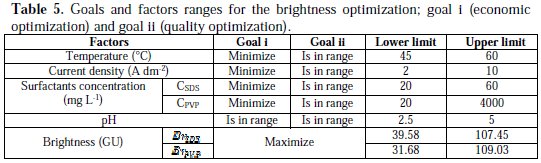
    <p>Optimization of electrolysis parameters for the nickel deposits brightness was 
carried out by a multiple response method called desirability function. We are 
interested in two approaches of optimization that we named ''economic 
optimization'' and ''quality optimization''. The first consists to find the maximum 
brightness by minimizing temperature, current density and the concentration of 
the surfactants, regardless the level of the pH. In the second, we seek the 
maximum brightness in the whole range of the studied factors. The factors ranges 
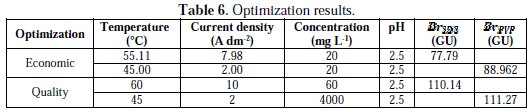
defined for each optimization are summarized in <a href="#t5">Table 5</a>, while the RSM 
optimization results are shown in <a href="#t6">Table 6</a>.</p>


    <p>&nbsp;</p>
<a name="t5">
<img src="/img/revistas/pea/v33n4/33n4a02t5.jpg">
    
<p>&nbsp;</p>
<a name="t6">
<img src="/img/revistas/pea/v33n4/33n4a02t6.jpg">
    
<p>&nbsp;</p>


    <p>In the case of economic optimization, the best calculated brightness of nickel 
deposits with SDS, generated among 31 optimums points, is 
Br<sub>SDS</sub> = 77.79 GU. It is achieved at T = 55.11 &deg;C, i = 7.98 A dm<sup>-2</sup>, for the SDS concentration of 20 
mg L<sup>-1</sup>, this corresponds to a value of desirability equals 0.729. The best 
calculated brightness of nickel deposits with PVP, generated among 34 optimums 
points, is Br<sub>PVP</sub> = 88.9619 GU. It is reached at T = 45 &deg;C, i = 2 A dm<sup>-2</sup>, for the 
PVP concentration of 20 mg L<sup>-1</sup>, and with 0.915 desirability. The values of 
desirability show that the PVP is more appropriate in strategy of economic 
optimization.</p>

    <p>In the case of the quality optimization, the results show that with both 
surfactants, we reach the maximum brightness values very close, which are 
(110.147 GU) for the SDS and (111.269 GU) for the PVP, and the value of 
desirability equals unity. The values of factors corresponding to these brightness 
values are the same as those by which we obtained the maximum experimental 
brightness. This indicates once again the concordance between the experimental 
results and the derivatives model.</p>

    <p>Comparison between the two optimization strategies gives a small advantage to 
the SDS-containing bath when the maximum of brightness is required. But the 
bath with PVP wins if an environment-friendly industry is adopted. Thus, PVP 
could efficiently and eco-friendly substitute SDS as an additive of nickel 
electroplating.</p>


    <p><i><b>Polarization study</b></i></p>

    ]]></body>
<body><![CDATA[<p>In order to evaluate the electrochemical behaviour of baths and deposits, we 
achieved cyclic voltammograms and corrosion plots.</p>


    <p><i>Cyclic voltammetry</i></p>

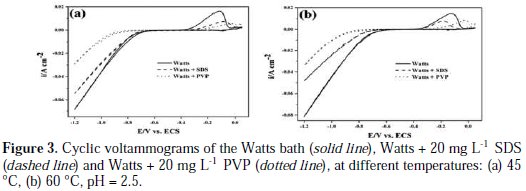
    <p><a href="#f3">Fig. 3(a)</a> and <a href="#f3">(b)</a> shows cyclic voltammograms obtained on the copper substrate 
during nickel electrodeposition, at temperatures of 45 &deg;C and 60 &deg;C, respectively.</p>


    <p>&nbsp;</p>
<a name="f3">
<img src="/img/revistas/pea/v33n4/33n4a02f3.jpg">
    
<p>&nbsp;</p>


    <p>Typical voltammograms related to Watts bath are represented by solid lines. 
They show that the reduction of nickel ions starts at about -0.71 V leading to the 
reduction of nickel ions to metallic nickel. The curves represented by dashed and 
dotted lines, illustrate the effect exerted by SDS and PVP, respectively. It's 
clearly shown that both SDS and PVP inhibit the reduction reaction of nickel 
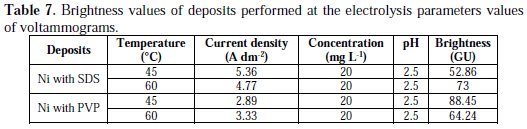
ions; this effect is more marked with PVP at both temperatures. <a href="#t7">Table 7</a> gives the 
values of the deposits brightness performed with the same electrolysis parameters 
values of the voltammograms.</p>


    <p>&nbsp;</p>
<a name="t7">
<img src="/img/revistas/pea/v33n4/33n4a02t7.jpg">
    
<p>&nbsp;</p>


    <p>In the case of SDS, the increase in temperature 
leads to a reduction of the cathodic current density, that is to say, there was a 
phenomenon of inhibition; in the other hand, the brightness increases with 
temperature. However, in the case of PVP, the decrease in temperature favours 
the inhibition of the current density and also the brightness of the deposit. This 
indicates that the brightness and the inhibition are well linked, and the two 
phenomena are directly proportional.</p>


    <p><i>Effect of SDS and PVP on corrosion resistance of coatings</i></p>

    ]]></body>
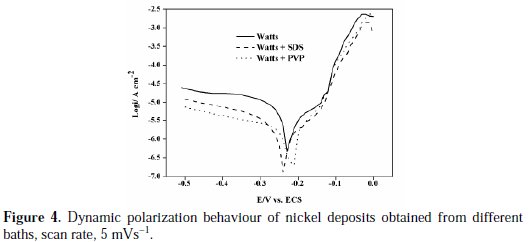
<body><![CDATA[<p><a href="#f4">Fig. 4</a> presents the potentiostatic polarization curves for nickel coatings obtained 
from Watts baths (with and without surfactants).</p>


    <p>&nbsp;</p>
<a name="f4">
<img src="/img/revistas/pea/v33n4/33n4a02f4.jpg">
    
<p>&nbsp;</p>


    <p>In order to understand the behaviour of deposits towards corrosion, Tafel plots were used to determine the 
corrosion parameters, such as corrosion current density (icorr) and corrosion 
potential (Ecorr).</p>

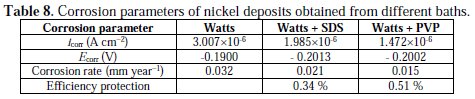
    <p>The experimental results (<a href="#t8">Table 8</a>) indicated that the nickel coatings elaborated 
from Watts bath with SDS and PVP have corrosion current density lower than 
that prepared from Watts bath without additives.</p>


    <p>&nbsp;</p>
<a name="t8">
<img src="/img/revistas/pea/v33n4/33n4a02t8.jpg">
    
<p>&nbsp;</p>


    <p>So the addition of surfactants 
conducts to a decrease in the rate of corrosion. Mohanty et al. [4] found analogue 
results with SDS, but from sulfate baths. The decreasing of the corrosion 
potential in the presence of surfactants, by about 10 mV, shows that their 
inhibition is of cathodic type. Thus, the reduction of the corrosion current density 
of the deposits obtained in the presence of surfactants indicates enhancement of 
their electrochemical properties versus those achieved without additives.</p>


    <p>&nbsp;</p>
    <p><b>Conclusions</b></p>

    ]]></body>
<body><![CDATA[<p>The influence of electrolysis parameters on the nickel deposits brightness in the 
presence of SDS and PVP were explored using RSM. The linear regression 
model with interactions provided excellent relationships between the design 
factors and the brightness.</p>

    <p>Based on the analysis of variance tools, all studied factors were found significant 
and the brightness of deposits from baths containing PVP was more sensitive to 
the changes in the levels of factors than that relating to the SDS. The pH 
influenced principally the brightness of nickel deposits from bath containing PVP 
and takes part in the majority of significant interactions. 
The brightness of deposits is not only dependent on the electrochemical kinetics 
but also on the adsorption of surfactants and the diffusion of adatoms. The 
voltammetric study showed that both SDS and PVP inhibit the nickel 
electrodeposition.</p>

    <p>The comparative analysis of the brightness and the cyclic voltammetry results 
indicated that the inhibition and the brightness are well linked and directly 
proportional. Besides, the corrosion resistance of the nickel coatings was slightly 
improved, especially with PVP.</p>

    <p>As a final point, PVP, which is less expensive, and non-toxic, could efficiently 
and eco-friendly substitute SDS as an additive of nickel electroplating. 
Therefore, these results provide promising perspectives for the use of PVP for 
future commercial applications.</p>


    <p>&nbsp;</p>
    <p><b>References</b></p>

    <!-- ref --><p>1. Chung C K, Chang W T, Chen C F, et al. Mater Lett. 2011;65:416.    &nbsp;&nbsp;&nbsp;&nbsp;&nbsp;&nbsp;&nbsp;&nbsp;[&#160;<a href="javascript:void(0);" onclick="javascript: window.open('/scielo.php?script=sci_nlinks&ref=000119&pid=S0872-1904201500040000200001&lng=','','width=640,height=500,resizable=yes,scrollbars=1,menubar=yes,');">Links</a>&#160;]<!-- end-ref --></p>

    <!-- ref --><p>2. di Bari G A. In: Electrodeposition of nickel. Schlesinger M, Paunovic M, 
editors. New Jersey: Wiley and Sons, Inc; 2010. Vol 55, p.79.    &nbsp;&nbsp;&nbsp;&nbsp;&nbsp;&nbsp;&nbsp;&nbsp;[&#160;<a href="javascript:void(0);" onclick="javascript: window.open('/scielo.php?script=sci_nlinks&ref=000121&pid=S0872-1904201500040000200002&lng=','','width=640,height=500,resizable=yes,scrollbars=1,menubar=yes,');">Links</a>&#160;]<!-- end-ref --></p>

    ]]></body>
<body><![CDATA[<!-- ref --><p>3. Rudnik E, Wojnicki M, Wloch G. Surf Coat Technol. 2012;207:375.    &nbsp;&nbsp;&nbsp;&nbsp;&nbsp;&nbsp;&nbsp;&nbsp;[&#160;<a href="javascript:void(0);" onclick="javascript: window.open('/scielo.php?script=sci_nlinks&ref=000123&pid=S0872-1904201500040000200003&lng=','','width=640,height=500,resizable=yes,scrollbars=1,menubar=yes,');">Links</a>&#160;]<!-- end-ref --></p>

    <!-- ref --><p>4. Mohanty U S, Tripathy B C, Das S C, et al. Hydrometallurgy. 2009;100:60.    &nbsp;&nbsp;&nbsp;&nbsp;&nbsp;&nbsp;&nbsp;&nbsp;[&#160;<a href="javascript:void(0);" onclick="javascript: window.open('/scielo.php?script=sci_nlinks&ref=000125&pid=S0872-1904201500040000200004&lng=','','width=640,height=500,resizable=yes,scrollbars=1,menubar=yes,');">Links</a>&#160;]<!-- end-ref --></p>

    <!-- ref --><p>5. Jing L U, Qi-Hua Y, Zhao Z. Trans Nonferrous Met Soc China. 2010;20:97.    &nbsp;&nbsp;&nbsp;&nbsp;&nbsp;&nbsp;&nbsp;&nbsp;[&#160;<a href="javascript:void(0);" onclick="javascript: window.open('/scielo.php?script=sci_nlinks&ref=000127&pid=S0872-1904201500040000200005&lng=','','width=640,height=500,resizable=yes,scrollbars=1,menubar=yes,');">Links</a>&#160;]<!-- end-ref --></p>

    <!-- ref --><p>6. Sen R, Bhattacharya S, Das S, et al. J Alloys Compd. 2010;489:650.    &nbsp;&nbsp;&nbsp;&nbsp;&nbsp;&nbsp;&nbsp;&nbsp;[&#160;<a href="javascript:void(0);" onclick="javascript: window.open('/scielo.php?script=sci_nlinks&ref=000129&pid=S0872-1904201500040000200006&lng=','','width=640,height=500,resizable=yes,scrollbars=1,menubar=yes,');">Links</a>&#160;]<!-- end-ref --></p>

    <!-- ref --><p>7. Sabri M, Sarabi A A, Kondelo S M N. Mater Chem Phys. 2012;136:566.    &nbsp;&nbsp;&nbsp;&nbsp;&nbsp;&nbsp;&nbsp;&nbsp;[&#160;<a href="javascript:void(0);" onclick="javascript: window.open('/scielo.php?script=sci_nlinks&ref=000131&pid=S0872-1904201500040000200007&lng=','','width=640,height=500,resizable=yes,scrollbars=1,menubar=yes,');">Links</a>&#160;]<!-- end-ref --></p>

    ]]></body>
<body><![CDATA[<!-- ref --><p>8. Ghavami R K, Rafiei Z. J Power Sources. 2006;162:893.    &nbsp;&nbsp;&nbsp;&nbsp;&nbsp;&nbsp;&nbsp;&nbsp;[&#160;<a href="javascript:void(0);" onclick="javascript: window.open('/scielo.php?script=sci_nlinks&ref=000133&pid=S0872-1904201500040000200008&lng=','','width=640,height=500,resizable=yes,scrollbars=1,menubar=yes,');">Links</a>&#160;]<!-- end-ref --></p>

    <!-- ref --><p>9. Kim S, Jang J H, Lee J S, et al. Electrochim Acta. 2007;52:5258.    &nbsp;&nbsp;&nbsp;&nbsp;&nbsp;&nbsp;&nbsp;&nbsp;[&#160;<a href="javascript:void(0);" onclick="javascript: window.open('/scielo.php?script=sci_nlinks&ref=000135&pid=S0872-1904201500040000200009&lng=','','width=640,height=500,resizable=yes,scrollbars=1,menubar=yes,');">Links</a>&#160;]<!-- end-ref --></p>

    <!-- ref --><p>10. McFadden S X, Mukherjee A K. Mater Sci Eng A. 2005;395:265.    &nbsp;&nbsp;&nbsp;&nbsp;&nbsp;&nbsp;&nbsp;&nbsp;[&#160;<a href="javascript:void(0);" onclick="javascript: window.open('/scielo.php?script=sci_nlinks&ref=000137&pid=S0872-1904201500040000200010&lng=','','width=640,height=500,resizable=yes,scrollbars=1,menubar=yes,');">Links</a>&#160;]<!-- end-ref --></p>

    <!-- ref --><p>11. Dennis J K, Such T E. Nickel and chromium plating. 3rd ed. Cambridge: Woodhead Publ Ltd; 1993.    &nbsp;&nbsp;&nbsp;&nbsp;&nbsp;&nbsp;&nbsp;&nbsp;[&#160;<a href="javascript:void(0);" onclick="javascript: window.open('/scielo.php?script=sci_nlinks&ref=000139&pid=S0872-1904201500040000200011&lng=','','width=640,height=500,resizable=yes,scrollbars=1,menubar=yes,');">Links</a>&#160;]<!-- end-ref --></p>

    <!-- ref --><p>12. Godon A, Creus J, Feaugas X, et al. Mater Charact. 2011;62:164.    &nbsp;&nbsp;&nbsp;&nbsp;&nbsp;&nbsp;&nbsp;&nbsp;[&#160;<a href="javascript:void(0);" onclick="javascript: window.open('/scielo.php?script=sci_nlinks&ref=000141&pid=S0872-1904201500040000200012&lng=','','width=640,height=500,resizable=yes,scrollbars=1,menubar=yes,');">Links</a>&#160;]<!-- end-ref --></p>

    ]]></body>
<body><![CDATA[<!-- ref --><p>13. Mohanty U S, Tripathy B C, Das S C, et al. Metall Mater Trans B. 2005;36:737.    &nbsp;&nbsp;&nbsp;&nbsp;&nbsp;&nbsp;&nbsp;&nbsp;[&#160;<a href="javascript:void(0);" onclick="javascript: window.open('/scielo.php?script=sci_nlinks&ref=000143&pid=S0872-1904201500040000200013&lng=','','width=640,height=500,resizable=yes,scrollbars=1,menubar=yes,');">Links</a>&#160;]<!-- end-ref --></p>

    <!-- ref --><p>14. Wang P, Gan T, Zhang J, et al. J Mol Liq. 2013;177:129.    &nbsp;&nbsp;&nbsp;&nbsp;&nbsp;&nbsp;&nbsp;&nbsp;[&#160;<a href="javascript:void(0);" onclick="javascript: window.open('/scielo.php?script=sci_nlinks&ref=000145&pid=S0872-1904201500040000200014&lng=','','width=640,height=500,resizable=yes,scrollbars=1,menubar=yes,');">Links</a>&#160;]<!-- end-ref --></p>

    <!-- ref --><p>15. Khaled M M. Arab J Sci Eng. 2010;35:29.    &nbsp;&nbsp;&nbsp;&nbsp;&nbsp;&nbsp;&nbsp;&nbsp;[&#160;<a href="javascript:void(0);" onclick="javascript: window.open('/scielo.php?script=sci_nlinks&ref=000147&pid=S0872-1904201500040000200015&lng=','','width=640,height=500,resizable=yes,scrollbars=1,menubar=yes,');">Links</a>&#160;]<!-- end-ref --></p>

    <!-- ref --><p>16. Gurten A A, Erbil M, Kayakirilmaz K. Cem Concr Compos. 2005;27:802.    &nbsp;&nbsp;&nbsp;&nbsp;&nbsp;&nbsp;&nbsp;&nbsp;[&#160;<a href="javascript:void(0);" onclick="javascript: window.open('/scielo.php?script=sci_nlinks&ref=000149&pid=S0872-1904201500040000200016&lng=','','width=640,height=500,resizable=yes,scrollbars=1,menubar=yes,');">Links</a>&#160;]<!-- end-ref --></p>

    <!-- ref --><p>17. Jianguo Y, Lin W, Otieno-Alegoi V, et al. Corros Sci. 1995;37:975.    &nbsp;&nbsp;&nbsp;&nbsp;&nbsp;&nbsp;&nbsp;&nbsp;[&#160;<a href="javascript:void(0);" onclick="javascript: window.open('/scielo.php?script=sci_nlinks&ref=000151&pid=S0872-1904201500040000200017&lng=','','width=640,height=500,resizable=yes,scrollbars=1,menubar=yes,');">Links</a>&#160;]<!-- end-ref --></p>

    ]]></body>
<body><![CDATA[<!-- ref --><p>18. Li Q, Zeng G-Z, Zhao W-F, et al. Synth Met. 2010;160:200.    &nbsp;&nbsp;&nbsp;&nbsp;&nbsp;&nbsp;&nbsp;&nbsp;[&#160;<a href="javascript:void(0);" onclick="javascript: window.open('/scielo.php?script=sci_nlinks&ref=000153&pid=S0872-1904201500040000200018&lng=','','width=640,height=500,resizable=yes,scrollbars=1,menubar=yes,');">Links</a>&#160;]<!-- end-ref --></p>

    <!-- ref --><p>19. Bayrakdar E, Altincekic T G, Oksuzomer F. Fuel Process Technol. 2013;110:167.    &nbsp;&nbsp;&nbsp;&nbsp;&nbsp;&nbsp;&nbsp;&nbsp;[&#160;<a href="javascript:void(0);" onclick="javascript: window.open('/scielo.php?script=sci_nlinks&ref=000155&pid=S0872-1904201500040000200019&lng=','','width=640,height=500,resizable=yes,scrollbars=1,menubar=yes,');">Links</a>&#160;]<!-- end-ref --></p>

    <!-- ref --><p>20. Chen Z, Tang Y, Zhang L, et al. Electrochim Acta. 2006;51:5870.    &nbsp;&nbsp;&nbsp;&nbsp;&nbsp;&nbsp;&nbsp;&nbsp;[&#160;<a href="javascript:void(0);" onclick="javascript: window.open('/scielo.php?script=sci_nlinks&ref=000157&pid=S0872-1904201500040000200020&lng=','','width=640,height=500,resizable=yes,scrollbars=1,menubar=yes,');">Links</a>&#160;]<!-- end-ref --></p>

    <!-- ref --><p>21. Ghasemi S, Mousavi M F, Shamsipur M. Electrochim Acta. 2007;53:459.    &nbsp;&nbsp;&nbsp;&nbsp;&nbsp;&nbsp;&nbsp;&nbsp;[&#160;<a href="javascript:void(0);" onclick="javascript: window.open('/scielo.php?script=sci_nlinks&ref=000159&pid=S0872-1904201500040000200021&lng=','','width=640,height=500,resizable=yes,scrollbars=1,menubar=yes,');">Links</a>&#160;]<!-- end-ref --></p>

    <!-- ref --><p>22. Nekouie R K, Rashchi F, Joda N N. Powder Technol. 2013;237:554.    &nbsp;&nbsp;&nbsp;&nbsp;&nbsp;&nbsp;&nbsp;&nbsp;[&#160;<a href="javascript:void(0);" onclick="javascript: window.open('/scielo.php?script=sci_nlinks&ref=000161&pid=S0872-1904201500040000200022&lng=','','width=640,height=500,resizable=yes,scrollbars=1,menubar=yes,');">Links</a>&#160;]<!-- end-ref --></p>

    ]]></body>
<body><![CDATA[<!-- ref --><p>23. Song Y-J, Han S-B, Park K-W. Mater Lett. 2010;64:1981.    &nbsp;&nbsp;&nbsp;&nbsp;&nbsp;&nbsp;&nbsp;&nbsp;[&#160;<a href="javascript:void(0);" onclick="javascript: window.open('/scielo.php?script=sci_nlinks&ref=000163&pid=S0872-1904201500040000200023&lng=','','width=640,height=500,resizable=yes,scrollbars=1,menubar=yes,');">Links</a>&#160;]<!-- end-ref --></p>

    <!-- ref --><p>24. Vasilache V, Gutt S, Gutt G, et al. Rom J Chem. 2009;54:243.    &nbsp;&nbsp;&nbsp;&nbsp;&nbsp;&nbsp;&nbsp;&nbsp;[&#160;<a href="javascript:void(0);" onclick="javascript: window.open('/scielo.php?script=sci_nlinks&ref=000165&pid=S0872-1904201500040000200024&lng=','','width=640,height=500,resizable=yes,scrollbars=1,menubar=yes,');">Links</a>&#160;]<!-- end-ref --></p>

    <!-- ref --><p>25. Li J-M, Cai C, Song L-X, et al. Trans Nonferrous Met Soc China. 2013;23:2300.    &nbsp;&nbsp;&nbsp;&nbsp;&nbsp;&nbsp;&nbsp;&nbsp;[&#160;<a href="javascript:void(0);" onclick="javascript: window.open('/scielo.php?script=sci_nlinks&ref=000167&pid=S0872-1904201500040000200025&lng=','','width=640,height=500,resizable=yes,scrollbars=1,menubar=yes,');">Links</a>&#160;]<!-- end-ref --></p>

    <!-- ref --><p>26. Rashidi A M, Amadeh A. J Mater Sci Technol. 2010;26:82.    &nbsp;&nbsp;&nbsp;&nbsp;&nbsp;&nbsp;&nbsp;&nbsp;[&#160;<a href="javascript:void(0);" onclick="javascript: window.open('/scielo.php?script=sci_nlinks&ref=000169&pid=S0872-1904201500040000200026&lng=','','width=640,height=500,resizable=yes,scrollbars=1,menubar=yes,');">Links</a>&#160;]<!-- end-ref --></p>

    <!-- ref --><p>27. Abd El Wahab S M, Abd El Halim M M, Abd El Rehim S S, et al. Surf Coat Technol. 1986;29:313.    &nbsp;&nbsp;&nbsp;&nbsp;&nbsp;&nbsp;&nbsp;&nbsp;[&#160;<a href="javascript:void(0);" onclick="javascript: window.open('/scielo.php?script=sci_nlinks&ref=000171&pid=S0872-1904201500040000200027&lng=','','width=640,height=500,resizable=yes,scrollbars=1,menubar=yes,');">Links</a>&#160;]<!-- end-ref --></p>

    ]]></body>
<body><![CDATA[<!-- ref --><p>28. Yuan X, Sun D, Yu H, et al. Surf Coat Technol. 2007;202:294.    &nbsp;&nbsp;&nbsp;&nbsp;&nbsp;&nbsp;&nbsp;&nbsp;[&#160;<a href="javascript:void(0);" onclick="javascript: window.open('/scielo.php?script=sci_nlinks&ref=000173&pid=S0872-1904201500040000200028&lng=','','width=640,height=500,resizable=yes,scrollbars=1,menubar=yes,');">Links</a>&#160;]<!-- end-ref --></p>

    <!-- ref --><p>29. Santana R A C, Prasad S, Moura E S, et al. Mater Sci. 2007;42:2290.    &nbsp;&nbsp;&nbsp;&nbsp;&nbsp;&nbsp;&nbsp;&nbsp;[&#160;<a href="javascript:void(0);" onclick="javascript: window.open('/scielo.php?script=sci_nlinks&ref=000175&pid=S0872-1904201500040000200029&lng=','','width=640,height=500,resizable=yes,scrollbars=1,menubar=yes,');">Links</a>&#160;]<!-- end-ref --></p>

    <!-- ref --><p>30. Baib A, Hu C-C. Electrochim Acta. 2005;50:1335.    &nbsp;&nbsp;&nbsp;&nbsp;&nbsp;&nbsp;&nbsp;&nbsp;[&#160;<a href="javascript:void(0);" onclick="javascript: window.open('/scielo.php?script=sci_nlinks&ref=000177&pid=S0872-1904201500040000200030&lng=','','width=640,height=500,resizable=yes,scrollbars=1,menubar=yes,');">Links</a>&#160;]<!-- end-ref --></p>

    <!-- ref --><p>31. Hu C-C, Baib A. J Appl Electrochem. 2001;31:565.    &nbsp;&nbsp;&nbsp;&nbsp;&nbsp;&nbsp;&nbsp;&nbsp;[&#160;<a href="javascript:void(0);" onclick="javascript: window.open('/scielo.php?script=sci_nlinks&ref=000179&pid=S0872-1904201500040000200031&lng=','','width=640,height=500,resizable=yes,scrollbars=1,menubar=yes,');">Links</a>&#160;]<!-- end-ref --></p>

    <!-- ref --><p>32. Poroch-Seritan MP, Gutt S, Gutt G, et al. Chem Eng Res Des. 2011;89:136.    &nbsp;&nbsp;&nbsp;&nbsp;&nbsp;&nbsp;&nbsp;&nbsp;[&#160;<a href="javascript:void(0);" onclick="javascript: window.open('/scielo.php?script=sci_nlinks&ref=000181&pid=S0872-1904201500040000200032&lng=','','width=640,height=500,resizable=yes,scrollbars=1,menubar=yes,');">Links</a>&#160;]<!-- end-ref --></p>

    ]]></body>
<body><![CDATA[<!-- ref --><p>33. Aouicil H, Yallese MA, Fnides B, et al. J Mech Sci Technol. 2011;25:2843.    &nbsp;&nbsp;&nbsp;&nbsp;&nbsp;&nbsp;&nbsp;&nbsp;[&#160;<a href="javascript:void(0);" onclick="javascript: window.open('/scielo.php?script=sci_nlinks&ref=000183&pid=S0872-1904201500040000200033&lng=','','width=640,height=500,resizable=yes,scrollbars=1,menubar=yes,');">Links</a>&#160;]<!-- end-ref --></p>

    <!-- ref --><p>34. Brereton R G. Chemometrics: Data analysis for the laboratory and chemical 
plant. England: John Wiley and Sons Limited; 2003.    &nbsp;&nbsp;&nbsp;&nbsp;&nbsp;&nbsp;&nbsp;&nbsp;[&#160;<a href="javascript:void(0);" onclick="javascript: window.open('/scielo.php?script=sci_nlinks&ref=000185&pid=S0872-1904201500040000200034&lng=','','width=640,height=500,resizable=yes,scrollbars=1,menubar=yes,');">Links</a>&#160;]<!-- end-ref --></p>

    <!-- ref --><p>35. Lakhwani S, Rahaman M N. J Mater Sci. 1999;34: 3909.    &nbsp;&nbsp;&nbsp;&nbsp;&nbsp;&nbsp;&nbsp;&nbsp;[&#160;<a href="javascript:void(0);" onclick="javascript: window.open('/scielo.php?script=sci_nlinks&ref=000187&pid=S0872-1904201500040000200035&lng=','','width=640,height=500,resizable=yes,scrollbars=1,menubar=yes,');">Links</a>&#160;]<!-- end-ref --></p>

    <!-- ref --><p>36. Sezer E, Ustamehmetoglu B, Katirci R. Surf Coat Technol. 2012;213:253.    &nbsp;&nbsp;&nbsp;&nbsp;&nbsp;&nbsp;&nbsp;&nbsp;[&#160;<a href="javascript:void(0);" onclick="javascript: window.open('/scielo.php?script=sci_nlinks&ref=000189&pid=S0872-1904201500040000200036&lng=','','width=640,height=500,resizable=yes,scrollbars=1,menubar=yes,');">Links</a>&#160;]<!-- end-ref --></p>

    <!-- ref --><p>37. Stoychev D S, Tomov I, Vitanova I, et al. Surf Technol. 1978;7:433.    &nbsp;&nbsp;&nbsp;&nbsp;&nbsp;&nbsp;&nbsp;&nbsp;[&#160;<a href="javascript:void(0);" onclick="javascript: window.open('/scielo.php?script=sci_nlinks&ref=000191&pid=S0872-1904201500040000200037&lng=','','width=640,height=500,resizable=yes,scrollbars=1,menubar=yes,');">Links</a>&#160;]<!-- end-ref --></p>

    ]]></body>
<body><![CDATA[<!-- ref --><p>38. Dini J W. Electrodeposition: The Materials Science of Coatings and 
Substrates. Westwood, New Jersey: Noyes publications; 1993.    &nbsp;&nbsp;&nbsp;&nbsp;&nbsp;&nbsp;&nbsp;&nbsp;[&#160;<a href="javascript:void(0);" onclick="javascript: window.open('/scielo.php?script=sci_nlinks&ref=000193&pid=S0872-1904201500040000200038&lng=','','width=640,height=500,resizable=yes,scrollbars=1,menubar=yes,');">Links</a>&#160;]<!-- end-ref --></p>

    <!-- ref --><p>39. Song Y-J, Oh J-K, Park K-W. Nanotechnology. 2008;19:355602.    &nbsp;&nbsp;&nbsp;&nbsp;&nbsp;&nbsp;&nbsp;&nbsp;[&#160;<a href="javascript:void(0);" onclick="javascript: window.open('/scielo.php?script=sci_nlinks&ref=000195&pid=S0872-1904201500040000200039&lng=','','width=640,height=500,resizable=yes,scrollbars=1,menubar=yes,');">Links</a>&#160;]<!-- end-ref --></p>

    <!-- ref --><p>40. Hai N T M, Furrer J, Stricker F, et al. J Electrochem Soc. 2013;160:3116.    &nbsp;&nbsp;&nbsp;&nbsp;&nbsp;&nbsp;&nbsp;&nbsp;[&#160;<a href="javascript:void(0);" onclick="javascript: window.open('/scielo.php?script=sci_nlinks&ref=000197&pid=S0872-1904201500040000200040&lng=','','width=640,height=500,resizable=yes,scrollbars=1,menubar=yes,');">Links</a>&#160;]<!-- end-ref --></p>

    <!-- ref --><p>41. Li N, Thomas R K, Rennie A R. J Colloid Interface Sci. 2012;378:152.    &nbsp;&nbsp;&nbsp;&nbsp;&nbsp;&nbsp;&nbsp;&nbsp;[&#160;<a href="javascript:void(0);" onclick="javascript: window.open('/scielo.php?script=sci_nlinks&ref=000199&pid=S0872-1904201500040000200041&lng=','','width=640,height=500,resizable=yes,scrollbars=1,menubar=yes,');">Links</a>&#160;]<!-- end-ref --></p>

    <!-- ref --><p>42. Ma C, Li C. J Colloid Interface Sci. 1989;131:485.    &nbsp;&nbsp;&nbsp;&nbsp;&nbsp;&nbsp;&nbsp;&nbsp;[&#160;<a href="javascript:void(0);" onclick="javascript: window.open('/scielo.php?script=sci_nlinks&ref=000201&pid=S0872-1904201500040000200042&lng=','','width=640,height=500,resizable=yes,scrollbars=1,menubar=yes,');">Links</a>&#160;]<!-- end-ref --></p>


    ]]></body>
<body><![CDATA[<p>&nbsp;</p>
    <p><b>Acknowledgements</b></p>

    <p>The financial support by the General Directorate for Scientific Research and 
Technological Development, Algeria (PNR project no. 13-u24-4029) is greatly 
acknowledged.</p>


    <p>&nbsp;</p>
    <p><a name=0></a><sup><a href="#top">*</a></sup>Corresponding author. E-mail address: <a href="mailto:affoune2@yahoo.fr">affoune2@yahoo.fr</a></p>

    <p>Received 18 March 2015; accepted 28 August 2015</p>

    <p><a href="http://www.peacta.org" target="_blank">www.peacta.org</a> </p>


     ]]></body><back>
<ref-list>
<ref id="B1">
<label>1</label><nlm-citation citation-type="journal">
<person-group person-group-type="author">
<name>
<surname><![CDATA[Chung]]></surname>
<given-names><![CDATA[C K]]></given-names>
</name>
<name>
<surname><![CDATA[Chang]]></surname>
<given-names><![CDATA[W T]]></given-names>
</name>
<name>
<surname><![CDATA[Chen]]></surname>
<given-names><![CDATA[C F]]></given-names>
</name>
</person-group>
<source><![CDATA[Mater Lett]]></source>
<year>2011</year>
<volume>65</volume>
<page-range>416</page-range></nlm-citation>
</ref>
<ref id="B2">
<label>2</label><nlm-citation citation-type="book">
<person-group person-group-type="author">
<name>
<surname><![CDATA[di Bari]]></surname>
<given-names><![CDATA[G A]]></given-names>
</name>
</person-group>
<source><![CDATA[]]></source>
<year>2010</year>
<volume>55</volume>
<page-range>79</page-range><publisher-loc><![CDATA[New Jersey ]]></publisher-loc>
<publisher-name><![CDATA[Wiley and Sons, Inc]]></publisher-name>
</nlm-citation>
</ref>
<ref id="B3">
<label>3</label><nlm-citation citation-type="journal">
<person-group person-group-type="author">
<name>
<surname><![CDATA[Rudnik]]></surname>
<given-names><![CDATA[E]]></given-names>
</name>
<name>
<surname><![CDATA[Wojnicki]]></surname>
<given-names><![CDATA[M]]></given-names>
</name>
<name>
<surname><![CDATA[Wloch]]></surname>
<given-names><![CDATA[G]]></given-names>
</name>
</person-group>
<source><![CDATA[Surf Coat Technol]]></source>
<year>2012</year>
<volume>207</volume>
<page-range>375</page-range></nlm-citation>
</ref>
<ref id="B4">
<label>4</label><nlm-citation citation-type="journal">
<person-group person-group-type="author">
<name>
<surname><![CDATA[Mohanty]]></surname>
<given-names><![CDATA[U S]]></given-names>
</name>
<name>
<surname><![CDATA[Tripathy]]></surname>
<given-names><![CDATA[B C]]></given-names>
</name>
<name>
<surname><![CDATA[Das]]></surname>
<given-names><![CDATA[S C]]></given-names>
</name>
</person-group>
<source><![CDATA[Hydrometallurgy]]></source>
<year>2009</year>
<volume>100</volume>
<page-range>60</page-range></nlm-citation>
</ref>
<ref id="B5">
<label>5</label><nlm-citation citation-type="journal">
<person-group person-group-type="author">
<name>
<surname><![CDATA[Jing]]></surname>
<given-names><![CDATA[L U]]></given-names>
</name>
<name>
<surname><![CDATA[Qi-Hua]]></surname>
<given-names><![CDATA[Y]]></given-names>
</name>
<name>
<surname><![CDATA[Zhao]]></surname>
<given-names><![CDATA[Z]]></given-names>
</name>
</person-group>
<source><![CDATA[Trans Nonferrous Met Soc China]]></source>
<year>2010</year>
<volume>20</volume>
<page-range>97</page-range></nlm-citation>
</ref>
<ref id="B6">
<label>6</label><nlm-citation citation-type="journal">
<person-group person-group-type="author">
<name>
<surname><![CDATA[Sen]]></surname>
<given-names><![CDATA[R]]></given-names>
</name>
<name>
<surname><![CDATA[Bhattacharya]]></surname>
<given-names><![CDATA[S]]></given-names>
</name>
<name>
<surname><![CDATA[Das]]></surname>
<given-names><![CDATA[S]]></given-names>
</name>
</person-group>
<source><![CDATA[J Alloys Compd]]></source>
<year>2010</year>
<volume>489</volume>
<page-range>650</page-range></nlm-citation>
</ref>
<ref id="B7">
<label>7</label><nlm-citation citation-type="journal">
<person-group person-group-type="author">
<name>
<surname><![CDATA[Sabri]]></surname>
<given-names><![CDATA[M]]></given-names>
</name>
<name>
<surname><![CDATA[Sarabi]]></surname>
<given-names><![CDATA[A A]]></given-names>
</name>
<name>
<surname><![CDATA[Kondelo]]></surname>
<given-names><![CDATA[S M N]]></given-names>
</name>
</person-group>
<source><![CDATA[Mater Chem Phys]]></source>
<year>2012</year>
<volume>136</volume>
<page-range>566</page-range></nlm-citation>
</ref>
<ref id="B8">
<label>8</label><nlm-citation citation-type="journal">
<person-group person-group-type="author">
<name>
<surname><![CDATA[Ghavami]]></surname>
<given-names><![CDATA[R K]]></given-names>
</name>
<name>
<surname><![CDATA[Rafiei]]></surname>
<given-names><![CDATA[Z]]></given-names>
</name>
</person-group>
<source><![CDATA[J Power Sources]]></source>
<year>2006</year>
<volume>162</volume>
<page-range>893</page-range></nlm-citation>
</ref>
<ref id="B9">
<label>9</label><nlm-citation citation-type="journal">
<person-group person-group-type="author">
<name>
<surname><![CDATA[Kim]]></surname>
<given-names><![CDATA[S]]></given-names>
</name>
<name>
<surname><![CDATA[Jang]]></surname>
<given-names><![CDATA[J H]]></given-names>
</name>
<name>
<surname><![CDATA[Lee]]></surname>
<given-names><![CDATA[J S]]></given-names>
</name>
</person-group>
<source><![CDATA[Electrochim Acta]]></source>
<year>2007</year>
<volume>52</volume>
<page-range>5258</page-range></nlm-citation>
</ref>
<ref id="B10">
<label>10</label><nlm-citation citation-type="journal">
<person-group person-group-type="author">
<name>
<surname><![CDATA[McFadden]]></surname>
<given-names><![CDATA[S X]]></given-names>
</name>
<name>
<surname><![CDATA[Mukherjee]]></surname>
<given-names><![CDATA[A K]]></given-names>
</name>
</person-group>
<source><![CDATA[Mater Sci Eng A]]></source>
<year>2005</year>
<volume>395</volume>
<page-range>265</page-range></nlm-citation>
</ref>
<ref id="B11">
<label>11</label><nlm-citation citation-type="book">
<person-group person-group-type="author">
<name>
<surname><![CDATA[Dennis]]></surname>
<given-names><![CDATA[J K]]></given-names>
</name>
<name>
<surname><![CDATA[Such]]></surname>
<given-names><![CDATA[T E]]></given-names>
</name>
</person-group>
<source><![CDATA[Nickel and chromium plating]]></source>
<year>1993</year>
<edition>3</edition>
<publisher-loc><![CDATA[Cambridge ]]></publisher-loc>
<publisher-name><![CDATA[Woodhead Publ Ltd]]></publisher-name>
</nlm-citation>
</ref>
<ref id="B12">
<label>12</label><nlm-citation citation-type="journal">
<person-group person-group-type="author">
<name>
<surname><![CDATA[Godon]]></surname>
<given-names><![CDATA[A]]></given-names>
</name>
<name>
<surname><![CDATA[Creus]]></surname>
<given-names><![CDATA[J]]></given-names>
</name>
<name>
<surname><![CDATA[Feaugas]]></surname>
<given-names><![CDATA[X]]></given-names>
</name>
</person-group>
<source><![CDATA[Mater Charact]]></source>
<year>2011</year>
<volume>62</volume>
<page-range>164</page-range></nlm-citation>
</ref>
<ref id="B13">
<label>13</label><nlm-citation citation-type="journal">
<person-group person-group-type="author">
<name>
<surname><![CDATA[Mohanty]]></surname>
<given-names><![CDATA[U S]]></given-names>
</name>
<name>
<surname><![CDATA[Tripathy]]></surname>
<given-names><![CDATA[B C]]></given-names>
</name>
<name>
<surname><![CDATA[Das]]></surname>
<given-names><![CDATA[S C]]></given-names>
</name>
</person-group>
<source><![CDATA[Metall Mater Trans B]]></source>
<year>2005</year>
<volume>36</volume>
<page-range>737</page-range></nlm-citation>
</ref>
<ref id="B14">
<label>14</label><nlm-citation citation-type="journal">
<person-group person-group-type="author">
<name>
<surname><![CDATA[Wang]]></surname>
<given-names><![CDATA[P]]></given-names>
</name>
<name>
<surname><![CDATA[Gan]]></surname>
<given-names><![CDATA[T]]></given-names>
</name>
<name>
<surname><![CDATA[Zhang]]></surname>
<given-names><![CDATA[J]]></given-names>
</name>
</person-group>
<source><![CDATA[J Mol Liq]]></source>
<year>2013</year>
<volume>177</volume>
<page-range>129</page-range></nlm-citation>
</ref>
<ref id="B15">
<label>15</label><nlm-citation citation-type="journal">
<person-group person-group-type="author">
<name>
<surname><![CDATA[Khaled]]></surname>
<given-names><![CDATA[M M]]></given-names>
</name>
</person-group>
<source><![CDATA[Arab J Sci Eng]]></source>
<year>2010</year>
<volume>35</volume>
<page-range>29</page-range></nlm-citation>
</ref>
<ref id="B16">
<label>16</label><nlm-citation citation-type="journal">
<person-group person-group-type="author">
<name>
<surname><![CDATA[Gurten]]></surname>
<given-names><![CDATA[A A]]></given-names>
</name>
<name>
<surname><![CDATA[Erbil]]></surname>
<given-names><![CDATA[M]]></given-names>
</name>
<name>
<surname><![CDATA[Kayakirilmaz]]></surname>
<given-names><![CDATA[K]]></given-names>
</name>
</person-group>
<source><![CDATA[Cem Concr Compos]]></source>
<year>2005</year>
<volume>27</volume>
<page-range>802</page-range></nlm-citation>
</ref>
<ref id="B17">
<label>17</label><nlm-citation citation-type="journal">
<person-group person-group-type="author">
<name>
<surname><![CDATA[Jianguo]]></surname>
<given-names><![CDATA[Y]]></given-names>
</name>
<name>
<surname><![CDATA[Lin]]></surname>
<given-names><![CDATA[W]]></given-names>
</name>
<name>
<surname><![CDATA[Otieno-Alegoi]]></surname>
<given-names><![CDATA[V]]></given-names>
</name>
</person-group>
<source><![CDATA[Corros Sci]]></source>
<year>1995</year>
<volume>37</volume>
<page-range>975</page-range></nlm-citation>
</ref>
<ref id="B18">
<label>18</label><nlm-citation citation-type="journal">
<person-group person-group-type="author">
<name>
<surname><![CDATA[Li]]></surname>
<given-names><![CDATA[Q]]></given-names>
</name>
<name>
<surname><![CDATA[Zeng]]></surname>
<given-names><![CDATA[G-Z]]></given-names>
</name>
<name>
<surname><![CDATA[Zhao]]></surname>
<given-names><![CDATA[W-F]]></given-names>
</name>
</person-group>
<source><![CDATA[Synth Met]]></source>
<year>2010</year>
<volume>160</volume>
<page-range>200</page-range></nlm-citation>
</ref>
<ref id="B19">
<label>19</label><nlm-citation citation-type="journal">
<person-group person-group-type="author">
<name>
<surname><![CDATA[Bayrakdar]]></surname>
<given-names><![CDATA[E]]></given-names>
</name>
<name>
<surname><![CDATA[Altincekic]]></surname>
<given-names><![CDATA[T G]]></given-names>
</name>
<name>
<surname><![CDATA[Oksuzomer]]></surname>
<given-names><![CDATA[F]]></given-names>
</name>
</person-group>
<source><![CDATA[Fuel Process Technol]]></source>
<year>2013</year>
<volume>110</volume>
<page-range>167</page-range></nlm-citation>
</ref>
<ref id="B20">
<label>20</label><nlm-citation citation-type="journal">
<person-group person-group-type="author">
<name>
<surname><![CDATA[Chen]]></surname>
<given-names><![CDATA[Z]]></given-names>
</name>
<name>
<surname><![CDATA[Tang]]></surname>
<given-names><![CDATA[Y]]></given-names>
</name>
<name>
<surname><![CDATA[Zhang]]></surname>
<given-names><![CDATA[L]]></given-names>
</name>
</person-group>
<source><![CDATA[Electrochim Acta]]></source>
<year>2006</year>
<volume>51</volume>
<page-range>5870</page-range></nlm-citation>
</ref>
<ref id="B21">
<label>21</label><nlm-citation citation-type="journal">
<person-group person-group-type="author">
<name>
<surname><![CDATA[Ghasemi]]></surname>
<given-names><![CDATA[S]]></given-names>
</name>
<name>
<surname><![CDATA[Mousavi]]></surname>
<given-names><![CDATA[M F]]></given-names>
</name>
<name>
<surname><![CDATA[Shamsipur]]></surname>
<given-names><![CDATA[M]]></given-names>
</name>
</person-group>
<source><![CDATA[Electrochim Acta]]></source>
<year>2007</year>
<volume>53</volume>
<page-range>459</page-range></nlm-citation>
</ref>
<ref id="B22">
<label>22</label><nlm-citation citation-type="journal">
<person-group person-group-type="author">
<name>
<surname><![CDATA[Nekouie]]></surname>
<given-names><![CDATA[R K]]></given-names>
</name>
<name>
<surname><![CDATA[Rashchi]]></surname>
<given-names><![CDATA[F]]></given-names>
</name>
<name>
<surname><![CDATA[Joda]]></surname>
<given-names><![CDATA[N N]]></given-names>
</name>
</person-group>
<source><![CDATA[Powder Technol]]></source>
<year>2013</year>
<volume>237</volume>
<page-range>554</page-range></nlm-citation>
</ref>
<ref id="B23">
<label>23</label><nlm-citation citation-type="journal">
<person-group person-group-type="author">
<name>
<surname><![CDATA[Song]]></surname>
<given-names><![CDATA[Y-J]]></given-names>
</name>
<name>
<surname><![CDATA[Han]]></surname>
<given-names><![CDATA[S-B]]></given-names>
</name>
<name>
<surname><![CDATA[Park]]></surname>
<given-names><![CDATA[K-W]]></given-names>
</name>
</person-group>
<source><![CDATA[Mater Lett]]></source>
<year>2010</year>
<volume>64</volume>
<page-range>1981</page-range></nlm-citation>
</ref>
<ref id="B24">
<label>24</label><nlm-citation citation-type="journal">
<person-group person-group-type="author">
<name>
<surname><![CDATA[Vasilache]]></surname>
<given-names><![CDATA[V]]></given-names>
</name>
<name>
<surname><![CDATA[Gutt]]></surname>
<given-names><![CDATA[S]]></given-names>
</name>
<name>
<surname><![CDATA[Gutt]]></surname>
<given-names><![CDATA[G]]></given-names>
</name>
</person-group>
<source><![CDATA[Rom J Chem]]></source>
<year>2009</year>
<volume>54</volume>
<page-range>243</page-range></nlm-citation>
</ref>
<ref id="B25">
<label>25</label><nlm-citation citation-type="journal">
<person-group person-group-type="author">
<name>
<surname><![CDATA[Li]]></surname>
<given-names><![CDATA[J-M]]></given-names>
</name>
<name>
<surname><![CDATA[Cai]]></surname>
<given-names><![CDATA[C]]></given-names>
</name>
<name>
<surname><![CDATA[Song]]></surname>
<given-names><![CDATA[L-X]]></given-names>
</name>
</person-group>
<source><![CDATA[Trans Nonferrous Met Soc China]]></source>
<year>2013</year>
<volume>23</volume>
<page-range>2300</page-range></nlm-citation>
</ref>
<ref id="B26">
<label>26</label><nlm-citation citation-type="journal">
<person-group person-group-type="author">
<name>
<surname><![CDATA[Rashidi]]></surname>
<given-names><![CDATA[A M]]></given-names>
</name>
<name>
<surname><![CDATA[Amadeh]]></surname>
<given-names><![CDATA[A]]></given-names>
</name>
</person-group>
<source><![CDATA[J Mater Sci Technol]]></source>
<year>2010</year>
<volume>26</volume>
<page-range>82</page-range></nlm-citation>
</ref>
<ref id="B27">
<label>27</label><nlm-citation citation-type="journal">
<person-group person-group-type="author">
<name>
<surname><![CDATA[Abd El Wahab]]></surname>
<given-names><![CDATA[S M]]></given-names>
</name>
<name>
<surname><![CDATA[Abd El Halim]]></surname>
<given-names><![CDATA[M M]]></given-names>
</name>
<name>
<surname><![CDATA[Abd El Rehim]]></surname>
<given-names><![CDATA[S S]]></given-names>
</name>
</person-group>
<source><![CDATA[Surf Coat Technol]]></source>
<year>1986</year>
<volume>29</volume>
<page-range>313</page-range></nlm-citation>
</ref>
<ref id="B28">
<label>28</label><nlm-citation citation-type="journal">
<person-group person-group-type="author">
<name>
<surname><![CDATA[Yuan]]></surname>
<given-names><![CDATA[X]]></given-names>
</name>
<name>
<surname><![CDATA[Sun]]></surname>
<given-names><![CDATA[D]]></given-names>
</name>
<name>
<surname><![CDATA[Yu]]></surname>
<given-names><![CDATA[H]]></given-names>
</name>
</person-group>
<source><![CDATA[Surf Coat Technol]]></source>
<year>2007</year>
<volume>202</volume>
<page-range>294</page-range></nlm-citation>
</ref>
<ref id="B29">
<label>29</label><nlm-citation citation-type="journal">
<person-group person-group-type="author">
<name>
<surname><![CDATA[Santana]]></surname>
<given-names><![CDATA[R A C]]></given-names>
</name>
<name>
<surname><![CDATA[Prasad]]></surname>
<given-names><![CDATA[S]]></given-names>
</name>
<name>
<surname><![CDATA[Moura]]></surname>
<given-names><![CDATA[E S]]></given-names>
</name>
</person-group>
<source><![CDATA[Mater Sci]]></source>
<year>2007</year>
<volume>42</volume>
<page-range>2290</page-range></nlm-citation>
</ref>
<ref id="B30">
<label>30</label><nlm-citation citation-type="journal">
<person-group person-group-type="author">
<name>
<surname><![CDATA[Baib]]></surname>
<given-names><![CDATA[A]]></given-names>
</name>
<name>
<surname><![CDATA[Hu]]></surname>
<given-names><![CDATA[C-C]]></given-names>
</name>
</person-group>
<source><![CDATA[Electrochim Acta]]></source>
<year>2005</year>
<volume>50</volume>
<page-range>1335</page-range></nlm-citation>
</ref>
<ref id="B31">
<label>31</label><nlm-citation citation-type="journal">
<person-group person-group-type="author">
<name>
<surname><![CDATA[Hu]]></surname>
<given-names><![CDATA[C-C]]></given-names>
</name>
<name>
<surname><![CDATA[Baib]]></surname>
<given-names><![CDATA[A]]></given-names>
</name>
</person-group>
<source><![CDATA[J Appl Electrochem]]></source>
<year>2001</year>
<volume>31</volume>
<page-range>565</page-range></nlm-citation>
</ref>
<ref id="B32">
<label>32</label><nlm-citation citation-type="journal">
<person-group person-group-type="author">
<name>
<surname><![CDATA[Poroch-Seritan]]></surname>
<given-names><![CDATA[M P]]></given-names>
</name>
<name>
<surname><![CDATA[Gutt]]></surname>
<given-names><![CDATA[S]]></given-names>
</name>
<name>
<surname><![CDATA[Gutt]]></surname>
<given-names><![CDATA[G]]></given-names>
</name>
</person-group>
<source><![CDATA[Chem Eng Res Des]]></source>
<year>2011</year>
<volume>89</volume>
<page-range>136</page-range></nlm-citation>
</ref>
<ref id="B33">
<label>33</label><nlm-citation citation-type="journal">
<person-group person-group-type="author">
<name>
<surname><![CDATA[Aouicil]]></surname>
<given-names><![CDATA[H]]></given-names>
</name>
<name>
<surname><![CDATA[Yallese]]></surname>
<given-names><![CDATA[M A]]></given-names>
</name>
<name>
<surname><![CDATA[Fnides]]></surname>
<given-names><![CDATA[B]]></given-names>
</name>
</person-group>
<source><![CDATA[J Mech Sci Technol]]></source>
<year>2011</year>
<volume>25</volume>
<page-range>2843</page-range></nlm-citation>
</ref>
<ref id="B34">
<label>34</label><nlm-citation citation-type="book">
<person-group person-group-type="author">
<name>
<surname><![CDATA[Brereton]]></surname>
<given-names><![CDATA[R G]]></given-names>
</name>
</person-group>
<source><![CDATA[Chemometrics: Data analysis for the laboratory and chemical plant]]></source>
<year>2003</year>
<publisher-name><![CDATA[John Wiley and Sons Limited]]></publisher-name>
</nlm-citation>
</ref>
<ref id="B35">
<label>35</label><nlm-citation citation-type="journal">
<person-group person-group-type="author">
<name>
<surname><![CDATA[Lakhwani]]></surname>
<given-names><![CDATA[S]]></given-names>
</name>
<name>
<surname><![CDATA[Rahaman]]></surname>
<given-names><![CDATA[M N]]></given-names>
</name>
</person-group>
<source><![CDATA[J Mater Sci]]></source>
<year>1999</year>
<volume>34</volume>
<page-range>3909</page-range></nlm-citation>
</ref>
<ref id="B36">
<label>36</label><nlm-citation citation-type="journal">
<person-group person-group-type="author">
<name>
<surname><![CDATA[Sezer]]></surname>
<given-names><![CDATA[E]]></given-names>
</name>
<name>
<surname><![CDATA[Ustamehmetoglu]]></surname>
<given-names><![CDATA[B]]></given-names>
</name>
<name>
<surname><![CDATA[Katirci]]></surname>
<given-names><![CDATA[R]]></given-names>
</name>
</person-group>
<source><![CDATA[Surf Coat Technol]]></source>
<year>2012</year>
<volume>213</volume>
<page-range>253</page-range></nlm-citation>
</ref>
<ref id="B37">
<label>37</label><nlm-citation citation-type="journal">
<person-group person-group-type="author">
<name>
<surname><![CDATA[Stoychev]]></surname>
<given-names><![CDATA[D S]]></given-names>
</name>
<name>
<surname><![CDATA[Tomov]]></surname>
<given-names><![CDATA[I]]></given-names>
</name>
<name>
<surname><![CDATA[Vitanova]]></surname>
<given-names><![CDATA[I]]></given-names>
</name>
</person-group>
<source><![CDATA[Surf Technol]]></source>
<year>1978</year>
<volume>7</volume>
<page-range>433</page-range></nlm-citation>
</ref>
<ref id="B38">
<label>38</label><nlm-citation citation-type="book">
<person-group person-group-type="author">
<name>
<surname><![CDATA[Dini]]></surname>
<given-names><![CDATA[J W]]></given-names>
</name>
</person-group>
<source><![CDATA[Electrodeposition: The Materials Science of Coatings and Substrates]]></source>
<year>1993</year>
<publisher-loc><![CDATA[Westwood^eNew Jersey New Jersey]]></publisher-loc>
<publisher-name><![CDATA[Noyes publications]]></publisher-name>
</nlm-citation>
</ref>
<ref id="B39">
<label>39</label><nlm-citation citation-type="journal">
<person-group person-group-type="author">
<name>
<surname><![CDATA[Song]]></surname>
<given-names><![CDATA[Y-J]]></given-names>
</name>
<name>
<surname><![CDATA[Oh]]></surname>
<given-names><![CDATA[J-K]]></given-names>
</name>
<name>
<surname><![CDATA[Park]]></surname>
<given-names><![CDATA[K-W]]></given-names>
</name>
</person-group>
<source><![CDATA[Nanotechnology]]></source>
<year>2008</year>
<volume>19</volume>
<page-range>355602</page-range></nlm-citation>
</ref>
<ref id="B40">
<label>40</label><nlm-citation citation-type="journal">
<person-group person-group-type="author">
<name>
<surname><![CDATA[Hai]]></surname>
<given-names><![CDATA[N T M]]></given-names>
</name>
<name>
<surname><![CDATA[Furrer]]></surname>
<given-names><![CDATA[J]]></given-names>
</name>
<name>
<surname><![CDATA[Stricker]]></surname>
<given-names><![CDATA[F]]></given-names>
</name>
</person-group>
<source><![CDATA[J Electrochem Soc]]></source>
<year>2013</year>
<volume>160</volume>
<page-range>3116</page-range></nlm-citation>
</ref>
<ref id="B41">
<label>41</label><nlm-citation citation-type="journal">
<person-group person-group-type="author">
<name>
<surname><![CDATA[Li]]></surname>
<given-names><![CDATA[N]]></given-names>
</name>
<name>
<surname><![CDATA[Thomas]]></surname>
<given-names><![CDATA[R K]]></given-names>
</name>
<name>
<surname><![CDATA[Rennie]]></surname>
<given-names><![CDATA[A R]]></given-names>
</name>
</person-group>
<source><![CDATA[J Colloid Interface Sci]]></source>
<year>2012</year>
<volume>378</volume>
<page-range>152</page-range></nlm-citation>
</ref>
<ref id="B42">
<label>42</label><nlm-citation citation-type="journal">
<person-group person-group-type="author">
<name>
<surname><![CDATA[Ma]]></surname>
<given-names><![CDATA[C]]></given-names>
</name>
<name>
<surname><![CDATA[Li]]></surname>
<given-names><![CDATA[C]]></given-names>
</name>
</person-group>
<source><![CDATA[J Colloid Interface Sci]]></source>
<year>1989</year>
<volume>131</volume>
<page-range>485</page-range></nlm-citation>
</ref>
</ref-list>
</back>
</article>