<?xml version="1.0" encoding="ISO-8859-1"?><article xmlns:mml="http://www.w3.org/1998/Math/MathML" xmlns:xlink="http://www.w3.org/1999/xlink" xmlns:xsi="http://www.w3.org/2001/XMLSchema-instance">
<front>
<journal-meta>
<journal-id>0872-1904</journal-id>
<journal-title><![CDATA[Portugaliae Electrochimica Acta]]></journal-title>
<abbrev-journal-title><![CDATA[Port. Electrochim. Acta]]></abbrev-journal-title>
<issn>0872-1904</issn>
<publisher>
<publisher-name><![CDATA[Sociedade Portuguesa de Electroquímica]]></publisher-name>
</publisher>
</journal-meta>
<article-meta>
<article-id>S0872-19042015000400003</article-id>
<article-id pub-id-type="doi">10.4152/pea.201504223</article-id>
<title-group>
<article-title xml:lang="en"><![CDATA[Treatment of Meat Industry Wastewater Using Electrochemical Treatment Method]]></article-title>
</title-group>
<contrib-group>
<contrib contrib-type="author">
<name>
<surname><![CDATA[Pinedo-Hernandez]]></surname>
<given-names><![CDATA[Jose]]></given-names>
</name>
<xref ref-type="aff" rid="A01"/>
<xref ref-type="aff" rid="A02"/>
</contrib>
<contrib contrib-type="author">
<name>
<surname><![CDATA[Nunez]]></surname>
<given-names><![CDATA[Yeison]]></given-names>
</name>
<xref ref-type="aff" rid="A01"/>
</contrib>
<contrib contrib-type="author">
<name>
<surname><![CDATA[Sanchez]]></surname>
<given-names><![CDATA[Isaac]]></given-names>
</name>
<xref ref-type="aff" rid="A01"/>
</contrib>
<contrib contrib-type="author">
<name>
<surname><![CDATA[Marrugo-Negrete]]></surname>
<given-names><![CDATA[Jose]]></given-names>
</name>
<xref ref-type="aff" rid="A01"/>
<xref ref-type="aff" rid="A02"/>
</contrib>
</contrib-group>
<aff id="A01">
<institution><![CDATA[,University of Cordoba Faculty of Basic Sciences Department of Chemistry]]></institution>
<addr-line><![CDATA[Monteria ]]></addr-line>
<country>Colombia</country>
</aff>
<aff id="A02">
<institution><![CDATA[,University of Cordoba Laboratory of Toxicology and Environmental Management ]]></institution>
<addr-line><![CDATA[Monteria ]]></addr-line>
<country>Colombia</country>
</aff>
<pub-date pub-type="pub">
<day>00</day>
<month>07</month>
<year>2015</year>
</pub-date>
<pub-date pub-type="epub">
<day>00</day>
<month>07</month>
<year>2015</year>
</pub-date>
<volume>33</volume>
<numero>4</numero>
<fpage>223</fpage>
<lpage>230</lpage>
<copyright-statement/>
<copyright-year/>
<self-uri xlink:href="http://scielo.pt/scielo.php?script=sci_arttext&amp;pid=S0872-19042015000400003&amp;lng=en&amp;nrm=iso"></self-uri><self-uri xlink:href="http://scielo.pt/scielo.php?script=sci_abstract&amp;pid=S0872-19042015000400003&amp;lng=en&amp;nrm=iso"></self-uri><self-uri xlink:href="http://scielo.pt/scielo.php?script=sci_pdf&amp;pid=S0872-19042015000400003&amp;lng=en&amp;nrm=iso"></self-uri><abstract abstract-type="short" xml:lang="en"><p><![CDATA[In this work, electrocoagulation (EC) was used to treat meat industry (frigorific) wastewater. Effects of EC process variables such as distance between electrodes and potential on the removal efficiency of chemical oxygen demand (COD), were examined. Two factors with three levels response surface design coupled with response surface methodology (RSM) were employed to optimize the EC process variables. Second order polynomial models were developed for the responses and three dimensional (3D) response surface plots were used to study the interactive effects of the process variables on the EC efficiency. Experimental results showed that EC treatment, using a potential of 40 V and electrodes with a 3 cm gap between them, presented a COD removal of over 90% for the meat industry wastewater.]]></p></abstract>
<kwd-group>
<kwd lng="en"><![CDATA[Meat industry wastewater]]></kwd>
<kwd lng="en"><![CDATA[Electrocoagulation]]></kwd>
<kwd lng="en"><![CDATA[response surface methodology (RSM)]]></kwd>
</kwd-group>
</article-meta>
</front><body><![CDATA[ 

<!--     <p>&nbsp;</p>
    <p>doi: 10.4152/pea.201504223</p> -->

    <p><b>Treatment of Meat Industry Wastewater Using Electrochemical Treatment Method</b></p>

    <p>
<b>Jose Pinedo-Hernandez</b><sup><i>a,b</i>,<a href="#0">*</a></sup>
, <b>Yeison Nunez</b><sup><i>a</i></sup>
, <b>Isaac Sanchez</b><sup><i>a</i></sup>
 and <b>Jose Marrugo-Negrete</b><sup><i>a,b</i></sup>
</p>

    <p><i><sup>a</sup> University of Cordoba, Faculty of Basic Sciences, Department of Chemistry, Water, Applied and Environmental Chemistry Group, Monteria, Colombia</i></p>

    <p><i><sup>b</sup> Laboratory of Toxicology and Environmental Management, University of Cordoba, Monteria, Colombia</i></p>


    <p>&nbsp;</p>
    <p><b>Abstract</b></p>

    <p>In this work, electrocoagulation (EC) was used to treat meat industry (frigorific) 
wastewater. Effects of EC process variables such as distance between electrodes and 
potential on the removal efficiency of chemical oxygen demand (COD), were examined. 
Two factors with three levels response surface design coupled with response surface 
methodology (RSM) were employed to optimize the EC process variables. Second order 
polynomial models were developed for the responses and three dimensional (3D) 
response surface plots were used to study the interactive effects of the process variables 
on the EC efficiency. Experimental results showed that EC treatment, using a potential 
of 40 V and electrodes with a 3 cm gap between them, presented a COD removal of 
over 90% for the meat industry wastewater.</p>

    ]]></body>
<body><![CDATA[<p><b><i>Keywords:</i></b> Meat industry wastewater, Electrocoagulation, response surface 
methodology (RSM).</p>


    <p>&nbsp;</p>
    <p><b>Introduction</b></p>

    <p>Meat industry effluents (mostly from refrigerators) are characterized by high 
outflows and concentrations of organic matter composed mainly of fat, protein 
and cellulose. These, can be expressed by their chemical oxygen demand (COD) 
and biological oxygen demand (BOD), which reach high concentrations, varying 
depending on the number of animals slaughtered daily, animals diet and 
byproduct seen during the process [1-3]. In Colombia, 99% of these 
establishments do not have an adequate system for wastewater treatment. 93% 
discharge their wastewater directly to a body of water, sewers or open field. 84% 
of the rumen contents are poured directly into water bodies or in the 
environment. 33% do not make any use whatsoever of the blood produced during 
the processes of slaughter and dressing. These policies generate a health and 
environmental impact over 70% of the Colombian population [4-5]. 
Current need to comply with increasingly stringent environmental regulations 
promotes research and development of new technologies that allow efficient 
utilization, conservation and recovery of water resources. In recent years, an 
electrochemical method named electrocoagulation has attracted significant 
attention for wastewaters treatments due to their easy operation, less amount of 
added chemicals, lower production of sludge and no representative co pollution, 
etc. [6-9]. The aim of this work was to evaluate the electrocoagulation 
process of COD removal from meat industry wastewater at different conditions 
of potential and distance between electrodes, optimizing the conditions of 
maximum removal efficiency by response surface methodology (RSM). The 
obtained results will be helpful for the implementation of EC process in 
industrial level with lower environmental impact.</p>


    <p>&nbsp;</p>
    <p><b>Materials and methods</b></p>

    <p><i><b>Wastewater</b></i></p>

    <p>Meat industry wastewater was collected from the local industry (frigorific), 
Monteria, Colombia. The characteristics of meat industry wastewater are 
determined by the dichromate method based on the standard methods of the 
American Public Health Association (APHA, 2012). The meat industry 
wastewater had a Chemical Oxygen Demand (COD) of 4216 &pm; 75 mg/L and pH 
of 7.4.</p>


    <p><i><b>Experimental setup</b></i></p>

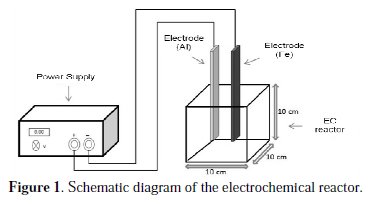
    <p>The experimental set up used in this study is shown in <a href="#f1">Fig. 1</a>, which mainly 
consisted of a 1200 mL cell used as a reactor to hold a sample of 1000 mL.</p>


    ]]></body>
<body><![CDATA[<p>&nbsp;</p>
<a name="f1">
<img src="/img/revistas/pea/v33n4/33n4a03f1.jpg">
    
<p>&nbsp;</p>


    <p>Iron (Fe) and aluminum (Al) plates of 0.25 cm thickness &times; 2.5 cm width &times; 15 cm 
height were used as electrodes. The total effective surface area of electrodes was 
22.6 cm<sup>2</sup>. The potential was maintained constant by means of a precision digital 
direct current power supply DC-PHYWE (0-50 V); electrolysis was carried out 
for 90 min. All experiments were conducted in batch mode of operation and the 
pH of the wastewater was monitored. After the experiments, the electrodes were 
polished, washed with sulfuric acid (0.10 M) and then rinsed with distilled water 
before each run. After applying current for the established period (i.e., after each 
batch experiment), the sample was stored in order to stabilize. After a settling 
period of 20 min, the supernatant sample was collected to perform the analysis of 
COD. All the experiments were performed in three replicates 
to check the reproducibility.</p>


    <p><i><b>Experimental design</b></i></p>

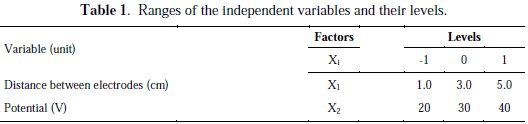
    <p>Two factors three level response surface experimental design was used to 
optimize and investigate the influence of process variables such as potential and 
distance between electrodes on the treatment of meat industry wastewater using 
EC method. Process variables and their ranges were determined based on the 
single factor experimental analysis and are shown in <a href="#t1">Table 1</a>.</p>


    <p>&nbsp;</p>
<a name="t1">
<img src="/img/revistas/pea/v33n4/33n4a03t1.jpg">
    
<p>&nbsp;</p>


    <p>After selection of 
process (independent) variables and their ranges, experiments were established 
based on an experimental design (3<sup>2</sup>) which consists of 27 experiments. The aim 
of the experimental design and analysis was to define the effective factors, and to 
select the levels which give the maximum COD removal efficiency. The results 
were analyzed using Statgraphics Centurion XV.II software.</p>


    <p><i><b>Electrochemical energetic consumption</b></i></p>

    <p>The electrical energy consumption was calculated in terms of kWh [15].</p>


    ]]></body>
<body><![CDATA[<p>&nbsp;</p>
<a name="e1">
<img src="/img/revistas/pea/v33n4/33n4a03e1.jpg">
    
<p>&nbsp;</p>


    <p>where U is the cell voltage (V), I is the current (A), t is the time of EC (h).</p>


    <p>&nbsp;</p>
    <p><b>Results and discussions</b></p>

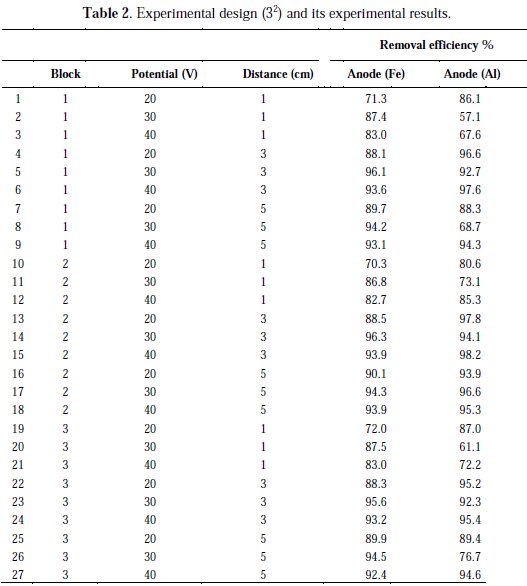
    <p>Two factors with three levels were used to evaluate and optimize the 
electrochemical treatment process variables on responses, such as, COD removal 
from meat industry wastewater. According to experimental design, a total of 27 
batch experiments were carried out in triplicates and the results (mean values) are 
shown in <a href="#t2">Table 2</a>.</p>


    <p>&nbsp;</p>
<a name="t2">
<img src="/img/revistas/pea/v33n4/33n4a03t2.jpg">
    
<p>&nbsp;</p>


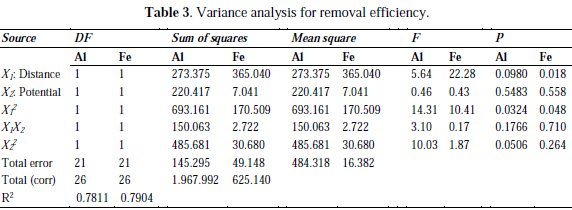
    <p>The results were analyzed using RSM, and the ANOVA table on the COD 
concentrations is given in <a href="#t3">Table 3</a>.</p>


    <p>&nbsp;</p>
<a name="t3">
<img src="/img/revistas/pea/v33n4/33n4a03t3.jpg">
    
]]></body>
<body><![CDATA[<p>&nbsp;</p>


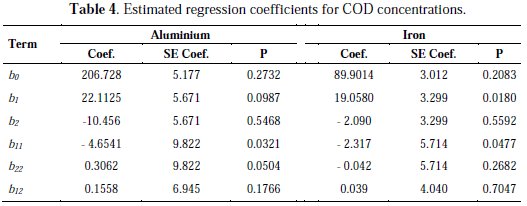
    <p>It can be seen that both linear and quadratic 
terms are effective factors on the optimization of COD concentration removal, 
due to their p values (p &lt; 0.05). Interaction terms have no statistical significant 
effect on the COD concentrations. In this second degree mathematical model, R<sup>2</sup> 
(adjusted), which is a measure of the amount of reduction in the variability of y 
obtained by using regression variables; x1, x2 and x22 is 78.1 % (Al) and 79 % 
(Fe) [11-12]. The estimated regression coefficients of linear and quadratic terms 
of the factors are given in <a href="#t4">Table 4</a>.</p>


    <p>&nbsp;</p>
<a name="t4">
<img src="/img/revistas/pea/v33n4/33n4a03t4.jpg">
    
<p>&nbsp;</p>


    <p>The remaining percentage of the total 
variation is explained by setting a mathematical model and it shows that the 
mathematical model with coded values is appropriate and acceptable. The 
mathematical model is obtained as follows:</p>

    <p>Aluminum</p>


    <p>&nbsp;</p>
<a name="e2">
<img src="/img/revistas/pea/v33n4/33n4a03e2.jpg">
    
<p>&nbsp;</p>


    <p>Iron</p>


    <p>&nbsp;</p>
<a name="e3">
<img src="/img/revistas/pea/v33n4/33n4a03e3.jpg">
    
]]></body>
<body><![CDATA[<p>&nbsp;</p>


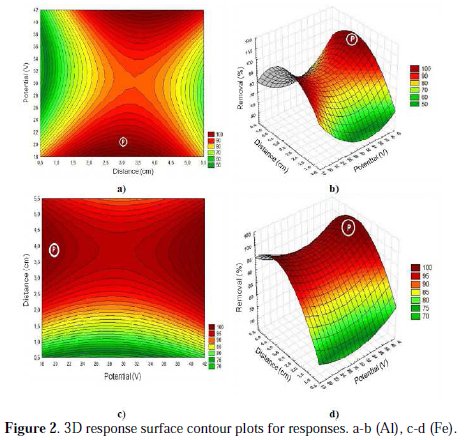
    <p>Three dimensional (3D) response surface plots were constructed from the 
developed models in order to study the individual and interactive effect of the 
process variables on the responses and also used to identify the optimal condition 
of each factor to determine the maximum removal efficiency of COD (<a href="#f2">Fig. 2</a>).</p>


    <p>&nbsp;</p>
<a name="f2">
<img src="/img/revistas/pea/v33n4/33n4a03f2.jpg">
    
<p>&nbsp;</p>


    <p>The point indicated by the letter P for each graph shows removal &gt; 90%. From 
the results, it is found that the removal efficiency of COD increased with 
increasing the potential applied. This is attributed to the higher formation of 
Fe(OH)3 and Al(OH)3 species, which have strong affinity towards organic 
matters present in the wastewater to be treated, thus the removal efficiencies are 
increased [13-14]. Further, there is a negligible effect on removal efficiencies of 
COD. Although not tested, pH is an important operating factor influencing the 
performance of the electrochemical process. This can explained by the fact that, 
when the pH is in the range of 6-7 (pH found for meat industry wastewater was 
of 7.4), the formation of Fe(III) and Al (III) species in the form of Fe(OH)3 and 
Al(OH)3 are seen, which increases the COD removal efficiency [15-17]. Distance 
between electrodes is one of the most important parameter that affects the 
electrocoagulation method to treat meat industry wastewater. From the results, it 
is found that the removal efficiency of COD increased with increasing the 
distance. This is attributed to the electrostatic field which is formed during the 
electrocoagulation process and depends on the distance between electrodes 
generating the metal ions produced by the anode, which main function is to 
destabilize loadings possessing contaminant particles present in water, neutralize 
the systems that keep the particles in suspension, allowing the formation of 
contaminant aggregates and initiating the coagulation process [18-19].</p>

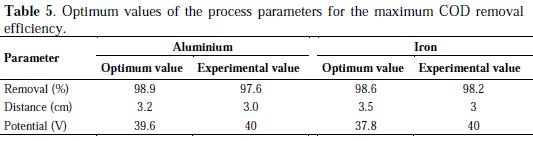
    <p>The model generates the optimum values for the variables in order to obtain the 
maximum Hg removal efficiency as a function of potential and distance between 
electrodes (<a href="#t5">Table 5</a>).</p>


    <p>&nbsp;</p>
<a name="t5">
<img src="/img/revistas/pea/v33n4/33n4a03t5.jpg">
    
<p>&nbsp;</p>


    <p>Significant differences were not observed (p &lt; 0.05) when a 
point near to the maximum response is compared to the corresponding 
experimental value, which confirms that RSM can be used to optimize the 
process parameters.</p>


    <p><i><b>Economic evaluation</b></i></p>

    ]]></body>
<body><![CDATA[<p>The implementation of EC unit in large scale level mainly depends on the cost of 
the treatment process. In order to find out the economy of the proposed treatment 
method, the economic evaluation is made in optimum operating conditions and it 
is found that the energy required to treat wastewater by EC is 0.03 kWh and 
given the price of Kwh in Colombia ($349.7; $US 0.13), the final cost for 
treatment is $10.49 for volume of solution (0.001 m3), the equivalent to 10490 
$/m3 (3.99 $US/m3). This result illustrates the economic feasibility of the 
proposed treatment in the on-field implementation, i.e., wastewater treatment 
plants (WTP's).</p>


    <p>&nbsp;</p>
    <p><b>Conclusions</b></p>

    <p>These results indicated that electrocoagulation process is an effective treatment 
method to treat meat industry wastewater (frigorific) in terms of removal 
efficiency with reasonable operating cost. The optimal operating conditions were 
found to be: potential (Al: 39.6 V; Fe: 37.8 V), distance (Al: 3.2 cm; Fe: 3.5 cm). 
Under identical conditions (40 V, 3 cm), the removal efficiency of COD was 
found to be 97.6% (Al) and 98% (Fe). Significant differences were not observed 
(p&lt;0.05) between the COD removal using iron or aluminum as sacrificial 
electrode. This study is a first step in implementing systems with continuous 
electrocoagulation of meat industry wastewater.</p>


    <p>&nbsp;</p>
    <p><b>References</b></p>

    <!-- ref --><p>1. Masse D I, Masse L. Canad Agricultural Eng. 2000;42:139.    &nbsp;&nbsp;&nbsp;&nbsp;&nbsp;&nbsp;&nbsp;&nbsp;[&#160;<a href="javascript:void(0);" onclick="javascript: window.open('/scielo.php?script=sci_nlinks&ref=000069&pid=S0872-1904201500040000300001&lng=','','width=640,height=500,resizable=yes,scrollbars=1,menubar=yes,');">Links</a>&#160;]<!-- end-ref --></p>

    <!-- ref --><p>2. Shahzad Z I, Sonia N, Muhammad R A, et al. Food Control. 2014;43:98.    &nbsp;&nbsp;&nbsp;&nbsp;&nbsp;&nbsp;&nbsp;&nbsp;[&#160;<a href="javascript:void(0);" onclick="javascript: window.open('/scielo.php?script=sci_nlinks&ref=000071&pid=S0872-1904201500040000300002&lng=','','width=640,height=500,resizable=yes,scrollbars=1,menubar=yes,');">Links</a>&#160;]<!-- end-ref --></p>

    ]]></body>
<body><![CDATA[<!-- ref --><p>3. Li F, Wichmann K, Otterpohl R. Sci Total Environ. 2009;407:3439.    &nbsp;&nbsp;&nbsp;&nbsp;&nbsp;&nbsp;&nbsp;&nbsp;[&#160;<a href="javascript:void(0);" onclick="javascript: window.open('/scielo.php?script=sci_nlinks&ref=000073&pid=S0872-1904201500040000300003&lng=','','width=640,height=500,resizable=yes,scrollbars=1,menubar=yes,');">Links</a>&#160;]<!-- end-ref --></p>

    <!-- ref --><p>4. MINAMBIENTE y Sociedad de agricultores de Colombia. Guia ambiental 
para las plantas de beneficio del ganado. Bogota. 2002:1&nbsp;&nbsp;&nbsp;&nbsp;&nbsp;&nbsp;&nbsp;&nbsp;[&#160;<a href="javascript:void(0);" onclick="javascript: window.open('/scielo.php?script=sci_nlinks&ref=000075&pid=S0872-1904201500040000300004&lng=','','width=640,height=500,resizable=yes,scrollbars=1,menubar=yes,');">Links</a>&#160;]<!-- end-ref --><!-- ref --><p>5. Guerrero J, Ramirez I. Scientia Et Technica. 2004;26:199.    &nbsp;&nbsp;&nbsp;&nbsp;&nbsp;&nbsp;&nbsp;&nbsp;[&#160;<a href="javascript:void(0);" onclick="javascript: window.open('/scielo.php?script=sci_nlinks&ref=000076&pid=S0872-1904201500040000300005&lng=','','width=640,height=500,resizable=yes,scrollbars=1,menubar=yes,');">Links</a>&#160;]<!-- end-ref --></p>

    <!-- ref --><p>6. Xiong Y A, Strunk P J, Xia H, et al. Water Res. 2001;35:4226.    &nbsp;&nbsp;&nbsp;&nbsp;&nbsp;&nbsp;&nbsp;&nbsp;[&#160;<a href="javascript:void(0);" onclick="javascript: window.open('/scielo.php?script=sci_nlinks&ref=000078&pid=S0872-1904201500040000300006&lng=','','width=640,height=500,resizable=yes,scrollbars=1,menubar=yes,');">Links</a>&#160;]<!-- end-ref --></p>

    <!-- ref --><p>7. Alinsafi A, Khemis M, Pons M N, et al. Chem Eng Processing. 2005;44:461.    &nbsp;&nbsp;&nbsp;&nbsp;&nbsp;&nbsp;&nbsp;&nbsp;[&#160;<a href="javascript:void(0);" onclick="javascript: window.open('/scielo.php?script=sci_nlinks&ref=000080&pid=S0872-1904201500040000300007&lng=','','width=640,height=500,resizable=yes,scrollbars=1,menubar=yes,');">Links</a>&#160;]<!-- end-ref --></p>

    <!-- ref --><p>8. Emamjomeh M M, Sivakumar M. J Environ Manage. 2009;90:1663.    &nbsp;&nbsp;&nbsp;&nbsp;&nbsp;&nbsp;&nbsp;&nbsp;[&#160;<a href="javascript:void(0);" onclick="javascript: window.open('/scielo.php?script=sci_nlinks&ref=000082&pid=S0872-1904201500040000300008&lng=','','width=640,height=500,resizable=yes,scrollbars=1,menubar=yes,');">Links</a>&#160;]<!-- end-ref --></p>

    <!-- ref --><p>9. Harif T, Khai M, Adin A. Water Res. 2012;46:3177.    &nbsp;&nbsp;&nbsp;&nbsp;&nbsp;&nbsp;&nbsp;&nbsp;[&#160;<a href="javascript:void(0);" onclick="javascript: window.open('/scielo.php?script=sci_nlinks&ref=000084&pid=S0872-1904201500040000300009&lng=','','width=640,height=500,resizable=yes,scrollbars=1,menubar=yes,');">Links</a>&#160;]<!-- end-ref --></p>

    <p>10. APHA. 25th ed. New York: American Public Health Association, American 
Water Works Association, Water Pollution Control Federation; 2012.</p>

    <!-- ref --><p>11. Hines W H, Montgomery D C. Probability and Statistics in Engineering and 
Management Science. 3rd ed. New York: John Wiley &amp; Sons; 1990.    &nbsp;&nbsp;&nbsp;&nbsp;&nbsp;&nbsp;&nbsp;&nbsp;[&#160;<a href="javascript:void(0);" onclick="javascript: window.open('/scielo.php?script=sci_nlinks&ref=000087&pid=S0872-1904201500040000300011&lng=','','width=640,height=500,resizable=yes,scrollbars=1,menubar=yes,');">Links</a>&#160;]<!-- end-ref --></p>

    <!-- ref --><p>12. Montgomery D C. Design and analysis of experiments. Nebraska: John Wiley &amp; Sons; 2000.    &nbsp;&nbsp;&nbsp;&nbsp;&nbsp;&nbsp;&nbsp;&nbsp;[&#160;<a href="javascript:void(0);" onclick="javascript: window.open('/scielo.php?script=sci_nlinks&ref=000089&pid=S0872-1904201500040000300012&lng=','','width=640,height=500,resizable=yes,scrollbars=1,menubar=yes,');">Links</a>&#160;]<!-- end-ref --></p>

    <!-- ref --><p>13. Daneshvar N, Khataee A R, Ghadim A R A, et al. J Hazard Mater. 2007;148:566.    &nbsp;&nbsp;&nbsp;&nbsp;&nbsp;&nbsp;&nbsp;&nbsp;[&#160;<a href="javascript:void(0);" onclick="javascript: window.open('/scielo.php?script=sci_nlinks&ref=000091&pid=S0872-1904201500040000300013&lng=','','width=640,height=500,resizable=yes,scrollbars=1,menubar=yes,');">Links</a>&#160;]<!-- end-ref --></p>

    ]]></body>
<body><![CDATA[<p>14. Thirugnanasambandham K, Sivakumar V, Prakash Maran J. J Serb Chem Soc. 2014;79:743.</p>

    <p>15. Thirugnanasambandham K, Sivakumar V, Prakash Maran J. J Korean Chem Soc. 2014; 58:198.</p>

    <!-- ref --><p>16. Behbahani M, Alavi Moghaddam M R, Arami M. Desalination. 2011;271:209.    &nbsp;&nbsp;&nbsp;&nbsp;&nbsp;&nbsp;&nbsp;&nbsp;[&#160;<a href="javascript:void(0);" onclick="javascript: window.open('/scielo.php?script=sci_nlinks&ref=000095&pid=S0872-1904201500040000300016&lng=','','width=640,height=500,resizable=yes,scrollbars=1,menubar=yes,');">Links</a>&#160;]<!-- end-ref --></p>

    <!-- ref --><p>17. Gengec E, Kobya M, Demirbas E, et al. Desalination. 2012;286:200.    &nbsp;&nbsp;&nbsp;&nbsp;&nbsp;&nbsp;&nbsp;&nbsp;[&#160;<a href="javascript:void(0);" onclick="javascript: window.open('/scielo.php?script=sci_nlinks&ref=000097&pid=S0872-1904201500040000300017&lng=','','width=640,height=500,resizable=yes,scrollbars=1,menubar=yes,');">Links</a>&#160;]<!-- end-ref --></p>

    <!-- ref --><p>18. Holt P, Barton G, Mitchell C. Electrocoagulation as a Wastewater 
Treatment. The Third Annual Australian Environmental Engineering Research Event.1999.    &nbsp;&nbsp;&nbsp;&nbsp;&nbsp;&nbsp;&nbsp;&nbsp;[&#160;<a href="javascript:void(0);" onclick="javascript: window.open('/scielo.php?script=sci_nlinks&ref=000099&pid=S0872-1904201500040000300018&lng=','','width=640,height=500,resizable=yes,scrollbars=1,menubar=yes,');">Links</a>&#160;]<!-- end-ref --></p>

    <!-- ref --><p>19. Daneshvar N, Sorkhabi H A, Kasiri M B. J Hazard Mater. 2004;112:55.    &nbsp;&nbsp;&nbsp;&nbsp;&nbsp;&nbsp;&nbsp;&nbsp;[&#160;<a href="javascript:void(0);" onclick="javascript: window.open('/scielo.php?script=sci_nlinks&ref=000101&pid=S0872-1904201500040000300019&lng=','','width=640,height=500,resizable=yes,scrollbars=1,menubar=yes,');">Links</a>&#160;]<!-- end-ref --></p>


    ]]></body>
<body><![CDATA[<p>&nbsp;</p>
    <p><b>Acknowledgements</b></p>

    <p>The authors wish to thank the University of Cordoba, Monteria-Colombia, 
Water, Applied and Environmental Chemistry Group, Laboratory of Toxicology 
and Environmental Management, University of Cordoba, Monteria-Colombia.</p>


    <p>&nbsp;</p>
    <p><a name=0></a><sup><a href="#top">*</a></sup>Corresponding author. E-mail address: <a href="mailto:josejph@hotmail.com">josejph@hotmail.com</a></p>

    <p>Received 9 March 2015; accepted 23 August 2015</p>

    <p><a href="http://www.peacta.org" target="_blank">www.peacta.org</a> </p>


     ]]></body><back>
<ref-list>
<ref id="B1">
<label>1</label><nlm-citation citation-type="journal">
<person-group person-group-type="author">
<name>
<surname><![CDATA[Masse]]></surname>
<given-names><![CDATA[D I]]></given-names>
</name>
<name>
<surname><![CDATA[Masse]]></surname>
<given-names><![CDATA[L]]></given-names>
</name>
</person-group>
<source><![CDATA[Canad Agricultural Eng]]></source>
<year>2000</year>
<volume>42</volume>
<page-range>139</page-range></nlm-citation>
</ref>
<ref id="B2">
<label>2</label><nlm-citation citation-type="journal">
<person-group person-group-type="author">
<name>
<surname><![CDATA[Shahzad]]></surname>
<given-names><![CDATA[Z I]]></given-names>
</name>
<name>
<surname><![CDATA[Sonia]]></surname>
<given-names><![CDATA[N]]></given-names>
</name>
<name>
<surname><![CDATA[Muhammad]]></surname>
<given-names><![CDATA[R A]]></given-names>
</name>
</person-group>
<source><![CDATA[Food Control]]></source>
<year>2014</year>
<volume>43</volume>
<page-range>98</page-range></nlm-citation>
</ref>
<ref id="B3">
<label>3</label><nlm-citation citation-type="journal">
<person-group person-group-type="author">
<name>
<surname><![CDATA[Li]]></surname>
<given-names><![CDATA[F]]></given-names>
</name>
<name>
<surname><![CDATA[Wichmann]]></surname>
<given-names><![CDATA[K]]></given-names>
</name>
<name>
<surname><![CDATA[Otterpohl]]></surname>
<given-names><![CDATA[R]]></given-names>
</name>
</person-group>
<source><![CDATA[Sci Total Environ]]></source>
<year>2009</year>
<volume>407</volume>
<page-range>3439</page-range></nlm-citation>
</ref>
<ref id="B4">
<label>4</label><nlm-citation citation-type="">
<collab>MINAMBIENTE y Sociedad de agricultores de Colombia</collab>
<source><![CDATA[Guia ambiental para las plantas de beneficio del ganado]]></source>
<year>2002</year>
<page-range>1</page-range><publisher-loc><![CDATA[Bogota ]]></publisher-loc>
</nlm-citation>
</ref>
<ref id="B5">
<label>5</label><nlm-citation citation-type="journal">
<person-group person-group-type="author">
<name>
<surname><![CDATA[Guerrero]]></surname>
<given-names><![CDATA[J]]></given-names>
</name>
<name>
<surname><![CDATA[Ramirez]]></surname>
<given-names><![CDATA[I]]></given-names>
</name>
</person-group>
<source><![CDATA[Scientia Et Technica]]></source>
<year>2004</year>
<volume>26</volume>
<page-range>199</page-range></nlm-citation>
</ref>
<ref id="B6">
<label>6</label><nlm-citation citation-type="journal">
<person-group person-group-type="author">
<name>
<surname><![CDATA[Xiong]]></surname>
<given-names><![CDATA[Y A]]></given-names>
</name>
<name>
<surname><![CDATA[Strunk]]></surname>
<given-names><![CDATA[P J]]></given-names>
</name>
<name>
<surname><![CDATA[Xia]]></surname>
<given-names><![CDATA[H]]></given-names>
</name>
</person-group>
<source><![CDATA[Water Res]]></source>
<year>2001</year>
<volume>35</volume>
<page-range>4226</page-range></nlm-citation>
</ref>
<ref id="B7">
<label>7</label><nlm-citation citation-type="journal">
<person-group person-group-type="author">
<name>
<surname><![CDATA[Alinsafi]]></surname>
<given-names><![CDATA[A]]></given-names>
</name>
<name>
<surname><![CDATA[Khemis]]></surname>
<given-names><![CDATA[M]]></given-names>
</name>
<name>
<surname><![CDATA[Pons]]></surname>
<given-names><![CDATA[M N]]></given-names>
</name>
</person-group>
<source><![CDATA[Chem Eng Processing]]></source>
<year>2005</year>
<volume>44</volume>
<page-range>461</page-range></nlm-citation>
</ref>
<ref id="B8">
<label>8</label><nlm-citation citation-type="journal">
<person-group person-group-type="author">
<name>
<surname><![CDATA[Emamjomeh]]></surname>
<given-names><![CDATA[M M]]></given-names>
</name>
<name>
<surname><![CDATA[Sivakumar]]></surname>
<given-names><![CDATA[M]]></given-names>
</name>
</person-group>
<source><![CDATA[J Environ Manage]]></source>
<year>2009</year>
<volume>90</volume>
<page-range>1663</page-range></nlm-citation>
</ref>
<ref id="B9">
<label>9</label><nlm-citation citation-type="journal">
<person-group person-group-type="author">
<name>
<surname><![CDATA[Harif]]></surname>
<given-names><![CDATA[T]]></given-names>
</name>
<name>
<surname><![CDATA[Khai]]></surname>
<given-names><![CDATA[M]]></given-names>
</name>
<name>
<surname><![CDATA[Adin]]></surname>
<given-names><![CDATA[A]]></given-names>
</name>
</person-group>
<source><![CDATA[Water Res]]></source>
<year>2012</year>
<volume>46</volume>
<page-range>3177</page-range></nlm-citation>
</ref>
<ref id="B10">
<label>10</label><nlm-citation citation-type="">
<collab>APHA^dAmerican Public Health Association, American Water Works Association, Water Pollution Control Federation</collab>
<source><![CDATA[]]></source>
<year>2012</year>
<edition>25</edition>
<publisher-loc><![CDATA[New York ]]></publisher-loc>
</nlm-citation>
</ref>
<ref id="B11">
<label>11</label><nlm-citation citation-type="book">
<person-group person-group-type="author">
<name>
<surname><![CDATA[Hines]]></surname>
<given-names><![CDATA[W H]]></given-names>
</name>
<name>
<surname><![CDATA[Montgomery]]></surname>
<given-names><![CDATA[D C]]></given-names>
</name>
</person-group>
<source><![CDATA[Probability and Statistics in Engineering and Management Science]]></source>
<year>1990</year>
<edition>3</edition>
<publisher-loc><![CDATA[New York ]]></publisher-loc>
<publisher-name><![CDATA[John Wiley & Sons]]></publisher-name>
</nlm-citation>
</ref>
<ref id="B12">
<label>12</label><nlm-citation citation-type="book">
<person-group person-group-type="author">
<name>
<surname><![CDATA[Montgomery]]></surname>
<given-names><![CDATA[D C]]></given-names>
</name>
</person-group>
<source><![CDATA[Design and analysis of experiments]]></source>
<year>2000</year>
<publisher-loc><![CDATA[Nebraska ]]></publisher-loc>
<publisher-name><![CDATA[John Wiley & Sons]]></publisher-name>
</nlm-citation>
</ref>
<ref id="B13">
<label>13</label><nlm-citation citation-type="journal">
<person-group person-group-type="author">
<name>
<surname><![CDATA[Daneshvar]]></surname>
<given-names><![CDATA[N]]></given-names>
</name>
<name>
<surname><![CDATA[Khataee]]></surname>
<given-names><![CDATA[A R]]></given-names>
</name>
<name>
<surname><![CDATA[Ghadim]]></surname>
<given-names><![CDATA[A R A]]></given-names>
</name>
</person-group>
<source><![CDATA[J Hazard Mater]]></source>
<year>2007</year>
<volume>148</volume>
<page-range>566</page-range></nlm-citation>
</ref>
<ref id="B14">
<label>14</label><nlm-citation citation-type="journal">
<person-group person-group-type="author">
<name>
<surname><![CDATA[Thirugnanasambandham]]></surname>
<given-names><![CDATA[K]]></given-names>
</name>
<name>
<surname><![CDATA[Sivakumar]]></surname>
<given-names><![CDATA[V]]></given-names>
</name>
<name>
<surname><![CDATA[Prakash]]></surname>
<given-names><![CDATA[M J]]></given-names>
</name>
</person-group>
<source><![CDATA[J Serb Chem Soc]]></source>
<year>2014</year>
<volume>79</volume>
<page-range>743</page-range></nlm-citation>
</ref>
<ref id="B15">
<label>15</label><nlm-citation citation-type="journal">
<person-group person-group-type="author">
<name>
<surname><![CDATA[Thirugnanasambandham]]></surname>
<given-names><![CDATA[K]]></given-names>
</name>
<name>
<surname><![CDATA[Sivakumar]]></surname>
<given-names><![CDATA[V]]></given-names>
</name>
<name>
<surname><![CDATA[Prakash]]></surname>
<given-names><![CDATA[M J]]></given-names>
</name>
</person-group>
<source><![CDATA[J Korean Chem Soc]]></source>
<year>2014</year>
<volume>58</volume>
<page-range>198</page-range></nlm-citation>
</ref>
<ref id="B16">
<label>16</label><nlm-citation citation-type="journal">
<person-group person-group-type="author">
<name>
<surname><![CDATA[Behbahani]]></surname>
<given-names><![CDATA[M]]></given-names>
</name>
<name>
<surname><![CDATA[Alavi Moghaddam]]></surname>
<given-names><![CDATA[M R]]></given-names>
</name>
<name>
<surname><![CDATA[Arami]]></surname>
<given-names><![CDATA[M]]></given-names>
</name>
</person-group>
<source><![CDATA[Desalination]]></source>
<year>2011</year>
<volume>271</volume>
<page-range>209</page-range></nlm-citation>
</ref>
<ref id="B17">
<label>17</label><nlm-citation citation-type="journal">
<person-group person-group-type="author">
<name>
<surname><![CDATA[Gengec]]></surname>
<given-names><![CDATA[E]]></given-names>
</name>
<name>
<surname><![CDATA[Kobya]]></surname>
<given-names><![CDATA[M]]></given-names>
</name>
<name>
<surname><![CDATA[Demirbas]]></surname>
<given-names><![CDATA[E]]></given-names>
</name>
</person-group>
<source><![CDATA[Desalination]]></source>
<year>2012</year>
<volume>286</volume>
<page-range>200</page-range></nlm-citation>
</ref>
<ref id="B18">
<label>18</label><nlm-citation citation-type="confpro">
<person-group person-group-type="author">
<name>
<surname><![CDATA[Holt]]></surname>
<given-names><![CDATA[P]]></given-names>
</name>
<name>
<surname><![CDATA[Barton]]></surname>
<given-names><![CDATA[G]]></given-names>
</name>
<name>
<surname><![CDATA[Mitchell]]></surname>
<given-names><![CDATA[C]]></given-names>
</name>
</person-group>
<source><![CDATA[Electrocoagulation as a Wastewater Treatment]]></source>
<year></year>
<conf-name><![CDATA[ The Third Annual Australian Environmental Engineering Research Event]]></conf-name>
<conf-date>1999</conf-date>
<conf-loc> </conf-loc>
</nlm-citation>
</ref>
<ref id="B19">
<label>19</label><nlm-citation citation-type="journal">
<person-group person-group-type="author">
<name>
<surname><![CDATA[Daneshvar]]></surname>
<given-names><![CDATA[N]]></given-names>
</name>
<name>
<surname><![CDATA[Sorkhabi]]></surname>
<given-names><![CDATA[H A]]></given-names>
</name>
<name>
<surname><![CDATA[Kasiri]]></surname>
<given-names><![CDATA[M B]]></given-names>
</name>
</person-group>
<source><![CDATA[J Hazard Mater]]></source>
<year>2004</year>
<volume>112</volume>
<page-range>55</page-range></nlm-citation>
</ref>
</ref-list>
</back>
</article>