<?xml version="1.0" encoding="ISO-8859-1"?><article xmlns:mml="http://www.w3.org/1998/Math/MathML" xmlns:xlink="http://www.w3.org/1999/xlink" xmlns:xsi="http://www.w3.org/2001/XMLSchema-instance">
<front>
<journal-meta>
<journal-id>0872-1904</journal-id>
<journal-title><![CDATA[Portugaliae Electrochimica Acta]]></journal-title>
<abbrev-journal-title><![CDATA[Port. Electrochim. Acta]]></abbrev-journal-title>
<issn>0872-1904</issn>
<publisher>
<publisher-name><![CDATA[Sociedade Portuguesa de Electroquímica]]></publisher-name>
</publisher>
</journal-meta>
<article-meta>
<article-id>S0872-19042015000400004</article-id>
<article-id pub-id-type="doi">10.4152/pea.201504231</article-id>
<title-group>
<article-title xml:lang="en"><![CDATA[Anticorrosive Properties of Chitosan for the Acid Corrosion of Aluminium]]></article-title>
</title-group>
<contrib-group>
<contrib contrib-type="author">
<name>
<surname><![CDATA[Abd-El-Nabey]]></surname>
<given-names><![CDATA[B. A.]]></given-names>
</name>
<xref ref-type="aff" rid="A01"/>
</contrib>
<contrib contrib-type="author">
<name>
<surname><![CDATA[Goher]]></surname>
<given-names><![CDATA[Y. M.]]></given-names>
</name>
<xref ref-type="aff" rid="A02"/>
</contrib>
<contrib contrib-type="author">
<name>
<surname><![CDATA[Fetouh]]></surname>
<given-names><![CDATA[H. A.]]></given-names>
</name>
<xref ref-type="aff" rid="A01"/>
</contrib>
<contrib contrib-type="author">
<name>
<surname><![CDATA[Karam]]></surname>
<given-names><![CDATA[M. S.]]></given-names>
</name>
<xref ref-type="aff" rid="A01"/>
</contrib>
</contrib-group>
<aff id="A01">
<institution><![CDATA[,Alexandria University Faculty of Science Department of Chemistry]]></institution>
<addr-line><![CDATA[Alexandria ]]></addr-line>
<country>Egypt</country>
</aff>
<aff id="A02">
<institution><![CDATA[,Alexandria University Faculty of Science Department of Botany]]></institution>
<addr-line><![CDATA[Alexandria ]]></addr-line>
<country>Egypt</country>
</aff>
<pub-date pub-type="pub">
<day>00</day>
<month>07</month>
<year>2015</year>
</pub-date>
<pub-date pub-type="epub">
<day>00</day>
<month>07</month>
<year>2015</year>
</pub-date>
<volume>33</volume>
<numero>4</numero>
<fpage>231</fpage>
<lpage>239</lpage>
<copyright-statement/>
<copyright-year/>
<self-uri xlink:href="http://scielo.pt/scielo.php?script=sci_arttext&amp;pid=S0872-19042015000400004&amp;lng=en&amp;nrm=iso"></self-uri><self-uri xlink:href="http://scielo.pt/scielo.php?script=sci_abstract&amp;pid=S0872-19042015000400004&amp;lng=en&amp;nrm=iso"></self-uri><self-uri xlink:href="http://scielo.pt/scielo.php?script=sci_pdf&amp;pid=S0872-19042015000400004&amp;lng=en&amp;nrm=iso"></self-uri><abstract abstract-type="short" xml:lang="en"><p><![CDATA[Potentiodynamic polarization and electrochemical impedance spectroscopy (EIS) techniques were used to measure the corrosion rate of aluminium in 0.1 M HCl in the absence and presence of different concentrations of chitosan. Inhibition efficiency up to 90% in the presence of 0.028 g/L chitosan was achieved. Increasing the concentration of chitosan shifted the breakdown potential, Eb, of aluminium to more noble values and inhbitied the pitting corrosion of aluminium. Measurements of the break potential, Eb, and the electrical double layer capacity (Qdl) indicated that chitosan is adsorbed at the aluminium/solution interface.]]></p></abstract>
<kwd-group>
<kwd lng="en"><![CDATA[aluminium]]></kwd>
<kwd lng="en"><![CDATA[polarization curves]]></kwd>
<kwd lng="en"><![CDATA[pitting corrosion]]></kwd>
<kwd lng="en"><![CDATA[Electrochemical Impedance Spectroscopy (EIS)]]></kwd>
<kwd lng="en"><![CDATA[charge transfer]]></kwd>
<kwd lng="en"><![CDATA[adsorption]]></kwd>
</kwd-group>
</article-meta>
</front><body><![CDATA[ 

<!--     <p>&nbsp;</p>
    <p>doi: 10.4152/pea.201504231</p> -->

    <p><b>Anticorrosive Properties of Chitosan for the Acid Corrosion of Aluminium</b></p>

    <p>
<b>B. A. Abd-El-Nabey</b><sup><i>a</i>,<a href="#0">*</a></sup>
, <b>Y. M. Goher</b><sup><i>b</i></sup>
, <b>H. A. Fetouh</b><sup><i>a</i>,<a href="#0">*</a></sup>
 and <b>M. S. Karam</b><sup><i>a</i></sup>
</p>

    <p><i><sup>a</sup> Department of Chemistry, Faculty of Science, Alexandria University, Ibrahimia, P.O. Box 426, Alexandria 21321, Egypt</i></p>

    <p><i><sup>b</sup> Department of Botany, Faculty of Science, Alexandria University, Ibrahimia, P.O. Box 426, Alexandria 21321, Egypt</i></p>


    <p>&nbsp;</p>
    <p><b>Abstract</b></p>

    <p>Potentiodynamic polarization and electrochemical impedance spectroscopy (EIS) 
techniques were used to measure the corrosion rate of aluminium in 0.1 M HCl in the 
absence and presence of different concentrations of chitosan. Inhibition efficiency up to 
90% in the presence of 0.028 g/L chitosan was achieved. Increasing the concentration of 
chitosan shifted the breakdown potential, Eb, of aluminium to more noble values and 
inhbitied the pitting corrosion of aluminium. Measurements of the break potential, Eb, 
and the electrical double layer capacity (Qdl) indicated that chitosan is adsorbed at the 
aluminium/solution interface.</p>

    ]]></body>
<body><![CDATA[<p><b><i>Keywords:</i></b> aluminium, polarization curves, pitting corrosion, Electrochemical 
Impedance Spectroscopy (EIS), charge transfer, adsorption.</p>


    <p>&nbsp;</p>
    <p><b>Introduction</b></p>

    <p>Aluminium was reported to be widely applied in aluminium-air technology, food 
industry and desalination plants. These industrial applications are due to the low 
density, favorable mechanical properties, good finishing, benign effect on the 
environment and the human health. The high corrosion resistance of aluminium 
is attributed to the natural surface protective oxide film. Aluminium suffers from 
pitting corrosion by chloride ion and many organic inhibitors are reported for the 
corrosion of aluminium in hydrochloric acid solutions [1-3].</p>

    <p>Chitosan was reported to be used in the smart self-healing coating and as based 
polymer with 2-mercaptobenzothiazole anticorrosive coating for the aluminium 
alloy against the atmospheric corrosion [4, 5]. Chitosan molecules are rich in 
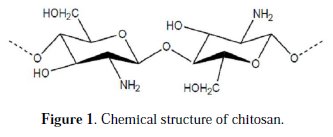
hydroxyl and amino groups (<a href="#f1">Fig. 1</a>), so it is a good potential inhibitor.</p>


    <p>&nbsp;</p>
<a name="f1">
<img src="/img/revistas/pea/v33n4/33n4a04f1.jpg">
    
<p>&nbsp;</p>


    <p>El-Haddad [6] has investigated the inhibition characteristics of chitosan for the corrosion of 
copper in 0.5 M HCl using the potentiodynamic polarization and the 
electrochemical impedance spectroscopy (EIS) techniques. The polarization 
results indicated that chitosan acted as cathodic inhibitor and shifted the 
corrosion potential of copper from (Ecorr.= -94 mV) into (Ecorr.= -174 mV) for 0.5 
M HCl solution in the absence and prescence of 8&times;10<sup>-6</sup> M chitosan respectively. 
The results also indicated that the inhibition efficiency of chitosan increased with 
increasing its concentration reaching the maximium value of 92% at the 
concentration of 8&times;10<sup>-6</sup> M chitosan at 25 &deg;C. 
This work aims to study the electrochemical behavior and the inhibition effect of 
chitosan for corrosion of aluminium in 0.1 M HCl at 30 &deg;C.</p>


    <p>&nbsp;</p>
    <p><b>Experimental</b></p>

    ]]></body>
<body><![CDATA[<p><i><b>Solution preparation</b></i></p>

    <p>Chitosan, that is a natural biopoymer, <a href="#f1">Fig. (1)</a>, was prepared in laboratory 
following the method reported elsewhere [7]. The structure of chitosan was 
elucidated by Infra red (IR) and UV-visible spectroscopy. Further 
characterization of chitosan was carried out by the determination of average 
number molecular weight and the degree of acetylation as reported previously[8]. 
Hydrochloric acid was purchased from Aldrich Chemicals Company. A stock 
solution of 1.0 M HCl solution was prepared using double distilled water. A 
stock solution of 0.1 g/L chitosan was prepared in 10% acetic acid. The test 
solutions of 0.1 M HCl containing different concentrations of chitosan were 
prepared by appropriate dilutions.</p>


    <p><i><b>Electrochemical techniques</b></i></p>

    <p>The impedance measurements were achieved by applying an alternating potential 
(AC) signal of 10 mV amplitude around the rest potential (Erest) to the electrode 
surface at the frequency range (0.1 Hz-1.0&times;10<sup>4</sup> Hz). The data indicate that 88 
reading points were recorded per decade.</p>

    <p>The polarization curves were recorded by polarizing the aluminium electrode 
surface at a scan rate of 0.5 mV/sec of direct current (DC) starting from -250 mV 
below the rest potential, Erest to +250 mV above Erest.</p>

    <p>The working electrode was the aluminium sample of the following chemical 
composition: 0.37 C, 0.212 Si, 0.002 Mn, 0.007 Cu, 0.001 Mg, 0.008 Zn, 0.007 
Ti, 0.089 Fe, 0.004 Pb, 0.003 B, 0.001 Zr, 0.0004 V, 0.0002 Cd, 0.002 Gu , 
0.0003 Ag , Al (98.64). The aluminium sample was fixed in a Teflon rod in such 
a way that only one surface area (1.227 cm<sup>2</sup>) was exposed to the test solution. 
This area was mechanically polished with emery papers of 320, 600 and 1000 
grades, washed thoroughly with double distilled water then with absolute 
ethanol. The working electrode was introduced in the electochemical cell 
containing the reference saturated calomel electrode, the counter platinium 
electrode and 25 mL of the tested solution. The cell was thermostated at 30 &deg;C for 
20 min before starting the experiment, then connected to Gill AC-potentiostat 
that forced alternating or direct potential to the working electrode, then recording 
the current signal. The open circuit or the rest potential of the working electrode 
was followed as a function of time until steady state potential (equilibrium 
potential at which the variation of potential is 1.0 mV/ min.) was established to 
ensure reliable measurements in polarization and impedance measurements in 
aerated unstirred solutions [9].</p>


    <p>&nbsp;</p>
    <p><b>Results and discussion</b></p>

    <p><i><b>Characterization of the structure of chitosan</b></i></p>

    <p>The chemical structure of the natural polymer that is shown in <a href="#f1">Fig. 1</a> was 
confirmed by various tools. Infrared spectroscopy, that is a measurement of 
intensity of the absorption of infrared (IR) radiation by a sample of chitosan at 
different wave numbers (cm<sup>-1</sup>). The IR spectrum gave a characteristic band at 
3450 cm<sup>-1</sup> due to the stretching vibrations of NH2 and OH groups and another 
band at 2925 cm<sup>-1</sup> that is a characteristic of CH2(s) symmetric vibrations. 
Chitosan showed a broad absorption peak at the wavelength (&lambda;) of 425 nm in the 
UV-visible range of electromagnetic radiations. This peak corresponds to the 
electronic transition (n-&sigma;*) of the free electrons in chitosan molecules [4]. 
The number of average molecular weight, M<sub>n</sub> of chitosan molecules was 
determined by the colligative properties methods and was found to be nearly 24 
kilo Dalton. Another evidence of the structure of chitosan is the degree of 
deacetylation of chitin (the precurser of chitosan). The deacetylation process of 
chitin was carried out by adding 50% NaOH and then boiled at 100 &deg;C for 2 
hours on a hot plate. The samples are then placed under the hood and cooled for 
30 min at the room temperature. Then the samples are washed continuously with 
50% NaOH and filtered in order to retain the solid chitosan. The samples were 
then left uncovered and oven dried at 110 &deg;C for 6 hours [8]. The chitosan 
obtained will be in a creamy-white form. The degree of acetylation was achieved 
to be 85%.</p>


    ]]></body>
<body><![CDATA[<p><i><b>Potentiodynamic polarization results</b></i></p>

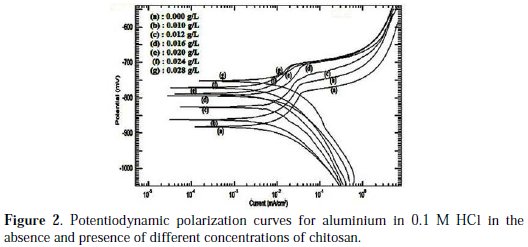
    <p><a href="#f2">Fig. 2</a> showed the potentiodynamic polarization curves for aluminium in 0.1 M 
HCl in the absence and presence of different concentrations of chitosan.</p>


    <p>&nbsp;</p>
<a name="f2">
<img src="/img/revistas/pea/v33n4/33n4a04f2.jpg">
    
<p>&nbsp;</p>


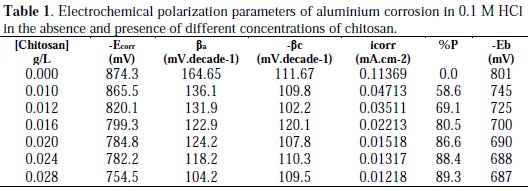
    <p>Increasing the concentration of chitosan shifted the corrosion potential, Ecorr. to 
more noble values and retarded the anodic and the cathodic reactions indicating 
that chitosan is a mixed-type inhibitor [9]. At highly cathodic overvoltages, the 
current density continuously increases. The highly anodic overvoltage causes 
breakdown of the oxide film by chloride ion that replaced the adsorbed oxygen 
gas in some defect points at the breakdown potential, Eb and the current density 
increases quickly.</p>

    <p>The anodic polarization curves showed an inflection (breakdown potential, Eb) 
corresponding to the pitting corrosion of aluminium. The breakdown potential 
was shifted to more noble values when chitosan is added, indicating retardation 
of pitting corrosion [10]. Applying Tafel extrapolation method on the cathodic 
and anodic Tafel lines gives the values of polarization parameters, including the 
corrosion potential, Ecorr, the corrosion current density, icorr, and the anodic and 
cathodic Tafel slopes, ba, bc respectively, <a href="#t1">Table 1</a>.</p>


    <p>&nbsp;</p>
<a name="t1">
<img src="/img/revistas/pea/v33n4/33n4a04t1.jpg">
    
<p>&nbsp;</p>


    <p>The slope of the cathodic Tafel line (&beta;c) remains nearly constant upon the 
addition of chitosan, indicating that the cathodic reaction which is the reduction 
of the hydrogen ion is not affected by the presence of chitosan and this step is 
charge transfer controlled. On the other hand, the slope of the anodic Tafel line 
(&beta;a) decreases by increasing the concentration of chitosan and largely decreases 
in the presence of high concentration of chitosan. This behavior indicated that the 
oxidation of aluiminium in the absence and presence of small concentrations of 
chitosan is charge transfer controlled and Tafel equation is applied. While, in the 
presence of higher concentrations of chitosan, the oxidation of aluminium is 
controlled by pitting corrosion and Tafel equation is not applicable [11].</p>


    <p><i><b>Electrochemical Impedance Spectroscopy (EIS) results</b></i></p>

    ]]></body>
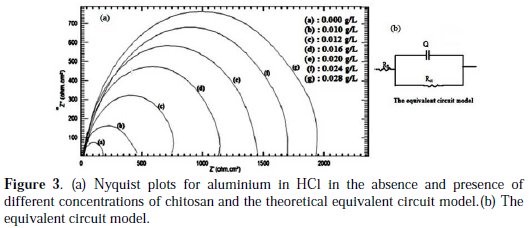
<body><![CDATA[<p>The impedance plots of aluminium as Nyquist plots and the equivalent circuit 
model fit well the impedance spectrum with a small error and are represented in 
<a href="#f3">Fig. 3 (a, b)</a>.</p>


    <p>&nbsp;</p>
<a name="f3">
<img src="/img/revistas/pea/v33n4/33n4a04f3.jpg">
    
<p>&nbsp;</p>


    <p>The Nyquist plots showed one capacitive semi-circle at high 
frequency region for all the examined solutions. These capacitive semi-circles 
indicate that the aluminium dissolution is mainly controlled by charge transfer 
process across the aluminium/solution interface. This capacitive loop is related to 
the dielectric properties of the oxide film [12, 13].</p>

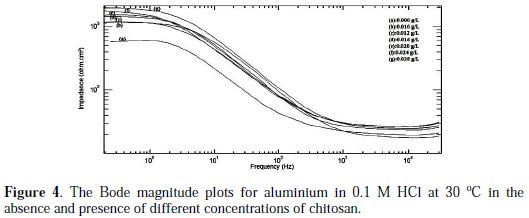
    <p>The Bode magnitude plots for aluminium in 0.1 M HCl at 30 &deg;C in the absence 
and presence of different concentrations of chitosan are shown in <a href="#f4">Fig. 4</a>.</p>


    <p>&nbsp;</p>
<a name="f4">
<img src="/img/revistas/pea/v33n4/33n4a04f4.jpg">
    
<p>&nbsp;</p>


    <p>The Bode plots explain the impedance at the high frequency region. The simulated 
spectra tof these plots indicated that the impedance increased with increasing the 
concentration of chitosan. The straight line obtained in Bode plots has a slope 
less than -0.5 indicating that the corrosion reaction is controlled by charge 
transfer, as predicted from Nyquist plots [14].</p>

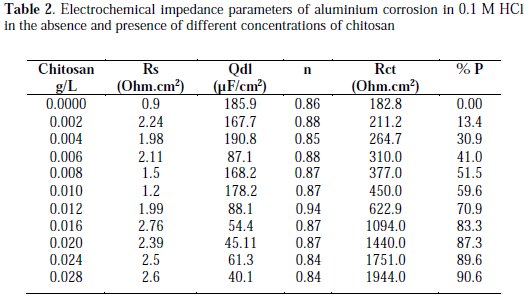
    <p>The diameter of the semicircle in the Nyquist plots increased with increasing the 
concentration of chitosan. The impedance parameters including the solution 
resistance (Rs), the charge transfer resistance, Rct, and the capacitance of the 
double layer (Qdl), are collected in <a href="#t2">Table (2)</a>.</p>


    <p>&nbsp;</p>
<a name="t2">
<img src="/img/revistas/pea/v33n4/33n4a04t2.jpg">
    
]]></body>
<body><![CDATA[<p>&nbsp;</p>


    <p>The surface coverage (&Theta;) of chitosan was calculated using the relations [9]:</p> 


    <p>&nbsp;</p>
<a name="e1">
<img src="/img/revistas/pea/v33n4/33n4a04e1.jpg">
    
<p>&nbsp;</p>


    <p>where io and Rcto, and I and Rct, are the current density and the charge transfer 
resistance in the absence and presence of different concentrations of chitosan, 
respectively.</p>


    <p>The protection efficiency % P = &Theta; &times; 100 in <a href="#t1">Tables 1</a> and <a href="#t2">2</a> indicated that there is a 
fairly agreement between the results of polarization and the impedance 
measurements.</p>

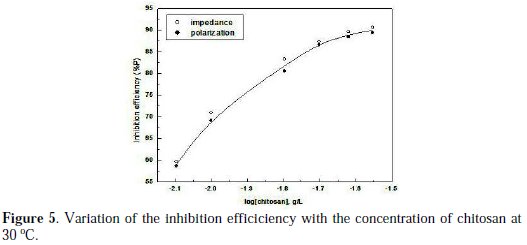
    <p>The dependence of the inhibition efficiency on the concentration of chitosan is 
shown in <a href="#f5">Fig. 5</a>.</p> 


    <p>&nbsp;</p>
<a name="f5">
<img src="/img/revistas/pea/v33n4/33n4a04f5.jpg">
    
<p>&nbsp;</p>


    <p>The rapid linear increase of (%P) followed by steadily rising 
part indicates the formation of a monomolecular film of chitosan on aluminium 
surface [15].</p>


    ]]></body>
<body><![CDATA[<p><i><b>Statistical linear regression analysis of the results</b></i></p>

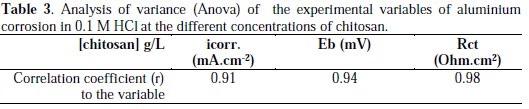
    <p>The statistical analysis of variance (Anova) method was used to analyze the 
significance of the influence of chitosan concentration on the thermodynamic 
(break down potential, Eb), and on the kinetic factors (corrosion current density 
icorr. and charge transfer resistance, Rct). High correlation coefficients (r) have 
been obtained and indicated a strong relationship between the concentration of 
chitosan and the experimental variables icorr., Rct and Eb, as shown in <a href="#t3">Table 3</a>.</p> 


    <p>&nbsp;</p>
<a name="t3">
<img src="/img/revistas/pea/v33n4/33n4a04t3.jpg">
    
<p>&nbsp;</p>


    <p><i><b>Anticorrosive action of chitosan</b></i></p>

    <p>The pitting corrosion of aluminium occured near copper and iron containing 
intermetallic particles. Both Cu and Fe are more cathodic than aluminium matrix 
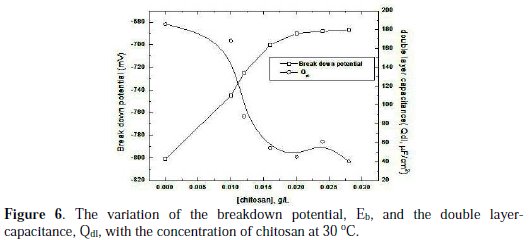
resulting in galvanic interaction [16]. <a href="#f6">Fig. (6)</a> presents the variation of each of the 
breakdown potential (Eb) and the double layer capacitance (Qdl) of aluminium in 
0.1 M HCl with the concentration of chitosan.</p> 


    <p>&nbsp;</p>
<a name="f6">
<img src="/img/revistas/pea/v33n4/33n4a04f6.jpg">
    
<p>&nbsp;</p>


    <p>It is clear that the increase of the 
concentration of chitosan leads to the shift of the breakdown potential towards 
more anodic values, while the capacitance of the double layer decreases. A 
maximum shift in the breakdown potential is attained at 0.02 g/L chitosan, the 
same concentration at which the double layer capacity has the minimum value.</p>

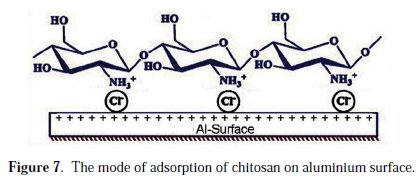
    <p>This behavior leads to the suggestion that 0.02 g/L chitosan is the concentration 
at which the adsorbed monolayer is completely formed at the aluminium surface 
and the repesentative mode of adsorption is shown in <a href="#f7">Fig. (7)</a>.</p> 


    ]]></body>
<body><![CDATA[<p>&nbsp;</p>
<a name="f7">
<img src="/img/revistas/pea/v33n4/33n4a04f7.jpg">
    
<p>&nbsp;</p>


    <p>&nbsp;</p>
    <p><b>Conclusion</b></p>

    <p>1) Increasing the concentration of chitosan shifted both the corrosion potential 
(Ecorr.) and the breakdown potential (Eb) of the aluminium in 0.1 M HCl to 
more noble values and retarded both the anodic and the cathodic reactions, 
indicating that chitosan is a mixed-type inhibitor.</p>

    <p>2) Oxidation of aluminium in 0.1 M HCl in the absence and presence of small 
concentrations of chitosan is charge transfer controlled and Tafel equation is 
applied, while in the presence of higher concentrations of chitosan, oxidation 
of aluminium is controlled by pitting corrosion and Tafel equation is not 
applicable.</p>

    <p>3) The increase of the concentration of chitosan leads to the decrease of the 
electrical double layer capacity at the aluminium/solution interface in 0.1 M 
HCl solution and shifted the breakdown potential towards more noble values. 
A maximum shift in the breakdown potential is attained at 0.02 g/L chitosan, 
and at the same concentration the double layer capacity has the minimum 
value. This concentration is required to form an adsorbed monolayer of 
chitosan at the aluminium/solution interface.</p>

    <p>4) Chitosan inhibits the pitting corrosion of aluminium in 0.1 M HCl with 
efficiency up to 90% at 0.028 g/L and acts by adsorption at the 
aluminium/solution interface.</p>


    <p>&nbsp;</p>
    <p><b>References</b></p>

    ]]></body>
<body><![CDATA[<!-- ref --><p>1. Safak S, Duran B, Yurt A, et al. Corrosion Sci. 2012;54:251.    &nbsp;&nbsp;&nbsp;&nbsp;&nbsp;&nbsp;&nbsp;&nbsp;[&#160;<a href="javascript:void(0);" onclick="javascript: window.open('/scielo.php?script=sci_nlinks&ref=000083&pid=S0872-1904201500040000400001&lng=','','width=640,height=500,resizable=yes,scrollbars=1,menubar=yes,');">Links</a>&#160;]<!-- end-ref --></p>

    <!-- ref --><p>2. Fares M M, Maayta A K, Al-Qudah M M. Corrosion Sci. 2012;60:112.    &nbsp;&nbsp;&nbsp;&nbsp;&nbsp;&nbsp;&nbsp;&nbsp;[&#160;<a href="javascript:void(0);" onclick="javascript: window.open('/scielo.php?script=sci_nlinks&ref=000085&pid=S0872-1904201500040000400002&lng=','','width=640,height=500,resizable=yes,scrollbars=1,menubar=yes,');">Links</a>&#160;]<!-- end-ref --></p>

    <!-- ref --><p>3. Abd El Aal E E, Abd El Wanees S, Farouk A, et al. Corrosion Sci. 2013;68:14.    &nbsp;&nbsp;&nbsp;&nbsp;&nbsp;&nbsp;&nbsp;&nbsp;[&#160;<a href="javascript:void(0);" onclick="javascript: window.open('/scielo.php?script=sci_nlinks&ref=000087&pid=S0872-1904201500040000400003&lng=','','width=640,height=500,resizable=yes,scrollbars=1,menubar=yes,');">Links</a>&#160;]<!-- end-ref --></p>

    <!-- ref --><p>4. Yasakau K A, Tedim J, Zheludkevich M L, et al. Handbook of Smart Coatings for Materials Protection. 2014. P. 451.    &nbsp;&nbsp;&nbsp;&nbsp;&nbsp;&nbsp;&nbsp;&nbsp;[&#160;<a href="javascript:void(0);" onclick="javascript: window.open('/scielo.php?script=sci_nlinks&ref=000089&pid=S0872-1904201500040000400004&lng=','','width=640,height=500,resizable=yes,scrollbars=1,menubar=yes,');">Links</a>&#160;]<!-- end-ref --></p>

    <!-- ref --><p>5. Carneiro J, Tedim J, Fernandes SCM, et al. Surf Coat Technol. 2013;226:51.    &nbsp;&nbsp;&nbsp;&nbsp;&nbsp;&nbsp;&nbsp;&nbsp;[&#160;<a href="javascript:void(0);" onclick="javascript: window.open('/scielo.php?script=sci_nlinks&ref=000091&pid=S0872-1904201500040000400005&lng=','','width=640,height=500,resizable=yes,scrollbars=1,menubar=yes,');">Links</a>&#160;]<!-- end-ref --></p>

    ]]></body>
<body><![CDATA[<!-- ref --><p>6. El-Haddad M N. Int J Biolog Macromol. 2013;55:142.    &nbsp;&nbsp;&nbsp;&nbsp;&nbsp;&nbsp;&nbsp;&nbsp;[&#160;<a href="javascript:void(0);" onclick="javascript: window.open('/scielo.php?script=sci_nlinks&ref=000093&pid=S0872-1904201500040000400006&lng=','','width=640,height=500,resizable=yes,scrollbars=1,menubar=yes,');">Links</a>&#160;]<!-- end-ref --></p>

    <!-- ref --><p>7. Islama M M, Masumb S M, Rahmana M M, et al. Int J Basic Appl Sci. 2011;11:77.    &nbsp;&nbsp;&nbsp;&nbsp;&nbsp;&nbsp;&nbsp;&nbsp;[&#160;<a href="javascript:void(0);" onclick="javascript: window.open('/scielo.php?script=sci_nlinks&ref=000095&pid=S0872-1904201500040000400007&lng=','','width=640,height=500,resizable=yes,scrollbars=1,menubar=yes,');">Links</a>&#160;]<!-- end-ref --></p>

    <!-- ref --><p>8. Hussain M R, Iman M, Maji T K. Int J Adv Eng Appl. 2013;6:4.    &nbsp;&nbsp;&nbsp;&nbsp;&nbsp;&nbsp;&nbsp;&nbsp;[&#160;<a href="javascript:void(0);" onclick="javascript: window.open('/scielo.php?script=sci_nlinks&ref=000097&pid=S0872-1904201500040000400008&lng=','','width=640,height=500,resizable=yes,scrollbars=1,menubar=yes,');">Links</a>&#160;]<!-- end-ref --></p>

    <!-- ref --><p>9. Abdel-Gaber A M, Abd-El-Nabey B A, Saadawy M. Corrosion Sci. 2009;51:1038.    &nbsp;&nbsp;&nbsp;&nbsp;&nbsp;&nbsp;&nbsp;&nbsp;[&#160;<a href="javascript:void(0);" onclick="javascript: window.open('/scielo.php?script=sci_nlinks&ref=000099&pid=S0872-1904201500040000400009&lng=','','width=640,height=500,resizable=yes,scrollbars=1,menubar=yes,');">Links</a>&#160;]<!-- end-ref --></p>

    <!-- ref --><p>10. Williams G, Coleman A J, McMurray H N. Electrochim Acta. 2010;55:5947.    &nbsp;&nbsp;&nbsp;&nbsp;&nbsp;&nbsp;&nbsp;&nbsp;[&#160;<a href="javascript:void(0);" onclick="javascript: window.open('/scielo.php?script=sci_nlinks&ref=000101&pid=S0872-1904201500040000400010&lng=','','width=640,height=500,resizable=yes,scrollbars=1,menubar=yes,');">Links</a>&#160;]<!-- end-ref --></p>

    ]]></body>
<body><![CDATA[<!-- ref --><p>11. Kelly G R, John R S, David W S, et al. Electrochemical Techniques in Corrosion Science and Engineering. 2002.    &nbsp;&nbsp;&nbsp;&nbsp;&nbsp;&nbsp;&nbsp;&nbsp;[&#160;<a href="javascript:void(0);" onclick="javascript: window.open('/scielo.php?script=sci_nlinks&ref=000103&pid=S0872-1904201500040000400011&lng=','','width=640,height=500,resizable=yes,scrollbars=1,menubar=yes,');">Links</a>&#160;]<!-- end-ref --></p>

    <!-- ref --><p>12. Zhang Q B, Hua Y X. Mater Chem Phys. 2010;119:57.    &nbsp;&nbsp;&nbsp;&nbsp;&nbsp;&nbsp;&nbsp;&nbsp;[&#160;<a href="javascript:void(0);" onclick="javascript: window.open('/scielo.php?script=sci_nlinks&ref=000105&pid=S0872-1904201500040000400012&lng=','','width=640,height=500,resizable=yes,scrollbars=1,menubar=yes,');">Links</a>&#160;]<!-- end-ref --></p>

    <!-- ref --><p>13. Fetouh H A, Abdel-Fattah T M, El-Tantawy M S. Int J Electrochemical Sci. 2014;9:1565.    &nbsp;&nbsp;&nbsp;&nbsp;&nbsp;&nbsp;&nbsp;&nbsp;[&#160;<a href="javascript:void(0);" onclick="javascript: window.open('/scielo.php?script=sci_nlinks&ref=000107&pid=S0872-1904201500040000400013&lng=','','width=640,height=500,resizable=yes,scrollbars=1,menubar=yes,');">Links</a>&#160;]<!-- end-ref --></p>

    <!-- ref --><p>14. Lenderink H J W, Linden M V D, de Wit J H W. Electrochim Acta. 1993;38:1989.    &nbsp;&nbsp;&nbsp;&nbsp;&nbsp;&nbsp;&nbsp;&nbsp;[&#160;<a href="javascript:void(0);" onclick="javascript: window.open('/scielo.php?script=sci_nlinks&ref=000109&pid=S0872-1904201500040000400014&lng=','','width=640,height=500,resizable=yes,scrollbars=1,menubar=yes,');">Links</a>&#160;]<!-- end-ref --></p>

    <!-- ref --><p>15. Abd-El-Nabey B A, Abdel-Gaber A M, Elewady G Y, et al. Int J Electrochem Sci. 2012;7:11718.    &nbsp;&nbsp;&nbsp;&nbsp;&nbsp;&nbsp;&nbsp;&nbsp;[&#160;<a href="javascript:void(0);" onclick="javascript: window.open('/scielo.php?script=sci_nlinks&ref=000111&pid=S0872-1904201500040000400015&lng=','','width=640,height=500,resizable=yes,scrollbars=1,menubar=yes,');">Links</a>&#160;]<!-- end-ref --></p>

    ]]></body>
<body><![CDATA[<!-- ref --><p>16. Meng Q, Frenkel G S. J Electrochem Soc. 2004;151:61.    &nbsp;&nbsp;&nbsp;&nbsp;&nbsp;&nbsp;&nbsp;&nbsp;[&#160;<a href="javascript:void(0);" onclick="javascript: window.open('/scielo.php?script=sci_nlinks&ref=000113&pid=S0872-1904201500040000400016&lng=','','width=640,height=500,resizable=yes,scrollbars=1,menubar=yes,');">Links</a>&#160;]<!-- end-ref --></p>


    <p>&nbsp;</p>
    <p><a name=0></a><sup><a href="#top">*</a></sup>Corresponding author. E-mail address: <a href="mailto:howida_fetouh@yahoo.com">howida_fetouh@yahoo.com</a></p>

    <p>Received 11 June 2015; accepted 30 August 2015</p>

    <p><a href="http://www.peacta.org" target="_blank">www.peacta.org</a> </p>


     ]]></body><back>
<ref-list>
<ref id="B1">
<label>1</label><nlm-citation citation-type="journal">
<person-group person-group-type="author">
<name>
<surname><![CDATA[Safak]]></surname>
<given-names><![CDATA[S]]></given-names>
</name>
<name>
<surname><![CDATA[Duran]]></surname>
<given-names><![CDATA[B]]></given-names>
</name>
<name>
<surname><![CDATA[Yurt]]></surname>
<given-names><![CDATA[A]]></given-names>
</name>
</person-group>
<source><![CDATA[Corrosion Sci]]></source>
<year>2012</year>
<volume>54</volume>
<page-range>251</page-range></nlm-citation>
</ref>
<ref id="B2">
<label>2</label><nlm-citation citation-type="journal">
<person-group person-group-type="author">
<name>
<surname><![CDATA[Fares]]></surname>
<given-names><![CDATA[M M]]></given-names>
</name>
<name>
<surname><![CDATA[Maayta]]></surname>
<given-names><![CDATA[A K]]></given-names>
</name>
<name>
<surname><![CDATA[Al-Qudah]]></surname>
<given-names><![CDATA[M M]]></given-names>
</name>
</person-group>
<source><![CDATA[Corrosion Sci]]></source>
<year>2012</year>
<volume>60</volume>
<page-range>112</page-range></nlm-citation>
</ref>
<ref id="B3">
<label>3</label><nlm-citation citation-type="journal">
<person-group person-group-type="author">
<name>
<surname><![CDATA[Abd El Aal]]></surname>
<given-names><![CDATA[E E]]></given-names>
</name>
<name>
<surname><![CDATA[Abd El Wanees]]></surname>
<given-names><![CDATA[S]]></given-names>
</name>
<name>
<surname><![CDATA[Farouk]]></surname>
<given-names><![CDATA[A]]></given-names>
</name>
</person-group>
<source><![CDATA[Corrosion Sci]]></source>
<year>2013</year>
<volume>68</volume>
<page-range>14</page-range></nlm-citation>
</ref>
<ref id="B4">
<label>4</label><nlm-citation citation-type="">
<person-group person-group-type="author">
<name>
<surname><![CDATA[Yasakau]]></surname>
<given-names><![CDATA[K A]]></given-names>
</name>
<name>
<surname><![CDATA[Tedim]]></surname>
<given-names><![CDATA[J]]></given-names>
</name>
<name>
<surname><![CDATA[Zheludkevich]]></surname>
<given-names><![CDATA[M L]]></given-names>
</name>
</person-group>
<source><![CDATA[Handbook of Smart Coatings for Materials Protection]]></source>
<year>2014</year>
<page-range>451</page-range></nlm-citation>
</ref>
<ref id="B5">
<label>5</label><nlm-citation citation-type="journal">
<person-group person-group-type="author">
<name>
<surname><![CDATA[Carneiro]]></surname>
<given-names><![CDATA[J]]></given-names>
</name>
<name>
<surname><![CDATA[Tedim]]></surname>
<given-names><![CDATA[J]]></given-names>
</name>
<name>
<surname><![CDATA[Fernandes]]></surname>
<given-names><![CDATA[S C M]]></given-names>
</name>
</person-group>
<source><![CDATA[Surf Coat Technol]]></source>
<year>2013</year>
<volume>226</volume>
<page-range>51</page-range></nlm-citation>
</ref>
<ref id="B6">
<label>6</label><nlm-citation citation-type="journal">
<person-group person-group-type="author">
<name>
<surname><![CDATA[El-Haddad]]></surname>
<given-names><![CDATA[M N]]></given-names>
</name>
</person-group>
<source><![CDATA[Int J Biolog Macromol]]></source>
<year>2013</year>
<volume>55</volume>
<page-range>142</page-range></nlm-citation>
</ref>
<ref id="B7">
<label>7</label><nlm-citation citation-type="journal">
<person-group person-group-type="author">
<name>
<surname><![CDATA[Islama]]></surname>
<given-names><![CDATA[M M]]></given-names>
</name>
<name>
<surname><![CDATA[Masumb]]></surname>
<given-names><![CDATA[S M]]></given-names>
</name>
<name>
<surname><![CDATA[Rahmana]]></surname>
<given-names><![CDATA[M M]]></given-names>
</name>
</person-group>
<source><![CDATA[Int J Basic Appl Sci]]></source>
<year>2011</year>
<volume>11</volume>
<page-range>77</page-range></nlm-citation>
</ref>
<ref id="B8">
<label>8</label><nlm-citation citation-type="journal">
<person-group person-group-type="author">
<name>
<surname><![CDATA[Hussain]]></surname>
<given-names><![CDATA[M R]]></given-names>
</name>
<name>
<surname><![CDATA[Iman]]></surname>
<given-names><![CDATA[M]]></given-names>
</name>
<name>
<surname><![CDATA[Maji]]></surname>
<given-names><![CDATA[T K]]></given-names>
</name>
</person-group>
<source><![CDATA[Int J Adv Eng Appl]]></source>
<year>2013</year>
<volume>6</volume>
<page-range>4</page-range></nlm-citation>
</ref>
<ref id="B9">
<label>9</label><nlm-citation citation-type="journal">
<person-group person-group-type="author">
<name>
<surname><![CDATA[Abdel-Gaber]]></surname>
<given-names><![CDATA[A M]]></given-names>
</name>
<name>
<surname><![CDATA[Abd-El-Nabey]]></surname>
<given-names><![CDATA[B A]]></given-names>
</name>
<name>
<surname><![CDATA[Saadawy]]></surname>
<given-names><![CDATA[M]]></given-names>
</name>
</person-group>
<source><![CDATA[Corrosion Sci]]></source>
<year>2009</year>
<volume>51</volume>
<page-range>1038</page-range></nlm-citation>
</ref>
<ref id="B10">
<label>1</label><nlm-citation citation-type="journal">
<person-group person-group-type="author">
<name>
<surname><![CDATA[Williams]]></surname>
<given-names><![CDATA[G]]></given-names>
</name>
<name>
<surname><![CDATA[Coleman]]></surname>
<given-names><![CDATA[A J]]></given-names>
</name>
<name>
<surname><![CDATA[McMurray]]></surname>
<given-names><![CDATA[H N]]></given-names>
</name>
</person-group>
<source><![CDATA[Electrochim Acta]]></source>
<year>2010</year>
<volume>55</volume>
<page-range>5947</page-range></nlm-citation>
</ref>
<ref id="B11">
<label>11</label><nlm-citation citation-type="">
<person-group person-group-type="author">
<name>
<surname><![CDATA[Kelly]]></surname>
<given-names><![CDATA[G R]]></given-names>
</name>
<name>
<surname><![CDATA[John]]></surname>
<given-names><![CDATA[R S]]></given-names>
</name>
<name>
<surname><![CDATA[David]]></surname>
<given-names><![CDATA[W S]]></given-names>
</name>
</person-group>
<source><![CDATA[Electrochemical Techniques in Corrosion Science and Engineering]]></source>
<year>2002</year>
</nlm-citation>
</ref>
<ref id="B12">
<label>12</label><nlm-citation citation-type="journal">
<person-group person-group-type="author">
<name>
<surname><![CDATA[Zhang]]></surname>
<given-names><![CDATA[Q B]]></given-names>
</name>
<name>
<surname><![CDATA[Hua]]></surname>
<given-names><![CDATA[Y X]]></given-names>
</name>
</person-group>
<source><![CDATA[Mater Chem Phys]]></source>
<year>2010</year>
<volume>119</volume>
<page-range>57</page-range></nlm-citation>
</ref>
<ref id="B13">
<label>13</label><nlm-citation citation-type="journal">
<person-group person-group-type="author">
<name>
<surname><![CDATA[Fetouh]]></surname>
<given-names><![CDATA[H A]]></given-names>
</name>
<name>
<surname><![CDATA[Abdel-Fattah]]></surname>
<given-names><![CDATA[T M]]></given-names>
</name>
<name>
<surname><![CDATA[El-Tantawy]]></surname>
<given-names><![CDATA[M S]]></given-names>
</name>
</person-group>
<source><![CDATA[Int J Electrochemical Sci]]></source>
<year>2014</year>
<volume>9</volume>
<page-range>1565</page-range></nlm-citation>
</ref>
<ref id="B14">
<label>14</label><nlm-citation citation-type="journal">
<person-group person-group-type="author">
<name>
<surname><![CDATA[Lenderink]]></surname>
<given-names><![CDATA[H J W]]></given-names>
</name>
<name>
<surname><![CDATA[Linden]]></surname>
<given-names><![CDATA[M V D]]></given-names>
</name>
<name>
<surname><![CDATA[de Wit]]></surname>
<given-names><![CDATA[J H W]]></given-names>
</name>
</person-group>
<source><![CDATA[Electrochim Acta]]></source>
<year>1993</year>
<volume>38</volume>
<page-range>1989</page-range></nlm-citation>
</ref>
<ref id="B15">
<label>15</label><nlm-citation citation-type="journal">
<person-group person-group-type="author">
<name>
<surname><![CDATA[Abd-El-Nabey]]></surname>
<given-names><![CDATA[B A]]></given-names>
</name>
<name>
<surname><![CDATA[Abdel-Gaber]]></surname>
<given-names><![CDATA[A M]]></given-names>
</name>
<name>
<surname><![CDATA[Elewady]]></surname>
<given-names><![CDATA[G Y]]></given-names>
</name>
</person-group>
<source><![CDATA[Int J Electrochem Sci]]></source>
<year>2012</year>
<volume>7</volume>
<page-range>11718</page-range></nlm-citation>
</ref>
<ref id="B16">
<label>16</label><nlm-citation citation-type="journal">
<person-group person-group-type="author">
<name>
<surname><![CDATA[Meng]]></surname>
<given-names><![CDATA[Q]]></given-names>
</name>
<name>
<surname><![CDATA[Frenkel]]></surname>
<given-names><![CDATA[G S]]></given-names>
</name>
</person-group>
<source><![CDATA[J Electrochem Soc]]></source>
<year>2004</year>
<volume>151</volume>
<page-range>61</page-range></nlm-citation>
</ref>
</ref-list>
</back>
</article>