<?xml version="1.0" encoding="ISO-8859-1"?><article xmlns:mml="http://www.w3.org/1998/Math/MathML" xmlns:xlink="http://www.w3.org/1999/xlink" xmlns:xsi="http://www.w3.org/2001/XMLSchema-instance">
<front>
<journal-meta>
<journal-id>0872-1904</journal-id>
<journal-title><![CDATA[Portugaliae Electrochimica Acta]]></journal-title>
<abbrev-journal-title><![CDATA[Port. Electrochim. Acta]]></abbrev-journal-title>
<issn>0872-1904</issn>
<publisher>
<publisher-name><![CDATA[Sociedade Portuguesa de Electroquímica]]></publisher-name>
</publisher>
</journal-meta>
<article-meta>
<article-id>S0872-19042015000400005</article-id>
<article-id pub-id-type="doi">10.4152/pea.201504241</article-id>
<title-group>
<article-title xml:lang="en"><![CDATA[Chemical and Electrochemical Combined Processes to Treat Sanitary Landfill Leachates]]></article-title>
</title-group>
<contrib-group>
<contrib contrib-type="author">
<name>
<surname><![CDATA[Fernandes]]></surname>
<given-names><![CDATA[A.]]></given-names>
</name>
<xref ref-type="aff" rid="A01"/>
</contrib>
<contrib contrib-type="author">
<name>
<surname><![CDATA[Afonso]]></surname>
<given-names><![CDATA[N.]]></given-names>
</name>
<xref ref-type="aff" rid="A01"/>
</contrib>
<contrib contrib-type="author">
<name>
<surname><![CDATA[Coelho]]></surname>
<given-names><![CDATA[J.]]></given-names>
</name>
<xref ref-type="aff" rid="A01"/>
</contrib>
<contrib contrib-type="author">
<name>
<surname><![CDATA[Pacheco]]></surname>
<given-names><![CDATA[M. J.]]></given-names>
</name>
<xref ref-type="aff" rid="A01"/>
</contrib>
<contrib contrib-type="author">
<name>
<surname><![CDATA[Ciriaco]]></surname>
<given-names><![CDATA[L.]]></given-names>
</name>
<xref ref-type="aff" rid="A01"/>
</contrib>
<contrib contrib-type="author">
<name>
<surname><![CDATA[Lopes]]></surname>
<given-names><![CDATA[A.]]></given-names>
</name>
<xref ref-type="aff" rid="A01"/>
</contrib>
</contrib-group>
<aff id="A01">
<institution><![CDATA[,University of Beira Interior Department of Chemistry FibEnTech/MTP Unit]]></institution>
<addr-line><![CDATA[Covilha ]]></addr-line>
<country>Portugal</country>
</aff>
<pub-date pub-type="pub">
<day>00</day>
<month>07</month>
<year>2015</year>
</pub-date>
<pub-date pub-type="epub">
<day>00</day>
<month>07</month>
<year>2015</year>
</pub-date>
<volume>33</volume>
<numero>4</numero>
<fpage>241</fpage>
<lpage>248</lpage>
<copyright-statement/>
<copyright-year/>
<self-uri xlink:href="http://scielo.pt/scielo.php?script=sci_arttext&amp;pid=S0872-19042015000400005&amp;lng=en&amp;nrm=iso"></self-uri><self-uri xlink:href="http://scielo.pt/scielo.php?script=sci_abstract&amp;pid=S0872-19042015000400005&amp;lng=en&amp;nrm=iso"></self-uri><self-uri xlink:href="http://scielo.pt/scielo.php?script=sci_pdf&amp;pid=S0872-19042015000400005&amp;lng=en&amp;nrm=iso"></self-uri><abstract abstract-type="short" xml:lang="en"><p><![CDATA[The application of combined chemical coagulation and electrochemical oxidation processes to treat a leachate from an intermunicipal sanitary landfill was evaluated. Chemical coagulation (CC) experiments were performed with lime (Ca(OH)2), and the influence of the lime concentration, stirring speed and assay duration were studied. In the electrochemical oxidation (EO) assays, a boron-doped diamond anode was used, and two applied current intensities were tested. It was also evaluated the influence of the lime concentration used in the CC pre-treatment on the EO performance. In the CC assays, the highest COD removals were obtained for lime concentrations of 20 and 25 g L-1, at 100 rpm stirring speed, during 2 h. In the CC+EO combined treatment the highest removals were obtained at the applied current intensity of 0.6 A, being the influence of the lime concentration used in the pre-treatment almost insignificant. The highest current efficiency was obtained for the combined treatment with EO assays performed at 0.4 A.]]></p></abstract>
<kwd-group>
<kwd lng="en"><![CDATA[landfill leachate]]></kwd>
<kwd lng="en"><![CDATA[chemical coagulation]]></kwd>
<kwd lng="en"><![CDATA[lime concentration]]></kwd>
<kwd lng="en"><![CDATA[electrochemical treatments]]></kwd>
<kwd lng="en"><![CDATA[electrochemical oxidation]]></kwd>
<kwd lng="en"><![CDATA[BDD]]></kwd>
</kwd-group>
</article-meta>
</front><body><![CDATA[ 

<!--     <p>&nbsp;</p>
    <p>doi: 10.4152/pea.201504241</p> -->

    <p><b>Chemical and Electrochemical Combined Processes to Treat Sanitary Landfill Leachates</b></p>

    <p>
<b>A. Fernandes</b><sup><a href="#0">*</a></sup>
, <b>N. Afonso</b>
, <b>J. Coelho</b>
, <b>M. J. Pacheco</b>
, <b>L. Ciriaco</b>
 and <b>A. Lopes</b>
</p>

    <p><i>FibEnTech/MTP Unit and Department of Chemistry, University of Beira Interior, 6201-001 Covilha, Portugal</i></p>


    <p>&nbsp;</p>
    <p><b>Abstract</b></p>

    <p>The application of combined chemical coagulation and electrochemical oxidation 
processes to treat a leachate from an intermunicipal sanitary landfill was evaluated. 
Chemical coagulation (CC) experiments were performed with lime (Ca(OH)2), and the 
influence of the lime concentration, stirring speed and assay duration were studied. In 
the electrochemical oxidation (EO) assays, a boron-doped diamond anode was used, and 
two applied current intensities were tested. It was also evaluated the influence of the 
lime concentration used in the CC pre-treatment on the EO performance. In the CC 
assays, the highest COD removals were obtained for lime concentrations of 20 and 25 g 
L<sup>-1</sup>, at 100 rpm stirring speed, during 2 h. In the CC+EO combined treatment the highest 
removals were obtained at the applied current intensity of 0.6 A, being the influence of 
the lime concentration used in the pre-treatment almost insignificant. The highest 
current efficiency was obtained for the combined treatment with EO assays performed 
at 0.4 A.</p>

    <p><b><i>Keywords:</i></b> landfill leachate; chemical coagulation; lime concentration; electrochemical 
treatments; electrochemical oxidation; BDD.</p>


    ]]></body>
<body><![CDATA[<p>&nbsp;</p>
    <p><b>Introduction</b></p>

    <p>Huge amounts of solid wastes are being produced daily and the simplest 
procedure for their discharge, with low cost, is the deposition on sanitary 
landfills [1]. However, as a result of rainwater percolation through the wastes, a 
very complex effluent is produced, usually known as sanitary landfill leachate. 
This leachate composition is very complex and it may contain all type of organic 
and inorganic compounds, some of them refractory and toxic, and heavy metals 
[1,2]. Besides the organic matter, ammonia nitrogen is of great environmental 
concern in landfill leachates [3]. It is released from wastes mainly due to the 
decomposition of proteins and has been found in leachates at a concentration 
range from 0.2 to 13000 mg L<sup>-1</sup> [4].</p>

    <p>Nowadays, biological reactors, with nitrification/denitrification steps, followed 
by membrane technologies, are commonly used to treat leachates. However, due 
to the variability in the quality and quantity of the leachate throughout the life 
span of the treatment plant, these conventional treatments may become 
ineffective. Thus, it is very important to apply reliable and effective treatment 
technologies, capable of deal with such complex effluents.</p>

    <p>Efficient methods for sanitary landfill leachates remediation based on 
electrochemical technologies are being developed. Among them, electrochemical 
oxidation (EO) is the most popular electrochemical procedure for removing 
organic pollutants from wastewaters, being boron-doped diamond (BDD) the 
most intensively studied anode material [5]. There are several papers describing 
the application of EO in sanitary landfill leachates, with promising results [3,610]. 
In fact, this treatment method has shown high potential to treat efficiently 
sanitary landfill leachates, although the high energetic costs are pointed as the 
main drawback to its full-scale implementation. EO integration with other 
treatment methods can be a possible solution to overcome this drawback. 
There are several reports describing the application of combined methods 
involving EO to treat sanitary landfill leachates [11-23]. A simple and economic 
process, widely used in wastewater treatment plants, is the chemical coagulation 
(CC). This process has shown to be efficient in the treatment of sanitary landfill 
leachates and has been widely used as a pre-treatment, prior to biological or 
reverse osmosis steps, or as a final polishing treatment step, in order to remove 
non-biodegradable organic matter [4]. The efficiency of the CC process depends 
on several factors, such as the nature and dosages of the coagulant, the 
characteristics of the leachate, the use of the process as a pre-treatment or posttreatment 
[4].</p>

    <p>Several authors refer lime as the most used reagent in CC processes, being the 
amount required to treat sanitary landfill leachates between 1 to 15 g L<sup>-1</sup> [24-27]. 
The main advantages of using lime in the CC process include its low cost, its 
availability in many countries and the fact that it does not contribute to increase 
salinity, as happens when aluminum or iron salts are employed.</p>

    <p>According to Renou et al. [28], CC with lime acts preferentially in organic 
compounds of high molecular weight, such as humic acids present in stabilized 
leachates. Also, the CC treatment with lime eliminates most of the organic 
macromolecules in the first moments of the reaction, being almost 91% of the 
organic matter removed during the first 30 s and more than 99% removed at the 
end of a rapid mixing (5 min) [29].</p>

    <p>The aim of this work was to evaluate the application of CC and EO as a 
combined treatment for a leachate from an intermunicipal sanitary landfill. The 
CC with lime was used as a first step, in order to remove colloidal and suspended 
particles, and it was followed by EO to eliminate the remaining dissolved 
persistent organic compounds. In the CC experiments, different added lime 
concentrations, stirring speed and assay durations were tested, in order to study 
their influence on the removal of the organic matter. In the EO assays, performed 
with a BDD anode, the influence of the applied current density and of the CC 
pre-treatment lime concentration, was studied.</p>


    <p>&nbsp;</p>
    <p><b>Materials and methods</b></p>

    ]]></body>
<body><![CDATA[<p><i><b>Leachate samples</b></i></p>

    <p>The leachate samples used in this study were collected at a Portuguese 
intermunicipal sanitary landfill site, with an area of 1 km<sup>2</sup> divided in 7 cells, 
being 6 of them sealed since 2012. Approximately 250 m<sup>3</sup> of leachate are 
produced daily at this landfill facility (average value). Samples were collected in 
the stabilization lagoon, before being submitted to any treatment, and kept 
refrigerated, in order to maintain its initial characteristics. Samples 
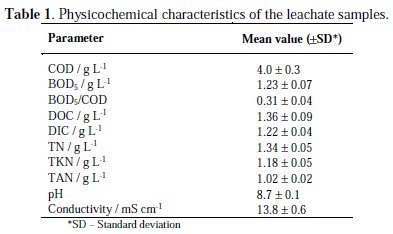
characterization is presented in <a href="#t1">Table 1</a>.</p>


    <p>&nbsp;</p>
<a name="t1">
<img src="/img/revistas/pea/v33n4/33n4a05t1.jpg">
    
<p>&nbsp;</p>


    <p><i><b>Analytical determinations</b></i></p>

    <p>Degradation tests were followed by chemical oxygen demand (COD), 
biochemical oxygen demand (BOD5), dissolved organic carbon (DOC), dissolved 
inorganic carbon (DIC), total nitrogen (TN), total ammonia nitrogen (TAN) and 
total Kjeldahl nitrogen (TKN), which were performed according to standard 
procedures [30]. The COD determinations were made using the closed reflux 
titrimetric method. The BOD5 was evaluated by determining the oxygen 
consumption after 5 days of incubation. The DOC, DIC and TN were measured 
in a Shimadzu TOC-VCPH analyzer combined with a TNM-1 unit. Before DOC, 
DIC and TN determinations, samples were filtered through 1.2 Î¼m glass 
microfiber filters. The TAN and TKN were determined using a Kjeldatherm 
block-digestion-system and a Vapodest 20s distillation system, both from 
Gerhardt. The pH was measured using a HANNA pH meter (HI 931400). The 
conductivity was determined using a Mettler Toledo conductivity meter 
(SevenEasy S30K).</p>


    <p><i><b>Chemical coagulation and electrochemical oxidation assays</b></i></p>

    <p>The CC experiments were performed in a Jar tester equipment (Lovibond, ET 
730, portable floc tester), using 0.5 L of leachate. With the aim of optimizing 
experimental conditions, a first set of assays was performed, where the added 
lime concentration was 15 g L<sup>-1</sup> and the stirring speed and assay duration were 
varied between 50-200 rpm and 1-4 h, respectively. 
Based on the results obtained in this first set of assays, a second set of CC assays 
was performed, where different lime concentrations between 10 and 25 g L<sup>-1</sup> 
were tested, applying a stirring speed and assay duration of 100 rpm and 2.5 h, 
respectively.</p>

    <p>All the CC experiments were conducted at room temperature (22-25 &deg;C). After 
the CC treatment, the samples were centrifuged in a high frequency induction 
motor centrifuge (Meditronic BL-S), at 5000 rpm during 5 min, and the 
supernatant liquid was collected for the analytical determinations. For the first set 
of assays, only COD was determined.</p>

    <p>In the combined treatment of CC+EO, the CC was performed using 20 and 25 g L<sup>-1</sup> 
of lime and, after that, the centrifuged samples were subjected to the EO 
treatment.</p>

    ]]></body>
<body><![CDATA[<p>The EO experiments were conducted in batch mode with stirring (100 rpm), 
during 6 h, at room temperature (22-25 &deg;C) and using 200 mL of the coagulated 
effluent. A BDD anode and a stainless steel cathode, both with an area of 10 cm2, 
were used. The applied current intensities evaluated were 0.4 and 0.6 A. In the 
electrochemical experiments it was used a DC power supply GW, Lab DC, 
model GPS-3030D (0-30 V, 0-3 A).</p>

    <p>Both CC and EO assays were performed, at least, in duplicate, and the values 
presented for the analytical parameters used to follow the assays are mean values.</p>


    <p>&nbsp;</p>
    <p><b>Results and discussion</b></p>

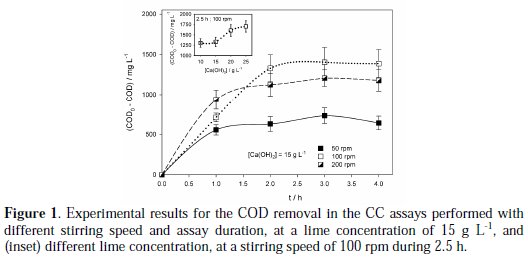
    <p><a href="#f1">Fig. 1</a> presents the COD removals obtained for the chemical coagulation assays 
performed with different stirring speed and assay duration, at a lime 
concentration of 15 g L<sup>-1</sup>.</p>


    <p>&nbsp;</p>
<a name="f1">
<img src="/img/revistas/pea/v33n4/33n4a05f1.jpg">
    
<p>&nbsp;</p>


    <p>From the obtained results, it can be seen that stirring 
speed of 100 rpm promoted higher COD removals than stirring speed of 50 rpm. 
This can be due to the fact that when stirring is slow, lime stays deposited in the 
bottom of the beaker, and does not react efficiently with the leachate. However, 
when stirring speed was increased to 200 rpm, except for the assay with 1 h 
duration, a slight decrease in COD removals was observed when compared with 
the assays performed at 100 rpm, probably because excessive stirring inhibits the 
hydroxides action, being the formed flocks smaller and with less tendency to 
precipitate.</p>

    <p>Regarding to assays duration, it can be seen from <a href="#f1">Fig. 1</a> that, around 2.5 h, there 
is a stabilization in the COD removal and longer assay duration does not lead to 
higher COD removal. Based on these results, to perform the CC assays the most 
suitable conditions were a duration of 2.5 h with a stirring speed of 100 rpm. 
Thus, in the subsequent assays performed to study the influence of the lime 
concentration, experiments were conducted at those experimental conditions.</p>

    <p>Inset of <a href="#f1">Fig. 1</a> presents the COD removals obtained in the assays performed at 
100 rpm stirring speed, during 2.5 h, with lime concentration varying from 10 to 
25 g L<sup>-1</sup>. It can be observed that the best COD removals were obtained at 20 and 
25 g L<sup>-1</sup>, with only a small difference between the removals obtained with these 
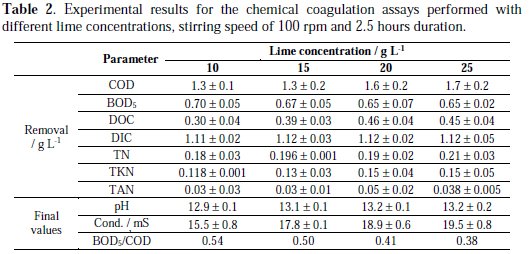
lime concentrations. <a href="#t2">Table 2</a> presents the results obtained for the CC assays 
performed with different lime concentrations.</p>


    ]]></body>
<body><![CDATA[<p>&nbsp;</p>
<a name="t2">
<img src="/img/revistas/pea/v33n4/33n4a05t2.jpg">
    
<p>&nbsp;</p>


    <p>As it can be seen, COD removal 
increased with the amount of lime added, achieving a COD removal of 43% 
when the lime concentration was 25 g L<sup>-1</sup> . DOC removal was low when 
compared with DIC removal and presented its high values at lime concentrations 
of 20 and 25 g L<sup>-1</sup>. DIC removal was above 90% for all the lime concentrations 
tested, with no significant differences between them. All forms of nitrogen 
measured presented low removals, especially TAN, being the highest removal 
values obtained for lime concentrations of 20 and 25 g L<sup>-1</sup> . Biodegradability 
index, measured by the ratio BOD5/COD, largely increased when compared to 
the initial sample, although this increase decreased with the amount of lime 
added. Thus, the best experimental conditions chosen to perform the CC pretreatment 
were: 20 and 25 g L<sup>-1</sup> lime concentration; 2.5 h assay duration; stirring 
speed of 100 rpm. These optimized lime concentrations are higher than those 
usually found in literature [24-27]. This can be due to the different characteristics 
of the sanitary landfill leachate used.</p>

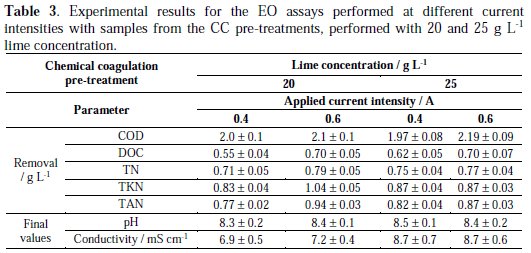
    <p>The results of the EO experiments performed with samples pre-treated with CC 
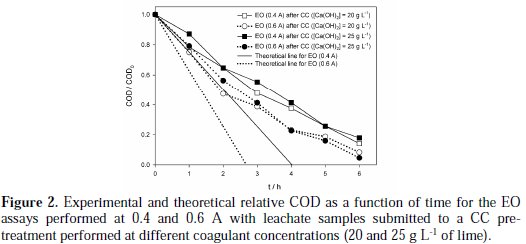
are shown in <a href="#f2">Fig. 2</a> and in <a href="#t3">Table 3</a>.</p>


    <p>&nbsp;</p>
<a name="f2">
<img src="/img/revistas/pea/v33n4/33n4a05f2.jpg">
    
<p>&nbsp;</p>
<a name="t3">
<img src="/img/revistas/pea/v33n4/33n4a05t3.jpg">
    
<p>&nbsp;</p>


    <p>From <a href="#f2">Fig. 2</a>, it can be seen that COD removal 
is more influenced by the current intensity applied in the EO process than by the 
lime concentration added in the CC pre-treatment.</p>

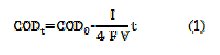
    <p><a href="#f2">Fig. 2</a> also includes the COD theoretical decay, calculated for the two current 
intensities, using <a href="#e1">Eq. (1)</a>,</p>


    <p>&nbsp;</p>
<a name="e1">
<img src="/img/revistas/pea/v33n4/33n4a05e1.jpg">
    
]]></body>
<body><![CDATA[<p>&nbsp;</p>


    <p>where COD<sub>0</sub> and COD<sub>t</sub> are the initial COD and COD at 
time t, in mg L<sup>-1</sup>, I is the current intensity, in A, F is the Faraday constant, 96485 
C moL<sup>-1</sup>, V is the solution volume, in m<sup>3</sup>, and t is the time, in s. From the 
theoretical lines, it can be inferred that the current efficiency decreases with the 
increase of current intensity, since the deviation between theoretical and 
experimental curves is higher for the assay run at the highest applied current 
intensity.</p>

    <p>DOC and TN removals present a similar behaviour to that of COD (<a href="#t3">Table 3</a>). 
Regarding TKN and TAN parameters, they present higher removals than TN, 
indicating that nitrates are still present in solution at the end of the assays. For all 
the conditions tested, TKN and TAN removals in the combined treatment were 
around 100%.</p>

    <p>During the EO process, the pH returned to its original value and the conductivity 
values dropped drastically, which can be attributed to the formation of carboxylic 
acids during the oxidation of the organic matter, and to the deposition on the 
cathode surface of reduced ionic species, respectively.</p>


    <p>&nbsp;</p>
    <p><b>Conclusions</b></p>

    <p>According to the obtained results, the application of combined chemical 
coagulation and electrochemical oxidation seems feasible for the treatment of 
leachates from sanitary landfills. The addition of lime promotes good COD 
removals, although the removals of the different nitrogen forms are small, 
particularly for the total ammonia nitrogen. Also, an increase in the 
biodegradability is noticed by the addition of lime.</p>

    <p>EO treatment, using pre-treated leachate by CC with lime, results in high COD 
removals and complete TKN and TAN removals.</p>

    <p>Attending to the lime consumption and the energy costs with stirring, during the 
CC pre-treatment, and with the EO process, the most favorable conditions found 
for the combined treatment were CC with 20 g L<sup>-1</sup> of lime at 100 rpm stirring 
speed, during 2.5 h, followed by EO at 0.4 A, during 6 h.</p>


    <p>&nbsp;</p>
    ]]></body>
<body><![CDATA[<p><b>References</b></p>

    <!-- ref --><p>1. Eggen T, Moeder M, Arukwe A. Sci Total Environ. 2010;408:5147.    &nbsp;&nbsp;&nbsp;&nbsp;&nbsp;&nbsp;&nbsp;&nbsp;[&#160;<a href="javascript:void(0);" onclick="javascript: window.open('/scielo.php?script=sci_nlinks&ref=000064&pid=S0872-1904201500040000500001&lng=','','width=640,height=500,resizable=yes,scrollbars=1,menubar=yes,');">Links</a>&#160;]<!-- end-ref --></p>

    <!-- ref --><p>2. Oman CB, Junestedt C. Waste Manage. 2008;28:1876.    &nbsp;&nbsp;&nbsp;&nbsp;&nbsp;&nbsp;&nbsp;&nbsp;[&#160;<a href="javascript:void(0);" onclick="javascript: window.open('/scielo.php?script=sci_nlinks&ref=000066&pid=S0872-1904201500040000500002&lng=','','width=640,height=500,resizable=yes,scrollbars=1,menubar=yes,');">Links</a>&#160;]<!-- end-ref --></p>

    <!-- ref --><p>3. Deng Y, Englehardt J D. Waste Manage. 2007;27:380.    &nbsp;&nbsp;&nbsp;&nbsp;&nbsp;&nbsp;&nbsp;&nbsp;[&#160;<a href="javascript:void(0);" onclick="javascript: window.open('/scielo.php?script=sci_nlinks&ref=000068&pid=S0872-1904201500040000500003&lng=','','width=640,height=500,resizable=yes,scrollbars=1,menubar=yes,');">Links</a>&#160;]<!-- end-ref --></p>

    <!-- ref --><p>4. Renou S, Givaudan J G, Poulain S, et al. J Hazard Mater. 2008;150:468.    &nbsp;&nbsp;&nbsp;&nbsp;&nbsp;&nbsp;&nbsp;&nbsp;[&#160;<a href="javascript:void(0);" onclick="javascript: window.open('/scielo.php?script=sci_nlinks&ref=000070&pid=S0872-1904201500040000500004&lng=','','width=640,height=500,resizable=yes,scrollbars=1,menubar=yes,');">Links</a>&#160;]<!-- end-ref --></p>

    <!-- ref --><p>5. Martinez-Huitle C A, Brillas E. Appl Catal B: Environ. 2009;87:105.    &nbsp;&nbsp;&nbsp;&nbsp;&nbsp;&nbsp;&nbsp;&nbsp;[&#160;<a href="javascript:void(0);" onclick="javascript: window.open('/scielo.php?script=sci_nlinks&ref=000072&pid=S0872-1904201500040000500005&lng=','','width=640,height=500,resizable=yes,scrollbars=1,menubar=yes,');">Links</a>&#160;]<!-- end-ref --></p>

    <!-- ref --><p>6. Cossu R, Polcaro A, Lavagnolo M, et al. Environ Sci Technol. 1998;32:3570.    &nbsp;&nbsp;&nbsp;&nbsp;&nbsp;&nbsp;&nbsp;&nbsp;[&#160;<a href="javascript:void(0);" onclick="javascript: window.open('/scielo.php?script=sci_nlinks&ref=000074&pid=S0872-1904201500040000500006&lng=','','width=640,height=500,resizable=yes,scrollbars=1,menubar=yes,');">Links</a>&#160;]<!-- end-ref --></p>

    <!-- ref --><p>7. Cabeza A, Urtiaga A, Ortiz I. Ind Eng Chem Res. 2007;46:1439.    &nbsp;&nbsp;&nbsp;&nbsp;&nbsp;&nbsp;&nbsp;&nbsp;[&#160;<a href="javascript:void(0);" onclick="javascript: window.open('/scielo.php?script=sci_nlinks&ref=000076&pid=S0872-1904201500040000500007&lng=','','width=640,height=500,resizable=yes,scrollbars=1,menubar=yes,');">Links</a>&#160;]<!-- end-ref --></p>

    <!-- ref --><p>8. Anglada A, Urtiaga A, Ortiz I. J Hazard Mater. 2010;181:729.    &nbsp;&nbsp;&nbsp;&nbsp;&nbsp;&nbsp;&nbsp;&nbsp;[&#160;<a href="javascript:void(0);" onclick="javascript: window.open('/scielo.php?script=sci_nlinks&ref=000078&pid=S0872-1904201500040000500008&lng=','','width=640,height=500,resizable=yes,scrollbars=1,menubar=yes,');">Links</a>&#160;]<!-- end-ref --></p>

    <!-- ref --><p>9. Fernandes A, Pacheco M J, Ciriaco L, et al. J Hazard Mater. 2012;199200:82.    &nbsp;&nbsp;&nbsp;&nbsp;&nbsp;&nbsp;&nbsp;&nbsp;[&#160;<a href="javascript:void(0);" onclick="javascript: window.open('/scielo.php?script=sci_nlinks&ref=000080&pid=S0872-1904201500040000500009&lng=','','width=640,height=500,resizable=yes,scrollbars=1,menubar=yes,');">Links</a>&#160;]<!-- end-ref --></p>

    <!-- ref --><p>10. Fernandes A, Pacheco M J, Ciriaco L, et al. Appl Catal B: Environ. 2015;176:183.    &nbsp;&nbsp;&nbsp;&nbsp;&nbsp;&nbsp;&nbsp;&nbsp;[&#160;<a href="javascript:void(0);" onclick="javascript: window.open('/scielo.php?script=sci_nlinks&ref=000082&pid=S0872-1904201500040000500010&lng=','','width=640,height=500,resizable=yes,scrollbars=1,menubar=yes,');">Links</a>&#160;]<!-- end-ref --></p>

    <!-- ref --><p>11. Wang P, Lau I W C, Fang H H P. Environ Technol. 2001;22:373.    &nbsp;&nbsp;&nbsp;&nbsp;&nbsp;&nbsp;&nbsp;&nbsp;[&#160;<a href="javascript:void(0);" onclick="javascript: window.open('/scielo.php?script=sci_nlinks&ref=000084&pid=S0872-1904201500040000500011&lng=','','width=640,height=500,resizable=yes,scrollbars=1,menubar=yes,');">Links</a>&#160;]<!-- end-ref --></p>

    <!-- ref --><p>12. Ihara I, Kanamura K, Shimada E, et al. IEEE Transactions on Applied Superconductivity 2004;14:1558.    &nbsp;&nbsp;&nbsp;&nbsp;&nbsp;&nbsp;&nbsp;&nbsp;[&#160;<a href="javascript:void(0);" onclick="javascript: window.open('/scielo.php?script=sci_nlinks&ref=000086&pid=S0872-1904201500040000500012&lng=','','width=640,height=500,resizable=yes,scrollbars=1,menubar=yes,');">Links</a>&#160;]<!-- end-ref --></p>

    <!-- ref --><p>13. Lei Y, Shen Z, Huang R, et al. Water Res. 2007;41:2417.    &nbsp;&nbsp;&nbsp;&nbsp;&nbsp;&nbsp;&nbsp;&nbsp;[&#160;<a href="javascript:void(0);" onclick="javascript: window.open('/scielo.php?script=sci_nlinks&ref=000088&pid=S0872-1904201500040000500013&lng=','','width=640,height=500,resizable=yes,scrollbars=1,menubar=yes,');">Links</a>&#160;]<!-- end-ref --></p>

    <!-- ref --><p>14. Feki F, Aloui F, Feki M, et al. Chemosphere 2009;75:256.    &nbsp;&nbsp;&nbsp;&nbsp;&nbsp;&nbsp;&nbsp;&nbsp;[&#160;<a href="javascript:void(0);" onclick="javascript: window.open('/scielo.php?script=sci_nlinks&ref=000090&pid=S0872-1904201500040000500014&lng=','','width=640,height=500,resizable=yes,scrollbars=1,menubar=yes,');">Links</a>&#160;]<!-- end-ref --></p>

    <!-- ref --><p>15. Papastavrou C, Mantzavinos D, Diamadopoulos E. Environ Technol. 2009;30:1547.    &nbsp;&nbsp;&nbsp;&nbsp;&nbsp;&nbsp;&nbsp;&nbsp;[&#160;<a href="javascript:void(0);" onclick="javascript: window.open('/scielo.php?script=sci_nlinks&ref=000092&pid=S0872-1904201500040000500015&lng=','','width=640,height=500,resizable=yes,scrollbars=1,menubar=yes,');">Links</a>&#160;]<!-- end-ref --></p>

    <!-- ref --><p>16. Urtiaga A, Rueda A, Anglada A, et al. J Hazard Mater. 2009;166:1530.    &nbsp;&nbsp;&nbsp;&nbsp;&nbsp;&nbsp;&nbsp;&nbsp;[&#160;<a href="javascript:void(0);" onclick="javascript: window.open('/scielo.php?script=sci_nlinks&ref=000094&pid=S0872-1904201500040000500016&lng=','','width=640,height=500,resizable=yes,scrollbars=1,menubar=yes,');">Links</a>&#160;]<!-- end-ref --></p>

    <!-- ref --><p>17. Zhao X, Qu J, Liu H, et al. Bioresour. Technol. 2010;101:865.    &nbsp;&nbsp;&nbsp;&nbsp;&nbsp;&nbsp;&nbsp;&nbsp;[&#160;<a href="javascript:void(0);" onclick="javascript: window.open('/scielo.php?script=sci_nlinks&ref=000096&pid=S0872-1904201500040000500017&lng=','','width=640,height=500,resizable=yes,scrollbars=1,menubar=yes,');">Links</a>&#160;]<!-- end-ref --></p>

    <p>18. Norma D, Fernandes A, Pacheco MJ, et al. Port Electrochim Acta. 2012;30:221.</p>

    <!-- ref --><p>19. Norma D, Fernandes A, Ciriaco L, et al. Port Electrochim Acta. 2012;30:281.    &nbsp;&nbsp;&nbsp;&nbsp;&nbsp;&nbsp;&nbsp;&nbsp;[&#160;<a href="javascript:void(0);" onclick="javascript: window.open('/scielo.php?script=sci_nlinks&ref=000099&pid=S0872-1904201500040000500019&lng=','','width=640,height=500,resizable=yes,scrollbars=1,menubar=yes,');">Links</a>&#160;]<!-- end-ref --></p>

    <!-- ref --><p>20. Orkun M O, Kuleyin A. Environ Prog Sust Energy. 2012;31:59.    &nbsp;&nbsp;&nbsp;&nbsp;&nbsp;&nbsp;&nbsp;&nbsp;[&#160;<a href="javascript:void(0);" onclick="javascript: window.open('/scielo.php?script=sci_nlinks&ref=000101&pid=S0872-1904201500040000500020&lng=','','width=640,height=500,resizable=yes,scrollbars=1,menubar=yes,');">Links</a>&#160;]<!-- end-ref --></p>

    ]]></body>
<body><![CDATA[<!-- ref --><p>21. Garaj-Vrhovac V, Orescanin V, Gajski G, et al. Chemosphere. 2013;93:939.    &nbsp;&nbsp;&nbsp;&nbsp;&nbsp;&nbsp;&nbsp;&nbsp;[&#160;<a href="javascript:void(0);" onclick="javascript: window.open('/scielo.php?script=sci_nlinks&ref=000103&pid=S0872-1904201500040000500021&lng=','','width=640,height=500,resizable=yes,scrollbars=1,menubar=yes,');">Links</a>&#160;]<!-- end-ref --></p>

    <!-- ref --><p>22. Xiao S, Peng J, Song Y, et al. Sep Purif Technol. 2013;117:24.    &nbsp;&nbsp;&nbsp;&nbsp;&nbsp;&nbsp;&nbsp;&nbsp;[&#160;<a href="javascript:void(0);" onclick="javascript: window.open('/scielo.php?script=sci_nlinks&ref=000105&pid=S0872-1904201500040000500022&lng=','','width=640,height=500,resizable=yes,scrollbars=1,menubar=yes,');">Links</a>&#160;]<!-- end-ref --></p>

    <!-- ref --><p>23. Fernandes A, Spranger P, Fonseca A D, et al. Appl. Catal. B: Environ. 2014;144:514.    &nbsp;&nbsp;&nbsp;&nbsp;&nbsp;&nbsp;&nbsp;&nbsp;[&#160;<a href="javascript:void(0);" onclick="javascript: window.open('/scielo.php?script=sci_nlinks&ref=000107&pid=S0872-1904201500040000500023&lng=','','width=640,height=500,resizable=yes,scrollbars=1,menubar=yes,');">Links</a>&#160;]<!-- end-ref --></p>

    <!-- ref --><p>24. Thornton RJ, Blanc FC. J Environ Eng Div. 1973;99:535.    &nbsp;&nbsp;&nbsp;&nbsp;&nbsp;&nbsp;&nbsp;&nbsp;[&#160;<a href="javascript:void(0);" onclick="javascript: window.open('/scielo.php?script=sci_nlinks&ref=000109&pid=S0872-1904201500040000500024&lng=','','width=640,height=500,resizable=yes,scrollbars=1,menubar=yes,');">Links</a>&#160;]<!-- end-ref --></p>

    <!-- ref --><p>25. Ho S, Boyle C W, Ham R K. Water Pollution Control Federation 1974;46:1776.    &nbsp;&nbsp;&nbsp;&nbsp;&nbsp;&nbsp;&nbsp;&nbsp;[&#160;<a href="javascript:void(0);" onclick="javascript: window.open('/scielo.php?script=sci_nlinks&ref=000111&pid=S0872-1904201500040000500025&lng=','','width=640,height=500,resizable=yes,scrollbars=1,menubar=yes,');">Links</a>&#160;]<!-- end-ref --></p>

    ]]></body>
<body><![CDATA[<!-- ref --><p>26. Keenan J D, Steiner R L, Fungaroli A A. J Environ Eng. 1983;109:1371.    &nbsp;&nbsp;&nbsp;&nbsp;&nbsp;&nbsp;&nbsp;&nbsp;[&#160;<a href="javascript:void(0);" onclick="javascript: window.open('/scielo.php?script=sci_nlinks&ref=000113&pid=S0872-1904201500040000500026&lng=','','width=640,height=500,resizable=yes,scrollbars=1,menubar=yes,');">Links</a>&#160;]<!-- end-ref --></p>

    <!-- ref --><p>27. Slater C S, Ahlert, R C, Uchrin C G. Environ Prog. 1983;2:251.    &nbsp;&nbsp;&nbsp;&nbsp;&nbsp;&nbsp;&nbsp;&nbsp;[&#160;<a href="javascript:void(0);" onclick="javascript: window.open('/scielo.php?script=sci_nlinks&ref=000115&pid=S0872-1904201500040000500027&lng=','','width=640,height=500,resizable=yes,scrollbars=1,menubar=yes,');">Links</a>&#160;]<!-- end-ref --></p>

    <!-- ref --><p>28. Renou S, Poulain S, Givaudan J G, et al. J Membr Sci. 2008;313:9.    &nbsp;&nbsp;&nbsp;&nbsp;&nbsp;&nbsp;&nbsp;&nbsp;[&#160;<a href="javascript:void(0);" onclick="javascript: window.open('/scielo.php?script=sci_nlinks&ref=000117&pid=S0872-1904201500040000500028&lng=','','width=640,height=500,resizable=yes,scrollbars=1,menubar=yes,');">Links</a>&#160;]<!-- end-ref --></p>

    <!-- ref --><p>29. Renou S, Poulain S, Givaudan J G, et al. Water Sci Technol. 2009;59:673.    &nbsp;&nbsp;&nbsp;&nbsp;&nbsp;&nbsp;&nbsp;&nbsp;[&#160;<a href="javascript:void(0);" onclick="javascript: window.open('/scielo.php?script=sci_nlinks&ref=000119&pid=S0872-1904201500040000500029&lng=','','width=640,height=500,resizable=yes,scrollbars=1,menubar=yes,');">Links</a>&#160;]<!-- end-ref --></p>

    <!-- ref --><p>30. Eaton A, Clesceri L, Rice E, et al. Standard methods for examination of 
water and wastewater. 21st ed. Washington, DC: American Public Health 
Association; 2005.    &nbsp;&nbsp;&nbsp;&nbsp;&nbsp;&nbsp;&nbsp;&nbsp;[&#160;<a href="javascript:void(0);" onclick="javascript: window.open('/scielo.php?script=sci_nlinks&ref=000121&pid=S0872-1904201500040000500030&lng=','','width=640,height=500,resizable=yes,scrollbars=1,menubar=yes,');">Links</a>&#160;]<!-- end-ref --></p>


    ]]></body>
<body><![CDATA[<p>&nbsp;</p>
    <p><b>Acknowledgements</b></p>

    <p>The authors gratefully acknowledge the financial support received from FCT, for 
the funding of the FibEnTech Research Unit, through ''Financiamento agregado 
para o bienio 2015-2016'', project UID/Multi/00195/2013, and for the grant 
awarded to A. Fernandes, SFRH/BPD/103615/2014.</p>


    <p>&nbsp;</p>
    <p><a name=0></a><sup><a href="#top">*</a></sup>Corresponding author. E-mail address: <a href="mailto:annabelf@ubi.pt">annabelf@ubi.pt</a></p>

    <p>Received 23 June 2015; accepted 27 August 2015</p>

    <p><a href="http://www.peacta.org" target="_blank">www.peacta.org</a> </p>


     ]]></body><back>
<ref-list>
<ref id="B1">
<label>1</label><nlm-citation citation-type="journal">
<person-group person-group-type="author">
<name>
<surname><![CDATA[Eggen]]></surname>
<given-names><![CDATA[T]]></given-names>
</name>
<name>
<surname><![CDATA[Moeder]]></surname>
<given-names><![CDATA[M]]></given-names>
</name>
<name>
<surname><![CDATA[Arukwe]]></surname>
<given-names><![CDATA[A]]></given-names>
</name>
</person-group>
<source><![CDATA[Sci Total Environ]]></source>
<year>2010</year>
<volume>408</volume>
<page-range>5147</page-range></nlm-citation>
</ref>
<ref id="B2">
<label>2</label><nlm-citation citation-type="journal">
<person-group person-group-type="author">
<name>
<surname><![CDATA[Oman]]></surname>
<given-names><![CDATA[C B]]></given-names>
</name>
<name>
<surname><![CDATA[Junestedt]]></surname>
<given-names><![CDATA[C]]></given-names>
</name>
</person-group>
<source><![CDATA[Waste Manage]]></source>
<year>2008</year>
<volume>28</volume>
<page-range>1876</page-range></nlm-citation>
</ref>
<ref id="B3">
<label>3</label><nlm-citation citation-type="journal">
<person-group person-group-type="author">
<name>
<surname><![CDATA[Deng]]></surname>
<given-names><![CDATA[Y]]></given-names>
</name>
<name>
<surname><![CDATA[Englehardt]]></surname>
<given-names><![CDATA[J D]]></given-names>
</name>
</person-group>
<source><![CDATA[Waste Manage]]></source>
<year>2007</year>
<volume>27</volume>
<page-range>380</page-range></nlm-citation>
</ref>
<ref id="B4">
<label>4</label><nlm-citation citation-type="journal">
<person-group person-group-type="author">
<name>
<surname><![CDATA[Renou]]></surname>
<given-names><![CDATA[S]]></given-names>
</name>
<name>
<surname><![CDATA[Givaudan]]></surname>
<given-names><![CDATA[J G]]></given-names>
</name>
<name>
<surname><![CDATA[Poulain]]></surname>
<given-names><![CDATA[S]]></given-names>
</name>
</person-group>
<source><![CDATA[J Hazard Mater]]></source>
<year>2008</year>
<volume>150</volume>
<page-range>468</page-range></nlm-citation>
</ref>
<ref id="B5">
<label>5</label><nlm-citation citation-type="journal">
<person-group person-group-type="author">
<name>
<surname><![CDATA[Martinez-Huitle]]></surname>
<given-names><![CDATA[C A]]></given-names>
</name>
<name>
<surname><![CDATA[Brillas]]></surname>
<given-names><![CDATA[E]]></given-names>
</name>
</person-group>
<source><![CDATA[Appl Catal B: Environ]]></source>
<year>2009</year>
<volume>87</volume>
<page-range>105</page-range></nlm-citation>
</ref>
<ref id="B6">
<label>6</label><nlm-citation citation-type="journal">
<person-group person-group-type="author">
<name>
<surname><![CDATA[Cossu]]></surname>
<given-names><![CDATA[R]]></given-names>
</name>
<name>
<surname><![CDATA[Polcaro]]></surname>
<given-names><![CDATA[A]]></given-names>
</name>
<name>
<surname><![CDATA[Lavagnolo]]></surname>
<given-names><![CDATA[M]]></given-names>
</name>
</person-group>
<source><![CDATA[Environ Sci Technol]]></source>
<year>1998</year>
<volume>32</volume>
<page-range>3570</page-range></nlm-citation>
</ref>
<ref id="B7">
<label>7</label><nlm-citation citation-type="journal">
<person-group person-group-type="author">
<name>
<surname><![CDATA[Cabeza]]></surname>
<given-names><![CDATA[A]]></given-names>
</name>
<name>
<surname><![CDATA[Urtiaga]]></surname>
<given-names><![CDATA[A]]></given-names>
</name>
<name>
<surname><![CDATA[Ortiz]]></surname>
<given-names><![CDATA[I]]></given-names>
</name>
</person-group>
<source><![CDATA[Ind Eng Chem Res]]></source>
<year>2007</year>
<volume>46</volume>
<page-range>1439</page-range></nlm-citation>
</ref>
<ref id="B8">
<label>8</label><nlm-citation citation-type="journal">
<person-group person-group-type="author">
<name>
<surname><![CDATA[Anglada]]></surname>
<given-names><![CDATA[A]]></given-names>
</name>
<name>
<surname><![CDATA[Urtiaga]]></surname>
<given-names><![CDATA[A]]></given-names>
</name>
<name>
<surname><![CDATA[Ortiz]]></surname>
<given-names><![CDATA[I]]></given-names>
</name>
</person-group>
<source><![CDATA[J Hazard Mater]]></source>
<year>2010</year>
<volume>181</volume>
<page-range>729</page-range></nlm-citation>
</ref>
<ref id="B9">
<label>9</label><nlm-citation citation-type="journal">
<person-group person-group-type="author">
<name>
<surname><![CDATA[Fernandes]]></surname>
<given-names><![CDATA[A]]></given-names>
</name>
<name>
<surname><![CDATA[Pacheco]]></surname>
<given-names><![CDATA[M J]]></given-names>
</name>
<name>
<surname><![CDATA[Ciriaco]]></surname>
<given-names><![CDATA[L]]></given-names>
</name>
</person-group>
<source><![CDATA[J Hazard Mater]]></source>
<year>2012</year>
<volume>199-200</volume>
<page-range>82</page-range></nlm-citation>
</ref>
<ref id="B10">
<label>10</label><nlm-citation citation-type="journal">
<person-group person-group-type="author">
<name>
<surname><![CDATA[Fernandes]]></surname>
<given-names><![CDATA[A]]></given-names>
</name>
<name>
<surname><![CDATA[Pacheco]]></surname>
<given-names><![CDATA[M J]]></given-names>
</name>
<name>
<surname><![CDATA[Ciriaco]]></surname>
<given-names><![CDATA[L]]></given-names>
</name>
</person-group>
<source><![CDATA[Appl Catal B: Environ]]></source>
<year>2015</year>
<volume>176</volume>
<page-range>183</page-range></nlm-citation>
</ref>
<ref id="B11">
<label>11</label><nlm-citation citation-type="journal">
<person-group person-group-type="author">
<name>
<surname><![CDATA[Wang]]></surname>
<given-names><![CDATA[P]]></given-names>
</name>
<name>
<surname><![CDATA[Lau]]></surname>
<given-names><![CDATA[I W C]]></given-names>
</name>
<name>
<surname><![CDATA[Fang]]></surname>
<given-names><![CDATA[H H P]]></given-names>
</name>
</person-group>
<source><![CDATA[Environ Technol]]></source>
<year>2001</year>
<volume>22</volume>
<page-range>373</page-range></nlm-citation>
</ref>
<ref id="B12">
<label>12</label><nlm-citation citation-type="journal">
<person-group person-group-type="author">
<name>
<surname><![CDATA[Ihara]]></surname>
<given-names><![CDATA[I]]></given-names>
</name>
<name>
<surname><![CDATA[Kanamura]]></surname>
<given-names><![CDATA[K]]></given-names>
</name>
<name>
<surname><![CDATA[Shimada]]></surname>
<given-names><![CDATA[E]]></given-names>
</name>
</person-group>
<source><![CDATA[IEEE Transactions on Applied Superconductivity]]></source>
<year>2004</year>
<volume>14</volume>
<page-range>1558</page-range></nlm-citation>
</ref>
<ref id="B13">
<label>13</label><nlm-citation citation-type="journal">
<person-group person-group-type="author">
<name>
<surname><![CDATA[Lei]]></surname>
<given-names><![CDATA[Y]]></given-names>
</name>
<name>
<surname><![CDATA[Shen]]></surname>
<given-names><![CDATA[Z]]></given-names>
</name>
<name>
<surname><![CDATA[Huang]]></surname>
<given-names><![CDATA[R]]></given-names>
</name>
</person-group>
<source><![CDATA[Water Res]]></source>
<year>2007</year>
<volume>41</volume>
<page-range>2417</page-range></nlm-citation>
</ref>
<ref id="B14">
<label>14</label><nlm-citation citation-type="journal">
<person-group person-group-type="author">
<name>
<surname><![CDATA[Feki]]></surname>
<given-names><![CDATA[F]]></given-names>
</name>
<name>
<surname><![CDATA[Aloui]]></surname>
<given-names><![CDATA[F]]></given-names>
</name>
<name>
<surname><![CDATA[Feki]]></surname>
<given-names><![CDATA[M]]></given-names>
</name>
</person-group>
<source><![CDATA[Chemosphere]]></source>
<year>2009</year>
<volume>75</volume>
<page-range>256</page-range></nlm-citation>
</ref>
<ref id="B15">
<label>15</label><nlm-citation citation-type="journal">
<person-group person-group-type="author">
<name>
<surname><![CDATA[Papastavrou]]></surname>
<given-names><![CDATA[C]]></given-names>
</name>
<name>
<surname><![CDATA[Mantzavinos]]></surname>
<given-names><![CDATA[D]]></given-names>
</name>
<name>
<surname><![CDATA[Diamadopoulos]]></surname>
<given-names><![CDATA[E]]></given-names>
</name>
</person-group>
<source><![CDATA[Environ Technol]]></source>
<year>2009</year>
<volume>30</volume>
<page-range>1547</page-range></nlm-citation>
</ref>
<ref id="B16">
<label>16</label><nlm-citation citation-type="journal">
<person-group person-group-type="author">
<name>
<surname><![CDATA[Urtiaga]]></surname>
<given-names><![CDATA[A]]></given-names>
</name>
<name>
<surname><![CDATA[Rueda]]></surname>
<given-names><![CDATA[A]]></given-names>
</name>
<name>
<surname><![CDATA[Anglada]]></surname>
<given-names><![CDATA[A]]></given-names>
</name>
</person-group>
<source><![CDATA[J Hazard Mater]]></source>
<year>2009</year>
<volume>166</volume>
<page-range>1530</page-range></nlm-citation>
</ref>
<ref id="B17">
<label>17</label><nlm-citation citation-type="journal">
<person-group person-group-type="author">
<name>
<surname><![CDATA[Zhao]]></surname>
<given-names><![CDATA[X]]></given-names>
</name>
<name>
<surname><![CDATA[Qu]]></surname>
<given-names><![CDATA[J]]></given-names>
</name>
<name>
<surname><![CDATA[Liu]]></surname>
<given-names><![CDATA[H]]></given-names>
</name>
</person-group>
<source><![CDATA[Bioresour. Technol]]></source>
<year>2010</year>
<volume>101</volume>
<page-range>865</page-range></nlm-citation>
</ref>
<ref id="B18">
<label>18</label><nlm-citation citation-type="journal">
<person-group person-group-type="author">
<name>
<surname><![CDATA[Norma]]></surname>
<given-names><![CDATA[D]]></given-names>
</name>
<name>
<surname><![CDATA[Fernandes]]></surname>
<given-names><![CDATA[A]]></given-names>
</name>
<name>
<surname><![CDATA[Pacheco]]></surname>
<given-names><![CDATA[M]]></given-names>
</name>
</person-group>
<source><![CDATA[Port Electrochim Acta]]></source>
<year>2012</year>
<volume>30</volume>
<page-range>221</page-range></nlm-citation>
</ref>
<ref id="B19">
<label>19</label><nlm-citation citation-type="journal">
<person-group person-group-type="author">
<name>
<surname><![CDATA[Norma]]></surname>
<given-names><![CDATA[D]]></given-names>
</name>
<name>
<surname><![CDATA[Fernandes]]></surname>
<given-names><![CDATA[A]]></given-names>
</name>
<name>
<surname><![CDATA[Ciriaco]]></surname>
<given-names><![CDATA[L]]></given-names>
</name>
</person-group>
<source><![CDATA[Port Electrochim Acta]]></source>
<year>2012</year>
<volume>30</volume>
<page-range>281</page-range></nlm-citation>
</ref>
<ref id="B20">
<label>20</label><nlm-citation citation-type="journal">
<person-group person-group-type="author">
<name>
<surname><![CDATA[Orkun]]></surname>
<given-names><![CDATA[M O]]></given-names>
</name>
<name>
<surname><![CDATA[Kuleyin]]></surname>
<given-names><![CDATA[A]]></given-names>
</name>
</person-group>
<source><![CDATA[Environ Prog Sust Energy]]></source>
<year>2012</year>
<volume>31</volume>
<page-range>59</page-range></nlm-citation>
</ref>
<ref id="B21">
<label>21</label><nlm-citation citation-type="journal">
<person-group person-group-type="author">
<name>
<surname><![CDATA[Garaj-Vrhovac]]></surname>
<given-names><![CDATA[V]]></given-names>
</name>
<name>
<surname><![CDATA[Orescanin]]></surname>
<given-names><![CDATA[V]]></given-names>
</name>
<name>
<surname><![CDATA[Gajski]]></surname>
<given-names><![CDATA[G]]></given-names>
</name>
</person-group>
<source><![CDATA[Chemosphere]]></source>
<year>2013</year>
<volume>93</volume>
<page-range>939</page-range></nlm-citation>
</ref>
<ref id="B22">
<label>22</label><nlm-citation citation-type="journal">
<person-group person-group-type="author">
<name>
<surname><![CDATA[Xiao]]></surname>
<given-names><![CDATA[S]]></given-names>
</name>
<name>
<surname><![CDATA[Peng]]></surname>
<given-names><![CDATA[J]]></given-names>
</name>
<name>
<surname><![CDATA[Song]]></surname>
<given-names><![CDATA[Y]]></given-names>
</name>
</person-group>
<source><![CDATA[Sep Purif Technol]]></source>
<year>2013</year>
<volume>117</volume>
<page-range>24</page-range></nlm-citation>
</ref>
<ref id="B23">
<label>23</label><nlm-citation citation-type="journal">
<person-group person-group-type="author">
<name>
<surname><![CDATA[Fernandes]]></surname>
<given-names><![CDATA[A]]></given-names>
</name>
<name>
<surname><![CDATA[Spranger]]></surname>
<given-names><![CDATA[P]]></given-names>
</name>
<name>
<surname><![CDATA[Fonseca]]></surname>
<given-names><![CDATA[A D]]></given-names>
</name>
</person-group>
<source><![CDATA[Appl. Catal. B: Environ]]></source>
<year>2014</year>
<volume>144</volume>
<page-range>514</page-range></nlm-citation>
</ref>
<ref id="B24">
<label>24</label><nlm-citation citation-type="journal">
<person-group person-group-type="author">
<name>
<surname><![CDATA[Thornton]]></surname>
<given-names><![CDATA[R J]]></given-names>
</name>
<name>
<surname><![CDATA[Blanc]]></surname>
<given-names><![CDATA[F C]]></given-names>
</name>
</person-group>
<source><![CDATA[J Environ Eng Div]]></source>
<year>1973</year>
<volume>99</volume>
<page-range>535</page-range></nlm-citation>
</ref>
<ref id="B25">
<label>25</label><nlm-citation citation-type="journal">
<person-group person-group-type="author">
<name>
<surname><![CDATA[Ho]]></surname>
<given-names><![CDATA[S]]></given-names>
</name>
<name>
<surname><![CDATA[Boyle]]></surname>
<given-names><![CDATA[C W]]></given-names>
</name>
<name>
<surname><![CDATA[Ham]]></surname>
<given-names><![CDATA[R K]]></given-names>
</name>
</person-group>
<source><![CDATA[Water Pollution Control Federation]]></source>
<year>1974</year>
<volume>46</volume>
<page-range>1776</page-range></nlm-citation>
</ref>
<ref id="B26">
<label>26</label><nlm-citation citation-type="journal">
<person-group person-group-type="author">
<name>
<surname><![CDATA[Keenan]]></surname>
<given-names><![CDATA[J D]]></given-names>
</name>
<name>
<surname><![CDATA[Steiner]]></surname>
<given-names><![CDATA[R L]]></given-names>
</name>
<name>
<surname><![CDATA[Fungaroli]]></surname>
<given-names><![CDATA[A A]]></given-names>
</name>
</person-group>
<source><![CDATA[J Environ Eng]]></source>
<year>1983</year>
<volume>109</volume>
<page-range>1371</page-range></nlm-citation>
</ref>
<ref id="B27">
<label>27</label><nlm-citation citation-type="journal">
<person-group person-group-type="author">
<name>
<surname><![CDATA[Slater]]></surname>
<given-names><![CDATA[C S]]></given-names>
</name>
<name>
<surname><![CDATA[Ahlert]]></surname>
<given-names><![CDATA[R C]]></given-names>
</name>
<name>
<surname><![CDATA[Uchrin]]></surname>
<given-names><![CDATA[C G]]></given-names>
</name>
</person-group>
<source><![CDATA[Environ Prog]]></source>
<year>1983</year>
<volume>2</volume>
<page-range>251</page-range></nlm-citation>
</ref>
<ref id="B28">
<label>28</label><nlm-citation citation-type="journal">
<person-group person-group-type="author">
<name>
<surname><![CDATA[Renou]]></surname>
<given-names><![CDATA[S]]></given-names>
</name>
<name>
<surname><![CDATA[Poulain]]></surname>
<given-names><![CDATA[S]]></given-names>
</name>
<name>
<surname><![CDATA[Givaudan]]></surname>
<given-names><![CDATA[J G]]></given-names>
</name>
</person-group>
<source><![CDATA[J Membr Sci]]></source>
<year>2008</year>
<volume>313</volume>
<page-range>9</page-range></nlm-citation>
</ref>
<ref id="B29">
<label>29</label><nlm-citation citation-type="journal">
<person-group person-group-type="author">
<name>
<surname><![CDATA[Renou]]></surname>
<given-names><![CDATA[S]]></given-names>
</name>
<name>
<surname><![CDATA[Poulain]]></surname>
<given-names><![CDATA[S]]></given-names>
</name>
<name>
<surname><![CDATA[Givaudan]]></surname>
<given-names><![CDATA[J G]]></given-names>
</name>
</person-group>
<source><![CDATA[Water Sci Technol]]></source>
<year>2009</year>
<volume>59</volume>
<page-range>673</page-range></nlm-citation>
</ref>
<ref id="B30">
<label>30</label><nlm-citation citation-type="book">
<person-group person-group-type="author">
<name>
<surname><![CDATA[Eaton]]></surname>
<given-names><![CDATA[A]]></given-names>
</name>
<name>
<surname><![CDATA[Clesceri]]></surname>
<given-names><![CDATA[L]]></given-names>
</name>
<name>
<surname><![CDATA[Rice]]></surname>
<given-names><![CDATA[E]]></given-names>
</name>
</person-group>
<source><![CDATA[Standard methods for examination of water and wastewater]]></source>
<year>2005</year>
<edition>21</edition>
<publisher-loc><![CDATA[Washington ]]></publisher-loc>
<publisher-name><![CDATA[American Public Health Association]]></publisher-name>
</nlm-citation>
</ref>
</ref-list>
</back>
</article>