<?xml version="1.0" encoding="ISO-8859-1"?><article xmlns:mml="http://www.w3.org/1998/Math/MathML" xmlns:xlink="http://www.w3.org/1999/xlink" xmlns:xsi="http://www.w3.org/2001/XMLSchema-instance">
<front>
<journal-meta>
<journal-id>0872-1904</journal-id>
<journal-title><![CDATA[Portugaliae Electrochimica Acta]]></journal-title>
<abbrev-journal-title><![CDATA[Port. Electrochim. Acta]]></abbrev-journal-title>
<issn>0872-1904</issn>
<publisher>
<publisher-name><![CDATA[Sociedade Portuguesa de Electroquímica]]></publisher-name>
</publisher>
</journal-meta>
<article-meta>
<article-id>S0872-19042015000500004</article-id>
<article-id pub-id-type="doi">10.4152/pea.201505289</article-id>
<title-group>
<article-title xml:lang="en"><![CDATA[Effect of Gadolinium Content on the Corrosion Behavior of Magnesium Alloys in 1 wt.% NaCl Solution]]></article-title>
</title-group>
<contrib-group>
<contrib contrib-type="author">
<name>
<surname><![CDATA[Zidane]]></surname>
<given-names><![CDATA[N.]]></given-names>
</name>
<xref ref-type="aff" rid="A01"/>
</contrib>
<contrib contrib-type="author">
<name>
<surname><![CDATA[Ait Albrimi]]></surname>
<given-names><![CDATA[Y.]]></given-names>
</name>
<xref ref-type="aff" rid="A01"/>
</contrib>
<contrib contrib-type="author">
<name>
<surname><![CDATA[Ait Addi]]></surname>
<given-names><![CDATA[A.]]></given-names>
</name>
<xref ref-type="aff" rid="A02"/>
</contrib>
<contrib contrib-type="author">
<name>
<surname><![CDATA[Ait Akbour]]></surname>
<given-names><![CDATA[R.]]></given-names>
</name>
<xref ref-type="aff" rid="A01"/>
</contrib>
<contrib contrib-type="author">
<name>
<surname><![CDATA[Douch]]></surname>
<given-names><![CDATA[J.]]></given-names>
</name>
<xref ref-type="aff" rid="A01"/>
</contrib>
<contrib contrib-type="author">
<name>
<surname><![CDATA[Nahle]]></surname>
<given-names><![CDATA[A.]]></given-names>
</name>
<xref ref-type="aff" rid="A02"/>
</contrib>
<contrib contrib-type="author">
<name>
<surname><![CDATA[Hamdani]]></surname>
<given-names><![CDATA[M.]]></given-names>
</name>
<xref ref-type="aff" rid="A01"/>
</contrib>
</contrib-group>
<aff id="A01">
<institution><![CDATA[,Universite Ibn Zohr Faculte des Sciences Laboratoire de Chimie Physique]]></institution>
<addr-line><![CDATA[Agadir ]]></addr-line>
<country>Maroc</country>
</aff>
<aff id="A02">
<institution><![CDATA[,University of Sharjah College of Sciences Department of Chemistry]]></institution>
<addr-line><![CDATA[ ]]></addr-line>
<country>United Arab Emirates</country>
</aff>
<pub-date pub-type="pub">
<day>00</day>
<month>09</month>
<year>2015</year>
</pub-date>
<pub-date pub-type="epub">
<day>00</day>
<month>09</month>
<year>2015</year>
</pub-date>
<volume>33</volume>
<numero>5</numero>
<fpage>289</fpage>
<lpage>304</lpage>
<copyright-statement/>
<copyright-year/>
<self-uri xlink:href="http://scielo.pt/scielo.php?script=sci_arttext&amp;pid=S0872-19042015000500004&amp;lng=en&amp;nrm=iso"></self-uri><self-uri xlink:href="http://scielo.pt/scielo.php?script=sci_abstract&amp;pid=S0872-19042015000500004&amp;lng=en&amp;nrm=iso"></self-uri><self-uri xlink:href="http://scielo.pt/scielo.php?script=sci_pdf&amp;pid=S0872-19042015000500004&amp;lng=en&amp;nrm=iso"></self-uri><abstract abstract-type="short" xml:lang="en"><p><![CDATA[The aim of this work was to study the effect of gadolinium content on the corrosion behavior of magnesium alloys in 1 wt.% NaCl solution at 21.5 (&pm;0.5) °C. Four Mg-Gd alloys, namely Mg-2 wt.% Gd, Mg-5 wt.% Gd, Mg-10 wt.% Gd, and Mg-15 wt.% Gd, were studied. Weight loss measurements, potentiodynamic tests, electrochemical impedance spectroscopy, XR diffraction, and scanning electron microscopy combined with energy-dispersive X-ray spectroscopy (SEM-EDS) were performed on the four Mg-Gd samples. The results showed the influence of the Gd content on the corrosion behavior of these alloys in 1wt.% NaCl solution. The corrosion resistance of the Mg-Gd alloys was improved with the introduction of 10 wt.% Gd in Mg matrix. Thus, weight loss and electrochemical measurements revealed the better corrosion resistance for Mg10 wt.% Gd alloy. Further addition of Gd exceeding 10 wt.% in a magnesium matrix reduces the corrosion resistance of Mg-alloy and induces an incremental increase in the corrosion rate.]]></p></abstract>
<kwd-group>
<kwd lng="en"><![CDATA[magnesium alloys]]></kwd>
<kwd lng="en"><![CDATA[biomaterials]]></kwd>
<kwd lng="en"><![CDATA[corrosion resistance]]></kwd>
<kwd lng="en"><![CDATA[gadolinium alloying]]></kwd>
</kwd-group>
</article-meta>
</front><body><![CDATA[ 

<!--     <p>&nbsp;</p>
    <p>doi: 10.4152/pea.201505289</p> -->

    <p><b>Effect of Gadolinium Content on the Corrosion Behavior of Magnesium Alloys in 1 wt.% NaCl Solution</b></p>

    <p>
<b>N. Zidane</b><sup><i>a</i></sup>
, <b>Y. Ait Albrimi</b><sup><i>a</i></sup>
, <b>A. Ait Addi</b><sup><i>b</i></sup>
, <b>R. Ait Akbour</b><sup><i>a</i></sup>
, <b>J. Douch</b><sup><i>a</i></sup>
, <b>A. Nahle</b><sup><i>b</i></sup>
 and <b>M. Hamdani</b><sup><i>a,<a href="#0">*</a></i></sup>
</p>

    <p><i><sup>a</sup> Laboratoire de Chimie Physique, Faculte des Sciences, Universite Ibn Zohr, B.P. 8106, Dakhla, Agadir, Maroc.</i></p>

    <p><i><sup>b</sup> Department of Chemistry, Corrosion Prevention &amp; Control Research Center, College of Sciences, 
University of Sharjah, PO Box: 27272, United Arab Emirates.</i></p>


    <p>&nbsp;</p>
    <p><b>Abstract</b></p>

    <p>The aim of this work was to study the effect of gadolinium content on the corrosion 
behavior of magnesium alloys in 1 wt.% NaCl solution at 21.5 (&pm;0.5) &deg;C. Four Mg-Gd 
alloys, namely Mg-2 wt.% Gd, Mg-5 wt.% Gd, Mg-10 wt.% Gd, and Mg-15 wt.% Gd, 
were studied. Weight loss measurements, potentiodynamic tests, electrochemical 
impedance spectroscopy, XR diffraction, and scanning electron microscopy combined 
with energy-dispersive X-ray spectroscopy (SEM-EDS) were performed on the four 
Mg-Gd samples. The results showed the influence of the Gd content on the corrosion 
behavior of these alloys in 1wt.% NaCl solution. The corrosion resistance of the Mg-Gd 
alloys was improved with the introduction of 10 wt.% Gd in Mg matrix. Thus, weight 
loss and electrochemical measurements revealed the better corrosion resistance for Mg10 
wt.% Gd alloy. Further addition of Gd exceeding 10 wt.% in a magnesium matrix 
reduces the corrosion resistance of Mg-alloy and induces an incremental increase in the 
corrosion rate.</p>

    ]]></body>
<body><![CDATA[<p><b><i>Keywords:</i></b> magnesium alloys, biomaterials, corrosion resistance, gadolinium alloying.</p>


    <p>&nbsp;</p>
    <p><b>Introduction</b></p>

    <p>Properties of high strength-to-weight ratio and high stiffness-to-weight ratio 
make magnesium based alloys very attractive for uses where lightweight 
materials are required [1-6]. However, due to their biocompatibility, magnesium 
alloys are suitable candidate for degradable material as implants. Moreover, these 
materials have received considerable attention due to the fact that their 
mechanical characteristics are close to those of natural bone [7-10]. The main 
limitation of magnesium for use as an implant is its very high corrosion rate, 
especially in wet or aqueous environments. The corrosion of Mg is accompanied 
by hydrogen evolution and basification of the electrolytic solution. One of the 
most efficient ways to protect Mg from corrosion is by alloying it with different 
metals. Therefore, efforts have been made to improve its corrosion performance 
by modifying the composition with one or more elements in various weight 
percentages. Thus, alloying is commonly used to protect Mg against corrosion 
phenomena that rely greatly on their microstructure and the distribution of 
alloying elements in the Mg matrix [11-15). In order to improve the corrosion 
resistance of such Mg alloys, this present research was carried out. Magnesium 
alloys containing particularly high solubility rare earth metals (RE) such Gd, Dy, 
Y, Nd, La, and Ce [11-21] have recently been studied. The distribution of these 
alloying elements in the Mg matrix was responsible for the change of the 
corrosion behavior of Mg alloys by the formation of new a corrosion resistant 
crystallographic b-phase [22-24]. Even though the corrosion resistance of some 
magnesium alloys can be enhanced by adding elements, the latter should have 
low toxicity for biomedical applications. Recent references suggest that Mg-Gd 
alloy is suitable for a biocompatible implant as Gd has high solubility in solid 
Mg [7]. As yet, literature reports are relatively scarce [7,25]. However, 
investigation of the influence of the amount of Gd in binary Mg-Gd alloys on the 
corrosion behavior in 1 wt.% NaCl solution has shown that introducing Gd in 
optimum concentration led to a reduction of the corrosion rate as long as the Gd 
was in solid solution. The corrosion rate increased significantly as soon as there 
were precipitates in the microstructure of the Mg-Gd alloys [7]. However, some 
recent studies on Mg-Y and Mg-Gd alloys prepared by magnetron sputtering 
reported that there was no significant change in the corrosion rate with alloying 
content in 3.5 wt.% NaCl solution saturated with Mg(OH)2 [25]. It was reported 
that the investigation was carried out on Mg-alloys using long-term techniques 
such as weight loss determinations and hydrogen measurements, or short term 
techniques such as potentiodynamic measurements, electrochemical impedance 
spectroscopy, and surface characterization (SEM-EDS, XRD, and XPS). In 
general, good corrosion resistance of a given material can be identified by low 
corrosion current density, high corrosion potential and high polarization 
resistance.</p>

    <p>The aqueous Mg corrosion process and hydrogen evolution can be represented by 
the reactions [8,26]:</p>


    <p>&nbsp;</p>
<a name="e1">
<img src="/img/revistas/pea/v33n5/33n5a04e1.jpg">
    
<p>&nbsp;</p>
<a name="e2">
<img src="/img/revistas/pea/v33n5/33n5a04e2.jpg">
    
<p>&nbsp;</p>


    <p>The overall corrosion reaction leads to the formation of Mg(OH)2 accompanied 
by the hydrogen evolution, following <a href="#e3">Equation 3</a></p>


    <p>&nbsp;</p>
<a name="e3">
<img src="/img/revistas/pea/v33n5/33n5a04e3.jpg">
    
]]></body>
<body><![CDATA[<p>&nbsp;</p>


    <p>In the presence of chloride ions, Mg<sup>2+</sup> ions react to form the soluble salt MgCl2, 
according to <a href="#e4">Equation 4</a>:</p>


    <p>&nbsp;</p>
<a name="e4">
<img src="/img/revistas/pea/v33n5/33n5a04e4.jpg">
    
<p>&nbsp;</p>


    <p>It is well known that the corrosion resistance of Mg-alloys decreases as the 
concentration of Cl-increases in the aqueous solution, due to the destruction of 
the protective layer on their surface. Also, the corrosion resistance of such 
materials is mainly improved in strong rather than in weak-alkaline solution, or 
neutral or acidic solutions [27]. This is likely due to the formation of a 
compacted corrosion product layer on the surface of the alloy in alkaline 
solutions, which also occurs with a decrease in the concentration of aggressive 
ions. It was concluded that the corrosion protection products layer was better at 
high pH values of the solution. The stability of protective layer decreased with 
either increasing Cl-concentration or lowering of the solution pH [27]. 
In the present study, binary Mg-Gd alloys were investigated to determine the 
influence of different amounts of Gd on the corrosion behavior of magnesium 
alloys. Four different Mg-Gd alloys (2, 5, 10, and 15 wt.%) were tested 
electrochemically in 1 wt.% NaCl solution at 21.5 &deg;C. Weight loss, open circuit 
potential, Tafel polarization curves, electrochemical impedance spectroscopy 
(EIS), scanning electron microscopy combined with energy-dispersive X-ray 
spectroscopy (SEM-EDS), and XR diffraction were used. The main objectives of 
the present study were (i) to investigate the effect of Gd content on the corrosion 
behavior of Mg-Gd alloys, and (ii) to answer the question ''can alloying improve 
and tailor the corrosion resistance of the Mg-Gd, or not?''.</p>


    <p>&nbsp;</p>
    <p><b>Experimental</b></p>

    <p><i><b>Materials and samples</b></i></p>

    <p>For the present investigation, Mg-2 wt.% Gd, Mg-5 wt.% Gd, Mg-10 wt.% Gd, 
and Mg-15 wt.% Gd were used. These materials were offered by a German team 
that has already described the preparation method of the Mg alloys in a previous 
publication [7]. All investigated materials were cylindrical in shape (15 mm in 
diameter and 4 mm thickness) cut into Mg-alloy rods. The samples were 
prepared by grinding each side with 1200 grid emery paper, the surfaces 
degreased ultrasonically with ethanol and finally dried in open air prior to 
corrosion testing. 1 wt.% (10 g.L<sup>-1</sup>) sodium chloride aqueous solution was 
prepared using bi-distilled water. The initial pH value of the prepared solution 
was 6.5 (&pm;0.1) and the temperature was kept at 21.5 (&pm;0.5) &deg;C using a DBO-
meter chamber. The pH was measured using a pH-meter (Knick 766 Calimatic). 
All reagents used in this work were analytical grade.</p>


    <p><i><b>Weight loss measurements</b></i></p>

    ]]></body>
<body><![CDATA[<p>After cleaning, samples of each alloy type were immersed (i.e., suspended) in 
200 mL of naturally aerated quiescent 1 wt.% NaCl solution at 21.5 (&pm; 0.5) &deg;C.</p>

    <p>The samples were weighed before and after immersion in the unstirred solutions, 
which were open to the atmosphere. After exposure, corrosion products were 
removed by immersing the samples in 180 g.L<sup>-1</sup> chromic acid for 20 minutes at 
room temperature [7]. After acid cleaning, samples were rinsed ultrasonically in 
ethanol, dried in the open air then reweighed. The difference in mass of the Mgalloy 
samples per surface unit area is defined as the corrosion rate (CR=Dm/S) in 
the solution after 24 hours of immersion. Each measurement was performed 
twice on a new specimen and the average was reported. The standard deviation 
of the observed weight loss was less than 6%. After 24 hours of immersion and 
before acid cleaning, all specimens increased in weight. An analytical balance 
with an accuracy of &pm;0.1 mg was used for weighing the Mg-alloy specimens. 
The average corrosion resistance of the alloys was also calculated and expressed 
in mm.year<sup>-1</sup> according to the following equation [7]:</p>


    <p>&nbsp;</p>
<a name="e5">
<img src="/img/revistas/pea/v33n5/33n5a04e5.jpg">
    
<p>&nbsp;</p>


    <p>where: Dm = weight change [g]; A = surface area [cm<sup>2</sup>]; t = time [hour], and r = 
density of the alloy [g.cm<sup>-3</sup>].</p>


    <p><i><b>Electrochemical measurements</b></i></p>

    <p>Mg-alloy samples in disc form were used as the working electrodes in quiescent 
1 wt.% NaCl aqueous solution at 21.5 (&pm;0.5) &deg;C. The specimens were mounted 
on a glass tube using Araldite epoxy resin and only one side of the specimen was 
in contact with the electrolyte (1.8 cm<sup>2</sup>). The electrical contact with the 
remaining side of the test electrode was made using a rigid copper wire. 
Electrochemical studies were carried out in a single-compartment three-electrode 
glass cell. The potential of the working electrode was measured against a 
saturated calomel electrode (SCE) (0.240 V vs. SHE). The SCE was connected 
through a KCl-containing agar-agar salt bridge, the tip of which was placed as 
close as possible to the surface of the working electrode in order to minimize the 
solution resistance between the test and reference electrodes (IR drop). The 
aerated and unstirred electrolyte had a volume of 200 mL. The counter electrode 
consisted of a platinum plate, 6 cm<sup>2</sup> in surface area. The volume of the aerated 
and unstirred electrolyte used was 200 mL.</p>

    <p>The electrochemical study was performed using a computerized electrochemical 
potentiostat set Voltalab PRZ 100 (Radiometer-Analytical). The corrosion 
behavior of the Mg-alloys was investigated using potentiodynamic polarization 
technique. The polarization curves were measured after determination of the 
open circuit potential of the test electrode. For all electrochemical investigations, 
the open-circuit potential (OCP) was measured for at least 90 minutes. The 
polarization curves were recorded in the range of -2.0 to + 1.0 V vs. SCE in 1 
wt.% NaCl aqueous solutions at a scan rate of 1 mV.s<sup>-1</sup> while each specimen was 
held in the vertical position.</p>

    <p>The experimental procedures and conditions employed in the EIS study were 
similar to those described previously [28,29]. An AC voltage amplitude of 5 mV 
peak-to-peak voltage excitation and a frequency range of 10<sup>-2</sup>-10<sup>5</sup> Hz were 
employed during the impedance measurements. Results were displayed in the 
form of Nyquist plots. Each experiment was repeated at least three times to 
ensure reproducibility.</p>


    <p><i><b>SEM-EDS and X-ray diffraction</b></i></p>

    ]]></body>
<body><![CDATA[<p>The corrosion morphologies of the Mg-alloys were characterized using a high 
resolution SEM (Zeiss Ultraplus 40, Germany) equipped with an energy 
dispersive X-ray spectrometer (EDS) to analyze the composition of the samples. 
The phase content of the samples was monitored using X-ray diffraction (XRD) 
(Pan Analytical X'Pert PRO, CuK&alpha; = 1.5406 &Acirc;) from Kiel University, Germany.</p>


    <p>&nbsp;</p>
    <p><b>Results</b></p>

    <p><i><b>pH measurements</b></i></p>

    <p>The corrosion of the Mg-alloys immersed in 1 wt.% NaCl aqueous solution was 
accompanied by hydrogen evolution, according to the overall reaction (<a href="#e3">Equation 3</a>), 
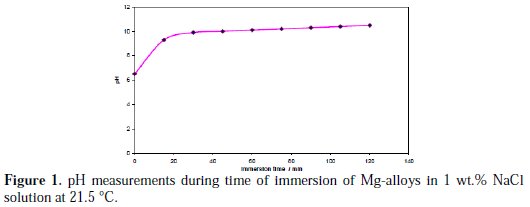
leading to an increase of the alkalinity of the solution. <a href="#f1">Fig. 1</a> depicts typical 
hydrogen evolution through the pH change as a function of immersion time of a 
specimen Mg-alloy in 200 mL of 1 wt.% NaCl solution at 21.5 &deg;C.</p>


    <p>&nbsp;</p>
<a name="f1">
<img src="/img/revistas/pea/v33n5/33n5a04f1.jpg">
    
<p>&nbsp;</p>


    <p>The solution 
was homogenized prior to the pH measurements. The pH values of the solution 
increased rapidly from 6.5 to 9.3 during the first 15 minutes. This was followed 
by a period of slower pH increase between 9.3 and 10.0 during the next 30 
minutes.</p>

    <p>After 90 minutes, the pH of the solution reached the steady state (10.5). The pH 
of the used solutions did not exceed 10.7 irrespective of the composition of the 
samples and the immersion time. This result probably was due to Mg(OH)2 that 
was suspended in water (called milk of magnesia) which exhibits a pH between 
9.5 and 10.5. The formation of one Mg(OH)2 molecule leads to formation of one 
H2 molecule (<a href="#e3">equation 3</a>).</p>

    <p>Doepke et al.[30] reported that the rising pH during immersion of Mg in NaCl 
solutions was most likely moderated by the formation of a corrosion product 
laying on the surface of the Mg sample that decreased the overall corrosion rate. 
In addition, the increased pH of the solution decelerated the corrosion activity 
due to the precipitation of a passivating film on the surface [31]. Generally, the 
magnesium alloy has high corrosion resistance in alkali solution but is active in 
acidic or neutral environments [27,32]. In strong alkaline solution, much of the 
Cl<sup>-</sup> ions were replaced by OH<sup>-</sup> ions so that the adsorption of Cl<sup>-</sup> on the layer was 
consequently reduced.</p>


    ]]></body>
<body><![CDATA[<p><i><b>Weight loss measurements</b></i></p>

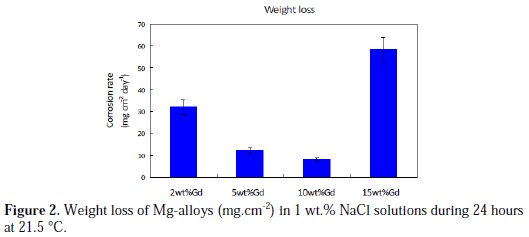
    <p>Weight loss determinations for the four Mg-alloys have been performed after 
immersion in 1 wt.% NaCl solution after 24 hours at 21.5 &deg;C, and the results are 
depicted in <a href="#f2">Fig. 2</a>.</p>


    <p>&nbsp;</p>
<a name="f2">
<img src="/img/revistas/pea/v33n5/33n5a04f2.jpg">
    
<p>&nbsp;</p>


    <p>The weight of the corrosion products that remained insoluble 
on the Mg-alloy surface was determined by weighing the corroded sample before 
and after cleaning. It was observed that the corrosion products that formed during 
immersion in the NaCl solution remained largely insoluble on the surface of the 
samples. <a href="#t1">Table 1</a> summarizes the corrosion rates obtained for the different Mgalloys.</p>


    <p>&nbsp;</p>
<a name="t1">
<img src="/img/revistas/pea/v33n5/33n5a04t1.jpg">
    
<p>&nbsp;</p>


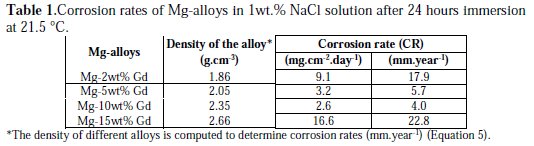
    <p>It can be observed from the data that the value of corrosion rate (CR) 
decreased and reached 2.6 mg.cm<sup>-2</sup>.day<sup>-1</sup> which corresponds to 4.0 mm.year<sup>-1</sup>, 
when the percentage of Gd increased to 10 wt.%. However, the corrosion rate 
was the highest (16.6 mg.cm<sup>-2</sup>.day<sup>-1</sup>) for the alloy containing 15 wt.% Gd. In 
addition, the color of the solution used with the 15 wt.% Gd sample turned 
whitish, which could be clearly observed with the naked eye during the 
immersion test period. This milk-like coloration could be due to the presence of 
great quantity of Mg(OH)2, i.e., milk of magnesia, in colloidal form in the 
solution.</p>

    <p>For the same binary Mg-Gd alloy and under the same conditions, Hort et al. [7] 
reported from weight loss measurements that the corrosion rate initially 
decreased and then increased. Mg-10 wt.% Gd alloy exhibited the lowest 
corrosion rate. A similar trend was also reported with the binary Mg-10 wt.% Dy 
alloy [17], and the mechanism responsible for an optimal corrosion resistance for 
Mg-10 wt.% RE (rare earth metals) is under investigation. The corrosion process 
of Mg-alloys when immersed in NaCl solution could be explained on the basis 
that the surface of the alloy is covered with a film of corrosion products. In some 
part of the alloys surface, the film is permeable, which may permit the Cl-ions to 
penetrate and reach active sites on the surface of the alloy beneath the formed 
corrosion product film. Cl-ions may also dissolve Mg(OH)2 which in turn will 
thin the passive film, allowing the aggressive ions to reach the alloy substrate 
more easily.</p>


    <p><i><b>Open circuit potential</b></i></p>

    ]]></body>
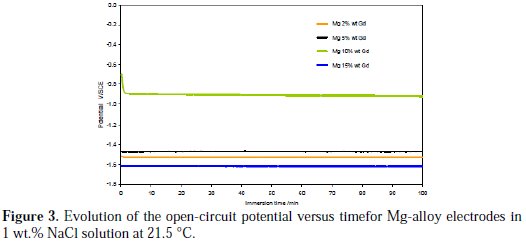
<body><![CDATA[<p><a href="#f3">Fig. 3</a> shows the open circuit potential (OCP) of the Mg-alloy electrodes versus 
time in aerated and unstirred 1 wt.% NaCl solutions at 21.5 &deg;C.</p>


    <p>&nbsp;</p>
<a name="f3">
<img src="/img/revistas/pea/v33n5/33n5a04f3.jpg">
    
<p>&nbsp;</p>


    <p>The curves demonstrate that most of the Mg-alloy electrodes reached a steady from the 
beginning, except in the case of the Mg-10 wt.% Gd alloy. The OCP values of 
the Mg-alloys changed in the following increasing order: Mg-15 wt.% Gd &lt; Mg2 
wt.% Gd &lt; Mg-5 wt.% Gd &lt; Mg-10 wt.% Gd. At the onset of corrosion there 
was an incubation period, during which the OCP of Mg-10 wt.% Gd tends 
initially to decrease abruptly towards the negative direction (during the first 
minute), indicating that a film has been formed on the surface of the specimen, 
before reaching a steady state at -0.888 V vs. SCE. The steady state condition 
indicates that a dynamic balance has been established between development of 
the corrosion activity and the deposit of the corrosion products on the surface of 
the alloy when the whole specimen surface has corroded. The time needed to 
attain a steady state was about 3-4 minutes. For all Mg-alloys, the OCP remained 
constant up to 100 minutes. The steady state condition might be due to the lack 
of variation in the interface composition. By comparing the OCP values obtained 
for all the specimens it can be observed that the OCP value of Mg-10 wt.% Gd 
shifted to a noble potential value by at least 0.6 V. This increase of OCP suggests 
a reduction of susceptibility of the alloy to the corrosion process but the OCP 
values do not provide any information on the corrosion kinetics [33]. That is to 
say that the Mg-alloy interfaces immersed in 1 wt.% NaCl solution probably 
undergo formation of a magnesium hydroxide film wherein the adsorbed Cl-ions 
do not reduce the effectiveness of the protective film.</p>


    <p><i><b>Tafel polarization measurements</b></i></p>

    <p>Potentiodynamic polarization measurement is a convenient and effective method 
to characterize the thermodynamics and the kinetics of the reaction which takes 
place on the working electrode surface. The corrosion potential (Ecorr) and 
corrosion current (Icorr) values can be extracted from the potentiodynamic 
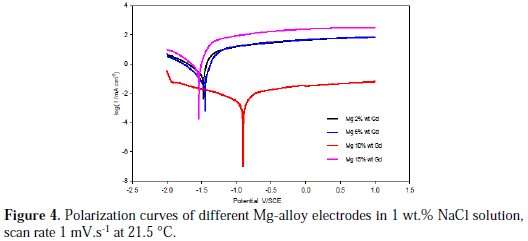
polarization curves. <a href="#f4">Fig. 4</a> shows Tafel current-potential curves for the Mg-alloys 
after 90 minutes of immersion in aerated stagnant 1 wt.% NaCl solutions at 21.5 
&deg;C.</p>


    <p>&nbsp;</p>
<a name="f4">
<img src="/img/revistas/pea/v33n5/33n5a04f4.jpg">
    
<p>&nbsp;</p>


    <p>The polarization curves are not symmetrical on the anodic and cathodic 
branches. The curves are recorded over the potential range of -2.0 to +1.0 V vs. 
SCE and scanning in the positive direction at a scan rate of 1 mV.s<sup>-1</sup>. All of the 
polarization curves showed the same trend. The cathodic polarization curves are 
assumed to represent the hydrogen evolution through reduction of the water 
molecules and followed Tafel behavior, while the anodic polarization curves 
represent the dissolution of magnesium. The polarization curves obtained were 
similar to each other in terms of current densities and corrosion potential, with 
the exception of the polarization curve obtained for the Mg-10 wt.% Gd 
electrode. Thus, the electrochemical behavior of the three Mg-alloys was similar. 
The potentiodynamic polarization curve obtained for the Mg-10 wt.% Gd 
electrode clearly shows that both the cathodic and anodic current densities were 
reduced and the corrosion potential, Ecorr, was shifted by about 0.6 V in the 
positive direction (less active region). The influence of the Gd content on the free 
corrosion potential was negligible for the other three Mg-alloys. The 
ennoblement of corrosion potential by about 0.6 V should indicate good 
corrosion resistance for the Mg-10 wt.% Gd alloy. This result was consistent 
with weight loss and OCP measurements.</p>

    <p>The cathodic curves indicated that the cathodic process was not diffusion 
controlled. During the cathodic process, hydrogen was produced in the form of 
bubbles on the electrode surface. Therefore the slope of the cathodic curves was 
steep.</p>

    ]]></body>
<body><![CDATA[<p>Despite having the same shape, it can be seen that both the anodic part and 
cathodic part obtained for Mg-10 wt.% Gd electrode presented low current 
density values compared to the other alloy electrodes. This means that the Mg-10 
wt.% Gd content had significant effects on retarding the cathodic hydrogen 
evolution reaction and on the dissolution of Mg-alloy. The electrochemical 
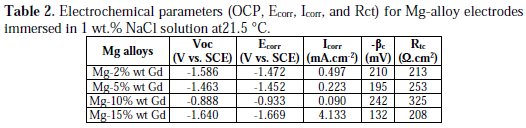
parameters obtained from the polarization curves, including the open circuit 
potential (OCP), corrosion potential (Ecorr), and corrosion current densities (Icorr), 
are summarized in <a href="#t2">Table 2</a>.</p>


    <p>&nbsp;</p>
<a name="t2">
<img src="/img/revistas/pea/v33n5/33n5a04t2.jpg">
    
<p>&nbsp;</p>


    <p>The values of corrosion current were estimated based 
on the Tafel extrapolation method for the most linear part of the cathodic branch 
of the polarization curve back to Ecorr, and are given as a function of the nature of 
the alloy. It is clearly shown that for the 10% Gd electrode, the open circuit 
potential (OCP) was the highest and the corrosion current density was the lowest. 
Judging from the polarization curves (<a href="#f4">Fig. 4</a> and <a href="#t2">Table 2</a>), the cathodic reaction 
and the anodic reaction were significantly lower as a result of the addition of 10 
wt.% Gd.</p>

    <p>It is evident that the corrosion potential (Ecorr) values are slightly different from 
those of open circuit potential (OCP) due to the modification into the Mg-alloy 
electrode surface.</p>


    <p><i><b>EIS study</b></i></p>

    <p>EIS measurements were performed to characterize the magnesium alloy/solution 
interface. In order to investigate the corrosion behavior of the alloys and stability 
of the film formed on the interface, the EIS measurements were carried out at the 
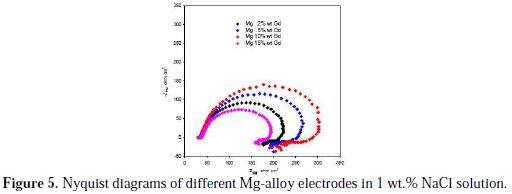
OCP in 1 wt.% NaCl solution. <a href="#f5">Fig. 5</a> depicts typical Nyquist plots for the studied 
Mg-alloys.</p>


    <p>&nbsp;</p>
<a name="f5">
<img src="/img/revistas/pea/v33n5/33n5a04f5.jpg">
    
<p>&nbsp;</p>


    <p>It can be seen from this figure that all of impedance spectra were 
rather similar, except the difference in the semicircle diameter. The EIS diagram 
presents the 'semicircles' for capacitive behavior at high frequencies (HF) in 
combination with an inductive loop at low (LF) frequencies. The impedance 
response of the electrode, which was apparent from the higher impedance values 
obtained, changed with the Gd content.</p>

    ]]></body>
<body><![CDATA[<p>Many studies support the use the capacitive loop to extract the charge transfer 
resistance Rct to obtain information on the corrosion rate [34-37].The diameter 
of the capacitive loop is associated with the charge transfer resistance of the 
corrosion process [35-37]. Rct is inversely related to the corrosion current 
density. The literature associates the corrosion of magnesium alloys to the 
diameter of this capacitive loop in the higher frequency region with the charge 
transfer resistance (Rct) of the corrosion process [38]. Thus, Rct increases in the 
following order: Mg-15 wt.% Gd &lt; Mg-2 wt.% Gd &lt; Mg-5 wt.% Gd &lt; Mg-10 
wt.% Gd, which ranked the corrosion resistance of alloys in the same way as 
shown in <a href="#t2">Table 2</a>. The decrease of Rct means that the corrosion of Mg-alloys 
accelerates. These results also were consistent with the results obtained by 
weight loss, OCP and potentiodynamic measurements.</p>

    <p>The second loop is present with all the specimens in low magnitude. King et al. 
[39] studied the corrosion of Mg using EIS and asserted that the electrochemical 
response usually displays inductive behavior with decreasing frequency. The 
inductive loop interpretation has been discussed in the literature and was 
attributed to species adsorption [40,41]. Thus, the inductive loop was ascribed to 
a process involving Mg<sup>+</sup> even though there was no firm evidence for the presence 
of the Mg<sup>+</sup> ion [42,43], or as Mg<sup>2+</sup> ions, or MgOH<sup>+</sup>, and to the dissolution of the 
protective film on the electrode surface [38]. For others, the interpretation of the 
inductive behavior observed in the Nyquist plot is immaterial in studies of 
electrochemical corrosion as the kinetic information is estimated from the 
capacitive arc [38,44].</p>


    <p><i><b>SEM and EDS</b></i></p>

    <p>The morphology and the composition of corrosion products formed on Mg-alloys 
after the 4 hour immersion test in 1 wt.% NaCl was characterized by means of 
scanning electron microscopy equipped with energy-dispersive X-ray 
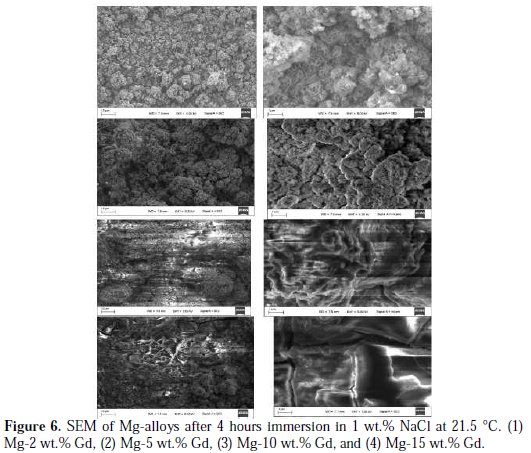
spectroscopy (SEM-EDS). <a href="#f6">Fig. 6</a> (1 to 4), show the SEM microstructures of the 
Mg-alloy surfaces after 4 hours immersion in 1 wt.% NaCl at 21.5 &deg;C. In general, 
the film of products was fragile and uncompact.</p>


    <p>&nbsp;</p>
<a name="f6">
<img src="/img/revistas/pea/v33n5/33n5a04f6.jpg">
    
<p>&nbsp;</p>


    <p>The film formed on the Mg-alloy 
surface with 2 and 5 wt.% Gd showed a cauliflower-like porous shape at a low 
magnification. At relatively high magnification the deposits were gypsum 
flower-like. The corrosion compounds formed on the surface of these two alloys 
contained crevices. The surface obtained after the immersion test of the specimen 
with 10 wt.% Gd was less rough than the former and appeared to be covered by 
an accretion. The formed film appeared thicker and smoother than on the other 
alloys, and should protect the Mg metal. The insoluble corrosion products on the 
surface of the alloy slow down the corrosion rate. The corrosion products formed 
on the 15 wt.% Gd were smoother but crackled. Even though the layer was thick, 
it did not offer strong protection.</p>

    <p>The differences may be caused by the different distribution of alloying elements 
in microscopic scale and the microstructure of alloys, which are the fundamental 
reasons for the metal corrosion morphology and corrosion resistance. In order to 
identify the elemental composition of the corrosion products of different 
specimens, EDS analysis was performed on the corrosion products from the 
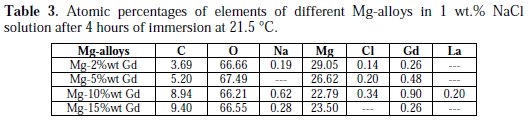
alloys after 4 hours immersion in 1wt.% NaCl and the results are listed in <a href="#t3">Table 3</a>.</p>


    <p>&nbsp;</p>
<a name="t3">
<img src="/img/revistas/pea/v33n5/33n5a04t3.jpg">
    
<p>&nbsp;</p>


    ]]></body>
<body><![CDATA[<p>It can be seen that the formed corrosion film on 10% Gd alloy contained the 
highest amount of Gd and surprisingly the highest amount of Na<sup>+</sup> and Cl<sup>-</sup> ions, in 
addition to a small amount of La.</p>


    <p><i><b>X-ray diffraction</b></i></p>

    <p>Observations with the naked eye of the Mg-alloys after 4 hours immersion in 1 
wt.% NaCl solution at 21.5 &deg;C showed that their surface was covered with a 
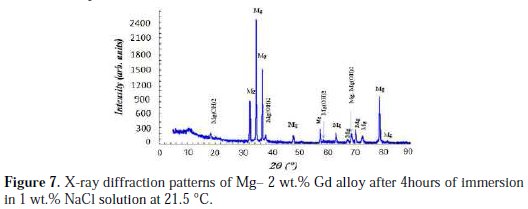
white compound. The XRD patterns of the 2 wt.% Gd alloy are presented in <a href="#f7">Fig. 7</a>.</p>


    <p>&nbsp;</p>
<a name="f7">
<img src="/img/revistas/pea/v33n5/33n5a04f7.jpg">
    
<p>&nbsp;</p>


    <p>Similar XRD patterns were obtained for the four studied Mg-alloys but are not 
shown. They were compared with the JCPDS Card No. 44-1482 and with the 
JCPDS card No. 35-0821 for identifying Mg(OH)2 and magnesium metal, 
respectively. The peaks at around 2&theta; = 18.5, 38.0, 58.7 and 68.8 were assigned to 
the brucite type Mg(OH)2. The product could be indexed to the hexagonal 
structure of magnesium hydroxide. In addition, the peaks at around 2&theta; = 32.3, 
34.5, 36.7, 47.9, 57.6, 63.3, 67.6, 68.8, 70.3, 72.8, 78.9 and 81.9 were attributed 
to Mg metal. It is well known that the corrosion products of Mg in NaCl 
solutions are mainly Mg(OH)2 and amorphous MgO phase [42,45].</p>


    <p>&nbsp;</p>
    <p><b>Discussion</b></p>

    <p>Alloying is one of the most used methods of enhancing the corrosion resistance 
of Mg and its alloys. The immersion of Mg-alloys in NaCl aqueous solutions 
involves a corrosion process that is concomitant with H2 evolution and 
consequently an increase in the pH of the solution. The results obtained by 
weight loss determinations, OCP measurements, potentiodynamic scans, and EIS 
plots were in accordance with the deduction of corrosion process of the Mg-10 
wt.% Gd alloy.</p>

    <p>Corrosion of this last alloy was lower in 1 wt.% NaCl alkaline solution because 
of the lower mass loss, reduced corrosion current (Icorr), corrosion potential (Ecorr) 
shift in the positive direction, and the enlarged capacitive loop that which 
represented larger charge transfer resistance, Rct. The morphology and 
composition of the corrosion compounds obtained for the Mg-10 wt.% Gd alloy 
seem to be different to those of the other studied alloys. The predominance of the 
b-phase in the Mg-10 wt.% Gd alloy should increase the compactness of the 
Mg(OH)2 formed on the Mg-alloy surface, which slows down the dissolution of 
the corrosion product and consequently decreases the corrosion rate of the Mgalloy 
[7]. The reason might be that after the addition of 10 wt.% Gd in the 
magnesium matrix, the b-phase particles are easy to precipitate in the magnesium 
matrix during the process of heat treatment processing. Furthermore, the 
morphology of the film, which is continuous over the exposed surface, plays the 
role of a corrosion barrier. Additionally, based on the presence of Na+ and Clions 
in composition of corrosion compounds, as shown by the EDS analysis, in 
the case of Mg-10 wt.% Gd alloy, the formed film impedes diffusion of these 
aggressive ions to the metal interface. In case of weight loss experiments, visual 
observation of the Mg-10 wt.% Gd electrode surface during the immersion tests 
revealed a continuous decrease in the rate of hydrogen gas evolution on its 
surface with time, compared with the other alloys, suggesting a decrease in the 
corrosion rate.</p>


    ]]></body>
<body><![CDATA[<p>&nbsp;</p>
    <p><b>Conclusions</b></p>

    <p>The corrosion behavior of Mg-2 wt.% Gd, Mg-5 wt.% Gd, Mg-10 wt.% Gd, and 
Mg-15 wt.% Gd was studied using weight loss, OCP, electrochemical 
measurements, SEM-EDS, and RXD techniques in 1 wt.% NaCl solution. The 
electrochemical results were consistent with the weight loss measurements. 
Alloying was observed to play an important role in modulating the corrosion 
behavior of the Mg-alloys. Thus, introduction of 10 wt.% Gd in the Mg matrix 
improved the corrosion resistance appreciably in 1 wt.% NaCl solution.</p>


    <p>&nbsp;</p>
    <p><b>References</b></p>

    <!-- ref --><p>1. Blawert C, Morales E D, Dietzel W, et al.Mater Sci Forum. 2005;488-489:697.    &nbsp;&nbsp;&nbsp;&nbsp;&nbsp;&nbsp;&nbsp;&nbsp;[&#160;<a href="javascript:void(0);" onclick="javascript: window.open('/scielo.php?script=sci_nlinks&ref=416560&pid=S0872-1904201500050000400001&lng=','','width=640,height=500,resizable=yes,scrollbars=1,menubar=yes,');">Links</a>&#160;]<!-- end-ref --></p>

    <!-- ref --><p>2. Majumdar J D, Galun R, Mordike B, et al. Mater Sci Eng A. 2003;361:119.    &nbsp;&nbsp;&nbsp;&nbsp;&nbsp;&nbsp;&nbsp;&nbsp;[&#160;<a href="javascript:void(0);" onclick="javascript: window.open('/scielo.php?script=sci_nlinks&ref=416562&pid=S0872-1904201500050000400002&lng=','','width=640,height=500,resizable=yes,scrollbars=1,menubar=yes,');">Links</a>&#160;]<!-- end-ref --></p>

    <!-- ref --><p>3. Song W, Martin H J, Hicks A, et al. Corros Sci. 2014;78:353.    &nbsp;&nbsp;&nbsp;&nbsp;&nbsp;&nbsp;&nbsp;&nbsp;[&#160;<a href="javascript:void(0);" onclick="javascript: window.open('/scielo.php?script=sci_nlinks&ref=416564&pid=S0872-1904201500050000400003&lng=','','width=640,height=500,resizable=yes,scrollbars=1,menubar=yes,');">Links</a>&#160;]<!-- end-ref --></p>

    <!-- ref --><p>4. Song G, Atrens A. Adv Eng Mater. 1999;1:11.    &nbsp;&nbsp;&nbsp;&nbsp;&nbsp;&nbsp;&nbsp;&nbsp;[&#160;<a href="javascript:void(0);" onclick="javascript: window.open('/scielo.php?script=sci_nlinks&ref=416566&pid=S0872-1904201500050000400004&lng=','','width=640,height=500,resizable=yes,scrollbars=1,menubar=yes,');">Links</a>&#160;]<!-- end-ref --></p>

    <!-- ref --><p>5. Gray J E, Luan B. J Alloys Compd. 2002;336:88.    &nbsp;&nbsp;&nbsp;&nbsp;&nbsp;&nbsp;&nbsp;&nbsp;[&#160;<a href="javascript:void(0);" onclick="javascript: window.open('/scielo.php?script=sci_nlinks&ref=416568&pid=S0872-1904201500050000400005&lng=','','width=640,height=500,resizable=yes,scrollbars=1,menubar=yes,');">Links</a>&#160;]<!-- end-ref --></p>

    <!-- ref --><p>6. Ghali E, Dietzel W, Kainer K. J Mater Eng Perform. 2004;1:7.    &nbsp;&nbsp;&nbsp;&nbsp;&nbsp;&nbsp;&nbsp;&nbsp;[&#160;<a href="javascript:void(0);" onclick="javascript: window.open('/scielo.php?script=sci_nlinks&ref=416570&pid=S0872-1904201500050000400006&lng=','','width=640,height=500,resizable=yes,scrollbars=1,menubar=yes,');">Links</a>&#160;]<!-- end-ref --></p>

    <!-- ref --><p>7. Hort N, Huanga Y, Fechner D, et al. Acta Biomater. 2010;6:1714.    &nbsp;&nbsp;&nbsp;&nbsp;&nbsp;&nbsp;&nbsp;&nbsp;[&#160;<a href="javascript:void(0);" onclick="javascript: window.open('/scielo.php?script=sci_nlinks&ref=416572&pid=S0872-1904201500050000400007&lng=','','width=640,height=500,resizable=yes,scrollbars=1,menubar=yes,');">Links</a>&#160;]<!-- end-ref --></p>

    <!-- ref --><p>8. Choi Y, Salmanb S, Kuroda K, et al. Corros Sci. 2012;63:5.    &nbsp;&nbsp;&nbsp;&nbsp;&nbsp;&nbsp;&nbsp;&nbsp;[&#160;<a href="javascript:void(0);" onclick="javascript: window.open('/scielo.php?script=sci_nlinks&ref=416574&pid=S0872-1904201500050000400008&lng=','','width=640,height=500,resizable=yes,scrollbars=1,menubar=yes,');">Links</a>&#160;]<!-- end-ref --></p>

    <!-- ref --><p>9. Hanzi A C, Gunde P, Schinhammer M, et al. Acta Biomater. 2009;5:162.    &nbsp;&nbsp;&nbsp;&nbsp;&nbsp;&nbsp;&nbsp;&nbsp;[&#160;<a href="javascript:void(0);" onclick="javascript: window.open('/scielo.php?script=sci_nlinks&ref=416576&pid=S0872-1904201500050000400009&lng=','','width=640,height=500,resizable=yes,scrollbars=1,menubar=yes,');">Links</a>&#160;]<!-- end-ref --></p>

    <!-- ref --><p>10. Zhao L, Cui C, Wang Q, et al. Corros Sci. 2010;52:2228.    &nbsp;&nbsp;&nbsp;&nbsp;&nbsp;&nbsp;&nbsp;&nbsp;[&#160;<a href="javascript:void(0);" onclick="javascript: window.open('/scielo.php?script=sci_nlinks&ref=416578&pid=S0872-1904201500050000400010&lng=','','width=640,height=500,resizable=yes,scrollbars=1,menubar=yes,');">Links</a>&#160;]<!-- end-ref --></p>

    <!-- ref --><p>11. Srinivasan A, Huanga Y, Mendis C L, et al. Mater Sci Eng A. 2014;595:224.    &nbsp;&nbsp;&nbsp;&nbsp;&nbsp;&nbsp;&nbsp;&nbsp;[&#160;<a href="javascript:void(0);" onclick="javascript: window.open('/scielo.php?script=sci_nlinks&ref=416580&pid=S0872-1904201500050000400011&lng=','','width=640,height=500,resizable=yes,scrollbars=1,menubar=yes,');">Links</a>&#160;]<!-- end-ref --></p>

    <!-- ref --><p>12. Doepke A, Xue D, Yun Y, et al. Electrochem Acta. 2012;70:165.    &nbsp;&nbsp;&nbsp;&nbsp;&nbsp;&nbsp;&nbsp;&nbsp;[&#160;<a href="javascript:void(0);" onclick="javascript: window.open('/scielo.php?script=sci_nlinks&ref=416582&pid=S0872-1904201500050000400012&lng=','','width=640,height=500,resizable=yes,scrollbars=1,menubar=yes,');">Links</a>&#160;]<!-- end-ref --></p>

    <!-- ref --><p>13. Zhao X, Shi L L, Xu J. J Mater Sci Technol. 2013;29:781.    &nbsp;&nbsp;&nbsp;&nbsp;&nbsp;&nbsp;&nbsp;&nbsp;[&#160;<a href="javascript:void(0);" onclick="javascript: window.open('/scielo.php?script=sci_nlinks&ref=416584&pid=S0872-1904201500050000400013&lng=','','width=640,height=500,resizable=yes,scrollbars=1,menubar=yes,');">Links</a>&#160;]<!-- end-ref --></p>

    <!-- ref --><p>14. Liu M, Schmutz P, Uggowitzer P J, et al. Corros Sci. 2010;52:3687.    &nbsp;&nbsp;&nbsp;&nbsp;&nbsp;&nbsp;&nbsp;&nbsp;[&#160;<a href="javascript:void(0);" onclick="javascript: window.open('/scielo.php?script=sci_nlinks&ref=416586&pid=S0872-1904201500050000400014&lng=','','width=640,height=500,resizable=yes,scrollbars=1,menubar=yes,');">Links</a>&#160;]<!-- end-ref --></p>

    <!-- ref --><p>15. Kubasek J, Vojtech D. T Nonferr Metals Soc. 2013;23:1215.    &nbsp;&nbsp;&nbsp;&nbsp;&nbsp;&nbsp;&nbsp;&nbsp;[&#160;<a href="javascript:void(0);" onclick="javascript: window.open('/scielo.php?script=sci_nlinks&ref=416588&pid=S0872-1904201500050000400015&lng=','','width=640,height=500,resizable=yes,scrollbars=1,menubar=yes,');">Links</a>&#160;]<!-- end-ref --></p>

    <!-- ref --><p>16. Peng Q, Wang J, Wu Y, et al. Mater Character. 2008;59:435.    &nbsp;&nbsp;&nbsp;&nbsp;&nbsp;&nbsp;&nbsp;&nbsp;[&#160;<a href="javascript:void(0);" onclick="javascript: window.open('/scielo.php?script=sci_nlinks&ref=416590&pid=S0872-1904201500050000400016&lng=','','width=640,height=500,resizable=yes,scrollbars=1,menubar=yes,');">Links</a>&#160;]<!-- end-ref --></p>

    <!-- ref --><p>17. Yang L, Huang Y, Peng Q, et al. Mater Sci Eng B. 2011;176:1827.    &nbsp;&nbsp;&nbsp;&nbsp;&nbsp;&nbsp;&nbsp;&nbsp;[&#160;<a href="javascript:void(0);" onclick="javascript: window.open('/scielo.php?script=sci_nlinks&ref=416592&pid=S0872-1904201500050000400017&lng=','','width=640,height=500,resizable=yes,scrollbars=1,menubar=yes,');">Links</a>&#160;]<!-- end-ref --></p>

    <!-- ref --><p>18. Yang L, Huang Y, Feyerabend F, et al. Acta Biomater. 2013;9:8499.    &nbsp;&nbsp;&nbsp;&nbsp;&nbsp;&nbsp;&nbsp;&nbsp;[&#160;<a href="javascript:void(0);" onclick="javascript: window.open('/scielo.php?script=sci_nlinks&ref=416594&pid=S0872-1904201500050000400018&lng=','','width=640,height=500,resizable=yes,scrollbars=1,menubar=yes,');">Links</a>&#160;]<!-- end-ref --></p>

    <!-- ref --><p>19. Yang L, Huang Y, Feyerabend F, et al. J Mech Behav Biomed Mater. 2012;13:36.    &nbsp;&nbsp;&nbsp;&nbsp;&nbsp;&nbsp;&nbsp;&nbsp;[&#160;<a href="javascript:void(0);" onclick="javascript: window.open('/scielo.php?script=sci_nlinks&ref=416596&pid=S0872-1904201500050000400019&lng=','','width=640,height=500,resizable=yes,scrollbars=1,menubar=yes,');">Links</a>&#160;]<!-- end-ref --></p>

    <!-- ref --><p>20. Yang L, Hort N, Laipple D, et al. Acta Biomater. 2013;9:8475.    &nbsp;&nbsp;&nbsp;&nbsp;&nbsp;&nbsp;&nbsp;&nbsp;[&#160;<a href="javascript:void(0);" onclick="javascript: window.open('/scielo.php?script=sci_nlinks&ref=416598&pid=S0872-1904201500050000400020&lng=','','width=640,height=500,resizable=yes,scrollbars=1,menubar=yes,');">Links</a>&#160;]<!-- end-ref --></p>

    <!-- ref --><p>21. Leng Z, Zhang J, Yin T, et al. J Mech Behav Biomed Mater. 2013;28:332.    &nbsp;&nbsp;&nbsp;&nbsp;&nbsp;&nbsp;&nbsp;&nbsp;[&#160;<a href="javascript:void(0);" onclick="javascript: window.open('/scielo.php?script=sci_nlinks&ref=416600&pid=S0872-1904201500050000400021&lng=','','width=640,height=500,resizable=yes,scrollbars=1,menubar=yes,');">Links</a>&#160;]<!-- end-ref --></p>

    <!-- ref --><p>22. Song G. Adv Eng Mater. 2005;7:563.    &nbsp;&nbsp;&nbsp;&nbsp;&nbsp;&nbsp;&nbsp;&nbsp;[&#160;<a href="javascript:void(0);" onclick="javascript: window.open('/scielo.php?script=sci_nlinks&ref=416602&pid=S0872-1904201500050000400022&lng=','','width=640,height=500,resizable=yes,scrollbars=1,menubar=yes,');">Links</a>&#160;]<!-- end-ref --></p>

    <!-- ref --><p>23. Zhao M C, Liu M, Song G, et al. Corros Sci. 2008;50:1939.    &nbsp;&nbsp;&nbsp;&nbsp;&nbsp;&nbsp;&nbsp;&nbsp;[&#160;<a href="javascript:void(0);" onclick="javascript: window.open('/scielo.php?script=sci_nlinks&ref=416604&pid=S0872-1904201500050000400023&lng=','','width=640,height=500,resizable=yes,scrollbars=1,menubar=yes,');">Links</a>&#160;]<!-- end-ref --></p>

    <!-- ref --><p>24. Song G, Atrens A, Wu Z, et al. Corros Sci. 1998;40:1769.    &nbsp;&nbsp;&nbsp;&nbsp;&nbsp;&nbsp;&nbsp;&nbsp;[&#160;<a href="javascript:void(0);" onclick="javascript: window.open('/scielo.php?script=sci_nlinks&ref=416606&pid=S0872-1904201500050000400024&lng=','','width=640,height=500,resizable=yes,scrollbars=1,menubar=yes,');">Links</a>&#160;]<!-- end-ref --></p>

    <!-- ref --><p>25. Schluter K, Shi Z, Zamponi C, et al. Corros Sci. 2014;78:43.    &nbsp;&nbsp;&nbsp;&nbsp;&nbsp;&nbsp;&nbsp;&nbsp;[&#160;<a href="javascript:void(0);" onclick="javascript: window.open('/scielo.php?script=sci_nlinks&ref=416608&pid=S0872-1904201500050000400025&lng=','','width=640,height=500,resizable=yes,scrollbars=1,menubar=yes,');">Links</a>&#160;]<!-- end-ref --></p>

    <!-- ref --><p>26. Mueller W D, Nascimento M L, Mele M F L. Acta Biomater. 2010;6:1749.    &nbsp;&nbsp;&nbsp;&nbsp;&nbsp;&nbsp;&nbsp;&nbsp;[&#160;<a href="javascript:void(0);" onclick="javascript: window.open('/scielo.php?script=sci_nlinks&ref=416610&pid=S0872-1904201500050000400026&lng=','','width=640,height=500,resizable=yes,scrollbars=1,menubar=yes,');">Links</a>&#160;]<!-- end-ref --></p>

    <!-- ref --><p>27. Gao L, Zhang C, Zhang M, et al. J Alloys Compd. 2009;468:285.    &nbsp;&nbsp;&nbsp;&nbsp;&nbsp;&nbsp;&nbsp;&nbsp;[&#160;<a href="javascript:void(0);" onclick="javascript: window.open('/scielo.php?script=sci_nlinks&ref=416612&pid=S0872-1904201500050000400027&lng=','','width=640,height=500,resizable=yes,scrollbars=1,menubar=yes,');">Links</a>&#160;]<!-- end-ref --></p>

    <!-- ref --><p>28. Laouini E, Douch J, Hamdani M, et al. J Appl Electrochem. 2011;41:731.    &nbsp;&nbsp;&nbsp;&nbsp;&nbsp;&nbsp;&nbsp;&nbsp;[&#160;<a href="javascript:void(0);" onclick="javascript: window.open('/scielo.php?script=sci_nlinks&ref=416614&pid=S0872-1904201500050000400028&lng=','','width=640,height=500,resizable=yes,scrollbars=1,menubar=yes,');">Links</a>&#160;]<!-- end-ref --></p>

    <!-- ref --><p>29. Laouini E, Hamdani M, Pereira M I S, et al. Int J Electrochem Sci. 2009;4:1074.    &nbsp;&nbsp;&nbsp;&nbsp;&nbsp;&nbsp;&nbsp;&nbsp;[&#160;<a href="javascript:void(0);" onclick="javascript: window.open('/scielo.php?script=sci_nlinks&ref=416616&pid=S0872-1904201500050000400029&lng=','','width=640,height=500,resizable=yes,scrollbars=1,menubar=yes,');">Links</a>&#160;]<!-- end-ref --></p>

    <!-- ref --><p>30. Doepke A, Kuhlmanna J, Guo X, et al. Acta Biomater. 2013;9:9211.    &nbsp;&nbsp;&nbsp;&nbsp;&nbsp;&nbsp;&nbsp;&nbsp;[&#160;<a href="javascript:void(0);" onclick="javascript: window.open('/scielo.php?script=sci_nlinks&ref=416618&pid=S0872-1904201500050000400030&lng=','','width=640,height=500,resizable=yes,scrollbars=1,menubar=yes,');">Links</a>&#160;]<!-- end-ref --></p>

    <!-- ref --><p>31. Ambat R, Aung N N, Zhou W. J Appl Electrochem. 2000;30:865.    &nbsp;&nbsp;&nbsp;&nbsp;&nbsp;&nbsp;&nbsp;&nbsp;[&#160;<a href="javascript:void(0);" onclick="javascript: window.open('/scielo.php?script=sci_nlinks&ref=416620&pid=S0872-1904201500050000400031&lng=','','width=640,height=500,resizable=yes,scrollbars=1,menubar=yes,');">Links</a>&#160;]<!-- end-ref --></p>

    <!-- ref --><p>32. Zeng R, Zhang J, Huang W, et al. Trans Nonferrous Met Soc China. 2006;16:763.    &nbsp;&nbsp;&nbsp;&nbsp;&nbsp;&nbsp;&nbsp;&nbsp;[&#160;<a href="javascript:void(0);" onclick="javascript: window.open('/scielo.php?script=sci_nlinks&ref=416622&pid=S0872-1904201500050000400032&lng=','','width=640,height=500,resizable=yes,scrollbars=1,menubar=yes,');">Links</a>&#160;]<!-- end-ref --></p>

    <!-- ref --><p>33. Kartsonakis I A, Balaskas A C, Koumoulos E P, et al. Corros Sci. 2012;65:481.    &nbsp;&nbsp;&nbsp;&nbsp;&nbsp;&nbsp;&nbsp;&nbsp;[&#160;<a href="javascript:void(0);" onclick="javascript: window.open('/scielo.php?script=sci_nlinks&ref=416624&pid=S0872-1904201500050000400033&lng=','','width=640,height=500,resizable=yes,scrollbars=1,menubar=yes,');">Links</a>&#160;]<!-- end-ref --></p>

    <!-- ref --><p>34. Pebere N, Riera C, Dabosi F. Electrochim Acta. 1990;35:555.    &nbsp;&nbsp;&nbsp;&nbsp;&nbsp;&nbsp;&nbsp;&nbsp;[&#160;<a href="javascript:void(0);" onclick="javascript: window.open('/scielo.php?script=sci_nlinks&ref=416626&pid=S0872-1904201500050000400034&lng=','','width=640,height=500,resizable=yes,scrollbars=1,menubar=yes,');">Links</a>&#160;]<!-- end-ref --></p>

    <!-- ref --><p>35. Mathieu S, Rapin C, Hazan J, et al. Corros Sci. 2002;44:2737.    &nbsp;&nbsp;&nbsp;&nbsp;&nbsp;&nbsp;&nbsp;&nbsp;[&#160;<a href="javascript:void(0);" onclick="javascript: window.open('/scielo.php?script=sci_nlinks&ref=416628&pid=S0872-1904201500050000400035&lng=','','width=640,height=500,resizable=yes,scrollbars=1,menubar=yes,');">Links</a>&#160;]<!-- end-ref --></p>

    <!-- ref --><p>36. Baril G, Pebere N. Corros Sci. 2001;43:471.    &nbsp;&nbsp;&nbsp;&nbsp;&nbsp;&nbsp;&nbsp;&nbsp;[&#160;<a href="javascript:void(0);" onclick="javascript: window.open('/scielo.php?script=sci_nlinks&ref=416630&pid=S0872-1904201500050000400036&lng=','','width=640,height=500,resizable=yes,scrollbars=1,menubar=yes,');">Links</a>&#160;]<!-- end-ref --></p>

    <!-- ref --><p>37. Feliu S, Samaniego A, Barranco V, et al. Appl Surf Sci. 2014;295:219.    &nbsp;&nbsp;&nbsp;&nbsp;&nbsp;&nbsp;&nbsp;&nbsp;[&#160;<a href="javascript:void(0);" onclick="javascript: window.open('/scielo.php?script=sci_nlinks&ref=416632&pid=S0872-1904201500050000400037&lng=','','width=640,height=500,resizable=yes,scrollbars=1,menubar=yes,');">Links</a>&#160;]<!-- end-ref --></p>

    <!-- ref --><p>38. Feliu S J, Samaniego A, Barranco V, et al. Corros Sci. 2014;80:461.    &nbsp;&nbsp;&nbsp;&nbsp;&nbsp;&nbsp;&nbsp;&nbsp;[&#160;<a href="javascript:void(0);" onclick="javascript: window.open('/scielo.php?script=sci_nlinks&ref=416634&pid=S0872-1904201500050000400038&lng=','','width=640,height=500,resizable=yes,scrollbars=1,menubar=yes,');">Links</a>&#160;]<!-- end-ref --></p>

    <!-- ref --><p>39. King A D, Birbilis N, Scully J R. Electrochim Acta. 2014;121:394.    &nbsp;&nbsp;&nbsp;&nbsp;&nbsp;&nbsp;&nbsp;&nbsp;[&#160;<a href="javascript:void(0);" onclick="javascript: window.open('/scielo.php?script=sci_nlinks&ref=416636&pid=S0872-1904201500050000400039&lng=','','width=640,height=500,resizable=yes,scrollbars=1,menubar=yes,');">Links</a>&#160;]<!-- end-ref --></p>

    <!-- ref --><p>40. Xin Y C, Liu C L, Zhang W J, et al. J Electrochem Soc. 2008;155:C178.    &nbsp;&nbsp;&nbsp;&nbsp;&nbsp;&nbsp;&nbsp;&nbsp;[&#160;<a href="javascript:void(0);" onclick="javascript: window.open('/scielo.php?script=sci_nlinks&ref=416638&pid=S0872-1904201500050000400040&lng=','','width=640,height=500,resizable=yes,scrollbars=1,menubar=yes,');">Links</a>&#160;]<!-- end-ref --></p>

    <!-- ref --><p>41. Fekry A M, Ameer M A. Int J Electrochem Sci. 2011;6:1342.    &nbsp;&nbsp;&nbsp;&nbsp;&nbsp;&nbsp;&nbsp;&nbsp;[&#160;<a href="javascript:void(0);" onclick="javascript: window.open('/scielo.php?script=sci_nlinks&ref=416640&pid=S0872-1904201500050000400041&lng=','','width=640,height=500,resizable=yes,scrollbars=1,menubar=yes,');">Links</a>&#160;]<!-- end-ref --></p>

    <!-- ref --><p>42. Baril G, Galicia G, Deslouis C, et al. J Electrochem Soc. 2007;154:C108.    &nbsp;&nbsp;&nbsp;&nbsp;&nbsp;&nbsp;&nbsp;&nbsp;[&#160;<a href="javascript:void(0);" onclick="javascript: window.open('/scielo.php?script=sci_nlinks&ref=416642&pid=S0872-1904201500050000400042&lng=','','width=640,height=500,resizable=yes,scrollbars=1,menubar=yes,');">Links</a>&#160;]<!-- end-ref --></p>

    <!-- ref --><p>43. Song G, Atrens A, John D S, et al. Corros Sci. 1997;39:1981.    &nbsp;&nbsp;&nbsp;&nbsp;&nbsp;&nbsp;&nbsp;&nbsp;[&#160;<a href="javascript:void(0);" onclick="javascript: window.open('/scielo.php?script=sci_nlinks&ref=416644&pid=S0872-1904201500050000400043&lng=','','width=640,height=500,resizable=yes,scrollbars=1,menubar=yes,');">Links</a>&#160;]<!-- end-ref --></p>

    <!-- ref --><p>44. Pinto R, Ferreira M G S, Carmezim M J, et al. Electrochim Acta. 2011;56:1535.    &nbsp;&nbsp;&nbsp;&nbsp;&nbsp;&nbsp;&nbsp;&nbsp;[&#160;<a href="javascript:void(0);" onclick="javascript: window.open('/scielo.php?script=sci_nlinks&ref=416646&pid=S0872-1904201500050000400044&lng=','','width=640,height=500,resizable=yes,scrollbars=1,menubar=yes,');">Links</a>&#160;]<!-- end-ref --></p>

    <!-- ref --><p>45. Wang L, Zhang B P, Shinohara T. Mater Design. 2010;31:857.    &nbsp;&nbsp;&nbsp;&nbsp;&nbsp;&nbsp;&nbsp;&nbsp;[&#160;<a href="javascript:void(0);" onclick="javascript: window.open('/scielo.php?script=sci_nlinks&ref=416648&pid=S0872-1904201500050000400045&lng=','','width=640,height=500,resizable=yes,scrollbars=1,menubar=yes,');">Links</a>&#160;]<!-- end-ref --></p>

    <!-- ref --><p>46. Wang N, Wang R, Peng C, et al. T Nonferr Metals Soc. 2010;20:1936.    &nbsp;&nbsp;&nbsp;&nbsp;&nbsp;&nbsp;&nbsp;&nbsp;[&#160;<a href="javascript:void(0);" onclick="javascript: window.open('/scielo.php?script=sci_nlinks&ref=416650&pid=S0872-1904201500050000400046&lng=','','width=640,height=500,resizable=yes,scrollbars=1,menubar=yes,');">Links</a>&#160;]<!-- end-ref --></p>


    <p>&nbsp;</p>
    <p><b>Acknowledgements</b></p>

    <p>This work was supported financially by the CNRST through the competence Pole 
PECCA. The authors also would like to thank W. Dietzel and N. Hort and their team at 
the Institute of Materials Research, Max-Planck-Str. 1, D-21502 Geesthacht, Germany, 
for providing the Mg alloys and also M. Es-Souni and S. Habouti at the Institute for 
Materials &amp; Surface Technology (IMST) HAW Kiel-University of Applied Sciences, 
Grenztrasse 3, D-24149 Kiel, Germany, for performing the XRD, SEM and EDS 
analyses.</p>


    ]]></body>
<body><![CDATA[<p>&nbsp;</p>
    <p><a name=0></a><sup><a href="#top">*</a></sup>Corresponding author. E-mail address: <a href="mailto:hamdani.mohamed@gmail.com">hamdani.mohamed@gmail.com</a></p>

    <p>Received 13 January 2015; accepted 10 July 2015</p>

    <p><a href="http://www.peacta.org" target="_blank">www.peacta.org</a> </p>


     ]]></body><back>
<ref-list>
<ref id="B1">
<label>1</label><nlm-citation citation-type="journal">
<person-group person-group-type="author">
<name>
<surname><![CDATA[Blawert]]></surname>
<given-names><![CDATA[C]]></given-names>
</name>
<name>
<surname><![CDATA[Morales]]></surname>
<given-names><![CDATA[E D]]></given-names>
</name>
<name>
<surname><![CDATA[Dietzel]]></surname>
<given-names><![CDATA[W]]></given-names>
</name>
</person-group>
<source><![CDATA[Mater Sci Forum]]></source>
<year>2005</year>
<volume>488-489</volume>
<page-range>697</page-range></nlm-citation>
</ref>
<ref id="B2">
<label>2</label><nlm-citation citation-type="journal">
<person-group person-group-type="author">
<name>
<surname><![CDATA[Majumdar]]></surname>
<given-names><![CDATA[J D]]></given-names>
</name>
<name>
<surname><![CDATA[Galun]]></surname>
<given-names><![CDATA[R]]></given-names>
</name>
<name>
<surname><![CDATA[Mordike]]></surname>
<given-names><![CDATA[B]]></given-names>
</name>
</person-group>
<source><![CDATA[Mater Sci Eng A]]></source>
<year>2003</year>
<volume>361</volume>
<page-range>119</page-range></nlm-citation>
</ref>
<ref id="B3">
<label>3</label><nlm-citation citation-type="journal">
<person-group person-group-type="author">
<name>
<surname><![CDATA[Song]]></surname>
<given-names><![CDATA[W]]></given-names>
</name>
<name>
<surname><![CDATA[Martin]]></surname>
<given-names><![CDATA[H J]]></given-names>
</name>
<name>
<surname><![CDATA[Hicks]]></surname>
<given-names><![CDATA[A]]></given-names>
</name>
</person-group>
<source><![CDATA[Corros Sci]]></source>
<year>2014</year>
<volume>78</volume>
<page-range>353</page-range></nlm-citation>
</ref>
<ref id="B4">
<label>4</label><nlm-citation citation-type="journal">
<person-group person-group-type="author">
<name>
<surname><![CDATA[Song]]></surname>
<given-names><![CDATA[G]]></given-names>
</name>
<name>
<surname><![CDATA[Atrens]]></surname>
<given-names><![CDATA[A]]></given-names>
</name>
</person-group>
<source><![CDATA[Adv Eng Mater]]></source>
<year>1999</year>
<volume>1</volume>
<page-range>11</page-range></nlm-citation>
</ref>
<ref id="B5">
<label>5</label><nlm-citation citation-type="journal">
<person-group person-group-type="author">
<name>
<surname><![CDATA[Gray]]></surname>
<given-names><![CDATA[J E]]></given-names>
</name>
<name>
<surname><![CDATA[Luan]]></surname>
<given-names><![CDATA[B]]></given-names>
</name>
</person-group>
<source><![CDATA[J Alloys Compd]]></source>
<year>2002</year>
<volume>336</volume>
<page-range>88</page-range></nlm-citation>
</ref>
<ref id="B6">
<label>6</label><nlm-citation citation-type="journal">
<person-group person-group-type="author">
<name>
<surname><![CDATA[Ghali]]></surname>
<given-names><![CDATA[E]]></given-names>
</name>
<name>
<surname><![CDATA[Dietzel]]></surname>
<given-names><![CDATA[W]]></given-names>
</name>
<name>
<surname><![CDATA[Kainer]]></surname>
<given-names><![CDATA[K]]></given-names>
</name>
</person-group>
<source><![CDATA[J Mater Eng Perform]]></source>
<year>2004</year>
<volume>1</volume>
<page-range>7</page-range></nlm-citation>
</ref>
<ref id="B7">
<label>7</label><nlm-citation citation-type="journal">
<person-group person-group-type="author">
<name>
<surname><![CDATA[Hort]]></surname>
<given-names><![CDATA[N]]></given-names>
</name>
<name>
<surname><![CDATA[Huanga]]></surname>
<given-names><![CDATA[Y]]></given-names>
</name>
<name>
<surname><![CDATA[Fechner]]></surname>
<given-names><![CDATA[D]]></given-names>
</name>
</person-group>
<source><![CDATA[Acta Biomater]]></source>
<year>2010</year>
<volume>6</volume>
<page-range>1714</page-range></nlm-citation>
</ref>
<ref id="B8">
<label>8</label><nlm-citation citation-type="journal">
<person-group person-group-type="author">
<name>
<surname><![CDATA[Choi]]></surname>
<given-names><![CDATA[Y]]></given-names>
</name>
<name>
<surname><![CDATA[Salmanb]]></surname>
<given-names><![CDATA[S]]></given-names>
</name>
<name>
<surname><![CDATA[Kuroda]]></surname>
<given-names><![CDATA[K]]></given-names>
</name>
</person-group>
<source><![CDATA[Corros Sci]]></source>
<year>2012</year>
<volume>63</volume>
<page-range>5</page-range></nlm-citation>
</ref>
<ref id="B9">
<label>9</label><nlm-citation citation-type="journal">
<person-group person-group-type="author">
<name>
<surname><![CDATA[Hanzi]]></surname>
<given-names><![CDATA[A C]]></given-names>
</name>
<name>
<surname><![CDATA[Gunde]]></surname>
<given-names><![CDATA[P]]></given-names>
</name>
<name>
<surname><![CDATA[Schinhammer]]></surname>
<given-names><![CDATA[M]]></given-names>
</name>
</person-group>
<source><![CDATA[Acta Biomater]]></source>
<year>2009</year>
<volume>5</volume>
<page-range>162</page-range></nlm-citation>
</ref>
<ref id="B10">
<label>10</label><nlm-citation citation-type="journal">
<person-group person-group-type="author">
<name>
<surname><![CDATA[Zhao]]></surname>
<given-names><![CDATA[L]]></given-names>
</name>
<name>
<surname><![CDATA[Cui]]></surname>
<given-names><![CDATA[C]]></given-names>
</name>
<name>
<surname><![CDATA[Wang]]></surname>
<given-names><![CDATA[Q]]></given-names>
</name>
</person-group>
<source><![CDATA[Corros Sci]]></source>
<year>2010</year>
<volume>52</volume>
<page-range>2228</page-range></nlm-citation>
</ref>
<ref id="B11">
<label>11</label><nlm-citation citation-type="journal">
<person-group person-group-type="author">
<name>
<surname><![CDATA[Srinivasan]]></surname>
<given-names><![CDATA[A]]></given-names>
</name>
<name>
<surname><![CDATA[Huanga]]></surname>
<given-names><![CDATA[Y]]></given-names>
</name>
<name>
<surname><![CDATA[Mendis]]></surname>
<given-names><![CDATA[C L]]></given-names>
</name>
</person-group>
<source><![CDATA[Mater Sci Eng A]]></source>
<year>2014</year>
<volume>595</volume>
<page-range>224</page-range></nlm-citation>
</ref>
<ref id="B12">
<label>12</label><nlm-citation citation-type="journal">
<person-group person-group-type="author">
<name>
<surname><![CDATA[Doepke]]></surname>
<given-names><![CDATA[A]]></given-names>
</name>
<name>
<surname><![CDATA[Xue]]></surname>
<given-names><![CDATA[D]]></given-names>
</name>
<name>
<surname><![CDATA[Yun]]></surname>
<given-names><![CDATA[Y]]></given-names>
</name>
</person-group>
<source><![CDATA[Electrochem Acta]]></source>
<year>2012</year>
<volume>70</volume>
<page-range>165</page-range></nlm-citation>
</ref>
<ref id="B13">
<label>13</label><nlm-citation citation-type="journal">
<person-group person-group-type="author">
<name>
<surname><![CDATA[Zhao]]></surname>
<given-names><![CDATA[X]]></given-names>
</name>
<name>
<surname><![CDATA[Shi]]></surname>
<given-names><![CDATA[L L]]></given-names>
</name>
<name>
<surname><![CDATA[Xu]]></surname>
<given-names><![CDATA[J]]></given-names>
</name>
</person-group>
<source><![CDATA[J Mater Sci Technol]]></source>
<year>2013</year>
<volume>29</volume>
<page-range>781</page-range></nlm-citation>
</ref>
<ref id="B14">
<label>14</label><nlm-citation citation-type="journal">
<person-group person-group-type="author">
<name>
<surname><![CDATA[Liu]]></surname>
<given-names><![CDATA[M]]></given-names>
</name>
<name>
<surname><![CDATA[Schmutz]]></surname>
<given-names><![CDATA[P]]></given-names>
</name>
<name>
<surname><![CDATA[Uggowitzer]]></surname>
<given-names><![CDATA[P J]]></given-names>
</name>
</person-group>
<source><![CDATA[Corros Sci]]></source>
<year>2010</year>
<volume>52</volume>
<page-range>3687</page-range></nlm-citation>
</ref>
<ref id="B15">
<label>15</label><nlm-citation citation-type="journal">
<person-group person-group-type="author">
<name>
<surname><![CDATA[Kubasek]]></surname>
<given-names><![CDATA[J]]></given-names>
</name>
<name>
<surname><![CDATA[Vojtech]]></surname>
<given-names><![CDATA[D]]></given-names>
</name>
</person-group>
<source><![CDATA[T Nonferr Metals Soc]]></source>
<year>2013</year>
<volume>23</volume>
<page-range>1215</page-range></nlm-citation>
</ref>
<ref id="B16">
<label>16</label><nlm-citation citation-type="journal">
<person-group person-group-type="author">
<name>
<surname><![CDATA[Peng]]></surname>
<given-names><![CDATA[Q]]></given-names>
</name>
<name>
<surname><![CDATA[Wang]]></surname>
<given-names><![CDATA[J]]></given-names>
</name>
<name>
<surname><![CDATA[Wu]]></surname>
<given-names><![CDATA[Y]]></given-names>
</name>
</person-group>
<source><![CDATA[Mater Character]]></source>
<year>2008</year>
<volume>59</volume>
<page-range>435</page-range></nlm-citation>
</ref>
<ref id="B17">
<label>17</label><nlm-citation citation-type="journal">
<person-group person-group-type="author">
<name>
<surname><![CDATA[Yang]]></surname>
<given-names><![CDATA[L]]></given-names>
</name>
<name>
<surname><![CDATA[Huang]]></surname>
<given-names><![CDATA[Y]]></given-names>
</name>
<name>
<surname><![CDATA[Peng]]></surname>
<given-names><![CDATA[Q]]></given-names>
</name>
</person-group>
<source><![CDATA[Mater Sci Eng B]]></source>
<year>2011</year>
<volume>176</volume>
<page-range>1827</page-range></nlm-citation>
</ref>
<ref id="B18">
<label>18</label><nlm-citation citation-type="journal">
<person-group person-group-type="author">
<name>
<surname><![CDATA[Yang]]></surname>
<given-names><![CDATA[L]]></given-names>
</name>
<name>
<surname><![CDATA[Huang]]></surname>
<given-names><![CDATA[Y]]></given-names>
</name>
<name>
<surname><![CDATA[Feyerabend]]></surname>
<given-names><![CDATA[F]]></given-names>
</name>
</person-group>
<source><![CDATA[Acta Biomater]]></source>
<year>2013</year>
<volume>9</volume>
<page-range>8499</page-range></nlm-citation>
</ref>
<ref id="B19">
<label>19</label><nlm-citation citation-type="journal">
<person-group person-group-type="author">
<name>
<surname><![CDATA[Yang]]></surname>
<given-names><![CDATA[L]]></given-names>
</name>
<name>
<surname><![CDATA[Huang]]></surname>
<given-names><![CDATA[Y]]></given-names>
</name>
<name>
<surname><![CDATA[Feyerabend]]></surname>
<given-names><![CDATA[F]]></given-names>
</name>
</person-group>
<source><![CDATA[J Mech Behav Biomed Mater]]></source>
<year>2012</year>
<volume>13</volume>
<page-range>36</page-range></nlm-citation>
</ref>
<ref id="B20">
<label>20</label><nlm-citation citation-type="journal">
<person-group person-group-type="author">
<name>
<surname><![CDATA[Yang]]></surname>
<given-names><![CDATA[L]]></given-names>
</name>
<name>
<surname><![CDATA[Hort]]></surname>
<given-names><![CDATA[N]]></given-names>
</name>
<name>
<surname><![CDATA[Laipple]]></surname>
<given-names><![CDATA[D]]></given-names>
</name>
</person-group>
<source><![CDATA[Acta Biomater]]></source>
<year>2013</year>
<volume>9</volume>
<page-range>8475</page-range></nlm-citation>
</ref>
<ref id="B21">
<label>21</label><nlm-citation citation-type="journal">
<person-group person-group-type="author">
<name>
<surname><![CDATA[Leng]]></surname>
<given-names><![CDATA[Z]]></given-names>
</name>
<name>
<surname><![CDATA[Zhang]]></surname>
<given-names><![CDATA[J]]></given-names>
</name>
<name>
<surname><![CDATA[Yin]]></surname>
<given-names><![CDATA[T]]></given-names>
</name>
</person-group>
<source><![CDATA[J Mech Behav Biomed Mater]]></source>
<year>2013</year>
<volume>28</volume>
<page-range>332</page-range></nlm-citation>
</ref>
<ref id="B22">
<label>22</label><nlm-citation citation-type="journal">
<person-group person-group-type="author">
<name>
<surname><![CDATA[Song]]></surname>
<given-names><![CDATA[G]]></given-names>
</name>
</person-group>
<source><![CDATA[Adv Eng Mater]]></source>
<year>2005</year>
<volume>7</volume>
<page-range>563</page-range></nlm-citation>
</ref>
<ref id="B23">
<label>23</label><nlm-citation citation-type="journal">
<person-group person-group-type="author">
<name>
<surname><![CDATA[Zhao]]></surname>
<given-names><![CDATA[M C]]></given-names>
</name>
<name>
<surname><![CDATA[Liu]]></surname>
<given-names><![CDATA[M]]></given-names>
</name>
<name>
<surname><![CDATA[Song]]></surname>
<given-names><![CDATA[G]]></given-names>
</name>
</person-group>
<source><![CDATA[Corros Sci]]></source>
<year>2008</year>
<volume>50</volume>
<page-range>1939</page-range></nlm-citation>
</ref>
<ref id="B24">
<label>24</label><nlm-citation citation-type="journal">
<person-group person-group-type="author">
<name>
<surname><![CDATA[Song]]></surname>
<given-names><![CDATA[G]]></given-names>
</name>
<name>
<surname><![CDATA[Atrens]]></surname>
<given-names><![CDATA[A]]></given-names>
</name>
<name>
<surname><![CDATA[Wu]]></surname>
<given-names><![CDATA[Z]]></given-names>
</name>
</person-group>
<source><![CDATA[Corros Sci]]></source>
<year>1998</year>
<volume>40</volume>
<page-range>1769</page-range></nlm-citation>
</ref>
<ref id="B25">
<label>25</label><nlm-citation citation-type="journal">
<person-group person-group-type="author">
<name>
<surname><![CDATA[Schluter]]></surname>
<given-names><![CDATA[K]]></given-names>
</name>
<name>
<surname><![CDATA[Shi]]></surname>
<given-names><![CDATA[Z]]></given-names>
</name>
<name>
<surname><![CDATA[Zamponi]]></surname>
<given-names><![CDATA[C]]></given-names>
</name>
</person-group>
<source><![CDATA[Corros Sci]]></source>
<year>2014</year>
<volume>78</volume>
<page-range>43</page-range></nlm-citation>
</ref>
<ref id="B26">
<label>26</label><nlm-citation citation-type="journal">
<person-group person-group-type="author">
<name>
<surname><![CDATA[Mueller]]></surname>
<given-names><![CDATA[W D]]></given-names>
</name>
<name>
<surname><![CDATA[Nascimento]]></surname>
<given-names><![CDATA[M L]]></given-names>
</name>
<name>
<surname><![CDATA[Mele]]></surname>
<given-names><![CDATA[M F L]]></given-names>
</name>
</person-group>
<source><![CDATA[Acta Biomater]]></source>
<year>2010</year>
<volume>6</volume>
<page-range>1749</page-range></nlm-citation>
</ref>
<ref id="B27">
<label>27</label><nlm-citation citation-type="journal">
<person-group person-group-type="author">
<name>
<surname><![CDATA[Gao]]></surname>
<given-names><![CDATA[L]]></given-names>
</name>
<name>
<surname><![CDATA[Zhang]]></surname>
<given-names><![CDATA[C]]></given-names>
</name>
<name>
<surname><![CDATA[Zhang]]></surname>
<given-names><![CDATA[M]]></given-names>
</name>
</person-group>
<source><![CDATA[J Alloys Compd]]></source>
<year>2009</year>
<volume>468</volume>
<page-range>285</page-range></nlm-citation>
</ref>
<ref id="B28">
<label>28</label><nlm-citation citation-type="journal">
<person-group person-group-type="author">
<name>
<surname><![CDATA[Laouini]]></surname>
<given-names><![CDATA[E]]></given-names>
</name>
<name>
<surname><![CDATA[Douch]]></surname>
<given-names><![CDATA[J]]></given-names>
</name>
<name>
<surname><![CDATA[Hamdani]]></surname>
<given-names><![CDATA[M]]></given-names>
</name>
</person-group>
<source><![CDATA[J Appl Electrochem]]></source>
<year>2011</year>
<volume>41</volume>
<page-range>731</page-range></nlm-citation>
</ref>
<ref id="B29">
<label>29</label><nlm-citation citation-type="journal">
<person-group person-group-type="author">
<name>
<surname><![CDATA[Laouini]]></surname>
<given-names><![CDATA[E]]></given-names>
</name>
<name>
<surname><![CDATA[Hamdani]]></surname>
<given-names><![CDATA[M]]></given-names>
</name>
<name>
<surname><![CDATA[Pereira]]></surname>
<given-names><![CDATA[M I S]]></given-names>
</name>
</person-group>
<source><![CDATA[Int J Electrochem Sci]]></source>
<year>2009</year>
<volume>4</volume>
<page-range>1074</page-range></nlm-citation>
</ref>
<ref id="B30">
<label>30</label><nlm-citation citation-type="journal">
<person-group person-group-type="author">
<name>
<surname><![CDATA[Doepke]]></surname>
<given-names><![CDATA[A]]></given-names>
</name>
<name>
<surname><![CDATA[Kuhlmanna]]></surname>
<given-names><![CDATA[J]]></given-names>
</name>
<name>
<surname><![CDATA[Guo]]></surname>
<given-names><![CDATA[X]]></given-names>
</name>
</person-group>
<source><![CDATA[Acta Biomater]]></source>
<year>2013</year>
<volume>9</volume>
<page-range>9211</page-range></nlm-citation>
</ref>
<ref id="B31">
<label>31</label><nlm-citation citation-type="journal">
<person-group person-group-type="author">
<name>
<surname><![CDATA[Ambat]]></surname>
<given-names><![CDATA[R]]></given-names>
</name>
<name>
<surname><![CDATA[Aung]]></surname>
<given-names><![CDATA[N N]]></given-names>
</name>
<name>
<surname><![CDATA[Zhou]]></surname>
<given-names><![CDATA[W]]></given-names>
</name>
</person-group>
<source><![CDATA[J Appl Electrochem]]></source>
<year>2000</year>
<volume>30</volume>
<page-range>865</page-range></nlm-citation>
</ref>
<ref id="B32">
<label>32</label><nlm-citation citation-type="journal">
<person-group person-group-type="author">
<name>
<surname><![CDATA[Zeng]]></surname>
<given-names><![CDATA[R]]></given-names>
</name>
<name>
<surname><![CDATA[Zhang]]></surname>
<given-names><![CDATA[J]]></given-names>
</name>
<name>
<surname><![CDATA[Huang]]></surname>
<given-names><![CDATA[W]]></given-names>
</name>
</person-group>
<source><![CDATA[Trans Nonferrous Met Soc China]]></source>
<year>2006</year>
<volume>16</volume>
<page-range>763</page-range></nlm-citation>
</ref>
<ref id="B33">
<label>33</label><nlm-citation citation-type="journal">
<person-group person-group-type="author">
<name>
<surname><![CDATA[Kartsonakis]]></surname>
<given-names><![CDATA[I A]]></given-names>
</name>
<name>
<surname><![CDATA[Balaskas]]></surname>
<given-names><![CDATA[A C]]></given-names>
</name>
<name>
<surname><![CDATA[Koumoulos]]></surname>
<given-names><![CDATA[E P]]></given-names>
</name>
</person-group>
<source><![CDATA[Corros Sci]]></source>
<year>2012</year>
<volume>65</volume>
<page-range>481</page-range></nlm-citation>
</ref>
<ref id="B34">
<label>34</label><nlm-citation citation-type="journal">
<person-group person-group-type="author">
<name>
<surname><![CDATA[Pebere]]></surname>
<given-names><![CDATA[N]]></given-names>
</name>
<name>
<surname><![CDATA[Riera]]></surname>
<given-names><![CDATA[C]]></given-names>
</name>
<name>
<surname><![CDATA[Dabosi]]></surname>
<given-names><![CDATA[F]]></given-names>
</name>
</person-group>
<source><![CDATA[Electrochim Acta]]></source>
<year>1990</year>
<volume>35</volume>
<page-range>555</page-range></nlm-citation>
</ref>
<ref id="B35">
<label>35</label><nlm-citation citation-type="journal">
<person-group person-group-type="author">
<name>
<surname><![CDATA[Mathieu]]></surname>
<given-names><![CDATA[S]]></given-names>
</name>
<name>
<surname><![CDATA[Rapin]]></surname>
<given-names><![CDATA[C]]></given-names>
</name>
<name>
<surname><![CDATA[Hazan]]></surname>
<given-names><![CDATA[J]]></given-names>
</name>
</person-group>
<source><![CDATA[Corros Sci]]></source>
<year>2002</year>
<volume>44</volume>
<page-range>2737</page-range></nlm-citation>
</ref>
<ref id="B36">
<label>36</label><nlm-citation citation-type="journal">
<person-group person-group-type="author">
<name>
<surname><![CDATA[Baril]]></surname>
<given-names><![CDATA[G]]></given-names>
</name>
<name>
<surname><![CDATA[Pebere]]></surname>
<given-names><![CDATA[N]]></given-names>
</name>
</person-group>
<source><![CDATA[Corros Sci]]></source>
<year>2001</year>
<volume>43</volume>
<page-range>471</page-range></nlm-citation>
</ref>
<ref id="B37">
<label>37</label><nlm-citation citation-type="journal">
<person-group person-group-type="author">
<name>
<surname><![CDATA[Feliu]]></surname>
<given-names><![CDATA[S]]></given-names>
</name>
<name>
<surname><![CDATA[Samaniego]]></surname>
<given-names><![CDATA[A]]></given-names>
</name>
<name>
<surname><![CDATA[Barranco]]></surname>
<given-names><![CDATA[V]]></given-names>
</name>
</person-group>
<source><![CDATA[Appl Surf Sci]]></source>
<year>2014</year>
<volume>295</volume>
<page-range>219</page-range></nlm-citation>
</ref>
<ref id="B38">
<label>38</label><nlm-citation citation-type="journal">
<person-group person-group-type="author">
<name>
<surname><![CDATA[Feliu]]></surname>
<given-names><![CDATA[S J]]></given-names>
</name>
<name>
<surname><![CDATA[Samaniego]]></surname>
<given-names><![CDATA[A]]></given-names>
</name>
<name>
<surname><![CDATA[Barranco]]></surname>
<given-names><![CDATA[V]]></given-names>
</name>
</person-group>
<source><![CDATA[Corros Sci]]></source>
<year>2014</year>
<volume>80</volume>
<page-range>461</page-range></nlm-citation>
</ref>
<ref id="B39">
<label>39</label><nlm-citation citation-type="journal">
<person-group person-group-type="author">
<name>
<surname><![CDATA[King]]></surname>
<given-names><![CDATA[A D]]></given-names>
</name>
<name>
<surname><![CDATA[Birbilis]]></surname>
<given-names><![CDATA[N]]></given-names>
</name>
<name>
<surname><![CDATA[Scully]]></surname>
<given-names><![CDATA[J R]]></given-names>
</name>
</person-group>
<source><![CDATA[Electrochim Acta]]></source>
<year>2014</year>
<volume>121</volume>
<page-range>394</page-range></nlm-citation>
</ref>
<ref id="B40">
<label>40</label><nlm-citation citation-type="journal">
<person-group person-group-type="author">
<name>
<surname><![CDATA[Xin]]></surname>
<given-names><![CDATA[Y C]]></given-names>
</name>
<name>
<surname><![CDATA[Liu]]></surname>
<given-names><![CDATA[C L]]></given-names>
</name>
<name>
<surname><![CDATA[Zhang]]></surname>
<given-names><![CDATA[W J]]></given-names>
</name>
</person-group>
<source><![CDATA[J Electrochem Soc]]></source>
<year>2008</year>
<volume>155</volume>
<page-range>C178</page-range></nlm-citation>
</ref>
<ref id="B41">
<label>41</label><nlm-citation citation-type="journal">
<person-group person-group-type="author">
<name>
<surname><![CDATA[Fekry]]></surname>
<given-names><![CDATA[A M]]></given-names>
</name>
<name>
<surname><![CDATA[Ameer]]></surname>
<given-names><![CDATA[M A]]></given-names>
</name>
</person-group>
<source><![CDATA[Int J Electrochem Sci]]></source>
<year>2011</year>
<volume>6</volume>
<page-range>1342</page-range></nlm-citation>
</ref>
<ref id="B42">
<label>42</label><nlm-citation citation-type="journal">
<person-group person-group-type="author">
<name>
<surname><![CDATA[Baril]]></surname>
<given-names><![CDATA[G]]></given-names>
</name>
<name>
<surname><![CDATA[Galicia]]></surname>
<given-names><![CDATA[G]]></given-names>
</name>
<name>
<surname><![CDATA[Deslouis]]></surname>
<given-names><![CDATA[C]]></given-names>
</name>
</person-group>
<source><![CDATA[J Electrochem Soc]]></source>
<year>2007</year>
<volume>154</volume>
<page-range>C108</page-range></nlm-citation>
</ref>
<ref id="B43">
<label>43</label><nlm-citation citation-type="journal">
<person-group person-group-type="author">
<name>
<surname><![CDATA[Song]]></surname>
<given-names><![CDATA[G]]></given-names>
</name>
<name>
<surname><![CDATA[Atrens]]></surname>
<given-names><![CDATA[A]]></given-names>
</name>
<name>
<surname><![CDATA[John]]></surname>
<given-names><![CDATA[D S]]></given-names>
</name>
</person-group>
<source><![CDATA[Corros Sci]]></source>
<year>1997</year>
<volume>39</volume>
<page-range>1981</page-range></nlm-citation>
</ref>
<ref id="B44">
<label>44</label><nlm-citation citation-type="journal">
<person-group person-group-type="author">
<name>
<surname><![CDATA[Pinto]]></surname>
<given-names><![CDATA[R]]></given-names>
</name>
<name>
<surname><![CDATA[Ferreira]]></surname>
<given-names><![CDATA[M G S]]></given-names>
</name>
<name>
<surname><![CDATA[Carmezim]]></surname>
<given-names><![CDATA[M J]]></given-names>
</name>
</person-group>
<source><![CDATA[Electrochim Acta]]></source>
<year>2011</year>
<volume>56</volume>
<page-range>1535</page-range></nlm-citation>
</ref>
<ref id="B45">
<label>45</label><nlm-citation citation-type="journal">
<person-group person-group-type="author">
<name>
<surname><![CDATA[Wang]]></surname>
<given-names><![CDATA[L]]></given-names>
</name>
<name>
<surname><![CDATA[Zhang]]></surname>
<given-names><![CDATA[B P]]></given-names>
</name>
<name>
<surname><![CDATA[Shinohara]]></surname>
<given-names><![CDATA[T]]></given-names>
</name>
</person-group>
<source><![CDATA[Mater Design]]></source>
<year>2010</year>
<volume>31</volume>
<page-range>857</page-range></nlm-citation>
</ref>
<ref id="B46">
<label>46</label><nlm-citation citation-type="journal">
<person-group person-group-type="author">
<name>
<surname><![CDATA[Wang]]></surname>
<given-names><![CDATA[N]]></given-names>
</name>
<name>
<surname><![CDATA[Wang]]></surname>
<given-names><![CDATA[R]]></given-names>
</name>
<name>
<surname><![CDATA[Peng]]></surname>
<given-names><![CDATA[C]]></given-names>
</name>
</person-group>
<source><![CDATA[T Nonferr Metals Soc]]></source>
<year>2010</year>
<volume>20</volume>
<page-range>1936</page-range></nlm-citation>
</ref>
</ref-list>
</back>
</article>