<?xml version="1.0" encoding="ISO-8859-1"?><article xmlns:mml="http://www.w3.org/1998/Math/MathML" xmlns:xlink="http://www.w3.org/1999/xlink" xmlns:xsi="http://www.w3.org/2001/XMLSchema-instance">
<front>
<journal-meta>
<journal-id>0872-1904</journal-id>
<journal-title><![CDATA[Portugaliae Electrochimica Acta]]></journal-title>
<abbrev-journal-title><![CDATA[Port. Electrochim. Acta]]></abbrev-journal-title>
<issn>0872-1904</issn>
<publisher>
<publisher-name><![CDATA[Sociedade Portuguesa de Electroquímica]]></publisher-name>
</publisher>
</journal-meta>
<article-meta>
<article-id>S0872-19042015000600002</article-id>
<article-id pub-id-type="doi">10.4152/pea.201506323</article-id>
<title-group>
<article-title xml:lang="en"><![CDATA[Synthesis Characterization and Anticancer Activity of Co(II)-Flutamide Complex]]></article-title>
</title-group>
<contrib-group>
<contrib contrib-type="author">
<name>
<surname><![CDATA[Singh]]></surname>
<given-names><![CDATA[Birjesh]]></given-names>
</name>
<xref ref-type="aff" rid="A01"/>
</contrib>
<contrib contrib-type="author">
<name>
<surname><![CDATA[Mishra]]></surname>
<given-names><![CDATA[Jyotsna]]></given-names>
</name>
<xref ref-type="aff" rid="A01"/>
</contrib>
<contrib contrib-type="author">
<name>
<surname><![CDATA[Pradhan]]></surname>
<given-names><![CDATA[Alka]]></given-names>
</name>
<xref ref-type="aff" rid="A02"/>
</contrib>
</contrib-group>
<aff id="A01">
<institution><![CDATA[,AISECT University Institute of Science and Technology Department of Chemistry]]></institution>
<addr-line><![CDATA[Bhopal India]]></addr-line>
</aff>
<aff id="A02">
<institution><![CDATA[,MVM College Department of Chemistry ]]></institution>
<addr-line><![CDATA[Bhopal ]]></addr-line>
<country>India</country>
</aff>
<pub-date pub-type="pub">
<day>00</day>
<month>11</month>
<year>2015</year>
</pub-date>
<pub-date pub-type="epub">
<day>00</day>
<month>11</month>
<year>2015</year>
</pub-date>
<volume>33</volume>
<numero>6</numero>
<fpage>323</fpage>
<lpage>330</lpage>
<copyright-statement/>
<copyright-year/>
<self-uri xlink:href="http://scielo.pt/scielo.php?script=sci_arttext&amp;pid=S0872-19042015000600002&amp;lng=en&amp;nrm=iso"></self-uri><self-uri xlink:href="http://scielo.pt/scielo.php?script=sci_abstract&amp;pid=S0872-19042015000600002&amp;lng=en&amp;nrm=iso"></self-uri><self-uri xlink:href="http://scielo.pt/scielo.php?script=sci_pdf&amp;pid=S0872-19042015000600002&amp;lng=en&amp;nrm=iso"></self-uri><abstract abstract-type="short" xml:lang="en"><p><![CDATA[Cobalt complex with flutamide was synthesized and physico-chemically characterized by amperometry, polarography, elemental analysis and IR spectrometry. After synthesizing the metal complex, it was evaluated for antibacterial and antifungal activities against various pathogenic microorganisms such as Streptococcus aureus, Prosteus mirabilis, Klebsiella pneumonia and Aspergillus niger, Nigrosporan sp Fungi. B16-F10 melanoma cell and C-57BL/6 mice have been used for anticancer screening of the metal complex for in vitro and in vivo study. The result of pharmacological studies with M:L revealed that the complex is more potent as compared to the pure drug as regards to its anticancer activity.]]></p></abstract>
<kwd-group>
<kwd lng="en"><![CDATA[Anticancer drug]]></kwd>
<kwd lng="en"><![CDATA[Cobalt Complex]]></kwd>
<kwd lng="en"><![CDATA[Polarography]]></kwd>
<kwd lng="en"><![CDATA[Antibacterial activity]]></kwd>
<kwd lng="en"><![CDATA[Pharmacology]]></kwd>
</kwd-group>
</article-meta>
</front><body><![CDATA[ 

<!--     <p>&nbsp;</p>
    <p>doi: 10.4152/pea.201506323</p> -->

    <p><b>Synthesis Characterization and Anticancer Activity of Co(II)-Flutamide Complex</b></p>

    <p>
<b>Birjesh Singh</b><sup><i>a</i>,<a href="#0">*</a></sup>
, <b>Jyotsna Mishra</b><sup><i>a</i></sup>
 and <b>Alka Pradhan</b><sup><i>b</i></sup>
</p>

    <p><i><sup>a</sup> Department of Chemistry, Institute of Science and Technology, AISECT University, Bhopal, India</i></p>

    <p><i><sup>b</sup> Department of Chemistry, MVM College, Bhopal (M.P), India</i></p>


    <p>&nbsp;</p>
    <p><b>Abstract</b></p>

    <p>Cobalt complex with flutamide was synthesized and physico-chemically characterized 
by amperometry, polarography, elemental analysis and IR spectrometry. After 
synthesizing the metal complex, it was evaluated for antibacterial and antifungal 
activities against various pathogenic microorganisms such as Streptococcus aureus, 
Prosteus mirabilis, Klebsiella pneumonia and Aspergillus niger, Nigrosporan sp Fungi. 
B16-F10 melanoma cell and C-57BL/6 mice have been used for anticancer screening of 
the metal complex for in vitro and in vivo study. The result of pharmacological studies 
with M:L revealed that the complex is more potent as compared to the pure drug as 
regards to its anticancer activity.</p>

    ]]></body>
<body><![CDATA[<p><b><i>Keywords:</i></b> Anticancer drug, Cobalt Complex, Polarography, Antibacterial activity, Pharmacology.</p>


    <p>&nbsp;</p>
    <p><b>Introduction</b></p>

    <p>Flutamide 2-methyl-N-[4-nitro-3-(trifluoromethyl) phenyl] propanamide is used 
as antineoplastic and antiandrogen drug [1]. It is a powerful nonsteroidal 
androgen antagonist which has treated prostate cancer and is believed to block 
androgen receptor sites. This drug and its primary hydroxyl metabolite decrease 
metabolism of C-19 steroid by the cytochrome P-450 system at the target cells in 
the secondary sex organ [2]. Prostate cancer is the most common cancer in men 
in western countries and it is the second leading cause of cancer death [3]. 
Cobalt ion is present in cobamide, which is a derivative of vitamin B12 and one 
of the most extraordinary in all biologically active substances. Cobamide is 
important in the in-vivo synthesis of amino acids used to make proteins. Vitamin 
B12 is the first metallo complex in living systems being studied in great depth [45]. 
Cobalt is a life essential element; it must be supplied in diet in its 
physiologically activity from vitamin B12. The complexation behavior of Co (II) 
for medicinal purposes has been widely published [6].</p>

    <p>The study on cobalt complex of anticancer flutamide drug has been carried out 
physico-chemically, microbially and pharmacologically. The metal ligand 
complexation equilibrium has been studied using amperometric titration 
polarographic studies and elemental analysis. IR spectral analysis has been 
worked out, giving the probable formula for the complex as being 1:1. Various 
pathogenic bacteria like Streptococcus aureus, Prosteus mirabilis, Klebsiella 
pneumonia, Aspergillus niger, and Nigrosporan sp, have been used to microbial 
study using the disc diffusion method.</p>

    <p>B16-F10 melanoma cell and C-57BL/6 mice were used for the in vitro and in 
vivo anticancer study of the complex, respectively. The results of the 
physicochemical method, and of microbial and pharmacological studies with 
Co(II)-flutamide complex may be suggested to the therapeutic experts for their 
possible use as a more potent anticancer drug.</p>


    <p>&nbsp;</p>
    <p><b>Experimental</b></p>

    <p>The entire chemicals used were of analytical ''grade''; the flutamide drug was 
purchased from Sigma Chemical Company&reg;, USA. Standard solutions of Co(II) 
1 mM, flutamide 1 mM, and potassium chloride 0.1 M, were 5% of 95% ethyl 
alcohol and prepared according to our choices.</p>

    <p>Polarographic / voltammetric measurement was carried out using a Metrohm&reg; 
instrument, Model 797A Computrace, which stands three electrodes containing a 
DME dropping mercury electrode as a working electrode, a coiled platinum wire 
as an auxillary electrode, and a saturated calomel electrode (SCE) as a reference 
electrode.</p>


    ]]></body>
<body><![CDATA[<p><i><b>Electrochemical studies of Co(II)-flutamide complex</b></i></p>

    <p>For the study of the metal : ligand (M:L) complexation equilibrium, experiment 
sets were prepared by keeping overall Co(II) and potassium chloride (supporting 
electrolyte) concentrations fixed at 1 mM and 0.1M, respectively. The ligand 
concentration was varied until 15 mM. The pH of the test solution was adjusted 
to 7.0 &pm;0.1 using HCl/NaOH solution. The test solutions were deaerated by 
bubbling nitrogen gas for 15 min before recording the polarogram. 
The amperometric titrations were performed on a manually operated set up 
equipped with a polyflex galvanometer (sensitivity 8.1 &times; 10<sup>-9</sup> amp per div) and 
an Agco Vernier potentiometer. The capillary characteristics of DME had m<sup>2/3</sup> 
t<sup>1/6</sup> value of 2.5 mg<sup>2/3</sup> S<sup>-1/2</sup> at 50 cm effective height of mercury column. A 
systronics digital pH meter-335 was used for the pH measurements. 
Experimental sets each having different but known amount of Co(II) were 
prepared in appropriate quantity of the supporting electrolyte (KCl) and the pH 
was adjusted to 7.0 &pm;0.2 and titrated separately against the standard solution of 
the titled flutamide whose pH was also adjusted to that of the titrate ( 7.0 &pm;0.1 
using NaOH / HCl) at -1.20 V versus SCE (the plateau potential of Co(II)). The 
current offered by each addition of the titrant was read, and a curve was plotted 
between current against volume of the titrant added.</p>


    <p><i><b>Synthesis procedure of the solid complex</b></i></p>

    <p>Cobalt chloride and flutamide were prepared separately in water and were mixed 
in 1:1 molar ''ratio''. The mixture was then refluxed in a round bottom flask for 2 
h. The complex was marked by precipitation; after reducing (complex) it was 
filtered and washed thoroughly to remove any unreacted material; then it was 
dried at low temperature and stored over P4O10.</p>

    <p>The results of elemental (C, H, N) and F analysis on the drug and Co(II)flutamide 
complex were furnished by CDRI Lucknow, India. The gravimetric 
method was used for the estimation of cobalt in the complex [7].</p>


    <p><i><b>Antimicrobial screening</b></i></p>

    <p>The microorganisms used in this study were Klebsiella pneumonia, Proteus 
mirabilis, Stretococus aureus, fungi Asperginus niger and Nigrosporas SP. All 
strains were obtained from the microbiological department Govt. Motial Vigyan 
mahavidyalal Bhopal (M.P.) India. Each microorganism was maintained on 
Mueller-Hinton (MH) agar medium at 4 &deg;C.</p>

    <p>Kirby-Baller et al. disc diffusion was followed for the antimicrobial activity 
screening of the complex against various microorganisms: Klebsiella pneumonia, 
Proteus mirabilis, Streptococcus aureus, fungi Asperginus niger and Nigrosporas 
S.P. [8]. The number of replicates in each case was three; the percentage of 
inhibition was calculated using the following formula [9]:</p>


    <p>&nbsp;</p>
<a name="e1">
<img src="/img/revistas/pea/v33n6/33n6a02e1.jpg">
    
<p>&nbsp;</p>


    ]]></body>
<body><![CDATA[<p>where a represents the diameter of the zone of inhibition for flutamide control, 
and b represents the zone of inhibition for the complex (Co(II)-flutamide).</p>


    <p><i><b>Pharmacological studies</b></i></p>

    <p>In-vitro and in vivo studies of anticancer activity of the prepared metal drug 
complex have been done using the following procedure [10-12]. 
In-vitro B16-F10 melanoma cell line strains were obtained from Jawaharlal 
Nehru Cancer Hospital and Research Centre, Idgah Hills Bhopal M.P, India, as a 
monolayer culture in Roux battles (Corning&reg; plastics U.S.A.).</p>


    <p><i><b>Cell Culture</b></i></p>

    <p>The cells B16-F10 (13) melanoma obtained were in culture in 5 mL 24 well 
culture plates (corning&reg; plastics, USA). The cells were seeded in 2&times;105 cell per 
well, grown in 1.0 mL dulbecco's modified Eagles medium (DMEM Gibco&reg;), 
supplemented with 10% fetal bovine serum (FBS), 1% non-essential amino acid, 
1mM sodium pyruvate, 100 &mu;g/mL penicillin, 100 &mu;g/ mL streptomycin, and 5% 
v/v heat inactivated fetal calf serum. The B16F10 cell line was growth at 37 &deg;C. 
The cells were kept in an incubator at 37 &deg;C for 8 h in 5% CO2 atmosphere and 
95% humidity. The cell counter was made on Neubaur's Chamber (Fine optic&reg;, 
Germany).</p>

    <p>Two dilutions viz 1 &mu;m, 10 &mu;m of pure drug and its complex were made and then 
the cells were treated as follows:</p>


    <p>&nbsp;</p>
<a name="s1">
<img src="/img/revistas/pea/v33n6/33n6a02s1.jpg">
    
<p>&nbsp;</p>


    <p>After addition of the respective solutions, the culture plate was incubated at 37 
&deg;C for 8 hours. Finally, the cell counts were made where appropriate to be 
shown. These are compared with the cell cultured in DMEM without treatment.</p>


    <p><i><b>Cells vialibility counts</b></i></p>

    ]]></body>
<body><![CDATA[<p>Cell vialibility counts were made by trypan blue dye exclusion test. Two drops of 
trypan blue were added to each cell culture well and kept for 15 minutes. Now a 
drop of culture was added to hemocytometer (Neubaurs chambers) and the 
number of stained, unstained, and the total numbers of cells were counted; then 
the % inhibition was calculated using the equation</p>


    <p>&nbsp;</p>
<a name="e2">
<img src="/img/revistas/pea/v33n6/33n6a02e2.jpg">
    
<p>&nbsp;</p>


    <p>The experiment of each concentration of the drug and the complex was repeated 
thrice and statistical conclusions were drawn.</p>


    <p><i><b>In vivo</b></i></p>

    <p>The comparative efficiency of pure and complex forms of flutamide drug was 
evaluated from the difference in response after treatment with two forms of the 
drug.</p>


    <p>&nbsp;</p>
<a name="s2">
<img src="/img/revistas/pea/v33n6/33n6a02s2.jpg">
    
<p>&nbsp;</p>


    <p>Cells growing in nutrient medium (DMEM) were obtained from NCCS Pune. 
They were brought into a single cell suspension by trypsinization (0.2% trypsin). 
The cell suspension was centrifuged to obtain a concentrated suspension (2&times;105 
cell/mL); approximately 10<sup>5</sup> cells of tumor were injected on the dorsal skin of an 
adult C57BL/6 mice and allowed the tumor grow; palpable size was reached by 
6-8 days.</p>

    <p>The time required to double the tumor volume (volume doubling time (VDT)) 
from 100 to 200 mm<sup>3</sup> was taken as a criterion to assess the antitumor efficiency 
of pure and complex drug in B16F10 tumor bearing mice. The treatment was 
started after tumor size reached 100 &pm;10 mm<sup>3</sup>. Indicated doses (0.2 mg) of free 
drug and drug complex were injected intravenously and the tumor growth was 
monitored. The tumor size was calculated by the formula V=(&pi;/6) D1 D2 D3, where 
D1 D2 D3 = diameters in three perpendicular planes, measured using a vernier 
caliper, and V=volume of tumor [14].</p>


    ]]></body>
<body><![CDATA[<p>&nbsp;</p>
    <p><b>Results and discussion</b></p>

    <p><i><b>Polarographic behaviour of flutamide with Co(II)</b></i></p>

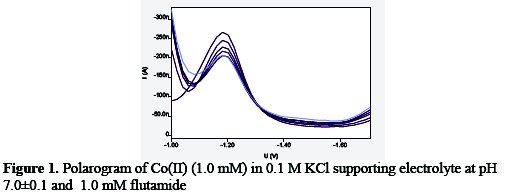
    <p>In 0.1 M KCl at pH 7.0&pm;0.1 the Co(II) and its complex with the ligand under 
study were found to be reversible, and the diffusion controlled polarographic 
wave, which was revealed by the log plot slop id versus &radic;h (effective height of 
mercury column) respectively on gradual addition of ligand the E1/2 of metal shift 
more electronegative value indicating the formation of complex (<a href="#f1">Fig. 1</a>). 
Lingane's treatment [15] of the observed polarographic data revealed 1:1 [M:L] 
complex formation in solution with log &beta;1=5.2.</p>


    <p>&nbsp;</p>
<a name="f1">
<img src="/img/revistas/pea/v33n6/33n6a02f1.jpg">
    
<p>&nbsp;</p>


    <p><i><b>Amperometric determination of flutamide with Co(II)</b></i></p>

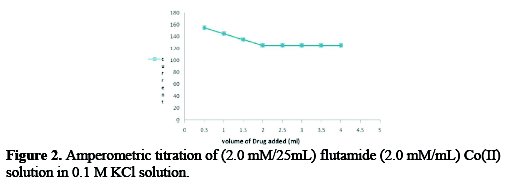
    <p>Co (II) with flutamide gives a well defined polarographic waves peak in 0.1 M 
KCl; at 7.0&pm;0.1 pH the diffusion current was found to be proportional to the 
concentration of Co(II). The plateau potential for the polarographic wave of Co 
(II) (-1.25V) vs. Hg Pool was applied for carrying out amperometeric titration. 
The current goes on decreasing to minimum and then attends a constant value. 
The plot of id versus volume (V+vV) of the titrant added revealed L shaped 
curve (<a href="#f2">Fig. 2</a>).</p>


    <p>&nbsp;</p>
<a name="f2">
<img src="/img/revistas/pea/v33n6/33n6a02f2.jpg">
    
<p>&nbsp;</p>


    ]]></body>
<body><![CDATA[<p>The end point was indicated by the intersection of the two lines, 
which confirmed 1:1 [M: L] complex formation.</p>


    <p><i><b>Elemental analysis</b></i></p>

    <p>Percentage of C, H, O, N, F and Co found and calculated in the complex and 
flutamide drug are summarized in <a href="#t1">Table 1</a>.</p>


    <p>&nbsp;</p>
<a name="t1">
<img src="/img/revistas/pea/v33n6/33n6a02t1.jpg">
    
<p>&nbsp;</p>


    <p><i><b>Spectroscopic measurement</b></i></p>

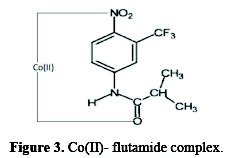
    <p>A comparison of IR data for the flutamide drug and its complexes reveals that the 
bond at 3356 cm<sup>-1</sup>, 1717 cm<sup>-1</sup>, 1513 cm<sup>-1</sup> and 1243 cm<sup>-1</sup> in the drug are shifted to 
3350 cm<sup>-1</sup>, 1656 cm<sup>-1</sup>, 1540 cm<sup>-1</sup> and 1280 cm<sup>-1</sup> respectively in the spectrum of 
the drug complex display nitrogen and (C=O) vibration in the spectrum of the 
free ligand suggesting ketoform of ligand and nitrogen indicating the 
coordination.</p>

    <p>On the basis of the above discussion, a tentative of structure to the flutamide and 
its complexes may be assigned as shown in <a href="#f3">Fig. 3</a>.</p>


    <p>&nbsp;</p>
<a name="f3">
<img src="/img/revistas/pea/v33n6/33n6a02f3.jpg">
    
<p>&nbsp;</p>


    ]]></body>
<body><![CDATA[<p><i><b>Antimicrobial activity</b></i></p>

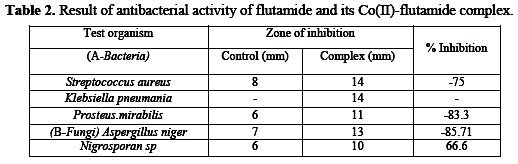
    <p>Antimicrobial behavior of Co(II)-flutamide complex against various pathogenic 
bacteria and fungi is reported in <a href="#t2">Table 2</a>.</p>


    <p>&nbsp;</p>
<a name="t2">
<img src="/img/revistas/pea/v33n6/33n6a02t2.jpg">
    
<p>&nbsp;</p>


    <p>A perusal of data in the table reveals 
that the complex shows increased antimicrobial activity against all the 
pathogenic bacteria under study, as compared to the parent drug flutamide.</p>


    <p><i><b>Pharmacological studies</b></i></p>

    <p><i>In vitro</i></p>

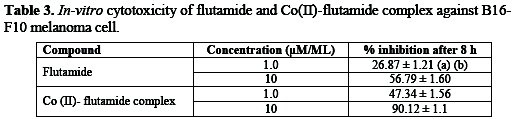
    <p>The result of in-vitro experiments of the pure drug and its complex is shown in 
<a href="#t3">Table 3</a>.</p>


    <p>&nbsp;</p>
<a name="t3">
<img src="/img/revistas/pea/v33n6/33n6a02t3.jpg">
    
<p>&nbsp;</p>


    ]]></body>
<body><![CDATA[<p>Perusals of results show that cobalt flutamide complex was found to be 
more effective than the pure drug. The complex under study showed an increased 
inhibition against the melanoma cell line B16F10 at all the test concentrations, 
i.e., 1, 10, &mu;M/ML. The increased inhibition activity of the complex was 
47.34&pm;1.56%, 90.12&pm;1.10% as against 26.87&pm;1.21%, 56.79&pm;1.60% shown by the 
drug, respectively. The statistical treatment of the observed inhibition data, i.e., 
standard deviation and coefficient of variance, which never exceeded 0.9 and 18 
%, respectively, speaks the reliability of the observed inhibition data.</p>

    <p><i>In vivo</i></p>

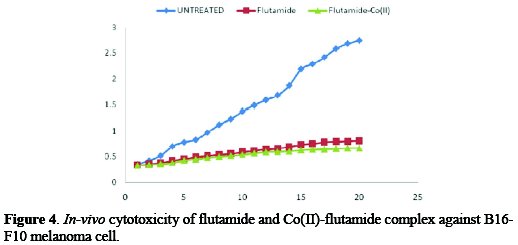
    <p>The results of the average of mice tumor against flutamide drug and cobalt 
complex under study are shown in <a href="#f4">Fig. 4</a>.</p>


    <p>&nbsp;</p>
<a name="f4">
<img src="/img/revistas/pea/v33n6/33n6a02f4.jpg">
    
<p>&nbsp;</p>


    <p>The results indicated that the tumor 
volume was 0.2 cm<sup>3</sup> on the mice tumor cells injected without administering drug 
or complex; 20 days after administering the flutamide drug in the mice tumor 
injected, the tumor size was reduced 0.81&pm; 0.63 cm<sup>3</sup>. The inhibition rate was 
found to be 70.54%. However, in the case of Co(II) flutamide, the administrated 
mice (tumor cell injected) show significant decrease in the tumor volume of 0.67 
&pm; 0.73 cm<sup>3</sup>, and the inhibition rate was 75.63%, thus indicating the increasing in 
vivo of the tumor inhibition power of the complex.</p>


    <p>&nbsp;</p>
    <p><b>Conclusions</b></p>

    <p>To investigate the structure and behavior of complex of flutamide with life 
essential metal ion Co(II) some physicochemical method i.e. IR spectral analysis, 
elemental analysis, amperometry and polarography have been successfully used. 
The obtained results suggest that the complexes are more stable as compared to 
the pure drug. On the basis of the observed results we can conclude that Co(II) 
with flutamide complex is more effective and non toxic in nature as compared to 
the parent drug. Thus, polarographic and amperometric methods may be 
recommended to study more potent drugs in lieu of the drug taken for present 
study, having excellent potential for clinical application.</p>


    <p>&nbsp;</p>
    ]]></body>
<body><![CDATA[<p><b>References</b></p>

    <!-- ref --><p>1. Budavari S O, Neil M, Smith A, et al. Merck Index. 11th ed. Rathway: Merck index and Co Inc;1989.    &nbsp;&nbsp;&nbsp;&nbsp;&nbsp;&nbsp;&nbsp;&nbsp;[&#160;<a href="javascript:void(0);" onclick="javascript: window.open('/scielo.php?script=sci_nlinks&ref=417306&pid=S0872-1904201500060000200001&lng=','','width=640,height=500,resizable=yes,scrollbars=1,menubar=yes,');">Links</a>&#160;]<!-- end-ref --></p>

    <!-- ref --><p>2. Snycerski A. J Pharm Biomed Anal. 1989;7:1513.    &nbsp;&nbsp;&nbsp;&nbsp;&nbsp;&nbsp;&nbsp;&nbsp;[&#160;<a href="javascript:void(0);" onclick="javascript: window.open('/scielo.php?script=sci_nlinks&ref=417308&pid=S0872-1904201500060000200002&lng=','','width=640,height=500,resizable=yes,scrollbars=1,menubar=yes,');">Links</a>&#160;]<!-- end-ref --></p>

    <!-- ref --><p>3. Ferlay J, Bray F, Pisani P, et al. Globocan 2000 cancer incidence. 2001.    &nbsp;&nbsp;&nbsp;&nbsp;&nbsp;&nbsp;&nbsp;&nbsp;[&#160;<a href="javascript:void(0);" onclick="javascript: window.open('/scielo.php?script=sci_nlinks&ref=417310&pid=S0872-1904201500060000200003&lng=','','width=640,height=500,resizable=yes,scrollbars=1,menubar=yes,');">Links</a>&#160;]<!-- end-ref --></p>

    <!-- ref --><p>4. Underwood E J. Trace element in human and nutrition. 4th ed. New York: Acad Press; 1997.    &nbsp;&nbsp;&nbsp;&nbsp;&nbsp;&nbsp;&nbsp;&nbsp;[&#160;<a href="javascript:void(0);" onclick="javascript: window.open('/scielo.php?script=sci_nlinks&ref=417312&pid=S0872-1904201500060000200004&lng=','','width=640,height=500,resizable=yes,scrollbars=1,menubar=yes,');">Links</a>&#160;]<!-- end-ref --></p>

    <!-- ref --><p>5. William D R. The metal of life. London: Van Nostrand Reinhold; 1971.    &nbsp;&nbsp;&nbsp;&nbsp;&nbsp;&nbsp;&nbsp;&nbsp;[&#160;<a href="javascript:void(0);" onclick="javascript: window.open('/scielo.php?script=sci_nlinks&ref=417314&pid=S0872-1904201500060000200005&lng=','','width=640,height=500,resizable=yes,scrollbars=1,menubar=yes,');">Links</a>&#160;]<!-- end-ref --></p>

    <!-- ref --><p>6. Brualand K W, Chester K. Chemical oceqnography. 8th ed. London: Acad Press; 1983.    &nbsp;&nbsp;&nbsp;&nbsp;&nbsp;&nbsp;&nbsp;&nbsp;[&#160;<a href="javascript:void(0);" onclick="javascript: window.open('/scielo.php?script=sci_nlinks&ref=417316&pid=S0872-1904201500060000200006&lng=','','width=640,height=500,resizable=yes,scrollbars=1,menubar=yes,');">Links</a>&#160;]<!-- end-ref --></p>

    <!-- ref --><p>7. Bassett J, Denny R C, Jeffery G H, et al, editors. Vogels Text Book of quantitative inorganic Analysis. 6th ed. London: ELBS Longman; 1996.    &nbsp;&nbsp;&nbsp;&nbsp;&nbsp;&nbsp;&nbsp;&nbsp;[&#160;<a href="javascript:void(0);" onclick="javascript: window.open('/scielo.php?script=sci_nlinks&ref=417318&pid=S0872-1904201500060000200007&lng=','','width=640,height=500,resizable=yes,scrollbars=1,menubar=yes,');">Links</a>&#160;]<!-- end-ref --></p>

    <!-- ref --><p>8. Bauer A W, Kirby W M M, Sherris J C, et al. Am J Clin Pathol. 1966;36:493.    &nbsp;&nbsp;&nbsp;&nbsp;&nbsp;&nbsp;&nbsp;&nbsp;[&#160;<a href="javascript:void(0);" onclick="javascript: window.open('/scielo.php?script=sci_nlinks&ref=417320&pid=S0872-1904201500060000200008&lng=','','width=640,height=500,resizable=yes,scrollbars=1,menubar=yes,');">Links</a>&#160;]<!-- end-ref --></p>

    <p>9. Kumar R, Giri G, Nizamuddin. J Indian Chem Soc. 1988;64:571.</p>

    <!-- ref --><p>10. Tiwari S B, Udupa N, Rao B S S, et al. Ind J Pharmacology. 2000;32:214.    &nbsp;&nbsp;&nbsp;&nbsp;&nbsp;&nbsp;&nbsp;&nbsp;[&#160;<a href="javascript:void(0);" onclick="javascript: window.open('/scielo.php?script=sci_nlinks&ref=417323&pid=S0872-1904201500060000200010&lng=','','width=640,height=500,resizable=yes,scrollbars=1,menubar=yes,');">Links</a>&#160;]<!-- end-ref --></p>

    ]]></body>
<body><![CDATA[<!-- ref --><p>11. Ghosh M N. Fundamentals of experimental pharmacology. 2nd ed. Scientific Book Agency; 1984.    &nbsp;&nbsp;&nbsp;&nbsp;&nbsp;&nbsp;&nbsp;&nbsp;[&#160;<a href="javascript:void(0);" onclick="javascript: window.open('/scielo.php?script=sci_nlinks&ref=417325&pid=S0872-1904201500060000200011&lng=','','width=640,height=500,resizable=yes,scrollbars=1,menubar=yes,');">Links</a>&#160;]<!-- end-ref --></p>

    <!-- ref --><p>12. Devi P U, Sharoda A C, Soloman F E, et al. Indian J Expl Biol. 1993;607.    &nbsp;&nbsp;&nbsp;&nbsp;&nbsp;&nbsp;&nbsp;&nbsp;[&#160;<a href="javascript:void(0);" onclick="javascript: window.open('/scielo.php?script=sci_nlinks&ref=417327&pid=S0872-1904201500060000200012&lng=','','width=640,height=500,resizable=yes,scrollbars=1,menubar=yes,');">Links</a>&#160;]<!-- end-ref --></p>

    <!-- ref --><p>13. Fidler I J. Cancer Res. 1975;35:218.    &nbsp;&nbsp;&nbsp;&nbsp;&nbsp;&nbsp;&nbsp;&nbsp;[&#160;<a href="javascript:void(0);" onclick="javascript: window.open('/scielo.php?script=sci_nlinks&ref=417329&pid=S0872-1904201500060000200013&lng=','','width=640,height=500,resizable=yes,scrollbars=1,menubar=yes,');">Links</a>&#160;]<!-- end-ref --></p>

    <!-- ref --><p>14. Rajanaresh R A, Udupa N, Uma D P. Indian J Expt Biol. 1996;34:764.    &nbsp;&nbsp;&nbsp;&nbsp;&nbsp;&nbsp;&nbsp;&nbsp;[&#160;<a href="javascript:void(0);" onclick="javascript: window.open('/scielo.php?script=sci_nlinks&ref=417331&pid=S0872-1904201500060000200014&lng=','','width=640,height=500,resizable=yes,scrollbars=1,menubar=yes,');">Links</a>&#160;]<!-- end-ref --></p>

    <!-- ref --><p>15. Lingane J. J Chem Rev. 1941;1:29.    &nbsp;&nbsp;&nbsp;&nbsp;&nbsp;&nbsp;&nbsp;&nbsp;[&#160;<a href="javascript:void(0);" onclick="javascript: window.open('/scielo.php?script=sci_nlinks&ref=417333&pid=S0872-1904201500060000200015&lng=','','width=640,height=500,resizable=yes,scrollbars=1,menubar=yes,');">Links</a>&#160;]<!-- end-ref --></p>


    ]]></body>
<body><![CDATA[<p>&nbsp;</p>
    <p><a name=0></a><sup><a href="#top">*</a></sup>Corresponding author. E-mail address: <a href="mailto:vision_bsin@yahoo.com">vision_bsin@yahoo.com</a></p>

    <p>Received 20 January 2015; accepted 13 October 2015</p>

    <p><a href="http://www.peacta.org" target="_blank">www.peacta.org</a> </p>


     ]]></body><back>
<ref-list>
<ref id="B1">
<label>1</label><nlm-citation citation-type="book">
<person-group person-group-type="author">
<name>
<surname><![CDATA[Budavari]]></surname>
<given-names><![CDATA[S O]]></given-names>
</name>
<name>
<surname><![CDATA[Neil]]></surname>
<given-names><![CDATA[M]]></given-names>
</name>
<name>
<surname><![CDATA[Smith]]></surname>
<given-names><![CDATA[A]]></given-names>
</name>
</person-group>
<source><![CDATA[Merck Index]]></source>
<year>1989</year>
<edition>11</edition>
<publisher-name><![CDATA[Merck index and Co Inc]]></publisher-name>
</nlm-citation>
</ref>
<ref id="B2">
<label>2</label><nlm-citation citation-type="journal">
<person-group person-group-type="author">
<name>
<surname><![CDATA[Snycerski]]></surname>
<given-names><![CDATA[A]]></given-names>
</name>
</person-group>
<source><![CDATA[J Pharm Biomed Anal]]></source>
<year>1989</year>
<volume>7</volume>
<page-range>1513</page-range></nlm-citation>
</ref>
<ref id="B3">
<label>3</label><nlm-citation citation-type="">
<person-group person-group-type="author">
<name>
<surname><![CDATA[Ferlay]]></surname>
<given-names><![CDATA[J]]></given-names>
</name>
<name>
<surname><![CDATA[Bray]]></surname>
<given-names><![CDATA[F]]></given-names>
</name>
<name>
<surname><![CDATA[Pisani]]></surname>
<given-names><![CDATA[P]]></given-names>
</name>
</person-group>
<source><![CDATA[Globocan 2000 cancer incidence]]></source>
<year>2001</year>
</nlm-citation>
</ref>
<ref id="B4">
<label>4</label><nlm-citation citation-type="book">
<person-group person-group-type="author">
<name>
<surname><![CDATA[Underwood]]></surname>
<given-names><![CDATA[E J]]></given-names>
</name>
</person-group>
<source><![CDATA[Trace element in human and nutrition]]></source>
<year>1997</year>
<edition>4</edition>
<publisher-loc><![CDATA[New York ]]></publisher-loc>
<publisher-name><![CDATA[Acad Press]]></publisher-name>
</nlm-citation>
</ref>
<ref id="B5">
<label>5</label><nlm-citation citation-type="book">
<person-group person-group-type="author">
<name>
<surname><![CDATA[William]]></surname>
<given-names><![CDATA[D R]]></given-names>
</name>
</person-group>
<source><![CDATA[The metal of life]]></source>
<year>1971</year>
<publisher-loc><![CDATA[London ]]></publisher-loc>
<publisher-name><![CDATA[Van Nostrand Reinhold]]></publisher-name>
</nlm-citation>
</ref>
<ref id="B6">
<label>6</label><nlm-citation citation-type="book">
<person-group person-group-type="author">
<name>
<surname><![CDATA[Brualand]]></surname>
<given-names><![CDATA[K W]]></given-names>
</name>
<name>
<surname><![CDATA[Chester]]></surname>
<given-names><![CDATA[K]]></given-names>
</name>
</person-group>
<source><![CDATA[Chemical oceqnography]]></source>
<year>1983</year>
<edition>8</edition>
<publisher-loc><![CDATA[London ]]></publisher-loc>
<publisher-name><![CDATA[Acad Press]]></publisher-name>
</nlm-citation>
</ref>
<ref id="B7">
<label>7</label><nlm-citation citation-type="book">
<person-group person-group-type="author">
<name>
<surname><![CDATA[Bassett]]></surname>
<given-names><![CDATA[J]]></given-names>
</name>
<name>
<surname><![CDATA[Denny]]></surname>
<given-names><![CDATA[R C]]></given-names>
</name>
<name>
<surname><![CDATA[Jeffery]]></surname>
<given-names><![CDATA[G H]]></given-names>
</name>
</person-group>
<source><![CDATA[Vogels Text Book of quantitative inorganic Analysis]]></source>
<year>1996</year>
<edition>6</edition>
<publisher-loc><![CDATA[London ]]></publisher-loc>
<publisher-name><![CDATA[ELBS Longman]]></publisher-name>
</nlm-citation>
</ref>
<ref id="B8">
<label>8</label><nlm-citation citation-type="journal">
<person-group person-group-type="author">
<name>
<surname><![CDATA[Bauer]]></surname>
<given-names><![CDATA[A W]]></given-names>
</name>
<name>
<surname><![CDATA[Kirby]]></surname>
<given-names><![CDATA[W M M]]></given-names>
</name>
<name>
<surname><![CDATA[Sherris]]></surname>
<given-names><![CDATA[J C]]></given-names>
</name>
</person-group>
<source><![CDATA[Am J Clin Pathol]]></source>
<year>1966</year>
<volume>36</volume>
<page-range>493</page-range></nlm-citation>
</ref>
<ref id="B9">
<label>9</label><nlm-citation citation-type="journal">
<person-group person-group-type="author">
<name>
<surname><![CDATA[Kumar]]></surname>
<given-names><![CDATA[R]]></given-names>
</name>
<name>
<surname><![CDATA[Giri]]></surname>
<given-names><![CDATA[G]]></given-names>
</name>
<name>
<surname><![CDATA[Nizamuddin]]></surname>
<given-names><![CDATA[J]]></given-names>
</name>
</person-group>
<source><![CDATA[J Indian Chem Soc]]></source>
<year>1988</year>
<volume>64</volume>
<page-range>571</page-range></nlm-citation>
</ref>
<ref id="B10">
<label>10</label><nlm-citation citation-type="journal">
<person-group person-group-type="author">
<name>
<surname><![CDATA[Tiwari]]></surname>
<given-names><![CDATA[S B]]></given-names>
</name>
<name>
<surname><![CDATA[Udupa]]></surname>
<given-names><![CDATA[N]]></given-names>
</name>
<name>
<surname><![CDATA[Rao]]></surname>
<given-names><![CDATA[B S S]]></given-names>
</name>
</person-group>
<source><![CDATA[Ind J Pharmacology]]></source>
<year>2000</year>
<volume>32</volume>
<page-range>214</page-range></nlm-citation>
</ref>
<ref id="B11">
<label>11</label><nlm-citation citation-type="book">
<person-group person-group-type="author">
<name>
<surname><![CDATA[Ghosh]]></surname>
<given-names><![CDATA[M N]]></given-names>
</name>
</person-group>
<source><![CDATA[Fundamentals of experimental pharmacology]]></source>
<year>1984</year>
<edition>2</edition>
<publisher-name><![CDATA[Scientific Book Agency]]></publisher-name>
</nlm-citation>
</ref>
<ref id="B12">
<label>12</label><nlm-citation citation-type="journal">
<person-group person-group-type="author">
<name>
<surname><![CDATA[Devi]]></surname>
<given-names><![CDATA[P U]]></given-names>
</name>
<name>
<surname><![CDATA[Sharoda]]></surname>
<given-names><![CDATA[A C]]></given-names>
</name>
<name>
<surname><![CDATA[Soloman]]></surname>
<given-names><![CDATA[F E]]></given-names>
</name>
</person-group>
<source><![CDATA[Indian J Expl Biol]]></source>
<year>1993</year>
<page-range>607</page-range></nlm-citation>
</ref>
<ref id="B13">
<label>13</label><nlm-citation citation-type="journal">
<person-group person-group-type="author">
<name>
<surname><![CDATA[Fidler]]></surname>
<given-names><![CDATA[I J]]></given-names>
</name>
</person-group>
<source><![CDATA[Cancer Res]]></source>
<year>1975</year>
<volume>35</volume>
<page-range>218</page-range></nlm-citation>
</ref>
<ref id="B14">
<label>14</label><nlm-citation citation-type="journal">
<person-group person-group-type="author">
<name>
<surname><![CDATA[Rajanaresh]]></surname>
<given-names><![CDATA[R A]]></given-names>
</name>
<name>
<surname><![CDATA[Udupa]]></surname>
<given-names><![CDATA[N]]></given-names>
</name>
<name>
<surname><![CDATA[Uma]]></surname>
<given-names><![CDATA[D P]]></given-names>
</name>
</person-group>
<source><![CDATA[Indian J Expt Biol]]></source>
<year>1996</year>
<volume>34</volume>
<page-range>764</page-range></nlm-citation>
</ref>
<ref id="B15">
<label>15</label><nlm-citation citation-type="journal">
<person-group person-group-type="author">
<name>
<surname><![CDATA[Lingane]]></surname>
<given-names><![CDATA[J]]></given-names>
</name>
</person-group>
<source><![CDATA[J Chem Rev]]></source>
<year>1941</year>
<volume>1</volume>
<page-range>29</page-range></nlm-citation>
</ref>
</ref-list>
</back>
</article>