<?xml version="1.0" encoding="ISO-8859-1"?><article xmlns:mml="http://www.w3.org/1998/Math/MathML" xmlns:xlink="http://www.w3.org/1999/xlink" xmlns:xsi="http://www.w3.org/2001/XMLSchema-instance">
<front>
<journal-meta>
<journal-id>0872-1904</journal-id>
<journal-title><![CDATA[Portugaliae Electrochimica Acta]]></journal-title>
<abbrev-journal-title><![CDATA[Port. Electrochim. Acta]]></abbrev-journal-title>
<issn>0872-1904</issn>
<publisher>
<publisher-name><![CDATA[Sociedade Portuguesa de Electroquímica]]></publisher-name>
</publisher>
</journal-meta>
<article-meta>
<article-id>S0872-19042015000600003</article-id>
<article-id pub-id-type="doi">10.4152/pea.201506331</article-id>
<title-group>
<article-title xml:lang="en"><![CDATA[Evaluation of the Performance of Pt-MWCNTs Nanocomposites Electrodeposited on Titanium for Methanol Electro-oxidation]]></article-title>
</title-group>
<contrib-group>
<contrib contrib-type="author">
<name>
<surname><![CDATA[Momeni]]></surname>
<given-names><![CDATA[M. M.]]></given-names>
</name>
<xref ref-type="aff" rid="A01"/>
</contrib>
</contrib-group>
<aff id="A01">
<institution><![CDATA[,Isfahan University of Technology Department of Chemistry ]]></institution>
<addr-line><![CDATA[ ]]></addr-line>
</aff>
<pub-date pub-type="pub">
<day>00</day>
<month>11</month>
<year>2015</year>
</pub-date>
<pub-date pub-type="epub">
<day>00</day>
<month>11</month>
<year>2015</year>
</pub-date>
<volume>33</volume>
<numero>6</numero>
<fpage>331</fpage>
<lpage>341</lpage>
<copyright-statement/>
<copyright-year/>
<self-uri xlink:href="http://scielo.pt/scielo.php?script=sci_arttext&amp;pid=S0872-19042015000600003&amp;lng=en&amp;nrm=iso"></self-uri><self-uri xlink:href="http://scielo.pt/scielo.php?script=sci_abstract&amp;pid=S0872-19042015000600003&amp;lng=en&amp;nrm=iso"></self-uri><self-uri xlink:href="http://scielo.pt/scielo.php?script=sci_pdf&amp;pid=S0872-19042015000600003&amp;lng=en&amp;nrm=iso"></self-uri><abstract abstract-type="short" xml:lang="en"><p><![CDATA[Pt nanoparticle-multi walled carbon nanotubes nanocomposites supported on titanium substrate (Pt-MWCNTs/Ti) were prepared by co-electrodeposition method. This composite catalyst was characterized by scanning electron microscopy (SEM), energy dispersive spectrum (EDS), and electrochemical methods. The SEM images reveal that nanostructures are distributed at the surface of the titanium plate. Electro-oxidation of methanol was investigated in acidic media on Pt-MWCNTs/Ti electrodes via cyclic voltammetric analysis in the mixed 0.1 M methanol and 0.1 M H2SO4 solutions. The Pt-MWCNTs/Ti catalyst has good electro-catalytic activity for methanol oxidation. This novel Pt-MWCNTs/Ti catalyst can be used repeatedly and exhibits stable electrocatalytic activity for the methanol oxidation.]]></p></abstract>
<kwd-group>
<kwd lng="en"><![CDATA[Platinum nanoparticles]]></kwd>
<kwd lng="en"><![CDATA[Multi walled carbon nanotubes]]></kwd>
<kwd lng="en"><![CDATA[Methanol]]></kwd>
<kwd lng="en"><![CDATA[Titanium]]></kwd>
</kwd-group>
</article-meta>
</front><body><![CDATA[ 

<!--     <p>&nbsp;</p>
    <p>doi: 10.4152/pea.201506331</p> -->

    <p><b>Evaluation of the Performance of Pt-MWCNTs Nanocomposites Electrodeposited on Titanium for Methanol Electro-oxidation</b></p>

    <p>
<b>M.M. Momeni</b><sup><a href="#0">*</a></sup>
</p>

    <p><i> Department of Chemistry, Isfahan University of Technology, Isfahan 84156-83111, Iran.</i></p>


    <p>&nbsp;</p>
    <p><b>Abstract</b></p>

    <p>Pt nanoparticle-multi walled carbon nanotubes nanocomposites supported on titanium 
substrate (Pt-MWCNTs/Ti) were prepared by co-electrodeposition method. This 
composite catalyst was characterized by scanning electron microscopy (SEM), energy 
dispersive spectrum (EDS), and electrochemical methods. The SEM images reveal that 
nanostructures are distributed at the surface of the titanium plate. Electro-oxidation of 
methanol was investigated in acidic media on Pt-MWCNTs/Ti electrodes via cyclic 
voltammetric analysis in the mixed 0.1 M methanol and 0.1 M H2SO4 solutions. The 
Pt-MWCNTs/Ti catalyst has good electro-catalytic activity for methanol oxidation. This 
novel Pt-MWCNTs/Ti catalyst can be used repeatedly and exhibits stable electrocatalytic 
activity for the methanol oxidation.</p>

    <p><b><i>Keywords:</i></b> Platinum nanoparticles, Multi walled carbon nanotubes, Methanol, Titanium.</p>


    ]]></body>
<body><![CDATA[<p>&nbsp;</p>
    <p><b>Introduction</b></p>

    <p>Direct alcohol fuel cells (DAFCs) based on liquid fuels have attracted much 
attention as power sources for portable electronic devices and fuel cell vehicles, 
due to their much higher energy density than gaseous fuels such as hydrogen [14]. 
Studies aiming at developing efficient fuel cells have greatly contributed to 
the development of catalysts for the electro-oxidation of small organic molecules. 
Among these substances, methanol has been the most investigated due to the 
possibility of using it as a fuel in direct methanol fuel cells (DMFC).</p>

    <p>Direct methanol fuel cells (DMFCs) are potential alternative energy sources for 
portable electronic devices, because of their high energy-conversion efficiency, 
low pollution emission, and safe fuel handling [5]. An effective catalyst is a key 
factor for the realization of DMFCs applications. It is largely accepted that Pt and 
Pt alloys are still indispensable and the most effective catalysts for the electrooxidation 
of methanol in DMFCs [6-8]. However, the increasing use of Pt and Pt 
alloys may raise the price of electro-catalyst and deplete a scarce resource. Thus, 
one of the grand challenges in DMFC development is how to reduce the use of 
precious Pt. One approach to cost reduction is to use Pt-based alloys, and another 
way is to efficiently utilize Pt by distributing limited Pt nanostructures on a 
suitable support [9-12]. Immobilization of Pt nanostructures in an active matrix 
may enhance the overall reactivity of catalytic metal centers. In the literature on 
optimum support for dispersed metal nanoparticles, attention shall be paid not 
only to systems stability and feasibility of fast charge propagation, but also to the 
existence of the activation of mutual metal-support interactions. In order to 
reduce the amount of noble metal loading and also enhance electro-catalytic 
activity of electrodes, there have been considerable efforts to increase dispersion 
of metal particles on different supports. Titanium is corrosion-resistant, has a 
high mechanical strength, a reasonable cost, wide electrochemical potential 
windows and good stability. Because of its excellent properties, titanium has 
been applied as a substrate in order to prepare novel and stable electro-catalysts 
including the well-known dimensionally stable anodes (DSA) [13-15]. Compared 
with the conventional structure of the anode, the titanium anode has many 
advantages, such as simplicity, easy production on a mass scale, low cost and 
flexibility in terms of shape [16]. In recent years, carbon nanotubes have received 
increasing attention, regarding the preparation of modified electrodes, due to 
their unique structures and extraordinary properties, such as a huge surface area, 
strong stability and efficient catalytic activity which can promote charge transfer 
reaction. At the present, carbon nanotubes are widely used in the electrochemical 
field [17-19]. To the best of our knowledge, electro-oxidation of methanol on 
titanium-coated with platinum nanoparticle-multi walled carbon nanotubes has 
not been reported in the literature. In the present work, we have prepared an 
electro-catalyst based on the co-deposition of platinum nanoparticle-multi walled 
carbon nanotubes on titanium plate and have studied their electrochemical 
activity for methanol electro-oxidation using cyclic voltammetry (CV).</p>


    <p>&nbsp;</p>
    <p><b>Experimental</b></p>

    <p><i><b>Chemicals, Solutions and Electrochemical measurement</b></i></p>

    <p>Methanol (Merck, 99% purity) and H2SO4 (Merck, 99% purity) were used as 
received. Hexachloroplatinic acid (98%) was purchased from Merck. All other 
chemicals were of analytical grade and used without further purification. All 
electrochemical experiments were carried out at room temperature. Distilled 
water was used throughout. The electrochemical experiments were performed in 
a three-electrode cell arrangement. A platinum sheet was used as counter 
electrode, while all potentials were measured with respect to a commercial 
saturated calomel reference electrode (SCE). Electrochemical experiments were 
carried out by the IviumStat electrochemical analyzer (IVIUM Technology, The 
Netherlands).</p>


    <p><i><b>Preparation of Pt-MWCNTs/Ti and Pt/Ti electrodes</b></i></p>

    <p>Titanium discs were cut from a titanium plate and mounted using polyester resin. 
Titanium electrodes were first mechanically polished and then chemically etched 
by immersion in a mixture of HF:HNO3 1:3 solution for 1 min. Prior to electrodeposition, 
titanium samples were degreased by sonicating in acetone and 
ethanol followed by rinsing with distilled water.</p>

    ]]></body>
<body><![CDATA[<p>Untreated MWNTs were ultrasonically treated with a 3:1 mixture of concentrated 
H2SO4 and HNO3 for 4 h, which produced carboxylic acid groups at the defect 
sites and thus improved the solubility of the c-MWNTs in acidic solution, and 
then washed with distilled water several times until the pH of the solution 
became neutral (pH 7). The carboxylic MWNTs were dried and stored until use. 
Afterwards, 10 mg carboxylic MWNTs were dispersed in 100 mL of 0.5 M 
H2SO4 solution containing 1 mM H2PtCl6 by ultrasonics over 1 h. The platinum 
nanoparticle-multi walled carbon nanotubes were electrochemically deposited at 
the surface of titanium substrate from this bath. The deposition conditions were a 
current density of 10 mA cm<sup>-2</sup> for 5 min and the temperature was maintained at 
45 &deg;C. For preparation of Pt/Ti electrodes, the Pt was electrochemically deposited 
at the surface of titanium substrate from 1 mM H2PtCl6 in aqueous 0.5 M H2SO4 
solution as the supporting electrolyte. Here again, the deposition conditions were 
a current density of 10 mA cm<sup>-2</sup> for 5 min and the temperature was maintained at 
45 &deg;C.</p>

    <p>In order to determine how much Pt (mass) was present on titanium substrates, the 
final platinum loading, as measured by dissolution of the deposit followed by 
ICP analysis was about 0.6 mg cm<sup>-2</sup> (for Pt-MWCNTs/Ti) and 1.1 mg cm<sup>-2</sup> (for 
Pt/Ti) electrodes.</p>


    <p>&nbsp;</p>
    <p><b>Results and discussion</b></p>

    <p><i><b>Morphology of Pt-MWCNTs/Ti electrode</b></i></p>

    <p><a href="#f1">Fig. 1</a> illustrates the SEM images of Pt-MWCNTs films deposited on the 
titanium plate.</p>


    <p>&nbsp;</p>
<a name="f1">
<img src="/img/revistas/pea/v33n6/33n6a03f1.jpg">
    
<p>&nbsp;</p>


    <p>It can be seen that platinum nanoparticles and MWCNTs are 
distributed in an almost homogeneous manner at the surface of the titanium plate. 
The EDX confirms the presence of Pt on the modified electrode.</p>


    <p><i><b>Characterization of the Pt-MWCNTs/Ti electrode surface</b></i></p>

    ]]></body>
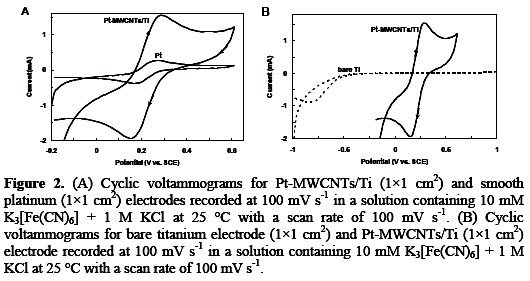
<body><![CDATA[<p>To determine whether the electro-deposition procedure has resulted in the 
removal of the oxide layer, thereby ensuring good electrical contact between the 
deposited composite film and the underlying substrates, the Pt-MWCNTs/Ti 
were tested as electrodes using one electron redox couple. <a href="#f2">Fig. 2</a> (A and B) 
shows the voltammetric curves for the reduction of K3Fe(CN)6 on flat platinum, 
Pt-MWCNTs/Ti and bare titanium electrodes.</p>


    <p>&nbsp;</p>
<a name="f2">
<img src="/img/revistas/pea/v33n6/33n6a03f2.jpg">
    
<p>&nbsp;</p>


    <p>The voltammogram for the Pt-MWCNTs/Ti electrodes shows the expected reversible behavior for the reduction 
on a bulk platinum electrode (<a href="#f2">Fig. 2A</a>). In comparison, the CVs obtained with 
titanium electrode show increased peak separation and peak widths (<a href="#f2">Fig. 2B</a>). 
This is probably attributable to a passivating surface film, most likely the oxide 
layer present on the surface of the titanium electrode. The lack of such 
resistances and over-potentials observed on repeated redox cycling of Pt-
MWCNTs/Ti electrodes indicates that there is no significant resistive film 
between the underlying titanium and the deposited composite film. It suggests 
that the adhesion and electrical contact property of the deposited composite film 
with titanium is quite satisfactory [20].</p>

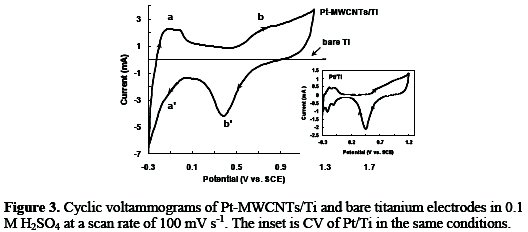
    <p>To understand the electrochemical activity of the Pt-MWCNTs/Ti, the cyclic 
voltammetric responses of the Pt-MWCNTs/Ti, Pt/Ti and bare titanium 
electrodes were recorded at a scan rate of 100 mV s<sup>-1</sup>. <a href="#f3">Fig. 3</a> shows the cyclic 
voltammograms of the Pt-MWCNTs/Ti, bare titanium and Pt/Ti (inset) in 0.1 M 
H2SO4 solution.</p>


    <p>&nbsp;</p>
<a name="f3">
<img src="/img/revistas/pea/v33n6/33n6a03f3.jpg">
    
<p>&nbsp;</p>


    <p>Although the typical Pt-peaks for the hydrogen deposition (a), 
the oxidation of hydrogen (a'), formation of platinum oxide (b), and its reduction 
(b') are present on the Pt-MWCNTs/Ti, they become ill-shaped compared to 
Pt/Ti (inset) [21-23]. Also, curve 3 shows the cyclic voltammetric of bare 
titanium substrate in 0.1 M H2SO4 solution. No adsorption/desorption peaks of 
hydrogen appeared at the bare titanium.</p>


    <p><i><b>Oxidation of methanol on the Pt-MWCNTs/Ti catalyst</b></i></p>

    <p>In order to compare the Pt-MWCNTs/Ti electrode with Pt/Ti electrode, the cyclic 
voltammetry method was used to estimate the electro-catalytic behavior of the 
electrodes. <a href="#f4">Fig. 4</a> shows the comparison of oxidation of methanol on Pt/Ti and 
the Pt-MWCNTs/Ti electrodes.</p>


    ]]></body>
<body><![CDATA[<p>&nbsp;</p>
<a name="f4">
<img src="/img/revistas/pea/v33n6/33n6a03f4.jpg">
    
<p>&nbsp;</p>


    <p>It can be seen from <a href="#f4">Fig. 4</a> that the cyclic 
voltammogram of Pt-MWCNTs/Ti electrode (curve II) shows the usual 
characteristics of Pt/Ti electrode (curve I), except that for both forward and 
reverse scan directions the oxidation currents of methanol on the Pt-MWCNTs/Ti 
electrode are significantly higher than on Pt/Ti electrode. <a href="#f4">Fig. 4</a>, inset A, shows 
the cyclic voltammograms of Pt/Ti electrode in 0.1 M H2SO4 aqueous solution at 
a scan rate of 100 mV s<sup>-1</sup> without methanol (dash line) and in the presence of 0.1 
M methanol (solid line). Cyclic voltammetry data were recorded for Pt-
MWCNTs/Ti electrode in 0.1 M H2SO4 aqueous solution at a scan rate of 100 
mV s<sup>-1</sup> without methanol (dash line) and in the presence of 0.1 M methanol (solid 
line), as shown in <a href="#f4">Fig. 4</a> (inset B). It can be seen from the cyclic voltammetry of 
methanol oxidation on the Pt-MWCNTs/Ti electrode that the reaction 
commences in the hydrogen region and proceeds slowly in the positive direction, 
and then reaches a plateau at about -0.10 V. At potentials with more than 0.25 V, 
the reaction becomes accelerated and maximum rate at ca. 0.83 V occurs. At 
potentials above 0.83 V the oxidation of platinum and formation of platinum 
oxides cause a decrease in the amount of active sites available on the electrode 
surface which subsequently result in a decrease of peak current. Upon reversing 
the potential sweep, a very steep increase of the reaction rate at ca. 0.65 V 
develops and a maximum current is observed at ca. 0.55 V. In the backward scan, 
the reduction of platinum oxides to platinum and production of active sites take 
place, so re-oxidation of methanol and/or methanol residues occurs on clean 
platinum surface and backward peak at 0.55 V appears [24, 25].</p>

    <p>Electro-oxidation of methanol at platinum-based electrodes has been studied 
extensively. Results from infra-red spectroscopy show that methanol oxidation 
on platinum at low potentials lead to the formation of linearly bonded CO 
species. This species, which is strongly adsorbed on the platinum, acts as a 
catalyst poison. The surface reaction between this adsorbed CO species and 
adsorbed OH species, from water decomposition, causes the formation of carbon 
dioxide (final product of methanol oxidation) [25, 26]. According to the 
literature, it is well known that methanol oxidation process consists of the 
following steps that result in the formation of carboxyl intermediates and 
strongly adsorbed CO species [27-29]:</p>


    <p>&nbsp;</p>
<a name="e1">
<img src="/img/revistas/pea/v33n6/33n6a03e1.jpg">
    
<p>&nbsp;</p>
<a name="e2">
<img src="/img/revistas/pea/v33n6/33n6a03e2.jpg">
    
<p>&nbsp;</p>
<a name="e3">
<img src="/img/revistas/pea/v33n6/33n6a03e3.jpg">
    
<p>&nbsp;</p>
<a name="e4">
<img src="/img/revistas/pea/v33n6/33n6a03e4.jpg">
    
<p>&nbsp;</p>
<a name="e5">
<img src="/img/revistas/pea/v33n6/33n6a03e5.jpg">
    
<p>&nbsp;</p>


    ]]></body>
<body><![CDATA[<p><a href="#e1">Reactions (1)-(5)</a> can be denoted by a total dissociative adsorption reaction:</p>


    <p>&nbsp;</p>
<a name="e6">
<img src="/img/revistas/pea/v33n6/33n6a03e6.jpg">
    
<p>&nbsp;</p>


    <p>The complete methanol oxidation (<a href="#e7">reaction 7</a>) can occur and cause the sharp 
increase in current of methanol oxidation peak:</p>


    <p>&nbsp;</p>
<a name="e7">
<img src="/img/revistas/pea/v33n6/33n6a03e7.jpg">
    
<p>&nbsp;</p>


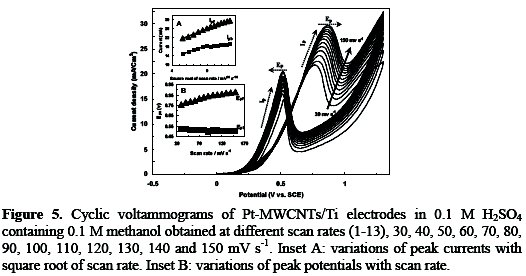
    <p>In order to investigate the kinetic characterization of methanol oxidation on the 
Pt-MWCNTs/Ti electrode, we have looked into the effect of the scan rate on the 
behavior of methanol oxidation. CVs of methanol oxidation on Pt-MWCNTs/Ti 
electrode at different scan rates were shown in <a href="#f5">Fig. 5</a>.</p>


    <p>&nbsp;</p>
<a name="f5">
<img src="/img/revistas/pea/v33n6/33n6a03f5.jpg">
    
<p>&nbsp;</p>


    <p>The result clearly reveals 
that the peak current associated to the methanol electro-oxidation increases 
linearly with the scan rate in the range 30-150 mV s<sup>-1</sup>. In principle, peak currents 
are proportional to the scan rate (v) for an adsorption process and the square root 
scan rate (v<sup>1/2</sup>) for a diffusion process [30]. In <a href="#f5">inset A</a> curve a, peak currents were 
plotted as a function of the square root scan rate (v<sup>1/2</sup>). As it can be seen, the 
current value of main anodic peak (Ipf) is liner vs. v<sup>1/2</sup>. This behavior indicates 
that the electro-catalytic process under study is controlled by diffusion [31]. The 
dependence of methanol oxidation peak potential (Epa) on the scan rate indicates 
an irreversible charge-transport process (<a href="#f5">inset B</a>) [30]. The potential of reoxidation 
peak (Epb) shifts negatively with the scan rate, because, most probably 
in high scan rates, the stability of platinum oxides increases, thus, their reduction 
in the backward scan requires more negative potentials [29].</p>

    ]]></body>
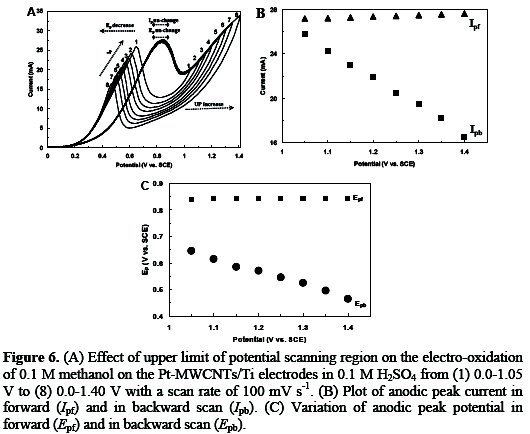
<body><![CDATA[<p>In order to reveal the correlation between methanol oxidation and platinum oxide 
species, we have studied the effect of the upper limit potentials (EU) in the cyclic 
potential scanning on the methanol oxidation. The reason for that, as reported in 
the literature, is that the different ranges of potential, over which the formation 
and dissolution of surface oxides occur on the smooth platinum or on the Ptbased 
electrodes, form a striking feature of the electrochemical behaviors of 
these electrodes [32]. It is also reflected in a kinetic irreversibility of most 
electro-catalytic oxidation, even in the reduction reactions that proceed on these 
electrodes [33].</p>

    <p><a href="#f6">Fig. 6</a> shows the CVs of methanol oxidation on the Pt-MWCNTs/Ti electrodes 
for EU of 1.05-1.40 V.</p>


    <p>&nbsp;</p>
<a name="f6">
<img src="/img/revistas/pea/v33n6/33n6a03f6.jpg">
    
<p>&nbsp;</p>


    <p>As seen in <a href="#f6">figure 6</a>, by increasing the final positive 
potential limit, the anodic current density of methanol oxidation in the positive 
going potential sweep (PGPS) remains unchanged, but the oxidation current 
density in the negative going potential sweep (NGPS) is decreased (<a href="#f6">Fig. 6B</a>). 
According to reports in the literature, the re-oxidation peak for methanol is 
related to the oxidation of methanol and/or methanol residues (Pt-CO) in the 
backward scan. The reaction for the re-oxidation peak is assumed as follows 
[24]:</p>


    <p>&nbsp;</p>
<a name="e8">
<img src="/img/revistas/pea/v33n6/33n6a03e8.jpg">
    
<p>&nbsp;</p>


    <p>In the lower limit potential, Pt oxides with a high valence do not develop greatly, 
so, the effect of the Pt oxides with a high valence on the methanol oxidation in 
the NGPS is relatively small. It can also be seen that the potential of the 
methanol oxidation peak remains invariable in PGPS, while the potential of the 
methanol oxidation peak shifts positively in NGPS (<a href="#f6">Fig. 6C</a>). On the other hand, 
the peak current density in NGPS decreased, as EU increased. Indeed, by 
increasing the final positive potentials, the conversion of Pt to PtO is accelerated, 
causing a decrease of the oxidation current density in NGPS, which further 
demonstrates that methanol can only be oxidized on a clean metallic platinum 
nanoparticles surface [20].</p>

    <p>In order to evaluate the capacity of Pt-MWCNTs/Ti for electro-oxidation of 
methanol, the effect of methanol concentration on the corresponding main anodic 
peak currents was investigated by cyclic voltammetry. According to 
experimental data the peak current of methanol was increased by methanol 
concentration, and reached a nearly constant value for concentrations higher than 
1.5 M methanol. We assume this effect was caused by saturation of active sites at 
the surface of the electro-catalyst.</p>

    <p>The effect of H2SO4 concentration on the peak current related to the electrooxidation 
of methanol at Pt-MWCNTs/Ti electrode has been investigated by 
cyclic voltammetry. The variation of the peak current obtained for methanol 
oxidation (main anodic peak) was plotted against H2SO4 concentration. The peak 
current of main anodic peak oxidation increases with the increase of H2SO4 
concentration to 0.1 M, and then it remains constant for the optimum H2SO4 
concentration range of 0.10-0.20 M. Further increase in H2SO4 concentration 
depressed the anodic peak current. It can be said that in high concentrations of 
H2SO4, the dissociation of acid decreases, causing the reduction of the solution 
conductivity. Also, the reducing effect of a high level H2SO4 concentration on 
peak currents may be addressed according to the Chatelier's principle, i.e. the 
thermodynamic tendency for oxidation of main anodic peak was reduced by 
H2SO4 concentration [23, 34], because, as it can be seen in reactions from (1)-(7), 
hydrogen ion was produced in the right sides. Therefore, as the concentration of 
hydrogen ion increases via increasing H2SO4 concentration, the reaction's 
progress will be reduced. On the other hand, according to the Chatelier's 
principle, if we are to add a species to the overall reaction, the reaction will favor 
the side opposing the addition of the species.</p>

    ]]></body>
<body><![CDATA[<p>The long-term stability of the electro-catalyst is important from the viewpoint of 
the practical application. In order to evaluate the stability of the electro-catalytic 
activity of the Pt-MWCNTs/Ti electrode toward methanol electro-oxidation and 
also poisoning-resistance of the electro-catalyst, chronoamperometric 
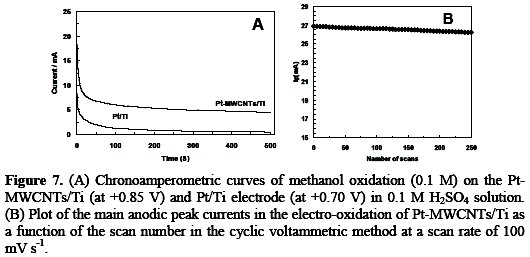
measurements were performed. The obtained results on Pt/Ti and Pt-
MWCNTs/Ti electrodes in 0.1 M methanol + 0.1 M H2SO4 solution were shown 
in <a href="#f7">Fig. 7</a>.</p>


    <p>&nbsp;</p>
<a name="f7">
<img src="/img/revistas/pea/v33n6/33n6a03f7.jpg">
    
<p>&nbsp;</p>


    <p>As it can be seen in <a href="#f7">Fig. 7A</a>, in both curves, the currents dropped 
rapidly at first, and then became relatively stable, due to the fast poisoning of the 
platinum surface by adsorbed intermediates. Also, the decay of the oxidation 
current density on Pt-MWCNTs/Ti is much slower than that on Pt/Ti electrodes. 
This indicates that the Pt-MWCNTs/Ti electrodes have an acceptable stability in 
the electro-oxidation of methanol. On the other hand, the oxidation current on the 
Pt-MWCNTs/Ti electrodes is larger than that on Pt/Ti electrodes at the end of the 
experiment. This indicates that the Pt-MWCNTs/Ti electrode is a good 
poisoning-resistance electro-catalyst for methanol oxidation.</p>

    <p>The continuous cycling in CV method can indicate that the present electrocatalyst 
has low stability in long-term using. The effect of continuous cycling and 
long-term stability of Pt-MWCNTs/Ti electrode was examined in 0.1 M H2SO4 
solution containing 0.1 M methanol (<a href="#f7">Fig. 7B</a>). It can be observed that the anodic 
current remains constant with an increase in the scan number at the initial stage 
and then starts to decrease after 35 scans. The peak current of the 250th scan is 
about 94% of that of the first scan. In general, the loss of catalytic activity after 
successive number of scans may result from the consumption of methanol during 
the CV scan. That may also be due to poisoning and the structural change of the 
Pt nanoparticles as a result of the perturbation of potentials during the scanning 
in aqueous solutions, especially in the presence of the organic compound. 
After long-term stability experiments, the Pt-MWCNTs/Ti electrode was stored 
in water for a week; then methanol oxidation was carried out again by CV, and 
excellent catalytic activity towards methanol oxidation was still observed. This 
indicates that Pt-MWCNTs/Ti electrodes have good long term stability and 
storage properties.</p>


    <p>&nbsp;</p>
    <p><b>Conclusions</b></p>

    <p>Pt-MWCNTs/Ti electrodes were prepared by co-deposition of a platinum 
nanoparticle-MWCNTs composite film on titanium substrates. The morphology 
and electro-catalytic performance of the electrode was investigated by scanning 
electron microscopy and cyclic voltammetry, respectively. The results indicated 
that platinum nanoparticle-multi walled carbon nanotubes were deposited on the 
surface of titanium. Electrochemical characterization of the Pt-MWCNTs/Ti 
electrode towards methanol oxidation shows that it has good electro-catalytic 
activity. The prepared electro-catalyst exhibits satisfactory stability in methanol 
oxidation. Compared to modified carbon electrodes requiring tedious 
preparations and pretreatment procedures, Pt-MWCNTs/Ti electrodes can easily 
be prepared without any further need for modification.</p>


    <p>&nbsp;</p>
    <p><b>References</b></p>

    ]]></body>
<body><![CDATA[<!-- ref --><p>1. Rousseau S, Coutanceau C, Lamy C, et al. J Power Sources. 2006;158:1824.    &nbsp;&nbsp;&nbsp;&nbsp;&nbsp;&nbsp;&nbsp;&nbsp;[&#160;<a href="javascript:void(0);" onclick="javascript: window.open('/scielo.php?script=sci_nlinks&ref=417438&pid=S0872-1904201500060000300001&lng=','','width=640,height=500,resizable=yes,scrollbars=1,menubar=yes,');">Links</a>&#160;]<!-- end-ref --></p>

    <!-- ref --><p>2. Andreadis G, Song S Q, Tsiakaras P. J Power Sources. 2006;157:657.    &nbsp;&nbsp;&nbsp;&nbsp;&nbsp;&nbsp;&nbsp;&nbsp;[&#160;<a href="javascript:void(0);" onclick="javascript: window.open('/scielo.php?script=sci_nlinks&ref=417440&pid=S0872-1904201500060000300002&lng=','','width=640,height=500,resizable=yes,scrollbars=1,menubar=yes,');">Links</a>&#160;]<!-- end-ref --></p>

    <!-- ref --><p>3. Wang Z B, Yin G P, Zhang J, et al. J Power Sources. 2006;160:37.    &nbsp;&nbsp;&nbsp;&nbsp;&nbsp;&nbsp;&nbsp;&nbsp;[&#160;<a href="javascript:void(0);" onclick="javascript: window.open('/scielo.php?script=sci_nlinks&ref=417442&pid=S0872-1904201500060000300003&lng=','','width=640,height=500,resizable=yes,scrollbars=1,menubar=yes,');">Links</a>&#160;]<!-- end-ref --></p>

    <!-- ref --><p>4. He X, Hu C, Liu H. Catal Commun. 2010;12:100.    &nbsp;&nbsp;&nbsp;&nbsp;&nbsp;&nbsp;&nbsp;&nbsp;[&#160;<a href="javascript:void(0);" onclick="javascript: window.open('/scielo.php?script=sci_nlinks&ref=417444&pid=S0872-1904201500060000300004&lng=','','width=640,height=500,resizable=yes,scrollbars=1,menubar=yes,');">Links</a>&#160;]<!-- end-ref --></p>

    <!-- ref --><p>5. Raoof J B, Ojani R, Hosseini S R. Int J Hydrogen Energy. 2011;36:52.    &nbsp;&nbsp;&nbsp;&nbsp;&nbsp;&nbsp;&nbsp;&nbsp;[&#160;<a href="javascript:void(0);" onclick="javascript: window.open('/scielo.php?script=sci_nlinks&ref=417446&pid=S0872-1904201500060000300005&lng=','','width=640,height=500,resizable=yes,scrollbars=1,menubar=yes,');">Links</a>&#160;]<!-- end-ref --></p>

    ]]></body>
<body><![CDATA[<!-- ref --><p>6. Steele B C H, Heinzel A. Nature. 2001;414:345.    &nbsp;&nbsp;&nbsp;&nbsp;&nbsp;&nbsp;&nbsp;&nbsp;[&#160;<a href="javascript:void(0);" onclick="javascript: window.open('/scielo.php?script=sci_nlinks&ref=417448&pid=S0872-1904201500060000300006&lng=','','width=640,height=500,resizable=yes,scrollbars=1,menubar=yes,');">Links</a>&#160;]<!-- end-ref --></p>

    <!-- ref --><p>7. Liu Y G, Wang Y G, Zhang J Y, et al. Catal Commun. 2009;10:1244.    &nbsp;&nbsp;&nbsp;&nbsp;&nbsp;&nbsp;&nbsp;&nbsp;[&#160;<a href="javascript:void(0);" onclick="javascript: window.open('/scielo.php?script=sci_nlinks&ref=417450&pid=S0872-1904201500060000300007&lng=','','width=640,height=500,resizable=yes,scrollbars=1,menubar=yes,');">Links</a>&#160;]<!-- end-ref --></p>

    <!-- ref --><p>8. Zhang X Y, Dong D H, Li D, et al. Electrochem Commun. 2008;11:190.    &nbsp;&nbsp;&nbsp;&nbsp;&nbsp;&nbsp;&nbsp;&nbsp;[&#160;<a href="javascript:void(0);" onclick="javascript: window.open('/scielo.php?script=sci_nlinks&ref=417452&pid=S0872-1904201500060000300008&lng=','','width=640,height=500,resizable=yes,scrollbars=1,menubar=yes,');">Links</a>&#160;]<!-- end-ref --></p>

    <!-- ref --><p>9. Xu C W, Shen P K. Chem Commun. 2004;2238.    &nbsp;&nbsp;&nbsp;&nbsp;&nbsp;&nbsp;&nbsp;&nbsp;[&#160;<a href="javascript:void(0);" onclick="javascript: window.open('/scielo.php?script=sci_nlinks&ref=417454&pid=S0872-1904201500060000300009&lng=','','width=640,height=500,resizable=yes,scrollbars=1,menubar=yes,');">Links</a>&#160;]<!-- end-ref --></p>

    <!-- ref --><p>10. Ganesan R, Lee J S. Angew Chem Int Ed. 2005;44:6557.    &nbsp;&nbsp;&nbsp;&nbsp;&nbsp;&nbsp;&nbsp;&nbsp;[&#160;<a href="javascript:void(0);" onclick="javascript: window.open('/scielo.php?script=sci_nlinks&ref=417456&pid=S0872-1904201500060000300010&lng=','','width=640,height=500,resizable=yes,scrollbars=1,menubar=yes,');">Links</a>&#160;]<!-- end-ref --></p>

    ]]></body>
<body><![CDATA[<!-- ref --><p>11. Matsumoto T, Komatsu T, Arai K, et al. Chem Commun. 2004;840.    &nbsp;&nbsp;&nbsp;&nbsp;&nbsp;&nbsp;&nbsp;&nbsp;[&#160;<a href="javascript:void(0);" onclick="javascript: window.open('/scielo.php?script=sci_nlinks&ref=417458&pid=S0872-1904201500060000300011&lng=','','width=640,height=500,resizable=yes,scrollbars=1,menubar=yes,');">Links</a>&#160;]<!-- end-ref --></p>

    <!-- ref --><p>12. Habibi B, Pournaghi-Azar M H. J Solid State Electrochem. 2010;14:599.    &nbsp;&nbsp;&nbsp;&nbsp;&nbsp;&nbsp;&nbsp;&nbsp;[&#160;<a href="javascript:void(0);" onclick="javascript: window.open('/scielo.php?script=sci_nlinks&ref=417460&pid=S0872-1904201500060000300012&lng=','','width=640,height=500,resizable=yes,scrollbars=1,menubar=yes,');">Links</a>&#160;]<!-- end-ref --></p>

    <!-- ref --><p>13. Mohd Y, Pletcher D. Electrochim. Acta. 2006;52:786.    &nbsp;&nbsp;&nbsp;&nbsp;&nbsp;&nbsp;&nbsp;&nbsp;[&#160;<a href="javascript:void(0);" onclick="javascript: window.open('/scielo.php?script=sci_nlinks&ref=417462&pid=S0872-1904201500060000300013&lng=','','width=640,height=500,resizable=yes,scrollbars=1,menubar=yes,');">Links</a>&#160;]<!-- end-ref --></p>

    <!-- ref --><p>14. Yi Q, Huang W, Zhang J, et al. Catal Commun. 2008;9:2053.    &nbsp;&nbsp;&nbsp;&nbsp;&nbsp;&nbsp;&nbsp;&nbsp;[&#160;<a href="javascript:void(0);" onclick="javascript: window.open('/scielo.php?script=sci_nlinks&ref=417464&pid=S0872-1904201500060000300014&lng=','','width=640,height=500,resizable=yes,scrollbars=1,menubar=yes,');">Links</a>&#160;]<!-- end-ref --></p>

    <!-- ref --><p>15. Chatzisymeon E, Dimou A, Mantzavinos D, et al. J Hazard Mater. 2009;167:268.    &nbsp;&nbsp;&nbsp;&nbsp;&nbsp;&nbsp;&nbsp;&nbsp;[&#160;<a href="javascript:void(0);" onclick="javascript: window.open('/scielo.php?script=sci_nlinks&ref=417466&pid=S0872-1904201500060000300015&lng=','','width=640,height=500,resizable=yes,scrollbars=1,menubar=yes,');">Links</a>&#160;]<!-- end-ref --></p>

    ]]></body>
<body><![CDATA[<!-- ref --><p>16. Hosseini M G, Momeni M M. Mol Catal A: Chem. 2012;355:216.    &nbsp;&nbsp;&nbsp;&nbsp;&nbsp;&nbsp;&nbsp;&nbsp;[&#160;<a href="javascript:void(0);" onclick="javascript: window.open('/scielo.php?script=sci_nlinks&ref=417468&pid=S0872-1904201500060000300016&lng=','','width=640,height=500,resizable=yes,scrollbars=1,menubar=yes,');">Links</a>&#160;]<!-- end-ref --></p>

    <!-- ref --><p>17. Wu K B, Fei J J, Hu S S. Anal Biochem. 2003;318:100.    &nbsp;&nbsp;&nbsp;&nbsp;&nbsp;&nbsp;&nbsp;&nbsp;[&#160;<a href="javascript:void(0);" onclick="javascript: window.open('/scielo.php?script=sci_nlinks&ref=417470&pid=S0872-1904201500060000300017&lng=','','width=640,height=500,resizable=yes,scrollbars=1,menubar=yes,');">Links</a>&#160;]<!-- end-ref --></p>

    <!-- ref --><p>18. Kim K S, Park S J. Anal Chim Acta. 2013;788:17.    &nbsp;&nbsp;&nbsp;&nbsp;&nbsp;&nbsp;&nbsp;&nbsp;[&#160;<a href="javascript:void(0);" onclick="javascript: window.open('/scielo.php?script=sci_nlinks&ref=417472&pid=S0872-1904201500060000300018&lng=','','width=640,height=500,resizable=yes,scrollbars=1,menubar=yes,');">Links</a>&#160;]<!-- end-ref --></p>

    <!-- ref --><p>19. Pajootan E, Arami M. Electrochim Acta. 2013;112:505.    &nbsp;&nbsp;&nbsp;&nbsp;&nbsp;&nbsp;&nbsp;&nbsp;[&#160;<a href="javascript:void(0);" onclick="javascript: window.open('/scielo.php?script=sci_nlinks&ref=417474&pid=S0872-1904201500060000300019&lng=','','width=640,height=500,resizable=yes,scrollbars=1,menubar=yes,');">Links</a>&#160;]<!-- end-ref --></p>

    <!-- ref --><p>20. Hosseini M G, Momeni M M. Electrochim Acta. 2012;70:1.    &nbsp;&nbsp;&nbsp;&nbsp;&nbsp;&nbsp;&nbsp;&nbsp;[&#160;<a href="javascript:void(0);" onclick="javascript: window.open('/scielo.php?script=sci_nlinks&ref=417476&pid=S0872-1904201500060000300020&lng=','','width=640,height=500,resizable=yes,scrollbars=1,menubar=yes,');">Links</a>&#160;]<!-- end-ref --></p>

    ]]></body>
<body><![CDATA[<!-- ref --><p>21. Fujiwara N, Friedrich K A, Stimming U. J Electroanal Chem. 1999;472:120.    &nbsp;&nbsp;&nbsp;&nbsp;&nbsp;&nbsp;&nbsp;&nbsp;[&#160;<a href="javascript:void(0);" onclick="javascript: window.open('/scielo.php?script=sci_nlinks&ref=417478&pid=S0872-1904201500060000300021&lng=','','width=640,height=500,resizable=yes,scrollbars=1,menubar=yes,');">Links</a>&#160;]<!-- end-ref --></p>

    <!-- ref --><p>22. Li W S, Tian L P, Huang Q M, et al. J Power Sources. 2002;104:281.    &nbsp;&nbsp;&nbsp;&nbsp;&nbsp;&nbsp;&nbsp;&nbsp;[&#160;<a href="javascript:void(0);" onclick="javascript: window.open('/scielo.php?script=sci_nlinks&ref=417480&pid=S0872-1904201500060000300022&lng=','','width=640,height=500,resizable=yes,scrollbars=1,menubar=yes,');">Links</a>&#160;]<!-- end-ref --></p>

    <p>23. Habibi B, Delnavaz N. Int J Hydrogen Energy. 35 (2010) 8831.</p>

    <!-- ref --><p>24. Manohara R, Goodenough J B. J Mater Chem. 1992;2:875.    &nbsp;&nbsp;&nbsp;&nbsp;&nbsp;&nbsp;&nbsp;&nbsp;[&#160;<a href="javascript:void(0);" onclick="javascript: window.open('/scielo.php?script=sci_nlinks&ref=417483&pid=S0872-1904201500060000300024&lng=','','width=640,height=500,resizable=yes,scrollbars=1,menubar=yes,');">Links</a>&#160;]<!-- end-ref --></p>

    <!-- ref --><p>25. Razmi H, Habibi E S, Heidari H. Electrochim Acta. 2008;53:8178.    &nbsp;&nbsp;&nbsp;&nbsp;&nbsp;&nbsp;&nbsp;&nbsp;[&#160;<a href="javascript:void(0);" onclick="javascript: window.open('/scielo.php?script=sci_nlinks&ref=417485&pid=S0872-1904201500060000300025&lng=','','width=640,height=500,resizable=yes,scrollbars=1,menubar=yes,');">Links</a>&#160;]<!-- end-ref --></p>

    <!-- ref --><p>26. Leger J-M, Rousseau S, Coutanceau C, et al. Electrochim Acta. 2005;50:5118.    &nbsp;&nbsp;&nbsp;&nbsp;&nbsp;&nbsp;&nbsp;&nbsp;[&#160;<a href="javascript:void(0);" onclick="javascript: window.open('/scielo.php?script=sci_nlinks&ref=417487&pid=S0872-1904201500060000300026&lng=','','width=640,height=500,resizable=yes,scrollbars=1,menubar=yes,');">Links</a>&#160;]<!-- end-ref --></p>

    <!-- ref --><p>27. Vigier F, Gloaguen F, Leger JM, et al. Electrochim Acta. 2001;46:4331.    &nbsp;&nbsp;&nbsp;&nbsp;&nbsp;&nbsp;&nbsp;&nbsp;[&#160;<a href="javascript:void(0);" onclick="javascript: window.open('/scielo.php?script=sci_nlinks&ref=417489&pid=S0872-1904201500060000300027&lng=','','width=640,height=500,resizable=yes,scrollbars=1,menubar=yes,');">Links</a>&#160;]<!-- end-ref --></p>

    <!-- ref --><p>28. Niu L, Li Q, Wei F, et al. J Electroanal Chem. 2005;578:331.    &nbsp;&nbsp;&nbsp;&nbsp;&nbsp;&nbsp;&nbsp;&nbsp;[&#160;<a href="javascript:void(0);" onclick="javascript: window.open('/scielo.php?script=sci_nlinks&ref=417491&pid=S0872-1904201500060000300028&lng=','','width=640,height=500,resizable=yes,scrollbars=1,menubar=yes,');">Links</a>&#160;]<!-- end-ref --></p>

    <!-- ref --><p>29. Razmi H, Habibi E. J Solid State Electrochem. 2009;13:1897.    &nbsp;&nbsp;&nbsp;&nbsp;&nbsp;&nbsp;&nbsp;&nbsp;[&#160;<a href="javascript:void(0);" onclick="javascript: window.open('/scielo.php?script=sci_nlinks&ref=417493&pid=S0872-1904201500060000300029&lng=','','width=640,height=500,resizable=yes,scrollbars=1,menubar=yes,');">Links</a>&#160;]<!-- end-ref --></p>

    <!-- ref --><p>30. Bard A J, Faulkner L R. Electrochemical Methods Fundamentals and Applications. 2nd ed. New York: Wiley; 2004.    &nbsp;&nbsp;&nbsp;&nbsp;&nbsp;&nbsp;&nbsp;&nbsp;[&#160;<a href="javascript:void(0);" onclick="javascript: window.open('/scielo.php?script=sci_nlinks&ref=417495&pid=S0872-1904201500060000300030&lng=','','width=640,height=500,resizable=yes,scrollbars=1,menubar=yes,');">Links</a>&#160;]<!-- end-ref --></p>

    <!-- ref --><p>31. Golikand A N, Maragheh M G, Sherehjini S S, et al. Electroanalysis. 2006;9:911.    &nbsp;&nbsp;&nbsp;&nbsp;&nbsp;&nbsp;&nbsp;&nbsp;[&#160;<a href="javascript:void(0);" onclick="javascript: window.open('/scielo.php?script=sci_nlinks&ref=417497&pid=S0872-1904201500060000300031&lng=','','width=640,height=500,resizable=yes,scrollbars=1,menubar=yes,');">Links</a>&#160;]<!-- end-ref --></p>

    <!-- ref --><p>32. Angerstein-Kozlowska H, Conway B E, Sharp W B A. J Electroanal Chem. 1973;43:9.    &nbsp;&nbsp;&nbsp;&nbsp;&nbsp;&nbsp;&nbsp;&nbsp;[&#160;<a href="javascript:void(0);" onclick="javascript: window.open('/scielo.php?script=sci_nlinks&ref=417499&pid=S0872-1904201500060000300032&lng=','','width=640,height=500,resizable=yes,scrollbars=1,menubar=yes,');">Links</a>&#160;]<!-- end-ref --></p>

    <!-- ref --><p>33. Conway I S, Marincic N, Gilroy D, et al. J Electrochem Soc. 1966;113:1144.    &nbsp;&nbsp;&nbsp;&nbsp;&nbsp;&nbsp;&nbsp;&nbsp;[&#160;<a href="javascript:void(0);" onclick="javascript: window.open('/scielo.php?script=sci_nlinks&ref=417501&pid=S0872-1904201500060000300033&lng=','','width=640,height=500,resizable=yes,scrollbars=1,menubar=yes,');">Links</a>&#160;]<!-- end-ref --></p>

    <!-- ref --><p>34. Habibi B, Dadashpour E. Int J Hydrogen Energy. 2013;38:5425.    &nbsp;&nbsp;&nbsp;&nbsp;&nbsp;&nbsp;&nbsp;&nbsp;[&#160;<a href="javascript:void(0);" onclick="javascript: window.open('/scielo.php?script=sci_nlinks&ref=417503&pid=S0872-1904201500060000300034&lng=','','width=640,height=500,resizable=yes,scrollbars=1,menubar=yes,');">Links</a>&#160;]<!-- end-ref --></p>


    <p>&nbsp;</p>
    <p><b>Acknowledgements</b></p>

    <p>The authors would like to acknowledge the financial support of the Iranian 
Nanotechnology Society and Isfahan University of Technology (IUT) Research 
Council.</p>
 

    ]]></body>
<body><![CDATA[<p>&nbsp;</p>
    <p><a name=0></a><sup><a href="#top">*</a></sup>Corresponding author. E-mail address: <a href="mailto:mm.momeni@cc.iut.ac.ir">mm.momeni@cc.iut.ac.ir</a></p>

    <p>Received 19 July 2015; accepted 1 October 2015</p>

    <p><a href="http://www.peacta.org" target="_blank">www.peacta.org</a> </p>


     ]]></body><back>
<ref-list>
<ref id="B1">
<label>1</label><nlm-citation citation-type="journal">
<person-group person-group-type="author">
<name>
<surname><![CDATA[Rousseau]]></surname>
<given-names><![CDATA[S]]></given-names>
</name>
<name>
<surname><![CDATA[Coutanceau]]></surname>
<given-names><![CDATA[C]]></given-names>
</name>
<name>
<surname><![CDATA[Lamy]]></surname>
<given-names><![CDATA[C]]></given-names>
</name>
</person-group>
<source><![CDATA[J Power Sources]]></source>
<year>2006</year>
<volume>158</volume>
<page-range>1824</page-range></nlm-citation>
</ref>
<ref id="B2">
<label>2</label><nlm-citation citation-type="journal">
<person-group person-group-type="author">
<name>
<surname><![CDATA[Andreadis]]></surname>
<given-names><![CDATA[G]]></given-names>
</name>
<name>
<surname><![CDATA[Song]]></surname>
<given-names><![CDATA[S Q]]></given-names>
</name>
<name>
<surname><![CDATA[Tsiakaras]]></surname>
<given-names><![CDATA[P]]></given-names>
</name>
</person-group>
<source><![CDATA[J Power Sources]]></source>
<year>2006</year>
<volume>157</volume>
<page-range>657</page-range></nlm-citation>
</ref>
<ref id="B3">
<label>3</label><nlm-citation citation-type="journal">
<person-group person-group-type="author">
<name>
<surname><![CDATA[Wang]]></surname>
<given-names><![CDATA[Z B]]></given-names>
</name>
<name>
<surname><![CDATA[Yin]]></surname>
<given-names><![CDATA[G P]]></given-names>
</name>
<name>
<surname><![CDATA[Zhang]]></surname>
<given-names><![CDATA[J]]></given-names>
</name>
</person-group>
<source><![CDATA[J Power Sources]]></source>
<year>2006</year>
<volume>160</volume>
<page-range>37</page-range></nlm-citation>
</ref>
<ref id="B4">
<label>4</label><nlm-citation citation-type="journal">
<person-group person-group-type="author">
<name>
<surname><![CDATA[He]]></surname>
<given-names><![CDATA[X]]></given-names>
</name>
<name>
<surname><![CDATA[Hu]]></surname>
<given-names><![CDATA[C]]></given-names>
</name>
<name>
<surname><![CDATA[Liu]]></surname>
<given-names><![CDATA[H]]></given-names>
</name>
</person-group>
<source><![CDATA[Catal Commun]]></source>
<year>2010</year>
<volume>12</volume>
<page-range>100</page-range></nlm-citation>
</ref>
<ref id="B5">
<label>5</label><nlm-citation citation-type="journal">
<person-group person-group-type="author">
<name>
<surname><![CDATA[Raoof]]></surname>
<given-names><![CDATA[J B]]></given-names>
</name>
<name>
<surname><![CDATA[Ojani]]></surname>
<given-names><![CDATA[R]]></given-names>
</name>
<name>
<surname><![CDATA[Hosseini]]></surname>
<given-names><![CDATA[S R]]></given-names>
</name>
</person-group>
<source><![CDATA[Int J Hydrogen Energy]]></source>
<year>2011</year>
<volume>36</volume>
<page-range>52</page-range></nlm-citation>
</ref>
<ref id="B6">
<label>6</label><nlm-citation citation-type="journal">
<person-group person-group-type="author">
<name>
<surname><![CDATA[Steele]]></surname>
<given-names><![CDATA[B C H]]></given-names>
</name>
<name>
<surname><![CDATA[Heinzel]]></surname>
<given-names><![CDATA[A]]></given-names>
</name>
</person-group>
<source><![CDATA[Nature]]></source>
<year>2001</year>
<volume>414</volume>
<page-range>345</page-range></nlm-citation>
</ref>
<ref id="B7">
<label>7</label><nlm-citation citation-type="journal">
<person-group person-group-type="author">
<name>
<surname><![CDATA[Liu]]></surname>
<given-names><![CDATA[Y G]]></given-names>
</name>
<name>
<surname><![CDATA[Wang]]></surname>
<given-names><![CDATA[Y G]]></given-names>
</name>
<name>
<surname><![CDATA[Zhang]]></surname>
<given-names><![CDATA[J Y]]></given-names>
</name>
</person-group>
<source><![CDATA[Catal Commun]]></source>
<year>2009</year>
<volume>10</volume>
<page-range>1244</page-range></nlm-citation>
</ref>
<ref id="B8">
<label>8</label><nlm-citation citation-type="journal">
<person-group person-group-type="author">
<name>
<surname><![CDATA[Zhang]]></surname>
<given-names><![CDATA[X Y]]></given-names>
</name>
<name>
<surname><![CDATA[Dong]]></surname>
<given-names><![CDATA[D H]]></given-names>
</name>
<name>
<surname><![CDATA[Li]]></surname>
<given-names><![CDATA[D]]></given-names>
</name>
</person-group>
<source><![CDATA[Electrochem Commun]]></source>
<year>2008</year>
<volume>11</volume>
<page-range>190</page-range></nlm-citation>
</ref>
<ref id="B9">
<label>9</label><nlm-citation citation-type="journal">
<person-group person-group-type="author">
<name>
<surname><![CDATA[Xu]]></surname>
<given-names><![CDATA[C W]]></given-names>
</name>
<name>
<surname><![CDATA[Shen]]></surname>
<given-names><![CDATA[P K]]></given-names>
</name>
</person-group>
<source><![CDATA[Chem Commun]]></source>
<year>2004</year>
<page-range>2238</page-range></nlm-citation>
</ref>
<ref id="B10">
<label>10</label><nlm-citation citation-type="journal">
<person-group person-group-type="author">
<name>
<surname><![CDATA[Ganesan]]></surname>
<given-names><![CDATA[R]]></given-names>
</name>
<name>
<surname><![CDATA[Lee]]></surname>
<given-names><![CDATA[J S]]></given-names>
</name>
</person-group>
<source><![CDATA[Angew Chem Int Ed]]></source>
<year>2005</year>
<volume>44</volume>
<page-range>6557</page-range></nlm-citation>
</ref>
<ref id="B11">
<label>11</label><nlm-citation citation-type="journal">
<person-group person-group-type="author">
<name>
<surname><![CDATA[Matsumoto]]></surname>
<given-names><![CDATA[T]]></given-names>
</name>
<name>
<surname><![CDATA[Komatsu]]></surname>
<given-names><![CDATA[T]]></given-names>
</name>
<name>
<surname><![CDATA[Arai]]></surname>
<given-names><![CDATA[K]]></given-names>
</name>
</person-group>
<source><![CDATA[Chem Commun]]></source>
<year>2004</year>
<page-range>840</page-range></nlm-citation>
</ref>
<ref id="B12">
<label>12</label><nlm-citation citation-type="journal">
<person-group person-group-type="author">
<name>
<surname><![CDATA[Habibi]]></surname>
<given-names><![CDATA[B]]></given-names>
</name>
<name>
<surname><![CDATA[Pournaghi-Azar]]></surname>
<given-names><![CDATA[M H]]></given-names>
</name>
</person-group>
<source><![CDATA[J Solid State Electrochem]]></source>
<year>2010</year>
<volume>14</volume>
<page-range>599</page-range></nlm-citation>
</ref>
<ref id="B13">
<label>13</label><nlm-citation citation-type="journal">
<person-group person-group-type="author">
<name>
<surname><![CDATA[Mohd]]></surname>
<given-names><![CDATA[Y]]></given-names>
</name>
<name>
<surname><![CDATA[Pletcher]]></surname>
<given-names><![CDATA[D]]></given-names>
</name>
</person-group>
<source><![CDATA[Electrochim. Acta]]></source>
<year>2006</year>
<volume>52</volume>
<page-range>786</page-range></nlm-citation>
</ref>
<ref id="B14">
<label>14</label><nlm-citation citation-type="journal">
<person-group person-group-type="author">
<name>
<surname><![CDATA[Yi]]></surname>
<given-names><![CDATA[Q]]></given-names>
</name>
<name>
<surname><![CDATA[Huang]]></surname>
<given-names><![CDATA[W]]></given-names>
</name>
<name>
<surname><![CDATA[Zhang]]></surname>
<given-names><![CDATA[J]]></given-names>
</name>
</person-group>
<source><![CDATA[Catal Commun]]></source>
<year>2008</year>
<volume>9</volume>
<page-range>2053</page-range></nlm-citation>
</ref>
<ref id="B15">
<label>15</label><nlm-citation citation-type="journal">
<person-group person-group-type="author">
<name>
<surname><![CDATA[Chatzisymeon]]></surname>
<given-names><![CDATA[E]]></given-names>
</name>
<name>
<surname><![CDATA[Dimou]]></surname>
<given-names><![CDATA[A]]></given-names>
</name>
<name>
<surname><![CDATA[Mantzavinos]]></surname>
<given-names><![CDATA[D]]></given-names>
</name>
</person-group>
<source><![CDATA[J Hazard Mater]]></source>
<year>2009</year>
<volume>167</volume>
<page-range>268</page-range></nlm-citation>
</ref>
<ref id="B16">
<label>16</label><nlm-citation citation-type="journal">
<person-group person-group-type="author">
<name>
<surname><![CDATA[Hosseini]]></surname>
<given-names><![CDATA[M G]]></given-names>
</name>
<name>
<surname><![CDATA[Momeni]]></surname>
<given-names><![CDATA[M M]]></given-names>
</name>
</person-group>
<source><![CDATA[Mol Catal A: Chem]]></source>
<year>2012</year>
<volume>355</volume>
<page-range>216</page-range></nlm-citation>
</ref>
<ref id="B17">
<label>17</label><nlm-citation citation-type="journal">
<person-group person-group-type="author">
<name>
<surname><![CDATA[Wu]]></surname>
<given-names><![CDATA[K B]]></given-names>
</name>
<name>
<surname><![CDATA[Fei]]></surname>
<given-names><![CDATA[J J]]></given-names>
</name>
<name>
<surname><![CDATA[Hu]]></surname>
<given-names><![CDATA[S S]]></given-names>
</name>
</person-group>
<source><![CDATA[Anal Biochem]]></source>
<year>2003</year>
<volume>318</volume>
<page-range>100</page-range></nlm-citation>
</ref>
<ref id="B18">
<label>18</label><nlm-citation citation-type="journal">
<person-group person-group-type="author">
<name>
<surname><![CDATA[Kim]]></surname>
<given-names><![CDATA[K S]]></given-names>
</name>
<name>
<surname><![CDATA[Park]]></surname>
<given-names><![CDATA[S J]]></given-names>
</name>
</person-group>
<source><![CDATA[Anal Chim Acta]]></source>
<year>2013</year>
<volume>788</volume>
<page-range>17</page-range></nlm-citation>
</ref>
<ref id="B19">
<label>19</label><nlm-citation citation-type="journal">
<person-group person-group-type="author">
<name>
<surname><![CDATA[Pajootan]]></surname>
<given-names><![CDATA[E]]></given-names>
</name>
<name>
<surname><![CDATA[Arami]]></surname>
<given-names><![CDATA[M]]></given-names>
</name>
</person-group>
<source><![CDATA[Electrochim Acta]]></source>
<year>2013</year>
<volume>112</volume>
<page-range>505</page-range></nlm-citation>
</ref>
<ref id="B20">
<label>20</label><nlm-citation citation-type="journal">
<person-group person-group-type="author">
<name>
<surname><![CDATA[Hosseini]]></surname>
<given-names><![CDATA[M G]]></given-names>
</name>
<name>
<surname><![CDATA[Momeni]]></surname>
<given-names><![CDATA[M M]]></given-names>
</name>
</person-group>
<source><![CDATA[Electrochim Acta]]></source>
<year>2012</year>
<volume>70</volume>
<page-range>1</page-range></nlm-citation>
</ref>
<ref id="B21">
<label>21</label><nlm-citation citation-type="journal">
<person-group person-group-type="author">
<name>
<surname><![CDATA[Fujiwara]]></surname>
<given-names><![CDATA[N]]></given-names>
</name>
<name>
<surname><![CDATA[Friedrich]]></surname>
<given-names><![CDATA[K A]]></given-names>
</name>
<name>
<surname><![CDATA[Stimming]]></surname>
<given-names><![CDATA[U]]></given-names>
</name>
</person-group>
<source><![CDATA[J Electroanal Chem]]></source>
<year>1999</year>
<volume>472</volume>
<page-range>120</page-range></nlm-citation>
</ref>
<ref id="B22">
<label>22</label><nlm-citation citation-type="journal">
<person-group person-group-type="author">
<name>
<surname><![CDATA[Li]]></surname>
<given-names><![CDATA[W S]]></given-names>
</name>
<name>
<surname><![CDATA[Tian]]></surname>
<given-names><![CDATA[L P]]></given-names>
</name>
<name>
<surname><![CDATA[Huang]]></surname>
<given-names><![CDATA[Q M]]></given-names>
</name>
</person-group>
<source><![CDATA[J Power Sources]]></source>
<year>2002</year>
<volume>104</volume>
<page-range>281</page-range></nlm-citation>
</ref>
<ref id="B23">
<label>23</label><nlm-citation citation-type="journal">
<person-group person-group-type="author">
<name>
<surname><![CDATA[Habibi]]></surname>
<given-names><![CDATA[B]]></given-names>
</name>
<name>
<surname><![CDATA[Delnavaz]]></surname>
<given-names><![CDATA[N]]></given-names>
</name>
</person-group>
<source><![CDATA[Int J Hydrogen Energy]]></source>
<year>2010</year>
<volume>35</volume>
<page-range>8831</page-range></nlm-citation>
</ref>
<ref id="B24">
<label>24</label><nlm-citation citation-type="journal">
<person-group person-group-type="author">
<name>
<surname><![CDATA[Manohara]]></surname>
<given-names><![CDATA[R]]></given-names>
</name>
<name>
<surname><![CDATA[Goodenough]]></surname>
<given-names><![CDATA[J B]]></given-names>
</name>
</person-group>
<source><![CDATA[J Mater Chem]]></source>
<year>1992</year>
<volume>2</volume>
<page-range>875</page-range></nlm-citation>
</ref>
<ref id="B25">
<label>25</label><nlm-citation citation-type="journal">
<person-group person-group-type="author">
<name>
<surname><![CDATA[Razmi]]></surname>
<given-names><![CDATA[H]]></given-names>
</name>
<name>
<surname><![CDATA[Habibi]]></surname>
<given-names><![CDATA[E S]]></given-names>
</name>
<name>
<surname><![CDATA[Heidari]]></surname>
<given-names><![CDATA[H]]></given-names>
</name>
</person-group>
<source><![CDATA[Electrochim Acta]]></source>
<year>2008</year>
<volume>53</volume>
<page-range>8178</page-range></nlm-citation>
</ref>
<ref id="B26">
<label>26</label><nlm-citation citation-type="journal">
<person-group person-group-type="author">
<name>
<surname><![CDATA[Leger]]></surname>
<given-names><![CDATA[J-M]]></given-names>
</name>
<name>
<surname><![CDATA[Rousseau]]></surname>
<given-names><![CDATA[S]]></given-names>
</name>
<name>
<surname><![CDATA[Coutanceau]]></surname>
<given-names><![CDATA[C]]></given-names>
</name>
</person-group>
<source><![CDATA[Electrochim Acta]]></source>
<year>2005</year>
<volume>50</volume>
<page-range>5118</page-range></nlm-citation>
</ref>
<ref id="B27">
<label>27</label><nlm-citation citation-type="journal">
<person-group person-group-type="author">
<name>
<surname><![CDATA[Vigier]]></surname>
<given-names><![CDATA[F]]></given-names>
</name>
<name>
<surname><![CDATA[Gloaguen]]></surname>
<given-names><![CDATA[F]]></given-names>
</name>
<name>
<surname><![CDATA[Leger]]></surname>
<given-names><![CDATA[J M]]></given-names>
</name>
</person-group>
<source><![CDATA[Electrochim Acta]]></source>
<year>2001</year>
<volume>46</volume>
<page-range>4331</page-range></nlm-citation>
</ref>
<ref id="B28">
<label>28</label><nlm-citation citation-type="journal">
<person-group person-group-type="author">
<name>
<surname><![CDATA[Niu]]></surname>
<given-names><![CDATA[L]]></given-names>
</name>
<name>
<surname><![CDATA[Li]]></surname>
<given-names><![CDATA[Q]]></given-names>
</name>
<name>
<surname><![CDATA[Wei]]></surname>
<given-names><![CDATA[F]]></given-names>
</name>
</person-group>
<source><![CDATA[J Electroanal Chem]]></source>
<year>2005</year>
<volume>578</volume>
<page-range>331</page-range></nlm-citation>
</ref>
<ref id="B29">
<label>29</label><nlm-citation citation-type="journal">
<person-group person-group-type="author">
<name>
<surname><![CDATA[Razmi]]></surname>
<given-names><![CDATA[H]]></given-names>
</name>
<name>
<surname><![CDATA[Habibi]]></surname>
<given-names><![CDATA[E]]></given-names>
</name>
</person-group>
<source><![CDATA[J Solid State Electrochem]]></source>
<year>2009</year>
<volume>13</volume>
<page-range>1897</page-range></nlm-citation>
</ref>
<ref id="B30">
<label>30</label><nlm-citation citation-type="book">
<person-group person-group-type="author">
<name>
<surname><![CDATA[Bard]]></surname>
<given-names><![CDATA[A J]]></given-names>
</name>
<name>
<surname><![CDATA[Faulkner]]></surname>
<given-names><![CDATA[L R]]></given-names>
</name>
</person-group>
<source><![CDATA[Electrochemical Methods Fundamentals and Applications]]></source>
<year>2004</year>
<edition>2</edition>
<publisher-loc><![CDATA[New York ]]></publisher-loc>
<publisher-name><![CDATA[Wiley]]></publisher-name>
</nlm-citation>
</ref>
<ref id="B31">
<label>31</label><nlm-citation citation-type="journal">
<person-group person-group-type="author">
<name>
<surname><![CDATA[Golikand]]></surname>
<given-names><![CDATA[A N]]></given-names>
</name>
<name>
<surname><![CDATA[Maragheh]]></surname>
<given-names><![CDATA[M G]]></given-names>
</name>
<name>
<surname><![CDATA[Sherehjini]]></surname>
<given-names><![CDATA[S S]]></given-names>
</name>
</person-group>
<source><![CDATA[Electroanalysis]]></source>
<year>2006</year>
<volume>9</volume>
<page-range>911</page-range></nlm-citation>
</ref>
<ref id="B32">
<label>32</label><nlm-citation citation-type="journal">
<person-group person-group-type="author">
<name>
<surname><![CDATA[Angerstein-Kozlowska]]></surname>
<given-names><![CDATA[H]]></given-names>
</name>
<name>
<surname><![CDATA[Conway]]></surname>
<given-names><![CDATA[B E]]></given-names>
</name>
<name>
<surname><![CDATA[Sharp]]></surname>
<given-names><![CDATA[W B A]]></given-names>
</name>
</person-group>
<source><![CDATA[J Electroanal Chem]]></source>
<year>1973</year>
<volume>43</volume>
<page-range>9</page-range></nlm-citation>
</ref>
<ref id="B33">
<label>33</label><nlm-citation citation-type="journal">
<person-group person-group-type="author">
<name>
<surname><![CDATA[Conway]]></surname>
<given-names><![CDATA[I S]]></given-names>
</name>
<name>
<surname><![CDATA[Marincic]]></surname>
<given-names><![CDATA[N]]></given-names>
</name>
<name>
<surname><![CDATA[Gilroy]]></surname>
<given-names><![CDATA[D]]></given-names>
</name>
</person-group>
<source><![CDATA[J Electrochem Soc]]></source>
<year>1966</year>
<volume>113</volume>
<page-range>1144</page-range></nlm-citation>
</ref>
<ref id="B34">
<label>34</label><nlm-citation citation-type="journal">
<person-group person-group-type="author">
<name>
<surname><![CDATA[Habibi]]></surname>
<given-names><![CDATA[B]]></given-names>
</name>
<name>
<surname><![CDATA[Dadashpour]]></surname>
<given-names><![CDATA[E]]></given-names>
</name>
</person-group>
<source><![CDATA[Int J Hydrogen Energy]]></source>
<year>2013</year>
<volume>38</volume>
<page-range>5425</page-range></nlm-citation>
</ref>
</ref-list>
</back>
</article>