<?xml version="1.0" encoding="ISO-8859-1"?><article xmlns:mml="http://www.w3.org/1998/Math/MathML" xmlns:xlink="http://www.w3.org/1999/xlink" xmlns:xsi="http://www.w3.org/2001/XMLSchema-instance">
<front>
<journal-meta>
<journal-id>0872-1904</journal-id>
<journal-title><![CDATA[Portugaliae Electrochimica Acta]]></journal-title>
<abbrev-journal-title><![CDATA[Port. Electrochim. Acta]]></abbrev-journal-title>
<issn>0872-1904</issn>
<publisher>
<publisher-name><![CDATA[Sociedade Portuguesa de Electroquímica]]></publisher-name>
</publisher>
</journal-meta>
<article-meta>
<article-id>S0872-19042016000100002</article-id>
<article-id pub-id-type="doi">10.4152/pea.201601023</article-id>
<title-group>
<article-title xml:lang="en"><![CDATA[Modeling Fireside Corrosion Rate in a Coal Fired Boiler Using Adaptive Neural Network Formalism]]></article-title>
</title-group>
<contrib-group>
<contrib contrib-type="author">
<name>
<surname><![CDATA[Kumari]]></surname>
<given-names><![CDATA[Amrita]]></given-names>
</name>
<xref ref-type="aff" rid="A01"/>
</contrib>
<contrib contrib-type="author">
<name>
<surname><![CDATA[Das]]></surname>
<given-names><![CDATA[S. K.]]></given-names>
</name>
<xref ref-type="aff" rid="A02"/>
</contrib>
<contrib contrib-type="author">
<name>
<surname><![CDATA[Srivastava]]></surname>
<given-names><![CDATA[P. K.]]></given-names>
</name>
<xref ref-type="aff" rid="A01"/>
</contrib>
</contrib-group>
<aff id="A01">
<institution><![CDATA[,Birla Institute of Technology  ]]></institution>
<addr-line><![CDATA[Ranchi ]]></addr-line>
<country>India</country>
</aff>
<aff id="A02">
<institution><![CDATA[,CSIR-National Metallurgical Laboratory  ]]></institution>
<addr-line><![CDATA[Jamshedpur ]]></addr-line>
<country>India</country>
</aff>
<pub-date pub-type="pub">
<day>00</day>
<month>01</month>
<year>2016</year>
</pub-date>
<pub-date pub-type="epub">
<day>00</day>
<month>01</month>
<year>2016</year>
</pub-date>
<volume>34</volume>
<numero>1</numero>
<fpage>23</fpage>
<lpage>38</lpage>
<copyright-statement/>
<copyright-year/>
<self-uri xlink:href="http://scielo.pt/scielo.php?script=sci_arttext&amp;pid=S0872-19042016000100002&amp;lng=en&amp;nrm=iso"></self-uri><self-uri xlink:href="http://scielo.pt/scielo.php?script=sci_abstract&amp;pid=S0872-19042016000100002&amp;lng=en&amp;nrm=iso"></self-uri><self-uri xlink:href="http://scielo.pt/scielo.php?script=sci_pdf&amp;pid=S0872-19042016000100002&amp;lng=en&amp;nrm=iso"></self-uri><abstract abstract-type="short" xml:lang="en"><p><![CDATA[In this paper, an efficient artificial neural network (ANN) model using multi-layer perceptron (MLP) philosophy has been proposed to predict the fireside corrosion rate of super heater tubes in coal fire boiler assembly, using operational data of an Indian typical thermal power plant. The input parameters comprise coal chemistry, namely, coal ash and sulfur contents, flue gas temperature, SOx concentrations in flue gas, fly ash chemistry (wt% Na2O and K2O). An efficient gradient based network training algorithm has been employed to minimize the network training errors. Effects of coal ash and sulfur contents, wt% of Na2O and K2O in fly ash and operating variables such as flue gas temperature and percentage excess air intake for coal combustion on the fireside corrosion behavior of super heater boiler tubes have been computationally investigated and parametric sensitivity analysis has been undertaken. It has been observed that ash and sulfur contents of coal, flue gas temperature and fly ash chemistry have a relatively predominant influence on the rate of fireside corrosion with respect to other parameters. Quite good agreement between ANN model predictions and the measured values of fireside corrosion rate has been observed, which is corroborated by the regression fit between these values.]]></p></abstract>
<kwd-group>
<kwd lng="en"><![CDATA[Fireside corrosion]]></kwd>
<kwd lng="en"><![CDATA[superheater tubes]]></kwd>
<kwd lng="en"><![CDATA[artificial neural network model]]></kwd>
<kwd lng="en"><![CDATA[coal composition]]></kwd>
<kwd lng="en"><![CDATA[boiler fly ash]]></kwd>
<kwd lng="en"><![CDATA[flue gas]]></kwd>
</kwd-group>
</article-meta>
</front><body><![CDATA[   <!--     <p>&nbsp;</p>     <p>doi: 10.4152/pea.201601023</p> -->      <p><b>Modeling Fireside Corrosion Rate in a Coal Fired Boiler Using Adaptive Neural Network Formalism</b></p>      <p> <b>Amrita Kumari</b><sup><i>a</i>,<a href="#0">*</a></sup> , <b>S. K. Das</b><sup><i>b</i></sup>  and <b>P. K. Srivastava</b><sup><i>a</i></sup> </p>      <p><i><sup>a</sup> Birla Institute of Technology, Mesra, Ranchi 835 215, India</i></p>      <p><i><sup>b</sup> CSIR -National Metallurgical Laboratory, Jamshedpur 831 007, India</i></p>       <p>&nbsp;</p>     <p><b>Abstract</b></p>      <p>In this paper, an efficient artificial neural network (ANN) model using multi-layer  perceptron (MLP) philosophy has been proposed to predict the fireside corrosion rate of  super heater tubes in coal fire boiler assembly, using operational data of an Indian  typical thermal power plant. The input parameters comprise coal chemistry, namely,  coal ash and sulfur contents, flue gas temperature, SOx concentrations in flue gas, fly  ash chemistry (wt% Na2O and K2O). An efficient gradient based network training  algorithm has been employed to minimize the network training errors. Effects of coal  ash and sulfur contents, wt% of Na2O and K2O in fly ash and operating variables such  as flue gas temperature and percentage excess air intake for coal combustion on the  fireside corrosion behavior of super heater boiler tubes have been computationally  investigated and parametric sensitivity analysis has been undertaken. It has been  observed that ash and sulfur contents of coal, flue gas temperature and fly ash chemistry  have a relatively predominant influence on the rate of fireside corrosion with respect to  other parameters. Quite good agreement between ANN model predictions and the  measured values of fireside corrosion rate has been observed, which is corroborated by  the regression fit between these values.</p>      ]]></body>
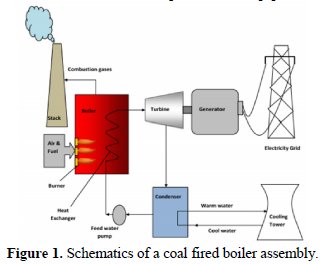
<body><![CDATA[<p><b><i>Keywords:</i></b> Fireside corrosion, superheater tubes, artificial neural network model, coal  composition, boiler fly ash and flue gas.</p>       <p>&nbsp;</p>     <p><b>Introduction</b></p>      <p>Fireside corrosion issues have always been a concern for the power generation  industry, but for the last few decades, when only fossils fuels, particularly coal,  were used as fuels, it has been aggravated. At the present, due to the introduction  of new technologies to improve the efficiency and facilitate CO2 and CO  reductions in power plants, fireside corrosion of heat exchangers has  become a major operational and techno -economic issue to the power plant  industry and manufacturers. Contaminants, such as alkali, chlorine, and sulfur  vaporize during gasification and combustion of coal, eventually condense on  metal surfaces and remove the protective layer from those surfaces by chemical  reaction, fluxing, or fracture [1]. While the boiler operating conditions are  important variables, the coal chemistry also plays a vital role in fireside  corrosion. Impurity constituents of coal (alkali metals and chlorine etc.) are well  known to accelerate corrosion wastage [2]. High sulfur and chlorine contents in  the coal have long been recognized as a major cause for boiler tube corrosion on  both the waterfall and superheater / reheater surfaces. <a href="#f1">Fig. 1</a> shows a typical  schematic of an Indian operating power plant. The effects of other constituents  on corrosion, such as the alkali and alkaline metal concentrations, as well as the  total ash content, are also important but less understood. Corrosion mainly  depends on fuel inorganic chemistry and operating conditions. The chemical  reaction mechanisms of the inorganic content depend on boiler operating  conditions. This may lead to different pathways for compounds that initiate or  accelerate the corrosion process. In pulverized-coal-fired boilers, high- temperature corrosion due to chlorine and sulphur is potentially troublesome. The  forms in which chlorine occurs are important, as they determine the mineral  transformation during combustion, which ultimately affects the fireside  corrosion behavior of the species, and their potential for removal during  the fuel preparation, as a remedial measure for fireside problems [3]. It may be  noted that in Indian coal, the chlorine content is much lesser and consequently its  influence on fireside corrosion rate is neither alarming nor an operational issue.  While higher efficiencies and lower emissions can be realized from an existing  coal combustion system, accelerated fireside corrosion is also expected to occur  on the boiler tubes. For instance, low-NOX combustion produces H2 S in the flue  gas and FeS in the deposit, due to incomplete combustion of the sulphur-bearing  species in coal. Both of these sulfides are known to increase fireside corrosion on  the waterfalls via sulfidation, although the corrosion mechanisms are distinctly  different [4].</p>     <p>&nbsp;</p> <a name="f1"> <img src="/img/revistas/pea/v34n1/34n1a02f1.jpg">     
<p>&nbsp;</p>       <p>The fireside corrosion of various components of a coal-fired boiler may be  attributed to the following:</p>      <p>- Reducing (sub-stoichiometric) conditions caused by impingement of  incompletely combusted coal particles and flames,</p>      <p>- Accelerated oxidation from overheating,</p>      <p>- Molten salt or slag-related attack.</p>      ]]></body>
<body><![CDATA[<p>The fireside corrosion is generally localized in regions specifically near the walls  of the burners. Reducing atmospheric corrosion can result from direct reaction of  the waterwall tubes with a sub-stoichiometric gaseous environment containing  sulphur, or with partially combusted char containing FeS. The reducing  conditions have two major influences on the corrosion process. First, they tend to  lower the melting point of any deposited slag, increasing its ability to dissolve  the normal oxide scales, and second, the stable gaseous sulphur compounds  include H2S, which is more corrosive than SO2 that prevails under oxidizing  conditions [5, 6]. The overheating leads to an accelerated oxidation of both the  fireside and the steam side surfaces of the tubes that produces thickened, hard  scales. Above 570 &deg;C, a considerable non-protective scale of wustite (FeO) can  be formed on iron, which culminates in rapid oxidation [7].</p>         <p><i><b>Mechanisms and causes and of Fireside corrosion</b></i></p>      <p>Fireside corrosion is often a very complicated process. Generally, the same  corrosion types as those from the steam side can be found in the fireside of a  tube, but the acid and base corrosion mechanisms are usually defined differently.  Corrosion of super-heaters has become the limiting factor in the attempt of  increasing the final steam temperature in energy production. The strength of  present steels would allow very high steam pressures and temperatures, but the  high oxidation rate or superheater corrosion caused by contaminants in fuel  limits the maximum allowed temperature, especially in the combustion of  biomass and recycled fuels [3,4]. Superheater corrosion can take place inside  the tube, as steam side corrosion, or outside the tube, as fireside corrosion. The  steam side corrosion is mainly due to faults in the steam quality control, while  the fireside corrosion is caused by corrosive components present in the flue gas.  The methods of measuring these two main corrosion types differ remarkably. It is  seldom possible to measure directly the thickening of the oxide scale inside a  tube, while a significant material loss on the outside can be detected with smaller  effort. Further, coal exhibits wide variations in many of its properties, including  composition. Low-rank coals commonly contain relatively large amounts of  organically associated elements such as Na, Mg, Ca, K, and Sr, present as salts of  organic acid groups, as well as mineral grains, although they commonly contain  less chlorine than high-rank coals. The Indian coals in general are low rank  coals having much less chlorine contents [8]. By contrast, high-rank coals  commonly contain more iron and sulfur than low-rank coals. When coal particles  are fired into the boiler furnace, the moisture and the volatile species are driven  off; the fixed carbon in the pulverized particles begins to burn. The contained  mineral matter may be melted or vaporized, and is largely oxidized. The sulphur bearing compounds in the coal (such as FeS) are converted to oxides, such as  Fe2O3, K2O, Na2O, SO2 and SO3. The relative proportions of SO2 and SO3 in the  flame depend on the oxygen availability and the flame temperature. SO2 is  thermodynamically favored at higher temperatures; the formation of SO3 can be  catalyzed by certain metal oxides. Thus, the gaseous species released, as the coal  passes through the flame, contain potential corrodents such as sulphur, vapor of  alkali metal salts, and chlorine compounds [9]. For high-temperature corrosion  due to sulfur, the presence of alkali pyrosulfates in furnace wall deposits and  alkali-iron trisulfates on the leading edge of the final superheater tube surface  is the primary cause for tube wastage. The sulfates interact with Fe2O3 in ash  and with SO3 present at the tube surface, to form alkali tri-sulfates. The  fireside corrosion rate enhances due to formation and de-stabilization of molten  complex alkali-iron tri-sulphates, with increasing temperature. Some of the most  common reactions of forming alkali-iron tri-sulphates are [10]:</p>       <p>&nbsp;</p> <a name="e1"> <img src="/img/revistas/pea/v34n1/34n1a02e1.jpg">     
<p>&nbsp;</p> <a name="e2"> <img src="/img/revistas/pea/v34n1/34n1a02e2.jpg">     
<p>&nbsp;</p> <a name="e3"> <img src="/img/revistas/pea/v34n1/34n1a02e3.jpg">     
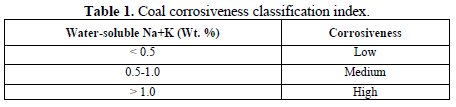
<p>&nbsp;</p>       <p>Compounds that have been recognized as having the potential to form in deposits  and cause fireside corrosion of tube surfaces include the following: sulphate  deposits; pyro-sulphates, e.g. (Na, K)2S2O7; alkali-iron tri-sulphates, e.g. (Na,  K)3FeS2(SO4)3; mixed sulphates, e.g. (Na, K, Fe)xSO4; chloride deposits, with  mixed compositions, including Na, K, Fe, Ca, Mg, and other metal elements  depending on the fuel used; and carbonates, with mixed compositions including  Na, K, Fe, Ca, Mg, and other metal elements depending on the fuel used [11].  The quality of coal used is very important. It has been proposed [2] that there are,  in general, three categories rankings for the corrosiveness of coals, based on the  sum of the percentages of water-soluble sodium and potassium in the coal, as  shown in <a href="#t1">Table 1</a>.</p>       <p>&nbsp;</p> <a name="t1"> <img src="/img/revistas/pea/v34n1/34n1a02t1.jpg">     
<p>&nbsp;</p>       ]]></body>
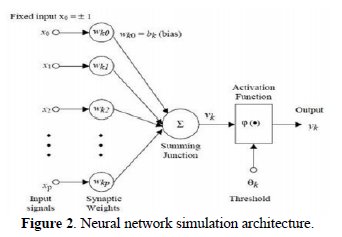
<body><![CDATA[<p>Chlorine (more than 0.2 wt%) has been found to promote the release of both Na  and K into the flame [12], and acts as a strong catalyst for the molten tri-sulphate  attack. There is also evidence that HCI formed in the flame can destroy the Fe2O3  layer on a steel surface, thereby exposing it to additional oxidative attack [3, 4].  Research on alkali tri-sulfates reveals that high-temperature corrosion of  furnace walls and superheater surfaces is minimized by maintaining an  oxidizing environment and avoiding flame impingement on furnace walls.</p>       <p><i><b>Artificial Intelligence applications in corrosion modeling</b></i></p>      <p>Quantitative determination of fireside corrosion rates, in conjunction with  pertinent mechanisms as a function of boiler coal chemistry, fly ash chemistry  and operating parameters based on first principle kinetic modeling, has remained  a fairly difficult topic. This is due to the phenomenological complexity and  sometimes non-linear relationship between the dependent and independent  variables of the fireside corrosion phenomenon. Therefore, first principle based  kinetic model predictions are not always amenable to realistic plant operating  conditions. Therefore, simplified assumptions are often made to overcome a  phenomenological complexity, which idealizes realistic problems. Recently, Data  driven Artificial Intelligence (AI) or Computational Intelligence (CI) based  techniques are increasingly used with to functionally map, in an accurate way,  the input-output relationship of complex corrosion processes, although these are  quite scanty. In principle, AI techniques (such as ANN, Fuzzy logic and Genetic  algorithms are intelligent information-treatment systems with the characteristics  of adaptive learning.</p>      <p>Application of an artificial neural network (ANN) model has been reported for  data driven modelling for prediction of ash deposition in boiler heat transport  system [13]. ANN has also been developed successfully to characterize thermal  behavior of boiler tubes in the presence of fouling on the basis of plant data [14],  and it has also been reported that such models have been applied to control and  minimize the effect of fouling in biomass boilers [15]. Application of an expert  system based theoretical approach for boiler fouling assessment has been  proposed [16]. A comparative study of Fuzzy logic and ANN has been reported  [17] for the prediction of the remaining life of boiler tubes subjected to various  damage mechanisms. An adaptive Neuro-Fuzzy technique has been attempted  [18] for predicting and characterizing coal slagging in a power plant. However,  application of ANN modeling to predict the oxidation scale deposition rate in  boiler operations is relatively scanty in the published literature.  The objective of the present work is to develop a multi-layer feed forward ANN  model to predict explicitly the fireside corrosion rate, as a function of measured  plant data (input/output parameters), namely coal ash and sulfur contents, wt% of  Na2O and K2O in fly ash, and operating variables such as flue gas temperature  and percentage excess air intake for coal combustion of a typical coal fired  Indian operating boiler. The proposed ANN model also attempts to characterize  effects of some of the operational parameters on the fireside corrosion behavior.  In this proposed ANN model, efficient gradient based network training algorithm  and optimized neural network architecture have been incorporated to improve the  network learning algorithm and to minimize training errors during the network  learning process.</p>       <p><i><b>Adaptive neural networks modeling of fireside corrosion rate</b></i></p>      <p>MLP is the most popular neural network architecture in use today [19, 20]. MLP  is a network of simple neurons called perceptrons. The perceptron computes a  single output from multiple real-valued inputs by forming a linear combination  according to its input weights, and then possibly putting the output through some  nonlinear activation. The output from a given neuron is calculated by applying a  transfer function to a weighted summation of its input to give an output, which  can serve as input to other neurons. The framework of MLP concept is shown in  <a href="#f2">figure 2</a>.</p>       <p>&nbsp;</p> <a name="f2"> <img src="/img/revistas/pea/v34n1/34n1a02f2.jpg">     
<p>&nbsp;</p>       <p>Mathematically, this can be given as:</p>       <p>&nbsp;</p> <a name="e4"> <img src="/img/revistas/pea/v34n1/34n1a02e4.jpg">     
]]></body>
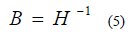
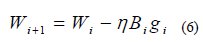
<body><![CDATA[<p>&nbsp;</p>       <p>where &alpha;is neuron j's output from k's layer and &beta;is the bias weight for neuron j in layer k. The model fitting parameters wijk are the connection weights and fk 's  are activation functions. Most neural networks will tend to forget old information  if we attempt to add new information incrementally. When developing an  artificial neural network to perform a particular pattern-classification operation,  one typically proceeds by gathering a set of exemplars, or training patterns, then  using these exemplars to train the system. During the training, information is  encoded in the system by the adjustment of weight values. Once the training is  deemed to be adequate, the system is ready to be put into production, and no  additional weight modification is permitted. This operational scenario is  acceptable, provided the problem domain has well-defined boundaries and is  stable. Under such conditions, it is usually possible to define an adequate set of  training inputs for whatever problem is being solved.</p>       <p><i><b>Optimal network learning algorithm</b></i></p>      <p>MLP is usually trained using the error back propagation algorithm. This popular  algorithm works by iteratively changing a network's interconnecting weights,  such that the overall error (i.e. between observed values and modeled network  outputs) is minimized. In principle, network training/ learning uses one of several  possible optimization methods to minimize this error term. There are various  back propagation (BP) algorithms, such as Scaled Conjugate Gradient (SCG),  Levenberg-Marquardt (LM), Gradient Descent with Momentum (GDM), variable  learning rate Back propagation (GDA) and Resilient back Propagation (RP) [19].  There is a variety of network optimization techniques that uses gradient of a  function to be optimized. One of the most recently developed efficient versions  of the quasi-Newton optimization methods is the BFGS algorithm [21, 22],  which has largely replaced the classical DFP algorithm.</p>      <p>In general, the quasi-Newton method was derived from quadratic objective  function. The inverse of the Hessian matrix, H (shown in <a href="#e8">eqn. 8</a>) is used to bias  the gradient direction [23, 24].</p>       <p>&nbsp;</p> <a name="e5"> <img src="/img/revistas/pea/v34n1/34n1a02e5.jpg">     
<p>&nbsp;</p>       <p>In the quasi-Newton training method, the weights are updated using the  following iterative procedure:</p>       <p>&nbsp;</p> <a name="e6"> <img src="/img/revistas/pea/v34n1/34n1a02e6.jpg">     
<p>&nbsp;</p>       ]]></body>
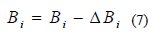
<body><![CDATA[<p>The matrix B here needs not be computed. It is successively estimated employing  rank 1 or rank 2 updates, following each line search in a sequence of search  directions. This is algorithmically given as follows:</p>       <p>&nbsp;</p> <a name="e7"> <img src="/img/revistas/pea/v34n1/34n1a02e7.jpg">     
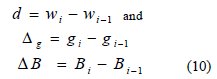
<p>&nbsp;</p>       <p>In this iterative algorithm, Bi-1 is the previous value of B.  The two important algorithmic relationships to compute &Delta;Bi are as follows [24]:</p>       <p>&nbsp;</p> <a name="e8"> <img src="/img/revistas/pea/v34n1/34n1a02e8.jpg">     
<p>&nbsp;</p>       <p>The above expression pertains to DFP algorithm and the equation given below is  the BFGS algorithm:</p>       <p>&nbsp;</p> <a name="e9"> <img src="/img/revistas/pea/v34n1/34n1a02e9.jpg">     
<p>&nbsp;</p>       <p>where,</p>       ]]></body>
<body><![CDATA[<p>&nbsp;</p> <a name="e10"> <img src="/img/revistas/pea/v34n1/34n1a02e10.jpg">     
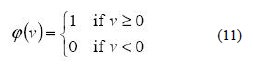
<p>&nbsp;</p>       <p>Thus, BFGS potentially reduces the number of function evaluations [24, 25]  required to achieve an optimization procedure which has been successfully  applied elsewhere by one of the authors [26].</p>       <p><i><b>Network configuration Input-Output variables</b></i></p>      <p>The following activation functions, denoted by &phi; (v), have been used in this  neural model. First, there is the Threshold Function which takes on a value of 0,  if the summed input is less than a certain threshold value of v, and the value of 1,  if the summed input is greater than or equal to the threshold value [27, 28].</p>       <p>&nbsp;</p> <a name="e11"> <img src="/img/revistas/pea/v34n1/34n1a02e11.jpg">     
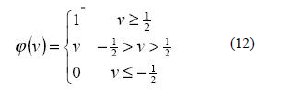
<p>&nbsp;</p>       <p>Secondly, there is the Piecewise-Linear function. This function again can take on  the values of 0 or 1, but can also take on values between that, depending on the  amplification factor in a certain region of linear operation.</p>       <p>&nbsp;</p> <a name="e12"> <img src="/img/revistas/pea/v34n1/34n1a02e12.jpg">     
<p>&nbsp;</p>       ]]></body>
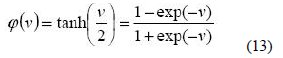
<body><![CDATA[<p>Thirdly, there is the sigmoid function. This function can range between 0 and 1,  but it is also sometimes useful to use the -1 to 1 range. The sigmoid function is  the hyperbolic tangent function given below [29]:</p>       <p>&nbsp;</p> <a name="e13"> <img src="/img/revistas/pea/v34n1/34n1a02e13.jpg">     
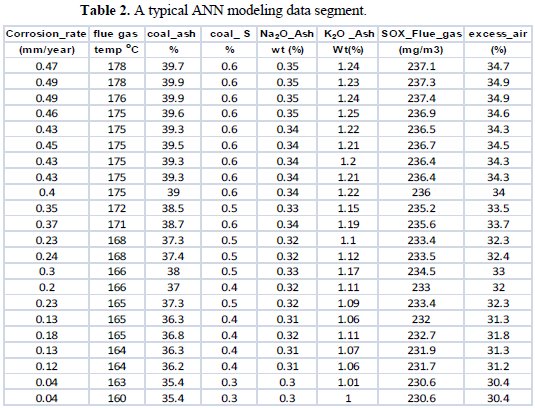
<p>&nbsp;</p>       <p>The input, output variables and their data ranges, for a 250 MW typical Indian  coal fired boiler system used in the ANN models, are shown in <a href="#t2">Table 2</a>.</p>       <p>&nbsp;</p> <a name="t2"> <img src="/img/revistas/pea/v34n1/34n1a02t2.jpg">     
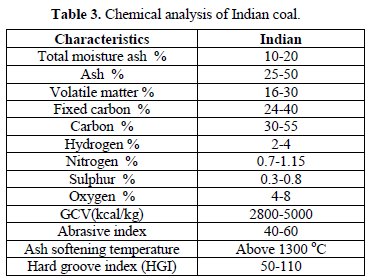
<p>&nbsp;</p>       <p><a href="#t3">Table 3</a> shows the chemistry of a typical Indian thermal coal used in power plants.</p>       <p>&nbsp;</p> <a name="t3"> <img src="/img/revistas/pea/v34n1/34n1a02t3.jpg">     
<p>&nbsp;</p>       <p>Input data set is segmented [26,27] into three subsets, namely, one for training  (learning),one for selection (validation), and one for testing (prediction) using  roughly 2:1:1 ratio. Out of 1000 dataset from plant measurements, 500 dataset  are used as training samples, 250 as validation samples and the remaining 250  samples have been utilized for prediction. The selection basis of these three  dataset for training, selection, and testing has been random. The current network  topology is designed with nine input neurons and one output neuron, four and  thirteen hidden layers (two separate cases) to numerically simulate the fireside  corrosion process. Sometimes, the pitfall of MLP based network is that too few  neurons in the hidden layer may introduce higher error during network selection  in the model, where the relations between different variables are not well  developed. On the other hand, too many neurons in the hidden layer may cause  the model to over-fit the training data, resulting in a less optimal solution for  selection data. The neural prediction based on two feed forward network  architectures (MLP 9-4-1 and MLP 9-13-1) is compared with the regression fit  between predicted and measured fireside corrosion rate data. It may be observed  from the simulation results (<a href="#f2">Fig. 2</a>) that all these two network architectures have  an almost similar accuracy level.</p>         ]]></body>
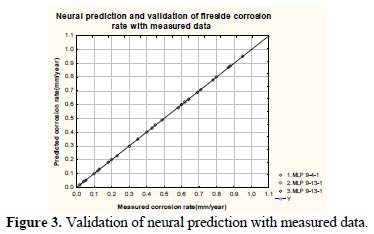
<body><![CDATA[<p>The network architecture nomenclature is as  follows: MLP 9-4-1 specify a multilayer perceptron network and the subsequent  digits indicate the number of input neurons(9), the number of hidden neurons(4)  and the number of output neurons(1), respectively.</p>       <p>&nbsp;</p>     <p><b>Results and discussion</b></p>      <p><a href="#f3">Fig. 3</a> depicts numerical predictions of fireside corrosion rates on boiler  superheater tubes (in a typical Indian power plant).</p>       <p>&nbsp;</p> <a name="f3"> <img src="/img/revistas/pea/v34n1/34n1a02f3.jpg">     
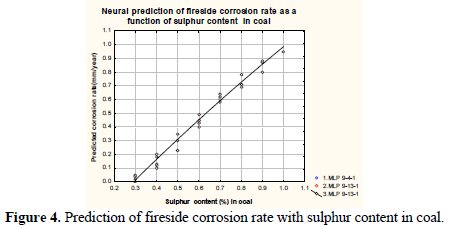
<p>&nbsp;</p>       <p>The neural prediction based  on two network architectures (MLP 9-4-1 and MLP 9-13-1) is compared with the  regression fit between predicted and measured data. It may be observed from the  simulation that all these two proposed network architectures have almost similar  prediction characteristics.</p>      <p><a href="#f4">Fig. 4</a> shows predicted fireside corrosion rate as a function of sulphur content in a  typical thermal Indian coal.</p>       <p>&nbsp;</p> <a name="f4"> <img src="/img/revistas/pea/v34n1/34n1a02f4.jpg">     
<p>&nbsp;</p>       ]]></body>
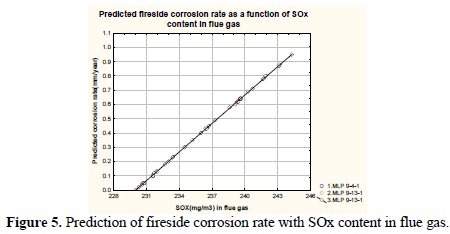
<body><![CDATA[<p>It may be observed from the figure that the fireside  corrosion rate monotonically increases with an increased sulphur content in coal.  The corrosion rate varies from 0.1 to 1.0 mm/year (approx.) with respect to  sulphur content of coal ranging from 0.3% - 1.0%. There is comparatively less  sulfur content present in Indian coal as compared to British coal. However, the  sulphur content is sufficient to the extent it ensures that any sodium and  potassium compounds released in the combustion process form fusible sulfates.  Sulfur typically is found as sodium sulfate in coal ash. At high temperature it  dissociates [12] and eventually alters the basicity of the molten ash deposits.  Sulfur reacts with sodium in the melt altering the concentration of Na2O, and  thereby changing the corrosion rates.</p>      <p><a href="#f5">Fig. 5</a> shows predicted fireside corrosion rates as a function  of SOx in flue gas.</p>       <p>&nbsp;</p> <a name="f5"> <img src="/img/revistas/pea/v34n1/34n1a02f5.jpg">     
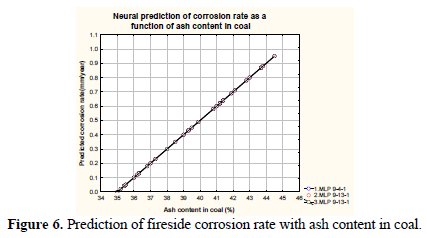
<p>&nbsp;</p>       <p>It may be observed from the figure that the corrosion rate linearly increases with  increased SOx percentage in flue gas.The predictions conform to the realistic  situation [30]. The corrosion rate varies from 0.1 - 0.95 mm/year (approx.) with  respect to SOx concentrations of 230 -245 mg/m3 in flue gas. Fireside corrosion  in boiler areas is associated with the deposition of alkali sulfates onto the metal  surface, their concentration being increased at the metal surface by absorption  onto the porous fly ash. The salts formed are usually molten and contain free  sulfur trioxide in flue gas, which dissolves the protective oxide film to form iron  and chromium based sulfates.</p>      <p><a href="#f6">Fig. 6</a> shows predicted fireside corrosion rates as a function of ash content in a  typical Indian coal.</p>       <p>&nbsp;</p> <a name="f6"> <img src="/img/revistas/pea/v34n1/34n1a02f6.jpg">     
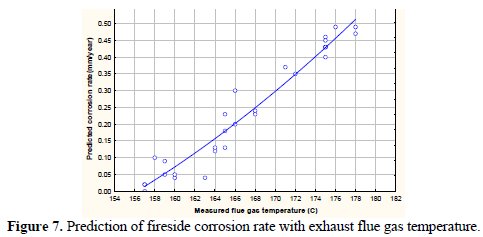
<p>&nbsp;</p>       <p>It may be observed from the figure that the fireside corrosion  rate enhances with an increased value of ash content in the coal. The fireside  corrosion rates varies from 0.05 to 0.97mm/year (approx.) with respect to an ash  content range 35% - 45% in the coal. With an increase in the ash content in coal  the mineral matter content in coal also increases accordingly. The mineral matter  main constituents are alkali metal oxides (sodium and potassium compounds  primarily). These alkali metal forms oxides at high temperatures and has low  melting point ranges from 540 to 750 &deg;C. These oxides fuse with the sulphur  compounds and form highly corrosive alkali metal sulphates deposits on to the  heat transport surfaces, accelerating corrosion. <a href="#f7">Fig. 7</a> depicts variation of  predicted corrosion rates as a function of flue gas temperature.</p>       <p>&nbsp;</p> <a name="f7"> <img src="/img/revistas/pea/v34n1/34n1a02f7.jpg">     
]]></body>
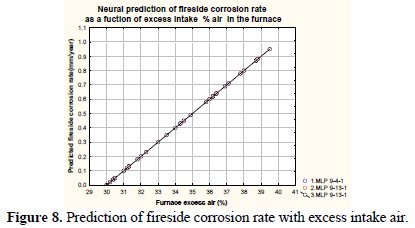
<body><![CDATA[<p>&nbsp;</p>       <p>It may be observed from the figure that the corrosion rate enhances with an increase in flue  gas temperature. Corrosion reactions get activated with higher activation energy  as the flue gas temperature increases [10, 31].</p>      <p><a href="#f8">Fig. 8</a> depicts variation of predicted corrosion rate with the excess air in the  furnace.</p>       <p>&nbsp;</p> <a name="f8"> <img src="/img/revistas/pea/v34n1/34n1a02f8.jpg">     
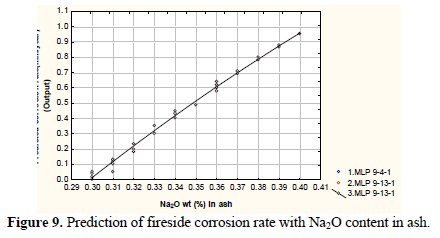
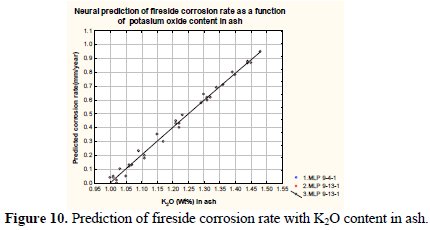
<p>&nbsp;</p>       <p>It may be observed from the figure that the corrosion rate increases  monotonically with an increased value of excess intake air percentage in the  furnace. The sulfur in coal reacts with oxygen in the combustion air forming SO2,  and, if the residence time and O2 content are more than sufficient, it forms also  SO3. The initial sulfidation reaction seldom continues so as to result in internal  sulfidation of the metal.</p>      <p><a href="#f9">Fig. 9</a> and <a href="#f10">Fig. 10</a> depict variation of  the predicted corrosion rate with the wt% of Na2Oand K2O in fly ash.</p>       <p>&nbsp;</p> <a name="f9"> <img src="/img/revistas/pea/v34n1/34n1a02f9.jpg">     
<p>&nbsp;</p> <a name="f10"> <img src="/img/revistas/pea/v34n1/34n1a02f10.jpg">     
<p>&nbsp;</p>       ]]></body>
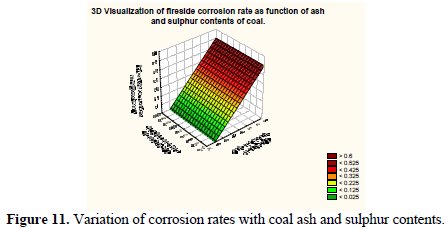
<body><![CDATA[<p>It may be observed from the figure that the corrosion  rate enhances with increased wt% of Na2O and K2O in fly ash. The corrosion rate  varies from 0.01 to 0.94 mm/year (approx.) with respect to 0.3-0.4 and 1.0-1.5  wt% of Na2O and K2O in fly ash, respectively. The severe fireside corrosion of  tube materials is caused by condensation/accumulation of low melting-point salts  from the flue gas onto the tube surface since salts containing chlorides and  sulphates of sodium and potassium, easily liquefying at the operating metal  temperatures [16, 32]. Reaction of alkali sulphates (Na2SO4, K2SO4) with Feoxides  (deriving from oxide scales or ashes) in the presence of SO3 will result in  the formation of alkali-iron trisulphates (Na, K)3Fe(SO4)3, held responsible for  the degradation of coal-fired plant superheater tubes[15].</p>      <p><a href="#f11">Fig. 11</a> shows a 3-D visualization of variation on predicted fireside corrosion  rates as a function of coal ash and sulphur concentrations.</p>       <p>&nbsp;</p> <a name="f11"> <img src="/img/revistas/pea/v34n1/34n1a02f11.jpg">     
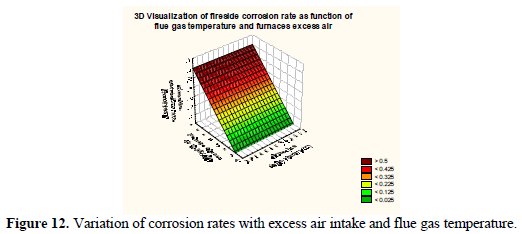
<p>&nbsp;</p>       <p>It may be observed  that the corrosion rate surface in 3-D framework depicting the variation of coal  ash and sulphur content has a peak value which corresponds to a higher level of  ash and sulphur content of coal.</p>      <p><a href="#f12">Fig. 12</a> shows 3-D visualization of the fireside corrosion rate as a function of  operational parameters, namely, excess air intake and flue gas temperature.</p>       <p>&nbsp;</p> <a name="f12"> <img src="/img/revistas/pea/v34n1/34n1a02f12.jpg">     
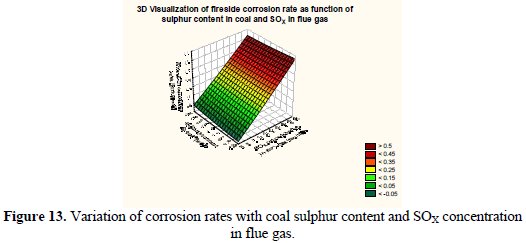
<p>&nbsp;</p>       <p>It may be observed that the corrosion rate surface in 3-D framework depicting the  variation of excess air and flue gas temperature has a peak value corresponding  to a very high level of excess air and elevated flue gas temperature. <a href="#f13">Fig. 13</a>  shows 3-D visualization of the fireside corrosion rate as a function of coal  sulphur concentrations and SOx concentrations in flue gas.</p>       <p>&nbsp;</p> <a name="f13"> <img src="/img/revistas/pea/v34n1/34n1a02f13.jpg">     
]]></body>
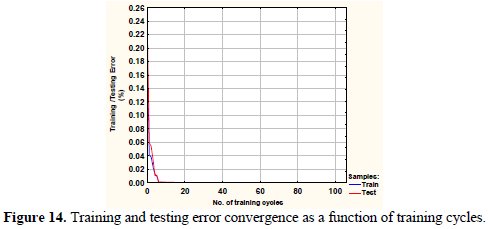
<body><![CDATA[<p>&nbsp;</p>       <p>It may be observed  that the corrosion rate surface in 3-D framework depicting the variation of  corrosion rate with coal sulphur content and SOx concentrations in flue gas has a  peak value corresponding to high level of coal sulphur content and SOx  concentrations in flue gas. <a href="#f14">Fig. 14</a> depicts the training and testing error  generation as a function of training cycles during computation.</p>       <p>&nbsp;</p> <a name="f14"> <img src="/img/revistas/pea/v34n1/34n1a02f14.jpg">     
<p>&nbsp;</p>       <p>It may be  observed from this figure that the absolute error drops sharply from 0.06 to 0.01  at the very early stage of training (few cycles) and, subsequently, the training and  testing errors asymptotically reduces to almost zero, with further increase in the  number of cycles. It may be further noted that the error bounds in the measured  data and neural computation are quiet small. Although several simulation results  have been generated, however, only limited results are discussed in this paper.</p>       <p>&nbsp;</p>     <p><b>Conclusions</b></p>      <p>The proposed neural network model provides a reasonably accurate predictive  framework and compares extremely well with the plant and experimental data.  The ANN methodology shows good potential for predictions of the fireside  corrosion rate as a function of input variables, namely, coal ash and sulfur  contents, wt% of Na2O and K2O in fly ash and operating variables such as flue  gas temperature and percentage excess air intake during combustion. This model  has a relative advantage over other phenomenological and semi empirical models  treating polluted data or data with complex functional dependence. Effects of  coal composition and fly ash constituents and process parameters on the fireside  corrosion rate have been investigated, and appropriately validated with the  measured data. In the numerical domain, it has been found that the efficient  gradient based network training algorithm does not require computation of  numerically cumbersome Hessian matrix, or calculation of any matrix inverses.  This algorithm potentially reduces the number of functions, facilitating faster  convergence of training errors within a few cycles, with respect to fireside  corrosion rate prediction.</p>       <p>&nbsp;</p>     <p><b>References</b></p>      ]]></body>
<body><![CDATA[<!-- ref --><p>1. Tomeczek J. Corros Sci. 2007;49:1862.    &nbsp;&nbsp;&nbsp;&nbsp;&nbsp;&nbsp;&nbsp;&nbsp;[&#160;<a href="javascript:void(0);" onclick="javascript: window.open('/scielo.php?script=sci_nlinks&ref=418457&pid=S0872-1904201600010000200001&lng=','','width=640,height=500,resizable=yes,scrollbars=1,menubar=yes,');">Links</a>&#160;]<!-- end-ref --></p>      <!-- ref --><p>2. Raask E. Mineral impurities in coal combustion. Washigton DC: Hemisphere Publishing Corp; 1985.    &nbsp;&nbsp;&nbsp;&nbsp;&nbsp;&nbsp;&nbsp;&nbsp;[&#160;<a href="javascript:void(0);" onclick="javascript: window.open('/scielo.php?script=sci_nlinks&ref=418459&pid=S0872-1904201600010000200002&lng=','','width=640,height=500,resizable=yes,scrollbars=1,menubar=yes,');">Links</a>&#160;]<!-- end-ref --></p>      <!-- ref --><p>3. Dooley R B. The control of high temperature fireside corrosion. 2nd Edition. London: Central Electricity Generating Board; 1977.    &nbsp;&nbsp;&nbsp;&nbsp;&nbsp;&nbsp;&nbsp;&nbsp;[&#160;<a href="javascript:void(0);" onclick="javascript: window.open('/scielo.php?script=sci_nlinks&ref=418461&pid=S0872-1904201600010000200003&lng=','','width=640,height=500,resizable=yes,scrollbars=1,menubar=yes,');">Links</a>&#160;]<!-- end-ref --></p>      <!-- ref --><p>4. Mayer P, Manolescu A V. Corrosion. 1980;36:369.    &nbsp;&nbsp;&nbsp;&nbsp;&nbsp;&nbsp;&nbsp;&nbsp;[&#160;<a href="javascript:void(0);" onclick="javascript: window.open('/scielo.php?script=sci_nlinks&ref=418463&pid=S0872-1904201600010000200004&lng=','','width=640,height=500,resizable=yes,scrollbars=1,menubar=yes,');">Links</a>&#160;]<!-- end-ref --></p>      <!-- ref --><p>5. Ivanova I P, Svistunova L A. Teploenerge-tika.1971;18:60.    &nbsp;&nbsp;&nbsp;&nbsp;&nbsp;&nbsp;&nbsp;&nbsp;[&#160;<a href="javascript:void(0);" onclick="javascript: window.open('/scielo.php?script=sci_nlinks&ref=418465&pid=S0872-1904201600010000200005&lng=','','width=640,height=500,resizable=yes,scrollbars=1,menubar=yes,');">Links</a>&#160;]<!-- end-ref --></p>      ]]></body>
<body><![CDATA[<!-- ref --><p>6. Ivanova I P, Kaminskii V P, Belyaeva A G. Teploenerge-tika. 1972;19:16.    &nbsp;&nbsp;&nbsp;&nbsp;&nbsp;&nbsp;&nbsp;&nbsp;[&#160;<a href="javascript:void(0);" onclick="javascript: window.open('/scielo.php?script=sci_nlinks&ref=418467&pid=S0872-1904201600010000200006&lng=','','width=640,height=500,resizable=yes,scrollbars=1,menubar=yes,');">Links</a>&#160;]<!-- end-ref --></p>      <!-- ref --><p>7. Ivanova I P, Marshak YuL. Teploenerge-tika. 1975;22:15.    &nbsp;&nbsp;&nbsp;&nbsp;&nbsp;&nbsp;&nbsp;&nbsp;[&#160;<a href="javascript:void(0);" onclick="javascript: window.open('/scielo.php?script=sci_nlinks&ref=418469&pid=S0872-1904201600010000200007&lng=','','width=640,height=500,resizable=yes,scrollbars=1,menubar=yes,');">Links</a>&#160;]<!-- end-ref --></p>      <!-- ref --><p>8. Albrecht R F, Reeves C R, Steele N C. Artificial neural nets and genetic algorithms. Vienna: Springer-Verlag; 1993.    &nbsp;&nbsp;&nbsp;&nbsp;&nbsp;&nbsp;&nbsp;&nbsp;[&#160;<a href="javascript:void(0);" onclick="javascript: window.open('/scielo.php?script=sci_nlinks&ref=418471&pid=S0872-1904201600010000200008&lng=','','width=640,height=500,resizable=yes,scrollbars=1,menubar=yes,');">Links</a>&#160;]<!-- end-ref --></p>      <!-- ref --><p>9. Burnod Y. An adaptive neural network: the cerebral cortex. London: Prentice-Hall; 1990.    &nbsp;&nbsp;&nbsp;&nbsp;&nbsp;&nbsp;&nbsp;&nbsp;[&#160;<a href="javascript:void(0);" onclick="javascript: window.open('/scielo.php?script=sci_nlinks&ref=418473&pid=S0872-1904201600010000200009&lng=','','width=640,height=500,resizable=yes,scrollbars=1,menubar=yes,');">Links</a>&#160;]<!-- end-ref --></p>      <!-- ref --><p>10. Baum E. Neural Comput. 2004;2:248.    &nbsp;&nbsp;&nbsp;&nbsp;&nbsp;&nbsp;&nbsp;&nbsp;[&#160;<a href="javascript:void(0);" onclick="javascript: window.open('/scielo.php?script=sci_nlinks&ref=418475&pid=S0872-1904201600010000200010&lng=','','width=640,height=500,resizable=yes,scrollbars=1,menubar=yes,');">Links</a>&#160;]<!-- end-ref --></p>      ]]></body>
<body><![CDATA[<!-- ref --><p>11. Simms N J. Environmental degradation of boiler components. 1st ed. London; 2011.    &nbsp;&nbsp;&nbsp;&nbsp;&nbsp;&nbsp;&nbsp;&nbsp;[&#160;<a href="javascript:void(0);" onclick="javascript: window.open('/scielo.php?script=sci_nlinks&ref=418477&pid=S0872-1904201600010000200011&lng=','','width=640,height=500,resizable=yes,scrollbars=1,menubar=yes,');">Links</a>&#160;]<!-- end-ref --></p>      <!-- ref --><p>12. Paul L D, Seelay R R. Corrosion. 1991;2:152-158.    &nbsp;&nbsp;&nbsp;&nbsp;&nbsp;&nbsp;&nbsp;&nbsp;[&#160;<a href="javascript:void(0);" onclick="javascript: window.open('/scielo.php?script=sci_nlinks&ref=418479&pid=S0872-1904201600010000200012&lng=','','width=640,height=500,resizable=yes,scrollbars=1,menubar=yes,');">Links</a>&#160;]<!-- end-ref --></p>      <!-- ref --><p>13. Lee F C C, Lockwood F C. Prog Energy Comb Sci. 1998;25:117.    &nbsp;&nbsp;&nbsp;&nbsp;&nbsp;&nbsp;&nbsp;&nbsp;[&#160;<a href="javascript:void(0);" onclick="javascript: window.open('/scielo.php?script=sci_nlinks&ref=418481&pid=S0872-1904201600010000200013&lng=','','width=640,height=500,resizable=yes,scrollbars=1,menubar=yes,');">Links</a>&#160;]<!-- end-ref --></p>      <!-- ref --><p>14. Yang Q F, Ding J, Shen Z Q. Chem Eng Sci. 2000;55:797.    &nbsp;&nbsp;&nbsp;&nbsp;&nbsp;&nbsp;&nbsp;&nbsp;[&#160;<a href="javascript:void(0);" onclick="javascript: window.open('/scielo.php?script=sci_nlinks&ref=418483&pid=S0872-1904201600010000200014&lng=','','width=640,height=500,resizable=yes,scrollbars=1,menubar=yes,');">Links</a>&#160;]<!-- end-ref --></p>      <!-- ref --><p>15. Thompson M L, Kramer M A. AIChE J. 1994;40:1328.    &nbsp;&nbsp;&nbsp;&nbsp;&nbsp;&nbsp;&nbsp;&nbsp;[&#160;<a href="javascript:void(0);" onclick="javascript: window.open('/scielo.php?script=sci_nlinks&ref=418485&pid=S0872-1904201600010000200015&lng=','','width=640,height=500,resizable=yes,scrollbars=1,menubar=yes,');">Links</a>&#160;]<!-- end-ref --></p>      ]]></body>
<body><![CDATA[<!-- ref --><p>16. Afgan N H, Carvalho M G, Coelho P. Appl Therm Eng. 1996;16:835.    &nbsp;&nbsp;&nbsp;&nbsp;&nbsp;&nbsp;&nbsp;&nbsp;[&#160;<a href="javascript:void(0);" onclick="javascript: window.open('/scielo.php?script=sci_nlinks&ref=418487&pid=S0872-1904201600010000200016&lng=','','width=640,height=500,resizable=yes,scrollbars=1,menubar=yes,');">Links</a>&#160;]<!-- end-ref --></p>      <!-- ref --><p>17. Majidian A, Saidi M H. Int J Fatigue. 2007;29:489.    &nbsp;&nbsp;&nbsp;&nbsp;&nbsp;&nbsp;&nbsp;&nbsp;[&#160;<a href="javascript:void(0);" onclick="javascript: window.open('/scielo.php?script=sci_nlinks&ref=418489&pid=S0872-1904201600010000200017&lng=','','width=640,height=500,resizable=yes,scrollbars=1,menubar=yes,');">Links</a>&#160;]<!-- end-ref --></p>      <!-- ref --><p>18. Dai M H. Int J Press Vessel Pip. 1995;63:111.    &nbsp;&nbsp;&nbsp;&nbsp;&nbsp;&nbsp;&nbsp;&nbsp;[&#160;<a href="javascript:void(0);" onclick="javascript: window.open('/scielo.php?script=sci_nlinks&ref=418491&pid=S0872-1904201600010000200018&lng=','','width=640,height=500,resizable=yes,scrollbars=1,menubar=yes,');">Links</a>&#160;]<!-- end-ref --></p>      <!-- ref --><p>19. Afgan N H, Carvalho M G, Coelho P. Appl Therm Eng. 1996;16:835.    &nbsp;&nbsp;&nbsp;&nbsp;&nbsp;&nbsp;&nbsp;&nbsp;[&#160;<a href="javascript:void(0);" onclick="javascript: window.open('/scielo.php?script=sci_nlinks&ref=418493&pid=S0872-1904201600010000200019&lng=','','width=640,height=500,resizable=yes,scrollbars=1,menubar=yes,');">Links</a>&#160;]<!-- end-ref --></p>      <!-- ref --><p>20. Majidian A, Saidi M H. Int J Fatigue. 2007;29:489.    &nbsp;&nbsp;&nbsp;&nbsp;&nbsp;&nbsp;&nbsp;&nbsp;[&#160;<a href="javascript:void(0);" onclick="javascript: window.open('/scielo.php?script=sci_nlinks&ref=418495&pid=S0872-1904201600010000200020&lng=','','width=640,height=500,resizable=yes,scrollbars=1,menubar=yes,');">Links</a>&#160;]<!-- end-ref --></p>      ]]></body>
<body><![CDATA[<!-- ref --><p>21. Dai M H. Int J Press Vessel Pip. 1995;63:111.    &nbsp;&nbsp;&nbsp;&nbsp;&nbsp;&nbsp;&nbsp;&nbsp;[&#160;<a href="javascript:void(0);" onclick="javascript: window.open('/scielo.php?script=sci_nlinks&ref=418497&pid=S0872-1904201600010000200021&lng=','','width=640,height=500,resizable=yes,scrollbars=1,menubar=yes,');">Links</a>&#160;]<!-- end-ref --></p>      <!-- ref --><p>22. Yagawa G. Int J Press Vessel Pip. 1995;63:303.    &nbsp;&nbsp;&nbsp;&nbsp;&nbsp;&nbsp;&nbsp;&nbsp;[&#160;<a href="javascript:void(0);" onclick="javascript: window.open('/scielo.php?script=sci_nlinks&ref=418499&pid=S0872-1904201600010000200022&lng=','','width=640,height=500,resizable=yes,scrollbars=1,menubar=yes,');">Links</a>&#160;]<!-- end-ref --></p>      <!-- ref --><p>23. Trana C, Abrahamb A, Jaina L. Neurocomputing. 2004;6:185.    &nbsp;&nbsp;&nbsp;&nbsp;&nbsp;&nbsp;&nbsp;&nbsp;[&#160;<a href="javascript:void(0);" onclick="javascript: window.open('/scielo.php?script=sci_nlinks&ref=418501&pid=S0872-1904201600010000200023&lng=','','width=640,height=500,resizable=yes,scrollbars=1,menubar=yes,');">Links</a>&#160;]<!-- end-ref --></p>      <!-- ref --><p>24. Nash SG, Nocedal J. SIAM J Optimization. 1991;1:358.    &nbsp;&nbsp;&nbsp;&nbsp;&nbsp;&nbsp;&nbsp;&nbsp;[&#160;<a href="javascript:void(0);" onclick="javascript: window.open('/scielo.php?script=sci_nlinks&ref=418503&pid=S0872-1904201600010000200024&lng=','','width=640,height=500,resizable=yes,scrollbars=1,menubar=yes,');">Links</a>&#160;]<!-- end-ref --></p>      <!-- ref --><p>25. Xiang Y Y. IMA J Numer Analysis. 1991;11:325.    &nbsp;&nbsp;&nbsp;&nbsp;&nbsp;&nbsp;&nbsp;&nbsp;[&#160;<a href="javascript:void(0);" onclick="javascript: window.open('/scielo.php?script=sci_nlinks&ref=418505&pid=S0872-1904201600010000200025&lng=','','width=640,height=500,resizable=yes,scrollbars=1,menubar=yes,');">Links</a>&#160;]<!-- end-ref --></p>      ]]></body>
<body><![CDATA[<!-- ref --><p>26. Boggs P, Tolle J. Acta Numerica. 1995;4:11.    &nbsp;&nbsp;&nbsp;&nbsp;&nbsp;&nbsp;&nbsp;&nbsp;[&#160;<a href="javascript:void(0);" onclick="javascript: window.open('/scielo.php?script=sci_nlinks&ref=418507&pid=S0872-1904201600010000200026&lng=','','width=640,height=500,resizable=yes,scrollbars=1,menubar=yes,');">Links</a>&#160;]<!-- end-ref --></p>      <!-- ref --><p>27. Gould N, Toint P. System modeling and optimization, methods, theory and applications. Netherlands: Kluwer; 2000.    &nbsp;&nbsp;&nbsp;&nbsp;&nbsp;&nbsp;&nbsp;&nbsp;[&#160;<a href="javascript:void(0);" onclick="javascript: window.open('/scielo.php?script=sci_nlinks&ref=418509&pid=S0872-1904201600010000200027&lng=','','width=640,height=500,resizable=yes,scrollbars=1,menubar=yes,');">Links</a>&#160;]<!-- end-ref --></p>      <!-- ref --><p>28. Das S K. Ironmaking Steelmaking. 2013;40:298.    &nbsp;&nbsp;&nbsp;&nbsp;&nbsp;&nbsp;&nbsp;&nbsp;[&#160;<a href="javascript:void(0);" onclick="javascript: window.open('/scielo.php?script=sci_nlinks&ref=418511&pid=S0872-1904201600010000200028&lng=','','width=640,height=500,resizable=yes,scrollbars=1,menubar=yes,');">Links</a>&#160;]<!-- end-ref --></p>      <!-- ref --><p>29. Ghosh I, Das S K, Chakraborty N. Neural Comput Applic. 2014;25:653.    &nbsp;&nbsp;&nbsp;&nbsp;&nbsp;&nbsp;&nbsp;&nbsp;[&#160;<a href="javascript:void(0);" onclick="javascript: window.open('/scielo.php?script=sci_nlinks&ref=418513&pid=S0872-1904201600010000200029&lng=','','width=640,height=500,resizable=yes,scrollbars=1,menubar=yes,');">Links</a>&#160;]<!-- end-ref --></p>      <!-- ref --><p>30. Tomeczek J, Palugniok H, Ochman J. Fuel. 2004;83:213.    &nbsp;&nbsp;&nbsp;&nbsp;&nbsp;&nbsp;&nbsp;&nbsp;[&#160;<a href="javascript:void(0);" onclick="javascript: window.open('/scielo.php?script=sci_nlinks&ref=418515&pid=S0872-1904201600010000200030&lng=','','width=640,height=500,resizable=yes,scrollbars=1,menubar=yes,');">Links</a>&#160;]<!-- end-ref --></p>      ]]></body>
<body><![CDATA[<!-- ref --><p>31. Weulersse-Mouturat, Moulin K, Billard G, et al. Mater Sci Forum. 2004;461:973.    &nbsp;&nbsp;&nbsp;&nbsp;&nbsp;&nbsp;&nbsp;&nbsp;[&#160;<a href="javascript:void(0);" onclick="javascript: window.open('/scielo.php?script=sci_nlinks&ref=418517&pid=S0872-1904201600010000200031&lng=','','width=640,height=500,resizable=yes,scrollbars=1,menubar=yes,');">Links</a>&#160;]<!-- end-ref --></p>      <!-- ref --><p>32. Otsuka N. Corros Sci. 2002;44:265.    &nbsp;&nbsp;&nbsp;&nbsp;&nbsp;&nbsp;&nbsp;&nbsp;[&#160;<a href="javascript:void(0);" onclick="javascript: window.open('/scielo.php?script=sci_nlinks&ref=418519&pid=S0872-1904201600010000200032&lng=','','width=640,height=500,resizable=yes,scrollbars=1,menubar=yes,');">Links</a>&#160;]<!-- end-ref --></p>      <p>&nbsp;</p>     <p><a name=0></a><sup><a href="#top">*</a></sup>Corresponding author. E-mail address: <a href="mailto:amrita.pandey08@gmail.com">amrita.pandey08@gmail.com</a></p>      <p>Received 24 August 2015; accepted 13 November 2015</p>      <p><a href="http://www.peacta.org" target="_blank">www.peacta.org</a> </p>        ]]></body><back>
<ref-list>
<ref id="B1">
<label>1</label><nlm-citation citation-type="journal">
<person-group person-group-type="author">
<name>
<surname><![CDATA[Tomeczek]]></surname>
<given-names><![CDATA[J]]></given-names>
</name>
</person-group>
<source><![CDATA[Corros Sci]]></source>
<year>2007</year>
<volume>49</volume>
<page-range>1862</page-range></nlm-citation>
</ref>
<ref id="B2">
<label>2</label><nlm-citation citation-type="book">
<person-group person-group-type="author">
<name>
<surname><![CDATA[Raask]]></surname>
<given-names><![CDATA[E]]></given-names>
</name>
</person-group>
<source><![CDATA[Mineral impurities in coal combustion]]></source>
<year>1985</year>
<publisher-loc><![CDATA[Washigton DC ]]></publisher-loc>
<publisher-name><![CDATA[Hemisphere Publishing Corp]]></publisher-name>
</nlm-citation>
</ref>
<ref id="B3">
<label>3</label><nlm-citation citation-type="book">
<person-group person-group-type="author">
<name>
<surname><![CDATA[Dooley]]></surname>
<given-names><![CDATA[R B]]></given-names>
</name>
</person-group>
<source><![CDATA[The control of high temperature fireside corrosion]]></source>
<year>1977</year>
<edition>2</edition>
<publisher-loc><![CDATA[London ]]></publisher-loc>
<publisher-name><![CDATA[Central Electricity Generating Board]]></publisher-name>
</nlm-citation>
</ref>
<ref id="B4">
<label>4</label><nlm-citation citation-type="journal">
<person-group person-group-type="author">
<name>
<surname><![CDATA[Mayer]]></surname>
<given-names><![CDATA[P]]></given-names>
</name>
<name>
<surname><![CDATA[Manolescu]]></surname>
<given-names><![CDATA[A V]]></given-names>
</name>
</person-group>
<source><![CDATA[Corrosion]]></source>
<year>1980</year>
<volume>36</volume>
<page-range>369</page-range></nlm-citation>
</ref>
<ref id="B5">
<label>5</label><nlm-citation citation-type="journal">
<person-group person-group-type="author">
<name>
<surname><![CDATA[Ivanova]]></surname>
<given-names><![CDATA[I P]]></given-names>
</name>
<name>
<surname><![CDATA[Svistunova]]></surname>
<given-names><![CDATA[L A]]></given-names>
</name>
</person-group>
<source><![CDATA[Teploenerge-tika]]></source>
<year>1971</year>
<volume>18</volume>
<page-range>60</page-range></nlm-citation>
</ref>
<ref id="B6">
<label>6</label><nlm-citation citation-type="journal">
<person-group person-group-type="author">
<name>
<surname><![CDATA[Ivanova]]></surname>
<given-names><![CDATA[I P]]></given-names>
</name>
<name>
<surname><![CDATA[Kaminskii]]></surname>
<given-names><![CDATA[V P]]></given-names>
</name>
<name>
<surname><![CDATA[Belyaeva]]></surname>
<given-names><![CDATA[A G]]></given-names>
</name>
</person-group>
<source><![CDATA[Teploenerge-tika]]></source>
<year>1972</year>
<volume>19</volume>
<page-range>16</page-range></nlm-citation>
</ref>
<ref id="B7">
<label>7</label><nlm-citation citation-type="journal">
<person-group person-group-type="author">
<name>
<surname><![CDATA[Ivanova]]></surname>
<given-names><![CDATA[I P]]></given-names>
</name>
<name>
<surname><![CDATA[Marshak]]></surname>
<given-names><![CDATA[YuL]]></given-names>
</name>
</person-group>
<source><![CDATA[Teploenerge-tika]]></source>
<year>1975</year>
<volume>22</volume>
<page-range>15</page-range></nlm-citation>
</ref>
<ref id="B8">
<label>8</label><nlm-citation citation-type="book">
<person-group person-group-type="author">
<name>
<surname><![CDATA[Albrecht]]></surname>
<given-names><![CDATA[R F]]></given-names>
</name>
<name>
<surname><![CDATA[Reeves]]></surname>
<given-names><![CDATA[C R]]></given-names>
</name>
<name>
<surname><![CDATA[Steele]]></surname>
<given-names><![CDATA[N C]]></given-names>
</name>
</person-group>
<source><![CDATA[Artificial neural nets and genetic algorithms]]></source>
<year>1993</year>
<publisher-loc><![CDATA[Vienna ]]></publisher-loc>
<publisher-name><![CDATA[Springer-Verlag]]></publisher-name>
</nlm-citation>
</ref>
<ref id="B9">
<label>9</label><nlm-citation citation-type="book">
<person-group person-group-type="author">
<name>
<surname><![CDATA[Burnod]]></surname>
<given-names><![CDATA[Y]]></given-names>
</name>
</person-group>
<source><![CDATA[An adaptive neural network:: the cerebral cortex]]></source>
<year>1990</year>
<publisher-loc><![CDATA[London ]]></publisher-loc>
<publisher-name><![CDATA[Prentice-Hall]]></publisher-name>
</nlm-citation>
</ref>
<ref id="B10">
<label>10</label><nlm-citation citation-type="journal">
<person-group person-group-type="author">
<name>
<surname><![CDATA[Baum]]></surname>
<given-names><![CDATA[E]]></given-names>
</name>
</person-group>
<source><![CDATA[Neural Comput]]></source>
<year>2004</year>
<volume>2</volume>
<page-range>248</page-range></nlm-citation>
</ref>
<ref id="B11">
<label>11</label><nlm-citation citation-type="">
<person-group person-group-type="author">
<name>
<surname><![CDATA[Simms]]></surname>
<given-names><![CDATA[N J]]></given-names>
</name>
</person-group>
<source><![CDATA[Environmental degradation of boiler components]]></source>
<year>2011</year>
<edition>1</edition>
<publisher-loc><![CDATA[London ]]></publisher-loc>
</nlm-citation>
</ref>
<ref id="B12">
<label>12</label><nlm-citation citation-type="journal">
<person-group person-group-type="author">
<name>
<surname><![CDATA[Paul]]></surname>
<given-names><![CDATA[L D]]></given-names>
</name>
<name>
<surname><![CDATA[Seelay]]></surname>
<given-names><![CDATA[R R]]></given-names>
</name>
</person-group>
<source><![CDATA[Corrosion]]></source>
<year>1991</year>
<volume>2</volume>
<page-range>152</page-range></nlm-citation>
</ref>
<ref id="B13">
<label>13</label><nlm-citation citation-type="journal">
<person-group person-group-type="author">
<name>
<surname><![CDATA[Lee]]></surname>
<given-names><![CDATA[F C C]]></given-names>
</name>
<name>
<surname><![CDATA[Lockwood]]></surname>
<given-names><![CDATA[F C]]></given-names>
</name>
</person-group>
<source><![CDATA[Prog Energy Comb Sci]]></source>
<year>1998</year>
<volume>25</volume>
<page-range>117</page-range></nlm-citation>
</ref>
<ref id="B14">
<label>14</label><nlm-citation citation-type="journal">
<person-group person-group-type="author">
<name>
<surname><![CDATA[Yang]]></surname>
<given-names><![CDATA[Q F]]></given-names>
</name>
<name>
<surname><![CDATA[Ding]]></surname>
<given-names><![CDATA[J]]></given-names>
</name>
<name>
<surname><![CDATA[Shen]]></surname>
<given-names><![CDATA[Z Q]]></given-names>
</name>
</person-group>
<source><![CDATA[Chem Eng Sci]]></source>
<year>2000</year>
<volume>55</volume>
<page-range>797</page-range></nlm-citation>
</ref>
<ref id="B15">
<label>15</label><nlm-citation citation-type="journal">
<person-group person-group-type="author">
<name>
<surname><![CDATA[Thompson]]></surname>
<given-names><![CDATA[M L]]></given-names>
</name>
<name>
<surname><![CDATA[Kramer]]></surname>
<given-names><![CDATA[M A]]></given-names>
</name>
</person-group>
<source><![CDATA[AIChE J]]></source>
<year>1994</year>
<volume>40</volume>
<page-range>1328</page-range></nlm-citation>
</ref>
<ref id="B16">
<label>16</label><nlm-citation citation-type="journal">
<person-group person-group-type="author">
<name>
<surname><![CDATA[Afgan]]></surname>
<given-names><![CDATA[N H]]></given-names>
</name>
<name>
<surname><![CDATA[Carvalho]]></surname>
<given-names><![CDATA[M G]]></given-names>
</name>
<name>
<surname><![CDATA[Coelho]]></surname>
<given-names><![CDATA[P]]></given-names>
</name>
</person-group>
<source><![CDATA[Appl Therm Eng]]></source>
<year>1996</year>
<volume>16</volume>
<page-range>835</page-range></nlm-citation>
</ref>
<ref id="B17">
<label>17</label><nlm-citation citation-type="journal">
<person-group person-group-type="author">
<name>
<surname><![CDATA[Majidian]]></surname>
<given-names><![CDATA[A]]></given-names>
</name>
<name>
<surname><![CDATA[Saidi]]></surname>
<given-names><![CDATA[M H]]></given-names>
</name>
</person-group>
<source><![CDATA[Int J Fatigue]]></source>
<year>2007</year>
<volume>29</volume>
<page-range>489</page-range></nlm-citation>
</ref>
<ref id="B18">
<label>18</label><nlm-citation citation-type="journal">
<person-group person-group-type="author">
<name>
<surname><![CDATA[Dai]]></surname>
<given-names><![CDATA[M H]]></given-names>
</name>
</person-group>
<source><![CDATA[Int J Press Vessel Pip]]></source>
<year>1995</year>
<volume>63</volume>
<page-range>111</page-range></nlm-citation>
</ref>
<ref id="B19">
<label>19</label><nlm-citation citation-type="journal">
<person-group person-group-type="author">
<name>
<surname><![CDATA[Afgan]]></surname>
<given-names><![CDATA[N H]]></given-names>
</name>
<name>
<surname><![CDATA[Carvalho]]></surname>
<given-names><![CDATA[M G]]></given-names>
</name>
<name>
<surname><![CDATA[Coelho]]></surname>
<given-names><![CDATA[P]]></given-names>
</name>
</person-group>
<source><![CDATA[Appl Therm Eng]]></source>
<year>1996</year>
<volume>16</volume>
<page-range>835</page-range></nlm-citation>
</ref>
<ref id="B20">
<label>20</label><nlm-citation citation-type="journal">
<person-group person-group-type="author">
<name>
<surname><![CDATA[Majidian]]></surname>
<given-names><![CDATA[A]]></given-names>
</name>
<name>
<surname><![CDATA[Saidi]]></surname>
<given-names><![CDATA[M H]]></given-names>
</name>
</person-group>
<source><![CDATA[Int J Fatigue]]></source>
<year>2007</year>
<volume>29</volume>
<page-range>489</page-range></nlm-citation>
</ref>
<ref id="B21">
<label>21</label><nlm-citation citation-type="journal">
<person-group person-group-type="author">
<name>
<surname><![CDATA[Dai]]></surname>
<given-names><![CDATA[M H]]></given-names>
</name>
</person-group>
<source><![CDATA[Int J Press Vessel Pip]]></source>
<year>1995</year>
<volume>63</volume>
<page-range>111</page-range></nlm-citation>
</ref>
<ref id="B22">
<label>22</label><nlm-citation citation-type="journal">
<person-group person-group-type="author">
<name>
<surname><![CDATA[Yagawa]]></surname>
<given-names><![CDATA[G]]></given-names>
</name>
</person-group>
<source><![CDATA[Int J Press Vessel Pip]]></source>
<year>1995</year>
<volume>63</volume>
<page-range>303</page-range></nlm-citation>
</ref>
<ref id="B23">
<label>23</label><nlm-citation citation-type="journal">
<person-group person-group-type="author">
<name>
<surname><![CDATA[Trana]]></surname>
<given-names><![CDATA[C]]></given-names>
</name>
<name>
<surname><![CDATA[Abrahamb]]></surname>
<given-names><![CDATA[A]]></given-names>
</name>
<name>
<surname><![CDATA[Jaina]]></surname>
<given-names><![CDATA[L]]></given-names>
</name>
</person-group>
<source><![CDATA[Neurocomputing]]></source>
<year>2004</year>
<volume>6</volume>
<page-range>185</page-range></nlm-citation>
</ref>
<ref id="B24">
<label>24</label><nlm-citation citation-type="journal">
<person-group person-group-type="author">
<name>
<surname><![CDATA[Nash]]></surname>
<given-names><![CDATA[S G]]></given-names>
</name>
<name>
<surname><![CDATA[Nocedal]]></surname>
<given-names><![CDATA[J]]></given-names>
</name>
</person-group>
<source><![CDATA[SIAM J Optimization]]></source>
<year>1991</year>
<volume>1</volume>
<page-range>358</page-range></nlm-citation>
</ref>
<ref id="B25">
<label>25</label><nlm-citation citation-type="journal">
<person-group person-group-type="author">
<name>
<surname><![CDATA[Xiang]]></surname>
<given-names><![CDATA[Y Y]]></given-names>
</name>
</person-group>
<source><![CDATA[IMA J Numer Analysis]]></source>
<year>1991</year>
<volume>11</volume>
<page-range>325</page-range></nlm-citation>
</ref>
<ref id="B26">
<label>26</label><nlm-citation citation-type="journal">
<person-group person-group-type="author">
<name>
<surname><![CDATA[Boggs]]></surname>
<given-names><![CDATA[P]]></given-names>
</name>
<name>
<surname><![CDATA[Tolle]]></surname>
<given-names><![CDATA[J]]></given-names>
</name>
</person-group>
<source><![CDATA[Acta Numerica]]></source>
<year>1995</year>
<volume>4</volume>
<page-range>11</page-range></nlm-citation>
</ref>
<ref id="B27">
<label>27</label><nlm-citation citation-type="book">
<person-group person-group-type="author">
<name>
<surname><![CDATA[Gould]]></surname>
<given-names><![CDATA[N]]></given-names>
</name>
<name>
<surname><![CDATA[Toint]]></surname>
<given-names><![CDATA[P]]></given-names>
</name>
</person-group>
<source><![CDATA[System modeling and optimization, methods, theory and applications]]></source>
<year>2000</year>
<publisher-name><![CDATA[Kluwer]]></publisher-name>
</nlm-citation>
</ref>
<ref id="B28">
<label>28</label><nlm-citation citation-type="journal">
<person-group person-group-type="author">
<name>
<surname><![CDATA[Das]]></surname>
<given-names><![CDATA[S K]]></given-names>
</name>
</person-group>
<source><![CDATA[Ironmaking Steelmaking]]></source>
<year>2013</year>
<volume>40</volume>
<page-range>298</page-range></nlm-citation>
</ref>
<ref id="B29">
<label>29</label><nlm-citation citation-type="journal">
<person-group person-group-type="author">
<name>
<surname><![CDATA[Ghosh]]></surname>
<given-names><![CDATA[I]]></given-names>
</name>
<name>
<surname><![CDATA[Das]]></surname>
<given-names><![CDATA[S K]]></given-names>
</name>
<name>
<surname><![CDATA[Chakraborty]]></surname>
<given-names><![CDATA[N]]></given-names>
</name>
</person-group>
<source><![CDATA[Neural Comput Applic]]></source>
<year>2014</year>
<volume>25</volume>
<page-range>653</page-range></nlm-citation>
</ref>
<ref id="B30">
<label>30</label><nlm-citation citation-type="journal">
<person-group person-group-type="author">
<name>
<surname><![CDATA[Tomeczek]]></surname>
<given-names><![CDATA[J]]></given-names>
</name>
<name>
<surname><![CDATA[Palugniok]]></surname>
<given-names><![CDATA[H]]></given-names>
</name>
<name>
<surname><![CDATA[Ochman]]></surname>
<given-names><![CDATA[J]]></given-names>
</name>
</person-group>
<source><![CDATA[Fuel]]></source>
<year>2004</year>
<volume>83</volume>
<page-range>213</page-range></nlm-citation>
</ref>
<ref id="B31">
<label>31</label><nlm-citation citation-type="journal">
<person-group person-group-type="author">
<name>
<surname><![CDATA[Weulersse-Mouturat]]></surname>
</name>
<name>
<surname><![CDATA[Moulin]]></surname>
<given-names><![CDATA[K]]></given-names>
</name>
<name>
<surname><![CDATA[Billard]]></surname>
<given-names><![CDATA[G]]></given-names>
</name>
</person-group>
<source><![CDATA[Mater Sci Forum]]></source>
<year>2004</year>
<volume>461</volume>
<page-range>973</page-range></nlm-citation>
</ref>
<ref id="B32">
<label>32</label><nlm-citation citation-type="journal">
<person-group person-group-type="author">
<name>
<surname><![CDATA[Otsuka]]></surname>
<given-names><![CDATA[N]]></given-names>
</name>
</person-group>
<source><![CDATA[Corros Sci]]></source>
<year>2002</year>
<volume>44</volume>
<page-range>265</page-range></nlm-citation>
</ref>
</ref-list>
</back>
</article>