<?xml version="1.0" encoding="ISO-8859-1"?><article xmlns:mml="http://www.w3.org/1998/Math/MathML" xmlns:xlink="http://www.w3.org/1999/xlink" xmlns:xsi="http://www.w3.org/2001/XMLSchema-instance">
<front>
<journal-meta>
<journal-id>0872-1904</journal-id>
<journal-title><![CDATA[Portugaliae Electrochimica Acta]]></journal-title>
<abbrev-journal-title><![CDATA[Port. Electrochim. Acta]]></abbrev-journal-title>
<issn>0872-1904</issn>
<publisher>
<publisher-name><![CDATA[Sociedade Portuguesa de Electroquímica]]></publisher-name>
</publisher>
</journal-meta>
<article-meta>
<article-id>S0872-19042016000100004</article-id>
<article-id pub-id-type="doi">10.4152/pea.201601053</article-id>
<title-group>
<article-title xml:lang="en"><![CDATA[Corrosion Inhibition of Aluminium in 2 M Phosphoric Acid Using the Essential Oil of Mentha Pulegium Leaves]]></article-title>
</title-group>
<contrib-group>
<contrib contrib-type="author">
<name>
<surname><![CDATA[Uwineza]]></surname>
<given-names><![CDATA[M. S.]]></given-names>
</name>
<xref ref-type="aff" rid="A01"/>
</contrib>
<contrib contrib-type="author">
<name>
<surname><![CDATA[Essahli]]></surname>
<given-names><![CDATA[M.]]></given-names>
</name>
<xref ref-type="aff" rid="A02"/>
</contrib>
<contrib contrib-type="author">
<name>
<surname><![CDATA[Lamiri]]></surname>
<given-names><![CDATA[A.]]></given-names>
</name>
<xref ref-type="aff" rid="A03"/>
</contrib>
</contrib-group>
<aff id="A01">
<institution><![CDATA[,University Hassan I Faculty of Sciences and Technology Laboratory of Applied Chemistry and Environment]]></institution>
<addr-line><![CDATA[Settat ]]></addr-line>
<country>Morocco</country>
</aff>
<aff id="A02">
<institution><![CDATA[,University Hassan I Faculty of Sciences and Technology Department of Applied Chemistry and Environment]]></institution>
<addr-line><![CDATA[Settat ]]></addr-line>
<country>Morocco</country>
</aff>
<aff id="A03">
<institution><![CDATA[,University Hassan I Director of the Superior School of Technology of Berrechid ]]></institution>
<addr-line><![CDATA[Berrechid ]]></addr-line>
<country>Morocco</country>
</aff>
<pub-date pub-type="pub">
<day>00</day>
<month>01</month>
<year>2016</year>
</pub-date>
<pub-date pub-type="epub">
<day>00</day>
<month>01</month>
<year>2016</year>
</pub-date>
<volume>34</volume>
<numero>1</numero>
<fpage>53</fpage>
<lpage>62</lpage>
<copyright-statement/>
<copyright-year/>
<self-uri xlink:href="http://scielo.pt/scielo.php?script=sci_arttext&amp;pid=S0872-19042016000100004&amp;lng=en&amp;nrm=iso"></self-uri><self-uri xlink:href="http://scielo.pt/scielo.php?script=sci_abstract&amp;pid=S0872-19042016000100004&amp;lng=en&amp;nrm=iso"></self-uri><self-uri xlink:href="http://scielo.pt/scielo.php?script=sci_pdf&amp;pid=S0872-19042016000100004&amp;lng=en&amp;nrm=iso"></self-uri><abstract abstract-type="short" xml:lang="en"><p><![CDATA[The corrosion inhibition characteristics of essential oil of mentha pulegium leaves have been studied as a green inhibitor of corrosion of aluminum in 2 M phosphoric acid using potentiodynamic polarization and electrochemical impedance spectroscopy (EIS). The effect of inhibitor concentration shows that efficiency increases with increase of concentration with maximum of 79% at 1800 ppm. Polarization curves reveal that the essential oil of mentha pulegium leaves acts as a cathodic inhibitor. The effect of temperature on aluminum corrosion behavior was also studied and thermodynamic data of activation was determined.]]></p></abstract>
<kwd-group>
<kwd lng="en"><![CDATA[corrosion]]></kwd>
<kwd lng="en"><![CDATA[phosphoric acid]]></kwd>
<kwd lng="en"><![CDATA[aluminum]]></kwd>
<kwd lng="en"><![CDATA[inhibitor]]></kwd>
<kwd lng="en"><![CDATA[mentha pulegium]]></kwd>
</kwd-group>
</article-meta>
</front><body><![CDATA[   <!--     <p>&nbsp;</p>     <p>doi: 10.4152/pea.201601053</p> -->      <p><b>Corrosion Inhibition of Aluminium in 2 M Phosphoric Acid Using the Essential Oil of Mentha Pulegium Leaves</b></p>      <p> <b>M. S. Uwineza</b><sup><i>a</i>,<a href="#0">*</a></sup> , <b>M. Essahli</b><sup><i>b</i></sup>  and <b>A. Lamiri</b><sup><i>c</i></sup> </p>      <p><i><sup>a</sup> University Hassan I, Laboratory of Applied Chemistry and Environment, Faculty of Sciences and Technology, BP 577 Settat, Morocco</i></p>      <p><i><sup>b</sup> University Hassan I, Department of Applied Chemistry and Environment, Faculty of Sciences and Technology, BP 577 Settat, Morocco</i></p>      <p><i><sup>b</sup> University Hassan I, Director of the Superior School of Technology of Berrechid, B.P 218 Berrechid, Morocco</i></p>       <p>&nbsp;</p>     <p><b>Abstract</b></p>      ]]></body>
<body><![CDATA[<p>The corrosion inhibition characteristics of essential oil of mentha pulegium leaves have  been studied as a green inhibitor of corrosion of aluminum in 2 M phosphoric acid using  potentiodynamic polarization and electrochemical impedance spectroscopy (EIS). The  effect of inhibitor concentration shows that efficiency increases with increase of  concentration with maximum of 79% at 1800 ppm. Polarization curves reveal that the  essential oil of mentha pulegium leaves acts as a cathodic inhibitor. The effect of  temperature on aluminum corrosion behavior was also studied and thermodynamic data  of activation was determined.</p>      <p><b><i>Keywords:</i></b> corrosion, phosphoric acid, aluminum, inhibitor, mentha pulegium.</p>       <p>&nbsp;</p>     <p><b>Introduction</b></p>      <p>Aluminum and its' alloys are a very important class of materials for their high  technological value and a wide range of industrial applications particularly in  aerospace and food industry, due to their low weight, low cost and favorable  mechanical properties [1, 2]. Aluminum and its' alloys are resistant to corrosion  due to the surface forming a thin oxide layer that protects the metal against the  oxidizing environments and a possible chemical attack [1, 3]. However, this  corrosion resistance can be influenced by the way in which metals are used [3].  Efforts to stop or delay the maximum attack of metals in various corrosive media  are made [4]. The use of green eco-friendly natural polymeric structures,  extracted from leaves or seeds as corrosion inhibitors, is gaining large preference  and interest due to its safe effect to the environment, practical use, low cost and  renewable sources of materials [4-6]. The extent of inhibition by those  compounds depends on the effective organic groups and increases in the order  oxygen &lt; nitrogen &lt; sulfur &lt; phosphorus [7, 8].</p>      <p>Mentha pulegium, commonly known as pennyroyal, is one of mentha species and  it is a native species of Europe, North Africa, and Asia. It has been traditionally  used as an antiseptic for treatment of cold, sinusitis, cholera, tuberculosis [9]. Its'  essential oil is known to have biological activities such as antibacterial [10],  antioxidant and antimicrobial properties [11, 12].</p>      <p>In this work, essential oil from mentha pulegium leaves has been studied for its'  inhibition of activity on aluminum corrosion in 2 M phosphoric acid by  electrochemical methods.</p>       <p>&nbsp;</p>     <p><b>Experimental</b></p>      <p><i><b>Preparation of the solution</b></i></p>      ]]></body>
<body><![CDATA[<p>The 2 M phosphoric acid solution was prepared by dilution of the phosphoric  acid of 85% analytical grade with distilled water. Test solutions were freshly  prepared before each experiment by adding the oil directly to the corrosive  media. Experiments were conducted in triplicate to ensure the reproducibility.</p>       <p><i><b>Preparation of material</b></i></p>      <p>The aluminum disc was abraded with sandpaper to different particle sizes of 400,  600, 800, 1000, and 1200, degreased with acetone, rinsed with distilled water and  dried before each test.</p>       <p><i><b>Electrochemical measures</b></i></p>      <p>The electrochemical experiments were performed using an electrochemical work  station. The electrochemical cell used was a conventional three-electrode  compartment with a pyrex cell: aluminum as the working electrode in the form of  discs cut with a geometric area of 1 cm<sup>2</sup>; platinum as a counter electrode; and a  saturated calomel electrode (SCE) as the reference. The measurements are  performed with an assembly comprising a potentiostat-galvanostat PGZ100  radiometer type associated with "voltamaster4" software.</p>       <p><i>Tafel polarization measures</i></p>      <p>A freshly polished disc was exposed to corrosion solution of 2 M phosphoric  acid. After a 30 minutes open-circuit potential steady-taste, the current-potential  curves are obtained by potentiodynamic method; the potential applied to the disc  varies continuously from -1200 mV to -500 mV with a scanning rate of 30 mV /  min.</p>       <p><i>Electrochemical impedance spectroscopy measures</i></p>      <p>The electrochemical impedance spectroscopy (EIS) measures were performed  with the same electrochemical system. The frequencies from 100 kHz to 40 mHz  were superposed on the corrosion potential. The diagrams given in the  impedances are Nyquist representation.</p>       <p>&nbsp;</p>     ]]></body>
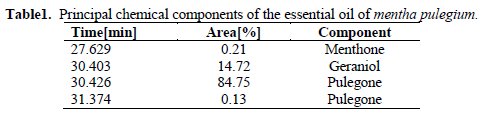
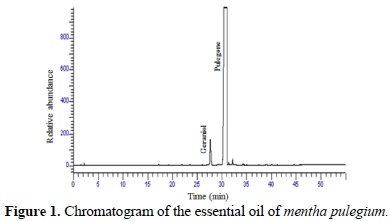
<body><![CDATA[<p><b>Results</b></p>      <p><i><b>Analysis of the essential oil of mentha pulegium</b></i></p>      <p><a href="#t1">Table 1</a> gives the principal chemical component of the essential oil of mentha  pulegium, which is mostly composed of 84,75 % of pulegone (5-methyl-2propan- 2-ylidene cyclohexan-1-one) and 14,72 % of geraniol (2,6-dimethyltrans- 2,6-octadien-8-ol).</p>       <p>&nbsp;</p> <a name="t1"> <img src="/img/revistas/pea/v34n1/34n1a04t1.jpg">     
<p>&nbsp;</p>       <p>The corresponding chromatogram is in <a href="#f1">Fig. 1</a>.</p>       <p>&nbsp;</p> <a name="f1"> <img src="/img/revistas/pea/v34n1/34n1a04f1.jpg">     
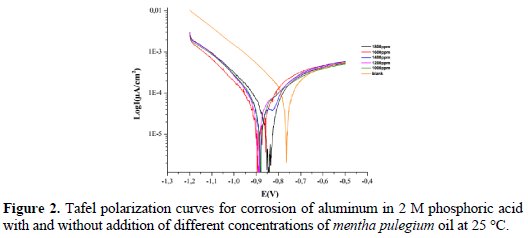
<p>&nbsp;</p>       <p><i><b>Polarization curves</b></i></p>      <p>The polarization behavior of aluminum in 2 M phosphoric acid with and without  addition of this inhibitor is presented in <a href="#f2">Fig. 2</a>.</p>       ]]></body>
<body><![CDATA[<p>&nbsp;</p> <a name="f2"> <img src="/img/revistas/pea/v34n1/34n1a04f2.jpg">     
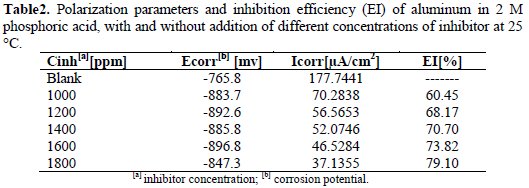
<p>&nbsp;</p>       <p>Electrochemical parameters,  values of corrosion current (Icorr), the corrosion potential (Ecorr), and inhibitor  efficiency (IE) are given in <a href="#t2">Table 2</a>.</p>       <p>&nbsp;</p> <a name="t2"> <img src="/img/revistas/pea/v34n1/34n1a04t2.jpg">     
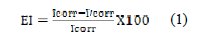
<p>&nbsp;</p>       <p>The inhibitor efficiency, in <a href="#e1">Equation 1</a>, is defined by the following relationship:</p>       <p>&nbsp;</p> <a name="e1"> <img src="/img/revistas/pea/v34n1/34n1a04e1.jpg">     
<p>&nbsp;</p>       <p>where I'corr and Icorr, respectively, represent corrosion current densities  determined by extrapolation of the straight Tafel corrosion potential, with and  without addition of inhibitor.</p>       <p><i><b>Electrochemical impedance spectroscopy</b></i></p>      ]]></body>
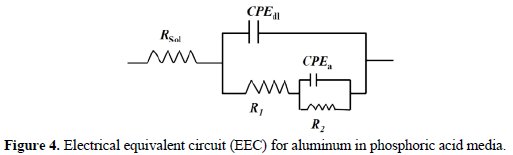
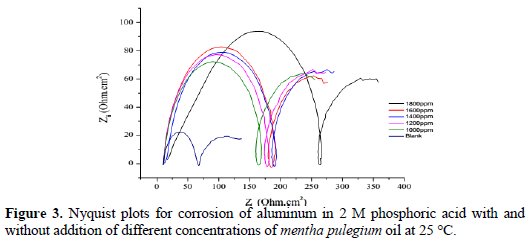
<body><![CDATA[<p>Electrochemical impedance (EIS) is a technique with a small perturbative signal,  and the surface damage of the sample is very little [13]. Besides, the corrosion  mechanism can be estimated by analyzing the measured electrochemical  impedance spectrum.</p>      <p>The Nyquist plots for this compound are shown in <a href="#f3">Fig. 3</a> and the corresponding  circuit is shown in <a href="#f4">Fig. 4</a>.</p>       <p>&nbsp;</p> <a name="f3"> <img src="/img/revistas/pea/v34n1/34n1a04f3.jpg">     
<p>&nbsp;</p> <a name="f4"> <img src="/img/revistas/pea/v34n1/34n1a04f4.jpg">     
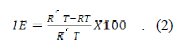
<p>&nbsp;</p>         <p><i>Nyquist plots</i></p>      <p>Every spectrum shows two capacitive loops. A first large well-trained high  frequency loop and a small low frequency loop.</p>      <p>The inhibition efficiency was calculated using the <a href="#e2">Equation 2</a>:</p>       <p>&nbsp;</p> <a name="e2"> <img src="/img/revistas/pea/v34n1/34n1a04e2.jpg">     
<p>&nbsp;</p>       ]]></body>
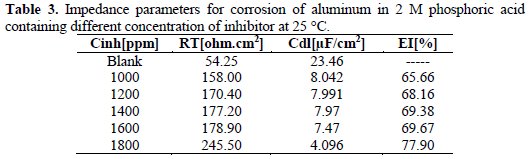
<body><![CDATA[<p>Where, R'T and RT are respectively the charge transfer resistance of aluminum  in 2 M phosphoric acid in the presence and absence of inhibitor. The impedance  parameters are given in <a href="#t3">Table 3</a>.</p>       <p>&nbsp;</p> <a name="t3"> <img src="/img/revistas/pea/v34n1/34n1a04t3.jpg">     
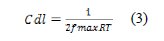
<p>&nbsp;</p>       <p>The relationship between the double layer capacity (Cdl) and the maximum  frequency (fmax) of the imaginary component of the impedance is shown in  <a href="#e3">Equation 3</a>:</p>       <p>&nbsp;</p> <a name="e3"> <img src="/img/revistas/pea/v34n1/34n1a04e3.jpg">     
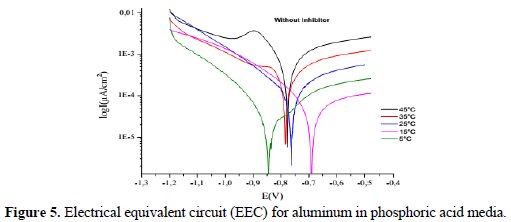
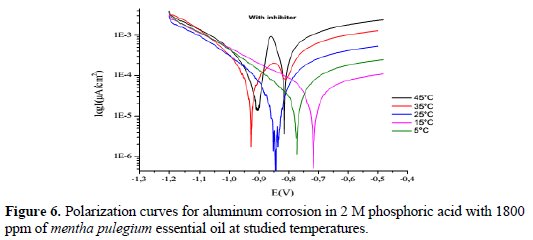
<p>&nbsp;</p>       <p><i>Electrical equivalent circuit</i></p>      <p>In the circuit, in <a href="#f4">Fig. 4</a>, Rsol represents the solution resistance of the system, R1  is the charge transfer resistance for the corrosion reaction and the double layer  resistance, and CPEdl is the capacitance of the electrical double layer at the  metal-solution interface, corresponding to the high frequency capacitive loop. R2  and CPEa represent the pseudo resistance and pseudo capacitance of the blasters  layer.</p>       <p><i><b>Effect of temperature</b></i></p>      <p>The polarization experiments were also used to investigate the effect of  temperature on the corrosion behavior of aluminum in 2 M phosphoric acid with  and without inhibitor at a concentration of 1800 ppm, in the temperature range of  278 &deg;K-318 &deg;K. Tafel curves are represented in <a href="#f5">Fig. 5</a> and <a href="#f6">Fig. 6</a>.</p>       ]]></body>
<body><![CDATA[<p>&nbsp;</p> <a name="f5"> <img src="/img/revistas/pea/v34n1/34n1a04f5.jpg">     
<p>&nbsp;</p> <a name="f6"> <img src="/img/revistas/pea/v34n1/34n1a04f6.jpg">     
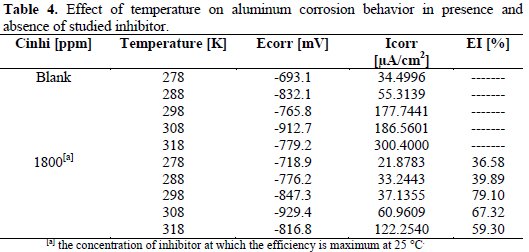
<p>&nbsp;</p>       <p>Results obtained are reported in <a href="#t4">Table 4</a>.</p>       <p>&nbsp;</p> <a name="t4"> <img src="/img/revistas/pea/v34n1/34n1a04t4.jpg">     
<p>&nbsp;</p>        <p>&nbsp;</p>     <p><b>Discussion</b></p>      <p><i><b>Polarization curves</b></i></p>      <p>From <a href="#f2">Fig. 2</a> and <a href="#t2">Table 2</a>, it can be observed that, with the addition of this oil, the  corrosion rate of aluminum decreases with an increase in the concentration of the  inhibitor. Therefore, the inhibitor efficiency increases with an increase in the  concentration of the inhibitor.</p>      ]]></body>
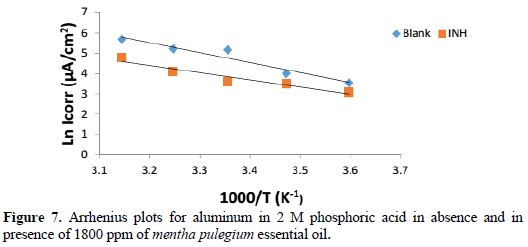
<body><![CDATA[<p>The changes observed in the polarization curves after the addition of the inhibitor  are usually used as the criteria to classify inhibitors as cathodic, anodic or mixed  [14]. According to literature report, when the corrosion potential is more than &pm;  85 mV, with respect to the corrosion potential of the blank, the inhibitor can be  considered distinctively as either cathodic or anodic type [14, 15]. However, the  minimum displacement in this study is more than &pm;85 mV.</p>      <p>This suggests that the essential oil of mentha pulegium oil functions as a  cathodic-type inhibitor.</p>      <p>Observing <a href="#f3">Figure 3</a>, the diameter of the capacitive loop increases with the  increase in the inhibitor concentration. This indicates that the impedance of the  inhibited substrate has increased with the inhibitor concentration. The fact that  impedance plots are semicircles both in the absence and in the presence of the  inhibitor indicates that the corrosion process is charge transfer controlled [16].  From <a href="#t3">Table 3</a>, the Cdl (double layer capacitance) values decrease with an  increase in inhibitor concentrations, which could be due to the formation of a  protective layer by inhibitor molecules [17].</p>       <p><i><b>Effect of temperature</b></i></p>      <p>On <a href="#t4">Table 4</a>, it is observed that the corrosion rate (Icorr) increases with an  increase of temperature in the presence and absence of the inhibitor. At low  temperatures, the inhibitor efficiency EI increases with an increase of  temperature. This can be due to the adsorption of inhibitor molecules on  aluminum surface [18]. At elevated temperatures, the efficiency of the inhibitor  decreases with an increase of temperature. This decrease in inhibition  performance of the inhibitor is due to desorption of the adsorbed inhibitor  molecules from aluminum surface [18].</p>       <p><i>Thermodynamic parameters</i></p>      <p>The corrosion inhibition of aluminum in M phosphoric acid can be more  explained in terms of molecular adsorption of inhibitor on its' surface [18].  The value of apparent activation energy (Ea), in both presence and absence of  inhibitor, was calculated from Arrhenius equation:</p>       <p>&nbsp;</p> <a name="e4"> <img src="/img/revistas/pea/v34n1/34n1a04e4.jpg">     
<p>&nbsp;</p>       <p>where, Ea is the apparent activation energy (kJ mol<sup>-1</sup>), R is the molar gas constant  (8.314 JK-1 mol<sup>-1</sup>), T is the absolute temperature (K), and &lambda; is the Arrhenius pre- exponential factor.</p>      ]]></body>
<body><![CDATA[<p>The Arrhenius plots give a straight line between LnI vs. 1000/T, as shown in <a href="#f7">Fig. 7</a>.</p>       <p>&nbsp;</p> <a name="f7"> <img src="/img/revistas/pea/v34n1/34n1a04f7.jpg">     
<p>&nbsp;</p>       <p>The Ea values were calculated by multiplying the slope of Arrhenius plots  (LnI vs. 1000/ T) by R, represented in <a href="#t5">Table 5</a>, from which it is noticed that the  activation energy is greater (40.98 kJmol<sup>-1</sup>) in absence of the inhibitor than in  presence of 1800 ppm of the inhibitor (29.48 kJmol<sup>-1</sup>).</p>      <p>&nbsp;</p> <a name="t5"> <img src="/img/revistas/pea/v34n1/34n1a04t5.jpg">     
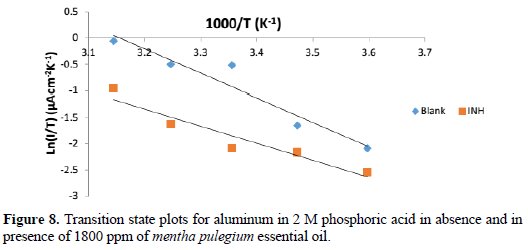
<p>&nbsp;</p>       <p>This shows the chemical  adsorption of the inhibitor and the effective formation of a surface film [8, 19].</p>      <p>The corrosion current intensity dependency on temperature can also be  represented by the transition state equation:</p>       <p>&nbsp;</p> <a name="e5"> <img src="/img/revistas/pea/v34n1/34n1a04e5.jpg">     
<p>&nbsp;</p>       ]]></body>
<body><![CDATA[<p>where, &Delta;H<sup>*</sup> is the apparent enthalpy of activation, &Delta;S<sup>*</sup> the apparent entropy of  activation, h is the Planck's constant and N is the Avogadro number. The  transition state plots, in <a href="#f8">Figure 8</a>, give a straight line between Ln (I/T) vs.  1000/T.</p>       <p>&nbsp;</p> <a name="f8"> <img src="/img/revistas/pea/v34n1/34n1a04f8.jpg">     
<p>&nbsp;</p>       <p>From the slope of (-&Delta;H<sup>*</sup>/R) and intercept of [Ln(R/Nh) + (&Delta;S<sup>*</sup>/R)],  values of &Delta;S<sup>*</sup> and &Delta;H<sup>*</sup> were calculated and listed in <a href="#t5">Table 5</a>.</p>      <p>From <a href="#t5">Table 5</a>, &Delta;H<sup>*</sup>, in both absence and presence of the inhibitor, are positive.  This reflects the endothermic process of adsorption of this inhibitor on aluminum  surface, suggesting that higher temperature favors the corrosion process [20].  The negative values of &Delta;S<sup>*</sup> may reflect the association mechanism of corrosion,  i.e., the decrease in disorder takes place on going from reactants to the activated  states. It has also been noticed that the addition of the inhibitor to the test  solution gives lesser negative values of &Delta;S<sup>*</sup> than in the absence of the inhibitor,  i.e., it decreases the corrosion rates. This result may be considered as an indirect  evidence to support the cited proposed mechanism [21].</p>       <p>&nbsp;</p>     <p><b>Conclusions</b></p>      <p>- Mentha pulegium leaves essential oil is a good aluminum corrosion inhibitor in  2 M phosphoric acid solution. Its effectiveness increases with an increase of  concentration, reaching the maximum efficiency of 79 % at 1800 ppm by  potentiodynamic polarization studies. The effectiveness decreases with an  increase in temperature.</p>      <p>- Polarization results indicate the cathodic type of the used inhibitor.</p>      <p>- Impedance plots shape indicates that the corrosion process is charge transfer  controlled.</p>      ]]></body>
<body><![CDATA[<p>- According to thermodynamic parameters and due to the addition of 1800 ppm  of the inhibitor, the apparent activation energy (Ea<sup>*</sup>) shows the chemical nature  of the adsorption of the studied oil on aluminum. The apparent enthalpy of  activation (&Delta;H<sup>*</sup>) proves that the same adsorption is an endothermic process and  the apparent entropy of activation (&Delta;S<sup>*</sup>) confirms the decrease of corrosion  rate.</p>       <p>&nbsp;</p>     <p><b>References</b></p>      <!-- ref --><p>1. Constantin F. PhD Thesis. Lyon, France: INSA; 2011.    &nbsp;&nbsp;&nbsp;&nbsp;&nbsp;&nbsp;&nbsp;&nbsp;[&#160;<a href="javascript:void(0);" onclick="javascript: window.open('/scielo.php?script=sci_nlinks&ref=418877&pid=S0872-1904201600010000400001&lng=','','width=640,height=500,resizable=yes,scrollbars=1,menubar=yes,');">Links</a>&#160;]<!-- end-ref --></p>      <!-- ref --><p>2. Halambek J, Zutinic A, Berkovic K. Int J Electrochem Sci. 2013;8:11201.    &nbsp;&nbsp;&nbsp;&nbsp;&nbsp;&nbsp;&nbsp;&nbsp;[&#160;<a href="javascript:void(0);" onclick="javascript: window.open('/scielo.php?script=sci_nlinks&ref=418879&pid=S0872-1904201600010000400002&lng=','','width=640,height=500,resizable=yes,scrollbars=1,menubar=yes,');">Links</a>&#160;]<!-- end-ref --></p>      <!-- ref --><p>3. Musa A Y. Recen Reseac Corr Evalu Protec. 2012.    &nbsp;&nbsp;&nbsp;&nbsp;&nbsp;&nbsp;&nbsp;&nbsp;[&#160;<a href="javascript:void(0);" onclick="javascript: window.open('/scielo.php?script=sci_nlinks&ref=418881&pid=S0872-1904201600010000400003&lng=','','width=640,height=500,resizable=yes,scrollbars=1,menubar=yes,');">Links</a>&#160;]<!-- end-ref --></p>      <!-- ref --><p>4. Bensabah F, Houbairi S, Essahli M, et al. Port Electochim Acta. 2013;31:195.    &nbsp;&nbsp;&nbsp;&nbsp;&nbsp;&nbsp;&nbsp;&nbsp;[&#160;<a href="javascript:void(0);" onclick="javascript: window.open('/scielo.php?script=sci_nlinks&ref=418883&pid=S0872-1904201600010000400004&lng=','','width=640,height=500,resizable=yes,scrollbars=1,menubar=yes,');">Links</a>&#160;]<!-- end-ref --></p>      <!-- ref --><p>5. Fares M M, Maayta A K, A-Qudah M M. Corros Sci. 2012;60:112.    &nbsp;&nbsp;&nbsp;&nbsp;&nbsp;&nbsp;&nbsp;&nbsp;[&#160;<a href="javascript:void(0);" onclick="javascript: window.open('/scielo.php?script=sci_nlinks&ref=418885&pid=S0872-1904201600010000400005&lng=','','width=640,height=500,resizable=yes,scrollbars=1,menubar=yes,');">Links</a>&#160;]<!-- end-ref --></p>      <!-- ref --><p>6. Deng S, Li X. Corros Sci. 2012;64:253.    &nbsp;&nbsp;&nbsp;&nbsp;&nbsp;&nbsp;&nbsp;&nbsp;[&#160;<a href="javascript:void(0);" onclick="javascript: window.open('/scielo.php?script=sci_nlinks&ref=418887&pid=S0872-1904201600010000400006&lng=','','width=640,height=500,resizable=yes,scrollbars=1,menubar=yes,');">Links</a>&#160;]<!-- end-ref --></p>      <!-- ref --><p>7. Haleem S M A E, Wanees S A E, Aal E E A E. Corros Sci. 2013;68:1.    &nbsp;&nbsp;&nbsp;&nbsp;&nbsp;&nbsp;&nbsp;&nbsp;[&#160;<a href="javascript:void(0);" onclick="javascript: window.open('/scielo.php?script=sci_nlinks&ref=418889&pid=S0872-1904201600010000400007&lng=','','width=640,height=500,resizable=yes,scrollbars=1,menubar=yes,');">Links</a>&#160;]<!-- end-ref --></p>      <!-- ref --><p>8. Houbairi S, Lamiri A, Essahli M, Chem Sci Rev Lett. 2014;3:353.    &nbsp;&nbsp;&nbsp;&nbsp;&nbsp;&nbsp;&nbsp;&nbsp;[&#160;<a href="javascript:void(0);" onclick="javascript: window.open('/scielo.php?script=sci_nlinks&ref=418891&pid=S0872-1904201600010000400008&lng=','','width=640,height=500,resizable=yes,scrollbars=1,menubar=yes,');">Links</a>&#160;]<!-- end-ref --></p>      <!-- ref --><p>9. Darwich E, Benziane Z, Taouil R. Chem Bull â€POLITEHNICAâ€ Univ (Timisoara). 2010;55:103.    &nbsp;&nbsp;&nbsp;&nbsp;&nbsp;&nbsp;&nbsp;&nbsp;[&#160;<a href="javascript:void(0);" onclick="javascript: window.open('/scielo.php?script=sci_nlinks&ref=418893&pid=S0872-1904201600010000400009&lng=','','width=640,height=500,resizable=yes,scrollbars=1,menubar=yes,');">Links</a>&#160;]<!-- end-ref --></p>      <!-- ref --><p>10. Boukhebti H, Chaker AN, Belhadj H, et al. D Pharma Lett. 2011;3:267.    &nbsp;&nbsp;&nbsp;&nbsp;&nbsp;&nbsp;&nbsp;&nbsp;[&#160;<a href="javascript:void(0);" onclick="javascript: window.open('/scielo.php?script=sci_nlinks&ref=418895&pid=S0872-1904201600010000400010&lng=','','width=640,height=500,resizable=yes,scrollbars=1,menubar=yes,');">Links</a>&#160;]<!-- end-ref --></p>      <!-- ref --><p>11. Erhan M K, Bolukbasi SC, Urusan H. Liv Stoc Sci. 2012;146:189.    &nbsp;&nbsp;&nbsp;&nbsp;&nbsp;&nbsp;&nbsp;&nbsp;[&#160;<a href="javascript:void(0);" onclick="javascript: window.open('/scielo.php?script=sci_nlinks&ref=418897&pid=S0872-1904201600010000400011&lng=','','width=640,height=500,resizable=yes,scrollbars=1,menubar=yes,');">Links</a>&#160;]<!-- end-ref --></p>      <!-- ref --><p>12. Teixeira B, Marques A, Ramos C, et al. Indust Crop Prod. 2012;36:81.    &nbsp;&nbsp;&nbsp;&nbsp;&nbsp;&nbsp;&nbsp;&nbsp;[&#160;<a href="javascript:void(0);" onclick="javascript: window.open('/scielo.php?script=sci_nlinks&ref=418899&pid=S0872-1904201600010000400012&lng=','','width=640,height=500,resizable=yes,scrollbars=1,menubar=yes,');">Links</a>&#160;]<!-- end-ref --></p>      <!-- ref --><p>13. Prabhu D, Rao P. J Environ Chem Eng. 2013;1:676.    &nbsp;&nbsp;&nbsp;&nbsp;&nbsp;&nbsp;&nbsp;&nbsp;[&#160;<a href="javascript:void(0);" onclick="javascript: window.open('/scielo.php?script=sci_nlinks&ref=418901&pid=S0872-1904201600010000400013&lng=','','width=640,height=500,resizable=yes,scrollbars=1,menubar=yes,');">Links</a>&#160;]<!-- end-ref --></p>      <!-- ref --><p>14. Zarrouk A, Zarrok H, Salghi R, et al. J Mater Environ Sci. 2013;4:177.    &nbsp;&nbsp;&nbsp;&nbsp;&nbsp;&nbsp;&nbsp;&nbsp;[&#160;<a href="javascript:void(0);" onclick="javascript: window.open('/scielo.php?script=sci_nlinks&ref=418903&pid=S0872-1904201600010000400014&lng=','','width=640,height=500,resizable=yes,scrollbars=1,menubar=yes,');">Links</a>&#160;]<!-- end-ref --></p>      <!-- ref --><p>15. Ameer M A, Ghoneim A A, Fekry AM. Int. J. Electrochem.Sci. 2012;7:4418.    &nbsp;&nbsp;&nbsp;&nbsp;&nbsp;&nbsp;&nbsp;&nbsp;[&#160;<a href="javascript:void(0);" onclick="javascript: window.open('/scielo.php?script=sci_nlinks&ref=418905&pid=S0872-1904201600010000400015&lng=','','width=640,height=500,resizable=yes,scrollbars=1,menubar=yes,');">Links</a>&#160;]<!-- end-ref --></p>      <!-- ref --><p>16. Hmamou D B, Salghi R, Zarrouk A, et al. D Pharma Lett. 2013;5:135.    &nbsp;&nbsp;&nbsp;&nbsp;&nbsp;&nbsp;&nbsp;&nbsp;[&#160;<a href="javascript:void(0);" onclick="javascript: window.open('/scielo.php?script=sci_nlinks&ref=418907&pid=S0872-1904201600010000400016&lng=','','width=640,height=500,resizable=yes,scrollbars=1,menubar=yes,');">Links</a>&#160;]<!-- end-ref --></p>      <!-- ref --><p>17. Victoria S N, Prasad R, Manivannan R. Int J Electrochem Sci. 2015;10:2220.    &nbsp;&nbsp;&nbsp;&nbsp;&nbsp;&nbsp;&nbsp;&nbsp;[&#160;<a href="javascript:void(0);" onclick="javascript: window.open('/scielo.php?script=sci_nlinks&ref=418909&pid=S0872-1904201600010000400017&lng=','','width=640,height=500,resizable=yes,scrollbars=1,menubar=yes,');">Links</a>&#160;]<!-- end-ref --></p>      <!-- ref --><p>18. Korbe R, Verma CB, Ebenso EE, et al. Int J Electrochem Sci. 2015;10:1081.    &nbsp;&nbsp;&nbsp;&nbsp;&nbsp;&nbsp;&nbsp;&nbsp;[&#160;<a href="javascript:void(0);" onclick="javascript: window.open('/scielo.php?script=sci_nlinks&ref=418911&pid=S0872-1904201600010000400018&lng=','','width=640,height=500,resizable=yes,scrollbars=1,menubar=yes,');">Links</a>&#160;]<!-- end-ref --></p>      <!-- ref --><p>19. Bhola S M, Singh G, Mishra B. Int J Electrochem Sci. 2013;8:5635.    &nbsp;&nbsp;&nbsp;&nbsp;&nbsp;&nbsp;&nbsp;&nbsp;[&#160;<a href="javascript:void(0);" onclick="javascript: window.open('/scielo.php?script=sci_nlinks&ref=418913&pid=S0872-1904201600010000400019&lng=','','width=640,height=500,resizable=yes,scrollbars=1,menubar=yes,');">Links</a>&#160;]<!-- end-ref --></p>      <!-- ref --><p>20. Vashi R T, Naik D. E-J Chem. 2010;7(S1):S1.    &nbsp;&nbsp;&nbsp;&nbsp;&nbsp;&nbsp;&nbsp;&nbsp;[&#160;<a href="javascript:void(0);" onclick="javascript: window.open('/scielo.php?script=sci_nlinks&ref=418915&pid=S0872-1904201600010000400020&lng=','','width=640,height=500,resizable=yes,scrollbars=1,menubar=yes,');">Links</a>&#160;]<!-- end-ref --></p>      <!-- ref --><p>21. Hassan R M, Zaafarany I A. Materials. 2013;6:2436.    &nbsp;&nbsp;&nbsp;&nbsp;&nbsp;&nbsp;&nbsp;&nbsp;[&#160;<a href="javascript:void(0);" onclick="javascript: window.open('/scielo.php?script=sci_nlinks&ref=418917&pid=S0872-1904201600010000400021&lng=','','width=640,height=500,resizable=yes,scrollbars=1,menubar=yes,');">Links</a>&#160;]<!-- end-ref --></p>       <p>&nbsp;</p>     <p><a name=0></a><sup><a href="#top">*</a></sup>Corresponding author. E-mail address: <a href="mailto:m.uwineza@uhp.ac.ma">m.uwineza@uhp.ac.ma</a></p>      <p>Received 15 February 2016; accepted 23 February 2016</p>      <p><a href="http://www.peacta.org" target="_blank">www.peacta.org</a> </p>        ]]></body><back>
<ref-list>
<ref id="B1">
<label>1</label><nlm-citation citation-type="">
<person-group person-group-type="author">
<name>
<surname><![CDATA[Constantin]]></surname>
<given-names><![CDATA[F]]></given-names>
</name>
</person-group>
<source><![CDATA[]]></source>
<year></year>
</nlm-citation>
</ref>
<ref id="B2">
<label>2</label><nlm-citation citation-type="journal">
<person-group person-group-type="author">
<name>
<surname><![CDATA[Halambek]]></surname>
<given-names><![CDATA[J]]></given-names>
</name>
<name>
<surname><![CDATA[Zutinic]]></surname>
<given-names><![CDATA[A]]></given-names>
</name>
<name>
<surname><![CDATA[Berkovic]]></surname>
<given-names><![CDATA[K]]></given-names>
</name>
</person-group>
<source><![CDATA[Int J Electrochem Sci]]></source>
<year>2013</year>
<volume>8</volume>
<page-range>11201</page-range></nlm-citation>
</ref>
<ref id="B3">
<label>3</label><nlm-citation citation-type="">
<person-group person-group-type="author">
<name>
<surname><![CDATA[Musa]]></surname>
<given-names><![CDATA[A Y]]></given-names>
</name>
</person-group>
<source><![CDATA[Recen Reseac Corr Evalu Protec]]></source>
<year>2012</year>
</nlm-citation>
</ref>
<ref id="B4">
<label>4</label><nlm-citation citation-type="journal">
<person-group person-group-type="author">
<name>
<surname><![CDATA[Bensabah]]></surname>
<given-names><![CDATA[F]]></given-names>
</name>
<name>
<surname><![CDATA[Houbairi]]></surname>
<given-names><![CDATA[S]]></given-names>
</name>
<name>
<surname><![CDATA[Essahli]]></surname>
<given-names><![CDATA[M]]></given-names>
</name>
</person-group>
<source><![CDATA[Port Electochim Acta]]></source>
<year>2013</year>
<volume>31</volume>
<page-range>195</page-range></nlm-citation>
</ref>
<ref id="B5">
<label>5</label><nlm-citation citation-type="journal">
<person-group person-group-type="author">
<name>
<surname><![CDATA[Fares]]></surname>
<given-names><![CDATA[M M]]></given-names>
</name>
<name>
<surname><![CDATA[Maayta]]></surname>
<given-names><![CDATA[A K]]></given-names>
</name>
<name>
<surname><![CDATA[A-Qudah]]></surname>
<given-names><![CDATA[M M]]></given-names>
</name>
</person-group>
<source><![CDATA[Corros Sci]]></source>
<year>2012</year>
<volume>60</volume>
<page-range>112</page-range></nlm-citation>
</ref>
<ref id="B6">
<label>6</label><nlm-citation citation-type="journal">
<person-group person-group-type="author">
<name>
<surname><![CDATA[Deng]]></surname>
<given-names><![CDATA[S]]></given-names>
</name>
<name>
<surname><![CDATA[Li]]></surname>
<given-names><![CDATA[X]]></given-names>
</name>
</person-group>
<source><![CDATA[Corros Sci]]></source>
<year>2012</year>
<volume>64</volume>
<page-range>253</page-range></nlm-citation>
</ref>
<ref id="B7">
<label>7</label><nlm-citation citation-type="journal">
<person-group person-group-type="author">
<name>
<surname><![CDATA[Haleem]]></surname>
<given-names><![CDATA[S M A E]]></given-names>
</name>
<name>
<surname><![CDATA[Wanees]]></surname>
<given-names><![CDATA[S A E]]></given-names>
</name>
<name>
<surname><![CDATA[Aal]]></surname>
<given-names><![CDATA[E E A E]]></given-names>
</name>
</person-group>
<source><![CDATA[Corros Sci]]></source>
<year>2013</year>
<volume>68</volume>
<page-range>1</page-range></nlm-citation>
</ref>
<ref id="B8">
<label>8</label><nlm-citation citation-type="journal">
<person-group person-group-type="author">
<name>
<surname><![CDATA[Houbairi]]></surname>
<given-names><![CDATA[S]]></given-names>
</name>
<name>
<surname><![CDATA[Lamiri]]></surname>
<given-names><![CDATA[A]]></given-names>
</name>
<name>
<surname><![CDATA[Essahli]]></surname>
<given-names><![CDATA[M]]></given-names>
</name>
</person-group>
<source><![CDATA[Chem Sci Rev Lett]]></source>
<year>2014</year>
<volume>3</volume>
<page-range>353</page-range></nlm-citation>
</ref>
<ref id="B9">
<label>9</label><nlm-citation citation-type="journal">
<person-group person-group-type="author">
<name>
<surname><![CDATA[Darwich]]></surname>
<given-names><![CDATA[E]]></given-names>
</name>
<name>
<surname><![CDATA[Benziane]]></surname>
<given-names><![CDATA[Z]]></given-names>
</name>
<name>
<surname><![CDATA[Taouil]]></surname>
<given-names><![CDATA[R]]></given-names>
</name>
</person-group>
<source><![CDATA[Chem Bull POLITEHNICA Univ (Timisoara)]]></source>
<year>2010</year>
<volume>55</volume>
<page-range>103</page-range></nlm-citation>
</ref>
<ref id="B10">
<label>10</label><nlm-citation citation-type="journal">
<person-group person-group-type="author">
<name>
<surname><![CDATA[Boukhebti]]></surname>
<given-names><![CDATA[H]]></given-names>
</name>
<name>
<surname><![CDATA[Chaker]]></surname>
<given-names><![CDATA[A N]]></given-names>
</name>
<name>
<surname><![CDATA[Belhadj]]></surname>
<given-names><![CDATA[H]]></given-names>
</name>
</person-group>
<source><![CDATA[D Pharma Lett]]></source>
<year>2011</year>
<volume>3</volume>
<page-range>267</page-range></nlm-citation>
</ref>
<ref id="B11">
<label>11</label><nlm-citation citation-type="journal">
<person-group person-group-type="author">
<name>
<surname><![CDATA[Erhan]]></surname>
<given-names><![CDATA[M K]]></given-names>
</name>
<name>
<surname><![CDATA[Bolukbasi]]></surname>
<given-names><![CDATA[S C]]></given-names>
</name>
<name>
<surname><![CDATA[Urusan]]></surname>
<given-names><![CDATA[H]]></given-names>
</name>
</person-group>
<source><![CDATA[Liv Stoc Sci]]></source>
<year>2012</year>
<volume>146</volume>
<page-range>189</page-range></nlm-citation>
</ref>
<ref id="B12">
<label>12</label><nlm-citation citation-type="journal">
<person-group person-group-type="author">
<name>
<surname><![CDATA[Teixeira]]></surname>
<given-names><![CDATA[B]]></given-names>
</name>
<name>
<surname><![CDATA[Marques]]></surname>
<given-names><![CDATA[A]]></given-names>
</name>
<name>
<surname><![CDATA[Ramos]]></surname>
<given-names><![CDATA[C]]></given-names>
</name>
</person-group>
<source><![CDATA[Indust Crop Prod]]></source>
<year>2012</year>
<volume>36</volume>
<page-range>81</page-range></nlm-citation>
</ref>
<ref id="B13">
<label>13</label><nlm-citation citation-type="journal">
<person-group person-group-type="author">
<name>
<surname><![CDATA[Prabhu]]></surname>
<given-names><![CDATA[D]]></given-names>
</name>
<name>
<surname><![CDATA[Rao]]></surname>
<given-names><![CDATA[P]]></given-names>
</name>
</person-group>
<source><![CDATA[J Environ Chem Eng]]></source>
<year>2013</year>
<volume>1</volume>
<page-range>676</page-range></nlm-citation>
</ref>
<ref id="B14">
<label>14</label><nlm-citation citation-type="journal">
<person-group person-group-type="author">
<name>
<surname><![CDATA[Zarrouk]]></surname>
<given-names><![CDATA[A]]></given-names>
</name>
<name>
<surname><![CDATA[Zarrok]]></surname>
<given-names><![CDATA[H]]></given-names>
</name>
<name>
<surname><![CDATA[Salghi]]></surname>
<given-names><![CDATA[R]]></given-names>
</name>
</person-group>
<source><![CDATA[J Mater Environ Sci]]></source>
<year>2013</year>
<volume>4</volume>
<page-range>177</page-range></nlm-citation>
</ref>
<ref id="B15">
<label>15</label><nlm-citation citation-type="journal">
<person-group person-group-type="author">
<name>
<surname><![CDATA[Ameer]]></surname>
<given-names><![CDATA[M A]]></given-names>
</name>
<name>
<surname><![CDATA[Ghoneim]]></surname>
<given-names><![CDATA[A A]]></given-names>
</name>
<name>
<surname><![CDATA[Fekry]]></surname>
<given-names><![CDATA[A M]]></given-names>
</name>
</person-group>
<source><![CDATA[Int. J. Electrochem.Sci]]></source>
<year>2012</year>
<volume>7</volume>
<page-range>4418</page-range></nlm-citation>
</ref>
<ref id="B16">
<label>16</label><nlm-citation citation-type="journal">
<person-group person-group-type="author">
<name>
<surname><![CDATA[Hmamou]]></surname>
<given-names><![CDATA[D B]]></given-names>
</name>
<name>
<surname><![CDATA[Salghi]]></surname>
<given-names><![CDATA[R]]></given-names>
</name>
<name>
<surname><![CDATA[Zarrouk]]></surname>
<given-names><![CDATA[A]]></given-names>
</name>
</person-group>
<source><![CDATA[D Pharma Lett]]></source>
<year>2013</year>
<volume>5</volume>
<page-range>135</page-range></nlm-citation>
</ref>
<ref id="B17">
<label>17</label><nlm-citation citation-type="journal">
<person-group person-group-type="author">
<name>
<surname><![CDATA[Victoria]]></surname>
<given-names><![CDATA[S N]]></given-names>
</name>
<name>
<surname><![CDATA[Prasad]]></surname>
<given-names><![CDATA[R]]></given-names>
</name>
<name>
<surname><![CDATA[Manivannan]]></surname>
<given-names><![CDATA[R]]></given-names>
</name>
</person-group>
<source><![CDATA[Int J Electrochem Sci]]></source>
<year>2015</year>
<volume>10</volume>
<page-range>2220</page-range></nlm-citation>
</ref>
<ref id="B18">
<label>18</label><nlm-citation citation-type="journal">
<person-group person-group-type="author">
<name>
<surname><![CDATA[Korbe]]></surname>
<given-names><![CDATA[R]]></given-names>
</name>
<name>
<surname><![CDATA[Verma]]></surname>
<given-names><![CDATA[C B]]></given-names>
</name>
<name>
<surname><![CDATA[Ebenso]]></surname>
<given-names><![CDATA[E E]]></given-names>
</name>
</person-group>
<source><![CDATA[Int J Electrochem Sci]]></source>
<year>2015</year>
<volume>10</volume>
<page-range>1081</page-range></nlm-citation>
</ref>
<ref id="B19">
<label>19</label><nlm-citation citation-type="journal">
<person-group person-group-type="author">
<name>
<surname><![CDATA[Bhola]]></surname>
<given-names><![CDATA[S M]]></given-names>
</name>
<name>
<surname><![CDATA[Singh]]></surname>
<given-names><![CDATA[G]]></given-names>
</name>
<name>
<surname><![CDATA[Mishra]]></surname>
<given-names><![CDATA[B]]></given-names>
</name>
</person-group>
<source><![CDATA[Int J Electrochem Sci]]></source>
<year>2013</year>
<volume>8</volume>
<page-range>5635</page-range></nlm-citation>
</ref>
<ref id="B20">
<label>20</label><nlm-citation citation-type="journal">
<person-group person-group-type="author">
<name>
<surname><![CDATA[Vashi]]></surname>
<given-names><![CDATA[R T]]></given-names>
</name>
<name>
<surname><![CDATA[Naik]]></surname>
<given-names><![CDATA[D]]></given-names>
</name>
</person-group>
<source><![CDATA[E-J Chem]]></source>
<year>2010</year>
<volume>7</volume>
<numero>S1</numero>
<issue>S1</issue>
<page-range>S1</page-range></nlm-citation>
</ref>
<ref id="B21">
<label>21</label><nlm-citation citation-type="journal">
<person-group person-group-type="author">
<name>
<surname><![CDATA[Hassan]]></surname>
<given-names><![CDATA[R M]]></given-names>
</name>
<name>
<surname><![CDATA[Zaafarany]]></surname>
<given-names><![CDATA[I A]]></given-names>
</name>
</person-group>
<source><![CDATA[Materials]]></source>
<year>2013</year>
<volume>6</volume>
<page-range>2436</page-range></nlm-citation>
</ref>
</ref-list>
</back>
</article>