<?xml version="1.0" encoding="ISO-8859-1"?><article xmlns:mml="http://www.w3.org/1998/Math/MathML" xmlns:xlink="http://www.w3.org/1999/xlink" xmlns:xsi="http://www.w3.org/2001/XMLSchema-instance">
<front>
<journal-meta>
<journal-id>0872-1904</journal-id>
<journal-title><![CDATA[Portugaliae Electrochimica Acta]]></journal-title>
<abbrev-journal-title><![CDATA[Port. Electrochim. Acta]]></abbrev-journal-title>
<issn>0872-1904</issn>
<publisher>
<publisher-name><![CDATA[Sociedade Portuguesa de Electroquímica]]></publisher-name>
</publisher>
</journal-meta>
<article-meta>
<article-id>S0872-19042016000100005</article-id>
<article-id pub-id-type="doi">10.4152/pea.201601063</article-id>
<title-group>
<article-title xml:lang="en"><![CDATA[Wear Analysis of Electroless Ni-P Coating Under Lubricated Condition Using Fuzzy Logic]]></article-title>
</title-group>
<contrib-group>
<contrib contrib-type="author">
<name>
<surname><![CDATA[Mukhopadhyay]]></surname>
<given-names><![CDATA[Arkadeb]]></given-names>
</name>
<xref ref-type="aff" rid="A01"/>
</contrib>
<contrib contrib-type="author">
<name>
<surname><![CDATA[Duari]]></surname>
<given-names><![CDATA[Santanu]]></given-names>
</name>
<xref ref-type="aff" rid="A01"/>
</contrib>
<contrib contrib-type="author">
<name>
<surname><![CDATA[Barman]]></surname>
<given-names><![CDATA[Tapan K.]]></given-names>
</name>
<xref ref-type="aff" rid="A01"/>
</contrib>
<contrib contrib-type="author">
<name>
<surname><![CDATA[Sahoo]]></surname>
<given-names><![CDATA[Prasanta]]></given-names>
</name>
<xref ref-type="aff" rid="A01"/>
</contrib>
</contrib-group>
<aff id="A01">
<institution><![CDATA[,Jadavpur University Department of Mechanical Engineering ]]></institution>
<addr-line><![CDATA[Kolkata ]]></addr-line>
<country>India</country>
</aff>
<pub-date pub-type="pub">
<day>00</day>
<month>01</month>
<year>2016</year>
</pub-date>
<pub-date pub-type="epub">
<day>00</day>
<month>01</month>
<year>2016</year>
</pub-date>
<volume>34</volume>
<numero>1</numero>
<fpage>63</fpage>
<lpage>82</lpage>
<copyright-statement/>
<copyright-year/>
<self-uri xlink:href="http://scielo.pt/scielo.php?script=sci_arttext&amp;pid=S0872-19042016000100005&amp;lng=en&amp;nrm=iso"></self-uri><self-uri xlink:href="http://scielo.pt/scielo.php?script=sci_abstract&amp;pid=S0872-19042016000100005&amp;lng=en&amp;nrm=iso"></self-uri><self-uri xlink:href="http://scielo.pt/scielo.php?script=sci_pdf&amp;pid=S0872-19042016000100005&amp;lng=en&amp;nrm=iso"></self-uri><abstract abstract-type="short" xml:lang="en"><p><![CDATA[Since its inception, the utilization of electroless nickel coatings in industries has increased by leaps and bounds, due to their excellent mechanical/electrical properties, hardness, high corrosion and wear resistance and low coefficient of friction. Their behavior in lubricated environments is an interesting subject of research and needs more attention. In the present study, the wear behavior of electroless Ni-P coating under lubricated condition has been investigated. Electroless Ni-P coating has been deposited on mild steel substrate. Characterization of the deposited Ni-P coating has been done using scanning electron microscopy (SEM), energy dispersive X-ray (EDX) analyzer and X-ray diffraction (XRD) technique. A prediction model for the wear depth of the deposits with varying normal load, sliding speed and sliding time has been developed using multiple regression analysis and fuzzy logic, which is a very efficient artificial intelligence technique for modeling and monitoring systems. Experiments are carried out according to Taguchi's L27 orthogonal array of experiments. The results obtained from the prediction models are seen to be in good agreement with experimental results. The applied normal load and sliding time are found to have a significant influence on the wear of electroless Ni-P coating. The wear mechanism was found to be mild abrasive in nature.]]></p></abstract>
<kwd-group>
<kwd lng="en"><![CDATA[Electroless Ni-P coating]]></kwd>
<kwd lng="en"><![CDATA[Friction]]></kwd>
<kwd lng="en"><![CDATA[Wear]]></kwd>
<kwd lng="en"><![CDATA[Lubricated condition]]></kwd>
<kwd lng="en"><![CDATA[Fuzzy Logic]]></kwd>
</kwd-group>
</article-meta>
</front><body><![CDATA[   <!--     <p>&nbsp;</p>     <p>doi: 10.4152/pea.201601063</p> -->      <p><b>Wear Analysis of Electroless Ni-P Coating Under Lubricated Condition Using Fuzzy Logic</b></p>      <p> <b>Arkadeb Mukhopadhyay</b> , <b>Santanu Duari</b> , <b>Tapan K. Barman</b><sup><i>b</i></sup>  and <b>Prasanta Sahoo</b><sup><a href="#0">*</a></sup> </p>      <p><i> Department of Mechanical Engineering, Jadavpur University, Kolkata - 700032, India</i></p>       <p>&nbsp;</p>     <p><b>Abstract</b></p>      <p>Since its inception, the utilization of electroless nickel coatings in industries has  increased by leaps and bounds, due to their excellent mechanical/electrical properties,  hardness, high corrosion and wear resistance and low coefficient of friction. Their  behavior in lubricated environments is an interesting subject of research and needs more  attention. In the present study, the wear behavior of electroless Ni-P coating under  lubricated condition has been investigated. Electroless Ni-P coating has been deposited  on mild steel substrate. Characterization of the deposited Ni-P coating has been done  using scanning electron microscopy (SEM), energy dispersive X-ray (EDX) analyzer  and X-ray diffraction (XRD) technique. A prediction model for the wear depth of the  deposits with varying normal load, sliding speed and sliding time has been developed  using multiple regression analysis and fuzzy logic, which is a very efficient artificial  intelligence technique for modeling and monitoring systems. Experiments are carried  out according to Taguchi's L27 orthogonal array of experiments. The results obtained  from the prediction models are seen to be in good agreement with experimental results.  The applied normal load and sliding time are found to have a significant influence on  the wear of electroless Ni-P coating. The wear mechanism was found to be mild  abrasive in nature.</p>      <p><b><i>Keywords:</i></b> Electroless Ni-P coating, Friction, Wear, Lubricated condition, Fuzzy Logic.</p>       ]]></body>
<body><![CDATA[<p>&nbsp;</p>     <p><b>Introduction</b></p>      <p>With the development of electroless nickel (EN) plating technique in the middle  of the twentieth century by Brenner and Riddell [1], a revolution swept into the  field of surface coatings technology. An electroless bath consists of an aqueous  solution of metal ions, reducing agent, stabilizers and complexing agents which  operates within a certain range of pH and temperature.This is an autocatalytic  process, wherein the cation of the metal to be deposited is reduced onto the  substrate by the electrons released due to the oxidation of a reducing agent  present in the aqueous solution. Once the initial layer of nickel is deposited, the  process continues until the nickel source gets exhausted. The electroless deposits  have enhanced mechanical and tribological properties. Moreover, they eliminate  the use of electricity, and hence, a wide variety of surfaces can be coated with  ease. One of the principal advantages of this method is that the deposit thickness  obtained is uniform, i.e., a sharp edge and a blunt hole receive the same amount  of deposition. The properties of EN coatings can also be varied by modifying  coating bath parameters [2].</p>      <p>Electroless Ni-P coating is one of the most famous variants of the EN coating  method, and has excellent tribological properties, such as high hardness, wear  resistance, corrosion resistance, lubricity etc., and is widely used either as  protective or decorative coatings in many industries, including petroleum,  chemical, plastic, optics, printing, mining, aerospace, nuclear, automotive,  electronics, computer, textile, paper, and food [3 - 5]. The hardness of the  deposits depends largely on the phosphorus content and also on the heat  treatment temperature [6 -9]. The hardness of as-deposited coatings varies from  500 to 700 HV0.1, as the content of P is varied from 3 to 14% by weight [8]. On  heat treatment, the hardness again increases due to the formation of Ni  crystallites and precipitation of nickel phosphides (Ni3P, Ni2P). Previous studies  show that a record high hardness value of the as-deposited coating can be  achieved for a phosphorus content of 7.97 atomic weight percent [10]. With the  increase in the hardness value, the wear resistance also increases accordingly  and, hence, can be used as a wear resistant coating in several applications. Sahoo  [11] has obtained the optimal composition of coating bath parameters for  minimum wear of the deposits by using Taguchi method. The optimal  combination of tribo-testing parameters for minimum friction coefficient and  wear under dry testing condition has also been obtained by Sahoo and Pal [12].  In another study it was revealed that the incorporation of Ni-P coating on 1018  carbon steel has lowered the kinetic coefficient of friction of the substrate,  irrespective of its heat treatment condition [13]. The wear resistance and friction  behavior of the deposits can be further improved by incorporating a third element  such as Ni-P-W and Ni-P-Cu [14 -18]. PTFE and MoS2 particles are seen to  significantly reduce the coefficient of friction of electroless Ni-P coating [19 22].  Hard particles such as diamond and Al2O3 have been incorporated  successfully along with Ni-P to reduce the wear of the coatings [23 -26]. The  choice of this additional element depends on the application for which it is  required. The tribological behavior of electroless Ni-P coating improves  significantly under the influence of a lubricant. The evolution of friction  coefficient with sliding speed agrees well with classical Stribeck curves under  bio-oil lubricated condition [18]. The addition of PTFE particles to Ni-P coating  is particularly helpful in reducing the friction coefficient when boundary  lubrication condition exists [27]. The optimal combination of tribo-testing  parameters for minimum friction and wear of Ni-P coating under engine oil  lubricated condition using Taguchi method was determined by Duari et al. [28].</p>      <p>On the other hand, fuzzy logic, an artificial intelligence technique, has proved to  be a very useful tool for modeling and analysis of complex inter-relationships  between process parameters and response variables. Fuzzy logic was first  presented by Zadeh in the year 1965 [29]. The basis of fuzzy logic is the  â€œlinguistic variableâ€ and it is efficient in dealing with uncertain and imprecise  data. It tries to mimic human behavior in decision taking. Several manufacturing  processes have been successfully modeled using fuzzy logic [30 -35].</p>      <p>From literature review it can be deduced that most of the studies related to  electroless Ni-P coating has been done regarding the inspection of tribological  properties and its optimization, phase transformation, corrosion resistance and  the effect of incorporating a third element along with Ni-P on its tribological  properties. The use of a comprehensive design of experiments technique along  with an artificial intelligence based expert system can provide a quick solution to  design engineers in situations where a practical approach while making quick  decisions regarding the suitability of Ni-P coating for a particular application is  infeasible. Hence, the objective of this study is directed towards the same goal,  but under lubricated condition, since the tribology of mating surfaces is  significantly affected under lubrication. An attempt has been made to model the  complex relationship between tribo-testing parameters (applied normal load,  roller speed and test duration) and wear of the deposits under lubricated  condition - on a block-on-roller set-up using a second order regression equation  and fuzzy logic -, and also to strike a difference between the prediction  capabilities of both methods. Mild steel (AISI 1040) has been used as substrate  material for the deposition of Ni-P coating. Surface morphology, composition  and phase transformation analysis of the deposits has been done using scanning  electron microscope (SEM), energy dispersed X-ray (EDX) analyzer and X-ray  diffraction (XRD) analyzer. The planning of experiments has been done based on  Taguchi's L27 orthogonal array for the collection of data. The obtained data were  then used as knowledge base to formulate the 'if-then' rules of the fuzzy model,  and also to generate a second order regression equation. Surface plots indicating  the variations of wear depth considering the combined effect of the process  parameters have been generated using the fuzzy model. Statistical analysis of  variance (ANOVA) has been carried out on the experimental data to determine  the significant parameters and their interactions in controlling the wear of the  deposits. Finally, worn out surface of electroless Ni-P coating has been viewed  under SEM to determine the prevailing wear mechanism under lubricated  condition.</p>       <p><b>Regression analysis</b></p>      <p>In complex engineering problems, the response of a system is dependent upon  several independent variables, and their interdependence is quite difficult to  analyze and predict, which is necessary for the process control and optimization.  If there is a single dependent variable or response y which depends upon k  independent or regressor variables (x1, x2, x3, ..., xk), then the relationship  between variables and the response can be characterized by a mathematical  model called regression model [36]. If a linear function of the independent  variables is found to be efficient in modeling the response with accuracy, then  the approximating function is called a first order model and can be expressed as:</p>       <p>&nbsp;</p> <a name="e1"> <img src="/img/revistas/pea/v34n1/34n1a05e1.jpg">     
<p>&nbsp;</p>       ]]></body>
<body><![CDATA[<p>where, &beta;j (j = 0, 1, ..., k) is known as the regression coefficient and &epsilon; represents  the error.</p>      <p>But to accommodate the curvature in a system, a polynomial of higher degree,  known as a second order model, which considers the interaction and square terms  of the regressor variables, must be used. It can be expressed as [36]:</p>       <p>&nbsp;</p> <a name="e2"> <img src="/img/revistas/pea/v34n1/34n1a05e2.jpg">     
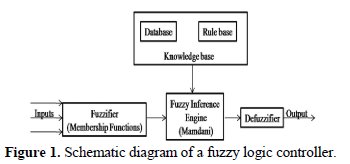
<p>&nbsp;</p>       <p>Developing an empirical model like the one mentioned above is quite easy and  cost-effective, though representing a highly non-linear and complex system  mathematically using regression method is quite difficult.</p>       <p><b>Fuzzy logic</b></p>      <p>Fuzzy logic analysis finds its application where information regarding a system,  and variables affecting the same, are uncertain and vague. It is a mathematical  modeling technique that mimics the reasoning process of human beings in terms  of linguistic variables. The outcome is an expert system having the capability to  model and take decisions like human intuition. Fuzzy logic method is based on  the fuzzy set theory. In the classical set theory, the membership of an object is 0  or 1 i.e., irrespective of belonging or not to the set. On the other hand, a fuzzy set  maps an object onto the unit interval. A fuzzy set assigns membership values  between 0 and 1 to objects.</p>      <p>A fuzzy system consists of a fuzzifier, an inference engine, a knowledge base and  a defuzzifier. A fuzzy logic controller has been depicted in <a href="#f1">Fig. 1</a>.</p>       <p>&nbsp;</p> <a name="f1"> <img src="/img/revistas/pea/v34n1/34n1a05f1.jpg">     
<p>&nbsp;</p>       ]]></body>
<body><![CDATA[<p>The fuzzifier  converts the inputs to a fuzzy value using membership functions. The assignment  of membership functions can be based on human intuition or some algorithmic  operations such as genetic algorithm, neural networks, soft partitioning and fuzzy  statistics [37]. Commonly used membership functions are triangular, trapezoidal,  Gaussian and sigmoidal, out of which triangular is the simplest. The fuzzy  inference engine then invokes the IF-THEN rules formulated from the  knowledge base to generate a fuzzy output. For a three input and a single output,  the IF-THEN rules take the following form:</p>       <p>&nbsp;</p> <a name="r1"> <img src="/img/revistas/pea/v34n1/34n1a05r1.jpg">     
<p>&nbsp;</p>       <p>where Ai, Bi, Ci and Di are the fuzzy subsets defined by the corresponding  membership functions, i.e. &mu;<sub>Ai</sub>, &mu;<sub>Bi</sub>, &mu;<sub>Ci</sub>  and &mu;<sub>Di</sub> and i = 1 to n (number of rules).</p>      <p>The fuzzy multi-response output y0 is provided from the above rules by  employing Mamdani's max-min inference operation. Inference results in a fuzzy  set with membership function for the multi-response output and can be expressed  as follows:</p>       <p>&nbsp;</p> <a name="e3"> <img src="/img/revistas/pea/v34n1/34n1a05e3.jpg">     
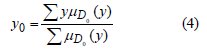
<p>&nbsp;</p>       <p>where &and; and &or; are the minimum and maximum operation, respectively. Finally,  the fuzzy multi-response output &mu;<sub>Di</sub> must be converted to a non-fuzzy value  y0. This is done by the de-fuzzifier. In this study, the centroid defuzzification  method has been selected, giving the area centre of the combined rules obtained  in the output. The centroid of the combined rule outputs can be represented as:</p>       <p>&nbsp;</p> <a name="e4"> <img src="/img/revistas/pea/v34n1/34n1a05e4.jpg">     
<p>&nbsp;</p>       ]]></body>
<body><![CDATA[<p>The non-fuzzy value y0 gives the output in 'crisp' or numerical form.</p>       <p>&nbsp;</p>     <p><b>Experimental details</b></p>      <p><i><b>Preparation of substrate and deposition of Ni-P coating</b></i></p>      <p>Mild steel (AISI 1040) with a dimension of 20 &times; 20 &times; 8 mm has been chosen as  substrate material for the deposition of electroless Ni-P coating. The substrate is  first freed of foreign matter and corrosion products by wiping and then rinsing it  in deionized water. Then the substrates are given an etching treatment using 50%  hydrochloric acid (for 1 min), and finally rinsed in methanol, followed by  deionized water.</p>      <p>The electroless bath for the deposition of Ni-P coating has been obtained by  mixing the chemicals as given in <a href="#t1">Table 1</a>, and in appropriate sequence.</p>       <p>&nbsp;</p> <a name="t1"> <img src="/img/revistas/pea/v34n1/34n1a05t1.jpg">     
<p>&nbsp;</p>       <p>The composition and deposition parameters of the electroless bath have been  determined after literature review and several experiments. The chemicals are  weighed on an electronic balance of high resolution, in order not to compromise  the accuracy of the bath composition (Afcoset, India, Model No. ER182A,  Maximum Range 180 gm, VACC 0.01 gm, Class-II). Nickel chloride and nickel  sulphate are used as the source of nickel; sodium hypophosphite as the reducing  agent; and sodium succinate as the stabilizer. Prior to immersion in the  electroless bath, the substrates are activated by dipping in a palladium chloride  (of about 0.01% strength) solution kept at 55 &deg;C. Activation of the substrate is  necessary to kick start the deposition process. Moreover, activation leads to a  higher rate of deposition and good bonding of the coating with substrate,  resulting in the deposition of a Ni-P coating considerable thick [38]. After  activation, the samples are immersed into the electroless bath maintained at 80  2 &deg;C. The pH of the solution is maintained at 4.5. The deposition is carried out  for about 2 hours, and the thickness of the deposit was found to vary within 3035  &mu;m. The deposition parameters are kept constant, so that all the specimens  receive more or less the same amount of deposition. As heat treatment is found to  have a positive influence on the hardness and wear resistance of electroless  coatings [11], the coated samples are separately annealed in a box furnace (for 1  h), at a temperature of 400 &deg;C, followed by slow cooling in the furnace.</p>       <p><i><b>Coating characterization</b></i></p>      ]]></body>
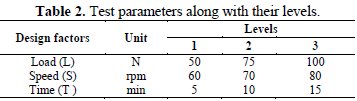
<body><![CDATA[<p>To ensure the proper deposition of electroless Ni-P coating onto the substrate,  coating characterization has been done. The surface morphology, composition  and the phases present in the electroless deposits influence the wear phenomenon  to a large extent. Hence, a study of the morphology and composition of the  deposits is very much needed. Coating characterization also reveals the changes  that have taken place in the phases and composition of electroless Ni-P coating  due to heat treatment. Surface morphology of the coating has been studied using  scanning electron microscopy (SEM) (JEOL, JSM 6360 and FEI Quanta 200).  Energy dispersive X-ray analysis (EDX) (EDAX Corporation) has been done in  conjunction with SEM to determine the composition of coating in terms of  weight percentages of nickel and phosphorus. The phase analysis of electroless  Ni-P coating before and after heat treatment has been done with the help of X-ray  diffraction (XRD) analysis (Rigaku Miniflex). Coating characterization has been  done before subjecting the coated specimens to wear tests. SEM has been done  also after the wear tests to determine the prevalent mechanism governing the  wear phenomenon.</p>       <p><i><b>Wear tests</b></i></p>      <p>The wear tests are carried out in a multi-tribotester (TR-25, DUCOM) with a  plate-on-roller arrangement. Since the present study, attempts to model the nonlinear  wear behavior of electroless Ni-P coating with varying applied normal load  (N), roller speed (rpm) and test duration (min) have been made. Those  parameters have been varied at three different levels, as shown in <a href="#t2">Table 2</a>.</p>       <p>&nbsp;</p> <a name="t2"> <img src="/img/revistas/pea/v34n1/34n1a05t2.jpg">     
<p>&nbsp;</p>       <p>The lubricant used is Servo PRIDE-40, a commercially available product of Indian  Oil used in automobile engines.</p>      <p>The tests have been carried out at an ambient temperature of 33 &deg;C. The coated  specimens are held stationary with the help of an attachment against a rotating  hard chromium coated steel roller (dia 50 mm and thickness 20 mm), conforming  to EN8 specification and with a hardness value of 55 HRc. The rotating roller  acts as counterface material for the stationary Ni-P coated plate. The speed of the  roller and duration of the tests can be controlled using a computer attached to the  tribo-tester. Load is applied onto the specimen via a 1:5 ratio loading lever  carrying a loading pan on one end, on which dead weights can be placed. The  loading lever is pivoted near the normal load sensor. The wear depth is indicated  and recorded on-line and is measured with the help of a linear voltage resistance  transducer. The sensor allows measurement of the deflection of the loading lever,  which is a direct indication of the wear of the coated specimen, as well as of the  counterface material. Since the hardness of the specimen (&sim;45 HRc) is found to  be lower than that of the counterface material, the indicated wear can be assumed  to be of the coated specimen only. In this study, wear is indicated in terms of  displacement (&mu;m). For the data collection, Taguchi's L27 orthogonal array (OA)  has been used. Since the degrees of freedom (DOF) of the individual design  variables and their interactions taken together came out to be 18, an experimental  design having a higher DOF needs to be selected. Hence, L27 OA having a DOF  value 26 has been chosen.</p>       <p>&nbsp;</p>     <p><b>Results and discussions</b></p>      <p><i><b>Surface morphology, composition and microstructure analysis</b></i></p>      ]]></body>
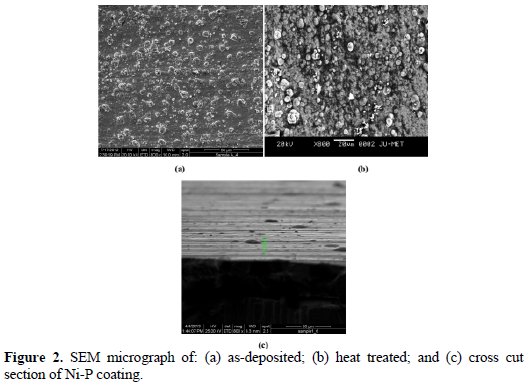
<body><![CDATA[<p>The surface morphology of as-deposited as well as heat treated (400OC for 1h)  electroless Ni-P coating is investigated using SEM, to analyze the microstructural  changes due to heat treatment, and has been illustrated in <a href="#f2">Fig. 2</a>.</p>       <p>&nbsp;</p> <a name="f2"> <img src="/img/revistas/pea/v34n1/34n1a05f2.jpg">     
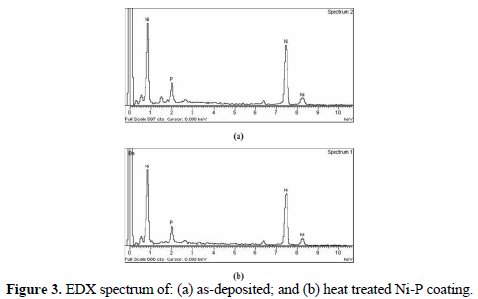
<p>&nbsp;</p>       <p>From the SEM micrograph of as-deposited coating (<a href="#f2">Fig. 2(a)</a>), it can be observed that many  globular particles exist, and that the surface has low porosity. On heat treatment,  the size of the nodules increases, and the surface appears to be denser and coarser  grained (<a href="#f2">Fig. 2(b)</a>). The self-lubricating nature of electroless nickel coatings can  be attributed to their surface morphology [4, 11], which results in lower wear of  the coatings. SEM micrograph of cross cut Ni-P coating has been given in <a href="#f2">Fig. 2(c)</a>,  which confirms the thickness and uniformity of the coating.</p>      <p>The content of phosphorus present in the deposits has a significant effect on the  hardness and, consequently, on the wear resistance of EN coating. With  increasing P content in the coating, the amorphous phase increases, which results  in a decrease of EN coating hardness [4, 13]. To determine the composition of  the deposited coating, an energy dispersive X-ray (EDX) analyzer has been used.  The EDX spectrum of as-deposited and heat treated Ni-P coating has been given  in <a href="#f3">Fig. 3(a)</a> and <a href="#f3">Fig. 3(b)</a>, respectively.</p>       <p>&nbsp;</p> <a name="f3"> <img src="/img/revistas/pea/v34n1/34n1a05f3.jpg">     
<p>&nbsp;</p>       <p>The peaks of Ni and P are quite specific,  which confirms the presence of the elements in the coating. The composition in  terms of weight percentage of Ni and P has been given in <a href="#t3">Table 3</a>.</p>       <p>&nbsp;</p> <a name="t3"> <img src="/img/revistas/pea/v34n1/34n1a05t3.jpg">     
<p>&nbsp;</p>       ]]></body>
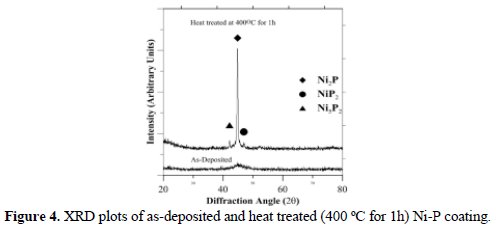
<body><![CDATA[<p>There has been no significant variation in the content of the deposits,  due to heat treatment.</p>      <p>In as-deposited condition, electroless Ni-P coating is nanocrystalline in nature,  having short range order. The phase structure depends on the phosphorus content.  A higher percentage of phosphorus leads to the amorphous nature of deposits.  The phase structure also depends on the heat treatment temperature. Phase  transformation generally starts from 260 &deg;C onwards [39]. The optimal hardness  of Ni-P coating has been obtained at a heat treatment temperature of 400OC (for  1h), due to the crystallization of nickel and precipitation of crystalline nickel  phosphides [4]. Similar results have been obtained in the present study from X- ray diffraction (XRD) analysis of the as-deposited and heat treated coatings  (<a href="#f4">Fig. 4</a>).</p>       <p>&nbsp;</p> <a name="f4"> <img src="/img/revistas/pea/v34n1/34n1a05f4.jpg">     
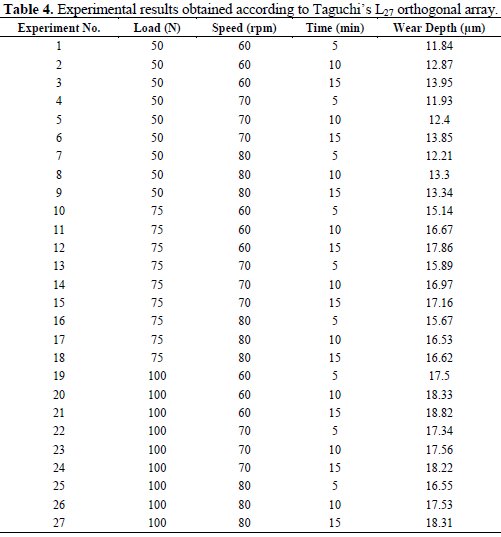
<p>&nbsp;</p>       <p>The as-deposited coating is seen to be microcrystalline in nature, while it  changes to crystalline in nature due to the formation of Ni2P, NiP2 and Ni5P2.  This leads to a higher hardness value of the heat treated coatings (&sim;45HRc).</p>       <p><i><b>Regression modeling</b></i></p>      <p>The wear tests to obtain the data for modeling of wear are done according to  Taguchi's L27 OA. The combination of test parameters along with the obtained  wear depth (&mu;m) has been given in <a href="#t4">Table 4</a>.</p>       <p>&nbsp;</p> <a name="t4"> <img src="/img/revistas/pea/v34n1/34n1a05t4.jpg">     
<p>&nbsp;</p>       <p>The second order regression model  was fitted from the obtained data using Minitab software [40]. The obtained  equation in an un-coded form of the design variables is:</p>       ]]></body>
<body><![CDATA[<p>&nbsp;</p> <a name="e5"> <img src="/img/revistas/pea/v34n1/34n1a05e5.jpg">     
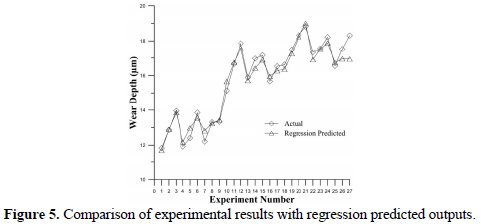
<p>&nbsp;</p>       <p>A plot of the experimental results along with the regression predicted results has  been given in <a href="#f5">Fig. 5</a>.</p>       <p>&nbsp;</p> <a name="f5"> <img src="/img/revistas/pea/v34n1/34n1a05f5.jpg">     
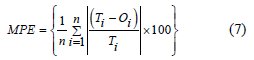
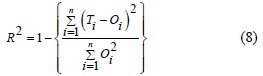
<p>&nbsp;</p>       <p>From the plot it can be deduced that the regression model is  quite efficient in predicting the response with high accuracy. To evaluate the  predicting capability several performance measures can be used. In this study,  mean square error (MSE), mean percentage error (MPE) and coefficient of  determination (R<sup>2</sup>) has been used and they can be expressed as follows:</p>       <p>&nbsp;</p> <a name="e6"> <img src="/img/revistas/pea/v34n1/34n1a05e6.jpg">     
<p>&nbsp;</p> <a name="e7"> <img src="/img/revistas/pea/v34n1/34n1a05e7.jpg">     
<p>&nbsp;</p> <a name="e8"> <img src="/img/revistas/pea/v34n1/34n1a05e8.jpg">     
<p>&nbsp;</p>       ]]></body>
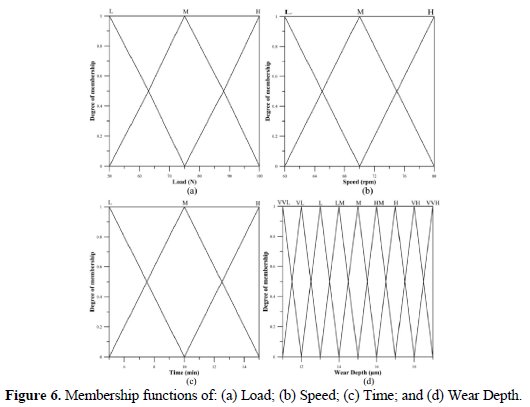
<body><![CDATA[<p>where n is the total number of results, Ti is the ith targeted data and Oi the  observed value.</p>      <p>In the present work, the MSE, MPE and R<sup>2</sup> value of the regression model comes  out to be 0.1655, 1.95411 and 0.9935, respectively. From the performance  measures and <a href="#f5">Fig. 5</a> it can be concluded that there is a close correlation between  the actual and predicted results, and a second order model can predict the  complex relationship between the process parameters and wear with minimal  error.</p>       <p><i><b>Fuzzy modeling</b></i></p>      <p>The basis of a fuzzy model is linguistic variables, i.e. words instead of numbers  and fuzzy sets. Hence, the preliminary step is to fuzzify the input parameters, i.e.  load, speed and time. In the present study, the fuzzy modeling has been done  using MATLAB 7 (Fuzzy Toolbox). For fuzzification of the inputs, triangular  membership functions have been chosen because of its simplicity in modeling.  The input space has been divided into three fuzzy subsets, i.e. low (L), medium  (M) and high (H). To obtain a fuzzy value of the output (wear depth), it has been  divided into nine fuzzy subsets, i.e. extremely low (EL), very low (VL), low (L),  low medium (LM), medium (M), high medium (HM), high (H), very high (VH)  and extremely/ high (EH/). Again, to map the output onto a fuzzy subset,  triangular membership functions have been chosen. The membership functions  for load, speed, time and wear depth have been depicted in <a href="#f6">Fig. 6</a>.</p>       <p>&nbsp;</p> <a name="f6"> <img src="/img/revistas/pea/v34n1/34n1a05f6.jpg">     
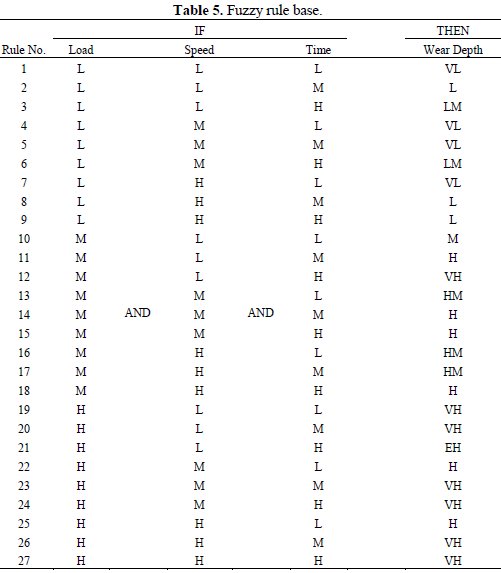
<p>&nbsp;</p>       <p>To relate the wear phenomenon with the process parameters, 27 rules are  obtained directly from the combination of the parameters in L27 OA. The IFTHEN  rule base along with the output has been enlisted in <a href="#t5">Table 5</a>.</p>       <p>&nbsp;</p> <a name="t5"> <img src="/img/revistas/pea/v34n1/34n1a05t5.jpg">     
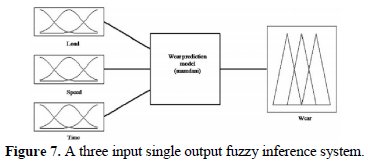
<p>&nbsp;</p>       <p>When a set of  input is received by the fuzzy inference engine, it fires a certain number of rules,  and a fuzzy output is obtained by using Mamdani's max-min implication. The  fuzzy output is defuzzified using the centroid defuzzification method (Eqn. 4). A  three input single output inference engine has been depicted in <a href="#f7">Fig. 7</a>.</p>       ]]></body>
<body><![CDATA[<p>&nbsp;</p> <a name="f7"> <img src="/img/revistas/pea/v34n1/34n1a05f7.jpg">     
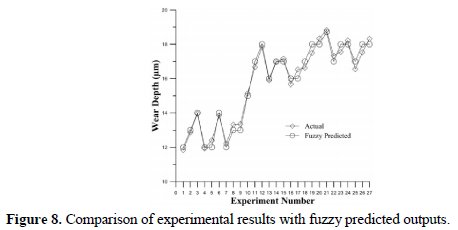
<p>&nbsp;</p>       <p>The experimental results have been compared with the ones that have been  obtained from the fuzzy prediction model in <a href="#f8">Fig. 8</a>.</p>       <p>&nbsp;</p> <a name="f8"> <img src="/img/revistas/pea/v34n1/34n1a05f8.jpg">     
<p>&nbsp;</p>       <p>A close correlation between  the experimental and predicted results is indicated. The MSE, MPE and R<sup>2</sup>  values of the fuzzy wear prediction model comes out to be 0.090867, 1.67849  and 0.99964 respectively, which indicate the high accuracy of the developed  model. The performance measures of the regression and the fuzzy model have  been compared in <a href="#t6">Table 6</a>.</p>       <p>&nbsp;</p> <a name="t6"> <img src="/img/revistas/pea/v34n1/34n1a05t6.jpg">     
<p>&nbsp;</p>       <p>Results corroborate that both are capable of predicting  the wear depth accurately, but the precision obtained from the fuzzy model is  higher. Hence, fuzzy logic is seen to be more efficient than regression modelling  to relate the highly non-linear behaviour of wear with the varying tribo-testing  parameters.</p>       <p><i><b>Validation test</b></i></p>      ]]></body>
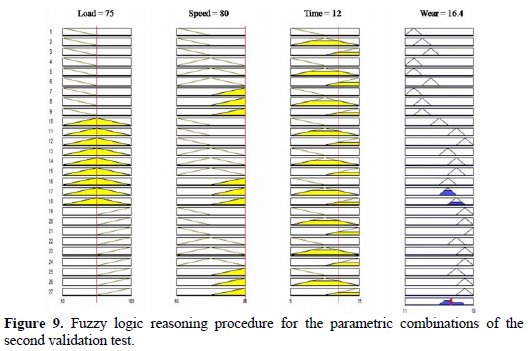
<body><![CDATA[<p>To check the adequacy of the developed second order regression and fuzzy rule  based models, validation tests have been carried out. They are carried out with  three different input values of load, speed and time, and the experimental, fuzzy  predicted and regression predicted results are compared. The values of load,  speed and time considered for the validation tests are selected from within the  range of the parameters considered (L = 50N, S = 60 rpm, T = 9 min; L=75 N, S  = 80 rpm, T = 12 min; L = 100 N, S = 70 rpm, T = 7 min). The fuzzy reasoning  procedure for the parametric combinations of the second validation test has been  shown in <a href="#f9">Fig. 9</a>.</p>       <p>&nbsp;</p> <a name="f9"> <img src="/img/revistas/pea/v34n1/34n1a05f9.jpg">     
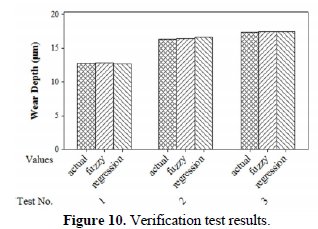
<p>&nbsp;</p>       <p>When the input values for load, speed and time are received by  the inference engine, rules 17 and 18 are invoked (<a href="#t5">Table 5</a>). The height of the  darkened area represented in each triangle corresponds to the fuzzy membership  value for that fuzzy set. Finally, a crisp output is obtained from the centroid of  the combined darkened areas, which is shown at the bottom of <a href="#f9">Fig. 9</a>, in the  column for wear.</p>      <p><a href="#f10">Fig. 10</a> shows the verification test results, and it can be inferred that both the  models are capable of predicting the values of wear depth with high accuracy.</p>       <p>&nbsp;</p> <a name="f10"> <img src="/img/revistas/pea/v34n1/34n1a05f10.jpg">     
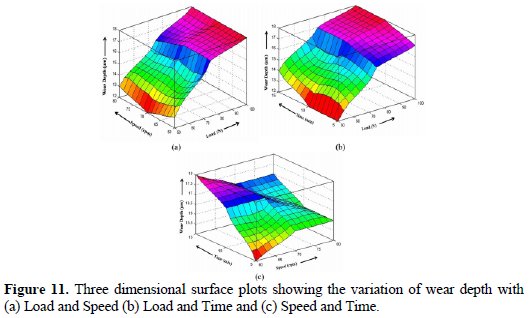
<p>&nbsp;</p>       <p>However, the precision obtained from the fuzzy logic model is higher, and hence  it can be used effectively for the wear prediction of electroless Ni-P coating  under lubricated condition.</p>       <p><i><b>Effect of process parameters on response variable</b></i></p>      <p>Surface plots revealing the trends in variation of wear depth of electroless Ni-P  coating considering the interaction effect of the parameters are generated from  the fuzzy logic model. The variation of wear depth with load, speed and time can  be seen in <a href="#f11">Fig. 11</a>.</p>       ]]></body>
<body><![CDATA[<p>&nbsp;</p> <a name="f11"> <img src="/img/revistas/pea/v34n1/34n1a05f11.jpg">     
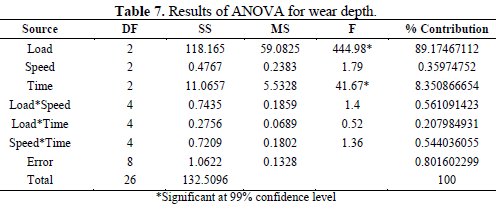
<p>&nbsp;</p>       <p>At higher values of load and speed, a higher wear of the electroless deposits is  encountered (<a href="#f11">Fig. 11(a)</a>). Similar trends are observed for the variation of wear  depth with load and time, as well speed and time in <a href="#f11">Fig. 11(b)</a> and <a href="#f11">Fig. 11(c)</a>,  respectively, under lubricated condition. When the applied normal load is  increased, the interacting surfaces advance more towards each other. This leads  to an increase in the contact area of the asperities and consequently, a greater  volume of the coating is sheared. With an increase in sliding speed or sliding  time, sliding distance increases and, again, wear depth increases. Thus, a  combination of the design parameters also leads to an increased value of the  deposits wear.</p>       <p><i><b>Analysis of variance (ANOVA)</b></i></p>      <p>To ascertain the significance of the tribo-testing parameters and their interactions  in controlling the wear of electroless Ni-P coating under lubricated condition,  analysis of variance (ANOVA) has been carried out on the experimental results  and given in <a href="#t7">Table 7</a>.</p>       <p>&nbsp;</p> <a name="t7"> <img src="/img/revistas/pea/v34n1/34n1a05t7.jpg">     
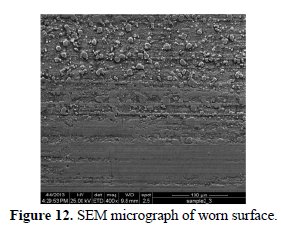
<p>&nbsp;</p>       <p>The last column of the table indicates the percentage  contribution of each of the parameters and their interactions. The F-ratio obtained  from Fisher's F-test [41] also gives a measure of the significance of any  parameter on the response variable. At any confidence level Î±, if the calculated  F-ratio for any factor is higher than the tabulated value, then it can be considered  to be a significant one. In this study, it has been performed using MINITAB  software [40]. Results reveal that the applied normal load has the highest  significance followed by test duration. The interaction terms have negligible  effect in controlling the wear of the coating.</p>       <p><i><b>Analysis of wear mechanism</b></i></p>      <p>SEM micrograph of a worn surface has been shown in <a href="#f12">Fig. 12</a>.</p>       ]]></body>
<body><![CDATA[<p>&nbsp;</p> <a name="f12"> <img src="/img/revistas/pea/v34n1/34n1a05f12.jpg">     
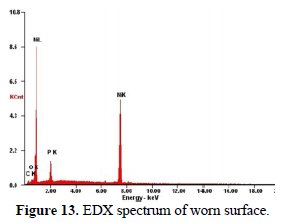
<p>&nbsp;</p>       <p>Longitudinal  grooves with high degree of plasticity along the sliding direction can be  observed. The surface is also characterized by micro-cutting and micro- ploughing effect. No pits or prows are observed. When a hard counterface  material such as the one considered in the present study (hard chrome coated  steel roller) moves through a softer surface and deforms it, mainly shear stresses  are formed [42]. When this shear strength exceeds the shear strength of the  material, a crack is formed which propagates, resulting in the fracture and  detachment of the material, and formation of wear debris. Thus, material  detachment takes place by abrasion, as well as fracture. Due to the heat generated  during the sliding action, it is possible that the wear debris might get attached to  the coated specimen. The flowing lubricant carries along with it the heat  generated, as well as the wear debris formed, preventing adhesion or stick slip  condition. Tribochemical wear may take place, if the used lubricant is corrosive  in nature. However, the lubricant considered in the present study is engine oil,  having a non-corrosive nature, and does not react chemically with the interacting  surfaces. Hence, the possibility of tribochemical wear is eliminated. Thus, it can  be noted that abrasive wear is the predominant wear mechanism.</p>      <p>The EDX spectrum of the worn surface has been illustrated in <a href="#f13">Fig. 13</a>.</p>       <p>&nbsp;</p> <a name="f13"> <img src="/img/revistas/pea/v34n1/34n1a05f13.jpg">     
<p>&nbsp;</p>       <p>The presence of oxygen may be due to the formation of a thin microfilm (oxide layer)  on the hard coating or only at the asperity tips of the coating [43]. Such type of  tribo-layers formed on wear surfaces prove to be beneficial and result in a low  coefficient of coatings friction. The effect of the oxide film on the deposits  friction coefficient can be investigated further. The formation of a low shear  micro-film onto the coating surface also leads to lower wear values. The presence  of carbon is mainly due to the adsorbed lubricant during the tribological tests.</p>       <p>&nbsp;</p>     <p><b>Conclusions</b></p>      <p>In the present study, electroless Ni-P coating is deposited on mild steel substrates  and coating characterization is done using SEM, EDX and XRD. From the  morphology and microstructure study, it can be seen that as-plated electroless Ni- P coating has nodulated structures, the size of which increases and becomes  dense on heat treatment. The surface morphology is responsible for the self  lubricating morphology of EN coatings. EDX spectrums confirm the presence of  Ni and P in the coatings. XRD plots reveal that as-deposited Ni-P coating is  microcrystalline in nature and changes to crystalline structure on heat treatment,  due to the precipitation of phosphides. This results in enhanced deposits hardness  and wear resistance.</p>      ]]></body>
<body><![CDATA[<p>Wear tests are carried out on a block-on-roller configuration multi-tribotester  under lubricated condition. A second order regression and a fuzzy rule based  expert system has been proposed to analyze and model the complex  interrelationship between wear depth and the tribo-testing parameters (load,  speed and time) considered in this article. The regression predicted and fuzzy  predicted values are fairly close to the experimental values. However, various  performance measures and validation tests indicate that the fuzzy-rule based  model is better than the second order regression model for the prediction of wear  depth.</p>      <p>Three dimensional surface plots reveal the variation of wear depth considering  the interaction effects of the process parameters. It is seen that with the increase  in load and speed, load and time as well as speed and time, the wear depth  increases. The results of ANOVA performed on the experimental values obtained  for wear depth of electroless Ni-P coating indicate that load and time are the  most significant parameters in controlling the wear of the deposits at 99%  confidence level. The wear mechanism as indicated by the SEM micrograph of a  worn out specimen was seen to be abrasive in nature. EDX spectrum indicates  the formation of a tribo-film on the coating surface.</p>      <p>Hence, fuzzy logic reasoning is successfully applied to predict the wear behavior  of electroless Ni-P coating. The proposed fuzzy model can prove to be beneficial  for extracting the optimum tribological performance out of the deposits under  lubricated condition, and can also be utilized for online condition monitoring.  The present method can further be extended to predict friction behavior of the  deposits under lubricated condition and the behavior of electroless nickel  composite and ternary coatings.</p>       <p>&nbsp;</p>     <p><b>References</b></p>      <!-- ref --><p>1. Brenner A, Riddell G E. J Res NBS. 1946;37:31.    &nbsp;&nbsp;&nbsp;&nbsp;&nbsp;&nbsp;&nbsp;&nbsp;[&#160;<a href="javascript:void(0);" onclick="javascript: window.open('/scielo.php?script=sci_nlinks&ref=419093&pid=S0872-1904201600010000500001&lng=','','width=640,height=500,resizable=yes,scrollbars=1,menubar=yes,');">Links</a>&#160;]<!-- end-ref --></p>      <!-- ref --><p>2. Das S K, Sahoo P. Mater Design. 2011;32:2228.    &nbsp;&nbsp;&nbsp;&nbsp;&nbsp;&nbsp;&nbsp;&nbsp;[&#160;<a href="javascript:void(0);" onclick="javascript: window.open('/scielo.php?script=sci_nlinks&ref=419095&pid=S0872-1904201600010000500002&lng=','','width=640,height=500,resizable=yes,scrollbars=1,menubar=yes,');">Links</a>&#160;]<!-- end-ref --></p>      <!-- ref --><p>3. Agarwala R C, Agarwala V. Sadhana, 2003;28:475.    &nbsp;&nbsp;&nbsp;&nbsp;&nbsp;&nbsp;&nbsp;&nbsp;[&#160;<a href="javascript:void(0);" onclick="javascript: window.open('/scielo.php?script=sci_nlinks&ref=419097&pid=S0872-1904201600010000500003&lng=','','width=640,height=500,resizable=yes,scrollbars=1,menubar=yes,');">Links</a>&#160;]<!-- end-ref --></p>      <!-- ref --><p>4. Sahoo P, Das S K. Mater Design. 2011;32:1760.    &nbsp;&nbsp;&nbsp;&nbsp;&nbsp;&nbsp;&nbsp;&nbsp;[&#160;<a href="javascript:void(0);" onclick="javascript: window.open('/scielo.php?script=sci_nlinks&ref=419099&pid=S0872-1904201600010000500004&lng=','','width=640,height=500,resizable=yes,scrollbars=1,menubar=yes,');">Links</a>&#160;]<!-- end-ref --></p>      <!-- ref --><p>5. Sudagar J, Lian J, Sha W. J Alloys Comp. 2013;571:183.    &nbsp;&nbsp;&nbsp;&nbsp;&nbsp;&nbsp;&nbsp;&nbsp;[&#160;<a href="javascript:void(0);" onclick="javascript: window.open('/scielo.php?script=sci_nlinks&ref=419101&pid=S0872-1904201600010000500005&lng=','','width=640,height=500,resizable=yes,scrollbars=1,menubar=yes,');">Links</a>&#160;]<!-- end-ref --></p>      <!-- ref --><p>6. Apachitei I, Duszczyk J. Surf Coat Tech. 2000;132:89.    &nbsp;&nbsp;&nbsp;&nbsp;&nbsp;&nbsp;&nbsp;&nbsp;[&#160;<a href="javascript:void(0);" onclick="javascript: window.open('/scielo.php?script=sci_nlinks&ref=419103&pid=S0872-1904201600010000500006&lng=','','width=640,height=500,resizable=yes,scrollbars=1,menubar=yes,');">Links</a>&#160;]<!-- end-ref --></p>      <!-- ref --><p>7. Apachitei I, Tichelaar F D, Duszczyk J, et al. Surf Coat Tech. 2002;149:263.    &nbsp;&nbsp;&nbsp;&nbsp;&nbsp;&nbsp;&nbsp;&nbsp;[&#160;<a href="javascript:void(0);" onclick="javascript: window.open('/scielo.php?script=sci_nlinks&ref=419105&pid=S0872-1904201600010000500007&lng=','','width=640,height=500,resizable=yes,scrollbars=1,menubar=yes,');">Links</a>&#160;]<!-- end-ref --></p>      <!-- ref --><p>8. Keong K G, Sha W, Malinov S. Surface and Coatings Technology, 2003;168:263.    &nbsp;&nbsp;&nbsp;&nbsp;&nbsp;&nbsp;&nbsp;&nbsp;[&#160;<a href="javascript:void(0);" onclick="javascript: window.open('/scielo.php?script=sci_nlinks&ref=419107&pid=S0872-1904201600010000500008&lng=','','width=640,height=500,resizable=yes,scrollbars=1,menubar=yes,');">Links</a>&#160;]<!-- end-ref --></p>      <!-- ref --><p>9. Guo Z, Keong K G, Sha W. J Alloys Comp. 2003;358:1129.    &nbsp;&nbsp;&nbsp;&nbsp;&nbsp;&nbsp;&nbsp;&nbsp;[&#160;<a href="javascript:void(0);" onclick="javascript: window.open('/scielo.php?script=sci_nlinks&ref=419109&pid=S0872-1904201600010000500009&lng=','','width=640,height=500,resizable=yes,scrollbars=1,menubar=yes,');">Links</a>&#160;]<!-- end-ref --></p>      <!-- ref --><p>10. Yan M, Ying H G, Ma TY. Surf Coat Tech. 2008;202:5909.    &nbsp;&nbsp;&nbsp;&nbsp;&nbsp;&nbsp;&nbsp;&nbsp;[&#160;<a href="javascript:void(0);" onclick="javascript: window.open('/scielo.php?script=sci_nlinks&ref=419111&pid=S0872-1904201600010000500010&lng=','','width=640,height=500,resizable=yes,scrollbars=1,menubar=yes,');">Links</a>&#160;]<!-- end-ref --></p>      <!-- ref --><p>11. Sahoo P. Mater Design. 2009;30:1341.    &nbsp;&nbsp;&nbsp;&nbsp;&nbsp;&nbsp;&nbsp;&nbsp;[&#160;<a href="javascript:void(0);" onclick="javascript: window.open('/scielo.php?script=sci_nlinks&ref=419113&pid=S0872-1904201600010000500011&lng=','','width=640,height=500,resizable=yes,scrollbars=1,menubar=yes,');">Links</a>&#160;]<!-- end-ref --></p>      <!-- ref --><p>12. Sahoo P, Pal S K. Tribology Lett. 2007;28:191.    &nbsp;&nbsp;&nbsp;&nbsp;&nbsp;&nbsp;&nbsp;&nbsp;[&#160;<a href="javascript:void(0);" onclick="javascript: window.open('/scielo.php?script=sci_nlinks&ref=419115&pid=S0872-1904201600010000500012&lng=','','width=640,height=500,resizable=yes,scrollbars=1,menubar=yes,');">Links</a>&#160;]<!-- end-ref --></p>      <!-- ref --><p>13. Taheri R, Oguocha I N A, Wear. 2001;249:389.    &nbsp;&nbsp;&nbsp;&nbsp;&nbsp;&nbsp;&nbsp;&nbsp;[&#160;<a href="javascript:void(0);" onclick="javascript: window.open('/scielo.php?script=sci_nlinks&ref=419117&pid=S0872-1904201600010000500013&lng=','','width=640,height=500,resizable=yes,scrollbars=1,menubar=yes,');">Links</a>&#160;]<!-- end-ref --></p>      <!-- ref --><p>14. Palaniappa M, Seshadri S K. Wear. 2008;265:735.    &nbsp;&nbsp;&nbsp;&nbsp;&nbsp;&nbsp;&nbsp;&nbsp;[&#160;<a href="javascript:void(0);" onclick="javascript: window.open('/scielo.php?script=sci_nlinks&ref=419119&pid=S0872-1904201600010000500014&lng=','','width=640,height=500,resizable=yes,scrollbars=1,menubar=yes,');">Links</a>&#160;]<!-- end-ref --></p>      <!-- ref --><p>15. Chen X M, Li G Y, Lian J S. Trans Nonferrous Metals Soc China. 2008;18:s323.    &nbsp;&nbsp;&nbsp;&nbsp;&nbsp;&nbsp;&nbsp;&nbsp;[&#160;<a href="javascript:void(0);" onclick="javascript: window.open('/scielo.php?script=sci_nlinks&ref=419121&pid=S0872-1904201600010000500015&lng=','','width=640,height=500,resizable=yes,scrollbars=1,menubar=yes,');">Links</a>&#160;]<!-- end-ref --></p>      <!-- ref --><p>16. Roy S, Sahoo P. ISRN Tribology. 2012;Article ID 136740.    &nbsp;&nbsp;&nbsp;&nbsp;&nbsp;&nbsp;&nbsp;&nbsp;[&#160;<a href="javascript:void(0);" onclick="javascript: window.open('/scielo.php?script=sci_nlinks&ref=419123&pid=S0872-1904201600010000500016&lng=','','width=640,height=500,resizable=yes,scrollbars=1,menubar=yes,');">Links</a>&#160;]<!-- end-ref --></p>      <!-- ref --><p>17. Roy S, Sahoo P. Procedia Tech. 2014;14:320.    &nbsp;&nbsp;&nbsp;&nbsp;&nbsp;&nbsp;&nbsp;&nbsp;[&#160;<a href="javascript:void(0);" onclick="javascript: window.open('/scielo.php?script=sci_nlinks&ref=419125&pid=S0872-1904201600010000500017&lng=','','width=640,height=500,resizable=yes,scrollbars=1,menubar=yes,');">Links</a>&#160;]<!-- end-ref --></p>      <!-- ref --><p>18. Xu Y, Zheng X, Hu X, et al. Surf Coat Tech. 2014;258:790.    &nbsp;&nbsp;&nbsp;&nbsp;&nbsp;&nbsp;&nbsp;&nbsp;[&#160;<a href="javascript:void(0);" onclick="javascript: window.open('/scielo.php?script=sci_nlinks&ref=419127&pid=S0872-1904201600010000500018&lng=','','width=640,height=500,resizable=yes,scrollbars=1,menubar=yes,');">Links</a>&#160;]<!-- end-ref --></p>      <!-- ref --><p>19. Wu Y, Liu H, Shen B, et al. Tribology Int. 2006;39:553.    &nbsp;&nbsp;&nbsp;&nbsp;&nbsp;&nbsp;&nbsp;&nbsp;[&#160;<a href="javascript:void(0);" onclick="javascript: window.open('/scielo.php?script=sci_nlinks&ref=419129&pid=S0872-1904201600010000500019&lng=','','width=640,height=500,resizable=yes,scrollbars=1,menubar=yes,');">Links</a>&#160;]<!-- end-ref --></p>      <p>20. Zhao Q, Liu Y, MÃ¼ller-Steinhagen H, et al. Surf Coat Tech. 2002;155:279.</p>      <!-- ref --><p>21. Moonir-Vaghefi SM, Saatchi A, Hedjazi J. Zeitschrift Metallkunde. 1997;88:498.    &nbsp;&nbsp;&nbsp;&nbsp;&nbsp;&nbsp;&nbsp;&nbsp;[&#160;<a href="javascript:void(0);" onclick="javascript: window.open('/scielo.php?script=sci_nlinks&ref=419132&pid=S0872-1904201600010000500021&lng=','','width=640,height=500,resizable=yes,scrollbars=1,menubar=yes,');">Links</a>&#160;]<!-- end-ref --></p>      <!-- ref --><p>22. Li Z, Wang J, Lu J, et al. Appl Surf Sci. 2013;264:516.    &nbsp;&nbsp;&nbsp;&nbsp;&nbsp;&nbsp;&nbsp;&nbsp;[&#160;<a href="javascript:void(0);" onclick="javascript: window.open('/scielo.php?script=sci_nlinks&ref=419134&pid=S0872-1904201600010000500022&lng=','','width=640,height=500,resizable=yes,scrollbars=1,menubar=yes,');">Links</a>&#160;]<!-- end-ref --></p>      <!-- ref --><p>23. Alirezaei S, Monirvaghefi S M, Salehi M, et al. Wear. 2007;262:978.    &nbsp;&nbsp;&nbsp;&nbsp;&nbsp;&nbsp;&nbsp;&nbsp;[&#160;<a href="javascript:void(0);" onclick="javascript: window.open('/scielo.php?script=sci_nlinks&ref=419136&pid=S0872-1904201600010000500023&lng=','','width=640,height=500,resizable=yes,scrollbars=1,menubar=yes,');">Links</a>&#160;]<!-- end-ref --></p>      ]]></body>
<body><![CDATA[<!-- ref --><p>24. Sharma A, Singh A K. J Mater Eng Performance. 2013;22:176.    &nbsp;&nbsp;&nbsp;&nbsp;&nbsp;&nbsp;&nbsp;&nbsp;[&#160;<a href="javascript:void(0);" onclick="javascript: window.open('/scielo.php?script=sci_nlinks&ref=419138&pid=S0872-1904201600010000500024&lng=','','width=640,height=500,resizable=yes,scrollbars=1,menubar=yes,');">Links</a>&#160;]<!-- end-ref --></p>      <!-- ref --><p>25. Gadhari P, Sahoo P. Procedia Mater Sci. 2014;6:623.    &nbsp;&nbsp;&nbsp;&nbsp;&nbsp;&nbsp;&nbsp;&nbsp;[&#160;<a href="javascript:void(0);" onclick="javascript: window.open('/scielo.php?script=sci_nlinks&ref=419140&pid=S0872-1904201600010000500025&lng=','','width=640,height=500,resizable=yes,scrollbars=1,menubar=yes,');">Links</a>&#160;]<!-- end-ref --></p>      <!-- ref --><p>26. Jappes J W, Ramamoorthy B, Nair P K. J Mater Process Tech. 2009;209:1004.    &nbsp;&nbsp;&nbsp;&nbsp;&nbsp;&nbsp;&nbsp;&nbsp;[&#160;<a href="javascript:void(0);" onclick="javascript: window.open('/scielo.php?script=sci_nlinks&ref=419142&pid=S0872-1904201600010000500026&lng=','','width=640,height=500,resizable=yes,scrollbars=1,menubar=yes,');">Links</a>&#160;]<!-- end-ref --></p>      <!-- ref --><p>27. Ramalho A, Miranda J C. Wear. 2007;263:592.    &nbsp;&nbsp;&nbsp;&nbsp;&nbsp;&nbsp;&nbsp;&nbsp;[&#160;<a href="javascript:void(0);" onclick="javascript: window.open('/scielo.php?script=sci_nlinks&ref=419144&pid=S0872-1904201600010000500027&lng=','','width=640,height=500,resizable=yes,scrollbars=1,menubar=yes,');">Links</a>&#160;]<!-- end-ref --></p>      <!-- ref --><p>28. Duari S, Barman T K, Sahoo P. Procedia Mater Sci. 2014;5:978.    &nbsp;&nbsp;&nbsp;&nbsp;&nbsp;&nbsp;&nbsp;&nbsp;[&#160;<a href="javascript:void(0);" onclick="javascript: window.open('/scielo.php?script=sci_nlinks&ref=419146&pid=S0872-1904201600010000500028&lng=','','width=640,height=500,resizable=yes,scrollbars=1,menubar=yes,');">Links</a>&#160;]<!-- end-ref --></p>      ]]></body>
<body><![CDATA[<!-- ref --><p>29. Zadeh LA. Information Control. 1965;8:338.    &nbsp;&nbsp;&nbsp;&nbsp;&nbsp;&nbsp;&nbsp;&nbsp;[&#160;<a href="javascript:void(0);" onclick="javascript: window.open('/scielo.php?script=sci_nlinks&ref=419148&pid=S0872-1904201600010000500029&lng=','','width=640,height=500,resizable=yes,scrollbars=1,menubar=yes,');">Links</a>&#160;]<!-- end-ref --></p>      <!-- ref --><p>30. Ozek C, Caydas U, Unal E. Mater Manufacturing Proc. 2012;27:95.    &nbsp;&nbsp;&nbsp;&nbsp;&nbsp;&nbsp;&nbsp;&nbsp;[&#160;<a href="javascript:void(0);" onclick="javascript: window.open('/scielo.php?script=sci_nlinks&ref=419150&pid=S0872-1904201600010000500030&lng=','','width=640,height=500,resizable=yes,scrollbars=1,menubar=yes,');">Links</a>&#160;]<!-- end-ref --></p>      <!-- ref --><p>31. Rajasekaran T, Palanikumar K, Vinayagam B K. J Comp Mater. 2012;46:809.    &nbsp;&nbsp;&nbsp;&nbsp;&nbsp;&nbsp;&nbsp;&nbsp;[&#160;<a href="javascript:void(0);" onclick="javascript: window.open('/scielo.php?script=sci_nlinks&ref=419152&pid=S0872-1904201600010000500031&lng=','','width=640,height=500,resizable=yes,scrollbars=1,menubar=yes,');">Links</a>&#160;]<!-- end-ref --></p>      <!-- ref --><p>32. Chen J C, Savage M. Int J Adv Manuf Tech. 2001;17:670.    &nbsp;&nbsp;&nbsp;&nbsp;&nbsp;&nbsp;&nbsp;&nbsp;[&#160;<a href="javascript:void(0);" onclick="javascript: window.open('/scielo.php?script=sci_nlinks&ref=419154&pid=S0872-1904201600010000500032&lng=','','width=640,height=500,resizable=yes,scrollbars=1,menubar=yes,');">Links</a>&#160;]<!-- end-ref --></p>      <!-- ref --><p>33. Ramesh S, Karunamoorthy L, Palanikumar K. Mater Manuf Proc. 2008;23:439.    &nbsp;&nbsp;&nbsp;&nbsp;&nbsp;&nbsp;&nbsp;&nbsp;[&#160;<a href="javascript:void(0);" onclick="javascript: window.open('/scielo.php?script=sci_nlinks&ref=419156&pid=S0872-1904201600010000500033&lng=','','width=640,height=500,resizable=yes,scrollbars=1,menubar=yes,');">Links</a>&#160;]<!-- end-ref --></p>      ]]></body>
<body><![CDATA[<!-- ref --><p>34. Latha B, Senthilkumar V S. Mater Manuf Proc. 2009;24:509.    &nbsp;&nbsp;&nbsp;&nbsp;&nbsp;&nbsp;&nbsp;&nbsp;[&#160;<a href="javascript:void(0);" onclick="javascript: window.open('/scielo.php?script=sci_nlinks&ref=419158&pid=S0872-1904201600010000500034&lng=','','width=640,height=500,resizable=yes,scrollbars=1,menubar=yes,');">Links</a>&#160;]<!-- end-ref --></p>      <!-- ref --><p>35. Chatterjee D, Sutradhar G, Oraon B. J Mater Proc Tech. 2008;200:212.    &nbsp;&nbsp;&nbsp;&nbsp;&nbsp;&nbsp;&nbsp;&nbsp;[&#160;<a href="javascript:void(0);" onclick="javascript: window.open('/scielo.php?script=sci_nlinks&ref=419160&pid=S0872-1904201600010000500035&lng=','','width=640,height=500,resizable=yes,scrollbars=1,menubar=yes,');">Links</a>&#160;]<!-- end-ref --></p>      <!-- ref --><p>36. Montgomery D C. Design and analysis of experiments. John Wiley Sons; 2008.    &nbsp;&nbsp;&nbsp;&nbsp;&nbsp;&nbsp;&nbsp;&nbsp;[&#160;<a href="javascript:void(0);" onclick="javascript: window.open('/scielo.php?script=sci_nlinks&ref=419162&pid=S0872-1904201600010000500036&lng=','','width=640,height=500,resizable=yes,scrollbars=1,menubar=yes,');">Links</a>&#160;]<!-- end-ref --></p>      <!-- ref --><p>37. Krishnamoorthy A, Boopathy S R, Palanikumar K, et al. Measurement. 2012;45:1286.    &nbsp;&nbsp;&nbsp;&nbsp;&nbsp;&nbsp;&nbsp;&nbsp;[&#160;<a href="javascript:void(0);" onclick="javascript: window.open('/scielo.php?script=sci_nlinks&ref=419164&pid=S0872-1904201600010000500037&lng=','','width=640,height=500,resizable=yes,scrollbars=1,menubar=yes,');">Links</a>&#160;]<!-- end-ref --></p>      <p>38. Ajibola O O, Oloruntoba D T, Adewuyi B O. J Coat. 2014;2014: Article ID 841619.</p>      <!-- ref --><p>39. Krishnan K H, John S, Srinivasan K N, et al. Metallurgical Mater Trans A. 2006;37:1917.    &nbsp;&nbsp;&nbsp;&nbsp;&nbsp;&nbsp;&nbsp;&nbsp;[&#160;<a href="javascript:void(0);" onclick="javascript: window.open('/scielo.php?script=sci_nlinks&ref=419167&pid=S0872-1904201600010000500039&lng=','','width=640,height=500,resizable=yes,scrollbars=1,menubar=yes,');">Links</a>&#160;]<!-- end-ref --></p>      <!-- ref --><p>40. Minitab User Manual (Release 13.2). MINITAB. PA, USA: Inc. State College; 2001.    &nbsp;&nbsp;&nbsp;&nbsp;&nbsp;&nbsp;&nbsp;&nbsp;[&#160;<a href="javascript:void(0);" onclick="javascript: window.open('/scielo.php?script=sci_nlinks&ref=419169&pid=S0872-1904201600010000500040&lng=','','width=640,height=500,resizable=yes,scrollbars=1,menubar=yes,');">Links</a>&#160;]<!-- end-ref --></p>      <!-- ref --><p>41. Fisher R A. Statistical methods for research workers. Genesis Publishing Pvt Ltd; 1925.    &nbsp;&nbsp;&nbsp;&nbsp;&nbsp;&nbsp;&nbsp;&nbsp;[&#160;<a href="javascript:void(0);" onclick="javascript: window.open('/scielo.php?script=sci_nlinks&ref=419171&pid=S0872-1904201600010000500041&lng=','','width=640,height=500,resizable=yes,scrollbars=1,menubar=yes,');">Links</a>&#160;]<!-- end-ref --></p>      <!-- ref --><p>42. Holmberg K, Ronkainen H, Laukkanen A, et al. Surf Coat Tech. 2007;202:1034.    &nbsp;&nbsp;&nbsp;&nbsp;&nbsp;&nbsp;&nbsp;&nbsp;[&#160;<a href="javascript:void(0);" onclick="javascript: window.open('/scielo.php?script=sci_nlinks&ref=419173&pid=S0872-1904201600010000500042&lng=','','width=640,height=500,resizable=yes,scrollbars=1,menubar=yes,');">Links</a>&#160;]<!-- end-ref --></p>      <!-- ref --><p>43. Holmberg K, Ronkainen H, Matthews A. Ceramics Int. 2000;26:787.    &nbsp;&nbsp;&nbsp;&nbsp;&nbsp;&nbsp;&nbsp;&nbsp;[&#160;<a href="javascript:void(0);" onclick="javascript: window.open('/scielo.php?script=sci_nlinks&ref=419175&pid=S0872-1904201600010000500043&lng=','','width=640,height=500,resizable=yes,scrollbars=1,menubar=yes,');">Links</a>&#160;]<!-- end-ref --></p>       <p>&nbsp;</p>     ]]></body>
<body><![CDATA[<p><a name=0></a><sup><a href="#top">*</a></sup>Corresponding author. E-mail address: <a href="mailto:psahoo@mech.jdvu.ac.in">psahoo@mech.jdvu.ac.in</a></p>      <p>Received 13 January 2016; accepted 19 February 2016</p>      <p><a href="http://www.peacta.org" target="_blank">www.peacta.org</a> </p>        ]]></body><back>
<ref-list>
<ref id="B1">
<label>1</label><nlm-citation citation-type="journal">
<person-group person-group-type="author">
<name>
<surname><![CDATA[Brenner]]></surname>
<given-names><![CDATA[A]]></given-names>
</name>
<name>
<surname><![CDATA[Riddell]]></surname>
<given-names><![CDATA[G E]]></given-names>
</name>
</person-group>
<source><![CDATA[J Res NBS]]></source>
<year>1946</year>
<volume>37</volume>
<page-range>31</page-range></nlm-citation>
</ref>
<ref id="B2">
<label>2</label><nlm-citation citation-type="journal">
<person-group person-group-type="author">
<name>
<surname><![CDATA[Das]]></surname>
<given-names><![CDATA[S K]]></given-names>
</name>
<name>
<surname><![CDATA[Sahoo]]></surname>
<given-names><![CDATA[P]]></given-names>
</name>
</person-group>
<source><![CDATA[Mater Design]]></source>
<year>2011</year>
<volume>32</volume>
<page-range>2228</page-range></nlm-citation>
</ref>
<ref id="B3">
<label>3</label><nlm-citation citation-type="journal">
<person-group person-group-type="author">
<name>
<surname><![CDATA[Agarwala]]></surname>
<given-names><![CDATA[R C]]></given-names>
</name>
<name>
<surname><![CDATA[Agarwala]]></surname>
<given-names><![CDATA[V]]></given-names>
</name>
</person-group>
<source><![CDATA[Sadhana]]></source>
<year>2003</year>
<volume>28</volume>
<page-range>475</page-range></nlm-citation>
</ref>
<ref id="B4">
<label>4</label><nlm-citation citation-type="journal">
<person-group person-group-type="author">
<name>
<surname><![CDATA[Sahoo]]></surname>
<given-names><![CDATA[P]]></given-names>
</name>
<name>
<surname><![CDATA[Das]]></surname>
<given-names><![CDATA[S K]]></given-names>
</name>
</person-group>
<source><![CDATA[Mater Design]]></source>
<year>2011</year>
<volume>32</volume>
<page-range>1760</page-range></nlm-citation>
</ref>
<ref id="B5">
<label>5</label><nlm-citation citation-type="journal">
<person-group person-group-type="author">
<name>
<surname><![CDATA[Sudagar]]></surname>
<given-names><![CDATA[J]]></given-names>
</name>
<name>
<surname><![CDATA[Lian]]></surname>
<given-names><![CDATA[J]]></given-names>
</name>
<name>
<surname><![CDATA[Sha]]></surname>
<given-names><![CDATA[W]]></given-names>
</name>
</person-group>
<source><![CDATA[J Alloys Comp]]></source>
<year>2013</year>
<volume>571</volume>
<page-range>183</page-range></nlm-citation>
</ref>
<ref id="B6">
<label>6</label><nlm-citation citation-type="journal">
<person-group person-group-type="author">
<name>
<surname><![CDATA[Apachitei]]></surname>
<given-names><![CDATA[I]]></given-names>
</name>
<name>
<surname><![CDATA[Duszczyk]]></surname>
<given-names><![CDATA[J]]></given-names>
</name>
</person-group>
<source><![CDATA[Surf Coat Tech]]></source>
<year>2000</year>
<volume>132</volume>
<page-range>89</page-range></nlm-citation>
</ref>
<ref id="B7">
<label>7</label><nlm-citation citation-type="journal">
<person-group person-group-type="author">
<name>
<surname><![CDATA[Apachitei]]></surname>
<given-names><![CDATA[I]]></given-names>
</name>
<name>
<surname><![CDATA[Tichelaar]]></surname>
<given-names><![CDATA[F D]]></given-names>
</name>
<name>
<surname><![CDATA[Duszczyk]]></surname>
<given-names><![CDATA[J]]></given-names>
</name>
</person-group>
<source><![CDATA[Surf Coat Tech]]></source>
<year>2002</year>
<volume>149</volume>
<page-range>263</page-range></nlm-citation>
</ref>
<ref id="B8">
<label>8</label><nlm-citation citation-type="journal">
<person-group person-group-type="author">
<name>
<surname><![CDATA[Keong]]></surname>
<given-names><![CDATA[K G]]></given-names>
</name>
<name>
<surname><![CDATA[Sha]]></surname>
<given-names><![CDATA[W]]></given-names>
</name>
<name>
<surname><![CDATA[Malinov]]></surname>
<given-names><![CDATA[S]]></given-names>
</name>
</person-group>
<source><![CDATA[Surface and Coatings Technology]]></source>
<year>2003</year>
<volume>168</volume>
<page-range>263</page-range></nlm-citation>
</ref>
<ref id="B9">
<label>9</label><nlm-citation citation-type="journal">
<person-group person-group-type="author">
<name>
<surname><![CDATA[Guo]]></surname>
<given-names><![CDATA[Z]]></given-names>
</name>
<name>
<surname><![CDATA[Keong]]></surname>
<given-names><![CDATA[K G]]></given-names>
</name>
<name>
<surname><![CDATA[Sha]]></surname>
<given-names><![CDATA[W]]></given-names>
</name>
</person-group>
<source><![CDATA[J Alloys Comp]]></source>
<year>2003</year>
<volume>358</volume>
<page-range>1129</page-range></nlm-citation>
</ref>
<ref id="B10">
<label>10</label><nlm-citation citation-type="journal">
<person-group person-group-type="author">
<name>
<surname><![CDATA[Yan]]></surname>
<given-names><![CDATA[M]]></given-names>
</name>
<name>
<surname><![CDATA[Ying]]></surname>
<given-names><![CDATA[H G]]></given-names>
</name>
<name>
<surname><![CDATA[Ma]]></surname>
<given-names><![CDATA[T Y]]></given-names>
</name>
</person-group>
<source><![CDATA[Surf Coat Tech]]></source>
<year>2008</year>
<volume>202</volume>
<page-range>5909</page-range></nlm-citation>
</ref>
<ref id="B11">
<label>11</label><nlm-citation citation-type="journal">
<person-group person-group-type="author">
<name>
<surname><![CDATA[Sahoo]]></surname>
<given-names><![CDATA[P]]></given-names>
</name>
</person-group>
<source><![CDATA[Mater Design]]></source>
<year>2009</year>
<volume>30</volume>
<page-range>1341</page-range></nlm-citation>
</ref>
<ref id="B12">
<label>12</label><nlm-citation citation-type="journal">
<person-group person-group-type="author">
<name>
<surname><![CDATA[Sahoo]]></surname>
<given-names><![CDATA[P]]></given-names>
</name>
<name>
<surname><![CDATA[Pal]]></surname>
<given-names><![CDATA[S K]]></given-names>
</name>
</person-group>
<source><![CDATA[Tribology Lett]]></source>
<year>2007</year>
<volume>28</volume>
<page-range>191</page-range></nlm-citation>
</ref>
<ref id="B13">
<label>13</label><nlm-citation citation-type="journal">
<person-group person-group-type="author">
<name>
<surname><![CDATA[Taheri]]></surname>
<given-names><![CDATA[R]]></given-names>
</name>
<name>
<surname><![CDATA[Oguocha]]></surname>
<given-names><![CDATA[I N A]]></given-names>
</name>
</person-group>
<source><![CDATA[Wear]]></source>
<year>2001</year>
<volume>249</volume>
<page-range>389</page-range></nlm-citation>
</ref>
<ref id="B14">
<label>14</label><nlm-citation citation-type="journal">
<person-group person-group-type="author">
<name>
<surname><![CDATA[Palaniappa]]></surname>
<given-names><![CDATA[M]]></given-names>
</name>
<name>
<surname><![CDATA[Seshadri]]></surname>
<given-names><![CDATA[S K]]></given-names>
</name>
</person-group>
<source><![CDATA[Wear]]></source>
<year>2008</year>
<volume>265</volume>
<page-range>735</page-range></nlm-citation>
</ref>
<ref id="B15">
<label>15</label><nlm-citation citation-type="journal">
<person-group person-group-type="author">
<name>
<surname><![CDATA[Chen]]></surname>
<given-names><![CDATA[X M]]></given-names>
</name>
<name>
<surname><![CDATA[Li]]></surname>
<given-names><![CDATA[G Y]]></given-names>
</name>
<name>
<surname><![CDATA[Lian]]></surname>
<given-names><![CDATA[J S]]></given-names>
</name>
</person-group>
<source><![CDATA[Trans Nonferrous Metals Soc China]]></source>
<year>2008</year>
<volume>18</volume>
<page-range>s323</page-range></nlm-citation>
</ref>
<ref id="B16">
<label>16</label><nlm-citation citation-type="journal">
<person-group person-group-type="author">
<name>
<surname><![CDATA[Roy]]></surname>
<given-names><![CDATA[S]]></given-names>
</name>
<name>
<surname><![CDATA[Sahoo]]></surname>
<given-names><![CDATA[P]]></given-names>
</name>
</person-group>
<source><![CDATA[ISRN Tribology]]></source>
<year>2012</year>
</nlm-citation>
</ref>
<ref id="B17">
<label>17</label><nlm-citation citation-type="journal">
<person-group person-group-type="author">
<name>
<surname><![CDATA[Roy]]></surname>
<given-names><![CDATA[S]]></given-names>
</name>
<name>
<surname><![CDATA[Sahoo]]></surname>
<given-names><![CDATA[P]]></given-names>
</name>
</person-group>
<source><![CDATA[Procedia Tech]]></source>
<year>2014</year>
<volume>14</volume>
<page-range>320</page-range></nlm-citation>
</ref>
<ref id="B18">
<label>18</label><nlm-citation citation-type="journal">
<person-group person-group-type="author">
<name>
<surname><![CDATA[Xu]]></surname>
<given-names><![CDATA[Y]]></given-names>
</name>
<name>
<surname><![CDATA[Zheng]]></surname>
<given-names><![CDATA[X]]></given-names>
</name>
<name>
<surname><![CDATA[Hu]]></surname>
<given-names><![CDATA[X]]></given-names>
</name>
</person-group>
<source><![CDATA[Surf Coat Tech]]></source>
<year>2014</year>
<volume>258</volume>
<page-range>790</page-range></nlm-citation>
</ref>
<ref id="B19">
<label>19</label><nlm-citation citation-type="journal">
<person-group person-group-type="author">
<name>
<surname><![CDATA[Wu]]></surname>
<given-names><![CDATA[Y]]></given-names>
</name>
<name>
<surname><![CDATA[Liu]]></surname>
<given-names><![CDATA[H]]></given-names>
</name>
<name>
<surname><![CDATA[Shen]]></surname>
<given-names><![CDATA[B]]></given-names>
</name>
</person-group>
<source><![CDATA[Tribology Int]]></source>
<year>2006</year>
<volume>39</volume>
<page-range>553</page-range></nlm-citation>
</ref>
<ref id="B20">
<label>20</label><nlm-citation citation-type="journal">
<person-group person-group-type="author">
<name>
<surname><![CDATA[Zhao]]></surname>
<given-names><![CDATA[Q]]></given-names>
</name>
<name>
<surname><![CDATA[Liu]]></surname>
<given-names><![CDATA[Y]]></given-names>
</name>
<name>
<surname><![CDATA[Muller-Steinhagen]]></surname>
<given-names><![CDATA[H]]></given-names>
</name>
</person-group>
<source><![CDATA[Surf Coat Tech]]></source>
<year>2002</year>
<volume>155</volume>
<page-range>279</page-range></nlm-citation>
</ref>
<ref id="B21">
<label>21</label><nlm-citation citation-type="journal">
<person-group person-group-type="author">
<name>
<surname><![CDATA[Moonir-Vaghefi]]></surname>
<given-names><![CDATA[S M]]></given-names>
</name>
<name>
<surname><![CDATA[Saatchi]]></surname>
<given-names><![CDATA[A]]></given-names>
</name>
<name>
<surname><![CDATA[Hedjazi]]></surname>
<given-names><![CDATA[J]]></given-names>
</name>
</person-group>
<source><![CDATA[Zeitschrift Metallkunde]]></source>
<year>1997</year>
<volume>88</volume>
<page-range>498</page-range></nlm-citation>
</ref>
<ref id="B22">
<label>22</label><nlm-citation citation-type="journal">
<person-group person-group-type="author">
<name>
<surname><![CDATA[Li]]></surname>
<given-names><![CDATA[Z]]></given-names>
</name>
<name>
<surname><![CDATA[Wang]]></surname>
<given-names><![CDATA[J]]></given-names>
</name>
<name>
<surname><![CDATA[Lu]]></surname>
<given-names><![CDATA[J]]></given-names>
</name>
</person-group>
<source><![CDATA[Appl Surf Sci]]></source>
<year>2013</year>
<volume>264</volume>
<page-range>516</page-range></nlm-citation>
</ref>
<ref id="B23">
<label>23</label><nlm-citation citation-type="journal">
<person-group person-group-type="author">
<name>
<surname><![CDATA[Alirezaei]]></surname>
<given-names><![CDATA[S]]></given-names>
</name>
<name>
<surname><![CDATA[Monirvaghefi]]></surname>
<given-names><![CDATA[S M]]></given-names>
</name>
<name>
<surname><![CDATA[Salehi]]></surname>
<given-names><![CDATA[M]]></given-names>
</name>
</person-group>
<source><![CDATA[Wear]]></source>
<year>2007</year>
<volume>262</volume>
<page-range>978</page-range></nlm-citation>
</ref>
<ref id="B24">
<label>24</label><nlm-citation citation-type="journal">
<person-group person-group-type="author">
<name>
<surname><![CDATA[Sharma]]></surname>
<given-names><![CDATA[A]]></given-names>
</name>
<name>
<surname><![CDATA[Singh]]></surname>
<given-names><![CDATA[A K]]></given-names>
</name>
</person-group>
<source><![CDATA[J Mater Eng Performance]]></source>
<year>2013</year>
<volume>22</volume>
<page-range>176</page-range></nlm-citation>
</ref>
<ref id="B25">
<label>25</label><nlm-citation citation-type="journal">
<person-group person-group-type="author">
<name>
<surname><![CDATA[Gadhari]]></surname>
<given-names><![CDATA[P]]></given-names>
</name>
<name>
<surname><![CDATA[Sahoo]]></surname>
<given-names><![CDATA[P]]></given-names>
</name>
</person-group>
<source><![CDATA[Procedia Mater Sci]]></source>
<year>2014</year>
<volume>6</volume>
<page-range>623</page-range></nlm-citation>
</ref>
<ref id="B26">
<label>26</label><nlm-citation citation-type="journal">
<person-group person-group-type="author">
<name>
<surname><![CDATA[Jappes]]></surname>
<given-names><![CDATA[J W]]></given-names>
</name>
<name>
<surname><![CDATA[Ramamoorthy]]></surname>
<given-names><![CDATA[B]]></given-names>
</name>
<name>
<surname><![CDATA[Nair]]></surname>
<given-names><![CDATA[P K]]></given-names>
</name>
</person-group>
<source><![CDATA[J Mater Process Tech]]></source>
<year>2009</year>
<volume>209</volume>
<page-range>1004</page-range></nlm-citation>
</ref>
<ref id="B27">
<label>27</label><nlm-citation citation-type="journal">
<person-group person-group-type="author">
<name>
<surname><![CDATA[Ramalho]]></surname>
<given-names><![CDATA[A]]></given-names>
</name>
<name>
<surname><![CDATA[Miranda]]></surname>
<given-names><![CDATA[J C]]></given-names>
</name>
</person-group>
<source><![CDATA[Wear]]></source>
<year>2007</year>
<volume>263</volume>
<page-range>592</page-range></nlm-citation>
</ref>
<ref id="B28">
<label>28</label><nlm-citation citation-type="journal">
<person-group person-group-type="author">
<name>
<surname><![CDATA[Duari]]></surname>
<given-names><![CDATA[S]]></given-names>
</name>
<name>
<surname><![CDATA[Barman]]></surname>
<given-names><![CDATA[T K]]></given-names>
</name>
<name>
<surname><![CDATA[Sahoo]]></surname>
<given-names><![CDATA[P]]></given-names>
</name>
</person-group>
<source><![CDATA[Procedia Mater Sci]]></source>
<year>2014</year>
<volume>5</volume>
<page-range>978</page-range></nlm-citation>
</ref>
<ref id="B29">
<label>29</label><nlm-citation citation-type="journal">
<person-group person-group-type="author">
<name>
<surname><![CDATA[Zadeh]]></surname>
<given-names><![CDATA[L A]]></given-names>
</name>
</person-group>
<source><![CDATA[Information Control]]></source>
<year>1965</year>
<volume>8</volume>
<page-range>338</page-range></nlm-citation>
</ref>
<ref id="B30">
<label>30</label><nlm-citation citation-type="journal">
<person-group person-group-type="author">
<name>
<surname><![CDATA[Ozek]]></surname>
<given-names><![CDATA[C]]></given-names>
</name>
<name>
<surname><![CDATA[Caydas]]></surname>
<given-names><![CDATA[U]]></given-names>
</name>
<name>
<surname><![CDATA[Unal]]></surname>
<given-names><![CDATA[E]]></given-names>
</name>
</person-group>
<source><![CDATA[Mater Manufacturing Proc]]></source>
<year>2012</year>
<volume>27</volume>
<page-range>95</page-range></nlm-citation>
</ref>
<ref id="B31">
<label>31</label><nlm-citation citation-type="journal">
<person-group person-group-type="author">
<name>
<surname><![CDATA[Rajasekaran]]></surname>
<given-names><![CDATA[T]]></given-names>
</name>
<name>
<surname><![CDATA[Palanikumar]]></surname>
<given-names><![CDATA[K]]></given-names>
</name>
<name>
<surname><![CDATA[Vinayagam]]></surname>
<given-names><![CDATA[B K]]></given-names>
</name>
</person-group>
<source><![CDATA[J Comp Mater]]></source>
<year>2012</year>
<volume>46</volume>
<page-range>809</page-range></nlm-citation>
</ref>
<ref id="B32">
<label>32</label><nlm-citation citation-type="journal">
<person-group person-group-type="author">
<name>
<surname><![CDATA[Chen]]></surname>
<given-names><![CDATA[J C]]></given-names>
</name>
<name>
<surname><![CDATA[Savage]]></surname>
<given-names><![CDATA[M]]></given-names>
</name>
</person-group>
<source><![CDATA[Int J Adv Manuf Tech]]></source>
<year>2001</year>
<volume>17</volume>
<page-range>670</page-range></nlm-citation>
</ref>
<ref id="B33">
<label>33</label><nlm-citation citation-type="journal">
<person-group person-group-type="author">
<name>
<surname><![CDATA[Ramesh]]></surname>
<given-names><![CDATA[S]]></given-names>
</name>
<name>
<surname><![CDATA[Karunamoorthy]]></surname>
<given-names><![CDATA[L]]></given-names>
</name>
<name>
<surname><![CDATA[Palanikumar]]></surname>
<given-names><![CDATA[K]]></given-names>
</name>
</person-group>
<source><![CDATA[Mater Manuf Proc]]></source>
<year>2008</year>
<volume>23</volume>
<page-range>439</page-range></nlm-citation>
</ref>
<ref id="B34">
<label>34</label><nlm-citation citation-type="journal">
<person-group person-group-type="author">
<name>
<surname><![CDATA[Latha]]></surname>
<given-names><![CDATA[B]]></given-names>
</name>
<name>
<surname><![CDATA[Senthilkumar]]></surname>
<given-names><![CDATA[V S]]></given-names>
</name>
</person-group>
<source><![CDATA[Mater Manuf Proc]]></source>
<year>2009</year>
<volume>24</volume>
<page-range>509</page-range></nlm-citation>
</ref>
<ref id="B35">
<label>35</label><nlm-citation citation-type="journal">
<person-group person-group-type="author">
<name>
<surname><![CDATA[Chatterjee]]></surname>
<given-names><![CDATA[D]]></given-names>
</name>
<name>
<surname><![CDATA[Sutradhar]]></surname>
<given-names><![CDATA[G]]></given-names>
</name>
<name>
<surname><![CDATA[Oraon]]></surname>
<given-names><![CDATA[B]]></given-names>
</name>
</person-group>
<source><![CDATA[J Mater Proc Tech]]></source>
<year>2008</year>
<volume>200</volume>
<page-range>212</page-range></nlm-citation>
</ref>
<ref id="B36">
<label>36</label><nlm-citation citation-type="book">
<person-group person-group-type="author">
<name>
<surname><![CDATA[Montgomery]]></surname>
<given-names><![CDATA[D C]]></given-names>
</name>
</person-group>
<source><![CDATA[Design and analysis of experiments]]></source>
<year>2008</year>
<publisher-name><![CDATA[John Wiley Sons]]></publisher-name>
</nlm-citation>
</ref>
<ref id="B37">
<label>37</label><nlm-citation citation-type="journal">
<person-group person-group-type="author">
<name>
<surname><![CDATA[Krishnamoorthy]]></surname>
<given-names><![CDATA[A]]></given-names>
</name>
<name>
<surname><![CDATA[Boopathy]]></surname>
<given-names><![CDATA[S R]]></given-names>
</name>
<name>
<surname><![CDATA[Palanikumar]]></surname>
<given-names><![CDATA[K]]></given-names>
</name>
</person-group>
<source><![CDATA[Measurement]]></source>
<year>2012</year>
<volume>45</volume>
<page-range>1286</page-range></nlm-citation>
</ref>
<ref id="B38">
<label>38</label><nlm-citation citation-type="journal">
<person-group person-group-type="author">
<name>
<surname><![CDATA[Ajibola]]></surname>
<given-names><![CDATA[O O]]></given-names>
</name>
<name>
<surname><![CDATA[Oloruntoba]]></surname>
<given-names><![CDATA[D T]]></given-names>
</name>
<name>
<surname><![CDATA[Adewuyi]]></surname>
<given-names><![CDATA[B O]]></given-names>
</name>
</person-group>
<source><![CDATA[J Coat]]></source>
<year>2014</year>
</nlm-citation>
</ref>
<ref id="B39">
<label>39</label><nlm-citation citation-type="journal">
<person-group person-group-type="author">
<name>
<surname><![CDATA[Krishnan]]></surname>
<given-names><![CDATA[K H]]></given-names>
</name>
<name>
<surname><![CDATA[John]]></surname>
<given-names><![CDATA[S]]></given-names>
</name>
<name>
<surname><![CDATA[Srinivasan]]></surname>
<given-names><![CDATA[K N]]></given-names>
</name>
</person-group>
<source><![CDATA[Metallurgical Mater Trans A]]></source>
<year>2006</year>
<volume>37</volume>
<page-range>1917</page-range></nlm-citation>
</ref>
<ref id="B40">
<label>40</label><nlm-citation citation-type="book">
<source><![CDATA[Minitab User Manual (Release 13.2): MINITAB. PA]]></source>
<year>2001</year>
<publisher-name><![CDATA[Inc. State College]]></publisher-name>
</nlm-citation>
</ref>
<ref id="B41">
<label>41</label><nlm-citation citation-type="book">
<person-group person-group-type="author">
<name>
<surname><![CDATA[Fisher]]></surname>
<given-names><![CDATA[R A]]></given-names>
</name>
</person-group>
<source><![CDATA[Statistical methods for research workers]]></source>
<year>1925</year>
<publisher-name><![CDATA[Genesis Publishing Pvt Ltd]]></publisher-name>
</nlm-citation>
</ref>
<ref id="B42">
<label>42</label><nlm-citation citation-type="journal">
<person-group person-group-type="author">
<name>
<surname><![CDATA[Holmberg]]></surname>
<given-names><![CDATA[K]]></given-names>
</name>
<name>
<surname><![CDATA[Ronkainen]]></surname>
<given-names><![CDATA[H]]></given-names>
</name>
<name>
<surname><![CDATA[Laukkanen]]></surname>
<given-names><![CDATA[A]]></given-names>
</name>
</person-group>
<source><![CDATA[Surf Coat Tech]]></source>
<year>2007</year>
<volume>202</volume>
<page-range>1034</page-range></nlm-citation>
</ref>
<ref id="B43">
<label>43</label><nlm-citation citation-type="journal">
<person-group person-group-type="author">
<name>
<surname><![CDATA[Holmberg]]></surname>
<given-names><![CDATA[K]]></given-names>
</name>
<name>
<surname><![CDATA[Ronkainen]]></surname>
<given-names><![CDATA[H]]></given-names>
</name>
<name>
<surname><![CDATA[Matthews]]></surname>
<given-names><![CDATA[A]]></given-names>
</name>
</person-group>
<source><![CDATA[Ceramics Int]]></source>
<year>2000</year>
<volume>26</volume>
<page-range>787</page-range></nlm-citation>
</ref>
</ref-list>
</back>
</article>