<?xml version="1.0" encoding="ISO-8859-1"?><article xmlns:mml="http://www.w3.org/1998/Math/MathML" xmlns:xlink="http://www.w3.org/1999/xlink" xmlns:xsi="http://www.w3.org/2001/XMLSchema-instance">
<front>
<journal-meta>
<journal-id>0872-1904</journal-id>
<journal-title><![CDATA[Portugaliae Electrochimica Acta]]></journal-title>
<abbrev-journal-title><![CDATA[Port. Electrochim. Acta]]></abbrev-journal-title>
<issn>0872-1904</issn>
<publisher>
<publisher-name><![CDATA[Sociedade Portuguesa de Electroquímica]]></publisher-name>
</publisher>
</journal-meta>
<article-meta>
<article-id>S0872-19042016000200001</article-id>
<article-id pub-id-type="doi">10.4152/pea.201602085</article-id>
<title-group>
<article-title xml:lang="en"><![CDATA[Electrocatalytic oxidation of ethanol at silver chloride/ bromide modified carbon paste electrodes]]></article-title>
</title-group>
<contrib-group>
<contrib contrib-type="author">
<name>
<surname><![CDATA[Karim-Nezhad]]></surname>
<given-names><![CDATA[Ghasem]]></given-names>
</name>
<xref ref-type="aff" rid="A01"/>
</contrib>
<contrib contrib-type="author">
<name>
<surname><![CDATA[Pashazadeh]]></surname>
<given-names><![CDATA[Sara]]></given-names>
</name>
<xref ref-type="aff" rid="A01"/>
</contrib>
</contrib-group>
<aff id="A01">
<institution><![CDATA[,Payame Noor University Department of Chemistry ]]></institution>
<addr-line><![CDATA[Tehran ]]></addr-line>
<country>Iran</country>
</aff>
<pub-date pub-type="pub">
<day>00</day>
<month>03</month>
<year>2016</year>
</pub-date>
<pub-date pub-type="epub">
<day>00</day>
<month>03</month>
<year>2016</year>
</pub-date>
<volume>34</volume>
<numero>2</numero>
<fpage>85</fpage>
<lpage>95</lpage>
<copyright-statement/>
<copyright-year/>
<self-uri xlink:href="http://scielo.pt/scielo.php?script=sci_arttext&amp;pid=S0872-19042016000200001&amp;lng=en&amp;nrm=iso"></self-uri><self-uri xlink:href="http://scielo.pt/scielo.php?script=sci_abstract&amp;pid=S0872-19042016000200001&amp;lng=en&amp;nrm=iso"></self-uri><self-uri xlink:href="http://scielo.pt/scielo.php?script=sci_pdf&amp;pid=S0872-19042016000200001&amp;lng=en&amp;nrm=iso"></self-uri><abstract abstract-type="short" xml:lang="en"><p><![CDATA[Silver chloride modified carbon paste electrode was prepared as a new electrode and used to electrocatalytic oxidation of ethanol. For the first time, the catalytic oxidation of ethanol was demonstrated by cyclic voltammetry, chronoamperometry and amperometry methods at the surface of this modified carbon paste electrode. Compared to silver chloride modified carbon paste electrode, silver bromide modified carbon paste electrode and bare silver electrode catalysts, silver chloride modified carbon paste electrode exhibited markedly superior catalytic activity for the electrocatalytic oxidation of ethanol. It can be seen that the electrocatalytic efficiency of silver chloride modified carbon paste electrode is higher than the silver bromide modified carbon paste and bare silver electrodes. The catalytic oxidation peak current was linearly dependent on the ethanol concentration. The j0 for silver chloride modified carbon paste and silver bromide modified carbon paste electrodes are 11.2 and 5.4 folds respectively higher than that of the bare silver electrode. For silver chloride modified carbon paste electrode, the charge transfer coefficient (&#945;), the number of electrons involved in the rate determining step (n&#945;) and exchange current density (j0) were calculated as 0.46, 1 and 5.05×10⁻⁷ respectively. The modified electrode possesses high selectivity, good reproducibility and well stability.]]></p></abstract>
<kwd-group>
<kwd lng="en"><![CDATA[ethanol]]></kwd>
<kwd lng="en"><![CDATA[modified carbon paste electrode]]></kwd>
<kwd lng="en"><![CDATA[electrocatalytic oxidation]]></kwd>
<kwd lng="en"><![CDATA[silver chloride]]></kwd>
<kwd lng="en"><![CDATA[cyclic voltammetry]]></kwd>
</kwd-group>
</article-meta>
</front><body><![CDATA[ 

<!--     <p>&nbsp;</p>
    <p>doi: 10.4152/pea.201602085</p> -->

    <p><b>Electrocatalytic oxidation of ethanol at silver chloride/ bromide modified carbon paste electrodes</b></p>

    <p>
<b>Ghasem Karim-Nezhad</b><sup><a href="#0">*</a></sup>
 and <b>Sara Pashazadeh</b>
</p>

    <p><i> Department of Chemistry, Payame Noor University, PO BOX 19395-3697 Tehran, Iran</i></p>


    <p>&nbsp;</p>
    <p><b>Abstract</b></p>

    <p>Silver chloride modified carbon paste electrode was prepared as a new electrode and 
used to electrocatalytic oxidation of ethanol. For the first time, the catalytic oxidation of 
ethanol was demonstrated by cyclic voltammetry, chronoamperometry and 
amperometry methods at the surface of this modified carbon paste electrode. Compared 
to silver chloride modified carbon paste electrode, silver bromide modified carbon paste 
electrode and bare silver electrode catalysts, silver chloride modified carbon paste 
electrode exhibited markedly superior catalytic activity for the electrocatalytic oxidation 
of ethanol. It can be seen that the electrocatalytic efficiency of silver chloride modified 
carbon paste electrode is higher than the silver bromide modified carbon paste and bare 
silver electrodes. The catalytic oxidation peak current was linearly dependent on the 
ethanol concentration. The j0 for silver chloride modified carbon paste and silver 
bromide modified carbon paste electrodes are 11.2 and 5.4 folds respectively higher 
than that of the bare silver electrode. For silver chloride modified carbon paste 
electrode, the charge transfer coefficient (&alpha;), the number of electrons involved in the 
rate determining step (n&alpha;) and exchange current density (j0) were calculated as 0.46, 1 
and 5.05&times;10<sup>-7</sup> respectively. The modified electrode possesses high selectivity, good 
reproducibility and well stability.</p>

    <p><b><i>Keywords:</i></b> ethanol, modified carbon paste electrode, electrocatalytic oxidation, silver 
chloride, cyclic voltammetry.</p>


    ]]></body>
<body><![CDATA[<p>&nbsp;</p>
    <p><b>Introduction</b></p>

    <p>Low-carbon alcohols are currently viewed as one of the most promising 
renewable resources for replacing declining petrochemical reserves over the next 
decade [1]. Among the several small organic molecules, ethanol is one of the 
most promising fuels because of its low toxicity, abundant availability, low 
permeability (but not negligible) across proton exchange membrane [2] and 
higher energy density (1325.31 kJmol<sup>-1</sup>) than that of methanol (702.32 kJmol<sup>-1</sup>) 
[3]. Therefore, regarding the electro-oxidation of ethanol and the construction of 
a direct ethanol fuel cell (DEFC), intense research efforts have been seen in the 
past decades [4-6]. Recently the use of ethanol in electrocatalytic processes has 
received great attention in many research groups, justified by the development of 
more efficient and less polluting electrochemical energy conversion systems. 
Although metals such as Pt, Au, and Ag are very active in the anodic oxidation 
and cathodic reduction, they are too expensive for practical applications. The use 
of bare electrodes for electrochemical detection have a number of limitations, 
such as low sensitivity and reproducibility, slow electron transfer reaction, low 
stability over a wide range of solution composition and high overpotential at 
which the electron transfer process occurs. The chemical modifications of inert 
substrate electrodes with redox active thin films offer significant advantages in 
the design and development of electrochemical sensors. In operation, the redox 
active sites shuttle electrons between the analyte and the electrodes with 
significant reduction in activation overpotential [7].</p>

    <p>Carbon paste electrode (CPE) is a special kind of heterogeneous carbon electrode 
consisting of mixture prepared from carbon powder (as graphite, glassy carbon 
and others carbonaceous materials) and a suitable water-immiscible or nonconducting 
binder [8]. The ease and speed of preparation and of obtaining a new 
reproducible surface, low residual current, porous surface, and low cost of 
carbon paste are some advantages of CPE over all other carbon electrodes. 
Therefore, CPE can provide a suitable electrode substrate for preparation of 
modified electrodes [9]. Modification of the paste matrix with various transition 
metal complexes [10-12] were reported in recent years. These electrodes have 
been widely used in electroanalysis due to their ability to catalyze the redox 
processes of some molecules of interest, since they facilitate the electron transfer 
[13]. A variety of mediators ranging from organic molecules to inorganic 
complexes such as prussian blue (PB) [14], polyoxometalates [15, 16] and 
ruthenium complexes [17] have been applied for the construction of CMCPE. 
Ag is one of important metals and can be used not only as modification metal but 
also as substrate metal in surface modification [18]. We previously proved that 
the presence of halides causes an increase activity in the electrocatalytic behavior 
of copper. The increased activity probably related to a more favorable adsorption 
of reactant or of intermediates leading to a higher surface concentration of 
electroactive molecules ready for being oxidized or it is due to the partial 
delocalization of the electronic density of reactant into the solid with possible 
consequent bond pre-dissociations which facilitates the oxidation or both [19, 
20]. It seems that the presence of halides causes an increase activity in the 
electrocatalytic behavior of silver similar to copper.</p>

    <p>The aim of this work is to develop a new modified carbon paste electrode using 
silver chloride and its application to electrocatalytic oxidation of ethanol in 
comparison to bare and silver bromide modified carbon paste electrodes.</p>


    <p>&nbsp;</p>
    <p><b>Experimental</b></p>

    <p><i><b>Reagents and solutions</b></i></p>

    <p>Ethanol and other reagents were of analytical grade supplied by Merck 
(Darmstadt, Germany) and Sigma Aldrich and were used without further 
purification. Deionized water was used for the preparation of all solutions. All 
Electrochemical measurements were carried out in a conventional three-electrode 
cell powered by an electrochemical system comprising an AUTOLAB system 
with PGSTAT12 boards (ECO Chemie, Utrecht, and The Netherlands). The 
system was run on a PC using GPES 4.9 software. SC-MCP and SB-MCP 
electrode as working electrode (prepared as follows) were employed for the 
electrochemical studies. A platinum wire was employed as counter electrode and 
an Ag/AgCl electrode served as the reference electrode. All experiments were 
performed at room temperature of 25&pm;2 &deg;C.</p>


    <p><i><b>Preparation of silver chloride/bromide modified carbon paste electrodes</b></i></p>

    ]]></body>
<body><![CDATA[<p>The unmodified carbon paste electrode was prepared by mixing graphite powder 
with appropriate amount of mineral oil (paraffin) and thorough hand mixing in a 
mortar and pestle (70:30, w/w). Then a portion of the composite mixture was 
packed into the end of a polyethylene syringe (2.0 mm in diameter). Electrical 
contact was made by forcing a thin copper wire down into the syringe and into 
the back of the composite. The modified electrode was prepared by mixing 
unmodified composite with silver chloride (9.0%, w/w)/ silver bromide (11.0%, 
w/w). Finally, the modified composite was packed into the end of a polyethylene 
syringe. A fresh electrode surface was obtained by squeezing out a small portion 
of paste and polishing it with wet filter paper until a smooth surface was 
obtained.</p>


    <p>&nbsp;</p>
    <p><b>Results and discussion</b></p>

    <p>Electrochemical properties of the prepared SC-MCP electrode were investigated. 
For the activation of this electrode, the electrode was placed in 0.1 mol L<sup>-1</sup> NaOH 
and the electrode potential was cycled between 170 and 800 mV (vs. Ag/AgCl) 
at a scan rate of 50 mVs<sup>-1</sup> for 20 cycles in a cyclic voltammetry regime until a 
stable voltammogram was obtained (not shown). Results showed that with 
increase of the scan number, the currents for both anodic and cathodic peaks 
increase steadily for up to 20 runs. After 20 runs, the SC-MCP electrode shows 
reproducible cyclic voltamograms. A pair of redox peaks was observed which 
correspond to the couple Ag(II)/Ag(I) can be described by the <a href="#m1">reaction (1)</a>:</p>


    <p>&nbsp;</p>
<a name="m1">
<img src="/img/revistas/pea/v34n2/34n2a01m1.jpg">
    
<p>&nbsp;</p>


    <p>For SB-MCP electrode, similar voltammogram were obtained. The surface 
coverage can be evaluated from the equation &Tau; = Q/nFA, where Q is the charge 
obtained by integrating the anodic peak under the anodic wave of the cyclic 
voltammogram and other symbols have their usual meanings. Now by assuming 
the involvement of two electrons in the process, the calculated value of Î“ are 
6.31&times;10<sup>-5</sup> mol cm<sup>-2</sup> for SC-MCP electrode and 3.26&times;10<sup>-7</sup> mol cm<sup>-2</sup> for SB-MCP 
electrode.</p>

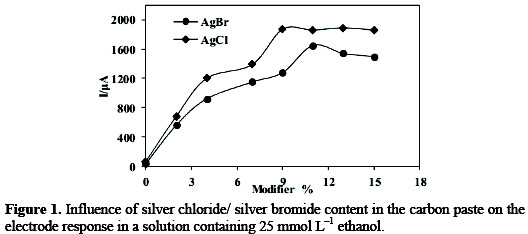
    <p>The voltammetric signals were affected by the composition of the paste. It was 
observed that the sensitivity of the sensor first rapidly increases with increasing 
the silver halide content in the paste up to about 9% SC-MCP and 11% SB-MCP, 
and then started to level off and even slightly decreases with the higher loadings 
<a href="#f1">(Fig.1)</a>.</p>


    <p>&nbsp;</p>
<a name="f1">
<img src="/img/revistas/pea/v34n2/34n2a01f1.jpg">
    
<p>&nbsp;</p>


    ]]></body>
<body><![CDATA[<p>This is because the sites for adsorption increased with the increase of 
silver halide percentage in the modified electrode, while the excess of silver 
halide increase the resistance of the electrode. Higher concentrations (&gt;9% SCMCP 
and 11% SB-MCP) showed a decrease in the peak current. This is 
presumably due to the reduction of conductive area at the electrode surface. 
Hence a silver halide (9% SC-MCP and 11% SB-MCP) modified carbon paste 
electrode was used throughout this work.</p>

    <p>The cyclic voltammograms of modified carbon paste electrode (SC-MCP/ SBMCP) 
were recorded in different concentrations of NaOH solution containing 30 
mmol L<sup>-1</sup> ethanol (not shown). It is shown that, the high catalytic peak current is 
achieved above a NaOH concentration of 0.1 mol L<sup>-1</sup>. The results indicate that 
the OH<sup>-</sup> ion participates in the oxidation of ethanol and may also be adverse to 
the oxidation of ethanol for the competitive adsorption on the active cites to 
ethanol. However, at high OH<sup>-</sup> concentration (&gt;0.1 mol L<sup>-1</sup>), the currents mainly 
come from the redox of Ag(II)/Ag(I) couple, because of the competitive 
adsorption on the active cites caused by OH<sup>-</sup>. To obtain high oxidation current at 
lower oxidation potential, 0.1 mol L<sup>-1</sup> NaOH was chosen as an optimum 
supporting electrolyte.</p>

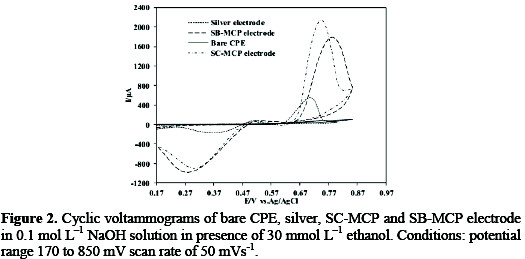
    <p>In order to reveal the electrocatalytic activity of modified carbon paste electrode 
toward the oxidation of ethanol, the voltammetric experiments were carried out 
on both modified and unmodified CPEs in the presence of ethanol. <a href="#f2">Fig. 2</a> 
illustrates the CVs of ethanol at the bare carbon paste and SC-MCP/ SB-MCP 
electrodes in 0.1 mol L<sup>-1</sup> NaOH solution at 50mV/s in a potential range of 0.17 to 
0.85V vs. Ag/AgCl.</p>


    <p>&nbsp;</p>
<a name="f2">
<img src="/img/revistas/pea/v34n2/34n2a01f2.jpg">
    
<p>&nbsp;</p>


    <p>As shown, no oxidation response of ethanol can be seen in 
the potential range from 0.17 to 0.85V on unmodified electrode, indicating the 
nonelectroactivity of ethanol on this substrate. From <a href="#f2">Fig. 2</a>, it can be seen that at 
the SC-MCP/ SB-MCP electrodes, the anodic currents of ethanol oxidation have
been greatly enhanced indicating that the anodic oxidation of ethanol could be 
catalyzed at silver halide modified carbon paste electrodes. This proves that the 
silver halide bear the main role in electrocatalytic oxidation of ethanol. In 
comparison with the data at the bare carbon paste electrode, an increase of 15.1 
and 7.6 folds in peak currents (at Ep) of ethanol were observed at the SC-MCP/ 
SB-MCP electrodes respectively. It can be seen that the electrocatalytic 
efficiency of SC-MCP electrode is higher than the SB-MCP electrode. <a href="#f2">Fig. 2</a> also 
compares the cyclic voltammogram of SC-MCP/ SB-MCP electrode with that 
obtained by silver electrode. In comparison with the data at silver electrode, an 
increase of 12.2 and 6.1 folds in peak current of ethanol was observed at the SCMCP/ 
SB-MCP electrode respectively.</p>

    <p>The following mechanism is proposed for the oxidation of ethanol at the surface 
of SC-MCP electrode:</p>


    <p>&nbsp;</p>
<a name="m2">
<img src="/img/revistas/pea/v34n2/34n2a01m2.jpg">
    
<p>&nbsp;</p>
<a name="m3">
<img src="/img/revistas/pea/v34n2/34n2a01m3.jpg">
    
<p>&nbsp;</p>
<a name="m4">
<img src="/img/revistas/pea/v34n2/34n2a01m4.jpg">
    
]]></body>
<body><![CDATA[<p>&nbsp;</p>
<a name="m5">
<img src="/img/revistas/pea/v34n2/34n2a01m5.jpg">
    
<p>&nbsp;</p>
<a name="m6">
<img src="/img/revistas/pea/v34n2/34n2a01m6.jpg">
    
<p>&nbsp;</p>
<a name="m7">
<img src="/img/revistas/pea/v34n2/34n2a01m7.jpg">
    
<p>&nbsp;</p>
<a name="m8">
<img src="/img/revistas/pea/v34n2/34n2a01m8.jpg">
    
<p>&nbsp;</p>
<a name="m9">
<img src="/img/revistas/pea/v34n2/34n2a01m9.jpg">
    
<p>&nbsp;</p>
<a name="m10">
<img src="/img/revistas/pea/v34n2/34n2a01m10.jpg">
    
<p>&nbsp;</p>
<a name="m11">
<img src="/img/revistas/pea/v34n2/34n2a01m11.jpg">
    
<p>&nbsp;</p>
<a name="m12">
<img src="/img/revistas/pea/v34n2/34n2a01m12.jpg">
    
<p>&nbsp;</p>
<a name="m13">
<img src="/img/revistas/pea/v34n2/34n2a01m13.jpg">
    
<p>&nbsp;</p>
<a name="m14">
<img src="/img/revistas/pea/v34n2/34n2a01m14.jpg">
    
]]></body>
<body><![CDATA[<p>&nbsp;</p>


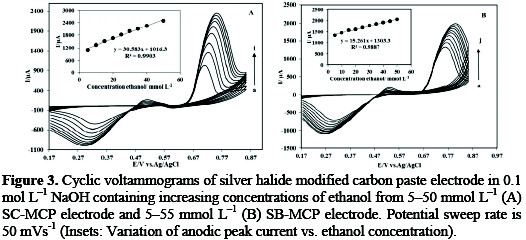
    <p>Under the optimal conditions, the relationship between oxidation peak current 
(ipa/&mu;A) and concentration of ethanol was examined by CV. With the increase of 
ethanol concentration, the anodic peak current gradually increased (<a href="#f3">Fig.3</a>).</p>


    <p>&nbsp;</p>
<a name="f3">
<img src="/img/revistas/pea/v34n2/34n2a01f3.jpg">
    
<p>&nbsp;</p>


    <p>The characteristic shape of cyclic voltammogram in this potential region indicates 
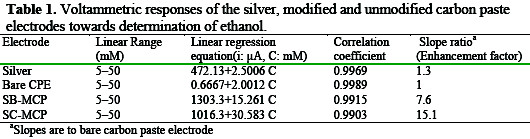
that the signal is due to the oxidation of ethanol. The voltammetric responses of 
the modified electrodes towards determination of ethanol have been listed in 
<a href="#t1">Table 1</a>.</p>


    <p>&nbsp;</p>
<a name="t1">
<img src="/img/revistas/pea/v34n2/34n2a01t1.jpg">
    
<p>&nbsp;</p>


    <p>In agreement with the preliminary CV results, it can be seen, from the 
slopes of the linear regression of the current vs. ethanol concentration plots, that 
the silver chloride modified carbon paste electrodes display, on a wide ethanol 
concentration range, a higher electrocatalytic activity with respect to silver 
bromide modified carbon paste electrode.</p>

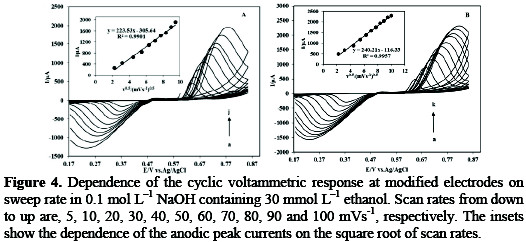
    <p>In order to provide more evidence, the effect of the scan rate varying from 5 to 
100 mVs<sup>-1</sup> on the <a href="#f4">Fig. 4</a> shows the voltammetric responses of (A) SC-MCP and 
(B) SB-MCP electrode in a solution containing 30 mmol L<sup>-1</sup> ethanol was studied.</p>


    <p>&nbsp;</p>
<a name="f4">
<img src="/img/revistas/pea/v34n2/34n2a01f4.jpg">
    
]]></body>
<body><![CDATA[<p>&nbsp;</p>


    <p>The anodic currents increase and the peak potential shifts as the scan rate 
increases. The relations between the peak currents obtained from forward CV 
scan and v1/2 of CV are shown in the insets. The anodic peak currents are linearly 
proportional to the square root of the scan rates. This behavior suggests that the 
oxidation process is controlled by diffusion. Also, plots of the scan rate 
normalized current (Ip/v1/2) vs. scan rate exhibited the characteristic shape of a 
typical EC' catalytic process. The peak currents for anodic oxidation of ethanol 
are not proportional to the scan rate. These results indicate that at sufficiently 
positive potential the reaction is controlled by surface-confined of the ethanol 
species, which is the ideal case for quantitative applications. Also, it can be seen 
that the peak potential for the catalytic reduction of ethanol shifts to more 
positive values by increasing the scan rate, suggesting a kinetic limitation in the 
reaction between the redox sites of silver halide and ethanol.</p>


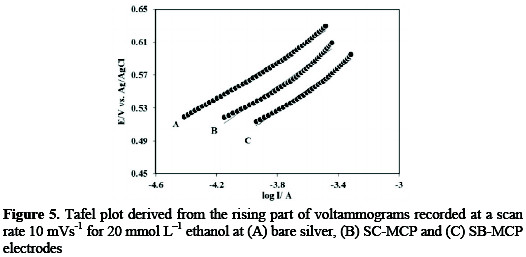
    <p><a href="#f5">Fig. 5</a> shows the Tafel plots recorded for 20 mmol L<sup>-1</sup> ethanol on the (A) bare 
silver, (B) SB-MCP and (C) SC-MCP electrodes at a scan rate of 10mVs<sup>-1</sup>.</p>


    <p>&nbsp;</p>
<a name="f5">
<img src="/img/revistas/pea/v34n2/34n2a01f5.jpg">
    
<p>&nbsp;</p>


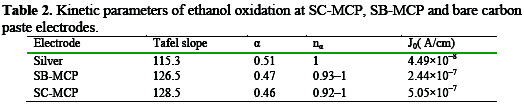
    <p>The charge transfer coefficient (&alpha;), the number of electrons involved in the rate 
determining step (n&alpha;) and exchange current density (j0) evaluated from Tafel 
plots have been given in <a href="#t2">Table 2</a>.</p>


    <p>&nbsp;</p>
<a name="t2">
<img src="/img/revistas/pea/v34n2/34n2a01t2.jpg">
    
<p>&nbsp;</p>


    <p>The parameters Tafel slope, &alpha;, and n&alpha; are very 
similar for three electrode reported in <a href="#t1">Table 1</a>, but the j0 for SC-MCP, and SBMCP 
electrodes are 11.2, and 5.4 folds respectively higher than that of bare 
silver electrode. The exchange current density for SC-MCP is 5.05&times;10<sup>-7</sup>A cm<sup>-2</sup>, 
which is 2.1 times higher than that of SB-MCP (2.44&times;10<sup>-7</sup>A cm<sup>-2</sup>).The results 
indicate that the SC-MCP electrocatalyst is more efficient than the SB-MCP.</p>

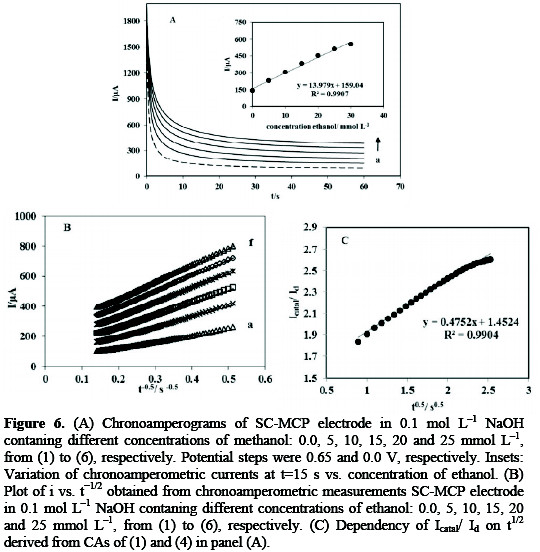
    <p>Chronoamperometry as well as other electrochemical methods may be used for 
the investigation of electrode processes at modified electrodes. The 
chronoamperograms obtained for a series of ethanol solutions with various 
concentrations as illustrated in <a href="#f6">Fig. 6A</a>.</p>


    ]]></body>
<body><![CDATA[<p>&nbsp;</p>
<a name="f6">
<img src="/img/revistas/pea/v34n2/34n2a01f6.jpg">
    
<p>&nbsp;</p>


    <p>An increase in concentration of ethanol 
was accompanied by an increase in anodic currents obtained for a potential step 
of 600mV. The inset of <a href="#f6">Fig. 6A</a> shows plots of currents sampled at fixed time as 
a function of ethanol concentration. The response is linearly proportional to the 
concentration of ethanol in the range of 5-30 mmol L<sup>-1</sup>. The plot of net current 
with respect to the mines square roots of time presents a linear dependency 
(<a href="#f6">Fig. 6B</a>). This indicates that the transient current must be controlled by a diffusion 
process. The transient current is due to catalytic oxidation of ethanol, which 
increases as the ethanol concentration is raised. No significant cathodic current 
was observed when the electrolysis potential was stepped to 0.00 mV (vs. 
Ag/AgCl), indicating the irreversible nature of the oxidation of ethanol.</p>

    <p>The rate constants of the reactions of ethanol and the ensuing intermediates with 
the redox sites of the SC-MCP electrode can be derived from the 
chronoamperograms according to <a href="#e1">Eq. (1)</a> [20]:</p>


    <p>&nbsp;</p>
<a name="e1">
<img src="/img/revistas/pea/v34n2/34n2a01e1.jpg">
    
<p>&nbsp;</p>


    <p>where Icatal is the catalytic current in the presence of ethanol, Id the limiting 
current in the absence of ethanol and &lambda;=kCt (k, C and t are the catalytic rate 
constant, bulk concentration of ethanol and the elapsed time, respectively) is the 
argument of the error function. For &lambda; &gt; 1.5, erf (&lambda;1/2) almost equals unity and 
<a href="#e2">Eq. (2)</a> reduces to [20]:</p>


    <p>&nbsp;</p>
<a name="e2">
<img src="/img/revistas/pea/v34n2/34n2a01e2.jpg">
    
<p>&nbsp;</p>


    <p>From the slope of the Icatal/Id vs. t1/2 plot (<a href="#f6">Fig. 6C</a>), the value of k for 15mmol L<sup>-1</sup> 
ethanol was calculated to be 0.4794&times;104 cm3 mol<sup>-1</sup> s<sup>-1</sup> . Similar 
chronoamperograms were collected for SB-MCP electrode. The value of k for 25 
mmol L<sup>-1</sup> ethanol obtained according to the method described in the above 
calculated to be 3.7153&times;104 cm3mol<sup>-1</sup>s<sup>-1</sup> . 
Since amperometry under stirred conditions has a much higher current sensitivity 
than cyclic voltammetry, it was used to estimate the lower limit of detection. 
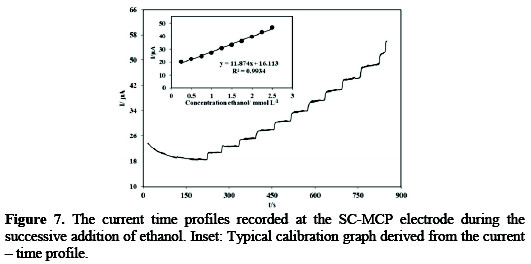
<a href="#f7">Figure 7</a> shows the current-time responses of the SC-MCP electrode to ethanol 
which was successively added to the electrochemical cell containing 0.1 mol L<sup>-1</sup> 
NaOH under hydrodynamic conditions, while the electrode potential was kept at 
0.620.</p>


    ]]></body>
<body><![CDATA[<p>&nbsp;</p>
<a name="f7">
<img src="/img/revistas/pea/v34n2/34n2a01f7.jpg">
    
<p>&nbsp;</p>


    <p>As shown in the figure a well-defined response was observed during the 
stepwise increasing of ethanol concentration in the range 0.25-2.5 mmol L<sup>-1</sup>. The 
linear regression equation of calibration curve is expressed as I (&mu;A) =11.874 
CEthanol mmol L<sup>-1</sup>+16.113 with a correlation coefficient of 0.9934 (n=10). A 
calibration plot constructed from data of <a href="#f7">Fig. 7</a>, gives a limit of detection (LOD) 
and sensitivity 0.31 mmol L<sup>-1</sup> and 11.87 &mu;A L mmol L<sup>-1</sup>, respectively. Similar 
amperometric response curves were collected for SB-MCP electrode (not 
shown). The linear regression equation of calibration curve is expressed as I (&mu;A) 
=0.12 C mmol L<sup>-1</sup> &mu;mol L<sup>-1</sup> +15.84 with a correlation coefficient of 0.9998 
(n=10). The sensitivity and limit of detection (LOD) were found to be 0.12 &mu;A L 
&mu;mol L<sup>-1</sup> and 0.53 &mu;mol L<sup>-1</sup>, respectively. 
The reproducibility of the same SC-MCP/ SB-MCP electrodes was examined 
by measuring the current response to six successive mixed samples containing 30 
mmol L<sup>-1</sup> ethanol. Relative standard deviation (RSD%) of 2.76% and 2.98% 
respectively were obtained. To further ascertain the reproducibility of the 
experimental results, six different SC-MCP/ SB-MCP electrodes were tested 
towards the oxidation of 30 mmol L<sup>-1</sup> ethanol. The peak currents obtained by the 
six independent electrodes showed RSD of 2.98% for SC-MCP and 3.2% for 
SB-MCP electrode, confirming that the sensors are reproducible. The stability of 
the SC-MCP/ SB-MCP electrodes was also tested. After measurements, the 
modified electrodes were stored at 4&deg;C. The peak current intensity only 
decreased 6.4% for SC-MCP electrode and 7.6% for SB-MCP electrode for 
ethanol after one week. The RSD (n = 5) for all these species was less than 9.1% 
for SC-MCP and 9.9% for SB-MCP electrode. These results above indicated 
that the modified electrodes possess high selectivity, good reproducibility and 
well stability.</p>


    <p>&nbsp;</p>
    <p><b>Conclusions</b></p>

    <p>In the present study, the electrochemical behaviors of ethanol at SC-MCP 
electrode have been investigated. The modified electrode exhibits excellent and 
persistent electrocatalytic behavior toward ethanol oxidation compared with the 
bare carbon paste electrode. The j0 for SC-MCP and SB-MCP electrodes are 
11.2 and 5.4 folds respectively higher than that of the bare silver electrode. For 
SC-MCP electrode, kinetic parameters such as the electron transfer coefficient 
(&alpha;), catalytic reaction rate constant (k) and the number of electrons involved in 
the rate determining step (n&alpha;) for oxidation of ethanol at the SC-MCP surface 
were calculated as 0.46, 0.4794&times;10<sup>4</sup> cm3mol<sup>-1</sup> s<sup>-1</sup> and 1 respectively.</p>


    <p>&nbsp;</p>
    <p><b>References</b></p>

    <!-- ref --><p>1. Karim-Nezhad G, Dizajdizi B Z, Dorraji P S. Cata Comm. 2011;12:906.    &nbsp;&nbsp;&nbsp;&nbsp;&nbsp;&nbsp;&nbsp;&nbsp;[&#160;<a href="javascript:void(0);" onclick="javascript: window.open('/scielo.php?script=sci_nlinks&ref=419320&pid=S0872-1904201600020000100001&lng=','','width=640,height=500,resizable=yes,scrollbars=1,menubar=yes,');">Links</a>&#160;]<!-- end-ref --></p>

    ]]></body>
<body><![CDATA[<!-- ref --><p>2. Scott K. Taama W M. Argyropoulos P J. J Power Sources. 1999;79:43.    &nbsp;&nbsp;&nbsp;&nbsp;&nbsp;&nbsp;&nbsp;&nbsp;[&#160;<a href="javascript:void(0);" onclick="javascript: window.open('/scielo.php?script=sci_nlinks&ref=419322&pid=S0872-1904201600020000100002&lng=','','width=640,height=500,resizable=yes,scrollbars=1,menubar=yes,');">Links</a>&#160;]<!-- end-ref --></p>

    <!-- ref --><p>3. Teng Z H, Wang Y J, Wu B, et al. Appl Catal B: Environ. 2008;84:400.    &nbsp;&nbsp;&nbsp;&nbsp;&nbsp;&nbsp;&nbsp;&nbsp;[&#160;<a href="javascript:void(0);" onclick="javascript: window.open('/scielo.php?script=sci_nlinks&ref=419324&pid=S0872-1904201600020000100003&lng=','','width=640,height=500,resizable=yes,scrollbars=1,menubar=yes,');">Links</a>&#160;]<!-- end-ref --></p>

    <!-- ref --><p>4. Douvartzides S, Tsiakaras P. Solid State Ionics. 2000;849:136.    &nbsp;&nbsp;&nbsp;&nbsp;&nbsp;&nbsp;&nbsp;&nbsp;[&#160;<a href="javascript:void(0);" onclick="javascript: window.open('/scielo.php?script=sci_nlinks&ref=419326&pid=S0872-1904201600020000100004&lng=','','width=640,height=500,resizable=yes,scrollbars=1,menubar=yes,');">Links</a>&#160;]<!-- end-ref --></p>

    <!-- ref --><p>5. Pang H L, Lu J P, Chen J H, et al. Electrochim Acta. 2009;54:2610.    &nbsp;&nbsp;&nbsp;&nbsp;&nbsp;&nbsp;&nbsp;&nbsp;[&#160;<a href="javascript:void(0);" onclick="javascript: window.open('/scielo.php?script=sci_nlinks&ref=419328&pid=S0872-1904201600020000100005&lng=','','width=640,height=500,resizable=yes,scrollbars=1,menubar=yes,');">Links</a>&#160;]<!-- end-ref --></p>

    <!-- ref --><p>6. Razmi H, Habibi E S, Heidari H. Electrochim Acta. 2008;53:8178.    &nbsp;&nbsp;&nbsp;&nbsp;&nbsp;&nbsp;&nbsp;&nbsp;[&#160;<a href="javascript:void(0);" onclick="javascript: window.open('/scielo.php?script=sci_nlinks&ref=419330&pid=S0872-1904201600020000100006&lng=','','width=640,height=500,resizable=yes,scrollbars=1,menubar=yes,');">Links</a>&#160;]<!-- end-ref --></p>

    ]]></body>
<body><![CDATA[<!-- ref --><p>7. Salimi A, Abdi K. Talanta 2004;63:475.    &nbsp;&nbsp;&nbsp;&nbsp;&nbsp;&nbsp;&nbsp;&nbsp;[&#160;<a href="javascript:void(0);" onclick="javascript: window.open('/scielo.php?script=sci_nlinks&ref=419332&pid=S0872-1904201600020000100007&lng=','','width=640,height=500,resizable=yes,scrollbars=1,menubar=yes,');">Links</a>&#160;]<!-- end-ref --></p>

    <!-- ref --><p>8. Kalcher K, Electroanalysis. 1990;2:419.    &nbsp;&nbsp;&nbsp;&nbsp;&nbsp;&nbsp;&nbsp;&nbsp;[&#160;<a href="javascript:void(0);" onclick="javascript: window.open('/scielo.php?script=sci_nlinks&ref=419334&pid=S0872-1904201600020000100008&lng=','','width=640,height=500,resizable=yes,scrollbars=1,menubar=yes,');">Links</a>&#160;]<!-- end-ref --></p>

    <!-- ref --><p>9. Zare H R, Nasirizadeh N. Int J Electrochem Sci. 2009;4:1691.    &nbsp;&nbsp;&nbsp;&nbsp;&nbsp;&nbsp;&nbsp;&nbsp;[&#160;<a href="javascript:void(0);" onclick="javascript: window.open('/scielo.php?script=sci_nlinks&ref=419336&pid=S0872-1904201600020000100009&lng=','','width=640,height=500,resizable=yes,scrollbars=1,menubar=yes,');">Links</a>&#160;]<!-- end-ref --></p>

    <!-- ref --><p>10. Ozoemena K I, Staden R S, Nyokong T. Electroanalysis. 2009;21:1651.    &nbsp;&nbsp;&nbsp;&nbsp;&nbsp;&nbsp;&nbsp;&nbsp;[&#160;<a href="javascript:void(0);" onclick="javascript: window.open('/scielo.php?script=sci_nlinks&ref=419338&pid=S0872-1904201600020000100010&lng=','','width=640,height=500,resizable=yes,scrollbars=1,menubar=yes,');">Links</a>&#160;]<!-- end-ref --></p>

    <!-- ref --><p>11. Shahrokhian S, Amiri M. Solid State Electrochem. 2007;11:1133.    &nbsp;&nbsp;&nbsp;&nbsp;&nbsp;&nbsp;&nbsp;&nbsp;[&#160;<a href="javascript:void(0);" onclick="javascript: window.open('/scielo.php?script=sci_nlinks&ref=419340&pid=S0872-1904201600020000100011&lng=','','width=640,height=500,resizable=yes,scrollbars=1,menubar=yes,');">Links</a>&#160;]<!-- end-ref --></p>

    ]]></body>
<body><![CDATA[<!-- ref --><p>12. Ivanova E V, Sergeeva V S, Oni J, et al. Bioelectrochem. 2003;60:65.    &nbsp;&nbsp;&nbsp;&nbsp;&nbsp;&nbsp;&nbsp;&nbsp;[&#160;<a href="javascript:void(0);" onclick="javascript: window.open('/scielo.php?script=sci_nlinks&ref=419342&pid=S0872-1904201600020000100012&lng=','','width=640,height=500,resizable=yes,scrollbars=1,menubar=yes,');">Links</a>&#160;]<!-- end-ref --></p>

    <!-- ref --><p>13. Amiri M, Pakdel Z, Bezaatpour A, et al. Bioelectrochem. 2011;81:81.    &nbsp;&nbsp;&nbsp;&nbsp;&nbsp;&nbsp;&nbsp;&nbsp;[&#160;<a href="javascript:void(0);" onclick="javascript: window.open('/scielo.php?script=sci_nlinks&ref=419344&pid=S0872-1904201600020000100013&lng=','','width=640,height=500,resizable=yes,scrollbars=1,menubar=yes,');">Links</a>&#160;]<!-- end-ref --></p>

    <!-- ref --><p>14. Moscone D, D'ottavi D, Compagnone D, et al. Anal Chem. 2001;73:2529.    &nbsp;&nbsp;&nbsp;&nbsp;&nbsp;&nbsp;&nbsp;&nbsp;[&#160;<a href="javascript:void(0);" onclick="javascript: window.open('/scielo.php?script=sci_nlinks&ref=419346&pid=S0872-1904201600020000100014&lng=','','width=640,height=500,resizable=yes,scrollbars=1,menubar=yes,');">Links</a>&#160;]<!-- end-ref --></p>

    <!-- ref --><p>15. Wang X L, Wang E B, Lan Y, et al. Electroanalysis. 2002;14:1116.    &nbsp;&nbsp;&nbsp;&nbsp;&nbsp;&nbsp;&nbsp;&nbsp;[&#160;<a href="javascript:void(0);" onclick="javascript: window.open('/scielo.php?script=sci_nlinks&ref=419348&pid=S0872-1904201600020000100015&lng=','','width=640,height=500,resizable=yes,scrollbars=1,menubar=yes,');">Links</a>&#160;]<!-- end-ref --></p>

    <!-- ref --><p>16. Limoges B R, Stanis R J, Turner J A, et al. Electrochim Acta. 2005;50:1169.    &nbsp;&nbsp;&nbsp;&nbsp;&nbsp;&nbsp;&nbsp;&nbsp;[&#160;<a href="javascript:void(0);" onclick="javascript: window.open('/scielo.php?script=sci_nlinks&ref=419350&pid=S0872-1904201600020000100016&lng=','','width=640,height=500,resizable=yes,scrollbars=1,menubar=yes,');">Links</a>&#160;]<!-- end-ref --></p>

    ]]></body>
<body><![CDATA[<!-- ref --><p>17. Wang X L, Han Z B, Zhang H, et al. Electroanalysis. 2003;15:1460.    &nbsp;&nbsp;&nbsp;&nbsp;&nbsp;&nbsp;&nbsp;&nbsp;[&#160;<a href="javascript:void(0);" onclick="javascript: window.open('/scielo.php?script=sci_nlinks&ref=419352&pid=S0872-1904201600020000100017&lng=','','width=640,height=500,resizable=yes,scrollbars=1,menubar=yes,');">Links</a>&#160;]<!-- end-ref --></p>

    <!-- ref --><p>18. Jin C, Zhang Z, Chen Z, et al. Electrochim Acta. 2013;87:860.    &nbsp;&nbsp;&nbsp;&nbsp;&nbsp;&nbsp;&nbsp;&nbsp;[&#160;<a href="javascript:void(0);" onclick="javascript: window.open('/scielo.php?script=sci_nlinks&ref=419354&pid=S0872-1904201600020000100018&lng=','','width=640,height=500,resizable=yes,scrollbars=1,menubar=yes,');">Links</a>&#160;]<!-- end-ref --></p>

    <!-- ref --><p>19. Karim-Nezhad G, Dorraji P S. Electrochim Acta. 2010;55:3414.    &nbsp;&nbsp;&nbsp;&nbsp;&nbsp;&nbsp;&nbsp;&nbsp;[&#160;<a href="javascript:void(0);" onclick="javascript: window.open('/scielo.php?script=sci_nlinks&ref=419356&pid=S0872-1904201600020000100019&lng=','','width=640,height=500,resizable=yes,scrollbars=1,menubar=yes,');">Links</a>&#160;]<!-- end-ref --></p>

    <!-- ref --><p>20. Karim-Nezhad G, Pashazadeh A, Pashazadeh S. J Korean Chem Soc. 2013;57:322.    &nbsp;&nbsp;&nbsp;&nbsp;&nbsp;&nbsp;&nbsp;&nbsp;[&#160;<a href="javascript:void(0);" onclick="javascript: window.open('/scielo.php?script=sci_nlinks&ref=419358&pid=S0872-1904201600020000100020&lng=','','width=640,height=500,resizable=yes,scrollbars=1,menubar=yes,');">Links</a>&#160;]<!-- end-ref --></p>


    <p>&nbsp;</p>
    <p><a name=0></a><sup><a href="#top">*</a></sup>Corresponding author. E-mail address: <a href="mailto:sa.pashazadeh20@gmail.com">sa.pashazadeh20@gmail.com</a></p>

    ]]></body>
<body><![CDATA[<p>Received 11 August 2014; accepted 25 February 2016</p>

    <p><a href="http://www.peacta.org" target="_blank">www.peacta.org</a> </p>


     ]]></body><back>
<ref-list>
<ref id="B1">
<label>1</label><nlm-citation citation-type="journal">
<person-group person-group-type="author">
<name>
<surname><![CDATA[Karim-Nezhad]]></surname>
<given-names><![CDATA[G]]></given-names>
</name>
<name>
<surname><![CDATA[Dizajdizi]]></surname>
<given-names><![CDATA[B Z]]></given-names>
</name>
<name>
<surname><![CDATA[Dorraji]]></surname>
<given-names><![CDATA[P S]]></given-names>
</name>
</person-group>
<source><![CDATA[Cata Comm]]></source>
<year>2011</year>
<volume>12</volume>
<page-range>906</page-range></nlm-citation>
</ref>
<ref id="B2">
<label>2</label><nlm-citation citation-type="journal">
<person-group person-group-type="author">
<name>
<surname><![CDATA[Scott]]></surname>
<given-names><![CDATA[K]]></given-names>
</name>
<name>
<surname><![CDATA[Taama]]></surname>
<given-names><![CDATA[W M]]></given-names>
</name>
<name>
<surname><![CDATA[Argyropoulos]]></surname>
<given-names><![CDATA[P J]]></given-names>
</name>
</person-group>
<source><![CDATA[J Power Sources]]></source>
<year>1999</year>
<volume>79</volume>
<page-range>43</page-range></nlm-citation>
</ref>
<ref id="B3">
<label>3</label><nlm-citation citation-type="journal">
<person-group person-group-type="author">
<name>
<surname><![CDATA[Teng]]></surname>
<given-names><![CDATA[Z H]]></given-names>
</name>
<name>
<surname><![CDATA[Wang]]></surname>
<given-names><![CDATA[Y J]]></given-names>
</name>
<name>
<surname><![CDATA[Wu]]></surname>
<given-names><![CDATA[B]]></given-names>
</name>
</person-group>
<source><![CDATA[Appl Catal B: Environ]]></source>
<year>2008</year>
<volume>84</volume>
<page-range>400</page-range></nlm-citation>
</ref>
<ref id="B4">
<label>4</label><nlm-citation citation-type="journal">
<person-group person-group-type="author">
<name>
<surname><![CDATA[Douvartzides]]></surname>
<given-names><![CDATA[S]]></given-names>
</name>
<name>
<surname><![CDATA[Tsiakaras]]></surname>
<given-names><![CDATA[P]]></given-names>
</name>
</person-group>
<source><![CDATA[Solid State Ionics]]></source>
<year>2000</year>
<volume>849</volume>
<page-range>136</page-range></nlm-citation>
</ref>
<ref id="B5">
<label>5</label><nlm-citation citation-type="journal">
<person-group person-group-type="author">
<name>
<surname><![CDATA[Pang]]></surname>
<given-names><![CDATA[H L]]></given-names>
</name>
<name>
<surname><![CDATA[Lu]]></surname>
<given-names><![CDATA[J P]]></given-names>
</name>
<name>
<surname><![CDATA[Chen]]></surname>
<given-names><![CDATA[J H]]></given-names>
</name>
</person-group>
<source><![CDATA[Electrochim Acta]]></source>
<year>2009</year>
<volume>54</volume>
<page-range>2610</page-range></nlm-citation>
</ref>
<ref id="B6">
<label>6</label><nlm-citation citation-type="journal">
<person-group person-group-type="author">
<name>
<surname><![CDATA[Razmi]]></surname>
<given-names><![CDATA[H]]></given-names>
</name>
<name>
<surname><![CDATA[Habibi]]></surname>
<given-names><![CDATA[E S]]></given-names>
</name>
<name>
<surname><![CDATA[Heidari]]></surname>
<given-names><![CDATA[H]]></given-names>
</name>
</person-group>
<source><![CDATA[Electrochim Acta]]></source>
<year>2008</year>
<volume>53</volume>
<page-range>8178</page-range></nlm-citation>
</ref>
<ref id="B7">
<label>7</label><nlm-citation citation-type="journal">
<person-group person-group-type="author">
<name>
<surname><![CDATA[Salimi]]></surname>
<given-names><![CDATA[A]]></given-names>
</name>
<name>
<surname><![CDATA[Abdi]]></surname>
<given-names><![CDATA[K]]></given-names>
</name>
</person-group>
<source><![CDATA[Talanta]]></source>
<year>2004</year>
<volume>63</volume>
<page-range>475</page-range></nlm-citation>
</ref>
<ref id="B8">
<label>8</label><nlm-citation citation-type="journal">
<person-group person-group-type="author">
<name>
<surname><![CDATA[Kalcher]]></surname>
<given-names><![CDATA[K]]></given-names>
</name>
</person-group>
<source><![CDATA[Electroanalysis]]></source>
<year>1990</year>
<volume>2</volume>
<page-range>419</page-range></nlm-citation>
</ref>
<ref id="B9">
<label>9</label><nlm-citation citation-type="journal">
<person-group person-group-type="author">
<name>
<surname><![CDATA[Zare]]></surname>
<given-names><![CDATA[H R]]></given-names>
</name>
<name>
<surname><![CDATA[Nasirizadeh]]></surname>
<given-names><![CDATA[N]]></given-names>
</name>
</person-group>
<source><![CDATA[Int J Electrochem Sci]]></source>
<year>2009</year>
<volume>4</volume>
<page-range>1691</page-range></nlm-citation>
</ref>
<ref id="B10">
<label>10</label><nlm-citation citation-type="journal">
<person-group person-group-type="author">
<name>
<surname><![CDATA[Ozoemena]]></surname>
<given-names><![CDATA[K I]]></given-names>
</name>
<name>
<surname><![CDATA[Staden]]></surname>
<given-names><![CDATA[R S]]></given-names>
</name>
<name>
<surname><![CDATA[Nyokong]]></surname>
<given-names><![CDATA[T]]></given-names>
</name>
</person-group>
<source><![CDATA[Electroanalysis]]></source>
<year>2009</year>
<volume>21</volume>
<page-range>1651</page-range></nlm-citation>
</ref>
<ref id="B11">
<label>11</label><nlm-citation citation-type="journal">
<person-group person-group-type="author">
<name>
<surname><![CDATA[Shahrokhian]]></surname>
<given-names><![CDATA[S]]></given-names>
</name>
<name>
<surname><![CDATA[Amiri]]></surname>
<given-names><![CDATA[M]]></given-names>
</name>
</person-group>
<source><![CDATA[Solid State Electrochem]]></source>
<year>2007</year>
<volume>11</volume>
<page-range>1133</page-range></nlm-citation>
</ref>
<ref id="B12">
<label>12</label><nlm-citation citation-type="journal">
<person-group person-group-type="author">
<name>
<surname><![CDATA[Ivanova]]></surname>
<given-names><![CDATA[E V]]></given-names>
</name>
<name>
<surname><![CDATA[Sergeeva]]></surname>
<given-names><![CDATA[V S]]></given-names>
</name>
<name>
<surname><![CDATA[Oni]]></surname>
<given-names><![CDATA[J]]></given-names>
</name>
</person-group>
<source><![CDATA[Bioelectrochem]]></source>
<year>2003</year>
<volume>60</volume>
<page-range>65</page-range></nlm-citation>
</ref>
<ref id="B13">
<label>13</label><nlm-citation citation-type="journal">
<person-group person-group-type="author">
<name>
<surname><![CDATA[Amiri]]></surname>
<given-names><![CDATA[M]]></given-names>
</name>
<name>
<surname><![CDATA[Pakdel]]></surname>
<given-names><![CDATA[Z]]></given-names>
</name>
<name>
<surname><![CDATA[Bezaatpour]]></surname>
<given-names><![CDATA[A]]></given-names>
</name>
</person-group>
<source><![CDATA[Bioelectrochem]]></source>
<year>2011</year>
<volume>81</volume>
<page-range>81</page-range></nlm-citation>
</ref>
<ref id="B14">
<label>14</label><nlm-citation citation-type="journal">
<person-group person-group-type="author">
<name>
<surname><![CDATA[Moscone]]></surname>
<given-names><![CDATA[D]]></given-names>
</name>
<name>
<surname><![CDATA[D'ottavi]]></surname>
<given-names><![CDATA[D]]></given-names>
</name>
<name>
<surname><![CDATA[Compagnone]]></surname>
<given-names><![CDATA[D]]></given-names>
</name>
</person-group>
<source><![CDATA[Anal Chem]]></source>
<year>2001</year>
<volume>73</volume>
<page-range>2529</page-range></nlm-citation>
</ref>
<ref id="B15">
<label>15</label><nlm-citation citation-type="journal">
<person-group person-group-type="author">
<name>
<surname><![CDATA[Wang]]></surname>
<given-names><![CDATA[X L]]></given-names>
</name>
<name>
<surname><![CDATA[Wang]]></surname>
<given-names><![CDATA[E B]]></given-names>
</name>
<name>
<surname><![CDATA[Lan]]></surname>
<given-names><![CDATA[Y]]></given-names>
</name>
</person-group>
<source><![CDATA[Electroanalysis]]></source>
<year>2002</year>
<volume>14</volume>
<page-range>1116</page-range></nlm-citation>
</ref>
<ref id="B16">
<label>16</label><nlm-citation citation-type="journal">
<person-group person-group-type="author">
<name>
<surname><![CDATA[Limoges]]></surname>
<given-names><![CDATA[B R]]></given-names>
</name>
<name>
<surname><![CDATA[Stanis]]></surname>
<given-names><![CDATA[R J]]></given-names>
</name>
<name>
<surname><![CDATA[Turner]]></surname>
<given-names><![CDATA[J A]]></given-names>
</name>
</person-group>
<source><![CDATA[Electrochim Acta]]></source>
<year>2005</year>
<volume>50</volume>
<page-range>1169</page-range></nlm-citation>
</ref>
<ref id="B17">
<label>17</label><nlm-citation citation-type="journal">
<person-group person-group-type="author">
<name>
<surname><![CDATA[Wang]]></surname>
<given-names><![CDATA[X L]]></given-names>
</name>
<name>
<surname><![CDATA[Han]]></surname>
<given-names><![CDATA[Z B]]></given-names>
</name>
<name>
<surname><![CDATA[Zhang]]></surname>
<given-names><![CDATA[H]]></given-names>
</name>
</person-group>
<source><![CDATA[Electroanalysis]]></source>
<year>2003</year>
<volume>15</volume>
<page-range>1460</page-range></nlm-citation>
</ref>
<ref id="B18">
<label>18</label><nlm-citation citation-type="journal">
<person-group person-group-type="author">
<name>
<surname><![CDATA[Jin]]></surname>
<given-names><![CDATA[C]]></given-names>
</name>
<name>
<surname><![CDATA[Zhang]]></surname>
<given-names><![CDATA[Z]]></given-names>
</name>
<name>
<surname><![CDATA[Chen]]></surname>
<given-names><![CDATA[Z]]></given-names>
</name>
</person-group>
<source><![CDATA[Electrochim Acta]]></source>
<year>2013</year>
<volume>87</volume>
<page-range>860</page-range></nlm-citation>
</ref>
<ref id="B19">
<label>19</label><nlm-citation citation-type="journal">
<person-group person-group-type="author">
<name>
<surname><![CDATA[Karim-Nezhad]]></surname>
<given-names><![CDATA[G]]></given-names>
</name>
<name>
<surname><![CDATA[Dorraji]]></surname>
<given-names><![CDATA[P S]]></given-names>
</name>
</person-group>
<source><![CDATA[Electrochim Acta]]></source>
<year>2010</year>
<volume>55</volume>
<page-range>3414</page-range></nlm-citation>
</ref>
<ref id="B20">
<label>20</label><nlm-citation citation-type="journal">
<person-group person-group-type="author">
<name>
<surname><![CDATA[Karim-Nezhad]]></surname>
<given-names><![CDATA[G]]></given-names>
</name>
<name>
<surname><![CDATA[Pashazadeh]]></surname>
<given-names><![CDATA[A]]></given-names>
</name>
<name>
<surname><![CDATA[Pashazadeh]]></surname>
<given-names><![CDATA[S]]></given-names>
</name>
</person-group>
<source><![CDATA[J Korean Chem Soc]]></source>
<year>2013</year>
<volume>57</volume>
<page-range>322</page-range></nlm-citation>
</ref>
</ref-list>
</back>
</article>