<?xml version="1.0" encoding="ISO-8859-1"?><article xmlns:mml="http://www.w3.org/1998/Math/MathML" xmlns:xlink="http://www.w3.org/1999/xlink" xmlns:xsi="http://www.w3.org/2001/XMLSchema-instance">
<front>
<journal-meta>
<journal-id>0872-1904</journal-id>
<journal-title><![CDATA[Portugaliae Electrochimica Acta]]></journal-title>
<abbrev-journal-title><![CDATA[Port. Electrochim. Acta]]></abbrev-journal-title>
<issn>0872-1904</issn>
<publisher>
<publisher-name><![CDATA[Sociedade Portuguesa de Electroquímica]]></publisher-name>
</publisher>
</journal-meta>
<article-meta>
<article-id>S0872-19042016000200002</article-id>
<article-id pub-id-type="doi">10.4152/pea.201602097</article-id>
<title-group>
<article-title xml:lang="en"><![CDATA[Voltammetric characterization of grafted polymer electrode self modification with carbon nanotubes (GPESMCNT)]]></article-title>
</title-group>
<contrib-group>
<contrib contrib-type="author">
<name>
<surname><![CDATA[Radhia]]></surname>
<given-names><![CDATA[Muhammed M.]]></given-names>
</name>
<xref ref-type="aff" rid="A01"/>
</contrib>
<contrib contrib-type="author">
<name>
<surname><![CDATA[Al-Mullab]]></surname>
<given-names><![CDATA[Emad A. J.]]></given-names>
</name>
<xref ref-type="aff" rid="A01"/>
</contrib>
</contrib-group>
<aff id="A01">
<institution><![CDATA[,University of Kufa Faculty of Science Iraqb Department of Chemistry]]></institution>
<addr-line><![CDATA[An-Najaf ]]></addr-line>
<country>Iraq</country>
</aff>
<pub-date pub-type="pub">
<day>00</day>
<month>03</month>
<year>2016</year>
</pub-date>
<pub-date pub-type="epub">
<day>00</day>
<month>03</month>
<year>2016</year>
</pub-date>
<volume>34</volume>
<numero>2</numero>
<fpage>97</fpage>
<lpage>103</lpage>
<copyright-statement/>
<copyright-year/>
<self-uri xlink:href="http://scielo.pt/scielo.php?script=sci_arttext&amp;pid=S0872-19042016000200002&amp;lng=en&amp;nrm=iso"></self-uri><self-uri xlink:href="http://scielo.pt/scielo.php?script=sci_abstract&amp;pid=S0872-19042016000200002&amp;lng=en&amp;nrm=iso"></self-uri><self-uri xlink:href="http://scielo.pt/scielo.php?script=sci_pdf&amp;pid=S0872-19042016000200002&amp;lng=en&amp;nrm=iso"></self-uri><abstract abstract-type="short" xml:lang="en"><p><![CDATA[A novel self modification of grafted polymer working electrode with carbon nanotubes was success for fabrication from grafting polymer via gamma irradiation and ferrous ammonium sulfate (FAS) as a catalyst. The electrochemical properties of the self modified grafted polymer with CNT (GPESMCNT) improved performance the working electrode at higher conducting surface was done through using in cyclic voltammetry (CV). The GPESMCNT was characterized by surface analytical methods including AFM and SEM. The characterization of electrocnductivity properties of GPESMCNT was studied in 1M of KCl with different concentration of K3(Fe(CN)6), at different scan rates, temperature, and different concentrations using CV technique. The new GPESMCNT improved performance the working electrode in CV at different techniques such as rotating disc electrode (RDE). also, the nanomaterials in the chain of grafted polymer was enhanced the redox current peaks of Fe(II)/Fe(III) multi times than at commercial working electrodes such as GCE, Pt-electrode, Au-electrode, etc.]]></p></abstract>
<kwd-group>
<kwd lng="en"><![CDATA[grafted polymer electrode self modified]]></kwd>
<kwd lng="en"><![CDATA[CNT]]></kwd>
<kwd lng="en"><![CDATA[cyclic voltammetry]]></kwd>
<kwd lng="en"><![CDATA[
</kwd-group>
</article-meta>
</front><body><![CDATA[ 

<!--     <p>&nbsp;</p>
    <p>doi: 10.4152/pea.201602097</p> -->

    <p><b>Voltammetric characterization of grafted polymer electrode self modification with carbon nanotubes (GPESMCNT)</b></p>

    <p>
<b>Muhammed M. Radhia</b><a href="#0">*</a></sup>
 and <b>Emad A. J. Al-Mullab</b>
</p>

    <p><i> Middle Technical University, Health and Medical Technology College-Baghdad, Iraqb Department of Chemistry, Faculty of Science, University of Kufa, P.O. Box 21, 
An-Najaf 54001, Iraq</i></p>


    <p>&nbsp;</p>
    <p><b>Abstract</b></p>

    <p>A novel self modification of grafted polymer working electrode with carbon nanotubes 
was success for fabrication from grafting polymer via gamma irradiation and ferrous 
ammonium sulfate (FAS) as a catalyst. The electrochemical properties of the self 
modified grafted polymer with CNT (GPESMCNT) improved performance the working 
electrode at higher conducting surface was done through using in cyclic voltammetry 
(CV). The GPESMCNT was characterized by surface analytical methods including 
AFM and SEM. The characterization of electrocnductivity properties of GPESMCNT 
was studied in 1M of KCl with different concentration of K3[Fe(CN)6], at different scan 
rates, temperature, and different concentrations using CV technique. The new 
GPESMCNT improved performance the working electrode in CV at different 
techniques such as rotating disc electrode (RDE). also, the nanomaterials in the chain of 
grafted polymer was enhanced the redox current peaks of Fe(II)/Fe(III) multi times than 
at commercial working electrodes such as GCE, Pt-electrode, Au-electrode, etc.</p>

    <p><b><i>Keywords:</i></b> grafted polymer electrode self modified, CNT, cyclic voltammetry, 
K3[Fe(CN)6].</p>


    ]]></body>
<body><![CDATA[<p>&nbsp;</p>
    <p><b>Introduction</b></p>

    <p>The modification of grafted polymer with nano-deposits such as CNT, C60 and 
activated carbon is very important for the scientists esp. in the electrochemistry 
by cyclic voltammetric analysis field [1-5].</p>

    <p>The unique chemical, physical, electronic (metallic or semiconducting) and high 
thermal properties of carbon nanotubes (CNTs) made them interesting materials 
for widespread application in the fields such as electrochemical sensors, 
biosensors, supports for heterogeneous metal catalysts in organic synthesis, fuel 
cells, semiconductors, batteries, random access memory cells, field effect 
transistor, field emission display, atomic force microscopy probes, 
microelectrodes, specific adsorbents to remove organic pollutants from water and 
waste water and as a potential drug carriers in cancer therapy[6-9]. 
Working electrodes must be an electronic conductor and electrochemically inert. 
Commonly used working solid electrode materials for cyclic voltammetry 
include platinum, gold and glassy carbon. Other materials (e.g., semi-conductors, 
for example ITO, indium-tin oxide, or conductive polymers or grafted polymer) 
are also used, for more specific applications [10,11].</p>

    <p>Electrochemical behaviour of famotidine has been studied at composite polymer 
membrane working electrode. Cyclic voltammetric method has been developed 
for the determination of drug in pharmaceutical formulation. A well-defined 
anodic peak was observed for famotidine in the entire pH range. The current 
increases steadily with scan rate and concentration. This composite film showed 
good catalytic behaviour, which includes a good current response. The result is 
compared with the glassy carbon electrode and it was found that the current with 
composite polymer electrode is of the order of 18.60 mA whereas with glassy 
carbon electrode it was around 565.00 &mu;A [12].</p>

    <p>Electrochemical study behavior of terthiophene and its corresponding polymer, 
which is obtained electrochemically as a film by cyclic voltammetry (CV) on 
platinum electrode. The analysis focuses essentially on the effect of two solvents 
acetonitrile and dichloromethane on the electrochemical behavior of the obtained 
polymer. The voltammograms show that the film of polyterthiophene can oxide 
and reduce in two solutions; in acetonitrile, the oxidation current intensity is 
more important than in dichloromethane. The impedance plots show the 
semicircle which is characteristic of charge-transfer resistance at the 
electrode/polymer interface at high frequency and the diffusion process at low 
frequency [13].</p>

    <p>Grafted copolymer of polypyrrole has been synthesized by electrochemical 
polymerization of pyrrole in the presence of poly(para-chloromethylstyrene-costyrene-
co-pyrrolemethylstyrene). The produced copolymer exhibits an electrical 
conductivity comparable to that of polypyrrole. This measurement showed that 
copolymer has excellent thermal stability. The response mechanism of this 
compound to sense a selection of gases and vapors was investigated, by 
measuring its electrical conductivity by four-point probe method. This gas sensor 
may have advantages over the other sensors in its ability to operate at room 
temperature, lower gas and vapous sensing concentration, suitable solubility, 
stability in air, sufficient diffusion, and selectivity [14].</p>

    <p>This review highlights the recent progress made in the area of thermoelectric 
(TE) applications of conducting polymers and related composites. Several 
examples of such materials and their TE properties are discussed. TE properties 
of new poly(2,7-carbazole) derivatives are highlighted. References are also made 
to carbon nanotube/polymer composites and their improved electrical and TE 
performance. Studies on polymer/ inorganic materials composites have also 
taken a step forward and have shown very promising TE properties [15].</p>

    <p>In this work, grafted polymer was modified with carbon nanotubes to fabrication 
grafted polymer electrode self modified with carbon nanotubes. The new grafted 
polymer electrode was electrochemically characterization in K3[Fe(CN)6] with 
KCl aqueous electrolyte by CV technique.</p>


    <p>&nbsp;</p>
    ]]></body>
<body><![CDATA[<p><b>Experimental</b></p>

    <p><i><b>Synthesis of Grafted Polymer modified with carbon nanotubes (GP/CNT)</b></i></p>

    <p>Polystyrene was grafted with acrylonitrile as a monomer and modified with 
nano-deposit (carbon nanotubes) and ferrous ammonium sulfate (FAS) as a 
catalyst using gamma-irradiation. The new grafted polymer modified with carbon 
nanotubes has been investigated and characterized [3].</p>


    <p><i><b>Instrument and Electroanalytical Methods</b></i></p>

    <p>Electrochemical workstations of NuVant Systems Inc., USA (EZ stat series with 
potentiostat/glvanostat driven by electroanalytical measuring software) were 
connected to a PC computer in order to perform cyclic voltammetry (CV), 
chronoamperometry (CC), and chronoamperometry (CA). An Ag/AgCl (3 M 
NaCl) and platinum wire (1 mm diameter) were used as the reference and counter 
electrodes, respectively.</p>

    <p>The working electrode used in this study was grafted polymer electrode self 
modified with carbon nanotubes (GPESMCNT). The voltammetric experiments 
were carried out with K3[Fe(CN)6] and KCl as supporting electrolyte. Solution 
was degassed with nitrogen gas for ten to fifteen minutes prior to recording the 
voltammogram.</p>


    <p><i><b>Reagents</b></i></p>

    <p>All reagents were analytical reagents or electrochemical grade purity. All 
solutions were prepared using distilled water. Unless otherwise specified, the 
supporting electrolyte was used 1M KCl in aqueous media at room temperature.</p>


    <p><i><b>Fabrication the new grafted polymer electrode self modified with CNT 
(GPESMCNT)</b></i></p>

    <p>GPESMCNT has been fabricated from grafted polymer modified with carbon 
nanotubes. The diameter of electrode was 3 cm. A hole was done (1mm) to allow 
1cm length of platinum wire out from other side of electrode. A copper wire was 
then joined with the platinum wire. After that, all parts of fabricated electrode 
was covered with glassy tube and then fixed with epoxy resin.</p>


    ]]></body>
<body><![CDATA[<p>&nbsp;</p>
    <p><b>Result and discussion</b></p>

    <p><i><b>Electrochemical properties of grafted polymer electrode self modified with 
carbon nanotubes (GPESMCNT)</b></i></p>

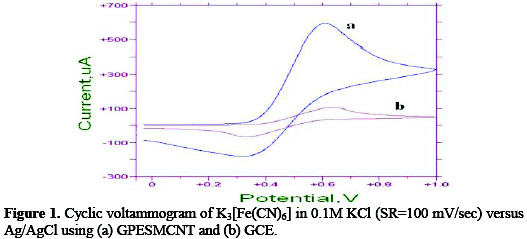
    <p>K3Fe(CN)6 solution is commonly used as a reference standard solution for the 
purpose of calibrating a voltammetric system in KCl aqueous solution. During 
the calibration process of an electroanalytical workstation (EZ stat) using glassy 
carbon electrode (GCE) and grafted polymer self modified with carbon 
nanotubes electrode (GPESMCNT) as working electrode. The current of 
Fe(II)/Fe(III) redox couple appears to be significantly enhanced by the 
GPESMCNT. The enhancement of oxidation-reduction current peaks +600&mu;A 
and -200 &mu;A, respectively is comparison of GCE at very weak redox current 
peaks of +70 &mu;A and -60 &mu;A respectively as show in <a href="#f1">figure 1a and 1b</a>.</p>


    <p>&nbsp;</p>
<a name="f1">
<img src="/img/revistas/pea/v34n2/34n2a02f1.jpg">
    
<p>&nbsp;</p>


    <p><b>Effect of different Scan Rate</b></p>

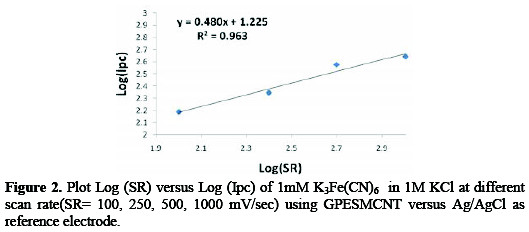
    <p>The effect of varying scan rates (SR) on the cyclic voltammograms using grafted 
polymer electrode self modified with CNT as working electrode in 1M KCl as a 
supporting electrolyte was studied with 1mM K3Fe(CN)6 over a scan rate ranging 
from 5 - 1000 mV/s. Oxidation and reduction currents of Fe(II)/Fe(III) couple 
increased with the scan rate due to heterogeneous kinetics and IR effect. 
<a href="#f2">Figure 2</a> is a reasonably linear dependence of GPESMCNT reduction current on the scan 
rate and is described by y=0.48x - 1.225, R2 =0.963.</p>


    <p>&nbsp;</p>
<a name="f2">
<img src="/img/revistas/pea/v34n2/34n2a02f2.jpg">
    
<p>&nbsp;</p>


    ]]></body>
<body><![CDATA[<p>The slope of graph Log Ipc 
(reduction current) versus Log (SR) is 0.48; which is significantly differ from the 
theoretical value of half for diffusion-controlled process, indicating presence of 
a complex. The relationship between oxidative potential and scan rate of 
GPESMCNT, shows a reduction peak at 150mV in low scan rate but increased to 
500mV at high scan rate (Linearly with Y=0.48X+150 (R2=0.963). Surface 
intercepts process at zero current produces zero current potential (E0,1) of 150 
mV for the reduction of GPESMCNT.</p>


    <p><b>Effect of Varying K3Fe(CN)6 Concentration</b></p>

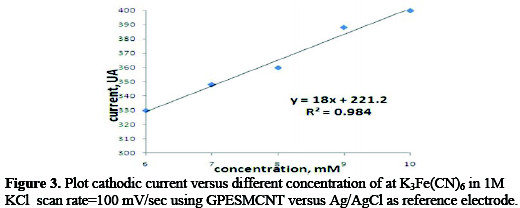
    <p><a href="#f3">Figure 3</a> shows the linear current dependent on K3Fe(CN)6 concentration; 
observed at concentration range (5-10mM) which is described by the equation of 
y=18X+221.2 with R2=0.984.</p>


    <p>&nbsp;</p>
<a name="f3">
<img src="/img/revistas/pea/v34n2/34n2a02f3.jpg">
    
<p>&nbsp;</p>


    <p>The slope of the linear line for K3Fe(CN)6 showed 
that a considerably high sensitivity response of18 &mu;A/mM is readily obtained at 
GPESMCNT during cyclic voltammetry.</p>


    <p><b>Reproducibility</b></p>

    <p>The potential cycling of the redox of GPESMCNT in 1mM K3Fe(CN)6 and 1 M 
KCl aqueous solution as a supporting electrolyte was carried out during cyclic 
voltammetry. Continuous potential cycling did not seem to affect the redox 
current of GPESMCNT as the faradic activity appears reproducible even after 15 
cycles, reflecting the stability and reproducibility at the surface of GPESMCNT.</p>


    <p><b>Scanning Electron Microscopy (SEM) of GPE/CNT</b></p>

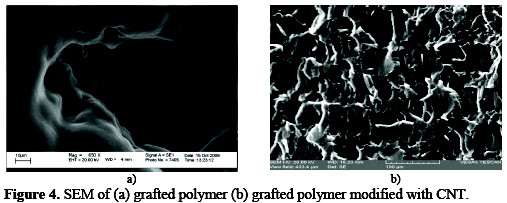
    <p>Before electro-analysis, grafted polymer surface appears compact and nonporous. 
The uniformity of the grafted polymer surface slightly increases since occurrence 
of protrusion observed phase as shown in <a href="#f4">Figure 4a</a>.</p>


    ]]></body>
<body><![CDATA[<p>&nbsp;</p>
<a name="f4">
<img src="/img/revistas/pea/v34n2/34n2a02f4.jpg">
    
<p>&nbsp;</p>


    <p>After modification with 
CNT, although many of the nano deposits with homogenous distribution of CNT 
still remain at about &lt;1 &mu;m as show in <a href="#f4">Figure 4b</a>.</p>


    <p><b>Atomic Force Microscopy (AFM)</b></p>

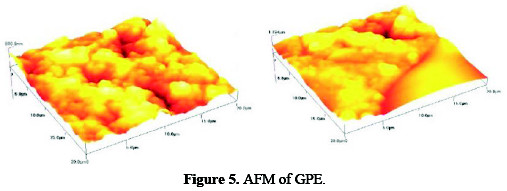
    <p>The surface image of AFM in an area of 20 &mu;m &times; 20 &mu;m of the grafted polymer 
(polystyrene acrylonitrile) before and after modified with CNT as shown in <a href="#f5">Fig. 5</a>.</p>


    <p>&nbsp;</p>
<a name="f5">
<img src="/img/revistas/pea/v34n2/34n2a02f5.jpg">
    
<p>&nbsp;</p>


    <p>The surface of the electrode appeared to be compact and rough. According to 
AFM images, the average grain size and thickness of the film were estimated to 
be 11.23 &mu;m and 28.69 &mu;m, respectively.</p>


    <p>&nbsp;</p>
    <p><b>Conclusions</b></p>

    ]]></body>
<body><![CDATA[<p>A Grafted Polymer Electrode self modified with CNT (GPESMCNT) has an 
extended potential working region as a compared with solid electrodes and 
classical modification electrodes. The stability of GPESMCNT as a working 
electrode was evaluated by using K3Fe(CN)6 in KCl electrolyte. Redox peaks of 
Fe(II) / Fe(III) obtained at GPESMCNT showed high current as compared with 
bar GCE. Electro-catalytic activity of GPESMCNT is therefore evident in this 
study. GPESMCNT was studied by redox process of K3Fe(CN)6 in KCl solution 
during cyclic voltammetry. The redox peaks potential shifts slightly to less 
negative value by about 100 mV for oxidative peak and 50 mV for reductive 
peak with current enhancement of about 3-5 folds. The sensitivity under 
conditions of cyclic voltammetry is significantly dependent on the concentration 
and scan rate. Excellent reproducibility of the current is observed, provided a 
fabricated electrode is used for each experiment without cleaning.</p>


    <p>&nbsp;</p>
    <p><b>References</b></p>

    <!-- ref --><p>1. Tan W T, Radhi M M, Ab Rahman M Z B, et al. J Appl Sci. 2010;10:139.    &nbsp;&nbsp;&nbsp;&nbsp;&nbsp;&nbsp;&nbsp;&nbsp;[&#160;<a href="javascript:void(0);" onclick="javascript: window.open('/scielo.php?script=sci_nlinks&ref=419451&pid=S0872-1904201600020000200001&lng=','','width=640,height=500,resizable=yes,scrollbars=1,menubar=yes,');">Links</a>&#160;]<!-- end-ref --></p>

    <!-- ref --><p>2. Radhi M M, Tan W T, Ab Rahman M Z et al. Sci Research Essays. 2012;7:790.    &nbsp;&nbsp;&nbsp;&nbsp;&nbsp;&nbsp;&nbsp;&nbsp;[&#160;<a href="javascript:void(0);" onclick="javascript: window.open('/scielo.php?script=sci_nlinks&ref=419453&pid=S0872-1904201600020000200002&lng=','','width=640,height=500,resizable=yes,scrollbars=1,menubar=yes,');">Links</a>&#160;]<!-- end-ref --></p>

    <!-- ref --><p>3. Radhi M M, Haider A J, Jameel Z N, et al. Research J Chem Sci. 2012;2:1.    &nbsp;&nbsp;&nbsp;&nbsp;&nbsp;&nbsp;&nbsp;&nbsp;[&#160;<a href="javascript:void(0);" onclick="javascript: window.open('/scielo.php?script=sci_nlinks&ref=419455&pid=S0872-1904201600020000200003&lng=','','width=640,height=500,resizable=yes,scrollbars=1,menubar=yes,');">Links</a>&#160;]<!-- end-ref --></p>

    <!-- ref --><p>4. Bhattacharya A, Misra B N. Prog Polym Sci. 2004;29:767.    &nbsp;&nbsp;&nbsp;&nbsp;&nbsp;&nbsp;&nbsp;&nbsp;[&#160;<a href="javascript:void(0);" onclick="javascript: window.open('/scielo.php?script=sci_nlinks&ref=419457&pid=S0872-1904201600020000200004&lng=','','width=640,height=500,resizable=yes,scrollbars=1,menubar=yes,');">Links</a>&#160;]<!-- end-ref --></p>

    <!-- ref --><p>5. Grande C D, Tria M C, Jiang G, et al. Reactive Funct Polym. 2011;71:938.    &nbsp;&nbsp;&nbsp;&nbsp;&nbsp;&nbsp;&nbsp;&nbsp;[&#160;<a href="javascript:void(0);" onclick="javascript: window.open('/scielo.php?script=sci_nlinks&ref=419459&pid=S0872-1904201600020000200005&lng=','','width=640,height=500,resizable=yes,scrollbars=1,menubar=yes,');">Links</a>&#160;]<!-- end-ref --></p>

    <!-- ref --><p>6. Cha S I, Kim K T, Lee K H, et al. Carbon. 2008;46:482.    &nbsp;&nbsp;&nbsp;&nbsp;&nbsp;&nbsp;&nbsp;&nbsp;[&#160;<a href="javascript:void(0);" onclick="javascript: window.open('/scielo.php?script=sci_nlinks&ref=419461&pid=S0872-1904201600020000200006&lng=','','width=640,height=500,resizable=yes,scrollbars=1,menubar=yes,');">Links</a>&#160;]<!-- end-ref --></p>

    <!-- ref --><p>7. Lee H J, Han S W, Kwon Y D, et al. Carbon. 2008;46:1850.    &nbsp;&nbsp;&nbsp;&nbsp;&nbsp;&nbsp;&nbsp;&nbsp;[&#160;<a href="javascript:void(0);" onclick="javascript: window.open('/scielo.php?script=sci_nlinks&ref=419463&pid=S0872-1904201600020000200007&lng=','','width=640,height=500,resizable=yes,scrollbars=1,menubar=yes,');">Links</a>&#160;]<!-- end-ref --></p>

    <!-- ref --><p>8. Lu W, Li N, Chen W, et al. Carbon. 2009;47:3337.    &nbsp;&nbsp;&nbsp;&nbsp;&nbsp;&nbsp;&nbsp;&nbsp;[&#160;<a href="javascript:void(0);" onclick="javascript: window.open('/scielo.php?script=sci_nlinks&ref=419465&pid=S0872-1904201600020000200008&lng=','','width=640,height=500,resizable=yes,scrollbars=1,menubar=yes,');">Links</a>&#160;]<!-- end-ref --></p>

    <!-- ref --><p>9. Wang L, Zhu D, Duan L, et al. Carbon. 2010;48:3906.    &nbsp;&nbsp;&nbsp;&nbsp;&nbsp;&nbsp;&nbsp;&nbsp;[&#160;<a href="javascript:void(0);" onclick="javascript: window.open('/scielo.php?script=sci_nlinks&ref=419467&pid=S0872-1904201600020000200009&lng=','','width=640,height=500,resizable=yes,scrollbars=1,menubar=yes,');">Links</a>&#160;]<!-- end-ref --></p>

    <!-- ref --><p>10. Natta G, Corradini P, Bassi I. Nuovo Cimento. 1960;15:68.    &nbsp;&nbsp;&nbsp;&nbsp;&nbsp;&nbsp;&nbsp;&nbsp;[&#160;<a href="javascript:void(0);" onclick="javascript: window.open('/scielo.php?script=sci_nlinks&ref=419469&pid=S0872-1904201600020000200010&lng=','','width=640,height=500,resizable=yes,scrollbars=1,menubar=yes,');">Links</a>&#160;]<!-- end-ref --></p>

    <!-- ref --><p>11. Ong T, Ng S, Chan H. Polymer. 2003;44:5597.    &nbsp;&nbsp;&nbsp;&nbsp;&nbsp;&nbsp;&nbsp;&nbsp;[&#160;<a href="javascript:void(0);" onclick="javascript: window.open('/scielo.php?script=sci_nlinks&ref=419471&pid=S0872-1904201600020000200011&lng=','','width=640,height=500,resizable=yes,scrollbars=1,menubar=yes,');">Links</a>&#160;]<!-- end-ref --></p>

    <!-- ref --><p>12. Tiwari D C, Jain R, Sahu G. Indian J Chem Techn. 2008;15:472.    &nbsp;&nbsp;&nbsp;&nbsp;&nbsp;&nbsp;&nbsp;&nbsp;[&#160;<a href="javascript:void(0);" onclick="javascript: window.open('/scielo.php?script=sci_nlinks&ref=419473&pid=S0872-1904201600020000200012&lng=','','width=640,height=500,resizable=yes,scrollbars=1,menubar=yes,');">Links</a>&#160;]<!-- end-ref --></p>

    <!-- ref --><p>13. Maouche N, Nessark B. Int J Electrochem. 2011;Article ID 670513.    &nbsp;&nbsp;&nbsp;&nbsp;&nbsp;&nbsp;&nbsp;&nbsp;[&#160;<a href="javascript:void(0);" onclick="javascript: window.open('/scielo.php?script=sci_nlinks&ref=419475&pid=S0872-1904201600020000200013&lng=','','width=640,height=500,resizable=yes,scrollbars=1,menubar=yes,');">Links</a>&#160;]<!-- end-ref --></p>

    <!-- ref --><p>14. Hoseini S H, Entezami A A. Iranian Polym J. 2005;14:101.    &nbsp;&nbsp;&nbsp;&nbsp;&nbsp;&nbsp;&nbsp;&nbsp;[&#160;<a href="javascript:void(0);" onclick="javascript: window.open('/scielo.php?script=sci_nlinks&ref=419477&pid=S0872-1904201600020000200014&lng=','','width=640,height=500,resizable=yes,scrollbars=1,menubar=yes,');">Links</a>&#160;]<!-- end-ref --></p>

    <!-- ref --><p>15. Dubey N, Leclerc M. J Polym Sci, Part b: Polym Phys. 2011;49:467.    &nbsp;&nbsp;&nbsp;&nbsp;&nbsp;&nbsp;&nbsp;&nbsp;[&#160;<a href="javascript:void(0);" onclick="javascript: window.open('/scielo.php?script=sci_nlinks&ref=419479&pid=S0872-1904201600020000200015&lng=','','width=640,height=500,resizable=yes,scrollbars=1,menubar=yes,');">Links</a>&#160;]<!-- end-ref --></p>


    <p>&nbsp;</p>
    <p><a name=0></a><sup><a href="#top">*</a></sup>Corresponding author. E-mail address: <a href="mailto:mmradhi@yahoo.com">mmradhi@yahoo.com</a></p>

    <p>Received 04 April 2015; accepted 26 February 2016</p>

    <p><a href="http://www.peacta.org" target="_blank">www.peacta.org</a> </p>


     ]]></body><back>
<ref-list>
<ref id="B1">
<label>1</label><nlm-citation citation-type="journal">
<person-group person-group-type="author">
<name>
<surname><![CDATA[Tan]]></surname>
<given-names><![CDATA[W T]]></given-names>
</name>
<name>
<surname><![CDATA[Radhi]]></surname>
<given-names><![CDATA[M M]]></given-names>
</name>
<name>
<surname><![CDATA[Ab Rahman]]></surname>
<given-names><![CDATA[M Z B]]></given-names>
</name>
</person-group>
<source><![CDATA[J Appl Sci]]></source>
<year>2010</year>
<volume>10</volume>
<page-range>139</page-range></nlm-citation>
</ref>
<ref id="B2">
<label>2</label><nlm-citation citation-type="journal">
<person-group person-group-type="author">
<name>
<surname><![CDATA[Radhi]]></surname>
<given-names><![CDATA[M M]]></given-names>
</name>
<name>
<surname><![CDATA[Tan]]></surname>
<given-names><![CDATA[W T]]></given-names>
</name>
<name>
<surname><![CDATA[Ab Rahman]]></surname>
<given-names><![CDATA[M Z]]></given-names>
</name>
</person-group>
<source><![CDATA[Sci Research Essays]]></source>
<year>2012</year>
<volume>7</volume>
<page-range>790</page-range></nlm-citation>
</ref>
<ref id="B3">
<label>3</label><nlm-citation citation-type="journal">
<person-group person-group-type="author">
<name>
<surname><![CDATA[Radhi]]></surname>
<given-names><![CDATA[M M]]></given-names>
</name>
<name>
<surname><![CDATA[Haider]]></surname>
<given-names><![CDATA[A J]]></given-names>
</name>
<name>
<surname><![CDATA[Jameel]]></surname>
<given-names><![CDATA[Z N]]></given-names>
</name>
</person-group>
<source><![CDATA[Research J Chem Sci]]></source>
<year>2012</year>
<volume>2</volume>
<page-range>1</page-range></nlm-citation>
</ref>
<ref id="B4">
<label>4</label><nlm-citation citation-type="journal">
<person-group person-group-type="author">
<name>
<surname><![CDATA[Bhattacharya]]></surname>
<given-names><![CDATA[A]]></given-names>
</name>
<name>
<surname><![CDATA[Misra]]></surname>
<given-names><![CDATA[B N]]></given-names>
</name>
</person-group>
<source><![CDATA[Prog Polym Sci]]></source>
<year>2004</year>
<volume>29</volume>
<page-range>767</page-range></nlm-citation>
</ref>
<ref id="B5">
<label>5</label><nlm-citation citation-type="journal">
<person-group person-group-type="author">
<name>
<surname><![CDATA[Grande]]></surname>
<given-names><![CDATA[C D]]></given-names>
</name>
<name>
<surname><![CDATA[Tria]]></surname>
<given-names><![CDATA[M C]]></given-names>
</name>
<name>
<surname><![CDATA[Jiang]]></surname>
<given-names><![CDATA[G]]></given-names>
</name>
</person-group>
<source><![CDATA[Reactive Funct Polym]]></source>
<year>2011</year>
<volume>71</volume>
<page-range>938</page-range></nlm-citation>
</ref>
<ref id="B6">
<label>6</label><nlm-citation citation-type="journal">
<person-group person-group-type="author">
<name>
<surname><![CDATA[Cha]]></surname>
<given-names><![CDATA[S I]]></given-names>
</name>
<name>
<surname><![CDATA[Kim]]></surname>
<given-names><![CDATA[K T]]></given-names>
</name>
<name>
<surname><![CDATA[Lee]]></surname>
<given-names><![CDATA[K H]]></given-names>
</name>
</person-group>
<source><![CDATA[Carbon]]></source>
<year>2008</year>
<volume>46</volume>
<page-range>482</page-range></nlm-citation>
</ref>
<ref id="B7">
<label>7</label><nlm-citation citation-type="journal">
<person-group person-group-type="author">
<name>
<surname><![CDATA[Lee]]></surname>
<given-names><![CDATA[H J]]></given-names>
</name>
<name>
<surname><![CDATA[Han]]></surname>
<given-names><![CDATA[S W]]></given-names>
</name>
<name>
<surname><![CDATA[Kwon]]></surname>
<given-names><![CDATA[Y D]]></given-names>
</name>
</person-group>
<source><![CDATA[Carbon]]></source>
<year>2008</year>
<volume>46</volume>
<page-range>1850</page-range></nlm-citation>
</ref>
<ref id="B8">
<label>8</label><nlm-citation citation-type="journal">
<person-group person-group-type="author">
<name>
<surname><![CDATA[Lu]]></surname>
<given-names><![CDATA[W]]></given-names>
</name>
<name>
<surname><![CDATA[Li]]></surname>
<given-names><![CDATA[N]]></given-names>
</name>
<name>
<surname><![CDATA[Chen]]></surname>
<given-names><![CDATA[W]]></given-names>
</name>
</person-group>
<source><![CDATA[Carbon]]></source>
<year>2009</year>
<volume>47</volume>
<page-range>3337</page-range></nlm-citation>
</ref>
<ref id="B9">
<label>9</label><nlm-citation citation-type="journal">
<person-group person-group-type="author">
<name>
<surname><![CDATA[Wang]]></surname>
<given-names><![CDATA[L]]></given-names>
</name>
<name>
<surname><![CDATA[Zhu]]></surname>
<given-names><![CDATA[D]]></given-names>
</name>
<name>
<surname><![CDATA[Duan]]></surname>
<given-names><![CDATA[L]]></given-names>
</name>
</person-group>
<source><![CDATA[Carbon]]></source>
<year>2010</year>
<volume>48</volume>
<page-range>3906</page-range></nlm-citation>
</ref>
<ref id="B10">
<label>10</label><nlm-citation citation-type="journal">
<person-group person-group-type="author">
<name>
<surname><![CDATA[Natta]]></surname>
<given-names><![CDATA[G]]></given-names>
</name>
<name>
<surname><![CDATA[Corradini]]></surname>
<given-names><![CDATA[P]]></given-names>
</name>
<name>
<surname><![CDATA[Bassi]]></surname>
<given-names><![CDATA[I]]></given-names>
</name>
</person-group>
<source><![CDATA[Nuovo Cimento]]></source>
<year>1960</year>
<volume>15</volume>
<page-range>68</page-range></nlm-citation>
</ref>
<ref id="B11">
<label>11</label><nlm-citation citation-type="journal">
<person-group person-group-type="author">
<name>
<surname><![CDATA[Ong]]></surname>
<given-names><![CDATA[T]]></given-names>
</name>
<name>
<surname><![CDATA[Ng]]></surname>
<given-names><![CDATA[S]]></given-names>
</name>
<name>
<surname><![CDATA[Chan]]></surname>
<given-names><![CDATA[H]]></given-names>
</name>
</person-group>
<source><![CDATA[Polymer]]></source>
<year>2003</year>
<volume>44</volume>
<page-range>5597</page-range></nlm-citation>
</ref>
<ref id="B12">
<label>12</label><nlm-citation citation-type="journal">
<person-group person-group-type="author">
<name>
<surname><![CDATA[Tiwari]]></surname>
<given-names><![CDATA[D C]]></given-names>
</name>
<name>
<surname><![CDATA[Jain]]></surname>
<given-names><![CDATA[R]]></given-names>
</name>
<name>
<surname><![CDATA[Sahu]]></surname>
<given-names><![CDATA[G]]></given-names>
</name>
</person-group>
<source><![CDATA[Indian J Chem Techn]]></source>
<year>2008</year>
<volume>15</volume>
<page-range>472</page-range></nlm-citation>
</ref>
<ref id="B13">
<label>13</label><nlm-citation citation-type="journal">
<person-group person-group-type="author">
<name>
<surname><![CDATA[Maouche]]></surname>
<given-names><![CDATA[N]]></given-names>
</name>
<name>
<surname><![CDATA[Nessark]]></surname>
<given-names><![CDATA[B]]></given-names>
</name>
</person-group>
<source><![CDATA[Int J Electrochem]]></source>
<year>2011</year>
</nlm-citation>
</ref>
<ref id="B14">
<label>14</label><nlm-citation citation-type="journal">
<person-group person-group-type="author">
<name>
<surname><![CDATA[Hoseini]]></surname>
<given-names><![CDATA[S H]]></given-names>
</name>
<name>
<surname><![CDATA[Entezami]]></surname>
<given-names><![CDATA[A A]]></given-names>
</name>
</person-group>
<source><![CDATA[Iranian Polym J]]></source>
<year>2005</year>
<volume>14</volume>
<page-range>101</page-range></nlm-citation>
</ref>
<ref id="B15">
<label>15</label><nlm-citation citation-type="journal">
<person-group person-group-type="author">
<name>
<surname><![CDATA[Dubey]]></surname>
<given-names><![CDATA[N]]></given-names>
</name>
<name>
<surname><![CDATA[Leclerc]]></surname>
<given-names><![CDATA[M]]></given-names>
</name>
</person-group>
<source><![CDATA[J Polym Sci, Part b: Polym Phys]]></source>
<year>2011</year>
<volume>49</volume>
<page-range>467</page-range></nlm-citation>
</ref>
</ref-list>
</back>
</article>