<?xml version="1.0" encoding="ISO-8859-1"?><article xmlns:mml="http://www.w3.org/1998/Math/MathML" xmlns:xlink="http://www.w3.org/1999/xlink" xmlns:xsi="http://www.w3.org/2001/XMLSchema-instance">
<front>
<journal-meta>
<journal-id>0872-1904</journal-id>
<journal-title><![CDATA[Portugaliae Electrochimica Acta]]></journal-title>
<abbrev-journal-title><![CDATA[Port. Electrochim. Acta]]></abbrev-journal-title>
<issn>0872-1904</issn>
<publisher>
<publisher-name><![CDATA[Sociedade Portuguesa de Electroquímica]]></publisher-name>
</publisher>
</journal-meta>
<article-meta>
<article-id>S0872-19042016000200003</article-id>
<article-id pub-id-type="doi">10.4152/pea.201602105</article-id>
<title-group>
<article-title xml:lang="en"><![CDATA[Studying Copper Electropolishing Inhibition in Presence of Some Organic Alcohols]]></article-title>
</title-group>
<contrib-group>
<contrib contrib-type="author">
<name>
<surname><![CDATA[Attia]]></surname>
<given-names><![CDATA[Azza A.]]></given-names>
</name>
<xref ref-type="aff" rid="A01"/>
</contrib>
<contrib contrib-type="author">
<name>
<surname><![CDATA[Elmelegy]]></surname>
<given-names><![CDATA[Essam M.]]></given-names>
</name>
<xref ref-type="aff" rid="A01"/>
</contrib>
<contrib contrib-type="author">
<name>
<surname><![CDATA[El Batouti]]></surname>
<given-names><![CDATA[Mervette]]></given-names>
</name>
<xref ref-type="aff" rid="A02"/>
</contrib>
<contrib contrib-type="author">
<name>
<surname><![CDATA[Ahmed]]></surname>
<given-names><![CDATA[Abdel-Moneim M.]]></given-names>
</name>
<xref ref-type="aff" rid="A02"/>
</contrib>
</contrib-group>
<aff id="A01">
<institution><![CDATA[,Zagazig University Faculty of Science Chemistry Department]]></institution>
<addr-line><![CDATA[ ]]></addr-line>
<country>Egypt</country>
</aff>
<aff id="A02">
<institution><![CDATA[,Alexandria University Faculty of Science Chemistry Department]]></institution>
<addr-line><![CDATA[ ]]></addr-line>
<country>Egypt</country>
</aff>
<pub-date pub-type="pub">
<day>00</day>
<month>03</month>
<year>2016</year>
</pub-date>
<pub-date pub-type="epub">
<day>00</day>
<month>03</month>
<year>2016</year>
</pub-date>
<volume>34</volume>
<numero>2</numero>
<fpage>105</fpage>
<lpage>118</lpage>
<copyright-statement/>
<copyright-year/>
<self-uri xlink:href="http://scielo.pt/scielo.php?script=sci_arttext&amp;pid=S0872-19042016000200003&amp;lng=en&amp;nrm=iso"></self-uri><self-uri xlink:href="http://scielo.pt/scielo.php?script=sci_abstract&amp;pid=S0872-19042016000200003&amp;lng=en&amp;nrm=iso"></self-uri><self-uri xlink:href="http://scielo.pt/scielo.php?script=sci_pdf&amp;pid=S0872-19042016000200003&amp;lng=en&amp;nrm=iso"></self-uri><abstract abstract-type="short" xml:lang="en"><p><![CDATA[Electro polishing is defined as anodic corrosion. The issue of the effects of corrosion on structural integrity of metal surfaces has been a question of concern for some time. The uses of chemical corrosion inhibitors are common in production and processing operations. Nevertheless, the challenge is to develop a new class of corrosion inhibitors to protect the materials, due to the economic importance of copper there are several researches deals with acceleration and inhibition of this process. In this paper the electropolishing process inhibited with different ratio by addition of some organic alcohols (methanol, ethanol,propanol, and isopropanol) by addition with concentration (2, 5, 10, 15, 20, 25 and 30 %) .The results reveal that these organic alcohols have a strongest inhibitive effect ranging from 8.7 - 53.8 % and the thermodynamic parameters were present.]]></p></abstract>
<kwd-group>
<kwd lng="en"><![CDATA[Electropolishing of copper]]></kwd>
<kwd lng="en"><![CDATA[organic alcohols]]></kwd>
<kwd lng="en"><![CDATA[limiting current]]></kwd>
<kwd lng="en"><![CDATA[inhibition of corrosion]]></kwd>
<kwd lng="en"><![CDATA[thermodynamic parameters]]></kwd>
</kwd-group>
</article-meta>
</front><body><![CDATA[ 

<!--     <p>&nbsp;</p>
    <p>doi: 10.4152/pea.201602105</p> -->

    <p><b>Studying Copper Electropolishing Inhibition in Presence of Some Organic Alcohols</b></p>

    <p>
<b>Azza A. Attia</b><sup><i>a</i></sup>
, <b>Essam M.Elmelegy</b><sup><i>a</i></sup>
, <b>Mervette El Batouti</b><sup><i>b</i>,<a href="#0">*</a></sup>
 and <b>Abdel-Moneim M. Ahmed</b><sup><i>b</i></sup>
</p>

    <p><i><sup>a</sup> Chemistry Department, Faculty of Science, Zagazig University, Egypt</i></p>

    <p><i><sup>b</sup> Chemistry Department, Faculty of Science, Alexandria University, Egypt</i></p>


    <p>&nbsp;</p>
    <p><b>Abstract</b></p>

    <p>Electro polishing is defined as anodic corrosion. 
The issue of the effects of corrosion on structural integrity 
of metal surfaces has been a question of concern for some time. The 
uses of chemical corrosion inhibitors are common in production and processing 
operations. Nevertheless, the challenge is to develop a new class of corrosion inhibitors 
to protect the materials, due to the economic importance of copper there are several 
researches deals with acceleration and inhibition of this process. In this paper 
the electropolishing process inhibited with different ratio by addition of some organic 
alcohols (methanol, ethanol,propanol, and isopropanol) by addition with concentration 
(2, 5, 10, 15, 20, 25 and 30 %) .The results reveal that these organic alcohols have a 
strongest inhibitive effect ranging from 8.7 - 53.8 % and the thermodynamic parameters 
were present.</p>

    ]]></body>
<body><![CDATA[<p><b><i>Keywords:</i></b> Electropolishing of copper, organic alcohols, limiting current, inhibition of 
corrosion, thermodynamic parameters.</p>


    <p>&nbsp;</p>
    <p><b>Introduction</b></p>

    <p>Corrosion is an electrochemical process that involves the rearrangement of 
electrons between metal surface and an aqueous electrolyte solution. 
Corrosion of materials is a big problem that receive interest of scientists whose 
concern in the technological world. Scientists are persistent in seeking better and more 
efficient ways of combating the corrosion of metals. Addition of corrosion 
inhibitors to the corrosion environment with respect to the other methods of 
corrosion inhibition has been employed [1-2]. The use of inhibitors is one of 
the most practical methods for protection against corrosion in acidic media. To 
be effective, an inhibitor must also transfer water from the metal surface, interact 
with anodic or cathodic reaction sites to retard the oxidation and reduction 
corrosion reaction, and prevent transportation of water and corrosion-active 
species on the metal surface. Copper is a material commonly used in heating and 
cooling systems. Scale and corrosion products have a negative effect on heat 
transfer, and they cause a decrease in the heating efficiency of the equipments 
which is a big problem in industrial processes.</p>

    <p>Many corrosion inhibitors can be used to eliminate the undesirable 
destructive effect and prevent metal dissolution. Copper normally does 
not displace hydrogen from acid solutions and, therefore, is virtually 
unattached in non-oxidizing conditions. In fact, the uprising hydrogen bubbles induce a radial 
momentum transfer, which enhances the rate of copper corrosion [3].</p>

    <p>Corrosion inhibitors can be used to prevent copper dissolution. Amines are 
known to be very effective inhibitors for metal and alloys in different corrosion 
media. Benzotriazole, for instances, was studied and found to have excellent 
inhibition properties in several corrosive environments [4]. The molecule 
contains nitrogen atoms and it is also useful in preventing copper staining and 
tarnishing [5]. The electropolishing process reported to be inhibited with 
different ratio by the addition of some organic aldehydes [6]and Organic 
compounds containing polar groups, including nitrogen, sulfur, oxygen, and 
heterocyclic compounds with polar functional groups and conjugated double 
bonds have been reported to inhibit copper corrosion [7-13]. The inhibiting 
action of these organic compounds is usually attributed to their interactions with 
the copper surface via their adsorption. Polar functional groups are regarded as 
the reaction center that stabilizes the adsorption process, in general, the 
adsorption of an inhibitor on a metal surface depends on the nature and the 
surface charge of the metal, the adsorption mode, its chemical structure and the 
type of electrolyte solution [14].</p>

    <p>The phenomenon of electropolishing is first discovered by Jaquet [15]. A lot of 
work has been done on this phenomenon owing to its importance as a metal 
finishing process. A great deal of work has been directed to study the mechanism 
of electro polishing as well as to establish conditions for different metals and 
alloys involved in the process.</p>

    <p>Mechanistic studies have revealed that electro polishing is diffusion controlled 
process taking place at the limiting current which is attained most probably 
when the diffusion layer becomes saturated with Cu in, electropolishing of copper.</p>

    <p>Therefore, the values of the limiting current which determined the polishing rate 
depends on the rate of mass transfer of Cu<sup>+2</sup> from the diffusion layer to the bulk 
solution. The latter depends on the relative movement of the ions at the anode 
and in the electrolyte. Earlier works studied the factors affecting the limiting 
current have overlooked the effect of anode geometry as an important factor in 
determining the value of the limiting current.</p>

    <p>Other work based on electron diffraction showed that, the film is an 
oxide. Hull cell studies by Lurking suggested that, copper oxides are 
formed during electro polishing of copper in H3PO4 [16].</p>

    ]]></body>
<body><![CDATA[<p>It can be denied that, a viscous layer is present at the surface of copper anodes 
during electro polishing as shown by the work of Walton [17].</p>

    <p>The objective of this study is to investigate the effect of some organic alcohols 
(methanol, ethanol, propanol, and isopropanol) on the inhibition of copper corrosion 
in phosphoric acid at different conditions. The rate of copper corrosion 
is determined bymeasuring the anodic limiting current.</p>


    <p>&nbsp;</p>
    <p><b>Experimental Procedure</b></p>

    <p><i><b>Chemicals</b></i></p>

    <p>Analytical grade H3PO4 (98% w/w) and double distilled water used to prepare the 
electrolyte. The organic alcohols were used in this work are methanol, ethanol, 
propanol, and isopropanol.</p>


    <p>&nbsp;</p>
<a name="s1">
<img src="/img/revistas/pea/v34n2/34n2a03s1.jpg">
    
<p>&nbsp;</p>


    <p><i><b>Apparatus and Procedure</b></i></p>

    <p>The cell and electrical circuit used in the present work showed in previous work 
[6]. The cell consists of a rectangular plastic container having the dimensions 
5.1&times;5&times;10 cm with electrodes fill-in the whole cross section. The electrodes were 
rectangular copper sheets of 10 cm height and 5 cm width. Electrode separation 
was 5 cm. A porous PVC diaphragm was used to prevent the effect due to H2 
bubbles. The electrical circuit consists of 6V D.C. power supply, while a 
voltmeter is connected in parallel to the cell to measure the voltage and 
multirange ammeter connected in series with cell to measure the current.</p>


    ]]></body>
<body><![CDATA[<p><i><b>Measurements of the Limiting Current</b></i></p>

    <p>Polarization curves were obtained byincreasing the cell current step wise and the 
steady state anode potential against a reference electrode consisted of a wire 
immersed in a cup ofLuggin tubefilled with phosphoric acid concentration 
similar to that in the cell, the tip of the Luggin tube was placed 0.5-from the 
anode. The potential difference between the anode and the reference was measured 
by high impedance potentiometer. Five phosphoric acid concentrations (6, 8, 10, 12 
and 14 M) were prepared from Analar grade phosphoric acid distilled water. The anode 
height varied from 1-5 cm. Before each run, the back part of 
the anode was insulated with polystyrene lacquers and the active surface of 
the anode was polished with fine emery paper, decreased with trichloroethylene, 
washed with alcohol and finally rinsed in distilled water. Electrode treatment was similar to that used by 
Wilke [18]. Organic acid concentration were 10<sup>-5</sup> - 10<sup>-2</sup> mol l<sup>-1</sup>. The rate of 
electropolishing of copper was determined at 25 &deg;C.</p>


    <p>&nbsp;</p>
    <p><b>Results and Discussion</b></p>

    <p><i><b>Effect of alcohol concentration on the limiting current density</b></i></p>

    <p>The observed limiting current density, which represents the rate of copper metal 
corrosion in phosphoric acid at 25 &deg;C , decrease with increasing the concentration 
of the organic alcohols under study.</p>


    <p><i><b>Effect of alcohol concentration on the limiting current density</b></i></p>

    <p>It found that the limiting current decreases with increasing the concentration of 
alcohols. From the practical point of view and on the basis of results obtained the 
uses of alcohols studied in the concentration range between (2, 5, 10, 15, 20, 25 
and 30 %) inhibit the corrosion of copper metal in 8 M H3PO4acid [19, 20]. The 
limiting current in the absence of organic alcohols (I), and in the presence of 
organic alcohols (IL), the percentage inhibition can be calculated from the 
following equation:</p>


    <p>&nbsp;</p>
<a name="e1">
<img src="/img/revistas/pea/v34n2/34n2a03e1.jpg">
    
<p>&nbsp;</p>


    ]]></body>
<body><![CDATA[<p><i><b>Adsorption Isotherm</b></i></p>

    <p>The adsorption of the inhibitor molecules from aqueous solutions can be 
regarded as a substitution adsorption process between the organic compounds in 
the aqueous phase and water molecules adsorbed on the electrode surface (H2O(s)).</p>


    <p>&nbsp;</p>
<a name="e2">
<img src="/img/revistas/pea/v34n2/34n2a03e2.jpg">
    
<p>&nbsp;</p>


    <p>where x (the size ratio) is the number of water molecules displaced byone 
molecule of inhibitor. The above process reaches equilibrium when the chemical 
potential on the left hand equal to that of the right hand side.</p>

    <p>Adsorption isotherms are very important in determining the mechanism 
of electrochemical reactions. The most frequently used isotherms are those 
of Langmuir . Frumkin, Parsons, Temkin, Flory-Huggins, and Bockris-Swinkels 
[21].</p>

    <p>These entire isotherms are of the general form:</p>


    <p>&nbsp;</p>
<a name="e3">
<img src="/img/revistas/pea/v34n2/34n2a03e3.jpg">
    
<p>&nbsp;</p>


    <p>where f(&theta;, x) is the configuration factor which depends essentially 
on the physical model and assumption underlying the derivation of the 
isotherm. The mechanism of inhibition is generally believed to be due 
to the formation and maintenance of a protective film on the metal surface [22,23].</p>

    ]]></body>
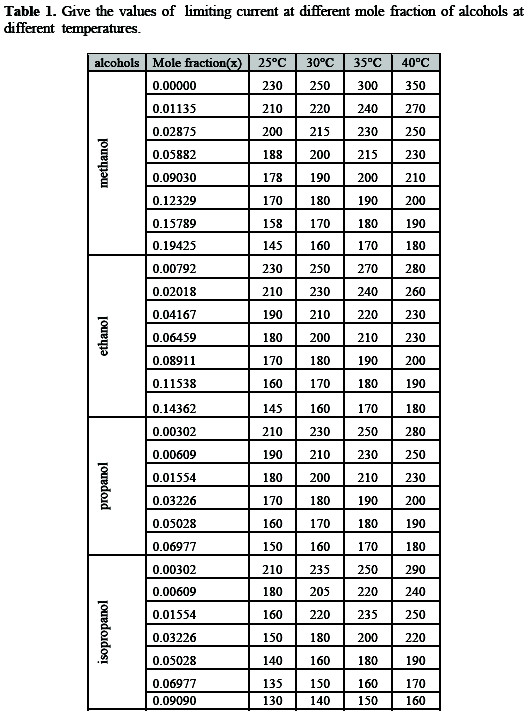
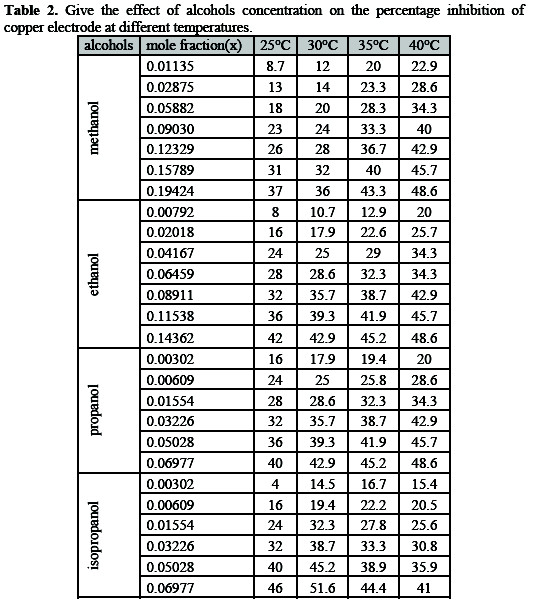
<body><![CDATA[<p><a href="#t1">Table 1</a> presents  the  values  of    limiting  current  at  different  mole  fraction  of  alcohols  at 
different  temperatures.</p>


    <p>&nbsp;</p>
<a name="t1">
<img src="/img/revistas/pea/v34n2/34n2a03t1.jpg">
    
<p>&nbsp;</p>


    <p><i><b>Application of Isotherm</b></i></p>

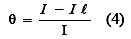
    <p>The degree of surface coverage (&theta;) at constant temperature was determined from 
the following equation[24,25].</p>


    <p>&nbsp;</p>
<a name="e4">
<img src="/img/revistas/pea/v34n2/34n2a03e4.jpg">
    
<p>&nbsp;</p>


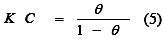
    <p>Inhibitor adsorption characteristics can be estimated by using the Langmuir 
isotherm given by the following equation:</p>


    <p>&nbsp;</p>
<a name="e5">
<img src="/img/revistas/pea/v34n2/34n2a03e5.jpg">
    
<p>&nbsp;</p>


    ]]></body>
<body><![CDATA[<p>The langmuir adsorption isotherm for copper electrode in H3PO4plotted as 
&theta; /1-&theta; against C at 25 &deg;C which give as a straight line that does not pass from 
the origin, i.e. Langmuir isotherm does not verify.</p>

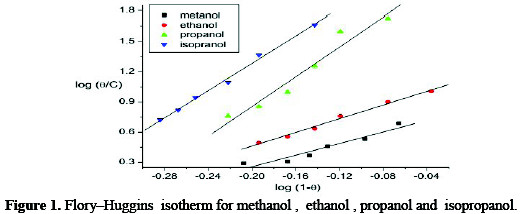
    <p><a href="#f1">Fig. 1</a> shows the Flory-Huggins adsorption isotherm for copper electrode in 
H3PO4plotted as log &theta; /C against log (1-&theta;) at 25&deg;C.</p>


    <p>&nbsp;</p>
<a name="f1">
<img src="/img/revistas/pea/v34n2/34n2a03f1.jpg">
    
<p>&nbsp;</p>


    <p>A straight line is obtained with a slope X and intercept log &times; K. 
The experimental data fit the Flory-Huggins adsorption isotherm, which represented by:</p>


    <p>&nbsp;</p>
<a name="e6">
<img src="/img/revistas/pea/v34n2/34n2a03e6.jpg">
    
<p>&nbsp;</p>


    <p>where x is the number of water molecules replaced by one molecule of the 
inhibitor. It is clear that, the surface coverage data are useful for discussing 
adsorption characteristics. The adsorption of inhibitors at the metal-solution 
interface may be due to the formation of electrostatic or covalent bonding 
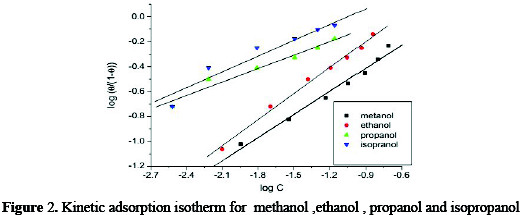
between the adsorbs and the metal surface [26]. The kinetic adsorption isotherm 
maybe written in the form [27]:</p>


    <p>&nbsp;</p>
<a name="e7">
<img src="/img/revistas/pea/v34n2/34n2a03e7.jpg">
    
<p>&nbsp;</p>


    ]]></body>
<body><![CDATA[<p>From equation (6) a plot of log &theta; /1-&theta; against log C should yield a straight line 
with intercept of log K' and slope = y, where y is the number of inhibitory molecules occupy one 
active site. The binding constant of adsorption K= k' l/y, where 1/y is the number of the active 
surface sites occupied by one molecule of the inhibitor, and k is the binding constant.</p>

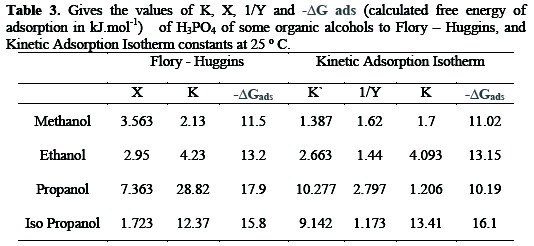
    <p><a href="#f2">Fig. 2</a> indicate a linear relationship between log &theta; / 1-&theta; and log C at 25&deg;C, and 
the calculated values of 1/y and K are given in <a href="#t2">Table 2</a>.</p>


    <p>&nbsp;</p>
<a name="f2">
<img src="/img/revistas/pea/v34n2/34n2a03f2.jpg">
    
<p>&nbsp;</p>
<a name="t2">
<img src="/img/revistas/pea/v34n2/34n2a03t2.jpg">
    
<p>&nbsp;</p>


    <p>And from this table, it is obvious that the 
value of 1/y for all compounds are higher than one indicating that, the given inhibitors molecules 
are attached to more than one active site. The free energy of adsorption (&Delta;G<sub>ads</sub>). 
At a different concentration of the alcohols as calculated from the following equation:</p>


    <p>&nbsp;</p>
<a name="e8">
<img src="/img/revistas/pea/v34n2/34n2a03e8.jpg">
    
<p>&nbsp;</p>


    <p>the value 55.5 is the concentration of water in the solution mol/1. 
The values of &Delta;G<sub>ads</sub> are given in <a href="#t3">Table 3</a>.</p>


    <p>&nbsp;</p>
<a name="t3">
<img src="/img/revistas/pea/v34n2/34n2a03t3.jpg">
    
]]></body>
<body><![CDATA[<p>&nbsp;</p>


    <p>In all cases, the (&Delta;G<sub>ads</sub>) values are 
negative and lie in the range of 10.2 - 16.1 KJ/mol. The most efficient inhibitor 
shows the most negative (&Delta;G<sub>ads</sub>) value. This suggests that, they are strongly 
adsorbed on metal surfaces. The negative values of (&Delta;G<sub>ads</sub>) indicate that the 
spontaneous ion of the inhibitors. It's found that (&Delta;G<sub>ads</sub>) values are more 
positive than (-40) indicating that the inhibitors are physically adsorbed on the 
metal surface. Similar results have also been reported by Talati [27].</p>


    <p><i><b>Effect of temperature and thermodynamic treatment of the reaction</b></i></p>

    <p>The effect of temperature on the Cu electro polishing rate in absence and presence of organic 
additives was determined in the temperature ranges between (25 - 40 &deg;C). It was observe that 
the electro polishing rate increases with temperature for different concentrations of 
organic additives. Values of Ea that have been derived from the slopes of Arrhenius [28].</p>

    <p>It is obviously seen that the Ea values in the absence and presence of organic 
additives are less than 40 kJ mol<sup>-1</sup>, also indicating that the 
diffusion processes are controlling the electropolishing reaction [29]. 
In this research, the thermodynamic parameters such as change in free energy 
&Delta;G<sup>*</sup>, enthalpy &Delta;H<sup>*</sup> and entropy &Delta;S<sup>*</sup> were 
calculated in the same way as the related researches did in 
literature [30-33]. From transition state equation [37] a straight line was obtained, 
from which can &Delta;H<sup>*</sup> and &Delta;S<sup>*</sup> be calculated from the slope 
and intercept, respectively. The free energy change, &Delta;G<sup>*</sup>, can be represented as follows:</p>


    <p>&nbsp;</p>
<a name="e9">
<img src="/img/revistas/pea/v34n2/34n2a03e9.jpg">
    
<p>&nbsp;</p>


    <p>The result indicated by that the tested compounds acted as inhibitors through 
adsorption on copper surface, which resulted in the formation of a barrier to mass 
and charge transfer. The values of &Delta;H<sup>*</sup> reflect the strong adsorption of 
these compounds on copper surface. The negative values of &Delta;S<sup>*</sup> pointed 
to a greater order produced during the process of activation.</p>


    <p>This can be achieved by the formation of an activated complex representing the 
association or fixation with consequent loss in the degree of freedom of the 
system during the process. &Delta;G<sup>*</sup> values showed a limited 
increase with a rise in the concentration of organic additives revealing 
that weak dependence of &Delta;G<sup>*</sup> on the composition of the 
organic additives can be attributed largely to the general 
linear composition between &Delta;H<sup>*</sup> and &Delta;S<sup>*</sup> for the given temperature [28, 34].</p>

    <p>Thermodynamic function of electropolishing of copper in alcohols gives evidence of 
structural change occurring in the solution as the type of solvents is 
changed. The effect can arise from the solvent properties and from 
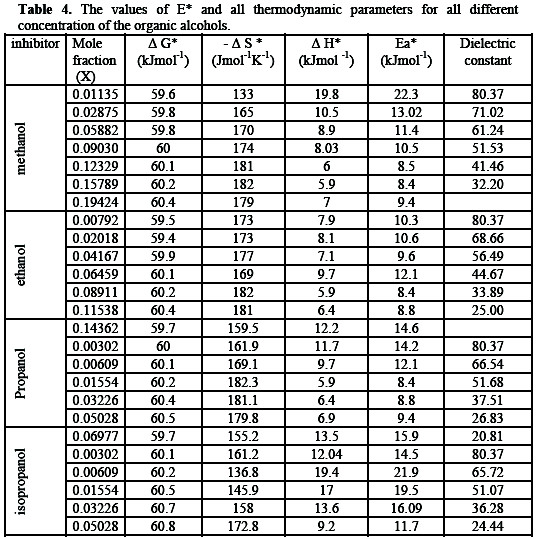
the salvation properties of ions in different solvents [35]. <a href="#t4">Table 4</a> shows 
the variations of &Delta;G<sup>*</sup>, &Delta;H<sup>*</sup> and &Delta;S<sup>*</sup> with the 
mole fraction of alcohols.</p>


    ]]></body>
<body><![CDATA[<p>&nbsp;</p>
<a name="t4">
<img src="/img/revistas/pea/v34n2/34n2a03t4.jpg">
    
<p>&nbsp;</p>


    <p>The gradual increases of both &Delta;H<sup>*</sup> 
and &Delta;S<sup>*</sup> give a good indication of 
preferential salvation of metal surface in the presence of 
aprotic solvents which is a criterion of specific salvation. The weak dependence of 
&Delta;G<sup>*</sup>, on the composition of the organic solvents can be 
attributed largely to the general linear compensation between &Delta;H<sup>*</sup> 
and &Delta;S<sup>*</sup> for the given temperature. <a href="#t4">Table 4</a> shows that, the free energy 
change increases positively with increasing dielectric constant of the solvent. This show 
that as the dielectric constant decreases more work as required to keep the ions apart and 
therefore the dissolution of Cu is decreased, as the dielectric constant decrease. 
There is less spontaneity and less dissolution of the lower dielectric constant. 
<a href="#t4">Table 4</a> show that for any solvent, as the temperature increases the dielectric 
constant decreases and the force among the ion greater [36]. This is attributed the 
fact that as temperature increases, the viscosity of solvent decreases, so salvation 
decrease and mobility of Cu<sup>2+</sup> increases, this led to increases in the rate of 
mass transfer.</p>


    <p><i><b>The isokinetic relationship</b></i></p>

    <p>Variation in the rate within series may be caused by changes in either, or both, 
the enthalpy or the entropy of activation the correlation of &Delta;H<sup>*</sup> 
with &Delta;S<sup>*</sup> is linear relationship may be stated algebraically:</p>


    <p>&nbsp;</p>
<a name="e10">
<img src="/img/revistas/pea/v34n2/34n2a03e10.jpg">
    
<p>&nbsp;</p>
<a name="e11">
<img src="/img/revistas/pea/v34n2/34n2a03e11.jpg">
    
<p>&nbsp;</p>


    <p>The operator, &delta;, concerns the difference between any 
two reactions in the series. Substituting from the equation (11) into the familiar relationship:</p>


    <p>&nbsp;</p>
<a name="e12">
<img src="/img/revistas/pea/v34n2/34n2a03e12.jpg">
    
]]></body>
<body><![CDATA[<p>&nbsp;</p>


    <p>we obtain</p>


    <p>&nbsp;</p>
<a name="e13">
<img src="/img/revistas/pea/v34n2/34n2a03e13.jpg">
    
<p>&nbsp;</p>


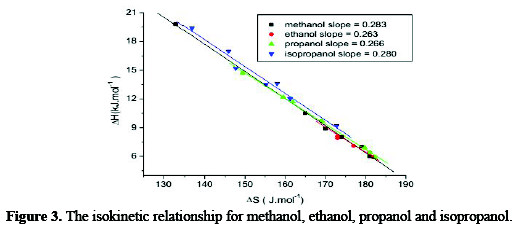
    <p>Where &delta;&Delta;G<sup>*</sup> = zero, &beta; = T. In other words, the slop in a linear plot of 
&Delta;H<sup>*</sup> 
versus &Delta;S<sup>*</sup> is the temperature at which all reactions that conform to the line 
occur at the same rate. &beta; there for known as the isokienetic temperature . The 
isokientic plot of &Delta;H<sup>*</sup> and &Delta;S<sup>*</sup> for different concentration of 
the organic alcohols, <a href="#f3">Fig. 3</a> and <a href="#t4">Table 4</a> was found 
to be linear and the isokienetic temperature (&beta;) was computed from 
the slop of the plot as 283K, 263 K, 266 K, and 280 K.</p>


    <p>&nbsp;</p>
<a name="f3">
<img src="/img/revistas/pea/v34n2/34n2a03f3.jpg">
    
<p>&nbsp;</p>


    <p>These values are much lower than that of the experimental 
temperature 298 K indicating that the rate of the reaction is Entropy controlled.</p>


    <p><i><b>Effect of dielectric constant</b></i></p>

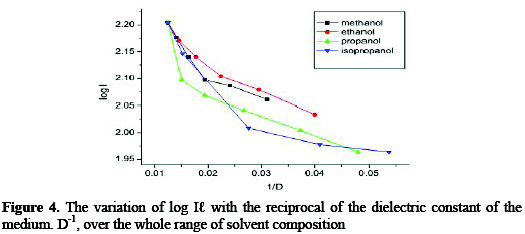
    <p>The variation of log Il with the reciprocal of the dielectric constant of 
the medium. D<sup>-1</sup>, over the whole range of solvent composition shows non-linear for 
all the aqueous solvent systems, <a href="#f4">Fig. 4</a>.</p>


    ]]></body>
<body><![CDATA[<p>&nbsp;</p>
<a name="f4">
<img src="/img/revistas/pea/v34n2/34n2a03f4.jpg">
    
<p>&nbsp;</p>


    <p>The absence of linearity suggests a 
large differential effect of solvent structure acting on the initial and transition 
states. This was shown from the extension of the equation of Laidler and 
Landskroaner [37], which allows changes in solvent structure with varying 
solvent composition [38].</p>


    <p><i><b>Solvent effect on limiting current</b></i></p>

    <p>Protic solvent: The variation of the physicochemical properties of 
the medium such as viscosity, density and dielectric constant, as a result of 
adding organic solvents, were expected to affect the rate of mass transfer process by 
affecting the diffusivity and the activity of the metal ions. The rate of 
corrosion of copper was studied in methanol, ethanol, propanol and isopropanol-H2O mixtures of 
different compositions at 298-313 K. The addition of organic solvent maychange 
the reactive species existing in solution by changing the composition of 
the salvation shell. Copper ions are solvated with water molecules to form [Cu 
(H2O)4]2+ in aqueous solution, alcohol molecules mayreplace some of the ligated 
water molecules and this would affect the mobility of copper ion [39], but in 
many cases this cannot be separated from the effect of the viscosity of the 
solvent. Another explanation for the decrease in the rate of corrosion would be 
that the addition of alcohol has a marked effect on increasing the basicity 
of the medium. The relative affinities of H2O or the non aqueous component toward 
Cu2+ may be expected to arise from the relative salvation capacities of 
solvent dipoles exerted largely through hydrogen bond formation. The strength of 
hydrogen bonding should be largely guided by the relative charge densities on 
the oxygen and hydrogen charge centers of the isolated dipoles. To a first 
approximation, the isolated dipoles of H2O and ROH, indicated by Feakins [40] 
can be represented as follows:</p>


    <p>&nbsp;</p>
<a name="s2">
<img src="/img/revistas/pea/v34n2/34n2a03s2.jpg">
    
<p>&nbsp;</p>


    <p>Owing to the inductive effect of the R-group in alcohols, the negative charge 
density on the oxygen Atom (R&Delta;-) is presumably somewhat greater than the corresponding quantity 
in water (w&Delta;-). As a result, the protonic character of the H atom of -OH group in 
alcohols (R&delta;+) is weaker than that in water (w&delta;+), i.e., R&Delta;- &gt; w&Delta;- 
and R&delta;+ &gt; w&delta;+. 
Furthermore, alcohol molecule is also expected to induce, in water molecule 
hydrogen bonded to it, a positive charge on the hydrogen atom. These effects are likely 
to be relayed over several molecular diameters, rendering all molecules in 
methanol, ethanol, propanol or isopropanol -H2O mixtures more basic and less 
acidic than in pure water. The viscosity is high because the relatively large 
number of hydrogen bonds would require more energy to be ruptured in the formation of 
the activated state. The inhibitory action of alcohols depends on stress effect taking part in the absorption of 
the inhibitor molecule and their electron charge density, molecular size of 
such alcohols. The order of inhibition efficiencyfor the alcohols is</p> 

    <p>isopropanol &gt; n-propanol &gt; ethanol &gt; methanol.</p>


    <p>&nbsp;</p>
    ]]></body>
<body><![CDATA[<p><b>Conclusions</b></p>

    <p>Electropolishing of 
copper in phosphoric acid is considered as corrosion rate of 
copper. It is measured by 
measuring the limiting current . 
The rate of 
corrosion decreases by 
adding of 
organic alcohols ( methanol, 
ethanol, propanol, and isopropanol). 
The rate of 
inhibition ranged from 8.7 -53.8%, depending on the type of 
the 
alcohols and its concentration. 
The corrosion rate increases by 
increases the temperature and the activation 
energy 
of 
the reaction is less than 40 kJ; 
i.e., 
the reaction is diffusion controlled. 
All alcohols verifyLangmuir, 
Flory-Huggins and Kinetic Adsorption Isotherm.</p>


    <p>&nbsp;</p>
    <p><b>References</b></p>

    <!-- ref --><p>1. Caroline M M, Christian P, Hannes C S, et al. Langmuir. 2008;24:14269.    &nbsp;&nbsp;&nbsp;&nbsp;&nbsp;&nbsp;&nbsp;&nbsp;[&#160;<a href="javascript:void(0);" onclick="javascript: window.open('/scielo.php?script=sci_nlinks&ref=419628&pid=S0872-1904201600020000300001&lng=','','width=640,height=500,resizable=yes,scrollbars=1,menubar=yes,');">Links</a>&#160;]<!-- end-ref --></p>

    <!-- ref --><p>2. El-Maksoud S A A. Int J Electrochem Sci. 2008;3:528.    &nbsp;&nbsp;&nbsp;&nbsp;&nbsp;&nbsp;&nbsp;&nbsp;[&#160;<a href="javascript:void(0);" onclick="javascript: window.open('/scielo.php?script=sci_nlinks&ref=419630&pid=S0872-1904201600020000300002&lng=','','width=640,height=500,resizable=yes,scrollbars=1,menubar=yes,');">Links</a>&#160;]<!-- end-ref --></p>

    <!-- ref --><p>3. Schumacher R, Muller A, Stockel W. J Electroanal Chem. 1987;219:311.    &nbsp;&nbsp;&nbsp;&nbsp;&nbsp;&nbsp;&nbsp;&nbsp;[&#160;<a href="javascript:void(0);" onclick="javascript: window.open('/scielo.php?script=sci_nlinks&ref=419632&pid=S0872-1904201600020000300003&lng=','','width=640,height=500,resizable=yes,scrollbars=1,menubar=yes,');">Links</a>&#160;]<!-- end-ref --></p>

    ]]></body>
<body><![CDATA[<!-- ref --><p>4. Moretti G, Molokanov V V, Quartarone G, et al. Corrosion. 1998;54:135.    &nbsp;&nbsp;&nbsp;&nbsp;&nbsp;&nbsp;&nbsp;&nbsp;[&#160;<a href="javascript:void(0);" onclick="javascript: window.open('/scielo.php?script=sci_nlinks&ref=419634&pid=S0872-1904201600020000300004&lng=','','width=640,height=500,resizable=yes,scrollbars=1,menubar=yes,');">Links</a>&#160;]<!-- end-ref --></p>

    <!-- ref --><p>5. Khaled K F, Hackerman N I.Electrochim Acta. 2004;49:485.    &nbsp;&nbsp;&nbsp;&nbsp;&nbsp;&nbsp;&nbsp;&nbsp;[&#160;<a href="javascript:void(0);" onclick="javascript: window.open('/scielo.php?script=sci_nlinks&ref=419636&pid=S0872-1904201600020000300005&lng=','','width=640,height=500,resizable=yes,scrollbars=1,menubar=yes,');">Links</a>&#160;]<!-- end-ref --></p>

    <!-- ref --><p>6. Ahmed A M, Ghozy S M.Int J Electrochem Sci. 2012;7:7720.    &nbsp;&nbsp;&nbsp;&nbsp;&nbsp;&nbsp;&nbsp;&nbsp;[&#160;<a href="javascript:void(0);" onclick="javascript: window.open('/scielo.php?script=sci_nlinks&ref=419638&pid=S0872-1904201600020000300006&lng=','','width=640,height=500,resizable=yes,scrollbars=1,menubar=yes,');">Links</a>&#160;]<!-- end-ref --></p>

    <!-- ref --><p>7. Christy A G, Lowe A, Otieno-Alego V, et al. J Appl Electrochem. 2004;34:225.    &nbsp;&nbsp;&nbsp;&nbsp;&nbsp;&nbsp;&nbsp;&nbsp;[&#160;<a href="javascript:void(0);" onclick="javascript: window.open('/scielo.php?script=sci_nlinks&ref=419640&pid=S0872-1904201600020000300007&lng=','','width=640,height=500,resizable=yes,scrollbars=1,menubar=yes,');">Links</a>&#160;]<!-- end-ref --></p>

    <!-- ref --><p>8. Wang C, Chen S, Zhao S. J Electrochem Soc. 2004;151:11.    &nbsp;&nbsp;&nbsp;&nbsp;&nbsp;&nbsp;&nbsp;&nbsp;[&#160;<a href="javascript:void(0);" onclick="javascript: window.open('/scielo.php?script=sci_nlinks&ref=419642&pid=S0872-1904201600020000300008&lng=','','width=640,height=500,resizable=yes,scrollbars=1,menubar=yes,');">Links</a>&#160;]<!-- end-ref --></p>

    ]]></body>
<body><![CDATA[<!-- ref --><p>9. Ma H Y, Yang C, Yin B S, et al. Appl Surf Sci. 2003;218:143.    &nbsp;&nbsp;&nbsp;&nbsp;&nbsp;&nbsp;&nbsp;&nbsp;[&#160;<a href="javascript:void(0);" onclick="javascript: window.open('/scielo.php?script=sci_nlinks&ref=419644&pid=S0872-1904201600020000300009&lng=','','width=640,height=500,resizable=yes,scrollbars=1,menubar=yes,');">Links</a>&#160;]<!-- end-ref --></p>

    <!-- ref --><p>10. Otmacic H, Stupnisek-Lisac E. Electrochim Acta. 2002;48:985.    &nbsp;&nbsp;&nbsp;&nbsp;&nbsp;&nbsp;&nbsp;&nbsp;[&#160;<a href="javascript:void(0);" onclick="javascript: window.open('/scielo.php?script=sci_nlinks&ref=419646&pid=S0872-1904201600020000300010&lng=','','width=640,height=500,resizable=yes,scrollbars=1,menubar=yes,');">Links</a>&#160;]<!-- end-ref --></p>

    <!-- ref --><p>11. Scendo M, Poddebniak D, Malyszko J. J Appl Electrochem. 2003;33:287.    &nbsp;&nbsp;&nbsp;&nbsp;&nbsp;&nbsp;&nbsp;&nbsp;[&#160;<a href="javascript:void(0);" onclick="javascript: window.open('/scielo.php?script=sci_nlinks&ref=419648&pid=S0872-1904201600020000300011&lng=','','width=640,height=500,resizable=yes,scrollbars=1,menubar=yes,');">Links</a>&#160;]<!-- end-ref --></p>

    <!-- ref --><p>12. Otmacic H, Telegdi L, Papp K, et al. J Appl Electrochem. 2004;34:545.    &nbsp;&nbsp;&nbsp;&nbsp;&nbsp;&nbsp;&nbsp;&nbsp;[&#160;<a href="javascript:void(0);" onclick="javascript: window.open('/scielo.php?script=sci_nlinks&ref=419650&pid=S0872-1904201600020000300012&lng=','','width=640,height=500,resizable=yes,scrollbars=1,menubar=yes,');">Links</a>&#160;]<!-- end-ref --></p>

    <!-- ref --><p>13. Dalali A, Hammouti B, Touzani R, et al. Anti-Corros Methods Mater. 2002;49:96.    &nbsp;&nbsp;&nbsp;&nbsp;&nbsp;&nbsp;&nbsp;&nbsp;[&#160;<a href="javascript:void(0);" onclick="javascript: window.open('/scielo.php?script=sci_nlinks&ref=419652&pid=S0872-1904201600020000300013&lng=','','width=640,height=500,resizable=yes,scrollbars=1,menubar=yes,');">Links</a>&#160;]<!-- end-ref --></p>

    ]]></body>
<body><![CDATA[<!-- ref --><p>14. Fontana M G, Staehle K W. Advances in corrosion science and technology. New Yourk: Plenum Press; 1970.    &nbsp;&nbsp;&nbsp;&nbsp;&nbsp;&nbsp;&nbsp;&nbsp;[&#160;<a href="javascript:void(0);" onclick="javascript: window.open('/scielo.php?script=sci_nlinks&ref=419654&pid=S0872-1904201600020000300014&lng=','','width=640,height=500,resizable=yes,scrollbars=1,menubar=yes,');">Links</a>&#160;]<!-- end-ref --></p>

    <!-- ref --><p>15. Jacquet P A.Trans. Electrochem Soc. 1936;69:629.    &nbsp;&nbsp;&nbsp;&nbsp;&nbsp;&nbsp;&nbsp;&nbsp;[&#160;<a href="javascript:void(0);" onclick="javascript: window.open('/scielo.php?script=sci_nlinks&ref=419656&pid=S0872-1904201600020000300015&lng=','','width=640,height=500,resizable=yes,scrollbars=1,menubar=yes,');">Links</a>&#160;]<!-- end-ref --></p>

    <!-- ref --><p>16. Hackerman N, Hurd R M. First International Congress of Metallic Corrosion. London: Butter Worth; 1962. P.166.    &nbsp;&nbsp;&nbsp;&nbsp;&nbsp;&nbsp;&nbsp;&nbsp;[&#160;<a href="javascript:void(0);" onclick="javascript: window.open('/scielo.php?script=sci_nlinks&ref=419658&pid=S0872-1904201600020000300016&lng=','','width=640,height=500,resizable=yes,scrollbars=1,menubar=yes,');">Links</a>&#160;]<!-- end-ref --></p>

    <!-- ref --><p>17. Walton H F. J Electrochem Soc. 1950;97:219.    &nbsp;&nbsp;&nbsp;&nbsp;&nbsp;&nbsp;&nbsp;&nbsp;[&#160;<a href="javascript:void(0);" onclick="javascript: window.open('/scielo.php?script=sci_nlinks&ref=419660&pid=S0872-1904201600020000300017&lng=','','width=640,height=500,resizable=yes,scrollbars=1,menubar=yes,');">Links</a>&#160;]<!-- end-ref --></p>

    <!-- ref --><p>18. Wilke C R, Eiesenberg M, Tobias C W. Chem Eng Prog. 1953;49:663.    &nbsp;&nbsp;&nbsp;&nbsp;&nbsp;&nbsp;&nbsp;&nbsp;[&#160;<a href="javascript:void(0);" onclick="javascript: window.open('/scielo.php?script=sci_nlinks&ref=419662&pid=S0872-1904201600020000300018&lng=','','width=640,height=500,resizable=yes,scrollbars=1,menubar=yes,');">Links</a>&#160;]<!-- end-ref --></p>

    ]]></body>
<body><![CDATA[<!-- ref --><p>19. Seleim S M, Ahmed A M, El-Adl A F. Int J Electrochem Sci. 2014;9:2016.    &nbsp;&nbsp;&nbsp;&nbsp;&nbsp;&nbsp;&nbsp;&nbsp;[&#160;<a href="javascript:void(0);" onclick="javascript: window.open('/scielo.php?script=sci_nlinks&ref=419664&pid=S0872-1904201600020000300019&lng=','','width=640,height=500,resizable=yes,scrollbars=1,menubar=yes,');">Links</a>&#160;]<!-- end-ref --></p>

    <!-- ref --><p>20. Mansfeld F, Kenkel J V. Corros Sci. 1975;15:183.    &nbsp;&nbsp;&nbsp;&nbsp;&nbsp;&nbsp;&nbsp;&nbsp;[&#160;<a href="javascript:void(0);" onclick="javascript: window.open('/scielo.php?script=sci_nlinks&ref=419666&pid=S0872-1904201600020000300020&lng=','','width=640,height=500,resizable=yes,scrollbars=1,menubar=yes,');">Links</a>&#160;]<!-- end-ref --></p>

    <!-- ref --><p>21. Frumkin A N. Z Phys Chem. 1925;116:466.    &nbsp;&nbsp;&nbsp;&nbsp;&nbsp;&nbsp;&nbsp;&nbsp;[&#160;<a href="javascript:void(0);" onclick="javascript: window.open('/scielo.php?script=sci_nlinks&ref=419668&pid=S0872-1904201600020000300021&lng=','','width=640,height=500,resizable=yes,scrollbars=1,menubar=yes,');">Links</a>&#160;]<!-- end-ref --></p>

    <!-- ref --><p>22. Ateya U, El-Anadouli B, El-Nizamy F. Corros Sci. 1984;24:509.    &nbsp;&nbsp;&nbsp;&nbsp;&nbsp;&nbsp;&nbsp;&nbsp;[&#160;<a href="javascript:void(0);" onclick="javascript: window.open('/scielo.php?script=sci_nlinks&ref=419670&pid=S0872-1904201600020000300022&lng=','','width=640,height=500,resizable=yes,scrollbars=1,menubar=yes,');">Links</a>&#160;]<!-- end-ref --></p>

    <!-- ref --><p>23. Chandrasekaran, Kannan K. Bull Electrochem. 2004;20:471.    &nbsp;&nbsp;&nbsp;&nbsp;&nbsp;&nbsp;&nbsp;&nbsp;[&#160;<a href="javascript:void(0);" onclick="javascript: window.open('/scielo.php?script=sci_nlinks&ref=419672&pid=S0872-1904201600020000300023&lng=','','width=640,height=500,resizable=yes,scrollbars=1,menubar=yes,');">Links</a>&#160;]<!-- end-ref --></p>

    ]]></body>
<body><![CDATA[<!-- ref --><p>24. Oguize E E, Okolue B N, Ogukwe C L, et al. Bull Electrochem. 2004;20:421.    &nbsp;&nbsp;&nbsp;&nbsp;&nbsp;&nbsp;&nbsp;&nbsp;[&#160;<a href="javascript:void(0);" onclick="javascript: window.open('/scielo.php?script=sci_nlinks&ref=419674&pid=S0872-1904201600020000300024&lng=','','width=640,height=500,resizable=yes,scrollbars=1,menubar=yes,');">Links</a>&#160;]<!-- end-ref --></p>

    <!-- ref --><p>25. Ebenso E E, Ekpe U J, Ita B I, et al. Mater Chem Phys. 1999;60:79.    &nbsp;&nbsp;&nbsp;&nbsp;&nbsp;&nbsp;&nbsp;&nbsp;[&#160;<a href="javascript:void(0);" onclick="javascript: window.open('/scielo.php?script=sci_nlinks&ref=419676&pid=S0872-1904201600020000300025&lng=','','width=640,height=500,resizable=yes,scrollbars=1,menubar=yes,');">Links</a>&#160;]<!-- end-ref --></p>

    <!-- ref --><p>26. Ebenso E E. Bull Electrochem. 2003;19:209.    &nbsp;&nbsp;&nbsp;&nbsp;&nbsp;&nbsp;&nbsp;&nbsp;[&#160;<a href="javascript:void(0);" onclick="javascript: window.open('/scielo.php?script=sci_nlinks&ref=419678&pid=S0872-1904201600020000300026&lng=','','width=640,height=500,resizable=yes,scrollbars=1,menubar=yes,');">Links</a>&#160;]<!-- end-ref --></p>

    <!-- ref --><p>27. Talati D, Darji M. J Ind Chem Soc. 1988;65:94.    &nbsp;&nbsp;&nbsp;&nbsp;&nbsp;&nbsp;&nbsp;&nbsp;[&#160;<a href="javascript:void(0);" onclick="javascript: window.open('/scielo.php?script=sci_nlinks&ref=419680&pid=S0872-1904201600020000300027&lng=','','width=640,height=500,resizable=yes,scrollbars=1,menubar=yes,');">Links</a>&#160;]<!-- end-ref --></p>

    <!-- ref --><p>28. Noor E A. Mater Chem Phys. 2009;114:533.    &nbsp;&nbsp;&nbsp;&nbsp;&nbsp;&nbsp;&nbsp;&nbsp;[&#160;<a href="javascript:void(0);" onclick="javascript: window.open('/scielo.php?script=sci_nlinks&ref=419682&pid=S0872-1904201600020000300028&lng=','','width=640,height=500,resizable=yes,scrollbars=1,menubar=yes,');">Links</a>&#160;]<!-- end-ref --></p>

    ]]></body>
<body><![CDATA[<!-- ref --><p>29. Sorkhabi H A, Shaabani B, Seifzdeh D. Electrochim Acta. 2005;50:3446.    &nbsp;&nbsp;&nbsp;&nbsp;&nbsp;&nbsp;&nbsp;&nbsp;[&#160;<a href="javascript:void(0);" onclick="javascript: window.open('/scielo.php?script=sci_nlinks&ref=419684&pid=S0872-1904201600020000300029&lng=','','width=640,height=500,resizable=yes,scrollbars=1,menubar=yes,');">Links</a>&#160;]<!-- end-ref --></p>

    <!-- ref --><p>30. Solmaz R, Kardas G, Yazici B, et al. Colloids Surf A: Physicochem Eng Aspects. 2008;312:7.    &nbsp;&nbsp;&nbsp;&nbsp;&nbsp;&nbsp;&nbsp;&nbsp;[&#160;<a href="javascript:void(0);" onclick="javascript: window.open('/scielo.php?script=sci_nlinks&ref=419686&pid=S0872-1904201600020000300030&lng=','','width=640,height=500,resizable=yes,scrollbars=1,menubar=yes,');">Links</a>&#160;]<!-- end-ref --></p>

    <!-- ref --><p>31. Malkoc E, Nuhoglu Y. J Hazard Mater. 2005;127:120.    &nbsp;&nbsp;&nbsp;&nbsp;&nbsp;&nbsp;&nbsp;&nbsp;[&#160;<a href="javascript:void(0);" onclick="javascript: window.open('/scielo.php?script=sci_nlinks&ref=419688&pid=S0872-1904201600020000300031&lng=','','width=640,height=500,resizable=yes,scrollbars=1,menubar=yes,');">Links</a>&#160;]<!-- end-ref --></p>

    <!-- ref --><p>32. Malkoc E, Nuhoglu Y, Dundar M. J Hazard Mater. 2006;138:142.    &nbsp;&nbsp;&nbsp;&nbsp;&nbsp;&nbsp;&nbsp;&nbsp;[&#160;<a href="javascript:void(0);" onclick="javascript: window.open('/scielo.php?script=sci_nlinks&ref=419690&pid=S0872-1904201600020000300032&lng=','','width=640,height=500,resizable=yes,scrollbars=1,menubar=yes,');">Links</a>&#160;]<!-- end-ref --></p>

    <!-- ref --><p>33. Nuhoglu Y, Malkoc E. Bioresour Technol. 2009;100:2375.    &nbsp;&nbsp;&nbsp;&nbsp;&nbsp;&nbsp;&nbsp;&nbsp;[&#160;<a href="javascript:void(0);" onclick="javascript: window.open('/scielo.php?script=sci_nlinks&ref=419692&pid=S0872-1904201600020000300033&lng=','','width=640,height=500,resizable=yes,scrollbars=1,menubar=yes,');">Links</a>&#160;]<!-- end-ref --></p>

    ]]></body>
<body><![CDATA[<!-- ref --><p>34. Quinet M, Lallemand F, Ricq L, et al. Electrochim Acta. 2009;54:1529.    &nbsp;&nbsp;&nbsp;&nbsp;&nbsp;&nbsp;&nbsp;&nbsp;[&#160;<a href="javascript:void(0);" onclick="javascript: window.open('/scielo.php?script=sci_nlinks&ref=419694&pid=S0872-1904201600020000300034&lng=','','width=640,height=500,resizable=yes,scrollbars=1,menubar=yes,');">Links</a>&#160;]<!-- end-ref --></p>

    <!-- ref --><p>35. McIntyre M, Amis E S. J Chem Eng Data. 1968;13:371.    &nbsp;&nbsp;&nbsp;&nbsp;&nbsp;&nbsp;&nbsp;&nbsp;[&#160;<a href="javascript:void(0);" onclick="javascript: window.open('/scielo.php?script=sci_nlinks&ref=419696&pid=S0872-1904201600020000300035&lng=','','width=640,height=500,resizable=yes,scrollbars=1,menubar=yes,');">Links</a>&#160;]<!-- end-ref --></p>

    <!-- ref --><p>36. Ahmed A M. Bull Electrochem. 1991;7:167.    &nbsp;&nbsp;&nbsp;&nbsp;&nbsp;&nbsp;&nbsp;&nbsp;[&#160;<a href="javascript:void(0);" onclick="javascript: window.open('/scielo.php?script=sci_nlinks&ref=419698&pid=S0872-1904201600020000300036&lng=','','width=640,height=500,resizable=yes,scrollbars=1,menubar=yes,');">Links</a>&#160;]<!-- end-ref --></p>

    <!-- ref --><p>37. Laidler K J. Chemical Kinetics. 2nd ed. New York: McGraw-Hill; 1965.    &nbsp;&nbsp;&nbsp;&nbsp;&nbsp;&nbsp;&nbsp;&nbsp;[&#160;<a href="javascript:void(0);" onclick="javascript: window.open('/scielo.php?script=sci_nlinks&ref=419700&pid=S0872-1904201600020000300037&lng=','','width=640,height=500,resizable=yes,scrollbars=1,menubar=yes,');">Links</a>&#160;]<!-- end-ref --></p>

    <!-- ref --><p>38. Ismail A M, Harfoush A A, Abdel-Rahman H H. Afinidad. 2002;479:81.    &nbsp;&nbsp;&nbsp;&nbsp;&nbsp;&nbsp;&nbsp;&nbsp;[&#160;<a href="javascript:void(0);" onclick="javascript: window.open('/scielo.php?script=sci_nlinks&ref=419702&pid=S0872-1904201600020000300038&lng=','','width=640,height=500,resizable=yes,scrollbars=1,menubar=yes,');">Links</a>&#160;]<!-- end-ref --></p>

    ]]></body>
<body><![CDATA[<!-- ref --><p>39. Tanaka N. Electrochim Acta. 1976;21:701.    &nbsp;&nbsp;&nbsp;&nbsp;&nbsp;&nbsp;&nbsp;&nbsp;[&#160;<a href="javascript:void(0);" onclick="javascript: window.open('/scielo.php?script=sci_nlinks&ref=419704&pid=S0872-1904201600020000300039&lng=','','width=640,height=500,resizable=yes,scrollbars=1,menubar=yes,');">Links</a>&#160;]<!-- end-ref --></p>

    <!-- ref --><p>40. Feakins D. Physico-chemical processes in mixed aqueous solvents. In: Franks F, editor. London: Heinemann; 1976. p. 17.    &nbsp;&nbsp;&nbsp;&nbsp;&nbsp;&nbsp;&nbsp;&nbsp;[&#160;<a href="javascript:void(0);" onclick="javascript: window.open('/scielo.php?script=sci_nlinks&ref=419706&pid=S0872-1904201600020000300040&lng=','','width=640,height=500,resizable=yes,scrollbars=1,menubar=yes,');">Links</a>&#160;]<!-- end-ref --></p>


    <p>&nbsp;</p>
    <p><a name=0></a><sup><a href="#top">*</a></sup>Corresponding author. E-mail address: <a href="mailto:mervette_b@yahoo.com">mervette_b@yahoo.com</a></p>

    <p>Received 09 March 2015; accepted 02 March 2016</p>

    <p><a href="http://www.peacta.org" target="_blank">www.peacta.org</a> </p>


     ]]></body><back>
<ref-list>
<ref id="B1">
<label>1</label><nlm-citation citation-type="journal">
<person-group person-group-type="author">
<name>
<surname><![CDATA[Caroline]]></surname>
<given-names><![CDATA[M M]]></given-names>
</name>
<name>
<surname><![CDATA[Christian]]></surname>
<given-names><![CDATA[P]]></given-names>
</name>
<name>
<surname><![CDATA[Hannes]]></surname>
<given-names><![CDATA[C S]]></given-names>
</name>
</person-group>
<source><![CDATA[Langmuir]]></source>
<year>2008</year>
<volume>24</volume>
<page-range>14269</page-range></nlm-citation>
</ref>
<ref id="B2">
<label>2</label><nlm-citation citation-type="journal">
<person-group person-group-type="author">
<name>
<surname><![CDATA[El-Maksoud]]></surname>
<given-names><![CDATA[S A A]]></given-names>
</name>
</person-group>
<source><![CDATA[Int J Electrochem Sci]]></source>
<year>2008</year>
<volume>3</volume>
<page-range>528</page-range></nlm-citation>
</ref>
<ref id="B3">
<label>3</label><nlm-citation citation-type="journal">
<person-group person-group-type="author">
<name>
<surname><![CDATA[Schumacher]]></surname>
<given-names><![CDATA[R]]></given-names>
</name>
<name>
<surname><![CDATA[Muller]]></surname>
<given-names><![CDATA[A]]></given-names>
</name>
<name>
<surname><![CDATA[Stockel]]></surname>
<given-names><![CDATA[W]]></given-names>
</name>
</person-group>
<source><![CDATA[J Electroanal Chem]]></source>
<year>1987</year>
<volume>219</volume>
<page-range>311</page-range></nlm-citation>
</ref>
<ref id="B4">
<label>4</label><nlm-citation citation-type="journal">
<person-group person-group-type="author">
<name>
<surname><![CDATA[Moretti]]></surname>
<given-names><![CDATA[G]]></given-names>
</name>
<name>
<surname><![CDATA[Molokanov]]></surname>
<given-names><![CDATA[V V]]></given-names>
</name>
<name>
<surname><![CDATA[Quartarone]]></surname>
<given-names><![CDATA[G]]></given-names>
</name>
</person-group>
<source><![CDATA[Corrosion]]></source>
<year>1998</year>
<volume>54</volume>
<page-range>135</page-range></nlm-citation>
</ref>
<ref id="B5">
<label>5</label><nlm-citation citation-type="journal">
<person-group person-group-type="author">
<name>
<surname><![CDATA[Khaled]]></surname>
<given-names><![CDATA[K F]]></given-names>
</name>
<name>
<surname><![CDATA[Hackerman]]></surname>
<given-names><![CDATA[N I]]></given-names>
</name>
</person-group>
<source><![CDATA[Electrochim Acta]]></source>
<year>2004</year>
<volume>49</volume>
<page-range>485</page-range></nlm-citation>
</ref>
<ref id="B6">
<label>6</label><nlm-citation citation-type="journal">
<person-group person-group-type="author">
<name>
<surname><![CDATA[Ahmed]]></surname>
<given-names><![CDATA[A M]]></given-names>
</name>
<name>
<surname><![CDATA[Ghozy]]></surname>
<given-names><![CDATA[S M]]></given-names>
</name>
</person-group>
<source><![CDATA[Int J Electrochem Sci]]></source>
<year>2012</year>
<volume>7</volume>
<page-range>7720</page-range></nlm-citation>
</ref>
<ref id="B7">
<label>7</label><nlm-citation citation-type="journal">
<person-group person-group-type="author">
<name>
<surname><![CDATA[Christy]]></surname>
<given-names><![CDATA[A G]]></given-names>
</name>
<name>
<surname><![CDATA[Lowe]]></surname>
<given-names><![CDATA[A]]></given-names>
</name>
<name>
<surname><![CDATA[Otieno-Alego]]></surname>
<given-names><![CDATA[V]]></given-names>
</name>
</person-group>
<source><![CDATA[J Appl Electrochem]]></source>
<year>2004</year>
<volume>34</volume>
<page-range>225</page-range></nlm-citation>
</ref>
<ref id="B8">
<label>8</label><nlm-citation citation-type="journal">
<person-group person-group-type="author">
<name>
<surname><![CDATA[Wang]]></surname>
<given-names><![CDATA[C]]></given-names>
</name>
<name>
<surname><![CDATA[Chen]]></surname>
<given-names><![CDATA[S]]></given-names>
</name>
<name>
<surname><![CDATA[Zhao]]></surname>
<given-names><![CDATA[S]]></given-names>
</name>
</person-group>
<source><![CDATA[J Electrochem Soc]]></source>
<year>2004</year>
<volume>151</volume>
<page-range>11</page-range></nlm-citation>
</ref>
<ref id="B9">
<label>9</label><nlm-citation citation-type="journal">
<person-group person-group-type="author">
<name>
<surname><![CDATA[Ma]]></surname>
<given-names><![CDATA[H Y]]></given-names>
</name>
<name>
<surname><![CDATA[Yang]]></surname>
<given-names><![CDATA[C]]></given-names>
</name>
<name>
<surname><![CDATA[Yin]]></surname>
<given-names><![CDATA[B S]]></given-names>
</name>
</person-group>
<source><![CDATA[Appl Surf Sci]]></source>
<year>2003</year>
<volume>218</volume>
<page-range>143</page-range></nlm-citation>
</ref>
<ref id="B10">
<label>10</label><nlm-citation citation-type="journal">
<person-group person-group-type="author">
<name>
<surname><![CDATA[Otmacic]]></surname>
<given-names><![CDATA[H]]></given-names>
</name>
<name>
<surname><![CDATA[Stupnisek-Lisac]]></surname>
<given-names><![CDATA[E]]></given-names>
</name>
</person-group>
<source><![CDATA[Electrochim Acta]]></source>
<year>2002</year>
<volume>48</volume>
<page-range>985</page-range></nlm-citation>
</ref>
<ref id="B11">
<label>11</label><nlm-citation citation-type="journal">
<person-group person-group-type="author">
<name>
<surname><![CDATA[Scendo]]></surname>
<given-names><![CDATA[M]]></given-names>
</name>
<name>
<surname><![CDATA[Poddebniak]]></surname>
<given-names><![CDATA[D]]></given-names>
</name>
<name>
<surname><![CDATA[Malyszko]]></surname>
<given-names><![CDATA[J]]></given-names>
</name>
</person-group>
<source><![CDATA[J Appl Electrochem]]></source>
<year>2003</year>
<volume>33</volume>
<page-range>287</page-range></nlm-citation>
</ref>
<ref id="B12">
<label>12</label><nlm-citation citation-type="journal">
<person-group person-group-type="author">
<name>
<surname><![CDATA[Otmacic]]></surname>
<given-names><![CDATA[H]]></given-names>
</name>
<name>
<surname><![CDATA[Telegdi]]></surname>
<given-names><![CDATA[L]]></given-names>
</name>
<name>
<surname><![CDATA[Papp]]></surname>
<given-names><![CDATA[K]]></given-names>
</name>
</person-group>
<source><![CDATA[J Appl Electrochem]]></source>
<year>2004</year>
<volume>34</volume>
<page-range>545</page-range></nlm-citation>
</ref>
<ref id="B13">
<label>13</label><nlm-citation citation-type="journal">
<person-group person-group-type="author">
<name>
<surname><![CDATA[Dalali]]></surname>
<given-names><![CDATA[A]]></given-names>
</name>
<name>
<surname><![CDATA[Hammouti]]></surname>
<given-names><![CDATA[B]]></given-names>
</name>
<name>
<surname><![CDATA[Touzani]]></surname>
<given-names><![CDATA[R]]></given-names>
</name>
</person-group>
<source><![CDATA[Anti-Corros Methods Mater]]></source>
<year>2002</year>
<volume>49</volume>
<page-range>96</page-range></nlm-citation>
</ref>
<ref id="B14">
<label>14</label><nlm-citation citation-type="book">
<person-group person-group-type="author">
<name>
<surname><![CDATA[Fontana]]></surname>
<given-names><![CDATA[M G]]></given-names>
</name>
<name>
<surname><![CDATA[Staehle]]></surname>
<given-names><![CDATA[K W]]></given-names>
</name>
</person-group>
<source><![CDATA[Advances in corrosion science and technology]]></source>
<year>1970</year>
<publisher-loc><![CDATA[New Yourk ]]></publisher-loc>
<publisher-name><![CDATA[Plenum Press]]></publisher-name>
</nlm-citation>
</ref>
<ref id="B15">
<label>15</label><nlm-citation citation-type="journal">
<person-group person-group-type="author">
<name>
<surname><![CDATA[Jacquet]]></surname>
<given-names><![CDATA[P A]]></given-names>
</name>
</person-group>
<source><![CDATA[Trans. Electrochem Soc]]></source>
<year>1936</year>
<volume>69</volume>
<page-range>629</page-range></nlm-citation>
</ref>
<ref id="B16">
<label>16</label><nlm-citation citation-type="book">
<person-group person-group-type="author">
<name>
<surname><![CDATA[Hackerman]]></surname>
<given-names><![CDATA[N]]></given-names>
</name>
<name>
<surname><![CDATA[Hurd]]></surname>
<given-names><![CDATA[R M]]></given-names>
</name>
</person-group>
<source><![CDATA[First International Congress of Metallic Corrosion]]></source>
<year>1962</year>
<page-range>166</page-range><publisher-loc><![CDATA[London ]]></publisher-loc>
<publisher-name><![CDATA[Butter Worth]]></publisher-name>
</nlm-citation>
</ref>
<ref id="B17">
<label>17</label><nlm-citation citation-type="journal">
<person-group person-group-type="author">
<name>
<surname><![CDATA[Walton]]></surname>
<given-names><![CDATA[H F]]></given-names>
</name>
</person-group>
<source><![CDATA[J Electrochem Soc]]></source>
<year>1950</year>
<volume>97</volume>
<page-range>219</page-range></nlm-citation>
</ref>
<ref id="B18">
<label>18</label><nlm-citation citation-type="journal">
<person-group person-group-type="author">
<name>
<surname><![CDATA[Wilke]]></surname>
<given-names><![CDATA[C R]]></given-names>
</name>
<name>
<surname><![CDATA[Eiesenberg]]></surname>
<given-names><![CDATA[M]]></given-names>
</name>
<name>
<surname><![CDATA[Tobias]]></surname>
<given-names><![CDATA[C W]]></given-names>
</name>
</person-group>
<source><![CDATA[Chem Eng Prog]]></source>
<year>1953</year>
<volume>49</volume>
<page-range>663</page-range></nlm-citation>
</ref>
<ref id="B19">
<label>19</label><nlm-citation citation-type="journal">
<person-group person-group-type="author">
<name>
<surname><![CDATA[Seleim]]></surname>
<given-names><![CDATA[S M]]></given-names>
</name>
<name>
<surname><![CDATA[Ahmed]]></surname>
<given-names><![CDATA[A M]]></given-names>
</name>
<name>
<surname><![CDATA[El-Adl]]></surname>
<given-names><![CDATA[A F]]></given-names>
</name>
</person-group>
<source><![CDATA[Int J Electrochem Sci]]></source>
<year>2014</year>
<volume>9</volume>
<page-range>2016</page-range></nlm-citation>
</ref>
<ref id="B20">
<label>20</label><nlm-citation citation-type="journal">
<person-group person-group-type="author">
<name>
<surname><![CDATA[Mansfeld]]></surname>
<given-names><![CDATA[F]]></given-names>
</name>
<name>
<surname><![CDATA[Kenkel]]></surname>
<given-names><![CDATA[J V]]></given-names>
</name>
</person-group>
<source><![CDATA[Corros Sci]]></source>
<year>1975</year>
<volume>15</volume>
<page-range>183</page-range></nlm-citation>
</ref>
<ref id="B21">
<label>21</label><nlm-citation citation-type="journal">
<person-group person-group-type="author">
<name>
<surname><![CDATA[Frumkin]]></surname>
<given-names><![CDATA[A N]]></given-names>
</name>
</person-group>
<source><![CDATA[Z Phys Chem]]></source>
<year>1925</year>
<volume>116</volume>
<page-range>466</page-range></nlm-citation>
</ref>
<ref id="B22">
<label>22</label><nlm-citation citation-type="journal">
<person-group person-group-type="author">
<name>
<surname><![CDATA[Ateya]]></surname>
<given-names><![CDATA[U]]></given-names>
</name>
<name>
<surname><![CDATA[El-Anadouli]]></surname>
<given-names><![CDATA[B]]></given-names>
</name>
<name>
<surname><![CDATA[El-Nizamy]]></surname>
<given-names><![CDATA[F]]></given-names>
</name>
</person-group>
<source><![CDATA[Corros Sci]]></source>
<year>1984</year>
<volume>24</volume>
<page-range>509</page-range></nlm-citation>
</ref>
<ref id="B23">
<label>23</label><nlm-citation citation-type="journal">
<person-group person-group-type="author">
<name>
<surname><![CDATA[Chandrasekaran]]></surname>
</name>
<name>
<surname><![CDATA[Kannan]]></surname>
<given-names><![CDATA[K]]></given-names>
</name>
</person-group>
<source><![CDATA[Bull Electrochem]]></source>
<year>2004</year>
<volume>20</volume>
<page-range>471</page-range></nlm-citation>
</ref>
<ref id="B24">
<label>24</label><nlm-citation citation-type="journal">
<person-group person-group-type="author">
<name>
<surname><![CDATA[Oguize]]></surname>
<given-names><![CDATA[E E]]></given-names>
</name>
<name>
<surname><![CDATA[Okolue]]></surname>
<given-names><![CDATA[B N]]></given-names>
</name>
<name>
<surname><![CDATA[Ogukwe]]></surname>
<given-names><![CDATA[C L]]></given-names>
</name>
</person-group>
<source><![CDATA[Bull Electrochem]]></source>
<year>2004</year>
<volume>20</volume>
<page-range>421</page-range></nlm-citation>
</ref>
<ref id="B25">
<label>25</label><nlm-citation citation-type="journal">
<person-group person-group-type="author">
<name>
<surname><![CDATA[Ebenso]]></surname>
<given-names><![CDATA[E E]]></given-names>
</name>
<name>
<surname><![CDATA[Ekpe]]></surname>
<given-names><![CDATA[U J]]></given-names>
</name>
<name>
<surname><![CDATA[Ita]]></surname>
<given-names><![CDATA[B I]]></given-names>
</name>
</person-group>
<source><![CDATA[Mater Chem Phys]]></source>
<year>1999</year>
<volume>60</volume>
<page-range>79</page-range></nlm-citation>
</ref>
<ref id="B26">
<label>26</label><nlm-citation citation-type="journal">
<person-group person-group-type="author">
<name>
<surname><![CDATA[Ebenso]]></surname>
<given-names><![CDATA[E E]]></given-names>
</name>
</person-group>
<source><![CDATA[Bull Electrochem]]></source>
<year>2003</year>
<volume>19</volume>
<page-range>209</page-range></nlm-citation>
</ref>
<ref id="B27">
<label>27</label><nlm-citation citation-type="journal">
<person-group person-group-type="author">
<name>
<surname><![CDATA[Talati]]></surname>
<given-names><![CDATA[D]]></given-names>
</name>
<name>
<surname><![CDATA[Darji]]></surname>
<given-names><![CDATA[M]]></given-names>
</name>
</person-group>
<source><![CDATA[J Ind Chem Soc]]></source>
<year>1988</year>
<volume>65</volume>
<page-range>94</page-range></nlm-citation>
</ref>
<ref id="B28">
<label>28</label><nlm-citation citation-type="journal">
<person-group person-group-type="author">
<name>
<surname><![CDATA[Noor]]></surname>
<given-names><![CDATA[E A]]></given-names>
</name>
</person-group>
<source><![CDATA[Mater Chem Phys]]></source>
<year>2009</year>
<volume>114</volume>
<page-range>533</page-range></nlm-citation>
</ref>
<ref id="B29">
<label>29</label><nlm-citation citation-type="journal">
<person-group person-group-type="author">
<name>
<surname><![CDATA[Sorkhabi]]></surname>
<given-names><![CDATA[H A]]></given-names>
</name>
<name>
<surname><![CDATA[Shaabani]]></surname>
<given-names><![CDATA[B]]></given-names>
</name>
<name>
<surname><![CDATA[Seifzdeh]]></surname>
<given-names><![CDATA[D]]></given-names>
</name>
</person-group>
<source><![CDATA[Electrochim Acta]]></source>
<year>2005</year>
<volume>50</volume>
<page-range>3446</page-range></nlm-citation>
</ref>
<ref id="B30">
<label>30</label><nlm-citation citation-type="journal">
<person-group person-group-type="author">
<name>
<surname><![CDATA[Solmaz]]></surname>
<given-names><![CDATA[R]]></given-names>
</name>
<name>
<surname><![CDATA[Kardas]]></surname>
<given-names><![CDATA[G]]></given-names>
</name>
<name>
<surname><![CDATA[Yazici]]></surname>
<given-names><![CDATA[B]]></given-names>
</name>
</person-group>
<source><![CDATA[Colloids Surf A: Physicochem Eng Aspects]]></source>
<year>2008</year>
<volume>312</volume>
<page-range>7</page-range></nlm-citation>
</ref>
<ref id="B31">
<label>31</label><nlm-citation citation-type="journal">
<person-group person-group-type="author">
<name>
<surname><![CDATA[Malkoc]]></surname>
<given-names><![CDATA[E]]></given-names>
</name>
<name>
<surname><![CDATA[Nuhoglu]]></surname>
<given-names><![CDATA[Y]]></given-names>
</name>
</person-group>
<source><![CDATA[J Hazard Mater]]></source>
<year>2005</year>
<volume>127</volume>
<page-range>120</page-range></nlm-citation>
</ref>
<ref id="B32">
<label>32</label><nlm-citation citation-type="journal">
<person-group person-group-type="author">
<name>
<surname><![CDATA[Malkoc]]></surname>
<given-names><![CDATA[E]]></given-names>
</name>
<name>
<surname><![CDATA[Nuhoglu]]></surname>
<given-names><![CDATA[Y]]></given-names>
</name>
<name>
<surname><![CDATA[Dundar]]></surname>
<given-names><![CDATA[M]]></given-names>
</name>
</person-group>
<source><![CDATA[J Hazard Mater]]></source>
<year>2006</year>
<volume>138</volume>
<page-range>142</page-range></nlm-citation>
</ref>
<ref id="B33">
<label>33</label><nlm-citation citation-type="journal">
<person-group person-group-type="author">
<name>
<surname><![CDATA[Nuhoglu]]></surname>
<given-names><![CDATA[Y]]></given-names>
</name>
<name>
<surname><![CDATA[Malkoc]]></surname>
<given-names><![CDATA[E]]></given-names>
</name>
</person-group>
<source><![CDATA[Bioresour Technol]]></source>
<year>2009</year>
<volume>100</volume>
<page-range>2375</page-range></nlm-citation>
</ref>
<ref id="B34">
<label>34</label><nlm-citation citation-type="journal">
<person-group person-group-type="author">
<name>
<surname><![CDATA[Quinet]]></surname>
<given-names><![CDATA[M]]></given-names>
</name>
<name>
<surname><![CDATA[Lallemand]]></surname>
<given-names><![CDATA[F]]></given-names>
</name>
<name>
<surname><![CDATA[Ricq]]></surname>
<given-names><![CDATA[L]]></given-names>
</name>
</person-group>
<source><![CDATA[Electrochim Acta]]></source>
<year>2009</year>
<volume>54</volume>
<page-range>1529</page-range></nlm-citation>
</ref>
<ref id="B35">
<label>35</label><nlm-citation citation-type="journal">
<person-group person-group-type="author">
<name>
<surname><![CDATA[McIntyre]]></surname>
<given-names><![CDATA[M]]></given-names>
</name>
<name>
<surname><![CDATA[Amis]]></surname>
<given-names><![CDATA[E S]]></given-names>
</name>
</person-group>
<source><![CDATA[J Chem Eng Data]]></source>
<year>1968</year>
<volume>13</volume>
<page-range>371</page-range></nlm-citation>
</ref>
<ref id="B36">
<label>36</label><nlm-citation citation-type="journal">
<person-group person-group-type="author">
<name>
<surname><![CDATA[Ahmed]]></surname>
<given-names><![CDATA[A M]]></given-names>
</name>
</person-group>
<source><![CDATA[Bull Electrochem]]></source>
<year>1991</year>
<volume>7</volume>
<page-range>167</page-range></nlm-citation>
</ref>
<ref id="B37">
<label>37</label><nlm-citation citation-type="book">
<person-group person-group-type="author">
<name>
<surname><![CDATA[Laidler]]></surname>
<given-names><![CDATA[K J]]></given-names>
</name>
</person-group>
<source><![CDATA[Chemical Kinetics]]></source>
<year>1965</year>
<edition>2nd ed</edition>
<publisher-loc><![CDATA[New York ]]></publisher-loc>
<publisher-name><![CDATA[McGraw-Hill]]></publisher-name>
</nlm-citation>
</ref>
<ref id="B38">
<label>38</label><nlm-citation citation-type="journal">
<person-group person-group-type="author">
<name>
<surname><![CDATA[Ismail]]></surname>
<given-names><![CDATA[A M]]></given-names>
</name>
<name>
<surname><![CDATA[Harfoush]]></surname>
<given-names><![CDATA[A A]]></given-names>
</name>
<name>
<surname><![CDATA[Abdel-Rahman]]></surname>
<given-names><![CDATA[H H]]></given-names>
</name>
</person-group>
<source><![CDATA[Afinidad]]></source>
<year>2002</year>
<volume>479</volume>
<page-range>81</page-range></nlm-citation>
</ref>
<ref id="B39">
<label>39</label><nlm-citation citation-type="journal">
<person-group person-group-type="author">
<name>
<surname><![CDATA[Tanaka]]></surname>
<given-names><![CDATA[N]]></given-names>
</name>
</person-group>
<source><![CDATA[Electrochim Acta]]></source>
<year>1976</year>
<volume>21</volume>
<page-range>701</page-range></nlm-citation>
</ref>
<ref id="B40">
<label>40</label><nlm-citation citation-type="book">
<person-group person-group-type="author">
<name>
<surname><![CDATA[Feakins]]></surname>
<given-names><![CDATA[D]]></given-names>
</name>
</person-group>
<source><![CDATA[Physico-chemical processes in mixed aqueous solvents]]></source>
<year>1976</year>
<page-range>17</page-range><publisher-loc><![CDATA[London ]]></publisher-loc>
<publisher-name><![CDATA[Heinemann]]></publisher-name>
</nlm-citation>
</ref>
</ref-list>
</back>
</article>