<?xml version="1.0" encoding="ISO-8859-1"?><article xmlns:mml="http://www.w3.org/1998/Math/MathML" xmlns:xlink="http://www.w3.org/1999/xlink" xmlns:xsi="http://www.w3.org/2001/XMLSchema-instance">
<front>
<journal-meta>
<journal-id>0872-1904</journal-id>
<journal-title><![CDATA[Portugaliae Electrochimica Acta]]></journal-title>
<abbrev-journal-title><![CDATA[Port. Electrochim. Acta]]></abbrev-journal-title>
<issn>0872-1904</issn>
<publisher>
<publisher-name><![CDATA[Sociedade Portuguesa de Electroquímica]]></publisher-name>
</publisher>
</journal-meta>
<article-meta>
<article-id>S0872-19042016000200005</article-id>
<article-id pub-id-type="doi">10.4152/pea.201602131</article-id>
<title-group>
<article-title xml:lang="en"><![CDATA[Cefuroxime axetil: A commercially available drug as corrosion inhibitor for aluminum in hydrochloric acid solution]]></article-title>
</title-group>
<contrib-group>
<contrib contrib-type="author">
<name>
<surname><![CDATA[Ameh]]></surname>
<given-names><![CDATA[Paul O.]]></given-names>
</name>
<xref ref-type="aff" rid="A01"/>
</contrib>
<contrib contrib-type="author">
<name>
<surname><![CDATA[Sani]]></surname>
<given-names><![CDATA[Umar M.]]></given-names>
</name>
<xref ref-type="aff" rid="A01"/>
</contrib>
</contrib-group>
<aff id="A01">
<institution><![CDATA[,Nigeria Police Academy Wudil Department of Chemistry ]]></institution>
<addr-line><![CDATA[ Kano State]]></addr-line>
<country>Nigeria</country>
</aff>
<pub-date pub-type="pub">
<day>00</day>
<month>03</month>
<year>2016</year>
</pub-date>
<pub-date pub-type="epub">
<day>00</day>
<month>03</month>
<year>2016</year>
</pub-date>
<volume>34</volume>
<numero>2</numero>
<fpage>131</fpage>
<lpage>141</lpage>
<copyright-statement/>
<copyright-year/>
<self-uri xlink:href="http://scielo.pt/scielo.php?script=sci_arttext&amp;pid=S0872-19042016000200005&amp;lng=en&amp;nrm=iso"></self-uri><self-uri xlink:href="http://scielo.pt/scielo.php?script=sci_abstract&amp;pid=S0872-19042016000200005&amp;lng=en&amp;nrm=iso"></self-uri><self-uri xlink:href="http://scielo.pt/scielo.php?script=sci_pdf&amp;pid=S0872-19042016000200005&amp;lng=en&amp;nrm=iso"></self-uri><abstract abstract-type="short" xml:lang="en"><p><![CDATA[Cefuroxime axetil (CA) a prodrug was tested as corrosion inhibitor for aluminum in hydrochloric acid solution using thermometric, gasometric weight loss and scanning electron microscope (SEM) techniques. Results obtained showed that this compound has a good inhibiting properties for aluminum corrosion in acidic medium, with inhibition efficiencies values reaching 89.87 % at 0.5 g / L . It was also found out that the results from weight loss method are highly consistent with those obtained by hydrogen evolution method and gasometric method; and all indicate that inhibitor efficiency increases with increasing inhibitor concentration. Cefuroxime axetil inhibited the corrosion of aluminum in solutions of HCl through the mechanism of physiosorption as confirmed by values of activation energy and free energy of adsorption. The adsorption of the inhibitor was also found to be spontaneous, exothermic and best fitted the Langmuir adsorption model. SEM analysis confirmed the existence of an absorbed protective film on the aluminum surface.]]></p></abstract>
<kwd-group>
<kwd lng="en"><![CDATA[Adsorption]]></kwd>
<kwd lng="en"><![CDATA[Aluminium]]></kwd>
<kwd lng="en"><![CDATA[Corrosion Inhibition]]></kwd>
<kwd lng="en"><![CDATA[Cefuroxime axetil]]></kwd>
<kwd lng="en"><![CDATA[SEM]]></kwd>
</kwd-group>
</article-meta>
</front><body><![CDATA[ 

<!--     <p>&nbsp;</p>
    <p>doi: 10.4152/pea.201602131</p> -->

    <p><b>Cefuroxime axetil: A commercially available drug as corrosion 
inhibitor for aluminum in hydrochloric acid solution</b></p>

    <p>
<b>Paul O. Ameh</b><sup><a href="#0">*</a></sup>
 and <b>Umar M. Sani</b><sup><i>b</i></sup>
</p>

    <p><i> Department of Chemistry, Nigeria Police Academy Wudil, Kano State Nigeria</i></p>


    <p>&nbsp;</p>
    <p><b>Abstract</b></p>

    <p>Cefuroxime axetil (CA) a prodrug was tested as corrosion inhibitor for aluminum in 
hydrochloric acid solution using thermometric, gasometric weight loss and scanning 
electron microscope (SEM) techniques. Results obtained showed that this compound 
has a good inhibiting properties for aluminum corrosion in acidic medium, with 
inhibition efficiencies values reaching 89.87 % at 0.5 g / L . It was also found out that 
the results from weight loss method are highly consistent with those obtained by 
hydrogen evolution method and gasometric method; and all indicate that inhibitor 
efficiency increases with increasing inhibitor concentration. Cefuroxime axetil 
inhibited the corrosion of aluminum in solutions of HCl through the mechanism of 
physiosorption as confirmed by values of activation energy and free energy of 
adsorption. The adsorption of the inhibitor was also found to be spontaneous, 
exothermic and best fitted the Langmuir adsorption model. SEM analysis confirmed the 
existence of an absorbed protective film on the aluminum surface.</p>

    <p><b><i>Keywords:</i></b> Adsorption, Aluminium, Corrosion Inhibition, Cefuroxime axetil, SEM.</p>


    ]]></body>
<body><![CDATA[<p>&nbsp;</p>
    <p><b>Introduction</b></p>

    <p>In developed and developing countries, billions of dollars every year are spent on 
capital replacement and control methods for corrosion infrastructure [1 -2]. In 
recent years, owing to the growing interest and attention of the world towards the 
protection of the environment and the hazardous effects of using chemicals on 
the ecological balance, the use of eco-friendly inhibitors to replace the older, 
which is more toxic and harmful to the environment are been intensified [3-5]. 
Research has shown that for an inhibitor to be an effective protector against 
metal corrosion, it should be readily adsorbed on the metal surface through either 
physisorption or chemisorption processes [6-11]. Either of these adsorption 
processes depends primarily on the physicochemical properties of the inhibitor 
group such as functional groups, electronic density at the donor atom, molecular 
structure, etc. For instance, organic molecules, which have had a wide 
applicability and that have been extensively studied and used as corrosion 
inhibitors, often contain nitrogen, oxygen, and sulfur atoms, as well as multiple 
bonds in their molecules. Several researches have been carried out on the use of 
drugs as corrosion inhibitors for several metals in various media. For example, 
Fouda et al. [12], studied the corrosion inhibition characteristics of floxacillin, 
cloxacillin, dicloxacillin, cefadroxil and cephalexin on aluminum in 0.5 M H3PO4 
using weight loss and galvanostatic polarization techniques. Results obtained 
revealed that the inhibition occurs through adsorption of the inhibitor molecules 
on the metal surface.</p>

    <p>Other drugs that have been found to be good corrosion inhibitors include 
norfloxacin [13], Streptomycin [14], Cefatrexyl [11], Cefazolin [15]. The choice 
of some of the drugs used as corrosion inhibitors may be due to the fact that they 
have a large number of functional adsorption centres, are biodegradable, can be 
easily produced and purified.</p>

    <p>In the present investigation, the corrosion inhibiting behavior of Cefuroxime 
axetil was investigated on aluminum in hydrochloric acid at 303 and 333 K using 
weight loss, thermometric gasometric and scanning electron microscope 
techniques.</p>

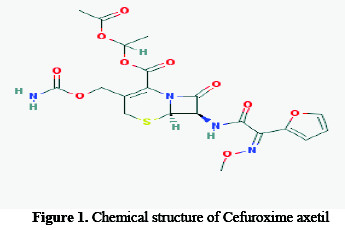
    <p>Cefuroxime axetil is a second generation oral cephalosporin antibiotic. It is an 
acetoxyethyl ester prodrug of cefuroxime which is effective orally [16]. The 
selection of this inhibitor is based on the following facts:</p>

    <p>-They contain three kinds of heteroatom (four nitrogen, ten oxygen and one 
sulphur atom) as reactive center through which they can adsorb readily on the 
metal surface.</p>

    <p>-These compounds are readily soluble in medium.</p>

    <p>-They do not cause any health hazards, but also find their diverse application in 
various biological and pharmacological activities [16]; hence the use of 
Cefuroxime as corrosion inhibitors is safe.</p>


    <p>&nbsp;</p>
<a name="f1">
<img src="/img/revistas/pea/v34n2/34n2a05f1.jpg">
    
]]></body>
<body><![CDATA[<p>&nbsp;</p>


    <p>&nbsp;</p>
    <p><b>Materials and Methods</b></p>

    <p><i><b>Weight loss method</b></i></p>

    <p>A previously weighed metal (aluminum sheet) was completely immersed in 250 
ml of the test solution in an open beaker. The beaker was inserted into a water 
bath maintained at a temperature of 30 &deg;C. Similar experiments were repeated at 
60 &deg;C. In each case, the weight of the sample before immersion was measured 
using Scaltec high precision balance (Model SPB31). After every 24 hours, each 
sample was removed from the test solution, washed in a solution of NaOH 
containing zinc dust and dried in acetone before re-weighing. The difference in 
weight for a period of 168 hours was taken as total weight loss. The inhibition 
efficiency (% I) for each inhibitor was calculated using <a href="#e1">equation 1</a> [17].</p>


    <p>&nbsp;</p>
<a name="e1">
<img src="/img/revistas/pea/v34n2/34n2a05e1.jpg">
    
<p>&nbsp;</p>


    <p>where W1 and W2 are the weight losses (g/dm3) for mild steel in the presence 
and absence of inhibitor in HCl solution respectively. The degree of surface 
coverage &theta; is given by the <a href="#e2">equation 2</a> [18]:</p>


    <p>&nbsp;</p>
<a name="e2">
<img src="/img/revistas/pea/v34n2/34n2a05e2.jpg">
    
<p>&nbsp;</p>


    ]]></body>
<body><![CDATA[<p>The corrosion rates for mild steel corrosion in different concentrations of the acid 

was determined for 168 h immersion period from weight loss using <a href="#e3">equation 3</a> 
[6]</p>


    <p>&nbsp;</p>
<a name="e3">
<img src="/img/revistas/pea/v34n2/34n2a05e3.jpg">
    
<p>&nbsp;</p>


    <p>where W = weight loss (mg); D = density of specimen (g/cm<sup>3</sup>), A = area of 
specimen (square inches) and T = period of immersion (hour).</p>


    <p><i><b>Gasometry method</b></i></p>

    <p>The method used for hydrogen evolution measurement is as described elsewhere 
[19]. The test solution (different concentrations of acid, inhibitor or their 
mixtures) was poured into the reaction vessel (gasometer). Upon the introduction 
of mild steel, the flask was quickly corked and the rise in volume of the paraffin 
due to hydrogen evolution was noted after every minute until a steady volume 
was observed. From the results obtained, the corrosion inhibition efficiency was 
calculated using the following equation,</p>


    <p>&nbsp;</p>
<a name="e4">
<img src="/img/revistas/pea/v34n2/34n2a05e4.jpg">
    
<p>&nbsp;</p>


    <p>where Vb is the volume of hydrogen gas evolved by the blank and Vt is the 
volume of hydrogen gas evolved in the presence of the inhibitor, after time, t.</p>


    <p><i><b>Thermometric method</b></i></p>

    ]]></body>
<body><![CDATA[<p>This was also carried out as reported elsewhere [20]. The reaction number (RN) 
of each system was calculated by dividing the difference between the highest and 
lowest temperature attained by the time interval. From the reaction number, the 
inhibition efficiency (% I) of the inhibitor was calculated using <a href="#e5">equation 5</a></p>


    <p>&nbsp;</p>
<a name="e5">
<img src="/img/revistas/pea/v34n2/34n2a05e5.jpg">
    
<p>&nbsp;</p>


    <p>where RNaq is the reaction number in the absence of inhibitors (blank solution) 
and RNwi is the reaction number of 2 M HCl containing the studied inhibitor.</p>


    <p><i><b>Scanning electron microscopy</b></i></p>

    <p>The scanning electron microscope (SEM) Model No JSM-5600 LV was used to 
study the morphology of corroded in the presence and absence of inhibitor. The 
photographs were taken from that portion of the specimen where better 
information was expected.</p>


    <p>&nbsp;</p>
    <p><b>Results and discussions</b></p>

    <p><i><b>Effect of Cefuroxime axetil</b></i></p>

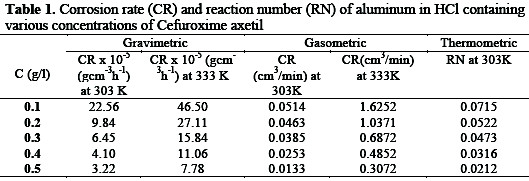
    <p>The corrosion rate (CR) and reaction number (RN) of aluminum in HCl 
containing various concentrations of Cefuroxime axetil determined for 168h 
immersion period from gravimetric, gasometric and thermometric are presented 
in <a href="#t1">Table 1</a>.</p>


    ]]></body>
<body><![CDATA[<p>&nbsp;</p>
<a name="t1">
<img src="/img/revistas/pea/v34n2/34n2a05t1.jpg">
    
<p>&nbsp;</p>


    <p>The results obtained indicates that the aluminum corrosion is reduced 
by the presence of Cefuroxime axetil in 1M HCl at all concentrations used in this 
study, since there is a general decrease in the rate of corrosion of the aluminum 
with increase in concentration of the inhibitor. This may be ascribed to the 
adsorption of this compound on the aluminum, producing a barrier, which 
isolates the surface from the corrosion environment.</p>

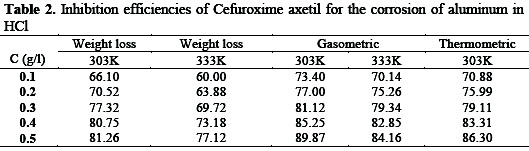
    <p><a href="#t2">Table 2</a> presents inhibition efficiencies of various concentrations of Cefuroxime 
axetil in HCl.</p>


    <p>&nbsp;</p>
<a name="t2">
<img src="/img/revistas/pea/v34n2/34n2a05t2.jpg">
    
<p>&nbsp;</p>


    <p>The inhibition efficiency was estimated to be 73.40 % even at 
extremely low inhibition concentration (0.1 M) and reaches 89.87 % at a 
concentration of 0.5 M. Such remarkable performances may be due to, the high 
molecular weight of CA, the presence of C=N, O-H, C=O, etc. which are 
electron donation groups and the presence of aryl groups. The inhibition 
efficiency was found to increases with increase in the concentration of the 
inhibitor but decreases with increase in temperature indicating that the 
mechanism of physical adsorption favours the adsorption of Cefuroxime axetil 
on aluminum surface. For a physical adsorption mechanism, the inhibition 
efficiency is expected to decrease with increase in temperature but for a chemical 
adsorption mechanism, the reverse is expected [20].</p>

    <p>Also, the inhibition efficiency of CA obtained from the two methods were found 
correlate strongly (R<sup>2</sup> = 0.8798 and 0.9644 for gasometric and thermometric 
respectively) with those obtained from gravimetric method. However, values of 
inhibition efficiency obtained from the weight loss were higher than the values 
obtained from thermometric and gasometric methods indicating that the average 
inhibition efficiency of CA is better than its instantaneous inhibition efficiency. 
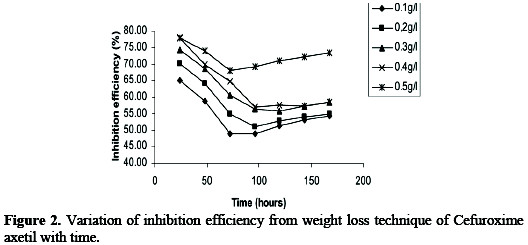
The stability of the inhibitive properties of the studied inhibitor over 168 hours of 
immersion was studied by plotting values of inhibition efficiencies gotten from 
weight loss studies against time as shown in <a href="#f2">Fig. 2</a>.</p>


    <p>&nbsp;</p>
<a name="f2">
<img src="/img/revistas/pea/v34n2/34n2a05f2.jpg">
    
<p>&nbsp;</p>


    ]]></body>
<body><![CDATA[<p>From the plots, it is also 
evident that the inhibition efficiency first decreased with time until a critical 
value was attained after which it started increasing. This trend suggests that at 
first, there was competition between the forces of adsorption and desorption and 
that after the critical zone, adsorption facilitated the formation of a protective 
layer and thus protected the metal against further corrosion attack.</p>


    <p><i><b>Effect of temperature</b></i></p>

    <p>According to Eddy [21], temperature affects the rate of any chemical reaction 
such that an increase in temperature leads to a corresponding increase in the rate 
of the reaction. Hence the effect of temperature on the corrosion of aluminum in 
HCl (in the absence and presence of CA) was studied using the Arrhenius 
Equation (<a href="#e6">equation 6</a>) where the apparent activation energies (Ea) for the 
corrosion process in absence and presence of inhibitor were evaluated [6, 22].</p>


    <p>&nbsp;</p>
<a name="e6">
<img src="/img/revistas/pea/v34n2/34n2a05e6.jpg">
    
<p>&nbsp;</p>


    <p>where CR1 and CR<sup>2</sup> are the corrosion rates of aluminum in solution of HCl at the 
temperatures, T1(303 K) and T2 (333 K) respectively, Ea is the activation energy 
for the adsorption of CA on Al surface and R is the gas constant. Calculated 
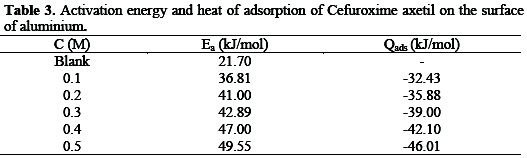
values of the Ea are shown in <a href="#t3">Table 3</a>.</p>


    <p>&nbsp;</p>
<a name="t3">
<img src="/img/revistas/pea/v34n2/34n2a05t3.jpg">
    
<p>&nbsp;</p>


    <p>It can be seen from the table that the 
activation energies are lower than the value of 80 kJmol<sup>-1</sup> required for a chemical 
adsorption mechanism supporting the earlier claims the adsorption of CA on 
aluminum proceeds by physical adsorption mechanism.</p>

    <p>The heat of adsorption (Qads) of Cefuroxime axetil on aluminum surface was 
calculated using <a href="#e7">equation 7</a> [23]</p>


    ]]></body>
<body><![CDATA[<p>&nbsp;</p>
<a name="e7">
<img src="/img/revistas/pea/v34n2/34n2a05e7.jpg">
    
<p>&nbsp;</p>


    <p>where Qads is the heat of adsorption of CA on Al surface, &theta;1 and &theta;2 are the 
degrees of surface coverage of the inhibitor at the temperatures, T1 and T2 (where 
T2 and T1 are 303 K and 333 K respectively) and R is the gas constant. Values of 
Qads calculated from <a href="#e7">equation 7</a> are presented in <a href="#t3">Table 3</a>. These values are 
negative indicating that the adsorption of CA on aluminum surface is exothermic.</p>


    <p><i><b>Adsorption considerations</b></i></p>

    <p>Eddy et al.[24] stated that adsorption isotherms provide importance clues about 
the nature of metal inhibitor interaction. The general formula for adsorption 
isotherm is expressed can be as follows</p>


    <p>&nbsp;</p>
<a name="e8">
<img src="/img/revistas/pea/v34n2/34n2a05e8.jpg">
    
<p>&nbsp;</p>


    <p>where, f(0,x) is configuration factor, &theta; is the surface coverage, C is inhibitors 
concentration, K is adsorption constant and a is the molecular interaction 
parameter.</p>

    <p>Data obtained from weight loss, thermometric and gasometric measurements 
were used to fit curves for different adsorption isotherms, including Temkin, 
Langmuir, Freundlich, Bockris-Swindles, Flory Huggins and Frumkin isotherm.</p>

    <p>The test indicated that Langmuir adsorption isotherm best described the
adsorption characteristics of CA on the surface of aluminum.</p>

    ]]></body>
<body><![CDATA[<p>According to Ghasemi and Tizpar [25], if the assumptions of Langmuir
adsorption isotherm are valid for the corrosion inhibition reaction, then, it can be
assumed that the degree of surface coverage and the concentration of the
inhibitor in the bulk electrolyte are related according to the following equation,


    <p>&nbsp;</p>
<a name="e9">
<img src="/img/revistas/pea/v34n2/34n2a05e9.jpg">
    
<p>&nbsp;</p>


    <p>Rearrangement of <a href="#e9">equation 9</a>, simplifies it to <a href="#e10">equation 10</a>,</p> 


    <p>&nbsp;</p>
<a name="e10">
<img src="/img/revistas/pea/v34n2/34n2a05e10.jpg">
    
<p>&nbsp;</p>


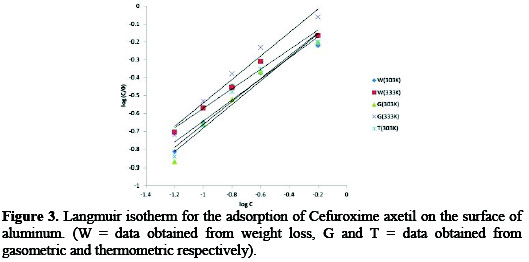
    <p>From <a href="#e10">equation 10</a>, plots of log(C/&theta;) versus log(C) are expected to yield straight 
lines with slopes and intercepts equal to unity and log bads. <a href="#f3">Fig. 3</a> shows the 
Langmuir isotherm for the adsorption of CA on Al surface.</p> 


    <p>&nbsp;</p>
<a name="f3">
<img src="/img/revistas/pea/v34n2/34n2a05f3.jpg">
    
<p>&nbsp;</p>


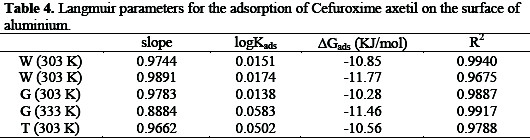
    <p>Adsorption parameters deduced from the plots are presented in <a href="#t4">Table 4</a>.</p> 


    ]]></body>
<body><![CDATA[<p>&nbsp;</p>
<a name="t4">
<img src="/img/revistas/pea/v34n2/34n2a05t4.jpg">
    
<p>&nbsp;</p>


    <p>The results obtained 
reveal that the slopes and R<sup>2</sup> values are very close to unity indicating a strong 
adherence of the adsorption data to the assumptions establishing the Langmuir 
model.</p>

    <p>The equilibrium constant of adsorption (obtained from the Langmuir adsorption 
isotherm) is related to the equilibrium constant of adsorption according to 
<a href="#e11">equation 11</a> [26], 


    <p>&nbsp;</p>
<a name="e11">
<img src="/img/revistas/pea/v34n2/34n2a05e11.jpg">
    
<p>&nbsp;</p>


    <p>where K is the equilibrium constant of adsorption, 55.5 is the molar 
concentration of water, &Delta;Gads is the free energy of adsorption of the inhibitor, R 
is the gas constant and T is the temperature. The free energies calculated from 
<a href="#e11">equation 11</a> are also presented in <a href="#t4">Table 4</a>. Results presented indicate that the 
values of &Delta;G<sup>0</sup>ads are negative and lies between -10.28 and -11.77 kJ mol<sup>-1</sup> . 
According to Bilgic and Sahin [27], values of standard Gibbs free energy of 
adsorption in aqueous solution around -20 kJ mol<sup>-1</sup> or lower (more positive) 
indicate adsorption with electrostatic interaction between the adsorbent and 
adsorbate (physisorption), while those around or higher (more negative) than -40 
kJ mol<sup>-1</sup> involve charge sharing between the molecules and the metal 
(chemisorption). Therefore, the adsorption of CA on aluminum surface is 
spontaneous and supports the mechanism of physical adsorption.</p>


    <p><i><b>Scanning electron microscope (SEM)</b></i></p>

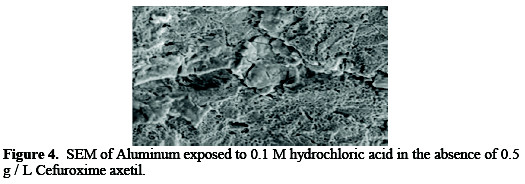
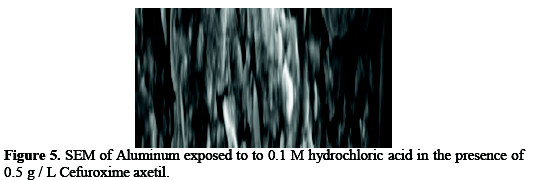
    <p><a href="#f4">Fig. 4</a> and <a href="#f5">5</a> show the surface morphology of aluminum exposed to 0.1 M 
hydrochloric acid in the presence and absence of 0.5 g / L CA respectively.</p> 


    <p>&nbsp;</p>
<a name="f4">
<img src="/img/revistas/pea/v34n2/34n2a05f4.jpg">
    
]]></body>
<body><![CDATA[<p>&nbsp;</p>
<a name="f5">
<img src="/img/revistas/pea/v34n2/34n2a05f5.jpg">
    
<p>&nbsp;</p>


    <p>A uniform severe corrosion can be observed in the absence of inhibitor (<a href="#f4">Fig. 4</a>). 
However, the SEM obtained for aluminum in presence of inhibitor (<a href="#f5">Fig. 5</a>) 
showed that the metal surface is partially covered with inhibitor giving it a 
reasonable degree of protection which further proves that CA acts as good 
inhibitor at 0.1 M acid concentration [28].</p>


    <p>&nbsp;</p>
    <p><b>Conclusions</b></p>

    <p>From the study, the following conclusions can be drawn. CA efficiently inhibits 
the corrosion of mild steel in 0.1M HCl medium. Adsorption of CA on the 
surface of aluminum from 1M HCl obeys Langumur adsorption isotherm. The 
inhibition efficiency of CA increases with increasing the inhibitor concentration 
and on increasing the temperature, the corrosion rate increases. The calculated 
values of Ea, Qads, &Delta;Gads indicates that the adsorption of inhibitor on the metal 
surface is physisorption, exothermic and followed by spontaneous process. 
Protective film formation against the acid attack is confirmed by SEM.</p>


    <p>&nbsp;</p>
    <p><b>References</b></p>

    <!-- ref --><p>1. Thompson N G, Yunovich M, Dunmire D. Corros Rev. 2007;25:247.    &nbsp;&nbsp;&nbsp;&nbsp;&nbsp;&nbsp;&nbsp;&nbsp;[&#160;<a href="javascript:void(0);" onclick="javascript: window.open('/scielo.php?script=sci_nlinks&ref=420007&pid=S0872-1904201600020000500001&lng=','','width=640,height=500,resizable=yes,scrollbars=1,menubar=yes,');">Links</a>&#160;]<!-- end-ref --></p>

    ]]></body>
<body><![CDATA[<!-- ref --><p>2. Cherry B W, Skerry B S, Clayton V. Corrosion in Australia: the report of the 
Australian National Centre for Corrosion Prevention and Control feasibility 
Study. Department of Materials Engineering, Monash University: Australia; 1983.    &nbsp;&nbsp;&nbsp;&nbsp;&nbsp;&nbsp;&nbsp;&nbsp;[&#160;<a href="javascript:void(0);" onclick="javascript: window.open('/scielo.php?script=sci_nlinks&ref=420009&pid=S0872-1904201600020000500002&lng=','','width=640,height=500,resizable=yes,scrollbars=1,menubar=yes,');">Links</a>&#160;]<!-- end-ref --></p>

    <!-- ref --><p>3. Patni N, Agarwal S, Pallav S. Chin J Eng. 2013:1.    &nbsp;&nbsp;&nbsp;&nbsp;&nbsp;&nbsp;&nbsp;&nbsp;[&#160;<a href="javascript:void(0);" onclick="javascript: window.open('/scielo.php?script=sci_nlinks&ref=420011&pid=S0872-1904201600020000500003&lng=','','width=640,height=500,resizable=yes,scrollbars=1,menubar=yes,');">Links</a>&#160;]<!-- end-ref --></p>

    <p>4. Dalo-Abu A M, Othman A A, Rawashdeh Al Fan. Int J Electrochem Sci. 2012;7:9303.</p>

    <!-- ref --><p>5. Sharma S K, Mudhoo A, Khamis E. Adsorption studies, modeling and use 
of green inhibitors in corrosion inhibition: an overview of recent research, 
green corrosion inhibitors: status in developing countries. In: Sharma S K, 
editor. Green corrosion chemistry and engineering. Wiley-VCH Publications: Weinheim; 2011. p 319.    &nbsp;&nbsp;&nbsp;&nbsp;&nbsp;&nbsp;&nbsp;&nbsp;[&#160;<a href="javascript:void(0);" onclick="javascript: window.open('/scielo.php?script=sci_nlinks&ref=420014&pid=S0872-1904201600020000500005&lng=','','width=640,height=500,resizable=yes,scrollbars=1,menubar=yes,');">Links</a>&#160;]<!-- end-ref --></p>

    <!-- ref --><p>6. Ameh P O, Oyeniyi S Q, Sani U M. Int J Chem, Mater Environm Research. 2015;2:1.    &nbsp;&nbsp;&nbsp;&nbsp;&nbsp;&nbsp;&nbsp;&nbsp;[&#160;<a href="javascript:void(0);" onclick="javascript: window.open('/scielo.php?script=sci_nlinks&ref=420016&pid=S0872-1904201600020000500006&lng=','','width=640,height=500,resizable=yes,scrollbars=1,menubar=yes,');">Links</a>&#160;]<!-- end-ref --></p>

    <!-- ref --><p>7. Hameed R S A. J Physical Chemistry. 2013;8:146.    &nbsp;&nbsp;&nbsp;&nbsp;&nbsp;&nbsp;&nbsp;&nbsp;[&#160;<a href="javascript:void(0);" onclick="javascript: window.open('/scielo.php?script=sci_nlinks&ref=420018&pid=S0872-1904201600020000500007&lng=','','width=640,height=500,resizable=yes,scrollbars=1,menubar=yes,');">Links</a>&#160;]<!-- end-ref --></p>

    <!-- ref --><p>8. Rani P D, Selvaraj S. Rasayan J Chem. 2010;3:473.    &nbsp;&nbsp;&nbsp;&nbsp;&nbsp;&nbsp;&nbsp;&nbsp;[&#160;<a href="javascript:void(0);" onclick="javascript: window.open('/scielo.php?script=sci_nlinks&ref=420020&pid=S0872-1904201600020000500008&lng=','','width=640,height=500,resizable=yes,scrollbars=1,menubar=yes,');">Links</a>&#160;]<!-- end-ref --></p>

    <!-- ref --><p>9. Saratha R, Kasthuri N, Thilagavathy P. Der Pharma Chemica. 2009;1:249.    &nbsp;&nbsp;&nbsp;&nbsp;&nbsp;&nbsp;&nbsp;&nbsp;[&#160;<a href="javascript:void(0);" onclick="javascript: window.open('/scielo.php?script=sci_nlinks&ref=420022&pid=S0872-1904201600020000500009&lng=','','width=640,height=500,resizable=yes,scrollbars=1,menubar=yes,');">Links</a>&#160;]<!-- end-ref --></p>

    <!-- ref --><p>10. Satapathy A K, Gunasekaran G, Sahoo SC, et al. Corros Sci. 2009;51:2848.    &nbsp;&nbsp;&nbsp;&nbsp;&nbsp;&nbsp;&nbsp;&nbsp;[&#160;<a href="javascript:void(0);" onclick="javascript: window.open('/scielo.php?script=sci_nlinks&ref=420024&pid=S0872-1904201600020000500010&lng=','','width=640,height=500,resizable=yes,scrollbars=1,menubar=yes,');">Links</a>&#160;]<!-- end-ref --></p>

    <!-- ref --><p>11. Morad M S. Corros Sci. 2008;50:436.    &nbsp;&nbsp;&nbsp;&nbsp;&nbsp;&nbsp;&nbsp;&nbsp;[&#160;<a href="javascript:void(0);" onclick="javascript: window.open('/scielo.php?script=sci_nlinks&ref=420026&pid=S0872-1904201600020000500011&lng=','','width=640,height=500,resizable=yes,scrollbars=1,menubar=yes,');">Links</a>&#160;]<!-- end-ref --></p>

    <!-- ref --><p>12. Fouda A S, Al-Sarawy A A, Ahmed F S, et al. Corros Sci. 2009;51:485.    &nbsp;&nbsp;&nbsp;&nbsp;&nbsp;&nbsp;&nbsp;&nbsp;[&#160;<a href="javascript:void(0);" onclick="javascript: window.open('/scielo.php?script=sci_nlinks&ref=420028&pid=S0872-1904201600020000500012&lng=','','width=640,height=500,resizable=yes,scrollbars=1,menubar=yes,');">Links</a>&#160;]<!-- end-ref --></p>

    <!-- ref --><p>13. Eddy N O, Odoemelam S A. Int J Pure Appl Chem. 2008;3:1.    &nbsp;&nbsp;&nbsp;&nbsp;&nbsp;&nbsp;&nbsp;&nbsp;[&#160;<a href="javascript:void(0);" onclick="javascript: window.open('/scielo.php?script=sci_nlinks&ref=420030&pid=S0872-1904201600020000500013&lng=','','width=640,height=500,resizable=yes,scrollbars=1,menubar=yes,');">Links</a>&#160;]<!-- end-ref --></p>

    <!-- ref --><p>14. Shukla S K, Singh A K, Ahamad I, et al. Mater Letters. 2009;63:819.    &nbsp;&nbsp;&nbsp;&nbsp;&nbsp;&nbsp;&nbsp;&nbsp;[&#160;<a href="javascript:void(0);" onclick="javascript: window.open('/scielo.php?script=sci_nlinks&ref=420032&pid=S0872-1904201600020000500014&lng=','','width=640,height=500,resizable=yes,scrollbars=1,menubar=yes,');">Links</a>&#160;]<!-- end-ref --></p>

    <!-- ref --><p>15. Singh A K, Quraishi M A. Corros Sci. 2010;52:152.    &nbsp;&nbsp;&nbsp;&nbsp;&nbsp;&nbsp;&nbsp;&nbsp;[&#160;<a href="javascript:void(0);" onclick="javascript: window.open('/scielo.php?script=sci_nlinks&ref=420034&pid=S0872-1904201600020000500015&lng=','','width=640,height=500,resizable=yes,scrollbars=1,menubar=yes,');">Links</a>&#160;]<!-- end-ref --></p>

    <!-- ref --><p>16. Sneader W. Drug discovery: a history. Chichester: John Wiley; 2002.    &nbsp;&nbsp;&nbsp;&nbsp;&nbsp;&nbsp;&nbsp;&nbsp;[&#160;<a href="javascript:void(0);" onclick="javascript: window.open('/scielo.php?script=sci_nlinks&ref=420036&pid=S0872-1904201600020000500016&lng=','','width=640,height=500,resizable=yes,scrollbars=1,menubar=yes,');">Links</a>&#160;]<!-- end-ref --></p>

    <!-- ref --><p>17. Oguzie E E. Corros Sci. 2008;50:2993.    &nbsp;&nbsp;&nbsp;&nbsp;&nbsp;&nbsp;&nbsp;&nbsp;[&#160;<a href="javascript:void(0);" onclick="javascript: window.open('/scielo.php?script=sci_nlinks&ref=420038&pid=S0872-1904201600020000500017&lng=','','width=640,height=500,resizable=yes,scrollbars=1,menubar=yes,');">Links</a>&#160;]<!-- end-ref --></p>

    <!-- ref --><p>18. Nnanna L A, Nwadiuko O C, Ekekwe N D, et al. Am J Mater Sci. 2011;1:143.    &nbsp;&nbsp;&nbsp;&nbsp;&nbsp;&nbsp;&nbsp;&nbsp;[&#160;<a href="javascript:void(0);" onclick="javascript: window.open('/scielo.php?script=sci_nlinks&ref=420040&pid=S0872-1904201600020000500018&lng=','','width=640,height=500,resizable=yes,scrollbars=1,menubar=yes,');">Links</a>&#160;]<!-- end-ref --></p>

    <!-- ref --><p>19. Umoren S A, Ebenso E E, Okafor P C, et al. Pigment Resin Technol. 2006;35:346.    &nbsp;&nbsp;&nbsp;&nbsp;&nbsp;&nbsp;&nbsp;&nbsp;[&#160;<a href="javascript:void(0);" onclick="javascript: window.open('/scielo.php?script=sci_nlinks&ref=420042&pid=S0872-1904201600020000500019&lng=','','width=640,height=500,resizable=yes,scrollbars=1,menubar=yes,');">Links</a>&#160;]<!-- end-ref --></p>

    <!-- ref --><p>20. Umoren S A, Ogbobe O, Ebenso E E, et al. J Appl Polym Sci. 2007;105:3363.    &nbsp;&nbsp;&nbsp;&nbsp;&nbsp;&nbsp;&nbsp;&nbsp;[&#160;<a href="javascript:void(0);" onclick="javascript: window.open('/scielo.php?script=sci_nlinks&ref=420044&pid=S0872-1904201600020000500020&lng=','','width=640,height=500,resizable=yes,scrollbars=1,menubar=yes,');">Links</a>&#160;]<!-- end-ref --></p>

    <!-- ref --><p>21. Eddy N O. Inhibition of the corrosion of mild steel in H2SO4 by some 
antibiotics. Ph. D Thesis. University of Calabar; 2008.    &nbsp;&nbsp;&nbsp;&nbsp;&nbsp;&nbsp;&nbsp;&nbsp;[&#160;<a href="javascript:void(0);" onclick="javascript: window.open('/scielo.php?script=sci_nlinks&ref=420046&pid=S0872-1904201600020000500021&lng=','','width=640,height=500,resizable=yes,scrollbars=1,menubar=yes,');">Links</a>&#160;]<!-- end-ref --></p>

    <!-- ref --><p>22. Momoh-Yahaya H, Eddy N O, Iyun J F, et al. Int J Modern Chem. 2012;2:127.    &nbsp;&nbsp;&nbsp;&nbsp;&nbsp;&nbsp;&nbsp;&nbsp;[&#160;<a href="javascript:void(0);" onclick="javascript: window.open('/scielo.php?script=sci_nlinks&ref=420048&pid=S0872-1904201600020000500022&lng=','','width=640,height=500,resizable=yes,scrollbars=1,menubar=yes,');">Links</a>&#160;]<!-- end-ref --></p>

    <!-- ref --><p>23. Bhajiwala H M, Vashi R T. Bull Electrochem Soc. 2001;17:441.    &nbsp;&nbsp;&nbsp;&nbsp;&nbsp;&nbsp;&nbsp;&nbsp;[&#160;<a href="javascript:void(0);" onclick="javascript: window.open('/scielo.php?script=sci_nlinks&ref=420050&pid=S0872-1904201600020000500023&lng=','','width=640,height=500,resizable=yes,scrollbars=1,menubar=yes,');">Links</a>&#160;]<!-- end-ref --></p>

    <!-- ref --><p>24. Eddy N O, Ibok U J, Ebenso E E. J Appl Electrochem. 2010;40:445.    &nbsp;&nbsp;&nbsp;&nbsp;&nbsp;&nbsp;&nbsp;&nbsp;[&#160;<a href="javascript:void(0);" onclick="javascript: window.open('/scielo.php?script=sci_nlinks&ref=420052&pid=S0872-1904201600020000500024&lng=','','width=640,height=500,resizable=yes,scrollbars=1,menubar=yes,');">Links</a>&#160;]<!-- end-ref --></p>

    <!-- ref --><p>25. Ghasemi Z, Tizpar A. Appl Sci. 2006;252:3667.    &nbsp;&nbsp;&nbsp;&nbsp;&nbsp;&nbsp;&nbsp;&nbsp;[&#160;<a href="javascript:void(0);" onclick="javascript: window.open('/scielo.php?script=sci_nlinks&ref=420054&pid=S0872-1904201600020000500025&lng=','','width=640,height=500,resizable=yes,scrollbars=1,menubar=yes,');">Links</a>&#160;]<!-- end-ref --></p>

    <!-- ref --><p>26. Flis J, Zakroczymski T. J Electrochem Soc. 1996;143:2458.    &nbsp;&nbsp;&nbsp;&nbsp;&nbsp;&nbsp;&nbsp;&nbsp;[&#160;<a href="javascript:void(0);" onclick="javascript: window.open('/scielo.php?script=sci_nlinks&ref=420056&pid=S0872-1904201600020000500026&lng=','','width=640,height=500,resizable=yes,scrollbars=1,menubar=yes,');">Links</a>&#160;]<!-- end-ref --></p>

    <!-- ref --><p>27. Bilgic S, Sahin M. Mater Chem Phys. 2001;70:290.    &nbsp;&nbsp;&nbsp;&nbsp;&nbsp;&nbsp;&nbsp;&nbsp;[&#160;<a href="javascript:void(0);" onclick="javascript: window.open('/scielo.php?script=sci_nlinks&ref=420058&pid=S0872-1904201600020000500027&lng=','','width=640,height=500,resizable=yes,scrollbars=1,menubar=yes,');">Links</a>&#160;]<!-- end-ref --></p>

    <!-- ref --><p>28. Rafiquee M Z A, Khan S, Saxena N, et al. Port Electrochim Acta. 2007;25:419.    &nbsp;&nbsp;&nbsp;&nbsp;&nbsp;&nbsp;&nbsp;&nbsp;[&#160;<a href="javascript:void(0);" onclick="javascript: window.open('/scielo.php?script=sci_nlinks&ref=420060&pid=S0872-1904201600020000500028&lng=','','width=640,height=500,resizable=yes,scrollbars=1,menubar=yes,');">Links</a>&#160;]<!-- end-ref --></p>


    <p>&nbsp;</p>
    <p><b>Acknowledgement</b></p>

    <p>The authors are grateful to TEFUND for sponsoring the research and Mrs Janet 
Onoja Ameh for typesetting the manuscript.</p>


    <p>&nbsp;</p>
    <p><a name=0></a><sup><a href="#top">*</a></sup>Corresponding author. E-mail address: <a href="mailto:nocaseoche@yahoo.com">nocaseoche@yahoo.com</a></p>

    <p>Received 28 July 2015; accepted 08 March 2016</p>

    <p><a href="http://www.peacta.org" target="_blank">www.peacta.org</a> </p>


    ]]></body>
<body><![CDATA[ ]]></body><back>
<ref-list>
<ref id="B1">
<label>1</label><nlm-citation citation-type="journal">
<person-group person-group-type="author">
<name>
<surname><![CDATA[Thompson]]></surname>
<given-names><![CDATA[N G]]></given-names>
</name>
<name>
<surname><![CDATA[Yunovich]]></surname>
<given-names><![CDATA[M]]></given-names>
</name>
<name>
<surname><![CDATA[Dunmire]]></surname>
<given-names><![CDATA[D]]></given-names>
</name>
</person-group>
<source><![CDATA[Corros Rev]]></source>
<year>2007</year>
<volume>25</volume>
<page-range>247</page-range></nlm-citation>
</ref>
<ref id="B2">
<label>2</label><nlm-citation citation-type="book">
<person-group person-group-type="author">
<name>
<surname><![CDATA[Cherry]]></surname>
<given-names><![CDATA[B W]]></given-names>
</name>
<name>
<surname><![CDATA[Skerry]]></surname>
<given-names><![CDATA[B S]]></given-names>
</name>
<name>
<surname><![CDATA[Clayton]]></surname>
<given-names><![CDATA[V]]></given-names>
</name>
</person-group>
<source><![CDATA[Corrosion in Australia: the report of the Australian National Centre for Corrosion Prevention and Control feasibility Study]]></source>
<year>1983</year>
<publisher-name><![CDATA[Department of Materials Engineering, Monash University]]></publisher-name>
</nlm-citation>
</ref>
<ref id="B3">
<label>3</label><nlm-citation citation-type="journal">
<person-group person-group-type="author">
<name>
<surname><![CDATA[Patni]]></surname>
<given-names><![CDATA[N]]></given-names>
</name>
<name>
<surname><![CDATA[Agarwal]]></surname>
<given-names><![CDATA[S]]></given-names>
</name>
<name>
<surname><![CDATA[Pallav]]></surname>
<given-names><![CDATA[S]]></given-names>
</name>
</person-group>
<source><![CDATA[Chin J Eng]]></source>
<year>2013</year>
<page-range>1</page-range></nlm-citation>
</ref>
<ref id="B4">
<label>4</label><nlm-citation citation-type="journal">
<person-group person-group-type="author">
<name>
<surname><![CDATA[Dalo-Abu]]></surname>
<given-names><![CDATA[A M]]></given-names>
</name>
<name>
<surname><![CDATA[Othman]]></surname>
<given-names><![CDATA[A A]]></given-names>
</name>
<name>
<surname><![CDATA[Rawashdeh]]></surname>
<given-names><![CDATA[A F]]></given-names>
</name>
</person-group>
<source><![CDATA[Int J Electrochem Sci]]></source>
<year>2012</year>
<volume>7</volume>
<page-range>9303</page-range></nlm-citation>
</ref>
<ref id="B5">
<label>5</label><nlm-citation citation-type="book">
<person-group person-group-type="author">
<name>
<surname><![CDATA[Sharma]]></surname>
<given-names><![CDATA[S K]]></given-names>
</name>
<name>
<surname><![CDATA[Mudhoo]]></surname>
<given-names><![CDATA[A]]></given-names>
</name>
<name>
<surname><![CDATA[Khamis]]></surname>
<given-names><![CDATA[E]]></given-names>
</name>
</person-group>
<source><![CDATA[Adsorption studies, modeling and use of green inhibitors in corrosion inhibition: an overview of recent research, green corrosion inhibitors: status in developing countries]]></source>
<year>2011</year>
<page-range>319</page-range><publisher-loc><![CDATA[Weinheim ]]></publisher-loc>
<publisher-name><![CDATA[Wiley-VCH Publications]]></publisher-name>
</nlm-citation>
</ref>
<ref id="B6">
<label>6</label><nlm-citation citation-type="journal">
<person-group person-group-type="author">
<name>
<surname><![CDATA[Ameh]]></surname>
<given-names><![CDATA[P O]]></given-names>
</name>
<name>
<surname><![CDATA[Oyeniyi]]></surname>
<given-names><![CDATA[S Q]]></given-names>
</name>
<name>
<surname><![CDATA[Sani]]></surname>
<given-names><![CDATA[U M]]></given-names>
</name>
</person-group>
<source><![CDATA[Int J Chem, Mater Environm Research]]></source>
<year>2015</year>
<volume>2</volume>
<page-range>1</page-range></nlm-citation>
</ref>
<ref id="B7">
<label>7</label><nlm-citation citation-type="journal">
<person-group person-group-type="author">
<name>
<surname><![CDATA[Hameed]]></surname>
<given-names><![CDATA[R S A]]></given-names>
</name>
</person-group>
<source><![CDATA[J Physical Chemistry]]></source>
<year>2013</year>
<volume>8</volume>
<page-range>146</page-range></nlm-citation>
</ref>
<ref id="B8">
<label>8</label><nlm-citation citation-type="journal">
<person-group person-group-type="author">
<name>
<surname><![CDATA[Rani]]></surname>
<given-names><![CDATA[P D]]></given-names>
</name>
<name>
<surname><![CDATA[Selvaraj]]></surname>
<given-names><![CDATA[S]]></given-names>
</name>
</person-group>
<source><![CDATA[Rasayan J Chem]]></source>
<year>2010</year>
<volume>3</volume>
<page-range>473</page-range></nlm-citation>
</ref>
<ref id="B9">
<label>9</label><nlm-citation citation-type="journal">
<person-group person-group-type="author">
<name>
<surname><![CDATA[Saratha]]></surname>
<given-names><![CDATA[R]]></given-names>
</name>
<name>
<surname><![CDATA[Kasthuri]]></surname>
<given-names><![CDATA[N]]></given-names>
</name>
<name>
<surname><![CDATA[Thilagavathy]]></surname>
<given-names><![CDATA[P]]></given-names>
</name>
</person-group>
<source><![CDATA[Der Pharma Chemica]]></source>
<year>2009</year>
<volume>1</volume>
<page-range>249</page-range></nlm-citation>
</ref>
<ref id="B10">
<label>10</label><nlm-citation citation-type="journal">
<person-group person-group-type="author">
<name>
<surname><![CDATA[Satapathy]]></surname>
<given-names><![CDATA[A K]]></given-names>
</name>
<name>
<surname><![CDATA[Gunasekaran]]></surname>
<given-names><![CDATA[G]]></given-names>
</name>
<name>
<surname><![CDATA[Sahoo]]></surname>
<given-names><![CDATA[S C]]></given-names>
</name>
</person-group>
<source><![CDATA[Corros Sci]]></source>
<year>2009</year>
<volume>51</volume>
<page-range>2848</page-range></nlm-citation>
</ref>
<ref id="B11">
<label>11</label><nlm-citation citation-type="journal">
<person-group person-group-type="author">
<name>
<surname><![CDATA[Morad]]></surname>
<given-names><![CDATA[M S]]></given-names>
</name>
</person-group>
<source><![CDATA[Corros Sci]]></source>
<year>2008</year>
<volume>50</volume>
<page-range>436</page-range></nlm-citation>
</ref>
<ref id="B12">
<label>12</label><nlm-citation citation-type="journal">
<person-group person-group-type="author">
<name>
<surname><![CDATA[Fouda]]></surname>
<given-names><![CDATA[A S]]></given-names>
</name>
<name>
<surname><![CDATA[Al-Sarawy]]></surname>
<given-names><![CDATA[A A]]></given-names>
</name>
<name>
<surname><![CDATA[Ahmed]]></surname>
<given-names><![CDATA[F S]]></given-names>
</name>
</person-group>
<source><![CDATA[Corros Sci]]></source>
<year>2009</year>
<volume>51</volume>
<page-range>485</page-range></nlm-citation>
</ref>
<ref id="B13">
<label>13</label><nlm-citation citation-type="journal">
<person-group person-group-type="author">
<name>
<surname><![CDATA[Eddy]]></surname>
<given-names><![CDATA[N O]]></given-names>
</name>
<name>
<surname><![CDATA[Odoemelam]]></surname>
<given-names><![CDATA[S A]]></given-names>
</name>
</person-group>
<source><![CDATA[Int J Pure Appl Chem]]></source>
<year>2008</year>
<volume>3</volume>
<page-range>1</page-range></nlm-citation>
</ref>
<ref id="B14">
<label>14</label><nlm-citation citation-type="journal">
<person-group person-group-type="author">
<name>
<surname><![CDATA[Shukla]]></surname>
<given-names><![CDATA[S K]]></given-names>
</name>
<name>
<surname><![CDATA[Singh]]></surname>
<given-names><![CDATA[A K]]></given-names>
</name>
<name>
<surname><![CDATA[Ahamad]]></surname>
<given-names><![CDATA[I]]></given-names>
</name>
</person-group>
<source><![CDATA[Mater Letters]]></source>
<year>2009</year>
<volume>63</volume>
<page-range>819</page-range></nlm-citation>
</ref>
<ref id="B15">
<label>15</label><nlm-citation citation-type="journal">
<person-group person-group-type="author">
<name>
<surname><![CDATA[Singh]]></surname>
<given-names><![CDATA[A K]]></given-names>
</name>
<name>
<surname><![CDATA[Quraishi]]></surname>
<given-names><![CDATA[M A]]></given-names>
</name>
</person-group>
<source><![CDATA[Corros Sci]]></source>
<year>2010</year>
<volume>52</volume>
<page-range>152</page-range></nlm-citation>
</ref>
<ref id="B16">
<label>16</label><nlm-citation citation-type="book">
<person-group person-group-type="author">
<name>
<surname><![CDATA[Sneader]]></surname>
<given-names><![CDATA[W]]></given-names>
</name>
</person-group>
<source><![CDATA[Drug discovery: a history]]></source>
<year>2002</year>
<publisher-loc><![CDATA[Chichester ]]></publisher-loc>
<publisher-name><![CDATA[John Wiley]]></publisher-name>
</nlm-citation>
</ref>
<ref id="B17">
<label>17</label><nlm-citation citation-type="journal">
<person-group person-group-type="author">
<name>
<surname><![CDATA[Oguzie]]></surname>
<given-names><![CDATA[E E]]></given-names>
</name>
</person-group>
<source><![CDATA[Corros Sci]]></source>
<year>2008</year>
<volume>50</volume>
<page-range>2993</page-range></nlm-citation>
</ref>
<ref id="B18">
<label>18</label><nlm-citation citation-type="journal">
<person-group person-group-type="author">
<name>
<surname><![CDATA[Nnanna]]></surname>
<given-names><![CDATA[L A]]></given-names>
</name>
<name>
<surname><![CDATA[Nwadiuko]]></surname>
<given-names><![CDATA[O C]]></given-names>
</name>
<name>
<surname><![CDATA[Ekekwe]]></surname>
<given-names><![CDATA[N D]]></given-names>
</name>
</person-group>
<source><![CDATA[Am J Mater Sci]]></source>
<year>2011</year>
<volume>1</volume>
<page-range>143</page-range></nlm-citation>
</ref>
<ref id="B19">
<label>19</label><nlm-citation citation-type="journal">
<person-group person-group-type="author">
<name>
<surname><![CDATA[Umoren]]></surname>
<given-names><![CDATA[S A]]></given-names>
</name>
<name>
<surname><![CDATA[Ebenso]]></surname>
<given-names><![CDATA[E E]]></given-names>
</name>
<name>
<surname><![CDATA[Okafor]]></surname>
<given-names><![CDATA[P C]]></given-names>
</name>
</person-group>
<source><![CDATA[Pigment Resin Technol]]></source>
<year>2006</year>
<volume>35</volume>
<page-range>346</page-range></nlm-citation>
</ref>
<ref id="B20">
<label>20</label><nlm-citation citation-type="journal">
<person-group person-group-type="author">
<name>
<surname><![CDATA[Umoren]]></surname>
<given-names><![CDATA[S A]]></given-names>
</name>
<name>
<surname><![CDATA[Ogbobe]]></surname>
<given-names><![CDATA[O]]></given-names>
</name>
<name>
<surname><![CDATA[Ebenso]]></surname>
<given-names><![CDATA[E E]]></given-names>
</name>
</person-group>
<source><![CDATA[J Appl Polym Sci]]></source>
<year>2007</year>
<volume>105</volume>
<page-range>3363</page-range></nlm-citation>
</ref>
<ref id="B21">
<label>21</label><nlm-citation citation-type="">
<person-group person-group-type="author">
<name>
<surname><![CDATA[Eddy]]></surname>
<given-names><![CDATA[N O]]></given-names>
</name>
</person-group>
<source><![CDATA[Inhibition of the corrosion of mild steel in H2SO4 by some antibiotics]]></source>
<year></year>
</nlm-citation>
</ref>
<ref id="B22">
<label>22</label><nlm-citation citation-type="journal">
<person-group person-group-type="author">
<name>
<surname><![CDATA[Momoh-Yahaya]]></surname>
<given-names><![CDATA[H]]></given-names>
</name>
<name>
<surname><![CDATA[Eddy]]></surname>
<given-names><![CDATA[N O]]></given-names>
</name>
<name>
<surname><![CDATA[Iyun]]></surname>
<given-names><![CDATA[J F]]></given-names>
</name>
</person-group>
<source><![CDATA[Int J Modern Chem]]></source>
<year>2012</year>
<volume>2</volume>
<page-range>127</page-range></nlm-citation>
</ref>
<ref id="B23">
<label>23</label><nlm-citation citation-type="journal">
<person-group person-group-type="author">
<name>
<surname><![CDATA[Bhajiwala]]></surname>
<given-names><![CDATA[H M]]></given-names>
</name>
<name>
<surname><![CDATA[Vashi]]></surname>
<given-names><![CDATA[R T]]></given-names>
</name>
</person-group>
<source><![CDATA[Bull Electrochem Soc]]></source>
<year>2001</year>
<volume>17</volume>
<page-range>441</page-range></nlm-citation>
</ref>
<ref id="B24">
<label>24</label><nlm-citation citation-type="journal">
<person-group person-group-type="author">
<name>
<surname><![CDATA[Eddy]]></surname>
<given-names><![CDATA[N O]]></given-names>
</name>
<name>
<surname><![CDATA[Ibok]]></surname>
<given-names><![CDATA[U J]]></given-names>
</name>
<name>
<surname><![CDATA[Ebenso]]></surname>
<given-names><![CDATA[E E]]></given-names>
</name>
</person-group>
<source><![CDATA[J Appl Electrochem]]></source>
<year>2010</year>
<volume>40</volume>
<page-range>445</page-range></nlm-citation>
</ref>
<ref id="B25">
<label>25</label><nlm-citation citation-type="journal">
<person-group person-group-type="author">
<name>
<surname><![CDATA[Ghasemi]]></surname>
<given-names><![CDATA[Z]]></given-names>
</name>
<name>
<surname><![CDATA[Tizpar]]></surname>
<given-names><![CDATA[A]]></given-names>
</name>
</person-group>
<source><![CDATA[Appl Sci]]></source>
<year>2006</year>
<volume>252</volume>
<page-range>3667</page-range></nlm-citation>
</ref>
<ref id="B26">
<label>26</label><nlm-citation citation-type="journal">
<person-group person-group-type="author">
<name>
<surname><![CDATA[Flis]]></surname>
<given-names><![CDATA[J]]></given-names>
</name>
<name>
<surname><![CDATA[Zakroczymski]]></surname>
<given-names><![CDATA[T]]></given-names>
</name>
</person-group>
<source><![CDATA[J Electrochem Soc]]></source>
<year>1996</year>
<volume>143</volume>
<page-range>2458</page-range></nlm-citation>
</ref>
<ref id="B27">
<label>27</label><nlm-citation citation-type="journal">
<person-group person-group-type="author">
<name>
<surname><![CDATA[Bilgic]]></surname>
<given-names><![CDATA[S]]></given-names>
</name>
<name>
<surname><![CDATA[Sahin]]></surname>
<given-names><![CDATA[M]]></given-names>
</name>
</person-group>
<source><![CDATA[Mater Chem Phys]]></source>
<year>2001</year>
<volume>70</volume>
<page-range>290</page-range></nlm-citation>
</ref>
<ref id="B28">
<label>28</label><nlm-citation citation-type="journal">
<person-group person-group-type="author">
<name>
<surname><![CDATA[Rafiquee]]></surname>
<given-names><![CDATA[M Z A]]></given-names>
</name>
<name>
<surname><![CDATA[Khan]]></surname>
<given-names><![CDATA[S]]></given-names>
</name>
<name>
<surname><![CDATA[Saxena]]></surname>
<given-names><![CDATA[N]]></given-names>
</name>
</person-group>
<source><![CDATA[Port Electrochim Acta]]></source>
<year>2007</year>
<volume>25</volume>
<page-range>419</page-range></nlm-citation>
</ref>
</ref-list>
</back>
</article>