<?xml version="1.0" encoding="ISO-8859-1"?><article xmlns:mml="http://www.w3.org/1998/Math/MathML" xmlns:xlink="http://www.w3.org/1999/xlink" xmlns:xsi="http://www.w3.org/2001/XMLSchema-instance">
<front>
<journal-meta>
<journal-id>0872-1904</journal-id>
<journal-title><![CDATA[Portugaliae Electrochimica Acta]]></journal-title>
<abbrev-journal-title><![CDATA[Port. Electrochim. Acta]]></abbrev-journal-title>
<issn>0872-1904</issn>
<publisher>
<publisher-name><![CDATA[Sociedade Portuguesa de Electroquímica]]></publisher-name>
</publisher>
</journal-meta>
<article-meta>
<article-id>S0872-19042016000300001</article-id>
<article-id pub-id-type="doi">10.4152/pea.201603143</article-id>
<title-group>
<article-title xml:lang="en"><![CDATA[Effect of Machining Process in Superfinish Turning on the Corrosion Behavior of UNS S31600 Stainless Steel in 6% NaCl Solution]]></article-title>
</title-group>
<contrib-group>
<contrib contrib-type="author">
<name>
<surname><![CDATA[Ech-Charqy]]></surname>
<given-names><![CDATA[Y.]]></given-names>
</name>
<xref ref-type="aff" rid="A01"/>
<xref ref-type="aff" rid="A02"/>
</contrib>
<contrib contrib-type="author">
<name>
<surname><![CDATA[Gziri]]></surname>
<given-names><![CDATA[H.]]></given-names>
</name>
<xref ref-type="aff" rid="A02"/>
</contrib>
<contrib contrib-type="author">
<name>
<surname><![CDATA[Essahli]]></surname>
<given-names><![CDATA[M.]]></given-names>
</name>
<xref ref-type="aff" rid="A01"/>
</contrib>
</contrib-group>
<aff id="A01">
<institution><![CDATA[,University Hassan 1 Laboratory of Applied Chemistry and Environment ]]></institution>
<addr-line><![CDATA[Settat ]]></addr-line>
<country>Morocco</country>
</aff>
<aff id="A02">
<institution><![CDATA[,University Hassan 1 Laboratory of Mechanic Industrial Management and Innovation]]></institution>
<addr-line><![CDATA[Settat ]]></addr-line>
<country>Morocco</country>
</aff>
<pub-date pub-type="pub">
<day>00</day>
<month>05</month>
<year>2016</year>
</pub-date>
<pub-date pub-type="epub">
<day>00</day>
<month>05</month>
<year>2016</year>
</pub-date>
<volume>34</volume>
<numero>3</numero>
<fpage>143</fpage>
<lpage>155</lpage>
<copyright-statement/>
<copyright-year/>
<self-uri xlink:href="http://scielo.pt/scielo.php?script=sci_arttext&amp;pid=S0872-19042016000300001&amp;lng=en&amp;nrm=iso"></self-uri><self-uri xlink:href="http://scielo.pt/scielo.php?script=sci_abstract&amp;pid=S0872-19042016000300001&amp;lng=en&amp;nrm=iso"></self-uri><self-uri xlink:href="http://scielo.pt/scielo.php?script=sci_pdf&amp;pid=S0872-19042016000300001&amp;lng=en&amp;nrm=iso"></self-uri><abstract abstract-type="short" xml:lang="en"><p><![CDATA[The influence of surface topography and cutting parameters on the corrosion resistance of stainless steel UNS S31600 in a 6% NaCl solution is addressed in the present study. Surface topography has been modified by changing the conditions parameters of superfinish turning, including feed, cutting speed and depth of cut, and their correlations with corrosion resistance have been examined. The results showed that the depth of cut is correlated with the corrosion potential. Moreover, the increase of cutting speed degrades the corrosion resistance and increases the corrosion potential in the anodic phase. In its turn, the polarization resistance increases in a manner correlated with increasing the surface quality.]]></p></abstract>
<kwd-group>
<kwd lng="en"><![CDATA[Pitting corrosion]]></kwd>
<kwd lng="en"><![CDATA[polarization resistance]]></kwd>
<kwd lng="en"><![CDATA[average roughness]]></kwd>
<kwd lng="en"><![CDATA[superfinish turning]]></kwd>
<kwd lng="en"><![CDATA[potentio-dynamic test]]></kwd>
</kwd-group>
</article-meta>
</front><body><![CDATA[ 

<!--     <p>&nbsp;</p>
    <p>doi: 10.4152/pea.201603143</p> -->

    <p><b>Effect of Machining Process in Superfinish Turning on the 
Corrosion Behavior of UNS S31600 Stainless 
Steel in 6% NaCl Solution</b></p>

    <p>
<b>Y. Ech-Charqy</b><sup><i>a,b</i>,<a href="#0">*</a></sup>
, <b>H. Gziri</b><sup><i>b</i></sup>
 and <b>M. Essahli</b><sup><i>a</i></sup>
</p>

    <p><i><sup>a</sup> University Hassan 1, Laboratory of Applied Chemistry and Environment, BP 577 Settat, Morocco</i></p>

    <p><i><sup>b</sup> University Hassan 1, Laboratory of Mechanic, Industrial Management and Innovation, BP 577 Settat, Morocco</i></p>


    <p>&nbsp;</p>
    <p><b>Abstract</b></p>

    <p>The influence of surface topography and cutting parameters on the corrosion resistance 
of stainless steel UNS S31600 in a 6% NaCl solution is addressed in the present study. 
Surface topography has been modified by changing the conditions parameters of 
superfinish turning, including feed, cutting speed and depth of cut, and their correlations 
with corrosion resistance have been examined. The results showed that the depth of cut 
is correlated with the corrosion potential. Moreover, the increase of cutting speed 
degrades the corrosion resistance and increases the corrosion potential in the anodic 
phase. In its turn, the polarization resistance increases in a manner correlated with 
increasing the surface quality.</p>

    ]]></body>
<body><![CDATA[<p><b><i>Keywords:</i></b> Pitting corrosion; polarization resistance; average roughness; superfinish 
turning; potentio-dynamic test.</p>


    <p>&nbsp;</p>
    <p><b>Introduction</b></p>

    <p>Superfinish turning is a machining process that has become increasingly 
important in industry. It consists to avoid the rectification phase in order to have 
a good quality of machined surface [1]. This process is developed in mechanical 
industry, in particular, when the functional performance and the safe life of 
workpiece are essential requirements [2]. Many experimental and analytical 
studies were performed to quantify the influence of these cutting conditions on 
the surface topography [3-5], residual stresses [6-8] and microstructure [9,10] of 
pure metals and metal alloys.</p>

    <p>In literature, many investigations claim that the cutting conditions of the turning 
machining, induce a field of the residual stresses in the inside layer near 
machined surface. They significantly modify the microstructure, the texture of 
the workpiece, and its mechanical properties [11,12]. So, the electrochemical 
behavior and the corrosion resistance can be also affected.</p>

    <p>Some research has proven that the corrosion behavior has been effected by 
machining [13,14]. Szklarska-Smialowska has confirmed that the more the 
surface is homogeneous, chemically and physically, the more the pitting potential 
is increased, and the number of pits is weak, consequently the best corrosion 
resistance of the metal [15]. Zuo et al. [16] have affirmed that the number of 
metastable pits, of stainless steel, decreases with increasing the number of grains 
of the paper at a given potential. Similar results were obtained by Sasaki and 
Burstein [17]. They reported that the pitting potential is lower for rougher 
surfaces than for smoother. ZatkalÃ­kovÃ¡ and LiptÃ¡kovÃ¡ [18] affirmed this result; 
they found that the potential and the corrosion rate decreases with the decrease in 
the value of the average roughness of UNS S30400. M. Prakash et al. [19] have 
found that the corrosion rate decreases with the increase in the cutting speed in 
turning operation, and it increases with the decrease in the cutting angle. 
However, Sang Mok Lee et al. [20] have proved that the polarization resistance 
has not a significant correlation with the average roughness of mashed stainless 
steel. Yet, they founded that it has a significant variation with the height of the 
pits.</p>

    <p>Gravier et al. [21] have observed that the electrochemical behavior of workpiece 
is influenced by the mechanical and microstructural properties in NaClO4 
electrolyte solution at 25 &deg;C; they adapted in their research the electrochemical 
microcell technique. Similarly, Bissey-Breton et al. [22] were remarked that the 
surface roughness and the residual stress are strongly correlated with the 
corrosion potential. Yin et al. [23] have also shown that the granular 
microstructure affects the distribution of the residual stress, which affects the 
wear corrosion of copper surfaces when exposed to NaCl solution. So, Robin et 
al. [24] have found that the corrosion resistance of copper decreases with the 
intensity of the stress induced by the stamping process.</p>

    <p>In this work, an empirical study will be established to find a correlation of the 
cutting conditions and the arithmetic average roughness, with the corrosion 
behavior of the workpiece in superfinish turning, especially with the corrosion 
potential, the current density and the polarization resistance.</p>


    <p>&nbsp;</p>
    <p><b>Presentation of experimental tests</b></p>

    ]]></body>
<body><![CDATA[<p><i><b>Material studied</b></i></p>

    <p>This is a stainless steel alloy UNS S31600 type 16Cr-10NI, with austenitic 
structure. It comes in rolled form. The chemical composition of the stainless steel 
is given in <a href="#t1">Table 1</a>.</p>


    <p>&nbsp;</p>
<a name="t1">
<img src="/img/revistas/pea/v34n3/34n3a01t1.jpg">
    
<p>&nbsp;</p>


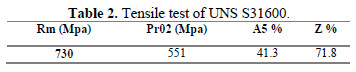
    <p>UNS S31600 stainless steel was subjected to a tensile test, to 
determine its mechanical behavior. <a href="#t2">Table 2</a> shows that the selected steel has high 
tensile stress 730 MPa, and its elastic limit reached 551 MPa.</p>


    <p>&nbsp;</p>
<a name="t2">
<img src="/img/revistas/pea/v34n3/34n3a01t2.jpg">
    
<p>&nbsp;</p>


    <p><i><b>Superfinish turning</b></i></p>

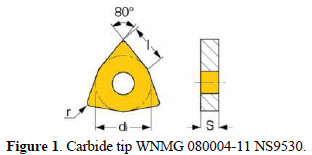
    <p>The experiment was conducted on a CNC lathe. Specimens were machined from 
a blank of four cylindrical bars, and have 0.5 m in length, and 11 mm in 
diameter. They are machined using a dressing tool with a carbide tip (<a href="#f1">Fig. 1</a>), 
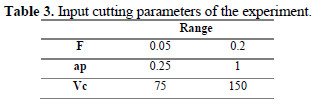
being its geometry described in <a href="#t3">Table 3</a>.</p>


    <p>&nbsp;</p>
<a name="f1">
<img src="/img/revistas/pea/v34n3/34n3a01f1.jpg">
    
]]></body>
<body><![CDATA[<p>&nbsp;</p>
<a name="t3">
<img src="/img/revistas/pea/v34n3/34n3a01t3.jpg">
    
<p>&nbsp;</p>


    <p>The tool penetrates the workpiece by 
minimizing the friction with the lubricant. For a superfinishing surface quality in 
turning operation, it is necessary to choose suitable cutting parameters. A. 
Chevallier [25] mentioned that austenitic stainless steel must be machined with a 
feed superior then 0.04 mm/rev, and a cutting speed environs 115 m / min. In the 
one hand, the field experiment uses feed values belong to the interval [0.05 
mm/tr; 0.2 mm/tr]. The upper value of the range (0.2 mm/tr) was selected to 
remain in the finishing operation, and to avoid the roughing rang of feed. Based 
on the average value of feed interval (0.125 mm/tr), Corner Radius can be 
calculated according to <a href="#e1">equation 1</a> used in mechanical industry [26].</p>


    <p>&nbsp;</p>
<a name="e1">
<img src="/img/revistas/pea/v34n3/34n3a01e1.jpg">
    
<p>&nbsp;</p>


    <p>This value is 
equal to 0.2 mm (0.125&times;2=0.25&simeq;0.2 mm). In the other hand, the cutting speed 
adopts 115 m/min value as the arithmetic average of the selected range, so the 
interval [75 m/min; 150 m/min] has been chosen (<a href="#e1">equation 2</a>).</p>


    <p>&nbsp;</p>
<a name="e2">
<img src="/img/revistas/pea/v34n3/34n3a01e2.jpg">
    
<p>&nbsp;</p>


    <p>The experimental 
design of the cutting parameters is presented in <a href="#t3">Table 3</a>.</p>


    <p><i><b>Localized corrosion tests</b></i></p>

    ]]></body>
<body><![CDATA[<p><i>Corrosive solution</i></p>

    <p>A 6% NaCl, obtained by diluting of sea salt with distilled water.</p>


    <p><i>Electrochemical measurements</i></p>

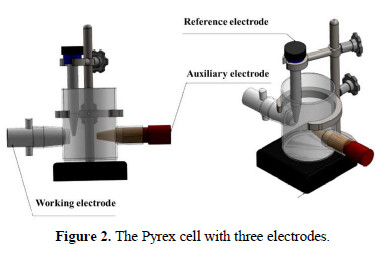
    <p>The electrochemical experiments were performed in a Pyrex cell with three 
electrodes (<a href="#f2">Fig. 2</a>): stainless steel UNS S31600 (1 cm<sup>2</sup>) as working electrode, 
platinum as an auxiliary electrode and a saturated calomel electrode, SCE, as a 
reference electrode.</p>


    <p>&nbsp;</p>
<a name="f2">
<img src="/img/revistas/pea/v34n3/34n3a01f2.jpg">
    
<p>&nbsp;</p>


    <p>The current-potential curve is obtained by operating in 
potentiodynamic mode; the potential applied to the sample varies continuously 
with a scanning rate of 5 mV / min. A relatively low rate of scanning was chosen 
to remain in a quasi-stationary regime. The measurements are performed with an 
assembly comprising a PGZ100 potentiostat-galvanostat, associated with 
"voltamaster4" software. Before curve plot, the working electrode is maintained 
at a potential of -800 mV for 15 minutes. The tests were carried out maintaining 
the temperature of the electrolyte at 25 &deg;C &pm; 0.1 &deg;C.</p>


    <p>&nbsp;</p>
    <p><b>Results and discussion</b></p>

    <p><i><b>Surface roughness</b></i></p>

    ]]></body>
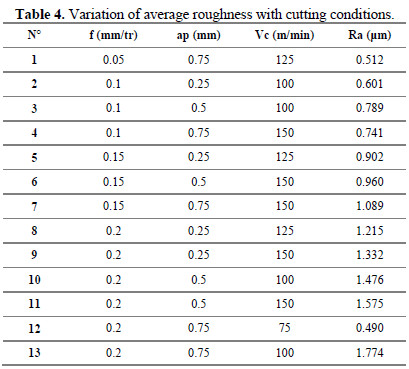
<body><![CDATA[<p>The average roughness Ra of the machined specimens in the superfinish turning 
is shown in <a href="#t4">Table 4</a>.</p>


    <p>&nbsp;</p>
<a name="t4">
<img src="/img/revistas/pea/v34n3/34n3a01t4.jpg">
    
<p>&nbsp;</p>


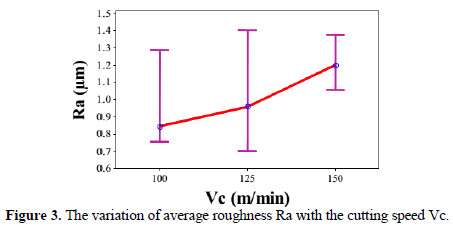
    <p>The cutting speed Vc had an influence on the average roughness Ra in 
superfinish turning. <a href="#f3">Fig. 3</a> proves that the increase in the cutting speed conducts 
to decreasing the quality of surface workpiece of l'UNS S31600.</p>


    <p>&nbsp;</p>
<a name="f3">
<img src="/img/revistas/pea/v34n3/34n3a01f3.jpg">
    
<p>&nbsp;</p>


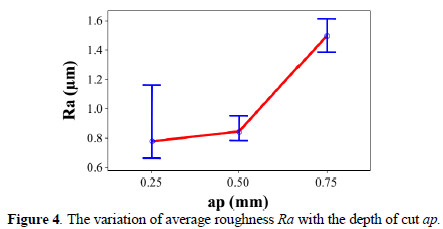
    <p>The same finding was observed on the variation of the average roughness 
with the depth of cut, as presented in <a href="#f4">Fig. 4</a>.</p>


    <p>&nbsp;</p>
<a name="f4">
<img src="/img/revistas/pea/v34n3/34n3a01f4.jpg">
    
<p>&nbsp;</p>


    <p>This observation approves the degradation of the 
surface quality with the increase in the depth of cut ap.</p>

    ]]></body>
<body><![CDATA[<p>In turning operation, increasing the depth of cut and the cutting speed generates a 
mechanical vibration on the cutting tool, and a thermal constraint, produced by 
the tool friction in machining operation [27]. Stainless steel has a low thermal 
conductivity that prevents dissipation of heat generated in the cutting area, 
consequently increasing the cutting temperature [28]. Therefore, high 
temperatures with high ductility of the austenite phase increase the residual stress 
in the subsurface layer of workpiece. Consequently, this stress impacts the 
material nobility, and increases corrosion potential.</p>

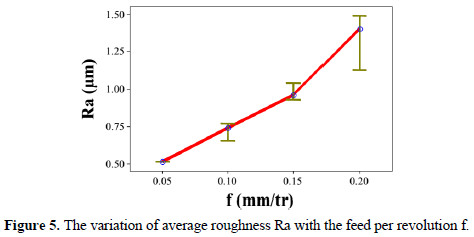
    <p>The average roughness increases with increasing the feed per revolution (<a href="#f5">Fig. 5</a>).</p>


    <p>&nbsp;</p>
<a name="f5">
<img src="/img/revistas/pea/v34n3/34n3a01f5.jpg">
    
<p>&nbsp;</p>


    <p>The lower quality of machined surface has not limited in this increase in 
roughness, but it was illustrated on the large dissipation of roughness values for 
higher feeds. Therefore, the range of dissipation increases with the increase in 
feed per revolution of cutting tool. This increase of dissipation range was 
influenced by increasing vibration on the cutting tool in finish turning operation 
[29].</p>


    <p><i><b>Corrosion resistance</b></i></p>

    <p>The evolution of the corrosion potential was studied with the machined surface 
behavior. This study consists in examining the variation of the polarization 
resistance Rp, the corrosion current density Icorr and the corrosion potential Ecorr, 
with the average roughness Ra of UNS S31600 workpiece in superfinish turning.</p>

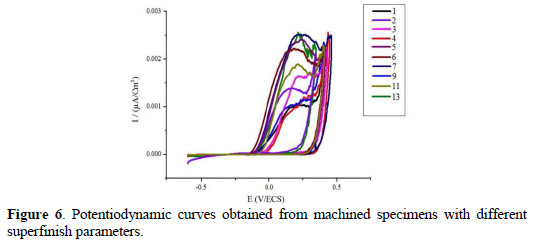
    <p>The potentiodynamic curves obtained from machined specimens with different 
superfinish parameters were compared in <a href="#f6">Fig. 6</a>.</p>


    <p>&nbsp;</p>
<a name="f6">
<img src="/img/revistas/pea/v34n3/34n3a01f6.jpg">
    
<p>&nbsp;</p>


    ]]></body>
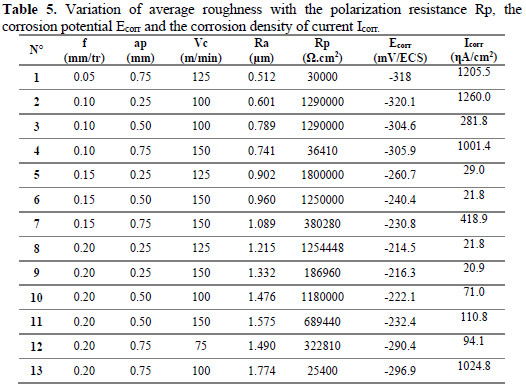
<body><![CDATA[<p>The specimens were machined 
in different values of the cutting speed, the feed and the depth of cut. The 
roughness parameters after the superfinish turning tests and the physico-chemical 
parameters were represented in <a href="#t5">Table 5</a>.</p>


    <p>&nbsp;</p>
<a name="t5">
<img src="/img/revistas/pea/v34n3/34n3a01t5.jpg">
    
<p>&nbsp;</p>


    <p><a href="#f6">Fig. 6</a> and <a href="#t5">Table 5</a> indicate that the average roughness impact the passivation 
processes of UNS S31600. The current-potential curves were influenced by the 
average roughness Ra. The domain of inertia is the same for all specimens. 
However, the active domain has established differently according to the average 
roughness of UNS S31600. The corrosion potential has ennobled since -320 
mV/ECS to -210 mV/ECS.</p>

    <p>The corrosion current density was varied with the surface quality of the 
workpiece. The average roughness value 1.774 &mu;m (workpiece N&deg;C13) 
corresponds to the current density 1.0248 &mu;A/cm<sup>2</sup>. This value of Icorr increases to 
1.0014 &mu;A/cm<sup>2</sup> for an average roughness lower (Ra=0.751 &mu;m), as far as the 
current density increases to 0.0941 &mu;A/cm<sup>2</sup> for the roughness 0.490 &mu;m. This 
observation approves the impact of the average roughness in the corrosion 
current density, and consequently in the corrosion rate of UNS S31600 stainless 
steel. Whereas, the corrosion rate increases with the increase in the number of 
pits, and corrosion potential decreases with decreasing the surface quality of a 
workpiece [16].</p>

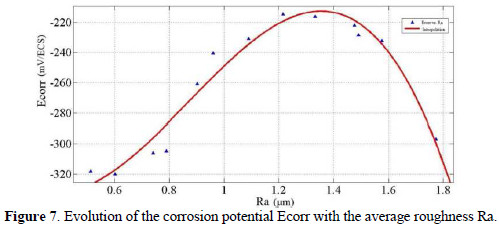
    <p>The potentiodynamic tests reveal that the corrosion potential of workpieces 
machined in superfinish turning, increases with increasing roughness values in a 
range lower than 1.3 &mu;m. The higher quality of machined surface generates a 
lower potential. However, this increase has stopped when the average roughness 
reaches 1.332 &mu;m (Ecorr=-216.3 mV/ECS). Then, the corrosion potential 
decreases with increasing the average roughness values (<a href="#f7">Fig. 7</a>).</p>


    <p>&nbsp;</p>
<a name="f7">
<img src="/img/revistas/pea/v34n3/34n3a01f7.jpg">
    
<p>&nbsp;</p>


    <p>Therefore, in 
superfinish roughness range (values inferior to 1 &mu;m), the more the surface 
quality is higher, the more the corrosion potential is lower. This variation (Ra 
according to Ecorr) follows a polynomial interpolation of degree 3 with a 95% 
correlation.</p>

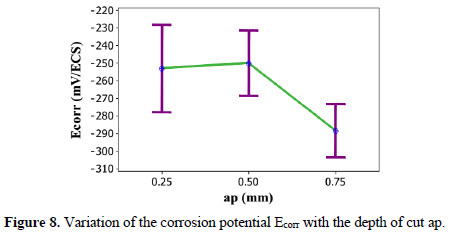
    <p>The average roughness range [0.512 &mu;m; 1.332 &mu;m], where the corrosion 
potential increases, is characterized by its low values of depth of cut (0.25 mm 
and 0.5 mm). Therefore, the other range (superior than 1.332 &mu;m) is 
characterized by a higher value of ap (0.75 mm). This remark is marked in <a href="#f8">Fig. 8</a>; 
the corrosion potential has increased clearly for 0.75 mm value of depth of cut.</p>


    ]]></body>
<body><![CDATA[<p>&nbsp;</p>
<a name="f8">
<img src="/img/revistas/pea/v34n3/34n3a01f8.jpg">
    
<p>&nbsp;</p>


    <p>However, the potential is more stable for the others values (0.25 mm and 0.5 
mm). The cutting depth ap does not affect the residual stress for lower values, so 
the corrosion behavior of stainless steel was more stable in this range [30]. 
Nevertheless, for greater values, the vibration increases with the increase in the 
cutting depth [31]. Therefore, the residual stress was appeared and accelerates the 
corrosion reaction of the workpiece.</p>

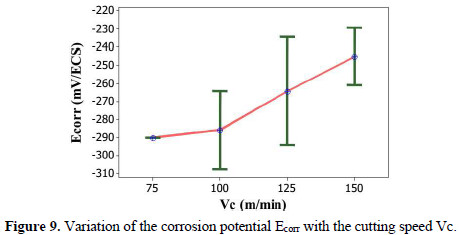
    <p>The cutting speed affects the corrosion potential. The more the cutting speed 
increases, the more the potential increases, especially, more the corrosion 
resistance of stainless steel is higher. The cutting speed affects the plastic 
deformation rate of the workpiece. When the cutting speed increases, the 
corrosion rate decreases (<a href="#f9">Fig. 9</a>).</p>


    <p>&nbsp;</p>
<a name="f9">
<img src="/img/revistas/pea/v34n3/34n3a01f9.jpg">
    
<p>&nbsp;</p>


    <p>This increase in the speed develops the 
deformation rate. Consequently, the &beta;-phase of material was appeared, which 
acts as non-protective component. This thin layer characterizes the rough surface. 
On the other hand, for the smooth surfaces, &alpha; 
and &gamma; phases occupy greater area of 
the workpiece, which acts as protective component [19].</p>

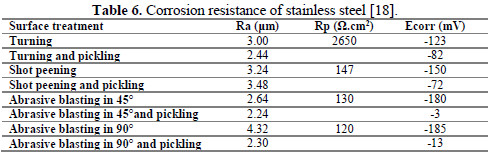
    <p>Comparing this investigation with others in literature, V. Zatkalikova et al. [16] 
have affirmed that the pitting corrosion parameters have been affected by the 
average roughness of workpiece.</p>

    <p>They have affirmed that the nobility of the stainless steel decreases with the 
increase in the average roughness values (<a href="#t6">Table 6</a>).</p>


    <p>&nbsp;</p>
<a name="t6">
<img src="/img/revistas/pea/v34n3/34n3a01t6.jpg">
    
]]></body>
<body><![CDATA[<p>&nbsp;</p>


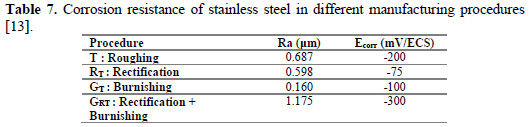
    <p>Also, W. Bouzid Sai et al. [11] arrived to the same results. They have revealed 
that the decrease in the average roughness provokes the increase in corrosion 
resistance, and, consequently, the increase in pitting potential, caused by the 
decrease of the residual stress. This decrease can be due to the diminution of the 
hardened layer of smooth surface (<a href="#t7">Table 7</a>).</p>


    <p>&nbsp;</p>
<a name="t7">
<img src="/img/revistas/pea/v34n3/34n3a01t7.jpg">
    
<p>&nbsp;</p>


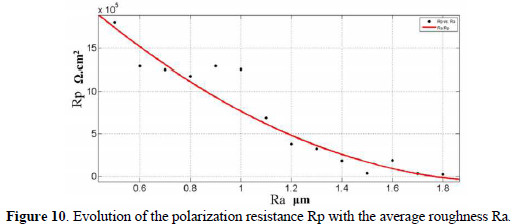
    <p>The polarization resistance Rp increases with the amelioration of the surface 
quality (smooth surface). The more the average roughness is low, the more the 
polarization resistance is high. This variation has a polynomial interpolation with 
91% correlation (<a href="#f10">Fig. 10</a>).</p>


    <p>&nbsp;</p>
<a name="f10">
<img src="/img/revistas/pea/v34n3/34n3a01f10.jpg">
    
<p>&nbsp;</p>


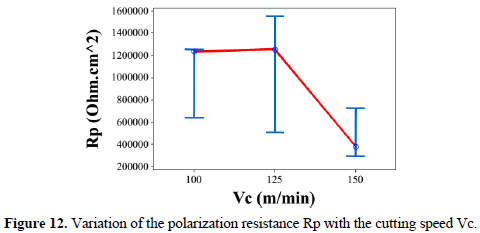
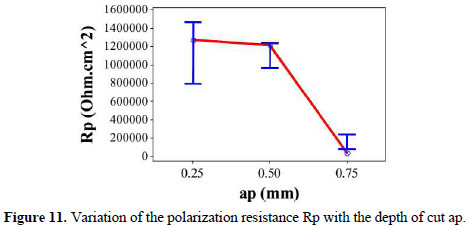
    <p>The impact of cutting parameters, especially the depth of cut and the cutting 
speed, was illustrated in <a href="#f11">Fig. 11</a> and <a href="#f12">Fig. 12</a>.</p>


    <p>&nbsp;</p>
<a name="f11">
<img src="/img/revistas/pea/v34n3/34n3a01f11.jpg">
    
<p>&nbsp;</p>
<a name="f12">
<img src="/img/revistas/pea/v34n3/34n3a01f12.jpg">
    
]]></body>
<body><![CDATA[<p>&nbsp;</p>


    <p>The polarization resistance decreases clearly after Vc= 125 m/min and ap= 0.5 
mm, so the corrosion resistance of stainless steel degrades. Therefore, the 
amelioration of UNS S31600 corrosion resistance was due to the higher surface 
quality and the decrease in residual stress, caused especially by the chosen 
cutting conditions.</p>

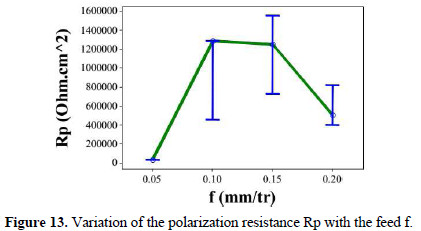
    <p>However, the feed f has not any significant correlation with the polarization 
resistance (<a href="#f13">Fig. 13</a>).</p>


    <p>&nbsp;</p>
<a name="f13">
<img src="/img/revistas/pea/v34n3/34n3a01f13.jpg">
    
<p>&nbsp;</p>


    <p>&nbsp;</p>
    <p><b>Conclusions</b></p>

    <p>The superfinish turning of UNS S31600 stainless steel affects the localized 
corrosion resistance. The results are grouped into the following:</p>

    <p>- In superfinish turning (Ra &lt; 1 &mu;m), the corrosion resistance of UNS S31600 
stainless steel decreases, reducing the metal dissolution. However, in finish 
turning (1 &mu;m &leq; Ra &leq; 6.3 &mu;m), the decrease in roughness value provokes a 
diminution in corrosion potential.</p>

    <p>- The depth of cut affects the corrosion potential. The increase in this factor 
generates the residual stress in the thin subsurface layer, which causes a decrease 
in potential, reducing the metal dissolution and the passivation layer.</p>

    ]]></body>
<body><![CDATA[<p>- The cutting speed affects the corrosion potential. Its increase (Vc) degrades the
corrosion resistance and increases the corrosion potential.</p>

    <p>- The polarization resistance increases with the increase in surface quality with 
91% correlation. Consequently, the amelioration of the corrosion resistance with 
the increase in surface quality of the UNS S31600 workpiece in superfinish 
turning.</p>


    <p>&nbsp;</p>
    <p><b>References</b></p>

    <!-- ref --><p>1. Hashimotoa F, Chaudharia R G, Melkoteb S N. Procedia CIRP. 2016;45:1.    &nbsp;&nbsp;&nbsp;&nbsp;&nbsp;&nbsp;&nbsp;&nbsp;[&#160;<a href="javascript:void(0);" onclick="javascript: window.open('/scielo.php?script=sci_nlinks&ref=420216&pid=S0872-1904201600030000100001&lng=','','width=640,height=500,resizable=yes,scrollbars=1,menubar=yes,');">Links</a>&#160;]<!-- end-ref --></p>

    <!-- ref --><p>2. Mittal S, Liu C. Wear. 1998;218:21.    &nbsp;&nbsp;&nbsp;&nbsp;&nbsp;&nbsp;&nbsp;&nbsp;[&#160;<a href="javascript:void(0);" onclick="javascript: window.open('/scielo.php?script=sci_nlinks&ref=420218&pid=S0872-1904201600030000100002&lng=','','width=640,height=500,resizable=yes,scrollbars=1,menubar=yes,');">Links</a>&#160;]<!-- end-ref --></p>

    <!-- ref --><p>3. Endrino J, Fox-Rabinovich G, Gey C. Surf Coat Tech. 2006;200:6840.    &nbsp;&nbsp;&nbsp;&nbsp;&nbsp;&nbsp;&nbsp;&nbsp;[&#160;<a href="javascript:void(0);" onclick="javascript: window.open('/scielo.php?script=sci_nlinks&ref=420220&pid=S0872-1904201600030000100003&lng=','','width=640,height=500,resizable=yes,scrollbars=1,menubar=yes,');">Links</a>&#160;]<!-- end-ref --></p>

    ]]></body>
<body><![CDATA[<!-- ref --><p>4. Asilturk I, Cunkas M. Expert Syst Appl. 2011;38:5826.    &nbsp;&nbsp;&nbsp;&nbsp;&nbsp;&nbsp;&nbsp;&nbsp;[&#160;<a href="javascript:void(0);" onclick="javascript: window.open('/scielo.php?script=sci_nlinks&ref=420222&pid=S0872-1904201600030000100004&lng=','','width=640,height=500,resizable=yes,scrollbars=1,menubar=yes,');">Links</a>&#160;]<!-- end-ref --></p>

    <!-- ref --><p>5. Grzesik W, Zak K. J Mater Process Tech. 2012;212:315.    &nbsp;&nbsp;&nbsp;&nbsp;&nbsp;&nbsp;&nbsp;&nbsp;[&#160;<a href="javascript:void(0);" onclick="javascript: window.open('/scielo.php?script=sci_nlinks&ref=420224&pid=S0872-1904201600030000100005&lng=','','width=640,height=500,resizable=yes,scrollbars=1,menubar=yes,');">Links</a>&#160;]<!-- end-ref --></p>

    <!-- ref --><p>6. Valiorgue F, Rech J, Hamdi H, et al. Int J Machin Tools Manuf. 2012;53:77.    &nbsp;&nbsp;&nbsp;&nbsp;&nbsp;&nbsp;&nbsp;&nbsp;[&#160;<a href="javascript:void(0);" onclick="javascript: window.open('/scielo.php?script=sci_nlinks&ref=420226&pid=S0872-1904201600030000100006&lng=','','width=640,height=500,resizable=yes,scrollbars=1,menubar=yes,');">Links</a>&#160;]<!-- end-ref --></p>

    <!-- ref --><p>7. Stenberg N, Proudian J. Procedia CIRP. 2013;8:258.    &nbsp;&nbsp;&nbsp;&nbsp;&nbsp;&nbsp;&nbsp;&nbsp;[&#160;<a href="javascript:void(0);" onclick="javascript: window.open('/scielo.php?script=sci_nlinks&ref=420228&pid=S0872-1904201600030000100007&lng=','','width=640,height=500,resizable=yes,scrollbars=1,menubar=yes,');">Links</a>&#160;]<!-- end-ref --></p>

    <!-- ref --><p>8. Abboud E, Shi B, Attia H, et al. Procedia CIRP. 2013;8:63.    &nbsp;&nbsp;&nbsp;&nbsp;&nbsp;&nbsp;&nbsp;&nbsp;[&#160;<a href="javascript:void(0);" onclick="javascript: window.open('/scielo.php?script=sci_nlinks&ref=420230&pid=S0872-1904201600030000100008&lng=','','width=640,height=500,resizable=yes,scrollbars=1,menubar=yes,');">Links</a>&#160;]<!-- end-ref --></p>

    ]]></body>
<body><![CDATA[<!-- ref --><p>9. Caruso S, Di Renzo S, Umbrello D, et al. Adv Mater Res. 2011;223:960.    &nbsp;&nbsp;&nbsp;&nbsp;&nbsp;&nbsp;&nbsp;&nbsp;[&#160;<a href="javascript:void(0);" onclick="javascript: window.open('/scielo.php?script=sci_nlinks&ref=420232&pid=S0872-1904201600030000100009&lng=','','width=640,height=500,resizable=yes,scrollbars=1,menubar=yes,');">Links</a>&#160;]<!-- end-ref --></p>

    <!-- ref --><p>10. Pu Z, Umbrello D, Dillon Jr O, et al. J Manuf Proc. 2014;16:335.    &nbsp;&nbsp;&nbsp;&nbsp;&nbsp;&nbsp;&nbsp;&nbsp;[&#160;<a href="javascript:void(0);" onclick="javascript: window.open('/scielo.php?script=sci_nlinks&ref=420234&pid=S0872-1904201600030000100010&lng=','','width=640,height=500,resizable=yes,scrollbars=1,menubar=yes,');">Links</a>&#160;]<!-- end-ref --></p>

    <!-- ref --><p>11. Liu CR, Mittal S. Single-step superfinish hard machining: Feasibility and 
feasible cutting conditions. Rob Comp lnteg Manuf. vol. 12, pp. 15-27, 1995.    &nbsp;&nbsp;&nbsp;&nbsp;&nbsp;&nbsp;&nbsp;&nbsp;[&#160;<a href="javascript:void(0);" onclick="javascript: window.open('/scielo.php?script=sci_nlinks&ref=420236&pid=S0872-1904201600030000100011&lng=','','width=640,height=500,resizable=yes,scrollbars=1,menubar=yes,');">Links</a>&#160;]<!-- end-ref --></p>

    <!-- ref --><p>12. Navas G V, Gonzalo O, Bengoetxa I. Int J Machin Tools Manuf. 2012;61:48.    &nbsp;&nbsp;&nbsp;&nbsp;&nbsp;&nbsp;&nbsp;&nbsp;[&#160;<a href="javascript:void(0);" onclick="javascript: window.open('/scielo.php?script=sci_nlinks&ref=420238&pid=S0872-1904201600030000100012&lng=','','width=640,height=500,resizable=yes,scrollbars=1,menubar=yes,');">Links</a>&#160;]<!-- end-ref --></p>

    <!-- ref --><p>13. Sai W B, Triki E. Trans Canad Soc Mech Eng. 2006;30:183.    &nbsp;&nbsp;&nbsp;&nbsp;&nbsp;&nbsp;&nbsp;&nbsp;[&#160;<a href="javascript:void(0);" onclick="javascript: window.open('/scielo.php?script=sci_nlinks&ref=420240&pid=S0872-1904201600030000100013&lng=','','width=640,height=500,resizable=yes,scrollbars=1,menubar=yes,');">Links</a>&#160;]<!-- end-ref --></p>

    ]]></body>
<body><![CDATA[<!-- ref --><p>14. Gurvich L, Shubadeeva L. All-Union Aviat Mater Sci-Res Inst. 1971;7:23.    &nbsp;&nbsp;&nbsp;&nbsp;&nbsp;&nbsp;&nbsp;&nbsp;[&#160;<a href="javascript:void(0);" onclick="javascript: window.open('/scielo.php?script=sci_nlinks&ref=420242&pid=S0872-1904201600030000100014&lng=','','width=640,height=500,resizable=yes,scrollbars=1,menubar=yes,');">Links</a>&#160;]<!-- end-ref --></p>

    <!-- ref --><p>15. Szklarska-Smialowska Z. Pitting and Crevice Corrosion. Houston, Texas: NACE International; 2005.    &nbsp;&nbsp;&nbsp;&nbsp;&nbsp;&nbsp;&nbsp;&nbsp;[&#160;<a href="javascript:void(0);" onclick="javascript: window.open('/scielo.php?script=sci_nlinks&ref=420244&pid=S0872-1904201600030000100015&lng=','','width=640,height=500,resizable=yes,scrollbars=1,menubar=yes,');">Links</a>&#160;]<!-- end-ref --></p>

    <!-- ref --><p>16. Zuo Y, Wang H, Zhao J. et al. Corros Sci. 2002;44:13.    &nbsp;&nbsp;&nbsp;&nbsp;&nbsp;&nbsp;&nbsp;&nbsp;[&#160;<a href="javascript:void(0);" onclick="javascript: window.open('/scielo.php?script=sci_nlinks&ref=420246&pid=S0872-1904201600030000100016&lng=','','width=640,height=500,resizable=yes,scrollbars=1,menubar=yes,');">Links</a>&#160;]<!-- end-ref --></p>

    <!-- ref --><p>17. Sasaki K, Burstein G. Corros Sci. 1996;38:2111.    &nbsp;&nbsp;&nbsp;&nbsp;&nbsp;&nbsp;&nbsp;&nbsp;[&#160;<a href="javascript:void(0);" onclick="javascript: window.open('/scielo.php?script=sci_nlinks&ref=420248&pid=S0872-1904201600030000100017&lng=','','width=640,height=500,resizable=yes,scrollbars=1,menubar=yes,');">Links</a>&#160;]<!-- end-ref --></p>

    <!-- ref --><p>18. Zatkalikova V, Liptakova T. Mater Eng. 2011;18:115.    &nbsp;&nbsp;&nbsp;&nbsp;&nbsp;&nbsp;&nbsp;&nbsp;[&#160;<a href="javascript:void(0);" onclick="javascript: window.open('/scielo.php?script=sci_nlinks&ref=420250&pid=S0872-1904201600030000100018&lng=','','width=640,height=500,resizable=yes,scrollbars=1,menubar=yes,');">Links</a>&#160;]<!-- end-ref --></p>

    ]]></body>
<body><![CDATA[<!-- ref --><p>19. Prakash M, Shekhar S, Moon A. et al. J Mater Proc Tech. 2015;219:70.    &nbsp;&nbsp;&nbsp;&nbsp;&nbsp;&nbsp;&nbsp;&nbsp;[&#160;<a href="javascript:void(0);" onclick="javascript: window.open('/scielo.php?script=sci_nlinks&ref=420252&pid=S0872-1904201600030000100019&lng=','','width=640,height=500,resizable=yes,scrollbars=1,menubar=yes,');">Links</a>&#160;]<!-- end-ref --></p>

    <!-- ref --><p>20. Lee S M, Lee W G, Kim YH, et al. Corros Sci. 2012;63:404.    &nbsp;&nbsp;&nbsp;&nbsp;&nbsp;&nbsp;&nbsp;&nbsp;[&#160;<a href="javascript:void(0);" onclick="javascript: window.open('/scielo.php?script=sci_nlinks&ref=420254&pid=S0872-1904201600030000100020&lng=','','width=640,height=500,resizable=yes,scrollbars=1,menubar=yes,');">Links</a>&#160;]<!-- end-ref --></p>

    <!-- ref --><p>21. Gravier J, Vignal V, Bissey-Breton S, et al. Corros Sci. 2008;50:2885.    &nbsp;&nbsp;&nbsp;&nbsp;&nbsp;&nbsp;&nbsp;&nbsp;[&#160;<a href="javascript:void(0);" onclick="javascript: window.open('/scielo.php?script=sci_nlinks&ref=420256&pid=S0872-1904201600030000100021&lng=','','width=640,height=500,resizable=yes,scrollbars=1,menubar=yes,');">Links</a>&#160;]<!-- end-ref --></p>

    <!-- ref --><p>22. Bissey-Breton S, Gravier J, Vignal V. Proc Eng. 2011;19:28.    &nbsp;&nbsp;&nbsp;&nbsp;&nbsp;&nbsp;&nbsp;&nbsp;[&#160;<a href="javascript:void(0);" onclick="javascript: window.open('/scielo.php?script=sci_nlinks&ref=420258&pid=S0872-1904201600030000100022&lng=','','width=640,height=500,resizable=yes,scrollbars=1,menubar=yes,');">Links</a>&#160;]<!-- end-ref --></p>

    <!-- ref --><p>23. Yin S, Li D. Mater Sci Eng A. 2005;394:266.    &nbsp;&nbsp;&nbsp;&nbsp;&nbsp;&nbsp;&nbsp;&nbsp;[&#160;<a href="javascript:void(0);" onclick="javascript: window.open('/scielo.php?script=sci_nlinks&ref=420260&pid=S0872-1904201600030000100023&lng=','','width=640,height=500,resizable=yes,scrollbars=1,menubar=yes,');">Links</a>&#160;]<!-- end-ref --></p>

    ]]></body>
<body><![CDATA[<!-- ref --><p>24. Robin A, Martine G A S, Suzuki P A. Mat Design. 2012;34:319.    &nbsp;&nbsp;&nbsp;&nbsp;&nbsp;&nbsp;&nbsp;&nbsp;[&#160;<a href="javascript:void(0);" onclick="javascript: window.open('/scielo.php?script=sci_nlinks&ref=420262&pid=S0872-1904201600030000100024&lng=','','width=640,height=500,resizable=yes,scrollbars=1,menubar=yes,');">Links</a>&#160;]<!-- end-ref --></p>

    <!-- ref --><p>25. Chevalier A, Bohan J. Guide du technicien en productique. Paris: Hachette Livre; 1996.    &nbsp;&nbsp;&nbsp;&nbsp;&nbsp;&nbsp;&nbsp;&nbsp;[&#160;<a href="javascript:void(0);" onclick="javascript: window.open('/scielo.php?script=sci_nlinks&ref=420264&pid=S0872-1904201600030000100025&lng=','','width=640,height=500,resizable=yes,scrollbars=1,menubar=yes,');">Links</a>&#160;]<!-- end-ref --></p>

    <!-- ref --><p>26. Grzesik W. Adv Machining Proc Metallic Mater. 2006.    &nbsp;&nbsp;&nbsp;&nbsp;&nbsp;&nbsp;&nbsp;&nbsp;[&#160;<a href="javascript:void(0);" onclick="javascript: window.open('/scielo.php?script=sci_nlinks&ref=420266&pid=S0872-1904201600030000100026&lng=','','width=640,height=500,resizable=yes,scrollbars=1,menubar=yes,');">Links</a>&#160;]<!-- end-ref --></p>

    <!-- ref --><p>27. Maurel A, Fontaine M, Thibaud S, et al. Modelisation thermo-elastoviscoplastique 
du comportement de l'acier inoxydable 304L -Applications a l'usinage grande vitesse. Grenoble: 18eme Congres Francais de 
Mecanique; 2007.    &nbsp;&nbsp;&nbsp;&nbsp;&nbsp;&nbsp;&nbsp;&nbsp;[&#160;<a href="javascript:void(0);" onclick="javascript: window.open('/scielo.php?script=sci_nlinks&ref=420268&pid=S0872-1904201600030000100027&lng=','','width=640,height=500,resizable=yes,scrollbars=1,menubar=yes,');">Links</a>&#160;]<!-- end-ref --></p>

    <!-- ref --><p>28. Fernandez-Abia A I, Garcia J B, de Lacalle L N L. High-performance 
machining of austenitic stainless steels. Leon: Woodhead Publ Ltd; 2013.    &nbsp;&nbsp;&nbsp;&nbsp;&nbsp;&nbsp;&nbsp;&nbsp;[&#160;<a href="javascript:void(0);" onclick="javascript: window.open('/scielo.php?script=sci_nlinks&ref=420270&pid=S0872-1904201600030000100028&lng=','','width=640,height=500,resizable=yes,scrollbars=1,menubar=yes,');">Links</a>&#160;]<!-- end-ref --></p>

    ]]></body>
<body><![CDATA[<!-- ref --><p>29. Marty A. Simulation numerique de l'usinage par l'outil coupant a l'echelle 
macroscopique: contribution a la definition geometrique de la surface 
usinee. Paris: Ecole Nationame superieure d'Arts et Metiers; 2003.    &nbsp;&nbsp;&nbsp;&nbsp;&nbsp;&nbsp;&nbsp;&nbsp;[&#160;<a href="javascript:void(0);" onclick="javascript: window.open('/scielo.php?script=sci_nlinks&ref=420272&pid=S0872-1904201600030000100029&lng=','','width=640,height=500,resizable=yes,scrollbars=1,menubar=yes,');">Links</a>&#160;]<!-- end-ref --></p>

    <!-- ref --><p>30. Dahlman P, Gunnberg F, Jacobson M. J Mater Proc Tech. 2004;147:181.    &nbsp;&nbsp;&nbsp;&nbsp;&nbsp;&nbsp;&nbsp;&nbsp;[&#160;<a href="javascript:void(0);" onclick="javascript: window.open('/scielo.php?script=sci_nlinks&ref=420274&pid=S0872-1904201600030000100030&lng=','','width=640,height=500,resizable=yes,scrollbars=1,menubar=yes,');">Links</a>&#160;]<!-- end-ref --></p>

    <!-- ref --><p>31. Aleksandrovich R V, Siamak G. Modern Mech Eng. 2014;4:8.    &nbsp;&nbsp;&nbsp;&nbsp;&nbsp;&nbsp;&nbsp;&nbsp;[&#160;<a href="javascript:void(0);" onclick="javascript: window.open('/scielo.php?script=sci_nlinks&ref=420276&pid=S0872-1904201600030000100031&lng=','','width=640,height=500,resizable=yes,scrollbars=1,menubar=yes,');">Links</a>&#160;]<!-- end-ref --></p>


    <p>&nbsp;</p>
    <p><a name=0></a><sup><a href="#top">*</a></sup>Corresponding author. E-mail address: <a href="mailto:y.echcharqy@uhp.ac.ma">y.echcharqy@uhp.ac.ma</a></p>

    <p>Received 18 April 2016; accepted 30 April 2016</p>

    <p><a href="http://www.peacta.org" target="_blank">www.peacta.org</a> </p>


    ]]></body>
<body><![CDATA[ ]]></body><back>
<ref-list>
<ref id="B1">
<label>1</label><nlm-citation citation-type="journal">
<person-group person-group-type="author">
<name>
<surname><![CDATA[Hashimotoa]]></surname>
<given-names><![CDATA[F]]></given-names>
</name>
<name>
<surname><![CDATA[Chaudharia]]></surname>
<given-names><![CDATA[R G]]></given-names>
</name>
<name>
<surname><![CDATA[Melkoteb]]></surname>
<given-names><![CDATA[S N]]></given-names>
</name>
</person-group>
<source><![CDATA[Procedia CIRP]]></source>
<year>2016</year>
<volume>45</volume>
<page-range>1</page-range></nlm-citation>
</ref>
<ref id="B2">
<label>2</label><nlm-citation citation-type="journal">
<person-group person-group-type="author">
<name>
<surname><![CDATA[Mittal]]></surname>
<given-names><![CDATA[S]]></given-names>
</name>
<name>
<surname><![CDATA[Liu]]></surname>
<given-names><![CDATA[C]]></given-names>
</name>
</person-group>
<source><![CDATA[Wear]]></source>
<year>1998</year>
<volume>218</volume>
<page-range>21</page-range></nlm-citation>
</ref>
<ref id="B3">
<label>3</label><nlm-citation citation-type="journal">
<person-group person-group-type="author">
<name>
<surname><![CDATA[Endrino]]></surname>
<given-names><![CDATA[J]]></given-names>
</name>
<name>
<surname><![CDATA[Fox-Rabinovich]]></surname>
<given-names><![CDATA[G]]></given-names>
</name>
<name>
<surname><![CDATA[Gey]]></surname>
<given-names><![CDATA[C]]></given-names>
</name>
</person-group>
<source><![CDATA[Surf Coat Tech]]></source>
<year>2006</year>
<volume>200</volume>
<page-range>6840</page-range></nlm-citation>
</ref>
<ref id="B4">
<label>4</label><nlm-citation citation-type="journal">
<person-group person-group-type="author">
<name>
<surname><![CDATA[Asilturk]]></surname>
<given-names><![CDATA[I]]></given-names>
</name>
<name>
<surname><![CDATA[Cunkas]]></surname>
<given-names><![CDATA[M]]></given-names>
</name>
</person-group>
<source><![CDATA[Expert Syst Appl]]></source>
<year>2011</year>
<volume>38</volume>
<page-range>5826</page-range></nlm-citation>
</ref>
<ref id="B5">
<label>5</label><nlm-citation citation-type="journal">
<person-group person-group-type="author">
<name>
<surname><![CDATA[Grzesik]]></surname>
<given-names><![CDATA[W]]></given-names>
</name>
<name>
<surname><![CDATA[Zak]]></surname>
<given-names><![CDATA[K]]></given-names>
</name>
</person-group>
<source><![CDATA[J Mater Process Tech]]></source>
<year>2012</year>
<volume>212</volume>
<page-range>315</page-range></nlm-citation>
</ref>
<ref id="B6">
<label>6</label><nlm-citation citation-type="journal">
<person-group person-group-type="author">
<name>
<surname><![CDATA[Valiorgue]]></surname>
<given-names><![CDATA[F]]></given-names>
</name>
<name>
<surname><![CDATA[Rech]]></surname>
<given-names><![CDATA[J]]></given-names>
</name>
<name>
<surname><![CDATA[Hamdi]]></surname>
<given-names><![CDATA[H]]></given-names>
</name>
</person-group>
<source><![CDATA[Int J Machin Tools Manuf]]></source>
<year>2012</year>
<volume>53</volume>
<page-range>77</page-range></nlm-citation>
</ref>
<ref id="B7">
<label>7</label><nlm-citation citation-type="journal">
<person-group person-group-type="author">
<name>
<surname><![CDATA[Stenberg]]></surname>
<given-names><![CDATA[N]]></given-names>
</name>
<name>
<surname><![CDATA[Proudian]]></surname>
<given-names><![CDATA[J]]></given-names>
</name>
</person-group>
<source><![CDATA[Procedia CIRP]]></source>
<year>2013</year>
<volume>8</volume>
<page-range>258</page-range></nlm-citation>
</ref>
<ref id="B8">
<label>8</label><nlm-citation citation-type="journal">
<person-group person-group-type="author">
<name>
<surname><![CDATA[Abboud]]></surname>
<given-names><![CDATA[E]]></given-names>
</name>
<name>
<surname><![CDATA[Shi]]></surname>
<given-names><![CDATA[B]]></given-names>
</name>
<name>
<surname><![CDATA[Attia]]></surname>
<given-names><![CDATA[H]]></given-names>
</name>
</person-group>
<source><![CDATA[Procedia CIRP]]></source>
<year>2013</year>
<volume>8</volume>
<page-range>63</page-range></nlm-citation>
</ref>
<ref id="B9">
<label>9</label><nlm-citation citation-type="journal">
<person-group person-group-type="author">
<name>
<surname><![CDATA[Caruso]]></surname>
<given-names><![CDATA[S]]></given-names>
</name>
<name>
<surname><![CDATA[Di Renzo]]></surname>
<given-names><![CDATA[S]]></given-names>
</name>
<name>
<surname><![CDATA[Umbrello]]></surname>
<given-names><![CDATA[D]]></given-names>
</name>
</person-group>
<source><![CDATA[Adv Mater Res]]></source>
<year>2011</year>
<volume>223</volume>
<page-range>960</page-range></nlm-citation>
</ref>
<ref id="B10">
<label>10</label><nlm-citation citation-type="journal">
<person-group person-group-type="author">
<name>
<surname><![CDATA[Pu]]></surname>
<given-names><![CDATA[Z]]></given-names>
</name>
<name>
<surname><![CDATA[Umbrello]]></surname>
<given-names><![CDATA[D]]></given-names>
</name>
<name>
<surname><![CDATA[Dillon]]></surname>
<given-names><![CDATA[Jr O]]></given-names>
</name>
</person-group>
<source><![CDATA[J Manuf Proc]]></source>
<year>2014</year>
<volume>16</volume>
<page-range>335</page-range></nlm-citation>
</ref>
<ref id="B11">
<label>11</label><nlm-citation citation-type="">
<person-group person-group-type="author">
<name>
<surname><![CDATA[Liu]]></surname>
<given-names><![CDATA[C R]]></given-names>
</name>
<name>
<surname><![CDATA[Mittal]]></surname>
<given-names><![CDATA[S]]></given-names>
</name>
</person-group>
<source><![CDATA[Single-step superfinish hard machining: Feasibility and feasible cutting conditions]]></source>
<year>1995</year>
<volume>12</volume>
<page-range>15-27</page-range></nlm-citation>
</ref>
<ref id="B12">
<label>12</label><nlm-citation citation-type="journal">
<person-group person-group-type="author">
<name>
<surname><![CDATA[Navas]]></surname>
<given-names><![CDATA[G V]]></given-names>
</name>
<name>
<surname><![CDATA[Gonzalo]]></surname>
<given-names><![CDATA[O]]></given-names>
</name>
<name>
<surname><![CDATA[Bengoetxa]]></surname>
<given-names><![CDATA[I]]></given-names>
</name>
</person-group>
<source><![CDATA[Int J Machin Tools Manuf]]></source>
<year>2012</year>
<volume>61</volume>
<page-range>48</page-range></nlm-citation>
</ref>
<ref id="B13">
<label>13</label><nlm-citation citation-type="journal">
<person-group person-group-type="author">
<name>
<surname><![CDATA[Sai]]></surname>
<given-names><![CDATA[W B]]></given-names>
</name>
<name>
<surname><![CDATA[Triki]]></surname>
<given-names><![CDATA[E]]></given-names>
</name>
</person-group>
<source><![CDATA[Trans Canad Soc Mech Eng]]></source>
<year>2006</year>
<volume>30</volume>
<page-range>183</page-range></nlm-citation>
</ref>
<ref id="B14">
<label>14</label><nlm-citation citation-type="journal">
<person-group person-group-type="author">
<name>
<surname><![CDATA[Gurvich]]></surname>
<given-names><![CDATA[L]]></given-names>
</name>
<name>
<surname><![CDATA[Shubadeeva]]></surname>
<given-names><![CDATA[L]]></given-names>
</name>
</person-group>
<source><![CDATA[All-Union Aviat Mater Sci-Res Inst]]></source>
<year>1971</year>
<volume>7</volume>
<page-range>23</page-range></nlm-citation>
</ref>
<ref id="B15">
<label>15</label><nlm-citation citation-type="book">
<person-group person-group-type="author">
<name>
<surname><![CDATA[Szklarska-Smialowska]]></surname>
<given-names><![CDATA[Z]]></given-names>
</name>
</person-group>
<source><![CDATA[Pitting and Crevice Corrosion]]></source>
<year>2005</year>
<publisher-loc><![CDATA[Houston^eTexas Texas]]></publisher-loc>
<publisher-name><![CDATA[NACE International]]></publisher-name>
</nlm-citation>
</ref>
<ref id="B16">
<label>16</label><nlm-citation citation-type="journal">
<person-group person-group-type="author">
<name>
<surname><![CDATA[Zuo]]></surname>
<given-names><![CDATA[Y]]></given-names>
</name>
<name>
<surname><![CDATA[Wang]]></surname>
<given-names><![CDATA[H]]></given-names>
</name>
<name>
<surname><![CDATA[Zhao]]></surname>
<given-names><![CDATA[J]]></given-names>
</name>
</person-group>
<source><![CDATA[Corros Sci]]></source>
<year>2002</year>
<volume>44</volume>
<page-range>13</page-range></nlm-citation>
</ref>
<ref id="B17">
<label>17</label><nlm-citation citation-type="journal">
<person-group person-group-type="author">
<name>
<surname><![CDATA[Sasaki]]></surname>
<given-names><![CDATA[K]]></given-names>
</name>
<name>
<surname><![CDATA[Burstein]]></surname>
<given-names><![CDATA[G]]></given-names>
</name>
</person-group>
<source><![CDATA[Corros Sci]]></source>
<year>1996</year>
<volume>38</volume>
<page-range>2111</page-range></nlm-citation>
</ref>
<ref id="B18">
<label>18</label><nlm-citation citation-type="journal">
<person-group person-group-type="author">
<name>
<surname><![CDATA[Zatkalikova]]></surname>
<given-names><![CDATA[V]]></given-names>
</name>
<name>
<surname><![CDATA[Liptakova]]></surname>
<given-names><![CDATA[T]]></given-names>
</name>
</person-group>
<source><![CDATA[Mater Eng]]></source>
<year>2011</year>
<volume>18</volume>
<page-range>115</page-range></nlm-citation>
</ref>
<ref id="B19">
<label>19</label><nlm-citation citation-type="journal">
<person-group person-group-type="author">
<name>
<surname><![CDATA[Prakash]]></surname>
<given-names><![CDATA[M]]></given-names>
</name>
<name>
<surname><![CDATA[Shekhar]]></surname>
<given-names><![CDATA[S]]></given-names>
</name>
<name>
<surname><![CDATA[Moon]]></surname>
<given-names><![CDATA[A]]></given-names>
</name>
</person-group>
<source><![CDATA[J Mater Proc Tech]]></source>
<year>2015</year>
<volume>219</volume>
<page-range>70</page-range></nlm-citation>
</ref>
<ref id="B20">
<label>20</label><nlm-citation citation-type="journal">
<person-group person-group-type="author">
<name>
<surname><![CDATA[Lee]]></surname>
<given-names><![CDATA[S M]]></given-names>
</name>
<name>
<surname><![CDATA[Lee]]></surname>
<given-names><![CDATA[W G]]></given-names>
</name>
<name>
<surname><![CDATA[Kim]]></surname>
<given-names><![CDATA[Y H]]></given-names>
</name>
</person-group>
<source><![CDATA[Corros Sci]]></source>
<year>2012</year>
<volume>63</volume>
<page-range>404</page-range></nlm-citation>
</ref>
<ref id="B21">
<label>21</label><nlm-citation citation-type="journal">
<person-group person-group-type="author">
<name>
<surname><![CDATA[Gravier]]></surname>
<given-names><![CDATA[J]]></given-names>
</name>
<name>
<surname><![CDATA[Vignal]]></surname>
<given-names><![CDATA[V]]></given-names>
</name>
<name>
<surname><![CDATA[Bissey-Breton]]></surname>
<given-names><![CDATA[S]]></given-names>
</name>
</person-group>
<source><![CDATA[Corros Sci]]></source>
<year>2008</year>
<volume>50</volume>
<page-range>2885</page-range></nlm-citation>
</ref>
<ref id="B22">
<label>22</label><nlm-citation citation-type="journal">
<person-group person-group-type="author">
<name>
<surname><![CDATA[Bissey-Breton]]></surname>
<given-names><![CDATA[S]]></given-names>
</name>
<name>
<surname><![CDATA[Gravier]]></surname>
<given-names><![CDATA[J]]></given-names>
</name>
<name>
<surname><![CDATA[Vignal]]></surname>
<given-names><![CDATA[V]]></given-names>
</name>
</person-group>
<source><![CDATA[Proc Eng]]></source>
<year>2011</year>
<volume>19</volume>
<page-range>28</page-range></nlm-citation>
</ref>
<ref id="B23">
<label>23</label><nlm-citation citation-type="journal">
<person-group person-group-type="author">
<name>
<surname><![CDATA[Yin]]></surname>
<given-names><![CDATA[S]]></given-names>
</name>
<name>
<surname><![CDATA[Li]]></surname>
<given-names><![CDATA[D]]></given-names>
</name>
</person-group>
<source><![CDATA[Mater Sci Eng A]]></source>
<year>2005</year>
<volume>394</volume>
<page-range>266</page-range></nlm-citation>
</ref>
<ref id="B24">
<label>24</label><nlm-citation citation-type="journal">
<person-group person-group-type="author">
<name>
<surname><![CDATA[Robin]]></surname>
<given-names><![CDATA[A]]></given-names>
</name>
<name>
<surname><![CDATA[Martine]]></surname>
<given-names><![CDATA[G A S]]></given-names>
</name>
<name>
<surname><![CDATA[Suzuki]]></surname>
<given-names><![CDATA[P A]]></given-names>
</name>
</person-group>
<source><![CDATA[Mat Design]]></source>
<year>2012</year>
<volume>34</volume>
<page-range>319</page-range></nlm-citation>
</ref>
<ref id="B25">
<label>25</label><nlm-citation citation-type="book">
<person-group person-group-type="author">
<name>
<surname><![CDATA[Chevalier]]></surname>
<given-names><![CDATA[A]]></given-names>
</name>
<name>
<surname><![CDATA[Bohan]]></surname>
<given-names><![CDATA[J]]></given-names>
</name>
</person-group>
<source><![CDATA[Guide du technicien en productique]]></source>
<year>1996</year>
<publisher-loc><![CDATA[Paris ]]></publisher-loc>
<publisher-name><![CDATA[Hachette Livre]]></publisher-name>
</nlm-citation>
</ref>
<ref id="B26">
<label>26</label><nlm-citation citation-type="">
<person-group person-group-type="author">
<name>
<surname><![CDATA[Grzesik]]></surname>
<given-names><![CDATA[W]]></given-names>
</name>
</person-group>
<source><![CDATA[Adv Machining Proc Metallic Mater]]></source>
<year>2006</year>
</nlm-citation>
</ref>
<ref id="B27">
<label>27</label><nlm-citation citation-type="confpro">
<person-group person-group-type="author">
<name>
<surname><![CDATA[Maurel]]></surname>
<given-names><![CDATA[A]]></given-names>
</name>
<name>
<surname><![CDATA[Fontaine]]></surname>
<given-names><![CDATA[M]]></given-names>
</name>
<name>
<surname><![CDATA[Thibaud]]></surname>
<given-names><![CDATA[S]]></given-names>
</name>
</person-group>
<source><![CDATA[Modelisation thermo-elastoviscoplastique du comportement de l'acier inoxydable 304L: Applications a l'usinage grande vitesse]]></source>
<year></year>
<conf-name><![CDATA[ 18eme Congres Francais de Mecanique]]></conf-name>
<conf-date>2007</conf-date>
<conf-loc>Grenoble </conf-loc>
</nlm-citation>
</ref>
<ref id="B28">
<label>28</label><nlm-citation citation-type="book">
<person-group person-group-type="author">
<name>
<surname><![CDATA[Fernandez-Abia]]></surname>
<given-names><![CDATA[A I]]></given-names>
</name>
<name>
<surname><![CDATA[Garcia]]></surname>
<given-names><![CDATA[J B]]></given-names>
</name>
<name>
<surname><![CDATA[de Lacalle]]></surname>
<given-names><![CDATA[L N L]]></given-names>
</name>
</person-group>
<source><![CDATA[High-performance machining of austenitic stainless steels]]></source>
<year>2013</year>
<publisher-loc><![CDATA[Leon ]]></publisher-loc>
<publisher-name><![CDATA[Woodhead Publ Ltd]]></publisher-name>
</nlm-citation>
</ref>
<ref id="B29">
<label>29</label><nlm-citation citation-type="book">
<person-group person-group-type="author">
<name>
<surname><![CDATA[Marty]]></surname>
<given-names><![CDATA[A]]></given-names>
</name>
</person-group>
<source><![CDATA[Simulation numerique de l'usinage par l'outil coupant a l'echelle macroscopique: contribution a la definition geometrique de la surface usinee]]></source>
<year>2003</year>
<publisher-loc><![CDATA[Paris ]]></publisher-loc>
<publisher-name><![CDATA[Ecole Nationame superieure d'Arts et Metiers]]></publisher-name>
</nlm-citation>
</ref>
<ref id="B30">
<label>30</label><nlm-citation citation-type="journal">
<person-group person-group-type="author">
<name>
<surname><![CDATA[Dahlman]]></surname>
<given-names><![CDATA[P]]></given-names>
</name>
<name>
<surname><![CDATA[Gunnberg]]></surname>
<given-names><![CDATA[F]]></given-names>
</name>
<name>
<surname><![CDATA[Jacobson]]></surname>
<given-names><![CDATA[M]]></given-names>
</name>
</person-group>
<source><![CDATA[J Mater Proc Tech]]></source>
<year>2004</year>
<volume>147</volume>
<page-range>181</page-range></nlm-citation>
</ref>
<ref id="B31">
<label>31</label><nlm-citation citation-type="journal">
<person-group person-group-type="author">
<name>
<surname><![CDATA[Aleksandrovich]]></surname>
<given-names><![CDATA[R V]]></given-names>
</name>
<name>
<surname><![CDATA[Siamak]]></surname>
<given-names><![CDATA[G]]></given-names>
</name>
</person-group>
<source><![CDATA[Modern Mech Eng]]></source>
<year>2014</year>
<volume>4</volume>
<page-range>8</page-range></nlm-citation>
</ref>
</ref-list>
</back>
</article>