<?xml version="1.0" encoding="ISO-8859-1"?><article xmlns:mml="http://www.w3.org/1998/Math/MathML" xmlns:xlink="http://www.w3.org/1999/xlink" xmlns:xsi="http://www.w3.org/2001/XMLSchema-instance">
<front>
<journal-meta>
<journal-id>0872-1904</journal-id>
<journal-title><![CDATA[Portugaliae Electrochimica Acta]]></journal-title>
<abbrev-journal-title><![CDATA[Port. Electrochim. Acta]]></abbrev-journal-title>
<issn>0872-1904</issn>
<publisher>
<publisher-name><![CDATA[Sociedade Portuguesa de Electroquímica]]></publisher-name>
</publisher>
</journal-meta>
<article-meta>
<article-id>S0872-19042016000300002</article-id>
<article-id pub-id-type="doi">10.4152/pea.201603157</article-id>
<title-group>
<article-title xml:lang="en"><![CDATA[Review on Mechanistic Action of Inhibitors on Steel Corrosion in Acidic Media]]></article-title>
</title-group>
<contrib-group>
<contrib contrib-type="author">
<name>
<surname><![CDATA[Vinutha]]></surname>
<given-names><![CDATA[M. R.]]></given-names>
</name>
<xref ref-type="aff" rid="A01"/>
</contrib>
<contrib contrib-type="author">
<name>
<surname><![CDATA[Venkatesha]]></surname>
<given-names><![CDATA[T. V.]]></given-names>
</name>
<xref ref-type="aff" rid="A01"/>
</contrib>
</contrib-group>
<aff id="A01">
<institution><![CDATA[,Kuvempu University Jnana Sahyadri Campus School of Chemical Sciences]]></institution>
<addr-line><![CDATA[Shankaraghatta Karanataka]]></addr-line>
<country>India</country>
</aff>
<pub-date pub-type="pub">
<day>00</day>
<month>05</month>
<year>2016</year>
</pub-date>
<pub-date pub-type="epub">
<day>00</day>
<month>05</month>
<year>2016</year>
</pub-date>
<volume>34</volume>
<numero>3</numero>
<fpage>157</fpage>
<lpage>184</lpage>
<copyright-statement/>
<copyright-year/>
<self-uri xlink:href="http://scielo.pt/scielo.php?script=sci_arttext&amp;pid=S0872-19042016000300002&amp;lng=en&amp;nrm=iso"></self-uri><self-uri xlink:href="http://scielo.pt/scielo.php?script=sci_abstract&amp;pid=S0872-19042016000300002&amp;lng=en&amp;nrm=iso"></self-uri><self-uri xlink:href="http://scielo.pt/scielo.php?script=sci_pdf&amp;pid=S0872-19042016000300002&amp;lng=en&amp;nrm=iso"></self-uri><abstract abstract-type="short" xml:lang="en"><p><![CDATA[Use of inhibitor is proven as an efficient and widely accepted corrosion prevention method. Corrosion control of steel is an important activity in technical, economic, environmental and safety terms. This article enumerates several types of inhibitors used to combat corrosion in acidic medium. In this paper, literature on corrosion inhibitors has been reviewed and discussions are made on properties and efficiency of inhibitors. (The prominent features of our work on the mechanism of corrosion inhibitors have been highlighted and in a few cases have tried to predict its mechanism).]]></p></abstract>
<kwd-group>
<kwd lng="en"><![CDATA[Inhibitor]]></kwd>
<kwd lng="en"><![CDATA[Mechanism]]></kwd>
<kwd lng="en"><![CDATA[Acid corrosion]]></kwd>
<kwd lng="en"><![CDATA[Quantum studies]]></kwd>
</kwd-group>
</article-meta>
</front><body><![CDATA[ 

<!--     <p>&nbsp;</p>
    <p>doi: 10.4152/pea.201603157</p> -->

    <p><b>Review on Mechanistic Action of Inhibitors on Steel Corrosion in Acidic Media</b></p>

    <p>
<b>M. R. Vinutha</b>
 and <b>T. V. Venkatesha</b><sup><a href="#0">*</a></sup>
</p>

    <p><i> Department of Chemistry, School of Chemical Sciences, Jnana Sahyadri Campus, 
Kuvempu University, Shankaraghatta-577451, Karanataka, India</i></p>


    <p>&nbsp;</p>
    <p><b>Abstract</b></p>

    <p>Use of inhibitor is proven as an efficient and widely accepted corrosion prevention 
method. Corrosion control of steel is an important activity in technical, economic, 
environmental and safety terms. This article enumerates several types of inhibitors used 
to combat corrosion in acidic medium. In this paper, literature on corrosion inhibitors 
has been reviewed and discussions are made on properties and efficiency of inhibitors. 
(The prominent features of our work on the mechanism of corrosion inhibitors have 
been highlighted and in a few cases have tried to predict its mechanism).</p>

    <p><b><i>Keywords:</i></b> Inhibitor, Mechanism, Acid corrosion, Quantum studies.</p>


    ]]></body>
<body><![CDATA[<p>&nbsp;</p>
    <p><b>Introduction</b></p>

    <p>Corrosion is a process in which loss of essential properties of material occurs as a 
result of its interaction with surroundings. In spite of remarkable advancement in 
the field of corrosion science and technology, the phenomenon of corrosion 
remains a major obstacle for industries all over the world. Though corrosion can 
be controlled by adapting suitable methods and highly corrosion resistant 
materials, it accounts for additional expenditure. So, industries would like to 
prefer the use of cheap metallic materials along with a suitable protection 
method, and the method selected for this purpose is based on its cost and 
performance in the field. Steel is one such material, which has been used in 
desalination plants, construction materials, pharmaceutical industry, thermal 
power plants, plating industries, oil refineries, automobiles, etc. Steel, in 
addition, has good mechanical and metallurgical properties which are very much 
essential for its fabrication for different applications. The surface preparation of 
steel materials is often done in industries to obtain a clear and highly active 
surface for further processing. For this operation, some strong acid solutions, 
such as H2SO4 or HCl are used as pickling liquors for surface cleaning of iron 
and steel materials. The highly corrosive nature of these acids affects steel 
surface. Hence, steel surface needs protection to achieve its minimum loss. Use 
of corrosion inhibition is one such best available methods to minimize the loss of 
steel [1-3].</p>

    <p>For this purpose, the organic compounds containing N, P, S, and O in their 
molecular structures have proven as efficient candidates as corrosion inhibitors. 
The corrosion inhibitors in acidic environment affect the corrosion process in a 
number of ways. It is not possible to assign a single general mechanism of action 
to an inhibitor, because the mechanism of inhibition of an inhibitor may vary 
with factors such as concentration, pH, nature of the acid anion, nature of the 
metal, molecular structure, electron density of the functional group and size of 
the aromatic and aliphatic moiety of the organic molecule [4]. Few compounds 
inhibit the corrosion process by forming a film on the metal surface. This film 
adheres to the surface, creating a barrier between the metal and the corrosive 
medium. If the surfactant molecule is used as inhibitor, then its ability to interact 
with the metal is directly related to the critical micelle concentration (CMC). The 
surfactant reduces the surface tension at the interface between the metal and the 
solution. This helps in the accumulation of the surfactant molecule at the surface 
of the metal and influences the corrosion properties [5]. Yet, the inhibitor's 
mechanism is not known properly. This article explained all the possible types of 
inhibitors' action mechanisms. In this concern, here an attempt is made to 
explain the mechanism of corrosion inhibitors adsorption on a steel surface in 
acidic media.</p>


    <p><b>Inhibitors' action mechanism</b></p>

    <p>In the corrosion studies, the organic compounds are added to acid solutions and 
metal specimens are immersed in the acid solution for specified hours. The loss 
in the weight of metal together with unit time is taken as the corrosion rate. The 
addition of a compound to the corrosive solution brings down the weight loss of 
metal, thus reducing the corrosion rate. There are many models in literature to 
explain the inhibitors' action mechanism. According to the well accepted model 
[21-24], the organic molecules get adsorbed on the corroding metal surface; this 
adsorption is often a displacement reaction involving removal of adsorbed water 
molecules from the metal surface, i.e.,</p>


    <p>&nbsp;</p>
<a name="e1">
<img src="/img/revistas/pea/v34n3/34n3a02e1.jpg">
    
<p>&nbsp;</p>


    <p>There are four primary modes of adsorption associated with inhibitor molecules 
at surfaces: electrostatic adsorption (physisorption), &pi;-back bonding, 
chemisorption, and organometallic complex formation [6]. Furthermore, the 
stability of the adsorbed organic compound films/layer on the metal surface 
depends on the nature of functional groups, aromaticity, possible steric factors, 
electronic density of donors, type of corrosive medium and nature of interaction 
between its p-orbital with the d-orbital of iron. Basic information on the mode of 
adsorption of these inhibitor molecules on metal surface can be drawn from the 
adsorption isotherm. There are several adsorption isotherms like Langmuir, 
Flory-Huggins, Temkin, Freundlich, and Frumkin, that explain the corrosion-inhibition 
mechanism [90-92].</p>


    <p>&nbsp;</p>
<a name="e2">
<img src="/img/revistas/pea/v34n3/34n3a02e2.jpg">
    
]]></body>
<body><![CDATA[<p>&nbsp;</p>
<a name="e3">
<img src="/img/revistas/pea/v34n3/34n3a02e3.jpg">
    
<p>&nbsp;</p>
<a name="e4">
<img src="/img/revistas/pea/v34n3/34n3a02e4.jpg">
    
<p>&nbsp;</p>
<a name="e5">
<img src="/img/revistas/pea/v34n3/34n3a02e5.jpg">
    
<p>&nbsp;</p>


    <p>where C is the inhibitor concentration, &theta; is the degree of surface coverage, Kads is 
the adsorptive equilibrium constant, f is the factor of energetic inhomogeneity, 
and the parameter 'a' is the number of water molecules replaced by inhibitor 
molecules on the metal surface.</p>

    <p>Adsorption of organic molecules on the metal surface is also influenced by its 
molecular structure, surface charge density and zero charge potential of metal. 
The calculation of the surface charge gives an idea of the type of interaction 
between metal/inhibitor. The surface charge is the position of the corrosion 
potential Ecorr with respect to the respective potential of zero charge (Eq). When 
the difference Er = Ecor - Eq = 0 is negative, where Er is the Antropov â€śrationalâ€ť 
corrosion potential, the electrode surface has a negative net charge and the 
adsorption of cation is favored, i.e., the cationic form of the inhibitor gets directly 
adsorbed to steel by replacing protonated water molecule. On the contrary, when 
Er becomes positive, the adsorption of anions is favored, hence, anions (Cl-or 
SO42-) get adsorbed on metal surface, and then interaction with the protonated 
inhibitor molecule is expected. This condition favors the formation of a film, 
which prevents the interaction between metal and solution [7]. If Er is zero, 
neither cation nor the anion of solution interact with the metal; hence the 
inhibitor molecule interacts through its p&pi; electrons with the empty d&pi; orbitals of 
iron metal.</p>

    <p>In recent years, use of quantum chemical techniques like MNDO, AM1, PM3 
and many other studies have gained attention as powerful tools in knowing 
fundamental parameters for adsorption and corrosion inhibition mechanisms. 
Quantum parameters like frontier orbital energy of HOMO and LUMO, Mulliken 
charges, ionization energy, electron affinity, hardness, electrophilicity index , 
back bonding tendency, electrostatic potential map inhibitor, are generators for 
corrosion study [8-16]. But nowadays, Ab-initio and DFT have become attractive 
theoretical methods since they gives exact basic parameters for even huge 
complex (multi-electron system) molecules. In the ab-initio, HF calculation, 
average of Columbic repulsion between electron-electron is considered for 
further determination of quantum parameters. DFT uses electronic density as 
basic parameter in place of electronic wave function. By using sophisticated 
computational, tools and with some basics, HSAB concept (the exact nature of 
the interactions between a metal surface and an organic molecule depends on the 
relative coordinating strength towards the metal, and of the particular groups 
present in the molecule) provides a systematic way for the analysis of the 
inhibitor/metal interaction. Thus, it is possible to ascertain a suitable mechanism 
for inhibition process. These techniques in support with electrochemical studies 
help us to know the inhibitor molecule's mechanism of interaction [17-20].</p>

    <p>The actual corrosion inhibition mechanism in acidic (HCl) medium by an 
inhibitor molecule occurs through the following modes:</p>

    <p>(a) Electrostatic attraction between the charged molecules and charged metal,</p>

    <p>(b) Interaction of uncharged electron pairs in the molecule with metal,</p>

    ]]></body>
<body><![CDATA[<p>(c) Interaction of p-electrons with metal,</p>

    <p>(d) Combination of (a) and (c).</p>

    <p>The inhibitor molecule may block anodic or cathodic or both sites and prevents 
them to undergo metal dissolution or hydrogen evolution reactions. The 
following mechanism causes metal dissolution and hydrogen evolution process 
occurred during corrosion.</p>

    <p>The metal dissolution occurs through the following reaction pathway from (<a href="#m1">a</a>) to 
(<a href="#m4">d</a>)</p>


    <p>&nbsp;</p>
<a name="m1">
<img src="/img/revistas/pea/v34n3/34n3a02m1.jpg">
    
<p>&nbsp;</p>
<a name="m2">
<img src="/img/revistas/pea/v34n3/34n3a02m2.jpg">
    
<p>&nbsp;</p>
<a name="m3">
<img src="/img/revistas/pea/v34n3/34n3a02m3.jpg">
    
<p>&nbsp;</p>
<a name="m4">
<img src="/img/revistas/pea/v34n3/34n3a02m4.jpg">
    
<p>&nbsp;</p>


    <p>Cathodic hydrogen evalution reaction may be given by the reaction pathway 
from (<a href="#m5">e</a>) to (<a href="#m7">g</a>) as given below [25-29],</p>


    ]]></body>
<body><![CDATA[<p>&nbsp;</p>
<a name="m5">
<img src="/img/revistas/pea/v34n3/34n3a02m5.jpg">
    
<p>&nbsp;</p>
<a name="m6">
<img src="/img/revistas/pea/v34n3/34n3a02m6.jpg">
    
<p>&nbsp;</p>
<a name="m7">
<img src="/img/revistas/pea/v34n3/34n3a02m7.jpg">
    
<p>&nbsp;</p>


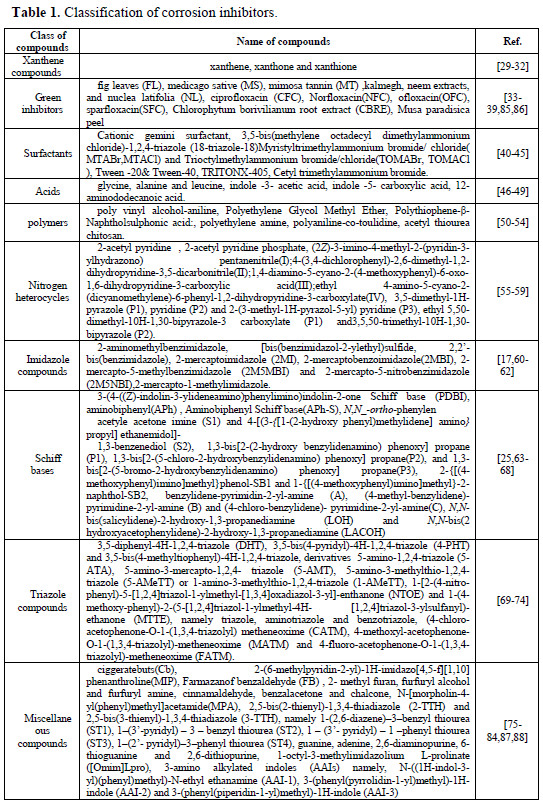
    <p>In this respect an attempt is made to study the mechanism of inhibitor 
compounds in acidic media. The inhibitors reviewed for mechanistic study are 
represented in <a href="#t1">Table 1</a>.</p>


    <p>&nbsp;</p>
<a name="t1">
<img src="/img/revistas/pea/v34n3/34n3a02t1.jpg">
    
<p>&nbsp;</p>


    <p>&nbsp;</p>
    <p><b>Mechanism of inhibitors studied under different groups</b></p>

    <p><i><b>Xanthene group</b></i></p>

    ]]></body>
<body><![CDATA[<p>I.B. Obot and N.O.Obi-Egbedi have investigated [29-32] the effect of xanthene, 
xanthone and xanthione as corrosion inhibitors in 0.5M sulphuric acid medium. 
They act as anodic inhibitors preventing anodic metal dissolution by forming 
metal-ligand complex on to the steel. Adsorption obeys Langmuir adsorption 
isotherm in xanthone and xanthenes, and Dubinine-Radushkevich adsorption in 
xanthione. The adsorption of xanthione and xanthone follows first order kinetics, 
and follows zero order in xanthene.</p>

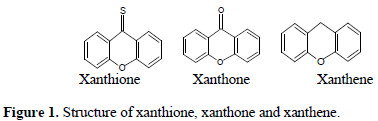
    <p>The inhibition efficiency of the compounds follows the order of Xanthione &gt; 
Xanthone &gt; Xanthene. This can be explained by considering its chemical 
structure as in <a href="#f1">Fig. 1</a>.</p>


    <p>&nbsp;</p>
<a name="f1">
<img src="/img/revistas/pea/v34n3/34n3a02f1.jpg">
    
<p>&nbsp;</p>


    <p>Xanthione possesses O and S hetero atoms, in xanthone 
both heteroatoms are O but in case of xanthenes it contain only one O-atom. The 
inhibition effect of hetero atoms follows the order of S&gt;N&gt;O. In aqueous acidic 
solutions, the xanthene moiety (XEN) exists either as neutral molecules or in the 
form of cations (protonated XEN).</p>

    <p>Generally, two modes of adsorption could be considered. The neutral XEN may 
be adsorbed on the metal surface via the chemisorption involving the 
displacement of water molecules from the metal surface and the sharing of 
electrons between oxygen atom and iron. The XEN molecules can be adsorbed 
also on the metal surface on the basis of donor-acceptor interactions between p-
electrons of the heterocycle and vacant d-orbitals of iron. On the other hand, SO4 
2-could adsorb on the metal surface, then the protonated XEN may be adsorbed 
through electrostatic interactions between the positive molecules and already 
adsorbed sulphate ions, thus forming the metal complexes of Fe<sup>2+</sup> and XEN. 
These complexes might adsorb onto steel surface by Vander Waals force to form 
a protective film over the mild steel surface. The same is supported by the 
frontier orbital calculations. HOMO &amp; LUMO distribution is on an entire 
molecule, so they interact with steel surface with its hetero atoms and &pi; system 
forming donor-acceptor type bond, in the case of a neutral molecule. The 
electronic absorption spectra of XAN in sulphuric acid test solution displayed &pi; &rightarrow;
&pi;* transition. After 3 days of steel immersion in the same test solution, the 
band maximum underwent a blue shift, suggesting the interaction between XAN 
and Fe<sup>2+</sup> ions in the solution. Furthermore, there is an increase in the absorbance 
of this band. It is clear that there was no significant difference in the shape of the 
spectra before and after the immersion of XAN, showing a possibility of 
physisorption or a weak interaction between XAN and mild steel.</p>


    <p><i><b>Green inhibitors</b></i></p>

    <p>The plant extracts of fig leaves (FL), medicago sative (MS), mimosa tannin 
(MT), kalmegh, neem extracts, and nuclea latifolia (NL) serve as good inhibitors 
for steel, and their phytochemical components formed stable complex on active 
sites of the metal, thereby reducing the corrosion rate. Increase in the 
concentration of the phytochemicals increases the amount of the surface 
complex, resulting in greater inhibition efficiency. A.M. Al-Turkustani et al. 
verified the effect of Medicago Sative (MS) as inhibitor for steel [35]. MS 
contains riboflavin, guanine, guanosine, biotin, and cytidine components. So, it 
contains a number of nitrogen atoms with free electron pair and aromatic 
electrons through which adsorption occurs onto steel surface, thereby preventing 
its interaction with corrosive media. Furthermore, MS has a marked effect on 
pitting corrosion, which was revealed by SEM images. S. Martinez et al. 
investigated the effect of mimosa tannin (MT) as efficient inhibitor for steel [38]. 
MT extract was tested in different pH as corrosion inhibitor, and at pH 1 and 2 
the flavanoids of MT have formed a cross linked polymeric layer on steel, 
inhibiting the corrosion due to chemisorptions. At pH-3, the tannin group of MT 
forms cationic ferric tannate, which gets adsorbed on steel through spatially 
adsorbed anions through electrostatic interaction, thereby preventing contact of 
steel with corrosive media. Taleb H. Ibrahim et al. [34] investigated the effect of 
fig leaves extract on steel corrosion in 2M HCl. It shows very high efficiency of 
87%, and was found to obey Langmuir isotherm from which we can say that the 
phytochemicals of fig leaves form a monolayer over steel, and hence act as a 
barrier against the corrosion of steel. I.E. Uwah et al. studied [37] the effect of 
inhibitive action of ethanolic extracts from Nauclea latifolia (NL) on steel. 
Ethanolic extracts of NL [root (RT), bark (BK) and leaves (LV)] revealed the 
presence of appreciable quantities of flavonoids, polyphenols and glycosides. It 
has been also detected the presence of alkaloids (in the root and leaves extract) 
and tannins (in the bark extract). The inhibition efficiency trend is in the order of 
RT &gt; LV &gt; BK. The leaves and roots extracts show the presence of alkaloids 
which contain nitrogen, oxygen and aromatic ring in their molecular structures, 
thus showing higher efficiency. From the observed results, it can be inferred that 
the insoluble Fe-NL complexes dominate the adsorbed intermediate, and thus the 
resultant inhibitive effects. Ayssar Nahl et al. investigated [36] neem extract as a 
corrosion inhibitor for carbon steel in HCl medium. Neem extract contains 
tannins and a series of complex compounds called ''triterpenes'' or, more 
specifically, limonoids as major components. The high inhibition efficiency of 
neem may be attributed to the presence of tannins, triterpenes, and many other 
organic compounds. As tannins contain polyphenolic moieties, and these 
moieties have the ability to form tanninate salts with ferric ions, the corrosion 
inhibition of tannins is due to the formation of a highly cross-lined network of 
ferric tanninate salts that protects the metal surface. In the same way, tri-terpenes 
have some functional groups such as (OH, C = O, C = C) that can interact with 
the metal surface and protect it from the attack from acid. The adsorption of fig 
leaves follows Langmuir adsorption forming a layer of monomeric film, thereby 
protecting the steel from corrosion. Ambrish Singh et al. [33] investigated 
Kalmegh plant leaves as corrosion inhibitor for steel. Kalmegh leaves extract 
contains oxygen atoms in functional groups (O-H, C=C, C=O, C-H, C-O) and 
aromatic ring, which meets the general consideration of typical corrosion 
inhibitors, as revealed by the FT-IR analysis. Kalmegh leaves extract molecules 
can also adsorb onto the metal surface on the basis of donor-acceptor interactions 
between &pi;-electrons of aromatic ring and vacant d-orbitals of Fe. The non-
bonded electrons of heteroatoms get protonated in acid media, thus getting 
adsorbed on the negatively charged metal surface when protonated. In their turn, 
when the leaves extract is on the metal surface, a coordinate bond may be formed 
by partial transference of electrons from the polar atoms (O atoms) onto the 
metal surface. The leaves extract effect could also be due to the large size of 
constituent's molecule which covers wide areas on the metal surface, thus 
producing high inhibition efficiency. Nnabuk. O. Eddy et al. [39] studied some 
fluoroquinalines, namely ciprofloxacin (CFC), norfloxacin (NFC), 
ofloxacin (OFC), sparfloxacin (SFC) as corrosion inhibitors for mild steel in 
H2SO4. These are antimalarial drugs, hence they are environmental friendly 
inhibitors. The inhibition efficiency follows the order of OFC &gt; NFC &gt;CFC &gt; SFC, 
and they undergo physical adsorption, obeying Langmuir adsorption. The 
adsorption site calculated from quantum mechanical parameters reveals that in 
CFC and NFC, the ring containing Cl and O atoms, in SFC -N3 atom and in 
OFC N4 atom of piperazine ring attached directly to the metal surface. In 
addition to the donation of &pi;-electons to metal, the inhibitor accepts electrons 
from metal to &pi;* orbital forming feedback bonding, suggesting comprehensive 
adsorption of the inhibitor, thus controlling metal dissolution or anodic process. 
Gopal Ji et al. [85] studied the inhibition effect of aqueous Chlorophytum 
borivilianum root extract (CBRE) on mild steel corrosion in 1 M HCl and 0.5 M 
H2SO4. The CBRE shows inhibition efficiency of 90% in 1 M HCl, and 85 % in 
0.5 M H2SO4 media. The CBRE gets adsorbed on active sites of steel, and thus 
inhibits its corrosion. The adsorption of CBRE obeys Langmuir isotherm in both 
cases. The CBRE's mechanism of action can be explained on the basis of 
molecular interaction of the inhibitor with mild steel. CBRE contains saponins as 
major constituents. Saponins are the class of chemical compounds which contain 
a number of fused rings, possessing several O atoms and -OH functional group 
in their structure. CBRE, in addition to saponins, contains other phyto-chemicals 
like tannins and flavanoids, which are rich with aromatic rings and heterocycles. 
The structure assists in the adsorption of CBRE on mild steel. The CBRE layer at 
the acid-steel interface is formed either due to chemisorption by forming 
chemical bond between &pi; electrons or lone pair electrons (from N, O atoms or 
aromatic rings of organic moieties) and vacant d-orbital electrons of iron. It also 
may due to physisorption, in which protonated organic moieties of CBRE 
interact with Fe<sup>2+</sup> via bridging chloride ions/ sulfate ions (being adsorbed on a 
steel surface) to make metal inhibitor complexes with a weak electrostatic 
interaction. Gopal Ji et al. [86] investigated the effect of aqueous extract of Musa     
paradisica peel on the corrosion inhibition of mild steel in 1 M HCl. The authors 
also verified the changes in the inhibition effect with the ripening of peel. The 
Musa paradisica peel extract impedes the corrosion of mild steel in 1M HCl for 
several hours. The Musa paradisica peel raw extract contains gallocatechin 
moiety and riped peel extract possesses catechin moiety, as confirmed by HPLC. 
From the results of the various techniques, it could be acknowledged that the 
corrosion of mild steel is minimized by the significant adsorption of the organic 
moieties of the extracts. Hence, we can say that, in real sense, the corrosion 
inhibition mechanism is purely an adsorption mechanism. The charge on steel 
surface plays a prominent role in assigning the possible mechanism for corrosion. 
From literature reviews, steel surface is positively charged in acid media. 
Gallocatechin and catechin have tendency to get protonated in acid solutions. 
These positively charged species physically adsorb onto metal surface via 
electrostatic coupling. Structurally, gallocatechin and catechin molecules contain 
several &pi; electrons on benzene rings and non-bonding electrons on oxygen atom, 
which assist in formation of a chemical bond with vacant d-orbital electrons of 
charged steel surface. The adsorption of molecules cover the effective surface 
area of mild steel, and retard the rate of corrosion either physically or chemically 
or both. However, the exact mechanism of corrosion inhibition 
(physical/chemical) could not be envisaged, due to unspecified molecular weight 
of the extracts.</p>


    <p><i><b>Surfactants</b></i></p>

    ]]></body>
<body><![CDATA[<p>The inhibitory action of the surfactant is of adsorption type; all surfactant 
molecules follow the same type of mechanism. The hydrophilic head group 
interacts with steel surface, while the hydrophobic tile group spreads in aqueous 
corrosive media. Furthermore, the efficiency of the surfactant inhibitor increases 
with increasing hydrophobic chain length. This is because an increase in the 
chain length increases adsorptive power and surface activity of the inhibitor, 
which in turn increases surface coverage, which is expressed in &theta;. Ling-Guang 
Qiu et al. investigated the effect of triazole-based cationic Gemini surfactant, 3,5bis(
methylene octadecyl dimethyl-ammonium chloride)-1,2,4-triazole (18triazole-
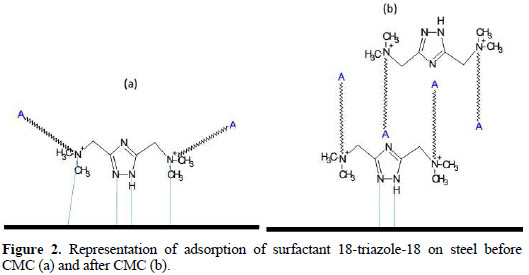
18) in 1M HCl [40]. This surfactant prevents the corrosion by forming a 
stable monolayer film, and its adsorption characteristics obey Langmuir 
isotherm. The 18-triazole-18 utilizes its four nitrogen atoms - two on trizole ring 
and two on ammonium alkyl chain - to get bind to steel surface through inter-
hydrophobic interaction (as in <a href="#f2">Fig. 2</a>).</p>


    <p>&nbsp;</p>
<a name="f2">
<img src="/img/revistas/pea/v34n3/34n3a02f2.jpg">
    
<p>&nbsp;</p>


    <p>The variation in the inhibition efficiency above CMC is quite small; this is 
because, above CMC, the quaternary ammonium nitrogen gets desorbed from the 
surface; however, triazole nitrogens are still in interaction with steel. Thereafter, 
an increase in the concentration of surfactant above CMC leads to the formation 
of a multilayer film on steel. R. Fuchs-Godec et al. studied [42] the action of Nalkyl 
quaternary ammonium salts as inhibitors. N-alkyl quaternary ammonium 
salts, like myristyltrimethylammonium bromide/ chloride (MTABr,MTACl) and 
trioctylmethylammonium bromide/chloride (TOMABr, TOMACl ) surfactants 
used in this study, acted as mixed type inhibitors causing the retardation of the 
corrosion reactions.</p>

    <p>It follows Flory-Huggins adsorption isotherm. The inhibition effect of the same 
surfactant with Br-counter ion is higher than the corresponding Cl-ions. 
Moreover, surfactants, which have Br-, as counter ion, have smaller CMC values 
than the identical type of surfactant with Cl-counter ions. This is because Cl-ion 
is more solvated in solution, thereby preventing its interaction with the cationic 
surfactant head group, and hence causing the repulsion between cationic head 
groups within the surfactant and also in surfactant micelle. It acts as mixed 
inhibitor controlling both anodic and cathodic corrosion reaction by forming an 
adsorption film over the entire surface. Mukta Sharma et al. studied the effect of 
cetyl trimethylammonium bromide as an inhibitor for steel corrosion. The 
adsorption of cetyl trimethylammonium bromide obeys Langmuir adsorption and 
behaves as mixed inhibitor [41]. Xianghong Li and Guannan Mu studied [43-44] 
the effect of tween-40 and tween-20 on cold rolled steel. The adsorption of both 
tween-20 and tween-40 on steel obeys Langmuir adsorption and both of them act 
as cathodic inhibitor. They reduce the surface roughness of steel on their 
adsorption. R. Fuchs-Godec investigated [45] the inhibitory action of triton-X405 
on steel. The adsorption of non-ionic surfactants of TRITON-X series type 
on stainless steel in 2 M sulphuric acid obeys the Flory-Huggins adsorption 
model. The Î”Gads values, calculated using the Flory-Huggins adsorption model, 
suggest the chemisorption mechanism. The higher inhibition efficiency of 
TRITON-X-405 at lower concentrations (Cinh &lt; CMC) in comparison with 
TRITON-X-100 is due to the large size of the head group (TRITON-X-100, 9-10 
ethylene oxide groups and TRITONX-405 around 40 ethylene oxide groups), 
which lies flat on the surface. But these excellent inhibition properties of 
TRITON-X-405 are valid only in the cathodic range up to the corrosion potential 
and at low anodic over potentials while the desorption process is in progress. 
Desorption of the protective layer was formed in the presence of TRITON-X405, 
since it creates a more porous and lower-grade film.</p>


    <p><i><b>Amino acids and organic acids</b></i></p>

    <p>Since aminoacids are nontoxic, economically viable and easily available, H. 
Ashassi-Sorkhabi et al. [46] studied three aminoacids, namely glycine, alanine 
and leucine as corrosion inhibitors for mild steel. The amino acids interact with 
the steel surface through its N-atoms and -COO group forming a compact 
barrier complex between steel and corrosive media. The adsorption of an amino 
acid on the steel surface generally follows Langmuir isotherm. Glycine and 
alanine behave as a mixed inhibitor controlling both anodic corrosion and 
cathodic hydrogen evolution process. Whereas leucine behaves as a cathodic 
inhibitor, acetic acid acts as a mixed inhibitor and Gulsen Auci [47] used indole 3-
acetic acid as a corrosion inhibitor for mild steel in HCl medium. 
The inhibitor utilizes its &pi; electrons and non-bonding electrons of nitrogen 
(indole moiety) along with -COO group to get adsorbed onto steel, forming a 
film. The adsorption characteristics of the compounds obey Langmuir adsorption, 
and Gibbs free energy calculations reveal that it undergoes a comprehensive 
adsorption. G. Quartaone et al. [48] investigated indole -5-carboxylic acid as 
steel corrosion inhibitor. Steel is positively charged (form PZC), and indole-5carboxylic 
acid is a polar molecule. There exists electrostatic interaction between 
polar -COOH group and steel surface. 12-aminododecanoic acid (AA) is 
investigated as corrosion inhibitor for steel by Saad Ghareba et al. [49]. It acts as 
mixed inhibitor controlling the anodic process to a larger extent. The adsorption 
of AA on steel obeys Langmuir adsorption forming a monolayer, preventing 
mass transfer. The formation of an AA monolayer is confirmed by the PMIRRAS. 
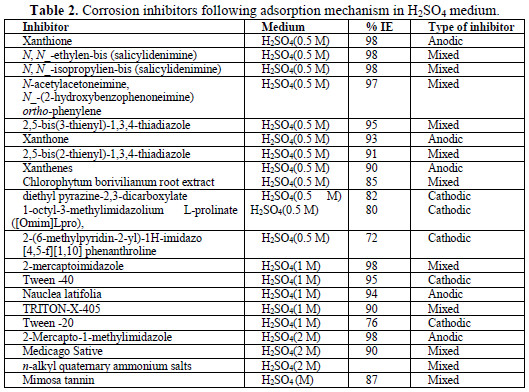
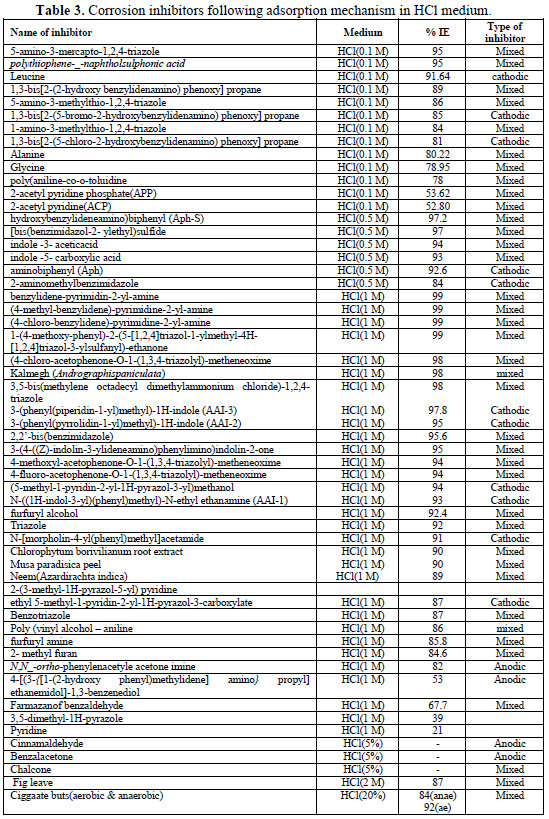
The adsorption mechanism (<a href="#t2">Tables 2</a> and <a href="#t3">3</a>) occurs through acid base 
reaction with the -COOH group and the Fe<sup>2+</sup> forming surface salt.</p>


    <p>&nbsp;</p>
<a name="t2">
<img src="/img/revistas/pea/v34n3/34n3a02t2.jpg">
    
<p>&nbsp;</p>
<a name="t3">
<img src="/img/revistas/pea/v34n3/34n3a02t3.jpg">
    
<p>&nbsp;</p>


    ]]></body>
<body><![CDATA[<p>The -NH2 group protonated in acid solution is directly attached to the cathodic site on steel 
preventing hydrogen evolution.</p>


    <p><i><b>Polymers</b></i></p>

    <p>The polymeric substances are proved to be an efficient inhibitor for mild steel, 
since they possess high molecular weight, and they have capability to form a 
complex with metals, which has a larger surface area and a higher surface 
coverage power, forming a compact barrier film on the metal surface. The 
polymeric inhibitors studied here are poly vinyl alcohol-aniline, PEGME, PTh &beta;NSA, 
polyethylene amine, polyaniline-co-toulidine, acetyl thiourea chitosan, and 
serve as mixed inhibitors for steel, controlling both anodic dissolution and 
cathodic hydrogen evolution reactions simultaneously. The polymeric substance 
undergoes protonation in acidic solution, and the protonated molecule gets 
adsorbed onto the cathodic site of steel, thereby controlling the cathodic reaction 
and anodic adsorption that take place through &pi;-electrons of the aromatic ring 
and lone pair electrons on heteroatoms of the molecule, forming a compact 
barrier film that, thus, prevents the interaction of steel with the corrosive 
environment. M. Mobin and N. Tanveer studied [51] the corrosion inhibitive 
effect of polyaniline co-toluidine coating of steel in different corrosive media. 
The polymeric film is stable even after 30 days of immersion, as revealed by its 
electrochemical parameters, and it shows 78% inhibition efficiency in HCl. The 
adsorbed film obeys Langmuir adsorption isotherm. A.K. Dubey et al. 
investigated [53] the corrosion inhibitive effect of PEGME on steel. PEGME, at 
higher temperature and at higher concentrations, exerts a greater influence on the 
cathodic process than on the anodic process. PEGME molecules interact with the 
metal surface through the oxygen and nitrogen lone pair of electrons, or by 
forming intermediate species (M-In)ads, or (M-In-OH)ads or (M-H-In)ads, which 
prevent contact of steel with corrosive media. R. Karthikaiselvi et al. studied [50] 
the effect of poly vinyl alcohol-aniline on corrosion of steel. The inhibitory 
action of poly vinyl alcohol-aniline is due to its interaction on anodic sites, which 
occurs through p-electrons of aromatic rings and a lone pair of electrons of the 
nitrogen atom, which decreases the anodic dissolution. The protonated species of 
polymer adsorb onto the cathodic sites of the steel decrease, thereby minimizing 
hydrogen evolution. The high performance of the poly vinyl alcohol-aniline 
polymer is attributed to the presence of &pi; electrons, and quaternary nitrogen atom 
and its larger molecular size. A.M. Fekry et al. studied [54] the inhibitive effect 
of acetyl thiourea chitosan on mild steel, and concluded it provides protection of 
about 94.5%, due to the homogeneous polymer composite film polymer/metal 
interphase, which acts like a barrier between steel and corrosive media. The 
acetyl thiourea chitosan possesses -OH, -C=S and -NH groups which can 
interact with the steel with its lone pair of electrons on heteroatoms, forming a 
layer of stable polymeric film, which protects steel from corrosion. V. Suresh 
Kumar et al. studied [52] the inhibitory effect of polythiophene-&beta;naphtholsulphonic 
acid (PTh-NSA) on steel. The polymeric inhibitor PTh-NSA 
could be adsorbed onto the metal surface via the lone pair of electrons present on 
its nitrogen atoms.</p>

    <p>The inhibitor might have be adsorbed onto the surface of steel, forming a 
compact protective thin layer film that acts as barrier for mass and charge 
transfers, protecting the steel surface from the attack of the acid solution's 
aggressive ions. The degree of protection was higher with the increasing of the 
surface fraction occupied by the adsorbed molecules.</p>


    <p><i><b>Nitrogen heterocycles</b></i></p>

    <p>Pyridine, pyrazine and pyrazoles are from the class of nitrogen, containing 
heterocycles possessing high inhibition efficiency. The inhibition is mainly due 
to an adsorptive phenomenon. Pyridine contains six membered heterocycles with 
N-atoms in their ring, pyrazine possesses two N atoms in six member rings, 
whereas pyrazole is a five membered heterocycles with two N-atoms. These 
compounds get bound to the steel through the lone pair electrons of nitrogen 
and the &pi;-electrons of the aromatic ring. This is proved by the n &rightarrow; &pi; 
* and &pi; &rightarrow; &pi;* transitions UV-Visible spectrum. In addition to these bonds, the inhibitor 
forms feedback bonds by accepting electrons from metal. Ita Bi et al. studied [55] 
the pyridine derivatives namely, 2-acetyl pyridine (ACP) and 2-acetyl pyridine 
phosphate (APP) as corrosion inhibitors for mild steel in HCl average, at two 
different temperatures. Both ACP and APP obey Langmuir adsorption. APP 
serves as better inhibitor than ACP. This can be explained with its structure, 
because ACP contains only two coordinated site, i.e., one is N-hetero atom of the 
Py-ring, other is O-atom of acetyl ring, whereas APP possesses one additional 
coordinated site at the phosphate group. So, APP possesses higher coverage 
power than ACP. Hence, APP inhibits better when compared to ACP. Through 
this adsorption site, ACP and APP are chemically adsorbed onto steel through a 
coordinate bond between inhibitor and metal. The four derivatives of pyridine 
were studied by S.A. Abd El-Maksoud and A.S. Fouda [59]. They are: (2Z)-3imino-
4-methyl-2-(pyridin-3-ylhydrazono) pentane nitrile(I);4-(3,4dichlorophenyl)-
2,6-dimethyl-1,2-dihydropyridine-3,5-dicarbonitrile(II);1,4diami-
no-5-cyano-2-(4-methoxyphenyl)-6-oxo-1,6-dihydropyridine-3-carboxylic 
acid(III); ethyl 4-amino-5-cyano-2-(dicyanomethylene)-6-phenyl-1,2dihydropyri-
dine-3-carboxylate(IV). The compounds inhibit corrosion by their 
adsorption onto steel surface. The adsorption of these compounds on steel 
follows Langmuir isotherm, and inhibition efficiency follows the order IV &gt; III &gt; 
II &gt; I. Compound IV shows the greatest inhibition among investigated 
compounds. This may be due to its higher molecular weight - because of the 
presence of three cyano groups, and the carboxylic ester group which are 
electrons - , and to the delocalization of &pi;-orbital on the phenyl group attached 
directly to the pyridine ring, which disturbs the electron density on the NH of the 
dihydro pyridine. Therefore, the compound IV can easily interact with the 
already adsorbed Cl-ions on steel surface. Compound III has two NH2 groups 
which are electron donating groups, and one cyano group that makes the electron 
density on the pyridine's nitrogen atom higher than the previous case. But its 
interaction with adsorbed Cl-ions is weaker when compared to the compound IV, 
and its direct interaction with the bare steel is hindered by its bulkier structure. 
Although in compound II there are two cyano groups which may decrease the 
electron density on the nitrogen atom, the presence of two methyl groups which 
are electron donating increases electronic density on pyridine ring. However, its 
interaction with steel is prevented due to the presence of two methyl groups at 
ortho position towards pyridine nitrogen. Compound I is the weakest one in the 
order of inhibition efficiency among the investigated compounds, which may be 
due to its lowest molecular weight. Diethyl ester of pyrazine was verified as an 
inhibitor by M. Bouklah et al. [58], as it contains both nitrogen and oxygen 
atoms, which assist in adsorption onto steel, and it obeys Langmuir adsorption. 
The inhibitor's action mechanism is explained with the aid of IR data. Before the 
immersion of the steel plate the inhibitive solution shows that the major 
characteristic bands were at 2900 cm_1 CH of pyrazine ring, at 2800 and 2760 
cm_1 for carboxylic CH2 and CH3 bands, respectively, for C=O at 1600 cm_1and 
for C-O at 1540 cm_1. After the immersion of steel a yellow film formed on steel 
surface, due to the inhibitor deposition, and this has been verified through the IR 
spectra of the deposit, which shows an absence of the majority of the group 
bands of pyrazine. This is attributed to the interaction of steel with N and O 
atoms of the pyrazine derivative. The inhibitive effect of three compounds 
including 3,5-dimethyl-1H-pyrazole (P1), pyridine (P2) and 2-(3-methyl-1Hpyrazol-
5-yl) pyridine (P3) against steel corrosion has been investigated by 
Hongfang Ma et al. [56] through Ab-initio calculation method. The inhibitive 
effect of these compounds follows the order P3 &gt; P1 &gt; P2, as verified by 
experimental results. The quantum data also support the same trend; among 
them, P3 has a large value of HOMO energy, and a smaller value of Î”E, which is 
indicative of the higher efficiency of the molecule. As the author has determined 
from quantum calculations, the reactive centers of P1, P2 and P3 are 3N, 8N, and 
13N, respectively. The 3N of P1 is more active than 14N because of its C=N 
bond. The P1 and P2 molecules are in the same plane with Fe atom. But P3's 
adsorption structure is different, because there are two rings in its molecule, 
which are not in one plane. In P3 system, the adsorption of these rings is 
accompanied by some spatial volume resistance. The bond distance from the 
adsorptive site is also determined for P3, and it is larger due to existence of 
special volume resistance. In spite of its larger bond distance, it shows high 
inhibition efficiency. K. Tebbji et al. have investigated [57] the effect of two 
pyrazole-type organic compounds, namely ethyl 5,50-dimethyl-10H-1,30bipyrazole-
3 carboxylate (P1) and3,5,50-trimethyl-10H-1,30-bipyrazole (P2), 
which were verified as inhibitors for steel corrosion in 1 M HCl media. The 
experimental results showed that P2 acts as better inhibitor than P1. The group - 
COOC2H5 in P1 decreases the electronic density on bipyrazole ring. In P2 the COO 
C2H5 by -CH3 group increases the electronic density on bipyrazole, and 
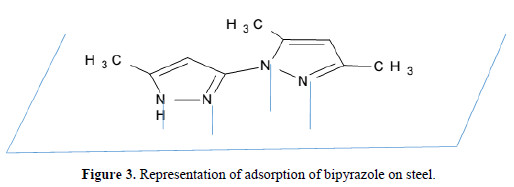
hence, has higher efficiency. The adsorption of P2 on steel surface is shown 
below in <a href="#f3">Fig. 3</a>.</p>


    <p>&nbsp;</p>
<a name="f3">
<img src="/img/revistas/pea/v34n3/34n3a02f3.jpg">
    
<p>&nbsp;</p>


    <p><i><b>Imidazole compounds</b></i></p>

    <p>The anti-corrosive process of (2-aminomethylbenzimidazole) AMB and 
[bis(benzimidazol-2-ylethyl)sulfide] BBES was evaluated by J. Cruz et al. [17]. 
The EIS and polarization resistance studies have indicated that AMB behaves as 
a cathodic inhibitor controlling cathodic H2 evolution, while BBES functions as a 
mixed inhibitor controlling both anodic metal dissolution and cathodic hydrogen 
evolution. Furthermore, BBES, with two benzimidazole rings, acts as an 
exceptionally good inhibitor, and forms a multilayer over metal surface. This 
process is explained by considering theoretical calculations in a more appropriate 
way. AMB produces more stable conformation only when the protonation takes 
place at nitrogen (N1). However, for BBES, one stable BBESH form only 
resulted as protonation occurs at the aromatic N(1). The Mullikan charge values 
reveal that the imidazole ring becomes symmetrical, which leads to a 
delocalization region around N1-C2-N3. Therefore, both protonated AMB and 
BBES generate an electronic delocalization around N1-C2-N3; the conjugate 
systems N1-C2-N3 and benzene ring present in both AMB and BBES are 
considered as active sites for the inhibition process. Additionally, the thioether 
sulfur present in BBES also contributes further to chemical adsorption; thus, 
BBES behaves as an efficient corrosion inhibitor. Abboud et al. [60] synthesized 
2,2'-bis(benzimidazole) and studied its corrosion inhibition action. BBI controls 
both cathodic and anodic reaction process. BBI is dimer of benzimidazole. 
Benzimidazole is a ''bicycle'' system consisting of a five-membered imidazole 
ring fused with benzene ring. It has two nitrogen atoms: ''pyrrolic'' nitrogen or 
N-atom at the 5-position in the molecule, whose lone pair of electrons takes part 
in the &pi;-system imidazole ring, and ''pyridyne'' nitrogen or N-atom at the 6position 
in the molecule, whose unshared electron pair remains free. So, the 
pyridyne N-atom acts as an electron donor in the BBI molecule. BBI has an 
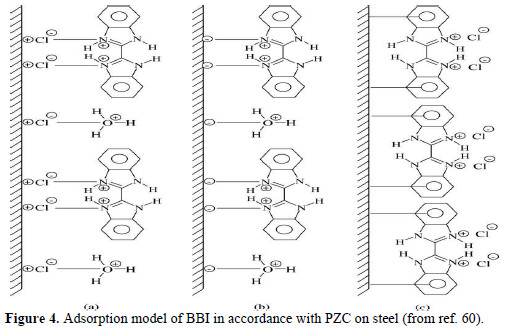
organic base and it protonates in acid solution to form cations. In neutral BBI, 
adsorption occurs by sharing of lone pair of electrons between nitrogen and the 
metal surface. In protonated BBI, this is coordinated through negatively charged 
Cl-on the metal surface. If the metal surface is positively charged with respect to 
the potential of zero charge (PZC), the chloride ions will first be adsorbed on the 
metal surface, which attracts the protonated BBI and protonated water molecules. 
Thus, a close packed triple layer will form on the metal surface and inhibits the 
entry of iron ions to the solution, as seen in (a) of <a href="#f4">Fig. 4</a>.</p>


    ]]></body>
<body><![CDATA[<p>&nbsp;</p>
<a name="f4">
<img src="/img/revistas/pea/v34n3/34n3a02f4.jpg">
    
<p>&nbsp;</p>


    <p>If the metal surface is 
negatively charged with respect to the PZC, the protonated water molecules and 
the protonated forms of BBI are directly adsorbed on the metal surface, as seen in 
(b) of <a href="#f4">Fig. 4</a>. When the metal surface attains the potential, it becomes zero with 
respect to PZC, and neutral BBI molecules are adsorbed through their aromatic 
&pi;-orbitals on the metal surface, as reported in [60]. The chemical compounds 2 mercaptoimidazole 
(2MI), 2-mercaptobenzoimidazole (2MBI), 2-mercapto-5methylbenzimidazole 
(2M5MBI) and 2-mercapto-5-nitrobenzimidazole 
(2M5NBI), were studied as inhibitors by R. Alvarez-Bustamante et al. [61] in 1 
M H2SO4 solution, and have shown good inhibition efficiency. The inhibition 
efficiency follows the order of 2MI &gt; 2MBI &gt;2M5MBI&gt; 2M5NBI. The 
adsorption of these compounds onto steel obeys Langmuir adsorption. It is 
shown that this compound can affect both anodic and cathodic processes. 
Therefore, it can be classified as a mixed-type inhibitor. However, from variation 
of both corrosion potential and polarization resistance with [2MI] it was possible 
to state that the anodic reaction rate of the corrosion process decreases at a 
greater proportion than the cathodic one. Benali Omar et al. have verified [62] 2mercapto 
1-methyl imidazole as an adsorption inhibitor, which forms an adherent 
film on the entire steel surface, thus preventing the interaction of steel with the 
corrosive environment. The adsorption of the inhibitor obeys Langmuir 
adsorption model, and the thermodynamic parameters reveal the formation of 
chemisorptions of the inhibitor on steel. E. Gutierreza et al. [89] have evaluated 
the inhibition effect and its QSAR properties of fifteen molecules derivated from 
imidazole and benzimidazole on carbon steel (CS) in 1 M HCl. The authors 
proposed a predictive model: according to it, the inhibition effect of the 
molecules varies with the molecules' volume, charge, electronegativity, and 
aromaticity. The adsorption of these molecules on CS obeys Langmuir isotherm 
model. The interaction of these molecules with CS is due to the lone pairs of 
electrons of nitrogen atoms, &pi;-electrons in each one of these compounds, and the 
vacant d-orbitals of iron surface atoms. The imidazole and benzimidazole 
derivatives exist in the form of either neutral or cationic molecules in acidic 
media. In the form of neutral molecules, they can interact with CS by forming 
coordinate bonds between molecules and Fe atoms. In the cationic form, 
molecular adsorption is predominantly an electrostatic interaction between the 
protonated compounds and the negatively charged steel surface resulted from 
chloride ions adsorption. The adsorption of imidazole and benzimidazole on CS 
(Fe atom) occurs through the iminic nitrogen and aromatic electron present on 
their molecular structure. The same is also proved by their theoretical. Further, 
the quantum molecular parameters, as determined from DFT and calculated p&rightarrow; d 
charge transfer (molecule&rightarrow; surface), for imidazole (0.74) and benzimidazole 
(0.99), have also supported the existence of the heterocycle/Fe interaction.</p>


    <p><i><b>Schiff bases</b></i></p>

    <p>Schiff bases (SB) of different organic compounds are proved as efficient 
inhibitors for preventing corrosion of mild steel. Schiff bases mainly possess (C=
N) group in which N atom gets bind to the steel surface. Moreover, SB 
undergo protonation in acid solution, and the protonated molecule gets adsorbed 
on to the anodic site of steel via the pre adsorbed Cl-ions. These protonated SB 
get directly adsorbed onto the cathodic site of steel, in competition with H+ ions. 
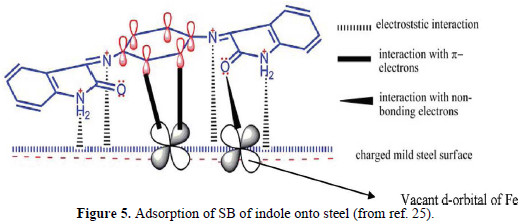
The inhibition effect of 3-(4-((Z)-indolin-3-ylideneamino) phenylimino)indolin2-
one Schiff base (PDBI) on mild steel is studied, and adsorption of PDBI obeys 
Langmuir adsorption model [25] (<a href="#f5">Fig. 5</a>).</p>


    <p>&nbsp;</p>
<a name="f5">
<img src="/img/revistas/pea/v34n3/34n3a02f5.jpg">
    
<p>&nbsp;</p>


    <p>The adsorption of PDBI occurs through 
the donor-acceptor interactions between free electron pairs of heteroatoms and &pi;electrons 
of multiple bonds, as well as phenyl group and vacant d-orbitals of iron. 
The skeletal representation of the PDBI molecule's adsorption onto the mild steel 
surface is presented. The adsorption of heterocyclic compounds occurs when the 
aromatic rings are normal towards the metal surface, however, parallel, in very 
few cases.</p>

    <p>It is well-known that the chloride ions have a small degree of hydration, and due 
to this, they get first adsorbed on the positively charged steel surface. The 
adsorption of chloride ions creates an excess negative charge towards the 
solution side of the metal, and favors a higher adsorption of the PDBI's cationic 
form. This results in electrostatic interactions between the negatively charged 
metal surface and the positively charged Schiff base molecule (PDBI+), forming 
a protective (FeCl-PDBI+) adsorbed layer. The protonated PDBI molecules are 
also adsorbed at cathodic sites of mild steel, in competition with hydrogen ions 
that are reduced to H2 gas.</p>

    <p>Inhibitory action of aminobiphenyl and its Schiff base is studied by Hulya Keles 
et al. [63]. APh molecule acts as a cathodic inhibitor, whereas APh-S acts as a 
mixed indicator, both obeying Langmuir's adsorption model. APh-S acts as a 
stronger inhibitor than APh, because of its additional phenylic ring and iminic 
group. The inhibitor molecule APh-S replaces Cl-, because the chelating effect of 
the Schiff base of APh-S is higher than that of the Cl- ion. Thus, the Cl- ion is 
removed from the metal surface. Explanation of this mechanism is based on the 
high chelating effect of the Schiff base of Aph-S. In addition to this, there is also 
the presence of more &pi;-electrons in the additional phenyl rings of Aph-S 
molecule. The &pi;-electrons from the aromatic rings may also interact with the 
metal surface. Inhibition efficiency of Aph-S with respect to Aph is due to the &pi;electrons 
of the iminic (-C=N) group and the aromatic system and participation 
of nonbonding electrons present on electronegative donor atoms N and O of the 
aromatic ring. Aysel Yurt et al. [65] synthesized and studied the effect of novel 
three Schiff bases, namely, 1,3-bis[2-(2-hydroxy benzylidenamino) phenoxy] 
propane (P1), 1,3-bis[2-(5-chloro-2-hydroxybenzyl-idenamino) phenoxy] 
propane (P2), and 1,3-bis[2-(5-bromo-2-hydroxybenzyl-idenamino) phenoxy] 
propane (P3) , on the corrosion of mild steel. Adsorption and thermodynamical 
studies reveal that the three Schiff bases P1, P2 and P3 undergo chemical 
adsorption obeying Temkin adsorption characteristics. Chemisorptions of Schiff 
bases are also proved by quantum mechanical studies, i.e., increase in the 
inhibition efficiency with decrease of EL -EH values, indicating the formation of 
a coordinate covalent bond. The bond is formed by the sharing or transfer of 
electrons from N and O atom or &pi; electrons of the aromatic system. From 
polarization studies, it is noted that P1 acts as mixed inhibitor controlling both 
metal dissolution, as well as hydrogen evolution, and P2, P3 act as cathodic 
inhibitors. This is because electronegative atoms, like Cl and Br present in P2, 
P3, decrease electron density at the N atom of the imine group which is 
responsible for adsorption. With Cl and Br atoms, an additional negative charge 
on P2 and P3 destroys the possibility of electrostatic interaction at the anode, and 
hence, they behave purely as a cathodic inhibitor. The inhibition efficiency 
follows the order of P1&gt;P3&gt;P2. Rovshan Hasanov et al. [68] have studied the 
corrosion inhibition effect of two Schiff bases, namely 2-{[(4methoxyphenyl)
imino]methyl}phenol-SB1 and 1-{[(4-methoxyphenyl) imino] 
methyl}-2-naphthol-SB2. Both Schiff bases act as mixed corrosion inhibitors, 
simultaneously controlling both anodic and cathodic processes and obey 
Langmuir's adsorption model. The adsorption of Schiff base on steel surface 
follows HSAB concept of interaction, which is also proved by DFT studies. 
Here, the steel surface acts as a soft acid, and hence, it prefers to interact with a 
soft base. According to quantum studies,compounds with a minimum energy 
difference between HOMO-LUMO may act as a soft base. SB2 possesses a 
smaller HOMO-LUMO gap than SB1 and, hence, a higher inhibition efficiency. 
Mechanistically, the adsoption of the inhibitor takes place through permanent 
dipole sites like &gt;C=N,-O-H and -O-CH3 and also with &pi;-electrons of the ring. 
Since SB2 is bulkier when compared to SB1, its surface coverage is higher than 
SB1, and hence, it is more efficient. Esmaeel Naderi et al. [64] have studied the 
effect of SB on the microstructure of steel, i.e., perlite and martensite. Perlite 
microstructure shows lower corrosion rate than martensite, even in the absence 
and presence of SB. The efficiency of some pyrinidine Schiff bases 
[benzylidene-pyrimidin-2-yl-amine (A), (4-methyl-benzylidene)-pyrimidine-2yl-
amine (B) and (4-chloro-benzylidene)-pyrimidine-2-yl-amine(C)] on 
corrosion prevention is investigated by H. Ashassi-Sorkhabia et al. [66]. Atoms 
like O and N of Schiff bases, which have unoccupied orbitals, exhibit an electron 
accepting tendency. Hence, SB, as an inhibitor, not only donates electrons to 
unoccupied d orbitals of metals, but it can also accept electrons from metallic 
orbitals using their anti-bonding orbital to form stable chelates. As a matter of 
fact, the inhibitor which donates an electron pair to the metal, and receives 
electrons from the metal, forming a feedback bond, is considered as an excellent 
inhibitor. The presence of electron donating groups on the Schiff bases structure 
(such as Cl and CH3) increases the electron density on the nitrogen of the C=N 
group, resulting in a high inhibition efficiency. Among the compounds 
investigated in the present study, the inhibition varies in the order of C&gt;B&gt;A, 
which is also proved by quantum parameters, i.e., C has higher HOMO and lower 
LUMO energy, as determined by AM1 methods. The inhibitor effect of N,Nbis(
salicylidene)-2-hydroxy-1,3-propanediamine (LOH) and N,N-bis(2 
hydroxyacetophenylidene)-2-hydroxy-1,3-propanediamine (LACOH) is studied 
by Kaan C. EmregĂĽl et al. in 2 M HCl [67]. Both compounds have two spaced 
-OH groups, which intend to form intra molecular hydrogen bonds, leaving only 
the -C= N group available to link the molecule to the electrode surface, in which 
case monomolecular adsorption is likely to occur. Steel had an affinity towards N 
and O bearing ligands. Therefore, the adsorption of these molecules is through 
the phenolic -OH and-C =N groups. The methyl groups on LACOH tend to 
increase the electron density on the -C=N group, increasing the bond strength 
between the molecule and the metal surface, and so, the inhibition efficiency.</p>


    ]]></body>
<body><![CDATA[<p><i><b>Triazoles</b></i></p>

    <p>Triazoles are termed as some of the most efficient and very often used inhibitors 
in the pickling process. The compounds inhibit the corrosion process through the 
adsorption onto the metal surface through the heteroatoms of their ring, and in 
addition to that, the &pi; electrons of the aromatic system play a vital role in the 
process of adsorption. F. Bentiss et al. have tested [70] the effect of three of 
triazole derivatives, namely 3,5-diphenyl-4H-1,2,4-triazole (DHT), 3,5-bis(4pyridyl)-
4H-1,2,4-triazole (4-PHT) and 3,5-bis(4-methyltiophenyl)-4H-1,2,4
triazole as inhibitors for steel corrosion in HCl medium. They were shown to 
reduce the corrosion of steel by forming a stable chemisorbed film controlling 
both anodic and cathodic corrosion reactions (as revealed by their Î”G values). 
The adsorption of these compounds on steel obeys Langmuir isotherm, and the 
inhibition efficiency produced is in the order of 4-MTHT &gt; 4-PHT &gt; DHT. This 
is because of the replacement of substituents at para position in the phenyl ring of 
DHT by N-atom in 4-PHT and by -SCH3 group in case of in 4-MTHT.The same 
is supported by quantum studies. Additionally, the compound 4-MTHT possesses 
a higher value of HOMO and a lower value of LUMO energy and a lower dipole 
moment in comparison with the other two. The four triazole derivatives by 
Hamdy H. Hassan et al. [69,71], - 
5-amino-1,2,4-triazole (5-ATA), 5-amino3-
mercapto-1,2,4-triazole (5-AMT), 5-amino-3-methylthio-1,2,4-triazole (5AMeTT) 
or 1-amino-3-methylthio-1,2,4-triazole (1-AMeTT) - , were inhibitors 
of steel corrosion by adsorbing onto the surface of steel using their N 
heteroatoms and the substituents. The inhibition efficiency varies in the order of 
5AMT&gt;1-AMeTT&gt;5-AMeTT&gt;5-ATA. The high efficiency of 5-AMT is 
attributed to polarizability of C=S group in the molecule. Shengtao Zhang et al. 
have investigated [72] the relationship between molecular structure and their 
inhibition effect of two triazole derivatives, namely, 1-[2-(4-nitro-phenyl)-5[
1,2,4]triazol-1-ylmethyl-[1,3,4]oxadiazol-3-yl]-enthanone (NTOE) and 1-(4methoxy-
phenyl)-2-(5-[1,2,4]triazol-1-ylmethyl-4H-[1,2,4]triazol-3-ylsulfanyl)ethanone 
(MTTE) on steel corrosion in HCl media. Quantum chemical 
calculations were performed using Ab initio method. Triazole derivative 
molecules interact with the steel surface on the basis of donor-acceptor 
interactions between the &pi;-electrons of the benzene ring, -C= N- and the vacant 
d-orbitals of iron atoms. The three triazole derivatives namely, triazole, 
aminotriazole and benzotriazole, were tested as inhibitors by K.F. Khaled [74]. 
The adsorption of these inhibitors on the mild steel obeys Langmuir's adsorption 
isotherm. Among the three tested triazoles, amino triazole has served as the best 
inhibitor, which is also proven by molecular modeling (a quantum technique). It 
is determined that the charge density distribution on aminotriazole is more 
intense than on triazole and benzotriazole. This fact explains that the adsorptive 
power of aminotriazole is stronger (because it binds more strongly on iron 
surface) than that of triazole and benzotriazole. This is also confirmed by the 
values of HOMO and LUMO energies and the value of dipole moment. 
Aminotriazole has got a higher value of HOMO and a lower value of LUMO and 
dipole moment, which is the essentials of a good inhibitor. Weihua Li et al. have 
investigated [73] the effect of three synthesized triazole derivatives, namely (4chloro-
acetophenone-O-1-(1,3,4-triazolyl) metheneoxime (CATM), 4-methoxylacetophenone-
O-1-(1,3,4-triazolyl)-metheneoxime (MATM) and 4-fluoroacetophenone-
O-1-(1,3,4-triazolyl)-metheneoxime (FATM), which were proven 
as efficient inhibitors for steel corrosion in acidic media. The adsorption of these 
triazoles obeys Langmuir isotherm law, and the inhibition efficiency follows the 
order CATM &gt; MATM &sim; FATM. The inhibition efficiency depends upon the 
substituents Cl,-OCH3 and F-at 4th position. The quantum parameters, HOMO 
and LUMO electronic distributions, showed the formation of donor -acceptor 
interaction between steel and inhibitors. This interaction occurs by utilizing &pi;electrons 
and -C=N-in all three compounds.</p>


    <p><i><b>Miscellaneous compounds</b></i></p>

    <p>Jun Zhao et al. have studied [75-76] the effect of aqueous extract of 
ciggeratebuts(Cb) as a corrosion inhibitor for mild steel. The aqueous solution of 
Cb contains aromatic amides, nicotine and its compounds. Weight loss and 
electrochemical studies reveal that Cb acts as a mixed inhibitor, controlling both 
anodic dissolution and cathodic hydrogen evolution. As aging proceeds, the 
solution of Cb produces higher efficiency. Its inhibition action is via the 
adsorption onto the metal surface. The adsorption of the inhibitor could occur 
due to the formation of an oxidation film, i.e., oxidants of inhibitor form 
insoluble salt on interaction with iron. This is because the aerobic solution oxides 
the existing compounds. The inhibition effect is proved by electrochemical noise 
(EN) studies. It is defined as the ratio of standard deviation of potential noise, 
&sigma;E, to coupling current fluctuations &sigma;1 i.e., Rn= &sigma;E/ &sigma;1. Resistance of noise follows 
the order of blank &lt; anaerobic &lt; aerobic. This is inversely related to the corrosion 
rate, i.e., blank &gt; anaerobic &gt; aerobic.</p>

    <p>N.O. Obi-Egbedi et al. have synthesized [77] and studied inhibition of 
phenanthroline derivative, 2-(6-methylpyridin-2-yl)-1H-imidazo[4,5-f][1,10] 
phenanthroline(MIP). The inhibitory effect is caused by the adsorption of MIP on 
the mild steel surface, which limits the hydrogen evolution by blocking its 
cathodic sites on steel with electrostatic interaction of protonated MIP through a 
SO42-bridge. In MIP, the presence of imidazole and phenanthroline rings, with 
several &pi;-electrons and aromatic systems containing five N atoms, can induce 
greater adsorption of the molecule. The formation of donor-acceptor surface 
complexes occurs between protonated MIP and the steel surface through 
electrostatic interaction with the sulphate bridge. Electrostatic interaction also 
takes place by partial transference of electrons from the N atoms and the 
delocalized &pi;-electrons around the heterocyclic rings of MIP to the metal surface. 
The physisorption of MIP is also proved by UV-studies and free energy 
calculation.</p>

    <p>Formazan of benzaldehyde (FB) is investigated as a corrosion inhibitor by B. 
Anand for mild steel in HCl media [78]. Electrochemical studies have revealed it 
acts as a mixed inhibitor, simultaneously controlling both anodic and cathodic 
corrosion processes. A free energy value reveals that FB undergoes physical 
adsorption. In observing the structure of the compound we may notice that it 
contains a great number of N-H bonds which get protonated in acidic media. This 
protonated FB may adsorb onto steel through the Cl bridge.</p>

    <p>E. Machnikova et al. have studied [79] the effect of three furan derivatives, 2methyl 
furan, furfuryl alcohol and furfuryl amine, as corrosion inhibitors for mild 
steel. Electrochemical studies of the inhibitor suggest that all three molecules act 
as a mixed inhibitor, controlling both anodic and cathodic processes. The 
inhibitor molecules undergo chemisorption and form a layer over the surface of 
metal, by forming a bond between empty d-orbitals of metal with lone pair 
electrons or &pi;-electrons of the inhibitor, which is proved by the decrease in 
capacitance of the electrical double layer. There is a further inhibition efficiency 
of furfuryl alcohol &gt; furfuryl amine &gt;2-methyl furan. This is because furfuryl 
alcohol polymerizes on steel, thereby preventing it from corrosion, and furfuryl 
amine contains one additional heteroatom in relation to 2-methyl furan; hence, its 
inhibition is higher than 2-methyl furan, which is proved by molecular modeling 
and quantum calculations.</p>

    <p>Gao Jiancun et al. have studied [80] the corrosion inhibition effect of &alpha;,&beta; unsaturated 
compounds, namely, cinnamaldehyde, benzalacetone and chalcone. 
They have studied the IR spectra of the compound before and after the corrosion 
process, w.r.t, the polymerization process of the three compounds. 
Cinnamaldehyde polymerizes completely, by forming a thin oil film on the steel 
surface, as the disappearance of functional groups -C=C,-C=O takes place, and 
corresponding peaks are observed after inhibition. Benzalacetone undergoes 
partial polymerization on steel; slight changes in characteristic peak of groups - 
C=C-,-C=O can be seen. In the case of chalcone, there are no changes in the IR 
spectra, so, no polymerization of compound is seen. All the three behave as 
mixed inhibitors, with an increase in concentration and temperature; 
cinnamaldehyde and benzalacetone act as anodic inhibitors. In spite of good 
polymerizing properties, cinnamaldehyde has poor inhibition efficiency, as its 
inhibition effect only occurs by the &pi;-electrons of the aromatic ring. In 
benzalacetone, both -C=O, &pi;-electrons of the aromatic ring are involved, and in 
chalcone the inhibition efficiency is high, since it possesses two aromatic rings 
with -C=O group.</p>

    <p>A. Jamal Abdul Nasser et al. have used [81] N-[morpholin-4-yl(phenyl) 
methyl]acetamide(MPA) as a cathodic inhibitor for steel. It shows 91% 
inhibition efficiency in weight loss measurement. The adsorption of MPA on 
steel surface obeys Langmuir isotherm. MPA structurally possesses N and O 
donor atoms of the morphaline ring. In addition, these heteroatoms, amide 
linkage, one phenyl ring, all these greatly influence the adsorption and film 
forming tendency of MPA. The reaction site in MPA is a lone pair of electrons 
on hetero atoms and &pi;-electrons of the aromatic ring. MPA acts as a Mannich 
base and gets protonated in an acidic solution. There are two different 
mechanisms of action. In the case of neutralized MPA molecule, chemisorptions 
occur, by the interaction of vacant d-sites of steel with the heteroatom and p-&pi; 
electrons of the aromatic ring of MPA. M. Lebrini et al. investigated [82] the 
corrosion inhibitive effect of two thiadiazole compounds. The two thiadizole 
compounds, 2,5-bis(2-thienyl)-1,3,4-thiadiazole (2-TTH) and 2,5-bis(3-thienyl)1,3,4-
thiadiazole (3-TTH), were studied as corrosion inhibitors for mild steel 
[86]. The compounds act as mixed type inhibitors obeying Langmuir isotherm. 3TTH 
has shown higher efficiency than 2-TTH, as revealed by the results of 
chemical, electrochemical and Quantum DFT studies. From XPS analysis, it is 
clearly stated that the compounds get chemisorbed to the steel surface using their 
N and S atoms, forming a stable film. There is a shift in the peaks corresponding 
to =N-and -S-towards lower binding energy, indicating the formation of a 
stable film on steel, and the same is supported by the thermodynamic 
calculation.</p>

    <p>R. Tripathi et al. have studied [83] the inhibitive effect of four derivatives of 
thiourea, namely: 1-(2,6-diazene)-3-benzyl thiourea (ST1), 1-(3'-pyridyl) - 3 - 
benzyl thiourea (ST2), 1 - (3'-pyridyl) - 1 -phenyl thiourea (ST3) and 1-(2'pyridyl)-
3-phenyl thiourea (ST4). They prevent the corrosion of steel in acidic 
media, forming a chemisorbed film which acts as a barrier between steel and 
corrosive media. The adsorption of the compounds obeys Langmuir isotherm, 
and inhibition efficiency varies accordingly, as follows: ST1 &gt; ST2 &gt; ST3 &gt; ST4. 
These STs interact with steel surface using their N and S atoms and &pi;-electrons 
of both pyridyl and benzene system, forming a compact barrier film between 
steel and corrosive media. Among the four STs, ST1 shows the highest 
corrosion inhibition, since the availability of electrons on nitrogen atoms of 
thiourea and on pyrimidine ring to donate to the Fe is higher than that of ST2. 
But in the case of ST3 and ST4, the lone pair of electrons on N of thiourea 
moiety is not available for adsorption, since it directly attaches to the phenyl ring, 
generating the inhibition trend.</p>

    ]]></body>
<body><![CDATA[<p>Ying Yana et al. have investigated the effect of the purines and their derivatives 
[84], viz., guanine, adenine, 2,6-diaminopurine, 6-thioguanine and 2,6dithiopurine 
as inhibitors for steel corrosion. The inhibition efficiency of the 
compounds follows the order: 2,6-dithiopurine &gt; 6-thioguanine &gt; 2,6diaminopurine 
&gt; adenine &gt; guanine. All the compounds act as mixed inhibitors 
controlling both anodic and cathodic corrosion reactions. The adsorption of these 
compounds occurs by utilizing entire purine moiety, and the adsorption may take 
place in three ways. The first is as a neutral molecule that, by sharing an electron 
pair between electronegative atoms and mild steel, gets directly adsorbed to steel 
via chemisorption mechanism. The second is through back bonding, i.e., purines 
accept the electron from metal surface, while the final one is through two 
heterocyclic rings, which occurs by hyper conjugation.</p>

    <p>A newly synthesized amino acid ionic liquid, 1-octyl-3-methylimidazolium Lprolinate 
([Omim]Lpro), was investigated as an inhibitor for mild steel in 0.5 M 
H2SO4 solution by X. Zheng et al. [87]. The obtained results have revealed that 
[Omim]Lpro was a mixed-type inhibitor with a predominantly cathodic action 
for mild steel in 0.5 M H2SO4 solution, and the adsorption of [Omim]Lpro on the 
mild steel surface was found to obey the El-Awady thermodynamic-kinetic 
model and Flory-Huggins isotherm. According to the results obtained from the 
experiments and theoretical analysis, 1-octyl-3-methylimidazolium L-prolinate 
([Omim]Lpro) mainly undergoes physical adsorption on the mild steel surface, 
and, to some extent, chemical adsorption. In acidic solutions, [Omim]Lpro exists 
predominantly as protonated species (Omim cation and Lpro cation); these 
cations may directly adsorb onto the cathodic sites of the mild steel surface and 
decrease the evolution of hydrogen. On the other hand, the adsorption on anodic 
sites probably occurs through the &pi;-electrons of the imidazole ring and the free 
lone-pair electrons of nitrogen and oxygen heteroatoms, which decreases the 
anodic dissolution of mild steel. However, due to the weak electron-donating 
ability of cations, the tendency to chemical adsorption is very weak. In addition, 
it can be presumed that, when the concentration of [Omim]Lpro is lower (0.5-5 
mM), Omim cation and Lpro cation show a synergistic effect, but when the 
concentration of [Omim]Lpro is higher (10 mM), there is a competition between 
Omim cation and Lpro cation in terms of adsorption at cathodic site, thus 
exhibiting an antagonistic effect.</p>

    <p>C. Verma et al. [88] synthesized and studied the effect of three 3-amino alkylated 
indoles (AAIs), namely, N-((1H-indol-3-yl)(phenyl)methyl)-N-ethyl ethanamine 
(AAI-1), 3-(phenyl(pyrrolidin-1-yl)methyl)-1H-indole (AAI-2) and 3-(phenyl 
(piperidin-1-yl)methyl)-1H-indole (AAI-3) on mild steel corrosion in 1 M HCl 
solution. All three compounds act as good inhibitors for mild steel, exhibiting the 
efficiency of 94.34% for AAI-1, 96.08% for AAI-2 and 96.95% for AAI-3. All 
the compounds are cathodic type inhibitors, and adsorption of these compounds 
on steel obeys Langmuir adsorption isotherm equation. Quantum studies together 
with MD simulation process describe the mode of adsorption of these molecules 
on steel. During the MD simulation process, AAIs moved gradually near the Fe 
(110) surface with an almost flat orientation. Therefore, it can be concluded that 
investigated inhibitors utilize their planar phenyl and indole rings moieties to 
adsorb onto the mild steel surface. Further, using the nonbonding electrons of the 
N atoms and &pi;-electrons of the indole and phenyl moieties, AAIs form back 
bonding with the empty d-orbitals of the steel surface (Fe atoms). Generally, the 
energy is released when the inhibitor is adsorbed on the steel substrate. The 
values of the interaction energy (Einteraction) and binding energy (Ebinding) between 
studied inhibitors and Fe (110) surface are determined when systems reach 
equilibrium. The negative value of (Einteraction) of all AAIs suggests spontaneous 
adsorption of these compounds on Fe (110) surface. The value of the binding 
energies (Ebinding) of studied inhibitors follows the order: AAI-3 &gt; AAI-2 &gt; AAI1, 
which is in accordance with the order of their inhibition efficiencies obtained 
experimentally.</p>


    <p>&nbsp;</p>
    <p><b>Conclusions</b></p>

    <p>In spite of much advances in the field of corrosion studies, it is not possible to 
predict a single generalized mechanism of action for inhibitors in acidic media. It 
can be generalized that the inhibitor undergoes adsorption at the metal surface, 
which prevents the interaction of the latter with the corrosive acid media. 
Further, the nature of metal, media and physic-chemical, electronic and structural 
properties of the chosen inhibitor have also played a prominent role, while 
explaining the mechanism. From this study it is inferred that organic compounds 
with S, N and O-heteroatom in their structure and phyto-chemicals of green 
inhibitors are the most efficient inhibitors, and surfactants are efficient inhibitors 
within their CMC concentration. In this respect an attempt is made here to 
summarize the possible types of inhibition process mechanisms for different 
classes of inhibitors.</p>


    <p>&nbsp;</p>
    <p><b>References</b></p>

    <!-- ref --><p>1. Tang B, Li D, Fu F, et al. Ind Eng Chem Res. 2012;51:2615.    &nbsp;&nbsp;&nbsp;&nbsp;&nbsp;&nbsp;&nbsp;&nbsp;[&#160;<a href="javascript:void(0);" onclick="javascript: window.open('/scielo.php?script=sci_nlinks&ref=420425&pid=S0872-1904201600030000200001&lng=','','width=640,height=500,resizable=yes,scrollbars=1,menubar=yes,');">Links</a>&#160;]<!-- end-ref --></p>

    ]]></body>
<body><![CDATA[<!-- ref --><p>2. Li Y, Zhao P, Liang Q, et al. Appl. Surf. Sci. 2005;252:1245.    &nbsp;&nbsp;&nbsp;&nbsp;&nbsp;&nbsp;&nbsp;&nbsp;[&#160;<a href="javascript:void(0);" onclick="javascript: window.open('/scielo.php?script=sci_nlinks&ref=420427&pid=S0872-1904201600030000200002&lng=','','width=640,height=500,resizable=yes,scrollbars=1,menubar=yes,');">Links</a>&#160;]<!-- end-ref --></p>

    <!-- ref --><p>3. Li X, Deng S, Fua H, et al. Electrochim. Acta. 2009;54:4089.    &nbsp;&nbsp;&nbsp;&nbsp;&nbsp;&nbsp;&nbsp;&nbsp;[&#160;<a href="javascript:void(0);" onclick="javascript: window.open('/scielo.php?script=sci_nlinks&ref=420429&pid=S0872-1904201600030000200003&lng=','','width=640,height=500,resizable=yes,scrollbars=1,menubar=yes,');">Links</a>&#160;]<!-- end-ref --></p>

    <p>4. I.B. Obot and N. O. Obi-Egbedi, Curr. Appl. Phy. 2011;11:382</p>

    <!-- ref --><p>5. Malik MA, Hashim M, Nabi F, et al. Int J Electrochem Sci. 2011;6:1927.    &nbsp;&nbsp;&nbsp;&nbsp;&nbsp;&nbsp;&nbsp;&nbsp;[&#160;<a href="javascript:void(0);" onclick="javascript: window.open('/scielo.php?script=sci_nlinks&ref=420432&pid=S0872-1904201600030000200005&lng=','','width=640,height=500,resizable=yes,scrollbars=1,menubar=yes,');">Links</a>&#160;]<!-- end-ref --></p>

    <!-- ref --><p>6. Desimonea MP, Grundmeierb G, Gordilloc G, et al. Electrochim Acta. 2011;56:2990.    &nbsp;&nbsp;&nbsp;&nbsp;&nbsp;&nbsp;&nbsp;&nbsp;[&#160;<a href="javascript:void(0);" onclick="javascript: window.open('/scielo.php?script=sci_nlinks&ref=420434&pid=S0872-1904201600030000200006&lng=','','width=640,height=500,resizable=yes,scrollbars=1,menubar=yes,');">Links</a>&#160;]<!-- end-ref --></p>

    <!-- ref --><p>7. Keles H, Keles M, Dehri I, et al. Mater Chem Phy. 2008;112:173.    &nbsp;&nbsp;&nbsp;&nbsp;&nbsp;&nbsp;&nbsp;&nbsp;[&#160;<a href="javascript:void(0);" onclick="javascript: window.open('/scielo.php?script=sci_nlinks&ref=420436&pid=S0872-1904201600030000200007&lng=','','width=640,height=500,resizable=yes,scrollbars=1,menubar=yes,');">Links</a>&#160;]<!-- end-ref --></p>

    <!-- ref --><p>8. Faig J, Li J. J Mol Struct (Theochem). 2002;593:179.    &nbsp;&nbsp;&nbsp;&nbsp;&nbsp;&nbsp;&nbsp;&nbsp;[&#160;<a href="javascript:void(0);" onclick="javascript: window.open('/scielo.php?script=sci_nlinks&ref=420438&pid=S0872-1904201600030000200008&lng=','','width=640,height=500,resizable=yes,scrollbars=1,menubar=yes,');">Links</a>&#160;]<!-- end-ref --></p>

    <!-- ref --><p>9. Chakrabarti A. Brit Corros J. 1984;19:124.    &nbsp;&nbsp;&nbsp;&nbsp;&nbsp;&nbsp;&nbsp;&nbsp;[&#160;<a href="javascript:void(0);" onclick="javascript: window.open('/scielo.php?script=sci_nlinks&ref=420440&pid=S0872-1904201600030000200009&lng=','','width=640,height=500,resizable=yes,scrollbars=1,menubar=yes,');">Links</a>&#160;]<!-- end-ref --></p>

    <!-- ref --><p>10. Abdul-Ahad PG, Al-Madfai SHF. Corrosion. 1989;45:978.    &nbsp;&nbsp;&nbsp;&nbsp;&nbsp;&nbsp;&nbsp;&nbsp;[&#160;<a href="javascript:void(0);" onclick="javascript: window.open('/scielo.php?script=sci_nlinks&ref=420442&pid=S0872-1904201600030000200010&lng=','','width=640,height=500,resizable=yes,scrollbars=1,menubar=yes,');">Links</a>&#160;]<!-- end-ref --></p>

    <!-- ref --><p>11. Growcock FB. Corrosion. 1989;45:1003.    &nbsp;&nbsp;&nbsp;&nbsp;&nbsp;&nbsp;&nbsp;&nbsp;[&#160;<a href="javascript:void(0);" onclick="javascript: window.open('/scielo.php?script=sci_nlinks&ref=420444&pid=S0872-1904201600030000200011&lng=','','width=640,height=500,resizable=yes,scrollbars=1,menubar=yes,');">Links</a>&#160;]<!-- end-ref --></p>

    <!-- ref --><p>12. Growcock FB, Frenier WW, Andreozzi PA. Corrosion. 1989;45:1007.    &nbsp;&nbsp;&nbsp;&nbsp;&nbsp;&nbsp;&nbsp;&nbsp;[&#160;<a href="javascript:void(0);" onclick="javascript: window.open('/scielo.php?script=sci_nlinks&ref=420446&pid=S0872-1904201600030000200012&lng=','','width=640,height=500,resizable=yes,scrollbars=1,menubar=yes,');">Links</a>&#160;]<!-- end-ref --></p>

    <!-- ref --><p>13. Costa JM, Lluch JM. Corros Sci. 1984;24:929.    &nbsp;&nbsp;&nbsp;&nbsp;&nbsp;&nbsp;&nbsp;&nbsp;[&#160;<a href="javascript:void(0);" onclick="javascript: window.open('/scielo.php?script=sci_nlinks&ref=420448&pid=S0872-1904201600030000200013&lng=','','width=640,height=500,resizable=yes,scrollbars=1,menubar=yes,');">Links</a>&#160;]<!-- end-ref --></p>

    <!-- ref --><p>14. Bereket G, Gretir CO, YurtA. J Mol Struct (Theochem). 2001;571:139.    &nbsp;&nbsp;&nbsp;&nbsp;&nbsp;&nbsp;&nbsp;&nbsp;[&#160;<a href="javascript:void(0);" onclick="javascript: window.open('/scielo.php?script=sci_nlinks&ref=420450&pid=S0872-1904201600030000200014&lng=','','width=640,height=500,resizable=yes,scrollbars=1,menubar=yes,');">Links</a>&#160;]<!-- end-ref --></p>

    <!-- ref --><p>15. Bereket G, Hur E, Ogretir C. J Mol Struct (Theochem). 2002;578:79.    &nbsp;&nbsp;&nbsp;&nbsp;&nbsp;&nbsp;&nbsp;&nbsp;[&#160;<a href="javascript:void(0);" onclick="javascript: window.open('/scielo.php?script=sci_nlinks&ref=420452&pid=S0872-1904201600030000200015&lng=','','width=640,height=500,resizable=yes,scrollbars=1,menubar=yes,');">Links</a>&#160;]<!-- end-ref --></p>

    <!-- ref --><p>16. Lukovits I, Kalman E, Palinkas G. Corrosion. 1995;51:201.    &nbsp;&nbsp;&nbsp;&nbsp;&nbsp;&nbsp;&nbsp;&nbsp;[&#160;<a href="javascript:void(0);" onclick="javascript: window.open('/scielo.php?script=sci_nlinks&ref=420454&pid=S0872-1904201600030000200016&lng=','','width=640,height=500,resizable=yes,scrollbars=1,menubar=yes,');">Links</a>&#160;]<!-- end-ref --></p>

    <!-- ref --><p>17. Cruz J, Pandiyan T, Garcia-Ochoa E. J Electroanal Chem. 2005;583:8.    &nbsp;&nbsp;&nbsp;&nbsp;&nbsp;&nbsp;&nbsp;&nbsp;[&#160;<a href="javascript:void(0);" onclick="javascript: window.open('/scielo.php?script=sci_nlinks&ref=420456&pid=S0872-1904201600030000200017&lng=','','width=640,height=500,resizable=yes,scrollbars=1,menubar=yes,');">Links</a>&#160;]<!-- end-ref --></p>

    <!-- ref --><p>18. Gaoa G, Liang C. Electrochim Acta. 2007;52:4554.    &nbsp;&nbsp;&nbsp;&nbsp;&nbsp;&nbsp;&nbsp;&nbsp;[&#160;<a href="javascript:void(0);" onclick="javascript: window.open('/scielo.php?script=sci_nlinks&ref=420458&pid=S0872-1904201600030000200018&lng=','','width=640,height=500,resizable=yes,scrollbars=1,menubar=yes,');">Links</a>&#160;]<!-- end-ref --></p>

    <!-- ref --><p>19. Parr R, Yang W. New York: Oxford University Press; 1989.    &nbsp;&nbsp;&nbsp;&nbsp;&nbsp;&nbsp;&nbsp;&nbsp;[&#160;<a href="javascript:void(0);" onclick="javascript: window.open('/scielo.php?script=sci_nlinks&ref=420460&pid=S0872-1904201600030000200019&lng=','','width=640,height=500,resizable=yes,scrollbars=1,menubar=yes,');">Links</a>&#160;]<!-- end-ref --></p>

    <!-- ref --><p>20. Cruz J, Martinez R, Genesca J, et al. J Electroanal Chem. 2004;566:111.    &nbsp;&nbsp;&nbsp;&nbsp;&nbsp;&nbsp;&nbsp;&nbsp;[&#160;<a href="javascript:void(0);" onclick="javascript: window.open('/scielo.php?script=sci_nlinks&ref=420462&pid=S0872-1904201600030000200020&lng=','','width=640,height=500,resizable=yes,scrollbars=1,menubar=yes,');">Links</a>&#160;]<!-- end-ref --></p>

    <!-- ref --><p>21. Desimonea MP, Grundmeier G, Gordilloc G, et al. Electrochim Acta. 2011;56:2990.    &nbsp;&nbsp;&nbsp;&nbsp;&nbsp;&nbsp;&nbsp;&nbsp;[&#160;<a href="javascript:void(0);" onclick="javascript: window.open('/scielo.php?script=sci_nlinks&ref=420464&pid=S0872-1904201600030000200021&lng=','','width=640,height=500,resizable=yes,scrollbars=1,menubar=yes,');">Links</a>&#160;]<!-- end-ref --></p>

    <!-- ref --><p>22. Bockris JOM, Swinkels DAJ. J Electrochem Soc. 1964;8:736.    &nbsp;&nbsp;&nbsp;&nbsp;&nbsp;&nbsp;&nbsp;&nbsp;[&#160;<a href="javascript:void(0);" onclick="javascript: window.open('/scielo.php?script=sci_nlinks&ref=420466&pid=S0872-1904201600030000200022&lng=','','width=640,height=500,resizable=yes,scrollbars=1,menubar=yes,');">Links</a>&#160;]<!-- end-ref --></p>

    <!-- ref --><p>23. Li X, Deng S, Fua H, et al. Electrochim Acta. 2009;54:4089.    &nbsp;&nbsp;&nbsp;&nbsp;&nbsp;&nbsp;&nbsp;&nbsp;[&#160;<a href="javascript:void(0);" onclick="javascript: window.open('/scielo.php?script=sci_nlinks&ref=420468&pid=S0872-1904201600030000200023&lng=','','width=640,height=500,resizable=yes,scrollbars=1,menubar=yes,');">Links</a>&#160;]<!-- end-ref --></p>

    <!-- ref --><p>24. Sahin M, Bilgic S, Yilmaz H. Appl Surf Sci. 2002;195:1.    &nbsp;&nbsp;&nbsp;&nbsp;&nbsp;&nbsp;&nbsp;&nbsp;[&#160;<a href="javascript:void(0);" onclick="javascript: window.open('/scielo.php?script=sci_nlinks&ref=420470&pid=S0872-1904201600030000200024&lng=','','width=640,height=500,resizable=yes,scrollbars=1,menubar=yes,');">Links</a>&#160;]<!-- end-ref --></p>

    <!-- ref --><p>25. Singh AK. Ind Eng Chem Res. 2012;51:3215.    &nbsp;&nbsp;&nbsp;&nbsp;&nbsp;&nbsp;&nbsp;&nbsp;[&#160;<a href="javascript:void(0);" onclick="javascript: window.open('/scielo.php?script=sci_nlinks&ref=420472&pid=S0872-1904201600030000200025&lng=','','width=640,height=500,resizable=yes,scrollbars=1,menubar=yes,');">Links</a>&#160;]<!-- end-ref --></p>

    <!-- ref --><p>26. Zhang QB, Hua YX. Electrochim Acta. 2009;54:1881.    &nbsp;&nbsp;&nbsp;&nbsp;&nbsp;&nbsp;&nbsp;&nbsp;[&#160;<a href="javascript:void(0);" onclick="javascript: window.open('/scielo.php?script=sci_nlinks&ref=420474&pid=S0872-1904201600030000200026&lng=','','width=640,height=500,resizable=yes,scrollbars=1,menubar=yes,');">Links</a>&#160;]<!-- end-ref --></p>

    <!-- ref --><p>27. Li W, He Q, Pei C, et al. Electrochim Acta. 2007;52:6386.    &nbsp;&nbsp;&nbsp;&nbsp;&nbsp;&nbsp;&nbsp;&nbsp;[&#160;<a href="javascript:void(0);" onclick="javascript: window.open('/scielo.php?script=sci_nlinks&ref=420476&pid=S0872-1904201600030000200027&lng=','','width=640,height=500,resizable=yes,scrollbars=1,menubar=yes,');">Links</a>&#160;]<!-- end-ref --></p>

    <!-- ref --><p>28. Yurt A, Balaban A, Kandemir SU, et al. Mater Chem Phys. 2004;85:420.    &nbsp;&nbsp;&nbsp;&nbsp;&nbsp;&nbsp;&nbsp;&nbsp;[&#160;<a href="javascript:void(0);" onclick="javascript: window.open('/scielo.php?script=sci_nlinks&ref=420478&pid=S0872-1904201600030000200028&lng=','','width=640,height=500,resizable=yes,scrollbars=1,menubar=yes,');">Links</a>&#160;]<!-- end-ref --></p>

    <!-- ref --><p>29. Singh AK, Quraishi MA. Corros Sci. 2010;52:152.    &nbsp;&nbsp;&nbsp;&nbsp;&nbsp;&nbsp;&nbsp;&nbsp;[&#160;<a href="javascript:void(0);" onclick="javascript: window.open('/scielo.php?script=sci_nlinks&ref=420480&pid=S0872-1904201600030000200029&lng=','','width=640,height=500,resizable=yes,scrollbars=1,menubar=yes,');">Links</a>&#160;]<!-- end-ref --></p>

    <!-- ref --><p>30. Obi-Egbedi NO, Obot IB. Arab J Chem. 2012;5:121.    &nbsp;&nbsp;&nbsp;&nbsp;&nbsp;&nbsp;&nbsp;&nbsp;[&#160;<a href="javascript:void(0);" onclick="javascript: window.open('/scielo.php?script=sci_nlinks&ref=420482&pid=S0872-1904201600030000200030&lng=','','width=640,height=500,resizable=yes,scrollbars=1,menubar=yes,');">Links</a>&#160;]<!-- end-ref --></p>

    <!-- ref --><p>31. Obi-Egbedi NO, Obot IB. Arab J Chem. 2013;6:211.    &nbsp;&nbsp;&nbsp;&nbsp;&nbsp;&nbsp;&nbsp;&nbsp;[&#160;<a href="javascript:void(0);" onclick="javascript: window.open('/scielo.php?script=sci_nlinks&ref=420484&pid=S0872-1904201600030000200031&lng=','','width=640,height=500,resizable=yes,scrollbars=1,menubar=yes,');">Links</a>&#160;]<!-- end-ref --></p>

    <!-- ref --><p>32. Obot IB, Obi-Egbedi NO. Curr Appl Phys. 2011;11:382.    &nbsp;&nbsp;&nbsp;&nbsp;&nbsp;&nbsp;&nbsp;&nbsp;[&#160;<a href="javascript:void(0);" onclick="javascript: window.open('/scielo.php?script=sci_nlinks&ref=420486&pid=S0872-1904201600030000200032&lng=','','width=640,height=500,resizable=yes,scrollbars=1,menubar=yes,');">Links</a>&#160;]<!-- end-ref --></p>

    <!-- ref --><p>33. Singh A, Singh VK, Quraishi AA. Int J Corr. 2010;Article Id 275983:10 pages.    &nbsp;&nbsp;&nbsp;&nbsp;&nbsp;&nbsp;&nbsp;&nbsp;[&#160;<a href="javascript:void(0);" onclick="javascript: window.open('/scielo.php?script=sci_nlinks&ref=420488&pid=S0872-1904201600030000200033&lng=','','width=640,height=500,resizable=yes,scrollbars=1,menubar=yes,');">Links</a>&#160;]<!-- end-ref --></p>

    <!-- ref --><p>34. Ibrahim TH, Zour MA. In. J Electrochem Sci. 2011;6:6442.    &nbsp;&nbsp;&nbsp;&nbsp;&nbsp;&nbsp;&nbsp;&nbsp;[&#160;<a href="javascript:void(0);" onclick="javascript: window.open('/scielo.php?script=sci_nlinks&ref=420490&pid=S0872-1904201600030000200034&lng=','','width=640,height=500,resizable=yes,scrollbars=1,menubar=yes,');">Links</a>&#160;]<!-- end-ref --></p>

    <!-- ref --><p>35. Al-Turkustani AM, Arab ST, Al-Qarni LSS. J Saudi Chem Soc. 2011;15:73.    &nbsp;&nbsp;&nbsp;&nbsp;&nbsp;&nbsp;&nbsp;&nbsp;[&#160;<a href="javascript:void(0);" onclick="javascript: window.open('/scielo.php?script=sci_nlinks&ref=420492&pid=S0872-1904201600030000200035&lng=','','width=640,height=500,resizable=yes,scrollbars=1,menubar=yes,');">Links</a>&#160;]<!-- end-ref --></p>

    <p>36. Nahl A, Abu-Abdoun I, A.Rahman I, et al. Int J Corros. 2010;Article Id 460154:9 pages.</p>

    <!-- ref --><p>37. Uwah IE, Okafor PC, Ebiekpe VE. Arab J Chem. 2013;6:285.    &nbsp;&nbsp;&nbsp;&nbsp;&nbsp;&nbsp;&nbsp;&nbsp;[&#160;<a href="javascript:void(0);" onclick="javascript: window.open('/scielo.php?script=sci_nlinks&ref=420495&pid=S0872-1904201600030000200037&lng=','','width=640,height=500,resizable=yes,scrollbars=1,menubar=yes,');">Links</a>&#160;]<!-- end-ref --></p>

    ]]></body>
<body><![CDATA[<!-- ref --><p>38. Martinez S, Stern I. J Appl Electrochem. 2001;31:973.    &nbsp;&nbsp;&nbsp;&nbsp;&nbsp;&nbsp;&nbsp;&nbsp;[&#160;<a href="javascript:void(0);" onclick="javascript: window.open('/scielo.php?script=sci_nlinks&ref=420497&pid=S0872-1904201600030000200038&lng=','','width=640,height=500,resizable=yes,scrollbars=1,menubar=yes,');">Links</a>&#160;]<!-- end-ref --></p>

    <!-- ref --><p>39. Eddy NO, Stoyanov SR, Ebenso EE. Int J Electrochem Sci. 2010;5:1127.    &nbsp;&nbsp;&nbsp;&nbsp;&nbsp;&nbsp;&nbsp;&nbsp;[&#160;<a href="javascript:void(0);" onclick="javascript: window.open('/scielo.php?script=sci_nlinks&ref=420499&pid=S0872-1904201600030000200039&lng=','','width=640,height=500,resizable=yes,scrollbars=1,menubar=yes,');">Links</a>&#160;]<!-- end-ref --></p>

    <!-- ref --><p>40. Guang L, Xie KAJ, Shen YH. Mater Chem Phys. 2005;91:269.    &nbsp;&nbsp;&nbsp;&nbsp;&nbsp;&nbsp;&nbsp;&nbsp;[&#160;<a href="javascript:void(0);" onclick="javascript: window.open('/scielo.php?script=sci_nlinks&ref=420501&pid=S0872-1904201600030000200040&lng=','','width=640,height=500,resizable=yes,scrollbars=1,menubar=yes,');">Links</a>&#160;]<!-- end-ref --></p>

    <!-- ref --><p>41. Sharma M, Chawla J, Singh G. Indian J Chem Technol. 2009;16:339.    &nbsp;&nbsp;&nbsp;&nbsp;&nbsp;&nbsp;&nbsp;&nbsp;[&#160;<a href="javascript:void(0);" onclick="javascript: window.open('/scielo.php?script=sci_nlinks&ref=420503&pid=S0872-1904201600030000200041&lng=','','width=640,height=500,resizable=yes,scrollbars=1,menubar=yes,');">Links</a>&#160;]<!-- end-ref --></p>

    <!-- ref --><p>42. Fuchs-Godec R. Ind Eng Chem Res. 2010;49:6407&nbsp;&nbsp;&nbsp;&nbsp;&nbsp;&nbsp;&nbsp;&nbsp;[&#160;<a href="javascript:void(0);" onclick="javascript: window.open('/scielo.php?script=sci_nlinks&ref=420505&pid=S0872-1904201600030000200042&lng=','','width=640,height=500,resizable=yes,scrollbars=1,menubar=yes,');">Links</a>&#160;]<!-- end-ref --><!-- ref --><p>43. Li X, Mu G. Appl Surf Sci. 2005;252:1254.    &nbsp;&nbsp;&nbsp;&nbsp;&nbsp;&nbsp;&nbsp;&nbsp;[&#160;<a href="javascript:void(0);" onclick="javascript: window.open('/scielo.php?script=sci_nlinks&ref=420506&pid=S0872-1904201600030000200043&lng=','','width=640,height=500,resizable=yes,scrollbars=1,menubar=yes,');">Links</a>&#160;]<!-- end-ref --></p>

    <!-- ref --><p>44. Mu G, Li X. J Colloid Interf Sci. 2005;289:184.    &nbsp;&nbsp;&nbsp;&nbsp;&nbsp;&nbsp;&nbsp;&nbsp;[&#160;<a href="javascript:void(0);" onclick="javascript: window.open('/scielo.php?script=sci_nlinks&ref=420508&pid=S0872-1904201600030000200044&lng=','','width=640,height=500,resizable=yes,scrollbars=1,menubar=yes,');">Links</a>&#160;]<!-- end-ref --></p>

    <!-- ref --><p>45. Fuchs-Godec R. Electrochim Acta. 2007;52:4974.    &nbsp;&nbsp;&nbsp;&nbsp;&nbsp;&nbsp;&nbsp;&nbsp;[&#160;<a href="javascript:void(0);" onclick="javascript: window.open('/scielo.php?script=sci_nlinks&ref=420510&pid=S0872-1904201600030000200045&lng=','','width=640,height=500,resizable=yes,scrollbars=1,menubar=yes,');">Links</a>&#160;]<!-- end-ref --></p>

    <!-- ref --><p>46. Ashassi-Sorkhabia H, Majidib MR, Seyyedia K. Appl Surf Sci. 2004;225:176.    &nbsp;&nbsp;&nbsp;&nbsp;&nbsp;&nbsp;&nbsp;&nbsp;[&#160;<a href="javascript:void(0);" onclick="javascript: window.open('/scielo.php?script=sci_nlinks&ref=420512&pid=S0872-1904201600030000200046&lng=','','width=640,height=500,resizable=yes,scrollbars=1,menubar=yes,');">Links</a>&#160;]<!-- end-ref --></p>

    <!-- ref --><p>47. Uls G, Avci E. Colloids Surf A: Physicochem Eng Aspects. 2008;317:730.    &nbsp;&nbsp;&nbsp;&nbsp;&nbsp;&nbsp;&nbsp;&nbsp;[&#160;<a href="javascript:void(0);" onclick="javascript: window.open('/scielo.php?script=sci_nlinks&ref=420514&pid=S0872-1904201600030000200047&lng=','','width=640,height=500,resizable=yes,scrollbars=1,menubar=yes,');">Links</a>&#160;]<!-- end-ref --></p>

    <!-- ref --><p>48. Quartarone G, Bonaldo L, Tortato C. Appl Surf Sci. 2006;252:8251.    &nbsp;&nbsp;&nbsp;&nbsp;&nbsp;&nbsp;&nbsp;&nbsp;[&#160;<a href="javascript:void(0);" onclick="javascript: window.open('/scielo.php?script=sci_nlinks&ref=420516&pid=S0872-1904201600030000200048&lng=','','width=640,height=500,resizable=yes,scrollbars=1,menubar=yes,');">Links</a>&#160;]<!-- end-ref --></p>

    <!-- ref --><p>49. Ghareba S, Omanovic S. Electrochim Acta. 2011;56:3890.    &nbsp;&nbsp;&nbsp;&nbsp;&nbsp;&nbsp;&nbsp;&nbsp;[&#160;<a href="javascript:void(0);" onclick="javascript: window.open('/scielo.php?script=sci_nlinks&ref=420518&pid=S0872-1904201600030000200049&lng=','','width=640,height=500,resizable=yes,scrollbars=1,menubar=yes,');">Links</a>&#160;]<!-- end-ref --></p>

    <!-- ref --><p>50. Karthikaiselvi R, Subhashini S, Rajalakshmi R. Arab J Chem. 2012;5:517.    &nbsp;&nbsp;&nbsp;&nbsp;&nbsp;&nbsp;&nbsp;&nbsp;[&#160;<a href="javascript:void(0);" onclick="javascript: window.open('/scielo.php?script=sci_nlinks&ref=420520&pid=S0872-1904201600030000200050&lng=','','width=640,height=500,resizable=yes,scrollbars=1,menubar=yes,');">Links</a>&#160;]<!-- end-ref --></p>

    <!-- ref --><p>51. Mobin M, Tanveer N, J Coat Technol Res. 2012;9:27.    &nbsp;&nbsp;&nbsp;&nbsp;&nbsp;&nbsp;&nbsp;&nbsp;[&#160;<a href="javascript:void(0);" onclick="javascript: window.open('/scielo.php?script=sci_nlinks&ref=420522&pid=S0872-1904201600030000200051&lng=','','width=640,height=500,resizable=yes,scrollbars=1,menubar=yes,');">Links</a>&#160;]<!-- end-ref --></p>

    <!-- ref --><p>52. Kumar VS, Venkatraman BR, Shobana V, et al. Res J Chem Sci. 2012;2:87.    &nbsp;&nbsp;&nbsp;&nbsp;&nbsp;&nbsp;&nbsp;&nbsp;[&#160;<a href="javascript:void(0);" onclick="javascript: window.open('/scielo.php?script=sci_nlinks&ref=420524&pid=S0872-1904201600030000200052&lng=','','width=640,height=500,resizable=yes,scrollbars=1,menubar=yes,');">Links</a>&#160;]<!-- end-ref --></p>

    <!-- ref --><p>53. Dubey AK, Singh G. Port Electrochim Acta. 2007;25:221.    &nbsp;&nbsp;&nbsp;&nbsp;&nbsp;&nbsp;&nbsp;&nbsp;[&#160;<a href="javascript:void(0);" onclick="javascript: window.open('/scielo.php?script=sci_nlinks&ref=420526&pid=S0872-1904201600030000200053&lng=','','width=640,height=500,resizable=yes,scrollbars=1,menubar=yes,');">Links</a>&#160;]<!-- end-ref --></p>

    <!-- ref --><p>54. Fekry AM, Mohamed RR, Electrochim Acta. 2010;55:1933.    &nbsp;&nbsp;&nbsp;&nbsp;&nbsp;&nbsp;&nbsp;&nbsp;[&#160;<a href="javascript:void(0);" onclick="javascript: window.open('/scielo.php?script=sci_nlinks&ref=420528&pid=S0872-1904201600030000200054&lng=','','width=640,height=500,resizable=yes,scrollbars=1,menubar=yes,');">Links</a>&#160;]<!-- end-ref --></p>

    <p>55. Bi I, Ou A, Osabor VN. Global Adv Res J Eng, Tech Innov. 2013;2:084.</p>

    <!-- ref --><p>56. Ma H, Chen S, Liu Z, et al. J Mol Struct. 2006;774:19.    &nbsp;&nbsp;&nbsp;&nbsp;&nbsp;&nbsp;&nbsp;&nbsp;[&#160;<a href="javascript:void(0);" onclick="javascript: window.open('/scielo.php?script=sci_nlinks&ref=420531&pid=S0872-1904201600030000200056&lng=','','width=640,height=500,resizable=yes,scrollbars=1,menubar=yes,');">Links</a>&#160;]<!-- end-ref --></p>

    <!-- ref --><p>57. Tebbji K, Hammouti B, Oudda H, et al. Appl Surf Sci. 2005;252:1378.    &nbsp;&nbsp;&nbsp;&nbsp;&nbsp;&nbsp;&nbsp;&nbsp;[&#160;<a href="javascript:void(0);" onclick="javascript: window.open('/scielo.php?script=sci_nlinks&ref=420533&pid=S0872-1904201600030000200057&lng=','','width=640,height=500,resizable=yes,scrollbars=1,menubar=yes,');">Links</a>&#160;]<!-- end-ref --></p>

    <!-- ref --><p>58. Bouklah M, Attayibat A, Kertit S, et al. Appl Surf Sci. 2005;242:399.    &nbsp;&nbsp;&nbsp;&nbsp;&nbsp;&nbsp;&nbsp;&nbsp;[&#160;<a href="javascript:void(0);" onclick="javascript: window.open('/scielo.php?script=sci_nlinks&ref=420535&pid=S0872-1904201600030000200058&lng=','','width=640,height=500,resizable=yes,scrollbars=1,menubar=yes,');">Links</a>&#160;]<!-- end-ref --></p>

    ]]></body>
<body><![CDATA[<!-- ref --><p>59. El-Maksoud SAA, Fouda AS. Mater Chem Phys. 2005;93:84.    &nbsp;&nbsp;&nbsp;&nbsp;&nbsp;&nbsp;&nbsp;&nbsp;[&#160;<a href="javascript:void(0);" onclick="javascript: window.open('/scielo.php?script=sci_nlinks&ref=420537&pid=S0872-1904201600030000200059&lng=','','width=640,height=500,resizable=yes,scrollbars=1,menubar=yes,');">Links</a>&#160;]<!-- end-ref --></p>

    <!-- ref --><p>60. Abboud Y, Abourriche A, Saffaj T, et al. Appl Surf Sci. 2006;252:8178.    &nbsp;&nbsp;&nbsp;&nbsp;&nbsp;&nbsp;&nbsp;&nbsp;[&#160;<a href="javascript:void(0);" onclick="javascript: window.open('/scielo.php?script=sci_nlinks&ref=420539&pid=S0872-1904201600030000200060&lng=','','width=640,height=500,resizable=yes,scrollbars=1,menubar=yes,');">Links</a>&#160;]<!-- end-ref --></p>

    <!-- ref --><p>61. Alvarez-Bustamante R, Negron-Silva G, Abreu-Quijano M, et al. Electrochim Acta. 2009;54:5393.    &nbsp;&nbsp;&nbsp;&nbsp;&nbsp;&nbsp;&nbsp;&nbsp;[&#160;<a href="javascript:void(0);" onclick="javascript: window.open('/scielo.php?script=sci_nlinks&ref=420541&pid=S0872-1904201600030000200061&lng=','','width=640,height=500,resizable=yes,scrollbars=1,menubar=yes,');">Links</a>&#160;]<!-- end-ref --></p>

    <!-- ref --><p>62. Omar AB, Mokhtar O. Arab J Chem. 2011;4:443.    &nbsp;&nbsp;&nbsp;&nbsp;&nbsp;&nbsp;&nbsp;&nbsp;[&#160;<a href="javascript:void(0);" onclick="javascript: window.open('/scielo.php?script=sci_nlinks&ref=420543&pid=S0872-1904201600030000200062&lng=','','width=640,height=500,resizable=yes,scrollbars=1,menubar=yes,');">Links</a>&#160;]<!-- end-ref --></p>

    <!-- ref --><p>63. Keles H, Keles M, Dehri I, et al. Colloids Surf A: Physicochem Eng Asp. 2008;320:138.    &nbsp;&nbsp;&nbsp;&nbsp;&nbsp;&nbsp;&nbsp;&nbsp;[&#160;<a href="javascript:void(0);" onclick="javascript: window.open('/scielo.php?script=sci_nlinks&ref=420545&pid=S0872-1904201600030000200063&lng=','','width=640,height=500,resizable=yes,scrollbars=1,menubar=yes,');">Links</a>&#160;]<!-- end-ref --></p>

    ]]></body>
<body><![CDATA[<!-- ref --><p>64. Naderi E, Jafari AH, Ehteshamzadeha M, et al. Mater Chem Phys. 2009;115:852.    &nbsp;&nbsp;&nbsp;&nbsp;&nbsp;&nbsp;&nbsp;&nbsp;[&#160;<a href="javascript:void(0);" onclick="javascript: window.open('/scielo.php?script=sci_nlinks&ref=420547&pid=S0872-1904201600030000200064&lng=','','width=640,height=500,resizable=yes,scrollbars=1,menubar=yes,');">Links</a>&#160;]<!-- end-ref --></p>

    <!-- ref --><p>65. Yurt A, Duran B, Dal H. Arab J Chem. 2014;7:732.    &nbsp;&nbsp;&nbsp;&nbsp;&nbsp;&nbsp;&nbsp;&nbsp;[&#160;<a href="javascript:void(0);" onclick="javascript: window.open('/scielo.php?script=sci_nlinks&ref=420549&pid=S0872-1904201600030000200065&lng=','','width=640,height=500,resizable=yes,scrollbars=1,menubar=yes,');">Links</a>&#160;]<!-- end-ref --></p>

    <!-- ref --><p>66. Ashassi-Sorkhabia H, Shaabanib B, Seifzadeha D. Electrochim Acta. 2005;50:3446.    &nbsp;&nbsp;&nbsp;&nbsp;&nbsp;&nbsp;&nbsp;&nbsp;[&#160;<a href="javascript:void(0);" onclick="javascript: window.open('/scielo.php?script=sci_nlinks&ref=420551&pid=S0872-1904201600030000200066&lng=','','width=640,height=500,resizable=yes,scrollbars=1,menubar=yes,');">Links</a>&#160;]<!-- end-ref --></p>

    <!-- ref --><p>67. Emregul KC, Akay AA, Atakol O. Mater Chem Phy. 2005;95:325.    &nbsp;&nbsp;&nbsp;&nbsp;&nbsp;&nbsp;&nbsp;&nbsp;[&#160;<a href="javascript:void(0);" onclick="javascript: window.open('/scielo.php?script=sci_nlinks&ref=420553&pid=S0872-1904201600030000200067&lng=','','width=640,height=500,resizable=yes,scrollbars=1,menubar=yes,');">Links</a>&#160;]<!-- end-ref --></p>

    <!-- ref --><p>68. Hasanova R, Lub MS, Bilgic S. Appl Surf Sci. 2007;253:3913.    &nbsp;&nbsp;&nbsp;&nbsp;&nbsp;&nbsp;&nbsp;&nbsp;[&#160;<a href="javascript:void(0);" onclick="javascript: window.open('/scielo.php?script=sci_nlinks&ref=420555&pid=S0872-1904201600030000200068&lng=','','width=640,height=500,resizable=yes,scrollbars=1,menubar=yes,');">Links</a>&#160;]<!-- end-ref --></p>

    ]]></body>
<body><![CDATA[<!-- ref --><p>69. Hassan HH, Abdelghani E, Amin MA. Electrochim Acta. 2007;52:6359.    &nbsp;&nbsp;&nbsp;&nbsp;&nbsp;&nbsp;&nbsp;&nbsp;[&#160;<a href="javascript:void(0);" onclick="javascript: window.open('/scielo.php?script=sci_nlinks&ref=420557&pid=S0872-1904201600030000200069&lng=','','width=640,height=500,resizable=yes,scrollbars=1,menubar=yes,');">Links</a>&#160;]<!-- end-ref --></p>

    <!-- ref --><p>70. Bentiss F, Bouanis M, Mernari B, et al. Appl Surf Sci. 2007;253:3696.    &nbsp;&nbsp;&nbsp;&nbsp;&nbsp;&nbsp;&nbsp;&nbsp;[&#160;<a href="javascript:void(0);" onclick="javascript: window.open('/scielo.php?script=sci_nlinks&ref=420559&pid=S0872-1904201600030000200070&lng=','','width=640,height=500,resizable=yes,scrollbars=1,menubar=yes,');">Links</a>&#160;]<!-- end-ref --></p>

    <!-- ref --><p>71. Hassan HH. Electrochim Acta. 2007;53:1722.    &nbsp;&nbsp;&nbsp;&nbsp;&nbsp;&nbsp;&nbsp;&nbsp;[&#160;<a href="javascript:void(0);" onclick="javascript: window.open('/scielo.php?script=sci_nlinks&ref=420561&pid=S0872-1904201600030000200071&lng=','','width=640,height=500,resizable=yes,scrollbars=1,menubar=yes,');">Links</a>&#160;]<!-- end-ref --></p>

    <!-- ref --><p>72. Zhang S, Tao Z, Li W, et al. Appl Surf Sci. 2009;255:6757.    &nbsp;&nbsp;&nbsp;&nbsp;&nbsp;&nbsp;&nbsp;&nbsp;[&#160;<a href="javascript:void(0);" onclick="javascript: window.open('/scielo.php?script=sci_nlinks&ref=420563&pid=S0872-1904201600030000200072&lng=','','width=640,height=500,resizable=yes,scrollbars=1,menubar=yes,');">Links</a>&#160;]<!-- end-ref --></p>

    <!-- ref --><p>73. Li W, Heb Q, Pei C, et al. Electrochim Acta. 2007;52:6386.    &nbsp;&nbsp;&nbsp;&nbsp;&nbsp;&nbsp;&nbsp;&nbsp;[&#160;<a href="javascript:void(0);" onclick="javascript: window.open('/scielo.php?script=sci_nlinks&ref=420565&pid=S0872-1904201600030000200073&lng=','','width=640,height=500,resizable=yes,scrollbars=1,menubar=yes,');">Links</a>&#160;]<!-- end-ref --></p>

    ]]></body>
<body><![CDATA[<!-- ref --><p>74. Khaled KF. Electrochim Acta. 2008;53:3484.    &nbsp;&nbsp;&nbsp;&nbsp;&nbsp;&nbsp;&nbsp;&nbsp;[&#160;<a href="javascript:void(0);" onclick="javascript: window.open('/scielo.php?script=sci_nlinks&ref=420567&pid=S0872-1904201600030000200074&lng=','','width=640,height=500,resizable=yes,scrollbars=1,menubar=yes,');">Links</a>&#160;]<!-- end-ref --></p>

    <!-- ref --><p>75. Zhao J, Zhang N, Wu X, et al. Ind Eng Chem Res. 2010;49:3986.    &nbsp;&nbsp;&nbsp;&nbsp;&nbsp;&nbsp;&nbsp;&nbsp;[&#160;<a href="javascript:void(0);" onclick="javascript: window.open('/scielo.php?script=sci_nlinks&ref=420569&pid=S0872-1904201600030000200075&lng=','','width=640,height=500,resizable=yes,scrollbars=1,menubar=yes,');">Links</a>&#160;]<!-- end-ref --></p>

    <!-- ref --><p>76. Zhao J, Zhang N, Wu X, et al. Ind Eng Chem Res. 2010;49:12452.    &nbsp;&nbsp;&nbsp;&nbsp;&nbsp;&nbsp;&nbsp;&nbsp;[&#160;<a href="javascript:void(0);" onclick="javascript: window.open('/scielo.php?script=sci_nlinks&ref=420571&pid=S0872-1904201600030000200076&lng=','','width=640,height=500,resizable=yes,scrollbars=1,menubar=yes,');">Links</a>&#160;]<!-- end-ref --></p>

    <!-- ref --><p>77. Obi-Egbedia NO, Obot IB, Eseola AO. Arab J Chem. 2014;7:197.    &nbsp;&nbsp;&nbsp;&nbsp;&nbsp;&nbsp;&nbsp;&nbsp;[&#160;<a href="javascript:void(0);" onclick="javascript: window.open('/scielo.php?script=sci_nlinks&ref=420573&pid=S0872-1904201600030000200077&lng=','','width=640,height=500,resizable=yes,scrollbars=1,menubar=yes,');">Links</a>&#160;]<!-- end-ref --></p>

    <!-- ref --><p>78. Anand B. Chem Sci Trans. 2013;2:1126.    &nbsp;&nbsp;&nbsp;&nbsp;&nbsp;&nbsp;&nbsp;&nbsp;[&#160;<a href="javascript:void(0);" onclick="javascript: window.open('/scielo.php?script=sci_nlinks&ref=420575&pid=S0872-1904201600030000200078&lng=','','width=640,height=500,resizable=yes,scrollbars=1,menubar=yes,');">Links</a>&#160;]<!-- end-ref --></p>

    ]]></body>
<body><![CDATA[<!-- ref --><p>79. Machnikova E, Whitmire HK, Hackerman N. Electrochim Acta. 2008;53:6024.    &nbsp;&nbsp;&nbsp;&nbsp;&nbsp;&nbsp;&nbsp;&nbsp;[&#160;<a href="javascript:void(0);" onclick="javascript: window.open('/scielo.php?script=sci_nlinks&ref=420577&pid=S0872-1904201600030000200079&lng=','','width=640,height=500,resizable=yes,scrollbars=1,menubar=yes,');">Links</a>&#160;]<!-- end-ref --></p>

    <!-- ref --><p>80. Jiancun G, Et Al WY, Salitanate, et al. Pet Sci. 2009;6:201.    &nbsp;&nbsp;&nbsp;&nbsp;&nbsp;&nbsp;&nbsp;&nbsp;[&#160;<a href="javascript:void(0);" onclick="javascript: window.open('/scielo.php?script=sci_nlinks&ref=420579&pid=S0872-1904201600030000200080&lng=','','width=640,height=500,resizable=yes,scrollbars=1,menubar=yes,');">Links</a>&#160;]<!-- end-ref --></p>

    <!-- ref --><p>81. Nasser AJA, Sathiq MA. Arab J Chem. 2012. doi: 10.1016/j.arabjc.2012.07.032.    &nbsp;&nbsp;&nbsp;&nbsp;&nbsp;&nbsp;&nbsp;&nbsp;[&#160;<a href="javascript:void(0);" onclick="javascript: window.open('/scielo.php?script=sci_nlinks&ref=420581&pid=S0872-1904201600030000200081&lng=','','width=640,height=500,resizable=yes,scrollbars=1,menubar=yes,');">Links</a>&#160;]<!-- end-ref --></p>

    <!-- ref --><p>82. Lebrini M, Lagrene M, Traisnel M, et al. Appl Surf Sci. 2007;253:9267.    &nbsp;&nbsp;&nbsp;&nbsp;&nbsp;&nbsp;&nbsp;&nbsp;[&#160;<a href="javascript:void(0);" onclick="javascript: window.open('/scielo.php?script=sci_nlinks&ref=420583&pid=S0872-1904201600030000200082&lng=','','width=640,height=500,resizable=yes,scrollbars=1,menubar=yes,');">Links</a>&#160;]<!-- end-ref --></p>

    <!-- ref --><p>83. Tripathi R, Chaturvedi A, Upadhayay RK. Res J Chem Sci. 2012;2:18.    &nbsp;&nbsp;&nbsp;&nbsp;&nbsp;&nbsp;&nbsp;&nbsp;[&#160;<a href="javascript:void(0);" onclick="javascript: window.open('/scielo.php?script=sci_nlinks&ref=420585&pid=S0872-1904201600030000200083&lng=','','width=640,height=500,resizable=yes,scrollbars=1,menubar=yes,');">Links</a>&#160;]<!-- end-ref --></p>

    ]]></body>
<body><![CDATA[<!-- ref --><p>84. Yana Y, Li W, Caia L, et al. Electrochim Acta. 2008;53:5953.    &nbsp;&nbsp;&nbsp;&nbsp;&nbsp;&nbsp;&nbsp;&nbsp;[&#160;<a href="javascript:void(0);" onclick="javascript: window.open('/scielo.php?script=sci_nlinks&ref=420587&pid=S0872-1904201600030000200084&lng=','','width=640,height=500,resizable=yes,scrollbars=1,menubar=yes,');">Links</a>&#160;]<!-- end-ref --></p>

    <!-- ref --><p>85. Ji G, Dwivedi P, Sundaram S, et al. Ind Eng Chem Res. 2013;52:10673.    &nbsp;&nbsp;&nbsp;&nbsp;&nbsp;&nbsp;&nbsp;&nbsp;[&#160;<a href="javascript:void(0);" onclick="javascript: window.open('/scielo.php?script=sci_nlinks&ref=420589&pid=S0872-1904201600030000200085&lng=','','width=640,height=500,resizable=yes,scrollbars=1,menubar=yes,');">Links</a>&#160;]<!-- end-ref --></p>

    <!-- ref --><p>86. Ji G, Anjum S, Sundaram S, et al. Corros Sci. 2015;90:107.    &nbsp;&nbsp;&nbsp;&nbsp;&nbsp;&nbsp;&nbsp;&nbsp;[&#160;<a href="javascript:void(0);" onclick="javascript: window.open('/scielo.php?script=sci_nlinks&ref=420591&pid=S0872-1904201600030000200086&lng=','','width=640,height=500,resizable=yes,scrollbars=1,menubar=yes,');">Links</a>&#160;]<!-- end-ref --></p>

    <!-- ref --><p>87. Zheng X, Zhang S, Gong M, et al. Ind Eng Chem Res. 2014;53:16349.    &nbsp;&nbsp;&nbsp;&nbsp;&nbsp;&nbsp;&nbsp;&nbsp;[&#160;<a href="javascript:void(0);" onclick="javascript: window.open('/scielo.php?script=sci_nlinks&ref=420593&pid=S0872-1904201600030000200087&lng=','','width=640,height=500,resizable=yes,scrollbars=1,menubar=yes,');">Links</a>&#160;]<!-- end-ref --></p>

    <!-- ref --><p>88. Verma C, Quraishi MA, Ebenso EE, et al. J Mol Liq. 2016;219:647.    &nbsp;&nbsp;&nbsp;&nbsp;&nbsp;&nbsp;&nbsp;&nbsp;[&#160;<a href="javascript:void(0);" onclick="javascript: window.open('/scielo.php?script=sci_nlinks&ref=420595&pid=S0872-1904201600030000200088&lng=','','width=640,height=500,resizable=yes,scrollbars=1,menubar=yes,');">Links</a>&#160;]<!-- end-ref --></p>

    ]]></body>
<body><![CDATA[<!-- ref --><p>89. Gutierreza E, Rodriguez JA, Borbolla JC, et al. Corros Sci. 2016;108:23.    &nbsp;&nbsp;&nbsp;&nbsp;&nbsp;&nbsp;&nbsp;&nbsp;[&#160;<a href="javascript:void(0);" onclick="javascript: window.open('/scielo.php?script=sci_nlinks&ref=420597&pid=S0872-1904201600030000200089&lng=','','width=640,height=500,resizable=yes,scrollbars=1,menubar=yes,');">Links</a>&#160;]<!-- end-ref --></p>

    <!-- ref --><p>90. Abouchane M, El Bakri M, Touir R, et al. Res Chem Interm. 2013. doi:10.1007/s11164-013-1319-520.    &nbsp;&nbsp;&nbsp;&nbsp;&nbsp;&nbsp;&nbsp;&nbsp;[&#160;<a href="javascript:void(0);" onclick="javascript: window.open('/scielo.php?script=sci_nlinks&ref=420599&pid=S0872-1904201600030000200090&lng=','','width=640,height=500,resizable=yes,scrollbars=1,menubar=yes,');">Links</a>&#160;]<!-- end-ref --></p>

    <!-- ref --><p>91. Anupama KK, Abraham J. Res Chem Interm. 2013;39:4067.    &nbsp;&nbsp;&nbsp;&nbsp;&nbsp;&nbsp;&nbsp;&nbsp;[&#160;<a href="javascript:void(0);" onclick="javascript: window.open('/scielo.php?script=sci_nlinks&ref=420601&pid=S0872-1904201600030000200091&lng=','','width=640,height=500,resizable=yes,scrollbars=1,menubar=yes,');">Links</a>&#160;]<!-- end-ref --></p>

    <!-- ref --><p>92. Khadraoui A, Khelifa A. Res Chem Interm. 2013;39:3937.    &nbsp;&nbsp;&nbsp;&nbsp;&nbsp;&nbsp;&nbsp;&nbsp;[&#160;<a href="javascript:void(0);" onclick="javascript: window.open('/scielo.php?script=sci_nlinks&ref=420603&pid=S0872-1904201600030000200092&lng=','','width=640,height=500,resizable=yes,scrollbars=1,menubar=yes,');">Links</a>&#160;]<!-- end-ref --></p>


    <p>&nbsp;</p>
    <p><b>Acknowledgements</b></p>

    ]]></body>
<body><![CDATA[<p>The authors are grateful to the University Grant Commission, New Delhi, and 
Government of India for providing financial assistance, and to the authorities of 
the Dept. of Chemistry, Kuvempu University, Karnataka, India, for providing lab 
facilities.</p>


    <p>&nbsp;</p>
    <p><a name=0></a><sup><a href="#top">*</a></sup>Corresponding author. E-mail address: <a href="mailto:drtvvenkatesha@yahoo.co.uk">drtvvenkatesha@yahoo.co.uk</a></p>

    <p>Received 07 April 2016; accepted 27 April 2016</p>

    <p><a href="http://www.peacta.org" target="_blank">www.peacta.org</a> </p>


     ]]></body><back>
<ref-list>
<ref id="B1">
<label>1</label><nlm-citation citation-type="journal">
<person-group person-group-type="author">
<name>
<surname><![CDATA[Tang]]></surname>
<given-names><![CDATA[B]]></given-names>
</name>
<name>
<surname><![CDATA[Li]]></surname>
<given-names><![CDATA[D]]></given-names>
</name>
<name>
<surname><![CDATA[Fu]]></surname>
<given-names><![CDATA[F]]></given-names>
</name>
</person-group>
<source><![CDATA[Ind Eng Chem Res]]></source>
<year>2012</year>
<volume>51</volume>
<page-range>2615</page-range></nlm-citation>
</ref>
<ref id="B2">
<label>2</label><nlm-citation citation-type="journal">
<person-group person-group-type="author">
<name>
<surname><![CDATA[Li]]></surname>
<given-names><![CDATA[Y]]></given-names>
</name>
<name>
<surname><![CDATA[Zhao]]></surname>
<given-names><![CDATA[P]]></given-names>
</name>
<name>
<surname><![CDATA[Liang]]></surname>
<given-names><![CDATA[Q]]></given-names>
</name>
</person-group>
<source><![CDATA[Appl. Surf. Sci]]></source>
<year>2005</year>
<volume>252</volume>
<page-range>1245</page-range></nlm-citation>
</ref>
<ref id="B3">
<label>3</label><nlm-citation citation-type="journal">
<person-group person-group-type="author">
<name>
<surname><![CDATA[Li]]></surname>
<given-names><![CDATA[X]]></given-names>
</name>
<name>
<surname><![CDATA[Deng]]></surname>
<given-names><![CDATA[S]]></given-names>
</name>
<name>
<surname><![CDATA[Fua]]></surname>
<given-names><![CDATA[H]]></given-names>
</name>
</person-group>
<source><![CDATA[Electrochim. Acta]]></source>
<year>2009</year>
<volume>54</volume>
<page-range>4089</page-range></nlm-citation>
</ref>
<ref id="B4">
<label>4</label><nlm-citation citation-type="journal">
<person-group person-group-type="author">
<name>
<surname><![CDATA[Obot]]></surname>
<given-names><![CDATA[I B]]></given-names>
</name>
<name>
<surname><![CDATA[Obi-Egbedi]]></surname>
<given-names><![CDATA[N O]]></given-names>
</name>
</person-group>
<source><![CDATA[Curr. Appl. Phy]]></source>
<year>2011</year>
<volume>11</volume>
<page-range>382</page-range></nlm-citation>
</ref>
<ref id="B5">
<label>5</label><nlm-citation citation-type="journal">
<person-group person-group-type="author">
<name>
<surname><![CDATA[Malik]]></surname>
<given-names><![CDATA[M A]]></given-names>
</name>
<name>
<surname><![CDATA[Hashim]]></surname>
<given-names><![CDATA[M]]></given-names>
</name>
<name>
<surname><![CDATA[Nabi]]></surname>
<given-names><![CDATA[F]]></given-names>
</name>
</person-group>
<source><![CDATA[Int J Electrochem Sci]]></source>
<year>2011</year>
<volume>6</volume>
<page-range>1927</page-range></nlm-citation>
</ref>
<ref id="B6">
<label>6</label><nlm-citation citation-type="journal">
<person-group person-group-type="author">
<name>
<surname><![CDATA[Desimonea]]></surname>
<given-names><![CDATA[M P]]></given-names>
</name>
<name>
<surname><![CDATA[Grundmeierb]]></surname>
<given-names><![CDATA[G]]></given-names>
</name>
<name>
<surname><![CDATA[Gordilloc]]></surname>
<given-names><![CDATA[G]]></given-names>
</name>
</person-group>
<source><![CDATA[Electrochim Acta]]></source>
<year>2011</year>
<volume>56</volume>
<page-range>2990</page-range></nlm-citation>
</ref>
<ref id="B7">
<label>7</label><nlm-citation citation-type="journal">
<person-group person-group-type="author">
<name>
<surname><![CDATA[Keles]]></surname>
<given-names><![CDATA[H]]></given-names>
</name>
<name>
<surname><![CDATA[Keles]]></surname>
<given-names><![CDATA[M]]></given-names>
</name>
<name>
<surname><![CDATA[Dehri]]></surname>
<given-names><![CDATA[I]]></given-names>
</name>
</person-group>
<source><![CDATA[Mater Chem Phy]]></source>
<year>2008</year>
<volume>112</volume>
<page-range>173</page-range></nlm-citation>
</ref>
<ref id="B8">
<label>8</label><nlm-citation citation-type="journal">
<person-group person-group-type="author">
<name>
<surname><![CDATA[Faig]]></surname>
<given-names><![CDATA[J]]></given-names>
</name>
<name>
<surname><![CDATA[Li]]></surname>
<given-names><![CDATA[J]]></given-names>
</name>
</person-group>
<source><![CDATA[J Mol Struct (Theochem)]]></source>
<year>2002</year>
<volume>593</volume>
<page-range>179</page-range></nlm-citation>
</ref>
<ref id="B9">
<label>9</label><nlm-citation citation-type="journal">
<person-group person-group-type="author">
<name>
<surname><![CDATA[Chakrabarti]]></surname>
<given-names><![CDATA[A]]></given-names>
</name>
</person-group>
<source><![CDATA[Brit Corros J]]></source>
<year>1984</year>
<volume>19</volume>
<page-range>124</page-range></nlm-citation>
</ref>
<ref id="B10">
<label>10</label><nlm-citation citation-type="journal">
<person-group person-group-type="author">
<name>
<surname><![CDATA[Abdul-Ahad]]></surname>
<given-names><![CDATA[P G]]></given-names>
</name>
<name>
<surname><![CDATA[Al-Madfai]]></surname>
<given-names><![CDATA[S H F]]></given-names>
</name>
</person-group>
<source><![CDATA[Corrosion]]></source>
<year>1989</year>
<volume>45</volume>
<page-range>978</page-range></nlm-citation>
</ref>
<ref id="B11">
<label>11</label><nlm-citation citation-type="journal">
<person-group person-group-type="author">
<name>
<surname><![CDATA[Growcock]]></surname>
<given-names><![CDATA[F B]]></given-names>
</name>
</person-group>
<source><![CDATA[Corrosion]]></source>
<year>1989</year>
<volume>45</volume>
<page-range>1003</page-range></nlm-citation>
</ref>
<ref id="B12">
<label>12</label><nlm-citation citation-type="journal">
<person-group person-group-type="author">
<name>
<surname><![CDATA[Growcock]]></surname>
<given-names><![CDATA[F B]]></given-names>
</name>
<name>
<surname><![CDATA[Frenier]]></surname>
<given-names><![CDATA[W W]]></given-names>
</name>
<name>
<surname><![CDATA[Andreozzi]]></surname>
<given-names><![CDATA[P A]]></given-names>
</name>
</person-group>
<source><![CDATA[Corrosion]]></source>
<year>1989</year>
<volume>45</volume>
<page-range>1007</page-range></nlm-citation>
</ref>
<ref id="B13">
<label>13</label><nlm-citation citation-type="journal">
<person-group person-group-type="author">
<name>
<surname><![CDATA[Costa]]></surname>
<given-names><![CDATA[J M]]></given-names>
</name>
<name>
<surname><![CDATA[Lluch]]></surname>
<given-names><![CDATA[J M]]></given-names>
</name>
</person-group>
<source><![CDATA[Corros Sci]]></source>
<year>1984</year>
<volume>24</volume>
<page-range>929</page-range></nlm-citation>
</ref>
<ref id="B14">
<label>14</label><nlm-citation citation-type="journal">
<person-group person-group-type="author">
<name>
<surname><![CDATA[Bereket]]></surname>
<given-names><![CDATA[G]]></given-names>
</name>
<name>
<surname><![CDATA[Gretir]]></surname>
<given-names><![CDATA[C O]]></given-names>
</name>
<name>
<surname><![CDATA[Yurt]]></surname>
<given-names><![CDATA[A]]></given-names>
</name>
</person-group>
<source><![CDATA[J Mol Struct (Theochem)]]></source>
<year>2001</year>
<volume>571</volume>
<page-range>139</page-range></nlm-citation>
</ref>
<ref id="B15">
<label>15</label><nlm-citation citation-type="journal">
<person-group person-group-type="author">
<name>
<surname><![CDATA[Bereket]]></surname>
<given-names><![CDATA[G]]></given-names>
</name>
<name>
<surname><![CDATA[Hur]]></surname>
<given-names><![CDATA[E]]></given-names>
</name>
<name>
<surname><![CDATA[Ogretir]]></surname>
<given-names><![CDATA[C]]></given-names>
</name>
</person-group>
<source><![CDATA[J Mol Struct (Theochem)]]></source>
<year>2002</year>
<volume>578</volume>
<page-range>79</page-range></nlm-citation>
</ref>
<ref id="B16">
<label>16</label><nlm-citation citation-type="journal">
<person-group person-group-type="author">
<name>
<surname><![CDATA[Lukovits]]></surname>
<given-names><![CDATA[I]]></given-names>
</name>
<name>
<surname><![CDATA[Kalman]]></surname>
<given-names><![CDATA[E]]></given-names>
</name>
<name>
<surname><![CDATA[Palinkas]]></surname>
<given-names><![CDATA[G]]></given-names>
</name>
</person-group>
<source><![CDATA[Corrosion]]></source>
<year>1995</year>
<volume>51</volume>
<page-range>201</page-range></nlm-citation>
</ref>
<ref id="B17">
<label>17</label><nlm-citation citation-type="journal">
<person-group person-group-type="author">
<name>
<surname><![CDATA[Cruz]]></surname>
<given-names><![CDATA[J]]></given-names>
</name>
<name>
<surname><![CDATA[Pandiyan]]></surname>
<given-names><![CDATA[T]]></given-names>
</name>
<name>
<surname><![CDATA[Garcia-Ochoa]]></surname>
<given-names><![CDATA[E]]></given-names>
</name>
</person-group>
<source><![CDATA[J Electroanal Chem]]></source>
<year>2005</year>
<volume>583</volume><volume>8</volume>
</nlm-citation>
</ref>
<ref id="B18">
<label>18</label><nlm-citation citation-type="journal">
<person-group person-group-type="author">
<name>
<surname><![CDATA[Gaoa]]></surname>
<given-names><![CDATA[G]]></given-names>
</name>
<name>
<surname><![CDATA[Liang]]></surname>
<given-names><![CDATA[C]]></given-names>
</name>
</person-group>
<source><![CDATA[Electrochim Acta]]></source>
<year>2007</year>
<volume>52</volume>
<page-range>4554</page-range></nlm-citation>
</ref>
<ref id="B19">
<label>19</label><nlm-citation citation-type="book">
<person-group person-group-type="author">
<name>
<surname><![CDATA[Parr]]></surname>
<given-names><![CDATA[R]]></given-names>
</name>
<name>
<surname><![CDATA[Yang]]></surname>
<given-names><![CDATA[W]]></given-names>
</name>
</person-group>
<source><![CDATA[]]></source>
<year>1989</year>
<publisher-loc><![CDATA[New York ]]></publisher-loc>
<publisher-name><![CDATA[Oxford University Press]]></publisher-name>
</nlm-citation>
</ref>
<ref id="B20">
<label>20</label><nlm-citation citation-type="journal">
<person-group person-group-type="author">
<name>
<surname><![CDATA[Cruz]]></surname>
<given-names><![CDATA[J]]></given-names>
</name>
<name>
<surname><![CDATA[Martinez]]></surname>
<given-names><![CDATA[R]]></given-names>
</name>
<name>
<surname><![CDATA[Genesca]]></surname>
<given-names><![CDATA[J]]></given-names>
</name>
</person-group>
<source><![CDATA[J Electroanal Chem]]></source>
<year>2004</year>
<volume>566</volume>
<page-range>111</page-range></nlm-citation>
</ref>
<ref id="B21">
<label>21</label><nlm-citation citation-type="journal">
<person-group person-group-type="author">
<name>
<surname><![CDATA[Desimonea]]></surname>
<given-names><![CDATA[M P]]></given-names>
</name>
<name>
<surname><![CDATA[Grundmeier]]></surname>
<given-names><![CDATA[G]]></given-names>
</name>
<name>
<surname><![CDATA[Gordilloc]]></surname>
<given-names><![CDATA[G]]></given-names>
</name>
</person-group>
<source><![CDATA[Electrochim Acta]]></source>
<year>2011</year>
<volume>56</volume>
<page-range>2990</page-range></nlm-citation>
</ref>
<ref id="B22">
<label>22</label><nlm-citation citation-type="journal">
<person-group person-group-type="author">
<name>
<surname><![CDATA[Bockris]]></surname>
<given-names><![CDATA[J O M]]></given-names>
</name>
<name>
<surname><![CDATA[Swinkels]]></surname>
<given-names><![CDATA[D A J]]></given-names>
</name>
</person-group>
<source><![CDATA[J Electrochem Soc]]></source>
<year>1964</year>
<volume>8</volume>
<page-range>736</page-range></nlm-citation>
</ref>
<ref id="B23">
<label>23</label><nlm-citation citation-type="journal">
<person-group person-group-type="author">
<name>
<surname><![CDATA[Li]]></surname>
<given-names><![CDATA[X]]></given-names>
</name>
<name>
<surname><![CDATA[Deng]]></surname>
<given-names><![CDATA[S]]></given-names>
</name>
<name>
<surname><![CDATA[Fua]]></surname>
<given-names><![CDATA[H]]></given-names>
</name>
</person-group>
<source><![CDATA[Electrochim Acta]]></source>
<year>2009</year>
<volume>54</volume>
<page-range>4089</page-range></nlm-citation>
</ref>
<ref id="B24">
<label>24</label><nlm-citation citation-type="journal">
<person-group person-group-type="author">
<name>
<surname><![CDATA[Sahin]]></surname>
<given-names><![CDATA[M]]></given-names>
</name>
<name>
<surname><![CDATA[Bilgic]]></surname>
<given-names><![CDATA[S]]></given-names>
</name>
<name>
<surname><![CDATA[Yilmaz]]></surname>
<given-names><![CDATA[H]]></given-names>
</name>
</person-group>
<source><![CDATA[Appl Surf Sci]]></source>
<year>2002</year>
<volume>195</volume>
<page-range>1</page-range></nlm-citation>
</ref>
<ref id="B25">
<label>25</label><nlm-citation citation-type="journal">
<person-group person-group-type="author">
<name>
<surname><![CDATA[Singh]]></surname>
<given-names><![CDATA[A K]]></given-names>
</name>
</person-group>
<source><![CDATA[Ind Eng Chem Res]]></source>
<year>2012</year>
<volume>51</volume>
<page-range>3215</page-range></nlm-citation>
</ref>
<ref id="B26">
<label>26</label><nlm-citation citation-type="journal">
<person-group person-group-type="author">
<name>
<surname><![CDATA[Zhang]]></surname>
<given-names><![CDATA[Q B]]></given-names>
</name>
<name>
<surname><![CDATA[Hua]]></surname>
<given-names><![CDATA[YX]]></given-names>
</name>
</person-group>
<source><![CDATA[Electrochim Acta]]></source>
<year>2009</year>
<volume>54</volume>
<page-range>1881</page-range></nlm-citation>
</ref>
<ref id="B27">
<label>27</label><nlm-citation citation-type="journal">
<person-group person-group-type="author">
<name>
<surname><![CDATA[Li]]></surname>
<given-names><![CDATA[W]]></given-names>
</name>
<name>
<surname><![CDATA[He]]></surname>
<given-names><![CDATA[Q]]></given-names>
</name>
<name>
<surname><![CDATA[Pei]]></surname>
<given-names><![CDATA[C]]></given-names>
</name>
</person-group>
<source><![CDATA[Electrochim Acta]]></source>
<year>2007</year>
<volume>52</volume>
<page-range>6386</page-range></nlm-citation>
</ref>
<ref id="B28">
<label>28</label><nlm-citation citation-type="journal">
<person-group person-group-type="author">
<name>
<surname><![CDATA[Yurt]]></surname>
<given-names><![CDATA[A]]></given-names>
</name>
<name>
<surname><![CDATA[Balaban]]></surname>
<given-names><![CDATA[A]]></given-names>
</name>
<name>
<surname><![CDATA[Kandemir]]></surname>
<given-names><![CDATA[S U]]></given-names>
</name>
</person-group>
<source><![CDATA[Mater Chem Phys]]></source>
<year>2004</year>
<volume>85</volume>
<page-range>420</page-range></nlm-citation>
</ref>
<ref id="B29">
<label>29</label><nlm-citation citation-type="journal">
<person-group person-group-type="author">
<name>
<surname><![CDATA[Singh]]></surname>
<given-names><![CDATA[A K]]></given-names>
</name>
<name>
<surname><![CDATA[Quraishi]]></surname>
<given-names><![CDATA[M A]]></given-names>
</name>
</person-group>
<source><![CDATA[Corros Sci]]></source>
<year>2010</year>
<volume>52</volume>
<page-range>152</page-range></nlm-citation>
</ref>
<ref id="B30">
<label>30</label><nlm-citation citation-type="journal">
<person-group person-group-type="author">
<name>
<surname><![CDATA[Obi-Egbedi]]></surname>
<given-names><![CDATA[N O]]></given-names>
</name>
<name>
<surname><![CDATA[Obot]]></surname>
<given-names><![CDATA[I B]]></given-names>
</name>
</person-group>
<source><![CDATA[Arab J Chem]]></source>
<year>2012</year>
<volume>5</volume>
<page-range>121</page-range></nlm-citation>
</ref>
<ref id="B31">
<label>31</label><nlm-citation citation-type="journal">
<person-group person-group-type="author">
<name>
<surname><![CDATA[Obi-Egbedi]]></surname>
<given-names><![CDATA[N O]]></given-names>
</name>
<name>
<surname><![CDATA[Obot]]></surname>
<given-names><![CDATA[I B]]></given-names>
</name>
</person-group>
<source><![CDATA[Arab J Chem]]></source>
<year>2013</year>
<volume>6</volume>
<page-range>211</page-range></nlm-citation>
</ref>
<ref id="B32">
<label>32</label><nlm-citation citation-type="journal">
<person-group person-group-type="author">
<name>
<surname><![CDATA[Obot]]></surname>
<given-names><![CDATA[I B]]></given-names>
</name>
<name>
<surname><![CDATA[Obi-Egbedi]]></surname>
<given-names><![CDATA[N O]]></given-names>
</name>
</person-group>
<source><![CDATA[Curr Appl Phys]]></source>
<year>2011</year>
<volume>11</volume>
<page-range>382</page-range></nlm-citation>
</ref>
<ref id="B33">
<label>33</label><nlm-citation citation-type="journal">
<person-group person-group-type="author">
<name>
<surname><![CDATA[Singh]]></surname>
<given-names><![CDATA[A]]></given-names>
</name>
<name>
<surname><![CDATA[Singh]]></surname>
<given-names><![CDATA[V K]]></given-names>
</name>
<name>
<surname><![CDATA[Quraishi]]></surname>
<given-names><![CDATA[A A]]></given-names>
</name>
</person-group>
<source><![CDATA[Int J Corr]]></source>
<year>2010</year>
</nlm-citation>
</ref>
<ref id="B34">
<label>34</label><nlm-citation citation-type="journal">
<person-group person-group-type="author">
<name>
<surname><![CDATA[Ibrahim]]></surname>
<given-names><![CDATA[T H]]></given-names>
</name>
<name>
<surname><![CDATA[Zour]]></surname>
<given-names><![CDATA[M A]]></given-names>
</name>
</person-group>
<source><![CDATA[In. J Electrochem Sci]]></source>
<year>2011</year>
<volume>6</volume>
<page-range>6442</page-range></nlm-citation>
</ref>
<ref id="B35">
<label>35</label><nlm-citation citation-type="journal">
<person-group person-group-type="author">
<name>
<surname><![CDATA[Al-Turkustani]]></surname>
<given-names><![CDATA[A M]]></given-names>
</name>
<name>
<surname><![CDATA[Arab]]></surname>
<given-names><![CDATA[S T]]></given-names>
</name>
<name>
<surname><![CDATA[Al-Qarni]]></surname>
<given-names><![CDATA[LSS]]></given-names>
</name>
</person-group>
<source><![CDATA[J Saudi Chem Soc]]></source>
<year>2011</year>
<volume>15</volume>
<page-range>73</page-range></nlm-citation>
</ref>
<ref id="B36">
<label>36</label><nlm-citation citation-type="journal">
<person-group person-group-type="author">
<name>
<surname><![CDATA[Nahl]]></surname>
<given-names><![CDATA[A]]></given-names>
</name>
<name>
<surname><![CDATA[Abu-Abdoun]]></surname>
<given-names><![CDATA[I]]></given-names>
</name>
<name>
<surname><![CDATA[Rahman]]></surname>
<given-names><![CDATA[A I]]></given-names>
</name>
</person-group>
<source><![CDATA[Int J Corros]]></source>
<year>2010</year>
</nlm-citation>
</ref>
<ref id="B37">
<label>37</label><nlm-citation citation-type="journal">
<person-group person-group-type="author">
<name>
<surname><![CDATA[Uwah]]></surname>
<given-names><![CDATA[I E]]></given-names>
</name>
<name>
<surname><![CDATA[Okafor]]></surname>
<given-names><![CDATA[PC]]></given-names>
</name>
<name>
<surname><![CDATA[Ebiekpe]]></surname>
<given-names><![CDATA[V E]]></given-names>
</name>
</person-group>
<source><![CDATA[Arab J Chem]]></source>
<year>2013</year>
<volume>6</volume>
<page-range>285</page-range></nlm-citation>
</ref>
<ref id="B38">
<label>38</label><nlm-citation citation-type="journal">
<person-group person-group-type="author">
<name>
<surname><![CDATA[Martinez]]></surname>
<given-names><![CDATA[S]]></given-names>
</name>
<name>
<surname><![CDATA[Stern]]></surname>
<given-names><![CDATA[I]]></given-names>
</name>
</person-group>
<source><![CDATA[J Appl Electrochem]]></source>
<year>2001</year>
<volume>31</volume>
<page-range>973</page-range></nlm-citation>
</ref>
<ref id="B39">
<label>39</label><nlm-citation citation-type="journal">
<person-group person-group-type="author">
<name>
<surname><![CDATA[Eddy]]></surname>
<given-names><![CDATA[N O]]></given-names>
</name>
<name>
<surname><![CDATA[Stoyanov]]></surname>
<given-names><![CDATA[S R]]></given-names>
</name>
<name>
<surname><![CDATA[Ebenso]]></surname>
<given-names><![CDATA[E E]]></given-names>
</name>
</person-group>
<source><![CDATA[Int J Electrochem Sci]]></source>
<year>2010</year>
<volume>5</volume>
<page-range>1127</page-range></nlm-citation>
</ref>
<ref id="B40">
<label>40</label><nlm-citation citation-type="journal">
<person-group person-group-type="author">
<name>
<surname><![CDATA[Guang]]></surname>
<given-names><![CDATA[L]]></given-names>
</name>
<name>
<surname><![CDATA[Xie]]></surname>
<given-names><![CDATA[K A J]]></given-names>
</name>
<name>
<surname><![CDATA[Shen]]></surname>
<given-names><![CDATA[Y H]]></given-names>
</name>
</person-group>
<source><![CDATA[Mater Chem Phys]]></source>
<year>2005</year>
<volume>91</volume>
<page-range>269</page-range></nlm-citation>
</ref>
<ref id="B41">
<label>41</label><nlm-citation citation-type="journal">
<person-group person-group-type="author">
<name>
<surname><![CDATA[Sharma]]></surname>
<given-names><![CDATA[M]]></given-names>
</name>
<name>
<surname><![CDATA[Chawla]]></surname>
<given-names><![CDATA[J]]></given-names>
</name>
<name>
<surname><![CDATA[Singh]]></surname>
<given-names><![CDATA[G]]></given-names>
</name>
</person-group>
<source><![CDATA[Indian J Chem Technol]]></source>
<year>2009</year>
<volume>16</volume>
<page-range>339</page-range></nlm-citation>
</ref>
<ref id="B42">
<label>42</label><nlm-citation citation-type="journal">
<person-group person-group-type="author">
<name>
<surname><![CDATA[Fuchs-Godec]]></surname>
<given-names><![CDATA[R]]></given-names>
</name>
</person-group>
<source><![CDATA[Ind Eng Chem Res]]></source>
<year>2010</year>
<volume>49</volume>
<page-range>6407</page-range></nlm-citation>
</ref>
<ref id="B43">
<label>43</label><nlm-citation citation-type="journal">
<person-group person-group-type="author">
<name>
<surname><![CDATA[Li]]></surname>
<given-names><![CDATA[X]]></given-names>
</name>
<name>
<surname><![CDATA[Mu]]></surname>
<given-names><![CDATA[G]]></given-names>
</name>
</person-group>
<source><![CDATA[Appl Surf Sci]]></source>
<year>2005</year>
<volume>252</volume>
<page-range>1254</page-range></nlm-citation>
</ref>
<ref id="B44">
<label>44</label><nlm-citation citation-type="journal">
<person-group person-group-type="author">
<name>
<surname><![CDATA[Mu]]></surname>
<given-names><![CDATA[G]]></given-names>
</name>
<name>
<surname><![CDATA[Li]]></surname>
<given-names><![CDATA[X]]></given-names>
</name>
</person-group>
<source><![CDATA[J Colloid Interf Sci]]></source>
<year>2005</year>
<volume>289</volume>
<page-range>184</page-range></nlm-citation>
</ref>
<ref id="B45">
<label>45</label><nlm-citation citation-type="journal">
<person-group person-group-type="author">
<name>
<surname><![CDATA[Fuchs-Godec]]></surname>
<given-names><![CDATA[R]]></given-names>
</name>
</person-group>
<source><![CDATA[Electrochim Acta]]></source>
<year>2007</year>
<volume>52</volume>
<page-range>4974</page-range></nlm-citation>
</ref>
<ref id="B46">
<label>46</label><nlm-citation citation-type="journal">
<person-group person-group-type="author">
<name>
<surname><![CDATA[Ashassi-Sorkhabia]]></surname>
<given-names><![CDATA[H]]></given-names>
</name>
<name>
<surname><![CDATA[Majidib]]></surname>
<given-names><![CDATA[M R]]></given-names>
</name>
<name>
<surname><![CDATA[Seyyedia]]></surname>
<given-names><![CDATA[K]]></given-names>
</name>
</person-group>
<source><![CDATA[Appl Surf Sci]]></source>
<year>2004</year>
<volume>225</volume>
<page-range>176</page-range></nlm-citation>
</ref>
<ref id="B47">
<label>47</label><nlm-citation citation-type="journal">
<person-group person-group-type="author">
<name>
<surname><![CDATA[Uls]]></surname>
<given-names><![CDATA[G]]></given-names>
</name>
<name>
<surname><![CDATA[Avci]]></surname>
<given-names><![CDATA[E]]></given-names>
</name>
</person-group>
<source><![CDATA[Colloids Surf A: Physicochem Eng Aspects]]></source>
<year>2008</year>
<volume>317</volume>
<page-range>730</page-range></nlm-citation>
</ref>
<ref id="B48">
<label>48</label><nlm-citation citation-type="journal">
<person-group person-group-type="author">
<name>
<surname><![CDATA[Quartarone]]></surname>
<given-names><![CDATA[G]]></given-names>
</name>
<name>
<surname><![CDATA[Bonaldo]]></surname>
<given-names><![CDATA[L]]></given-names>
</name>
<name>
<surname><![CDATA[Tortato]]></surname>
<given-names><![CDATA[C]]></given-names>
</name>
</person-group>
<source><![CDATA[Appl Surf Sci]]></source>
<year>2006</year>
<volume>252</volume>
<page-range>8251</page-range></nlm-citation>
</ref>
<ref id="B49">
<label>49</label><nlm-citation citation-type="journal">
<person-group person-group-type="author">
<name>
<surname><![CDATA[Ghareba]]></surname>
<given-names><![CDATA[S]]></given-names>
</name>
<name>
<surname><![CDATA[Omanovic]]></surname>
<given-names><![CDATA[S]]></given-names>
</name>
</person-group>
<source><![CDATA[Electrochim Acta]]></source>
<year>2011</year>
<volume>56</volume>
<page-range>3890</page-range></nlm-citation>
</ref>
<ref id="B50">
<label>50</label><nlm-citation citation-type="journal">
<person-group person-group-type="author">
<name>
<surname><![CDATA[Karthikaiselvi]]></surname>
<given-names><![CDATA[R]]></given-names>
</name>
<name>
<surname><![CDATA[Subhashini]]></surname>
<given-names><![CDATA[S]]></given-names>
</name>
<name>
<surname><![CDATA[Rajalakshmi]]></surname>
<given-names><![CDATA[R]]></given-names>
</name>
</person-group>
<source><![CDATA[Arab J Chem]]></source>
<year>2012</year>
<volume>5</volume>
<page-range>517</page-range></nlm-citation>
</ref>
<ref id="B51">
<label>51</label><nlm-citation citation-type="journal">
<person-group person-group-type="author">
<name>
<surname><![CDATA[Mobin]]></surname>
<given-names><![CDATA[M]]></given-names>
</name>
<name>
<surname><![CDATA[Tanveer]]></surname>
<given-names><![CDATA[N]]></given-names>
</name>
</person-group>
<source><![CDATA[J Coat Technol Res]]></source>
<year>2012</year>
<volume>9</volume>
<page-range>27</page-range></nlm-citation>
</ref>
<ref id="B52">
<label>52</label><nlm-citation citation-type="journal">
<person-group person-group-type="author">
<name>
<surname><![CDATA[Kumar]]></surname>
<given-names><![CDATA[V S]]></given-names>
</name>
<name>
<surname><![CDATA[Venkatraman]]></surname>
<given-names><![CDATA[BR]]></given-names>
</name>
<name>
<surname><![CDATA[Shobana]]></surname>
<given-names><![CDATA[V]]></given-names>
</name>
</person-group>
<source><![CDATA[Res J Chem Sci]]></source>
<year>2012</year>
<volume>2</volume>
<page-range>87</page-range></nlm-citation>
</ref>
<ref id="B53">
<label>53</label><nlm-citation citation-type="journal">
<person-group person-group-type="author">
<name>
<surname><![CDATA[Dubey]]></surname>
<given-names><![CDATA[A K]]></given-names>
</name>
<name>
<surname><![CDATA[Singh]]></surname>
<given-names><![CDATA[G]]></given-names>
</name>
</person-group>
<source><![CDATA[Port Electrochim Acta]]></source>
<year>2007</year>
<volume>25</volume>
<page-range>221</page-range></nlm-citation>
</ref>
<ref id="B54">
<label>54</label><nlm-citation citation-type="journal">
<person-group person-group-type="author">
<name>
<surname><![CDATA[Fekry]]></surname>
<given-names><![CDATA[A M]]></given-names>
</name>
<name>
<surname><![CDATA[Mohamed]]></surname>
<given-names><![CDATA[R R]]></given-names>
</name>
</person-group>
<source><![CDATA[Electrochim Acta]]></source>
<year>2010</year>
<volume>55</volume>
<page-range>1933</page-range></nlm-citation>
</ref>
<ref id="B55">
<label>55</label><nlm-citation citation-type="journal">
<person-group person-group-type="author">
<name>
<surname><![CDATA[Bi]]></surname>
<given-names><![CDATA[I]]></given-names>
</name>
<name>
<surname><![CDATA[Ou]]></surname>
<given-names><![CDATA[A]]></given-names>
</name>
<name>
<surname><![CDATA[Osabor]]></surname>
<given-names><![CDATA[V N]]></given-names>
</name>
</person-group>
<source><![CDATA[Global Adv Res J Eng, Tech Innov]]></source>
<year>2013</year>
<volume>2</volume>
<page-range>84</page-range></nlm-citation>
</ref>
<ref id="B56">
<label>56</label><nlm-citation citation-type="journal">
<person-group person-group-type="author">
<name>
<surname><![CDATA[Ma]]></surname>
<given-names><![CDATA[H]]></given-names>
</name>
<name>
<surname><![CDATA[Chen]]></surname>
<given-names><![CDATA[S]]></given-names>
</name>
<name>
<surname><![CDATA[Liu]]></surname>
<given-names><![CDATA[Z]]></given-names>
</name>
</person-group>
<source><![CDATA[J Mol Struct]]></source>
<year>2006</year>
<volume>774</volume>
<page-range>19</page-range></nlm-citation>
</ref>
<ref id="B57">
<label>57</label><nlm-citation citation-type="journal">
<person-group person-group-type="author">
<name>
<surname><![CDATA[Tebbji]]></surname>
<given-names><![CDATA[K]]></given-names>
</name>
<name>
<surname><![CDATA[Hammouti]]></surname>
<given-names><![CDATA[B]]></given-names>
</name>
<name>
<surname><![CDATA[Oudda]]></surname>
<given-names><![CDATA[H]]></given-names>
</name>
</person-group>
<source><![CDATA[Appl Surf Sci]]></source>
<year>2005</year>
<volume>252</volume>
<page-range>1378</page-range></nlm-citation>
</ref>
<ref id="B58">
<label>58</label><nlm-citation citation-type="journal">
<person-group person-group-type="author">
<name>
<surname><![CDATA[Bouklah]]></surname>
<given-names><![CDATA[M]]></given-names>
</name>
<name>
<surname><![CDATA[Attayibat]]></surname>
<given-names><![CDATA[A]]></given-names>
</name>
<name>
<surname><![CDATA[Kertit]]></surname>
<given-names><![CDATA[S]]></given-names>
</name>
</person-group>
<source><![CDATA[Appl Surf Sci]]></source>
<year>2005</year>
<volume>242</volume>
<page-range>399</page-range></nlm-citation>
</ref>
<ref id="B59">
<label>59</label><nlm-citation citation-type="journal">
<person-group person-group-type="author">
<name>
<surname><![CDATA[El-Maksoud]]></surname>
<given-names><![CDATA[S A A]]></given-names>
</name>
<name>
<surname><![CDATA[Fouda]]></surname>
<given-names><![CDATA[A S]]></given-names>
</name>
</person-group>
<source><![CDATA[Mater Chem Phys]]></source>
<year>2005</year>
<volume>93</volume>
<page-range>84</page-range></nlm-citation>
</ref>
<ref id="B60">
<label>60</label><nlm-citation citation-type="journal">
<person-group person-group-type="author">
<name>
<surname><![CDATA[Abboud]]></surname>
<given-names><![CDATA[Y]]></given-names>
</name>
<name>
<surname><![CDATA[Abourriche]]></surname>
<given-names><![CDATA[A]]></given-names>
</name>
<name>
<surname><![CDATA[Saffaj]]></surname>
<given-names><![CDATA[T]]></given-names>
</name>
</person-group>
<source><![CDATA[Appl Surf Sci]]></source>
<year>2006</year>
<volume>252</volume>
<page-range>8178</page-range></nlm-citation>
</ref>
<ref id="B61">
<label>61</label><nlm-citation citation-type="journal">
<person-group person-group-type="author">
<name>
<surname><![CDATA[Alvarez-Bustamante]]></surname>
<given-names><![CDATA[R]]></given-names>
</name>
<name>
<surname><![CDATA[Negron-Silva]]></surname>
<given-names><![CDATA[G]]></given-names>
</name>
<name>
<surname><![CDATA[Abreu-Quijano]]></surname>
<given-names><![CDATA[M]]></given-names>
</name>
</person-group>
<source><![CDATA[Electrochim Acta]]></source>
<year>2009</year>
<volume>54</volume>
<page-range>5393</page-range></nlm-citation>
</ref>
<ref id="B62">
<label>62</label><nlm-citation citation-type="journal">
<person-group person-group-type="author">
<name>
<surname><![CDATA[Omar]]></surname>
<given-names><![CDATA[A B]]></given-names>
</name>
<name>
<surname><![CDATA[Mokhtar]]></surname>
<given-names><![CDATA[O]]></given-names>
</name>
</person-group>
<source><![CDATA[Arab J Chem]]></source>
<year>2011</year>
<volume>4</volume>
<page-range>443</page-range></nlm-citation>
</ref>
<ref id="B63">
<label>63</label><nlm-citation citation-type="journal">
<person-group person-group-type="author">
<name>
<surname><![CDATA[Keles]]></surname>
<given-names><![CDATA[H]]></given-names>
</name>
<name>
<surname><![CDATA[Keles]]></surname>
<given-names><![CDATA[M]]></given-names>
</name>
<name>
<surname><![CDATA[Dehri]]></surname>
<given-names><![CDATA[I]]></given-names>
</name>
</person-group>
<source><![CDATA[Colloids Surf A: Physicochem Eng Asp]]></source>
<year>2008</year>
<volume>320</volume>
<page-range>138</page-range></nlm-citation>
</ref>
<ref id="B64">
<label>64</label><nlm-citation citation-type="journal">
<person-group person-group-type="author">
<name>
<surname><![CDATA[Naderi]]></surname>
<given-names><![CDATA[E]]></given-names>
</name>
<name>
<surname><![CDATA[Jafari]]></surname>
<given-names><![CDATA[A H]]></given-names>
</name>
<name>
<surname><![CDATA[Ehteshamzadeha]]></surname>
<given-names><![CDATA[M]]></given-names>
</name>
</person-group>
<source><![CDATA[Mater Chem Phys]]></source>
<year>2009</year>
<volume>115</volume>
<page-range>852</page-range></nlm-citation>
</ref>
<ref id="B65">
<label>65</label><nlm-citation citation-type="journal">
<person-group person-group-type="author">
<name>
<surname><![CDATA[Yurt]]></surname>
<given-names><![CDATA[A]]></given-names>
</name>
<name>
<surname><![CDATA[Duran]]></surname>
<given-names><![CDATA[B]]></given-names>
</name>
<name>
<surname><![CDATA[Dal]]></surname>
<given-names><![CDATA[H]]></given-names>
</name>
</person-group>
<source><![CDATA[Arab J Chem]]></source>
<year>2014</year>
<volume>7</volume>
<page-range>732</page-range></nlm-citation>
</ref>
<ref id="B66">
<label>66</label><nlm-citation citation-type="journal">
<person-group person-group-type="author">
<name>
<surname><![CDATA[Ashassi-Sorkhabia]]></surname>
<given-names><![CDATA[H]]></given-names>
</name>
<name>
<surname><![CDATA[Shaabanib]]></surname>
<given-names><![CDATA[B]]></given-names>
</name>
<name>
<surname><![CDATA[Seifzadeha]]></surname>
<given-names><![CDATA[D]]></given-names>
</name>
</person-group>
<source><![CDATA[Electrochim Acta]]></source>
<year>2005</year>
<volume>50</volume>
<page-range>3446</page-range></nlm-citation>
</ref>
<ref id="B67">
<label>67</label><nlm-citation citation-type="journal">
<person-group person-group-type="author">
<name>
<surname><![CDATA[Emregul]]></surname>
<given-names><![CDATA[K C]]></given-names>
</name>
<name>
<surname><![CDATA[Akay]]></surname>
<given-names><![CDATA[A A]]></given-names>
</name>
<name>
<surname><![CDATA[Atakol]]></surname>
<given-names><![CDATA[O]]></given-names>
</name>
</person-group>
<source><![CDATA[Mater Chem Phy]]></source>
<year>2005</year>
<volume>95</volume>
<page-range>325</page-range></nlm-citation>
</ref>
<ref id="B68">
<label>68</label><nlm-citation citation-type="journal">
<person-group person-group-type="author">
<name>
<surname><![CDATA[Hasanova]]></surname>
<given-names><![CDATA[R]]></given-names>
</name>
<name>
<surname><![CDATA[Lub]]></surname>
<given-names><![CDATA[M S]]></given-names>
</name>
<name>
<surname><![CDATA[Bilgic]]></surname>
<given-names><![CDATA[S]]></given-names>
</name>
</person-group>
<source><![CDATA[Appl Surf Sci]]></source>
<year>2007</year>
<volume>253</volume>
<page-range>3913</page-range></nlm-citation>
</ref>
<ref id="B69">
<label>69</label><nlm-citation citation-type="journal">
<person-group person-group-type="author">
<name>
<surname><![CDATA[Hassan]]></surname>
<given-names><![CDATA[H H]]></given-names>
</name>
<name>
<surname><![CDATA[Abdelghani]]></surname>
<given-names><![CDATA[E]]></given-names>
</name>
<name>
<surname><![CDATA[Amin]]></surname>
<given-names><![CDATA[M A]]></given-names>
</name>
</person-group>
<source><![CDATA[Electrochim Acta]]></source>
<year>2007</year>
<volume>52</volume>
<page-range>6359</page-range></nlm-citation>
</ref>
<ref id="B70">
<label>70</label><nlm-citation citation-type="journal">
<person-group person-group-type="author">
<name>
<surname><![CDATA[Bentiss]]></surname>
<given-names><![CDATA[F]]></given-names>
</name>
<name>
<surname><![CDATA[Bouanis]]></surname>
<given-names><![CDATA[M]]></given-names>
</name>
<name>
<surname><![CDATA[Mernari]]></surname>
<given-names><![CDATA[B]]></given-names>
</name>
</person-group>
<source><![CDATA[Appl Surf Sci]]></source>
<year>2007</year>
<volume>253</volume>
<page-range>3696</page-range></nlm-citation>
</ref>
<ref id="B71">
<label>71</label><nlm-citation citation-type="journal">
<person-group person-group-type="author">
<name>
<surname><![CDATA[Hassan]]></surname>
<given-names><![CDATA[HH]]></given-names>
</name>
</person-group>
<source><![CDATA[Electrochim Acta]]></source>
<year>2007</year>
<volume>53</volume>
<page-range>1722</page-range></nlm-citation>
</ref>
<ref id="B72">
<label>72</label><nlm-citation citation-type="journal">
<person-group person-group-type="author">
<name>
<surname><![CDATA[Zhang]]></surname>
<given-names><![CDATA[S]]></given-names>
</name>
<name>
<surname><![CDATA[Tao]]></surname>
<given-names><![CDATA[Z]]></given-names>
</name>
<name>
<surname><![CDATA[Li]]></surname>
<given-names><![CDATA[W]]></given-names>
</name>
</person-group>
<source><![CDATA[Appl Surf Sci]]></source>
<year>2009</year>
<volume>255</volume>
<page-range>6757</page-range></nlm-citation>
</ref>
<ref id="B73">
<label>73</label><nlm-citation citation-type="journal">
<person-group person-group-type="author">
<name>
<surname><![CDATA[Li]]></surname>
<given-names><![CDATA[W]]></given-names>
</name>
<name>
<surname><![CDATA[Heb]]></surname>
<given-names><![CDATA[Q]]></given-names>
</name>
<name>
<surname><![CDATA[Pei]]></surname>
<given-names><![CDATA[C]]></given-names>
</name>
</person-group>
<source><![CDATA[Electrochim Acta]]></source>
<year>2007</year>
<volume>52</volume>
<page-range>6386</page-range></nlm-citation>
</ref>
<ref id="B74">
<label>74</label><nlm-citation citation-type="journal">
<person-group person-group-type="author">
<name>
<surname><![CDATA[Khaled]]></surname>
<given-names><![CDATA[K F]]></given-names>
</name>
</person-group>
<source><![CDATA[Electrochim Acta]]></source>
<year>2008</year>
<volume>53</volume>
<page-range>3484</page-range></nlm-citation>
</ref>
<ref id="B75">
<label>75</label><nlm-citation citation-type="journal">
<person-group person-group-type="author">
<name>
<surname><![CDATA[Zhao]]></surname>
<given-names><![CDATA[J]]></given-names>
</name>
<name>
<surname><![CDATA[Zhang]]></surname>
<given-names><![CDATA[N]]></given-names>
</name>
<name>
<surname><![CDATA[Wu]]></surname>
<given-names><![CDATA[X]]></given-names>
</name>
</person-group>
<source><![CDATA[Ind Eng Chem Res]]></source>
<year>2010</year>
<volume>49</volume>
<page-range>3986</page-range></nlm-citation>
</ref>
<ref id="B76">
<label>76</label><nlm-citation citation-type="journal">
<person-group person-group-type="author">
<name>
<surname><![CDATA[Zhao]]></surname>
<given-names><![CDATA[J]]></given-names>
</name>
<name>
<surname><![CDATA[Zhang]]></surname>
<given-names><![CDATA[N]]></given-names>
</name>
<name>
<surname><![CDATA[Wu]]></surname>
<given-names><![CDATA[X]]></given-names>
</name>
</person-group>
<source><![CDATA[Ind Eng Chem Res]]></source>
<year>2010</year>
<volume>49</volume>
<page-range>12452</page-range></nlm-citation>
</ref>
<ref id="B77">
<label>77</label><nlm-citation citation-type="journal">
<person-group person-group-type="author">
<name>
<surname><![CDATA[Obi-Egbedia]]></surname>
<given-names><![CDATA[N O]]></given-names>
</name>
<name>
<surname><![CDATA[Obot]]></surname>
<given-names><![CDATA[I B]]></given-names>
</name>
<name>
<surname><![CDATA[Eseola]]></surname>
<given-names><![CDATA[A O]]></given-names>
</name>
</person-group>
<source><![CDATA[Arab J Chem]]></source>
<year>2014</year>
<volume>7</volume>
<page-range>197</page-range></nlm-citation>
</ref>
<ref id="B78">
<label>78</label><nlm-citation citation-type="journal">
<person-group person-group-type="author">
<name>
<surname><![CDATA[Anand]]></surname>
<given-names><![CDATA[B]]></given-names>
</name>
</person-group>
<source><![CDATA[Chem Sci Trans]]></source>
<year>2013</year>
<volume>2</volume>
<page-range>1126</page-range></nlm-citation>
</ref>
<ref id="B79">
<label>79</label><nlm-citation citation-type="journal">
<person-group person-group-type="author">
<name>
<surname><![CDATA[Machnikova]]></surname>
<given-names><![CDATA[E]]></given-names>
</name>
<name>
<surname><![CDATA[Whitmire]]></surname>
<given-names><![CDATA[H K]]></given-names>
</name>
<name>
<surname><![CDATA[Hackerman]]></surname>
<given-names><![CDATA[N]]></given-names>
</name>
</person-group>
<source><![CDATA[Electrochim Acta]]></source>
<year>2008</year>
<volume>53</volume>
<page-range>6024</page-range></nlm-citation>
</ref>
<ref id="B80">
<label>80</label><nlm-citation citation-type="journal">
<person-group person-group-type="author">
<name>
<surname><![CDATA[Jiancun]]></surname>
<given-names><![CDATA[G]]></given-names>
</name>
<name>
<surname><![CDATA[Et Al]]></surname>
<given-names><![CDATA[W Y]]></given-names>
</name>
<name>
<surname><![CDATA[Salitanate]]></surname>
</name>
</person-group>
<source><![CDATA[Pet Sci]]></source>
<year>2009</year>
<volume>6</volume>
<page-range>201</page-range></nlm-citation>
</ref>
<ref id="B81">
<label>81</label><nlm-citation citation-type="journal">
<person-group person-group-type="author">
<name>
<surname><![CDATA[Nasser]]></surname>
<given-names><![CDATA[A J A]]></given-names>
</name>
<name>
<surname><![CDATA[Sathiq]]></surname>
<given-names><![CDATA[M A]]></given-names>
</name>
</person-group>
<source><![CDATA[Arab J Chem]]></source>
<year>2012</year>
</nlm-citation>
</ref>
<ref id="B82">
<label>82</label><nlm-citation citation-type="journal">
<person-group person-group-type="author">
<name>
<surname><![CDATA[Lebrini]]></surname>
<given-names><![CDATA[M]]></given-names>
</name>
<name>
<surname><![CDATA[Lagrene]]></surname>
<given-names><![CDATA[M]]></given-names>
</name>
<name>
<surname><![CDATA[Traisnel]]></surname>
<given-names><![CDATA[M]]></given-names>
</name>
</person-group>
<source><![CDATA[Appl Surf Sci]]></source>
<year>2007</year>
<volume>253</volume>
<page-range>9267</page-range></nlm-citation>
</ref>
<ref id="B83">
<label>83</label><nlm-citation citation-type="journal">
<person-group person-group-type="author">
<name>
<surname><![CDATA[Tripathi]]></surname>
<given-names><![CDATA[R]]></given-names>
</name>
<name>
<surname><![CDATA[Chaturvedi]]></surname>
<given-names><![CDATA[A]]></given-names>
</name>
<name>
<surname><![CDATA[Upadhayay]]></surname>
<given-names><![CDATA[R K]]></given-names>
</name>
</person-group>
<source><![CDATA[Res J Chem Sci]]></source>
<year>2012</year>
<volume>2</volume>
<page-range>18</page-range></nlm-citation>
</ref>
<ref id="B84">
<label>84</label><nlm-citation citation-type="journal">
<person-group person-group-type="author">
<name>
<surname><![CDATA[Yana]]></surname>
<given-names><![CDATA[Y]]></given-names>
</name>
<name>
<surname><![CDATA[Li]]></surname>
<given-names><![CDATA[W]]></given-names>
</name>
<name>
<surname><![CDATA[Caia]]></surname>
<given-names><![CDATA[L]]></given-names>
</name>
</person-group>
<source><![CDATA[Electrochim Acta]]></source>
<year>2008</year>
<volume>53</volume>
<page-range>5953</page-range></nlm-citation>
</ref>
<ref id="B85">
<label>85</label><nlm-citation citation-type="journal">
<person-group person-group-type="author">
<name>
<surname><![CDATA[Ji]]></surname>
<given-names><![CDATA[G]]></given-names>
</name>
<name>
<surname><![CDATA[Dwivedi]]></surname>
<given-names><![CDATA[P]]></given-names>
</name>
<name>
<surname><![CDATA[Sundaram]]></surname>
<given-names><![CDATA[S]]></given-names>
</name>
</person-group>
<source><![CDATA[Ind Eng Chem Res]]></source>
<year>2013</year>
<volume>52</volume>
<page-range>10673</page-range></nlm-citation>
</ref>
<ref id="B86">
<label>86</label><nlm-citation citation-type="journal">
<person-group person-group-type="author">
<name>
<surname><![CDATA[Ji]]></surname>
<given-names><![CDATA[G]]></given-names>
</name>
<name>
<surname><![CDATA[Anjum]]></surname>
<given-names><![CDATA[S]]></given-names>
</name>
<name>
<surname><![CDATA[Sundaram]]></surname>
<given-names><![CDATA[S]]></given-names>
</name>
</person-group>
<source><![CDATA[Corros Sci]]></source>
<year>2015</year>
<volume>90</volume>
<page-range>107</page-range></nlm-citation>
</ref>
<ref id="B87">
<label>87</label><nlm-citation citation-type="journal">
<person-group person-group-type="author">
<name>
<surname><![CDATA[Zheng]]></surname>
<given-names><![CDATA[X]]></given-names>
</name>
<name>
<surname><![CDATA[Zhang]]></surname>
<given-names><![CDATA[S]]></given-names>
</name>
<name>
<surname><![CDATA[Gong]]></surname>
<given-names><![CDATA[M]]></given-names>
</name>
</person-group>
<source><![CDATA[Ind Eng Chem Res]]></source>
<year>2014</year>
<volume>53</volume>
<page-range>16349</page-range></nlm-citation>
</ref>
<ref id="B88">
<label>88</label><nlm-citation citation-type="journal">
<person-group person-group-type="author">
<name>
<surname><![CDATA[Verma]]></surname>
<given-names><![CDATA[C]]></given-names>
</name>
<name>
<surname><![CDATA[Quraishi]]></surname>
<given-names><![CDATA[M A]]></given-names>
</name>
<name>
<surname><![CDATA[Ebenso]]></surname>
<given-names><![CDATA[E E]]></given-names>
</name>
</person-group>
<source><![CDATA[J Mol Liq]]></source>
<year>2016</year>
<volume>219</volume>
<page-range>647</page-range></nlm-citation>
</ref>
<ref id="B89">
<label>89</label><nlm-citation citation-type="journal">
<person-group person-group-type="author">
<name>
<surname><![CDATA[Gutierreza]]></surname>
<given-names><![CDATA[E]]></given-names>
</name>
<name>
<surname><![CDATA[Rodriguez]]></surname>
<given-names><![CDATA[J A]]></given-names>
</name>
<name>
<surname><![CDATA[Borbolla]]></surname>
<given-names><![CDATA[J C]]></given-names>
</name>
</person-group>
<source><![CDATA[Corros Sci]]></source>
<year>2016</year>
<volume>108</volume>
<page-range>23</page-range></nlm-citation>
</ref>
<ref id="B90">
<label>90</label><nlm-citation citation-type="journal">
<person-group person-group-type="author">
<name>
<surname><![CDATA[Abouchane]]></surname>
<given-names><![CDATA[M]]></given-names>
</name>
<name>
<surname><![CDATA[El Bakri]]></surname>
<given-names><![CDATA[M]]></given-names>
</name>
<name>
<surname><![CDATA[Touir]]></surname>
<given-names><![CDATA[R]]></given-names>
</name>
</person-group>
<source><![CDATA[Res Chem Interm]]></source>
<year>2013</year>
</nlm-citation>
</ref>
<ref id="B91">
<label>91</label><nlm-citation citation-type="journal">
<person-group person-group-type="author">
<name>
<surname><![CDATA[Anupama]]></surname>
<given-names><![CDATA[K K]]></given-names>
</name>
<name>
<surname><![CDATA[Abraham]]></surname>
<given-names><![CDATA[J]]></given-names>
</name>
</person-group>
<source><![CDATA[Res Chem Interm]]></source>
<year>2013</year>
<volume>39</volume>
<page-range>4067</page-range></nlm-citation>
</ref>
<ref id="B92">
<label>92</label><nlm-citation citation-type="journal">
<person-group person-group-type="author">
<name>
<surname><![CDATA[Khadraoui]]></surname>
<given-names><![CDATA[A]]></given-names>
</name>
<name>
<surname><![CDATA[Khelifa]]></surname>
<given-names><![CDATA[A]]></given-names>
</name>
</person-group>
<source><![CDATA[Res Chem Interm]]></source>
<year>2013</year>
<volume>39</volume>
<page-range>3937</page-range></nlm-citation>
</ref>
</ref-list>
</back>
</article>