<?xml version="1.0" encoding="ISO-8859-1"?><article xmlns:mml="http://www.w3.org/1998/Math/MathML" xmlns:xlink="http://www.w3.org/1999/xlink" xmlns:xsi="http://www.w3.org/2001/XMLSchema-instance">
<front>
<journal-meta>
<journal-id>0872-1904</journal-id>
<journal-title><![CDATA[Portugaliae Electrochimica Acta]]></journal-title>
<abbrev-journal-title><![CDATA[Port. Electrochim. Acta]]></abbrev-journal-title>
<issn>0872-1904</issn>
<publisher>
<publisher-name><![CDATA[Sociedade Portuguesa de Electroquímica]]></publisher-name>
</publisher>
</journal-meta>
<article-meta>
<article-id>S0872-19042016000300003</article-id>
<article-id pub-id-type="doi">10.4152/pea.201603185</article-id>
<title-group>
<article-title xml:lang="en"><![CDATA[Electrochemical Degradation of Congo Red from Aqueous Solution: Role of Graphite Anode as Electrode Material]]></article-title>
</title-group>
<contrib-group>
<contrib contrib-type="author">
<name>
<surname><![CDATA[Kaur]]></surname>
<given-names><![CDATA[Rajvir]]></given-names>
</name>
<xref ref-type="aff" rid="A01"/>
</contrib>
<contrib contrib-type="author">
<name>
<surname><![CDATA[Kaur]]></surname>
<given-names><![CDATA[Harpreet]]></given-names>
</name>
<xref ref-type="aff" rid="A01"/>
</contrib>
</contrib-group>
<aff id="A01">
<institution><![CDATA[,Punjabi University Department of Chemistry ]]></institution>
<addr-line><![CDATA[Patiala Punjab]]></addr-line>
<country>India</country>
</aff>
<pub-date pub-type="pub">
<day>00</day>
<month>05</month>
<year>2016</year>
</pub-date>
<pub-date pub-type="epub">
<day>00</day>
<month>05</month>
<year>2016</year>
</pub-date>
<volume>34</volume>
<numero>3</numero>
<fpage>185</fpage>
<lpage>196</lpage>
<copyright-statement/>
<copyright-year/>
<self-uri xlink:href="http://scielo.pt/scielo.php?script=sci_arttext&amp;pid=S0872-19042016000300003&amp;lng=en&amp;nrm=iso"></self-uri><self-uri xlink:href="http://scielo.pt/scielo.php?script=sci_abstract&amp;pid=S0872-19042016000300003&amp;lng=en&amp;nrm=iso"></self-uri><self-uri xlink:href="http://scielo.pt/scielo.php?script=sci_pdf&amp;pid=S0872-19042016000300003&amp;lng=en&amp;nrm=iso"></self-uri><abstract abstract-type="short" xml:lang="en"><p><![CDATA[The present work has been carried out to study the mechanism of electrochemical degradation of Congo red dye. Electrolysis has been carried out in a single-chamber electrochemical cell having graphite anode and platinum cathode in the presence of KCl as supporting electrolyte under amperostatic conditions. The potential across the electrodes has been adjusted so that a constant 30 mA current passed through the cell. The effect of various operating parameters such as current density, initial dye concentration, nature of supporting electrolyte KCl, pH and electrode materials, on electrochemical degradation of Congo red dye has been investigated. The decolourization efficiency was assessed through UV-Visible studies which are supported by a percentage reduction in Chemical Oxygen Demand (COD). Kinetic studies indicate that decolourization takes place through a second order diffusion controlled reaction. Energy consumption has been calculated. It is observed from Fourier transform infrared spectroscopy (FTIR) and mass spectra that Congo red dye has been degraded to small molecules. Results indicate that electrochemical degradation of Congo red by using low-cost graphite electrodes proves to be an efficient method at an optimum current density of 1.805 mA cm-2.]]></p></abstract>
<kwd-group>
<kwd lng="en"><![CDATA[COD]]></kwd>
<kwd lng="en"><![CDATA[Congo red]]></kwd>
<kwd lng="en"><![CDATA[Electrochemical oxidation]]></kwd>
<kwd lng="en"><![CDATA[Energy consumption]]></kwd>
<kwd lng="en"><![CDATA[Graphite anode electrode]]></kwd>
</kwd-group>
</article-meta>
</front><body><![CDATA[ 

<!--     <p>&nbsp;</p>
    <p>doi: 10.4152/pea.201603185</p> -->

    <p><b>Electrochemical Degradation of Congo Red from Aqueous 
Solution: Role of Graphite Anode as Electrode Material</b></p>

    <p>
<b>Rajvir Kaur</b>
 and <b>Harpreet Kaur</b><sup><a href="#0">*</a></sup>
</p>

    <p><i> Department of Chemistry, Punjabi University, Patiala-147002, Punjab, India</i></p>


    <p>&nbsp;</p>
    <p><b>Abstract</b></p>

    <p>The present work has been carried out to study the mechanism of electrochemical 
degradation of Congo red dye. Electrolysis has been carried out in a single-chamber 
electrochemical cell having graphite anode and platinum cathode in the presence of KCl 
as supporting electrolyte under amperostatic conditions. The potential across the 
electrodes has been adjusted so that a constant 30 mA current passed through the cell. 
The effect of various operating parameters such as current density, initial dye 
concentration, nature of supporting electrolyte KCl, pH and electrode materials, on 
electrochemical degradation of Congo red dye has been investigated. The 
decolourization efficiency was assessed through UV-Visible studies which are 
supported by a percentage reduction in Chemical Oxygen Demand (COD). Kinetic 
studies indicate that decolourization takes place through a second order diffusion 
controlled reaction. Energy consumption has been calculated. It is observed from 
Fourier transform infrared spectroscopy (FTIR) and mass spectra that Congo red dye 
has been degraded to small molecules. Results indicate that electrochemical degradation 
of Congo red by using low-cost graphite electrodes proves to be an efficient method at 
an optimum current density of 1.805 mA cm<sup>-2</sup></p>

    <p><b><i>Keywords:</i></b> COD, Congo red, Electrochemical oxidation, Energy consumption, Graphite 
anode electrode.</p>


    ]]></body>
<body><![CDATA[<p>&nbsp;</p>
    <p><b>Introduction</b></p>

    <p>Water pollution refers to the presence of a harmful and objectionable material in 
water, even at very low concentrations, which makes it unfit for drinking [1]. 
Water contamination weakens or destroys natural ecosystems that support human 
health, food production and biodiversity. The problem is especially faced by 
developing countries, due to rapid increase in industries. 
Effluents, especially from textile industries and from other industries like paper, 
paint, plastic, cosmetics, leather and foodstuffs, etc., contain dyes, which are 
responsible for various environmental and biological problems [2-5]. Most of the 
azo dyes are not oxidized by conventional physical and biological treatments, 
because of their complex molecular structures and large sizes [6-7]. Congo red 
[1-napthalenesulfonic acid, 3,3'-(4,4'-biphenylene bis(azo))bis (4-amino-) 
disodium salt] is a benzidine-based anionic diazo dye, known to metabolize to 
benzidine, a carcinogen [8-9]. Congo red mainly occurs in effluents discharged 
from wood pulp, paper, cotton textile and leather industries, during dyeing 
operation; about 20 % of it is left in the wastewater. It causes skin irritation and 
allergic dermatitis in human beings. The presence of dye in water causes 
tremendous chemico-azo stress on aquatic organisms, including fishes, and 
sometimes results in their mass mortality. A number of techniques such as 
electrochemical coagulation [10-11], photocatalytic decolourization [12], 
electrochemical oxidation [13], adsorption [8,14] and microbiological 
decomposition [15] have been proposed from time to time for the removal of 
different types of dyes from effluents. The removal of dyes from wastewater in 
an economic fashion remains a major problem.</p>

    <p>The electrochemical technique has found wide acceptance for wastewater 
remediation, because it currently offers promising approaches for the prevention 
of pollution, versatility, environmental compatibility and cost effectiveness [16]. 
The main reagent is electron, which is a â€˜clean reagent', this being the most 
important advantage of that technology, related to environment compatibility 
[17]. Electrochemical oxidation provides a direct and economically cheap route 
for the efficient removal of dye from aqueous solution, as a process-integrated 
environmental protection and maximum energy management method. The 
electric current induces cell reactions upon the electrodes surface, resulting in the 
transformation and destruction of the organic compound, and oxidation to CO2 
and H2O [18]. In indirect electro-oxidation, sodium or potassium chloride are 
added to wastewater for better conductivity, which results in the formation of 
hypochlorite ions, by the following mechanism [19]:</p>


    <p>&nbsp;</p>
<a name="e1">
<img src="/img/revistas/pea/v34n3/34n3a03e1.jpg">
    
<p>&nbsp;</p>
<a name="e2">
<img src="/img/revistas/pea/v34n3/34n3a03e2.jpg">
    
<p>&nbsp;</p>


    <p>In the solution Cl2 hydrolysis occurs according to the following reaction:</p>


    <p>&nbsp;</p>
<a name="e3">
<img src="/img/revistas/pea/v34n3/34n3a03e3.jpg">
    
<p>&nbsp;</p>
<a name="e4">
<img src="/img/revistas/pea/v34n3/34n3a03e4.jpg">
    
]]></body>
<body><![CDATA[<p>&nbsp;</p>


    <p>At anode, O2 evolution competes with Cl2 evolution, according to the following 
reaction:</p>


    <p>&nbsp;</p>
<a name="e5">
<img src="/img/revistas/pea/v34n3/34n3a03e5.jpg">
    
<p>&nbsp;</p>


    <p>The overall reaction can be written as:</p>


    <p>&nbsp;</p>
<a name="e6">
<img src="/img/revistas/pea/v34n3/34n3a03e6.jpg">
    
<p>&nbsp;</p>


    <p>The aim of the present work is thus to study electrochemical oxidation of an 
aqueous solution of hazardous diazo dye, ''Congo red'', at graphite anode and Pt 
cathode. The influence of current density and anode material on the COD and 
dye removal has been investigated, in order to identify optimal conditions, which 
gives high current efficiency and has very low energy requirements.</p>


    <p>&nbsp;</p>
    <p><b>Experimental</b></p>

    ]]></body>
<body><![CDATA[<p><i><b>Materials</b></i></p>

    <p>Congo red (commercial name), an anionic diazo dye (CAS No. 573-58-0, M.W. 
696.68 gmol<sup>-1</sup>), has been obtained from sd fine-chem limited, Mumbai. All the 
chemicals were used as procured. Water has been purified by adding potassium 
permanganate and a pellet of potassium hydroxide, and then it has been 
fractionally distilled. Double distilled water has been used to prepare the desired 
concentration of dye solutions and of reagents.</p>


    <p><i><b>Instrumentation</b></i></p>

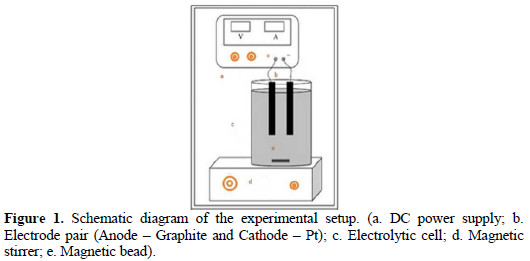
    <p>The electrochemical experiments have been carried out using a digital DC 
Electrophoresis power supply, as shown in <a href="#f1">Fig. 1</a>.</p>


    <p>&nbsp;</p>
<a name="f1">
<img src="/img/revistas/pea/v34n3/34n3a03f1.jpg">
    
<p>&nbsp;</p>


    <p>The electrochemical cell 
consists of an undivided cell with two monopolar electrodes, i.e., graphite has 
been used as anode, and platinum as a cathode. Graphite electrodes have a total 
effective electrode area of 16.623 cm<sup>2</sup>. The electrodes have been placed vertical 
and parallel to each other, and connected to a digital DC power supply (0 -100 
mA, 1 -300 V) equipped with amperostatic operational conditions. The potential 
across the electrodes has been adjusted, so that a current of 30 mA has passed 
through the cell. Potassium chloride has been used as supporting electrolyte. The 
optimum condition during electrolysis has been selected as follows: current 
density at 1.805 mA cm<sup>-2</sup>; initial dye concentration of 100 mgL<sup>-1</sup>; amount of KCl 
5 gL<sup>-1</sup> at original solution pH and room temperature. The electrolytic solution has 
been stirred thoroughly with the help of a magnetic stirrer during electrolysis.</p>


    <p><i><b>Electrochemical degradation studies</b></i></p>

    <p>The electrolysis of a 100 mL solution of dye containing 5 gL<sup>-1</sup> of supporting 
electrolyte KCl has been carried out at graphite anode and platinum cathode. 2 
mL of solution have been withdrawn at pre-set intervals of time, and the amount 
of dye decomposed was measured with the help of a Shimadzu-1800 UV-Visible 
Spectrophotometer at 484.95 nm. In order to study the effect of different 
parameters, electrolysis has been carried out by varying the current density, 
initial dye concentration, electrolysis time, amount of supporting electrolytes, 
pH, cathode and electrode materials. All the reagents were prepared and analysed 
as per standard methods. All the experiments were performed at room 
temperature. The percentage of dye removed was calculated using the following 
relation:</p>


    <p>&nbsp;</p>
<a name="e7">
<img src="/img/revistas/pea/v34n3/34n3a03e7.jpg">
    
]]></body>
<body><![CDATA[<p>&nbsp;</p>


    <p>where Co and Ct are the initial dye concentration, and the dye concentration at 
time t in solution (mgL<sup>-1</sup>), respectively.</p>

    <p>Electrochemical oxidation degrades the organic pollutants in wastewater, and 
thereby causes the reduction in COD and decrease in colour. The chemical 
oxygen demand (COD) was measured by volumetric analytical method, as 
reported in literature [20].</p>


    <p>&nbsp;</p>
    <p><b>Results and discussion</b></p>

    <p><i><b>Optimization of current density</b></i></p>

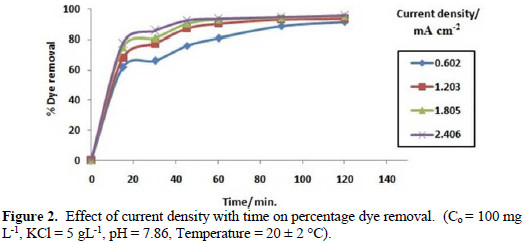
    <p><a href="#f2">Fig. 2</a> shows that different current densities (0.602, 1.203, 1.805 and 2.406 mA 
cm<sup>-2</sup>) with contact time play an important role in the study of electrochemical 
degradation of Congo red dye in an aqueous solution.</p>


    <p>&nbsp;</p>
<a name="f2">
<img src="/img/revistas/pea/v34n3/34n3a03f2.jpg">
    
<p>&nbsp;</p>


    <p>As the current density 
increases, the rate of hypochlorite produced increases at constant pH [21]. Also, 
the amount of H2 gas evolved on cathode increases with increasing applied 
current density, as per Faraday's law.</p> 


    ]]></body>
<body><![CDATA[<p><i><b>Optimization of initial dye concentration</b></i></p>

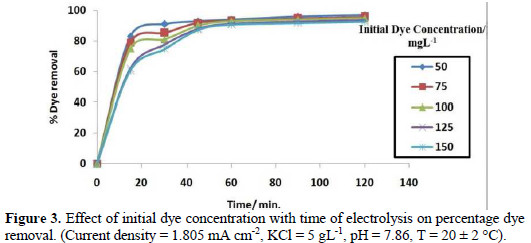
    <p>The effect of the initial dye concentration on the removal efficiency of colour 
with contact time, at broad range of dye concentration, is shown in <a href="#f3">Fig. 3</a>.</p>


    <p>&nbsp;</p>
<a name="f3">
<img src="/img/revistas/pea/v34n3/34n3a03f3.jpg">
    
<p>&nbsp;</p>


    <p>The rate of dye decolourization decreased with increasing initial dye concentration at 
constant current. During electrolysis, by increasing the dye concentration, the 
molecules of dye tend to associate to large molecules of low diffusivity, which 
lowers the rate of dye diffusion to the anode, with a consequent decrease in the 
dye removal [22].</p>


    <p><i><b>Optimization of supporting electrolytes</b></i></p>

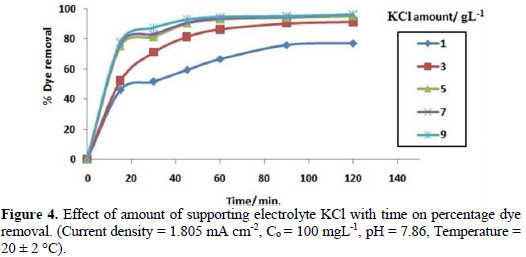
    <p>It is evident from <a href="#f4">Fig. 4</a> that the rate of colour removal increases with the 
increase in the amount of supporting electrolytes.</p>


    <p>&nbsp;</p>
<a name="f4">
<img src="/img/revistas/pea/v34n3/34n3a03f4.jpg">
    
<p>&nbsp;</p>


    <p>This may be due to the fact 
that, with an increase in concentration of supporting electrolytes, more 
hypochlorite ions are formed, which increases the dye oxidation. But, at a very 
high concentration, the percentage removal of dye becomes nearly constant, 
which may be due to the evolution of oxygen at high concentration levels [23].</p>

    ]]></body>
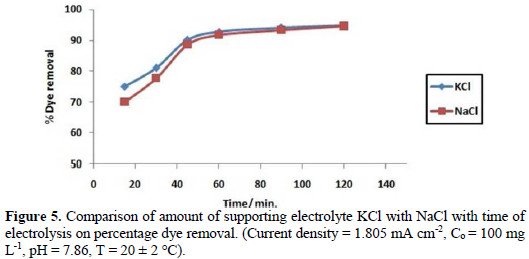
<body><![CDATA[<p>A comparative study of KCl with NaCl as supporting electrolytes has been 
carried out at optimum conditions. <a href="#f5">Fig. 5</a> depicts that KCl is a more efficient 
supporting electrolyte, as compared with NaCl, at initial stages.</p>


    <p>&nbsp;</p>
<a name="f5">
<img src="/img/revistas/pea/v34n3/34n3a03f5.jpg">
    
<p>&nbsp;</p>


    <p><i><b>Optimization of pH</b></i></p>

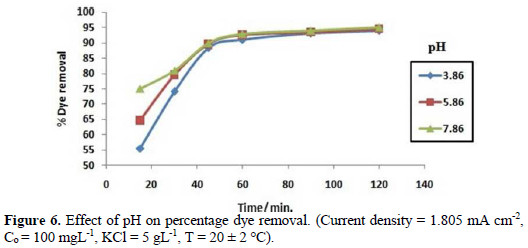
    <p>In order to study the effect of pH on the degradation of Congo red, the pH of the 
solution was varied from 3.86 to 7.86, at optimum conditions at room 
temperature. It is shown from <a href="#f6">Fig. 6</a> that the solution's pH affects the rate of dye 
degradation only at initial stages.</p>


    <p>&nbsp;</p>
<a name="f6">
<img src="/img/revistas/pea/v34n3/34n3a03f6.jpg">
    
<p>&nbsp;</p>


    <p><i><b>Effect of cathode and anode material</b></i></p>

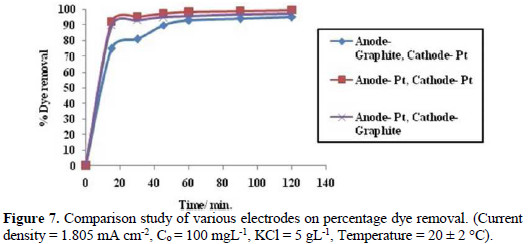
    <p>In order to evaluate the efficiency of electrode materials towards electrochemical 
oxidation of Congo red dye, the electrolysis has been carried out by varying 
electrode materials (<a href="#f7">Fig. 7</a>).</p>


    <p>&nbsp;</p>
<a name="f7">
<img src="/img/revistas/pea/v34n3/34n3a03f7.jpg">
    
]]></body>
<body><![CDATA[<p>&nbsp;</p>


    <p>It has been observed that when Pt has been used as 
electrodes then there is a 99.5% degradation of the dye, but when cathode 
material is replaced with graphite, then there is a slight decrease in dye 
degradation at final stage. In its turn, when the anode is replaced with graphite, 
then there is a decrease in percentage of dye degradation both at initial and final 
stage. From this, it can be concluded that although the efficiency of dye 
degradation at the graphite electrode is low at middle stage, it grows to 90%. 
Therefore, it can be used as an alternative electrode material for dye pollution 
monitoring, instead of the costly platinum electrode.</p>


    <p><i><b>Kinetic studies</b></i></p>

    <p>Many kinetic models have been applied to study the controlling mechanism of 
dye removal from aqueous solution. In order to investigate the mechanism of 
electrolysis of Congo red dye, the following kinetic models have been 
considered.</p>


    <p><i>Kinetic first-order rate equation</i></p>

    <p>In an attempt to correlate the present data with a kinetic first-order rate equation, 
a graph is plotted between ln (Co/Ce) versus time t. The results show that the data 
do not follow first-order equation.</p>


    <p><i>Kinetic second-order rate equation</i></p>

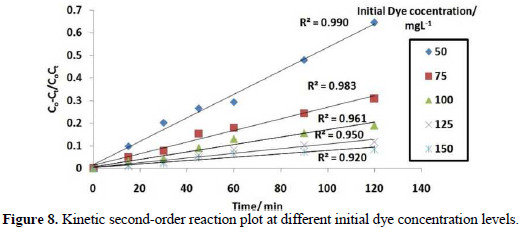
    <p>The data are then subjected to kinetics of second-order equation. The rate at 
which is expressed is:</p>


    <p>&nbsp;</p>
<a name="e8">
<img src="/img/revistas/pea/v34n3/34n3a03e8.jpg">
    
<p>&nbsp;</p>


    ]]></body>
<body><![CDATA[<p>where Co and Ct are the initial dye concentration and concentration of dye at time 
t in solution (mgL<sup>-1</sup>), respectively; and K2 is the second-order rate constant 
(min<sup>-1</sup>).</p>

    <p>It is evident from <a href="#f8">Fig. 8</a> that the data fitted well with a kinetic second-order rate 
equation.</p>


    <p>&nbsp;</p>
<a name="f8">
<img src="/img/revistas/pea/v34n3/34n3a03f8.jpg">
    
<p>&nbsp;</p>


    <p>Rate constant value is listed in <a href="#t1">Table 1</a>, which shows decrease in the 
rate constant value K2, with different initial dye concentration levels for the 
electrolytic removal of dye.</p>


    <p>&nbsp;</p>
<a name="t1">
<img src="/img/revistas/pea/v34n3/34n3a03t1.jpg">
    
<p>&nbsp;</p>


    <p><i><b>Analysis of COD</b></i></p>

    <p>The chemical oxygen demand analysis allows the feasibility of waste in terms of 
the total quantity of oxygen required for the oxidation of organic matter to CO2 
and H2O. This study has been taken as an effective parameter to measure the 
efficiency of the electrochemical oxidation process for the treatment of hazardous 
Congo red dye from aqueous solution. The volumetric analytical method was 
applied for COD measurement. The electrochemical degradation of Congo red 
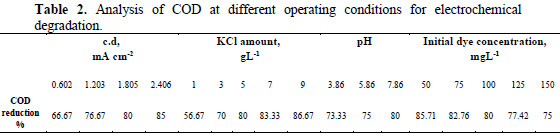
has been carried out at different experimental conditions. <a href="#t2">Table 2</a> shows that the 
COD reduction percentage increases with the increase in current density, amount 
of supporting electrolytes (potassium chloride) and pH of the dye solution.</p>


    <p>&nbsp;</p>
<a name="t2">
<img src="/img/revistas/pea/v34n3/34n3a03t2.jpg">
    
]]></body>
<body><![CDATA[<p>&nbsp;</p>


    <p>This may be because the electrogenerated chlorine/hypochlorite plays an important 
role in the electrocatalytic degradation process of the dye removal [23-24]. 
However, the reduction percentage in COD value decreases with an increase in 
initial dye concentration, because dye molecules tend to associate with large 
molecules of low diffusivity, which may lower the dye diffusion to the anode.</p>


    <p><i><b>Electric energy consumption</b></i></p>

    <p>In the electrochemical oxidation process for the removal of Congo red dye from 
aqueous solution, the major operating cost is associated with electric energy 
consumption values. The electric energy consumption during the electrochemical 
process has been calculated in terms of KWh Kg<sup>-1</sup> dye removed, using the 
following equation [22]:</p>


    <p>&nbsp;</p>
<a name="e9">
<img src="/img/revistas/pea/v34n3/34n3a03e9.jpg">
    
<p>&nbsp;</p>


    <p>where V is the cell voltage (V), I is the current (A), t is the time of electrolysis 
(min), Co and Ct are the initial dye concentration and concentration of dye at time 
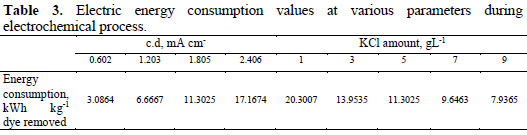
t in solution (mgL<sup>-1</sup>). The contents of <a href="#t3">Table 3</a> indicate that the energy 
consumption increases with increasing current density, and decreases with 
increasing KCl amount.</p>


    <p>&nbsp;</p>
<a name="t3">
<img src="/img/revistas/pea/v34n3/34n3a03t3.jpg">
    
<p>&nbsp;</p>


    <p>The minimum electrical energy consumption was 3.0864 
KWh Kg<sup>-1</sup> colour removed at a very low current density of 0.602 mA cm<sup>-2</sup>, which 
may be attributed to the decreased hydrogen and oxygen evolution reaction. With 
this very small electrical energy consumption, an almost complete degradation of 
dyes has been achieved after 60 min of electrolysis. In India &approx;6.43 rupees are 
required to remove one kilogram of dye from wastewater during this process.</p>


    ]]></body>
<body><![CDATA[<p><i><b>Fourier Transform Infrared Spectroscopy (FTIR) analysis</b></i></p>

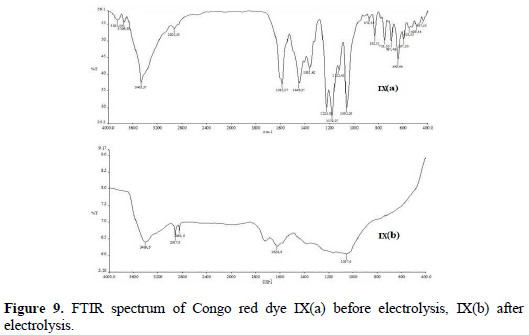
    <p>The FTIR spectra of Congo red dye before and after electrolysis at optimum 
condition have been recorded in the region of 4000-400 cm<sup>-1</sup>. The FTIR spectrum 
of Congo red showed peaks in 1062 cm<sup>-1</sup> for S=O stretching vibrations of 
sulfonic acid, 1225 cm<sup>-1</sup> for C-N stretching vibrations, 1361 cm<sup>-1</sup> for C-N 
bending vibrations, 1446 cm<sup>-1</sup> for aromatic C=C stretching vibrations, 1585 cm<sup>-1</sup> 
for N=N stretching vibrations, 2925 cm<sup>-1</sup> for O-H stretching vibrations and 3465 
cm<sup>-1</sup> for N-H stretching vibrations of aromatic primary amine (<a href="#f9">Fig. 9(a)</a>).</p>


    <p>&nbsp;</p>
<a name="f9">
<img src="/img/revistas/pea/v34n3/34n3a03f9.jpg">
    
<p>&nbsp;</p>


    <p>The FTIR spectrum obtained after electrolysis of Congo red consists of no peak at 
1585 cm<sup>-1</sup>, due to azo group [25]. The other peaks (visible in the spectra before 
electrolysis) weaken or disappear, as shown in the FTIR spectrum (<a href="#f9">Fig. 9(b)</a>).</p>


    <p><i><b>Electrochemical degradation pathways of Congo red</b></i></p>

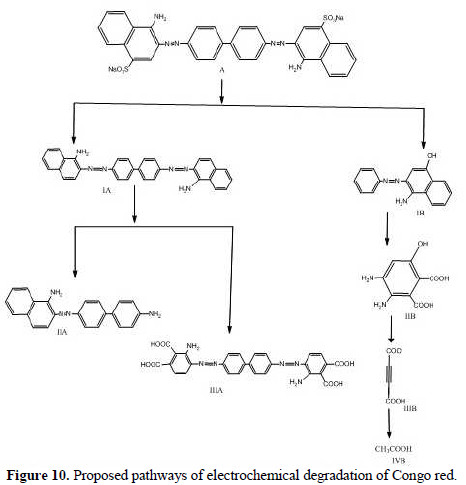
    <p>The intermediate compounds formed during the electrochemical degradation of 
Congo red have been identified by MS/MS. The sample has been collected after 
60 minutes of electrolysis. Based on the MS/MS identification, the following 
pathway (<a href="#f10">Fig. 10</a>) is proposed for the electrochemical degradation of Congo red.</p>


    <p>&nbsp;</p>
<a name="f10">
<img src="/img/revistas/pea/v34n3/34n3a03f10.jpg">
    
<p>&nbsp;</p>


    <p>The structures of various intermediates, as predicted from MS/MS fragmentation 
analysis, are given below in <a href="#f10">Fig. 10</a>, with a base peak at 113, indicating that the 
entire dye has been decomposed to low molecular weight fragments.</p>


    ]]></body>
<body><![CDATA[<p>&nbsp;</p>
    <p><b>Conclusions</b></p>

    <p>The present work is devoted to the electrochemical oxidation of textile dye 
Congo red at graphite anode and platinum cathode under optimum conditions. 
This process is capable of destroying the harmful dye contents in short treatment 
time. The influence of current density, initial dye concentration, KCl 
concentration, pH and electrode material on the dye removal percentage and 
COD reduction has been determined. The intermediates formed during 
electrolysis have been identified with MS/MS and FTIR spectral studies. It is 
interesting to notice that 95% of dye has been degraded during electrolysis with 
maximum energy resource management. The present data were well fitted to 
second-order kinetic model for the electrochemical process. Thus, 
electrochemical technology is an effective method for the removal of Congo red 
dye from effluents of textile industry.</p>


    <p>&nbsp;</p>
    <p><b>References</b></p>

    <!-- ref --><p>1. Ramakrishna KR, Viraraghavan T. Water Sci Technol. 1997;36:189.    &nbsp;&nbsp;&nbsp;&nbsp;&nbsp;&nbsp;&nbsp;&nbsp;[&#160;<a href="javascript:void(0);" onclick="javascript: window.open('/scielo.php?script=sci_nlinks&ref=420823&pid=S0872-1904201600030000300001&lng=','','width=640,height=500,resizable=yes,scrollbars=1,menubar=yes,');">Links</a>&#160;]<!-- end-ref --></p>

    <!-- ref --><p>2. Baban A, Yediler A, Ciliz NK. Clean - Soil Air Water. 2010;38:84.    &nbsp;&nbsp;&nbsp;&nbsp;&nbsp;&nbsp;&nbsp;&nbsp;[&#160;<a href="javascript:void(0);" onclick="javascript: window.open('/scielo.php?script=sci_nlinks&ref=420825&pid=S0872-1904201600030000300002&lng=','','width=640,height=500,resizable=yes,scrollbars=1,menubar=yes,');">Links</a>&#160;]<!-- end-ref --></p>

    <!-- ref --><p>3. Robinson T, McMullan G, Marchant R, et al. Bioresource Technol. 2001;77:247.    &nbsp;&nbsp;&nbsp;&nbsp;&nbsp;&nbsp;&nbsp;&nbsp;[&#160;<a href="javascript:void(0);" onclick="javascript: window.open('/scielo.php?script=sci_nlinks&ref=420827&pid=S0872-1904201600030000300003&lng=','','width=640,height=500,resizable=yes,scrollbars=1,menubar=yes,');">Links</a>&#160;]<!-- end-ref --></p>

    <!-- ref --><p>4. Ho YS, Mckay G. Can J Chem Eng. 1998;76:822.    &nbsp;&nbsp;&nbsp;&nbsp;&nbsp;&nbsp;&nbsp;&nbsp;[&#160;<a href="javascript:void(0);" onclick="javascript: window.open('/scielo.php?script=sci_nlinks&ref=420829&pid=S0872-1904201600030000300004&lng=','','width=640,height=500,resizable=yes,scrollbars=1,menubar=yes,');">Links</a>&#160;]<!-- end-ref --></p>

    <!-- ref --><p>5. Walker GM, Hansen L, Hanna JA, et al. Water Res. 2003;37:2081.    &nbsp;&nbsp;&nbsp;&nbsp;&nbsp;&nbsp;&nbsp;&nbsp;[&#160;<a href="javascript:void(0);" onclick="javascript: window.open('/scielo.php?script=sci_nlinks&ref=420831&pid=S0872-1904201600030000300005&lng=','','width=640,height=500,resizable=yes,scrollbars=1,menubar=yes,');">Links</a>&#160;]<!-- end-ref --></p>

    <!-- ref --><p>6. Jain R, Sharma N, Radhapyari K. Eur Water. 2009;27/28:43.    &nbsp;&nbsp;&nbsp;&nbsp;&nbsp;&nbsp;&nbsp;&nbsp;[&#160;<a href="javascript:void(0);" onclick="javascript: window.open('/scielo.php?script=sci_nlinks&ref=420833&pid=S0872-1904201600030000300006&lng=','','width=640,height=500,resizable=yes,scrollbars=1,menubar=yes,');">Links</a>&#160;]<!-- end-ref --></p>

    <!-- ref --><p>7. Weber WJ, Morris CJ. Advances in water pollution research. In: 
Proceedings of the First International Conference on Water Pollution 
Research. vol 2. Oxford: Pergamon Press; 1962. p. 231.    &nbsp;&nbsp;&nbsp;&nbsp;&nbsp;&nbsp;&nbsp;&nbsp;[&#160;<a href="javascript:void(0);" onclick="javascript: window.open('/scielo.php?script=sci_nlinks&ref=420835&pid=S0872-1904201600030000300007&lng=','','width=640,height=500,resizable=yes,scrollbars=1,menubar=yes,');">Links</a>&#160;]<!-- end-ref --></p>

    <!-- ref --><p>8. Kaur H, Swati, Kaur R. Chem Sci Trans. 2014;3:1300.    &nbsp;&nbsp;&nbsp;&nbsp;&nbsp;&nbsp;&nbsp;&nbsp;[&#160;<a href="javascript:void(0);" onclick="javascript: window.open('/scielo.php?script=sci_nlinks&ref=420837&pid=S0872-1904201600030000300008&lng=','','width=640,height=500,resizable=yes,scrollbars=1,menubar=yes,');">Links</a>&#160;]<!-- end-ref --></p>

    <!-- ref --><p>9. Han R, Ding D, Xu Y, et al. Bioresour Tech. 2008;99:2938.    &nbsp;&nbsp;&nbsp;&nbsp;&nbsp;&nbsp;&nbsp;&nbsp;[&#160;<a href="javascript:void(0);" onclick="javascript: window.open('/scielo.php?script=sci_nlinks&ref=420839&pid=S0872-1904201600030000300009&lng=','','width=640,height=500,resizable=yes,scrollbars=1,menubar=yes,');">Links</a>&#160;]<!-- end-ref --></p>

    <!-- ref --><p>10. Yang CL, McGarrahan J. J Hazard Mater. 2005;127:40.    &nbsp;&nbsp;&nbsp;&nbsp;&nbsp;&nbsp;&nbsp;&nbsp;[&#160;<a href="javascript:void(0);" onclick="javascript: window.open('/scielo.php?script=sci_nlinks&ref=420841&pid=S0872-1904201600030000300010&lng=','','width=640,height=500,resizable=yes,scrollbars=1,menubar=yes,');">Links</a>&#160;]<!-- end-ref --></p>

    <!-- ref --><p>11. Saleem M, Bhkhari AA, Akram MN. J Basic Appl Sci. 2011;7:11.    &nbsp;&nbsp;&nbsp;&nbsp;&nbsp;&nbsp;&nbsp;&nbsp;[&#160;<a href="javascript:void(0);" onclick="javascript: window.open('/scielo.php?script=sci_nlinks&ref=420843&pid=S0872-1904201600030000300011&lng=','','width=640,height=500,resizable=yes,scrollbars=1,menubar=yes,');">Links</a>&#160;]<!-- end-ref --></p>

    <!-- ref --><p>12. Katwal R, Kaur H, Sharma G, et al. J Ind Eng Chem. 2015;31:173.    &nbsp;&nbsp;&nbsp;&nbsp;&nbsp;&nbsp;&nbsp;&nbsp;[&#160;<a href="javascript:void(0);" onclick="javascript: window.open('/scielo.php?script=sci_nlinks&ref=420845&pid=S0872-1904201600030000300012&lng=','','width=640,height=500,resizable=yes,scrollbars=1,menubar=yes,');">Links</a>&#160;]<!-- end-ref --></p>

    <!-- ref --><p>13. Lopes A, Martins S, Morao A, et al. Port Electrochim Acta. 2004;22:279.    &nbsp;&nbsp;&nbsp;&nbsp;&nbsp;&nbsp;&nbsp;&nbsp;[&#160;<a href="javascript:void(0);" onclick="javascript: window.open('/scielo.php?script=sci_nlinks&ref=420847&pid=S0872-1904201600030000300013&lng=','','width=640,height=500,resizable=yes,scrollbars=1,menubar=yes,');">Links</a>&#160;]<!-- end-ref --></p>

    <!-- ref --><p>14. Kaur H, Kaur R. J Mater Environ Sci. 2014;5:1830.    &nbsp;&nbsp;&nbsp;&nbsp;&nbsp;&nbsp;&nbsp;&nbsp;[&#160;<a href="javascript:void(0);" onclick="javascript: window.open('/scielo.php?script=sci_nlinks&ref=420849&pid=S0872-1904201600030000300014&lng=','','width=640,height=500,resizable=yes,scrollbars=1,menubar=yes,');">Links</a>&#160;]<!-- end-ref --></p>

    <!-- ref --><p>15. Forgacs E, Cserhati T, Oros G. Environ Int. 2004;30:953.    &nbsp;&nbsp;&nbsp;&nbsp;&nbsp;&nbsp;&nbsp;&nbsp;[&#160;<a href="javascript:void(0);" onclick="javascript: window.open('/scielo.php?script=sci_nlinks&ref=420851&pid=S0872-1904201600030000300015&lng=','','width=640,height=500,resizable=yes,scrollbars=1,menubar=yes,');">Links</a>&#160;]<!-- end-ref --></p>

    <!-- ref --><p>16. Nava JL, Quiroz MA, Marinez-Huitle CA. J Mex Chem Soc. 2008;52:249.    &nbsp;&nbsp;&nbsp;&nbsp;&nbsp;&nbsp;&nbsp;&nbsp;[&#160;<a href="javascript:void(0);" onclick="javascript: window.open('/scielo.php?script=sci_nlinks&ref=420853&pid=S0872-1904201600030000300016&lng=','','width=640,height=500,resizable=yes,scrollbars=1,menubar=yes,');">Links</a>&#160;]<!-- end-ref --></p>

    <!-- ref --><p>17. Jovic M, Stankovic D, Manojlovic D, et al. Int J Electrochem Sci. 2013;8:168.    &nbsp;&nbsp;&nbsp;&nbsp;&nbsp;&nbsp;&nbsp;&nbsp;[&#160;<a href="javascript:void(0);" onclick="javascript: window.open('/scielo.php?script=sci_nlinks&ref=420855&pid=S0872-1904201600030000300017&lng=','','width=640,height=500,resizable=yes,scrollbars=1,menubar=yes,');">Links</a>&#160;]<!-- end-ref --></p>

    <p>18. Rivera M, Pazos M, SanromÃ¡n MA. Desalination. 2011;274:39.</p>

    ]]></body>
<body><![CDATA[<!-- ref --><p>19. El-Ashtoukhy ESZ, Amin NK. J Hazard Mater. 2010;179:113.    &nbsp;&nbsp;&nbsp;&nbsp;&nbsp;&nbsp;&nbsp;&nbsp;[&#160;<a href="javascript:void(0);" onclick="javascript: window.open('/scielo.php?script=sci_nlinks&ref=420858&pid=S0872-1904201600030000300019&lng=','','width=640,height=500,resizable=yes,scrollbars=1,menubar=yes,');">Links</a>&#160;]<!-- end-ref --></p>

    <p>20. Clesceri LS, Greenberg AE, Trussell RR, editors. Standard methods for the examination of water and wastewater. 17th ed. 1989.</p>

    <!-- ref --><p>21. Wang CT, Chou WL, Kuo YM, et al. J Hazard Mater. 2009;169:16.    &nbsp;&nbsp;&nbsp;&nbsp;&nbsp;&nbsp;&nbsp;&nbsp;[&#160;<a href="javascript:void(0);" onclick="javascript: window.open('/scielo.php?script=sci_nlinks&ref=420861&pid=S0872-1904201600030000300021&lng=','','width=640,height=500,resizable=yes,scrollbars=1,menubar=yes,');">Links</a>&#160;]<!-- end-ref --></p>

    <!-- ref --><p>22. El-Ashtoukhy ESZ. Int J Electrochem Sci. 2013;8:846.    &nbsp;&nbsp;&nbsp;&nbsp;&nbsp;&nbsp;&nbsp;&nbsp;[&#160;<a href="javascript:void(0);" onclick="javascript: window.open('/scielo.php?script=sci_nlinks&ref=420863&pid=S0872-1904201600030000300022&lng=','','width=640,height=500,resizable=yes,scrollbars=1,menubar=yes,');">Links</a>&#160;]<!-- end-ref --></p>

    <p>23. Kariyajjanavar P, Narayana J, Nayaka YA, et al. Port Electrochim Acta. 2010;28:265.</p>

    <p>24. Ghalwa NMA, Abdel-Latif MS. J Iran Chem Soc. 2005;2:238.</p>

    <p>25. Telke AA, Joshi SM, Jadhav SU, et al. Biodegradation. 2010;21:283.</p>


    ]]></body>
<body><![CDATA[<p>&nbsp;</p>
    <p><b>Acknowledgements</b></p>

    <p>Authors acknowledge sincere thanks to UGC, New Delhi, for awarding the 
UGC-BSR Fellowship (to Ms. Rajvir Kaur) for carrying out the research work 
successfully.</p>


    <p>&nbsp;</p>
    <p><a name=0></a><sup><a href="#top">*</a></sup>Corresponding author. E-mail address: <a href="mailto:preetjudge@yahoo.co.in">preetjudge@yahoo.co.in</a></p>

    <p>Received 01 December 2015; accepted 18 March 2016</p>

    <p><a href="http://www.peacta.org" target="_blank">www.peacta.org</a> </p>


     ]]></body><back>
<ref-list>
<ref id="B1">
<label>1</label><nlm-citation citation-type="journal">
<person-group person-group-type="author">
<name>
<surname><![CDATA[Ramakrishna]]></surname>
<given-names><![CDATA[K R]]></given-names>
</name>
<name>
<surname><![CDATA[Viraraghavan]]></surname>
<given-names><![CDATA[T]]></given-names>
</name>
</person-group>
<source><![CDATA[Water Sci Technol]]></source>
<year>1997</year>
<volume>36</volume>
<page-range>189</page-range></nlm-citation>
</ref>
<ref id="B2">
<label>2</label><nlm-citation citation-type="journal">
<person-group person-group-type="author">
<name>
<surname><![CDATA[Baban]]></surname>
<given-names><![CDATA[A]]></given-names>
</name>
<name>
<surname><![CDATA[Yediler]]></surname>
<given-names><![CDATA[A]]></given-names>
</name>
<name>
<surname><![CDATA[Ciliz]]></surname>
<given-names><![CDATA[N K]]></given-names>
</name>
</person-group>
<source><![CDATA[Clean - Soil Air Water]]></source>
<year>2010</year>
<volume>38</volume>
<page-range>84</page-range></nlm-citation>
</ref>
<ref id="B3">
<label>3</label><nlm-citation citation-type="journal">
<person-group person-group-type="author">
<name>
<surname><![CDATA[Robinson]]></surname>
<given-names><![CDATA[T]]></given-names>
</name>
<name>
<surname><![CDATA[McMullan]]></surname>
<given-names><![CDATA[G]]></given-names>
</name>
<name>
<surname><![CDATA[Marchant]]></surname>
<given-names><![CDATA[R]]></given-names>
</name>
</person-group>
<source><![CDATA[Bioresource Technol]]></source>
<year>2001</year>
<volume>77</volume>
<page-range>247</page-range></nlm-citation>
</ref>
<ref id="B4">
<label>4</label><nlm-citation citation-type="journal">
<person-group person-group-type="author">
<name>
<surname><![CDATA[Ho]]></surname>
<given-names><![CDATA[YS]]></given-names>
</name>
<name>
<surname><![CDATA[Mckay]]></surname>
<given-names><![CDATA[G]]></given-names>
</name>
</person-group>
<source><![CDATA[Can J Chem Eng]]></source>
<year>1998</year>
<volume>76</volume>
<page-range>822</page-range></nlm-citation>
</ref>
<ref id="B5">
<label>5</label><nlm-citation citation-type="journal">
<person-group person-group-type="author">
<name>
<surname><![CDATA[Walker]]></surname>
<given-names><![CDATA[G M]]></given-names>
</name>
<name>
<surname><![CDATA[Hansen]]></surname>
<given-names><![CDATA[L]]></given-names>
</name>
<name>
<surname><![CDATA[Hanna]]></surname>
<given-names><![CDATA[J A]]></given-names>
</name>
</person-group>
<source><![CDATA[Water Res]]></source>
<year>2003</year>
<volume>37</volume>
<page-range>2081</page-range></nlm-citation>
</ref>
<ref id="B6">
<label>6</label><nlm-citation citation-type="journal">
<person-group person-group-type="author">
<name>
<surname><![CDATA[Jain]]></surname>
<given-names><![CDATA[R]]></given-names>
</name>
<name>
<surname><![CDATA[Sharma]]></surname>
<given-names><![CDATA[N]]></given-names>
</name>
<name>
<surname><![CDATA[Radhapyari]]></surname>
<given-names><![CDATA[K]]></given-names>
</name>
</person-group>
<source><![CDATA[Eur Water]]></source>
<year>2009</year>
<volume>27/28</volume>
<page-range>43</page-range></nlm-citation>
</ref>
<ref id="B7">
<label>7</label><nlm-citation citation-type="confpro">
<person-group person-group-type="author">
<name>
<surname><![CDATA[Weber]]></surname>
<given-names><![CDATA[W J]]></given-names>
</name>
<name>
<surname><![CDATA[Morris]]></surname>
<given-names><![CDATA[C J]]></given-names>
</name>
</person-group>
<source><![CDATA[Advances in water pollution research]]></source>
<year></year>
<conf-name><![CDATA[ First International Conference on Water Pollution Research]]></conf-name>
<conf-date>1962</conf-date>
<conf-loc> </conf-loc>
</nlm-citation>
</ref>
<ref id="B8">
<label>8</label><nlm-citation citation-type="journal">
<person-group person-group-type="author">
<name>
<surname><![CDATA[Kaur]]></surname>
<given-names><![CDATA[H]]></given-names>
</name>
<name>
<surname><![CDATA[Swati]]></surname>
</name>
<name>
<surname><![CDATA[Kaur]]></surname>
<given-names><![CDATA[R]]></given-names>
</name>
</person-group>
<source><![CDATA[Chem Sci Trans]]></source>
<year>2014</year>
<volume>3</volume>
<page-range>1300</page-range></nlm-citation>
</ref>
<ref id="B9">
<label>9</label><nlm-citation citation-type="journal">
<person-group person-group-type="author">
<name>
<surname><![CDATA[Han]]></surname>
<given-names><![CDATA[R]]></given-names>
</name>
<name>
<surname><![CDATA[Ding]]></surname>
<given-names><![CDATA[D]]></given-names>
</name>
<name>
<surname><![CDATA[Xu]]></surname>
<given-names><![CDATA[Y]]></given-names>
</name>
</person-group>
<source><![CDATA[Bioresour Tech]]></source>
<year>2008</year>
<volume>99</volume>
<page-range>2938</page-range></nlm-citation>
</ref>
<ref id="B10">
<label>10</label><nlm-citation citation-type="journal">
<person-group person-group-type="author">
<name>
<surname><![CDATA[Yang]]></surname>
<given-names><![CDATA[C L]]></given-names>
</name>
<name>
<surname><![CDATA[McGarrahan]]></surname>
<given-names><![CDATA[J]]></given-names>
</name>
</person-group>
<source><![CDATA[J Hazard Mater]]></source>
<year>2005</year>
<volume>127</volume>
<page-range>40</page-range></nlm-citation>
</ref>
<ref id="B11">
<label>11</label><nlm-citation citation-type="journal">
<person-group person-group-type="author">
<name>
<surname><![CDATA[Saleem]]></surname>
<given-names><![CDATA[M]]></given-names>
</name>
<name>
<surname><![CDATA[Bhkhari]]></surname>
<given-names><![CDATA[A A]]></given-names>
</name>
<name>
<surname><![CDATA[Akram]]></surname>
<given-names><![CDATA[M N]]></given-names>
</name>
</person-group>
<source><![CDATA[J Basic Appl Sci]]></source>
<year>2011</year>
<volume>7</volume>
<page-range>11</page-range></nlm-citation>
</ref>
<ref id="B12">
<label>12</label><nlm-citation citation-type="journal">
<person-group person-group-type="author">
<name>
<surname><![CDATA[Katwal]]></surname>
<given-names><![CDATA[R]]></given-names>
</name>
<name>
<surname><![CDATA[Kaur]]></surname>
<given-names><![CDATA[H]]></given-names>
</name>
<name>
<surname><![CDATA[Sharma]]></surname>
<given-names><![CDATA[G]]></given-names>
</name>
</person-group>
<source><![CDATA[J Ind Eng Chem]]></source>
<year>2015</year>
<volume>31</volume>
<page-range>173</page-range></nlm-citation>
</ref>
<ref id="B13">
<label>13</label><nlm-citation citation-type="journal">
<person-group person-group-type="author">
<name>
<surname><![CDATA[Lopes]]></surname>
<given-names><![CDATA[A]]></given-names>
</name>
<name>
<surname><![CDATA[Martins]]></surname>
<given-names><![CDATA[S]]></given-names>
</name>
<name>
<surname><![CDATA[Morao]]></surname>
<given-names><![CDATA[A]]></given-names>
</name>
</person-group>
<source><![CDATA[Port Electrochim Acta]]></source>
<year>2004</year>
<volume>22</volume>
<page-range>279</page-range></nlm-citation>
</ref>
<ref id="B14">
<label>14</label><nlm-citation citation-type="journal">
<person-group person-group-type="author">
<name>
<surname><![CDATA[Kaur]]></surname>
<given-names><![CDATA[H]]></given-names>
</name>
<name>
<surname><![CDATA[Kaur]]></surname>
<given-names><![CDATA[R]]></given-names>
</name>
</person-group>
<source><![CDATA[J Mater Environ Sci]]></source>
<year>2014</year>
<volume>5</volume>
<page-range>1830</page-range></nlm-citation>
</ref>
<ref id="B15">
<label>15</label><nlm-citation citation-type="journal">
<person-group person-group-type="author">
<name>
<surname><![CDATA[Forgacs]]></surname>
<given-names><![CDATA[E]]></given-names>
</name>
<name>
<surname><![CDATA[Cserhati]]></surname>
<given-names><![CDATA[T]]></given-names>
</name>
<name>
<surname><![CDATA[Oros]]></surname>
<given-names><![CDATA[G]]></given-names>
</name>
</person-group>
<source><![CDATA[Environ Int]]></source>
<year>2004</year>
<volume>30</volume>
<page-range>953</page-range></nlm-citation>
</ref>
<ref id="B16">
<label>16</label><nlm-citation citation-type="journal">
<person-group person-group-type="author">
<name>
<surname><![CDATA[Nava]]></surname>
<given-names><![CDATA[J L]]></given-names>
</name>
<name>
<surname><![CDATA[Quiroz]]></surname>
<given-names><![CDATA[M A]]></given-names>
</name>
<name>
<surname><![CDATA[Marinez-Huitle]]></surname>
<given-names><![CDATA[C A]]></given-names>
</name>
</person-group>
<source><![CDATA[J Mex Chem Soc]]></source>
<year>2008</year>
<volume>52</volume>
<page-range>249</page-range></nlm-citation>
</ref>
<ref id="B17">
<label>17</label><nlm-citation citation-type="journal">
<person-group person-group-type="author">
<name>
<surname><![CDATA[Jovic]]></surname>
<given-names><![CDATA[M]]></given-names>
</name>
<name>
<surname><![CDATA[Stankovic]]></surname>
<given-names><![CDATA[D]]></given-names>
</name>
<name>
<surname><![CDATA[Manojlovic]]></surname>
<given-names><![CDATA[D]]></given-names>
</name>
</person-group>
<source><![CDATA[Int J Electrochem Sci]]></source>
<year>2013</year>
<volume>8</volume>
<page-range>168</page-range></nlm-citation>
</ref>
<ref id="B18">
<label>18</label><nlm-citation citation-type="journal">
<person-group person-group-type="author">
<name>
<surname><![CDATA[Rivera]]></surname>
<given-names><![CDATA[M]]></given-names>
</name>
<name>
<surname><![CDATA[Pazos]]></surname>
<given-names><![CDATA[M]]></given-names>
</name>
<name>
<surname><![CDATA[Sanroman]]></surname>
<given-names><![CDATA[M A]]></given-names>
</name>
</person-group>
<source><![CDATA[Desalination]]></source>
<year>2011</year>
<volume>274</volume>
<page-range>39</page-range></nlm-citation>
</ref>
<ref id="B19">
<label>19</label><nlm-citation citation-type="journal">
<person-group person-group-type="author">
<name>
<surname><![CDATA[El-Ashtoukhy]]></surname>
<given-names><![CDATA[E S Z]]></given-names>
</name>
<name>
<surname><![CDATA[Amin]]></surname>
<given-names><![CDATA[N K]]></given-names>
</name>
</person-group>
<source><![CDATA[J Hazard Mater]]></source>
<year>2010</year>
<volume>179</volume>
<page-range>113</page-range></nlm-citation>
</ref>
<ref id="B20">
<label>20</label><nlm-citation citation-type="">
<person-group person-group-type="author">
<name>
<surname><![CDATA[Clesceri]]></surname>
<given-names><![CDATA[L S]]></given-names>
</name>
<name>
<surname><![CDATA[Greenberg]]></surname>
<given-names><![CDATA[A E]]></given-names>
</name>
<name>
<surname><![CDATA[Trussell]]></surname>
<given-names><![CDATA[R R]]></given-names>
</name>
</person-group>
<source><![CDATA[Standard methods for the examination of water and wastewater]]></source>
<year>1989</year>
<edition>17</edition>
</nlm-citation>
</ref>
<ref id="B21">
<label>21</label><nlm-citation citation-type="journal">
<person-group person-group-type="author">
<name>
<surname><![CDATA[Wang]]></surname>
<given-names><![CDATA[C T]]></given-names>
</name>
<name>
<surname><![CDATA[Chou]]></surname>
<given-names><![CDATA[W L]]></given-names>
</name>
<name>
<surname><![CDATA[Kuo]]></surname>
<given-names><![CDATA[Y M]]></given-names>
</name>
</person-group>
<source><![CDATA[J Hazard Mater]]></source>
<year>2009</year>
<volume>169</volume>
<page-range>16</page-range></nlm-citation>
</ref>
<ref id="B22">
<label>22</label><nlm-citation citation-type="journal">
<person-group person-group-type="author">
<name>
<surname><![CDATA[El-Ashtoukhy]]></surname>
<given-names><![CDATA[E S Z]]></given-names>
</name>
</person-group>
<source><![CDATA[Int J Electrochem Sci]]></source>
<year>2013</year>
<volume>8</volume>
<page-range>846</page-range></nlm-citation>
</ref>
<ref id="B23">
<label>23</label><nlm-citation citation-type="journal">
<person-group person-group-type="author">
<name>
<surname><![CDATA[Ghalwa]]></surname>
<given-names><![CDATA[N M A]]></given-names>
</name>
<name>
<surname><![CDATA[Abdel-Latif]]></surname>
<given-names><![CDATA[M S]]></given-names>
</name>
</person-group>
<source><![CDATA[J Iran Chem Soc]]></source>
<year>2005</year>
<volume>2</volume>
<page-range>238</page-range></nlm-citation>
</ref>
<ref id="B24">
<label>24</label><nlm-citation citation-type="journal">
<person-group person-group-type="author">
<name>
<surname><![CDATA[Telke]]></surname>
<given-names><![CDATA[A A]]></given-names>
</name>
<name>
<surname><![CDATA[Joshi]]></surname>
<given-names><![CDATA[S M]]></given-names>
</name>
<name>
<surname><![CDATA[Jadhav]]></surname>
<given-names><![CDATA[S U]]></given-names>
</name>
</person-group>
<source><![CDATA[Biodegradation]]></source>
<year>2010</year>
<volume>21</volume>
<page-range>283</page-range></nlm-citation>
</ref>
</ref-list>
</back>
</article>