<?xml version="1.0" encoding="ISO-8859-1"?><article xmlns:mml="http://www.w3.org/1998/Math/MathML" xmlns:xlink="http://www.w3.org/1999/xlink" xmlns:xsi="http://www.w3.org/2001/XMLSchema-instance">
<front>
<journal-meta>
<journal-id>0872-1904</journal-id>
<journal-title><![CDATA[Portugaliae Electrochimica Acta]]></journal-title>
<abbrev-journal-title><![CDATA[Port. Electrochim. Acta]]></abbrev-journal-title>
<issn>0872-1904</issn>
<publisher>
<publisher-name><![CDATA[Sociedade Portuguesa de Electroquímica]]></publisher-name>
</publisher>
</journal-meta>
<article-meta>
<article-id>S0872-19042016000300005</article-id>
<article-id pub-id-type="doi">10.4152/pea.201603213</article-id>
<title-group>
<article-title xml:lang="en"><![CDATA[Synthesis, Characterization and Corrosion Protection Properties of Imidazole Derivatives on Mild Steel in 1.0 M HCl]]></article-title>
</title-group>
<contrib-group>
<contrib contrib-type="author">
<name>
<surname><![CDATA[Krim]]></surname>
<given-names><![CDATA[O.]]></given-names>
</name>
<xref ref-type="aff" rid="A01"/>
</contrib>
<contrib contrib-type="author">
<name>
<surname><![CDATA[Jodeh]]></surname>
<given-names><![CDATA[S.]]></given-names>
</name>
<xref ref-type="aff" rid="A02"/>
</contrib>
<contrib contrib-type="author">
<name>
<surname><![CDATA[Messali]]></surname>
<given-names><![CDATA[M.]]></given-names>
</name>
<xref ref-type="aff" rid="A03"/>
</contrib>
<contrib contrib-type="author">
<name>
<surname><![CDATA[Hammouti]]></surname>
<given-names><![CDATA[B.]]></given-names>
</name>
<xref ref-type="aff" rid="A04"/>
<xref ref-type="aff" rid="A05"/>
</contrib>
<contrib contrib-type="author">
<name>
<surname><![CDATA[Elidrissi]]></surname>
<given-names><![CDATA[A.]]></given-names>
</name>
<xref ref-type="aff" rid="A03"/>
</contrib>
<contrib contrib-type="author">
<name>
<surname><![CDATA[Khaled]]></surname>
<given-names><![CDATA[K.]]></given-names>
</name>
<xref ref-type="aff" rid="A01"/>
</contrib>
<contrib contrib-type="author">
<name>
<surname><![CDATA[Salghie]]></surname>
<given-names><![CDATA[R.]]></given-names>
</name>
<xref ref-type="aff" rid="A06"/>
</contrib>
<contrib contrib-type="author">
<name>
<surname><![CDATA[Lgaz]]></surname>
<given-names><![CDATA[H.]]></given-names>
</name>
<xref ref-type="aff" rid="A07"/>
</contrib>
</contrib-group>
<aff id="A01">
<institution><![CDATA[,Universite Mohammed Premier Faculte des Sciences LCAE-URAC18]]></institution>
<addr-line><![CDATA[Oujda ]]></addr-line>
<country>Morocco</country>
</aff>
<aff id="A02">
<institution><![CDATA[,An-Najah National University Department of Chemistry ]]></institution>
<addr-line><![CDATA[Nablus ]]></addr-line>
<country>Palestine</country>
</aff>
<aff id="A03">
<institution><![CDATA[,Taibah University Faculty of Science Chemistry Department]]></institution>
<addr-line><![CDATA[Al-Madinah Al-Mounawwara]]></addr-line>
<country>Saudi Arabia</country>
</aff>
<aff id="A04">
<institution><![CDATA[,Ain Shams University Faculty of Education Chemistry Department]]></institution>
<addr-line><![CDATA[Cairo ]]></addr-line>
<country>Egypt</country>
</aff>
<aff id="A05">
<institution><![CDATA[,Taif University Faculty of Science Chemistry Department]]></institution>
<addr-line><![CDATA[Taif ]]></addr-line>
<country>Saudi Arabia</country>
</aff>
<aff id="A06">
<institution><![CDATA[,King Saud University Department of Chemistry ]]></institution>
<addr-line><![CDATA[Riyadh ]]></addr-line>
<country>Saudi Arabia</country>
</aff>
<aff id="A07">
<institution><![CDATA[,Universite Ibn Zohr ENSA Laboratory of Environmental Engineering and Biotechnology]]></institution>
<addr-line><![CDATA[Agadir ]]></addr-line>
<country>Morocco</country>
</aff>
<pub-date pub-type="pub">
<day>00</day>
<month>05</month>
<year>2016</year>
</pub-date>
<pub-date pub-type="epub">
<day>00</day>
<month>05</month>
<year>2016</year>
</pub-date>
<volume>34</volume>
<numero>3</numero>
<fpage>213</fpage>
<lpage>229</lpage>
<copyright-statement/>
<copyright-year/>
<self-uri xlink:href="http://scielo.pt/scielo.php?script=sci_arttext&amp;pid=S0872-19042016000300005&amp;lng=en&amp;nrm=iso"></self-uri><self-uri xlink:href="http://scielo.pt/scielo.php?script=sci_abstract&amp;pid=S0872-19042016000300005&amp;lng=en&amp;nrm=iso"></self-uri><self-uri xlink:href="http://scielo.pt/scielo.php?script=sci_pdf&amp;pid=S0872-19042016000300005&amp;lng=en&amp;nrm=iso"></self-uri><abstract abstract-type="short" xml:lang="en"><p><![CDATA[1-(2-Dodecylsulfanyl-ethyl)-1H-imidazole (DSEIm) and 2-Imidazol-1-yl-ethylsulfanyl)- acetic acid (ImESAA) were synthesized via radical catalysis method and characterized using 1H NMR and 13C NMR spectroscopy. The corrosion performances of mild steel specimens were studied by three imidazole derivatives include: 1vinylvinylimidazole (VyIm), DSEIm and ImESAA, which were investigated in 1.0 M HCl using weight loss measurements, potentiodynamic polarization and electrochemical impedance spectroscopic (EIS) method. The results obtained show that DSEIm is the best corrosion inhibitor; its inhibition efficiency (E %) increases with increasing the inhibitor concentration, but decreases with the raise of temperature. Potentiodynamic polarization studies clearly revealed that the inhibitors changed the mechanism of hydrogen evolution, and that they acted as mixed inhibitors, but most effectively in the cathodic range. The higher values of activation energy (Ea) in the inhibited solution can be correlated with the increased thickness of the double layer; this is interpreted with physical adsorption of the inhibitor onto the metal surface resulting in the formation of a surface film. Adsorption of imidazole derivatives have been studied with Monte Carlo simulations.]]></p></abstract>
<kwd-group>
<kwd lng="en"><![CDATA[Adsorption]]></kwd>
<kwd lng="en"><![CDATA[Aluminium]]></kwd>
<kwd lng="en"><![CDATA[Corrosion Inhibition]]></kwd>
<kwd lng="en"><![CDATA[Cefuroxime axetil]]></kwd>
<kwd lng="en"><![CDATA[SEM]]></kwd>
</kwd-group>
</article-meta>
</front><body><![CDATA[ 

<!--     <p>&nbsp;</p>
    <p>doi: 10.4152/pea.201603213</p> -->

    <p><b>Synthesis, Characterization and Corrosion Protection 
Properties of Imidazole Derivatives 
on Mild Steel in 1.0 M HCl</b></p>

    <p>
<b>O. Krim</b><sup><i>a</i></sup>
, <b>S. Jodeh</b><sup><i>b</i>,<a href="#0">*</a></sup>
, <b>M. Messali</b><sup><i>c</i></sup>
, <b>B. Hammouti</b><sup><i>d,e</i></sup>
, <b>A. Elidrissi</b><sup><i>c</i></sup>
, <b>K. Khaled</b><sup><i>a</i></sup>
, <b>R. Salghie</b><sup><i>f</i></sup>
 and <b>H. Lgaz</b><sup><i>g</i></sup>
</p>

    <p><i><sup>a</sup> LCAE-URAC18, Faculte des Sciences, Universite Mohammed Premier, B.P. 717, 60000 Oujda, Morocco</i></p>

    <p><i><sup>b</sup> Department of Chemistry, An-Najah National University, P.O. Box 7, Nablus, Palestine</i></p>

    <p><i><sup>c</sup> Chemistry Department, Faculty of Science, Taibah University, 30002, Al-Madinah Al-Mounawwara, Saudi Arabia </i></p>

    <p><i><sup>d</sup> Electrochemistry Research Laboratory, Ain Shams University, Faculty of Education, Chemistry Department, Roxy, Cairo, Egypt</i></p>

    <p><i><sup>e</sup> Materials and Corrosion Laboratory, Taif University, Faculty of Science, Chemistry Department, Taif, Hawiya 888, Saudi Arabia</i></p>

    ]]></body>
<body><![CDATA[<p><i><sup>f</sup> Department of Chemistry, King Saud University, P.O. Box 2455, Riyadh 11451, Saudi Arabia</i></p>

    <p><i><sup>g</sup> Laboratory of Environmental Engineering and Biotechnology, ENSA, Universite Ibn Zohr, PO Box 1136, 80000 Agadir, Morocco</i></p>


    <p>&nbsp;</p>
    <p><b>Abstract</b></p>

    <p>1-(2-Dodecylsulfanyl-ethyl)-1H-imidazole (DSEIm) and 2-Imidazol-1-yl-ethylsulfanyl)-
acetic acid (ImESAA) were synthesized via radical catalysis method and 
characterized using 1H NMR and 13C NMR spectroscopy. The corrosion performances 
of mild steel specimens were studied by three imidazole derivatives include: 1vinylvinylimidazole 
(VyIm), DSEIm and ImESAA, which were investigated in 1.0 M 
HCl using weight loss measurements, potentiodynamic polarization and electrochemical 
impedance spectroscopic (EIS) method. The results obtained show that DSEIm is the 
best corrosion inhibitor; its inhibition efficiency (E %) increases with increasing the 
inhibitor concentration, but decreases with the raise of temperature. Potentiodynamic 
polarization studies clearly revealed that the inhibitors changed the mechanism of 
hydrogen evolution, and that they acted as mixed inhibitors, but most effectively in the 
cathodic range. The higher values of activation energy (Ea) in the inhibited solution can 
be correlated with the increased thickness of the double layer; this is interpreted with 
physical adsorption of the inhibitor onto the metal surface resulting in the formation of a 
surface film. Adsorption of imidazole derivatives have been studied with Monte Carlo 
simulations.</p>

    <p><b><i>Keywords:</i></b> Adsorption, Aluminium, Corrosion Inhibition, Cefuroxime axetil, SEM.</p>


    <p>&nbsp;</p>
    <p><b>Introduction</b></p>

    <p>The phenomenon of corrosion in mild steel represents a fundamental problem 
both in basic research in industry. The prevention of corrosion is vital not only 
for increasing the lifetime of equipment, but also in decreasing the dissolution of 
toxic metals from the components into the environment [1]. Mild steel is one of 
the most widely used materials of construction. Corrosion of mild steel has an 
enormous economic impact. The understanding of the corrosion problem and the 
solution to tackle it is a very active field of research. In corrosion of mild steel, 
acids like HCl and H2SO4 are the most important pickling acids, which are 
widely used in steel and ferrous alloy industry [2].</p>

    <p>However, the main problems in using mild steel in these applications are due to 
the uniform corrosion attack. At this juncture, there is a need to improve the 
corrosion performance of mild steel. This can be achieved by adding appropriate 
concentrations of the organic compounds as inhibitors.</p>

    ]]></body>
<body><![CDATA[<p>The effect of organic compounds containing heteroatoms on the corrosion 
behavior of iron and steel in acidic solutions has been recognized for a long time 
[3-7].</p>

    <p>Most of the effective organic corrosion inhibitors contain multiple bonds and 
heteroatoms such as oxygen, nitrogen, sulfur, with which the inhibitors can 
adsorb on the metal surface [8-11]; well-known inhibitors are benzaldehydes 
[12], furans [13], isoxazolidines [14,15], triazoles [16-20], pyridines [21-23], 
thiadiazole [24,25], oxadiazoles [26], and imidazolines [27-30]. As expected, the 
physical/chemical adsorption of the inhibitor at the metal surface is influenced by 
various factors including electron density and Ð»-character of donor atom, types of 
functional groups, steric effect, etc., [11, 12].</p>

    <p>Moreover, nitrogen-containing heterocyclic compounds are considered to be 
effective corrosion inhibitors [7]. Among these, imidazole and its derivatives 
have been found to be the most effective and widely used organic compounds for 
corrosion inhibition of mild steel in acid medium [31-32] due to the presence of 
the electron donating heteroatom namely, nitrogen. In addition, the compounds 
containing both nitrogen and sulphur can provide excellent inhibition compared 
with compounds containing only nitrogen or sulphur [33-35]. Their adsorption is 
generally explained by the formation of an adherent film on the metal surface 
[36].</p>

    <p>Despite several experimental and computational tools that have been designed to 
study the structural characteristics of the inhibitor molecules, little is known 
about the interaction between the adsorbed inhibitor molecules and the corroding 
metal surface. A practical route to study these complex processes is computer 
simulations using suitable models [37-38].</p>

    <p>In continuation of our effort in developing corrosion inhibitors with high 
effectiveness and efficiency, the present paper describes the synthesis of 
imidazole derivatives using radical catalyzed addition of mercaptoacetic acid and 
1-dodecanethiol to 1-vinylvinylimidazole, as described elsewhere [39-41]. The 
properties of these compounds, DSEIm and ImESAA, as corrosion inhibitors for 
mild steel in molar HCl were studied by gravimetry, potentiokinetic polarization, 
electrochemical impedance spectroscopy (EIS) and Monte Carlo simulation 
methods.</p>


    <p>&nbsp;</p>
    <p><b>Materials and methods</b></p>

    <p><i><b>Materials</b></i></p>

    <p>The chemical composition (wt.) of the mild steel used in the present study was 
0.09 wt.% P, 0.38 wt.% Si, 0.01 wt.% Al, 0.05 wt.% Mn, 0.21 wt.% C, 0.05 wt.% 
S. The mild steel specimens were mechanically grounded and polished using 
different grades of abrasive SiC papers, then washed with distilled water, 
degreased with acetone and subsequently dried at room temperature. Corrosion 
media were prepared from HCl and double-distilled water.</p>


    <p><i><b>Synthesis</b></i></p>

    ]]></body>
<body><![CDATA[<p>Initially, 1-(2-Dodecylsulfanyl-ethyl)-1H-imidazole (DSEIm) was synthesized 
according to a previously reported procedure using the method of telomerization 
[39, 40]. In a 250 mL three-necked flask equipped with a condenser and a 
nitrogen flux, 18.6 g (9.2 10-2 mol) of 1-dodecanethiol dissolved in 100 mL of 
acetonitrile was introduced. A solution containing 4 g (4.2 10-2 mol) of 1vinylimidazole 
(VyIm) and 0.07 g (4.2 10-4 mole) of azobisisobutyronitrile 
(AIBN) as initiator was then added dropwise. The mixture was stirred and heated 
using oil bath at 353K under a continuous flow of nitrogen for 3 h. 
The solvent and excess thiol were then evaporated off under vacuum and the 
product isolated by trituration with methanol. The crude sample was purified by 
column chromatography on silica using ethyl acetate as eluent, giving the final 
monoadduct as a viscous orange liquid in 84% yield. 
The reaction with mercaptoacetic acid was realized under the same conditions 
using 4 g (4.2 10-2 mol) of 1-vinylimidazole, 8.8 g (9.2 10-2 mol) of 
mercaptoacetic acid, and 0.07 g (4.2 10-4 mol) of AIBN.</p>

    <p>The monoadduct, (2-Imidazol-1-yl-ethylsulfanyl)-acetic acid (ImESAA) was 
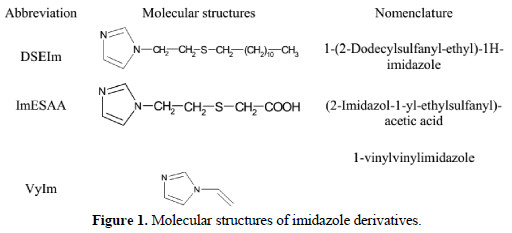
again obtained as a viscous, orange liquid (yield 91%). Molecular structures of 
DSEIm and ImESAA were presented in <a href="#f1">Fig. 1</a>.</p>


    <p>&nbsp;</p>
<a name="f1">
<img src="/img/revistas/pea/v34n3/34n3a05f1.jpg">
    
<p>&nbsp;</p>


    <p>The characterization of DSEIm and ImESAA was performed using 1H NMR and 
13C NMR recorded for CDCl3 solutions with tetramethylsilane (TMS) as 
reference. The letters s, d, t, q, and m denote respectively singlet, doublet, triplet, 
quadruplet, and multiplet.</p>


    <p><i><b>Measurements</b></i></p>

    <p><i>Weight loss technique</i></p>

    <p>Gravimetric experiments were carried out in a double-walled glass cell. The test 
pieces were cut nearly (1.5 cm &times; 1.5 cm &times; 0.04 cm), weighed and suspended in 
the test solution (1.0 M HCl) with and without the addition of inhibitors at a 
temperature of 308K in air atmosphere without bubbling.</p>

    <p>After specified periods of time (6 h), the test pieces were taken out of the test 
solution, rinsed in doubly distilled water, dried as before and weighed again.</p>


    <p><i>Polarization measurements</i></p>

    ]]></body>
<body><![CDATA[<p>Stainless steel strips with an exposed area of 1 cm2 were used. Measurements 
were carried out in a standard glass three-electrode electrolysis cylindrical Pyrex 
glass cell. The auxiliary and the reference electrodes are platinum and saturated 
calomel (SCE), respectively. 352 Soft CorrTM III software was used to control 
an EG&amp;G Instruments potentiostat-galvanostat model 263A at a scan rate of 20 
mV/min. The working electrode was initially kept at the corrosion potential for 
30 min before recording the cathodic curves up to the -800 mV. The test 
solutions were de-aerated with pure nitrogen and the flow was maintained 
throughout the experiments. The inhibition efficiency E% was calculated using 
the following equation:</p>


    <p>&nbsp;</p>
<a name="e1">
<img src="/img/revistas/pea/v34n3/34n3a05e1.jpg">
    
<p>&nbsp;</p>


    <p>where Icorr and I0corr are the corrosion current densities of mild steel in the 
presence and absence of inhibitor, respectively.</p>


    <p><i>Electrochemical impedance spectroscopy (EIS)</i></p>

    <p>EIS experiments were conducted using computer controlled simulations with a 
Tacussel electrochemical system for calculation of polarization resistance (Rp) 
and double layer capacitance (Cdl) values. All experiments were performed with 
a frequency ranging from 100 mHz to 10 kHz (10 mV peak-to-peak). The 
impedance diagrams were plotted in the Nyquist representation. The inhibition 
efficiency Ew was calculated using the following equation:</p>


    <p>&nbsp;</p>
<a name="e2">
<img src="/img/revistas/pea/v34n3/34n3a05e2.jpg">
    
<p>&nbsp;</p>


    <p>where Wcorr and W0corr are the corrosion rates of mild steel in the absence and 
presence of the inhibitor, respectively.</p>


    <p>&nbsp;</p>
    ]]></body>
<body><![CDATA[<p><b>Results and Discussion</b></p>

    <p><i><b>Characterization</b></i></p>

    <p><i>Characterization of DSEIm</i></p>

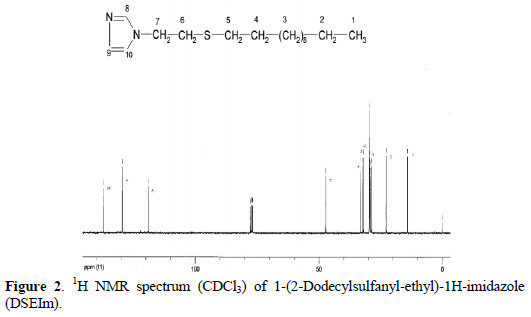
    <p>1H NMR spectrum of DSEIm, <a href="#f2">Fig. 2</a>, shows two new triplets at (&delta; 2.38, 2.82) 
assigned to the methylene groups adjacent to sulfur, and the absence of three 
signals at 4.7, 5.1 and 6.8 confirms the loss of the vinyl unit.</p>


    <p>&nbsp;</p>
<a name="f2">
<img src="/img/revistas/pea/v34n3/34n3a05f2.jpg">
    
<p>&nbsp;</p>


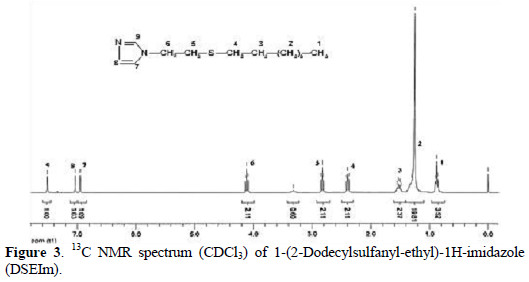
    <p>The proton decoupled 13C NMR spectrum of DSEIm was also used to examine 
the chemical structure of the monoadduct and it is shown in <a href="#f3">Fig. 3</a>.</p>


    <p>&nbsp;</p>
<a name="f3">
<img src="/img/revistas/pea/v34n3/34n3a05f3.jpg">
    
<p>&nbsp;</p>


    <p>The signals at 177.05 and 175.34 ppm were due to the adjacent carbons to sulfur atom of the 
monomer.</p>


    ]]></body>
<body><![CDATA[<p><i>Characterization of ImESAA</i></p>

    <p>1HNMR (CDCl3/TMS): 2,92 (t, 2H); 3,38(s, 2H); 4,10 (t, 2H); 6,97(d, 1H); 
7,01(d,1H); 7,54 (s,1H)
13CNMR (CDCl3): 32, 3; 38; 49, 4; 122,6; 125,5; 138,6; 177.</p>


    <p><i><b>Inhibitive effect of imidazole derivatives</b></i></p>

    <p><i>Gravimetric measurements</i></p>

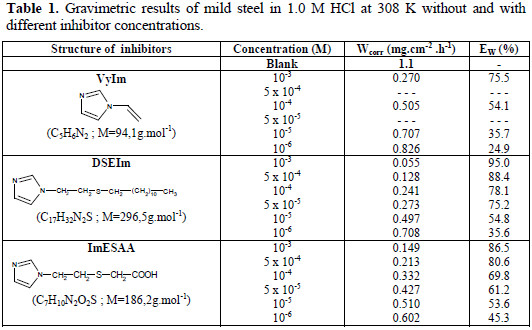
    <p>The effect of the addition of VyIm, DSEIm and ImESAA at different 
concentrations on the corrosion of mild steel in 1.0 M HCl solution was studied 
by measuring the weight loss after 6 h of immersion. <a href="#t1">Table 1</a> gathers the values 
deduced for Wcorr and E%.</p>


    <p>&nbsp;</p>
<a name="t1">
<img src="/img/revistas/pea/v34n3/34n3a05t1.jpg">
    
<p>&nbsp;</p>


    <p>Gravimetric measurements showed that the corrosion decreased in the presence 
of VyIm, ImESAA and DSEIm. The inhibition efficiency increased with the 
inhibitor's concentration to reach 95% for DSEIm, 86.5% for ImESAA and 
75.5% for VyIm at 10<sup>-3</sup>M (<a href="#t1">Table 1</a>).</p>

    <p>Thus, all derivatives studied inhibited the 
corrosion, but DSEIm was the most effective.</p>


    <p><i>Polarization curves</i></p>

    ]]></body>
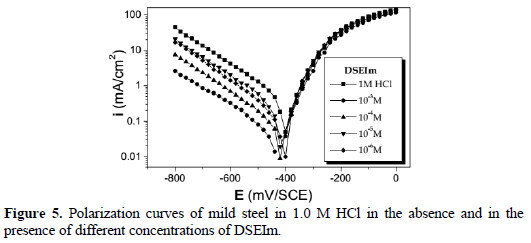
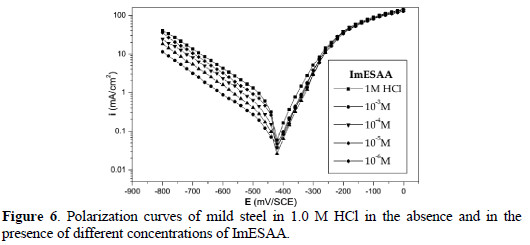
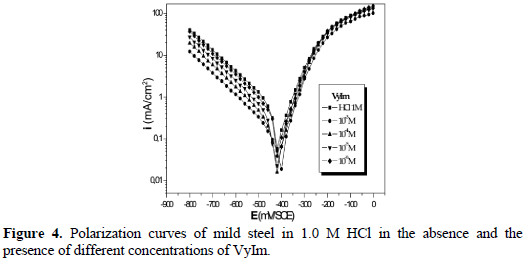
<body><![CDATA[<p>Anodic and cathodic polarization curves for mild steel in 1.0 M HCl with and 
without various concentrations of the inhibitors are shown in <a href="#f4">Fig. 4</a>, 
<a href="#f5">5</a> and <a href="#f6">6</a>.</p>


    <p>&nbsp;</p>
<a name="f4">
<img src="/img/revistas/pea/v34n3/34n3a05f4.jpg">
    
<p>&nbsp;</p>
<a name="f5">
<img src="/img/revistas/pea/v34n3/34n3a05f5.jpg">
    
<p>&nbsp;</p>
<a name="f6">
<img src="/img/revistas/pea/v34n3/34n3a05f6.jpg">
    
<p>&nbsp;</p>


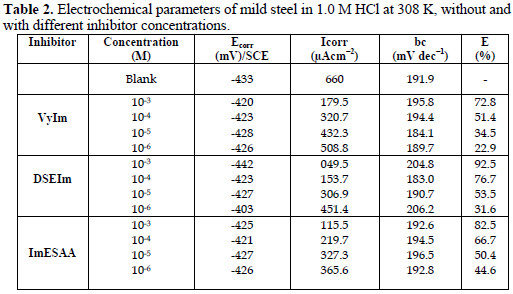
    <p>Values of the corrosion potential (Ecorr), corrosion current density (Icorr), and the 
inhibition efficiency (E%) were determined by the Tafel extrapolation method, 
and are given in <a href="#t2">Table 2</a>.</p>


    <p>&nbsp;</p>
<a name="t2">
<img src="/img/revistas/pea/v34n3/34n3a05t2.jpg">
    
<p>&nbsp;</p>


    <p>Addition of the various inhibitors decreased Icorr significantly for all the studied 
concentrations, due to the increase in the fraction of the electrode surface blocked 
by adsorption. The cathodic current versus potential curves gave rise to Tafel 
lines indicating that the hydrogen evolution reaction was activation controlled, bc 
values being slightly modified, and due to modification of the mechanism of the 
proton discharge reaction.</p>

    <p>The anodic branches were only slightly affected in the presence of these 
inhibitors, the highest effect being observed with DSEIm. The inhibitors thus act 
as mixed inhibitors, but predominantly in the cathodic domain. The long side 
chain of DSEIm slightly, -S-(CH2)11-CH3, presumably plays a major role in the 
adsorption, and the presence of the acid function -S-CH2COOH in ImESAA 
must diminish the inhibition protection [42].</p>


    ]]></body>
<body><![CDATA[<p><i>Electrochemical impedance spectroscopic studies</i></p>

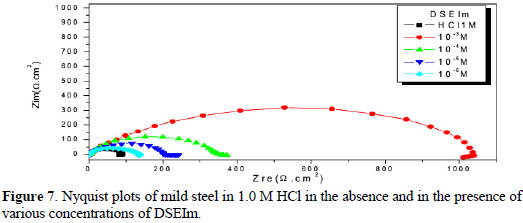
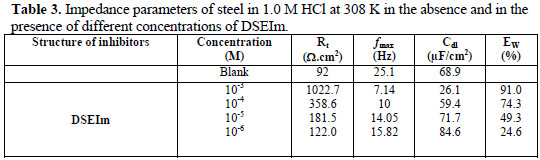
    <p><a href="#f7">Fig. 7</a> presents the Nyquist diagrams obtained in the absence and the presence of 
DSEIm at different concentrations.</p>


    <p>&nbsp;</p>
<a name="f7">
<img src="/img/revistas/pea/v34n3/34n3a05f7.jpg">
    
<p>&nbsp;</p>


    <p>The impedance parameters calculated are 
given in <a href="#t3">Table 3</a>.</p>


    <p>&nbsp;</p>
<a name="t3">
<img src="/img/revistas/pea/v34n3/34n3a05t3.jpg">
    
<p>&nbsp;</p>


    <p>The charge-transfer resistance values (Rct) were calculated from 
the difference in impedance at lower and higher frequencies [42] .To obtain the 
double-layer capacitance (Cdl), the frequency fmax at which the imaginary 
component of the impedance is maximum (-Zimax) was found, and Cdl values 
were obtained from the following equation:</p>


    <p>&nbsp;</p>
<a name="e3">
<img src="/img/revistas/pea/v34n3/34n3a05e3.jpg">
    
<p>&nbsp;</p>


    ]]></body>
<body><![CDATA[<p>In this case, the inhibition efficiency was calculated using the charge transfer 
resistance from:</p>


    <p>&nbsp;</p>
<a name="e4">
<img src="/img/revistas/pea/v34n3/34n3a05e4.jpg">
    
<p>&nbsp;</p>


    <p>where Rt(inh) and Rt are the charge transfer resistance in the presence and 
absence of DSEIm, respectively.</p>

    <p>The results show that Rt increased, and Cdl tended to decrease when the 
concentration of the inhibitor increased. A decrease in the Cdl values, which can 
result from a decrease in the local dielectric constant and/or an increase in the 
thickness of the electrical double layer, suggests that DSEIm functions by 
adsorption at the metal solution/interface [43].</p>

    <p>The high values of inhibition efficiency observed in the case of DSEIm and 
ImESAA molecules are due to the presence of the sulfur atom and its highest 
molecular size.</p>

    <p>The nitrogen and sulfur atoms are the major adsorption center for their 
interaction with the metal surface. The extent of inhibition is found to be more 
for DSEIm than for ImESAA, and efficiency reaches 95% and 86.5%, 
respectively at 10<sup>-3</sup>M (<a href="#t1">Table 1</a>). This difference in the inhibition efficiency is 
attributed to the presence of an electron donor group of DSEIm (C12H25); this last 
group increases and enriches the electron density on the sulfur atom and, 
consequently, increases the density of the molecule (DSEIm) and provides an 
active adsorption center. On the other hand, the presence of an electron attractor 
group (-COOH) in the molecule ImESAA decreases its inhibition efficiency.</p>


    <p><i>Effect of temperature</i></p>

    <p>In acidic media, the corrosion of metal is generally accompanied with the 
evolution of H2 gas. This is usually followed by an increase in temperature and 
acceleration of the corrosion reaction which results in higher dissolution rate of 
the metal [22].</p>

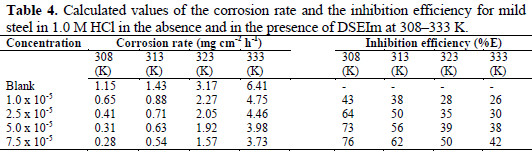
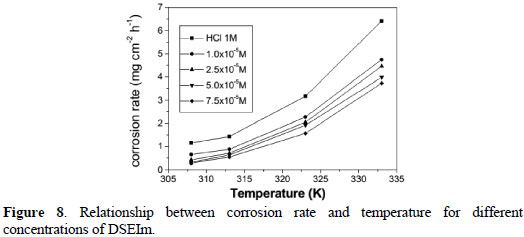
    <p>The results retired from <a href="#t4">Table 4</a> and <a href="#f8">Fig. 8</a> show that DSEIm inhibits the 
corrosion of steel in 1 M HCl solution.</p>


    ]]></body>
<body><![CDATA[<p>&nbsp;</p>
<a name="t4">
<img src="/img/revistas/pea/v34n3/34n3a05t4.jpg">
    
<p>&nbsp;</p>
<a name="f8">
<img src="/img/revistas/pea/v34n3/34n3a05f8.jpg">
    
<p>&nbsp;</p>


    <p>The corrosion rate was found to depend 
on the concentration of DSEIm and experimental temperature. It is evident from 
<a href="#t4">Table 4</a> and <a href="#f8">Fig. 8</a> that the corrosion rate decreased with increasing inhibitor 
concentration, but increased with a rise in temperature.</p>

    <p><a href="#t4">Table 4</a> also shows that inhibition efficiency (%E) decreased with rise in 
temperature, and reached its maximum value of 76% at a concentration of 
7.5&times;10<sup>-5</sup> M. A decrease in inhibition efficiency with an increase in temperature 
may be due to the desorption of inhibitor molecules at higher temperatures. This 
has been attributed to physical adsorption of the inhibitor molecule on the mild 
steel surface [44].</p>

    <p>The apparent activation energy, Ea, for the corrosion reaction of mild steel in 1.0 
M HCl in the presence and the absence of DSEIm was calculated from the Arrheniustype 
equation:</p>


    <p>&nbsp;</p>
<a name="e5">
<img src="/img/revistas/pea/v34n3/34n3a05e5.jpg">
    
<p>&nbsp;</p>


    <p>where Wcorr is the corrosion rate, Ea is the apparent activation energy, R is the 
molar gas constant (8.314 J K<sup>-1</sup> mol<sup>-1</sup>), T is the absolute temperature, and A is 
the frequency factor.</p>

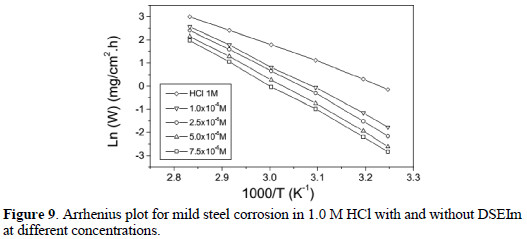
    <p>For the corrosion of steel in acid medium, the natural logarithm of the corrosion 
rate (Wcorr) is a linear function with 1/T [45]. The plot of log Wcorr against 1/T for 
mild steel corrosion in 1.0 M HCl in the absence and presence of different 
concentrations of DSEIm is presented in <a href="#f9">Fig. 9</a>.</p>


    ]]></body>
<body><![CDATA[<p>&nbsp;</p>
<a name="f9">
<img src="/img/revistas/pea/v34n3/34n3a05f9.jpg">
    
<p>&nbsp;</p>


    <p>The activation energies calculated for HCl only and in the presence of 1&times;10<sup>-5</sup> M, 
2.5&times;10<sup>-5</sup> M, 5&times;10<sup>-5</sup> and 7.5&times;10<sup>-5</sup>M DSEIm 
were 53.43 kJ mol<sup>-1</sup>, 67.35 kJ mol<sup>-1</sup>, 
71.21 kJ mol<sup>-1</sup> and 84.51 kJ mol<sup>-1</sup>, respectively. 
It is observed that the apparent activation energy is higher in the presence of the 
inhibitor than in its absence.</p>

    <p>The higher values of Ea in the inhibited solution can be correlated with the 
increased thickness of the double layer, which enhances the activation energy of 
the corrosion process [46]. This is interpreted with physical adsorption of the 
inhibitor onto the metal surface, resulting in the formation of a surface film. This 
type of inhibitor retards the corrosion at ordinary temperatures, but the inhibition 
is diminished especially at temperatures higher than 313K [23].</p>

    <p>However, the adsorption phenomenon of an organic molecule is not considered 
only as a physical or as a chemical adsorption phenomenon, because a wide 
spectrum of conditions, ranging from the dominance of chemisorption or 
electrostatic effects may arise due to the complex nature of the corrosion 
inhibiting process [48].</p>


    <p><i>Monte Carlo simulation adsorption studies</i></p>

    <p>In the current study, selected imidazole derivatives have been simulated as 
adsorbates on an iron (Fe) (111) surface substrate to find the low energy 
adsorption sites and to investigate the preferential adsorption of the studied 
imidazole derivatives. To calculate the adsorption density as well as the binding 
energy of the studied inhibitors, the Monte Carlo method has been used. In this 
computational work, possible adsorption configurations have been identified by 
carrying out Monte Carlo searches of the configurational space of the 
iron/imidazole derivatives system as the temperature was gradually decreased. 
Imidazole derivatives were constructed and their energy was optimized using 
Forcite classical simulation engine [48-49]. The geometry optimization process is 
carried out using an iterative process, in which the atomic coordinates are 
adjusted until the total energy of a structure is minimized, i.e., it corresponds to a 
local minimum in the potential energy surface. Geometry optimization is based 
on reducing the magnitude of the calculated forces until they become smaller 
than defined convergence tolerances [50]. The forces on the atoms in the studied 
inhibitors are calculated from the potential energy expression and will, therefore, 
depend on the force field that is selected [5].</p>

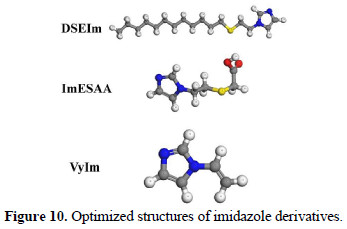
    <p>It was shown from chemical and electrochemical studies that the substitution of 
the hydrogen atom of amino group (-NH-) of imidazole by different substituents 
- dodecyl(ethyl)sulfane (DSEIm), ethylsulfanyl acetic acid (ImESAA) and vinyl 
(vyIm) - leads to an increase of the inhibition efficiency as given in <a href="#f5">Figures 5</a>-<a href="#f7">7</a> 
and <a href="#t1">Tables 1</a>-<a href="#t3">3</a>. Each imidazole derivative contains imidazole ring, and the rest 
of the molecule can affect adsorption by its influence on the electron density of 
the side chains. Geometric and electronic structures of the imidazoles were 
calculated by optimization of their bond lengths and bond angles. The optimized 
structures are given in <a href="#f10">Fig. 10</a>.</p>


    <p>&nbsp;</p>
<a name="f10">
<img src="/img/revistas/pea/v34n3/34n3a05f10.jpg">
    
<p>&nbsp;</p>


    ]]></body>
<body><![CDATA[<p>The molecular dynamic (MD) simulations were performed using the software, 
Materials Studio [50]. The MD simulation of the interaction between the 
imidazole derivatives molecules and Fe (111) surface was carried out in a 
simulation box (17.38 &Aring; &times; 17.38 &Aring; &times; 44.57 &Aring;) with periodic boundary conditions 
to model a representative part of the interface devoid of any arbitrary boundary 
effects [50]. The Fe (111) was first built and relaxed by minimizing its energy 
using molecular mechanics, then the surface area of Fe (111) was increased and 
its periodicity is changed by constructing a super cell, and then a vacuum slabwith 
15 &Aring; thicknesses was built on the Fe (111) surface [50]. The number of 
layers in the structure was chosen so that the depth of the surface is greater than 
the non-bond cutoff used in calculation. Using six layers of iron atoms gives a 
sufficient depth, so that the inhibitor molecules will only be involved in non-
bond interactions with iron atoms in the layers of the surface, without increasing 
the calculation time unreasonably.</p>

    <p>This structure is then converted to exhibit 3D periodicity. As 3D periodic 
boundary conditions are used, it is important that the size of the vacuum slab is 
enough (15 &Aring;), and that the non-bond calculation for the adsorbate does not 
interact with the periodic image of the bottom layer of atoms in the surface. After 
minimizing the Fe (111) surface and the imidazole derivatives molecules, the 
corrosion system will be built by a layer builder to place the inhibitor molecules 
on the Fe (111) surface, and the behaviors of these molecules on the Fe (111) 
surface are simulated using the COMPASS (condensed phase optimized 
molecular potentials for atomistic simulation studies) force field. The adsorption 
locator module in Materials Studio 6.0 [50, 51] has been used to model the 
adsorption of the inhibitor molecules onto the Fe (111) surface, and therefore 
provides access to the energy of the adsorption and its effects on the inhibition 
efficiencies of the studied imidazole derivatives [52-57]. The binding energy 
between the imidazole derivatives and the Fe (111) surface was calculated using 
the following equation [58, 59]:</p>


    <p>&nbsp;</p>
<a name="e6">
<img src="/img/revistas/pea/v34n3/34n3a05e6.jpg">
    
<p>&nbsp;</p>


    <p>where E is the total energy of the surface and imidazole derivative, E is
total surface the energy of the surface without the imidazole derivative, 
and E is the inhibitor 
energy of the imidazole derivative without the steel surface. 
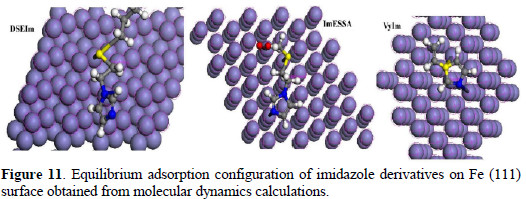
The Metropolis Monte Carlo method in Adsorption Locator provides four step 
types for a canonical ensemble: conformer, rotation, translation and re-growth 
[60]. <a href="#f11">Fig. 11</a> shows the most suitable imidazole derivatives conformation 
adsorbed on Fe (111) substrate obtained by adsorption locator module.</p>


    <p>&nbsp;</p>
<a name="f11">
<img src="/img/revistas/pea/v34n3/34n3a05f11.jpg">
    
<p>&nbsp;</p>


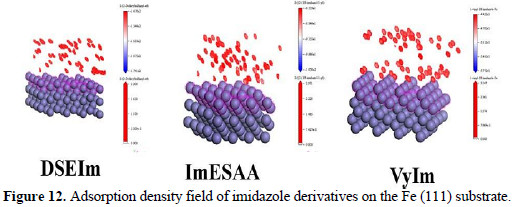
    <p>The adsorption density of imidazole derivatives on the Fe (111) substrate is 
presented in <a href="#f12">Fig. 12</a> using Materials studio software.</p>


    <p>&nbsp;</p>
<a name="f12">
<img src="/img/revistas/pea/v34n3/34n3a05f12.jpg">
    
<p>&nbsp;</p>


    ]]></body>
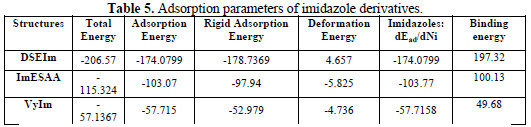
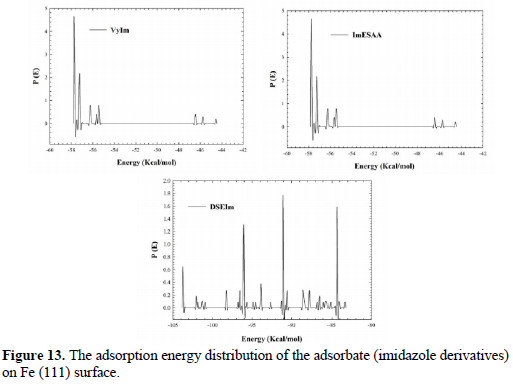
<body><![CDATA[<p>As can be seen from <a href="#f11">Fig. 11</a> and <a href="#f12">12</a> the imidazole derivatives molecules 
showthe ability to adsorb on a Fe (111) surface. Also, it has high binding energy 
to the Fe surface as seen in <a href="#t5">Table 5</a>.</p>


    <p>&nbsp;</p>
<a name="t5">
<img src="/img/revistas/pea/v34n3/34n3a05t5.jpg">
    
<p>&nbsp;</p>


    <p>The outputs and descriptors calculated by the Monte Carlo simulation are 
presented in <a href="#t5">Table 5</a>.</p>

    <p>The parameters presented in <a href="#t5">Table 5</a> include total energy, in kcal mol<sup>-1</sup>, of the 
substrate-adsorbate configuration. The total energy is defined as the sum of the 
energies of the adsorbate components, the rigid adsorption energy and the 
deformation energy. In this study, the substrate energy (iron surface) is taken as 
zero. In addition, adsorption energy in kcal mol<sup>-1</sup>, reports energy released (or 
required) when the relaxed adsorbate components (imidazole derivatives in HCl) 
are adsorbed on the substrate. The adsorption energy is defined as the sum of the 
rigid adsorption energy and the deformation energy for the adsorbate 
components. The rigid adsorption energy reports the energy, in kcal mol<sup>-1</sup> , 
released (or required) when the unrelaxed adsorbate components (i.e., before the 
geometry optimization step) are adsorbed on the substrate. The deformation 
energy reports the energy, in kcal mol<sup>-1</sup>, released when the adsorbed adsorbate 
components are relaxed on the substrate surface. <a href="#t5">Table 5</a> also shows that 
(dEads/dNi), which reports the energy, in kcal mol<sup>-1</sup>, of substrate-adsorbate 
configurations where one of the adsorbate components has been removed.</p>

    <p><a href="#f13">Fig. 13</a> shows the adsorption energy distribution of the imidazole derivatives on 
Fe (111).</p>


    <p>&nbsp;</p>
<a name="f13">
<img src="/img/revistas/pea/v34n3/34n3a05f13.jpg">
    
<p>&nbsp;</p>


    <p>As can be seen in <a href="#f13">13</a>, the adsorption energy of DSEIm reaches (174 
Kcal mole<sup>-1</sup>), ImESAA reaches (-103.7 Kcal mole<sup>-1</sup>) and VyIm reaches (-57.7 
Kcal mole<sup>-1</sup>) which shows the adsorption power for DSEIm molecules on Fe (111) surface.</p> 


    <p>&nbsp;</p>
    ]]></body>
<body><![CDATA[<p><b>Conclusions</b></p>

    <p>In this research, we have prepared various monoadducts with Telomerisation 
method based on 1-vinylimidazol, and have studied their corrosion inhibition 
properties as a function of concentration and temperature. The results can be 
summarized as follows.</p>

    <p>1) DSEIm and ImESAA were synthesized by Telomerisation method, purified 
and characterized by 1HNMR and 13CNMR spectroscopy.</p>

    <p>2) The monoadducts were evaluated for its inhibitive characteristics for mild 
steel in 1.0 M HCl by gravimetric and electrochemical methods, and it was found 
that all inhibitors could be used to protect the mild steel in 1.0 M HCl. However, 
DSEIm is most suited to protect mild steel in acidic chloride environment.</p>

    <p>3) Different results show that inhibition efficiency (%E) increased with 
increasing inhibitor concentration, but decreased with temperature.</p>

    <p>4) The increase of the alkyl chain length attached to the inhibitor molecule 
(DSEIm) increases its inhibition efficiency compared to at the presence of a 
functional group (ImESAA).</p>

    <p>5) The trend of a greater inhibition efficiency with a higher temperature, and the 
increase in the activation energy in the presence of DSEIm, suggest a physical 
adsorption mechanism, although chemisorption may also play a part in the 
inhibiting process.</p>

    <p>6) Monte Carlo simulation studies help to find the most stable imidazole 
derivative conformation and adsorption sites. This information can help to gain 
further insight into the corrosion system, such as the most likely point of attack 
for corrosion on a surface, the most stable site for inhibitor adsorption, 
adsorption density of the inhibitor and the binding energy of the adsorbed layer.</p>


    <p>&nbsp;</p>
    <p><b>References</b></p>

    ]]></body>
<body><![CDATA[<!-- ref --><p>1. Solmaz R. Corros Sci. 2010;52:3321.    &nbsp;&nbsp;&nbsp;&nbsp;&nbsp;&nbsp;&nbsp;&nbsp;[&#160;<a href="javascript:void(0);" onclick="javascript: window.open('/scielo.php?script=sci_nlinks&ref=421299&pid=S0872-1904201600030000500001&lng=','','width=640,height=500,resizable=yes,scrollbars=1,menubar=yes,');">Links</a>&#160;]<!-- end-ref --></p>

    <!-- ref --><p>2. Srikanth A P, Lavanya A, Nanjundan S, et al. Appl Surf Sci. 2006;253:1810.    &nbsp;&nbsp;&nbsp;&nbsp;&nbsp;&nbsp;&nbsp;&nbsp;[&#160;<a href="javascript:void(0);" onclick="javascript: window.open('/scielo.php?script=sci_nlinks&ref=421301&pid=S0872-1904201600030000500002&lng=','','width=640,height=500,resizable=yes,scrollbars=1,menubar=yes,');">Links</a>&#160;]<!-- end-ref --></p>

    <!-- ref --><p>3. Cizek A. Mater Perform. 1994;33:56.    &nbsp;&nbsp;&nbsp;&nbsp;&nbsp;&nbsp;&nbsp;&nbsp;[&#160;<a href="javascript:void(0);" onclick="javascript: window.open('/scielo.php?script=sci_nlinks&ref=421303&pid=S0872-1904201600030000500003&lng=','','width=640,height=500,resizable=yes,scrollbars=1,menubar=yes,');">Links</a>&#160;]<!-- end-ref --></p>

    <!-- ref --><p>4. Batros M, Hakerman N. J Electrochem Soc. 1992;139:3429.    &nbsp;&nbsp;&nbsp;&nbsp;&nbsp;&nbsp;&nbsp;&nbsp;[&#160;<a href="javascript:void(0);" onclick="javascript: window.open('/scielo.php?script=sci_nlinks&ref=421305&pid=S0872-1904201600030000500004&lng=','','width=640,height=500,resizable=yes,scrollbars=1,menubar=yes,');">Links</a>&#160;]<!-- end-ref --></p>

    <!-- ref --><p>5. Kertit S, Hammouti B. Appl Surf Sci. 1996;93:59.    &nbsp;&nbsp;&nbsp;&nbsp;&nbsp;&nbsp;&nbsp;&nbsp;[&#160;<a href="javascript:void(0);" onclick="javascript: window.open('/scielo.php?script=sci_nlinks&ref=421307&pid=S0872-1904201600030000500005&lng=','','width=640,height=500,resizable=yes,scrollbars=1,menubar=yes,');">Links</a>&#160;]<!-- end-ref --></p>

    ]]></body>
<body><![CDATA[<!-- ref --><p>6. Zucchi F, Trabnelli G, Brunoro G. Corros Sci. 1992;33:1135.    &nbsp;&nbsp;&nbsp;&nbsp;&nbsp;&nbsp;&nbsp;&nbsp;[&#160;<a href="javascript:void(0);" onclick="javascript: window.open('/scielo.php?script=sci_nlinks&ref=421309&pid=S0872-1904201600030000500006&lng=','','width=640,height=500,resizable=yes,scrollbars=1,menubar=yes,');">Links</a>&#160;]<!-- end-ref --></p>

    <!-- ref --><p>7. Quraishi M A, Jamal D. Mater Chem Phys. 2001;71:202.    &nbsp;&nbsp;&nbsp;&nbsp;&nbsp;&nbsp;&nbsp;&nbsp;[&#160;<a href="javascript:void(0);" onclick="javascript: window.open('/scielo.php?script=sci_nlinks&ref=421311&pid=S0872-1904201600030000500007&lng=','','width=640,height=500,resizable=yes,scrollbars=1,menubar=yes,');">Links</a>&#160;]<!-- end-ref --></p>

    <!-- ref --><p>8. Quraishi M A, Ansari F A. J Appl Electrochem. 2006;36:309.    &nbsp;&nbsp;&nbsp;&nbsp;&nbsp;&nbsp;&nbsp;&nbsp;[&#160;<a href="javascript:void(0);" onclick="javascript: window.open('/scielo.php?script=sci_nlinks&ref=421313&pid=S0872-1904201600030000500008&lng=','','width=640,height=500,resizable=yes,scrollbars=1,menubar=yes,');">Links</a>&#160;]<!-- end-ref --></p>

    <!-- ref --><p>9. Rafiquee M Z A, Kahn S, Saxena N, et al. Port Electrochim Acta. 2007;25:419.    &nbsp;&nbsp;&nbsp;&nbsp;&nbsp;&nbsp;&nbsp;&nbsp;[&#160;<a href="javascript:void(0);" onclick="javascript: window.open('/scielo.php?script=sci_nlinks&ref=421315&pid=S0872-1904201600030000500009&lng=','','width=640,height=500,resizable=yes,scrollbars=1,menubar=yes,');">Links</a>&#160;]<!-- end-ref --></p>

    <!-- ref --><p>10. Bentiss F, Traisnel M, Chaibi N, et al. Corros Sci. 2002;44:2271.    &nbsp;&nbsp;&nbsp;&nbsp;&nbsp;&nbsp;&nbsp;&nbsp;[&#160;<a href="javascript:void(0);" onclick="javascript: window.open('/scielo.php?script=sci_nlinks&ref=421317&pid=S0872-1904201600030000500010&lng=','','width=640,height=500,resizable=yes,scrollbars=1,menubar=yes,');">Links</a>&#160;]<!-- end-ref --></p>

    ]]></body>
<body><![CDATA[<!-- ref --><p>11. Lebrini M, Lagrenee M, Venzin H, et al. Corros Sci. 2005;47:485.    &nbsp;&nbsp;&nbsp;&nbsp;&nbsp;&nbsp;&nbsp;&nbsp;[&#160;<a href="javascript:void(0);" onclick="javascript: window.open('/scielo.php?script=sci_nlinks&ref=421319&pid=S0872-1904201600030000500011&lng=','','width=640,height=500,resizable=yes,scrollbars=1,menubar=yes,');">Links</a>&#160;]<!-- end-ref --></p>

    <!-- ref --><p>12. Emregul K C, Hayvali M. Mater Chem Phys. 2004;83:209.    &nbsp;&nbsp;&nbsp;&nbsp;&nbsp;&nbsp;&nbsp;&nbsp;[&#160;<a href="javascript:void(0);" onclick="javascript: window.open('/scielo.php?script=sci_nlinks&ref=421321&pid=S0872-1904201600030000500012&lng=','','width=640,height=500,resizable=yes,scrollbars=1,menubar=yes,');">Links</a>&#160;]<!-- end-ref --></p>

    <!-- ref --><p>13. Machnikova E, Whitmire K H, Hackerman N. Electrochim Acta. 2008;53:6024.    &nbsp;&nbsp;&nbsp;&nbsp;&nbsp;&nbsp;&nbsp;&nbsp;[&#160;<a href="javascript:void(0);" onclick="javascript: window.open('/scielo.php?script=sci_nlinks&ref=421323&pid=S0872-1904201600030000500013&lng=','','width=640,height=500,resizable=yes,scrollbars=1,menubar=yes,');">Links</a>&#160;]<!-- end-ref --></p>

    <!-- ref --><p>14. Ali S A, Al-Muallem H A, Saeed M T, et al. Corros Sci. 2008;50:664.    &nbsp;&nbsp;&nbsp;&nbsp;&nbsp;&nbsp;&nbsp;&nbsp;[&#160;<a href="javascript:void(0);" onclick="javascript: window.open('/scielo.php?script=sci_nlinks&ref=421325&pid=S0872-1904201600030000500014&lng=','','width=640,height=500,resizable=yes,scrollbars=1,menubar=yes,');">Links</a>&#160;]<!-- end-ref --></p>

    <!-- ref --><p>15. Ali S A, Saeed M T, Rahman S U. Corros Sci. 2003;45:253.    &nbsp;&nbsp;&nbsp;&nbsp;&nbsp;&nbsp;&nbsp;&nbsp;[&#160;<a href="javascript:void(0);" onclick="javascript: window.open('/scielo.php?script=sci_nlinks&ref=421327&pid=S0872-1904201600030000500015&lng=','','width=640,height=500,resizable=yes,scrollbars=1,menubar=yes,');">Links</a>&#160;]<!-- end-ref --></p>

    ]]></body>
<body><![CDATA[<!-- ref --><p>16. Yildirim A, Cetin M. Corros Sci. 2008;50:155.    &nbsp;&nbsp;&nbsp;&nbsp;&nbsp;&nbsp;&nbsp;&nbsp;[&#160;<a href="javascript:void(0);" onclick="javascript: window.open('/scielo.php?script=sci_nlinks&ref=421329&pid=S0872-1904201600030000500016&lng=','','width=640,height=500,resizable=yes,scrollbars=1,menubar=yes,');">Links</a>&#160;]<!-- end-ref --></p>

    <!-- ref --><p>17. Hassan H H, Abdelgahani E, Amin M A. Electrochim Acta. 2007;52:6359.    &nbsp;&nbsp;&nbsp;&nbsp;&nbsp;&nbsp;&nbsp;&nbsp;[&#160;<a href="javascript:void(0);" onclick="javascript: window.open('/scielo.php?script=sci_nlinks&ref=421331&pid=S0872-1904201600030000500017&lng=','','width=640,height=500,resizable=yes,scrollbars=1,menubar=yes,');">Links</a>&#160;]<!-- end-ref --></p>

    <!-- ref --><p>18. Khaled K F. Electrochim Acta. 2008;53:3484.    &nbsp;&nbsp;&nbsp;&nbsp;&nbsp;&nbsp;&nbsp;&nbsp;[&#160;<a href="javascript:void(0);" onclick="javascript: window.open('/scielo.php?script=sci_nlinks&ref=421333&pid=S0872-1904201600030000500018&lng=','','width=640,height=500,resizable=yes,scrollbars=1,menubar=yes,');">Links</a>&#160;]<!-- end-ref --></p>

    <!-- ref --><p>19. Lebrini M, Traisnel M, Lagrenee M, et al. Corros Sci. 2008;50:473.    &nbsp;&nbsp;&nbsp;&nbsp;&nbsp;&nbsp;&nbsp;&nbsp;[&#160;<a href="javascript:void(0);" onclick="javascript: window.open('/scielo.php?script=sci_nlinks&ref=421335&pid=S0872-1904201600030000500019&lng=','','width=640,height=500,resizable=yes,scrollbars=1,menubar=yes,');">Links</a>&#160;]<!-- end-ref --></p>

    <!-- ref --><p>20. Rammelt U. Koehler S. Reinhard G. Corros Sci. 2008;50:1659.    &nbsp;&nbsp;&nbsp;&nbsp;&nbsp;&nbsp;&nbsp;&nbsp;[&#160;<a href="javascript:void(0);" onclick="javascript: window.open('/scielo.php?script=sci_nlinks&ref=421337&pid=S0872-1904201600030000500020&lng=','','width=640,height=500,resizable=yes,scrollbars=1,menubar=yes,');">Links</a>&#160;]<!-- end-ref --></p>

    ]]></body>
<body><![CDATA[<!-- ref --><p>21. Abd El-Maksoud S A, Fonda A S. Mater Chem Phys. 2005;93:84.    &nbsp;&nbsp;&nbsp;&nbsp;&nbsp;&nbsp;&nbsp;&nbsp;[&#160;<a href="javascript:void(0);" onclick="javascript: window.open('/scielo.php?script=sci_nlinks&ref=421339&pid=S0872-1904201600030000500021&lng=','','width=640,height=500,resizable=yes,scrollbars=1,menubar=yes,');">Links</a>&#160;]<!-- end-ref --></p>

    <!-- ref --><p>22. Obi-Egbedi N O, Obot I B, Eseola A O. Arab J Chem. 2014;7:197.    &nbsp;&nbsp;&nbsp;&nbsp;&nbsp;&nbsp;&nbsp;&nbsp;[&#160;<a href="javascript:void(0);" onclick="javascript: window.open('/scielo.php?script=sci_nlinks&ref=421341&pid=S0872-1904201600030000500022&lng=','','width=640,height=500,resizable=yes,scrollbars=1,menubar=yes,');">Links</a>&#160;]<!-- end-ref --></p>

    <!-- ref --><p>23. Ergun U, Yuzer D, Emreguel K C. Mater Chem Phys. 2008;109:492.    &nbsp;&nbsp;&nbsp;&nbsp;&nbsp;&nbsp;&nbsp;&nbsp;[&#160;<a href="javascript:void(0);" onclick="javascript: window.open('/scielo.php?script=sci_nlinks&ref=421343&pid=S0872-1904201600030000500023&lng=','','width=640,height=500,resizable=yes,scrollbars=1,menubar=yes,');">Links</a>&#160;]<!-- end-ref --></p>

    <!-- ref --><p>24. Bentiss F, Lebrini M, Vezin H, et al. Mater Chem Phys. 2004;87:18.    &nbsp;&nbsp;&nbsp;&nbsp;&nbsp;&nbsp;&nbsp;&nbsp;[&#160;<a href="javascript:void(0);" onclick="javascript: window.open('/scielo.php?script=sci_nlinks&ref=421345&pid=S0872-1904201600030000500024&lng=','','width=640,height=500,resizable=yes,scrollbars=1,menubar=yes,');">Links</a>&#160;]<!-- end-ref --></p>

    <!-- ref --><p>25. Lebrini M, Bentiss F, Venzin H, et al. Corros Sci. 2006;48:1279.    &nbsp;&nbsp;&nbsp;&nbsp;&nbsp;&nbsp;&nbsp;&nbsp;[&#160;<a href="javascript:void(0);" onclick="javascript: window.open('/scielo.php?script=sci_nlinks&ref=421347&pid=S0872-1904201600030000500025&lng=','','width=640,height=500,resizable=yes,scrollbars=1,menubar=yes,');">Links</a>&#160;]<!-- end-ref --></p>

    ]]></body>
<body><![CDATA[<!-- ref --><p>26. Bentiss F, Traisnel M, Lagrenee M. Corros Sci. 2000;42:127.    &nbsp;&nbsp;&nbsp;&nbsp;&nbsp;&nbsp;&nbsp;&nbsp;[&#160;<a href="javascript:void(0);" onclick="javascript: window.open('/scielo.php?script=sci_nlinks&ref=421349&pid=S0872-1904201600030000500026&lng=','','width=640,height=500,resizable=yes,scrollbars=1,menubar=yes,');">Links</a>&#160;]<!-- end-ref --></p>

    <!-- ref --><p>27. Ramachandran S, Tsai B-L, Blanco M, et al. Langmuir. 1996;12:6419.    &nbsp;&nbsp;&nbsp;&nbsp;&nbsp;&nbsp;&nbsp;&nbsp;[&#160;<a href="javascript:void(0);" onclick="javascript: window.open('/scielo.php?script=sci_nlinks&ref=421351&pid=S0872-1904201600030000500027&lng=','','width=640,height=500,resizable=yes,scrollbars=1,menubar=yes,');">Links</a>&#160;]<!-- end-ref --></p>

    <!-- ref --><p>28. Villamizar W, Casales M, Martinez L, et al. J Solid State Electrochem. 2008;12:193.    &nbsp;&nbsp;&nbsp;&nbsp;&nbsp;&nbsp;&nbsp;&nbsp;[&#160;<a href="javascript:void(0);" onclick="javascript: window.open('/scielo.php?script=sci_nlinks&ref=421353&pid=S0872-1904201600030000500028&lng=','','width=640,height=500,resizable=yes,scrollbars=1,menubar=yes,');">Links</a>&#160;]<!-- end-ref --></p>

    <!-- ref --><p>29. Yoo SH, Kim YW, Chung K, et al. Corros Sci. 2012;59:42.    &nbsp;&nbsp;&nbsp;&nbsp;&nbsp;&nbsp;&nbsp;&nbsp;[&#160;<a href="javascript:void(0);" onclick="javascript: window.open('/scielo.php?script=sci_nlinks&ref=421355&pid=S0872-1904201600030000500029&lng=','','width=640,height=500,resizable=yes,scrollbars=1,menubar=yes,');">Links</a>&#160;]<!-- end-ref --></p>

    <!-- ref --><p>30. Tuken T, Demir F, Kicir N, et al. Corros Sci. 2012;59:110.    &nbsp;&nbsp;&nbsp;&nbsp;&nbsp;&nbsp;&nbsp;&nbsp;[&#160;<a href="javascript:void(0);" onclick="javascript: window.open('/scielo.php?script=sci_nlinks&ref=421357&pid=S0872-1904201600030000500030&lng=','','width=640,height=500,resizable=yes,scrollbars=1,menubar=yes,');">Links</a>&#160;]<!-- end-ref --></p>

    ]]></body>
<body><![CDATA[<!-- ref --><p>31. Lagrenee M, Mernari B, Bouanis M, et al. Corros Sci. 2002;44:73.    &nbsp;&nbsp;&nbsp;&nbsp;&nbsp;&nbsp;&nbsp;&nbsp;[&#160;<a href="javascript:void(0);" onclick="javascript: window.open('/scielo.php?script=sci_nlinks&ref=421359&pid=S0872-1904201600030000500031&lng=','','width=640,height=500,resizable=yes,scrollbars=1,menubar=yes,');">Links</a>&#160;]<!-- end-ref --></p>

    <!-- ref --><p>32. Bentiss F, Traisnel M, Lagrenee M. Br Corros J. 2000;35:315.    &nbsp;&nbsp;&nbsp;&nbsp;&nbsp;&nbsp;&nbsp;&nbsp;[&#160;<a href="javascript:void(0);" onclick="javascript: window.open('/scielo.php?script=sci_nlinks&ref=421361&pid=S0872-1904201600030000500032&lng=','','width=640,height=500,resizable=yes,scrollbars=1,menubar=yes,');">Links</a>&#160;]<!-- end-ref --></p>

    <!-- ref --><p>33. Wang H L, Liu RB, Xin J. Corros Sci. 2004;46:2455.    &nbsp;&nbsp;&nbsp;&nbsp;&nbsp;&nbsp;&nbsp;&nbsp;[&#160;<a href="javascript:void(0);" onclick="javascript: window.open('/scielo.php?script=sci_nlinks&ref=421363&pid=S0872-1904201600030000500033&lng=','','width=640,height=500,resizable=yes,scrollbars=1,menubar=yes,');">Links</a>&#160;]<!-- end-ref --></p>

    <!-- ref --><p>34. Saliyan V R, Adhikari A V. Corros Sci. 2008;50:55.    &nbsp;&nbsp;&nbsp;&nbsp;&nbsp;&nbsp;&nbsp;&nbsp;[&#160;<a href="javascript:void(0);" onclick="javascript: window.open('/scielo.php?script=sci_nlinks&ref=421365&pid=S0872-1904201600030000500034&lng=','','width=640,height=500,resizable=yes,scrollbars=1,menubar=yes,');">Links</a>&#160;]<!-- end-ref --></p>

    <!-- ref --><p>35. Fouda A S, Ellithy A S. Corros Sci. 2009;51:868.    &nbsp;&nbsp;&nbsp;&nbsp;&nbsp;&nbsp;&nbsp;&nbsp;[&#160;<a href="javascript:void(0);" onclick="javascript: window.open('/scielo.php?script=sci_nlinks&ref=421367&pid=S0872-1904201600030000500035&lng=','','width=640,height=500,resizable=yes,scrollbars=1,menubar=yes,');">Links</a>&#160;]<!-- end-ref --></p>

    ]]></body>
<body><![CDATA[<!-- ref --><p>36. Abed Y, Arrar Z, Aouniti A, et al. J Chem Phys. 1999;95:1347.    &nbsp;&nbsp;&nbsp;&nbsp;&nbsp;&nbsp;&nbsp;&nbsp;[&#160;<a href="javascript:void(0);" onclick="javascript: window.open('/scielo.php?script=sci_nlinks&ref=421369&pid=S0872-1904201600030000500036&lng=','','width=640,height=500,resizable=yes,scrollbars=1,menubar=yes,');">Links</a>&#160;]<!-- end-ref --></p>

    <!-- ref --><p>37. Khaled K F, Sherik AM. Int J Electrochem. 2013;8:10022.    &nbsp;&nbsp;&nbsp;&nbsp;&nbsp;&nbsp;&nbsp;&nbsp;[&#160;<a href="javascript:void(0);" onclick="javascript: window.open('/scielo.php?script=sci_nlinks&ref=421371&pid=S0872-1904201600030000500037&lng=','','width=640,height=500,resizable=yes,scrollbars=1,menubar=yes,');">Links</a>&#160;]<!-- end-ref --></p>

    <!-- ref --><p>38. Khaled K F. J Solid State Electrochem. 2009;13:1743.    &nbsp;&nbsp;&nbsp;&nbsp;&nbsp;&nbsp;&nbsp;&nbsp;[&#160;<a href="javascript:void(0);" onclick="javascript: window.open('/scielo.php?script=sci_nlinks&ref=421373&pid=S0872-1904201600030000500038&lng=','','width=640,height=500,resizable=yes,scrollbars=1,menubar=yes,');">Links</a>&#160;]<!-- end-ref --></p>

    <!-- ref --><p>39. Boyer C, Boutevin G, Robin JJ, et al. Polymer. 2004;45:7863.    &nbsp;&nbsp;&nbsp;&nbsp;&nbsp;&nbsp;&nbsp;&nbsp;[&#160;<a href="javascript:void(0);" onclick="javascript: window.open('/scielo.php?script=sci_nlinks&ref=421375&pid=S0872-1904201600030000500039&lng=','','width=640,height=500,resizable=yes,scrollbars=1,menubar=yes,');">Links</a>&#160;]<!-- end-ref --></p>

    <!-- ref --><p>40. Senhaji O, Robin J, Achchoubi M, et al. Macromol Chem Phys. 2004;205:951.    &nbsp;&nbsp;&nbsp;&nbsp;&nbsp;&nbsp;&nbsp;&nbsp;[&#160;<a href="javascript:void(0);" onclick="javascript: window.open('/scielo.php?script=sci_nlinks&ref=421377&pid=S0872-1904201600030000500040&lng=','','width=640,height=500,resizable=yes,scrollbars=1,menubar=yes,');">Links</a>&#160;]<!-- end-ref --></p>

    ]]></body>
<body><![CDATA[<!-- ref --><p>41. Ameduri B, Boutevin B, Guida-Pietrasanta F, et al. J Fluorine Chem. 2001;107:397.    &nbsp;&nbsp;&nbsp;&nbsp;&nbsp;&nbsp;&nbsp;&nbsp;[&#160;<a href="javascript:void(0);" onclick="javascript: window.open('/scielo.php?script=sci_nlinks&ref=421379&pid=S0872-1904201600030000500041&lng=','','width=640,height=500,resizable=yes,scrollbars=1,menubar=yes,');">Links</a>&#160;]<!-- end-ref --></p>

    <!-- ref --><p>42. Aouniti A, Hammouti B, Kertit S, et al. Bull Electrochem. 1998;14:193.    &nbsp;&nbsp;&nbsp;&nbsp;&nbsp;&nbsp;&nbsp;&nbsp;[&#160;<a href="javascript:void(0);" onclick="javascript: window.open('/scielo.php?script=sci_nlinks&ref=421381&pid=S0872-1904201600030000500042&lng=','','width=640,height=500,resizable=yes,scrollbars=1,menubar=yes,');">Links</a>&#160;]<!-- end-ref --></p>

    <!-- ref --><p>43. Anuradha K, Vimala R, Narayanasamy B, et al. Chem Eng Comm. 2008;195:352.    &nbsp;&nbsp;&nbsp;&nbsp;&nbsp;&nbsp;&nbsp;&nbsp;[&#160;<a href="javascript:void(0);" onclick="javascript: window.open('/scielo.php?script=sci_nlinks&ref=421383&pid=S0872-1904201600030000500043&lng=','','width=640,height=500,resizable=yes,scrollbars=1,menubar=yes,');">Links</a>&#160;]<!-- end-ref --></p>

    <!-- ref --><p>44. Obot LB, Obi-Egbedi NO. Curr Appl Phys. 2011;5:382.    &nbsp;&nbsp;&nbsp;&nbsp;&nbsp;&nbsp;&nbsp;&nbsp;[&#160;<a href="javascript:void(0);" onclick="javascript: window.open('/scielo.php?script=sci_nlinks&ref=421385&pid=S0872-1904201600030000500044&lng=','','width=640,height=500,resizable=yes,scrollbars=1,menubar=yes,');">Links</a>&#160;]<!-- end-ref --></p>

    <!-- ref --><p>45. Soltani N, Behpour M, Ghoreishi SM, et al. Corros Sci. 2010;52:1351.    &nbsp;&nbsp;&nbsp;&nbsp;&nbsp;&nbsp;&nbsp;&nbsp;[&#160;<a href="javascript:void(0);" onclick="javascript: window.open('/scielo.php?script=sci_nlinks&ref=421387&pid=S0872-1904201600030000500045&lng=','','width=640,height=500,resizable=yes,scrollbars=1,menubar=yes,');">Links</a>&#160;]<!-- end-ref --></p>

    ]]></body>
<body><![CDATA[<!-- ref --><p>46. Behpour M, Ghoreishi SM, Gandomi-Niasar A, et al. J Mater Sci. 2009;44:2444.    &nbsp;&nbsp;&nbsp;&nbsp;&nbsp;&nbsp;&nbsp;&nbsp;[&#160;<a href="javascript:void(0);" onclick="javascript: window.open('/scielo.php?script=sci_nlinks&ref=421389&pid=S0872-1904201600030000500046&lng=','','width=640,height=500,resizable=yes,scrollbars=1,menubar=yes,');">Links</a>&#160;]<!-- end-ref --></p>

    <!-- ref --><p>47. Solmaz R, Kardas G, Yazici B, et al. Colloids Surf A: Physicochem Eng Asp. 2008;312:7.    &nbsp;&nbsp;&nbsp;&nbsp;&nbsp;&nbsp;&nbsp;&nbsp;[&#160;<a href="javascript:void(0);" onclick="javascript: window.open('/scielo.php?script=sci_nlinks&ref=421391&pid=S0872-1904201600030000500047&lng=','','width=640,height=500,resizable=yes,scrollbars=1,menubar=yes,');">Links</a>&#160;]<!-- end-ref --></p>

    <!-- ref --><p>48. Barriga J, Coto B, Fernandez B, Tribol. Int., 2007;40:960.    &nbsp;&nbsp;&nbsp;&nbsp;&nbsp;&nbsp;&nbsp;&nbsp;[&#160;<a href="javascript:void(0);" onclick="javascript: window.open('/scielo.php?script=sci_nlinks&ref=421393&pid=S0872-1904201600030000500048&lng=','','width=640,height=500,resizable=yes,scrollbars=1,menubar=yes,');">Links</a>&#160;]<!-- end-ref --></p>

    <!-- ref --><p>49. Khaled K F. J Electrochem Soc. 2010;157:C116.    &nbsp;&nbsp;&nbsp;&nbsp;&nbsp;&nbsp;&nbsp;&nbsp;[&#160;<a href="javascript:void(0);" onclick="javascript: window.open('/scielo.php?script=sci_nlinks&ref=421395&pid=S0872-1904201600030000500049&lng=','','width=640,height=500,resizable=yes,scrollbars=1,menubar=yes,');">Links</a>&#160;]<!-- end-ref --></p>

    <!-- ref --><p>50. Khaled K F. J Solid State Electrochem. 2009;13:1743.    &nbsp;&nbsp;&nbsp;&nbsp;&nbsp;&nbsp;&nbsp;&nbsp;[&#160;<a href="javascript:void(0);" onclick="javascript: window.open('/scielo.php?script=sci_nlinks&ref=421397&pid=S0872-1904201600030000500050&lng=','','width=640,height=500,resizable=yes,scrollbars=1,menubar=yes,');">Links</a>&#160;]<!-- end-ref --></p>

    ]]></body>
<body><![CDATA[<!-- ref --><p>51. Khaled K F. J Appl Electrochem. 2011;41:423.    &nbsp;&nbsp;&nbsp;&nbsp;&nbsp;&nbsp;&nbsp;&nbsp;[&#160;<a href="javascript:void(0);" onclick="javascript: window.open('/scielo.php?script=sci_nlinks&ref=421399&pid=S0872-1904201600030000500051&lng=','','width=640,height=500,resizable=yes,scrollbars=1,menubar=yes,');">Links</a>&#160;]<!-- end-ref --></p>

    <!-- ref --><p>52. Khaled K F, Al-Mobarak N A. Int J Electrochem Sci. 2012;7:1045.    &nbsp;&nbsp;&nbsp;&nbsp;&nbsp;&nbsp;&nbsp;&nbsp;[&#160;<a href="javascript:void(0);" onclick="javascript: window.open('/scielo.php?script=sci_nlinks&ref=421401&pid=S0872-1904201600030000500052&lng=','','width=640,height=500,resizable=yes,scrollbars=1,menubar=yes,');">Links</a>&#160;]<!-- end-ref --></p>

    <!-- ref --><p>53. Khaled K F, Abdelshafi N S, Elmaghraby A A, et al. Int J Electrochem Sci. 2012;7:12706.    &nbsp;&nbsp;&nbsp;&nbsp;&nbsp;&nbsp;&nbsp;&nbsp;[&#160;<a href="javascript:void(0);" onclick="javascript: window.open('/scielo.php?script=sci_nlinks&ref=421403&pid=S0872-1904201600030000500053&lng=','','width=640,height=500,resizable=yes,scrollbars=1,menubar=yes,');">Links</a>&#160;]<!-- end-ref --></p>

    <!-- ref --><p>54. Khaled K F, Abdel-Shafi N S. Int J Electrochem Sci. 2011;6:4077.    &nbsp;&nbsp;&nbsp;&nbsp;&nbsp;&nbsp;&nbsp;&nbsp;[&#160;<a href="javascript:void(0);" onclick="javascript: window.open('/scielo.php?script=sci_nlinks&ref=421405&pid=S0872-1904201600030000500054&lng=','','width=640,height=500,resizable=yes,scrollbars=1,menubar=yes,');">Links</a>&#160;]<!-- end-ref --></p>

    <!-- ref --><p>55. Khaled K F, Abdel-Shafi N S, Al-Mobarak NA. Int J Electrochem Sci.2012;7:1027.    &nbsp;&nbsp;&nbsp;&nbsp;&nbsp;&nbsp;&nbsp;&nbsp;[&#160;<a href="javascript:void(0);" onclick="javascript: window.open('/scielo.php?script=sci_nlinks&ref=421407&pid=S0872-1904201600030000500055&lng=','','width=640,height=500,resizable=yes,scrollbars=1,menubar=yes,');">Links</a>&#160;]<!-- end-ref --></p>

    ]]></body>
<body><![CDATA[<!-- ref --><p>56. Khaled K F. Electrochim Acta. 2008;53:3484.    &nbsp;&nbsp;&nbsp;&nbsp;&nbsp;&nbsp;&nbsp;&nbsp;[&#160;<a href="javascript:void(0);" onclick="javascript: window.open('/scielo.php?script=sci_nlinks&ref=421409&pid=S0872-1904201600030000500056&lng=','','width=640,height=500,resizable=yes,scrollbars=1,menubar=yes,');">Links</a>&#160;]<!-- end-ref --></p>

    <!-- ref --><p>57. Tan Y. Corros Sci. 2011;53:1845.    &nbsp;&nbsp;&nbsp;&nbsp;&nbsp;&nbsp;&nbsp;&nbsp;[&#160;<a href="javascript:void(0);" onclick="javascript: window.open('/scielo.php?script=sci_nlinks&ref=421411&pid=S0872-1904201600030000500057&lng=','','width=640,height=500,resizable=yes,scrollbars=1,menubar=yes,');">Links</a>&#160;]<!-- end-ref --></p>

    <!-- ref --><p>58. Tamura H. Corros Sci. 2008;50:1872.    &nbsp;&nbsp;&nbsp;&nbsp;&nbsp;&nbsp;&nbsp;&nbsp;[&#160;<a href="javascript:void(0);" onclick="javascript: window.open('/scielo.php?script=sci_nlinks&ref=421413&pid=S0872-1904201600030000500058&lng=','','width=640,height=500,resizable=yes,scrollbars=1,menubar=yes,');">Links</a>&#160;]<!-- end-ref --></p>

    <!-- ref --><p>59. Soares C G, Garbatov Y, Zayed A, et al. Corros Sci. 2008;50:3095.    &nbsp;&nbsp;&nbsp;&nbsp;&nbsp;&nbsp;&nbsp;&nbsp;[&#160;<a href="javascript:void(0);" onclick="javascript: window.open('/scielo.php?script=sci_nlinks&ref=421415&pid=S0872-1904201600030000500059&lng=','','width=640,height=500,resizable=yes,scrollbars=1,menubar=yes,');">Links</a>&#160;]<!-- end-ref --></p>

    <!-- ref --><p>60. Gudze M T, Melchers R E. Corros Sci. 2008;50:3296.    &nbsp;&nbsp;&nbsp;&nbsp;&nbsp;&nbsp;&nbsp;&nbsp;[&#160;<a href="javascript:void(0);" onclick="javascript: window.open('/scielo.php?script=sci_nlinks&ref=421417&pid=S0872-1904201600030000500060&lng=','','width=640,height=500,resizable=yes,scrollbars=1,menubar=yes,');">Links</a>&#160;]<!-- end-ref --></p>

    ]]></body>
<body><![CDATA[<!-- ref --><p>61. Accelrys to Release Enhanced Suite of Chemicals and Materials Modeling 
and Simulation Tools with Materials Studio(R) 4.1. in: Business Wire. New 
York; 2006.    &nbsp;&nbsp;&nbsp;&nbsp;&nbsp;&nbsp;&nbsp;&nbsp;[&#160;<a href="javascript:void(0);" onclick="javascript: window.open('/scielo.php?script=sci_nlinks&ref=421419&pid=S0872-1904201600030000500061&lng=','','width=640,height=500,resizable=yes,scrollbars=1,menubar=yes,');">Links</a>&#160;]<!-- end-ref --></p>

    <!-- ref --><p>62. Ermer O. Calculation of molecular properties using force fields. 
Applications in organic chemistry. in: Bonding forces. Vol. 27. Berlin 
Heidelberg: Springer, 1976. Pp 161-211.    &nbsp;&nbsp;&nbsp;&nbsp;&nbsp;&nbsp;&nbsp;&nbsp;[&#160;<a href="javascript:void(0);" onclick="javascript: window.open('/scielo.php?script=sci_nlinks&ref=421421&pid=S0872-1904201600030000500062&lng=','','width=640,height=500,resizable=yes,scrollbars=1,menubar=yes,');">Links</a>&#160;]<!-- end-ref --></p>

    <!-- ref --><p>63. Khaled K F. Appl Surf Sci. 2008;255:1811.    &nbsp;&nbsp;&nbsp;&nbsp;&nbsp;&nbsp;&nbsp;&nbsp;[&#160;<a href="javascript:void(0);" onclick="javascript: window.open('/scielo.php?script=sci_nlinks&ref=421423&pid=S0872-1904201600030000500063&lng=','','width=640,height=500,resizable=yes,scrollbars=1,menubar=yes,');">Links</a>&#160;]<!-- end-ref --></p>


    <p>&nbsp;</p>
    <p><a name=0></a><sup><a href="#top">*</a></sup>Corresponding author. E-mail address: <a href="mailto:sjodeh@hotmail.com">sjodeh@hotmail.com</a></p>

    <p>Received 31 March 2016; accepted 20 April 2016</p>

    <p><a href="http://www.peacta.org" target="_blank">www.peacta.org</a> </p>


    ]]></body>
<body><![CDATA[ ]]></body><back>
<ref-list>
<ref id="B1">
<label>1</label><nlm-citation citation-type="journal">
<person-group person-group-type="author">
<name>
<surname><![CDATA[Solmaz]]></surname>
<given-names><![CDATA[R]]></given-names>
</name>
</person-group>
<source><![CDATA[Corros Sci]]></source>
<year>2010</year>
<volume>52</volume>
<page-range>3321</page-range></nlm-citation>
</ref>
<ref id="B2">
<label>2</label><nlm-citation citation-type="journal">
<person-group person-group-type="author">
<name>
<surname><![CDATA[Srikanth]]></surname>
<given-names><![CDATA[A P]]></given-names>
</name>
<name>
<surname><![CDATA[Lavanya]]></surname>
<given-names><![CDATA[A]]></given-names>
</name>
<name>
<surname><![CDATA[Nanjundan]]></surname>
<given-names><![CDATA[S]]></given-names>
</name>
</person-group>
<source><![CDATA[Appl Surf Sci]]></source>
<year>2006</year>
<volume>253</volume>
<page-range>1810</page-range></nlm-citation>
</ref>
<ref id="B3">
<label>3</label><nlm-citation citation-type="journal">
<person-group person-group-type="author">
<name>
<surname><![CDATA[Cizek]]></surname>
<given-names><![CDATA[A]]></given-names>
</name>
</person-group>
<source><![CDATA[Mater Perform]]></source>
<year>1994</year>
<volume>33</volume>
<page-range>56</page-range></nlm-citation>
</ref>
<ref id="B4">
<label>4</label><nlm-citation citation-type="journal">
<person-group person-group-type="author">
<name>
<surname><![CDATA[Batros]]></surname>
<given-names><![CDATA[M]]></given-names>
</name>
<name>
<surname><![CDATA[Hakerman]]></surname>
<given-names><![CDATA[N]]></given-names>
</name>
</person-group>
<source><![CDATA[J Electrochem Soc]]></source>
<year>1992</year>
<volume>139</volume>
<page-range>3429</page-range></nlm-citation>
</ref>
<ref id="B5">
<label>5</label><nlm-citation citation-type="journal">
<person-group person-group-type="author">
<name>
<surname><![CDATA[Kertit]]></surname>
<given-names><![CDATA[S]]></given-names>
</name>
<name>
<surname><![CDATA[Hammouti]]></surname>
<given-names><![CDATA[B]]></given-names>
</name>
</person-group>
<source><![CDATA[Appl Surf Sci]]></source>
<year>1996</year>
<volume>93</volume>
<page-range>59</page-range></nlm-citation>
</ref>
<ref id="B6">
<label>6</label><nlm-citation citation-type="journal">
<person-group person-group-type="author">
<name>
<surname><![CDATA[Zucchi]]></surname>
<given-names><![CDATA[F]]></given-names>
</name>
<name>
<surname><![CDATA[Trabnelli]]></surname>
<given-names><![CDATA[G]]></given-names>
</name>
<name>
<surname><![CDATA[Brunoro]]></surname>
<given-names><![CDATA[G]]></given-names>
</name>
</person-group>
<source><![CDATA[Corros Sci]]></source>
<year>1992</year>
<volume>33</volume>
<page-range>1135</page-range></nlm-citation>
</ref>
<ref id="B7">
<label>7</label><nlm-citation citation-type="journal">
<person-group person-group-type="author">
<name>
<surname><![CDATA[Quraishi]]></surname>
<given-names><![CDATA[M A]]></given-names>
</name>
<name>
<surname><![CDATA[Jamal]]></surname>
<given-names><![CDATA[D]]></given-names>
</name>
</person-group>
<source><![CDATA[Mater Chem Phys]]></source>
<year>2001</year>
<volume>71</volume>
<page-range>202</page-range></nlm-citation>
</ref>
<ref id="B8">
<label>8</label><nlm-citation citation-type="journal">
<person-group person-group-type="author">
<name>
<surname><![CDATA[Quraishi]]></surname>
<given-names><![CDATA[M A]]></given-names>
</name>
<name>
<surname><![CDATA[Ansari]]></surname>
<given-names><![CDATA[F A]]></given-names>
</name>
</person-group>
<source><![CDATA[J Appl Electrochem]]></source>
<year>2006</year>
<volume>36</volume>
<page-range>309</page-range></nlm-citation>
</ref>
<ref id="B9">
<label>9</label><nlm-citation citation-type="journal">
<person-group person-group-type="author">
<name>
<surname><![CDATA[Rafiquee]]></surname>
<given-names><![CDATA[M Z A]]></given-names>
</name>
<name>
<surname><![CDATA[Kahn]]></surname>
<given-names><![CDATA[S]]></given-names>
</name>
<name>
<surname><![CDATA[Saxena]]></surname>
<given-names><![CDATA[N]]></given-names>
</name>
</person-group>
<source><![CDATA[Port Electrochim Acta]]></source>
<year>2007</year>
<volume>25</volume>
<page-range>419</page-range></nlm-citation>
</ref>
<ref id="B10">
<label>10</label><nlm-citation citation-type="journal">
<person-group person-group-type="author">
<name>
<surname><![CDATA[Bentiss]]></surname>
<given-names><![CDATA[F]]></given-names>
</name>
<name>
<surname><![CDATA[Traisnel]]></surname>
<given-names><![CDATA[M]]></given-names>
</name>
<name>
<surname><![CDATA[Chaibi]]></surname>
<given-names><![CDATA[N]]></given-names>
</name>
</person-group>
<source><![CDATA[Corros Sci]]></source>
<year>2002</year>
<volume>44</volume>
<page-range>2271</page-range></nlm-citation>
</ref>
<ref id="B11">
<label>11</label><nlm-citation citation-type="journal">
<person-group person-group-type="author">
<name>
<surname><![CDATA[Lebrini]]></surname>
<given-names><![CDATA[M]]></given-names>
</name>
<name>
<surname><![CDATA[Lagrenee]]></surname>
<given-names><![CDATA[M]]></given-names>
</name>
<name>
<surname><![CDATA[Venzin]]></surname>
<given-names><![CDATA[H]]></given-names>
</name>
</person-group>
<source><![CDATA[Corros Sci]]></source>
<year>2005</year>
<volume>47</volume>
<page-range>485</page-range></nlm-citation>
</ref>
<ref id="B12">
<label>12</label><nlm-citation citation-type="journal">
<person-group person-group-type="author">
<name>
<surname><![CDATA[Emregul]]></surname>
<given-names><![CDATA[K C]]></given-names>
</name>
<name>
<surname><![CDATA[Hayvali]]></surname>
<given-names><![CDATA[M]]></given-names>
</name>
</person-group>
<source><![CDATA[Mater Chem Phys]]></source>
<year>2004</year>
<volume>83</volume>
<page-range>209</page-range></nlm-citation>
</ref>
<ref id="B13">
<label>13</label><nlm-citation citation-type="journal">
<person-group person-group-type="author">
<name>
<surname><![CDATA[Machnikova]]></surname>
<given-names><![CDATA[E]]></given-names>
</name>
<name>
<surname><![CDATA[Whitmire]]></surname>
<given-names><![CDATA[K H]]></given-names>
</name>
<name>
<surname><![CDATA[Hackerman]]></surname>
<given-names><![CDATA[N]]></given-names>
</name>
</person-group>
<source><![CDATA[Electrochim Acta]]></source>
<year>2008</year>
<volume>53</volume>
<page-range>6024</page-range></nlm-citation>
</ref>
<ref id="B14">
<label>14</label><nlm-citation citation-type="journal">
<person-group person-group-type="author">
<name>
<surname><![CDATA[Ali]]></surname>
<given-names><![CDATA[S A]]></given-names>
</name>
<name>
<surname><![CDATA[Al-Muallem]]></surname>
<given-names><![CDATA[H A]]></given-names>
</name>
<name>
<surname><![CDATA[Saeed]]></surname>
<given-names><![CDATA[M T]]></given-names>
</name>
</person-group>
<source><![CDATA[Corros Sci]]></source>
<year>2008</year>
<volume>50</volume>
<page-range>664</page-range></nlm-citation>
</ref>
<ref id="B15">
<label>15</label><nlm-citation citation-type="journal">
<person-group person-group-type="author">
<name>
<surname><![CDATA[Ali]]></surname>
<given-names><![CDATA[S A]]></given-names>
</name>
<name>
<surname><![CDATA[Saeed]]></surname>
<given-names><![CDATA[M T]]></given-names>
</name>
<name>
<surname><![CDATA[Rahman]]></surname>
<given-names><![CDATA[S U]]></given-names>
</name>
</person-group>
<source><![CDATA[Corros Sci]]></source>
<year>2003</year>
<volume>45</volume>
<page-range>253</page-range></nlm-citation>
</ref>
<ref id="B16">
<label>16</label><nlm-citation citation-type="journal">
<person-group person-group-type="author">
<name>
<surname><![CDATA[Yildirim]]></surname>
<given-names><![CDATA[A]]></given-names>
</name>
<name>
<surname><![CDATA[Cetin]]></surname>
<given-names><![CDATA[M]]></given-names>
</name>
</person-group>
<source><![CDATA[Corros Sci]]></source>
<year>2008</year>
<volume>50</volume>
<page-range>155</page-range></nlm-citation>
</ref>
<ref id="B17">
<label>17</label><nlm-citation citation-type="journal">
<person-group person-group-type="author">
<name>
<surname><![CDATA[Hassan]]></surname>
<given-names><![CDATA[H H]]></given-names>
</name>
<name>
<surname><![CDATA[Abdelgahani]]></surname>
<given-names><![CDATA[E]]></given-names>
</name>
<name>
<surname><![CDATA[Amin]]></surname>
<given-names><![CDATA[M A]]></given-names>
</name>
</person-group>
<source><![CDATA[Electrochim Acta]]></source>
<year>2007</year>
<volume>52</volume>
<page-range>6359</page-range></nlm-citation>
</ref>
<ref id="B18">
<label>18</label><nlm-citation citation-type="journal">
<person-group person-group-type="author">
<name>
<surname><![CDATA[Khaled]]></surname>
<given-names><![CDATA[K F]]></given-names>
</name>
</person-group>
<source><![CDATA[Electrochim Acta]]></source>
<year>2008</year>
<volume>53</volume>
<page-range>3484</page-range></nlm-citation>
</ref>
<ref id="B19">
<label>19</label><nlm-citation citation-type="journal">
<person-group person-group-type="author">
<name>
<surname><![CDATA[Lebrini]]></surname>
<given-names><![CDATA[M]]></given-names>
</name>
<name>
<surname><![CDATA[Traisnel]]></surname>
<given-names><![CDATA[M]]></given-names>
</name>
<name>
<surname><![CDATA[Lagrenee]]></surname>
<given-names><![CDATA[M]]></given-names>
</name>
</person-group>
<source><![CDATA[Corros Sci]]></source>
<year>2008</year>
<volume>50</volume>
<page-range>473</page-range></nlm-citation>
</ref>
<ref id="B20">
<label>20</label><nlm-citation citation-type="journal">
<person-group person-group-type="author">
<name>
<surname><![CDATA[Rammelt]]></surname>
<given-names><![CDATA[U]]></given-names>
</name>
<name>
<surname><![CDATA[Koehler]]></surname>
<given-names><![CDATA[S]]></given-names>
</name>
<name>
<surname><![CDATA[Reinhard]]></surname>
<given-names><![CDATA[G]]></given-names>
</name>
</person-group>
<source><![CDATA[Corros Sci]]></source>
<year>2008</year>
<volume>50</volume>
<page-range>1659</page-range></nlm-citation>
</ref>
<ref id="B21">
<label>21</label><nlm-citation citation-type="journal">
<person-group person-group-type="author">
<name>
<surname><![CDATA[Abd El-Maksoud]]></surname>
<given-names><![CDATA[S A]]></given-names>
</name>
<name>
<surname><![CDATA[Fonda]]></surname>
<given-names><![CDATA[A S]]></given-names>
</name>
</person-group>
<source><![CDATA[Mater Chem Phys]]></source>
<year>2005</year>
<volume>93</volume>
<page-range>84</page-range></nlm-citation>
</ref>
<ref id="B22">
<label>22</label><nlm-citation citation-type="journal">
<person-group person-group-type="author">
<name>
<surname><![CDATA[Obi-Egbedi]]></surname>
<given-names><![CDATA[N O]]></given-names>
</name>
<name>
<surname><![CDATA[Obot]]></surname>
<given-names><![CDATA[I B]]></given-names>
</name>
<name>
<surname><![CDATA[Eseola]]></surname>
<given-names><![CDATA[A O]]></given-names>
</name>
</person-group>
<source><![CDATA[Arab J Chem]]></source>
<year>2014</year>
<volume>7</volume>
<page-range>197</page-range></nlm-citation>
</ref>
<ref id="B23">
<label>23</label><nlm-citation citation-type="journal">
<person-group person-group-type="author">
<name>
<surname><![CDATA[Ergun]]></surname>
<given-names><![CDATA[U]]></given-names>
</name>
<name>
<surname><![CDATA[Yuzer]]></surname>
<given-names><![CDATA[D]]></given-names>
</name>
<name>
<surname><![CDATA[Emreguel]]></surname>
<given-names><![CDATA[K C]]></given-names>
</name>
</person-group>
<source><![CDATA[Mater Chem Phys]]></source>
<year>2008</year>
<volume>109</volume>
<page-range>492</page-range></nlm-citation>
</ref>
<ref id="B24">
<label>24</label><nlm-citation citation-type="journal">
<person-group person-group-type="author">
<name>
<surname><![CDATA[Bentiss]]></surname>
<given-names><![CDATA[F]]></given-names>
</name>
<name>
<surname><![CDATA[Lebrini]]></surname>
<given-names><![CDATA[M]]></given-names>
</name>
<name>
<surname><![CDATA[Vezin]]></surname>
<given-names><![CDATA[H]]></given-names>
</name>
</person-group>
<source><![CDATA[Mater Chem Phys]]></source>
<year>2004</year>
<volume>87</volume>
<page-range>18</page-range></nlm-citation>
</ref>
<ref id="B25">
<label>25</label><nlm-citation citation-type="journal">
<person-group person-group-type="author">
<name>
<surname><![CDATA[Lebrini]]></surname>
<given-names><![CDATA[M]]></given-names>
</name>
<name>
<surname><![CDATA[Bentiss]]></surname>
<given-names><![CDATA[F]]></given-names>
</name>
<name>
<surname><![CDATA[Venzin]]></surname>
<given-names><![CDATA[H]]></given-names>
</name>
</person-group>
<source><![CDATA[Corros Sci]]></source>
<year>2006</year>
<volume>48</volume>
<page-range>1279</page-range></nlm-citation>
</ref>
<ref id="B26">
<label>26</label><nlm-citation citation-type="journal">
<person-group person-group-type="author">
<name>
<surname><![CDATA[Bentiss]]></surname>
<given-names><![CDATA[F]]></given-names>
</name>
<name>
<surname><![CDATA[Traisnel]]></surname>
<given-names><![CDATA[M]]></given-names>
</name>
<name>
<surname><![CDATA[Lagrenee]]></surname>
<given-names><![CDATA[M]]></given-names>
</name>
</person-group>
<source><![CDATA[Corros Sci]]></source>
<year>2000</year>
<volume>42</volume>
<page-range>127</page-range></nlm-citation>
</ref>
<ref id="B27">
<label>27</label><nlm-citation citation-type="journal">
<person-group person-group-type="author">
<name>
<surname><![CDATA[Ramachandran]]></surname>
<given-names><![CDATA[S]]></given-names>
</name>
<name>
<surname><![CDATA[Tsai]]></surname>
<given-names><![CDATA[B-L]]></given-names>
</name>
<name>
<surname><![CDATA[Blanco]]></surname>
<given-names><![CDATA[M]]></given-names>
</name>
</person-group>
<source><![CDATA[Langmuir]]></source>
<year>1996</year>
<volume>12</volume>
<page-range>6419</page-range></nlm-citation>
</ref>
<ref id="B28">
<label>28</label><nlm-citation citation-type="journal">
<person-group person-group-type="author">
<name>
<surname><![CDATA[Villamizar]]></surname>
<given-names><![CDATA[W]]></given-names>
</name>
<name>
<surname><![CDATA[Casales]]></surname>
<given-names><![CDATA[M]]></given-names>
</name>
<name>
<surname><![CDATA[Martinez]]></surname>
<given-names><![CDATA[L]]></given-names>
</name>
</person-group>
<source><![CDATA[J Solid State Electrochem]]></source>
<year>2008</year>
<volume>12</volume>
<page-range>193</page-range></nlm-citation>
</ref>
<ref id="B29">
<label>29</label><nlm-citation citation-type="journal">
<person-group person-group-type="author">
<name>
<surname><![CDATA[Yoo]]></surname>
<given-names><![CDATA[S H]]></given-names>
</name>
<name>
<surname><![CDATA[Kim]]></surname>
<given-names><![CDATA[Y W]]></given-names>
</name>
<name>
<surname><![CDATA[Chung]]></surname>
<given-names><![CDATA[K]]></given-names>
</name>
</person-group>
<source><![CDATA[Corros Sci]]></source>
<year>2012</year>
<volume>59</volume>
<page-range>42</page-range></nlm-citation>
</ref>
<ref id="B30">
<label>30</label><nlm-citation citation-type="journal">
<person-group person-group-type="author">
<name>
<surname><![CDATA[Tuken]]></surname>
<given-names><![CDATA[T]]></given-names>
</name>
<name>
<surname><![CDATA[Demir]]></surname>
<given-names><![CDATA[F]]></given-names>
</name>
<name>
<surname><![CDATA[Kicir]]></surname>
<given-names><![CDATA[N]]></given-names>
</name>
</person-group>
<source><![CDATA[Corros Sci]]></source>
<year>2012</year>
<volume>59</volume>
<page-range>110</page-range></nlm-citation>
</ref>
<ref id="B31">
<label>31</label><nlm-citation citation-type="journal">
<person-group person-group-type="author">
<name>
<surname><![CDATA[Lagrenee]]></surname>
<given-names><![CDATA[M]]></given-names>
</name>
<name>
<surname><![CDATA[Mernari]]></surname>
<given-names><![CDATA[B]]></given-names>
</name>
<name>
<surname><![CDATA[Bouanis]]></surname>
<given-names><![CDATA[M]]></given-names>
</name>
</person-group>
<source><![CDATA[Corros Sci]]></source>
<year>2002</year>
<volume>44</volume>
<page-range>73</page-range></nlm-citation>
</ref>
<ref id="B32">
<label>32</label><nlm-citation citation-type="journal">
<person-group person-group-type="author">
<name>
<surname><![CDATA[Bentiss]]></surname>
<given-names><![CDATA[F]]></given-names>
</name>
<name>
<surname><![CDATA[Traisnel]]></surname>
<given-names><![CDATA[M]]></given-names>
</name>
<name>
<surname><![CDATA[Lagrenee]]></surname>
<given-names><![CDATA[M]]></given-names>
</name>
</person-group>
<source><![CDATA[Br Corros J]]></source>
<year>2000</year>
<volume>35</volume>
<page-range>315</page-range></nlm-citation>
</ref>
<ref id="B33">
<label>33</label><nlm-citation citation-type="journal">
<person-group person-group-type="author">
<name>
<surname><![CDATA[Wang]]></surname>
<given-names><![CDATA[H L]]></given-names>
</name>
<name>
<surname><![CDATA[Liu]]></surname>
<given-names><![CDATA[R B]]></given-names>
</name>
<name>
<surname><![CDATA[Xin]]></surname>
<given-names><![CDATA[J]]></given-names>
</name>
</person-group>
<source><![CDATA[Corros Sci]]></source>
<year>2004</year>
<volume>46</volume>
<page-range>2455</page-range></nlm-citation>
</ref>
<ref id="B34">
<label>34</label><nlm-citation citation-type="journal">
<person-group person-group-type="author">
<name>
<surname><![CDATA[Saliyan]]></surname>
<given-names><![CDATA[V R]]></given-names>
</name>
<name>
<surname><![CDATA[Adhikari]]></surname>
<given-names><![CDATA[A V]]></given-names>
</name>
</person-group>
<source><![CDATA[Corros Sci]]></source>
<year>2008</year>
<volume>50</volume>
<page-range>55</page-range></nlm-citation>
</ref>
<ref id="B35">
<label>35</label><nlm-citation citation-type="journal">
<person-group person-group-type="author">
<name>
<surname><![CDATA[Fouda]]></surname>
<given-names><![CDATA[A S]]></given-names>
</name>
<name>
<surname><![CDATA[Ellithy]]></surname>
<given-names><![CDATA[A S]]></given-names>
</name>
</person-group>
<source><![CDATA[Corros Sci]]></source>
<year>2009</year>
<volume>51</volume>
<page-range>868</page-range></nlm-citation>
</ref>
<ref id="B36">
<label>36</label><nlm-citation citation-type="journal">
<person-group person-group-type="author">
<name>
<surname><![CDATA[Abed]]></surname>
<given-names><![CDATA[Y]]></given-names>
</name>
<name>
<surname><![CDATA[Arrar]]></surname>
<given-names><![CDATA[Z]]></given-names>
</name>
<name>
<surname><![CDATA[Aouniti]]></surname>
<given-names><![CDATA[A]]></given-names>
</name>
</person-group>
<source><![CDATA[J Chem Phys]]></source>
<year>1999</year>
<volume>95</volume>
<page-range>1347</page-range></nlm-citation>
</ref>
<ref id="B37">
<label>37</label><nlm-citation citation-type="journal">
<person-group person-group-type="author">
<name>
<surname><![CDATA[Khaled]]></surname>
<given-names><![CDATA[K F]]></given-names>
</name>
<name>
<surname><![CDATA[Sherik]]></surname>
<given-names><![CDATA[A M]]></given-names>
</name>
</person-group>
<source><![CDATA[Int J Electrochem]]></source>
<year>2013</year>
<volume>8</volume>
<page-range>10022</page-range></nlm-citation>
</ref>
<ref id="B38">
<label>38</label><nlm-citation citation-type="journal">
<person-group person-group-type="author">
<name>
<surname><![CDATA[Khaled]]></surname>
<given-names><![CDATA[K F]]></given-names>
</name>
</person-group>
<source><![CDATA[J Solid State Electrochem]]></source>
<year>2009</year>
<volume>13</volume>
<page-range>1743</page-range></nlm-citation>
</ref>
<ref id="B39">
<label>39</label><nlm-citation citation-type="journal">
<person-group person-group-type="author">
<name>
<surname><![CDATA[Boyer]]></surname>
<given-names><![CDATA[C]]></given-names>
</name>
<name>
<surname><![CDATA[Boutevin]]></surname>
<given-names><![CDATA[G]]></given-names>
</name>
<name>
<surname><![CDATA[Robin]]></surname>
<given-names><![CDATA[J J]]></given-names>
</name>
</person-group>
<source><![CDATA[Polymer]]></source>
<year>2004</year>
<volume>45</volume>
<page-range>7863</page-range></nlm-citation>
</ref>
<ref id="B40">
<label>40</label><nlm-citation citation-type="journal">
<person-group person-group-type="author">
<name>
<surname><![CDATA[Senhaji]]></surname>
<given-names><![CDATA[O]]></given-names>
</name>
<name>
<surname><![CDATA[Robin]]></surname>
<given-names><![CDATA[J]]></given-names>
</name>
<name>
<surname><![CDATA[Achchoubi]]></surname>
<given-names><![CDATA[M]]></given-names>
</name>
</person-group>
<source><![CDATA[Macromol Chem Phys]]></source>
<year>2004</year>
<volume>205</volume>
<page-range>951</page-range></nlm-citation>
</ref>
<ref id="B41">
<label>41</label><nlm-citation citation-type="journal">
<person-group person-group-type="author">
<name>
<surname><![CDATA[Ameduri]]></surname>
<given-names><![CDATA[B]]></given-names>
</name>
<name>
<surname><![CDATA[Boutevin]]></surname>
<given-names><![CDATA[B]]></given-names>
</name>
<name>
<surname><![CDATA[Guida-Pietrasanta]]></surname>
<given-names><![CDATA[F]]></given-names>
</name>
</person-group>
<source><![CDATA[J Fluorine Chem]]></source>
<year>2001</year>
<volume>107</volume>
<page-range>397</page-range></nlm-citation>
</ref>
<ref id="B42">
<label>42</label><nlm-citation citation-type="journal">
<person-group person-group-type="author">
<name>
<surname><![CDATA[Aouniti]]></surname>
<given-names><![CDATA[A]]></given-names>
</name>
<name>
<surname><![CDATA[Hammouti]]></surname>
<given-names><![CDATA[B]]></given-names>
</name>
<name>
<surname><![CDATA[Kertit]]></surname>
<given-names><![CDATA[S]]></given-names>
</name>
</person-group>
<source><![CDATA[Bull Electrochem]]></source>
<year>1998</year>
<volume>14</volume>
<page-range>193</page-range></nlm-citation>
</ref>
<ref id="B43">
<label>43</label><nlm-citation citation-type="journal">
<person-group person-group-type="author">
<name>
<surname><![CDATA[Anuradha]]></surname>
<given-names><![CDATA[K]]></given-names>
</name>
<name>
<surname><![CDATA[Vimala]]></surname>
<given-names><![CDATA[R]]></given-names>
</name>
<name>
<surname><![CDATA[Narayanasamy]]></surname>
<given-names><![CDATA[B]]></given-names>
</name>
</person-group>
<source><![CDATA[Chem Eng Comm]]></source>
<year>2008</year>
<volume>195</volume>
<page-range>352</page-range></nlm-citation>
</ref>
<ref id="B44">
<label>44</label><nlm-citation citation-type="journal">
<person-group person-group-type="author">
<name>
<surname><![CDATA[Obot]]></surname>
<given-names><![CDATA[L B]]></given-names>
</name>
<name>
<surname><![CDATA[Obi-Egbedi]]></surname>
<given-names><![CDATA[N O]]></given-names>
</name>
</person-group>
<source><![CDATA[Curr Appl Phys]]></source>
<year>2011</year>
<volume>5</volume>
<page-range>382</page-range></nlm-citation>
</ref>
<ref id="B45">
<label>45</label><nlm-citation citation-type="journal">
<person-group person-group-type="author">
<name>
<surname><![CDATA[Soltani]]></surname>
<given-names><![CDATA[N]]></given-names>
</name>
<name>
<surname><![CDATA[Behpour]]></surname>
<given-names><![CDATA[M]]></given-names>
</name>
<name>
<surname><![CDATA[Ghoreishi]]></surname>
<given-names><![CDATA[S M]]></given-names>
</name>
</person-group>
<source><![CDATA[Corros Sci]]></source>
<year>2010</year>
<volume>52</volume>
<page-range>1351</page-range></nlm-citation>
</ref>
<ref id="B46">
<label>46</label><nlm-citation citation-type="journal">
<person-group person-group-type="author">
<name>
<surname><![CDATA[Behpour]]></surname>
<given-names><![CDATA[M]]></given-names>
</name>
<name>
<surname><![CDATA[Ghoreishi]]></surname>
<given-names><![CDATA[S M]]></given-names>
</name>
<name>
<surname><![CDATA[Gandomi-Niasar]]></surname>
<given-names><![CDATA[A]]></given-names>
</name>
</person-group>
<source><![CDATA[J Mater Sci]]></source>
<year>2009</year>
<volume>44</volume>
<page-range>2444</page-range></nlm-citation>
</ref>
<ref id="B47">
<label>47</label><nlm-citation citation-type="journal">
<person-group person-group-type="author">
<name>
<surname><![CDATA[Solmaz]]></surname>
<given-names><![CDATA[R]]></given-names>
</name>
<name>
<surname><![CDATA[Kardas]]></surname>
<given-names><![CDATA[G]]></given-names>
</name>
<name>
<surname><![CDATA[Yazici]]></surname>
<given-names><![CDATA[B]]></given-names>
</name>
</person-group>
<source><![CDATA[Colloids Surf A: Physicochem Eng Asp]]></source>
<year>2008</year>
<volume>312</volume>
<page-range>7</page-range></nlm-citation>
</ref>
<ref id="B48">
<label>48</label><nlm-citation citation-type="journal">
<person-group person-group-type="author">
<name>
<surname><![CDATA[Barriga]]></surname>
<given-names><![CDATA[J]]></given-names>
</name>
<name>
<surname><![CDATA[Coto]]></surname>
<given-names><![CDATA[B]]></given-names>
</name>
<name>
<surname><![CDATA[Fernandez]]></surname>
<given-names><![CDATA[B]]></given-names>
</name>
</person-group>
<source><![CDATA[Tribol. Int]]></source>
<year>2007</year>
<volume>40</volume>
<page-range>960</page-range></nlm-citation>
</ref>
<ref id="B49">
<label>49</label><nlm-citation citation-type="journal">
<person-group person-group-type="author">
<name>
<surname><![CDATA[Khaled]]></surname>
<given-names><![CDATA[K F]]></given-names>
</name>
</person-group>
<source><![CDATA[J Electrochem Soc]]></source>
<year>2010</year>
<volume>157</volume>
<page-range>C116</page-range></nlm-citation>
</ref>
<ref id="B50">
<label>50</label><nlm-citation citation-type="journal">
<person-group person-group-type="author">
<name>
<surname><![CDATA[Khaled]]></surname>
<given-names><![CDATA[K F]]></given-names>
</name>
</person-group>
<source><![CDATA[J Solid State Electrochem]]></source>
<year>2009</year>
<volume>13</volume>
<page-range>1743</page-range></nlm-citation>
</ref>
<ref id="B51">
<label>51</label><nlm-citation citation-type="journal">
<person-group person-group-type="author">
<name>
<surname><![CDATA[Khaled]]></surname>
<given-names><![CDATA[K F]]></given-names>
</name>
</person-group>
<source><![CDATA[J Appl Electrochem]]></source>
<year>2011</year>
<volume>41</volume>
<page-range>423</page-range></nlm-citation>
</ref>
<ref id="B52">
<label>52</label><nlm-citation citation-type="journal">
<person-group person-group-type="author">
<name>
<surname><![CDATA[Khaled]]></surname>
<given-names><![CDATA[K F]]></given-names>
</name>
<name>
<surname><![CDATA[Al-Mobarak]]></surname>
<given-names><![CDATA[N A]]></given-names>
</name>
</person-group>
<source><![CDATA[Int J Electrochem Sci]]></source>
<year>2012</year>
<volume>7</volume>
<page-range>1045</page-range></nlm-citation>
</ref>
<ref id="B53">
<label>53</label><nlm-citation citation-type="journal">
<person-group person-group-type="author">
<name>
<surname><![CDATA[Khaled]]></surname>
<given-names><![CDATA[K F]]></given-names>
</name>
<name>
<surname><![CDATA[Abdelshafi]]></surname>
<given-names><![CDATA[N S]]></given-names>
</name>
<name>
<surname><![CDATA[Elmaghraby]]></surname>
<given-names><![CDATA[A A]]></given-names>
</name>
</person-group>
<source><![CDATA[Int J Electrochem Sci]]></source>
<year>2012</year>
<volume>7</volume>
<page-range>12706</page-range></nlm-citation>
</ref>
<ref id="B54">
<label>54</label><nlm-citation citation-type="journal">
<person-group person-group-type="author">
<name>
<surname><![CDATA[Khaled]]></surname>
<given-names><![CDATA[K F]]></given-names>
</name>
<name>
<surname><![CDATA[Abdel-Shafi]]></surname>
<given-names><![CDATA[N S]]></given-names>
</name>
</person-group>
<source><![CDATA[Int J Electrochem Sci]]></source>
<year>2011</year>
<volume>6</volume>
<page-range>4077</page-range></nlm-citation>
</ref>
<ref id="B55">
<label>55</label><nlm-citation citation-type="journal">
<person-group person-group-type="author">
<name>
<surname><![CDATA[Khaled]]></surname>
<given-names><![CDATA[K F]]></given-names>
</name>
<name>
<surname><![CDATA[Abdel-Shafi]]></surname>
<given-names><![CDATA[N S]]></given-names>
</name>
<name>
<surname><![CDATA[Al-Mobarak]]></surname>
<given-names><![CDATA[N A]]></given-names>
</name>
</person-group>
<source><![CDATA[Int J Electrochem Sci]]></source>
<year>2012</year>
<volume>7</volume>
<page-range>1027</page-range></nlm-citation>
</ref>
<ref id="B56">
<label>56</label><nlm-citation citation-type="journal">
<person-group person-group-type="author">
<name>
<surname><![CDATA[Khaled]]></surname>
<given-names><![CDATA[K F]]></given-names>
</name>
</person-group>
<source><![CDATA[Electrochim Acta]]></source>
<year>2008</year>
<volume>53</volume>
<page-range>3484</page-range></nlm-citation>
</ref>
<ref id="B57">
<label>57</label><nlm-citation citation-type="journal">
<person-group person-group-type="author">
<name>
<surname><![CDATA[Tan]]></surname>
<given-names><![CDATA[Y]]></given-names>
</name>
</person-group>
<source><![CDATA[Corros Sci]]></source>
<year>2011</year>
<volume>53</volume>
<page-range>1845</page-range></nlm-citation>
</ref>
<ref id="B58">
<label>58</label><nlm-citation citation-type="journal">
<person-group person-group-type="author">
<name>
<surname><![CDATA[Tamura]]></surname>
<given-names><![CDATA[H]]></given-names>
</name>
</person-group>
<source><![CDATA[Corros Sci]]></source>
<year>2008</year>
<volume>50</volume>
<page-range>1872</page-range></nlm-citation>
</ref>
<ref id="B59">
<label>59</label><nlm-citation citation-type="journal">
<person-group person-group-type="author">
<name>
<surname><![CDATA[Soares]]></surname>
<given-names><![CDATA[C G]]></given-names>
</name>
<name>
<surname><![CDATA[Garbatov]]></surname>
<given-names><![CDATA[Y]]></given-names>
</name>
<name>
<surname><![CDATA[Zayed]]></surname>
<given-names><![CDATA[A]]></given-names>
</name>
</person-group>
<source><![CDATA[Corros Sci]]></source>
<year>2008</year>
<volume>50</volume>
<page-range>3095</page-range></nlm-citation>
</ref>
<ref id="B60">
<label>60</label><nlm-citation citation-type="journal">
<person-group person-group-type="author">
<name>
<surname><![CDATA[Gudze]]></surname>
<given-names><![CDATA[M T]]></given-names>
</name>
<name>
<surname><![CDATA[Melchers]]></surname>
<given-names><![CDATA[R E]]></given-names>
</name>
</person-group>
<source><![CDATA[Corros Sci]]></source>
<year>2008</year>
<volume>50</volume>
<page-range>3296</page-range></nlm-citation>
</ref>
<ref id="B61">
<label>61</label><nlm-citation citation-type="book">
<source><![CDATA[Accelrys to Release Enhanced Suite of Chemicals and Materials Modeling and Simulation Tools with Materials Studio(R) 4.1]]></source>
<year>2006</year>
<publisher-loc><![CDATA[New York ]]></publisher-loc>
<publisher-name><![CDATA[Business Wire]]></publisher-name>
</nlm-citation>
</ref>
<ref id="B62">
<label>62</label><nlm-citation citation-type="book">
<person-group person-group-type="author">
<name>
<surname><![CDATA[Ermer]]></surname>
<given-names><![CDATA[O]]></given-names>
</name>
</person-group>
<source><![CDATA[Calculation of molecular properties using force fields: Applications in organic chemistry]]></source>
<year>1976</year>
<volume>27</volume>
<page-range>161-211</page-range><publisher-loc><![CDATA[Berlin Heidelberg ]]></publisher-loc>
<publisher-name><![CDATA[Springer]]></publisher-name>
</nlm-citation>
</ref>
<ref id="B63">
<label>63</label><nlm-citation citation-type="journal">
<person-group person-group-type="author">
<name>
<surname><![CDATA[Khaled]]></surname>
<given-names><![CDATA[K F]]></given-names>
</name>
</person-group>
<source><![CDATA[Appl Surf Sci]]></source>
<year>2008</year>
<volume>255</volume>
<page-range>1811</page-range></nlm-citation>
</ref>
</ref-list>
</back>
</article>