<?xml version="1.0" encoding="ISO-8859-1"?><article xmlns:mml="http://www.w3.org/1998/Math/MathML" xmlns:xlink="http://www.w3.org/1999/xlink" xmlns:xsi="http://www.w3.org/2001/XMLSchema-instance">
<front>
<journal-meta>
<journal-id>0872-1904</journal-id>
<journal-title><![CDATA[Portugaliae Electrochimica Acta]]></journal-title>
<abbrev-journal-title><![CDATA[Port. Electrochim. Acta]]></abbrev-journal-title>
<issn>0872-1904</issn>
<publisher>
<publisher-name><![CDATA[Sociedade Portuguesa de Electroquímica]]></publisher-name>
</publisher>
</journal-meta>
<article-meta>
<article-id>S0872-19042016000400001</article-id>
<article-id pub-id-type="doi">10.4152/pea.201604231</article-id>
<title-group>
<article-title xml:lang="en"><![CDATA[Investigation of Wear Behavior of Electroless Ni-P-W Coating under Dry and Lubricated Conditions Using RSM and Fuzzy Logic]]></article-title>
</title-group>
<contrib-group>
<contrib contrib-type="author">
<name>
<surname><![CDATA[Mukhopadhyay]]></surname>
<given-names><![CDATA[Arkadeb]]></given-names>
</name>
<xref ref-type="aff" rid="A01"/>
</contrib>
<contrib contrib-type="author">
<name>
<surname><![CDATA[Duari]]></surname>
<given-names><![CDATA[Santanu]]></given-names>
</name>
<xref ref-type="aff" rid="A01"/>
</contrib>
<contrib contrib-type="author">
<name>
<surname><![CDATA[Barman]]></surname>
<given-names><![CDATA[Tapan Kr.]]></given-names>
</name>
<xref ref-type="aff" rid="A01"/>
</contrib>
<contrib contrib-type="author">
<name>
<surname><![CDATA[Sahoo]]></surname>
<given-names><![CDATA[Prasanta]]></given-names>
</name>
<xref ref-type="aff" rid="A01"/>
</contrib>
</contrib-group>
<aff id="A01">
<institution><![CDATA[,Jadavpur University Department of Mechanical Engineering ]]></institution>
<addr-line><![CDATA[Kolkata ]]></addr-line>
<country>India</country>
</aff>
<pub-date pub-type="pub">
<day>00</day>
<month>07</month>
<year>2016</year>
</pub-date>
<pub-date pub-type="epub">
<day>00</day>
<month>07</month>
<year>2016</year>
</pub-date>
<volume>34</volume>
<numero>4</numero>
<fpage>231</fpage>
<lpage>255</lpage>
<copyright-statement/>
<copyright-year/>
<self-uri xlink:href="http://scielo.pt/scielo.php?script=sci_arttext&amp;pid=S0872-19042016000400001&amp;lng=en&amp;nrm=iso"></self-uri><self-uri xlink:href="http://scielo.pt/scielo.php?script=sci_abstract&amp;pid=S0872-19042016000400001&amp;lng=en&amp;nrm=iso"></self-uri><self-uri xlink:href="http://scielo.pt/scielo.php?script=sci_pdf&amp;pid=S0872-19042016000400001&amp;lng=en&amp;nrm=iso"></self-uri><abstract abstract-type="short" xml:lang="en"><p><![CDATA[The present work aims to investigate and correlate the wear behavior of electroless Ni- P-W coating under dry and lubricated conditions with the tribological testing parameters. A pin -on -disc configuration test setup is used for the same. Taguchi's orthogonal design of experiments technique is used to carry out the experiments. Both response surface and fuzzy rule based models are seen to be effective in determining the complex interrelationship between the wear depth of the coatings and the test parameters, namely applied normal load, sliding speed and sliding duration. The coefficient of determination for fuzzy logic based predictions is seen to be higher than the regression predicted ones, indicating better modeling capabilities of the artificial intelligence technique. ANOVA results reveal that the wear depth is mostly influenced by sliding speed followed by applied normal load and sliding duration for both dry and lubricated conditions. Coating composition, phase transformation and microstructure studies are undertaken to analyze their effects on the wear behavior. Abrasive wear mechanism is seen to be the predominating under both dry and lubricated condition. The coatings are seen to suffer more wear under dry sliding condition compared to lubricated environment.]]></p></abstract>
<kwd-group>
<kwd lng="en"><![CDATA[Electroless Ni-P-W coating]]></kwd>
<kwd lng="en"><![CDATA[wear]]></kwd>
<kwd lng="en"><![CDATA[response surface methodology]]></kwd>
<kwd lng="en"><![CDATA[fuzzy logic]]></kwd>
<kwd lng="en"><![CDATA[lubricated]]></kwd>
</kwd-group>
</article-meta>
</front><body><![CDATA[ 

<!--     <p>&nbsp;</p>
    <p>doi: 10.4152/pea.201604231</p> -->

    <p><b>Investigation of Wear Behavior of Electroless 
Ni-P-W Coating under Dry and Lubricated Conditions Using RSM and Fuzzy Logic</b></p>

    <p>
<b>Arkadeb Mukhopadhyay</b>
, <b>Santanu Duari</b>
, <b>Tapan Kr. Barman</b>
 and <b>Prasanta Sahoo</b><sup><a href="#0">*</a></sup>
</p>

    <p><i> Department of Mechanical Engineering, Jadavpur University, Kolkata 700032, India1</i></p>


    <p>&nbsp;</p>
    <p><b>Abstract</b></p>

    <p>The present work aims to investigate and correlate the wear behavior of electroless Ni-
P-W coating under dry and lubricated conditions with the tribological testing 
parameters. A pin -on -disc configuration test setup is used for the same. Taguchi's 
orthogonal design of experiments technique is used to carry out the experiments. Both 
response surface and fuzzy rule based models are seen to be effective in determining the 
complex interrelationship between the wear depth of the coatings and the test 
parameters, namely applied normal load, sliding speed and sliding duration. The 
coefficient of determination for fuzzy logic based predictions is seen to be higher than 
the regression predicted ones, indicating better modeling capabilities of the artificial 
intelligence technique. ANOVA results reveal that the wear depth is mostly influenced 
by sliding speed followed by applied normal load and sliding duration for both dry and 
lubricated conditions. Coating composition, phase transformation and microstructure 
studies are undertaken to analyze their effects on the wear behavior. Abrasive wear 
mechanism is seen to be the predominating under both dry and lubricated condition. 
The coatings are seen to suffer more wear under dry sliding condition compared to 
lubricated environment.</p>

    <p><b><i>Keywords:</i></b> Electroless Ni-P-W coating; wear; response surface methodology; fuzzy 
logic; lubricated.</p>


    ]]></body>
<body><![CDATA[<p>&nbsp;</p>
    <p><b>Introduction</b></p>

    <p>Prevention of wear and corrosion of tribological contact by the application of 
surface coatings has received significant attention and has experienced a rapid 
evolution in the last few decades. Electroless nickel (EN) coating has proven to 
be a potential candidate for the same [1-4]. EN coatings possess excellent wear 
and corrosion resistance, high hardness and low coefficient of friction (COF), 
which make them suitable for use in several industries such as marine, aerospace, 
automobile, chemical, electrical, food processing, etc [2]. EN coatings can be 
categorized as pure nickel, nickel alloy and composite coatings. The deposition 
of pure nickel (99%) from hydrazine bath has found little industrial usage due to 
the hazards and cost associated with it [1]. At higher temperatures, hydrazine 
baths tend to become unstable and difficult to control. Sodium hypophosphite 
reduced electroless Ni-P alloy coating finds 90% share in industrial applications 
[1]. On using sodium borohydride as the reducing agent, a Ni-B alloy coating is 
obtained, which possesses even higher hardness and wear resistance comparable 
to that of chromium [2].</p>

    <p>Incorporation of hard particles and solid lubricants in the Ni-P matrix such as 
diamond, Al2O3, TiO2, PTFE, SiC, graphite, etc. has been reported in several 
research works to improve the tribological performance of the coatings under dry 
condition [5-9]. The Ni-P binary alloy coating has been explored by several 
researchers, and it is seen that friction, wear and corrosion resistance properties 
can be easily tailored by controlling the coating bath parameters and proper heat 
treatment [10-12]. The deposit uniformity and the wide variety of substrates that 
can be plated by this method are the added advantages [1-4]. The friction and 
wear behavior of EN coatings under lubricated condition has been reported in 
several research works [13-18]. The tribological behavior of borohydride reduced 
Ni-B alloy coatings under oil lubrication has also been addressed [19-21]. The 
results obtained from the studies of tribological behavior of Ni-P, Ni-P-PTFE, 
Ni-P-Cu, Ni-P-CNT and Ni-B coatings indicated that the deposits have 
tremendous friction and wear reduction capabilities under lubricated condition. 
In fact Ni-P-Cu coatings can effectively prevent engine cylinders from corrosive 
wear of bio-lubricants [16]. Electroless Ni-P-PTFE coating has proven to be 
suitable, especially under boundary lubrication condition [15]. A hybrid grey-
fuzzy logic along with Taguchi's design of experiments has been employed by 
Mukhopadhyay et al. [19], to achieve optimal tribological behavior of Ni-B 
coating under oil lubricated condition.</p>

    <p>The use of mathematical and artificial intelligence techniques for the analysis of 
a complex system leads to an improvement in product quality and a reduction in 
time, keeping in mind cost effectivity. The conventional regression analysis 
using orthogonal arrays and response surface methodology has proved to be quite 
simple and fruitful for effective modeling and prediction of EN plating [22-24]. 
Some instances of the use of artificial neural network (ANN) for the modeling of 
crystallization temperature, plating rate and phosphorus content have been 
reported [25-29]. Hardness prediction model for Ni-P coatings considering heat 
treatment temperature and its duration, as well as the phosphorus content has 
been elaborated by Vaghefi and Vaghefi [30]. Fuzzy logic is seen to be quite 
efficient in relating the complex wear phenomenon with the tribological test 
parameters for Ni-P coatings [13].</p>

    <p>The introduction of a transition element such as W to the binary Ni-P alloy 
coating has received considerable attention due to the unique properties achieved, 
such as thermal stability, high hardness, wear resistance and corrosion resistance. 
Co-deposition of tungsten controls the crystallinity of Ni-P coatings by reducing 
the phosphorus content [31, 32]. However, the crystallization temperature is 
raised on account of tungsten addition. The formation of a Ni-W solid solution 
explains the high hardness and wear resistance achieved in addition to thermal 
stability [33, 34]. The thermal stability under long term aging treatment for 
electroless Ni-P-W coating has been investigated by Tien et al [35]. It is reported 
that, at 375&deg;C, the coating is strengthened up to 1440 HK, due to the 
crystallization of nickel, precipitation of Ni3P and solid solution strengthening. 
The hardness remains unchanged even after 20h heat treatment. The hardness 
further increases to 1460 HK with heat treatment of the deposits at 450&deg;C for 4h. 
The as-deposited coatings are seen to be amorphous/ nanocrystalline in nature, 
which depends primarily on the content of phosphorus of the deposits. The phase 
transformation behavior and thermal stability of Ni-P-W coating for various 
phosphorus and tungsten content has been investigated by Balaraju et al [36]. It 
is reported that the addition of W leads to a more nodular surface morphology, 
and metastable phases such as Ni5P12 and NiP are identified along with stable 
Ni3P and Ni for heat treated coatings at 400&deg;C for 1h. Better thermal stability is 
obtained for baths containing 20g/L sodium tungstate. A correlation between the 
structure of electroless deposited Ni-P-W coating with the hardness and 
corrosion behavior has been established by Liu et al [37]. It is revealed that with 
heat treatment of the coatings at a temperature of 300&deg;C or below, the increase in 
hardness is mainly due to the crystallization of nickel from the amorphous phase 
and not to Ni3P. Peak hardness is obtained for a heat treatment temperature of 
400 or 500&deg;C, which can be mainly attributed to the precipitation of Ni3P phase. 
The poorest corrosion resistance is obtained for the coatings heat treated at 
400&deg;C for 1h. Laser nano-crystallization affects the wear and corrosion resistance 
significantly compared to the furnace annealed ones [38]. The best corrosion 
resistance is achieved at lower scanning velocities [39, 40].</p>

    <p>It has been used the design of experiments and Taguchi based Grey relational 
analysis for the optimization of tribological testing parameters for minimum 
friction and wear, while optimization of coating deposition parameters for 
improving corrosion resistance of electroless Ni-P-W coating has been carried 
out extensively by Roy and Sahoo [41, 42]. A parametric combination of 50N 
applied normal load, 70 rpm roller speed and 5min test duration has been 
reported to yield minimum friction and wear of the coatings on a block-on-roller 
multi-tribotester [41]. From electrochemical impedance spectroscopy study in 
3.5% NaCl solution, the best corrosion resistance is seen for a coating bath 
composition having 30 g/L nickel sulphate, 17 g/L sodium hypophosphite, 25 g/L 
sodium tungstate and an annealing temperature of 600 &deg;C [42]. Optimum 
deposition of tungsten and phosphorus content of the coatings using orthogonal 
arrays by considering plating bath parameters such as concentration of sodium 
hypophosphite, sodium citrate, bath temperature, pH and stabilizer has been 
reported by Shu et al. [43].</p>

    <p>From an extensive review of literature, it seems that the research concerning 
electroless Ni-P-W coating is mainly directed towards the investigation of 
surface morphology, microstructure, corrosion resistance, microhardness, wear 
resistance and friction behavior. The effect of different heat and surface 
treatments on the same has also been studied, while the tribological behavior has 
been investigated mostly under dry sliding condition [31-43]. Investigation of 
tribological behavior of EN coatings under lubricated condition is seen to be 
mostly concentrated around Ni-P binary alloy coatings and its composite variants 
[13, 14-18]. EN coatings find extensive usage in the automotive industry [1-4]. 
The exploration of friction and wear behavior of Ni-P-W coating under oil 
lubricated condition can prove to be fruitful to extend the usage of the coatings to 
newer applications involving tribological contact under lubricated environments. 
Moreover, a scarcity of literature on the investigation and modeling of 
tribological behavior of Ni-P-W coatings using AI techniques is also seen. The 
use of fuzzy logics is extensively seen for the prediction and optimization of 
machining operations and manufacturing processes, due to its simplicity and 
effectivity in handling vague and imprecise data [44-47].The present study is 
thus intended towards the same in a systematic manner, using Taguchi's design 
of experiments, regression analysis and artificial intelligence (AI) technique. 
Hence, a fuzzy rule based expert system has been proposed in the present study 
along with the conventional regression method for the prediction of wear depth 
of electroless Ni-P-W coating under dry and lubricated condition. An expert 
fuzzy model can be effectively used for quicker decision making, in cases where 
a practical approach is not feasible.</p>

    <p>In the present work, Ni-P-W coating is deposited on AISI 1040 steel specimens. 
The coating characteristics are studied using energy dispersive X-ray analysis, X-
ray diffraction and scanning electron microscope. The wear tests are carried out 
under dry and lubricated sliding condition on a pin-on-disc tribological test setup. 
An effort has been made to analyze the relationship between the tribological test 
parameters and wear behavior of the coatings, using response surface 
methodology and fuzzy logics. A comparative analysis between the two 
modeling procedures has been undertaken. The mechanism governing the wear 
of Ni-P-W coating has been investigated both under dry and oil lubricated 
condition. The feasibility of the coatings for applications involving tribological 
contact under lubricated condition is ascertained.</p>


    <p>&nbsp;</p>
    ]]></body>
<body><![CDATA[<p><b>Response surface methodology</b></p>

    <p>Response surface methodology (RSM) is a simple yet powerful tool for the 
modeling and analysis of a response of interest that is influenced by several 
process variables. It combines both mathematical and statistical techniques to 
find out the interrelationships between the responses and process parameters, as 
well as to evaluate the competence of the model for future predictions [48-52]. 
Generally, a response surface is graphically represented. If the response of 
interest can be defined efficiently by a first order model, then the approximating 
function can be written as [52]:</p>


    <p>&nbsp;</p>
<a name="e1">
<img src="/img/revistas/pea/v34n4/34n4a01e1.jpg">
    
<p>&nbsp;</p>


    <p>where k is the number of independent variables, x1, x2, x3, ..., xk are the 
independent variables, &beta;0, &beta;1, &beta;2, &beta;3, ..., &beta;k are constants, while &eta; is the error 
term.</p>

    <p>In cases where curvature exists in the system, a higher order polynomial is 
required to approximate the surface. Generally, a second order model is seen to 
be adequate in representing the same, and is given as [52]:</p>


    <p>&nbsp;</p>
<a name="e2">
<img src="/img/revistas/pea/v34n4/34n4a01e2.jpg">
    
<p>&nbsp;</p>


    <p>where &beta;0 is a constant, &beta;i, &beta;ii and &beta;ij are the coefficients of linear, quadratic and 
interaction terms, respectively. The fitted equation is obtained as:</p>


    <p>&nbsp;</p>
<a name="e3">
<img src="/img/revistas/pea/v34n4/34n4a01e3.jpg">
    
]]></body>
<body><![CDATA[<p>&nbsp;</p>


    <p><b>Fuzzy reasoning method</b></p>

    <p>Development of a mathematical model of a system response with the 
corresponding design variables has always interested researches. However, it is 
not always feasible to obtain an accurate mathematical model in several practical 
situations, due to the highly complex and vague interrelationships that exist 
between the system and the process variables. In such cases, fuzzy logic offers an 
efficient means of system design based on non-formally expressed laws that are 
derived from a database or expert knowledge. Fuzzy logic was firstly proposed 
by Zadeh [53], and the true essence of it lies in the use of linguistic variables. 
The relationship between a system response and the process variables can be 
captured in the form of rules which can be expressed as:</p>


    <p>&nbsp;</p>
IF (antecedent) THEN (consequent)
    <p>&nbsp;</p>


    <p>Vague, uncertain and imprecise information can be well handled by the fuzzy 
logic method. The basis of fuzzy logic is the fuzzy set theory. In any ordinary set, 
an object is either included or excluded, meaning its membership value is either 1 
or 0. But, in a fuzzy set, there is a gradual transition from membership to nonmembership 
[54]. A membership value between 0 and 1 is assigned to an object. 
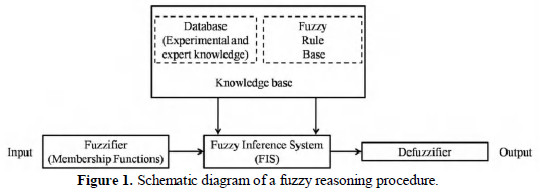
A fuzzy logic system consists of a fuzzifier, fuzzy inference engine and a 
defuzzifier. A typical fuzzy process is shown in <a href="#f1">Fig. 1</a>.</p>


    <p>&nbsp;</p>
<a name="f1">
<img src="/img/revistas/pea/v34n4/34n4a01f1.jpg">
    
<p>&nbsp;</p>


    <p>The crisp inputs are 
fuzzified, i.e., converted to linguistic expressions. The fuzzification is carried out 
using membership function (MF) that assigns membership values. The range of 
the input parameters is found out, and the whole space is divided into fuzzy 
subsets using MF. Values of MF range between 0 and 1, which determine the 
degree of membership of a variable in a subset. A MF can be triangular, 
trapezoidal, gaussian, bell shaped or sigmoidal. The fuzzified members then 
invoke the fuzzy inference engine (FIS), which comprises a knowledge base 
based on expert intuition and rule base. A certain number of rules are satisfied, 
which in turn give the fuzzified output by performing Mamdani's MAX-MIN 
implication or Takagi and Sugeno's approach [54]. Finally, a crisp output is 
obtained from the defuzzifier.</p>


    <p>&nbsp;</p>
    ]]></body>
<body><![CDATA[<p><b>Experimental details</b></p>

    <p><i><b>Coating deposition</b></i></p>

    <p>Coating deposition is carried out on steel (AISI 1040) substrates of dimension &Phi;6 
&times; 30 mm. The substrates are rinsed in deionized water and cleaned using acetone 
for degreasing and removal of corrosive products. A pickling treatment in 50% 
HCl is given to remove rust or oxide layers which may have formed. After 
thorough cleaning of the substrates, they are subjected to surface roughness 
measurements. EN coatings follow the substrate profile and, hence, they are 
selected with precision, to eliminate the effect of surface roughness on the 
tribological behavior of the coatings. The specimens corresponding to N6 grade 
(Ra = 0.8 &mu;m) are selected for coating deposition. 

Prior to deposition in the electroless bath, the specimens are again rinsed in 
deionized water, and dipped in a warm (55&deg;C) PdCl2 solution. This process, 
known as â€˜activation', is done to achieve a higher deposition rate, good adhesion 
of the coatings with the substrate, and obtain a significant amount of deposit 
thickness, so that tribological tests can be carried out [19, 55, 56]. It may be 
noted here that the substrates used in the present study are catalytically active. 
But it is observed that, without the activation in PdCl2, the deposition proceeds at 
a very slow rate, leading to a very low deposit thickness [56]. In the meantime, 
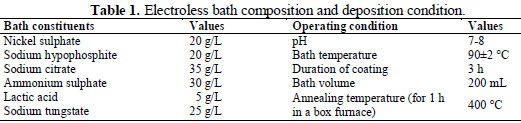
the electroless bath is prepared by mixing the chemicals in the selected order, as 
enlisted in <a href="#t1">Table 1</a>.</p>


    <p>&nbsp;</p>
<a name="t1">
<img src="/img/revistas/pea/v34n4/34n4a01t1.jpg">
    
<p>&nbsp;</p>


    <p>A bath volume of 200 ml is taken for coating deposition. The parameters of the 
electroless bath are kept constant to achieve equal coating thickness and 
properties for all the specimens. After a deposit period of 3 hrs, the coated 
specimens are heat treated in a muffle furnace at 400&deg;C for 1 hr.</p>

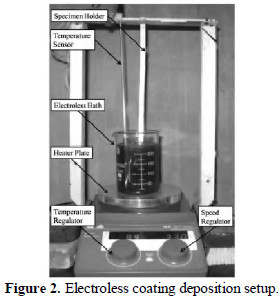
    <p>The coatings are allowed to cool to the ambient temperature inside the furnace 
itself. The deposition setup is illustrated in <a href="#f2">Fig. 2</a>.</p>


    <p>&nbsp;</p>
<a name="f2">
<img src="/img/revistas/pea/v34n4/34n4a01f2.jpg">
    
<p>&nbsp;</p>


    <p><i><b>Coating characterization</b></i></p>

    ]]></body>
<body><![CDATA[<p>The composition of EN coatings significantly determines the phase structure and 
tribological behavior. Heat treatment results in an improved hardness, wear 
resistance and low coefficient of friction. Therefore, it is necessary to study the 
coating characteristics in detail, to understand their effect on wear behavior. 
Energy dispersive X-ray (EDX) analysis (FEI, Quanta FEG 250) is used to 
determine the percentage by weight of nickel, phosphorus and tungsten in the 
coating. To analyze the phase transformation taking place due to heat treatment, 
X-ray diffraction (XRD) with Cu-K&alpha; (Rigaku, Miniflex) technique is used. The 
surface morphology of the coating before and after annealing at 400&deg;C for 1hr is 
observed under a scanning electron microscope (SEM) (JEOL, JSM 6360). The 
wear mechanism is also ascertained from SEM micrographs of worn out 
specimens after the tribological tests under dry and lubricated sliding condition.</p>


    <p><i><b>Tribological tests</b></i></p>

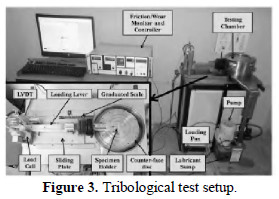
    <p>The dry and lubricated sliding wear tests are carried out on a pin-on-disc 
tribological test setup (Ducom, TR-20-LE-CHM-400, India). The coated pin 
specimens are held stationary against a rotating counterface disc (diameter 
165mm, 8mm thick) of EN 31 material hardened to 60HRc and ground to 1.6Ra 
surface roughness. The wear track diameter is kept fixed at 80mm. The normal 
load is applied to the specimen by placing dead weights on a loading pan 
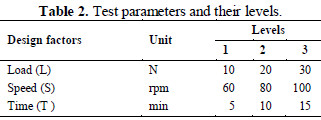
connected to a loading lever of ratio 1:1. The sliding speed and sliding duration 
can be controlled from the friction/wear monitor. <a href="#t2">Table 2</a> enlists the tribological 
test parameters along with their levels.</p>


    <p>&nbsp;</p>
<a name="t2">
<img src="/img/revistas/pea/v34n4/34n4a01t2.jpg">
    
<p>&nbsp;</p>


    <p>The parameters are selected after a 
meticulous study of the literature and carrying out several experiments. Wear 
depth is acquired by a LVDT (Syscon) with a least count of 1&mu;m and 1&pm;1% of 
measured wear. A commercially available engine oil (Servo PRIDE-4T, Indian 
Oil) is used for the wear tests under lubricated condition. Experiments are 
systematically carried out following the combinations available in Taguchi's L27 
orthogonal array (OA). The L27 OA can accommodate the direct as well as the 
interaction effect of the test parameters on responses.</p>

    <p>Wear depth is acquired by a LVDT (Syscon) with a least count of 1&mu;m and 1&pm;1% 
of measured wear. A commercially available engine oil (Servo PRIDE-4T, 
Indian Oil) is used for the wear tests under lubricated condition. Experiments are 
systematically carried out following the combinations available in Taguchi's L27 
orthogonal array (OA). The L27 OA can accommodate the direct as well as the 
interaction effect of the test parameters on responses. 
The pin-on-disc tribotester is shown in <a href="#f3">Fig. 3</a>.</p>


    <p>&nbsp;</p>
<a name="f3">
<img src="/img/revistas/pea/v34n4/34n4a01f3.jpg">
    
<p>&nbsp;</p>


    <p><b>Results and discussion</b></p>

    ]]></body>
<body><![CDATA[<p><i><b>Composition, phase transformation, microstructure and coating thickness</b></i></p>

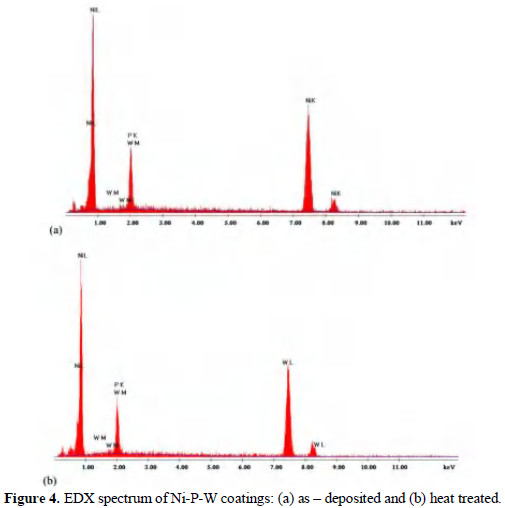
    <p>Composition of the coatings in terms of weight percentages of nickel, 
phosphorus and tungsten is obtained from EDX analysis which is 88%, 8% and 
4%, respectively, in the as-deposited coatings. The EDX spectrum of the coatings 
in its as-deposited and heat treated condition is shown in <a href="#f4">Fig. 4</a>.</p>


    <p>&nbsp;</p>
<a name="f4">
<img src="/img/revistas/pea/v34n4/34n4a01f4.jpg">
    
<p>&nbsp;</p>


    <p>Phosphorus 
percentage of the deposits determines their crystallinity. In general, for the binary 
Ni-P alloy system, the coatings are seen to be amorphous in the high phosphorus 
(10-13 wt% P) range, while there is a mixture of nanocrystalline and amorphous 
phases in the medium phosphorus (6-9 wt% P) range. The incorporation of 
tungsten to Ni-P coating leads to a decrease in the phosphorus content. As the 
concentration of sodium tungstate is increased in the electroless bath, the 
phosphorus content decreases, while the tungsten content increases [32], and the 
coatings are transformed more to a mixture of amorphous and nanocrystalline 
phases. This also causes an improvement in the microhardness of the deposits, 
which in turn affects the tribological behavior. The phosphorus content obtained 
in the present case is around 8% by weight, which corresponds to the medium 
phosphorus range, and it is expected that the coatings would exhibit an X-ray 
amorphous/nanocrystalline nature in its as-deposited condition. 
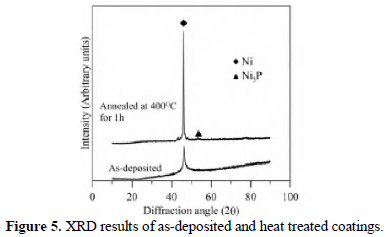
The phase transformation caused on account of the heat treatment is analyzed 
using XRD, and shown in <a href="#f5">Fig. 5</a>.</p>


    <p>&nbsp;</p>
<a name="f5">
<img src="/img/revistas/pea/v34n4/34n4a01f5.jpg">
    
<p>&nbsp;</p>


    <p>Results obtained in the EDX analysis are 
further supported by the XRD results where as-deposited Ni-P-W coating 
exhibits amorphous/ nanocrystalline behavior with a sharp peak pertaining to Ni 
(111) plane surrounded by short peaks. The intensity corresponding to Ni (111) 
increases on heat treatment at 400&deg;C for 1 hour, and the coatings turn crystalline 
due to the precipitation of stable crystalline phases of nickel phosphides (Ni3P). 
Heat treatment improves the microhardness and wear resistance of Ni-P-W 
coatings. This is mainly attributed to precipitation hardening, as well as to a solid 
solution strengthening phenomenon [33].</p>

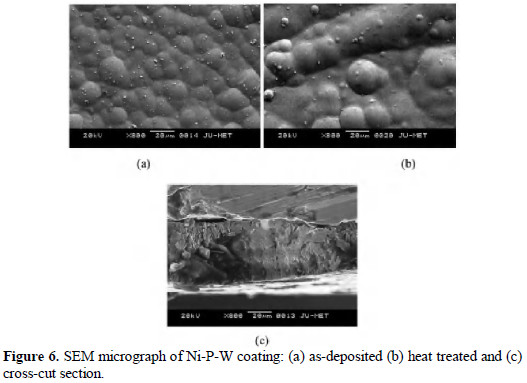
    <p>SEM micrographs of an as-deposited and heat treated specimen are shown in 
<a href="#f6">Fig. 6(a)</a> and <a href="#f6">Fig. 6(b)</a>, respectively.</p>


    <p>&nbsp;</p>
<a name="f6">
<img src="/img/revistas/pea/v34n4/34n4a01f6.jpg">
    
]]></body>
<body><![CDATA[<p>&nbsp;</p>


    <p>A nodular surface morphology similar to that of 
a cauliflower can be observed in <a href="#f6">Fig. 6(a)</a> for the as-deposited coating. The 
coating deposit is quite homogenous without any porosity. Bright particles are 
visible to be scattered all over the coating surface. This can be attributed to the 
excess growth of nickel alloy over the nodules. Similar results were obtained by 
Selvi et al. [57], and it was explained that this excess growth could be due to the 
mixed complex in the electroless bath which acts as a precursor for the 
deposition of the alloy. On heat treatment the nodules are seen to become more 
compact, and some amount of volume contraction is observed in <a href="#f6">Fig. 6(b)</a>. Phase 
transformation of Ni-P-W coating results in a large number of Ni3P crystallites 
precipitating out of the supersaturated solid solution of nickel, thereby causing 
volume contraction [40]. A cross-cut section of the coated specimen is shown in 
<a href="#f6">Fig. 6(c)</a>. The coating thickness is seen to be around 30 &mu;m and quite uniform, 
which is a characteristic feature of EN coatings.</p>


    <p><i><b>Analysis of response surface model</b></i></p>

    <p>The present investigation considers applied normal load, sliding speed and 
sliding duration as the independent variables, while the wear depth is the system 
response. The experimental combinations of the independent regressor variables 
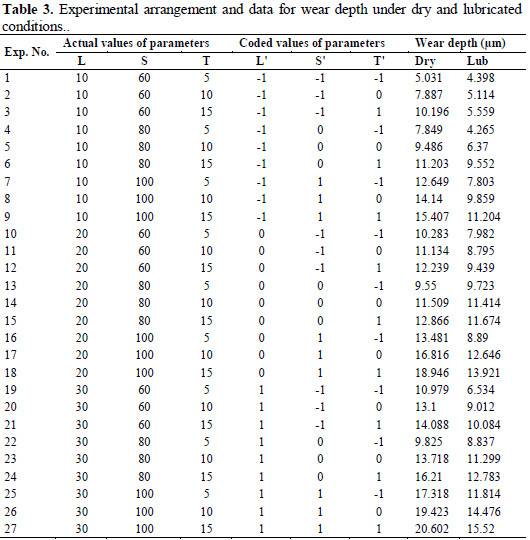
(process parameters) in their un-coded and coded form, along with the system 
response, i.e., wear depth under dry and lubricated conditions, are given in <a href="#t3">Table 3</a>.</p>


    <p>&nbsp;</p>
<a name="t3">
<img src="/img/revistas/pea/v34n4/34n4a01t3.jpg">
    
<p>&nbsp;</p>


    <p>The regression constants are evaluated by using a method of least squares, and it 
is carried out using Minitab [58]. The fitted second order equation for wear depth 
under dry condition in un-coded form is:</p>


    <p>&nbsp;</p>
<a name="e4">
<img src="/img/revistas/pea/v34n4/34n4a01e4.jpg">
    
<p>&nbsp;</p>


    <p>Similarly, the wear depth under lubricated condition can be expressed in uncoded 
form by the following:</p>


    ]]></body>
<body><![CDATA[<p>&nbsp;</p>
<a name="e5">
<img src="/img/revistas/pea/v34n4/34n4a01e5.jpg">
    
<p>&nbsp;</p>


    <p>The analysis of the response surface model is carried out using Minitab software 
[58] for wear depth under dry and lubricated condition. The significance of the 
second order regression model is evaluated by calculating the coefficient of 
determination (R<sup>2</sup>). The coefficient of determination signifies the percentage of 
variability that can be accounted for by the model. The capability to predict the 
response with accuracy is denoted by the term R<sup>2</sup> [48-51].</p>

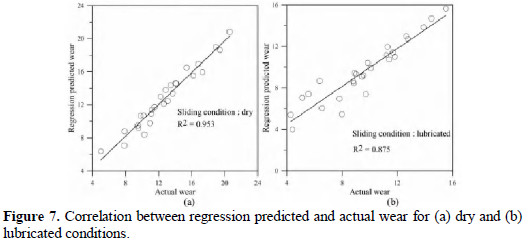
    <p>Moreover, the correlation between the predicted and experimental wear depth for 
both dry and lubricated conditions is shown in <a href="#f7">Fig. 7(a)</a> and <a href="#f7">Fig. 7(b)</a>, 
respectively.</p>


    <p>&nbsp;</p>
<a name="f7">
<img src="/img/revistas/pea/v34n4/34n4a01f7.jpg">
    
<p>&nbsp;</p>


    <p>A high correlation between the two is observed in <a href="#f7">Fig. 7</a>, which 
indicates that the model is quite significant, and can be used for further 
predictions. Furthermore, the R<sup>2</sup> value is seen to be 95.3% and 87.5% for dry and 
lubricated condition, respectively, which is reasonably high. This indicates the 
sufficient closeness of the predicted response to the actual response. Hence, it 
can be assimilated that the quadratic models for wear depth under dry and 
lubricated condition can suitably conceive the complex relationship with the 
tribological test parameters.</p>

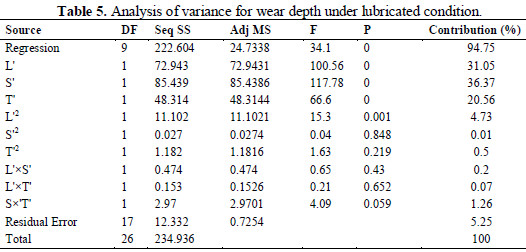
    <p>Similarly, the ANOVA results for wear depth under lubricated condition are 
presented in <a href="#t3">Table 3</a>. Again, the linear terms are seen to be important, along with 
the square term of load.</p>

    <p>The percentage contributions of the process parameters, their square terms and 
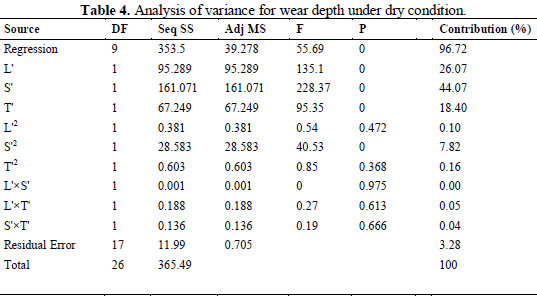
interactions are also given in <a href="#t4">Tables 4</a> and <a href="#t5">5</a>, for dry and lubricated condition, 
respectively.</p>


    <p>&nbsp;</p>
<a name="t4">
<img src="/img/revistas/pea/v34n4/34n4a01t4.jpg">
    
]]></body>
<body><![CDATA[<p>&nbsp;</p>
<a name="t5">
<img src="/img/revistas/pea/v34n4/34n4a01t5.jpg">
    
<p>&nbsp;</p>


    <p>Accordingly, it can be noticed that sliding speed has the highest 
contribution followed by applied normal load and sliding duration for both dry 
and lubricated condition.</p>

    <p>Statistical significance of the developed models is analyzed by carrying out 
analysis of variance (ANOVA) using Minitab [58], and in coded form of the 
parameters. The quadratic models expressed in <a href="#e4">Eqn. 4</a> and <a href="#e5">Eqn. 5</a> have been 
developed at 95% confidence interval. In that case, a P value lower than 0.05 
indicates a significant contribution by a factor, square term or an interaction 
term. ANOVA results for wear depth under dry condition are given in <a href="#t4">Table 4</a>.</p>

    <p>From the results, it can be assessed that the regression model is highly 
significant. All the three linear terms, i.e., load, speed and time are significant 
along with the square term of speed.</p>


    <p><i><b>Analysis of fuzzy rule based model</b></i></p>

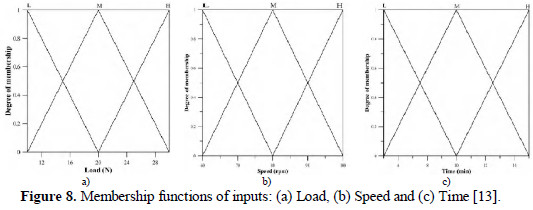
    <p>In the present work, the input (load, speed and time) as well as the output 
parameter (wear depth) are fuzzified using triangular membership function. To 
represent the input parameters, linguistic variables such as low (L), medium (M) 
and high (H) are used [13]. The fuzzy subsets for the same are shown in <a href="#f8">Fig. 8</a>.</p>


    <p>&nbsp;</p>
<a name="f8">
<img src="/img/revistas/pea/v34n4/34n4a01f8.jpg">
    
<p>&nbsp;</p>


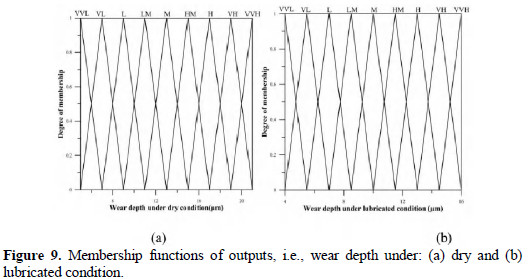
    <p>To obtain a fuzzy value of the output (wear depth), it has been divided into nine 
fuzzy subsets, i.e., very very low (VVL), very low (VL), low (L), low medium 
(LM), medium (M), high medium (HM), high (H), very high (VH) and very very 
high (VVH) [13]. Again, to map the output onto a fuzzy subset, triangular 
membership functions (MF) have been chosen. The MF for wear depth under dry 
and lubricated condition has been shown in <a href="#f9">Fig. 9(a)</a> and <a href="#f9">Fig. 9(b)</a>, respectively. 
Triangular MF is chosen for its simplicity of use.</p>


    ]]></body>
<body><![CDATA[<p>&nbsp;</p>
<a name="f9">
<img src="/img/revistas/pea/v34n4/34n4a01f9.jpg">
    
<p>&nbsp;</p>


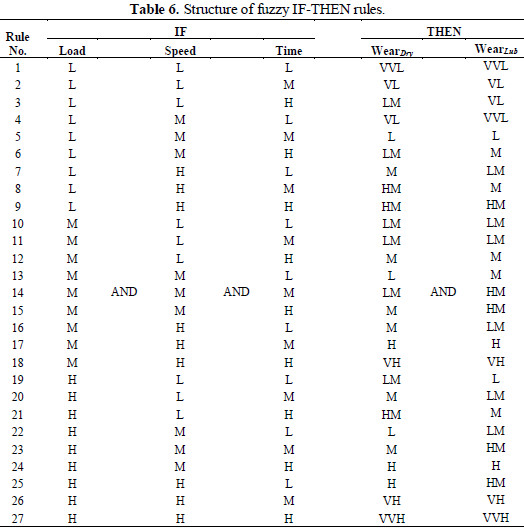
    <p>After fuzzification of the input and the output space using linguistic variables, 
they are correlated by a IF-THEN fuzzy rule based system, which forms the core 
of the FIS. Two separate FIS are created for modeling the wear depth under dry 
and lubricated condition. From the number of process parameters and their 
levels, 27 rules are directly obtained which again depend on the experimental 
values of the responses. <a href="#t6">Table 6</a> enlists the rule base derived from the 
experimental results for both dry and lubricated sliding wear.</p>


    <p>&nbsp;</p>
<a name="t6">
<img src="/img/revistas/pea/v34n4/34n4a01t6.jpg">
    
<p>&nbsp;</p>


    <p>Using Mamdani's 
max-min implication, a fuzzy subset is assigned to each output variable for a 
particular rule. Finally, the centroid defuzzification scheme is used in the present 
investigation to obtain a crisp value of the output. The centroid method computes 
the centroid of the area under the membership function.</p>

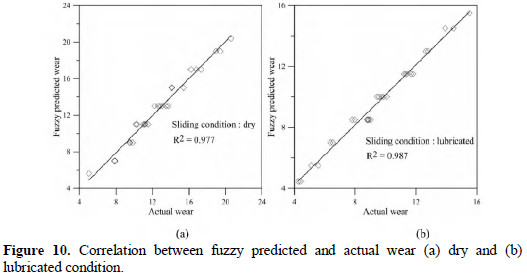
    <p>The correlation graph for fuzzy rule based predicted wear depth under dry and 
lubricated condition is illustrated in <a href="#f10">Fig. 10(a)</a> and <a href="#f10">Fig. 10(b)</a>, 
respectively.</p>


    <p>&nbsp;</p>
<a name="f10">
<img src="/img/revistas/pea/v34n4/34n4a01f10.jpg">
    
<p>&nbsp;</p>


    <p>The R<sup>2</sup> value for the fuzzy prediction model is seen to be 97.7% and 98.7% for dry 
and lubricated sliding condition, respectively. Therefore, within the experimental 
domain, fuzzy model is seen to be adequate in interpreting the relationship of the 
complex wear phenomenon and the process parameters viz. load, speed and time. 
The closeness of the points to the straight line in <a href="#f10">Fig. 10</a> clearly indicates the 
close correlation that exists between the predicted and experimentally obtained 
values. In fact, the fuzzy model is seen to be superior compared to the response 
surface method in precisely relating vague and uncertain of the data by the use of 
linguistic variables and an expert system. Thus, it can be concluded that both 
regression and fuzzy model are valid and acceptable, but fuzzy system has better 
modeling capabilities, and in a more human like manner.</p>


    ]]></body>
<body><![CDATA[<p><i><b>Validation tests</b></i></p>

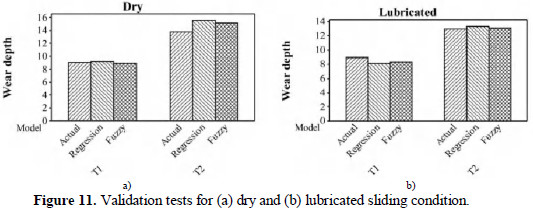
    <p>To validate the observations made from RSM and fuzzy models, two test runs T1 
and T2 are undertaken at dry and lubricated condition. T1 corresponds to a 
parametric combination, where the applied normal load is 15N, a sliding speed of 
70 rpm and a sliding duration of 9 min. The combination of test parameters 
corresponding to T2 is applied normal load of 25N, sliding speed of 90 rpm and 
12 min sliding duration. Intermediate values of tribo-testing parameters within 
the experimental domain are purposely selected to check the adequacy and 
correlation of the developed models with the actual (experimental) results 
obtained. The validation test run results for dry and lubricated sliding condition 
are presented in <a href="#f11">Fig. 11(a)</a> and <a href="#f11">Fig. 11(b)</a>, respectively.</p>


    <p>&nbsp;</p>
<a name="f11">
<img src="/img/revistas/pea/v34n4/34n4a01f11.jpg">
    
<p>&nbsp;</p>


    <p>It can be clearly seen that 
both second order regression and fuzzy models have excellent prediction 
capabilities, and corroborate well with the actual results experimentally obtained.</p>

    <p>However, the results obtained from fuzzy model exhibit less errors compared to 
the regression predicted results. Therefore, the validation tests also substantiate 
the observations made in the present experiment, where fuzzy rule based expert 
system is seen to have a higher R<sup>2</sup> value compared to RSM for both dry and 
lubricated tribological test conditions. Similar results were obtained by 
Mukhopadhyay et al. [13], where fuzzy logic and conventional regression 
method were used to analyze the wear behavior of electroless Ni-P coating under 
lubricated condition.</p>


    <p><i><b>Effect of process parameters on wear</b></i></p>

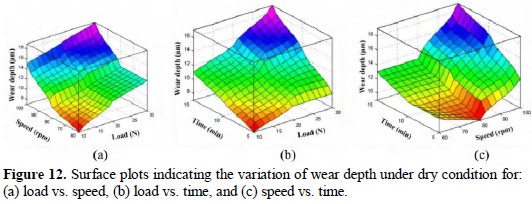
    <p>The trends in variation of wear depth with the interaction effect of the process 
parameters are determined from surface plots predicted by the fuzzy model both 
under dry and lubricated conditions. The plots for dry sliding wear behavior are 
depicted in <a href="#f12">Fig. 12</a>.</p>


    <p>&nbsp;</p>
<a name="f12">
<img src="/img/revistas/pea/v34n4/34n4a01f12.jpg">
    
<p>&nbsp;</p>


    ]]></body>
<body><![CDATA[<p>For load vs. speed interaction (<a href="#f12">Fig. 12(a)</a>), the wear depth is 
seen to increase with an increase in load and speed. In general, with an increase 
in the applied normal load, the actual contact area of the asperities increases, 
because of the advancement of the mating surfaces towards each other. Due to 
this, the sheared volume of the coatings by the hard counterface material 
increases, indicating an increase in the wear depth in the present case. Similarly, 
an increasing trend in wear depth is observed for load vs. time interaction 
(<a href="#f12">Fig. 12(b)</a>). It is also to be noted that, as the sliding speed or the sliding duration 
increases, a simultaneous increase in sliding distance is achieved. This again 
leads to more wear of the coatings, unless tribochemical reaction at the sliding 
interface occurs, and a protective oxide film formation takes place at the tip of 
the asperities. Due to the aforesaid reasons, the wear depth is again seen to 
increase with speed vs. time interaction (<a href="#f12">Fig. 12(c)</a>).</p>

    <p>However, in <a href="#f12">Fig. 12(a)</a> and <a href="#f12">Fig. 12(b)</a>, the wear depth encountered is seen to be 
quite low up to 80 rpm. This could be due to the rolling effect of worn particles 
of the debris being entrapped between the counterface and coating. This effect 
again vanishes at a higher level of the test parameters, and the wear debris seems 
to contribute to the ploughing effect, causing higher wear.</p>

    <p>The obtained trends are also seen to be in accordance with Archard's relation for 
wear according to which, the wear volume is directly proportional to the applied 
normal load and sliding distance, and inversely proportional to the hardness of 
the material.</p>

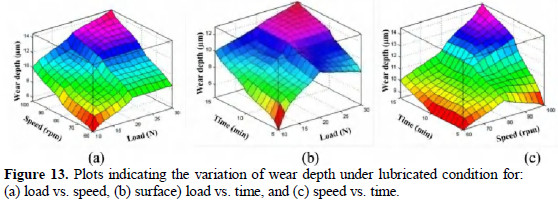
    <p>To assess the wear behavior of electroless Ni-P-W coating with interaction 
effects of the test parameters under lubricated condition, 3D surface plots are 
again generated from the fuzzy prediction model and are displayed in <a href="#f13">Fig. 13</a>.</p>


    <p>&nbsp;</p>
<a name="f13">
<img src="/img/revistas/pea/v34n4/34n4a01f13.jpg">
    
<p>&nbsp;</p>


    <p>For load vs. speed interaction (<a href="#f13">Fig. 13(a)</a>), the wear depth is seen to increase up 
to 20N, and then gradually stabilizes. No steep increase in wear depth is 
observed. Initially higher wear may be encountered due to the running in stage. 
The wear depth stabilizes at a later stage. Moreover, as the speed increases, the 
adsorbed film thickness increases leading to better lubrication. However, it can 
be observed in <a href="#f13">Fig. 13(a)</a> that, at higher values of the parameters, a higher wear 
depth is encountered, which may be due to the breakage of the lubricant film at 
higher load. Similar result is obtained in <a href="#f13">Fig. 13(b)</a> for the load vs. time 
interaction. The wear depth tends to stabilize after 20 N applied normal, and up 
to a sliding duration of 10 min, after which the response seems to increase. In 
<a href="#f13">Fig. 13(c)</a>, for speed vs. time interaction, the wear depth is again seen to be stable 
at higher speed, up to 10 min sliding duration, above which it increases. Thus, in 
<a href="#f13">Fig. 13</a>, for all the interaction effects of the tribo-test parameters, the wear depth 
is seen to be higher at higher levels of the same. But, on comparing with the 
results obtained in dry condition (<a href="#f12">Fig. 12</a>), a clear enhancement in wear behavior 
is seen under lubricated condition. Another reason for the low wear of the 
coatings under lubricated condition can be due to the fact that the lubricant 
carries away the generated heat, and lowers the flash temperature at the contact 
point of the asperities. Therefore, electroless Ni-P-W coatings are found to be 
suitable for reduction of wear of tribological contact applications working under 
lubrication.</p>

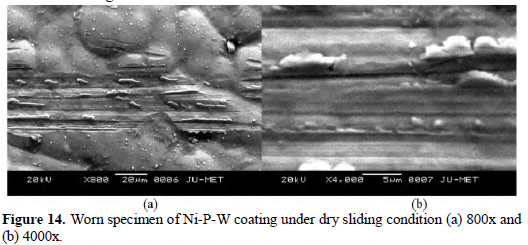
    <p>The wear mechanism of electroless Ni-P-W coating after dry sliding against 
hardened EN 31 counterface disc is analyzed by observing the worn specimens 
under SEM. Under dry sliding condition, most of the specimens exhibit similar 
wear morphology. Hence, the wear track at the highest parametric combination, 
i.e., 30N applied normal load, 100 rpm sliding speed and 15 min sliding duration 
is shown in <a href="#f14">Fig. 14</a>.</p>


    <p>&nbsp;</p>
<a name="f14">
<img src="/img/revistas/pea/v34n4/34n4a01f14.jpg">
    
<p>&nbsp;</p>


    ]]></body>
<body><![CDATA[<p>Micro cutting and micro ploughing in the direction of sliding 
arte observed (<a href="#f14">Fig. 14(a)</a>). A three body abrasion is clearly indicated with the 
debris particles cutting through the coating and displacing the material to the side 
of the wear track (<a href="#f14">Fig. 14(b)</a>). Therefore, abrasive wear mechanism of the 
coatings is established from the wear track images. Such abrasion leads to an 
increase in the wear depth, with an increase in the test parameters, and the same 
is reflected in <a href="#f12">Fig. 14</a>.</p>

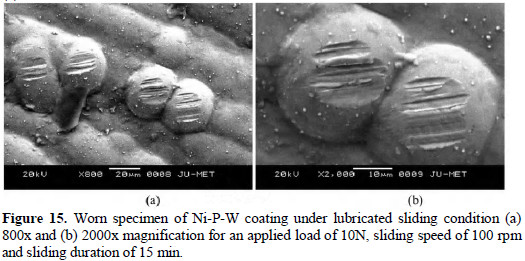
    <p>Similarly, the wear mechanism is analyzed for lubricated sliding condition, and 
the SEM micrograph is shown for 10 N applied normal load, 100 rpm sliding 
speed and 15 min sliding duration in <a href="#f15">Fig. 15</a>.</p>


    <p>&nbsp;</p>
<a name="f15">
<img src="/img/revistas/pea/v34n4/34n4a01f15.jpg">
    
<p>&nbsp;</p>


    <p>It can be noted here that worn 
specimen for 10 N and 20 N load and other combination of sliding speed and 
sliding duration exhibits similar wear morphology, and, hence, has been omitted 
for brevity reasons. It can be clearly seen in <a href="#f15">Fig. 15(a)</a> that wear occurs by mild 
abrasion. The load is carried by some of the nodules, and minor scratch marks 
are visible in <a href="#f15">Fig. 15(a)</a>, and more evidently in the magnified 
view in <a href="#f15">Fig. 15(b)</a>.</p>

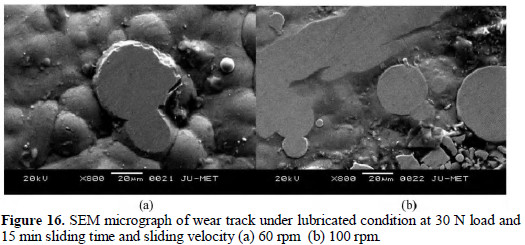
    <p>SEM micrographs of wear tracks at 30 N load and a sliding duration of 15 min 
are shown in <a href="#f16">Fig. 16</a> for Ni-P-W coating under lubricated sliding condition.</p>


    <p>&nbsp;</p>
<a name="f16">
<img src="/img/revistas/pea/v34n4/34n4a01f16.jpg">
    
<p>&nbsp;</p>


    <p>At 60 rpm sliding speed, mild abrasion and surface smoothening effect can be 
observed (<a href="#f16">Fig. 16(a)</a>). The smoothening effect is more prominent at 100 rpm 
(<a href="#f16">Fig. 16(b)</a>). Such effects tend to reduce the wear rate of the coatings. 
In <a href="#f13">Fig. 13(a)</a> and <a href="#f13">Fig. 13(c)</a>, 
it can be observed that the wear depth becomes stable at 
higher values of sliding speed. This can be attributed to the smoothening effect 
observed in <a href="#f16">Fig. 16)</a>. Therefore, although the breakage of lubricant film might 
take place at higher applied normal loads, a decrease in wear depth is observed. 
In fact, the flowing lubricant carries away the wear debris, thereby preventing the 
ploughing effect caused by the particles. Hence, enhanced tribological behavior 
of electroless Ni-P-W coating is observed under lubrication compared to dry 
sliding condition. It also seems that boundary lubrication regime exists within the 
experimental domain considered. Thus, from the wear behavior and wear 
mechanism exhibited by the coatings, superior tribological behavior is 
established under boundary lubrication sliding condition.</p>

    <p>At this point, it is interesting to note that the wear depth of the coatings obtained 
for both dry and lubricated sliding conditions is lower than the coating thickness. 
Moreover, the hardness of the coatings is lower than that of the hardened 
counterface disc. This indicates that only the wear of the coatings has taken 
place, and the measurement of wear in terms of displacement adequately 
represents the wear of the deposits.</p>


    ]]></body>
<body><![CDATA[<p>&nbsp;</p>
    <p><b>Conclusions</b></p>

    <p>In the present work, Ni-P-W coating is deposited by the electroless method onto 
AISI 1040 steel substrates. Tribological tests under dry and lubricated condition 
are carried out on a pin-on-disc test setup following Taguchi's L27 orthogonal 
array. Prediction models are developed using the experimental data through 
conventional regression method and fuzzy logic, which is an artificial 
intelligence technique capable of handling uncertain and vague data. The 
coefficient of determination of fuzzy rule based model is seen to be 97.7% and 
98.7% under dry and lubricated conditions, respectively, indicating the high 
efficiency and prediction capabilities of the method. A lower coefficient of 
determination compared to the fuzzy logic method is observed for the response 
surface method. ANOVA results reveal that the highest contribution to wear 
under both the conditions is sliding speed followed by applied normal load and 
sliding duration. Three dimensional surface plots indicate an increase in wear 
with the interaction effect of the test parameters. But the coatings exhibit 
excellent wear resistance under lubricated condition, due to a surface 
smoothening effect at higher parametric combinations. Abrasive wear is the 
predominant mechanism under dry and lubricated condition. It is also seen that 
wear behavior of the coatings is mainly governed by the synergistic effects of the 
tribo-testing parameters, coating microstructure, surface morphology, 
strengthening of the deposits on heat treatment and surface smoothening effects. 
Finally, validation runs conducted at arbitrary parametric combination 
consolidated the outstanding prediction capabilities of the developed models. The 
present study thus widens the scope of Ni-P-W coatings for tribological contact 
applications working under lubricated condition. Moreover, the prediction 
models can reduce computational and experimental costs, as well as save time, 
leading to quicker decision making, and improve tribological behavior of 
electroless Ni-P-W coatings.</p>


    <p>&nbsp;</p>
    <p><b>References</b></p>

    <!-- ref --><p>1. Sudagar J, Lian J, Sha W. J Alloys Comp. 2013;571:183.    &nbsp;&nbsp;&nbsp;&nbsp;&nbsp;&nbsp;&nbsp;&nbsp;[&#160;<a href="javascript:void(0);" onclick="javascript: window.open('/scielo.php?script=sci_nlinks&ref=421642&pid=S0872-1904201600040000100001&lng=','','width=640,height=500,resizable=yes,scrollbars=1,menubar=yes,');">Links</a>&#160;]<!-- end-ref --></p>

    <!-- ref --><p>2. Sahoo P, Das SK. Mater Design. 2011;32:1760.    &nbsp;&nbsp;&nbsp;&nbsp;&nbsp;&nbsp;&nbsp;&nbsp;[&#160;<a href="javascript:void(0);" onclick="javascript: window.open('/scielo.php?script=sci_nlinks&ref=421644&pid=S0872-1904201600040000100002&lng=','','width=640,height=500,resizable=yes,scrollbars=1,menubar=yes,');">Links</a>&#160;]<!-- end-ref --></p>

    <!-- ref --><p>3. Agarwala R C, Agarwala V. Sadhana. 2003;28:475.    &nbsp;&nbsp;&nbsp;&nbsp;&nbsp;&nbsp;&nbsp;&nbsp;[&#160;<a href="javascript:void(0);" onclick="javascript: window.open('/scielo.php?script=sci_nlinks&ref=421646&pid=S0872-1904201600040000100003&lng=','','width=640,height=500,resizable=yes,scrollbars=1,menubar=yes,');">Links</a>&#160;]<!-- end-ref --></p>

    <!-- ref --><p>4. Loto C A. Silicon. 2016;8:177.    &nbsp;&nbsp;&nbsp;&nbsp;&nbsp;&nbsp;&nbsp;&nbsp;[&#160;<a href="javascript:void(0);" onclick="javascript: window.open('/scielo.php?script=sci_nlinks&ref=421648&pid=S0872-1904201600040000100004&lng=','','width=640,height=500,resizable=yes,scrollbars=1,menubar=yes,');">Links</a>&#160;]<!-- end-ref --></p>

    <!-- ref --><p>5. Reddy V V N, Ramamoorthy B, Nair P K. Wear. 2000;239:111.    &nbsp;&nbsp;&nbsp;&nbsp;&nbsp;&nbsp;&nbsp;&nbsp;[&#160;<a href="javascript:void(0);" onclick="javascript: window.open('/scielo.php?script=sci_nlinks&ref=421650&pid=S0872-1904201600040000100005&lng=','','width=640,height=500,resizable=yes,scrollbars=1,menubar=yes,');">Links</a>&#160;]<!-- end-ref --></p>

    <!-- ref --><p>6. Gadhari P, Sahoo P. Procedia Mater Sci. 2014;6:623.    &nbsp;&nbsp;&nbsp;&nbsp;&nbsp;&nbsp;&nbsp;&nbsp;[&#160;<a href="javascript:void(0);" onclick="javascript: window.open('/scielo.php?script=sci_nlinks&ref=421652&pid=S0872-1904201600040000100006&lng=','','width=640,height=500,resizable=yes,scrollbars=1,menubar=yes,');">Links</a>&#160;]<!-- end-ref --></p>

    <!-- ref --><p>7. Gadhari P, Sahoo P. Surf Rev Lett. 2015;22:1550082.    &nbsp;&nbsp;&nbsp;&nbsp;&nbsp;&nbsp;&nbsp;&nbsp;[&#160;<a href="javascript:void(0);" onclick="javascript: window.open('/scielo.php?script=sci_nlinks&ref=421654&pid=S0872-1904201600040000100007&lng=','','width=640,height=500,resizable=yes,scrollbars=1,menubar=yes,');">Links</a>&#160;]<!-- end-ref --></p>

    <!-- ref --><p>8. Wu Y, Liu H, Shen B, et al. Tribol Int. 2006;39:553.    &nbsp;&nbsp;&nbsp;&nbsp;&nbsp;&nbsp;&nbsp;&nbsp;[&#160;<a href="javascript:void(0);" onclick="javascript: window.open('/scielo.php?script=sci_nlinks&ref=421656&pid=S0872-1904201600040000100008&lng=','','width=640,height=500,resizable=yes,scrollbars=1,menubar=yes,');">Links</a>&#160;]<!-- end-ref --></p>

    <!-- ref --><p>9. Wu Y, Shen B, Liu L, et al. Wear, 2006;261:2017.    &nbsp;&nbsp;&nbsp;&nbsp;&nbsp;&nbsp;&nbsp;&nbsp;[&#160;<a href="javascript:void(0);" onclick="javascript: window.open('/scielo.php?script=sci_nlinks&ref=421658&pid=S0872-1904201600040000100009&lng=','','width=640,height=500,resizable=yes,scrollbars=1,menubar=yes,');">Links</a>&#160;]<!-- end-ref --></p>

    <!-- ref --><p>10. Yoon JW, Park JH, Shur CC, et al. Microelectronic Eng. 2007;84:2552.    &nbsp;&nbsp;&nbsp;&nbsp;&nbsp;&nbsp;&nbsp;&nbsp;[&#160;<a href="javascript:void(0);" onclick="javascript: window.open('/scielo.php?script=sci_nlinks&ref=421660&pid=S0872-1904201600040000100010&lng=','','width=640,height=500,resizable=yes,scrollbars=1,menubar=yes,');">Links</a>&#160;]<!-- end-ref --></p>

    <!-- ref --><p>11. Guo Z, Keong KG, Sha W. J Alloys Comp. 2003;358:112.    &nbsp;&nbsp;&nbsp;&nbsp;&nbsp;&nbsp;&nbsp;&nbsp;[&#160;<a href="javascript:void(0);" onclick="javascript: window.open('/scielo.php?script=sci_nlinks&ref=421662&pid=S0872-1904201600040000100011&lng=','','width=640,height=500,resizable=yes,scrollbars=1,menubar=yes,');">Links</a>&#160;]<!-- end-ref --></p>

    <!-- ref --><p>12. Keong K G, Sha W, Malinov S. Surf Coat Tech. 2003;168:263.    &nbsp;&nbsp;&nbsp;&nbsp;&nbsp;&nbsp;&nbsp;&nbsp;[&#160;<a href="javascript:void(0);" onclick="javascript: window.open('/scielo.php?script=sci_nlinks&ref=421664&pid=S0872-1904201600040000100012&lng=','','width=640,height=500,resizable=yes,scrollbars=1,menubar=yes,');">Links</a>&#160;]<!-- end-ref --></p>

    <!-- ref --><p>13. Mukhopadhyay A, Duari S, Barman TK, et al. Port Electroch Acta. 2016;34:63.    &nbsp;&nbsp;&nbsp;&nbsp;&nbsp;&nbsp;&nbsp;&nbsp;[&#160;<a href="javascript:void(0);" onclick="javascript: window.open('/scielo.php?script=sci_nlinks&ref=421666&pid=S0872-1904201600040000100013&lng=','','width=640,height=500,resizable=yes,scrollbars=1,menubar=yes,');">Links</a>&#160;]<!-- end-ref --></p>

    <!-- ref --><p>14. Duari S, Barman TK, Sahoo P. Proc Mat Sci. 2014;5:978.    &nbsp;&nbsp;&nbsp;&nbsp;&nbsp;&nbsp;&nbsp;&nbsp;[&#160;<a href="javascript:void(0);" onclick="javascript: window.open('/scielo.php?script=sci_nlinks&ref=421668&pid=S0872-1904201600040000100014&lng=','','width=640,height=500,resizable=yes,scrollbars=1,menubar=yes,');">Links</a>&#160;]<!-- end-ref --></p>

    <!-- ref --><p>15. Ramalho A, Miranda JC. Wear. 2007;263:592.    &nbsp;&nbsp;&nbsp;&nbsp;&nbsp;&nbsp;&nbsp;&nbsp;[&#160;<a href="javascript:void(0);" onclick="javascript: window.open('/scielo.php?script=sci_nlinks&ref=421670&pid=S0872-1904201600040000100015&lng=','','width=640,height=500,resizable=yes,scrollbars=1,menubar=yes,');">Links</a>&#160;]<!-- end-ref --></p>

    <!-- ref --><p>16. Xu Y, Zheng X, Hu X, et al. Surf Coat Technol. 2014;258:790.    &nbsp;&nbsp;&nbsp;&nbsp;&nbsp;&nbsp;&nbsp;&nbsp;[&#160;<a href="javascript:void(0);" onclick="javascript: window.open('/scielo.php?script=sci_nlinks&ref=421672&pid=S0872-1904201600040000100016&lng=','','width=640,height=500,resizable=yes,scrollbars=1,menubar=yes,');">Links</a>&#160;]<!-- end-ref --></p>

    <!-- ref --><p>17. Chen WX, Tu JP, Gan HY, et al. Surf Coat Technol. 2002;160:68.    &nbsp;&nbsp;&nbsp;&nbsp;&nbsp;&nbsp;&nbsp;&nbsp;[&#160;<a href="javascript:void(0);" onclick="javascript: window.open('/scielo.php?script=sci_nlinks&ref=421674&pid=S0872-1904201600040000100017&lng=','','width=640,height=500,resizable=yes,scrollbars=1,menubar=yes,');">Links</a>&#160;]<!-- end-ref --></p>

    <!-- ref --><p>18. Der Ger M, Hou KH, Wang LM, et al. Mater Chem Phys. 2003;77:755.    &nbsp;&nbsp;&nbsp;&nbsp;&nbsp;&nbsp;&nbsp;&nbsp;[&#160;<a href="javascript:void(0);" onclick="javascript: window.open('/scielo.php?script=sci_nlinks&ref=421676&pid=S0872-1904201600040000100018&lng=','','width=640,height=500,resizable=yes,scrollbars=1,menubar=yes,');">Links</a>&#160;]<!-- end-ref --></p>

    <!-- ref --><p>19. Mukhopadhyay A, Duari S, Barman TK, et al. J Instit Eng (India): Series D.    &nbsp;&nbsp;&nbsp;&nbsp;&nbsp;&nbsp;&nbsp;&nbsp;[&#160;<a href="javascript:void(0);" onclick="javascript: window.open('/scielo.php?script=sci_nlinks&ref=421678&pid=S0872-1904201600040000100019&lng=','','width=640,height=500,resizable=yes,scrollbars=1,menubar=yes,');">Links</a>&#160;]<!-- end-ref --></p>

    <!-- ref --><p>20. Duari S, Mukhopadhyay A, Barman TK, et al. Int J Appl Eng Res. 2015;10:10090.    &nbsp;&nbsp;&nbsp;&nbsp;&nbsp;&nbsp;&nbsp;&nbsp;[&#160;<a href="javascript:void(0);" onclick="javascript: window.open('/scielo.php?script=sci_nlinks&ref=421680&pid=S0872-1904201600040000100020&lng=','','width=640,height=500,resizable=yes,scrollbars=1,menubar=yes,');">Links</a>&#160;]<!-- end-ref --></p>

    <!-- ref --><p>21. Duari S, Mukhopadhyay A, Barman TK, et al. Int J Eng Technol. 2016;7:94.    &nbsp;&nbsp;&nbsp;&nbsp;&nbsp;&nbsp;&nbsp;&nbsp;[&#160;<a href="javascript:void(0);" onclick="javascript: window.open('/scielo.php?script=sci_nlinks&ref=421682&pid=S0872-1904201600040000100021&lng=','','width=640,height=500,resizable=yes,scrollbars=1,menubar=yes,');">Links</a>&#160;]<!-- end-ref --></p>

    <!-- ref --><p>22. Oraon B, Majumdar G, Ghosh B. Mater Design. 2008;29:1412.    &nbsp;&nbsp;&nbsp;&nbsp;&nbsp;&nbsp;&nbsp;&nbsp;[&#160;<a href="javascript:void(0);" onclick="javascript: window.open('/scielo.php?script=sci_nlinks&ref=421684&pid=S0872-1904201600040000100022&lng=','','width=640,height=500,resizable=yes,scrollbars=1,menubar=yes,');">Links</a>&#160;]<!-- end-ref --></p>

    <!-- ref --><p>23. Oraon B, Majumdar G, Ghosh B. Mater Design. 2007;28:2138.    &nbsp;&nbsp;&nbsp;&nbsp;&nbsp;&nbsp;&nbsp;&nbsp;[&#160;<a href="javascript:void(0);" onclick="javascript: window.open('/scielo.php?script=sci_nlinks&ref=421686&pid=S0872-1904201600040000100023&lng=','','width=640,height=500,resizable=yes,scrollbars=1,menubar=yes,');">Links</a>&#160;]<!-- end-ref --></p>

    <!-- ref --><p>24. Choudhury BS, Sen RS, Oraon B, et al. Surf Eng. 2009;25:410.    &nbsp;&nbsp;&nbsp;&nbsp;&nbsp;&nbsp;&nbsp;&nbsp;[&#160;<a href="javascript:void(0);" onclick="javascript: window.open('/scielo.php?script=sci_nlinks&ref=421688&pid=S0872-1904201600040000100024&lng=','','width=640,height=500,resizable=yes,scrollbars=1,menubar=yes,');">Links</a>&#160;]<!-- end-ref --></p>

    <!-- ref --><p>25. Keong KG, Sha W, Malinov S. Mater Sci Eng: A. 2004;365:212.    &nbsp;&nbsp;&nbsp;&nbsp;&nbsp;&nbsp;&nbsp;&nbsp;[&#160;<a href="javascript:void(0);" onclick="javascript: window.open('/scielo.php?script=sci_nlinks&ref=421690&pid=S0872-1904201600040000100025&lng=','','width=640,height=500,resizable=yes,scrollbars=1,menubar=yes,');">Links</a>&#160;]<!-- end-ref --></p>

    <!-- ref --><p>26. Yating W, Bin S, Lei L, et al. J Mater Proc Technol. 2008;205:207.    &nbsp;&nbsp;&nbsp;&nbsp;&nbsp;&nbsp;&nbsp;&nbsp;[&#160;<a href="javascript:void(0);" onclick="javascript: window.open('/scielo.php?script=sci_nlinks&ref=421692&pid=S0872-1904201600040000100026&lng=','','width=640,height=500,resizable=yes,scrollbars=1,menubar=yes,');">Links</a>&#160;]<!-- end-ref --></p>

    <!-- ref --><p>27. Beygi H, Vafaeenezhad H, Sajjadi SA. Appl Surf Sci. 2012;258:7744.    &nbsp;&nbsp;&nbsp;&nbsp;&nbsp;&nbsp;&nbsp;&nbsp;[&#160;<a href="javascript:void(0);" onclick="javascript: window.open('/scielo.php?script=sci_nlinks&ref=421694&pid=S0872-1904201600040000100027&lng=','','width=640,height=500,resizable=yes,scrollbars=1,menubar=yes,');">Links</a>&#160;]<!-- end-ref --></p>

    <!-- ref --><p>28. Vaghefi SYM, Vaghefi SMM. Neural Comp Appl. 2011;20:1055.    &nbsp;&nbsp;&nbsp;&nbsp;&nbsp;&nbsp;&nbsp;&nbsp;[&#160;<a href="javascript:void(0);" onclick="javascript: window.open('/scielo.php?script=sci_nlinks&ref=421696&pid=S0872-1904201600040000100028&lng=','','width=640,height=500,resizable=yes,scrollbars=1,menubar=yes,');">Links</a>&#160;]<!-- end-ref --></p>

    <!-- ref --><p>29. Xu Y, Luan T, Zou Y. Artificial neural networks implementation in Ni-Cu-
P ternary coating: Investigation of the effects of bath stabilizers. In: 8th Int 
Conf on Natural Computation (ICNC 2012). 2012;422.    &nbsp;&nbsp;&nbsp;&nbsp;&nbsp;&nbsp;&nbsp;&nbsp;[&#160;<a href="javascript:void(0);" onclick="javascript: window.open('/scielo.php?script=sci_nlinks&ref=421698&pid=S0872-1904201600040000100029&lng=','','width=640,height=500,resizable=yes,scrollbars=1,menubar=yes,');">Links</a>&#160;]<!-- end-ref --></p>

    <!-- ref --><p>30. Vaghefi SYM, Vaghefi SMM. A novel multilayer neural network model for 
heat treatment of electroless Ni-P coatings. Proceedings of International 
Joint Conference on Neural Networks. 2011; San Jose, California, USA. pp 
3036.    &nbsp;&nbsp;&nbsp;&nbsp;&nbsp;&nbsp;&nbsp;&nbsp;[&#160;<a href="javascript:void(0);" onclick="javascript: window.open('/scielo.php?script=sci_nlinks&ref=421700&pid=S0872-1904201600040000100030&lng=','','width=640,height=500,resizable=yes,scrollbars=1,menubar=yes,');">Links</a>&#160;]<!-- end-ref --></p>

    <!-- ref --><p>31. Palaniappa M, Seshadri SK. Mater Sci Eng: A. 2007;460:638.    &nbsp;&nbsp;&nbsp;&nbsp;&nbsp;&nbsp;&nbsp;&nbsp;[&#160;<a href="javascript:void(0);" onclick="javascript: window.open('/scielo.php?script=sci_nlinks&ref=421702&pid=S0872-1904201600040000100031&lng=','','width=640,height=500,resizable=yes,scrollbars=1,menubar=yes,');">Links</a>&#160;]<!-- end-ref --></p>

    <!-- ref --><p>32. Balaraju, JN, Rajam KS. J Alloys Comp. 2009;486:468.    &nbsp;&nbsp;&nbsp;&nbsp;&nbsp;&nbsp;&nbsp;&nbsp;[&#160;<a href="javascript:void(0);" onclick="javascript: window.open('/scielo.php?script=sci_nlinks&ref=421704&pid=S0872-1904201600040000100032&lng=','','width=640,height=500,resizable=yes,scrollbars=1,menubar=yes,');">Links</a>&#160;]<!-- end-ref --></p>

    <!-- ref --><p>33. Wu FB, Tien SK, Chen WY, et al. Surf Coat Technol. 2004;177:312.    &nbsp;&nbsp;&nbsp;&nbsp;&nbsp;&nbsp;&nbsp;&nbsp;[&#160;<a href="javascript:void(0);" onclick="javascript: window.open('/scielo.php?script=sci_nlinks&ref=421706&pid=S0872-1904201600040000100033&lng=','','width=640,height=500,resizable=yes,scrollbars=1,menubar=yes,');">Links</a>&#160;]<!-- end-ref --></p>

    <!-- ref --><p>34. Tien SK, Duh JG, Chen YI. Thin Solid Films. 2004;469:333.    &nbsp;&nbsp;&nbsp;&nbsp;&nbsp;&nbsp;&nbsp;&nbsp;[&#160;<a href="javascript:void(0);" onclick="javascript: window.open('/scielo.php?script=sci_nlinks&ref=421708&pid=S0872-1904201600040000100034&lng=','','width=640,height=500,resizable=yes,scrollbars=1,menubar=yes,');">Links</a>&#160;]<!-- end-ref --></p>

    <!-- ref --><p>35. Tien SK, Duh JG. Thin Solid Films. 2004;469:268.    &nbsp;&nbsp;&nbsp;&nbsp;&nbsp;&nbsp;&nbsp;&nbsp;[&#160;<a href="javascript:void(0);" onclick="javascript: window.open('/scielo.php?script=sci_nlinks&ref=421710&pid=S0872-1904201600040000100035&lng=','','width=640,height=500,resizable=yes,scrollbars=1,menubar=yes,');">Links</a>&#160;]<!-- end-ref --></p>

    <!-- ref --><p>36. Balaraju JN, Manikandanath NT, Grips VW. Surf Coat Technol. 2012;206:2682.    &nbsp;&nbsp;&nbsp;&nbsp;&nbsp;&nbsp;&nbsp;&nbsp;[&#160;<a href="javascript:void(0);" onclick="javascript: window.open('/scielo.php?script=sci_nlinks&ref=421712&pid=S0872-1904201600040000100036&lng=','','width=640,height=500,resizable=yes,scrollbars=1,menubar=yes,');">Links</a>&#160;]<!-- end-ref --></p>

    <!-- ref --><p>37. Liu H, Yao HL, Thompson GE, et al. Surf Eng. 2015;31:412.    &nbsp;&nbsp;&nbsp;&nbsp;&nbsp;&nbsp;&nbsp;&nbsp;[&#160;<a href="javascript:void(0);" onclick="javascript: window.open('/scielo.php?script=sci_nlinks&ref=421714&pid=S0872-1904201600040000100037&lng=','','width=640,height=500,resizable=yes,scrollbars=1,menubar=yes,');">Links</a>&#160;]<!-- end-ref --></p>

    <!-- ref --><p>38. Liu H, Guo RX, Liu Z. Surf Coat Technol. 2013;219:31.    &nbsp;&nbsp;&nbsp;&nbsp;&nbsp;&nbsp;&nbsp;&nbsp;[&#160;<a href="javascript:void(0);" onclick="javascript: window.open('/scielo.php?script=sci_nlinks&ref=421716&pid=S0872-1904201600040000100038&lng=','','width=640,height=500,resizable=yes,scrollbars=1,menubar=yes,');">Links</a>&#160;]<!-- end-ref --></p>

    <!-- ref --><p>39. Liu H, Yao HL, Viejo F, et al. Transactions of the IMF. 2014;92:212.    &nbsp;&nbsp;&nbsp;&nbsp;&nbsp;&nbsp;&nbsp;&nbsp;[&#160;<a href="javascript:void(0);" onclick="javascript: window.open('/scielo.php?script=sci_nlinks&ref=421718&pid=S0872-1904201600040000100039&lng=','','width=640,height=500,resizable=yes,scrollbars=1,menubar=yes,');">Links</a>&#160;]<!-- end-ref --></p>

    <!-- ref --><p>40. Liu H, Guo RX, Zong Y, et al. Trans Nonferrous Metals Soc China. 2010;20:1024.    &nbsp;&nbsp;&nbsp;&nbsp;&nbsp;&nbsp;&nbsp;&nbsp;[&#160;<a href="javascript:void(0);" onclick="javascript: window.open('/scielo.php?script=sci_nlinks&ref=421720&pid=S0872-1904201600040000100040&lng=','','width=640,height=500,resizable=yes,scrollbars=1,menubar=yes,');">Links</a>&#160;]<!-- end-ref --></p>

    <!-- ref --><p>41. Roy S, Sahoo P. J Coat. 2013;Article ID 608140.    &nbsp;&nbsp;&nbsp;&nbsp;&nbsp;&nbsp;&nbsp;&nbsp;[&#160;<a href="javascript:void(0);" onclick="javascript: window.open('/scielo.php?script=sci_nlinks&ref=421722&pid=S0872-1904201600040000100041&lng=','','width=640,height=500,resizable=yes,scrollbars=1,menubar=yes,');">Links</a>&#160;]<!-- end-ref --></p>

    <!-- ref --><p>42. Roy S, Sahoo P. Port Electrochim Acta. 2012;30:203.    &nbsp;&nbsp;&nbsp;&nbsp;&nbsp;&nbsp;&nbsp;&nbsp;[&#160;<a href="javascript:void(0);" onclick="javascript: window.open('/scielo.php?script=sci_nlinks&ref=421724&pid=S0872-1904201600040000100042&lng=','','width=640,height=500,resizable=yes,scrollbars=1,menubar=yes,');">Links</a>&#160;]<!-- end-ref --></p>

    <!-- ref --><p>43. Shu X, Wang Y, Lu X, et al. Surf Coat Technol. 2015;276:195.    &nbsp;&nbsp;&nbsp;&nbsp;&nbsp;&nbsp;&nbsp;&nbsp;[&#160;<a href="javascript:void(0);" onclick="javascript: window.open('/scielo.php?script=sci_nlinks&ref=421726&pid=S0872-1904201600040000100043&lng=','','width=640,height=500,resizable=yes,scrollbars=1,menubar=yes,');">Links</a>&#160;]<!-- end-ref --></p>

    <!-- ref --><p>44. Latha B, Senthilkumar VS. Mater Manufacturing Proc. 2010;25:817.    &nbsp;&nbsp;&nbsp;&nbsp;&nbsp;&nbsp;&nbsp;&nbsp;[&#160;<a href="javascript:void(0);" onclick="javascript: window.open('/scielo.php?script=sci_nlinks&ref=421728&pid=S0872-1904201600040000100044&lng=','','width=640,height=500,resizable=yes,scrollbars=1,menubar=yes,');">Links</a>&#160;]<!-- end-ref --></p>

    <!-- ref --><p>45. Ramesh S, Karunamoorthy L, Palanikumar K. Mater Manufacturing Proc. 2008;23:439.    &nbsp;&nbsp;&nbsp;&nbsp;&nbsp;&nbsp;&nbsp;&nbsp;[&#160;<a href="javascript:void(0);" onclick="javascript: window.open('/scielo.php?script=sci_nlinks&ref=421730&pid=S0872-1904201600040000100045&lng=','','width=640,height=500,resizable=yes,scrollbars=1,menubar=yes,');">Links</a>&#160;]<!-- end-ref --></p>

    <!-- ref --><p>46. Kuram E, Ozcelik B. Indian J Eng Mater Sci. 2013;20:51.    &nbsp;&nbsp;&nbsp;&nbsp;&nbsp;&nbsp;&nbsp;&nbsp;[&#160;<a href="javascript:void(0);" onclick="javascript: window.open('/scielo.php?script=sci_nlinks&ref=421732&pid=S0872-1904201600040000100046&lng=','','width=640,height=500,resizable=yes,scrollbars=1,menubar=yes,');">Links</a>&#160;]<!-- end-ref --></p>

    <!-- ref --><p>47. Chatterjee D, Sutradhar G, Oraon B. J Mater Proc Technol. 2008;200:212.    &nbsp;&nbsp;&nbsp;&nbsp;&nbsp;&nbsp;&nbsp;&nbsp;[&#160;<a href="javascript:void(0);" onclick="javascript: window.open('/scielo.php?script=sci_nlinks&ref=421734&pid=S0872-1904201600040000100047&lng=','','width=640,height=500,resizable=yes,scrollbars=1,menubar=yes,');">Links</a>&#160;]<!-- end-ref --></p>

    <!-- ref --><p>48. Das MK, Kumar K, Barman TK, et al. Proc Eng. 2014;97:1587.    &nbsp;&nbsp;&nbsp;&nbsp;&nbsp;&nbsp;&nbsp;&nbsp;[&#160;<a href="javascript:void(0);" onclick="javascript: window.open('/scielo.php?script=sci_nlinks&ref=421736&pid=S0872-1904201600040000100048&lng=','','width=640,height=500,resizable=yes,scrollbars=1,menubar=yes,');">Links</a>&#160;]<!-- end-ref --></p>

    <!-- ref --><p>49. Das MK, Kumar K, Barman TK, et al. Proc Mater Sci. 2014;6:741.    &nbsp;&nbsp;&nbsp;&nbsp;&nbsp;&nbsp;&nbsp;&nbsp;[&#160;<a href="javascript:void(0);" onclick="javascript: window.open('/scielo.php?script=sci_nlinks&ref=421738&pid=S0872-1904201600040000100049&lng=','','width=640,height=500,resizable=yes,scrollbars=1,menubar=yes,');">Links</a>&#160;]<!-- end-ref --></p>

    <!-- ref --><p>50. Palanikumar K. Mater Manufacturing Processes. 2010;25:1059.    &nbsp;&nbsp;&nbsp;&nbsp;&nbsp;&nbsp;&nbsp;&nbsp;[&#160;<a href="javascript:void(0);" onclick="javascript: window.open('/scielo.php?script=sci_nlinks&ref=421740&pid=S0872-1904201600040000100050&lng=','','width=640,height=500,resizable=yes,scrollbars=1,menubar=yes,');">Links</a>&#160;]<!-- end-ref --></p>

    <!-- ref --><p>51. Asilturk I, Neseli S, Ince MA. Measurement. 2016;78:120.    &nbsp;&nbsp;&nbsp;&nbsp;&nbsp;&nbsp;&nbsp;&nbsp;[&#160;<a href="javascript:void(0);" onclick="javascript: window.open('/scielo.php?script=sci_nlinks&ref=421742&pid=S0872-1904201600040000100051&lng=','','width=640,height=500,resizable=yes,scrollbars=1,menubar=yes,');">Links</a>&#160;]<!-- end-ref --></p>

    <!-- ref --><p>52. Montgomery DC. Design and analysis of experiments. John Wiley &amp; Sons; 2008.    &nbsp;&nbsp;&nbsp;&nbsp;&nbsp;&nbsp;&nbsp;&nbsp;[&#160;<a href="javascript:void(0);" onclick="javascript: window.open('/scielo.php?script=sci_nlinks&ref=421744&pid=S0872-1904201600040000100052&lng=','','width=640,height=500,resizable=yes,scrollbars=1,menubar=yes,');">Links</a>&#160;]<!-- end-ref --></p>

    <!-- ref --><p>53. Zadeh LA. Information Control. 1965;8:338.    &nbsp;&nbsp;&nbsp;&nbsp;&nbsp;&nbsp;&nbsp;&nbsp;[&#160;<a href="javascript:void(0);" onclick="javascript: window.open('/scielo.php?script=sci_nlinks&ref=421746&pid=S0872-1904201600040000100053&lng=','','width=640,height=500,resizable=yes,scrollbars=1,menubar=yes,');">Links</a>&#160;]<!-- end-ref --></p>

    <!-- ref --><p>54. Zak SH. Systems and control. New York: Oxford University Press; 2003.    &nbsp;&nbsp;&nbsp;&nbsp;&nbsp;&nbsp;&nbsp;&nbsp;[&#160;<a href="javascript:void(0);" onclick="javascript: window.open('/scielo.php?script=sci_nlinks&ref=421748&pid=S0872-1904201600040000100054&lng=','','width=640,height=500,resizable=yes,scrollbars=1,menubar=yes,');">Links</a>&#160;]<!-- end-ref --></p>

    <!-- ref --><p>55. Ajibola OO, Oloruntoba DT, Adewuyi BO. J Coatings. 2014;Article ID 841619.    &nbsp;&nbsp;&nbsp;&nbsp;&nbsp;&nbsp;&nbsp;&nbsp;[&#160;<a href="javascript:void(0);" onclick="javascript: window.open('/scielo.php?script=sci_nlinks&ref=421750&pid=S0872-1904201600040000100055&lng=','','width=640,height=500,resizable=yes,scrollbars=1,menubar=yes,');">Links</a>&#160;]<!-- end-ref --></p>

    <!-- ref --><p>56. Panja B, Das SK, Sahoo P. Surf Rev Lett. 2016;23:1650040.    &nbsp;&nbsp;&nbsp;&nbsp;&nbsp;&nbsp;&nbsp;&nbsp;[&#160;<a href="javascript:void(0);" onclick="javascript: window.open('/scielo.php?script=sci_nlinks&ref=421752&pid=S0872-1904201600040000100056&lng=','','width=640,height=500,resizable=yes,scrollbars=1,menubar=yes,');">Links</a>&#160;]<!-- end-ref --></p>

    <!-- ref --><p>57. Selvi VE, Chatterji P, Subramanian S, et al. Surf Coat Technol. 2014;240:103.    &nbsp;&nbsp;&nbsp;&nbsp;&nbsp;&nbsp;&nbsp;&nbsp;[&#160;<a href="javascript:void(0);" onclick="javascript: window.open('/scielo.php?script=sci_nlinks&ref=421754&pid=S0872-1904201600040000100057&lng=','','width=640,height=500,resizable=yes,scrollbars=1,menubar=yes,');">Links</a>&#160;]<!-- end-ref --></p>

    <!-- ref --><p>58. Minitab User Manual (Release 13.2). Making data analysis easier, 
MINITAB Inc. State College, PA, USA; 2001.    &nbsp;&nbsp;&nbsp;&nbsp;&nbsp;&nbsp;&nbsp;&nbsp;[&#160;<a href="javascript:void(0);" onclick="javascript: window.open('/scielo.php?script=sci_nlinks&ref=421756&pid=S0872-1904201600040000100058&lng=','','width=640,height=500,resizable=yes,scrollbars=1,menubar=yes,');">Links</a>&#160;]<!-- end-ref --></p>


    <p>&nbsp;</p>
    <p><b>Acknowledgements</b></p>

    <p>The authors gratefully acknowledge the financial support of University Grants 
Commission (UGC), Govt. of India, through Major Research Project vide Ref. 
No. F No. 41-984/2012 (SR) dated 25.07.2012.</p>


    <p>&nbsp;</p>
    <p><a name=0></a><sup><a href="#top">*</a></sup>Corresponding author. E-mail address: <a href="mailto:psjume@gmail.com">psjume@gmail.com</a></p>

    <p>Received July 14, 2016; accepted July 29, 2016X</p>

    <p><a href="http://www.peacta.org" target="_blank">www.peacta.org</a> </p>


     ]]></body><back>
<ref-list>
<ref id="B1">
<label>1</label><nlm-citation citation-type="journal">
<person-group person-group-type="author">
<name>
<surname><![CDATA[Sudagar]]></surname>
<given-names><![CDATA[J]]></given-names>
</name>
<name>
<surname><![CDATA[Lian]]></surname>
<given-names><![CDATA[J]]></given-names>
</name>
<name>
<surname><![CDATA[Sha]]></surname>
<given-names><![CDATA[W]]></given-names>
</name>
</person-group>
<source><![CDATA[J Alloys Comp]]></source>
<year>2013</year>
<volume>571</volume>
<page-range>183</page-range></nlm-citation>
</ref>
<ref id="B2">
<label>2</label><nlm-citation citation-type="journal">
<person-group person-group-type="author">
<name>
<surname><![CDATA[Sahoo]]></surname>
<given-names><![CDATA[P]]></given-names>
</name>
<name>
<surname><![CDATA[Das]]></surname>
<given-names><![CDATA[S K]]></given-names>
</name>
</person-group>
<source><![CDATA[Mater Design]]></source>
<year>2011</year>
<volume>32</volume>
<page-range>1760</page-range></nlm-citation>
</ref>
<ref id="B3">
<label>3</label><nlm-citation citation-type="journal">
<person-group person-group-type="author">
<name>
<surname><![CDATA[Agarwala]]></surname>
<given-names><![CDATA[R C]]></given-names>
</name>
<name>
<surname><![CDATA[Agarwala]]></surname>
<given-names><![CDATA[V]]></given-names>
</name>
</person-group>
<source><![CDATA[Sadhana]]></source>
<year>2003</year>
<volume>28</volume>
<page-range>475</page-range></nlm-citation>
</ref>
<ref id="B4">
<label>4</label><nlm-citation citation-type="journal">
<person-group person-group-type="author">
<name>
<surname><![CDATA[Loto]]></surname>
<given-names><![CDATA[C A]]></given-names>
</name>
</person-group>
<source><![CDATA[Silicon]]></source>
<year>2016</year>
<volume>8</volume>
<page-range>177</page-range></nlm-citation>
</ref>
<ref id="B5">
<label>5</label><nlm-citation citation-type="journal">
<person-group person-group-type="author">
<name>
<surname><![CDATA[Reddy]]></surname>
<given-names><![CDATA[V V N]]></given-names>
</name>
<name>
<surname><![CDATA[Ramamoorthy]]></surname>
<given-names><![CDATA[B]]></given-names>
</name>
<name>
<surname><![CDATA[Nair]]></surname>
<given-names><![CDATA[P K]]></given-names>
</name>
</person-group>
<source><![CDATA[Wear]]></source>
<year>2000</year>
<volume>239</volume>
<page-range>111</page-range></nlm-citation>
</ref>
<ref id="B6">
<label>6</label><nlm-citation citation-type="journal">
<person-group person-group-type="author">
<name>
<surname><![CDATA[Gadhari]]></surname>
<given-names><![CDATA[P]]></given-names>
</name>
<name>
<surname><![CDATA[Sahoo]]></surname>
<given-names><![CDATA[P]]></given-names>
</name>
</person-group>
<source><![CDATA[Procedia Mater Sci]]></source>
<year>2014</year>
<volume>6</volume>
<page-range>623</page-range></nlm-citation>
</ref>
<ref id="B7">
<label>7</label><nlm-citation citation-type="journal">
<person-group person-group-type="author">
<name>
<surname><![CDATA[Gadhari]]></surname>
<given-names><![CDATA[P]]></given-names>
</name>
<name>
<surname><![CDATA[Sahoo]]></surname>
<given-names><![CDATA[P]]></given-names>
</name>
</person-group>
<source><![CDATA[Surf Rev Lett]]></source>
<year>2015</year>
<volume>22</volume>
<page-range>1550082</page-range></nlm-citation>
</ref>
<ref id="B8">
<label>8</label><nlm-citation citation-type="journal">
<person-group person-group-type="author">
<name>
<surname><![CDATA[Wu]]></surname>
<given-names><![CDATA[Y]]></given-names>
</name>
<name>
<surname><![CDATA[Liu]]></surname>
<given-names><![CDATA[H]]></given-names>
</name>
<name>
<surname><![CDATA[Shen]]></surname>
<given-names><![CDATA[B]]></given-names>
</name>
</person-group>
<source><![CDATA[Tribol Int]]></source>
<year>2006</year>
<volume>39</volume>
<page-range>553</page-range></nlm-citation>
</ref>
<ref id="B9">
<label>9</label><nlm-citation citation-type="journal">
<person-group person-group-type="author">
<name>
<surname><![CDATA[Wu]]></surname>
<given-names><![CDATA[Y]]></given-names>
</name>
<name>
<surname><![CDATA[Shen]]></surname>
<given-names><![CDATA[B]]></given-names>
</name>
<name>
<surname><![CDATA[Liu]]></surname>
<given-names><![CDATA[L]]></given-names>
</name>
</person-group>
<source><![CDATA[Wear]]></source>
<year>2006</year>
<volume>261</volume>
<page-range>2017</page-range></nlm-citation>
</ref>
<ref id="B10">
<label>10</label><nlm-citation citation-type="journal">
<person-group person-group-type="author">
<name>
<surname><![CDATA[Yoon]]></surname>
<given-names><![CDATA[J W]]></given-names>
</name>
<name>
<surname><![CDATA[Park]]></surname>
<given-names><![CDATA[J H]]></given-names>
</name>
<name>
<surname><![CDATA[Shur]]></surname>
<given-names><![CDATA[C C]]></given-names>
</name>
</person-group>
<source><![CDATA[Microelectronic Eng]]></source>
<year>2007</year>
<volume>84</volume>
<page-range>2552</page-range></nlm-citation>
</ref>
<ref id="B11">
<label>11</label><nlm-citation citation-type="journal">
<person-group person-group-type="author">
<name>
<surname><![CDATA[Guo]]></surname>
<given-names><![CDATA[Z]]></given-names>
</name>
<name>
<surname><![CDATA[Keong]]></surname>
<given-names><![CDATA[K G]]></given-names>
</name>
<name>
<surname><![CDATA[Sha]]></surname>
<given-names><![CDATA[W]]></given-names>
</name>
</person-group>
<source><![CDATA[J Alloys Comp]]></source>
<year>2003</year>
<volume>358</volume>
<page-range>112</page-range></nlm-citation>
</ref>
<ref id="B12">
<label>12</label><nlm-citation citation-type="journal">
<person-group person-group-type="author">
<name>
<surname><![CDATA[Keong]]></surname>
<given-names><![CDATA[K G]]></given-names>
</name>
<name>
<surname><![CDATA[Sha]]></surname>
<given-names><![CDATA[W]]></given-names>
</name>
<name>
<surname><![CDATA[Malinov]]></surname>
<given-names><![CDATA[S]]></given-names>
</name>
</person-group>
<source><![CDATA[Surf Coat Tech]]></source>
<year>2003</year>
<volume>168</volume>
<page-range>263</page-range></nlm-citation>
</ref>
<ref id="B13">
<label>13</label><nlm-citation citation-type="journal">
<person-group person-group-type="author">
<name>
<surname><![CDATA[Mukhopadhyay]]></surname>
<given-names><![CDATA[A]]></given-names>
</name>
<name>
<surname><![CDATA[Duari]]></surname>
<given-names><![CDATA[S]]></given-names>
</name>
<name>
<surname><![CDATA[Barman]]></surname>
<given-names><![CDATA[T K]]></given-names>
</name>
</person-group>
<source><![CDATA[Port Electroch Acta]]></source>
<year>2016</year>
<volume>34</volume>
<page-range>63</page-range></nlm-citation>
</ref>
<ref id="B14">
<label>14</label><nlm-citation citation-type="journal">
<person-group person-group-type="author">
<name>
<surname><![CDATA[Duari]]></surname>
<given-names><![CDATA[S]]></given-names>
</name>
<name>
<surname><![CDATA[Barman]]></surname>
<given-names><![CDATA[T K]]></given-names>
</name>
<name>
<surname><![CDATA[Sahoo]]></surname>
<given-names><![CDATA[P]]></given-names>
</name>
</person-group>
<source><![CDATA[Proc Mat Sci]]></source>
<year>2014</year>
<volume>5</volume>
<page-range>978</page-range></nlm-citation>
</ref>
<ref id="B15">
<label>15</label><nlm-citation citation-type="journal">
<person-group person-group-type="author">
<name>
<surname><![CDATA[Ramalho]]></surname>
<given-names><![CDATA[A]]></given-names>
</name>
<name>
<surname><![CDATA[Miranda]]></surname>
<given-names><![CDATA[J C]]></given-names>
</name>
</person-group>
<source><![CDATA[Wear]]></source>
<year>2007</year>
<volume>263</volume>
<page-range>592</page-range></nlm-citation>
</ref>
<ref id="B16">
<label>16</label><nlm-citation citation-type="journal">
<person-group person-group-type="author">
<name>
<surname><![CDATA[Xu]]></surname>
<given-names><![CDATA[Y]]></given-names>
</name>
<name>
<surname><![CDATA[Zheng]]></surname>
<given-names><![CDATA[X]]></given-names>
</name>
<name>
<surname><![CDATA[Hu]]></surname>
<given-names><![CDATA[X]]></given-names>
</name>
</person-group>
<source><![CDATA[Surf Coat Technol]]></source>
<year>2014</year>
<volume>258</volume>
<page-range>790</page-range></nlm-citation>
</ref>
<ref id="B17">
<label>17</label><nlm-citation citation-type="journal">
<person-group person-group-type="author">
<name>
<surname><![CDATA[Chen]]></surname>
<given-names><![CDATA[W X]]></given-names>
</name>
<name>
<surname><![CDATA[Tu]]></surname>
<given-names><![CDATA[J P]]></given-names>
</name>
<name>
<surname><![CDATA[Gan]]></surname>
<given-names><![CDATA[H Y]]></given-names>
</name>
</person-group>
<source><![CDATA[Surf Coat Technol]]></source>
<year>2002</year>
<volume>160</volume>
<page-range>68</page-range></nlm-citation>
</ref>
<ref id="B18">
<label>18</label><nlm-citation citation-type="journal">
<person-group person-group-type="author">
<name>
<surname><![CDATA[Der Ger]]></surname>
<given-names><![CDATA[M]]></given-names>
</name>
<name>
<surname><![CDATA[Hou]]></surname>
<given-names><![CDATA[K H]]></given-names>
</name>
<name>
<surname><![CDATA[Wang]]></surname>
<given-names><![CDATA[L M]]></given-names>
</name>
</person-group>
<source><![CDATA[Mater Chem Phys]]></source>
<year>2003</year>
<volume>77</volume>
<page-range>755</page-range></nlm-citation>
</ref>
<ref id="B19">
<label>19</label><nlm-citation citation-type="journal">
<person-group person-group-type="author">
<name>
<surname><![CDATA[Mukhopadhyay]]></surname>
<given-names><![CDATA[A]]></given-names>
</name>
<name>
<surname><![CDATA[Duari]]></surname>
<given-names><![CDATA[S]]></given-names>
</name>
<name>
<surname><![CDATA[Barman]]></surname>
<given-names><![CDATA[T K]]></given-names>
</name>
</person-group>
<source><![CDATA[J Instit Eng (India): Series D]]></source>
<year></year>
</nlm-citation>
</ref>
<ref id="B20">
<label>20</label><nlm-citation citation-type="journal">
<person-group person-group-type="author">
<name>
<surname><![CDATA[Duari]]></surname>
<given-names><![CDATA[S]]></given-names>
</name>
<name>
<surname><![CDATA[Mukhopadhyay]]></surname>
<given-names><![CDATA[A]]></given-names>
</name>
<name>
<surname><![CDATA[Barman]]></surname>
<given-names><![CDATA[T K]]></given-names>
</name>
</person-group>
<source><![CDATA[Int J Appl Eng Res]]></source>
<year>2015</year>
<volume>10</volume>
<page-range>10090</page-range></nlm-citation>
</ref>
<ref id="B21">
<label>21</label><nlm-citation citation-type="journal">
<person-group person-group-type="author">
<name>
<surname><![CDATA[Duari]]></surname>
<given-names><![CDATA[S]]></given-names>
</name>
<name>
<surname><![CDATA[Mukhopadhyay]]></surname>
<given-names><![CDATA[A]]></given-names>
</name>
<name>
<surname><![CDATA[Barman]]></surname>
<given-names><![CDATA[T K]]></given-names>
</name>
</person-group>
<source><![CDATA[Int J Eng Technol]]></source>
<year>2016</year>
<volume>7</volume>
<page-range>94</page-range></nlm-citation>
</ref>
<ref id="B22">
<label>22</label><nlm-citation citation-type="journal">
<person-group person-group-type="author">
<name>
<surname><![CDATA[Oraon]]></surname>
<given-names><![CDATA[B]]></given-names>
</name>
<name>
<surname><![CDATA[Majumdar]]></surname>
<given-names><![CDATA[G]]></given-names>
</name>
<name>
<surname><![CDATA[Ghosh]]></surname>
<given-names><![CDATA[B]]></given-names>
</name>
</person-group>
<source><![CDATA[Mater Design]]></source>
<year>2008</year>
<volume>29</volume>
<page-range>1412</page-range></nlm-citation>
</ref>
<ref id="B23">
<label>23</label><nlm-citation citation-type="journal">
<person-group person-group-type="author">
<name>
<surname><![CDATA[Oraon]]></surname>
<given-names><![CDATA[B]]></given-names>
</name>
<name>
<surname><![CDATA[Majumdar]]></surname>
<given-names><![CDATA[G]]></given-names>
</name>
<name>
<surname><![CDATA[Ghosh]]></surname>
<given-names><![CDATA[B]]></given-names>
</name>
</person-group>
<source><![CDATA[Mater Design]]></source>
<year>2007</year>
<volume>28</volume>
<page-range>2138</page-range></nlm-citation>
</ref>
<ref id="B24">
<label>24</label><nlm-citation citation-type="journal">
<person-group person-group-type="author">
<name>
<surname><![CDATA[Choudhury]]></surname>
<given-names><![CDATA[B S]]></given-names>
</name>
<name>
<surname><![CDATA[Sen]]></surname>
<given-names><![CDATA[R S]]></given-names>
</name>
<name>
<surname><![CDATA[Oraon]]></surname>
<given-names><![CDATA[B]]></given-names>
</name>
</person-group>
<source><![CDATA[Surf Eng]]></source>
<year>2009</year>
<volume>25</volume>
<page-range>410</page-range></nlm-citation>
</ref>
<ref id="B25">
<label>25</label><nlm-citation citation-type="journal">
<person-group person-group-type="author">
<name>
<surname><![CDATA[Keong]]></surname>
<given-names><![CDATA[K G]]></given-names>
</name>
<name>
<surname><![CDATA[Sha]]></surname>
<given-names><![CDATA[W]]></given-names>
</name>
<name>
<surname><![CDATA[Malinov]]></surname>
<given-names><![CDATA[S]]></given-names>
</name>
</person-group>
<source><![CDATA[Mater Sci Eng: A]]></source>
<year>2004</year>
<volume>365</volume>
<page-range>212</page-range></nlm-citation>
</ref>
<ref id="B26">
<label>26</label><nlm-citation citation-type="journal">
<person-group person-group-type="author">
<name>
<surname><![CDATA[Yating]]></surname>
<given-names><![CDATA[W]]></given-names>
</name>
<name>
<surname><![CDATA[Bin]]></surname>
<given-names><![CDATA[S]]></given-names>
</name>
<name>
<surname><![CDATA[Lei]]></surname>
<given-names><![CDATA[L]]></given-names>
</name>
</person-group>
<source><![CDATA[J Mater Proc Technol]]></source>
<year>2008</year>
<volume>205</volume>
<page-range>207</page-range></nlm-citation>
</ref>
<ref id="B27">
<label>27</label><nlm-citation citation-type="journal">
<person-group person-group-type="author">
<name>
<surname><![CDATA[Beygi]]></surname>
<given-names><![CDATA[H]]></given-names>
</name>
<name>
<surname><![CDATA[Vafaeenezhad]]></surname>
<given-names><![CDATA[H]]></given-names>
</name>
<name>
<surname><![CDATA[Sajjadi]]></surname>
<given-names><![CDATA[S A]]></given-names>
</name>
</person-group>
<source><![CDATA[Appl Surf Sci]]></source>
<year>2012</year>
<volume>258</volume>
<page-range>7744</page-range></nlm-citation>
</ref>
<ref id="B28">
<label>28</label><nlm-citation citation-type="journal">
<person-group person-group-type="author">
<name>
<surname><![CDATA[Vaghefi]]></surname>
<given-names><![CDATA[S Y M]]></given-names>
</name>
<name>
<surname><![CDATA[Vaghefi]]></surname>
<given-names><![CDATA[S M M]]></given-names>
</name>
</person-group>
<source><![CDATA[Neural Comp Appl]]></source>
<year>2011</year>
<volume>20</volume>
<page-range>1055</page-range></nlm-citation>
</ref>
<ref id="B29">
<label>29</label><nlm-citation citation-type="confpro">
<person-group person-group-type="author">
<name>
<surname><![CDATA[Xu]]></surname>
<given-names><![CDATA[Y]]></given-names>
</name>
<name>
<surname><![CDATA[Luan]]></surname>
<given-names><![CDATA[T]]></given-names>
</name>
<name>
<surname><![CDATA[Zou]]></surname>
<given-names><![CDATA[Y]]></given-names>
</name>
</person-group>
<source><![CDATA[Artificial neural networks implementation in Ni-Cu- P ternary coating: Investigation of the effects of bath stabilizers]]></source>
<year></year>
<conf-name><![CDATA[ 8th Int Conf on Natural Computation]]></conf-name>
<conf-date>2012</conf-date>
<conf-loc> </conf-loc>
</nlm-citation>
</ref>
<ref id="B30">
<label>30</label><nlm-citation citation-type="confpro">
<person-group person-group-type="author">
<name>
<surname><![CDATA[Vaghefi]]></surname>
<given-names><![CDATA[S Y M]]></given-names>
</name>
<name>
<surname><![CDATA[Vaghefi]]></surname>
<given-names><![CDATA[S M M]]></given-names>
</name>
</person-group>
<source><![CDATA[A novel multilayer neural network model for heat treatment of electroless Ni-P coatings]]></source>
<year></year>
<conf-name><![CDATA[ International Joint Conference on Neural Networks]]></conf-name>
<conf-date>2011</conf-date>
<conf-loc>San Jose California</conf-loc>
<page-range>3036</page-range></nlm-citation>
</ref>
<ref id="B31">
<label>31</label><nlm-citation citation-type="journal">
<person-group person-group-type="author">
<name>
<surname><![CDATA[Palaniappa]]></surname>
<given-names><![CDATA[M]]></given-names>
</name>
<name>
<surname><![CDATA[Seshadri]]></surname>
<given-names><![CDATA[S K]]></given-names>
</name>
</person-group>
<source><![CDATA[Mater Sci Eng: A]]></source>
<year>2007</year>
<volume>460</volume>
<page-range>638</page-range></nlm-citation>
</ref>
<ref id="B32">
<label>32</label><nlm-citation citation-type="journal">
<person-group person-group-type="author">
<name>
<surname><![CDATA[Balaraju]]></surname>
<given-names><![CDATA[J N]]></given-names>
</name>
<name>
<surname><![CDATA[Rajam]]></surname>
<given-names><![CDATA[K S]]></given-names>
</name>
</person-group>
<source><![CDATA[J Alloys Comp]]></source>
<year>2009</year>
<volume>486</volume>
<page-range>468</page-range></nlm-citation>
</ref>
<ref id="B33">
<label>33</label><nlm-citation citation-type="journal">
<person-group person-group-type="author">
<name>
<surname><![CDATA[Wu]]></surname>
<given-names><![CDATA[F B]]></given-names>
</name>
<name>
<surname><![CDATA[Tien]]></surname>
<given-names><![CDATA[S K]]></given-names>
</name>
<name>
<surname><![CDATA[Chen]]></surname>
<given-names><![CDATA[W Y]]></given-names>
</name>
</person-group>
<source><![CDATA[Surf Coat Technol]]></source>
<year>2004</year>
<volume>177</volume>
<page-range>312</page-range></nlm-citation>
</ref>
<ref id="B34">
<label>34</label><nlm-citation citation-type="journal">
<person-group person-group-type="author">
<name>
<surname><![CDATA[Tien]]></surname>
<given-names><![CDATA[S K]]></given-names>
</name>
<name>
<surname><![CDATA[Duh]]></surname>
<given-names><![CDATA[J G]]></given-names>
</name>
<name>
<surname><![CDATA[Chen]]></surname>
<given-names><![CDATA[Y I]]></given-names>
</name>
</person-group>
<source><![CDATA[Thin Solid Films]]></source>
<year>2004</year>
<volume>469</volume>
<page-range>333</page-range></nlm-citation>
</ref>
<ref id="B35">
<label>35</label><nlm-citation citation-type="journal">
<person-group person-group-type="author">
<name>
<surname><![CDATA[Tien]]></surname>
<given-names><![CDATA[S K]]></given-names>
</name>
<name>
<surname><![CDATA[Duh]]></surname>
<given-names><![CDATA[J G]]></given-names>
</name>
</person-group>
<source><![CDATA[Thin Solid Films]]></source>
<year>2004</year>
<volume>469</volume>
<page-range>268</page-range></nlm-citation>
</ref>
<ref id="B36">
<label>36</label><nlm-citation citation-type="journal">
<person-group person-group-type="author">
<name>
<surname><![CDATA[Balaraju]]></surname>
<given-names><![CDATA[J N]]></given-names>
</name>
<name>
<surname><![CDATA[Manikandanath]]></surname>
<given-names><![CDATA[N T]]></given-names>
</name>
<name>
<surname><![CDATA[Grips]]></surname>
<given-names><![CDATA[V W]]></given-names>
</name>
</person-group>
<source><![CDATA[Surf Coat Technol]]></source>
<year>2012</year>
<volume>206</volume>
<page-range>2682</page-range></nlm-citation>
</ref>
<ref id="B37">
<label>37</label><nlm-citation citation-type="journal">
<person-group person-group-type="author">
<name>
<surname><![CDATA[Liu]]></surname>
<given-names><![CDATA[H]]></given-names>
</name>
<name>
<surname><![CDATA[Yao]]></surname>
<given-names><![CDATA[H L]]></given-names>
</name>
<name>
<surname><![CDATA[Thompson]]></surname>
<given-names><![CDATA[G E]]></given-names>
</name>
</person-group>
<source><![CDATA[Surf Eng]]></source>
<year>2015</year>
<volume>31</volume>
<page-range>412</page-range></nlm-citation>
</ref>
<ref id="B38">
<label>38</label><nlm-citation citation-type="journal">
<person-group person-group-type="author">
<name>
<surname><![CDATA[Liu]]></surname>
<given-names><![CDATA[H]]></given-names>
</name>
<name>
<surname><![CDATA[Guo]]></surname>
<given-names><![CDATA[R X]]></given-names>
</name>
<name>
<surname><![CDATA[Liu]]></surname>
<given-names><![CDATA[Z]]></given-names>
</name>
</person-group>
<source><![CDATA[Surf Coat Technol]]></source>
<year>2013</year>
<volume>219</volume>
<page-range>31</page-range></nlm-citation>
</ref>
<ref id="B39">
<label>39</label><nlm-citation citation-type="journal">
<person-group person-group-type="author">
<name>
<surname><![CDATA[Liu]]></surname>
<given-names><![CDATA[H]]></given-names>
</name>
<name>
<surname><![CDATA[Yao]]></surname>
<given-names><![CDATA[H L]]></given-names>
</name>
<name>
<surname><![CDATA[Viejo]]></surname>
<given-names><![CDATA[F]]></given-names>
</name>
</person-group>
<source><![CDATA[Transactions of the IMF]]></source>
<year>2014</year>
<volume>92</volume>
<page-range>212</page-range></nlm-citation>
</ref>
<ref id="B40">
<label>40</label><nlm-citation citation-type="journal">
<person-group person-group-type="author">
<name>
<surname><![CDATA[Liu]]></surname>
<given-names><![CDATA[H]]></given-names>
</name>
<name>
<surname><![CDATA[Guo]]></surname>
<given-names><![CDATA[R X]]></given-names>
</name>
<name>
<surname><![CDATA[Zong]]></surname>
<given-names><![CDATA[Y]]></given-names>
</name>
</person-group>
<source><![CDATA[Trans Nonferrous Metals Soc China]]></source>
<year>2010</year>
<volume>20</volume>
<page-range>1024</page-range></nlm-citation>
</ref>
<ref id="B41">
<label>41</label><nlm-citation citation-type="journal">
<person-group person-group-type="author">
<name>
<surname><![CDATA[Roy]]></surname>
<given-names><![CDATA[S]]></given-names>
</name>
<name>
<surname><![CDATA[Sahoo]]></surname>
<given-names><![CDATA[P]]></given-names>
</name>
</person-group>
<source><![CDATA[J Coat]]></source>
<year>2013</year>
</nlm-citation>
</ref>
<ref id="B42">
<label>42</label><nlm-citation citation-type="journal">
<person-group person-group-type="author">
<name>
<surname><![CDATA[Roy]]></surname>
<given-names><![CDATA[S]]></given-names>
</name>
<name>
<surname><![CDATA[Sahoo]]></surname>
<given-names><![CDATA[P]]></given-names>
</name>
</person-group>
<source><![CDATA[Port Electrochim Acta]]></source>
<year>2012</year>
<volume>30</volume>
<page-range>203</page-range></nlm-citation>
</ref>
<ref id="B43">
<label>43</label><nlm-citation citation-type="journal">
<person-group person-group-type="author">
<name>
<surname><![CDATA[Shu]]></surname>
<given-names><![CDATA[X]]></given-names>
</name>
<name>
<surname><![CDATA[Wang]]></surname>
<given-names><![CDATA[Y]]></given-names>
</name>
<name>
<surname><![CDATA[Lu]]></surname>
<given-names><![CDATA[X]]></given-names>
</name>
</person-group>
<source><![CDATA[Surf Coat Technol]]></source>
<year>2015</year>
<volume>276</volume>
<page-range>195</page-range></nlm-citation>
</ref>
<ref id="B44">
<label>44</label><nlm-citation citation-type="journal">
<person-group person-group-type="author">
<name>
<surname><![CDATA[Latha]]></surname>
<given-names><![CDATA[B]]></given-names>
</name>
<name>
<surname><![CDATA[Senthilkumar]]></surname>
<given-names><![CDATA[V S]]></given-names>
</name>
</person-group>
<source><![CDATA[Mater Manufacturing Proc]]></source>
<year>2010</year>
<volume>25</volume>
<page-range>817</page-range></nlm-citation>
</ref>
<ref id="B45">
<label>45</label><nlm-citation citation-type="journal">
<person-group person-group-type="author">
<name>
<surname><![CDATA[Ramesh]]></surname>
<given-names><![CDATA[S]]></given-names>
</name>
<name>
<surname><![CDATA[Karunamoorthy]]></surname>
<given-names><![CDATA[L]]></given-names>
</name>
<name>
<surname><![CDATA[Palanikumar]]></surname>
<given-names><![CDATA[K]]></given-names>
</name>
</person-group>
<source><![CDATA[Mater Manufacturing Proc]]></source>
<year>2008</year>
<volume>23</volume>
<page-range>439</page-range></nlm-citation>
</ref>
<ref id="B46">
<label>46</label><nlm-citation citation-type="journal">
<person-group person-group-type="author">
<name>
<surname><![CDATA[Kuram]]></surname>
<given-names><![CDATA[E]]></given-names>
</name>
<name>
<surname><![CDATA[Ozcelik]]></surname>
<given-names><![CDATA[B]]></given-names>
</name>
</person-group>
<source><![CDATA[Indian J Eng Mater Sci]]></source>
<year>2013</year>
<volume>20</volume>
<page-range>51</page-range></nlm-citation>
</ref>
<ref id="B47">
<label>47</label><nlm-citation citation-type="journal">
<person-group person-group-type="author">
<name>
<surname><![CDATA[Chatterjee]]></surname>
<given-names><![CDATA[D]]></given-names>
</name>
<name>
<surname><![CDATA[Sutradhar]]></surname>
<given-names><![CDATA[G]]></given-names>
</name>
<name>
<surname><![CDATA[Oraon]]></surname>
<given-names><![CDATA[B]]></given-names>
</name>
</person-group>
<source><![CDATA[J Mater Proc Technol]]></source>
<year>2008</year>
<volume>200</volume>
<page-range>212</page-range></nlm-citation>
</ref>
<ref id="B48">
<label>48</label><nlm-citation citation-type="journal">
<person-group person-group-type="author">
<name>
<surname><![CDATA[Das]]></surname>
<given-names><![CDATA[M K]]></given-names>
</name>
<name>
<surname><![CDATA[Kumar]]></surname>
<given-names><![CDATA[K]]></given-names>
</name>
<name>
<surname><![CDATA[Barman]]></surname>
<given-names><![CDATA[T K]]></given-names>
</name>
</person-group>
<source><![CDATA[Proc Eng]]></source>
<year>2014</year>
<volume>97</volume>
<page-range>1587</page-range></nlm-citation>
</ref>
<ref id="B49">
<label>49</label><nlm-citation citation-type="journal">
<person-group person-group-type="author">
<name>
<surname><![CDATA[Das]]></surname>
<given-names><![CDATA[M K]]></given-names>
</name>
<name>
<surname><![CDATA[Kumar]]></surname>
<given-names><![CDATA[K]]></given-names>
</name>
<name>
<surname><![CDATA[Barman]]></surname>
<given-names><![CDATA[T K]]></given-names>
</name>
</person-group>
<source><![CDATA[Proc Mater Sci]]></source>
<year>2014</year>
<volume>6</volume>
<page-range>741</page-range></nlm-citation>
</ref>
<ref id="B50">
<label>50</label><nlm-citation citation-type="journal">
<person-group person-group-type="author">
<name>
<surname><![CDATA[Palanikumar]]></surname>
<given-names><![CDATA[K]]></given-names>
</name>
</person-group>
<source><![CDATA[Mater Manufacturing Processes]]></source>
<year>2010</year>
<volume>25</volume>
<page-range>1059</page-range></nlm-citation>
</ref>
<ref id="B51">
<label>51</label><nlm-citation citation-type="journal">
<person-group person-group-type="author">
<name>
<surname><![CDATA[Asilturk]]></surname>
<given-names><![CDATA[I]]></given-names>
</name>
<name>
<surname><![CDATA[Neseli]]></surname>
<given-names><![CDATA[S]]></given-names>
</name>
<name>
<surname><![CDATA[Ince]]></surname>
<given-names><![CDATA[M A]]></given-names>
</name>
</person-group>
<source><![CDATA[Measurement]]></source>
<year>2016</year>
<volume>78</volume>
<page-range>120</page-range></nlm-citation>
</ref>
<ref id="B52">
<label>52</label><nlm-citation citation-type="book">
<person-group person-group-type="author">
<name>
<surname><![CDATA[Montgomery]]></surname>
<given-names><![CDATA[D C]]></given-names>
</name>
</person-group>
<source><![CDATA[Design and analysis of experiments]]></source>
<year>2008</year>
<publisher-name><![CDATA[John Wiley & Sons]]></publisher-name>
</nlm-citation>
</ref>
<ref id="B53">
<label>53</label><nlm-citation citation-type="journal">
<person-group person-group-type="author">
<name>
<surname><![CDATA[Zadeh]]></surname>
<given-names><![CDATA[L A]]></given-names>
</name>
</person-group>
<source><![CDATA[Information Control]]></source>
<year>1965</year>
<volume>8</volume>
<page-range>338</page-range></nlm-citation>
</ref>
<ref id="B54">
<label>54</label><nlm-citation citation-type="book">
<person-group person-group-type="author">
<name>
<surname><![CDATA[Zak]]></surname>
<given-names><![CDATA[S H]]></given-names>
</name>
</person-group>
<source><![CDATA[Systems and control]]></source>
<year>2003</year>
<publisher-loc><![CDATA[New York ]]></publisher-loc>
<publisher-name><![CDATA[Oxford University Press]]></publisher-name>
</nlm-citation>
</ref>
<ref id="B55">
<label>55</label><nlm-citation citation-type="journal">
<person-group person-group-type="author">
<name>
<surname><![CDATA[Ajibola]]></surname>
<given-names><![CDATA[O O]]></given-names>
</name>
<name>
<surname><![CDATA[Oloruntoba]]></surname>
<given-names><![CDATA[D T]]></given-names>
</name>
<name>
<surname><![CDATA[Adewuyi]]></surname>
<given-names><![CDATA[B O]]></given-names>
</name>
</person-group>
<source><![CDATA[J Coatings]]></source>
<year>2014</year>
</nlm-citation>
</ref>
<ref id="B56">
<label>56</label><nlm-citation citation-type="journal">
<person-group person-group-type="author">
<name>
<surname><![CDATA[Panja]]></surname>
<given-names><![CDATA[B]]></given-names>
</name>
<name>
<surname><![CDATA[Das]]></surname>
<given-names><![CDATA[S K]]></given-names>
</name>
<name>
<surname><![CDATA[Sahoo]]></surname>
<given-names><![CDATA[P]]></given-names>
</name>
</person-group>
<source><![CDATA[Surf Rev Lett]]></source>
<year>2016</year>
<volume>23</volume>
<page-range>1650040</page-range></nlm-citation>
</ref>
<ref id="B57">
<label>57</label><nlm-citation citation-type="journal">
<person-group person-group-type="author">
<name>
<surname><![CDATA[Selvi]]></surname>
<given-names><![CDATA[V E]]></given-names>
</name>
<name>
<surname><![CDATA[Chatterji]]></surname>
<given-names><![CDATA[P]]></given-names>
</name>
<name>
<surname><![CDATA[Subramanian]]></surname>
<given-names><![CDATA[S]]></given-names>
</name>
</person-group>
<source><![CDATA[Surf Coat Technol]]></source>
<year>2014</year>
<volume>240</volume>
<page-range>103</page-range></nlm-citation>
</ref>
<ref id="B58">
<label>58</label><nlm-citation citation-type="book">
<source><![CDATA[Minitab User Manual (Release 13.2): Making data analysis easier]]></source>
<year>2001</year>
<publisher-loc><![CDATA[State College^ePA PA]]></publisher-loc>
<publisher-name><![CDATA[MINITAB Inc]]></publisher-name>
</nlm-citation>
</ref>
</ref-list>
</back>
</article>