<?xml version="1.0" encoding="ISO-8859-1"?><article xmlns:mml="http://www.w3.org/1998/Math/MathML" xmlns:xlink="http://www.w3.org/1999/xlink" xmlns:xsi="http://www.w3.org/2001/XMLSchema-instance">
<front>
<journal-meta>
<journal-id>0872-1904</journal-id>
<journal-title><![CDATA[Portugaliae Electrochimica Acta]]></journal-title>
<abbrev-journal-title><![CDATA[Port. Electrochim. Acta]]></abbrev-journal-title>
<issn>0872-1904</issn>
<publisher>
<publisher-name><![CDATA[Sociedade Portuguesa de Electroquímica]]></publisher-name>
</publisher>
</journal-meta>
<article-meta>
<article-id>S0872-19042016000400003</article-id>
<article-id pub-id-type="doi">10.4152/pea.201604267</article-id>
<title-group>
<article-title xml:lang="en"><![CDATA[Promotion of Copper Corrosion Inhibition by Application of a Square Wave Potential Regime to Copper Specimens in Polyvinylpyrrolidone Solutions]]></article-title>
</title-group>
<contrib-group>
<contrib contrib-type="author">
<name>
<surname><![CDATA[Hourania]]></surname>
<given-names><![CDATA[Mohammed K.]]></given-names>
</name>
<xref ref-type="aff" rid="A01"/>
</contrib>
<contrib contrib-type="author">
<name>
<surname><![CDATA[Abo-Hassan]]></surname>
<given-names><![CDATA[Hamzah]]></given-names>
</name>
<xref ref-type="aff" rid="A02"/>
</contrib>
</contrib-group>
<aff id="A01">
<institution><![CDATA[,University of Jordan Electrochemistry Research Laboratory Department of Chemistry]]></institution>
<addr-line><![CDATA[Amman ]]></addr-line>
<country>Jordan</country>
</aff>
<aff id="A02">
<institution><![CDATA[,Royal Scientific Society  ]]></institution>
<addr-line><![CDATA[Amman ]]></addr-line>
<country>Jordan</country>
</aff>
<pub-date pub-type="pub">
<day>00</day>
<month>07</month>
<year>2016</year>
</pub-date>
<pub-date pub-type="epub">
<day>00</day>
<month>07</month>
<year>2016</year>
</pub-date>
<volume>34</volume>
<numero>4</numero>
<fpage>267</fpage>
<lpage>275</lpage>
<copyright-statement/>
<copyright-year/>
<self-uri xlink:href="http://scielo.pt/scielo.php?script=sci_arttext&amp;pid=S0872-19042016000400003&amp;lng=en&amp;nrm=iso"></self-uri><self-uri xlink:href="http://scielo.pt/scielo.php?script=sci_abstract&amp;pid=S0872-19042016000400003&amp;lng=en&amp;nrm=iso"></self-uri><self-uri xlink:href="http://scielo.pt/scielo.php?script=sci_pdf&amp;pid=S0872-19042016000400003&amp;lng=en&amp;nrm=iso"></self-uri><abstract abstract-type="short" xml:lang="en"><p><![CDATA[Enhancement of corrosion inhibition of copper by polyvinylpyrrolidone (PVP) upon application of a square wave potential regime to copper specimens was investigated. The results indicated a marked decrease of copper corrosion rate upon application of a square wave to copper specimens in PVP - containing solutions. The inhibition enhancement was found to increase when increasing PVP concentration, and with a larger time of exposure with application of the square wave potential regime. A 500 Hz frequency was the optimal frequency for promotion of inhibition by PVP. SEM micrographs revealed that application of the square wave converted the dendritic coverage of PVP to a more uniform layer of PVP at copper surface. The enhancement of corrosion inhibition by application of the square wave might be explained on basis of the enhanced adsorption of PVP onto copper surface by application of the square wave potential regime. Application of square wave potential regime apparently influences the PVP adsorption coverage at the copper surface.]]></p></abstract>
<kwd-group>
<kwd lng="en"><![CDATA[corrosion of copper]]></kwd>
<kwd lng="en"><![CDATA[corrosion inhibition]]></kwd>
<kwd lng="en"><![CDATA[square wave potential regimes]]></kwd>
<kwd lng="en"><![CDATA[promotion of corrosion inhibition]]></kwd>
</kwd-group>
</article-meta>
</front><body><![CDATA[ 

<!--     <p>&nbsp;</p>
    <p>doi: 10.4152/pea.201604267</p> -->

    <p><b>Promotion of Copper Corrosion Inhibition by Application of 
a Square Wave Potential Regime to Copper Specimens in 
Polyvinylpyrrolidone Solutions</b></p>

    <p>
<b>Mohammed K. Hourania</b><sup><i>a</i>,<a href="#0">*</a></sup>
 and <b>Hamzah Abo-Hassan</b><sup><i>b</i></sup>
</p>

    <p><i><sup>a</sup> Department of Chemistry, Electrochemistry Research Laboratory, University of Jordan, Amman 11942, Jordan</i></p>

    <p><i><sup>b</sup> Royal Scientific Society, Amman 11942, Jordan</i></p>


    <p>&nbsp;</p>
    <p><b>Abstract</b></p>

    <p>Enhancement of corrosion inhibition of copper by polyvinylpyrrolidone (PVP) upon 
application of a square wave potential regime to copper specimens was investigated. 
The results indicated a marked decrease of copper corrosion rate upon application of a 
square wave to copper specimens in PVP - containing solutions. The inhibition 
enhancement was found to increase when increasing PVP concentration, and with a 
larger time of exposure with application of the square wave potential regime. A 500 Hz 
frequency was the optimal frequency for promotion of inhibition by PVP. SEM 
micrographs revealed that application of the square wave converted the dendritic 
coverage of PVP to a more uniform layer of PVP at copper surface. The enhancement of 
corrosion inhibition by application of the square wave might be explained on basis of 
the enhanced adsorption of PVP onto copper surface by application of the square wave 
potential regime. Application of square wave potential regime apparently influences the 
PVP adsorption coverage at the copper surface.</p>

    ]]></body>
<body><![CDATA[<p><b><i>Keywords:</i></b> corrosion of copper, corrosion inhibition, square wave potential regimes, 
promotion of corrosion inhibition.</p>


    <p>&nbsp;</p>
    <p><b>Introduction</b></p>

    <p>Square wave, in a sense, is a train of double-potential step experiments [1]. The 
double-potential step comprises a forward step and a reverse step, which means 
that it involves a process, and though not necessarily its reversal, in each 
complete cycle [2]. Applications of the square wave to induce changes at the 
electrode surface have been reported for more than two decades [2,3,4].</p>

    <p>Preparation of preferentially oriented metallic surfaces by application of a square 
wave of potential regimes has been reported [2,3,4], and their use for preparation 
of electrocatalysts has been reported too [2]. In our laboratory, we have proved 
the notion that square wave potential regimes can be used for elimination of 
some pollutants [5], and desulfurization of thiophene as a model for sulfur 
compounds [6]. Later on, we have shown that square wave potential regimes 
with suitable parameters can be used for preparation of nano and microstructured 
metallic surfaces [7,8].</p>

    <p>Corrosion, on the other hand, is an electrochemical process [9], and corrosion 
inhibition, to a great extent, depends on the surface coverage and the state on 
which the inhibitor exists at the surface of the metallic or alloy substrate [10]. 
Orientation or polymerization of the inhibitor at the metal surface may affect the 
rate of corrosion, i.e., promote corrosion resistance of the metal.</p>

    <p>Polyvinylpyrrolidone (PVP) is a nontoxic, environment friendly water soluble 
polymer [11]. These properties of PVP render this polymer an interesting 
material for green corrosion inhibition [12]. Moreover, polyvinylpyrrolidone 
exhibits the requirements that must be found in a typical inhibitor. PVP contains 
the oxazole moiety, an N-heterocycle, where N-heterocyclic compounds are 
well-known for their efficient inhibition of copper corrosion in a solution 
containing chloride [13]. Heteroatoms, &pi; bonds and aromatic rings are three 
factors which contribute to the efficiency of the adsorption of N-heterocyclic 
compounds onto copper surfaces, and, consequently, corrosion inhibition of 
copper [14]. PVP, in addition to containing the oxazole moiety, is a polymer 
which facilitates the formation of a protective adsorbed layer on the surface 
copper by the inherent cross-linking of the oxazole, N-heteroatomic moieties 
[15]. Thus, the protective polyvinylpyrrolidone formed at the copper surface 
blocks the copper active sites and hinders the electrochemical communication 
between the solution and copper atoms [16]. For this reason, 
polyvinylpyrrolidone was chosen as a model for the inhibitor, while copper was 
chosen as the model for a corroding metal for the exploration of the effect of the 
application of square wave potential regimes on the rate of copper corrosion.</p>


    <p>&nbsp;</p>
    <p><b>Experimental section</b></p>

    <p><i><b>Instruments, cells and materials</b></i></p>

    ]]></body>
<body><![CDATA[<p>A potentiostat (273, Princeton Applied Research) interfaced to a computer via 
GPIB interface (IEEE), along with M270 software (Princeton Applied research), 
was used for data acquisition and experiment control. This potentiostat was used 
for obtaining the cyclic voltammetric data and performing the potentiodynamic 
polarization measurements. A conventional H-shape electrochemical cell 
equipped with a multiple inlet/outlet system for admission of supporting 
electrolyte, purging and blanketing the solution with oxygen-free nitrogen, was 
used. The reference electrode was an Ag/AgCl/ [Cl<sup>-</sup>] = 1.0 M, and all the 
reported potentials were measured and referenced to this electrode. The working 
electrode was a 1.0 mm diameter copper wire (99.99% minimum purity, 
Goodfellow, UK). The immersed part of the wire in the cell was curved in order 
to provide a mark for obtaining a consistent surface area. The auxiliary electrode 
was made of platinum (Certified Reagent, 99.99% minimum purity, Aldrich). 
Surface morphology and composition were investigated by SEM (InspectTM F50, 
FEI) equipped with an electron microprobe.</p>

    <p>The square wave with a preset amplitude and frequency was generated by a 
function generator (BK Precision, 4003). The desired lower and higher limits of 
the potential regime were obtained by adjusting the applied electrode potential 
from the potentiostat or the offset of the function generator.</p>

    <p>All reagents used were highly pure analytical reagent (A.R.) grade chemicals, 
and used as received from the suppliers, without further purification. Sulfuric 
acid (Aldrich, USA) and polyvinylpyrrolidone were supplied by Fluka (USA). 
The purging nitrogen was G5 Grade, 99.999% minimum purity, supplied by the 
International Gas Company, and coupled with Oxisorb&regr; cartridge (Supelco, 
USA) to remove any residual traces of oxygen. All solutions were made from the 
above-mentioned reagents dissolved in purified water (Merck Millipore).</p>


    <p>&nbsp;</p>
    <p><i><b>Procedures</b></i></p>

    <p><i>Preparation of copper specimens</i></p>

    <p>For cyclic voltammetry and polarization experiments, copper wires were 
chemically itched by immersion in 20% HNO3 for 5 s , extensively rinsed with 
Millipore water, and mounted in the working electrode compartment in an 
electrochemical cell containing 1.0 M KOH. The electrode was cathodized at 
1.2 V to remove any traces of oxygen from the surface. The surface was 
conditioned by cycling the electrode potential between -1.5 and 0.745 V. 
Reproducing a cyclic voltammogram similar to the well-known voltammogram 
of copper in 1.0 M KOH was taken as a criterion for copper electrode 
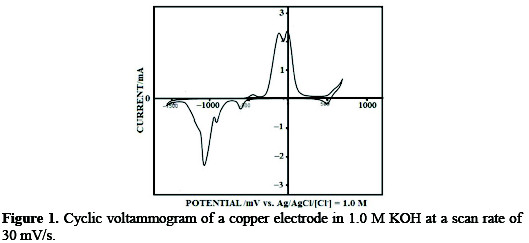
cleanliness [17]. A representative voltammogram of clean copper electrode under 
our experimental conditions is displayed in <a href="#f1">Fig. 1</a>.</p>


    <p>&nbsp;</p>
<a name="f1">
<img src="/img/revistas/pea/v34n4/34n4a03f1.jpg">
    
<p>&nbsp;</p>


    <p>The voltammogram shows 
almost all the voltammetric features reported for copper voltammogram under 
similar experimental conditions. The details of these features are reported 
elsewhere [17]. Further experimentation was performed on validated-clean 
copper surfaces.</p>


    ]]></body>
<body><![CDATA[<p><i>Weight loss experiments</i></p>

    <p>Weight-loss methodology for evaluation of the corrosion rate was conducted on 2 
cm long, 1 mm diameter copper wire specimens. The specimens were pre
weighed to the nearest 0.1 mg and placed in an Erlenmeyer flask containing 0.1 
M NaCl acidified with sulfuric acid to make a final pH of 2. The solutions were 
saturated with oxygen by continuous bubbling of oxygen into the solutions. The 
sulfuric acid-chloride solution was chosen as a corrosive medium, because, at 
one hand, sulfuric acid is widely used in copper plating industry, and, at the 
other, because the N-heterocyclic compounds are known as efficient inhibitors in 
sulfuric acid containing chloride ions [15].</p>

    <p>Copper specimens were subjected to a square wave potential regime, with a set 
of preset experimental conditions (i.e., frequency, amplitude, upper and lower 
values of the square wave, and concentration of PVP).</p>

    <p>The pre-weighed copper specimens were immersed in the above-mentioned 
corrosive medium for 72 h. At the end of the test period, the specimens were 
rinsed, dried, and re-weighed on the analytical balance.</p>

    <p>Corrosion rate determination was conducted on two groups of samples. The first 
was the control group, where copper specimens were exposed to the inhibitor for 
72 h. The second group included specimens which were subjected to square wave 
potential regimes in solutions containing PVP.</p>


    <p><i>Electrochemical corrosion measurements</i></p>

    <p>Electrochemical measurements involved three types of experiments. The first 
type involved reproducing the voltammogram of copper as an ''electrochemical 
signature'' for a clean non-oxidized polycrystalline copper surface. The second 
type of experiments involved investigation of adsorption of PVP at the copper 
electrode. The third type was concerned with polarization curves which were 
needed for calculation of the corrosion rate for the specimens subjected to the 
square wave potential regime and the control specimens. Electrochemical 
measurements were conducted in 1.0 M KOH solutions, because the 
voltammetric features are well-established in alkaline media rather than in acidic 
media [17].</p>


    <p>&nbsp;</p>
    <p><b>Results and discussion</b></p>

    <p><i><b>Adsorption of PVP on polycrystalline copper electrodes</b></i></p>

    ]]></body>
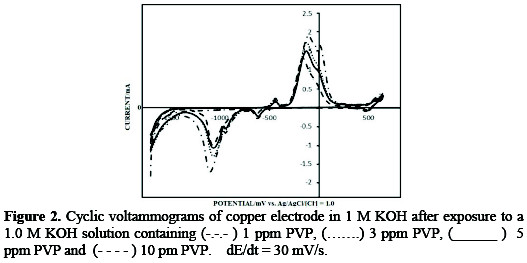
<body><![CDATA[<p><a href="#f2">Fig. 2</a> shows the cyclic voltammograms of copper polycrystalline electrode in a 
1.0 M KOH solution in addition to a variable concentration of PVP.</p>


    <p>&nbsp;</p>
<a name="f2">
<img src="/img/revistas/pea/v34n4/34n4a03f2.jpg">
    
<p>&nbsp;</p>


    <p>The voltammograms display all the well-known reported voltammetric features of 
polycrystalline copper recorded in a 1.0 M KOH solution. This indicates that 
PVP does not alter the surface energy states of copper, but merely adsorbs and 
blocks a part of the electrode surface.</p>

    <p>The voltammograms (<a href="#f2">Fig. 2</a>) show a monotonic decrease in the charge 
underneath all the peaks on the voltammograms with an increased concentration 
of PVP.</p>

    <p>This can be attributed to the decrease in the real surface area of the 
copper electrode. This, in fact, is a consequence of the adsorption of PVP 
molecules onto copper surface. This also explains in part the mechanism through 
which PVP inhibits corrosion. Recording the voltammograms in a PVP-free 1.0 
KOH solution, after exposure to the solutions containing PVP showed 
voltammograms that are identical to those recorded in the presence of PVP in the 
solutions. This observation indicates that PVP is stable on the copper surface and 
survives rinsing with purified water or a supporting electrolyte solution. This 
finding is a common belief that corrosion inhibitors inhibit corrosion by 
adsorption onto metal surfaces [14].</p>


    <p><i><b>Effect of applied square wave frequency on adsorption of PVP on copper surfaces</b></i></p>

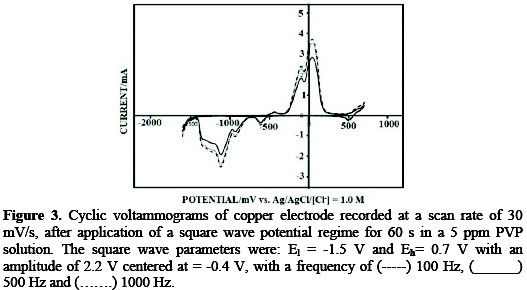
    <p><a href="#f3">Fig. 3</a> shows the cyclic voltammograms of a copper electrode, after exposure to 
PVP, with application of a square wave potential regime at different frequencies, 
under identical experimental conditions.</p>

    <p>&nbsp;</p>
<a name="f3">
<img src="/img/revistas/pea/v34n4/34n4a03f3.jpg">
    
<p>&nbsp;</p>


    ]]></body>
<body><![CDATA[<p>The voltammograms show a minimum 
charge underneath the voltammetric peaks of the copper electrode, upon 
application of a square wave with 500 Hz. Minimum charge underneath the 
voltammetric peaks is associated with maximum PVP coverage at the electrode 
surface.</p>

    <p>Thus, the 500 Hz frequency is the optimal frequency for application of square 
wave potential regimes to copper specimens for corrosion inhibition. The 500 Hz 
frequency presents an intermediate frequency between the two other investigated 
frequencies, 100 Hz and 1000 Hz.</p>

    <p>It is well known that, at high frequencies, the problems of charging current and 
ohmic potential drop prevent the electrode from acquiring the desired potential. 
At a lower frequency, 100 Hz, the number of pulses per unit time is lower than 
those at 500 Hz, which dictates a higher number of molecular rearrangements at 
the electrode surface. This decrease in the available surface area is expected to 
enhance corrosion inhibition.</p>


    <p><i><b>The effect of square wave frequency and exposure time on corrosion rate</b></i></p>

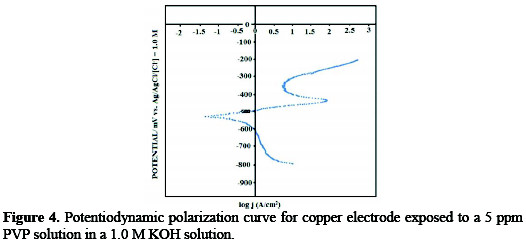
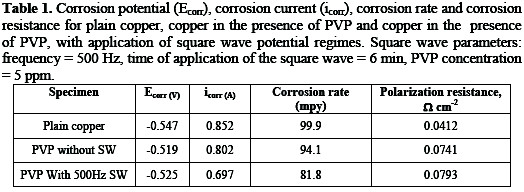
    <p>The effect of the square wave on corrosion rate was further explored by 
recording the polarization curves for plain copper, copper in presence of PVP, 
and copper in presence of PVP with application of the square wave (<a href="#f4">Fig. 4</a> shows 
a representative example).</p>


    <p>&nbsp;</p>
<a name="f4">
<img src="/img/revistas/pea/v34n4/34n4a03f4.jpg">
    
<p>&nbsp;</p>


    <p>The corrosion rates were calculated for the three 
aforementioned surfaces, and the results are given in <a href="#t1">Table 1</a>.</p>


    <p>&nbsp;</p>
<a name="t1">
<img src="/img/revistas/pea/v34n4/34n4a03t1.jpg">
    
<p>&nbsp;</p>


    ]]></body>
<body><![CDATA[<p>Linear polarization 
experiments were also conducted on plain copper, copper in presence of PVP and 
copper in presence of PVP with application of the square wave. From these 
experiments the polarization resistance was calculated for the three surfaces, and 
the results are also given in <a href="#t1">Table 1</a>. The results unequivocally show that there is 
an enhancement in corrosion inhibition upon application of the square wave to a 
copper electrode, in the presence of PVP.</p>

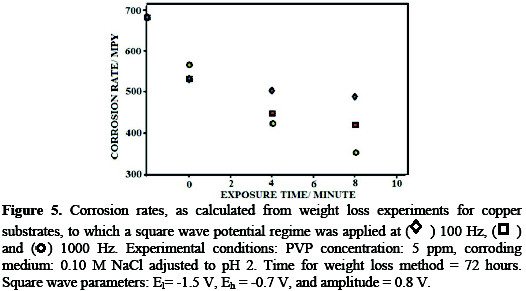
    <p>Moreover, the effect of square wave frequency and exposure time with 
application of the square wave was evaluated by weight-loss experiments, where 
the corrosion rates for copper specimens were calculated according to <a href="#e1">equation 1</a></p>


    <p>&nbsp;</p>
<a name="e1">
<img src="/img/revistas/pea/v34n4/34n4a03e1.jpg">
    
<p>&nbsp;</p>


    <p>where mpy is the corrosion rate in mils per year, w is the weight loss, A is the 
geometrical surface area of the electrode, &rho; is the density and t is the time of 
exposure to the inhibitor. The results of these experiments are shown in <a href="#f5">Fig. 5</a>.</p>


    <p>&nbsp;</p>
<a name="f5">
<img src="/img/revistas/pea/v34n4/34n4a03f5.jpg">
    
<p>&nbsp;</p>


    <p><a href="#f5">Fig. 5</a> shows a trend of enhancement of corrosion inhibition with an increased 
time of application of the square wave in presence of PVP. The influence of the 
increased exposure time on the corrosion rate can be explained as a result of the 
increased induced adsorption on the copper surface, caused by the application of 
the square wave (<a href="#f2">Fig. 2</a>). Explanation of the increased inhibition at 500 Hz and 
1000 Hz may rely on the increase of the number of adsorption desorption 
episodes from the surface per unit time with an increased frequency. The number 
of adsorption/desorption episodes at 1000 Hz, however, is offset by potential 
drop and charging current problems. This explains the closeness in the 
enhancement of corrosion inhibition upon application of 500 Hz and 1000 Hz 
square wave potential regimes. 

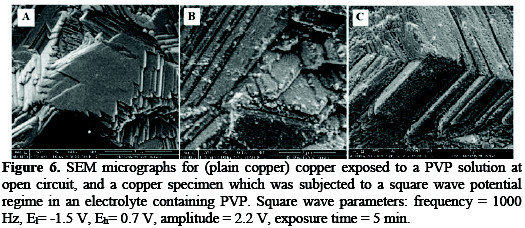
Scanning electron microscopy results 

<a href="#f6">Fig. 6</a> shows the SEM micrographs for a plain copper electrode, a copper 
substrate exposed to PVP under open circuit conditions and a copper substrate 
which was exposed to a PVP solution with the application of a square wave 
potential regime.</p>


    <p>&nbsp;</p>
<a name="f6">
<img src="/img/revistas/pea/v34n4/34n4a03f6.jpg">
    
<p>&nbsp;</p>


    ]]></body>
<body><![CDATA[<p>The SEM micrographs indicate transformation of PVP on the 
surface of copper, from scattered dendritic form to a uniform layer covering the 
surface of copper.</p>

    <p>This indicates that the phenomenological influence of the square wave emanates 
from the increased adsorption coverage of PVP on the copper surface. This might 
be due to a better alignment of the heteroatom dipoles at the copper surface, as a 
result of alternating episodes of forward and reverse steps of the square wave.</p>


    <p>&nbsp;</p>
    <p><b>Conclusions</b></p>

    <p>The present work has shown that application of a square wave potential regime to 
copper substrate decreases the rate of corrosion of copper and promotes 
inhibition efficiency of PVP. Adsorption of PVP was found to increase 
monotonically with the application time of the square wave potential regime. 
Adsorption of PVP at the copper surface was found to survive washing with 
water, or the supporting electrolyte solution. Rate of corrosion also was found to 
decrease upon application of square wave potential regimes in a PVP solution. 
Enhanced adsorption of PVP on the copper surface, and promotion of corrosion 
resistance by PVP, with the application of square wave potential regimes, may be 
explained on basis of enhanced PVP adsorption coverage induced by application 
of the square wave potential regime.</p>


    <p>&nbsp;</p>
    <p><b>References</b></p>

    <!-- ref --><p>1. Bard A, Faulkner L. Electrochemical methods: fundamentals and 
applications. 2nd ed. New York; 2001.    &nbsp;&nbsp;&nbsp;&nbsp;&nbsp;&nbsp;&nbsp;&nbsp;[&#160;<a href="javascript:void(0);" onclick="javascript: window.open('/scielo.php?script=sci_nlinks&ref=425185&pid=S0872-1904201600040000300001&lng=','','width=640,height=500,resizable=yes,scrollbars=1,menubar=yes,');">Links</a>&#160;]<!-- end-ref --></p>

    <!-- ref --><p>2. Hourani M, Wieckowski A. Langmuir. 1990;6:379.    &nbsp;&nbsp;&nbsp;&nbsp;&nbsp;&nbsp;&nbsp;&nbsp;[&#160;<a href="javascript:void(0);" onclick="javascript: window.open('/scielo.php?script=sci_nlinks&ref=425187&pid=S0872-1904201600040000300002&lng=','','width=640,height=500,resizable=yes,scrollbars=1,menubar=yes,');">Links</a>&#160;]<!-- end-ref --></p>

    <!-- ref --><p>3. Arvia A, Canullo JC, Custidiano E, et al. Electrochim Acta. 1986;31:1359.    &nbsp;&nbsp;&nbsp;&nbsp;&nbsp;&nbsp;&nbsp;&nbsp;[&#160;<a href="javascript:void(0);" onclick="javascript: window.open('/scielo.php?script=sci_nlinks&ref=425189&pid=S0872-1904201600040000300003&lng=','','width=640,height=500,resizable=yes,scrollbars=1,menubar=yes,');">Links</a>&#160;]<!-- end-ref --></p>

    <!-- ref --><p>4. Canullo J, Uchida Y, Lehmpfuhl G, et al. Surf Sci. 1987;188:350.    &nbsp;&nbsp;&nbsp;&nbsp;&nbsp;&nbsp;&nbsp;&nbsp;[&#160;<a href="javascript:void(0);" onclick="javascript: window.open('/scielo.php?script=sci_nlinks&ref=425191&pid=S0872-1904201600040000300004&lng=','','width=640,height=500,resizable=yes,scrollbars=1,menubar=yes,');">Links</a>&#160;]<!-- end-ref --></p>

    <!-- ref --><p>5. Hourani M, Waleed B. J Appl Electrochem. 2000;30:859.    &nbsp;&nbsp;&nbsp;&nbsp;&nbsp;&nbsp;&nbsp;&nbsp;[&#160;<a href="javascript:void(0);" onclick="javascript: window.open('/scielo.php?script=sci_nlinks&ref=425193&pid=S0872-1904201600040000300005&lng=','','width=640,height=500,resizable=yes,scrollbars=1,menubar=yes,');">Links</a>&#160;]<!-- end-ref --></p>

    <!-- ref --><p>6. Hourani M. J Electroanal Chem. 1994;368:139.    &nbsp;&nbsp;&nbsp;&nbsp;&nbsp;&nbsp;&nbsp;&nbsp;[&#160;<a href="javascript:void(0);" onclick="javascript: window.open('/scielo.php?script=sci_nlinks&ref=425195&pid=S0872-1904201600040000300006&lng=','','width=640,height=500,resizable=yes,scrollbars=1,menubar=yes,');">Links</a>&#160;]<!-- end-ref --></p>

    <!-- ref --><p>7. Hourani M, Hamdan T. Surf Eng Appl Electrochem. 2013;49:247.    &nbsp;&nbsp;&nbsp;&nbsp;&nbsp;&nbsp;&nbsp;&nbsp;[&#160;<a href="javascript:void(0);" onclick="javascript: window.open('/scielo.php?script=sci_nlinks&ref=425197&pid=S0872-1904201600040000300007&lng=','','width=640,height=500,resizable=yes,scrollbars=1,menubar=yes,');">Links</a>&#160;]<!-- end-ref --></p>

    <!-- ref --><p>8. Hourani M, Mahmood W. Afinidad. 2013;71:299.    &nbsp;&nbsp;&nbsp;&nbsp;&nbsp;&nbsp;&nbsp;&nbsp;[&#160;<a href="javascript:void(0);" onclick="javascript: window.open('/scielo.php?script=sci_nlinks&ref=425199&pid=S0872-1904201600040000300008&lng=','','width=640,height=500,resizable=yes,scrollbars=1,menubar=yes,');">Links</a>&#160;]<!-- end-ref --></p>

    <!-- ref --><p>9. Fontana M, Green N. Corrosion engineering. 1st ed. New York: Mc Graw Hill; 1967.    &nbsp;&nbsp;&nbsp;&nbsp;&nbsp;&nbsp;&nbsp;&nbsp;[&#160;<a href="javascript:void(0);" onclick="javascript: window.open('/scielo.php?script=sci_nlinks&ref=425201&pid=S0872-1904201600040000300009&lng=','','width=640,height=500,resizable=yes,scrollbars=1,menubar=yes,');">Links</a>&#160;]<!-- end-ref --></p>

    <!-- ref --><p>10. Charing T, Lansing F. Corrosion Sci. 1982;42:145.    &nbsp;&nbsp;&nbsp;&nbsp;&nbsp;&nbsp;&nbsp;&nbsp;[&#160;<a href="javascript:void(0);" onclick="javascript: window.open('/scielo.php?script=sci_nlinks&ref=425203&pid=S0872-1904201600040000300010&lng=','','width=640,height=500,resizable=yes,scrollbars=1,menubar=yes,');">Links</a>&#160;]<!-- end-ref --></p>

    <!-- ref --><p>11. Umoren SA, Eduok UM, Oguzie EE. Port Electrochim Acta. 2008;26:533.    &nbsp;&nbsp;&nbsp;&nbsp;&nbsp;&nbsp;&nbsp;&nbsp;[&#160;<a href="javascript:void(0);" onclick="javascript: window.open('/scielo.php?script=sci_nlinks&ref=425205&pid=S0872-1904201600040000300011&lng=','','width=640,height=500,resizable=yes,scrollbars=1,menubar=yes,');">Links</a>&#160;]<!-- end-ref --></p>

    <!-- ref --><p>12. Schweinsberg DP, Hope GA, Trueman A. Corrosion Sci. 1996;38:587.    &nbsp;&nbsp;&nbsp;&nbsp;&nbsp;&nbsp;&nbsp;&nbsp;[&#160;<a href="javascript:void(0);" onclick="javascript: window.open('/scielo.php?script=sci_nlinks&ref=425207&pid=S0872-1904201600040000300012&lng=','','width=640,height=500,resizable=yes,scrollbars=1,menubar=yes,');">Links</a>&#160;]<!-- end-ref --></p>

    <!-- ref --><p>13. Tian H, Li W, Cao K, et al. Corrosion Sci. 2013;73:281.    &nbsp;&nbsp;&nbsp;&nbsp;&nbsp;&nbsp;&nbsp;&nbsp;[&#160;<a href="javascript:void(0);" onclick="javascript: window.open('/scielo.php?script=sci_nlinks&ref=425209&pid=S0872-1904201600040000300013&lng=','','width=640,height=500,resizable=yes,scrollbars=1,menubar=yes,');">Links</a>&#160;]<!-- end-ref --></p>

    <!-- ref --><p>14. Finsgar M, Milosev I. Corrosion Sci. 2010;52:2737.    &nbsp;&nbsp;&nbsp;&nbsp;&nbsp;&nbsp;&nbsp;&nbsp;[&#160;<a href="javascript:void(0);" onclick="javascript: window.open('/scielo.php?script=sci_nlinks&ref=425211&pid=S0872-1904201600040000300014&lng=','','width=640,height=500,resizable=yes,scrollbars=1,menubar=yes,');">Links</a>&#160;]<!-- end-ref --></p>

    <!-- ref --><p>15. Thanapackiam P, Rameshkumar S, Subramanian SS, et al. Mater Chem Phys. 2016;174:129.    &nbsp;&nbsp;&nbsp;&nbsp;&nbsp;&nbsp;&nbsp;&nbsp;[&#160;<a href="javascript:void(0);" onclick="javascript: window.open('/scielo.php?script=sci_nlinks&ref=425213&pid=S0872-1904201600040000300015&lng=','','width=640,height=500,resizable=yes,scrollbars=1,menubar=yes,');">Links</a>&#160;]<!-- end-ref --></p>

    <!-- ref --><p>16. Antonijevic MM, Petrovic MB. Int J Electrochem Sci. 2008;3:1.    &nbsp;&nbsp;&nbsp;&nbsp;&nbsp;&nbsp;&nbsp;&nbsp;[&#160;<a href="javascript:void(0);" onclick="javascript: window.open('/scielo.php?script=sci_nlinks&ref=425215&pid=S0872-1904201600040000300016&lng=','','width=640,height=500,resizable=yes,scrollbars=1,menubar=yes,');">Links</a>&#160;]<!-- end-ref --></p>

    <!-- ref --><p>17. Ambrose J, Barradas R, Shoesmith D. J Electroanal Chem Interf Electrochem. 1973;47:47.    &nbsp;&nbsp;&nbsp;&nbsp;&nbsp;&nbsp;&nbsp;&nbsp;[&#160;<a href="javascript:void(0);" onclick="javascript: window.open('/scielo.php?script=sci_nlinks&ref=425217&pid=S0872-1904201600040000300017&lng=','','width=640,height=500,resizable=yes,scrollbars=1,menubar=yes,');">Links</a>&#160;]<!-- end-ref --></p>


    <p>&nbsp;</p>
    <p><a name=0></a><sup><a href="#top">*</a></sup>Corresponding author. E-mail address: <a href="mailto:mhourani@ju.edu.jo">mhourani@ju.edu.jo</a></p>

    <p>Received April 20, 2016; accepted July 15, 2016</p>

    <p><a href="http://www.peacta.org" target="_blank">www.peacta.org</a> </p>


     ]]></body><back>
<ref-list>
<ref id="B1">
<label>1</label><nlm-citation citation-type="">
<person-group person-group-type="author">
<name>
<surname><![CDATA[Bard]]></surname>
<given-names><![CDATA[A]]></given-names>
</name>
<name>
<surname><![CDATA[Faulkner]]></surname>
<given-names><![CDATA[L]]></given-names>
</name>
</person-group>
<source><![CDATA[Electrochemical methods: fundamentals and applications]]></source>
<year>2001</year>
<edition>2nd ed</edition>
<publisher-loc><![CDATA[New York ]]></publisher-loc>
</nlm-citation>
</ref>
<ref id="B2">
<label>2</label><nlm-citation citation-type="journal">
<person-group person-group-type="author">
<name>
<surname><![CDATA[Hourani]]></surname>
<given-names><![CDATA[M]]></given-names>
</name>
<name>
<surname><![CDATA[Wieckowski]]></surname>
<given-names><![CDATA[A]]></given-names>
</name>
</person-group>
<source><![CDATA[Langmuir]]></source>
<year>1990</year>
<volume>6</volume>
<page-range>379</page-range></nlm-citation>
</ref>
<ref id="B3">
<label>3</label><nlm-citation citation-type="journal">
<person-group person-group-type="author">
<name>
<surname><![CDATA[Arvia]]></surname>
<given-names><![CDATA[A]]></given-names>
</name>
<name>
<surname><![CDATA[Canullo]]></surname>
<given-names><![CDATA[J C]]></given-names>
</name>
<name>
<surname><![CDATA[Custidiano]]></surname>
<given-names><![CDATA[E]]></given-names>
</name>
</person-group>
<source><![CDATA[Electrochim Acta]]></source>
<year>1986</year>
<volume>31</volume>
<page-range>1359</page-range></nlm-citation>
</ref>
<ref id="B4">
<label>4</label><nlm-citation citation-type="journal">
<person-group person-group-type="author">
<name>
<surname><![CDATA[Canullo]]></surname>
<given-names><![CDATA[J]]></given-names>
</name>
<name>
<surname><![CDATA[Uchida]]></surname>
<given-names><![CDATA[Y]]></given-names>
</name>
<name>
<surname><![CDATA[Lehmpfuhl]]></surname>
<given-names><![CDATA[G]]></given-names>
</name>
</person-group>
<source><![CDATA[Surf Sci]]></source>
<year>1987</year>
<volume>188</volume>
<page-range>350</page-range></nlm-citation>
</ref>
<ref id="B5">
<label>5</label><nlm-citation citation-type="journal">
<person-group person-group-type="author">
<name>
<surname><![CDATA[Hourani]]></surname>
<given-names><![CDATA[M]]></given-names>
</name>
<name>
<surname><![CDATA[Waleed]]></surname>
<given-names><![CDATA[B]]></given-names>
</name>
</person-group>
<source><![CDATA[J Appl Electrochem]]></source>
<year>2000</year>
<volume>30</volume>
<page-range>859</page-range></nlm-citation>
</ref>
<ref id="B6">
<label>6</label><nlm-citation citation-type="journal">
<person-group person-group-type="author">
<name>
<surname><![CDATA[Hourani]]></surname>
<given-names><![CDATA[M]]></given-names>
</name>
</person-group>
<source><![CDATA[J Electroanal Chem]]></source>
<year>1994</year>
<volume>368</volume>
<page-range>139</page-range></nlm-citation>
</ref>
<ref id="B7">
<label>7</label><nlm-citation citation-type="journal">
<person-group person-group-type="author">
<name>
<surname><![CDATA[Hourani]]></surname>
<given-names><![CDATA[M]]></given-names>
</name>
<name>
<surname><![CDATA[Hamdan]]></surname>
<given-names><![CDATA[T]]></given-names>
</name>
</person-group>
<source><![CDATA[Surf Eng Appl Electrochem]]></source>
<year>2013</year>
<volume>49</volume>
<page-range>247</page-range></nlm-citation>
</ref>
<ref id="B8">
<label>8</label><nlm-citation citation-type="journal">
<person-group person-group-type="author">
<name>
<surname><![CDATA[Hourani]]></surname>
<given-names><![CDATA[M]]></given-names>
</name>
<name>
<surname><![CDATA[Mahmood]]></surname>
<given-names><![CDATA[W]]></given-names>
</name>
</person-group>
<source><![CDATA[Afinidad]]></source>
<year>2013</year>
<volume>71</volume>
<page-range>299</page-range></nlm-citation>
</ref>
<ref id="B9">
<label>9</label><nlm-citation citation-type="book">
<person-group person-group-type="author">
<name>
<surname><![CDATA[Fontana]]></surname>
<given-names><![CDATA[M]]></given-names>
</name>
<name>
<surname><![CDATA[Green]]></surname>
<given-names><![CDATA[N]]></given-names>
</name>
</person-group>
<source><![CDATA[Corrosion engineering]]></source>
<year>1967</year>
<edition>1st ed</edition>
<publisher-loc><![CDATA[New York ]]></publisher-loc>
<publisher-name><![CDATA[Mc Graw Hill]]></publisher-name>
</nlm-citation>
</ref>
<ref id="B10">
<label>10</label><nlm-citation citation-type="journal">
<person-group person-group-type="author">
<name>
<surname><![CDATA[Charing]]></surname>
<given-names><![CDATA[T]]></given-names>
</name>
<name>
<surname><![CDATA[Lansing]]></surname>
<given-names><![CDATA[F]]></given-names>
</name>
</person-group>
<source><![CDATA[Corrosion Sci]]></source>
<year>1982</year>
<volume>42</volume>
<page-range>145</page-range></nlm-citation>
</ref>
<ref id="B11">
<label>11</label><nlm-citation citation-type="journal">
<person-group person-group-type="author">
<name>
<surname><![CDATA[Umoren]]></surname>
<given-names><![CDATA[S A]]></given-names>
</name>
<name>
<surname><![CDATA[Eduok]]></surname>
<given-names><![CDATA[U M]]></given-names>
</name>
<name>
<surname><![CDATA[Oguzie]]></surname>
<given-names><![CDATA[E E]]></given-names>
</name>
</person-group>
<source><![CDATA[Port Electrochim Acta]]></source>
<year>2008</year>
<volume>26</volume>
<page-range>533</page-range></nlm-citation>
</ref>
<ref id="B12">
<label>12</label><nlm-citation citation-type="journal">
<person-group person-group-type="author">
<name>
<surname><![CDATA[Schweinsberg]]></surname>
<given-names><![CDATA[D P]]></given-names>
</name>
<name>
<surname><![CDATA[Hope]]></surname>
<given-names><![CDATA[G A]]></given-names>
</name>
<name>
<surname><![CDATA[Trueman]]></surname>
<given-names><![CDATA[A]]></given-names>
</name>
</person-group>
<source><![CDATA[Corrosion Sci]]></source>
<year>1996</year>
<volume>38</volume>
<page-range>587</page-range></nlm-citation>
</ref>
<ref id="B13">
<label>13</label><nlm-citation citation-type="journal">
<person-group person-group-type="author">
<name>
<surname><![CDATA[Tian]]></surname>
<given-names><![CDATA[H]]></given-names>
</name>
<name>
<surname><![CDATA[Li]]></surname>
<given-names><![CDATA[W]]></given-names>
</name>
<name>
<surname><![CDATA[Cao]]></surname>
<given-names><![CDATA[K]]></given-names>
</name>
</person-group>
<source><![CDATA[Corrosion Sci]]></source>
<year>2013</year>
<volume>73</volume>
<page-range>281</page-range></nlm-citation>
</ref>
<ref id="B14">
<label>14</label><nlm-citation citation-type="journal">
<person-group person-group-type="author">
<name>
<surname><![CDATA[Finsgar]]></surname>
<given-names><![CDATA[M]]></given-names>
</name>
<name>
<surname><![CDATA[Milosev]]></surname>
<given-names><![CDATA[I]]></given-names>
</name>
</person-group>
<source><![CDATA[Corrosion Sci]]></source>
<year>2010</year>
<volume>52</volume>
<page-range>2737</page-range></nlm-citation>
</ref>
<ref id="B15">
<label>15</label><nlm-citation citation-type="journal">
<person-group person-group-type="author">
<name>
<surname><![CDATA[Thanapackiam]]></surname>
<given-names><![CDATA[P]]></given-names>
</name>
<name>
<surname><![CDATA[Rameshkumar]]></surname>
<given-names><![CDATA[S]]></given-names>
</name>
<name>
<surname><![CDATA[Subramanian]]></surname>
<given-names><![CDATA[S S]]></given-names>
</name>
</person-group>
<source><![CDATA[Mater Chem Phys]]></source>
<year>2016</year>
<volume>174</volume>
<page-range>129</page-range></nlm-citation>
</ref>
<ref id="B16">
<label>16</label><nlm-citation citation-type="journal">
<person-group person-group-type="author">
<name>
<surname><![CDATA[Antonijevic]]></surname>
<given-names><![CDATA[M M]]></given-names>
</name>
<name>
<surname><![CDATA[Petrovic]]></surname>
<given-names><![CDATA[M B]]></given-names>
</name>
</person-group>
<source><![CDATA[Int J Electrochem Sci]]></source>
<year>2008</year>
<volume>3</volume>
<page-range>1</page-range></nlm-citation>
</ref>
<ref id="B17">
<label>17</label><nlm-citation citation-type="journal">
<person-group person-group-type="author">
<name>
<surname><![CDATA[Ambrose]]></surname>
<given-names><![CDATA[J]]></given-names>
</name>
<name>
<surname><![CDATA[Barradas]]></surname>
<given-names><![CDATA[R]]></given-names>
</name>
<name>
<surname><![CDATA[Shoesmith]]></surname>
<given-names><![CDATA[D]]></given-names>
</name>
</person-group>
<source><![CDATA[J Electroanal Chem Interf Electrochem]]></source>
<year>1973</year>
<volume>47</volume>
<page-range>47</page-range></nlm-citation>
</ref>
</ref-list>
</back>
</article>