<?xml version="1.0" encoding="ISO-8859-1"?><article xmlns:mml="http://www.w3.org/1998/Math/MathML" xmlns:xlink="http://www.w3.org/1999/xlink" xmlns:xsi="http://www.w3.org/2001/XMLSchema-instance">
<front>
<journal-meta>
<journal-id>0872-1904</journal-id>
<journal-title><![CDATA[Portugaliae Electrochimica Acta]]></journal-title>
<abbrev-journal-title><![CDATA[Port. Electrochim. Acta]]></abbrev-journal-title>
<issn>0872-1904</issn>
<publisher>
<publisher-name><![CDATA[Sociedade Portuguesa de Electroquímica]]></publisher-name>
</publisher>
</journal-meta>
<article-meta>
<article-id>S0872-19042016000400004</article-id>
<article-id pub-id-type="doi">10.4152/pea.201604277</article-id>
<title-group>
<article-title xml:lang="en"><![CDATA[Alternative Electrocoagulation for Livestock Wastewater Treatment]]></article-title>
</title-group>
<contrib-group>
<contrib contrib-type="author">
<name>
<surname><![CDATA[Pinedo-Hernandez]]></surname>
<given-names><![CDATA[Jose]]></given-names>
</name>
<xref ref-type="aff" rid="A01"/>
</contrib>
<contrib contrib-type="author">
<name>
<surname><![CDATA[Paternina-Uribe]]></surname>
<given-names><![CDATA[Roberth]]></given-names>
</name>
<xref ref-type="aff" rid="A01"/>
</contrib>
<contrib contrib-type="author">
<name>
<surname><![CDATA[Marrugo-Negrete]]></surname>
<given-names><![CDATA[Jose]]></given-names>
</name>
<xref ref-type="aff" rid="A01"/>
</contrib>
</contrib-group>
<aff id="A01">
<institution><![CDATA[,University of Cordoba Faculty of Basic Sciences Department of Chemistry]]></institution>
<addr-line><![CDATA[Monteria ]]></addr-line>
<country>Colombia</country>
</aff>
<pub-date pub-type="pub">
<day>00</day>
<month>07</month>
<year>2016</year>
</pub-date>
<pub-date pub-type="epub">
<day>00</day>
<month>07</month>
<year>2016</year>
</pub-date>
<volume>34</volume>
<numero>4</numero>
<fpage>277</fpage>
<lpage>285</lpage>
<copyright-statement/>
<copyright-year/>
<self-uri xlink:href="http://scielo.pt/scielo.php?script=sci_arttext&amp;pid=S0872-19042016000400004&amp;lng=en&amp;nrm=iso"></self-uri><self-uri xlink:href="http://scielo.pt/scielo.php?script=sci_abstract&amp;pid=S0872-19042016000400004&amp;lng=en&amp;nrm=iso"></self-uri><self-uri xlink:href="http://scielo.pt/scielo.php?script=sci_pdf&amp;pid=S0872-19042016000400004&amp;lng=en&amp;nrm=iso"></self-uri><abstract abstract-type="short" xml:lang="en"><p><![CDATA[This project assessed the technical feasibility of organic matter (COD) removal in livestock effluents, by electrocoagulation. An experimental design was used to block two factors at three levels, to evaluate the effect of the variables distance between electrodes and pH, using aluminum sacrificial electrodes. Maximum removal (90.16%) was obtained at 7 units pH, and 2.0 cm distance between electrodes. This study demonstrated the technical feasibility of electrocoagulation (EC) for the removal of organic matter as COD, present in wastewater from the livestock industry.]]></p></abstract>
<kwd-group>
<kwd lng="en"><![CDATA[Livestock effluents]]></kwd>
<kwd lng="en"><![CDATA[Electrocoagulation]]></kwd>
<kwd lng="en"><![CDATA[Chemical Oxygen Demand (COD)]]></kwd>
</kwd-group>
</article-meta>
</front><body><![CDATA[ 

<!--     <p>&nbsp;</p>
    <p>doi: 10.4152/pea.201604277</p> -->

    <p><b>Alternative Electrocoagulation for Livestock Wastewater Treatment</b></p>

    <p>
<b>Jose Pinedo-Hernandez</b><sup><a href="#0">*</a></sup>
, <b>Roberth Paternina-Uribe</b>
 and <b>Jose Marrugo-Negrete</b>
</p>

    <p><i> University of Cordoba, Faculty of Basic Sciences, Department of Chemistry, Water, Applied 
and Environmental Chemistry Group, Monteria, Colombia</i></p>


    <p>&nbsp;</p>
    <p><b>Abstract</b></p>

    <p>This project assessed the technical feasibility of organic matter (COD) removal in 
livestock effluents, by electrocoagulation. An experimental design was used to block 
two factors at three levels, to evaluate the effect of the variables distance between 
electrodes and pH, using aluminum sacrificial electrodes. Maximum removal (90.16%) 
was obtained at 7 units pH, and 2.0 cm distance between electrodes. This study 
demonstrated the technical feasibility of electrocoagulation (EC) for the removal of 
organic matter as COD, present in wastewater from the livestock industry.</p>

    <p><b><i>Keywords:</i></b> Livestock effluents, Electrocoagulation, Chemical Oxygen Demand (COD).</p>


    ]]></body>
<body><![CDATA[<p>&nbsp;</p>
    <p><b>Introduction</b></p>

    <p>Colombian livestock represents a very important sector for the economy's main 
axis of the Caribbean region, especially in the department of Cordoba, due to 
certain geographical conditions characteristic of the area [1]. In livestock 
industry, the wastewater generated as cattle bath product represents a great threat 
to the environment; it contains traces of recalcitrant pesticides, toxic compounds 
and high levels of organic matter [2]. Electrocoagulation (EC) may be used as an 
alternative system of wastewater treatment, because it is inexpensive, the 
equipment used is simple and of easy operation, compared to the conventional 
methods (chemical coagulation), no chemical substances are used, and produces 
large and more stable flocs than those formed by chemical coagulation [3, 4]. 
Electrocoagulation is receiving an increasing acceptance by industry, in view of 
its advantages compared to other methods. The method is based on anodic 
dissolution of metallic aluminium and the formation of aluminium ions in the 
vicinity of the anode, these ions being immediately converted to the 
corresponding hydroxides. The hydroxide, in the process of coagulation and 
flocculation, has highly adsorptive and adherent qualities, and is colloidally 
dispersed. When a current is passed through Al anodic dissolution, it takes place 
according to the following reaction:</p>


    <p>&nbsp;</p>
<a name="e1">
<img src="/img/revistas/pea/v34n4/34n4a04e1.jpg">
    
<p>&nbsp;</p>


    <p>Simultaneously, water is reduced at the cathode to hydrogen gas and hydroxyl 
ion (OH<sup>-</sup>)</p>


    <p>&nbsp;</p>
<a name="e2">
<img src="/img/revistas/pea/v34n4/34n4a04e2.jpg">
    
<p>&nbsp;</p>


    <p>Thus, electrocoagulation introduces metal cations in situ, electrochemically, 
using sacrificial anodes. Al<sup>3+</sup> hydrolyzes in water, forming the corresponding 
hydroxide; <a href="#e3">Eqs. (3)</a> - <a href="#e5">(5)</a> illustrate this, in the case of aluminium anode charge 
on the organic matter, which is responsible for the stability:</p>


    <p>&nbsp;</p>
<a name="e3">
<img src="/img/revistas/pea/v34n4/34n4a04e3.jpg">
    
]]></body>
<body><![CDATA[<p>&nbsp;</p>
<a name="e4">
<img src="/img/revistas/pea/v34n4/34n4a04e4.jpg">
    
<p>&nbsp;</p>
<a name="e5">
<img src="/img/revistas/pea/v34n4/34n4a04e5.jpg">
    
<p>&nbsp;</p>


    <p>The main objective of this study was to evaluate the removal of organic matter 
(COD) in livestock effluents by electrocoagulation, controlling pH and distance 
variables between electrodes.</p>

    <p>On this basis, it was expected that using Al anode would improve the process of 
electrocoagulation, through enhancing the rate of mass transfer of Al<sup>3+</sup> from the 
anode surface to the bulk solution, to be applied to continuous flow process. This 
would reduce the concentration of polarization, and hence, reduce the passivation 
tendency of the anode, which adversely affects the process of electrocoagulation.</p>


    <p>&nbsp;</p>
    <p><b>Materials and methods</b></p>

    <p><i><b>Sample collection and preservation</b></i></p>

    <p>Wastewater sample under study was taken from a cattle farm in the town of 
Monteria, Cordoba -Colombia, in a day of cattle bath. Effluents were collected 
in plastic tanks, sufficient for processing in the EC system. The processing was 
performed before and after pH treatment, and the COD analysis was based on 
Standard Methods 4500H B and 5220 D [5] procedures references. Initial pH 
and COD were 6.5 units and 680 mg L<sup>-1</sup>.</p>


    <p><i><b>Electrocoagulation cell</b></i></p>

    ]]></body>
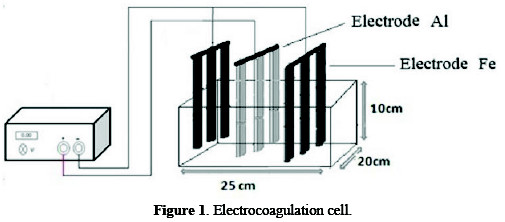
<body><![CDATA[<p><a href="#f1">Fig. 1</a> shows the experimental scheme of the EC process.</p>


    <p>&nbsp;</p>
<a name="f1">
<img src="/img/revistas/pea/v34n4/34n4a04f1.jpg">
    
<p>&nbsp;</p>


    <p>Volume was used for 
each 4.0 L test sample. Six iron electrodes in the reactor were used as cathodes, 
and three aluminium anodes with effective dimensions of 18 &times; 2.5 &times; 0.5 cm 
were connected to DC -PHYWE 0-50 V fluent potential. The entire submerged 
surface of every electrode was 25 cm<sup>2</sup>.</p>


    <p><i><b>Experimental design</b></i></p>

    <p>Statgraphics Centurion 15.2.06 software was used for the statistical design of 
experiments and data analysis. The two most important operating variables, 
initial wastewater pH (x1) and distance (x2), were optimized for both 
wastewaters. Their range and levels are shown in <a href="#t1">Table 1</a>.</p>


    <p>&nbsp;</p>
<a name="t1">
<img src="/img/revistas/pea/v34n4/34n4a04t1.jpg">
    
<p>&nbsp;</p>


    <p>Levels of every factor 
were evaluated in triplicate; there were 27 essays in the whole process. 
Percentage of COD removal was established as the response variable. Time and 
potential were 30 min and 50 V. Aluminium was used as sacrificial electrode. 
Fixed variables sets were selected based on tests conducted by Mestra and Pineda 
[6].</p>


    <p><i><b>Statistical analysis</b></i></p>

    ]]></body>
<body><![CDATA[<p>The data were submitted to ANOVA test, and mean comparisons were performed 
when needed using Tukey tests. Response Surface Methodology (RSM) was 
applied to evaluate the simple and combined effects of three independent 
parameters on removal and optimizing of the operating conditions. Statgraphics 
Centurion 15.2.06 statistical software was used for all analysis. A significance 
level of 0.05 was selected.</p>


    <p>&nbsp;</p>
    <p><b>Results and discussion</b></p>

    <p><i><b>COD removal function of pH and distance</b></i></p>

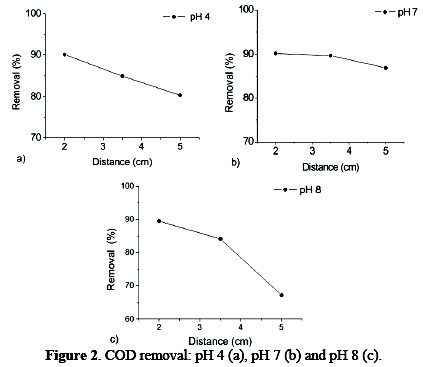
    <p>The removal of COD in function of pH and distance between electrodes is shown 
in <a href="#f2">Fig. 2</a>.</p>


    <p>&nbsp;</p>
<a name="f2">
<img src="/img/revistas/pea/v34n4/34n4a04f2.jpg">
    
<p>&nbsp;</p>


    <p>Removal values are higher than 80% at initial pH of 4 and 7, 
independently of distance. However, initial pH of 8 and 5 cm distance show 
67.21% removal (<a href="#f2">Fig. 2c</a>). It is observed that decreasing the distance between 
electrodes increases the removal of COD, reaching maximum values (&gt; 80%) at a 
distance of 2 cm for different pH values. This is possibly due to the electrostatic 
field formed during the electrocoagulation process, which depends on the distance 
between electrodes [7-8], and causes the metal ions production by the anode 
(sacrificial electrode): its function is to destabilize loads possessing contaminant 
particles present in water, neutralize the systems that keep the particles in 
suspension - allowing the formation of aggregates of contaminants, and initiating 
the coagulation process in less time, with higher removal [9].</p>

    <p><a href="#f2">Fig. 2b</a> shows that, at pH 7, COD removal decreases according to the distance, 
with no statistically significant difference (p &gt; 0.05), unlike pH 4 and 8, which 
have a statistically major difference (p &lt; 0.05). This can be attributed to pH &lt; 7, 
because the formed hydroxides are not stable enough to react with the aluminum 
cation, not allowing coagulant formation [10-12]. A pH near 7 facilitates the 
generation of hydroxyl radicals and, in its turn, the formation of agglomerates, 
which are ultimately removed from the solution [13]. With pH values &gt; 7 the 
oxidative potential in question decreases; this justifies the reduction in the 
removal of reactions involved in the process, and therefore, a decrease in pollutant 
removal [14].</p>


    <p><i><b>Optimization of the treatment conditions</b></i></p>

    ]]></body>
<body><![CDATA[<p>The application of RSM based on the parameters estimation generates the second 
order regression model, where the removal percentage of COD (y) and the 
independent variables studied are related (<a href="#e6">Eq. 6</a>).</p>


    <p>&nbsp;</p>
<a name="e6">
<img src="/img/revistas/pea/v34n4/34n4a04e6.jpg">
    
<p>&nbsp;</p>


    <p>The coefficient of determination (r<sup>2</sup>) was 0.843, which implies that 84.3 % of the 
variations in COD removal are explained through independent variables, and 
15.7 % of variations cannot be explained by the model. According to 
Montgomery [15], it is satisfactory that (r<sup>2</sup>) is at least 75%, when considering 
proceeding with the methodology. The model generates the optimum values for 
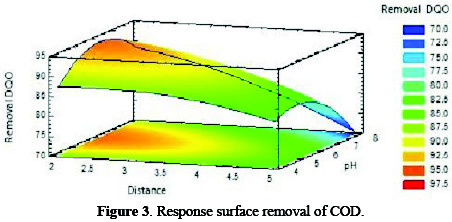
the maximum COD removal, as a function of pH and distance. The response 
surface calculated on the basis of the model (<a href="#f3">Fig. 3</a>) allows visualizing the 
behavior of the response variable, and clearly indicates the factors levels 
combination that leads to a maximum value.</p>


    <p>&nbsp;</p>
<a name="f3">
<img src="/img/revistas/pea/v34n4/34n4a04f3.jpg">
    
<p>&nbsp;</p>


    <p>In this study, it is observed that the 
best results are in the orange region, where factors interaction leads to results 
between 92.5 and 95 %.</p>

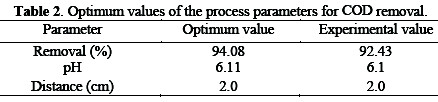
    <p>Significant differences were not observed (p &lt; 0.05) when the response was 
compared to the corresponding experimental value, which confirms that RSM 
can be used to optimize the process parameters (<a href="#t2">Table 2</a>).</p>


    <p>&nbsp;</p>
<a name="t2">
<img src="/img/revistas/pea/v34n4/34n4a04t2.jpg">
    
<p>&nbsp;</p>


    ]]></body>
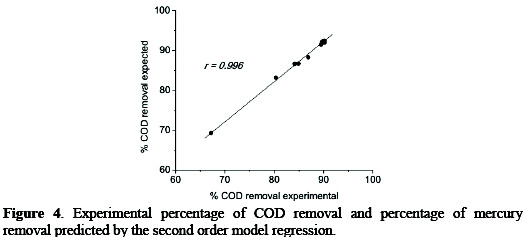
<body><![CDATA[<p>Additionally, it is 
observed that the results of the second order regression model present significant 
correlations with the experimentally obtained results (r=0.996, p=0.01, n=27; 
<a href="#f4">Fig. 4</a>).</p>


    <p>&nbsp;</p>
<a name="f4">
<img src="/img/revistas/pea/v34n4/34n4a04f4.jpg">
    
<p>&nbsp;</p>


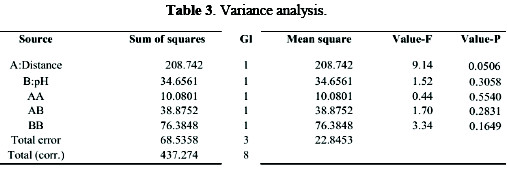
    <p>The variance analysis is shown in <a href="#t3">Table 3</a>.</p>


    <p>&nbsp;</p>
<a name="t3">
<img src="/img/revistas/pea/v34n4/34n4a04t3.jpg">
    
<p>&nbsp;</p>


    <p>It is observed that the independent 
variables are not statistically significant (p &gt; 0.05). However, the distance factor 
has a value close to 0.05, which can reveal the removal difference based on this 
factor.</p>

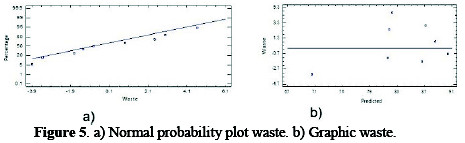
    <p>To assess the adequacy of the developed model, the difference between 
Experiment and Predicted (waste) response is used to graphically analyze the 
effectiveness of the model. Waste is considered as unexplained variations by the 
model, and they will have a normal distribution if the model accurately predicts 
normal residue probability graph and normal distribution. This should give a 
linear fashion, and graphic of residuals versus predicted values should represent a 
random pattern of residues around zero [16]. <a href="#f5">Fig. 5a</a> shows the normal probability 
graph waste for use as Al anode electrode in the optimization model for COD 
removal from effluents of livestock industry, where it meets the criteria of 
statistical normality by its linear trend.</p>


    <p>&nbsp;</p>
<a name="f5">
<img src="/img/revistas/pea/v34n4/34n4a04f5.jpg">
    
<p>&nbsp;</p>


    ]]></body>
<body><![CDATA[<p><a href="#f5">Fig. 5b</a> shows the graph of actual versus 
predicted residuals for the removal of COD, exhibiting a random pattern around 
zero waste, which represents a normal distribution.</p>

    <p>The electrical energy consumption was calculated in terms of KHz. E (kWh) = 
U &times; I &times; t /1000, where U is cell voltage (V), I is current (A), t is the time of EC (h). 
The implementation of EC unit in large scale level mainly depends on the 
treatment process cost. In order to find out the economy of the proposed 
treatment method, the economic evaluation was made in optimum operating 
conditions. It was found that the energy supplied to wastewater treatment by EC 
is 0.03 KHz, given that KHz price in Colombia ($ 349.7; $US 0.13) is $ 4.37 for 
volume of solution (0.004 m<sup>3</sup>), i.e., 1092.8 $/m<sup>3</sup> (0.39 $US/m<sup>3</sup>). Related to the 
consumption of Al per test (0.0643 g / L) by m<sup>3</sup> (64.25 g / m<sup>3</sup>), the A1 material 
price ($ 4313.7 / kg) is obtained by m<sup>3</sup> ($ 277.2 / m<sup>3</sup>; $ 0.11 US / m<sup>3</sup>). This result 
illustrates the economical feasibility of the proposed treatment in the on-field 
implementation, i.e., wastewater treatment plants (WTPâ€™s). pH and temperature 
should be taken into account to develop processes to improve electrocoagulation 
process. It has been determined in some cases that greater removal of a 
contaminant occurs within a specific pH range. This range can be even wider. In 
general, the literature indicates that the best removals were obtained for pH 
values close to 7, which improves electrocoagulation process [18].</p>

    <p>The pre treatment temperature was 28 &deg;C, and post treatment temperature 
increased 2 &deg;C. Chen [19] indicates that the system temperature must be lower 
than or equal to 60 &deg;C, to achieve greater removal.</p>


    <p>&nbsp;</p>
    <p><b>Conclusions</b></p>

    <p>Electrocoagulation (EC) and effluent treatment bath livestock is a technically 
viable alternative for the removal of organic matter as COD. The results showed 
that, for a distance between electrodes of 2 cm, COD removal percentage was 
significantly higher. The applied electrochemical treatment allowed the removal 
of COD in 90.16%, under conditions of optimal electrocoagulation: pH (7.0), 
distance (2 cm), voltage (50 V), time (30 min). These results indicated that 
electrochemical treatment process is an effective treatment method, in terms of 
removal efficiency, with reasonable operating costs.</p>


    <p>&nbsp;</p>
    <p><b>References</b></p>

    <!-- ref --><p>1. Lombana J, Martinez D, Valverde M, et al. Caracterization the livestock 
sector of the Colombian Caribbean. Editorial Universidad del Norte; 2012.    &nbsp;&nbsp;&nbsp;&nbsp;&nbsp;&nbsp;&nbsp;&nbsp;[&#160;<a href="javascript:void(0);" onclick="javascript: window.open('/scielo.php?script=sci_nlinks&ref=422201&pid=S0872-1904201600040000400001&lng=','','width=640,height=500,resizable=yes,scrollbars=1,menubar=yes,');">Links</a>&#160;]<!-- end-ref --></p>

    ]]></body>
<body><![CDATA[<!-- ref --><p>2. Barrios J, Yepez J. Evaluation model of solar photocatalytic degradation 
kinetic in a cpc reactor of pesticide used in the bathroom of cattle. 
Graduation Project: Universidad de Cartagena, Facultad de Ingenieria, 
Cartagena-Colombia; 2010.    &nbsp;&nbsp;&nbsp;&nbsp;&nbsp;&nbsp;&nbsp;&nbsp;[&#160;<a href="javascript:void(0);" onclick="javascript: window.open('/scielo.php?script=sci_nlinks&ref=422203&pid=S0872-1904201600040000400002&lng=','','width=640,height=500,resizable=yes,scrollbars=1,menubar=yes,');">Links</a>&#160;]<!-- end-ref --></p>

    <!-- ref --><p>3. Rios GB, Almerava F, Herrera MT. Port Electrochim Acta. 2005;23:17.    &nbsp;&nbsp;&nbsp;&nbsp;&nbsp;&nbsp;&nbsp;&nbsp;[&#160;<a href="javascript:void(0);" onclick="javascript: window.open('/scielo.php?script=sci_nlinks&ref=422205&pid=S0872-1904201600040000400003&lng=','','width=640,height=500,resizable=yes,scrollbars=1,menubar=yes,');">Links</a>&#160;]<!-- end-ref --></p>

    <!-- ref --><p>4. Holt PK, Barton GW, Mitchell CA. Chemosphere. 2005;59:355.    &nbsp;&nbsp;&nbsp;&nbsp;&nbsp;&nbsp;&nbsp;&nbsp;[&#160;<a href="javascript:void(0);" onclick="javascript: window.open('/scielo.php?script=sci_nlinks&ref=422207&pid=S0872-1904201600040000400004&lng=','','width=640,height=500,resizable=yes,scrollbars=1,menubar=yes,');">Links</a>&#160;]<!-- end-ref --></p>

    <!-- ref --><p>5. APHA, Standard Methods for the Examination of Water and Wastewater. 
21th ed. Washington, DC: American Public Health Association, American 
Water Works Association, Water Pollution Control Federation; 2005.    &nbsp;&nbsp;&nbsp;&nbsp;&nbsp;&nbsp;&nbsp;&nbsp;[&#160;<a href="javascript:void(0);" onclick="javascript: window.open('/scielo.php?script=sci_nlinks&ref=422209&pid=S0872-1904201600040000400005&lng=','','width=640,height=500,resizable=yes,scrollbars=1,menubar=yes,');">Links</a>&#160;]<!-- end-ref --></p>

    <!-- ref --><p>6. Mestra D, Pineda R. Electrocoagulacion como alternativa para el 
tratamiento de aguas residuales del bano de ganado bovino en el 
departamento de Cordoba. Universidad de Cordoba, Colombia; 2015.    &nbsp;&nbsp;&nbsp;&nbsp;&nbsp;&nbsp;&nbsp;&nbsp;[&#160;<a href="javascript:void(0);" onclick="javascript: window.open('/scielo.php?script=sci_nlinks&ref=422211&pid=S0872-1904201600040000400006&lng=','','width=640,height=500,resizable=yes,scrollbars=1,menubar=yes,');">Links</a>&#160;]<!-- end-ref --></p>

    ]]></body>
<body><![CDATA[<!-- ref --><p>7. Holt P, Barton G, Mitchell C. Electrocoagulation as a Wastewater 
Treatment. The Third Annual Australian Environmental Engineering 
Research Event; 1999.    &nbsp;&nbsp;&nbsp;&nbsp;&nbsp;&nbsp;&nbsp;&nbsp;[&#160;<a href="javascript:void(0);" onclick="javascript: window.open('/scielo.php?script=sci_nlinks&ref=422213&pid=S0872-1904201600040000400007&lng=','','width=640,height=500,resizable=yes,scrollbars=1,menubar=yes,');">Links</a>&#160;]<!-- end-ref --></p>

    <!-- ref --><p>8. Daneshvar N, Sorkhabi HA, Kasiri MB. J Hazard Mater. 2004;112:55.    &nbsp;&nbsp;&nbsp;&nbsp;&nbsp;&nbsp;&nbsp;&nbsp;[&#160;<a href="javascript:void(0);" onclick="javascript: window.open('/scielo.php?script=sci_nlinks&ref=422215&pid=S0872-1904201600040000400008&lng=','','width=640,height=500,resizable=yes,scrollbars=1,menubar=yes,');">Links</a>&#160;]<!-- end-ref --></p>

    <!-- ref --><p>9. Chen G. J Environ Eng. 2000;126:858.    &nbsp;&nbsp;&nbsp;&nbsp;&nbsp;&nbsp;&nbsp;&nbsp;[&#160;<a href="javascript:void(0);" onclick="javascript: window.open('/scielo.php?script=sci_nlinks&ref=422217&pid=S0872-1904201600040000400009&lng=','','width=640,height=500,resizable=yes,scrollbars=1,menubar=yes,');">Links</a>&#160;]<!-- end-ref --></p>

    <!-- ref --><p>10. Chen G. Sep Purifi Technol. 2004;38:11.    &nbsp;&nbsp;&nbsp;&nbsp;&nbsp;&nbsp;&nbsp;&nbsp;[&#160;<a href="javascript:void(0);" onclick="javascript: window.open('/scielo.php?script=sci_nlinks&ref=422219&pid=S0872-1904201600040000400010&lng=','','width=640,height=500,resizable=yes,scrollbars=1,menubar=yes,');">Links</a>&#160;]<!-- end-ref --></p>

    <!-- ref --><p>11. Kumar P, Chaudhari S, Khilar K, et al. Chemosphere. 2004;55:1245.    &nbsp;&nbsp;&nbsp;&nbsp;&nbsp;&nbsp;&nbsp;&nbsp;[&#160;<a href="javascript:void(0);" onclick="javascript: window.open('/scielo.php?script=sci_nlinks&ref=422221&pid=S0872-1904201600040000400011&lng=','','width=640,height=500,resizable=yes,scrollbars=1,menubar=yes,');">Links</a>&#160;]<!-- end-ref --></p>

    ]]></body>
<body><![CDATA[<!-- ref --><p>12. Bayramoglu M, Kobya M, Can O, et al. Sep Purif Rev. 2004;37:117.    &nbsp;&nbsp;&nbsp;&nbsp;&nbsp;&nbsp;&nbsp;&nbsp;[&#160;<a href="javascript:void(0);" onclick="javascript: window.open('/scielo.php?script=sci_nlinks&ref=422223&pid=S0872-1904201600040000400012&lng=','','width=640,height=500,resizable=yes,scrollbars=1,menubar=yes,');">Links</a>&#160;]<!-- end-ref --></p>

    <!-- ref --><p>13. Heidmann I, Calmano W. J Hazard Mater. 2008;152:934.    &nbsp;&nbsp;&nbsp;&nbsp;&nbsp;&nbsp;&nbsp;&nbsp;[&#160;<a href="javascript:void(0);" onclick="javascript: window.open('/scielo.php?script=sci_nlinks&ref=422225&pid=S0872-1904201600040000400013&lng=','','width=640,height=500,resizable=yes,scrollbars=1,menubar=yes,');">Links</a>&#160;]<!-- end-ref --></p>

    <!-- ref --><p>14. Linares I, Martinez V, Barrera C, et al. Avances Ciencias Ingenieria. 2011;2:21.    &nbsp;&nbsp;&nbsp;&nbsp;&nbsp;&nbsp;&nbsp;&nbsp;[&#160;<a href="javascript:void(0);" onclick="javascript: window.open('/scielo.php?script=sci_nlinks&ref=422227&pid=S0872-1904201600040000400014&lng=','','width=640,height=500,resizable=yes,scrollbars=1,menubar=yes,');">Links</a>&#160;]<!-- end-ref --></p>

    <!-- ref --><p>15. Montgomery DC. Design and analysis of experiments. Nebraska: John Wiley &amp; Sons; 2000.    &nbsp;&nbsp;&nbsp;&nbsp;&nbsp;&nbsp;&nbsp;&nbsp;[&#160;<a href="javascript:void(0);" onclick="javascript: window.open('/scielo.php?script=sci_nlinks&ref=422229&pid=S0872-1904201600040000400015&lng=','','width=640,height=500,resizable=yes,scrollbars=1,menubar=yes,');">Links</a>&#160;]<!-- end-ref --></p>

    <!-- ref --><p>16 Sarabia LA, Ortiz MC. Response surface methodology. In: Brown SD, 
Tauler R, Walczak B. editors. Comprehensive chemometrics. Oxford: 
Elsevier; 2009. pages 345-390.    &nbsp;&nbsp;&nbsp;&nbsp;&nbsp;&nbsp;&nbsp;&nbsp;[&#160;<a href="javascript:void(0);" onclick="javascript: window.open('/scielo.php?script=sci_nlinks&ref=422231&pid=S0872-1904201600040000400016&lng=','','width=640,height=500,resizable=yes,scrollbars=1,menubar=yes,');">Links</a>&#160;]<!-- end-ref --></p>

    ]]></body>
<body><![CDATA[<!-- ref --><p>17. Thirugnanasambandham K, Sivakumar V, Maran JJP. J Taiwan Inst Chem Eng. 2015;46:160.    &nbsp;&nbsp;&nbsp;&nbsp;&nbsp;&nbsp;&nbsp;&nbsp;[&#160;<a href="javascript:void(0);" onclick="javascript: window.open('/scielo.php?script=sci_nlinks&ref=422233&pid=S0872-1904201600040000400017&lng=','','width=640,height=500,resizable=yes,scrollbars=1,menubar=yes,');">Links</a>&#160;]<!-- end-ref --></p>

    <!-- ref --><p>18. Chen G. Sep Purif Technol. 2004;38:11.    &nbsp;&nbsp;&nbsp;&nbsp;&nbsp;&nbsp;&nbsp;&nbsp;[&#160;<a href="javascript:void(0);" onclick="javascript: window.open('/scielo.php?script=sci_nlinks&ref=422235&pid=S0872-1904201600040000400018&lng=','','width=640,height=500,resizable=yes,scrollbars=1,menubar=yes,');">Links</a>&#160;]<!-- end-ref --></p>

    <!-- ref --><p>19. Chen G, Chen X, Yue PL. J Environ Eng. 2000;858.    &nbsp;&nbsp;&nbsp;&nbsp;&nbsp;&nbsp;&nbsp;&nbsp;[&#160;<a href="javascript:void(0);" onclick="javascript: window.open('/scielo.php?script=sci_nlinks&ref=422237&pid=S0872-1904201600040000400019&lng=','','width=640,height=500,resizable=yes,scrollbars=1,menubar=yes,');">Links</a>&#160;]<!-- end-ref --></p>


    <p>&nbsp;</p>
    <p><b>Acknowledgements</b></p>

    <p>The authors wish to thank the Water, Applied and Environmental Chemistry 
Group, Laboratory of Toxicology and Environmental Management, University of 
Cordoba, Monteria-Colombia.</p>


    <p>&nbsp;</p>
    ]]></body>
<body><![CDATA[<p><a name=0></a><sup><a href="#top">*</a></sup>Corresponding author. E-mail address: <a href="mailto:josejph@hotmail.com">josejph@hotmail.com</a></p>

    <p>Received May 17, 2016; accepted August 23, 2016</p>

    <p><a href="http://www.peacta.org" target="_blank">www.peacta.org</a> </p>


     ]]></body><back>
<ref-list>
<ref id="B1">
<label>1</label><nlm-citation citation-type="book">
<person-group person-group-type="author">
<name>
<surname><![CDATA[Lombana]]></surname>
<given-names><![CDATA[J]]></given-names>
</name>
<name>
<surname><![CDATA[Martinez]]></surname>
<given-names><![CDATA[D]]></given-names>
</name>
<name>
<surname><![CDATA[Valverde]]></surname>
<given-names><![CDATA[M]]></given-names>
</name>
</person-group>
<source><![CDATA[Caracterization the livestock sector of the Colombian Caribbean]]></source>
<year>2012</year>
<publisher-name><![CDATA[Editorial Universidad del Norte]]></publisher-name>
</nlm-citation>
</ref>
<ref id="B2">
<label>2</label><nlm-citation citation-type="">
<person-group person-group-type="author">
<name>
<surname><![CDATA[Barrios]]></surname>
<given-names><![CDATA[J]]></given-names>
</name>
<name>
<surname><![CDATA[Yepez]]></surname>
<given-names><![CDATA[J]]></given-names>
</name>
</person-group>
<source><![CDATA[Evaluation model of solar photocatalytic degradation kinetic in a cpc reactor of pesticide used in the bathroom of cattle: Graduation Project]]></source>
<year>2010</year>
<publisher-loc><![CDATA[Cartagena ]]></publisher-loc>
</nlm-citation>
</ref>
<ref id="B3">
<label>3</label><nlm-citation citation-type="journal">
<person-group person-group-type="author">
<name>
<surname><![CDATA[Rios]]></surname>
<given-names><![CDATA[G B]]></given-names>
</name>
<name>
<surname><![CDATA[Almerava]]></surname>
<given-names><![CDATA[F]]></given-names>
</name>
<name>
<surname><![CDATA[Herrera]]></surname>
<given-names><![CDATA[M T]]></given-names>
</name>
</person-group>
<source><![CDATA[Port Electrochim Acta]]></source>
<year>2005</year>
<volume>23</volume>
<page-range>17</page-range></nlm-citation>
</ref>
<ref id="B4">
<label>4</label><nlm-citation citation-type="journal">
<person-group person-group-type="author">
<name>
<surname><![CDATA[Holt]]></surname>
<given-names><![CDATA[P K]]></given-names>
</name>
<name>
<surname><![CDATA[Barton]]></surname>
<given-names><![CDATA[G W]]></given-names>
</name>
<name>
<surname><![CDATA[Mitchell]]></surname>
<given-names><![CDATA[C A]]></given-names>
</name>
</person-group>
<source><![CDATA[Chemosphere]]></source>
<year>2005</year>
<volume>59</volume>
<page-range>355</page-range></nlm-citation>
</ref>
<ref id="B5">
<label>5</label><nlm-citation citation-type="book">
<collab>APHA</collab>
<source><![CDATA[Standard Methods for the Examination of Water and Wastewater]]></source>
<year>2005</year>
<edition>21th ed</edition>
<publisher-loc><![CDATA[Washington, DC ]]></publisher-loc>
<publisher-name><![CDATA[American Public Health Association, American Water Works Association, Water Pollution Control Federation]]></publisher-name>
</nlm-citation>
</ref>
<ref id="B6">
<label>6</label><nlm-citation citation-type="book">
<person-group person-group-type="author">
<name>
<surname><![CDATA[Mestra]]></surname>
<given-names><![CDATA[D]]></given-names>
</name>
<name>
<surname><![CDATA[Pineda]]></surname>
<given-names><![CDATA[R]]></given-names>
</name>
</person-group>
<source><![CDATA[Electrocoagulacion como alternativa para el tratamiento de aguas residuales del bano de ganado bovino en el departamento de Cordoba]]></source>
<year>2015</year>
<publisher-loc><![CDATA[Colombia ]]></publisher-loc>
<publisher-name><![CDATA[Universidad de Cordoba]]></publisher-name>
</nlm-citation>
</ref>
<ref id="B7">
<label>7</label><nlm-citation citation-type="confpro">
<person-group person-group-type="author">
<name>
<surname><![CDATA[Holt]]></surname>
<given-names><![CDATA[P]]></given-names>
</name>
<name>
<surname><![CDATA[Barton]]></surname>
<given-names><![CDATA[G]]></given-names>
</name>
<name>
<surname><![CDATA[Mitchell]]></surname>
<given-names><![CDATA[C]]></given-names>
</name>
</person-group>
<source><![CDATA[Electrocoagulation as a Wastewater Treatment]]></source>
<year>1999</year>
<conf-name><![CDATA[ The Third Annual Australian Environmental Engineering Research Event]]></conf-name>
<conf-loc> </conf-loc>
</nlm-citation>
</ref>
<ref id="B8">
<label>8</label><nlm-citation citation-type="journal">
<person-group person-group-type="author">
<name>
<surname><![CDATA[Daneshvar]]></surname>
<given-names><![CDATA[N]]></given-names>
</name>
<name>
<surname><![CDATA[Sorkhabi]]></surname>
<given-names><![CDATA[H A]]></given-names>
</name>
<name>
<surname><![CDATA[Kasiri]]></surname>
<given-names><![CDATA[M B]]></given-names>
</name>
</person-group>
<source><![CDATA[J Hazard Mater]]></source>
<year>2004</year>
<volume>112</volume>
<page-range>55</page-range></nlm-citation>
</ref>
<ref id="B9">
<label>9</label><nlm-citation citation-type="journal">
<person-group person-group-type="author">
<name>
<surname><![CDATA[Chen]]></surname>
<given-names><![CDATA[G]]></given-names>
</name>
</person-group>
<source><![CDATA[J Environ Eng]]></source>
<year>2000</year>
<volume>126</volume>
<page-range>858</page-range></nlm-citation>
</ref>
<ref id="B10">
<label>10</label><nlm-citation citation-type="journal">
<person-group person-group-type="author">
<name>
<surname><![CDATA[Chen]]></surname>
<given-names><![CDATA[G]]></given-names>
</name>
</person-group>
<source><![CDATA[Sep Purifi Technol]]></source>
<year>2004</year>
<volume>38</volume>
<page-range>11</page-range></nlm-citation>
</ref>
<ref id="B11">
<label>11</label><nlm-citation citation-type="journal">
<person-group person-group-type="author">
<name>
<surname><![CDATA[Kumar]]></surname>
<given-names><![CDATA[P]]></given-names>
</name>
<name>
<surname><![CDATA[Chaudhari]]></surname>
<given-names><![CDATA[S]]></given-names>
</name>
<name>
<surname><![CDATA[Khilar]]></surname>
<given-names><![CDATA[K]]></given-names>
</name>
</person-group>
<source><![CDATA[Chemosphere]]></source>
<year>2004</year>
<volume>55</volume>
<page-range>1245</page-range></nlm-citation>
</ref>
<ref id="B12">
<label>12</label><nlm-citation citation-type="journal">
<person-group person-group-type="author">
<name>
<surname><![CDATA[Bayramoglu]]></surname>
<given-names><![CDATA[M]]></given-names>
</name>
<name>
<surname><![CDATA[Kobya]]></surname>
<given-names><![CDATA[M]]></given-names>
</name>
<name>
<surname><![CDATA[Can]]></surname>
<given-names><![CDATA[O]]></given-names>
</name>
</person-group>
<source><![CDATA[Sep Purif Rev]]></source>
<year>2004</year>
<volume>37</volume>
<page-range>117</page-range></nlm-citation>
</ref>
<ref id="B13">
<label>13</label><nlm-citation citation-type="journal">
<person-group person-group-type="author">
<name>
<surname><![CDATA[Heidmann]]></surname>
<given-names><![CDATA[I]]></given-names>
</name>
<name>
<surname><![CDATA[Calmano]]></surname>
<given-names><![CDATA[W]]></given-names>
</name>
</person-group>
<source><![CDATA[J Hazard Mater]]></source>
<year>2008</year>
<volume>152</volume>
<page-range>934</page-range></nlm-citation>
</ref>
<ref id="B14">
<label>14</label><nlm-citation citation-type="journal">
<person-group person-group-type="author">
<name>
<surname><![CDATA[Linares]]></surname>
<given-names><![CDATA[I]]></given-names>
</name>
<name>
<surname><![CDATA[Martinez]]></surname>
<given-names><![CDATA[V]]></given-names>
</name>
<name>
<surname><![CDATA[Barrera]]></surname>
<given-names><![CDATA[C]]></given-names>
</name>
</person-group>
<source><![CDATA[Avances Ciencias Ingenieria]]></source>
<year>2011</year>
<volume>2</volume>
<page-range>21</page-range></nlm-citation>
</ref>
<ref id="B15">
<label>15</label><nlm-citation citation-type="book">
<person-group person-group-type="author">
<name>
<surname><![CDATA[Montgomery]]></surname>
<given-names><![CDATA[D C]]></given-names>
</name>
</person-group>
<source><![CDATA[Design and analysis of experiments]]></source>
<year>2000</year>
<publisher-loc><![CDATA[Nebraska ]]></publisher-loc>
<publisher-name><![CDATA[John Wiley & Sons]]></publisher-name>
</nlm-citation>
</ref>
<ref id="B16">
<label>16</label><nlm-citation citation-type="book">
<person-group person-group-type="author">
<name>
<surname><![CDATA[Sarabia]]></surname>
<given-names><![CDATA[L A]]></given-names>
</name>
<name>
<surname><![CDATA[Ortiz]]></surname>
<given-names><![CDATA[M C]]></given-names>
</name>
</person-group>
<source><![CDATA[Response surface methodology]]></source>
<year>2009</year>
<page-range>pages 345-390</page-range><publisher-loc><![CDATA[Oxford ]]></publisher-loc>
<publisher-name><![CDATA[Elsevier]]></publisher-name>
</nlm-citation>
</ref>
<ref id="B17">
<label>17</label><nlm-citation citation-type="journal">
<person-group person-group-type="author">
<name>
<surname><![CDATA[Thirugnanasambandham]]></surname>
<given-names><![CDATA[K]]></given-names>
</name>
<name>
<surname><![CDATA[Sivakumar]]></surname>
<given-names><![CDATA[V]]></given-names>
</name>
<name>
<surname><![CDATA[Maran]]></surname>
<given-names><![CDATA[J J P]]></given-names>
</name>
</person-group>
<source><![CDATA[J Taiwan Inst Chem Eng]]></source>
<year>2015</year>
<volume>46</volume>
<page-range>160</page-range></nlm-citation>
</ref>
<ref id="B18">
<label>18</label><nlm-citation citation-type="journal">
<person-group person-group-type="author">
<name>
<surname><![CDATA[Chen]]></surname>
<given-names><![CDATA[G]]></given-names>
</name>
</person-group>
<source><![CDATA[Sep Purif Technol]]></source>
<year>2004</year>
<volume>38</volume>
<page-range>11</page-range></nlm-citation>
</ref>
<ref id="B19">
<label>19</label><nlm-citation citation-type="journal">
<person-group person-group-type="author">
<name>
<surname><![CDATA[Chen]]></surname>
<given-names><![CDATA[G]]></given-names>
</name>
<name>
<surname><![CDATA[Chen]]></surname>
<given-names><![CDATA[X]]></given-names>
</name>
<name>
<surname><![CDATA[Yue]]></surname>
<given-names><![CDATA[P L]]></given-names>
</name>
</person-group>
<source><![CDATA[J Environ Eng]]></source>
<year>2000</year>
<page-range>858</page-range></nlm-citation>
</ref>
</ref-list>
</back>
</article>