<?xml version="1.0" encoding="ISO-8859-1"?><article xmlns:mml="http://www.w3.org/1998/Math/MathML" xmlns:xlink="http://www.w3.org/1999/xlink" xmlns:xsi="http://www.w3.org/2001/XMLSchema-instance">
<front>
<journal-meta>
<journal-id>0872-1904</journal-id>
<journal-title><![CDATA[Portugaliae Electrochimica Acta]]></journal-title>
<abbrev-journal-title><![CDATA[Port. Electrochim. Acta]]></abbrev-journal-title>
<issn>0872-1904</issn>
<publisher>
<publisher-name><![CDATA[Sociedade Portuguesa de Electroquímica]]></publisher-name>
</publisher>
</journal-meta>
<article-meta>
<article-id>S0872-19042016000500001</article-id>
<article-id pub-id-type="doi">10.4152/pea.201605295</article-id>
<title-group>
<article-title xml:lang="en"><![CDATA[The Need for a more Comprehensive Model for the Current Transient in Anomalous Electrochemical Deposition of Metal: Alloys Exemplified by Ni-Fe Co-deposition]]></article-title>
</title-group>
<contrib-group>
<contrib contrib-type="author">
<name>
<surname><![CDATA[Pires]]></surname>
<given-names><![CDATA[M. J. M.]]></given-names>
</name>
<xref ref-type="aff" rid="A01"/>
</contrib>
</contrib-group>
<aff id="A01">
<institution><![CDATA[,Universidade Federal dos Vales do Jequitinhonha e Mucuri (UFVJM) Instituto de Ciencia e Tecnologia ]]></institution>
<addr-line><![CDATA[Diamantina ]]></addr-line>
<country>Brazil</country>
</aff>
<pub-date pub-type="pub">
<day>00</day>
<month>09</month>
<year>2016</year>
</pub-date>
<pub-date pub-type="epub">
<day>00</day>
<month>09</month>
<year>2016</year>
</pub-date>
<volume>34</volume>
<numero>5</numero>
<fpage>295</fpage>
<lpage>308</lpage>
<copyright-statement/>
<copyright-year/>
<self-uri xlink:href="http://scielo.pt/scielo.php?script=sci_arttext&amp;pid=S0872-19042016000500001&amp;lng=en&amp;nrm=iso"></self-uri><self-uri xlink:href="http://scielo.pt/scielo.php?script=sci_abstract&amp;pid=S0872-19042016000500001&amp;lng=en&amp;nrm=iso"></self-uri><self-uri xlink:href="http://scielo.pt/scielo.php?script=sci_pdf&amp;pid=S0872-19042016000500001&amp;lng=en&amp;nrm=iso"></self-uri><abstract abstract-type="short" xml:lang="en"><p><![CDATA[Measurements of the electric current as a function of time during the electrochemical deposition of metals are usually treated considering models based on the Kolmogorov- Avrami theory or alternatives to it including hierarchical overlap of diffusion zones. These models explain the main tendencies of the nucleation and growth of the metallic deposits but still do not include details related to the anomalous deposition of metallic alloys, although the electrochemical methods are widely used for their production. In this work, a discussion of the several factors involved in this issue is presented to evidence the need for a more comprehensive model that may reach a complete quantitative description of electrodeposition of alloys including the anomalous phenomenon. Cyclic voltammetry as well as chronoamperometry measurements in a sulfate solution for Ni-Fe deposition were used to exemplify several aspects to be better understood and included in the model. Some Ni-Fe films were also deposited and characterized by scanning electron microscopy and ferromagnetic resonance to discuss some additional aspects as final composition and structure.]]></p></abstract>
<kwd-group>
<kwd lng="en"><![CDATA[electrochemical deposition]]></kwd>
<kwd lng="en"><![CDATA[anomalous co-deposition]]></kwd>
<kwd lng="en"><![CDATA[Ni-Fe alloys]]></kwd>
</kwd-group>
</article-meta>
</front><body><![CDATA[ 

<!--     <p>&nbsp;</p>
    <p>doi: 10.4152/pea.201605295</p> -->

    <p><b>The Need for a more Comprehensive Model for the Current 
Transient in Anomalous Electrochemical Deposition of Metal</p>

    <p>Alloys Exemplified by Ni-Fe Co-deposition</b></p>

    <p>
<b>M. J. M. Pires</b><sup><a href="#0">*</a></sup>
</p>

    <p><i> Instituto de Ciencia e Tecnologia - Universidade Federal dos Vales do Jequitinhonha e Mucuri 
(UFVJM), CEP 39100-000 Diamantina, Brazil</i></p>


    <p>&nbsp;</p>
    <p><b>Abstract</b></p>

    <p>Measurements of the electric current as a function of time during the electrochemical 
deposition of metals are usually treated considering models based on the Kolmogorov-
Avrami theory or alternatives to it including hierarchical overlap of diffusion zones. 
These models explain the main tendencies of the nucleation and growth of the metallic 
deposits but still do not include details related to the anomalous deposition of metallic 
alloys, although the electrochemical methods are widely used for their production. In 
this work, a discussion of the several factors involved in this issue is presented to 
evidence the need for a more comprehensive model that may reach a complete 
quantitative description of electrodeposition of alloys including the anomalous 
phenomenon. Cyclic voltammetry as well as chronoamperometry measurements in a 
sulfate solution for Ni-Fe deposition were used to exemplify several aspects to be better 
understood and included in the model. Some Ni-Fe films were also deposited and 
characterized by scanning electron microscopy and ferromagnetic resonance to discuss 
some additional aspects as final composition and structure.</p>

    ]]></body>
<body><![CDATA[<p><b><i>Keywords:</i></b> electrochemical deposition; anomalous co-deposition; Ni-Fe alloys.</p>


    <p>&nbsp;</p>
    <p><b>Introduction</b></p>

    <p>The electrochemical deposition of metals is employed for several purposes, from 
the strictly academic researches to the industrial usage. An area seen with 
particular interest by both the academic and industrial worlds is the 
manufacturing of electronic devices by electrochemical deposition of conductors. 
By the end of nineties, major manufactures of these devices changed from 
physical vapor methods of deposition to electrochemical deposition [1, 2]. Since 
then, another high-tech research and development field has emerged, the 
spintronics [3], which allies magnetic and electronic properties of miniaturized 
devices. In most of the cases these devices are based on thin films of metallic 
alloys of the iron group, and therefore can be also electrochemically produced. 
Despite of the vast use of the electrochemical deposition for the production of 
these alloys, there is still a number of issues not completely understood, as for 
instance details of the reactions involved in anomalous co-deposition [4-11]. 
Anomalous co-deposition is a common phenomenon occurring in several alloys, 
investigated mainly in alloys with elements of the iron group. The ''anomaly'' in 
this case is the preferential deposition of the less noble metal of the alloy, which 
incurs in relative concentrations in the deposits different from the ones in the 
solutions [2, 12, 13].</p>

    <p>Along the years, several studies have been made to explain the anomalous codeposition. 
Focusing on aqueous electrolytes, the studied aspects involve for 
instance the influence of the pH of the solutions [5, 11], the species which can 
possibly adsorb on the electrodes surfaces as hydroxyl and other ions present in 
the electrolytes [7, 10, 13, 14], the hydrogen evolution reactions [1, 7], the 
temperature of the ''bath'' (electrolyte solution) [5, 9], the dynamics of the 
solution [11, 13], and so on. Naturally, the physical properties of the deposits are 
affected by all these aspects, in particular the magnetic properties are sensibly 
altered by small changes of them [1, 4, 6, 15]. Therefore the strict control of the 
deposition conditions is essential for the adequate production of samples and 
devices intended to be used in spintronics, but also in other areas, of course. 
The way the deposits grow, mainly when we are dealing with thin films, has also 
great influence on their final physical properties. The characteristics of growth 
cannot be separated from the aspects commented in the previous paragraph, and 
also here some issues are not completely understood [16-18]. The metal 
incorporation from the solution to the electrode is normally treated through the 
Erdey-Gruz and Volmer approaches, which are used as base for the studies of the 
nucleation of the deposits [2]. Specific models for the nucleation can include 
progressive and or instantaneous nucleation, two or three dimensions for each 
nuclei, their overlap or not, etc. A direct way to follow these aspects is through in 
situ high resolution microscopy (e.g., AFM and STM), but much information can 
be also obtained studying the transient curves, i.e., curves of current as a function 
of time during deposition under constant electric potentials, a far more accessible 
technique than in situ microscopies. The theoretical model most used to deal with 
transient curves is known as ''standard model'' [18, 19], which provides a 
description of the growth process in good agreement with the experimental 
results. One of the basic principles of this model is the Kolmogorov-Avrami 
description for metal ions incorporation but considering planar diffusion zones 
[18-21]. Despite of the achievements of this approach in many aspects, it carries 
some imprecision by assuming uniform height for all diffusion zones [18]. An 
improvement of this approach is obtained when the model includes Monte Carlo 
simulations of the growth in the case of diffusion-controlled deposition [18, 22]. 
Although well succeed, these models have been used in the majority of the cases 
for the deposition of a single metallic element. A relatively smaller number of 
works presents transient curves for anomalous co-deposition of alloys and rarely 
analyzed with the standard model or its variations [17, 6, 23].</p>

    <p>In the present work, a study of the anomalous electrochemical deposition of Fe-
Ni alloys is presented. A sulfate solution has been employed for the deposition of 
thin films on Au substrates. Potentiostatic current-time transient curves are 
analyzed in the context discussed above. In the literature there is a large number 
of works on electrochemical deposition of these alloys, but few addressing the 
transient curve in more detail. Our motivation is to discuss these issues trying to 
bring to light the necessity of a more comprehensive model for the transient 
curves of growth, including the anomalous deposition of alloys. As the magnetic 
properties of these alloys are among the main motivations for their use in 
magneto-electronic devices, a magnetic characterization is also presented.</p>


    <p>&nbsp;</p>
    <p><b>Experimental</b></p>

    <p>Fe-Ni thin films have been electrochemically deposited in aqueous solutions on 
Au electrodes using a conventional three electrode cell with bi-distilled water. 
The electrolyte solutions (''baths'') were prepared with H3BO3 (0.4 M; J. T. 
Backer), FeSO4.7H2O (ACROS) and NiSO4.6H2O (J. T. Backer). Two 
concentrations of Fe and Ni sulfates, which will be called ''high'' (hc) and ''low'' 
concentrations (lc), have been used: hc corresponds to FeSO4.7H2O 0.02 M and 
NiSO4.6H2O 0.5 M, and lc corresponds to FeSO4.7H2O 0.007 M and 
NiSO4.6H2O 0.2 M. The pH was maintained in 3, corrected in some cases with 
drops of H2SO4.</p>

    <p>A pure Pt sheet was used as counter-electrode and Au films as working 
electrodes. These Au films were previously evaporated over sheets of mica 
cleaved immediately before the Au evaporation. The mica/Au substrates 
prepared in this way were flame annealed before to be immersed in the 
deposition solution. This kind of annealing is known to provide flat terraces on 
the Au surfaces which can reach hundreds of nanometers of extension [24, 25]. 
The electrode remained fixed during the procedures.</p>

    ]]></body>
<body><![CDATA[<p>An AMEL General-Propose potentiostat/galvanostat (Model 2029) has been used 
for the measurements of transient curves, cyclic voltammograms and control of 
the deposition. The electric potentials were measured relative to an AMEL 
saturated mercury-mercurous sulfate electrode (MSE). A scan rate of 20 mV/s 
was used for the acquisition of the voltammograms. Before each test and 
deposition procedures, the solutions were submitted to N2 bubbling for about 15 
minutes in order to reduce the amount of dissolved O2 gas.</p>

    <p>In the case for which more homogeneous films were deposited with sequences of 
60 s stages at constant potentials, scanning electron microscopy (SEM) and 
energy dispersive X-ray spectroscopy (EDX) analysis were performed with a 
Hitachi TM3030 microscope (15 kV). Ferromagnetic resonance was also used for 
the characterization of some of the samples; this analysis employed a Varian E15 
resonance spectrometer (9.4 GHz). All samples have been prepared and 
analyzed at room temperature.</p>


    <p>&nbsp;</p>
    <p><b>Results and discussion</b></p>

    <p><i><b>Electrochemical deposition</b></i></p>

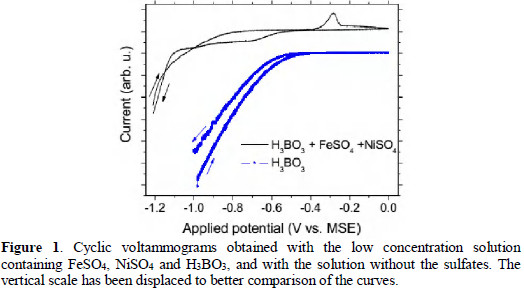
    <p>Typical cyclic voltammograms obtained are presented in <a href="#f1">Fig. 1</a>.</p>


    <p>&nbsp;</p>
<a name="f1">
<img src="/img/revistas/pea/v34n5/34n5a01f1.jpg">
    
<p>&nbsp;</p>


    <p>Comparing the 
results for the pure H3BO3 solution and the one including nickel and iron sulfates, 
we can see the ''peaks'' located between -1.2 and -0.5 V (MSE) are associated 
with the presence of the sulfates, whereas the downturn below -0.4 V (MSE) 
occurs also in the case without sulfates. This downturn in the curves is attributed 
to hydrogen evolution. In most of the cases, bubbles could be observed on the 
work electrode surface when the potential reached about -1 V (MSE). Hydrogen 
evolution is known to be concurrent with Fe and Ni electrodeposition in these 
conditions [7, 26], but its rate is retarded by the presence and deposition of the 
metallic ions [26, 27].</p>

    <p>Formerly, boric acid has been argued to act as a selective membrane which 
blocks the passage for the reduction of nickel but permits the reduction of iron in 
a retarded rate [27]. Nevertheless, more detailed studies [26] have indicated the 
presence of boric acid leading to an extension of the potential range of proton 
discharge to more negative potentials, which provides a wider potential range for 
plating without hydroxide precipitation. Indeed we have obtained Fe-Ni deposits 
at potentiostatic conditions for the whole range between -1.2 and -0.5 V (MSE), 
being the more homogeneous films prepared with constant potentials of -1 V 
(MSE), indicating this is a deposition peak overlapped with hydrogen evolution, 
whereas the peak at about -0.28 V is attributed to the dissolution of the Ni-Fe 
deposit. The hydrogen evolution increases rapidly as the potential reaches more 
negative values. The results presented here do not show any effect of the boric 
acid or borate ions involving electrons from the external circuit since no rise of 
the current has been measured other than the one associated to hydrogen 
evolution. Such effects would be expected for potential below -1 V MSE [26].</p>

    ]]></body>
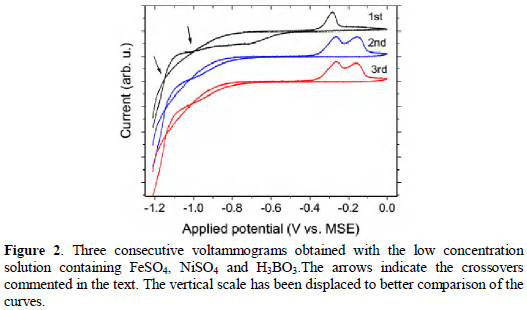
<body><![CDATA[<p>A series of consecutive cyclic voltammograms in ranges at low potentials is 
presented in <a href="#f2">Fig. 2</a>.</p>


    <p>&nbsp;</p>
<a name="f2">
<img src="/img/revistas/pea/v34n5/34n5a01f2.jpg">
    
<p>&nbsp;</p>


    <p>A second dissolution peak at -0.15 V appears in the second 
voltammogram. There are also changes in the region below -0.5 V. From the 2nd 
up to the 5th voltammogram there were no significant changes. Then, for this 
range of potentials and velocity of scans (20 mV/s), the first step of deposition is 
not reversible as the next step, being also an indication that a significant coverage 
of Au electrode has been promoted in the 1st stage and not completely removed in 
the cycle under the employed conditions. Furthermore, in the 1st cycle, the 
deposition extends along the range between -1.2 and -0.5 V MSE, while from 
the second on, the rise in the amount of current associated to deposition is seen 
only from -0.7 V (MSE) and below. The total charge associated to the deposition 
in the 1st cycle is significantly larger than in the next cycles, showing a maximum 
growth rate has occurred in the 1st cycle.</p>

    <p>Another aspect to be noted in these voltammograms is the occurrence of 
crossovers between the cathodic and anodic branches approximately at -1.15 and 
-1.00 V (MSE), which is a common phenomenon in electrodeposition of a 
metal-ion on a foreign substrate [2, 6, 28-30]. The deposition potential of metal-
ion on a substrate of the same metal is usually smaller than its deposition 
potential on substrates of distinct metals, therefore in cyclic voltammogram in 
which the deposit is not completely removed, there is the occurrence of 
crossovers. For this reason crossovers are normally considered as diagnostic for 
the nuclei formation on the electrode surface [2, 6, 28-30].</p>

    <p>In the cases the potential was maintained constant around -1 V, which will be 
discussed later, the maxima of the nucleation rate were observed between 3 and 
40 s. In the case presented in <a href="#f2">Fig. 2</a>, the system spends 35 s between -1.2 and 
-0.5 V.</p>

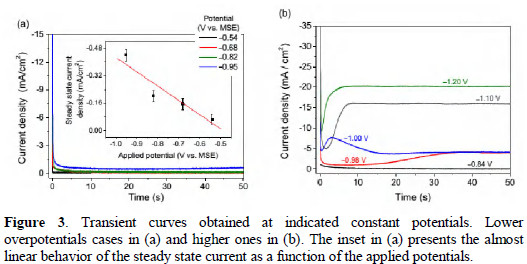
    <p>Typical transient curves obtained at constant potentials are presented in <a href="#f3">Fig. 3</a>.</p>


    <p>&nbsp;</p>
<a name="f3">
<img src="/img/revistas/pea/v34n5/34n5a01f3.jpg">
    
<p>&nbsp;</p>


    <p>For small values of the overpotentials, the curves have similar behaviors, as can 
be seen in <a href="#f3">Fig. 3(a)</a>. The initial peak in the current is associated to the charging of 
the double-layer and fast after it there is stabilization, with the current reaching a 
steady state value. This ending stable current is proportional to the applied 
potential (see inset in <a href="#f3">Fig. 3(a)</a>), following closely the expected behavior for 
small values of the overpotential [2]. For larger overpotentials, the transient 
curves change significantly as can be seen in <a href="#f3">Fig. 3(b)</a>. Typical current-time 
transient under a constant applied potential can be separated in three regions [6, 
31]. The first one, immediately after the turning on of the potentials, reflects the 
charging of the double layer (electrode-solution interface) and is a very sharp 
peak. After that, the deposition starts itself by the formation and growth of spread 
nuclei which increases the modulus of the current up to a local maximum where 
overlapping of the nuclei begins. This happens because when the overlaps take 
place, the electroactive area of the electrode will be smaller than in the instants 
before. The third region usually shows a decreasing behavior tending to a stable 
value of current which can occurs with some oscillations or in a more smooth 
way. The results of <a href="#f3">Fig. 3</a> show this typical behavior only for the applied 
potentials of -0.98 and -1.00 V, being more clear for -1.00 V. For -1.10 V and 
-1.20 V the maximum current modulus and the steady state value are practically 
the same. Following the conventional interpretation, this behavior can be 
indicating a tendency for instantaneous layer growth [2, 6, 31].</p>

    ]]></body>
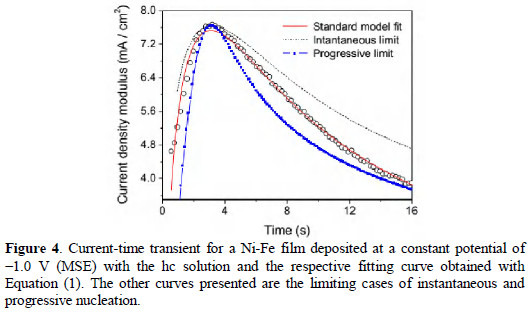
<body><![CDATA[<p><a href="#f4">Fig. 4</a> presents a comparison between the experimental transient for a Ni-Fe film 
deposited at a constant potential of -1.0 V (MSE) in the conditions commented 
above and theoretical transients following the Scharifker and Hills approach [18, 
32].</p>


    <p>&nbsp;</p>
<a name="f4">
<img src="/img/revistas/pea/v34n5/34n5a01f4.jpg">
    
<p>&nbsp;</p>


    <p>Three curves are presented for comparison, two representing the limiting 
cases for progressive and instantaneous nucleation and a third one, which has 
been fitted using <a href="#e1">Equation (1)</a>, for current density as a function of time t [18].</p>


    <p>&nbsp;</p>
<a name="e1">
<img src="/img/revistas/pea/v34n5/34n5a01e1.jpg">
    
<p>&nbsp;</p>


    <p> 
Simplified expressions for the limiting cases can be obtained using the 
experimental values of current and time corresponding to the maximum current, 
and calculating the limits when the ratio No/A tends to infinity (progressive) or to 
zero (instantaneous). No representing the initial number of electroactive sites per 
area of the electrode surface, A representing the nucleation frequency (nucleation 
rate constant), D the diffusion coefficient of the electrodepositing species in 
solution, and the product zF is the molar charge transferred. For the calculation 
of the limiting curves for progressive and instantaneous nucleation, the 
experimental values of the current density and time of point of maximum must be 
used.</p>

    <p>One can see our experimental results for Ni-Fe alloy are between the expected 
behaviors for the limiting cases, closer to the progressive behavior after the local 
maximum, but before the maximum we cannot say the results are clearly closer 
to instantaneous or to progressive nucleation. A better agreement between model 
and experimental results was clearly obtained when the expression has been 
fitted, without taking the limits. In the fitting procedure the metal ion 
concentration c, and molar volume of the deposit have been maintained fixed 
considering the values of the real experimental concentration and the estimated 
molar volume for permalloy (M/&rho; = 0.15 cm<sup>3</sup>/mol) [33]. The remained 
parameters were permitted to vary through a Levenbeg-Marquardt non-linear 
least squares fitting. The obtained parameters were: D = 1.0&times;10<sup>-5</sup> cm<sup>2</sup> s<sup>-1</sup>, No = 
1.8&times;10<sup>5</sup> cm<sup>-2</sup> and A = 11 s<sup>-1</sup>. The initial guess value for D in the fitting procedure 
has been 2.0&times;10<sup>-5</sup> cm<sup>2</sup> s<sup>-1</sup>, value which converted in the first step 
to 1.0&times;10<sup>-4</sup> cm<sup>2</sup> 
s<sup>-1</sup>. The behavior was similar to several initial values in the range between 
10<sup>-4</sup> cm<sup>2</sup> s<sup>-1</sup> and 10<sup>-6</sup> cm<sup>2</sup> s<sup>-1</sup>, 
but presents poor convergence for initial guess out 
of this range. Since <a href="#e1">Equation (1)</a> includes two exponential terms and the time 
interval is relatively short, not reaching asymptotical values, the numerical 
uncertainties of the fit are relatively large, and the values obtained must be taken 
only as estimates for the real parameters. These values correspond to a ratio No/A 
of 1.6&times;10<sup>4</sup> cm<sup>-2</sup> s<sup>1</sup>, which for sure is closer to the progressive than to the 
instantaneous growth limits [18, 23, 32].</p>

    <p>Although the approach above provides an adequate description of the 
experimental observations, not only for the Ni-Fe case exemplified here, some 
aspects of the model and its precision should be improved. In this sense, several 
works have been published recently addressing different aspects of the model 
[18, 23]. A first aspect to be noted is that not all the current flowing in the 
external circuit is related to ion deposition, since some intermediate reactions can 
be occurring, physisorption is very likely, some electrons can participate on the 
hydrogen evolution catalysis, etc. The current directly related to the deposit can 
be much lower than the total measured [1, 13]. Furthermore, as the system 
involves the deposition of two species, the diffusion coefficient of each one is not 
expected to be the same or even of the same order, particularly in the cases where 
anomalous deposition is significant. Diaz-Morales et al. [23] have recently 
proposed a model including the distinctions of the ions for diffusion-controlled 
growth of bimetallic phases. They have obtained <a href="#e2">Equation (2)</a>, 
where Dw = (z1D1&gamma;+ z2D2)/(&gamma;(z1x1 + z2x2)), Da = (&gamma;D1 + D2)/(&gamma;+ 1), C* = Î³C2*= C1* and k = 
(8&pi;C*(x1vm,1 + x2vm,2))1/2, the subscripts 1 and 2 referring to each ion. vm,i are 
molar volumes, Ci* the bulk concentrations, and xi the relative concentrations.</p>


    <p>&nbsp;</p>
<a name="e2">
<img src="/img/revistas/pea/v34n5/34n5a01e2.jpg">
    
]]></body>
<body><![CDATA[<p>&nbsp;</p>


    <p><a href="#e1">Equations (1)</a> and <a href="#e2">(2)</a> have the same mathematical form, in a way that fits 
obtained with any one of them are numerically equivalent for a bimetallic alloy. 
Providing a distinct result that shows the two species were deposited, naturally, 
<a href="#e2">Equation (2)</a> will be the most adequate one, but the individual diffusion 
coefficients must be known independently in order to use this equation for the 
determination of the separated parameters of each component. The authors of 
Ref. [23] have used independent results for Ag and Hg deposition in that case. 
The fundamental arguments to derive <a href="#e1">Equations (1)</a> and <a href="#e2">(2)</a> are essentially the 
whole process is diffusion-controlled, the diffusion of the nuclei is radial on flat 
surfaces following the Avrami theorem, and the rate of conversion (A) of active 
sites into growing nuclei is constant. The fitting of experimental results is usually 
very good numerically, but detailed analysis have shown there is an error of the 
order of few percent [18, 22], one of the motivations for the use of Monte Carlo 
simulations for the nucleation kinetics dealing hierarchically with the overlap of 
the diffusion zones of the deposits. Another important motivation for the use of 
these simulations is to avoid the assumption of uniform heights for all diffusion 
zones. The presence of microsteps in the electrode surface is not taken into 
account, usually.</p>

    <p>The use of a constant rate of conversion (nucleation rate) is questionable, 
especially when we know that the substrate is changing and when the electrode 
and deposits are composed by different metals or alloys. During the process, a 
number of ions (not only metallic ions) will reach the electrode surface, part of 
those ions will remain in contact with the electrode a certain time interval and 
may be incorporated or not, and all these stages will change along the time, and 
consequently A will be changed. These changes can be more significant if the 
adsorptions of intermediate species take part in the deposition. Practically all the 
proposed explanations for the anomalous deposition of alloys include one or 
more adsorbed intermediate species [5-13]. As the fitting of the transients 
involves exponential functions, if the changes in A are not abrupt, the numerical 
convergence tends to be good. The inclusion of a time dependence smooth in A 
will lead to expressions similar to <a href="#e1">Equations (1)</a> and <a href="#e2">(2)</a>, which would hardly 
provide additional information on this parameter. But the implications are 
analogous to the case of consider the partial currents in alloy deposition: if we 
know the effect is present, it is reasonable to include it in the approach, even if 
the numerical analysis does not furnish a direct evidence of the effect. 
Concerning the cause of the anomalous deposition itself, one can find different 
interpretations in the recent literature [5-11], which shows there is still some 
controversy about the phenomenon. Some works quote the formation of 
hydroxide of the less noble metal in the electrolyte hinders the discharges of the 
nobler one [11]. The hydrogen evolution is also argued to enhance the anomalous 
deposition [5, 7]. A more comprehensive work has been published previously by 
Zech et al. [12,13]. In this case the anomalous deposition was attributed to the 
adsorption and partial reduction of the ions followed by a second reaction of 
complete reduction and incorporation to the electrode surface, the rate of these 
side reactions are distinct for each metal-ion, in a way the deposition of the 
nobler ion is inhibited by the adsorption of the less noble and furthermore the 
presence of the nobler one in the electrolyte accelerate the deposition of the 
other, as a catalyst. These authors also presented experimental results 
corroborating their model with a final remark that, for the quantitative prediction 
of alloy composition, the application of the model is limited due to uncertainties 
in the reaction mechanisms [13]. In 2008, a similar model but including three 
adsorbed intermediates has been applied to the study of Fe deposition [14], and 
two of these intermediates species catalyze the H+ reduction. In this last case, the 
anomalous deposition is not treated but, if the mechanism proposed is valid, that 
should modify the model from Zech et al.</p>

    <p>More recently, another model for Co-Ni anomalous deposition has been 
presented [10], following a description similar to the one from Zech et al. with 
intermediate adsorption of partially reduced metal-ions. The use of this model on 
Co-Ni deposition on copper rotating disk electrode indicated the first reduction of 
Co(II) to Co(I)ads is much faster than the equivalent reduction of Ni(II), and the 
anomalous character of the deposition is essentially attributed to this aspect. 
Saying in another way, the anomalous deposition would be caused by the much 
faster charge transfer from the electrode to the less noble metal-ion than to the 
nobler one. In their analysis [10], those authors also bring to attention that the 
metal-ions are not the majority species in the solution, fact not always 
considered, and they also comment on the role B(OH)3 concluding its adsorption 
is negligible. The solution they have used is similar to the solutions employed 
here, as well as to the one employed by Zech et al.</p>

    <p>The faster or slower reduction of the intermediate species is naturally related 
with the heat of adsorption in each case. The reaction rates can be analyzed 
considering the energies of the ions in the solution via Maxwell distribution of 
velocities and comparing these energies with the heat of adsorption. Also the rate 
of collisions with the electrode surface of each ion can be inferred and details of 
the process discriminated. Concentrations and residence time of each adsorbate 
on the electrode surface should be also included in the description.</p>

    <p>In each of the cases discussed above, there is some intermediate adsorbed species 
which can affect the way of nucleation and growth process and the properties of 
the final deposited material. One can say these aspects are embedded in some 
extent in the parameters D and A of the standard model and its variations. D and 
A are global rates resulting in average from several intermediate stages of the 
deposition process. Although the major aspects of the current-time transients can 
be explained by these models, it is clear that for better understand of the 
phenomenon of anomalous deposition they should include the proposed causing 
mechanisms. The proposal from Diaz-Morales et al. [23], resulting in <a href="#e2">Equation (2)</a>, 
is a step forward such an improved model, but the other details commented 
above will certainly improve it further and may provide a complete 
understanding of each factor involved.</p>


    <p><i><b>Sample characterization</b></i></p>

    <p>Some Ni-Fe films (labeled samples #A, #B, #C, and #D) were produced by three 
successive steps of 60 s of electrochemical deposition at constant potentials with 
the high concentration solution, as discussed in the previous section. These films 
are intended to further studies of magneto-electronic devices and in this way are 
exploratory samples.</p>

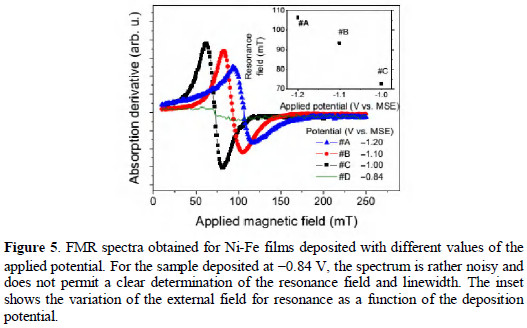
    <p>Magnetic characterization has been made by FMR; <a href="#f5">Fig. 5</a> presents some of the 
results.</p>


    <p>&nbsp;</p>
<a name="f5">
<img src="/img/revistas/pea/v34n5/34n5a01f5.jpg">
    
]]></body>
<body><![CDATA[<p>&nbsp;</p>


    <p>FMR is known to be a technique very sensitive for the local magnetic 
environment reflecting not only the magnetic ordering and anisotropies but also, 
indirectly, the crystalline structure of the samples [34, 35]. One can see in <a href="#f5">Fig. 5</a> 
the external field for resonance (''resonance field'') increases from about 0.073 to 
0.106 T when the deposition potential becomes more negative from -1.0 to -1.2 
V (MSE), the relation is approximately linear. The peak-to-peak linewidth 
remains between 0.018 and 0.024 T, which are values relatively small and of the 
same order of the ones obtained in polycrystalline Ni-Fe films produced by 
electron beam evaporation [36] and sputtering [37]. Since the magnetic 
inhomogeneity of the local field is mainly related to the polycrystallinity [34, 
35], the obtained linewidths indicate these films have a homogeneous crystalline 
structure. The change of the external field for resonance in its turn is related with 
the change in the composition of the samples as will be discussed below.</p>

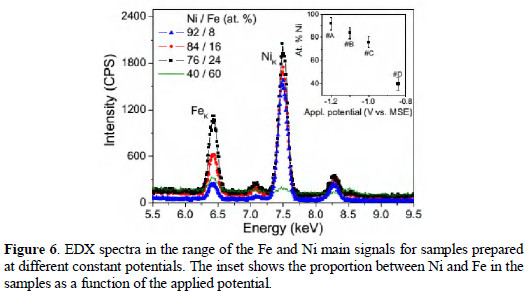
    <p>In <a href="#f6">Fig. 6</a> are presented EDX spectra obtained with the representative films quoted 
above.</p>


    <p>&nbsp;</p>
<a name="f6">
<img src="/img/revistas/pea/v34n5/34n5a01f6.jpg">
    
<p>&nbsp;</p>


    <p>The relative proportions of the Ni and Fe sulfates in the solutions were 
chosen based on the literature to provide the permalloy final composition 
Ni80Fe20 [8, 12, 15, 17, 38]. The Ni/Fe overall composition determined by EDX 
for these samples were: sample #A 92/8, sample #B 84/16; and sample #C 76/24 
at.% (uncertainties of the order of 5 at.%). These measured Ni/Fe proportions are 
the fingerprint of the anomalous deposition since a ratio of 96/4 has been used in 
the solution (sample #A can be seen as an exception because the values are 
approximately equivalent considering the EDX uncertainties). The applied 
potential for these samples were -1.20, -1.10 and -1.00 V (MSE), respectively 
for samples #A, #B and #C. Therefore, less negative was the applied potential, 
larger was the amount of Fe deposited. This is the same tendency reported by 
Llavona et al. in similar solutions but with saccharin as additive and pH = 2.3 [7]. 
Sample #D has been deposited with a constant potential of -0.84 V, resulting in a 
less uniform film with overall composition of 40/60 at.%, it is the same sample 
for which no clear FMR signal has been obtained, as commented. The films with 
84 and 76 at.% of Ni are the ones which presented more uniform deposits, i. e., 
more homogeneous composition along the sample area and smooth surface under 
typical MEV analysis. As the saturation magnetization of Ni-Fe alloys decreases 
almost linearly with the increase of the amount of Ni from 50 at.% to pure Ni 
[33], the change of the resonance field presented in <a href="#f5">Fig. 5</a> agrees with the 
compositions determined by EDX.</p>

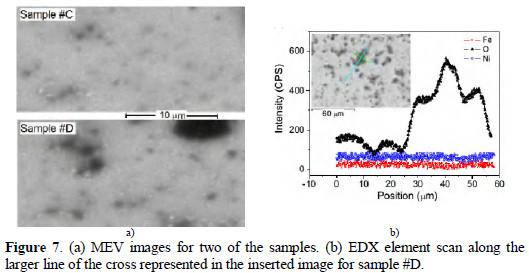
    <p>MEV representative images for samples #C and #D are presented in <a href="#f7">Fig. 7(a)</a>.</p>


    <p>&nbsp;</p>
<a name="f7">
<img src="/img/revistas/pea/v34n5/34n5a01f7.jpg">
    
<p>&nbsp;</p>


    <p>One can see sample #D presents more irregularities and large dark spots. Line 
EDX scans were collected along some of these spots and indicate a significant 
amount of oxygen on them, as shown in <a href="#f7">Fig. 7(b)</a>. Since oxygen is present in 
several components of the solution and can be also present as a dissolved gas not 
totally eliminated by the N2 bubbling, we cannot determine unequivocally the 
origin of the oxygen detected in the spots, however one has to note oxygen has 
fixed in significant amounts in the deposits only for applied potential of -0.84 V 
(MSE). As the measurement has been made ex situ, the samples were exposed to 
the air and an unavoidable adsorption of oxygen occurs, then a certain amount of 
oxygen is detected at any point of the sample surface (the equipment vacuum is 
of the order of 10<sup>-5</sup> mbar).</p>


    ]]></body>
<body><![CDATA[<p>&nbsp;</p>
    <p><b>Concluding remarks</b></p>

    <p>Due to the vast use of metallic alloys for technological applications, particularly 
the alloys of elements of the iron group, a better understanding of the process of 
their electrochemical deposition is of great interest, since electrodeposition is one 
of the methods most used for the production of these alloys. The composition and 
crystalline characteristics can be tuned varying the deposition parameters, as 
exemplified by the samples produced in this work, for which the applied 
potential during the deposition is the decisive parameter.</p>

    <p>From the presented results and from the literature, one realizes the main aspects 
of the nucleation and growth of metallic films electrochemically produced can be 
explained by the available models, particularly the so called standard model and 
its variations. However, there is not a universally accepted description for the 
causes of the anomalous deposition of alloys. In this way, the models for 
nucleation and growth must be extended to include different aspects of the 
anomalous deposition, as the distinct behavior of the parameters A and D for 
each metal of the alloy, as well as the influence of the intermediate adsorbates on 
them. A more comprehensive model including these features can be used to 
verify the several hypotheses for the anomaly leading to a better description of 
the process from both quantitative and qualitative points of view.</p>


    <p>&nbsp;</p>
    <p><b>References</b></p>

    <!-- ref --><p>1. Andricacos PC, Robertson N. IBM J Res Develop. 1998;42:671.    &nbsp;&nbsp;&nbsp;&nbsp;&nbsp;&nbsp;&nbsp;&nbsp;[&#160;<a href="javascript:void(0);" onclick="javascript: window.open('/scielo.php?script=sci_nlinks&ref=422508&pid=S0872-1904201600050000100001&lng=','','width=640,height=500,resizable=yes,scrollbars=1,menubar=yes,');">Links</a>&#160;]<!-- end-ref --></p>

    <!-- ref --><p>2. Paunovic M, Schlesinger M. Fundamentals of electrochemical deposition. 
New York: John Wiley &amp; Sons; 1998.    &nbsp;&nbsp;&nbsp;&nbsp;&nbsp;&nbsp;&nbsp;&nbsp;[&#160;<a href="javascript:void(0);" onclick="javascript: window.open('/scielo.php?script=sci_nlinks&ref=422510&pid=S0872-1904201600050000100002&lng=','','width=640,height=500,resizable=yes,scrollbars=1,menubar=yes,');">Links</a>&#160;]<!-- end-ref --></p>

    ]]></body>
<body><![CDATA[<!-- ref --><p>3. Fert A. Rev Mod Phys. 2008;80:1517.    &nbsp;&nbsp;&nbsp;&nbsp;&nbsp;&nbsp;&nbsp;&nbsp;[&#160;<a href="javascript:void(0);" onclick="javascript: window.open('/scielo.php?script=sci_nlinks&ref=422512&pid=S0872-1904201600050000100003&lng=','','width=640,height=500,resizable=yes,scrollbars=1,menubar=yes,');">Links</a>&#160;]<!-- end-ref --></p>

    <!-- ref --><p>4. Tebbakh S, Messaoudi Y, Azizi A, et al. Trans IMF. 2015:196.    &nbsp;&nbsp;&nbsp;&nbsp;&nbsp;&nbsp;&nbsp;&nbsp;[&#160;<a href="javascript:void(0);" onclick="javascript: window.open('/scielo.php?script=sci_nlinks&ref=422514&pid=S0872-1904201600050000100004&lng=','','width=640,height=500,resizable=yes,scrollbars=1,menubar=yes,');">Links</a>&#160;]<!-- end-ref --></p>

    <!-- ref --><p>5. Yang Y. Int J Electrochem Sci. 2015;10:5164.    &nbsp;&nbsp;&nbsp;&nbsp;&nbsp;&nbsp;&nbsp;&nbsp;[&#160;<a href="javascript:void(0);" onclick="javascript: window.open('/scielo.php?script=sci_nlinks&ref=422516&pid=S0872-1904201600050000100005&lng=','','width=640,height=500,resizable=yes,scrollbars=1,menubar=yes,');">Links</a>&#160;]<!-- end-ref --></p>

    <!-- ref --><p>6. Tebbakh S, Beniaiche A, Fenineche N, et al. Trans IMF. 2013:17.    &nbsp;&nbsp;&nbsp;&nbsp;&nbsp;&nbsp;&nbsp;&nbsp;[&#160;<a href="javascript:void(0);" onclick="javascript: window.open('/scielo.php?script=sci_nlinks&ref=422518&pid=S0872-1904201600050000100006&lng=','','width=640,height=500,resizable=yes,scrollbars=1,menubar=yes,');">Links</a>&#160;]<!-- end-ref --></p>

    <!-- ref --><p>7. Llavona A, Perez L, Sanchez MC, et al. Electrochim Acta. 2013;106:392.    &nbsp;&nbsp;&nbsp;&nbsp;&nbsp;&nbsp;&nbsp;&nbsp;[&#160;<a href="javascript:void(0);" onclick="javascript: window.open('/scielo.php?script=sci_nlinks&ref=422520&pid=S0872-1904201600050000100007&lng=','','width=640,height=500,resizable=yes,scrollbars=1,menubar=yes,');">Links</a>&#160;]<!-- end-ref --></p>

    ]]></body>
<body><![CDATA[<!-- ref --><p>8. Su X, Qiang C. Bull Mater Sci. 2012;35:183.    &nbsp;&nbsp;&nbsp;&nbsp;&nbsp;&nbsp;&nbsp;&nbsp;[&#160;<a href="javascript:void(0);" onclick="javascript: window.open('/scielo.php?script=sci_nlinks&ref=422522&pid=S0872-1904201600050000100008&lng=','','width=640,height=500,resizable=yes,scrollbars=1,menubar=yes,');">Links</a>&#160;]<!-- end-ref --></p>

    <!-- ref --><p>9. Lee T, Chang L, Chen C. Surf Coat. Tech. 2012;207:523.    &nbsp;&nbsp;&nbsp;&nbsp;&nbsp;&nbsp;&nbsp;&nbsp;[&#160;<a href="javascript:void(0);" onclick="javascript: window.open('/scielo.php?script=sci_nlinks&ref=422524&pid=S0872-1904201600050000100009&lng=','','width=640,height=500,resizable=yes,scrollbars=1,menubar=yes,');">Links</a>&#160;]<!-- end-ref --></p>

    <!-- ref --><p>10. Vazquez-Arenas J, Pritzker M. Electrochim Acta. 2012;66:139.    &nbsp;&nbsp;&nbsp;&nbsp;&nbsp;&nbsp;&nbsp;&nbsp;[&#160;<a href="javascript:void(0);" onclick="javascript: window.open('/scielo.php?script=sci_nlinks&ref=422526&pid=S0872-1904201600050000100010&lng=','','width=640,height=500,resizable=yes,scrollbars=1,menubar=yes,');">Links</a>&#160;]<!-- end-ref --></p>

    <!-- ref --><p>11. Abou-Krisha MM, Assaf FH, El-Naby SA. J Coat Technol Res. 2009;6:391.    &nbsp;&nbsp;&nbsp;&nbsp;&nbsp;&nbsp;&nbsp;&nbsp;[&#160;<a href="javascript:void(0);" onclick="javascript: window.open('/scielo.php?script=sci_nlinks&ref=422528&pid=S0872-1904201600050000100011&lng=','','width=640,height=500,resizable=yes,scrollbars=1,menubar=yes,');">Links</a>&#160;]<!-- end-ref --></p>

    <!-- ref --><p>12. Zech N, Podlaha EJ, Landolt D. J Electrochem Soc. 1999;146:2886.    &nbsp;&nbsp;&nbsp;&nbsp;&nbsp;&nbsp;&nbsp;&nbsp;[&#160;<a href="javascript:void(0);" onclick="javascript: window.open('/scielo.php?script=sci_nlinks&ref=422530&pid=S0872-1904201600050000100012&lng=','','width=640,height=500,resizable=yes,scrollbars=1,menubar=yes,');">Links</a>&#160;]<!-- end-ref --></p>

    ]]></body>
<body><![CDATA[<!-- ref --><p>13. Zech N, Podlaha EJ, Landolt D. J Electrochem Soc. 1999;146:2892.    &nbsp;&nbsp;&nbsp;&nbsp;&nbsp;&nbsp;&nbsp;&nbsp;[&#160;<a href="javascript:void(0);" onclick="javascript: window.open('/scielo.php?script=sci_nlinks&ref=422532&pid=S0872-1904201600050000100013&lng=','','width=640,height=500,resizable=yes,scrollbars=1,menubar=yes,');">Links</a>&#160;]<!-- end-ref --></p>

    <!-- ref --><p>14. Diaz SL, Calderon JA, Barcia OE, et al. Electrochim Acta. 2008;53:7426.    &nbsp;&nbsp;&nbsp;&nbsp;&nbsp;&nbsp;&nbsp;&nbsp;[&#160;<a href="javascript:void(0);" onclick="javascript: window.open('/scielo.php?script=sci_nlinks&ref=422534&pid=S0872-1904201600050000100014&lng=','','width=640,height=500,resizable=yes,scrollbars=1,menubar=yes,');">Links</a>&#160;]<!-- end-ref --></p>

    <!-- ref --><p>15. Gao LJ, Ma P, Novogradecz KM, et al. J Appl Phys. 1997;81:7595.    &nbsp;&nbsp;&nbsp;&nbsp;&nbsp;&nbsp;&nbsp;&nbsp;[&#160;<a href="javascript:void(0);" onclick="javascript: window.open('/scielo.php?script=sci_nlinks&ref=422536&pid=S0872-1904201600050000100015&lng=','','width=640,height=500,resizable=yes,scrollbars=1,menubar=yes,');">Links</a>&#160;]<!-- end-ref --></p>

    <!-- ref --><p>16. Guo L, Searson PC. Electrochim Acta. 2010;55:4086.    &nbsp;&nbsp;&nbsp;&nbsp;&nbsp;&nbsp;&nbsp;&nbsp;[&#160;<a href="javascript:void(0);" onclick="javascript: window.open('/scielo.php?script=sci_nlinks&ref=422538&pid=S0872-1904201600050000100016&lng=','','width=640,height=500,resizable=yes,scrollbars=1,menubar=yes,');">Links</a>&#160;]<!-- end-ref --></p>

    <!-- ref --><p>17. Su C, He F, Ju H, et al. Electrochim Acta. 2009;54:6257.    &nbsp;&nbsp;&nbsp;&nbsp;&nbsp;&nbsp;&nbsp;&nbsp;[&#160;<a href="javascript:void(0);" onclick="javascript: window.open('/scielo.php?script=sci_nlinks&ref=422540&pid=S0872-1904201600050000100017&lng=','','width=640,height=500,resizable=yes,scrollbars=1,menubar=yes,');">Links</a>&#160;]<!-- end-ref --></p>

    ]]></body>
<body><![CDATA[<!-- ref --><p>18. Mazaira D. BorrAs C, Mostany J, et al. The development of theoretical 
models for multiple nucleation with diffusion-controlled three dimensional 
growth. In: Huizar LHM, editor. Theoretical and experimental advances in 
electrodeposition. Kerala: Research Signpost, 2008; 1-23.    &nbsp;&nbsp;&nbsp;&nbsp;&nbsp;&nbsp;&nbsp;&nbsp;[&#160;<a href="javascript:void(0);" onclick="javascript: window.open('/scielo.php?script=sci_nlinks&ref=422542&pid=S0872-1904201600050000100018&lng=','','width=640,height=500,resizable=yes,scrollbars=1,menubar=yes,');">Links</a>&#160;]<!-- end-ref --></p>

    <!-- ref --><p>19. Schariffker BR, Mostany J. J Electroanal Chem. 1984;177:13.    &nbsp;&nbsp;&nbsp;&nbsp;&nbsp;&nbsp;&nbsp;&nbsp;[&#160;<a href="javascript:void(0);" onclick="javascript: window.open('/scielo.php?script=sci_nlinks&ref=422544&pid=S0872-1904201600050000100019&lng=','','width=640,height=500,resizable=yes,scrollbars=1,menubar=yes,');">Links</a>&#160;]<!-- end-ref --></p>

    <!-- ref --><p>20. Bostanov V, Obretenov W, Staikov G, et al. J Cryst Growth. 1981;52:761.    &nbsp;&nbsp;&nbsp;&nbsp;&nbsp;&nbsp;&nbsp;&nbsp;[&#160;<a href="javascript:void(0);" onclick="javascript: window.open('/scielo.php?script=sci_nlinks&ref=422546&pid=S0872-1904201600050000100020&lng=','','width=640,height=500,resizable=yes,scrollbars=1,menubar=yes,');">Links</a>&#160;]<!-- end-ref --></p>

    <!-- ref --><p>21. Bostanov V, Obretenov W, Staikov G, et al. J Electroanal Chem. 1983;146:303.    &nbsp;&nbsp;&nbsp;&nbsp;&nbsp;&nbsp;&nbsp;&nbsp;[&#160;<a href="javascript:void(0);" onclick="javascript: window.open('/scielo.php?script=sci_nlinks&ref=422548&pid=S0872-1904201600050000100021&lng=','','width=640,height=500,resizable=yes,scrollbars=1,menubar=yes,');">Links</a>&#160;]<!-- end-ref --></p>

    <!-- ref --><p>22. Matthijs E, Langerock S, Michailova E, et al. J Electroanal Chem. 2004;570:123.    &nbsp;&nbsp;&nbsp;&nbsp;&nbsp;&nbsp;&nbsp;&nbsp;[&#160;<a href="javascript:void(0);" onclick="javascript: window.open('/scielo.php?script=sci_nlinks&ref=422550&pid=S0872-1904201600050000100022&lng=','','width=640,height=500,resizable=yes,scrollbars=1,menubar=yes,');">Links</a>&#160;]<!-- end-ref --></p>

    ]]></body>
<body><![CDATA[<!-- ref --><p>23. Diaz-Morales O, Mostany J, Borras C, et al. J. Solid State Electrochem. 2013;17:345.    &nbsp;&nbsp;&nbsp;&nbsp;&nbsp;&nbsp;&nbsp;&nbsp;[&#160;<a href="javascript:void(0);" onclick="javascript: window.open('/scielo.php?script=sci_nlinks&ref=422552&pid=S0872-1904201600050000100023&lng=','','width=640,height=500,resizable=yes,scrollbars=1,menubar=yes,');">Links</a>&#160;]<!-- end-ref --></p>

    <!-- ref --><p>24. Bucher JP, Santesson L, Kern K. Langmuir. 1994;10:979.    &nbsp;&nbsp;&nbsp;&nbsp;&nbsp;&nbsp;&nbsp;&nbsp;[&#160;<a href="javascript:void(0);" onclick="javascript: window.open('/scielo.php?script=sci_nlinks&ref=422554&pid=S0872-1904201600050000100024&lng=','','width=640,height=500,resizable=yes,scrollbars=1,menubar=yes,');">Links</a>&#160;]<!-- end-ref --></p>

    <!-- ref --><p>25. Bubendorff JL, Beaurepaire E, Meny C, et al. Phys Rev B. 1997;56:R7120.    &nbsp;&nbsp;&nbsp;&nbsp;&nbsp;&nbsp;&nbsp;&nbsp;[&#160;<a href="javascript:void(0);" onclick="javascript: window.open('/scielo.php?script=sci_nlinks&ref=422556&pid=S0872-1904201600050000100025&lng=','','width=640,height=500,resizable=yes,scrollbars=1,menubar=yes,');">Links</a>&#160;]<!-- end-ref --></p>

    <!-- ref --><p>26. Zech N, Landolt D. Electrochim Acta. 2000;45:3461.    &nbsp;&nbsp;&nbsp;&nbsp;&nbsp;&nbsp;&nbsp;&nbsp;[&#160;<a href="javascript:void(0);" onclick="javascript: window.open('/scielo.php?script=sci_nlinks&ref=422558&pid=S0872-1904201600050000100026&lng=','','width=640,height=500,resizable=yes,scrollbars=1,menubar=yes,');">Links</a>&#160;]<!-- end-ref --></p>

    <!-- ref --><p>27. Yin K-M, Lin B-T. Surf Coat Technol. 1995;78:205.    &nbsp;&nbsp;&nbsp;&nbsp;&nbsp;&nbsp;&nbsp;&nbsp;[&#160;<a href="javascript:void(0);" onclick="javascript: window.open('/scielo.php?script=sci_nlinks&ref=422560&pid=S0872-1904201600050000100027&lng=','','width=640,height=500,resizable=yes,scrollbars=1,menubar=yes,');">Links</a>&#160;]<!-- end-ref --></p>

    ]]></body>
<body><![CDATA[<!-- ref --><p>28. Bento FR, Mascaro LH. Surf Coat Technol. 2006;201:1752.    &nbsp;&nbsp;&nbsp;&nbsp;&nbsp;&nbsp;&nbsp;&nbsp;[&#160;<a href="javascript:void(0);" onclick="javascript: window.open('/scielo.php?script=sci_nlinks&ref=422562&pid=S0872-1904201600050000100028&lng=','','width=640,height=500,resizable=yes,scrollbars=1,menubar=yes,');">Links</a>&#160;]<!-- end-ref --></p>

    <!-- ref --><p>29. Yang M, Hu Z. J Electroanal Chem. 2005;583:46.    &nbsp;&nbsp;&nbsp;&nbsp;&nbsp;&nbsp;&nbsp;&nbsp;[&#160;<a href="javascript:void(0);" onclick="javascript: window.open('/scielo.php?script=sci_nlinks&ref=422564&pid=S0872-1904201600050000100029&lng=','','width=640,height=500,resizable=yes,scrollbars=1,menubar=yes,');">Links</a>&#160;]<!-- end-ref --></p>

    <!-- ref --><p>30. Grujicic D, Pesic B. Electrochim Acta. 2002;47:2901.    &nbsp;&nbsp;&nbsp;&nbsp;&nbsp;&nbsp;&nbsp;&nbsp;[&#160;<a href="javascript:void(0);" onclick="javascript: window.open('/scielo.php?script=sci_nlinks&ref=422566&pid=S0872-1904201600050000100030&lng=','','width=640,height=500,resizable=yes,scrollbars=1,menubar=yes,');">Links</a>&#160;]<!-- end-ref --></p>

    <!-- ref --><p>31. Bort H, Juttner K, Lorenz WJ, et al. Electrochim Acta. 1983;28:985.    &nbsp;&nbsp;&nbsp;&nbsp;&nbsp;&nbsp;&nbsp;&nbsp;[&#160;<a href="javascript:void(0);" onclick="javascript: window.open('/scielo.php?script=sci_nlinks&ref=422568&pid=S0872-1904201600050000100031&lng=','','width=640,height=500,resizable=yes,scrollbars=1,menubar=yes,');">Links</a>&#160;]<!-- end-ref --></p>

    <!-- ref --><p>32. Scharifker BR, Hills G. Electrochim Acta. 1983;28:879.    &nbsp;&nbsp;&nbsp;&nbsp;&nbsp;&nbsp;&nbsp;&nbsp;[&#160;<a href="javascript:void(0);" onclick="javascript: window.open('/scielo.php?script=sci_nlinks&ref=422570&pid=S0872-1904201600050000100032&lng=','','width=640,height=500,resizable=yes,scrollbars=1,menubar=yes,');">Links</a>&#160;]<!-- end-ref --></p>

    ]]></body>
<body><![CDATA[<!-- ref --><p>33. Bozorth RM. Ferromagnetism. New York: IEEE Press; 1993.    &nbsp;&nbsp;&nbsp;&nbsp;&nbsp;&nbsp;&nbsp;&nbsp;[&#160;<a href="javascript:void(0);" onclick="javascript: window.open('/scielo.php?script=sci_nlinks&ref=422572&pid=S0872-1904201600050000100033&lng=','','width=640,height=500,resizable=yes,scrollbars=1,menubar=yes,');">Links</a>&#160;]<!-- end-ref --></p>

    <!-- ref --><p>34. Farle M. Rep Prog Phys. 1998;61:755.    &nbsp;&nbsp;&nbsp;&nbsp;&nbsp;&nbsp;&nbsp;&nbsp;[&#160;<a href="javascript:void(0);" onclick="javascript: window.open('/scielo.php?script=sci_nlinks&ref=422574&pid=S0872-1904201600050000100034&lng=','','width=640,height=500,resizable=yes,scrollbars=1,menubar=yes,');">Links</a>&#160;]<!-- end-ref --></p>

    <!-- ref --><p>35. Sparks M. Phys Rev B. 1970;1:3856.    &nbsp;&nbsp;&nbsp;&nbsp;&nbsp;&nbsp;&nbsp;&nbsp;[&#160;<a href="javascript:void(0);" onclick="javascript: window.open('/scielo.php?script=sci_nlinks&ref=422576&pid=S0872-1904201600050000100035&lng=','','width=640,height=500,resizable=yes,scrollbars=1,menubar=yes,');">Links</a>&#160;]<!-- end-ref --></p>

    <!-- ref --><p>36. Pires MJM, Oliveira Jr RB, Martins MD, et al. J Phys Chem Solids. 2007;68:2398.    &nbsp;&nbsp;&nbsp;&nbsp;&nbsp;&nbsp;&nbsp;&nbsp;[&#160;<a href="javascript:void(0);" onclick="javascript: window.open('/scielo.php?script=sci_nlinks&ref=422578&pid=S0872-1904201600050000100036&lng=','','width=640,height=500,resizable=yes,scrollbars=1,menubar=yes,');">Links</a>&#160;]<!-- end-ref --></p>

    <!-- ref --><p>37. Pires MJM, Araujo-Filho MS, Tedesco JCG, et al. J Phys Chem Solids. 2014;75:1124.    &nbsp;&nbsp;&nbsp;&nbsp;&nbsp;&nbsp;&nbsp;&nbsp;[&#160;<a href="javascript:void(0);" onclick="javascript: window.open('/scielo.php?script=sci_nlinks&ref=422580&pid=S0872-1904201600050000100037&lng=','','width=640,height=500,resizable=yes,scrollbars=1,menubar=yes,');">Links</a>&#160;]<!-- end-ref --></p>

    ]]></body>
<body><![CDATA[<!-- ref --><p>38. Leith SD, Ramli S, Schwartz DT. J Electrochem Soc. 1999;146:1431-1435.    &nbsp;&nbsp;&nbsp;&nbsp;&nbsp;&nbsp;&nbsp;&nbsp;[&#160;<a href="javascript:void(0);" onclick="javascript: window.open('/scielo.php?script=sci_nlinks&ref=422582&pid=S0872-1904201600050000100038&lng=','','width=640,height=500,resizable=yes,scrollbars=1,menubar=yes,');">Links</a>&#160;]<!-- end-ref --></p>


    <p>&nbsp;</p>
    <p><b>Acknowledgements</b></p>

    <p>The financial support from the agencies FAPEMIG (CEX -APQ-01341-14) and 
CAPES (PDEE BEX: 2459/35) is acknowledged. The author is grateful to Prof. 
E. C. da Silva and to former group of Prof. J. Pelzl (Experimentalphysik III, 
Festkorperspektroskopie Ruhr-Universitat Bochum). Analysis involving 
MEV/EDX was performed in the Laboratorio Multiuso de Microscopia 
Avancada - UFVJM.</p>


    <p>&nbsp;</p>
    <p><a name=0></a><sup><a href="#top">*</a></sup>Corresponding author. E-mail address: <a href="mailto:manoel.pires@ict.ufvjm.edu.br">manoel.pires@ict.ufvjm.edu.br</a></p>

    <p>Received May 13, 2016; accepted October 12, 2016</p>

    <p><a href="http://www.peacta.org" target="_blank">www.peacta.org</a> </p>


     ]]></body><back>
<ref-list>
<ref id="B1">
<label>1</label><nlm-citation citation-type="journal">
<person-group person-group-type="author">
<name>
<surname><![CDATA[Andricacos]]></surname>
<given-names><![CDATA[P C]]></given-names>
</name>
<name>
<surname><![CDATA[Robertson]]></surname>
<given-names><![CDATA[N]]></given-names>
</name>
</person-group>
<source><![CDATA[IBM J Res Develop]]></source>
<year>1998</year>
<volume>42</volume>
<page-range>671</page-range></nlm-citation>
</ref>
<ref id="B2">
<label>2</label><nlm-citation citation-type="book">
<person-group person-group-type="author">
<name>
<surname><![CDATA[Paunovic]]></surname>
<given-names><![CDATA[M]]></given-names>
</name>
<name>
<surname><![CDATA[Schlesinger]]></surname>
<given-names><![CDATA[M]]></given-names>
</name>
</person-group>
<source><![CDATA[Fundamentals of electrochemical deposition]]></source>
<year>1998</year>
<publisher-loc><![CDATA[New York ]]></publisher-loc>
<publisher-name><![CDATA[John Wiley & Sons]]></publisher-name>
</nlm-citation>
</ref>
<ref id="B3">
<label>3</label><nlm-citation citation-type="journal">
<person-group person-group-type="author">
<name>
<surname><![CDATA[Fert]]></surname>
<given-names><![CDATA[A]]></given-names>
</name>
</person-group>
<source><![CDATA[Rev Mod Phys]]></source>
<year>2008</year>
<volume>80</volume>
<page-range>1517</page-range></nlm-citation>
</ref>
<ref id="B4">
<label>4</label><nlm-citation citation-type="journal">
<person-group person-group-type="author">
<name>
<surname><![CDATA[Tebbakh]]></surname>
<given-names><![CDATA[S]]></given-names>
</name>
<name>
<surname><![CDATA[Messaoudi]]></surname>
<given-names><![CDATA[Y]]></given-names>
</name>
<name>
<surname><![CDATA[Azizi]]></surname>
<given-names><![CDATA[A]]></given-names>
</name>
</person-group>
<source><![CDATA[Trans IMF]]></source>
<year>2015</year>
<page-range>196</page-range></nlm-citation>
</ref>
<ref id="B5">
<label>5</label><nlm-citation citation-type="journal">
<person-group person-group-type="author">
<name>
<surname><![CDATA[Yang]]></surname>
<given-names><![CDATA[Y]]></given-names>
</name>
</person-group>
<source><![CDATA[Int J Electrochem Sci]]></source>
<year>2015</year>
<volume>10</volume>
<page-range>5164</page-range></nlm-citation>
</ref>
<ref id="B6">
<label>6</label><nlm-citation citation-type="journal">
<person-group person-group-type="author">
<name>
<surname><![CDATA[Tebbakh]]></surname>
<given-names><![CDATA[S]]></given-names>
</name>
<name>
<surname><![CDATA[Beniaiche]]></surname>
<given-names><![CDATA[A]]></given-names>
</name>
<name>
<surname><![CDATA[Fenineche]]></surname>
<given-names><![CDATA[N]]></given-names>
</name>
</person-group>
<source><![CDATA[Trans IMF]]></source>
<year>2013</year>
<page-range>17</page-range></nlm-citation>
</ref>
<ref id="B7">
<label>7</label><nlm-citation citation-type="journal">
<person-group person-group-type="author">
<name>
<surname><![CDATA[Llavona]]></surname>
<given-names><![CDATA[A]]></given-names>
</name>
<name>
<surname><![CDATA[Perez]]></surname>
<given-names><![CDATA[L]]></given-names>
</name>
<name>
<surname><![CDATA[Sanchez]]></surname>
<given-names><![CDATA[M C]]></given-names>
</name>
</person-group>
<source><![CDATA[Electrochim Acta]]></source>
<year>2013</year>
<volume>106</volume>
<page-range>392</page-range></nlm-citation>
</ref>
<ref id="B8">
<label>8</label><nlm-citation citation-type="journal">
<person-group person-group-type="author">
<name>
<surname><![CDATA[Su]]></surname>
<given-names><![CDATA[X]]></given-names>
</name>
<name>
<surname><![CDATA[Qiang]]></surname>
<given-names><![CDATA[C]]></given-names>
</name>
</person-group>
<source><![CDATA[Bull Mater Sci]]></source>
<year>2012</year>
<volume>35</volume>
<page-range>183</page-range></nlm-citation>
</ref>
<ref id="B9">
<label>9</label><nlm-citation citation-type="journal">
<person-group person-group-type="author">
<name>
<surname><![CDATA[Lee]]></surname>
<given-names><![CDATA[T]]></given-names>
</name>
<name>
<surname><![CDATA[Chang]]></surname>
<given-names><![CDATA[L]]></given-names>
</name>
<name>
<surname><![CDATA[Chen]]></surname>
<given-names><![CDATA[C]]></given-names>
</name>
</person-group>
<source><![CDATA[Surf Coat. Tech]]></source>
<year>2012</year>
<volume>207</volume>
<page-range>523</page-range></nlm-citation>
</ref>
<ref id="B10">
<label>10</label><nlm-citation citation-type="journal">
<person-group person-group-type="author">
<name>
<surname><![CDATA[Vazquez-Arenas]]></surname>
<given-names><![CDATA[J]]></given-names>
</name>
<name>
<surname><![CDATA[Pritzker]]></surname>
<given-names><![CDATA[M]]></given-names>
</name>
</person-group>
<source><![CDATA[Electrochim Acta]]></source>
<year>2012</year>
<volume>66</volume>
<page-range>139</page-range></nlm-citation>
</ref>
<ref id="B11">
<label>11</label><nlm-citation citation-type="journal">
<person-group person-group-type="author">
<name>
<surname><![CDATA[Abou-Krisha]]></surname>
<given-names><![CDATA[M M]]></given-names>
</name>
<name>
<surname><![CDATA[Assaf]]></surname>
<given-names><![CDATA[F H]]></given-names>
</name>
<name>
<surname><![CDATA[El-Naby]]></surname>
<given-names><![CDATA[S A]]></given-names>
</name>
</person-group>
<source><![CDATA[J Coat Technol Res]]></source>
<year>2009</year>
<volume>6</volume>
<page-range>391</page-range></nlm-citation>
</ref>
<ref id="B12">
<label>12</label><nlm-citation citation-type="journal">
<person-group person-group-type="author">
<name>
<surname><![CDATA[Zech]]></surname>
<given-names><![CDATA[N]]></given-names>
</name>
<name>
<surname><![CDATA[Podlaha]]></surname>
<given-names><![CDATA[E J]]></given-names>
</name>
<name>
<surname><![CDATA[Landolt]]></surname>
<given-names><![CDATA[D]]></given-names>
</name>
</person-group>
<source><![CDATA[J Electrochem Soc]]></source>
<year>1999</year>
<volume>146</volume>
<page-range>2886</page-range></nlm-citation>
</ref>
<ref id="B13">
<label>13</label><nlm-citation citation-type="journal">
<person-group person-group-type="author">
<name>
<surname><![CDATA[Zech]]></surname>
<given-names><![CDATA[N]]></given-names>
</name>
<name>
<surname><![CDATA[Podlaha]]></surname>
<given-names><![CDATA[E J]]></given-names>
</name>
<name>
<surname><![CDATA[Landolt]]></surname>
<given-names><![CDATA[D]]></given-names>
</name>
</person-group>
<source><![CDATA[J Electrochem Soc]]></source>
<year>1999</year>
<volume>146</volume>
<page-range>2892</page-range></nlm-citation>
</ref>
<ref id="B14">
<label>14</label><nlm-citation citation-type="journal">
<person-group person-group-type="author">
<name>
<surname><![CDATA[Diaz]]></surname>
<given-names><![CDATA[S L]]></given-names>
</name>
<name>
<surname><![CDATA[Calderon]]></surname>
<given-names><![CDATA[J A]]></given-names>
</name>
<name>
<surname><![CDATA[Barcia]]></surname>
<given-names><![CDATA[O E]]></given-names>
</name>
</person-group>
<source><![CDATA[Electrochim Acta]]></source>
<year>2008</year>
<volume>53</volume>
<page-range>7426</page-range></nlm-citation>
</ref>
<ref id="B15">
<label>15</label><nlm-citation citation-type="journal">
<person-group person-group-type="author">
<name>
<surname><![CDATA[Gao]]></surname>
<given-names><![CDATA[L J]]></given-names>
</name>
<name>
<surname><![CDATA[Ma]]></surname>
<given-names><![CDATA[P]]></given-names>
</name>
<name>
<surname><![CDATA[Novogradecz]]></surname>
<given-names><![CDATA[K M]]></given-names>
</name>
</person-group>
<source><![CDATA[J Appl Phys]]></source>
<year>1997</year>
<volume>81</volume>
<page-range>7595</page-range></nlm-citation>
</ref>
<ref id="B16">
<label>16</label><nlm-citation citation-type="journal">
<person-group person-group-type="author">
<name>
<surname><![CDATA[Guo]]></surname>
<given-names><![CDATA[L]]></given-names>
</name>
<name>
<surname><![CDATA[Searson]]></surname>
<given-names><![CDATA[P C]]></given-names>
</name>
</person-group>
<source><![CDATA[Electrochim Acta]]></source>
<year>2010</year>
<volume>55</volume>
<page-range>4086</page-range></nlm-citation>
</ref>
<ref id="B17">
<label>17</label><nlm-citation citation-type="journal">
<person-group person-group-type="author">
<name>
<surname><![CDATA[Su]]></surname>
<given-names><![CDATA[C]]></given-names>
</name>
<name>
<surname><![CDATA[He]]></surname>
<given-names><![CDATA[F]]></given-names>
</name>
<name>
<surname><![CDATA[Ju]]></surname>
<given-names><![CDATA[H]]></given-names>
</name>
</person-group>
<source><![CDATA[Electrochim Acta]]></source>
<year>2009</year>
<volume>54</volume>
<page-range>6257</page-range></nlm-citation>
</ref>
<ref id="B18">
<label>18</label><nlm-citation citation-type="book">
<person-group person-group-type="author">
<name>
<surname><![CDATA[Mazaira]]></surname>
<given-names><![CDATA[D]]></given-names>
</name>
<name>
<surname><![CDATA[Borras]]></surname>
<given-names><![CDATA[C]]></given-names>
</name>
<name>
<surname><![CDATA[Mostany]]></surname>
<given-names><![CDATA[J]]></given-names>
</name>
</person-group>
<source><![CDATA[The development of theoretical models for multiple nucleation with diffusion-controlled three dimensional growth]]></source>
<year>2008</year>
<page-range>1-23</page-range><publisher-name><![CDATA[Kerala: Research Signpost]]></publisher-name>
</nlm-citation>
</ref>
<ref id="B19">
<label>19</label><nlm-citation citation-type="journal">
<person-group person-group-type="author">
<name>
<surname><![CDATA[Schariffker]]></surname>
<given-names><![CDATA[B R]]></given-names>
</name>
<name>
<surname><![CDATA[Mostany]]></surname>
<given-names><![CDATA[J]]></given-names>
</name>
</person-group>
<source><![CDATA[J Electroanal Chem]]></source>
<year>1984</year>
<volume>177</volume>
<page-range>13</page-range></nlm-citation>
</ref>
<ref id="B20">
<label>20</label><nlm-citation citation-type="journal">
<person-group person-group-type="author">
<name>
<surname><![CDATA[Bostanov]]></surname>
<given-names><![CDATA[V]]></given-names>
</name>
<name>
<surname><![CDATA[Obretenov]]></surname>
<given-names><![CDATA[W]]></given-names>
</name>
<name>
<surname><![CDATA[Staikov]]></surname>
<given-names><![CDATA[G]]></given-names>
</name>
</person-group>
<source><![CDATA[J Cryst Growth]]></source>
<year>1981</year>
<volume>52</volume>
<page-range>761</page-range></nlm-citation>
</ref>
<ref id="B21">
<label>21</label><nlm-citation citation-type="journal">
<person-group person-group-type="author">
<name>
<surname><![CDATA[Bostanov]]></surname>
<given-names><![CDATA[V]]></given-names>
</name>
<name>
<surname><![CDATA[Obretenov]]></surname>
<given-names><![CDATA[W]]></given-names>
</name>
<name>
<surname><![CDATA[Staikov]]></surname>
<given-names><![CDATA[G]]></given-names>
</name>
</person-group>
<source><![CDATA[J Electroanal Chem]]></source>
<year>1983</year>
<volume>146</volume>
<page-range>303</page-range></nlm-citation>
</ref>
<ref id="B22">
<label>22</label><nlm-citation citation-type="journal">
<person-group person-group-type="author">
<name>
<surname><![CDATA[Matthijs]]></surname>
<given-names><![CDATA[E]]></given-names>
</name>
<name>
<surname><![CDATA[Langerock]]></surname>
<given-names><![CDATA[S]]></given-names>
</name>
<name>
<surname><![CDATA[Michailova]]></surname>
<given-names><![CDATA[E]]></given-names>
</name>
</person-group>
<source><![CDATA[J Electroanal Chem]]></source>
<year>2004</year>
<volume>570</volume>
<page-range>123</page-range></nlm-citation>
</ref>
<ref id="B23">
<label>23</label><nlm-citation citation-type="journal">
<person-group person-group-type="author">
<name>
<surname><![CDATA[Diaz-Morales]]></surname>
<given-names><![CDATA[O]]></given-names>
</name>
<name>
<surname><![CDATA[Mostany]]></surname>
<given-names><![CDATA[J]]></given-names>
</name>
<name>
<surname><![CDATA[Borras]]></surname>
<given-names><![CDATA[C]]></given-names>
</name>
</person-group>
<source><![CDATA[J. Solid State Electrochem]]></source>
<year>2013</year>
<volume>17</volume>
<page-range>345</page-range></nlm-citation>
</ref>
<ref id="B24">
<label>24</label><nlm-citation citation-type="journal">
<person-group person-group-type="author">
<name>
<surname><![CDATA[Bucher]]></surname>
<given-names><![CDATA[J P]]></given-names>
</name>
<name>
<surname><![CDATA[Santesson]]></surname>
<given-names><![CDATA[L]]></given-names>
</name>
<name>
<surname><![CDATA[Kern]]></surname>
<given-names><![CDATA[K]]></given-names>
</name>
</person-group>
<source><![CDATA[Langmuir]]></source>
<year>1994</year>
<volume>10</volume>
<page-range>979</page-range></nlm-citation>
</ref>
<ref id="B25">
<label>25</label><nlm-citation citation-type="journal">
<person-group person-group-type="author">
<name>
<surname><![CDATA[Bubendorff]]></surname>
<given-names><![CDATA[J L]]></given-names>
</name>
<name>
<surname><![CDATA[Beaurepaire]]></surname>
<given-names><![CDATA[E]]></given-names>
</name>
<name>
<surname><![CDATA[Meny]]></surname>
<given-names><![CDATA[C]]></given-names>
</name>
</person-group>
<source><![CDATA[Phys Rev B]]></source>
<year>1997</year>
<volume>56</volume>
<page-range>R7120</page-range></nlm-citation>
</ref>
<ref id="B26">
<label>26</label><nlm-citation citation-type="journal">
<person-group person-group-type="author">
<name>
<surname><![CDATA[Zech]]></surname>
<given-names><![CDATA[N]]></given-names>
</name>
<name>
<surname><![CDATA[Landolt]]></surname>
<given-names><![CDATA[D]]></given-names>
</name>
</person-group>
<source><![CDATA[Electrochim Acta]]></source>
<year>2000</year>
<volume>45</volume>
<page-range>3461</page-range></nlm-citation>
</ref>
<ref id="B27">
<label>27</label><nlm-citation citation-type="journal">
<person-group person-group-type="author">
<name>
<surname><![CDATA[Yin]]></surname>
<given-names><![CDATA[K-M]]></given-names>
</name>
<name>
<surname><![CDATA[Lin]]></surname>
<given-names><![CDATA[B-T]]></given-names>
</name>
</person-group>
<source><![CDATA[Surf Coat Technol]]></source>
<year>1995</year>
<volume>78</volume>
<page-range>205</page-range></nlm-citation>
</ref>
<ref id="B28">
<label>28</label><nlm-citation citation-type="journal">
<person-group person-group-type="author">
<name>
<surname><![CDATA[Bento]]></surname>
<given-names><![CDATA[F R]]></given-names>
</name>
<name>
<surname><![CDATA[Mascaro]]></surname>
<given-names><![CDATA[L H]]></given-names>
</name>
</person-group>
<source><![CDATA[Surf Coat Technol]]></source>
<year>2006</year>
<volume>201</volume>
<page-range>1752</page-range></nlm-citation>
</ref>
<ref id="B29">
<label>29</label><nlm-citation citation-type="journal">
<person-group person-group-type="author">
<name>
<surname><![CDATA[Yang]]></surname>
<given-names><![CDATA[M]]></given-names>
</name>
<name>
<surname><![CDATA[Hu]]></surname>
<given-names><![CDATA[Z]]></given-names>
</name>
</person-group>
<source><![CDATA[J Electroanal Chem]]></source>
<year>2005</year>
<volume>583</volume>
<page-range>46</page-range></nlm-citation>
</ref>
<ref id="B30">
<label>30</label><nlm-citation citation-type="journal">
<person-group person-group-type="author">
<name>
<surname><![CDATA[Grujicic]]></surname>
<given-names><![CDATA[D]]></given-names>
</name>
<name>
<surname><![CDATA[Pesic]]></surname>
<given-names><![CDATA[B]]></given-names>
</name>
</person-group>
<source><![CDATA[Electrochim Acta]]></source>
<year>2002</year>
<volume>47</volume>
<page-range>2901</page-range></nlm-citation>
</ref>
<ref id="B31">
<label>31</label><nlm-citation citation-type="journal">
<person-group person-group-type="author">
<name>
<surname><![CDATA[Bort]]></surname>
<given-names><![CDATA[H]]></given-names>
</name>
<name>
<surname><![CDATA[Juttner]]></surname>
<given-names><![CDATA[K]]></given-names>
</name>
<name>
<surname><![CDATA[Lorenz]]></surname>
<given-names><![CDATA[W J]]></given-names>
</name>
</person-group>
<source><![CDATA[Electrochim Acta]]></source>
<year>1983</year>
<volume>28</volume>
<page-range>985</page-range></nlm-citation>
</ref>
<ref id="B32">
<label>32</label><nlm-citation citation-type="journal">
<person-group person-group-type="author">
<name>
<surname><![CDATA[Scharifker]]></surname>
<given-names><![CDATA[B R]]></given-names>
</name>
<name>
<surname><![CDATA[Hills]]></surname>
<given-names><![CDATA[G]]></given-names>
</name>
</person-group>
<source><![CDATA[Electrochim Acta]]></source>
<year>1983</year>
<volume>28</volume>
<page-range>879</page-range></nlm-citation>
</ref>
<ref id="B33">
<label>33</label><nlm-citation citation-type="book">
<person-group person-group-type="author">
<name>
<surname><![CDATA[Bozorth]]></surname>
<given-names><![CDATA[R M]]></given-names>
</name>
</person-group>
<source><![CDATA[Ferromagnetism]]></source>
<year>1993</year>
<publisher-loc><![CDATA[New York ]]></publisher-loc>
<publisher-name><![CDATA[IEEE Press]]></publisher-name>
</nlm-citation>
</ref>
<ref id="B34">
<label>34</label><nlm-citation citation-type="journal">
<person-group person-group-type="author">
<name>
<surname><![CDATA[Farle]]></surname>
<given-names><![CDATA[M]]></given-names>
</name>
</person-group>
<source><![CDATA[Rep Prog Phys]]></source>
<year>1998</year>
<volume>61</volume>
<page-range>755</page-range></nlm-citation>
</ref>
<ref id="B35">
<label>35</label><nlm-citation citation-type="journal">
<person-group person-group-type="author">
<name>
<surname><![CDATA[Sparks]]></surname>
<given-names><![CDATA[M]]></given-names>
</name>
</person-group>
<source><![CDATA[Phys Rev B]]></source>
<year>1970</year>
<volume>1</volume>
<page-range>3856</page-range></nlm-citation>
</ref>
<ref id="B36">
<label>36</label><nlm-citation citation-type="journal">
<person-group person-group-type="author">
<name>
<surname><![CDATA[Pires]]></surname>
<given-names><![CDATA[M J M]]></given-names>
</name>
<name>
<surname><![CDATA[Oliveira]]></surname>
<given-names><![CDATA[Jr R B]]></given-names>
</name>
<name>
<surname><![CDATA[Martins]]></surname>
<given-names><![CDATA[M D]]></given-names>
</name>
</person-group>
<source><![CDATA[J Phys Chem Solids]]></source>
<year>2007</year>
<volume>68</volume>
<page-range>2398</page-range></nlm-citation>
</ref>
<ref id="B37">
<label>37</label><nlm-citation citation-type="journal">
<person-group person-group-type="author">
<name>
<surname><![CDATA[Pires]]></surname>
<given-names><![CDATA[M J M]]></given-names>
</name>
<name>
<surname><![CDATA[Araujo-Filho]]></surname>
<given-names><![CDATA[M S]]></given-names>
</name>
<name>
<surname><![CDATA[Tedesco]]></surname>
<given-names><![CDATA[J C G]]></given-names>
</name>
</person-group>
<source><![CDATA[J Phys Chem Solids]]></source>
<year>2014</year>
<volume>75</volume>
<page-range>1124</page-range></nlm-citation>
</ref>
<ref id="B38">
<label>38</label><nlm-citation citation-type="journal">
<person-group person-group-type="author">
<name>
<surname><![CDATA[Leith]]></surname>
<given-names><![CDATA[S D]]></given-names>
</name>
<name>
<surname><![CDATA[Ramli]]></surname>
<given-names><![CDATA[S]]></given-names>
</name>
<name>
<surname><![CDATA[Schwartz]]></surname>
<given-names><![CDATA[D T]]></given-names>
</name>
</person-group>
<source><![CDATA[J Electrochem Soc]]></source>
<year>1999</year>
<volume>146</volume>
<page-range>1431</page-range></nlm-citation>
</ref>
</ref-list>
</back>
</article>