<?xml version="1.0" encoding="ISO-8859-1"?><article xmlns:mml="http://www.w3.org/1998/Math/MathML" xmlns:xlink="http://www.w3.org/1999/xlink" xmlns:xsi="http://www.w3.org/2001/XMLSchema-instance">
<front>
<journal-meta>
<journal-id>0872-1904</journal-id>
<journal-title><![CDATA[Portugaliae Electrochimica Acta]]></journal-title>
<abbrev-journal-title><![CDATA[Port. Electrochim. Acta]]></abbrev-journal-title>
<issn>0872-1904</issn>
<publisher>
<publisher-name><![CDATA[Sociedade Portuguesa de Electroquímica]]></publisher-name>
</publisher>
</journal-meta>
<article-meta>
<article-id>S0872-19042016000500003</article-id>
<article-id pub-id-type="doi">10.4152/pea.201605321</article-id>
<title-group>
<article-title xml:lang="en"><![CDATA[Green Electrochemistry - A Versatile Tool in Green Synthesis: an Overview]]></article-title>
</title-group>
<contrib-group>
<contrib contrib-type="author">
<name>
<surname><![CDATA[Rajendran]]></surname>
<given-names><![CDATA[Susai]]></given-names>
</name>
<xref ref-type="aff" rid="A01"/>
</contrib>
<contrib contrib-type="author">
<name>
<surname><![CDATA[Rathish]]></surname>
<given-names><![CDATA[R. Joseph]]></given-names>
</name>
<xref ref-type="aff" rid="A02"/>
</contrib>
<contrib contrib-type="author">
<name>
<surname><![CDATA[Prabha]]></surname>
<given-names><![CDATA[S. Santhana]]></given-names>
</name>
<xref ref-type="aff" rid="A02"/>
</contrib>
<contrib contrib-type="author">
<name>
<surname><![CDATA[Anandan]]></surname>
<given-names><![CDATA[A.]]></given-names>
</name>
<xref ref-type="aff" rid="A03"/>
</contrib>
</contrib-group>
<aff id="A01">
<institution><![CDATA[,RVS School of Engineering and Technology Department of Chemistry Research Centre]]></institution>
<addr-line><![CDATA[Dindigul Tamilnadu]]></addr-line>
<country>India</country>
</aff>
<aff id="A02">
<institution><![CDATA[,PSNA College of Engineering and Technology  ]]></institution>
<addr-line><![CDATA[ Dindigul]]></addr-line>
<country>India</country>
</aff>
<aff id="A03">
<institution><![CDATA[,SKV Higher Secondary School  ]]></institution>
<addr-line><![CDATA[Kandampalayam ]]></addr-line>
<country>India</country>
</aff>
<pub-date pub-type="pub">
<day>00</day>
<month>09</month>
<year>2016</year>
</pub-date>
<pub-date pub-type="epub">
<day>00</day>
<month>09</month>
<year>2016</year>
</pub-date>
<volume>34</volume>
<numero>5</numero>
<fpage>321</fpage>
<lpage>342</lpage>
<copyright-statement/>
<copyright-year/>
<self-uri xlink:href="http://scielo.pt/scielo.php?script=sci_arttext&amp;pid=S0872-19042016000500003&amp;lng=en&amp;nrm=iso"></self-uri><self-uri xlink:href="http://scielo.pt/scielo.php?script=sci_abstract&amp;pid=S0872-19042016000500003&amp;lng=en&amp;nrm=iso"></self-uri><self-uri xlink:href="http://scielo.pt/scielo.php?script=sci_pdf&amp;pid=S0872-19042016000500003&amp;lng=en&amp;nrm=iso"></self-uri><abstract abstract-type="short" xml:lang="en"><p><![CDATA[Green is attractive and beautiful. Green chemistry has attracted scientists and researchers from various fields. Electrolysis is considered as green electrochemistry, because electrochemical process can be stopped and controlled at any time and at any stage of the reaction. Usually water is used as the solvent. Corrosive acids are not used. Toxic chemicals are not involved. The main components of an electrolysis process are anode, cathode and electrolyte. By using suitable anodes, cathodes and medium, electrolysis has been applied in various fields. Electrolysis has been used to decolourise dyes from effluents of textile industries. The decolourisation efficiencies of various anodes, such as platinised-titanium, mild steel and aluminium in various electrolytic media, such as well water and sea water, have been evaluated and compared. The role of positive chlorine in the decolourisation process has been established. Electrolysis, in presence of a suitable reducing agent, has also been used to synthesize nanoparticles. Copper nanoparticles and silver nanoparticles have been produced by making use of reducing agents, such as sodium potassium tartrate and trisodium citrate. Various plants extracts have also been used as reducing agents. The nanoparticles synthesized by green methods have been characterized by UV-Visible absorption spectroscopy and fluorescence spectroscopy. The surface morphology of these nanoparticles has been characterized by SEM and EDS. Blue pigment that can be used in paint industry has been synthesized by green electrolysis. For this purpose, waste mild steel rod has been used, and graphite has been used as anode. The blue pigment prepared has been characterized by UV-Visible absorption spectroscopy and fluorescence spectroscopy. The surface morphology of these nanoparticles has been characterized by SEM and EDS. The blue pigment prepared is found to be in the nano range. This can be used in paint industry and also in the field of nano biosensors. By green electrolysis method, Hofmann rearrangement has been successfully effected, benzamide being the starting material. The product obtained has been diazotised and coupled with Î±-napthol and Î²-napthol to give dyes. The dyes have been characterized by UV-Visible absorption spectroscopy and fluorescence spectroscopy. Polyaniline has also been synthesized by green electrolysis process, without using expensive oxidizing agents, but using positive chloride ions generated in-situ during electrolysis, in the presence of sodium chloride solution as electrolyte. The polyaniline produced has been characterized by UV-Visible absorption spectroscopy, fluorescence spectroscopy and FTIR spectra.]]></p></abstract>
<kwd-group>
<kwd lng="en"><![CDATA[Green chemistry]]></kwd>
<kwd lng="en"><![CDATA[green electrochemistry]]></kwd>
<kwd lng="en"><![CDATA[green synthesis]]></kwd>
<kwd lng="en"><![CDATA[nanoparticles]]></kwd>
<kwd lng="en"><![CDATA[blue pigment]]></kwd>
<kwd lng="en"><![CDATA[decolourisation]]></kwd>
<kwd lng="en"><![CDATA[Hoffman rearrangement]]></kwd>
<kwd lng="en"><![CDATA[polyaniline]]></kwd>
</kwd-group>
</article-meta>
</front><body><![CDATA[ 

<!--     <p>&nbsp;</p>
    <p>doi: 10.4152/pea.201605321</p> -->

    <p><b>Green Electrochemistry - A Versatile Tool in Green Synthesis: an Overview</b></p>

    <p>
<b>Susai Rajendran</b><sup><i>a</i>,<a href="#0">*</a></sup>
, <b>R. Joseph Rathish</b><sup><i>b</i></sup>
, <b>S. Santhana Prabha</b><sup><i>b</i></sup>
 and <b>A. Anandan</b><sup><i>c</i></sup>
</p>

    <p><i><sup>a</sup> Research Centre, Department of Chemistry, RVS School of Engineering and Technology, Dindigul-624 005, Tamilnadu, India</i></p>

    <p><i><sup>b</sup> PSNA College of Engineering and Technology, Dindigul, India</i></p>

    <p><i><sup>c</sup> SKV Higher Secondary School, Kandampalayam-637201, India</i></p>


    <p>&nbsp;</p>
    <p><b>Abstract</b></p>

    ]]></body>
<body><![CDATA[<p>Green is attractive and beautiful. Green chemistry has attracted scientists and researchers from various 
fields. Electrolysis is considered as green electrochemistry, because electrochemical process can be 
stopped and controlled at any time and at any stage of the reaction. Usually water is used as the solvent. 
Corrosive acids are not used. Toxic chemicals are not involved. The main components of an electrolysis 
process are anode, cathode and electrolyte. By using suitable anodes, cathodes and medium, electrolysis 
has been applied in various fields. Electrolysis has been used to decolourise dyes from effluents of textile 
industries. The decolourisation efficiencies of various anodes, such as platinised-titanium, mild steel and 
aluminium in various electrolytic media, such as well water and sea water, have been evaluated and 
compared. The role of positive chlorine in the decolourisation process has been established. Electrolysis, 
in presence of a suitable reducing agent, has also been used to synthesize nanoparticles. Copper 
nanoparticles and silver nanoparticles have been produced by making use of reducing agents, such as 
sodium potassium tartrate and trisodium citrate. Various plants extracts have also been used as reducing 
agents. The nanoparticles synthesized by green methods have been characterized by UV-Visible 
absorption spectroscopy and fluorescence spectroscopy. The surface morphology of these nanoparticles 
has been characterized by SEM and EDS. Blue pigment that can be used in paint industry has been 
synthesized by green electrolysis. For this purpose, waste mild steel rod has been used, and graphite has 
been used as anode. The blue pigment prepared has been characterized by UV-Visible absorption 
spectroscopy and fluorescence spectroscopy. The surface morphology of these nanoparticles has been 
characterized by SEM and EDS. The blue pigment prepared is found to be in the nano range. This can be 
used in paint industry and also in the field of nano biosensors. By green electrolysis method, Hofmann 
rearrangement has been successfully effected, benzamide being the starting material. The product 
obtained has been diazotised and coupled with Î±-napthol and Î²-napthol to give dyes. The dyes have been 
characterized by UV-Visible absorption spectroscopy and fluorescence spectroscopy. Polyaniline has 
also been synthesized by green electrolysis process, without using expensive oxidizing agents, but using 
positive chloride ions generated in-situ during electrolysis, in the presence of sodium chloride solution as 
electrolyte. The polyaniline produced has been characterized by UV-Visible absorption spectroscopy, 
fluorescence spectroscopy and FTIR spectra.</p>

    <p><b><i>Keywords:</i></b> Green chemistry, green electrochemistry, green synthesis, nanoparticles, blue pigment, 
decolourisation, Hoffman rearrangement, polyaniline.</p>


    <p>&nbsp;</p>
    <p><b>Introduction</b></p>

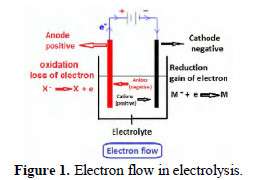
    <p>Electrochemistry deals with chemical changes brought out by electricity, and 
electricity generated by chemical changes. Electron is the king of 
Electrochemistry. It rules electrochemistry. Electricity is generated, and chemical 
reactions take place, due to the movement of electrons from one source to 
another. Electron generation occurs at one place; the electron moves through a 
medium, and reaches a particular site. The electron is generated at the anode and 
it moves through the electrical circuit outside the solution system. It enters the 
solution system through the cathode and travels towards the anode through a 
medium which is called an electrolyte (<a href="#f1">Fig. 1</a>).</p>


    <p>&nbsp;</p>
<a name="f1">
<img src="/img/revistas/pea/v34n5/34n5a03f1.jpg">
    
<p>&nbsp;</p>


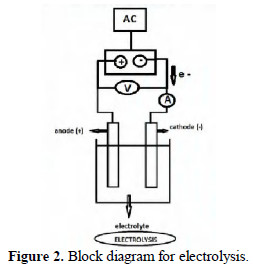
    <p>During this process many chemical reactions take place. The important 
components of this process are a source of AC electricity, a rectifier to produce 
DC current, an anode, a cathode and an electrolyte solution. An ammeter is 
connected in series, and a voltmeter in parallel. This experimental setup can be 
used for a process called electrolysis (<a href="#f2">Fig. 2</a>).</p>


    <p>&nbsp;</p>
<a name="f2">
<img src="/img/revistas/pea/v34n5/34n5a03f2.jpg">
    
<p>&nbsp;</p>


    ]]></body>
<body><![CDATA[<p>By selecting a variety of anodes, cathodes, electrolytic medium, solvent, 
potential difference (volt) and current density, many wonders can be done in the 
undivided cell. When an aqueous solution of sodium chloride is electrolyzed, Cl<sup>+</sup> 
is generated at anode [1]. Various other species are also produced as per the 
views of many other scientists. Cl<sup>+</sup> can be used to bring about variety of 
chemical reactions.</p>

    <p>Dyes from textile effluents can be removed by chemical method [2], bio 
chemical method [3] and electrochemical method [4].</p>

    <p>Nano particles can be generated by various methods, by reducing the particular 
metal ions, by using suitable reducing agents and capping agents [5].Hofmann 
rearrangement has been conventionally effected by making use of acid amides 
and hypo halites to produce primary amines [6]. Polyaniline has been produced 
from aniline, by making use of a variety of oxidizing agents [7]. 
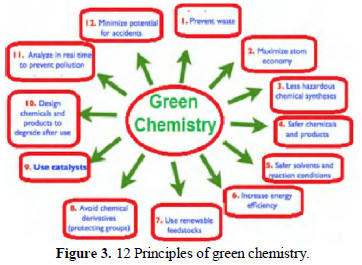
In the old days our environment was healthy and safe, because there was less 
industrialization, and there was no deforestation, but rather continuous 
forestation. Because of the development of science and technology and the 
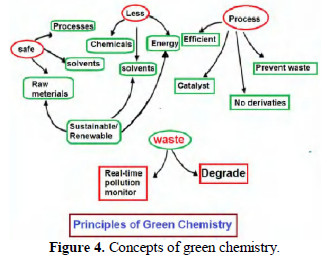
greediness of mankind, our environment has been polluted. To protect the nature, 
principles of green chemistry have been formulated (<a href="#f3">Figs. 3</a> and <a href="#f4">4</a>).</p>


    <p>&nbsp;</p>
<a name="f3">
<img src="/img/revistas/pea/v34n5/34n5a03f3.jpg">
    
<p>&nbsp;</p>
<a name="f4">
<img src="/img/revistas/pea/v34n5/34n5a03f4.jpg">
    
<p>&nbsp;</p>


    <p>These principles emphasize that safe processes, raw materials and solvents must 
be used.</p>

    <p>The use of solvents, energy and chemicals must be lesser. Any green process 
should be efficient, prevent waste and make use of catalysts. Raw materials, 
solvents and energy should be sustainable and renewable. 
The present work is undertaken to employ green electrolysis processes in the 
following events:</p>

    <p>&bull; Decolourisation of dyes;</p>

    <p>&bull; Production of a blue pigment from waste rusted iron rods;</p>

    ]]></body>
<body><![CDATA[<p>&bull; Electrochemical synthesis of silver nano particles and copper nano particles;</p>

    <p>&bull; To effect Hofmann rearrangement, there was an electrochemical start from 
benzamide and dyes were produced from the product obtained from electrolysis;</p>

    <p>&bull; To produce poly aniline electrochemically Cl<sup>+</sup> was used as oxidizing agent.</p>

    <p>In all the cases water is used as solvent; non toxic chemicals are used; less 
expensive reagents are used. Ordinary sodium chloride, even commercial sodium 
chloride, can be used to produce Cl<sup>+</sup>, which acts as a wonderful oxidizing agent. 
Apart from platinised titanium anode, other less expensive electrodes such as 
aluminium, mild steel, graphite, copper and silver are used. This process is an 
electrochemical process. Hence, the reaction can be started and stopped at will. 
No hazardous side products are produced. The environments are very safe. 
Wealth is produced even from waste materials such as waste iron rods. Natural 
product extracts have been used, in some cases as reducing agents, as in the case 
of production of silver nano particles, by reducing the silver ions produced 
electrochemically/chemically by neem extract.</p>


    <p>&nbsp;</p>
    <p><b>Experimental</b></p>

    <p><i><b>Electrolysis</b></i></p>

    <p>Electrolysis was carried out in an undivided cell. Graphite was used as cathode. 
The anode was platinised titanium or aluminium or mild steel or copper. The 
solvent was water (well water) or double distilled water or sea water. In some 
cases sodium chloride was also added. For synthesis of nano particles double 
distilled water was used and the chemicals were very pure. For other cases, 
chemicals readily available were used. The following experiments were carried 
out:</p>

    <p>&bull; Electrochemical decolourisation of dyes;</p>

    <p>&bull; Electrochemical synthesis of blue pigment;</p>

    ]]></body>
<body><![CDATA[<p>&bull; Electrochemical synthesis of silver nano particles and copper nano particles;</p>

    <p>&bull; Electrochemical Hofmann rearrangement;</p>

    <p>&bull; Electrochemical synthesis of poly aniline.</p>


    <p>&nbsp;</p>
    <p><b>Results and discussion</b></p>

    <p>In this section, the following are discussed:</p>

    <p>&bull; Electrochemical decolourisation of dyes;</p>

    <p>&bull; Electrochemical synthesis of blue pigment;</p>

    <p>&bull; Electrochemical synthesis of silver nano particles and copper nano particles;</p>

    <p>&bull; Electrochemical Hofmann rearrangement;</p>

    ]]></body>
<body><![CDATA[<p>&bull; Electrochemical synthesis of poly aniline.</p>


    <p><i><b>Electrochemical decolourisation of dye</b></i></p>

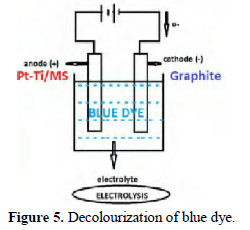
    <p>A blue dye ''Blue ARDE dye'' used in dyeing industry has been decolourised in 
the present study. An aqueous solution of this dye (2%) has been used in this 
electrolysis process. Graphite was used as cathode, mild steel or platinised 
titanium were used as anode. Sodium chloride solution was used as electrolyte. 
When the dye solution was electrolysed, decolourisation took place effectively 
(<a href="#f5">Fig. 5</a>).</p>


    <p>&nbsp;</p>
<a name="f5">
<img src="/img/revistas/pea/v34n5/34n5a03f5.jpg">
    
<p>&nbsp;</p>


    <p>Optical densities were measured before and after decolourisation. 
Decolourisation efficiency (DE) was calculated using the equation:</p>


    <p>&nbsp;</p>
<a name="e1">
<img src="/img/revistas/pea/v34n5/34n5a03e1.jpg">
    
<p>&nbsp;</p>


    <p>where OD1 and OD2 are optical densities before and after decolourisation, 
respectively.</p>


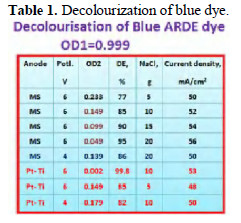
    <p>he results are given in <a href="#t1">Table 1</a>.</p>


    ]]></body>
<body><![CDATA[<p>&nbsp;</p>
<a name="t1">
<img src="/img/revistas/pea/v34n5/34n5a03t1.jpg">
    
<p>&nbsp;</p>


    <p>It is observed that platinised titanium offered better decolourisation efficiency 
than mild steel. As the concentration of sodium chloride increases, DE also 
increases, because in presence of higher concentration of NaCl, more Cl<sup>+</sup> is 
produced and hence, more dye molecules were decolourised. For a given 
concentration of sodium chloride, as the applied voltage increases, DE also 
increases, since the flow of electrons increases as the potential difference 
increases. For a given concentration of NaCl and a given voltage, platinised 
titanium offered better DE than mild steel.</p>


    <p><i><b>Mechanism of decolourisation</b></i></p>

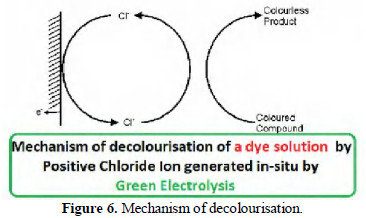
    <p>When sodium chloride solution is electrolyzed, positive chloride (Cl<sup>+</sup>) is 
produced [1]. This converts coloured compounds into colourless products (<a href="#f6">Fig. 6</a>).</p>


    <p>&nbsp;</p>
<a name="f6">
<img src="/img/revistas/pea/v34n5/34n5a03f6.jpg">
    
<p>&nbsp;</p>


    <p><i><b>UV-visible absorption spectra</b></i></p>

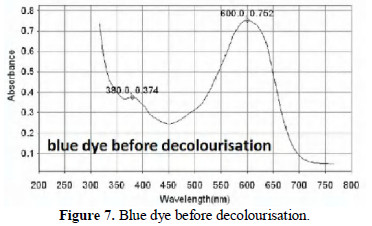
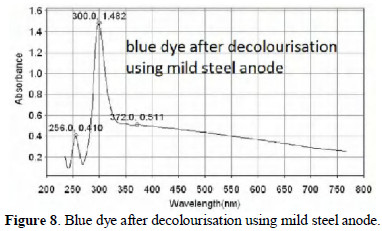
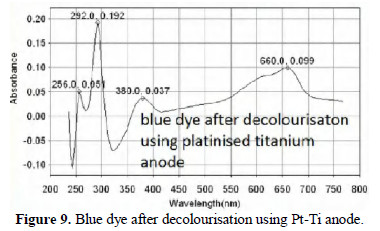
    <p>The UV-visible absorption spectra of dye solution before and after 
decolourisation are shown in <a href="#f7">Figs. 7</a>, <a href="#f8">8</a> and <a href="#f9">9</a>.</p>


    <p>&nbsp;</p>
<a name="f7">
<img src="/img/revistas/pea/v34n5/34n5a03f7.jpg">
    
]]></body>
<body><![CDATA[<p>&nbsp;</p>
<a name="f8">
<img src="/img/revistas/pea/v34n5/34n5a03f8.jpg">
    
<p>&nbsp;</p>
<a name="f9">
<img src="/img/revistas/pea/v34n5/34n5a03f9.jpg">
    
<p>&nbsp;</p>


    <p>In <a href="#f7">Fig. 7</a> the absorption in the 300 nm region is due to &pi;-&pi;* electronic transition 
of the aromatic ring of the dyes. The peak at 600 nm is due to the chromophore 
group on the dye.</p>

    <p>From <a href="#f8">Fig. 8</a> it is observed that when mild steel is used as anode, the chromophore 
has completely disappeared. The peak corresponding to aromatic rings is present. 
When platinised titanium is used as anode (<a href="#f9">Fig. 9</a>), the aromatic rings and the 
chromophore are still present, but the intensity has decreased. The 
decolourisation efficiency is very high (99.8%). Based on the same principles, 
several dyes such as methyl orange [8], eriochrome black T [9], and orange 3 R 
dye [10] have been decolourised.</p>


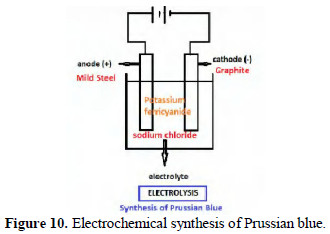
    <p><i><b>Synthesis of blue pigment (Prussian blue) from waste rusted mild steel Electrolysis</b></i></p>

    <p>1 g of potassium ferrocyanide was dissolved in 10 mL of water in an undivided 
cell. 5 g of NaCl were added. A rusted mild steel was pickled and cleaned with 
water. It was used as anode. Graphite was used as cathode. A potential of 6 volts 
was applied for 5 minutes. Current density was 250 mA/cm<sup>2</sup>. The solution turned 
blue due to the formation of Prussian blue (<a href="#f10">Fig. 10</a>).</p>


    <p>&nbsp;</p>
<a name="f10">
<img src="/img/revistas/pea/v34n5/34n5a03f10.jpg">
    
<p>&nbsp;</p></p>


    <p><i><b>UV-visible absorption spectra</b></i></p>

    ]]></body>
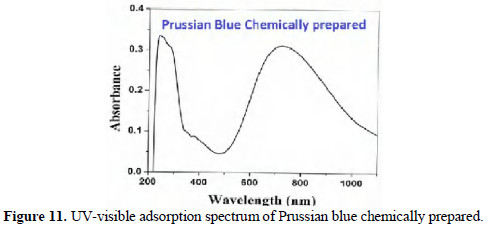
<body><![CDATA[<p>The UV-visible absorption spectrum of prussian blue (PB) prepared by chemical 
method (by mixing aqueous solutions of potassium ferricyanide and ferrous 
sulphate) is shown in <a href="#f11">Fig. 11</a>.</p>


    <p>&nbsp;</p>
<a name="f11">
<img src="/img/revistas/pea/v34n5/34n5a03f11.jpg">
    
<p>&nbsp;</p></p>


    <p>Peaks appeared at 275 nm and 750 nm.</p>


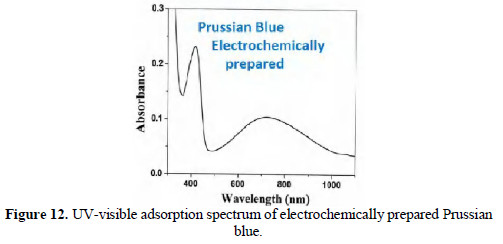
    <p>It is observed (<a href="#f12">Fig. 12</a>) that the UV-visible absorption spectrum of prepared 
electrochemically PB matches with that prepared chemically.</p>


    <p>&nbsp;</p>
<a name="f12">
<img src="/img/revistas/pea/v34n5/34n5a03f12.jpg">
    
<p>&nbsp;</p></p>


    <p>Thus, the formation 
of PB by electrochemical method from mild steel is confirmed.</p>


    <p><i><b>Fluorescence spectra</b></i></p>

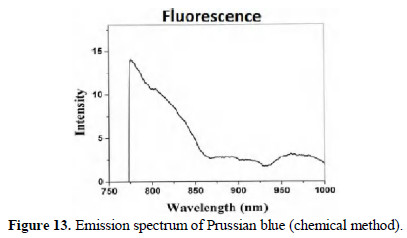
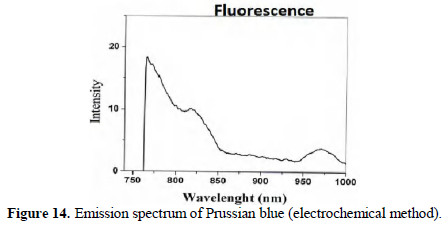
    <p>The fluorescence spectra (&lambda;ex =750 nm) of chemically and electrochemically 
prepared PB are shown in <a href="#f13">Figs. 13</a> and <a href="#f14">14</a>.</p>


    ]]></body>
<body><![CDATA[<p>&nbsp;</p>
<a name="f13">
<img src="/img/revistas/pea/v34n5/34n5a03f13.jpg">
    
<p>&nbsp;</p></p>
<a name="f14">
<img src="/img/revistas/pea/v34n5/34n5a03f14.jpg">
    
<p>&nbsp;</p></p>


    <p>They closely resemble. Thus, formation of PB is confirmed.</p>


    <p><i><b>FTIR spectra</b></i></p>

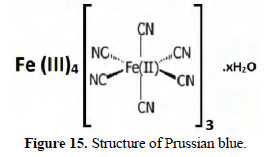
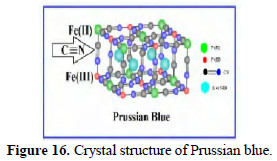
    <p>The structures of Prussian blue are shown in <a href="#f15">Figs. 15</a> and <a href="#f16">16</a>.</p>


    <p>&nbsp;</p>
<a name="f15">
<img src="/img/revistas/pea/v34n5/34n5a03f15.jpg">
    
<p>&nbsp;</p></p>
<a name="f16">
<img src="/img/revistas/pea/v34n5/34n5a03f16.jpg">
    
<p>&nbsp;</p></p>


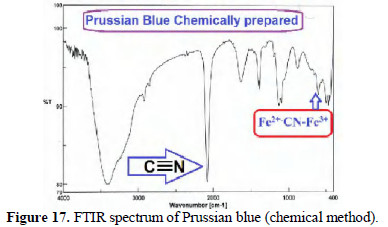
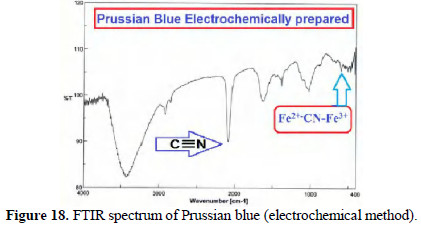
    <p>FTIR spectra of chemically and electrochemically prepared PB are shown in 
<a href="#f17">Figs. 17</a> and <a href="#f18">18</a>.</p>


    ]]></body>
<body><![CDATA[<p>&nbsp;</p>
<a name="f17">
<img src="/img/revistas/pea/v34n5/34n5a03f17.jpg">
    
<p>&nbsp;</p></p>
<a name="f18">
<img src="/img/revistas/pea/v34n5/34n5a03f18.jpg">
    
<p>&nbsp;</p></p>


    <p>The presence of C &equiv; N peak and Fe<sup>2+</sup>-CN-Fe<sup>3+</sup> peak confirmed the formation 
of PB from mild steel.</p>


    <p><i><b>SEM images</b></i></p>

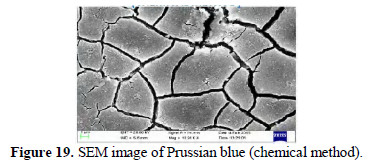
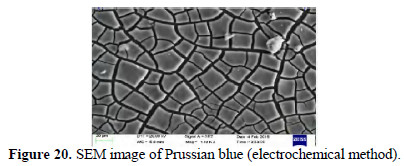
    <p>SEM images of chemically and electrochemically prepared PB are shown in 
<a href="#f19">Figs. 19</a> and <a href="#f20">20</a>.</p>


    <p>&nbsp;</p>
<a name="f19">
<img src="/img/revistas/pea/v34n5/34n5a03f19.jpg">
    
<p>&nbsp;</p></p>
<a name="f20">
<img src="/img/revistas/pea/v34n5/34n5a03f20.jpg">
    
<p>&nbsp;</p></p>


    <p>Squares and pentagons are seen. Some triangles are also seen.</p>


    ]]></body>
<body><![CDATA[<p><i><b>Size of Prussian blue (PB) nano particles</b></i></p>

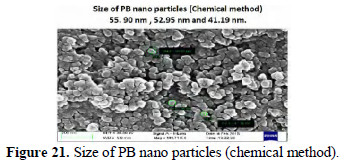
    <p>The sizes of the PB nano particles prepared by chemical method are found to be 
41.19 nm, 52.95 nm and 55.90 nm (<a href="#f21">Fig. 21</a>).</p>


    <p>&nbsp;</p>
<a name="f21">
<img src="/img/revistas/pea/v34n5/34n5a03f21.jpg">
    
<p>&nbsp;</p></p>


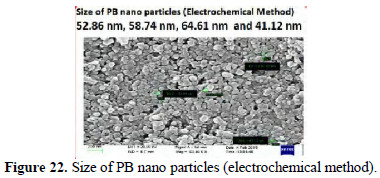
    <p>The sizes of the PB nano particles prepared by electrochemical method are found 
to be 41.12 nm, 52.86 nm, 58.74 nm and 64.61 nm (<a href="#f22">Fig. 22</a>).</p>


    <p>&nbsp;</p>
<a name="f22">
<img src="/img/revistas/pea/v34n5/34n5a03f22.jpg">
    
<p>&nbsp;</p></p>


    <p>Squares and pentagons are seen. Some triangles are also seen.</p>


    <p><i><b>Synthesis of silver nano particles</b></i></p>

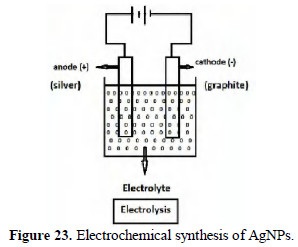
    <p>Silver nano particles have been prepared by electrolysis method (<a href="#f23">Fig. 23</a>).</p>


    ]]></body>
<body><![CDATA[<p>&nbsp;</p>
<a name="f23">
<img src="/img/revistas/pea/v34n5/34n5a03f23.jpg">
    
<p>&nbsp;</p></p>


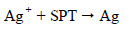
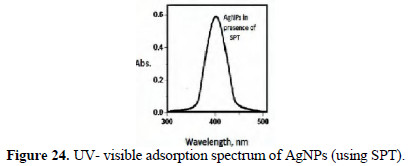
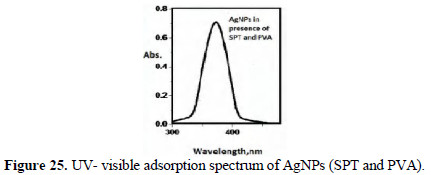
    <p>Pure silver rod was used as anode. Graphite was used as cathode. The electrolyte 
(reducing agent) was sodium potassium tartrate (SPT) and polyvinyl alcohol. 
When a potential of 6 volts was applied for 5 minutes (current density 50 
mA/cm<sup>2</sup>), silver ions were released, which were reduced by SPT.</p>


    <p>&nbsp;</p>
<a name="e2">
<img src="/img/revistas/pea/v34n5/34n5a03e2.jpg">
    
<p>&nbsp;</p></p>


    <p>Pure The UV-visible absorption spectrum is shown in <a href="#f24">Figs. 24</a> and <a href="#f25">25</a>.</p>


    <p>&nbsp;</p>
<a name="f24">
<img src="/img/revistas/pea/v34n5/34n5a03f24.jpg">
    
<p>&nbsp;</p></p>
<a name="f25">
<img src="/img/revistas/pea/v34n5/34n5a03f25.jpg">
    
<p>&nbsp;</p></p>


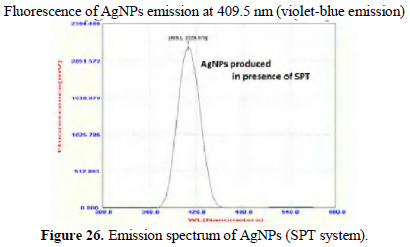
    <p><i>Fluorescence of AgNPs emission at 409.5 nm (violet-blue emission)</i></p> 

    ]]></body>
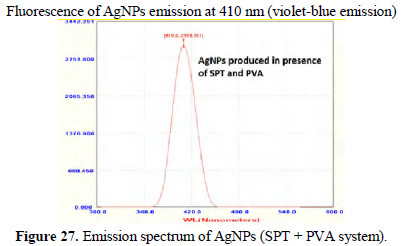
<body><![CDATA[<p>Peaks around 400 nm are due to AgNPs. They are found to be UV-fluorescence 
(&lambda;ex = 400 nm) (<a href="#f26">Figs. 26</a> and <a href="#f27">27</a>).</p> 


    <p>&nbsp;</p>
<a name="f26">
<img src="/img/revistas/pea/v34n5/34n5a03f26.jpg">
    
<p>&nbsp;</p></p>
<a name="f27">
<img src="/img/revistas/pea/v34n5/34n5a03f27.jpg">
    
<p>&nbsp;</p></p>


    <p><i>Fluorescence of AgNPs emission at 410 nm (violet-blue emission)</i></p> 

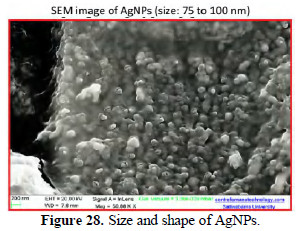
    <p>The sizes of AgNPs are found to be in the range of 75 to 100 nm (<a href="#f28">Fig. 28</a>).</p>


    <p>&nbsp;</p>
<a name="f28">
<img src="/img/revistas/pea/v34n5/34n5a03f28.jpg">
    
<p>&nbsp;</p></p>


    <p>AgNPs are found to be spherical. Some flowers of AgNPs are also seen (<a href="#f28">Fig. 28</a>).</p>


    <p><i><b>EDAX spectrum</b></i></p>

    ]]></body>
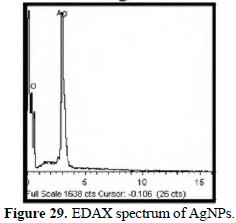
<body><![CDATA[<p>The EDAX spectrum confirms the presence of silver (<a href="#f29">Fig. 29</a>).</p>


    <p>&nbsp;</p>
<a name="f29">
<img src="/img/revistas/pea/v34n5/34n5a03f29.jpg">
    
<p>&nbsp;</p>


    <p>&nbsp;</p>
    <p><b>Formation of copper nanoparticles</b></p>

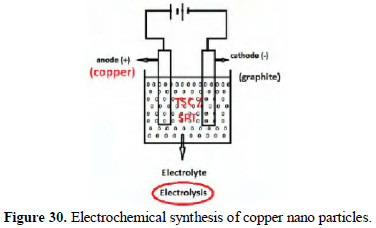
    <p>In the electrolysis process, copper rod was used as anode. Graphite was used as 
cathode. The electrolyte was 1% of trisodium citrate (TSC) / sodium potassium 
tartrate (SPT). A potential difference of 6 volts was applied for 5 minutes. The 
current density was 50 mA/cm<sup>2</sup>.</p>

    <p>The copper ions produced at anode were reduced by reducing agents such as SPT 
and TSC (<a href="#f30">Fig. 30</a>).</p>


    <p>&nbsp;</p>
<a name="f30">
<img src="/img/revistas/pea/v34n5/34n5a03f30.jpg">
    
<p>&nbsp;</p>


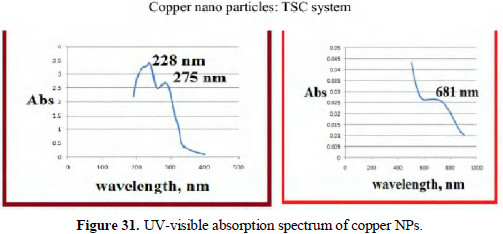
    <p>When TSC is used as reducing agent, the CuNPs show peaks at 228 nm, 275 nm 
and 681 nm in the UV-visible absorption spectrum (<a href="#f31">Fig. 31</a>).</p>


    ]]></body>
<body><![CDATA[<p>&nbsp;</p>
<a name="f31">
<img src="/img/revistas/pea/v34n5/34n5a03f31.jpg">
    
<p>&nbsp;</p>


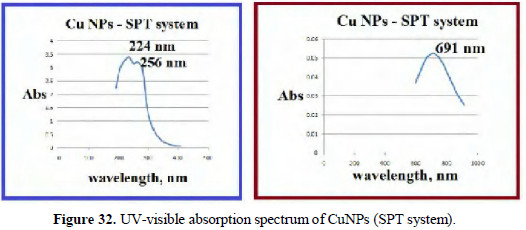
    <p>When SPT is used as reducing agent, peaks appear at 224 nm, 256 nm and 691 
nm (<a href="#f32">Fig. 32</a>).</p>


    <p>&nbsp;</p>
<a name="f32">
<img src="/img/revistas/pea/v34n5/34n5a03f32.jpg">
    
<p>&nbsp;</p>


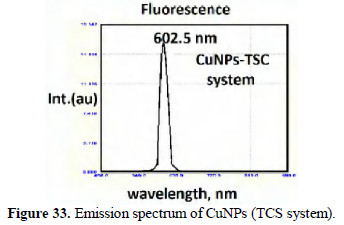
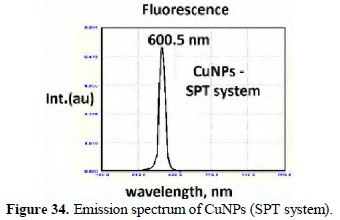
    <p>The slight shifts in the position of peaks may be due to the size of the 
nanoparticles. The CuNPs are found to be UV-fluorescent (&lambda;ex) = 300 nm 
(<a href="#f33">Figs. 33</a> and <a href="#f34">34</a>).</p>


    <p>&nbsp;</p>
<a name="f33">
<img src="/img/revistas/pea/v34n5/34n5a03f33.jpg">
    
<p>&nbsp;</p>
<a name="f34">
<img src="/img/revistas/pea/v34n5/34n5a03f34.jpg">
    
<p>&nbsp;</p>


    <p>&nbsp;</p>
    ]]></body>
<body><![CDATA[<p><b>Electrochemical Hofmann rearrangement</b></p>

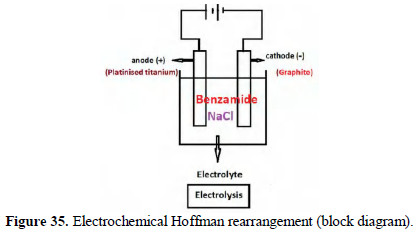
    <p>Hofmann rearrangement involves conversion of acid amide into primary amine 
in the presence of hypohalite OCl-, OBr-(Cl2/NaOH, Br2/NaOH). In the present 
study benzamide was converted into a primary amine. 1 g of benzamide was 
taken as an undivided cell containing an aqueous solution of 5% NaCl solution. 
The anode was platinised titanium. The cathode was graphite (<a href="#f35">Fig. 35</a>).</p>


    <p>&nbsp;</p>
<a name="f35">
<img src="/img/revistas/pea/v34n5/34n5a03f35.jpg">
    
<p>&nbsp;</p>


    <p>A potential difference of 6 volts was applied for 5 minutes. The current density 
was 50 mA/cm<sup>2</sup>. During electrolysis of NaCl, Cl2 and NaOH are produced. Thus, 
hypochlorite is produced. This has produced the Hofmann rearrangement 
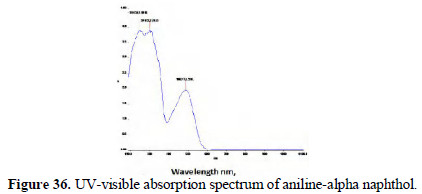
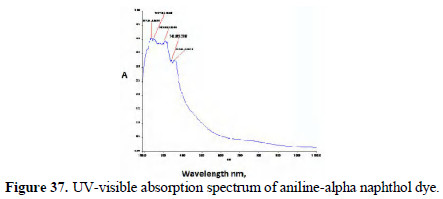
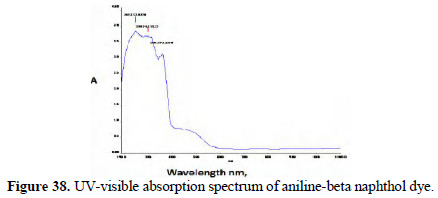
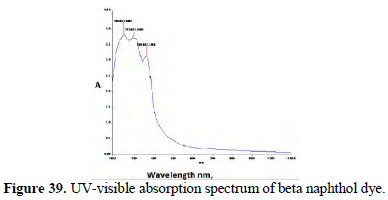
climate. The resulting primary amine was diazotised and coupled with alkaline Î±naphthol 
in NaOH solution, and Î²-napthol in NaOH solution. Dyes were 
produced. These dyes were matched with the dyes prepared from pure aniline.</p>

    <p>The UV-visible adsorption spectra of the respective dyes were compared 
(<a href="#f36">Figs. 36</a> and <a href="#f37">37</a>; <a href="#f38">38</a> and <a href="#f39">39</a>).</p>


    <p>&nbsp;</p>
<a name="f36">
<img src="/img/revistas/pea/v34n5/34n5a03f36.jpg">
    
<p>&nbsp;</p>
<a name="f37">
<img src="/img/revistas/pea/v34n5/34n5a03f37.jpg">
    
<p>&nbsp;</p>
<a name="f38">
<img src="/img/revistas/pea/v34n5/34n5a03f38.jpg">
    
<p>&nbsp;</p>
<a name="f39">
<img src="/img/revistas/pea/v34n5/34n5a03f39.jpg">
    
]]></body>
<body><![CDATA[<p>&nbsp;</p>


    <p>It is observed that, in the case of dyes obtained from pure aniline, a peak 
occurred around 475 nm range. But these peaks are absent or insignificant in the 
case of the spectra of dyes prepared by electrochemical method.</p>

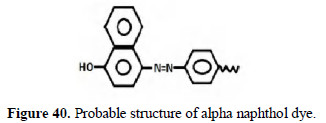
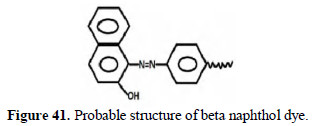
    <p>This may be due to the fact that the dyes prepared by electrochemical method are 
polymeric in nature (<a href="#f40">Figs. 40</a> and <a href="#f41">41</a>).</p>


    <p>&nbsp;</p>
<a name="f40">
<img src="/img/revistas/pea/v34n5/34n5a03f40.jpg">
    
<p>&nbsp;</p>
<a name="f41">
<img src="/img/revistas/pea/v34n5/34n5a03f41.jpg">
    
<p>&nbsp;</p>


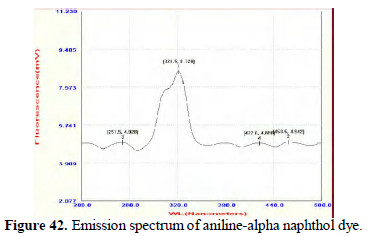
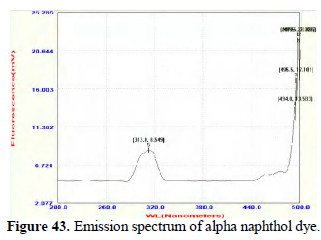
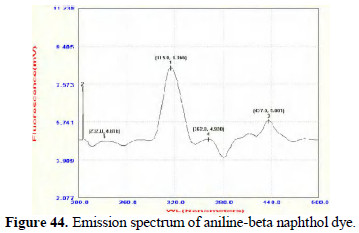
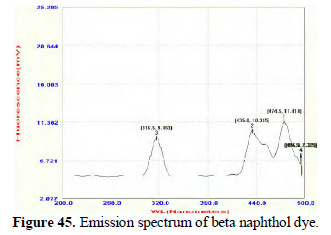
    <p>Further study in this line will lead to interesting conclusions. The dyes prepared 
from pure aniline and the dyes prepared by electrochemical method are found to 
be UV-fluorescent. (<a href="#f42">Figs. 42</a> and <a href="#f43">43</a>; <a href="#f44">44</a> and <a href="#f45">45</a>).</p>


    <p>&nbsp;</p>
<a name="f42">
<img src="/img/revistas/pea/v34n5/34n5a03f42.jpg">
    
<p>&nbsp;</p>
<a name="f43">
<img src="/img/revistas/pea/v34n5/34n5a03f43.jpg">
    
<p>&nbsp;</p>
<a name="f44">
<img src="/img/revistas/pea/v34n5/34n5a03f44.jpg">
    
]]></body>
<body><![CDATA[<p>&nbsp;</p>
<a name="f45">
<img src="/img/revistas/pea/v34n5/34n5a03f45.jpg">
    
<p>&nbsp;</p>


    <p><i><b>Electrochemical synthesis of poly aniline (PANI)</b></i></p>

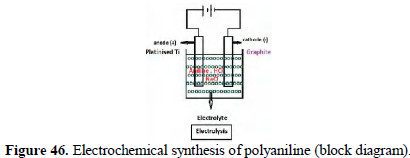
    <p>Aniline hydrochloride was dissolved in water and diluted to 100 mL (pH = 0.5). 
5 g of NaCl were added. The solution was electrolysed (<a href="#f46">Fig. 46</a>) using platinised 
titanium, and graphite cathode for a period of 5 minutes.</p>


    <p>&nbsp;</p>
<a name="f46">
<img src="/img/revistas/pea/v34n5/34n5a03f46.jpg">
    
<p>&nbsp;</p>


    <p>A potential difference of 6 volts was applied. The current density was 50 
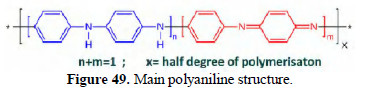
mA/cm<sup>2</sup>. Emerald green poly aniline was produced. In this method, conventional 
oxidizing agents were not used. The positive chloride ions produced in situ acted 
as oxidizing agent and initiated the polymerization process.</p>

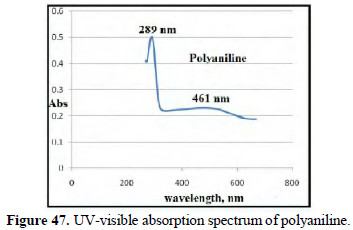
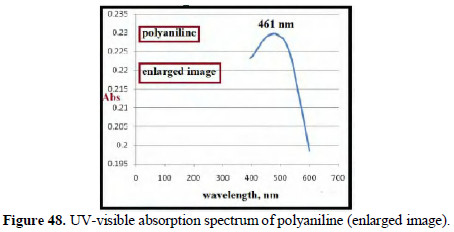
    <p>The UV-visible absorption spectrum of polyaniline produced showed peaks at 
289 nm and 461 nm (<a href="#f47">Figs. 47</a> and <a href="#f48">48</a>).</p>


    <p>&nbsp;</p>
<a name="f47">
<img src="/img/revistas/pea/v34n5/34n5a03f47.jpg">
    
<p>&nbsp;</p>
<a name="f48">
<img src="/img/revistas/pea/v34n5/34n5a03f48.jpg">
    
]]></body>
<body><![CDATA[<p>&nbsp;</p>


    <p>FTIR spectra of polyaniline 
The main poly aniline structure is shown in <a href="#f49">Fig. 49</a>.</p>


    <p>&nbsp;</p>
<a name="f49">
<img src="/img/revistas/pea/v34n5/34n5a03f49.jpg">
    
<p>&nbsp;</p>


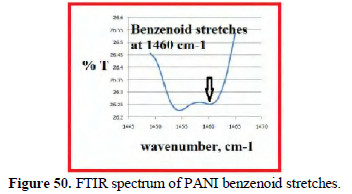
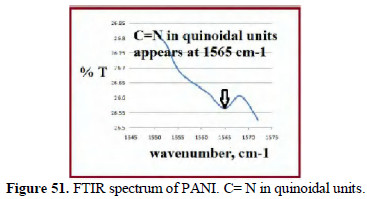
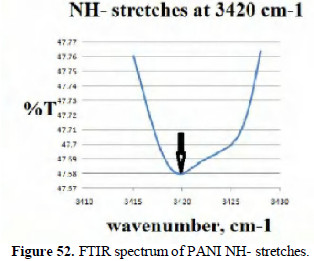
    <p>The FTIR spectra (KBr) of the poly aniline produced confirm the presence of 
benzenoid stretches (<a href="#f50">Fig. 50</a>), C=N quinoidal units (<a href="#f51">Fig. 51</a>) and -NH stretches 
(<a href="#f52">Fig. 52</a>).</p>


    <p>&nbsp;</p>
<a name="f50">
<img src="/img/revistas/pea/v34n5/34n5a03f50.jpg">
    
<p>&nbsp;</p>
<a name="f51">
<img src="/img/revistas/pea/v34n5/34n5a03f51.jpg">
    
<p>&nbsp;</p>
<a name="f52">
<img src="/img/revistas/pea/v34n5/34n5a03f52.jpg">
    
<p>&nbsp;</p>


    <p>Thus, electrochemically generated poly aniline is confirmed.</p>


    ]]></body>
<body><![CDATA[<p>&nbsp;</p>
    <p><b>Electrochemical green synthesis</b></p>

    <p>By electrochemical method, dyes have been decolourised. Blue pigment has been 
produced. Silver and copper nano particles have been synthesized. Hofmann 
rearrangement has been effected. Poly aniline has been synthesized. All these 
processes use less hazardous chemicals. Safe chemicals and products are 
involved. Water is used as a solvent. There is no heating. Reaction time is only 5 
minutes. Efficiency can be improved by increasing the voltage. Electric energy 
can be used again and again. Side products are not obtained. The Cl<sup>+</sup> is used as 
catalyst and reagent. It is continuously generated. The products can be easily 
degraded. The experiments are free from pollution. The reactions can be started 
and stopped anytime.</p>

    <p>All these facts support electro synthesis as a versatile green technique of the 
future.</p>


    <p>&nbsp;</p>
    <p><b>References</b></p>

    <!-- ref --><p>1. Rajendran S, Trivedi DC. Synthesis Feb. 1995;153.    &nbsp;&nbsp;&nbsp;&nbsp;&nbsp;&nbsp;&nbsp;&nbsp;[&#160;<a href="javascript:void(0);" onclick="javascript: window.open('/scielo.php?script=sci_nlinks&ref=423013&pid=S0872-1904201600050000300001&lng=','','width=640,height=500,resizable=yes,scrollbars=1,menubar=yes,');">Links</a>&#160;]<!-- end-ref --></p>

    <!-- ref --><p>2. Chhabra M, Mishra S, Sreekrishnan TR. Biochem Eng J. 2015;93:17.    &nbsp;&nbsp;&nbsp;&nbsp;&nbsp;&nbsp;&nbsp;&nbsp;[&#160;<a href="javascript:void(0);" onclick="javascript: window.open('/scielo.php?script=sci_nlinks&ref=423015&pid=S0872-1904201600050000300002&lng=','','width=640,height=500,resizable=yes,scrollbars=1,menubar=yes,');">Links</a>&#160;]<!-- end-ref --></p>

    ]]></body>
<body><![CDATA[<!-- ref --><p>3. Pramila M, Manikandan S, Anju KS, et al. Sep Purif Technol. 2014;132:719.    &nbsp;&nbsp;&nbsp;&nbsp;&nbsp;&nbsp;&nbsp;&nbsp;[&#160;<a href="javascript:void(0);" onclick="javascript: window.open('/scielo.php?script=sci_nlinks&ref=423017&pid=S0872-1904201600050000300003&lng=','','width=640,height=500,resizable=yes,scrollbars=1,menubar=yes,');">Links</a>&#160;]<!-- end-ref --></p>

    <!-- ref --><p>4. Lin H, Zhang H, Hou L. J Hazardous Mater. 2014;276:182.    &nbsp;&nbsp;&nbsp;&nbsp;&nbsp;&nbsp;&nbsp;&nbsp;[&#160;<a href="javascript:void(0);" onclick="javascript: window.open('/scielo.php?script=sci_nlinks&ref=423019&pid=S0872-1904201600050000300004&lng=','','width=640,height=500,resizable=yes,scrollbars=1,menubar=yes,');">Links</a>&#160;]<!-- end-ref --></p>

    <!-- ref --><p>5. Joany RM, Shanthy P, Mary ACC, et al. Int J Nano Corr Sci Eng. 2015;2:16.    &nbsp;&nbsp;&nbsp;&nbsp;&nbsp;&nbsp;&nbsp;&nbsp;[&#160;<a href="javascript:void(0);" onclick="javascript: window.open('/scielo.php?script=sci_nlinks&ref=423021&pid=S0872-1904201600050000300005&lng=','','width=640,height=500,resizable=yes,scrollbars=1,menubar=yes,');">Links</a>&#160;]<!-- end-ref --></p>

    <!-- ref --><p>6. Howard JW, Derick CG. J Am Chem Soc. 1924;46:166.    &nbsp;&nbsp;&nbsp;&nbsp;&nbsp;&nbsp;&nbsp;&nbsp;[&#160;<a href="javascript:void(0);" onclick="javascript: window.open('/scielo.php?script=sci_nlinks&ref=423023&pid=S0872-1904201600050000300006&lng=','','width=640,height=500,resizable=yes,scrollbars=1,menubar=yes,');">Links</a>&#160;]<!-- end-ref --></p>

    <!-- ref --><p>7. Vivekanandan J, Ponnusamy V, Mahudeswaran A, et al. Arch Appl Sci Research. 2011;3:147.    &nbsp;&nbsp;&nbsp;&nbsp;&nbsp;&nbsp;&nbsp;&nbsp;[&#160;<a href="javascript:void(0);" onclick="javascript: window.open('/scielo.php?script=sci_nlinks&ref=423025&pid=S0872-1904201600050000300007&lng=','','width=640,height=500,resizable=yes,scrollbars=1,menubar=yes,');">Links</a>&#160;]<!-- end-ref --></p>

    ]]></body>
<body><![CDATA[<!-- ref --><p>8. Rajendran S, Devi MK, Regis APP, et al. Zastita Materijala. 2009;50:131.    &nbsp;&nbsp;&nbsp;&nbsp;&nbsp;&nbsp;&nbsp;&nbsp;[&#160;<a href="javascript:void(0);" onclick="javascript: window.open('/scielo.php?script=sci_nlinks&ref=423027&pid=S0872-1904201600050000300008&lng=','','width=640,height=500,resizable=yes,scrollbars=1,menubar=yes,');">Links</a>&#160;]<!-- end-ref --></p>

    <!-- ref --><p>9. Sathiyabama J, Rajendran S, Selvi JA, et al. Bull Electrochem. 2006;22:363.    &nbsp;&nbsp;&nbsp;&nbsp;&nbsp;&nbsp;&nbsp;&nbsp;[&#160;<a href="javascript:void(0);" onclick="javascript: window.open('/scielo.php?script=sci_nlinks&ref=423029&pid=S0872-1904201600050000300009&lng=','','width=640,height=500,resizable=yes,scrollbars=1,menubar=yes,');">Links</a>&#160;]<!-- end-ref --></p>

    <!-- ref --><p>10. Gowri S, Bama JS, Rajendran S, et al. Int J Nano Corr Sci Eng. 2014;1:2430.    &nbsp;&nbsp;&nbsp;&nbsp;&nbsp;&nbsp;&nbsp;&nbsp;[&#160;<a href="javascript:void(0);" onclick="javascript: window.open('/scielo.php?script=sci_nlinks&ref=423031&pid=S0872-1904201600050000300010&lng=','','width=640,height=500,resizable=yes,scrollbars=1,menubar=yes,');">Links</a>&#160;]<!-- end-ref --></p>


    <p>&nbsp;</p>
    <p><b>Acknowledgements</b></p>

    <p>The authors are thankful to their managements and Management of SRM 
Universty, Chennai, India, which is responsible for initiating this paper.</p>


    <p>&nbsp;</p>
    ]]></body>
<body><![CDATA[<p><a name=0></a><sup><a href="#top">*</a></sup>Corresponding author. E-mail address: <a href="mailto:suasirajendran@gmail.com">suasirajendran@gmail.com</a></p>

    <p>Received July 15, 2016; accepted September 06, 2016</p>

    <p><a href="http://www.peacta.org" target="_blank">www.peacta.org</a> </p>


     ]]></body><back>
<ref-list>
<ref id="B1">
<label>1</label><nlm-citation citation-type="journal">
<person-group person-group-type="author">
<name>
<surname><![CDATA[Rajendran]]></surname>
<given-names><![CDATA[S]]></given-names>
</name>
<name>
<surname><![CDATA[Trivedi]]></surname>
<given-names><![CDATA[D C]]></given-names>
</name>
</person-group>
<source><![CDATA[Synthesis Feb]]></source>
<year>1995</year>
<page-range>153</page-range></nlm-citation>
</ref>
<ref id="B2">
<label>2</label><nlm-citation citation-type="journal">
<person-group person-group-type="author">
<name>
<surname><![CDATA[Chhabra]]></surname>
<given-names><![CDATA[M]]></given-names>
</name>
<name>
<surname><![CDATA[Mishra]]></surname>
<given-names><![CDATA[S]]></given-names>
</name>
<name>
<surname><![CDATA[Sreekrishnan]]></surname>
<given-names><![CDATA[T R]]></given-names>
</name>
</person-group>
<source><![CDATA[Biochem Eng J]]></source>
<year>2015</year>
<volume>93</volume>
<page-range>17</page-range></nlm-citation>
</ref>
<ref id="B3">
<label>3</label><nlm-citation citation-type="journal">
<person-group person-group-type="author">
<name>
<surname><![CDATA[Pramila]]></surname>
<given-names><![CDATA[M]]></given-names>
</name>
<name>
<surname><![CDATA[Manikandan]]></surname>
<given-names><![CDATA[S]]></given-names>
</name>
<name>
<surname><![CDATA[Anju]]></surname>
<given-names><![CDATA[K S]]></given-names>
</name>
</person-group>
<source><![CDATA[Sep Purif Technol]]></source>
<year>2014</year>
<volume>132</volume>
<page-range>719</page-range></nlm-citation>
</ref>
<ref id="B4">
<label>4</label><nlm-citation citation-type="journal">
<person-group person-group-type="author">
<name>
<surname><![CDATA[Lin]]></surname>
<given-names><![CDATA[H]]></given-names>
</name>
<name>
<surname><![CDATA[Zhang]]></surname>
<given-names><![CDATA[H]]></given-names>
</name>
<name>
<surname><![CDATA[Hou]]></surname>
<given-names><![CDATA[L]]></given-names>
</name>
</person-group>
<source><![CDATA[J Hazardous Mater]]></source>
<year>2014</year>
<volume>276</volume>
<page-range>182</page-range></nlm-citation>
</ref>
<ref id="B5">
<label>5</label><nlm-citation citation-type="journal">
<person-group person-group-type="author">
<name>
<surname><![CDATA[Joany]]></surname>
<given-names><![CDATA[R M]]></given-names>
</name>
<name>
<surname><![CDATA[Shanthy]]></surname>
<given-names><![CDATA[P]]></given-names>
</name>
<name>
<surname><![CDATA[Mary]]></surname>
<given-names><![CDATA[A C C]]></given-names>
</name>
</person-group>
<source><![CDATA[Int J Nano Corr Sci Eng]]></source>
<year>2015</year>
<volume>2</volume>
<page-range>16</page-range></nlm-citation>
</ref>
<ref id="B6">
<label>6</label><nlm-citation citation-type="journal">
<person-group person-group-type="author">
<name>
<surname><![CDATA[Howard]]></surname>
<given-names><![CDATA[J W]]></given-names>
</name>
<name>
<surname><![CDATA[Derick]]></surname>
<given-names><![CDATA[C G]]></given-names>
</name>
</person-group>
<source><![CDATA[J Am Chem Soc]]></source>
<year>1924</year>
<volume>46</volume>
<page-range>166</page-range></nlm-citation>
</ref>
<ref id="B7">
<label>7</label><nlm-citation citation-type="journal">
<person-group person-group-type="author">
<name>
<surname><![CDATA[Vivekanandan]]></surname>
<given-names><![CDATA[J]]></given-names>
</name>
<name>
<surname><![CDATA[Ponnusamy]]></surname>
<given-names><![CDATA[V]]></given-names>
</name>
<name>
<surname><![CDATA[Mahudeswaran]]></surname>
<given-names><![CDATA[A]]></given-names>
</name>
</person-group>
<source><![CDATA[Arch Appl Sci Research]]></source>
<year>2011</year>
<volume>3</volume>
<page-range>147</page-range></nlm-citation>
</ref>
<ref id="B8">
<label>8</label><nlm-citation citation-type="journal">
<person-group person-group-type="author">
<name>
<surname><![CDATA[Rajendran]]></surname>
<given-names><![CDATA[S]]></given-names>
</name>
<name>
<surname><![CDATA[Devi]]></surname>
<given-names><![CDATA[M K]]></given-names>
</name>
<name>
<surname><![CDATA[Regis]]></surname>
<given-names><![CDATA[A P P]]></given-names>
</name>
</person-group>
<source><![CDATA[Zastita Materijala]]></source>
<year>2009</year>
<page-range>50</page-range></nlm-citation>
</ref>
<ref id="B9">
<label>9</label><nlm-citation citation-type="journal">
<person-group person-group-type="author">
<name>
<surname><![CDATA[Sathiyabama]]></surname>
<given-names><![CDATA[J]]></given-names>
</name>
<name>
<surname><![CDATA[Rajendran]]></surname>
<given-names><![CDATA[S]]></given-names>
</name>
<name>
<surname><![CDATA[Selvi]]></surname>
<given-names><![CDATA[J A]]></given-names>
</name>
</person-group>
<source><![CDATA[Bull Electrochem]]></source>
<year>2006</year>
<volume>22</volume>
<page-range>363</page-range></nlm-citation>
</ref>
<ref id="B10">
<label>10</label><nlm-citation citation-type="journal">
<person-group person-group-type="author">
<name>
<surname><![CDATA[Gowri]]></surname>
<given-names><![CDATA[S]]></given-names>
</name>
<name>
<surname><![CDATA[Bama]]></surname>
<given-names><![CDATA[J S]]></given-names>
</name>
<name>
<surname><![CDATA[Rajendran]]></surname>
<given-names><![CDATA[S]]></given-names>
</name>
</person-group>
<source><![CDATA[Int J Nano Corr Sci Eng]]></source>
<year>2014</year>
<volume>1</volume>
<page-range>2430</page-range></nlm-citation>
</ref>
</ref-list>
</back>
</article>