<?xml version="1.0" encoding="ISO-8859-1"?><article xmlns:mml="http://www.w3.org/1998/Math/MathML" xmlns:xlink="http://www.w3.org/1999/xlink" xmlns:xsi="http://www.w3.org/2001/XMLSchema-instance">
<front>
<journal-meta>
<journal-id>0872-1904</journal-id>
<journal-title><![CDATA[Portugaliae Electrochimica Acta]]></journal-title>
<abbrev-journal-title><![CDATA[Port. Electrochim. Acta]]></abbrev-journal-title>
<issn>0872-1904</issn>
<publisher>
<publisher-name><![CDATA[Sociedade Portuguesa de Electroquímica]]></publisher-name>
</publisher>
</journal-meta>
<article-meta>
<article-id>S0872-19042016000600002</article-id>
<article-id pub-id-type="doi">10.4152/pea.201606383</article-id>
<title-group>
<article-title xml:lang="en"><![CDATA[Improving the Corrosion Resistance of Lead in H2SO4 4 M by the Addition of Phosphoric and Phosphonic Compounds for Lead Grid Batteries]]></article-title>
</title-group>
<contrib-group>
<contrib contrib-type="author">
<name>
<surname><![CDATA[Khatbi]]></surname>
<given-names><![CDATA[Salma]]></given-names>
</name>
<xref ref-type="aff" rid="A01"/>
</contrib>
<contrib contrib-type="author">
<name>
<surname><![CDATA[Gouale]]></surname>
<given-names><![CDATA[Youssef]]></given-names>
</name>
<xref ref-type="aff" rid="A01"/>
</contrib>
<contrib contrib-type="author">
<name>
<surname><![CDATA[Lamiri]]></surname>
<given-names><![CDATA[Abdeslam]]></given-names>
</name>
<xref ref-type="aff" rid="A01"/>
</contrib>
<contrib contrib-type="author">
<name>
<surname><![CDATA[Essahli]]></surname>
<given-names><![CDATA[Mohamed]]></given-names>
</name>
<xref ref-type="aff" rid="A01"/>
</contrib>
</contrib-group>
<aff id="A01">
<institution><![CDATA[,University Hassan 1 Faculty of Science and Technology Laboratory of Applied Chemistry and Environment]]></institution>
<addr-line><![CDATA[Settat ]]></addr-line>
<country>Morocco</country>
</aff>
<pub-date pub-type="pub">
<day>00</day>
<month>11</month>
<year>2016</year>
</pub-date>
<pub-date pub-type="epub">
<day>00</day>
<month>11</month>
<year>2016</year>
</pub-date>
<volume>34</volume>
<numero>6</numero>
<fpage>383</fpage>
<lpage>393</lpage>
<copyright-statement/>
<copyright-year/>
<self-uri xlink:href="http://scielo.pt/scielo.php?script=sci_arttext&amp;pid=S0872-19042016000600002&amp;lng=en&amp;nrm=iso"></self-uri><self-uri xlink:href="http://scielo.pt/scielo.php?script=sci_abstract&amp;pid=S0872-19042016000600002&amp;lng=en&amp;nrm=iso"></self-uri><self-uri xlink:href="http://scielo.pt/scielo.php?script=sci_pdf&amp;pid=S0872-19042016000600002&amp;lng=en&amp;nrm=iso"></self-uri><abstract abstract-type="short" xml:lang="en"><p><![CDATA[The effect of the addition of phosphoric acid ((HO)3P=O), potassium hydrogen phosphate ((HO)2P(O)(O-K+)), dimethyl vinylphosphonate (CH2=CH-P(O)(OCH3)2) and vinylphosphonic acid (CH2=CHP(O)(OH)2) on lead corrosion in 4 M H2SO4 was studied by potentiodynamic polarization and electrochemical impedance spectroscopy (EIS). The results show that phosphoric acid and potassium hydrogen phosphate, added to an optimal concentration of 0.4 M, reduce the lead passivation current and increase its corrosion current, with charge transfer as the main reaction mechanism at the interface metal/electrolyte. They also increase PbO2 formation's potential when they are added at larger concentrations, while adding dimethyl vinylphosphonate and vinylphosphonic acid up to 0.3 M reduces corrosion current and lead passivation current. This last product appears to suppress the formation of PbO2. The parameters of potentiodynamic polarization are in good agreement with those of EIS.]]></p></abstract>
<kwd-group>
<kwd lng="en"><![CDATA[corrosion]]></kwd>
<kwd lng="en"><![CDATA[inhibition]]></kwd>
<kwd lng="en"><![CDATA[lead]]></kwd>
<kwd lng="en"><![CDATA[phosphoric acid]]></kwd>
<kwd lng="en"><![CDATA[potassium hydrogen phosphate]]></kwd>
<kwd lng="en"><![CDATA[dimethyl vinylphosphonate]]></kwd>
<kwd lng="en"><![CDATA[vinylphosphonic acid]]></kwd>
</kwd-group>
</article-meta>
</front><body><![CDATA[ 

<!--     <p>&nbsp;</p>
    <p>doi: 10.4152/pea.201606383</p> -->

    <p><b>Improving the Corrosion Resistance of Lead in H2SO4 4 M 
by the Addition of Phosphoric and Phosphonic Compounds 
for Lead Grid Batteries</b></p>

    <p>
<b>Salma Khatbi</b><sup><a href="#0">*</a></sup>
, <b>Youssef Gouale</b>
, <b>Abdeslam Lamiri</b>
 and <b>Mohamed Essahli</b>
</p>

    <p><i> University Hassan 1, Laboratory of Applied Chemistry and Environment, Faculty of Science 
and Technology, BP 5777, Settat, Morocco</i></p>


    <p>&nbsp;</p>
    <p><b>Abstract</b></p>

    <p>The effect of the addition of phosphoric acid ((HO)3P=O), potassium hydrogen 
phosphate ((HO)2P(O)(O-K+)), dimethyl vinylphosphonate (CH2=CH-P(O)(OCH3)2) 
and vinylphosphonic acid (CH2=CHP(O)(OH)2) on lead corrosion in 4 M H2SO4 was 
studied by potentiodynamic polarization and electrochemical impedance spectroscopy 
(EIS). The results show that phosphoric acid and potassium hydrogen phosphate, added 
to an optimal concentration of 0.4 M, reduce the lead passivation current and increase 
its corrosion current, with charge transfer as the main reaction mechanism at the 
interface metal/electrolyte. They also increase PbO2 formation's potential when they are 
added at larger concentrations, while adding dimethyl vinylphosphonate and 
vinylphosphonic acid up to 0.3 M reduces corrosion current and lead passivation 
current. This last product appears to suppress the formation of PbO2. The parameters of 
potentiodynamic polarization are in good agreement with those of EIS.</p>

    <p><b><i>Keywords:</i></b> corrosion, inhibition, lead, phosphoric acid, potassium hydrogen phosphate, 
dimethyl vinylphosphonate, vinylphosphonic acid.</p>


    ]]></body>
<body><![CDATA[<p>&nbsp;</p>
    <p><b>Introduction</b></p>

    <p>The study of lead corrosion in a sulfuric medium is mainly applied in the 
automotive batteries sector. These batteries suffer from severe corrosion of their 
anodic grills (lead plate) and from the phenomenon of sulphation (formation and 
deposition of PbSO4 on metallic plates). Addition of phosphoric acid and various 
phosphate compounds to the electrolyte has always been a very interesting and 
effective way to improve Pb-acid battery performance [1-5]. The majority of 
studies found that phosphoric acid addition reduces the sulphation by preventing 
the formation of an insulating PbSO4 layer, resulting in an increase of the cycle 
life and a decrease of the discharge [6-10]. Meanwhile, in some reports, 
phosphoric acid was found to improve the formation of the lead dioxide layer 
[11, 12], while others have claimed the opposite [13, 14]. However, the major 
disadvantage of the addition of phosphoric acid or its salts was found to be the 
loss of the cell capacity [15].</p>

    <p>The motivation of our work is to improve the performance of the lead-acid 
battery by improving the corrosion resistance of lead in H2SO4 4 M, with the 
addition of phosphoric acid, potassium hydrogen phosphate, dimethyl 
vinylphosphonate and vinylphosphonic acid to the electrolyte, using 
potentiodynamic polarization and electrochemical impedance spectroscopy.</p>


    <p>&nbsp;</p>
    <p><b>Experimental</b></p>

    <p><i><b>Material preparation</b></i></p>

    <p>For our studies, we used a working electrode formed with pure lead cut in a disk 
shape of 1 cm<sup>2</sup> in size. To obtain reliable and reproducible results, before each 
experiment, the working electrode was polished with SiC paper 400, 600, 1200 
and rinsed with distilled water.</p>


    <p><i><b>Solutions preparation</b></i></p>

    <p>The sulfuric acid 4 M solution was made by diluting H2SO4 96% (d = 1.84 and M 
= 98.08 g/mol) with distilled water.</p>

    ]]></body>
<body><![CDATA[<p>The phosphoric acid solutions were made by diluting (HO)3P=O 85% (d = 1.69 
and M = 98 g/mol) with distilled water, which were then added to the electrolyte 
at concentrations from 0.1 up to 0.6 M.</p>

    <p>The potassium hydrogen phosphate solutions were made by dissolving 
(HO)2P(O)(O-K+) (M = 174.18 g/mol) in distilled water, which were then added 
to the electrolyte at concentrations from 0.1 up to 0.6 M.</p>

    <p>The dimethyl vinylphosphonate solutions were made by diluting 
C2H3-P(O)(OCH3)2 98% (d = 1.13 and M = 136.09 g/mol) with distilled water, 
which were then added to the electrolyte at concentrations from 0.1 up to 0.3 M. 
The vinylphosphonic acid solutions were made by diluting CH2=CHP(O)(OH)2 
97% (d = 1.37 and M = 108.03 g/mol) with distilled water, which were then 
added to the electrolyte at concentrations from 0.1 up to 0.3 M. 
The solutions were freshly made before each experiment.</p>


    <p><i><b>Electrochemical studies</b></i></p>

    <p>The electrochemical measurements were carried out using a three-electrode cell 
assembly comprised of a saturated calomel electrode (reference), a platinum 
electrode (counter) and lead coupon as working electrode. Before each 
experiment, an open circuit potential was measured for 5 minutes, in order to 
reach a steady state. Potentiodynamic polarization was performed with a sweep 
rate of 2 mV/s in the range of -1 to 2.5 V, with respect to the corrosion potential. 
Various corrosion kinetic parameters, such as corrosion current density (Icorr), 
corrosion potential (Ecorr) and passivation current (Ipass) were obtained. Corrosion 
current density was measured from the intersection point obtained by the 
extrapolation of Tafel lines. The impedance measurement was performed using a 
frequency range from 100 kHz to 10 Hz at corrosion potential. VoltaLab 10 
electrochemical analyzer model (PGZ100) interfaced with HP computer along 
with VoltaMaster 4 and OriginLab softwares were used for data acquisition and 
analysis.</p>


    <p>&nbsp;</p>
    <p><b>Results and discussion</b></p>

    <p><i><b>Potentiodynamic polarization</b></i></p>

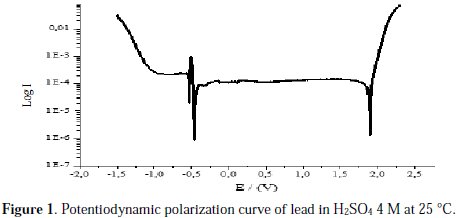
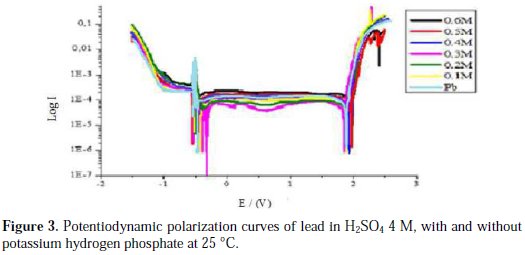
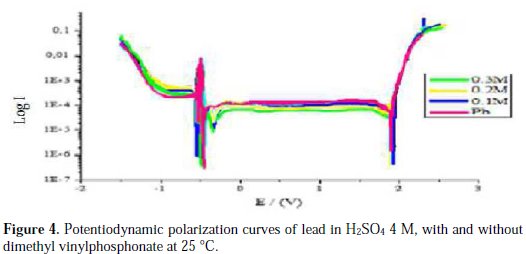
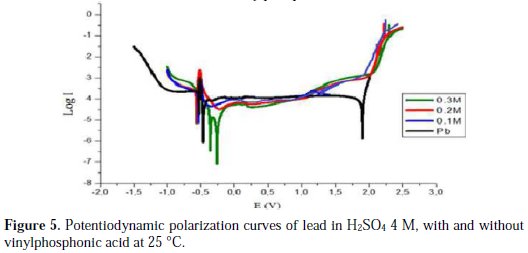
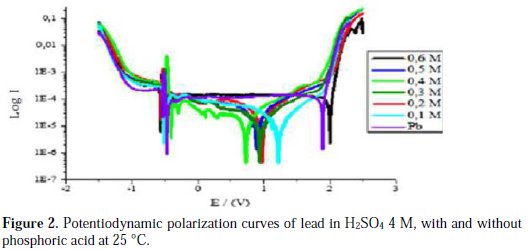
    <p>The anodic and cathodic polarization curves for lead in H2SO4 solution, with and 
without the addition of phosphoric acid, potassium hydrogen phosphate, dimethyl 
vinylphosphonate and vinylphosphonic acid are shown in <a href="#f1">Figs. 1</a>, 
<a href="#f2">2</a>, <a href="#f3">3</a>, <a href="#f4">4</a> and <a href="#f5">5</a>, 
respectively.</p>


    <p>&nbsp;</p>
<a name="f1">
<img src="/img/revistas/pea/v34n6/34n6a02f1.jpg">
    
]]></body>
<body><![CDATA[<p>&nbsp;</p>
<a name="f2">
<img src="/img/revistas/pea/v34n6/34n6a02f2.jpg">
    
<p>&nbsp;</p>
<a name="f3">
<img src="/img/revistas/pea/v34n6/34n6a02f3.jpg">
    
<p>&nbsp;</p>
<a name="f4">
<img src="/img/revistas/pea/v34n6/34n6a02f4.jpg">
    
<p>&nbsp;</p>
<a name="f5">
<img src="/img/revistas/pea/v34n6/34n6a02f5.jpg">
    
<p>&nbsp;</p>


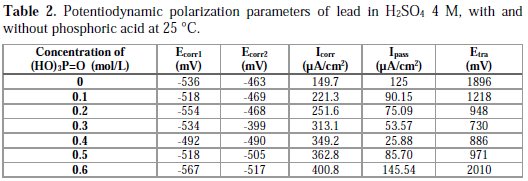
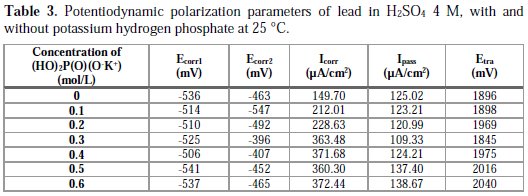
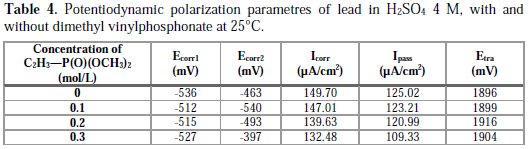
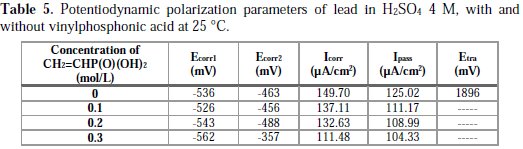
    <p>The intersection point of Tafel regions gives the corrosion current 
density (Icorr). The obtained polarization parameters Icorr, Ecorr, Ipass and Etra are 
given in <a href="#t1">Tables 1</a>, <a href="#t2">2</a>, <a href="#t3">3</a>, 
<a href="#t4">4</a> and <a href="#t5">5</a>.</p>


    <p>&nbsp;</p>
<a name="t1">
<img src="/img/revistas/pea/v34n6/34n6a02t1.jpg">
    
<p>&nbsp;</p>
<a name="t2">
<img src="/img/revistas/pea/v34n6/34n6a02t2.jpg">
    
<p>&nbsp;</p>
<a name="t3">
<img src="/img/revistas/pea/v34n6/34n6a02t3.jpg">
    
<p>&nbsp;</p>
<a name="t4">
<img src="/img/revistas/pea/v34n6/34n6a02t4.jpg">
    
]]></body>
<body><![CDATA[<p>&nbsp;</p>
<a name="t5">
<img src="/img/revistas/pea/v34n6/34n6a02t5.jpg">
    
<p>&nbsp;</p>


    <p><i><b>Corrosion of lead in pure H2SO4 4 M medium</b></i></p>

    <p>Examining the polarization curve shown in Fig. 1, we observe the evolution of 
hydrogen on the specimen represented by a high current that dropped with 
increasingly positive potential. The lead, at this range of potential, is at its active 
mode. Two pics of potential, observed at -536 mV and at -463 mV, correspond to 
the corrosion of lead and the formation of PbO and PbSO4, respectively, by the 
reaction of lead with water and H2SO4. Following these pics, the current drops to 
a low value (Ipass), indicating the attainment of passivity, and remains constant for 
a considerable range of potential. A layer comprised of lead sulfate PbSO4 and 
lead oxide PbO blocks the ion transfer from the electrolyte to the surface of the 
metal, inhibiting any further corrosion. Lead at this range shows passive 
characteristics. At 1896 mV, a pic was observed corresponding to the trans
passive mode, where a layer of PbO2 is formed by the reaction between lead 
sulfate and sulfuric acid. Furthermore, the current increases again, representing 
the evolution of oxygen in the electrolyte [22].</p>


    <p><i><b>Corrosion of lead with the addition of phosphoric acid</b></i></p>

    <p><a href="#f2">Fig. 2</a> and <a href="#t2">Table 2</a> show that the addition of phosphoric acid at concentrations up 
to 0.4 M makes the corrosion potential Ecorr1 shift towards less negative values 
from -536 to -492 mV, meaning that the metal was protected. This shifting is 
accompanied of a significant decrease of the passivity current Ipass from 125 to 
25.88 &mu;A/cm<sup>2</sup>. This indicates that the addition of phosphoric acid at this range of 
concentration increases the passivity of lead, by perhaps forming a porous layer 
of PbHPO4 [19]. After the reaction of lead with phosphoric acid, this layer is 
deposited along with PbSO4, leading to a better inhibition of ion transfer to the 
metal, and blocking any further corrosion. We have observed in our study that 
the main disadvantage of phosphoric acid is that the corrosion current Icorr 
increases with an increasing concentration, due to the fact that phosphoric acid is 
a strong acid that can increase the corrosion rate of lead. The trans-passive 
potential Etra decreases with an increasing concentration of phosphoric acid up to 
0.4 M, indicating that phosphoric acid facilitates the formation of PbO2. On the 
other hand, by adding phosphoric acid at concentrations above 0.4 M, we notice 
that passivity current increases with an increasing concentration of phosphoric 
acid; this may be due to the competitive deposition of PbHPO4 with PbSO4, not 
possible at lower concentrations, and because PbHPO4 is more conductive than 
PbSO4, as it allows the passage of ions on the interface metal/electrolyte [20, 21]. 
In its turn, the trans-passive potential Etra increases with an increasing 
concentration of phosphoric acid, indicating that the addition of phosphoric acid, 
at this range of concentration, retards the formation of PbO2, perhaps through the 
formation of the complex Pb3(PO4)2, as an intermediate in the process of lead 
corrosion [10]; the oxidation of this complex into PbO2 is produced at higher 
potentials, due to its high stability.</p>


    <p><i><b>Corrosion of lead with addition of potassium hydrogen phosphate</b></i></p>

    <p>After analyzing <a href="#f3">Fig. 3</a> and <a href="#t3">Table 3</a>, we conclude that the addition of potassium 
hydrogen phosphate at concentrations up to 0.3 M makes the corrosion potential 
Ecorr1 shift towards less negative values; this means that the metal is protected. 
Meanwhile, the passivity current decreases at this range of concentrations 
indicating an increase of the passivity of lead. This may be explained by the 
formation of a porous layer comprised of PbKPO4 that deposited together with 
PbSO4, forming a thick passive layer that blocks the passage of ions to the metal 
and increases its passivity. At low concentrations (&lt; 0.3 M), the trans-passive 
potential does not shift towards a precise direction, indicating that potassium 
hydrogen phosphate does not influence the PbO2 formation. The corrosion 
current Icorr increases with an increasing concentration. Above 0.3 M of 
potassium hydrogen phosphate, we notice that the passivity current Ipass increases 
with an increasing concentration; this may be explained by the deposition of 
PbKPO4 (which is more conductive than PbSO4), in detriment of PbSO4, 
allowing the ion transfer at the interface lead/electrolyte, and thereby, decreasing 
the lead passivity. The trans-passive potential also increases at this range of 
concentration, indicating a retardation of PbO2 formation, possibly due to the 
formation of Pb3(PO4)2 that transforms into PbO2 at higher potentials, because of 
its stability.</p>


    <p><i><b>Corrosion of lead with addition of dimethyl vinylphosphonate</b></i></p>

    <p><a href="#f4">Fig. 4</a> and <a href="#t4">Table 4</a> show us that the addition of dimethyl vinylphosphonate does 
not make the corrosion potentials shift towards a precise direction, indicating that 
dimethyl vinylphosphonate can be considered as a mixed inhibitor. The 
advantage of dimethyl vinylphosphonate is that the corrosion current Ecorr 
decreases with an increasing concentration of dimethyl vinylphosphonate up to 
0.3 M, indicating a decrease in the corrosion rate, unlike phosphoric acid and 
potassium hydrogen phosphate. We also notice that the passivity current Ipass 
decreases with an increasing concentration, indicating an increase of the passivity 
of lead. This might be explained by the fact that dimethyl vinylphosphonate 
induces the formation of a passive layer that inhibits the corrosion of the metal 
by blocking the ion transfer. The trans-passive potential doesn't shift 
significatively, meaning that dimethyl vinylphosphonate has no influence on the 
PbO2 formation.</p>


    ]]></body>
<body><![CDATA[<p><i><b>Corrosion of lead with the addition of vinylphosphonic acid</b></i></p>

    <p>We have studied the addition of vinylphosphonic acid at concentrations up to 0.3 
M, to see the difference between vinylphosphonic acid and the ester potassium 
hydrogen phosphate at this interesting range.</p>

    <p><a href="#f5">Fig. 5</a> and <a href="#t5">Table 5</a> show us that the addition of vinylphosphonic acid does not 
make the corrosion potentials shift towards a precise direction, indicating that 
vinylphosphonic acid can be considered as a mixed inhibitor. The advantage 
noticed for the addition of vinylphosphonic acid is that the corrosion current Ecorr 
decreases with an increasing concentration of vinylphosphonic acid, indicating a 
decrease in the corrosion rate, just like in the case of potassium hydrogen 
phosphate. We also have noticed that the passivity current Ipass decreases at low 
concentrations, indicating an increase of the passivity of lead. We also have 
noticed a significant decrease of the marge of the passivity, which may be due to 
a rapid degradation of PbSO4. After the addition of vinylphosphonic acid, we 
have noticed the complete absence of the Etra, indicating that there is no 
formation of PbO2, unlike previous cases.</p>


    <p><i><b>Electrochemical impedance spectroscopy (EIS)</b></i></p>

    <p>EIS was used to determine the action mode of the compound studied, and to 
evaluate the dielectric properties of the passive layer; it also helps explaining the 
electrochemical process that develops throughout the passive layer. Thus, we 
used this technique to study the reaction mechanisms during the lead corrosion in 
H2SO4 with the presence of phosphoric and phosphonic compounds.</p>

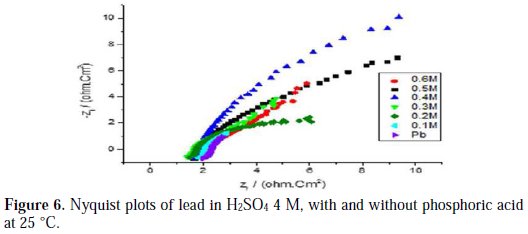
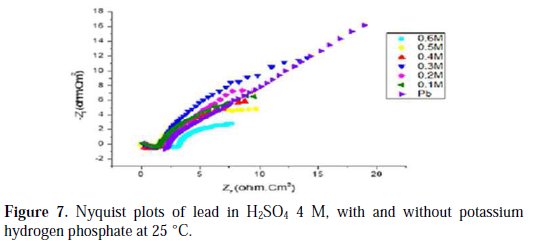
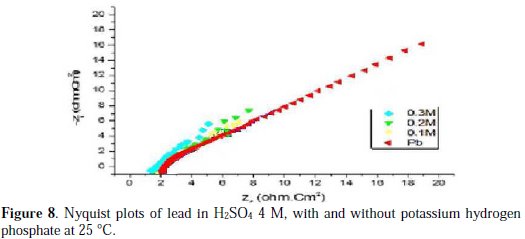
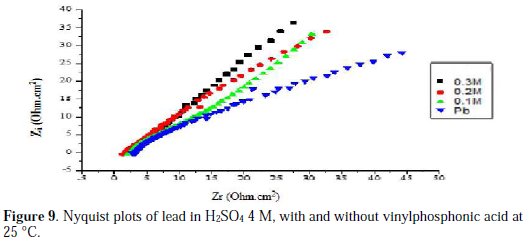
    <p><a href="#f6">Figs. 6</a>, <a href="#f7">7</a>, <a href="#f8">8</a> and <a href="#f9">9</a> 
show the Nyquist plots for pure lead in H2SO4 4 M, in the 
absence and presence of phosphoric acid, potassium hydrogen phosphate, 
potassium hydrogen phosphate and vinylphosphonic acid, respectively, generated 
at 25 &deg;C.</p>


    <p>&nbsp;</p>
<a name="f6">
<img src="/img/revistas/pea/v34n6/34n6a02f6.jpg">
    
<p>&nbsp;</p>
<a name="f7">
<img src="/img/revistas/pea/v34n6/34n6a02f7.jpg">
    
<p>&nbsp;</p>
<a name="f8">
<img src="/img/revistas/pea/v34n6/34n6a02f8.jpg">
    
<p>&nbsp;</p>
<a name="f9">
<img src="/img/revistas/pea/v34n6/34n6a02f9.jpg">
    
]]></body>
<body><![CDATA[<p>&nbsp;</p>


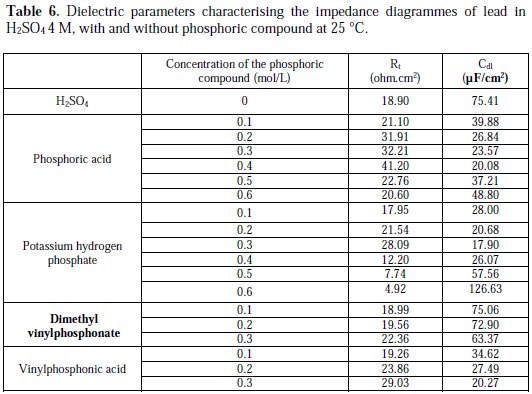
    <p>The values of the charge transfer resistance Rt, and those of the capacity 
of the double layer Cdl at Ecorr = -536 mV/SCE, are listed in <a href="#t6">Table 6</a>.</p>


    <p>&nbsp;</p>
<a name="t6">
<img src="/img/revistas/pea/v34n6/34n6a02t6.jpg">
    
<p>&nbsp;</p>


    <p>The charge transfer resistance values Rt were calculated based on the difference 
between impedance values at lower and higher frequencies.</p>

    <p>The Nyquist plots shown in <a href="#f6">Figs. 6</a>, <a href="#f7">7</a>, 
<a href="#f8">8</a> and <a href="#f9">9</a> are in the shape of a unique semicircle, 
meaning that the charge transfer is the main reaction mechanism at the 
interface lead/electrolyte [16, 17]. At concentrations below 0.5 M for phosphoric 
acid, and 0.4 M for potassium hydrogen phosphate, and vinylphosphonic acid, 
the diameter of the semi-circles increases with an increasing concentration of 
phosphoric and phosphonic compounds, indicating the growth of a passive layer 
that protects the metal from corrosion. At higher concentrations, the diameter of 
the semi-circles decreases because of the degradation of the passive layer [18].</p>

    <p>Analyzing <a href="#t6">Table 6</a>, we can clearly see that, below a certain concentration of the 
phosphoric compound, the charge transfer resistance Rt increases, and the 
capacitance Cdl decreases with an increasing concentration. This indicates that 
the thickness of the passive layer increases with the addition of the compound, by 
formation and deposition of PbHPO4, after adding phosphoric acid to the 
electrolyte, and PbKPO4, after adding potassium hydrogen phosphate to the 
electrolyte, along with PbSO4 on the surface of lead, and by increasing the rate of 
PbSO4 formation, after adding potassium hydrogen phosphate and 
vinylphosphonic acid.</p>

    <p>At higher concentrations of the three phosphoric and phosphonic compounds, Rt 
decreases and Cdl increases with an increasing concentration. This is attributed to 
the formation and deposition of PbHPO4 (for phosphoric acid) and PbKPO4 (for 
potassium hydrogen phosphate) in detriment of PbSO4, leading to a decrease in 
thickness of the passive layer.</p>


    <p>&nbsp;</p>
    <p><b>Conclusions</b></p>

    ]]></body>
<body><![CDATA[<p>With the addition of phosphoric acid or its salt potassium hydrogen phosphate at 
concentrations up to 0.4 M, the passivation current Ipass decreases, indicating an 
increase of the passivation rate of lead; the corrosion rate Icorr increases and trans-
passive potential Etra decreases, meaning that these 2 compounds accelerate the 
formation of PbO2.</p>

    <p>After increasing the concentration of potassium hydrogen phosphate and 
vinylphosphonic acid up to 0.3 M, the passivation current Ipass decreases, and the 
corrosion current Icorr also decreases, meaning that both products increase the 
lead passivation and decrease its corrosion rate. Our studies showed that 
potassium hydrogen phosphate has no effect on the PbO2 formation. Meanwhile, 
the addition of vinylphosphonic acid has the same effect on the corrosion and 
passivation of lead, but it suppresses the formation of PbO2.</p>

    <p>We can conclude that phosphoric acid, potassium hydrogen phosphate, and 
vinylphosphonic acid, added to a certain concentration, create a better resistance 
of lead against corrosion in sulfuric acid, by increasing its passivation, and can 
improve the life time of the battery, by reducing the sulphatation phenomenon.</p>


    <p>&nbsp;</p>
    <p><b>References</b></p>

    <!-- ref --><p>1. Venugopalan S. J Power Sources. 1994;48:371.    &nbsp;&nbsp;&nbsp;&nbsp;&nbsp;&nbsp;&nbsp;&nbsp;[&#160;<a href="javascript:void(0);" onclick="javascript: window.open('/scielo.php?script=sci_nlinks&ref=423704&pid=S0872-1904201600060000200001&lng=','','width=640,height=500,resizable=yes,scrollbars=1,menubar=yes,');">Links</a>&#160;]<!-- end-ref --></p>

    <!-- ref --><p>2. Bhattacharya A, Basumallick I N. J Power Sources. 2003;113:382.    &nbsp;&nbsp;&nbsp;&nbsp;&nbsp;&nbsp;&nbsp;&nbsp;[&#160;<a href="javascript:void(0);" onclick="javascript: window.open('/scielo.php?script=sci_nlinks&ref=423706&pid=S0872-1904201600060000200002&lng=','','width=640,height=500,resizable=yes,scrollbars=1,menubar=yes,');">Links</a>&#160;]<!-- end-ref --></p>

    <!-- ref --><p>3. Paleskaa I, Pruszkowska-Drachala R, Kotowskia J, et al. J. Power Sources. 2003;113:308.    &nbsp;&nbsp;&nbsp;&nbsp;&nbsp;&nbsp;&nbsp;&nbsp;[&#160;<a href="javascript:void(0);" onclick="javascript: window.open('/scielo.php?script=sci_nlinks&ref=423708&pid=S0872-1904201600060000200003&lng=','','width=640,height=500,resizable=yes,scrollbars=1,menubar=yes,');">Links</a>&#160;]<!-- end-ref --></p>

    <!-- ref --><p>4. Li S, Chen HY, Tang MC, et al. J. Power Sources. 2006;158:914.    &nbsp;&nbsp;&nbsp;&nbsp;&nbsp;&nbsp;&nbsp;&nbsp;[&#160;<a href="javascript:void(0);" onclick="javascript: window.open('/scielo.php?script=sci_nlinks&ref=423710&pid=S0872-1904201600060000200004&lng=','','width=640,height=500,resizable=yes,scrollbars=1,menubar=yes,');">Links</a>&#160;]<!-- end-ref --></p>

    <!-- ref --><p>5. Saminathan K, Jayaprakash N, Rajeswari B, et al. J Power Sources. 2006;160:1410.    &nbsp;&nbsp;&nbsp;&nbsp;&nbsp;&nbsp;&nbsp;&nbsp;[&#160;<a href="javascript:void(0);" onclick="javascript: window.open('/scielo.php?script=sci_nlinks&ref=423712&pid=S0872-1904201600060000200005&lng=','','width=640,height=500,resizable=yes,scrollbars=1,menubar=yes,');">Links</a>&#160;]<!-- end-ref --></p>

    <!-- ref --><p>6. Abd El-Rahman HA, Salih SA, Mokhtar AA. AFINIDAD LXVIII. 2011;351.    &nbsp;&nbsp;&nbsp;&nbsp;&nbsp;&nbsp;&nbsp;&nbsp;[&#160;<a href="javascript:void(0);" onclick="javascript: window.open('/scielo.php?script=sci_nlinks&ref=423714&pid=S0872-1904201600060000200006&lng=','','width=640,height=500,resizable=yes,scrollbars=1,menubar=yes,');">Links</a>&#160;]<!-- end-ref --></p>

    <!-- ref --><p>7. Badawy WA, El-Egamy SS. J Power Sources. 1995;55:11.    &nbsp;&nbsp;&nbsp;&nbsp;&nbsp;&nbsp;&nbsp;&nbsp;[&#160;<a href="javascript:void(0);" onclick="javascript: window.open('/scielo.php?script=sci_nlinks&ref=423716&pid=S0872-1904201600060000200007&lng=','','width=640,height=500,resizable=yes,scrollbars=1,menubar=yes,');">Links</a>&#160;]<!-- end-ref --></p>

    <!-- ref --><p>8. Stemberg S, Mateescu A, Branzoi V, et al. Electrochim Acta. 1987;32:349.    &nbsp;&nbsp;&nbsp;&nbsp;&nbsp;&nbsp;&nbsp;&nbsp;[&#160;<a href="javascript:void(0);" onclick="javascript: window.open('/scielo.php?script=sci_nlinks&ref=423718&pid=S0872-1904201600060000200008&lng=','','width=640,height=500,resizable=yes,scrollbars=1,menubar=yes,');">Links</a>&#160;]<!-- end-ref --></p>

    <!-- ref --><p>9. Doring H, Wiesener K, Garche J, et al. J Power Sources. 1992;381:261.    &nbsp;&nbsp;&nbsp;&nbsp;&nbsp;&nbsp;&nbsp;&nbsp;[&#160;<a href="javascript:void(0);" onclick="javascript: window.open('/scielo.php?script=sci_nlinks&ref=423720&pid=S0872-1904201600060000200009&lng=','','width=640,height=500,resizable=yes,scrollbars=1,menubar=yes,');">Links</a>&#160;]<!-- end-ref --></p>

    <!-- ref --><p>10. Bullock K. Phosphoric acid influence. Elsevier; 2009.    &nbsp;&nbsp;&nbsp;&nbsp;&nbsp;&nbsp;&nbsp;&nbsp;[&#160;<a href="javascript:void(0);" onclick="javascript: window.open('/scielo.php?script=sci_nlinks&ref=423722&pid=S0872-1904201600060000200010&lng=','','width=640,height=500,resizable=yes,scrollbars=1,menubar=yes,');">Links</a>&#160;]<!-- end-ref --></p>

    <p>11. Visscher W. J Power Sources. 1976/77;1:257.</p>

    <!-- ref --><p>12. Doring H, Wiesener K, Garche J, et al. J Power Sources. 1992;38:261.    &nbsp;&nbsp;&nbsp;&nbsp;&nbsp;&nbsp;&nbsp;&nbsp;[&#160;<a href="javascript:void(0);" onclick="javascript: window.open('/scielo.php?script=sci_nlinks&ref=423725&pid=S0872-1904201600060000200012&lng=','','width=640,height=500,resizable=yes,scrollbars=1,menubar=yes,');">Links</a>&#160;]<!-- end-ref --></p>

    <!-- ref --><p>13. Sternberg S, Branzoi V, Apateanu L. J Power Sources, 1990;30:177.    &nbsp;&nbsp;&nbsp;&nbsp;&nbsp;&nbsp;&nbsp;&nbsp;[&#160;<a href="javascript:void(0);" onclick="javascript: window.open('/scielo.php?script=sci_nlinks&ref=423727&pid=S0872-1904201600060000200013&lng=','','width=640,height=500,resizable=yes,scrollbars=1,menubar=yes,');">Links</a>&#160;]<!-- end-ref --></p>

    ]]></body>
<body><![CDATA[<!-- ref --><p>14. Saminathan K, Jayaprakash N, Rajeswari B, et al. J Power Sources. 2006;160:1410.    &nbsp;&nbsp;&nbsp;&nbsp;&nbsp;&nbsp;&nbsp;&nbsp;[&#160;<a href="javascript:void(0);" onclick="javascript: window.open('/scielo.php?script=sci_nlinks&ref=423729&pid=S0872-1904201600060000200014&lng=','','width=640,height=500,resizable=yes,scrollbars=1,menubar=yes,');">Links</a>&#160;]<!-- end-ref --></p>

    <!-- ref --><p>15. Stemberg S, Mateescu A, Branzoi V, et al. Electrochim Acta. 1987;32:349.    &nbsp;&nbsp;&nbsp;&nbsp;&nbsp;&nbsp;&nbsp;&nbsp;[&#160;<a href="javascript:void(0);" onclick="javascript: window.open('/scielo.php?script=sci_nlinks&ref=423731&pid=S0872-1904201600060000200015&lng=','','width=640,height=500,resizable=yes,scrollbars=1,menubar=yes,');">Links</a>&#160;]<!-- end-ref --></p>

    <!-- ref --><p>16. Larabi L, Harek Y, Traisnel M, et al. J Appl Electrochem. 2004;34:833.    &nbsp;&nbsp;&nbsp;&nbsp;&nbsp;&nbsp;&nbsp;&nbsp;[&#160;<a href="javascript:void(0);" onclick="javascript: window.open('/scielo.php?script=sci_nlinks&ref=423733&pid=S0872-1904201600060000200016&lng=','','width=640,height=500,resizable=yes,scrollbars=1,menubar=yes,');">Links</a>&#160;]<!-- end-ref --></p>

    <!-- ref --><p>17. Li X, Deng S, Fu H. Corros Sci. 2010;52:2786.    &nbsp;&nbsp;&nbsp;&nbsp;&nbsp;&nbsp;&nbsp;&nbsp;[&#160;<a href="javascript:void(0);" onclick="javascript: window.open('/scielo.php?script=sci_nlinks&ref=423735&pid=S0872-1904201600060000200017&lng=','','width=640,height=500,resizable=yes,scrollbars=1,menubar=yes,');">Links</a>&#160;]<!-- end-ref --></p>

    <!-- ref --><p>18. Behpour M, Ghoreishi SM, Mohammadi N, et al. Corros Sci. 2010;52:4046.    &nbsp;&nbsp;&nbsp;&nbsp;&nbsp;&nbsp;&nbsp;&nbsp;[&#160;<a href="javascript:void(0);" onclick="javascript: window.open('/scielo.php?script=sci_nlinks&ref=423737&pid=S0872-1904201600060000200018&lng=','','width=640,height=500,resizable=yes,scrollbars=1,menubar=yes,');">Links</a>&#160;]<!-- end-ref --></p>

    ]]></body>
<body><![CDATA[<!-- ref --><p>19. Paleskaa I, Pruszkowska-Drachala R, Kotowskia J, et al. J Power Sources. 2003;113:308.    &nbsp;&nbsp;&nbsp;&nbsp;&nbsp;&nbsp;&nbsp;&nbsp;[&#160;<a href="javascript:void(0);" onclick="javascript: window.open('/scielo.php?script=sci_nlinks&ref=423739&pid=S0872-1904201600060000200019&lng=','','width=640,height=500,resizable=yes,scrollbars=1,menubar=yes,');">Links</a>&#160;]<!-- end-ref --></p>

    <!-- ref --><p>20. Li S, Chen HY, Tang MC, et al. J Power Sources. 2006;158:914.    &nbsp;&nbsp;&nbsp;&nbsp;&nbsp;&nbsp;&nbsp;&nbsp;[&#160;<a href="javascript:void(0);" onclick="javascript: window.open('/scielo.php?script=sci_nlinks&ref=423741&pid=S0872-1904201600060000200020&lng=','','width=640,height=500,resizable=yes,scrollbars=1,menubar=yes,');">Links</a>&#160;]<!-- end-ref --></p>

    <!-- ref --><p>21. Abd El-Rahman HA, Salih SA, Mokhtar AA. AFINIDAD LXVIII. 2011;349.    &nbsp;&nbsp;&nbsp;&nbsp;&nbsp;&nbsp;&nbsp;&nbsp;[&#160;<a href="javascript:void(0);" onclick="javascript: window.open('/scielo.php?script=sci_nlinks&ref=423743&pid=S0872-1904201600060000200021&lng=','','width=640,height=500,resizable=yes,scrollbars=1,menubar=yes,');">Links</a>&#160;]<!-- end-ref --></p>

    <!-- ref --><p>22. El Rahim A, El Halim AA, Fouad E. J Industrial Chem. 1999.    &nbsp;&nbsp;&nbsp;&nbsp;&nbsp;&nbsp;&nbsp;&nbsp;[&#160;<a href="javascript:void(0);" onclick="javascript: window.open('/scielo.php?script=sci_nlinks&ref=423745&pid=S0872-1904201600060000200022&lng=','','width=640,height=500,resizable=yes,scrollbars=1,menubar=yes,');">Links</a>&#160;]<!-- end-ref --></p>


    <p>&nbsp;</p>
    <p><a name=0></a><sup><a href="#top">*</a></sup>Corresponding author. E-mail address: <a href="mailto:khatbisalma@gmail.com">khatbisalma@gmail.com</a></p>

    ]]></body>
<body><![CDATA[<p>Received May 24, 2016; accepted October 13, 2016</p>

    <p><a href="http://www.peacta.org" target="_blank">www.peacta.org</a> </p>


     ]]></body><back>
<ref-list>
<ref id="B1">
<label>1</label><nlm-citation citation-type="journal">
<person-group person-group-type="author">
<name>
<surname><![CDATA[Venugopalan]]></surname>
<given-names><![CDATA[S]]></given-names>
</name>
</person-group>
<source><![CDATA[J Power Sources]]></source>
<year>1994</year>
<volume>48</volume>
<page-range>371</page-range></nlm-citation>
</ref>
<ref id="B2">
<label>2</label><nlm-citation citation-type="journal">
<person-group person-group-type="author">
<name>
<surname><![CDATA[Bhattacharya]]></surname>
<given-names><![CDATA[A]]></given-names>
</name>
<name>
<surname><![CDATA[Basumallick]]></surname>
<given-names><![CDATA[I N]]></given-names>
</name>
</person-group>
<source><![CDATA[J Power Sources]]></source>
<year>2003</year>
<volume>113</volume>
<page-range>382</page-range></nlm-citation>
</ref>
<ref id="B3">
<label>3</label><nlm-citation citation-type="journal">
<person-group person-group-type="author">
<name>
<surname><![CDATA[Paleskaa]]></surname>
<given-names><![CDATA[I]]></given-names>
</name>
<name>
<surname><![CDATA[Pruszkowska-Drachala]]></surname>
<given-names><![CDATA[R]]></given-names>
</name>
<name>
<surname><![CDATA[Kotowskia]]></surname>
<given-names><![CDATA[J]]></given-names>
</name>
</person-group>
<source><![CDATA[J. Power Sources]]></source>
<year>2003</year>
<volume>113</volume>
<page-range>308</page-range></nlm-citation>
</ref>
<ref id="B4">
<label>4</label><nlm-citation citation-type="journal">
<person-group person-group-type="author">
<name>
<surname><![CDATA[Li]]></surname>
<given-names><![CDATA[S]]></given-names>
</name>
<name>
<surname><![CDATA[Chen]]></surname>
<given-names><![CDATA[H Y]]></given-names>
</name>
<name>
<surname><![CDATA[Tang]]></surname>
<given-names><![CDATA[M C]]></given-names>
</name>
</person-group>
<source><![CDATA[J. Power Sources]]></source>
<year>2006</year>
<volume>158</volume>
<page-range>914</page-range></nlm-citation>
</ref>
<ref id="B5">
<label>5</label><nlm-citation citation-type="journal">
<person-group person-group-type="author">
<name>
<surname><![CDATA[Saminathan]]></surname>
<given-names><![CDATA[K]]></given-names>
</name>
<name>
<surname><![CDATA[Jayaprakash]]></surname>
<given-names><![CDATA[N]]></given-names>
</name>
<name>
<surname><![CDATA[Rajeswari]]></surname>
<given-names><![CDATA[B]]></given-names>
</name>
</person-group>
<source><![CDATA[J Power Sources]]></source>
<year>2006</year>
<volume>160</volume>
<page-range>1410</page-range></nlm-citation>
</ref>
<ref id="B6">
<label>6</label><nlm-citation citation-type="journal">
<person-group person-group-type="author">
<name>
<surname><![CDATA[Abd El-Rahman]]></surname>
<given-names><![CDATA[H A]]></given-names>
</name>
<name>
<surname><![CDATA[Salih]]></surname>
<given-names><![CDATA[S A]]></given-names>
</name>
<name>
<surname><![CDATA[Mokhtar]]></surname>
<given-names><![CDATA[A A]]></given-names>
</name>
</person-group>
<source><![CDATA[AFINIDAD LXVIII]]></source>
<year>2011</year>
<page-range>351</page-range></nlm-citation>
</ref>
<ref id="B7">
<label>7</label><nlm-citation citation-type="journal">
<person-group person-group-type="author">
<name>
<surname><![CDATA[Badawy]]></surname>
<given-names><![CDATA[W A]]></given-names>
</name>
<name>
<surname><![CDATA[El-Egamy]]></surname>
<given-names><![CDATA[S S]]></given-names>
</name>
</person-group>
<source><![CDATA[J Power Sources]]></source>
<year>1995</year>
<volume>55</volume>
<page-range>11</page-range></nlm-citation>
</ref>
<ref id="B8">
<label>8</label><nlm-citation citation-type="journal">
<person-group person-group-type="author">
<name>
<surname><![CDATA[Stemberg]]></surname>
<given-names><![CDATA[S]]></given-names>
</name>
<name>
<surname><![CDATA[Mateescu]]></surname>
<given-names><![CDATA[A]]></given-names>
</name>
<name>
<surname><![CDATA[Branzoi]]></surname>
<given-names><![CDATA[V]]></given-names>
</name>
</person-group>
<source><![CDATA[Electrochim Acta]]></source>
<year>1987</year>
<volume>32</volume>
<page-range>349</page-range></nlm-citation>
</ref>
<ref id="B9">
<label>9</label><nlm-citation citation-type="journal">
<person-group person-group-type="author">
<name>
<surname><![CDATA[Doring]]></surname>
<given-names><![CDATA[H]]></given-names>
</name>
<name>
<surname><![CDATA[Wiesener]]></surname>
<given-names><![CDATA[K]]></given-names>
</name>
<name>
<surname><![CDATA[Garche]]></surname>
<given-names><![CDATA[J]]></given-names>
</name>
</person-group>
<source><![CDATA[J Power Sources]]></source>
<year>1992</year>
<volume>381</volume>
<page-range>261</page-range></nlm-citation>
</ref>
<ref id="B10">
<label>10</label><nlm-citation citation-type="book">
<person-group person-group-type="author">
<name>
<surname><![CDATA[Bullock]]></surname>
<given-names><![CDATA[K]]></given-names>
</name>
</person-group>
<source><![CDATA[Phosphoric acid influence]]></source>
<year>2009</year>
<publisher-name><![CDATA[Elsevier]]></publisher-name>
</nlm-citation>
</ref>
<ref id="B11">
<label>11</label><nlm-citation citation-type="journal">
<person-group person-group-type="author">
<name>
<surname><![CDATA[Visscher]]></surname>
<given-names><![CDATA[W]]></given-names>
</name>
</person-group>
<source><![CDATA[J Power Sources]]></source>
<year>1976</year>
<volume>1</volume>
<page-range>257</page-range></nlm-citation>
</ref>
<ref id="B12">
<label>12</label><nlm-citation citation-type="journal">
<person-group person-group-type="author">
<name>
<surname><![CDATA[Doring]]></surname>
<given-names><![CDATA[H]]></given-names>
</name>
<name>
<surname><![CDATA[Wiesener]]></surname>
<given-names><![CDATA[K]]></given-names>
</name>
<name>
<surname><![CDATA[Garche]]></surname>
<given-names><![CDATA[J]]></given-names>
</name>
</person-group>
<source><![CDATA[J Power Sources]]></source>
<year>1992</year>
<volume>38</volume>
<page-range>261</page-range></nlm-citation>
</ref>
<ref id="B13">
<label>13</label><nlm-citation citation-type="journal">
<person-group person-group-type="author">
<name>
<surname><![CDATA[Sternberg]]></surname>
<given-names><![CDATA[S]]></given-names>
</name>
<name>
<surname><![CDATA[Branzoi]]></surname>
<given-names><![CDATA[V]]></given-names>
</name>
<name>
<surname><![CDATA[Apateanu]]></surname>
<given-names><![CDATA[L]]></given-names>
</name>
</person-group>
<source><![CDATA[J Power Sources]]></source>
<year>1990</year>
<volume>30</volume>
<page-range>177</page-range></nlm-citation>
</ref>
<ref id="B14">
<label>14</label><nlm-citation citation-type="journal">
<person-group person-group-type="author">
<name>
<surname><![CDATA[Saminathan]]></surname>
<given-names><![CDATA[K]]></given-names>
</name>
<name>
<surname><![CDATA[Jayaprakash]]></surname>
<given-names><![CDATA[N]]></given-names>
</name>
<name>
<surname><![CDATA[Rajeswari]]></surname>
<given-names><![CDATA[B]]></given-names>
</name>
</person-group>
<source><![CDATA[J Power Sources]]></source>
<year>2006</year>
<volume>160</volume>
<page-range>1410</page-range></nlm-citation>
</ref>
<ref id="B15">
<label>15</label><nlm-citation citation-type="journal">
<person-group person-group-type="author">
<name>
<surname><![CDATA[Stemberg]]></surname>
<given-names><![CDATA[S]]></given-names>
</name>
<name>
<surname><![CDATA[Mateescu]]></surname>
<given-names><![CDATA[A]]></given-names>
</name>
<name>
<surname><![CDATA[Branzoi]]></surname>
<given-names><![CDATA[V]]></given-names>
</name>
</person-group>
<source><![CDATA[Electrochim Acta]]></source>
<year>1987</year>
<volume>32</volume>
<page-range>349</page-range></nlm-citation>
</ref>
<ref id="B16">
<label>16</label><nlm-citation citation-type="journal">
<person-group person-group-type="author">
<name>
<surname><![CDATA[Larabi]]></surname>
<given-names><![CDATA[L]]></given-names>
</name>
<name>
<surname><![CDATA[Harek]]></surname>
<given-names><![CDATA[Y]]></given-names>
</name>
<name>
<surname><![CDATA[Traisnel]]></surname>
<given-names><![CDATA[M]]></given-names>
</name>
</person-group>
<source><![CDATA[J Appl Electrochem]]></source>
<year>2004</year>
<volume>34</volume>
<page-range>833</page-range></nlm-citation>
</ref>
<ref id="B17">
<label>17</label><nlm-citation citation-type="journal">
<person-group person-group-type="author">
<name>
<surname><![CDATA[Li]]></surname>
<given-names><![CDATA[X]]></given-names>
</name>
<name>
<surname><![CDATA[Deng]]></surname>
<given-names><![CDATA[S]]></given-names>
</name>
<name>
<surname><![CDATA[Fu]]></surname>
<given-names><![CDATA[H]]></given-names>
</name>
</person-group>
<source><![CDATA[Corros Sci]]></source>
<year>2010</year>
<volume>52</volume>
<page-range>2786</page-range></nlm-citation>
</ref>
<ref id="B18">
<label>18</label><nlm-citation citation-type="journal">
<person-group person-group-type="author">
<name>
<surname><![CDATA[Behpour]]></surname>
<given-names><![CDATA[M]]></given-names>
</name>
<name>
<surname><![CDATA[Ghoreishi]]></surname>
<given-names><![CDATA[S M]]></given-names>
</name>
<name>
<surname><![CDATA[Mohammadi]]></surname>
<given-names><![CDATA[N]]></given-names>
</name>
</person-group>
<source><![CDATA[Corros Sci]]></source>
<year>2010</year>
<volume>52</volume>
<page-range>4046</page-range></nlm-citation>
</ref>
<ref id="B19">
<label>19</label><nlm-citation citation-type="journal">
<person-group person-group-type="author">
<name>
<surname><![CDATA[Paleskaa]]></surname>
<given-names><![CDATA[I]]></given-names>
</name>
<name>
<surname><![CDATA[Pruszkowska-Drachala]]></surname>
<given-names><![CDATA[R]]></given-names>
</name>
<name>
<surname><![CDATA[Kotowskia]]></surname>
<given-names><![CDATA[J]]></given-names>
</name>
</person-group>
<source><![CDATA[J Power Sources]]></source>
<year>2003</year>
<volume>113</volume>
<page-range>308</page-range></nlm-citation>
</ref>
<ref id="B20">
<label>20</label><nlm-citation citation-type="journal">
<person-group person-group-type="author">
<name>
<surname><![CDATA[Li]]></surname>
<given-names><![CDATA[S]]></given-names>
</name>
<name>
<surname><![CDATA[Chen]]></surname>
<given-names><![CDATA[H Y]]></given-names>
</name>
<name>
<surname><![CDATA[Tang]]></surname>
<given-names><![CDATA[M C]]></given-names>
</name>
</person-group>
<source><![CDATA[J Power Sources]]></source>
<year>2006</year>
<volume>158</volume>
<page-range>914</page-range></nlm-citation>
</ref>
<ref id="B21">
<label>21</label><nlm-citation citation-type="journal">
<person-group person-group-type="author">
<name>
<surname><![CDATA[Abd El-Rahman]]></surname>
<given-names><![CDATA[H A]]></given-names>
</name>
<name>
<surname><![CDATA[Salih]]></surname>
<given-names><![CDATA[S A]]></given-names>
</name>
<name>
<surname><![CDATA[Mokhtar]]></surname>
<given-names><![CDATA[A A]]></given-names>
</name>
</person-group>
<source><![CDATA[AFINIDAD LXVIII]]></source>
<year>2011</year>
<page-range>349</page-range></nlm-citation>
</ref>
<ref id="B22">
<label>22</label><nlm-citation citation-type="journal">
<person-group person-group-type="author">
<name>
<surname><![CDATA[El Rahim]]></surname>
<given-names><![CDATA[A]]></given-names>
</name>
<name>
<surname><![CDATA[El Halim]]></surname>
<given-names><![CDATA[A A]]></given-names>
</name>
<name>
<surname><![CDATA[Fouad]]></surname>
<given-names><![CDATA[E]]></given-names>
</name>
</person-group>
<source><![CDATA[J Industrial Chem]]></source>
<year>1999</year>
</nlm-citation>
</ref>
</ref-list>
</back>
</article>