<?xml version="1.0" encoding="ISO-8859-1"?><article xmlns:mml="http://www.w3.org/1998/Math/MathML" xmlns:xlink="http://www.w3.org/1999/xlink" xmlns:xsi="http://www.w3.org/2001/XMLSchema-instance">
<front>
<journal-meta>
<journal-id>0872-1904</journal-id>
<journal-title><![CDATA[Portugaliae Electrochimica Acta]]></journal-title>
<abbrev-journal-title><![CDATA[Port. Electrochim. Acta]]></abbrev-journal-title>
<issn>0872-1904</issn>
<publisher>
<publisher-name><![CDATA[Sociedade Portuguesa de Electroquímica]]></publisher-name>
</publisher>
</journal-meta>
<article-meta>
<article-id>S0872-19042016000600003</article-id>
<article-id pub-id-type="doi">10.4152/pea.201606395</article-id>
<title-group>
<article-title xml:lang="en"><![CDATA[Aromatic Carboxylic Acids as Corrosion Inhibitors for Aluminium in Alkaline Solution]]></article-title>
</title-group>
<contrib-group>
<contrib contrib-type="author">
<name>
<surname><![CDATA[Madram]]></surname>
<given-names><![CDATA[Ali Reza]]></given-names>
</name>
<xref ref-type="aff" rid="A01"/>
</contrib>
<contrib contrib-type="author">
<name>
<surname><![CDATA[Shokri]]></surname>
<given-names><![CDATA[Foroozan]]></given-names>
</name>
<xref ref-type="aff" rid="A01"/>
</contrib>
<contrib contrib-type="author">
<name>
<surname><![CDATA[Sovizi]]></surname>
<given-names><![CDATA[Mohammad Reza]]></given-names>
</name>
<xref ref-type="aff" rid="A01"/>
</contrib>
<contrib contrib-type="author">
<name>
<surname><![CDATA[Kalhor]]></surname>
<given-names><![CDATA[Hamide]]></given-names>
</name>
<xref ref-type="aff" rid="A01"/>
</contrib>
</contrib-group>
<aff id="A01">
<institution><![CDATA[,Malek Ashtar University of Technology Department of Chemistry and Chemical Engineering ]]></institution>
<addr-line><![CDATA[Tehran ]]></addr-line>
<country>I.R. Iran</country>
</aff>
<pub-date pub-type="pub">
<day>00</day>
<month>11</month>
<year>2016</year>
</pub-date>
<pub-date pub-type="epub">
<day>00</day>
<month>11</month>
<year>2016</year>
</pub-date>
<volume>34</volume>
<numero>6</numero>
<fpage>395</fpage>
<lpage>405</lpage>
<copyright-statement/>
<copyright-year/>
<self-uri xlink:href="http://scielo.pt/scielo.php?script=sci_arttext&amp;pid=S0872-19042016000600003&amp;lng=en&amp;nrm=iso"></self-uri><self-uri xlink:href="http://scielo.pt/scielo.php?script=sci_abstract&amp;pid=S0872-19042016000600003&amp;lng=en&amp;nrm=iso"></self-uri><self-uri xlink:href="http://scielo.pt/scielo.php?script=sci_pdf&amp;pid=S0872-19042016000600003&amp;lng=en&amp;nrm=iso"></self-uri><abstract abstract-type="short" xml:lang="en"><p><![CDATA[The corrosion behavior of aluminium in 1 M NaOH solution, in the absence and presence of some aromatic carboxylic acids, was investigated using potentiodynamic polarization techniques, electrochemical impedance spectroscopy (EIS) and scanning electron microscope (SEM). The results among the investigated aromatic carboxylic acids, 4-bromomethyl, 3-bromo and 3-hydroxy benzoic acid were more efficient corrosion inhibitors for aluminium in alkaline medium. The values of different thermodynamic parameters such as adsorption equilibrium constant (Kads) and free energy of adsorption (&#916;Gads) were calculated and discussed. The adsorption process of studied inhibitors on aluminium surface obeys the Langmuir adsorption isotherm.]]></p></abstract>
<kwd-group>
<kwd lng="en"><![CDATA[aluminium corrosion]]></kwd>
<kwd lng="en"><![CDATA[aromatic carboxylic acids]]></kwd>
<kwd lng="en"><![CDATA[inhibitor]]></kwd>
<kwd lng="en"><![CDATA[electrochemical impedance spectroscopy]]></kwd>
<kwd lng="en"><![CDATA[potentiodynamic polarization]]></kwd>
</kwd-group>
</article-meta>
</front><body><![CDATA[ 

<!--     <p>&nbsp;</p>
    <p>doi: 10.4152/pea.201606395</p> -->

    <p><b>Aromatic Carboxylic Acids as Corrosion Inhibitors 
for Aluminium in Alkaline Solution</b></p>

    <p>
<b>Ali Reza Madram</b><sup><a href="#0">*</a></sup>
, <b>Foroozan Shokri</b>
, <b>Mohammad Reza Sovizi</b>
 and <b>Hamide Kalhor</b>
</p>

    <p><i> Department of Chemistry and Chemical Engineering, Malek Ashtar University of Technology, 
Tehran 15875-1774, I.R. Iran</i></p>


    <p>&nbsp;</p>
    <p><b>Abstract</b></p>

    <p>The corrosion behavior of aluminium in 1 M NaOH solution, in the absence and presence 
of some aromatic carboxylic acids, was investigated using potentiodynamic polarization 
techniques, electrochemical impedance spectroscopy (EIS) and scanning electron 
microscope (SEM). The results among the investigated aromatic carboxylic acids, 
4-bromomethyl, 3-bromo and 3-hydroxy benzoic acid were more efficient corrosion 
inhibitors for aluminium in alkaline medium. The values of different thermodynamic 
parameters such as adsorption equilibrium constant (K<sub>ads</sub>) and free energy of adsorption 
(&Delta;G<sub>ads</sub>) were calculated and discussed. The adsorption process of studied inhibitors on 
aluminium surface obeys the Langmuir adsorption isotherm.</p>

    <p><b><i>Keywords:</i></b> aluminium corrosion, aromatic carboxylic acids, inhibitor, electrochemical 
impedance spectroscopy, potentiodynamic polarization.</p>


    ]]></body>
<body><![CDATA[<p>&nbsp;</p>
    <p><b>Introduction</b></p>

    <p>Aluminium is an attractive fuel for electrochemical power sources. Its principal 
advantages as an anode material include high power, energy density, and great 
abundance. Corrosion of aluminium and its alloys has been the subject of 
numerous studies, due to their wide range of industrial applications, especially in 
aerospace, surface coating and alkaline batteries [1-3]. Aluminium and its alloys, 
however, are reactive materials and are prone to corrode. Aluminium relies on the 
formation of a compact, adherent passive oxide film for its corrosion immunity in 
various environments. This surface film is amphoteric and dissolves substantially 
when the metal is exposed to high concentrations of acids or bases [4]. Alkali 
destroys the protective aluminium film very quickly, because OH- ions are 
adsorbed, thus increasing the dissolution rate of aluminium [5]. The corrosion 
inhibition of aluminium and its alloys is of tremendous technological importance, 
due to the increased applications of these materials. Many investigators have 
studied ways to obtain optimum corrosion protection for aluminium in various 
media, by either finding new inhibitors or improving the inhibition efficiency. The 
inhibitor efficiency has been attributed to the adsorption of the inhibitor molecules 
on the metal surface, forming a protective layer. The extent of adsorption of an 
inhibitor depends on many factors: (a) the nature of the metal, (b) the mode of 
adsorption of the inhibitor, and (c) the surface condition [6-8]. The inhibition 
effect mainly depends on some physicochemical and electronic properties of the 
organic inhibitor which relate to its functional groups, steric effects, electronic 
density of donor atoms, and orbital character of donating electrons [9-12]. Several 
inhibitors have been used to control the corrosion of aluminium. To prevent the 
corrosion of aluminium in acid medium, inhibitors such as antibacterial drugs [13], 
imidazoline derivatives [14], Schiff bases [15] and delonix regia extract [16] have 
been used. In alkaline medium, inhibitors such as polyvinyl alcohol [17], 
gongronema latifolium extract [18] and 3-hydroxyflavone [19] have been used to 
prevent corrosion of aluminium. Aromatic carboxylic acid, especially benzoic 
acids and their substituted compounds were investigated as effective inhibitors for 
aluminium in acidic and alkaline solutions [20]. Adsorptive characteristics of the 
benzoic acids have an influence on the corrosion inhibition capacities. The 
benzene ring attached to the carboxyl group contributes to the inhibitor efficiency, 
which is further influenced by the substituent in the benzene ring. Thus, the 
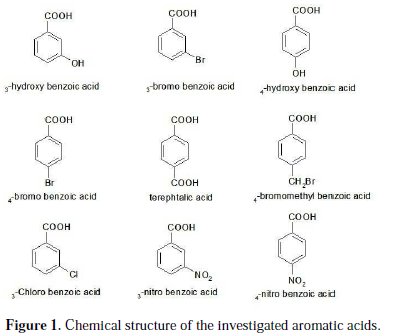
present study was undertaken to compare the inhibitive abilities of some aromatic 
carboxylic acids shown in <a href="#f1">Fig. 1</a> on the corrosion of aluminium in 1 M NaOH 
solutions by using potentiodynamic polarization and electrochemical impedance 
spectroscopy (EIS) methods.</p>


    <p>&nbsp;</p>
<a name="f1">
<img src="/img/revistas/pea/v34n6/34n6a03f1.jpg">
    
<p>&nbsp;</p>


    <p>The surface analysis was carried out using scanning 
electron microscope (SEM). The adsorption behavior of the inhibitors was 
analyzed against Langmuir adsorption isotherm theory.</p>


    <p>&nbsp;</p>
    <p><b>Experimental</b></p>

    <p><i><b>Materials and methods</b></i></p>

    <p>The working electrode was made of aluminium (Al-1050); surface preparation 
consisted of abrasion with sandpaper (P 800-2000, Siawat&reg;), followed by 
degreasing in an ultrasonic bath using ethanol and deionized water, and drying 
with a stream of air. The investigated aromatic carboxylic acids (<a href="#f1">Fig. 1</a>) were of 
analytical grade and used as purchased without further purification.</p>


    ]]></body>
<body><![CDATA[<p><i><b>Electrochemical experiments</b></i></p>

    <p>The electrochemical experiments were carried out using a traditional three-
electrode cell. The working electrode was an aluminium electrode (0.5 cm2). The 
counter electrode was a platinum foil and the reference electrode was an Hg/HgO 
electrode. Electrochemical measurements were performed by a Bio Logic 
(SP-150) instrument. Impedance measurements were performed under the 
corrosion potential with a sinusoidal potential perturbation of 5 mV in amplitude, 
and the frequency was from 100 kHz to 10 mHz. The measurements were taken 
until the electrode reached a steady state.</p>


    <p>&nbsp;</p>
    <p><b>Results and discussion</b></p>

    <p><i><b>Polarization measurements</b></i></p>

    <p>Polarization measurements were performed in the absence (blank solution) and 
presence of various concentrations (100, 250 and 500 ppm) of the investigated 
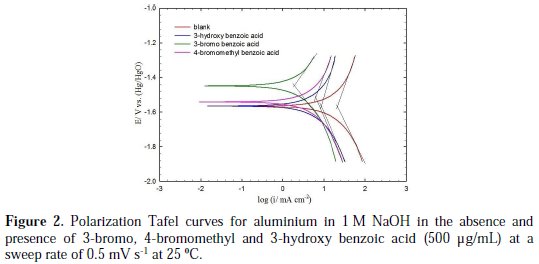
aromatic carboxylic acids in 1 M NaOH at 25 &deg;C. <a href="#f2">Fig. 2</a> shows typical Tafel 
polarization curves for aluminium in 1 M NaOH for blank solution, and in the 
presence of the more efficient investigated aromatic carboxylic acids (3-bromo, 4bromomethyl 
and 3-hydroxy benzoic acid), at a concentration of 500 &mu;g/mL and a 
sweep rate of 0.5 mV s<sup>-1</sup> at 25 &deg;C.</p>


    <p>&nbsp;</p>
<a name="f2">
<img src="/img/revistas/pea/v34n6/34n6a03f2.jpg">
    
<p>&nbsp;</p>


    <p>The data clearly show that the addition of the 
derivatives of benzoic acids shifts the corrosion potential (Ecorr) in the positive 
direction (especially for the 3-bromo and 4-bromomethyl derivatives) and reduces 
both the anodic and cathodic current densities. The anodic current was, however, 
reduced more significantly than the cathodic current for 3-bromo, 4-bromomethyl 
and 3-hydroxy derivatives of benzoic acid (<a href="#f2">Fig. 2</a>).</p>

    <p>These results indicate that these three aromatic carboxylic acids act as mixed-type 
inhibitors. This means that these inhibitors have significant effects on retarding the 
cathodic hydrogen evolution reaction and inhibiting the anodic dissolution of 
aluminium in alkaline solution. The Tafel extrapolation method was used to 
evaluate the corrosion parameters and the values of related electrochemical 
parameters, i.e. Ecorr, corrosion current density (icorr), and inhibition efficiency 
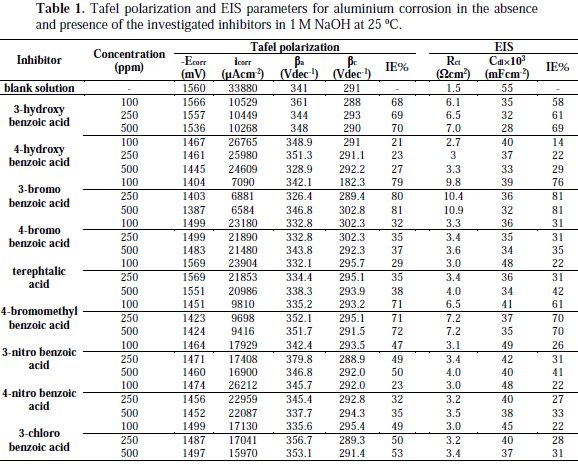
(IE%) were calculated from the related polarization curves, and are presented in 
<a href="#t1">Table 1</a>.</p>


    ]]></body>
<body><![CDATA[<p>&nbsp;</p>
<a name="t1">
<img src="/img/revistas/pea/v34n6/34n6a03t1.jpg">
    
<p>&nbsp;</p>


    <p>The percentage inhibition efficiency (IE%) was calculated as follows [21]:</p>


    <p>&nbsp;</p>
<a name="e1">
<img src="/img/revistas/pea/v34n6/34n6a03e1.jpg">
    
<p>&nbsp;</p>


    <p>where icorr and i'corr are the corrosion current densities in the absence and presence 
of inhibitors, respectively. The values of cathodic (&beta;c) and anodic (&beta;a) Tafel 
constants were calculated from the linear region of the polarization curves. 
As presented in <a href="#t1">Table 1</a>, the corrosion current density was reduced in the presence 
of all investigated aromatic carboxylic acids, especially in the presence of 
3-bromo, 4-bromomethyl and 3-hydroxy benzoic acid. The values of IE% for these 
inhibitors at a concentration of 500 ppm were 81, 72 and 70%, respectively. 
Furthermore, the increase of inhibition efficiencies for the aluminium corrosion in 
1 M NaOH, with increasing concentrations of organic acids, can be explained on 
the bases of the inhibitor adsorption.</p>

    <p>This behavior can be attributed to the increased surface coverage &theta;, due to the 
increase of the number of adsorbed molecules at the metal surface [13]. So, the 
investigation of the relation between corrosion inhibition and adsorption is of great 
importance. The adsorption of organic inhibitors at the metal/solution interface 
takes place through the replacement of water molecules by organic inhibitor 
molecules, according to the following process [13]:</p>


    <p>&nbsp;</p>
<a name="e2">
<img src="/img/revistas/pea/v34n6/34n6a03e2.jpg">
    
<p>&nbsp;</p>


    <p>where Org(sol) and Org(ads) are organic molecules in the solution and adsorbed on 
the metal surface, respectively, and x is the number of water molecules replaced 
by the organic molecules. Different adsorption isotherms were analyzed in order to 
obtain more information about the interactions between aromatic carboxylic acids 
and the aluminium surface. The linear relationship between &theta; values and 
concentration of inhibitor, Cinh, is to be found in order to obtain the isotherm. The 
degree of &theta; is calculated from the polarization data using the following equation 
[13]:</p>


    ]]></body>
<body><![CDATA[<p>&nbsp;</p>
<a name="e3">
<img src="/img/revistas/pea/v34n6/34n6a03e3.jpg">
    
<p>&nbsp;</p>


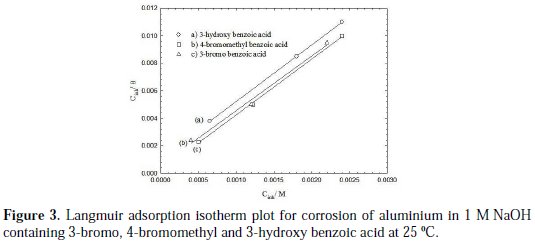
    <p>Attempts were made to fit the &theta; values to various isotherms, including Langmuir, 
Temkin, Frumkin and Flory-Huggins. The best fit is obtained with the Langmuir 
isotherm. The Langmuir adsorption isotherm is given by [22]:</p>


    <p>&nbsp;</p>
<a name="e4">
<img src="/img/revistas/pea/v34n6/34n6a03e4.jpg">
    
<p>&nbsp;</p>


    <p>where K<sub>ads</sub> is the adsorption equilibrium constant. A plot of Cinh/&theta; 
against Cinh for 
the more efficient investigated inhibitors showed a straight line, indicating that 
adsorption follows the Langmuir adsorption isotherm, as shown in <a href="#f3">Fig. 3</a>.</p>


    <p>&nbsp;</p>
<a name="f3">
<img src="/img/revistas/pea/v34n6/34n6a03f3.jpg">
    
<p>&nbsp;</p>


    <p>The values of K<sub>ads</sub> obtained from the Langmuir adsorption isotherm are related to 
the standard free energy of adsorption (&Delta;G<sub>ads</sub>) [23]:</p>


    <p>&nbsp;</p>
<a name="e5">
<img src="/img/revistas/pea/v34n6/34n6a03e5.jpg">
    
]]></body>
<body><![CDATA[<p>&nbsp;</p>


    <p>where R is the universal gas constant, T is the absolute temperature, and the value 
of 55.5 is the molar concentration of water in the solution. The values of K<sub>ads</sub> for 
the more efficient investigated inhibitors, i.e., 3-bromo, 4-bromomethyl and 
3-hydroxy benzoic acid, were 1250, 1111 and 1000 L.mol<sup>-1</sup>, respectively. The 
higher value of K<sub>ads</sub> for 3-bromo benzoic acid indicates stronger adsorption on the 
aluminium surface. Furthermore, -&Delta;G&deg;<sub>ads</sub> values for 3-bromo, 4-bromomethyl and 
3-hydroxy benzoic acid were 27.6, 27.3 and 27.1 kJ.mol<sup>-1</sup>, 
respectively (<a href="#t2">Table 2</a>).</p>


    <p>&nbsp;</p>
<a name="t2">
<img src="/img/revistas/pea/v34n6/34n6a03t2.jpg">
    
<p>&nbsp;</p>


    <p>That indicates 3-bromo benzoic acid was more effectively adsorbed on aluminium 
surface than other investigated carboxylic acids. The negative values for &Delta;G&deg;<sub>ads</sub> 
are consistent with the condition for spontaneity of the adsorption process and the 
stability of the adsorbed layer on the aluminium surface.</p>


    <p><i><b>EIS measurements</b></i></p>

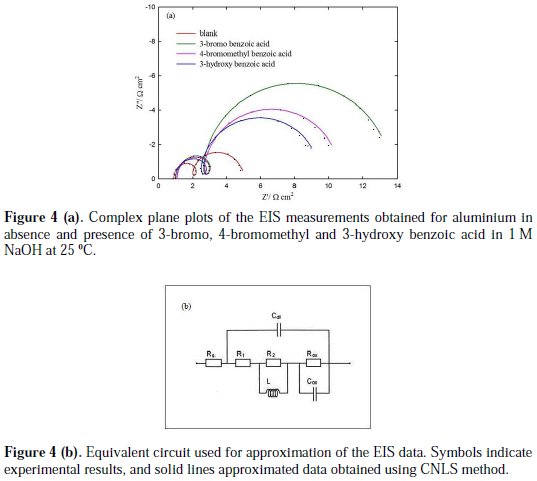
    <p>The EIS were recorded for aluminium in the absence and presence of investigated 
aromatic carboxylic acids. The complex plane plots of the EIS measurements, 
obtained at open-circuit potential after one hour immersion in the absence and 
presence of 3-bromo, 4-bromomethyl and 3-hydroxy benzoic acid as the best 
investigated inhibitors, are presented in <a href="#f4">Fig. 4(a)</a>.</p>


    <p>&nbsp;</p>
<a name="f4">
<img src="/img/revistas/pea/v34n6/34n6a03f4.jpg">
    
<p>&nbsp;</p>


    <p>Furthermore, an equivalent circuit to describe the electrochemical impedance 
characteristics of aluminium is shown in <a href="#f4">Fig. 4(b)</a>.</p>

    ]]></body>
<body><![CDATA[<p>It is composed of a Faradaic impedance parallel to a double layer capacitance: Cdl. 
Faradaic impedance consists of Rct (=R1+R2), indicating the charge transfer 
resistance at the metal/oxide film interface; L results from the interruption of 
anodic dissolution of aluminium by the surface charge build-up; Rox is the 
resistance against charge transport in the oxide film and Cox, due to the dielectric 
properties of surface oxide film. The Rs component in the circuit is a solution 
resistance with the value at a high frequency intercept on the real impedance axis 
[24]. This model circuit shows that the capacitive semicircles occurring at the high 
and low frequencies in <a href="#f4">Fig. 4(a)</a> are due to the charge transfer reaction at the 
metal/surface oxide film, and the dielectric properties of surface oxide film, 
respectively. It has been reported that aluminium dissolves into the solution in the 
3+ oxidation state through the generation of Al+ or Al+2 intermediate species [24]. 
Therefore, the charge transfer resistance, Rct, might be represented by the sum of 
R1 and R2 in the equivalent circuit. The inductive loop shown in the medium 
frequency range might have been caused by the intermediate species generated 
during metal dissolution. The EIS data obtained in the NaOH solution are shown 
in <a href="#t1">Table 1</a>. Inspection of <a href="#t1">Table 1</a> reveals that Rct values increase prominently, 
while Cdl reduces with the concentration of all investigate inhibitors. Rct is 
associated with the corrosion resistance, so, the higher charge transfer resistance 
indicates better inhibition performance. The decrease in Cdl, compared with that in 
the blank solution, which can result from a decrease in local dielectric constant 
and/or an increase in the thickness of the electrical double layer, suggests that the 
inhibitor molecules function by adsorption at the solid/solution interface [25]. 
However, the values of the charge transfer and inhibition efficiency were 
increased in the presence of all inhibitors, especially in the presence of 3-bromo, 
4-bromomethyl and 3-hydroxy derivatives of benzoic acid. These results are in 
good agreement with those obtained from polarization measurements (<a href="#f2">Fig. 2</a>). The 
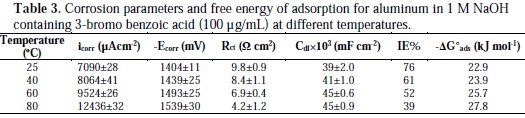
effect of temperature on the rate of dissolution of aluminium in 1 M NaOH 
containing 100 &mu;g/mL of the 3-bromo benzoic acid, as the most efficient 
investigated inhibitor, was evaluated by the Tafel polarization and EIS methods 
over a temperature range from 25 to 80 &deg;C (<a href="#t3">Table 3</a>).</p>


    <p>&nbsp;</p>
<a name="t3">
<img src="/img/revistas/pea/v34n6/34n6a03t3.jpg">
    
<p>&nbsp;</p>


    <p>The results revealed that a higher temperature increased the corrosion rate of Al1050 
for this inhibitor. Additionally, the increase in corrosion rate in the absence 
of 3-bromo benzoic acid was higher than in its presence at all temperatures, 
suggesting more aggressiveness of a free alkaline solution. It was proved that 
benzoic acid is a good corrosion inhibitor, probably because the dimeric structure 
is formed, and this structure is somehow preferable for adsorption [26]. The results 
of <a href="#t3">Table 3</a> revealed that the &Delta;G&deg;<sub>ads</sub> values increased from -22.9 to -27.8 kJ mol<sup>-1</sup> 
with increasing temperature from 25 to 80 &deg;C; this means adsorption phenomena 
are affected by dimerization of 3-bromo benzoic acid on aluminium surface.</p>

    <p><i><b>SEM studies</b></i></p>

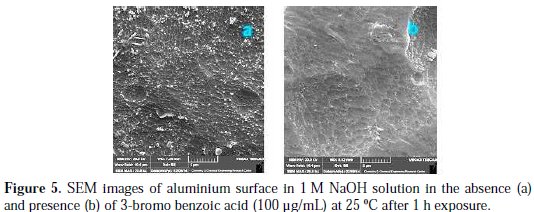
    <p>The SEM images of aluminium in 1 M NaOH solution in the absence (a) and 
presence (b) of 3-bromo benzoic acid (100 &mu;g/mL) at 25 &deg;C after 1 h exposure are 
given in <a href="#f5">Fig. 5</a>.</p>


    <p>&nbsp;</p>
<a name="f5">
<img src="/img/revistas/pea/v34n6/34n6a03f5.jpg">
    
<p>&nbsp;</p>


    <p>The surface is porous and the large and deep holes appear. However, the 
appearance of Al surface is different after the addition of 3-boromo benzoic acid 
as the most investigated inhibitor for the corrosive solution. It can be seen from 
<a href="#f5">Fig. 5</a> that the dissolution rate of aluminium is considerably reduced, and the 
smooth surfaces appear by the formation of a protective film on the Al surface.</p>


    <p>&nbsp;</p>
    ]]></body>
<body><![CDATA[<p><b>Conclusions</b></p>

    <p>Some aromatic carboxylic acids were studied for the inhibition of aluminium 
corrosion in alkaline solution. The polarization and EIS measurements showed that 
3-bromo, 4-bromomethyl and 3-hydroxy benzoic acid were the more effective 
inhibitors among all investigated aromatic carboxylic acids on corrosion of 
aluminium in 1 M NaOH at 25 &deg;C. The IE% values calculated from polarization 
Tafel curves for these inhibitors at concentration of 100 ppm were: 79, 71 and 68, 
respectively. These results are in good agreement with those obtained from EIS 
measurements. Furthermore, the IE % was found to increase with an increase in 
inhibitors' concentration. The adsorption of these inhibitors on the aluminium 
surface obeyed the Langmuir adsorption isotherm model. The negative values of 
&Delta;G&deg;<sub>ads</sub> indicate spontaneous adsorption of the inhibitors on the surface of 
aluminium. The effect of temperature on the rate of dissolution of aluminium in 
1 M NaOH containing 100 &mu;g/mL of the 3-bromo benzoic, as the most efficient 
investigated inhibitor, revealed that higher temperatures increased the corrosion 
rate of Al-1050 for this inhibitor. Surface morphological studies by SEM analysis 
were in good agreement with electrochemical measurements.</p>


    <p>&nbsp;</p>
    <p><b>References</b></p>

    <!-- ref --><p>1. Hori Y, Takao J, Shomon H. Electrochim Acta. 1986;36:555.    &nbsp;&nbsp;&nbsp;&nbsp;&nbsp;&nbsp;&nbsp;&nbsp;[&#160;<a href="javascript:void(0);" onclick="javascript: window.open('/scielo.php?script=sci_nlinks&ref=423851&pid=S0872-1904201600060000300001&lng=','','width=640,height=500,resizable=yes,scrollbars=1,menubar=yes,');">Links</a>&#160;]<!-- end-ref --></p>

    <!-- ref --><p>2. Wilhelmsen W, Arnesen T, Hasvold O, et al. Electrochim Acta. 1991;36:79.    &nbsp;&nbsp;&nbsp;&nbsp;&nbsp;&nbsp;&nbsp;&nbsp;[&#160;<a href="javascript:void(0);" onclick="javascript: window.open('/scielo.php?script=sci_nlinks&ref=423853&pid=S0872-1904201600060000300002&lng=','','width=640,height=500,resizable=yes,scrollbars=1,menubar=yes,');">Links</a>&#160;]<!-- end-ref --></p>

    <!-- ref --><p>3. Zeinelabedin S, Saleh AO. J Appl Electrochem. 2004;34:331.    &nbsp;&nbsp;&nbsp;&nbsp;&nbsp;&nbsp;&nbsp;&nbsp;[&#160;<a href="javascript:void(0);" onclick="javascript: window.open('/scielo.php?script=sci_nlinks&ref=423855&pid=S0872-1904201600060000300003&lng=','','width=640,height=500,resizable=yes,scrollbars=1,menubar=yes,');">Links</a>&#160;]<!-- end-ref --></p>

    ]]></body>
<body><![CDATA[<!-- ref --><p>4. Ashassi-Sorkhabi H, Shabani B, Aligholipour B, et al. Appl Surf Sci. 2006;252:4039.    &nbsp;&nbsp;&nbsp;&nbsp;&nbsp;&nbsp;&nbsp;&nbsp;[&#160;<a href="javascript:void(0);" onclick="javascript: window.open('/scielo.php?script=sci_nlinks&ref=423857&pid=S0872-1904201600060000300004&lng=','','width=640,height=500,resizable=yes,scrollbars=1,menubar=yes,');">Links</a>&#160;]<!-- end-ref --></p>

    <!-- ref --><p>5. Noor AE. J Appl Electrochem. 2009;39:1465.    &nbsp;&nbsp;&nbsp;&nbsp;&nbsp;&nbsp;&nbsp;&nbsp;[&#160;<a href="javascript:void(0);" onclick="javascript: window.open('/scielo.php?script=sci_nlinks&ref=423859&pid=S0872-1904201600060000300005&lng=','','width=640,height=500,resizable=yes,scrollbars=1,menubar=yes,');">Links</a>&#160;]<!-- end-ref --></p>

    <!-- ref --><p>6. Zhang DQ, Gao LX, Zhou GD. Corros Sci. 2004;46:3031.    &nbsp;&nbsp;&nbsp;&nbsp;&nbsp;&nbsp;&nbsp;&nbsp;[&#160;<a href="javascript:void(0);" onclick="javascript: window.open('/scielo.php?script=sci_nlinks&ref=423861&pid=S0872-1904201600060000300006&lng=','','width=640,height=500,resizable=yes,scrollbars=1,menubar=yes,');">Links</a>&#160;]<!-- end-ref --></p>

    <!-- ref --><p>7. Elmorsi MA, Hassanein AM. Corros Sci. 1999;41:2337.    &nbsp;&nbsp;&nbsp;&nbsp;&nbsp;&nbsp;&nbsp;&nbsp;[&#160;<a href="javascript:void(0);" onclick="javascript: window.open('/scielo.php?script=sci_nlinks&ref=423863&pid=S0872-1904201600060000300007&lng=','','width=640,height=500,resizable=yes,scrollbars=1,menubar=yes,');">Links</a>&#160;]<!-- end-ref --></p>

    <!-- ref --><p>8. Curkovic HO, Stupnisek-Lisac E, Takenouti H. Corros Sci. 2010;52:398.    &nbsp;&nbsp;&nbsp;&nbsp;&nbsp;&nbsp;&nbsp;&nbsp;[&#160;<a href="javascript:void(0);" onclick="javascript: window.open('/scielo.php?script=sci_nlinks&ref=423865&pid=S0872-1904201600060000300008&lng=','','width=640,height=500,resizable=yes,scrollbars=1,menubar=yes,');">Links</a>&#160;]<!-- end-ref --></p>

    ]]></body>
<body><![CDATA[<!-- ref --><p>9. Lamaka SV, Zheludkevich ML, Yasakau KA, et al. Electrochim Acta. 2007;52:7231.    &nbsp;&nbsp;&nbsp;&nbsp;&nbsp;&nbsp;&nbsp;&nbsp;[&#160;<a href="javascript:void(0);" onclick="javascript: window.open('/scielo.php?script=sci_nlinks&ref=423867&pid=S0872-1904201600060000300009&lng=','','width=640,height=500,resizable=yes,scrollbars=1,menubar=yes,');">Links</a>&#160;]<!-- end-ref --></p>

    <!-- ref --><p>10. Branzoi V, Golgovici F, Branzoi F. Mater Chem Phys. 2003;78:122.    &nbsp;&nbsp;&nbsp;&nbsp;&nbsp;&nbsp;&nbsp;&nbsp;[&#160;<a href="javascript:void(0);" onclick="javascript: window.open('/scielo.php?script=sci_nlinks&ref=423869&pid=S0872-1904201600060000300010&lng=','','width=640,height=500,resizable=yes,scrollbars=1,menubar=yes,');">Links</a>&#160;]<!-- end-ref --></p>

    <!-- ref --><p>11. Fleischmann M, Hill IR, Mengoli G, et al. Electrochim Acta. 1985;30:879.    &nbsp;&nbsp;&nbsp;&nbsp;&nbsp;&nbsp;&nbsp;&nbsp;[&#160;<a href="javascript:void(0);" onclick="javascript: window.open('/scielo.php?script=sci_nlinks&ref=423871&pid=S0872-1904201600060000300011&lng=','','width=640,height=500,resizable=yes,scrollbars=1,menubar=yes,');">Links</a>&#160;]<!-- end-ref --></p>

    <!-- ref --><p>12. Sanja M, Metikos-Hukovic M. J Appl Electrochem. 2003;33:1137.    &nbsp;&nbsp;&nbsp;&nbsp;&nbsp;&nbsp;&nbsp;&nbsp;[&#160;<a href="javascript:void(0);" onclick="javascript: window.open('/scielo.php?script=sci_nlinks&ref=423873&pid=S0872-1904201600060000300012&lng=','','width=640,height=500,resizable=yes,scrollbars=1,menubar=yes,');">Links</a>&#160;]<!-- end-ref --></p>

    <!-- ref --><p>13. Abdallah M. Corros Sci. 2004;46:1981.    &nbsp;&nbsp;&nbsp;&nbsp;&nbsp;&nbsp;&nbsp;&nbsp;[&#160;<a href="javascript:void(0);" onclick="javascript: window.open('/scielo.php?script=sci_nlinks&ref=423875&pid=S0872-1904201600060000300013&lng=','','width=640,height=500,resizable=yes,scrollbars=1,menubar=yes,');">Links</a>&#160;]<!-- end-ref --></p>

    ]]></body>
<body><![CDATA[<!-- ref --><p>14. Quraishi MA, Rafique MZA, Khan S, et al. J Appl Electrochem. 2007;37:1153.    &nbsp;&nbsp;&nbsp;&nbsp;&nbsp;&nbsp;&nbsp;&nbsp;[&#160;<a href="javascript:void(0);" onclick="javascript: window.open('/scielo.php?script=sci_nlinks&ref=423877&pid=S0872-1904201600060000300014&lng=','','width=640,height=500,resizable=yes,scrollbars=1,menubar=yes,');">Links</a>&#160;]<!-- end-ref --></p>

    <!-- ref --><p>15. Safak S, Duran B, Yurt A, et al. Corros Sci. 2012;54:251.    &nbsp;&nbsp;&nbsp;&nbsp;&nbsp;&nbsp;&nbsp;&nbsp;[&#160;<a href="javascript:void(0);" onclick="javascript: window.open('/scielo.php?script=sci_nlinks&ref=423879&pid=S0872-1904201600060000300015&lng=','','width=640,height=500,resizable=yes,scrollbars=1,menubar=yes,');">Links</a>&#160;]<!-- end-ref --></p>

    <!-- ref --><p>16. Abiola OK, Oforka NC, Ebenso EE. et al. Anti-Corrosion Methods Mater. 2005;54:219.    &nbsp;&nbsp;&nbsp;&nbsp;&nbsp;&nbsp;&nbsp;&nbsp;[&#160;<a href="javascript:void(0);" onclick="javascript: window.open('/scielo.php?script=sci_nlinks&ref=423881&pid=S0872-1904201600060000300016&lng=','','width=640,height=500,resizable=yes,scrollbars=1,menubar=yes,');">Links</a>&#160;]<!-- end-ref --></p>

    <!-- ref --><p>17. Umoren SA, Ebens EE, Okafo PC, et al. J Appl Polym Sci. 2006;103:2810.    &nbsp;&nbsp;&nbsp;&nbsp;&nbsp;&nbsp;&nbsp;&nbsp;[&#160;<a href="javascript:void(0);" onclick="javascript: window.open('/scielo.php?script=sci_nlinks&ref=423883&pid=S0872-1904201600060000300017&lng=','','width=640,height=500,resizable=yes,scrollbars=1,menubar=yes,');">Links</a>&#160;]<!-- end-ref --></p>

    <!-- ref --><p>18. Oguzie EE, Onuoha GN, Ejike EN. Pigment Resin Technol. 2007;36:44.    &nbsp;&nbsp;&nbsp;&nbsp;&nbsp;&nbsp;&nbsp;&nbsp;[&#160;<a href="javascript:void(0);" onclick="javascript: window.open('/scielo.php?script=sci_nlinks&ref=423885&pid=S0872-1904201600060000300018&lng=','','width=640,height=500,resizable=yes,scrollbars=1,menubar=yes,');">Links</a>&#160;]<!-- end-ref --></p>

    ]]></body>
<body><![CDATA[<!-- ref --><p>19. Princey JM, Nagarajan P. J Korean Chem Soc. 2012;56:201.    &nbsp;&nbsp;&nbsp;&nbsp;&nbsp;&nbsp;&nbsp;&nbsp;[&#160;<a href="javascript:void(0);" onclick="javascript: window.open('/scielo.php?script=sci_nlinks&ref=423887&pid=S0872-1904201600060000300019&lng=','','width=640,height=500,resizable=yes,scrollbars=1,menubar=yes,');">Links</a>&#160;]<!-- end-ref --></p>

    <!-- ref --><p>20. Moussa MN, El-Tagoury MM, Radi AA, et al. Anti-Corros Methods Mater. 1990;37:4.    &nbsp;&nbsp;&nbsp;&nbsp;&nbsp;&nbsp;&nbsp;&nbsp;[&#160;<a href="javascript:void(0);" onclick="javascript: window.open('/scielo.php?script=sci_nlinks&ref=423889&pid=S0872-1904201600060000300020&lng=','','width=640,height=500,resizable=yes,scrollbars=1,menubar=yes,');">Links</a>&#160;]<!-- end-ref --></p>

    <!-- ref --><p>21. Tao Z, Zhang S, Li W, et al. Ind Eng Chem Res. 2011;50:6082.    &nbsp;&nbsp;&nbsp;&nbsp;&nbsp;&nbsp;&nbsp;&nbsp;[&#160;<a href="javascript:void(0);" onclick="javascript: window.open('/scielo.php?script=sci_nlinks&ref=423891&pid=S0872-1904201600060000300021&lng=','','width=640,height=500,resizable=yes,scrollbars=1,menubar=yes,');">Links</a>&#160;]<!-- end-ref --></p>

    <!-- ref --><p>22. Obot IB, Obi-Egbedi NO, Umoren SA. Corros Sci. 2009;51:1868.    &nbsp;&nbsp;&nbsp;&nbsp;&nbsp;&nbsp;&nbsp;&nbsp;[&#160;<a href="javascript:void(0);" onclick="javascript: window.open('/scielo.php?script=sci_nlinks&ref=423893&pid=S0872-1904201600060000300022&lng=','','width=640,height=500,resizable=yes,scrollbars=1,menubar=yes,');">Links</a>&#160;]<!-- end-ref --></p>

    <!-- ref --><p>23. Yurt A, Aykin O. Corros Sci. 2011;53:3725.    &nbsp;&nbsp;&nbsp;&nbsp;&nbsp;&nbsp;&nbsp;&nbsp;[&#160;<a href="javascript:void(0);" onclick="javascript: window.open('/scielo.php?script=sci_nlinks&ref=423895&pid=S0872-1904201600060000300023&lng=','','width=640,height=500,resizable=yes,scrollbars=1,menubar=yes,');">Links</a>&#160;]<!-- end-ref --></p>

    ]]></body>
<body><![CDATA[<!-- ref --><p>24. Lee KK, Kim KB. Corros Sci. 2001;43:561.    &nbsp;&nbsp;&nbsp;&nbsp;&nbsp;&nbsp;&nbsp;&nbsp;[&#160;<a href="javascript:void(0);" onclick="javascript: window.open('/scielo.php?script=sci_nlinks&ref=423897&pid=S0872-1904201600060000300024&lng=','','width=640,height=500,resizable=yes,scrollbars=1,menubar=yes,');">Links</a>&#160;]<!-- end-ref --></p>

    <!-- ref --><p>25. Lagrenee M, Mernari B, Bouanis M, et al. Corros Sci. 2002;44:573.    &nbsp;&nbsp;&nbsp;&nbsp;&nbsp;&nbsp;&nbsp;&nbsp;[&#160;<a href="javascript:void(0);" onclick="javascript: window.open('/scielo.php?script=sci_nlinks&ref=423899&pid=S0872-1904201600060000300025&lng=','','width=640,height=500,resizable=yes,scrollbars=1,menubar=yes,');">Links</a>&#160;]<!-- end-ref --></p>

    <!-- ref --><p>26. Bilgic S. Mater Chem Phys. 2002;76:52.    &nbsp;&nbsp;&nbsp;&nbsp;&nbsp;&nbsp;&nbsp;&nbsp;[&#160;<a href="javascript:void(0);" onclick="javascript: window.open('/scielo.php?script=sci_nlinks&ref=423901&pid=S0872-1904201600060000300026&lng=','','width=640,height=500,resizable=yes,scrollbars=1,menubar=yes,');">Links</a>&#160;]<!-- end-ref --></p>


    <p>&nbsp;</p>
    <p><b>Acknowledgements</b></p>

    <p>The authors are grateful to Malek-Ashtar University of Technology for providing 
the lab facilities to bring about this work.</p>


    <p>&nbsp;</p>
    ]]></body>
<body><![CDATA[<p><a name=0></a><sup><a href="#top">*</a></sup>Corresponding author. E-mail address: <a href="mailto:ar.madram@gmail.com">ar.madram@gmail.com</a></p>

    <p>Received March 05, 2016; accepted October 24, 2016</p>

    <p><a href="http://www.peacta.org" target="_blank">www.peacta.org</a> </p>


     ]]></body><back>
<ref-list>
<ref id="B1">
<label>1</label><nlm-citation citation-type="journal">
<person-group person-group-type="author">
<name>
<surname><![CDATA[Hori]]></surname>
<given-names><![CDATA[Y]]></given-names>
</name>
<name>
<surname><![CDATA[Takao]]></surname>
<given-names><![CDATA[J]]></given-names>
</name>
<name>
<surname><![CDATA[Shomon]]></surname>
<given-names><![CDATA[H]]></given-names>
</name>
</person-group>
<source><![CDATA[Electrochim Acta]]></source>
<year>1986</year>
<volume>36</volume>
<page-range>555</page-range></nlm-citation>
</ref>
<ref id="B2">
<label>2</label><nlm-citation citation-type="journal">
<person-group person-group-type="author">
<name>
<surname><![CDATA[Wilhelmsen]]></surname>
<given-names><![CDATA[W]]></given-names>
</name>
<name>
<surname><![CDATA[Arnesen]]></surname>
<given-names><![CDATA[T]]></given-names>
</name>
<name>
<surname><![CDATA[Hasvold]]></surname>
<given-names><![CDATA[O]]></given-names>
</name>
</person-group>
<source><![CDATA[Electrochim Acta]]></source>
<year>1991</year>
<volume>36</volume>
<page-range>79</page-range></nlm-citation>
</ref>
<ref id="B3">
<label>3</label><nlm-citation citation-type="journal">
<person-group person-group-type="author">
<name>
<surname><![CDATA[Zeinelabedin]]></surname>
<given-names><![CDATA[S]]></given-names>
</name>
<name>
<surname><![CDATA[Saleh]]></surname>
<given-names><![CDATA[A O]]></given-names>
</name>
</person-group>
<source><![CDATA[J Appl Electrochem]]></source>
<year>2004</year>
<volume>34</volume>
<page-range>331</page-range></nlm-citation>
</ref>
<ref id="B4">
<label>4</label><nlm-citation citation-type="journal">
<person-group person-group-type="author">
<name>
<surname><![CDATA[Ashassi-Sorkhabi]]></surname>
<given-names><![CDATA[H]]></given-names>
</name>
<name>
<surname><![CDATA[Shabani]]></surname>
<given-names><![CDATA[B]]></given-names>
</name>
<name>
<surname><![CDATA[Aligholipour]]></surname>
<given-names><![CDATA[B]]></given-names>
</name>
</person-group>
<source><![CDATA[Appl Surf Sci]]></source>
<year>2006</year>
<volume>252</volume>
<page-range>4039</page-range></nlm-citation>
</ref>
<ref id="B5">
<label>5</label><nlm-citation citation-type="journal">
<person-group person-group-type="author">
<name>
<surname><![CDATA[Noor]]></surname>
<given-names><![CDATA[A E]]></given-names>
</name>
</person-group>
<source><![CDATA[J Appl Electrochem]]></source>
<year>2009</year>
<volume>39</volume>
<page-range>1465</page-range></nlm-citation>
</ref>
<ref id="B6">
<label>6</label><nlm-citation citation-type="journal">
<person-group person-group-type="author">
<name>
<surname><![CDATA[Zhang]]></surname>
<given-names><![CDATA[D Q]]></given-names>
</name>
<name>
<surname><![CDATA[Gao]]></surname>
<given-names><![CDATA[L X]]></given-names>
</name>
<name>
<surname><![CDATA[Zhou]]></surname>
<given-names><![CDATA[G D]]></given-names>
</name>
</person-group>
<source><![CDATA[Corros Sci]]></source>
<year>2004</year>
<volume>46</volume>
<page-range>3031</page-range></nlm-citation>
</ref>
<ref id="B7">
<label>7</label><nlm-citation citation-type="journal">
<person-group person-group-type="author">
<name>
<surname><![CDATA[Elmorsi]]></surname>
<given-names><![CDATA[M A]]></given-names>
</name>
<name>
<surname><![CDATA[Hassanein]]></surname>
<given-names><![CDATA[A M]]></given-names>
</name>
</person-group>
<source><![CDATA[Corros Sci]]></source>
<year>1999</year>
<volume>41</volume>
<page-range>2337</page-range></nlm-citation>
</ref>
<ref id="B8">
<label>8</label><nlm-citation citation-type="journal">
<person-group person-group-type="author">
<name>
<surname><![CDATA[Curkovic]]></surname>
<given-names><![CDATA[H O]]></given-names>
</name>
<name>
<surname><![CDATA[Stupnisek-Lisac]]></surname>
<given-names><![CDATA[E]]></given-names>
</name>
<name>
<surname><![CDATA[Takenouti]]></surname>
<given-names><![CDATA[H]]></given-names>
</name>
</person-group>
<source><![CDATA[Corros Sci]]></source>
<year>2010</year>
<volume>52</volume>
<page-range>398</page-range></nlm-citation>
</ref>
<ref id="B9">
<label>9</label><nlm-citation citation-type="journal">
<person-group person-group-type="author">
<name>
<surname><![CDATA[Lamaka]]></surname>
<given-names><![CDATA[S V]]></given-names>
</name>
<name>
<surname><![CDATA[Zheludkevich]]></surname>
<given-names><![CDATA[M L]]></given-names>
</name>
<name>
<surname><![CDATA[Yasakau]]></surname>
<given-names><![CDATA[K A]]></given-names>
</name>
</person-group>
<source><![CDATA[Electrochim Acta]]></source>
<year>2007</year>
<volume>52</volume>
<page-range>7231</page-range></nlm-citation>
</ref>
<ref id="B10">
<label>10</label><nlm-citation citation-type="journal">
<person-group person-group-type="author">
<name>
<surname><![CDATA[Branzoi]]></surname>
<given-names><![CDATA[V]]></given-names>
</name>
<name>
<surname><![CDATA[Golgovici]]></surname>
<given-names><![CDATA[F]]></given-names>
</name>
<name>
<surname><![CDATA[Branzoi]]></surname>
<given-names><![CDATA[F]]></given-names>
</name>
</person-group>
<source><![CDATA[Mater Chem Phys]]></source>
<year>2003</year>
<volume>78</volume>
<page-range>122</page-range></nlm-citation>
</ref>
<ref id="B11">
<label>11</label><nlm-citation citation-type="journal">
<person-group person-group-type="author">
<name>
<surname><![CDATA[Fleischmann]]></surname>
<given-names><![CDATA[M]]></given-names>
</name>
<name>
<surname><![CDATA[Hill]]></surname>
<given-names><![CDATA[I R]]></given-names>
</name>
<name>
<surname><![CDATA[Mengoli]]></surname>
<given-names><![CDATA[G]]></given-names>
</name>
</person-group>
<source><![CDATA[Electrochim Acta]]></source>
<year>1985</year>
<volume>30</volume>
<page-range>879</page-range></nlm-citation>
</ref>
<ref id="B12">
<label>12</label><nlm-citation citation-type="journal">
<person-group person-group-type="author">
<name>
<surname><![CDATA[Sanja]]></surname>
<given-names><![CDATA[M]]></given-names>
</name>
<name>
<surname><![CDATA[Metikos-Hukovic]]></surname>
<given-names><![CDATA[M]]></given-names>
</name>
</person-group>
<source><![CDATA[J Appl Electrochem]]></source>
<year>2003</year>
<volume>33</volume>
<page-range>1137</page-range></nlm-citation>
</ref>
<ref id="B13">
<label>13</label><nlm-citation citation-type="journal">
<person-group person-group-type="author">
<name>
<surname><![CDATA[Abdallah]]></surname>
<given-names><![CDATA[M]]></given-names>
</name>
</person-group>
<source><![CDATA[Corros Sci]]></source>
<year>2004</year>
<volume>46</volume>
<page-range>1981</page-range></nlm-citation>
</ref>
<ref id="B14">
<label>14</label><nlm-citation citation-type="journal">
<person-group person-group-type="author">
<name>
<surname><![CDATA[Quraishi]]></surname>
<given-names><![CDATA[M A]]></given-names>
</name>
<name>
<surname><![CDATA[Rafique]]></surname>
<given-names><![CDATA[M Z A]]></given-names>
</name>
<name>
<surname><![CDATA[Khan]]></surname>
<given-names><![CDATA[S]]></given-names>
</name>
</person-group>
<source><![CDATA[J Appl Electrochem]]></source>
<year>2007</year>
<volume>37</volume>
<page-range>1153</page-range></nlm-citation>
</ref>
<ref id="B15">
<label>15</label><nlm-citation citation-type="journal">
<person-group person-group-type="author">
<name>
<surname><![CDATA[Safak]]></surname>
<given-names><![CDATA[S]]></given-names>
</name>
<name>
<surname><![CDATA[Duran]]></surname>
<given-names><![CDATA[B]]></given-names>
</name>
<name>
<surname><![CDATA[Yurt]]></surname>
<given-names><![CDATA[A]]></given-names>
</name>
</person-group>
<source><![CDATA[Corros Sci]]></source>
<year>2012</year>
<volume>54</volume>
<page-range>251</page-range></nlm-citation>
</ref>
<ref id="B16">
<label>16</label><nlm-citation citation-type="journal">
<person-group person-group-type="author">
<name>
<surname><![CDATA[Abiola]]></surname>
<given-names><![CDATA[O K]]></given-names>
</name>
<name>
<surname><![CDATA[Oforka]]></surname>
<given-names><![CDATA[N C]]></given-names>
</name>
<name>
<surname><![CDATA[Ebenso]]></surname>
<given-names><![CDATA[E E]]></given-names>
</name>
</person-group>
<source><![CDATA[Anti-Corrosion Methods Mater]]></source>
<year>2005</year>
<volume>54</volume>
<page-range>219</page-range></nlm-citation>
</ref>
<ref id="B17">
<label>17</label><nlm-citation citation-type="journal">
<person-group person-group-type="author">
<name>
<surname><![CDATA[Umoren]]></surname>
<given-names><![CDATA[S A]]></given-names>
</name>
<name>
<surname><![CDATA[Ebens]]></surname>
<given-names><![CDATA[E E]]></given-names>
</name>
<name>
<surname><![CDATA[Okafo]]></surname>
<given-names><![CDATA[P C]]></given-names>
</name>
</person-group>
<source><![CDATA[J Appl Polym Sci]]></source>
<year>2006</year>
<volume>103</volume>
<page-range>2810</page-range></nlm-citation>
</ref>
<ref id="B18">
<label>18</label><nlm-citation citation-type="journal">
<person-group person-group-type="author">
<name>
<surname><![CDATA[Oguzie]]></surname>
<given-names><![CDATA[E E]]></given-names>
</name>
<name>
<surname><![CDATA[Onuoha]]></surname>
<given-names><![CDATA[G N]]></given-names>
</name>
<name>
<surname><![CDATA[Ejike]]></surname>
<given-names><![CDATA[E N]]></given-names>
</name>
</person-group>
<source><![CDATA[Pigment Resin Technol]]></source>
<year>2007</year>
<volume>36</volume>
<page-range>44</page-range></nlm-citation>
</ref>
<ref id="B19">
<label>19</label><nlm-citation citation-type="journal">
<person-group person-group-type="author">
<name>
<surname><![CDATA[Princey]]></surname>
<given-names><![CDATA[J M]]></given-names>
</name>
<name>
<surname><![CDATA[Nagarajan]]></surname>
<given-names><![CDATA[P]]></given-names>
</name>
</person-group>
<source><![CDATA[J Korean Chem Soc]]></source>
<year>2012</year>
<volume>56</volume>
<page-range>201</page-range></nlm-citation>
</ref>
<ref id="B20">
<label>20</label><nlm-citation citation-type="journal">
<person-group person-group-type="author">
<name>
<surname><![CDATA[Moussa]]></surname>
<given-names><![CDATA[M N]]></given-names>
</name>
<name>
<surname><![CDATA[El-Tagoury]]></surname>
<given-names><![CDATA[M M]]></given-names>
</name>
<name>
<surname><![CDATA[Radi]]></surname>
<given-names><![CDATA[A A]]></given-names>
</name>
</person-group>
<source><![CDATA[Anti-Corros Methods Mater]]></source>
<year>1990</year>
<volume>37</volume>
<page-range>4</page-range></nlm-citation>
</ref>
<ref id="B21">
<label>21</label><nlm-citation citation-type="journal">
<person-group person-group-type="author">
<name>
<surname><![CDATA[Tao]]></surname>
<given-names><![CDATA[Z]]></given-names>
</name>
<name>
<surname><![CDATA[Zhang]]></surname>
<given-names><![CDATA[S]]></given-names>
</name>
<name>
<surname><![CDATA[Li]]></surname>
<given-names><![CDATA[W]]></given-names>
</name>
</person-group>
<source><![CDATA[Ind Eng Chem Res]]></source>
<year>2011</year>
<volume>50</volume>
<page-range>6082</page-range></nlm-citation>
</ref>
<ref id="B22">
<label>22</label><nlm-citation citation-type="journal">
<person-group person-group-type="author">
<name>
<surname><![CDATA[Obot]]></surname>
<given-names><![CDATA[I B]]></given-names>
</name>
<name>
<surname><![CDATA[Obi-Egbedi]]></surname>
<given-names><![CDATA[N O]]></given-names>
</name>
<name>
<surname><![CDATA[Umoren]]></surname>
<given-names><![CDATA[S A]]></given-names>
</name>
</person-group>
<source><![CDATA[Corros Sci]]></source>
<year>2009</year>
<volume>51</volume>
<page-range>1868</page-range></nlm-citation>
</ref>
<ref id="B23">
<label>23</label><nlm-citation citation-type="journal">
<person-group person-group-type="author">
<name>
<surname><![CDATA[Yurt]]></surname>
<given-names><![CDATA[A]]></given-names>
</name>
<name>
<surname><![CDATA[Aykin]]></surname>
<given-names><![CDATA[O]]></given-names>
</name>
</person-group>
<source><![CDATA[Corros Sci]]></source>
<year>2011</year>
<volume>53</volume>
<page-range>3725</page-range></nlm-citation>
</ref>
<ref id="B24">
<label>24</label><nlm-citation citation-type="journal">
<person-group person-group-type="author">
<name>
<surname><![CDATA[Lee]]></surname>
<given-names><![CDATA[K K]]></given-names>
</name>
<name>
<surname><![CDATA[Kim]]></surname>
<given-names><![CDATA[K B]]></given-names>
</name>
</person-group>
<source><![CDATA[Corros Sci]]></source>
<year>2001</year>
<volume>43</volume>
<page-range>561</page-range></nlm-citation>
</ref>
<ref id="B25">
<label>25</label><nlm-citation citation-type="journal">
<person-group person-group-type="author">
<name>
<surname><![CDATA[Lagrenee]]></surname>
<given-names><![CDATA[M]]></given-names>
</name>
<name>
<surname><![CDATA[Mernari]]></surname>
<given-names><![CDATA[B]]></given-names>
</name>
<name>
<surname><![CDATA[Bouanis]]></surname>
<given-names><![CDATA[M]]></given-names>
</name>
</person-group>
<source><![CDATA[Corros Sci]]></source>
<year>2002</year>
<volume>44</volume>
<page-range>573</page-range></nlm-citation>
</ref>
<ref id="B26">
<label>26</label><nlm-citation citation-type="journal">
<person-group person-group-type="author">
<name>
<surname><![CDATA[Bilgic]]></surname>
<given-names><![CDATA[S]]></given-names>
</name>
</person-group>
<source><![CDATA[Mater Chem Phys]]></source>
<year>2002</year>
<volume>76</volume>
<page-range>52</page-range></nlm-citation>
</ref>
</ref-list>
</back>
</article>