<?xml version="1.0" encoding="ISO-8859-1"?><article xmlns:mml="http://www.w3.org/1998/Math/MathML" xmlns:xlink="http://www.w3.org/1999/xlink" xmlns:xsi="http://www.w3.org/2001/XMLSchema-instance">
<front>
<journal-meta>
<journal-id>0872-1904</journal-id>
<journal-title><![CDATA[Portugaliae Electrochimica Acta]]></journal-title>
<abbrev-journal-title><![CDATA[Port. Electrochim. Acta]]></abbrev-journal-title>
<issn>0872-1904</issn>
<publisher>
<publisher-name><![CDATA[Sociedade Portuguesa de Electroquímica]]></publisher-name>
</publisher>
</journal-meta>
<article-meta>
<article-id>S0872-19042016000600005</article-id>
<article-id pub-id-type="doi">10.4152/pea.201606417</article-id>
<title-group>
<article-title xml:lang="en"><![CDATA[Electrochemical, Adsorption and Anticorrosion Study on Fluvoxamine and its Blends for X80 Steel Protection in Well Acidizing Fluids]]></article-title>
</title-group>
<contrib-group>
<contrib contrib-type="author">
<name>
<surname><![CDATA[Ituen]]></surname>
<given-names><![CDATA[Ekemini]]></given-names>
</name>
<xref ref-type="aff" rid="A01"/>
<xref ref-type="aff" rid="A02"/>
</contrib>
<contrib contrib-type="author">
<name>
<surname><![CDATA[James]]></surname>
<given-names><![CDATA[Abosede]]></given-names>
</name>
<xref ref-type="aff" rid="A03"/>
</contrib>
<contrib contrib-type="author">
<name>
<surname><![CDATA[Akaranta]]></surname>
<given-names><![CDATA[Onyewuchi]]></given-names>
</name>
<xref ref-type="aff" rid="A02"/>
<xref ref-type="aff" rid="A03"/>
</contrib>
</contrib-group>
<aff id="A01">
<institution><![CDATA[,China University of Petroleum Department of Materials Physics and Chemistry ]]></institution>
<addr-line><![CDATA[Qingdao ]]></addr-line>
<country>China</country>
</aff>
<aff id="A02">
<institution><![CDATA[,University of Port Harcourt Institute of Petroleum Studies African Centre of Excellence for Oilfield Chemicals Research]]></institution>
<addr-line><![CDATA[ ]]></addr-line>
<country>Nigeria</country>
</aff>
<aff id="A03">
<institution><![CDATA[,University of Port Harcourt Department of Pure and Industrial Chemistry ]]></institution>
<addr-line><![CDATA[ ]]></addr-line>
<country>Nigeria</country>
</aff>
<pub-date pub-type="pub">
<day>00</day>
<month>11</month>
<year>2016</year>
</pub-date>
<pub-date pub-type="epub">
<day>00</day>
<month>11</month>
<year>2016</year>
</pub-date>
<volume>34</volume>
<numero>6</numero>
<fpage>417</fpage>
<lpage>432</lpage>
<copyright-statement/>
<copyright-year/>
<self-uri xlink:href="http://scielo.pt/scielo.php?script=sci_arttext&amp;pid=S0872-19042016000600005&amp;lng=en&amp;nrm=iso"></self-uri><self-uri xlink:href="http://scielo.pt/scielo.php?script=sci_abstract&amp;pid=S0872-19042016000600005&amp;lng=en&amp;nrm=iso"></self-uri><self-uri xlink:href="http://scielo.pt/scielo.php?script=sci_pdf&amp;pid=S0872-19042016000600005&amp;lng=en&amp;nrm=iso"></self-uri><abstract abstract-type="short" xml:lang="en"><p><![CDATA[Corrosion of steel pipes, tubing, and casings in the oilfield by acidizing fluids is a major cause of materials failure. Corrosion of X80 steel in hydrochloric acid, a typical acidizing solution, was probed using gravimetric and electrochemical techniques. Fluvoxamine (FLU) was used as anticorrosive additive to the acid, and monitored between 30 °C to 90 °C. FLU offered efficient protection for the X80 steel by inhibition. The inhibitive effect increased with a higher FLU concentration, but decreased as temperature increased. The highest concentration of FLU (10×10-5 M) afforded inhibition efficiency of 93.5% and 80.4% in 1 M and 15% HCl, respectively, at 30 oC. The efficiency decreased to 88.5% and 73.3%, respectively, at 90 °C. Inhibition efficiency was improved by blending FLU with glutathione, polyethyleneglycol and potassium iodide. Adsorption and thermodynamic studies reveal that the inhibitor functions, by spontaneous exothermic adsorption on X80 surface, were best described by Langmuir adsorption model. Impedance measurement reveals increase in charge transfer resistance with decrease in double layer capacitance. Polarization studies show that FLU acts as a mixed type inhibitor. Scanned micrographs of X80 surface show a lower pitting in the presence of FLU than in the free acid, demonstrating the effectiveness of FLU as X80 steel corrosion inhibitor.]]></p></abstract>
<kwd-group>
<kwd lng="en"><![CDATA[acid corrosion]]></kwd>
<kwd lng="en"><![CDATA[charge transfer resistance]]></kwd>
<kwd lng="en"><![CDATA[corrosion inhibitor]]></kwd>
<kwd lng="en"><![CDATA[double layer capacitance]]></kwd>
<kwd lng="en"><![CDATA[SEM]]></kwd>
<kwd lng="en"><![CDATA[EIS]]></kwd>
</kwd-group>
</article-meta>
</front><body><![CDATA[ 

<!--     <p>&nbsp;</p>
    <p>doi: 10.4152/pea.201606417</p> -->

    <p><b>Electrochemical, Adsorption and Anticorrosion Study on 
Fluvoxamine and its Blends for X80 Steel Protection 
in Well Acidizing Fluids</b></p>

    <p>
<b>Ekemini Ituen</b><sup><i>a,b</i>,<a href="#0">*</a></sup>
, <b>Abosede James</b><sup><i>c</i></sup>
 and <b>Onyewuchi Akaranta</b><sup><i>b,c</i></sup>
</p>

    <p><i><sup>a</sup> Department of Materials Physics and Chemistry, China University of Petroleum, Qingdao, China</i></p>

    <p><i><sup>b</sup> African Centre of Excellence for Oilfield Chemicals Research, Institute of Petroleum Studies, 
University of Port Harcourt, Nigeria</i></p>

    <p><i><sup>b</sup> Department of Pure and Industrial Chemistry, University of Port Harcourt, Nigeria</i></p>


    <p>&nbsp;</p>
    <p><b>Abstract</b></p>

    ]]></body>
<body><![CDATA[<p>Corrosion of steel pipes, tubing, and casings in the oilfield by acidizing fluids is a major 
cause of materials failure. Corrosion of X80 steel in hydrochloric acid, a typical 
acidizing solution, was probed using gravimetric and electrochemical techniques. 
Fluvoxamine (FLU) was used as anticorrosive additive to the acid, and monitored 
between 30 &deg;C to 90 &deg;C. FLU offered efficient protection for the X80 steel by inhibition. 
The inhibitive effect increased with a higher FLU concentration, but decreased as 
temperature increased. The highest concentration of FLU (10&times;10<sup>-5</sup> M) afforded 
inhibition efficiency of 93.5% and 80.4% in 1 M and 15% HCl, respectively, at 30 oC. 
The efficiency decreased to 88.5% and 73.3%, respectively, at 90 &deg;C. Inhibition 
efficiency was improved by blending FLU with glutathione, polyethyleneglycol and 
potassium iodide. Adsorption and thermodynamic studies reveal that the inhibitor 
functions, by spontaneous exothermic adsorption on X80 surface, were best described 
by Langmuir adsorption model. Impedance measurement reveals increase in charge 
transfer resistance with decrease in double layer capacitance. Polarization studies show 
that FLU acts as a mixed type inhibitor. Scanned micrographs of X80 surface show a 
lower pitting in the presence of FLU than in the free acid, demonstrating the 
effectiveness of FLU as X80 steel corrosion inhibitor.</p>

    <p><b><i>Keywords:</i></b> acid corrosion, charge transfer resistance, corrosion inhibitor, double layer 
capacitance, SEM, EIS.</p>


    <p>&nbsp;</p>
    <p><b>Introduction</b></p>

    <p>Acidizing is an important field technique in oil and gas production, comprising 
wellbore, matrix and fracture acidizing procedures [1]. In wellbore acidizing, 
acid is used to wash the wellbore in order to remove scales, corrosion products, 
and some acid soluble debris from drilling, completion, production treating or 
stimulation [2]. Matrix acidizing involves treating the formation with acid 
beyond the wellbore [3]. In fracturing, acid is forced under high pressure through 
the well bore into the reservoir rock formation to chemically react with rocks 
(calcite, limestone and dolomite) and dissolve them, and to open new flow 
channels and enlarge existing ones [4, 5]. In the process, cracks are produced in 
the formation, and acidic solution is introduced into the fracture to etch the flow 
channels and enlarge pore spaces [4]. Techniques for enhanced oil recovery, 
removal of scales and drilling mud damage are also associated with the 
introduction of acids [2].</p>

    <p>The most commonly used acid in acidizing procedure is HCl, and at a 
concentration up to 15% [2]. Formic acid, acetic acid and hydrofluoric acid have 
also been used, and sometimes as a mixture with sulphuric, phosphoric, nitric, 
citric, methanesulphonic and chloroacetic acids [2, 5, 6]. Hydrochloric acid is 
more economical and reacts very fast with the formation, but is highly corrosive. 
Owing to this corrosive nature of HCl, corrosion inhibitors (CIs) are usually 
added to protect the surface of steel materials from corrosion and pitting. Many 
corrosion inhibitors have been reported to be effective in various acid solutions 
in different concentrations [5, 7-9]. However, it is more desirable that a corrosion 
inhibitor (CI) be cheap and environmentally and people friendly. It should also 
be easy to synthesize or processed from inexpensive sustainable sources.</p>

    <p>Fluvoxamine is a non-toxic compound which has been used as anti-depressant 
[10], for treatment of obsessive-compulsive disorder (OCD) [11], and as a potent 
inhibitor of the metabolism of caffeine in vitro [12]. It is also one of the major 
compounds that can be obtained from seeds of Griffonia simplicifolia [13]. Many 
electron rich sites found in efficient organic corrosion inhibitors reported in 
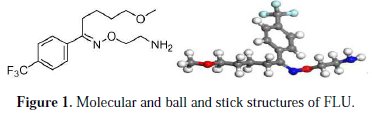
literature [5, 7] are also found in the chemical structure of FLU (<a href="#f1">Fig. 1</a>).</p>


    <p>&nbsp;</p>
<a name="f1">
<img src="/img/revistas/pea/v34n6/34n6a05f1.jpg">
    
<p>&nbsp;</p>


    <p>This motivated us to investigate FLU as alternative corrosion inhibitor for 
acidizing fluid. Different concentrations of HCl were used to simulate acidizing 
fluids. The X80 steel was used in this study, because such steel grades like API 
5L X70, X80, X60, X65, X52 and X42 are extensively preferred for line pipes, 
transfer tubings, drilling pipes, casings, etc. [14, 15].The use of FLU as corrosion 
inhibitor for X80 steel is being reported for the first time. Electrochemical and 
gravimetric techniques were employed to determine the inhibition efficiency and 
mechanism of inhibition. The morphology of the protected metal is studied using 
SEM. The effect of temperature on the inhibitor performance is also examined. 
CI is also blended with synergistic additives to assess their performances at high 
temperature.</p>


    ]]></body>
<body><![CDATA[<p>&nbsp;</p>
    <p><b>Experimental methods</b></p>

    <p><i><b>Preparation of steel specimens</b></i></p>

    <p>X80 steel specimens with 2 cm &times; 2 cm dimensions were supplied by Qingdao 
Tengxiang Instrument and Equipment Co. Ltd., China. As-received surface of 
X80 steel was treated as provided by NACE Recommended Practice RP-0775 
and ASTM G-1 &amp; G-4, for surface finishing and cleaning of weight loss 
coupons. Coupons for electrochemical studies were abraded with various grades 
of silicon carbide paper, and 1 cm<sup>2</sup> of the exposed surface was finished to mirror 
surface with CC-22F P2000 grade of silicon carbide paper. The prepared 
specimens were enclosed in sealed water-proof bags and stored in moisture free 
desiccator prior to use. The chemical compositions (wt. %) of X80 were C 
(0.065), Si (0.24), Mn (1.58), P (0.011), S (0.003), Cu (0.01), Cr (0.022), Nb 
(0.057), V (0.005), Ti (0.024), B (0.0006), Fe (balance).</p>


    <p><i><b>Preparation of test solutions</b></i></p>

    <p>Analytical grade HCl was diluted to concentrations of 1 M and 15% using 
double-distilled water. As received powdered fluvoxamine (AR), supplied by 
Meyers Co. Ltd., China, was prepared to different concentrations (1&times;10<sup>-5</sup>, 3&times;10<sup>-5</sup> , 
5&times;10<sup>-5</sup> and 10&times;10<sup>-5</sup> M) in HCl solutions. The additives used in blending are: 
industrial grade polyethyleneglycol, PEG-4000 (PEG) and analytical grade 
potassium iodide (KI) supplied by Richest group Ltd., Shanghai; analytical grade 
sodium gluconate (NaG) and industrial grade glutathione (GLU) supplied by 
Wuhan Yuancheng Gongchuang Technology Co. Ltd., China; and potassium 
chloride (analytical grade) supplied by Meyer Chemical Technology Co. Lt., 
Shanghai, China. All reagents were used as supplied, without further analysis or 
purification. 1&times;10<sup>-6</sup> M of each additive was blended with 10&times;10<sup>-5</sup> M FLU in the 
ratio 1:1 and prepared in the HCl with vigorous stirring.</p>


    <p><i><b>Weight loss measurement</b></i></p>

    <p>Weight loss measurements were conducted according to ASTM standard method 
explained in literature [5]. All weight measurements were conducted using a 
Sartorius CPA225D analytical balance with sensitivity &pm;0.00001 g. Pre-weighed 
X80 coupons were immersed in acid solutions with and without different 
concentrations of FLU for five (5) hours, and maintained at 30 &deg;C in a water bath. 
The retrieved coupons were cleaned in 20% NaOH solution containing about 200 
g/L of zinc dust, dried in air after rinsing in acetone, and weighed to determine 
the weight loss. This was repeated using the inhibitor blends. Triplicates of the 
experiments were conducted per test solution, and the means of the weight losses 
(g) were computed and reported. The corrosion rate (CR) of iron, percentage 
inhibition efficiency (&epsilon;<sub>WL</sub>) and degree of surface coverage (&theta;) were calculated as 
follows</p>


    <p>&nbsp;</p>
<a name="e1">
<img src="/img/revistas/pea/v34n6/34n6a05e1.jpg">
    
<p>&nbsp;</p>
<a name="e2">
<img src="/img/revistas/pea/v34n6/34n6a05e2.jpg">
    
]]></body>
<body><![CDATA[<p>&nbsp;</p>
<a name="e3">
<img src="/img/revistas/pea/v34n6/34n6a05e3.jpg">
    
<p>&nbsp;</p>


    <p>where &Delta;W<su>mean</sub> is the mean weight loss, CR<sub>b</sub> and CR<sub>i</sub> 
are the corrosion rates (cm h<sup>-1</sup>) in the absence and presence of the inhibitor, 
&rho; is the density of iron (g cm<sup>-3</sup>), A is the average surface area (cm<sup>2</sup>) of the 
metal specimens, and t is the 
immersion time (h). The values of corrosion rate obtained were converted to 
another unit (mmpy) using conversion factors explained in literature [16]. This 
procedure was repeated at other temperatures such as 45 &deg;C, 60 &deg;C, 75 &deg;C and 90 
&deg;C in the different test solutions.</p>


    <p><i><b>Electrochemical measurements</b></i></p>

    <p>The electrochemical workstation used for measurement was Gamry ZRA REF 
600-18042 Potentiostat/Galvanostat. The conventional three electrode set up was 
used, consisting of saturated calomel electrode (SCE) as reference electrode, 
platinum as counter electrode and X80 coupons as working electrode. The EIS 
were conducted at a frequency of 10 kHz to 10 mHz, for open circuit immersion 
time of 30 minutes, at 30 &deg;C. The voltage was changed to -0.15 V to +0.15 V vs. 
Eoc at scan rate of 0.2 mV/s for PDP measurements. Linear polarization 
resistance measurements (LPR) were carried out at -0.20 V to +0.20 V vs. Eoc at 
1 mV/s. Electrochemical Frequency Modulation (EFM) measurements were 
conducted using two frequencies: 2 Hz and 5 Hz. The base frequency was 1 Hz, 
hence, the waveform repeats after 1 s. A peak voltage of 10 mV was used. E-
Chem software package was used for data fitting and analysis.</p>

    <p>Charge transfer resistance obtained from analysis of Nyquist plot was used to 
compute the inhibition efficiency according to <a href="#e4">Eq. 4</a>.</p>


    <p>&nbsp;</p>
<a name="e4">
<img src="/img/revistas/pea/v34n6/34n6a05e4.jpg">
    
<p>&nbsp;</p>


    <p>where R<sub>ctB</sub> and R<sub>ctI</sub> 
are charge transfer resistances in the absence and presence 
of the inhibitor, respectively.</p>


    <p>The inhibition efficiency 
from PDP was calculated from the corrosion current densities obtained from 
analysis of Tafel plot using <a href="#e5">Eq. 5</a>.</p>


    ]]></body>
<body><![CDATA[<p>&nbsp;</p>
<a name="e5">
<img src="/img/revistas/pea/v34n6/34n6a05e5.jpg">
    
<p>&nbsp;</p>


    <p>where i<sup>b</sup><sub>corr</sub> and i<sup>i</sup><sub>corr</sub> 
are the corrosion current densities in the absence and 
presence of the inhibitor, respectively.</p>

    <p>The magnitude of the double layer capacitance (C<sub>dl</sub>) 
of the adsorbed film was calculated from constant phase 
element (CPE), constant (Y<sub>o</sub>) and charge transfer resistance 
(R<sub>ct</sub>) using <a href="#e6">Eq. 6</a>.</p>


    <p>&nbsp;</p>
<a name="e6">
<img src="/img/revistas/pea/v34n6/34n6a05e6.jpg">
    
<p>&nbsp;</p>


    <p>where n is a constant showing a degree of roughness of the metal surface 
obtained from the phase angle, given that (j<sup>2</sup>=-1)&alpha;
is the phase angle of CPE and n=2&alpha;/(&pi;) is the CPE exponent.</p>


    <p><i><b>SEM study</b></i></p>

    <p>To study the morphology of the metal in both uninhibited and inhibited solutions, 
the steel coupons of size 1 cm &times; 2 cm were abraded to mirror finish, as described 
above. The SEM images were recorded in the vacuum mode before and after 
immersion in HCl using AMETEX S4800 SEM/EDAX TSL. This was repeated 
with a coupon immersed in HCl containing 10&times;10<sup>-5</sup> M FLU solution. The 
instrument was operated at 5 kV.</p>


    <p>&nbsp;</p>
    ]]></body>
<body><![CDATA[<p><b>Results and discussion</b></p>

    <p><i><b>Weight loss experiment: effect of inhibitor and acid concentration</b></i></p>

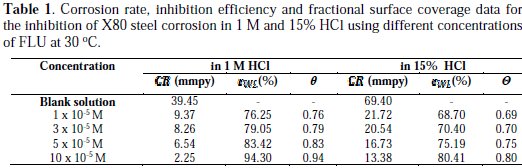
    <p>The corrosion rate (CR), inhibition efficiency (%I) and fractional surface 
coverage obtained from weight loss measurements for the corrosion of X80 in 
both 1 M HCl and 15% HCl containing the different concentrations of FLU are 
presented in <a href="#t1">Table 1</a>.</p>


    <p>&nbsp;</p>
<a name="t1">
<img src="/img/revistas/pea/v34n6/34n6a05t1.jpg">
    
<p>&nbsp;</p>


    <p>Inhibition efficiency obtained increased from 76.25% to 94.30%, when the 
concentration of FLU was increased from 1&times;10<sup>-5</sup> M to 10&times;10<sup>-5</sup> M, at constant 
temperature. The efficiency of FLU was also tested for both 1 M HCl and 15% 
HCl, and results were compared. The effectiveness of FLU declined when the 
acid concentration was increased from 1 M to 15%. For instance, the inhibition 
efficiency decreased from 94.3% in 1 M HCl to 80.4% in 15% HCl at 30 oC. This 
represents about a 14.7% decrease in inhibition efficiency on about a 340% 
increase in acid concentration, which is reasonable and may be improved using 
some synergistic intensifiers.</p>


    <p><i><b>Effect of temperature</b></i></p>

    <p>Nowadays, many industries have ventured into the production and recovery of 
hydrocarbons from deep pay zones. Since the temperature at the surface is 
usually different from down-hole temperature, understanding the effect of 
temperature on a corrosion inhibitor is essential. As one goes down the well, the 
difference in temperature per unit well length has been described as geothermal 
gradient. It is believed that the universal average geothermal gradient is about 25 
&deg;C per km of depth (1&deg;F per 70 feet of depth) [17, 18]. From literature, the 
average geothermal gradient in Nigeria Niger delta fields is 28 &deg;C/km [19].</p>

    <p>Therefore, minimally deep wells in the Nigerian Niger-delta region have been 
reported to be about 2-4 km deep, corresponding to average downhole 
temperatures of 65-125 &deg;C [20].</p>

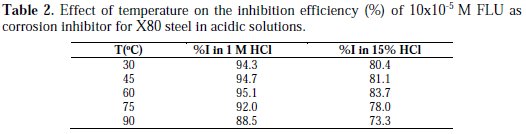
    <p>On this basis, the performance of FLU was examined at higher temperatures up 
to 90 &deg;C. Results obtained are shown in <a href="#t2">Table 2</a>.</p>


    ]]></body>
<body><![CDATA[<p>&nbsp;</p>
<a name="t2">
<img src="/img/revistas/pea/v34n6/34n6a05t2.jpg">
    
<p>&nbsp;</p>


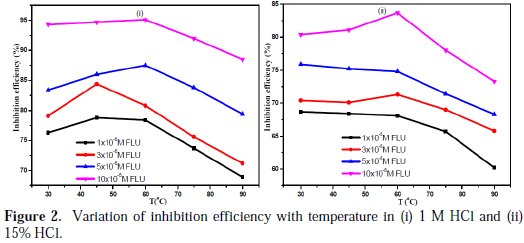
    <p>Inhibition efficiency initially 
increases as temperature increases, and later decreases with higher temperatures. 
With 10&times;10<sup>-5</sup> M FLU in 1 M HCl solution, the inhibition efficiency increases 
from 94.3% at 30 &deg;C to 95.1% at 60 &deg;C, before decreasing to 88.5% at 90 &deg;C. 
Similar trend was obtained in 15% HCl.</p>

    <p>This behaviour is graphically illustrated in <a href="#f2">Fig. 2</a>.</p>


    <p>&nbsp;</p>
<a name="f2">
<img src="/img/revistas/pea/v34n6/34n6a05f2.jpg">
    
<p>&nbsp;</p>


    <p>This implies that if FLU is 
used as CI in acidizing fluid, it will perform more efficiently at surface 
conditions than at down hole conditions. In literature, similar trend of inhibition 
efficiency is associated with both physical and chemical adsorption mechanism 
[21].</p>


    <p><i><b>Effect of additives</b></i></p>

    <p>It has been reported that certain substances (called intensifiers) can increase the 
inhibition efficiency of some corrosion inhibitors [5]. Intensifiers are desirable, 
because corrosion inhibitors often may not provide adequate protection to steels, 
at high temperatures and long exposure time.</p>

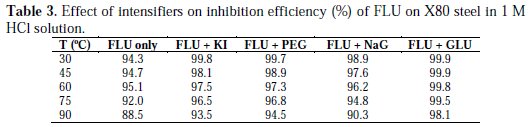
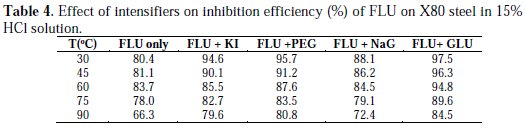
    <p>Therefore, 10&times;10<sup>-5</sup> M FLU in both 1 M and 15% HCl solutions were blended 
with potassium iodide (KI), polyethylene glycol (PEG), sodium gluconate (NaG), 
and glutathione (GLU). The results obtained (<a href="#t3">Tables 3</a>-<a href="#t4">4</a>) show that the additives 
improved the inhibition efficiency of FLU.</p>


    ]]></body>
<body><![CDATA[<p>&nbsp;</p>
<a name="t3">
<img src="/img/revistas/pea/v34n6/34n6a05t3.jpg">
    
<p>&nbsp;</p>
<a name="t4">
<img src="/img/revistas/pea/v34n6/34n6a05t4.jpg">
    
<p>&nbsp;</p>


    <p>For instance, at 90 &deg;C, the blends 
containing PEG, KI and GLU afforded %I of 93.5%, 94.5% and 95.6 %, 
respectively, in 1 M HCl and 79.6%, 80.8%, and 84.5% in 15% HCl.</p>

    <p>This demonstrates that the inhibitor blends obtained could be suitable alternatives 
for various oilfield acidizing procedures associated with high temperature 
operations. However, a study is ongoing to formulate the FLU using surfactants, 
other intensifiers, solvents, etc., to optimize effectiveness at high temperatures.</p>


    <p><i><b>Adsorption study</b></i></p>

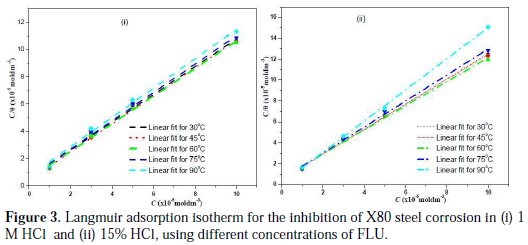
    <p>Adsorption of CIs can be either by physical or chemical adsorption mechanism. 
To predict this mechanism, surface coverage (&theta;) data were fitted into adsorption 
models namely, Langmuir, Temkin, Freundlich, Flory Huggins and El-Awady et 
al. The best fit was obtained with Langmuir isotherm (<a href="#f3">Fig. 3</a>), with 
adjusted R<sup>2</sup> &ge; 0.99255.</p>


    <p>&nbsp;</p>
<a name="f3">
<img src="/img/revistas/pea/v34n6/34n6a05f3.jpg">
    
<p>&nbsp;</p>


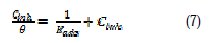
    <p>The expression for the model is given in <a href="#e7">Eq. 7</a> [22].</p>


    ]]></body>
<body><![CDATA[<p>&nbsp;</p>
<a name="e7">
<img src="/img/revistas/pea/v34n6/34n6a05e7.jpg">
    
<p>&nbsp;</p>


    <p>where C<sub>inh</sub> is the concentration of inhibitor (M) in the acid solution and 
is K<sub>ads</sub> the adsorption-desorption equilibrium constant, which relates to the free energy 
change of adsorption (&Delta;G<sub>ads</sub>), according to <a href="#e8">Eq. 8</a>.</p>


    <p>&nbsp;</p>
<a name="e8">
<img src="/img/revistas/pea/v34n6/34n6a05e8.jpg">
    
<p>&nbsp;</p>


    <p>where 55.5 represents the concentration of water molecules displaced by the 
inhibitor molecules, R is the universal gas constant and T is the absolute 
temperature. The values of K<sub>ads</sub> and &Delta;G<sub>ads</sub> 
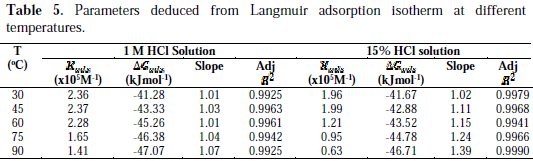
obtained are given in <a href="#t5">Table 5</a>.</p>


    <p>&nbsp;</p>
<a name="t5">
<img src="/img/revistas/pea/v34n6/34n6a05t5.jpg">
    
<p>&nbsp;</p>


    <p>The constant, K<sub>ads</sub>, relates to the strength of the inhibitor-metal surface 
interaction. It can be observed that K<sub>ads</sub> decreases as temperature increases, 
which indicates that the strength of adsorptive binding of FLU to the steel surface 
decreases as temperature increases, perhaps due to desorption of its molecules 
from the surface. The K<sub>ads</sub> values are also higher in 1 M HCl than in 15% HCl, 
demonstrating that the inhibitor is more strongly adsorbed on X80 steel in the 
former than in the later.</p>

    <p>The &Delta;G<sub>ads</sub> values obtained are higher than -40 kJ mol<sup>-1</sup>, suggesting that the 
mechanism is of chemical adsorption [23]. This indicates that the adsorption of 
FLU on X80 surface is facilitated by chemical interactions between FLU 
electrons and empty d-orbitals of iron in the steel. The Langmuir adsorption 
isotherm assumes equivalent X80 sites with the monolayer of FLU molecules, as 
shown in the almost unity values of the slope obtained. Therefore, the results 
obtained are in agreement, since chemisorption mechanism is consistent with 
monolayer adsorption. In addition, adsorption of FLU is more spontaneous as 
temperature increases.</p>


    ]]></body>
<body><![CDATA[<p><i><b>Kinetic and thermodynamic studies</b></i></p>

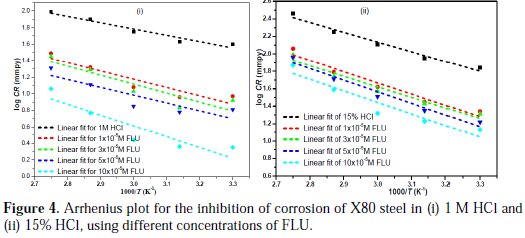
    <p>The corrosion rate data were fitted into Arrhenius kinetic model (<a href="#e9">Eq. 9</a>), and 
activation energy was calculated from the slope of linear plots of Log(CR), against 
reciprocal of temperature (<a href="#f4">Fig. 4</a>).</p>


    <p>&nbsp;</p>
<a name="e9">
<img src="/img/revistas/pea/v34n6/34n6a05e9.jpg">
    
<p>&nbsp;</p>
<a name="f4">
<img src="/img/revistas/pea/v34n6/34n6a05f4.jpg">
    
<p>&nbsp;</p>


    <p>where Ea is the activation energy, A is the Arrhenius pre-exponential factor or 
frequency factor, R is the universal gas constant and T is the absolute 
temperature.</p>

    <p>The obtained activation energy increased on 
addition of the inhibitor, depending on the inhibitor's concentration. From the 
concept of activation and collision theory, it can be considered that, before the 
acid solution corrodes the steel, the molecules of the acid must collide with the 
metal molecules on the surface. The acid molecules should possess energy up to 
a minimum threshold called activation energy.</p>

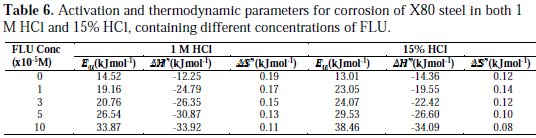
    <p>In the presence of the inhibitors, the activation energy values were 
higher than in the uninhibited solutions (<a href="#t6">Table 6</a>).</p>


    <p>&nbsp;</p>
<a name="t6">
<img src="/img/revistas/pea/v34n6/34n6a05t6.jpg">
    
<p>&nbsp;</p>


    ]]></body>
<body><![CDATA[<p>Therefore, the acid molecules 
must acquire extra (higher) energy in the presence of the inhibitor, for corrosion 
to occur, hence, corrosion inhibition [24]. The energy also increases as the 
inhibitor concentration increases. The activation energy was lower in 15% HCl 
than in 1 M HCl, implying that molecules of 15% HCl solution require a lower 
energy barrier to cross the activated complex and form corrosion products with 
mild steel than that of 1 M HCl. The increase in activation energy in the presence 
of the inhibitor in both acids is consistent with trends reported in literature, and it 
is associated with physical adsorption mechanism [25].</p>

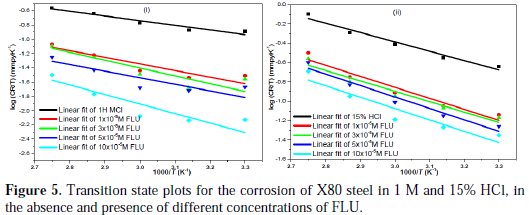
    <p>The other activation parameters given in <a href="#t6">Table 6</a> were derived from the transition 
state equation (<a href="#e9">Eq. 10</a>)</p>


    <p>&nbsp;</p>
<a name="e10">
<img src="/img/revistas/pea/v34n6/34n6a05e10.jpg">
    
<p>&nbsp;</p>


    <p>where &Delta;H* and &Delta;S* are the enthalpy and entropy changes of activation, respectively.</p>

    <p>Linear plots of Log(CR)/T against reciprocal of temperature 
are given in <a href="#f5">Fig. 5</a>)</p>


    <p>&nbsp;</p>
<a name="f5">
<img src="/img/revistas/pea/v34n6/34n6a05f5.jpg">
    
<p>&nbsp;</p>


    <p>The values of &Delta;S* are all negative, which implies that a decrease in 
disorderliness of the system takes place on moving from reactants to the 
activated complex. It also indicates that the activated complex in the rate 
determining step involves an association of the inhibitor on metal surface, instead 
of dissolution of the metal [26]. The negative sign of &Delta;H* reflects the exothermic 
nature of X80 steel corrosion in HCl. Thermodynamically, it is consistent for an 
exothermic process with decreasing entropy to be spontaneous at temperatures 
that are not too high [27].</p>


    <p><i><b>EIS experiment</b></i></p>

    ]]></body>
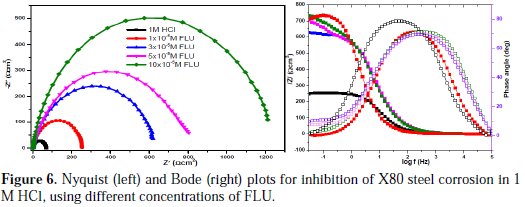
<body><![CDATA[<p>Nyquist and Bode plots shown in <a href="#f6">Fig. 6</a> were obtained from analysis of the EIS 
results for the corrosion of X80 steel in 1 M HCl, with and without different 
concentrations of FLU.</p>


    <p>&nbsp;</p>
<a name="f6">
<img src="/img/revistas/pea/v34n6/34n6a05f6.jpg">
    
<p>&nbsp;</p>


    <p>The Nyquist plot yields semicircles with larger diameters 
in the presence of FLU than in of HCl solution, depending on FLU's 
concentration.</p>

    <p>The difference in diameter size from that of the HCl solution is due to the 
influence of FLU on the corrosion rate of X80 steel through the inhibition 
process. This is further supported by an increase in diameter, as the inhibitor 
concentration increases, as it also happens with the obtained inhibition 
efficiency. The semicircles are imperfect in shape, and this has been attributed to 
the inhomogeneity of the steel surface, due to adsorption of the inhibitor [28].</p>

    <p>The shapes of the plots were similar in both the inhibited and free acid solution, 
indicating that the mechanism of steel corrosion is not influenced by the 
introduction of FLU. The single capacitive loop obtained also indicates that the 
mechanism of corrosion is mainly controlled by charge transfer process [26]. The 
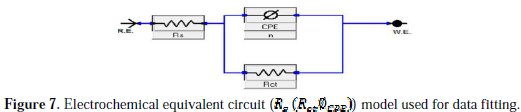
R<sub>S</sub>(R<sub>CT</sub> . &phi;<sub>CPE</sub>) equivalent circuit model 
(<a href="#f7">Fig. 7</a>) provides a good fit (&Chi;<sup>2</sup> &le; 
10<sup>-4</sup>) for the obtained data.</p>


    <p>&nbsp;</p>
<a name="f7">
<img src="/img/revistas/pea/v34n6/34n6a05f7.jpg">
    
<p>&nbsp;</p>


    <p>With this model, a constant phase element (CPE) compensates the surface 
inhomogeneity of the steel. The CPE is a non-integer element dependent on 
frequency, and its impedance can be estimated using Y<sub>0</sub> and n 
in <a href="#e11">Eq. 11</a>.</p>


    <p>&nbsp;</p>
<a name="e11">
<img src="/img/revistas/pea/v34n6/34n6a05e11.jpg">
    
]]></body>
<body><![CDATA[<p>&nbsp;</p>


    <p>where Z<sub>CPE</sub> is the impedance of the CPE, 
Y<sub>0</sub> is the CPE constant, w is the angular 
frequency, j is an imaginary complex number, (j<sup>2</sup> = -1)&alpha; is the phase angle of 
CPE and n = 2 &alpha;/(&pi;).</p>

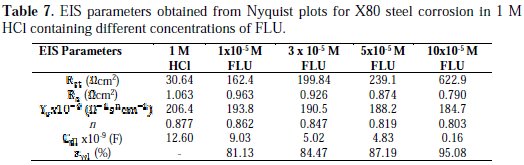
    <p>Some of the EIS parameters calculated are presented in <a href="#t7">Table 7</a>.</p>


    <p>&nbsp;</p>
<a name="t7">
<img src="/img/revistas/pea/v34n6/34n6a05t7.jpg">
    
<p>&nbsp;</p>


    <p>The value of n decreases on addition of FLU, indicating that adsorption of FLU molecules 
increases the surface roughness of the steel [28]. It also shows that there is 
relative and/or integrated influence on the CPE, rather than just a single 
resistance, capacitance or inductive element. Decrease in n on addition inhibitors 
also signifies insulation of the metal/solution interface by formation of a surface 
film. Film formation increases the charge transfer resistance in the presence of 
the inhibitor. The charge transfer resistance increases with an increase in the 
inhibitor's concentration, showing that the 'blanketing' property of the film is 
better at higher inhibitor's concentrations.</p>

    <p>Increase in peak heights of the Bode plots suggests a higher capacitive response 
of the interface, caused by the presence of the adsorbed inhibitor layer [28], due 
to the formation of an electrochemical double layer with a magnitude capacitance 
(C<sub>dl</sub>) estimated using <a href="#e6">Eq. 6</a>. The calculated C<sub>dl</sub> 
values decrease in the presence of 
inhibitors, similar to what is reported in literature [28, 29]. This is attributed to a 
decrease in the local dielectric, or to an increase in the thickness of the double 
layer or both, caused by the adsorbed protective film of the inhibitors.</p>


    <p><i><b>PDP experiment</b></i></p>

    <p>The chemical composition of X80 steel shown above shows that it is a mixture of 
many metals, hence, a number of oxidation reactions may occur at the anode 
(<a href="#e11">Eq. 11</a>). The oxidation of iron in the steel sample is represented 
by <a href="#e12">Eq. 13</a>.</p>


    <p>&nbsp;</p>
<a name="e12">
<img src="/img/revistas/pea/v34n6/34n6a05e12.jpg">
    
]]></body>
<body><![CDATA[<p>&nbsp;</p>


    <p>The reaction at the cathode could involve reduction of water in aqueous environments 
with sufficiently negative potential (<a href="#e14">Eq. 14</a>), and/or evolution of hydrogen 
(<a href="#e14">Eq. 15</a>).</p>


    <p>&nbsp;</p>
<a name="e14">
<img src="/img/revistas/pea/v34n6/34n6a05e14.jpg">
    
<p>&nbsp;</p>


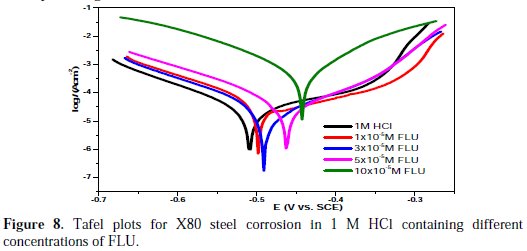
    <p>The driving force (i.e. potential) was controlled so as to measure the current as a 
function of the net change in reaction rate. The sum of currents resulting from the 
electrode processes can be used to obtain the compromise current or free 
corrosion current density (i<sub>corr</sub>) and the corresponding potential (E<sub>corr</sub>) using 
Tafel plots (<a href="#f8">Fig. 8</a>).</p>


    <p>&nbsp;</p>
<a name="f8">
<img src="/img/revistas/pea/v34n6/34n6a05f8.jpg">
    
<p>&nbsp;</p>


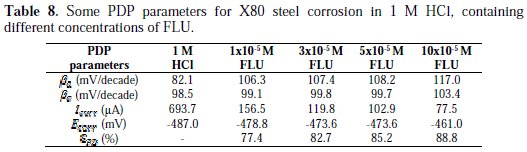
    <p>Also, the cathodic and anodic constants (&beta;c and &beta;a) and some other PDP 
parameters were obtained and are shown in <a href="#t8">Table 8</a>.</p>


    <p>&nbsp;</p>
<a name="t8">
<img src="/img/revistas/pea/v34n6/34n6a05t8.jpg">
    
<p>&nbsp;</p>


    ]]></body>
<body><![CDATA[<p>The values decreased with an increase in the inhibitor's concentration, 
compared to the free acid solution. This is due to the formation of an adsorbed 
protective film of FLU on the X80's steel surface. A displacement of E<sub>corr</sub>
to less negative values in the inhibited solutions compared to the free acid solution 
was also observed. Corrosion inhibitors that displace E<sub>corr</sub> to less negative 
values are usually identified as anodic inhibitors, whereas cathodic inhibitors 
displace the potential to more negative values [30]. Therefore, the E<sub>corr</sub> values 
obtained indicate that the inhibitor has dominant influence on the partial anodic 
reaction. However, the highest difference from that of the free acid (&delta; E<sub>corr</sub>) 
not up to -85 mV, hence, not sufficient to categorize the inhibitor as cathodic or 
anodic type. Such corrosion inhibitors are usually regarded as mixed type 
inhibitors with anodic predominance [31]. The obtained values of &beta;c and &beta;a 
differ on addition of inhibitor from those of the free acid solution. The highest 
difference was obtained with &beta;a, confirming that FLU exhibits more influence on 
the anodic reaction.</p>

    <p>A mixed type inhibitor acts by blocking some active anodic and cathodic sites of 
the metal, without changing its corrosion mechanism. In other words, FLU 
inhibits both the iron dissolution and hydrogen evolution processes, but more 
actively inhibiting iron oxidation (anodic reaction). The mechanism may be 
activation or diffusion controlled. The calculated inhibition efficiency also 
increased with an increase in concentration of the inhibitor, similar to EIS results.</p>


    <p><i><b>LPR measurement</b></i></p>

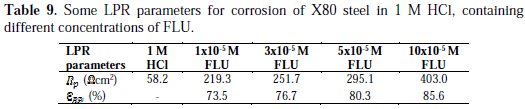
    <p>The polarization resistances in the absence and presence of different 
concentrations of FLU were obtained using insights from the Stern-Geary 
equation (<a href="#e16">Eq. 16</a>).</p>


    <p>&nbsp;</p>
<a name="e16">
<img src="/img/revistas/pea/v34n6/34n6a05e16.jpg">
    
<p>&nbsp;</p>


    <p>Inhibition efficiency was calculated from the polarization 
resistances using <a href="#e17">Eq. 17</a>.</p>


    <p>&nbsp;</p>
<a name="e17">
<img src="/img/revistas/pea/v34n6/34n6a05e17.jpg">
    
<p>&nbsp;</p>


    <p>where and are the polarization resistances with and without the inhibitor, 
respectively. Obtained values of (<a href="#t9">Table 9</a>) increased with an increase in 
FLU's concentration.</p>


    ]]></body>
<body><![CDATA[<p>&nbsp;</p>
<a name="t9">
<img src="/img/revistas/pea/v34n6/34n6a05t9.jpg">
    
<p>&nbsp;</p>


    <p>The obtained inhibition efficiency followed similar trend as PDP, with respect to 
concentration. However, the obtained inhibition efficiency was relatively lower 
than that from PDP measurements, but comparable to EIS results.</p>


    <p><i><b>EFM measurement</b></i></p>

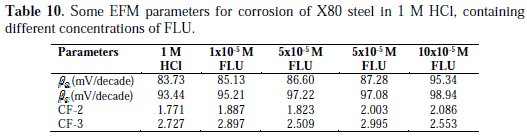
    <p>EFM measurement was also carried out using small signals to obtain the 
causality factors (CF-2 and CF-3) and Tafel constants displayed in <a href="#t10">Table 10</a>.</p>


    <p>&nbsp;</p>
<a name="t10">
<img src="/img/revistas/pea/v34n6/34n6a05t10.jpg">
    
<p>&nbsp;</p>


    <p>The obtained causality factors CF-2 and CF-3 are close to theoretical values, 
indicating that the measurements are of good quality [32]. The slight differences 
can be attributed to the influence of electrochemical noise on the measurement. 
Variation in the values of the Tafel constants demonstrates that the inhibitor has 
more influence on &beta;a, supporting PDP results.</p>


    <p><i><b>SEM studies</b></i></p>

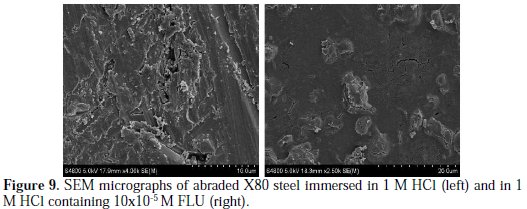
    <p>Micrographs of an abraded X80 steel coupon prior to immersion, and then 
immersed in 1 M HCl, with and without FLU, for 24 hours, were recorded by 
SEM. Results reveal that the surface of the coupon immersed in the free acid 
solution (<a href="#f9">Fig. 9</a>, left) experienced damage, due to a corrosive attack leading to 
pitting and undulation.</p>


    ]]></body>
<body><![CDATA[<p>&nbsp;</p>
<a name="f9">
<img src="/img/revistas/pea/v34n6/34n6a05f9.jpg">
    
<p>&nbsp;</p>


    <p>However, the surface of the coupon immersed in the 
solution containing FLU (<a href="#f9">Fig. 9</a>, right) was relatively smoother compared to the 
free acid solution.</p>

    <p>This demonstrates that the addition of inhibitor reduces the corrosive pitting 
which occurs in the free acid solution. The extent of protection can be considered 
to be high, since pitting decreases significantly.</p>

    <p>The protective layer formed by the inhibitor was not evenly distributed over the 
metal surface, which is why some portions on the surface are smoother than 
others. Thus, the active sites on the steel surface might not be equivalent or 
possess similar affinity for the active molecules of the inhibitors. Also, some 
cracks, which may arise during cleaning of the coupon after retrieval, are visible 
on the protected surface.</p>


    <p>&nbsp;</p>
    <p><b>Conclusions</b></p>

    <p>Fluvoxamine has been assessed as an alternative anticorrosion additive for X80 
steel surface protection in hydrochloric acid. The efficiency of FLU on inhibition 
of X80 steel corrosion decreases as temperature increases, and increases as FLU 
concentration increases. Blending of FLU with potassium iodide, 
polyethyleneglygol and glutathione further improves the efficiency. FLU behaves 
as a mixed type inhibitor with anodic predominance. Adsorption of FLU on X80 
steel surface is spontaneous, exothermic and best described by Langmuir 
adsorption model. SEM micrographs of X80 steel surface are protected from the 
aggressive HCl solution by addition of FLU. FLU and its blends could be useful 
as effective alternative ecofriendly corrosion inhibitors for X80 steel materials in 
acidic well treatment fluids.</p>


    <p>&nbsp;</p>
    <p><b>References</b></p>

    ]]></body>
<body><![CDATA[<!-- ref --><p>1. Brezinski MM, Desai B. Google Patents. 1997.    &nbsp;&nbsp;&nbsp;&nbsp;&nbsp;&nbsp;&nbsp;&nbsp;[&#160;<a href="javascript:void(0);" onclick="javascript: window.open('/scielo.php?script=sci_nlinks&ref=424284&pid=S0872-1904201600060000500001&lng=','','width=640,height=500,resizable=yes,scrollbars=1,menubar=yes,');">Links</a>&#160;]<!-- end-ref --></p>

    <!-- ref --><p>2. Walker ML. Google Patents. 1994.    &nbsp;&nbsp;&nbsp;&nbsp;&nbsp;&nbsp;&nbsp;&nbsp;[&#160;<a href="javascript:void(0);" onclick="javascript: window.open('/scielo.php?script=sci_nlinks&ref=424286&pid=S0872-1904201600060000500002&lng=','','width=640,height=500,resizable=yes,scrollbars=1,menubar=yes,');">Links</a>&#160;]<!-- end-ref --></p>

    <!-- ref --><p>3. Johannes KF. Gulf Professional Publishing; 2012.    &nbsp;&nbsp;&nbsp;&nbsp;&nbsp;&nbsp;&nbsp;&nbsp;[&#160;<a href="javascript:void(0);" onclick="javascript: window.open('/scielo.php?script=sci_nlinks&ref=424288&pid=S0872-1904201600060000500003&lng=','','width=640,height=500,resizable=yes,scrollbars=1,menubar=yes,');">Links</a>&#160;]<!-- end-ref --></p>

    <!-- ref --><p>4. Arthur J, Daniel BB, Layne M. Cincinnati: ALL Consulting; 2008.    &nbsp;&nbsp;&nbsp;&nbsp;&nbsp;&nbsp;&nbsp;&nbsp;[&#160;<a href="javascript:void(0);" onclick="javascript: window.open('/scielo.php?script=sci_nlinks&ref=424290&pid=S0872-1904201600060000500004&lng=','','width=640,height=500,resizable=yes,scrollbars=1,menubar=yes,');">Links</a>&#160;]<!-- end-ref --></p>

    <!-- ref --><p>5. Finsgar M, Jackson J. Corros Sci 2014;86:17.    &nbsp;&nbsp;&nbsp;&nbsp;&nbsp;&nbsp;&nbsp;&nbsp;[&#160;<a href="javascript:void(0);" onclick="javascript: window.open('/scielo.php?script=sci_nlinks&ref=424292&pid=S0872-1904201600060000500005&lng=','','width=640,height=500,resizable=yes,scrollbars=1,menubar=yes,');">Links</a>&#160;]<!-- end-ref --></p>

    ]]></body>
<body><![CDATA[<!-- ref --><p>6. Williams DA, Holifield PK, Looney JR, et al. Google Patents. 1993.    &nbsp;&nbsp;&nbsp;&nbsp;&nbsp;&nbsp;&nbsp;&nbsp;[&#160;<a href="javascript:void(0);" onclick="javascript: window.open('/scielo.php?script=sci_nlinks&ref=424294&pid=S0872-1904201600060000500006&lng=','','width=640,height=500,resizable=yes,scrollbars=1,menubar=yes,');">Links</a>&#160;]<!-- end-ref --></p>

    <!-- ref --><p>7. Yadav M, Behera D, Sharma U. Arab J Chem. 2012. doi:10.1016/j.arabjc.2012.03.011.    &nbsp;&nbsp;&nbsp;&nbsp;&nbsp;&nbsp;&nbsp;&nbsp;[&#160;<a href="javascript:void(0);" onclick="javascript: window.open('/scielo.php?script=sci_nlinks&ref=424296&pid=S0872-1904201600060000500007&lng=','','width=640,height=500,resizable=yes,scrollbars=1,menubar=yes,');">Links</a>&#160;]<!-- end-ref --></p>

    <!-- ref --><p>8. Sanyal B. Prog Organic Coat. 1981;9:165.    &nbsp;&nbsp;&nbsp;&nbsp;&nbsp;&nbsp;&nbsp;&nbsp;[&#160;<a href="javascript:void(0);" onclick="javascript: window.open('/scielo.php?script=sci_nlinks&ref=424298&pid=S0872-1904201600060000500008&lng=','','width=640,height=500,resizable=yes,scrollbars=1,menubar=yes,');">Links</a>&#160;]<!-- end-ref --></p>

    <!-- ref --><p>9. Fouda AS, Shalabi SK, Elewady GY, et al. Int J Electrochem Sci. 2014;9:7038.    &nbsp;&nbsp;&nbsp;&nbsp;&nbsp;&nbsp;&nbsp;&nbsp;[&#160;<a href="javascript:void(0);" onclick="javascript: window.open('/scielo.php?script=sci_nlinks&ref=424300&pid=S0872-1904201600060000500009&lng=','','width=640,height=500,resizable=yes,scrollbars=1,menubar=yes,');">Links</a>&#160;]<!-- end-ref --></p>

    <!-- ref --><p>10. Burton SW. Int Clin Psychopharmacol. 1991;6:1.    &nbsp;&nbsp;&nbsp;&nbsp;&nbsp;&nbsp;&nbsp;&nbsp;[&#160;<a href="javascript:void(0);" onclick="javascript: window.open('/scielo.php?script=sci_nlinks&ref=424302&pid=S0872-1904201600060000500010&lng=','','width=640,height=500,resizable=yes,scrollbars=1,menubar=yes,');">Links</a>&#160;]<!-- end-ref --></p>

    ]]></body>
<body><![CDATA[<!-- ref --><p>11. Goodman WK, Ward H, Kablinger A, et al. J Clin Psychiat. 1997;58:32.    &nbsp;&nbsp;&nbsp;&nbsp;&nbsp;&nbsp;&nbsp;&nbsp;[&#160;<a href="javascript:void(0);" onclick="javascript: window.open('/scielo.php?script=sci_nlinks&ref=424304&pid=S0872-1904201600060000500011&lng=','','width=640,height=500,resizable=yes,scrollbars=1,menubar=yes,');">Links</a>&#160;]<!-- end-ref --></p>

    <!-- ref --><p>12. Rasmussen BB, Nielson TL, Brosen K. Pharmacol Toxicol. 1998;83:240.    &nbsp;&nbsp;&nbsp;&nbsp;&nbsp;&nbsp;&nbsp;&nbsp;[&#160;<a href="javascript:void(0);" onclick="javascript: window.open('/scielo.php?script=sci_nlinks&ref=424306&pid=S0872-1904201600060000500012&lng=','','width=640,height=500,resizable=yes,scrollbars=1,menubar=yes,');">Links</a>&#160;]<!-- end-ref --></p>

    <!-- ref --><p>13. Adotey A. Doctoral Dissertation. 2009.    &nbsp;&nbsp;&nbsp;&nbsp;&nbsp;&nbsp;&nbsp;&nbsp;[&#160;<a href="javascript:void(0);" onclick="javascript: window.open('/scielo.php?script=sci_nlinks&ref=424308&pid=S0872-1904201600060000500013&lng=','','width=640,height=500,resizable=yes,scrollbars=1,menubar=yes,');">Links</a>&#160;]<!-- end-ref --></p>

    <!-- ref --><p>14. Kennedy JL. Pennwell books, 1993.    &nbsp;&nbsp;&nbsp;&nbsp;&nbsp;&nbsp;&nbsp;&nbsp;[&#160;<a href="javascript:void(0);" onclick="javascript: window.open('/scielo.php?script=sci_nlinks&ref=424310&pid=S0872-1904201600060000500014&lng=','','width=640,height=500,resizable=yes,scrollbars=1,menubar=yes,');">Links</a>&#160;]<!-- end-ref --></p>

    <!-- ref --><p>15. Masakatsu U, Takabe H, Nice PI. Corrosion. NACE International;2000.    &nbsp;&nbsp;&nbsp;&nbsp;&nbsp;&nbsp;&nbsp;&nbsp;[&#160;<a href="javascript:void(0);" onclick="javascript: window.open('/scielo.php?script=sci_nlinks&ref=424312&pid=S0872-1904201600060000500015&lng=','','width=640,height=500,resizable=yes,scrollbars=1,menubar=yes,');">Links</a>&#160;]<!-- end-ref --></p>

    ]]></body>
<body><![CDATA[<p>16. Ahmad Z. Butterworth-Heinemann, 2006.</p>

    <!-- ref --><p>17. Akpabio I, Ejedawe J, Ebeniro J, et al. Global J Pure Appl Sci 2003;9:265.    &nbsp;&nbsp;&nbsp;&nbsp;&nbsp;&nbsp;&nbsp;&nbsp;[&#160;<a href="javascript:void(0);" onclick="javascript: window.open('/scielo.php?script=sci_nlinks&ref=424315&pid=S0872-1904201600060000500017&lng=','','width=640,height=500,resizable=yes,scrollbars=1,menubar=yes,');">Links</a>&#160;]<!-- end-ref --></p>

    <!-- ref --><p>18. Nwankwo CN, Ekine AS. Int J Phys Sci. 2009;4:777.    &nbsp;&nbsp;&nbsp;&nbsp;&nbsp;&nbsp;&nbsp;&nbsp;[&#160;<a href="javascript:void(0);" onclick="javascript: window.open('/scielo.php?script=sci_nlinks&ref=424317&pid=S0872-1904201600060000500018&lng=','','width=640,height=500,resizable=yes,scrollbars=1,menubar=yes,');">Links</a>&#160;]<!-- end-ref --></p>

    <!-- ref --><p>19. Adedapo J, Ikpokonte A, Schoeneich K, Kurowska. Gas. 2014;5:12.    &nbsp;&nbsp;&nbsp;&nbsp;&nbsp;&nbsp;&nbsp;&nbsp;[&#160;<a href="javascript:void(0);" onclick="javascript: window.open('/scielo.php?script=sci_nlinks&ref=424319&pid=S0872-1904201600060000500019&lng=','','width=640,height=500,resizable=yes,scrollbars=1,menubar=yes,');">Links</a>&#160;]<!-- end-ref --></p>

    <!-- ref --><p>20. Emujakporue G, Ekine A. J Earth Sci Geotech Eng. 2014;4:109.    &nbsp;&nbsp;&nbsp;&nbsp;&nbsp;&nbsp;&nbsp;&nbsp;[&#160;<a href="javascript:void(0);" onclick="javascript: window.open('/scielo.php?script=sci_nlinks&ref=424321&pid=S0872-1904201600060000500020&lng=','','width=640,height=500,resizable=yes,scrollbars=1,menubar=yes,');">Links</a>&#160;]<!-- end-ref --></p>

    <!-- ref --><p>21. Kairi NI, Kassim J. Int J Electrochem Sci. 2013;8:7138.    &nbsp;&nbsp;&nbsp;&nbsp;&nbsp;&nbsp;&nbsp;&nbsp;[&#160;<a href="javascript:void(0);" onclick="javascript: window.open('/scielo.php?script=sci_nlinks&ref=424323&pid=S0872-1904201600060000500021&lng=','','width=640,height=500,resizable=yes,scrollbars=1,menubar=yes,');">Links</a>&#160;]<!-- end-ref --></p>

    <!-- ref --><p>22. Vinutha MR, Venkatesha TV. Port Electrochim Acta. 2016;34:159.    &nbsp;&nbsp;&nbsp;&nbsp;&nbsp;&nbsp;&nbsp;&nbsp;[&#160;<a href="javascript:void(0);" onclick="javascript: window.open('/scielo.php?script=sci_nlinks&ref=424325&pid=S0872-1904201600060000500022&lng=','','width=640,height=500,resizable=yes,scrollbars=1,menubar=yes,');">Links</a>&#160;]<!-- end-ref --></p>

    <!-- ref --><p>23. Umoren S, Solomon M. J Ind Eng Chem. 2015;21:81.    &nbsp;&nbsp;&nbsp;&nbsp;&nbsp;&nbsp;&nbsp;&nbsp;[&#160;<a href="javascript:void(0);" onclick="javascript: window.open('/scielo.php?script=sci_nlinks&ref=424327&pid=S0872-1904201600060000500023&lng=','','width=640,height=500,resizable=yes,scrollbars=1,menubar=yes,');">Links</a>&#160;]<!-- end-ref --></p>

    <!-- ref --><p>24. Nahle, A, Al-Tuniji, RS, Abu-Abdoun, I, Abdel-Rahman, I. Port Electrochim Acta. 2016;34:207.    &nbsp;&nbsp;&nbsp;&nbsp;&nbsp;&nbsp;&nbsp;&nbsp;[&#160;<a href="javascript:void(0);" onclick="javascript: window.open('/scielo.php?script=sci_nlinks&ref=424329&pid=S0872-1904201600060000500024&lng=','','width=640,height=500,resizable=yes,scrollbars=1,menubar=yes,');">Links</a>&#160;]<!-- end-ref --></p>

    <!-- ref --><p>25. Shukla SK, Ebenso EE. Int J Electrochem Sci. 2011;6:3277.    &nbsp;&nbsp;&nbsp;&nbsp;&nbsp;&nbsp;&nbsp;&nbsp;[&#160;<a href="javascript:void(0);" onclick="javascript: window.open('/scielo.php?script=sci_nlinks&ref=424331&pid=S0872-1904201600060000500025&lng=','','width=640,height=500,resizable=yes,scrollbars=1,menubar=yes,');">Links</a>&#160;]<!-- end-ref --></p>

    <!-- ref --><p>26. Shaban SM, Aiad I, El-Sukkary, MM, et al. J Mol Liq. 2015;203:20.    &nbsp;&nbsp;&nbsp;&nbsp;&nbsp;&nbsp;&nbsp;&nbsp;[&#160;<a href="javascript:void(0);" onclick="javascript: window.open('/scielo.php?script=sci_nlinks&ref=424333&pid=S0872-1904201600060000500026&lng=','','width=640,height=500,resizable=yes,scrollbars=1,menubar=yes,');">Links</a>&#160;]<!-- end-ref --></p>

    <!-- ref --><p>27. Patel NS, Hadlicka J, Beranek P, et al. Port Electrochim Acta. 2014;32:395.    &nbsp;&nbsp;&nbsp;&nbsp;&nbsp;&nbsp;&nbsp;&nbsp;[&#160;<a href="javascript:void(0);" onclick="javascript: window.open('/scielo.php?script=sci_nlinks&ref=424335&pid=S0872-1904201600060000500027&lng=','','width=640,height=500,resizable=yes,scrollbars=1,menubar=yes,');">Links</a>&#160;]<!-- end-ref --></p>

    <!-- ref --><p>28. Anupama KK, Ramya K, Shainy KM, et al. Mater Chem Phys. 2015;167:28.    &nbsp;&nbsp;&nbsp;&nbsp;&nbsp;&nbsp;&nbsp;&nbsp;[&#160;<a href="javascript:void(0);" onclick="javascript: window.open('/scielo.php?script=sci_nlinks&ref=424337&pid=S0872-1904201600060000500028&lng=','','width=640,height=500,resizable=yes,scrollbars=1,menubar=yes,');">Links</a>&#160;]<!-- end-ref --></p>

    <!-- ref --><p>29. Olasunkanmi LO Mwadham MK, Ebenso EE. Physica E: Low-dimen Sys Nanostruct 2016;76:109.    &nbsp;&nbsp;&nbsp;&nbsp;&nbsp;&nbsp;&nbsp;&nbsp;[&#160;<a href="javascript:void(0);" onclick="javascript: window.open('/scielo.php?script=sci_nlinks&ref=424339&pid=S0872-1904201600060000500029&lng=','','width=640,height=500,resizable=yes,scrollbars=1,menubar=yes,');">Links</a>&#160;]<!-- end-ref --></p>

    <!-- ref --><p>30. Hamdy A, El-Gendy NS. Egypt J Petrol. 2013;22:17.    &nbsp;&nbsp;&nbsp;&nbsp;&nbsp;&nbsp;&nbsp;&nbsp;[&#160;<a href="javascript:void(0);" onclick="javascript: window.open('/scielo.php?script=sci_nlinks&ref=424341&pid=S0872-1904201600060000500030&lng=','','width=640,height=500,resizable=yes,scrollbars=1,menubar=yes,');">Links</a>&#160;]<!-- end-ref --></p>

    <!-- ref --><p>31. Alaneme KK, Olusegun SJ, Adelowo OT. Alexan Eng J. 2015;55:673.    &nbsp;&nbsp;&nbsp;&nbsp;&nbsp;&nbsp;&nbsp;&nbsp;[&#160;<a href="javascript:void(0);" onclick="javascript: window.open('/scielo.php?script=sci_nlinks&ref=424343&pid=S0872-1904201600060000500031&lng=','','width=640,height=500,resizable=yes,scrollbars=1,menubar=yes,');">Links</a>&#160;]<!-- end-ref --></p>

    <p>32. Fouda AS, Abou Shahba RM, El El-Shenawy A, et al. Elixir Corros Dye. 2015;87:35501.</p>


    <p>&nbsp;</p>
    <p><b>Acknowledgements</b></p>

    <p>The authors acknowledge support from World Bank, through the Robert S. 
McNamara Fellowship programme, to conduct laboratory work abroad. We also 
are grateful to Dr. Shuangqing Sun, of Materials Physics and Chemistry 
Department, China University of Petroleum Qingdao, for providing their 
facilities and softwares to carry out this research, and to African Centre of 
Excellence in Oilfield Chemicals Research, for their support. EI is grateful to 
Prof. A. P. Udoh, Dr. B. S. Antia, Prof. Ogbona Joel, Prof. Hu, Dr. Li, Dr. Wang, 
Ubong Jerome, Chen, Chao, Xiang and Min in UPC, for their assistance.</p>


    <p>&nbsp;</p>
    <p><a name=0></a><sup><a href="#top">*</a></sup>Corresponding author. E-mail address: <a href="mailto:ekeminiituen@uniuyo.edu.ng">ekeminiituen@uniuyo.edu.ng</a></p>

    <p>Received September 29, 2016; accepted October 29, 2016</p>

    <p><a href="http://www.peacta.org" target="_blank">www.peacta.org</a> </p>


     ]]></body><back>
<ref-list>
<ref id="B1">
<label>1</label><nlm-citation citation-type="">
<person-group person-group-type="author">
<name>
<surname><![CDATA[Brezinski]]></surname>
<given-names><![CDATA[M M]]></given-names>
</name>
<name>
<surname><![CDATA[Desai]]></surname>
<given-names><![CDATA[B]]></given-names>
</name>
</person-group>
<source><![CDATA[Google Patents]]></source>
<year>1997</year>
</nlm-citation>
</ref>
<ref id="B2">
<label>2</label><nlm-citation citation-type="">
<person-group person-group-type="author">
<name>
<surname><![CDATA[Walker]]></surname>
<given-names><![CDATA[M L]]></given-names>
</name>
</person-group>
<source><![CDATA[Google Patents]]></source>
<year>1994</year>
</nlm-citation>
</ref>
<ref id="B3">
<label>3</label><nlm-citation citation-type="">
<person-group person-group-type="author">
<name>
<surname><![CDATA[Johannes]]></surname>
<given-names><![CDATA[K F]]></given-names>
</name>
</person-group>
<source><![CDATA[Gulf Professional Publishing]]></source>
<year>2012</year>
</nlm-citation>
</ref>
<ref id="B4">
<label>4</label><nlm-citation citation-type="">
<person-group person-group-type="author">
<name>
<surname><![CDATA[Arthur]]></surname>
<given-names><![CDATA[J]]></given-names>
</name>
<name>
<surname><![CDATA[Daniel]]></surname>
<given-names><![CDATA[B B]]></given-names>
</name>
<name>
<surname><![CDATA[Layne]]></surname>
<given-names><![CDATA[M]]></given-names>
</name>
</person-group>
<source><![CDATA[Cincinnati: ALL Consulting]]></source>
<year>2008</year>
</nlm-citation>
</ref>
<ref id="B5">
<label>5</label><nlm-citation citation-type="journal">
<person-group person-group-type="author">
<name>
<surname><![CDATA[Finsgar]]></surname>
<given-names><![CDATA[M]]></given-names>
</name>
<name>
<surname><![CDATA[Jackson]]></surname>
<given-names><![CDATA[J]]></given-names>
</name>
</person-group>
<source><![CDATA[Corros Sci]]></source>
<year>2014</year>
<volume>86</volume>
<page-range>17</page-range></nlm-citation>
</ref>
<ref id="B6">
<label>6</label><nlm-citation citation-type="">
<person-group person-group-type="author">
<name>
<surname><![CDATA[Williams]]></surname>
<given-names><![CDATA[D A]]></given-names>
</name>
<name>
<surname><![CDATA[Holifield]]></surname>
<given-names><![CDATA[P K]]></given-names>
</name>
<name>
<surname><![CDATA[Looney]]></surname>
<given-names><![CDATA[J R]]></given-names>
</name>
</person-group>
<source><![CDATA[Google Patents]]></source>
<year>1993</year>
</nlm-citation>
</ref>
<ref id="B7">
<label>7</label><nlm-citation citation-type="journal">
<person-group person-group-type="author">
<name>
<surname><![CDATA[Yadav]]></surname>
<given-names><![CDATA[M]]></given-names>
</name>
<name>
<surname><![CDATA[Behera]]></surname>
<given-names><![CDATA[D]]></given-names>
</name>
<name>
<surname><![CDATA[Sharma]]></surname>
<given-names><![CDATA[U]]></given-names>
</name>
</person-group>
<source><![CDATA[Arab J Chem]]></source>
<year>2012</year>
</nlm-citation>
</ref>
<ref id="B8">
<label>8</label><nlm-citation citation-type="journal">
<person-group person-group-type="author">
<name>
<surname><![CDATA[Sanyal]]></surname>
<given-names><![CDATA[B]]></given-names>
</name>
</person-group>
<source><![CDATA[Prog Organic Coat]]></source>
<year>1981</year>
<volume>9</volume>
<page-range>165</page-range></nlm-citation>
</ref>
<ref id="B9">
<label>9</label><nlm-citation citation-type="journal">
<person-group person-group-type="author">
<name>
<surname><![CDATA[Fouda]]></surname>
<given-names><![CDATA[A S]]></given-names>
</name>
<name>
<surname><![CDATA[Shalabi]]></surname>
<given-names><![CDATA[S K]]></given-names>
</name>
<name>
<surname><![CDATA[Elewady]]></surname>
<given-names><![CDATA[G Y]]></given-names>
</name>
</person-group>
<source><![CDATA[Int J Electrochem Sci]]></source>
<year>2014</year>
<volume>9</volume>
<page-range>7038</page-range></nlm-citation>
</ref>
<ref id="B10">
<label>10</label><nlm-citation citation-type="journal">
<person-group person-group-type="author">
<name>
<surname><![CDATA[Burton]]></surname>
<given-names><![CDATA[S W]]></given-names>
</name>
</person-group>
<source><![CDATA[Int Clin Psychopharmacol]]></source>
<year>1991</year>
<volume>6</volume>
<page-range>1</page-range></nlm-citation>
</ref>
<ref id="B11">
<label>11</label><nlm-citation citation-type="journal">
<person-group person-group-type="author">
<name>
<surname><![CDATA[Goodman]]></surname>
<given-names><![CDATA[W K]]></given-names>
</name>
<name>
<surname><![CDATA[Ward]]></surname>
<given-names><![CDATA[H]]></given-names>
</name>
<name>
<surname><![CDATA[Kablinger]]></surname>
<given-names><![CDATA[A]]></given-names>
</name>
</person-group>
<source><![CDATA[J Clin Psychiat]]></source>
<year>1997</year>
<volume>58</volume>
<page-range>32</page-range></nlm-citation>
</ref>
<ref id="B12">
<label>12</label><nlm-citation citation-type="journal">
<person-group person-group-type="author">
<name>
<surname><![CDATA[Rasmussen]]></surname>
<given-names><![CDATA[B B]]></given-names>
</name>
<name>
<surname><![CDATA[Nielson]]></surname>
<given-names><![CDATA[T L]]></given-names>
</name>
<name>
<surname><![CDATA[Brosen]]></surname>
<given-names><![CDATA[K]]></given-names>
</name>
</person-group>
<source><![CDATA[Pharmacol Toxicol]]></source>
<year>1998</year>
<volume>83</volume>
<page-range>240</page-range></nlm-citation>
</ref>
<ref id="B13">
<label>13</label><nlm-citation citation-type="">
<person-group person-group-type="author">
<name>
<surname><![CDATA[Adotey]]></surname>
<given-names><![CDATA[A]]></given-names>
</name>
</person-group>
<source><![CDATA[]]></source>
<year></year>
</nlm-citation>
</ref>
<ref id="B14">
<label>14</label><nlm-citation citation-type="">
<person-group person-group-type="author">
<name>
<surname><![CDATA[Kennedy]]></surname>
<given-names><![CDATA[J L]]></given-names>
</name>
</person-group>
<source><![CDATA[Pennwell books]]></source>
<year>1993</year>
</nlm-citation>
</ref>
<ref id="B15">
<label>15</label><nlm-citation citation-type="book">
<person-group person-group-type="author">
<name>
<surname><![CDATA[Masakatsu]]></surname>
<given-names><![CDATA[U]]></given-names>
</name>
<name>
<surname><![CDATA[Takabe]]></surname>
<given-names><![CDATA[H]]></given-names>
</name>
<name>
<surname><![CDATA[Nice]]></surname>
<given-names><![CDATA[P I]]></given-names>
</name>
</person-group>
<source><![CDATA[Corrosion]]></source>
<year>2000</year>
<publisher-name><![CDATA[NACE International]]></publisher-name>
</nlm-citation>
</ref>
<ref id="B16">
<label>16</label><nlm-citation citation-type="book">
<person-group person-group-type="author">
<name>
<surname><![CDATA[Ahmad]]></surname>
<given-names><![CDATA[Z]]></given-names>
</name>
</person-group>
<source><![CDATA[Corrosion]]></source>
<year>2006</year>
<publisher-name><![CDATA[Butterworth-Heinemann]]></publisher-name>
</nlm-citation>
</ref>
<ref id="B17">
<label>17</label><nlm-citation citation-type="journal">
<person-group person-group-type="author">
<name>
<surname><![CDATA[Akpabio]]></surname>
<given-names><![CDATA[I]]></given-names>
</name>
<name>
<surname><![CDATA[Ejedawe]]></surname>
<given-names><![CDATA[J]]></given-names>
</name>
<name>
<surname><![CDATA[Ebeniro]]></surname>
<given-names><![CDATA[J]]></given-names>
</name>
</person-group>
<source><![CDATA[Global J Pure Appl Sci]]></source>
<year>2003</year>
<volume>9</volume>
<page-range>265</page-range></nlm-citation>
</ref>
<ref id="B18">
<label>18</label><nlm-citation citation-type="journal">
<person-group person-group-type="author">
<name>
<surname><![CDATA[Nwankwo]]></surname>
<given-names><![CDATA[C N]]></given-names>
</name>
<name>
<surname><![CDATA[Ekine]]></surname>
<given-names><![CDATA[A S]]></given-names>
</name>
</person-group>
<source><![CDATA[Int J Phys Sci]]></source>
<year>2009</year>
<volume>4</volume>
<page-range>777</page-range></nlm-citation>
</ref>
<ref id="B19">
<label>19</label><nlm-citation citation-type="journal">
<person-group person-group-type="author">
<name>
<surname><![CDATA[Adedapo]]></surname>
<given-names><![CDATA[J]]></given-names>
</name>
<name>
<surname><![CDATA[Ikpokonte]]></surname>
<given-names><![CDATA[A]]></given-names>
</name>
<name>
<surname><![CDATA[Schoeneich]]></surname>
<given-names><![CDATA[K]]></given-names>
</name>
</person-group>
<source><![CDATA[Kurowska. Gas]]></source>
<year>2014</year>
<volume>5</volume>
<page-range>12</page-range></nlm-citation>
</ref>
<ref id="B20">
<label>20</label><nlm-citation citation-type="journal">
<person-group person-group-type="author">
<name>
<surname><![CDATA[Emujakporue]]></surname>
<given-names><![CDATA[G]]></given-names>
</name>
<name>
<surname><![CDATA[Ekine]]></surname>
<given-names><![CDATA[A]]></given-names>
</name>
</person-group>
<source><![CDATA[J Earth Sci Geotech Eng]]></source>
<year>2014</year>
<volume>4</volume>
<page-range>109</page-range></nlm-citation>
</ref>
<ref id="B21">
<label>21</label><nlm-citation citation-type="journal">
<person-group person-group-type="author">
<name>
<surname><![CDATA[Kairi]]></surname>
<given-names><![CDATA[N I]]></given-names>
</name>
<name>
<surname><![CDATA[Kassim]]></surname>
<given-names><![CDATA[J]]></given-names>
</name>
</person-group>
<source><![CDATA[Int J Electrochem Sci]]></source>
<year>2013</year>
<volume>8</volume>
<page-range>7138</page-range></nlm-citation>
</ref>
<ref id="B22">
<label>22</label><nlm-citation citation-type="journal">
<person-group person-group-type="author">
<name>
<surname><![CDATA[Vinutha]]></surname>
<given-names><![CDATA[M R]]></given-names>
</name>
<name>
<surname><![CDATA[Venkatesha]]></surname>
<given-names><![CDATA[T V]]></given-names>
</name>
</person-group>
<source><![CDATA[Port Electrochim Acta]]></source>
<year>2016</year>
<volume>34</volume>
<page-range>159</page-range></nlm-citation>
</ref>
<ref id="B23">
<label>23</label><nlm-citation citation-type="journal">
<person-group person-group-type="author">
<name>
<surname><![CDATA[Umoren]]></surname>
<given-names><![CDATA[S]]></given-names>
</name>
<name>
<surname><![CDATA[Solomon]]></surname>
<given-names><![CDATA[M]]></given-names>
</name>
</person-group>
<source><![CDATA[J Ind Eng Chem]]></source>
<year>2015</year>
<volume>21</volume>
<page-range>81</page-range></nlm-citation>
</ref>
<ref id="B24">
<label>24</label><nlm-citation citation-type="journal">
<person-group person-group-type="author">
<name>
<surname><![CDATA[Nahle]]></surname>
<given-names><![CDATA[A]]></given-names>
</name>
<name>
<surname><![CDATA[Al-Tuniji]]></surname>
<given-names><![CDATA[R S]]></given-names>
</name>
<name>
<surname><![CDATA[Abu-Abdoun]]></surname>
<given-names><![CDATA[I]]></given-names>
</name>
<name>
<surname><![CDATA[Abdel-Rahman]]></surname>
<given-names><![CDATA[I]]></given-names>
</name>
</person-group>
<source><![CDATA[Port Electrochim Acta]]></source>
<year>2016</year>
<volume>34</volume>
<page-range>207</page-range></nlm-citation>
</ref>
<ref id="B25">
<label>25</label><nlm-citation citation-type="journal">
<person-group person-group-type="author">
<name>
<surname><![CDATA[Shukla]]></surname>
<given-names><![CDATA[S K]]></given-names>
</name>
<name>
<surname><![CDATA[Ebenso]]></surname>
<given-names><![CDATA[E E]]></given-names>
</name>
</person-group>
<source><![CDATA[Int J Electrochem Sci]]></source>
<year>2011</year>
<volume>6</volume>
<page-range>3277</page-range></nlm-citation>
</ref>
<ref id="B26">
<label>26</label><nlm-citation citation-type="journal">
<person-group person-group-type="author">
<name>
<surname><![CDATA[Shaban]]></surname>
<given-names><![CDATA[S M]]></given-names>
</name>
<name>
<surname><![CDATA[Aiad]]></surname>
<given-names><![CDATA[I]]></given-names>
</name>
<name>
<surname><![CDATA[El-Sukkary]]></surname>
<given-names><![CDATA[M M]]></given-names>
</name>
</person-group>
<source><![CDATA[J Mol Liq]]></source>
<year>2015</year>
<volume>203</volume>
<page-range>20</page-range></nlm-citation>
</ref>
<ref id="B27">
<label>27</label><nlm-citation citation-type="journal">
<person-group person-group-type="author">
<name>
<surname><![CDATA[Patel]]></surname>
<given-names><![CDATA[N S]]></given-names>
</name>
<name>
<surname><![CDATA[Hadlicka]]></surname>
<given-names><![CDATA[J]]></given-names>
</name>
<name>
<surname><![CDATA[Beranek]]></surname>
<given-names><![CDATA[P]]></given-names>
</name>
</person-group>
<source><![CDATA[Port Electrochim Acta]]></source>
<year>2014</year>
<volume>32</volume>
<page-range>395</page-range></nlm-citation>
</ref>
<ref id="B28">
<label>28</label><nlm-citation citation-type="journal">
<person-group person-group-type="author">
<name>
<surname><![CDATA[Anupama]]></surname>
<given-names><![CDATA[K K]]></given-names>
</name>
<name>
<surname><![CDATA[Ramya]]></surname>
<given-names><![CDATA[K]]></given-names>
</name>
<name>
<surname><![CDATA[Shainy]]></surname>
<given-names><![CDATA[K M]]></given-names>
</name>
</person-group>
<source><![CDATA[Mater Chem Phys]]></source>
<year>2015</year>
<volume>167</volume>
<page-range>28</page-range></nlm-citation>
</ref>
<ref id="B29">
<label>29</label><nlm-citation citation-type="journal">
<person-group person-group-type="author">
<name>
<surname><![CDATA[Olasunkanmi]]></surname>
<given-names><![CDATA[LO]]></given-names>
</name>
<name>
<surname><![CDATA[Mwadham]]></surname>
<given-names><![CDATA[M K]]></given-names>
</name>
<name>
<surname><![CDATA[Ebenso]]></surname>
<given-names><![CDATA[E E]]></given-names>
</name>
</person-group>
<source><![CDATA[Physica E: Low-dimen Sys Nanostruct]]></source>
<year>2016</year>
<volume>76</volume>
<page-range>109</page-range></nlm-citation>
</ref>
<ref id="B30">
<label>30</label><nlm-citation citation-type="journal">
<person-group person-group-type="author">
<name>
<surname><![CDATA[Hamdy]]></surname>
<given-names><![CDATA[A]]></given-names>
</name>
<name>
<surname><![CDATA[El-Gendy]]></surname>
<given-names><![CDATA[N S]]></given-names>
</name>
</person-group>
<source><![CDATA[Egypt J Petrol]]></source>
<year>2013</year>
<volume>22</volume>
<page-range>17</page-range></nlm-citation>
</ref>
<ref id="B31">
<label>31</label><nlm-citation citation-type="journal">
<person-group person-group-type="author">
<name>
<surname><![CDATA[Alaneme]]></surname>
<given-names><![CDATA[K K]]></given-names>
</name>
<name>
<surname><![CDATA[Olusegun]]></surname>
<given-names><![CDATA[S J]]></given-names>
</name>
<name>
<surname><![CDATA[Adelowo]]></surname>
<given-names><![CDATA[O T]]></given-names>
</name>
</person-group>
<source><![CDATA[Alexan Eng J]]></source>
<year>2015</year>
<volume>55</volume>
<page-range>673</page-range></nlm-citation>
</ref>
<ref id="B32">
<label>32</label><nlm-citation citation-type="journal">
<person-group person-group-type="author">
<name>
<surname><![CDATA[Fouda]]></surname>
<given-names><![CDATA[A S]]></given-names>
</name>
<name>
<surname><![CDATA[Abou Shahba]]></surname>
<given-names><![CDATA[R M]]></given-names>
</name>
<name>
<surname><![CDATA[El-Shenawy]]></surname>
<given-names><![CDATA[A]]></given-names>
</name>
</person-group>
<source><![CDATA[Elixir Corros Dye]]></source>
<year>2015</year>
<volume>87</volume>
<page-range>35501</page-range></nlm-citation>
</ref>
</ref-list>
</back>
</article>