<?xml version="1.0" encoding="ISO-8859-1"?><article xmlns:mml="http://www.w3.org/1998/Math/MathML" xmlns:xlink="http://www.w3.org/1999/xlink" xmlns:xsi="http://www.w3.org/2001/XMLSchema-instance">
<front>
<journal-meta>
<journal-id>0872-1904</journal-id>
<journal-title><![CDATA[Portugaliae Electrochimica Acta]]></journal-title>
<abbrev-journal-title><![CDATA[Port. Electrochim. Acta]]></abbrev-journal-title>
<issn>0872-1904</issn>
<publisher>
<publisher-name><![CDATA[Sociedade Portuguesa de Electroquímica]]></publisher-name>
</publisher>
</journal-meta>
<article-meta>
<article-id>S0872-19042017000100003</article-id>
<article-id pub-id-type="doi">10.4152/pea.201701027</article-id>
<title-group>
<article-title xml:lang="en"><![CDATA[Solvent Effect and Adsorption Study of Mild Steel Protection from Acid Corrosion Using Eco-friendly Formulations of Annatto Extract]]></article-title>
</title-group>
<contrib-group>
<contrib contrib-type="author">
<name>
<surname><![CDATA[Ituen]]></surname>
<given-names><![CDATA[Ekemini]]></given-names>
</name>
<xref ref-type="aff" rid="A01"/>
<xref ref-type="aff" rid="A02"/>
</contrib>
<contrib contrib-type="author">
<name>
<surname><![CDATA[Umoren]]></surname>
<given-names><![CDATA[I. S.]]></given-names>
</name>
<xref ref-type="aff" rid="A02"/>
</contrib>
</contrib-group>
<aff id="A01">
<institution><![CDATA[,China University of Petroleum Materials Physics and Chemistry Research Laboratory Research Scholar]]></institution>
<addr-line><![CDATA[Qindao ]]></addr-line>
<country>China</country>
</aff>
<aff id="A02">
<institution><![CDATA[,University of Uyo Faculty of Science Department of Chemistry]]></institution>
<addr-line><![CDATA[ ]]></addr-line>
<country>Nigeria</country>
</aff>
<pub-date pub-type="pub">
<day>00</day>
<month>01</month>
<year>2017</year>
</pub-date>
<pub-date pub-type="epub">
<day>00</day>
<month>01</month>
<year>2017</year>
</pub-date>
<volume>35</volume>
<numero>1</numero>
<fpage>27</fpage>
<lpage>37</lpage>
<copyright-statement/>
<copyright-year/>
<self-uri xlink:href="http://scielo.pt/scielo.php?script=sci_arttext&amp;pid=S0872-19042017000100003&amp;lng=en&amp;nrm=iso"></self-uri><self-uri xlink:href="http://scielo.pt/scielo.php?script=sci_abstract&amp;pid=S0872-19042017000100003&amp;lng=en&amp;nrm=iso"></self-uri><self-uri xlink:href="http://scielo.pt/scielo.php?script=sci_pdf&amp;pid=S0872-19042017000100003&amp;lng=en&amp;nrm=iso"></self-uri><abstract abstract-type="short" xml:lang="en"><p><![CDATA[Annatto extract (dye) was investigated as a cheap and ecologically friendly alternative corrosion inhibitor. The corrosion process was monitored with mild steel coupons in 1.0 M hydrochloric acid at temperatures between 30 °C to 90 °C by weight loss and spectroscopic techniques. The dye effectively inhibited the corrosion of mild steel in the acid at the studied temperatures. Inhibition efficiency obtained was found to vary with temperature and concentration of the dye. Adsorption models were used to predict the nature of the dye-steel surface interaction. Thermodynamic models provided evidence of spontaneous physical and chemical adsorption mechanism with the evolution of heat. Kinetic studies revealed a deepening effect on the activation potential in the presence of the dye. The effect of solvent and synergistic intensifiers on the effectiveness of the dye was also assessed. Heavy metal ion composition in the formulation was determined and was within the limit of environmental and health safety.]]></p></abstract>
<kwd-group>
<kwd lng="en"><![CDATA[adsorption]]></kwd>
<kwd lng="en"><![CDATA[annatto]]></kwd>
<kwd lng="en"><![CDATA[corrosion inhibitor formulation]]></kwd>
<kwd lng="en"><![CDATA[inhibition effectiveness]]></kwd>
<kwd lng="en"><![CDATA[intensifier]]></kwd>
<kwd lng="en"><![CDATA[solvents]]></kwd>
</kwd-group>
</article-meta>
</front><body><![CDATA[ 

<!--     <p>&nbsp;</p>
    <p>doi: 10.4152/pea.201701027</p> -->

    <p><b>Solvent Effect and Adsorption Study of Mild Steel Protection 
from Acid Corrosion Using Eco-friendly Formulations of 
Annatto Extract</b></p>

    <p>
<b>Ekemini Ituen</b><sup><i>a,b</i>,<a href="#0">*</a></sup>
 and <b>I. S. Umoren</b><sup><i>b</i></sup>
</p>

    <p><i><sup>a</sup> Research Scholar, Materials Physics and Chemistry Research Laboratory, China University of 
Petroleum, Qindao, China</i></p>

    <p><i><sup>b</sup> Department of Chemistry, Faculty of Science, University of Uyo, Nigeria</i></p>


    <p>&nbsp;</p>
    <p><b>Abstract</b></p>

    <p>Annatto extract (dye) was investigated as a cheap and ecologically friendly alternative 
corrosion inhibitor. The corrosion process was monitored with mild steel coupons in 1.0 
M hydrochloric acid at temperatures between 30 &deg;C to 90 &deg;C by weight loss and 
spectroscopic techniques. The dye effectively inhibited the corrosion of mild steel in the 
acid at the studied temperatures. Inhibition efficiency obtained was found to vary with 
temperature and concentration of the dye. Adsorption models were used to predict the 
nature of the dye-steel surface interaction. Thermodynamic models provided evidence 
of spontaneous physical and chemical adsorption mechanism with the evolution of heat. 
Kinetic studies revealed a deepening effect on the activation potential in the presence of 
the dye. The effect of solvent and synergistic intensifiers on the effectiveness of the dye 
was also assessed. Heavy metal ion composition in the formulation was determined and 
was within the limit of environmental and health safety.</p>

    ]]></body>
<body><![CDATA[<p><b><i>Keywords:</i></b> adsorption, annatto, corrosion inhibitor formulation, inhibition effectiveness, 
intensifier, solvents.</p>


    <p>&nbsp;</p>
    <p><b>Introduction</b></p>

    <p>Corrosion is a phenomenon that is perhaps as old as when humans started using 
metallic structural materials. Failure of materials as well as high cost and toxicity 
usually associated with the importation of corrosion control chemicals might 
have been some of the driving forces for active research on cheap and efficient 
techniques of combating corrosion, the simplest being the use of corrosion 
inhibitors. Little wonder why a wide range of materials have been tested and 
reported as efficient corrosion inhibitors [1-2]. Some of these substances reported 
or currently used for corrosion control are very expensive and toxic.</p>

    <p>Economically, an inhibitor produced from cheap and readily available materials 
would be more desirable. On the other hand, non-toxicity to the environment in 
terms of heavy metal composition and biodegradability is also desired. Materials 
that best fit into these descriptions are locally sourced materials such as plant 
products. Some plants, including those used for food production, have been 
reported to possess good inhibitive properties against corrosion of different 
metals under different conditions [3-21]. When farmers prefer to sell their 
produce at higher profits to industries for manufacture of corrosion inhibitors 
instead of food production, food scarcity is inevitable. The paradigm has now 
shifted to the use of agricultural wastes and wild (non-edible) plants. In Nigeria, 
for instance, the transformation of local materials into products useful for 
industrial application (like corrosion inhibitors), within acceptable limits of 
health and environmental safety, will keep an open door to the actualization of 
2010 Nigerian content act.</p>

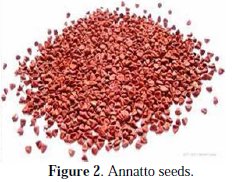
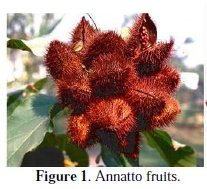
    <p>Annatto (Bixa orellana L.) is a fruiting shrub that grows generously up to 5-10 m 
high as a wild plant in southern Nigeria. Some are cultivated by individuals for 
the purpose of either folk medicine or dye extraction from the seeds (which are 
covered with reddish aril (<a href="#f1">Figs. 1</a>-<a href="#f2">2</a>)).</p>


    <p>&nbsp;</p>
<a name="f1">
<img src="/img/revistas/pea/v35n1/35n1a03f1.jpg">
    
<p>&nbsp;</p>
<a name="f2">
<img src="/img/revistas/pea/v35n1/35n1a03f2.jpg">
    
<p>&nbsp;</p>


    <p>Phytochemical screening of this extract has 
revealed the presence of tannins, saponins, flavonoids, terpenoids, phenolics, 
anthraquinones, steroids, proteins and carbohydrates with no alkaloids [22].</p>

    ]]></body>
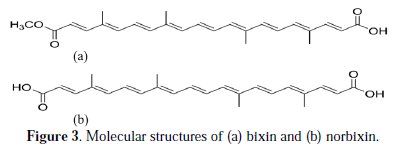
<body><![CDATA[<p>Bixin and norbixin carotenoids (structures in <a href="#f3">Fig. 3</a>) have been isolated from the 
dye extract, but bixin is claimed to be the predominant colouring compound in 
the extract [23-24].</p>


    <p>&nbsp;</p>
<a name="f3">
<img src="/img/revistas/pea/v35n1/35n1a03f3.jpg">
    
<p>&nbsp;</p>


    <p>The dye has been locally used in the manufacture of hair oil, shoe polish, floor 
polishes, nail gloss, furniture lacquer, domestic lipsticks, etc. The paste may also 
be used as a natural dye for cloth and hair, and is sometimes employed in paint 
industries [25]. Extracts from the fruits and seeds of the plant have been used in 
folk medicine as additives for treatment of malaria, fever, astringent, kidney 
diseases and skin diseases, because of its anti-bacterial and anti-microbial 
activity [25-26]. The dye is also used as colourant in some foods and beverages, 
due to its characteristic colour (see <a href="#f2">Figs. 2</a>-<a href="#f3">3</a>). Some reports have claimed that 
some synthetic dyes can inhibit metal corrosion [27-29]. Some of these dyes 
offer good corrosion protection to the metal, but are toxic or expensive. The 
present study aims to investigate annatto dye, a natural dye from a cheap, nontoxic 
and renewable source, as a possible replacement to these synthetic dyes 
used in corrosion inhibitors. It also investigates the effect of solvents on its anticorrosive 
effectiveness.</p>


    <p>&nbsp;</p>
    <p><b>Materials and method</b></p>

    <p><i><b>Materials preparation</b></i></p>

    <p>Mild steel sheets (thickness = 0.46 mm), with the composition (wt. %) 0.13 C, 
0.18 Si, 0.39 Mn, 0.60 P, 0.04 S, 0.025 Cu, and balance Fe), were mechanically 
press-cut into 4.0 cm &times; 4.0 cm pieces, degreased in absolute ethanol, washed first 
in water then in acetone, air-dried at room temperature, and stored in a moisture 
free desiccator to be used for the study. Fresh Bixa orellana seeds were harvested 
from a local forest in between Ikot Ambon village in Ibesikpo-Asutan L.G.A. of 
Akwa Ibom State, Nigeria. They were air-dried, grounded, and extracted in 
ethanol using standard procedures reported elsewhere [18]. Different 
concentrations of the dye extracts (1.0, 3.0 and 5.0 mg/L) were prepared as test 
solutions. The corrosive agent was general purpose grade HCl, prepared to a 
concentration of 1.0 M in double de-ionized water.</p>


    <p><i><b>Weight loss technique</b></i></p>

    <p>Pre-weighed mild steel coupons were totally immersed in the test solutions 
containing the acid, in the presence and absence of the dye, retrieved after 5 
hours immersion time, washed thoroughly in 20 % NaOH solution containing 
200 g/L of zinc dust, rinsed in water, dried in acetone, and re-weighed using a 
FA2104A digital weighing balance with &pm; 0.0001 g sensitivity. This was 
conducted at temperatures 30 - 60 &deg;C in triplicates, and the values of mass losses 
were used to estimate the corrosion rate using <a href="#e1">equation 1</a>:</p>


    ]]></body>
<body><![CDATA[<p>&nbsp;</p>
<a name="e1">
<img src="/img/revistas/pea/v35n1/35n1a03e1.jpg">
    
<p>&nbsp;</p>


    <p>where CR (gcm-2h-1) is the corrosion rate, w1 and w2 (g) are the weights before 
and after immersion, respectively, A (cm2) is the average surface area of the 
coupons and t (h) is the immersion time. The inhibitor effectiveness (%I) was 
estimated from <a href="#e1">equation 2</a>:</p>


    <p>&nbsp;</p>
<a name="e2">
<img src="/img/revistas/pea/v35n1/35n1a03e2.jpg">
    
<p>&nbsp;</p>


    <p>where CRb and CRi are the corrosion rates in the absence and presence of the 
extract, respectively. The fractional surface coverage was calculated from %I 
using <a href="#e1">equation 3</a>:</p>


    <p>&nbsp;</p>
<a name="e3">
<img src="/img/revistas/pea/v35n1/35n1a03e3.jpg">
    
<p>&nbsp;</p>


    <p><i><b>Intensifier blendingn</b></i></p>

    <p>The highest concentration of the dye extract was blended with a mixture of 2.0 
wt% KI/1.0 wt% CuI, and the inhibition efficiency (effectiveness) of the 
resulting mixture was determined using the weight loss procedure above 
described.</p>


    ]]></body>
<body><![CDATA[<p><i><b>Solvatochromic technique</b></i></p>

    <p>To determine the effect of solvents on the inhibitor effectiveness, the extract with 
the intensifier blend was formulated in different solvents, namely water (W), 
methanol (M), nitromethane (N) and formic acid (F). The uv/vis spectra of the 
lowest concentration (1.0 mg/L) of the dye, both in the acid and in the different 
solvents, were scanned ab initio using UNICO-UV-Spectrophotometer (Model 
2010, Made in China) at a dilution of 1:40. The metal coupons were thereafter 
immersed in the test solutions for 5 hours before retrieval, and the absorbance 
and maximum wavelength of absorption of the corrosion products were also 
obtained. These formulations in the different solvents were also subjected to 
weight loss measurements, as earlier described.</p>


    <p><i><b>Adsorption studies</b></i></p>

    <p>The values of fractional surface coverage obtained were fitted into Langmuir, 
Temkin, Flory Huggins and Frumkin adsorption models, respectively, given by 
<a href="#e1">equations 4</a>-<a href="#e7">7</a> [30-31].</p>


    <p>&nbsp;</p>
<a name="e4">
<img src="/img/revistas/pea/v35n1/35n1a03e4.jpg">
    
<p>&nbsp;</p>
<a name="e5">
<img src="/img/revistas/pea/v35n1/35n1a03e5.jpg">
    
<p>&nbsp;</p>
<a name="e6">
<img src="/img/revistas/pea/v35n1/35n1a03e6.jpg">
    
<p>&nbsp;</p>
<a name="e7">
<img src="/img/revistas/pea/v35n1/35n1a03e7.jpg">
    
<p>&nbsp;</p>


    <p>These models were used to probe the responsiveness of 
fractional coverage on the steel surface (&theta;) to changes in concentrations (C) of 
the extract, where &alpha;  
is the lateral interaction term or interaction parameter describing the 
interaction in the adsorbed layer, &chi; is the size parameter which measures the 
number of water molecules substituted by the inhibitor molecules, K is the 
adsorption-desorption equilibrium constant related to the free energy of 
adsorption according to equation 8, R is the universal gas constant, and T is the 
temperature.</p>


    ]]></body>
<body><![CDATA[<p><i><b>Atomic Absorption Spectrophotometric (AAS) technique</b></i></p>

    <p>Copper ions content in the formulation was determined by Atomic Absorption 
Spectrophotometry using model 939/959 UNICAM Spectrophotometer with deionized 
water used as blank.</p>


    <p>&nbsp;</p>
    <p><b>Results and discussion</b></p>

    <p><i><b>Corrosion rate and dye effectiveness</b></i></p>

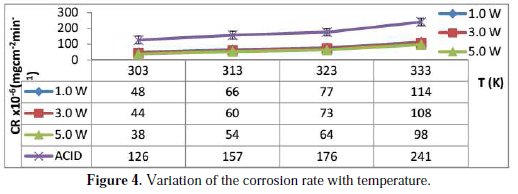
    <p>The corrosion rates of mild steel after 5 hours of immersion in 1.0 M HCl, in the 
absence and presence of annatto dye at 30-60 &deg;C, were calculated. Corrosion rate 
increased with higher temperatures, but decreased with an increase in 
concentration of the extracts, which agrees with findings from some other reports 
[31-33]. Results indicate that corrosion rate was even reduced by the addition of 
very low concentrations of annatto dye extract (<a href="#f4">Fig. 4</a>).</p>


    <p>&nbsp;</p>
<a name="f4">
<img src="/img/revistas/pea/v35n1/35n1a03f4.jpg">
    
<p>&nbsp;</p>


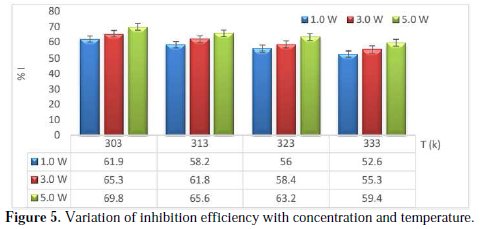
    <p>The inhibitor effectiveness (inhibition efficiency) increased with a higher 
concentration of the extract, and decreased as immersion system temperature 
increased (<a href="#f5">Fig. 5</a>).</p>


    <p>&nbsp;</p>
<a name="f5">
<img src="/img/revistas/pea/v35n1/35n1a03f5.jpg">
    
]]></body>
<body><![CDATA[<p>&nbsp;</p>


    <p>This effectiveness may be attributed to the presence of the electron rich 
phytochemicals earlier mentioned. Bixin and norbixin may be the active 
ingredients in the dye extract responsible for the high inhibition efficiency. The 
corrosion inhibition process may be due to adsorption of these phytochemicals 
onto the mild steel surface by interaction of 'phyto-electrons' from heteroatoms, 
and pie-functionalities of these phytochemicals with the vacant d-orbitals of iron. 
However, further study is recommended to help assign inhibitive effects to these 
phytochemicals, and elucidate their contributions.</p>


    <p><i><b>Effect of intensifier blend</b></i></p>

    <p>The use of plants biomass as corrosion inhibitors is limited, because they do not 
have long shelf life (they degrade with time), and their phyto-compounds lose 
their effectiveness at high temperatures [33].</p>

    <p>In oilfields, for instance, when the borehole temperature assumes higher values 
due to geothermal gradient, an inhibitor with good performance at surface 
conditions may not protect the steel structures in the deep. An intensifier 
(sometimes called an inhibitor aid) [34] is usually added to enhance the 
performance of the inhibitor at high temperatures and long exposure time [33]. 
Potassium iodide has been widely reported to elicit synergistic effect to inhibitors 
in deep sour wells [35-36]. Attempts were made to blend the extract with 2.0 
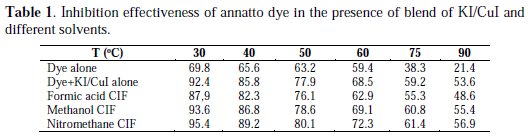
wt% KI/1.0 wt% CuI. Results revealed that KI/CuI blend intensified the 
effectiveness of the extract, even at temperatures up to 90 &deg;C (<a href="#t1">Table 1</a>).</p>


    <p>&nbsp;</p>
<a name="t1">
<img src="/img/revistas/pea/v35n1/35n1a03t1.jpg">
    
<p>&nbsp;</p>


    <p>This 
intensifying effect may be due to production or release of metal ions which form 
coordinated or associated complexes with some of the phyto-compounds in the 
dye, leading to formation of protective deposits (film) on the metal surface [37].</p>


    <p><i><b>Effect of solvents</b></i></p>

    <p>A study was designed to determine the effect of some polar solvents on the 
inhibition effectiveness of the dye extract. It has been claimed that solvents 
function by either reducing the viscosity for ease of handling or ensuring the 
stability of the corrosion inhibitor formulation in various environments [33]. The 
effect of extracting solvents on inhibitor effectiveness has been described [19], 
but researchers are yet to quantitatively describe the effect of the solvent or cosolvent 
used in corrosion inhibitor formulation on its effectiveness. When a 
corrosion inhibitor is blended with intensifier(s) and a solvent (and sometimes 
with a surfactant) and co-solvent, the resulting mixture is usually called corrosion 
inhibitor formulation (CIF). The purpose of a solvent may sometimes be similar 
to that of a surfactant, but with a different mechanism, i.e., to improve CIF 
solubility, dispersability in the acid and wettability on the acid-steel interface 
[33]. Solvents with polarity (methanol, nitromethane and formic acid) were 
selected (concentration 0.8 wt% and consisting of 50% by volume of the total 
test solution) to promote miscibility and to enhance inhibition effectiveness.</p>

    ]]></body>
<body><![CDATA[<p>Results show that the solvents affected the inhibition efficiency of the 
formulation. The effectiveness increased in methanol and nitomethane, but 
decreased in formic acid (see <a href="#t1">Table 1</a>). Nitromethane showed higher enhanced 
effectiveness than methanol, and this may be explained in terms of the higher 
number of electron rich atoms (N and O) in it than in ethanol. Formic acid may 
be thought to act as antagonistic to the corrosion inhibition or even aiding to 
increase the corrosion rate of the system. For practical applications, methanol is 
more cost effective than nitromethane, but may be hazardous to health like 
formic acid.</p>


    <p><i><b>Solvent effect on uv/vis absorption</b></i></p>

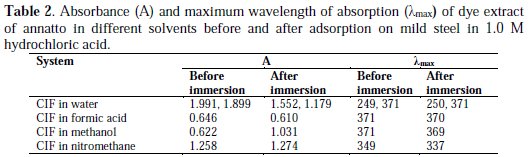
    <p>In order to elucidate the effect of solvents on the adsorption of the dye molecules 
onto the metal surface, the uv/vis absorbance spectra of the dye in the various 
solvents were obtained before and after the immersion of steel. Before 
immersion, the dye sample showed absorbance of 1.889 (dye in water), 0.622 (in 
methanol), 0.646 (in formic acid) and 1.258 (in nitromethane). One wonders why 
the absorbance values in the different solvents were lower than those obtained in 
water (<a href="#t2">Table 2</a>).</p>


    <p>&nbsp;</p>
<a name="t2">
<img src="/img/revistas/pea/v35n1/35n1a03t2.jpg">
    
<p>&nbsp;</p>


    <p>Introduction of the solvents lowered the absorbance of the dye 
molecules, but after the adsorption process, increase in absorbance was observed 
with nitromethane (1.274) and methanol (1.031), while formic acid (0.610) 
showed a decrease (<a href="#t2">Table 2</a>).</p>

    <p>The differences in absorbance before and after adsorption may be attributed to 
synergistic enhancement offered by the solvents. The mechanism underlying the 
observed phenomena is still unclear, although it appears consistent with the trend 
of solvent effect on the inhibition efficiencies (<a href="#t1">Table 1</a>). It is believed that the 
complex(es) formed between Fe<sup>2+</sup> and phyto-compounds in dye was/were rapidly 
dissolved by formic acid, thus reducing the absorbance. Further studies may be 
needed to understand this mechanism. In addition, shifts to shorter wavelengths 
of absorption were also observed in all the solvents after the adsorption process 
(<a href="#t2">Table 2</a>).</p>


    <p><i><b>Mechanism of inhibition</b></i></p>

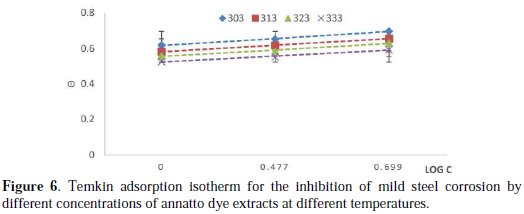
    <p>The fractional surface coverage (&theta;) data were fitted into the adsorption models 
described above by a plot of some functions of &theta; against those of the inhibitor's 
concentration (C). The best fit was obtained with the Temkin adsorption model 
(R<sub>2</sub> &gt; 0.96) (<a href="#f6">Fig. 6</a>), the linear form of which is given in <a href="#e9">equation 9</a>:</p>


    <p>&nbsp;</p>
<a name="f6">
<img src="/img/revistas/pea/v35n1/35n1a03f6.jpg">
    
]]></body>
<body><![CDATA[<p>&nbsp;</p>
<a name="e9">
<img src="/img/revistas/pea/v35n1/35n1a03e9.jpg">
    
<p>&nbsp;</p>


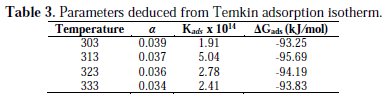
    <p>Negative values of &Delta;Gads were obtained at all temperatures studied (<a href="#t3">Table 3</a>), 
which implies spontaneous adsorption.</p>


    <p>&nbsp;</p>
<a name="t3">
<img src="/img/revistas/pea/v35n1/35n1a03t3.jpg">
    
<p>&nbsp;</p>


    <p>It has been established that when &Delta;Gads is 
less negative than -20 kJ/mol, the mechanism is physical adsorption, and if it is 
more negative than -40 kJ/mol, it is chemical adsorption [30, 33].</p>

    <p>Physical adsorption mechanism (physisorption) is usually associated with 
intermolecular forces which would cause preferential binding of certain 
phytochemicals of the dye to the metal (reversible with an increase in 
temperature), while chemical adsorption involves chemical bond formation 
(coordinate covalent in nature), usually with the release of heat. However, the 
obtained &Delta;Gads values indicate chemisorption which may be further supported by 
the exothermicity of the process and large values of Keq. Chemisorption is 
associated with monolayer adsorption and protective film formation. However, 
this observation is not in agreement with the predictions usually made from the 
trend of inhibition efficiency with temperature. When inhibition efficiency 
decreases with higher temperatures, as the ones obtained in this study, physical 
adsorption mechanism is usually proposed, which involves multilayer adsorption. 
The values of obtained &alpha; and Keq signify strong adsorbate-adsorbent molecular 
attraction and great binding strength.</p>


    <p><i><b>Thermodynamic considerations</b></i></p>

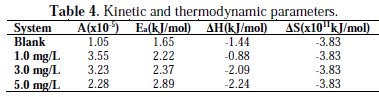
    <p>Energetically, the obtained negative &Delta;Gads is consistent with the spontaneous 
nature of the adsorption processes. A classical thermodynamic model called the 
transition state equation (<a href="#e10">equation 10</a>) was used to deduce some energetic 
parameters (<a href="#t4">Table 4</a>) associated with the adsorption process:</p>


    <p>&nbsp;</p>
<a name="e10">
<img src="/img/revistas/pea/v35n1/35n1a03e10.jpg">
    
]]></body>
<body><![CDATA[<p>&nbsp;</p>
<a name="t4">
<img src="/img/revistas/pea/v35n1/35n1a03t4.jpg">
    
<p>&nbsp;</p>


    <p>where CR is the corrosion rate, h is Plank's constant, N is Avogadro's number, R 
is the universal gas constant and T is the absolute temperature. A plot of log 
CR/T against 1/T (not shown) afforded straight lines with slopes (&Delta;Hads/2.303R) 
and intercepts [log(R/Nh) + (&Delta;Sads/2.303R)]. Obtained data reveal that the 
adsorption process was exothermic, and with a higher heat of adsorption in the 
presence of the extracts. Obtained negative &Delta;Sads values indicate a decrease in 
entropy, and consequently, an increased orderliness in the system, probably 
brought about by the reduction in the number of molecules of the active 
constituents of the extracts in the bulk solution, due to adsorption [32]. The 
decrease in orderliness was not concentration dependent, and may have resulted 
from the loss of heat to the surroundings.</p>


    <p><i><b>Kinetic considerations</b></i></p>

    <p>The percentage inhibition effectiveness decreased with higher temperatures for 
all the studied concentrations of the extracts, which means a possible shift in 
adsorption-desorption equilibrium towards desorption process, as temperature 
increases. This agrees with Le Chatellier's principle, which describes shifts in 
equilibrium position to annul the effects of changes in equilibrium conditions. 
However, the introduction of the intensifier blend elicited enhanced effectiveness 
on the extract, even when temperature increased to 90 &deg;C. Corrosion rate data 
obtained from this study were also fitted into Arrhenius kinetic model 
(<a href="#e11">equation 11</a>), to elucidate the effect of temperature on the inhibition efficiency and 
adsorption behaviour of the extracts.</p>


    <p>&nbsp;</p>
<a name="e11">
<img src="/img/revistas/pea/v35n1/35n1a03e11.jpg">
    
<p>&nbsp;</p>


    <p>Activation energy (Ea) was deduced from Arrhenius plot of log CR against the 
reciprocal of temperature. In accordance with the concept of activation, the acid 
molecules must acquire sufficient energy to overcome a minimum energy barrier 
(Ea), required to collide, attack and dissolve the steel in the aqueous medium. The 
Ea values of the inhibited solutions are larger than those of the free acid solution, 
which implies that the inhibited acid molecules must pass over a higher energy 
barrier to corrode the metal. Acid molecules that are unable to acquire this higher 
energy become deactivated, which promotes inhibition (protection) of the metal 
corrosion.</p>


    <p><i><b>Health, safety and environmental considerations</b></i></p>

    <p>Since heavy metals are known to be toxic, the amount of copper ions present in 
the inhibitor was evaluated in terms of its friendliness, or otherwise. Copper does 
not break down in the environment. Its accumulation in water may have slight 
effects on biodiversity, in case of exposure. The amount of copper obtained from 
AAS measurement was 1.02 &pm; 0.11 &mu;g. This value falls within the Recommended 
Dietary Allowance and Tolerable Upper Intake Level provided by both EPA and 
WHO. Based on this result, it is believed that the corrosion inhibitor formulation 
will be safe to the environment and people, if applied in the industry.</p>


    ]]></body>
<body><![CDATA[<p>&nbsp;</p>
    <p><b>Conclusions</b></p>

    <p>Based on the results obtained from this study, it may be concluded that extract of 
annatto is an effective corrosion inhibitor for mild steel in 1.0 M HCl at 
30-60 &deg;C. Addition of HI/CuI blend to the extract synergistically improves the 
effectiveness of the inhibitor, even at temperatures up to 90 &deg;C. The performance 
of the corrosion inhibitor formulation is affected by the solvents used. The 
absorption maxima and absorbance of the formulations were shifted in the 
solvents from values in water. The formulation functions by spontaneous 
adsorption of its phyto-compounds on the steel surface with the evolution of heat. 
The formulation can serve as a cheap and non-toxic alternative for chemical dyes 
used as inhibitors.</p>


    <p>&nbsp;</p>
    <p><b>References</b></p>

    <!-- ref --><p>1. Otaibi MS, Al-Mayouf AM, Mousa AA, et al. Arab J Chem. 2014;7:340.    &nbsp;&nbsp;&nbsp;&nbsp;&nbsp;&nbsp;&nbsp;&nbsp;[&#160;<a href="javascript:void(0);" onclick="javascript: window.open('/scielo.php?script=sci_nlinks&ref=425042&pid=S0872-1904201700010000300001&lng=','','width=640,height=500,resizable=yes,scrollbars=1,menubar=yes,');">Links</a>&#160;]<!-- end-ref --></p>

    <!-- ref --><p>2. Sangeetha M, Rajendran S, Muthumegala TS, et al. Zast Mater. 2011;52:3.    &nbsp;&nbsp;&nbsp;&nbsp;&nbsp;&nbsp;&nbsp;&nbsp;[&#160;<a href="javascript:void(0);" onclick="javascript: window.open('/scielo.php?script=sci_nlinks&ref=425044&pid=S0872-1904201700010000300002&lng=','','width=640,height=500,resizable=yes,scrollbars=1,menubar=yes,');">Links</a>&#160;]<!-- end-ref --></p>

    <!-- ref --><p>3. Satapathy AK, Gunasekaran G, Sahoo SC, et al. Corros Sci. 2009;51:2848.    &nbsp;&nbsp;&nbsp;&nbsp;&nbsp;&nbsp;&nbsp;&nbsp;[&#160;<a href="javascript:void(0);" onclick="javascript: window.open('/scielo.php?script=sci_nlinks&ref=425046&pid=S0872-1904201700010000300003&lng=','','width=640,height=500,resizable=yes,scrollbars=1,menubar=yes,');">Links</a>&#160;]<!-- end-ref --></p>

    <!-- ref --><p>4. Quraishi MA, Singh A, Singh VK, et al. Mater Chem Phys. 2010;122:114.    &nbsp;&nbsp;&nbsp;&nbsp;&nbsp;&nbsp;&nbsp;&nbsp;[&#160;<a href="javascript:void(0);" onclick="javascript: window.open('/scielo.php?script=sci_nlinks&ref=425048&pid=S0872-1904201700010000300004&lng=','','width=640,height=500,resizable=yes,scrollbars=1,menubar=yes,');">Links</a>&#160;]<!-- end-ref --></p>

    <!-- ref --><p>5. Deyab MAJ. Taiwan Inst Chem Eng. 2015;51:1.    &nbsp;&nbsp;&nbsp;&nbsp;&nbsp;&nbsp;&nbsp;&nbsp;[&#160;<a href="javascript:void(0);" onclick="javascript: window.open('/scielo.php?script=sci_nlinks&ref=425050&pid=S0872-1904201700010000300005&lng=','','width=640,height=500,resizable=yes,scrollbars=1,menubar=yes,');">Links</a>&#160;]<!-- end-ref --></p>

    <!-- ref --><p>6. Bammou L, Belkaouda M, Salghi R, et al. J Assoc Arabs Bas Appl Sci. 2014,16:83.    &nbsp;&nbsp;&nbsp;&nbsp;&nbsp;&nbsp;&nbsp;&nbsp;[&#160;<a href="javascript:void(0);" onclick="javascript: window.open('/scielo.php?script=sci_nlinks&ref=425052&pid=S0872-1904201700010000300006&lng=','','width=640,height=500,resizable=yes,scrollbars=1,menubar=yes,');">Links</a>&#160;]<!-- end-ref --></p>

    <!-- ref --><p>7. Shabani-Nooshabadi M, Ghandchi MS. J Ind Eng Chem. 2015;31:213.    &nbsp;&nbsp;&nbsp;&nbsp;&nbsp;&nbsp;&nbsp;&nbsp;[&#160;<a href="javascript:void(0);" onclick="javascript: window.open('/scielo.php?script=sci_nlinks&ref=425054&pid=S0872-1904201700010000300007&lng=','','width=640,height=500,resizable=yes,scrollbars=1,menubar=yes,');">Links</a>&#160;]<!-- end-ref --></p>

    <!-- ref --><p>8. Kajeswari V, Kesavan D, Gopiraman M, et al. Appl Surf Sci. 2014;314:537.    &nbsp;&nbsp;&nbsp;&nbsp;&nbsp;&nbsp;&nbsp;&nbsp;[&#160;<a href="javascript:void(0);" onclick="javascript: window.open('/scielo.php?script=sci_nlinks&ref=425056&pid=S0872-1904201700010000300008&lng=','','width=640,height=500,resizable=yes,scrollbars=1,menubar=yes,');">Links</a>&#160;]<!-- end-ref --></p>

    <!-- ref --><p>9. Bhawsar J, Jain PK, Jain P. Alexand Eng J. 2015;54:769.    &nbsp;&nbsp;&nbsp;&nbsp;&nbsp;&nbsp;&nbsp;&nbsp;[&#160;<a href="javascript:void(0);" onclick="javascript: window.open('/scielo.php?script=sci_nlinks&ref=425058&pid=S0872-1904201700010000300009&lng=','','width=640,height=500,resizable=yes,scrollbars=1,menubar=yes,');">Links</a>&#160;]<!-- end-ref --></p>

    <!-- ref --><p>10. Hu Q, Qiu Y, Zhang Q, et al. Chin J Chem Engin. 2015;23:1408.    &nbsp;&nbsp;&nbsp;&nbsp;&nbsp;&nbsp;&nbsp;&nbsp;[&#160;<a href="javascript:void(0);" onclick="javascript: window.open('/scielo.php?script=sci_nlinks&ref=425060&pid=S0872-1904201700010000300010&lng=','','width=640,height=500,resizable=yes,scrollbars=1,menubar=yes,');">Links</a>&#160;]<!-- end-ref --></p>

    <!-- ref --><p>11. Mehdipour M, Ramezanzadeh B, Aman SY. J Ind Eng Chem. 2015;21:318.    &nbsp;&nbsp;&nbsp;&nbsp;&nbsp;&nbsp;&nbsp;&nbsp;[&#160;<a href="javascript:void(0);" onclick="javascript: window.open('/scielo.php?script=sci_nlinks&ref=425062&pid=S0872-1904201700010000300011&lng=','','width=640,height=500,resizable=yes,scrollbars=1,menubar=yes,');">Links</a>&#160;]<!-- end-ref --></p>

    <!-- ref --><p>12. Kumar CBP, Mohama KN. Egyp J Petrol. 2014;23:201.    &nbsp;&nbsp;&nbsp;&nbsp;&nbsp;&nbsp;&nbsp;&nbsp;[&#160;<a href="javascript:void(0);" onclick="javascript: window.open('/scielo.php?script=sci_nlinks&ref=425064&pid=S0872-1904201700010000300012&lng=','','width=640,height=500,resizable=yes,scrollbars=1,menubar=yes,');">Links</a>&#160;]<!-- end-ref --></p>

    <!-- ref --><p>13. Abdel-Gabber AM, Abd-El-Nabey BA, Sidahmed AM, et al. Corros Sci. 2006;49:2765.    &nbsp;&nbsp;&nbsp;&nbsp;&nbsp;&nbsp;&nbsp;&nbsp;[&#160;<a href="javascript:void(0);" onclick="javascript: window.open('/scielo.php?script=sci_nlinks&ref=425066&pid=S0872-1904201700010000300013&lng=','','width=640,height=500,resizable=yes,scrollbars=1,menubar=yes,');">Links</a>&#160;]<!-- end-ref --></p>

    <!-- ref --><p>14. Soltani N, Tavakkoli N, Khayatkashani M, et al. J Ind Eng Chem. 2014;20:3217.    &nbsp;&nbsp;&nbsp;&nbsp;&nbsp;&nbsp;&nbsp;&nbsp;[&#160;<a href="javascript:void(0);" onclick="javascript: window.open('/scielo.php?script=sci_nlinks&ref=425068&pid=S0872-1904201700010000300014&lng=','','width=640,height=500,resizable=yes,scrollbars=1,menubar=yes,');">Links</a>&#160;]<!-- end-ref --></p>

    <!-- ref --><p>15. Odewunmi NA, Umoren SA, Gasem ZM, et al. J Taiwan Inst Chem Eng. 2015;51:177.    &nbsp;&nbsp;&nbsp;&nbsp;&nbsp;&nbsp;&nbsp;&nbsp;[&#160;<a href="javascript:void(0);" onclick="javascript: window.open('/scielo.php?script=sci_nlinks&ref=425070&pid=S0872-1904201700010000300015&lng=','','width=640,height=500,resizable=yes,scrollbars=1,menubar=yes,');">Links</a>&#160;]<!-- end-ref --></p>

    <!-- ref --><p>16. Obi-Egbedi NO, Obot IB, Umoren SA. Arab J Chem. 2012;5:361.    &nbsp;&nbsp;&nbsp;&nbsp;&nbsp;&nbsp;&nbsp;&nbsp;[&#160;<a href="javascript:void(0);" onclick="javascript: window.open('/scielo.php?script=sci_nlinks&ref=425072&pid=S0872-1904201700010000300016&lng=','','width=640,height=500,resizable=yes,scrollbars=1,menubar=yes,');">Links</a>&#160;]<!-- end-ref --></p>

    <!-- ref --><p>17. Bouknana D, Hammouti B, Messali M, et al. Asian Pacif J Trop Disea. 2014;4:5963.    &nbsp;&nbsp;&nbsp;&nbsp;&nbsp;&nbsp;&nbsp;&nbsp;[&#160;<a href="javascript:void(0);" onclick="javascript: window.open('/scielo.php?script=sci_nlinks&ref=425074&pid=S0872-1904201700010000300017&lng=','','width=640,height=500,resizable=yes,scrollbars=1,menubar=yes,');">Links</a>&#160;]<!-- end-ref --></p>

    <!-- ref --><p>18. Deyab MA. J Ind Eng Chem. 2015;22:384.    &nbsp;&nbsp;&nbsp;&nbsp;&nbsp;&nbsp;&nbsp;&nbsp;[&#160;<a href="javascript:void(0);" onclick="javascript: window.open('/scielo.php?script=sci_nlinks&ref=425076&pid=S0872-1904201700010000300018&lng=','','width=640,height=500,resizable=yes,scrollbars=1,menubar=yes,');">Links</a>&#160;]<!-- end-ref --></p>

    <!-- ref --><p>19. Umoren SA, Solomon MM, Eduok UM, et al. J Environ Chem Engin. 2014;2:1048.    &nbsp;&nbsp;&nbsp;&nbsp;&nbsp;&nbsp;&nbsp;&nbsp;[&#160;<a href="javascript:void(0);" onclick="javascript: window.open('/scielo.php?script=sci_nlinks&ref=425078&pid=S0872-1904201700010000300019&lng=','','width=640,height=500,resizable=yes,scrollbars=1,menubar=yes,');">Links</a>&#160;]<!-- end-ref --></p>

    <!-- ref --><p>20. Khadom AA, Hassan AF, Abod BM. Proc Saf Environ Protect. 2015;98:93.    &nbsp;&nbsp;&nbsp;&nbsp;&nbsp;&nbsp;&nbsp;&nbsp;[&#160;<a href="javascript:void(0);" onclick="javascript: window.open('/scielo.php?script=sci_nlinks&ref=425080&pid=S0872-1904201700010000300020&lng=','','width=640,height=500,resizable=yes,scrollbars=1,menubar=yes,');">Links</a>&#160;]<!-- end-ref --></p>

    <!-- ref --><p>21. Singh A, Lin Y, Ebenso EE, et al. J Ind Eng Chem. 2015;24:219.    &nbsp;&nbsp;&nbsp;&nbsp;&nbsp;&nbsp;&nbsp;&nbsp;[&#160;<a href="javascript:void(0);" onclick="javascript: window.open('/scielo.php?script=sci_nlinks&ref=425082&pid=S0872-1904201700010000300021&lng=','','width=640,height=500,resizable=yes,scrollbars=1,menubar=yes,');">Links</a>&#160;]<!-- end-ref --></p>

    <!-- ref --><p>22. Ganju K, Ganju EJ. Medic Pharm Innov. 2014;1:21.    &nbsp;&nbsp;&nbsp;&nbsp;&nbsp;&nbsp;&nbsp;&nbsp;[&#160;<a href="javascript:void(0);" onclick="javascript: window.open('/scielo.php?script=sci_nlinks&ref=425084&pid=S0872-1904201700010000300022&lng=','','width=640,height=500,resizable=yes,scrollbars=1,menubar=yes,');">Links</a>&#160;]<!-- end-ref --></p>

    <!-- ref --><p>23. Reith JF, Gielen JW. J Food Sci. 1971;36:861.    &nbsp;&nbsp;&nbsp;&nbsp;&nbsp;&nbsp;&nbsp;&nbsp;[&#160;<a href="javascript:void(0);" onclick="javascript: window.open('/scielo.php?script=sci_nlinks&ref=425086&pid=S0872-1904201700010000300023&lng=','','width=640,height=500,resizable=yes,scrollbars=1,menubar=yes,');">Links</a>&#160;]<!-- end-ref --></p>

    <!-- ref --><p>24. Silva GF, Gamarra FM, Oliveira AL, et al. Brazil J Chem Eng. 2008;25:419.    &nbsp;&nbsp;&nbsp;&nbsp;&nbsp;&nbsp;&nbsp;&nbsp;[&#160;<a href="javascript:void(0);" onclick="javascript: window.open('/scielo.php?script=sci_nlinks&ref=425088&pid=S0872-1904201700010000300024&lng=','','width=640,height=500,resizable=yes,scrollbars=1,menubar=yes,');">Links</a>&#160;]<!-- end-ref --></p>

    <!-- ref --><p>25. Vilar DA, Vilar MS, Moura TF, et al. Scientific World J. 2014; Article ID 857292.    &nbsp;&nbsp;&nbsp;&nbsp;&nbsp;&nbsp;&nbsp;&nbsp;[&#160;<a href="javascript:void(0);" onclick="javascript: window.open('/scielo.php?script=sci_nlinks&ref=425090&pid=S0872-1904201700010000300025&lng=','','width=640,height=500,resizable=yes,scrollbars=1,menubar=yes,');">Links</a>&#160;]<!-- end-ref --></p>

    <!-- ref --><p>26. Tamil SA, Dinesa MG, Satyan RS, et al. J Appl Pharm Sci. 2011;1:116.    &nbsp;&nbsp;&nbsp;&nbsp;&nbsp;&nbsp;&nbsp;&nbsp;[&#160;<a href="javascript:void(0);" onclick="javascript: window.open('/scielo.php?script=sci_nlinks&ref=425092&pid=S0872-1904201700010000300026&lng=','','width=640,height=500,resizable=yes,scrollbars=1,menubar=yes,');">Links</a>&#160;]<!-- end-ref --></p>

    <!-- ref --><p>27. Ebenso EE, Oguze EE. Mater Let. 2005;59:2163.    &nbsp;&nbsp;&nbsp;&nbsp;&nbsp;&nbsp;&nbsp;&nbsp;[&#160;<a href="javascript:void(0);" onclick="javascript: window.open('/scielo.php?script=sci_nlinks&ref=425094&pid=S0872-1904201700010000300027&lng=','','width=640,height=500,resizable=yes,scrollbars=1,menubar=yes,');">Links</a>&#160;]<!-- end-ref --></p>

    <!-- ref --><p>28. Oguzie EE, Njoku VO, Enenebeaku CK, et al. Corros Sci. 2008;50:3480.    &nbsp;&nbsp;&nbsp;&nbsp;&nbsp;&nbsp;&nbsp;&nbsp;[&#160;<a href="javascript:void(0);" onclick="javascript: window.open('/scielo.php?script=sci_nlinks&ref=425096&pid=S0872-1904201700010000300028&lng=','','width=640,height=500,resizable=yes,scrollbars=1,menubar=yes,');">Links</a>&#160;]<!-- end-ref --></p>

    <!-- ref --><p>29. Oguzie EE, Okulue BN, Ebenso EE, et al. Mater Chem Phys. 2004;87:394.    &nbsp;&nbsp;&nbsp;&nbsp;&nbsp;&nbsp;&nbsp;&nbsp;[&#160;<a href="javascript:void(0);" onclick="javascript: window.open('/scielo.php?script=sci_nlinks&ref=425098&pid=S0872-1904201700010000300029&lng=','','width=640,height=500,resizable=yes,scrollbars=1,menubar=yes,');">Links</a>&#160;]<!-- end-ref --></p>

    <!-- ref --><p>30. Nwabanne JT, Okafor JNJ. Min Mater Charact Engin. 2012;11:885.    &nbsp;&nbsp;&nbsp;&nbsp;&nbsp;&nbsp;&nbsp;&nbsp;[&#160;<a href="javascript:void(0);" onclick="javascript: window.open('/scielo.php?script=sci_nlinks&ref=425100&pid=S0872-1904201700010000300030&lng=','','width=640,height=500,resizable=yes,scrollbars=1,menubar=yes,');">Links</a>&#160;]<!-- end-ref --></p>

    <!-- ref --><p>31. Geethanjali R, Subhashini S. Port Electrochim Acta. 2015;33:35.    &nbsp;&nbsp;&nbsp;&nbsp;&nbsp;&nbsp;&nbsp;&nbsp;[&#160;<a href="javascript:void(0);" onclick="javascript: window.open('/scielo.php?script=sci_nlinks&ref=425102&pid=S0872-1904201700010000300031&lng=','','width=640,height=500,resizable=yes,scrollbars=1,menubar=yes,');">Links</a>&#160;]<!-- end-ref --></p>

    <!-- ref --><p>32. Odozi NW, Babalola JO, Ituen EB, et al. J Phys Chem. 2015;4:1.    &nbsp;&nbsp;&nbsp;&nbsp;&nbsp;&nbsp;&nbsp;&nbsp;[&#160;<a href="javascript:void(0);" onclick="javascript: window.open('/scielo.php?script=sci_nlinks&ref=425104&pid=S0872-1904201700010000300032&lng=','','width=640,height=500,resizable=yes,scrollbars=1,menubar=yes,');">Links</a>&#160;]<!-- end-ref --></p>

    <!-- ref --><p>33. Ituen EB, Essien EA, Udo UE, et al. Adv Appl Sci Resear. 2015;5:26.    &nbsp;&nbsp;&nbsp;&nbsp;&nbsp;&nbsp;&nbsp;&nbsp;[&#160;<a href="javascript:void(0);" onclick="javascript: window.open('/scielo.php?script=sci_nlinks&ref=425106&pid=S0872-1904201700010000300033&lng=','','width=640,height=500,resizable=yes,scrollbars=1,menubar=yes,');">Links</a>&#160;]<!-- end-ref --></p>

    <!-- ref --><p>34. Finsgar M, Jackson J. Corros Sci. 2014;8:17.    &nbsp;&nbsp;&nbsp;&nbsp;&nbsp;&nbsp;&nbsp;&nbsp;[&#160;<a href="javascript:void(0);" onclick="javascript: window.open('/scielo.php?script=sci_nlinks&ref=425108&pid=S0872-1904201700010000300034&lng=','','width=640,height=500,resizable=yes,scrollbars=1,menubar=yes,');">Links</a>&#160;]<!-- end-ref --></p>

    <!-- ref --><p>35. Hill DG, Jones A. Corros. 2003;No. 03121.    &nbsp;&nbsp;&nbsp;&nbsp;&nbsp;&nbsp;&nbsp;&nbsp;[&#160;<a href="javascript:void(0);" onclick="javascript: window.open('/scielo.php?script=sci_nlinks&ref=425110&pid=S0872-1904201700010000300035&lng=','','width=640,height=500,resizable=yes,scrollbars=1,menubar=yes,');">Links</a>&#160;]<!-- end-ref --></p>

    <!-- ref --><p>36. Quraishi MA, Sardar N, Ali H. Corros. 2002;58:317.    &nbsp;&nbsp;&nbsp;&nbsp;&nbsp;&nbsp;&nbsp;&nbsp;[&#160;<a href="javascript:void(0);" onclick="javascript: window.open('/scielo.php?script=sci_nlinks&ref=425112&pid=S0872-1904201700010000300036&lng=','','width=640,height=500,resizable=yes,scrollbars=1,menubar=yes,');">Links</a>&#160;]<!-- end-ref --></p>

    <!-- ref --><p>37. Deyab MA. Corros Sci. 2007;49:2315.    &nbsp;&nbsp;&nbsp;&nbsp;&nbsp;&nbsp;&nbsp;&nbsp;[&#160;<a href="javascript:void(0);" onclick="javascript: window.open('/scielo.php?script=sci_nlinks&ref=425114&pid=S0872-1904201700010000300037&lng=','','width=640,height=500,resizable=yes,scrollbars=1,menubar=yes,');">Links</a>&#160;]<!-- end-ref --></p>

    <!-- ref --><p>38. Williams DA, Holifield PK, Looney JR, et al. Inhibited Acid System for 
Acidizing Wells. US Patent 5,209,859, Exxon Chemical Patents, Inc: 
Linden, New Jersey; 1993.    &nbsp;&nbsp;&nbsp;&nbsp;&nbsp;&nbsp;&nbsp;&nbsp;[&#160;<a href="javascript:void(0);" onclick="javascript: window.open('/scielo.php?script=sci_nlinks&ref=425116&pid=S0872-1904201700010000300038&lng=','','width=640,height=500,resizable=yes,scrollbars=1,menubar=yes,');">Links</a>&#160;]<!-- end-ref --></p>


    <p>&nbsp;</p>
    <p><b>Acknowledgements</b></p>

    <p>The authors are grateful to the World Bank and African Centre of Excellence in 
Oilfield Chemicals Research, as well as to Ubong Jerome Etim and Eka-Eric 
Johnson Idang, for their assistance/contributions.</p>


    <p>&nbsp;</p>
    <p><a name=0></a><sup><a href="#top">*</a></sup>Corresponding author. E-mail address: <a href="mailto:ebituen@gmail.com">ebituen@gmail.com</a></p>

    <p>Received September 26, 2015; accepted &deg;Ctober 15, 2016</p>

    <p><a href="http://www.peacta.org" target="_blank">www.peacta.org</a> </p>


     ]]></body><back>
<ref-list>
<ref id="B1">
<label>1</label><nlm-citation citation-type="journal">
<person-group person-group-type="author">
<name>
<surname><![CDATA[Otaibi]]></surname>
<given-names><![CDATA[M S]]></given-names>
</name>
<name>
<surname><![CDATA[Al-Mayouf]]></surname>
<given-names><![CDATA[A M]]></given-names>
</name>
<name>
<surname><![CDATA[Mousa]]></surname>
<given-names><![CDATA[A A]]></given-names>
</name>
</person-group>
<source><![CDATA[Arab J Chem]]></source>
<year>2014</year>
<volume>7</volume>
<page-range>340</page-range></nlm-citation>
</ref>
<ref id="B2">
<label>2</label><nlm-citation citation-type="journal">
<person-group person-group-type="author">
<name>
<surname><![CDATA[Sangeetha]]></surname>
<given-names><![CDATA[M]]></given-names>
</name>
<name>
<surname><![CDATA[Rajendran]]></surname>
<given-names><![CDATA[S]]></given-names>
</name>
<name>
<surname><![CDATA[Muthumegala]]></surname>
<given-names><![CDATA[T S]]></given-names>
</name>
</person-group>
<source><![CDATA[Zast Mater]]></source>
<year>2011</year>
<volume>52</volume>
<page-range>3</page-range></nlm-citation>
</ref>
<ref id="B3">
<label>3</label><nlm-citation citation-type="journal">
<person-group person-group-type="author">
<name>
<surname><![CDATA[Satapathy]]></surname>
<given-names><![CDATA[A K]]></given-names>
</name>
<name>
<surname><![CDATA[Gunasekaran]]></surname>
<given-names><![CDATA[G]]></given-names>
</name>
<name>
<surname><![CDATA[Sahoo]]></surname>
<given-names><![CDATA[S C]]></given-names>
</name>
</person-group>
<source><![CDATA[Corros Sci]]></source>
<year>2009</year>
<volume>51</volume>
<page-range>2848</page-range></nlm-citation>
</ref>
<ref id="B4">
<label>4</label><nlm-citation citation-type="journal">
<person-group person-group-type="author">
<name>
<surname><![CDATA[Quraishi]]></surname>
<given-names><![CDATA[M A]]></given-names>
</name>
<name>
<surname><![CDATA[Singh]]></surname>
<given-names><![CDATA[A]]></given-names>
</name>
<name>
<surname><![CDATA[Singh]]></surname>
<given-names><![CDATA[V K]]></given-names>
</name>
</person-group>
<source><![CDATA[Mater Chem Phys]]></source>
<year>2010</year>
<volume>122</volume>
<page-range>114</page-range></nlm-citation>
</ref>
<ref id="B5">
<label>5</label><nlm-citation citation-type="journal">
<person-group person-group-type="author">
<name>
<surname><![CDATA[Deyab]]></surname>
<given-names><![CDATA[M A J]]></given-names>
</name>
</person-group>
<source><![CDATA[Taiwan Inst Chem Eng]]></source>
<year>2015</year>
<volume>51</volume>
<page-range>1</page-range></nlm-citation>
</ref>
<ref id="B6">
<label>6</label><nlm-citation citation-type="journal">
<person-group person-group-type="author">
<name>
<surname><![CDATA[Bammou]]></surname>
<given-names><![CDATA[L]]></given-names>
</name>
<name>
<surname><![CDATA[Belkaouda]]></surname>
<given-names><![CDATA[M]]></given-names>
</name>
<name>
<surname><![CDATA[Salghi]]></surname>
<given-names><![CDATA[R]]></given-names>
</name>
</person-group>
<source><![CDATA[J Assoc Arabs Bas Appl Sci]]></source>
<year>2014</year>
<volume>16</volume>
<page-range>83</page-range></nlm-citation>
</ref>
<ref id="B7">
<label>7</label><nlm-citation citation-type="journal">
<person-group person-group-type="author">
<name>
<surname><![CDATA[Shabani-Nooshabadi]]></surname>
<given-names><![CDATA[M]]></given-names>
</name>
<name>
<surname><![CDATA[Ghandchi]]></surname>
<given-names><![CDATA[M S]]></given-names>
</name>
</person-group>
<source><![CDATA[J Ind Eng Chem]]></source>
<year>2015</year>
<volume>31</volume>
<page-range>213</page-range></nlm-citation>
</ref>
<ref id="B8">
<label>8</label><nlm-citation citation-type="journal">
<person-group person-group-type="author">
<name>
<surname><![CDATA[Kajeswari]]></surname>
<given-names><![CDATA[V]]></given-names>
</name>
<name>
<surname><![CDATA[Kesavan]]></surname>
<given-names><![CDATA[D]]></given-names>
</name>
<name>
<surname><![CDATA[Gopiraman]]></surname>
<given-names><![CDATA[M]]></given-names>
</name>
</person-group>
<source><![CDATA[Appl Surf Sci]]></source>
<year>2014</year>
<volume>314</volume>
<page-range>537</page-range></nlm-citation>
</ref>
<ref id="B9">
<label>9</label><nlm-citation citation-type="journal">
<person-group person-group-type="author">
<name>
<surname><![CDATA[Bhawsar]]></surname>
<given-names><![CDATA[J]]></given-names>
</name>
<name>
<surname><![CDATA[Jain]]></surname>
<given-names><![CDATA[P K]]></given-names>
</name>
<name>
<surname><![CDATA[Jain]]></surname>
<given-names><![CDATA[P]]></given-names>
</name>
</person-group>
<source><![CDATA[Alexand Eng J]]></source>
<year>2015</year>
<volume>54</volume>
<page-range>769</page-range></nlm-citation>
</ref>
<ref id="B10">
<label>10</label><nlm-citation citation-type="journal">
<person-group person-group-type="author">
<name>
<surname><![CDATA[Hu]]></surname>
<given-names><![CDATA[Q]]></given-names>
</name>
<name>
<surname><![CDATA[Qiu]]></surname>
<given-names><![CDATA[Y]]></given-names>
</name>
<name>
<surname><![CDATA[Zhang]]></surname>
<given-names><![CDATA[Q]]></given-names>
</name>
</person-group>
<source><![CDATA[Chin J Chem Engin]]></source>
<year>2015</year>
<volume>23</volume>
<page-range>1408</page-range></nlm-citation>
</ref>
<ref id="B11">
<label>11</label><nlm-citation citation-type="journal">
<person-group person-group-type="author">
<name>
<surname><![CDATA[Mehdipour]]></surname>
<given-names><![CDATA[M]]></given-names>
</name>
<name>
<surname><![CDATA[Ramezanzadeh]]></surname>
<given-names><![CDATA[B]]></given-names>
</name>
<name>
<surname><![CDATA[Aman]]></surname>
<given-names><![CDATA[S Y]]></given-names>
</name>
</person-group>
<source><![CDATA[J Ind Eng Chem]]></source>
<year>2015</year>
<volume>21</volume>
<page-range>318</page-range></nlm-citation>
</ref>
<ref id="B12">
<label>12</label><nlm-citation citation-type="journal">
<person-group person-group-type="author">
<name>
<surname><![CDATA[Kumar]]></surname>
<given-names><![CDATA[C B P]]></given-names>
</name>
<name>
<surname><![CDATA[Mohama]]></surname>
<given-names><![CDATA[K N]]></given-names>
</name>
</person-group>
<source><![CDATA[Egyp J Petrol]]></source>
<year>2014</year>
<volume>23</volume>
<page-range>201</page-range></nlm-citation>
</ref>
<ref id="B13">
<label>13</label><nlm-citation citation-type="journal">
<person-group person-group-type="author">
<name>
<surname><![CDATA[Abdel-Gabber]]></surname>
<given-names><![CDATA[A M]]></given-names>
</name>
<name>
<surname><![CDATA[Abd-El-Nabey]]></surname>
<given-names><![CDATA[B A]]></given-names>
</name>
<name>
<surname><![CDATA[Sidahmed]]></surname>
<given-names><![CDATA[A M]]></given-names>
</name>
</person-group>
<source><![CDATA[Corros Sci]]></source>
<year>2006</year>
<volume>49</volume>
<page-range>2765</page-range></nlm-citation>
</ref>
<ref id="B14">
<label>14</label><nlm-citation citation-type="journal">
<person-group person-group-type="author">
<name>
<surname><![CDATA[Soltani]]></surname>
<given-names><![CDATA[N]]></given-names>
</name>
<name>
<surname><![CDATA[Tavakkoli]]></surname>
<given-names><![CDATA[N]]></given-names>
</name>
<name>
<surname><![CDATA[Khayatkashani]]></surname>
<given-names><![CDATA[M]]></given-names>
</name>
</person-group>
<source><![CDATA[J Ind Eng Chem]]></source>
<year>2014</year>
<volume>20</volume>
<page-range>3217</page-range></nlm-citation>
</ref>
<ref id="B15">
<label>15</label><nlm-citation citation-type="journal">
<person-group person-group-type="author">
<name>
<surname><![CDATA[Odewunmi]]></surname>
<given-names><![CDATA[N A]]></given-names>
</name>
<name>
<surname><![CDATA[Umoren]]></surname>
<given-names><![CDATA[S A]]></given-names>
</name>
<name>
<surname><![CDATA[Gasem]]></surname>
<given-names><![CDATA[Z M]]></given-names>
</name>
</person-group>
<source><![CDATA[J Taiwan Inst Chem Eng]]></source>
<year>2015</year>
<volume>51</volume>
<page-range>177</page-range></nlm-citation>
</ref>
<ref id="B16">
<label>16</label><nlm-citation citation-type="journal">
<person-group person-group-type="author">
<name>
<surname><![CDATA[Obi-Egbedi]]></surname>
<given-names><![CDATA[N O]]></given-names>
</name>
<name>
<surname><![CDATA[Obot]]></surname>
<given-names><![CDATA[I B]]></given-names>
</name>
<name>
<surname><![CDATA[Umoren]]></surname>
<given-names><![CDATA[S A]]></given-names>
</name>
</person-group>
<source><![CDATA[Arab J Chem]]></source>
<year>2012</year>
<volume>5</volume>
<page-range>361</page-range></nlm-citation>
</ref>
<ref id="B17">
<label>17</label><nlm-citation citation-type="journal">
<person-group person-group-type="author">
<name>
<surname><![CDATA[Bouknana]]></surname>
<given-names><![CDATA[D]]></given-names>
</name>
<name>
<surname><![CDATA[Hammouti]]></surname>
<given-names><![CDATA[B]]></given-names>
</name>
<name>
<surname><![CDATA[Messali]]></surname>
<given-names><![CDATA[M]]></given-names>
</name>
</person-group>
<source><![CDATA[Asian Pacif J Trop Disea]]></source>
<year>2014</year>
<volume>4</volume>
<page-range>5963</page-range></nlm-citation>
</ref>
<ref id="B18">
<label>18</label><nlm-citation citation-type="journal">
<person-group person-group-type="author">
<name>
<surname><![CDATA[Deyab]]></surname>
<given-names><![CDATA[M A]]></given-names>
</name>
</person-group>
<source><![CDATA[J Ind Eng Chem]]></source>
<year>2015</year>
<volume>22</volume>
<page-range>384</page-range></nlm-citation>
</ref>
<ref id="B19">
<label>19</label><nlm-citation citation-type="journal">
<person-group person-group-type="author">
<name>
<surname><![CDATA[Umoren]]></surname>
<given-names><![CDATA[S A]]></given-names>
</name>
<name>
<surname><![CDATA[Solomon]]></surname>
<given-names><![CDATA[M M]]></given-names>
</name>
<name>
<surname><![CDATA[Eduok]]></surname>
<given-names><![CDATA[U M]]></given-names>
</name>
</person-group>
<source><![CDATA[J Environ Chem Engin]]></source>
<year>2014</year>
<volume>2</volume>
<page-range>1048</page-range></nlm-citation>
</ref>
<ref id="B20">
<label>20</label><nlm-citation citation-type="journal">
<person-group person-group-type="author">
<name>
<surname><![CDATA[Khadom]]></surname>
<given-names><![CDATA[A A]]></given-names>
</name>
<name>
<surname><![CDATA[Hassan]]></surname>
<given-names><![CDATA[A F]]></given-names>
</name>
<name>
<surname><![CDATA[Abod]]></surname>
<given-names><![CDATA[B M]]></given-names>
</name>
</person-group>
<source><![CDATA[Proc Saf Environ Protect]]></source>
<year>2015</year>
<volume>98</volume>
<page-range>93</page-range></nlm-citation>
</ref>
<ref id="B21">
<label>21</label><nlm-citation citation-type="journal">
<person-group person-group-type="author">
<name>
<surname><![CDATA[Singh]]></surname>
<given-names><![CDATA[A]]></given-names>
</name>
<name>
<surname><![CDATA[Lin]]></surname>
<given-names><![CDATA[Y]]></given-names>
</name>
<name>
<surname><![CDATA[Ebenso]]></surname>
<given-names><![CDATA[E E]]></given-names>
</name>
</person-group>
<source><![CDATA[J Ind Eng Chem]]></source>
<year>2015</year>
<volume>24</volume>
<page-range>219</page-range></nlm-citation>
</ref>
<ref id="B22">
<label>22</label><nlm-citation citation-type="journal">
<person-group person-group-type="author">
<name>
<surname><![CDATA[Ganju]]></surname>
<given-names><![CDATA[K]]></given-names>
</name>
<name>
<surname><![CDATA[Ganju]]></surname>
<given-names><![CDATA[E J]]></given-names>
</name>
</person-group>
<source><![CDATA[Medic Pharm Innov]]></source>
<year>2014</year>
<volume>1</volume>
<page-range>21</page-range></nlm-citation>
</ref>
<ref id="B23">
<label>23</label><nlm-citation citation-type="journal">
<person-group person-group-type="author">
<name>
<surname><![CDATA[Reith]]></surname>
<given-names><![CDATA[J F]]></given-names>
</name>
<name>
<surname><![CDATA[Gielen]]></surname>
<given-names><![CDATA[J W]]></given-names>
</name>
</person-group>
<source><![CDATA[J Food Sci]]></source>
<year>1971</year>
<volume>36</volume>
<page-range>861</page-range></nlm-citation>
</ref>
<ref id="B24">
<label>24</label><nlm-citation citation-type="journal">
<person-group person-group-type="author">
<name>
<surname><![CDATA[Silva]]></surname>
<given-names><![CDATA[G F]]></given-names>
</name>
<name>
<surname><![CDATA[Gamarra]]></surname>
<given-names><![CDATA[F M]]></given-names>
</name>
<name>
<surname><![CDATA[Oliveira]]></surname>
<given-names><![CDATA[A L]]></given-names>
</name>
</person-group>
<source><![CDATA[Brazil J Chem Eng]]></source>
<year>2008</year>
<volume>25</volume>
<page-range>419</page-range></nlm-citation>
</ref>
<ref id="B25">
<label>25</label><nlm-citation citation-type="journal">
<person-group person-group-type="author">
<name>
<surname><![CDATA[Vilar]]></surname>
<given-names><![CDATA[D A]]></given-names>
</name>
<name>
<surname><![CDATA[Vilar]]></surname>
<given-names><![CDATA[M S]]></given-names>
</name>
<name>
<surname><![CDATA[Moura]]></surname>
<given-names><![CDATA[T F]]></given-names>
</name>
</person-group>
<source><![CDATA[Scientific World J]]></source>
<year>2014</year>
</nlm-citation>
</ref>
<ref id="B26">
<label>26</label><nlm-citation citation-type="journal">
<person-group person-group-type="author">
<name>
<surname><![CDATA[Tamil]]></surname>
<given-names><![CDATA[S A]]></given-names>
</name>
<name>
<surname><![CDATA[Dinesa]]></surname>
<given-names><![CDATA[M G]]></given-names>
</name>
<name>
<surname><![CDATA[Satyan]]></surname>
<given-names><![CDATA[R S]]></given-names>
</name>
</person-group>
<source><![CDATA[J Appl Pharm Sci]]></source>
<year>2011</year>
<volume>1</volume>
<page-range>116</page-range></nlm-citation>
</ref>
<ref id="B27">
<label>27</label><nlm-citation citation-type="journal">
<person-group person-group-type="author">
<name>
<surname><![CDATA[Ebenso]]></surname>
<given-names><![CDATA[E E]]></given-names>
</name>
<name>
<surname><![CDATA[Oguze]]></surname>
<given-names><![CDATA[E E]]></given-names>
</name>
</person-group>
<source><![CDATA[Mater Let]]></source>
<year>2005</year>
<volume>59</volume>
<page-range>2163</page-range></nlm-citation>
</ref>
<ref id="B28">
<label>28</label><nlm-citation citation-type="journal">
<person-group person-group-type="author">
<name>
<surname><![CDATA[Oguzie]]></surname>
<given-names><![CDATA[E E]]></given-names>
</name>
<name>
<surname><![CDATA[Njoku]]></surname>
<given-names><![CDATA[V O]]></given-names>
</name>
<name>
<surname><![CDATA[Enenebeaku]]></surname>
<given-names><![CDATA[C K]]></given-names>
</name>
</person-group>
<source><![CDATA[Corros Sci]]></source>
<year>2008</year>
<volume>50</volume>
<page-range>3480</page-range></nlm-citation>
</ref>
<ref id="B29">
<label>29</label><nlm-citation citation-type="journal">
<person-group person-group-type="author">
<name>
<surname><![CDATA[Oguzie]]></surname>
<given-names><![CDATA[E E]]></given-names>
</name>
<name>
<surname><![CDATA[Okulue]]></surname>
<given-names><![CDATA[B N]]></given-names>
</name>
<name>
<surname><![CDATA[Ebenso]]></surname>
<given-names><![CDATA[E E]]></given-names>
</name>
</person-group>
<source><![CDATA[Mater Chem Phys]]></source>
<year>2004</year>
<volume>87</volume>
<page-range>394</page-range></nlm-citation>
</ref>
<ref id="B30">
<label>30</label><nlm-citation citation-type="journal">
<person-group person-group-type="author">
<name>
<surname><![CDATA[Nwabanne]]></surname>
<given-names><![CDATA[J T]]></given-names>
</name>
<name>
<surname><![CDATA[Okafor]]></surname>
<given-names><![CDATA[J N J]]></given-names>
</name>
</person-group>
<source><![CDATA[Min Mater Charact Engin]]></source>
<year>2012</year>
<volume>11</volume>
<page-range>885</page-range></nlm-citation>
</ref>
<ref id="B31">
<label>31</label><nlm-citation citation-type="journal">
<person-group person-group-type="author">
<name>
<surname><![CDATA[Geethanjali]]></surname>
<given-names><![CDATA[R]]></given-names>
</name>
<name>
<surname><![CDATA[Subhashini]]></surname>
<given-names><![CDATA[S]]></given-names>
</name>
</person-group>
<source><![CDATA[Port Electrochim Acta]]></source>
<year>2015</year>
<volume>33</volume>
<page-range>35</page-range></nlm-citation>
</ref>
<ref id="B32">
<label>32</label><nlm-citation citation-type="journal">
<person-group person-group-type="author">
<name>
<surname><![CDATA[Odozi]]></surname>
<given-names><![CDATA[N W]]></given-names>
</name>
<name>
<surname><![CDATA[Babalola]]></surname>
<given-names><![CDATA[J O]]></given-names>
</name>
<name>
<surname><![CDATA[Ituen]]></surname>
<given-names><![CDATA[E B]]></given-names>
</name>
</person-group>
<source><![CDATA[J Phys Chem]]></source>
<year>2015</year>
<volume>4</volume>
<page-range>1</page-range></nlm-citation>
</ref>
<ref id="B33">
<label>33</label><nlm-citation citation-type="journal">
<person-group person-group-type="author">
<name>
<surname><![CDATA[Ituen]]></surname>
<given-names><![CDATA[E B]]></given-names>
</name>
<name>
<surname><![CDATA[Essien]]></surname>
<given-names><![CDATA[E A]]></given-names>
</name>
<name>
<surname><![CDATA[Udo]]></surname>
<given-names><![CDATA[U E]]></given-names>
</name>
</person-group>
<source><![CDATA[Adv Appl Sci Resear]]></source>
<year>2015</year>
<volume>5</volume>
<page-range>26</page-range></nlm-citation>
</ref>
<ref id="B34">
<label>34</label><nlm-citation citation-type="journal">
<person-group person-group-type="author">
<name>
<surname><![CDATA[Finsgar]]></surname>
<given-names><![CDATA[M]]></given-names>
</name>
<name>
<surname><![CDATA[Jackson]]></surname>
<given-names><![CDATA[J]]></given-names>
</name>
</person-group>
<source><![CDATA[Corros Sci]]></source>
<year>2014</year>
<volume>8</volume>
<page-range>17</page-range></nlm-citation>
</ref>
<ref id="B35">
<label>35</label><nlm-citation citation-type="journal">
<person-group person-group-type="author">
<name>
<surname><![CDATA[Hill]]></surname>
<given-names><![CDATA[D G]]></given-names>
</name>
<name>
<surname><![CDATA[Jones]]></surname>
<given-names><![CDATA[A]]></given-names>
</name>
</person-group>
<source><![CDATA[Corros]]></source>
<year>2003</year>
</nlm-citation>
</ref>
<ref id="B36">
<label>36</label><nlm-citation citation-type="journal">
<person-group person-group-type="author">
<name>
<surname><![CDATA[Quraishi]]></surname>
<given-names><![CDATA[M A]]></given-names>
</name>
<name>
<surname><![CDATA[Sardar]]></surname>
<given-names><![CDATA[N]]></given-names>
</name>
<name>
<surname><![CDATA[Ali]]></surname>
<given-names><![CDATA[H]]></given-names>
</name>
</person-group>
<source><![CDATA[Corros]]></source>
<year>2002</year>
<volume>58</volume>
<page-range>317</page-range></nlm-citation>
</ref>
<ref id="B37">
<label>37</label><nlm-citation citation-type="journal">
<person-group person-group-type="author">
<name>
<surname><![CDATA[Deyab]]></surname>
<given-names><![CDATA[M A]]></given-names>
</name>
</person-group>
<source><![CDATA[Corros Sci]]></source>
<year>2007</year>
<volume>49</volume>
<page-range>2315</page-range></nlm-citation>
</ref>
<ref id="B38">
<label>38</label><nlm-citation citation-type="book">
<person-group person-group-type="author">
<name>
<surname><![CDATA[Williams]]></surname>
<given-names><![CDATA[D A]]></given-names>
</name>
<name>
<surname><![CDATA[Holifield]]></surname>
<given-names><![CDATA[P K]]></given-names>
</name>
<name>
<surname><![CDATA[Looney]]></surname>
<given-names><![CDATA[J R]]></given-names>
</name>
</person-group>
<source><![CDATA[Inhibited Acid System for Acidizing Wells: US Patent 5,209,859, Exxon Chemical Patents]]></source>
<year>1993</year>
<publisher-loc><![CDATA[New Jersey ]]></publisher-loc>
<publisher-name><![CDATA[Inc: Linden]]></publisher-name>
</nlm-citation>
</ref>
</ref-list>
</back>
</article>