<?xml version="1.0" encoding="ISO-8859-1"?><article xmlns:mml="http://www.w3.org/1998/Math/MathML" xmlns:xlink="http://www.w3.org/1999/xlink" xmlns:xsi="http://www.w3.org/2001/XMLSchema-instance">
<front>
<journal-meta>
<journal-id>0872-1904</journal-id>
<journal-title><![CDATA[Portugaliae Electrochimica Acta]]></journal-title>
<abbrev-journal-title><![CDATA[Port. Electrochim. Acta]]></abbrev-journal-title>
<issn>0872-1904</issn>
<publisher>
<publisher-name><![CDATA[Sociedade Portuguesa de Electroquímica]]></publisher-name>
</publisher>
</journal-meta>
<article-meta>
<article-id>S0872-19042017000100005</article-id>
<article-id pub-id-type="doi">10.4152/pea.201701053</article-id>
<title-group>
<article-title xml:lang="en"><![CDATA[Influence of Organic Additives and of Stabilized Polymeric Micelles on the Metalographic Structure of Nanocomposite Zn and Zn-Co Coatings]]></article-title>
</title-group>
<contrib-group>
<contrib contrib-type="author">
<name>
<surname><![CDATA[Boshkov]]></surname>
<given-names><![CDATA[N.]]></given-names>
</name>
<xref ref-type="aff" rid="A01"/>
</contrib>
</contrib-group>
<aff id="A01">
<institution><![CDATA[,Bulgarian Academy of Sciences Academik G. Bonchev Institute of Physical Chemistry]]></institution>
<addr-line><![CDATA[Sofia ]]></addr-line>
<country>Bulgaria</country>
</aff>
<pub-date pub-type="pub">
<day>00</day>
<month>01</month>
<year>2017</year>
</pub-date>
<pub-date pub-type="epub">
<day>00</day>
<month>01</month>
<year>2017</year>
</pub-date>
<volume>35</volume>
<numero>1</numero>
<fpage>53</fpage>
<lpage>63</lpage>
<copyright-statement/>
<copyright-year/>
<self-uri xlink:href="http://scielo.pt/scielo.php?script=sci_arttext&amp;pid=S0872-19042017000100005&amp;lng=en&amp;nrm=iso"></self-uri><self-uri xlink:href="http://scielo.pt/scielo.php?script=sci_abstract&amp;pid=S0872-19042017000100005&amp;lng=en&amp;nrm=iso"></self-uri><self-uri xlink:href="http://scielo.pt/scielo.php?script=sci_pdf&amp;pid=S0872-19042017000100005&amp;lng=en&amp;nrm=iso"></self-uri><abstract abstract-type="short" xml:lang="en"><p><![CDATA[The peculiarities of the metallographic structure of electrodeposited nanocomposite polymeric modified Zn and Zn-Co (1 wt.%) alloy coatings are described and discussed. These coatings are obtained from usual electrochemical baths for Zn and Zn-Co alloys, but with the addition of stabilized polymeric micelles (SPM). The latter are of core-shell type, and are based on polypropylene oxide (hydrophobic core) and polyethylene oxide (hydrophilic shell). These coatings and their polymeric modified nano-composites are investigated with X-ray (XRD) method, which reveals changes in the metallographic structure as a result of the presence or absence of organic additives (wetting agent and brightener) and SPMs. The possible reasons for the changes observed are commented. In addition, cyclic voltammetry method (CVA) is applied in order to clarify the influence of the applied additives and of SPM on the cathodic (deposition) and anodic (dissolution) processes.]]></p></abstract>
<kwd-group>
<kwd lng="en"><![CDATA[zinc]]></kwd>
<kwd lng="en"><![CDATA[Zn-Co alloy]]></kwd>
<kwd lng="en"><![CDATA[metallographic structure]]></kwd>
<kwd lng="en"><![CDATA[polymeric modified coatings]]></kwd>
</kwd-group>
</article-meta>
</front><body><![CDATA[ 

<!--     <p>&nbsp;</p>
    <p>doi: 10.4152/pea.201701053</p> -->

    <p><b>Influence of Organic Additives and of Stabilized 
Polymeric Micelles on the Metalographic Structure of 
Nanocomposite Zn and Zn-Co Coatings</b></p>

    <p><b>N. Boshkov</b><sup><a href="#0">*</a></sup></p>

    <p><i> Institute of Physical Chemistry, ''Academik G. Bonchev'', bl. No. 11, Bulgarian Academy of 
Sciences, Sofia 1113, Bulgaria</i></p>


    <p>&nbsp;</p>
    <p><b>Abstract</b></p>

    <p>The peculiarities of the metallographic structure of electrodeposited nanocomposite 
polymeric modified Zn and Zn-Co (1 wt.%) alloy coatings are described and discussed. 
These coatings are obtained from usual electrochemical baths for Zn and Zn-Co alloys, 
but with the addition of stabilized polymeric micelles (SPM). The latter are of core-shell 
type, and are based on polypropylene oxide (hydrophobic core) and polyethylene oxide 
(hydrophilic shell). These coatings and their polymeric modified nano-composites are 
investigated with X-ray (XRD) method, which reveals changes in the metallographic 
structure as a result of the presence or absence of organic additives (wetting agent and 
brightener) and SPMs. The possible reasons for the changes observed are commented. 
In addition, cyclic voltammetry method (CVA) is applied in order to clarify the 
influence of the applied additives and of SPM on the cathodic (deposition) and anodic 
(dissolution) processes.</p>

    <p><b><i>Keywords:</i></b> zinc; Zn-Co alloy; metallographic structure; polymeric modified coatings.</p>


    ]]></body>
<body><![CDATA[<p>&nbsp;</p>
    <p><b>Introduction</b></p>

    <p>Zinc coatings are widespread in the industry as they are used as sacrificial layers 
for protection of steel against corrosion. Generally, zinc content in the earth crust 
is below 0.01 wt%, and this metal is the 24th most abundant element in the world. 
Zinc coatings are corrosion resistant in the pH range 7 - 12, and they are 
hopefully able to protect the steel substrate, for example, at atmospheric 
conditions.</p>

    <p>According to the significant application of Zn on industrial scale for corrosion 
protection of different steel parts (nuts, bolts, metal brackets, etc.) and 
components, this metal is the forth-most commonly used one, only surpassed by 
iron, copper and aluminum [1-5]. Zinc coatings find application in the 
automotive industry, but also in civil engineering, household, etc. The global 
prospects for the automotive industry are for the production of approximately 
hundred million cars in 2018, and the main construction material used for this 
purpose is galvanized low carbon steel. Another aspect of the zinc application is 
its lower cost compared to other industrial materials. The safe exploitation of the 
zinc is, to a certain degree, limited, due to the aggressive nature of an 
environment that contains industrial pollutants, which requires additional efforts 
to increase corrosion resistance [6-9]. For example, the alloying of Zn with some 
metals, such as Mn, Co, Ni, etc., can be applied for this purpose. However, the 
protective characteristics of the galvanic alloys often need additional 
improvement, especially in more aggressive media.</p>

    <p>A possible way to extend the service life of the zinc is obtaining composite 
coatings by using different inorganic (oxides, ceramics, carbides, such as ZrO2, 
TiO2, SiO2, Fe2O3, SiC etc) [10-14] or polymeric micro-(nano)particles, which 
generally also exhibit high corrosion resistance [15-19]. One serious problem 
could be the possible agglomeration of the particles in the electrolyte, and their 
sedimentation on the bottom. The amounts of the incorporated particles in the 
metal matrix depend in general on their concentration in the electrolytic bath, on 
the additives used, and on the electrodeposition conditions. In addition, Zn and 
its alloy coatings have various morphologies and textures [2-5], which can 
seriously affect their protective and physical-mechanical properties.</p>

    <p>The main aim of the present work is to characterize and discuss the influence of 
the stabilized polymeric micelles (SPM) on the metallographic structure, and on 
the deposition process of nanocomposite Zn and Zn-Co (1 wt.%) coatings.</p>


    <p>&nbsp;</p>
    <p><b>Experimental</b></p>

    <p><i><b>Sample and electrolyte preparation</b></i></p>

    <p>The composite and non-composite zinc and Zn-Co (1 wt.%) coatings are 
electrodeposited on low carbon steel sheets (sizes 2 &times; 1 &times; 0.1 cm; surface area of 
4 cm<sup>2</sup>) with a coating thickness of about 12 &mu;m. The electrodeposition process is 
carried out at ambient room temperature of 25 &deg;C and current density of 2 A.dm<sup>-2</sup>. 
Metallurgical zinc plates are used as anodes; no stirring or circulation is 
applied.</p>

    ]]></body>
<body><![CDATA[<p>The electrolytes for obtaining the nanocomposite coatings are ultrasonically 
treated before the electrodeposition during 10 minutes, aiming a better 
distribution of the SPM in the entire volume.</p>


    <p><i><b>Non-composite coatings</b></i></p>

    <p>Electrodeposited zinc coatings are obtained at pH value 4.5-5.0 from starting 
electrolyte (SE) with a composition 150 g/L ZnSO4.7H2O, 30 g/L NH4Cl, 30 
g/L H3BO3 and additives AZ-1 (wetting agent -50 mL.L) and AZ-2 
(brightener -10 mL/L).</p>

    <p>Electrodeposited Zn-Co (1 wt.%) alloy coatings are obtained from starting 
electrolyte (SE1) containing 100 g/L ZnSO4.7H2O; 120 g/L CoSO4.7H2O; 30 
g/L NH4Cl; 25 g/L H3BO3 at pH 3.0-4.0 and additives ZC-1 (wetting agent 20 
mL/L) and ZC-2 (brightener -2 mL/L).</p>


    <p><i><b>Composite coatingss</b></i></p>

    <p>The composite Zn and Zn-Co (1 wt.%) coatings are electrodeposited from SE 
and SE1 at the same electrodeposition conditions described above, but with an 
addition of nano-sized SPM. The latter are based on PEO75PPO30PEO75 (polyethylene 
oxide - poly-propylene oxide - poly-ethylene oxide) tri-block 
copolymer, where PPO forms the hydrophobic core, and PEO the hydrophilic 
shell of the micelle.</p>


    <p><i><b>Stabilized polymeric micelles (SPM)</b></i></p>

    <p>The main procedure for SPM preparation is described elsewhere [20]. It is based 
on the formation of core-shell type micelles in aqueous media at 60 oC, and 
immobilization of tetra-functional hydrophobic monomer - pentaerythritol tetraacrylate 
(PETA) -, followed by UV-induced polymerization and formation of a 
semi-interpenetrating polymer network. The stabilized polymeric micelles are 
dialyzed against distilled water, and then added to SE or SE1 in concentration of 
0.1 wt.% [15, 16].</p>


    <p><i><b>Sample characterization and reproducibility</b></i></p>

    <p>The metallographic structure and the changes appeared in the metal matrix as a 
result of the incorporated SPM are determined with X-ray diffraction analysis 
using of DRON-3 unit (Bragg-Brentano arrangement, CuK&alpha; -radiation and 
scintillation counter).</p>

    ]]></body>
<body><![CDATA[<p>The influence of the SPM added to the electrolytic baths on the cathodic and 
anodic processes is investigated with the cyclic voltammetry method. The 
measurements are performed with an electrochemical workstation PAR 
â€˜â€˜VersaStat 4'' at scan rate of 10 mV.s-1 in a common three-electrode 
experimental cell (250 mL). Platinum plate is taken as a counter electrode, and 
the potentials are measured with respect to saturated calomel electrode (SCE). 
The results from the investigations are, in average, of 5 samples per type and per 
stage, i.e., for each measurement 5 replicates of a Zn and Zn-Co alloy, as well as 
of their composites, are conditioned for initial and follow-up measurements.</p>


    <p>&nbsp;</p>
    <p><b>Results and discussion</b></p>

    <p><i><b>XRD investigations</b></i></p>

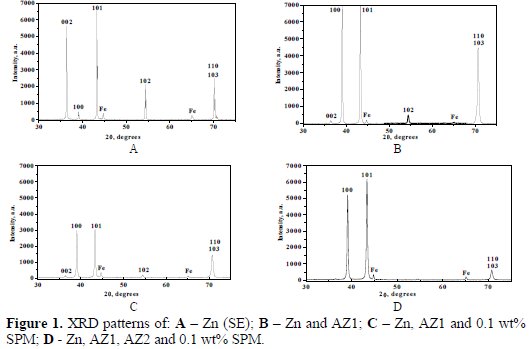
    <p>The results obtained by XRD method for electrodeposited Zn and polymeric 
modified Zn coatings are demonstrated in <a href="#f1">Fig. 1 (A - D)</a>.</p>


    <p>&nbsp;</p>
<a name="f1">
<img src="/img/revistas/pea/v35n1/35n1a05f1.jpg">
    
<p>&nbsp;</p>


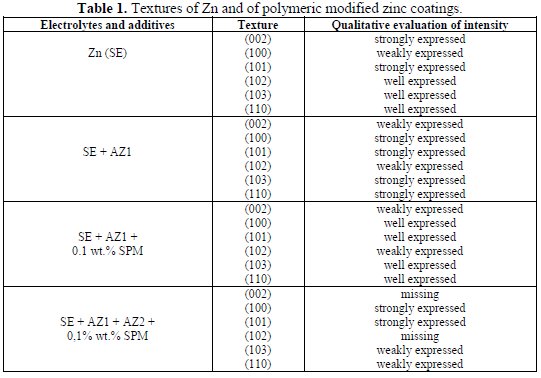
    <p>X-ray diffraction method 
allows qualitatively characterizing the type of the texture, as well as the 
evaluation of its intensity. If several orientations appear, it can be assessed 
whether one is stronger than another. The textures registered for the 
electrodeposited Zn and for the composite (polymeric modified) zinc coatings, as 
well as the qualitative evaluation of their intensity, are presented in <a href="#t1">Table 1</a>.</p>


    <p>&nbsp;</p>
<a name="t1">
<img src="/img/revistas/pea/v35n1/35n1a05t1.jpg">
    
<p>&nbsp;</p>


    ]]></body>
<body><![CDATA[<p>It is well known that the electrodeposition process of the metal cations from the 
electrolytic bath significantly depends on their discharge and on the applied 
additives (mainly organic) which can affect the cathode polarization, either by 
control of the electron transfer or by preferential adsorption on the surface.</p>

    <p>According to <a href="#f1">Fig. 1</a> and <a href="#t1">Table 1</a>, it is obvious that the zinc coating obtained from 
a bath without additives (SE) has a strongly expressed diffraction intensity of 
(002) and (101) peaks. The diffraction lines corresponding to (102), (103) and 
(110) planes - which practically overlap - are well expressed, but with lower 
intensity compared to both (002) and (101), respectively. Finally, the diffraction 
peak corresponding to (100) plane has the lowest intensity and is weakly 
expressed (<a href="#f1">Fig. 1A</a>).</p>

    <p>When the wetting agent is added to SE the crystallographic orientation of the 
electrodeposit changes - the peaks corresponding to textures (002) and (102) are 
strongly reduced. Simultaneously, the peaks characterizing (100) and (101) 
planes strongly increase. The same, although to a lesser extent, is true for (103) 
and (110) preferred orientations. The obtained results are a sign of the strong 
influence of the additive AZ1 on the texture of the zinc coating (<a href="#f1">Fig. 1B</a>). 
According to the presented results, in <a href="#f1">Fig. 1C</a> it can be summarized that, in the 
presence of AZ1, the SPM qualitatively changes the texture of the coating. In that 
case the intensity of the peaks corresponding to (100), (101), (102), (103) and 
(110) planes decreases to a different extent, while the intensity of (002) remains 
almost the same.</p>

    <p>In the presence of both additives AZ1 and AZ2, as well as of SPM (<a href="#f1">Fig. 1D</a>), the 
intensity of the peaks corresponding to (100) and (101) planes increases about 
1.5 and 2 times, respectively, compared to <a href="#f1">Fig. 1C</a>. In that case, the intensity of 
the preferred orientations (103) and (110) decreases, while the peaks 
corresponding to orientations (002) and (102) practically disappear. Most 
probably, the reason for this observation seems to be the more pronounced 
impact of AZ2 (brightener) leading to the appearing of more grains with smaller 
sizes, which grow evenly in preferred directions.</p>

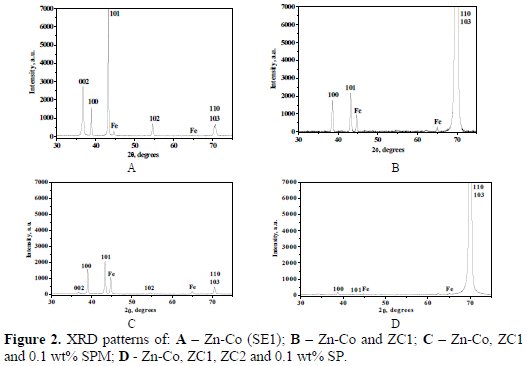
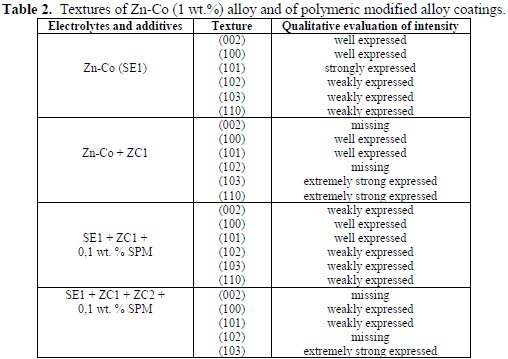
    <p>The textures of electrodeposited Zn-Co (1 wt.%) and of polymeric modified alloy 
coatings are demonstrated in <a href="#t2">Table 2</a>, and the XRD patterns of the samples in 
<a href="#f2">Fig. 2</a>.</p>


    <p>&nbsp;</p>
<a name="t2">
<img src="/img/revistas/pea/v35n1/35n1a05t2.jpg">
    
<p>&nbsp;</p>
<a name="f2">
<img src="/img/revistas/pea/v35n1/35n1a05f2.jpg">
    
<p>&nbsp;</p>


    <p>The results for the alloy coatings obtained from SE1 (<a href="#f2">Fig. 2A</a>) clearly 
demonstrate the quality match with Zn obtained from SE, although with different 
intensity. The intensity of (002) peak is about two times lower, and that of (100) 
- about 1.5 times stronger expressed. The diffraction lines corresponding to 
(102), (103) and (110) planes are about two times weakly expressed, while the 
intensity of (101) peak is almost the same (<a href="#f1">Fig. 1A</a> and <a href="#f2">2A</a>). 
When the wetting agent is added to SE1 (<a href="#f2">Fig. 2B</a>), the crystallographic 
orientations change - the peaks corresponding to (110) and (103) planes increase 
extremely strongly, while the texture (101) decreases about 3 times. The peak 
corresponding to (100) plane slightly increases, and the peak for (002) plane 
disappears.</p>

    <p>In the presence of the wetting agent ZC1, the SPM strongly affects the texture of 
the alloy (<a href="#f2">Fig. 2C</a> and <a href="#f2">2B</a>). The intensity of the peaks corresponding to (110) and 
(103) sharply decreases, while these reappear for (002) and (102) (compared with 
<a href="#f2">Fig. 2A</a>). The intensity of the preferred orientations (100) and (101) remains 
almost unchanged.</p>

    ]]></body>
<body><![CDATA[<p>In the presence of both additives (wetting agent and brightener), the adding of 
SPM to the electrolytic bath drastically changes again the alloy texture, and the 
result is an extremely strong intensity of the peaks for (110) and (103) planes, 
and a sharp decrease of (100) and (101) orientations (<a href="#f2">Fig. 2D</a>). The peaks for 
(002) and (102) planes are missing. It can be concluded that, in the case of Zn-
Co alloy, the influence of SPM is much more pronounced compared to the Zn, 
since its presence strongly affects the intensity of (110) and (103) orientations.</p>


    <p><i><b>Cyclic voltammetry</b></i></p>

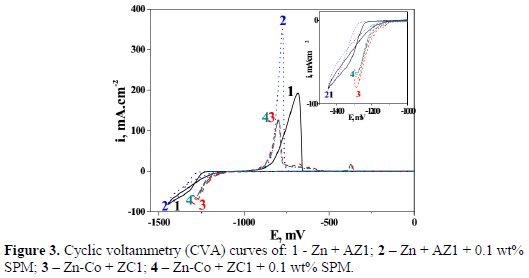
    <p><a href="#f3">Fig. 3</a> demonstrates the influence of SPM on the cathodic and anodic processes 
in SE and SE1, in the presence of a wetting agent.</p>


    <p>&nbsp;</p>
<a name="f3">
<img src="/img/revistas/pea/v35n1/35n1a05f3.jpg">
    
<p>&nbsp;</p>


    <p>The cathodic process of zinc 
deposition begins at about -1210 mV, and proceeds with a relative high speed 
(steeper slope) up to 1320 mV (curve 1); see the inset. Thereafter, the deposition 
rate slightly slows down until -1450 mV, and the direction of the change of the 
polarization shifted from cathodic-going to anodic-going. This behavior is 
probably related to the influence of the wetting agent, which leads to the 
appearance of a definite number of grains on the cathode, followed by their 
increase in size.</p>

    <p>In the presence of SPM (curve 2), a slightly expressed over-polarization effect 
can be observed - the deposition process begins at about -1255 mV, most 
probably due to the partial blocking effect of SPM on some parts of the cathode 
surface. The process proceeds with a higher speed up to -1380 mV, and thereafter 
slows down (changes the slope) until -1400 mV. During the return move in the 
direction of the anodic zone, curves 1 and 2 practically overlap at about -1100 
mV.</p>

    <p>In the presence of AZ1, the SPM leads to a shift of the anodic maximum to a 
more negative potential value -curve 2 (-780 mV) and curve 1 (-685 mV), 
respectively. The current density is also affected: 192 mA.cm<sup>-2</sup> for Zn, and 349 
mA.cm<sup>-2</sup> for the composite one. This means that the anodic dissolution rate of the 
composite coating is higher. A probable explanation for this result could be the 
absence of the brightener in both electrolytes, which leads to a greater surface 
inhomogeneity of the composite coating.</p>

    <p>It must be noted that the SPM added to the electrolytic bath is not made of 
hermetic closed capsules. They have been received from amphiphilic tri-block 
copolymer type PEO-PPO-PEO -poly (ethylene oxide) - block -poly (
propylene oxide) - block -poly (ethylene oxide) [20]. The hydrophobic core 
consists of closely interwoven PPO-segments, while the hydrophilic shell is 
dominated by hydrated PEO-chains, which allow the penetration of the solution 
into the bulk of the shell, i.e., permeation of zinc and other ions.</p>

    <p>On the other hand, there are some literature data [21] on the affinity of the 
polyethylene oxide for positively charged metal ions (such as zinc). The result 
will be a coordination bond between these ions and the oxygen from the PEO-
chains.</p>

    ]]></body>
<body><![CDATA[<p>Having this point in mind, it can be suggested the appearance of some positively 
charged polymeric/zinc aggregates, which will be deposited on the cathode 
during the electrodeposition. Their size will be much greater compared to the 
individual zinc ions, and these aggregates will cover a bigger place on the 
cathode during the electrodeposition of the composite coatings.</p>

    <p>In addition, due to their small sizes, part of the zinc ions could locate in the PEO 
shell without interacting with it (the ions will practically be spatially positioned 
between the separate hydrophilic segments/chains). When the current flows these 
ions will be simultaneously directed to the cathode, setting off (bringing with) the 
already formed aggregates. Finally, both individual zinc ions and polymeric/zinc 
aggregates will simultaneously deposit on the cathode, leading to the appearance 
of a composite coating.</p>

    <p>In SE1 with the wetting agent, whether in the presence (curve 4) or absence 
(curve 3) of SPM, the electrodeposition of Zn-Co alloy begins at about -1120 
mV, i.e., at more positive potentials, compared to Zn and its composite. The 
curves of both coating types have a steeper slope, i.e., the process is accelerated, 
compared to curves 1 and 2, respectively. In the anodic part, several peaks 
appear corresponding to the dissolution of some intermediate products/phases of 
both metals (Zn and Co) present on the cathode. The occurrence of positively 
charged polymeric/metal (Zn or Co) aggregates in the electrolytic bath, due to the 
reasons mentioned above during the electrodeposition process, also takes place 
here.</p>

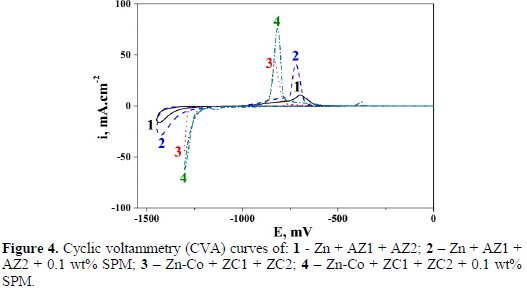
    <p><a href="#f4">Fig. 4</a> shows the influence of SPM on the cathodic and anodic processes for Zn 
and Zn-Co, in the presence of wetting agent and brightener.</p>


    <p>&nbsp;</p>
<a name="f4">
<img src="/img/revistas/pea/v35n1/35n1a05f4.jpg">
    
<p>&nbsp;</p>


    <p>The addition of the 
brightener changes the course of the cathodic curves of the zinc - 1 and 2. The 
deposition process for both zinc and composite zinc coatings is characterized by 
a strong over-polarization, compared to <a href="#f3">Fig. 3</a>, and begins at potential value of 1350 
mV. In that case, the aesthetics of the coatings is better -they are finely 
crystalline, since the rate of nucleation is greater, compared to the rate of growth. 
The current density value registered at the vertex potential is greater for the 
composite zinc (-29 mA.cm<sup>2</sup>), compared to the non-composite one (-17 mA.cm 2), 
but much lower, compared to the same parameter from <a href="#f3">Fig. 3</a> (-85 mA.cm<sup>-2</sup>). 
The presence of SPM does not affect the polarization of the process at the initial 
stages, i.e., no effect of over-polarization or depolarization can be observed, and 
both cathodic curves practically overlap at this stage. The reverse stroke of the 
curves takes place on its own substrate (already deposited coating), and the 
process, in that case, is depolarized -curves 1 and 2. Simultaneously, the anodic 
dissolution rate drastically decreases, compared to <a href="#f3">Fig. 3</a>, i.e., 41 mA.cm<sup>-2</sup> for Zn 
and 76 mA.cm<sup>-2</sup> for the composite one can be registered. The anodic peak of the 
zinc is placed at 695 mV, while that of the composite one is at 720 mV.</p>

    <p>In the case of Zn-Co, the deposition process begins at about -1275 mA.cm<sup>-2</sup> for 
Zn-Co, and at -1200 mA.cm<sup>-2</sup> for the composite alloy, i.e., a depolarization effect 
appears in the presence of SPM. The cathodic processes are accelerated 
compared to the Zn and its composite, having in mind the curve slopes.</p>

    <p>The cathodic current density of the composite Zn-Co is greater - about -65 
mA.cm, compared to the non-composite one, which is -45 mA.cm. These 
values are close of the anodic peaks: 45 mA.cmfor Zn-Co, and 75 mA.cmfor 
the composite one. The potentials are close: about 835 mV for Zn-Co, and 820 
mV for the composite. The additional slightly expressed anodic peak appears for 
both coatings at -375 mV.</p>


    <p>&nbsp;</p>
    ]]></body>
<body><![CDATA[<p><b>Conclusions</b></p>

    <p>According to the presented results the following can be summarized:</p>

    <p>- The addition of the wetting agent to SE leads to an increase of the peaks 
corresponding to (100), (110) and (103) planes. In the presence of AZ1, the 
SPM quantitatively changes the metallographic structure of the Zn coating, 
decreasing the diffraction intensity of the peaks, corresponding to (100) and 
(101) planes. With the simultaneous presence of both wetting agent and 
brightener, SPM leads to an increase in the intensity of the preferred 
orientations (100) and (101), and to a slight decrease of (103) and (110). The 
(002) texture practically disappears</p>

    <p>- In the case of Zn-Co, the addition of wetting agent to SE1 leads to a strong 
increase in the intensity of the peaks representing (110) and (103) orientations, 
to a decrease of (101), and to the disappearance of (002) texture. In the presence 
of ZC1, the SPM leads to an extremely strong decrease in the intensity of the 
preferred orientations (110) and (103), compared to the non-composite Zn-Co. 
The intensity of the texture (101) and (100) remains almost unchanged. In the 
presence of both additives the SPM leads to an extremely strong increase in the 
intensity of the peaks corresponding to (110) and (103) planes.</p>

    <p>- In the presence of the wetting agent, SPM slightly affects the course of the 
cathodic processes for Zn and Zn-Co alloy. Their influence is strongly 
demonstrated in the anodic region for the zinc. SPM practically does not affect 
the anodic curve of the Zn-Co alloy.</p>

    <p>- In the presence of both additives, SPM leads to an over-polarization effect in 
the cathodic region for Zn, compared to the case when only the wetting agent is 
present in the bath.</p>

    <p>- In the presence of both additives, SPM leads to a depolarization effect of the 
cathodic curve of the composite Zn-Co alloy, compared to the galvanic one. 
The anodic current densities of the composite coatings are greater compared to 
the non-composite ones.</p>


    <p>&nbsp;</p>
    <p><b>References</b></p>

    <!-- ref --><p>1. Gomes A, Pereira MIS. Electrochim Acta. 2006;51:1342.    &nbsp;&nbsp;&nbsp;&nbsp;&nbsp;&nbsp;&nbsp;&nbsp;[&#160;<a href="javascript:void(0);" onclick="javascript: window.open('/scielo.php?script=sci_nlinks&ref=425471&pid=S0872-1904201700010000500001&lng=','','width=640,height=500,resizable=yes,scrollbars=1,menubar=yes,');">Links</a>&#160;]<!-- end-ref --></p>

    <!-- ref --><p>2. Vasilakopoulos D, Bouroushian M, Spyrellis N. J Mater Sci. 2006;41:2869.    &nbsp;&nbsp;&nbsp;&nbsp;&nbsp;&nbsp;&nbsp;&nbsp;[&#160;<a href="javascript:void(0);" onclick="javascript: window.open('/scielo.php?script=sci_nlinks&ref=425473&pid=S0872-1904201700010000500002&lng=','','width=640,height=500,resizable=yes,scrollbars=1,menubar=yes,');">Links</a>&#160;]<!-- end-ref --></p>

    <!-- ref --><p>3. Raeissi K, Saatchi A, Golozar MA. J Appl Electrochem. 2003;33:635.    &nbsp;&nbsp;&nbsp;&nbsp;&nbsp;&nbsp;&nbsp;&nbsp;[&#160;<a href="javascript:void(0);" onclick="javascript: window.open('/scielo.php?script=sci_nlinks&ref=425475&pid=S0872-1904201700010000500003&lng=','','width=640,height=500,resizable=yes,scrollbars=1,menubar=yes,');">Links</a>&#160;]<!-- end-ref --></p>

    <!-- ref --><p>4. Raeissi K, Saatchi A, Golozar MA, et al. J Appl Electrochem. 2004;34:1249.    &nbsp;&nbsp;&nbsp;&nbsp;&nbsp;&nbsp;&nbsp;&nbsp;[&#160;<a href="javascript:void(0);" onclick="javascript: window.open('/scielo.php?script=sci_nlinks&ref=425477&pid=S0872-1904201700010000500004&lng=','','width=640,height=500,resizable=yes,scrollbars=1,menubar=yes,');">Links</a>&#160;]<!-- end-ref --></p>

    <!-- ref --><p>5. Vasilakopoulos D, Bouroushian M, Spyrellis N. Electrochim Acta. 2009;54:2509.    &nbsp;&nbsp;&nbsp;&nbsp;&nbsp;&nbsp;&nbsp;&nbsp;[&#160;<a href="javascript:void(0);" onclick="javascript: window.open('/scielo.php?script=sci_nlinks&ref=425479&pid=S0872-1904201700010000500005&lng=','','width=640,height=500,resizable=yes,scrollbars=1,menubar=yes,');">Links</a>&#160;]<!-- end-ref --></p>

    <!-- ref --><p>6. Tuaweri TJ, Wilcox GD. Surf Coat Technol. 2006;200:5921.    &nbsp;&nbsp;&nbsp;&nbsp;&nbsp;&nbsp;&nbsp;&nbsp;[&#160;<a href="javascript:void(0);" onclick="javascript: window.open('/scielo.php?script=sci_nlinks&ref=425481&pid=S0872-1904201700010000500006&lng=','','width=640,height=500,resizable=yes,scrollbars=1,menubar=yes,');">Links</a>&#160;]<!-- end-ref --></p>

    <!-- ref --><p>7. Muller C, Sarret M, Benballa M. Surf Coat Technol. 2003;162:49.    &nbsp;&nbsp;&nbsp;&nbsp;&nbsp;&nbsp;&nbsp;&nbsp;[&#160;<a href="javascript:void(0);" onclick="javascript: window.open('/scielo.php?script=sci_nlinks&ref=425483&pid=S0872-1904201700010000500007&lng=','','width=640,height=500,resizable=yes,scrollbars=1,menubar=yes,');">Links</a>&#160;]<!-- end-ref --></p>

    <!-- ref --><p>8. Praveen BM, Venkatesha TV, Naik YA, et al. Surf Coat Technol. 2007;201:5836.    &nbsp;&nbsp;&nbsp;&nbsp;&nbsp;&nbsp;&nbsp;&nbsp;[&#160;<a href="javascript:void(0);" onclick="javascript: window.open('/scielo.php?script=sci_nlinks&ref=425485&pid=S0872-1904201700010000500008&lng=','','width=640,height=500,resizable=yes,scrollbars=1,menubar=yes,');">Links</a>&#160;]<!-- end-ref --></p>

    <!-- ref --><p>9. Vathsala K, Venkatesha TV. Appl Surf Sci. 2011;257:8929.    &nbsp;&nbsp;&nbsp;&nbsp;&nbsp;&nbsp;&nbsp;&nbsp;[&#160;<a href="javascript:void(0);" onclick="javascript: window.open('/scielo.php?script=sci_nlinks&ref=425487&pid=S0872-1904201700010000500009&lng=','','width=640,height=500,resizable=yes,scrollbars=1,menubar=yes,');">Links</a>&#160;]<!-- end-ref --></p>

    <!-- ref --><p>10. Tulio PC, Rodrigues SEB, Carlos IA. Surf Coat Technol. 2007;202:91.    &nbsp;&nbsp;&nbsp;&nbsp;&nbsp;&nbsp;&nbsp;&nbsp;[&#160;<a href="javascript:void(0);" onclick="javascript: window.open('/scielo.php?script=sci_nlinks&ref=425489&pid=S0872-1904201700010000500010&lng=','','width=640,height=500,resizable=yes,scrollbars=1,menubar=yes,');">Links</a>&#160;]<!-- end-ref --></p>

    <!-- ref --><p>11. Nemes PI, Lekka M, Fedrizzi L, et al. Surf Coat Technol. 2014;252:102.    &nbsp;&nbsp;&nbsp;&nbsp;&nbsp;&nbsp;&nbsp;&nbsp;[&#160;<a href="javascript:void(0);" onclick="javascript: window.open('/scielo.php?script=sci_nlinks&ref=425491&pid=S0872-1904201700010000500011&lng=','','width=640,height=500,resizable=yes,scrollbars=1,menubar=yes,');">Links</a>&#160;]<!-- end-ref --></p>

    <!-- ref --><p>12. Praveen BM, Venkatesha TV. Appl Surf Sci. 2008;254:2418.    &nbsp;&nbsp;&nbsp;&nbsp;&nbsp;&nbsp;&nbsp;&nbsp;[&#160;<a href="javascript:void(0);" onclick="javascript: window.open('/scielo.php?script=sci_nlinks&ref=425493&pid=S0872-1904201700010000500012&lng=','','width=640,height=500,resizable=yes,scrollbars=1,menubar=yes,');">Links</a>&#160;]<!-- end-ref --></p>

    <!-- ref --><p>13. Praveen CM, Venkatesha TV, Chandrappa KG. Surf Coat Technol. 2012;206:2249.    &nbsp;&nbsp;&nbsp;&nbsp;&nbsp;&nbsp;&nbsp;&nbsp;[&#160;<a href="javascript:void(0);" onclick="javascript: window.open('/scielo.php?script=sci_nlinks&ref=425495&pid=S0872-1904201700010000500013&lng=','','width=640,height=500,resizable=yes,scrollbars=1,menubar=yes,');">Links</a>&#160;]<!-- end-ref --></p>

    <!-- ref --><p>14. Tseluikin VN, Koreshkova AA. Russ J Appl Chem. 2014;87:1251.    &nbsp;&nbsp;&nbsp;&nbsp;&nbsp;&nbsp;&nbsp;&nbsp;[&#160;<a href="javascript:void(0);" onclick="javascript: window.open('/scielo.php?script=sci_nlinks&ref=425497&pid=S0872-1904201700010000500014&lng=','','width=640,height=500,resizable=yes,scrollbars=1,menubar=yes,');">Links</a>&#160;]<!-- end-ref --></p>

    <!-- ref --><p>15. Boshkov N, Tsvetkova N, Petrov P, et al. Appl Surf Sci. 2008;254:5618.    &nbsp;&nbsp;&nbsp;&nbsp;&nbsp;&nbsp;&nbsp;&nbsp;[&#160;<a href="javascript:void(0);" onclick="javascript: window.open('/scielo.php?script=sci_nlinks&ref=425499&pid=S0872-1904201700010000500015&lng=','','width=640,height=500,resizable=yes,scrollbars=1,menubar=yes,');">Links</a>&#160;]<!-- end-ref --></p>

    <p>16. Boshkov N, Koleva DA, Petrov P, et al. Corrosion resistant nano-composite 
metallic coatings with embedded polymeric aggregates. In: Magagnin L, 
editor. Engineered Metal Matrix Composites: Forming Methods, Material 
Properties and Industrial Applications. Chapyer 10. NOVA Publishing 
House; 2013. p. 261.</p>

    ]]></body>
<body><![CDATA[<!-- ref --><p>17. Koleva D, Boshkov N, Bachvarov V, et al. Surf Coat Technol. 2010;204:3760.    &nbsp;&nbsp;&nbsp;&nbsp;&nbsp;&nbsp;&nbsp;&nbsp;[&#160;<a href="javascript:void(0);" onclick="javascript: window.open('/scielo.php?script=sci_nlinks&ref=425502&pid=S0872-1904201700010000500017&lng=','','width=640,height=500,resizable=yes,scrollbars=1,menubar=yes,');">Links</a>&#160;]<!-- end-ref --></p>

    <!-- ref --><p>18. Koleva DA, Taheri P, Tsvetkova N, et al. ECS Transactions. 2011;33:8592.    &nbsp;&nbsp;&nbsp;&nbsp;&nbsp;&nbsp;&nbsp;&nbsp;[&#160;<a href="javascript:void(0);" onclick="javascript: window.open('/scielo.php?script=sci_nlinks&ref=425504&pid=S0872-1904201700010000500018&lng=','','width=640,height=500,resizable=yes,scrollbars=1,menubar=yes,');">Links</a>&#160;]<!-- end-ref --></p>

    <!-- ref --><p>19. Pazderova M, Bradac M, Vales M. MM Science J. 2010;208.    &nbsp;&nbsp;&nbsp;&nbsp;&nbsp;&nbsp;&nbsp;&nbsp;[&#160;<a href="javascript:void(0);" onclick="javascript: window.open('/scielo.php?script=sci_nlinks&ref=425506&pid=S0872-1904201700010000500019&lng=','','width=640,height=500,resizable=yes,scrollbars=1,menubar=yes,');">Links</a>&#160;]<!-- end-ref --></p>

    <!-- ref --><p>20. Petrov P, Bozukov M, Tsvetanov Ch. J Mater Chem. 2005;15:1481.    &nbsp;&nbsp;&nbsp;&nbsp;&nbsp;&nbsp;&nbsp;&nbsp;[&#160;<a href="javascript:void(0);" onclick="javascript: window.open('/scielo.php?script=sci_nlinks&ref=425508&pid=S0872-1904201700010000500020&lng=','','width=640,height=500,resizable=yes,scrollbars=1,menubar=yes,');">Links</a>&#160;]<!-- end-ref --></p>

    <p>21. Yang H, Farrington GC. Technical Report No.: 1992-24. J Electrochem Soc. 1991.63</p>


    <p>&nbsp;</p>
    ]]></body>
<body><![CDATA[<p><a name=0></a><sup><a href="#top">*</a></sup>Corresponding author. E-mail address: <a href="mailto:NBoshkov@ipc.bas.bg">NBoshkov@ipc.bas.bg</a></p>

    <p>Received October 12, 2016; accepted November 8, 2016</p>

    <p><a href="http://www.peacta.org" target="_blank">www.peacta.org</a> </p>


     ]]></body><back>
<ref-list>
<ref id="B1">
<label>1</label><nlm-citation citation-type="journal">
<person-group person-group-type="author">
<name>
<surname><![CDATA[Gomes]]></surname>
<given-names><![CDATA[A]]></given-names>
</name>
<name>
<surname><![CDATA[Pereira]]></surname>
<given-names><![CDATA[M I S]]></given-names>
</name>
</person-group>
<source><![CDATA[Electrochim Acta]]></source>
<year>2006</year>
<volume>51</volume>
<page-range>1342</page-range></nlm-citation>
</ref>
<ref id="B2">
<label>2</label><nlm-citation citation-type="journal">
<person-group person-group-type="author">
<name>
<surname><![CDATA[Vasilakopoulos]]></surname>
<given-names><![CDATA[D]]></given-names>
</name>
<name>
<surname><![CDATA[Bouroushian]]></surname>
<given-names><![CDATA[M]]></given-names>
</name>
<name>
<surname><![CDATA[Spyrellis]]></surname>
<given-names><![CDATA[N]]></given-names>
</name>
</person-group>
<source><![CDATA[J Mater Sci]]></source>
<year>2006</year>
<volume>41</volume>
<page-range>2869</page-range></nlm-citation>
</ref>
<ref id="B3">
<label>3</label><nlm-citation citation-type="journal">
<person-group person-group-type="author">
<name>
<surname><![CDATA[Raeissi]]></surname>
<given-names><![CDATA[K]]></given-names>
</name>
<name>
<surname><![CDATA[Saatchi]]></surname>
<given-names><![CDATA[A]]></given-names>
</name>
<name>
<surname><![CDATA[Golozar]]></surname>
<given-names><![CDATA[M A]]></given-names>
</name>
</person-group>
<source><![CDATA[J Appl Electrochem]]></source>
<year>2003</year>
<volume>33</volume>
<page-range>635</page-range></nlm-citation>
</ref>
<ref id="B4">
<label>4</label><nlm-citation citation-type="journal">
<person-group person-group-type="author">
<name>
<surname><![CDATA[Raeissi]]></surname>
<given-names><![CDATA[K]]></given-names>
</name>
<name>
<surname><![CDATA[Saatchi]]></surname>
<given-names><![CDATA[A]]></given-names>
</name>
<name>
<surname><![CDATA[Golozar]]></surname>
<given-names><![CDATA[M A]]></given-names>
</name>
</person-group>
<source><![CDATA[J Appl Electrochem]]></source>
<year>2004</year>
<volume>34</volume>
<page-range>1249</page-range></nlm-citation>
</ref>
<ref id="B5">
<label>5</label><nlm-citation citation-type="journal">
<person-group person-group-type="author">
<name>
<surname><![CDATA[Vasilakopoulos]]></surname>
<given-names><![CDATA[D]]></given-names>
</name>
<name>
<surname><![CDATA[Bouroushian]]></surname>
<given-names><![CDATA[M]]></given-names>
</name>
<name>
<surname><![CDATA[Spyrellis]]></surname>
<given-names><![CDATA[N]]></given-names>
</name>
</person-group>
<source><![CDATA[Electrochim Acta]]></source>
<year>2009</year>
<volume>54</volume>
<page-range>2509</page-range></nlm-citation>
</ref>
<ref id="B6">
<label>6</label><nlm-citation citation-type="journal">
<person-group person-group-type="author">
<name>
<surname><![CDATA[Tuaweri]]></surname>
<given-names><![CDATA[T J]]></given-names>
</name>
<name>
<surname><![CDATA[Wilcox]]></surname>
<given-names><![CDATA[G D]]></given-names>
</name>
</person-group>
<source><![CDATA[Surf Coat Technol]]></source>
<year>2006</year>
<volume>200</volume>
<page-range>5921</page-range></nlm-citation>
</ref>
<ref id="B7">
<label>7</label><nlm-citation citation-type="journal">
<person-group person-group-type="author">
<name>
<surname><![CDATA[Muller]]></surname>
<given-names><![CDATA[C]]></given-names>
</name>
<name>
<surname><![CDATA[Sarret]]></surname>
<given-names><![CDATA[M]]></given-names>
</name>
<name>
<surname><![CDATA[Benballa]]></surname>
<given-names><![CDATA[M]]></given-names>
</name>
</person-group>
<source><![CDATA[Surf Coat Technol]]></source>
<year>2003</year>
<volume>162</volume>
<page-range>49</page-range></nlm-citation>
</ref>
<ref id="B8">
<label>8</label><nlm-citation citation-type="journal">
<person-group person-group-type="author">
<name>
<surname><![CDATA[Praveen]]></surname>
<given-names><![CDATA[B M]]></given-names>
</name>
<name>
<surname><![CDATA[Venkatesha]]></surname>
<given-names><![CDATA[T V]]></given-names>
</name>
<name>
<surname><![CDATA[Naik]]></surname>
<given-names><![CDATA[Y A]]></given-names>
</name>
</person-group>
<source><![CDATA[Surf Coat Technol]]></source>
<year>2007</year>
<volume>201</volume>
<page-range>5836</page-range></nlm-citation>
</ref>
<ref id="B9">
<label>9</label><nlm-citation citation-type="journal">
<person-group person-group-type="author">
<name>
<surname><![CDATA[Vathsala]]></surname>
<given-names><![CDATA[K]]></given-names>
</name>
<name>
<surname><![CDATA[Venkatesha]]></surname>
<given-names><![CDATA[T V]]></given-names>
</name>
</person-group>
<source><![CDATA[Appl Surf Sci]]></source>
<year>2011</year>
<volume>257</volume>
<page-range>8929</page-range></nlm-citation>
</ref>
<ref id="B10">
<label>10</label><nlm-citation citation-type="journal">
<person-group person-group-type="author">
<name>
<surname><![CDATA[Tulio]]></surname>
<given-names><![CDATA[P C]]></given-names>
</name>
<name>
<surname><![CDATA[Rodrigues]]></surname>
<given-names><![CDATA[S E B]]></given-names>
</name>
<name>
<surname><![CDATA[Carlos]]></surname>
<given-names><![CDATA[I A]]></given-names>
</name>
</person-group>
<source><![CDATA[Surf Coat Technol]]></source>
<year>2007</year>
<volume>202</volume>
<page-range>91</page-range></nlm-citation>
</ref>
<ref id="B11">
<label>11</label><nlm-citation citation-type="journal">
<person-group person-group-type="author">
<name>
<surname><![CDATA[Nemes]]></surname>
<given-names><![CDATA[P I]]></given-names>
</name>
<name>
<surname><![CDATA[Lekka]]></surname>
<given-names><![CDATA[M]]></given-names>
</name>
<name>
<surname><![CDATA[Fedrizzi]]></surname>
<given-names><![CDATA[L]]></given-names>
</name>
</person-group>
<source><![CDATA[Surf Coat Technol]]></source>
<year>2014</year>
<volume>252</volume>
<page-range>102</page-range></nlm-citation>
</ref>
<ref id="B12">
<label>12</label><nlm-citation citation-type="journal">
<person-group person-group-type="author">
<name>
<surname><![CDATA[Praveen]]></surname>
<given-names><![CDATA[B M]]></given-names>
</name>
<name>
<surname><![CDATA[Venkatesha]]></surname>
<given-names><![CDATA[T V]]></given-names>
</name>
</person-group>
<source><![CDATA[Appl Surf Sci]]></source>
<year>2008</year>
<volume>254</volume>
<page-range>2418</page-range></nlm-citation>
</ref>
<ref id="B13">
<label>13</label><nlm-citation citation-type="journal">
<person-group person-group-type="author">
<name>
<surname><![CDATA[Praveen]]></surname>
<given-names><![CDATA[C M]]></given-names>
</name>
<name>
<surname><![CDATA[Venkatesha]]></surname>
<given-names><![CDATA[T V]]></given-names>
</name>
<name>
<surname><![CDATA[Chandrappa]]></surname>
<given-names><![CDATA[K G]]></given-names>
</name>
</person-group>
<source><![CDATA[Surf Coat Technol]]></source>
<year>2012</year>
<volume>206</volume>
<page-range>2249</page-range></nlm-citation>
</ref>
<ref id="B14">
<label>14</label><nlm-citation citation-type="journal">
<person-group person-group-type="author">
<name>
<surname><![CDATA[Tseluikin]]></surname>
<given-names><![CDATA[V N]]></given-names>
</name>
<name>
<surname><![CDATA[Koreshkova]]></surname>
<given-names><![CDATA[A A]]></given-names>
</name>
</person-group>
<source><![CDATA[Russ J Appl Chem]]></source>
<year>2014</year>
<volume>87</volume>
<page-range>1251</page-range></nlm-citation>
</ref>
<ref id="B15">
<label>15</label><nlm-citation citation-type="journal">
<person-group person-group-type="author">
<name>
<surname><![CDATA[Boshkov]]></surname>
<given-names><![CDATA[N]]></given-names>
</name>
<name>
<surname><![CDATA[Tsvetkova]]></surname>
<given-names><![CDATA[N]]></given-names>
</name>
<name>
<surname><![CDATA[Petrov]]></surname>
<given-names><![CDATA[P]]></given-names>
</name>
</person-group>
<source><![CDATA[Appl Surf Sci]]></source>
<year>2008</year>
<volume>254</volume>
<page-range>5618</page-range></nlm-citation>
</ref>
<ref id="B16">
<label>16</label><nlm-citation citation-type="book">
<person-group person-group-type="author">
<name>
<surname><![CDATA[Boshkov]]></surname>
<given-names><![CDATA[N]]></given-names>
</name>
<name>
<surname><![CDATA[Koleva]]></surname>
<given-names><![CDATA[D A]]></given-names>
</name>
<name>
<surname><![CDATA[Petrov]]></surname>
<given-names><![CDATA[P]]></given-names>
</name>
</person-group>
<source><![CDATA[Corrosion resistant nano-composite metallic coatings with embedded polymeric aggregates: Engineered Metal Matrix Composites: Forming Methods, Material Properties and Industrial Applications.]]></source>
<year>2013</year>
<page-range>261</page-range><publisher-name><![CDATA[NOVA Publishing House]]></publisher-name>
</nlm-citation>
</ref>
<ref id="B17">
<label>17</label><nlm-citation citation-type="journal">
<person-group person-group-type="author">
<name>
<surname><![CDATA[Koleva]]></surname>
<given-names><![CDATA[D]]></given-names>
</name>
<name>
<surname><![CDATA[Boshkov]]></surname>
<given-names><![CDATA[N]]></given-names>
</name>
<name>
<surname><![CDATA[Bachvarov]]></surname>
<given-names><![CDATA[V]]></given-names>
</name>
</person-group>
<source><![CDATA[Surf Coat Technol]]></source>
<year>2010</year>
<volume>204</volume>
<page-range>3760</page-range></nlm-citation>
</ref>
<ref id="B18">
<label>18</label><nlm-citation citation-type="journal">
<person-group person-group-type="author">
<name>
<surname><![CDATA[Koleva]]></surname>
<given-names><![CDATA[D A]]></given-names>
</name>
<name>
<surname><![CDATA[Taheri]]></surname>
<given-names><![CDATA[P]]></given-names>
</name>
<name>
<surname><![CDATA[Tsvetkova]]></surname>
<given-names><![CDATA[N]]></given-names>
</name>
</person-group>
<source><![CDATA[ECS Transactions]]></source>
<year>2011</year>
<volume>33</volume>
<page-range>8592</page-range></nlm-citation>
</ref>
<ref id="B19">
<label>19</label><nlm-citation citation-type="journal">
<person-group person-group-type="author">
<name>
<surname><![CDATA[Pazderova]]></surname>
<given-names><![CDATA[M]]></given-names>
</name>
<name>
<surname><![CDATA[Bradac]]></surname>
<given-names><![CDATA[M]]></given-names>
</name>
<name>
<surname><![CDATA[Vales]]></surname>
<given-names><![CDATA[M]]></given-names>
</name>
</person-group>
<source><![CDATA[MM Science J]]></source>
<year>2010</year>
<page-range>208</page-range></nlm-citation>
</ref>
<ref id="B20">
<label>20</label><nlm-citation citation-type="journal">
<person-group person-group-type="author">
<name>
<surname><![CDATA[Petrov]]></surname>
<given-names><![CDATA[P]]></given-names>
</name>
<name>
<surname><![CDATA[Bozukov]]></surname>
<given-names><![CDATA[M]]></given-names>
</name>
<name>
<surname><![CDATA[Tsvetanov]]></surname>
<given-names><![CDATA[Ch]]></given-names>
</name>
</person-group>
<source><![CDATA[J Mater Chem]]></source>
<year>2005</year>
<volume>15</volume>
<page-range>1481</page-range></nlm-citation>
</ref>
<ref id="B21">
<label>21</label><nlm-citation citation-type="journal">
<person-group person-group-type="author">
<name>
<surname><![CDATA[Yang]]></surname>
<given-names><![CDATA[H]]></given-names>
</name>
<name>
<surname><![CDATA[Farrington]]></surname>
<given-names><![CDATA[G C]]></given-names>
</name>
</person-group>
<source><![CDATA[J Electrochem Soc]]></source>
<year>1991</year>
<page-range>63</page-range></nlm-citation>
</ref>
</ref-list>
</back>
</article>