<?xml version="1.0" encoding="ISO-8859-1"?><article xmlns:mml="http://www.w3.org/1998/Math/MathML" xmlns:xlink="http://www.w3.org/1999/xlink" xmlns:xsi="http://www.w3.org/2001/XMLSchema-instance">
<front>
<journal-meta>
<journal-id>0872-1904</journal-id>
<journal-title><![CDATA[Portugaliae Electrochimica Acta]]></journal-title>
<abbrev-journal-title><![CDATA[Port. Electrochim. Acta]]></abbrev-journal-title>
<issn>0872-1904</issn>
<publisher>
<publisher-name><![CDATA[Sociedade Portuguesa de Electroquímica]]></publisher-name>
</publisher>
</journal-meta>
<article-meta>
<article-id>S0872-19042017000200001</article-id>
<article-id pub-id-type="doi">10.4152/pea.201702065</article-id>
<title-group>
<article-title xml:lang="en"><![CDATA[Electrochemical and Theoretical Study of Pyrazole 4-(4,5dihydro- 1H-pyrazol-5-yl)-N,N-dimethylaniline (D) as a Corrosion Inhibitor for Mild Steel in 1 M HCl]]></article-title>
</title-group>
<contrib-group>
<contrib contrib-type="author">
<name>
<surname><![CDATA[Chadli]]></surname>
<given-names><![CDATA[R.]]></given-names>
</name>
<xref ref-type="aff" rid="A01"/>
</contrib>
<contrib contrib-type="author">
<name>
<surname><![CDATA[Elazouzi]]></surname>
<given-names><![CDATA[M.]]></given-names>
</name>
<xref ref-type="aff" rid="A02"/>
</contrib>
<contrib contrib-type="author">
<name>
<surname><![CDATA[Khelladi]]></surname>
<given-names><![CDATA[I.]]></given-names>
</name>
<xref ref-type="aff" rid="A03"/>
</contrib>
<contrib contrib-type="author">
<name>
<surname><![CDATA[Elhourri]]></surname>
<given-names><![CDATA[A.M.]]></given-names>
</name>
<xref ref-type="aff" rid="A03"/>
</contrib>
<contrib contrib-type="author">
<name>
<surname><![CDATA[Elmsellem]]></surname>
<given-names><![CDATA[H.]]></given-names>
</name>
<xref ref-type="aff" rid="A02"/>
</contrib>
<contrib contrib-type="author">
<name>
<surname><![CDATA[Aouniti]]></surname>
<given-names><![CDATA[A.]]></given-names>
</name>
<xref ref-type="aff" rid="A02"/>
</contrib>
<contrib contrib-type="author">
<name>
<surname><![CDATA[Mulengi]]></surname>
<given-names><![CDATA[J. Kajima]]></given-names>
</name>
<xref ref-type="aff" rid="A01"/>
</contrib>
<contrib contrib-type="author">
<name>
<surname><![CDATA[Hammouti]]></surname>
<given-names><![CDATA[B.]]></given-names>
</name>
<xref ref-type="aff" rid="A02"/>
</contrib>
</contrib-group>
<aff id="A01">
<institution><![CDATA[,University of Tlemcen Laboratoire de chimie organique, substances naturelles et analyses ]]></institution>
<addr-line><![CDATA[ ]]></addr-line>
<country>Algeria</country>
</aff>
<aff id="A02">
<institution><![CDATA[,Faculty of sciences Laboratoire de chimie appliquee et environnement ]]></institution>
<addr-line><![CDATA[Oujda ]]></addr-line>
<country>Maroc</country>
</aff>
<aff id="A03">
<institution><![CDATA[,University Djilali Liabes Sidi Bel Abbes Faculty of exact sciences Dept of chemistry]]></institution>
<addr-line><![CDATA[ ]]></addr-line>
<country>Algeria</country>
</aff>
<pub-date pub-type="pub">
<day>00</day>
<month>03</month>
<year>2017</year>
</pub-date>
<pub-date pub-type="epub">
<day>00</day>
<month>03</month>
<year>2017</year>
</pub-date>
<volume>35</volume>
<numero>2</numero>
<fpage>65</fpage>
<lpage>80</lpage>
<copyright-statement/>
<copyright-year/>
<self-uri xlink:href="http://scielo.pt/scielo.php?script=sci_arttext&amp;pid=S0872-19042017000200001&amp;lng=en&amp;nrm=iso"></self-uri><self-uri xlink:href="http://scielo.pt/scielo.php?script=sci_abstract&amp;pid=S0872-19042017000200001&amp;lng=en&amp;nrm=iso"></self-uri><self-uri xlink:href="http://scielo.pt/scielo.php?script=sci_pdf&amp;pid=S0872-19042017000200001&amp;lng=en&amp;nrm=iso"></self-uri><abstract abstract-type="short" xml:lang="en"><p><![CDATA[This work is devoted to examine the effectiveness of pyrazoles 4-(4,5-dihydro-1Hpyrazol- 5-yl)-N,N-dimethylaniline (D) on corrosion of mild steel in a 1 M HCl solution, using weight loss measurement at concentration effects. The inhibitor (D) was synthesized in our laboratory. The formation of this pyrazole was carried out with hydrazine and &#945;-unsaturated aldehydes, and the structure was checked by spectroscopic means, such as FT-IR, 1H NMR and 13C NMR. Polarization curves and electrochemical impedance spectroscopy (EIS) methods were used to assess both the corrosion rate and inhibition efficiency. Potentiodynamic polarization showed that D behaved as a mixed-type inhibitor. The Nyquist plots showed that, while D concentrations increased, charge-transfer resistance increased and double-layer capacitance decreased, involving increased inhibition efficiency. Adsorption of the inhibitor molecules corresponds to Langmuir adsorption isotherm. Quantum chemical calculations showed that the inhibitor was prone to be protonated in the acid, and the results were in full agreement with experimental observations.]]></p></abstract>
<kwd-group>
<kwd lng="en"><![CDATA[Pyrazole; hydrazine]]></kwd>
<kwd lng="en"><![CDATA[NMR]]></kwd>
<kwd lng="en"><![CDATA[mild steel]]></kwd>
<kwd lng="en"><![CDATA[corrosion inhibition]]></kwd>
<kwd lng="en"><![CDATA[weight loss]]></kwd>
<kwd lng="en"><![CDATA[electrochemical]]></kwd>
<kwd lng="en"><![CDATA[DFT method]]></kwd>
</kwd-group>
</article-meta>
</front><body><![CDATA[ 

<!--     <p>&nbsp;</p>
    <p>doi: 10.4152/pea.201702065</p> -->

    <p><b>Electrochemical and Theoretical Study of Pyrazole 4-(4,5dihydro-
1H-pyrazol-5-yl)-N,N-dimethylaniline (D) as a 
Corrosion Inhibitor for Mild Steel in 1 M HCl</b></p>

    <p>
<b>R. Chadli</b><sup><i>a</i>,<a href="#0">*</a></sup>
, <b>M. Elazouzi</b><sup><i>b</i></sup>
, <b>I. Khelladi</b><sup><i>c</i></sup>
, <b>A.M. Elhourri</b><sup><i>c</i></sup>
, <b>H. Elmsellem</b><sup><i>b</i></sup>
, <b>A. Aouniti</b><sup><i>b</i></sup>
, <b>J. Kajima Mulengi</b><sup><i>a</i></sup>
 and <b>B. Hammouti</b><sup><i>b</i></sup>
</p>

    <p><i><sup>a</sup> Laboratoire de chimie organique, substances naturelles et analyses (COSNA), University of Tlemcen, Algeria</i></p>

    <p><i><sup>b</sup> Laboratoire de chimie appliquee et environnement (LCAE-URAC18), Faculty of sciences, Oujda, Maroc</i></p>

    <p><i><sup>c</sup> Laboratoire de microscopie, microanalyse de la matiere et spectroscopie moleculaire, Dept of 
chemistry, Faculty of exact sciences. University Djilali Liabes Sidi Bel Abbes, Algeria</i></p>


    <p>&nbsp;</p>
    <p><b>Abstract</b></p>

    ]]></body>
<body><![CDATA[<p>This work is devoted to examine the effectiveness of pyrazoles 4-(4,5-dihydro-1Hpyrazol-
5-yl)-N,N-dimethylaniline (D) on corrosion of mild steel in a 1 M HCl solution, 
using weight loss measurement at concentration effects. The inhibitor (D) was 
synthesized in our laboratory. The formation of this pyrazole was carried out with 
hydrazine and &alpha;-unsaturated aldehydes, and the structure was checked by spectroscopic 
means, such as FT-IR, 1H NMR and 13C NMR. Polarization curves and 
electrochemical impedance spectroscopy (EIS) methods were used to assess both the 
corrosion rate and inhibition efficiency. Potentiodynamic polarization showed that D 
behaved as a mixed-type inhibitor. The Nyquist plots showed that, while D 
concentrations increased, charge-transfer resistance increased and double-layer 
capacitance decreased, involving increased inhibition efficiency. Adsorption of the 
inhibitor molecules corresponds to Langmuir adsorption isotherm. Quantum chemical 
calculations showed that the inhibitor was prone to be protonated in the acid, and the 
results were in full agreement with experimental observations.</p>

    <p><b><i>Keywords:</i></b> Pyrazole; hydrazine; NMR; mild steel; corrosion inhibition; weight loss; 
electrochemical, DFT method.</p>


    <p>&nbsp;</p>
    <p><b>Introduction</b></p>

    <p>The use of iron and its alloys in daily live is almost found in everyday aspect of 
life. Iron is used in large amounts in industry, as well as in domestic needs. Iron 
gained this place by its physicochemical properties, as it is strong, has a high 
density, high melting point and is reliable for life. Despite all these beneficial 
features, iron is very corrosive, especially in water and air. This corrosion can 
cause serious damage to the metal, thereby limiting its applications [1-7]. To 
prevent iron from acidic aggression, the use of organic inhibitors is one of the 
most practical methods and cost-effective choices to protect metals against 
corrosion; most of the well-known acid inhibitors are organic compounds 
containing nitrogen, sulphur and oxygen atoms [8-15]. These organic inhibitors 
are usually adsorbed on the metal surface via formation of a coordinate covalent 
bond (chemical adsorption) or electrostatic interaction between the metal and 
inhibitor (physical adsorption) [16]. This adsorption produces a uniform film, 
which isolates the metal surface from the aggressive medium, and consequently 
reduces the extension of corrosion [17].</p>

    <p>In this work we were mainly interested in the N-heterocyclic inhibitors of iron 
corrosion in an acidic medium; these N-heterocycles of interest are pyrazoles. 
Pyrazoles derivatives are a very important class of iron corrosion inhibitors [1828]. 
As a matter of fact, nitrogen containing heterocycles can be easily 
protonated in acidic medium, thus exhibiting good inhibitory action on the 
corrosion of metals in acid solutions. The present study aimed at testing a new 
compound, namely D, 4-(4,5-dihydro-1H-pyrazol-5-yl)-N, N-dimethylaniline, on 
the corrosion of stainless steel in 1 M hydrochloric acid solution. The study has 
been performed with various concentrations of D, using potentiodynamic 
polarization and EIS techniques. Compound D afforded a good anticorrosive 
activity of steel in 1 M HCl solution, with a 97% efficacy that was reached with 
the use of 10<sup>-3</sup> M of D at 25 &deg;C. In order to understand the inhibition of corrosion 
of mild steel in acidic medium, D chemical quantum parameters were examined 
and calculated using the density functional theory (DFT) method.</p>

    <p>The heterocycle inhibitor was synthesized in ethanol reacting hydrazine and an 
&alpha;,&beta;-unsaturated carbonyl derivative such as 3-(4-(dimethylamino)phenyl)
acrylaldehyde. This reaction provided the pyrazole a very high yield 
(<a href="#s1">Scheme 1</a>).</p>


    <p>&nbsp;</p>
<a name="s1">
<img src="/img/revistas/pea/v35n2/35n2a01s1.jpg">
    
<p>&nbsp;</p>


    <p>This reaction is considered an analogue of reaction of ketenes and 
aldehydes hydrazines and derivatives [29-33]. The target compound was 
analysed by FT-IR, 1H NMR and 13C NMR.</p>


    ]]></body>
<body><![CDATA[<p>&nbsp;</p>
    <p><b>Experimental</b></p>

    <p><i><b>Synthesis and characterization of the inhibitor</b></i></p>

    <p>All reactions were carried out under dry nitrogen. I.R spectra were performed on 
a Mattson Genesis II FTIR instrument. NMR spectra were recorded in CDCl3 on 
a Bruker 300 MHz instrument using tetramethylsilane (TMS) as an internal 
standard. Melting points were determined on an Electrothermal T1A F3.15A-instrument.</p>


    <p><i>Synthesis of 4-(4,5-dihydro-1H-pyrazol-5-yl)-N,N-dimethylaniline D</i></p>

    <p>To a solution of 3-(4-(dimethylamino) phenyl) acrylaldehyde (1 mmol) in 
ethanol (10 mL), an equimolar 98% hydrazine monohydrate was added in the 
presence of acetic acid. The mixture was maintained under reflux for 2 h, until 
TLC indicated the end of reaction. Then, the reaction mixture was poured in cold 
water, and the precipitate formed was filtered off, washed and recrystallized in 
ethanol.</p>

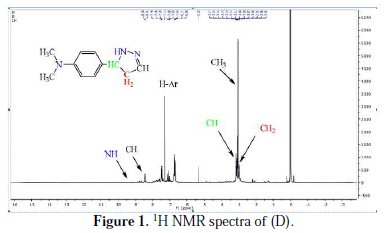
    <p>Yield: 76%; mp=142-144&deg;C; IR (KBr, &lambda;max): 3159, 3066, 2933, 1649, 1531, 
1597 cm-1 , 1H NMR (CDCl3) &Delta;: 2.95 (t, 2H, CH2), 3.08 (s, 6H, CH3), 3.17 (t, 1H, 
CH), 7.17-7.54 (m, 4H, ArH), 8.44 (t, 1H, CH), 9.82 (s, 1H, NH) ppm (<a href="#f1">Fig. 1</a>); 
13CNMR (CDCl3): &Delta; 40.24, 111.73, 112.01, 123.64, 129.84, 151.76, 162.39 ppm.</p>


    <p>&nbsp;</p>
<a name="f1">
<img src="/img/revistas/pea/v35n2/35n2a01f1.jpg">
    
<p>&nbsp;</p>


    <p><i><b>Metal specimens</b></i></p>

    ]]></body>
<body><![CDATA[<p>Steel samples (0.21% C, 0.38% Si, 0.09% P, 0.01% Al, 0.05% Mn and 0.05% S) 
are used.</p>


    <p><i><b>Test solution</b></i></p>

    <p>The aggressive solution 1 M HCl was prepared by the dilution of commercial 
analytical grade 37% HCl with bi-distilled water. Prior to all measurements, steel 
samples were polished with different sand paper up to 1200 grade, washed 
thoroughly with bi-distilled water and dried after washing with acetone. The 
concentration range of green inhibitor ranged within 10<sup>-3</sup> and 10<sup>-6</sup> M.</p>


    <p><i><b>Methods</b></i></p>

    <p>Mild steel corrosion behaviour in 1 M HCl was investigated in the absence and 
presence of D with the help of gravimetrical and electrochemical techniques. It 
was observed that mild steel dissolution rate was very high in 1 M HCl alone, but 
presence of the inhibitor significantly decreased the corrosion rate of mild steel.</p>


    <p><i>Gravimetrical measurements</i></p>

    <p>Coupons for weight loss measurements were cut into 1.5 &times; 1.5 &times; 0.05 cm 
dimensions with the following composition: 0.09% P, 0.01% Al, 0.38% Si, 
0.05% Mn, 0.21% C, 0.05% S and Fe. Prior to all measurements, the exposed 
area was mechanically abraded with 180, 400, 800, 1000 and 1200 grades of 
emery papers. The specimens were thoroughly washed with bi-distilled water, 
defatted, and finally washed with ethanol and dried. Gravimetric measurements 
were carried out in a double walled glass cell equipped with a thermostated 
cooling condenser. The solution volume was 100 cm3 standard. The immersion 
time for the weight loss was 6 h at 25&pm;1 &deg;C. In order to get good reproducibility, 
experiments were carried out in duplicate, and the value given was an average of 
individual measures. The corrosion rate (v) was calculated using the following 
equation:</p>


    <p>&nbsp;</p>
<a name="e1">
<img src="/img/revistas/pea/v35n2/35n2a01e1.jpg">
    
<p>&nbsp;</p>


    <p>where W is the average weight loss, S the total area, and t the immersion time. 
With the corrosion rate calculated, the inhibition efficiency Ew was determined as 
follows:</p>


    ]]></body>
<body><![CDATA[<p>&nbsp;</p>
<a name="e2">
<img src="/img/revistas/pea/v35n2/35n2a01e2.jpg">
    
<p>&nbsp;</p>


    <p>V0 and V are the values of corrosion rate without and with inhibitor, respectively.</p>


    <p><i>Electrochemical measurements</i></p>

    <p>The electrochemical study was carried out using a potentiostat PGZ100 piloted 
by Voltamaster software. This potentiostat was connected to a cell with three 
electrode-thermostat with double wall. A saturated calomel electrode (SCE) and 
platinum electrode were used as reference and auxiliary electrodes, respectively. 
Anodic and cathodic potentiodynamic polarization curves were plotted at a 
polarization scan rate of 0.5 mV/s. Before all experiments, the potential was 
stabilized at free potential during 30 min. The polarization curves were obtained 
from -800 mV to -200 mV at 308 K. The solution to be analysed was then 
degassed by bubbling nitrogen. Inhibition efficiency Ep% was defined as shown 
in <a href="#e3">equation (3)</a>, where Icorr and Icorr(inh) represent corrosion current density values 
without and with inhibitor, respectively:</p>


    <p>&nbsp;</p>
<a name="e3">
<img src="/img/revistas/pea/v35n2/35n2a01e3.jpg">
    
<p>&nbsp;</p>


    <p>The electrochemical impedance spectroscopy (EIS) measurements were carried 
out with the electrochemical system, which included a digital potentiostat model 
Voltalab PGZ100 computer at Ecorr, after immersion in solution without 
bubbling. After determination of the steady-state current at corrosion potential, 
sinus wave voltage (10 mV) peak to peak, at frequencies between 100 kHz and 
10 mHz, was superimposed on the rest potential. Computer programs 
automatically controlled the measurements performed at rest potentials after 0.5 
hour of exposure at 308 K. The impedance diagrams are given in the Nyquist 
representation. Inhibition efficiency ER% was estimated using the <a href="#e4">relation (4)</a>, 
where Rt and Rt(inh) are the charge transfer resistance values in the absence and 
presence of inhibitor, respectively.</p>


    <p>&nbsp;</p>
<a name="e4">
<img src="/img/revistas/pea/v35n2/35n2a01e4.jpg">
    
<p>&nbsp;</p>


    ]]></body>
<body><![CDATA[<p><i>Quantum chemical calculations</i></p>

    <p>Density functional theory (DFT) has often been used [34, 35] to describe the 
interaction between the inhibitor molecule and the surface, as well as the 
properties of these inhibitors concerning their reactivity. The molecular band gap 
was computed as the first vertical electronic excitation energy from the ground 
state, using the time-dependent density functional theory (TD-DFT) approach as 
implemented in Gaussian 03 [25]. For this sake, some molecular descriptors, 
such as HOMO and LUMO energy values, frontier orbital energy gap (Egap), 
molecular dipole moment (&mu;), absolute electronegativity (&chi;), global hardness (&eta;), 
softness (&sigma;), and fraction of electrons transferred (&Delta;N) were calculated using the 
DFT method, and have been used to understand the properties and activity of the 
newly prepared compounds, and to help in the explanation of the experimental 
data obtained for the corrosion process.</p>

    <p>According to Koopman's theorem [36], the ionization potential (IE) and electron 
affinity (EA) of the inhibitors were calculated using the following equations</p>


    <p>&nbsp;</p>
<a name="e5">
<img src="/img/revistas/pea/v35n2/35n2a01e5.jpg">
    
<p>&nbsp;</p>
<a name="e6">
<img src="/img/revistas/pea/v35n2/35n2a01e6.jpg">
    
<p>&nbsp;</p>


    <p>Thus, the values of electronegativity (&chi;) and chemical hardness (&eta;), according to 
Pearson, with operational and approximate definitions, could be evaluated using 
the following relations [37]:</p>


    <p>&nbsp;</p>
<a name="e7">
<img src="/img/revistas/pea/v35n2/35n2a01e7.jpg">
    
<p>&nbsp;</p>
<a name="e8">
<img src="/img/revistas/pea/v35n2/35n2a01e8.jpg">
    
<p>&nbsp;</p>


    ]]></body>
<body><![CDATA[<p>Global chemical softness (&sigma;), which describes the capacity of an atom or group 
of atoms to receive electrons [38], was estimated by using the equation:</p>


    <p>&nbsp;</p>
<a name="e9">
<img src="/img/revistas/pea/v35n2/35n2a01e9.jpg">
    
<p>&nbsp;</p>


    <p>The number of electrons transferred (&Delta;N) was calculated from the quantum 
chemical method using the following equation:</p>


    <p>&nbsp;</p>
<a name="e10">
<img src="/img/revistas/pea/v35n2/35n2a01e10.jpg">
    
<p>&nbsp;</p>


    <p>where &chi;Fe and &chi;inh denote the absolute electronegativity of iron and the inhibitor 
molecule, respectively, and &eta;Fe and &eta;inh denote the absolute hardness of iron and 
the inhibitor molecule, respectively. The theoretical value &chi;Fe &approx;7 eV was used for 
iron and &eta;Fe = 0 was used, assuming that IE = EA for bulk metals [39].</p>


    <p>&nbsp;</p>
    <p><b>Results and discussion</b></p>

    <p><i><b>Gravimetrical measurements</b></i></p>

    ]]></body>
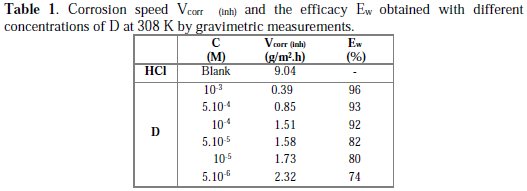
<body><![CDATA[<p>The inhibition efficiency values for mild steel in 1 M HCl media at different 
concentrations of the inhibitor are presented in <a href="#t1">Table 1</a>.</p>


    <p>&nbsp;</p>
<a name="t1">
<img src="/img/revistas/pea/v35n2/35n2a01t1.jpg">
    
<p>&nbsp;</p>


    <p>It is obvious that the 
inhibition efficiency increased with an increase in the inhibitor's concentration. 
This behaviour can be explained based on strong interaction of the inhibitor 
molecule with the metal surface, resulting in adsorption [40]. The extent of 
adsorption increases with the increase in concentration of the inhibitor, leading to 
increased inhibition efficiency.</p>

    <p>In acidic solutions, the maximum inhibition efficiency was observed at an 
inhibitor concentration of 10<sup>-3</sup> M (97%). This result can be explained because 
organic inhibitors suppress the metal dissolution by forming a protective film 
adsorbed onto the metal surface, and preserve it from the corrosion medium [41].</p>


    <p><i><b>Adsorption isotherm</b></i></p>

    <p>Organic inhibitors exhibit inhibition via adsorption on the solution-metal 
interface, while the adsorption isotherm can provide the basic information about 
the interaction between the inhibitor and the metal surface. We tested various 
adsorption isotherms to fit the experimental data, such as Langmuir, Temkin and 
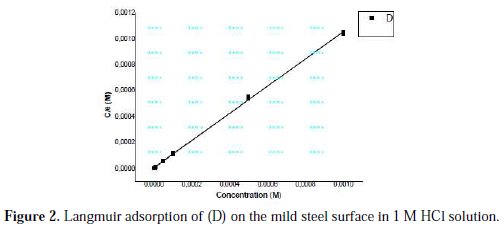
Frumkin adsorption isotherms. For D, the plot of C versus (C/&theta;) provided a 
straight line with a slope nearly 1, and the linear association coefficient (R2) was 
also nearly 1 (<a href="#f2">Fig. 2</a>), showing that the adsorption of (D) on the carbon steel 
surface could be well described by Langmuir adsorption isotherm (<a href="#e11">equation 11</a>).</p>


    <p>&nbsp;</p>
<a name="f2">
<img src="/img/revistas/pea/v35n2/35n2a01f2.jpg">
    
<p>&nbsp;</p>
<a name="e11">
<img src="/img/revistas/pea/v35n2/35n2a01e11.jpg">
    
<p>&nbsp;</p>


    ]]></body>
<body><![CDATA[<p>where C is the concentration of inhibitor, K the adsorption equilibrium constant, 
and &theta; is the surface coverage.</p>

    <p>This kind of isotherm involves the single layer adsorption characteristic and there 
is no interaction between the adsorbed inhibitor molecules and the carbon steel 
surface.</p>

    <p>The constant of adsorption Kads, is related to the 
standard free energy of adsorption &Delta;G<sup>0</sup>ads, with the following <a href="#e12">equation (12)</a>:</p>


    <p>&nbsp;</p>
<a name="e12">
<img src="/img/revistas/pea/v35n2/35n2a01e12.jpg">
    
<p>&nbsp;</p>


    <p>Thermodynamic parameters for the adsorption process were obtained from this 
figure (<a href="#t2">Table 2</a>)</p>


    <p>&nbsp;</p>
<a name="t2">
<img src="/img/revistas/pea/v35n2/35n2a01t2.jpg">
    
<p>&nbsp;</p>


    <p>The value of &Delta;G<sup>0</sup>ads was negative, indicating that the compound investigated was 
strongly adsorbed on the carbon steel surface, and showing the spontaneity of the 
adsorption process and stability of the adsorbed layer on the carbon steel surface. 
Generally, values of &Delta;G<sup>0</sup> up to -20 kJ mol-1 are consistent with the electrostatic 
interaction between the charged molecules and the charged metal (physical 
adsorption), while those more negative than -40 kJ mol-1 involve sharing or 
transfer of electrons from the inhibitor molecules onto the metal surface to form a 
coordinate type of bond (chemisorption) [42]. Therefore, it can be assumed that 
the adsorption of D on mild steel surface occurs, first due to electrostatic 
interactions, and then to desorption of water molecules, accompanied by 
chemical interaction between the adsorbate and metal surface [43].</p>


    <p><i><b>Polarization measurements</b></i></p>

    ]]></body>
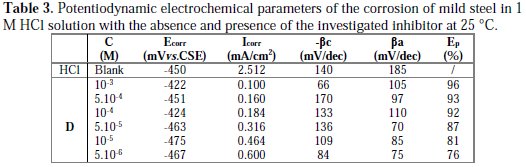
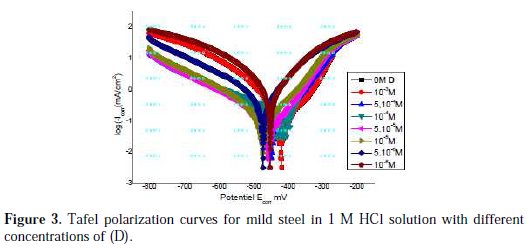
<body><![CDATA[<p>It can be observed that the addition of D caused a remarkable decrease in the 
corrosion rate, shifting both anodic and cathodic Tafel curves to lower current 
densities. This indicated that both anodic and cathodic reactions were suppressed, 
and the suppression became more pronounced with the increase of the 
concentration of this inhibitor. Electrochemical parameters, such as corrosion 
potential (Ecorr), cathodic Tafel slope (&beta;c), and corrosion current density (Icorr), 
obtained by extrapolating the Tafel line, are given in <a href="#t3">Table 3</a>.</p>


    <p>&nbsp;</p>
<a name="t3">
<img src="/img/revistas/pea/v35n2/35n2a01t3.jpg">
    
<p>&nbsp;</p>


    <p>The corrosion 
inhibition efficiency (Ep%) of this compound was calculated using the 
<a href="#e3">relationship (3)</a>. We can classify an inhibitor as cathodic or anodic if the 
displacement in corrosion potential is more than 85 mV, with respect to corrosion 
potential of the blank [44]. In the presence of D, the corrosion potential of mild 
steel shifted only 30 mV to the negative side (vs. SCE). This means that the 
inhibitor acted as a mixed type inhibitor and showed more pronounced influence 
in the cathodic polarization plots compared to that in the anodic plots. The 
parallel cathodic current-potential curves suggested that the addition of this 
inhibitor did not modify the hydrogen evolution mechanism, and that the 
hydrogen evolution is activation-controlled. This suppression of the corrosion 
process may be attributed to the covering of adsorbed pyrazole D molecules on 
the mild steel surface [45]. For anodic polarization curves of mild steel with this 
compound, it is clear that the presence of D did not modify the current vs. 
potential characteristics. The data in <a href="#t3">Table 3</a> showed that, when the concentration 
of the inhibitor increased, the inhibition efficiency also increased and the 
corrosion current density sharply decreased. This may be due to the adsorption 
layer of the inhibitor on the metal surface.</p>


    <p><i><b>Electrochemical impedance spectroscopy</b></i></p>

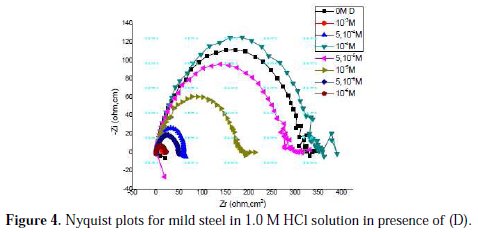
    <p>The corrosion of mild steel in 1 M HCl solution in the presence of pyrazole (D) 
was investigated by EIS at 25 &deg;C after a 30 min exposure. A single semicircle has 
been observed at high frequency; this could be attributed to charge transfer of the 
corrosion process and the diameter of the semicircle increased, as the result of 
increasing inhibitor concentration.</p>

    <p><a href="#f3">Fig. 3</a> clearly shows that impedance spectra are not a perfect semicircle.</p>


    <p>&nbsp;</p>
<a name="f3">
<img src="/img/revistas/pea/v35n2/35n2a01f3.jpg">
    
<p>&nbsp;</p>


    <p>They seem to be depressed in the centre under real axis and look like depressed 
capacitive loops. Such phenomenon often corresponds to surface heterogeneity 
that may be the result of surface roughness, dislocations, distribution of the 
active sites, or adsorption of the inhibitor molecules.</p>

    ]]></body>
<body><![CDATA[<p>Nyquist plots for mild steel obtained at the interface in the absence and presence 
of pyrazole (D) at different concentrations are shown in <a href="#f4">Fig. 4</a>.</p>


    <p>&nbsp;</p>
<a name="f4">
<img src="/img/revistas/pea/v35n2/35n2a01f4.jpg">
    
<p>&nbsp;</p>


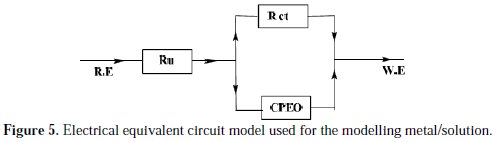
    <p>An equivalent circuit was introduced to explain the EIS data, as shown in <a href="#f5">Fig. 5</a>.</p>


    <p>&nbsp;</p>
<a name="f5">
<img src="/img/revistas/pea/v35n2/35n2a01f5.jpg">
    
<p>&nbsp;</p>


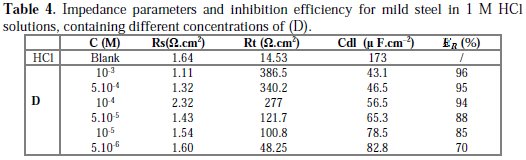
    <p>The inhibition efficiency of the inhibitor ER% was calculated from the charge 
transfer resistance values using <a href="#e4">equation 4</a>. <a href="#t4">Table 4</a> lists impedance parameters of 
the Nyquist plots of D with different concentrations.</p>


    <p>&nbsp;</p>
<a name="t4">
<img src="/img/revistas/pea/v35n2/35n2a01t4.jpg">
    
<p>&nbsp;</p>


    <p>The EIS measurement 
reveals that, at the concentration of 10<sup>-3</sup> M, the percentage of inhibition 
efficiency is the highest (97%). The result strongly supports the observation that 
10<sup>-3</sup> M of this compound could work best as an inhibitor.</p>

    ]]></body>
<body><![CDATA[<p>The results also show that Rt values increased with the increase in additive 
concentrations, except for a few cases. The percentage inhibition efficiencies 
calculated from the Rt values showed that D played the role of a good corrosion 
inhibitor of mild steel in HCl medium. The CPE values were found to decrease 
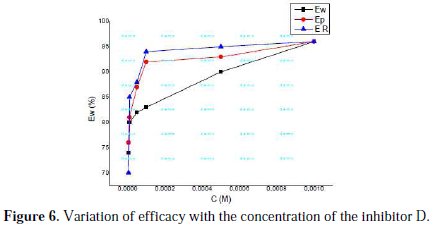
with increase in concentration of the inhibitor solutions (<a href="#f6">Fig. 6</a>).</p>


    <p>&nbsp;</p>
<a name="f6">
<img src="/img/revistas/pea/v35n2/35n2a01f6.jpg">
    
<p>&nbsp;</p>


    <p>This behaviour 
is generally found for systems where inhibition occurred due to the formation of 
a surface film by the adsorption of the inhibitor on the metal surface [46]. 
Decrease in CPE, which can result from a decrease in local dielectric constant 
and/or an increase in the thickness of the electrical double layer, suggested that 
the inhibitor molecules were absorbed at the metal/solution interface. The values 
of n obtained for this inhibitor system were close to unity, which shows that the 
interface behaved in a nearly capacitive way [47].</p>


    <p><i><b>Quantum chemical calculations</b></i></p>

    <p>Quantum chemical calculations have been widely used to evaluate the inhibition 
performance of corrosion inhibitors, which can quantitatively study the 
relationship between inhibition efficiency and molecular reactivity [48]. By 
means of this method, the capability of an inhibitor molecule to donate or accept 
electrons can be predicted with the analysis of global reactivity parameters, such 
as the energy gap Egap between HOMO and LUMO, chemical hardness &eta; 
and dipole moment &mu;.</p>

    <p>The higher the value of EHOMO, the greater the ability of the molecule inhibitor to 
donate electrons, while ELUMO indicates the propensity to accept electrons. By 
contrast, the lower the ELUMO, the greater the ability of that molecule to accept 
electrons. Thus, the binding ability of organics to the metal surface increases 
with an increase in energy of HOMO and a decrease in the value of energy of 
LUMO [49]. The energy gap Egap indicates the reactivity tendency of organics 
toward the metal surface [50]. Thus, Egap has been used to characterize the 
binding ability of organic compounds to the metal surface [51]. A good corrosion 
inhibitor behaves as a strong Lewis base, and the electronegativity value of 
inhibitors is an important parameter in terms of electron transfer between metal 
and inhibitor. The reactivity of corrosion inhibitors may also be discussed in 
terms of chemical hardness &eta;, softness &sigma;, parameters molecular dipole moment &mu;, 
absolute electronegativity &chi; [52], and fraction of electrons transferred &Delta;N [53].</p>

    <p>The adsorption of the inhibitor on the mild steel surface can occur on the basis of 
donor-acceptor interactions between the lone-pair electron of the heteroatom of 
the inhibitors and the vacant d orbital of the mild steel surface of Fe atoms. 
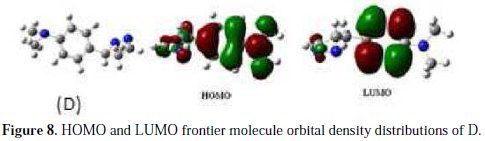
The optimized geometry, the HOMO and LUMO density distribution of D by 
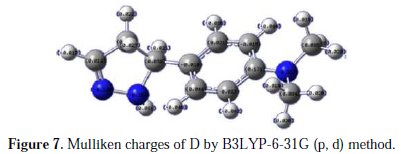
B3LYP/6-31G (d,p) method were presented in <a href="#f7">Fig. 7</a> and <a href="#f8">Fig. 8</a>.</p>


    <p>&nbsp;</p>
<a name="f7">
<img src="/img/revistas/pea/v35n2/35n2a01f7.jpg">
    
<p>&nbsp;</p>
<a name="f8">
<img src="/img/revistas/pea/v35n2/35n2a01f8.jpg">
    
]]></body>
<body><![CDATA[<p>&nbsp;</p>


    <p>Mulliken charges, according to the numeration of corresponding atoms, are 
shown in <a href="#f7">Fig. 7</a>, where it can be observed that both inhibitors had a considerable 
excess of negative charge around the nitrogen (-0.322,-0.120, -0.107) and some 
carbon atoms, indicating that these are the coordinating sites of the inhibitors. 
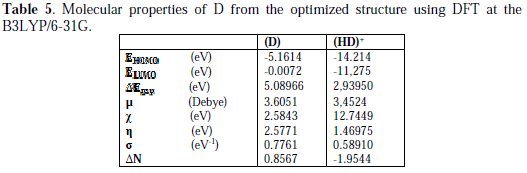
The value of EHOMO in the neutral form is higher than in the protonated form (see 
<a href="#t5">Table 5</a>).</p>


    <p>&nbsp;</p>
<a name="t5">
<img src="/img/revistas/pea/v35n2/35n2a01t5.jpg">
    
<p>&nbsp;</p>


    <p>This means that the electron-donating ability of (D) is greater in the 
neutral form. The ELUMO is directly related to the electron affinity and 
characterizes the susceptibility of the molecule towards attack by nucleophiles. 
The diminution of the value of ELUMO increases the ability of the electron-
accepting molecule. Thus, the protonated form of pyrazole D exhibits the lowest 
EHOMO, making the neutral form the most likely to interact with D molecule. Low 
values of the energy and gap Egap in the protonated form of D can indicate a good 
stability of the formed complex (inhibitor-Fe) on the metal surface, therefore 
improving the corrosion resistance of mild steel in 1 M HCl medium [54]. The 
high value of the dipole moment of pyrazole in the neutral and protonated forms 
probably indicates strong dipole-dipole interactions of D molecules and the 
metallic surface. Finally, and according to Lukovits, if &Delta;N &lt;3.6, the inhibition 
efficiency increased with increasing electron-donating ability at the metal surface 
[7]. In this study, the value of &Delta;N for D was less than 3.6 for both neutral and 
protonated forms. This shows that the increase in inhibition efficiency was solely 
due to the electron-donating ability of D in both forms.</p>


    <p><i><b>Inhibition mechanism</b></i></p>

    <p>From the results obtained from different electrochemical and weight loss 
measurements, we can conclude that pyrazole D inhibited the corrosion of mild 
steel in 1 M HCl through its adsorption at the metal/solution interface. D can 
easily be protonated, because its molecules are made of planer aromatic rings of 
benzene and the pyrazole ring, and it also contains &pi; electrons. Generally, the 
inhibition of metallic corrosion in acidic solutions first occurs through 
electrostatic interaction of protonated molecules with already adsorbed chloride 
ions; second, through donor-acceptor interactions between the p electrons of the 
aromatic ring and the vacant d-orbital of the iron atoms; and third, from 
interactions between unshared electron pairs of hetero atoms and the vacant d-
orbital of the iron surface atoms. In this study, the calculated &Delta;G<sup>0</sup>ads value 
indicates that the adsorption of D on the mild steel surface follows both 
physisorption (ionic) and chemisorption (molecular) mechanisms.</p>


    <p>&nbsp;</p>
    <p><b>Conclusions</b></p>

    <p>The results obtained during this investigation lead us to draw the following main 
points:</p>

    ]]></body>
<body><![CDATA[<p>-The pyrazole D or 4-(4,5-dihydro-1H-pyrazol-5-yl)-N,N-dimethylaniline shows 
good inhibitive properties for mild steel corrosion in 1.0 M HCl solution.</p>

    <p>-The inhibition efficiency increases with an increasing concentration of the 
inhibitor.</p>

    <p>-The results of potentiodynamic polarization measurements demonstrate that D 
behaves as a mixed type inhibitor and could suppress both anodic metal 
dissolution and cathodic hydrogen evolution reactions.</p>

    <p>-D, on the metal surface, obeyed Langmuir adsorption isotherm. The value of 
the adsorption equilibrium constant shows that the inhibitor is strongly adsorbed 
on the metal surface.</p>

    <p>-The adsorption of D on the steel surface obeys the statistical physics adsorption 
model. Furthermore, the obtained values of &Delta;G<sup>0</sup>ads indicate that the adsorption of 
(D) molecules onto the steel surface is a spontaneous process involving both 
physisorption and chemisorption mechanisms.</p>

    <p>-The quantum mechanical approach may well be able to foretell molecule 
structures that are better for corrosion inhibition.</p> 


    <p>&nbsp;</p>
    <p><b>References</b></p>

    <!-- ref --><p>1. Adejoro I A, Ojo F K, Obafemi S K. J Taibah Univ Sci. 2015;9:196.    &nbsp;&nbsp;&nbsp;&nbsp;&nbsp;&nbsp;&nbsp;&nbsp;[&#160;<a href="javascript:void(0);" onclick="javascript: window.open('/scielo.php?script=sci_nlinks&ref=425679&pid=S0872-1904201700020000100001&lng=','','width=640,height=500,resizable=yes,scrollbars=1,menubar=yes,');">Links</a>&#160;]<!-- end-ref --></p>

    ]]></body>
<body><![CDATA[<!-- ref --><p>2. Hmamou D B, Salghi R, Zarrouk A, et al. Ind Eng Chem Res. 2013;52:14315.    &nbsp;&nbsp;&nbsp;&nbsp;&nbsp;&nbsp;&nbsp;&nbsp;[&#160;<a href="javascript:void(0);" onclick="javascript: window.open('/scielo.php?script=sci_nlinks&ref=425681&pid=S0872-1904201700020000100002&lng=','','width=640,height=500,resizable=yes,scrollbars=1,menubar=yes,');">Links</a>&#160;]<!-- end-ref --></p>

    <!-- ref --><p>3. Zarrok H, Saddik R, Oudda H, et al. Der Pharm Chem. 2011;3:272.    &nbsp;&nbsp;&nbsp;&nbsp;&nbsp;&nbsp;&nbsp;&nbsp;[&#160;<a href="javascript:void(0);" onclick="javascript: window.open('/scielo.php?script=sci_nlinks&ref=425683&pid=S0872-1904201700020000100003&lng=','','width=640,height=500,resizable=yes,scrollbars=1,menubar=yes,');">Links</a>&#160;]<!-- end-ref --></p>

    <!-- ref --><p>4. Ghazoui A, Saddik R, Benchat N, et al. Der Pharm Chem. 2012;4:352.    &nbsp;&nbsp;&nbsp;&nbsp;&nbsp;&nbsp;&nbsp;&nbsp;[&#160;<a href="javascript:void(0);" onclick="javascript: window.open('/scielo.php?script=sci_nlinks&ref=425685&pid=S0872-1904201700020000100004&lng=','','width=640,height=500,resizable=yes,scrollbars=1,menubar=yes,');">Links</a>&#160;]<!-- end-ref --></p>

    <!-- ref --><p>5. Al Hamzi AH, Zarrok H, Zarrouk A, et al. Int J Electrochem Sci. 2013;8:2586.    &nbsp;&nbsp;&nbsp;&nbsp;&nbsp;&nbsp;&nbsp;&nbsp;[&#160;<a href="javascript:void(0);" onclick="javascript: window.open('/scielo.php?script=sci_nlinks&ref=425687&pid=S0872-1904201700020000100005&lng=','','width=640,height=500,resizable=yes,scrollbars=1,menubar=yes,');">Links</a>&#160;]<!-- end-ref --></p>

    <!-- ref --><p>6. Goulart CM, Esteves-Souza A, Martinez-Huitle CA, et al. Corros Sci. 2013;67:281.    &nbsp;&nbsp;&nbsp;&nbsp;&nbsp;&nbsp;&nbsp;&nbsp;[&#160;<a href="javascript:void(0);" onclick="javascript: window.open('/scielo.php?script=sci_nlinks&ref=425689&pid=S0872-1904201700020000100006&lng=','','width=640,height=500,resizable=yes,scrollbars=1,menubar=yes,');">Links</a>&#160;]<!-- end-ref --></p>

    ]]></body>
<body><![CDATA[<!-- ref --><p>7. Aouniti A, Elmsellem H, Tighadouini S, et al. J Taibah Univ Sci. 2015;263:12.    &nbsp;&nbsp;&nbsp;&nbsp;&nbsp;&nbsp;&nbsp;&nbsp;[&#160;<a href="javascript:void(0);" onclick="javascript: window.open('/scielo.php?script=sci_nlinks&ref=425691&pid=S0872-1904201700020000100007&lng=','','width=640,height=500,resizable=yes,scrollbars=1,menubar=yes,');">Links</a>&#160;]<!-- end-ref --></p>

    <!-- ref --><p>8. Zarrouk A, Hammouti B, Zarrok H, et al. Int J Electrochem Sci. 2011;6:6261.    &nbsp;&nbsp;&nbsp;&nbsp;&nbsp;&nbsp;&nbsp;&nbsp;[&#160;<a href="javascript:void(0);" onclick="javascript: window.open('/scielo.php?script=sci_nlinks&ref=425693&pid=S0872-1904201700020000100008&lng=','','width=640,height=500,resizable=yes,scrollbars=1,menubar=yes,');">Links</a>&#160;]<!-- end-ref --></p>

    <!-- ref --><p>9. Zarrouk A, Hammouti B, Dafali A, et al. Der Pharm Chem. 2011;3:266.    &nbsp;&nbsp;&nbsp;&nbsp;&nbsp;&nbsp;&nbsp;&nbsp;[&#160;<a href="javascript:void(0);" onclick="javascript: window.open('/scielo.php?script=sci_nlinks&ref=425695&pid=S0872-1904201700020000100009&lng=','','width=640,height=500,resizable=yes,scrollbars=1,menubar=yes,');">Links</a>&#160;]<!-- end-ref --></p>

    <!-- ref --><p>10. Zarrouk A, Hammouti B, Zarrok H, et al. Der Pharm Chem. 2011;3:263.    &nbsp;&nbsp;&nbsp;&nbsp;&nbsp;&nbsp;&nbsp;&nbsp;[&#160;<a href="javascript:void(0);" onclick="javascript: window.open('/scielo.php?script=sci_nlinks&ref=425697&pid=S0872-1904201700020000100010&lng=','','width=640,height=500,resizable=yes,scrollbars=1,menubar=yes,');">Links</a>&#160;]<!-- end-ref --></p>

    <!-- ref --><p>11. Ghazoui A, Bencaht N, Al-Deyab SS, et al. Int J Electrochem Sci. 2013;8:2272.    &nbsp;&nbsp;&nbsp;&nbsp;&nbsp;&nbsp;&nbsp;&nbsp;[&#160;<a href="javascript:void(0);" onclick="javascript: window.open('/scielo.php?script=sci_nlinks&ref=425699&pid=S0872-1904201700020000100011&lng=','','width=640,height=500,resizable=yes,scrollbars=1,menubar=yes,');">Links</a>&#160;]<!-- end-ref --></p>

    ]]></body>
<body><![CDATA[<!-- ref --><p>12. Zarrouk A, Zarrok H, Salghi R, et al. Int J Electrochem Sci. 2012;7:10215.    &nbsp;&nbsp;&nbsp;&nbsp;&nbsp;&nbsp;&nbsp;&nbsp;[&#160;<a href="javascript:void(0);" onclick="javascript: window.open('/scielo.php?script=sci_nlinks&ref=425701&pid=S0872-1904201700020000100012&lng=','','width=640,height=500,resizable=yes,scrollbars=1,menubar=yes,');">Links</a>&#160;]<!-- end-ref --></p>

    <!-- ref --><p>13. Bendaha H, Zarrouk A, Aouniti A, et al. Phys Chem News. 2012;64:95.    &nbsp;&nbsp;&nbsp;&nbsp;&nbsp;&nbsp;&nbsp;&nbsp;[&#160;<a href="javascript:void(0);" onclick="javascript: window.open('/scielo.php?script=sci_nlinks&ref=425703&pid=S0872-1904201700020000100013&lng=','','width=640,height=500,resizable=yes,scrollbars=1,menubar=yes,');">Links</a>&#160;]<!-- end-ref --></p>

    <!-- ref --><p>14. Zarrok H, Zarrouk A, Salghi R, et al. J Chem Pharm Res. 2012;4:5048.    &nbsp;&nbsp;&nbsp;&nbsp;&nbsp;&nbsp;&nbsp;&nbsp;[&#160;<a href="javascript:void(0);" onclick="javascript: window.open('/scielo.php?script=sci_nlinks&ref=425705&pid=S0872-1904201700020000100014&lng=','','width=640,height=500,resizable=yes,scrollbars=1,menubar=yes,');">Links</a>&#160;]<!-- end-ref --></p>

    <!-- ref --><p>15. Zarrok H, Al Mamari K, Zarrouk A, et al. Int J Electrochem Sci. 2012;7:10338.    &nbsp;&nbsp;&nbsp;&nbsp;&nbsp;&nbsp;&nbsp;&nbsp;[&#160;<a href="javascript:void(0);" onclick="javascript: window.open('/scielo.php?script=sci_nlinks&ref=425707&pid=S0872-1904201700020000100015&lng=','','width=640,height=500,resizable=yes,scrollbars=1,menubar=yes,');">Links</a>&#160;]<!-- end-ref --></p>

    <!-- ref --><p>16. Daoud D, Douadi T, Issaadi S, et al. Corros Sci. 2014;79:50.    &nbsp;&nbsp;&nbsp;&nbsp;&nbsp;&nbsp;&nbsp;&nbsp;[&#160;<a href="javascript:void(0);" onclick="javascript: window.open('/scielo.php?script=sci_nlinks&ref=425709&pid=S0872-1904201700020000100016&lng=','','width=640,height=500,resizable=yes,scrollbars=1,menubar=yes,');">Links</a>&#160;]<!-- end-ref --></p>

    ]]></body>
<body><![CDATA[<!-- ref --><p>17. Avci G. Mater Chem Phys. 2008;112:234.    &nbsp;&nbsp;&nbsp;&nbsp;&nbsp;&nbsp;&nbsp;&nbsp;[&#160;<a href="javascript:void(0);" onclick="javascript: window.open('/scielo.php?script=sci_nlinks&ref=425711&pid=S0872-1904201700020000100017&lng=','','width=640,height=500,resizable=yes,scrollbars=1,menubar=yes,');">Links</a>&#160;]<!-- end-ref --></p>

    <!-- ref --><p>18. Meresht E S, Farahani T S, Neshati J. Corros Sci. 2012;54:36.    &nbsp;&nbsp;&nbsp;&nbsp;&nbsp;&nbsp;&nbsp;&nbsp;[&#160;<a href="javascript:void(0);" onclick="javascript: window.open('/scielo.php?script=sci_nlinks&ref=425713&pid=S0872-1904201700020000100018&lng=','','width=640,height=500,resizable=yes,scrollbars=1,menubar=yes,');">Links</a>&#160;]<!-- end-ref --></p>

    <!-- ref --><p>19. Quraishi M A, Jamal D. Corrosion. 2000;56:156.    &nbsp;&nbsp;&nbsp;&nbsp;&nbsp;&nbsp;&nbsp;&nbsp;[&#160;<a href="javascript:void(0);" onclick="javascript: window.open('/scielo.php?script=sci_nlinks&ref=425715&pid=S0872-1904201700020000100019&lng=','','width=640,height=500,resizable=yes,scrollbars=1,menubar=yes,');">Links</a>&#160;]<!-- end-ref --></p>

    <!-- ref --><p>20. Benabdellah M, Yahyi A, Dafali A, et al. Arab J Chem. 2011;4:343.    &nbsp;&nbsp;&nbsp;&nbsp;&nbsp;&nbsp;&nbsp;&nbsp;[&#160;<a href="javascript:void(0);" onclick="javascript: window.open('/scielo.php?script=sci_nlinks&ref=425717&pid=S0872-1904201700020000100020&lng=','','width=640,height=500,resizable=yes,scrollbars=1,menubar=yes,');">Links</a>&#160;]<!-- end-ref --></p>

    <!-- ref --><p>21. Elayyachy M, Hammouti B, El Idrissi A, et al. Port Electrochim Acta. 2011;29:57.    &nbsp;&nbsp;&nbsp;&nbsp;&nbsp;&nbsp;&nbsp;&nbsp;[&#160;<a href="javascript:void(0);" onclick="javascript: window.open('/scielo.php?script=sci_nlinks&ref=425719&pid=S0872-1904201700020000100021&lng=','','width=640,height=500,resizable=yes,scrollbars=1,menubar=yes,');">Links</a>&#160;]<!-- end-ref --></p>

    ]]></body>
<body><![CDATA[<!-- ref --><p>22. Sykes J M. Br Corros J. 1990;25:175.    &nbsp;&nbsp;&nbsp;&nbsp;&nbsp;&nbsp;&nbsp;&nbsp;[&#160;<a href="javascript:void(0);" onclick="javascript: window.open('/scielo.php?script=sci_nlinks&ref=425721&pid=S0872-1904201700020000100022&lng=','','width=640,height=500,resizable=yes,scrollbars=1,menubar=yes,');">Links</a>&#160;]<!-- end-ref --></p>

    <!-- ref --><p>23. Chatterjee P, Banerjee M K, Mukherjee J P. Indian J Technol. 1991,29:191.    &nbsp;&nbsp;&nbsp;&nbsp;&nbsp;&nbsp;&nbsp;&nbsp;[&#160;<a href="javascript:void(0);" onclick="javascript: window.open('/scielo.php?script=sci_nlinks&ref=425723&pid=S0872-1904201700020000100023&lng=','','width=640,height=500,resizable=yes,scrollbars=1,menubar=yes,');">Links</a>&#160;]<!-- end-ref --></p>

    <!-- ref --><p>24. Bockris J M, Yang B. J Electrochem Soc. 1991;138:2237.    &nbsp;&nbsp;&nbsp;&nbsp;&nbsp;&nbsp;&nbsp;&nbsp;[&#160;<a href="javascript:void(0);" onclick="javascript: window.open('/scielo.php?script=sci_nlinks&ref=425725&pid=S0872-1904201700020000100024&lng=','','width=640,height=500,resizable=yes,scrollbars=1,menubar=yes,');">Links</a>&#160;]<!-- end-ref --></p>

    <!-- ref --><p>25. Zarrouk A, Warad I, Hammouti B, et al. Int J Electrochem Sci. 2010;5:1516.    &nbsp;&nbsp;&nbsp;&nbsp;&nbsp;&nbsp;&nbsp;&nbsp;[&#160;<a href="javascript:void(0);" onclick="javascript: window.open('/scielo.php?script=sci_nlinks&ref=425727&pid=S0872-1904201700020000100025&lng=','','width=640,height=500,resizable=yes,scrollbars=1,menubar=yes,');">Links</a>&#160;]<!-- end-ref --></p>

    <!-- ref --><p>26. Vermilyea D A. In: Metal Corrosion. London: Butterworths; 1962.    &nbsp;&nbsp;&nbsp;&nbsp;&nbsp;&nbsp;&nbsp;&nbsp;[&#160;<a href="javascript:void(0);" onclick="javascript: window.open('/scielo.php?script=sci_nlinks&ref=425729&pid=S0872-1904201700020000100026&lng=','','width=640,height=500,resizable=yes,scrollbars=1,menubar=yes,');">Links</a>&#160;]<!-- end-ref --></p>

    ]]></body>
<body><![CDATA[<!-- ref --><p>27. Bentiss F, Traisnel M, Chaibi N, et al. Corros Sci. 2002;44:2271.    &nbsp;&nbsp;&nbsp;&nbsp;&nbsp;&nbsp;&nbsp;&nbsp;[&#160;<a href="javascript:void(0);" onclick="javascript: window.open('/scielo.php?script=sci_nlinks&ref=425731&pid=S0872-1904201700020000100027&lng=','','width=640,height=500,resizable=yes,scrollbars=1,menubar=yes,');">Links</a>&#160;]<!-- end-ref --></p>

    <!-- ref --><p>28. El Ouali I, Hammouti B, Aouniti A, et al. J Mater Environ Sci. 2010;1:1.    &nbsp;&nbsp;&nbsp;&nbsp;&nbsp;&nbsp;&nbsp;&nbsp;[&#160;<a href="javascript:void(0);" onclick="javascript: window.open('/scielo.php?script=sci_nlinks&ref=425733&pid=S0872-1904201700020000100028&lng=','','width=640,height=500,resizable=yes,scrollbars=1,menubar=yes,');">Links</a>&#160;]<!-- end-ref --></p>

    <!-- ref --><p>29. Khaled K F, Abdelshafi N S, El-Maghraby A, et al. J Mater Environ Sci. 2011;2:166.    &nbsp;&nbsp;&nbsp;&nbsp;&nbsp;&nbsp;&nbsp;&nbsp;[&#160;<a href="javascript:void(0);" onclick="javascript: window.open('/scielo.php?script=sci_nlinks&ref=425735&pid=S0872-1904201700020000100029&lng=','','width=640,height=500,resizable=yes,scrollbars=1,menubar=yes,');">Links</a>&#160;]<!-- end-ref --></p>

    <!-- ref --><p>30. Uhrea J, Aramaki K. J Electrochem Soc. 1991;138:3245.    &nbsp;&nbsp;&nbsp;&nbsp;&nbsp;&nbsp;&nbsp;&nbsp;[&#160;<a href="javascript:void(0);" onclick="javascript: window.open('/scielo.php?script=sci_nlinks&ref=425737&pid=S0872-1904201700020000100030&lng=','','width=640,height=500,resizable=yes,scrollbars=1,menubar=yes,');">Links</a>&#160;]<!-- end-ref --></p>

    <!-- ref --><p>31. Almirante N, Cerri A, Fedrizzi G, et al. Tetrahedron Lett. 1998;39:3287.    &nbsp;&nbsp;&nbsp;&nbsp;&nbsp;&nbsp;&nbsp;&nbsp;[&#160;<a href="javascript:void(0);" onclick="javascript: window.open('/scielo.php?script=sci_nlinks&ref=425739&pid=S0872-1904201700020000100031&lng=','','width=640,height=500,resizable=yes,scrollbars=1,menubar=yes,');">Links</a>&#160;]<!-- end-ref --></p>

    ]]></body>
<body><![CDATA[<!-- ref --><p>32. Grandi R, Messerotti W, Pagnoni UM, et al. J Org Chem. 1977;42:1352.    &nbsp;&nbsp;&nbsp;&nbsp;&nbsp;&nbsp;&nbsp;&nbsp;[&#160;<a href="javascript:void(0);" onclick="javascript: window.open('/scielo.php?script=sci_nlinks&ref=425741&pid=S0872-1904201700020000100032&lng=','','width=640,height=500,resizable=yes,scrollbars=1,menubar=yes,');">Links</a>&#160;]<!-- end-ref --></p>

    <!-- ref --><p>33. Aggarwal V K, Vicente J, Bonnert R V. J Org Chem. 2003;68:5381.    &nbsp;&nbsp;&nbsp;&nbsp;&nbsp;&nbsp;&nbsp;&nbsp;[&#160;<a href="javascript:void(0);" onclick="javascript: window.open('/scielo.php?script=sci_nlinks&ref=425743&pid=S0872-1904201700020000100033&lng=','','width=640,height=500,resizable=yes,scrollbars=1,menubar=yes,');">Links</a>&#160;]<!-- end-ref --></p>

    <!-- ref --><p>34. Corradi A, Leonelli C, Rizzuti A, et al. Molecules. 2007;12:1482.    &nbsp;&nbsp;&nbsp;&nbsp;&nbsp;&nbsp;&nbsp;&nbsp;[&#160;<a href="javascript:void(0);" onclick="javascript: window.open('/scielo.php?script=sci_nlinks&ref=425745&pid=S0872-1904201700020000100034&lng=','','width=640,height=500,resizable=yes,scrollbars=1,menubar=yes,');">Links</a>&#160;]<!-- end-ref --></p>

    <!-- ref --><p>35. Mohareb R M, El-Sayed N N E, Abdelaziz M A. Molecules. 2012;17:8449.    &nbsp;&nbsp;&nbsp;&nbsp;&nbsp;&nbsp;&nbsp;&nbsp;[&#160;<a href="javascript:void(0);" onclick="javascript: window.open('/scielo.php?script=sci_nlinks&ref=425747&pid=S0872-1904201700020000100035&lng=','','width=640,height=500,resizable=yes,scrollbars=1,menubar=yes,');">Links</a>&#160;]<!-- end-ref --></p>

    <!-- ref --><p>36. Chaudhary R S, Sharma S. Ind J Chem Technol. 1999;6:202.    &nbsp;&nbsp;&nbsp;&nbsp;&nbsp;&nbsp;&nbsp;&nbsp;[&#160;<a href="javascript:void(0);" onclick="javascript: window.open('/scielo.php?script=sci_nlinks&ref=425749&pid=S0872-1904201700020000100036&lng=','','width=640,height=500,resizable=yes,scrollbars=1,menubar=yes,');">Links</a>&#160;]<!-- end-ref --></p>

    ]]></body>
<body><![CDATA[<!-- ref --><p>37. Hmamou D B, Salghi R, Zarroukb A, et al. J Environ Chem Eng. 2015;3:2031.    &nbsp;&nbsp;&nbsp;&nbsp;&nbsp;&nbsp;&nbsp;&nbsp;[&#160;<a href="javascript:void(0);" onclick="javascript: window.open('/scielo.php?script=sci_nlinks&ref=425751&pid=S0872-1904201700020000100037&lng=','','width=640,height=500,resizable=yes,scrollbars=1,menubar=yes,');">Links</a>&#160;]<!-- end-ref --></p>

    <!-- ref --><p>38. Liu H, Zhu L, Zhao Q. Res Chem Intermed. 2015;41:4943.    &nbsp;&nbsp;&nbsp;&nbsp;&nbsp;&nbsp;&nbsp;&nbsp;[&#160;<a href="javascript:void(0);" onclick="javascript: window.open('/scielo.php?script=sci_nlinks&ref=425753&pid=S0872-1904201700020000100038&lng=','','width=640,height=500,resizable=yes,scrollbars=1,menubar=yes,');">Links</a>&#160;]<!-- end-ref --></p>

    <!-- ref --><p>39. El Ouali I, Hammouti B, Aouniti A, et al. J Mater Environ Sci. 2010;1:1.    &nbsp;&nbsp;&nbsp;&nbsp;&nbsp;&nbsp;&nbsp;&nbsp;[&#160;<a href="javascript:void(0);" onclick="javascript: window.open('/scielo.php?script=sci_nlinks&ref=425755&pid=S0872-1904201700020000100039&lng=','','width=640,height=500,resizable=yes,scrollbars=1,menubar=yes,');">Links</a>&#160;]<!-- end-ref --></p>

    <!-- ref --><p>40. Khaled K F, Abdelshafi N S, El-Maghraby A, et al. J Mater Environ Sci. 2011;2:166.    &nbsp;&nbsp;&nbsp;&nbsp;&nbsp;&nbsp;&nbsp;&nbsp;[&#160;<a href="javascript:void(0);" onclick="javascript: window.open('/scielo.php?script=sci_nlinks&ref=425757&pid=S0872-1904201700020000100040&lng=','','width=640,height=500,resizable=yes,scrollbars=1,menubar=yes,');">Links</a>&#160;]<!-- end-ref --></p>

    <!-- ref --><p>41. Uhrea J, Aramaki K. J Electrochem Soc. 1991;138:3245.    &nbsp;&nbsp;&nbsp;&nbsp;&nbsp;&nbsp;&nbsp;&nbsp;[&#160;<a href="javascript:void(0);" onclick="javascript: window.open('/scielo.php?script=sci_nlinks&ref=425759&pid=S0872-1904201700020000100041&lng=','','width=640,height=500,resizable=yes,scrollbars=1,menubar=yes,');">Links</a>&#160;]<!-- end-ref --></p>

    ]]></body>
<body><![CDATA[<!-- ref --><p>42. Adejoro I A, Ojo F K, Obafemi S K. J Taibah Univ Sci. 2015;9:196.    &nbsp;&nbsp;&nbsp;&nbsp;&nbsp;&nbsp;&nbsp;&nbsp;[&#160;<a href="javascript:void(0);" onclick="javascript: window.open('/scielo.php?script=sci_nlinks&ref=425761&pid=S0872-1904201700020000100042&lng=','','width=640,height=500,resizable=yes,scrollbars=1,menubar=yes,');">Links</a>&#160;]<!-- end-ref --></p>

    <!-- ref --><p>43. Gomma G K. Mater Chem Phys. 1998;55:241.    &nbsp;&nbsp;&nbsp;&nbsp;&nbsp;&nbsp;&nbsp;&nbsp;[&#160;<a href="javascript:void(0);" onclick="javascript: window.open('/scielo.php?script=sci_nlinks&ref=425763&pid=S0872-1904201700020000100043&lng=','','width=640,height=500,resizable=yes,scrollbars=1,menubar=yes,');">Links</a>&#160;]<!-- end-ref --></p>

    <!-- ref --><p>44. Cheng S, Chen S, Liu T, et al. Mater Lett. 2007;61:3276.    &nbsp;&nbsp;&nbsp;&nbsp;&nbsp;&nbsp;&nbsp;&nbsp;[&#160;<a href="javascript:void(0);" onclick="javascript: window.open('/scielo.php?script=sci_nlinks&ref=425765&pid=S0872-1904201700020000100044&lng=','','width=640,height=500,resizable=yes,scrollbars=1,menubar=yes,');">Links</a>&#160;]<!-- end-ref --></p>

    <!-- ref --><p>45. Elmsellem H, Karrouchi K, Aouniti A, et al. Der Pharma Chemica. 2015;7:237.    &nbsp;&nbsp;&nbsp;&nbsp;&nbsp;&nbsp;&nbsp;&nbsp;[&#160;<a href="javascript:void(0);" onclick="javascript: window.open('/scielo.php?script=sci_nlinks&ref=425767&pid=S0872-1904201700020000100045&lng=','','width=640,height=500,resizable=yes,scrollbars=1,menubar=yes,');">Links</a>&#160;]<!-- end-ref --></p>

    <!-- ref --><p>46. Donahue F M, Nobe K. J Electrochem Soc. 1965;112:886.    &nbsp;&nbsp;&nbsp;&nbsp;&nbsp;&nbsp;&nbsp;&nbsp;[&#160;<a href="javascript:void(0);" onclick="javascript: window.open('/scielo.php?script=sci_nlinks&ref=425769&pid=S0872-1904201700020000100046&lng=','','width=640,height=500,resizable=yes,scrollbars=1,menubar=yes,');">Links</a>&#160;]<!-- end-ref --></p>

    ]]></body>
<body><![CDATA[<!-- ref --><p>47. Mahgoub F M, Abdel-Nabey B A, El-Samadisy Y A. Mater Chem Phys. 2010;120:104.    &nbsp;&nbsp;&nbsp;&nbsp;&nbsp;&nbsp;&nbsp;&nbsp;[&#160;<a href="javascript:void(0);" onclick="javascript: window.open('/scielo.php?script=sci_nlinks&ref=425771&pid=S0872-1904201700020000100047&lng=','','width=640,height=500,resizable=yes,scrollbars=1,menubar=yes,');">Links</a>&#160;]<!-- end-ref --></p>

    <!-- ref --><p>48. Fawcett W R, Kovacova Z, Motheo A J, et al. J Electroanal Chem. 1992;326:91.    &nbsp;&nbsp;&nbsp;&nbsp;&nbsp;&nbsp;&nbsp;&nbsp;[&#160;<a href="javascript:void(0);" onclick="javascript: window.open('/scielo.php?script=sci_nlinks&ref=425773&pid=S0872-1904201700020000100048&lng=','','width=640,height=500,resizable=yes,scrollbars=1,menubar=yes,');">Links</a>&#160;]<!-- end-ref --></p>

    <!-- ref --><p>49. Rosenfield I L. Corrosion Inhibitors. New York: Mc Graw-Hill; 1981.    &nbsp;&nbsp;&nbsp;&nbsp;&nbsp;&nbsp;&nbsp;&nbsp;[&#160;<a href="javascript:void(0);" onclick="javascript: window.open('/scielo.php?script=sci_nlinks&ref=425775&pid=S0872-1904201700020000100049&lng=','','width=640,height=500,resizable=yes,scrollbars=1,menubar=yes,');">Links</a>&#160;]<!-- end-ref --></p>

    <!-- ref --><p>50. Obi-Egbedi N O, Obot I B, El-Khaiary M I. J Mol Struct. 2011;1002:86.    &nbsp;&nbsp;&nbsp;&nbsp;&nbsp;&nbsp;&nbsp;&nbsp;[&#160;<a href="javascript:void(0);" onclick="javascript: window.open('/scielo.php?script=sci_nlinks&ref=425777&pid=S0872-1904201700020000100050&lng=','','width=640,height=500,resizable=yes,scrollbars=1,menubar=yes,');">Links</a>&#160;]<!-- end-ref --></p>

    <!-- ref --><p>51. El-Haddad N M, Elattar K M. Int J Ind Chem. 2015;6:105.    &nbsp;&nbsp;&nbsp;&nbsp;&nbsp;&nbsp;&nbsp;&nbsp;[&#160;<a href="javascript:void(0);" onclick="javascript: window.open('/scielo.php?script=sci_nlinks&ref=425779&pid=S0872-1904201700020000100051&lng=','','width=640,height=500,resizable=yes,scrollbars=1,menubar=yes,');">Links</a>&#160;]<!-- end-ref --></p>

    ]]></body>
<body><![CDATA[<!-- ref --><p>52. Yadav M, Gope L, Sarkar TK. Res Chem Intermed. 2016;42:2641.    &nbsp;&nbsp;&nbsp;&nbsp;&nbsp;&nbsp;&nbsp;&nbsp;[&#160;<a href="javascript:void(0);" onclick="javascript: window.open('/scielo.php?script=sci_nlinks&ref=425781&pid=S0872-1904201700020000100052&lng=','','width=640,height=500,resizable=yes,scrollbars=1,menubar=yes,');">Links</a>&#160;]<!-- end-ref --></p>

    <!-- ref --><p>53. Elbakri M, Touir R, Touhami M B, et al. Res Chem Intermed. 2013;39:2417.    &nbsp;&nbsp;&nbsp;&nbsp;&nbsp;&nbsp;&nbsp;&nbsp;[&#160;<a href="javascript:void(0);" onclick="javascript: window.open('/scielo.php?script=sci_nlinks&ref=425783&pid=S0872-1904201700020000100053&lng=','','width=640,height=500,resizable=yes,scrollbars=1,menubar=yes,');">Links</a>&#160;]<!-- end-ref --></p>

    <!-- ref --><p>54. Obot I B, Obi-Egbedi N O, Ebenso E E, et al. Res Chem Intermed. 2013;39:1927.    &nbsp;&nbsp;&nbsp;&nbsp;&nbsp;&nbsp;&nbsp;&nbsp;[&#160;<a href="javascript:void(0);" onclick="javascript: window.open('/scielo.php?script=sci_nlinks&ref=425785&pid=S0872-1904201700020000100054&lng=','','width=640,height=500,resizable=yes,scrollbars=1,menubar=yes,');">Links</a>&#160;]<!-- end-ref --></p>


    <p>&nbsp;</p>
    <p><b>Acknowledgements</b></p>

    <p>The authors are indebted to General Directorate for Scientific Research and 
Technological Development (Ministry of Higher Education and Scientific Research 
Algeria) and the laboratory of Chemistry and Environment (LCAE-URAC18), Faculty 
of Sciences, Oujda, Morocco, for financial support of this work.</p>


    <p>&nbsp;</p>
    ]]></body>
<body><![CDATA[<p><a name=0></a><sup><a href="#top">*</a></sup>Corresponding author. E-mail address: <a href="mailto:mailchadli@yahoo.fr">mailchadli@yahoo.fr</a></p>

    <p>Received June 28, 2016; accepted December 22, 2016</p>

    <p><a href="http://www.peacta.org" target="_blank">www.peacta.org</a> </p>


     ]]></body><back>
<ref-list>
<ref id="B1">
<label>1</label><nlm-citation citation-type="journal">
<person-group person-group-type="author">
<name>
<surname><![CDATA[Adejoro]]></surname>
<given-names><![CDATA[I A]]></given-names>
</name>
<name>
<surname><![CDATA[Ojo]]></surname>
<given-names><![CDATA[F K]]></given-names>
</name>
<name>
<surname><![CDATA[Obafemi]]></surname>
<given-names><![CDATA[S K]]></given-names>
</name>
</person-group>
<source><![CDATA[J Taibah Univ Sci]]></source>
<year>2015</year>
<volume>9</volume>
<page-range>196</page-range></nlm-citation>
</ref>
<ref id="B2">
<label>2</label><nlm-citation citation-type="journal">
<person-group person-group-type="author">
<name>
<surname><![CDATA[Hmamou]]></surname>
<given-names><![CDATA[D B]]></given-names>
</name>
<name>
<surname><![CDATA[Salghi]]></surname>
<given-names><![CDATA[R]]></given-names>
</name>
<name>
<surname><![CDATA[Zarrouk]]></surname>
<given-names><![CDATA[A]]></given-names>
</name>
</person-group>
<source><![CDATA[Ind Eng Chem Res]]></source>
<year>2013</year>
<volume>52</volume>
<page-range>14315</page-range></nlm-citation>
</ref>
<ref id="B3">
<label>3</label><nlm-citation citation-type="journal">
<person-group person-group-type="author">
<name>
<surname><![CDATA[Zarrok]]></surname>
<given-names><![CDATA[H]]></given-names>
</name>
<name>
<surname><![CDATA[Saddik]]></surname>
<given-names><![CDATA[R]]></given-names>
</name>
<name>
<surname><![CDATA[Oudda]]></surname>
<given-names><![CDATA[H]]></given-names>
</name>
</person-group>
<source><![CDATA[Der Pharm Chem]]></source>
<year>2011</year>
<volume>3</volume>
<page-range>272</page-range></nlm-citation>
</ref>
<ref id="B4">
<label>4</label><nlm-citation citation-type="journal">
<person-group person-group-type="author">
<name>
<surname><![CDATA[Ghazoui]]></surname>
<given-names><![CDATA[A]]></given-names>
</name>
<name>
<surname><![CDATA[Saddik]]></surname>
<given-names><![CDATA[R]]></given-names>
</name>
<name>
<surname><![CDATA[Benchat]]></surname>
<given-names><![CDATA[N]]></given-names>
</name>
</person-group>
<source><![CDATA[Der Pharm Chem]]></source>
<year>2012</year>
<volume>4</volume>
<page-range>352</page-range></nlm-citation>
</ref>
<ref id="B5">
<label>5</label><nlm-citation citation-type="journal">
<person-group person-group-type="author">
<name>
<surname><![CDATA[Al Hamzi]]></surname>
<given-names><![CDATA[A H]]></given-names>
</name>
<name>
<surname><![CDATA[Zarrok]]></surname>
<given-names><![CDATA[H]]></given-names>
</name>
<name>
<surname><![CDATA[Zarrouk]]></surname>
<given-names><![CDATA[A]]></given-names>
</name>
</person-group>
<source><![CDATA[Int J Electrochem Sci]]></source>
<year>2013</year>
<volume>8</volume>
<page-range>2586</page-range></nlm-citation>
</ref>
<ref id="B6">
<label>6</label><nlm-citation citation-type="journal">
<person-group person-group-type="author">
<name>
<surname><![CDATA[Goulart]]></surname>
<given-names><![CDATA[C M]]></given-names>
</name>
<name>
<surname><![CDATA[Esteves-Souza]]></surname>
<given-names><![CDATA[A]]></given-names>
</name>
<name>
<surname><![CDATA[Martinez-Huitle]]></surname>
<given-names><![CDATA[C A]]></given-names>
</name>
</person-group>
<source><![CDATA[Corros Sci]]></source>
<year>2013</year>
<volume>67</volume>
<page-range>281</page-range></nlm-citation>
</ref>
<ref id="B7">
<label>7</label><nlm-citation citation-type="journal">
<person-group person-group-type="author">
<name>
<surname><![CDATA[Aouniti]]></surname>
<given-names><![CDATA[A]]></given-names>
</name>
<name>
<surname><![CDATA[Elmsellem]]></surname>
<given-names><![CDATA[H]]></given-names>
</name>
<name>
<surname><![CDATA[Tighadouini]]></surname>
<given-names><![CDATA[S]]></given-names>
</name>
</person-group>
<source><![CDATA[J Taibah Univ Sci]]></source>
<year>2015</year>
<volume>263</volume>
<page-range>12</page-range></nlm-citation>
</ref>
<ref id="B8">
<label>8</label><nlm-citation citation-type="journal">
<person-group person-group-type="author">
<name>
<surname><![CDATA[Zarrouk]]></surname>
<given-names><![CDATA[A]]></given-names>
</name>
<name>
<surname><![CDATA[Hammouti]]></surname>
<given-names><![CDATA[B]]></given-names>
</name>
<name>
<surname><![CDATA[Zarrok]]></surname>
<given-names><![CDATA[H]]></given-names>
</name>
</person-group>
<source><![CDATA[Int J Electrochem Sci]]></source>
<year>2011</year>
<volume>6</volume>
<page-range>6261</page-range></nlm-citation>
</ref>
<ref id="B9">
<label>9</label><nlm-citation citation-type="journal">
<person-group person-group-type="author">
<name>
<surname><![CDATA[Zarrouk]]></surname>
<given-names><![CDATA[A]]></given-names>
</name>
<name>
<surname><![CDATA[Hammouti]]></surname>
<given-names><![CDATA[B]]></given-names>
</name>
<name>
<surname><![CDATA[Dafali]]></surname>
<given-names><![CDATA[A]]></given-names>
</name>
</person-group>
<source><![CDATA[Der Pharm Chem]]></source>
<year>2011</year>
<volume>3</volume>
<page-range>266</page-range></nlm-citation>
</ref>
<ref id="B10">
<label>10</label><nlm-citation citation-type="journal">
<person-group person-group-type="author">
<name>
<surname><![CDATA[Zarrouk]]></surname>
<given-names><![CDATA[A]]></given-names>
</name>
<name>
<surname><![CDATA[Hammouti]]></surname>
<given-names><![CDATA[B]]></given-names>
</name>
<name>
<surname><![CDATA[Zarrok]]></surname>
<given-names><![CDATA[H]]></given-names>
</name>
</person-group>
<source><![CDATA[Der Pharm Chem]]></source>
<year>2011</year>
<volume>3</volume>
<page-range>263</page-range></nlm-citation>
</ref>
<ref id="B11">
<label>11</label><nlm-citation citation-type="journal">
<person-group person-group-type="author">
<name>
<surname><![CDATA[Ghazoui]]></surname>
<given-names><![CDATA[A]]></given-names>
</name>
<name>
<surname><![CDATA[Bencaht]]></surname>
<given-names><![CDATA[N]]></given-names>
</name>
<name>
<surname><![CDATA[Al-Deyab]]></surname>
<given-names><![CDATA[S S]]></given-names>
</name>
</person-group>
<source><![CDATA[Int J Electrochem Sci]]></source>
<year>2013</year>
<volume>8</volume>
<page-range>2272</page-range></nlm-citation>
</ref>
<ref id="B12">
<label>12</label><nlm-citation citation-type="journal">
<person-group person-group-type="author">
<name>
<surname><![CDATA[Zarrouk]]></surname>
<given-names><![CDATA[A]]></given-names>
</name>
<name>
<surname><![CDATA[Zarrok]]></surname>
<given-names><![CDATA[H]]></given-names>
</name>
<name>
<surname><![CDATA[Salghi]]></surname>
<given-names><![CDATA[R]]></given-names>
</name>
</person-group>
<source><![CDATA[Int J Electrochem Sci]]></source>
<year>2012</year>
<volume>7</volume>
<page-range>10215</page-range></nlm-citation>
</ref>
<ref id="B13">
<label>13</label><nlm-citation citation-type="journal">
<person-group person-group-type="author">
<name>
<surname><![CDATA[Bendaha]]></surname>
<given-names><![CDATA[H]]></given-names>
</name>
<name>
<surname><![CDATA[Zarrouk]]></surname>
<given-names><![CDATA[A]]></given-names>
</name>
<name>
<surname><![CDATA[Aouniti]]></surname>
<given-names><![CDATA[A]]></given-names>
</name>
</person-group>
<source><![CDATA[Phys Chem News]]></source>
<year>2012</year>
<volume>64</volume>
<page-range>95</page-range></nlm-citation>
</ref>
<ref id="B14">
<label>14</label><nlm-citation citation-type="journal">
<person-group person-group-type="author">
<name>
<surname><![CDATA[Zarrok]]></surname>
<given-names><![CDATA[H]]></given-names>
</name>
<name>
<surname><![CDATA[Zarrouk]]></surname>
<given-names><![CDATA[A]]></given-names>
</name>
<name>
<surname><![CDATA[Salghi]]></surname>
<given-names><![CDATA[R]]></given-names>
</name>
</person-group>
<source><![CDATA[J Chem Pharm Res]]></source>
<year>2012</year>
<volume>4</volume>
<page-range>5048</page-range></nlm-citation>
</ref>
<ref id="B15">
<label>15</label><nlm-citation citation-type="journal">
<person-group person-group-type="author">
<name>
<surname><![CDATA[Zarrok]]></surname>
<given-names><![CDATA[H]]></given-names>
</name>
<name>
<surname><![CDATA[Al-Mamari]]></surname>
<given-names><![CDATA[K]]></given-names>
</name>
<name>
<surname><![CDATA[Zarrouk]]></surname>
<given-names><![CDATA[A]]></given-names>
</name>
</person-group>
<source><![CDATA[Int J Electrochem Sci]]></source>
<year>2012</year>
<volume>7</volume>
<page-range>10338</page-range></nlm-citation>
</ref>
<ref id="B16">
<label>16</label><nlm-citation citation-type="journal">
<person-group person-group-type="author">
<name>
<surname><![CDATA[Daoud]]></surname>
<given-names><![CDATA[D]]></given-names>
</name>
<name>
<surname><![CDATA[Douadi]]></surname>
<given-names><![CDATA[T]]></given-names>
</name>
<name>
<surname><![CDATA[Issaadi]]></surname>
<given-names><![CDATA[S]]></given-names>
</name>
</person-group>
<source><![CDATA[Corros Sci]]></source>
<year>2014</year>
<volume>79</volume>
<page-range>50</page-range></nlm-citation>
</ref>
<ref id="B17">
<label>17</label><nlm-citation citation-type="journal">
<person-group person-group-type="author">
<name>
<surname><![CDATA[Avci]]></surname>
<given-names><![CDATA[G]]></given-names>
</name>
</person-group>
<source><![CDATA[Mater Chem Phys]]></source>
<year>2008</year>
<volume>112</volume>
<page-range>234</page-range></nlm-citation>
</ref>
<ref id="B18">
<label>18</label><nlm-citation citation-type="journal">
<person-group person-group-type="author">
<name>
<surname><![CDATA[Meresht]]></surname>
<given-names><![CDATA[E S]]></given-names>
</name>
<name>
<surname><![CDATA[Farahani]]></surname>
<given-names><![CDATA[T S]]></given-names>
</name>
<name>
<surname><![CDATA[Neshati]]></surname>
<given-names><![CDATA[J]]></given-names>
</name>
</person-group>
<source><![CDATA[Corros Sci]]></source>
<year>2012</year>
<volume>54</volume>
<page-range>36</page-range></nlm-citation>
</ref>
<ref id="B19">
<label>19</label><nlm-citation citation-type="journal">
<person-group person-group-type="author">
<name>
<surname><![CDATA[Quraishi]]></surname>
<given-names><![CDATA[M A]]></given-names>
</name>
<name>
<surname><![CDATA[Jamal]]></surname>
<given-names><![CDATA[D]]></given-names>
</name>
</person-group>
<source><![CDATA[Corrosion]]></source>
<year>2000</year>
<volume>56</volume>
<page-range>156</page-range></nlm-citation>
</ref>
<ref id="B20">
<label>20</label><nlm-citation citation-type="journal">
<person-group person-group-type="author">
<name>
<surname><![CDATA[Benabdellah]]></surname>
<given-names><![CDATA[M]]></given-names>
</name>
<name>
<surname><![CDATA[Yahyi]]></surname>
<given-names><![CDATA[A]]></given-names>
</name>
<name>
<surname><![CDATA[Dafali]]></surname>
<given-names><![CDATA[A]]></given-names>
</name>
</person-group>
<source><![CDATA[Arab J Chem]]></source>
<year>2011</year>
<volume>4</volume>
<page-range>343</page-range></nlm-citation>
</ref>
<ref id="B21">
<label>21</label><nlm-citation citation-type="journal">
<person-group person-group-type="author">
<name>
<surname><![CDATA[Elayyachy]]></surname>
<given-names><![CDATA[M]]></given-names>
</name>
<name>
<surname><![CDATA[Hammouti]]></surname>
<given-names><![CDATA[B]]></given-names>
</name>
<name>
<surname><![CDATA[El Idrissi]]></surname>
<given-names><![CDATA[A]]></given-names>
</name>
</person-group>
<source><![CDATA[Port Electrochim Acta]]></source>
<year>2011</year>
<volume>29</volume>
<page-range>57</page-range></nlm-citation>
</ref>
<ref id="B22">
<label>22</label><nlm-citation citation-type="journal">
<person-group person-group-type="author">
<name>
<surname><![CDATA[Sykes]]></surname>
<given-names><![CDATA[J M]]></given-names>
</name>
</person-group>
<source><![CDATA[Br Corros J]]></source>
<year>1990</year>
<volume>25</volume>
<page-range>175</page-range></nlm-citation>
</ref>
<ref id="B23">
<label>23</label><nlm-citation citation-type="journal">
<person-group person-group-type="author">
<name>
<surname><![CDATA[Chatterjee]]></surname>
<given-names><![CDATA[P]]></given-names>
</name>
<name>
<surname><![CDATA[Banerjee]]></surname>
<given-names><![CDATA[M K]]></given-names>
</name>
<name>
<surname><![CDATA[Mukherjee]]></surname>
<given-names><![CDATA[J P]]></given-names>
</name>
</person-group>
<source><![CDATA[Indian J Technol]]></source>
<year>1991</year>
<volume>29</volume>
<page-range>191</page-range></nlm-citation>
</ref>
<ref id="B24">
<label>24</label><nlm-citation citation-type="journal">
<person-group person-group-type="author">
<name>
<surname><![CDATA[Bockris]]></surname>
<given-names><![CDATA[J M]]></given-names>
</name>
<name>
<surname><![CDATA[Yang]]></surname>
<given-names><![CDATA[B]]></given-names>
</name>
</person-group>
<source><![CDATA[J Electrochem Soc]]></source>
<year>1991</year>
<volume>138</volume>
<page-range>2237</page-range></nlm-citation>
</ref>
<ref id="B25">
<label>25</label><nlm-citation citation-type="journal">
<person-group person-group-type="author">
<name>
<surname><![CDATA[Zarrouk]]></surname>
<given-names><![CDATA[A]]></given-names>
</name>
<name>
<surname><![CDATA[Warad]]></surname>
<given-names><![CDATA[I]]></given-names>
</name>
<name>
<surname><![CDATA[Hammouti]]></surname>
<given-names><![CDATA[B]]></given-names>
</name>
</person-group>
<source><![CDATA[Int J Electrochem Sci]]></source>
<year>2010</year>
<volume>5</volume>
<page-range>1516</page-range></nlm-citation>
</ref>
<ref id="B26">
<label>26</label><nlm-citation citation-type="book">
<person-group person-group-type="author">
<name>
<surname><![CDATA[Vermilyea]]></surname>
<given-names><![CDATA[D A]]></given-names>
</name>
</person-group>
<source><![CDATA[Metal Corrosion]]></source>
<year>1962</year>
<publisher-loc><![CDATA[London ]]></publisher-loc>
<publisher-name><![CDATA[Butterworths]]></publisher-name>
</nlm-citation>
</ref>
<ref id="B27">
<label>27</label><nlm-citation citation-type="journal">
<person-group person-group-type="author">
<name>
<surname><![CDATA[Bentiss]]></surname>
<given-names><![CDATA[F]]></given-names>
</name>
<name>
<surname><![CDATA[Traisnel]]></surname>
<given-names><![CDATA[M]]></given-names>
</name>
<name>
<surname><![CDATA[Chaibi]]></surname>
<given-names><![CDATA[N]]></given-names>
</name>
</person-group>
<source><![CDATA[Corros Sci]]></source>
<year>2002</year>
<volume>44</volume>
<page-range>2271</page-range></nlm-citation>
</ref>
<ref id="B28">
<label>28</label><nlm-citation citation-type="journal">
<person-group person-group-type="author">
<name>
<surname><![CDATA[El-Ouali]]></surname>
<given-names><![CDATA[I]]></given-names>
</name>
<name>
<surname><![CDATA[Hammouti]]></surname>
<given-names><![CDATA[B]]></given-names>
</name>
<name>
<surname><![CDATA[Aouniti]]></surname>
<given-names><![CDATA[A]]></given-names>
</name>
</person-group>
<source><![CDATA[J Mater Environ Sci]]></source>
<year>2010</year>
<volume>1</volume>
<page-range>1</page-range></nlm-citation>
</ref>
<ref id="B29">
<label>29</label><nlm-citation citation-type="journal">
<person-group person-group-type="author">
<name>
<surname><![CDATA[Khaled]]></surname>
<given-names><![CDATA[K F]]></given-names>
</name>
<name>
<surname><![CDATA[Abdelshafi]]></surname>
<given-names><![CDATA[N S]]></given-names>
</name>
<name>
<surname><![CDATA[El-Maghraby]]></surname>
<given-names><![CDATA[A]]></given-names>
</name>
</person-group>
<source><![CDATA[J Mater Environ Sci]]></source>
<year>2011</year>
<volume>2</volume>
<page-range>166</page-range></nlm-citation>
</ref>
<ref id="B30">
<label>30</label><nlm-citation citation-type="journal">
<person-group person-group-type="author">
<name>
<surname><![CDATA[Uhrea]]></surname>
<given-names><![CDATA[J]]></given-names>
</name>
<name>
<surname><![CDATA[Aramaki]]></surname>
<given-names><![CDATA[K]]></given-names>
</name>
</person-group>
<source><![CDATA[J Electrochem Soc]]></source>
<year>1991</year>
<volume>138</volume>
<page-range>3245</page-range></nlm-citation>
</ref>
<ref id="B31">
<label>31</label><nlm-citation citation-type="journal">
<person-group person-group-type="author">
<name>
<surname><![CDATA[Almirante]]></surname>
<given-names><![CDATA[N]]></given-names>
</name>
<name>
<surname><![CDATA[Cerri]]></surname>
<given-names><![CDATA[A]]></given-names>
</name>
<name>
<surname><![CDATA[Fedrizzi]]></surname>
<given-names><![CDATA[G]]></given-names>
</name>
</person-group>
<source><![CDATA[Tetrahedron Lett]]></source>
<year>1998</year>
<volume>39</volume>
<page-range>3287</page-range></nlm-citation>
</ref>
<ref id="B32">
<label>32</label><nlm-citation citation-type="journal">
<person-group person-group-type="author">
<name>
<surname><![CDATA[Grandi]]></surname>
<given-names><![CDATA[R]]></given-names>
</name>
<name>
<surname><![CDATA[Messerotti]]></surname>
<given-names><![CDATA[W]]></given-names>
</name>
<name>
<surname><![CDATA[Pagnoni]]></surname>
<given-names><![CDATA[U M]]></given-names>
</name>
</person-group>
<source><![CDATA[J Org Chem]]></source>
<year>1977</year>
<volume>42</volume>
<page-range>1352</page-range></nlm-citation>
</ref>
<ref id="B33">
<label>33</label><nlm-citation citation-type="journal">
<person-group person-group-type="author">
<name>
<surname><![CDATA[Aggarwal]]></surname>
<given-names><![CDATA[V K]]></given-names>
</name>
<name>
<surname><![CDATA[Vicente]]></surname>
<given-names><![CDATA[J]]></given-names>
</name>
<name>
<surname><![CDATA[Bonnert]]></surname>
<given-names><![CDATA[R V]]></given-names>
</name>
</person-group>
<source><![CDATA[J Org Chem]]></source>
<year>2003</year>
<volume>68</volume>
<page-range>5381</page-range></nlm-citation>
</ref>
<ref id="B34">
<label>34</label><nlm-citation citation-type="journal">
<person-group person-group-type="author">
<name>
<surname><![CDATA[Corradi]]></surname>
<given-names><![CDATA[A]]></given-names>
</name>
<name>
<surname><![CDATA[Leonelli]]></surname>
<given-names><![CDATA[C]]></given-names>
</name>
<name>
<surname><![CDATA[Rizzuti]]></surname>
<given-names><![CDATA[A]]></given-names>
</name>
</person-group>
<source><![CDATA[Molecules]]></source>
<year>2007</year>
<volume>12</volume>
<page-range>1482</page-range></nlm-citation>
</ref>
<ref id="B35">
<label>35</label><nlm-citation citation-type="journal">
<person-group person-group-type="author">
<name>
<surname><![CDATA[Mohareb]]></surname>
<given-names><![CDATA[R M]]></given-names>
</name>
<name>
<surname><![CDATA[El-Sayed]]></surname>
<given-names><![CDATA[N N E]]></given-names>
</name>
<name>
<surname><![CDATA[Abdelaziz]]></surname>
<given-names><![CDATA[M A]]></given-names>
</name>
</person-group>
<source><![CDATA[Molecules]]></source>
<year>2012</year>
<volume>17</volume>
<page-range>8449</page-range></nlm-citation>
</ref>
<ref id="B36">
<label>36</label><nlm-citation citation-type="journal">
<person-group person-group-type="author">
<name>
<surname><![CDATA[Chaudhary]]></surname>
<given-names><![CDATA[R S]]></given-names>
</name>
<name>
<surname><![CDATA[Sharma]]></surname>
<given-names><![CDATA[S]]></given-names>
</name>
</person-group>
<source><![CDATA[Ind J Chem Technol]]></source>
<year>1999</year>
<volume>6</volume>
<page-range>202</page-range></nlm-citation>
</ref>
<ref id="B37">
<label>37</label><nlm-citation citation-type="journal">
<person-group person-group-type="author">
<name>
<surname><![CDATA[Hmamou]]></surname>
<given-names><![CDATA[D B]]></given-names>
</name>
<name>
<surname><![CDATA[Salghi]]></surname>
<given-names><![CDATA[R]]></given-names>
</name>
<name>
<surname><![CDATA[Zarroukb]]></surname>
<given-names><![CDATA[A]]></given-names>
</name>
</person-group>
<source><![CDATA[J Environ Chem Eng]]></source>
<year>2015</year>
<volume>3</volume>
<page-range>2031</page-range></nlm-citation>
</ref>
<ref id="B38">
<label>38</label><nlm-citation citation-type="journal">
<person-group person-group-type="author">
<name>
<surname><![CDATA[Liu]]></surname>
<given-names><![CDATA[H]]></given-names>
</name>
<name>
<surname><![CDATA[Zhu]]></surname>
<given-names><![CDATA[L]]></given-names>
</name>
<name>
<surname><![CDATA[Zhao]]></surname>
<given-names><![CDATA[Q]]></given-names>
</name>
</person-group>
<source><![CDATA[Res Chem Intermed]]></source>
<year>2015</year>
<volume>41</volume>
<page-range>4943</page-range></nlm-citation>
</ref>
<ref id="B39">
<label>39</label><nlm-citation citation-type="journal">
<person-group person-group-type="author">
<name>
<surname><![CDATA[El-Ouali]]></surname>
<given-names><![CDATA[I]]></given-names>
</name>
<name>
<surname><![CDATA[Hammouti]]></surname>
<given-names><![CDATA[B]]></given-names>
</name>
<name>
<surname><![CDATA[Aouniti]]></surname>
<given-names><![CDATA[A]]></given-names>
</name>
</person-group>
<source><![CDATA[J Mater Environ Sci]]></source>
<year>2010</year>
<volume>1</volume>
<page-range>1</page-range></nlm-citation>
</ref>
<ref id="B40">
<label>40</label><nlm-citation citation-type="journal">
<person-group person-group-type="author">
<name>
<surname><![CDATA[Khaled]]></surname>
<given-names><![CDATA[K F]]></given-names>
</name>
<name>
<surname><![CDATA[Abdelshafi]]></surname>
<given-names><![CDATA[N S]]></given-names>
</name>
<name>
<surname><![CDATA[El-Maghraby]]></surname>
<given-names><![CDATA[A]]></given-names>
</name>
</person-group>
<source><![CDATA[J Mater Environ Sci]]></source>
<year>2011</year>
<volume>2</volume>
<page-range>166</page-range></nlm-citation>
</ref>
<ref id="B41">
<label>41</label><nlm-citation citation-type="journal">
<person-group person-group-type="author">
<name>
<surname><![CDATA[Uhrea]]></surname>
<given-names><![CDATA[J]]></given-names>
</name>
<name>
<surname><![CDATA[Aramaki]]></surname>
<given-names><![CDATA[K]]></given-names>
</name>
</person-group>
<source><![CDATA[J Electrochem Soc]]></source>
<year>1991</year>
<volume>138</volume>
<page-range>3245</page-range></nlm-citation>
</ref>
<ref id="B42">
<label>42</label><nlm-citation citation-type="journal">
<person-group person-group-type="author">
<name>
<surname><![CDATA[Adejoro]]></surname>
<given-names><![CDATA[I A]]></given-names>
</name>
<name>
<surname><![CDATA[Ojo]]></surname>
<given-names><![CDATA[F K]]></given-names>
</name>
<name>
<surname><![CDATA[Obafemi]]></surname>
<given-names><![CDATA[S K]]></given-names>
</name>
</person-group>
<source><![CDATA[J Taibah Univ Sci]]></source>
<year>2015</year>
<volume>9</volume>
<page-range>196</page-range></nlm-citation>
</ref>
<ref id="B43">
<label>43</label><nlm-citation citation-type="journal">
<person-group person-group-type="author">
<name>
<surname><![CDATA[Gomma]]></surname>
<given-names><![CDATA[G K]]></given-names>
</name>
</person-group>
<source><![CDATA[Mater Chem Phys]]></source>
<year>1998</year>
<volume>55</volume>
<page-range>241</page-range></nlm-citation>
</ref>
<ref id="B44">
<label>44</label><nlm-citation citation-type="journal">
<person-group person-group-type="author">
<name>
<surname><![CDATA[Cheng]]></surname>
<given-names><![CDATA[S]]></given-names>
</name>
<name>
<surname><![CDATA[Chen]]></surname>
<given-names><![CDATA[S]]></given-names>
</name>
<name>
<surname><![CDATA[Liu]]></surname>
<given-names><![CDATA[T]]></given-names>
</name>
</person-group>
<source><![CDATA[Mater Lett]]></source>
<year>2007</year>
<volume>61</volume>
<page-range>3276</page-range></nlm-citation>
</ref>
<ref id="B45">
<label>45</label><nlm-citation citation-type="journal">
<person-group person-group-type="author">
<name>
<surname><![CDATA[Elmsellem]]></surname>
<given-names><![CDATA[H]]></given-names>
</name>
<name>
<surname><![CDATA[Karrouchi]]></surname>
<given-names><![CDATA[K]]></given-names>
</name>
<name>
<surname><![CDATA[Aouniti]]></surname>
<given-names><![CDATA[A]]></given-names>
</name>
</person-group>
<source><![CDATA[Der Pharma Chemica]]></source>
<year>2015</year>
<volume>7</volume>
<page-range>237</page-range></nlm-citation>
</ref>
<ref id="B46">
<label>46</label><nlm-citation citation-type="journal">
<person-group person-group-type="author">
<name>
<surname><![CDATA[Donahue]]></surname>
<given-names><![CDATA[F M]]></given-names>
</name>
<name>
<surname><![CDATA[Nobe]]></surname>
<given-names><![CDATA[K]]></given-names>
</name>
</person-group>
<source><![CDATA[J Electrochem Soc]]></source>
<year>1965</year>
<volume>112</volume>
<page-range>886</page-range></nlm-citation>
</ref>
<ref id="B47">
<label>47</label><nlm-citation citation-type="journal">
<person-group person-group-type="author">
<name>
<surname><![CDATA[Mahgoub]]></surname>
<given-names><![CDATA[F M]]></given-names>
</name>
<name>
<surname><![CDATA[Abdel-Nabey]]></surname>
<given-names><![CDATA[B A]]></given-names>
</name>
<name>
<surname><![CDATA[El-Samadisy]]></surname>
<given-names><![CDATA[Y A]]></given-names>
</name>
</person-group>
<source><![CDATA[Mater Chem Phys]]></source>
<year>2010</year>
<volume>120</volume>
<page-range>104</page-range></nlm-citation>
</ref>
<ref id="B48">
<label>48</label><nlm-citation citation-type="journal">
<person-group person-group-type="author">
<name>
<surname><![CDATA[Fawcett]]></surname>
<given-names><![CDATA[W R]]></given-names>
</name>
<name>
<surname><![CDATA[Kovacova]]></surname>
<given-names><![CDATA[Z]]></given-names>
</name>
<name>
<surname><![CDATA[Motheo]]></surname>
<given-names><![CDATA[A J]]></given-names>
</name>
</person-group>
<source><![CDATA[J Electroanal Chem]]></source>
<year>1992</year>
<volume>326</volume>
<page-range>91</page-range></nlm-citation>
</ref>
<ref id="B49">
<label>49</label><nlm-citation citation-type="book">
<person-group person-group-type="author">
<name>
<surname><![CDATA[Rosenfield]]></surname>
<given-names><![CDATA[I L]]></given-names>
</name>
</person-group>
<source><![CDATA[Corrosion Inhibitors]]></source>
<year>1981</year>
<publisher-loc><![CDATA[New York ]]></publisher-loc>
<publisher-name><![CDATA[Mc Graw-Hill]]></publisher-name>
</nlm-citation>
</ref>
<ref id="B50">
<label>50</label><nlm-citation citation-type="journal">
<person-group person-group-type="author">
<name>
<surname><![CDATA[Obi-Egbedi]]></surname>
<given-names><![CDATA[N O]]></given-names>
</name>
<name>
<surname><![CDATA[Obot]]></surname>
<given-names><![CDATA[I B]]></given-names>
</name>
<name>
<surname><![CDATA[El-Khaiary]]></surname>
<given-names><![CDATA[M I]]></given-names>
</name>
</person-group>
<source><![CDATA[J Mol Struct]]></source>
<year>2011</year>
<volume>1002</volume>
<page-range>86</page-range></nlm-citation>
</ref>
<ref id="B51">
<label>51</label><nlm-citation citation-type="journal">
<person-group person-group-type="author">
<name>
<surname><![CDATA[El-Haddad]]></surname>
<given-names><![CDATA[N M]]></given-names>
</name>
<name>
<surname><![CDATA[Elattar]]></surname>
<given-names><![CDATA[K M]]></given-names>
</name>
</person-group>
<source><![CDATA[Int J Ind Chem]]></source>
<year>2015</year>
<volume>6</volume>
<page-range>105</page-range></nlm-citation>
</ref>
<ref id="B52">
<label>52</label><nlm-citation citation-type="journal">
<person-group person-group-type="author">
<name>
<surname><![CDATA[Yadav]]></surname>
<given-names><![CDATA[M]]></given-names>
</name>
<name>
<surname><![CDATA[Gope]]></surname>
<given-names><![CDATA[L]]></given-names>
</name>
<name>
<surname><![CDATA[Sarkar]]></surname>
<given-names><![CDATA[T K]]></given-names>
</name>
</person-group>
<source><![CDATA[Res Chem Intermed]]></source>
<year>2016</year>
<volume>42</volume>
<page-range>2641</page-range></nlm-citation>
</ref>
<ref id="B53">
<label>53</label><nlm-citation citation-type="journal">
<person-group person-group-type="author">
<name>
<surname><![CDATA[Elbakri]]></surname>
<given-names><![CDATA[M]]></given-names>
</name>
<name>
<surname><![CDATA[Touir]]></surname>
<given-names><![CDATA[R]]></given-names>
</name>
<name>
<surname><![CDATA[Touhami]]></surname>
<given-names><![CDATA[M B]]></given-names>
</name>
</person-group>
<source><![CDATA[Res Chem Intermed]]></source>
<year>2013</year>
<volume>39</volume>
<page-range>2417</page-range></nlm-citation>
</ref>
<ref id="B54">
<label>54</label><nlm-citation citation-type="journal">
<person-group person-group-type="author">
<name>
<surname><![CDATA[Obot]]></surname>
<given-names><![CDATA[I B]]></given-names>
</name>
<name>
<surname><![CDATA[Obi-Egbedi]]></surname>
<given-names><![CDATA[N O]]></given-names>
</name>
<name>
<surname><![CDATA[Ebenso]]></surname>
<given-names><![CDATA[E E]]></given-names>
</name>
</person-group>
<source><![CDATA[Res Chem Intermed]]></source>
<year>2013</year>
<volume>39</volume>
<page-range>1927</page-range></nlm-citation>
</ref>
</ref-list>
</back>
</article>