<?xml version="1.0" encoding="ISO-8859-1"?><article xmlns:mml="http://www.w3.org/1998/Math/MathML" xmlns:xlink="http://www.w3.org/1999/xlink" xmlns:xsi="http://www.w3.org/2001/XMLSchema-instance">
<front>
<journal-meta>
<journal-id>0872-1904</journal-id>
<journal-title><![CDATA[Portugaliae Electrochimica Acta]]></journal-title>
<abbrev-journal-title><![CDATA[Port. Electrochim. Acta]]></abbrev-journal-title>
<issn>0872-1904</issn>
<publisher>
<publisher-name><![CDATA[Sociedade Portuguesa de Electroquímica]]></publisher-name>
</publisher>
</journal-meta>
<article-meta>
<article-id>S0872-19042017000200002</article-id>
<article-id pub-id-type="doi">10.4152/pea.201702081</article-id>
<title-group>
<article-title xml:lang="en"><![CDATA[Effect of Operating Parameters on Electrochemical Discoloration of Acid Blue 1 on BDD Electrode]]></article-title>
</title-group>
<contrib-group>
<contrib contrib-type="author">
<name>
<surname><![CDATA[Ayoub]]></surname>
<given-names><![CDATA[Z.A.]]></given-names>
</name>
<xref ref-type="aff" rid="A01"/>
</contrib>
<contrib contrib-type="author">
<name>
<surname><![CDATA[El Jamal]]></surname>
<given-names><![CDATA[M.M.]]></given-names>
</name>
<xref ref-type="aff" rid="A01"/>
</contrib>
</contrib-group>
<aff id="A01">
<institution><![CDATA[,Lebanese University Faculty of Sciences (I) Inorganic and Organometallic Coordination Chemistry Laboratory]]></institution>
<addr-line><![CDATA[El Hadath ]]></addr-line>
<country>Lebanon</country>
</aff>
<pub-date pub-type="pub">
<day>00</day>
<month>03</month>
<year>2017</year>
</pub-date>
<pub-date pub-type="epub">
<day>00</day>
<month>03</month>
<year>2017</year>
</pub-date>
<volume>35</volume>
<numero>2</numero>
<fpage>81</fpage>
<lpage>90</lpage>
<copyright-statement/>
<copyright-year/>
<self-uri xlink:href="http://scielo.pt/scielo.php?script=sci_arttext&amp;pid=S0872-19042017000200002&amp;lng=en&amp;nrm=iso"></self-uri><self-uri xlink:href="http://scielo.pt/scielo.php?script=sci_abstract&amp;pid=S0872-19042017000200002&amp;lng=en&amp;nrm=iso"></self-uri><self-uri xlink:href="http://scielo.pt/scielo.php?script=sci_pdf&amp;pid=S0872-19042017000200002&amp;lng=en&amp;nrm=iso"></self-uri><abstract abstract-type="short" xml:lang="en"><p><![CDATA[The degradation of the AB1 dye by electro-generated species using a BDD electrode was performed. The results were explained by the generation of OH* radical, S2O82- in the presence of sulfate, and active halide species in the presence of halide salt. The discoloration rate increases in this order: sulfate, KCl, KBr. In the presence of KCl, the discoloration is affected by the current density, initial pH, temperature, and concentration of the supporting electrolyte; however, the concentration of the dye and the ionic strength showed a negligible effect. The intermediates produced during the discoloration are a function of the pH of the solution. In the presence of sulfate, the discoloration rate is very slow, and the mechanism of discoloration is different from that in the presence of KCl. The thermodynamic parameters of the discoloration are calculated.]]></p></abstract>
<kwd-group>
<kwd lng="en"><![CDATA[BDD electrode]]></kwd>
<kwd lng="en"><![CDATA[Acid Blue 1]]></kwd>
<kwd lng="en"><![CDATA[discoloration]]></kwd>
<kwd lng="en"><![CDATA[kinetic]]></kwd>
<kwd lng="en"><![CDATA[strong electrolyte]]></kwd>
</kwd-group>
</article-meta>
</front><body><![CDATA[ 

<!--     <p>&nbsp;</p>
    <p>doi: 10.4152/pea.201702081</p> -->

    <p><b>Effect of Operating Parameters on Electrochemical 
Discoloration of Acid Blue 1 on BDD Electrode</b></p>

    <p>
<b>Z.A. Ayoub</b> and <b>M.M. El Jamal</b><a href="#0">*</a></sup>
</p>

    <p><i> Inorganic and Organometallic Coordination Chemistry Laboratory (LCIO), 
Faculty of Sciences (I), Lebanese University, El Hadath, Lebanon</i></p>


    <p>&nbsp;</p>
    <p><b>Abstract</b></p>

    <p>The degradation of the AB1 dye by electro-generated species using a BDD electrode 
was performed. The results were explained by the generation of OH* radical, S2O82- in 
the presence of sulfate, and active halide species in the presence of halide salt. The 
discoloration rate increases in this order: sulfate, KCl, KBr. In the presence of KCl, the 
discoloration is affected by the current density, initial pH, temperature, and 
concentration of the supporting electrolyte; however, the concentration of the dye and 
the ionic strength showed a negligible effect. The intermediates produced during the 
discoloration are a function of the pH of the solution. In the presence of sulfate, the 
discoloration rate is very slow, and the mechanism of discoloration is different from that 
in the presence of KCl. The thermodynamic parameters of the discoloration are 
calculated.</p>

    <p><b><i>Keywords:</i></b> BDD electrode; Acid Blue 1; discoloration; kinetic; strong electrolyte.</p>


    ]]></body>
<body><![CDATA[<p>&nbsp;</p>
    <p><b>Introduction</b></p>

    <p>Synthetic dyes are extensively used in various branches of industry: textile, 
leather tanning, paper production, cosmetic products, and food technology. 
Different chemical classes of dyes are frequently employed on industrial scale, 
such as azo, anthraquinone, sulfur, indigo, and triphenylmethyl derivatives. Due 
to large-scale production and extensive application, synthetic dyes can cause 
considerable environmental pollution, and are serious health-risk factors [1-4]. 
For this reason, there is a need to apply powerful methods to ensure the complete 
discoloration and degradation of dyestuffs and their metabolites present in the 
spent dyeing baths.</p>

    <p>Many studies have been carried out to investigate the degradation of the 
triphenylmethane dyes, such as adsorption [5, 6], biodegradation [7, 8], 
photocatalytic degradation [9-12], oxidation with persulfate - E133 [13], crystal 
violet [14], and E131V [15]-, and finally, electrochemical treatment: 
alphazurine on BDD electrode [16], crystal violet on BDD [17], methyl violet 
[18] and malachite green [19, 20] have been investigated.</p>

    <p>Advanced oxidation processes involve in situ generation of powerful chemical 
oxidants, such as OH* and SO4-* for the removal of a wide range of organic 
contaminants in wastewater. The generation of these oxidants at the BDD 
electrode surface from the oxidation of an aqueous solution occurred as follows 
[21-23].</p>


    <p>&nbsp;</p>
<a name="e1">
<img src="/img/revistas/pea/v35n2/35n2a02e1.jpg">
    
<p>&nbsp;</p>


    <p>The generation of SO4, and S2O8 in an aqueous solution of sulfate could be 
represented as follows:</p>


    <p>&nbsp;</p>
<a name="e2">
<img src="/img/revistas/pea/v35n2/35n2a02e2.jpg">
    
<p>&nbsp;</p>


    ]]></body>
<body><![CDATA[<p>Less powerful oxidants, such as Cl2 and Br2, can also be produced in a solution 
containing halide salt (X-: Cl-, Br-):</p>


    <p>&nbsp;</p>
<a name="e3">
<img src="/img/revistas/pea/v35n2/35n2a02e3.jpg">
    
<p>&nbsp;</p>


    <p>The HOX/OX- pair reacts with organic compounds by addition, substitution or 
oxidation.</p>

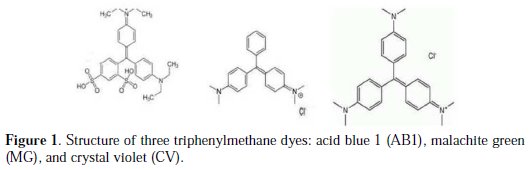
    <p>Acid blue 1, also called sulfan blue 5 or E131 VF, is a dark greenish synthetic 
triphenylmethane dye (<a href="#f1">Fig. 1</a>).</p>


    <p>&nbsp;</p>
<a name="f1">
<img src="/img/revistas/pea/v35n2/35n2a02f1.jpg">
    
<p>&nbsp;</p>


    <p>It is structurally very similar to the patent blue V 
and brilliant blue (three phenyl rings with different substituted groups). The 
mineralization of the mentioned dyes by persulfate failed [13, 15].</p>

    <p>The aim of this work is to study the electrochemical oxidation of aqueous 
solutions containing acid blue 1 (AB1) using a boron-doped diamond electrode. 
Thus, it is of interest to study the effect of some experimental parameters, such as 
the nature of the strong electrolyte, pH, temperature, current intensity, and others, 
on the indirect oxidation of the acid blue 1 on a BDD electrode.</p>


    <p>&nbsp;</p>
    ]]></body>
<body><![CDATA[<p><b>Experimental</b></p>

    <p>All chemical reagents used were of analytical grade. The food colorant AB1 is 
used as purchased from Sigma Aldrich (C27H31N2O6S2-Na, purity: 50 %, MW: 
565.67 g). Stock solution of acid blue 1 (AB1) was prepared by dissolving 40 mg 
in one liter of distilled water. The concentration of the dye in the reactional 
mixture was selected in such a way that the absorbance of the dye followed 
Beer's law. Most of the electrolysis experiments were done at room temperature 
(293 K), 2 mA for KBr, 5 mA for KCl and 20 mA for Na2SO4 and pH &sim;5, in 
presence of 8 mg L<sup>-1</sup> of AB1, 0.1 M, of the strong electrolyte. The experiments 
were carried out in a single electrolytic cell.</p>

    <p>BDD electrodes are bipolar plates (50&times;25&times;2 mm) from NeoCoaT (Switzerland). 
The distance between the two electrodes was 5 cm (undivided cell). The 
electrolysis was done with a Chrono-Amperostat, type CEAMD-6, from 
Taccusel. Measurements of pH were carried out using a Schott Gerate CG 819 
pH-meter.</p>

    <p>The discoloration rate of the food colorant was followed by measuring the 
absorbance at the maximum wavelength of AB1 (640 nm). UV-visible spectra 
were recorded on a double beam UV-visible spectrophotometer, in order to 
detect any shift in the &lambda;max or the appearance of a new band.</p>


    <p>&nbsp;</p>
    <p><b>Results and discussion</b></p>

    <p><i><b>Nature of the supporting electrolyte</b></i></p>

    <p>The strong electrolyte added to do the electrolysis has a great importance, since, 
in the first step, it is oxidized at the anode, and in the second step it probably 
oxidizes the organic compounds present in the solution. Therefore, the 
intermediates and the final products are a function of the strong electrolyte 
present in the medium. Four strong electrolytes are used in this study: KCl, KBr, 
KI and Na2SO4. The electrolysis in the presence of KI produces I2, which is a 
weak oxidant and, therefore, is not able to attack AB1 dye [the absorbance at 640 
nm (&lambda;max) did not vary with the electrolysis].</p>


    <p><i><b>Electrolysis in the presence of KCl</b></i></p>

    <p><i>Order with respect to AB1</i></p>

    ]]></body>
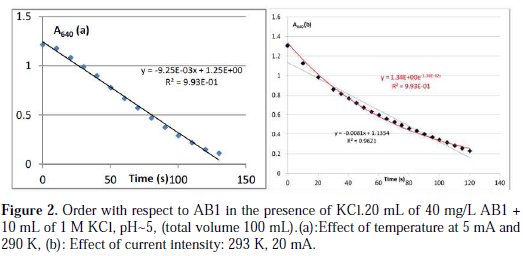
<body><![CDATA[<p>In the presence of KCl, the absorbance at 640 nm decreases with the time of 
electrolysis (<a href="#f2">Fig. 2</a>), but at 480 nm increases.</p>


    <p>&nbsp;</p>
<a name="f2">
<img src="/img/revistas/pea/v35n2/35n2a02f2.jpg">
    
<p>&nbsp;</p>


    <p>The time required for total 
discoloration or degradation is a function of the operational parameters which 
will be later discussed. A detailed discussion about the evolution of the UV-
visible spectrum is given in the paragraph on the effect of pH. At the pH (pH&sim;5) 
of the dye solution, the reaction occurred into two steps: the first one is fast and 
corresponds to a color change of the solution from deep blue to slight pink; and 
in a second step total discoloration occurred (slow step). So, the rate constant 
calculated in these conditions corresponds to the rate constant of the first step. 
The order with respect to AB1 is not clear; in fact, there is a strong competition 
between order zero and one. When studying the effect of temperature and the 
ionic force, the best order is zero (<a href="#f2">Fig. 2a</a>), but when studying the effect of KCl 
concentration and current intensity, the best order is 1 (<a href="#f2">Fig. 2b</a>), and finally, 
when studying the effect of dye concentration, for a given concentration, the best 
order is zero, and for other the best order is 1.</p>


    <p><i><b>Effect of the food colorant concentration</b></i></p>

    <p>At BDD electrode, the discoloration rate constant, ko,obs (slope of the line A640 vs. 
time), is approximately the same when the concentration varies in the range from 
2 to 8 mg L<sup>-1</sup> (4 different mixtures were prepared for this study); so, the rate 
constant ko,obs (ki for order i) does not vary with AB1 concentration, but the time 
needed to have total discoloration is proportional to the concentration of AB1.</p>


    <p><i><b>Effect of pH</b></i></p>

    <p>The UV-visible spectrum of AB1 aqueous solution shows three bands at 312 nm 
(smallest one), 414 nm, and 640 nm (highest one). AB1 has an acid-base 
property with pka equal to 2.2. In pH lower than 1, the AB1 solution is yellow 
(&lambda;max: 414 nm), and it is blue in pH higher than 3 (&lambda;max: 640 nm).</p>

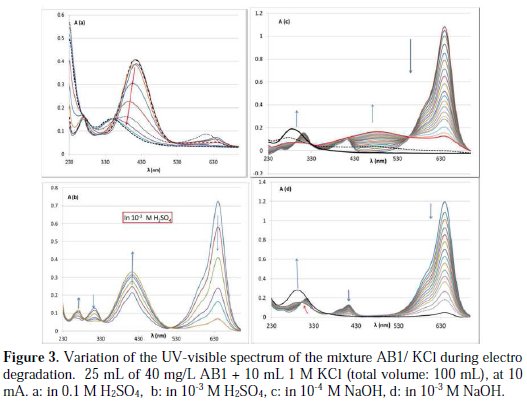
    <p><u>In 0.1 M H2SO4</u>: The solution is yellow. There is only one important band at 416 
nm and a small one at 274 nm. During electrolysis, there is a decrease in A414 
accompanied by a progressive blue shift to 346 nm, whereas the absorbance at 
274 nm remains &sim; constant. The yellow color of the solution faded slowly. 
According to the literature, the progressive blue shift is attributed to the 
dealkylation of the amino groups and partial degradation of the dye (<a href="#f3">Fig. 3a</a>) 
[24].</p>


    <p>&nbsp;</p>
<a name="f3">
<img src="/img/revistas/pea/v35n2/35n2a02f3.jpg">
    
]]></body>
<body><![CDATA[<p>&nbsp;</p>


    <p><u>In 0.01 M H2SO4</u>: At the beginning, the visible spectrum shows two bands at 414 
(more intense) and 640 nm. In the first step of electrolysis, the absorbance at 640 
nm decreases, but at 414 nm increases; then, the absorbance at 640 nm begins to 
increase with a blue shift to 628 nm, and at 414 nm continues to increase. At the 
end, the bands at 414 and 628 nm begin to decrease with a progressive blue shift 
to 604 nm (spectra not shown here).</p>

    <p><u>In 10<sup>-3</sup> M H2SO4</u>: At first, the solution changes with time from green to yellow, 
and then it becomes slowly transparent. The A640 and A314 decrease, whereas A414 
and A272 increase to reach a maximum (<a href="#f3">Fig. 3b</a>). The increase in A414 (&lambda;max of the 
acidic form) isn't because of the decrease in the pH of the solution, since there is 
a reduction of H+ on the cathode. Then, the absorbance at 640 begins to increase 
with a progressive blue shift to 604 nm, and at 414 begins to decrease. There are 
several isobestic points at 284, 328 and 510 nm. At the end, the absorbance at 
640 and 414 nm decreases, but the absorbance below 370 increases with the 
appearance of a new band at 330 nm (the spectra of the second step are removed 
for clearness of the figure).</p>

    <p><u>In water and in less basic medium (10<sup>-4</sup> M NaOH)</u>: The evolution of the UV-
visible spectrum in both mediums is approximately the same - the spectrum 
shows three bands at 314, 414, and 640 nm. A new large band appears with time 
(350 nm - 558 nm). At first, the solution changes from deep blue to slight pink, 
and then it becomes slowly transparent. There is a decrease in A640 and A314 nm, 
but an increase in A480 and A274 nm; the absorbance at 414 nm remains &sim; constant 
with time (<a href="#f3">Fig. 3c</a>). The decrease in A640 nm is linear with time, so, the order 
with respect to the discoloration of AB1 is zero. The rate constant decreases with 
the increase in pH. There are also three isobestic points at 294, 332 and 558 nm. 
After a certain time, the absorbance at 480 nm begins to decrease, and the 
absorbance at 640 nm continues to decrease, accompanied by the appearance of a 
new band at 274 nm (<a href="#f3">Fig. 3c</a>).</p>

    <p><u>In basic medium (10<sup>-3</sup> M NaOH)</u>: The UV-visible spectrum shows three bands at 
314, 414, and 640 nm. These three bands decrease during electrolysis (<a href="#f3">Fig. 3d</a>). 
The color of the solution passes from deep blue to transparent, without passing 
through the pink color. The same trend is observed in the presence of sulfate at 
the pH of the dye solution. Comparing the evolution of the UV-visible spectrum 
of AB1during electrolysis with that in ref. 20, we can say that total degradation 
of AB1occurred in basic medium in the presence of KCl.</p>

    <p>It is obvious that the pH of the medium is an important parameter which affects 
the mechanism of the reaction. HPLC MS will be helpful to determine the 
mechanism of the indirect oxidation of AB1.</p>

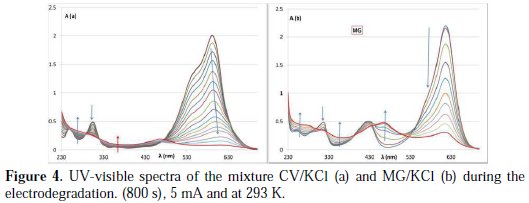
    <p>The comparison between the AB1 dye, crystal violet (CV) and malachite green 
(MG), with respect to the evolution of the UV-visible spectrum, shows different 
behaviors: in the case of CV, the solution changes from pink to faded blue during 
electrolysis.</p>

    <p>The decrease in A590 is accompanied by a bathochromic shift, due to the 
substitution of chlorine on the phenyl ring(s), or the deamination of one amino 
group (leading to an increase in resonance as in MG), then, degradation of the 
dye (<a href="#f4">Fig. 4a</a>)).</p>


    <p>&nbsp;</p>
<a name="f4">
<img src="/img/revistas/pea/v35n2/35n2a02f4.jpg">
    
<p>&nbsp;</p>


    ]]></body>
<body><![CDATA[<p>In the case of MG, which has two amino groups, the behavior is 
similar to AB1; in the first step, there is an increase in the region between 430 
and 500 nm, and a decrease in the band at 640 nm, and the absorbance at 426 
remains &sim; constant (<a href="#f4">Fig. 4b</a>).</p>


    <p><i><b>Effect of the current intensity</b></i></p>

    <p>Current intensity is also an important parameter in electrolysis. The generation of 
chlorine species by electrolysis was done at pH (pH&sim;5)of the dye solution in the 
presence of 8 mg L<sup>-1</sup> of AB1 and 0.1 M KCl (as final concentrations), at five 
constant currents ranging from 1 mA to 20 mA. As expected, the degradation rate 
constant increases linearly with the increase of the current intensity (k1obs&times;10><sup>3</sup> = 
0.688 &times; I(mA), R2: 0.997). The increase in the degradation rate is related to the 
increase in the production rate of chlorine species. Similar results were obtained 
with other organic compounds [25, 26].</p>


    <p><i><b>Effect of KCl concentration</b></i></p>

    <p>The effect of KCl concentration on the degradation rate was undertaken in the 
following conditions: 0 M &leq; [KCl] &leq; 0.2 M (KCl added), 8 mg L<sup>-1</sup> of AB1, pHo&sim; 
5, 293 K, with 5 mA. The rate constant increases linearly with the increase in 
KCl concentration (k1,obs x103: 0.87x [KCl](M)+ 2.5, R2: 0.986)(k1,obs: slope of 
the line lnA vs. time). The reason is that a higher amount of 
chlorine/hypochlorite will be generated, while increasing the chloride 
concentration, due to the increased mass transport of chloride ions to the anode 
surface [25]. This result confirms the discoloration and the degradation of the 
organic compounds via the electro-generated chloride species [26, 27]. The 
discoloration of the rate constant is not negligible when the volume of KCl added 
is zero, since the powder of AB1 contains already sulfate and chloride as 
impurities.</p>


    <p><i><b>Effect of the ionic force</b></i></p>

    <p>In the presence of a constant concentration of KCl (0.1 M), the rate constant Ko 
remains approximately constant with the increase of the ionic force by addition 
of several volumes of 1 M Na2SO4 (7 different mixtures were prepared for this 
study). Maybe this is because the powder of the food colorant already contains 
50 % of inorganic salts (sulfate and chloride).</p>


    <p><i><b>Effect of temperature</b></i></p>

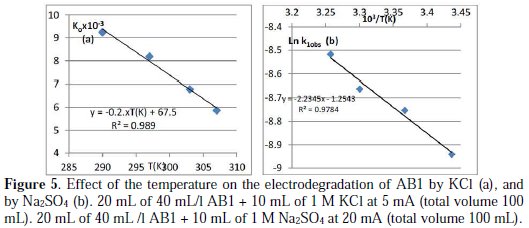
    <p>In general, any increase in temperature decreases the solubility of Cl2 in water 
and, therefore, decreases the discoloration rate constant of the dyes [28]. The 
effect of the temperature on the degradation rate was investigated with the 
conditions mentioned in the caption of <a href="#f5">Fig. 5a</a>.</p>


    <p>&nbsp;</p>
<a name="f5">
<img src="/img/revistas/pea/v35n2/35n2a02f5.jpg">
    
]]></body>
<body><![CDATA[<p>&nbsp;</p>


    <p>For the range of temperature between 280 and 303 K, ko decreases linearly with 
the increase of temperature (Ko &times; 103= -0.2&times;T(K) + 67.5, R2:0.989).</p>


    <p><i><b>In the presence of KBr</b></i></p>

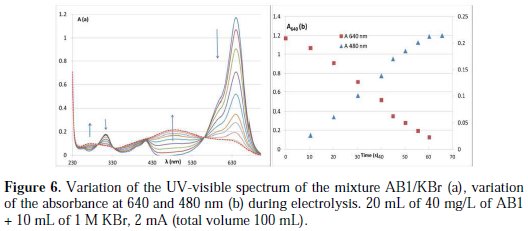
    <p>In the presence of KBr, the decrease in the A640 is four times faster than in the 
presence of KCl.</p>

    <p>At pH (pH&sim; 5) of the dye solution, the general shape of the spectrum vs. time is 
similar to that in the presence of KCl: there is a decrease in the absorbance at 640 
nm (&lambda;max), accompanied with an important increase in the absorbance in the zone 
from 414 to 560 nm (new band, &lambda;max: 480 nm) (<a href="#f6">Fig. 6a</a>).</p>


    <p>&nbsp;</p>
<a name="f6">
<img src="/img/revistas/pea/v35n2/35n2a02f6.jpg">
    
<p>&nbsp;</p>


    <p>The discoloration passes 
by two steps: the first one is fast and corresponds to a change of color from blue 
to brown pink; the second one is slower and corresponds to total discoloration. In 
the first step, the absorbance at 480 nm increases linearly with time. By varying 
the concentration of KBr in the medium, the order of the first step with respect to 
AB1 remains zero (<a href="#f6">Fig. 6b</a>), and the rate constant remains &sim; constant (five 
different mixtures were prepared for this study). In the absence of KBr, the rate 
constant is not zero, since the sample already contains a strong electrolyte as 
impurities (50 %).</p>

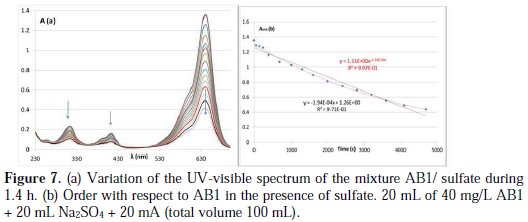
    <p>The discoloration in the presence of sulfate is very low with 5 mA; for this 
reason, the discoloration is done with 20 mA (more than 2 h are needed to have 
total discoloration, with 20 mA, <a href="#f7">Fig. 7</a>).</p>


    <p>&nbsp;</p>
<a name="f7">
<img src="/img/revistas/pea/v35n2/35n2a02f7.jpg">
    
]]></body>
<body><![CDATA[<p>&nbsp;</p>


    <p>In the same conditions, the rate constant 
is 40 times lower than in the presence of KCl. The behavior in the presence of 
sulfate is completely different, with no new band or isobestic point observed, but 
with a decrease in the whole spectrum with time (<a href="#f7">Fig. 7a</a>). The blue color faded 
progressively; no intermediate color is observed during the reaction, as was the 
case with KCl and KBr, where the blue color of AB1 turns pink to brown with 
time, and then becomes transparent. The best order with respect to AB1 is order 
1 (<a href="#f7">Fig. 7b</a>) (similar order is observed with malachite green [20]). According to 
the literature, in the presence of sulfate, AB1 undergoes total discoloration [17]. 
With a constant concentration of sulfate (0.05 M), the increase in the food color 
concentration leads to a negligible decrease in the k1obs rate constant. The 
increase in the concentration of sulfate in the medium from 0.05 to 0.4 M has no 
effect on the K1obs rate constant. The increase in pH from 1 to 4 causes a slight 
increase in the rate constant, from 1.35&times;10<sup>-4</sup> to 2.08&times;10<sup>-4</sup> (four different mixtures 
were prepared to study every parameter). Similar results are obtained with the 
electrodegradation of CV on the BDD electrode [17]. Finally, the increase in 
temperature increases the degradation rate of AB1 (<a href="#f5">Fig. 5b</a>). Similar effect is 
observed with other organic compounds on BDD electrode [29, 30].</p>

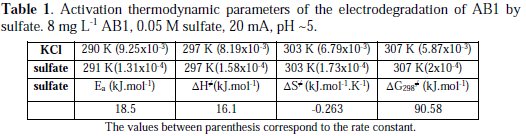
    <p>The activation parameters associated with the discoloration are calculated as 
follows: the plot of ln k1obs vs. 1/T gives the value of the activation energy (Ea), 
according to Arrhenius equation:</p>


    <p>&nbsp;</p>
<a name="e4">
<img src="/img/revistas/pea/v35n2/35n2a02e4.jpg">
    
<p>&nbsp;</p>


    <p>The &Delta;H<sup>#</sup>, &Delta;S<sup>#</sup> and &Delta;G<sup>#</sup> values can be calculated from the two equations:</p>


    <p>&nbsp;</p>
<a name="e5">
<img src="/img/revistas/pea/v35n2/35n2a02e5.jpg">
    
<p>&nbsp;</p>


    <p>The activation energy and the other kinetic parameters in the range of 
temperature studied (18 &deg;C - 34 &deg;C) are listed in <a href="#t1">Table 1</a>.</p>


    <p>&nbsp;</p>
<a name="t1">
<img src="/img/revistas/pea/v35n2/35n2a02t1.jpg">
    
]]></body>
<body><![CDATA[<p>&nbsp;</p>


    <p>&nbsp;</p>
    <p><b>Conclusions</b></p>

    <p>At BDD electrode, the discoloration of AB1 in the presence of sulfate is too 
much slower than in the presence of KCl and KBr. The increase in the current 
intensity, the dye concentration, and the ionic force follow identical behaviors in 
both kind of salts, but the same does not happen with respect to the temperature. 
Total degradation occurred in the presence of sulfate and in the presence of KCl 
in a basic medium. In the presence of KCl, the pH of the medium strongly affects 
the reaction mechanism; HPLC MS will help us have an idea about the 
intermediates of the reaction at different pH and confirm if there is total 
degradation.</p>


    <p>&nbsp;</p>
    <p><b>References</b></p>

    <!-- ref --><p>1. Robinson T, McMullan G, Marchant R, et al. Bioresource Technol. 2001;77:247.    &nbsp;&nbsp;&nbsp;&nbsp;&nbsp;&nbsp;&nbsp;&nbsp;[&#160;<a href="javascript:void(0);" onclick="javascript: window.open('/scielo.php?script=sci_nlinks&ref=425948&pid=S0872-1904201700020000200001&lng=','','width=640,height=500,resizable=yes,scrollbars=1,menubar=yes,');">Links</a>&#160;]<!-- end-ref --></p>

    <!-- ref --><p>2. Fonovich T M. Drug Chem Toxicol. 2012;36:343.    &nbsp;&nbsp;&nbsp;&nbsp;&nbsp;&nbsp;&nbsp;&nbsp;[&#160;<a href="javascript:void(0);" onclick="javascript: window.open('/scielo.php?script=sci_nlinks&ref=425950&pid=S0872-1904201700020000200002&lng=','','width=640,height=500,resizable=yes,scrollbars=1,menubar=yes,');">Links</a>&#160;]<!-- end-ref --></p>

    ]]></body>
<body><![CDATA[<!-- ref --><p>3. Inetianbor J E, Yakubu J M, Ezeonn SC. Asian J Sci Technol. 2015;6:1118.    &nbsp;&nbsp;&nbsp;&nbsp;&nbsp;&nbsp;&nbsp;&nbsp;[&#160;<a href="javascript:void(0);" onclick="javascript: window.open('/scielo.php?script=sci_nlinks&ref=425952&pid=S0872-1904201700020000200003&lng=','','width=640,height=500,resizable=yes,scrollbars=1,menubar=yes,');">Links</a>&#160;]<!-- end-ref --></p>

    <p>4. EFSA Journal, Parma, Italy, 2013:11(3):2818, ''Re-evaluation of Patent Blue V (E 131) as a food additive''</p>

    <!-- ref --><p>5. Rammal R S, Zatiti S A, El Jamal MM. JUCTM (Sofia). 2011;46:283.    &nbsp;&nbsp;&nbsp;&nbsp;&nbsp;&nbsp;&nbsp;&nbsp;[&#160;<a href="javascript:void(0);" onclick="javascript: window.open('/scielo.php?script=sci_nlinks&ref=425955&pid=S0872-1904201700020000200005&lng=','','width=640,height=500,resizable=yes,scrollbars=1,menubar=yes,');">Links</a>&#160;]<!-- end-ref --></p>

    <!-- ref --><p>6. Bulut E, Ozacar M, Sengil I A. Microp Mesop Mater. 2008;115:234.    &nbsp;&nbsp;&nbsp;&nbsp;&nbsp;&nbsp;&nbsp;&nbsp;[&#160;<a href="javascript:void(0);" onclick="javascript: window.open('/scielo.php?script=sci_nlinks&ref=425957&pid=S0872-1904201700020000200006&lng=','','width=640,height=500,resizable=yes,scrollbars=1,menubar=yes,');">Links</a>&#160;]<!-- end-ref --></p>

    <!-- ref --><p>7. Lucova M, Hojerova J, Pazourekova S, et al. Food Chem Toxic. 2013;52:19.    &nbsp;&nbsp;&nbsp;&nbsp;&nbsp;&nbsp;&nbsp;&nbsp;[&#160;<a href="javascript:void(0);" onclick="javascript: window.open('/scielo.php?script=sci_nlinks&ref=425959&pid=S0872-1904201700020000200007&lng=','','width=640,height=500,resizable=yes,scrollbars=1,menubar=yes,');">Links</a>&#160;]<!-- end-ref --></p>

    <!-- ref --><p>8. Chaube P, Indurkar H, Moghe S. Asiatic J Biotech Res. 2010;1:45.    &nbsp;&nbsp;&nbsp;&nbsp;&nbsp;&nbsp;&nbsp;&nbsp;[&#160;<a href="javascript:void(0);" onclick="javascript: window.open('/scielo.php?script=sci_nlinks&ref=425961&pid=S0872-1904201700020000200008&lng=','','width=640,height=500,resizable=yes,scrollbars=1,menubar=yes,');">Links</a>&#160;]<!-- end-ref --></p>

    <!-- ref --><p>9. Diao Z-H, Xu X-R et al. Sep Purif Technol. 2015;154:168.    &nbsp;&nbsp;&nbsp;&nbsp;&nbsp;&nbsp;&nbsp;&nbsp;[&#160;<a href="javascript:void(0);" onclick="javascript: window.open('/scielo.php?script=sci_nlinks&ref=425963&pid=S0872-1904201700020000200009&lng=','','width=640,height=500,resizable=yes,scrollbars=1,menubar=yes,');">Links</a>&#160;]<!-- end-ref --></p>

    <!-- ref --><p>10. Barka N, Qourzal S, Assabbane A, et al. Chem Eng Comm. 2011;198:1233.    &nbsp;&nbsp;&nbsp;&nbsp;&nbsp;&nbsp;&nbsp;&nbsp;[&#160;<a href="javascript:void(0);" onclick="javascript: window.open('/scielo.php?script=sci_nlinks&ref=425965&pid=S0872-1904201700020000200010&lng=','','width=640,height=500,resizable=yes,scrollbars=1,menubar=yes,');">Links</a>&#160;]<!-- end-ref --></p>

    <!-- ref --><p>11. Chen C-C, Fan H-J, Jan J-L. J Phys Chem C. 2008;112:11962.    &nbsp;&nbsp;&nbsp;&nbsp;&nbsp;&nbsp;&nbsp;&nbsp;[&#160;<a href="javascript:void(0);" onclick="javascript: window.open('/scielo.php?script=sci_nlinks&ref=425967&pid=S0872-1904201700020000200011&lng=','','width=640,height=500,resizable=yes,scrollbars=1,menubar=yes,');">Links</a>&#160;]<!-- end-ref --></p>

    <!-- ref --><p>12. Saquib M, Tariq M A, Faisal M, et al. Desalination. 2008;219:301.    &nbsp;&nbsp;&nbsp;&nbsp;&nbsp;&nbsp;&nbsp;&nbsp;[&#160;<a href="javascript:void(0);" onclick="javascript: window.open('/scielo.php?script=sci_nlinks&ref=425969&pid=S0872-1904201700020000200012&lng=','','width=640,height=500,resizable=yes,scrollbars=1,menubar=yes,');">Links</a>&#160;]<!-- end-ref --></p>

    <!-- ref --><p>13. Gosetti F, Gennaro M C, et al. J Chromatography A. 2004;1054:379.    &nbsp;&nbsp;&nbsp;&nbsp;&nbsp;&nbsp;&nbsp;&nbsp;[&#160;<a href="javascript:void(0);" onclick="javascript: window.open('/scielo.php?script=sci_nlinks&ref=425971&pid=S0872-1904201700020000200013&lng=','','width=640,height=500,resizable=yes,scrollbars=1,menubar=yes,');">Links</a>&#160;]<!-- end-ref --></p>

    <!-- ref --><p>14. Fayoumi L M A, Ezzedine M A, Akel H H, et al. Port Electrochim Acta. 2012;30:121.    &nbsp;&nbsp;&nbsp;&nbsp;&nbsp;&nbsp;&nbsp;&nbsp;[&#160;<a href="javascript:void(0);" onclick="javascript: window.open('/scielo.php?script=sci_nlinks&ref=425973&pid=S0872-1904201700020000200014&lng=','','width=640,height=500,resizable=yes,scrollbars=1,menubar=yes,');">Links</a>&#160;]<!-- end-ref --></p>

    <!-- ref --><p>15. Elddine H A N, Damaj Z K, Yazbeck O A, et al. Port Electrochim Acta. 2015;33:275.    &nbsp;&nbsp;&nbsp;&nbsp;&nbsp;&nbsp;&nbsp;&nbsp;[&#160;<a href="javascript:void(0);" onclick="javascript: window.open('/scielo.php?script=sci_nlinks&ref=425975&pid=S0872-1904201700020000200015&lng=','','width=640,height=500,resizable=yes,scrollbars=1,menubar=yes,');">Links</a>&#160;]<!-- end-ref --></p>

    <!-- ref --><p>16. Nava J L, Quiroz M A, Martinez-Huitle C A. J Mex Chem Soc. 2008;52:249.    &nbsp;&nbsp;&nbsp;&nbsp;&nbsp;&nbsp;&nbsp;&nbsp;[&#160;<a href="javascript:void(0);" onclick="javascript: window.open('/scielo.php?script=sci_nlinks&ref=425977&pid=S0872-1904201700020000200016&lng=','','width=640,height=500,resizable=yes,scrollbars=1,menubar=yes,');">Links</a>&#160;]<!-- end-ref --></p>

    <!-- ref --><p>17. Palma-Goyes RE, Torres-Palma RA, et al. Chemosphere. 2010;81:26.    &nbsp;&nbsp;&nbsp;&nbsp;&nbsp;&nbsp;&nbsp;&nbsp;[&#160;<a href="javascript:void(0);" onclick="javascript: window.open('/scielo.php?script=sci_nlinks&ref=425979&pid=S0872-1904201700020000200017&lng=','','width=640,height=500,resizable=yes,scrollbars=1,menubar=yes,');">Links</a>&#160;]<!-- end-ref --></p>

    <!-- ref --><p>18. Hamza M, Abdelhedi R, Brillas E, et al. J Electroanal Chem. 2009;627:41.    &nbsp;&nbsp;&nbsp;&nbsp;&nbsp;&nbsp;&nbsp;&nbsp;[&#160;<a href="javascript:void(0);" onclick="javascript: window.open('/scielo.php?script=sci_nlinks&ref=425981&pid=S0872-1904201700020000200018&lng=','','width=640,height=500,resizable=yes,scrollbars=1,menubar=yes,');">Links</a>&#160;]<!-- end-ref --></p>

    <!-- ref --><p>19. Rao A N S, Venkatarangaiah V T. Port Electrochim Acta. 2014;32:213.    &nbsp;&nbsp;&nbsp;&nbsp;&nbsp;&nbsp;&nbsp;&nbsp;[&#160;<a href="javascript:void(0);" onclick="javascript: window.open('/scielo.php?script=sci_nlinks&ref=425983&pid=S0872-1904201700020000200019&lng=','','width=640,height=500,resizable=yes,scrollbars=1,menubar=yes,');">Links</a>&#160;]<!-- end-ref --></p>

    <!-- ref --><p>20. Guenfoud F, Mokhtari M, Akrout H. Diamond Related Mater. 2014;46:8.    &nbsp;&nbsp;&nbsp;&nbsp;&nbsp;&nbsp;&nbsp;&nbsp;[&#160;<a href="javascript:void(0);" onclick="javascript: window.open('/scielo.php?script=sci_nlinks&ref=425985&pid=S0872-1904201700020000200020&lng=','','width=640,height=500,resizable=yes,scrollbars=1,menubar=yes,');">Links</a>&#160;]<!-- end-ref --></p>

    <!-- ref --><p>21. Martinez-Huitle C A, Alfaro M A Q, J Environ Eng Manag. 2008;18:155.    &nbsp;&nbsp;&nbsp;&nbsp;&nbsp;&nbsp;&nbsp;&nbsp;[&#160;<a href="javascript:void(0);" onclick="javascript: window.open('/scielo.php?script=sci_nlinks&ref=425987&pid=S0872-1904201700020000200021&lng=','','width=640,height=500,resizable=yes,scrollbars=1,menubar=yes,');">Links</a>&#160;]<!-- end-ref --></p>

    <!-- ref --><p>22. Enache T A, Chiorcea-Paquim A-M, Fatibello-Filho O, et al. Electrochem Comm. 2009;11:1342.    &nbsp;&nbsp;&nbsp;&nbsp;&nbsp;&nbsp;&nbsp;&nbsp;[&#160;<a href="javascript:void(0);" onclick="javascript: window.open('/scielo.php?script=sci_nlinks&ref=425989&pid=S0872-1904201700020000200022&lng=','','width=640,height=500,resizable=yes,scrollbars=1,menubar=yes,');">Links</a>&#160;]<!-- end-ref --></p>

    <!-- ref --><p>23. Souza R B A, Ruotolo LAM. Int J Electrochem Sci. 2013;8:643.    &nbsp;&nbsp;&nbsp;&nbsp;&nbsp;&nbsp;&nbsp;&nbsp;[&#160;<a href="javascript:void(0);" onclick="javascript: window.open('/scielo.php?script=sci_nlinks&ref=425991&pid=S0872-1904201700020000200023&lng=','','width=640,height=500,resizable=yes,scrollbars=1,menubar=yes,');">Links</a>&#160;]<!-- end-ref --></p>

    <!-- ref --><p>24. Chen C-C, Lu C-S, Mai F-D, et al. J Haz Mat. 2006; B137:1600.    &nbsp;&nbsp;&nbsp;&nbsp;&nbsp;&nbsp;&nbsp;&nbsp;[&#160;<a href="javascript:void(0);" onclick="javascript: window.open('/scielo.php?script=sci_nlinks&ref=425993&pid=S0872-1904201700020000200024&lng=','','width=640,height=500,resizable=yes,scrollbars=1,menubar=yes,');">Links</a>&#160;]<!-- end-ref --></p>

    <!-- ref --><p>25. Rajkumar D, Jong G K. J Haz Mat. 2006;B136:203.    &nbsp;&nbsp;&nbsp;&nbsp;&nbsp;&nbsp;&nbsp;&nbsp;[&#160;<a href="javascript:void(0);" onclick="javascript: window.open('/scielo.php?script=sci_nlinks&ref=425995&pid=S0872-1904201700020000200025&lng=','','width=640,height=500,resizable=yes,scrollbars=1,menubar=yes,');">Links</a>&#160;]<!-- end-ref --></p>

    <!-- ref --><p>26. El Jamal M M, Mousaoui A M, Naoufal D M, et al. Port Electrochim Acta. 2014;32:233.    &nbsp;&nbsp;&nbsp;&nbsp;&nbsp;&nbsp;&nbsp;&nbsp;[&#160;<a href="javascript:void(0);" onclick="javascript: window.open('/scielo.php?script=sci_nlinks&ref=425997&pid=S0872-1904201700020000200026&lng=','','width=640,height=500,resizable=yes,scrollbars=1,menubar=yes,');">Links</a>&#160;]<!-- end-ref --></p>

    <!-- ref --><p>27. Tabarra MA, Mallah HA, El Jamal MM. J Chem Technol Metall (Sofia). 2014;49:12.    &nbsp;&nbsp;&nbsp;&nbsp;&nbsp;&nbsp;&nbsp;&nbsp;[&#160;<a href="javascript:void(0);" onclick="javascript: window.open('/scielo.php?script=sci_nlinks&ref=425999&pid=S0872-1904201700020000200027&lng=','','width=640,height=500,resizable=yes,scrollbars=1,menubar=yes,');">Links</a>&#160;]<!-- end-ref --></p>

    <!-- ref --><p>28. Schmittinger P. Chlorine. In: Ullmann's Encyclopaedia, vol. 6A. Weinheim: VCH; 1986. P.399.    &nbsp;&nbsp;&nbsp;&nbsp;&nbsp;&nbsp;&nbsp;&nbsp;[&#160;<a href="javascript:void(0);" onclick="javascript: window.open('/scielo.php?script=sci_nlinks&ref=426001&pid=S0872-1904201700020000200028&lng=','','width=640,height=500,resizable=yes,scrollbars=1,menubar=yes,');">Links</a>&#160;]<!-- end-ref --></p>

    <!-- ref --><p>29. Chen T-S, Kuo Y-M, Chen J-L, et al. Int J Electrochem Sci. 2013;8:7625.    &nbsp;&nbsp;&nbsp;&nbsp;&nbsp;&nbsp;&nbsp;&nbsp;[&#160;<a href="javascript:void(0);" onclick="javascript: window.open('/scielo.php?script=sci_nlinks&ref=426003&pid=S0872-1904201700020000200029&lng=','','width=640,height=500,resizable=yes,scrollbars=1,menubar=yes,');">Links</a>&#160;]<!-- end-ref --></p>

    <!-- ref --><p>30. Chen T-S, Huang K-L. Int J Electrochem Sci. 2013;8:6343.    &nbsp;&nbsp;&nbsp;&nbsp;&nbsp;&nbsp;&nbsp;&nbsp;[&#160;<a href="javascript:void(0);" onclick="javascript: window.open('/scielo.php?script=sci_nlinks&ref=426005&pid=S0872-1904201700020000200030&lng=','','width=640,height=500,resizable=yes,scrollbars=1,menubar=yes,');">Links</a>&#160;]<!-- end-ref --></p>


    <p>&nbsp;</p>
    <p><b>Acknowledgements</b></p>

    <p>The author thanks the Lebanese University for providing financial assistance to carry 
out this work.</p>


    <p>&nbsp;</p>
    <p><a name=0></a><sup><a href="#top">*</a></sup>Corresponding author. E-mail address: <a href="mailto:mjamal@ul.edu.lb">mjamal@ul.edu.lb</a></p>

    ]]></body>
<body><![CDATA[<p>Received June 30, 2016; accepted December 9, 2016</p>

    <p><a href="http://www.peacta.org" target="_blank">www.peacta.org</a> </p>


     ]]></body><back>
<ref-list>
<ref id="B1">
<label>1</label><nlm-citation citation-type="journal">
<person-group person-group-type="author">
<name>
<surname><![CDATA[Robinson]]></surname>
<given-names><![CDATA[T]]></given-names>
</name>
<name>
<surname><![CDATA[McMullan]]></surname>
<given-names><![CDATA[G]]></given-names>
</name>
<name>
<surname><![CDATA[Marchant]]></surname>
<given-names><![CDATA[R]]></given-names>
</name>
</person-group>
<source><![CDATA[Bioresource Technol]]></source>
<year>2001</year>
<volume>77</volume>
<page-range>247</page-range></nlm-citation>
</ref>
<ref id="B2">
<label>2</label><nlm-citation citation-type="journal">
<person-group person-group-type="author">
<name>
<surname><![CDATA[Fonovich]]></surname>
<given-names><![CDATA[T M]]></given-names>
</name>
</person-group>
<source><![CDATA[Drug Chem Toxicol]]></source>
<year>2012</year>
<volume>36</volume>
<page-range>343</page-range></nlm-citation>
</ref>
<ref id="B3">
<label>3</label><nlm-citation citation-type="journal">
<person-group person-group-type="author">
<name>
<surname><![CDATA[Inetianbor]]></surname>
<given-names><![CDATA[J E]]></given-names>
</name>
<name>
<surname><![CDATA[Yakubu]]></surname>
<given-names><![CDATA[J M]]></given-names>
</name>
<name>
<surname><![CDATA[Ezeonn]]></surname>
<given-names><![CDATA[S C]]></given-names>
</name>
</person-group>
<source><![CDATA[Asian J Sci Technol]]></source>
<year>2015</year>
<volume>6</volume>
<page-range>1118</page-range></nlm-citation>
</ref>
<ref id="B4">
<label>4</label><nlm-citation citation-type="journal">
<source><![CDATA[EFSA Journal, Parma, Italy]]></source>
<year>2013</year>
<volume>11</volume>
<page-range>2818</page-range></nlm-citation>
</ref>
<ref id="B5">
<label>5</label><nlm-citation citation-type="journal">
<person-group person-group-type="author">
<name>
<surname><![CDATA[Rammal]]></surname>
<given-names><![CDATA[R S]]></given-names>
</name>
<name>
<surname><![CDATA[Zatiti]]></surname>
<given-names><![CDATA[S A]]></given-names>
</name>
<name>
<surname><![CDATA[El Jamal]]></surname>
<given-names><![CDATA[M M]]></given-names>
</name>
</person-group>
<source><![CDATA[JUCTM (Sofia)]]></source>
<year>2011</year>
<volume>46</volume>
<page-range>283</page-range></nlm-citation>
</ref>
<ref id="B6">
<label>6</label><nlm-citation citation-type="journal">
<person-group person-group-type="author">
<name>
<surname><![CDATA[Bulut]]></surname>
<given-names><![CDATA[E]]></given-names>
</name>
<name>
<surname><![CDATA[Ozacar]]></surname>
<given-names><![CDATA[M]]></given-names>
</name>
<name>
<surname><![CDATA[Sengil]]></surname>
<given-names><![CDATA[I A]]></given-names>
</name>
</person-group>
<source><![CDATA[Microp Mesop Mater]]></source>
<year>2008</year>
<volume>115</volume>
<page-range>234</page-range></nlm-citation>
</ref>
<ref id="B7">
<label>7</label><nlm-citation citation-type="journal">
<person-group person-group-type="author">
<name>
<surname><![CDATA[Lucova]]></surname>
<given-names><![CDATA[M]]></given-names>
</name>
<name>
<surname><![CDATA[Hojerova]]></surname>
<given-names><![CDATA[J]]></given-names>
</name>
<name>
<surname><![CDATA[Pazourekova]]></surname>
<given-names><![CDATA[S]]></given-names>
</name>
</person-group>
<source><![CDATA[Food Chem Toxic]]></source>
<year>2013</year>
<volume>52</volume>
<page-range>19</page-range></nlm-citation>
</ref>
<ref id="B8">
<label>8</label><nlm-citation citation-type="journal">
<person-group person-group-type="author">
<name>
<surname><![CDATA[Chaube]]></surname>
<given-names><![CDATA[P]]></given-names>
</name>
<name>
<surname><![CDATA[Indurkar]]></surname>
<given-names><![CDATA[H]]></given-names>
</name>
<name>
<surname><![CDATA[Moghe]]></surname>
<given-names><![CDATA[S]]></given-names>
</name>
</person-group>
<source><![CDATA[Asiatic J Biotech Res]]></source>
<year>2010</year>
<volume>1</volume>
<page-range>45</page-range></nlm-citation>
</ref>
<ref id="B9">
<label>9</label><nlm-citation citation-type="journal">
<person-group person-group-type="author">
<name>
<surname><![CDATA[Diao]]></surname>
<given-names><![CDATA[Z-H]]></given-names>
</name>
<name>
<surname><![CDATA[Xu]]></surname>
<given-names><![CDATA[X-R]]></given-names>
</name>
</person-group>
<source><![CDATA[Sep Purif Technol]]></source>
<year>2015</year>
<volume>154</volume>
<page-range>168</page-range></nlm-citation>
</ref>
<ref id="B10">
<label>10</label><nlm-citation citation-type="journal">
<person-group person-group-type="author">
<name>
<surname><![CDATA[Barka]]></surname>
<given-names><![CDATA[N]]></given-names>
</name>
<name>
<surname><![CDATA[Qourzal]]></surname>
<given-names><![CDATA[S]]></given-names>
</name>
<name>
<surname><![CDATA[Assabbane]]></surname>
<given-names><![CDATA[A]]></given-names>
</name>
</person-group>
<source><![CDATA[Chem Eng Comm]]></source>
<year>2011</year>
<volume>198</volume>
<page-range>1233</page-range></nlm-citation>
</ref>
<ref id="B11">
<label>11</label><nlm-citation citation-type="journal">
<person-group person-group-type="author">
<name>
<surname><![CDATA[Chen]]></surname>
<given-names><![CDATA[C-C]]></given-names>
</name>
<name>
<surname><![CDATA[Fan]]></surname>
<given-names><![CDATA[H-J]]></given-names>
</name>
<name>
<surname><![CDATA[Jan]]></surname>
<given-names><![CDATA[J-L]]></given-names>
</name>
</person-group>
<source><![CDATA[J Phys Chem C]]></source>
<year>2008</year>
<volume>112</volume>
<page-range>11962</page-range></nlm-citation>
</ref>
<ref id="B12">
<label>12</label><nlm-citation citation-type="journal">
<person-group person-group-type="author">
<name>
<surname><![CDATA[Saquib]]></surname>
<given-names><![CDATA[M]]></given-names>
</name>
<name>
<surname><![CDATA[Tariq]]></surname>
<given-names><![CDATA[M A]]></given-names>
</name>
<name>
<surname><![CDATA[Faisal]]></surname>
<given-names><![CDATA[M]]></given-names>
</name>
</person-group>
<source><![CDATA[Desalination]]></source>
<year>2008</year>
<volume>219</volume>
<page-range>301</page-range></nlm-citation>
</ref>
<ref id="B13">
<label>13</label><nlm-citation citation-type="journal">
<person-group person-group-type="author">
<name>
<surname><![CDATA[Gosetti]]></surname>
<given-names><![CDATA[F]]></given-names>
</name>
<name>
<surname><![CDATA[Gennaro]]></surname>
<given-names><![CDATA[M C]]></given-names>
</name>
</person-group>
<source><![CDATA[J Chromatography A]]></source>
<year>2004</year>
<volume>1054</volume>
<page-range>379</page-range></nlm-citation>
</ref>
<ref id="B14">
<label>14</label><nlm-citation citation-type="journal">
<person-group person-group-type="author">
<name>
<surname><![CDATA[Fayoumi]]></surname>
<given-names><![CDATA[L M A]]></given-names>
</name>
<name>
<surname><![CDATA[Ezzedine]]></surname>
<given-names><![CDATA[M A]]></given-names>
</name>
<name>
<surname><![CDATA[Akel]]></surname>
<given-names><![CDATA[H H]]></given-names>
</name>
</person-group>
<source><![CDATA[Port Electrochim Acta]]></source>
<year>2012</year>
<volume>30</volume>
<page-range>121</page-range></nlm-citation>
</ref>
<ref id="B15">
<label>15</label><nlm-citation citation-type="journal">
<person-group person-group-type="author">
<name>
<surname><![CDATA[Elddine]]></surname>
<given-names><![CDATA[H A N]]></given-names>
</name>
<name>
<surname><![CDATA[Damaj]]></surname>
<given-names><![CDATA[Z K]]></given-names>
</name>
<name>
<surname><![CDATA[Yazbeck]]></surname>
<given-names><![CDATA[O A]]></given-names>
</name>
</person-group>
<source><![CDATA[Port Electrochim Acta]]></source>
<year>2015</year>
<volume>33</volume>
<page-range>275</page-range></nlm-citation>
</ref>
<ref id="B16">
<label>16</label><nlm-citation citation-type="journal">
<person-group person-group-type="author">
<name>
<surname><![CDATA[Nava]]></surname>
<given-names><![CDATA[J L]]></given-names>
</name>
<name>
<surname><![CDATA[Quiroz]]></surname>
<given-names><![CDATA[M A]]></given-names>
</name>
<name>
<surname><![CDATA[Martinez-Huitle]]></surname>
<given-names><![CDATA[C A]]></given-names>
</name>
</person-group>
<source><![CDATA[J Mex Chem Soc]]></source>
<year>2008</year>
<volume>52</volume>
<page-range>249</page-range></nlm-citation>
</ref>
<ref id="B17">
<label>17</label><nlm-citation citation-type="journal">
<person-group person-group-type="author">
<name>
<surname><![CDATA[Palma-Goyes]]></surname>
<given-names><![CDATA[R E]]></given-names>
</name>
<name>
<surname><![CDATA[Torres-Palma]]></surname>
<given-names><![CDATA[R A]]></given-names>
</name>
</person-group>
<source><![CDATA[Chemosphere]]></source>
<year>2010</year>
<volume>81</volume>
<page-range>26</page-range></nlm-citation>
</ref>
<ref id="B18">
<label>18</label><nlm-citation citation-type="journal">
<person-group person-group-type="author">
<name>
<surname><![CDATA[Hamza]]></surname>
<given-names><![CDATA[M]]></given-names>
</name>
<name>
<surname><![CDATA[Abdelhedi]]></surname>
<given-names><![CDATA[R]]></given-names>
</name>
<name>
<surname><![CDATA[Brillas]]></surname>
<given-names><![CDATA[E]]></given-names>
</name>
</person-group>
<source><![CDATA[J Electroanal Chem]]></source>
<year>2009</year>
<volume>627</volume>
<page-range>41</page-range></nlm-citation>
</ref>
<ref id="B19">
<label>19</label><nlm-citation citation-type="journal">
<person-group person-group-type="author">
<name>
<surname><![CDATA[Rao]]></surname>
<given-names><![CDATA[A N S]]></given-names>
</name>
<name>
<surname><![CDATA[Venkatarangaiah]]></surname>
<given-names><![CDATA[V T]]></given-names>
</name>
</person-group>
<source><![CDATA[Port Electrochim Acta]]></source>
<year>2014</year>
<volume>32</volume>
<page-range>213</page-range></nlm-citation>
</ref>
<ref id="B20">
<label>20</label><nlm-citation citation-type="journal">
<person-group person-group-type="author">
<name>
<surname><![CDATA[Guenfoud]]></surname>
<given-names><![CDATA[F]]></given-names>
</name>
<name>
<surname><![CDATA[Mokhtari]]></surname>
<given-names><![CDATA[M]]></given-names>
</name>
<name>
<surname><![CDATA[Akrout]]></surname>
<given-names><![CDATA[H]]></given-names>
</name>
</person-group>
<source><![CDATA[Diamond Related Mater]]></source>
<year>2014</year>
<volume>46</volume>
<page-range>8</page-range></nlm-citation>
</ref>
<ref id="B21">
<label>21</label><nlm-citation citation-type="journal">
<person-group person-group-type="author">
<name>
<surname><![CDATA[Martinez-Huitle]]></surname>
<given-names><![CDATA[C A]]></given-names>
</name>
<name>
<surname><![CDATA[Alfaro]]></surname>
<given-names><![CDATA[M A Q]]></given-names>
</name>
</person-group>
<source><![CDATA[J Environ Eng Manag]]></source>
<year>2008</year>
<volume>18</volume>
<page-range>155</page-range></nlm-citation>
</ref>
<ref id="B22">
<label>22</label><nlm-citation citation-type="journal">
<person-group person-group-type="author">
<name>
<surname><![CDATA[Enache]]></surname>
<given-names><![CDATA[T A]]></given-names>
</name>
<name>
<surname><![CDATA[Chiorcea-Paquim]]></surname>
<given-names><![CDATA[A-M]]></given-names>
</name>
<name>
<surname><![CDATA[Fatibello-Filho]]></surname>
<given-names><![CDATA[O]]></given-names>
</name>
</person-group>
<source><![CDATA[Electrochem Comm]]></source>
<year>2009</year>
<volume>11</volume>
<page-range>1342</page-range></nlm-citation>
</ref>
<ref id="B23">
<label>23</label><nlm-citation citation-type="journal">
<person-group person-group-type="author">
<name>
<surname><![CDATA[Souza]]></surname>
<given-names><![CDATA[R B A]]></given-names>
</name>
<name>
<surname><![CDATA[Ruotolo]]></surname>
<given-names><![CDATA[L A M]]></given-names>
</name>
</person-group>
<source><![CDATA[Int J Electrochem Sci]]></source>
<year>2013</year>
<volume>8</volume>
<page-range>643</page-range></nlm-citation>
</ref>
<ref id="B24">
<label>24</label><nlm-citation citation-type="journal">
<person-group person-group-type="author">
<name>
<surname><![CDATA[Chen]]></surname>
<given-names><![CDATA[C-C]]></given-names>
</name>
<name>
<surname><![CDATA[Lu]]></surname>
<given-names><![CDATA[C-S]]></given-names>
</name>
<name>
<surname><![CDATA[Mai]]></surname>
<given-names><![CDATA[F-D]]></given-names>
</name>
</person-group>
<source><![CDATA[J Haz Mat]]></source>
<year>2006</year>
<volume>B137</volume>
<page-range>1600</page-range></nlm-citation>
</ref>
<ref id="B25">
<label>25</label><nlm-citation citation-type="journal">
<person-group person-group-type="author">
<name>
<surname><![CDATA[Rajkumar]]></surname>
<given-names><![CDATA[D]]></given-names>
</name>
<name>
<surname><![CDATA[Jong]]></surname>
<given-names><![CDATA[G K]]></given-names>
</name>
</person-group>
<source><![CDATA[J Haz Mat]]></source>
<year>2006</year>
<volume>B136</volume>
<page-range>203</page-range></nlm-citation>
</ref>
<ref id="B26">
<label>26</label><nlm-citation citation-type="journal">
<person-group person-group-type="author">
<name>
<surname><![CDATA[El Jamal]]></surname>
<given-names><![CDATA[M M]]></given-names>
</name>
<name>
<surname><![CDATA[Mousaoui]]></surname>
<given-names><![CDATA[A M]]></given-names>
</name>
<name>
<surname><![CDATA[Naoufal]]></surname>
<given-names><![CDATA[D M]]></given-names>
</name>
</person-group>
<source><![CDATA[Port Electrochim Acta]]></source>
<year>2014</year>
<volume>32</volume>
<page-range>233</page-range></nlm-citation>
</ref>
<ref id="B27">
<label>27</label><nlm-citation citation-type="journal">
<person-group person-group-type="author">
<name>
<surname><![CDATA[Tabarra]]></surname>
<given-names><![CDATA[M A]]></given-names>
</name>
<name>
<surname><![CDATA[Mallah]]></surname>
<given-names><![CDATA[H A]]></given-names>
</name>
<name>
<surname><![CDATA[El Jamal]]></surname>
<given-names><![CDATA[M M]]></given-names>
</name>
</person-group>
<source><![CDATA[J Chem Technol Metall (Sofia)]]></source>
<year>2014</year>
<volume>49</volume>
<page-range>12</page-range></nlm-citation>
</ref>
<ref id="B28">
<label>28</label><nlm-citation citation-type="book">
<person-group person-group-type="author">
<name>
<surname><![CDATA[Schmittinger]]></surname>
<given-names><![CDATA[P]]></given-names>
</name>
</person-group>
<source><![CDATA[Ullmann's Encyclopaedia: Chlorine]]></source>
<year>1986</year>
<volume>6A</volume>
<page-range>399</page-range><publisher-loc><![CDATA[Weinheim ]]></publisher-loc>
<publisher-name><![CDATA[VCH]]></publisher-name>
</nlm-citation>
</ref>
<ref id="B29">
<label>29</label><nlm-citation citation-type="journal">
<person-group person-group-type="author">
<name>
<surname><![CDATA[Chen]]></surname>
<given-names><![CDATA[T-S]]></given-names>
</name>
<name>
<surname><![CDATA[Kuo]]></surname>
<given-names><![CDATA[Y-M]]></given-names>
</name>
<name>
<surname><![CDATA[Chen]]></surname>
<given-names><![CDATA[J-L]]></given-names>
</name>
</person-group>
<source><![CDATA[Int J Electrochem Sci]]></source>
<year>2013</year>
<volume>8</volume>
<page-range>7625</page-range></nlm-citation>
</ref>
<ref id="B30">
<label>30</label><nlm-citation citation-type="journal">
<person-group person-group-type="author">
<name>
<surname><![CDATA[Chen]]></surname>
<given-names><![CDATA[T-S]]></given-names>
</name>
<name>
<surname><![CDATA[Huang]]></surname>
<given-names><![CDATA[K-L]]></given-names>
</name>
</person-group>
<source><![CDATA[Int J Electrochem Sci]]></source>
<year>2013</year>
<volume>8</volume>
<page-range>6343</page-range></nlm-citation>
</ref>
</ref-list>
</back>
</article>