<?xml version="1.0" encoding="ISO-8859-1"?><article xmlns:mml="http://www.w3.org/1998/Math/MathML" xmlns:xlink="http://www.w3.org/1999/xlink" xmlns:xsi="http://www.w3.org/2001/XMLSchema-instance">
<front>
<journal-meta>
<journal-id>0872-1904</journal-id>
<journal-title><![CDATA[Portugaliae Electrochimica Acta]]></journal-title>
<abbrev-journal-title><![CDATA[Port. Electrochim. Acta]]></abbrev-journal-title>
<issn>0872-1904</issn>
<publisher>
<publisher-name><![CDATA[Sociedade Portuguesa de Electroquímica]]></publisher-name>
</publisher>
</journal-meta>
<article-meta>
<article-id>S0872-19042017000300001</article-id>
<article-id pub-id-type="doi">10.4152/pea.201703127</article-id>
<title-group>
<article-title xml:lang="en"><![CDATA[Ni Corrosion Product Layer During Immersion in a 3.5% NaCl Solution: Electrochemical and XPS Characterization]]></article-title>
</title-group>
<contrib-group>
<contrib contrib-type="author">
<name>
<surname><![CDATA[Onyeachu]]></surname>
<given-names><![CDATA[B.I.]]></given-names>
</name>
<xref ref-type="aff" rid="A01"/>
</contrib>
<contrib contrib-type="author">
<name>
<surname><![CDATA[Oguzie]]></surname>
<given-names><![CDATA[E.E.]]></given-names>
</name>
<xref ref-type="aff" rid="A02"/>
</contrib>
<contrib contrib-type="author">
<name>
<surname><![CDATA[Ukaga]]></surname>
<given-names><![CDATA[I.C.]]></given-names>
</name>
<xref ref-type="aff" rid="A02"/>
</contrib>
<contrib contrib-type="author">
<name>
<surname><![CDATA[Njoku]]></surname>
<given-names><![CDATA[D.I.]]></given-names>
</name>
<xref ref-type="aff" rid="A02"/>
</contrib>
<contrib contrib-type="author">
<name>
<surname><![CDATA[Peng]]></surname>
<given-names><![CDATA[X.]]></given-names>
</name>
<xref ref-type="aff" rid="A03"/>
</contrib>
</contrib-group>
<aff id="A01">
<institution><![CDATA[,Edo University Department of Chemistry ]]></institution>
<addr-line><![CDATA[Iyamho Edo State]]></addr-line>
<country>Nigeria</country>
</aff>
<aff id="A02">
<institution><![CDATA[,Federal University of Technology Department of Chemistry Electrochemistry and Material Science Research Unit]]></institution>
<addr-line><![CDATA[Owerri Imo State]]></addr-line>
<country>Nigeria</country>
</aff>
<aff id="A03">
<institution><![CDATA[,Chinese Academy of Science Institute of Metal Research State Key Laboratory for Corrosion and Protection]]></institution>
<addr-line><![CDATA[Shenyang ]]></addr-line>
<country>China</country>
</aff>
<pub-date pub-type="pub">
<day>00</day>
<month>05</month>
<year>2017</year>
</pub-date>
<pub-date pub-type="epub">
<day>00</day>
<month>05</month>
<year>2017</year>
</pub-date>
<volume>35</volume>
<numero>3</numero>
<fpage>127</fpage>
<lpage>136</lpage>
<copyright-statement/>
<copyright-year/>
<self-uri xlink:href="http://scielo.pt/scielo.php?script=sci_arttext&amp;pid=S0872-19042017000300001&amp;lng=en&amp;nrm=iso"></self-uri><self-uri xlink:href="http://scielo.pt/scielo.php?script=sci_abstract&amp;pid=S0872-19042017000300001&amp;lng=en&amp;nrm=iso"></self-uri><self-uri xlink:href="http://scielo.pt/scielo.php?script=sci_pdf&amp;pid=S0872-19042017000300001&amp;lng=en&amp;nrm=iso"></self-uri><abstract abstract-type="short" xml:lang="en"><p><![CDATA[Long term wet corrosion resistance of metals depends on the stability of their corrosion product layer. With immersion corrosion tests, such stability can be predicted. EIS and potentiodynamic polarization were complemented with XPS to investigate the characteristics of Ni corrosion product layer formed after 1 hr. and 72 hr. immersion in 3.5% NaCl solution. Two time constants with decreasing Nyquist semi-circle size and phase angle maxima, based on EIS characterization during the immersion times, indicated the formation of an increasingly porous and less adherent corrosion product layer. The product formation shifted the Ni corrosion potential more negatively and increased cathodic and anodic current densities, during potentiodynamic polarization. XPS characterization suggested that a rapid nucleation of NiO could increase H2O adsorption, subsequently triggering the formation of different forms of Ni(OH)2 in the corrosion product layer. Consequently, the corrosion resistance of the Ni coating decreased after 72 hr. immersion in 3.5% NaCl solution.]]></p></abstract>
<kwd-group>
<kwd lng="en"><![CDATA[Ni coating]]></kwd>
<kwd lng="en"><![CDATA[XPS]]></kwd>
<kwd lng="en"><![CDATA[EIS]]></kwd>
<kwd lng="en"><![CDATA[NiO]]></kwd>
<kwd lng="en"><![CDATA[immersion test]]></kwd>
<kwd lng="en"><![CDATA[corrosion product layer]]></kwd>
</kwd-group>
</article-meta>
</front><body><![CDATA[ 

<!--     <p>&nbsp;</p>
    <p>doi: 10.4152/pea.201703127</p> -->

    <p><b>Ni Corrosion Product Layer During Immersion in a 3.5% 
NaCl Solution: Electrochemical and XPS Characterization</b></p>

    <p>
<b>B.I. Onyeachu</b><sup><i>a</i></sup>
, <b>E.E. Oguzie</b><sup><i>b</i>,<a href="#0">*</a></sup>
, <b>I.C. Ukaga</b><sup><i>b</i></sup>
, <b>D.I. Njoku</b><sup><i>b</i></sup>
 and <b>X. Peng</b><sup><i>c</i></sup>
</p>

    <p><i><sup>a</sup> Department of Chemistry, Edo University, Iyamho, Edo State, Nigeria</i></p>

    <p><i><sup>b</sup> Electrochemistry and Material Science Research Unit, Department of Chemistry, 
Federal University of Technology, Owerri, Imo State, Nigeria</i></p>

    <p><i><sup>c</sup> State Key Laboratory for Corrosion and Protection, Institute of Metal Research, 
Chinese Academy of Science, 62 Wencui Road, Shenyang 110016, China</i></p>


    <p>&nbsp;</p>
    <p><b>Abstract</b></p>

    ]]></body>
<body><![CDATA[<p>Long term wet corrosion resistance of metals depends on the stability of their corrosion 
product layer. With immersion corrosion tests, such stability can be predicted. EIS and 
potentiodynamic polarization were complemented with XPS to investigate the 
characteristics of Ni corrosion product layer formed after 1 hr. and 72 hr. immersion in 
3.5% NaCl solution. Two time constants with decreasing Nyquist semi-circle size and 
phase angle maxima, based on EIS characterization during the immersion times, 
indicated the formation of an increasingly porous and less adherent corrosion product 
layer. The product formation shifted the Ni corrosion potential more negatively and 
increased cathodic and anodic current densities, during potentiodynamic polarization. 
XPS characterization suggested that a rapid nucleation of NiO could increase H2O 
adsorption, subsequently triggering the formation of different forms of Ni(OH)2 in the 
corrosion product layer. Consequently, the corrosion resistance of the Ni coating 
decreased after 72 hr. immersion in 3.5% NaCl solution.</p>

    <p><b><i>Keywords:</i></b> Ni coating, XPS, EIS, NiO, immersion test, corrosion product layer.</p>


    <p>&nbsp;</p>
    <p><b>Introduction</b></p>

    <p>The corrosion resistance of metallic materials is a function of the corrosion 
product layer characteristics formed in the corrosion environment. Surface 
modification through nano-crystallization of grain size, which has been achieved 
through various sputtering and deposition techniques, has been reported to 
greatly improve the corrosion resistance of these metallic materials [1-10]. 
Nanocrystalline Ni metal and its alloys have gained wide industrial application, 
especially because of the good corrosion resistance of Ni. The highly reduced 
grain size facilitates a faster nucleation of Ni corrosion products (due to the 
higher density of surface atoms), promotes easier linkage of the corrosion 
product nuclei (due to the highly reduced inter-particle spacing), and allows 
continuous outward supply of Ni atoms through the abundant grain boundaries to 
the reaction front for replenishment and participation in the corrosion process. In 
wet environments, these factors ultimately promote the formation of a more 
continuous and compact corrosion product layer [6]. Nevertheless, understanding 
how prolonged exposure affects the stability of the Ni corrosion product layer, in 
such wet environments, is fundamental towards ascertaining its long term 
protectiveness. The electrodeposited nanocrystalline Ni coating exhibited higher 
corrosion resistance than the microcrystalline counterpart in a 3% NaCl solution, 
courtesy of the rapid formation of a fine and compact corrosion product layer 
composed of NiO and Ni(OH)2 [6]. The formation of this corrosion product layer 
resulted in reduced anodic, cathodic and passivation current densities, as well as 
increased passivation potential range. However, the corrosion product layer 
characterization focused mainly on a surface probe without due consideration to 
a depth profiling approach which could provide more detailed information about 
the distribution of the corrosion products, especially at the corrosion product 
layer-substrate interface. Recent reports based on electrochemical 
characterization, however, have shown that the corrosion resistance of the 
electrodeposited Ni coating decreased with prolonged exposure in a more 
aggressive 3.5% NaCl containing solution [11]. Therefore, despite establishing 
the constituents of the Ni corrosion product layer, characterizing their 
transformation mechanism over time, is highly imperative. Such characterization 
could provide clearer insight into the usability span of Ni coatings, for wet 
application during deployment.</p>

    <p>In the present work, we have employed electrochemical techniques to 
characterize the corrosion resistance of an electrodeposited Ni coating after 1 hr 
and 72 hr immersion in a 3.5% NaCl solution. Subsequently, we have utilized X- 
ray photoelectron spectroscopy (XPS) to perform depth profiling of the corrosion 
product layer formed by the polarized Ni coating after the immersion times in a 
3.5% NaCl solution.</p>


    <p>&nbsp;</p>
    <p><b>Experimental</b></p>

    <p><i><b>Materials preparation</b></i></p>

    <p>The reagents used for all solutions preparation were of analytical (BDH) grade 
and were used without further purification. All solutions were prepared using 
distilled water. The Ni coating was fabricated using direct current 
electrodeposition, on pure (99.9%) Ni substrate, with the dimensions (12 &times; 10 &times; 
12) mm<sup>3</sup>. The substrates were prepared by mechanically abrading to final 800 
grit size using SiC paper, followed by washing with distilled water, cleaning in 
acetone (with ultrasonic vibration) and drying with a mechanical dryer. The 
procedure for the Ni coating electrodeposition has been detailed in our earlier 
reports [11, 12]. The as-deposited Ni coating samples were, thereafter, dried in 
an oven at 105 &deg;C for 2 hr and kept in an oxygen-free desiccator.</p>


    ]]></body>
<body><![CDATA[<p><i><b>Electrochemical characterization</b></i></p>

    <p>The electrochemical characteristics of the Ni corrosion product layer were 
investigated after immersing the Ni coating samples for 1 hr and 72 hr in a 3.5% 
NaCl solution. The Ni coating was utilized as working electrode in a three 
electrode system, where a platinum sheet functioned as the counter electrode, and 
a saturated calomel electrode (SCE), connected through a Luggin capillary, was 
used as reference electrode. The working electrode was prepared by embedding 
in a mixture of paraffin and rosin, so that a working area of 100 mm<sup>2</sup> was 
exposed for the corrosion characterization. The employed electrochemical 
techniques include electrochemical impedance spectroscopy (EIS) and 
potentiodynamic polarization. The coating samples were first allowed to attain 
stable open circuit potentials for 30 min before each experiment. The 
electrochemical measurements were performed by using a PARSTAT 273A 
Potentiostat/Galvanostat (Princeton Applied Research) connected to a signal 
recovery model 5210 lock-in amplifier for EIS acquisition. The EIS 
measurement was performed by applying a signal amplitude perturbation of 10 
mV in a frequency range of 100 kHz to 0.1 Hz. Potentiodynamic polarization 
measurement was performed during a 0.166 mV/s potential scan from -0.25 
V/OCP to +0.25 V/SCE.</p>


    <p><i><b>Corrosion product characterization</b></i></p>

    <p>The chemistry of formation and transformation of the Ni corrosion products after 
1 hr and 72 hr exposure with subsequent polarization in a 3.5% NaCl solution, 
was characterized using the XPS-ESCALAB 250 Thermo VG X-ray 
spectrometer with monochromatic AlK&alpha; (1486.6 eV) radiation source at a pass 
energy of 1 keV and on a sample area of 2 mm X 2 mm. Sputtering was 
performed at a rate of 0.04 nm/s for 0, 10 and 40 sec. Subsequent spectra peak 
deconvolution of the Ni 2p3/2, and O 1s peaks was performed with the aid of 
XPSPEAK4.1 processing software (Chemistry Ltd., CUHK) in the Shirley 
background after calibrating with the C 1s peak at 284.6 eV.</p>


    <p>&nbsp;</p>
    <p><b>Results and discussion</b></p>

    <p><i><b>Electrochemical impedance spectroscopy (EIS)</b></i></p>

    <p>During the immersion times, the EIS characterization at OCP can provide 
information concerning the mechanism and rate of charge transfer both at the 
surface of the Ni coating and through a corrosion product layer formed in the 
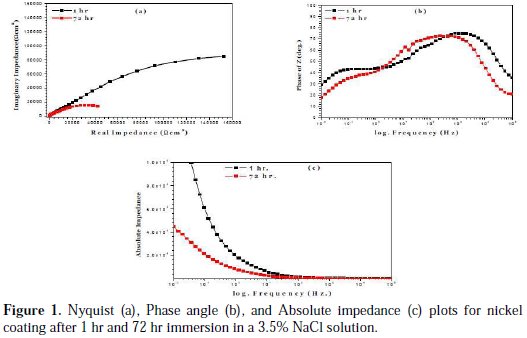
3.5% NaCl solution. The EIS results have been represented in the Nyquist, Bode 
phase angle and Bode modulus formats, as shown in <a href="#f1">Fig. 1</a>.</p>


    <p>&nbsp;</p>
<a name="f1">
<img src="/img/revistas/pea/v35n3/35n3a01f1.jpg">
    
<p>&nbsp;</p>


    ]]></body>
<body><![CDATA[<p>In the plot of real 
impedance against imaginary impedance, the Nyquist plot, after each immersion 
time, <a href="#f1">Fig. 1(a)</a>, revealed a small semi-circle at high frequency and a large 
incomplete semi-circle spanning through the intermediate to the low frequency 
region, with a slight diffusion phenomenon. Such diffusion can be attributed to 
the movement of reaction species like hydroxide and chloride ions, as well as 
oxygen, through a very thin layer, such as a corrosion product, formed on the 
coating surface [6, 13-16]. The shape of the impedance plot is synonymous with 
the formation of a corrosion product layer experiencing partially localized 
breakdown [17]. The size of the Nyquist semi-circle correlates with the 
corrosion resistance of the electrode. From the decrease in the size of the Nyquist 
plots after 72 hr immersion, it is obvious that the corrosion resistance of the Ni 
coating in the 3.5% NaCl solution decreased as immersion time increased. The 
corresponding Bode phase angle plots for the coating are shown in <a href="#f1">Fig. 1(b)</a>. 
After both immersion times, the phase angle plots revealed two impedance loops, 
which decreased in maxima after 72 hr immersion, at high and low frequency. 
The phase angle plots indicate that the mechanism of the Ni coating corrosion in 
the 3.5% NaCl solution can be explained using two time constants which 
correspond to the charge transfer processes occurring at a corrosion product 
layer-NaCl interface and at the substrate-NaCl interface (beneath the corrosion 
product layer). The reduction in the maximum phase angle, and the noticeable 
shift of the high frequency loop towards lower frequency after 72 hr immersion, 
can be attributed to certain localized thinning of the Ni corrosion product layer 
[18]. In a previous work [11], SEM surface characterization also revealed that the 
corrosion products, which formed sparsely in the crevices between the large 
surface grains of a similar Ni coating, were highly prone to attack by chloride 
ions, leading to localized pitting corrosion after prolonged immersion up to 72 hr 
in a 3.5% NaCl solution.</p>

    <p>Our impedance observation differs markedly from the report of [6] for 
nanocrystaline Ni coating in a 3% NaCl solution without an immersion time 
experiment. According to them, the Nyquist diffusion phenomenon was observed 
at low frequency, and corresponded with a single time constant in the phase 
angle plot. It, therefore, indicates that concentration and time can seriously 
modify the electrochemical characteristics of the Ni corrosion product layer in 
aqueous NaCl solutions.</p>

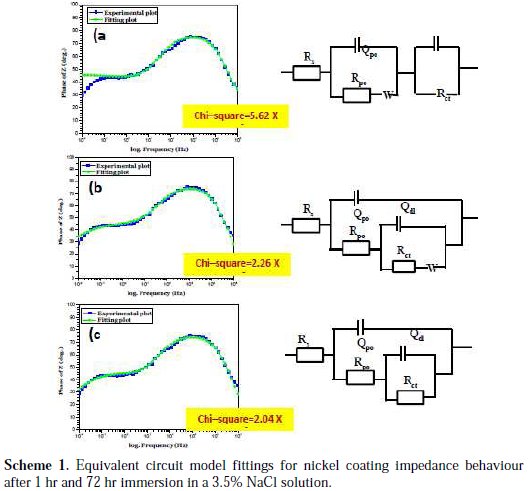
    <p>In order to correlate the impedance result with electrical elements, the ZSimpWin 
software was deployed to derive an appropriate electric model for the impedance 
phenomenon. According to the two time constants exhibited in the Phase angle 
plots, three different models were tested, as shown in <a href="#s1">Scheme 1(a)</a>, 
<a href="#s1">Scheme 1(b)</a> and <a href="#s1">Scheme 1(c)</a>.</p>


    <p>&nbsp;</p>
<a name="s1">
<img src="/img/revistas/pea/v35n3/35n3a01s1.jpg">
    
<p>&nbsp;</p>


    <p>Consequently, the equivalent circuit model in <a href="#s1">Scheme 1(c)</a> with the best overlap 
between experimental and fitting curves (especially at the low frequency regions) 
and least chi-square value was adapted to model the impedance behavior of the 
Ni coating in a 3.5% NaCl solution. The values of the resultant electrical 
elements derived by using the ZSimpWin software are presented in <a href="#t1">Table 1</a>.</p>


    <p>&nbsp;</p>
<a name="t1">
<img src="/img/revistas/pea/v35n3/35n3a01t1.jpg">
    
<p>&nbsp;</p>


    <p>In the model, Rs is the solution resistance, the elements Qpo and Rpo are, 
respectively, the corrosion product layer capacitance and pore resistance, while 
Qdl and Rct represent, respectively, the capacitance of charge and resistance to 
charge transfer at the electric double layer formed beneath the corrosion product 
layer.</p>

    <p>The R values are measures of the compactness and corrosion resistance of the 
corrosion product layer, while the Q values depict its dielectric properties. The 
decrease in R values and increase in Q values, after 72 hr immersion, confirm 
that the Ni corrosion product layer became more porous and increased the 
diffusion of stored charges across its interface (even as the value of n2=0.5 
further confirms). This is the reason for the decrease in corrosion resistance of 
the Ni coating with immersion time in a 3.5% NaCl solution.</p>


    ]]></body>
<body><![CDATA[<p><i><b>Potentiodynamic polarization</b></i></p>

    <p>It is well known that, during a potential scan, the simultaneous anodic and 
cathodic half-reactions occurring at the metal surface usually lead to the 
formation of a corrosion product layer, and its characteristics influence the 
properties of the polarization curve and its derivable parameters. The 
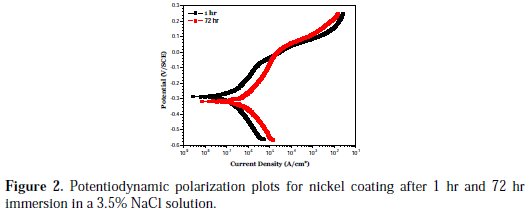
potentiodynamic polarization plots for the Ni coating after 1 hr and 72 hr 
immersion in the 3.5% NaCl solution are presented in <a href="#f2">Fig. 2</a>.</p>


    <p>&nbsp;</p>
<a name="f2">
<img src="/img/revistas/pea/v35n3/35n3a01f2.jpg">
    
<p>&nbsp;</p>


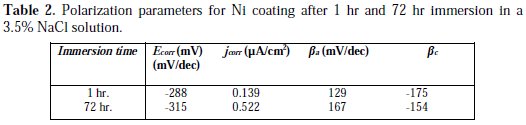
    <p>The derivable 
polarization parameters, namely, the corrosion potential (Ecorr) and corrosion 
current density (jcorr) were extrapolated from the intersection of the anodic and 
cathodic Tafel slopes drawn &pm;10 mV around the OCP. The values are presented 
in <a href="#t2">Table 2</a>.</p>


    <p>&nbsp;</p>
<a name="t2">
<img src="/img/revistas/pea/v35n3/35n3a01t2.jpg">
    
<p>&nbsp;</p>


    <p>Based on <a href="#t2">Table 2</a>, the Ecorr value became more negative, changing 
from -288 mV after 1 hr to -315 mV after 72 hr immersion in the 3.5% NaCl 
solution. This indicates the increased tendency for dissolution in the solution. 
The jcorr value, on the other hand, is a measure of the corrosion rate of the 
coating. Accordingly, there was a higher jcorr value of 0.522 &mu;A/cm<sup>2</sup> after 72 hr 
immersion, compared with 0.139 &mu;A/cm<sup>2</sup> after 1 hr, showing that the corrosion 
product layer, with time, could not impede the rate of electron transfer through its 
interface.</p>

    <p>Furthermore, <a href="#f2">Fig. 2</a> shows that immersion time caused an increase in both the 
cathodic and anodic current densities. A highly favorable cathodic reaction, 
which can proceed in such a neutral solution as the 3.5% NaCl solution, is the 
reduction of oxygen and water molecules into hydroxide ions (Equation 1). 
Such phenomenon would favor the formation of Ni(OH)2, rather than the more 
protective NiO. The higher anodic current density reveals an increase in the 
oxidation rate of Ni atoms after the longer immersion time, and may also be 
facilitated by the localized adsorption and penetration of chloride ions during the 
prolonged immersion, which deteriorate both the microstructure and adherence 
of the corrosion product layer. Nevertheless, a slight reduction in anodic current 
density occurred between 150 and 250 mV after the prolonged immersion, and 
can be related to increased thickness of the corrosion product layer.</p>


    <p>&nbsp;</p>
<a name="e1">
<img src="/img/revistas/pea/v35n3/35n3a01e1.jpg">
    
]]></body>
<body><![CDATA[<p>&nbsp;</p>


    <p><i><b>X-ray photoelectron spectroscopy (XPS)</b></i></p>

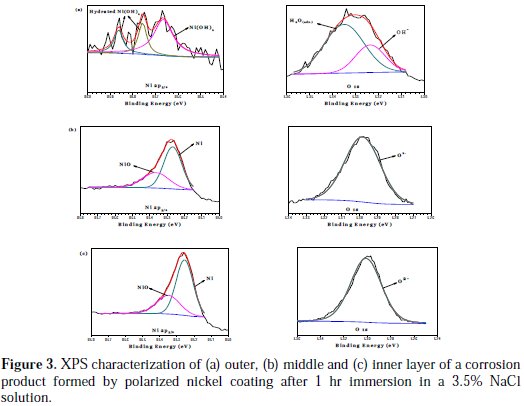
    <p>XPS depth profiling was employed to characterize the corrosion product layer 
formed by the polarized Ni coating after each immersion time. By sputtering at 
0.04 nm/s for 0, 10 and 40 s, a depth profiling occurred for 0, 0.4 and 1.6 nm, and 
is henceforth regarded as outer, middle and inner layer, respectively. The C 1s 
peak remained at 284.6 eV throughout the detections. The Ni 2p3/2 peaks were 
detected at 852.6, 853.7, 856, 857.7 and 858.7 eV binding energies. The O 1s 
peaks were detected between 529 eV and 533.7 eV. After 1 hr immersion with 
subsequent polarization in a 3.5% NaCl solution, <a href="#f3">Fig. 3(a)</a> reveals that the 
surface of the Ni coating contained Ni species deconvoluted at 856.7 eV (most 
enriched), 857.7 eV and 858.6 eV (least enriched), with corresponding O 1s 
peaks at 532.4 eV and 533.5 eV.</p>


    <p>&nbsp;</p>
<a name="f3">
<img src="/img/revistas/pea/v35n3/35n3a01f3.jpg">
    
<p>&nbsp;</p>


    <p>The binding energy at 856.7 eV is consistent 
with the formation of Ni(OH)2 [11, 12, 19-21].</p>

    <p>Although higher binding energies are commonly correlated with higher oxidation 
state species, the phenomenon for a Ni oxidation to Ni+3 was not observed during 
the polarization experiments. The Ni 2p3/2 peaks at 857.7 eV and 858.6 eV could, 
therefore, be attributed to the formation of different polymorphs of Ni(OH)2 with 
a greater degree of intercalated species like water molecules [22, 23]. The O 1s 
peaks were therefore attributed to the OH- (532.4 eV) and H2O(ads.) (533.5 eV). In 
the middle and inner layers, only NiO and unreacted Ni at 853.5 eV and 852.6 
eV [11, 12], respectively, were detected. These peaks corresponded with O 1s 
peak at 530 eV, which confirms the formation of O2<sup>-</sup> compounds. The peak area, 
hence, concentration of the NiO also increased with the increasing depth of the 
corrosion product layer. This result confirms that the corrosion resistance of the 
Ni coating in a 3.5% NaCl solution is courtesy of the formation of a thin layer of 
NiO just beneath a hydroxide-enriched outer layer. Based on this configuration 
of an O2<sup>-</sup>-enriched layer directly beneath a OH<sup>-</sup>-enriched layer, it can also be 
proposed that the formation of the Ni(OH)2 species could be initiated by 
precursors like NiO-H2O(ads.), whereby the NiO particles act as nucleation sites to 
trigger the adsorption of H2O molecules (see <a href="#e2">Equation 2</a>).</p>


    <p>&nbsp;</p>
<a name="e2">
<img src="/img/revistas/pea/v35n3/35n3a01e2.jpg">
    
<p>&nbsp;</p>


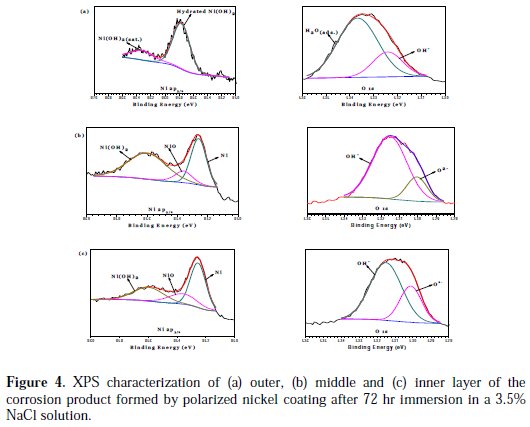
    <p>After 72 hr immersion in a 3.5% NaCl solution with subsequent polarization, 
only the Ni 2p3/2 peak at 857.7 eV, with an associated satellite peak at 864 eV, 
was detected on the outer layer of the corrosion product (see <a href="#f4">Fig. 4</a>).</p>


    ]]></body>
<body><![CDATA[<p>&nbsp;</p>
<a name="f4">
<img src="/img/revistas/pea/v35n3/35n3a01f4.jpg">
    
<p>&nbsp;</p>


    <p>TThe corresponding O 1s peak was observed at 533.5 eV. Compared with the 
characterization after 1 hr immersion, the persistence of the peak at 857.7 eV 
definitely means that the adsorption of water molecules is a characteristic of the 
Ni corrosion product layer. The peak must, therefore, be attributed to the 
formation of a more hydrated form of Ni(OH)2, such as the &alpha;-Ni(OH)2 [22, 23]. 
The middle and inner layers contained Ni compounds detected at 853.6 eV and 
856 eV which, respectively, signifies NiO and Ni(OH)2. This peak at 856 eV 
must, hence, be a less hydrated Ni(OH)2 (such as Î²-Ni(OH)2) than the more 
hydrated &alpha;-Ni(OH)2 at 857.7 eV. While the NiO concentration increased with a 
greater layer thickness, the reverse occurred for the Ni(OH)2 constituent. This 
result implies that the corrosion product layer also becomes more dehydrated 
with a greater layer thickness. Nevertheless, the non-dominance of the NiO at 
the corrosion product layer-substrate interface after 72 hr, compared with after 1 
hr, is the reason for the decrease in the coating corrosion resistance during 
immersion in a 3.5% NaCl solution. Thus, the formed NiO must be more 
amorphous than crystalline, which causes it to readily be converted in the less 
protective Ni(OH)2 species, via adsorption of water molecules. The increased 
adsorption also implies higher incorporation and diffusion of chloride ions within 
the matrix of the corrosion product layer. This, subsequently, will locally 
deteriorate the corrosion product layer-substrate interface. SEM characterization 
of the pitting corrosion of such electrodeposited Ni coating, arising due to 
increased localized deterioration of the Ni corrosion product layer in a 3.5% 
NaCl solution, has been undertaken in an earlier report [11]. This is the reason 
for the increase in the corrosion rate of the Ni coating with prolonged immersion 
in a 3.5% NaCl solution.</p>


    <p>&nbsp;</p>
    <p><b>Conclusion</b></p>

    <p>The protection characteristic of the corrosion product layer formed by an 
electrodeposited Ni coating has been investigated in a 3.5% NaCl solution, using 
immersion time experiments. The corrosion resistance of the Ni coating 
decreases after 72 hr immersion, due to the enrichment of the corrosion product 
layer with less protective Ni(OH)2 species which are readily hydrated on the 
surface, but dehydrated with a greater corrosion product layer thickness. The 
corrosion product layer also exhibited increasing porosity and weaker adhesion 
with the substrate, after the prolonged immersion time.</p>


    <p>&nbsp;</p>
    <p><b>References</b></p>

    <!-- ref --><p>1. Jinlong L, Tongxiang L, Wang C. J. Solid State Chem. 2016;240:109.    &nbsp;&nbsp;&nbsp;&nbsp;&nbsp;&nbsp;&nbsp;&nbsp;[&#160;<a href="javascript:void(0);" onclick="javascript: window.open('/scielo.php?script=sci_nlinks&ref=426695&pid=S0872-1904201700030000100001&lng=','','width=640,height=500,resizable=yes,scrollbars=1,menubar=yes,');">Links</a>&#160;]<!-- end-ref --></p>

    ]]></body>
<body><![CDATA[<!-- ref --><p>2. Sadreddini S, Afshar A. J Appl Surf Sci. 2014;303:125.    &nbsp;&nbsp;&nbsp;&nbsp;&nbsp;&nbsp;&nbsp;&nbsp;[&#160;<a href="javascript:void(0);" onclick="javascript: window.open('/scielo.php?script=sci_nlinks&ref=426697&pid=S0872-1904201700030000100002&lng=','','width=640,height=500,resizable=yes,scrollbars=1,menubar=yes,');">Links</a>&#160;]<!-- end-ref --></p>

    <!-- ref --><p>3. Bakhit B, Akbari A, Nasirpouri F, et al. J Appl Surf Sci. 2014;307:351.    &nbsp;&nbsp;&nbsp;&nbsp;&nbsp;&nbsp;&nbsp;&nbsp;[&#160;<a href="javascript:void(0);" onclick="javascript: window.open('/scielo.php?script=sci_nlinks&ref=426699&pid=S0872-1904201700030000100003&lng=','','width=640,height=500,resizable=yes,scrollbars=1,menubar=yes,');">Links</a>&#160;]<!-- end-ref --></p>

    <!-- ref --><p>4. Onyeachu BI, Oguzie EE, Njoku DI, et al. Int J Sci Technol. 2014;3:728.    &nbsp;&nbsp;&nbsp;&nbsp;&nbsp;&nbsp;&nbsp;&nbsp;[&#160;<a href="javascript:void(0);" onclick="javascript: window.open('/scielo.php?script=sci_nlinks&ref=426701&pid=S0872-1904201700030000100004&lng=','','width=640,height=500,resizable=yes,scrollbars=1,menubar=yes,');">Links</a>&#160;]<!-- end-ref --></p>

    <!-- ref --><p>5. Peng X, Li M, Wang F. Corros Sci. 2011;53:1616.    &nbsp;&nbsp;&nbsp;&nbsp;&nbsp;&nbsp;&nbsp;&nbsp;[&#160;<a href="javascript:void(0);" onclick="javascript: window.open('/scielo.php?script=sci_nlinks&ref=426703&pid=S0872-1904201700030000100005&lng=','','width=640,height=500,resizable=yes,scrollbars=1,menubar=yes,');">Links</a>&#160;]<!-- end-ref --></p>

    <!-- ref --><p>6. Qin L, Lian J, Jiang Q. Trans Nonferrous Met Soc China. 2010;20:82.    &nbsp;&nbsp;&nbsp;&nbsp;&nbsp;&nbsp;&nbsp;&nbsp;[&#160;<a href="javascript:void(0);" onclick="javascript: window.open('/scielo.php?script=sci_nlinks&ref=426705&pid=S0872-1904201700030000100006&lng=','','width=640,height=500,resizable=yes,scrollbars=1,menubar=yes,');">Links</a>&#160;]<!-- end-ref --></p>

    ]]></body>
<body><![CDATA[<!-- ref --><p>7. Yang X, Peng X, Xu C, et al. J Electrochem Soc. 2009;156:167.    &nbsp;&nbsp;&nbsp;&nbsp;&nbsp;&nbsp;&nbsp;&nbsp;[&#160;<a href="javascript:void(0);" onclick="javascript: window.open('/scielo.php?script=sci_nlinks&ref=426707&pid=S0872-1904201700030000100007&lng=','','width=640,height=500,resizable=yes,scrollbars=1,menubar=yes,');">Links</a>&#160;]<!-- end-ref --></p>

    <!-- ref --><p>8. Peng X, Zhang Y, Zhao J, et al. J Electrochim Acta. 2006;51:4922.    &nbsp;&nbsp;&nbsp;&nbsp;&nbsp;&nbsp;&nbsp;&nbsp;[&#160;<a href="javascript:void(0);" onclick="javascript: window.open('/scielo.php?script=sci_nlinks&ref=426709&pid=S0872-1904201700030000100008&lng=','','width=640,height=500,resizable=yes,scrollbars=1,menubar=yes,');">Links</a>&#160;]<!-- end-ref --></p>

    <!-- ref --><p>9. Mishra R, Balasubramaniam R. Corros Sci. 2004;46:3019.    &nbsp;&nbsp;&nbsp;&nbsp;&nbsp;&nbsp;&nbsp;&nbsp;[&#160;<a href="javascript:void(0);" onclick="javascript: window.open('/scielo.php?script=sci_nlinks&ref=426711&pid=S0872-1904201700030000100009&lng=','','width=640,height=500,resizable=yes,scrollbars=1,menubar=yes,');">Links</a>&#160;]<!-- end-ref --></p>

    <!-- ref --><p>10. Sziraki L, Kuzmann E, El-Sharif M, et al. J Electrochem Commun. 2000;2:619.    &nbsp;&nbsp;&nbsp;&nbsp;&nbsp;&nbsp;&nbsp;&nbsp;[&#160;<a href="javascript:void(0);" onclick="javascript: window.open('/scielo.php?script=sci_nlinks&ref=426713&pid=S0872-1904201700030000100010&lng=','','width=640,height=500,resizable=yes,scrollbars=1,menubar=yes,');">Links</a>&#160;]<!-- end-ref --></p>

    <!-- ref --><p>11. Onyeachu BI, Peng X, Oguzie EE, et al. Port Electrochim Acta. 2015;33:69.    &nbsp;&nbsp;&nbsp;&nbsp;&nbsp;&nbsp;&nbsp;&nbsp;[&#160;<a href="javascript:void(0);" onclick="javascript: window.open('/scielo.php?script=sci_nlinks&ref=426715&pid=S0872-1904201700030000100011&lng=','','width=640,height=500,resizable=yes,scrollbars=1,menubar=yes,');">Links</a>&#160;]<!-- end-ref --></p>

    ]]></body>
<body><![CDATA[<!-- ref --><p>12. Onyeachu BI, Oguzie EE, Peng X, et al. Int J Sci Technol. 2014;3:711.    &nbsp;&nbsp;&nbsp;&nbsp;&nbsp;&nbsp;&nbsp;&nbsp;[&#160;<a href="javascript:void(0);" onclick="javascript: window.open('/scielo.php?script=sci_nlinks&ref=426717&pid=S0872-1904201700030000100012&lng=','','width=640,height=500,resizable=yes,scrollbars=1,menubar=yes,');">Links</a>&#160;]<!-- end-ref --></p>

    <!-- ref --><p>13. Nagarajan S, Karthega M, Rajendran N. J Appl Electrochem. 2007;37:195.    &nbsp;&nbsp;&nbsp;&nbsp;&nbsp;&nbsp;&nbsp;&nbsp;[&#160;<a href="javascript:void(0);" onclick="javascript: window.open('/scielo.php?script=sci_nlinks&ref=426719&pid=S0872-1904201700030000100013&lng=','','width=640,height=500,resizable=yes,scrollbars=1,menubar=yes,');">Links</a>&#160;]<!-- end-ref --></p>

    <!-- ref --><p>14. Ozyilmaz AT. J Surf Coat Technol. 2006;200:3918.    &nbsp;&nbsp;&nbsp;&nbsp;&nbsp;&nbsp;&nbsp;&nbsp;[&#160;<a href="javascript:void(0);" onclick="javascript: window.open('/scielo.php?script=sci_nlinks&ref=426721&pid=S0872-1904201700030000100014&lng=','','width=640,height=500,resizable=yes,scrollbars=1,menubar=yes,');">Links</a>&#160;]<!-- end-ref --></p>

    <!-- ref --><p>15. Youssef KMS, Koch CC, Fedkiw PS. Corros Sci. 2004;46:51.    &nbsp;&nbsp;&nbsp;&nbsp;&nbsp;&nbsp;&nbsp;&nbsp;[&#160;<a href="javascript:void(0);" onclick="javascript: window.open('/scielo.php?script=sci_nlinks&ref=426723&pid=S0872-1904201700030000100015&lng=','','width=640,height=500,resizable=yes,scrollbars=1,menubar=yes,');">Links</a>&#160;]<!-- end-ref --></p>

    <!-- ref --><p>16. Seckin A, Mahir G, Serkan S, et al. J Power Source. 2016;307:796.    &nbsp;&nbsp;&nbsp;&nbsp;&nbsp;&nbsp;&nbsp;&nbsp;[&#160;<a href="javascript:void(0);" onclick="javascript: window.open('/scielo.php?script=sci_nlinks&ref=426725&pid=S0872-1904201700030000100016&lng=','','width=640,height=500,resizable=yes,scrollbars=1,menubar=yes,');">Links</a>&#160;]<!-- end-ref --></p>

    ]]></body>
<body><![CDATA[<!-- ref --><p>17. Zeng CL, Wang W, Wu WT. Corros Sci. 2001;43:787.    &nbsp;&nbsp;&nbsp;&nbsp;&nbsp;&nbsp;&nbsp;&nbsp;[&#160;<a href="javascript:void(0);" onclick="javascript: window.open('/scielo.php?script=sci_nlinks&ref=426727&pid=S0872-1904201700030000100017&lng=','','width=640,height=500,resizable=yes,scrollbars=1,menubar=yes,');">Links</a>&#160;]<!-- end-ref --></p>

    <!-- ref --><p>18. Deng Y, Yin ZM, Zhao K, et al., Corros Sci. 2012;65:288.    &nbsp;&nbsp;&nbsp;&nbsp;&nbsp;&nbsp;&nbsp;&nbsp;[&#160;<a href="javascript:void(0);" onclick="javascript: window.open('/scielo.php?script=sci_nlinks&ref=426729&pid=S0872-1904201700030000100018&lng=','','width=640,height=500,resizable=yes,scrollbars=1,menubar=yes,');">Links</a>&#160;]<!-- end-ref --></p>

    <!-- ref --><p>19. Machet A, Galtayries A, Zanna S. J Electrochim Acta. 2004;49:3957.    &nbsp;&nbsp;&nbsp;&nbsp;&nbsp;&nbsp;&nbsp;&nbsp;[&#160;<a href="javascript:void(0);" onclick="javascript: window.open('/scielo.php?script=sci_nlinks&ref=426731&pid=S0872-1904201700030000100019&lng=','','width=640,height=500,resizable=yes,scrollbars=1,menubar=yes,');">Links</a>&#160;]<!-- end-ref --></p>

    <!-- ref --><p>20. Natarajan R, Palaniswamy N, Natesan M. Open Corros J. 2009;2:114.    &nbsp;&nbsp;&nbsp;&nbsp;&nbsp;&nbsp;&nbsp;&nbsp;[&#160;<a href="javascript:void(0);" onclick="javascript: window.open('/scielo.php?script=sci_nlinks&ref=426733&pid=S0872-1904201700030000100020&lng=','','width=640,height=500,resizable=yes,scrollbars=1,menubar=yes,');">Links</a>&#160;]<!-- end-ref --></p>

    <!-- ref --><p>21. Grden M, Alsabet M, Jerkiewicz G. J Appl Mater Interfaces. 2012;4:3012.    &nbsp;&nbsp;&nbsp;&nbsp;&nbsp;&nbsp;&nbsp;&nbsp;[&#160;<a href="javascript:void(0);" onclick="javascript: window.open('/scielo.php?script=sci_nlinks&ref=426735&pid=S0872-1904201700030000100021&lng=','','width=640,height=500,resizable=yes,scrollbars=1,menubar=yes,');">Links</a>&#160;]<!-- end-ref --></p>

    ]]></body>
<body><![CDATA[<!-- ref --><p>22. Grosvnor AP, Biesinger MC, Smart RC, et al. J Surf Sci. 2006;600:1771.    &nbsp;&nbsp;&nbsp;&nbsp;&nbsp;&nbsp;&nbsp;&nbsp;[&#160;<a href="javascript:void(0);" onclick="javascript: window.open('/scielo.php?script=sci_nlinks&ref=426737&pid=S0872-1904201700030000100022&lng=','','width=640,height=500,resizable=yes,scrollbars=1,menubar=yes,');">Links</a>&#160;]<!-- end-ref --></p>

    <!-- ref --><p>23. Bode H, Del-melt K, Witte J. J Electrochim Acta. 1996;11:1079.    &nbsp;&nbsp;&nbsp;&nbsp;&nbsp;&nbsp;&nbsp;&nbsp;[&#160;<a href="javascript:void(0);" onclick="javascript: window.open('/scielo.php?script=sci_nlinks&ref=426739&pid=S0872-1904201700030000100023&lng=','','width=640,height=500,resizable=yes,scrollbars=1,menubar=yes,');">Links</a>&#160;]<!-- end-ref --></p>


    <p>&nbsp;</p>
    <p><b>Acknowledgements</b></p>

    <p>Onyeachu B. Ikenna acknowledges The World Academy of Science (TWAS) and 
the Chinese Academy of Science (CAS) for the award of a TWAS-CAS 
Postgraduate Fellowship.</p>


    <p>&nbsp;</p>
    <p><a name=0></a><sup><a href="#top">*</a></sup>Corresponding author. E-mail address: <a href="mailto:emekaoguzie@gmail.com">emekaoguzie@gmail.com</a></p>

    <p>Received July 29, 2016; accepted February 06, 2017</p>

    ]]></body>
<body><![CDATA[<p><a href="http://www.peacta.org" target="_blank">www.peacta.org</a> </p>


     ]]></body><back>
<ref-list>
<ref id="B1">
<label>1</label><nlm-citation citation-type="journal">
<person-group person-group-type="author">
<name>
<surname><![CDATA[Jinlong]]></surname>
<given-names><![CDATA[L]]></given-names>
</name>
<name>
<surname><![CDATA[Tongxiang]]></surname>
<given-names><![CDATA[L]]></given-names>
</name>
<name>
<surname><![CDATA[Wang]]></surname>
<given-names><![CDATA[C]]></given-names>
</name>
</person-group>
<source><![CDATA[J. Solid State Chem]]></source>
<year>2016</year>
<volume>240</volume>
<page-range>109</page-range></nlm-citation>
</ref>
<ref id="B2">
<label>2</label><nlm-citation citation-type="journal">
<person-group person-group-type="author">
<name>
<surname><![CDATA[Sadreddini]]></surname>
<given-names><![CDATA[S]]></given-names>
</name>
<name>
<surname><![CDATA[Afshar]]></surname>
<given-names><![CDATA[A]]></given-names>
</name>
</person-group>
<source><![CDATA[J Appl Surf Sci]]></source>
<year>2014</year>
<volume>303</volume>
<page-range>125</page-range></nlm-citation>
</ref>
<ref id="B3">
<label>3</label><nlm-citation citation-type="journal">
<person-group person-group-type="author">
<name>
<surname><![CDATA[Bakhit]]></surname>
<given-names><![CDATA[B]]></given-names>
</name>
<name>
<surname><![CDATA[Akbari]]></surname>
<given-names><![CDATA[A]]></given-names>
</name>
<name>
<surname><![CDATA[Nasirpouri]]></surname>
<given-names><![CDATA[F]]></given-names>
</name>
</person-group>
<source><![CDATA[J Appl Surf Sci]]></source>
<year>2014</year>
<volume>307</volume>
<page-range>351</page-range></nlm-citation>
</ref>
<ref id="B4">
<label>4</label><nlm-citation citation-type="journal">
<person-group person-group-type="author">
<name>
<surname><![CDATA[Onyeachu]]></surname>
<given-names><![CDATA[B I]]></given-names>
</name>
<name>
<surname><![CDATA[Oguzie]]></surname>
<given-names><![CDATA[E E]]></given-names>
</name>
<name>
<surname><![CDATA[Njoku]]></surname>
<given-names><![CDATA[D I]]></given-names>
</name>
</person-group>
<source><![CDATA[Int J Sci Technol]]></source>
<year>2014</year>
<volume>3</volume>
<page-range>728</page-range></nlm-citation>
</ref>
<ref id="B5">
<label>5</label><nlm-citation citation-type="journal">
<person-group person-group-type="author">
<name>
<surname><![CDATA[Peng]]></surname>
<given-names><![CDATA[X]]></given-names>
</name>
<name>
<surname><![CDATA[Li]]></surname>
<given-names><![CDATA[M]]></given-names>
</name>
<name>
<surname><![CDATA[Wang]]></surname>
<given-names><![CDATA[F]]></given-names>
</name>
</person-group>
<source><![CDATA[Corros Sci]]></source>
<year>2011</year>
<volume>53</volume>
<page-range>1616</page-range></nlm-citation>
</ref>
<ref id="B6">
<label>6</label><nlm-citation citation-type="journal">
<person-group person-group-type="author">
<name>
<surname><![CDATA[Qin]]></surname>
<given-names><![CDATA[L]]></given-names>
</name>
<name>
<surname><![CDATA[Lian]]></surname>
<given-names><![CDATA[J]]></given-names>
</name>
<name>
<surname><![CDATA[Jiang]]></surname>
<given-names><![CDATA[Q]]></given-names>
</name>
</person-group>
<source><![CDATA[Trans Nonferrous Met Soc China]]></source>
<year>2010</year>
<volume>20</volume>
<page-range>82</page-range></nlm-citation>
</ref>
<ref id="B7">
<label>7</label><nlm-citation citation-type="journal">
<person-group person-group-type="author">
<name>
<surname><![CDATA[Yang]]></surname>
<given-names><![CDATA[X]]></given-names>
</name>
<name>
<surname><![CDATA[Peng]]></surname>
<given-names><![CDATA[X]]></given-names>
</name>
<name>
<surname><![CDATA[Xu]]></surname>
<given-names><![CDATA[C]]></given-names>
</name>
</person-group>
<source><![CDATA[J Electrochem Soc]]></source>
<year>2009</year>
<volume>156</volume>
<page-range>167</page-range></nlm-citation>
</ref>
<ref id="B8">
<label>8</label><nlm-citation citation-type="journal">
<person-group person-group-type="author">
<name>
<surname><![CDATA[Peng]]></surname>
<given-names><![CDATA[X]]></given-names>
</name>
<name>
<surname><![CDATA[Zhang]]></surname>
<given-names><![CDATA[Y]]></given-names>
</name>
<name>
<surname><![CDATA[Zhao]]></surname>
<given-names><![CDATA[J]]></given-names>
</name>
</person-group>
<source><![CDATA[J Electrochim Acta]]></source>
<year>2006</year>
<volume>51</volume>
<page-range>4922</page-range></nlm-citation>
</ref>
<ref id="B9">
<label>9</label><nlm-citation citation-type="journal">
<person-group person-group-type="author">
<name>
<surname><![CDATA[Mishra]]></surname>
<given-names><![CDATA[R]]></given-names>
</name>
<name>
<surname><![CDATA[Balasubramaniam]]></surname>
<given-names><![CDATA[R]]></given-names>
</name>
</person-group>
<source><![CDATA[Corros Sci]]></source>
<year>2004</year>
<volume>46</volume>
<page-range>3019</page-range></nlm-citation>
</ref>
<ref id="B10">
<label>10</label><nlm-citation citation-type="journal">
<person-group person-group-type="author">
<name>
<surname><![CDATA[Sziraki]]></surname>
<given-names><![CDATA[L]]></given-names>
</name>
<name>
<surname><![CDATA[Kuzmann]]></surname>
<given-names><![CDATA[E]]></given-names>
</name>
<name>
<surname><![CDATA[El-Sharif]]></surname>
<given-names><![CDATA[M]]></given-names>
</name>
</person-group>
<source><![CDATA[J Electrochem Commun]]></source>
<year>2000</year>
<volume>2</volume>
<page-range>619</page-range></nlm-citation>
</ref>
<ref id="B11">
<label>11</label><nlm-citation citation-type="journal">
<person-group person-group-type="author">
<name>
<surname><![CDATA[Onyeachu]]></surname>
<given-names><![CDATA[B I]]></given-names>
</name>
<name>
<surname><![CDATA[Peng]]></surname>
<given-names><![CDATA[X]]></given-names>
</name>
<name>
<surname><![CDATA[Oguzie]]></surname>
<given-names><![CDATA[E E]]></given-names>
</name>
</person-group>
<source><![CDATA[Port Electrochim Acta]]></source>
<year>2015</year>
<volume>33</volume>
<page-range>69</page-range></nlm-citation>
</ref>
<ref id="B12">
<label>12</label><nlm-citation citation-type="journal">
<person-group person-group-type="author">
<name>
<surname><![CDATA[Onyeachu]]></surname>
<given-names><![CDATA[B I]]></given-names>
</name>
<name>
<surname><![CDATA[Oguzie]]></surname>
<given-names><![CDATA[E E]]></given-names>
</name>
<name>
<surname><![CDATA[Peng]]></surname>
<given-names><![CDATA[X]]></given-names>
</name>
</person-group>
<source><![CDATA[Int J Sci Technol]]></source>
<year>2014</year>
<volume>3</volume>
<page-range>711</page-range></nlm-citation>
</ref>
<ref id="B13">
<label>13</label><nlm-citation citation-type="journal">
<person-group person-group-type="author">
<name>
<surname><![CDATA[Nagarajan]]></surname>
<given-names><![CDATA[S]]></given-names>
</name>
<name>
<surname><![CDATA[Karthega]]></surname>
<given-names><![CDATA[M]]></given-names>
</name>
<name>
<surname><![CDATA[Rajendran]]></surname>
<given-names><![CDATA[N]]></given-names>
</name>
</person-group>
<source><![CDATA[J Appl Electrochem]]></source>
<year>2007</year>
<volume>37</volume>
<page-range>195</page-range></nlm-citation>
</ref>
<ref id="B14">
<label>14</label><nlm-citation citation-type="journal">
<person-group person-group-type="author">
<name>
<surname><![CDATA[Ozyilmaz]]></surname>
<given-names><![CDATA[A T]]></given-names>
</name>
</person-group>
<source><![CDATA[J Surf Coat Technol]]></source>
<year>2006</year>
<volume>200</volume>
<page-range>3918</page-range></nlm-citation>
</ref>
<ref id="B15">
<label>15</label><nlm-citation citation-type="journal">
<person-group person-group-type="author">
<name>
<surname><![CDATA[Youssef]]></surname>
<given-names><![CDATA[K M S]]></given-names>
</name>
<name>
<surname><![CDATA[Koch]]></surname>
<given-names><![CDATA[C C]]></given-names>
</name>
<name>
<surname><![CDATA[Fedkiw]]></surname>
<given-names><![CDATA[P S]]></given-names>
</name>
</person-group>
<source><![CDATA[Corros Sci]]></source>
<year>2004</year>
<volume>46</volume>
<page-range>51</page-range></nlm-citation>
</ref>
<ref id="B16">
<label>16</label><nlm-citation citation-type="journal">
<person-group person-group-type="author">
<name>
<surname><![CDATA[Seckin]]></surname>
<given-names><![CDATA[A]]></given-names>
</name>
<name>
<surname><![CDATA[Mahir]]></surname>
<given-names><![CDATA[G]]></given-names>
</name>
<name>
<surname><![CDATA[Serkan]]></surname>
<given-names><![CDATA[S]]></given-names>
</name>
</person-group>
<source><![CDATA[J Power Source]]></source>
<year>2016</year>
<volume>307</volume>
<page-range>796</page-range></nlm-citation>
</ref>
<ref id="B17">
<label>17</label><nlm-citation citation-type="journal">
<person-group person-group-type="author">
<name>
<surname><![CDATA[Zeng]]></surname>
<given-names><![CDATA[C L]]></given-names>
</name>
<name>
<surname><![CDATA[Wang]]></surname>
<given-names><![CDATA[W]]></given-names>
</name>
<name>
<surname><![CDATA[Wu]]></surname>
<given-names><![CDATA[W T]]></given-names>
</name>
</person-group>
<source><![CDATA[Corros Sci]]></source>
<year>2001</year>
<volume>43</volume>
<page-range>787</page-range></nlm-citation>
</ref>
<ref id="B18">
<label>18</label><nlm-citation citation-type="journal">
<person-group person-group-type="author">
<name>
<surname><![CDATA[Deng]]></surname>
<given-names><![CDATA[Y]]></given-names>
</name>
<name>
<surname><![CDATA[Yin]]></surname>
<given-names><![CDATA[Z M]]></given-names>
</name>
<name>
<surname><![CDATA[Zhao]]></surname>
<given-names><![CDATA[K]]></given-names>
</name>
</person-group>
<source><![CDATA[Corros Sci]]></source>
<year>2012</year>
<volume>65</volume>
<page-range>288</page-range></nlm-citation>
</ref>
<ref id="B19">
<label>19</label><nlm-citation citation-type="journal">
<person-group person-group-type="author">
<name>
<surname><![CDATA[Machet]]></surname>
<given-names><![CDATA[A]]></given-names>
</name>
<name>
<surname><![CDATA[Galtayries]]></surname>
<given-names><![CDATA[A]]></given-names>
</name>
<name>
<surname><![CDATA[Zanna]]></surname>
<given-names><![CDATA[S]]></given-names>
</name>
</person-group>
<source><![CDATA[J Electrochim Acta]]></source>
<year>2004</year>
<volume>49</volume>
<page-range>3957</page-range></nlm-citation>
</ref>
<ref id="B20">
<label>20</label><nlm-citation citation-type="journal">
<person-group person-group-type="author">
<name>
<surname><![CDATA[Natarajan]]></surname>
<given-names><![CDATA[R]]></given-names>
</name>
<name>
<surname><![CDATA[Palaniswamy]]></surname>
<given-names><![CDATA[N]]></given-names>
</name>
<name>
<surname><![CDATA[Natesan]]></surname>
<given-names><![CDATA[M]]></given-names>
</name>
</person-group>
<source><![CDATA[Open Corros J]]></source>
<year>2009</year>
<volume>2</volume>
<page-range>114</page-range></nlm-citation>
</ref>
<ref id="B21">
<label>21</label><nlm-citation citation-type="journal">
<person-group person-group-type="author">
<name>
<surname><![CDATA[Grden]]></surname>
<given-names><![CDATA[M]]></given-names>
</name>
<name>
<surname><![CDATA[Alsabet]]></surname>
<given-names><![CDATA[M]]></given-names>
</name>
<name>
<surname><![CDATA[Jerkiewicz]]></surname>
<given-names><![CDATA[G]]></given-names>
</name>
</person-group>
<source><![CDATA[J Appl Mater Interfaces]]></source>
<year>2012</year>
<volume>4</volume>
<page-range>3012</page-range></nlm-citation>
</ref>
<ref id="B22">
<label>22</label><nlm-citation citation-type="journal">
<person-group person-group-type="author">
<name>
<surname><![CDATA[Grosvnor]]></surname>
<given-names><![CDATA[A P]]></given-names>
</name>
<name>
<surname><![CDATA[Biesinger]]></surname>
<given-names><![CDATA[M C]]></given-names>
</name>
<name>
<surname><![CDATA[Smart]]></surname>
<given-names><![CDATA[R C]]></given-names>
</name>
</person-group>
<source><![CDATA[J Surf Sci]]></source>
<year>2006</year>
<volume>600</volume>
<page-range>1771</page-range></nlm-citation>
</ref>
<ref id="B23">
<label>23</label><nlm-citation citation-type="journal">
<person-group person-group-type="author">
<name>
<surname><![CDATA[Bode]]></surname>
<given-names><![CDATA[H]]></given-names>
</name>
<name>
<surname><![CDATA[Del-melt]]></surname>
<given-names><![CDATA[K]]></given-names>
</name>
<name>
<surname><![CDATA[Witte]]></surname>
<given-names><![CDATA[J]]></given-names>
</name>
</person-group>
<source><![CDATA[J Electrochim Acta]]></source>
<year>1996</year>
<volume>11</volume>
<page-range>1079</page-range></nlm-citation>
</ref>
</ref-list>
</back>
</article>