<?xml version="1.0" encoding="ISO-8859-1"?><article xmlns:mml="http://www.w3.org/1998/Math/MathML" xmlns:xlink="http://www.w3.org/1999/xlink" xmlns:xsi="http://www.w3.org/2001/XMLSchema-instance">
<front>
<journal-meta>
<journal-id>0872-1904</journal-id>
<journal-title><![CDATA[Portugaliae Electrochimica Acta]]></journal-title>
<abbrev-journal-title><![CDATA[Port. Electrochim. Acta]]></abbrev-journal-title>
<issn>0872-1904</issn>
<publisher>
<publisher-name><![CDATA[Sociedade Portuguesa de Electroquímica]]></publisher-name>
</publisher>
</journal-meta>
<article-meta>
<article-id>S0872-19042017000300004</article-id>
<article-id pub-id-type="doi">10.4152/pea.201703159</article-id>
<title-group>
<article-title xml:lang="en"><![CDATA[Theoretical and Experimental Studies on the Corrosion Inhibition Potentials of Two Tetrakis Pyrazole Derivatives for Mild Steel in 1.0 M HCl]]></article-title>
</title-group>
<contrib-group>
<contrib contrib-type="author">
<name>
<surname><![CDATA[Louadi]]></surname>
<given-names><![CDATA[Y.E.]]></given-names>
</name>
<xref ref-type="aff" rid="A01"/>
</contrib>
<contrib contrib-type="author">
<name>
<surname><![CDATA[Abrigach]]></surname>
<given-names><![CDATA[F.]]></given-names>
</name>
<xref ref-type="aff" rid="A01"/>
</contrib>
<contrib contrib-type="author">
<name>
<surname><![CDATA[Bouyanzer]]></surname>
<given-names><![CDATA[A.]]></given-names>
</name>
<xref ref-type="aff" rid="A01"/>
</contrib>
<contrib contrib-type="author">
<name>
<surname><![CDATA[Touzani]]></surname>
<given-names><![CDATA[R.]]></given-names>
</name>
<xref ref-type="aff" rid="A01"/>
<xref ref-type="aff" rid="A02"/>
</contrib>
<contrib contrib-type="author">
<name>
<surname><![CDATA[El Assyry]]></surname>
<given-names><![CDATA[A.]]></given-names>
</name>
<xref ref-type="aff" rid="A03"/>
</contrib>
<contrib contrib-type="author">
<name>
<surname><![CDATA[Zarrouk]]></surname>
<given-names><![CDATA[A.]]></given-names>
</name>
<xref ref-type="aff" rid="A01"/>
</contrib>
<contrib contrib-type="author">
<name>
<surname><![CDATA[Hammouti]]></surname>
<given-names><![CDATA[B.]]></given-names>
</name>
<xref ref-type="aff" rid="A01"/>
</contrib>
</contrib-group>
<aff id="A01">
<institution><![CDATA[,Mohammed First University Faculty of Science LCAE-URAC18]]></institution>
<addr-line><![CDATA[Oujda ]]></addr-line>
<country>Morocco</country>
</aff>
<aff id="A02">
<institution><![CDATA[,Universite Mohammed Premier Faculte Pluridisciplinaire de Nador ]]></institution>
<addr-line><![CDATA[Selouane Nador]]></addr-line>
<country>Morocco</country>
</aff>
<aff id="A03">
<institution><![CDATA[,Universite Ibn Tofail Faculte des Sciences Laboratoire d'Optoelectronique et de Physico-chimie des Materiaux]]></institution>
<addr-line><![CDATA[Kenitra Morocco]]></addr-line>
</aff>
<pub-date pub-type="pub">
<day>00</day>
<month>05</month>
<year>2017</year>
</pub-date>
<pub-date pub-type="epub">
<day>00</day>
<month>05</month>
<year>2017</year>
</pub-date>
<volume>35</volume>
<numero>3</numero>
<fpage>159</fpage>
<lpage>178</lpage>
<copyright-statement/>
<copyright-year/>
<self-uri xlink:href="http://scielo.pt/scielo.php?script=sci_arttext&amp;pid=S0872-19042017000300004&amp;lng=en&amp;nrm=iso"></self-uri><self-uri xlink:href="http://scielo.pt/scielo.php?script=sci_abstract&amp;pid=S0872-19042017000300004&amp;lng=en&amp;nrm=iso"></self-uri><self-uri xlink:href="http://scielo.pt/scielo.php?script=sci_pdf&amp;pid=S0872-19042017000300004&amp;lng=en&amp;nrm=iso"></self-uri><abstract abstract-type="short" xml:lang="en"><p><![CDATA[The inhibition performance and mechanism of N1,N1,N3,N3-tetrakis((3,5-dimethyL-1Hpyrazol- 1-yl)methyl)propane-1,3-diamine (BF2) and N1,N1,N2,N2-tetrakis((3,5-dimethyl- 1H-pyrazoL-1-yl)methyl) benzene-1,2-diamine (BF4) for the corrosion of mild steel in 1.0 M HCl were investigated using weight loss method and electrochemical measurements. The results show that both tetrakis pyrazole derivatives act as good inhibitors, and inhibition efficiency follows the order: BF4 > BF2. Two tetrakis pyrazole derivatives are mixed type inhibitors exhibiting predominantly cathodic behavior. The Nyquist plots showed that, after increasing inhibitors' concentrations, charge-transfer resistance increased and double-layer capacitance decreased, involving increased inhibition efficiency. The adsorption of both inhibitors on a steel surface obeyed Langmuir model, thus, the thermodynamic and kinetic parameters were calculated and discussed. Quantum chemical parameters are calculated using the Density Functional Theory method (DFT). Correlation between theoretical and experimental results is discussed.]]></p></abstract>
<kwd-group>
<kwd lng="en"><![CDATA[Mild steel]]></kwd>
<kwd lng="en"><![CDATA[corrosion inhibition]]></kwd>
<kwd lng="en"><![CDATA[weight loss]]></kwd>
<kwd lng="en"><![CDATA[electrochemical techniques]]></kwd>
<kwd lng="en"><![CDATA[DFT]]></kwd>
</kwd-group>
</article-meta>
</front><body><![CDATA[ 

<!--     <p>&nbsp;</p>
    <p>doi: 10.4152/pea.201703159</p> -->

    <p><b>Theoretical and Experimental Studies on the Corrosion 
Inhibition Potentials of Two Tetrakis Pyrazole Derivatives for 
Mild Steel in 1.0 M HCl</b></p>

    <p>
<b>Y.E. Louadi</b><sup><i>a</i></sup>
, <b>F. Abrigach</b><sup><i>a</i></sup>
, <b>A. Bouyanzer</b><sup><i>a</i></sup>
, <b>R. Touzani</b><sup><i>a,b</i></sup>
, <b>A. El Assyry</b><sup><i>c</i></sup>
, <b>A. Zarrouk</b><sup><i>a</i></sup>
 and <b>B. Hammouti</b><sup><i>a,<a href="#0">*</a></i></sup>
</p>

    <p><i><sup>a</sup> LCAE-URAC18, Faculty of Science, Mohammed First University, P.O. Box 717, 60000 Oujda, Morocco</i></p>

    <p><i><sup>b</sup> Faculte Pluridisciplinaire de Nador, Universite Mohammed Premier, BP: 300, Selouane 62700, Nador, Morocco</i></p>

    <p><i><sup>c</sup> Laboratoire d'Optoelectronique et de Physico-chimie des Materiaux, (Unite associee au 
CNRST), Universite Ibn Tofail, Faculte des Sciences, B.P. 133, Kenitra, Morocco</i></p>


    <p>&nbsp;</p>
    <p><b>Abstract</b></p>

    ]]></body>
<body><![CDATA[<p>The inhibition performance and mechanism of N1,N1,N3,N3-tetrakis((3,5-dimethyL<sup>-1</sup>Hpyrazol-
1-yl)methyl)propane-1,3-diamine (BF2) and N1,N1,N2,N2-tetrakis((3,5-dimethyl-
1H-pyrazoL<sup>-1</sup>-yl)methyl) benzene-1,2-diamine (BF4) for the corrosion of mild steel 
in 1.0 M HCl were investigated using weight loss method and electrochemical 
measurements. The results show that both tetrakis pyrazole derivatives act as good 
inhibitors, and inhibition efficiency follows the order: BF4 > BF2. Two tetrakis 
pyrazole derivatives are mixed type inhibitors exhibiting predominantly cathodic 
behavior. The Nyquist plots showed that, after increasing inhibitors' concentrations, 
charge-transfer resistance increased and double-layer capacitance decreased, involving 
increased inhibition efficiency. The adsorption of both inhibitors on a steel surface 
obeyed Langmuir model, thus, the thermodynamic and kinetic parameters were 
calculated and discussed. Quantum chemical parameters are calculated using the 
Density Functional Theory method (DFT). Correlation between theoretical and 
experimental results is discussed.</p>

    <p><b><i>Keywords:</i></b> Mild steel; corrosion inhibition; weight loss; electrochemical techniques; 
DFT.</p>


    <p>&nbsp;</p>
    <p><b>Introduction</b></p>

    <p>Acid solutions are widely used in industry, such as acid pickling, industrial acid 
cleaning, acid descaling and oil-well cleaning [1]. As the most effective and 
economic method [2,3], inhibitors are applied in these processes to control the 
metal dissolution. Most of the well known acid inhibitors are organic compounds 
containing nitrogen, sulphur and oxygen atoms [4-10]. The efficiency of these 
compounds mainly depends on their abilities to be adsorbed on the metal surface 
with the polar groups acting as reactive centers.</p>

    <p>The corrosion inhibition is a surface process, which involves adsorption of the 
organic compounds on a metal surface. The adsorption mainly depends on the 
electronic structure of the molecule [11]. The inhibition efficiency of organic 
compounds depends on the mode of interaction with the metal surface and 
molecular structure.</p>

    <p>Among numerous inhibitors, N-heterocyclic compounds are considered to be the 
most effective corrosion inhibitors [12]. Up to now, various N-heterocyclic 
compounds are reported as good corrosion inhibitors for steel in acidic media, 
such as triazole derivatives [13-15], pyrazole derivatives [16-19], and bipyrazole 
derivatives [20-23].</p>

    <p>In continuation of our research for developing efficient corrosion inhibitors, [2429] 
this work represents a systematic study of the corrosion inhibition effect of 
synthesized pyrazole derivatives, namely N1,N1,N3,N3-tetrakis((3,5-dimethyl1H-
pyrazoL<sup>-1</sup>-yl)methyl)propane-1,3-diamine (BF2) and N1,N1,N2,N2-tetrakis 
((3,5-dimethyL<sup>-1</sup>H-pyrazoL<sup>-1</sup>-yl)methyl)benzene-1,2-diamine (BF4), on MS in a 
1.0 M HCl solution using weight loss measurement, potentiodynamic 
polarization, electrochemical impedance, and quantum chemical calculations.</p>

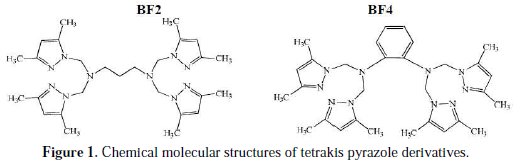
    <p><a href="#f1">Fig. 1</a> shows all molecular structures used.</p>


    <p>&nbsp;</p>
<a name="f1">
<img src="/img/revistas/pea/v35n3/35n3a04f1.jpg">
    
]]></body>
<body><![CDATA[<p>&nbsp;</p>


    <p>&nbsp;</p>
    <p><b>Experimental</b></p>

    <p><i><b>Materials</b></i></p>

    <p>The steel used in this study is a mild steel with a chemical composition (in wt%) 
of 0.09% P, 0.01% Al, 0.38% Si, 0.05% Mn, 0.21% C, 0.05% S and the 
remainder iron (Fe). The steel samples were pre-treated prior to the experiments 
by grinding with emery paper (SiC) (220, 400, 800, 1000 and 1200), rinsed with 
distilled water, degreased in acetone, washed again with bidistilled water and 
then dried at room temperature before use.</p>


    <p><i><b>Solutions</b></i></p>

    <p>The aggressive solutions of 1.0 M HCl were prepared by dilution of analytical 
grade 37% HCl with distilled water. The concentration range of N1,N1,N3,N3tetrakis((
3,5-dimethyL<sup>-1</sup>H-pyrazoL<sup>-1</sup>-yl)methyl)propane-1,3-diamine (BF2) and 
N1,N1,N2,N2-tetrakis((3,5-dimethyL<sup>-1</sup>H-pyrazoL<sup>-1</sup>-yl)methyl) benzene-1,2 diamine 
(BF4) used was 10-5 M to 10<sup>-3</sup> M.</p>


    <p><i><b>Gravimetric study</b></i></p>

    <p>Gravimetric experiments were performed according to the standard methods 
[30]; the mild steel sheets of 1 &times; 1 &times; 0.1 cm were abraded with a series of emery 
papers, (SiC) (120, 600 and 1200), and then washed with distilled water and 
acetone. After accurate weighing, the specimens were immersed in a 100 mL 
beaker containing 250 mL of a 1.0 M HCl solution with and without addition of 
different concentrations of inhibitor. All the aggressive acid solutions were open 
to air. After 6 h of acid immersion, the specimens were taken out, washed, dried, 
and accurately weighed. In order to get good reproducibility, all measurements 
were performed a few times, and average values were reported to obtain good 
reproducibility. The inhibition efficiency (&eta;WL%) and surface coverage (&theta;) were 
calculated as follows:</p>


    <p>&nbsp;</p>
<a name="e1">
<img src="/img/revistas/pea/v35n3/35n3a04e1.jpg">
    
]]></body>
<body><![CDATA[<p>&nbsp;</p>
<a name="e2">
<img src="/img/revistas/pea/v35n3/35n3a04e2.jpg">
    
<p>&nbsp;</p>
<a name="e3">
<img src="/img/revistas/pea/v35n3/35n3a04e3.jpg">
    
<p>&nbsp;</p>


    <p>where Wb and Wa are the specimen weight before and after immersion in the 
tested solution; w0 and wi are the values of corrosion weight losses of mild steel 
in uninhibited and inhibited solutions, respectively; A is the total area of the mild 
steel specimen (cm<sup>2</sup>); and t is the exposure time (h).</p>


    <p><i><b>Electrochemical measurements</b></i></p>

    <p>The electrochemical measurements were carried out using a Volta lab (Tacussel-
Radiometer PGZ 100) potentiostat, and controlled by Tacussel corrosion analysis 
software model (Voltamaster 4) under static condition. The corrosion cell used 
had three electrodes. The reference electrode was a saturated calomel electrode 
(SCE). A platinum electrode was used as auxiliary electrode with a surface area 
of 1 cm<sup>2</sup>. The working electrode was mild steel with a surface of 1.0 cm<sup>2</sup>. All 
potentials given in this study were referred to this electrode. The working 
electrode was immersed in a test solution for 30 min to establish a steady state 
open circuit potential (E0cp). After measuring the Eocp, the electrochemical 
measurements were performed. All electrochemical tests were performed in 
aerated solutions at 308 K. The EIS experiments were conducted in the frequency 
range with a high limit of 100 kHz and a different low limit of 0.1 Hz at open 
circuit potential, with 10 points per decade, at the rest potential, after 30 min of 
acid immersion, by applying 10 mV ac at voltage peak-to-peak. Nyquist plots 
were made from these experiments. The best semicircle can be fit through the 
data points in the Nyquist plot using a non-linear least square fit, so as to give the 
intersections with the x-axis.</p>

    <p>The inhibition efficiency of the inhibitor was calculated from the charge transfer 
resistance values using the following equation:</p>


    <p>&nbsp;</p>
<a name="e4">
<img src="/img/revistas/pea/v35n3/35n3a04e4.jpg">
    
<p>&nbsp;</p>


    <p>where, R0ct and Rict are the charge transfer resistance in absence and in presence 
of the inhibitor, respectively.</p>

    ]]></body>
<body><![CDATA[<p>After ac impedance test, the potentiodynamic polarization measurements of mild 
steel substrate in inhibited and uninhibited solution were scanned from cathodic 
to anodic direction, with a scan rate of 0.5 mV s<sup>-1</sup>. The potentiodynamic data 
were analysed using the polarization VoltaMaster 4 software. The linear Tafel 
segments of anodic and cathodic curves were extrapolated to corrosion potential, 
to obtain corrosion current densities (Icorr). From the obtained polarization curves, 
the corrosion current (Icorr) was calculated by curve fitting using the equation:</p>


    <p>&nbsp;</p>
<a name="e5">
<img src="/img/revistas/pea/v35n3/35n3a04e5.jpg">
    
<p>&nbsp;</p>


    <p>The inhibition efficiency was evaluated from the measured Icorr values using the 
following relationship:</p>


    <p>&nbsp;</p>
<a name="e6">
<img src="/img/revistas/pea/v35n3/35n3a04e6.jpg">
    
<p>&nbsp;</p>


    <p>where Icorr and Icorr(i) are the corrosion current densities for steel electrode in the 
uninhibited and inhibited solutions, respectively.</p>


    <p><i><b>Quantum chemical calculations</b></i></p>

    <p>Complete geometry optimization of the inhibitor molecules was performed using 
density functional theory (DFT) with Beck's three-parameter exchange functional 
along with LeeeYangeParr non-local correlation functional (B3LYP) with 6-1G* 
basis set using the Gaussian 03 programme package [31]. Frontier molecular 
orbitals (HOMO and LUMO) were used to interpret the adsorption of inhibitor 
molecules on the metal surface. According to DFT-Koopman's theorem [32,33], 
the ionization potential (I) is approximated as the negative of the highest 
occupied molecular orbital energy (EHOMO) and the negative of the lowest 
unoccupied molecular orbital energy (ELUMO) are related to the electron affinity 
(A).</p>


    <p>&nbsp;</p>
<a name="e7">
<img src="/img/revistas/pea/v35n3/35n3a04e7.jpg">
    
]]></body>
<body><![CDATA[<p>&nbsp;</p>
<a name="e8">
<img src="/img/revistas/pea/v35n3/35n3a04e8.jpg">
    
<p>&nbsp;</p>


    <p>Natural bond orbital (NBO) analysis [34] was performed to evaluate the electron 
density distributions. The electron density plays an important role in calculating 
the chemical reactivity parameters. The global reactivities include 
electronegativity (Ï‡), global hardness (&eta;) and global softness (&sigma;). They can be 
calculated from the following equations:</p>


    <p>&nbsp;</p>
<a name="e9">
<img src="/img/revistas/pea/v35n3/35n3a04e9.jpg">
    
<p>&nbsp;</p>
<a name="e10">
<img src="/img/revistas/pea/v35n3/35n3a04e10.jpg">
    
<p>&nbsp;</p>
<a name="e11">
<img src="/img/revistas/pea/v35n3/35n3a04e11.jpg">
    
<p>&nbsp;</p>


    <p>The local reactivity has been analyzed by means of Fukui indices [35], an 
indication of the reactive centers within the molecules. These are measurements 
of the chemical reactivity, as well as an indicative of the reactive regions, 
nucleophilic and electrophilic behavior of the molecule [36]. The condensed 
Fukui functions were found by taking the finite difference approximations from 
Mulliken population analysis of atoms in inhibitor molecules, depending on the 
direction of the electron transfer.</p>


    <p>&nbsp;</p>
<a name="e12">
<img src="/img/revistas/pea/v35n3/35n3a04e12.jpg">
    
<p>&nbsp;</p>
<a name="e13">
<img src="/img/revistas/pea/v35n3/35n3a04e13.jpg">
    
]]></body>
<body><![CDATA[<p>&nbsp;</p>


    <p>where q (N), q (N + 1), and q (N -1) are the electronic population of the atom k 
in neutral, cationic and anionic systems, respectively [37].</p>


    <p>&nbsp;</p>
    <p><b>Results and discussion</b></p>

    <p><i><b>Potentiodynamic polarization curves</b></i></p>

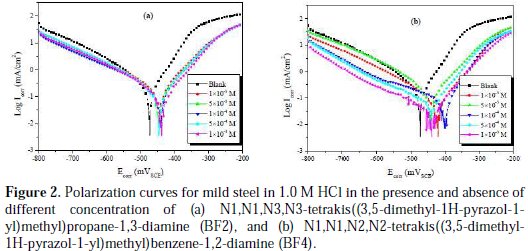
    <p>The potentiodynamic measurement results of mild steel in a 1.0 M HCl solution, 
without and with different range of inhibitors concentrations, were shown in 
<a href="#f2">Fig. 2a and b</a>.</p>


    <p>&nbsp;</p>
<a name="f2">
<img src="/img/revistas/pea/v35n3/35n3a04f2.jpg">
    
<p>&nbsp;</p>


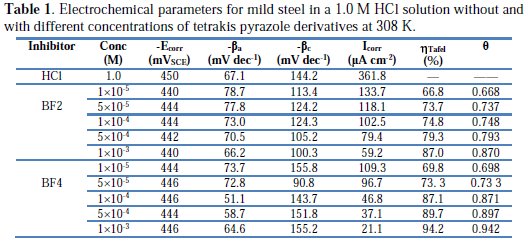
    <p>The polarization parameters, namely corrosion current density (Icorr), 
corrosion potential (Ecorr), anodic Tafel slope (&beta;a), cathodic Tafel slope (&beta;c) and 
percentage inhibition efficiency (&eta;Tafel %) were calculated from the Tafel curves 
and are given in <a href="#t1">Table 1</a>.</p>


    <p>&nbsp;</p>
<a name="t1">
<img src="/img/revistas/pea/v35n3/35n3a04t1.jpg">
    
]]></body>
<body><![CDATA[<p>&nbsp;</p>


    <p>From <a href="#f2">Fig. 2</a> it can be observed that both the cathodic 
and anodic reactions were suppressed with the addition of inhibitor, which 
suggested that the tetrakis pyrazole derivatives reduced anodic dissolution and 
also retarded the hydrogen evolution reaction [38].</p>

    <p>It is observed that the corrosion potentials (Ecorr) for mild steel in the presence of 
BF2 (<a href="#f2">Fig. 2a</a>) and BF4 (<a href="#f2">Fig. 2b</a>) are slightly shifted towards the positive 
potentials compared with the mild steel in 1.0 M HCl. Both anodic and cathodic 
current densities were reduced in the presence of BF2 and BF4, which suggests a 
mixed-type inhibitor behavior [39].</p>

    <p>It is clear from <a href="#t1">Table 1</a> that, after increasing the concentration of inhibitor, the 
inhibition efficiency increased, while the corrosion current density decreased due 
to adsorption of BF2 and BF4 on the mild steel surface. The minor shift in Ecorr 
value (10 mV) towards positive direction in the presence of inhibitors, as 
compared to the Ecorr value in the absence of inhibitor, indicates that BF2 and 
BF4 act as a mixed type inhibitor with predominant control of the anodic reaction 
[40]. From <a href="#t1">Table 1</a>, it is observed that inhibition efficiency increased with an 
increased concentration of the two tetrakis pyrazole derivatives. Also, the order 
of corrosion inhibition efficiency for the highest concentration (10<sup>-3</sup> M) of the 
two studied inhibitors is BF4 (94.2%) &gt; BF2 (87.0%).</p>


    <p><i><b>Electrochemical impedance spectroscopy studies</b></i></p>

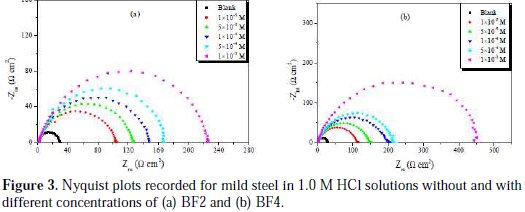
    <p>The Nyquist plots obtained from the EIS measurements for mild steel in 1.0 M 
HCl solutions at 308 K are shown in <a href="#f3">Fig. 3</a>.</p>


    <p>&nbsp;</p>
<a name="f3">
<img src="/img/revistas/pea/v35n3/35n3a04f3.jpg">
    
<p>&nbsp;</p>


    <p>The plots are characterized by a 
semicircle, which means the process was mainly controlled by capacitance and 
depressed semicircle, reflecting the surface in-homogeneity of structural or 
interfacial origin, such as that found in adsorption processes [41]. The capacitive 
semicircle refers to the double layer capacitance and transfer resistance (Rct). 
Different size semicircles are shown in <a href="#f3">Fig. 3</a>. The diameter of the semicircle 
represents the value of transfer resistance (Rct), which indicates a decreasing 
trend in corrosion rate. The charge transfer resistance values (Rct) were calculated 
from the difference between impedance values at lower and higher frequencies, 
as suggested by Haruyama et al. [42]. The double layer capacitance (Cdl) was 
obtained from the following equation [43]:</p>


    <p>&nbsp;</p>
<a name="e14">
<img src="/img/revistas/pea/v35n3/35n3a04e14.jpg">
    
]]></body>
<body><![CDATA[<p>&nbsp;</p>


    <p>where Zimg is the frequency of maximum imaginary components of the 
impedance and Rct is the charge transfer resistances.</p>

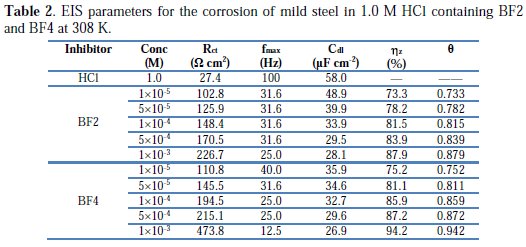
    <p>The calculated electrochemical parameters of EIS measurements are listed in 
<a href="#t2">Table 2</a>.</p>


    <p>&nbsp;</p>
<a name="t2">
<img src="/img/revistas/pea/v35n3/35n3a04t2.jpg">
    
<p>&nbsp;</p>


    <p>From the electrochemical impedance parameters and the inhibition 
efficiency (&eta;z%), which are listed in <a href="#t2">Table 2</a>, it is clear that the impedance 
spectra exhibit one single capacitive loop, indicating that: (i) the charge transfer 
takes place at the electrode/solution interface, (ii) the transfer process controls 
corrosion reaction, and (iii) the presence of the inhibitor does not change the 
mechanism of steel dissolution [44].</p>

    <p>As the inhibitor concentration increased, the Rct values increased and the Cdl 
values tended to decrease due to a decrease in local dielectric constant and/or an 
increase in the thickness of the electrical double layer, suggesting that the 
inhibitor molecules acted by adsorption at the metal/solution interface. Addition 
of synthesized inhibitors provided lower Cdl values, probably due to the 
replacement of water molecules by the inhibitor molecule at the electrode 
surface. In addition, the inhibitor molecules may reduce the capacitance by 
increasing the double layer thickness, according to the Helmholtz model [45]:</p>


    <p>&nbsp;</p>
<a name="e15">
<img src="/img/revistas/pea/v35n3/35n3a04e15.jpg">
    
<p>&nbsp;</p>


    <p>where &epsilon; is the dielectric constant of the medium, &epsilon;0 is the vacuum permittivity, 
A is the electrode surface area and &delta;org is the thickness of the protective layer. 
The order of tetrakis pyrazole derivatives remains unchanged; it is as follows: 
BF4 &gt; BF2. This is also in agreement with the observed order of corrosion 
inhibition obtained from potentiodynamic measurements.</p>


    ]]></body>
<body><![CDATA[<p><i><b>Weight loss measurements</b></i></p>

    <p><i>Effect of tetrakis pyrazole compounds on corrosion rate</i></p>

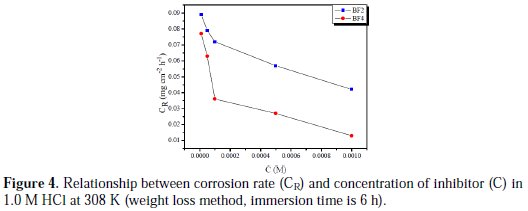
    <p><a href="#f4">Fig. 4</a> illustrates the corrosion rate (CR) of mild steel in 1.0 M HCl at 308 K in 
the presence of different concentrations (C) of tetrakis pyrazole compounds 
(immersion time is 6 h).</p>


    <p>&nbsp;</p>
<a name="f4">
<img src="/img/revistas/pea/v35n3/35n3a04f4.jpg">
    
<p>&nbsp;</p>


    <p>The corrosion rate reduces after addition of the selected 
two tetrakis pyrazole compounds, and decreases with the inhibitor concentration. 
This behaviour is due to the fact that the adsorption coverage increases with the 
increase of inhibitor's concentration, which shields the mild steel surface 
efficiently from the medium. In the absence of inhibitor, the corrosion rate is as 
high as 0.32 mg cm<sup>-2</sup> h<sup>-1</sup>, while in the presence of 10<sup>-3</sup> M inhibitor, the corrosion 
rate values are reduced to 0.042 and 0.013 mg for BF2 and BF4, 
respectively. At any given inhibitor concentration, the corrosion rate follows the 
order: CR (BF4) &lt; CR (BF2), which indicates that BF4 exhibits the best inhibitive 
performance among two tetrakis pyrazole compounds.</p>


    <p><i>Effect of tetrakis pyrazole compounds on inhibition efficiency</i></p>

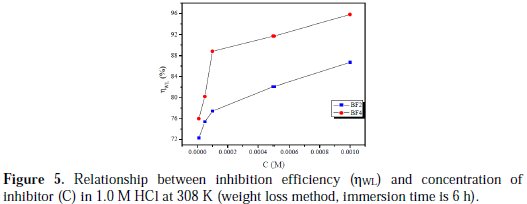
    <p><a href="#f5">Fig. 5</a> represents inhibition efficiency (&eta;WL) values obtained from the weight loss 
in 1.0 M HCl solutions in the presence of various concentrations of BF2 and BF4 
at 308 K (immersion time is 6 h).</p>


    <p>&nbsp;</p>
<a name="f5">
<img src="/img/revistas/pea/v35n3/35n3a04f5.jpg">
    
<p>&nbsp;</p>


    ]]></body>
<body><![CDATA[<p>Clearly, &eta;WL increases with an increase in the 
inhibitor's concentration. At 10<sup>-3</sup> M, the maximum &eta;WL is 86.7% for BF2, and 
95.8% for BF4, which indicates that two tetrakis pyrazole compounds act as 
good corrosion inhibitors for mild steel in 1.0 M HCl. Inhibition efficiency of the 
examined tetrakis pyrazole compounds follows the order: BF4 &gt; BF2.</p>


    <p><i>Effect of temperature and thermodynamic activation parameters</i></p>

    <p>Being given that the temperature is one of the factors that may affect the 
behavior of a material in a corrosive environment, and can also modify the metal-
inhibitor interaction, it is essential to study the effect of this factor on the 
protection rates, as well as to determine the mechanism of inhibition, to calculate 
the activation energies of the corrosion process.</p>

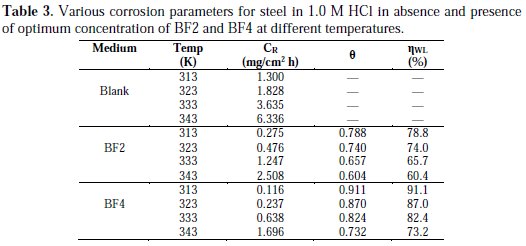
    <p>The study of the influence of temperature on the rate of corrosion inhibition of 
mild steel by our inhibitors was performed at temperatures 313, 323, 333 and 343 
K, in the absence and in the presence of inhibitor at 10<sup>-3</sup> M. This study 
determines the activation energies, enthalpies and entropies of activation of the 
corrosion process, and thus provides information on the mechanism of inhibition. 
The corresponding data are shown in <a href="#t3">Table 3</a>.</p>


    <p>&nbsp;</p>
<a name="t3">
<img src="/img/revistas/pea/v35n3/35n3a04t3.jpg">
    
<p>&nbsp;</p>


    <p>The comparative study of <a href="#t3">Table 3</a> showed that the corrosion rate increases with 
an increase in temperature in both the stabilized and inhibited solutions, while the 
inhibition efficiency of BF2 and BF4 products decreases. A decrease in the 
efficiency of inhibition with increasing temperature in the presence of our 
compounds may be due to the weakening of physical adsorption.</p>

    <p>To determine the activation energy, we have used the Arrhenius equation (16) to 
account for the effect of temperature (T) on the corrosion rate (CR). The change 
in the log corrosion rate, as a function of the reciprocal of the absolute 
temperature, is a linear function of T<sup>-1</sup>, and the corresponding relation (17) 
provides access to the activation energies:</p>


    <p>&nbsp;</p>
<a name="e16">
<img src="/img/revistas/pea/v35n3/35n3a04e16.jpg">
    
<p>&nbsp;</p>
<a name="e17">
<img src="/img/revistas/pea/v35n3/35n3a04e17.jpg">
    
]]></body>
<body><![CDATA[<p>&nbsp;</p>


    <p>To access the activation thermodynamic characteristics, enthalpy (&Delta;Ha) and 
entropy of activation (&Delta;Sa), we have used the Arrhenius equation transition [46]:</p>


    <p>&nbsp;</p>
<a name="e18">
<img src="/img/revistas/pea/v35n3/35n3a04e18.jpg">
    
<p>&nbsp;</p>


    <p>where CR is the corrosion rate, R the gas constant, T the absolute temperature, A 
the pre-exponential factor, h the Plank's constant, N is Avogrado's number, Ea the 
activation energy for corrosion process, DH a the enthalpy of activation and &Delta;Sa
the entropy of activation.</p>

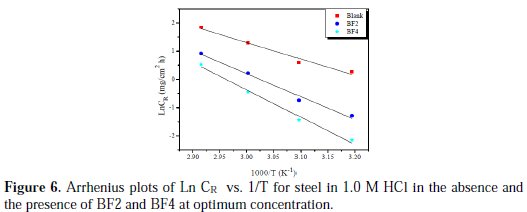
    <p>The curves of variation of the logarithm of the corrosion rate as a function of the 
reciprocal of the absolute temperature (T<sup>-1</sup>) are recorded in 
<a href="#f6">Fig. 6</a>.</p>


    <p>&nbsp;</p>
<a name="f6">
<img src="/img/revistas/pea/v35n3/35n3a04f6.jpg">
    
<p>&nbsp;</p>


    <p>The curves obtained in the form of lines obey the Arrhenius law, which satisfies the 
<a href="#e17">relation (17)</a>.</p>

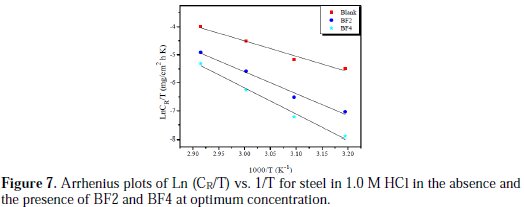
    <p><a href="#f7">Fig. 7</a> shows the variation of Ln (CR/T) vs. (1/T) as a straight line with a slope of 
(-&Delta;Ha/ R), and the intersection with the y-axis is [Ln(R/Nh) + (&Delta;Sa / R)].</p>


    ]]></body>
<body><![CDATA[<p>&nbsp;</p>
<a name="f7">
<img src="/img/revistas/pea/v35n3/35n3a04f7.jpg">
    
<p>&nbsp;</p>


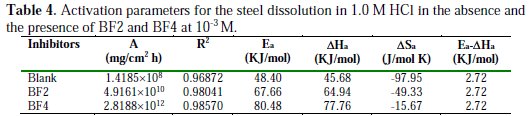
    <p>From these relationships, values of &Delta;Sa and &Delta;Ha can be calculated. The activation 
parameters (Ea, &Delta;Ha and &Delta;Sa) calculated from the slopes of Arrhenius lines in the 
absence and presence of our inhibitors (<a href="#f6">Fig. 6</a> and <a href="#f7">Fig. 7</a>) 
are summarized in <a href="#t4">Table 4</a>.</p>


    <p>&nbsp;</p>
<a name="t4">
<img src="/img/revistas/pea/v35n3/35n3a04t4.jpg">
    
<p>&nbsp;</p>


    <p>It is evident from <a href="#t4">Table 4</a> that the values of the apparent activation energy for the 
inhibited solutions were higher than those for the uninhibited solution, indicating 
that the dissolution of mild steel was decreased due to the formation of a barrier 
by the adsorption of the inhibitors on the metal surface [47].</p>

    <p>The values of Ea and &Delta;Ha were increased in the presence of inhibitors, suggesting 
that the energy barrier of the corrosion reaction increases, which means that the 
steel dissolution is difficult [48]. According to Gomma et al. [49], the activation 
energy is much higher when the inhibitor is more effective. However, the 
positive sign of the endothermic enthalpy reflects the nature of steel dissolution. 
We note that the variation of the activation energy Ea and the enthalpy of &Delta;Ha 
vary in the same way with the inhibitor's concentration, which satisfies the 
relationship between Ea and thermodynamics as &Delta;Ha [50]: Ea - &Delta;Ha = RT. 
The values of &Delta;Sa were lower for the solution without inhibitor than those for the 
solution with inhibitor. This may be because the rate-determining step for the 
activated complex was the association rather than the dissociation step [51]. As 
seen from <a href="#t4">Table 4</a>, there is a shift of &Delta;Sa to more positive values in the presence 
of the inhibitor, thus the increase in disorder is a driving force that can overcome 
the barriers for the inhibitor's adsorption onto the metal surface.</p>


    <p><i><b>Adsorption isotherm and thermodynamic parameters</b></i></p>

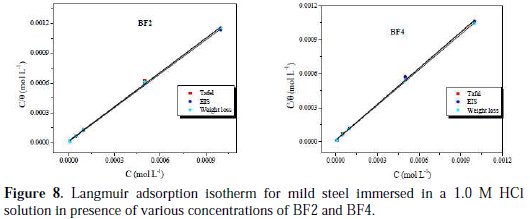
    <p>The adsorption isotherms are vital in elucidating the corrosion inhibition 
mechanism, since they express the interaction of the inhibitor molecule with the 
active sites on the mild steel surface. Therefore, in this study, several adsorption 
isotherms were evaluated, namely, Langmuir, Frumkin and Temkin. As can be 
seen from <a href="#f8">Fig. 8</a>, straight lines were obtained (R2 is almost equal to unity) by 
plotting C/&theta; vs. C at all concentrations studied.</p>


    <p>&nbsp;</p>
<a name="f8">
<img src="/img/revistas/pea/v35n3/35n3a04f8.jpg">
    
]]></body>
<body><![CDATA[<p>&nbsp;</p>


    <p>This indicates that the inhibitor is 
adsorbed on the mild steel surface, according to the Langmuir adsorption 
isotherm. From the intercepts of the straight lines on the C/&theta; 
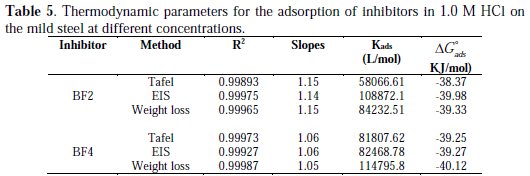
axis, Kads values were calculated for the adsorption process (<a href="#t5">Table 5</a>).</p>


    <p>&nbsp;</p>
<a name="t5">
<img src="/img/revistas/pea/v35n3/35n3a04t5.jpg">
    
<p>&nbsp;</p>


    <p>The slope values are mostly 
equal to unity, indicating the physicochemical adsorption of inhibitor molecules 
on an active site on the mild steel surface. Free energy of adsorption (&Delta;Gads) was 
calculated by using the following equation <a href="#e19">Eq. (19)</a>:</p>


    <p>&nbsp;</p>
<a name="e19">
<img src="/img/revistas/pea/v35n3/35n3a04e19.jpg">
    
<p>&nbsp;</p>


    <p>where R is the gas constant, T is the absolute temperature of the experiment and 
the constant value of 55.5 is the concentration of water in a solution in mol L<sup>-1</sup>.</p>

    <p><a href="#t5">Table 5</a> shows the negative values of &Delta;Gads, indicating the spontaneity of 
adsorption of the inhibitor molecules on the mild steel surface [52]. In general, 
&Delta;Gads values below -20 kJ mol<sup>-1</sup> are due to the physisorption of the inhibitor, 
whereas &Delta;Gads values above -40 kJ mol<sup>-1</sup> are attributed to the chemisorption of the 
inhibitor molecules on metal surface. In the present study, &Delta;Gads values are 
between -38.27 and -40.12 kJ mol<sup>-1</sup> , which provides evidence for both 
electrostatic interactions (physisorption) and charge sharing or transferring from 
the inhibitor to the charged mild steel surface (chemisorption) [53]. Moreover, 
higher values for the equilibrium constant (Kads) and standard free energy of 
adsorption (&Delta;Gads) support a better inhibitive activity of the substance [54]. <a href="#f8">Fig. 8</a> 
shows a skeletal representation of adsorption on the charged mild steel surface.</p>


    <p><i><b>Quantum chemical calculation</b></i></p>

    ]]></body>
<body><![CDATA[<p><i>Frontier orbital energies</i></p>

    <p>It is well known that the molecular reactivity is mainly analyzed via frontier 
orbital theory; therefore, it is necessary to investigate the highest occupied orbital 
(HOMO) and the lowest unoccupied orbital (LUMO) for exploring the 
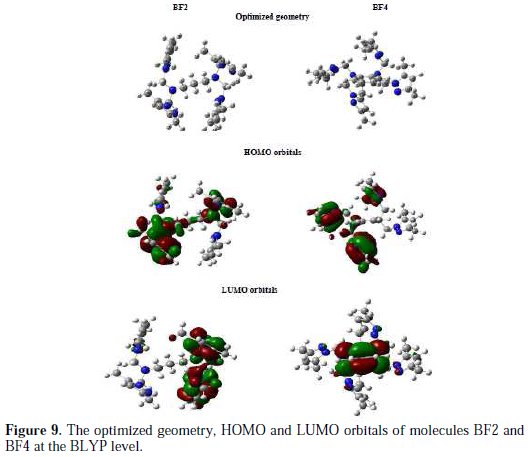
adsorption behavior of corrosion inhibitor on the metal surface. The HOMO and 
LUMO of BF2 and BF4 molecules were calculated and are presented in 
<a href="#f9">Fig. 9</a>.</p>


    <p>&nbsp;</p>
<a name="f9">
<img src="/img/revistas/pea/v35n3/35n3a04f9.jpg">
    
<p>&nbsp;</p>


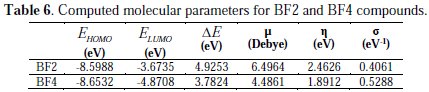
    <p>The quantum-chemical parameters related to the BF2 and BF4 molecules are 
listed in <a href="#t6">Table 6</a>.</p>


    <p>&nbsp;</p>
<a name="t6">
<img src="/img/revistas/pea/v35n3/35n3a04t6.jpg">
    
<p>&nbsp;</p>


    <p>They include: EHOMO, ELUMO, the energy gap (&Delta;E), dipole 
moment (&mu;), the chemical potential, global hardness (&sigma;) and global softness (S).</p>

    <p>The highest occupied molecular orbital (EHOMO) and the lowest unoccupied 
molecular orbital (ELUMO) are very useful to elucidate the chemical reactivity of a 
molecule. According to the frontier molecular orbital theory of chemical 
reactivity, the transition of electrons is mainly related to the highest occupied 
molecular orbital (HOMO) and lowest unoccupied molecular orbital (LUMO) of 
the reacting species [55]. The HOMO is associated with the electron donation 
capability of the molecule. The higher the EHOMO value, the stronger the electron 
donating capability of the inhibitor will be and, therefore, the better the observed 
inhibition efficiency will be [56]. The LUMO implies the capability of the 
molecules to accept electrons from the metallic surface. The lower the value of 
ELUMO, the more it will be prone towards accepting electrons [57].</p>

    <p>From <a href="#t6">Table 6</a>, it can be concluded that the capability of donating electrons 
follows the order: BF4 &gt; BF2. ELUMO signifies the propensity of molecules to 
accept electrons. The lower value of the ELUMO is, the stronger is the ability of 
molecules to accept electrons. It can be observed (via <a href="#t6">Table 6</a>) that the capability 
of accepting electrons obeys the order: BF2 &gt; BF4. This is not in accordance 
with the result (inhibition efficiencies) obtained from the experiments.</p>

    ]]></body>
<body><![CDATA[<p>The energy gap (&Delta;E) is a very important stability parameter of the molecules 
related to the reactivity tendency of the molecules towards the metal surface. The 
lower &Delta;E is, the higher is the reactivity tendency of molecules in adsorption [58].</p>

    <p>As for a molecule with lower energy gap, it means that the molecule is more 
polarizable and the molecule electrons are transported more smoothly. Thus, &Delta;E 
has been used to measure the binding ability of molecules as an important index. 
It can be seen (via <a href="#t6">Table 6</a>) that the property of molecules obeys the order: BF4 &gt; 
BF2. These results are in good agreement with the experiments. Global softness 
(&sigma;) is also a predominant parameter to characterize the adsorption ability of 
molecules, and the higher the value is, the higher is the possibility of adsorption. 
In the research of corrosion inhibition chemistry, the inhibitors and the metals are 
considered as soft base and soft acid, respectively. It could be concluded (via 
<a href="#t6">Table 6</a>) that the property of molecules obeys the order: BF4 &gt; BF2. These 
results are in accordance to the former ones. The dipole moment (&mu;) of a 
molecule is also an important parameter to elucidate the chemical reactivity of a 
molecule. A literature survey reveals that the adsorption process is further 
facilitated with increased values of dipole moment as the latter influences the 
transport process through the adsorbed layer [59,60]. In this work it can be 
observed from <a href="#t6">Table 6</a> that the dipole moment values increase in the order of 
BF4 &lt; BF2, which is not in accordance with the experimental results.</p>


    <p><i>Active sites</i></p>

    <p>Inhibitor molecules are in general adsorbed on the metallic surface by the donor 
acceptor (D-A) type interaction between the inhibitor molecule and the 
concerned metallic surface. Therefore, it is essential to examine which 
corresponding active sites are responsible for this. Generally the more negative is 
the charge on the heteroatoms, more it can participate on the 
D-A type interactions [61]. However, it is also important to consider the situation 
from where the inhibitor molecules are going to receive certain amount of 
charges at some centres and reverting back for donating considerable amount of 
charges through consecutive centres [62]. This can be easily achieved by 
evaluating Fukui indices for each individual atom. This shows local reactivity as 
well as nucleophilic and electrophilic nature of the molecule [63]. Nucleophilic 
and electrophilic attacks are mainly controlled by the maximum threshold values 
of fk+ and fk-. fk+ measures changes in electron density when the molecule 
accepts extra electrons, whereas fk- measures electron density changes when 
molecule loses electrons.</p>

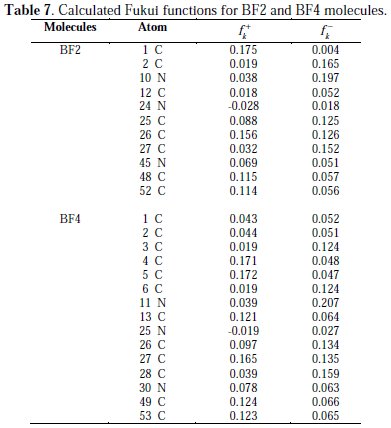
    <p>The calculated values of the Fukui functions for the non hydrogen atoms are 
reported in <a href="#t7">Table 7</a>).</p>


    <p>&nbsp;</p>
<a name="t7">
<img src="/img/revistas/pea/v35n3/35n3a04t7.jpg">
    
<p>&nbsp;</p>


    <p>From the results obtained, it can be stated that the site for 
nucleophilic attack is where the value of fk+ is maximum. On the other hand, the 
site for electrophilic attack is controlled by the value of fk-.</p>

    <p>It can be seen from <a href="#t7">Table 7</a> that in the BF2 molecule, the C(1), C(25), C(48) and 
C(53) atoms are the more susceptible sites for a nucleophilic attack (electron 
acceptance), as those atoms possess higher charge densities. On the other hand, 
the C(2), N(10), C(25), C(26) and C(27) atoms mainly participate in the 
electrophilic attack (the donation of electrons). Therefore, it can be concluded 
from these results that all the individual atoms will participate in the D-A type 
interactions on the iron surface. On the other hand, C(4), C(5), C(13), C(27), 
C(49) and C(53) atoms are the favorable sites for electron acceptance, while the 
C(3), C(6), C(26), C(27), C(28) and N(11) atoms will be responsible for electron 
donation for BF4. Based on the above discussion, it can be concluded that BF2 
and BF4 have many active sites for adsorption on the mild steel surface. These 
results are also in good accordance with experimentally obtained inhibition 
efficiency.</p>


    <p>&nbsp;</p>
    ]]></body>
<body><![CDATA[<p><b>Conclusion</b></p>

    <p>From the overall experimental results and theoretical calculations the following 
conclusions can be deduced:</p>

    <p>- The synthesized tetrakis pyrazole derivatives showed good inhibition 
efficiencies for the corrosion of mild steel in 1.0 M HCl solution, and the 
inhibition efficiency increased on increasing the concentration of inhibitor. The 
inhibiting performance of BF4 is better than that of BF2.</p>

    <p>- Inhibition efficiency (&eta;WL) decreases with the temperature. The value of 
apparent activation energy (Ea) in the presence of inhibitors is higher than that in 
the absence of inhibitor.</p>

    <p>- The adsorption of each tetrakis pyrazole inhibitor obeys Langmuir adsorption 
isotherm.</p>

    <p>- Polarization studies showed that both tested inhibitors are mixed type in nature.</p>

    <p>- Electrochemical impedance spectroscopy (EIS) measurements show that charge 
transfer resistance (Rct) increases and double-layer capacitance (Cdl) decreases in 
presence of inhibitors, suggesting the adsorption of the inhibitor molecules on the 
surface of mild steel.</p>

    <p>- Quantum chemical calculations reveal that the electron donation and electron 
acceptance capabilities of the studied inhibitors follow the order BF4 > BF2, 
which is in good accordance with the results obtained from previously performed 
experiments.</p>

    <p>- The active sites of the studied inhibitor molecules are also thoroughly 
investigated using Fukui indices. Fukui indices describe in detail which particular 
atoms mainly participate for the electron donation and acceptance processes 
between the inhibitors and the Fe surface.</p>


    <p>&nbsp;</p>
    ]]></body>
<body><![CDATA[<p><b>References</b></p>

    <!-- ref --><p>1. Sastri VS. Corrosion Inhibitors - Principles and Applications. Chichester, 
England: Wiley; 1998.    &nbsp;&nbsp;&nbsp;&nbsp;&nbsp;&nbsp;&nbsp;&nbsp;[&#160;<a href="javascript:void(0);" onclick="javascript: window.open('/scielo.php?script=sci_nlinks&ref=427336&pid=S0872-1904201700030000400001&lng=','','width=640,height=500,resizable=yes,scrollbars=1,menubar=yes,');">Links</a>&#160;]<!-- end-ref --></p>

    <!-- ref --><p>2. Lagrenee M, Mernari B, Bouanis M, et al. Corros Sci. 2002;44:573.    &nbsp;&nbsp;&nbsp;&nbsp;&nbsp;&nbsp;&nbsp;&nbsp;[&#160;<a href="javascript:void(0);" onclick="javascript: window.open('/scielo.php?script=sci_nlinks&ref=427338&pid=S0872-1904201700030000400002&lng=','','width=640,height=500,resizable=yes,scrollbars=1,menubar=yes,');">Links</a>&#160;]<!-- end-ref --></p>

    <!-- ref --><p>3. Abdallah M. Corros Sci. 2003;45:2705.    &nbsp;&nbsp;&nbsp;&nbsp;&nbsp;&nbsp;&nbsp;&nbsp;[&#160;<a href="javascript:void(0);" onclick="javascript: window.open('/scielo.php?script=sci_nlinks&ref=427340&pid=S0872-1904201700030000400003&lng=','','width=640,height=500,resizable=yes,scrollbars=1,menubar=yes,');">Links</a>&#160;]<!-- end-ref --></p>

    <!-- ref --><p>4. Naik UJ, Panchal VA, Patel AS, et al. J Mater Environ Sci. 2012;3:935.    &nbsp;&nbsp;&nbsp;&nbsp;&nbsp;&nbsp;&nbsp;&nbsp;[&#160;<a href="javascript:void(0);" onclick="javascript: window.open('/scielo.php?script=sci_nlinks&ref=427342&pid=S0872-1904201700030000400004&lng=','','width=640,height=500,resizable=yes,scrollbars=1,menubar=yes,');">Links</a>&#160;]<!-- end-ref --></p>

    <!-- ref --><p>5. Al Hamzi AH, Zarrok H, Zarrouk A, et al. Int J Electrochem Sci. 2013;8:2586.    &nbsp;&nbsp;&nbsp;&nbsp;&nbsp;&nbsp;&nbsp;&nbsp;[&#160;<a href="javascript:void(0);" onclick="javascript: window.open('/scielo.php?script=sci_nlinks&ref=427344&pid=S0872-1904201700030000400005&lng=','','width=640,height=500,resizable=yes,scrollbars=1,menubar=yes,');">Links</a>&#160;]<!-- end-ref --></p>

    <!-- ref --><p>6. Zarrouk A, Hammouti B, Zarrok H, et al. Der Pharm Chem. 2011;3:263.    &nbsp;&nbsp;&nbsp;&nbsp;&nbsp;&nbsp;&nbsp;&nbsp;[&#160;<a href="javascript:void(0);" onclick="javascript: window.open('/scielo.php?script=sci_nlinks&ref=427346&pid=S0872-1904201700030000400006&lng=','','width=640,height=500,resizable=yes,scrollbars=1,menubar=yes,');">Links</a>&#160;]<!-- end-ref --></p>

    <!-- ref --><p>7. Ghazoui A, Bencaht N, Al-Deyab SS, et al. Int J Electrochem Sci. 2013;8:2272.    &nbsp;&nbsp;&nbsp;&nbsp;&nbsp;&nbsp;&nbsp;&nbsp;[&#160;<a href="javascript:void(0);" onclick="javascript: window.open('/scielo.php?script=sci_nlinks&ref=427348&pid=S0872-1904201700030000400007&lng=','','width=640,height=500,resizable=yes,scrollbars=1,menubar=yes,');">Links</a>&#160;]<!-- end-ref --></p>

    <!-- ref --><p>8. Zarrouk A, Zarrok H, Salghi R, et al. Int J Electrochem Sci. 2012;7:10215.    &nbsp;&nbsp;&nbsp;&nbsp;&nbsp;&nbsp;&nbsp;&nbsp;[&#160;<a href="javascript:void(0);" onclick="javascript: window.open('/scielo.php?script=sci_nlinks&ref=427350&pid=S0872-1904201700030000400008&lng=','','width=640,height=500,resizable=yes,scrollbars=1,menubar=yes,');">Links</a>&#160;]<!-- end-ref --></p>

    <!-- ref --><p>9. Zarrouk A, Hammouti B, Zarrok H, et al. Int J Electrochem Sci. 2012;6:89.    &nbsp;&nbsp;&nbsp;&nbsp;&nbsp;&nbsp;&nbsp;&nbsp;[&#160;<a href="javascript:void(0);" onclick="javascript: window.open('/scielo.php?script=sci_nlinks&ref=427352&pid=S0872-1904201700030000400009&lng=','','width=640,height=500,resizable=yes,scrollbars=1,menubar=yes,');">Links</a>&#160;]<!-- end-ref --></p>

    <!-- ref --><p>10. Ghazoui A, Saddik R, Benchat N, et al. Int J Electrochem Sci. 2012;7:7080.    &nbsp;&nbsp;&nbsp;&nbsp;&nbsp;&nbsp;&nbsp;&nbsp;[&#160;<a href="javascript:void(0);" onclick="javascript: window.open('/scielo.php?script=sci_nlinks&ref=427354&pid=S0872-1904201700030000400010&lng=','','width=640,height=500,resizable=yes,scrollbars=1,menubar=yes,');">Links</a>&#160;]<!-- end-ref --></p>

    <!-- ref --><p>11. Quraishi MA, Sardar R, Jamal D. Mater Chem Phys. 2001;71:309.    &nbsp;&nbsp;&nbsp;&nbsp;&nbsp;&nbsp;&nbsp;&nbsp;[&#160;<a href="javascript:void(0);" onclick="javascript: window.open('/scielo.php?script=sci_nlinks&ref=427356&pid=S0872-1904201700030000400011&lng=','','width=640,height=500,resizable=yes,scrollbars=1,menubar=yes,');">Links</a>&#160;]<!-- end-ref --></p>

    <!-- ref --><p>12. El Ouali I, Chetouani A, Hammouti B, et al. Port Electrochim Acta. 2013;31:53.    &nbsp;&nbsp;&nbsp;&nbsp;&nbsp;&nbsp;&nbsp;&nbsp;[&#160;<a href="javascript:void(0);" onclick="javascript: window.open('/scielo.php?script=sci_nlinks&ref=427358&pid=S0872-1904201700030000400012&lng=','','width=640,height=500,resizable=yes,scrollbars=1,menubar=yes,');">Links</a>&#160;]<!-- end-ref --></p>

    <!-- ref --><p>13. Eddy NO, Ameh PO, Gwarzo MY, et al. Port Electrochim Acta. 2013;31:79.    &nbsp;&nbsp;&nbsp;&nbsp;&nbsp;&nbsp;&nbsp;&nbsp;[&#160;<a href="javascript:void(0);" onclick="javascript: window.open('/scielo.php?script=sci_nlinks&ref=427360&pid=S0872-1904201700030000400013&lng=','','width=640,height=500,resizable=yes,scrollbars=1,menubar=yes,');">Links</a>&#160;]<!-- end-ref --></p>

    <!-- ref --><p>14. Joseph B, Prajila M, Joseph A. J Dispersion Sci Technol. 2012;33:739.    &nbsp;&nbsp;&nbsp;&nbsp;&nbsp;&nbsp;&nbsp;&nbsp;[&#160;<a href="javascript:void(0);" onclick="javascript: window.open('/scielo.php?script=sci_nlinks&ref=427362&pid=S0872-1904201700030000400014&lng=','','width=640,height=500,resizable=yes,scrollbars=1,menubar=yes,');">Links</a>&#160;]<!-- end-ref --></p>

    <!-- ref --><p>15. Kabanda MM, Murulana LC, Ozcan M, et al. Int J Electrochem Sci. 2012;7:5035.    &nbsp;&nbsp;&nbsp;&nbsp;&nbsp;&nbsp;&nbsp;&nbsp;[&#160;<a href="javascript:void(0);" onclick="javascript: window.open('/scielo.php?script=sci_nlinks&ref=427364&pid=S0872-1904201700030000400015&lng=','','width=640,height=500,resizable=yes,scrollbars=1,menubar=yes,');">Links</a>&#160;]<!-- end-ref --></p>

    <!-- ref --><p>16. Zertoubi M, Zerouali D, Hammouti B, et al. E-J Chem. 2010;7:S35.    &nbsp;&nbsp;&nbsp;&nbsp;&nbsp;&nbsp;&nbsp;&nbsp;[&#160;<a href="javascript:void(0);" onclick="javascript: window.open('/scielo.php?script=sci_nlinks&ref=427366&pid=S0872-1904201700030000400016&lng=','','width=640,height=500,resizable=yes,scrollbars=1,menubar=yes,');">Links</a>&#160;]<!-- end-ref --></p>

    <!-- ref --><p>17. Khaled KF, Abdel-Rehim SS, Sakr GB. Arab J Chem. 2012;5:213.    &nbsp;&nbsp;&nbsp;&nbsp;&nbsp;&nbsp;&nbsp;&nbsp;[&#160;<a href="javascript:void(0);" onclick="javascript: window.open('/scielo.php?script=sci_nlinks&ref=427368&pid=S0872-1904201700030000400017&lng=','','width=640,height=500,resizable=yes,scrollbars=1,menubar=yes,');">Links</a>&#160;]<!-- end-ref --></p>

    <!-- ref --><p>18. Ogukwe CE, Akalezi CO, Chidiebere MA, et al. Port Electrochim Acta. 2012;30:189.    &nbsp;&nbsp;&nbsp;&nbsp;&nbsp;&nbsp;&nbsp;&nbsp;[&#160;<a href="javascript:void(0);" onclick="javascript: window.open('/scielo.php?script=sci_nlinks&ref=427370&pid=S0872-1904201700030000400018&lng=','','width=640,height=500,resizable=yes,scrollbars=1,menubar=yes,');">Links</a>&#160;]<!-- end-ref --></p>

    <!-- ref --><p>19. Khaled KF, Abdel-Rehim SS. Arab J Chem. 2011;4:397.    &nbsp;&nbsp;&nbsp;&nbsp;&nbsp;&nbsp;&nbsp;&nbsp;[&#160;<a href="javascript:void(0);" onclick="javascript: window.open('/scielo.php?script=sci_nlinks&ref=427372&pid=S0872-1904201700030000400019&lng=','','width=640,height=500,resizable=yes,scrollbars=1,menubar=yes,');">Links</a>&#160;]<!-- end-ref --></p>

    <!-- ref --><p>20. Tebbji K, Aouniti A, Attayibat A, et al. Indian J Chem Technol. 2011;18:244.    &nbsp;&nbsp;&nbsp;&nbsp;&nbsp;&nbsp;&nbsp;&nbsp;[&#160;<a href="javascript:void(0);" onclick="javascript: window.open('/scielo.php?script=sci_nlinks&ref=427374&pid=S0872-1904201700030000400020&lng=','','width=640,height=500,resizable=yes,scrollbars=1,menubar=yes,');">Links</a>&#160;]<!-- end-ref --></p>

    <!-- ref --><p>21. Hammouti B, Dafali A, Touzani R, et al. J Saudi Chem Soc. 2012;16:413.    &nbsp;&nbsp;&nbsp;&nbsp;&nbsp;&nbsp;&nbsp;&nbsp;[&#160;<a href="javascript:void(0);" onclick="javascript: window.open('/scielo.php?script=sci_nlinks&ref=427376&pid=S0872-1904201700030000400021&lng=','','width=640,height=500,resizable=yes,scrollbars=1,menubar=yes,');">Links</a>&#160;]<!-- end-ref --></p>

    <!-- ref --><p>22. Zarrok H, Oudda H, El Midaoui A, et al.Res Chem Intermed. 2012;38:2051.    &nbsp;&nbsp;&nbsp;&nbsp;&nbsp;&nbsp;&nbsp;&nbsp;[&#160;<a href="javascript:void(0);" onclick="javascript: window.open('/scielo.php?script=sci_nlinks&ref=427378&pid=S0872-1904201700030000400022&lng=','','width=640,height=500,resizable=yes,scrollbars=1,menubar=yes,');">Links</a>&#160;]<!-- end-ref --></p>

    <!-- ref --><p>23. Tebbji K, Oudda H, Hammouti B, et al. Res Chem Intermed. 2011;37:985.    &nbsp;&nbsp;&nbsp;&nbsp;&nbsp;&nbsp;&nbsp;&nbsp;[&#160;<a href="javascript:void(0);" onclick="javascript: window.open('/scielo.php?script=sci_nlinks&ref=427380&pid=S0872-1904201700030000400023&lng=','','width=640,height=500,resizable=yes,scrollbars=1,menubar=yes,');">Links</a>&#160;]<!-- end-ref --></p>

    <!-- ref --><p>24. Bendaha H, Zarrouk A, Aouniti A, et al. Phys Chem News. 2012;64:95.    &nbsp;&nbsp;&nbsp;&nbsp;&nbsp;&nbsp;&nbsp;&nbsp;[&#160;<a href="javascript:void(0);" onclick="javascript: window.open('/scielo.php?script=sci_nlinks&ref=427382&pid=S0872-1904201700030000400024&lng=','','width=640,height=500,resizable=yes,scrollbars=1,menubar=yes,');">Links</a>&#160;]<!-- end-ref --></p>

    <!-- ref --><p>25. Zarrok H, Al Mamari K, Zarrouk A, et al. Int J Electrochem Sci. 2012;7:10338.    &nbsp;&nbsp;&nbsp;&nbsp;&nbsp;&nbsp;&nbsp;&nbsp;[&#160;<a href="javascript:void(0);" onclick="javascript: window.open('/scielo.php?script=sci_nlinks&ref=427384&pid=S0872-1904201700030000400025&lng=','','width=640,height=500,resizable=yes,scrollbars=1,menubar=yes,');">Links</a>&#160;]<!-- end-ref --></p>

    <!-- ref --><p>26. Zarrok H, Zarrouk A, Salghi R, et al. J Chem Pharm Res. 2012;4:5048.    &nbsp;&nbsp;&nbsp;&nbsp;&nbsp;&nbsp;&nbsp;&nbsp;[&#160;<a href="javascript:void(0);" onclick="javascript: window.open('/scielo.php?script=sci_nlinks&ref=427386&pid=S0872-1904201700030000400026&lng=','','width=640,height=500,resizable=yes,scrollbars=1,menubar=yes,');">Links</a>&#160;]<!-- end-ref --></p>

    <!-- ref --><p>27. Belayachi M, Serrar H, Zarrok H, et al. Int J Electrochem Sci. 2015;10:3010.    &nbsp;&nbsp;&nbsp;&nbsp;&nbsp;&nbsp;&nbsp;&nbsp;[&#160;<a href="javascript:void(0);" onclick="javascript: window.open('/scielo.php?script=sci_nlinks&ref=427388&pid=S0872-1904201700030000400027&lng=','','width=640,height=500,resizable=yes,scrollbars=1,menubar=yes,');">Links</a>&#160;]<!-- end-ref --></p>

    <!-- ref --><p>28. Tayebi H, Bourazmi H, Himmi B, et al. Der Pharm Lett. 2014;6:20.    &nbsp;&nbsp;&nbsp;&nbsp;&nbsp;&nbsp;&nbsp;&nbsp;[&#160;<a href="javascript:void(0);" onclick="javascript: window.open('/scielo.php?script=sci_nlinks&ref=427390&pid=S0872-1904201700030000400028&lng=','','width=640,height=500,resizable=yes,scrollbars=1,menubar=yes,');">Links</a>&#160;]<!-- end-ref --></p>

    <!-- ref --><p>29. Tayebi H, Bourazmi H, Himmi B, et al. Der Pharm Chem. 2014;6:220.    &nbsp;&nbsp;&nbsp;&nbsp;&nbsp;&nbsp;&nbsp;&nbsp;[&#160;<a href="javascript:void(0);" onclick="javascript: window.open('/scielo.php?script=sci_nlinks&ref=427392&pid=S0872-1904201700030000400029&lng=','','width=640,height=500,resizable=yes,scrollbars=1,menubar=yes,');">Links</a>&#160;]<!-- end-ref --></p>

    <!-- ref --><p>30. Zarrok H, Zarrouk A, Salghi R, et al. Der Pharm Lett. 2013;5:43.    &nbsp;&nbsp;&nbsp;&nbsp;&nbsp;&nbsp;&nbsp;&nbsp;[&#160;<a href="javascript:void(0);" onclick="javascript: window.open('/scielo.php?script=sci_nlinks&ref=427394&pid=S0872-1904201700030000400030&lng=','','width=640,height=500,resizable=yes,scrollbars=1,menubar=yes,');">Links</a>&#160;]<!-- end-ref --></p>

    <!-- ref --><p>31. ASTM Designation G1-03 ''Standard Practice for Preparing, Cleaning, and 
Evaluating Corrosion Test Specimens''; 2011.    &nbsp;&nbsp;&nbsp;&nbsp;&nbsp;&nbsp;&nbsp;&nbsp;[&#160;<a href="javascript:void(0);" onclick="javascript: window.open('/scielo.php?script=sci_nlinks&ref=427396&pid=S0872-1904201700030000400031&lng=','','width=640,height=500,resizable=yes,scrollbars=1,menubar=yes,');">Links</a>&#160;]<!-- end-ref --></p>

    <!-- ref --><p>32. Gaussian 03, Revision B.01, M. J. Frisch, et al., Gaussian, Inc., Pittsburgh, PA, 2003.    &nbsp;&nbsp;&nbsp;&nbsp;&nbsp;&nbsp;&nbsp;&nbsp;[&#160;<a href="javascript:void(0);" onclick="javascript: window.open('/scielo.php?script=sci_nlinks&ref=427398&pid=S0872-1904201700030000400032&lng=','','width=640,height=500,resizable=yes,scrollbars=1,menubar=yes,');">Links</a>&#160;]<!-- end-ref --></p>

    <!-- ref --><p>33. Hehre WJ, Radom L, Schleyer PVR, et al. AB INITIO Molecular Orbital 
Theory. New York: Wiley-Interscience; 1986.    &nbsp;&nbsp;&nbsp;&nbsp;&nbsp;&nbsp;&nbsp;&nbsp;[&#160;<a href="javascript:void(0);" onclick="javascript: window.open('/scielo.php?script=sci_nlinks&ref=427400&pid=S0872-1904201700030000400033&lng=','','width=640,height=500,resizable=yes,scrollbars=1,menubar=yes,');">Links</a>&#160;]<!-- end-ref --></p>

    <!-- ref --><p>34. Janak JF. Phys Rev B. 1978;18:7165.    &nbsp;&nbsp;&nbsp;&nbsp;&nbsp;&nbsp;&nbsp;&nbsp;[&#160;<a href="javascript:void(0);" onclick="javascript: window.open('/scielo.php?script=sci_nlinks&ref=427402&pid=S0872-1904201700030000400034&lng=','','width=640,height=500,resizable=yes,scrollbars=1,menubar=yes,');">Links</a>&#160;]<!-- end-ref --></p>

    <!-- ref --><p>35. Stowasser R, Hoffmann R. J Am Chem Soc. 1999;121:3414.    &nbsp;&nbsp;&nbsp;&nbsp;&nbsp;&nbsp;&nbsp;&nbsp;[&#160;<a href="javascript:void(0);" onclick="javascript: window.open('/scielo.php?script=sci_nlinks&ref=427404&pid=S0872-1904201700030000400035&lng=','','width=640,height=500,resizable=yes,scrollbars=1,menubar=yes,');">Links</a>&#160;]<!-- end-ref --></p>

    <!-- ref --><p>36. Pearson RG. Inorg Chem. 1988;27:734.    &nbsp;&nbsp;&nbsp;&nbsp;&nbsp;&nbsp;&nbsp;&nbsp;[&#160;<a href="javascript:void(0);" onclick="javascript: window.open('/scielo.php?script=sci_nlinks&ref=427406&pid=S0872-1904201700030000400036&lng=','','width=640,height=500,resizable=yes,scrollbars=1,menubar=yes,');">Links</a>&#160;]<!-- end-ref --></p>

    <!-- ref --><p>37. Parr RG, Yang W. J Am Chem Soc. 1984;106:4049.    &nbsp;&nbsp;&nbsp;&nbsp;&nbsp;&nbsp;&nbsp;&nbsp;[&#160;<a href="javascript:void(0);" onclick="javascript: window.open('/scielo.php?script=sci_nlinks&ref=427408&pid=S0872-1904201700030000400037&lng=','','width=640,height=500,resizable=yes,scrollbars=1,menubar=yes,');">Links</a>&#160;]<!-- end-ref --></p>

    <!-- ref --><p>38. Khaled KF. Electrochim Acta. 2010;55:6523.    &nbsp;&nbsp;&nbsp;&nbsp;&nbsp;&nbsp;&nbsp;&nbsp;[&#160;<a href="javascript:void(0);" onclick="javascript: window.open('/scielo.php?script=sci_nlinks&ref=427410&pid=S0872-1904201700030000400038&lng=','','width=640,height=500,resizable=yes,scrollbars=1,menubar=yes,');">Links</a>&#160;]<!-- end-ref --></p>

    <!-- ref --><p>39. Fouda AS, Elewady YA, Abd El-Aziz HK. J Chem Sci Technol. 2012;1:45.    &nbsp;&nbsp;&nbsp;&nbsp;&nbsp;&nbsp;&nbsp;&nbsp;[&#160;<a href="javascript:void(0);" onclick="javascript: window.open('/scielo.php?script=sci_nlinks&ref=427412&pid=S0872-1904201700030000400039&lng=','','width=640,height=500,resizable=yes,scrollbars=1,menubar=yes,');">Links</a>&#160;]<!-- end-ref --></p>

    <!-- ref --><p>40. Li X, Deng S, Fu H, et al. Corros Sci. 2009;51:620.    &nbsp;&nbsp;&nbsp;&nbsp;&nbsp;&nbsp;&nbsp;&nbsp;[&#160;<a href="javascript:void(0);" onclick="javascript: window.open('/scielo.php?script=sci_nlinks&ref=427414&pid=S0872-1904201700030000400040&lng=','','width=640,height=500,resizable=yes,scrollbars=1,menubar=yes,');">Links</a>&#160;]<!-- end-ref --></p>

    <!-- ref --><p>41. Amar H, Tounsi A, Makayssi A, et al. Corros Sci. 2007;49:2936.    &nbsp;&nbsp;&nbsp;&nbsp;&nbsp;&nbsp;&nbsp;&nbsp;[&#160;<a href="javascript:void(0);" onclick="javascript: window.open('/scielo.php?script=sci_nlinks&ref=427416&pid=S0872-1904201700030000400041&lng=','','width=640,height=500,resizable=yes,scrollbars=1,menubar=yes,');">Links</a>&#160;]<!-- end-ref --></p>

    <!-- ref --><p>42. Deyab MA, Abd El-Rehim SS, Keera ST. Colloids Surf A. 2009;348:170.    &nbsp;&nbsp;&nbsp;&nbsp;&nbsp;&nbsp;&nbsp;&nbsp;[&#160;<a href="javascript:void(0);" onclick="javascript: window.open('/scielo.php?script=sci_nlinks&ref=427418&pid=S0872-1904201700030000400042&lng=','','width=640,height=500,resizable=yes,scrollbars=1,menubar=yes,');">Links</a>&#160;]<!-- end-ref --></p>

    <!-- ref --><p>43. Haruyama S, Tsuru T, Gijutsu B. J Jpn Soc Corros Eng. 1978;27:573.    &nbsp;&nbsp;&nbsp;&nbsp;&nbsp;&nbsp;&nbsp;&nbsp;[&#160;<a href="javascript:void(0);" onclick="javascript: window.open('/scielo.php?script=sci_nlinks&ref=427420&pid=S0872-1904201700030000400043&lng=','','width=640,height=500,resizable=yes,scrollbars=1,menubar=yes,');">Links</a>&#160;]<!-- end-ref --></p>

    <!-- ref --><p>44. Elkadi L, Mernari B, Traisnel M, et al. Corros Sci. 2000;42:703.    &nbsp;&nbsp;&nbsp;&nbsp;&nbsp;&nbsp;&nbsp;&nbsp;[&#160;<a href="javascript:void(0);" onclick="javascript: window.open('/scielo.php?script=sci_nlinks&ref=427422&pid=S0872-1904201700030000400044&lng=','','width=640,height=500,resizable=yes,scrollbars=1,menubar=yes,');">Links</a>&#160;]<!-- end-ref --></p>

    <!-- ref --><p>45. Saliyan VR, Adhikari AV. Corros Sci. 2008;50:55.    &nbsp;&nbsp;&nbsp;&nbsp;&nbsp;&nbsp;&nbsp;&nbsp;[&#160;<a href="javascript:void(0);" onclick="javascript: window.open('/scielo.php?script=sci_nlinks&ref=427424&pid=S0872-1904201700030000400045&lng=','','width=640,height=500,resizable=yes,scrollbars=1,menubar=yes,');">Links</a>&#160;]<!-- end-ref --></p>

    <!-- ref --><p>46. Atta AM, El-Azabawy OE, Ismail HS, et al. Corros Sci. 2011;53:1680.    &nbsp;&nbsp;&nbsp;&nbsp;&nbsp;&nbsp;&nbsp;&nbsp;[&#160;<a href="javascript:void(0);" onclick="javascript: window.open('/scielo.php?script=sci_nlinks&ref=427426&pid=S0872-1904201700030000400046&lng=','','width=640,height=500,resizable=yes,scrollbars=1,menubar=yes,');">Links</a>&#160;]<!-- end-ref --></p>

    <!-- ref --><p>47. Bockris JO'M, Reddy AKN. Modern Electrochemistry. New York: Plenum Press; 1977. P.1267.    &nbsp;&nbsp;&nbsp;&nbsp;&nbsp;&nbsp;&nbsp;&nbsp;[&#160;<a href="javascript:void(0);" onclick="javascript: window.open('/scielo.php?script=sci_nlinks&ref=427428&pid=S0872-1904201700030000400047&lng=','','width=640,height=500,resizable=yes,scrollbars=1,menubar=yes,');">Links</a>&#160;]<!-- end-ref --></p>

    <!-- ref --><p>48. Bentiss F, Lebrini M, Lagrenee M. Corros Sci. 2005;47:2915.    &nbsp;&nbsp;&nbsp;&nbsp;&nbsp;&nbsp;&nbsp;&nbsp;[&#160;<a href="javascript:void(0);" onclick="javascript: window.open('/scielo.php?script=sci_nlinks&ref=427430&pid=S0872-1904201700030000400048&lng=','','width=640,height=500,resizable=yes,scrollbars=1,menubar=yes,');">Links</a>&#160;]<!-- end-ref --></p>

    <!-- ref --><p>49. Dehri I, Ozcan M. Mater Chem Phys. 2006;98:316.    &nbsp;&nbsp;&nbsp;&nbsp;&nbsp;&nbsp;&nbsp;&nbsp;[&#160;<a href="javascript:void(0);" onclick="javascript: window.open('/scielo.php?script=sci_nlinks&ref=427432&pid=S0872-1904201700030000400049&lng=','','width=640,height=500,resizable=yes,scrollbars=1,menubar=yes,');">Links</a>&#160;]<!-- end-ref --></p>

    <!-- ref --><p>50. Gomma GK, Wahdan MH. Mater Chem Phys. 1995;39:209.    &nbsp;&nbsp;&nbsp;&nbsp;&nbsp;&nbsp;&nbsp;&nbsp;[&#160;<a href="javascript:void(0);" onclick="javascript: window.open('/scielo.php?script=sci_nlinks&ref=427434&pid=S0872-1904201700030000400050&lng=','','width=640,height=500,resizable=yes,scrollbars=1,menubar=yes,');">Links</a>&#160;]<!-- end-ref --></p>

    <!-- ref --><p>51. Guan NM, Xueming L, Fei L. Mater Chem Phys. 2004;86:59.    &nbsp;&nbsp;&nbsp;&nbsp;&nbsp;&nbsp;&nbsp;&nbsp;[&#160;<a href="javascript:void(0);" onclick="javascript: window.open('/scielo.php?script=sci_nlinks&ref=427436&pid=S0872-1904201700030000400051&lng=','','width=640,height=500,resizable=yes,scrollbars=1,menubar=yes,');">Links</a>&#160;]<!-- end-ref --></p>

    <!-- ref --><p>52. Li X, Deng S, Fu H, et al. Corros. Sci. 2008;50:2635.    &nbsp;&nbsp;&nbsp;&nbsp;&nbsp;&nbsp;&nbsp;&nbsp;[&#160;<a href="javascript:void(0);" onclick="javascript: window.open('/scielo.php?script=sci_nlinks&ref=427438&pid=S0872-1904201700030000400052&lng=','','width=640,height=500,resizable=yes,scrollbars=1,menubar=yes,');">Links</a>&#160;]<!-- end-ref --></p>

    <!-- ref --><p>53. Abdallach M. Corros Sci. 2002;44:717.    &nbsp;&nbsp;&nbsp;&nbsp;&nbsp;&nbsp;&nbsp;&nbsp;[&#160;<a href="javascript:void(0);" onclick="javascript: window.open('/scielo.php?script=sci_nlinks&ref=427440&pid=S0872-1904201700030000400053&lng=','','width=640,height=500,resizable=yes,scrollbars=1,menubar=yes,');">Links</a>&#160;]<!-- end-ref --></p>

    <!-- ref --><p>54. Noor EA. Int J Electrochem Sci. 2007;2:996.    &nbsp;&nbsp;&nbsp;&nbsp;&nbsp;&nbsp;&nbsp;&nbsp;[&#160;<a href="javascript:void(0);" onclick="javascript: window.open('/scielo.php?script=sci_nlinks&ref=427442&pid=S0872-1904201700030000400054&lng=','','width=640,height=500,resizable=yes,scrollbars=1,menubar=yes,');">Links</a>&#160;]<!-- end-ref --></p>

    <p>55. OzkÄ±r D, KayakÄ±rÄ±lmaz K, Bayol E, et al. Corros Sci. 2012;56:143.</p>

    ]]></body>
<body><![CDATA[<!-- ref --><p>56. Obi-Egbedi NO, Obot IB. Corros Sci. 2011;53:263.    &nbsp;&nbsp;&nbsp;&nbsp;&nbsp;&nbsp;&nbsp;&nbsp;[&#160;<a href="javascript:void(0);" onclick="javascript: window.open('/scielo.php?script=sci_nlinks&ref=427445&pid=S0872-1904201700030000400056&lng=','','width=640,height=500,resizable=yes,scrollbars=1,menubar=yes,');">Links</a>&#160;]<!-- end-ref --></p>

    <!-- ref --><p>57. Khaled KF. Appl Surf Sci. 2008;255:1811.    &nbsp;&nbsp;&nbsp;&nbsp;&nbsp;&nbsp;&nbsp;&nbsp;[&#160;<a href="javascript:void(0);" onclick="javascript: window.open('/scielo.php?script=sci_nlinks&ref=427447&pid=S0872-1904201700030000400057&lng=','','width=640,height=500,resizable=yes,scrollbars=1,menubar=yes,');">Links</a>&#160;]<!-- end-ref --></p>

    <!-- ref --><p>58. El Adnani Z, McHarfi M, Sfaira M, et al. Corros Sci. 2013;68:223.    &nbsp;&nbsp;&nbsp;&nbsp;&nbsp;&nbsp;&nbsp;&nbsp;[&#160;<a href="javascript:void(0);" onclick="javascript: window.open('/scielo.php?script=sci_nlinks&ref=427449&pid=S0872-1904201700030000400058&lng=','','width=640,height=500,resizable=yes,scrollbars=1,menubar=yes,');">Links</a>&#160;]<!-- end-ref --></p>

    <!-- ref --><p>59. Sahin M, Gece G, Karci F, et al. J Appl Electrochem. 2008;38:809.    &nbsp;&nbsp;&nbsp;&nbsp;&nbsp;&nbsp;&nbsp;&nbsp;[&#160;<a href="javascript:void(0);" onclick="javascript: window.open('/scielo.php?script=sci_nlinks&ref=427451&pid=S0872-1904201700030000400059&lng=','','width=640,height=500,resizable=yes,scrollbars=1,menubar=yes,');">Links</a>&#160;]<!-- end-ref --></p>

    <!-- ref --><p>60. Quraishi MA, Sardar R. J Appl Electrochem. 2003;33:1163.    &nbsp;&nbsp;&nbsp;&nbsp;&nbsp;&nbsp;&nbsp;&nbsp;[&#160;<a href="javascript:void(0);" onclick="javascript: window.open('/scielo.php?script=sci_nlinks&ref=427453&pid=S0872-1904201700030000400060&lng=','','width=640,height=500,resizable=yes,scrollbars=1,menubar=yes,');">Links</a>&#160;]<!-- end-ref --></p>

    ]]></body>
<body><![CDATA[<!-- ref --><p>61. Gece G, Bilgic S, Ind Eng Chem Res. 2012;51:14115.    &nbsp;&nbsp;&nbsp;&nbsp;&nbsp;&nbsp;&nbsp;&nbsp;[&#160;<a href="javascript:void(0);" onclick="javascript: window.open('/scielo.php?script=sci_nlinks&ref=427455&pid=S0872-1904201700030000400061&lng=','','width=640,height=500,resizable=yes,scrollbars=1,menubar=yes,');">Links</a>&#160;]<!-- end-ref --></p>

    <!-- ref --><p>62. Breket G, Hur E, Ogretir C. J Mol Struct (Theochem). 2002;578:79.    &nbsp;&nbsp;&nbsp;&nbsp;&nbsp;&nbsp;&nbsp;&nbsp;[&#160;<a href="javascript:void(0);" onclick="javascript: window.open('/scielo.php?script=sci_nlinks&ref=427457&pid=S0872-1904201700030000400062&lng=','','width=640,height=500,resizable=yes,scrollbars=1,menubar=yes,');">Links</a>&#160;]<!-- end-ref --></p>

    <!-- ref --><p>63. Shokry H. J Mol Struc. 2014;1060:80.    &nbsp;&nbsp;&nbsp;&nbsp;&nbsp;&nbsp;&nbsp;&nbsp;[&#160;<a href="javascript:void(0);" onclick="javascript: window.open('/scielo.php?script=sci_nlinks&ref=427459&pid=S0872-1904201700030000400063&lng=','','width=640,height=500,resizable=yes,scrollbars=1,menubar=yes,');">Links</a>&#160;]<!-- end-ref --></p>

    <!-- ref --><p>64. Hegazy MA, Badawi AM, Abd El Rehim SS, et al. Corros Sci. 2013;69:110.    &nbsp;&nbsp;&nbsp;&nbsp;&nbsp;&nbsp;&nbsp;&nbsp;[&#160;<a href="javascript:void(0);" onclick="javascript: window.open('/scielo.php?script=sci_nlinks&ref=427461&pid=S0872-1904201700030000400064&lng=','','width=640,height=500,resizable=yes,scrollbars=1,menubar=yes,');">Links</a>&#160;]<!-- end-ref --></p>


    <p>&nbsp;</p>
    <p><a name=0></a><sup><a href="#top">*</a></sup>Corresponding author. E-mail address: <a href="mailto:azarrouk@gmail.com">azarrouk@gmail.com</a></p>

    ]]></body>
<body><![CDATA[<p>Received June 30, 2016; accepted December 27, 2016</p>

    <p><a href="http://www.peacta.org" target="_blank">www.peacta.org</a> </p>


     ]]></body><back>
<ref-list>
<ref id="B1">
<label>1</label><nlm-citation citation-type="book">
<person-group person-group-type="author">
<name>
<surname><![CDATA[Sastri]]></surname>
<given-names><![CDATA[V S]]></given-names>
</name>
</person-group>
<source><![CDATA[Corrosion Inhibitors - Principles and Applications]]></source>
<year>1998</year>
<publisher-loc><![CDATA[Chichester ]]></publisher-loc>
<publisher-name><![CDATA[Wiley]]></publisher-name>
</nlm-citation>
</ref>
<ref id="B2">
<label>2</label><nlm-citation citation-type="journal">
<person-group person-group-type="author">
<name>
<surname><![CDATA[Lagrenee]]></surname>
<given-names><![CDATA[M]]></given-names>
</name>
<name>
<surname><![CDATA[Mernari]]></surname>
<given-names><![CDATA[B]]></given-names>
</name>
<name>
<surname><![CDATA[Bouanis]]></surname>
<given-names><![CDATA[M]]></given-names>
</name>
</person-group>
<source><![CDATA[Corros Sci]]></source>
<year>2002</year>
<volume>44</volume>
<page-range>573</page-range></nlm-citation>
</ref>
<ref id="B3">
<label>3</label><nlm-citation citation-type="journal">
<person-group person-group-type="author">
<name>
<surname><![CDATA[Abdallah]]></surname>
<given-names><![CDATA[M]]></given-names>
</name>
</person-group>
<source><![CDATA[Corros Sci]]></source>
<year>2003</year>
<volume>45</volume>
<page-range>2705</page-range></nlm-citation>
</ref>
<ref id="B4">
<label>4</label><nlm-citation citation-type="journal">
<person-group person-group-type="author">
<name>
<surname><![CDATA[Naik]]></surname>
<given-names><![CDATA[U J]]></given-names>
</name>
<name>
<surname><![CDATA[Panchal]]></surname>
<given-names><![CDATA[V A]]></given-names>
</name>
<name>
<surname><![CDATA[Patel]]></surname>
<given-names><![CDATA[A S]]></given-names>
</name>
</person-group>
<source><![CDATA[J Mater Environ Sci]]></source>
<year>2012</year>
<volume>3</volume>
<page-range>935</page-range></nlm-citation>
</ref>
<ref id="B5">
<label>5</label><nlm-citation citation-type="journal">
<person-group person-group-type="author">
<name>
<surname><![CDATA[Al Hamzi]]></surname>
<given-names><![CDATA[A H]]></given-names>
</name>
<name>
<surname><![CDATA[Zarrok]]></surname>
<given-names><![CDATA[H]]></given-names>
</name>
<name>
<surname><![CDATA[Zarrouk]]></surname>
<given-names><![CDATA[A]]></given-names>
</name>
</person-group>
<source><![CDATA[Int J Electrochem Sci]]></source>
<year>2013</year>
<volume>8</volume>
<page-range>2586</page-range></nlm-citation>
</ref>
<ref id="B6">
<label>6</label><nlm-citation citation-type="journal">
<person-group person-group-type="author">
<name>
<surname><![CDATA[Zarrouk]]></surname>
<given-names><![CDATA[A]]></given-names>
</name>
<name>
<surname><![CDATA[Hammouti]]></surname>
<given-names><![CDATA[B]]></given-names>
</name>
<name>
<surname><![CDATA[Zarrok]]></surname>
<given-names><![CDATA[H]]></given-names>
</name>
</person-group>
<source><![CDATA[Der Pharm Chem]]></source>
<year>2011</year>
<volume>3</volume>
<page-range>263</page-range></nlm-citation>
</ref>
<ref id="B7">
<label>7</label><nlm-citation citation-type="journal">
<person-group person-group-type="author">
<name>
<surname><![CDATA[Ghazoui]]></surname>
<given-names><![CDATA[A]]></given-names>
</name>
<name>
<surname><![CDATA[Bencaht]]></surname>
<given-names><![CDATA[N]]></given-names>
</name>
<name>
<surname><![CDATA[Al-Deyab]]></surname>
<given-names><![CDATA[S S]]></given-names>
</name>
</person-group>
<source><![CDATA[Int J Electrochem Sci]]></source>
<year>2013</year>
<volume>8</volume>
<page-range>2272</page-range></nlm-citation>
</ref>
<ref id="B8">
<label>8</label><nlm-citation citation-type="journal">
<person-group person-group-type="author">
<name>
<surname><![CDATA[Zarrouk]]></surname>
<given-names><![CDATA[A]]></given-names>
</name>
<name>
<surname><![CDATA[Zarrok]]></surname>
<given-names><![CDATA[H]]></given-names>
</name>
<name>
<surname><![CDATA[Salghi]]></surname>
<given-names><![CDATA[R]]></given-names>
</name>
</person-group>
<source><![CDATA[Int J Electrochem Sci]]></source>
<year>2012</year>
<volume>7</volume>
<page-range>10215</page-range></nlm-citation>
</ref>
<ref id="B9">
<label>9</label><nlm-citation citation-type="journal">
<person-group person-group-type="author">
<name>
<surname><![CDATA[Zarrouk]]></surname>
<given-names><![CDATA[A]]></given-names>
</name>
<name>
<surname><![CDATA[Hammouti]]></surname>
<given-names><![CDATA[B]]></given-names>
</name>
<name>
<surname><![CDATA[Zarrok]]></surname>
<given-names><![CDATA[H]]></given-names>
</name>
</person-group>
<source><![CDATA[Int J Electrochem Sci]]></source>
<year>2012</year>
<volume>6</volume>
<page-range>89</page-range></nlm-citation>
</ref>
<ref id="B10">
<label>10</label><nlm-citation citation-type="journal">
<person-group person-group-type="author">
<name>
<surname><![CDATA[Ghazoui]]></surname>
<given-names><![CDATA[A]]></given-names>
</name>
<name>
<surname><![CDATA[Saddik]]></surname>
<given-names><![CDATA[R]]></given-names>
</name>
<name>
<surname><![CDATA[Benchat]]></surname>
<given-names><![CDATA[N]]></given-names>
</name>
</person-group>
<source><![CDATA[Int J Electrochem Sci]]></source>
<year>2012</year>
<volume>7</volume>
<page-range>7080</page-range></nlm-citation>
</ref>
<ref id="B11">
<label>11</label><nlm-citation citation-type="journal">
<person-group person-group-type="author">
<name>
<surname><![CDATA[Quraishi]]></surname>
<given-names><![CDATA[M A]]></given-names>
</name>
<name>
<surname><![CDATA[Sardar]]></surname>
<given-names><![CDATA[R]]></given-names>
</name>
<name>
<surname><![CDATA[Jamal]]></surname>
<given-names><![CDATA[D]]></given-names>
</name>
</person-group>
<source><![CDATA[Mater Chem Phys]]></source>
<year>2001</year>
<volume>71</volume>
<page-range>309</page-range></nlm-citation>
</ref>
<ref id="B12">
<label>12</label><nlm-citation citation-type="journal">
<person-group person-group-type="author">
<name>
<surname><![CDATA[El Ouali]]></surname>
<given-names><![CDATA[I]]></given-names>
</name>
<name>
<surname><![CDATA[Chetouani]]></surname>
<given-names><![CDATA[A]]></given-names>
</name>
<name>
<surname><![CDATA[Hammouti]]></surname>
<given-names><![CDATA[B]]></given-names>
</name>
</person-group>
<source><![CDATA[Port Electrochim Acta]]></source>
<year>2013</year>
<volume>31</volume>
<page-range>53</page-range></nlm-citation>
</ref>
<ref id="B13">
<label>13</label><nlm-citation citation-type="journal">
<person-group person-group-type="author">
<name>
<surname><![CDATA[Eddy]]></surname>
<given-names><![CDATA[N O]]></given-names>
</name>
<name>
<surname><![CDATA[Ameh]]></surname>
<given-names><![CDATA[P O]]></given-names>
</name>
<name>
<surname><![CDATA[Gwarzo]]></surname>
<given-names><![CDATA[M Y]]></given-names>
</name>
</person-group>
<source><![CDATA[Port Electrochim Acta]]></source>
<year>2013</year>
<volume>31</volume>
<page-range>79</page-range></nlm-citation>
</ref>
<ref id="B14">
<label>14</label><nlm-citation citation-type="journal">
<person-group person-group-type="author">
<name>
<surname><![CDATA[Joseph]]></surname>
<given-names><![CDATA[B]]></given-names>
</name>
<name>
<surname><![CDATA[Prajila]]></surname>
<given-names><![CDATA[M]]></given-names>
</name>
<name>
<surname><![CDATA[Joseph]]></surname>
<given-names><![CDATA[A]]></given-names>
</name>
</person-group>
<source><![CDATA[J Dispersion Sci Technol]]></source>
<year>2012</year>
<volume>33</volume>
<page-range>739</page-range></nlm-citation>
</ref>
<ref id="B15">
<label>15</label><nlm-citation citation-type="journal">
<person-group person-group-type="author">
<name>
<surname><![CDATA[Kabanda]]></surname>
<given-names><![CDATA[M M]]></given-names>
</name>
<name>
<surname><![CDATA[Murulana]]></surname>
<given-names><![CDATA[L C]]></given-names>
</name>
<name>
<surname><![CDATA[Ozcan]]></surname>
<given-names><![CDATA[M]]></given-names>
</name>
</person-group>
<source><![CDATA[Int J Electrochem Sci]]></source>
<year>2012</year>
<volume>7</volume>
<page-range>5035</page-range></nlm-citation>
</ref>
<ref id="B16">
<label>16</label><nlm-citation citation-type="journal">
<person-group person-group-type="author">
<name>
<surname><![CDATA[Zertoubi]]></surname>
<given-names><![CDATA[M]]></given-names>
</name>
<name>
<surname><![CDATA[Zerouali]]></surname>
<given-names><![CDATA[D]]></given-names>
</name>
<name>
<surname><![CDATA[Hammouti]]></surname>
<given-names><![CDATA[B]]></given-names>
</name>
</person-group>
<source><![CDATA[E-J Chem]]></source>
<year>2010</year>
<volume>7</volume>
<page-range>S35</page-range></nlm-citation>
</ref>
<ref id="B17">
<label>17</label><nlm-citation citation-type="journal">
<person-group person-group-type="author">
<name>
<surname><![CDATA[Khaled]]></surname>
<given-names><![CDATA[K F]]></given-names>
</name>
<name>
<surname><![CDATA[Abdel-Rehim]]></surname>
<given-names><![CDATA[S S]]></given-names>
</name>
<name>
<surname><![CDATA[Sakr]]></surname>
<given-names><![CDATA[G B]]></given-names>
</name>
</person-group>
<source><![CDATA[Arab J Chem]]></source>
<year>2012</year>
<volume>5</volume>
<page-range>213</page-range></nlm-citation>
</ref>
<ref id="B18">
<label>18</label><nlm-citation citation-type="journal">
<person-group person-group-type="author">
<name>
<surname><![CDATA[Ogukwe]]></surname>
<given-names><![CDATA[C E]]></given-names>
</name>
<name>
<surname><![CDATA[Akalezi]]></surname>
<given-names><![CDATA[C O]]></given-names>
</name>
<name>
<surname><![CDATA[Chidiebere]]></surname>
<given-names><![CDATA[M A]]></given-names>
</name>
</person-group>
<source><![CDATA[Port Electrochim Acta]]></source>
<year>2012</year>
<volume>30</volume>
<page-range>189</page-range></nlm-citation>
</ref>
<ref id="B19">
<label>19</label><nlm-citation citation-type="journal">
<person-group person-group-type="author">
<name>
<surname><![CDATA[Khaled]]></surname>
<given-names><![CDATA[K F]]></given-names>
</name>
<name>
<surname><![CDATA[Abdel-Rehim]]></surname>
<given-names><![CDATA[S S]]></given-names>
</name>
</person-group>
<source><![CDATA[Arab J Chem]]></source>
<year>2011</year>
<volume>4</volume>
<page-range>397</page-range></nlm-citation>
</ref>
<ref id="B20">
<label>20</label><nlm-citation citation-type="journal">
<person-group person-group-type="author">
<name>
<surname><![CDATA[Tebbji]]></surname>
<given-names><![CDATA[K]]></given-names>
</name>
<name>
<surname><![CDATA[Aouniti]]></surname>
<given-names><![CDATA[A]]></given-names>
</name>
<name>
<surname><![CDATA[Attayibat]]></surname>
<given-names><![CDATA[A]]></given-names>
</name>
</person-group>
<source><![CDATA[Indian J Chem Technol]]></source>
<year>2011</year>
<volume>18</volume>
<page-range>244</page-range></nlm-citation>
</ref>
<ref id="B21">
<label>21</label><nlm-citation citation-type="journal">
<person-group person-group-type="author">
<name>
<surname><![CDATA[Hammouti]]></surname>
<given-names><![CDATA[B]]></given-names>
</name>
<name>
<surname><![CDATA[Dafali]]></surname>
<given-names><![CDATA[A]]></given-names>
</name>
<name>
<surname><![CDATA[Touzani]]></surname>
<given-names><![CDATA[R]]></given-names>
</name>
</person-group>
<source><![CDATA[J Saudi Chem Soc]]></source>
<year>2012</year>
<volume>16</volume>
<page-range>413</page-range></nlm-citation>
</ref>
<ref id="B22">
<label>22</label><nlm-citation citation-type="journal">
<person-group person-group-type="author">
<name>
<surname><![CDATA[Zarrok]]></surname>
<given-names><![CDATA[H]]></given-names>
</name>
<name>
<surname><![CDATA[Oudda]]></surname>
<given-names><![CDATA[H]]></given-names>
</name>
<name>
<surname><![CDATA[El Midaoui]]></surname>
<given-names><![CDATA[A]]></given-names>
</name>
</person-group>
<source><![CDATA[Res Chem Intermed]]></source>
<year>2012</year>
<volume>38</volume>
<page-range>2051</page-range></nlm-citation>
</ref>
<ref id="B23">
<label>23</label><nlm-citation citation-type="journal">
<person-group person-group-type="author">
<name>
<surname><![CDATA[Tebbji]]></surname>
<given-names><![CDATA[K]]></given-names>
</name>
<name>
<surname><![CDATA[Oudda]]></surname>
<given-names><![CDATA[H]]></given-names>
</name>
<name>
<surname><![CDATA[Hammouti]]></surname>
<given-names><![CDATA[B]]></given-names>
</name>
</person-group>
<source><![CDATA[Res Chem Intermed]]></source>
<year>2011</year>
<volume>37</volume>
<page-range>985</page-range></nlm-citation>
</ref>
<ref id="B24">
<label>24</label><nlm-citation citation-type="journal">
<person-group person-group-type="author">
<name>
<surname><![CDATA[Bendaha]]></surname>
<given-names><![CDATA[H]]></given-names>
</name>
<name>
<surname><![CDATA[Zarrouk]]></surname>
<given-names><![CDATA[A]]></given-names>
</name>
<name>
<surname><![CDATA[Aouniti]]></surname>
<given-names><![CDATA[A]]></given-names>
</name>
</person-group>
<source><![CDATA[Phys Chem News]]></source>
<year>2012</year>
<volume>64</volume>
<page-range>95</page-range></nlm-citation>
</ref>
<ref id="B25">
<label>25</label><nlm-citation citation-type="journal">
<person-group person-group-type="author">
<name>
<surname><![CDATA[Zarrok]]></surname>
<given-names><![CDATA[H]]></given-names>
</name>
<name>
<surname><![CDATA[Al Mamari]]></surname>
<given-names><![CDATA[K]]></given-names>
</name>
<name>
<surname><![CDATA[Zarrouk]]></surname>
<given-names><![CDATA[A]]></given-names>
</name>
</person-group>
<source><![CDATA[Int J Electrochem Sci]]></source>
<year>2012</year>
<volume>7</volume>
<page-range>10338</page-range></nlm-citation>
</ref>
<ref id="B26">
<label>26</label><nlm-citation citation-type="journal">
<person-group person-group-type="author">
<name>
<surname><![CDATA[Zarrok]]></surname>
<given-names><![CDATA[H]]></given-names>
</name>
<name>
<surname><![CDATA[Zarrouk]]></surname>
<given-names><![CDATA[A]]></given-names>
</name>
<name>
<surname><![CDATA[Salghi]]></surname>
<given-names><![CDATA[R]]></given-names>
</name>
</person-group>
<source><![CDATA[J Chem Pharm Res]]></source>
<year>2012</year>
<volume>4</volume>
<page-range>5048</page-range></nlm-citation>
</ref>
<ref id="B27">
<label>27</label><nlm-citation citation-type="journal">
<person-group person-group-type="author">
<name>
<surname><![CDATA[Belayachi]]></surname>
<given-names><![CDATA[M]]></given-names>
</name>
<name>
<surname><![CDATA[Serrar]]></surname>
<given-names><![CDATA[H]]></given-names>
</name>
<name>
<surname><![CDATA[Zarrok]]></surname>
<given-names><![CDATA[H]]></given-names>
</name>
</person-group>
<source><![CDATA[Int J Electrochem Sci]]></source>
<year>2015</year>
<volume>10</volume>
<page-range>3010</page-range></nlm-citation>
</ref>
<ref id="B28">
<label>28</label><nlm-citation citation-type="journal">
<person-group person-group-type="author">
<name>
<surname><![CDATA[Tayebi]]></surname>
<given-names><![CDATA[H]]></given-names>
</name>
<name>
<surname><![CDATA[Bourazmi]]></surname>
<given-names><![CDATA[H]]></given-names>
</name>
<name>
<surname><![CDATA[Himmi]]></surname>
<given-names><![CDATA[B]]></given-names>
</name>
</person-group>
<source><![CDATA[Der Pharm Lett]]></source>
<year>2014</year>
<volume>6</volume>
<page-range>20</page-range></nlm-citation>
</ref>
<ref id="B29">
<label>29</label><nlm-citation citation-type="journal">
<person-group person-group-type="author">
<name>
<surname><![CDATA[Tayebi]]></surname>
<given-names><![CDATA[H]]></given-names>
</name>
<name>
<surname><![CDATA[Bourazmi]]></surname>
<given-names><![CDATA[H]]></given-names>
</name>
<name>
<surname><![CDATA[Himmi]]></surname>
<given-names><![CDATA[B]]></given-names>
</name>
</person-group>
<source><![CDATA[Der Pharm Chem]]></source>
<year>2014</year>
<volume>6</volume>
<page-range>220</page-range></nlm-citation>
</ref>
<ref id="B30">
<label>30</label><nlm-citation citation-type="journal">
<person-group person-group-type="author">
<name>
<surname><![CDATA[Zarrok]]></surname>
<given-names><![CDATA[H]]></given-names>
</name>
<name>
<surname><![CDATA[Zarrouk]]></surname>
<given-names><![CDATA[A]]></given-names>
</name>
<name>
<surname><![CDATA[Salghi]]></surname>
<given-names><![CDATA[R]]></given-names>
</name>
</person-group>
<source><![CDATA[Der Pharm Lett]]></source>
<year>2013</year>
<volume>5</volume>
<page-range>43</page-range></nlm-citation>
</ref>
<ref id="B31">
<label>31</label><nlm-citation citation-type="">
<source><![CDATA[ASTM Designation G1-03, Standard Practice for Preparing, Cleaning, and Evaluating Corrosion Test Specimens]]></source>
<year>2011</year>
</nlm-citation>
</ref>
<ref id="B32">
<label>32</label><nlm-citation citation-type="book">
<person-group person-group-type="author">
<name>
<surname><![CDATA[Frisch]]></surname>
<given-names><![CDATA[M. J.]]></given-names>
</name>
</person-group>
<source><![CDATA[Gaussian 03: Revision B.01]]></source>
<year>2003</year>
<publisher-loc><![CDATA[Pittsburgh, PA ]]></publisher-loc>
<publisher-name><![CDATA[Gaussian, Inc]]></publisher-name>
</nlm-citation>
</ref>
<ref id="B33">
<label>33</label><nlm-citation citation-type="book">
<person-group person-group-type="author">
<name>
<surname><![CDATA[Hehre]]></surname>
<given-names><![CDATA[W J]]></given-names>
</name>
<name>
<surname><![CDATA[Radom]]></surname>
<given-names><![CDATA[L]]></given-names>
</name>
<name>
<surname><![CDATA[Schleyer]]></surname>
<given-names><![CDATA[P V R]]></given-names>
</name>
</person-group>
<source><![CDATA[AB INITIO Molecular Orbital Theory]]></source>
<year>1986</year>
<publisher-loc><![CDATA[New York ]]></publisher-loc>
<publisher-name><![CDATA[Wiley-Interscience]]></publisher-name>
</nlm-citation>
</ref>
<ref id="B34">
<label>34</label><nlm-citation citation-type="journal">
<person-group person-group-type="author">
<name>
<surname><![CDATA[Janak]]></surname>
<given-names><![CDATA[J F]]></given-names>
</name>
</person-group>
<source><![CDATA[Phys Rev B]]></source>
<year>1978</year>
<volume>18</volume>
<page-range>7165</page-range></nlm-citation>
</ref>
<ref id="B35">
<label>35</label><nlm-citation citation-type="journal">
<person-group person-group-type="author">
<name>
<surname><![CDATA[Stowasser]]></surname>
<given-names><![CDATA[R]]></given-names>
</name>
<name>
<surname><![CDATA[Hoffmann]]></surname>
<given-names><![CDATA[R]]></given-names>
</name>
</person-group>
<source><![CDATA[J Am Chem Soc]]></source>
<year>1999</year>
<volume>121</volume>
<page-range>3414</page-range></nlm-citation>
</ref>
<ref id="B36">
<label>36</label><nlm-citation citation-type="journal">
<person-group person-group-type="author">
<name>
<surname><![CDATA[Pearson]]></surname>
<given-names><![CDATA[R G]]></given-names>
</name>
</person-group>
<source><![CDATA[Inorg Chem]]></source>
<year>1988</year>
<volume>27</volume>
<page-range>734</page-range></nlm-citation>
</ref>
<ref id="B37">
<label>37</label><nlm-citation citation-type="journal">
<person-group person-group-type="author">
<name>
<surname><![CDATA[Parr]]></surname>
<given-names><![CDATA[R G]]></given-names>
</name>
<name>
<surname><![CDATA[Yang]]></surname>
<given-names><![CDATA[W]]></given-names>
</name>
</person-group>
<source><![CDATA[J Am Chem Soc]]></source>
<year>1984</year>
<volume>106</volume>
<page-range>4049</page-range></nlm-citation>
</ref>
<ref id="B38">
<label>38</label><nlm-citation citation-type="journal">
<person-group person-group-type="author">
<name>
<surname><![CDATA[Khaled]]></surname>
<given-names><![CDATA[K F]]></given-names>
</name>
</person-group>
<source><![CDATA[Electrochim Acta]]></source>
<year>2010</year>
<volume>55</volume>
<page-range>6523</page-range></nlm-citation>
</ref>
<ref id="B39">
<label>39</label><nlm-citation citation-type="journal">
<person-group person-group-type="author">
<name>
<surname><![CDATA[Fouda]]></surname>
<given-names><![CDATA[A S]]></given-names>
</name>
<name>
<surname><![CDATA[Elewady]]></surname>
<given-names><![CDATA[Y A]]></given-names>
</name>
<name>
<surname><![CDATA[Abd El-Aziz]]></surname>
<given-names><![CDATA[H K]]></given-names>
</name>
</person-group>
<source><![CDATA[J Chem Sci Technol]]></source>
<year>2012</year>
<volume>1</volume>
<page-range>45</page-range></nlm-citation>
</ref>
<ref id="B40">
<label>40</label><nlm-citation citation-type="journal">
<person-group person-group-type="author">
<name>
<surname><![CDATA[Li]]></surname>
<given-names><![CDATA[X]]></given-names>
</name>
<name>
<surname><![CDATA[Deng]]></surname>
<given-names><![CDATA[S]]></given-names>
</name>
<name>
<surname><![CDATA[Fu]]></surname>
<given-names><![CDATA[H]]></given-names>
</name>
</person-group>
<source><![CDATA[Corros Sci]]></source>
<year>2009</year>
<volume>51</volume>
<page-range>620</page-range></nlm-citation>
</ref>
<ref id="B41">
<label>41</label><nlm-citation citation-type="journal">
<person-group person-group-type="author">
<name>
<surname><![CDATA[Amar]]></surname>
<given-names><![CDATA[H]]></given-names>
</name>
<name>
<surname><![CDATA[Tounsi]]></surname>
<given-names><![CDATA[A]]></given-names>
</name>
<name>
<surname><![CDATA[Makayssi]]></surname>
<given-names><![CDATA[A]]></given-names>
</name>
</person-group>
<source><![CDATA[Corros Sci]]></source>
<year>2007</year>
<volume>49</volume>
<page-range>2936</page-range></nlm-citation>
</ref>
<ref id="B42">
<label>42</label><nlm-citation citation-type="journal">
<person-group person-group-type="author">
<name>
<surname><![CDATA[Deyab]]></surname>
<given-names><![CDATA[M A]]></given-names>
</name>
<name>
<surname><![CDATA[Abd El-Rehim]]></surname>
<given-names><![CDATA[S S]]></given-names>
</name>
<name>
<surname><![CDATA[Keera]]></surname>
<given-names><![CDATA[S T]]></given-names>
</name>
</person-group>
<source><![CDATA[Colloids Surf A]]></source>
<year>2009</year>
<volume>348</volume>
<page-range>170</page-range></nlm-citation>
</ref>
<ref id="B43">
<label>43</label><nlm-citation citation-type="journal">
<person-group person-group-type="author">
<name>
<surname><![CDATA[Haruyama]]></surname>
<given-names><![CDATA[S]]></given-names>
</name>
<name>
<surname><![CDATA[Tsuru]]></surname>
<given-names><![CDATA[T]]></given-names>
</name>
<name>
<surname><![CDATA[Gijutsu]]></surname>
<given-names><![CDATA[B]]></given-names>
</name>
</person-group>
<source><![CDATA[J Jpn Soc Corros Eng]]></source>
<year>1978</year>
<volume>27</volume>
<page-range>573</page-range></nlm-citation>
</ref>
<ref id="B44">
<label>44</label><nlm-citation citation-type="journal">
<person-group person-group-type="author">
<name>
<surname><![CDATA[Elkadi]]></surname>
<given-names><![CDATA[L]]></given-names>
</name>
<name>
<surname><![CDATA[Mernari]]></surname>
<given-names><![CDATA[B]]></given-names>
</name>
<name>
<surname><![CDATA[Traisnel]]></surname>
<given-names><![CDATA[M]]></given-names>
</name>
</person-group>
<source><![CDATA[Corros Sci]]></source>
<year>2000</year>
<volume>42</volume>
<page-range>703</page-range></nlm-citation>
</ref>
<ref id="B45">
<label>45</label><nlm-citation citation-type="journal">
<person-group person-group-type="author">
<name>
<surname><![CDATA[Saliyan]]></surname>
<given-names><![CDATA[V R]]></given-names>
</name>
<name>
<surname><![CDATA[Adhikari]]></surname>
<given-names><![CDATA[A V]]></given-names>
</name>
</person-group>
<source><![CDATA[Corros Sci]]></source>
<year>2008</year>
<volume>50</volume>
<page-range>55</page-range></nlm-citation>
</ref>
<ref id="B46">
<label>46</label><nlm-citation citation-type="journal">
<person-group person-group-type="author">
<name>
<surname><![CDATA[Atta]]></surname>
<given-names><![CDATA[A M]]></given-names>
</name>
<name>
<surname><![CDATA[El-Azabawy]]></surname>
<given-names><![CDATA[O E]]></given-names>
</name>
<name>
<surname><![CDATA[Ismail]]></surname>
<given-names><![CDATA[H S]]></given-names>
</name>
</person-group>
<source><![CDATA[Corros Sci]]></source>
<year>2011</year>
<volume>53</volume>
<page-range>1680</page-range></nlm-citation>
</ref>
<ref id="B47">
<label>47</label><nlm-citation citation-type="book">
<person-group person-group-type="author">
<name>
<surname><![CDATA[Bockris]]></surname>
<given-names><![CDATA[J O'M]]></given-names>
</name>
<name>
<surname><![CDATA[Reddy]]></surname>
<given-names><![CDATA[A K N]]></given-names>
</name>
</person-group>
<source><![CDATA[Modern Electrochemistry]]></source>
<year>1977</year>
<page-range>P.1267</page-range><publisher-loc><![CDATA[New York ]]></publisher-loc>
<publisher-name><![CDATA[Plenum Press]]></publisher-name>
</nlm-citation>
</ref>
<ref id="B48">
<label>48</label><nlm-citation citation-type="journal">
<person-group person-group-type="author">
<name>
<surname><![CDATA[Bentiss]]></surname>
<given-names><![CDATA[F]]></given-names>
</name>
<name>
<surname><![CDATA[Lebrini]]></surname>
<given-names><![CDATA[M]]></given-names>
</name>
<name>
<surname><![CDATA[Lagrenee]]></surname>
<given-names><![CDATA[M]]></given-names>
</name>
</person-group>
<source><![CDATA[Corros Sci]]></source>
<year>2005</year>
<volume>47</volume>
<page-range>2915</page-range></nlm-citation>
</ref>
<ref id="B49">
<label>49</label><nlm-citation citation-type="journal">
<person-group person-group-type="author">
<name>
<surname><![CDATA[Dehri]]></surname>
<given-names><![CDATA[I]]></given-names>
</name>
<name>
<surname><![CDATA[Ozcan]]></surname>
<given-names><![CDATA[M]]></given-names>
</name>
</person-group>
<source><![CDATA[Mater Chem Phys]]></source>
<year>2006</year>
<volume>98</volume>
<page-range>316</page-range></nlm-citation>
</ref>
<ref id="B50">
<label>50</label><nlm-citation citation-type="journal">
<person-group person-group-type="author">
<name>
<surname><![CDATA[Gomma]]></surname>
<given-names><![CDATA[G K]]></given-names>
</name>
<name>
<surname><![CDATA[Wahdan]]></surname>
<given-names><![CDATA[M H]]></given-names>
</name>
</person-group>
<source><![CDATA[Mater Chem Phys]]></source>
<year>1995</year>
<volume>39</volume>
<page-range>209</page-range></nlm-citation>
</ref>
<ref id="B51">
<label>51</label><nlm-citation citation-type="journal">
<person-group person-group-type="author">
<name>
<surname><![CDATA[Guan]]></surname>
<given-names><![CDATA[N M]]></given-names>
</name>
<name>
<surname><![CDATA[Xueming]]></surname>
<given-names><![CDATA[L]]></given-names>
</name>
<name>
<surname><![CDATA[Fei]]></surname>
<given-names><![CDATA[L]]></given-names>
</name>
</person-group>
<source><![CDATA[Mater Chem Phys]]></source>
<year>2004</year>
<volume>86</volume>
<page-range>59</page-range></nlm-citation>
</ref>
<ref id="B52">
<label>52</label><nlm-citation citation-type="journal">
<person-group person-group-type="author">
<name>
<surname><![CDATA[Li]]></surname>
<given-names><![CDATA[X]]></given-names>
</name>
<name>
<surname><![CDATA[Deng]]></surname>
<given-names><![CDATA[S]]></given-names>
</name>
<name>
<surname><![CDATA[Fu]]></surname>
<given-names><![CDATA[H]]></given-names>
</name>
</person-group>
<source><![CDATA[Corros. Sci]]></source>
<year>2008</year>
<volume>50</volume>
<page-range>2635</page-range></nlm-citation>
</ref>
<ref id="B53">
<label>53</label><nlm-citation citation-type="journal">
<person-group person-group-type="author">
<name>
<surname><![CDATA[Abdallach]]></surname>
<given-names><![CDATA[M]]></given-names>
</name>
</person-group>
<source><![CDATA[Corros Sci]]></source>
<year>2002</year>
<volume>44</volume>
<page-range>717</page-range></nlm-citation>
</ref>
<ref id="B54">
<label>54</label><nlm-citation citation-type="journal">
<person-group person-group-type="author">
<name>
<surname><![CDATA[Noor]]></surname>
<given-names><![CDATA[E A]]></given-names>
</name>
</person-group>
<source><![CDATA[Int J Electrochem Sci]]></source>
<year>2007</year>
<volume>2</volume>
<page-range>996</page-range></nlm-citation>
</ref>
<ref id="B55">
<label>55</label><nlm-citation citation-type="journal">
<person-group person-group-type="author">
<name>
<surname><![CDATA[Ozkir]]></surname>
<given-names><![CDATA[D]]></given-names>
</name>
<name>
<surname><![CDATA[Kayakirilmaz]]></surname>
<given-names><![CDATA[K]]></given-names>
</name>
<name>
<surname><![CDATA[Bayol]]></surname>
<given-names><![CDATA[E]]></given-names>
</name>
</person-group>
<source><![CDATA[Corros Sci]]></source>
<year>2012</year>
<volume>56</volume>
<page-range>143</page-range></nlm-citation>
</ref>
<ref id="B56">
<label>56</label><nlm-citation citation-type="journal">
<person-group person-group-type="author">
<name>
<surname><![CDATA[Obi-Egbedi]]></surname>
<given-names><![CDATA[N O]]></given-names>
</name>
<name>
<surname><![CDATA[Obot]]></surname>
<given-names><![CDATA[I B]]></given-names>
</name>
</person-group>
<source><![CDATA[Corros Sci]]></source>
<year>2011</year>
<volume>53</volume>
<page-range>263</page-range></nlm-citation>
</ref>
<ref id="B57">
<label>57</label><nlm-citation citation-type="journal">
<person-group person-group-type="author">
<name>
<surname><![CDATA[Khaled]]></surname>
<given-names><![CDATA[K F]]></given-names>
</name>
</person-group>
<source><![CDATA[Appl Surf Sci]]></source>
<year>2008</year>
<volume>255</volume>
<page-range>1811</page-range></nlm-citation>
</ref>
<ref id="B58">
<label>58</label><nlm-citation citation-type="journal">
<person-group person-group-type="author">
<name>
<surname><![CDATA[El Adnani]]></surname>
<given-names><![CDATA[Z]]></given-names>
</name>
<name>
<surname><![CDATA[McHarfi]]></surname>
<given-names><![CDATA[M]]></given-names>
</name>
<name>
<surname><![CDATA[Sfaira]]></surname>
<given-names><![CDATA[M]]></given-names>
</name>
</person-group>
<source><![CDATA[Corros Sci]]></source>
<year>2013</year>
<volume>68</volume>
<page-range>223</page-range></nlm-citation>
</ref>
<ref id="B59">
<label>59</label><nlm-citation citation-type="journal">
<person-group person-group-type="author">
<name>
<surname><![CDATA[Sahin]]></surname>
<given-names><![CDATA[M]]></given-names>
</name>
<name>
<surname><![CDATA[Gece]]></surname>
<given-names><![CDATA[G]]></given-names>
</name>
<name>
<surname><![CDATA[Karci]]></surname>
<given-names><![CDATA[F]]></given-names>
</name>
</person-group>
<source><![CDATA[J Appl Electrochem]]></source>
<year>2008</year>
<volume>38</volume>
<page-range>809</page-range></nlm-citation>
</ref>
<ref id="B60">
<label>60</label><nlm-citation citation-type="journal">
<person-group person-group-type="author">
<name>
<surname><![CDATA[Quraishi]]></surname>
<given-names><![CDATA[M A]]></given-names>
</name>
<name>
<surname><![CDATA[Sardar]]></surname>
<given-names><![CDATA[R]]></given-names>
</name>
</person-group>
<source><![CDATA[J Appl Electrochem]]></source>
<year>2003</year>
<volume>33</volume>
<page-range>1163</page-range></nlm-citation>
</ref>
<ref id="B61">
<label>61</label><nlm-citation citation-type="journal">
<person-group person-group-type="author">
<name>
<surname><![CDATA[Gece]]></surname>
<given-names><![CDATA[G]]></given-names>
</name>
<name>
<surname><![CDATA[Bilgic]]></surname>
<given-names><![CDATA[S]]></given-names>
</name>
</person-group>
<source><![CDATA[Ind Eng Chem Res]]></source>
<year>2012</year>
<volume>51</volume>
<page-range>14115</page-range></nlm-citation>
</ref>
<ref id="B62">
<label>62</label><nlm-citation citation-type="journal">
<person-group person-group-type="author">
<name>
<surname><![CDATA[Breket]]></surname>
<given-names><![CDATA[G]]></given-names>
</name>
<name>
<surname><![CDATA[Hur]]></surname>
<given-names><![CDATA[E]]></given-names>
</name>
<name>
<surname><![CDATA[Ogretir]]></surname>
<given-names><![CDATA[C]]></given-names>
</name>
</person-group>
<source><![CDATA[J Mol Struct (Theochem)]]></source>
<year>2002</year>
<volume>578</volume>
<page-range>79</page-range></nlm-citation>
</ref>
<ref id="B63">
<label>63</label><nlm-citation citation-type="journal">
<person-group person-group-type="author">
<name>
<surname><![CDATA[Shokry]]></surname>
<given-names><![CDATA[H]]></given-names>
</name>
</person-group>
<source><![CDATA[J Mol Struc]]></source>
<year>2014</year>
<volume>1060</volume>
<page-range>80</page-range></nlm-citation>
</ref>
<ref id="B64">
<label>64</label><nlm-citation citation-type="journal">
<person-group person-group-type="author">
<name>
<surname><![CDATA[Hegazy]]></surname>
<given-names><![CDATA[M A]]></given-names>
</name>
<name>
<surname><![CDATA[Badawi]]></surname>
<given-names><![CDATA[A M]]></given-names>
</name>
<name>
<surname><![CDATA[Abd El Rehim]]></surname>
<given-names><![CDATA[S S]]></given-names>
</name>
</person-group>
<source><![CDATA[Corros Sci]]></source>
<year>2013</year>
<volume>69</volume>
<page-range>110</page-range></nlm-citation>
</ref>
</ref-list>
</back>
</article>