<?xml version="1.0" encoding="ISO-8859-1"?><article xmlns:mml="http://www.w3.org/1998/Math/MathML" xmlns:xlink="http://www.w3.org/1999/xlink" xmlns:xsi="http://www.w3.org/2001/XMLSchema-instance">
<front>
<journal-meta>
<journal-id>0872-1904</journal-id>
<journal-title><![CDATA[Portugaliae Electrochimica Acta]]></journal-title>
<abbrev-journal-title><![CDATA[Port. Electrochim. Acta]]></abbrev-journal-title>
<issn>0872-1904</issn>
<publisher>
<publisher-name><![CDATA[Sociedade Portuguesa de Electroquímica]]></publisher-name>
</publisher>
</journal-meta>
<article-meta>
<article-id>S0872-19042017000300005</article-id>
<article-id pub-id-type="doi">10.4152/pea.201703179</article-id>
<title-group>
<article-title xml:lang="en"><![CDATA[Corrosion of a Ni-Al Composite Coating in 2 M NaCl Solution]]></article-title>
</title-group>
<contrib-group>
<contrib contrib-type="author">
<name>
<surname><![CDATA[Onyeachu]]></surname>
<given-names><![CDATA[Ikenna B.]]></given-names>
</name>
<xref ref-type="aff" rid="A01"/>
</contrib>
<contrib contrib-type="author">
<name>
<surname><![CDATA[Njoku]]></surname>
<given-names><![CDATA[Demian I.]]></given-names>
</name>
<xref ref-type="aff" rid="A02"/>
</contrib>
<contrib contrib-type="author">
<name>
<surname><![CDATA[Oguzie]]></surname>
<given-names><![CDATA[Emeka E.]]></given-names>
</name>
<xref ref-type="aff" rid="A02"/>
</contrib>
<contrib contrib-type="author">
<name>
<surname><![CDATA[Peng]]></surname>
<given-names><![CDATA[X.]]></given-names>
</name>
<xref ref-type="aff" rid="A03"/>
</contrib>
</contrib-group>
<aff id="A01">
<institution><![CDATA[,Edo University Iyamho Department of Chemistry ]]></institution>
<addr-line><![CDATA[ Edo State]]></addr-line>
<country>Nigeria</country>
</aff>
<aff id="A02">
<institution><![CDATA[,Federal University of Technology Owerri Department of Chemistry Electrochemistry and Material Science Research Unit]]></institution>
<addr-line><![CDATA[ Imo State]]></addr-line>
<country>Nigeria</country>
</aff>
<aff id="A03">
<institution><![CDATA[,Chinese Academy of Science Institute of Metal Research State Key Laboratory for Corrosion and Protection]]></institution>
<addr-line><![CDATA[Shenyang ]]></addr-line>
<country>China</country>
</aff>
<pub-date pub-type="pub">
<day>00</day>
<month>05</month>
<year>2017</year>
</pub-date>
<pub-date pub-type="epub">
<day>00</day>
<month>05</month>
<year>2017</year>
</pub-date>
<volume>35</volume>
<numero>3</numero>
<fpage>179</fpage>
<lpage>186</lpage>
<copyright-statement/>
<copyright-year/>
<self-uri xlink:href="http://scielo.pt/scielo.php?script=sci_arttext&amp;pid=S0872-19042017000300005&amp;lng=en&amp;nrm=iso"></self-uri><self-uri xlink:href="http://scielo.pt/scielo.php?script=sci_abstract&amp;pid=S0872-19042017000300005&amp;lng=en&amp;nrm=iso"></self-uri><self-uri xlink:href="http://scielo.pt/scielo.php?script=sci_pdf&amp;pid=S0872-19042017000300005&amp;lng=en&amp;nrm=iso"></self-uri><abstract abstract-type="short" xml:lang="en"><p><![CDATA[A Ni-Al composite was electrodeposited on a Ni substrate, and its corrosion behavior was observed in 2 M NaCl solution, compared with a pure Ni coating. The Al particles increased the porosity of the composite and encouraged charge percolation, both at the corrosion product layer-solution interface and at the substrate-solution interface, based on EIS characterization. This phenomenon greatly decreased the corrosion potential, and increased both cathodic and anodic current densities in the active region, as well as the passive current density in the passive potential range, during polarization of the composite. Although a continuous Al3+ ions supply to the passivation front was suspected, based on the longer passivation potential of the Ni-Al composite, the simultaneous consumption of the Al products by the chloride ions is the reason for serious cracking and localized collapse of the composite corrosion layer, as confirmed by SEM. This conferred lower corrosion resistance on the Ni-Al composite, compared to the pure Ni coating, in the 2 M NaCl solution.]]></p></abstract>
<kwd-group>
<kwd lng="en"><![CDATA[Ni-Al composite]]></kwd>
<kwd lng="en"><![CDATA[passive layer]]></kwd>
<kwd lng="en"><![CDATA[EIS]]></kwd>
<kwd lng="en"><![CDATA[SEM]]></kwd>
<kwd lng="en"><![CDATA[corrosion resistance]]></kwd>
</kwd-group>
</article-meta>
</front><body><![CDATA[ 

<!--     <p>&nbsp;</p>
    <p>doi: 10.4152/pea.201703179</p> -->

    <p><b>Corrosion of a Ni-Al Composite Coating in 2 M NaCl Solution</b></p>

    <p>
<b>Ikenna B. Onyeachu</b><sup><i>a</i></sup>
, <b>Demian I. Njoku</b><sup><i>b</i></sup>
, <b>Emeka E. Oguzie</b><sup><i>b</i>,<a href="#0">*</a></sup>
 and <b>X. Peng</b><sup><i>c</i></sup>
</p>

    <p><i><sup>a</sup> Department of Chemistry, Edo University Iyamho, Edo State, Nigeria</i></p>

    <p><i><sup>b</sup> Electrochemistry and Material Science Research Unit (EMRU), Department of Chemistry, 
Federal University of Technology Owerri, Imo State, Nigeria</i></p>

    <p><i><sup>c</sup> State Key Laboratory for Corrosion and Protection, Institute of Metal Research, Chinese
Academy of Science, 62 Wencui Road, Shenyang 110016, China</i></p>


    <p>&nbsp;</p>
    <p><b>Abstract</b></p>

    ]]></body>
<body><![CDATA[<p>A Ni-Al composite was electrodeposited on a Ni substrate, and its corrosion behavior 
was observed in 2 M NaCl solution, compared with a pure Ni coating. The Al particles 
increased the porosity of the composite and encouraged charge percolation, both at the 
corrosion product layer-solution interface and at the substrate-solution interface, based 
on EIS characterization. This phenomenon greatly decreased the corrosion potential, 
and increased both cathodic and anodic current densities in the active region, as well as 
the passive current density in the passive potential range, during polarization of the 
composite. Although a continuous Al3+ ions supply to the passivation front was 
suspected, based on the longer passivation potential of the Ni-Al composite, the 
simultaneous consumption of the Al products by the chloride ions is the reason for 
serious cracking and localized collapse of the composite corrosion layer, as confirmed 
by SEM. This conferred lower corrosion resistance on the Ni-Al composite, compared 
to the pure Ni coating, in the 2 M NaCl solution.</p>

    <p><b><i>Keywords:</i></b> Ni-Al composite, passive layer, EIS, SEM, corrosion resistance.</p>


    <p>&nbsp;</p>
    <p><b>Introduction</b></p>

    <p>The reinforcement of the pure nickel (Ni) coating with micrometer or 
nanometer-size second phase particles, to form a Ni matrix composite, is a 
veritable approach to improve the material and corrosion characteristics of the Ni 
coating [1-7]. A Ni-Al composite consists of a Ni coating reinforced with an 
aluminum (Al) particle. The electrodeposition of a Ni-Al composite commonly 
involves the deliberate loading of a Ni deposition bath with a given amount of Al 
particles, so that, assisted by a means of agitation, the Ni<sup>2+</sup> ion adsorbs on the 
particle and transports it to the substrate, where it becomes entrapped during the 
Ni<sup>2+</sup> reduction [8, 9]. Upon annealing treatment of the electrodeposited Ni-Al 
composite, the Al particle usually reacts with the Ni matrix, and the process is an 
important step towards the fabrication of an &gamma;-Ni3Al intermetallic ultrafine-grain, 
a potential structural material well known for its low density, high strength at 
elevated temperature and higher resistance to high temperature oxidation [10-12] 
and electrochemical corrosion [13], compared with the polycrystalline &gamma;-Ni3Al 
counterpart.</p>

    <p>Despite refining the Ni grain size and morphology, which is important for 
increased corrosion resistance, it is expected that the Al particle in a Ni-Al 
composite could also augment the Ni corrosion resistance by enriching the Ni 
corrosion product layer with Al2O3. The formation of Al2O3 is fundamental for 
the high corrosion resistance of many materials containing Al. Nevertheless, in 
aqueous solutions containing chloride ions, Al2O3 itself can be stealthily 
destroyed through its transformation into soluble chloride complexes [14-16]. In 
a previous work [17], we complemented electrochemical techniques with surface 
probe and depth profiling techniques, and reported that, due to the ability of the 
Al2O3 to acquire surface hydration and become gradually transformed into the 
less protective Al(OH)3, an incubation time was required for the formation of a 
well-developed Al2O3 layer, which increased the corrosion resistance of a Ni-Al 
composite coating, compared to a pure Ni coating, in a neutral 3.5% NaCl 
solution. Conversely, the Al2O3 was greatly unstable and consumed in a more 
aggressive 3.5% NaCl solution acidified with 0.05 M H2SO4 solution, thus, 
decreasing the Ni-Al corrosion resistance [18]. In order to fully appraise the role 
of the Al particle during electrochemical corrosion of a Ni-Al composite in 
chloride-containing solutions, an important approach would also be to investigate 
this phenomenon in a strongly saline solution with higher chloride ion 
concentration.</p>

    <p>In the present work, we characterize the corrosion behavior of an 
electrodeposited Ni-Al composite, compared with a pure Ni coating, in 2 M NaCl 
solution. We focus on the electrochemical characteristics and the surface probe 
of the corrosion product layers formed by the coatings.</p>


    <p>&nbsp;</p>
    <p><b>Experimental</b></p>

    <p>All reagents used in this work were analytical (BDH) grade chemicals used as 
source without further purification. All solutions were prepared with deionized 
water. The Ni coating and Ni-Al composite were fabricated on 99.9% Ni 
substrates with dimensions (12&times;10&times;12) mm<sup>3</sup>, using direct-current 
electrodeposition. The preparation of the Ni substrates involved mechanical 
abrading to final 800 grit size, using SiC paper, washing with distilled water, 
ultrasonic cleaning in acetone and, thereafter, drying with a mechanical dryer. 
The procedure for the Ni and Ni-Al electrodeposition has been detailed in our 
earlier reports [17, 18]. The average content of the co-deposited Al particle was 
found to be 28wt%. The as-deposited coatings were dried in an oven at 105 oC 
for 2 h, and kept in an oxygen-free desiccator. The electrochemical corrosion 
behavior of the Ni coating and Ni-Al composite was observed in 2 M NaCl 
solution at room temperature, using electrochemical impedance spectroscopy 
(EIS) and potentiodynamic polarization techniques, with the aid of a PARSTAT 
273A Potentiostat/Galvanostat (Princeton Applied Research) connected to a 
signal recovery model 5210 lock-in amplifier for EIS acquisition. The coatings 
were embedded in a mixture of paraffin and rosin, so that an area of 100 mm<sup>2</sup> 
was exposed for the corrosion characterization. The prepared coatings were 
deployed as working electrodes in a three-electrode system, wherein a platinum 
sheet functioned as counter electrode, and a saturated calomel electrode (SCE) 
was the reference electrode. The working electrodes were first allowed to attain 
open circuit potential (OCP) before the electrochemical characterization. For the 
EIS measurement, the coatings were subjected to a signal amplitude perturbation 
of 10 mV through a frequency range of 100 kHz to 0.1 Hz. Potentiodynamic 
polarization measurement was performed by applying 0.166 mV/s potential scan 
between -0.25 V/OCP and +0.40 V/SCE. The surface morphology of the Ni 
coating and Ni-Al composite was visualized, before and after polarization, using 
the SEM (FEI Inspect/OXFORDINSTRUMENTS-X-Max) hyphenated with an 
energy dispersive X-ray (EDAX) spectrophotometer for the acquisition of the 
elemental composition.</p>


    ]]></body>
<body><![CDATA[<p>&nbsp;</p>
    <p><b>Results and discussion</b></p>

    <p><i><b>EIS characterization</b></i></p>

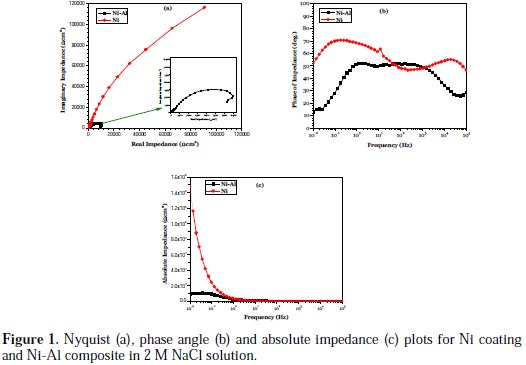
    <p>The EIS results obtained for the pure Ni coating and the Ni-Al composite, at 
OCP in the 2 M NaCl solution, are expressed in Nyquist, Bode phase angle and 
Bode absolute impedance formats, and shown in <a href="#f1">Fig. 1</a>.</p>


    <p>&nbsp;</p>
<a name="f1">
<img src="/img/revistas/pea/v35n3/35n3a05f1.jpg">
    
<p>&nbsp;</p>


    <p>In <a href="#f1">Fig. 1(a)</a>, the Nyquist 
plots showed curves of incomplete semi-circles: a slight semi-circle at high 
frequency and a larger one at low frequency. The size of the Nyquist plot usually 
correlates with the corrosion resistance of the material in a corrosion solution 
[19-22]. The clearly larger size of the Nyquist plot exhibited by the pure Ni 
coating implies higher corrosion resistance compared with the Ni-Al composite. 
In the Bode phase angle plots, <a href="#f1">Fig. 1(b)</a>, both coatings displayed two impedance 
maxima, <a href="#f1">Fig. 1(c)</a>, which imply that two time constants could be employed to 
explain the electrochemical processes occurring at the surfaces of the Ni and Ni-
Al coatings in 2 M NaCl solution. Such two time constants usually represent 
impedance processes like charge transfer, mass transfer and film effects 
occurring at a corrosion product layer-solution interface and a substrate-solution 
interface beneath the corrosion product layer [23]. The high frequency phase 
angle maximum in EIS characterization is commonly associated with resistance 
to phenomena, such as uptake of water and intrusion of electrolyte salt, whereas 
the low frequency maximum concerns resistance to substrate-controlled 
processes including localized defects [23]. The pure Ni coating displayed higher 
phase angle maxima throughout the frequency scan compared with the Ni-Al 
composite, an attestation to the higher corrosion resistance of the former in the 2 
M NaCl solution. By fitting the impedance data with the ZSimpWin software, 
<a href="#f2">Fig. 2</a> shows the most suitable equivalence circuit to model the electrochemical 
corrosion mechanism of the Ni coating and Ni-Al composite in 2 M NaCl 
solution.</p>


    <p>&nbsp;</p>
<a name="f2">
<img src="/img/revistas/pea/v35n3/35n3a05f2.jpg">
    
<p>&nbsp;</p>


    <p>The values of the electrical elements in the equivalence circuit are 
detailed in <a href="#t1">Table 1</a>.</p>


    ]]></body>
<body><![CDATA[<p>&nbsp;</p>
<a name="t1">
<img src="/img/revistas/pea/v35n3/35n3a05t1.jpg">
    
<p>&nbsp;</p>


    <p>Rs is the solution resistance between the reference and 
working electrodes; Qpo and Rpo, respectively, stand for the capacitance of a 
corrosion product layer and its resistance to transfer of ions; and Qdl and Rct, 
respectively, represent the capacitance of the double layer and resistance to 
charge transfer in the regions beneath the corrosion product layer. The Qdl for the 
Ni-Al composite was approximately three times as high as that of the Ni coating, 
which implies greater solution percolation within the composite.</p>

    <p>More so, the Rct, which is a measure of the corrosion resistance of the coatings, 
was far lower for the composite than for the Ni coating. Thus, the Al particle 
increased the porosity of the Ni coating, which promoted the 2 M NaCl solution 
penetration through the numerous micro pores on the composite surface. Based 
on the surface hydration characteristic well known for the Al2O3, as reported 
elsewhere [21], the solution accumulation in the composite interior should, 
therefore, favor its transformation into Al(OH)3 which, in turn, is rapidly 
consumed in the presence of high chloride concentration in the 2 M NaCl 
solution. The Al2O3 to Al(OH)3 transformation, in the presence of water and 
subsequent dissolution by chloride ions, was also reported [24, 25]. This explains 
the lower corrosion resistance of the Ni-Al composite at open circuit potential, 
compared with the pure Ni coating, in 2 M NaCl solution.</p>


    <p><i><b>Potentiodynamic polarization characterization</b></i></p>

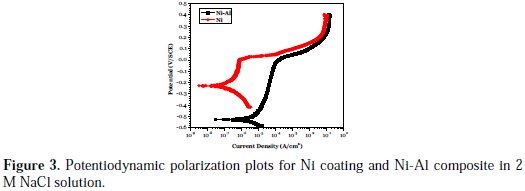
    <p>Potentiodynamic polarization curves derived for the Ni coating and Ni-Al 
composite in 2 M NaCl solution are presented in <a href="#f3">Fig. 3</a>.</p>


    <p>&nbsp;</p>
<a name="f3">
<img src="/img/revistas/pea/v35n3/35n3a05f3.jpg">
    
<p>&nbsp;</p>


    <p>The values of the 
polarization parameters, such as corrosion potential (Ecorr) and corrosion current 
density (icorr), which were derived from the intersection of the cathodic and 
anodic Tafel slopes drawn &pm;5 mV around the transition potential, are given in 
<a href="#t2">Table 2</a>.</p>


    <p>&nbsp;</p>
<a name="t2">
<img src="/img/revistas/pea/v35n3/35n3a05t2.jpg">
    
]]></body>
<body><![CDATA[<p>&nbsp;</p>


    <p>The polarization result shows that the Ni-Al composite displayed a 
strongly more negative Ecorr (-527 mV), compared with the pure Ni coating (-229 
mV). This reveals greater propensity for the Ni-Al composite to become 
dissoluble in the 2 M NaCl solution. Furthermore, the icorr value of 5.057 &mu;A/cm<sup>2</sup> 
for the composite was far greater than the icorr value of 0.1958 &mu;A/cm<sup>2</sup> for the 
pure Ni coating.</p>

    <p>The icorr value is a measure of the corrosion rate of the coatings. Thus, there is a 
higher rate of cathodic and anodic half-reaction occurring on the surface of the 
Ni-Al composite, compared with the Ni coating in 2 M NaCl solution. This 
strongly correlates with the mechanism of solution accumulation in the 
composite pores at open circuit (equilibrium) potential, as reported during EIS 
measurement. Away from the equilibrium potential during anodic polarization, 
both Ni coating and Ni-Al composite exhibited similar phenomena, namely: (i) 
an active region during early scan; (ii) a region where the applied potential 
caused only minimal increase in current density, and could be regarded as a 
passive region caused by a corrosion product layer formation; (iii) a region where 
the current density sharply increases with the applied potential, attributed to the 
initiation of serious localized phenomena, such as pitting corrosion; and (iv) a 
region whereby the coatings attempt a gradual transition to trans-passivation. 
Although the Ni-Al composite displayed higher current density than the Ni 
coating, in the passive region (which implies greater transport of charges through 
the Ni-Al corrosion product layer), surprisingly, the composite sustained its 
passive nature over a longer potential range. This strongly indicates that, during 
the polarization, an increased outward migration of Al3+ ions occurs from the 
composite interior through the corrosion product layer grain's boundaries to the 
reaction front for the sustenance of passivation (which prolongs the passive 
potential). However, the Al corrosion products are simultaneously consumed as 
they form (which results in higher current than that of the Ni coating in that 
region). This phenomenon provides more support for the strong surface hydration 
of the formed Al2O3 and its transformation into Al(OH)3, which is readily 
consumed by chloride ions in the 2 M NaCl solution.</p>


    <p><i><b>SEM characterization</b></i></p>

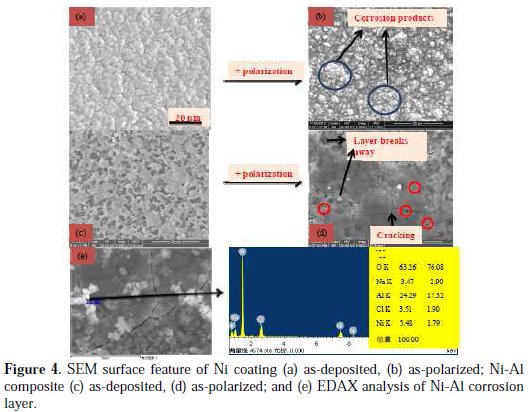
    <p>After polarization in 2 M NaCl solution, the electrodeposited Ni coating, 
<a href="#f4">Fig. 4(a)</a>, transformed such that the Ni corrosion products scattered on the surfaces of 
the Ni grains; however, with no clear linkage into a continuous layer.</p>


    <p>&nbsp;</p>
<a name="f4">
<img src="/img/revistas/pea/v35n3/35n3a05f4.jpg">
    
<p>&nbsp;</p>


    <p>At some points, obvious consumption of the Ni grains could be noticed. The surface of the 
as-deposited Ni-Al composite (where the Al particle preferentially incorporated 
within the Ni grain boundaries), <a href="#f4">Fig. 4(c)</a>, was transformed into a corrosion 
product layer, somewhat, smoother when compared with the Ni coating, <a href="#f4">Fig. 4(d)</a>. 
The layer was, nevertheless, characterized by serious cracks, which led to 
obvious collapse of some portions. It is important to notice that, apart from the 
regions where the layer collapsed, numerous holes could be seen at the triple 
junction of the cracks along the Ni-Al corrosion product layer, which is strongly 
attributed to the points of serious consumption by chloride ions in the 2 M NaCl 
solution. Since Al2O3 formation should predominantly occur at the Ni grain 
boundaries and assist in the linkage of the Ni corrosion product layer, given that 
the Al particle is mainly incorporated therein, it must be the Al products 
consumption by the chloride ion that vigorously destroys the grain boundary 
adhesion and locally causes the collapse of the layer portions. This Al product 
consumption by chloride ions can be verified from the EDAX acquisition of Cl 
and Na with high composition of Al and O (than Ni), at a crack along the 
corrosion product layer, <a href="#f4">Fig. 4(e)</a>. This is, therefore, the reason for the lower 
corrosion resistance of the Ni-Al composite, than that of the pure Ni coating, in 2 
M NaCl solution.</p>


    <p>&nbsp;</p>
    <p><b>Conclusion</b></p>

    ]]></body>
<body><![CDATA[<p>The electrodeposited Ni-Al composite exhibited lower corrosion resistance in 2 
M NaCl solution, compared with the pure Ni coating, because the Al particle 
increases the porosity of the Ni coating and encourages the solution penetration 
during corrosion. This leads to an increased rate of dissolution of the composite 
surface. The Al corrosion products are readily consumed in the highly 
concentrated chloride solution, leading to serious cracking and localized collapse 
of the composite corrosion product layer.</p>


    <p>&nbsp;</p>
    <p><b>References</b></p>

    <!-- ref --><p>1. Shi L, Chufeng S, Gao P, et al. Appl Surf Sci. 2006;252:3591.    &nbsp;&nbsp;&nbsp;&nbsp;&nbsp;&nbsp;&nbsp;&nbsp;[&#160;<a href="javascript:void(0);" onclick="javascript: window.open('/scielo.php?script=sci_nlinks&ref=427588&pid=S0872-1904201700030000500001&lng=','','width=640,height=500,resizable=yes,scrollbars=1,menubar=yes,');">Links</a>&#160;]<!-- end-ref --></p>

    <!-- ref --><p>2. Li J, Sun Y, Sun X, et al. Surf Coat Technol. 2005;192:331.    &nbsp;&nbsp;&nbsp;&nbsp;&nbsp;&nbsp;&nbsp;&nbsp;[&#160;<a href="javascript:void(0);" onclick="javascript: window.open('/scielo.php?script=sci_nlinks&ref=427590&pid=S0872-1904201700030000500002&lng=','','width=640,height=500,resizable=yes,scrollbars=1,menubar=yes,');">Links</a>&#160;]<!-- end-ref --></p>

    <!-- ref --><p>3. Zimmerman AF, Palumbo G, Aust KT, et al. Mater Sci Eng A. 2002;328:137.    &nbsp;&nbsp;&nbsp;&nbsp;&nbsp;&nbsp;&nbsp;&nbsp;[&#160;<a href="javascript:void(0);" onclick="javascript: window.open('/scielo.php?script=sci_nlinks&ref=427592&pid=S0872-1904201700030000500003&lng=','','width=640,height=500,resizable=yes,scrollbars=1,menubar=yes,');">Links</a>&#160;]<!-- end-ref --></p>

    <!-- ref --><p>4. Hasannejad H, Shahrabi T, Jafarian M. Mater Corros. 2012;1.    &nbsp;&nbsp;&nbsp;&nbsp;&nbsp;&nbsp;&nbsp;&nbsp;[&#160;<a href="javascript:void(0);" onclick="javascript: window.open('/scielo.php?script=sci_nlinks&ref=427594&pid=S0872-1904201700030000500004&lng=','','width=640,height=500,resizable=yes,scrollbars=1,menubar=yes,');">Links</a>&#160;]<!-- end-ref --></p>

    <!-- ref --><p>5. Szczygiel B, Kolodziej M. Electrochim Acta. 2005;50:4188.    &nbsp;&nbsp;&nbsp;&nbsp;&nbsp;&nbsp;&nbsp;&nbsp;[&#160;<a href="javascript:void(0);" onclick="javascript: window.open('/scielo.php?script=sci_nlinks&ref=427596&pid=S0872-1904201700030000500005&lng=','','width=640,height=500,resizable=yes,scrollbars=1,menubar=yes,');">Links</a>&#160;]<!-- end-ref --></p>

    <!-- ref --><p>6. Feng Q, Li T, Teng H, et al. Surf Coat Technol. 2008;4137.    &nbsp;&nbsp;&nbsp;&nbsp;&nbsp;&nbsp;&nbsp;&nbsp;[&#160;<a href="javascript:void(0);" onclick="javascript: window.open('/scielo.php?script=sci_nlinks&ref=427598&pid=S0872-1904201700030000500006&lng=','','width=640,height=500,resizable=yes,scrollbars=1,menubar=yes,');">Links</a>&#160;]<!-- end-ref --></p>

    <!-- ref --><p>7. Peng X, Zhang Y, Zhao J, et al. Electrochim Acta. 2006;51:4922.    &nbsp;&nbsp;&nbsp;&nbsp;&nbsp;&nbsp;&nbsp;&nbsp;[&#160;<a href="javascript:void(0);" onclick="javascript: window.open('/scielo.php?script=sci_nlinks&ref=427600&pid=S0872-1904201700030000500007&lng=','','width=640,height=500,resizable=yes,scrollbars=1,menubar=yes,');">Links</a>&#160;]<!-- end-ref --></p>

    <!-- ref --><p>8. Susan DF, Barmak K, Marder AR. Thin Solid Films. 1997;307:133.    &nbsp;&nbsp;&nbsp;&nbsp;&nbsp;&nbsp;&nbsp;&nbsp;[&#160;<a href="javascript:void(0);" onclick="javascript: window.open('/scielo.php?script=sci_nlinks&ref=427602&pid=S0872-1904201700030000500008&lng=','','width=640,height=500,resizable=yes,scrollbars=1,menubar=yes,');">Links</a>&#160;]<!-- end-ref --></p>

    <!-- ref --><p>9. Guglielmi N. Electrochem Soc. 1972;119:1009.    &nbsp;&nbsp;&nbsp;&nbsp;&nbsp;&nbsp;&nbsp;&nbsp;[&#160;<a href="javascript:void(0);" onclick="javascript: window.open('/scielo.php?script=sci_nlinks&ref=427604&pid=S0872-1904201700030000500009&lng=','','width=640,height=500,resizable=yes,scrollbars=1,menubar=yes,');">Links</a>&#160;]<!-- end-ref --></p>

    <!-- ref --><p>10. Peng X, Li M, Wang F. Corros Sci. 2011;53:1616.    &nbsp;&nbsp;&nbsp;&nbsp;&nbsp;&nbsp;&nbsp;&nbsp;[&#160;<a href="javascript:void(0);" onclick="javascript: window.open('/scielo.php?script=sci_nlinks&ref=427606&pid=S0872-1904201700030000500010&lng=','','width=640,height=500,resizable=yes,scrollbars=1,menubar=yes,');">Links</a>&#160;]<!-- end-ref --></p>

    <!-- ref --><p>11. Zhou YB, Zhang HJ. Trans Nonferrous Metal Soc China. 2011;21:322.    &nbsp;&nbsp;&nbsp;&nbsp;&nbsp;&nbsp;&nbsp;&nbsp;[&#160;<a href="javascript:void(0);" onclick="javascript: window.open('/scielo.php?script=sci_nlinks&ref=427608&pid=S0872-1904201700030000500011&lng=','','width=640,height=500,resizable=yes,scrollbars=1,menubar=yes,');">Links</a>&#160;]<!-- end-ref --></p>

    <!-- ref --><p>12. Yang X, Peng X, Wang F. Corros Sci. 2008;50:3227.    &nbsp;&nbsp;&nbsp;&nbsp;&nbsp;&nbsp;&nbsp;&nbsp;[&#160;<a href="javascript:void(0);" onclick="javascript: window.open('/scielo.php?script=sci_nlinks&ref=427610&pid=S0872-1904201700030000500012&lng=','','width=640,height=500,resizable=yes,scrollbars=1,menubar=yes,');">Links</a>&#160;]<!-- end-ref --></p>

    <!-- ref --><p>13. Onyeachu BI, Oguzie EE, Njoku DI, et al. Int J Sci Technol. 2014;3:728.    &nbsp;&nbsp;&nbsp;&nbsp;&nbsp;&nbsp;&nbsp;&nbsp;[&#160;<a href="javascript:void(0);" onclick="javascript: window.open('/scielo.php?script=sci_nlinks&ref=427612&pid=S0872-1904201700030000500013&lng=','','width=640,height=500,resizable=yes,scrollbars=1,menubar=yes,');">Links</a>&#160;]<!-- end-ref --></p>

    <!-- ref --><p>14. McCafferty E. Corros Sci. 2003;45:1421.    &nbsp;&nbsp;&nbsp;&nbsp;&nbsp;&nbsp;&nbsp;&nbsp;[&#160;<a href="javascript:void(0);" onclick="javascript: window.open('/scielo.php?script=sci_nlinks&ref=427614&pid=S0872-1904201700030000500014&lng=','','width=640,height=500,resizable=yes,scrollbars=1,menubar=yes,');">Links</a>&#160;]<!-- end-ref --></p>

    <!-- ref --><p>15. Ensinger W, Lensch O, Matsutani T. et al. Surf Coat Technol. 2005;196:231.    &nbsp;&nbsp;&nbsp;&nbsp;&nbsp;&nbsp;&nbsp;&nbsp;[&#160;<a href="javascript:void(0);" onclick="javascript: window.open('/scielo.php?script=sci_nlinks&ref=427616&pid=S0872-1904201700030000500015&lng=','','width=640,height=500,resizable=yes,scrollbars=1,menubar=yes,');">Links</a>&#160;]<!-- end-ref --></p>

    <!-- ref --><p>16. Jafarzadeh K, Shahrabi T, Hosseini MG. Corros Sci Eng Technol. 2009;44:144.    &nbsp;&nbsp;&nbsp;&nbsp;&nbsp;&nbsp;&nbsp;&nbsp;[&#160;<a href="javascript:void(0);" onclick="javascript: window.open('/scielo.php?script=sci_nlinks&ref=427618&pid=S0872-1904201700030000500016&lng=','','width=640,height=500,resizable=yes,scrollbars=1,menubar=yes,');">Links</a>&#160;]<!-- end-ref --></p>

    <!-- ref --><p>17. Onyeachu BI, Peng X, Oguzie EE, et al. Port Electrochim Acta. 2015;33:69.    &nbsp;&nbsp;&nbsp;&nbsp;&nbsp;&nbsp;&nbsp;&nbsp;[&#160;<a href="javascript:void(0);" onclick="javascript: window.open('/scielo.php?script=sci_nlinks&ref=427620&pid=S0872-1904201700030000500017&lng=','','width=640,height=500,resizable=yes,scrollbars=1,menubar=yes,');">Links</a>&#160;]<!-- end-ref --></p>

    <!-- ref --><p>18. Onyeachu BI, Peng X, Oguzie EE, et al. Int Sci Technol. 2014;3:711.    &nbsp;&nbsp;&nbsp;&nbsp;&nbsp;&nbsp;&nbsp;&nbsp;[&#160;<a href="javascript:void(0);" onclick="javascript: window.open('/scielo.php?script=sci_nlinks&ref=427622&pid=S0872-1904201700030000500018&lng=','','width=640,height=500,resizable=yes,scrollbars=1,menubar=yes,');">Links</a>&#160;]<!-- end-ref --></p>

    <!-- ref --><p>19. Oguzie EE, Adindu CB, Enenebeaku CK, et al. Phys Chem C. 2012;116:13603.    &nbsp;&nbsp;&nbsp;&nbsp;&nbsp;&nbsp;&nbsp;&nbsp;[&#160;<a href="javascript:void(0);" onclick="javascript: window.open('/scielo.php?script=sci_nlinks&ref=427624&pid=S0872-1904201700030000500019&lng=','','width=640,height=500,resizable=yes,scrollbars=1,menubar=yes,');">Links</a>&#160;]<!-- end-ref --></p>

    <!-- ref --><p>20. Njoku DI, Ukaga I, Onyeachu BI, et al. Mol Liq. 2016;219:417.    &nbsp;&nbsp;&nbsp;&nbsp;&nbsp;&nbsp;&nbsp;&nbsp;[&#160;<a href="javascript:void(0);" onclick="javascript: window.open('/scielo.php?script=sci_nlinks&ref=427626&pid=S0872-1904201700030000500020&lng=','','width=640,height=500,resizable=yes,scrollbars=1,menubar=yes,');">Links</a>&#160;]<!-- end-ref --></p>

    <!-- ref --><p>21. Khaled KF. Corros Sci. 2010;52:2905.    &nbsp;&nbsp;&nbsp;&nbsp;&nbsp;&nbsp;&nbsp;&nbsp;[&#160;<a href="javascript:void(0);" onclick="javascript: window.open('/scielo.php?script=sci_nlinks&ref=427628&pid=S0872-1904201700030000500021&lng=','','width=640,height=500,resizable=yes,scrollbars=1,menubar=yes,');">Links</a>&#160;]<!-- end-ref --></p>

    <p>22. M.A. Chidiebere, C.E. Ogukwe, and K.L. Oguzie et al., Ind. Eng. Chem. Res. 2012;15:668.</p>

    <p>23. Y. Zhao, G. Wu, and H. Pan et al., Mater. Chem. Phy. 2012;132:187.</p>

    <!-- ref --><p>24. Chen C, Splinter SJ, Do T, et al. Surf Sci. 1997;382:L652.    &nbsp;&nbsp;&nbsp;&nbsp;&nbsp;&nbsp;&nbsp;&nbsp;[&#160;<a href="javascript:void(0);" onclick="javascript: window.open('/scielo.php?script=sci_nlinks&ref=427632&pid=S0872-1904201700030000500024&lng=','','width=640,height=500,resizable=yes,scrollbars=1,menubar=yes,');">Links</a>&#160;]<!-- end-ref --></p>

    <p>25. Alwitt RS. In: Oxides and oxide films. Diggle JW, Vijh AK (eds.). New York: Marcel Dekker; 1976.</p>


    ]]></body>
<body><![CDATA[<p>&nbsp;</p>
    <p><b>Acknowledgements</b></p>

    <p>Onyeachu B. Ikenna is grateful to The World Academy of Sciences (TWAS) and 
the Chinese Academy of Sciences (CAS) for the award of a Postgraduate 
Fellowship.</p>


    <p>&nbsp;</p>
    <p><a name=0></a><sup><a href="#top">*</a></sup>Corresponding author. E-mail address: <a href="mailto:emekaoguzie@gmail.com">emekaoguzie@gmail.com</a></p>

    <p>Received August 20, 2016; accepted November 21, 2016</p>

    <p><a href="http://www.peacta.org" target="_blank">www.peacta.org</a> </p>


     ]]></body><back>
<ref-list>
<ref id="B1">
<label>1</label><nlm-citation citation-type="journal">
<person-group person-group-type="author">
<name>
<surname><![CDATA[Shi]]></surname>
<given-names><![CDATA[L]]></given-names>
</name>
<name>
<surname><![CDATA[Chufeng]]></surname>
<given-names><![CDATA[S]]></given-names>
</name>
<name>
<surname><![CDATA[Gao]]></surname>
<given-names><![CDATA[P]]></given-names>
</name>
</person-group>
<source><![CDATA[Appl Surf Sci]]></source>
<year>2006</year>
<volume>252</volume>
<page-range>3591</page-range></nlm-citation>
</ref>
<ref id="B2">
<label>2</label><nlm-citation citation-type="journal">
<person-group person-group-type="author">
<name>
<surname><![CDATA[Li]]></surname>
<given-names><![CDATA[J]]></given-names>
</name>
<name>
<surname><![CDATA[Sun]]></surname>
<given-names><![CDATA[Y]]></given-names>
</name>
<name>
<surname><![CDATA[Sun]]></surname>
<given-names><![CDATA[X]]></given-names>
</name>
</person-group>
<source><![CDATA[Surf Coat Technol]]></source>
<year>2005</year>
<volume>192</volume>
<page-range>331</page-range></nlm-citation>
</ref>
<ref id="B3">
<label>3</label><nlm-citation citation-type="journal">
<person-group person-group-type="author">
<name>
<surname><![CDATA[Zimmerman]]></surname>
<given-names><![CDATA[A F]]></given-names>
</name>
<name>
<surname><![CDATA[Palumbo]]></surname>
<given-names><![CDATA[G]]></given-names>
</name>
<name>
<surname><![CDATA[Aust]]></surname>
<given-names><![CDATA[K T]]></given-names>
</name>
</person-group>
<source><![CDATA[Mater Sci Eng A]]></source>
<year>2002</year>
<volume>328</volume>
<page-range>137</page-range></nlm-citation>
</ref>
<ref id="B4">
<label>4</label><nlm-citation citation-type="journal">
<person-group person-group-type="author">
<name>
<surname><![CDATA[Hasannejad]]></surname>
<given-names><![CDATA[H]]></given-names>
</name>
<name>
<surname><![CDATA[Shahrabi]]></surname>
<given-names><![CDATA[T]]></given-names>
</name>
<name>
<surname><![CDATA[Jafarian]]></surname>
<given-names><![CDATA[M]]></given-names>
</name>
</person-group>
<source><![CDATA[Mater Corros]]></source>
<year>2012</year>
<volume>1</volume>
</nlm-citation>
</ref>
<ref id="B5">
<label>5</label><nlm-citation citation-type="journal">
<person-group person-group-type="author">
<name>
<surname><![CDATA[Szczygiel]]></surname>
<given-names><![CDATA[B]]></given-names>
</name>
<name>
<surname><![CDATA[Kolodziej]]></surname>
<given-names><![CDATA[M]]></given-names>
</name>
</person-group>
<source><![CDATA[Electrochim Acta]]></source>
<year>2005</year>
<volume>50</volume>
<page-range>4188</page-range></nlm-citation>
</ref>
<ref id="B6">
<label>6</label><nlm-citation citation-type="journal">
<person-group person-group-type="author">
<name>
<surname><![CDATA[Feng]]></surname>
<given-names><![CDATA[Q]]></given-names>
</name>
<name>
<surname><![CDATA[Li]]></surname>
<given-names><![CDATA[T]]></given-names>
</name>
<name>
<surname><![CDATA[Teng]]></surname>
<given-names><![CDATA[H]]></given-names>
</name>
</person-group>
<source><![CDATA[Surf Coat Technol]]></source>
<year>2008</year>
<page-range>4137</page-range></nlm-citation>
</ref>
<ref id="B7">
<label>7</label><nlm-citation citation-type="journal">
<person-group person-group-type="author">
<name>
<surname><![CDATA[Peng]]></surname>
<given-names><![CDATA[X]]></given-names>
</name>
<name>
<surname><![CDATA[Zhang]]></surname>
<given-names><![CDATA[Y]]></given-names>
</name>
<name>
<surname><![CDATA[Zhao]]></surname>
<given-names><![CDATA[J]]></given-names>
</name>
</person-group>
<source><![CDATA[Electrochim Acta]]></source>
<year>2006</year>
<volume>51</volume>
<page-range>4922</page-range></nlm-citation>
</ref>
<ref id="B8">
<label>8</label><nlm-citation citation-type="journal">
<person-group person-group-type="author">
<name>
<surname><![CDATA[Susan]]></surname>
<given-names><![CDATA[D F]]></given-names>
</name>
<name>
<surname><![CDATA[Barmak]]></surname>
<given-names><![CDATA[K]]></given-names>
</name>
<name>
<surname><![CDATA[Marder]]></surname>
<given-names><![CDATA[A R]]></given-names>
</name>
</person-group>
<source><![CDATA[Thin Solid Films]]></source>
<year>1997</year>
<volume>307</volume>
<page-range>133</page-range></nlm-citation>
</ref>
<ref id="B9">
<label>9</label><nlm-citation citation-type="journal">
<person-group person-group-type="author">
<name>
<surname><![CDATA[Guglielmi]]></surname>
<given-names><![CDATA[N]]></given-names>
</name>
</person-group>
<source><![CDATA[Electrochem Soc]]></source>
<year>1972</year>
<volume>119</volume>
<page-range>1009</page-range></nlm-citation>
</ref>
<ref id="B10">
<label>10</label><nlm-citation citation-type="journal">
<person-group person-group-type="author">
<name>
<surname><![CDATA[Peng]]></surname>
<given-names><![CDATA[X]]></given-names>
</name>
<name>
<surname><![CDATA[Li]]></surname>
<given-names><![CDATA[M]]></given-names>
</name>
<name>
<surname><![CDATA[Wang]]></surname>
<given-names><![CDATA[F]]></given-names>
</name>
</person-group>
<source><![CDATA[Corros Sci]]></source>
<year>2011</year>
<volume>53</volume>
<page-range>1616</page-range></nlm-citation>
</ref>
<ref id="B11">
<label>11</label><nlm-citation citation-type="journal">
<person-group person-group-type="author">
<name>
<surname><![CDATA[Zhou]]></surname>
<given-names><![CDATA[Y B]]></given-names>
</name>
<name>
<surname><![CDATA[Zhang]]></surname>
<given-names><![CDATA[H J]]></given-names>
</name>
</person-group>
<source><![CDATA[Trans Nonferrous Metal Soc China]]></source>
<year>2011</year>
<volume>21</volume>
<page-range>322</page-range></nlm-citation>
</ref>
<ref id="B12">
<label>12</label><nlm-citation citation-type="journal">
<person-group person-group-type="author">
<name>
<surname><![CDATA[Yang]]></surname>
<given-names><![CDATA[X]]></given-names>
</name>
<name>
<surname><![CDATA[Peng]]></surname>
<given-names><![CDATA[X]]></given-names>
</name>
<name>
<surname><![CDATA[Wang]]></surname>
<given-names><![CDATA[F]]></given-names>
</name>
</person-group>
<source><![CDATA[Corros Sci]]></source>
<year>2008</year>
<volume>50</volume>
<page-range>3227</page-range></nlm-citation>
</ref>
<ref id="B13">
<label>13</label><nlm-citation citation-type="journal">
<person-group person-group-type="author">
<name>
<surname><![CDATA[Onyeachu]]></surname>
<given-names><![CDATA[B I]]></given-names>
</name>
<name>
<surname><![CDATA[Oguzie]]></surname>
<given-names><![CDATA[E E]]></given-names>
</name>
<name>
<surname><![CDATA[Njoku]]></surname>
<given-names><![CDATA[D I]]></given-names>
</name>
</person-group>
<source><![CDATA[Int J Sci Technol]]></source>
<year>2014</year>
<volume>3</volume>
<page-range>728</page-range></nlm-citation>
</ref>
<ref id="B14">
<label>14</label><nlm-citation citation-type="journal">
<person-group person-group-type="author">
<name>
<surname><![CDATA[McCafferty]]></surname>
<given-names><![CDATA[E]]></given-names>
</name>
</person-group>
<source><![CDATA[Corros Sci]]></source>
<year>2003</year>
<volume>45</volume>
<page-range>1421</page-range></nlm-citation>
</ref>
<ref id="B15">
<label>15</label><nlm-citation citation-type="journal">
<person-group person-group-type="author">
<name>
<surname><![CDATA[Ensinger]]></surname>
<given-names><![CDATA[W]]></given-names>
</name>
<name>
<surname><![CDATA[Lensch]]></surname>
<given-names><![CDATA[O]]></given-names>
</name>
<name>
<surname><![CDATA[Matsutani]]></surname>
<given-names><![CDATA[T]]></given-names>
</name>
</person-group>
<source><![CDATA[Surf Coat Technol]]></source>
<year>2005</year>
<volume>196</volume>
<page-range>231</page-range></nlm-citation>
</ref>
<ref id="B16">
<label>16</label><nlm-citation citation-type="journal">
<person-group person-group-type="author">
<name>
<surname><![CDATA[Jafarzadeh]]></surname>
<given-names><![CDATA[K]]></given-names>
</name>
<name>
<surname><![CDATA[Shahrabi]]></surname>
<given-names><![CDATA[T]]></given-names>
</name>
<name>
<surname><![CDATA[Hosseini]]></surname>
<given-names><![CDATA[M G]]></given-names>
</name>
</person-group>
<source><![CDATA[Corros Sci Eng Technol]]></source>
<year>2009</year>
<volume>44</volume>
<page-range>144</page-range></nlm-citation>
</ref>
<ref id="B17">
<label>17</label><nlm-citation citation-type="journal">
<person-group person-group-type="author">
<name>
<surname><![CDATA[Onyeachu]]></surname>
<given-names><![CDATA[B I]]></given-names>
</name>
<name>
<surname><![CDATA[Peng]]></surname>
<given-names><![CDATA[X]]></given-names>
</name>
<name>
<surname><![CDATA[Oguzie]]></surname>
<given-names><![CDATA[E E]]></given-names>
</name>
</person-group>
<source><![CDATA[Port Electrochim Acta]]></source>
<year>2015</year>
<volume>33</volume>
<page-range>69</page-range></nlm-citation>
</ref>
<ref id="B18">
<label>18</label><nlm-citation citation-type="journal">
<person-group person-group-type="author">
<name>
<surname><![CDATA[Onyeachu]]></surname>
<given-names><![CDATA[B I]]></given-names>
</name>
<name>
<surname><![CDATA[Peng]]></surname>
<given-names><![CDATA[X]]></given-names>
</name>
<name>
<surname><![CDATA[Oguzie]]></surname>
<given-names><![CDATA[E E]]></given-names>
</name>
</person-group>
<source><![CDATA[Int Sci Technol]]></source>
<year>2014</year>
<volume>3</volume>
<page-range>711</page-range></nlm-citation>
</ref>
<ref id="B19">
<label>19</label><nlm-citation citation-type="journal">
<person-group person-group-type="author">
<name>
<surname><![CDATA[Oguzie]]></surname>
<given-names><![CDATA[E E]]></given-names>
</name>
<name>
<surname><![CDATA[Adindu]]></surname>
<given-names><![CDATA[C B]]></given-names>
</name>
<name>
<surname><![CDATA[Enenebeaku]]></surname>
<given-names><![CDATA[C K]]></given-names>
</name>
</person-group>
<source><![CDATA[Phys Chem C]]></source>
<year>2012</year>
<volume>116</volume>
<page-range>13603</page-range></nlm-citation>
</ref>
<ref id="B20">
<label>20</label><nlm-citation citation-type="journal">
<person-group person-group-type="author">
<name>
<surname><![CDATA[Njoku]]></surname>
<given-names><![CDATA[D I]]></given-names>
</name>
<name>
<surname><![CDATA[Ukaga]]></surname>
<given-names><![CDATA[I]]></given-names>
</name>
<name>
<surname><![CDATA[Onyeachu]]></surname>
<given-names><![CDATA[B I]]></given-names>
</name>
</person-group>
<source><![CDATA[Mol Liq]]></source>
<year>2016</year>
<volume>219</volume>
<page-range>417</page-range></nlm-citation>
</ref>
<ref id="B21">
<label>21</label><nlm-citation citation-type="journal">
<person-group person-group-type="author">
<name>
<surname><![CDATA[Khaled]]></surname>
<given-names><![CDATA[K F]]></given-names>
</name>
</person-group>
<source><![CDATA[Corros Sci]]></source>
<year>2010</year>
<volume>52</volume>
<page-range>2905</page-range></nlm-citation>
</ref>
<ref id="B22">
<label>22</label><nlm-citation citation-type="journal">
<person-group person-group-type="author">
<name>
<surname><![CDATA[Chidiebere]]></surname>
<given-names><![CDATA[M A]]></given-names>
</name>
<name>
<surname><![CDATA[Ogukwe]]></surname>
<given-names><![CDATA[C E]]></given-names>
</name>
<name>
<surname><![CDATA[Oguzie]]></surname>
<given-names><![CDATA[K L]]></given-names>
</name>
</person-group>
<source><![CDATA[Ind. Eng. Chem. Res]]></source>
<year>2012</year>
<volume>15</volume>
<page-range>668</page-range></nlm-citation>
</ref>
<ref id="B23">
<label>23</label><nlm-citation citation-type="journal">
<person-group person-group-type="author">
<name>
<surname><![CDATA[Zhao]]></surname>
<given-names><![CDATA[Y]]></given-names>
</name>
<name>
<surname><![CDATA[Wu]]></surname>
<given-names><![CDATA[G]]></given-names>
</name>
<name>
<surname><![CDATA[Pan]]></surname>
<given-names><![CDATA[H]]></given-names>
</name>
</person-group>
<source><![CDATA[Mater. Chem. Phy]]></source>
<year>2012</year>
<volume>132</volume>
<page-range>187</page-range></nlm-citation>
</ref>
<ref id="B24">
<label>24</label><nlm-citation citation-type="journal">
<person-group person-group-type="author">
<name>
<surname><![CDATA[Chen]]></surname>
<given-names><![CDATA[C]]></given-names>
</name>
<name>
<surname><![CDATA[Splinter]]></surname>
<given-names><![CDATA[S J]]></given-names>
</name>
<name>
<surname><![CDATA[Do]]></surname>
<given-names><![CDATA[T]]></given-names>
</name>
</person-group>
<source><![CDATA[Surf Sci]]></source>
<year>1997</year>
<volume>382</volume>
<page-range>L652</page-range></nlm-citation>
</ref>
<ref id="B25">
<label>25</label><nlm-citation citation-type="book">
<person-group person-group-type="author">
<name>
<surname><![CDATA[Alwitt]]></surname>
<given-names><![CDATA[R S]]></given-names>
</name>
</person-group>
<source><![CDATA[Oxides and oxide films]]></source>
<year>1976</year>
<publisher-loc><![CDATA[New York ]]></publisher-loc>
<publisher-name><![CDATA[Marcel Dekker]]></publisher-name>
</nlm-citation>
</ref>
</ref-list>
</back>
</article>