<?xml version="1.0" encoding="ISO-8859-1"?><article xmlns:mml="http://www.w3.org/1998/Math/MathML" xmlns:xlink="http://www.w3.org/1999/xlink" xmlns:xsi="http://www.w3.org/2001/XMLSchema-instance">
<front>
<journal-meta>
<journal-id>0872-1904</journal-id>
<journal-title><![CDATA[Portugaliae Electrochimica Acta]]></journal-title>
<abbrev-journal-title><![CDATA[Port. Electrochim. Acta]]></abbrev-journal-title>
<issn>0872-1904</issn>
<publisher>
<publisher-name><![CDATA[Sociedade Portuguesa de Electroquímica]]></publisher-name>
</publisher>
</journal-meta>
<article-meta>
<article-id>S0872-19042017000400005</article-id>
<article-id pub-id-type="doi">10.4152/pea.201704233</article-id>
<title-group>
<article-title xml:lang="en"><![CDATA[Synthesis, Characterization and Anti-Corrosion Properties of Novel Quinolinol on C-steel in a Molar Hydrochloric Acid Solution]]></article-title>
</title-group>
<contrib-group>
<contrib contrib-type="author">
<name>
<surname><![CDATA[Galai]]></surname>
<given-names><![CDATA[M]]></given-names>
</name>
<xref ref-type="aff" rid="A01"/>
</contrib>
<contrib contrib-type="author">
<name>
<surname><![CDATA[El Faydy]]></surname>
<given-names><![CDATA[M]]></given-names>
</name>
<xref ref-type="aff" rid="A02"/>
</contrib>
<contrib contrib-type="author">
<name>
<surname><![CDATA[El Kacimi]]></surname>
<given-names><![CDATA[Y]]></given-names>
</name>
<xref ref-type="aff" rid="A01"/>
</contrib>
<contrib contrib-type="author">
<name>
<surname><![CDATA[Dahmani]]></surname>
<given-names><![CDATA[K]]></given-names>
</name>
<xref ref-type="aff" rid="A03"/>
</contrib>
<contrib contrib-type="author">
<name>
<surname><![CDATA[Alaoui]]></surname>
<given-names><![CDATA[K]]></given-names>
</name>
<xref ref-type="aff" rid="A01"/>
</contrib>
<contrib contrib-type="author">
<name>
<surname><![CDATA[Touir]]></surname>
<given-names><![CDATA[R]]></given-names>
</name>
<xref ref-type="aff" rid="A01"/>
<xref ref-type="aff" rid="A04"/>
</contrib>
<contrib contrib-type="author">
<name>
<surname><![CDATA[Lakhrissi]]></surname>
<given-names><![CDATA[B]]></given-names>
</name>
<xref ref-type="aff" rid="A02"/>
</contrib>
<contrib contrib-type="author">
<name>
<surname><![CDATA[Ebn Touhami]]></surname>
<given-names><![CDATA[M]]></given-names>
</name>
<xref ref-type="aff" rid="A01"/>
</contrib>
</contrib-group>
<aff id="A01">
<institution><![CDATA[,University Ibn Tofail Faculty of Science Laboratory of Materials Engineering and Environment: Modeling and Application]]></institution>
<addr-line><![CDATA[Kenitra ]]></addr-line>
<country>Morocco</country>
</aff>
<aff id="A02">
<institution><![CDATA[,University Ibn Tofail Faculte des Sciences Laboratoire d'Agroressources et Genie des Procedes]]></institution>
<addr-line><![CDATA[Kenitra ]]></addr-line>
<country>Morocco</country>
</aff>
<aff id="A03">
<institution><![CDATA[,Ibn Tofail University Faculty of Science Laboratory of Materials, Electrochemistry and Environment]]></institution>
<addr-line><![CDATA[Kenitra ]]></addr-line>
<country>Morocco</country>
</aff>
<aff id="A04">
<institution><![CDATA[,Regional des Metiers de l'Education et de la Formation (CRMEF)  ]]></institution>
<addr-line><![CDATA[Rabat ]]></addr-line>
<country>Morocco</country>
</aff>
<pub-date pub-type="pub">
<day>00</day>
<month>07</month>
<year>2017</year>
</pub-date>
<pub-date pub-type="epub">
<day>00</day>
<month>07</month>
<year>2017</year>
</pub-date>
<volume>35</volume>
<numero>4</numero>
<fpage>233</fpage>
<lpage>251</lpage>
<copyright-statement/>
<copyright-year/>
<self-uri xlink:href="http://scielo.pt/scielo.php?script=sci_arttext&amp;pid=S0872-19042017000400005&amp;lng=en&amp;nrm=iso"></self-uri><self-uri xlink:href="http://scielo.pt/scielo.php?script=sci_abstract&amp;pid=S0872-19042017000400005&amp;lng=en&amp;nrm=iso"></self-uri><self-uri xlink:href="http://scielo.pt/scielo.php?script=sci_pdf&amp;pid=S0872-19042017000400005&amp;lng=en&amp;nrm=iso"></self-uri><abstract abstract-type="short" xml:lang="en"><p><![CDATA[New quinoline, namely 5-(ethoxymethyl)-8-quinolinol (M-QN), has been synthesized and characterized by different spectral methods, such as 1H NMR, 13C NMR and IR spectra. Its inhibitive action against the corrosion of carbon steel in 1.0 M hydrochloric acid solution was investigated at different temperatures in the range from 25&pm;2 to 55&pm;2 °C by a series of known techniques, such as weight loss, open circuit potential (OCP), electrochemical impedance spectroscopy (EIS) and Tafel polarization measurements. The inhibition efficiencies obtained from all employed methods are in good agreement with each other. The obtained results show that M-QN compound is a very good inhibitor with an efficiency of 97.7 % at 10-3 M additive concentration in a 1.0 M HCl solution. The inhibition efficiency increased with an increase of the inhibitor's concentration. Changes in impedance parameters (Rct and Cdl) were indicative of adsorption of the compound (M-QN) on the metal surface, leading to the formation of a protective film. Tafel polarization measurements showed that M-QN inhibitor is of a mixed type. The adsorption of the inhibitor on the surface of carbon steel in a 1.0 M HCl solution was found to obey Langmuir's adsorption isotherm. The kinetic and thermodynamic parameters for carbon steel corrosion and inhibitor adsorption, respectively, were determined and discussed. On the bases of thermodynamic adsorption parameters, comprehensive adsorption (physisorption and chemisorption) for the studied inhibitors on carbon steel surface was suggested.]]></p></abstract>
<kwd-group>
<kwd lng="en"><![CDATA[Corrosion inhibition]]></kwd>
<kwd lng="en"><![CDATA[carbon steel]]></kwd>
<kwd lng="en"><![CDATA[5-(ethoxymethyl)-8-quinolinol]]></kwd>
<kwd lng="en"><![CDATA[hydrochloric acidic medium]]></kwd>
<kwd lng="en"><![CDATA[potentiodynamic polarization]]></kwd>
<kwd lng="en"><![CDATA[EIS]]></kwd>
</kwd-group>
</article-meta>
</front><body><![CDATA[ 

<!--     <p>&nbsp;</p>
    <p>doi: 10.4152/pea.201704233</p> -->

    <p><b>Synthesis, Characterization and Anti-Corrosion Properties of Novel 
Quinolinol on C-steel in a Molar Hydrochloric Acid Solution</b></p>

    <p>
<b>M. Galai</b><sup><i>a</i></sup>
, <b>M. El Faydy</b><sup><i>b</i></sup>
, <b>Y. El Kacimi</b><sup><i>a</i>,<a href="#0">*</a></sup>
, <b>K. Dahmani</b><sup><i>c</i></sup>
, <b>K. Alaoui</b><sup><i>a</i></sup>
, <b>R. Touir</b><sup><i>a,d</i></sup>
, <b>B. Lakhrissi</b><sup><i>b</i></sup>
 and <b>M. Ebn Touhami</b><sup><i>a</i></sup>
</p>

    <p><i><sup>a</sup> Laboratory of Materials Engineering and Environment: Modeling and Application, Faculty of 
Science, University Ibn Tofail BP. 133-14000, Kenitra, Morocco</i></p>

    <p><i><sup>b</sup> Laboratoire d'Agroressources et Genie des Procedes, Faculte des Sciences, Universite Ibn 
Tofail, BP 133, Kenitra 14000, Morocco</i></p>

    <p><i><sup>c</sup> Laboratory of Materials, Electrochemistry and Environment, Faculty of Science, Ibn Tofail 
University, Kenitra, Morocco</i></p>

    <p><i><sup>d</sup> Centre Regional des Metiers de l'Education et de la Formation (CRMEF), Avenue Allal Al 
Fassi, Madinat Al Irfane, BP 6210 Rabat, Morocco</i></p>


    <p>&nbsp;</p>
    ]]></body>
<body><![CDATA[<p><b>Abstract</b></p>

    <p>New quinoline, namely 5-(ethoxymethyl)-8-quinolinol (M-QN), has been synthesized 
and characterized by different spectral methods, such as 1H NMR, 13C NMR and IR 
spectra. Its inhibitive action against the corrosion of carbon steel in 1.0 M hydrochloric 
acid solution was investigated at different temperatures in the range from 25&pm;2 to 55&pm;2 
&deg;C by a series of known techniques, such as weight loss, open circuit potential (OCP), 
electrochemical impedance spectroscopy (EIS) and Tafel polarization measurements. 
The inhibition efficiencies obtained from all employed methods are in good agreement 
with each other. The obtained results show that M-QN compound is a very good 
inhibitor with an efficiency of 97.7 % at 10<sup>-3</sup> M additive concentration in a 1.0 M HCl 
solution. The inhibition efficiency increased with an increase of the inhibitor's 
concentration. Changes in impedance parameters (Rct and Cdl) were indicative of 
adsorption of the compound (M-QN) on the metal surface, leading to the formation of a 
protective film. Tafel polarization measurements showed that M-QN inhibitor is of a 
mixed type. The adsorption of the inhibitor on the surface of carbon steel in a 1.0 M 
HCl solution was found to obey Langmuir's adsorption isotherm. The kinetic and 
thermodynamic parameters for carbon steel corrosion and inhibitor adsorption, 
respectively, were determined and discussed. On the bases of thermodynamic 
adsorption parameters, comprehensive adsorption (physisorption and chemisorption) for 
the studied inhibitors on carbon steel surface was suggested.</p>

    <p><b><i>Keywords:</i></b> Corrosion inhibition, carbon steel, 5-(ethoxymethyl)-8-quinolinol, 
hydrochloric acidic medium, potentiodynamic polarization, EIS.</p>


    <p>&nbsp;</p>
    <p><b>Introduction</b></p>

    <p>Mild steel has been widely used as a main construction material for piping works 
in various industries. It has found applications in downhole casing or tubing, 
flow lines and transmission or distribution pipelines in oil and gas industries [1-
3]. Petroleum oil well acidization is an essential technique that is routinely used 
in oil and gas industries for the purpose of stimulating oil-well to ensure 
enhanced oil production [4,5]. This process, however, endangers the useful life of 
steel gadgets as a result of acid driven corrosion. In order to prevent this 
undesirable reaction, corrosion inhibitors are often added to the acid solution 
during acidification process [6-8].</p>

    <p>These compounds inhibit corrosion by adsorbing onto a metallic surface using 
heteroatoms (e.g., N, O, S), polar functional groups (e.g., -OH, -NH2, -NO2, etc.), 
pi-electrons and aromatic rings as adsorption centers [9-11]. Inhibitors retard 
metal corrosion by adsorbing onto a metallic surface, and the process is 
influenced by some factors, which include molecular size of inhibitor, nature of 
substituents, inhibitor concentration, solution temperature and nature of test 
solution [8-11].</p>

    <p>These compounds can form either a strong coordination bond with metal atom or 
a passive film on the surface [12]. The corrosion inhibition of a metal may 
involve either physisorption or chemisorption of the inhibitor onto the metal 
surface. Electrostatic attraction between the charged hydrophilic groups and the 
charged active centers on the metal surface leads to physicosorption. Several 
authors have showed that most inhibitors were adsorbed onto the metal surface 
by displacing water molecules from the surface and forming a compact barrier 
film [13, 32, 33].</p>

    <p>Perusal of literature reveals that many N-heterocyclic compounds such as 
pyrimidine derivatives [14], triazole derivatives [15], tetrazole derivatives [16], 
phenyltetrazole derivatives [17, 18], indole derivatives [19], pyridazine 
derivatives [20], and benzimidazole derivatives [21], to mention but a few, have 
been used for the corrosion inhibition of iron or steel in acidic media. The 
effectiveness of quinoxaline derivatives (N-heterocyclic compounds) as effective 
corrosion inhibitors for carbon steel in acid media has been reported [22-24].</p>

    <p>Quinolines and their derivatives are important constituents of pharmacologically 
active synthetic compounds [26], including biological activities, such as DNA 
binding capabilities [26], antitumor [27] and DNA- intercalating carrier [28]. 
Several 8-aminoquinoline compounds, for instance, Primaquine, have been 
applied as chemotherapeutics for the treatment of malaria disease [30]. Recently, 
the first quinoline-based structure (GS-9137) with very strong antiretroviral 
activity for HIV treatment has been synthesized [30]. Although some quinoline 
derivatives have been reported as corrosion inhibitors for steel in sulphuric acid 
medium [31], no work, to the best of our knowledge, has been documented on 
the corrosion inhibition potentials of quinoline derivatives, namely, 5-
(ethoxymethyl)-8-quinolinol (M-QN) on hydrochloric acid medium.</p>

    ]]></body>
<body><![CDATA[<p>5-(ethoxymethyl)-8-Quinolinol was synthesized to be used as a corrosion 
inhibitor. The choice of this compound was based on the consideration that this 
compound contains many &pi;-electrons and heteroatoms, which induce greater 
adsorption of the inhibitor, compared to other organic compounds.</p>

    <p>By considering the above mentioned remarks, the inhibition effect of 5-
(ethoxymethyl)-8-quinolinol (M-QN) on the corrosion of carbon steel in a 1.0 M 
HCl solution was studied using electrochemical techniques and weight loss 
measurements. The effect of temperature on the corrosion behavior of carbon 
steel in a 1.0 M HCl, without and with M-QN, was investigated. In addition, 
adsorption of M-QN on a carbon steel surface was studied to examine basic 
information about the interaction between inhibitor and metal surface. Finally, to 
complete this study, the adsorption mechanism of M-QN molecules was 
proposed and is discussed.</p>


    <p>&nbsp;</p>
    <p><b>Experimental</b></p>

    <p><i><b>Weight loss measurements</b></i></p>

    <p>The chemical composition of the used carbon steel sample is shown in <a href="#t1">Table 1</a>.</p>


    <p>&nbsp;</p>
<a name="t1">
<img src="/img/revistas/pea/v35n4/35n4a05t1.jpg">
    
<p>&nbsp;</p>


    <p>The specimen's surface was prepared by polishing with emery paper at different 
grit sizes (from 180 to 1200), rinsing with distilled water, degreasing with 
ethanol, and drying at hot air.</p>

    <p>The used carbon steels specimens have a rectangular form of 2.5 cm &times; 2.0 cm &times; 
0.05 cm. The immersion time for weight loss was 6 h at 25&pm;2 &deg;C, and it was 
determined according to Hmamou et al. [39]. After the immersion period, the 
specimens were cleaned according to ASTM G [31-34]. The aggressive solution 
of 1.0 M HCl was prepared by dilution of analytical grade 37 % HCl with 
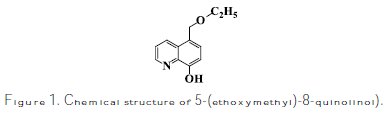
distilled water. The molecular formula of the examined inhibitor is shown in <a href="#f1">Fig. 1</a>.</p>


    ]]></body>
<body><![CDATA[<p>&nbsp;</p>
<a name="f1">
<img src="/img/revistas/pea/v35n4/35n4a05f1.jpg">
    
<p>&nbsp;</p>


    <p>For every concentration, the mean value of the corrosion rate CR (mg cm<sup>-2</sup> h<sup>-1</sup>) 
was determined, and the inhibition efficiency, &eta;<sub>w</sub>%, was calculated using <a href="#e1">Eqs. (1)</a> 
and <a href="#e2">(2)</a>, respectively:</p>


    <p>&nbsp;</p>
<a name="e1">
<img src="/img/revistas/pea/v35n4/35n4a05e1.jpg">
    
<p>&nbsp;</p>
<a name="e2">
<img src="/img/revistas/pea/v35n4/35n4a05e2.jpg">
    
<p>&nbsp;</p>


    <p>where Wb and Wa are the specimen weight before and after immersion in the 
tested solution, w<sup>0</sup><sub>corr</sub>% and w<sub>corr</sub>% are the corrosion weight losses of carbon steel in 
uninhibited and inhibited solutions, respectively, A the area of the carbon steel 
specimen (cm<sup>2</sup>), and t is the exposure time (h).</p>


    <p><i><b>Electrochemical measurements</b></i></p>

    <p>For electrochemical measurements, the electrolysis cell was a borosilicate glass 
(Pyrex&reg;) cylinder closed by a cap with five apertures. Three of them were used 
for the electrode insertions. The working electrode was pressure-fitted into a 
polytetrafluoroethylene holder (PTFE) exposing only 1 cm<sup>2</sup> of area to the 
solution. Platinum and saturated calomel were used as counter and reference 
electrodes (SCE), respectively. All potentials were measured against the last 
electrode.</p>

    <p>The potentiodynamic polarization curves were recorded by automatically 
changing the electrode potential from negative values to positive values versus 
Ecorr using a Potentiostat/Galvanostat type PGZ 100, at a scan rate of 1 mV s<sup>-1</sup> 
after 30 min immersion time until reaching steady state. The test solution was 
thermostatically controlled at 25&pm;2 &deg;C in air atmosphere without bubbling. To 
evaluate corrosion kinetic parameters, a fitting by Stern-Geary equation was 
used. To do so, the overall current density values, i, were considered as the sum 
of two contributions, anodic and cathodic current, ia and ic, respectively. For the 
potential domain not too far from the open circuit potential, it may be considered 
that both processes followed the Tafel law [34]. Thus, it can be derived from 
<a href="#e3">equation (3)</a> that:</p>


    ]]></body>
<body><![CDATA[<p>&nbsp;</p>
<a name="e3">
<img src="/img/revistas/pea/v35n4/35n4a05e3.jpg">
    
<p>&nbsp;</p>


    <p>where icorr is the corrosion current density (A cm<sup>-2</sup>) and ba and bc are the Tafel 
constants of anodic and cathodic reactions (V-1), respectively. These constants 
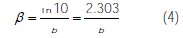
are linked to the Tafel slopes &beta; (V/dec) in a usual logarithmic scale given by 
<a href="#e4">equation (4)</a>:</p>


    <p>&nbsp;</p>
<a name="e4">
<img src="/img/revistas/pea/v35n4/35n4a05e4.jpg">
    
<p>&nbsp;</p>


    <p>The corrosion parameters were then evaluated by means of nonlinear least square 
method applying equation (2), using Origin software. However, for this 
calculation, the potential range applied was limited to &pm;0.100 V around Ecorr, 
because a significant systematic divergence was sometimes observed for both 
anodic and cathodic branches. The corrosion inhibition efficiency is evaluated 
from the corrosion current density values using the <a href="#e5">relationship (5)</a>:</p>


    <p>&nbsp;</p>
<a name="e5">
<img src="/img/revistas/pea/v35n4/35n4a05e5.jpg">
    
<p>&nbsp;</p>


    <p>The surface coverage values (&theta;) have been obtained from polarization curves for 
various concentrations of the inhibitor using the following <a href="#e6">equation (6)</a>:</p>


    <p>&nbsp;</p>
<a name="e6">
<img src="/img/revistas/pea/v35n4/35n4a05e6.jpg">
    
]]></body>
<body><![CDATA[<p>&nbsp;</p>


    <p>where i<sup>0</sup><sub>corr</sub> and i<sub>corr</sub> are the corrosion current density values without and with 
inhibitor, respectively.</p>

    <p>The electrochemical impedance spectroscopy measurements were carried out 
using a transfer function analyzer (VoltaLab PGZ 100), with a small amplitude 
a.c. signal (10 mV rms), over a frequency domain from 100 kHz to 100 mHz 
with five points per decade. The EIS diagrams were done in the Nyquist 
representation. The results were then analyzed in terms of an equivalent electrical 
circuit using Bouckamp program [36].</p>

    <p>The inhibiting efficiency derived from EIS, Î·EIS, was calculated using the following 
<a href="#e7">equation (7)</a>:</p>


    <p>&nbsp;</p>
<a name="e7">
<img src="/img/revistas/pea/v35n4/35n4a05e7.jpg">
    
<p>&nbsp;</p>


    <p>where R<sup>0</sup><sub>ct</sub> and R<sub>ct</sub> are the charge transfer resistance values in the absence and in 
the presence of the inhibitor, respectively.</p>

    <p>In order to ensure reproducibility, all experiments were repeated three times. The 
evaluated inaccuracy did not exceed 10 %.</p>


    <p>&nbsp;</p>
    <p><b>Results and discussion</b></p>

    ]]></body>
<body><![CDATA[<p><i><b>Preparation and characterization of 5-(ethoxymethyl)-8-quinolinol</b></i></p>

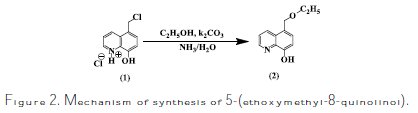
    <p>Preparation and characterization of 5-(ethoxymethyl)-8-quinolinol is represented in <a href="#f2">Fig. 2</a>.</p>


    <p>&nbsp;</p>
<a name="f2">
<img src="/img/revistas/pea/v35n4/35n4a05f2.jpg">
    
<p>&nbsp;</p>


    <p>The melting points were determined on a digital automatic electrothermal IA 
9200. 1H and 13C NMR spectra were recorded on a Bruker 300 WB spectrometer 
at 300 MHz, for solutions in Me2SO-d6. Chemical shifts are given as &Delta; values 
with reference to tetramethylsilane (TMS) as internal standard.</p>

    <p>Infrared spectra were recorded from 400 cm<sup>-1</sup> to 4000 cm<sup>-1</sup> on a Bruker IFS 66v 
Fourier transform spectrometer using KBr pellets.</p>

    <p>5- (chloromethyl)-8-quinolinol hydrochloride (1) was synthesized according to 
the method described by El Faydy et al. [37].</p>

    <p>A mixture of 2.3 g, 0.01 mol of 5-(chloromethyl)-8-quinolinol hydrochloride (1), 
25 mL of anhydrous ethanol and 0.84 g, 0.01 mol of added potassium 
bicarbonate (k2CO3) was heated at reflux temperature for 1 hour. The mixture 
was poured into 50 mL of water and made alkaline with 5% of ammonium 
hydroxide. The product which precipitated was filtered, then dissolved in ether, 
and the ethereal solution was washed with water and dried over anhydrous 
sodium sulfate. After removal of the solvent, 5-ethoxymethyl-8-
hydroxyquinoline (2) was crystallized from ethanol; yield 1.63g (80%); m.p.78-
80 &deg;C.</p>

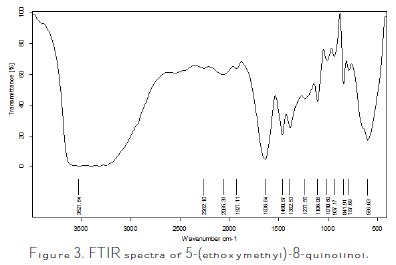
    <p>The FTIR spectra of 5-(ethoxymethyl)-8-quinolinol was displayed in <a href="#f3">Fig. 3</a>.</p>


    <p>&nbsp;</p>
<a name="f3">
<img src="/img/revistas/pea/v35n4/35n4a05f3.jpg">
    
]]></body>
<body><![CDATA[<p>&nbsp;</p>


    <p>It is observed that the absorption peaks between 3800 cm<sup>-1</sup> and 2700 cm<sup>-1</sup> 
corresponded to -OH, and bands around 3026 cm<sup>-1</sup> for aromatic C=C and C-H 
stretching are observable. Instead, the absorption peaks between 1275 cm<sup>-1</sup> and 
1298 cm<sup>-1</sup> related to CN, and strong and large peaks (2850 cm<sup>-1</sup>, 2940 cm<sup>-1</sup> and 
1450 cm<sup>-1</sup>) took place in the spectrum of 5-(ethoxymethyl)-8-quinolinol 
corresponding to the presence of CH2.</p>

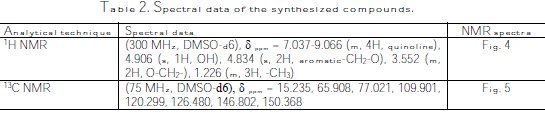
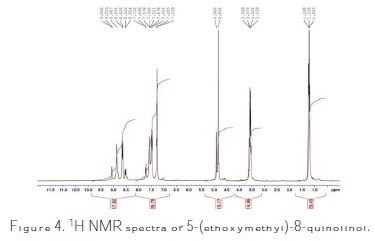
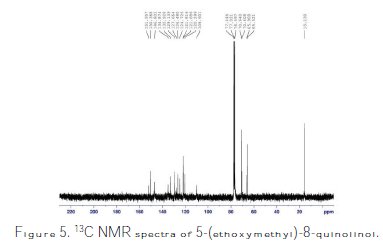
    <p>1H and 13C NMR spectra were used to characterize and confirm the obtained 
product structure (see supplementary data) (<a href="#t2">Table 2</a>).</p>


    <p>&nbsp;</p>
<a name="t2">
<img src="/img/revistas/pea/v35n4/35n4a05t2.jpg">
    
<p>&nbsp;</p>
<a name="f4">
<img src="/img/revistas/pea/v35n4/35n4a05f4.jpg">
    
<p>&nbsp;</p>
<a name="f5">
<img src="/img/revistas/pea/v35n4/35n4a05f5.jpg">
    
<p>&nbsp;</p>


    <p><i><b>Weight loss measurements</b></i></p>

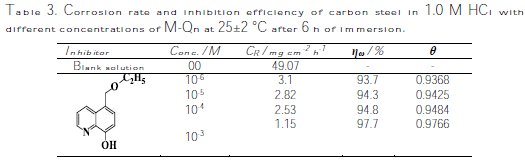
    <p>The corrosion rate of carbon steel in 1.0 M HCl with and without different 
concentrations of M-Qn was determined after 6 h of immersion at 25&pm;2 &deg;C. This 
immersion time choice was made according to literature [39]. The obtained 
results are presented in <a href="#t3">Table 3</a>).</p>


    <p>&nbsp;</p>
<a name="t3">
<img src="/img/revistas/pea/v35n4/35n4a05t3.jpg">
    
]]></body>
<body><![CDATA[<p>&nbsp;</p>


    <p>It has been observed that the corrosion rate (CR), 
decreases with an increase in inhibitor's concentration, M-Qn. At the same time, 
the inhibition efficiency, &eta;<sub>w</sub>%, was enhanced by the inhibitor's concentration, 
reaching a maximum of 97.7% at 10<sup>-3</sup> M of M-Qn. The good inhibitive 
performance of 5-(ethoxymethyl)-8-quinolinol may be explained on the basis of 
adsorption of the molecule (physisorption and/or chemisorption). The M-Qn 
molecule can easily be protonated to form cation-ionic forms in an HCl solution, 
and therefore adsorb onto the metal surface through the already adsorbed 
chloride ions. Also, the adsorption of the neutral 5-(ethoxymethyl)-8-quinolinol 
molecule could occur through the formation of links between the d-orbital of iron 
atoms, involving the displacement of water molecules from the metal surface, the 
lone sp2 electron pairs present on the N, and O atoms and p-orbitals in the 
aromatic ring, blocking the active sites on the steel surface and, therefore, 
decreasing the corrosion rate. The inhibition efficiency increased with 
concentration of M-Qn, reaching a maximum at 10<sup>-3</sup> M of M-Qn. This behavior 
could be attributed to the increase in adsorption of the inhibitor at the 
metal/solution interface with the increase on its concentration.</p>


    <p><i><b>Open circuit potential (OCP) measurements</b></i></p>

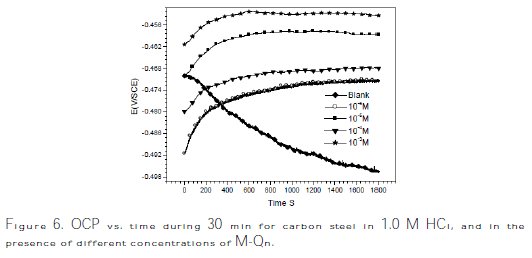
    <p>The variances of OCP of the carbon steel as a function of time in aerated 1.0 M 
HCl solution, in the absence and presence of different concentrations of M-Qn, 
are shown in <a href="#f6">Fig. 6</a>.</p>


    <p>&nbsp;</p>
<a name="f6">
<img src="/img/revistas/pea/v35n4/35n4a05f6.jpg">
    
<p>&nbsp;</p>


    <p><a href="#f6">Fig. 6</a> shows the differences of the open circuit potential (OCP), with time, for 
carbon steel corrosion against 1.0 M HCl solution in the presence and absence of 
M-Qn. It was noticed that the addition of the inhibitor molecule induces a 
continuous shift in OCP (i.e., Ecorr) to nobler potentials, indicating the 
spontaneous adsorption of inhibitor onto the metallic surface.</p>

    <p>Corrosion potential stabilization occurs after almost 600 (s) of immersion time in 
1.0 M HCl solutions.</p>

    <p>For 10<sup>-3</sup> M of M-Qn, OCP becomes more positive compared to 
10<sup>-6</sup>, 10<sup>-5</sup> and 10<sup>-4</sup> 
M of inhibitor. This means that the surface becomes nobler with an increased 
inhibitor concentration, which can probably be due to the stronger oxides 
formation on the metal surface. With the addition of 10<sup>-3</sup> M of M-Qn, the 
presence of dissolved oxygen and H+ ions on metal surface is increased and can 
lead to formation of more oxides and more positive values of OCP [33].</p>


    <p><i><b>Potentiodynamic polarization curves</b></i></p>

    ]]></body>
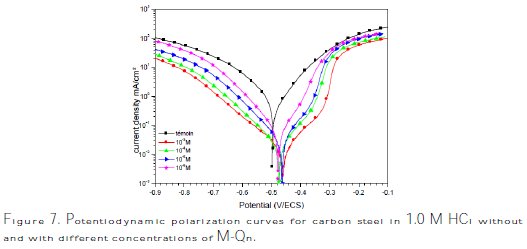
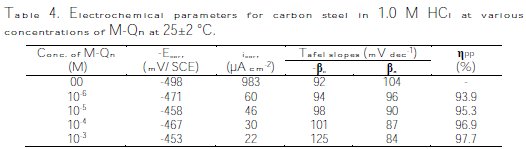
<body><![CDATA[<p>Potentiodynamic polarization curves of carbon steel in 1.0 M HCl without and 
with different concentrations of M-Qn at 25&pm;2 &deg;C are given in <a href="#f7">Fig. 7</a>, and their 
extrapolation parameters and inhibition efficiencies are plotted in <a href="#t4">Table 4</a>.</p>


    <p>&nbsp;</p>
<a name="f7">
<img src="/img/revistas/pea/v35n4/35n4a05f7.jpg">
    
<p>&nbsp;</p>
<a name="t4">
<img src="/img/revistas/pea/v35n4/35n4a05t4.jpg">
    
<p>&nbsp;</p>


    <p>It can be seen that the M-Qn addition hindered the acid attack on carbon steel, 
and an increase in its concentration gave a decrease in anodic and cathodic 
current densities, indicating that this inhibitor acted as a mixed-type inhibitor. 
However, the cathodic Tafel slopes (&beta;c) changed with the quinolinol substituted 
compound addition, indicating a modification of the mechanism of cathodic 
hydrogen evolution, which suggests that these compounds powerfully inhibit the 
corrosion process of carbon steel, and their ability as corrosion inhibitors are 
enhanced as their concentrations are increased. The suppression of the cathodic 
process can be due to the covering of the surface with a monolayer originated by 
the adsorbed inhibitor molecules [27]. It is also seen that the inhibition efficiency 
increased with concentrations, reaching a maximum of 97.7 % at 10<sup>-3</sup> M of M-
Qn, and exhibited both cathodic and anodic inhibition through adsorption on 
carbon steel surface blocking active sites [28]. So, a slight definite change on the 
corrosion potential (Ecorr) was observed. According to Riggs [29] and other 
authors, if the displacement in E is > 85 mV/ Ecorr, the inhibitor can be seen as of 
the cathodic or anodic type; if the displacement in E is &lt; 85 mV/ Ecorr, the 
inhibitor can be seen as of the mixed type. In our study, the maximum 
displacement is less than 85 mV/ Ecorr, which indicates that M-Qn is a mixed type 
inhibitor. The results obtained by the potentiodynamic polarization curves 
confirmed those obtained by weight loss measurements.</p>


    <p><i><b>Electrochemical Impedance Spectroscopy (EIS)</b></i></p>

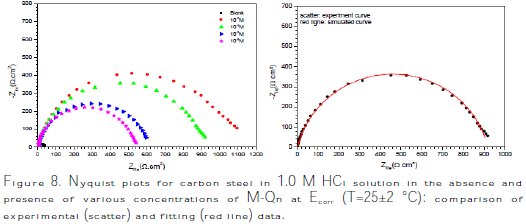
    <p>The aim of this section was to confirm the obtained results by potentiodynamic 
polarization curves and weight loss measurements. <a href="#f8">Fig. 8</a> presents the Nyquist 
plots of carbon steel in 1.0 M HCl, without and with different concentrations of 
M-Qn at the corrosion potential.</p>


    <p>&nbsp;</p>
<a name="f8">
<img src="/img/revistas/pea/v35n4/35n4a05f8.jpg">
    
<p>&nbsp;</p>


    <p>It is noted that the Nyquist plot of carbon steel 
in the absence and presence of all concentrations of inhibitors contains a slightly 
depressed semi-circular shape, and only one time constant appeared, indicating 
that carbon steel corrosion is mainly controlled by a charge transfer process.</p>

    ]]></body>
<body><![CDATA[<p>In this case, it can be seen that these plots were composed by one capacitive loop 
in the absence and presence of different concentrations of M-Qn. This behavior 
can be attributed to charge transfer of the corrosion process. It is also noted that 
the diameter of the semicircle increased with the inhibitor's concentration, 
indicating an increase in corrosion resistance of the material [43].</p>

    <p>However, a CPE element was employed in order to investigate the inhibitive film 
properties on the metallic surface. Thus, the impedance of CPE can be described 
by the following equation:</p>


    <p>&nbsp;</p>
<a name="e8">
<img src="/img/revistas/pea/v35n4/35n4a05e8.jpg">
    
<p>&nbsp;</p>


    <p>where j is an imaginary number, Q is the frequency independent real constant, w 
= 2&pi;f is the angular frequency (rad s<sup>-1</sup>), f is the frequency of the applied signal, 
n is the CPE exponent for whole number of n = 1, 0, -1, and CPE is reduced to 
the classical lump element-capacitor (C), resistance (R) and inductance (L) [44]. 
The use of these parameters, similar to the constant phase element (CPE), 
allowed the depressed feature of Nyquist plot to be readily reproduced.</p>

    <p>In addition, the effective calculated double layer capacitance (C) derived from 
the CPE parameters according to the following equation [45]:</p>


    <p>&nbsp;</p>
<a name="e9">
<img src="/img/revistas/pea/v35n4/35n4a05e9.jpg">
    
<p>&nbsp;</p>


    <p>The most important data obtained from the equivalent circuit are presented in 
<a href="#t4">Table 4</a>. It may be remarked that Rct values increased, while Cdl values decreased 
with inhibitor's concentrations, indicating that more inhibitor molecules are 
adsorbed onto the metallic surface, providing better surface coverage and/or 
enhancing the thickness of the protective layer at the metal/solution interface [46, 
47]. In addition, these changes in Rct and Cdl can be attributed to the gradual 
displacement of water molecules and/or chloride ions on the carbon steel surface 
[48], leading to a protective solid film, and then to a decrease in the extent of the 
dissolution reaction [49, 50]. In its turn, the decrease of Cdl with concentrations 
can be explained by the decrease in local dielectric constant and/or the increase 
in the protective layer thickness on the electrode surface. This trend is in 
accordance with Helmholtz model, given by the following equation [51]:</p>


    <p>&nbsp;</p>
<a name="e10">
<img src="/img/revistas/pea/v35n4/35n4a05e10.jpg">
    
]]></body>
<body><![CDATA[<p>&nbsp;</p>


    <p>where &epsilon; is the dielectric constant of the protective layer, &epsilon;0 is the permittivity of 
free space (8.854 &times;10<sup>-14</sup> F cm<sup>-1</sup>) and S is the effective surface area of the 
electrode. However, the inhibition efficiencies obtained from electrochemical 
impedance measurements increase with concentration and show the same trend 
as those obtained from potentiodynamic polarization and gravimetric 
measurements.</p>

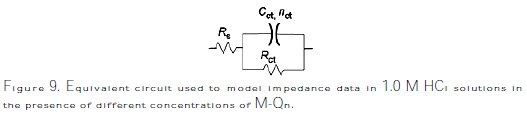
    <p>However, the results can be interpreted using the equivalent circuit presented in 
<a href="#f9">Fig. 9</a>, which has been previously used to model the iron/steel interface [52].</p>


    <p>&nbsp;</p>
<a name="f9">
<img src="/img/revistas/pea/v35n4/35n4a05f9.jpg">
    
<p>&nbsp;</p>


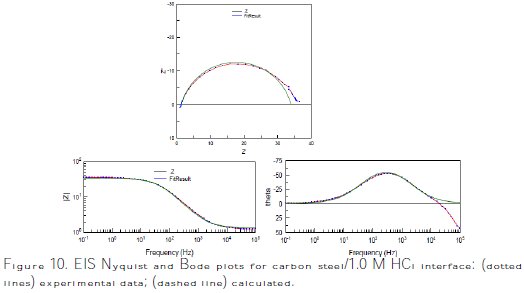
    <p>Excellent fit with the model was obtained for all experimental data (<a href="#f10">Fig. 10</a>).</p>


    <p>&nbsp;</p>
<a name="f10">
<img src="/img/revistas/pea/v35n4/35n4a05f10.jpg">
    
<p>&nbsp;</p>


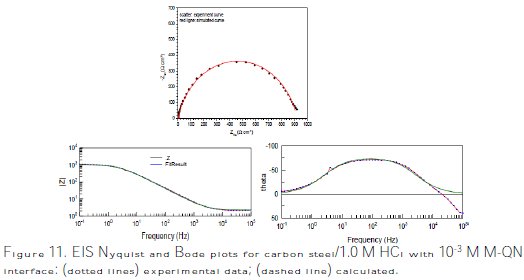
    <p>The Nyquist and Bode plots of both experimental and simulated data of carbon steel 
in 1.0 M HCl solution without and with 10<sup>-3</sup> M of M-Qn are shown in <a href="#f11">Fig. 11</a>.</p>


    <p>&nbsp;</p>
<a name="f11">
<img src="/img/revistas/pea/v35n4/35n4a05f11.jpg">
    
]]></body>
<body><![CDATA[<p>&nbsp;</p>


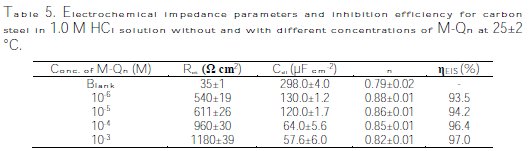
    <p>It is clear that the impedance plots are in accordance with those calculated by the 
used equivalent circuit model. Various parameters such as charge-transfer 
resistance (Rct), double layer capacitance (Cdl) and degree of heterogeneity (ndl) 
obtained from impedance measurements are shown in <a href="#t5">Table 5</a>, which contains all 
the impedance parameters obtained from the simulation of experimental 
impedance data, including Rct and n.</p>


    <p>&nbsp;</p>
<a name="t5">
<img src="/img/revistas/pea/v35n4/35n4a05t5.jpg">
    
<p>&nbsp;</p>


    <p>In <a href="#t5">Table 5</a> are also shown the calculated ''double layer capacitance values (Cdl)'', 
and the relaxation time constant (&tau;) of charge-transfer process using the 
following <a href="#e11">equation (11)</a>:</p>


    <p>&nbsp;</p>
<a name="e11">
<img src="/img/revistas/pea/v35n4/35n4a05e11.jpg">
    
<p>&nbsp;</p>


    <p>It is obvious from the results that M-Qn inhibited carbon steel corrosion in an 1.0 
M HCl solution at its different concentrations, and Î·EIS (%) was seen to 
continuously increase with the arise of concentration, reaching a maximum of 
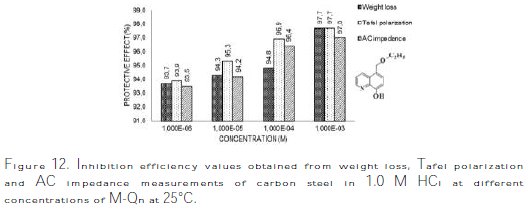
97.0 % at 10<sup>-3</sup> M. The inhibition efficiencies, calculated from Tafel impedance 
results, showed the same trend as those obtained from EIS, polarization and 
weight loss measurements (<a href="#f12">Fig. 12</a>).</p>


    <p>&nbsp;</p>
<a name="f12">
<img src="/img/revistas/pea/v35n4/35n4a05f12.jpg">
    
<p>&nbsp;</p>


    ]]></body>
<body><![CDATA[<p><i><b>Effect of temperature</b></i></p>

    <p>Temperature can modify the interaction between the carbon steel electrode and 
the acidic media without and with M-Qn. Thus, the potentiodynamic polarization 
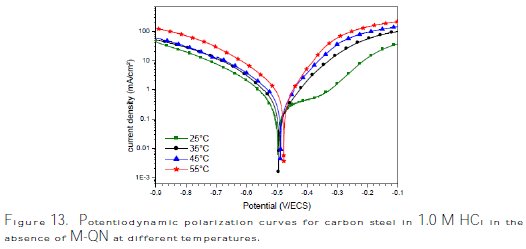
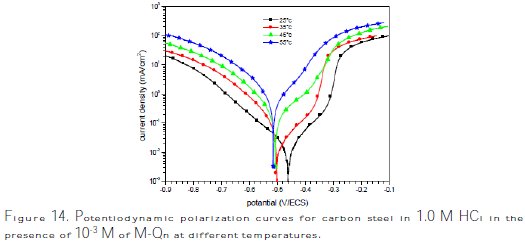
curves for carbon steel in 1.0 M HCl in the absence and presence of 10<sup>-3</sup> M of M-
Qn in the temperature range of 25&pm;2 &deg;C to 55&pm;2 &deg;C are shown in 
<a href="#f13">Figs. 13</a> and <a href="#f14">14</a>, respectively.</p>


    <p>&nbsp;</p>
<a name="f13">
<img src="/img/revistas/pea/v35n4/35n4a05f13.jpg">
    
<p>&nbsp;</p>
<a name="f14">
<img src="/img/revistas/pea/v35n4/35n4a05f14.jpg">
    
<p>&nbsp;</p>


    <p>It is remarked that these curves exhibited Tafel regions. It is also 
noted that the anodic and cathodic branches increased with the increase of 
temperature.</p>

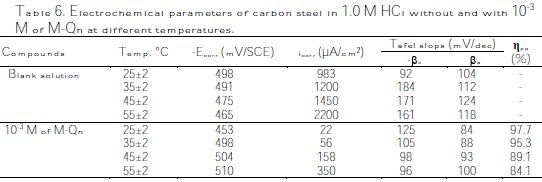
    <p>The various electrochemical parameters were calculated from Tafel plots and are 
summarized in <a href="#t6">Table 6</a>.</p>


    <p>&nbsp;</p>
<a name="t6">
<img src="/img/revistas/pea/v35n4/35n4a05t6.jpg">
    
<p>&nbsp;</p>


    <p>It can be seen that icorr increased with an increase in temperature both in 
uninhibited and inhibited solutions, and the values of inhibition efficiency of M-
Qn decreased with an increase in temperature. Thus, the inhibition efficiencies of 
M-Qn are temperature-dependent.</p>


    ]]></body>
<body><![CDATA[<p><i><b>Adsorption isotherm and thermodynamic parameters</b></i></p>

    <p>The surface coverage values (&theta;) of carbon steel in 1.0 M HCl, in the presence of 
10<sup>-3</sup> M of M-Qn, were obtained from weight loss measurements (<a href="#t3">Table 3</a>). This 
parameter has been used to explain the best isotherm, in order to determine the 
adsorption process. As it is known, the adsorption of an organic adsorbate onto a 
metal/solution interface denotes a substitutive adsorption process between the 
organic molecules in the aqueous solution, Org(sol), and the water molecules on 
the metallic surface, H2O(ads) [42]:</p>


    <p>&nbsp;</p>
<a name="e12">
<img src="/img/revistas/pea/v35n4/35n4a05e12.jpg">
    
<p>&nbsp;</p>


    <p>where Org(sol) and Org(ads) are the organic molecules in the aqueous solution, and 
adsorbed onto the metallic surface, respectively, H2O(ads) is the water molecules 
on the metallic surface, and X is the size ratio representing the number of water 
molecules replaced by one molecule of organic adsorbate [53].</p>

    <p>However, the considered Langmuir isotherm model was as described in reference 
[54]:</p>


    <p>&nbsp;</p>
<a name="e13">
<img src="/img/revistas/pea/v35n4/35n4a05e13.jpg">
    
<p>&nbsp;</p>


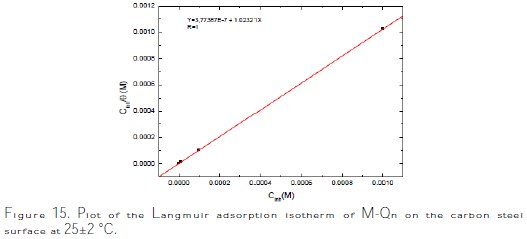
    <p>In this study, the Langmuir isotherm was fitted. The best fit straight line (strong 
correlation with R2 &approx; 1) is obtained for the plot of Cinh/&theta; vs. Cinh, with slopes 
around unity (<a href="#f15">Fig. 15</a>).</p>


    <p>&nbsp;</p>
<a name="f15">
<img src="/img/revistas/pea/v35n4/35n4a05f15.jpg">
    
]]></body>
<body><![CDATA[<p>&nbsp;</p>


    <p>This suggested that the adsorption of the studied inhibitor 
at the metallic surface obeyed Langmuir's adsorption isotherm model, and 
exhibited single-layer adsorption characteristics. This kind of isotherm involved 
the assumption of no interaction between the adsorbed species onto the electrode 
surface [55].</p>

    <p>In addition, the adsorption constant, Kads, was related to the free energy of 
adsorption, &Delta;Gads, by the following <a href="#e14">equation (14)</a> [54]:</p>


    <p>&nbsp;</p>
<a name="e14">
<img src="/img/revistas/pea/v35n4/35n4a05e14.jpg">
    
<p>&nbsp;</p>


    <p>where 55.55 value represents the water concentration in solution by mol L<sup>-1</sup>, R is 
the universal gas constant and T is the absolute temperature.</p>

    <p>The calculated value of the free energy of adsorption, &Delta;Gads, from the adsorption 
isotherm is -46.6 kJ mol<sup>-1</sup> at 25&pm;2 &deg;C. It is well known that values of &Delta;Gads of the 
order of -20 kJ/mol or lower indicate a physisorption; those of order of - 40 
kJ/mol or higher are associated with chemisorptions, as a result of the sharing or 
transfer of electrons from organic molecules to the metal surface, to form a co-
ordinate; while values between -20 kJ moL<sup>-1</sup> and -40 kJ mol<sup>-1</sup> indicate both 
physisorption and chemisorption [41, 46, 48].</p>


    <p><i><b>Corrosion kinetic parameters</b></i></p>

    <p>The data presented in <a href="#t7">Table 7</a> revealed that M-Qn took its inhibition efficiency at 
all temperature range.</p>


    <p>&nbsp;</p>
<a name="t7">
<img src="/img/revistas/pea/v35n4/35n4a05t7.jpg">
    
]]></body>
<body><![CDATA[<p>&nbsp;</p>


    <p>This behavior confirmed the higher adsorption equilibrium constant Kads values, 
indicating the physisorption and chemisorption of M-Qn at the carbon steel 
surface. This result has been explained by some authors as a likely specific 
interaction between the iron surface and the inhibitor. So, Ivanov [58] explained 
this increase in temperature by the change in the nature of the adsorption mode; 
the inhibitor is being physically adsorbed at lower temperatures, while this 
physisorption is favored by the increase in temperature. The same phenomenon 
was explained by other researchers as an increase in the surface coverage by the 
inhibitor [59]. Thus, at a surface with high coverage values, the diffusion through 
the surface layer containing the inhibitor and corrosion products became the rate-
determining step of the metal dissolution process [60]. Thus, the inhibition 
properties of M-Qn can be explained by the kinetic model. The dependence of 
the corrosion value, icorr, with the temperature can be regarded as an Arrhenius-
type process given by <a href="#e15">equation (15)</a> [61]:</p>


    <p>&nbsp;</p>
<a name="e15">
<img src="/img/revistas/pea/v35n4/35n4a05e15.jpg">
    
<p>&nbsp;</p>


    <p>where Ea is the apparent activation energy of the corrosion process, R is the 
universal gas constant, A is the Arrhenius pre-exponential constant and T is the 
absolute temperature.</p>

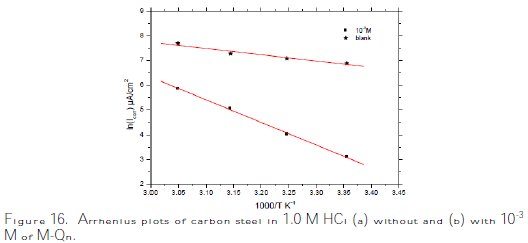
    <p>The Arrhenius plots for carbon steel in 1.0 M HCl without and with 10<sup>-3</sup> M of M-
Qn, according to equation (13), are presented in <a href="#f16">Fig. 16</a>.</p>


    <p>&nbsp;</p>
<a name="f16">
<img src="/img/revistas/pea/v35n4/35n4a05f16.jpg">
    
<p>&nbsp;</p>


    <p>These obtained plots are straight lines, and the slope of each straight line gives 
the activation energy value, Ea. It is noted that the increase in the corrosion rate is 
more pronounced with the rise in temperature for the free solution. So, in the 
presence of M-Qn, the corrosion rate is slightly increased at explored 
temperatures. The Ea values were found to be equal to 21.0 kJ moL<sup>-1</sup> and 76.0 KJ 
moL<sup>-1</sup> in the absence and presence of 10<sup>-3</sup> M of M-Qn (<a href="#t7">Table 7</a>).</p>

    <p>The decrease of the inhibitor efficiency with an increased temperature, which 
referred to a higher value of Ea, when compared to the free solution, was 
interpreted as an indication of an electrostatic character of the inhibitor's 
adsorption. So, the investigated inhibitor significantly blocked some of the active 
sites on the metal surface. In general, the inhibitor adsorbed at the most active 
sites of the surface with lowest Ea and, thus, isolated them. Other active sites of 
higher Ea took part in the more intense corrosion process.</p>

    ]]></body>
<body><![CDATA[<p>In addition, this change in Ea with the M-Qn addition can be attributed to the 
change in the corrosion process mechanism, in the presence of adsorbed inhibitor 
molecules [62].</p>

    <p>Other kinetic data are accessible using the alternative formulation of the 
Arrhenius equation <a href="#e16">equation (16)</a> [63]:</p>


    <p>&nbsp;</p>
<a name="e16">
<img src="/img/revistas/pea/v35n4/35n4a05e16.jpg">
    
<p>&nbsp;</p>


    <p>where h is Plank's constant, N is Avogadro's number, &Delta;Sa is the entropy of 
activation and &Delta;Ha is the enthalpy of activation.</p>

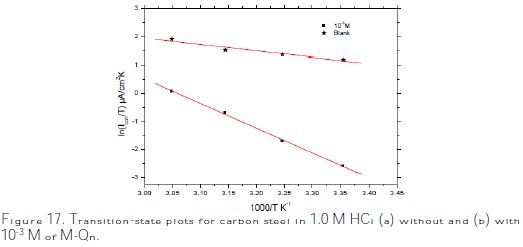
    <p>Plots of ln (icorr/T) versus the reciprocal of temperature (1/T) of carbon steel in 
1.0 M HCl without and with 10<sup>-3</sup> M of M-Qn are presented in <a href="#f17">Fig. 17</a>.</p>


    <p>&nbsp;</p>
<a name="f17">
<img src="/img/revistas/pea/v35n4/35n4a05f17.jpg">
    
<p>&nbsp;</p>


    <p>Straight 
lines are obtained with a slope of &Delta;Ha /R and an intercept of lnR/Nh + &Delta;Sa/R. 
The values of &Delta;Ha and &Delta;Sa are calculated and listed in <a href="#t7">Table 7</a>. The positive sign 
of the enthalpies &Delta;Ha improved the endothermic nature of the carbon steel 
dissolution process, whereas large negative values of entropies, &Delta;Sa, implied that 
the activated complex in the rate determining step represents an association 
rather than a dissociation step, meaning that a decrease in disordering takes place 
on going from reactants to the activated complex [61-66].</p>


    <p>&nbsp;</p>
    ]]></body>
<body><![CDATA[<p><b>Conclusions</b></p>

    <p>Concluding the experimental part, it was clearly demonstrated that all used 
techniques are able to characterize and follow the corrosion inhibition process 
promoted by 5-(ethoxymethyl)-8-quinolinol. The following conclusions can be 
drawn:</p>

    <p>- The corrosion rate of carbon steel decreased with an increase in inhibitor's 
concentration, reaching a minimum at 10<sup>-3</sup> M.</p>

    <p>- 5-(ethoxymethyl)-8-quinolinol exhibited good inhibition properties for carbon 
steel corrosion in 1.0 M HCl solution, and increased with an increase in the 
concentration of inhibitor.</p>

    <p>- The obtained results showed that 5-(ethoxymethyl)-8-quinolinol acted as 
mixed-type inhibitor of carbon steel corrosion in 1.0 M HCl. </p>

    <p>- EIS measurement results indicated that the resistance of the carbon steel 
electrode increased with inhibitor's concentrations, reaching a maximum at 10-3 
M of 5-(ethoxymethyl)-8-quinolinol.</p>

    <p>- The inhibition efficiency of 5-(ethoxymethyl)-8-quinolinol can be stabilized by 
the participation of the two adsorption modes, physisorption and chemisorption.</p>

    <p>- Thermodynamic adsorption parameters (&Delta;Ha, &Delta;Sa 
and &Delta;Ga.) showed that the 
studied inhibitor was adsorbed onto carbon steel surface by an endothermic and 
spontaneous process.</p>

    <p>- Reasonably good agreement was observed between the obtained data from 
weight loss, potentiodynamic polarization curves and electrochemical impedance 
spectroscopy techniques.</p>


    <p>&nbsp;</p>
    ]]></body>
<body><![CDATA[<p><b>References</b></p>

    <!-- ref --><p>1. El Kacimi Y, Touir R, Galai M, et al. J Mater Environ. Sci. 2016;7:371.    &nbsp;&nbsp;&nbsp;&nbsp;&nbsp;&nbsp;&nbsp;&nbsp;[&#160;<a href="javascript:void(0);" onclick="javascript: window.open('/scielo.php?script=sci_nlinks&ref=428634&pid=S0872-1904201700040000500001&lng=','','width=640,height=500,resizable=yes,scrollbars=1,menubar=yes,');">Links</a>&#160;]<!-- end-ref --></p>

    <!-- ref --><p>2. Hussin MH, Kassim MJ, Razali NN, et al. Arab J. Chem. 2011;1878.    &nbsp;&nbsp;&nbsp;&nbsp;&nbsp;&nbsp;&nbsp;&nbsp;[&#160;<a href="javascript:void(0);" onclick="javascript: window.open('/scielo.php?script=sci_nlinks&ref=428636&pid=S0872-1904201700040000500002&lng=','','width=640,height=500,resizable=yes,scrollbars=1,menubar=yes,');">Links</a>&#160;]<!-- end-ref --></p>

    <!-- ref --><p>3. Abbouda Y, Abourriche A, Saffaj T, et al. Mater Chem Phys. 2007;105:1.    &nbsp;&nbsp;&nbsp;&nbsp;&nbsp;&nbsp;&nbsp;&nbsp;[&#160;<a href="javascript:void(0);" onclick="javascript: window.open('/scielo.php?script=sci_nlinks&ref=428638&pid=S0872-1904201700040000500003&lng=','','width=640,height=500,resizable=yes,scrollbars=1,menubar=yes,');">Links</a>&#160;]<!-- end-ref --></p>

    <!-- ref --><p>4. James AO, Oforka NC, Abiola K. Int J Electrochem Sci. 2007;2:284.    &nbsp;&nbsp;&nbsp;&nbsp;&nbsp;&nbsp;&nbsp;&nbsp;[&#160;<a href="javascript:void(0);" onclick="javascript: window.open('/scielo.php?script=sci_nlinks&ref=428640&pid=S0872-1904201700040000500004&lng=','','width=640,height=500,resizable=yes,scrollbars=1,menubar=yes,');">Links</a>&#160;]<!-- end-ref --></p>

    <p>5. Ebenso EE, Niger. J Chem Res. 2001;6:12.</p>

    ]]></body>
<body><![CDATA[<!-- ref --><p>6. Ekpe UJ, Okafor PC, Ebenso EE, et al. Bull Electrochem. 2001;17:135.    &nbsp;&nbsp;&nbsp;&nbsp;&nbsp;&nbsp;&nbsp;&nbsp;[&#160;<a href="javascript:void(0);" onclick="javascript: window.open('/scielo.php?script=sci_nlinks&ref=428643&pid=S0872-1904201700040000500006&lng=','','width=640,height=500,resizable=yes,scrollbars=1,menubar=yes,');">Links</a>&#160;]<!-- end-ref --></p>

    <!-- ref --><p>7. Alaoui K, El Kacimi Y, Galai M, et al. J Mater Environ Sci. 2016;7:2389.    &nbsp;&nbsp;&nbsp;&nbsp;&nbsp;&nbsp;&nbsp;&nbsp;[&#160;<a href="javascript:void(0);" onclick="javascript: window.open('/scielo.php?script=sci_nlinks&ref=428645&pid=S0872-1904201700040000500007&lng=','','width=640,height=500,resizable=yes,scrollbars=1,menubar=yes,');">Links</a>&#160;]<!-- end-ref --></p>

    <!-- ref --><p>8. Noor EA, Al-Moubaraki AH. Int J Electrochem Sci. 2008;3:806.    &nbsp;&nbsp;&nbsp;&nbsp;&nbsp;&nbsp;&nbsp;&nbsp;[&#160;<a href="javascript:void(0);" onclick="javascript: window.open('/scielo.php?script=sci_nlinks&ref=428647&pid=S0872-1904201700040000500008&lng=','','width=640,height=500,resizable=yes,scrollbars=1,menubar=yes,');">Links</a>&#160;]<!-- end-ref --></p>

    <!-- ref --><p>9. Alaoui K, El Kacimi Y, Galai M, et al. Anal Bioanal Electrochem. 2016;8:830.    &nbsp;&nbsp;&nbsp;&nbsp;&nbsp;&nbsp;&nbsp;&nbsp;[&#160;<a href="javascript:void(0);" onclick="javascript: window.open('/scielo.php?script=sci_nlinks&ref=428649&pid=S0872-1904201700040000500009&lng=','','width=640,height=500,resizable=yes,scrollbars=1,menubar=yes,');">Links</a>&#160;]<!-- end-ref --></p>

    <!-- ref --><p>10. Galai M, El Gouri M, Dagdag O, et al. J Mater Environ Sci. 2016;7:1562.    &nbsp;&nbsp;&nbsp;&nbsp;&nbsp;&nbsp;&nbsp;&nbsp;[&#160;<a href="javascript:void(0);" onclick="javascript: window.open('/scielo.php?script=sci_nlinks&ref=428651&pid=S0872-1904201700040000500010&lng=','','width=640,height=500,resizable=yes,scrollbars=1,menubar=yes,');">Links</a>&#160;]<!-- end-ref --></p>

    ]]></body>
<body><![CDATA[<!-- ref --><p>11. El Hezzat M, Assouag M, Zarrok H, et al. Der Pharma Chemica. 2015;7:77.    &nbsp;&nbsp;&nbsp;&nbsp;&nbsp;&nbsp;&nbsp;&nbsp;[&#160;<a href="javascript:void(0);" onclick="javascript: window.open('/scielo.php?script=sci_nlinks&ref=428653&pid=S0872-1904201700040000500011&lng=','','width=640,height=500,resizable=yes,scrollbars=1,menubar=yes,');">Links</a>&#160;]<!-- end-ref --></p>

    <!-- ref --><p>12. Obot IB, Obi-Egbedi NO. Corros Sci. 2009;52:276.    &nbsp;&nbsp;&nbsp;&nbsp;&nbsp;&nbsp;&nbsp;&nbsp;[&#160;<a href="javascript:void(0);" onclick="javascript: window.open('/scielo.php?script=sci_nlinks&ref=428655&pid=S0872-1904201700040000500012&lng=','','width=640,height=500,resizable=yes,scrollbars=1,menubar=yes,');">Links</a>&#160;]<!-- end-ref --></p>

    <!-- ref --><p>13. Obot IE, Obi-Egbedi NO. Corros Sci. 2010;52:657.    &nbsp;&nbsp;&nbsp;&nbsp;&nbsp;&nbsp;&nbsp;&nbsp;[&#160;<a href="javascript:void(0);" onclick="javascript: window.open('/scielo.php?script=sci_nlinks&ref=428657&pid=S0872-1904201700040000500013&lng=','','width=640,height=500,resizable=yes,scrollbars=1,menubar=yes,');">Links</a>&#160;]<!-- end-ref --></p>

    <!-- ref --><p>14. Ebenso EE, Alemu H, Umoren SA, et al. Int J Electrochem Sci. 2008;4:1325.    &nbsp;&nbsp;&nbsp;&nbsp;&nbsp;&nbsp;&nbsp;&nbsp;[&#160;<a href="javascript:void(0);" onclick="javascript: window.open('/scielo.php?script=sci_nlinks&ref=428659&pid=S0872-1904201700040000500014&lng=','','width=640,height=500,resizable=yes,scrollbars=1,menubar=yes,');">Links</a>&#160;]<!-- end-ref --></p>

    <!-- ref --><p>15. Abd El-Maksoud SA. Appl Surf Sci. 2003;206:129.    &nbsp;&nbsp;&nbsp;&nbsp;&nbsp;&nbsp;&nbsp;&nbsp;[&#160;<a href="javascript:void(0);" onclick="javascript: window.open('/scielo.php?script=sci_nlinks&ref=428661&pid=S0872-1904201700040000500015&lng=','','width=640,height=500,resizable=yes,scrollbars=1,menubar=yes,');">Links</a>&#160;]<!-- end-ref --></p>

    ]]></body>
<body><![CDATA[<!-- ref --><p>16. Hassan HH, Abdelghani E, Amina MA. Electrochim. Acta. 2007;52:6359.    &nbsp;&nbsp;&nbsp;&nbsp;&nbsp;&nbsp;&nbsp;&nbsp;[&#160;<a href="javascript:void(0);" onclick="javascript: window.open('/scielo.php?script=sci_nlinks&ref=428663&pid=S0872-1904201700040000500016&lng=','','width=640,height=500,resizable=yes,scrollbars=1,menubar=yes,');">Links</a>&#160;]<!-- end-ref --></p>

    <!-- ref --><p>17. Elkacimi Y, Achnin M, Aouine Y, et al. Port Electrochim Acta. 2012;30:53.    &nbsp;&nbsp;&nbsp;&nbsp;&nbsp;&nbsp;&nbsp;&nbsp;[&#160;<a href="javascript:void(0);" onclick="javascript: window.open('/scielo.php?script=sci_nlinks&ref=428665&pid=S0872-1904201700040000500017&lng=','','width=640,height=500,resizable=yes,scrollbars=1,menubar=yes,');">Links</a>&#160;]<!-- end-ref --></p>

    <!-- ref --><p>18. El Kacimi Y, Azaroual MA, Touir R, et al. Euro-Mediterr J Environ Integr. 2017;2:1.    &nbsp;&nbsp;&nbsp;&nbsp;&nbsp;&nbsp;&nbsp;&nbsp;[&#160;<a href="javascript:void(0);" onclick="javascript: window.open('/scielo.php?script=sci_nlinks&ref=428667&pid=S0872-1904201700040000500018&lng=','','width=640,height=500,resizable=yes,scrollbars=1,menubar=yes,');">Links</a>&#160;]<!-- end-ref --></p>

    <!-- ref --><p>19. Chetouani A, Hammouti B, Benhadda T, et al. Appl Surf Sci. 2005;249:375.    &nbsp;&nbsp;&nbsp;&nbsp;&nbsp;&nbsp;&nbsp;&nbsp;[&#160;<a href="javascript:void(0);" onclick="javascript: window.open('/scielo.php?script=sci_nlinks&ref=428669&pid=S0872-1904201700040000500019&lng=','','width=640,height=500,resizable=yes,scrollbars=1,menubar=yes,');">Links</a>&#160;]<!-- end-ref --></p>

    <!-- ref --><p>20. Khaled KF. Mater Chem Phys. 2008;112:290.    &nbsp;&nbsp;&nbsp;&nbsp;&nbsp;&nbsp;&nbsp;&nbsp;[&#160;<a href="javascript:void(0);" onclick="javascript: window.open('/scielo.php?script=sci_nlinks&ref=428671&pid=S0872-1904201700040000500020&lng=','','width=640,height=500,resizable=yes,scrollbars=1,menubar=yes,');">Links</a>&#160;]<!-- end-ref --></p>

    ]]></body>
<body><![CDATA[<!-- ref --><p>21. Chetouani A, Aounti A, Hammouti B, et al. Corros Sci. 2003;45:1675.    &nbsp;&nbsp;&nbsp;&nbsp;&nbsp;&nbsp;&nbsp;&nbsp;[&#160;<a href="javascript:void(0);" onclick="javascript: window.open('/scielo.php?script=sci_nlinks&ref=428673&pid=S0872-1904201700040000500021&lng=','','width=640,height=500,resizable=yes,scrollbars=1,menubar=yes,');">Links</a>&#160;]<!-- end-ref --></p>

    <!-- ref --><p>22. El Faydy M, Galai M, Touir R, et al. J Mater Environ Sci. 2016;7:1406.    &nbsp;&nbsp;&nbsp;&nbsp;&nbsp;&nbsp;&nbsp;&nbsp;[&#160;<a href="javascript:void(0);" onclick="javascript: window.open('/scielo.php?script=sci_nlinks&ref=428675&pid=S0872-1904201700040000500022&lng=','','width=640,height=500,resizable=yes,scrollbars=1,menubar=yes,');">Links</a>&#160;]<!-- end-ref --></p>

    <!-- ref --><p>23. El Faydy M, Galai M, El Assyry A, et al. J Molec Liq. 2016;219:396.    &nbsp;&nbsp;&nbsp;&nbsp;&nbsp;&nbsp;&nbsp;&nbsp;[&#160;<a href="javascript:void(0);" onclick="javascript: window.open('/scielo.php?script=sci_nlinks&ref=428677&pid=S0872-1904201700040000500023&lng=','','width=640,height=500,resizable=yes,scrollbars=1,menubar=yes,');">Links</a>&#160;]<!-- end-ref --></p>

    <!-- ref --><p>24. Obot IB, Obi-Egbedi NO. Corros Sci. 2010;52:923.    &nbsp;&nbsp;&nbsp;&nbsp;&nbsp;&nbsp;&nbsp;&nbsp;[&#160;<a href="javascript:void(0);" onclick="javascript: window.open('/scielo.php?script=sci_nlinks&ref=428679&pid=S0872-1904201700040000500024&lng=','','width=640,height=500,resizable=yes,scrollbars=1,menubar=yes,');">Links</a>&#160;]<!-- end-ref --></p>

    <!-- ref --><p>25. Obot IB, Obi-Egbedi NO. Mater Chem Phys. 2010;122:325.    &nbsp;&nbsp;&nbsp;&nbsp;&nbsp;&nbsp;&nbsp;&nbsp;[&#160;<a href="javascript:void(0);" onclick="javascript: window.open('/scielo.php?script=sci_nlinks&ref=428681&pid=S0872-1904201700040000500025&lng=','','width=640,height=500,resizable=yes,scrollbars=1,menubar=yes,');">Links</a>&#160;]<!-- end-ref --></p>

    ]]></body>
<body><![CDATA[<!-- ref --><p>26. Watson AA, Fleet GWJ, Asano N, et al. Phytochemistry. 2001;56:265.    &nbsp;&nbsp;&nbsp;&nbsp;&nbsp;&nbsp;&nbsp;&nbsp;[&#160;<a href="javascript:void(0);" onclick="javascript: window.open('/scielo.php?script=sci_nlinks&ref=428683&pid=S0872-1904201700040000500026&lng=','','width=640,height=500,resizable=yes,scrollbars=1,menubar=yes,');">Links</a>&#160;]<!-- end-ref --></p>

    <!-- ref --><p>27. Abbouda Y, Abourriche A, Saffaj T, et al. Mater Chem Phys. 2007;105:1.    &nbsp;&nbsp;&nbsp;&nbsp;&nbsp;&nbsp;&nbsp;&nbsp;[&#160;<a href="javascript:void(0);" onclick="javascript: window.open('/scielo.php?script=sci_nlinks&ref=428685&pid=S0872-1904201700040000500027&lng=','','width=640,height=500,resizable=yes,scrollbars=1,menubar=yes,');">Links</a>&#160;]<!-- end-ref --></p>

    <!-- ref --><p>28. Xia Y, Yang ZY, Xia P, et al. J Med Chem. 1998;41:1155.    &nbsp;&nbsp;&nbsp;&nbsp;&nbsp;&nbsp;&nbsp;&nbsp;[&#160;<a href="javascript:void(0);" onclick="javascript: window.open('/scielo.php?script=sci_nlinks&ref=428687&pid=S0872-1904201700040000500028&lng=','','width=640,height=500,resizable=yes,scrollbars=1,menubar=yes,');">Links</a>&#160;]<!-- end-ref --></p>

    <!-- ref --><p>29. Chen YL, Chen IL, Tzeng CC, et al. Helv Chim Acta. 2000;83:989.    &nbsp;&nbsp;&nbsp;&nbsp;&nbsp;&nbsp;&nbsp;&nbsp;[&#160;<a href="javascript:void(0);" onclick="javascript: window.open('/scielo.php?script=sci_nlinks&ref=428689&pid=S0872-1904201700040000500029&lng=','','width=640,height=500,resizable=yes,scrollbars=1,menubar=yes,');">Links</a>&#160;]<!-- end-ref --></p>

    <!-- ref --><p>30. Peters W. Chemotherapy and Drug Resistance in Malaria. New York: Academic Press; 1970.    &nbsp;&nbsp;&nbsp;&nbsp;&nbsp;&nbsp;&nbsp;&nbsp;[&#160;<a href="javascript:void(0);" onclick="javascript: window.open('/scielo.php?script=sci_nlinks&ref=428691&pid=S0872-1904201700040000500030&lng=','','width=640,height=500,resizable=yes,scrollbars=1,menubar=yes,');">Links</a>&#160;]<!-- end-ref --></p>

    ]]></body>
<body><![CDATA[<!-- ref --><p>31. Sato M, Motomura T, Aramaki H. J Med Chem. 2006;49:1506.    &nbsp;&nbsp;&nbsp;&nbsp;&nbsp;&nbsp;&nbsp;&nbsp;[&#160;<a href="javascript:void(0);" onclick="javascript: window.open('/scielo.php?script=sci_nlinks&ref=428693&pid=S0872-1904201700040000500031&lng=','','width=640,height=500,resizable=yes,scrollbars=1,menubar=yes,');">Links</a>&#160;]<!-- end-ref --></p>

    <!-- ref --><p>32. Shukla SK, Quraishi MA. J. Appl. Polym. Sci. 2012;124:5130.    &nbsp;&nbsp;&nbsp;&nbsp;&nbsp;&nbsp;&nbsp;&nbsp;[&#160;<a href="javascript:void(0);" onclick="javascript: window.open('/scielo.php?script=sci_nlinks&ref=428695&pid=S0872-1904201700040000500032&lng=','','width=640,height=500,resizable=yes,scrollbars=1,menubar=yes,');">Links</a>&#160;]<!-- end-ref --></p>

    <!-- ref --><p>33. Ashassi-Sarkhadi, Asghri E. Electrochim. Acta. 2008;54:162.    &nbsp;&nbsp;&nbsp;&nbsp;&nbsp;&nbsp;&nbsp;&nbsp;[&#160;<a href="javascript:void(0);" onclick="javascript: window.open('/scielo.php?script=sci_nlinks&ref=428697&pid=S0872-1904201700040000500033&lng=','','width=640,height=500,resizable=yes,scrollbars=1,menubar=yes,');">Links</a>&#160;]<!-- end-ref --></p>

    <!-- ref --><p>34. ASTM Practice Standard G-31, Standard Practice for Laboratory 
Immersion Corrosion Testing of Metals. West Conshohocken: ASTM International; 2004.    &nbsp;&nbsp;&nbsp;&nbsp;&nbsp;&nbsp;&nbsp;&nbsp;[&#160;<a href="javascript:void(0);" onclick="javascript: window.open('/scielo.php?script=sci_nlinks&ref=428699&pid=S0872-1904201700040000500034&lng=','','width=640,height=500,resizable=yes,scrollbars=1,menubar=yes,');">Links</a>&#160;]<!-- end-ref --></p>

    <!-- ref --><p>35. Stern M, Geary AL. J Electrochem Soc. 1957;104:56.    &nbsp;&nbsp;&nbsp;&nbsp;&nbsp;&nbsp;&nbsp;&nbsp;[&#160;<a href="javascript:void(0);" onclick="javascript: window.open('/scielo.php?script=sci_nlinks&ref=428701&pid=S0872-1904201700040000500035&lng=','','width=640,height=500,resizable=yes,scrollbars=1,menubar=yes,');">Links</a>&#160;]<!-- end-ref --></p>

    ]]></body>
<body><![CDATA[<!-- ref --><p>36. AbdelAal MS, Radwan S, El Saied A. Br Corros J. 1983;18:2.    &nbsp;&nbsp;&nbsp;&nbsp;&nbsp;&nbsp;&nbsp;&nbsp;[&#160;<a href="javascript:void(0);" onclick="javascript: window.open('/scielo.php?script=sci_nlinks&ref=428703&pid=S0872-1904201700040000500036&lng=','','width=640,height=500,resizable=yes,scrollbars=1,menubar=yes,');">Links</a>&#160;]<!-- end-ref --></p>

    <!-- ref --><p>37. El Faydy M, Galai M, El Assyry A, et al. J Molec Liq. 2016;219:396.    &nbsp;&nbsp;&nbsp;&nbsp;&nbsp;&nbsp;&nbsp;&nbsp;[&#160;<a href="javascript:void(0);" onclick="javascript: window.open('/scielo.php?script=sci_nlinks&ref=428705&pid=S0872-1904201700040000500037&lng=','','width=640,height=500,resizable=yes,scrollbars=1,menubar=yes,');">Links</a>&#160;]<!-- end-ref --></p>

    <!-- ref --><p>38. Williamson KL, Minard RD, Masters KM. Macroscale and Microscale Organic Experiments. 5th ed. 2007.    &nbsp;&nbsp;&nbsp;&nbsp;&nbsp;&nbsp;&nbsp;&nbsp;[&#160;<a href="javascript:void(0);" onclick="javascript: window.open('/scielo.php?script=sci_nlinks&ref=428707&pid=S0872-1904201700040000500038&lng=','','width=640,height=500,resizable=yes,scrollbars=1,menubar=yes,');">Links</a>&#160;]<!-- end-ref --></p>

    <!-- ref --><p>39. Hmamou DB, Salghi R, Zarrouk A, et al. Ind Eng Chem Res. 2013;52:14315.    &nbsp;&nbsp;&nbsp;&nbsp;&nbsp;&nbsp;&nbsp;&nbsp;[&#160;<a href="javascript:void(0);" onclick="javascript: window.open('/scielo.php?script=sci_nlinks&ref=428709&pid=S0872-1904201700040000500039&lng=','','width=640,height=500,resizable=yes,scrollbars=1,menubar=yes,');">Links</a>&#160;]<!-- end-ref --></p>

    <!-- ref --><p>40. Ateya BG, El-Khair MBA, Abdel-Hamed IA. Corros Sci. 1976;16:163.    &nbsp;&nbsp;&nbsp;&nbsp;&nbsp;&nbsp;&nbsp;&nbsp;[&#160;<a href="javascript:void(0);" onclick="javascript: window.open('/scielo.php?script=sci_nlinks&ref=428711&pid=S0872-1904201700040000500040&lng=','','width=640,height=500,resizable=yes,scrollbars=1,menubar=yes,');">Links</a>&#160;]<!-- end-ref --></p>

    ]]></body>
<body><![CDATA[<!-- ref --><p>41. Li W, He Q, Zhang S, et al. J Appl Electrochem. 2008;38:289.    &nbsp;&nbsp;&nbsp;&nbsp;&nbsp;&nbsp;&nbsp;&nbsp;[&#160;<a href="javascript:void(0);" onclick="javascript: window.open('/scielo.php?script=sci_nlinks&ref=428713&pid=S0872-1904201700040000500041&lng=','','width=640,height=500,resizable=yes,scrollbars=1,menubar=yes,');">Links</a>&#160;]<!-- end-ref --></p>

    <!-- ref --><p>42. Quraishi MA, Ahmad S, Venkatachari G. Bull Electrochem. 1996;12:109.    &nbsp;&nbsp;&nbsp;&nbsp;&nbsp;&nbsp;&nbsp;&nbsp;[&#160;<a href="javascript:void(0);" onclick="javascript: window.open('/scielo.php?script=sci_nlinks&ref=428715&pid=S0872-1904201700040000500042&lng=','','width=640,height=500,resizable=yes,scrollbars=1,menubar=yes,');">Links</a>&#160;]<!-- end-ref --></p>

    <!-- ref --><p>43. Riggs Jr OL. Corrosion Inhibition. 2nd ed. Houston: CC Nathan; 1973.    &nbsp;&nbsp;&nbsp;&nbsp;&nbsp;&nbsp;&nbsp;&nbsp;[&#160;<a href="javascript:void(0);" onclick="javascript: window.open('/scielo.php?script=sci_nlinks&ref=428717&pid=S0872-1904201700040000500043&lng=','','width=640,height=500,resizable=yes,scrollbars=1,menubar=yes,');">Links</a>&#160;]<!-- end-ref --></p>

    <!-- ref --><p>44. Ghareba S, Omanovic S. Corros Sci. 2010;52:2104.    &nbsp;&nbsp;&nbsp;&nbsp;&nbsp;&nbsp;&nbsp;&nbsp;[&#160;<a href="javascript:void(0);" onclick="javascript: window.open('/scielo.php?script=sci_nlinks&ref=428719&pid=S0872-1904201700040000500044&lng=','','width=640,height=500,resizable=yes,scrollbars=1,menubar=yes,');">Links</a>&#160;]<!-- end-ref --></p>

    <!-- ref --><p>45. Gerengi H, Darowicki K, Bereket G, et al. Corros Sci. 2009;51:2573.    &nbsp;&nbsp;&nbsp;&nbsp;&nbsp;&nbsp;&nbsp;&nbsp;[&#160;<a href="javascript:void(0);" onclick="javascript: window.open('/scielo.php?script=sci_nlinks&ref=428721&pid=S0872-1904201700040000500045&lng=','','width=640,height=500,resizable=yes,scrollbars=1,menubar=yes,');">Links</a>&#160;]<!-- end-ref --></p>

    ]]></body>
<body><![CDATA[<!-- ref --><p>46. Brug GJ, Van DenEeden ALG, Sluyters-Rehbach M, et al. J Electroanal Chem. 1984;176:275.    &nbsp;&nbsp;&nbsp;&nbsp;&nbsp;&nbsp;&nbsp;&nbsp;[&#160;<a href="javascript:void(0);" onclick="javascript: window.open('/scielo.php?script=sci_nlinks&ref=428723&pid=S0872-1904201700040000500046&lng=','','width=640,height=500,resizable=yes,scrollbars=1,menubar=yes,');">Links</a>&#160;]<!-- end-ref --></p>

    <!-- ref --><p>47. Moradi M, Duan J, Du X. Corros Sci. 2013;69:338.    &nbsp;&nbsp;&nbsp;&nbsp;&nbsp;&nbsp;&nbsp;&nbsp;[&#160;<a href="javascript:void(0);" onclick="javascript: window.open('/scielo.php?script=sci_nlinks&ref=428725&pid=S0872-1904201700040000500047&lng=','','width=640,height=500,resizable=yes,scrollbars=1,menubar=yes,');">Links</a>&#160;]<!-- end-ref --></p>

    <!-- ref --><p>48. Tang Y, Zhang F, Huc S, et al. Corros Sci. 2013;74:271.    &nbsp;&nbsp;&nbsp;&nbsp;&nbsp;&nbsp;&nbsp;&nbsp;[&#160;<a href="javascript:void(0);" onclick="javascript: window.open('/scielo.php?script=sci_nlinks&ref=428727&pid=S0872-1904201700040000500048&lng=','','width=640,height=500,resizable=yes,scrollbars=1,menubar=yes,');">Links</a>&#160;]<!-- end-ref --></p>

    <!-- ref --><p>49. Schultze JW, Wippermann K. Electrochim Acta. 1987;32:823.    &nbsp;&nbsp;&nbsp;&nbsp;&nbsp;&nbsp;&nbsp;&nbsp;[&#160;<a href="javascript:void(0);" onclick="javascript: window.open('/scielo.php?script=sci_nlinks&ref=428729&pid=S0872-1904201700040000500049&lng=','','width=640,height=500,resizable=yes,scrollbars=1,menubar=yes,');">Links</a>&#160;]<!-- end-ref --></p>

    <p>50. Martinez S, Metikos M, Hukovic. J Appl Electrochem. 2003;33:137.</p>

    <!-- ref --><p>51. Hsu CH, Mansfeld F. Corrosion. 2001;57:747.    &nbsp;&nbsp;&nbsp;&nbsp;&nbsp;&nbsp;&nbsp;&nbsp;[&#160;<a href="javascript:void(0);" onclick="javascript: window.open('/scielo.php?script=sci_nlinks&ref=428732&pid=S0872-1904201700040000500051&lng=','','width=640,height=500,resizable=yes,scrollbars=1,menubar=yes,');">Links</a>&#160;]<!-- end-ref --></p>

    <!-- ref --><p>52. Khamis E. Corrosion. 1990;46:6.    &nbsp;&nbsp;&nbsp;&nbsp;&nbsp;&nbsp;&nbsp;&nbsp;[&#160;<a href="javascript:void(0);" onclick="javascript: window.open('/scielo.php?script=sci_nlinks&ref=428734&pid=S0872-1904201700040000500052&lng=','','width=640,height=500,resizable=yes,scrollbars=1,menubar=yes,');">Links</a>&#160;]<!-- end-ref --></p>

    <!-- ref --><p>53. Bentiss F, Lebrini M, Lagrenee M. Corros Sci. 2005;47:2915.    &nbsp;&nbsp;&nbsp;&nbsp;&nbsp;&nbsp;&nbsp;&nbsp;[&#160;<a href="javascript:void(0);" onclick="javascript: window.open('/scielo.php?script=sci_nlinks&ref=428736&pid=S0872-1904201700040000500053&lng=','','width=640,height=500,resizable=yes,scrollbars=1,menubar=yes,');">Links</a>&#160;]<!-- end-ref --></p>

    <!-- ref --><p>54. Adardour K, Kassou O, Touir R, et al. J Mater Environ Sci. 2010;1:129.    &nbsp;&nbsp;&nbsp;&nbsp;&nbsp;&nbsp;&nbsp;&nbsp;[&#160;<a href="javascript:void(0);" onclick="javascript: window.open('/scielo.php?script=sci_nlinks&ref=428738&pid=S0872-1904201700040000500054&lng=','','width=640,height=500,resizable=yes,scrollbars=1,menubar=yes,');">Links</a>&#160;]<!-- end-ref --></p>

    <!-- ref --><p>55. Khaled KF. Electrochim Acta. 2008;55:3484.    &nbsp;&nbsp;&nbsp;&nbsp;&nbsp;&nbsp;&nbsp;&nbsp;[&#160;<a href="javascript:void(0);" onclick="javascript: window.open('/scielo.php?script=sci_nlinks&ref=428740&pid=S0872-1904201700040000500055&lng=','','width=640,height=500,resizable=yes,scrollbars=1,menubar=yes,');">Links</a>&#160;]<!-- end-ref --></p>

    <!-- ref --><p>56. Srhiri A. Etman M, Dabosi F. Werkst Korros. 1992;43:406.    &nbsp;&nbsp;&nbsp;&nbsp;&nbsp;&nbsp;&nbsp;&nbsp;[&#160;<a href="javascript:void(0);" onclick="javascript: window.open('/scielo.php?script=sci_nlinks&ref=428742&pid=S0872-1904201700040000500056&lng=','','width=640,height=500,resizable=yes,scrollbars=1,menubar=yes,');">Links</a>&#160;]<!-- end-ref --></p>

    <!-- ref --><p>57. Elayyachy M, El Idrissi A, Hammouti B. Corros Sci. 2006;48:2470.    &nbsp;&nbsp;&nbsp;&nbsp;&nbsp;&nbsp;&nbsp;&nbsp;[&#160;<a href="javascript:void(0);" onclick="javascript: window.open('/scielo.php?script=sci_nlinks&ref=428744&pid=S0872-1904201700040000500057&lng=','','width=640,height=500,resizable=yes,scrollbars=1,menubar=yes,');">Links</a>&#160;]<!-- end-ref --></p>

    <!-- ref --><p>58. Hongbo F. Chem Industry Press. 2002;166.    &nbsp;&nbsp;&nbsp;&nbsp;&nbsp;&nbsp;&nbsp;&nbsp;[&#160;<a href="javascript:void(0);" onclick="javascript: window.open('/scielo.php?script=sci_nlinks&ref=428746&pid=S0872-1904201700040000500058&lng=','','width=640,height=500,resizable=yes,scrollbars=1,menubar=yes,');">Links</a>&#160;]<!-- end-ref --></p>

    <!-- ref --><p>59. Ali SA, Al-Muallem HA, Saeed MT, et al. Corros Sci. 2008;50:664.    &nbsp;&nbsp;&nbsp;&nbsp;&nbsp;&nbsp;&nbsp;&nbsp;[&#160;<a href="javascript:void(0);" onclick="javascript: window.open('/scielo.php?script=sci_nlinks&ref=428748&pid=S0872-1904201700040000500059&lng=','','width=640,height=500,resizable=yes,scrollbars=1,menubar=yes,');">Links</a>&#160;]<!-- end-ref --></p>

    <!-- ref --><p>60. Popova A. Corros Sci. 2007;49:2144.    &nbsp;&nbsp;&nbsp;&nbsp;&nbsp;&nbsp;&nbsp;&nbsp;[&#160;<a href="javascript:void(0);" onclick="javascript: window.open('/scielo.php?script=sci_nlinks&ref=428750&pid=S0872-1904201700040000500060&lng=','','width=640,height=500,resizable=yes,scrollbars=1,menubar=yes,');">Links</a>&#160;]<!-- end-ref --></p>

    <!-- ref --><p>61. Raicheff R, Valcheva K, Lazarova E. in: Proceeding of the Seventh 
European Symposium on Corrosion Inhibitors: Ferrara, Italy; 1990. p 48.    &nbsp;&nbsp;&nbsp;&nbsp;&nbsp;&nbsp;&nbsp;&nbsp;[&#160;<a href="javascript:void(0);" onclick="javascript: window.open('/scielo.php?script=sci_nlinks&ref=428752&pid=S0872-1904201700040000500061&lng=','','width=640,height=500,resizable=yes,scrollbars=1,menubar=yes,');">Links</a>&#160;]<!-- end-ref --></p>

    <!-- ref --><p>62. Herrag L, Hammouti B, Elkadiri S, et al. Corros Sci. 2010;52:3042.    &nbsp;&nbsp;&nbsp;&nbsp;&nbsp;&nbsp;&nbsp;&nbsp;[&#160;<a href="javascript:void(0);" onclick="javascript: window.open('/scielo.php?script=sci_nlinks&ref=428754&pid=S0872-1904201700040000500062&lng=','','width=640,height=500,resizable=yes,scrollbars=1,menubar=yes,');">Links</a>&#160;]<!-- end-ref --></p>

    <!-- ref --><p>63. Marsh J. Advanced Organic Chemistry. 3rd ed. New Delhi: Wiley Eastern; 1988.    &nbsp;&nbsp;&nbsp;&nbsp;&nbsp;&nbsp;&nbsp;&nbsp;[&#160;<a href="javascript:void(0);" onclick="javascript: window.open('/scielo.php?script=sci_nlinks&ref=428756&pid=S0872-1904201700040000500063&lng=','','width=640,height=500,resizable=yes,scrollbars=1,menubar=yes,');">Links</a>&#160;]<!-- end-ref --></p>

    <!-- ref --><p>64. Martinez S, Stern I. Appl Surf Sci. 2002;199:83.    &nbsp;&nbsp;&nbsp;&nbsp;&nbsp;&nbsp;&nbsp;&nbsp;[&#160;<a href="javascript:void(0);" onclick="javascript: window.open('/scielo.php?script=sci_nlinks&ref=428758&pid=S0872-1904201700040000500064&lng=','','width=640,height=500,resizable=yes,scrollbars=1,menubar=yes,');">Links</a>&#160;]<!-- end-ref --></p>

    <!-- ref --><p>65. Galai M, El Gouri M, Dagdag O, et al. J Chem Pharm Res. 2015;7:712.    &nbsp;&nbsp;&nbsp;&nbsp;&nbsp;&nbsp;&nbsp;&nbsp;[&#160;<a href="javascript:void(0);" onclick="javascript: window.open('/scielo.php?script=sci_nlinks&ref=428760&pid=S0872-1904201700040000500065&lng=','','width=640,height=500,resizable=yes,scrollbars=1,menubar=yes,');">Links</a>&#160;]<!-- end-ref --></p>

    <!-- ref --><p>66. Dahmani M, Et-Touhami A, Al-Deyab SS, et al. Int J Electrochem Sci. 2010;5:1060.    &nbsp;&nbsp;&nbsp;&nbsp;&nbsp;&nbsp;&nbsp;&nbsp;[&#160;<a href="javascript:void(0);" onclick="javascript: window.open('/scielo.php?script=sci_nlinks&ref=428762&pid=S0872-1904201700040000500066&lng=','','width=640,height=500,resizable=yes,scrollbars=1,menubar=yes,');">Links</a>&#160;]<!-- end-ref --></p>


    <p>&nbsp;</p>
    <p><a name=0></a><sup><a href="#top">*</a></sup>Corresponding author. E-mail address: <a href="mailto:elkacimiyounes@yahoo.fr">elkacimiyounes@yahoo.fr</a></p>

    <p>Received October 18, 2016; accepted February 16, 2017</p>

    <p><a href="http://www.peacta.org" target="_blank">www.peacta.org</a> </p>


     ]]></body><back>
<ref-list>
<ref id="B1">
<label>1</label><nlm-citation citation-type="journal">
<person-group person-group-type="author">
<name>
<surname><![CDATA[El Kacimi]]></surname>
<given-names><![CDATA[Y]]></given-names>
</name>
<name>
<surname><![CDATA[Touir]]></surname>
<given-names><![CDATA[R]]></given-names>
</name>
<name>
<surname><![CDATA[Galai]]></surname>
<given-names><![CDATA[M]]></given-names>
</name>
</person-group>
<source><![CDATA[J Mater Environ. Sci]]></source>
<year>2016</year>
<volume>7</volume>
<page-range>371</page-range></nlm-citation>
</ref>
<ref id="B2">
<label>2</label><nlm-citation citation-type="journal">
<person-group person-group-type="author">
<name>
<surname><![CDATA[Hussin]]></surname>
<given-names><![CDATA[M H]]></given-names>
</name>
<name>
<surname><![CDATA[Kassim]]></surname>
<given-names><![CDATA[M J]]></given-names>
</name>
<name>
<surname><![CDATA[Razali]]></surname>
<given-names><![CDATA[N N]]></given-names>
</name>
</person-group>
<source><![CDATA[Arab J. Chem]]></source>
<year>2011</year>
<page-range>1878</page-range></nlm-citation>
</ref>
<ref id="B3">
<label>3</label><nlm-citation citation-type="journal">
<person-group person-group-type="author">
<name>
<surname><![CDATA[Abbouda]]></surname>
<given-names><![CDATA[Y]]></given-names>
</name>
<name>
<surname><![CDATA[Abourriche]]></surname>
<given-names><![CDATA[A]]></given-names>
</name>
<name>
<surname><![CDATA[Saffaj]]></surname>
<given-names><![CDATA[T]]></given-names>
</name>
</person-group>
<source><![CDATA[Mater Chem Phys]]></source>
<year>2007</year>
<volume>105</volume>
<page-range>1</page-range></nlm-citation>
</ref>
<ref id="B4">
<label>4</label><nlm-citation citation-type="journal">
<person-group person-group-type="author">
<name>
<surname><![CDATA[James]]></surname>
<given-names><![CDATA[A O]]></given-names>
</name>
<name>
<surname><![CDATA[Oforka]]></surname>
<given-names><![CDATA[N C]]></given-names>
</name>
<name>
<surname><![CDATA[Abiola]]></surname>
<given-names><![CDATA[K]]></given-names>
</name>
</person-group>
<source><![CDATA[Int J Electrochem Sci]]></source>
<year>2007</year>
<volume>2</volume>
<page-range>284</page-range></nlm-citation>
</ref>
<ref id="B5">
<label>5</label><nlm-citation citation-type="journal">
<person-group person-group-type="author">
<name>
<surname><![CDATA[Ebenso]]></surname>
<given-names><![CDATA[E E]]></given-names>
</name>
<name>
<surname><![CDATA[Niger]]></surname>
<given-names><![CDATA[E]]></given-names>
</name>
</person-group>
<source><![CDATA[J Chem Res]]></source>
<year>2001</year>
<volume>6</volume>
<page-range>12</page-range></nlm-citation>
</ref>
<ref id="B6">
<label>6</label><nlm-citation citation-type="journal">
<person-group person-group-type="author">
<name>
<surname><![CDATA[Ekpe]]></surname>
<given-names><![CDATA[U J]]></given-names>
</name>
<name>
<surname><![CDATA[Okafor]]></surname>
<given-names><![CDATA[P C]]></given-names>
</name>
<name>
<surname><![CDATA[Ebenso]]></surname>
<given-names><![CDATA[E E]]></given-names>
</name>
</person-group>
<source><![CDATA[Bull Electrochem]]></source>
<year>2001</year>
<volume>17</volume>
<page-range>135</page-range></nlm-citation>
</ref>
<ref id="B7">
<label>7</label><nlm-citation citation-type="journal">
<person-group person-group-type="author">
<name>
<surname><![CDATA[Alaoui]]></surname>
<given-names><![CDATA[K]]></given-names>
</name>
<name>
<surname><![CDATA[El Kacimi]]></surname>
<given-names><![CDATA[Y]]></given-names>
</name>
<name>
<surname><![CDATA[Galai]]></surname>
<given-names><![CDATA[M]]></given-names>
</name>
</person-group>
<source><![CDATA[J Mater Environ Sci]]></source>
<year>2016</year>
<volume>7</volume>
<page-range>2389</page-range></nlm-citation>
</ref>
<ref id="B8">
<label>8</label><nlm-citation citation-type="journal">
<person-group person-group-type="author">
<name>
<surname><![CDATA[Noor]]></surname>
<given-names><![CDATA[E A]]></given-names>
</name>
<name>
<surname><![CDATA[Al-Moubaraki]]></surname>
<given-names><![CDATA[A H]]></given-names>
</name>
</person-group>
<source><![CDATA[Int J Electrochem Sci]]></source>
<year>2008</year>
<volume>3</volume>
<page-range>806</page-range></nlm-citation>
</ref>
<ref id="B9">
<label>9</label><nlm-citation citation-type="journal">
<person-group person-group-type="author">
<name>
<surname><![CDATA[Alaoui]]></surname>
<given-names><![CDATA[K]]></given-names>
</name>
<name>
<surname><![CDATA[El Kacimi]]></surname>
<given-names><![CDATA[Y]]></given-names>
</name>
<name>
<surname><![CDATA[Galai]]></surname>
<given-names><![CDATA[M]]></given-names>
</name>
</person-group>
<source><![CDATA[Anal Bioanal Electrochem]]></source>
<year>2016</year>
<volume>8</volume>
<page-range>830</page-range></nlm-citation>
</ref>
<ref id="B10">
<label>10</label><nlm-citation citation-type="journal">
<person-group person-group-type="author">
<name>
<surname><![CDATA[Galai]]></surname>
<given-names><![CDATA[M]]></given-names>
</name>
<name>
<surname><![CDATA[El Gouri]]></surname>
<given-names><![CDATA[M]]></given-names>
</name>
<name>
<surname><![CDATA[Dagdag]]></surname>
<given-names><![CDATA[O]]></given-names>
</name>
</person-group>
<source><![CDATA[J Mater Environ Sci]]></source>
<year>2016</year>
<volume>7</volume>
<page-range>1562</page-range></nlm-citation>
</ref>
<ref id="B11">
<label>11</label><nlm-citation citation-type="journal">
<person-group person-group-type="author">
<name>
<surname><![CDATA[El Hezzat]]></surname>
<given-names><![CDATA[M]]></given-names>
</name>
<name>
<surname><![CDATA[Assouag]]></surname>
<given-names><![CDATA[M]]></given-names>
</name>
<name>
<surname><![CDATA[Zarrok]]></surname>
<given-names><![CDATA[H]]></given-names>
</name>
</person-group>
<source><![CDATA[Der Pharma Chemica]]></source>
<year>2015</year>
<volume>7</volume>
<page-range>77</page-range></nlm-citation>
</ref>
<ref id="B12">
<label>12</label><nlm-citation citation-type="journal">
<person-group person-group-type="author">
<name>
<surname><![CDATA[Obot]]></surname>
<given-names><![CDATA[I B]]></given-names>
</name>
<name>
<surname><![CDATA[Obi-Egbedi]]></surname>
<given-names><![CDATA[N O]]></given-names>
</name>
</person-group>
<source><![CDATA[Corros Sci]]></source>
<year>2009</year>
<volume>52</volume>
<page-range>276</page-range></nlm-citation>
</ref>
<ref id="B13">
<label>13</label><nlm-citation citation-type="journal">
<person-group person-group-type="author">
<name>
<surname><![CDATA[Obot]]></surname>
<given-names><![CDATA[I E]]></given-names>
</name>
<name>
<surname><![CDATA[Obi-Egbedi]]></surname>
<given-names><![CDATA[N O]]></given-names>
</name>
</person-group>
<source><![CDATA[Corros Sci]]></source>
<year>2010</year>
<volume>52</volume>
<page-range>657</page-range></nlm-citation>
</ref>
<ref id="B14">
<label>14</label><nlm-citation citation-type="journal">
<person-group person-group-type="author">
<name>
<surname><![CDATA[Ebenso]]></surname>
<given-names><![CDATA[E E]]></given-names>
</name>
<name>
<surname><![CDATA[Alemu]]></surname>
<given-names><![CDATA[H]]></given-names>
</name>
<name>
<surname><![CDATA[Umoren]]></surname>
<given-names><![CDATA[S A]]></given-names>
</name>
</person-group>
<source><![CDATA[Int J Electrochem Sci]]></source>
<year>2008</year>
<volume>4</volume>
<page-range>1325</page-range></nlm-citation>
</ref>
<ref id="B15">
<label>15</label><nlm-citation citation-type="journal">
<person-group person-group-type="author">
<name>
<surname><![CDATA[Abd El-Maksoud]]></surname>
<given-names><![CDATA[S A]]></given-names>
</name>
</person-group>
<source><![CDATA[Appl Surf Sci]]></source>
<year>2003</year>
<volume>206</volume>
<page-range>129</page-range></nlm-citation>
</ref>
<ref id="B16">
<label>16</label><nlm-citation citation-type="journal">
<person-group person-group-type="author">
<name>
<surname><![CDATA[Hassan]]></surname>
<given-names><![CDATA[H H]]></given-names>
</name>
<name>
<surname><![CDATA[Abdelghani]]></surname>
<given-names><![CDATA[E]]></given-names>
</name>
<name>
<surname><![CDATA[Amina]]></surname>
<given-names><![CDATA[M A]]></given-names>
</name>
</person-group>
<source><![CDATA[Electrochim. Acta]]></source>
<year>2007</year>
<volume>52</volume>
<page-range>6359</page-range></nlm-citation>
</ref>
<ref id="B17">
<label>17</label><nlm-citation citation-type="journal">
<person-group person-group-type="author">
<name>
<surname><![CDATA[Elkacimi]]></surname>
<given-names><![CDATA[Y]]></given-names>
</name>
<name>
<surname><![CDATA[Achnin]]></surname>
<given-names><![CDATA[M]]></given-names>
</name>
<name>
<surname><![CDATA[Aouine]]></surname>
<given-names><![CDATA[Y]]></given-names>
</name>
</person-group>
<source><![CDATA[Port Electrochim Acta]]></source>
<year>2012</year>
<volume>30</volume>
<page-range>53</page-range></nlm-citation>
</ref>
<ref id="B18">
<label>18</label><nlm-citation citation-type="journal">
<person-group person-group-type="author">
<name>
<surname><![CDATA[El Kacimi]]></surname>
<given-names><![CDATA[Y]]></given-names>
</name>
<name>
<surname><![CDATA[Azaroual]]></surname>
<given-names><![CDATA[M A]]></given-names>
</name>
<name>
<surname><![CDATA[Touir]]></surname>
<given-names><![CDATA[R]]></given-names>
</name>
</person-group>
<source><![CDATA[Euro-Mediterr J Environ Integr]]></source>
<year>2017</year>
<volume>2</volume>
<page-range>1</page-range></nlm-citation>
</ref>
<ref id="B19">
<label>19</label><nlm-citation citation-type="journal">
<person-group person-group-type="author">
<name>
<surname><![CDATA[Chetouani]]></surname>
<given-names><![CDATA[A]]></given-names>
</name>
<name>
<surname><![CDATA[Hammouti]]></surname>
<given-names><![CDATA[B]]></given-names>
</name>
<name>
<surname><![CDATA[Benhadda]]></surname>
<given-names><![CDATA[T]]></given-names>
</name>
</person-group>
<source><![CDATA[Appl Surf Sci]]></source>
<year>2005</year>
<volume>249</volume>
<page-range>375</page-range></nlm-citation>
</ref>
<ref id="B20">
<label>20</label><nlm-citation citation-type="journal">
<person-group person-group-type="author">
<name>
<surname><![CDATA[Khaled]]></surname>
<given-names><![CDATA[K F]]></given-names>
</name>
</person-group>
<source><![CDATA[Mater Chem Phys]]></source>
<year>2008</year>
<volume>112</volume>
<page-range>290</page-range></nlm-citation>
</ref>
<ref id="B21">
<label>21</label><nlm-citation citation-type="journal">
<person-group person-group-type="author">
<name>
<surname><![CDATA[Chetouani]]></surname>
<given-names><![CDATA[A]]></given-names>
</name>
<name>
<surname><![CDATA[Aounti]]></surname>
<given-names><![CDATA[A]]></given-names>
</name>
<name>
<surname><![CDATA[Hammouti]]></surname>
<given-names><![CDATA[B]]></given-names>
</name>
</person-group>
<source><![CDATA[Corros Sci]]></source>
<year>2003</year>
<volume>45</volume>
<page-range>1675</page-range></nlm-citation>
</ref>
<ref id="B22">
<label>22</label><nlm-citation citation-type="journal">
<person-group person-group-type="author">
<name>
<surname><![CDATA[El Faydy]]></surname>
<given-names><![CDATA[M]]></given-names>
</name>
<name>
<surname><![CDATA[Galai]]></surname>
<given-names><![CDATA[M]]></given-names>
</name>
<name>
<surname><![CDATA[Touir]]></surname>
<given-names><![CDATA[R]]></given-names>
</name>
</person-group>
<source><![CDATA[J Mater Environ Sci]]></source>
<year>2016</year>
<volume>7</volume>
<page-range>1406</page-range></nlm-citation>
</ref>
<ref id="B23">
<label>23</label><nlm-citation citation-type="journal">
<person-group person-group-type="author">
<name>
<surname><![CDATA[El Faydy]]></surname>
<given-names><![CDATA[M]]></given-names>
</name>
<name>
<surname><![CDATA[Galai]]></surname>
<given-names><![CDATA[M]]></given-names>
</name>
<name>
<surname><![CDATA[El Assyry]]></surname>
<given-names><![CDATA[A]]></given-names>
</name>
</person-group>
<source><![CDATA[J Molec Liq]]></source>
<year>2016</year>
<volume>219</volume>
<page-range>396</page-range></nlm-citation>
</ref>
<ref id="B24">
<label>24</label><nlm-citation citation-type="journal">
<person-group person-group-type="author">
<name>
<surname><![CDATA[Obot]]></surname>
<given-names><![CDATA[I B]]></given-names>
</name>
<name>
<surname><![CDATA[Obi-Egbedi]]></surname>
<given-names><![CDATA[N O]]></given-names>
</name>
</person-group>
<source><![CDATA[Corros Sci]]></source>
<year>2010</year>
<volume>52</volume>
<page-range>923</page-range></nlm-citation>
</ref>
<ref id="B25">
<label>25</label><nlm-citation citation-type="journal">
<person-group person-group-type="author">
<name>
<surname><![CDATA[Obot]]></surname>
<given-names><![CDATA[I B]]></given-names>
</name>
<name>
<surname><![CDATA[Obi-Egbedi]]></surname>
<given-names><![CDATA[N O]]></given-names>
</name>
</person-group>
<source><![CDATA[Mater Chem Phys]]></source>
<year>2010</year>
<volume>122</volume>
<page-range>325</page-range></nlm-citation>
</ref>
<ref id="B26">
<label>26</label><nlm-citation citation-type="journal">
<person-group person-group-type="author">
<name>
<surname><![CDATA[Watson]]></surname>
<given-names><![CDATA[A A]]></given-names>
</name>
<name>
<surname><![CDATA[Fleet]]></surname>
<given-names><![CDATA[G W J]]></given-names>
</name>
<name>
<surname><![CDATA[Asano]]></surname>
<given-names><![CDATA[N]]></given-names>
</name>
</person-group>
<source><![CDATA[Phytochemistry]]></source>
<year>2001</year>
<volume>56</volume>
<page-range>265</page-range></nlm-citation>
</ref>
<ref id="B27">
<label>27</label><nlm-citation citation-type="journal">
<person-group person-group-type="author">
<name>
<surname><![CDATA[Abbouda]]></surname>
<given-names><![CDATA[Y]]></given-names>
</name>
<name>
<surname><![CDATA[Abourriche]]></surname>
<given-names><![CDATA[A]]></given-names>
</name>
<name>
<surname><![CDATA[Saffaj]]></surname>
<given-names><![CDATA[T]]></given-names>
</name>
</person-group>
<source><![CDATA[Mater Chem Phys]]></source>
<year>2007</year>
<volume>105</volume>
<page-range>1</page-range></nlm-citation>
</ref>
<ref id="B28">
<label>28</label><nlm-citation citation-type="journal">
<person-group person-group-type="author">
<name>
<surname><![CDATA[Xia]]></surname>
<given-names><![CDATA[Y]]></given-names>
</name>
<name>
<surname><![CDATA[Yang]]></surname>
<given-names><![CDATA[Z Y]]></given-names>
</name>
<name>
<surname><![CDATA[Xia]]></surname>
<given-names><![CDATA[P]]></given-names>
</name>
</person-group>
<source><![CDATA[J Med Chem]]></source>
<year>1998</year>
<volume>41</volume>
<page-range>1155</page-range></nlm-citation>
</ref>
<ref id="B29">
<label>29</label><nlm-citation citation-type="journal">
<person-group person-group-type="author">
<name>
<surname><![CDATA[Chen]]></surname>
<given-names><![CDATA[Y L]]></given-names>
</name>
<name>
<surname><![CDATA[Chen]]></surname>
<given-names><![CDATA[I L]]></given-names>
</name>
<name>
<surname><![CDATA[Tzeng]]></surname>
<given-names><![CDATA[C C]]></given-names>
</name>
</person-group>
<source><![CDATA[Helv Chim Acta]]></source>
<year>2000</year>
<volume>83</volume>
<page-range>989</page-range></nlm-citation>
</ref>
<ref id="B30">
<label>30</label><nlm-citation citation-type="book">
<person-group person-group-type="author">
<name>
<surname><![CDATA[Peters]]></surname>
<given-names><![CDATA[W]]></given-names>
</name>
</person-group>
<source><![CDATA[Chemotherapy and Drug Resistance in Malaria]]></source>
<year>1970</year>
<publisher-loc><![CDATA[New York ]]></publisher-loc>
<publisher-name><![CDATA[Academic Press]]></publisher-name>
</nlm-citation>
</ref>
<ref id="B31">
<label>31</label><nlm-citation citation-type="journal">
<person-group person-group-type="author">
<name>
<surname><![CDATA[Sato]]></surname>
<given-names><![CDATA[M]]></given-names>
</name>
<name>
<surname><![CDATA[Motomura]]></surname>
<given-names><![CDATA[T]]></given-names>
</name>
<name>
<surname><![CDATA[Aramaki]]></surname>
<given-names><![CDATA[H]]></given-names>
</name>
</person-group>
<source><![CDATA[J Med Chem]]></source>
<year>2006</year>
<volume>49</volume>
<page-range>1506</page-range></nlm-citation>
</ref>
<ref id="B32">
<label>32</label><nlm-citation citation-type="journal">
<person-group person-group-type="author">
<name>
<surname><![CDATA[Shukla]]></surname>
<given-names><![CDATA[S K]]></given-names>
</name>
<name>
<surname><![CDATA[Quraishi]]></surname>
<given-names><![CDATA[M A]]></given-names>
</name>
</person-group>
<source><![CDATA[J. Appl. Polym. Sci]]></source>
<year>2012</year>
<volume>124</volume>
<page-range>5130</page-range></nlm-citation>
</ref>
<ref id="B33">
<label>33</label><nlm-citation citation-type="journal">
<person-group person-group-type="author">
<name>
<surname><![CDATA[Ashassi-Sarkhadi]]></surname>
</name>
<name>
<surname><![CDATA[Asghri]]></surname>
<given-names><![CDATA[E]]></given-names>
</name>
</person-group>
<source><![CDATA[Electrochim. Acta]]></source>
<year>2008</year>
<volume>54</volume>
<page-range>162</page-range></nlm-citation>
</ref>
<ref id="B34">
<label>34</label><nlm-citation citation-type="book">
<source><![CDATA[Practice Standard G-31: Practice for Laboratory Immersion Corrosion Testing of Metals]]></source>
<year>2004</year>
<publisher-name><![CDATA[ASTM International]]></publisher-name>
</nlm-citation>
</ref>
<ref id="B35">
<label>35</label><nlm-citation citation-type="journal">
<person-group person-group-type="author">
<name>
<surname><![CDATA[Stern]]></surname>
<given-names><![CDATA[M]]></given-names>
</name>
<name>
<surname><![CDATA[Geary]]></surname>
<given-names><![CDATA[A L]]></given-names>
</name>
</person-group>
<source><![CDATA[J. Electrochem Soc]]></source>
<year>1957</year>
<volume>104</volume>
<page-range>56</page-range></nlm-citation>
</ref>
<ref id="B36">
<label>36</label><nlm-citation citation-type="journal">
<person-group person-group-type="author">
<name>
<surname><![CDATA[AbdelAal]]></surname>
<given-names><![CDATA[M S]]></given-names>
</name>
<name>
<surname><![CDATA[Radwan]]></surname>
<given-names><![CDATA[S]]></given-names>
</name>
<name>
<surname><![CDATA[El Saied]]></surname>
<given-names><![CDATA[A]]></given-names>
</name>
</person-group>
<source><![CDATA[Br Corros J]]></source>
<year>1983</year>
<volume>18</volume>
<page-range>2</page-range></nlm-citation>
</ref>
<ref id="B37">
<label>37</label><nlm-citation citation-type="journal">
<person-group person-group-type="author">
<name>
<surname><![CDATA[El Faydy]]></surname>
<given-names><![CDATA[M]]></given-names>
</name>
<name>
<surname><![CDATA[Galai]]></surname>
<given-names><![CDATA[M]]></given-names>
</name>
<name>
<surname><![CDATA[El Assyry]]></surname>
<given-names><![CDATA[A]]></given-names>
</name>
</person-group>
<source><![CDATA[J Molec Liq]]></source>
<year>2016</year>
<volume>219</volume>
<page-range>396</page-range></nlm-citation>
</ref>
<ref id="B38">
<label>38</label><nlm-citation citation-type="">
<person-group person-group-type="author">
<name>
<surname><![CDATA[Williamson]]></surname>
<given-names><![CDATA[K L]]></given-names>
</name>
<name>
<surname><![CDATA[Minard]]></surname>
<given-names><![CDATA[R D]]></given-names>
</name>
<name>
<surname><![CDATA[Masters]]></surname>
<given-names><![CDATA[K M]]></given-names>
</name>
</person-group>
<source><![CDATA[Macroscale and Microscale Organic Experiments]]></source>
<year>2007</year>
<edition>5</edition>
</nlm-citation>
</ref>
<ref id="B39">
<label>39</label><nlm-citation citation-type="journal">
<person-group person-group-type="author">
<name>
<surname><![CDATA[Hmamou]]></surname>
<given-names><![CDATA[D B]]></given-names>
</name>
<name>
<surname><![CDATA[Salghi]]></surname>
<given-names><![CDATA[R]]></given-names>
</name>
<name>
<surname><![CDATA[Zarrouk]]></surname>
<given-names><![CDATA[A]]></given-names>
</name>
</person-group>
<source><![CDATA[Ind Eng Chem Res]]></source>
<year>2013</year>
<volume>52</volume>
<page-range>14315</page-range></nlm-citation>
</ref>
<ref id="B40">
<label>40</label><nlm-citation citation-type="journal">
<person-group person-group-type="author">
<name>
<surname><![CDATA[Ateya]]></surname>
<given-names><![CDATA[B G]]></given-names>
</name>
<name>
<surname><![CDATA[El-Khair]]></surname>
<given-names><![CDATA[M B A]]></given-names>
</name>
<name>
<surname><![CDATA[Abdel-Hamed]]></surname>
<given-names><![CDATA[I A]]></given-names>
</name>
</person-group>
<source><![CDATA[Corros Sci]]></source>
<year>1976</year>
<volume>16</volume>
<page-range>163</page-range></nlm-citation>
</ref>
<ref id="B41">
<label>41</label><nlm-citation citation-type="journal">
<person-group person-group-type="author">
<name>
<surname><![CDATA[Li]]></surname>
<given-names><![CDATA[W]]></given-names>
</name>
<name>
<surname><![CDATA[He]]></surname>
<given-names><![CDATA[Q]]></given-names>
</name>
<name>
<surname><![CDATA[Zhang]]></surname>
<given-names><![CDATA[S]]></given-names>
</name>
</person-group>
<source><![CDATA[J Appl Electrochem]]></source>
<year>2008</year>
<volume>38</volume>
<page-range>289</page-range></nlm-citation>
</ref>
<ref id="B42">
<label>42</label><nlm-citation citation-type="journal">
<person-group person-group-type="author">
<name>
<surname><![CDATA[Quraishi]]></surname>
<given-names><![CDATA[M A]]></given-names>
</name>
<name>
<surname><![CDATA[Ahmad]]></surname>
<given-names><![CDATA[S]]></given-names>
</name>
<name>
<surname><![CDATA[Venkatachari]]></surname>
<given-names><![CDATA[G]]></given-names>
</name>
</person-group>
<source><![CDATA[Bull Electrochem]]></source>
<year>1996</year>
<volume>12</volume>
<page-range>109</page-range></nlm-citation>
</ref>
<ref id="B43">
<label>43</label><nlm-citation citation-type="book">
<person-group person-group-type="author">
<name>
<surname><![CDATA[Riggs Jr]]></surname>
<given-names><![CDATA[O L]]></given-names>
</name>
</person-group>
<source><![CDATA[Corrosion Inhibition]]></source>
<year>1973</year>
<edition>2</edition>
<publisher-loc><![CDATA[Houston ]]></publisher-loc>
<publisher-name><![CDATA[CC Nathan]]></publisher-name>
</nlm-citation>
</ref>
<ref id="B44">
<label>44</label><nlm-citation citation-type="journal">
<person-group person-group-type="author">
<name>
<surname><![CDATA[Ghareba]]></surname>
<given-names><![CDATA[S]]></given-names>
</name>
<name>
<surname><![CDATA[Omanovic]]></surname>
<given-names><![CDATA[S]]></given-names>
</name>
</person-group>
<source><![CDATA[Corros Sci]]></source>
<year>2010</year>
<volume>52</volume>
<page-range>2104</page-range></nlm-citation>
</ref>
<ref id="B45">
<label>45</label><nlm-citation citation-type="journal">
<person-group person-group-type="author">
<name>
<surname><![CDATA[Gerengi]]></surname>
<given-names><![CDATA[H]]></given-names>
</name>
<name>
<surname><![CDATA[Darowicki]]></surname>
<given-names><![CDATA[K]]></given-names>
</name>
<name>
<surname><![CDATA[Bereket]]></surname>
<given-names><![CDATA[G]]></given-names>
</name>
</person-group>
<source><![CDATA[Corros Sci]]></source>
<year>2009</year>
<volume>51</volume>
<page-range>2573</page-range></nlm-citation>
</ref>
<ref id="B46">
<label>46</label><nlm-citation citation-type="journal">
<person-group person-group-type="author">
<name>
<surname><![CDATA[Brug]]></surname>
<given-names><![CDATA[G J]]></given-names>
</name>
<name>
<surname><![CDATA[Van DenEeden]]></surname>
<given-names><![CDATA[A L G]]></given-names>
</name>
<name>
<surname><![CDATA[Sluyters-Rehbach]]></surname>
<given-names><![CDATA[M]]></given-names>
</name>
</person-group>
<source><![CDATA[J Electroanal Chem]]></source>
<year>1984</year>
<volume>176</volume>
<page-range>275</page-range></nlm-citation>
</ref>
<ref id="B47">
<label>47</label><nlm-citation citation-type="journal">
<person-group person-group-type="author">
<name>
<surname><![CDATA[Moradi]]></surname>
<given-names><![CDATA[M]]></given-names>
</name>
<name>
<surname><![CDATA[Duan]]></surname>
<given-names><![CDATA[J]]></given-names>
</name>
<name>
<surname><![CDATA[Du]]></surname>
<given-names><![CDATA[X]]></given-names>
</name>
</person-group>
<source><![CDATA[Corros Sci]]></source>
<year>2013</year>
<volume>69</volume>
<page-range>338</page-range></nlm-citation>
</ref>
<ref id="B48">
<label>48</label><nlm-citation citation-type="journal">
<person-group person-group-type="author">
<name>
<surname><![CDATA[Tang]]></surname>
<given-names><![CDATA[Y]]></given-names>
</name>
<name>
<surname><![CDATA[Zhang]]></surname>
<given-names><![CDATA[F]]></given-names>
</name>
<name>
<surname><![CDATA[Huc]]></surname>
<given-names><![CDATA[S]]></given-names>
</name>
</person-group>
<source><![CDATA[Corros Sci]]></source>
<year>2013</year>
<volume>74</volume>
<page-range>271</page-range></nlm-citation>
</ref>
<ref id="B49">
<label>49</label><nlm-citation citation-type="journal">
<person-group person-group-type="author">
<name>
<surname><![CDATA[Schultze]]></surname>
<given-names><![CDATA[J W]]></given-names>
</name>
<name>
<surname><![CDATA[Wippermann]]></surname>
<given-names><![CDATA[K]]></given-names>
</name>
</person-group>
<source><![CDATA[Electrochim Acta]]></source>
<year>1987</year>
<volume>32</volume>
<page-range>823</page-range></nlm-citation>
</ref>
<ref id="B50">
<label>50</label><nlm-citation citation-type="journal">
<person-group person-group-type="author">
<name>
<surname><![CDATA[Martinez]]></surname>
<given-names><![CDATA[S]]></given-names>
</name>
<name>
<surname><![CDATA[Metikos]]></surname>
<given-names><![CDATA[M]]></given-names>
</name>
<name>
<surname><![CDATA[Hukovic]]></surname>
<given-names><![CDATA[J]]></given-names>
</name>
</person-group>
<source><![CDATA[J Appl Electrochem]]></source>
<year>2003</year>
<volume>33</volume>
<page-range>137</page-range></nlm-citation>
</ref>
<ref id="B51">
<label>51</label><nlm-citation citation-type="journal">
<person-group person-group-type="author">
<name>
<surname><![CDATA[Hsu]]></surname>
<given-names><![CDATA[C H]]></given-names>
</name>
<name>
<surname><![CDATA[Mansfeld]]></surname>
<given-names><![CDATA[F]]></given-names>
</name>
</person-group>
<source><![CDATA[Corrosion]]></source>
<year>2001</year>
<volume>57</volume>
<page-range>747</page-range></nlm-citation>
</ref>
<ref id="B52">
<label>52</label><nlm-citation citation-type="journal">
<person-group person-group-type="author">
<name>
<surname><![CDATA[Khamis]]></surname>
<given-names><![CDATA[E]]></given-names>
</name>
</person-group>
<source><![CDATA[Corrosion]]></source>
<year>1990</year>
<volume>46</volume>
<page-range>6</page-range></nlm-citation>
</ref>
<ref id="B53">
<label>53</label><nlm-citation citation-type="journal">
<person-group person-group-type="author">
<name>
<surname><![CDATA[Bentiss]]></surname>
<given-names><![CDATA[F]]></given-names>
</name>
<name>
<surname><![CDATA[Lebrini]]></surname>
<given-names><![CDATA[M]]></given-names>
</name>
<name>
<surname><![CDATA[Lagrenee]]></surname>
<given-names><![CDATA[M]]></given-names>
</name>
</person-group>
<source><![CDATA[Corros Sci]]></source>
<year>2005</year>
<volume>47</volume>
<page-range>2915</page-range></nlm-citation>
</ref>
<ref id="B54">
<label>54</label><nlm-citation citation-type="journal">
<person-group person-group-type="author">
<name>
<surname><![CDATA[Adardour]]></surname>
<given-names><![CDATA[K]]></given-names>
</name>
<name>
<surname><![CDATA[Kassou]]></surname>
<given-names><![CDATA[O]]></given-names>
</name>
<name>
<surname><![CDATA[Touir]]></surname>
<given-names><![CDATA[R]]></given-names>
</name>
</person-group>
<source><![CDATA[J Mater Environ Sci]]></source>
<year>2010</year>
<volume>1</volume>
<page-range>129</page-range></nlm-citation>
</ref>
<ref id="B55">
<label>55</label><nlm-citation citation-type="journal">
<person-group person-group-type="author">
<name>
<surname><![CDATA[Khaled]]></surname>
<given-names><![CDATA[K F]]></given-names>
</name>
</person-group>
<source><![CDATA[Electrochim Acta]]></source>
<year>2008</year>
<volume>55</volume>
<page-range>3484</page-range></nlm-citation>
</ref>
<ref id="B56">
<label>56</label><nlm-citation citation-type="journal">
<person-group person-group-type="author">
<name>
<surname><![CDATA[Srhiri]]></surname>
<given-names><![CDATA[A]]></given-names>
</name>
<name>
<surname><![CDATA[Etman]]></surname>
<given-names><![CDATA[M]]></given-names>
</name>
<name>
<surname><![CDATA[Dabosi]]></surname>
<given-names><![CDATA[F]]></given-names>
</name>
</person-group>
<source><![CDATA[Werkst Korros]]></source>
<year>1992</year>
<volume>43</volume>
<page-range>406</page-range></nlm-citation>
</ref>
<ref id="B57">
<label>57</label><nlm-citation citation-type="journal">
<person-group person-group-type="author">
<name>
<surname><![CDATA[Elayyachy]]></surname>
<given-names><![CDATA[M]]></given-names>
</name>
<name>
<surname><![CDATA[El Idrissi]]></surname>
<given-names><![CDATA[A]]></given-names>
</name>
<name>
<surname><![CDATA[Hammouti]]></surname>
<given-names><![CDATA[B]]></given-names>
</name>
</person-group>
<source><![CDATA[Corros Sci]]></source>
<year>2006</year>
<volume>48</volume>
<page-range>2470</page-range></nlm-citation>
</ref>
<ref id="B58">
<label>58</label><nlm-citation citation-type="journal">
<person-group person-group-type="author">
<name>
<surname><![CDATA[Hongbo]]></surname>
<given-names><![CDATA[F]]></given-names>
</name>
</person-group>
<source><![CDATA[Chem Industry Press]]></source>
<year>2002</year>
<page-range>166</page-range></nlm-citation>
</ref>
<ref id="B59">
<label>59</label><nlm-citation citation-type="journal">
<person-group person-group-type="author">
<name>
<surname><![CDATA[Ali]]></surname>
<given-names><![CDATA[S A]]></given-names>
</name>
<name>
<surname><![CDATA[Al-Muallem]]></surname>
<given-names><![CDATA[H A]]></given-names>
</name>
<name>
<surname><![CDATA[Saeed]]></surname>
<given-names><![CDATA[M T]]></given-names>
</name>
</person-group>
<source><![CDATA[Corros Sci]]></source>
<year>2008</year>
<volume>50</volume>
<page-range>664</page-range></nlm-citation>
</ref>
<ref id="B60">
<label>60</label><nlm-citation citation-type="journal">
<person-group person-group-type="author">
<name>
<surname><![CDATA[Popova]]></surname>
<given-names><![CDATA[A]]></given-names>
</name>
</person-group>
<source><![CDATA[Corros Sci]]></source>
<year>2007</year>
<volume>49</volume>
<page-range>2144</page-range></nlm-citation>
</ref>
<ref id="B61">
<label>61</label><nlm-citation citation-type="confpro">
<person-group person-group-type="author">
<name>
<surname><![CDATA[Raicheff]]></surname>
<given-names><![CDATA[R]]></given-names>
</name>
<name>
<surname><![CDATA[Valcheva]]></surname>
<given-names><![CDATA[K]]></given-names>
</name>
<name>
<surname><![CDATA[Lazarova]]></surname>
<given-names><![CDATA[E]]></given-names>
</name>
</person-group>
<source><![CDATA[]]></source>
<year>1990</year>
<conf-name><![CDATA[ Seventh European Symposium on Corrosion Inhibitors]]></conf-name>
<conf-loc>Ferrara </conf-loc>
<page-range>48</page-range></nlm-citation>
</ref>
<ref id="B62">
<label>62</label><nlm-citation citation-type="journal">
<person-group person-group-type="author">
<name>
<surname><![CDATA[Herrag]]></surname>
<given-names><![CDATA[L]]></given-names>
</name>
<name>
<surname><![CDATA[Hammouti]]></surname>
<given-names><![CDATA[B]]></given-names>
</name>
<name>
<surname><![CDATA[Elkadiri]]></surname>
<given-names><![CDATA[S]]></given-names>
</name>
</person-group>
<source><![CDATA[Corros Sci]]></source>
<year>2010</year>
<volume>52</volume>
<page-range>3042</page-range></nlm-citation>
</ref>
<ref id="B63">
<label>63</label><nlm-citation citation-type="book">
<person-group person-group-type="author">
<name>
<surname><![CDATA[Marsh]]></surname>
<given-names><![CDATA[J]]></given-names>
</name>
</person-group>
<source><![CDATA[Advanced Organic Chemistry]]></source>
<year>1988</year>
<edition>3</edition>
<publisher-loc><![CDATA[New Delhi ]]></publisher-loc>
<publisher-name><![CDATA[Wiley Eastern]]></publisher-name>
</nlm-citation>
</ref>
<ref id="B64">
<label>64</label><nlm-citation citation-type="journal">
<person-group person-group-type="author">
<name>
<surname><![CDATA[Martinez]]></surname>
<given-names><![CDATA[S]]></given-names>
</name>
<name>
<surname><![CDATA[Stern]]></surname>
<given-names><![CDATA[I]]></given-names>
</name>
</person-group>
<source><![CDATA[Appl Surf Sci]]></source>
<year>2002</year>
<volume>199</volume>
<page-range>83</page-range></nlm-citation>
</ref>
<ref id="B65">
<label>65</label><nlm-citation citation-type="journal">
<person-group person-group-type="author">
<name>
<surname><![CDATA[Galai]]></surname>
<given-names><![CDATA[M]]></given-names>
</name>
<name>
<surname><![CDATA[El Gouri]]></surname>
<given-names><![CDATA[M]]></given-names>
</name>
<name>
<surname><![CDATA[Dagdag]]></surname>
<given-names><![CDATA[O]]></given-names>
</name>
</person-group>
<source><![CDATA[J Chem Pharm Res]]></source>
<year>2015</year>
<volume>7</volume>
<page-range>712</page-range></nlm-citation>
</ref>
<ref id="B66">
<label>66</label><nlm-citation citation-type="journal">
<person-group person-group-type="author">
<name>
<surname><![CDATA[Dahmani]]></surname>
<given-names><![CDATA[M]]></given-names>
</name>
<name>
<surname><![CDATA[Et-Touhami]]></surname>
<given-names><![CDATA[A]]></given-names>
</name>
<name>
<surname><![CDATA[Al-Deyab]]></surname>
<given-names><![CDATA[S S]]></given-names>
</name>
</person-group>
<source><![CDATA[Int J Electrochem Sci]]></source>
<year>2010</year>
<volume>5</volume>
<page-range>1060</page-range></nlm-citation>
</ref>
</ref-list>
</back>
</article>