<?xml version="1.0" encoding="ISO-8859-1"?><article xmlns:mml="http://www.w3.org/1998/Math/MathML" xmlns:xlink="http://www.w3.org/1999/xlink" xmlns:xsi="http://www.w3.org/2001/XMLSchema-instance">
<front>
<journal-meta>
<journal-id>0872-1904</journal-id>
<journal-title><![CDATA[Portugaliae Electrochimica Acta]]></journal-title>
<abbrev-journal-title><![CDATA[Port. Electrochim. Acta]]></abbrev-journal-title>
<issn>0872-1904</issn>
<publisher>
<publisher-name><![CDATA[Sociedade Portuguesa de Electroquímica]]></publisher-name>
</publisher>
</journal-meta>
<article-meta>
<article-id>S0872-19042017000500001</article-id>
<article-id pub-id-type="doi">10.4152/pea.201705253</article-id>
<title-group>
<article-title xml:lang="en"><![CDATA[Benzyl Nicotinate as an Efficient Corrosion Inhibitor for Cold Rolled Steel in a 1 M HCl Solution]]></article-title>
</title-group>
<contrib-group>
<contrib contrib-type="author">
<name>
<surname><![CDATA[Vinutha]]></surname>
<given-names><![CDATA[M. R.]]></given-names>
</name>
<xref ref-type="aff" rid="A01"/>
</contrib>
<contrib contrib-type="author">
<name>
<surname><![CDATA[Venkatesha]]></surname>
<given-names><![CDATA[T. V.]]></given-names>
</name>
<xref ref-type="aff" rid="A01"/>
</contrib>
<contrib contrib-type="author">
<name>
<surname><![CDATA[Bhat]]></surname>
<given-names><![CDATA[Vinayak]]></given-names>
</name>
<xref ref-type="aff" rid="A02"/>
</contrib>
</contrib-group>
<aff id="A01">
<institution><![CDATA[,Kuvempu University Jnana Sahyadri Campus School of Chemical Science]]></institution>
<addr-line><![CDATA[Shankaraghatta Karanataka]]></addr-line>
<country>India</country>
</aff>
<aff id="A02">
<institution><![CDATA[,Shri Madhwa Vadiraja Institute of Technology and Management Department of Physics ]]></institution>
<addr-line><![CDATA[Udupi Bantakal]]></addr-line>
<country>India</country>
</aff>
<pub-date pub-type="pub">
<day>00</day>
<month>09</month>
<year>2017</year>
</pub-date>
<pub-date pub-type="epub">
<day>00</day>
<month>09</month>
<year>2017</year>
</pub-date>
<volume>35</volume>
<numero>5</numero>
<fpage>253</fpage>
<lpage>268</lpage>
<copyright-statement/>
<copyright-year/>
<self-uri xlink:href="http://scielo.pt/scielo.php?script=sci_arttext&amp;pid=S0872-19042017000500001&amp;lng=en&amp;nrm=iso"></self-uri><self-uri xlink:href="http://scielo.pt/scielo.php?script=sci_abstract&amp;pid=S0872-19042017000500001&amp;lng=en&amp;nrm=iso"></self-uri><self-uri xlink:href="http://scielo.pt/scielo.php?script=sci_pdf&amp;pid=S0872-19042017000500001&amp;lng=en&amp;nrm=iso"></self-uri><abstract abstract-type="short" xml:lang="en"><p><![CDATA[The ability of benzyl nicotinate (BN) to inhibit the corrosion process of cold rolled steel (CRS) in a 1 M HCl solution has been investigated by weight loss measurements, potentiodynamic polarization and electrochemical impedance spectroscopic methods. The potentiodynamic polarization study revealed that BN acts as a mixed type inhibitor. The effect of temperature range (303-333 K) on the corrosion of steel was studied at different concentrations of BN. The efficiency of this inhibitor increases with an increase in its concentration, and decreases with rise of temperature. Free energy values revealed that BN molecule undergoes comprehensive adsorption. The adsorptive behavior of BN on CRS obeys Langmuir adsorption. The thermodynamic and activation parameters calculation helped in getting insight into the inhibitor mechanism. The DFT (density functional theory) studies of BN molecule also supported our experimental findings.]]></p></abstract>
<kwd-group>
<kwd lng="en"><![CDATA[BN]]></kwd>
<kwd lng="en"><![CDATA[corrosion]]></kwd>
<kwd lng="en"><![CDATA[EIS]]></kwd>
<kwd lng="en"><![CDATA[quantum studies]]></kwd>
</kwd-group>
</article-meta>
</front><body><![CDATA[ 

<!--     <p>&nbsp;</p>
    <p>doi: 10.4152/pea.201705253</p> -->

    <p><b>Benzyl Nicotinate as an Efficient Corrosion Inhibitor for Cold Rolled Steel in a 1 M HCl Solution</b></p>

    <p>
<b>M.R. Vinutha</b><sup><i>a</i></sup>
, <b>T.V. Venkatesha</b><sup><i>a</i>,<a href="#0">*</a></sup>
 and <b>Vinayak Bhat</b><sup><i>b</i></sup>
</p>

    <p><i><sup>a</sup> Department of Chemistry, School of Chemical Science, Jnana Sahyadri Campus, Kuvempu 
University, Shankaraghatta-577451, Karanataka, India</i></p>

    <p><i><sup>b</sup> Department of Physics, Shri Madhwa Vadiraja Institute of Technology and Management, 
Bantakal, Udupi - 574115, India</i></p>


    <p>&nbsp;</p>
    <p><b>Abstract</b></p>

    <p>The ability of benzyl nicotinate (BN) to inhibit the corrosion process of cold rolled steel 
(CRS) in a 1 M HCl solution has been investigated by weight loss measurements, 
potentiodynamic polarization and electrochemical impedance spectroscopic methods. 
The potentiodynamic polarization study revealed that BN acts as a mixed type inhibitor. 
The effect of temperature range (303-333 K) on the corrosion of steel was studied at 
different concentrations of BN. The efficiency of this inhibitor increases with an 
increase in its concentration, and decreases with rise of temperature. Free energy values 
revealed that BN molecule undergoes comprehensive adsorption. The adsorptive 
behavior of BN on CRS obeys Langmuir adsorption. The thermodynamic and activation 
parameters calculation helped in getting insight into the inhibitor mechanism. The DFT 
(density functional theory) studies of BN molecule also supported our experimental 
findings.</p>

    ]]></body>
<body><![CDATA[<p><b><i>Keywords:</i></b> BN, corrosion, EIS, quantum studies.</p>


    <p>&nbsp;</p>
    <p><b>Introduction</b></p>

    <p>Hydrochloric acid is widely used as pickling liquor for processes like descaling, 
pickling, acid cleaning and oil-well acidizing, etc. Steel (mild steel-MS, cold 
rolled steel-CRS, and stainless steel-SS) of various forms is employed in all 
industries for many purposes, such as storage tanks, containers, boilers, carrier 
pipes, etc. But, during its surface treatment, steel gets damaged due to the 
corrosive nature of acid solution, thereby reducing its service life. This corrosive 
damage occurs as a result of electrochemical reactions at the surface, which 
cause the failure of materials [1]. To avoid this, various preventive methods were 
developed by the researchers, and the use of corrosion inhibitors is one of the 
best practical methods.</p>

    <p>Corrosion inhibitors are organic compounds containing heteroatoms like P, S, O 
and N in their ring structure, which show good corrosion inhibition properties in 
acidic media [2-8]. Inhibitors act through the process of adsorption, and their 
adsorptive nature depends upon the electronic density at the donor site, 
aromaticity, steric factor, molecular mass, presence of functional groups like - 
C=O,-N=N-,-OH,-COOR, temperature and potential developed at the metal 
solution interface. Literature survey reveals that derivatives of Schiff bases, 
triazoles, thiozoles, pyridine and many other organic compounds were reported 
as good corrosion inhibitors in acidic media [9-12]. A few researchers have 
reported the use of nicotinic acid derivatives, namely, M.P. Chakravarthy et al. 
[13-14], which have studied the inhibitive effect of two nicotinamide derivatives 
and two isonicotinic acid derivatives of indole and pyrrol on mild steel in 0.5 M 
HCl. The anti-corrosive effect using nicotinic acid hydrazide and its benzalidine 
derivatives as inhibitors in a 1 M HCl solution studied by Hemapriya et al. [15] 
showed a as high as 90% and 94% inhibition efficiency, respectively. Jun Zhao et 
al. [16] have used cigarette butts as a corrosion inhibitor for N80 steel in an HCl 
solution; they contain nicotine and nicotine derivatives as major components, 
which show 92% inhibition efficiency in 5% by weight of inhibitor solution in 
10% HCl.</p>

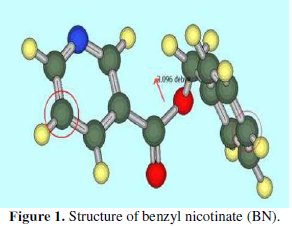
    <p>The inhibitors containing nicotine heterocycle are less reported in the literature, 
so we have chosen benzyl nicotinate (BN) (<a href="#f1">Fig. 1</a>).</p>


    <p>&nbsp;</p>
<a name="f1">
<img src="/img/revistas/pea/v35n5/35n5a01f1.jpg">
    
<p>&nbsp;</p>


    <p>Previously, we have verified the inhibitory effect of BN on the corrosion of CRS 
in a 0.5 M H2SO4 solution [17]. In the present work, studies on the theoretical, 
adsorptive and electrochemical behavior of BN on the corrosion of CRS in a 1 M 
HCl solution are evaluated.</p>


    <p>&nbsp;</p>
    ]]></body>
<body><![CDATA[<p><b>Experimental</b></p>

    <p><i><b>Sample</b></i></p>

    <p>The experiments were performed with CRS specimens with the compositions of 
0.14% C, 0.4% Mn, 0.025% P, 0.0008% S, 0.025% Si, 0.003% Al and remaining 
of Fe.</p>


    <p><i><b>Solutions</b></i></p>

    <p>The aggressive solutions of 1 M HCl AR-grade were prepared using double 
distilled Millipore water. The tested inhibitor benzyl nicotinate (BN) of AR grade 
was purchased from Sigma-Aldrich Chemicals, Bangalore. The different 
concentrations of inhibitor (0 to 500 ppm) were prepared in a 1 M HCl solution.</p>


    <p><i><b>Weight loss measurement</b></i></p>

    <p>The CRS coupons of dimension 4 cm &times; 2 cm &times; 0.5 cm were used for weight loss 
measurements. The coupons were treated with a series of emery paper from 220, 
330, 400, 600 and 1200 grades to obtain a uniform surface. Then, the specimens 
were washed several times with distilled water, then with acetone, and dried 
using a stream of air. The weight loss incurred by CRS specimens was 
determined by weighing the samples before and after immersion in 100 cm<sup>3</sup> of 1 
M HCl, in the absence and presence of various concentrations of BN at different 
temperature ranges of 303, 313, 323, and 333 K. The experiments were 
performed in triplicate and the mean value is reported. The experiments were 
carried out in a static aerated condition. The corrosion rate (v<sub>corr</sub>) of CRS was 
determined using the following relation:</p>


    <p>&nbsp;</p>
<a name="e1">
<img src="/img/revistas/pea/v35n5/35n5a01e1.jpg">
    
<p>&nbsp;</p>


    <p>where v<sub>corr</sub> is the corrosion rate of mild steel (g cm<sup>-2</sup> h<sup>-1</sup>), &Delta;m is the corrosion 
weight loss of mild steel (g), S is the surface area of mild steel specimen (cm<sup>2</sup>), 
and t is the time of exposure. The percentage inhibition efficiency was calculated 
using the relationship:</p>


    ]]></body>
<body><![CDATA[<p>&nbsp;</p>
<a name="e2">
<img src="/img/revistas/pea/v35n5/35n5a01e2.jpg">
    
<p>&nbsp;</p>


    <p>where v<sup>0</sup><sub>corr</sub> and v<sub>corr</sub> are the corrosion rates 
of CRS in the absence and presence of BN, respectively.</p>


    <p><i><b>Electrochemical measurements</b></i></p>

    <p>Electrochemical measurements were conducted in a conventional glass cell using 
a CHI 660D electrochemical analyzer (USA made). The CRS specimen of 1 cm<sup>2</sup> 
exposed areas with a 5 cm<sup>2</sup> long stem isolated with araldite resin was used as 
working electrode; platinum electrode and calomel electrode were used as 
counter and reference electrodes, respectively. Prior to polarization and 
electrochemical impedance spectroscopic measurements (EIS), a steady state 
open circuit potential (OCP) was measured. Each experiment was carried out in 
triplicate and the average values of corrosion parameters were reported. 
EIS measurements were done at OCP in the frequency range from 100 kHz to 
0.01 Hz, with an amplitude of 5 mV. The inhibition efficiency of EIS 
measurements was calculated using charge transfer resistance (Rct) values by the 
following equation:</p>


    <p>&nbsp;</p>
<a name="e3">
<img src="/img/revistas/pea/v35n5/35n5a01e3.jpg">
    
<p>&nbsp;</p>


    <p>where Rct and R<sup>0</sup>ct are charge transfer resistance of the working electrode with 
and without inhibitor, respectively.</p>

    <p>Polarization plots were automatically obtained in a potential range from -1000 
mV to -200 mV with a scan rate of 10 mV/S. Corrosion parameters like corrosion 
current density (Icorr), equilibrium potential (Ecorr), cathodic (&beta;c) and anodic (&beta;a) 
Tafel slopes were calculated. Inhibition efficiency of polarization method was 
calculated using the corrosion current density values by the following relation:</p>


    <p>&nbsp;</p>
<a name="e4">
<img src="/img/revistas/pea/v35n5/35n5a01e4.jpg">
    
]]></body>
<body><![CDATA[<p>&nbsp;</p>


    <p>where I<sup>0</sup>corr and Icorr are the corrosion current density in the absence and presence 
of the inhibitor, respectively.</p>


    <p><i><b>Quantum and SEM studies</b></i></p>

    <p>In the present study, quatum calculations were performed using pc gamess 
(firefly) software by DFT method using B3LYP/6-311 G basic set. The surface 
morphology of cold rolled steel samples is investigated using Scanning electron 
microscopy.</p>


    <p>&nbsp;</p>
    <p><b>Results and discussion</b></p>

    <p><i><b>Polarization studies</b></i></p>

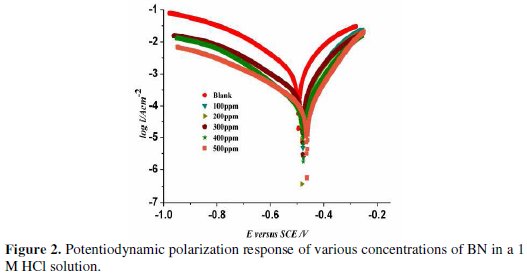
    <p>The anodic and cathodic polarization plots for CRS in 1 M HCl at various 
concentrations of BN are as shown in <a href="#f2">Fig. 2</a>.</p>


    <p>&nbsp;</p>
<a name="f2">
<img src="/img/revistas/pea/v35n5/35n5a01f2.jpg">
    
<p>&nbsp;</p>


    ]]></body>
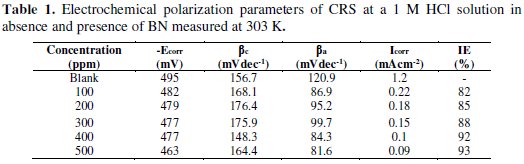
<body><![CDATA[<p>The values of corrosion current density (Icorr), corrosion potential (Ecorr), cathodic 
(&beta;c) and anodic (&beta;a) Tafel slopes, and inhibition efficiency (IE), as a function of 
BN concentrations, are tabulated in <a href="#t1">Table 1</a>.</p>


    <p>&nbsp;</p>
<a name="t1">
<img src="/img/revistas/pea/v35n5/35n5a01t1.jpg">
    
<p>&nbsp;</p>


    <p>From the table it is indicated that the 
corrosion current density, Icorr, considerably decreases with an increase in the 
concentrations of BN. We can classify the inhibitor as of the anodic or cathodic 
type if the change in the Ecorr value is above 85 mV [20]. But, in the present 
study, the maximum obtained shift in Ecorr value was 32 mV. On the other hand, 
changes in cathodic (&beta;c) and anodic (&beta;a) slope values with BN concentrations 
revealed that BN controls both anodic steel dissolution reactions and cathodic 
hydrogen evolution reaction. Hence, we can arrive at the conclusion that BN acts 
as a mixed type inhibitor.</p>


    <p><i><b>Electrochemical impedance spectroscopic studies</b></i></p>

    <p>Electrochemical impedance spectroscopic technique is a widely used method for 
investigating corrosion phenomena. It gives complete information of both 
capacitive and resistive behavior of the metal/solution interface. The effect of 
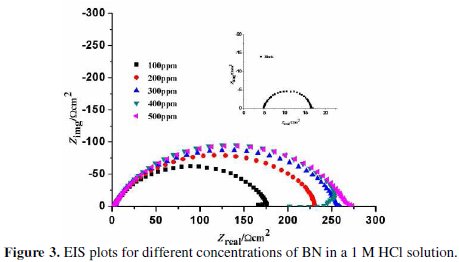
different concentrations of BN on the impedance behavior of CRS in a 1 M HCl 
at room temperature is exhibited by the Nyquist plot, as shown in <a href="#f3">Fig. 3</a>.</p>


    <p>&nbsp;</p>
<a name="f3">
<img src="/img/revistas/pea/v35n5/35n5a01f3.jpg">
    
<p>&nbsp;</p>


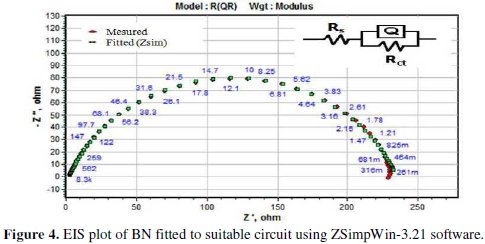
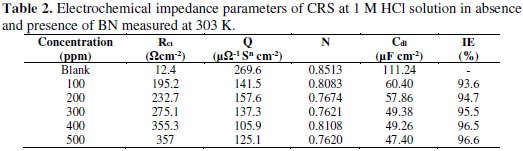
    <p>The extracted impedance data are analyzed using ZSimpWin-3.21 software by fitting 
to a suitable circuit (as in <a href="#f4">Fig. 4</a>), and the corresponding EIS values are tabulated 
in <a href="#t2">Table 2</a>.</p>


    <p>&nbsp;</p>
<a name="f4">
<img src="/img/revistas/pea/v35n5/35n5a01f4.jpg">
    
]]></body>
<body><![CDATA[<p>&nbsp;</p>
<a name="t2">
<img src="/img/revistas/pea/v35n5/35n5a01t2.jpg">
    
<p>&nbsp;</p>


    <p>In the circuit, Rs stands for solution resistance, Rct is charge transfer 
resistance and Q is a constant phase element is CPE. CPE is composed of Qdl and 
coefficient n, where n represents surface in-homogeneity, roughness, and porous 
layer formation [21]. The double layer capacitance (Cdl) is calculated by the 
relation:</p>


    <p>&nbsp;</p>
<a name="e5">
<img src="/img/revistas/pea/v35n5/35n5a01e5.jpg">
    
<p>&nbsp;</p>


    <p>The Nyquist plot at all concentrations nearly shows the same behavior, indicating 
that a semicircle at a higher frequency is related to charge transfer process. A 
small inductive loop observed at a low frequency is attributed to the relaxation 
process obtained by the adsorption of the inhibitor molecule on the electrode 
surface or by the adsorption of species like (FeCl-)ads or (FeCl-
Inh+)ads [22]. It may also be due to the re-dissolution of adsorbed species [23].</p>

    <p>The successive increase in semicircle diameter with an increase in the Rct value is 
attributed to the increase of corrosion resistance of CRS in presence of different 
concentrations of inhibitor [24]. The decreasing value of Cdl showed a decrease 
in local dielectric constant, due to an increase in the thickness of the protective 
double layer at the CRS surface, because of the inhibitor adsorption.</p>


    <p><i><b>Weight loss measurements</b></i></p>

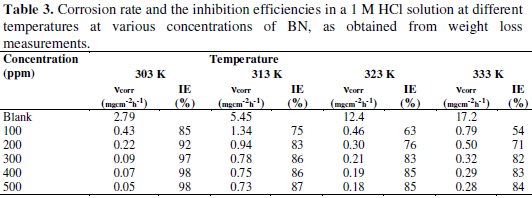
    <p>The weight loss of CRS specimen in 1 M HCl is determined in absence and 
presence of different concentrations of inhibitor at different temperature ranges 
of 303 K to 333 K. The corrosion rate and inhibition efficiency values are 
tabulated in <a href="#t3">Table 3</a>.</p>


    <p>&nbsp;</p>
<a name="t3">
<img src="/img/revistas/pea/v35n5/35n5a01t3.jpg">
    
]]></body>
<body><![CDATA[<p>&nbsp;</p>


    <p>From the values, it is revealed that the corrosion rate 
decreases with an increase in the concentration of inhibitor. This is due to an 
increase in the surface coverage of steel with an increase in the concentration of 
inhibitor [19]. Inhibition efficiency increases with an increase in the 
concentration of inhibitor, and decreases with an increase in temperature, 
indicating that the adsorption of BN on CRS is physisorption. The maximum 
inhibition efficiency was observed at 500 ppm in all temperatures.</p>


    <p><i><b>Corrosion kinetic parameters</b></i></p>

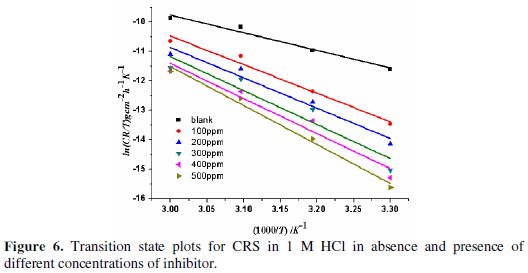
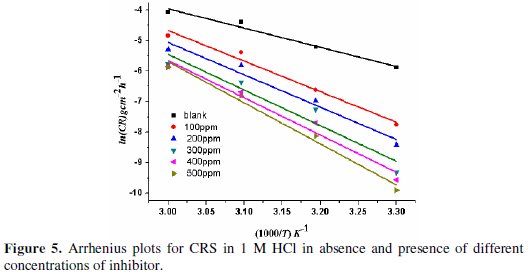
    <p>The effect of temperature on the corrosion parameters of CRS in 1 M HCl was 
studied at the temperatures of 303-333 K. Since corrosion is regarded as an 
Arrhenius process, the Arrhenius plot (<a href="#f5">Fig. 5</a>), in addition to transition state plots 
(<a href="#f6">Fig. 6</a>), was used to obtain corrosion kinetic parameters like pre-exponential 
factor (A), activation energy (Ea), enthalpy of activation (&Delta;H*) and activation 
entropy (&Delta;S*) for corrosion of CRS in 1 M HCl, both in absence and presence of 
BN.</p>


    <p>&nbsp;</p>
<a name="f5">
<img src="/img/revistas/pea/v35n5/35n5a01f5.jpg">
    
<p>&nbsp;</p>
<a name="f6">
<img src="/img/revistas/pea/v35n5/35n5a01f6.jpg">
    
<p>&nbsp;</p>


    <p>The pre-exponential factor (A) and activation energy (Ea) are obtained from 
Arrhenius equation [25].</p>


    <p>&nbsp;</p>
<a name="e6">
<img src="/img/revistas/pea/v35n5/35n5a01e6.jpg">
    
<p>&nbsp;</p>


    ]]></body>
<body><![CDATA[<p>where &gamma;<sub>corr</sub> is corrosion current, R is universal gas constant and T is temperature 
measured in K. Taking a logarithm to the <a href="#e6">equation (6)</a>, it gets reduced to:</p>


    <p>&nbsp;</p>
<a name="e7">
<img src="/img/revistas/pea/v35n5/35n5a01e7.jpg">
    
<p>&nbsp;</p>


    <p>The plot of ln(&gamma;<sub>corr</sub>) against 1/T gives a straight line with a slope of -Ea/RT and 
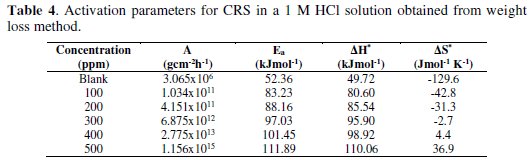
intercept equal to ln(A). The values of Ea and A were tabulated in <a href="#t4">Table 4</a>.</p>


    <p>&nbsp;</p>
<a name="t4">
<img src="/img/revistas/pea/v35n5/35n5a01t4.jpg">
    
<p>&nbsp;</p>


    <p>The changes in enthalpy, &Delta;H, and entropy, &Delta;S, are calculated using transition state 
equation [26].</p>


    <p>&nbsp;</p>
<a name="e8">
<img src="/img/revistas/pea/v35n5/35n5a01e8.jpg">
    
<p>&nbsp;</p>


    <p>where N is Avogadro's number and h is Plank's constant. The <a href="#e8">equation (8)</a> can be 
reduced to:</p>


    ]]></body>
<body><![CDATA[<p>&nbsp;</p>
<a name="e9">
<img src="/img/revistas/pea/v35n5/35n5a01e9.jpg">
    
<p>&nbsp;</p>


    <p>The graph of ln(&gamma;<sub>corr</sub>/T) against 1/T gives a straight line with a slope of -&Delta;H*/R 
and intercept of ln(R/Nh) + &Delta;S*/R; values of &Delta;H* and &Delta;S* were given in <a href="#t4">Table 4</a>.</p>

    <p>The temperature dependency of inhibition efficiency and Ea can be categorized 
into three groups [27-28]:</p>

    <p>1. Inhibition efficiency decreases with an increase in temperature, Ea 
(inhibited solution) &gt; Ea (uninhibited solution)</p>

    <p>2. Inhibition efficiency increases with an increase in temperature, Ea 
(inhibited solution) &lt; Ea (uninhibited solution)</p>

    <p>3. Inhibition efficiency does not change with temperature, Ea (inhibited 
solution) = Ea (uninhibited solution).</p>

    <p>In the present case, Ea of the inhibited solution is greater than Ea of the 
uninhibited solution, showing that inhibition efficiency decreases with an 
increase in temperature, indicating physical (electrostatic) adsorption of BN. 
According to literature, a lower value of pre-exponential factor (A) and a higher 
value of Ea lowers corrosion rate [29]. In the present study, the value of A 
increases with an increase in concentration of BN. Hence, the corrosion rate 
entirely depends upon the activation parameter, Ea. The positive value of &Delta;H* 
indicates the endothermic nature of corrosion, showing the hindrance for steel 
dissolution [30]. &Delta;H* and Ea values are nearly the same, and both increase with an 
increase in the concentrations of inhibitor, indicating a raise in the energy barrier 
of the corrosion process, without affecting the mechanism of dissolution. It is 
observed that Ea -&Delta;H* = RT is indicative of uni-molecular adsorption of BN 
molecules [31]. The value of &Delta;S* increases with an increase in the concentrations 
of inhibitor, showing that the free energy of reactants is converted into an 
activated complex [32]. The adsorption of BN on CRS reduces the disorder of 
the system, thus producing an ordered arrangement of BN.</p>


    <p><i><b>Adsorption isothermn</b></i></p>

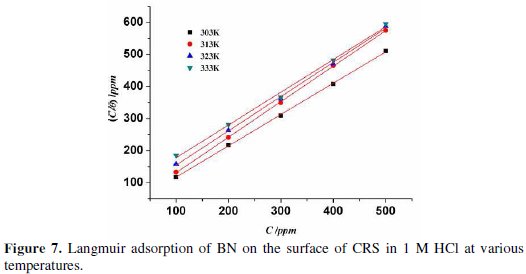
    <p>The efficacy of an inhibitor depends on its ability of adsorption onto a metal 
surface. Generally, it is accepted that the inhibitor molecule undergoes 
adsorption at the metal/solution interface and inhibits the corrosion process. 
Attempts were made to fit the experimental data to various adsorption isotherms, 
including Temkin, Langmuir, Freundlich, Flory-Huggins and Bockris-Swinkels. 
But the best fit with Langmuir isotherm (<a href="#f7">Fig. 7</a>)</p>


    ]]></body>
<body><![CDATA[<p>&nbsp;</p>
<a name="f7">
<img src="/img/revistas/pea/v35n5/35n5a01f7.jpg">
    
<p>&nbsp;</p>


    <p>is according to the following equation [33]:</p>


    <p>&nbsp;</p>
<a name="e10">
<img src="/img/revistas/pea/v35n5/35n5a01e10.jpg">
    
<p>&nbsp;</p>


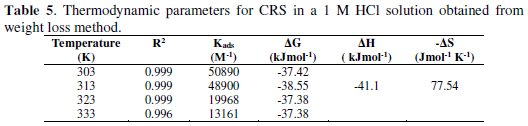
    <p>where C is the concentration of inhibitor, &theta; is the surface coverage and Kads the 
adsorption equilibrium constant. Using the values of Kads, we can calculate 
thermodynamic parameters like &Delta;Gads , &Delta;H and &Delta;S, which are equally important 
in assigning a suitable mechanism for the adsorption of the inhibitor onto the 
metal surface. &Delta;Gads can be calculated according to <a href="#e11">equation (11)</a> [34] and is 
represented in <a href="#t5">Table 5</a>.</p>


    <p>&nbsp;</p>
<a name="e11">
<img src="/img/revistas/pea/v35n5/35n5a01e11.jpg">
    
<p>&nbsp;</p>
<a name="t5">
<img src="/img/revistas/pea/v35n5/35n5a01t5.jpg">
    
<p>&nbsp;</p>


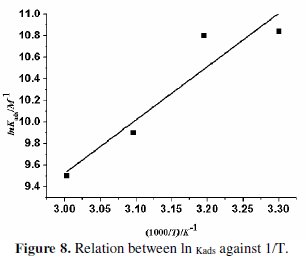
    <p>The value of &Delta;H and &Delta;S can be calculated using Vant-Hoff equation:</p>


    ]]></body>
<body><![CDATA[<p>&nbsp;</p>
<a name="e12">
<img src="/img/revistas/pea/v35n5/35n5a01e12.jpg">
    
<p>&nbsp;</p>


    <p>The graph (as shown in <a href="#f8">Fig. 8</a>) of ln (Kads) against 1/T gives a straight line with a 
slope of -&Delta;H/R and intercept equal to [&Delta;S/R + ln(1/55.5)].</p>


    <p>&nbsp;</p>
<a name="f8">
<img src="/img/revistas/pea/v35n5/35n5a01f8.jpg">
    
<p>&nbsp;</p>


    <p>All the values are 
mentioned in <a href="#t5">Table 5</a>. The negative value of &Delta;Gads suggests spontaneous 
adsorption of the inhibitor molecule on the steel surface. It is generally accepted 
that &Delta;Gads values up to 20 kJ/mol indicate physisorption, and that 40 kJ/mol and 
above stand for chemisorption [35]. The free energy &Delta;Gads of BN comes around 
37-39 kJ/mol, indicating that the comprehensive adsorption is accompanied by 
both physisorption and chemisorption. The negative values of &Delta;H indicate that 
adsorption is an exothermic process [36], hence, the inhibition efficiency 
decreases with an increase in temperature.</p>

    <p>Generally, the exothermic process is attributed to either physisorption or 
chemisorption, while the endothermic process indicates pure chemisorption. 
Further, if the value of &Delta;H is less than 41.86 kJ/mol, then it is physisorption, 
while for chemisorption, a &Delta;H value is around 100 kJ/mol [37]. &Delta;S value 
indicates that the adsorption process is accompanied by an increase in entropy, 
which means that the adsorption process is a quasi-substitution process between 
the organic inhibitor molecule in solution phase and water molecule at the 
electrode surface [38], i.e.,</p>

    <p>Org (sol) + x H2O (ads) &harr; Org (ads) + x H2O (sol)</p>

    <p>The organic molecule gets adsorbed onto the metal surface by replacing the water molecule, 
which means the gain in entropy is just because of an increase in the solvent 
entropy [39]. Increase in the solvent entropy means a decrease in the entropy of 
solute, which means an orderly arrangement of the inhibitor molecule onto the 
metal surface.</p>


    <p><i><b>Mechanism of adsorption</b></i></p>

    ]]></body>
<body><![CDATA[<p>The corrosion inhibition process mechanism of the inhibitor under consideration 
is of the adsorption type, as revealed by experimental studies. This adsorption is 
governed by many parameters including aromaticity, functional groups and 
presence of heteroatom. The BN inhibitor utilizes its COOR group and nitrogen 
containing pyridine heterocyclic; the R-group is composed of aromatic benzene, 
to bind the steel surface, thus acting as a barrier between steel and corrosive 
media and inhibiting the corrosion process of CRS in 1 M HCl. 
The anodic metal dissolution process involves the following reactions [40]:</p>


    <p>&nbsp;</p>
<a name="e13">
<img src="/img/revistas/pea/v35n5/35n5a01e13.jpg">
    
<p>&nbsp;</p>
<a name="e14">
<img src="/img/revistas/pea/v35n5/35n5a01e14.jpg">
    
<p>&nbsp;</p>
<a name="e15">
<img src="/img/revistas/pea/v35n5/35n5a01e15.jpg">
    
<p>&nbsp;</p>
<a name="e16">
<img src="/img/revistas/pea/v35n5/35n5a01e16.jpg">
    
<p>&nbsp;</p>


    <p>The cathodic hydrogen evolution progresses accordingly,</p>


    <p>&nbsp;</p>
<a name="e17">
<img src="/img/revistas/pea/v35n5/35n5a01e17.jpg">
    
<p>&nbsp;</p>
<a name="e18">
<img src="/img/revistas/pea/v35n5/35n5a01e18.jpg">
    
<p>&nbsp;</p>
<a name="e19">
<img src="/img/revistas/pea/v35n5/35n5a01e19.jpg">
    
]]></body>
<body><![CDATA[<p>&nbsp;</p>


    <p>The inhibitor molecule either remains the same, or it may get protonated in an 
acid solution [26]. Hence, the protonated BN gets attached to the positively 
charged anodic site of CRS through the bridging of Cl-ion. The inhibitor 
molecule directly attaches to the cathodic site through its hetero atom and, also, 
through donor-acceptor interactions using Ï€-electrons of the aromatic ring, thus 
preventing both anodic and cathodic corrosion processes.</p>


    <p><i><b>SEM studies</b></i></p>

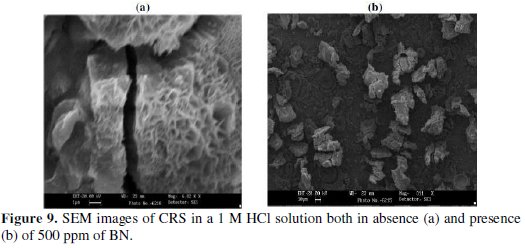
    <p>Surface morphology of CRS in a 1 M HCl solution in absence and presence of 
500 ppm of BN was studied, as shown in <a href="#f9">Fig. 9</a>.</p>


    <p>&nbsp;</p>
<a name="f9">
<img src="/img/revistas/pea/v35n5/35n5a01f9.jpg">
    
<p>&nbsp;</p>


    <p>In the absence of BN (<a href="#f9">Fig. 9a</a>), 
the specimen is severely corroded creating deep cracks with an uneven surface. 
In the presence of 500 ppm BN (<a href="#f9">Fig. 9b</a>), the cracks are reduced to a greater 
extent. This indicates the protection of the BN molecule against corrosion.</p>


    <p><i><b>Quantum studies</b></i></p>

    <p>Quantum chemical calculations helped us to correlate the corrosion inhibiting 
properties of an inhibitor molecule, with chemical and electrochemical method 
findings. With the theoretical prediction of the number of molecular parameters 
like Frontier orbital energies (E<sub>HOMO</sub> &amp; E<sub>LUMO</sub> ), dipole moment (&mu;), hardness, 
electronegativity (&eta;), ionisation energy (I), electron affinity (A), one can easily 
depict the nature of interactions between inhibitor and metal surface and, thus, 
possibly assign a suitable mechanism for inhibition.</p>

    <p>The quantum calculations performed in gas phase using DFT method using 
B3LYP/6-311 G basic set and quantum chemical parameters are dipicted in the 
<a href="#t6">Table 6</a>.</p>


    ]]></body>
<body><![CDATA[<p>&nbsp;</p>
<a name="t6">
<img src="/img/revistas/pea/v35n5/35n5a01t6.jpg">
    
<p>&nbsp;</p>


    <p>Using frontier orbital energies E<sub>HOMO</sub> &amp; E<sub>LUMO</sub>, the interaction of the 
metal surface with the inhibitor molecule can be explained. The energy gap 
between LUMO and HOMO levels is another important factor in deciding the 
interaction. The inhibitor possessing lower energy produces good inhibition 
effficiency. A good inhibitor is one which has an ability to donate unoccupied p-
orbital to the metal, and the capability of forming feedback bonds by accepting 
electrons from the metal [41-42].</p>

    <p>According to literature survey, a higher value of E<sub>HOMO</sub> increases the electronic 
donating tendency of the inhibitor molecule. A lower value of E<sub>LUMO</sub> indicates 
the feed-back bonding tendency of the inhibitor. In general, a higher value of 
E<sub>HOMO</sub> and lower value of E<sub>LUMO</sub> symbolise a high inhibition efficiency of an 
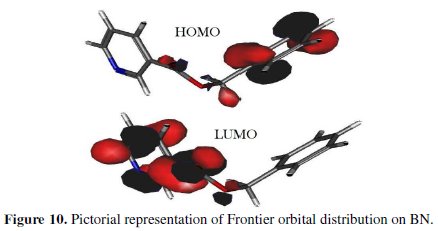
inhibitor. In the case of the BN molecule (<a href="#f10">Fig. 10</a>), HOMO is distributed over 
oxygen atoms and entire Ï€-electrons of benzene; LUMO is distributed on the 
pyridine ring.</p>


    <p>&nbsp;</p>
<a name="f10">
<img src="/img/revistas/pea/v35n5/35n5a01f10.jpg">
    
<p>&nbsp;</p>


    <p>Further, frontier orbital energies (E<sub>HOMO</sub> &amp; E<sub>LUMO</sub>) clearly 
indicate the electronic donating ability and feed back bond formation of the 
inhibitor. A lower value of dipole moment (&mu;) ranging between 3-5 favours the 
assembly of an inhibitor molecule on the metal surface [43], and also symbolises 
the hydrophobic character of an inhibitor molecule.</p>

    <p>For BN, the dipole moment (&mu;) is 3.005, hence, it favours the adsorption of the 
inhibitor on the steel surface. E<sub>HOMO</sub> and E<sub>LUMO</sub> are related to ionisation energy 
(I), electron affinity (A), absolute electronegativity (&chi;) and global hardness (&eta;), 
as:</p>


    <p>&nbsp;</p>
<a name="e20">
<img src="/img/revistas/pea/v35n5/35n5a01e20.jpg">
    
<p>&nbsp;</p>
<a name="e21">
<img src="/img/revistas/pea/v35n5/35n5a01e21.jpg">
    
]]></body>
<body><![CDATA[<p>&nbsp;</p>
<a name="e22">
<img src="/img/revistas/pea/v35n5/35n5a01e22.jpg">
    
<p>&nbsp;</p>
<a name="e23">
<img src="/img/revistas/pea/v35n5/35n5a01e23.jpg">
    
<p>&nbsp;</p>
<a name="e24">
<img src="/img/revistas/pea/v35n5/35n5a01e24.jpg">
    
<p>&nbsp;</p>


    <p>The hardness and softness (S) are measures of molecular stability and reactivity. 
A hard molecule has a larger energy gap and a soft molecule has a smaller energy 
gap [44].</p>


    <p>&nbsp;</p>
<a name="e25">
<img src="/img/revistas/pea/v35n5/35n5a01e25.jpg">
    
<p>&nbsp;</p>


    <p>This global electrophilicity index (&omega;) is a measure of change in energy due to the 
flow of electrons between donor and acceptor. This electrophilicity index gives 
the measure of stabilisation in the energy produced when the fraction of charge, &Delta;N, 
is exchanged between inhibitor and metal surface [45], and is given by:</p>


    <p>&nbsp;</p>
<a name="e26">
<img src="/img/revistas/pea/v35n5/35n5a01e26.jpg">
    
<p>&nbsp;</p>


    ]]></body>
<body><![CDATA[<p>where &chi;Fe and &chi;inh denote the absolute electro negativity of iron and of the 
inhibitor molecule, respectively; &eta;Fe and &eta;inh denote the absolute hardness of 
iron and of the inhibitor molecule, respectively. In this study, the &chi;inh and &eta;inh 
values of the inhibitor are determined using the values of I and A, and the 
theoretical value of &chi;Fe = 7eV/mol, and &eta;Fe = 0 eV/mol for the computation of 
the number of transferred electrons. Thus, the calculated value of &Delta;N is 0.1926, 
which clearly indicates the high inhibition efficiency of BN, since &Delta;N &gt; 3.6 
indicates the high inhibition efficiency with the electron donating tendency of the 
inhibitor molecule [44].</p>


    <p>&nbsp;</p>
    <p><b>Conclusions</b></p>

    <p>The results of experiments revealed that BN acts as a good inhibitor for CRS in a 
1 M HCl solution. The BN molecule obeys Langmuir adsorption isotherm. 
Thermodynamic and activation parameters revealed a spontaneous and 
exothermic adsorption of the BN molecule. The obtained results from weight loss 
method are compatible with electrochemical results. Quantum studies support 
experimental findings.</p>


    <p>&nbsp;</p>
    <p><b>References</b></p>

    <!-- ref --><p>1. Fekry AM, Mohamed RR. Electrochim. Acta. 2010;55:1933.    &nbsp;&nbsp;&nbsp;&nbsp;&nbsp;&nbsp;&nbsp;&nbsp;[&#160;<a href="javascript:void(0);" onclick="javascript: window.open('/scielo.php?script=sci_nlinks&ref=429005&pid=S0872-1904201700050000100001&lng=','','width=640,height=500,resizable=yes,scrollbars=1,menubar=yes,');">Links</a>&#160;]<!-- end-ref --></p>

    <!-- ref --><p>2. Abd El Rehim SS, Hassan HH, Amin MA. Mater Chem Phys. 2003;78: 337.    &nbsp;&nbsp;&nbsp;&nbsp;&nbsp;&nbsp;&nbsp;&nbsp;[&#160;<a href="javascript:void(0);" onclick="javascript: window.open('/scielo.php?script=sci_nlinks&ref=429007&pid=S0872-1904201700050000100002&lng=','','width=640,height=500,resizable=yes,scrollbars=1,menubar=yes,');">Links</a>&#160;]<!-- end-ref --></p>

    ]]></body>
<body><![CDATA[<!-- ref --><p>3. Bentiss F, Traisnel M, Chaibi N, et al. Corros Sci. 2002;44:2271.    &nbsp;&nbsp;&nbsp;&nbsp;&nbsp;&nbsp;&nbsp;&nbsp;[&#160;<a href="javascript:void(0);" onclick="javascript: window.open('/scielo.php?script=sci_nlinks&ref=429009&pid=S0872-1904201700050000100003&lng=','','width=640,height=500,resizable=yes,scrollbars=1,menubar=yes,');">Links</a>&#160;]<!-- end-ref --></p>

    <!-- ref --><p>4. Lebrini M, Lagrenee M, Vezin H, et al. Corros Sci. 2005;47:485.    &nbsp;&nbsp;&nbsp;&nbsp;&nbsp;&nbsp;&nbsp;&nbsp;[&#160;<a href="javascript:void(0);" onclick="javascript: window.open('/scielo.php?script=sci_nlinks&ref=429011&pid=S0872-1904201700050000100004&lng=','','width=640,height=500,resizable=yes,scrollbars=1,menubar=yes,');">Links</a>&#160;]<!-- end-ref --></p>

    <!-- ref --><p>5. Cano E, Pinilla P, Polo JL, et al. Mater Corros. 2003;54:222.    &nbsp;&nbsp;&nbsp;&nbsp;&nbsp;&nbsp;&nbsp;&nbsp;[&#160;<a href="javascript:void(0);" onclick="javascript: window.open('/scielo.php?script=sci_nlinks&ref=429013&pid=S0872-1904201700050000100005&lng=','','width=640,height=500,resizable=yes,scrollbars=1,menubar=yes,');">Links</a>&#160;]<!-- end-ref --></p>

    <!-- ref --><p>6. Moretti G, Guidi F, Grion G. Corros Sci. 2004;46:387.    &nbsp;&nbsp;&nbsp;&nbsp;&nbsp;&nbsp;&nbsp;&nbsp;[&#160;<a href="javascript:void(0);" onclick="javascript: window.open('/scielo.php?script=sci_nlinks&ref=429015&pid=S0872-1904201700050000100006&lng=','','width=640,height=500,resizable=yes,scrollbars=1,menubar=yes,');">Links</a>&#160;]<!-- end-ref --></p>

    <!-- ref --><p>7. Abd El-Maksoud SA. Int. J Electrochem Sci. 2008;3:528.    &nbsp;&nbsp;&nbsp;&nbsp;&nbsp;&nbsp;&nbsp;&nbsp;[&#160;<a href="javascript:void(0);" onclick="javascript: window.open('/scielo.php?script=sci_nlinks&ref=429017&pid=S0872-1904201700050000100007&lng=','','width=640,height=500,resizable=yes,scrollbars=1,menubar=yes,');">Links</a>&#160;]<!-- end-ref --></p>

    ]]></body>
<body><![CDATA[<!-- ref --><p>8. Sorkhabia HA, Shaabanib B, Seifzadeha D. Appl Surf Sci. 2005;239:154.    &nbsp;&nbsp;&nbsp;&nbsp;&nbsp;&nbsp;&nbsp;&nbsp;[&#160;<a href="javascript:void(0);" onclick="javascript: window.open('/scielo.php?script=sci_nlinks&ref=429019&pid=S0872-1904201700050000100008&lng=','','width=640,height=500,resizable=yes,scrollbars=1,menubar=yes,');">Links</a>&#160;]<!-- end-ref --></p>

    <!-- ref --><p>9. Hosseini MG, Ehteshamzadeh M, Shahrabi T. Electrochim Acta. 2007;52:3680.    &nbsp;&nbsp;&nbsp;&nbsp;&nbsp;&nbsp;&nbsp;&nbsp;[&#160;<a href="javascript:void(0);" onclick="javascript: window.open('/scielo.php?script=sci_nlinks&ref=429021&pid=S0872-1904201700050000100009&lng=','','width=640,height=500,resizable=yes,scrollbars=1,menubar=yes,');">Links</a>&#160;]<!-- end-ref --></p>

    <!-- ref --><p>10. Hassan HH, Abdelghani E, Amin MA. Electrochim Acta. 2007;52:6359.    &nbsp;&nbsp;&nbsp;&nbsp;&nbsp;&nbsp;&nbsp;&nbsp;[&#160;<a href="javascript:void(0);" onclick="javascript: window.open('/scielo.php?script=sci_nlinks&ref=429023&pid=S0872-1904201700050000100010&lng=','','width=640,height=500,resizable=yes,scrollbars=1,menubar=yes,');">Links</a>&#160;]<!-- end-ref --></p>

    <p>11. Lebrini M, LagrenÃ©e, Traisnel M, et al. Appl Surf Sci. 2007;253:9267.</p>

    <!-- ref --><p>12. Sudheer, Quraishi MA. Ind Eng Chem Res. 2014;53:2851.    &nbsp;&nbsp;&nbsp;&nbsp;&nbsp;&nbsp;&nbsp;&nbsp;[&#160;<a href="javascript:void(0);" onclick="javascript: window.open('/scielo.php?script=sci_nlinks&ref=429026&pid=S0872-1904201700050000100012&lng=','','width=640,height=500,resizable=yes,scrollbars=1,menubar=yes,');">Links</a>&#160;]<!-- end-ref --></p>

    <!-- ref --><p>13. Chakravarthy MP, Mohana KN. Int J Corros. 2013;Article ID 854781.    &nbsp;&nbsp;&nbsp;&nbsp;&nbsp;&nbsp;&nbsp;&nbsp;[&#160;<a href="javascript:void(0);" onclick="javascript: window.open('/scielo.php?script=sci_nlinks&ref=429028&pid=S0872-1904201700050000100013&lng=','','width=640,height=500,resizable=yes,scrollbars=1,menubar=yes,');">Links</a>&#160;]<!-- end-ref --></p>

    <!-- ref --><p>14. Chakravarthy MP, Mohana KN. ISRN Corros. 2014;Article ID 687276.    &nbsp;&nbsp;&nbsp;&nbsp;&nbsp;&nbsp;&nbsp;&nbsp;[&#160;<a href="javascript:void(0);" onclick="javascript: window.open('/scielo.php?script=sci_nlinks&ref=429030&pid=S0872-1904201700050000100014&lng=','','width=640,height=500,resizable=yes,scrollbars=1,menubar=yes,');">Links</a>&#160;]<!-- end-ref --></p>

    <!-- ref --><p>15. Hemapriya V, Savithri K, Parameswari K, et al. Int J Curr Res. 2014;6:4550.    &nbsp;&nbsp;&nbsp;&nbsp;&nbsp;&nbsp;&nbsp;&nbsp;[&#160;<a href="javascript:void(0);" onclick="javascript: window.open('/scielo.php?script=sci_nlinks&ref=429032&pid=S0872-1904201700050000100015&lng=','','width=640,height=500,resizable=yes,scrollbars=1,menubar=yes,');">Links</a>&#160;]<!-- end-ref --></p>

    <!-- ref --><p>16. Zhao J, Zhang N, Qu C, et al. Ind Eng Chem Res. 2010;49:12452.    &nbsp;&nbsp;&nbsp;&nbsp;&nbsp;&nbsp;&nbsp;&nbsp;[&#160;<a href="javascript:void(0);" onclick="javascript: window.open('/scielo.php?script=sci_nlinks&ref=429034&pid=S0872-1904201700050000100016&lng=','','width=640,height=500,resizable=yes,scrollbars=1,menubar=yes,');">Links</a>&#160;]<!-- end-ref --></p>

    <!-- ref --><p>17. Vinutha MR, Venkatesha TV. J Electrochem Sci Eng. 2015;5:209.    &nbsp;&nbsp;&nbsp;&nbsp;&nbsp;&nbsp;&nbsp;&nbsp;[&#160;<a href="javascript:void(0);" onclick="javascript: window.open('/scielo.php?script=sci_nlinks&ref=429036&pid=S0872-1904201700050000100017&lng=','','width=640,height=500,resizable=yes,scrollbars=1,menubar=yes,');">Links</a>&#160;]<!-- end-ref --></p>

    <!-- ref --><p>18. Emregul KC, Hayvali M. Mater Chem Phys. 2004;83:209.    &nbsp;&nbsp;&nbsp;&nbsp;&nbsp;&nbsp;&nbsp;&nbsp;[&#160;<a href="javascript:void(0);" onclick="javascript: window.open('/scielo.php?script=sci_nlinks&ref=429038&pid=S0872-1904201700050000100018&lng=','','width=640,height=500,resizable=yes,scrollbars=1,menubar=yes,');">Links</a>&#160;]<!-- end-ref --></p>

    <!-- ref --><p>19. Ali SA, El-Shareef, Al-Ghamdi RF, et al. Corros Sci. 2005;47:2659.    &nbsp;&nbsp;&nbsp;&nbsp;&nbsp;&nbsp;&nbsp;&nbsp;[&#160;<a href="javascript:void(0);" onclick="javascript: window.open('/scielo.php?script=sci_nlinks&ref=429040&pid=S0872-1904201700050000100019&lng=','','width=640,height=500,resizable=yes,scrollbars=1,menubar=yes,');">Links</a>&#160;]<!-- end-ref --></p>

    <!-- ref --><p>20. El Mehdi B, Mernari B, Traisnel M, et al. Mater Chem Phys. 2002;77:489.    &nbsp;&nbsp;&nbsp;&nbsp;&nbsp;&nbsp;&nbsp;&nbsp;[&#160;<a href="javascript:void(0);" onclick="javascript: window.open('/scielo.php?script=sci_nlinks&ref=429042&pid=S0872-1904201700050000100020&lng=','','width=640,height=500,resizable=yes,scrollbars=1,menubar=yes,');">Links</a>&#160;]<!-- end-ref --></p>

    <!-- ref --><p>21. Tao Z, Zhang S, Li W, et al. Ind Eng Chem Res. 2011;50:6082.    &nbsp;&nbsp;&nbsp;&nbsp;&nbsp;&nbsp;&nbsp;&nbsp;[&#160;<a href="javascript:void(0);" onclick="javascript: window.open('/scielo.php?script=sci_nlinks&ref=429044&pid=S0872-1904201700050000100021&lng=','','width=640,height=500,resizable=yes,scrollbars=1,menubar=yes,');">Links</a>&#160;]<!-- end-ref --></p>

    <!-- ref --><p>22. Solmaz R, Kardas G, Culha M, et al. Electrochim Acta. 2008;53:5941.    &nbsp;&nbsp;&nbsp;&nbsp;&nbsp;&nbsp;&nbsp;&nbsp;[&#160;<a href="javascript:void(0);" onclick="javascript: window.open('/scielo.php?script=sci_nlinks&ref=429046&pid=S0872-1904201700050000100022&lng=','','width=640,height=500,resizable=yes,scrollbars=1,menubar=yes,');">Links</a>&#160;]<!-- end-ref --></p>

    <!-- ref --><p>23. Singh AK, Quraishi MA. Corros Sci. 2010;52:152.    &nbsp;&nbsp;&nbsp;&nbsp;&nbsp;&nbsp;&nbsp;&nbsp;[&#160;<a href="javascript:void(0);" onclick="javascript: window.open('/scielo.php?script=sci_nlinks&ref=429048&pid=S0872-1904201700050000100023&lng=','','width=640,height=500,resizable=yes,scrollbars=1,menubar=yes,');">Links</a>&#160;]<!-- end-ref --></p>

    <!-- ref --><p>24. Kosari A, Momeni M, Parvizi R, et al. Corros Sci. 2011;53:3058.    &nbsp;&nbsp;&nbsp;&nbsp;&nbsp;&nbsp;&nbsp;&nbsp;[&#160;<a href="javascript:void(0);" onclick="javascript: window.open('/scielo.php?script=sci_nlinks&ref=429050&pid=S0872-1904201700050000100024&lng=','','width=640,height=500,resizable=yes,scrollbars=1,menubar=yes,');">Links</a>&#160;]<!-- end-ref --></p>

    <!-- ref --><p>25. Obot IB, Obi-Egbedi NO, Odozi NW, Corros Sci. 2010;52:923.    &nbsp;&nbsp;&nbsp;&nbsp;&nbsp;&nbsp;&nbsp;&nbsp;[&#160;<a href="javascript:void(0);" onclick="javascript: window.open('/scielo.php?script=sci_nlinks&ref=429052&pid=S0872-1904201700050000100025&lng=','','width=640,height=500,resizable=yes,scrollbars=1,menubar=yes,');">Links</a>&#160;]<!-- end-ref --></p>

    <!-- ref --><p>26. Obot IB, Obi-Egbedi NO. Curr Appl Phys. 2011;11:382.    &nbsp;&nbsp;&nbsp;&nbsp;&nbsp;&nbsp;&nbsp;&nbsp;[&#160;<a href="javascript:void(0);" onclick="javascript: window.open('/scielo.php?script=sci_nlinks&ref=429054&pid=S0872-1904201700050000100026&lng=','','width=640,height=500,resizable=yes,scrollbars=1,menubar=yes,');">Links</a>&#160;]<!-- end-ref --></p>

    <!-- ref --><p>27. Priya ARS, Muralidharan VS, Subramania A. Corrosion. 2008;64:541.    &nbsp;&nbsp;&nbsp;&nbsp;&nbsp;&nbsp;&nbsp;&nbsp;[&#160;<a href="javascript:void(0);" onclick="javascript: window.open('/scielo.php?script=sci_nlinks&ref=429056&pid=S0872-1904201700050000100027&lng=','','width=640,height=500,resizable=yes,scrollbars=1,menubar=yes,');">Links</a>&#160;]<!-- end-ref --></p>

    <!-- ref --><p>28. Pavithra MK, Venkatesha TV, Kumar MKP. Int J Electrochem. 2013;Article ID 714372.    &nbsp;&nbsp;&nbsp;&nbsp;&nbsp;&nbsp;&nbsp;&nbsp;[&#160;<a href="javascript:void(0);" onclick="javascript: window.open('/scielo.php?script=sci_nlinks&ref=429058&pid=S0872-1904201700050000100028&lng=','','width=640,height=500,resizable=yes,scrollbars=1,menubar=yes,');">Links</a>&#160;]<!-- end-ref --></p>

    <!-- ref --><p>29. Herrag L, Hammouti B, Elkadiri S, et al. Corros Sci. 2010;52:3042.    &nbsp;&nbsp;&nbsp;&nbsp;&nbsp;&nbsp;&nbsp;&nbsp;[&#160;<a href="javascript:void(0);" onclick="javascript: window.open('/scielo.php?script=sci_nlinks&ref=429060&pid=S0872-1904201700050000100029&lng=','','width=640,height=500,resizable=yes,scrollbars=1,menubar=yes,');">Links</a>&#160;]<!-- end-ref --></p>

    <!-- ref --><p>30. Behpour M, Ghoreshi SM, Soltani N, et al. Corros Sci. 2008;50:2172.    &nbsp;&nbsp;&nbsp;&nbsp;&nbsp;&nbsp;&nbsp;&nbsp;[&#160;<a href="javascript:void(0);" onclick="javascript: window.open('/scielo.php?script=sci_nlinks&ref=429062&pid=S0872-1904201700050000100030&lng=','','width=640,height=500,resizable=yes,scrollbars=1,menubar=yes,');">Links</a>&#160;]<!-- end-ref --></p>

    <!-- ref --><p>31. Ostavari A, Hoseinieh SM, Peikari M, et al. Corros Sci. 2009;51:1935.    &nbsp;&nbsp;&nbsp;&nbsp;&nbsp;&nbsp;&nbsp;&nbsp;[&#160;<a href="javascript:void(0);" onclick="javascript: window.open('/scielo.php?script=sci_nlinks&ref=429064&pid=S0872-1904201700050000100031&lng=','','width=640,height=500,resizable=yes,scrollbars=1,menubar=yes,');">Links</a>&#160;]<!-- end-ref --></p>

    <!-- ref --><p>32. El Ouali I, Hammouti B, Aouniti A, et al. J Mater Environ Sci. 2010;1:1.    &nbsp;&nbsp;&nbsp;&nbsp;&nbsp;&nbsp;&nbsp;&nbsp;[&#160;<a href="javascript:void(0);" onclick="javascript: window.open('/scielo.php?script=sci_nlinks&ref=429066&pid=S0872-1904201700050000100032&lng=','','width=640,height=500,resizable=yes,scrollbars=1,menubar=yes,');">Links</a>&#160;]<!-- end-ref --></p>

    <!-- ref --><p>33. Deng S, Li X, H. Corros Sci. 2010;52:3840.    &nbsp;&nbsp;&nbsp;&nbsp;&nbsp;&nbsp;&nbsp;&nbsp;[&#160;<a href="javascript:void(0);" onclick="javascript: window.open('/scielo.php?script=sci_nlinks&ref=429068&pid=S0872-1904201700050000100033&lng=','','width=640,height=500,resizable=yes,scrollbars=1,menubar=yes,');">Links</a>&#160;]<!-- end-ref --></p>

    <p>34. Bentiss F, Lebrini M, LagrenÃ©e M. Corros Sci. 2005;47:2915.</p>

    <!-- ref --><p>35. Noor EA. J Appl Electrochem. 2009;39:1465.    &nbsp;&nbsp;&nbsp;&nbsp;&nbsp;&nbsp;&nbsp;&nbsp;[&#160;<a href="javascript:void(0);" onclick="javascript: window.open('/scielo.php?script=sci_nlinks&ref=429071&pid=S0872-1904201700050000100035&lng=','','width=640,height=500,resizable=yes,scrollbars=1,menubar=yes,');">Links</a>&#160;]<!-- end-ref --></p>

    <!-- ref --><p>36. Li XH, Mu GN. Appl Surf Sci. 2005;252:1254.    &nbsp;&nbsp;&nbsp;&nbsp;&nbsp;&nbsp;&nbsp;&nbsp;[&#160;<a href="javascript:void(0);" onclick="javascript: window.open('/scielo.php?script=sci_nlinks&ref=429073&pid=S0872-1904201700050000100036&lng=','','width=640,height=500,resizable=yes,scrollbars=1,menubar=yes,');">Links</a>&#160;]<!-- end-ref --></p>

    <!-- ref --><p>37. Martinez S, Stern I. Appl Surf Sci. 2002;199:83.    &nbsp;&nbsp;&nbsp;&nbsp;&nbsp;&nbsp;&nbsp;&nbsp;[&#160;<a href="javascript:void(0);" onclick="javascript: window.open('/scielo.php?script=sci_nlinks&ref=429075&pid=S0872-1904201700050000100037&lng=','','width=640,height=500,resizable=yes,scrollbars=1,menubar=yes,');">Links</a>&#160;]<!-- end-ref --></p>

    <!-- ref --><p>38. Cano E, Polo JL, Iglesia ALA, et al. Adsorp. 2004;10:219.    &nbsp;&nbsp;&nbsp;&nbsp;&nbsp;&nbsp;&nbsp;&nbsp;[&#160;<a href="javascript:void(0);" onclick="javascript: window.open('/scielo.php?script=sci_nlinks&ref=429077&pid=S0872-1904201700050000100038&lng=','','width=640,height=500,resizable=yes,scrollbars=1,menubar=yes,');">Links</a>&#160;]<!-- end-ref --></p>

    ]]></body>
<body><![CDATA[<!-- ref --><p>39. Ateya BG, El-Anadouli BE, El-Nizamy FM. Corros Sci. 1984;24:509.    &nbsp;&nbsp;&nbsp;&nbsp;&nbsp;&nbsp;&nbsp;&nbsp;[&#160;<a href="javascript:void(0);" onclick="javascript: window.open('/scielo.php?script=sci_nlinks&ref=429079&pid=S0872-1904201700050000100039&lng=','','width=640,height=500,resizable=yes,scrollbars=1,menubar=yes,');">Links</a>&#160;]<!-- end-ref --></p>

    <!-- ref --><p>40. Solmaz R. Corros Sci. 2010;52:321.    &nbsp;&nbsp;&nbsp;&nbsp;&nbsp;&nbsp;&nbsp;&nbsp;[&#160;<a href="javascript:void(0);" onclick="javascript: window.open('/scielo.php?script=sci_nlinks&ref=429081&pid=S0872-1904201700050000100040&lng=','','width=640,height=500,resizable=yes,scrollbars=1,menubar=yes,');">Links</a>&#160;]<!-- end-ref --></p>

    <!-- ref --><p>41. Khalil N. Electrochim Acta. 2003;48:2635.    &nbsp;&nbsp;&nbsp;&nbsp;&nbsp;&nbsp;&nbsp;&nbsp;[&#160;<a href="javascript:void(0);" onclick="javascript: window.open('/scielo.php?script=sci_nlinks&ref=429083&pid=S0872-1904201700050000100041&lng=','','width=640,height=500,resizable=yes,scrollbars=1,menubar=yes,');">Links</a>&#160;]<!-- end-ref --></p>

    <!-- ref --><p>42. Zhao P, Liang Q, Li Y. Appl Surf Sci. 2005;252:1596.    &nbsp;&nbsp;&nbsp;&nbsp;&nbsp;&nbsp;&nbsp;&nbsp;[&#160;<a href="javascript:void(0);" onclick="javascript: window.open('/scielo.php?script=sci_nlinks&ref=429085&pid=S0872-1904201700050000100042&lng=','','width=640,height=500,resizable=yes,scrollbars=1,menubar=yes,');">Links</a>&#160;]<!-- end-ref --></p>

    <p>43. Cruz J, MartÄ±nez R, Genesca J, et al. J Electroanal Chem. 2004;566:111.</p>

    <!-- ref --><p>44. Karzazi Y, Belghiti MA, Dafali A, et al. J Chem Pharm Res. 2014;6:689.    &nbsp;&nbsp;&nbsp;&nbsp;&nbsp;&nbsp;&nbsp;&nbsp;[&#160;<a href="javascript:void(0);" onclick="javascript: window.open('/scielo.php?script=sci_nlinks&ref=429088&pid=S0872-1904201700050000100044&lng=','','width=640,height=500,resizable=yes,scrollbars=1,menubar=yes,');">Links</a>&#160;]<!-- end-ref --></p>

    <p>45. V. S. Sastri VS, Perumareddi JR. Corrosion. 1997;53:617.</p>


    <p>&nbsp;</p>
    <p><b>Acknowledgements</b></p>

    <p>The authors are grateful to the University Grants Commission, New Delhi, Govt. 
of India, for providing financial assistance, and to the Department of Chemistry, 
Kuvempu University for providing lab facilities..</p>


    <p>&nbsp;</p>
    <p><a name=0></a><sup><a href="#top">*</a></sup>Corresponding author. E-mail address: <a href="mailto:drtvvenkatesha@yahoo.co.uk">drtvvenkatesha@yahoo.co.uk</a></p>

    <p>Received August 27, 2016; accepted April 02, 2017</p>

    <p><a href="http://www.peacta.org" target="_blank">www.peacta.org</a> </p>


     ]]></body><back>
<ref-list>
<ref id="B1">
<label>1</label><nlm-citation citation-type="journal">
<person-group person-group-type="author">
<name>
<surname><![CDATA[Fekry]]></surname>
<given-names><![CDATA[A M]]></given-names>
</name>
<name>
<surname><![CDATA[Mohamed]]></surname>
<given-names><![CDATA[R R]]></given-names>
</name>
</person-group>
<source><![CDATA[Electrochim. Acta]]></source>
<year>2010</year>
<volume>55</volume>
<page-range>1933</page-range></nlm-citation>
</ref>
<ref id="B2">
<label>2</label><nlm-citation citation-type="journal">
<person-group person-group-type="author">
<name>
<surname><![CDATA[Abd El Rehim]]></surname>
<given-names><![CDATA[S S]]></given-names>
</name>
<name>
<surname><![CDATA[Hassan]]></surname>
<given-names><![CDATA[H H]]></given-names>
</name>
<name>
<surname><![CDATA[Amin]]></surname>
<given-names><![CDATA[M A]]></given-names>
</name>
</person-group>
<source><![CDATA[Mater Chem Phys]]></source>
<year>2003</year>
<volume>78</volume>
<page-range>337</page-range></nlm-citation>
</ref>
<ref id="B3">
<label>3</label><nlm-citation citation-type="journal">
<person-group person-group-type="author">
<name>
<surname><![CDATA[Bentiss]]></surname>
<given-names><![CDATA[F]]></given-names>
</name>
<name>
<surname><![CDATA[Traisnel]]></surname>
<given-names><![CDATA[M]]></given-names>
</name>
<name>
<surname><![CDATA[Chaibi]]></surname>
<given-names><![CDATA[N]]></given-names>
</name>
</person-group>
<source><![CDATA[Corros Sci]]></source>
<year>2002</year>
<volume>44</volume>
<page-range>2271</page-range></nlm-citation>
</ref>
<ref id="B4">
<label>4</label><nlm-citation citation-type="journal">
<person-group person-group-type="author">
<name>
<surname><![CDATA[Lebrini]]></surname>
<given-names><![CDATA[M]]></given-names>
</name>
<name>
<surname><![CDATA[Lagrenee]]></surname>
<given-names><![CDATA[M]]></given-names>
</name>
<name>
<surname><![CDATA[Vezin]]></surname>
<given-names><![CDATA[H]]></given-names>
</name>
</person-group>
<source><![CDATA[Corros Sci]]></source>
<year>2005</year>
<volume>47</volume>
<page-range>485</page-range></nlm-citation>
</ref>
<ref id="B5">
<label>5</label><nlm-citation citation-type="journal">
<person-group person-group-type="author">
<name>
<surname><![CDATA[Cano]]></surname>
<given-names><![CDATA[E]]></given-names>
</name>
<name>
<surname><![CDATA[Pinilla]]></surname>
<given-names><![CDATA[P]]></given-names>
</name>
<name>
<surname><![CDATA[Polo]]></surname>
<given-names><![CDATA[J L]]></given-names>
</name>
</person-group>
<source><![CDATA[Mater Corros]]></source>
<year>2003</year>
<volume>54</volume>
<page-range>222</page-range></nlm-citation>
</ref>
<ref id="B6">
<label>6</label><nlm-citation citation-type="journal">
<person-group person-group-type="author">
<name>
<surname><![CDATA[Moretti]]></surname>
<given-names><![CDATA[G]]></given-names>
</name>
<name>
<surname><![CDATA[Guidi]]></surname>
<given-names><![CDATA[F]]></given-names>
</name>
<name>
<surname><![CDATA[Grion]]></surname>
<given-names><![CDATA[G]]></given-names>
</name>
</person-group>
<source><![CDATA[Corros Sci]]></source>
<year>2004</year>
<volume>46</volume>
<page-range>387</page-range></nlm-citation>
</ref>
<ref id="B7">
<label>7</label><nlm-citation citation-type="journal">
<person-group person-group-type="author">
<name>
<surname><![CDATA[Abd El-Maksoud]]></surname>
<given-names><![CDATA[S A]]></given-names>
</name>
</person-group>
<source><![CDATA[Int. J Electrochem Sci]]></source>
<year>2008</year>
<volume>3</volume>
<page-range>528</page-range></nlm-citation>
</ref>
<ref id="B8">
<label>8</label><nlm-citation citation-type="journal">
<person-group person-group-type="author">
<name>
<surname><![CDATA[Sorkhabia]]></surname>
<given-names><![CDATA[H A]]></given-names>
</name>
<name>
<surname><![CDATA[Shaabanib]]></surname>
<given-names><![CDATA[B]]></given-names>
</name>
<name>
<surname><![CDATA[Seifzadeha]]></surname>
<given-names><![CDATA[D]]></given-names>
</name>
</person-group>
<source><![CDATA[Appl Surf Sci]]></source>
<year>2005</year>
<volume>239</volume>
<page-range>154</page-range></nlm-citation>
</ref>
<ref id="B9">
<label>9</label><nlm-citation citation-type="journal">
<person-group person-group-type="author">
<name>
<surname><![CDATA[Hosseini]]></surname>
<given-names><![CDATA[M G]]></given-names>
</name>
<name>
<surname><![CDATA[Ehteshamzadeh]]></surname>
<given-names><![CDATA[M]]></given-names>
</name>
<name>
<surname><![CDATA[Shahrabi]]></surname>
<given-names><![CDATA[T]]></given-names>
</name>
</person-group>
<source><![CDATA[Electrochim Acta]]></source>
<year>2007</year>
<volume>52</volume>
<page-range>3680</page-range></nlm-citation>
</ref>
<ref id="B10">
<label>10</label><nlm-citation citation-type="journal">
<person-group person-group-type="author">
<name>
<surname><![CDATA[Hassan]]></surname>
<given-names><![CDATA[H H]]></given-names>
</name>
<name>
<surname><![CDATA[Abdelghani]]></surname>
<given-names><![CDATA[E]]></given-names>
</name>
<name>
<surname><![CDATA[Amin]]></surname>
<given-names><![CDATA[M A]]></given-names>
</name>
</person-group>
<source><![CDATA[Electrochim Acta]]></source>
<year>2007</year>
<volume>52</volume>
<page-range>6359</page-range></nlm-citation>
</ref>
<ref id="B11">
<label>11</label><nlm-citation citation-type="journal">
<person-group person-group-type="author">
<name>
<surname><![CDATA[Lebrini]]></surname>
<given-names><![CDATA[M]]></given-names>
</name>
<name>
<surname><![CDATA[Lagrenee]]></surname>
</name>
<name>
<surname><![CDATA[Traisnel]]></surname>
<given-names><![CDATA[M]]></given-names>
</name>
</person-group>
<source><![CDATA[Appl Surf Sci]]></source>
<year>2007</year>
<volume>253</volume>
<page-range>9267</page-range></nlm-citation>
</ref>
<ref id="B12">
<label>12</label><nlm-citation citation-type="journal">
<person-group person-group-type="author">
<name>
<surname><![CDATA[Sudheer]]></surname>
</name>
<name>
<surname><![CDATA[Quraishi]]></surname>
<given-names><![CDATA[M A]]></given-names>
</name>
</person-group>
<source><![CDATA[Ind Eng Chem Res]]></source>
<year>2014</year>
<volume>53</volume>
<page-range>2851</page-range></nlm-citation>
</ref>
<ref id="B13">
<label>13</label><nlm-citation citation-type="journal">
<person-group person-group-type="author">
<name>
<surname><![CDATA[Chakravarthy]]></surname>
<given-names><![CDATA[M P]]></given-names>
</name>
<name>
<surname><![CDATA[Mohana]]></surname>
<given-names><![CDATA[K N]]></given-names>
</name>
</person-group>
<source><![CDATA[Int J Corros]]></source>
<year>2013</year>
</nlm-citation>
</ref>
<ref id="B14">
<label>14</label><nlm-citation citation-type="journal">
<person-group person-group-type="author">
<name>
<surname><![CDATA[Chakravarthy]]></surname>
<given-names><![CDATA[M P]]></given-names>
</name>
<name>
<surname><![CDATA[Mohana]]></surname>
<given-names><![CDATA[K N]]></given-names>
</name>
</person-group>
<source><![CDATA[ISRN Corros]]></source>
<year>2014</year>
</nlm-citation>
</ref>
<ref id="B15">
<label>15</label><nlm-citation citation-type="journal">
<person-group person-group-type="author">
<name>
<surname><![CDATA[Hemapriya]]></surname>
<given-names><![CDATA[V]]></given-names>
</name>
<name>
<surname><![CDATA[Savithri]]></surname>
<given-names><![CDATA[K]]></given-names>
</name>
<name>
<surname><![CDATA[Parameswari]]></surname>
<given-names><![CDATA[K]]></given-names>
</name>
</person-group>
<source><![CDATA[Int J Curr Res]]></source>
<year>2014</year>
<volume>6</volume>
<page-range>4550</page-range></nlm-citation>
</ref>
<ref id="B16">
<label>16</label><nlm-citation citation-type="journal">
<person-group person-group-type="author">
<name>
<surname><![CDATA[Zhao]]></surname>
<given-names><![CDATA[J]]></given-names>
</name>
<name>
<surname><![CDATA[Zhang]]></surname>
<given-names><![CDATA[N]]></given-names>
</name>
<name>
<surname><![CDATA[Qu]]></surname>
<given-names><![CDATA[C]]></given-names>
</name>
</person-group>
<source><![CDATA[Ind Eng Chem Res]]></source>
<year>2010</year>
<volume>49</volume>
<page-range>12452</page-range></nlm-citation>
</ref>
<ref id="B17">
<label>17</label><nlm-citation citation-type="journal">
<person-group person-group-type="author">
<name>
<surname><![CDATA[Vinutha]]></surname>
<given-names><![CDATA[M R]]></given-names>
</name>
<name>
<surname><![CDATA[Venkatesha]]></surname>
<given-names><![CDATA[T V]]></given-names>
</name>
</person-group>
<source><![CDATA[J Electrochem Sci Eng]]></source>
<year>2015</year>
<volume>5</volume>
<page-range>209</page-range></nlm-citation>
</ref>
<ref id="B18">
<label>18</label><nlm-citation citation-type="journal">
<person-group person-group-type="author">
<name>
<surname><![CDATA[Emregul]]></surname>
<given-names><![CDATA[K C]]></given-names>
</name>
<name>
<surname><![CDATA[Hayvali]]></surname>
<given-names><![CDATA[M]]></given-names>
</name>
</person-group>
<source><![CDATA[Mater Chem Phys]]></source>
<year>2004</year>
<volume>83</volume>
<page-range>209</page-range></nlm-citation>
</ref>
<ref id="B19">
<label>19</label><nlm-citation citation-type="journal">
<person-group person-group-type="author">
<name>
<surname><![CDATA[Ali]]></surname>
<given-names><![CDATA[S A]]></given-names>
</name>
<name>
<surname><![CDATA[El-Shareef]]></surname>
</name>
<name>
<surname><![CDATA[Al-Ghamdi]]></surname>
<given-names><![CDATA[R F]]></given-names>
</name>
</person-group>
<source><![CDATA[Corros Sci]]></source>
<year>2005</year>
<volume>47</volume>
<page-range>2659</page-range></nlm-citation>
</ref>
<ref id="B20">
<label>20</label><nlm-citation citation-type="journal">
<person-group person-group-type="author">
<name>
<surname><![CDATA[El Mehdi]]></surname>
<given-names><![CDATA[B]]></given-names>
</name>
<name>
<surname><![CDATA[Mernari]]></surname>
<given-names><![CDATA[B]]></given-names>
</name>
<name>
<surname><![CDATA[Traisnel]]></surname>
<given-names><![CDATA[M]]></given-names>
</name>
</person-group>
<source><![CDATA[Mater Chem Phys]]></source>
<year>2002</year>
<volume>77</volume>
<page-range>489</page-range></nlm-citation>
</ref>
<ref id="B21">
<label>21</label><nlm-citation citation-type="journal">
<person-group person-group-type="author">
<name>
<surname><![CDATA[Tao]]></surname>
<given-names><![CDATA[Z]]></given-names>
</name>
<name>
<surname><![CDATA[Zhang]]></surname>
<given-names><![CDATA[S]]></given-names>
</name>
<name>
<surname><![CDATA[Li]]></surname>
<given-names><![CDATA[W]]></given-names>
</name>
</person-group>
<source><![CDATA[Ind Eng Chem Res]]></source>
<year>2011</year>
<volume>50</volume>
<page-range>6082</page-range></nlm-citation>
</ref>
<ref id="B22">
<label>22</label><nlm-citation citation-type="journal">
<person-group person-group-type="author">
<name>
<surname><![CDATA[Solmaz]]></surname>
<given-names><![CDATA[R]]></given-names>
</name>
<name>
<surname><![CDATA[Kardas]]></surname>
<given-names><![CDATA[G]]></given-names>
</name>
<name>
<surname><![CDATA[Culha]]></surname>
<given-names><![CDATA[M]]></given-names>
</name>
</person-group>
<source><![CDATA[Electrochim Acta]]></source>
<year>2008</year>
<volume>53</volume>
<page-range>5941</page-range></nlm-citation>
</ref>
<ref id="B23">
<label>23</label><nlm-citation citation-type="journal">
<person-group person-group-type="author">
<name>
<surname><![CDATA[Singh]]></surname>
<given-names><![CDATA[A K]]></given-names>
</name>
<name>
<surname><![CDATA[Quraishi]]></surname>
<given-names><![CDATA[M A]]></given-names>
</name>
</person-group>
<source><![CDATA[Corros Sci]]></source>
<year>2010</year>
<volume>52</volume>
<page-range>152</page-range></nlm-citation>
</ref>
<ref id="B24">
<label>24</label><nlm-citation citation-type="journal">
<person-group person-group-type="author">
<name>
<surname><![CDATA[Kosari]]></surname>
<given-names><![CDATA[A]]></given-names>
</name>
<name>
<surname><![CDATA[Momeni]]></surname>
<given-names><![CDATA[M]]></given-names>
</name>
<name>
<surname><![CDATA[Parvizi]]></surname>
<given-names><![CDATA[R]]></given-names>
</name>
</person-group>
<source><![CDATA[Corros Sci]]></source>
<year>2011</year>
<volume>53</volume>
<page-range>3058</page-range></nlm-citation>
</ref>
<ref id="B25">
<label>25</label><nlm-citation citation-type="journal">
<person-group person-group-type="author">
<name>
<surname><![CDATA[Obot]]></surname>
<given-names><![CDATA[I B]]></given-names>
</name>
<name>
<surname><![CDATA[Obi-Egbedi]]></surname>
<given-names><![CDATA[N O]]></given-names>
</name>
<name>
<surname><![CDATA[Odozi]]></surname>
<given-names><![CDATA[N W]]></given-names>
</name>
</person-group>
<source><![CDATA[Corros Sci]]></source>
<year>2010</year>
<volume>52</volume>
<page-range>923</page-range></nlm-citation>
</ref>
<ref id="B26">
<label>26</label><nlm-citation citation-type="journal">
<person-group person-group-type="author">
<name>
<surname><![CDATA[Obot]]></surname>
<given-names><![CDATA[I B]]></given-names>
</name>
<name>
<surname><![CDATA[Obi-Egbedi]]></surname>
<given-names><![CDATA[N O]]></given-names>
</name>
</person-group>
<source><![CDATA[Curr Appl Phys]]></source>
<year>2011</year>
<volume>11</volume>
<page-range>382</page-range></nlm-citation>
</ref>
<ref id="B27">
<label>27</label><nlm-citation citation-type="journal">
<person-group person-group-type="author">
<name>
<surname><![CDATA[Priya]]></surname>
<given-names><![CDATA[A R S]]></given-names>
</name>
<name>
<surname><![CDATA[Muralidharan]]></surname>
<given-names><![CDATA[V S]]></given-names>
</name>
<name>
<surname><![CDATA[Subramania]]></surname>
<given-names><![CDATA[A]]></given-names>
</name>
</person-group>
<source><![CDATA[Corrosion]]></source>
<year>2008</year>
<volume>64</volume>
<page-range>541</page-range></nlm-citation>
</ref>
<ref id="B28">
<label>28</label><nlm-citation citation-type="journal">
<person-group person-group-type="author">
<name>
<surname><![CDATA[Pavithra]]></surname>
<given-names><![CDATA[M K]]></given-names>
</name>
<name>
<surname><![CDATA[Venkatesha]]></surname>
<given-names><![CDATA[T V]]></given-names>
</name>
<name>
<surname><![CDATA[Kumar]]></surname>
<given-names><![CDATA[M K P]]></given-names>
</name>
</person-group>
<source><![CDATA[Int J Electrochem]]></source>
<year>2013</year>
</nlm-citation>
</ref>
<ref id="B29">
<label>29</label><nlm-citation citation-type="journal">
<person-group person-group-type="author">
<name>
<surname><![CDATA[Herrag]]></surname>
<given-names><![CDATA[L]]></given-names>
</name>
<name>
<surname><![CDATA[Hammouti]]></surname>
<given-names><![CDATA[B]]></given-names>
</name>
<name>
<surname><![CDATA[Elkadiri]]></surname>
<given-names><![CDATA[S]]></given-names>
</name>
</person-group>
<source><![CDATA[Corros Sci]]></source>
<year>2010</year>
<volume>52</volume>
<page-range>3042</page-range></nlm-citation>
</ref>
<ref id="B30">
<label>30</label><nlm-citation citation-type="journal">
<person-group person-group-type="author">
<name>
<surname><![CDATA[Behpour]]></surname>
<given-names><![CDATA[M]]></given-names>
</name>
<name>
<surname><![CDATA[Ghoreshi]]></surname>
<given-names><![CDATA[S M]]></given-names>
</name>
<name>
<surname><![CDATA[Soltani]]></surname>
<given-names><![CDATA[N]]></given-names>
</name>
</person-group>
<source><![CDATA[Corros Sci]]></source>
<year>2008</year>
<volume>50</volume>
<page-range>2172</page-range></nlm-citation>
</ref>
<ref id="B31">
<label>31</label><nlm-citation citation-type="journal">
<person-group person-group-type="author">
<name>
<surname><![CDATA[Ostavari]]></surname>
<given-names><![CDATA[A]]></given-names>
</name>
<name>
<surname><![CDATA[Hoseinieh]]></surname>
<given-names><![CDATA[S M]]></given-names>
</name>
<name>
<surname><![CDATA[Peikari]]></surname>
<given-names><![CDATA[M]]></given-names>
</name>
</person-group>
<source><![CDATA[Corros Sci]]></source>
<year>2009</year>
<volume>51</volume>
<page-range>1935</page-range></nlm-citation>
</ref>
<ref id="B32">
<label>32</label><nlm-citation citation-type="journal">
<person-group person-group-type="author">
<name>
<surname><![CDATA[El Ouali]]></surname>
<given-names><![CDATA[I]]></given-names>
</name>
<name>
<surname><![CDATA[Hammouti]]></surname>
<given-names><![CDATA[B]]></given-names>
</name>
<name>
<surname><![CDATA[Aouniti]]></surname>
<given-names><![CDATA[A]]></given-names>
</name>
</person-group>
<source><![CDATA[J Mater Environ Sci]]></source>
<year>2010</year>
<volume>1</volume>
<page-range>1</page-range></nlm-citation>
</ref>
<ref id="B33">
<label>33</label><nlm-citation citation-type="journal">
<person-group person-group-type="author">
<name>
<surname><![CDATA[Deng]]></surname>
<given-names><![CDATA[S]]></given-names>
</name>
<name>
<surname><![CDATA[Li]]></surname>
<given-names><![CDATA[X H]]></given-names>
</name>
</person-group>
<source><![CDATA[Corros Sci]]></source>
<year>2010</year>
<volume>52</volume>
<page-range>3840</page-range></nlm-citation>
</ref>
<ref id="B34">
<label>34</label><nlm-citation citation-type="journal">
<person-group person-group-type="author">
<name>
<surname><![CDATA[Bentiss]]></surname>
<given-names><![CDATA[F]]></given-names>
</name>
<name>
<surname><![CDATA[Lebrini]]></surname>
<given-names><![CDATA[M]]></given-names>
</name>
<name>
<surname><![CDATA[Lagrenee]]></surname>
<given-names><![CDATA[M]]></given-names>
</name>
</person-group>
<source><![CDATA[Corros Sci]]></source>
<year>2005</year>
<volume>47</volume>
<page-range>2915</page-range></nlm-citation>
</ref>
<ref id="B35">
<label>35</label><nlm-citation citation-type="journal">
<person-group person-group-type="author">
<name>
<surname><![CDATA[Noor]]></surname>
<given-names><![CDATA[E A]]></given-names>
</name>
</person-group>
<source><![CDATA[J Appl Electrochem]]></source>
<year>2009</year>
<volume>39</volume>
<page-range>1465</page-range></nlm-citation>
</ref>
<ref id="B36">
<label>36</label><nlm-citation citation-type="journal">
<person-group person-group-type="author">
<name>
<surname><![CDATA[Li]]></surname>
<given-names><![CDATA[X H]]></given-names>
</name>
<name>
<surname><![CDATA[Mu]]></surname>
<given-names><![CDATA[G N]]></given-names>
</name>
</person-group>
<source><![CDATA[Appl Surf Sci]]></source>
<year>2005</year>
<volume>252</volume>
<page-range>1254</page-range></nlm-citation>
</ref>
<ref id="B37">
<label>37</label><nlm-citation citation-type="journal">
<person-group person-group-type="author">
<name>
<surname><![CDATA[Martinez]]></surname>
<given-names><![CDATA[S]]></given-names>
</name>
<name>
<surname><![CDATA[Stern]]></surname>
<given-names><![CDATA[I]]></given-names>
</name>
</person-group>
<source><![CDATA[Appl Surf Sci]]></source>
<year>2002</year>
<volume>199</volume>
<page-range>83</page-range></nlm-citation>
</ref>
<ref id="B38">
<label>38</label><nlm-citation citation-type="journal">
<person-group person-group-type="author">
<name>
<surname><![CDATA[Cano]]></surname>
<given-names><![CDATA[E]]></given-names>
</name>
<name>
<surname><![CDATA[Polo]]></surname>
<given-names><![CDATA[J L]]></given-names>
</name>
<name>
<surname><![CDATA[Iglesia]]></surname>
<given-names><![CDATA[A L A]]></given-names>
</name>
</person-group>
<source><![CDATA[Adsorp]]></source>
<year>2004</year>
<volume>10</volume>
<page-range>219</page-range></nlm-citation>
</ref>
<ref id="B39">
<label>39</label><nlm-citation citation-type="journal">
<person-group person-group-type="author">
<name>
<surname><![CDATA[Ateya]]></surname>
<given-names><![CDATA[B G]]></given-names>
</name>
<name>
<surname><![CDATA[El-Anadouli]]></surname>
<given-names><![CDATA[B E]]></given-names>
</name>
<name>
<surname><![CDATA[El-Nizamy]]></surname>
<given-names><![CDATA[F M]]></given-names>
</name>
</person-group>
<source><![CDATA[Corros Sci]]></source>
<year>1984</year>
<volume>24</volume>
<page-range>509</page-range></nlm-citation>
</ref>
<ref id="B40">
<label>40</label><nlm-citation citation-type="journal">
<person-group person-group-type="author">
<name>
<surname><![CDATA[Solmaz]]></surname>
<given-names><![CDATA[R]]></given-names>
</name>
</person-group>
<source><![CDATA[Corros Sci]]></source>
<year>2010</year>
<volume>52</volume>
<page-range>321</page-range></nlm-citation>
</ref>
<ref id="B41">
<label>41</label><nlm-citation citation-type="journal">
<person-group person-group-type="author">
<name>
<surname><![CDATA[Khalil]]></surname>
<given-names><![CDATA[N]]></given-names>
</name>
</person-group>
<source><![CDATA[Electrochim Acta]]></source>
<year>2003</year>
<volume>48</volume>
<page-range>2635</page-range></nlm-citation>
</ref>
<ref id="B42">
<label>42</label><nlm-citation citation-type="journal">
<person-group person-group-type="author">
<name>
<surname><![CDATA[Zhao]]></surname>
<given-names><![CDATA[P]]></given-names>
</name>
<name>
<surname><![CDATA[Liang]]></surname>
<given-names><![CDATA[Q]]></given-names>
</name>
<name>
<surname><![CDATA[Li]]></surname>
<given-names><![CDATA[Y]]></given-names>
</name>
</person-group>
<source><![CDATA[Appl Surf Sci]]></source>
<year>2005</year>
<volume>252</volume>
<page-range>1596</page-range></nlm-citation>
</ref>
<ref id="B43">
<label>43</label><nlm-citation citation-type="journal">
<person-group person-group-type="author">
<name>
<surname><![CDATA[Cruz]]></surname>
<given-names><![CDATA[J]]></given-names>
</name>
<name>
<surname><![CDATA[Martinez]]></surname>
<given-names><![CDATA[R]]></given-names>
</name>
<name>
<surname><![CDATA[Genesca]]></surname>
<given-names><![CDATA[J]]></given-names>
</name>
</person-group>
<source><![CDATA[J Electroanal Chem]]></source>
<year>2004</year>
<volume>566</volume>
<page-range>111</page-range></nlm-citation>
</ref>
<ref id="B44">
<label>44</label><nlm-citation citation-type="journal">
<person-group person-group-type="author">
<name>
<surname><![CDATA[Karzazi]]></surname>
<given-names><![CDATA[Y]]></given-names>
</name>
<name>
<surname><![CDATA[Belghiti]]></surname>
<given-names><![CDATA[M A]]></given-names>
</name>
<name>
<surname><![CDATA[Dafali]]></surname>
<given-names><![CDATA[A]]></given-names>
</name>
</person-group>
<source><![CDATA[J Chem Pharm Res]]></source>
<year>2014</year>
<volume>6</volume>
<page-range>689</page-range></nlm-citation>
</ref>
<ref id="B45">
<label>45</label><nlm-citation citation-type="journal">
<person-group person-group-type="author">
<name>
<surname><![CDATA[Sastri]]></surname>
<given-names><![CDATA[V S]]></given-names>
</name>
<name>
<surname><![CDATA[Perumareddi]]></surname>
<given-names><![CDATA[J R]]></given-names>
</name>
</person-group>
<source><![CDATA[Corrosion]]></source>
<year>1997</year>
<volume>53</volume>
<page-range>617</page-range></nlm-citation>
</ref>
</ref-list>
</back>
</article>