<?xml version="1.0" encoding="ISO-8859-1"?><article xmlns:mml="http://www.w3.org/1998/Math/MathML" xmlns:xlink="http://www.w3.org/1999/xlink" xmlns:xsi="http://www.w3.org/2001/XMLSchema-instance">
<front>
<journal-meta>
<journal-id>0872-1904</journal-id>
<journal-title><![CDATA[Portugaliae Electrochimica Acta]]></journal-title>
<abbrev-journal-title><![CDATA[Port. Electrochim. Acta]]></abbrev-journal-title>
<issn>0872-1904</issn>
<publisher>
<publisher-name><![CDATA[Sociedade Portuguesa de Electroquímica]]></publisher-name>
</publisher>
</journal-meta>
<article-meta>
<article-id>S0872-19042017000500003</article-id>
<article-id pub-id-type="doi">10.4152/pea.201705279</article-id>
<title-group>
<article-title xml:lang="en"><![CDATA[Corrosion Inhibition of Aluminium in Acidic Media by Different Extracts of Trigonellafoenum-graecum L Seeds]]></article-title>
</title-group>
<contrib-group>
<contrib contrib-type="author">
<name>
<surname><![CDATA[Ennouri]]></surname>
<given-names><![CDATA[A.]]></given-names>
</name>
<xref ref-type="aff" rid="A01"/>
</contrib>
<contrib contrib-type="author">
<name>
<surname><![CDATA[Lamiri]]></surname>
<given-names><![CDATA[A.]]></given-names>
</name>
<xref ref-type="aff" rid="A01"/>
</contrib>
<contrib contrib-type="author">
<name>
<surname><![CDATA[Essahli]]></surname>
<given-names><![CDATA[M.]]></given-names>
</name>
<xref ref-type="aff" rid="A01"/>
</contrib>
</contrib-group>
<aff id="A01">
<institution><![CDATA[,University Hassan 1 Faculty of Science and Techniques Laboratory of Applied Chemistry and Environment]]></institution>
<addr-line><![CDATA[Settat ]]></addr-line>
<country>Morocco</country>
</aff>
<pub-date pub-type="pub">
<day>00</day>
<month>09</month>
<year>2017</year>
</pub-date>
<pub-date pub-type="epub">
<day>00</day>
<month>09</month>
<year>2017</year>
</pub-date>
<volume>35</volume>
<numero>5</numero>
<fpage>279</fpage>
<lpage>295</lpage>
<copyright-statement/>
<copyright-year/>
<self-uri xlink:href="http://scielo.pt/scielo.php?script=sci_arttext&amp;pid=S0872-19042017000500003&amp;lng=en&amp;nrm=iso"></self-uri><self-uri xlink:href="http://scielo.pt/scielo.php?script=sci_abstract&amp;pid=S0872-19042017000500003&amp;lng=en&amp;nrm=iso"></self-uri><self-uri xlink:href="http://scielo.pt/scielo.php?script=sci_pdf&amp;pid=S0872-19042017000500003&amp;lng=en&amp;nrm=iso"></self-uri><abstract abstract-type="short" xml:lang="en"><p><![CDATA[The corrosion inhibition of aluminum by the extract of Trigonellafoenum-graecum L was studied in a hydrochloric acid 1 M solution using electrochemical polarization measurements and electrochemical impedance spectroscopy (EIS). Three organic solvents, pentane, dichloromethane (DCM) and ethanol, of different polarities, were tested. An inhibition efficiency of 86.6 %, 84.41 %, and 75.77 % was obtained by the addition of 1400 ppm of the extract using three solvents: DCM, ethanol and pentane, respectively. The potentiodynamic curves show that the decrease of aluminum corrosion in the presence of the fenugreek extract in a HCl 1 M solution mainly acts by a mixed process with an anodic tendency for both extracts with ethanol and with pentane; on the other hand, the extract with DCM showed a cathodic tendency. The temperature effect on the corrosion of aluminum indicates that the inhibition efficiency of the natural substance decreases with an increase in temperature. The inhibition efficiency values obtained from the polarization curves are in good agreement with those of EIS.]]></p></abstract>
<kwd-group>
<kwd lng="en"><![CDATA[aluminum, inhibition]]></kwd>
<kwd lng="en"><![CDATA[corrosion]]></kwd>
<kwd lng="en"><![CDATA[fenugreek]]></kwd>
<kwd lng="en"><![CDATA[extract]]></kwd>
<kwd lng="en"><![CDATA[solvent]]></kwd>
<kwd lng="en"><![CDATA[hydrochloric acid]]></kwd>
</kwd-group>
</article-meta>
</front><body><![CDATA[ 

<!--     <p>&nbsp;</p>
    <p>doi: 10.4152/pea.201705279</p> -->

    <p><b>Corrosion Inhibition of Aluminium in Acidic Media by Different 
Extracts of Trigonellafoenum-graecum L Seeds</b></p>

    <p>
<b>A. Ennouri</b><sup><a href="#0">*</a></sup>
, <b>A. Lamiri</b>
 and <b>M. Essahli</b>
</p>

    <p><i> University Hassan 1, Faculty of Science and Techniques, Laboratory 
of Applied Chemistry and Environment, P.O. Box 577, Settat, Morocco</i></p>


    <p>&nbsp;</p>
    <p><b>Abstract</b></p>

    <p>The corrosion inhibition of aluminum by the extract of Trigonellafoenum-graecum L 
was studied in a hydrochloric acid 1 M solution using electrochemical polarization 
measurements and electrochemical impedance spectroscopy (EIS). Three organic 
solvents, pentane, dichloromethane (DCM) and ethanol, of different polarities, were 
tested. An inhibition efficiency of 86.6 %, 84.41 %, and 75.77 % was obtained by the addition 
of 1400 ppm of the extract using three solvents: DCM, ethanol and pentane, 
respectively. The potentiodynamic curves show that the decrease of aluminum corrosion 
in the presence of the fenugreek extract in a HCl 1 M solution mainly acts by a mixed 
process with an anodic tendency for both extracts with ethanol and with pentane; on the 
other hand, the extract with DCM showed a cathodic tendency. The temperature effect 
on the corrosion of aluminum indicates that the inhibition efficiency of the natural 
substance decreases with an increase in temperature. The inhibition efficiency values 
obtained from the polarization curves are in good agreement with those of EIS.</p>

    <p><b><i>Keywords:</i></b> aluminum, inhibition, corrosion, fenugreek, extract, solvent, hydrochloric acid.</p>


    ]]></body>
<body><![CDATA[<p>&nbsp;</p>
    <p><b>Introduction</b></p>

    <p>Corrosion is a natural phenomenon, which can be considered either chemical or 
electrochemical in nature, and it degrades the properties of metal and its alloys 
making them unusable. Aluminum is a soft, durable, lightweight, malleable metal 
with appearance ranging from silvery to dull gray, depending on the surface 
roughness and is nonmagnetic and non-sparkling. Aluminum and its alloys are 
recommended for building purposes and for various internal outfits, at various 
industries and highly polluted places. Aluminum is remarkable for its low density 
and ability to resist to corrosion to some extent, due to the phenomenon of 
passivation, but its corrosion always takes place in aqueous acidic conditions.</p>

    <p>The corrosion of aluminum and its alloys in acid solutions has been extensively 
studied [1-2]. Some chemicals are currently used in the industry as corrosion 
inhibitors to prevent or reduce the corrosion rate of metals in acidic mediums. 
Due to the toxic nature and high cost of these chemicals, it is necessary to 
environmentally develop acceptable and less expensive inhibitors. Some natural 
products have been evaluated as potential corrosion inhibitors for different 
metals [3-4]. Natural products such as plants contain different organic 
compounds (viz-alkaloids, steroids, aminoacids, tannins, flavanoids, etc.), and 
most of them are known to have an inhibitive action. Studies [5-6] have incited 
us to take advantage of the program of our laboratory to study natural extracts of 
essential oil as corrosion inhibitors. We have found that thyme [7-8], artemisia 
[8], castor-oil plant [9], spearmint [10] and verbena [11], etc., have got the power 
to be very effective corrosion inhibitors in acidic media.</p>

    <p>The purpose of this work is to study the corrosion inhibition of aluminum in HCl 
1 M using Trigonellafoenum-graecum L extract obtained via three solvents of 
different polarities by electrochemical polarization measurements and 
electrochemical impedance spectroscopy methods. The temperature effect is also 
studied.</p>


    <p>&nbsp;</p>
    <p><b>Experimental part</b></p>

    <p><i><b>The inhibitor</b></i></p>

    <p><i>Extraction of Trigonellafoenum-graecum L oil</i></p>

    <p>With the aim of estimating the capacity of extraction of three organic solvents on 
equipments, the extractions were realized in the same operating conditions: a 
mass of powder of 100 g seeds with a 600 mL volume of solvent, an occupancy 
rate of material to be extracted from 80 %. The results obtained for the three 
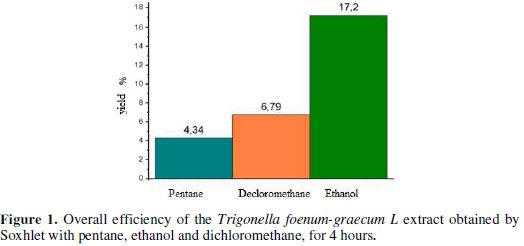
solvents in terms of overall efficiency are presented in <a href="#f1">Fig. 1</a>:</p>


    ]]></body>
<body><![CDATA[<p>&nbsp;</p>
<a name="f1">
<img src="/img/revistas/pea/v35n5/35n5a03f1.jpg">
    
<p>&nbsp;</p>


    <p><a href="#f1">Fig. 1</a> shows that the extraction yield with ethanol is the highest.This is due to the 
fact that ethanol extract contains many more chemical substances.</p>

    <p>After the extraction, the extract was saved and preserved in an opaque flask and 
stored at 4 &deg;C before its use.</p>


    <p><i>Chemical composition and identification of the compounds</i></p>

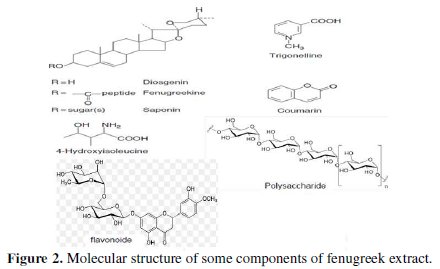
    <p>The work done on the chemical analysis of fenugreek (<a href="#f2">Fig. 2</a>) shows that the 
grain contains the following substances:</p>

    <p>&bull; proteins, carbohydrates and mucilage [12-13-14];</p>

    <p>&bull; saponins [15];</p>

    <p>&bull; polysaccharide [16-17];</p>

    <p>&bull; steroidal sapogenins: diosgenin, gitogenin and tigogenin [18];</p>

    ]]></body>
<body><![CDATA[<p>&bull; fenugreekine [19];</p>

    <p>&bull; arginine, glycine and alanine [20-21];</p>

    <p>&bull; 4-hydroxyisoleucine [22];</p>

    <p>&bull; trigonelline [23];</p>

    <p>&bull; flavonoids, carotenoids, coumarins [24].</p>


    <p>&nbsp;</p>
<a name="f2">
<img src="/img/revistas/pea/v35n5/35n5a03f2.jpg">
    
<p>&nbsp;</p>


    <p><i><b>Corrosive solution</b></i></p>

    <p>The solution of HCl 1 M was prepared by dilution of hydrochloric acid with 
analytical quality of 37% using distilled water. The test solutions were freshly 
prepared before every experience, by directly adding the extract to the corrosive 
solution.</p>


    <p><i><b>Electrochemical measurements</b></i></p>

    ]]></body>
<body><![CDATA[<p>Electrochemical measurements were carried out in a conventional three-electrode 
electrolysis cylindrical Pyrex glass cell. The working electrode (WE) had the 
form of a disc cut from aluminum with a geometric area of 1 cm<sup>2</sup>. A saturated 
calomel electrode (SCE) and a disc platinum electrode were respectively used as 
reference and auxiliary electrodes. The temperature was thermostatically 
controlled at 25 &deg;C. The WE was abraded with different emery papers up to 1200 
grade, degreased with acetone, and rinsed with distilled water before use.</p>

    <p>Running was done on a compatible computer, Voltab Master 4 Software, which 
communicated with the potentiostat-galvanostat model PGZ100, at a scan rate of 
10 mV/sec. Before recording the polarization curves, the working electrode was 
maintained for 30 min at Ecorr. The resulting current was plotted as a function of 
the potential.</p>

    <p>Polarization resistance (Rp) values were obtained from the current-potential plot. 
The scan rate was 10 mV/sec. Electrochemical impedance spectroscopy (EIS) 
measurements were carried out with an electrochemical system which included a 
digital potentiostat model Volta lab PGZ 100 computer at Ecorr; after immersion 
in solution, the circular surface of 1 cm<sup>2</sup> aluminum exposing to the solution was 
used as working electrode.</p>

    <p>Frequencies between 100 kHz and 10 mHz were superimposed on the corrosion 
potential. The impedance diagrams are given in the Nyquist representation.</p>


    <p>&nbsp;</p>
    <p><b>Results and discussion</b></p>

    <p><i><b>Chemical composition of three extracts of fenugreek obtained by three solvents</b></i></p>

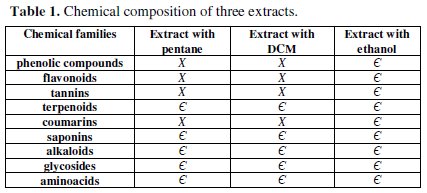
    <p>To determine the chemical composition of the three extracts, several procedures 
have been completed. <a href="#t1">Table 1</a> summarizes the presence (E) and absence (X) of a 
chemical family in the three extracts:</p>


    <p>&nbsp;</p>
<a name="t1">
<img src="/img/revistas/pea/v35n5/35n5a03t1.jpg">
    
<p>&nbsp;</p>


    ]]></body>
<body><![CDATA[<p><i><b>Potentiodynamic polarization measurements</b></i></p>

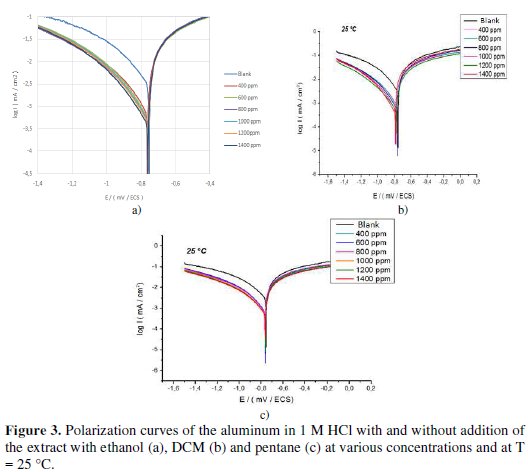
    <p><a href="#f3">Fig. 3.1</a>, <a href="#f3">3.2</a> and <a href="#f3">3.3</a> show 
the plots of cathodic and anodic polarization of the 
aluminum immersed in 1 M HCl at 25 &deg;C, in absence and in presence of various 
inhibitor's concentrations.</p>


    <p>&nbsp;</p>
<a name="f3">
<img src="/img/revistas/pea/v35n5/35n5a03f3.jpg">
    
<p>&nbsp;</p>


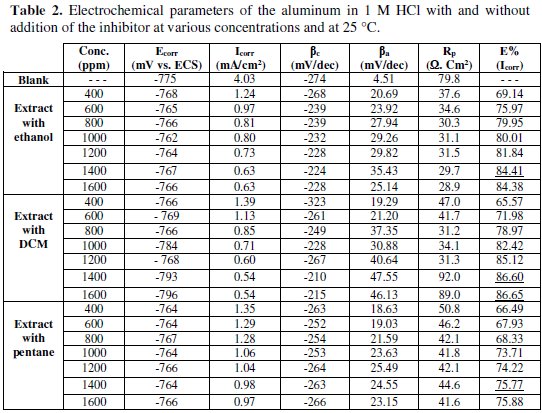
    <p>The electrochemical data, the corrosion potential 
(Ecorr), the cathodic (&beta;c) and anodic (&beta;a) Tafel slopes, and the current density of 
corrosion (Icorr) are listed in <a href="#t2">Table 2</a>.</p>


    <p>&nbsp;</p>
<a name="t2">
<img src="/img/revistas/pea/v35n5/35n5a03t2.jpg">
    
<p>&nbsp;</p>


    <p>The inhibition efficiency (IE%) is calculated by:</p>


    <p>&nbsp;</p>
<a name="e1">
<img src="/img/revistas/pea/v35n5/35n5a03e1.jpg">
    
<p>&nbsp;</p>


    ]]></body>
<body><![CDATA[<p>where Icorr and I'corr represent the current densities of corrosion determined by 
extrapolation of Tafel slopes to the corrosion potential, respectively, with and 
without addition of the inhibitor.</p>

    <p>In the used experimental conditions, the cathodic branch represents the reaction 
of hydrogen formation, and the anodic branch represents the dissolution of 
aluminum. The inspection of these results reveals that the corrosion current 
density (Icorr) decreased in the presence of the inhibitor. This behavior translates 
its capacity to inhibit the aluminum corrosion in a solution of 1 M HCl.</p>

    <p>According to <a href="#f3">Fig. 3</a> and <a href="#t2">Table 2</a>, we note that, in the presence of the inhibitor:</p>

    <p>- for the three extracts the corrosion current density Icorr decreases as the 
inhibitor's concentration increases;</p>

    <p>- the addition of the three extracts modifies the values of Ecorr, and it is observed 
that the inhibitory efficiency (IE%) increases with an increase in the inhibitor's 
concentration;</p>

    <p>- the inhibitor can be classified as cathodic or anodic, if the difference in 
corrosion potential is greater than 85 mV relative to the corrosion potential of the 
blank [25]; the values of the corrosion potential vary to the anodic potential in 
the presence of both extracts with ethanol and pentane. This observation clearly 
shows that these two extracts can be classified as mixed inhibitors with an anodic 
pattern. However, in the case of the extract with DCM, the values of Ecorr 
regularly vary to the cathodic potential relative to the aluminum corrosion 
potential in the presence of acid alone; so, the inhibitor can be classified as a 
mixed corrosion inhibitor with a cathodic pattern;</p>

    <p>- cathodic Tafel slopes (&beta;c) have significantly changed with the addition of the 
three extracts, indicating that the adsorbed inhibitory molecules affect the 
evolution of hydrogen; that is to say, hydrogen evolution is not solely reduced by 
the locking surface effect;</p>

    <p>- the results also show that the anodic Tafel slopes (&beta;a) vary with the addition of 
the inhibitor, indicating the change in the metal dissolution process;</p>

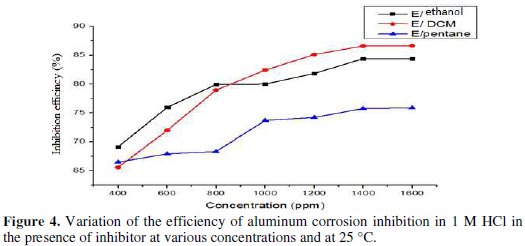
    <p>- the inhibition efficiency values calculated on the values of Icorr obtained in the 
absence and presence of the extract with the three solvents reached 84.41% for 
the extract with ethanol, 86.6% for the extract with DCM and 75.77% for the 
extract with pentane at 1400 ppm (<a href="#f4">Fig. 4</a>).</p>


    <p>&nbsp;</p>
<a name="f4">
<img src="/img/revistas/pea/v35n5/35n5a03f4.jpg">
    
]]></body>
<body><![CDATA[<p>&nbsp;</p>


    <p>Electrochemical impedance spectroscopy (EIS)</p>

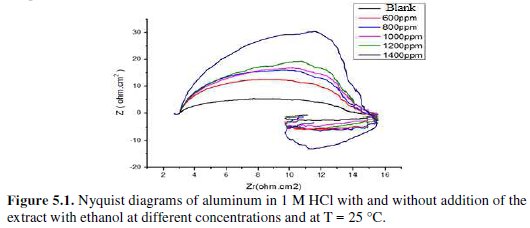
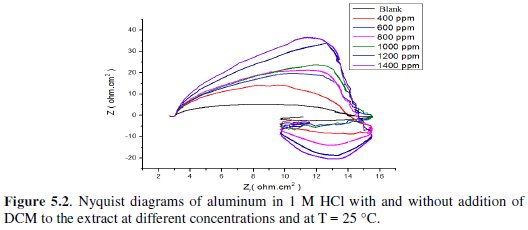
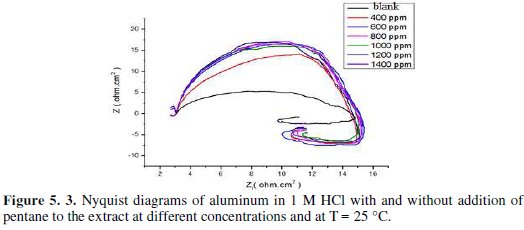
    <p><a href="#f5">Fig. 5</a> represents Nyquist diagrams for aluminium in 1 M HCl at 25 &deg;C without 
and with various concentrations of fenugreek.</p>


    <p>&nbsp;</p>
<a name="f5">
<img src="/img/revistas/pea/v35n5/35n5a03f5a.jpg">
    
<p>&nbsp;</p>
<img src="/img/revistas/pea/v35n5/35n5a03f5b.jpg">
    
<p>&nbsp;</p>
<img src="/img/revistas/pea/v35n5/35n5a03f5c.jpg">
    
<p>&nbsp;</p>


    <p>Electrochemical impedance spectroscopy (EIS)</p>

    <p>The impedance spectra consist of 
a large capacitive loop at high frequency (HF), followed by a large inductive one 
at low frequency values.</p>

    <p>Generally, the small inductive loop at low frequency (LF) is always observed for 
aluminium in hydrochloric acid [26-27-28-29], and the diameter of the inductive 
loop is drastically smaller than that of the capacitive loop at higher frequencies. 
After adding fenugreek, the shape is not changed throughout a series of 
inhibitor's concentrations, indicating that there is almost no change in the 
corrosion mechanism due to the inhibitor addition.</p>

    ]]></body>
<body><![CDATA[<p>According to Mansfeld et al. [30], Bessone et al. [31], Wit and Lenderink [32], 
and Brett [33], the capacitive loop at HF could be assigned to the formation of an 
oxide layer on Al. In the experiments, it is reasonable to assume that the 
electrode surface has been covered with an oxide layer, because of the ex situ 
pretreatment of the electrode. In fact, it is very difficult to produce an oxide free 
Al surface. Even if producing such a surface, it is very fastly repassivated by O2 
[34]. The capacitive loop at HF corresponds to the interfacial reactions, 
particularly, the reaction of aluminum oxidation at the metal/oxide/electrolyte 
interface [33]. In the present system, the oxide layer is dissolved in 1 M HCl. The 
dissolution process mainly includes the formation of Al+ ions at the metal/oxide 
interface, and their migration through the oxide/solution interface, where they are 
further oxidized to Al3+. In the presence of the inhibitor, the complex of [metaloxide-
hydroxide-inhibitor]ads could also be formed [35]. The fact that all these 
processes are represented by only one loop could be attributed either to the 
overlapping of the loops of processes, or to the assumption that one process 
dominates and, therefore, excludes the other processes [32].</p>

    <p>On the other hand, the cause of the inductive loop at low frequency is still 
uncertain. The relaxation of adsorbed charged intermediates may result in the 
inductive loop [36]. This is more pronounced when the intermediates are strongly 
adsorbed. The relaxations of adsorbed species include H<sub>ads</sub><sup>+</sup> 
 [37], Cl<sup>-</sup> [38], O2<sup>-</sup> ion [39] 
 or inhibitor species [40] on the electrode surface. It might be also attributed 
to the re-dissolution of the oxide layer surface [41] or Al-dissolution [38] at low 
frequencies. Inductive behavior is also observed for the pitted active state and 
attributed to the surface area modulation or salt film property modulation [42]. 
Nevertheless, the sizes of both capacitive and inductive loops significantly 
increase with an increase in the inhibitor's concentration. This suggests that the 
impedance of the inhibited substrate increases with fenugreek concentration, 
which in turn leads to a lower corrosion of Al. Noticeably, these high frequency 
loops are not perfect semicircles, which can be attributed to the frequency 
dispersion as a result of the roughness and inhomogeneity of the electrode 
surface [43].</p>

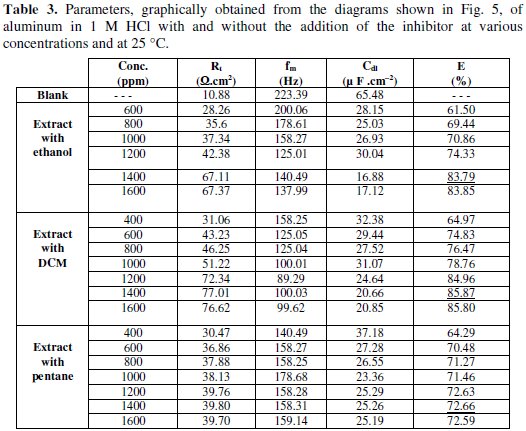
    <p>The dielectric parameters are given in <a href="#t3">Table 3</a>.</p>


    <p>&nbsp;</p>
<a name="t3">
<img src="/img/revistas/pea/v35n5/35n5a03t3.jpg">
    
<p>&nbsp;</p>


    <p>The values of R'<sub>T</sub> increase with 
the growth of the inhibitor's concentration, while Cdl values decrease. Increasing 
may suggest the formation of a protective layer on the surface of the 
electrode [44]. The inhibitory effectiveness was determined by:</p>


    <p>&nbsp;</p>
<a name="e2">
<img src="/img/revistas/pea/v35n5/35n5a03e2.jpg">
    
<p>&nbsp;</p>


    <p>where RT and R'<sub>T</sub> are the aluminum charge transfer resistance in 1 M HCl 
medium in, respectively, the absence and presence of the inhibitor at Ecorr = -777 
mV / ECS.</p>

    <p>The charge transfer resistance values (RT) were calculated based on the 
difference between impedance values at lower and higher frequencies. 
The ability of the double layer (Cdl) and the frequency (fmax) at which the 
imaginary component of the impedance is maximum (-Zmax) are represented by:</p>


    ]]></body>
<body><![CDATA[<p>&nbsp;</p>
<a name="e3">
<img src="/img/revistas/pea/v35n5/35n5a03e3.jpg">
    
<p>&nbsp;</p>


    <p>The values of Cdl are judged to be lower than those of the blank values, 
confirming the adsorption of the inhibitor onto the metal surface, forming an 
electronic double layer [45].</p>

    <p>These results are in good agreement with those obtained by polarization, 
where fenugreek extract proves to be a good inhibitor for aluminum in 1 M 
HCl with an efficiency of 83.79% in the extract with ethanol, 85.87% for the 
extract with DCM and 72.66% for the extract with pentane at 1400 ppm.</p>

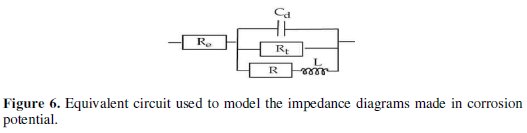
    <p>In such a corrosion process, an intermediate stage of adsorption of the species 
can take place in the electrode. This one shows itself on the diagram of 
impedance, represented in the Nyquist plots, by an inductive loop (<a href="#f6">Fig. 6</a>) [46].</p>


    <p>&nbsp;</p>
<a name="f6">
<img src="/img/revistas/pea/v35n5/35n5a03f6.jpg">
    
<p>&nbsp;</p>


    <p>It is modelled by a resistance, R, and an inductance, L, in parallel with the circuit of 
Randles [47,48].</p>

    <p>The total impedance of the circuit is given by the following relation:</p>


    <p>&nbsp;</p>
<a name="e4">
<img src="/img/revistas/pea/v35n5/35n5a03e4.jpg">
    
]]></body>
<body><![CDATA[<p>&nbsp;</p>


    <p>The faradic impedance is calculated in the following way:</p>


    <p>&nbsp;</p>
<a name="e5">
<img src="/img/revistas/pea/v35n5/35n5a03e5.jpg">
    
<p>&nbsp;</p>


    <p>we know that:</p>


    <p>&nbsp;</p>
<a name="e6">
<img src="/img/revistas/pea/v35n5/35n5a03e6.jpg">
    
<p>&nbsp;</p>


    <p>and the load transfer resistor, Rtc</p>


    <p>&nbsp;</p>
<a name="e7">
<img src="/img/revistas/pea/v35n5/35n5a03e7.jpg">
    
<p>&nbsp;</p>


    ]]></body>
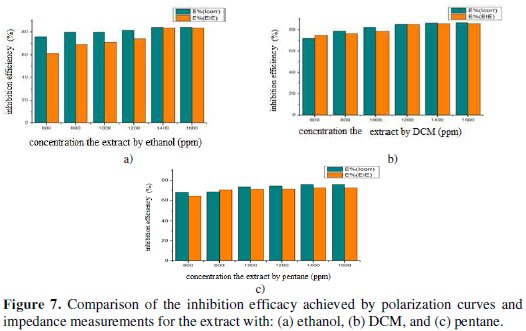
<body><![CDATA[<p>The comparison of both techniques shows that the IE (%) obtained by using the 
impedance technique is comparable and is parallel to those obtained by 
polarization curves (<a href="#f7">Fig. 7</a>).</p>


    <p>&nbsp;</p>
<a name="f7">
<img src="/img/revistas/pea/v35n5/35n5a03f7.jpg">
    
<p>&nbsp;</p>


    <p><i><b>Effect of temperature</b></i></p>

    <p>Temperature is an important factor in the studies on metal dissolution. The 
corrosion rate in acidic solutions, for example, exponentially increases with an 
increasing temperature, due to the decrease on the evolution of the hydrogen 
overvoltage [49].</p>

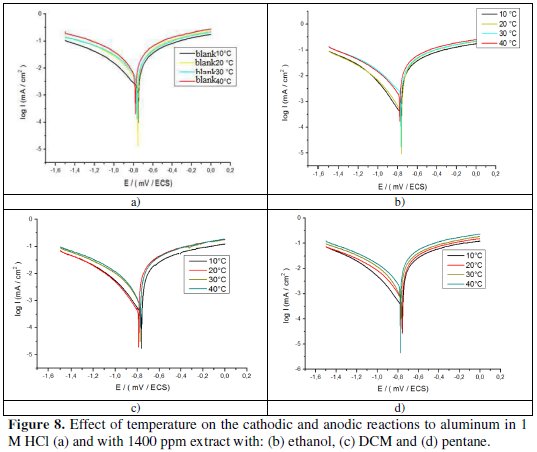
    <p>The Icorr value was obtained by extrapolation of Tafel straight experiments 
conducted at 10, 20, 30, and 40 &deg;C. The polarization curves for aluminum in a 1 
M HCl solution in the temperature range (10-40 &deg;C) are shown in <a href="#f8">Figs. 8</a>, with 
and without 1400 ppm of extract with the three solvents.</p>


    <p>&nbsp;</p>
<a name="f8">
<img src="/img/revistas/pea/v35n5/35n5a03f8.jpg">
    
<p>&nbsp;</p>


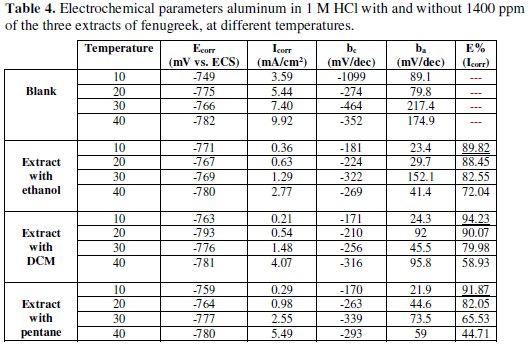
    <p>The different numerical values of the variation of corrosion current density (Icorr), 
corrosion potential (Ecorr), cathodic Tafel slope (&beta;c), and slope anodic Tafel (&beta;a) 
to 1400 ppm of inhibitor in all studied temperatures studied are given in <a href="#t4">Table 4</a>.</p>


    <p>&nbsp;</p>
<a name="t4">
<img src="/img/revistas/pea/v35n5/35n5a03t4.jpg">
    
]]></body>
<body><![CDATA[<p>&nbsp;</p>


    <p>From the obtained results, we can make the following remarks:</p>

    <p>- the current densities increase with an increase on the temperature from 10 to 40 
&deg;C; the areas in the cathodic part are parallel, indicating that the reduction of H+ 
ions to the aluminum surface takes place according to the same mechanism of 
pure activation throughout the temperature range;</p>

    <p>- the corrosion potential of aluminum (Ecorr) is slightly modified by increasing the 
temperature from 10 to 40 &deg;C in 1 M HCl, with and without the inhibitor;</p>

    <p>- in general, the increase of the temperature causes an increase in Icorr values 
throughout the studied temperature range. The evolution of corrosion currents in 
only a corrosive solution (1 M HCl) shows a sharp growth, confirming an 
increasing metal dissolution with an increasing temperature. The increase in the 
corrosion current with temperature in presence of the inhibitor extract for three 
solvents is low compared to the control;</p>

    <p>- these results confirm that the three extracts inhibit corrosion in the temperature 
range with high efficiency in the case of the extract with DCM.</p>

    <p>- For the acid corrosion, many authors [50] have used the Arrhenius equation to 
account for the effect of temperature (T) on the rate of corrosion and, therefore, 
consider that the logarithm of the speed corrosion W is a linear function of 1/T.</p>

    <p>We can calculate the activation energies from the following relationships:</p>


    <p>&nbsp;</p>
<a name="e8">
<img src="/img/revistas/pea/v35n5/35n5a03e8.jpg">
    
<p>&nbsp;</p>
<a name="e9">
<img src="/img/revistas/pea/v35n5/35n5a03e9.jpg">
    
]]></body>
<body><![CDATA[<p>&nbsp;</p>


    <p>where K and K' are constants (pre-exponential Arrhenius parameter), and Ea and 
E'a are activation energies, respectively, in the absence and presence of the 
inhibitor.</p>

    <p>Some conclusions on the mechanism of action of the inhibitors may be obtained 
by comparing measured Ea at both the presence and absence of the corrosion 
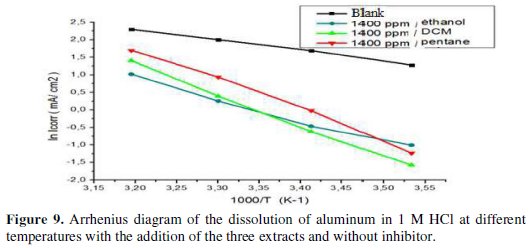
inhibitor. <a href="#f9">Fig. 9</a> shows the Arrhenius plot coordinates of the aluminum corrosion 
rate in 1 M HCl, in the absence and presence of 1400 ppm of the three extracts of 
fenugreek.</p>


    <p>&nbsp;</p>
<a name="f9">
<img src="/img/revistas/pea/v35n5/35n5a03f9.jpg">
    
<p>&nbsp;</p>


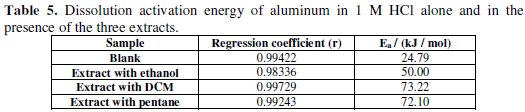
    <p>The variation of the logarithm of the corrosion current as a function of 1/T gives 
lines indicating that the Arrhenius law is respected. The values of the activation 
energy obtained from these lines are given in <a href="#t5">Table 5</a>.</p>


    <p>&nbsp;</p>
<a name="t5">
<img src="/img/revistas/pea/v35n5/35n5a03t5.jpg">
    
<p>&nbsp;</p>


    <p>From the obtained results, we may conclude that the studied inhibitors adsorb 
onto the surface by the electrostatic nature of links (physisorbed to the electrode 
surface). Indeed, the Ea values for the three extracts are greater than the Ea value 
obtained for the inhibitor-free solution. The extract with DCM has a higher 
activation energy.</p>

    <p>The kinetic parameters, the enthalpy and entropy of the corrosion process are 
also evaluated from the study on the effect of temperature. An alternative 
formulation is the Arrhenius equation [51]:</p>


    ]]></body>
<body><![CDATA[<p>&nbsp;</p>
<a name="e10">
<img src="/img/revistas/pea/v35n5/35n5a03e10.jpg">
    
<p>&nbsp;</p>


    <p>where h is Planck's constant, N is the number of Avogadro, &Delta;Sa is the entropy of 
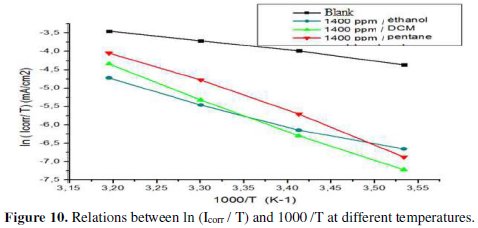
activation, and &Delta;Ha is the activation enthalpy. <a href="#f10">Fig. 10</a> shows plots of ln (Icorr / T) 
versus 1/T.</p>


    <p>&nbsp;</p>
<a name="f10">
<img src="/img/revistas/pea/v35n5/35n5a03f10.jpg">
    
<p>&nbsp;</p>


    <p>Straight lines are obtained with a slope -&Delta;Ha / R and an intercept 
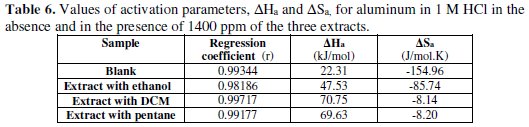
(Ln R / Nh + &Delta;Sa / R), from which values of &Delta;Sa and &Delta;Ha can be calculated, and 
these values are given in <a href="#t6">Table 6</a>.</p>


    <p>&nbsp;</p>
<a name="t6">
<img src="/img/revistas/pea/v35n5/35n5a03t6.jpg">
    
<p>&nbsp;</p>


    <p>The enthalpy positive signs (&Delta;Ha) reflect the endothermic nature of the aluminum 
dissolution process. Indeed, the increase in enthalpy &Delta;Ha activation corresponds 
to a decrease on the metal dissolution.</p>

    <p>And high negative values of the entropy, &Delta;Sa, mean that there is a decrease on 
the disorder when processing complex reagents active in the solution [52].</p>

    ]]></body>
<body><![CDATA[<p>The thermodynamic data confirm the physisorption of the three extracts of 
fenugreek on the surface of pure aluminum in a 1 M HCl medium. For the values 
of the free energy of adsorption, &Delta;G<sub>ads</sub>, three extracts on the Al surface were 
calculated using <a href="#e7">equation (7)</a> [53]; these values are given in <a href="#t7">Table 7</a>.</p>


    <p>&nbsp;</p>
<a name="t7">
<img src="/img/revistas/pea/v35n5/35n5a03t7.jpg">
    
<p>&nbsp;</p>


    <p>The values of &Delta;G<sub>ads</sub> were negative at 25 &deg;C for these three extracts, indicating 
spontaneous adsorption of the inhibitor on the surface of aluminum, through the 
mechanism of physisorption (&Delta;G<sub>ads</sub> &lt; 40 kJ / mol) [53].</p>


    <p><i><b>Explanation for inhibition</b></i></p>

    <p>The inhibitive action of fenugreek towards the acid corrosion of aluminium can 
be attributed to the adsorption of the components of fenugreek on the aluminium 
surface. Some important constituents of fenugreek are saponins, polysaccharide, 
steroidal sapogenins, fenugreekine, arginine, glycine and alanine, 4-hydroxyisoleucine, 
and trigonelline. These chemical structures are shown in <a href="#f2">Fig. 2</a>.</p>

    <p>Obviously, each compound contains many oxygen atoms in functional groups 
of O-H, C=O, C-O and O-heterocyclic ring, which meets the general measuring 
conditions for typical corrosion inhibitors.</p>

    <p>As discussed above on activation parameters, adsorption is mainly physical 
adsorption. Consequently, the adsorption mechanism is presented. According to 
<a href="#f2">Fig. 2</a>, these compounds could be protonated in the acid solution, due to the 
interaction between O atom and H+. The mechanism for anodic dissolution of 
aluminium in a HCl solution was proposed as the following steps [54]:</p>


    <p>&nbsp;</p>
<a name="e11">
<img src="/img/revistas/pea/v35n5/35n5a03e11.jpg">
    
<p>&nbsp;</p>
<a name="e12">
<img src="/img/revistas/pea/v35n5/35n5a03e12.jpg">
    
]]></body>
<body><![CDATA[<p>&nbsp;</p>


    <p>As mentioned above, the protonated compounds in fenugreek can interact with 
AlCl<sub>ads</sub><sup>-</sup> species, which are formed in steps (11) through electrostatical force, and 
then prevent oxidation reaction of AlCl<sub>ads</sub><sup>-</sup> to AlCl2<sup>+</sup>, as shown by <a href="#e12">reaction (12)</a>.</p>

    <p>Also, owing to the lone-pair electrons of O atoms of these main constituents 
shown in <a href="#f2">Fig. 2</a>, these compounds may combine with Al3+ ions to form the metal 
inhibitor complexes. These complexes might get adsorbed onto aluminium 
surface by van der Waals forces, to form a protective film which keeps 
aluminium from corrosion.</p>


    <p>&nbsp;</p>
    <p><b>Conclusions</b></p>

    <p>From the results of our study we can conclude the following:</p>

    <p>- all extracts effectively inhibit the corrosion of Al, but the extract with DCM 
appears to be better than the others;</p>

    <p>- the addition of these extracts reduced the anodic dissolution and retarded the 
hydrogen evolution reaction;</p>

    <p>- the molecules characterizing these extracts act as mixed corrosion inhibitors 
with an anodic trend for both extracts with ethanol and pentane, and a cathodic 
trend for the extract with DCM;</p>

    <p>- the efficiency increases with the increase on the concentration of the inhibitor, 
to reach 84.41% for the extract with ethanol, 86.6% for the extract with DCM, 
and 75.77% for the extract with pentane to 1400 ppm;</p>

    ]]></body>
<body><![CDATA[<p>- the adsorption constants values of the three extracts are characterized by 
physical adsorption of the inhibitor on the surface of aluminum;</p>

    <p>- the &Delta;G<sub>ads</sub> values are negative and less than 40 kJ/mol; this proves that it is a 
physical adsorption, and that the adsorption process is spontaneous;</p>

    <p>- the pattern of inhibition efficacy of the different extracts was in this order: 
extract with DCM &gt; extract with ethanol &gt; extract with pentane.</p>


    <p>&nbsp;</p>
    <p><b>References</b></p>

    <!-- ref --><p>1. El-Etre A. Corros Sci. 2003;45:2485.    &nbsp;&nbsp;&nbsp;&nbsp;&nbsp;&nbsp;&nbsp;&nbsp;[&#160;<a href="javascript:void(0);" onclick="javascript: window.open('/scielo.php?script=sci_nlinks&ref=429518&pid=S0872-1904201700050000300001&lng=','','width=640,height=500,resizable=yes,scrollbars=1,menubar=yes,');">Links</a>&#160;]<!-- end-ref --></p>

    <!-- ref --><p>2. Muller B, Corros Sci. 2002;44:1583.    &nbsp;&nbsp;&nbsp;&nbsp;&nbsp;&nbsp;&nbsp;&nbsp;[&#160;<a href="javascript:void(0);" onclick="javascript: window.open('/scielo.php?script=sci_nlinks&ref=429520&pid=S0872-1904201700050000300002&lng=','','width=640,height=500,resizable=yes,scrollbars=1,menubar=yes,');">Links</a>&#160;]<!-- end-ref --></p>

    <!-- ref --><p>3. Jain T, Chowdhary R, Mathur SP. Mater Corros. 2006;57:422.    &nbsp;&nbsp;&nbsp;&nbsp;&nbsp;&nbsp;&nbsp;&nbsp;[&#160;<a href="javascript:void(0);" onclick="javascript: window.open('/scielo.php?script=sci_nlinks&ref=429522&pid=S0872-1904201700050000300003&lng=','','width=640,height=500,resizable=yes,scrollbars=1,menubar=yes,');">Links</a>&#160;]<!-- end-ref --></p>

    <!-- ref --><p>4. Chaieb E, Bouyanzer A, Hammouti B, et al. Appl Surf Sci. 2005;246:199.    &nbsp;&nbsp;&nbsp;&nbsp;&nbsp;&nbsp;&nbsp;&nbsp;[&#160;<a href="javascript:void(0);" onclick="javascript: window.open('/scielo.php?script=sci_nlinks&ref=429524&pid=S0872-1904201700050000300004&lng=','','width=640,height=500,resizable=yes,scrollbars=1,menubar=yes,');">Links</a>&#160;]<!-- end-ref --></p>

    <!-- ref --><p>5. El-Etre AY, Abdallah M, El-Tantany ZE. Corros Sci. 2005;47:385.    &nbsp;&nbsp;&nbsp;&nbsp;&nbsp;&nbsp;&nbsp;&nbsp;[&#160;<a href="javascript:void(0);" onclick="javascript: window.open('/scielo.php?script=sci_nlinks&ref=429526&pid=S0872-1904201700050000300005&lng=','','width=640,height=500,resizable=yes,scrollbars=1,menubar=yes,');">Links</a>&#160;]<!-- end-ref --></p>

    <!-- ref --><p>6. Chowdhary R, Jain T, Rathoria MK, et al. Bull Electrochem. 2004;20:67.    &nbsp;&nbsp;&nbsp;&nbsp;&nbsp;&nbsp;&nbsp;&nbsp;[&#160;<a href="javascript:void(0);" onclick="javascript: window.open('/scielo.php?script=sci_nlinks&ref=429528&pid=S0872-1904201700050000300006&lng=','','width=640,height=500,resizable=yes,scrollbars=1,menubar=yes,');">Links</a>&#160;]<!-- end-ref --></p>

    <!-- ref --><p>7. Houbairi S, Essahli M, Lamiri A. Port Electrochim Acta. 2013;31:221.    &nbsp;&nbsp;&nbsp;&nbsp;&nbsp;&nbsp;&nbsp;&nbsp;[&#160;<a href="javascript:void(0);" onclick="javascript: window.open('/scielo.php?script=sci_nlinks&ref=429530&pid=S0872-1904201700050000300007&lng=','','width=640,height=500,resizable=yes,scrollbars=1,menubar=yes,');">Links</a>&#160;]<!-- end-ref --></p>

    <!-- ref --><p>8. Houbairi S, Essahli M, Lamiri A. Int J Eng Res Technol. 2014;3:2.    &nbsp;&nbsp;&nbsp;&nbsp;&nbsp;&nbsp;&nbsp;&nbsp;[&#160;<a href="javascript:void(0);" onclick="javascript: window.open('/scielo.php?script=sci_nlinks&ref=429532&pid=S0872-1904201700050000300008&lng=','','width=640,height=500,resizable=yes,scrollbars=1,menubar=yes,');">Links</a>&#160;]<!-- end-ref --></p>

    <!-- ref --><p>9. Houbairi S, Lamiri A, Essahli M, Int J Eng Res Technol. 2014;3:1.    &nbsp;&nbsp;&nbsp;&nbsp;&nbsp;&nbsp;&nbsp;&nbsp;[&#160;<a href="javascript:void(0);" onclick="javascript: window.open('/scielo.php?script=sci_nlinks&ref=429534&pid=S0872-1904201700050000300009&lng=','','width=640,height=500,resizable=yes,scrollbars=1,menubar=yes,');">Links</a>&#160;]<!-- end-ref --></p>

    <!-- ref --><p>10. Bensabah F, Houbairi S, Essahli M, et al. Port Electrochim Acta. 2013;31:195.    &nbsp;&nbsp;&nbsp;&nbsp;&nbsp;&nbsp;&nbsp;&nbsp;[&#160;<a href="javascript:void(0);" onclick="javascript: window.open('/scielo.php?script=sci_nlinks&ref=429536&pid=S0872-1904201700050000300010&lng=','','width=640,height=500,resizable=yes,scrollbars=1,menubar=yes,');">Links</a>&#160;]<!-- end-ref --></p>

    <!-- ref --><p>11. Bensabah F, Houbairi S, Essahli M, et al. J Adv Chem. 2014.    &nbsp;&nbsp;&nbsp;&nbsp;&nbsp;&nbsp;&nbsp;&nbsp;[&#160;<a href="javascript:void(0);" onclick="javascript: window.open('/scielo.php?script=sci_nlinks&ref=429538&pid=S0872-1904201700050000300011&lng=','','width=640,height=500,resizable=yes,scrollbars=1,menubar=yes,');">Links</a>&#160;]<!-- end-ref --></p>

    <!-- ref --><p>12. Baccou JC, Sauvaire Y, Ollie V, et al. Rev Fr Corbs Gras. 1978;25:353.    &nbsp;&nbsp;&nbsp;&nbsp;&nbsp;&nbsp;&nbsp;&nbsp;[&#160;<a href="javascript:void(0);" onclick="javascript: window.open('/scielo.php?script=sci_nlinks&ref=429540&pid=S0872-1904201700050000300012&lng=','','width=640,height=500,resizable=yes,scrollbars=1,menubar=yes,');">Links</a>&#160;]<!-- end-ref --></p>

    <!-- ref --><p>13. El-Mahdy AR, El-Sebaiy LA. Food Chem. 1985;18:19.    &nbsp;&nbsp;&nbsp;&nbsp;&nbsp;&nbsp;&nbsp;&nbsp;[&#160;<a href="javascript:void(0);" onclick="javascript: window.open('/scielo.php?script=sci_nlinks&ref=429542&pid=S0872-1904201700050000300013&lng=','','width=640,height=500,resizable=yes,scrollbars=1,menubar=yes,');">Links</a>&#160;]<!-- end-ref --></p>

    <!-- ref --><p>14. Rao P, Sharma RD. Food Chem. 1987;24:1.    &nbsp;&nbsp;&nbsp;&nbsp;&nbsp;&nbsp;&nbsp;&nbsp;[&#160;<a href="javascript:void(0);" onclick="javascript: window.open('/scielo.php?script=sci_nlinks&ref=429544&pid=S0872-1904201700050000300014&lng=','','width=640,height=500,resizable=yes,scrollbars=1,menubar=yes,');">Links</a>&#160;]<!-- end-ref --></p>

    <!-- ref --><p>15. Sharma RD. Nutr Rep Int. 1986;33:669.    &nbsp;&nbsp;&nbsp;&nbsp;&nbsp;&nbsp;&nbsp;&nbsp;[&#160;<a href="javascript:void(0);" onclick="javascript: window.open('/scielo.php?script=sci_nlinks&ref=429546&pid=S0872-1904201700050000300015&lng=','','width=640,height=500,resizable=yes,scrollbars=1,menubar=yes,');">Links</a>&#160;]<!-- end-ref --></p>

    <!-- ref --><p>16. Chatterjee BP, Sakar N, Rao AS. Carbohyd Res. 1982;104:348.    &nbsp;&nbsp;&nbsp;&nbsp;&nbsp;&nbsp;&nbsp;&nbsp;[&#160;<a href="javascript:void(0);" onclick="javascript: window.open('/scielo.php?script=sci_nlinks&ref=429548&pid=S0872-1904201700050000300016&lng=','','width=640,height=500,resizable=yes,scrollbars=1,menubar=yes,');">Links</a>&#160;]<!-- end-ref --></p>

    <!-- ref --><p>17. Valette G, Sauvaire Y, Baccou JC, et al. Atherosclerosis. 1984;50:105.    &nbsp;&nbsp;&nbsp;&nbsp;&nbsp;&nbsp;&nbsp;&nbsp;[&#160;<a href="javascript:void(0);" onclick="javascript: window.open('/scielo.php?script=sci_nlinks&ref=429550&pid=S0872-1904201700050000300017&lng=','','width=640,height=500,resizable=yes,scrollbars=1,menubar=yes,');">Links</a>&#160;]<!-- end-ref --></p>

    <!-- ref --><p>18. Anis M, Aminuddin E. Fitoterapia. 1985;56:51.    &nbsp;&nbsp;&nbsp;&nbsp;&nbsp;&nbsp;&nbsp;&nbsp;[&#160;<a href="javascript:void(0);" onclick="javascript: window.open('/scielo.php?script=sci_nlinks&ref=429552&pid=S0872-1904201700050000300018&lng=','','width=640,height=500,resizable=yes,scrollbars=1,menubar=yes,');">Links</a>&#160;]<!-- end-ref --></p>

    <p>19. Ghosal S, Srivastava RS, Chatter DC, et al. 1974;13:2247.</p>

    <!-- ref --><p>20. Gopalan C, Shastri BVR, Balasubramanyan SC. Nutritive value of Indian 
foods. Hyderabad, India: National Institute of Nutrition (ICMR); 1978.    &nbsp;&nbsp;&nbsp;&nbsp;&nbsp;&nbsp;&nbsp;&nbsp;[&#160;<a href="javascript:void(0);" onclick="javascript: window.open('/scielo.php?script=sci_nlinks&ref=429555&pid=S0872-1904201700050000300020&lng=','','width=640,height=500,resizable=yes,scrollbars=1,menubar=yes,');">Links</a>&#160;]<!-- end-ref --></p>

    <!-- ref --><p>21. Sharma RD. Nutr Rep Int. 1984;30:221.    &nbsp;&nbsp;&nbsp;&nbsp;&nbsp;&nbsp;&nbsp;&nbsp;[&#160;<a href="javascript:void(0);" onclick="javascript: window.open('/scielo.php?script=sci_nlinks&ref=429557&pid=S0872-1904201700050000300021&lng=','','width=640,height=500,resizable=yes,scrollbars=1,menubar=yes,');">Links</a>&#160;]<!-- end-ref --></p>

    <!-- ref --><p>22. Sauvaire Y, Girardon P, Baccou JC, et al. Phytochem. 1984;23:479.    &nbsp;&nbsp;&nbsp;&nbsp;&nbsp;&nbsp;&nbsp;&nbsp;[&#160;<a href="javascript:void(0);" onclick="javascript: window.open('/scielo.php?script=sci_nlinks&ref=429559&pid=S0872-1904201700050000300022&lng=','','width=640,height=500,resizable=yes,scrollbars=1,menubar=yes,');">Links</a>&#160;]<!-- end-ref --></p>

    <!-- ref --><p>23. Mishkinsky J, Joseph B, Sulman F. Lancet. 1967;1311.    &nbsp;&nbsp;&nbsp;&nbsp;&nbsp;&nbsp;&nbsp;&nbsp;[&#160;<a href="javascript:void(0);" onclick="javascript: window.open('/scielo.php?script=sci_nlinks&ref=429561&pid=S0872-1904201700050000300023&lng=','','width=640,height=500,resizable=yes,scrollbars=1,menubar=yes,');">Links</a>&#160;]<!-- end-ref --></p>

    ]]></body>
<body><![CDATA[<!-- ref --><p>24. Varshney IP, Sharma SC. J Indian Chem Soc. 1996;43:564.    &nbsp;&nbsp;&nbsp;&nbsp;&nbsp;&nbsp;&nbsp;&nbsp;[&#160;<a href="javascript:void(0);" onclick="javascript: window.open('/scielo.php?script=sci_nlinks&ref=429563&pid=S0872-1904201700050000300024&lng=','','width=640,height=500,resizable=yes,scrollbars=1,menubar=yes,');">Links</a>&#160;]<!-- end-ref --></p>

    <!-- ref --><p>25. Satapathy AK, Gunasekaran G, Sahoo SC, et al. Corros Sci. 2009;51:2848.    &nbsp;&nbsp;&nbsp;&nbsp;&nbsp;&nbsp;&nbsp;&nbsp;[&#160;<a href="javascript:void(0);" onclick="javascript: window.open('/scielo.php?script=sci_nlinks&ref=429565&pid=S0872-1904201700050000300025&lng=','','width=640,height=500,resizable=yes,scrollbars=1,menubar=yes,');">Links</a>&#160;]<!-- end-ref --></p>

    <!-- ref --><p>26. Yurt A, Ulutas S, Dal H. Appl Surf Sci. 2006;253:919.    &nbsp;&nbsp;&nbsp;&nbsp;&nbsp;&nbsp;&nbsp;&nbsp;[&#160;<a href="javascript:void(0);" onclick="javascript: window.open('/scielo.php?script=sci_nlinks&ref=429567&pid=S0872-1904201700050000300026&lng=','','width=640,height=500,resizable=yes,scrollbars=1,menubar=yes,');">Links</a>&#160;]<!-- end-ref --></p>

    <!-- ref --><p>27. Zhang QB, Hua YX. Mater Chem Phys. 2010;119:57.    &nbsp;&nbsp;&nbsp;&nbsp;&nbsp;&nbsp;&nbsp;&nbsp;[&#160;<a href="javascript:void(0);" onclick="javascript: window.open('/scielo.php?script=sci_nlinks&ref=429569&pid=S0872-1904201700050000300027&lng=','','width=640,height=500,resizable=yes,scrollbars=1,menubar=yes,');">Links</a>&#160;]<!-- end-ref --></p>

    <!-- ref --><p>28. Oguzie EE, Okolue BN, Ebenso EE, et al. Mater Chem Phys. 2004;87:394.    &nbsp;&nbsp;&nbsp;&nbsp;&nbsp;&nbsp;&nbsp;&nbsp;[&#160;<a href="javascript:void(0);" onclick="javascript: window.open('/scielo.php?script=sci_nlinks&ref=429571&pid=S0872-1904201700050000300028&lng=','','width=640,height=500,resizable=yes,scrollbars=1,menubar=yes,');">Links</a>&#160;]<!-- end-ref --></p>

    ]]></body>
<body><![CDATA[<!-- ref --><p>29. Khaled KF, Al-Qahtani MM. Mater Chem Phys. 2009;113:150.    &nbsp;&nbsp;&nbsp;&nbsp;&nbsp;&nbsp;&nbsp;&nbsp;[&#160;<a href="javascript:void(0);" onclick="javascript: window.open('/scielo.php?script=sci_nlinks&ref=429573&pid=S0872-1904201700050000300029&lng=','','width=640,height=500,resizable=yes,scrollbars=1,menubar=yes,');">Links</a>&#160;]<!-- end-ref --></p>

    <!-- ref --><p>30. Mansfeld F, Lin S, Kim K, et al. Corros Sci. 1987;27:997.    &nbsp;&nbsp;&nbsp;&nbsp;&nbsp;&nbsp;&nbsp;&nbsp;[&#160;<a href="javascript:void(0);" onclick="javascript: window.open('/scielo.php?script=sci_nlinks&ref=429575&pid=S0872-1904201700050000300030&lng=','','width=640,height=500,resizable=yes,scrollbars=1,menubar=yes,');">Links</a>&#160;]<!-- end-ref --></p>

    <!-- ref --><p>31. Bessone J, Mayer C, Jutter K, et al. Electrochim Acta. 1983;28:171.    &nbsp;&nbsp;&nbsp;&nbsp;&nbsp;&nbsp;&nbsp;&nbsp;[&#160;<a href="javascript:void(0);" onclick="javascript: window.open('/scielo.php?script=sci_nlinks&ref=429577&pid=S0872-1904201700050000300031&lng=','','width=640,height=500,resizable=yes,scrollbars=1,menubar=yes,');">Links</a>&#160;]<!-- end-ref --></p>

    <!-- ref --><p>32. de Wit JHW, Lenderink HJW. Electrochim Acta. 1996;41:1111.    &nbsp;&nbsp;&nbsp;&nbsp;&nbsp;&nbsp;&nbsp;&nbsp;[&#160;<a href="javascript:void(0);" onclick="javascript: window.open('/scielo.php?script=sci_nlinks&ref=429579&pid=S0872-1904201700050000300032&lng=','','width=640,height=500,resizable=yes,scrollbars=1,menubar=yes,');">Links</a>&#160;]<!-- end-ref --></p>

    <!-- ref --><p>33. Brett CMA. Corros Sci. 1992;33:203.    &nbsp;&nbsp;&nbsp;&nbsp;&nbsp;&nbsp;&nbsp;&nbsp;[&#160;<a href="javascript:void(0);" onclick="javascript: window.open('/scielo.php?script=sci_nlinks&ref=429581&pid=S0872-1904201700050000300033&lng=','','width=640,height=500,resizable=yes,scrollbars=1,menubar=yes,');">Links</a>&#160;]<!-- end-ref --></p>

    ]]></body>
<body><![CDATA[<!-- ref --><p>34. Burstein GT, Cinderey RJ. Corros Sci. 1992;32:1195.    &nbsp;&nbsp;&nbsp;&nbsp;&nbsp;&nbsp;&nbsp;&nbsp;[&#160;<a href="javascript:void(0);" onclick="javascript: window.open('/scielo.php?script=sci_nlinks&ref=429583&pid=S0872-1904201700050000300034&lng=','','width=640,height=500,resizable=yes,scrollbars=1,menubar=yes,');">Links</a>&#160;]<!-- end-ref --></p>

    <!-- ref --><p>35. Metlkos-Hukovic M, Babic R, Grubac Z. J Appl Electrochem. 1998;28:433.    &nbsp;&nbsp;&nbsp;&nbsp;&nbsp;&nbsp;&nbsp;&nbsp;[&#160;<a href="javascript:void(0);" onclick="javascript: window.open('/scielo.php?script=sci_nlinks&ref=429585&pid=S0872-1904201700050000300035&lng=','','width=640,height=500,resizable=yes,scrollbars=1,menubar=yes,');">Links</a>&#160;]<!-- end-ref --></p>

    <!-- ref --><p>36. Amin MA, Mohsen Q, Hazzai OA. Mater Chem Phys. 2009;114:908.    &nbsp;&nbsp;&nbsp;&nbsp;&nbsp;&nbsp;&nbsp;&nbsp;[&#160;<a href="javascript:void(0);" onclick="javascript: window.open('/scielo.php?script=sci_nlinks&ref=429587&pid=S0872-1904201700050000300036&lng=','','width=640,height=500,resizable=yes,scrollbars=1,menubar=yes,');">Links</a>&#160;]<!-- end-ref --></p>

    <!-- ref --><p>37. Lenderink HJW, Linden MVD, de Wit JHW. Electrochim Acta. 1993;38:1989.    &nbsp;&nbsp;&nbsp;&nbsp;&nbsp;&nbsp;&nbsp;&nbsp;[&#160;<a href="javascript:void(0);" onclick="javascript: window.open('/scielo.php?script=sci_nlinks&ref=429589&pid=S0872-1904201700050000300037&lng=','','width=640,height=500,resizable=yes,scrollbars=1,menubar=yes,');">Links</a>&#160;]<!-- end-ref --></p>

    <!-- ref --><p>38. Noor EA. Mater Chem Phys. 2009;114:533.    &nbsp;&nbsp;&nbsp;&nbsp;&nbsp;&nbsp;&nbsp;&nbsp;[&#160;<a href="javascript:void(0);" onclick="javascript: window.open('/scielo.php?script=sci_nlinks&ref=429591&pid=S0872-1904201700050000300038&lng=','','width=640,height=500,resizable=yes,scrollbars=1,menubar=yes,');">Links</a>&#160;]<!-- end-ref --></p>

    ]]></body>
<body><![CDATA[<!-- ref --><p>39. Valand T, Heusler KE. J Electroanal Chem. 1983;149:71.    &nbsp;&nbsp;&nbsp;&nbsp;&nbsp;&nbsp;&nbsp;&nbsp;[&#160;<a href="javascript:void(0);" onclick="javascript: window.open('/scielo.php?script=sci_nlinks&ref=429593&pid=S0872-1904201700050000300039&lng=','','width=640,height=500,resizable=yes,scrollbars=1,menubar=yes,');">Links</a>&#160;]<!-- end-ref --></p>

    <!-- ref --><p>40. Singh AK, Quraishi MA. Corros Sci. 2010;52:152.    &nbsp;&nbsp;&nbsp;&nbsp;&nbsp;&nbsp;&nbsp;&nbsp;[&#160;<a href="javascript:void(0);" onclick="javascript: window.open('/scielo.php?script=sci_nlinks&ref=429595&pid=S0872-1904201700050000300040&lng=','','width=640,height=500,resizable=yes,scrollbars=1,menubar=yes,');">Links</a>&#160;]<!-- end-ref --></p>

    <!-- ref --><p>41. Abd El Rehim SS, Hassan HH, Amin MA. Mater Chem Phys. 2001;70:6472.    &nbsp;&nbsp;&nbsp;&nbsp;&nbsp;&nbsp;&nbsp;&nbsp;[&#160;<a href="javascript:void(0);" onclick="javascript: window.open('/scielo.php?script=sci_nlinks&ref=429597&pid=S0872-1904201700050000300041&lng=','','width=640,height=500,resizable=yes,scrollbars=1,menubar=yes,');">Links</a>&#160;]<!-- end-ref --></p>

    <!-- ref --><p>42. Bessone JB, Salinas DR, Mayer C, et al. Electrochim Acta. 1992;37:2283.    &nbsp;&nbsp;&nbsp;&nbsp;&nbsp;&nbsp;&nbsp;&nbsp;[&#160;<a href="javascript:void(0);" onclick="javascript: window.open('/scielo.php?script=sci_nlinks&ref=429599&pid=S0872-1904201700050000300042&lng=','','width=640,height=500,resizable=yes,scrollbars=1,menubar=yes,');">Links</a>&#160;]<!-- end-ref --></p>

    <!-- ref --><p>43. Lebrini M, Lagrenee M, Vezin H, et al. Corros Sci. 2007;49:2254.    &nbsp;&nbsp;&nbsp;&nbsp;&nbsp;&nbsp;&nbsp;&nbsp;[&#160;<a href="javascript:void(0);" onclick="javascript: window.open('/scielo.php?script=sci_nlinks&ref=429601&pid=S0872-1904201700050000300043&lng=','','width=640,height=500,resizable=yes,scrollbars=1,menubar=yes,');">Links</a>&#160;]<!-- end-ref --></p>

    ]]></body>
<body><![CDATA[<!-- ref --><p>44. Behpour M, Ghoreishi SM, Mohammadi N, et al. Corros Sci. 2010;52:4046.    &nbsp;&nbsp;&nbsp;&nbsp;&nbsp;&nbsp;&nbsp;&nbsp;[&#160;<a href="javascript:void(0);" onclick="javascript: window.open('/scielo.php?script=sci_nlinks&ref=429603&pid=S0872-1904201700050000300044&lng=','','width=640,height=500,resizable=yes,scrollbars=1,menubar=yes,');">Links</a>&#160;]<!-- end-ref --></p>

    <!-- ref --><p>45. Kumar KPV, Pillai MSN, Thusnavis GR. Port Electrochim Acta. 2010;28:373.    &nbsp;&nbsp;&nbsp;&nbsp;&nbsp;&nbsp;&nbsp;&nbsp;[&#160;<a href="javascript:void(0);" onclick="javascript: window.open('/scielo.php?script=sci_nlinks&ref=429605&pid=S0872-1904201700050000300045&lng=','','width=640,height=500,resizable=yes,scrollbars=1,menubar=yes,');">Links</a>&#160;]<!-- end-ref --></p>

    <!-- ref --><p>46. Amin MA, Mohsen Q, Hazzai OA. Mater Chem Phys. 2009;114:908.    &nbsp;&nbsp;&nbsp;&nbsp;&nbsp;&nbsp;&nbsp;&nbsp;[&#160;<a href="javascript:void(0);" onclick="javascript: window.open('/scielo.php?script=sci_nlinks&ref=429607&pid=S0872-1904201700050000300046&lng=','','width=640,height=500,resizable=yes,scrollbars=1,menubar=yes,');">Links</a>&#160;]<!-- end-ref --></p>

    <!-- ref --><p>47. Noor EA. Mater Chem Phys. 2009;114:533.    &nbsp;&nbsp;&nbsp;&nbsp;&nbsp;&nbsp;&nbsp;&nbsp;[&#160;<a href="javascript:void(0);" onclick="javascript: window.open('/scielo.php?script=sci_nlinks&ref=429609&pid=S0872-1904201700050000300047&lng=','','width=640,height=500,resizable=yes,scrollbars=1,menubar=yes,');">Links</a>&#160;]<!-- end-ref --></p>

    <!-- ref --><p>48. Zhao M, Wu S, An P, et al. Appl Surf Sci. 2006;253:468.    &nbsp;&nbsp;&nbsp;&nbsp;&nbsp;&nbsp;&nbsp;&nbsp;[&#160;<a href="javascript:void(0);" onclick="javascript: window.open('/scielo.php?script=sci_nlinks&ref=429611&pid=S0872-1904201700050000300048&lng=','','width=640,height=500,resizable=yes,scrollbars=1,menubar=yes,');">Links</a>&#160;]<!-- end-ref --></p>

    ]]></body>
<body><![CDATA[<!-- ref --><p>49. Popova A, Sokolova E, Raicheva S, et al. Corros Sci. 2003;45:33.    &nbsp;&nbsp;&nbsp;&nbsp;&nbsp;&nbsp;&nbsp;&nbsp;[&#160;<a href="javascript:void(0);" onclick="javascript: window.open('/scielo.php?script=sci_nlinks&ref=429613&pid=S0872-1904201700050000300049&lng=','','width=640,height=500,resizable=yes,scrollbars=1,menubar=yes,');">Links</a>&#160;]<!-- end-ref --></p>

    <!-- ref --><p>50. Fiala A. Universite Mentouri-Constantine: These d'etat.; 2007.    &nbsp;&nbsp;&nbsp;&nbsp;&nbsp;&nbsp;&nbsp;&nbsp;[&#160;<a href="javascript:void(0);" onclick="javascript: window.open('/scielo.php?script=sci_nlinks&ref=429615&pid=S0872-1904201700050000300050&lng=','','width=640,height=500,resizable=yes,scrollbars=1,menubar=yes,');">Links</a>&#160;]<!-- end-ref --></p>

    <!-- ref --><p>51. Abd El Rehim SS, Sayyah SM, Azooz RE. Port Electrochim Acta. 2012;30:67.    &nbsp;&nbsp;&nbsp;&nbsp;&nbsp;&nbsp;&nbsp;&nbsp;[&#160;<a href="javascript:void(0);" onclick="javascript: window.open('/scielo.php?script=sci_nlinks&ref=429617&pid=S0872-1904201700050000300051&lng=','','width=640,height=500,resizable=yes,scrollbars=1,menubar=yes,');">Links</a>&#160;]<!-- end-ref --></p>

    <!-- ref --><p>52. Faustin M. Etude de l'effet des alcaloides sur la corrosion de l'acier C38 en 
milieu acide chlorhydrique 1M. Cayenne: PhD thesis; 2013.    &nbsp;&nbsp;&nbsp;&nbsp;&nbsp;&nbsp;&nbsp;&nbsp;[&#160;<a href="javascript:void(0);" onclick="javascript: window.open('/scielo.php?script=sci_nlinks&ref=429619&pid=S0872-1904201700050000300052&lng=','','width=640,height=500,resizable=yes,scrollbars=1,menubar=yes,');">Links</a>&#160;]<!-- end-ref --></p>

    <!-- ref --><p>53. Alinnor IJ, Ejikeme PM. Corrosion inhibition of aluminium in acidic 
medium by different extracts of ocimumgratissimum. Nigeria: PhD Thesis; 2012.    &nbsp;&nbsp;&nbsp;&nbsp;&nbsp;&nbsp;&nbsp;&nbsp;[&#160;<a href="javascript:void(0);" onclick="javascript: window.open('/scielo.php?script=sci_nlinks&ref=429621&pid=S0872-1904201700050000300053&lng=','','width=640,height=500,resizable=yes,scrollbars=1,menubar=yes,');">Links</a>&#160;]<!-- end-ref --></p>

    ]]></body>
<body><![CDATA[<!-- ref --><p>54. Bereket G, Pinarbsi A. Corros Eng Sci Tech. 2004;39:308-312.    &nbsp;&nbsp;&nbsp;&nbsp;&nbsp;&nbsp;&nbsp;&nbsp;[&#160;<a href="javascript:void(0);" onclick="javascript: window.open('/scielo.php?script=sci_nlinks&ref=429623&pid=S0872-1904201700050000300054&lng=','','width=640,height=500,resizable=yes,scrollbars=1,menubar=yes,');">Links</a>&#160;]<!-- end-ref --></p>


    <p>&nbsp;</p>
    <p><a name=0></a><sup><a href="#top">*</a></sup>Corresponding author. E-mail address: <a href="mailto:amal.ennouri@gmail.com">amal.ennouri@gmail.com</a></p>

    <p>Received October 16, 2016; accepted March 17, 2017</p>

    <p><a href="http://www.peacta.org" target="_blank">www.peacta.org</a> </p>


     ]]></body><back>
<ref-list>
<ref id="B1">
<label>1</label><nlm-citation citation-type="journal">
<person-group person-group-type="author">
<name>
<surname><![CDATA[El-Etre]]></surname>
<given-names><![CDATA[A]]></given-names>
</name>
</person-group>
<source><![CDATA[Corros Sci]]></source>
<year>2003</year>
<volume>45</volume>
<page-range>2485</page-range></nlm-citation>
</ref>
<ref id="B2">
<label>2</label><nlm-citation citation-type="journal">
<person-group person-group-type="author">
<name>
<surname><![CDATA[Muller]]></surname>
<given-names><![CDATA[B]]></given-names>
</name>
</person-group>
<source><![CDATA[Corros Sci]]></source>
<year>2002</year>
<volume>44</volume>
<page-range>1583</page-range></nlm-citation>
</ref>
<ref id="B3">
<label>3</label><nlm-citation citation-type="journal">
<person-group person-group-type="author">
<name>
<surname><![CDATA[Jain]]></surname>
<given-names><![CDATA[T]]></given-names>
</name>
<name>
<surname><![CDATA[Chowdhary]]></surname>
<given-names><![CDATA[R]]></given-names>
</name>
<name>
<surname><![CDATA[Mathur]]></surname>
<given-names><![CDATA[S P]]></given-names>
</name>
</person-group>
<source><![CDATA[Mater Corros]]></source>
<year>2006</year>
<volume>57</volume>
<page-range>422</page-range></nlm-citation>
</ref>
<ref id="B4">
<label>4</label><nlm-citation citation-type="journal">
<person-group person-group-type="author">
<name>
<surname><![CDATA[Chaieb]]></surname>
<given-names><![CDATA[E]]></given-names>
</name>
<name>
<surname><![CDATA[Bouyanzer]]></surname>
<given-names><![CDATA[A]]></given-names>
</name>
<name>
<surname><![CDATA[Hammouti]]></surname>
<given-names><![CDATA[B]]></given-names>
</name>
</person-group>
<source><![CDATA[Appl Surf Sci]]></source>
<year>2005</year>
<volume>246</volume>
<page-range>199</page-range></nlm-citation>
</ref>
<ref id="B5">
<label>5</label><nlm-citation citation-type="journal">
<person-group person-group-type="author">
<name>
<surname><![CDATA[El-Etre]]></surname>
<given-names><![CDATA[A Y]]></given-names>
</name>
<name>
<surname><![CDATA[Abdallah]]></surname>
<given-names><![CDATA[M]]></given-names>
</name>
<name>
<surname><![CDATA[El-Tantany]]></surname>
<given-names><![CDATA[Z E]]></given-names>
</name>
</person-group>
<source><![CDATA[Corros Sci]]></source>
<year>2005</year>
<volume>47</volume>
<page-range>385</page-range></nlm-citation>
</ref>
<ref id="B6">
<label>6</label><nlm-citation citation-type="journal">
<person-group person-group-type="author">
<name>
<surname><![CDATA[Chowdhary]]></surname>
<given-names><![CDATA[R]]></given-names>
</name>
<name>
<surname><![CDATA[Jain]]></surname>
<given-names><![CDATA[T]]></given-names>
</name>
<name>
<surname><![CDATA[Rathoria]]></surname>
<given-names><![CDATA[M K]]></given-names>
</name>
</person-group>
<source><![CDATA[Bull Electrochem]]></source>
<year>2004</year>
<volume>20</volume>
<page-range>67</page-range></nlm-citation>
</ref>
<ref id="B7">
<label>7</label><nlm-citation citation-type="journal">
<person-group person-group-type="author">
<name>
<surname><![CDATA[Houbairi]]></surname>
<given-names><![CDATA[S]]></given-names>
</name>
<name>
<surname><![CDATA[Essahli]]></surname>
<given-names><![CDATA[M]]></given-names>
</name>
<name>
<surname><![CDATA[Lamiri]]></surname>
<given-names><![CDATA[A]]></given-names>
</name>
</person-group>
<source><![CDATA[Port Electrochim Acta]]></source>
<year>2013</year>
<volume>31</volume>
<page-range>221</page-range></nlm-citation>
</ref>
<ref id="B8">
<label>8</label><nlm-citation citation-type="journal">
<person-group person-group-type="author">
<name>
<surname><![CDATA[Houbairi]]></surname>
<given-names><![CDATA[S]]></given-names>
</name>
<name>
<surname><![CDATA[Essahli]]></surname>
<given-names><![CDATA[M]]></given-names>
</name>
<name>
<surname><![CDATA[Lamiri]]></surname>
<given-names><![CDATA[A]]></given-names>
</name>
</person-group>
<source><![CDATA[Int J Eng Res Technol]]></source>
<year>2014</year>
<volume>3</volume>
<page-range>2</page-range></nlm-citation>
</ref>
<ref id="B9">
<label>9</label><nlm-citation citation-type="journal">
<person-group person-group-type="author">
<name>
<surname><![CDATA[Houbairi]]></surname>
<given-names><![CDATA[S]]></given-names>
</name>
<name>
<surname><![CDATA[Lamiri]]></surname>
<given-names><![CDATA[A]]></given-names>
</name>
<name>
<surname><![CDATA[Essahli]]></surname>
<given-names><![CDATA[M]]></given-names>
</name>
</person-group>
<source><![CDATA[Int J Eng Res Technol]]></source>
<year>2014</year>
<volume>3</volume>
<page-range>1</page-range></nlm-citation>
</ref>
<ref id="B10">
<label>10</label><nlm-citation citation-type="journal">
<person-group person-group-type="author">
<name>
<surname><![CDATA[Bensabah]]></surname>
<given-names><![CDATA[F]]></given-names>
</name>
<name>
<surname><![CDATA[Houbairi]]></surname>
<given-names><![CDATA[S]]></given-names>
</name>
<name>
<surname><![CDATA[Essahli]]></surname>
<given-names><![CDATA[M]]></given-names>
</name>
</person-group>
<source><![CDATA[Port Electrochim Acta]]></source>
<year>2013</year>
<volume>31</volume>
<page-range>195</page-range></nlm-citation>
</ref>
<ref id="B11">
<label>11</label><nlm-citation citation-type="journal">
<person-group person-group-type="author">
<name>
<surname><![CDATA[Bensabah]]></surname>
<given-names><![CDATA[F]]></given-names>
</name>
<name>
<surname><![CDATA[Houbairi]]></surname>
<given-names><![CDATA[S]]></given-names>
</name>
<name>
<surname><![CDATA[Essahli]]></surname>
<given-names><![CDATA[M]]></given-names>
</name>
</person-group>
<source><![CDATA[J Adv Chem]]></source>
<year>2014</year>
</nlm-citation>
</ref>
<ref id="B12">
<label>12</label><nlm-citation citation-type="journal">
<person-group person-group-type="author">
<name>
<surname><![CDATA[Baccou]]></surname>
<given-names><![CDATA[J C]]></given-names>
</name>
<name>
<surname><![CDATA[Sauvaire]]></surname>
<given-names><![CDATA[Y]]></given-names>
</name>
<name>
<surname><![CDATA[Ollie]]></surname>
<given-names><![CDATA[V]]></given-names>
</name>
</person-group>
<source><![CDATA[Rev Fr Corbs Gras]]></source>
<year>1978</year>
<volume>25</volume>
<page-range>353</page-range></nlm-citation>
</ref>
<ref id="B13">
<label>13</label><nlm-citation citation-type="journal">
<person-group person-group-type="author">
<name>
<surname><![CDATA[El-Mahdy]]></surname>
<given-names><![CDATA[A R]]></given-names>
</name>
<name>
<surname><![CDATA[El-Sebaiy]]></surname>
<given-names><![CDATA[L A]]></given-names>
</name>
</person-group>
<source><![CDATA[Food Chem]]></source>
<year>1985</year>
<volume>18</volume>
<page-range>19</page-range></nlm-citation>
</ref>
<ref id="B14">
<label>14</label><nlm-citation citation-type="journal">
<person-group person-group-type="author">
<name>
<surname><![CDATA[Rao]]></surname>
<given-names><![CDATA[P]]></given-names>
</name>
<name>
<surname><![CDATA[Sharma]]></surname>
<given-names><![CDATA[R D]]></given-names>
</name>
</person-group>
<source><![CDATA[Food Chem]]></source>
<year>1987</year>
<volume>24</volume>
<page-range>1</page-range></nlm-citation>
</ref>
<ref id="B15">
<label>15</label><nlm-citation citation-type="journal">
<person-group person-group-type="author">
<name>
<surname><![CDATA[Sharma]]></surname>
<given-names><![CDATA[R D]]></given-names>
</name>
</person-group>
<source><![CDATA[Nutr Rep Int]]></source>
<year>1986</year>
<volume>33</volume>
<page-range>669</page-range></nlm-citation>
</ref>
<ref id="B16">
<label>16</label><nlm-citation citation-type="journal">
<person-group person-group-type="author">
<name>
<surname><![CDATA[Chatterjee]]></surname>
<given-names><![CDATA[B P]]></given-names>
</name>
<name>
<surname><![CDATA[Sakar]]></surname>
<given-names><![CDATA[N]]></given-names>
</name>
<name>
<surname><![CDATA[Rao]]></surname>
<given-names><![CDATA[A S]]></given-names>
</name>
</person-group>
<source><![CDATA[Carbohyd Res]]></source>
<year>1982</year>
<volume>104</volume>
<page-range>348</page-range></nlm-citation>
</ref>
<ref id="B17">
<label>17</label><nlm-citation citation-type="journal">
<person-group person-group-type="author">
<name>
<surname><![CDATA[Valette]]></surname>
<given-names><![CDATA[G]]></given-names>
</name>
<name>
<surname><![CDATA[Sauvaire]]></surname>
<given-names><![CDATA[Y]]></given-names>
</name>
<name>
<surname><![CDATA[Baccou]]></surname>
<given-names><![CDATA[J C]]></given-names>
</name>
</person-group>
<source><![CDATA[Atherosclerosis]]></source>
<year>1984</year>
<volume>50</volume>
<page-range>105</page-range></nlm-citation>
</ref>
<ref id="B18">
<label>18</label><nlm-citation citation-type="journal">
<person-group person-group-type="author">
<name>
<surname><![CDATA[Anis]]></surname>
<given-names><![CDATA[M]]></given-names>
</name>
<name>
<surname><![CDATA[Aminuddin]]></surname>
<given-names><![CDATA[E]]></given-names>
</name>
</person-group>
<source><![CDATA[Fitoterapia]]></source>
<year>1985</year>
<volume>56</volume>
<page-range>51</page-range></nlm-citation>
</ref>
<ref id="B19">
<label>19</label><nlm-citation citation-type="journal">
<person-group person-group-type="author">
<name>
<surname><![CDATA[Ghosal]]></surname>
<given-names><![CDATA[S]]></given-names>
</name>
<name>
<surname><![CDATA[Srivastava]]></surname>
<given-names><![CDATA[R S]]></given-names>
</name>
<name>
<surname><![CDATA[Chatter]]></surname>
<given-names><![CDATA[D C]]></given-names>
</name>
</person-group>
<source><![CDATA[Fitoterapia]]></source>
<year>1974</year>
<volume>13</volume>
<page-range>2247</page-range></nlm-citation>
</ref>
<ref id="B20">
<label>20</label><nlm-citation citation-type="book">
<person-group person-group-type="author">
<name>
<surname><![CDATA[Gopalan]]></surname>
<given-names><![CDATA[C]]></given-names>
</name>
<name>
<surname><![CDATA[Shastri]]></surname>
<given-names><![CDATA[B V R]]></given-names>
</name>
<name>
<surname><![CDATA[Balasubramanyan]]></surname>
<given-names><![CDATA[S C]]></given-names>
</name>
</person-group>
<source><![CDATA[Nutritive value of Indian foods]]></source>
<year>1978</year>
<publisher-loc><![CDATA[Hyderabad ]]></publisher-loc>
<publisher-name><![CDATA[National Institute of Nutrition (ICMR)]]></publisher-name>
</nlm-citation>
</ref>
<ref id="B21">
<label>21</label><nlm-citation citation-type="journal">
<person-group person-group-type="author">
<name>
<surname><![CDATA[Sharma]]></surname>
<given-names><![CDATA[R D]]></given-names>
</name>
</person-group>
<source><![CDATA[Nutr Rep Int]]></source>
<year>1984</year>
<volume>30</volume>
<page-range>221</page-range></nlm-citation>
</ref>
<ref id="B22">
<label>22</label><nlm-citation citation-type="journal">
<person-group person-group-type="author">
<name>
<surname><![CDATA[Sauvaire]]></surname>
<given-names><![CDATA[Y]]></given-names>
</name>
<name>
<surname><![CDATA[Girardon]]></surname>
<given-names><![CDATA[P]]></given-names>
</name>
<name>
<surname><![CDATA[Baccou]]></surname>
<given-names><![CDATA[J C]]></given-names>
</name>
</person-group>
<source><![CDATA[Phytochem]]></source>
<year>1984</year>
<volume>23</volume>
<page-range>479</page-range></nlm-citation>
</ref>
<ref id="B23">
<label>23</label><nlm-citation citation-type="journal">
<person-group person-group-type="author">
<name>
<surname><![CDATA[Mishkinsky]]></surname>
<given-names><![CDATA[J]]></given-names>
</name>
<name>
<surname><![CDATA[Joseph]]></surname>
<given-names><![CDATA[B]]></given-names>
</name>
<name>
<surname><![CDATA[Sulman]]></surname>
<given-names><![CDATA[F]]></given-names>
</name>
</person-group>
<source><![CDATA[Lancet]]></source>
<year>1967</year>
<page-range>1311</page-range></nlm-citation>
</ref>
<ref id="B24">
<label>24</label><nlm-citation citation-type="journal">
<person-group person-group-type="author">
<name>
<surname><![CDATA[Varshney]]></surname>
<given-names><![CDATA[I P]]></given-names>
</name>
<name>
<surname><![CDATA[Sharma]]></surname>
<given-names><![CDATA[S C]]></given-names>
</name>
</person-group>
<source><![CDATA[J Indian Chem Soc]]></source>
<year>1996</year>
<volume>43</volume>
<page-range>564</page-range></nlm-citation>
</ref>
<ref id="B25">
<label>25</label><nlm-citation citation-type="journal">
<person-group person-group-type="author">
<name>
<surname><![CDATA[Satapathy]]></surname>
<given-names><![CDATA[A K]]></given-names>
</name>
<name>
<surname><![CDATA[Gunasekaran]]></surname>
<given-names><![CDATA[G]]></given-names>
</name>
<name>
<surname><![CDATA[Sahoo]]></surname>
<given-names><![CDATA[S C]]></given-names>
</name>
</person-group>
<source><![CDATA[Corros Sci]]></source>
<year>2009</year>
<volume>51</volume>
<page-range>2848</page-range></nlm-citation>
</ref>
<ref id="B26">
<label>26</label><nlm-citation citation-type="journal">
<person-group person-group-type="author">
<name>
<surname><![CDATA[Yurt]]></surname>
<given-names><![CDATA[A]]></given-names>
</name>
<name>
<surname><![CDATA[Ulutas]]></surname>
<given-names><![CDATA[S]]></given-names>
</name>
<name>
<surname><![CDATA[Dal]]></surname>
<given-names><![CDATA[H]]></given-names>
</name>
</person-group>
<source><![CDATA[Appl Surf Sci]]></source>
<year>2006</year>
<volume>253</volume>
<page-range>919</page-range></nlm-citation>
</ref>
<ref id="B27">
<label>27</label><nlm-citation citation-type="journal">
<person-group person-group-type="author">
<name>
<surname><![CDATA[Zhang]]></surname>
<given-names><![CDATA[Q B]]></given-names>
</name>
<name>
<surname><![CDATA[Hua]]></surname>
<given-names><![CDATA[Y X]]></given-names>
</name>
</person-group>
<source><![CDATA[Chem Phys]]></source>
<year>2010</year>
<volume>119</volume>
<page-range>57</page-range></nlm-citation>
</ref>
<ref id="B28">
<label>28</label><nlm-citation citation-type="journal">
<person-group person-group-type="author">
<name>
<surname><![CDATA[Oguzie]]></surname>
<given-names><![CDATA[E E]]></given-names>
</name>
<name>
<surname><![CDATA[Okolue]]></surname>
<given-names><![CDATA[B N]]></given-names>
</name>
<name>
<surname><![CDATA[Ebenso]]></surname>
<given-names><![CDATA[E E]]></given-names>
</name>
</person-group>
<source><![CDATA[Mater Chem Phys]]></source>
<year>2004</year>
<volume>87</volume>
<page-range>394</page-range></nlm-citation>
</ref>
<ref id="B29">
<label>29</label><nlm-citation citation-type="journal">
<person-group person-group-type="author">
<name>
<surname><![CDATA[Khaled]]></surname>
<given-names><![CDATA[K F]]></given-names>
</name>
<name>
<surname><![CDATA[Al-Qahtani]]></surname>
<given-names><![CDATA[M M]]></given-names>
</name>
</person-group>
<source><![CDATA[Mater Chem Phys]]></source>
<year>2009</year>
<volume>113</volume>
<page-range>150</page-range></nlm-citation>
</ref>
<ref id="B30">
<label>30</label><nlm-citation citation-type="journal">
<person-group person-group-type="author">
<name>
<surname><![CDATA[Mansfeld]]></surname>
<given-names><![CDATA[F]]></given-names>
</name>
<name>
<surname><![CDATA[Lin]]></surname>
<given-names><![CDATA[S]]></given-names>
</name>
<name>
<surname><![CDATA[Kim]]></surname>
<given-names><![CDATA[K]]></given-names>
</name>
</person-group>
<source><![CDATA[Corros Sci]]></source>
<year>1987</year>
<volume>27</volume>
<page-range>997</page-range></nlm-citation>
</ref>
<ref id="B31">
<label>31</label><nlm-citation citation-type="journal">
<person-group person-group-type="author">
<name>
<surname><![CDATA[Bessone]]></surname>
<given-names><![CDATA[J]]></given-names>
</name>
<name>
<surname><![CDATA[Mayer]]></surname>
<given-names><![CDATA[C]]></given-names>
</name>
<name>
<surname><![CDATA[Jutter]]></surname>
<given-names><![CDATA[K]]></given-names>
</name>
</person-group>
<source><![CDATA[Electrochim Acta]]></source>
<year>1983</year>
<volume>28</volume>
<page-range>171</page-range></nlm-citation>
</ref>
<ref id="B32">
<label>32</label><nlm-citation citation-type="journal">
<person-group person-group-type="author">
<name>
<surname><![CDATA[de Wit]]></surname>
<given-names><![CDATA[J H W]]></given-names>
</name>
<name>
<surname><![CDATA[Lenderink]]></surname>
<given-names><![CDATA[H J W]]></given-names>
</name>
</person-group>
<source><![CDATA[Electrochim Acta]]></source>
<year>1996</year>
<volume>41</volume>
<page-range>1111</page-range></nlm-citation>
</ref>
<ref id="B33">
<label>33</label><nlm-citation citation-type="journal">
<person-group person-group-type="author">
<name>
<surname><![CDATA[Brett]]></surname>
<given-names><![CDATA[C M A]]></given-names>
</name>
</person-group>
<source><![CDATA[Corros Sci]]></source>
<year>1992</year>
<volume>33</volume>
<page-range>203</page-range></nlm-citation>
</ref>
<ref id="B34">
<label>34</label><nlm-citation citation-type="journal">
<person-group person-group-type="author">
<name>
<surname><![CDATA[Burstein]]></surname>
<given-names><![CDATA[G T]]></given-names>
</name>
<name>
<surname><![CDATA[Cinderey]]></surname>
<given-names><![CDATA[R J]]></given-names>
</name>
</person-group>
<source><![CDATA[Corros Sci]]></source>
<year>1992</year>
<volume>32</volume>
<page-range>1195</page-range></nlm-citation>
</ref>
<ref id="B35">
<label>35</label><nlm-citation citation-type="journal">
<person-group person-group-type="author">
<name>
<surname><![CDATA[Metlkos-Hukovic]]></surname>
<given-names><![CDATA[M]]></given-names>
</name>
<name>
<surname><![CDATA[Babic]]></surname>
<given-names><![CDATA[R]]></given-names>
</name>
<name>
<surname><![CDATA[Grubac]]></surname>
<given-names><![CDATA[Z]]></given-names>
</name>
</person-group>
<source><![CDATA[J Appl Electrochem]]></source>
<year>1998</year>
<volume>28</volume>
<page-range>433</page-range></nlm-citation>
</ref>
<ref id="B36">
<label>36</label><nlm-citation citation-type="journal">
<person-group person-group-type="author">
<name>
<surname><![CDATA[Amin]]></surname>
<given-names><![CDATA[M A]]></given-names>
</name>
<name>
<surname><![CDATA[Mohsen]]></surname>
<given-names><![CDATA[Q]]></given-names>
</name>
<name>
<surname><![CDATA[Hazzai]]></surname>
<given-names><![CDATA[O A]]></given-names>
</name>
</person-group>
<source><![CDATA[Mater Chem Phys]]></source>
<year>2009</year>
<volume>114</volume>
<page-range>908</page-range></nlm-citation>
</ref>
<ref id="B37">
<label>37</label><nlm-citation citation-type="journal">
<person-group person-group-type="author">
<name>
<surname><![CDATA[Lenderink]]></surname>
<given-names><![CDATA[H J W]]></given-names>
</name>
<name>
<surname><![CDATA[Linden]]></surname>
<given-names><![CDATA[M V D]]></given-names>
</name>
<name>
<surname><![CDATA[de Wit]]></surname>
<given-names><![CDATA[J H W]]></given-names>
</name>
</person-group>
<source><![CDATA[Electrochim Acta]]></source>
<year>1993</year>
<volume>38</volume>
<page-range>1989</page-range></nlm-citation>
</ref>
<ref id="B38">
<label>38</label><nlm-citation citation-type="journal">
<person-group person-group-type="author">
<name>
<surname><![CDATA[Noor]]></surname>
<given-names><![CDATA[E A]]></given-names>
</name>
</person-group>
<source><![CDATA[Mater Chem Phys]]></source>
<year>2009</year>
<volume>114</volume>
<page-range>533</page-range></nlm-citation>
</ref>
<ref id="B39">
<label>39</label><nlm-citation citation-type="journal">
<person-group person-group-type="author">
<name>
<surname><![CDATA[Valand]]></surname>
<given-names><![CDATA[T]]></given-names>
</name>
<name>
<surname><![CDATA[Heusler]]></surname>
<given-names><![CDATA[K E]]></given-names>
</name>
</person-group>
<source><![CDATA[J Electroanal Chem]]></source>
<year>1983</year>
<volume>149</volume>
<page-range>71</page-range></nlm-citation>
</ref>
<ref id="B40">
<label>40</label><nlm-citation citation-type="journal">
<person-group person-group-type="author">
<name>
<surname><![CDATA[Singh]]></surname>
<given-names><![CDATA[A K]]></given-names>
</name>
<name>
<surname><![CDATA[Quraishi]]></surname>
<given-names><![CDATA[M A]]></given-names>
</name>
</person-group>
<source><![CDATA[Corros Sci]]></source>
<year>2010</year>
<volume>52</volume>
<page-range>152</page-range></nlm-citation>
</ref>
<ref id="B41">
<label>41</label><nlm-citation citation-type="journal">
<person-group person-group-type="author">
<name>
<surname><![CDATA[Abd El Rehim]]></surname>
<given-names><![CDATA[S S]]></given-names>
</name>
<name>
<surname><![CDATA[Hassan]]></surname>
<given-names><![CDATA[H H]]></given-names>
</name>
<name>
<surname><![CDATA[Amin]]></surname>
<given-names><![CDATA[M A]]></given-names>
</name>
</person-group>
<source><![CDATA[Mater Chem Phys]]></source>
<year>2001</year>
<volume>70</volume>
<page-range>6472</page-range></nlm-citation>
</ref>
<ref id="B42">
<label>42</label><nlm-citation citation-type="journal">
<person-group person-group-type="author">
<name>
<surname><![CDATA[Bessone]]></surname>
<given-names><![CDATA[J B]]></given-names>
</name>
<name>
<surname><![CDATA[Salinas]]></surname>
<given-names><![CDATA[D R]]></given-names>
</name>
<name>
<surname><![CDATA[Mayer]]></surname>
<given-names><![CDATA[C]]></given-names>
</name>
</person-group>
<source><![CDATA[Electrochim Acta]]></source>
<year>1992</year>
<volume>37</volume>
<page-range>2283</page-range></nlm-citation>
</ref>
<ref id="B43">
<label>43</label><nlm-citation citation-type="journal">
<person-group person-group-type="author">
<name>
<surname><![CDATA[Lebrini]]></surname>
<given-names><![CDATA[M]]></given-names>
</name>
<name>
<surname><![CDATA[Lagrenee]]></surname>
<given-names><![CDATA[M]]></given-names>
</name>
<name>
<surname><![CDATA[Vezin]]></surname>
<given-names><![CDATA[H]]></given-names>
</name>
</person-group>
<source><![CDATA[Corros Sci]]></source>
<year>2007</year>
<volume>49</volume>
<page-range>2254</page-range></nlm-citation>
</ref>
<ref id="B44">
<label>44</label><nlm-citation citation-type="journal">
<person-group person-group-type="author">
<name>
<surname><![CDATA[Behpour]]></surname>
<given-names><![CDATA[M]]></given-names>
</name>
<name>
<surname><![CDATA[Ghoreishi]]></surname>
<given-names><![CDATA[S M]]></given-names>
</name>
<name>
<surname><![CDATA[Mohammadi]]></surname>
<given-names><![CDATA[N]]></given-names>
</name>
</person-group>
<source><![CDATA[Corros Sci]]></source>
<year>2010</year>
<volume>52</volume>
<page-range>4046</page-range></nlm-citation>
</ref>
<ref id="B45">
<label>45</label><nlm-citation citation-type="journal">
<person-group person-group-type="author">
<name>
<surname><![CDATA[Kumar]]></surname>
<given-names><![CDATA[K P V]]></given-names>
</name>
<name>
<surname><![CDATA[Pillai]]></surname>
<given-names><![CDATA[M S N]]></given-names>
</name>
<name>
<surname><![CDATA[Thusnavis]]></surname>
<given-names><![CDATA[G R]]></given-names>
</name>
</person-group>
<source><![CDATA[Port Electrochim Acta]]></source>
<year>2010</year>
<volume>28</volume>
<page-range>373</page-range></nlm-citation>
</ref>
<ref id="B46">
<label>46</label><nlm-citation citation-type="journal">
<person-group person-group-type="author">
<name>
<surname><![CDATA[Amin]]></surname>
<given-names><![CDATA[M A]]></given-names>
</name>
<name>
<surname><![CDATA[Mohsen]]></surname>
<given-names><![CDATA[Q]]></given-names>
</name>
<name>
<surname><![CDATA[Hazzai]]></surname>
<given-names><![CDATA[O A]]></given-names>
</name>
</person-group>
<source><![CDATA[Mater Chem Phys]]></source>
<year>2009</year>
<volume>114</volume>
<page-range>908</page-range></nlm-citation>
</ref>
<ref id="B47">
<label>47</label><nlm-citation citation-type="journal">
<person-group person-group-type="author">
<name>
<surname><![CDATA[Noor]]></surname>
<given-names><![CDATA[E A]]></given-names>
</name>
</person-group>
<source><![CDATA[Mater Chem Phys]]></source>
<year>2009</year>
<volume>114</volume>
<page-range>533</page-range></nlm-citation>
</ref>
<ref id="B48">
<label>48</label><nlm-citation citation-type="journal">
<person-group person-group-type="author">
<name>
<surname><![CDATA[Zhao]]></surname>
<given-names><![CDATA[M]]></given-names>
</name>
<name>
<surname><![CDATA[Wu]]></surname>
<given-names><![CDATA[S]]></given-names>
</name>
<name>
<surname><![CDATA[An]]></surname>
<given-names><![CDATA[P]]></given-names>
</name>
</person-group>
<source><![CDATA[Appl Surf Sci]]></source>
<year>2006</year>
<volume>253</volume>
<page-range>468</page-range></nlm-citation>
</ref>
<ref id="B49">
<label>49</label><nlm-citation citation-type="journal">
<person-group person-group-type="author">
<name>
<surname><![CDATA[Popova]]></surname>
<given-names><![CDATA[A]]></given-names>
</name>
<name>
<surname><![CDATA[Sokolova]]></surname>
<given-names><![CDATA[E]]></given-names>
</name>
<name>
<surname><![CDATA[Raicheva]]></surname>
<given-names><![CDATA[S]]></given-names>
</name>
</person-group>
<source><![CDATA[Corros Sci]]></source>
<year>2003</year>
<volume>45</volume>
<page-range>33</page-range></nlm-citation>
</ref>
<ref id="B50">
<label>50</label><nlm-citation citation-type="">
<person-group person-group-type="author">
<name>
<surname><![CDATA[Fiala]]></surname>
<given-names><![CDATA[A]]></given-names>
</name>
</person-group>
<source><![CDATA[]]></source>
<year></year>
</nlm-citation>
</ref>
<ref id="B51">
<label>51</label><nlm-citation citation-type="journal">
<person-group person-group-type="author">
<name>
<surname><![CDATA[Abd El Rehim]]></surname>
<given-names><![CDATA[S S]]></given-names>
</name>
<name>
<surname><![CDATA[Sayyah]]></surname>
<given-names><![CDATA[S M]]></given-names>
</name>
<name>
<surname><![CDATA[Azooz]]></surname>
<given-names><![CDATA[R E]]></given-names>
</name>
</person-group>
<source><![CDATA[Port Electrochim Acta]]></source>
<year>2012</year>
<volume>30</volume>
<page-range>67</page-range></nlm-citation>
</ref>
<ref id="B52">
<label>52</label><nlm-citation citation-type="">
<person-group person-group-type="author">
<name>
<surname><![CDATA[Faustin]]></surname>
<given-names><![CDATA[M]]></given-names>
</name>
</person-group>
<source><![CDATA[Etude de l'effet des alcaloides sur la corrosion de l'acier C38 en milieu acide chlorhydrique 1M]]></source>
<year></year>
</nlm-citation>
</ref>
<ref id="B53">
<label>53</label><nlm-citation citation-type="">
<person-group person-group-type="author">
<name>
<surname><![CDATA[Alinnor]]></surname>
<given-names><![CDATA[I J]]></given-names>
</name>
<name>
<surname><![CDATA[Ejikeme]]></surname>
<given-names><![CDATA[P M]]></given-names>
</name>
</person-group>
<source><![CDATA[Corrosion inhibition of aluminium in acidic medium by different extracts of ocimumgratissimum]]></source>
<year></year>
</nlm-citation>
</ref>
<ref id="B54">
<label>54</label><nlm-citation citation-type="journal">
<person-group person-group-type="author">
<name>
<surname><![CDATA[Bereket]]></surname>
<given-names><![CDATA[G]]></given-names>
</name>
<name>
<surname><![CDATA[Pinarbsi]]></surname>
<given-names><![CDATA[A]]></given-names>
</name>
</person-group>
<source><![CDATA[Corros Eng Sci Tech]]></source>
<year>2004</year>
<volume>39</volume>
<page-range>308</page-range></nlm-citation>
</ref>
</ref-list>
</back>
</article>