<?xml version="1.0" encoding="ISO-8859-1"?><article xmlns:mml="http://www.w3.org/1998/Math/MathML" xmlns:xlink="http://www.w3.org/1999/xlink" xmlns:xsi="http://www.w3.org/2001/XMLSchema-instance">
<front>
<journal-meta>
<journal-id>0872-1904</journal-id>
<journal-title><![CDATA[Portugaliae Electrochimica Acta]]></journal-title>
<abbrev-journal-title><![CDATA[Port. Electrochim. Acta]]></abbrev-journal-title>
<issn>0872-1904</issn>
<publisher>
<publisher-name><![CDATA[Sociedade Portuguesa de Electroquímica]]></publisher-name>
</publisher>
</journal-meta>
<article-meta>
<article-id>S0872-19042017000500004</article-id>
<article-id pub-id-type="doi">10.4152/pea.201705297</article-id>
<title-group>
<article-title xml:lang="en"><![CDATA[Impact of Applied Potential on the Structural and Non-lubricated Wear Composite Coating in Petrochemical Industry]]></article-title>
</title-group>
<contrib-group>
<contrib contrib-type="author">
<name>
<surname><![CDATA[Anawe]]></surname>
<given-names><![CDATA[P. A. L.]]></given-names>
</name>
<xref ref-type="aff" rid="A01"/>
</contrib>
<contrib contrib-type="author">
<name>
<surname><![CDATA[Fayomi]]></surname>
<given-names><![CDATA[O. S. I.]]></given-names>
</name>
<xref ref-type="aff" rid="A02"/>
<xref ref-type="aff" rid="A03"/>
</contrib>
</contrib-group>
<aff id="A01">
<institution><![CDATA[,Covenant University Department of Petroleum Engineering ]]></institution>
<addr-line><![CDATA[Ota ]]></addr-line>
<country>Nigeria</country>
</aff>
<aff id="A02">
<institution><![CDATA[,Covenant University Department of Mechanical Engineering ]]></institution>
<addr-line><![CDATA[Ota ]]></addr-line>
<country>Nigeria</country>
</aff>
<aff id="A03">
<institution><![CDATA[,Tshwane University of Technology Department of Chemical, Metallurgical and Materials Engineering ]]></institution>
<addr-line><![CDATA[Pretoria ]]></addr-line>
<country>South Africa</country>
</aff>
<pub-date pub-type="pub">
<day>00</day>
<month>09</month>
<year>2017</year>
</pub-date>
<pub-date pub-type="epub">
<day>00</day>
<month>09</month>
<year>2017</year>
</pub-date>
<volume>35</volume>
<numero>5</numero>
<fpage>297</fpage>
<lpage>303</lpage>
<copyright-statement/>
<copyright-year/>
<self-uri xlink:href="http://scielo.pt/scielo.php?script=sci_arttext&amp;pid=S0872-19042017000500004&amp;lng=en&amp;nrm=iso"></self-uri><self-uri xlink:href="http://scielo.pt/scielo.php?script=sci_abstract&amp;pid=S0872-19042017000500004&amp;lng=en&amp;nrm=iso"></self-uri><self-uri xlink:href="http://scielo.pt/scielo.php?script=sci_pdf&amp;pid=S0872-19042017000500004&amp;lng=en&amp;nrm=iso"></self-uri><abstract abstract-type="short" xml:lang="en"><p><![CDATA[The need to improve the structural properties of materials in petrochemical industry, due to recurring failure, has motivated this study. The effect of deposition potential on structural integrity, surface topography and micromechanical progression of Zn based induced aluminium and TiO2 alloy coating series on mild steel was studied. The wear stability and microhardness behaviour of the developed composite coating was examined via, respectively, sliding reciprocating rig and dura scan diamond based microhardness tester. The structural reliability was inspected with scanning electron microscope equipped with EDS, and atomic force microscope. The results showed that the superb structural crystal resulted into a significant increase in the microhardness, and into a decrease in wear plastic deformation in a non-lubricated system. The precipitation of the deposits enforces stable crystal orientation and compact grains growth. The work has established that up to 13wt% TiO2 on zinc rich bath, a solid composite coating on mild steel, can be used to improve the service life of coating for stable structural properties.]]></p></abstract>
<kwd-group>
<kwd lng="en"><![CDATA[Applied potential]]></kwd>
<kwd lng="en"><![CDATA[structural integrity]]></kwd>
<kwd lng="en"><![CDATA[co-deposition]]></kwd>
<kwd lng="en"><![CDATA[oil and gas]]></kwd>
</kwd-group>
</article-meta>
</front><body><![CDATA[ 

<!--     <p>&nbsp;</p>
    <p>doi: 10.4152/pea.201705297</p> -->

    <p><b>Impact of Applied Potential on the Structural and 
Non-lubricated Wear Composite Coating in Petrochemical Industry</b></p>

    <p>
<b>P.A.L. Anawe</b><sup><i>a</i></sup>
 and <b>O.S.I. Fayomi</b><sup><i>b,c</i>,<a href="#0">*</a></sup>
</p>

    <p><i><sup>a</sup> Department of Petroleum Engineering, Covenant University, P.M.B. 1023, Ota, Nigeria</i></p>

    <p><i><sup>b</sup> Department of Mechanical Engineering, Covenant University, P.M.B. 1023, Ota, Nigeria</i></p>

    <p><i><sup>b</sup> Department of Chemical, Metallurgical and Materials Engineering, Tshwane University of 
Technology, P.M.B. X680, Pretoria, South Africa</i></p>


    <p>&nbsp;</p>
    <p><b>Abstract</b></p>

    ]]></body>
<body><![CDATA[<p>The need to improve the structural properties of materials in petrochemical industry, 
due to recurring failure, has motivated this study. The effect of deposition potential on 
structural integrity, surface topography and micromechanical progression of Zn based 
induced aluminium and TiO2 alloy coating series on mild steel was studied. The wear 
stability and microhardness behaviour of the developed composite coating was 
examined via, respectively, sliding reciprocating rig and dura scan diamond based 
microhardness tester. The structural reliability was inspected with scanning electron 
microscope equipped with EDS, and atomic force microscope. The results showed that 
the superb structural crystal resulted into a significant increase in the microhardness, 
and into a decrease in wear plastic deformation in a non-lubricated system. The 
precipitation of the deposits enforces stable crystal orientation and compact grains 
growth. The work has established that up to 13wt% TiO2 on zinc rich bath, a solid 
composite coating on mild steel, can be used to improve the service life of coating for 
stable structural properties.</p>

    <p><b><i>Keywords:</i></b> Applied potential; structural integrity; co-deposition; oil and gas.</p>


    <p>&nbsp;</p>
    <p><b>Introduction</b></p>

    <p>The successful use, over years, of engineering materials, especially mild steel, in 
construction, aerospace, automobile, and most especially in the oil and gas 
sector, has been massive, due to its inclusive properties. Its multifaceted 
importance on low cost, availability and ease of fabrication has also given it an 
edge on demand. Unfortunately, mild steel versatility has its limitations, as it has 
a low hardness tendency, increases plastic deformation and is prone to structural 
defect in high temperature applications [1-3].</p>

    <p>Several surface protection applications were used to continually improve the 
forbearing nature of steel challenges [4]. Electrodeposition is an appreciable 
technique that has been known to proffer superior advantage over other 
functional applications, mainly due to its excellent performance [5], although the 
challenge of co-deposition has been the stability and formation of bath, based on 
the nature of coating. The kind of bath constituents is known to influence the 
nature of coating, and it is stated that properties of binary alloy deposits are 
advantageous, based on the resilient characteristics of metal or composite 
embedded in the bath [6-7].</p>

    <p>From the assertion made by [1-3,8,9], the plating parameters such as current 
density, rate of agitation, temperature range, bath constituents' concentration and 
pH, determine the fraction in which two or more metals uniformly co-deposit to 
have good surface modified coatings [10]. It is worth mentioning that a 
significant variation in any one parameter could require a substantial and 
rewarding alteration in another variable or combination of parameters, to 
maintain a given design and fabricated coating [1-3].</p>

    <p>Metals associated with different complexing ions can significantly change in 
coating composition. More so, transition metal-oxides exhibit fascinating 
properties and multiple functionalities; and their sensitive nature provide 
improved microstructure, reinforced crystal grains and better mechanical 
properties for engineering application [13, 14].</p>

    <p>In view of this, the effect of applied potential on the properties of the coating will 
be studied to test the wear and hardness behaviour of the developed alloys.</p>


    <p>&nbsp;</p>
    ]]></body>
<body><![CDATA[<p><b>Materials and method</b></p>

    <p><i><b>Materials</b></i></p>

    <p>A flat plate mild steel (20 mm &times; 20 mm &times; 2 mm) substrate was used in this study. 
Other materials employed for the purpose of this work include pure zinc plate 
anode, zinc chloride, glycine, thiourea, Al (45 nm, 97 %purity) and tin IV oxide 
(25 nm, 99.7 % purity).</p>


    <p><i><b>Method</b></i></p>

    <p><i>Sample preparation</i></p>

    <p>The mild steel plate was sectioned using an automatic strewers high precision 
cut-off machine, which was connected to lubricant supply to cool the blade and 
sample during the cutting process. The mild steel plate was cut into equal plates 
of about five samples with dimensions of 20 mm by 20 mm &times; 2 mm.</p>


    <p><i>Electro-deposition</i></p>

    <p>The mild steel sample was dipped into a 1 M HCl solution for 10 seconds, 
followed by rinsing into the de-ionised water. Analytical grade chemicals and deionised 
water were used to prepare the plating solutions at 40 &deg;C, to easily 
dissociate any agglomerate in the bath. During the plating, the solutions were 
stirred at 200 rpm using the magnetic stirrer, for the solution to plate well on the 
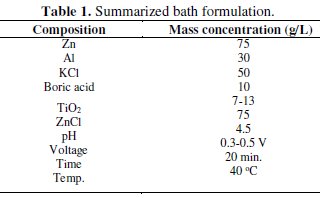
mild steel. The admixed bath compositions for the coatings are shown in <a href="#t1">Table 1</a>, 
and they were prepared two weeks before the plating.</p>


    <p>&nbsp;</p>
<a name="t1">
<img src="/img/revistas/pea/v35n5/35n5a04t1.jpg">
    
<p>&nbsp;</p>


    ]]></body>
<body><![CDATA[<p>Boric acid and other 
ingredients were added, and a pH of 4.5 was attained. A constant static current 
density was used to produce Zn-Al-TiO2 coating series. A current density of 
1.0A/cm<sup>2</sup> was used for the deposition at a varying voltage between 0.3-0.5 V. 
The rinsing was done in distilled water for 5 seconds, and then later air dried.</p>

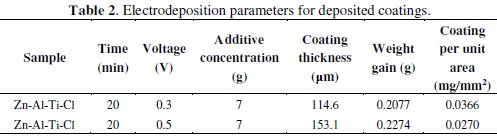
    <p><a href="#t2">Table 2</a> shows the bath process formulation.</p>


    <p>&nbsp;</p>
<a name="t2">
<img src="/img/revistas/pea/v35n5/35n5a04t2.jpg">
    
<p>&nbsp;</p>


    <p><i>Characterization of the electrodeposited samples</i></p>

    <p>The structural properties of the sample were examined by scanning using a JEOL 
JSM 6390 electron microscope. An Emco-test micro-hardness tester machine 
was used to determine the hardness values of the samples. Indentation of five 
points and 15 seconds dwell with 100 g load were used in this work.</p>


    <p><i>Reciprocating wear test</i></p>

    <p>Reciprocating ball-on-flat sliding wear tests were performed on a CETR UMT-2 
tribometer. For sliding wear tests, a 20 &times; 20 mm coated mild steel substrate was 
cut, and an aluminum ball of 10 mm diameter was engaged as counterface. The 
tests were performed under a load of 5 N with a distance of 2.000 m, oscillating 
frequency of 5 Hz, and wear stroke length of 2 mm. The tests were carried in 
both dry sliding conditions. All tests were carried out at room temperature. The 
average wear depths of the samples at the end were used to evaluate the dry 
sliding wear performance.</p>


    <p>&nbsp;</p>
    <p><b>Results and discussion</b></p>

    ]]></body>
<body><![CDATA[<p><i><b>Characterization of the substrate</b></i></p>

    <p>The substrate metal used in this study is mild steel. The spectrometer chemical 
composition is detailed in <a href="#t3">Table 3</a>.</p>


    <p>&nbsp;</p>
<a name="t3">
<img src="/img/revistas/pea/v35n5/35n5a04t3.jpg">
    
<p>&nbsp;</p>


    <p>From the steel elemental evaluation, Fe is the 
major constituent with over 99%, and there is a carbon content of approximately 
0.15%, among other visible elements in attendance. The average over all 
percentage of other metals is at minute quantity. The SEM structure of the 
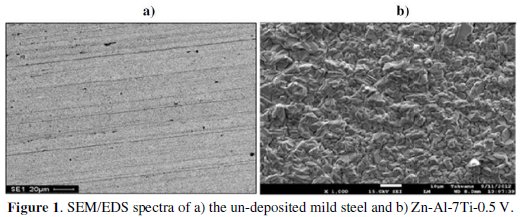
working steel is shown in <a href="#f1">Fig. 1</a> with clearly prepared surface appearance.</p>


    <p>&nbsp;</p>
<a name="f1">
<img src="/img/revistas/pea/v35n5/35n5a04f1.jpg">
    
<p>&nbsp;</p>


    <p><i><b>Properties and characteristics of deposited alloys</b></i></p>

    <p><a href="#f1">Fig. 1a</a> and <a href="#f1">1b</a> shows the SEM of the as-received and the deposited alloy at Zn-Al7Ti-
0.5 V. The presence of process parameter is obvious on the produced alloy, 
with distinctive crystal growth and homogenous dispatched grains. More so, the 
coating appears to have a strong bond beneficial effect on TiO2 and aluminium in 
adequate concentration, which promotes the adhesion behaviour and interlock 
seen at the interface of the alloyed coating.</p>

    <p>No doubt that the structural differences maximally depend on the embedded 
volume of the particulate in the deposit and the corresponding applied potential 
which, in turn, gives smaller regular grains, without porosity. More so, it is worth 
mentioning that particles cannot provide preferential nucleation vacancies for the 
next stage layer of deposition, without the effort of Zn-based sample, which often 
results into crystal buildup, leaving the particulate to gain a robust structural 
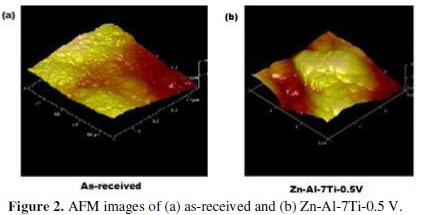
cohesion with other composite. <a href="#f2">Fig. 2</a> shows the adhesion characteristic and 
topography of Zn-Al-TiO2 composite, as against the as-received samples.</p>


    ]]></body>
<body><![CDATA[<p>&nbsp;</p>
<a name="f2">
<img src="/img/revistas/pea/v35n5/35n5a04f2.jpg">
    
<p>&nbsp;</p>


    <p>From the presented structure, it is clear that the as-received sample has no evidence of 
crystal growth; see <a href="#f2">Fig. 2a</a>. With Zn-Al-7TiO2-0.5 V alloy coating, a compact 
fine topography, which connotes deposit profile, was seen at the surfaces. This is 
in line with the study made by [5].</p>

    <p>In addition, the deposited layer has some micro-crystallites hexagonal flakes with 
uniform distribution and slight agglomeration, which, to some extent, contribute 
to the topographic properties of Zn-Al-7TiO2-0.5 V coating and could influence 
its performance characteristics. -7TiO2-0.5 V coating and could influence its 
performance characteristics.</p>

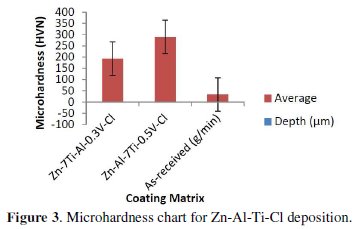
    <p><a href="#f3">Fig. 3</a> shows the progression of developed coatings on the hardness.</p>


    <p>&nbsp;</p>
<a name="f3">
<img src="/img/revistas/pea/v35n5/35n5a04f3.jpg">
    
<p>&nbsp;</p>


    <p>From the chart, it is clear that there is an improved microhardness trend for the composites 
coated samples, as against the mild steel substrate, although applied potential was 
seen to actually determine the trend of the improvement of the hardness 
characteristics of the coating. It is obvious that the impediment and the combined 
effect of TiO2 with aluminum metal provoked decreases in crystallites size, 
resulting in a strong crystallite distributed across the entire surfaces, which 
invariably gives solid hard layers.</p>

    <p>Agreeing to [8, 9], titanium composite particles incorporated in Zn matrix can act 
as seeds for the whiskers growth; [10] added that, through a strengthening 
mechanism, either via dispersion strengthening or particle strengthening, the 
whiskers growth will invariably result into higher microhardness. From all these 
indications, coatings with Zn-Al-7Ti-0.5 V-Cl (289.6 HVN), with higher micro-
hardness value, follow the above assertion. With lesser potentials, Zn-Al-7Ti-0.3 
V-Cl has 193.4 HVN hardness performance. The microhardness of the mild steel 
is approximately 34 HVN; this implies that all composite produced coatings had 
a significant impact on the mild steel improvement.</p>

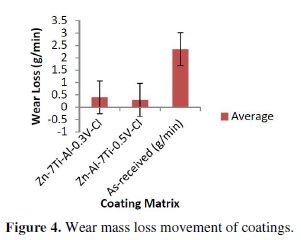
    <p><a href="#f4">Fig. 4</a> shows the compressive wear mass loss of coatings as against the as-
received mild steel substrate.</p>


    ]]></body>
<body><![CDATA[<p>&nbsp;</p>
<a name="f4">
<img src="/img/revistas/pea/v35n5/35n5a04f4.jpg">
    
<p>&nbsp;</p>


    <p>The result of the wear assessment shows a 
progressive trend, as that of the hardness behaviour correspondent. From all 
observations, the structural evolution is seen to significantly impact on the 
inclination tendency of plastic deformation, although [5, 6] mentioned that the 
control of microstructure plays a vital role on the wear movement, as seen in <a href="#f4">Fig. 4</a>.
The effort of process parameter, especially the applied potential, could be seen 
to significantly influence the wear performance. A coating composite fabricated 
with Zn-Al-7Ti-0.5 V-Cl processed an average wear resistance of about 0.3 
g/min, as against the as-received sample, with massive wear plastic deformation 
of 2.351 g/min. The maximum wear loss is 0.4 g/min for Zn-Al-7Ti-0.3 V-Cl.</p>


    <p>&nbsp;</p>
    <p><b>Conclusions</b></p>

    <p>- The co-deposition of chloride alloy was successful, with evidence of good 
structural properties.</p>

    <p>- The structural build up results into significant wear and hardness integrity.</p>

    <p>- The incorporation of Al-TiO2 series into the Zn coating also creates a superior 
surface active topography needed for a cohesive coating, which massively 
contributes to the attained improved coating performance.</p>


    <p>&nbsp;</p>
    <p><b>References</b></p>

    ]]></body>
<body><![CDATA[<!-- ref --><p>1. Fayomi OSI, Popoola API. Int J Electro Sci. 2012;7:6555.    &nbsp;&nbsp;&nbsp;&nbsp;&nbsp;&nbsp;&nbsp;&nbsp;[&#160;<a href="javascript:void(0);" onclick="javascript: window.open('/scielo.php?script=sci_nlinks&ref=429757&pid=S0872-1904201700050000400001&lng=','','width=640,height=500,resizable=yes,scrollbars=1,menubar=yes,');">Links</a>&#160;]<!-- end-ref --></p>

    <!-- ref --><p>2. Lee CK. Trib Inter. 2012;55:7.    &nbsp;&nbsp;&nbsp;&nbsp;&nbsp;&nbsp;&nbsp;&nbsp;[&#160;<a href="javascript:void(0);" onclick="javascript: window.open('/scielo.php?script=sci_nlinks&ref=429759&pid=S0872-1904201700050000400002&lng=','','width=640,height=500,resizable=yes,scrollbars=1,menubar=yes,');">Links</a>&#160;]<!-- end-ref --></p>

    <!-- ref --><p>3. Gomes A, Frade T, Nogueira ID. Current Micro Con. Adv Sci Tech. 2012;2:1146.    &nbsp;&nbsp;&nbsp;&nbsp;&nbsp;&nbsp;&nbsp;&nbsp;[&#160;<a href="javascript:void(0);" onclick="javascript: window.open('/scielo.php?script=sci_nlinks&ref=429761&pid=S0872-1904201700050000400003&lng=','','width=640,height=500,resizable=yes,scrollbars=1,menubar=yes,');">Links</a>&#160;]<!-- end-ref --></p>

    <!-- ref --><p>4. Fayomi OSI, Popoola API. Res Chem Int. 2013;39:1354.    &nbsp;&nbsp;&nbsp;&nbsp;&nbsp;&nbsp;&nbsp;&nbsp;[&#160;<a href="javascript:void(0);" onclick="javascript: window.open('/scielo.php?script=sci_nlinks&ref=429763&pid=S0872-1904201700050000400004&lng=','','width=640,height=500,resizable=yes,scrollbars=1,menubar=yes,');">Links</a>&#160;]<!-- end-ref --></p>

    <!-- ref --><p>5. Popoola API, Aigbodion VS, Fayomi OSI. J Alloys Compd. 2016;654:561.    &nbsp;&nbsp;&nbsp;&nbsp;&nbsp;&nbsp;&nbsp;&nbsp;[&#160;<a href="javascript:void(0);" onclick="javascript: window.open('/scielo.php?script=sci_nlinks&ref=429765&pid=S0872-1904201700050000400005&lng=','','width=640,height=500,resizable=yes,scrollbars=1,menubar=yes,');">Links</a>&#160;]<!-- end-ref --></p>

    ]]></body>
<body><![CDATA[<!-- ref --><p>6. Shanaghi A, Sabour AR, Shahrabi T, et al. Prot Met Phys Chem Surf. 2009;45:305.    &nbsp;&nbsp;&nbsp;&nbsp;&nbsp;&nbsp;&nbsp;&nbsp;[&#160;<a href="javascript:void(0);" onclick="javascript: window.open('/scielo.php?script=sci_nlinks&ref=429767&pid=S0872-1904201700050000400006&lng=','','width=640,height=500,resizable=yes,scrollbars=1,menubar=yes,');">Links</a>&#160;]<!-- end-ref --></p>

    <!-- ref --><p>7. Vathsala K, Venkatesha TV. J Appl Surf Sci. 2011;257:8929.    &nbsp;&nbsp;&nbsp;&nbsp;&nbsp;&nbsp;&nbsp;&nbsp;[&#160;<a href="javascript:void(0);" onclick="javascript: window.open('/scielo.php?script=sci_nlinks&ref=429769&pid=S0872-1904201700050000400007&lng=','','width=640,height=500,resizable=yes,scrollbars=1,menubar=yes,');">Links</a>&#160;]<!-- end-ref --></p>

    <!-- ref --><p>8. Popoola ASI, Fayomi OSI, Popoola OM. Int. J. Electrochem Science. 2012;7:4860.    &nbsp;&nbsp;&nbsp;&nbsp;&nbsp;&nbsp;&nbsp;&nbsp;[&#160;<a href="javascript:void(0);" onclick="javascript: window.open('/scielo.php?script=sci_nlinks&ref=429771&pid=S0872-1904201700050000400008&lng=','','width=640,height=500,resizable=yes,scrollbars=1,menubar=yes,');">Links</a>&#160;]<!-- end-ref --></p>

    <!-- ref --><p>9. Fayomi OSI, Popoola API, Olorunniwo OE. Int J Adv Manuf Technol. 2016;87:389.    &nbsp;&nbsp;&nbsp;&nbsp;&nbsp;&nbsp;&nbsp;&nbsp;[&#160;<a href="javascript:void(0);" onclick="javascript: window.open('/scielo.php?script=sci_nlinks&ref=429773&pid=S0872-1904201700050000400009&lng=','','width=640,height=500,resizable=yes,scrollbars=1,menubar=yes,');">Links</a>&#160;]<!-- end-ref --></p>

    <!-- ref --><p>10. Fayomi OSI, Popoola API, Oloruntoba DT, Prot Met Phys Chem Surf. 2016;52:512.    &nbsp;&nbsp;&nbsp;&nbsp;&nbsp;&nbsp;&nbsp;&nbsp;[&#160;<a href="javascript:void(0);" onclick="javascript: window.open('/scielo.php?script=sci_nlinks&ref=429775&pid=S0872-1904201700050000400010&lng=','','width=640,height=500,resizable=yes,scrollbars=1,menubar=yes,');">Links</a>&#160;]<!-- end-ref --></p>

    ]]></body>
<body><![CDATA[<!-- ref --><p>11. Zhu X, Cai C, Zheng G, et al. Trans. Non Ferr Met Soc China. 2011;21:2216.    &nbsp;&nbsp;&nbsp;&nbsp;&nbsp;&nbsp;&nbsp;&nbsp;[&#160;<a href="javascript:void(0);" onclick="javascript: window.open('/scielo.php?script=sci_nlinks&ref=429777&pid=S0872-1904201700050000400011&lng=','','width=640,height=500,resizable=yes,scrollbars=1,menubar=yes,');">Links</a>&#160;]<!-- end-ref --></p>

    <!-- ref --><p>12. Arici M, Nazir H, Aksu A. J Alloys Compd. 2011;509:1534.    &nbsp;&nbsp;&nbsp;&nbsp;&nbsp;&nbsp;&nbsp;&nbsp;[&#160;<a href="javascript:void(0);" onclick="javascript: window.open('/scielo.php?script=sci_nlinks&ref=429779&pid=S0872-1904201700050000400012&lng=','','width=640,height=500,resizable=yes,scrollbars=1,menubar=yes,');">Links</a>&#160;]<!-- end-ref --></p>

    <!-- ref --><p>13. Popoola API, Fayomi OSI, Popoola OM. Int J Electro Sci. 2012;7:4898.    &nbsp;&nbsp;&nbsp;&nbsp;&nbsp;&nbsp;&nbsp;&nbsp;[&#160;<a href="javascript:void(0);" onclick="javascript: window.open('/scielo.php?script=sci_nlinks&ref=429781&pid=S0872-1904201700050000400013&lng=','','width=640,height=500,resizable=yes,scrollbars=1,menubar=yes,');">Links</a>&#160;]<!-- end-ref --></p>

    <!-- ref --><p>14. Praveen BM, Venkatesha TV. Appl Surf Sci. 2008;254:2418.    &nbsp;&nbsp;&nbsp;&nbsp;&nbsp;&nbsp;&nbsp;&nbsp;[&#160;<a href="javascript:void(0);" onclick="javascript: window.open('/scielo.php?script=sci_nlinks&ref=429783&pid=S0872-1904201700050000400014&lng=','','width=640,height=500,resizable=yes,scrollbars=1,menubar=yes,');">Links</a>&#160;]<!-- end-ref --></p>


    <p>&nbsp;</p>
    <p><a name=0></a><sup><a href="#top">*</a></sup>Corresponding author. E-mail address: <a href="mailto:ojosundayfayomi3@gmail.com">ojosundayfayomi3@gmail.com</a></p>

    ]]></body>
<body><![CDATA[<p>Received December 31, 2016; accepted March 31, 2017</p>

    <p><a href="http://www.peacta.org" target="_blank">www.peacta.org</a> </p>


     ]]></body><back>
<ref-list>
<ref id="B1">
<label>1</label><nlm-citation citation-type="journal">
<person-group person-group-type="author">
<name>
<surname><![CDATA[Fayomi]]></surname>
<given-names><![CDATA[O S I]]></given-names>
</name>
<name>
<surname><![CDATA[Popoola]]></surname>
<given-names><![CDATA[A P I]]></given-names>
</name>
</person-group>
<source><![CDATA[Int J Electro Sci]]></source>
<year>2012</year>
<volume>7</volume>
<page-range>6555</page-range></nlm-citation>
</ref>
<ref id="B2">
<label>2</label><nlm-citation citation-type="journal">
<person-group person-group-type="author">
<name>
<surname><![CDATA[Lee]]></surname>
<given-names><![CDATA[C K]]></given-names>
</name>
</person-group>
<source><![CDATA[Trib Inter]]></source>
<year>2012</year>
<volume>55</volume>
<page-range>7</page-range></nlm-citation>
</ref>
<ref id="B3">
<label>3</label><nlm-citation citation-type="journal">
<person-group person-group-type="author">
<name>
<surname><![CDATA[Gomes]]></surname>
<given-names><![CDATA[A]]></given-names>
</name>
<name>
<surname><![CDATA[Frade]]></surname>
<given-names><![CDATA[T]]></given-names>
</name>
<name>
<surname><![CDATA[Nogueira]]></surname>
<given-names><![CDATA[I D]]></given-names>
</name>
</person-group>
<source><![CDATA[Current Micro Con. Adv Sci Tech]]></source>
<year>2012</year>
<volume>2</volume>
<page-range>1146</page-range></nlm-citation>
</ref>
<ref id="B4">
<label>4</label><nlm-citation citation-type="journal">
<person-group person-group-type="author">
<name>
<surname><![CDATA[Fayomi]]></surname>
<given-names><![CDATA[O S I]]></given-names>
</name>
<name>
<surname><![CDATA[Popoola]]></surname>
<given-names><![CDATA[A P I]]></given-names>
</name>
</person-group>
<source><![CDATA[Res Chem Int]]></source>
<year>2013</year>
<volume>39</volume>
<page-range>1354</page-range></nlm-citation>
</ref>
<ref id="B5">
<label>5</label><nlm-citation citation-type="journal">
<person-group person-group-type="author">
<name>
<surname><![CDATA[Popoola]]></surname>
<given-names><![CDATA[A P I]]></given-names>
</name>
<name>
<surname><![CDATA[Aigbodion]]></surname>
<given-names><![CDATA[V S]]></given-names>
</name>
<name>
<surname><![CDATA[Fayomi]]></surname>
<given-names><![CDATA[O S I]]></given-names>
</name>
</person-group>
<source><![CDATA[J Alloys Compd]]></source>
<year>2016</year>
<volume>654</volume>
<page-range>561</page-range></nlm-citation>
</ref>
<ref id="B6">
<label>6</label><nlm-citation citation-type="journal">
<person-group person-group-type="author">
<name>
<surname><![CDATA[Shanaghi]]></surname>
<given-names><![CDATA[A]]></given-names>
</name>
<name>
<surname><![CDATA[Sabour]]></surname>
<given-names><![CDATA[A R]]></given-names>
</name>
<name>
<surname><![CDATA[Shahrabi]]></surname>
<given-names><![CDATA[T]]></given-names>
</name>
</person-group>
<source><![CDATA[Prot Met Phys Chem Surf]]></source>
<year>2009</year>
<volume>45</volume>
<page-range>305</page-range></nlm-citation>
</ref>
<ref id="B7">
<label>7</label><nlm-citation citation-type="journal">
<person-group person-group-type="author">
<name>
<surname><![CDATA[Vathsala]]></surname>
<given-names><![CDATA[K]]></given-names>
</name>
<name>
<surname><![CDATA[Venkatesha]]></surname>
<given-names><![CDATA[T V]]></given-names>
</name>
</person-group>
<source><![CDATA[J Appl Surf Sci]]></source>
<year>2011</year>
<volume>257</volume>
<page-range>8929</page-range></nlm-citation>
</ref>
<ref id="B8">
<label>8</label><nlm-citation citation-type="journal">
<person-group person-group-type="author">
<name>
<surname><![CDATA[Popoola]]></surname>
<given-names><![CDATA[A S I]]></given-names>
</name>
<name>
<surname><![CDATA[Fayomi]]></surname>
<given-names><![CDATA[O S I]]></given-names>
</name>
<name>
<surname><![CDATA[Popoola]]></surname>
<given-names><![CDATA[O M]]></given-names>
</name>
</person-group>
<source><![CDATA[Int. J. Electrochem Science]]></source>
<year>2012</year>
<volume>7</volume>
<page-range>4860</page-range></nlm-citation>
</ref>
<ref id="B9">
<label>9</label><nlm-citation citation-type="journal">
<person-group person-group-type="author">
<name>
<surname><![CDATA[Fayomi]]></surname>
<given-names><![CDATA[O S I]]></given-names>
</name>
<name>
<surname><![CDATA[Popoola]]></surname>
<given-names><![CDATA[A P I]]></given-names>
</name>
<name>
<surname><![CDATA[Olorunniwo]]></surname>
<given-names><![CDATA[O E]]></given-names>
</name>
</person-group>
<source><![CDATA[Int J Adv Manuf Technol]]></source>
<year>2016</year>
<volume>87</volume>
<page-range>389</page-range></nlm-citation>
</ref>
<ref id="B10">
<label>10</label><nlm-citation citation-type="journal">
<person-group person-group-type="author">
<name>
<surname><![CDATA[Fayomi]]></surname>
<given-names><![CDATA[O S I]]></given-names>
</name>
<name>
<surname><![CDATA[Popoola]]></surname>
<given-names><![CDATA[A P I]]></given-names>
</name>
<name>
<surname><![CDATA[Oloruntoba]]></surname>
<given-names><![CDATA[D T]]></given-names>
</name>
</person-group>
<source><![CDATA[Prot Met Phys Chem Surf]]></source>
<year>2016</year>
<volume>52</volume>
<page-range>512</page-range></nlm-citation>
</ref>
<ref id="B11">
<label>11</label><nlm-citation citation-type="journal">
<person-group person-group-type="author">
<name>
<surname><![CDATA[Zhu]]></surname>
<given-names><![CDATA[X]]></given-names>
</name>
<name>
<surname><![CDATA[Cai]]></surname>
<given-names><![CDATA[C]]></given-names>
</name>
<name>
<surname><![CDATA[Zheng]]></surname>
<given-names><![CDATA[G]]></given-names>
</name>
</person-group>
<source><![CDATA[Trans. Non Ferr Met Soc China]]></source>
<year>2011</year>
<volume>21</volume>
<page-range>2216</page-range></nlm-citation>
</ref>
<ref id="B12">
<label>12</label><nlm-citation citation-type="journal">
<person-group person-group-type="author">
<name>
<surname><![CDATA[Arici]]></surname>
<given-names><![CDATA[M]]></given-names>
</name>
<name>
<surname><![CDATA[Nazir]]></surname>
<given-names><![CDATA[H]]></given-names>
</name>
<name>
<surname><![CDATA[Aksu]]></surname>
<given-names><![CDATA[A]]></given-names>
</name>
</person-group>
<source><![CDATA[J Alloys Compd]]></source>
<year>2011</year>
<volume>509</volume>
<page-range>1534</page-range></nlm-citation>
</ref>
<ref id="B13">
<label>13</label><nlm-citation citation-type="journal">
<person-group person-group-type="author">
<name>
<surname><![CDATA[Popoola]]></surname>
<given-names><![CDATA[A P I]]></given-names>
</name>
<name>
<surname><![CDATA[Fayomi]]></surname>
<given-names><![CDATA[O S I]]></given-names>
</name>
<name>
<surname><![CDATA[Popoola]]></surname>
<given-names><![CDATA[O M]]></given-names>
</name>
</person-group>
<source><![CDATA[Int J Electro Sci]]></source>
<year>2012</year>
<volume>7</volume>
<page-range>4898</page-range></nlm-citation>
</ref>
<ref id="B14">
<label>14</label><nlm-citation citation-type="journal">
<person-group person-group-type="author">
<name>
<surname><![CDATA[Praveen]]></surname>
<given-names><![CDATA[B M]]></given-names>
</name>
<name>
<surname><![CDATA[Venkatesha]]></surname>
<given-names><![CDATA[T V]]></given-names>
</name>
</person-group>
<source><![CDATA[Appl Surf Sci]]></source>
<year>2008</year>
<volume>254</volume>
<page-range>2418</page-range></nlm-citation>
</ref>
</ref-list>
</back>
</article>