<?xml version="1.0" encoding="ISO-8859-1"?><article xmlns:mml="http://www.w3.org/1998/Math/MathML" xmlns:xlink="http://www.w3.org/1999/xlink" xmlns:xsi="http://www.w3.org/2001/XMLSchema-instance">
<front>
<journal-meta>
<journal-id>0872-1904</journal-id>
<journal-title><![CDATA[Portugaliae Electrochimica Acta]]></journal-title>
<abbrev-journal-title><![CDATA[Port. Electrochim. Acta]]></abbrev-journal-title>
<issn>0872-1904</issn>
<publisher>
<publisher-name><![CDATA[Sociedade Portuguesa de Electroquímica]]></publisher-name>
</publisher>
</journal-meta>
<article-meta>
<article-id>S0872-19042017000600003</article-id>
<article-id pub-id-type="doi">10.4152/pea.201706339</article-id>
<title-group>
<article-title xml:lang="en"><![CDATA[Corrosion Resistance of an SS 316L Alloy in Artificial Saliva in Presence of a Sparkle Fresh Toothpaste]]></article-title>
</title-group>
<contrib-group>
<contrib contrib-type="author">
<name>
<surname><![CDATA[D'Souza]]></surname>
<given-names><![CDATA[Renita]]></given-names>
</name>
<xref ref-type="aff" rid="A01"/>
</contrib>
<contrib contrib-type="author">
<name>
<surname><![CDATA[Chattree]]></surname>
<given-names><![CDATA[A.]]></given-names>
</name>
<xref ref-type="aff" rid="A01"/>
</contrib>
<contrib contrib-type="author">
<name>
<surname><![CDATA[Rajendran]]></surname>
<given-names><![CDATA[S.]]></given-names>
</name>
<xref ref-type="aff" rid="A02"/>
</contrib>
</contrib-group>
<aff id="A01">
<institution><![CDATA[,SHIATS Department of Chemistry ]]></institution>
<addr-line><![CDATA[Allahabad UP]]></addr-line>
<country>India</country>
</aff>
<aff id="A02">
<institution><![CDATA[,St Antony's College of Arts and Science for Women Department of Chemistry ]]></institution>
<addr-line><![CDATA[Dindigul Thamaraipadi]]></addr-line>
<country>India</country>
</aff>
<pub-date pub-type="pub">
<day>00</day>
<month>11</month>
<year>2017</year>
</pub-date>
<pub-date pub-type="epub">
<day>00</day>
<month>11</month>
<year>2017</year>
</pub-date>
<volume>35</volume>
<numero>6</numero>
<fpage>339</fpage>
<lpage>350</lpage>
<copyright-statement/>
<copyright-year/>
<self-uri xlink:href="http://scielo.pt/scielo.php?script=sci_arttext&amp;pid=S0872-19042017000600003&amp;lng=en&amp;nrm=iso"></self-uri><self-uri xlink:href="http://scielo.pt/scielo.php?script=sci_abstract&amp;pid=S0872-19042017000600003&amp;lng=en&amp;nrm=iso"></self-uri><self-uri xlink:href="http://scielo.pt/scielo.php?script=sci_pdf&amp;pid=S0872-19042017000600003&amp;lng=en&amp;nrm=iso"></self-uri><abstract abstract-type="short" xml:lang="en"><p><![CDATA[People are implanted with orthodontic wires made of different materials, to regulate their teeth. The various toothpastes that they use during the course of the treatment may have a corrosive effect on these materials. Hence, the main objective of this study was to evaluate the corrosion behaviour of an SS 316L alloy in artificial saliva in the presence of a sparkle fresh toothpaste. An electrochemical study has been used to investigate the corrosion behaviour of this alloy. Scanning electron microscopy (SEM) imaging gave the morphological data for the sample; however, by using X-ray spectroscopy in conjunction with SEM (EDAX), the elemental composition was determined. Further, the analysis of the protective film formed on the metal surface was done using UV-visible absorption and fluorescence spectra. The corrosion resistance of the SS 316L system in various solutions decreases in the following order: AS+ toothpaste> toothpaste>AS. For AS+ toothpaste system, LPR= 1813475 Ohm cm²; Icorr = 2.464 x 10⁻⁸ A/cm²; Rct =14961 Ohm cm²; Cdl= 3.4088 x10⁻¹⁰ F/cm² and impedance = 4.397 log z/Ohm. The high corrosion resistance offered by the toothpaste is due to the formation of a protective film. It confirmed that the active principles of the toothpaste ingredients have co-ordinated with the SS 316L metal ions through their polar atoms to form a complex.]]></p></abstract>
<kwd-group>
<kwd lng="en"><![CDATA[Orthodontic appliances]]></kwd>
<kwd lng="en"><![CDATA[toothpaste]]></kwd>
<kwd lng="en"><![CDATA[dental alloys]]></kwd>
<kwd lng="en"><![CDATA[impedance]]></kwd>
<kwd lng="en"><![CDATA[resistance]]></kwd>
<kwd lng="en"><![CDATA[ingredients]]></kwd>
</kwd-group>
</article-meta>
</front><body><![CDATA[ 

<!--     <p>&nbsp;</p>
    <p>doi: 10.4152/pea.201706339</p> -->

    <p><b>Corrosion Resistance of an SS 316L Alloy in Artificial Saliva 
in Presence of a Sparkle Fresh Toothpaste</b></p>

    <p>
<b>Renita D'Souza</b><sup><i>a</i>,<a href="#0">*</a></sup>
, <b>A. Chattree</b><sup><i>a</i></sup>
 and <b>S. Rajendran</b><sup><i>b</i></sup>
</p>

    <p><i><sup>a</sup> Department of Chemistry, SHIATS, Allahabad, 211007, UP, India</i></p>

    <p><i><sup>b</sup> Department of Chemistry, St Antony's College of Arts and Science for Women, Amala Annai 
Nagar, Thamaraipadi (Post), Dindigul - 624 005, India</i></p>


    <p>&nbsp;</p>
    <p><b>Abstract</b></p>

    <p>People are implanted with orthodontic wires made of different materials, to regulate 
their teeth. The various toothpastes that they use during the course of the treatment may 
have a corrosive effect on these materials. Hence, the main objective of this study was 
to evaluate the corrosion behaviour of an SS 316L alloy in artificial saliva in the 
presence of a sparkle fresh toothpaste. An electrochemical study has been used to 
investigate the corrosion behaviour of this alloy. Scanning electron microscopy (SEM) 
imaging gave the morphological data for the sample; however, by using X-ray 
spectroscopy in conjunction with SEM (EDAX), the elemental composition was 
determined. Further, the analysis of 
the protective film formed on the metal surface was done using UV-visible absorption 
and fluorescence spectra. The corrosion resistance of the SS 316L system in various 
solutions decreases in the following order: AS+ toothpaste> toothpaste>AS. For AS+ 
toothpaste system, LPR= 1813475 Ohm cm<sup>2</sup>; Icorr = 2.464 x 10<sup>-8</sup> A/cm<sup>2</sup>; Rct =14961 Ohm 
cm<sup>2</sup>; Cdl= 3.4088 x10<sup>-10</sup> F/cm<sup>2</sup> and impedance = 4.397 log z/Ohm. The high corrosion 
resistance offered by the toothpaste is due to the formation of a protective film. It 
confirmed that the active principles of the toothpaste ingredients have co-ordinated with 
the SS 316L metal ions through their polar atoms to form a complex.</p>

    ]]></body>
<body><![CDATA[<p><b><i>Keywords:</i></b> Orthodontic appliances, toothpaste, dental alloys, impedance, resistance, 
ingredients.</p>


    <p>&nbsp;</p>
    <p><b>Introduction</b></p>

    <p>In dentistry, precious metals and alloys often used are Au, Ag, Pt and their 
alloys. They possess good cast ability, ductility and resistance to corrosion [1]. 
The escalating cost of precious metals throughout the 20th century has been one 
of the primary reasons for the development of base metal alloys for dental 
applications. In addition, these non-precious alloys were also found to provide 
better mechanical properties and aesthetics for some oral applications. Due to 
their superior mechanical properties and lower density, certain base metal alloy 
systems are preferred. Stainless steels, nickel-chromium, cobalt-chromium, 
titanium, and nickel-titanium alloys are some of the base metal alloy systems 
most commonly used in dentistry of today [2].</p>


    <p><i><b>Stainless steel alloys</b></i></p>

    <p>Stainless steel has been successfully used in dentistry for almost a century. The 
first stainless steel used for implants contained &sim;18wt% Cr and &sim;8wt% Ni, which 
made it stronger than steel and more resistant to corrosion. Further addition of 
molybdenum (Mo) has improved stainless steels (known as type 316). 
Afterwards, the carbon (C) content has been reduced from 0.08 to 0.03 wt%, 
which improved stainless steel (named as 316L) corrosion resistance to a 
chloride solution [1, 3].</p>


    <p><i><b>Physical properties of metals</b></i></p>

    <p>One important criterion in metals selection is the consideration of their physical 
properties, such as density, melting point, specific heat, thermal conductivity, 
thermal expansion and corrosion. For many applications, one of the most 
important considerations is their deterioration by corrosion. Corrosion of metal 
depends on the metals composition and the corrosive media in the surrounding 
environment [3].</p>

    <p>Chromium has a very strong affinity with oxygen, resulting in the creation of 
chromium oxide on the surface of stainless steel, when it is exposed to oxygen. 
Chromium oxide is a very thin layer that prevents further oxidation of stainless 
steel. Even if stainless steel is scratched and the chromium oxide layer is 
removed, a new chromium oxide layer will form and protect the remaining 
stainless steel beneath it. The chromium oxide layer will continue to protect 
stainless steel and prevent it from undergoing corrosion, as long as there is 
sufficient chromium present in it [4].</p>

    <p>There are several metals and metal alloys used in dentistry and orthodontic 
applications. Corrosion of orthodontic appliances has been thoroughly studied 
[5-10]. The oral cavity represents a harsh environment for orthodontic appliances 
of any kind [11]. The traces of corrosion on the surfaces of metals used in any 
application can be formed after a period of time depending on the mouth 
environment [12]. The corrosion process occurs as a result either of the loss of 
metal ions directly into the solution or of the progressive dissolution of the 
surface films, as a rule oxide or sulphide [13]. Corrosion resistance is one of the 
important features of dental materials, because after introducing the metallic 
biomaterials into the human body, they are subject to a corrosive medium [14]. 
Orthodontic wires are recommended by the dentists to regulate the arrangement 
of teeth. People with these orthodontic wires have to daily brush their teeth. The 
toothpaste that they use may corrode the orthodontic wires in the oral 
environment. Hence, there is a need to investigate the influence of various 
toothpastes on the corrosion resistance of orthodontic wires made of many metals 
and alloys. The following work was undertaken to study the corrosion behaviour 
of an SS 316L alloy in artificial saliva, in the absence and presence of a sparkle 
fresh toothpaste.</p>


    ]]></body>
<body><![CDATA[<p>&nbsp;</p>
    <p><b>Experimental</b></p>

    <p><i><b>Materials</b></i></p>

    <p>The metal specimens, namely, SS 316L, were chosen for the present study. The 
study was carried out in the presence of artificial saliva (AS) using a sparkle 
fresh toothpaste. The composition of SS 316L is Cr (18%), Ni (12%), Mo 
(2.5%), C (&lt;0.03%) and balance is Fe [15]. The composition of artificial saliva in 
g/L-1 is KCl (0.4), NaCl (0.4), CaCl2.2H2O (0.906), NaH2PO4.2H2O (0.690), 
Na2S.9H2O (0.005) and urea (1.0) [16-18].</p>

    <p>The ingredients of the sparkle fresh toothpaste are sodium 
monofluorophosphate (active ingredients), calcium carbonate, carboxymethyl 
cellulose, glycerine, hydrated silica, sodium benzoate, sodium lauryl sulfate, 
sodium saccharin, sorbitol, tetra sodium pyrophosphate and water (inactive 
ingredients).</p>


    <p><i><b>Methods</b></i></p>

    <p><i>Potentiodynamic polarization</i></p>

    <p>Polarization studies were carried out in a CHI-electrochemical workstation with 
impedance, model 660A. A three-electrode cell assembly was used. The 
working electrode used was a thin wire metal specimen. A saturated calomel 
electrode (SCE) was the reference electrode, and platinum was the counter 
electrode. IR contribution was minimized by placing the reference electrode 
close to the working electrode. To attain a steady state open circuit potential, a 
time interval of about 5 minutes was given for the working electrode. The 
corrosion parameters such as corrosion potential (Ecorr), corrosion current (Icorr), 
Tafel slopes (anodic = ba and cathodic = bc) and linear polarization resistance 
(LPR) were calculated. During the polarization study, the scan rate (V/s) was 
0.005; hold time at Ef (s) was zero and quite time (s) was 2.</p>


    <p><i>AC impedance measurements</i></p>

    <p>The measure of the ability of a circuit to resist the flow of electrical current is 
known as impedance. By applying an AC potential to an electrochemical cell and 
then measuring the current through the cell, the electrochemical impedance is 
usually measured using a small excitation signal. The instrument used for the 
polarization study was also used to record AC impedance spectra. The cell setup 
was also the same. The real part (Z') and imaginary part (Z'') of the cell 
impedance were measured in Ohms at various frequencies. Values of the charge 
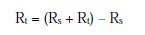
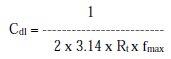
transfer resistance (Rt) and double layer capacitance (Cdl) were calculated from 
the Nyquist plot and the impedance; log (z/Ohm) value was calculated from 
Bode plots. During AC, impedance spectra were recorded: the scan rate (V/s) 
was 0.005; hold time at Ef(s) was zero and quite time (s) was 2. The value of 
charge transfer resistance (Rt) and double layer capacitance (Cdl) were calculated 
from Nyquist plot.</p>


    ]]></body>
<body><![CDATA[<p>&nbsp;</p>
<a name="e1">
<img src="/img/revistas/pea/v35n6/35n6a03s1.jpg">
    
<p>&nbsp;</p>


    <p>(where Rs = solution resistance, Rt =charge transfer resistance)</p>


    <p>&nbsp;</p>
<a name="e2">
<img src="/img/revistas/pea/v35n6/35n6a03s2.jpg">
    
<p>&nbsp;</p>


    <p>where fmax= frequency at maximum imaginary impedance.</p>


    <p><i>UV-visible absorption spectra of solutions</i></p>

    <p>The possibility of the formation of a metal - inhibitor complex in a solution was 
examined by recording its UV-visible absorption spectra for the blank, the 
inhibitor and the best system solution using an Analytic Jena Specord S-100, UV 
-visible spectrometer.</p>


    <p><i>Fluorescence spectroscopy</i></p>

    <p>Fluorescence spectra of solutions, blank, the inhibitor and the best system were 
recorded by using a Jasco-6300 spectrofluorometer.</p>


    ]]></body>
<body><![CDATA[<p><i>Scanning Electron Microscopic studies (SEM)</i></p>

    <p>The surface morphology measurements of the thin wire metal specimen were 
examined using Tescon, Vega3, and a USA computer controlled scanning 
electron microscope. The surface morphology was examined for the thin wire 
metal specimen in absence and in presence of the inhibitor system. The 
specimen immersed in the best system for a period of one day was removed, 
rinsed with double distilled water, dried and observed in a scanning electron 
microscope to examine the surface morphology.</p>


    <p><i>Energy Dispersive Analysis of X-rays (EDAX)</i></p>

    <p>SEM imaging gives the morphological data for a sample; however, by using X-
ray spectroscopy in conjunction with SEM, the elemental composition can be 
determined. The elements present in a material are determined by an EDAX 
spectrum. An energy dispersive X-ray analyzer (EDAX) [Brucker, Nano, 
GMBH, Germany] unit attached to the SEM machine was used to carry out the 
elemental analysis of the metal surface.</p>


    <p>&nbsp;</p>
    <p><b>Results and discussion</b></p>

    <p><i><b>Analysis of potentiodynamic polarization study</b></i></p>

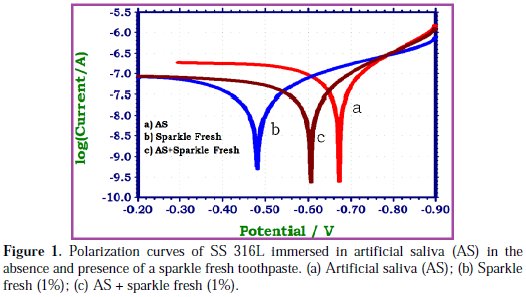
    <p>The polarization curves of SS 316L immersed in various test solutions are shown 
in <a href="#f1">Fig. 1</a>.</p>


    <p>&nbsp;</p>
<a name="f1">
<img src="/img/revistas/pea/v35n6/35n6a03f1.jpg">
    
<p>&nbsp;</p>


    ]]></body>
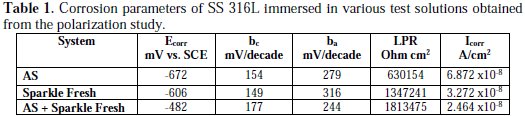
<body><![CDATA[<p>The corrosion parameters, namely, corrosion potential (Ecorr), Tafel slopes (bc = 
cathodic; ba = anodic), linear polarization resistance (LPR) and corrosion current 
(Icorr) derived from polarization curves are given in <a href="#t1">Table 1</a>.</p>


    <p>&nbsp;</p>
<a name="t1">
<img src="/img/revistas/pea/v35n6/35n6a03t1.jpg">
    
<p>&nbsp;</p>


    <p>This observes that, when SS 316L is immersed in AS, the corrosion potential is 
-672 mV vs. SCE. The linear polarization resistance value is 630154 Ohm cm<sup>2</sup>. 
The corrosion current is 6.872 &times; 10<sup>-8</sup> A/cm<sup>2</sup>. When SS 316L is immersed in an 
aqueous solution of (1%) sparkle fresh toothpaste, the corrosion potential is 
shifted to the noble side (-606 mV vs. SCE). The linear polarization resistance 
(LPR) value increases from 630154 Ohm cm<sup>2</sup> to 1347241 Ohm cm<sup>2</sup>. The 
corrosion current decreases from 6.872 &times; 10<sup>-8</sup> A/cm<sup>2</sup> to 3.272 x 10<sup>-8</sup> A/cm<sup>2</sup>. These 
observations indicate that the anodic reaction is predominantly controlled. A 
protective film is formed on the metal surface. Hence, the linear polarization 
resistance (LPR) value increases and corrosion current (Icorr) decreases. The 
protective film may probably consist of complexes formed between stainless 
steel ions and the active principles of the toothpaste ingredients. 
When SS 316L is immersed in an aqueous solution consisting of AS and the 1% 
paste solutions, the corrosion potential is shifted to the anodic side (-482 mV vs. 
SCE). Hence, it is inferred that the anodic reactions are predominantly 
controlled. Further, the linear polarization resistance (LPR) value increases from 
630154 Ohm cm<sup>2</sup> to 1813475 Ohm cm<sup>2</sup>. Corrosion current decreases 
from 6.872 &times; 10<sup>-8</sup> A/cm<sup>2</sup> to 2.464 &times; 10<sup>-8</sup>A/cm<sup>2</sup>. 
These observations indicate that the corrosion 
resistance of SS 316L increases when it is immersed in AS containing aqueous 
solutions of the sparkle fresh toothpaste.</p>


    <p><i><b>Analysis of AC impedance spectra</b></i></p>

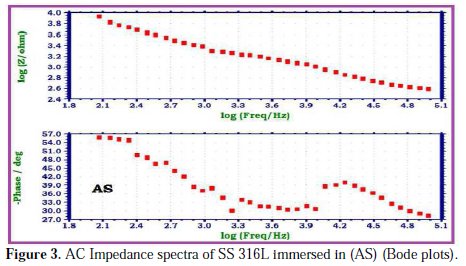
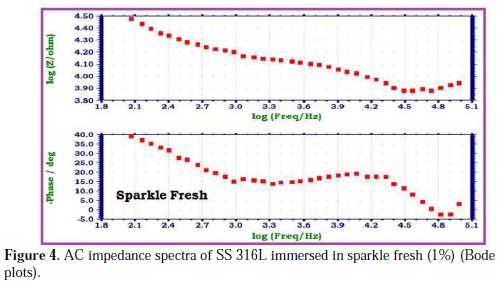
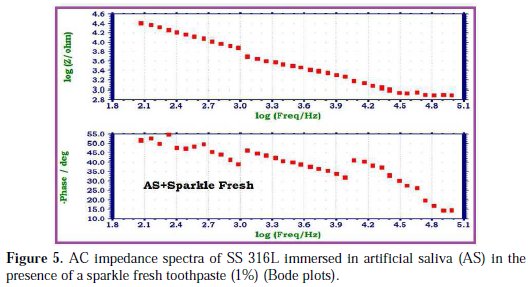
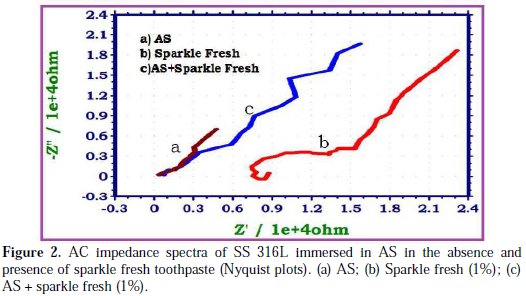
    <p>The AC impedance spectra of SS 316L immersed in various test solutions are 
shown in <a href="#f2">Figs. 2</a>, <a href="#f3">3</a>, <a href="#f4">4</a> and <a href="#f5">5</a>.</p>


    <p>&nbsp;</p>
<a name="f2">
<img src="/img/revistas/pea/v35n6/35n6a03f2.jpg">
    
<p>&nbsp;</p>
<a name="f3">
<img src="/img/revistas/pea/v35n6/35n6a03f3.jpg">
    
<p>&nbsp;</p>
<a name="f4">
<img src="/img/revistas/pea/v35n6/35n6a03f4.jpg">
    
<p>&nbsp;</p>
<a name="f5">
<img src="/img/revistas/pea/v35n6/35n6a03f5.jpg">
    
]]></body>
<body><![CDATA[<p>&nbsp;</p>


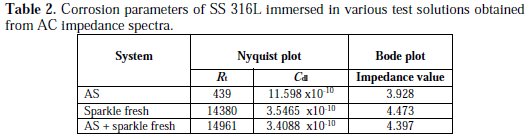
    <p>The Nyquist plots are shown in <a href="#f2">Fig. 2</a>. The Bode plots are shown in 
<a href="#f3">Figs. 3</a>, <a href="#f4">4</a> and <a href="#f5">5</a>. The corrosion 
parameters derived from these plots are shown in <a href="#t2">Table 2</a>.</p>


    <p>&nbsp;</p>
<a name="t2">
<img src="/img/revistas/pea/v35n6/35n6a03t2.jpg">
    
<p>&nbsp;</p>


    <p>When SS 316L is immersed in AS, the charge transfer resistance (Rt) value is 
4397 Ohm cm<sup>2</sup>, the double layer capacitance (Cdl) value is 11.598 x10<sup>-10</sup> F/cm<sup>2</sup> 
and the impedance (log z/Ohm) value is 3.928. When SS 316L is immersed in 
aqueous solutions of (1%) sparkle fresh toothpaste, the charge transfer resistance 
(Rt) value increases from 4397 Ohm cm<sup>2</sup> to 14380 Ohm cm<sup>2</sup>; the double layer 
capacitance value (Cdl) decreases from 11.598 &times; 10<sup>-10</sup> F/cm 2 to 3.5465 &times; 10<sup>-10</sup> 
F/cm<sup>2</sup>, and the impedance value (log z/Ohm) increases from 3.928 to 4.473. 
These observations indicate that a protective film is formed on the metal surface 
when SS 316L is immersed in aqueous solutions of a sparkle fresh toothpaste. 
The protective film prevents the transfer of electrons from the metal surface to 
the bulk of the solutions. Hence, corrosion resistance increases and the rate of 
corrosion decreases. The protective film probably consists of stainless steel ions, 
and the active principle of the toothpaste's ingredients.</p>

    <p>When SS 316L is immersed in AS containing an aqueous solution of sparkle 
fresh toothpaste, the charge transfer resistance (Rt) value increases from 4397 
Ohm cm<sup>2</sup> to 14961 Ohm cm<sup>2</sup>; the double layer capacitance (Cdl) value decreases 
from 11.598 &times; 10<sup>-10</sup> F/cm<sup>2</sup> to 3.4088 &times; 10<sup>-10</sup> F/cm<sup>2</sup>; and the impedance (log 
z/Ohm) value increases from 3.928 to 4.397. It is inferred that, in presence of AS 
containing sparkle fresh toothpaste, the corrosion resistance of SS 316L 
increases.</p>


    <p><i><b>Analysis of UV-visible absorption spectra</b></i></p>

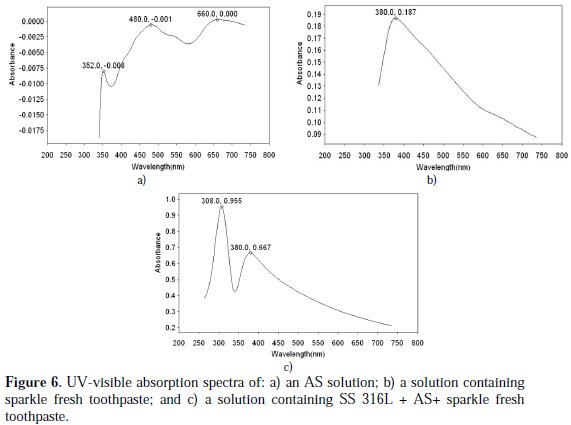
    <p>The UV-visible absorption spectrum is used to confirm the protective film 
formed on the metal surface. The UV-visible absorption spectrum of artificial 
saliva is shown in <a href="#f6">Fig. 6(a)</a>.</p>


    <p>&nbsp;</p>
<a name="f6">
<img src="/img/revistas/pea/v35n6/35n6a03f6.jpg">
    
<p>&nbsp;</p>


    ]]></body>
<body><![CDATA[<p>Peaks appear at 352 nm, 480 nm and 660 nm. The UV-visible absorption spectrum of the toothpaste solution is shown in 
<a href="#f6">Fig. 6(b)</a>. A peak appears at 380 nm. The UV-visible absorption spectrum of the 
solution of AS toothpaste system, where in SS 316L has been immersed for one 
day, is shown in <a href="#f6">Fig. 6(c)</a>.</p>

    <p>A peak appears at 380 nm. There is no shift in the position of &lambda;max of the 
toothpaste system. This indicates that the SS 316L alloy has not undergone 
corrosion in presence of the saliva and toothpaste system. Had there been 
corrosion, there would have been a shift in the position of &lambda;max. The change in 
intensity at 380 nm may be attributed to the fact that there is no electronic 
transition because of the co-ordination of the active principles of the toothpaste's 
ingredients with the SS 316L alloy.</p>


    <p><i><b>Analysis of fluorescence spectra</b></i></p>

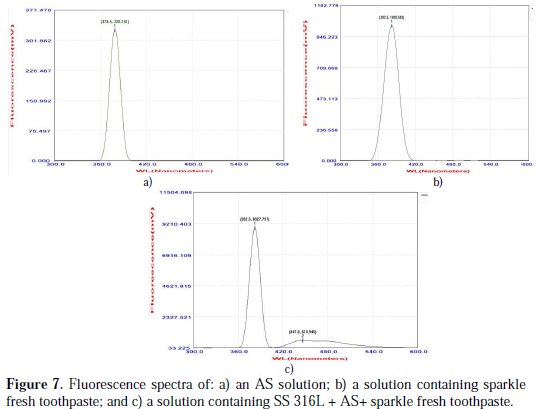
    <p>Fluorescence spectra are used to detect the presence of the metal-inhibitor 
complex formed on the surface of the SS 316L alloy. The fluorescence spectrum 
(&lambda;ex = 300 nm) of AS is shown in <a href="#f7">Fig. 7(a)</a>.</p>


    <p>&nbsp;</p>
<a name="f7">
<img src="/img/revistas/pea/v35n6/35n6a03f7.jpg">
    
<p>&nbsp;</p>


    <p>A peak appears at 378.5 nm. The 
fluorescence spectrum (&lambda;ex = 300 nm) of an aqueous solution of sparkle fresh 
toothpaste is shown in <a href="#f7">Fig. 7(b)</a>. Emission takes place at 381.5 nm. SS 316L was 
immersed in an aqueous solution containing AS and the sparkle fresh toothpaste. 
A solution was obtained. The fluorescence spectrum (&lambda;ex = 300 nm) of this 
solution is shown in <a href="#f7">Fig. 7(c)</a>.</p>

    <p>The peaks appear at 382.5 nm and 447.0 nm. The shift in &lambda;max is not substantial. 
This indicates that SS 18/8 has not undergone substantial corrosion in presence 
of AS and the toothpaste. The slight shift in the &lambda;max value may be due to the 
release of some Cu ions in this system. This indicates that a protective film is 
formed on the metal surface. There is UV-blue emission.</p>


    <p><i><b>Analysis of Scanning Electron Microscopy (SEM)</b></i></p>

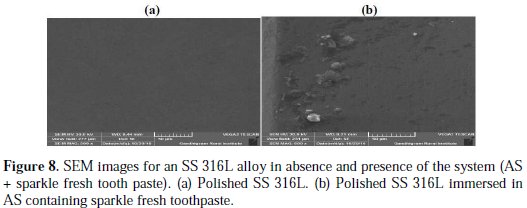
    <p>SEM images for SS 316L alloy in absence and presence of the system are shown 
in <a href="#f8">Fig. 8(a)</a> and <a href="#f8">8(b)</a>.</p>


    ]]></body>
<body><![CDATA[<p>&nbsp;</p>
<a name="f8">
<img src="/img/revistas/pea/v35n6/35n6a03f8.jpg">
    
<p>&nbsp;</p>


    <p>The surface is found to be smooth only for pure polished 
metals; the system surface has become rough due to the presence of a film 
deposited on the metal surface. This protective film is due to the deposition of the 
active principles of the ingredients present in the toothpaste.</p>


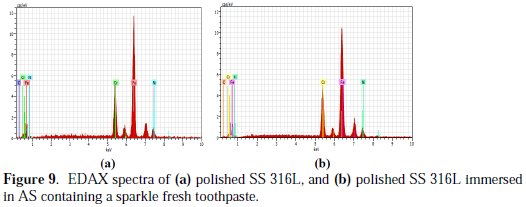
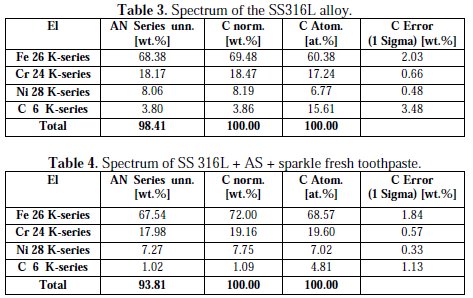
    <p>The EDAX spectra are shown in <a href="#f9">Fig. 9(a)</a> and <a href="#f9">9(b)</a>.</p>


    <p>&nbsp;</p>
<a name="f9">
<img src="/img/revistas/pea/v35n6/35n6a03f9.jpg">
    
<p>&nbsp;</p>


    <p>It is seen from the EDAX 
spectra that Fe, Cr, Ni and C are present in both absence and presence of the 
inhibitor (<a href="#t3">Table 3</a> and <a href="#t3">4</a>).</p>


    <p>&nbsp;</p>
<a name="t3">
<img src="/img/revistas/pea/v35n6/35n6a03t3.jpg">
    
<p>&nbsp;</p>


    <p>But the weight percentage of these elements has 
changed after immersion in the AS containing a sparkle fresh toothpaste. The 
weight percentage of Fe and Cr has increased as weight percentage of C 
decreases. The intensity of the peak of Fe is reduced as the active principles of 
the toothpaste's ingredients form a protective film on the metal surface, thus 
preventing the corrosion of the SS 316L alloy.</p>


    ]]></body>
<body><![CDATA[<p>&nbsp;</p>
    <p><b>Conclusions</b></p>

    <p>In presence of a sparkle fresh toothpaste, corrosion resistance of the SS 316L 
alloy increases. Hence, it is recommended that people implanted with orthodontic 
wires made of SS 316L alloy use sparkle fresh toothpaste to clean their teeth 
without any hesitation. So, dentists can recommend this toothpaste to their 
patients.</p>


    <p>&nbsp;</p>
    <p><b>References</b></p>

    <!-- ref --><p>1. Dongre, Choudaha S. Int J Innov Eng Res. 2016;6:1.    &nbsp;&nbsp;&nbsp;&nbsp;&nbsp;&nbsp;&nbsp;&nbsp;[&#160;<a href="javascript:void(0);" onclick="javascript: window.open('/scielo.php?script=sci_nlinks&ref=430519&pid=S0872-1904201700060000300001&lng=','','width=640,height=500,resizable=yes,scrollbars=1,menubar=yes,');">Links</a>&#160;]<!-- end-ref --></p>

    <!-- ref --><p>2. Roach M. Dent Clin North Am. 2007;51:603.    &nbsp;&nbsp;&nbsp;&nbsp;&nbsp;&nbsp;&nbsp;&nbsp;[&#160;<a href="javascript:void(0);" onclick="javascript: window.open('/scielo.php?script=sci_nlinks&ref=430521&pid=S0872-1904201700060000300002&lng=','','width=640,height=500,resizable=yes,scrollbars=1,menubar=yes,');">Links</a>&#160;]<!-- end-ref --></p>

    <!-- ref --><p>3. Hermawan H, Ramdan D, Djuansjah JRP. Intech. 2011;17:411.    &nbsp;&nbsp;&nbsp;&nbsp;&nbsp;&nbsp;&nbsp;&nbsp;[&#160;<a href="javascript:void(0);" onclick="javascript: window.open('/scielo.php?script=sci_nlinks&ref=430523&pid=S0872-1904201700060000300003&lng=','','width=640,height=500,resizable=yes,scrollbars=1,menubar=yes,');">Links</a>&#160;]<!-- end-ref --></p>

    <!-- ref --><p>4. Wensley A. Mater Sci Res Innov. 2015.    &nbsp;&nbsp;&nbsp;&nbsp;&nbsp;&nbsp;&nbsp;&nbsp;[&#160;<a href="javascript:void(0);" onclick="javascript: window.open('/scielo.php?script=sci_nlinks&ref=430525&pid=S0872-1904201700060000300004&lng=','','width=640,height=500,resizable=yes,scrollbars=1,menubar=yes,');">Links</a>&#160;]<!-- end-ref --></p>

    <!-- ref --><p>5. Walker MP, White RJ, Kula KS. Am J Orthod Dentof Orthop. 2005;127:662.    &nbsp;&nbsp;&nbsp;&nbsp;&nbsp;&nbsp;&nbsp;&nbsp;[&#160;<a href="javascript:void(0);" onclick="javascript: window.open('/scielo.php?script=sci_nlinks&ref=430527&pid=S0872-1904201700060000300005&lng=','','width=640,height=500,resizable=yes,scrollbars=1,menubar=yes,');">Links</a>&#160;]<!-- end-ref --></p>

    <!-- ref --><p>6. Kaneko K, Yokoyama K, Moriyama K, et al. Angle Orthodontist. 2004;74:487.    &nbsp;&nbsp;&nbsp;&nbsp;&nbsp;&nbsp;&nbsp;&nbsp;[&#160;<a href="javascript:void(0);" onclick="javascript: window.open('/scielo.php?script=sci_nlinks&ref=430529&pid=S0872-1904201700060000300006&lng=','','width=640,height=500,resizable=yes,scrollbars=1,menubar=yes,');">Links</a>&#160;]<!-- end-ref --></p>

    <!-- ref --><p>7. Yokoyama K, Kaneko K, Ogawa T, et al. Biomaterials. 2004;26:101.    &nbsp;&nbsp;&nbsp;&nbsp;&nbsp;&nbsp;&nbsp;&nbsp;[&#160;<a href="javascript:void(0);" onclick="javascript: window.open('/scielo.php?script=sci_nlinks&ref=430531&pid=S0872-1904201700060000300007&lng=','','width=640,height=500,resizable=yes,scrollbars=1,menubar=yes,');">Links</a>&#160;]<!-- end-ref --></p>

    <!-- ref --><p>8. Schiff N, Grosgogeat B, Lissac M, et al. Biomaterials. 2004;25:4535.    &nbsp;&nbsp;&nbsp;&nbsp;&nbsp;&nbsp;&nbsp;&nbsp;[&#160;<a href="javascript:void(0);" onclick="javascript: window.open('/scielo.php?script=sci_nlinks&ref=430533&pid=S0872-1904201700060000300008&lng=','','width=640,height=500,resizable=yes,scrollbars=1,menubar=yes,');">Links</a>&#160;]<!-- end-ref --></p>

    <!-- ref --><p>9. Ogawa T, Yokoyama K, Asaoka K, et al. Biomaterials. 2004;25:2419.    &nbsp;&nbsp;&nbsp;&nbsp;&nbsp;&nbsp;&nbsp;&nbsp;[&#160;<a href="javascript:void(0);" onclick="javascript: window.open('/scielo.php?script=sci_nlinks&ref=430535&pid=S0872-1904201700060000300009&lng=','','width=640,height=500,resizable=yes,scrollbars=1,menubar=yes,');">Links</a>&#160;]<!-- end-ref --></p>

    <!-- ref --><p>10. Kaneko K, Yokoyama K, Moriyama K, et al. Biomaterials. 2003;24:2113.    &nbsp;&nbsp;&nbsp;&nbsp;&nbsp;&nbsp;&nbsp;&nbsp;[&#160;<a href="javascript:void(0);" onclick="javascript: window.open('/scielo.php?script=sci_nlinks&ref=430537&pid=S0872-1904201700060000300010&lng=','','width=640,height=500,resizable=yes,scrollbars=1,menubar=yes,');">Links</a>&#160;]<!-- end-ref --></p>

    <p>11. McCann HC. Inorganic components of salivary secretions in art and science 
of dental caries research. Harris RS, editor. New York: Academic Press; 1968. p.55-70.</p>

    <!-- ref --><p>12. House K, Sernetz F, Dymock D, et al. Am J Orthodontics Dentofacial Orthopedics. 2008;133:584.    &nbsp;&nbsp;&nbsp;&nbsp;&nbsp;&nbsp;&nbsp;&nbsp;[&#160;<a href="javascript:void(0);" onclick="javascript: window.open('/scielo.php?script=sci_nlinks&ref=430540&pid=S0872-1904201700060000300012&lng=','','width=640,height=500,resizable=yes,scrollbars=1,menubar=yes,');">Links</a>&#160;]<!-- end-ref --></p>

    <!-- ref --><p>13. Unal, Zor S, Atapek H. Mater Sci. 2012;47:830.    &nbsp;&nbsp;&nbsp;&nbsp;&nbsp;&nbsp;&nbsp;&nbsp;[&#160;<a href="javascript:void(0);" onclick="javascript: window.open('/scielo.php?script=sci_nlinks&ref=430542&pid=S0872-1904201700060000300013&lng=','','width=640,height=500,resizable=yes,scrollbars=1,menubar=yes,');">Links</a>&#160;]<!-- end-ref --></p>

    ]]></body>
<body><![CDATA[<!-- ref --><p>14. Hancu V, Comaneanu RM, Coman C, et al. Rev Chim (Bucharest). 2014;65:706.    &nbsp;&nbsp;&nbsp;&nbsp;&nbsp;&nbsp;&nbsp;&nbsp;[&#160;<a href="javascript:void(0);" onclick="javascript: window.open('/scielo.php?script=sci_nlinks&ref=430544&pid=S0872-1904201700060000300014&lng=','','width=640,height=500,resizable=yes,scrollbars=1,menubar=yes,');">Links</a>&#160;]<!-- end-ref --></p>

    <!-- ref --><p>15. Rajendran S, Uma V, Krishnaveni A, et al. Arab J Sci Eng. 2009;34:147.    &nbsp;&nbsp;&nbsp;&nbsp;&nbsp;&nbsp;&nbsp;&nbsp;[&#160;<a href="javascript:void(0);" onclick="javascript: window.open('/scielo.php?script=sci_nlinks&ref=430546&pid=S0872-1904201700060000300015&lng=','','width=640,height=500,resizable=yes,scrollbars=1,menubar=yes,');">Links</a>&#160;]<!-- end-ref --></p>

    <p>16. S. Rajendran S, Paulraj J, Rengan P, et al. J Dent Oral Hug. 2009;1:1.</p>

    <!-- ref --><p>17. Meyer M. Corros Sci. 1977;17:971.    &nbsp;&nbsp;&nbsp;&nbsp;&nbsp;&nbsp;&nbsp;&nbsp;[&#160;<a href="javascript:void(0);" onclick="javascript: window.open('/scielo.php?script=sci_nlinks&ref=430549&pid=S0872-1904201700060000300017&lng=','','width=640,height=500,resizable=yes,scrollbars=1,menubar=yes,');">Links</a>&#160;]<!-- end-ref --></p>

    <!-- ref --><p>18. Brett MAC, Muresan I. Eng Mater. 2002;230-232:459.    &nbsp;&nbsp;&nbsp;&nbsp;&nbsp;&nbsp;&nbsp;&nbsp;[&#160;<a href="javascript:void(0);" onclick="javascript: window.open('/scielo.php?script=sci_nlinks&ref=430551&pid=S0872-1904201700060000300018&lng=','','width=640,height=500,resizable=yes,scrollbars=1,menubar=yes,');">Links</a>&#160;]<!-- end-ref --></p>


    <p>&nbsp;</p>
    ]]></body>
<body><![CDATA[<p><b>Acknowledgements</b></p>

    <p>The authors are thankful to their respective departments for the help and 
encouragement to carry out this research.</p>


    <p>&nbsp;</p>
    <p><a name=0></a><sup><a href="#top">*</a></sup>Corresponding author. E-mail address: <a href="mailto:renitavinaya@yahoo.com">renitavinaya@yahoo.com</a></p>

    <p>Received November 02, 2016; accepted April 15, 2017</p>

    <p><a href="http://www.peacta.org" target="_blank">www.peacta.org</a> </p>


     ]]></body><back>
<ref-list>
<ref id="B1">
<label>1</label><nlm-citation citation-type="journal">
<person-group person-group-type="author">
<name>
<surname><![CDATA[Dongre]]></surname>
</name>
<name>
<surname><![CDATA[Choudaha]]></surname>
<given-names><![CDATA[S]]></given-names>
</name>
</person-group>
<source><![CDATA[Int J Innov Eng Res]]></source>
<year>2016</year>
<volume>6</volume>
<page-range>1</page-range></nlm-citation>
</ref>
<ref id="B2">
<label>2</label><nlm-citation citation-type="journal">
<person-group person-group-type="author">
<name>
<surname><![CDATA[Roach]]></surname>
<given-names><![CDATA[M]]></given-names>
</name>
</person-group>
<source><![CDATA[Dent Clin North Am]]></source>
<year>2007</year>
<volume>51</volume>
<page-range>603</page-range></nlm-citation>
</ref>
<ref id="B3">
<label>3</label><nlm-citation citation-type="journal">
<person-group person-group-type="author">
<name>
<surname><![CDATA[Hermawan]]></surname>
<given-names><![CDATA[H]]></given-names>
</name>
<name>
<surname><![CDATA[Ramdan]]></surname>
<given-names><![CDATA[D]]></given-names>
</name>
<name>
<surname><![CDATA[Djuansjah]]></surname>
<given-names><![CDATA[J R P]]></given-names>
</name>
</person-group>
<source><![CDATA[Intech]]></source>
<year>2011</year>
<volume>17</volume>
<page-range>411</page-range></nlm-citation>
</ref>
<ref id="B4">
<label>4</label><nlm-citation citation-type="">
<person-group person-group-type="author">
<name>
<surname><![CDATA[Wensley]]></surname>
<given-names><![CDATA[A]]></given-names>
</name>
</person-group>
<source><![CDATA[Mater Sci Res Innov]]></source>
<year>2015</year>
</nlm-citation>
</ref>
<ref id="B5">
<label>5</label><nlm-citation citation-type="journal">
<person-group person-group-type="author">
<name>
<surname><![CDATA[Walker]]></surname>
<given-names><![CDATA[M P]]></given-names>
</name>
<name>
<surname><![CDATA[White]]></surname>
<given-names><![CDATA[R J]]></given-names>
</name>
<name>
<surname><![CDATA[Kula]]></surname>
<given-names><![CDATA[K S]]></given-names>
</name>
</person-group>
<source><![CDATA[Am J Orthod Dentof Orthop]]></source>
<year>2005</year>
<volume>127</volume>
<page-range>662</page-range></nlm-citation>
</ref>
<ref id="B6">
<label>6</label><nlm-citation citation-type="journal">
<person-group person-group-type="author">
<name>
<surname><![CDATA[Kaneko]]></surname>
<given-names><![CDATA[K]]></given-names>
</name>
<name>
<surname><![CDATA[Yokoyama]]></surname>
<given-names><![CDATA[K]]></given-names>
</name>
<name>
<surname><![CDATA[Moriyama]]></surname>
<given-names><![CDATA[K]]></given-names>
</name>
</person-group>
<source><![CDATA[Angle Orthodontist]]></source>
<year>2004</year>
<volume>74</volume>
<page-range>487</page-range></nlm-citation>
</ref>
<ref id="B7">
<label>7</label><nlm-citation citation-type="journal">
<person-group person-group-type="author">
<name>
<surname><![CDATA[Yokoyama]]></surname>
<given-names><![CDATA[K]]></given-names>
</name>
<name>
<surname><![CDATA[Kaneko]]></surname>
<given-names><![CDATA[K]]></given-names>
</name>
<name>
<surname><![CDATA[Ogawa]]></surname>
<given-names><![CDATA[T]]></given-names>
</name>
</person-group>
<source><![CDATA[Biomaterials]]></source>
<year>2004</year>
<volume>26</volume>
<page-range>101</page-range></nlm-citation>
</ref>
<ref id="B8">
<label>8</label><nlm-citation citation-type="journal">
<person-group person-group-type="author">
<name>
<surname><![CDATA[Schiff]]></surname>
<given-names><![CDATA[N]]></given-names>
</name>
<name>
<surname><![CDATA[Grosgogeat]]></surname>
<given-names><![CDATA[B]]></given-names>
</name>
<name>
<surname><![CDATA[Lissac]]></surname>
<given-names><![CDATA[M]]></given-names>
</name>
</person-group>
<source><![CDATA[Biomaterials]]></source>
<year>2004</year>
<volume>25</volume>
<page-range>4535</page-range></nlm-citation>
</ref>
<ref id="B9">
<label>9</label><nlm-citation citation-type="journal">
<person-group person-group-type="author">
<name>
<surname><![CDATA[Ogawa]]></surname>
<given-names><![CDATA[T]]></given-names>
</name>
<name>
<surname><![CDATA[Yokoyama]]></surname>
<given-names><![CDATA[K]]></given-names>
</name>
<name>
<surname><![CDATA[Asaoka]]></surname>
<given-names><![CDATA[K]]></given-names>
</name>
</person-group>
<source><![CDATA[Biomaterials]]></source>
<year>2004</year>
<volume>25</volume>
<page-range>2419</page-range></nlm-citation>
</ref>
<ref id="B10">
<label>10</label><nlm-citation citation-type="journal">
<person-group person-group-type="author">
<name>
<surname><![CDATA[Kaneko]]></surname>
<given-names><![CDATA[K]]></given-names>
</name>
<name>
<surname><![CDATA[Yokoyama]]></surname>
<given-names><![CDATA[K]]></given-names>
</name>
<name>
<surname><![CDATA[Moriyama]]></surname>
<given-names><![CDATA[K]]></given-names>
</name>
</person-group>
<source><![CDATA[Biomaterials]]></source>
<year>2003</year>
<volume>24</volume>
<page-range>2113</page-range></nlm-citation>
</ref>
<ref id="B11">
<label>11</label><nlm-citation citation-type="book">
<person-group person-group-type="author">
<name>
<surname><![CDATA[McCann]]></surname>
<given-names><![CDATA[H C]]></given-names>
</name>
</person-group>
<source><![CDATA[Inorganic components of salivary secretions in art and science of dental caries research]]></source>
<year>1968</year>
<page-range>55-70</page-range><publisher-loc><![CDATA[New York ]]></publisher-loc>
<publisher-name><![CDATA[Academic Press]]></publisher-name>
</nlm-citation>
</ref>
<ref id="B12">
<label>12</label><nlm-citation citation-type="journal">
<person-group person-group-type="author">
<name>
<surname><![CDATA[House]]></surname>
<given-names><![CDATA[K]]></given-names>
</name>
<name>
<surname><![CDATA[Sernetz]]></surname>
<given-names><![CDATA[F]]></given-names>
</name>
<name>
<surname><![CDATA[Dymock]]></surname>
<given-names><![CDATA[D]]></given-names>
</name>
</person-group>
<source><![CDATA[Am J Orthodontics Dentofacial Orthopedics]]></source>
<year>2008</year>
<volume>133</volume>
<page-range>584</page-range></nlm-citation>
</ref>
<ref id="B13">
<label>13</label><nlm-citation citation-type="journal">
<person-group person-group-type="author">
<name>
<surname><![CDATA[Unal]]></surname>
</name>
<name>
<surname><![CDATA[Zor]]></surname>
<given-names><![CDATA[S]]></given-names>
</name>
<name>
<surname><![CDATA[Atapek]]></surname>
<given-names><![CDATA[H]]></given-names>
</name>
</person-group>
<source><![CDATA[Mater Sci]]></source>
<year>2012</year>
<volume>47</volume>
<page-range>830</page-range></nlm-citation>
</ref>
<ref id="B14">
<label>14</label><nlm-citation citation-type="journal">
<person-group person-group-type="author">
<name>
<surname><![CDATA[Hancu]]></surname>
<given-names><![CDATA[V]]></given-names>
</name>
<name>
<surname><![CDATA[Comaneanu]]></surname>
<given-names><![CDATA[R M]]></given-names>
</name>
<name>
<surname><![CDATA[Coman]]></surname>
<given-names><![CDATA[C]]></given-names>
</name>
</person-group>
<source><![CDATA[Rev Chim (Bucharest)]]></source>
<year>2014</year>
<volume>65</volume>
<page-range>706</page-range></nlm-citation>
</ref>
<ref id="B15">
<label>15</label><nlm-citation citation-type="journal">
<person-group person-group-type="author">
<name>
<surname><![CDATA[Rajendran]]></surname>
<given-names><![CDATA[S]]></given-names>
</name>
<name>
<surname><![CDATA[Uma]]></surname>
<given-names><![CDATA[V]]></given-names>
</name>
<name>
<surname><![CDATA[Krishnaveni]]></surname>
<given-names><![CDATA[A]]></given-names>
</name>
</person-group>
<source><![CDATA[Arab J Sci Eng]]></source>
<year>2009</year>
<volume>34</volume>
<page-range>147</page-range></nlm-citation>
</ref>
<ref id="B16">
<label>16</label><nlm-citation citation-type="journal">
<person-group person-group-type="author">
<name>
<surname><![CDATA[Rajendran]]></surname>
<given-names><![CDATA[S]]></given-names>
</name>
<name>
<surname><![CDATA[Paulraj]]></surname>
<given-names><![CDATA[J]]></given-names>
</name>
<name>
<surname><![CDATA[Rengan]]></surname>
<given-names><![CDATA[P]]></given-names>
</name>
</person-group>
<source><![CDATA[J Dent Oral Hug]]></source>
<year>2009</year>
<volume>1</volume><volume>1</volume>
</nlm-citation>
</ref>
<ref id="B17">
<label>17</label><nlm-citation citation-type="journal">
<person-group person-group-type="author">
<name>
<surname><![CDATA[Meyer]]></surname>
<given-names><![CDATA[M]]></given-names>
</name>
</person-group>
<source><![CDATA[Corros Sci]]></source>
<year>1977</year>
<volume>17</volume>
<page-range>971</page-range></nlm-citation>
</ref>
<ref id="B18">
<label>18</label><nlm-citation citation-type="journal">
<person-group person-group-type="author">
<name>
<surname><![CDATA[Brett]]></surname>
<given-names><![CDATA[M A C]]></given-names>
</name>
<name>
<surname><![CDATA[Muresan]]></surname>
<given-names><![CDATA[I]]></given-names>
</name>
</person-group>
<source><![CDATA[Eng Mater]]></source>
<year>2002</year>
<volume>230-232</volume>
<page-range>459</page-range></nlm-citation>
</ref>
</ref-list>
</back>
</article>