<?xml version="1.0" encoding="ISO-8859-1"?><article xmlns:mml="http://www.w3.org/1998/Math/MathML" xmlns:xlink="http://www.w3.org/1999/xlink" xmlns:xsi="http://www.w3.org/2001/XMLSchema-instance">
<front>
<journal-meta>
<journal-id>0872-1904</journal-id>
<journal-title><![CDATA[Portugaliae Electrochimica Acta]]></journal-title>
<abbrev-journal-title><![CDATA[Port. Electrochim. Acta]]></abbrev-journal-title>
<issn>0872-1904</issn>
<publisher>
<publisher-name><![CDATA[Sociedade Portuguesa de Electroquímica]]></publisher-name>
</publisher>
</journal-meta>
<article-meta>
<article-id>S0872-19042017000600005</article-id>
<article-id pub-id-type="doi">10.4152/pea.201706361</article-id>
<title-group>
<article-title xml:lang="en"><![CDATA[Effect of Incorporating a Biodegradable Ecofriendly Additive in Pursuit of Improved Anti-Corrosion, Microstructure and Mechanical Properties of a Zn-based TiO2/TiB2 Coating by DAECD Technique]]></article-title>
</title-group>
<contrib-group>
<contrib contrib-type="author">
<name>
<surname><![CDATA[Fayomi]]></surname>
<given-names><![CDATA[O. S. I.]]></given-names>
</name>
<xref ref-type="aff" rid="A01"/>
<xref ref-type="aff" rid="A02"/>
</contrib>
<contrib contrib-type="author">
<name>
<surname><![CDATA[Popoola]]></surname>
<given-names><![CDATA[A. P. I.]]></given-names>
</name>
<xref ref-type="aff" rid="A01"/>
</contrib>
<contrib contrib-type="author">
<name>
<surname><![CDATA[Kanyane]]></surname>
<given-names><![CDATA[L. R.]]></given-names>
</name>
<xref ref-type="aff" rid="A01"/>
</contrib>
<contrib contrib-type="author">
<name>
<surname><![CDATA[Monyai]]></surname>
<given-names><![CDATA[T.]]></given-names>
</name>
<xref ref-type="aff" rid="A01"/>
</contrib>
</contrib-group>
<aff id="A01">
<institution><![CDATA[,Tshwane University of Technology Department of Chemical, Metallurgical and Materials Engineering ]]></institution>
<addr-line><![CDATA[Pretoria ]]></addr-line>
<country>South Africa</country>
</aff>
<aff id="A02">
<institution><![CDATA[,Covenant University Department of Mechanical Engineering ]]></institution>
<addr-line><![CDATA[Canaan land Ota]]></addr-line>
<country>Nigeria</country>
</aff>
<pub-date pub-type="pub">
<day>00</day>
<month>11</month>
<year>2017</year>
</pub-date>
<pub-date pub-type="epub">
<day>00</day>
<month>11</month>
<year>2017</year>
</pub-date>
<volume>35</volume>
<numero>6</numero>
<fpage>361</fpage>
<lpage>370</lpage>
<copyright-statement/>
<copyright-year/>
<self-uri xlink:href="http://scielo.pt/scielo.php?script=sci_arttext&amp;pid=S0872-19042017000600005&amp;lng=en&amp;nrm=iso"></self-uri><self-uri xlink:href="http://scielo.pt/scielo.php?script=sci_abstract&amp;pid=S0872-19042017000600005&amp;lng=en&amp;nrm=iso"></self-uri><self-uri xlink:href="http://scielo.pt/scielo.php?script=sci_pdf&amp;pid=S0872-19042017000600005&amp;lng=en&amp;nrm=iso"></self-uri><abstract abstract-type="short" xml:lang="en"><p><![CDATA[The incorporation of composite and eco-friendly particles or fluids to develop new engineering materials has recently changed the coating world. In this study, a Zn-TiO2TiB2 ternary alloy was produced from a sulphate bath on a mild steel substrate. Solanum tuberosum (ST) was later introduced to the bath to evaluate the effect of the organic additive on the ternary alloy. The study was conducted under constant plating time and current density. The fabricated matrix was systematically investigated using scanning electron microscope (SEM) coupled with an energy dispersive spectrometer (EDS) for structural properties. The micro hardness and anti-corrosion properties of the deposits were studied using, respectively, a diamond base micro hardness tester and potentiodynamic polarization method. The anti-wear properties and thermal stability of the electrodeposited alloy were studied using a MTR-300 abrasive tester and an isothermal furnace at 250 °C. From the observed result, the coatings presented good stability, especially for Zn-TiO2-TiB2-ST, as compared to the Zn-TiO2-TiB2 coating. The addition of ST improved the hardness properties of the matrix from 182.4 to197.2 HV, and the corrosion rate from 0.9805 to 0.7711 mm/yr. This work established that codeposition of mild steel with TiO2/TiB2/ST is promising in anti-wear and corrosion resistance properties.]]></p></abstract>
<kwd-group>
<kwd lng="en"><![CDATA[Zn-TiO2-TiB2]]></kwd>
<kwd lng="en"><![CDATA[solanum tuberosum (ST)]]></kwd>
<kwd lng="en"><![CDATA[electrodeposition]]></kwd>
<kwd lng="en"><![CDATA[structural properties]]></kwd>
</kwd-group>
</article-meta>
</front><body><![CDATA[ 

<!--     <p>&nbsp;</p>
    <p>doi: 10.4152/pea.201706361</p> -->

    <p><b>Effect of Incorporating a Biodegradable Ecofriendly Additive in Pursuit 
of Improved Anti-Corrosion, Microstructure and Mechanical Properties of a Zn-based 
TiO2/TiB2 Coating by DAECD Technique</b></p>

    <p>
<b>O.S.I. Fayomi</b><sup><i>a,b</i>,<a href="#0">*</a></sup>
, <b>A.P.I. Popoola</b><sup><i>a</i></sup>
, <b>L.R. Kanyane</b><sup><i>a</i></sup>
 and <b>T. Monyai</b><sup><i>a</i></sup>
</p>

    <p><i><sup>a</sup> Department of Chemical, Metallurgical and Materials Engineering, Tshwane 
University of Technology, P.M.B. X680, Pretoria, South Africa</i></p>

    <p><i><sup>b</sup> Department of Mechanical Engineering, Covenant University, P.M.B. 1023, 
Canaan land, Ota, Nigeria</i></p>


    <p>&nbsp;</p>
    <p><b>Abstract</b></p>

    <p>The incorporation of composite and eco-friendly particles or fluids to develop new 
engineering materials has recently changed the coating world. In this study, a Zn-TiO2TiB2 
ternary alloy was produced from a sulphate bath on a mild steel substrate. Solanum 
tuberosum (ST) was later introduced to the bath to evaluate the effect of the organic 
additive on the ternary alloy. The study was conducted under constant plating time and 
current density. The fabricated matrix was systematically investigated using scanning 
electron microscope (SEM) coupled with an energy dispersive spectrometer (EDS) for 
structural properties. The micro hardness and anti-corrosion properties of the deposits 
were studied using, respectively, a diamond base micro hardness tester and 
potentiodynamic polarization method. The anti-wear properties and thermal stability of 
the electrodeposited alloy were studied using a MTR-300 abrasive tester and an 
isothermal furnace at 250 &deg;C. From the observed result, the coatings presented good 
stability, especially for Zn-TiO2-TiB2-ST, as compared to the Zn-TiO2-TiB2 coating. 
The addition of ST improved the hardness properties of the matrix from 182.4 to197.2 
HV, and the corrosion rate from 0.9805 to 0.7711 mm/yr. This work established that codeposition 
of mild steel with TiO2/TiB2/ST is promising in anti-wear and corrosion 
resistance properties.</p>

    ]]></body>
<body><![CDATA[<p><b><i>Keywords:</i></b> Zn-TiO2-TiB2; solanum tuberosum (ST); electrodeposition; structural properties.</p>


    <p>&nbsp;</p>
    <p><b>Introduction</b></p>

    <p>The potential uses of low carbon steel are numerous, especially in engineering 
fields, due to its accessibility, reasonable cost and physical properties, such as 
durability, weldability and strength [1-3]. It has, however, a low life span, due to 
its reactivity to moisture, oxygen, humidity and temperature in the area of 
application, leading to the buildup of rust, which results in failures [4]. The main 
environmental challenges of mild steel are chemical and mechanical interactions. 
The mechanical challenge to steel, that often results in the loss of wear life, high 
friction coefficient and thermal instability, is caused by mechanical interactions 
of two components in contact with each other [5, 6].</p>

    <p>Hence, the need to protect a metal component from this chemical and mechanical 
catastrophe, so as to reduce unexpected failure in service [7]. One of the best 
ways to prevent corrosion and mechanical fallout is to apply an anti-corrosion 
protective coating. A protective coating of a substrate prevents its contact with 
harsh environments (atmospheric, chemical, etc.) [8, 9]. Although many coating 
methods have been used over decades, to minimize or prevent this challenge, the 
attentions have increasingly turned on thin film applications that can offer long-
lasting protection to virtually any substrate [10, 11].</p>

    <p>Electrodeposition has been found to possess good qualities, such as durability, 
strength, improved chemical and mechanical wear life with targeted weight ratio 
in terms of thin film applications. Zinc and zinc alloy coatings have been 
extensively employed on steel structures and components to shield them from 
electrochemical reactions and wear in marine and acidic environments [12-14]. 
In recent times, a shift into binary and ternary alloys, such as Zn-Fe, Zn-Co, Zn-
Ni, Zn-Al, Zn-Si, Zn-Ti, Zn-Cr, Zn-TiC-TiB2 and Zn-Co-Ti [15-17] in a single 
bath, has been undertaken by different authors, in an attempt to obtain a compact 
and adhered functional coating [18]. This tends to improve the corrosion 
resistance, wear abrasion and micro-hardness characteristics of steel, as 
compared to a pure zinc coating.</p>

    <p>However, stress initiation, caused by bath contents, is reported to be the 
challenge of developed coatings over time [18, 19]. Another important 
consideration is the use of environmental toxic bath solutions that are detrimental 
to health. In view of this, an attempt to create a local eco-friendly ingredient that 
could reduce the exorbitant cost of the environmental unfriendliness of 
formulated baths has necessitated this study [20].</p>

    <p>Several studies have reported that anticorrosion and micro hardness properties of 
the electrodeposited samples can be improved by introducing nontoxic, cheap 
organic and inorganic additives as fillers to the bath, to create a strong structural 
bond and reduce stress influence. Such additives are solanum tuberosum, 
saccharum officinarum, N, N-dimethyldodecylamine and 3,4,5-Trimethoxy 
benzaldehyde, to mention but a few [21-22]. More so, these fillers, also known as 
bath enhancers, are said to improve the morphology, decrease porosity and 
increase corrosion resistance properties [22]. Hence, the need to carry out 
research in this area, so as to confirm the potential of these local fillers on the 
developed coating. Therefore, the aim of this work is to study the surface 
structures, wear abrasion, electrochemical resistance and micro-hardness 
properties of Zn-TiO2-TiB2/ST co-deposited alloys on mild steel, with the 
addition of a bath enhancer.</p>


    <p>&nbsp;</p>
    <p><b>Material and methods</b></p>

    ]]></body>
<body><![CDATA[<p><i><b>Material preparation</b></i></p>

    <p>A plane mild steel sheet of 60 mm x 60 mm dimension, with the thickness of 1 
mm, was used as a substrate in this research. Other used materials include a zinc 
plate anode (99.9 % pure) and grinding paper in the order of 60 &mu;m, 120 &mu;m, 400 
&mu;m, 800 &mu;m and 1 600 &mu;m for surface preparation. An electrodeposition bath 
solution was prepared using distilled water. Samples were activated by sinking 
them into a 2 M HCl solution for 10 seconds, and then rinsing them in distilled 
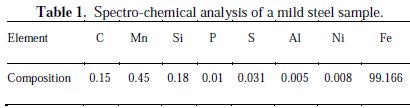
water, which is in accordance with [21]. The spectro-chemical analysis of the 
low carbon steel is presented in <a href="#t1">Table 1</a>.</p>


    <p>&nbsp;</p>
<a name="t1">
<img src="/img/revistas/pea/v35n6/35n6a05t1.jpg">
    
<p>&nbsp;</p>


    <p><i><b>Solanum tuberosum fluid extraction</b></i></p>

    <p>Solanum tuberosum of equivalent weight around 18 g was selected, peeled, 
washed and grated into smaller pieces. Then, the smaller pieces were squeezed 
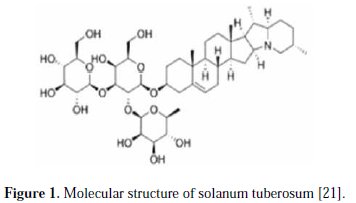
and de-ionized. The extracted fluid was stored in bottles and refrigerated. <a href="#f1">Fig. 1</a> 
presents the molecular structure of solanum tuberosum.</p>


    <p>&nbsp;</p>
<a name="f1">
<img src="/img/revistas/pea/v35n6/35n6a05f1.jpg">
    
<p>&nbsp;</p>


    <p><i><b>Preparation of coating formation</b></i></p>

    <p>The prepared mild steel samples were dipped in plating. Cathode and anode parts 
of the process were connected to the D.C. power supply through a rectifier. 
Electroplating was supported with the applied voltage of 2 V for 20 min at 50 &deg;C. 
Instantly after deposition, the samples were rinsed in distilled water and 
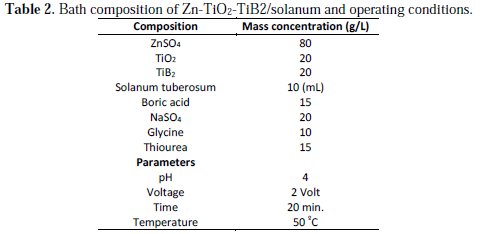
thereafter they were air-dried. <a href="#t2">Table 2</a> presents the electrodeposition bath 
composition along with the operational conditions used.</p>


    ]]></body>
<body><![CDATA[<p>&nbsp;</p>
<a name="t2">
<img src="/img/revistas/pea/v35n6/35n6a05t2.jpg">
    
<p>&nbsp;</p>


    <p><i><b>Surface characterization</b></i></p>

    <p>The surface morphology of the coatings were characterized using a Joel 
JSM6510 Scanning Electron Microscope, (SEM) built with Energy Dispersive 
Spectroscopy (EDS), and a high resolution optical microscope (OPM) was used 
to analyze the samples after corrosion and heat-treated samples.</p>


    <p><i><b>Micro hardness characterization</b></i></p>

    <p>Micro hardness of the co-deposited matrix was studied by using emco test dura 
scan micro hardness tester. A 10 g load was used during the tests and the time 
was 10 s. The detailed values are, for an average of 3 different indentation 
measurements, attained from distinct positions.</p>


    <p><i><b>Abrasive wear studies</b></i></p>

    <p>A dry abrasion rig machine (MTR 300) was employed to define the wear mass 
loss by means of silica sand as wearing medium. The speed used was 200 
rev/min for 60 s. The initial mass of the electroplated samples was assessed 
before testing the samples, and the final mass of the samples was also recorded 
after the dry sliding.</p>


    <p><i><b>Corrosion studies</b></i></p>

    <p>AUTOLAB Galvanostat was employed to investigate the electrochemical 
behavior of the control sample and coated samples in a 3.65 wt% NaCl 
environment. The polarization measurements were carried from 2.5 V as start 
potential to +1.5 V as end potential, and the scanning rate was 0.01 V/s. 
Graphite served as a counter electrode and AgCl was the reference electrode. The 
working electrode was the sample.</p>


    ]]></body>
<body><![CDATA[<p>&nbsp;</p>
    <p><b>Results and discussion</b></p>

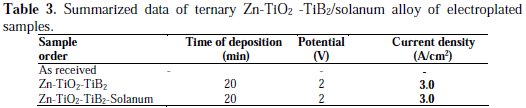
    <p>The summary of the operational conditions during electrodeposition of mild steel 
samples with Zn-TiO2 -TiB2/solanum is presented in <a href="#t3">Table 3</a>.</p>


    <p>&nbsp;</p>
<a name="t3">
<img src="/img/revistas/pea/v35n6/35n6a05t3.jpg">
    
<p>&nbsp;</p>


    <p><i><b>Micrographs studies</b></i></p>

    <p><i>SEM/EDS surface characterisation of electroplated mild steel samples</i></p>

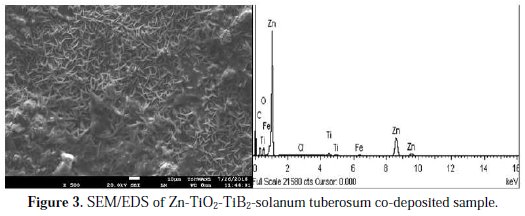
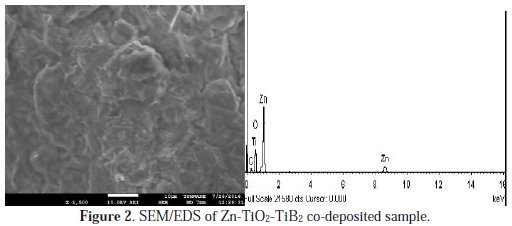
    <p><a href="#f2">Fig. 2</a> and <a href="#f3">3</a> displayed the SEM/EDS structure 
of the electrodeposited samples with and without solanum additives.</p>


    <p>&nbsp;</p>
<a name="f2">
<img src="/img/revistas/pea/v35n6/35n6a05f2.jpg">
    
<p>&nbsp;</p>
<a name="f3">
<img src="/img/revistas/pea/v35n6/35n6a05f3.jpg">
    
]]></body>
<body><![CDATA[<p>&nbsp;</p>


    <p>From all indications, the addition of an 
additive fluid on Zn-TiO2-TiB2 (<a href="#f3">Fig. 3</a>) shows a flake-like crystalline structure. 
The structure shows no trace of porosities, cracks and dispatched agglomeration. 
This implies that possible oriented and adhered crystals were formed. On the 
other hand, non-homogenous and hexagonal crystals were seen on a Zn-TiO2TiB2 
composite coating, which revealed uneven grains refinement (see <a href="#f2">Fig. 2</a>).</p>

    <p>It is noteworthy to mention that a good structural bond is necessary for a suitable 
solid coating, often caused by the condition of the bath and of its additive [6]. No 
doubt that the structural behaviour of the coated alloy with solanum has 
corroborated the study by [8], which has showed that, apart from the process 
parameter effect, the coating state depends on the bath influence. In addition to 
the effect of the additive, there is the effort of the embedded composite TiO2 and 
TiB2 on a zinc rich lattice. The incorporation indicated that a solid precipitation 
arises within the conjugal existence of the process parameter, embedded 
particulate and additives. In view of this, the structural changes result from vital 
coating influences. In addition, in <a href="#f2">Fig. 2</a>, the EDS elemental distribution without 
solanum tuberosum confirmed the presence of elements like Fe, Si, Al, Cl, etc., 
while that of Zn-TiO2-TiB2-ST also confirmed the presence of elements like Ti, 
Zn, Cl, Fe, C and O on the EDs pattern. The EDS results are in line with our 
previous studies [20, 21].</p>


    <p><i><b>Wear study</b></i></p>

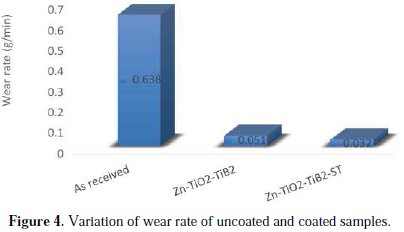
    <p>The wear loss was carried out using silica sand as the wearing media at a 
common load of 10 N. <a href="#f4">Fig. 4</a> displays the wear loss for the control sample, ZnTiO2-
TiB2 and Zn-TiO2-TiB2-ST co-deposition.</p>


    <p>&nbsp;</p>
<a name="f4">
<img src="/img/revistas/pea/v35n6/35n6a05f4.jpg">
    
<p>&nbsp;</p>


    <p>The addition of solanum tuberosum on Zn-TiO2-TiB2 displayed a reduced mass 
loss as compared to the as received sample and deposited alloy without solanum. 
The different wear mass losses for each sample were: 0.638 g/min for the as-
received sample; 0.051 g/min for the Zn-TiO2-TiB2 sample; and 0.032 g/min for 
the Zn-TiO2-TiB2 solanum sample. These results put forward that the addition of 
the bath enhancer and nanoparticles of TiO2 and TiB2 into the Zn matrix 
reinforces a protective wall between the coating layer and the wearing medium. 
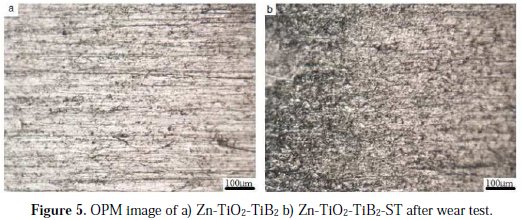
A high resolution optical microscope was used to evaluate the structural 
characteristics of the coated alloy after a wear study, as presented in <a href="#f5">Fig. 5</a>.</p>


    <p>&nbsp;</p>
<a name="f5">
<img src="/img/revistas/pea/v35n6/35n6a05f5.jpg">
    
<p>&nbsp;</p>


    ]]></body>
<body><![CDATA[<p>The structures show that the wear-degradation properties of the Zn-TiO2-TiB2 
(<a href="#f5">Fig. 5a</a>) coating result in a much higher debris compared to the coating influence by 
solanum, which shows a low scar along tracks at the interface, as indicated in <a href="#f5">Fig. 5b</a>.</p>


    <p><i><b>Micro hardness</b></i></p>

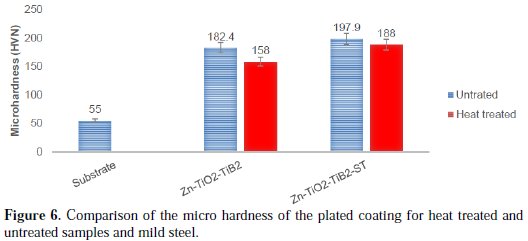
    <p>The micro-hardness properties of the as-received mild steel substrate, Zn-TiO2TiB2 
and Zn-TiO2-TiB2_ST samples were confirmed using an emco test dura scan 
and the obtained results are presented in <a href="#f6">Fig. 6</a>.</p>


    <p>&nbsp;</p>
<a name="f6">
<img src="/img/revistas/pea/v35n6/35n6a05f6.jpg">
    
<p>&nbsp;</p>


    <p>A significant rise in the micro-hardness value was detected in the Zn-TiO2-TiB2ST 
matrix. The pure mild steel sample had the micro hardness value of 55 HVN, 
followed by 182.4 HVN for Zn-TiO2-TiB2 and 197.9 HVN for the coating with 
solanum tuberosum. Thermal stability of the electrodeposited samples at 250 &deg;C 
had no impact in improving the hardness properties of the deposited mild steel. 
According to [22], titanium diboride as a ceramic material has durability and 
relatively high strength, and it is characterized by relatively high values of 
hardness and wear resistance. Hence, the presence of TiO2 and TiB2 also has an 
impact in improving the hardness of plated materials. The rise in the hardness of 
Zn-TiO2-TiB2-ST coated samples was due to the presence of solanum tuberosum 
as an additive, since its structural properties were built up to give it an excellent 
strength.</p>

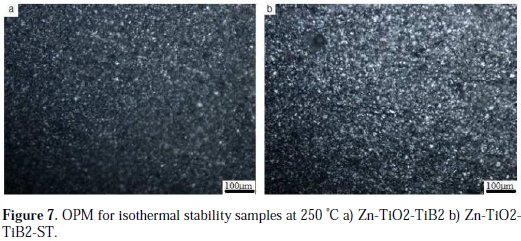
    <p>The micrographs of the heat treated samples show compact grains, and there is 
no evidence of porosities and cracks for both plated samples, as presented in <a href="#f7">Fig. 7</a>.</p>


    <p>&nbsp;</p>
<a name="f7">
<img src="/img/revistas/pea/v35n6/35n6a05f7.jpg">
    
<p>&nbsp;</p>


    <p><i><b>Potentiodynamic polarization studies</b></i></p>

    ]]></body>
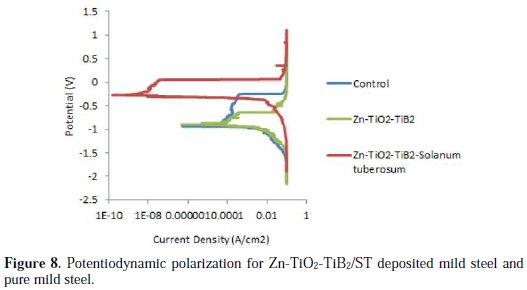
<body><![CDATA[<p><a href="#f8">Fig. 8</a> shows the corrosion behavior of the fabricated composite Zn-TiO2-TiB2, 
Zn-TiO2-TiB2 -ST and as-received samples.</p>


    <p>&nbsp;</p>
<a name="f8">
<img src="/img/revistas/pea/v35n6/35n6a05f8.jpg">
    
<p>&nbsp;</p>


    <p>Zn-TiO2-TiB2 had a little higher 
potential than the as-received sample, which was never expected. This shows 
weaker anti-corrosion properties than those of the protective coating. However, 
on the other hand, the Zn-TiO2-TiB2 -ST matrix witnesses massive passive 
characteristics with the peak potential values of -0.254 V, and a corresponding 
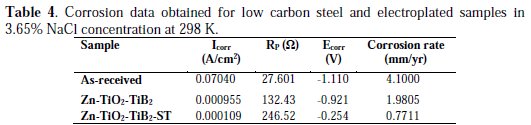
lower corrosion rate, as observed in the Tafel plot represented in <a href="#t4">Table 4</a>.</p>


    <p>&nbsp;</p>
<a name="t4">
<img src="/img/revistas/pea/v35n6/35n6a05t4.jpg">
    
<p>&nbsp;</p>


    <p>The control sample has a higher corrosion rate of about 4.1 mm/yr, due to the 
lack of surface defense against the chloride attack, because a coating protects its 
substrate by preventing its contact with harsh environments, either atmospheric 
or chemical. Meanwhile, Zn-TiO2-TiB2 in the presence of solanum tuberosum 
resulted in a good decrease in the corrosion current, which is due to the thin layer 
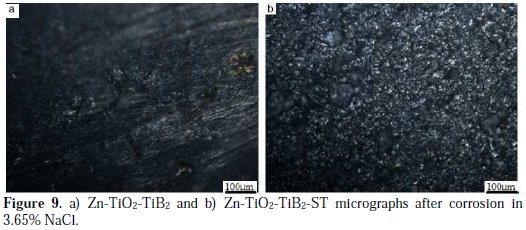
of TiO2, TiB2 and the natural additive added to it. On the optical microscope after 
corrosion (<a href="#f9">Fig. 9</a>), the coating had a strong protective film, and the micrograph 
showed that the acidic chloride did not penetrate through.</p>


    <p>&nbsp;</p>
<a name="f9">
<img src="/img/revistas/pea/v35n6/35n6a05f9.jpg">
    
<p>&nbsp;</p>


    <p>The polarization 
resistance (Rp) of Zn-TiO2-TiB2 -ST had 246.52(&Omega;), which was the highest value 
reached by all the coated samples and the control.</p>


    ]]></body>
<body><![CDATA[<p>&nbsp;</p>
    <p><b>Conclusions</b></p>

    <p>Zn-TiO2-TiB2 and Zn-TiO2-TiB2 /ST were successfully deposited on a mild steel 
surface with homogeneous deposition.</p>

    <p>The EDS of the matrix confirmed the existence of Zn, Ti, and other chemical 
agents from the organic additive.</p>

    <p>The Zn-TiO2-TiB2-ST matrix revealed an improved corrosion resistance as 
compared to Zn-TiO2-TiB2.</p>

    <p>Fluid addition of a natural additive to the electrodeposition bath resulted in a 
reduced texture, and increased micro hardness properties. 
Good anti-wear properties were attained on the deposit.</p>


    <p>&nbsp;</p>
    <p><b>References</b></p>

    <!-- ref --><p>1. Popoola API, Fayomi OSI, Popoola OM. Int J Electrochem Sci. 2012;7:4898.    &nbsp;&nbsp;&nbsp;&nbsp;&nbsp;&nbsp;&nbsp;&nbsp;[&#160;<a href="javascript:void(0);" onclick="javascript: window.open('/scielo.php?script=sci_nlinks&ref=430807&pid=S0872-1904201700060000500001&lng=','','width=640,height=500,resizable=yes,scrollbars=1,menubar=yes,');">Links</a>&#160;]<!-- end-ref --></p>

    ]]></body>
<body><![CDATA[<!-- ref --><p>2. Tiwari SK, Sahu RK, Pramanick AK, et al. J Surf Coat Technol. 2011;25:4960.    &nbsp;&nbsp;&nbsp;&nbsp;&nbsp;&nbsp;&nbsp;&nbsp;[&#160;<a href="javascript:void(0);" onclick="javascript: window.open('/scielo.php?script=sci_nlinks&ref=430809&pid=S0872-1904201700060000500002&lng=','','width=640,height=500,resizable=yes,scrollbars=1,menubar=yes,');">Links</a>&#160;]<!-- end-ref --></p>

    <!-- ref --><p>3. Popoola API, Fayomi OSI, Popoola OM. Int J Electrochem Sci. 2012;7:4860.    &nbsp;&nbsp;&nbsp;&nbsp;&nbsp;&nbsp;&nbsp;&nbsp;[&#160;<a href="javascript:void(0);" onclick="javascript: window.open('/scielo.php?script=sci_nlinks&ref=430811&pid=S0872-1904201700060000500003&lng=','','width=640,height=500,resizable=yes,scrollbars=1,menubar=yes,');">Links</a>&#160;]<!-- end-ref --></p>

    <!-- ref --><p>4. Fayomi OSI, Popoola API. Int J Electrochem Sci., 2012;7:6555.    &nbsp;&nbsp;&nbsp;&nbsp;&nbsp;&nbsp;&nbsp;&nbsp;[&#160;<a href="javascript:void(0);" onclick="javascript: window.open('/scielo.php?script=sci_nlinks&ref=430813&pid=S0872-1904201700060000500004&lng=','','width=640,height=500,resizable=yes,scrollbars=1,menubar=yes,');">Links</a>&#160;]<!-- end-ref --></p>

    <!-- ref --><p>5. Lekka M, Kouloumbi N, Gajo M, et al. Electrochim Acta. 2005;50:4551.    &nbsp;&nbsp;&nbsp;&nbsp;&nbsp;&nbsp;&nbsp;&nbsp;[&#160;<a href="javascript:void(0);" onclick="javascript: window.open('/scielo.php?script=sci_nlinks&ref=430815&pid=S0872-1904201700060000500005&lng=','','width=640,height=500,resizable=yes,scrollbars=1,menubar=yes,');">Links</a>&#160;]<!-- end-ref --></p>

    <!-- ref --><p>6. Popoola API, Fayomi OS. Int J Electrochem Sci. 2011;6:3254.    &nbsp;&nbsp;&nbsp;&nbsp;&nbsp;&nbsp;&nbsp;&nbsp;[&#160;<a href="javascript:void(0);" onclick="javascript: window.open('/scielo.php?script=sci_nlinks&ref=430817&pid=S0872-1904201700060000500006&lng=','','width=640,height=500,resizable=yes,scrollbars=1,menubar=yes,');">Links</a>&#160;]<!-- end-ref --></p>

    ]]></body>
<body><![CDATA[<!-- ref --><p>7. Arici M, Nazir H, Aksu A. J Alloys Comp. 2011;509:1534.    &nbsp;&nbsp;&nbsp;&nbsp;&nbsp;&nbsp;&nbsp;&nbsp;[&#160;<a href="javascript:void(0);" onclick="javascript: window.open('/scielo.php?script=sci_nlinks&ref=430819&pid=S0872-1904201700060000500007&lng=','','width=640,height=500,resizable=yes,scrollbars=1,menubar=yes,');">Links</a>&#160;]<!-- end-ref --></p>

    <!-- ref --><p>8. Fayomi OSI, Popoola API. Res Chem Intermed. 2013;39:6.    &nbsp;&nbsp;&nbsp;&nbsp;&nbsp;&nbsp;&nbsp;&nbsp;[&#160;<a href="javascript:void(0);" onclick="javascript: window.open('/scielo.php?script=sci_nlinks&ref=430821&pid=S0872-1904201700060000500008&lng=','','width=640,height=500,resizable=yes,scrollbars=1,menubar=yes,');">Links</a>&#160;]<!-- end-ref --></p>

    <!-- ref --><p>9. Yan GG, Chai S, Xiong X, et al. Trans Nonferrous Metals Soc China. 2012;22:366.    &nbsp;&nbsp;&nbsp;&nbsp;&nbsp;&nbsp;&nbsp;&nbsp;[&#160;<a href="javascript:void(0);" onclick="javascript: window.open('/scielo.php?script=sci_nlinks&ref=430823&pid=S0872-1904201700060000500009&lng=','','width=640,height=500,resizable=yes,scrollbars=1,menubar=yes,');">Links</a>&#160;]<!-- end-ref --></p>

    <!-- ref --><p>10. Zhang Z, Leng WH, Shao HB, et al. J Electroanal Chem. 2001;516:127.    &nbsp;&nbsp;&nbsp;&nbsp;&nbsp;&nbsp;&nbsp;&nbsp;[&#160;<a href="javascript:void(0);" onclick="javascript: window.open('/scielo.php?script=sci_nlinks&ref=430825&pid=S0872-1904201700060000500010&lng=','','width=640,height=500,resizable=yes,scrollbars=1,menubar=yes,');">Links</a>&#160;]<!-- end-ref --></p>

    <!-- ref --><p>11. Malatji N, Popoola API, Fayomi OSI, et al. Int J Adv Manuf Technol. 2016;82:1335.    &nbsp;&nbsp;&nbsp;&nbsp;&nbsp;&nbsp;&nbsp;&nbsp;[&#160;<a href="javascript:void(0);" onclick="javascript: window.open('/scielo.php?script=sci_nlinks&ref=430827&pid=S0872-1904201700060000500011&lng=','','width=640,height=500,resizable=yes,scrollbars=1,menubar=yes,');">Links</a>&#160;]<!-- end-ref --></p>

    ]]></body>
<body><![CDATA[<!-- ref --><p>12. Fayomi OSI, Popoola API. Surf Eng Appl Electrochem. 2015;51:76.    &nbsp;&nbsp;&nbsp;&nbsp;&nbsp;&nbsp;&nbsp;&nbsp;[&#160;<a href="javascript:void(0);" onclick="javascript: window.open('/scielo.php?script=sci_nlinks&ref=430829&pid=S0872-1904201700060000500012&lng=','','width=640,height=500,resizable=yes,scrollbars=1,menubar=yes,');">Links</a>&#160;]<!-- end-ref --></p>

    <p>13. Kumar MKP, Venkatesha TV, Pavithra MK, et al. Phys Scr. 2011;84:035601.</p>

    <!-- ref --><p>14. Tuaweri TJ, Wilcox GD. Surf Coatings Technol. 2006;200:5921.    &nbsp;&nbsp;&nbsp;&nbsp;&nbsp;&nbsp;&nbsp;&nbsp;[&#160;<a href="javascript:void(0);" onclick="javascript: window.open('/scielo.php?script=sci_nlinks&ref=430832&pid=S0872-1904201700060000500014&lng=','','width=640,height=500,resizable=yes,scrollbars=1,menubar=yes,');">Links</a>&#160;]<!-- end-ref --></p>

    <!-- ref --><p>15. Fayomi OSI, Aigbodion VS, Popoola API. J Fail Anal Preven. 2015;15:54.    &nbsp;&nbsp;&nbsp;&nbsp;&nbsp;&nbsp;&nbsp;&nbsp;[&#160;<a href="javascript:void(0);" onclick="javascript: window.open('/scielo.php?script=sci_nlinks&ref=430834&pid=S0872-1904201700060000500015&lng=','','width=640,height=500,resizable=yes,scrollbars=1,menubar=yes,');">Links</a>&#160;]<!-- end-ref --></p>

    <!-- ref --><p>16. Wang TG, Jeong D, Liu Y, et al. J Surf Coating Technol. 2012;206:2638.    &nbsp;&nbsp;&nbsp;&nbsp;&nbsp;&nbsp;&nbsp;&nbsp;[&#160;<a href="javascript:void(0);" onclick="javascript: window.open('/scielo.php?script=sci_nlinks&ref=430836&pid=S0872-1904201700060000500016&lng=','','width=640,height=500,resizable=yes,scrollbars=1,menubar=yes,');">Links</a>&#160;]<!-- end-ref --></p>

    <!-- ref --><p>17. Hammami O, Dhouibi L, Bercot P, et al. Int J Corros Sci. 2012;8:1.    &nbsp;&nbsp;&nbsp;&nbsp;&nbsp;&nbsp;&nbsp;&nbsp;[&#160;<a href="javascript:void(0);" onclick="javascript: window.open('/scielo.php?script=sci_nlinks&ref=430838&pid=S0872-1904201700060000500017&lng=','','width=640,height=500,resizable=yes,scrollbars=1,menubar=yes,');">Links</a>&#160;]<!-- end-ref --></p>

    <!-- ref --><p>18. Naik YA, Venkatesha TV, Nayak PV. Turk J Chem. 2002;26:725.    &nbsp;&nbsp;&nbsp;&nbsp;&nbsp;&nbsp;&nbsp;&nbsp;[&#160;<a href="javascript:void(0);" onclick="javascript: window.open('/scielo.php?script=sci_nlinks&ref=430840&pid=S0872-1904201700060000500018&lng=','','width=640,height=500,resizable=yes,scrollbars=1,menubar=yes,');">Links</a>&#160;]<!-- end-ref --></p>

    <!-- ref --><p>19. LeRiche EL, Wang-Pruski G, Zheljazkov VD. Hort Science. 2009;44:1866.    &nbsp;&nbsp;&nbsp;&nbsp;&nbsp;&nbsp;&nbsp;&nbsp;[&#160;<a href="javascript:void(0);" onclick="javascript: window.open('/scielo.php?script=sci_nlinks&ref=430842&pid=S0872-1904201700060000500019&lng=','','width=640,height=500,resizable=yes,scrollbars=1,menubar=yes,');">Links</a>&#160;]<!-- end-ref --></p>

    <!-- ref --><p>20. Fayomi OSI, Popoola API, Kanyane LR, et al. Results Phys. 2017;7:644.    &nbsp;&nbsp;&nbsp;&nbsp;&nbsp;&nbsp;&nbsp;&nbsp;[&#160;<a href="javascript:void(0);" onclick="javascript: window.open('/scielo.php?script=sci_nlinks&ref=430844&pid=S0872-1904201700060000500020&lng=','','width=640,height=500,resizable=yes,scrollbars=1,menubar=yes,');">Links</a>&#160;]<!-- end-ref --></p>

    <!-- ref --><p>21. Kanyane LR, Fayomi OSI, Popoola API, et al. Procedia Manuf. 2016;7:584.    &nbsp;&nbsp;&nbsp;&nbsp;&nbsp;&nbsp;&nbsp;&nbsp;[&#160;<a href="javascript:void(0);" onclick="javascript: window.open('/scielo.php?script=sci_nlinks&ref=430846&pid=S0872-1904201700060000500021&lng=','','width=640,height=500,resizable=yes,scrollbars=1,menubar=yes,');">Links</a>&#160;]<!-- end-ref --></p>

    <!-- ref --><p>22. Munro RG. J Res Natl Inst Stand Technol. 2000;105:709.    &nbsp;&nbsp;&nbsp;&nbsp;&nbsp;&nbsp;&nbsp;&nbsp;[&#160;<a href="javascript:void(0);" onclick="javascript: window.open('/scielo.php?script=sci_nlinks&ref=430848&pid=S0872-1904201700060000500022&lng=','','width=640,height=500,resizable=yes,scrollbars=1,menubar=yes,');">Links</a>&#160;]<!-- end-ref --></p>


    <p>&nbsp;</p>
    <p><b>Acknowledgements</b></p>

    <p>The funding from the National Research Foundation is highly appreciated, and 
the authors wish to acknowledge the equipment support by Surface Engineering 
Research Centre (SERC), Tshwane University of Technology Pretoria, South 
Africa.</p>


    <p>&nbsp;</p>
    <p><a name=0></a><sup><a href="#top">*</a></sup>Corresponding author. E-mail address: <a href="mailto:ojosundayfayomi3@gmail.com">ojosundayfayomi3@gmail.com</a></p>

    <p>Received December 20, 2016; accepted April 8, 2017</p>

    <p><a href="http://www.peacta.org" target="_blank">www.peacta.org</a> </p>


     ]]></body><back>
<ref-list>
<ref id="B1">
<label>1</label><nlm-citation citation-type="journal">
<person-group person-group-type="author">
<name>
<surname><![CDATA[Popoola]]></surname>
<given-names><![CDATA[A P I]]></given-names>
</name>
<name>
<surname><![CDATA[Fayomi]]></surname>
<given-names><![CDATA[O S I]]></given-names>
</name>
<name>
<surname><![CDATA[Popoola]]></surname>
<given-names><![CDATA[O M]]></given-names>
</name>
</person-group>
<source><![CDATA[Int J Electrochem Sci]]></source>
<year>2012</year>
<volume>7</volume>
<page-range>4898</page-range></nlm-citation>
</ref>
<ref id="B2">
<label>2</label><nlm-citation citation-type="journal">
<person-group person-group-type="author">
<name>
<surname><![CDATA[Tiwari]]></surname>
<given-names><![CDATA[S K]]></given-names>
</name>
<name>
<surname><![CDATA[Sahu]]></surname>
<given-names><![CDATA[R K]]></given-names>
</name>
<name>
<surname><![CDATA[Pramanick]]></surname>
<given-names><![CDATA[A K]]></given-names>
</name>
</person-group>
<source><![CDATA[J Surf Coat Technol]]></source>
<year>2011</year>
<volume>25</volume>
<page-range>4960</page-range></nlm-citation>
</ref>
<ref id="B3">
<label>3</label><nlm-citation citation-type="journal">
<person-group person-group-type="author">
<name>
<surname><![CDATA[Popoola]]></surname>
<given-names><![CDATA[A P I]]></given-names>
</name>
<name>
<surname><![CDATA[Fayomi]]></surname>
<given-names><![CDATA[O S I]]></given-names>
</name>
<name>
<surname><![CDATA[Popoola]]></surname>
<given-names><![CDATA[O M]]></given-names>
</name>
</person-group>
<source><![CDATA[Int J Electrochem Sci]]></source>
<year>2012</year>
<volume>7</volume>
<page-range>4860</page-range></nlm-citation>
</ref>
<ref id="B4">
<label>4</label><nlm-citation citation-type="journal">
<person-group person-group-type="author">
<name>
<surname><![CDATA[Fayomi]]></surname>
<given-names><![CDATA[O S I]]></given-names>
</name>
<name>
<surname><![CDATA[Popoola]]></surname>
<given-names><![CDATA[A P I]]></given-names>
</name>
</person-group>
<source><![CDATA[Int J Electrochem Sci]]></source>
<year>2012</year>
<volume>7</volume>
<page-range>6555</page-range></nlm-citation>
</ref>
<ref id="B5">
<label>5</label><nlm-citation citation-type="journal">
<person-group person-group-type="author">
<name>
<surname><![CDATA[Lekka]]></surname>
<given-names><![CDATA[M]]></given-names>
</name>
<name>
<surname><![CDATA[Kouloumbi]]></surname>
<given-names><![CDATA[N]]></given-names>
</name>
<name>
<surname><![CDATA[Gajo]]></surname>
<given-names><![CDATA[M]]></given-names>
</name>
</person-group>
<source><![CDATA[Electrochim Acta]]></source>
<year>2005</year>
<volume>50</volume>
<page-range>4551</page-range></nlm-citation>
</ref>
<ref id="B6">
<label>6</label><nlm-citation citation-type="journal">
<person-group person-group-type="author">
<name>
<surname><![CDATA[Popoola]]></surname>
<given-names><![CDATA[A P I]]></given-names>
</name>
<name>
<surname><![CDATA[Fayomi]]></surname>
<given-names><![CDATA[O S]]></given-names>
</name>
</person-group>
<source><![CDATA[Int J Electrochem Sci]]></source>
<year>2011</year>
<volume>6</volume>
<page-range>3254</page-range></nlm-citation>
</ref>
<ref id="B7">
<label>7</label><nlm-citation citation-type="journal">
<person-group person-group-type="author">
<name>
<surname><![CDATA[Arici]]></surname>
<given-names><![CDATA[M]]></given-names>
</name>
<name>
<surname><![CDATA[Nazir]]></surname>
<given-names><![CDATA[H]]></given-names>
</name>
<name>
<surname><![CDATA[Aksu]]></surname>
<given-names><![CDATA[A]]></given-names>
</name>
</person-group>
<source><![CDATA[J Alloys Comp]]></source>
<year>2011</year>
<volume>509</volume>
<page-range>1534</page-range></nlm-citation>
</ref>
<ref id="B8">
<label>8</label><nlm-citation citation-type="journal">
<person-group person-group-type="author">
<name>
<surname><![CDATA[Fayomi]]></surname>
<given-names><![CDATA[O S I]]></given-names>
</name>
<name>
<surname><![CDATA[Popoola]]></surname>
<given-names><![CDATA[A P I]]></given-names>
</name>
</person-group>
<source><![CDATA[Res Chem Intermed]]></source>
<year>2013</year>
<volume>39</volume>
<page-range>6</page-range></nlm-citation>
</ref>
<ref id="B9">
<label>9</label><nlm-citation citation-type="journal">
<person-group person-group-type="author">
<name>
<surname><![CDATA[Yan]]></surname>
<given-names><![CDATA[G G]]></given-names>
</name>
<name>
<surname><![CDATA[Chai]]></surname>
<given-names><![CDATA[S]]></given-names>
</name>
<name>
<surname><![CDATA[Xiong]]></surname>
<given-names><![CDATA[X]]></given-names>
</name>
</person-group>
<source><![CDATA[Trans Nonferrous Metals Soc China]]></source>
<year>2012</year>
<volume>22</volume>
<page-range>366</page-range></nlm-citation>
</ref>
<ref id="B10">
<label>10</label><nlm-citation citation-type="journal">
<person-group person-group-type="author">
<name>
<surname><![CDATA[Zhang]]></surname>
<given-names><![CDATA[Z]]></given-names>
</name>
<name>
<surname><![CDATA[Leng]]></surname>
<given-names><![CDATA[W H]]></given-names>
</name>
<name>
<surname><![CDATA[Shao]]></surname>
<given-names><![CDATA[H B]]></given-names>
</name>
</person-group>
<source><![CDATA[J Electroanal Chem]]></source>
<year>2001</year>
<volume>516</volume>
<page-range>127</page-range></nlm-citation>
</ref>
<ref id="B11">
<label>11</label><nlm-citation citation-type="journal">
<person-group person-group-type="author">
<name>
<surname><![CDATA[Malatji]]></surname>
<given-names><![CDATA[N]]></given-names>
</name>
<name>
<surname><![CDATA[Popoola]]></surname>
<given-names><![CDATA[A P I]]></given-names>
</name>
<name>
<surname><![CDATA[Fayomi]]></surname>
<given-names><![CDATA[O S I]]></given-names>
</name>
</person-group>
<source><![CDATA[Int J Adv Manuf Technol]]></source>
<year>2016</year>
<volume>82</volume>
<page-range>1335</page-range></nlm-citation>
</ref>
<ref id="B12">
<label>12</label><nlm-citation citation-type="journal">
<person-group person-group-type="author">
<name>
<surname><![CDATA[Fayomi]]></surname>
<given-names><![CDATA[O S I]]></given-names>
</name>
<name>
<surname><![CDATA[Popoola]]></surname>
<given-names><![CDATA[A P I]]></given-names>
</name>
</person-group>
<source><![CDATA[Surf Eng Appl Electrochem]]></source>
<year>2015</year>
<volume>51</volume>
<page-range>76</page-range></nlm-citation>
</ref>
<ref id="B13">
<label>13</label><nlm-citation citation-type="journal">
<person-group person-group-type="author">
<name>
<surname><![CDATA[Kumar]]></surname>
<given-names><![CDATA[M K P]]></given-names>
</name>
<name>
<surname><![CDATA[Venkatesha]]></surname>
<given-names><![CDATA[T V]]></given-names>
</name>
<name>
<surname><![CDATA[Pavithra]]></surname>
<given-names><![CDATA[M K]]></given-names>
</name>
</person-group>
<source><![CDATA[Phys Scr]]></source>
<year>2011</year>
<volume>84</volume>
<page-range>35601</page-range></nlm-citation>
</ref>
<ref id="B14">
<label>14</label><nlm-citation citation-type="journal">
<person-group person-group-type="author">
<name>
<surname><![CDATA[Tuaweri]]></surname>
<given-names><![CDATA[T J]]></given-names>
</name>
<name>
<surname><![CDATA[Wilcox]]></surname>
<given-names><![CDATA[G D]]></given-names>
</name>
</person-group>
<source><![CDATA[Surf Coatings Technol]]></source>
<year>2006</year>
<volume>200</volume>
<page-range>5921</page-range></nlm-citation>
</ref>
<ref id="B15">
<label>15</label><nlm-citation citation-type="journal">
<person-group person-group-type="author">
<name>
<surname><![CDATA[Fayomi]]></surname>
<given-names><![CDATA[O S I]]></given-names>
</name>
<name>
<surname><![CDATA[Aigbodion]]></surname>
<given-names><![CDATA[V S]]></given-names>
</name>
<name>
<surname><![CDATA[Popoola]]></surname>
<given-names><![CDATA[A P I]]></given-names>
</name>
</person-group>
<source><![CDATA[J Fail Anal Preven]]></source>
<year>2015</year>
<volume>15</volume>
<page-range>54</page-range></nlm-citation>
</ref>
<ref id="B16">
<label>16</label><nlm-citation citation-type="journal">
<person-group person-group-type="author">
<name>
<surname><![CDATA[Wang]]></surname>
<given-names><![CDATA[T G]]></given-names>
</name>
<name>
<surname><![CDATA[Jeong]]></surname>
<given-names><![CDATA[D]]></given-names>
</name>
<name>
<surname><![CDATA[Liu]]></surname>
<given-names><![CDATA[Y]]></given-names>
</name>
</person-group>
<source><![CDATA[J Surf Coating Technol]]></source>
<year>2012</year>
<volume>206</volume>
<page-range>2638</page-range></nlm-citation>
</ref>
<ref id="B17">
<label>17</label><nlm-citation citation-type="journal">
<person-group person-group-type="author">
<name>
<surname><![CDATA[Hammami]]></surname>
<given-names><![CDATA[O]]></given-names>
</name>
<name>
<surname><![CDATA[Dhouibi]]></surname>
<given-names><![CDATA[L]]></given-names>
</name>
<name>
<surname><![CDATA[Bercot]]></surname>
<given-names><![CDATA[P]]></given-names>
</name>
</person-group>
<source><![CDATA[Int J Corros Sci]]></source>
<year>2012</year>
<volume>8</volume>
<page-range>1</page-range></nlm-citation>
</ref>
<ref id="B18">
<label>18</label><nlm-citation citation-type="journal">
<person-group person-group-type="author">
<name>
<surname><![CDATA[Naik]]></surname>
<given-names><![CDATA[Y A]]></given-names>
</name>
<name>
<surname><![CDATA[Venkatesha]]></surname>
<given-names><![CDATA[T V]]></given-names>
</name>
<name>
<surname><![CDATA[Nayak]]></surname>
<given-names><![CDATA[P V]]></given-names>
</name>
</person-group>
<source><![CDATA[Turk J Chem]]></source>
<year>2002</year>
<volume>26</volume>
<page-range>725</page-range></nlm-citation>
</ref>
<ref id="B19">
<label>19</label><nlm-citation citation-type="journal">
<person-group person-group-type="author">
<name>
<surname><![CDATA[LeRiche]]></surname>
<given-names><![CDATA[E L]]></given-names>
</name>
<name>
<surname><![CDATA[Wang-Pruski]]></surname>
<given-names><![CDATA[G]]></given-names>
</name>
<name>
<surname><![CDATA[Zheljazkov]]></surname>
<given-names><![CDATA[V D]]></given-names>
</name>
</person-group>
<source><![CDATA[Hort Science]]></source>
<year>2009</year>
<volume>44</volume>
<page-range>1866</page-range></nlm-citation>
</ref>
<ref id="B20">
<label>20</label><nlm-citation citation-type="journal">
<person-group person-group-type="author">
<name>
<surname><![CDATA[Fayomi]]></surname>
<given-names><![CDATA[O S I]]></given-names>
</name>
<name>
<surname><![CDATA[Popoola]]></surname>
<given-names><![CDATA[A P I]]></given-names>
</name>
<name>
<surname><![CDATA[Kanyane]]></surname>
<given-names><![CDATA[L R]]></given-names>
</name>
</person-group>
<source><![CDATA[Results Phys]]></source>
<year>2017</year>
<volume>7</volume>
<page-range>644</page-range></nlm-citation>
</ref>
<ref id="B21">
<label>21</label><nlm-citation citation-type="journal">
<person-group person-group-type="author">
<name>
<surname><![CDATA[Kanyane]]></surname>
<given-names><![CDATA[L R]]></given-names>
</name>
<name>
<surname><![CDATA[Fayomi]]></surname>
<given-names><![CDATA[O S I]]></given-names>
</name>
<name>
<surname><![CDATA[Popoola]]></surname>
<given-names><![CDATA[A P I]]></given-names>
</name>
</person-group>
<source><![CDATA[Procedia Manuf]]></source>
<year>2016</year>
<volume>7</volume>
<page-range>584</page-range></nlm-citation>
</ref>
<ref id="B22">
<label>22</label><nlm-citation citation-type="journal">
<person-group person-group-type="author">
<name>
<surname><![CDATA[Munro]]></surname>
<given-names><![CDATA[R G]]></given-names>
</name>
</person-group>
<source><![CDATA[J Res Natl Inst Stand Technol]]></source>
<year>2000</year>
<volume>105</volume>
<page-range>709</page-range></nlm-citation>
</ref>
</ref-list>
</back>
</article>