<?xml version="1.0" encoding="ISO-8859-1"?><article xmlns:mml="http://www.w3.org/1998/Math/MathML" xmlns:xlink="http://www.w3.org/1999/xlink" xmlns:xsi="http://www.w3.org/2001/XMLSchema-instance">
<front>
<journal-meta>
<journal-id>0872-1904</journal-id>
<journal-title><![CDATA[Portugaliae Electrochimica Acta]]></journal-title>
<abbrev-journal-title><![CDATA[Port. Electrochim. Acta]]></abbrev-journal-title>
<issn>0872-1904</issn>
<publisher>
<publisher-name><![CDATA[Sociedade Portuguesa de Electroquímica]]></publisher-name>
</publisher>
</journal-meta>
<article-meta>
<article-id>S0872-19042018000100004</article-id>
<article-id pub-id-type="doi">10.4152/pea.201801035</article-id>
<title-group>
<article-title xml:lang="en"><![CDATA[Experimental and Theoretical Studies of the Corrosion Inhibition of 4-amino-2-(4-chlorophenyl)-8-(2, 3-dimethoxyphenyl)-6-oxo-2, 6-dihydropyrimido [2, 1-b][1, 3] thiazine-3,7-dicarbonitrile on Carbon Steel in a 1.0 M HCl Solution]]></article-title>
</title-group>
<contrib-group>
<contrib contrib-type="author">
<name>
<surname><![CDATA[Serrar]]></surname>
<given-names><![CDATA[H.]]></given-names>
</name>
<xref ref-type="aff" rid="A01"/>
</contrib>
<contrib contrib-type="author">
<name>
<surname><![CDATA[Larouj]]></surname>
<given-names><![CDATA[M.]]></given-names>
</name>
<xref ref-type="aff" rid="A02"/>
<xref ref-type="aff" rid="A03"/>
</contrib>
<contrib contrib-type="author">
<name>
<surname><![CDATA[Gaz]]></surname>
<given-names><![CDATA[H. L.]]></given-names>
</name>
<xref ref-type="aff" rid="A02"/>
<xref ref-type="aff" rid="A03"/>
</contrib>
<contrib contrib-type="author">
<name>
<surname><![CDATA[Benzekri]]></surname>
<given-names><![CDATA[Z.]]></given-names>
</name>
<xref ref-type="aff" rid="A01"/>
</contrib>
<contrib contrib-type="author">
<name>
<surname><![CDATA[Zarguil]]></surname>
<given-names><![CDATA[A.]]></given-names>
</name>
<xref ref-type="aff" rid="A01"/>
</contrib>
<contrib contrib-type="author">
<name>
<surname><![CDATA[Essebaai]]></surname>
<given-names><![CDATA[H.]]></given-names>
</name>
<xref ref-type="aff" rid="A04"/>
</contrib>
<contrib contrib-type="author">
<name>
<surname><![CDATA[Boukhris]]></surname>
<given-names><![CDATA[S.]]></given-names>
</name>
<xref ref-type="aff" rid="A01"/>
</contrib>
<contrib contrib-type="author">
<name>
<surname><![CDATA[Oudda]]></surname>
<given-names><![CDATA[H.]]></given-names>
</name>
<xref ref-type="aff" rid="A02"/>
</contrib>
<contrib contrib-type="author">
<name>
<surname><![CDATA[Salghi]]></surname>
<given-names><![CDATA[R.]]></given-names>
</name>
<xref ref-type="aff" rid="A03"/>
</contrib>
<contrib contrib-type="author">
<name>
<surname><![CDATA[Hassikou]]></surname>
<given-names><![CDATA[A.]]></given-names>
</name>
<xref ref-type="aff" rid="A01"/>
</contrib>
<contrib contrib-type="author">
<name>
<surname><![CDATA[Souizi]]></surname>
<given-names><![CDATA[A.]]></given-names>
</name>
<xref ref-type="aff" rid="A01"/>
</contrib>
</contrib-group>
<aff id="A01">
<institution><![CDATA[,University Ibn Tofail Faculty of Sciences Department of Chemistry]]></institution>
<addr-line><![CDATA[Kenitra ]]></addr-line>
<country>Morocco</country>
</aff>
<aff id="A02">
<institution><![CDATA[,University Ibn Tofail Faculty of Sciences Department of Chemistry]]></institution>
<addr-line><![CDATA[Kenitra ]]></addr-line>
<country>Morocco</country>
</aff>
<aff id="A03">
<institution><![CDATA[,Universite Ibn Zohr Equipe de Genie de l'Environnement et Biotechnologie ]]></institution>
<addr-line><![CDATA[Agadir ]]></addr-line>
<country>Morocco</country>
</aff>
<aff id="A04">
<institution><![CDATA[,University Ibn Tofail Faculty of Sciences Department of Chemistry]]></institution>
<addr-line><![CDATA[Kenitra ]]></addr-line>
<country>Morocco</country>
</aff>
<pub-date pub-type="pub">
<day>00</day>
<month>01</month>
<year>2018</year>
</pub-date>
<pub-date pub-type="epub">
<day>00</day>
<month>01</month>
<year>2018</year>
</pub-date>
<volume>36</volume>
<numero>1</numero>
<fpage>35</fpage>
<lpage>52</lpage>
<copyright-statement/>
<copyright-year/>
<self-uri xlink:href="http://scielo.pt/scielo.php?script=sci_arttext&amp;pid=S0872-19042018000100004&amp;lng=en&amp;nrm=iso"></self-uri><self-uri xlink:href="http://scielo.pt/scielo.php?script=sci_abstract&amp;pid=S0872-19042018000100004&amp;lng=en&amp;nrm=iso"></self-uri><self-uri xlink:href="http://scielo.pt/scielo.php?script=sci_pdf&amp;pid=S0872-19042018000100004&amp;lng=en&amp;nrm=iso"></self-uri><abstract abstract-type="short" xml:lang="en"><p><![CDATA[The corrosion inhibition of carbon steel in a 1.0 M HCl solution, using 4-amino-2-(4 chlorophenyl)-8-(2,3-dimethoxyphenyl)-6-oxo-2,6-dihydropyrimido &#91;2,1b&#93; &#91;1,3&#93; thiazine- 3,7-dicarbonitrile (ACMPT) was investigated by weight loss, potentiodynamic polarization, electrochemical impedance spectroscopy (EIS) and quantum chemical calculations. Polarization curves indicate that the studied compound was acting as a mixed inhibitor with predominant cathodic effectiveness. The inhibition efficiency decreased with an increased temperature, and the thermodynamic and activation parameters obtained from this study were discussed. The adsorption behavior of ACMT follows Langmuir's isotherm. In addition, Density Function Theory (DFT) calculations were performed on the studied molecule. The theoretical parameters obtained from this method are in good agreement with the experimental results.]]></p></abstract>
<kwd-group>
<kwd lng="en"><![CDATA[pyrimidothiazine]]></kwd>
<kwd lng="en"><![CDATA[carbon steel]]></kwd>
<kwd lng="en"><![CDATA[corrosion inhibition]]></kwd>
<kwd lng="en"><![CDATA[theoretical studies]]></kwd>
<kwd lng="en"><![CDATA[DFT]]></kwd>
</kwd-group>
</article-meta>
</front><body><![CDATA[ 

<!--     <p>&nbsp;</p>
    <p>doi: 10.4152/pea.201801035</p> -->

    <p><b>Experimental and Theoretical Studies of the Corrosion Inhibition of 4-amino-2-(4-chlorophenyl)-8-(2, 3-dimethoxyphenyl)-6-oxo-2, 6-dihydropyrimido [2, 1-b][1, 3] thiazine-3,7-dicarbonitrile on Carbon Steel in a 1.0 M HCl Solution</b></p>

    <p>
<b>H. Serrar</b><sup><i>a</i>,<a href="#0">*</a></sup>
, <b>M. Larouj</b><sup><i>b,c</i></sup>
, <b>H.L. Gaz</b><sup><i>b,c</i></sup>
, <b>Z. Benzekri</b><sup><i>a</i></sup>
, <b>A. Zarguil</b><sup><i>a</i></sup>
, <b>H. Essebaai</b><sup><i>d</i></sup>
, <b>S. Boukhris</b><sup><i>a</i></sup>
, <b>H. Oudda</b><sup><i>b</i></sup>
, <b>R. Salghi</b><sup><i>c</i></sup>
, <b>A. Hassikou</b><sup><i>a</i></sup>
 and <b>A. Souizi</b><sup><i>a</i></sup>
</p>

    <p><i><sup>a</sup> Laboratory of Organic, Organometallic and Theoretical Chemistry, Department of Chemistry, Faculty of Sciences, University Ibn Tofail, 14000 Kenitra, Morocco</i></p>

    <p><i><sup>b</sup> Laboratory of Separation Processes, Central Post, Department of Chemistry, Faculty of Sciences, University Ibn Tofail, 14000 Kenitra, Morocco</i></p>

    <p><i><sup>c</sup> Equipe de Genie de l'Environnement et Biotechnologie, ENSA, Universite Ibn Zohr, BP1136 Agadir, Morocco</i></p>

    <p><i><sup>d</sup> Laboratory of Organic Synthesis and Extraction Processes, Department of Chemistry, Faculty of Sciences, University Ibn Tofail, 14000 Kenitra, Morocco</i></p>


    <p>&nbsp;</p>
    ]]></body>
<body><![CDATA[<p><b>Abstract</b></p>

    <p>The corrosion inhibition of carbon steel in a 1.0 M HCl solution, using 4-amino-2-(4
chlorophenyl)-8-(2,3-dimethoxyphenyl)-6-oxo-2,6-dihydropyrimido[2,1b][1,3]thiazine-
3,7-dicarbonitrile (ACMPT) was investigated by weight loss, potentiodynamic
polarization, electrochemical impedance spectroscopy (EIS) and quantum chemical
calculations. Polarization curves indicate that the studied compound was acting as a
mixed inhibitor with predominant cathodic effectiveness. The inhibition efficiency
decreased with an increased temperature, and the thermodynamic and activation
parameters obtained from this study were discussed. The adsorption behavior of ACMT
follows Langmuir's isotherm. In addition, Density Function Theory (DFT) calculations
were performed on the studied molecule. The theoretical parameters obtained from this
method are in good agreement with the experimental results.</p>

    <p><b><i>Keywords:</i></b> pyrimidothiazine, carbon steel, corrosion inhibition, theoretical studies, DFT.</p>


    <p>&nbsp;</p>
    <p><b>Introduction</b></p>

    <p>Mild steel is widely used in different areas, such as in chemical processing,
marine application, petroleum production and refining, and construction [1-4].
Furthermore, hydrochloric acid solutions are widely used for the pickling,
cleaning, desaling and etching of mild steel [5-7]. In the other hand, hydrochloric
acid is the most difficult to handle of the common acids, from the standpoint of
corrosion and construction materials. It is required an extreme care to choose the
right material to handle this acid by itself, even in relatively dilute
concentrations, or in process solutions containing it in appreciable amounts. This
acid is well-known for its corrosive capacity towards the most common metals
and alloys [8]. One of the most used methods for the protection against corrosion,
especially in acidic solutions, is the use of inhibitors [9]. The development of
organic inhibitors containing nitrogen, sulphur and oxygen atoms is of growing
interest in the field of corrosion and industrial chemistries, as corrosion poses a
serious problem to the iron industry [10, 11]. In the other hand, quantum
chemical calculations became widely reputed and used to study reaction
mechanisms, and to interpret the experimental results, as well as to resolve
chemical ambiguities [12]. The choice of pyrimidothiazine as an inhibitor is
based on the good results obtained with this type of heterocyclic compounds in
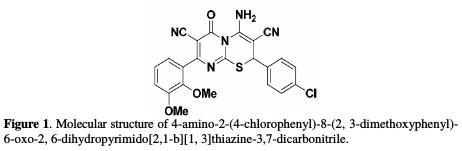
different media [13-16]. In the present work, 4-amino-2-(4-chlorophenyl)-8-(2,3-
dimethoxyphenyl)-6-oxo-2,6-dihydropyrimido[2,1-b] [1,3] thiazine-3,7-
dicarbonitrile (ACMPT) was investigated as a corrosion inhibitor for carbon steel
in 1.0 M HCl, using detailed gravimetric measurements, electrochemical
impedance spectroscopy and quantum chemical calculations. The molecular
structure of this pyrimidothiazine derivative is shown in <a href="#f1">Fig. 1</a>.</p>


    <p>&nbsp;</p>
<a name="f1">
<img src="/img/revistas/pea/v36n1/36n1a04f1.jpg">
    
<p>&nbsp;</p>


    <p>&nbsp;</p>
    <p><b>Experimental methods</b></p>

    ]]></body>
<body><![CDATA[<p><i><b>Materials and methods</b></i></p>

    <p><i>Materials</i></p>

    <p>The metal used in this study is carbon steel (CS) (Euronorm: C35E carbon steel
and US specification: SAE 1035); <a href="#t1">Table 1</a> shows its chemical composition.</p>


    <p>&nbsp;</p>
<a name="t1">
<img src="/img/revistas/pea/v36n1/36n1a04t1.jpg">
    
<p>&nbsp;</p>


    <p><i>Synthesis</i></p>

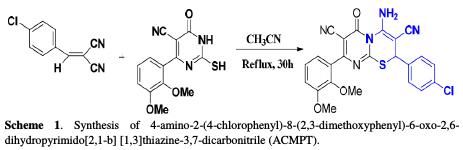
    <p>Pyrimidin-4-one (1 mmol) was added to a solution of 2-(2, 3-dimethoxybenzy-
lidene) malononitrile (1 mmol) in acetonitrile (20 mL). The mixture was then
refluxed for 30 h. The solvent was removed under reduced pressure, and the
crude product was treated with a mixture of ether/petroleum ether and the 4-
amino-2-(4-chlorophenyl)-8-(2,3-dimethoxyphenyl)-6-oxo-2,6-
dihydropyrimido[2,1-b][1,3]thiazine-3,7-dicarbonitrile (ACMPT) precipitate, and
it was recrystallized from EtOH. The synthetic approaches adopted to obtain the
target compounds (ACMOPT) are shown in <a href="#s1">Scheme 1</a>.</p>


    <p>&nbsp;</p>
<a name="s1">
<img src="/img/revistas/pea/v36n1/36n1a04s1.jpg">
    
<p>&nbsp;</p>


    <p><i>Solution</i></p>

    ]]></body>
<body><![CDATA[<p>The aggressive solution of 1.0 M HCl was prepared by the dilution of analytical
grade 37% HCl with distilled water. The concentration range of used 4-amino-2-
(4-chlorophenyl)-8-(2, 3-dimethoxyphenyl)-6-oxo-2, 6-dihydropyrimido[2,
1b][1, 3] thiazine-3,7-dicarbonitrile (ACMPT) was 10<sup>-6</sup> to 10<sup>-3</sup> M.</p>


    <p><i><b>Weight loss measurements</b></i></p>

    <p>Gravimetric measurements were carried out at a definite time interval of 4 h, at
room temperature, using an analytical balance (precision &pm; 0.1 mg). The used
carbon steel specimens had a rectangular form (length = 1.6 cm, width = 1.6 cm,
thickness = 0.07 cm). Gravimetric experiments were carried out in a double glass
cell equipped with a thermostated cooling condenser containing 80 mL of the
non-de-aerated test solution. After the immersion period, the steel specimens
were withdrawn, carefully rinsed with bidistilled water, ultrasonic cleaned in
acetone, dried at room temperature and then weighed. Triplicate experiments
were performed in each case, and the mean value of the weight loss was
calculated.</p>


    <p><i><b>Electrochemical measurements</b></i></p>

    <p><i>Electrochemical impedance spectroscopy</i></p>

    <p>The electrochemical measurements were carried out with a Voltalab (Tacussel-
Radiometer PGZ 100) potentiostat, and controlled by Tacussel corrosion analysis
software model (Voltamaster 4) under static conditions. The used corrosion cell
had three electrodes. The reference electrode was a saturated calomel electrode
(SCE). A platinum electrode was used as auxiliary electrode, with a surface area
of 1 cm<sup>2</sup>. The working electrode was carbon steel.</p>

    <p>All potentials given in this study were referred to this reference electrode. The
working electrode was immersed in a test solution for 30 min, to establish a
steady state open circuit potential (Eocp). After measuring the Eocp, the
electrochemical measurements were performed. All electrochemical tests have
been performed in aerated solutions at 303 K. The ESI experiments were
conducted in the frequency range with a high limit of 100 KHz, and a different
low limit of 0.1 Hz at open circuit potential, with 10 points per decade, at the rest
potential after 30 min of immersion in the acid, by applying 10 mV ac voltage
peak-to-peak. Nyquist plots were made from these experiments. The best
semicircle could be fit through the data points in the Nyquist plot, using a non-
linear least square fit, so as to give the intersections with the X-axis.
The inhibition efficiency was calculated from the charge transfer resistance
values using the following equation [17]:</p>


    <p>&nbsp;</p>
<a name="e1">
<img src="/img/revistas/pea/v36n1/36n1a04e1.jpg">
    
<p>&nbsp;</p>


    <p>where R<sup>0</sup><sub>ct</sub> and R<sup>i</sup><sub>ct</sub> are the charge transfer resistance, respectively in the absence
and presence of inhibitor.</p>


    ]]></body>
<body><![CDATA[<p><i>Potentiodynamic polarization</i></p>

    <p>The electrochemical behavior of a carbon steel sample in inhibited and
uninhibited solutions was studied by recording anodic and cathodic
potentiodynamic curves. Measurements were performed in the 1.0 M HCl
solution containing different concentrations of the tested inhibitor, by
automatically changing the electrode potential from 800 to -100 mV versus the
corrosion potential at a scan rate of 2 mV.s<sup>-1</sup>. The linear Tafel segments of
anodic and cathodic curves were extrapolated to the corrosion potential to obtain
corrosion current densities (Icorr). From the obtained polarization curves, the
corrosion current (Icorr) was calculated by the curve fitting using the following
equation:</p>


    <p>&nbsp;</p>
<a name="e2">
<img src="/img/revistas/pea/v36n1/36n1a04e2.jpg">
    
<p>&nbsp;</p>


    <p>The inhibition efficiency was evaluated from the measured Icorr values using the
following relationship [18]:</p>


    <p>&nbsp;</p>
<a name="e3">
<img src="/img/revistas/pea/v36n1/36n1a04e3.jpg">
    
<p>&nbsp;</p>


    <p>where I<sup>0</sup><sub>corr</sub> and I<sup>i</sup><sub>corr</sub> are the corrosion current density, respectively in the absence
and presence of the inhibitor.</p>


    <p><i>Computational details</i></p>

    <p>Density Functional Theory (DFT) has been recently used [18-22] to describe the
interaction between the inhibitor molecule and the surface, as well as the
properties of these inhibitors concerning their reactivity. The molecular hand gap
was computed as the first vertical electronic excitation energy from the ground
state using the time dependent density functional theory (TD-DFT) approach, as
implemented in Gaussian 03 [23]. For this purpose, some molecular descriptors,
such as HOMO and LUMO energy values, frontier orbital energy gap, molecular
dipole moment electronegativity (&chi;), global hardness (&eta;), softness (S) and the
fraction of transferred electrons (&Delta;N) were calculated using DFT method, and
have been used to understand the inhibitors' properties, to help in the explanation
of the experimental data obtained for the corrosion process.
According to Koopman's theorem [24], the ionization potential (IE) and electron
affinity (EA) of the inhibitors are calculated using the following equations:</p>


    ]]></body>
<body><![CDATA[<p>&nbsp;</p>
<a name="e4">
<img src="/img/revistas/pea/v36n1/36n1a04e4.jpg">
    
<p>&nbsp;</p>
<a name="e5">
<img src="/img/revistas/pea/v36n1/36n1a04e5.jpg">
    
<p>&nbsp;</p>


    <p>Thus, the values of electronegativity (&chi;) and chemical hardness (&eta;) that,
according to Pearson, are operational and approximate definitions, can be
evaluated using the following relation [25]:</p>


    <p>&nbsp;</p>
<a name="e6">
<img src="/img/revistas/pea/v36n1/36n1a04e6.jpg">
    
<p>&nbsp;</p>
<a name="e7">
<img src="/img/revistas/pea/v36n1/36n1a04e7.jpg">
    
<p>&nbsp;</p>


    <p>The number of transferred electrons (&Delta;N) was also calculated depending on the
quantum chemical method [26, 27].</p>


    <p>&nbsp;</p>
<a name="e8">
<img src="/img/revistas/pea/v36n1/36n1a04e8.jpg">
    
<p>&nbsp;</p>


    ]]></body>
<body><![CDATA[<p>where &chi;Fe and &chi;inh donate the absolute electronegativity of iron and of the inhibitor
molecule, and &eta;Fe and &eta;inhi donate the absolute hardness of iron and of the
inhibitor molecule. In this study, we use the theoretical values of &chi;Fe for the
absolute hardness of iron and of the inhibitor molecule, and we use the
theoretical value of &chi;Fe = 7.0 eV and &eta;Fe = 0 to calculate the number of transferred
electrons.</p>


    <p>&nbsp;</p>
    <p><b>Results and discussion</b></p>

    <p><i><b>Polarization curves</b></i></p>

    <p>In the present paper, a potentiodynamic polarization study has been made in
order to understand the role of the inhibitor in biasing anodic and cathodic
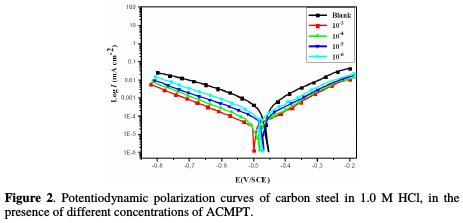
reactions. <a href="#f2">Fig. 2</a> shows the anodic and cathodic polarization plots of carbon steel
in a 1.0 M HCl solution, in the absence and presence of different concentrations
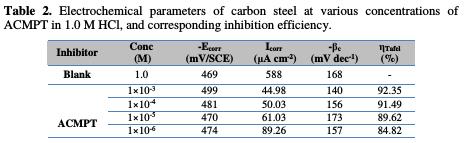
of the ACMPT inhibitor at 298 K, while <a href="#t2">Table 2</a> shows electrochemical
corrosion parameters, such as corrosion potential (Ecorr), corrosion current density
(Icorr) and inhibition efficiency (&eta;IE%).</p>


    <p>&nbsp;</p>
<a name="f2">
<img src="/img/revistas/pea/v36n1/36n1a04f2.jpg">
    
<p>&nbsp;</p>
<a name="t2">
<img src="/img/revistas/pea/v36n1/36n1a04t2.jpg">
    
<p>&nbsp;</p>


    <p>It is noted from <a href="#f2">Fig. 2</a> that the polarization curves in the 1.0 M HCl solution,
containing different concentrations of the studied pyrimidothiazine, are nearly
the same. In addition, cathodic and anodic current densities of the polarization
curves are both reduced [28, 29].</p>

    <p>The above results indicate that retardation of the samples corrosion processes at
cathodic and anodic reaction sites occurred, and this was due to the adsorption of
these sites by the inhibitor molecules [30-33].</p>

    ]]></body>
<body><![CDATA[<p>On the other hand, cathodic Tafel curves gave rise to parallel Tafel lines,
indicating that hydrogen evolution reaction is activation-controlled, that a
stronger inhibition effect of the inhibitors does not affect the reduction
mechanism, and that their inhibition action is blocking the metal surface [34].
Based on <a href="#f2">Fig. 2</a> and <a href="#t2">Table 2</a>, it is obvious that the value of &beta;c changed with the
increase in the inhibitor's concentration, indicating the influence of the inhibitor
on the kinetics of the hydrogen evolution [35].</p>

    <p>In addition to what was previously described, an inhibitor can generally be
classified as from the cathodic or anodic type, if the shift of corrosion potential in
the presence of the inhibitor is more than 85 mV, with respect to the corrosion
potential of the blank solution.</p>

    <p>In the present study, the maximum displacement was 30 mV, suggesting that
ACMPT can be arranged as a mixed type inhibitor, with predominant cathodic
effectiveness [36, 37].</p>

    <p>Also, the examination of <a href="#t2">Table 2</a> concludes that the corrosion current density
(Icorr) values of carbon steel, in the presence of the ACMPT inhibitor, are lower
than those found without inhibitor.</p>

    <p>It is noted that the inhibitory efficiency (IE%) increased with the increase in the
inhibitor's concentration, and reached a maximum value of 92.35% for a
concentration of 10<sup>-3</sup> M of the studied inhibitor.</p>


    <p><i><b>Electrochemical impedance spectroscopy measurements</b></i></p>

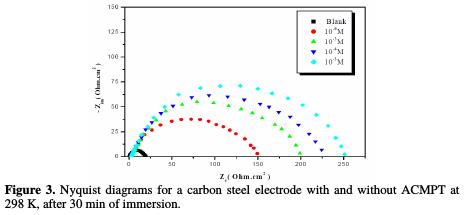
    <p>The corrosion behavior of carbon steel in 1.0 M HCl, in the absence and presence
of various concentrations of ACMPT, was also investigated by EIS technique.
The resultant Nyquist plots are shown in <a href="#f3">Fig. 3</a>.</p>


    <p>&nbsp;</p>
<a name="f3">
<img src="/img/revistas/pea/v36n1/36n1a04f3.jpg">
    
<p>&nbsp;</p>


    <p>The values of inhibition efficiency ((&eta;Z%) were calculated by the <a href="#e1">equation (1)</a>.</p>

    ]]></body>
<body><![CDATA[<p>To obtain the values of double layer capacitance (Cdl), the values of frequency at
which the imaginary component of the impedance is maximum -Zim(max) were
found and used in the following equation with corresponding Rct values:</p>


    <p>&nbsp;</p>
<a name="e9">
<img src="/img/revistas/pea/v36n1/36n1a04e9.jpg">
    
<p>&nbsp;</p>


    <p>Nyquist plots contain a semicircle with the center under real axis. The size of the
semicircle increases with the inhibitor's concentration, indicating the charge
transfer process as the main controlling factor for the corrosion inhibition of
carbon steel. As we could see from the plots, the impedance of the inhibited
solution has increased with the increase in the inhibitor's concentration.</p>

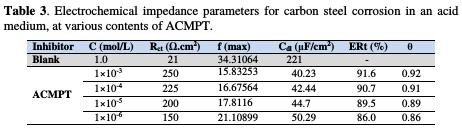
    <p>The experimental results of EIS measurements for the corrosion of carbon steel
in 1.0 M HCl, in the absence and presence of inhibitor, are given in <a href="#t3">Table 3</a>.</p>


    <p>&nbsp;</p>
<a name="t3">
<img src="/img/revistas/pea/v36n1/36n1a04t3.jpg">
    
<p>&nbsp;</p>


    <p>As it can be observed from <a href="#t3">Table 3</a>, the charge transfer resistance (Rct) value
increased with the increase in the inhibitor's concentration. Inversely, values of
the interface's capacitance (Cdl) started decreasing, with the increase in the
inhibitor's concentration, which is most probably due to the decrease in local
dielectric constant and/or to the increase in thickness of the electrical double
layer. This suggests that the inhibitor acts via adsorption at the metal/solution
interface [38], and that the decrease in the Cdl values is caused by the gradual
replacement of water molecules by the adsorption of the inhibitor molecules onto
the electrode surface, which decreases the extent of metal dissolution [39]. A
keen observation of these plots has revealed that capacitive loops are not perfect
semicircles, which is possibly due to the frequency dispersion, roughness, and
inhomogeneity of the metal surface, and to impurities, grain boundaries, and
distribution of the surface's active sites. The existence of a single semicircle can
be attributed to the single charge transfer reaction during the metal dissolution
process [40].</p>

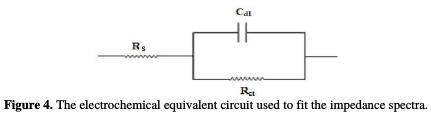
    <p>The equivalent circuit that describes the present metal/electrolyte corroding
system is the simple Randles model shown in <a href="#f4">Fig. 4</a>, where Rs, Rct and Cdl are,
respectively, the resistance in solution, the charge transfer resistor and the double
layer capacitance of the interface.</p>


    <p>&nbsp;</p>
<a name="f4">
<img src="/img/revistas/pea/v36n1/36n1a04f4.jpg">
    
]]></body>
<body><![CDATA[<p>&nbsp;</p>


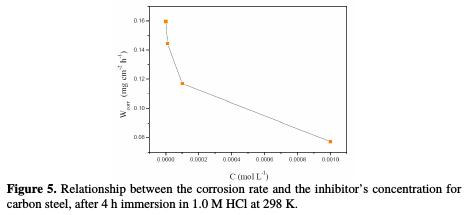
    <p><a href="#f5">Fig. 5</a> indicates the variation of ACMPT's corrosion rate as a function of its
concentration in 1.0 M HCl at 298 K, from weight loss measurements.</p>


    <p>&nbsp;</p>
<a name="f5">
<img src="/img/revistas/pea/v36n1/36n1a04f5.jpg">
    
<p>&nbsp;</p>


    <p>This figure reveals that the rate of mild steel corrosion in 1.0 M HCl decreases with an
increase in the inhibitor's concentration at 298 K.</p>

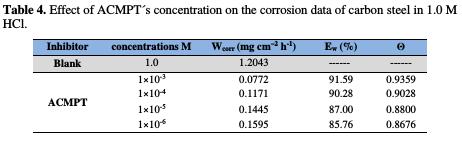
    <p>The increase in inhibition efficiency with an increase in the concentration of the
studied compound can be explained by the increased adsorption of ACMPT on
the metal surface (<a href="#t4">Table 4</a>).</p>


    <p>&nbsp;</p>
<a name="t4">
<img src="/img/revistas/pea/v36n1/36n1a04t4.jpg">
    
<p>&nbsp;</p>


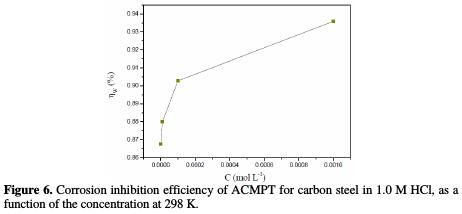
    <p>In the inhibition process, the first step in the inhibition mechanism is the
adsorption at the metal/aggressive solution interface [41]. Given the dependence
of inhibition efficiency on the concentration, as represented in <a href="#f6">Fig. 6</a>, the
inhibitor decreases the active center for steel dissolution. The adsorption process
is made possible by the presence of heteroatoms such as N, S and O, which are
regarded as active adsorption centers.</p>


    <p>&nbsp;</p>
<a name="f6">
<img src="/img/revistas/pea/v36n1/36n1a04f6.jpg">
    
]]></body>
<body><![CDATA[<p>&nbsp;</p>


    <p>The adsorption of ACMPT on the surface of mild steel can be achieved by the
interaction between the pair of single electrons of the heteroatoms or between the
electron-rich &pi; electron systems and the metal surface. This, as earlier reported by
Umoren and Ebenso [42], may be facilitated by the presence of the vacant d-
orbital of iron that constitutes steel, as observed in d group metals or in the
transition element. In addition to the molecular form, ACMPT can be present in
protonated species in an acidic solution. This protonated form facilitates the
adsorption of the compound onto the metal surface by electrostatic interaction
between the organic molecules and the metal surface [43].</p>

    <p><i><b>Effect of temperature</b></i></p>

    <p>The influence of temperature is also studied by potentiodynamic polarization. We
have carried out a study in the range of 298-328 K, using stationary
electrochemical measurements in potentiostatic mode.</p>

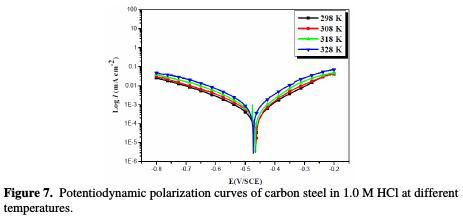
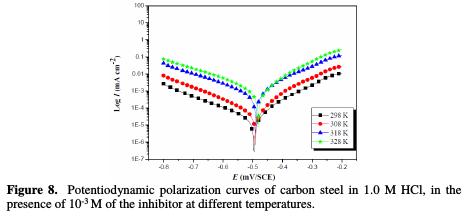
    <p><a href="#f7">Figs. 7</a> and <a href="#f8">8</a> show the polarization curves of steel in a 1.0 M HCl medium,
respectively in the absence and presence of 10<sup>-3</sup> M of ACMPT, in the studied
temperature range.</p>


    <p>&nbsp;</p>
<a name="f7">
<img src="/img/revistas/pea/v36n1/36n1a04f7.jpg">
    
<p>&nbsp;</p>
<a name="f8">
<img src="/img/revistas/pea/v36n1/36n1a04f8.jpg">
    
<p>&nbsp;</p>


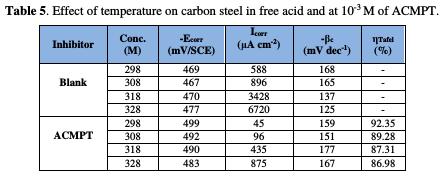
    <p>The results deduced from the polarization curves are given in <a href="#t5">Table 5</a>.</p>


    <p>&nbsp;</p>
<a name="t5">
<img src="/img/revistas/pea/v36n1/36n1a04t5.jpg">
    
]]></body>
<body><![CDATA[<p>&nbsp;</p>


    <p>As it can be seen, raising the temperature increases both anodic and cathodic reactions of
the carbon steel electrode, both in the absence and presence of the organic
compound.</p>

    <p>The inhibition efficiency of ACMPT reaches the maximum values (92.35%) at
298 K, upon an increased temperature; &eta;IE% is slightly decreased, and the
pyrimidothiazine derivative becomes less effective at 328 K. This behavior again
shows the physical nature of ACMPT's adsorption in a HCl solution.</p>

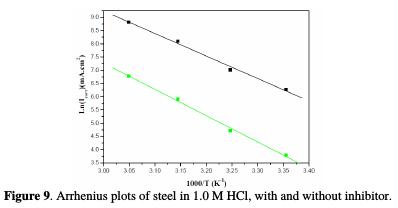
    <p>The activation energy, Ea, was calculated from an Arrhenius-type plot (<a href="#e10">Eq. 10</a>)
[44, 45].</p>


    <p>&nbsp;</p>
<a name="e10">
<img src="/img/revistas/pea/v36n1/36n1a04e10.jpg">
    
<p>&nbsp;</p>


    <p>where E is the apparent activation corrosion energy, T is the absolute
temperature, k is the Arrhenius pre-exponential constant and R is the universal
gas constant.</p>

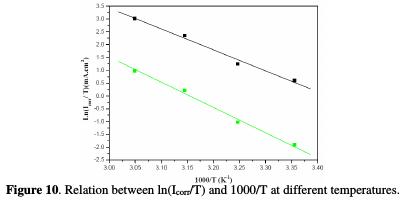
    <p>The enthalpy of activation, &Delta;Ha, and the entropy of activation, &Delta;Sa, were
calculated from <a href="#e11">equation 11</a>)
[44, 45].</p>


    <p>&nbsp;</p>
<a name="e11">
<img src="/img/revistas/pea/v36n1/36n1a04e11.jpg">
    
<p>&nbsp;</p>


    ]]></body>
<body><![CDATA[<p>where h, N, &Delta;Sa and &Delta;Ha are, respectively, the Planck constant, the Avogadro
number, the activation entropy and the activation entropy.</p>

    <p>Plots of ln (Icorr) vs. 1000/T and ln (Icorr/T) vs. 1000/T gave straight lines,
respectively with slopes of -Ea/R and -&Delta;Ha/R. The intercepts were A and [ln
(R/Nh)+ (&Delta;Sa/R)], respectively for the Arrhenius and transition state equations.
<a href="#f9">Figs. 9</a> and <a href="#f10">10</a> represent the data plots of Ln (Icorr) vs. 1000/T and Ln (Icorr/T) vs.
1000/T, in the absence and presence of 10<sup>-3</sup> M ACMPT, as a representative
example.</p>


    <p>&nbsp;</p>
<a name="f9">
<img src="/img/revistas/pea/v36n1/36n1a04f9.jpg">
    
<p>&nbsp;</p>
<a name="f10">
<img src="/img/revistas/pea/v36n1/36n1a04f10.jpg">
    
<p>&nbsp;</p>


    <p>The calculated values from both methods of the activation energy, Ea, the
enthalpy of activation, &Delta;Ha, and the entropy of activation, &Delta;Sa, are shown in
<a href="#t6">Table 6</a>.</p>


    <p>&nbsp;</p>
<a name="t6">
<img src="/img/revistas/pea/v36n1/36n1a04t6.jpg">
    
<p>&nbsp;</p>


    <p>From this table, it could be clearly seen that the values of Ea and of &Delta;Ha,
obtained in the presence of ACMPT, are higher than those obtained in the
solution without inhibitor. The positive sign of &Delta;Ha reflects the endothermic
nature of carbon steel dissolution process, suggesting that the dissolution of
carbon steel is slower in the inhibitor's presence [46]. It is also clear that Ea, in
the presence of 10<sup>-3</sup> M of ACMPT, is higher than that obtained in the blank. This
observation has been reported to be indicative of physical adsorption mechanism,
while lower values of Ea suggest a chemisorption mechanism [47, 48].</p>

    <p>The presence of the test compound results in an increase in the &Delta;Sa values. This
result indicates that corrosion changes from a more ordered system into a
disordered system, with the increase in the inhibitory nature of the studied
compounds [49]. In the presence of the inhibitor, the value of &Delta;Sa increases,
which is generally interpreted as an increase in disorder, as the reactants are
converted to the activated complexes [50].</p>


    ]]></body>
<body><![CDATA[<p><i><b>Adsorption isotherm and standard adsorption of free energy</b></i></p>

    <p>The adsorption isotherm that describes the adsorptive behavior of organic
inhibitors is important, in order to know the mechanism of corrosion inhibition.
Basic information on the interaction between the inhibitor molecules and the
metal surface can be provided by adsorption isotherms. Several adsorption
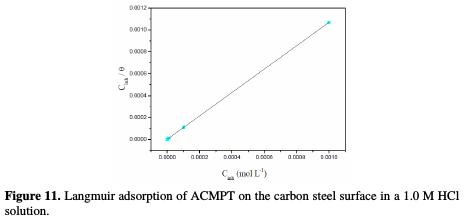
isotherms were attempted to fit the degree of surface coverage values (&theta;),
including Frumkin, Temkin, Freundlich and Langmuir isotherms. The &theta; values
for various concentrations of inhibitors in acidic media have been evaluated from
the polarization measurements. The best fit was obtained in the case of Langmuir
isotherm, which assumes that the solid surface contains a fixed number of
adsorption sites, and that each site holds one adsorbed species [51]. The plot of
Cinh/&theta; vs. Cinh (<a href="#f11">Fig. 11</a>) yields a straight line with a correlation coefficient of
0.99998, providing that the adsorption of ACMPT from the 1.0 M HCl solution
on the carbon steel surface obeys Langmuir adsorption isotherm.</p>


    <p>&nbsp;</p>
<a name="f11">
<img src="/img/revistas/pea/v36n1/36n1a04f11.jpg">
    
<p>&nbsp;</p>


    <p>This isotherm
can be represented as:</p>


    <p>&nbsp;</p>
<a name="e12">
<img src="/img/revistas/pea/v36n1/36n1a04e12.jpg">
    
<p>&nbsp;</p>


    <p>where Cinh is the molar concentration of the inhibitor and Kads is the equilibrium
constant or the adsorption-desorption process.</p>

    <p>The value of Kads was found to be 654900.3 M<sup>-1</sup> (<a href="#t7">Table 7</a>).</p>


    <p>&nbsp;</p>
<a name="t7">
<img src="/img/revistas/pea/v36n1/36n1a04t7.jpg">
    
]]></body>
<body><![CDATA[<p>&nbsp;</p>


    <p>The relatively high
value of the adsorption equilibrium constant reflects the high adsorption ability
of ACMPT on the carbon steel surface [52].</p>

    <p>Kads is related to the standard free energy of adsorption, &Delta;Gads , by the following
equation:</p>


    <p>&nbsp;</p>
<a name="e13">
<img src="/img/revistas/pea/v36n1/36n1a04e13.jpg">
    
<p>&nbsp;</p>


    <p>where R is the gas constant, T is the absolute temperature of the experiment, and
the constant value of 55.5 is the concentration of water in the solution in mol L-1.
The &Delta;G<sup>0</sup>ads was calculated as -43.13 KJ mol<sup>-1</sup>. The negative value of &Delta;G<sup>0</sup>ads
indicates the spontaneity of the adsorption process and the stability of the
adsorbed layer on the carbon steel surface.</p>

    <p>It is well known that the values of &Delta;G<sup>0</sup>ads of the order of -20 KJ mol<sup>-1</sup> or lower
indicate a physisorption; those of the order of -40 kJ mol<sup>-1</sup> or higher involve a
charge sharing or transfer from the inhibitor molecules to the metal surface, to
form a coordinate type of bond (chemisorption) [53-54]. On the other hand, the
adsorption phenomenon of an organic molecule is not just considered as a purely
physical or chemical adsorption phenomenon [55, 56]. A wide spectrum of
conditions, from the dominance of chemisorption to electrostatic effects, arises
from other adsorptions experimental data [57]. The value of -43.13 kJ mol<sup>-1</sup> may
suggest chemisorption mode.</p>


    <p><i><b>Computational studies</b></i></p>

    <p>Computational methods have a strong impact towards the design and
development of organic corrosion inhibitors.</p>

    <p>Nowadays, density function theory (DFT) has been used to analyze the
characteristics of the inhibitor/surface mechanism, and to describe the structural
nature of the inhibitor on the corrosion process. Furthermore, DFT is considered
to be a very useful technique to probe the inhibitor/surface interaction, as well as
to analyze the experimental data [58]. Thus, in our present investigation, DFT
method was employed to give some insight into the inhibition action of ACMPT
molecule on the carbon steel surface. Quantum chemical parameters, such as
EHOMO, ELUMO, energy gap, &Delta;E (ELUMO - EHOMO) and dipole moment (&mu;), were
obtained, for the neutral molecule to predict their activity towards the metal
surface. These quantum chemical parameters were generated after geometric
optimization with respect to all nuclear coordinates.</p>

    ]]></body>
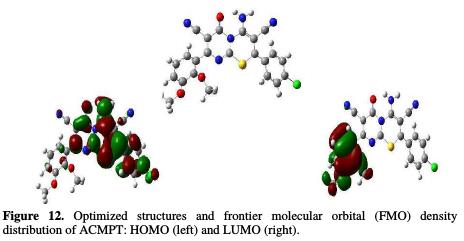
<body><![CDATA[<p><a href="#f12">Fig. 12</a> shows the optimized geometry of ACMPT: the HOMO optimized
structure and frontier orbital distribution, and the LUMO density distribution.</p>


    <p>&nbsp;</p>
<a name="f12">
<img src="/img/revistas/pea/v36n1/36n1a04f12.jpg">
    
<p>&nbsp;</p>


    <p>Frontier orbital density distribution is useful in predicting adsorption centers of
the ACMPT molecule responsible for the interaction with metal surface atoms.
As it can be seen from this figure, HOMO is distributed over the entire molecule,
but the LUMO density is mainly localized on the dimethoxyphenyl group. The
presence of these adsorption centers can cause a flat orientation of ACMPT
molecules on the steel surface; thus, a high degree of surface coverage and
inhibition efficiency is expected for ACMPT, from the theoretical point of view.
These results suggest that O and S atoms and two N atoms are probably the most
favorable reactive sites for the adsorption of ACMPT onto the metal surface.</p>

    <p>The calculated molecular parameters are listed in <a href="#t8">Table 8</a>.</p>


    <p>&nbsp;</p>
<a name="t8">
<img src="/img/revistas/pea/v36n1/36n1a04t8.jpg">
    
<p>&nbsp;</p>


    <p>EHOMO is often associated with the electron-donating ability of a molecule, and its
high value (-4.9593) is likely to indicate a tendency to donate electrons to
appropriate low-energy acceptor states. Increasing EHOMO values facilitates
adsorption (and therefore inhibition), by influencing the transport process
through the adsorbed layer. ELUMO indicates the ability of the molecule to accept
electrons; hence, these are the acceptor states. The lower the value (-2.8882) of
ELUMO, the more probable it is that the molecule would accept electrons [59]. As
for the values of &Delta;E (ELUMO - EHOMO), lower values (2.0711) of the energy
difference, &Delta;E, will cause a higher inhibition efficiency, because the energy to
release an electron from the last occupied orbital will be low [60]. For the dipole
moment (&mu;), a higher value (6.6028) will favor a strong interaction of the
inhibitor molecules with the metal surface.</p>

    <p>In addition, the number of transferred electrons (&Delta;N) was also calculated based
on the quantum chemical method [61]:</p>


    <p>&nbsp;</p>
<a name="e14">
<img src="/img/revistas/pea/v36n1/36n1a04e14.jpg">
    
]]></body>
<body><![CDATA[<p>&nbsp;</p>


    <p>where &chi;Fe and &chi;inh denote, respectively, the absolute electronegativity of iron and
the inhibitor molecule; and &eta;Fe and &eta;inh denote, respectively, the absolute
hardness of iron and the inhibitor molecule. These quantities are related to the
electron affinity (A) and ionization potential (I).</p>

    <p>Absolute electro negativity, (&chi;), and absolute hardness, (&eta;), of the inhibitor
molecules are given by [62]:</p>


    <p>&nbsp;</p>
<a name="e15">
<img src="/img/revistas/pea/v36n1/36n1a04e15.jpg">
    
<p>&nbsp;</p>


    <p>IE and EA are related [63] to EHOMO and ELUMO, as follows:</p>


    <p>&nbsp;</p>
<a name="e16">
<img src="/img/revistas/pea/v36n1/36n1a04e16.jpg">
    
<p>&nbsp;</p>
<a name="e17">
<img src="/img/revistas/pea/v36n1/36n1a04e17.jpg">
    
<p>&nbsp;</p>


    <p>For an iron atom, a theoretical &chi;, with the value of 7 eV mol<sup>-1</sup>, and &eta;, with the
value of 0 eV mol<sup>-1</sup>, were used [64] to calculate the number of electrons
transferred (&Delta;N) from the inhibitor to the iron atom. The number of transferred
electrons strongly depends on what the actual quantum chemical method has
employed for computation. Furthermore, the expression ''number of transferred
electrons'' is equal to the wording ''electron-donating ability'', which does not
imply that the figures of &Delta;N actually indicate the number of electrons leaving the
donor and entering the acceptor molecule.</p>

    ]]></body>
<body><![CDATA[<p>The value of electron-donating ability (&Delta;N) was calculated, and it is given in
<a href="#t8">Table 8</a>. If &Delta;N &lt; 3.6 (electron), the inhibition efficiency increases with an
increasing value of &Delta;N, while it decreases if &Delta;N &gt; 3.6 (electron) [65, 66]. Based
on these data, it can be said that ACMPT is the electron donor, and the surface is
the acceptor. ACMPT was bound to the mild steel surface, thus forming an
inhibition adsorption layer against corrosion, at carbon steel/hydrochloric acid
solution interface.</p>


    <p>&nbsp;</p>
    <p><b>Conclusions</b></p>

    <p>From the results of this paper, several conclusions could be listed:</p>

    <p>&bull; ACMPT was found to be a good inhibitor for carbon steel in 1.0 M HCl. The 
inhibition efficiency increases with the inhibitor concentration.</p>

    <p>&bull; ACMPT acts as a mixed type inhibitor, with predominant cathodic effectiveness.</p>

    <p>&bull; The temperature affects the inhibitory efficiency; this is clearly demonstrated 
by the decrease in the studied inhibitor effect, with the increase in temperature.</p>

    <p>&bull; The adsorption of ACMPT at the carbon steel surface has obeyed the Langmuir's 
adsorption isotherm.</p>

    <p>&bull; The inhibition efficiencies obtained from EIS, Tafel polarization and weight 
loss methods are in reasonable agreement with each other.</p>

    <p>&bull; The calculated parameters obtained from the quantum chemical calculations 
were correlated with experimental results.</p>


    ]]></body>
<body><![CDATA[<p>&nbsp;</p>
    <p><b>References</b></p>

    <!-- ref --><p>1. Saravanamoorthy S, Velmathi S. Prog Org Coat. 2013;76:1527.    &nbsp;&nbsp;&nbsp;&nbsp;&nbsp;&nbsp;&nbsp;&nbsp;[&#160;<a href="javascript:void(0);" onclick="javascript: window.open('/scielo.php?script=sci_nlinks&ref=431606&pid=S0872-1904201800010000400001&lng=','','width=640,height=500,resizable=yes,scrollbars=1,menubar=yes,');">Links</a>&#160;]<!-- end-ref --></p>

    <!-- ref --><p>2. Nam DN, Bui VQ, Mathesh M, et al. Corros Sci. 2013;76:257.    &nbsp;&nbsp;&nbsp;&nbsp;&nbsp;&nbsp;&nbsp;&nbsp;[&#160;<a href="javascript:void(0);" onclick="javascript: window.open('/scielo.php?script=sci_nlinks&ref=431608&pid=S0872-1904201800010000400002&lng=','','width=640,height=500,resizable=yes,scrollbars=1,menubar=yes,');">Links</a>&#160;]<!-- end-ref --></p>

    <p>3. Nam DN, Somers A, Mathesh M, et al. Corros Sci. 80;2014:128.</p>

    <!-- ref --><p>4. Bobina M, Kellenberger A, Millet JP, et al. Corros. Sci. 2013; 69:389.    &nbsp;&nbsp;&nbsp;&nbsp;&nbsp;&nbsp;&nbsp;&nbsp;[&#160;<a href="javascript:void(0);" onclick="javascript: window.open('/scielo.php?script=sci_nlinks&ref=431611&pid=S0872-1904201800010000400004&lng=','','width=640,height=500,resizable=yes,scrollbars=1,menubar=yes,');">Links</a>&#160;]<!-- end-ref --></p>

    <!-- ref --><p>5. Bilgic S, Yilmaz H. Mater Chem Phys. 2007;79:5.    &nbsp;&nbsp;&nbsp;&nbsp;&nbsp;&nbsp;&nbsp;&nbsp;[&#160;<a href="javascript:void(0);" onclick="javascript: window.open('/scielo.php?script=sci_nlinks&ref=431613&pid=S0872-1904201800010000400005&lng=','','width=640,height=500,resizable=yes,scrollbars=1,menubar=yes,');">Links</a>&#160;]<!-- end-ref --></p>

    <!-- ref --><p>6. Ekpe JU, Okafor CP, Ebenso EE, et al. Bull Electrochem. 2001;17:135.    &nbsp;&nbsp;&nbsp;&nbsp;&nbsp;&nbsp;&nbsp;&nbsp;[&#160;<a href="javascript:void(0);" onclick="javascript: window.open('/scielo.php?script=sci_nlinks&ref=431615&pid=S0872-1904201800010000400006&lng=','','width=640,height=500,resizable=yes,scrollbars=1,menubar=yes,');">Links</a>&#160;]<!-- end-ref --></p>

    <!-- ref --><p>7. Odoemelam AS, Eddy ON. J Surf Sci Technol. 2008;24:65.    &nbsp;&nbsp;&nbsp;&nbsp;&nbsp;&nbsp;&nbsp;&nbsp;[&#160;<a href="javascript:void(0);" onclick="javascript: window.open('/scielo.php?script=sci_nlinks&ref=431617&pid=S0872-1904201800010000400007&lng=','','width=640,height=500,resizable=yes,scrollbars=1,menubar=yes,');">Links</a>&#160;]<!-- end-ref --></p>

    <!-- ref --><p>8. Noor AE, Al-Moubaraki AH. Int J Electrochem Sci. 2008;3:806.    &nbsp;&nbsp;&nbsp;&nbsp;&nbsp;&nbsp;&nbsp;&nbsp;[&#160;<a href="javascript:void(0);" onclick="javascript: window.open('/scielo.php?script=sci_nlinks&ref=431619&pid=S0872-1904201800010000400008&lng=','','width=640,height=500,resizable=yes,scrollbars=1,menubar=yes,');">Links</a>&#160;]<!-- end-ref --></p>

    <!-- ref --><p>9. Anejjar A, Salghi R, Zarrouk A, et al. Res Chem Intermediat. 2013;41:913.    &nbsp;&nbsp;&nbsp;&nbsp;&nbsp;&nbsp;&nbsp;&nbsp;[&#160;<a href="javascript:void(0);" onclick="javascript: window.open('/scielo.php?script=sci_nlinks&ref=431621&pid=S0872-1904201800010000400009&lng=','','width=640,height=500,resizable=yes,scrollbars=1,menubar=yes,');">Links</a>&#160;]<!-- end-ref --></p>

    <!-- ref --><p>10. Awad KM, Metwally SM., Soliman AS, et al. J Ind Eng Chem. 2014;20:796.    &nbsp;&nbsp;&nbsp;&nbsp;&nbsp;&nbsp;&nbsp;&nbsp;[&#160;<a href="javascript:void(0);" onclick="javascript: window.open('/scielo.php?script=sci_nlinks&ref=431623&pid=S0872-1904201800010000400010&lng=','','width=640,height=500,resizable=yes,scrollbars=1,menubar=yes,');">Links</a>&#160;]<!-- end-ref --></p>

    <!-- ref --><p>11. Soliman AS, Metwally SM, Selim SR, et al. J Ind Eng Chem. 2014;20:4311.    &nbsp;&nbsp;&nbsp;&nbsp;&nbsp;&nbsp;&nbsp;&nbsp;[&#160;<a href="javascript:void(0);" onclick="javascript: window.open('/scielo.php?script=sci_nlinks&ref=431625&pid=S0872-1904201800010000400011&lng=','','width=640,height=500,resizable=yes,scrollbars=1,menubar=yes,');">Links</a>&#160;]<!-- end-ref --></p>

    <!-- ref --><p>12. Awe EF, Idris OS, Abdulwahab M, et al. Cogent Chem. 2015;1.    &nbsp;&nbsp;&nbsp;&nbsp;&nbsp;&nbsp;&nbsp;&nbsp;[&#160;<a href="javascript:void(0);" onclick="javascript: window.open('/scielo.php?script=sci_nlinks&ref=431627&pid=S0872-1904201800010000400012&lng=','','width=640,height=500,resizable=yes,scrollbars=1,menubar=yes,');">Links</a>&#160;]<!-- end-ref --></p>

    <!-- ref --><p>13. Belayachi M, Serrar H, Zarrok H, et al. Int J Electrochem Sci. 2015;10:3010.    &nbsp;&nbsp;&nbsp;&nbsp;&nbsp;&nbsp;&nbsp;&nbsp;[&#160;<a href="javascript:void(0);" onclick="javascript: window.open('/scielo.php?script=sci_nlinks&ref=431629&pid=S0872-1904201800010000400013&lng=','','width=640,height=500,resizable=yes,scrollbars=1,menubar=yes,');">Links</a>&#160;]<!-- end-ref --></p>

    <!-- ref --><p>14. Belayachi M, Serrar H, Assyry AE, et al. Int J Electrochem Sci. 2015;10:3038.    &nbsp;&nbsp;&nbsp;&nbsp;&nbsp;&nbsp;&nbsp;&nbsp;[&#160;<a href="javascript:void(0);" onclick="javascript: window.open('/scielo.php?script=sci_nlinks&ref=431631&pid=S0872-1904201800010000400014&lng=','','width=640,height=500,resizable=yes,scrollbars=1,menubar=yes,');">Links</a>&#160;]<!-- end-ref --></p>

    <!-- ref --><p>15. Larouj M, Elaoufir Y, Serrar H, et al. Pharm Lett. 2014;6:324.    &nbsp;&nbsp;&nbsp;&nbsp;&nbsp;&nbsp;&nbsp;&nbsp;[&#160;<a href="javascript:void(0);" onclick="javascript: window.open('/scielo.php?script=sci_nlinks&ref=431633&pid=S0872-1904201800010000400015&lng=','','width=640,height=500,resizable=yes,scrollbars=1,menubar=yes,');">Links</a>&#160;]<!-- end-ref --></p>

    <!-- ref --><p>16. Larouj M, Belkhaouda M, Lgaz H, et al. Pharm Lett. 2016;8:114.    &nbsp;&nbsp;&nbsp;&nbsp;&nbsp;&nbsp;&nbsp;&nbsp;[&#160;<a href="javascript:void(0);" onclick="javascript: window.open('/scielo.php?script=sci_nlinks&ref=431635&pid=S0872-1904201800010000400016&lng=','','width=640,height=500,resizable=yes,scrollbars=1,menubar=yes,');">Links</a>&#160;]<!-- end-ref --></p>

    <!-- ref --><p>17. Zarrok H, Zarrouk A, Hammouti B, et al. Corros. Sci. 2012;64:243.    &nbsp;&nbsp;&nbsp;&nbsp;&nbsp;&nbsp;&nbsp;&nbsp;[&#160;<a href="javascript:void(0);" onclick="javascript: window.open('/scielo.php?script=sci_nlinks&ref=431637&pid=S0872-1904201800010000400017&lng=','','width=640,height=500,resizable=yes,scrollbars=1,menubar=yes,');">Links</a>&#160;]<!-- end-ref --></p>

    <!-- ref --><p>18. Obot BI, Obi-Egbedi ON. Curr Appl Phys. 2011;11:382.    &nbsp;&nbsp;&nbsp;&nbsp;&nbsp;&nbsp;&nbsp;&nbsp;[&#160;<a href="javascript:void(0);" onclick="javascript: window.open('/scielo.php?script=sci_nlinks&ref=431639&pid=S0872-1904201800010000400018&lng=','','width=640,height=500,resizable=yes,scrollbars=1,menubar=yes,');">Links</a>&#160;]<!-- end-ref --></p>

    <!-- ref --><p>19. Ma H, Chen S, Liu Z, et al. J Mol Struct THEOCHEM. 2006:774;19.    &nbsp;&nbsp;&nbsp;&nbsp;&nbsp;&nbsp;&nbsp;&nbsp;[&#160;<a href="javascript:void(0);" onclick="javascript: window.open('/scielo.php?script=sci_nlinks&ref=431641&pid=S0872-1904201800010000400019&lng=','','width=640,height=500,resizable=yes,scrollbars=1,menubar=yes,');">Links</a>&#160;]<!-- end-ref --></p>

    <!-- ref --><p>20. Henriquez-Roman HJ, Padilla-Campos L, Paez AM, et al. J Mol Struct THEOCHEM. 2005;757:1.    &nbsp;&nbsp;&nbsp;&nbsp;&nbsp;&nbsp;&nbsp;&nbsp;[&#160;<a href="javascript:void(0);" onclick="javascript: window.open('/scielo.php?script=sci_nlinks&ref=431643&pid=S0872-1904201800010000400020&lng=','','width=640,height=500,resizable=yes,scrollbars=1,menubar=yes,');">Links</a>&#160;]<!-- end-ref --></p>

    <p>21. Rodriguez-Valdez ML, Martinez-VillafaÃ±e A, Glossman-Mitnik D. J Mol Struct THEOCHEM. 2005;713:65.</p>

    <!-- ref --><p>22. Feng Y, Chen S, Guo W, et al. J Electroanal Chem. 2007;602;115.    &nbsp;&nbsp;&nbsp;&nbsp;&nbsp;&nbsp;&nbsp;&nbsp;[&#160;<a href="javascript:void(0);" onclick="javascript: window.open('/scielo.php?script=sci_nlinks&ref=431646&pid=S0872-1904201800010000400022&lng=','','width=640,height=500,resizable=yes,scrollbars=1,menubar=yes,');">Links</a>&#160;]<!-- end-ref --></p>

    <!-- ref --><p>23. Frisch JM, Trucks WG, Schlegel BH, et al. Gaussian 03, Revision E.01, Gaussian, Inc, Wallingford CT; 2004.    &nbsp;&nbsp;&nbsp;&nbsp;&nbsp;&nbsp;&nbsp;&nbsp;[&#160;<a href="javascript:void(0);" onclick="javascript: window.open('/scielo.php?script=sci_nlinks&ref=431648&pid=S0872-1904201800010000400023&lng=','','width=640,height=500,resizable=yes,scrollbars=1,menubar=yes,');">Links</a>&#160;]<!-- end-ref --></p>

    <!-- ref --><p>24. Dewar SJM, Thiel W. J Am Chem Soc. 1977;99:4899.    &nbsp;&nbsp;&nbsp;&nbsp;&nbsp;&nbsp;&nbsp;&nbsp;[&#160;<a href="javascript:void(0);" onclick="javascript: window.open('/scielo.php?script=sci_nlinks&ref=431650&pid=S0872-1904201800010000400024&lng=','','width=640,height=500,resizable=yes,scrollbars=1,menubar=yes,');">Links</a>&#160;]<!-- end-ref --></p>

    <!-- ref --><p>25. Pearson GR. Inorg Chem. 1988;27:734.    &nbsp;&nbsp;&nbsp;&nbsp;&nbsp;&nbsp;&nbsp;&nbsp;[&#160;<a href="javascript:void(0);" onclick="javascript: window.open('/scielo.php?script=sci_nlinks&ref=431652&pid=S0872-1904201800010000400025&lng=','','width=640,height=500,resizable=yes,scrollbars=1,menubar=yes,');">Links</a>&#160;]<!-- end-ref --></p>

    ]]></body>
<body><![CDATA[<!-- ref --><p>26. Sastri SV, Perumareddi RJ. Corrosion. 1997;53:617.    &nbsp;&nbsp;&nbsp;&nbsp;&nbsp;&nbsp;&nbsp;&nbsp;[&#160;<a href="javascript:void(0);" onclick="javascript: window.open('/scielo.php?script=sci_nlinks&ref=431654&pid=S0872-1904201800010000400026&lng=','','width=640,height=500,resizable=yes,scrollbars=1,menubar=yes,');">Links</a>&#160;]<!-- end-ref --></p>

    <!-- ref --><p>27. Lukovits I, Kalman E, Zucchi F. Corrosion. 2001;57:3.    &nbsp;&nbsp;&nbsp;&nbsp;&nbsp;&nbsp;&nbsp;&nbsp;[&#160;<a href="javascript:void(0);" onclick="javascript: window.open('/scielo.php?script=sci_nlinks&ref=431656&pid=S0872-1904201800010000400027&lng=','','width=640,height=500,resizable=yes,scrollbars=1,menubar=yes,');">Links</a>&#160;]<!-- end-ref --></p>

    <!-- ref --><p>28. Fu J, Zang H, Wang Y, et al. Ind Eng Chem Res. 2012;51:6377.    &nbsp;&nbsp;&nbsp;&nbsp;&nbsp;&nbsp;&nbsp;&nbsp;[&#160;<a href="javascript:void(0);" onclick="javascript: window.open('/scielo.php?script=sci_nlinks&ref=431658&pid=S0872-1904201800010000400028&lng=','','width=640,height=500,resizable=yes,scrollbars=1,menubar=yes,');">Links</a>&#160;]<!-- end-ref --></p>

    <!-- ref --><p>29. Qiang Y, Zhang S, Xu S, et al. J Colloid Interface Sci. 2016;472:52.    &nbsp;&nbsp;&nbsp;&nbsp;&nbsp;&nbsp;&nbsp;&nbsp;[&#160;<a href="javascript:void(0);" onclick="javascript: window.open('/scielo.php?script=sci_nlinks&ref=431660&pid=S0872-1904201800010000400029&lng=','','width=640,height=500,resizable=yes,scrollbars=1,menubar=yes,');">Links</a>&#160;]<!-- end-ref --></p>

    <!-- ref --><p>30. Abd El-Lateef MH, Abbasov MV, Aliyeva IL, et al. Mater Chem Phys. 2013;142:502.    &nbsp;&nbsp;&nbsp;&nbsp;&nbsp;&nbsp;&nbsp;&nbsp;[&#160;<a href="javascript:void(0);" onclick="javascript: window.open('/scielo.php?script=sci_nlinks&ref=431662&pid=S0872-1904201800010000400030&lng=','','width=640,height=500,resizable=yes,scrollbars=1,menubar=yes,');">Links</a>&#160;]<!-- end-ref --></p>

    ]]></body>
<body><![CDATA[<!-- ref --><p>31. Abd El-Lateef MH, Abbasov MV, Aliyeva IL, et al. J Korean Chem Soc. 2013;57(1):25.    &nbsp;&nbsp;&nbsp;&nbsp;&nbsp;&nbsp;&nbsp;&nbsp;[&#160;<a href="javascript:void(0);" onclick="javascript: window.open('/scielo.php?script=sci_nlinks&ref=431664&pid=S0872-1904201800010000400031&lng=','','width=640,height=500,resizable=yes,scrollbars=1,menubar=yes,');">Links</a>&#160;]<!-- end-ref --></p>

    <!-- ref --><p>32. Abd El-Lateef MH. Corros Sci. 2015;92:104.    &nbsp;&nbsp;&nbsp;&nbsp;&nbsp;&nbsp;&nbsp;&nbsp;[&#160;<a href="javascript:void(0);" onclick="javascript: window.open('/scielo.php?script=sci_nlinks&ref=431666&pid=S0872-1904201800010000400032&lng=','','width=640,height=500,resizable=yes,scrollbars=1,menubar=yes,');">Links</a>&#160;]<!-- end-ref --></p>

    <!-- ref --><p>33. Abd El-Lateef MH, Ismael M, Mohamed I. Corros Rev. 2015;33:77.    &nbsp;&nbsp;&nbsp;&nbsp;&nbsp;&nbsp;&nbsp;&nbsp;[&#160;<a href="javascript:void(0);" onclick="javascript: window.open('/scielo.php?script=sci_nlinks&ref=431668&pid=S0872-1904201800010000400033&lng=','','width=640,height=500,resizable=yes,scrollbars=1,menubar=yes,');">Links</a>&#160;]<!-- end-ref --></p>

    <!-- ref --><p>34. Marusic K, Curkovic OH, Takenouti H. Electrochim Acta. 2011;56:7491.    &nbsp;&nbsp;&nbsp;&nbsp;&nbsp;&nbsp;&nbsp;&nbsp;[&#160;<a href="javascript:void(0);" onclick="javascript: window.open('/scielo.php?script=sci_nlinks&ref=431670&pid=S0872-1904201800010000400034&lng=','','width=640,height=500,resizable=yes,scrollbars=1,menubar=yes,');">Links</a>&#160;]<!-- end-ref --></p>

    <!-- ref --><p>35. Khaled KF, El-Maghraby A. Arabian J Chem. 2014;7.3:319.    &nbsp;&nbsp;&nbsp;&nbsp;&nbsp;&nbsp;&nbsp;&nbsp;[&#160;<a href="javascript:void(0);" onclick="javascript: window.open('/scielo.php?script=sci_nlinks&ref=431672&pid=S0872-1904201800010000400035&lng=','','width=640,height=500,resizable=yes,scrollbars=1,menubar=yes,');">Links</a>&#160;]<!-- end-ref --></p>

    ]]></body>
<body><![CDATA[<!-- ref --><p>36. El Azzouzi M, Aouniti A, Tighadouin S, et al. J Mol Liq. 2016;221:633.    &nbsp;&nbsp;&nbsp;&nbsp;&nbsp;&nbsp;&nbsp;&nbsp;[&#160;<a href="javascript:void(0);" onclick="javascript: window.open('/scielo.php?script=sci_nlinks&ref=431674&pid=S0872-1904201800010000400036&lng=','','width=640,height=500,resizable=yes,scrollbars=1,menubar=yes,');">Links</a>&#160;]<!-- end-ref --></p>

    <!-- ref --><p>37. Elmsellem H, Aouniti A, Khoutoul M, et al. J Chem Pharm Res. 2014;6:1216.    &nbsp;&nbsp;&nbsp;&nbsp;&nbsp;&nbsp;&nbsp;&nbsp;[&#160;<a href="javascript:void(0);" onclick="javascript: window.open('/scielo.php?script=sci_nlinks&ref=431676&pid=S0872-1904201800010000400037&lng=','','width=640,height=500,resizable=yes,scrollbars=1,menubar=yes,');">Links</a>&#160;]<!-- end-ref --></p>

    <!-- ref --><p>38. Khaled FK. Electrochimica Acta. 2003;48:2493.    &nbsp;&nbsp;&nbsp;&nbsp;&nbsp;&nbsp;&nbsp;&nbsp;[&#160;<a href="javascript:void(0);" onclick="javascript: window.open('/scielo.php?script=sci_nlinks&ref=431678&pid=S0872-1904201800010000400038&lng=','','width=640,height=500,resizable=yes,scrollbars=1,menubar=yes,');">Links</a>&#160;]<!-- end-ref --></p>

    <!-- ref --><p>39. Aljourani J, Raeissi K, Golozar AM. Corros Sci. 2009;51:1836.    &nbsp;&nbsp;&nbsp;&nbsp;&nbsp;&nbsp;&nbsp;&nbsp;[&#160;<a href="javascript:void(0);" onclick="javascript: window.open('/scielo.php?script=sci_nlinks&ref=431680&pid=S0872-1904201800010000400039&lng=','','width=640,height=500,resizable=yes,scrollbars=1,menubar=yes,');">Links</a>&#160;]<!-- end-ref --></p>

    <!-- ref --><p>40. Chaitra KT, Mohana SNK, Tandon CH. J Mol Liq. 2015;211:1026.    &nbsp;&nbsp;&nbsp;&nbsp;&nbsp;&nbsp;&nbsp;&nbsp;[&#160;<a href="javascript:void(0);" onclick="javascript: window.open('/scielo.php?script=sci_nlinks&ref=431682&pid=S0872-1904201800010000400040&lng=','','width=640,height=500,resizable=yes,scrollbars=1,menubar=yes,');">Links</a>&#160;]<!-- end-ref --></p>

    ]]></body>
<body><![CDATA[<!-- ref --><p>41. Niu L, Zhang H, Wei F, et al. Appl Surf Sci. 2005;252:1634.    &nbsp;&nbsp;&nbsp;&nbsp;&nbsp;&nbsp;&nbsp;&nbsp;[&#160;<a href="javascript:void(0);" onclick="javascript: window.open('/scielo.php?script=sci_nlinks&ref=431684&pid=S0872-1904201800010000400041&lng=','','width=640,height=500,resizable=yes,scrollbars=1,menubar=yes,');">Links</a>&#160;]<!-- end-ref --></p>

    <!-- ref --><p>42. Umoren AS, Ebenso E. Mater Chem Phys. 2007;106:387.    &nbsp;&nbsp;&nbsp;&nbsp;&nbsp;&nbsp;&nbsp;&nbsp;[&#160;<a href="javascript:void(0);" onclick="javascript: window.open('/scielo.php?script=sci_nlinks&ref=431686&pid=S0872-1904201800010000400042&lng=','','width=640,height=500,resizable=yes,scrollbars=1,menubar=yes,');">Links</a>&#160;]<!-- end-ref --></p>

    <!-- ref --><p>43. Feng Y, Siow SK, Teo KW, et al. Corros Sci. 1999;41:829.    &nbsp;&nbsp;&nbsp;&nbsp;&nbsp;&nbsp;&nbsp;&nbsp;[&#160;<a href="javascript:void(0);" onclick="javascript: window.open('/scielo.php?script=sci_nlinks&ref=431688&pid=S0872-1904201800010000400043&lng=','','width=640,height=500,resizable=yes,scrollbars=1,menubar=yes,');">Links</a>&#160;]<!-- end-ref --></p>

    <!-- ref --><p>44. Wenner M, Branan N, Stern V, et al. Sci Am Mind. 2008;19:82.    &nbsp;&nbsp;&nbsp;&nbsp;&nbsp;&nbsp;&nbsp;&nbsp;[&#160;<a href="javascript:void(0);" onclick="javascript: window.open('/scielo.php?script=sci_nlinks&ref=431690&pid=S0872-1904201800010000400044&lng=','','width=640,height=500,resizable=yes,scrollbars=1,menubar=yes,');">Links</a>&#160;]<!-- end-ref --></p>

    <!-- ref --><p>45. Li P, Lin YJ, Tan LK, et al. Electrochimica Acta. 1997;42:605.    &nbsp;&nbsp;&nbsp;&nbsp;&nbsp;&nbsp;&nbsp;&nbsp;[&#160;<a href="javascript:void(0);" onclick="javascript: window.open('/scielo.php?script=sci_nlinks&ref=431692&pid=S0872-1904201800010000400045&lng=','','width=640,height=500,resizable=yes,scrollbars=1,menubar=yes,');">Links</a>&#160;]<!-- end-ref --></p>

    ]]></body>
<body><![CDATA[<!-- ref --><p>46. Mu NG, Li X, Li F. Mater Chem Phys. 2004;86:59.    &nbsp;&nbsp;&nbsp;&nbsp;&nbsp;&nbsp;&nbsp;&nbsp;[&#160;<a href="javascript:void(0);" onclick="javascript: window.open('/scielo.php?script=sci_nlinks&ref=431694&pid=S0872-1904201800010000400046&lng=','','width=640,height=500,resizable=yes,scrollbars=1,menubar=yes,');">Links</a>&#160;]<!-- end-ref --></p>

    <!-- ref --><p>47. Lebrini M, Robert F, Roos C. Int J Electrochem Sci. 2010;5:1698.    &nbsp;&nbsp;&nbsp;&nbsp;&nbsp;&nbsp;&nbsp;&nbsp;[&#160;<a href="javascript:void(0);" onclick="javascript: window.open('/scielo.php?script=sci_nlinks&ref=431696&pid=S0872-1904201800010000400047&lng=','','width=640,height=500,resizable=yes,scrollbars=1,menubar=yes,');">Links</a>&#160;]<!-- end-ref --></p>

    <!-- ref --><p>48. Moretti G, Quartarone G, Tassan A, et al. Electrochimica Acta. 1996;41:1971.    &nbsp;&nbsp;&nbsp;&nbsp;&nbsp;&nbsp;&nbsp;&nbsp;[&#160;<a href="javascript:void(0);" onclick="javascript: window.open('/scielo.php?script=sci_nlinks&ref=431698&pid=S0872-1904201800010000400048&lng=','','width=640,height=500,resizable=yes,scrollbars=1,menubar=yes,');">Links</a>&#160;]<!-- end-ref --></p>

    <!-- ref --><p>49. Growcock BF, Lopp VR. Corros Sci.1988;28:397.    &nbsp;&nbsp;&nbsp;&nbsp;&nbsp;&nbsp;&nbsp;&nbsp;[&#160;<a href="javascript:void(0);" onclick="javascript: window.open('/scielo.php?script=sci_nlinks&ref=431700&pid=S0872-1904201800010000400049&lng=','','width=640,height=500,resizable=yes,scrollbars=1,menubar=yes,');">Links</a>&#160;]<!-- end-ref --></p>

    <!-- ref --><p>50. Zarrouk A, El Ouali I, Bouachrine M, et al. Res Chem Intermediat. 2012;39:1125.    &nbsp;&nbsp;&nbsp;&nbsp;&nbsp;&nbsp;&nbsp;&nbsp;[&#160;<a href="javascript:void(0);" onclick="javascript: window.open('/scielo.php?script=sci_nlinks&ref=431702&pid=S0872-1904201800010000400050&lng=','','width=640,height=500,resizable=yes,scrollbars=1,menubar=yes,');">Links</a>&#160;]<!-- end-ref --></p>

    ]]></body>
<body><![CDATA[<!-- ref --><p>51. Ali AS, Saeed MT, Rahman US. Corros Sci. 2003;45:253.    &nbsp;&nbsp;&nbsp;&nbsp;&nbsp;&nbsp;&nbsp;&nbsp;[&#160;<a href="javascript:void(0);" onclick="javascript: window.open('/scielo.php?script=sci_nlinks&ref=431704&pid=S0872-1904201800010000400051&lng=','','width=640,height=500,resizable=yes,scrollbars=1,menubar=yes,');">Links</a>&#160;]<!-- end-ref --></p>

    <!-- ref --><p>52. Migahed AM. Mater Chem Phys. 2005;93:48.    &nbsp;&nbsp;&nbsp;&nbsp;&nbsp;&nbsp;&nbsp;&nbsp;[&#160;<a href="javascript:void(0);" onclick="javascript: window.open('/scielo.php?script=sci_nlinks&ref=431706&pid=S0872-1904201800010000400052&lng=','','width=640,height=500,resizable=yes,scrollbars=1,menubar=yes,');">Links</a>&#160;]<!-- end-ref --></p>

    <!-- ref --><p>53. Ahamad I, Prasad R, Quraishi AM. Corros Sci. 2010;52:933.    &nbsp;&nbsp;&nbsp;&nbsp;&nbsp;&nbsp;&nbsp;&nbsp;[&#160;<a href="javascript:void(0);" onclick="javascript: window.open('/scielo.php?script=sci_nlinks&ref=431708&pid=S0872-1904201800010000400053&lng=','','width=640,height=500,resizable=yes,scrollbars=1,menubar=yes,');">Links</a>&#160;]<!-- end-ref --></p>

    <!-- ref --><p>54. Noor AE, Al-Moubaraki HA. Mater Chem Phys. 2008;110:145.    &nbsp;&nbsp;&nbsp;&nbsp;&nbsp;&nbsp;&nbsp;&nbsp;[&#160;<a href="javascript:void(0);" onclick="javascript: window.open('/scielo.php?script=sci_nlinks&ref=431710&pid=S0872-1904201800010000400054&lng=','','width=640,height=500,resizable=yes,scrollbars=1,menubar=yes,');">Links</a>&#160;]<!-- end-ref --></p>

    <!-- ref --><p>55. Ozcan M, Solmaz R, Kardas G, et al. Colloids Surf A. Physicochem Eng Asp. 2008;325:57.    &nbsp;&nbsp;&nbsp;&nbsp;&nbsp;&nbsp;&nbsp;&nbsp;[&#160;<a href="javascript:void(0);" onclick="javascript: window.open('/scielo.php?script=sci_nlinks&ref=431712&pid=S0872-1904201800010000400055&lng=','','width=640,height=500,resizable=yes,scrollbars=1,menubar=yes,');">Links</a>&#160;]<!-- end-ref --></p>

    ]]></body>
<body><![CDATA[<!-- ref --><p>56. Solmaz R. Corros Sci. 2010;52:3321.    &nbsp;&nbsp;&nbsp;&nbsp;&nbsp;&nbsp;&nbsp;&nbsp;[&#160;<a href="javascript:void(0);" onclick="javascript: window.open('/scielo.php?script=sci_nlinks&ref=431714&pid=S0872-1904201800010000400056&lng=','','width=640,height=500,resizable=yes,scrollbars=1,menubar=yes,');">Links</a>&#160;]<!-- end-ref --></p>

    <!-- ref --><p>57. Doner A, Solmaz R, ozcan M, et al. Corros Sci. 2011;53:2902.    &nbsp;&nbsp;&nbsp;&nbsp;&nbsp;&nbsp;&nbsp;&nbsp;[&#160;<a href="javascript:void(0);" onclick="javascript: window.open('/scielo.php?script=sci_nlinks&ref=431716&pid=S0872-1904201800010000400057&lng=','','width=640,height=500,resizable=yes,scrollbars=1,menubar=yes,');">Links</a>&#160;]<!-- end-ref --></p>

    <!-- ref --><p>58. Moretti G, Guidi F, Grion G. Corros Sci. 2004;46:387.    &nbsp;&nbsp;&nbsp;&nbsp;&nbsp;&nbsp;&nbsp;&nbsp;[&#160;<a href="javascript:void(0);" onclick="javascript: window.open('/scielo.php?script=sci_nlinks&ref=431718&pid=S0872-1904201800010000400058&lng=','','width=640,height=500,resizable=yes,scrollbars=1,menubar=yes,');">Links</a>&#160;]<!-- end-ref --></p>

    <!-- ref --><p>59. Guadalupe JH, Garcia-Ochoa E, Maldonado-Rivas JP, et al. J Electroanal Chem. 2011;655;164.    &nbsp;&nbsp;&nbsp;&nbsp;&nbsp;&nbsp;&nbsp;&nbsp;[&#160;<a href="javascript:void(0);" onclick="javascript: window.open('/scielo.php?script=sci_nlinks&ref=431720&pid=S0872-1904201800010000400059&lng=','','width=640,height=500,resizable=yes,scrollbars=1,menubar=yes,');">Links</a>&#160;]<!-- end-ref --></p>

    <!-- ref --><p>60. Gece G. Corros Sci. 2008;50:2981.    &nbsp;&nbsp;&nbsp;&nbsp;&nbsp;&nbsp;&nbsp;&nbsp;[&#160;<a href="javascript:void(0);" onclick="javascript: window.open('/scielo.php?script=sci_nlinks&ref=431722&pid=S0872-1904201800010000400060&lng=','','width=640,height=500,resizable=yes,scrollbars=1,menubar=yes,');">Links</a>&#160;]<!-- end-ref --></p>

    ]]></body>
<body><![CDATA[<!-- ref --><p>61. Issa MR, Awad KM, Atlam MF. Appl Surf Sci. 2008;255:2433.    &nbsp;&nbsp;&nbsp;&nbsp;&nbsp;&nbsp;&nbsp;&nbsp;[&#160;<a href="javascript:void(0);" onclick="javascript: window.open('/scielo.php?script=sci_nlinks&ref=431724&pid=S0872-1904201800010000400061&lng=','','width=640,height=500,resizable=yes,scrollbars=1,menubar=yes,');">Links</a>&#160;]<!-- end-ref --></p>

    <!-- ref --><p>62. Sastri SV, Perumareddi RJ. Corrosion. 1997;53:617.    &nbsp;&nbsp;&nbsp;&nbsp;&nbsp;&nbsp;&nbsp;&nbsp;[&#160;<a href="javascript:void(0);" onclick="javascript: window.open('/scielo.php?script=sci_nlinks&ref=431726&pid=S0872-1904201800010000400062&lng=','','width=640,height=500,resizable=yes,scrollbars=1,menubar=yes,');">Links</a>&#160;]<!-- end-ref --></p>

    <!-- ref --><p>63. Pearson GR. Inorg Chem. 1988;27:734.    &nbsp;&nbsp;&nbsp;&nbsp;&nbsp;&nbsp;&nbsp;&nbsp;[&#160;<a href="javascript:void(0);" onclick="javascript: window.open('/scielo.php?script=sci_nlinks&ref=431728&pid=S0872-1904201800010000400063&lng=','','width=640,height=500,resizable=yes,scrollbars=1,menubar=yes,');">Links</a>&#160;]<!-- end-ref --></p>

    <!-- ref --><p>64. Bentiss F, Traisnel M, Lagrenee M. Corros Sci. 2000;42:127.    &nbsp;&nbsp;&nbsp;&nbsp;&nbsp;&nbsp;&nbsp;&nbsp;[&#160;<a href="javascript:void(0);" onclick="javascript: window.open('/scielo.php?script=sci_nlinks&ref=431730&pid=S0872-1904201800010000400064&lng=','','width=640,height=500,resizable=yes,scrollbars=1,menubar=yes,');">Links</a>&#160;]<!-- end-ref --></p>

    <!-- ref --><p>65. Bentiss F, Traisnel M, Lagrenee M. J Appl Electrochem. 2001;31:41.    &nbsp;&nbsp;&nbsp;&nbsp;&nbsp;&nbsp;&nbsp;&nbsp;[&#160;<a href="javascript:void(0);" onclick="javascript: window.open('/scielo.php?script=sci_nlinks&ref=431732&pid=S0872-1904201800010000400065&lng=','','width=640,height=500,resizable=yes,scrollbars=1,menubar=yes,');">Links</a>&#160;]<!-- end-ref --></p>

    ]]></body>
<body><![CDATA[<!-- ref --><p>66. Lukovits I, Kalman E, Zucchi F. Corrosion. 2001;57:3-8.    &nbsp;&nbsp;&nbsp;&nbsp;&nbsp;&nbsp;&nbsp;&nbsp;[&#160;<a href="javascript:void(0);" onclick="javascript: window.open('/scielo.php?script=sci_nlinks&ref=431734&pid=S0872-1904201800010000400066&lng=','','width=640,height=500,resizable=yes,scrollbars=1,menubar=yes,');">Links</a>&#160;]<!-- end-ref --></p>


    <p>&nbsp;</p>
    <p><a name=0></a><sup><a href="#top">*</a></sup>Corresponding author. E-mail address: <a href="mailto:serrar.doc2015@gmail.com">serrar.doc2015@gmail.com</a></p>

    <p>Received January 5, 2017; accepted May 25, 2017</p>

    <p><a href="http://www.peacta.org" target="_blank">www.peacta.org</a> </p>


     ]]></body><back>
<ref-list>
<ref id="B1">
<label>1</label><nlm-citation citation-type="journal">
<person-group person-group-type="author">
<name>
<surname><![CDATA[Saravanamoorthy]]></surname>
<given-names><![CDATA[S]]></given-names>
</name>
<name>
<surname><![CDATA[Velmathi]]></surname>
<given-names><![CDATA[S]]></given-names>
</name>
</person-group>
<source><![CDATA[Prog Org Coat]]></source>
<year>2013</year>
<volume>76</volume>
<page-range>1527</page-range></nlm-citation>
</ref>
<ref id="B2">
<label>2</label><nlm-citation citation-type="journal">
<person-group person-group-type="author">
<name>
<surname><![CDATA[Nam]]></surname>
<given-names><![CDATA[D N]]></given-names>
</name>
<name>
<surname><![CDATA[Bui]]></surname>
<given-names><![CDATA[V Q]]></given-names>
</name>
<name>
<surname><![CDATA[Mathesh]]></surname>
<given-names><![CDATA[M]]></given-names>
</name>
</person-group>
<source><![CDATA[Corros Sci]]></source>
<year>2013</year>
<volume>76</volume>
<page-range>257</page-range></nlm-citation>
</ref>
<ref id="B3">
<label>3</label><nlm-citation citation-type="journal">
<person-group person-group-type="author">
<name>
<surname><![CDATA[Nam]]></surname>
<given-names><![CDATA[D N]]></given-names>
</name>
<name>
<surname><![CDATA[Somers]]></surname>
<given-names><![CDATA[A]]></given-names>
</name>
<name>
<surname><![CDATA[Mathesh]]></surname>
<given-names><![CDATA[M]]></given-names>
</name>
</person-group>
<source><![CDATA[Corros Sci]]></source>
<year>2014</year>
<volume>80</volume>
<page-range>128</page-range></nlm-citation>
</ref>
<ref id="B4">
<label>4</label><nlm-citation citation-type="journal">
<person-group person-group-type="author">
<name>
<surname><![CDATA[Bobina]]></surname>
<given-names><![CDATA[M]]></given-names>
</name>
<name>
<surname><![CDATA[Kellenberger]]></surname>
<given-names><![CDATA[A]]></given-names>
</name>
<name>
<surname><![CDATA[Millet]]></surname>
<given-names><![CDATA[J P]]></given-names>
</name>
</person-group>
<source><![CDATA[Corros. Sci]]></source>
<year>2013</year>
<volume>69</volume>
<page-range>389</page-range></nlm-citation>
</ref>
<ref id="B5">
<label>5</label><nlm-citation citation-type="journal">
<person-group person-group-type="author">
<name>
<surname><![CDATA[Bilgic]]></surname>
<given-names><![CDATA[S]]></given-names>
</name>
<name>
<surname><![CDATA[Yilmaz]]></surname>
<given-names><![CDATA[H]]></given-names>
</name>
</person-group>
<source><![CDATA[Mater Chem Phys]]></source>
<year>2007</year>
<volume>79</volume>
<page-range>5</page-range></nlm-citation>
</ref>
<ref id="B6">
<label>6</label><nlm-citation citation-type="journal">
<person-group person-group-type="author">
<name>
<surname><![CDATA[Ekpe]]></surname>
<given-names><![CDATA[J U]]></given-names>
</name>
<name>
<surname><![CDATA[Okafor]]></surname>
<given-names><![CDATA[C P]]></given-names>
</name>
<name>
<surname><![CDATA[Ebenso]]></surname>
<given-names><![CDATA[E E]]></given-names>
</name>
</person-group>
<source><![CDATA[Bull Electrochem]]></source>
<year>2001</year>
<volume>17</volume>
<page-range>135</page-range></nlm-citation>
</ref>
<ref id="B7">
<label>7</label><nlm-citation citation-type="journal">
<person-group person-group-type="author">
<name>
<surname><![CDATA[Odoemelam]]></surname>
<given-names><![CDATA[A S]]></given-names>
</name>
<name>
<surname><![CDATA[Eddy]]></surname>
<given-names><![CDATA[O N]]></given-names>
</name>
</person-group>
<source><![CDATA[J Surf Sci Technol]]></source>
<year>2008</year>
<volume>24</volume>
<page-range>65</page-range></nlm-citation>
</ref>
<ref id="B8">
<label>8</label><nlm-citation citation-type="journal">
<person-group person-group-type="author">
<name>
<surname><![CDATA[Noor]]></surname>
<given-names><![CDATA[A E]]></given-names>
</name>
<name>
<surname><![CDATA[Al-Moubaraki]]></surname>
<given-names><![CDATA[A H]]></given-names>
</name>
</person-group>
<source><![CDATA[Int J Electrochem Sci]]></source>
<year>2008</year>
<volume>3</volume>
<page-range>806</page-range></nlm-citation>
</ref>
<ref id="B9">
<label>9</label><nlm-citation citation-type="journal">
<person-group person-group-type="author">
<name>
<surname><![CDATA[Anejjar]]></surname>
<given-names><![CDATA[A]]></given-names>
</name>
<name>
<surname><![CDATA[Salghi]]></surname>
<given-names><![CDATA[R]]></given-names>
</name>
<name>
<surname><![CDATA[Zarrouk]]></surname>
<given-names><![CDATA[A]]></given-names>
</name>
</person-group>
<source><![CDATA[Res Chem Intermediat]]></source>
<year>2013</year>
<volume>41</volume>
<page-range>913</page-range></nlm-citation>
</ref>
<ref id="B10">
<label>10</label><nlm-citation citation-type="journal">
<person-group person-group-type="author">
<name>
<surname><![CDATA[Awad]]></surname>
<given-names><![CDATA[K M]]></given-names>
</name>
<name>
<surname><![CDATA[Metwally]]></surname>
<given-names><![CDATA[S M]]></given-names>
</name>
<name>
<surname><![CDATA[Soliman]]></surname>
<given-names><![CDATA[A S]]></given-names>
</name>
</person-group>
<source><![CDATA[J Ind Eng Chem]]></source>
<year>2014</year>
<volume>20</volume>
<page-range>796</page-range></nlm-citation>
</ref>
<ref id="B11">
<label>11</label><nlm-citation citation-type="journal">
<person-group person-group-type="author">
<name>
<surname><![CDATA[Soliman]]></surname>
<given-names><![CDATA[A S]]></given-names>
</name>
<name>
<surname><![CDATA[Metwally]]></surname>
<given-names><![CDATA[S M]]></given-names>
</name>
<name>
<surname><![CDATA[Selim]]></surname>
<given-names><![CDATA[S R]]></given-names>
</name>
</person-group>
<source><![CDATA[J Ind Eng Chem]]></source>
<year>2014</year>
<volume>20</volume>
<page-range>4311</page-range></nlm-citation>
</ref>
<ref id="B12">
<label>12</label><nlm-citation citation-type="journal">
<person-group person-group-type="author">
<name>
<surname><![CDATA[Awe]]></surname>
<given-names><![CDATA[EF]]></given-names>
</name>
<name>
<surname><![CDATA[Idris]]></surname>
<given-names><![CDATA[O S]]></given-names>
</name>
<name>
<surname><![CDATA[Abdulwahab]]></surname>
<given-names><![CDATA[M]]></given-names>
</name>
</person-group>
<source><![CDATA[Cogent Chem]]></source>
<year>2015</year>
<page-range>1</page-range></nlm-citation>
</ref>
<ref id="B13">
<label>13</label><nlm-citation citation-type="journal">
<person-group person-group-type="author">
<name>
<surname><![CDATA[Belayachi]]></surname>
<given-names><![CDATA[M]]></given-names>
</name>
<name>
<surname><![CDATA[Serrar]]></surname>
<given-names><![CDATA[H]]></given-names>
</name>
<name>
<surname><![CDATA[Zarrok]]></surname>
<given-names><![CDATA[H]]></given-names>
</name>
</person-group>
<source><![CDATA[Int J Electrochem Sci]]></source>
<year>2015</year>
<volume>10</volume>
<page-range>3010</page-range></nlm-citation>
</ref>
<ref id="B14">
<label>14</label><nlm-citation citation-type="journal">
<person-group person-group-type="author">
<name>
<surname><![CDATA[Belayachi]]></surname>
<given-names><![CDATA[M]]></given-names>
</name>
<name>
<surname><![CDATA[Serrar]]></surname>
<given-names><![CDATA[H]]></given-names>
</name>
<name>
<surname><![CDATA[Assyry]]></surname>
<given-names><![CDATA[A E]]></given-names>
</name>
</person-group>
<source><![CDATA[Int J Electrochem Sci]]></source>
<year>2015</year>
<volume>10</volume>
<page-range>3038</page-range></nlm-citation>
</ref>
<ref id="B15">
<label>15</label><nlm-citation citation-type="journal">
<person-group person-group-type="author">
<name>
<surname><![CDATA[Larouj]]></surname>
<given-names><![CDATA[M]]></given-names>
</name>
<name>
<surname><![CDATA[Elaoufir]]></surname>
<given-names><![CDATA[Y]]></given-names>
</name>
<name>
<surname><![CDATA[Serrar]]></surname>
<given-names><![CDATA[H]]></given-names>
</name>
</person-group>
<source><![CDATA[Pharm Lett]]></source>
<year>2014</year>
<volume>6</volume>
<page-range>324</page-range></nlm-citation>
</ref>
<ref id="B16">
<label>16</label><nlm-citation citation-type="journal">
<person-group person-group-type="author">
<name>
<surname><![CDATA[Larouj]]></surname>
<given-names><![CDATA[M]]></given-names>
</name>
<name>
<surname><![CDATA[Belkhaouda]]></surname>
<given-names><![CDATA[M]]></given-names>
</name>
<name>
<surname><![CDATA[Lgaz]]></surname>
<given-names><![CDATA[H]]></given-names>
</name>
</person-group>
<source><![CDATA[Pharm Lett]]></source>
<year>2016</year>
<volume>8</volume>
<page-range>114</page-range></nlm-citation>
</ref>
<ref id="B17">
<label>17</label><nlm-citation citation-type="journal">
<person-group person-group-type="author">
<name>
<surname><![CDATA[Zarrok]]></surname>
<given-names><![CDATA[H]]></given-names>
</name>
<name>
<surname><![CDATA[Zarrouk]]></surname>
<given-names><![CDATA[A]]></given-names>
</name>
<name>
<surname><![CDATA[Hammouti]]></surname>
<given-names><![CDATA[B]]></given-names>
</name>
</person-group>
<source><![CDATA[Corros. Sci]]></source>
<year>2012</year>
<volume>64</volume>
<page-range>243</page-range></nlm-citation>
</ref>
<ref id="B18">
<label>18</label><nlm-citation citation-type="journal">
<person-group person-group-type="author">
<name>
<surname><![CDATA[Obot]]></surname>
<given-names><![CDATA[B I]]></given-names>
</name>
<name>
<surname><![CDATA[Obi-Egbedi]]></surname>
<given-names><![CDATA[O N]]></given-names>
</name>
</person-group>
<source><![CDATA[Curr Appl Phys]]></source>
<year>2011</year>
<volume>11</volume>
<page-range>382</page-range></nlm-citation>
</ref>
<ref id="B19">
<label>19</label><nlm-citation citation-type="journal">
<person-group person-group-type="author">
<name>
<surname><![CDATA[Ma]]></surname>
<given-names><![CDATA[H]]></given-names>
</name>
<name>
<surname><![CDATA[Chen]]></surname>
<given-names><![CDATA[S]]></given-names>
</name>
<name>
<surname><![CDATA[Liu]]></surname>
<given-names><![CDATA[Z]]></given-names>
</name>
</person-group>
<source><![CDATA[J Mol Struct THEOCHEM]]></source>
<year>2006</year>
<volume>774</volume>
<page-range>19</page-range></nlm-citation>
</ref>
<ref id="B20">
<label>20</label><nlm-citation citation-type="journal">
<person-group person-group-type="author">
<name>
<surname><![CDATA[Henriquez-Roman]]></surname>
<given-names><![CDATA[H J]]></given-names>
</name>
<name>
<surname><![CDATA[Padilla-Campos]]></surname>
<given-names><![CDATA[L]]></given-names>
</name>
<name>
<surname><![CDATA[Paez]]></surname>
<given-names><![CDATA[A M]]></given-names>
</name>
</person-group>
<source><![CDATA[J Mol Struct THEOCHEM]]></source>
<year>2005</year>
<volume>757</volume>
<page-range>1</page-range></nlm-citation>
</ref>
<ref id="B21">
<label>21</label><nlm-citation citation-type="journal">
<person-group person-group-type="author">
<name>
<surname><![CDATA[Rodriguez-Valdez]]></surname>
<given-names><![CDATA[M L]]></given-names>
</name>
<name>
<surname><![CDATA[Martinez-Villafaie]]></surname>
<given-names><![CDATA[A]]></given-names>
</name>
<name>
<surname><![CDATA[Glossman-Mitnik]]></surname>
<given-names><![CDATA[D]]></given-names>
</name>
</person-group>
<source><![CDATA[J Mol Struct THEOCHEM]]></source>
<year>2005</year>
<volume>713</volume>
<page-range>65</page-range></nlm-citation>
</ref>
<ref id="B22">
<label>22</label><nlm-citation citation-type="journal">
<person-group person-group-type="author">
<name>
<surname><![CDATA[Feng]]></surname>
<given-names><![CDATA[Y]]></given-names>
</name>
<name>
<surname><![CDATA[Chen]]></surname>
<given-names><![CDATA[S]]></given-names>
</name>
<name>
<surname><![CDATA[Guo]]></surname>
<given-names><![CDATA[W]]></given-names>
</name>
</person-group>
<source><![CDATA[J Electroanal Chem]]></source>
<year>2007</year>
<volume>602</volume>
<page-range>115</page-range></nlm-citation>
</ref>
<ref id="B23">
<label>23</label><nlm-citation citation-type="book">
<person-group person-group-type="author">
<name>
<surname><![CDATA[Frisch]]></surname>
<given-names><![CDATA[J M]]></given-names>
</name>
<name>
<surname><![CDATA[Trucks]]></surname>
<given-names><![CDATA[W G]]></given-names>
</name>
<name>
<surname><![CDATA[Schlegel]]></surname>
<given-names><![CDATA[B H]]></given-names>
</name>
</person-group>
<source><![CDATA[Gaussian 03, Revision E.01]]></source>
<year>2004</year>
<publisher-loc><![CDATA[Wallingford CT ]]></publisher-loc>
<publisher-name><![CDATA[Gaussian, Inc]]></publisher-name>
</nlm-citation>
</ref>
<ref id="B24">
<label>24</label><nlm-citation citation-type="journal">
<person-group person-group-type="author">
<name>
<surname><![CDATA[Dewar]]></surname>
<given-names><![CDATA[S J M]]></given-names>
</name>
<name>
<surname><![CDATA[Thiel]]></surname>
<given-names><![CDATA[W]]></given-names>
</name>
</person-group>
<source><![CDATA[J Am Chem Soc]]></source>
<year>1977</year>
<volume>99</volume>
<page-range>4899</page-range></nlm-citation>
</ref>
<ref id="B25">
<label>25</label><nlm-citation citation-type="journal">
<person-group person-group-type="author">
<name>
<surname><![CDATA[Pearson]]></surname>
<given-names><![CDATA[G R]]></given-names>
</name>
</person-group>
<source><![CDATA[Inorg Chem]]></source>
<year>1988</year>
<volume>27</volume>
<page-range>734</page-range></nlm-citation>
</ref>
<ref id="B26">
<label>26</label><nlm-citation citation-type="journal">
<person-group person-group-type="author">
<name>
<surname><![CDATA[Sastri]]></surname>
<given-names><![CDATA[S V]]></given-names>
</name>
<name>
<surname><![CDATA[Perumareddi]]></surname>
<given-names><![CDATA[R J]]></given-names>
</name>
</person-group>
<source><![CDATA[Corrosion]]></source>
<year>1997</year>
<volume>53</volume>
<page-range>617</page-range></nlm-citation>
</ref>
<ref id="B27">
<label>27</label><nlm-citation citation-type="journal">
<person-group person-group-type="author">
<name>
<surname><![CDATA[Lukovits]]></surname>
<given-names><![CDATA[I]]></given-names>
</name>
<name>
<surname><![CDATA[Kalman]]></surname>
<given-names><![CDATA[E]]></given-names>
</name>
<name>
<surname><![CDATA[Zucchi]]></surname>
<given-names><![CDATA[F]]></given-names>
</name>
</person-group>
<source><![CDATA[Corrosion]]></source>
<year>2001</year>
<volume>57</volume>
<page-range>3</page-range></nlm-citation>
</ref>
<ref id="B28">
<label>28</label><nlm-citation citation-type="journal">
<person-group person-group-type="author">
<name>
<surname><![CDATA[Fu]]></surname>
<given-names><![CDATA[J]]></given-names>
</name>
<name>
<surname><![CDATA[Zang]]></surname>
<given-names><![CDATA[H]]></given-names>
</name>
<name>
<surname><![CDATA[Wang]]></surname>
<given-names><![CDATA[Y]]></given-names>
</name>
</person-group>
<source><![CDATA[Ind Eng Chem Res]]></source>
<year>2012</year>
<volume>51</volume>
<page-range>6377</page-range></nlm-citation>
</ref>
<ref id="B29">
<label>29</label><nlm-citation citation-type="journal">
<person-group person-group-type="author">
<name>
<surname><![CDATA[Qiang]]></surname>
<given-names><![CDATA[Y]]></given-names>
</name>
<name>
<surname><![CDATA[Zhang]]></surname>
<given-names><![CDATA[S]]></given-names>
</name>
<name>
<surname><![CDATA[Xu]]></surname>
<given-names><![CDATA[S]]></given-names>
</name>
</person-group>
<source><![CDATA[J Colloid Interface Sci]]></source>
<year>2016</year>
<volume>472</volume>
<page-range>52</page-range></nlm-citation>
</ref>
<ref id="B30">
<label>30</label><nlm-citation citation-type="journal">
<person-group person-group-type="author">
<name>
<surname><![CDATA[Abd El-Lateef]]></surname>
<given-names><![CDATA[M H]]></given-names>
</name>
<name>
<surname><![CDATA[Abbasov]]></surname>
<given-names><![CDATA[M V]]></given-names>
</name>
<name>
<surname><![CDATA[Aliyeva]]></surname>
<given-names><![CDATA[I L]]></given-names>
</name>
</person-group>
<source><![CDATA[Mater Chem Phys]]></source>
<year>2013</year>
<volume>142</volume>
<page-range>502</page-range></nlm-citation>
</ref>
<ref id="B31">
<label>31</label><nlm-citation citation-type="journal">
<person-group person-group-type="author">
<name>
<surname><![CDATA[Abd El-Lateef]]></surname>
<given-names><![CDATA[M H]]></given-names>
</name>
<name>
<surname><![CDATA[Abbasov]]></surname>
<given-names><![CDATA[M V]]></given-names>
</name>
<name>
<surname><![CDATA[Aliyeva]]></surname>
<given-names><![CDATA[I L]]></given-names>
</name>
</person-group>
<source><![CDATA[J Korean Chem Soc]]></source>
<year>2013</year>
<volume>57</volume>
<numero>1</numero>
<issue>1</issue>
<page-range>25</page-range></nlm-citation>
</ref>
<ref id="B32">
<label>32</label><nlm-citation citation-type="journal">
<person-group person-group-type="author">
<name>
<surname><![CDATA[Abd El-Lateef]]></surname>
<given-names><![CDATA[M H]]></given-names>
</name>
</person-group>
<source><![CDATA[Corros Sci]]></source>
<year>2015</year>
<volume>92</volume>
<page-range>104</page-range></nlm-citation>
</ref>
<ref id="B33">
<label>33</label><nlm-citation citation-type="journal">
<person-group person-group-type="author">
<name>
<surname><![CDATA[Abd El-Lateef]]></surname>
<given-names><![CDATA[M H]]></given-names>
</name>
<name>
<surname><![CDATA[Ismael]]></surname>
<given-names><![CDATA[M]]></given-names>
</name>
<name>
<surname><![CDATA[Mohamed]]></surname>
<given-names><![CDATA[I]]></given-names>
</name>
</person-group>
<source><![CDATA[Corros Rev]]></source>
<year>2015</year>
<volume>33</volume>
<page-range>77</page-range></nlm-citation>
</ref>
<ref id="B34">
<label>34</label><nlm-citation citation-type="journal">
<person-group person-group-type="author">
<name>
<surname><![CDATA[Marusic]]></surname>
<given-names><![CDATA[K]]></given-names>
</name>
<name>
<surname><![CDATA[Curkovic]]></surname>
<given-names><![CDATA[O H]]></given-names>
</name>
<name>
<surname><![CDATA[Takenouti]]></surname>
<given-names><![CDATA[H]]></given-names>
</name>
</person-group>
<source><![CDATA[Electrochim Acta]]></source>
<year>2011</year>
<volume>56</volume>
<page-range>7491</page-range></nlm-citation>
</ref>
<ref id="B35">
<label>35</label><nlm-citation citation-type="journal">
<person-group person-group-type="author">
<name>
<surname><![CDATA[Khaled]]></surname>
<given-names><![CDATA[K F]]></given-names>
</name>
<name>
<surname><![CDATA[El-Maghraby]]></surname>
<given-names><![CDATA[A]]></given-names>
</name>
</person-group>
<source><![CDATA[Arabian J Chem]]></source>
<year>2014</year>
<volume>7</volume>
<numero>3</numero>
<issue>3</issue>
<page-range>319</page-range></nlm-citation>
</ref>
<ref id="B36">
<label>36</label><nlm-citation citation-type="journal">
<person-group person-group-type="author">
<name>
<surname><![CDATA[El Azzouzi]]></surname>
<given-names><![CDATA[M]]></given-names>
</name>
<name>
<surname><![CDATA[Aouniti]]></surname>
<given-names><![CDATA[A]]></given-names>
</name>
<name>
<surname><![CDATA[Tighadouin]]></surname>
<given-names><![CDATA[S]]></given-names>
</name>
</person-group>
<source><![CDATA[J Mol Liq]]></source>
<year>2016</year>
<volume>221</volume>
<page-range>633</page-range></nlm-citation>
</ref>
<ref id="B37">
<label>37</label><nlm-citation citation-type="journal">
<person-group person-group-type="author">
<name>
<surname><![CDATA[Elmsellem]]></surname>
<given-names><![CDATA[H]]></given-names>
</name>
<name>
<surname><![CDATA[Aouniti]]></surname>
<given-names><![CDATA[A]]></given-names>
</name>
<name>
<surname><![CDATA[Khoutoul]]></surname>
<given-names><![CDATA[M]]></given-names>
</name>
</person-group>
<source><![CDATA[J Chem Pharm Res]]></source>
<year>2014</year>
<volume>6</volume>
<page-range>1216</page-range></nlm-citation>
</ref>
<ref id="B38">
<label>38</label><nlm-citation citation-type="journal">
<person-group person-group-type="author">
<name>
<surname><![CDATA[Khaled]]></surname>
<given-names><![CDATA[F K]]></given-names>
</name>
</person-group>
<source><![CDATA[Electrochimica Acta]]></source>
<year>2003</year>
<volume>48</volume>
<page-range>2493</page-range></nlm-citation>
</ref>
<ref id="B39">
<label>39</label><nlm-citation citation-type="journal">
<person-group person-group-type="author">
<name>
<surname><![CDATA[Aljourani]]></surname>
<given-names><![CDATA[J]]></given-names>
</name>
<name>
<surname><![CDATA[Raeissi]]></surname>
<given-names><![CDATA[K]]></given-names>
</name>
<name>
<surname><![CDATA[Golozar]]></surname>
<given-names><![CDATA[A M]]></given-names>
</name>
</person-group>
<source><![CDATA[Corros Sci]]></source>
<year>2009</year>
<volume>51</volume>
<page-range>1836</page-range></nlm-citation>
</ref>
<ref id="B40">
<label>40</label><nlm-citation citation-type="journal">
<person-group person-group-type="author">
<name>
<surname><![CDATA[Chaitra]]></surname>
<given-names><![CDATA[K T]]></given-names>
</name>
<name>
<surname><![CDATA[Mohana]]></surname>
<given-names><![CDATA[S N K]]></given-names>
</name>
<name>
<surname><![CDATA[Tandon]]></surname>
<given-names><![CDATA[C H]]></given-names>
</name>
</person-group>
<source><![CDATA[J Mol Liq]]></source>
<year>2015</year>
<volume>211</volume>
<page-range>1026</page-range></nlm-citation>
</ref>
<ref id="B41">
<label>41</label><nlm-citation citation-type="journal">
<person-group person-group-type="author">
<name>
<surname><![CDATA[Niu]]></surname>
<given-names><![CDATA[L]]></given-names>
</name>
<name>
<surname><![CDATA[Zhang]]></surname>
<given-names><![CDATA[H]]></given-names>
</name>
<name>
<surname><![CDATA[Wei]]></surname>
<given-names><![CDATA[F]]></given-names>
</name>
</person-group>
<source><![CDATA[Appl Surf Sci]]></source>
<year>2005</year>
<volume>252</volume>
<page-range>1634</page-range></nlm-citation>
</ref>
<ref id="B42">
<label>42</label><nlm-citation citation-type="journal">
<person-group person-group-type="author">
<name>
<surname><![CDATA[Umoren]]></surname>
<given-names><![CDATA[A S]]></given-names>
</name>
<name>
<surname><![CDATA[Ebenso]]></surname>
<given-names><![CDATA[E]]></given-names>
</name>
</person-group>
<source><![CDATA[Mater Chem Phys]]></source>
<year>2007</year>
<volume>106</volume>
<page-range>387</page-range></nlm-citation>
</ref>
<ref id="B43">
<label>43</label><nlm-citation citation-type="journal">
<person-group person-group-type="author">
<name>
<surname><![CDATA[Feng]]></surname>
<given-names><![CDATA[Y]]></given-names>
</name>
<name>
<surname><![CDATA[Siow]]></surname>
<given-names><![CDATA[S K]]></given-names>
</name>
<name>
<surname><![CDATA[Teo]]></surname>
<given-names><![CDATA[K W]]></given-names>
</name>
</person-group>
<source><![CDATA[Corros Sci]]></source>
<year>1999</year>
<volume>41</volume>
<page-range>829</page-range></nlm-citation>
</ref>
<ref id="B44">
<label>44</label><nlm-citation citation-type="journal">
<person-group person-group-type="author">
<name>
<surname><![CDATA[Wenner]]></surname>
<given-names><![CDATA[M]]></given-names>
</name>
<name>
<surname><![CDATA[Branan]]></surname>
<given-names><![CDATA[N]]></given-names>
</name>
<name>
<surname><![CDATA[Stern]]></surname>
<given-names><![CDATA[V]]></given-names>
</name>
</person-group>
<source><![CDATA[Sci Am Mind]]></source>
<year>2008</year>
<volume>19</volume>
<page-range>82</page-range></nlm-citation>
</ref>
<ref id="B45">
<label>45</label><nlm-citation citation-type="journal">
<person-group person-group-type="author">
<name>
<surname><![CDATA[Li]]></surname>
<given-names><![CDATA[P]]></given-names>
</name>
<name>
<surname><![CDATA[Lin]]></surname>
<given-names><![CDATA[Y J]]></given-names>
</name>
<name>
<surname><![CDATA[Tan]]></surname>
<given-names><![CDATA[L K]]></given-names>
</name>
</person-group>
<source><![CDATA[Electrochimica Acta]]></source>
<year>1997</year>
<volume>42</volume>
<page-range>605</page-range></nlm-citation>
</ref>
<ref id="B46">
<label>46</label><nlm-citation citation-type="journal">
<person-group person-group-type="author">
<name>
<surname><![CDATA[Mu]]></surname>
<given-names><![CDATA[N G]]></given-names>
</name>
<name>
<surname><![CDATA[Li]]></surname>
<given-names><![CDATA[X]]></given-names>
</name>
<name>
<surname><![CDATA[Li]]></surname>
<given-names><![CDATA[F]]></given-names>
</name>
</person-group>
<source><![CDATA[Mater Chem Phys]]></source>
<year>2004</year>
<volume>86</volume>
<page-range>59</page-range></nlm-citation>
</ref>
<ref id="B47">
<label>47</label><nlm-citation citation-type="journal">
<person-group person-group-type="author">
<name>
<surname><![CDATA[Lebrini]]></surname>
<given-names><![CDATA[M]]></given-names>
</name>
<name>
<surname><![CDATA[Robert]]></surname>
<given-names><![CDATA[F]]></given-names>
</name>
<name>
<surname><![CDATA[Roos]]></surname>
<given-names><![CDATA[C]]></given-names>
</name>
</person-group>
<source><![CDATA[Int J Electrochem Sci]]></source>
<year>2010</year>
<volume>5</volume>
<page-range>1698</page-range></nlm-citation>
</ref>
<ref id="B48">
<label>48</label><nlm-citation citation-type="journal">
<person-group person-group-type="author">
<name>
<surname><![CDATA[Moretti]]></surname>
<given-names><![CDATA[G]]></given-names>
</name>
<name>
<surname><![CDATA[Quartarone]]></surname>
<given-names><![CDATA[G]]></given-names>
</name>
<name>
<surname><![CDATA[Tassan]]></surname>
<given-names><![CDATA[A]]></given-names>
</name>
</person-group>
<source><![CDATA[Electrochimica Acta]]></source>
<year>1996</year>
<volume>41</volume>
<page-range>1971</page-range></nlm-citation>
</ref>
<ref id="B49">
<label>49</label><nlm-citation citation-type="journal">
<person-group person-group-type="author">
<name>
<surname><![CDATA[Growcock]]></surname>
<given-names><![CDATA[B F]]></given-names>
</name>
<name>
<surname><![CDATA[Lopp]]></surname>
<given-names><![CDATA[V R]]></given-names>
</name>
</person-group>
<source><![CDATA[Corros Sci]]></source>
<year>1988</year>
<volume>28</volume>
<page-range>397</page-range></nlm-citation>
</ref>
<ref id="B50">
<label>50</label><nlm-citation citation-type="journal">
<person-group person-group-type="author">
<name>
<surname><![CDATA[Zarrouk]]></surname>
<given-names><![CDATA[A]]></given-names>
</name>
<name>
<surname><![CDATA[El Ouali]]></surname>
<given-names><![CDATA[I]]></given-names>
</name>
<name>
<surname><![CDATA[Bouachrine]]></surname>
<given-names><![CDATA[M]]></given-names>
</name>
</person-group>
<source><![CDATA[Res Chem Intermediat]]></source>
<year>2012</year>
<volume>39</volume>
<page-range>1125</page-range></nlm-citation>
</ref>
<ref id="B51">
<label>51</label><nlm-citation citation-type="journal">
<person-group person-group-type="author">
<name>
<surname><![CDATA[Ali]]></surname>
<given-names><![CDATA[A S]]></given-names>
</name>
<name>
<surname><![CDATA[Saeed]]></surname>
<given-names><![CDATA[M T]]></given-names>
</name>
<name>
<surname><![CDATA[Rahman]]></surname>
<given-names><![CDATA[U S]]></given-names>
</name>
</person-group>
<source><![CDATA[Corros Sci]]></source>
<year>2003</year>
<volume>45</volume>
<page-range>253</page-range></nlm-citation>
</ref>
<ref id="B52">
<label>52</label><nlm-citation citation-type="journal">
<person-group person-group-type="author">
<name>
<surname><![CDATA[Migahed]]></surname>
<given-names><![CDATA[A M]]></given-names>
</name>
</person-group>
<source><![CDATA[Mater Chem Phys]]></source>
<year>2005</year>
<volume>93</volume>
<page-range>48</page-range></nlm-citation>
</ref>
<ref id="B53">
<label>53</label><nlm-citation citation-type="journal">
<person-group person-group-type="author">
<name>
<surname><![CDATA[Ahamad]]></surname>
<given-names><![CDATA[I]]></given-names>
</name>
<name>
<surname><![CDATA[Prasad]]></surname>
<given-names><![CDATA[R]]></given-names>
</name>
<name>
<surname><![CDATA[Quraishi]]></surname>
<given-names><![CDATA[A M]]></given-names>
</name>
</person-group>
<source><![CDATA[Corros Sci]]></source>
<year>2010</year>
<volume>52</volume>
<page-range>933</page-range></nlm-citation>
</ref>
<ref id="B54">
<label>54</label><nlm-citation citation-type="journal">
<person-group person-group-type="author">
<name>
<surname><![CDATA[Noor]]></surname>
<given-names><![CDATA[A E]]></given-names>
</name>
<name>
<surname><![CDATA[Al-Moubaraki]]></surname>
<given-names><![CDATA[H A]]></given-names>
</name>
</person-group>
<source><![CDATA[Mater Chem Phys]]></source>
<year>2008</year>
<volume>110</volume>
<page-range>145</page-range></nlm-citation>
</ref>
<ref id="B55">
<label>55</label><nlm-citation citation-type="journal">
<person-group person-group-type="author">
<name>
<surname><![CDATA[Ozcan]]></surname>
<given-names><![CDATA[M]]></given-names>
</name>
<name>
<surname><![CDATA[Solmaz]]></surname>
<given-names><![CDATA[R]]></given-names>
</name>
<name>
<surname><![CDATA[Kardas]]></surname>
<given-names><![CDATA[G]]></given-names>
</name>
</person-group>
<source><![CDATA[Colloids Surf A. Physicochem Eng Asp]]></source>
<year>2008</year>
<volume>325</volume>
<page-range>57</page-range></nlm-citation>
</ref>
<ref id="B56">
<label>56</label><nlm-citation citation-type="journal">
<person-group person-group-type="author">
<name>
<surname><![CDATA[Solmaz]]></surname>
<given-names><![CDATA[R]]></given-names>
</name>
</person-group>
<source><![CDATA[Corros Sci]]></source>
<year>2010</year>
<volume>52</volume>
<page-range>3321</page-range></nlm-citation>
</ref>
<ref id="B57">
<label>57</label><nlm-citation citation-type="journal">
<person-group person-group-type="author">
<name>
<surname><![CDATA[Doner]]></surname>
<given-names><![CDATA[A]]></given-names>
</name>
<name>
<surname><![CDATA[Solmaz]]></surname>
<given-names><![CDATA[R]]></given-names>
</name>
<name>
<surname><![CDATA[Ozcan]]></surname>
<given-names><![CDATA[M]]></given-names>
</name>
</person-group>
<source><![CDATA[Corros Sci]]></source>
<year>2011</year>
<volume>53</volume>
<page-range>2902</page-range></nlm-citation>
</ref>
<ref id="B58">
<label>58</label><nlm-citation citation-type="journal">
<person-group person-group-type="author">
<name>
<surname><![CDATA[Moretti]]></surname>
<given-names><![CDATA[G]]></given-names>
</name>
<name>
<surname><![CDATA[Guidi]]></surname>
<given-names><![CDATA[F]]></given-names>
</name>
<name>
<surname><![CDATA[Grion]]></surname>
<given-names><![CDATA[G]]></given-names>
</name>
</person-group>
<source><![CDATA[Corros Sci]]></source>
<year>2004</year>
<volume>46</volume>
<page-range>387</page-range></nlm-citation>
</ref>
<ref id="B59">
<label>59</label><nlm-citation citation-type="journal">
<person-group person-group-type="author">
<name>
<surname><![CDATA[Guadalupe]]></surname>
<given-names><![CDATA[J H]]></given-names>
</name>
<name>
<surname><![CDATA[Garcia-Ochoa]]></surname>
<given-names><![CDATA[E]]></given-names>
</name>
<name>
<surname><![CDATA[Maldonado-Rivas]]></surname>
<given-names><![CDATA[J P]]></given-names>
</name>
</person-group>
<source><![CDATA[J Electroanal Chem]]></source>
<year>2011</year>
<volume>655</volume>
<page-range>164</page-range></nlm-citation>
</ref>
<ref id="B60">
<label>60</label><nlm-citation citation-type="journal">
<person-group person-group-type="author">
<name>
<surname><![CDATA[Gece]]></surname>
<given-names><![CDATA[G]]></given-names>
</name>
</person-group>
<source><![CDATA[Corros Sci]]></source>
<year>2008</year>
<volume>50</volume>
<page-range>2981</page-range></nlm-citation>
</ref>
<ref id="B61">
<label>61</label><nlm-citation citation-type="journal">
<person-group person-group-type="author">
<name>
<surname><![CDATA[Issa]]></surname>
<given-names><![CDATA[M R]]></given-names>
</name>
<name>
<surname><![CDATA[Awad]]></surname>
<given-names><![CDATA[K M]]></given-names>
</name>
<name>
<surname><![CDATA[Atlam]]></surname>
<given-names><![CDATA[M F]]></given-names>
</name>
</person-group>
<source><![CDATA[Appl Surf Sci]]></source>
<year>2008</year>
<volume>255</volume>
<page-range>2433</page-range></nlm-citation>
</ref>
<ref id="B62">
<label>62</label><nlm-citation citation-type="journal">
<person-group person-group-type="author">
<name>
<surname><![CDATA[Sastri]]></surname>
<given-names><![CDATA[S V]]></given-names>
</name>
<name>
<surname><![CDATA[Perumareddi]]></surname>
<given-names><![CDATA[R J]]></given-names>
</name>
</person-group>
<source><![CDATA[Corrosion]]></source>
<year>1997</year>
<volume>53</volume>
<page-range>617</page-range></nlm-citation>
</ref>
<ref id="B63">
<label>63</label><nlm-citation citation-type="journal">
<person-group person-group-type="author">
<name>
<surname><![CDATA[Pearson]]></surname>
<given-names><![CDATA[G R]]></given-names>
</name>
</person-group>
<source><![CDATA[Inorg Chem]]></source>
<year>1988</year>
<volume>27</volume>
<page-range>734</page-range></nlm-citation>
</ref>
<ref id="B64">
<label>64</label><nlm-citation citation-type="journal">
<person-group person-group-type="author">
<name>
<surname><![CDATA[Bentiss]]></surname>
<given-names><![CDATA[F]]></given-names>
</name>
<name>
<surname><![CDATA[Traisnel]]></surname>
<given-names><![CDATA[M]]></given-names>
</name>
<name>
<surname><![CDATA[Lagrenee]]></surname>
<given-names><![CDATA[M]]></given-names>
</name>
</person-group>
<source><![CDATA[Corros Sci]]></source>
<year>2000</year>
<volume>42</volume>
<page-range>127</page-range></nlm-citation>
</ref>
<ref id="B65">
<label>65</label><nlm-citation citation-type="journal">
<person-group person-group-type="author">
<name>
<surname><![CDATA[Bentiss]]></surname>
<given-names><![CDATA[F]]></given-names>
</name>
<name>
<surname><![CDATA[Traisnel]]></surname>
<given-names><![CDATA[M]]></given-names>
</name>
<name>
<surname><![CDATA[Lagrenee]]></surname>
<given-names><![CDATA[M]]></given-names>
</name>
</person-group>
<source><![CDATA[J Appl Electrochem]]></source>
<year>2001</year>
<volume>31</volume>
<page-range>41</page-range></nlm-citation>
</ref>
<ref id="B66">
<label>66</label><nlm-citation citation-type="journal">
<person-group person-group-type="author">
<name>
<surname><![CDATA[Lukovits]]></surname>
<given-names><![CDATA[I]]></given-names>
</name>
<name>
<surname><![CDATA[Kalman]]></surname>
<given-names><![CDATA[E]]></given-names>
</name>
<name>
<surname><![CDATA[Zucchi]]></surname>
<given-names><![CDATA[F]]></given-names>
</name>
</person-group>
<source><![CDATA[Corrosion]]></source>
<year>2001</year>
<volume>57</volume>
<page-range>3</page-range></nlm-citation>
</ref>
</ref-list>
</back>
</article>