<?xml version="1.0" encoding="ISO-8859-1"?><article xmlns:mml="http://www.w3.org/1998/Math/MathML" xmlns:xlink="http://www.w3.org/1999/xlink" xmlns:xsi="http://www.w3.org/2001/XMLSchema-instance">
<front>
<journal-meta>
<journal-id>0872-1904</journal-id>
<journal-title><![CDATA[Portugaliae Electrochimica Acta]]></journal-title>
<abbrev-journal-title><![CDATA[Port. Electrochim. Acta]]></abbrev-journal-title>
<issn>0872-1904</issn>
<publisher>
<publisher-name><![CDATA[Sociedade Portuguesa de Electroquímica]]></publisher-name>
</publisher>
</journal-meta>
<article-meta>
<article-id>S0872-19042018000200001</article-id>
<article-id pub-id-type="doi">10.4152/pea.201802077</article-id>
<title-group>
<article-title xml:lang="en"><![CDATA[The Inhibition Action of Essential Oil of J. Juniperus Phoenicea on the Corrosion of Mild Steel in Acidic Media]]></article-title>
</title-group>
<contrib-group>
<contrib contrib-type="author">
<name>
<surname><![CDATA[Elkhotfi]]></surname>
<given-names><![CDATA[Y.]]></given-names>
</name>
<xref ref-type="aff" rid="A01"/>
</contrib>
<contrib contrib-type="author">
<name>
<surname><![CDATA[Forsal]]></surname>
<given-names><![CDATA[I.]]></given-names>
</name>
<xref ref-type="aff" rid="A01"/>
</contrib>
<contrib contrib-type="author">
<name>
<surname><![CDATA[Rakib]]></surname>
<given-names><![CDATA[E. M.]]></given-names>
</name>
<xref ref-type="aff" rid="A01"/>
</contrib>
<contrib contrib-type="author">
<name>
<surname><![CDATA[Mernari]]></surname>
<given-names><![CDATA[B.]]></given-names>
</name>
<xref ref-type="aff" rid="A02"/>
</contrib>
</contrib-group>
<aff id="A01">
<institution><![CDATA[,University Sultan Moulay Slimane Faculty of Sciences and Technologies Organic and Analytical Chemistry Laboratory]]></institution>
<addr-line><![CDATA[Beni Mellal ]]></addr-line>
<country>Morocco</country>
</aff>
<aff id="A02">
<institution><![CDATA[,Chouaib Doukkali University Faculty of Sciences Coordination and Analytical Chemistry Laboratory]]></institution>
<addr-line><![CDATA[ ]]></addr-line>
</aff>
<pub-date pub-type="pub">
<day>00</day>
<month>03</month>
<year>2018</year>
</pub-date>
<pub-date pub-type="epub">
<day>00</day>
<month>03</month>
<year>2018</year>
</pub-date>
<volume>36</volume>
<numero>2</numero>
<fpage>77</fpage>
<lpage>87</lpage>
<copyright-statement/>
<copyright-year/>
<self-uri xlink:href="http://scielo.pt/scielo.php?script=sci_arttext&amp;pid=S0872-19042018000200001&amp;lng=en&amp;nrm=iso"></self-uri><self-uri xlink:href="http://scielo.pt/scielo.php?script=sci_abstract&amp;pid=S0872-19042018000200001&amp;lng=en&amp;nrm=iso"></self-uri><self-uri xlink:href="http://scielo.pt/scielo.php?script=sci_pdf&amp;pid=S0872-19042018000200001&amp;lng=en&amp;nrm=iso"></self-uri><abstract abstract-type="short" xml:lang="en"><p><![CDATA[Essential oil of Juniperus phoenicea (Cupressaceae) is extracted from the natural plant collected in Morocco. Extracted by distillation, its inhibiting action on the corrosion of mild steel in 1 M acidic media has been investigated by weight loss and various electrochemical techniques. Obtained results reveal that this naturally occurring substance is a very good inhibitor. The inhibition efficiency was found to increase with the oil content, attaining 83% at 1500 ppm. The oil of Juniperus phoenicea acts as a mixed-type inhibitor. The adsorption isotherm and the thermodynamic data of adsorption and activation are herein determined and discussed.]]></p></abstract>
<kwd-group>
<kwd lng="en"><![CDATA[Steel]]></kwd>
<kwd lng="en"><![CDATA[acid solution]]></kwd>
<kwd lng="en"><![CDATA[weight loss]]></kwd>
<kwd lng="en"><![CDATA[acid corrosion]]></kwd>
<kwd lng="en"><![CDATA[adsorption]]></kwd>
</kwd-group>
</article-meta>
</front><body><![CDATA[ 

<!--     <p>&nbsp;</p>
    <p>doi: 10.4152/pea.201802077</p> -->

    <p><b>The Inhibition Action of Essential Oil of J. Juniperus Phoenicea on the Corrosion of Mild Steel in Acidic Media</b></p>

    <p>
<b>Y. Elkhotfi</b><sup><i>a</i>,<a href="#0">*</a></sup>
, <b>I. Forsal</b><sup><i>a</i></sup>
, <b>E.M. Rakib</b><sup><i>a</i></sup>
 and <b>B. Mernari</b><sup><i>b</i></sup>
</p>

    <p><i><sup>a</sup> Organic and Analytical Chemistry Laboratory, University Sultan Moulay Slimane, Faculty of Sciences and Technologies, Beni Mellal, Morocco</i></p>

    <p><i><sup>b</sup> Coordination and Analytical Chemistry Laboratory, Chouaib Doukkali University, Faculty of Sciences El Jadida, Morocco</i></p>


    <p>&nbsp;</p>
    <p><b>Abstract</b></p>

    <p>Essential oil of Juniperus phoenicea (Cupressaceae) is extracted from the natural plant
collected in Morocco. Extracted by distillation, its inhibiting action on the corrosion of
mild steel in 1 M acidic media has been investigated by weight loss and various
electrochemical techniques. Obtained results reveal that this naturally occurring
substance is a very good inhibitor. The inhibition efficiency was found to increase with
the oil content, attaining 83% at 1500 ppm. The oil of Juniperus phoenicea acts as a
mixed-type inhibitor. The adsorption isotherm and the thermodynamic data of
adsorption and activation are herein determined and discussed.</p>

    ]]></body>
<body><![CDATA[<p><b><i>Keywords:</i></b> Steel, acid solution, weight loss, acid corrosion, adsorption.</p>


    <p>&nbsp;</p>
    <p><b>Introduction</b></p>

    <p>Environmental technology, also called green or clean technology, is the
application of environmental science to conserve the natural environment and
resources, and to curb the negative impacts of human involvement. Sustainable
development is the core of environmental technologies. Owing to increasing
ecological awareness, strict environmental regulations and the need of
environmentally friendly processes, research is now focused on the development
of substitute nontoxic biodegradable natural compounds [1].</p>

    <p>In this frame, most of the naturally occurring substances are safe and can be
extracted by simple and cheap procedures. Recent literature is full of researches
which test different extracts for corrosion inhibition applications [2-12].
Many oils extracted from different parts of different plants are rich in aroma
compounds. Many of these naturally occurring substances proved their ability to
act as inhibitors for the corrosion of different metals and alloys in different
aggressive media. To value the inhibitory performance of the essential oil
of Juniperus phoenicea, weight loss and electrochemical techniques (AC
impedance and polarization techniques) have been employed. The effect of
concentration and temperature on the inhibition efficiency has been examined.
The thermodynamic parameters for both dissolution and adsorption processes
were calculated and discussed.</p>


    <p>&nbsp;</p>
    <p><b>Materials and methods</b></p>

    <p><i><b>Natural oil of Juniperus phoenicea</b></i></p>

    <p>The essential oil of Juniperus phoenicea, endemic to Morocco, was isolated by
distillation, and analyzed by gas chromatography-mass spectrometry (GC-MS)
[13].</p>


    <p><i><b>Specimens</b></i></p>

    ]]></body>
<body><![CDATA[<p>Mild steel specimens containing 0.09% P, 0.38 % Si, 0.01 Al, 0.05 % Mn, 0.21%
C, 0.05% S and the remainder Fe, were used for gravimetric and electrochemical
measurements. These steel specimens were mechanically cut into 1 cm &times; 5 cm &times;
0.06 cm dimensions for weight loss and electrochemical experiments. Prior to all
measurements, they were mechanically polished on wet SiC paper (grade 400 -
800 - 1200), rinsed with double distilled water, ultrasonically degreased in
ethanol for 5 min, and dried at room temperature.</p>


    <p><i><b>Electrolytes</b></i></p>

    <p>Aggressive solutions of 1 M HCl were prepared by dilution of analytical grade
37% with double distilled water. The concentration range of the employed
inhibitors has varied from 800 ppm to 1500 ppm in 1 M HCl, and the used
electrolyte was 50 mL.</p>


    <p><i><b>Methods</b></i></p>


    <p><i>Gravimetric measurement</i></p>

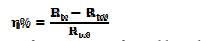
    <p>The weight loss of steel, with and without the addition of different oil
concentrations, was determined after immersion in acid over 24 h at 30 &deg;C, and
the percentage inhibition efficiency (&eta;%) was calculated from:</p>


    <p>&nbsp;</p>
<a name="e1">
<img src="/img/revistas/pea/v36n2/36n2a01e1.jpg">
    
<p>&nbsp;</p>


    <p>where w0 and w are the values of the corrosion weight loss of steel after
immersion in solutions, respectively, without and with inhibitor.</p>


    <p><i>Electrochemical measurement</i></p>

    ]]></body>
<body><![CDATA[<p>Electrochemical experiments were conducted using impedance equipment
(Tacussel-Voltalab PGZ 100), and controlled with Tacussel corrosion analysis
software model Voltamaster 4.</p>

    <p>A conventional three electrode glass cell assembly with a mild steel rod was used
as working electrode (we); a platinum foil of 3-3 cm as auxiliary electrode; and
(CE) Hg/Hg2Cl2/KCl saturated (SCE) for the 1 M HCl medium, were used as
reference electrodes. AC impedance measurements were carried-out at Ecorr after
immersion in a solution without bubbling, and the rectangle surface of the steel,
with 1 cm<sup>2</sup> exposed to the solution, was used as working electrode. After the
determination of steady state current at a given potential, peak to peak sine wave
voltage (10 mV), at frequencies between 100 KHz and 10 mHz, was
superimposed on the open circuit potential. Computer programs automatically
controlled the measurements performed at rest potentials after 30 min of
exposure. The impedance diagrams are given in the Nyquist representation.
Values of Rtc and Cdl were obtained from Nyquist plots. For polarization curves,
potentiodynamic polarisation studies were performed with a scan rate of 1 mV.s<sup>-1</sup>
in the potential range from -750 mV to -100 mV, relative to the corrosion
potential.</p>


    <p>&nbsp;</p>
    <p><b>Results and discussion</b></p>

    <p><i><b>Weight loss measurements</b></i></p>

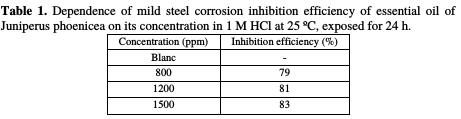
    <p>The inhibitor efficiency increased with the oil content. The inhibition was
estimated to be superior to 78 % in 1 M HCl, even at different concentrations,
and the optimum concentration for maximum efficiency was found to be 1500
ppm of oil.</p>

    <p>The inhibition efficiencies calculated from the weight loss measurements for
different amounts of essential oil of Juniperus phoenicea in 1 M HCl are
summarized in <a href="#t1">Table 1</a>.</p>


    <p>&nbsp;</p>
<a name="t1">
<img src="/img/revistas/pea/v36n2/36n2a01t1.jpg">
    
<p>&nbsp;</p>


    <p><i><b>Polarization measurements</b></i></p>

    ]]></body>
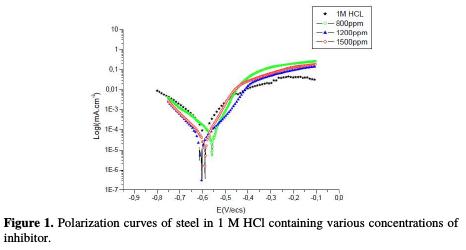
<body><![CDATA[<p>The polarization curves of steel in 1 M HCl, in the absence and presence of the
essential oil at 25 &deg;C, are presented in <a href="#f1">Fig. 1</a>.</p>


    <p>&nbsp;</p>
<a name="f1">
<img src="/img/revistas/pea/v36n2/36n2a01f1.jpg">
    
<p>&nbsp;</p>


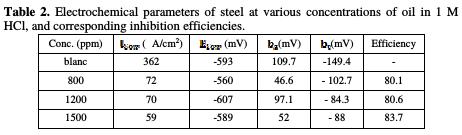
    <p>The collected parameters deduced
from the polarization curves, such as corrosion potential (Ecorr), corrosion
current (icorr), Tafel slopes (bc, ba), and percentage inhibition efficiency, are
shown in <a href="#t2">Table 2</a>.</p>


    <p>&nbsp;</p>
<a name="t2">
<img src="/img/revistas/pea/v36n2/36n2a01t2.jpg">
    
<p>&nbsp;</p>


    <p>Examination of <a href="#f1">Fig. 1</a> and <a href="#t2">Table 2</a> shows that. The cathodic current density
decreases with the natural substance concentration. The slopes of cathodic Tafel
lines, and the corrosion potential remain almost constant upon the addition of
the inhibitor concentration. This result indicates that the reduction mechanism of
the hydrogen ion is modified in the oil's presence [14-15]. In the anodic range,
the polarization curves in steel in 1 M HCl, with and without oil, show that the
inhibitor presence decreases the current density. This fact means that the
essential oil of Juniperus phoenicea inhibits anodic reaction and acts a mixed-
type inhibitor.</p>

    <p>The inhibition efficiency increases with the inhibitor concentration, attaining
83% at 1500 ppm of the natural substance.</p>


    <p><i><b>Electrochemical impedance spectroscopy (EIS)</b></i></p>

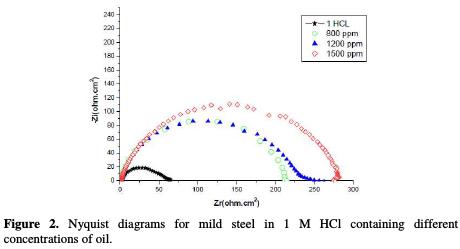
    <p>The corrosion of mild steel in an acidic solution, in the presence of a natural
substance, was investigated by EIS. Nyquist plots of steel, in inhibited and
uninhibited acidic solutions containing various concentrations of oil, are shown
in <a href="#f2">Fig. 2</a>.</p>


    ]]></body>
<body><![CDATA[<p>&nbsp;</p>
<a name="f2">
<img src="/img/revistas/pea/v36n2/36n2a01f2.jpg">
    
<p>&nbsp;</p>


    <p>The obtained impedance diagrams are not perfect semicircles, and this
difference has been attributed to frequency dispersion [16-18].</p>

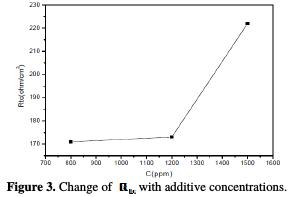
    <p>The transfer resistance values (Rtc) are calculated from the difference in
impedance at lower and higher frequencies [19]. To obtain the double layer
capacitance (Cdl), the frequency at wich the imaginary component of the
impedance (-Zmax) is found, and Cdl values, are obtained from the equation:</p>


    <p>&nbsp;</p>
<a name="e2">
<img src="/img/revistas/pea/v36n2/36n2a01e2.jpg">
    
<p>&nbsp;</p>


    <p>The inhibition efficiency is calculated by transfer resistance, as follows:</p>


    <p>&nbsp;</p>
<a name="e3">
<img src="/img/revistas/pea/v36n2/36n2a01e3.jpg">
    
<p>&nbsp;</p>


    <p>where Rtc and Rtc0 are the transfer resistances for mild steel in 1 M HCl,
respectively, with and without inhibitor.</p>

    ]]></body>
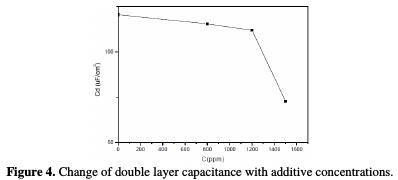
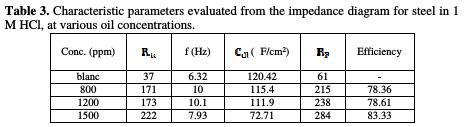
<body><![CDATA[<p>It is found (<a href="#t3">Table 3</a>) that, as the oil concentration increases, the Rtc values
increase (<a href="#f3">Fig. 3</a>), but the Cdl values tend to decrease (<a href="#f4">Fig. 4</a>).</p>


    <p>&nbsp;</p>
<a name="t3">
<img src="/img/revistas/pea/v36n2/36n2a01t3.jpg">
    
<p>&nbsp;</p>
<a name="f3">
<img src="/img/revistas/pea/v36n2/36n2a01f3.jpg">
    
<p>&nbsp;</p>
<a name="f4">
<img src="/img/revistas/pea/v36n2/36n2a01f4.jpg">
    
<p>&nbsp;</p>


    <p>The decrease in
values is due to the adsorption of aroma compounds onto the metal surface [20].
The electrochemical study confirms the results of the weight loss measurements.
The Juniperus phoenicea's oil appears to be a good inhibitor in 1 M HCl, with a
maximum efficiency of 83%.</p>

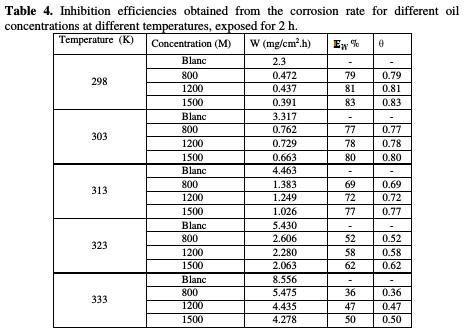
    <p>The effect of temperature on the anti-corrosion effectiveness of oil, studied at
various concentrations in the temperature domain of 298-333 K, at 2 h of
immersion, is summarized in <a href="#t4">Table 4</a>.</p>


    <p>&nbsp;</p>
<a name="t4">
<img src="/img/revistas/pea/v36n2/36n2a01t4.jpg">
    
<p>&nbsp;</p>


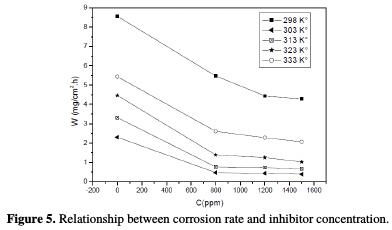
    <p>The collected curves in <a href="#f5">Fig. 5</a> show the evolution of the corrosion rate (W) with
oil concentration (C), at different temperatures.</p>


    ]]></body>
<body><![CDATA[<p>&nbsp;</p>
<a name="f5">
<img src="/img/revistas/pea/v36n2/36n2a01f5.jpg">
    
<p>&nbsp;</p>


    <p><a href="#f5">Fig. 5</a> indicates that, at a given oil concentration, the corrosion rate of steel
increased with temperature. The increase is more pronounced at weak
concentrations. The results also indicate that, for a given temperature, the
corrosion rate of steel decreased with increasing inhibitor concentration. The
values of inhibition efficiency obtained from weight loss for different inhibitor
concentrations, and at various temperatures, in 1 M HCl, are given in <a href="#t4">Table 4</a> and
<a href="#f5">Fig. 5</a>. The results show that the inhibition efficiency decreases with increasing
temperature, indicating that the dissolution of steel at higher temperatures
predominates on the adsorption of aroma compounds onto the surface.</p>

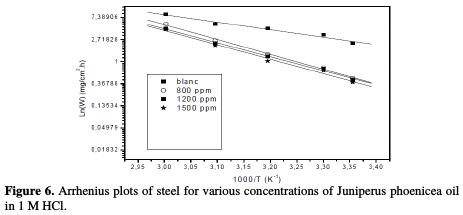
    <p>The activation kinetic parameters, such as energy (Ea), enthalpy (&Delta;Ha<sup>0</sup>) and
entropy (&Delta;Sa<sup>0</sup>), may be evaluated from the effect of temperature on the inhibitor,
using Arrhenius law (<a href="#e4">Eq. 4</a>) and the alternative formulation of Arrhenius
equation (<a href="#e5">Eq. 5</a>) [21].</p>


    <p>&nbsp;</p>
<a name="e4">
<img src="/img/revistas/pea/v36n2/36n2a01e4.jpg">
    
<p>&nbsp;</p>
<a name="e5">
<img src="/img/revistas/pea/v36n2/36n2a01e5.jpg">
    
<p>&nbsp;</p>


    <p>where A is the Arrhenius pre-exponential factor, T the absolute temperature,
Ea the activation corrosion energy for the corrosion process, h the Planck's
constant, N the Avogadro's number, &Delta;Sa<sup>0</sup> the entropy of activation, &Delta;Ha<sup>0</sup> the
enthalpy of activation, and I is the corrosion rate of steel.</p>

    <p>The apparent activation energies (Ea) and pre-exponential factors (A) are
calculated by linear regression between ln(I) and 1/T (<a href="#f6">Fig. 6</a>).</p>


    <p>&nbsp;</p>
<a name="f6">
<img src="/img/revistas/pea/v36n2/36n2a01f6.jpg">
    
]]></body>
<body><![CDATA[<p>&nbsp;</p>


    <p>The apparent activation corrosion energies in the absence and presence of 1500
ppm of Juniperus phoenicea oil were found to be, respectively, 28.17 and 52.52
kJ/mol. The pre-exponential factors (A) and Ea show the same trend. The
increase in Ea, in the oil presence, may be interpreted as the likely specific
interaction between the iron surface and aroma compounds [22], that occurs in
the first stage [23]. The increase in activation energy can be attributed to an
appreciable decrease in the adsorption of the aroma compounds onto the mild
steel surface with an increase in temperature. A corresponding increase in the
corrosion rate occurs because of the greater area of metal that is consequently
exposed to the acid environment.</p>

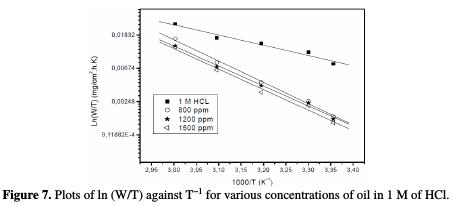
    <p><a href="#f7">Fig. 7</a> shows plots of ln(w/T) against 1/T.</p>


    <p>&nbsp;</p>
<a name="f7">
<img src="/img/revistas/pea/v36n2/36n2a01f7.jpg">
    
<p>&nbsp;</p>


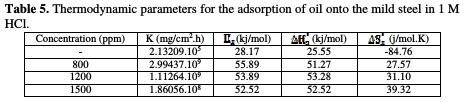
    <p>Straight lines are obtained with a slope of (-&Delta;Ha<sup>0</sup>/R) and an intercept 
of (ln R/Nh + &Delta;Sa<sup>0</sup>/R), from which the values of
&Delta;Ha<sup>0</sup> and &Delta;Sa<sup>0</sup> are calculated (<a href="#t5">Table 5</a>).</p>


    <p>&nbsp;</p>
<a name="t5">
<img src="/img/revistas/pea/v36n2/36n2a01t5.jpg">
    
<p>&nbsp;</p>


    <p>The obtained values of &Delta;Ha<sup>0</sup> are 25.55, 51.27, 53.28 and 52.52 Kj/mol for free
acid and 800, 1200 and 1500 ppm in acid added with oil, respectively. The
positive signs of the enthalpies, &Delta;Ha<sup>0</sup>, reflect the endothermic nature of the steel
dissolution process, and mean that the dissolution of steel is difficult [24].</p>

    <p>The positive values of entropies (&Delta;Sa<sup>0</sup>) in the inhibitor presence imply that the
activated complex in the rate determining step represents an association rather
than a dissociation step, meaning that an increase in disordering takes place on
going from the reactants to the activated complex [25].</p>


    ]]></body>
<body><![CDATA[<p><i><b>Adsorption isotherm</b></i></p>

    <p>The surface coverage, &theta;, was calculated according to the following equation:</p>


    <p>&nbsp;</p>
<a name="e6">
<img src="/img/revistas/pea/v36n2/36n2a01e6.jpg">
    
<p>&nbsp;</p>


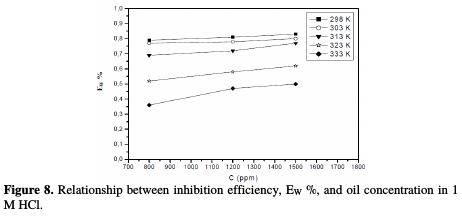
    <p>Surface coverage values (&theta;) for the inhibitor were obtained from the weight loss
measurements for various concentrations at different temperatures (303-333 K),
as shown in <a href="#t4">Table 4</a>.</p>

    <p>The dependence of the fraction of the covered surface, &theta;, obtained by the ratio
Ew/100, on the concentration (C) (<a href="#f8">Fig. 8</a>), was graphically fitted for Langmuir,
Temkin, Frumkin and Freundlich adsorption isotherms.</p>


    <p>&nbsp;</p>
<a name="f8">
<img src="/img/revistas/pea/v36n2/36n2a01f8.jpg">
    
<p>&nbsp;</p>


    <p>
The models considered were [26].</p>


    <p>&nbsp;</p>
<a name="e7">
<img src="/img/revistas/pea/v36n2/36n2a01e7.jpg">
    
]]></body>
<body><![CDATA[<p>&nbsp;</p>
<a name="e8">
<img src="/img/revistas/pea/v36n2/36n2a01e8.jpg">
    
<p>&nbsp;</p>
<a name="e9">
<img src="/img/revistas/pea/v36n2/36n2a01e9.jpg">
    
<p>&nbsp;</p>
<a name="e10">
<img src="/img/revistas/pea/v36n2/36n2a01e10.jpg">
    
<p>&nbsp;</p>


    <p>where Kads is the equilibrium constant of the adsorption process, C the inhibitor
concentration and f the factor of energetic inhomogeneity [27].</p>

    <p>The modes of adsorption mainly depend on the chemical structure of the active
molecules of this oil. The adsorption mainly depends on the electronic and
structural properties of aroma compounds, such as functional groups, steric
factors, aromaticity, and electron density [28-29].</p>


    <p>&nbsp;</p>
    <p><b>Conclusion</b></p>

    <p>1. The essential oil of Juniperus phoenicea acts as a good inhibitor for the
    corrosion of steel in acidic media.</p>

    <p>2. Essential oil of Juniperus phoenicea acts as a mixed-type inhibitor.</p>

    ]]></body>
<body><![CDATA[<p>3. The inhibition efficiency of oil decreases with the rise in temperature within
    the range 298-333 K.</p>

    <p>4. The results obtained from weight loss, potentiodynamic polarization and
    impedance spectroscopy are in good agreement.</p>


    <p>&nbsp;</p>
    <p><b>References</b></p>

    <!-- ref --><p>1. Oguzie EE, Li Y, Wang FH. J Colloid Interface Sci. 2007;310:90.    &nbsp;&nbsp;&nbsp;&nbsp;&nbsp;&nbsp;&nbsp;&nbsp;[&#160;<a href="javascript:void(0);" onclick="javascript: window.open('/scielo.php?script=sci_nlinks&ref=432359&pid=S0872-1904201800020000100001&lng=','','width=640,height=500,resizable=yes,scrollbars=1,menubar=yes,');">Links</a>&#160;]<!-- end-ref --></p>

    <!-- ref --><p>2. El-Etre AY, Abdallah M, El-Tantawy ZE. Corros Sci. 2005;47:385.    &nbsp;&nbsp;&nbsp;&nbsp;&nbsp;&nbsp;&nbsp;&nbsp;[&#160;<a href="javascript:void(0);" onclick="javascript: window.open('/scielo.php?script=sci_nlinks&ref=432361&pid=S0872-1904201800020000100002&lng=','','width=640,height=500,resizable=yes,scrollbars=1,menubar=yes,');">Links</a>&#160;]<!-- end-ref --></p>

    <!-- ref --><p>3. El-Etre AY. Corros Sci. 2003;45:2485.    &nbsp;&nbsp;&nbsp;&nbsp;&nbsp;&nbsp;&nbsp;&nbsp;[&#160;<a href="javascript:void(0);" onclick="javascript: window.open('/scielo.php?script=sci_nlinks&ref=432363&pid=S0872-1904201800020000100003&lng=','','width=640,height=500,resizable=yes,scrollbars=1,menubar=yes,');">Links</a>&#160;]<!-- end-ref --></p>

    ]]></body>
<body><![CDATA[<!-- ref --><p>4. Avwiri GO, Igho FO. Mater Let. 2001;57:3705.    &nbsp;&nbsp;&nbsp;&nbsp;&nbsp;&nbsp;&nbsp;&nbsp;[&#160;<a href="javascript:void(0);" onclick="javascript: window.open('/scielo.php?script=sci_nlinks&ref=432365&pid=S0872-1904201800020000100004&lng=','','width=640,height=500,resizable=yes,scrollbars=1,menubar=yes,');">Links</a>&#160;]<!-- end-ref --></p>

    <!-- ref --><p>5. El-Etre AY, Abdallah M. Corros Sci. 2000;42:731.    &nbsp;&nbsp;&nbsp;&nbsp;&nbsp;&nbsp;&nbsp;&nbsp;[&#160;<a href="javascript:void(0);" onclick="javascript: window.open('/scielo.php?script=sci_nlinks&ref=432367&pid=S0872-1904201800020000100005&lng=','','width=640,height=500,resizable=yes,scrollbars=1,menubar=yes,');">Links</a>&#160;]<!-- end-ref --></p>

    <!-- ref --><p>6. Martinez S, Stern I. Appl Surf Sci. 2002;199:83.    &nbsp;&nbsp;&nbsp;&nbsp;&nbsp;&nbsp;&nbsp;&nbsp;[&#160;<a href="javascript:void(0);" onclick="javascript: window.open('/scielo.php?script=sci_nlinks&ref=432369&pid=S0872-1904201800020000100006&lng=','','width=640,height=500,resizable=yes,scrollbars=1,menubar=yes,');">Links</a>&#160;]<!-- end-ref --></p>

    <!-- ref --><p>7. El-Etre AY, Abdallah M. Corros Sci. 2000;42:731.    &nbsp;&nbsp;&nbsp;&nbsp;&nbsp;&nbsp;&nbsp;&nbsp;[&#160;<a href="javascript:void(0);" onclick="javascript: window.open('/scielo.php?script=sci_nlinks&ref=432371&pid=S0872-1904201800020000100007&lng=','','width=640,height=500,resizable=yes,scrollbars=1,menubar=yes,');">Links</a>&#160;]<!-- end-ref --></p>

    <!-- ref --><p>8. Chetouani A, Hammouti B. Bull Electrochem. 2003;19:23.    &nbsp;&nbsp;&nbsp;&nbsp;&nbsp;&nbsp;&nbsp;&nbsp;[&#160;<a href="javascript:void(0);" onclick="javascript: window.open('/scielo.php?script=sci_nlinks&ref=432373&pid=S0872-1904201800020000100008&lng=','','width=640,height=500,resizable=yes,scrollbars=1,menubar=yes,');">Links</a>&#160;]<!-- end-ref --></p>

    ]]></body>
<body><![CDATA[<!-- ref --><p>9. Chetouani A, Hammouti B. Bull Electrochem. 2004;20.    &nbsp;&nbsp;&nbsp;&nbsp;&nbsp;&nbsp;&nbsp;&nbsp;[&#160;<a href="javascript:void(0);" onclick="javascript: window.open('/scielo.php?script=sci_nlinks&ref=432375&pid=S0872-1904201800020000100009&lng=','','width=640,height=500,resizable=yes,scrollbars=1,menubar=yes,');">Links</a>&#160;]<!-- end-ref --></p>

    <p>10. Benabdellah M, Benkaddour M, Hammouti B, et al. 2006;52:6212.</p>

    <!-- ref --><p>11. Znini M, Bouklah M, Majidi L, et al. Int J Electrochem Sci. 2011;6:691.    &nbsp;&nbsp;&nbsp;&nbsp;&nbsp;&nbsp;&nbsp;&nbsp;[&#160;<a href="javascript:void(0);" onclick="javascript: window.open('/scielo.php?script=sci_nlinks&ref=432378&pid=S0872-1904201800020000100011&lng=','','width=640,height=500,resizable=yes,scrollbars=1,menubar=yes,');">Links</a>&#160;]<!-- end-ref --></p>

    <!-- ref --><p>12. Chaieb EL, Bouyanzer A, Hammouti B, et al. Appl Surf Sci. 2005;249:183.    &nbsp;&nbsp;&nbsp;&nbsp;&nbsp;&nbsp;&nbsp;&nbsp;[&#160;<a href="javascript:void(0);" onclick="javascript: window.open('/scielo.php?script=sci_nlinks&ref=432380&pid=S0872-1904201800020000100012&lng=','','width=640,height=500,resizable=yes,scrollbars=1,menubar=yes,');">Links</a>&#160;]<!-- end-ref --></p>

    <!-- ref --><p>13. Achak N, Romane A, Abbad A, et al. J Ess Oi Bear Plan. 2008;11:137.    &nbsp;&nbsp;&nbsp;&nbsp;&nbsp;&nbsp;&nbsp;&nbsp;[&#160;<a href="javascript:void(0);" onclick="javascript: window.open('/scielo.php?script=sci_nlinks&ref=432382&pid=S0872-1904201800020000100013&lng=','','width=640,height=500,resizable=yes,scrollbars=1,menubar=yes,');">Links</a>&#160;]<!-- end-ref --></p>

    <p>14. LagreneÃ© M, Mernari B, Chaibi N, et al. Corros Sci. 2001;43:951.</p>

    ]]></body>
<body><![CDATA[<!-- ref --><p>15. Bentiss F, Traisnel M, Vezin H, et al. Corros Sci. 2003;45:371.    &nbsp;&nbsp;&nbsp;&nbsp;&nbsp;&nbsp;&nbsp;&nbsp;[&#160;<a href="javascript:void(0);" onclick="javascript: window.open('/scielo.php?script=sci_nlinks&ref=432385&pid=S0872-1904201800020000100015&lng=','','width=640,height=500,resizable=yes,scrollbars=1,menubar=yes,');">Links</a>&#160;]<!-- end-ref --></p>

    <!-- ref --><p>16. Mansfeld F, Kending MW, Tsai S. Corrosion. 1981;37:301.    &nbsp;&nbsp;&nbsp;&nbsp;&nbsp;&nbsp;&nbsp;&nbsp;[&#160;<a href="javascript:void(0);" onclick="javascript: window.open('/scielo.php?script=sci_nlinks&ref=432387&pid=S0872-1904201800020000100016&lng=','','width=640,height=500,resizable=yes,scrollbars=1,menubar=yes,');">Links</a>&#160;]<!-- end-ref --></p>

    <!-- ref --><p>17. Hsu CH, Mansfeld F. Corrosion. 2001;57:747.    &nbsp;&nbsp;&nbsp;&nbsp;&nbsp;&nbsp;&nbsp;&nbsp;[&#160;<a href="javascript:void(0);" onclick="javascript: window.open('/scielo.php?script=sci_nlinks&ref=432389&pid=S0872-1904201800020000100017&lng=','','width=640,height=500,resizable=yes,scrollbars=1,menubar=yes,');">Links</a>&#160;]<!-- end-ref --></p>

    <!-- ref --><p>18. Bentiss F, Bouanis M, Mernari B, et al. Corrosion. 2007;273:3696.    &nbsp;&nbsp;&nbsp;&nbsp;&nbsp;&nbsp;&nbsp;&nbsp;[&#160;<a href="javascript:void(0);" onclick="javascript: window.open('/scielo.php?script=sci_nlinks&ref=432391&pid=S0872-1904201800020000100018&lng=','','width=640,height=500,resizable=yes,scrollbars=1,menubar=yes,');">Links</a>&#160;]<!-- end-ref --></p>

    <!-- ref --><p>19. Tsuru T, Haruyama S, Gijutsu B. J Japan Soc Corros Eng. 1978;27:573.    &nbsp;&nbsp;&nbsp;&nbsp;&nbsp;&nbsp;&nbsp;&nbsp;[&#160;<a href="javascript:void(0);" onclick="javascript: window.open('/scielo.php?script=sci_nlinks&ref=432393&pid=S0872-1904201800020000100019&lng=','','width=640,height=500,resizable=yes,scrollbars=1,menubar=yes,');">Links</a>&#160;]<!-- end-ref --></p>

    ]]></body>
<body><![CDATA[<p>20. Bentiss F, Lebrini M, LagrenÃ©e M. Corros Sci. 2005;47:2915.</p>

    <!-- ref --><p>21. Arab ST, Noor EA. Corrosion. 1993;49:122.    &nbsp;&nbsp;&nbsp;&nbsp;&nbsp;&nbsp;&nbsp;&nbsp;[&#160;<a href="javascript:void(0);" onclick="javascript: window.open('/scielo.php?script=sci_nlinks&ref=432396&pid=S0872-1904201800020000100021&lng=','','width=640,height=500,resizable=yes,scrollbars=1,menubar=yes,');">Links</a>&#160;]<!-- end-ref --></p>

    <!-- ref --><p>22. Popova A, Sokolova E, Raicheva S, et al. Corros Sci. 2003;45:33.    &nbsp;&nbsp;&nbsp;&nbsp;&nbsp;&nbsp;&nbsp;&nbsp;[&#160;<a href="javascript:void(0);" onclick="javascript: window.open('/scielo.php?script=sci_nlinks&ref=432398&pid=S0872-1904201800020000100022&lng=','','width=640,height=500,resizable=yes,scrollbars=1,menubar=yes,');">Links</a>&#160;]<!-- end-ref --></p>

    <!-- ref --><p>23. El Sherbini EF. Mater Chem Phys. 1999;60:286.    &nbsp;&nbsp;&nbsp;&nbsp;&nbsp;&nbsp;&nbsp;&nbsp;[&#160;<a href="javascript:void(0);" onclick="javascript: window.open('/scielo.php?script=sci_nlinks&ref=432400&pid=S0872-1904201800020000100023&lng=','','width=640,height=500,resizable=yes,scrollbars=1,menubar=yes,');">Links</a>&#160;]<!-- end-ref --></p>

    <!-- ref --><p>24. Gomma MK, Wahdan MH. Mater Chem Phys. 1995;39:209.    &nbsp;&nbsp;&nbsp;&nbsp;&nbsp;&nbsp;&nbsp;&nbsp;[&#160;<a href="javascript:void(0);" onclick="javascript: window.open('/scielo.php?script=sci_nlinks&ref=432402&pid=S0872-1904201800020000100024&lng=','','width=640,height=500,resizable=yes,scrollbars=1,menubar=yes,');">Links</a>&#160;]<!-- end-ref --></p>

    <p>25. M. Elachouri M, Hajji MS, Salem M, et al. Corrosion. 1996;52:103.</p>

    ]]></body>
<body><![CDATA[<!-- ref --><p>26. Bouklah M, Hammouti B, LagrenÃ©e M, et al. Corros Sci. 2006;48: 2831.    &nbsp;&nbsp;&nbsp;&nbsp;&nbsp;&nbsp;&nbsp;&nbsp;[&#160;<a href="javascript:void(0);" onclick="javascript: window.open('/scielo.php?script=sci_nlinks&ref=432405&pid=S0872-1904201800020000100026&lng=','','width=640,height=500,resizable=yes,scrollbars=1,menubar=yes,');">Links</a>&#160;]<!-- end-ref --></p>

    <!-- ref --><p>27. Popova A, Christov M, Raicheva S, et al. Corros Sci. 2004;46:1333.    &nbsp;&nbsp;&nbsp;&nbsp;&nbsp;&nbsp;&nbsp;&nbsp;[&#160;<a href="javascript:void(0);" onclick="javascript: window.open('/scielo.php?script=sci_nlinks&ref=432407&pid=S0872-1904201800020000100027&lng=','','width=640,height=500,resizable=yes,scrollbars=1,menubar=yes,');">Links</a>&#160;]<!-- end-ref --></p>

    <!-- ref --><p>28. Bockris JO'M, Young B. J Electrochem Soc. 1991;138:2237.    &nbsp;&nbsp;&nbsp;&nbsp;&nbsp;&nbsp;&nbsp;&nbsp;[&#160;<a href="javascript:void(0);" onclick="javascript: window.open('/scielo.php?script=sci_nlinks&ref=432409&pid=S0872-1904201800020000100028&lng=','','width=640,height=500,resizable=yes,scrollbars=1,menubar=yes,');">Links</a>&#160;]<!-- end-ref --></p>

    <!-- ref --><p>29. Touhami F, Aouniti A, Kertit S, et al. Corros Sci. 2000;42:929.    &nbsp;&nbsp;&nbsp;&nbsp;&nbsp;&nbsp;&nbsp;&nbsp;[&#160;<a href="javascript:void(0);" onclick="javascript: window.open('/scielo.php?script=sci_nlinks&ref=432411&pid=S0872-1904201800020000100029&lng=','','width=640,height=500,resizable=yes,scrollbars=1,menubar=yes,');">Links</a>&#160;]<!-- end-ref --></p>


    <p>&nbsp;</p>
    <p><b>Acknowledgements</b></p>

    ]]></body>
<body><![CDATA[<p>The authors are pleased to acknowledge Laboratory Electrochemistry and
Corrosion Studies, Faculty of Science Kenitra, for technical assistance.</p>


    <p>&nbsp;</p>
    <p><a name=0></a><sup><a href="#top">*</a></sup>Corresponding author. E-mail address: <a href="mailto:elkhotfi@gmail.com">elkhotfi@gmail.com</a></p>

    <p>Received December 28, 2016; accepted July 1, 2017</p>

    <p><a href="http://www.peacta.org" target="_blank">www.peacta.org</a> </p>


     ]]></body><back>
<ref-list>
<ref id="B1">
<label>1</label><nlm-citation citation-type="journal">
<person-group person-group-type="author">
<name>
<surname><![CDATA[Oguzie]]></surname>
<given-names><![CDATA[E E]]></given-names>
</name>
<name>
<surname><![CDATA[Li]]></surname>
<given-names><![CDATA[Y]]></given-names>
</name>
<name>
<surname><![CDATA[Wang]]></surname>
<given-names><![CDATA[F H]]></given-names>
</name>
</person-group>
<source><![CDATA[J Colloid Interface Sci]]></source>
<year>2007</year>
<volume>310</volume>
<page-range>90</page-range></nlm-citation>
</ref>
<ref id="B2">
<label>2</label><nlm-citation citation-type="journal">
<person-group person-group-type="author">
<name>
<surname><![CDATA[El-Etre]]></surname>
<given-names><![CDATA[A Y]]></given-names>
</name>
<name>
<surname><![CDATA[Abdallah]]></surname>
<given-names><![CDATA[M]]></given-names>
</name>
<name>
<surname><![CDATA[El-Tantawy]]></surname>
<given-names><![CDATA[Z E]]></given-names>
</name>
</person-group>
<source><![CDATA[Corros Sci]]></source>
<year>2005</year>
<volume>47</volume>
<page-range>385</page-range></nlm-citation>
</ref>
<ref id="B3">
<label>3</label><nlm-citation citation-type="journal">
<person-group person-group-type="author">
<name>
<surname><![CDATA[El-Etre]]></surname>
<given-names><![CDATA[A Y]]></given-names>
</name>
</person-group>
<source><![CDATA[Corros Sci]]></source>
<year>2003</year>
<volume>45</volume>
<page-range>2485</page-range></nlm-citation>
</ref>
<ref id="B4">
<label>4</label><nlm-citation citation-type="journal">
<person-group person-group-type="author">
<name>
<surname><![CDATA[Avwiri]]></surname>
<given-names><![CDATA[G O]]></given-names>
</name>
<name>
<surname><![CDATA[Igho]]></surname>
<given-names><![CDATA[F O]]></given-names>
</name>
</person-group>
<source><![CDATA[Mater Let]]></source>
<year>2001</year>
<volume>57</volume>
<page-range>3705</page-range></nlm-citation>
</ref>
<ref id="B5">
<label>5</label><nlm-citation citation-type="journal">
<person-group person-group-type="author">
<name>
<surname><![CDATA[El-Etre]]></surname>
<given-names><![CDATA[A Y]]></given-names>
</name>
<name>
<surname><![CDATA[Abdallah]]></surname>
<given-names><![CDATA[M]]></given-names>
</name>
</person-group>
<source><![CDATA[Corros Sci]]></source>
<year>2000</year>
<volume>42</volume>
<page-range>731</page-range></nlm-citation>
</ref>
<ref id="B6">
<label>6</label><nlm-citation citation-type="journal">
<person-group person-group-type="author">
<name>
<surname><![CDATA[Martinez]]></surname>
<given-names><![CDATA[S]]></given-names>
</name>
<name>
<surname><![CDATA[Stern]]></surname>
<given-names><![CDATA[I]]></given-names>
</name>
</person-group>
<source><![CDATA[Appl Surf Sci]]></source>
<year>2002</year>
<volume>199</volume>
<page-range>83</page-range></nlm-citation>
</ref>
<ref id="B7">
<label>7</label><nlm-citation citation-type="journal">
<person-group person-group-type="author">
<name>
<surname><![CDATA[El-Etre]]></surname>
<given-names><![CDATA[A Y]]></given-names>
</name>
<name>
<surname><![CDATA[Abdallah]]></surname>
<given-names><![CDATA[M]]></given-names>
</name>
</person-group>
<source><![CDATA[Corros Sci]]></source>
<year>2000</year>
<volume>42</volume>
<page-range>731</page-range></nlm-citation>
</ref>
<ref id="B8">
<label>8</label><nlm-citation citation-type="journal">
<person-group person-group-type="author">
<name>
<surname><![CDATA[Chetouani]]></surname>
<given-names><![CDATA[A]]></given-names>
</name>
<name>
<surname><![CDATA[Hammouti]]></surname>
<given-names><![CDATA[B]]></given-names>
</name>
</person-group>
<source><![CDATA[Bull Electrochem]]></source>
<year>2003</year>
<volume>19</volume>
<page-range>23</page-range></nlm-citation>
</ref>
<ref id="B9">
<label>9</label><nlm-citation citation-type="journal">
<person-group person-group-type="author">
<name>
<surname><![CDATA[Chetouani]]></surname>
<given-names><![CDATA[A]]></given-names>
</name>
<name>
<surname><![CDATA[Hammouti]]></surname>
<given-names><![CDATA[B]]></given-names>
</name>
</person-group>
<source><![CDATA[Bull Electrochem]]></source>
<year>2004</year>
<volume>20</volume>
</nlm-citation>
</ref>
<ref id="B10">
<label>10</label><nlm-citation citation-type="journal">
<person-group person-group-type="author">
<name>
<surname><![CDATA[Benabdellah]]></surname>
<given-names><![CDATA[M]]></given-names>
</name>
<name>
<surname><![CDATA[Benkaddour]]></surname>
<given-names><![CDATA[M]]></given-names>
</name>
<name>
<surname><![CDATA[Hammouti]]></surname>
<given-names><![CDATA[B]]></given-names>
</name>
</person-group>
<source><![CDATA[Corr. Sci]]></source>
<year>2006</year>
<volume>52</volume>
<page-range>6212</page-range></nlm-citation>
</ref>
<ref id="B11">
<label>11</label><nlm-citation citation-type="journal">
<person-group person-group-type="author">
<name>
<surname><![CDATA[Znini]]></surname>
<given-names><![CDATA[M]]></given-names>
</name>
<name>
<surname><![CDATA[Bouklah]]></surname>
<given-names><![CDATA[M]]></given-names>
</name>
<name>
<surname><![CDATA[Majidi]]></surname>
<given-names><![CDATA[L]]></given-names>
</name>
</person-group>
<source><![CDATA[Int J Electrochem Sci]]></source>
<year>2011</year>
<volume>6</volume>
<page-range>691</page-range></nlm-citation>
</ref>
<ref id="B12">
<label>12</label><nlm-citation citation-type="journal">
<person-group person-group-type="author">
<name>
<surname><![CDATA[Chaieb]]></surname>
<given-names><![CDATA[E L]]></given-names>
</name>
<name>
<surname><![CDATA[Bouyanzer]]></surname>
<given-names><![CDATA[A]]></given-names>
</name>
<name>
<surname><![CDATA[Hammouti]]></surname>
<given-names><![CDATA[B]]></given-names>
</name>
</person-group>
<source><![CDATA[Appl Surf Sci]]></source>
<year>2005</year>
<volume>249</volume>
<page-range>183</page-range></nlm-citation>
</ref>
<ref id="B13">
<label>13</label><nlm-citation citation-type="journal">
<person-group person-group-type="author">
<name>
<surname><![CDATA[Achak]]></surname>
<given-names><![CDATA[N]]></given-names>
</name>
<name>
<surname><![CDATA[Romane]]></surname>
<given-names><![CDATA[A]]></given-names>
</name>
<name>
<surname><![CDATA[Abbad]]></surname>
<given-names><![CDATA[A]]></given-names>
</name>
</person-group>
<source><![CDATA[J Ess Oi Bear Plan]]></source>
<year>2008</year>
<volume>11</volume>
<page-range>137</page-range></nlm-citation>
</ref>
<ref id="B14">
<label>14</label><nlm-citation citation-type="journal">
<person-group person-group-type="author">
<name>
<surname><![CDATA[Lagrenene]]></surname>
<given-names><![CDATA[M]]></given-names>
</name>
<name>
<surname><![CDATA[Mernari]]></surname>
<given-names><![CDATA[B]]></given-names>
</name>
<name>
<surname><![CDATA[Chaibi]]></surname>
<given-names><![CDATA[N]]></given-names>
</name>
</person-group>
<source><![CDATA[Corros Sci]]></source>
<year>2001</year>
<volume>43</volume>
<page-range>951</page-range></nlm-citation>
</ref>
<ref id="B15">
<label>15</label><nlm-citation citation-type="journal">
<person-group person-group-type="author">
<name>
<surname><![CDATA[Bentiss]]></surname>
<given-names><![CDATA[F]]></given-names>
</name>
<name>
<surname><![CDATA[Traisnel]]></surname>
<given-names><![CDATA[M]]></given-names>
</name>
<name>
<surname><![CDATA[Vezin]]></surname>
<given-names><![CDATA[H]]></given-names>
</name>
</person-group>
<source><![CDATA[Corros Sci]]></source>
<year>2003</year>
<volume>45</volume>
<page-range>371</page-range></nlm-citation>
</ref>
<ref id="B16">
<label>16</label><nlm-citation citation-type="journal">
<person-group person-group-type="author">
<name>
<surname><![CDATA[Mansfeld]]></surname>
<given-names><![CDATA[F]]></given-names>
</name>
<name>
<surname><![CDATA[Kending]]></surname>
<given-names><![CDATA[M W]]></given-names>
</name>
<name>
<surname><![CDATA[Tsai]]></surname>
<given-names><![CDATA[S]]></given-names>
</name>
</person-group>
<source><![CDATA[Corrosion]]></source>
<year>1981</year>
<volume>37</volume>
<page-range>301</page-range></nlm-citation>
</ref>
<ref id="B17">
<label>17</label><nlm-citation citation-type="journal">
<person-group person-group-type="author">
<name>
<surname><![CDATA[Hsu]]></surname>
<given-names><![CDATA[C H]]></given-names>
</name>
<name>
<surname><![CDATA[Mansfeld]]></surname>
<given-names><![CDATA[F]]></given-names>
</name>
</person-group>
<source><![CDATA[Corrosion]]></source>
<year>2001</year>
<volume>57</volume>
<page-range>747</page-range></nlm-citation>
</ref>
<ref id="B18">
<label>18</label><nlm-citation citation-type="journal">
<person-group person-group-type="author">
<name>
<surname><![CDATA[Bentiss]]></surname>
<given-names><![CDATA[F]]></given-names>
</name>
<name>
<surname><![CDATA[Bouanis]]></surname>
<given-names><![CDATA[M]]></given-names>
</name>
<name>
<surname><![CDATA[Mernari]]></surname>
<given-names><![CDATA[B]]></given-names>
</name>
</person-group>
<source><![CDATA[Corrosion]]></source>
<year>2007</year>
<volume>273</volume>
<page-range>3696</page-range></nlm-citation>
</ref>
<ref id="B19">
<label>19</label><nlm-citation citation-type="journal">
<person-group person-group-type="author">
<name>
<surname><![CDATA[Tsuru]]></surname>
<given-names><![CDATA[T]]></given-names>
</name>
<name>
<surname><![CDATA[Haruyama]]></surname>
<given-names><![CDATA[S]]></given-names>
</name>
<name>
<surname><![CDATA[Gijutsu]]></surname>
<given-names><![CDATA[B]]></given-names>
</name>
</person-group>
<source><![CDATA[J Japan Soc Corros Eng]]></source>
<year>1978</year>
<volume>27</volume>
<page-range>573</page-range></nlm-citation>
</ref>
<ref id="B20">
<label>20</label><nlm-citation citation-type="journal">
<person-group person-group-type="author">
<name>
<surname><![CDATA[Bentiss]]></surname>
<given-names><![CDATA[F]]></given-names>
</name>
<name>
<surname><![CDATA[Lebrini]]></surname>
<given-names><![CDATA[M]]></given-names>
</name>
<name>
<surname><![CDATA[Lagrenene]]></surname>
<given-names><![CDATA[M]]></given-names>
</name>
</person-group>
<source><![CDATA[Corros Sci]]></source>
<year>2005</year>
<volume>47</volume>
<page-range>2915</page-range></nlm-citation>
</ref>
<ref id="B21">
<label>21</label><nlm-citation citation-type="journal">
<person-group person-group-type="author">
<name>
<surname><![CDATA[Arab]]></surname>
<given-names><![CDATA[S T]]></given-names>
</name>
<name>
<surname><![CDATA[Noor]]></surname>
<given-names><![CDATA[E A]]></given-names>
</name>
</person-group>
<source><![CDATA[Corrosion]]></source>
<year>1993</year>
<volume>49</volume>
<page-range>122</page-range></nlm-citation>
</ref>
<ref id="B22">
<label>22</label><nlm-citation citation-type="journal">
<person-group person-group-type="author">
<name>
<surname><![CDATA[Popova]]></surname>
<given-names><![CDATA[A]]></given-names>
</name>
<name>
<surname><![CDATA[Sokolova]]></surname>
<given-names><![CDATA[E]]></given-names>
</name>
<name>
<surname><![CDATA[Raicheva]]></surname>
<given-names><![CDATA[S]]></given-names>
</name>
</person-group>
<source><![CDATA[Corros Sci]]></source>
<year>2003</year>
<volume>45</volume>
<page-range>33</page-range></nlm-citation>
</ref>
<ref id="B23">
<label>23</label><nlm-citation citation-type="journal">
<person-group person-group-type="author">
<name>
<surname><![CDATA[El Sherbini]]></surname>
<given-names><![CDATA[E F]]></given-names>
</name>
</person-group>
<source><![CDATA[Mater Chem Phys]]></source>
<year>1999</year>
<volume>60</volume>
<page-range>286</page-range></nlm-citation>
</ref>
<ref id="B24">
<label>24</label><nlm-citation citation-type="journal">
<person-group person-group-type="author">
<name>
<surname><![CDATA[Gomma]]></surname>
<given-names><![CDATA[M K]]></given-names>
</name>
<name>
<surname><![CDATA[Wahdan]]></surname>
<given-names><![CDATA[M H]]></given-names>
</name>
</person-group>
<source><![CDATA[Mater Chem Phys]]></source>
<year>1995</year>
<volume>39</volume>
<page-range>209</page-range></nlm-citation>
</ref>
<ref id="B25">
<label>25</label><nlm-citation citation-type="journal">
<person-group person-group-type="author">
<name>
<surname><![CDATA[Elachouri]]></surname>
<given-names><![CDATA[M]]></given-names>
</name>
<name>
<surname><![CDATA[Hajji]]></surname>
<given-names><![CDATA[M S]]></given-names>
</name>
<name>
<surname><![CDATA[Salem]]></surname>
<given-names><![CDATA[M]]></given-names>
</name>
</person-group>
<source><![CDATA[Corrosion]]></source>
<year>1996</year>
<volume>52</volume>
<page-range>103</page-range></nlm-citation>
</ref>
<ref id="B26">
<label>26</label><nlm-citation citation-type="journal">
<person-group person-group-type="author">
<name>
<surname><![CDATA[Bouklah]]></surname>
<given-names><![CDATA[M]]></given-names>
</name>
<name>
<surname><![CDATA[Hammouti]]></surname>
<given-names><![CDATA[B]]></given-names>
</name>
<name>
<surname><![CDATA[Lagrene]]></surname>
<given-names><![CDATA[M]]></given-names>
</name>
</person-group>
<source><![CDATA[Corros Sci]]></source>
<year>2006</year>
<volume>48</volume>
<page-range>2831</page-range></nlm-citation>
</ref>
<ref id="B27">
<label>27</label><nlm-citation citation-type="journal">
<person-group person-group-type="author">
<name>
<surname><![CDATA[Popova]]></surname>
<given-names><![CDATA[A]]></given-names>
</name>
<name>
<surname><![CDATA[Christov]]></surname>
<given-names><![CDATA[M]]></given-names>
</name>
<name>
<surname><![CDATA[Raicheva]]></surname>
<given-names><![CDATA[S]]></given-names>
</name>
</person-group>
<source><![CDATA[Corros Sci]]></source>
<year>2004</year>
<volume>46</volume>
<page-range>1333</page-range></nlm-citation>
</ref>
<ref id="B28">
<label>28</label><nlm-citation citation-type="journal">
<person-group person-group-type="author">
<name>
<surname><![CDATA[Bockris]]></surname>
<given-names><![CDATA[J O M]]></given-names>
</name>
<name>
<surname><![CDATA[Young]]></surname>
<given-names><![CDATA[B]]></given-names>
</name>
</person-group>
<source><![CDATA[J Electrochem Soc]]></source>
<year>1991</year>
<volume>138</volume>
<page-range>2237</page-range></nlm-citation>
</ref>
<ref id="B29">
<label>29</label><nlm-citation citation-type="journal">
<person-group person-group-type="author">
<name>
<surname><![CDATA[Touhami]]></surname>
<given-names><![CDATA[F]]></given-names>
</name>
<name>
<surname><![CDATA[Aouniti]]></surname>
<given-names><![CDATA[A]]></given-names>
</name>
<name>
<surname><![CDATA[Kertit]]></surname>
<given-names><![CDATA[S]]></given-names>
</name>
</person-group>
<source><![CDATA[Corros Sci]]></source>
<year>2000</year>
<volume>42</volume>
<page-range>929</page-range></nlm-citation>
</ref>
</ref-list>
</back>
</article>