<?xml version="1.0" encoding="ISO-8859-1"?><article xmlns:mml="http://www.w3.org/1998/Math/MathML" xmlns:xlink="http://www.w3.org/1999/xlink" xmlns:xsi="http://www.w3.org/2001/XMLSchema-instance">
<front>
<journal-meta>
<journal-id>0872-1904</journal-id>
<journal-title><![CDATA[Portugaliae Electrochimica Acta]]></journal-title>
<abbrev-journal-title><![CDATA[Port. Electrochim. Acta]]></abbrev-journal-title>
<issn>0872-1904</issn>
<publisher>
<publisher-name><![CDATA[Sociedade Portuguesa de Electroquímica]]></publisher-name>
</publisher>
</journal-meta>
<article-meta>
<article-id>S0872-19042018000200005</article-id>
<article-id pub-id-type="doi">10.4152/pea.201802133</article-id>
<title-group>
<article-title xml:lang="en"><![CDATA[Electrochemical and Metallurgical Behavior of Lead-Aluminum Casting Alloys as Grids for Lead-Acid Batteries]]></article-title>
</title-group>
<contrib-group>
<contrib contrib-type="author">
<name>
<surname><![CDATA[Khatbi]]></surname>
<given-names><![CDATA[Salma]]></given-names>
</name>
<xref ref-type="aff" rid="A01"/>
</contrib>
<contrib contrib-type="author">
<name>
<surname><![CDATA[Gouale]]></surname>
<given-names><![CDATA[Youssef]]></given-names>
</name>
<xref ref-type="aff" rid="A01"/>
</contrib>
<contrib contrib-type="author">
<name>
<surname><![CDATA[Mansour]]></surname>
<given-names><![CDATA[Said]]></given-names>
</name>
<xref ref-type="aff" rid="A01"/>
</contrib>
<contrib contrib-type="author">
<name>
<surname><![CDATA[Lamiri]]></surname>
<given-names><![CDATA[Abdeslam]]></given-names>
</name>
<xref ref-type="aff" rid="A01"/>
</contrib>
<contrib contrib-type="author">
<name>
<surname><![CDATA[Essahli]]></surname>
<given-names><![CDATA[Mohamed]]></given-names>
</name>
<xref ref-type="aff" rid="A01"/>
</contrib>
</contrib-group>
<aff id="A01">
<institution><![CDATA[,Univ. Hassan 1 Faculty of Science and Technology Laboratory of Applied Chemistry and Environment]]></institution>
<addr-line><![CDATA[Settat ]]></addr-line>
<country>Morocco</country>
</aff>
<pub-date pub-type="pub">
<day>00</day>
<month>03</month>
<year>2018</year>
</pub-date>
<pub-date pub-type="epub">
<day>00</day>
<month>03</month>
<year>2018</year>
</pub-date>
<volume>36</volume>
<numero>2</numero>
<fpage>133</fpage>
<lpage>146</lpage>
<copyright-statement/>
<copyright-year/>
<self-uri xlink:href="http://scielo.pt/scielo.php?script=sci_arttext&amp;pid=S0872-19042018000200005&amp;lng=en&amp;nrm=iso"></self-uri><self-uri xlink:href="http://scielo.pt/scielo.php?script=sci_abstract&amp;pid=S0872-19042018000200005&amp;lng=en&amp;nrm=iso"></self-uri><self-uri xlink:href="http://scielo.pt/scielo.php?script=sci_pdf&amp;pid=S0872-19042018000200005&amp;lng=en&amp;nrm=iso"></self-uri><abstract abstract-type="short" xml:lang="en"><p><![CDATA[In order to evaluate the influence of aluminum on the corrosion resistance of lead anodes in 4 M H2SO4, as well as on the microcrystalline morphology of lead, different electrochemical and metallurgical studies were made such as potentiodynamic polarization, electrochemical impedance spectroscopy, hardness evolution, X-ray fluorescence spectroscopy and optical microscopy. The obtained results have shown that the addition of aluminum up to 1.5% in weight leads to a significant decrease of the corrosion and passivation rates (Icorr and Ipass) and it reduces the famous sulfation phenomena by facilitating the transformation of PbSO4 and PbO to PbO2. It also makes the micro-structure of Pb much stronger, which makes the Pb anodes more resistant to mechanical shocks within the battery. All of these improvements led to increase the lifetime of the conventional lead-acid battery up to 51.15%. Therefore, the new improved battery is more resistant, durable and more environment friendly.]]></p></abstract>
<kwd-group>
<kwd lng="en"><![CDATA[battery]]></kwd>
<kwd lng="en"><![CDATA[corrosion]]></kwd>
<kwd lng="en"><![CDATA[lead-aluminum alloy]]></kwd>
<kwd lng="en"><![CDATA[electrochemistry]]></kwd>
<kwd lng="en"><![CDATA[metallurgy]]></kwd>
</kwd-group>
</article-meta>
</front><body><![CDATA[ 

<!--     <p>&nbsp;</p>
    <p>doi: 10.4152/pea.201802133</p> -->

    <p><b>Electrochemical and Metallurgical Behavior of Lead-Aluminum Casting Alloys as Grids for Lead-Acid Batteries</b></p>

    <p>
<b>Salma Khatbi</b><sup><a href="#0">*</a></sup>
, <b>Youssef Gouale</b>
, <b>Said Mansour</b>
, <b>Abdeslam Lamiri</b>
 and <b>Mohamed Essahli</b>
</p>

    <p><i> Univ. Hassan 1, Laboratory of Applied Chemistry and Environment, Faculty of Science and Technology, P.O. Box 5777, Settat, Morocco</i></p>


    <p>&nbsp;</p>
    <p><b>Abstract</b></p>

    <p>In order to evaluate the influence of aluminum on the corrosion resistance of lead
anodes in 4 M H2SO4, as well as on the microcrystalline morphology of lead, different
electrochemical and metallurgical studies were made such as potentiodynamic
polarization, electrochemical impedance spectroscopy, hardness evolution, X-ray
fluorescence spectroscopy and optical microscopy. The obtained results have shown
that the addition of aluminum up to 1.5% in weight leads to a significant decrease of the
corrosion and passivation rates (Icorr and Ipass) and it reduces the famous sulfation
phenomena by facilitating the transformation of PbSO4 and PbO to PbO2. It also makes
the micro-structure of Pb much stronger, which makes the Pb anodes more resistant to
mechanical shocks within the battery. All of these improvements led to increase the
lifetime of the conventional lead-acid battery up to 51.15%. Therefore, the new
improved battery is more resistant, durable and more environment friendly.</p>

    <p><b><i>Keywords:</i></b> battery, corrosion, lead-aluminum alloy, electrochemistry, metallurgy.</p>


    ]]></body>
<body><![CDATA[<p>&nbsp;</p>
    <p><b>Introduction</b></p>

    <p>The lead-acid battery is considered as one of the most successful electrochemical
inventions up to today; it is very difficult to find a battery that performs as well
as the lead-acid battery and that can replace it in the field of energy storage. The
lead plates which constitute this battery are very malleable, fragile and cannot
resist, as it should, facing the corrosivity of the concentrated electrolyte which is
made of 4 M H2SO4. Also, the battery suffers from the sulfation phenomena,
which is characterized by the formation of a non-porous and impermeable layer
of PbSO4 on the surface of the metal, thus preventing any possible reaction
between lead and H2SO4 [1-4]. For all these reasons, it is imperative to find
alternative solutions to reinforce these plates and make them more resistant to
mechanical shocks as well as to electrochemical corrosion. Many researches have
been made recently to find the best alloys capable of replacing the pure lead
plates. Wislei R. Osorio et al. [5] have found that the Pb-1%Sn and Pb-2.5% Sn
alloys immersed in 0.5 M H2SO4 reduce considerably the corrosion of lead when
these alloys have coarse grains in comparison with other alloys that have finer
grains. Also, this type of alloys allow to make much lighter batteries. M. I.
Cekerevac et al. [6] and R. David Prengaman [7] have studied the influence of
the addition of tin and silver on the corrosion rate of Pb by modifying its
microstructure. They have found that, indeed, Pb-Ca-Sn-Ag alloys are more
resistant to corrosion in comparison with pure Pb, and that by increasing the
concentration of the added Sn and Ag, the microstructure of the primary alloy
Pb-Ca is modified in a positive way. L. Albert et al. [8] have found that when Sn
is added up to 1.2% in weight in 4.8 M H2SO4, the passivation rate of the Pb-Ca-
Sn alloys decreases under conditions that simulate the deep discharge of the
battery, by increasing the conductivity of the PbO layer that usually is formed on
the surface of the metal. Very little researches have been done to evaluate the
effect of the addition of aluminum on the corrosion of lead in batteries, and for
this reason we have chosen aluminum as our element of addition. Among these
researches, we have found those of B. Hong et al. [9] who have prepared a
lightweight grid of Pb plated (Al / Pb) grid immersed in 5 M H2SO4 and made by
molten salt electroless plating which had a life cycle of 475 cycles, and this
complies with the requirements of the lead-acid battery. Their grid was 55.4%
lighter than the conventional grid of pure lead and with a mass specific capacity
of 17.8% higher. L.A. Yolshina et al. [10] have found that the addition of
aluminum to the lead grids immersed in 4.75 M H2SO4 led to significantly reduce
the weight of the battery, and increased its specific energy from 30 to 35%.
Prior to this work, we studied the effect of the addition of phosphoric acid and its
salt K2HPO4 into the corrosive electrolyte of 4 M H2SO4 on the corrosion
resistance of lead. The obtained results were very promising, since the corrosion
and passivation rates were significantly reduced [11]. Now, we're opting for a
different approach; we have chosen to modify the composition of the negative
plate of the battery (Pb) by combining it with other metals such as aluminum,
which is known by its lightness and its high electrical conductivity. It will allow
us to evaluate its effect on the resistance of lead to corrosion and mechanical
shocks. To do this, we used different techniques such as: the potentiodynamic
polarization, electrochemical impedance spectroscopy, optical microscopy and
the X-ray fluorescence spectrometry.</p>


    <p>&nbsp;</p>
    <p><b>Experimental procedures</b></p>

    <p><i><b>Preparation of the alloys</b></i></p>

    <p>The prepared alloys are made of pure metals: Pb (99.98%) and Al (99.85%); they
are based on Pb with the addition of Al in different contents: Pb-0.5% Al, Pb-
0.8% Al, Pb-1% Al and Pb-1.5% Al.</p>

    <p>To prepare these alloys, we have taken the items in the appropriate proportions,
we introduced them in a silica glass tube of 1 cm in diameter, sealed under high
vacuum in order to prevent oxidation of lead. The assembly (alloy + tube) is
brought to a temperature of approximately 700 &deg;C. After fusion, the assembly is
water quenched at room temperature.</p>

    <p>All the prepared samples are aged at room temperature to follow the evolution of
hardness as a function of time.</p>

    <p>The prepared alloys are directly studied or preserved in liquid nitrogen. In order
to obtain reliable and reproducible results, the working electrode undergoes,
before each test, polishing with different abrasive papers 400, 600 and 1200.
Then, they are rinsed with distilled water and dried.</p>

    ]]></body>
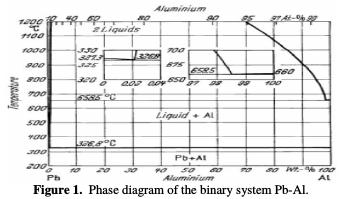
<body><![CDATA[<p>As shown in the <a href="#f1">Fig. 1</a> [12], the binary system Pb-Al is characterized by 3
phases: liquid phase (L), solid solution of Pb and solid solution of Al.</p>


    <p>&nbsp;</p>
<a name="f1">
<img src="/img/revistas/pea/v36n2/36n2a05f1.jpg">
    
<p>&nbsp;</p>


    <p>An immiscible liquid occurs below a critical threshold. The solubility of the solid
lead in aluminum and that of the solid aluminum in the lead are extremely low.
The critical composition is of 55.2% aluminum at 1566 &deg;C.</p>

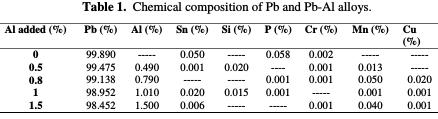
    <p>Before and after elaborating the alloys, we have analyzed the chemical
composition of, respectively, pure lead and the Pb-Al alloys to know the exact
quantities of each element including impurities. To do this, we used the portable
X-ray fluorescence spectrometer The Thermo Scientific Niton XL5. It's the
newest and the faster device to give accurate results and exact composition of
any metallic surface. Each chemical composition present in <a href="#t1">Table 1</a> is the result
of punctual analysis.</p>


    <p>&nbsp;</p>
<a name="t1">
<img src="/img/revistas/pea/v36n2/36n2a05t1.jpg">
    
<p>&nbsp;</p>


    <p><i><b>Hardness</b></i></p>

    <p>The hardness tests were carried out by the Vickers method using a Testwell
durometer under a load of 2 kgf. Each measurement corresponds to the average
of a maximum of four imprints located on a planar section corresponding to a
diameter plan or perpendicular to the axis of the cylindrical sample. The sections
are obtained by sawing, mechanical abrasion and then chemical polishing. We
should recall that the empirical relationship HV= 0.3 R (Mpa) can be used to
assess the maximum load (R) of these alloys.</p>


    <p><i><b>Optical microscopy</b></i></p>

    ]]></body>
<body><![CDATA[<p>The physical properties of the quenched solid solutions of lead alloys evolve at
room temperature. The hardening mechanisms are continuous/discontinuous
transformations. In fact, this temperature corresponds to 0.5 Tf (alloy's melting
temperature). We know that from 0.4 to 0.5 Tf, the alloy elements can diffuse. In
case where the kinetics of the discontinuous transformation are rapid at room
temperature, we use the original technique developed by Hilger [13] in order to
be able to observe the structure before any transformation. For our alloys, the
sample is polished, soaked in a chemical solution consisting of one part of 30%
H2O2 and three parts of glacial acetic acid. The solution temperature is -50 &deg;C.
The duration of the immersing process varies between 20 seconds and 2 minutes
depending on the state of the sample. The chemical polishing is followed by
repeated chemical attacks/etching using a mixture of 100 mL distilled water, 25 g
citric acid and 10 g ammonium molybdate.</p>


    <p><i><b>Electrochemical techniques</b></i></p>

    <p>Electrochemical measurements have been carried out by a cell of 3 electrodes
consisting of a saturated calomel electrode (reference), a platinum wire electrode
(auxiliary) and a sample of the lead as a working electrode. Before each test, the
sample is left under an open circuit for 5 minutes to achieve a stable open circuit
potential. The potentiodynamic polarization was carried out by sweeping the
potential with a rate of 2 mV/s ranging from - 1500 to 2500 mV. We obtained
various kinetic parameters as the corrosion current density (Icorr), the corrosion
potential (Ecorr) and the passivation current density (Ipass). The corrosion current
density has been measured by extrapolation of Tafel straight lines. The
measurements of the electrochemical impedance spectroscopy have been carried
out using a margin of frequency ranging from 100 kHz to 10 Hz at the corrosion
potential. For the analysis, we used the device 10 VoltaLab model (PGZ100)
connected to an HP computer. The acquisition and processing of data were done
using VoltaMaster 4 and OriginLab software.</p>


    <p>&nbsp;</p>
    <p><b>Results and discussion</b></p>

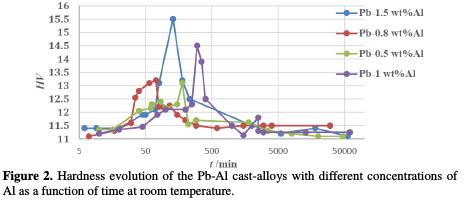
    <p><a href="#f2">Fig. 2</a> shows the hardness evolution of Pb-Al cast-alloys at room temperature (25
&deg;C). It is noted that the initial values of hardness are approximately 11.02 HV,
11.30 HV, 11.37 HV and 11.49 HV.</p>


    <p>&nbsp;</p>
<a name="f2">
<img src="/img/revistas/pea/v36n2/36n2a05f2.jpg">
    
<p>&nbsp;</p>


    <p>Therefore, in combining lead to aluminum,
the initial value of the alloy's hardness is more than two times higher than that of
pure lead (5 HV), meaning that lead is harder when added to aluminum. This
increase in hardness leads to a great reduction the inter-granular corrosion as well
as to increase the corrosion resistance. The alloys will have better mechanical
properties and it will definitely be more resistant to mechanical shocks
experienced within the battery. The hardness is higher, due to transformations
that take place during the solidification of the alloy. At 25 &deg;C, the maximum
hardness achieved is approximately 13.15 HV for Pb-0.5%Al after 2 h, 13.35 HV
for Pb-0.8%Al after 30 min, 14.5 HV for Pb-1%Al after 2 h 20 min and 15.5 HV
for Pb-1.5%Al after 1 h 55 min. After that, we note a slight decrease of the
hardness values. After 3 days, the hardness becomes stable at 11.45 HV for all
alloys.</p>


    <p><i><b>Optical microscopy</b></i></p>

    ]]></body>
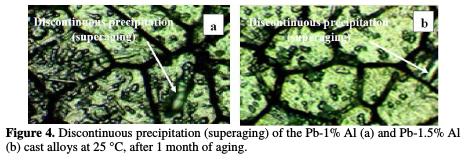
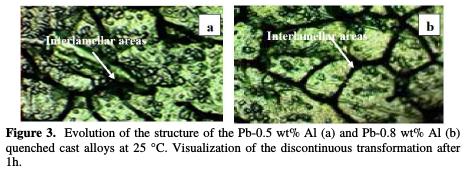
<body><![CDATA[<p><a href="#f3">Fig. 3</a> and <a href="#f4">Fig. 4</a> represent the evolution of the structure of quenched cast Pb-Al
alloy at 25 &deg;C.</p>


    <p>&nbsp;</p>
<a name="f3">
<img src="/img/revistas/pea/v36n2/36n2a05f3.jpg">
    
<p>&nbsp;</p>
<a name="f4">
<img src="/img/revistas/pea/v36n2/36n2a05f4.jpg">
    
<p>&nbsp;</p>


    <p>It's a visualization of the discontinuous transformation after 1h for
Pb-0.5% Al and Pb-0.8% Al and after 1 month for Pb-1% Al and Pb-1.5% Al.</p>

    <p>Microprobe analysis carried out in the regions concerned by the aging, shows
that the precipitates are fully made of aluminum. However, the analysis of the
interlamellar areas shows that the contents of aluminum in these areas is very low
and that it remains the same throughout the matrix.</p>


    <p><i><b>Potentiodynamic polarization</b></i></p>

    <p>Effect of Al contents on the corrosion of Pb
To study the electrochemical effect of aluminum (Al) on the corrosion of lead
(Pb) in 4 M H2SO4, we have used two techniques of analysis: potentiodynamic
polarization and electrochemical impedance spectroscopy. We have prepared 4
electrodes (Pb-0.5% Al, Pb-0.8% Al, Pb-1% Al and Pb-1.5% Al) using the
procedure above described. To be able to study the effect of aluminum, we had to
compare polarization and impedance curves obtained by immersion of the
electrodes Pb-Al with those obtained by immersion of pure lead in 4 M H2SO4.</p>

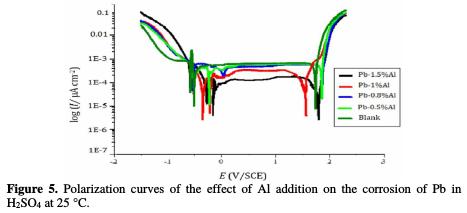
    <p><a href="#f5">Fig. 5</a> shows the polarization curves of the pure lead and those of Pb-Al alloys at
different contents of Al in 4 M H2SO4 at 25 &deg;C.</p>


    <p>&nbsp;</p>
<a name="f5">
<img src="/img/revistas/pea/v36n2/36n2a05f5.jpg">
    
]]></body>
<body><![CDATA[<p>&nbsp;</p>


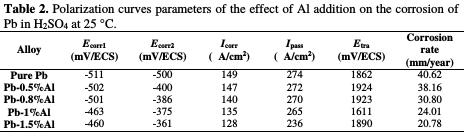
    <p>The intersection points of the
Tafel lines give the corrosion current density Icorr. The polarization parameters
are present in the <a href="#t2">Table 2</a>.</p>


    <p>&nbsp;</p>
<a name="t2">
<img src="/img/revistas/pea/v36n2/36n2a05t2.jpg">
    
<p>&nbsp;</p>


    <p>In the cathodic part of the polarization curves, we note an intense decrease of the
current corresponding to the hydrogen evolution reactions. At this range of
potential (-1.500 to 0.512 V), lead is in the activation phase. The corrosion of Pb
and of the Pb-Al alloys is characterized by the appearance of two peaks
corresponding to two corrosion potentials (Ecorr1 and Ecorr2). The first corrosion
potential Ecorr1 corresponds to the reaction of Pb with H2SO4 and the formation of
PbSO4 according to the following reaction:</p>


    <p>&nbsp;</p>
<a name="s1">
<img src="/img/revistas/pea/v36n2/36n2a05s1.jpg">
    
<p>&nbsp;</p>


    <p>The second corrosion potential Ecorr2 indicates the potential at which Pb oxidizes
leading to the appearance of PbO; this oxidation is resulting from the reaction
between Pb and H2O:</p>


    <p>&nbsp;</p>
<a name="s2">
<img src="/img/revistas/pea/v36n2/36n2a05s2.jpg">
    
<p>&nbsp;</p>


    ]]></body>
<body><![CDATA[<p>These two compounds (PbO and PbSO4) precipitate on the surface of the lead
preventing H2SO4 to infiltrate, thereby inhibiting any reaction between the lead
and the electrolyte. This is the phase of the passivation process, represented by a
bearing of corrosion current density Ipass, which remains virtually constant for a
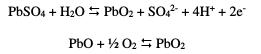
period of time. This phase ends with the transpassivation. At this stage, the
products of the corrosion (PbO and PbSO4) are transformed into PbO2 by
reaction with water, according to the following reactions:</p>


    <p>&nbsp;</p>
<a name="s3">
<img src="/img/revistas/pea/v36n2/36n2a05s3.jpg">
    
<p>&nbsp;</p>


    <p>This transformation is indicated by a peak of polarization characterized by a
potential of transpassivation (Etra) followed by an increasing current
corresponding to the evolution of oxygen.</p>

    <p>By observing the polarization curves in the <a href="#f5">Fig. 5</a> and the data in the <a href="#t2">Table 2</a>, we
can note that the more the content of added Al increases, the more the corrosion
potentials Ecorr1 and Ecorr2 decrease (from -511 to -400 mV for Ecorr1 and from -
500 to -361 mV for Ecorr2) meaning that there is an important protection of lead
against corrosion. Also, the addition of Al reduces strongly the corrosion current
density Icorr from 149 to 128 &mu;A/cm<sup>2</sup> and the passivation current density Ipass from
274 to 236 &mu;A/cm<sup>2</sup> indicating that the addition of aluminum led to an
improvement of the corrosion resistance of Pb. The quantity of the impermeable
elements (PbO and PbSO4) passivating lead also decreases and consequently, the
lifetime of the battery increases, which can be concluded by the decrease in the
corrosion rate from 40.62 mm/year for pure lead to only 20.78 mm/year after
addition of 1.5% in weight of Al, which means that the lifetime of the battery
will be 48.84% times greater after the addition of aluminum up to only 1.5% in
weight.</p>

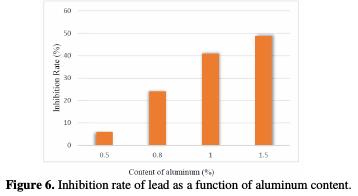
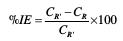
    <p><a href="#f6">Fig. 6</a> illustrates the increase of the inhibition efficiency (%IE) as a function of
the content of aluminum. IE was calculated using the equation:</p>


    <p>&nbsp;</p>
<a name="f6">
<img src="/img/revistas/pea/v36n2/36n2a05f6.jpg">
    
<p>&nbsp;</p>
<a name="s4">
<img src="/img/revistas/pea/v36n2/36n2a05s4.jpg">
    
<p>&nbsp;</p>


    <p>where CR' is the corrosion rate of pure Pb and CR is the corrosion rate of the
alloy.</p>

    ]]></body>
<body><![CDATA[<p>The bearing of passivation and therefore the potential for transpassivation (Etra)
decreases with the increase of the Al concentration, meaning that aluminum
facilitates the transformation of PbSO4 and PbO into PbO2. This decrease is
followed by the reactions of the oxygen evolution. The parts of the polarization
curves indicating these reactions do not change, meaning that aluminum has no
significant effect on the oxygen evolution.</p>


    <p><i><b>Effect of temperature on pure Pb and Pb-Al alloys</b></i></p>

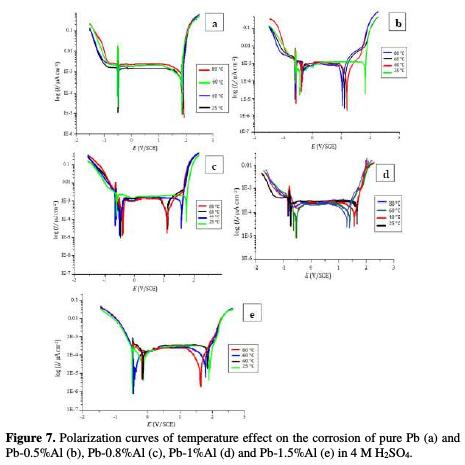
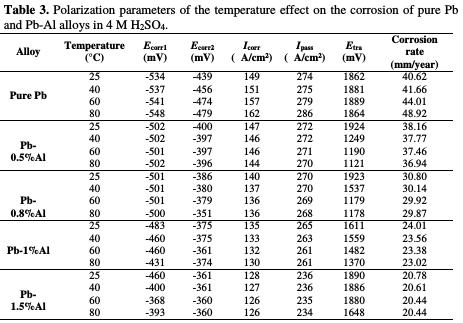
    <p>According to the obtained results, presented in <a href="#f7">Fig. 7</a> and 
the <a href="#t3">Table 3</a>, it can be
clearly noticed that the increase in the temperature has a negative effect on the
corrosion of pure lead.</p>


    <p>&nbsp;</p>
<a name="f7">
<img src="/img/revistas/pea/v36n2/36n2a05f7.jpg">
    
<p>&nbsp;</p>
<a name="t3">
<img src="/img/revistas/pea/v36n2/36n2a05t3.jpg">
    
<p>&nbsp;</p>


    <p>With the increase of the temperature from 25 to 80 &deg;C, the
corrosion potentials Ecorr1 and Ecorr2 increase (meaning that the protection of the
metal decreases), the corrosion and passivation current densities (Icorr and Ipass)
increase also, as well as the corrosion rate, which goes from 40.62 to 48.92
mm/year, indicating that when the temperature within the battery increases, the
battery's lifetime decreases by 16.96%.</p>

    <p>After the addition of aluminum, we clearly note that the increase in the
temperature has slighter effect in comparison to the one in the case of pure lead.
In fact, the values of the corrosion potentials Ecorr1 and Ecorr2 increase slightly,
which means that the addition of Al minimizes the effect of temperature on the
corrosion of Pb. Therefore, temperature reduces the negative effect of the
corrosion obtained from the addition of aluminum. Meanwhile, the
transpassivation potential Etra decreases in the case of each alloy. The
potentiodynamic experiments show that addition of Al to Pb significantly
facilitates the formation of PbO2 at high temperatures and hence accelerates the
corrosion process but not as much as in the case of pure Pb.</p>


    <p><i><b>Electrochemical impedance spectroscopy</b></i></p>

    <p>Effect of Al concentration on the corrosion of pure Pb
The electrode of pure lead and that of lead-aluminum were polarized in 4 M
H2SO4. The potential scan began at -1500 mV at a rate of 2 mV/s. A steady state-
passive current was obtained and then the electrochemical impedance
spectroscopy measurements were carried out.</p>

    ]]></body>
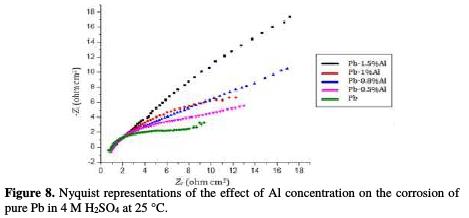
<body><![CDATA[<p><a href="#f8">Fig. 8</a> shows the Nyquist representations of pure lead and Pb-Al alloys with
different contents of Al in 4 M H2SO4 at 25 &deg;C.</p>


    <p>&nbsp;</p>
<a name="f8">
<img src="/img/revistas/pea/v36n2/36n2a05f8.jpg">
    
<p>&nbsp;</p>


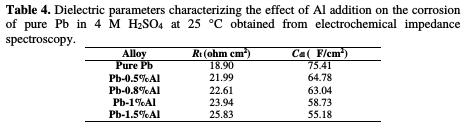
    <p>The charge transfer resistance Rt
values (determined from the intercept of the semi-circle with the real part of the
cell impedance at low frequencies) and those of the double layer capacitance Cdl
at Ecorr = -536 mV/ECS are listed in <a href="#t4">Table 4</a>.</p>


    <p>&nbsp;</p>
<a name="t4">
<img src="/img/revistas/pea/v36n2/36n2a05t4.jpg">
    
<p>&nbsp;</p>


    <p>The Nyquist representations of <a href="#f8">Fig. 8</a> are in the shape of deformed semi-circles.
This means that the main reaction mechanism present on the double layer is the
charge transfer mechanism and that control of charged species by diffusion is
absent [16-17]. By increasing the concentration of Al up to 1.5% in weight, we
note that the diameter of the half-circles increases, indicating a strong resistance
to corrosion in this margin of concentration. As it is indicated in <a href="#t4">Table 4</a>, Rt
increases from 18.9 to 25.83 ohm cm<sup>2</sup> by adding only 1.5% in weight of Al, and
the values of Cdl decrease from 75.41 to 55.18 &mu;F/cm<sup>2</sup>, meaning that the
corrosion rate of lead decreases and the lifetime of the battery increases. These
results are in good agreement with those obtained by potentiodynamic
polarization.</p>

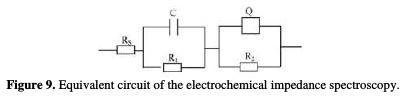
    <p><a href="#f9">Fig. 9</a> gives the equivalent circuit of the measured electrochemical impedance
spectroscopy, in which RS represents the resistance of the solution, C and R1
represent the capacitance and resistance of the double layer, and R2 and Q are the
resistance and capacitance of the anodic film, where Q is a constant phase
element (CPE) reflecting the dispersion effect of the film.</p>


    <p>&nbsp;</p>
<a name="f9">
<img src="/img/revistas/pea/v36n2/36n2a05f9.jpg">
    
<p>&nbsp;</p>


    ]]></body>
<body><![CDATA[<p>The real reason of the
dispersion effect is not clear, but the inhomogeneous ion distribution in the film,
ionic mobility, capacitance response, etc., may illustrate it [18].</p>

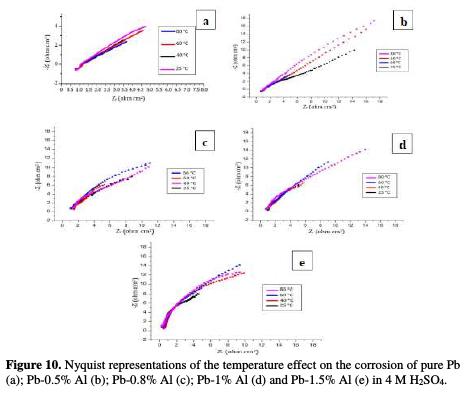
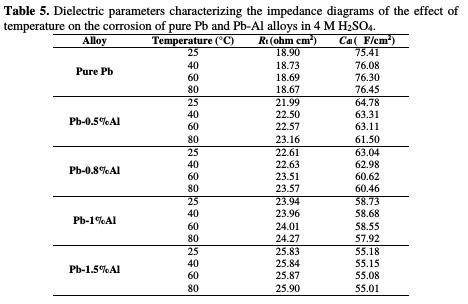
    <p>The results of the electrochemical impedance spectroscopy represented in <a href="#f10">Fig. 10</a>
and in <a href="#t5">Table 5</a> are in good agreement with those of the potentiodynamic
polarization.</p>


    <p>&nbsp;</p>
<a name="f10">
<img src="/img/revistas/pea/v36n2/36n2a05f10.jpg">
    
<p>&nbsp;</p>
<a name="t5">
<img src="/img/revistas/pea/v36n2/36n2a05t5.jpg">
    
<p>&nbsp;</p>


    <p>In the case of pure Pb, by increasing the temperature (from 25 oC to 80 &deg;C), the
charge transfer resistance Rt decreases (from 18.90 to 18.67 ohm cm<sup>2</sup>) and the
capacity of the double layer Cdl increases (from 75.41 to 76.45 &mu;F/cm<sup>2</sup>),
signifying that whenever the temperature within the battery increases, the battery
lifetime decreases. However, after Al addition, the charge transfer resistance Rt
slightly decreases (from 25.83 to 25.81 ohm cm<sup>2</sup> for Pb-1.5%Al) and the
capacitance Cdl slightly increases (from 55.18 to 55.21 &mu;F/cm<sup>2</sup> for the same
alloy). After aluminum addition, the increase in temperature within the battery
ceases to have such a negative effect on the corrosion as in the case of pure lead.</p>


    <p>&nbsp;</p>
    <p><b>Conclusions</b></p>

    <p>The results of our work on the metallurgical and electrochemical effects of Al
addition on lead in the lead-acid battery may be summarized as follows:</p>

    <p>- Aluminum addition in contents not exceeding 1.5% Al led to an increase in the
aluminum hardness (which was initially 5 HV) up to approximately 11.5 HV,
meaning that the alloys are twice harder and more resistant than pure lead.</p>

    ]]></body>
<body><![CDATA[<p>- Aluminum addition reduces the corrosion current density, Icorr, thus increasing
the battery lifetime.</p>

    <p>- Al leads to a decrease in the passivation current density, Ipass, as well as in
passivity bearing size (especially for Pb-1% Al), meaning that Al facilitates the
transformation reactions of PbO and PbSO4 into PbO2, which significantly
reduces the lead-acid battery sulfation phenomena.</p>

    <p>- The Pb-1.5% Al alloy proves to be the most resistant to corrosion, the battery
lifetime being then be 51.15% times greater.</p>

    <p>- The reaction mechanism that governs the metal surface is the charge transfer, as
indicated by the deformed semi-circles shown by the electrochemical impedance
spectroscopy.</p>

    <p>- The temperature increases the corrosion rate of pure lead and consequently,
decreases the battery's lifetime (to 16.96%). However, after aluminum addition,
the negative effect of temperature decreases, and the battery's lifetime is not as
reduced as with pure lead.</p>


    <p>&nbsp;</p>
    <p><b>References</b></p>

    <!-- ref --><p>1. Bullock KR. J Electrochem Soc. 1979;3:360.    &nbsp;&nbsp;&nbsp;&nbsp;&nbsp;&nbsp;&nbsp;&nbsp;[&#160;<a href="javascript:void(0);" onclick="javascript: window.open('/scielo.php?script=sci_nlinks&ref=433237&pid=S0872-1904201800020000500001&lng=','','width=640,height=500,resizable=yes,scrollbars=1,menubar=yes,');">Links</a>&#160;]<!-- end-ref --></p>

    <!-- ref --><p>2. Abd El-Rahman HA, Salih SA, El-Wahab AMA. Materialwiss Werkstofftech. 2011;42:791.    &nbsp;&nbsp;&nbsp;&nbsp;&nbsp;&nbsp;&nbsp;&nbsp;[&#160;<a href="javascript:void(0);" onclick="javascript: window.open('/scielo.php?script=sci_nlinks&ref=433239&pid=S0872-1904201800020000500002&lng=','','width=640,height=500,resizable=yes,scrollbars=1,menubar=yes,');">Links</a>&#160;]<!-- end-ref --></p>

    <!-- ref --><p>3. Garche J, Doring H, Wiesener K. J Power Sources. 1991;33:220.    &nbsp;&nbsp;&nbsp;&nbsp;&nbsp;&nbsp;&nbsp;&nbsp;[&#160;<a href="javascript:void(0);" onclick="javascript: window.open('/scielo.php?script=sci_nlinks&ref=433241&pid=S0872-1904201800020000500003&lng=','','width=640,height=500,resizable=yes,scrollbars=1,menubar=yes,');">Links</a>&#160;]<!-- end-ref --></p>

    <!-- ref --><p>4. Meissner E. J Power Sources. 1997;67:135.    &nbsp;&nbsp;&nbsp;&nbsp;&nbsp;&nbsp;&nbsp;&nbsp;[&#160;<a href="javascript:void(0);" onclick="javascript: window.open('/scielo.php?script=sci_nlinks&ref=433243&pid=S0872-1904201800020000500004&lng=','','width=640,height=500,resizable=yes,scrollbars=1,menubar=yes,');">Links</a>&#160;]<!-- end-ref --></p>

    <!-- ref --><p>5. Osorio WR, Peixoto LC, Garcia A. J Power Sources. 2009;194:120.    &nbsp;&nbsp;&nbsp;&nbsp;&nbsp;&nbsp;&nbsp;&nbsp;[&#160;<a href="javascript:void(0);" onclick="javascript: window.open('/scielo.php?script=sci_nlinks&ref=433245&pid=S0872-1904201800020000500005&lng=','','width=640,height=500,resizable=yes,scrollbars=1,menubar=yes,');">Links</a>&#160;]<!-- end-ref --></p>

    <!-- ref --><p>6. Cekerevac MI, Romhanji E, Cvijovic Z, et al. Mater Corros. 2010;61:51.    &nbsp;&nbsp;&nbsp;&nbsp;&nbsp;&nbsp;&nbsp;&nbsp;[&#160;<a href="javascript:void(0);" onclick="javascript: window.open('/scielo.php?script=sci_nlinks&ref=433247&pid=S0872-1904201800020000500006&lng=','','width=640,height=500,resizable=yes,scrollbars=1,menubar=yes,');">Links</a>&#160;]<!-- end-ref --></p>

    <!-- ref --><p>7. Prengaman RD. J Power Sources. 2001;95:233.    &nbsp;&nbsp;&nbsp;&nbsp;&nbsp;&nbsp;&nbsp;&nbsp;[&#160;<a href="javascript:void(0);" onclick="javascript: window.open('/scielo.php?script=sci_nlinks&ref=433249&pid=S0872-1904201800020000500007&lng=','','width=640,height=500,resizable=yes,scrollbars=1,menubar=yes,');">Links</a>&#160;]<!-- end-ref --></p>

    <!-- ref --><p>8. Albert L, Chabrol A, Torcheux L, et al. J Power Sources. 1997;67:265.    &nbsp;&nbsp;&nbsp;&nbsp;&nbsp;&nbsp;&nbsp;&nbsp;[&#160;<a href="javascript:void(0);" onclick="javascript: window.open('/scielo.php?script=sci_nlinks&ref=433251&pid=S0872-1904201800020000500008&lng=','','width=640,height=500,resizable=yes,scrollbars=1,menubar=yes,');">Links</a>&#160;]<!-- end-ref --></p>

    <!-- ref --><p>9. Hong B, Jiang L, Hao K, et al. J Power Sources. 2014;256:300.    &nbsp;&nbsp;&nbsp;&nbsp;&nbsp;&nbsp;&nbsp;&nbsp;[&#160;<a href="javascript:void(0);" onclick="javascript: window.open('/scielo.php?script=sci_nlinks&ref=433253&pid=S0872-1904201800020000500009&lng=','','width=640,height=500,resizable=yes,scrollbars=1,menubar=yes,');">Links</a>&#160;]<!-- end-ref --></p>

    <!-- ref --><p>10. Yolshina LA, Kudyakov VY, Zyryanov VG. J Power Sources. 1999;78:87.    &nbsp;&nbsp;&nbsp;&nbsp;&nbsp;&nbsp;&nbsp;&nbsp;[&#160;<a href="javascript:void(0);" onclick="javascript: window.open('/scielo.php?script=sci_nlinks&ref=433255&pid=S0872-1904201800020000500010&lng=','','width=640,height=500,resizable=yes,scrollbars=1,menubar=yes,');">Links</a>&#160;]<!-- end-ref --></p>

    <!-- ref --><p>11. Khatbi S, Gouale Y, Lamiri A, et al. Port Electrochim Acta. 2016;34:393.    &nbsp;&nbsp;&nbsp;&nbsp;&nbsp;&nbsp;&nbsp;&nbsp;[&#160;<a href="javascript:void(0);" onclick="javascript: window.open('/scielo.php?script=sci_nlinks&ref=433257&pid=S0872-1904201800020000500011&lng=','','width=640,height=500,resizable=yes,scrollbars=1,menubar=yes,');">Links</a>&#160;]<!-- end-ref --></p>

    <!-- ref --><p>12. Hofmann W, Vibrans G. Lead and Lead Alloys. 1st ed. Berlin: Springer; 1970.    &nbsp;&nbsp;&nbsp;&nbsp;&nbsp;&nbsp;&nbsp;&nbsp;[&#160;<a href="javascript:void(0);" onclick="javascript: window.open('/scielo.php?script=sci_nlinks&ref=433259&pid=S0872-1904201800020000500012&lng=','','width=640,height=500,resizable=yes,scrollbars=1,menubar=yes,');">Links</a>&#160;]<!-- end-ref --></p>

    <!-- ref --><p>13. Boulahrouf JH. Mater Character. 1990;24:167.    &nbsp;&nbsp;&nbsp;&nbsp;&nbsp;&nbsp;&nbsp;&nbsp;[&#160;<a href="javascript:void(0);" onclick="javascript: window.open('/scielo.php?script=sci_nlinks&ref=433261&pid=S0872-1904201800020000500013&lng=','','width=640,height=500,resizable=yes,scrollbars=1,menubar=yes,');">Links</a>&#160;]<!-- end-ref --></p>

    <!-- ref --><p>14. Lander JJ. J Electrochem Soc. 1956;103:215.    &nbsp;&nbsp;&nbsp;&nbsp;&nbsp;&nbsp;&nbsp;&nbsp;[&#160;<a href="javascript:void(0);" onclick="javascript: window.open('/scielo.php?script=sci_nlinks&ref=433263&pid=S0872-1904201800020000500014&lng=','','width=640,height=500,resizable=yes,scrollbars=1,menubar=yes,');">Links</a>&#160;]<!-- end-ref --></p>

    <!-- ref --><p>15. Abd-El Rehim SS, Amin NH, Ali LI, et al. J Chem Technol Biotechnol. 1998;2:201.    &nbsp;&nbsp;&nbsp;&nbsp;&nbsp;&nbsp;&nbsp;&nbsp;[&#160;<a href="javascript:void(0);" onclick="javascript: window.open('/scielo.php?script=sci_nlinks&ref=433265&pid=S0872-1904201800020000500015&lng=','','width=640,height=500,resizable=yes,scrollbars=1,menubar=yes,');">Links</a>&#160;]<!-- end-ref --></p>

    <!-- ref --><p>16. Morakchi K, Hamel A, Zazoua A, et al. J Ren Ener. 2008;11:362.    &nbsp;&nbsp;&nbsp;&nbsp;&nbsp;&nbsp;&nbsp;&nbsp;[&#160;<a href="javascript:void(0);" onclick="javascript: window.open('/scielo.php?script=sci_nlinks&ref=433267&pid=S0872-1904201800020000500016&lng=','','width=640,height=500,resizable=yes,scrollbars=1,menubar=yes,');">Links</a>&#160;]<!-- end-ref --></p>

    <!-- ref --><p>17. Larabi L, Harek Y, Traisnel M, et al. J Appl Electrochem. 2004;34:839.    &nbsp;&nbsp;&nbsp;&nbsp;&nbsp;&nbsp;&nbsp;&nbsp;[&#160;<a href="javascript:void(0);" onclick="javascript: window.open('/scielo.php?script=sci_nlinks&ref=433269&pid=S0872-1904201800020000500017&lng=','','width=640,height=500,resizable=yes,scrollbars=1,menubar=yes,');">Links</a>&#160;]<!-- end-ref --></p>

    <!-- ref --><p>18. Li DG, Zhou GS, Zhang J., et al. Electrochim Acta. 2007;52:2152.    &nbsp;&nbsp;&nbsp;&nbsp;&nbsp;&nbsp;&nbsp;&nbsp;[&#160;<a href="javascript:void(0);" onclick="javascript: window.open('/scielo.php?script=sci_nlinks&ref=433271&pid=S0872-1904201800020000500018&lng=','','width=640,height=500,resizable=yes,scrollbars=1,menubar=yes,');">Links</a>&#160;]<!-- end-ref --></p>


    <p>&nbsp;</p>
    <p><a name=0></a><sup><a href="#top">*</a></sup>Corresponding author. E-mail address: <a href="mailto:khatbisalma@gmail.com">khatbisalma@gmail.com</a></p>

    <p>Received July 31, 2017; accepted November 5, 2017</p>

    <p><a href="http://www.peacta.org" target="_blank">www.peacta.org</a> </p>


     ]]></body><back>
<ref-list>
<ref id="B1">
<label>1</label><nlm-citation citation-type="journal">
<person-group person-group-type="author">
<name>
<surname><![CDATA[Bullock]]></surname>
<given-names><![CDATA[K R]]></given-names>
</name>
</person-group>
<source><![CDATA[J Electrochem Soc]]></source>
<year>1979</year>
<volume>3</volume>
<page-range>360</page-range></nlm-citation>
</ref>
<ref id="B2">
<label>2</label><nlm-citation citation-type="journal">
<person-group person-group-type="author">
<name>
<surname><![CDATA[Abd El-Rahman]]></surname>
<given-names><![CDATA[H A]]></given-names>
</name>
<name>
<surname><![CDATA[Salih]]></surname>
<given-names><![CDATA[S A]]></given-names>
</name>
<name>
<surname><![CDATA[El-Wahab]]></surname>
<given-names><![CDATA[A M A]]></given-names>
</name>
</person-group>
<source><![CDATA[Materialwiss Werkstofftech]]></source>
<year>2011</year>
<volume>42</volume>
<page-range>791</page-range></nlm-citation>
</ref>
<ref id="B3">
<label>3</label><nlm-citation citation-type="journal">
<person-group person-group-type="author">
<name>
<surname><![CDATA[Garche]]></surname>
<given-names><![CDATA[J]]></given-names>
</name>
<name>
<surname><![CDATA[Doring]]></surname>
<given-names><![CDATA[H]]></given-names>
</name>
<name>
<surname><![CDATA[Wiesener]]></surname>
<given-names><![CDATA[K]]></given-names>
</name>
</person-group>
<source><![CDATA[J Power Sources]]></source>
<year>1991</year>
<volume>33</volume>
<page-range>220</page-range></nlm-citation>
</ref>
<ref id="B4">
<label>4</label><nlm-citation citation-type="journal">
<person-group person-group-type="author">
<name>
<surname><![CDATA[Meissner]]></surname>
<given-names><![CDATA[E]]></given-names>
</name>
</person-group>
<source><![CDATA[J Power Sources]]></source>
<year>1997</year>
<volume>67</volume>
<page-range>135</page-range></nlm-citation>
</ref>
<ref id="B5">
<label>5</label><nlm-citation citation-type="journal">
<person-group person-group-type="author">
<name>
<surname><![CDATA[Osorio]]></surname>
<given-names><![CDATA[W R]]></given-names>
</name>
<name>
<surname><![CDATA[Peixoto]]></surname>
<given-names><![CDATA[L C]]></given-names>
</name>
<name>
<surname><![CDATA[Garcia]]></surname>
<given-names><![CDATA[A]]></given-names>
</name>
</person-group>
<source><![CDATA[J Power Sources]]></source>
<year>2009</year>
<volume>194</volume>
<page-range>120</page-range></nlm-citation>
</ref>
<ref id="B6">
<label>6</label><nlm-citation citation-type="journal">
<person-group person-group-type="author">
<name>
<surname><![CDATA[Cekerevac]]></surname>
<given-names><![CDATA[MI]]></given-names>
</name>
<name>
<surname><![CDATA[Romhanji]]></surname>
<given-names><![CDATA[E]]></given-names>
</name>
<name>
<surname><![CDATA[Cvijovic]]></surname>
<given-names><![CDATA[Z]]></given-names>
</name>
</person-group>
<source><![CDATA[Mater Corros]]></source>
<year>2010</year>
<volume>61</volume>
<page-range>51</page-range></nlm-citation>
</ref>
<ref id="B7">
<label>7</label><nlm-citation citation-type="journal">
<person-group person-group-type="author">
<name>
<surname><![CDATA[Prengaman]]></surname>
<given-names><![CDATA[R D]]></given-names>
</name>
</person-group>
<source><![CDATA[J Power Sources]]></source>
<year>2001</year>
<volume>95</volume>
<page-range>233</page-range></nlm-citation>
</ref>
<ref id="B8">
<label>8</label><nlm-citation citation-type="journal">
<person-group person-group-type="author">
<name>
<surname><![CDATA[Albert]]></surname>
<given-names><![CDATA[L]]></given-names>
</name>
<name>
<surname><![CDATA[Chabrol]]></surname>
<given-names><![CDATA[A]]></given-names>
</name>
<name>
<surname><![CDATA[Torcheux]]></surname>
<given-names><![CDATA[L]]></given-names>
</name>
</person-group>
<source><![CDATA[J Power Sources]]></source>
<year>1997</year>
<volume>67</volume>
<page-range>265</page-range></nlm-citation>
</ref>
<ref id="B9">
<label>9</label><nlm-citation citation-type="journal">
<person-group person-group-type="author">
<name>
<surname><![CDATA[Hong]]></surname>
<given-names><![CDATA[B]]></given-names>
</name>
<name>
<surname><![CDATA[Jiang]]></surname>
<given-names><![CDATA[L]]></given-names>
</name>
<name>
<surname><![CDATA[Hao]]></surname>
<given-names><![CDATA[K]]></given-names>
</name>
</person-group>
<source><![CDATA[J Power Sources]]></source>
<year>2014</year>
<volume>256</volume>
<page-range>300</page-range></nlm-citation>
</ref>
<ref id="B10">
<label>10</label><nlm-citation citation-type="journal">
<person-group person-group-type="author">
<name>
<surname><![CDATA[Yolshina]]></surname>
<given-names><![CDATA[L A]]></given-names>
</name>
<name>
<surname><![CDATA[Kudyakov]]></surname>
<given-names><![CDATA[V Y]]></given-names>
</name>
<name>
<surname><![CDATA[Zyryanov]]></surname>
<given-names><![CDATA[V G]]></given-names>
</name>
</person-group>
<source><![CDATA[J Power Sources]]></source>
<year>1999</year>
<volume>78</volume>
<page-range>87</page-range></nlm-citation>
</ref>
<ref id="B11">
<label>11</label><nlm-citation citation-type="journal">
<person-group person-group-type="author">
<name>
<surname><![CDATA[Khatbi]]></surname>
<given-names><![CDATA[S]]></given-names>
</name>
<name>
<surname><![CDATA[Gouale]]></surname>
<given-names><![CDATA[Y]]></given-names>
</name>
<name>
<surname><![CDATA[Lamiri]]></surname>
<given-names><![CDATA[A]]></given-names>
</name>
</person-group>
<source><![CDATA[Port Electrochim Acta]]></source>
<year>2016</year>
<volume>34</volume>
<page-range>393</page-range></nlm-citation>
</ref>
<ref id="B12">
<label>12</label><nlm-citation citation-type="book">
<person-group person-group-type="author">
<name>
<surname><![CDATA[Hofmann]]></surname>
<given-names><![CDATA[W]]></given-names>
</name>
<name>
<surname><![CDATA[Vibrans]]></surname>
<given-names><![CDATA[G]]></given-names>
</name>
</person-group>
<source><![CDATA[Lead and Lead Alloys]]></source>
<year>1970</year>
<edition>1</edition>
<publisher-loc><![CDATA[Berlin ]]></publisher-loc>
<publisher-name><![CDATA[Springer]]></publisher-name>
</nlm-citation>
</ref>
<ref id="B13">
<label>13</label><nlm-citation citation-type="journal">
<person-group person-group-type="author">
<name>
<surname><![CDATA[Boulahrouf]]></surname>
<given-names><![CDATA[J H]]></given-names>
</name>
</person-group>
<source><![CDATA[Mater Character]]></source>
<year>1990</year>
<volume>24</volume>
<page-range>167</page-range></nlm-citation>
</ref>
<ref id="B14">
<label>14</label><nlm-citation citation-type="journal">
<person-group person-group-type="author">
<name>
<surname><![CDATA[Lander]]></surname>
<given-names><![CDATA[J J]]></given-names>
</name>
</person-group>
<source><![CDATA[J Electrochem Soc]]></source>
<year>1956</year>
<volume>103</volume>
<page-range>215</page-range></nlm-citation>
</ref>
<ref id="B15">
<label>15</label><nlm-citation citation-type="journal">
<person-group person-group-type="author">
<name>
<surname><![CDATA[Abd-El Rehim]]></surname>
<given-names><![CDATA[S S]]></given-names>
</name>
<name>
<surname><![CDATA[Amin]]></surname>
<given-names><![CDATA[N H]]></given-names>
</name>
<name>
<surname><![CDATA[Ali]]></surname>
<given-names><![CDATA[L I]]></given-names>
</name>
</person-group>
<source><![CDATA[J Chem Technol Biotechnol]]></source>
<year>1998</year>
<volume>2</volume>
<page-range>201</page-range></nlm-citation>
</ref>
<ref id="B16">
<label>16</label><nlm-citation citation-type="journal">
<person-group person-group-type="author">
<name>
<surname><![CDATA[Morakchi]]></surname>
<given-names><![CDATA[K]]></given-names>
</name>
<name>
<surname><![CDATA[Hamel]]></surname>
<given-names><![CDATA[A]]></given-names>
</name>
<name>
<surname><![CDATA[Zazoua]]></surname>
<given-names><![CDATA[A]]></given-names>
</name>
</person-group>
<source><![CDATA[J Ren Ener]]></source>
<year>2008</year>
<volume>11</volume>
<page-range>362</page-range></nlm-citation>
</ref>
<ref id="B17">
<label>17</label><nlm-citation citation-type="journal">
<person-group person-group-type="author">
<name>
<surname><![CDATA[Larabi]]></surname>
<given-names><![CDATA[L]]></given-names>
</name>
<name>
<surname><![CDATA[Harek]]></surname>
<given-names><![CDATA[Y]]></given-names>
</name>
<name>
<surname><![CDATA[Traisnel]]></surname>
<given-names><![CDATA[M]]></given-names>
</name>
</person-group>
<source><![CDATA[J Appl Electrochem]]></source>
<year>2004</year>
<volume>34</volume>
<page-range>839</page-range></nlm-citation>
</ref>
<ref id="B18">
<label>18</label><nlm-citation citation-type="journal">
<person-group person-group-type="author">
<name>
<surname><![CDATA[Li]]></surname>
<given-names><![CDATA[D G]]></given-names>
</name>
<name>
<surname><![CDATA[Zhou]]></surname>
<given-names><![CDATA[G S]]></given-names>
</name>
<name>
<surname><![CDATA[Zhang]]></surname>
<given-names><![CDATA[J]]></given-names>
</name>
</person-group>
<source><![CDATA[Electrochim Acta]]></source>
<year>2007</year>
<volume>52</volume>
<page-range>2152</page-range></nlm-citation>
</ref>
</ref-list>
</back>
</article>