<?xml version="1.0" encoding="ISO-8859-1"?><article xmlns:mml="http://www.w3.org/1998/Math/MathML" xmlns:xlink="http://www.w3.org/1999/xlink" xmlns:xsi="http://www.w3.org/2001/XMLSchema-instance">
<front>
<journal-meta>
<journal-id>0872-1904</journal-id>
<journal-title><![CDATA[Portugaliae Electrochimica Acta]]></journal-title>
<abbrev-journal-title><![CDATA[Port. Electrochim. Acta]]></abbrev-journal-title>
<issn>0872-1904</issn>
<publisher>
<publisher-name><![CDATA[Sociedade Portuguesa de Electroquímica]]></publisher-name>
</publisher>
</journal-meta>
<article-meta>
<article-id>S0872-19042018000300002</article-id>
<article-id pub-id-type="doi">10.4152/pea.201803163</article-id>
<title-group>
<article-title xml:lang="en"><![CDATA[Advanced Oxidation of Reactive Yellow 17 Dye: a Comparison between Fenton, Photo-Fenton, Electro-Fenton, Anodic Oxidation and Heterogeneous Photocatalysis Processes]]></article-title>
</title-group>
<contrib-group>
<contrib contrib-type="author">
<name>
<surname><![CDATA[Sennaoui]]></surname>
<given-names><![CDATA[A.]]></given-names>
</name>
<xref ref-type="aff" rid="A01"/>
</contrib>
<contrib contrib-type="author">
<name>
<surname><![CDATA[Alahiane]]></surname>
<given-names><![CDATA[S.]]></given-names>
</name>
<xref ref-type="aff" rid="A01"/>
</contrib>
<contrib contrib-type="author">
<name>
<surname><![CDATA[Sakr]]></surname>
<given-names><![CDATA[F.]]></given-names>
</name>
<xref ref-type="aff" rid="A01"/>
</contrib>
<contrib contrib-type="author">
<name>
<surname><![CDATA[Assabbane]]></surname>
<given-names><![CDATA[A.]]></given-names>
</name>
<xref ref-type="aff" rid="A01"/>
</contrib>
<contrib contrib-type="author">
<name>
<surname><![CDATA[Addi]]></surname>
<given-names><![CDATA[El H. Ait]]></given-names>
</name>
<xref ref-type="aff" rid="A02"/>
</contrib>
<contrib contrib-type="author">
<name>
<surname><![CDATA[Hamdani]]></surname>
<given-names><![CDATA[M.]]></given-names>
</name>
<xref ref-type="aff" rid="A01"/>
</contrib>
</contrib-group>
<aff id="A01">
<institution><![CDATA[,Ibn Zohr University Faculty of Science Laboratory of Electrochemistry, Catalysis and Environment]]></institution>
<addr-line><![CDATA[Agadir ]]></addr-line>
<country>Morocco</country>
</aff>
<aff id="A02">
<institution><![CDATA[,Ibn Zohr University Superior School of Technology Team of Biotechnology, Energy and Environment]]></institution>
<addr-line><![CDATA[Agadir ]]></addr-line>
<country>Morocco</country>
</aff>
<pub-date pub-type="pub">
<day>00</day>
<month>05</month>
<year>2018</year>
</pub-date>
<pub-date pub-type="epub">
<day>00</day>
<month>05</month>
<year>2018</year>
</pub-date>
<volume>36</volume>
<numero>3</numero>
<fpage>163</fpage>
<lpage>178</lpage>
<copyright-statement/>
<copyright-year/>
<self-uri xlink:href="http://scielo.pt/scielo.php?script=sci_arttext&amp;pid=S0872-19042018000300002&amp;lng=en&amp;nrm=iso"></self-uri><self-uri xlink:href="http://scielo.pt/scielo.php?script=sci_abstract&amp;pid=S0872-19042018000300002&amp;lng=en&amp;nrm=iso"></self-uri><self-uri xlink:href="http://scielo.pt/scielo.php?script=sci_pdf&amp;pid=S0872-19042018000300002&amp;lng=en&amp;nrm=iso"></self-uri><abstract abstract-type="short" xml:lang="en"><p><![CDATA[In this study, Fenton, photo-Fenton, electro-Fenton, anodic oxidation and heterogeneous photocatalysis advanced oxidation processes (AOPs) have been applied to degrade reactive yellow 17 (RY17) dye in an aqueous solution. Comparison of these techniques for oxidation efficiency was undertaken. The results showed better performance with the use of a heterogeneous photocatalysis process. Degradation efficiency was observed in the order: heterogeneous photocatalysis > photo-Fenton = electro-Fenton > anodic oxidation > Fenton. Even though complete RY17 dye degradation has been observed with heterogeneous photocatalysis, photo-Fenton and electro-Fenton processes, the heterogeneous photocatalysis process has showed complete RY17 dye removal within 30 min, whereas in the case of photo-Fenton and electro-Fenton processes, no RY17 was detected after 60 min. Fenton and anodic oxidation processes have required more time for complete RY17 degradation. The RY17 degradation kinetics was studied and compared in all processes. The results showed higher rate constant values for heterogeneous photocatalysis (kapp = 0.2 min-1), photo-Fenton (kapp = 0.126 min-1) and electro-Fenton (kapp = 0.122 min-1) processes.]]></p></abstract>
<kwd-group>
<kwd lng="en"><![CDATA[RY17 degradation]]></kwd>
<kwd lng="en"><![CDATA[Fenton's processes]]></kwd>
<kwd lng="en"><![CDATA[anodic oxidation]]></kwd>
<kwd lng="en"><![CDATA[heterogeneous photocatalysis]]></kwd>
<kwd lng="en"><![CDATA[degradation kinetics]]></kwd>
</kwd-group>
</article-meta>
</front><body><![CDATA[ 

<!--     <p>&nbsp;</p>
    <p>doi: 10.4152/pea.201803163</p> -->

    <p><b>Advanced Oxidation of Reactive Yellow 17 Dye: a Comparison between Fenton, Photo-Fenton, Electro-Fenton, Anodic Oxidation and Heterogeneous Photocatalysis Processes</b></p>

    <p>
<b>A. Sennaoui</b><sup><i>a</i>,<a href="#0">*</a></sup>
, <b>S. Alahiane</b><sup><i>a</i></sup>
, <b>F. Sakr</b><sup><i>a</i></sup>
, <b>A. Assabbane</b><sup><i>a</i></sup>
, <b>El H. Ait Addi</b><sup><i>b</i></sup>
 and <b>M. Hamdani</b><sup><i>a</i></sup>
</p>

    <p><i><sup>a</sup> Laboratory of Electrochemistry, Catalysis and Environment, Faculty of Science, Ibn Zohr University, Agadir, Morocco</i></p>

    <p><i><sup>b</sup> Team of Biotechnology, Energy and Environment, Superior School of Technology, Ibn Zohr University, Agadir, Morocco</i></p>


    <p>&nbsp;</p>
    <p><b>ABSTRACT</b></p>

    <p>In this study, Fenton, photo-Fenton, electro-Fenton, anodic oxidation and heterogeneous
 photocatalysis advanced oxidation processes (AOPs) have been applied to degrade
 reactive yellow 17 (RY17) dye in an aqueous solution. Comparison of these techniques
 for oxidation efficiency was undertaken. The results showed better performance with
 the use of a heterogeneous photocatalysis process. Degradation efficiency was observed
 in the order: heterogeneous photocatalysis &gt; photo-Fenton = electro-Fenton > anodic
 oxidation &gt; Fenton. Even though complete RY17 dye degradation has been observed
 with heterogeneous photocatalysis, photo-Fenton and electro-Fenton processes, the
 heterogeneous photocatalysis process has showed complete RY17 dye removal within
 30 min, whereas in the case of photo-Fenton and electro-Fenton processes, no RY17
 was detected after 60 min. Fenton and anodic oxidation processes have required more
 time for complete RY17 degradation. The RY17 degradation kinetics was studied and
 compared in all processes. The results showed higher rate constant values for
 heterogeneous photocatalysis (kapp = 0.2 min<sup>-1</sup>), photo-Fenton (kapp = 0.126 min<sup>-1</sup>) and
 electro-Fenton (kapp = 0.122 min<sup>-1</sup>) processes.</p>

    ]]></body>
<body><![CDATA[<p><b><i>Keywords:</i></b> RY17 degradation; Fenton's processes; anodic oxidation; heterogeneous
 photocatalysis; degradation kinetics.</p>


    <p>&nbsp;</p>
    <p><b>Introduction</b></p>

    <p>Azo dyes constitute the largest and most versatile class of synthetic dyes used for
 textile dying, and other industrial applications [1]. Unfortunately, azo dyes
 present in the wastewater are normally unaffected by conventional treatment
 processes. Their persistence is mainly due to sulfo and azo groups, which do not
 naturally occur, making the dyes xenobiotic and recalcitrant to oxidative
degradation [2].</p>

    <p>Treatment methods involving adsorption, coagulation/flocculation and electro-
coagulation are also not able to completely remove the pollutants, and can
generate secondary environment loading, in the form of sludge [3]. As a result of
these shortcomings, and for the past few decades, alternate technologies, known
as Advanced Oxidation Processes (AOPs), have been extensively explored for
the effective degradation of these compounds [4]. AOPs are chemical,
photocatalytic and electrochemical methods based on the in situ generation of
hydroxyl radical (&bull;OH). This species is the second strongest oxidant known after
fluorine, and has an equally high standard reduction potential (E<sup>0</sup> (&bull;OH/H2O) =
2.80 V vs. SHE) that can non-selectively react with most organic pollutants up to
their total mineralization (conversion into CO2, water and inorganic ions) [5].
As one of AOPs, photocatalytic treatment of wastewater is an emerging
technology. In this process, the solution is illuminated with UV irradiation in the
presence of a suitable photocatalyst, mainly titanium dioxide (TiO2). It can
absorb UV light to generate electron-hole pairs. Then, reactive oxygen species
(ROS), particularly hydroxyl radicals, are generated by photo-stimulated
reactions on TiO2 surface (<a href="#e1">Eqs. 1</a>-<a href="#e6">6</a>) [6]. Thus, complete pollutants mineralization
can occur by the heterogeneous photocatalysis process (UV/TiO2) [7].</p>


    <p>&nbsp;</p>
<a name="e1">
<img src="/img/revistas/pea/v36n3/36n3a02e1.jpg">
    
<p>&nbsp;</p>
<a name="e2">
<img src="/img/revistas/pea/v36n3/36n3a02e2.jpg">
    
<p>&nbsp;</p>
<a name="e3">
<img src="/img/revistas/pea/v36n3/36n3a02e3.jpg">
    
<p>&nbsp;</p>
<a name="e4">
<img src="/img/revistas/pea/v36n3/36n3a02e4.jpg">
    
<p>&nbsp;</p>
<a name="e5">
<img src="/img/revistas/pea/v36n3/36n3a02e5.jpg">
    
]]></body>
<body><![CDATA[<p>&nbsp;</p>
<a name="e6">
<img src="/img/revistas/pea/v36n3/36n3a02e6.jpg">
    
<p>&nbsp;</p>


    <p>The other advanced oxidation process is Fenton, which is initiated by hydroxyl
radicals formation during a Fenton reaction (<a href="#e7">Eq. 7</a>) [8].</p>


    <p>&nbsp;</p>
<a name="e7">
<img src="/img/revistas/pea/v36n3/36n3a02e7.jpg">
    
<p>&nbsp;</p>


    <p>The simultaneous emission of photons enhances the Fenton reaction rate, and
even recalcitrant organic acid by-products achieve complete mineralization,
through the so-called ''photo-Fenton process''. This is attributed to the
regeneration of the required Fe(II) species (<a href="#e8">Eq. 8</a>).</p>


    <p>&nbsp;</p>
<a name="e8">
<img src="/img/revistas/pea/v36n3/36n3a02e8.jpg">
    
<p>&nbsp;</p>


    <p>More significantly, low
molecular weight organic acids, that are strongly complexed by Fe(III), and thus
limit their oxidation by strong &bull;HO radicals, are also destroyed through
intramolecular ligand to metal charge transfer, to yield Fe(II) ions as well (<a href="#e9">Eq. 9</a>)
[9].</p>


    <p>&nbsp;</p>
<a name="e9">
<img src="/img/revistas/pea/v36n3/36n3a02e9.jpg">
    
]]></body>
<body><![CDATA[<p>&nbsp;</p>


    <p>The advanced oxidation electrochemical processes are used to eliminate or
reduce the necessary quantities in chemical reagents, by directly producing the
oxidants (&bull;OH) in the reaction medium, through direct (anodic oxidation) or
indirect (electro-Fenton, via the Fenton reagent) electrochemical methods [10].
The most usual conventional electrochemical method for organic pollutants
destruction is anodic oxidation. This method is based on the generation of
adsorbed hydroxyl radicals (&bull;OH) onto the anode surface of a high oxygen
overvoltage, by water oxidation (<a href="#e10">Eq. 10</a>) [11]:</p>


    <p>&nbsp;</p>
<a name="e10">
<img src="/img/revistas/pea/v36n3/36n3a02e10.jpg">
    
<p>&nbsp;</p>


    <p>In the electro-Fenton process, Fe<sup>2+</sup> and H2O2 are simultaneous produced by
reduction of air oxygen (<a href="#e11">Eq. 11</a>) and ferric ions (<a href="#e12">Eq. 12</a>) 
at the cathode.</p>


    <p>&nbsp;</p>
<a name="e11">
<img src="/img/revistas/pea/v36n3/36n3a02e11.jpg">
    
<p>&nbsp;</p>
<a name="e12">
<img src="/img/revistas/pea/v36n3/36n3a02e12.jpg">
    
<p>&nbsp;</p>


    <p>Then, hydroxyl radicals are formed in a catalytic mode via electrochemically generated
Fenton's reagent (<a href="#e7">Eq. 7</a>) [12].</p>

    <p>The objective of this study is to present the results obtained for the RY17 dye
degradation through advanced oxidation processes: chemical (Fenton),
electrochemical (direct and indirect) and photochemical (homogeneous and
heterogeneous), in order to show the utility of these processes on azo dye (RY17)
degradation, and to carry out a comparative study of these different advanced
oxidation processes.</p>


    ]]></body>
<body><![CDATA[<p>&nbsp;</p>
    <p><b>Experimental</b></p>

    <p><i><b>Reagents</b></i></p>

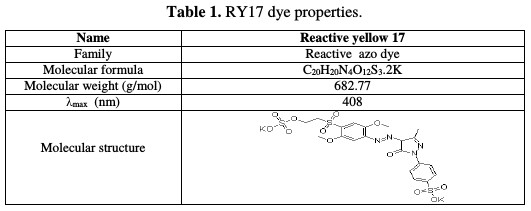
    <p>The reactive yellow 17 (RY17) is a synthetic organic dye used in textile
industries. The molecular structure and other properties of RY 17 are given in
<a href="#t1">Table 1</a>.</p>


    <p>&nbsp;</p>
<a name="t1">
<img src="/img/revistas/pea/v36n3/36n3a02t1.jpg">
    
<p>&nbsp;</p>


    <p>Ferrous sulphate heptahydrate (FeSO4, 7H2O), sodium sulfate (Na2SO4),
sulphuric acid (H2SO4) and nitric acid (HNO3) were purchased from Fluka,
Labosi and Riedel-de Haen, respectively. Also, hydrogen peroxide (H2O2, 30%),
sodium hydroxide (NaOH) and ethanol (C2H6O) were obtained from Carlo Erba
reagents, Pharmac and Merck, respectively. Acetonitrile and water were of ultra
gradient grade for HPLC, supplied by VWR Chemicals (Prolabo).</p>

    <p>All these chemical substances were of reagent grade, and used without further
purification. All the solutions were prepared from distilled water, and were
conducted at room temperature.</p>

    <p>The immobilized photocatalyst used in this study is titanium dioxide PC500 of
Millennium inorganic chemicals S.A brand (anatase: > 99%, specific surface area
350 - 400 m2/g, crystallites mean size = 5 - 10 nm). Titania PC500 was coated on
non-woven fibers (natural and synthetic fibers with 254 &mu;m of thickness) using
an inorganic binder. The binder was an aqueous dispersion of colloidal SiO2. A
specific surface area extender (zeolite, 2000 m2/g) was used to increase the
photocatalyst adsorption properties.</p>


    <p><i><b>Instruments and experimental procedures</b></i></p>

    ]]></body>
<body><![CDATA[<p><i>Fenton and photo-Fenton processes</i></p>

    <p>RY17 solutions with different concentrations were prepared in distilled water.
They were then homogenized by stirring, until the dye was totally dissolved. The
reaction mixture's pH was adjusted to 3, by adding sulfuric acid, and measured
by a pH-meter. The dye oxidation was achieved by Fenton's reagent, composed
of a FeSO4.7H2O and H2O2 mixture. The required Fe<sup>2+</sup> and H2O2 quantities were
simultaneously added in the solution. The experimental device was a perfectly
agitated and cylindrical reactor, in which a 500 mL solution was studied.
Specifically, for the photochemical experiments, a high pressure mercury lamp
(Philips HPK, 125 W), which emitted a maximum radiation at 365 nm, was used
as radiation source. It was located in the reactor in axial position inside a quartz
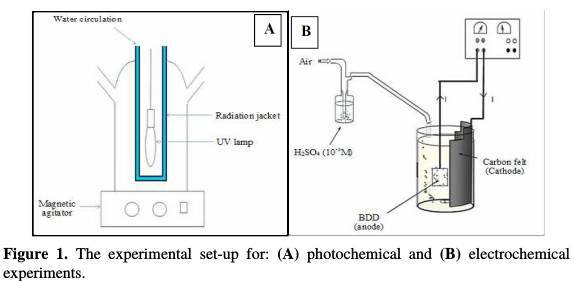
sleeve. This photoreactor (<a href="#f1">Fig. 1(A)</a>) contains a double wall for the circulation of
the system's cooling water.</p>


    <p>&nbsp;</p>
<a name="f1">
<img src="/img/revistas/pea/v36n3/36n3a02f1.jpg">
    
<p>&nbsp;</p>


    <p>The outside of the photoreactor was covered with an
aluminium sheet. At the top, the photoreactor has inlets and ports for feeding
reactants and withdrawing samples.</p>


    <p><i>Electro-Fenton and anodic oxidation processes</i></p>

    <p>RY17 degradation by the electro-Fenton process was performed in a 0.5 L
undivided electrochemical cell, equipped with two electrodes (<a href="#f1">Fig. 1(B)</a>). The
working electrode was a carbon felt piece (6&times;8&times;0.5 cm<sup>3</sup>), a flexible, resistant and
easy handling material. The counter electrode was a boron-doped diamond
(BDD) thin film (5&times;8&times;0.2 cm<sup>3</sup>). The applied current between these electrodes
was available by a stabilized supply source. Before the electrolysis, compressed
air was bubbled for 10 min through the cell, to saturate the aqueous solution in
oxygen. A sodium sulfate concentration of 50 mM (Na2SO4) was added to the
solution as the supporting electrolyte. The iron sulfate (FeSO4, 7H2O) catalyzing
the Fenton reaction was added to the reaction medium before the electrolysis
beginning. The solutions' pH was adjusted to 3 by sulphuric acid (10-3 M), to
avoid the precipitation of ferric ions in the form of hydroxides. The solutions
were homogenized by a magnetic stirrer (600 rev/min).</p>

    <p>RY17 degradation by the anodic oxidation process was carried out in the same
electrochemical cell as the electro-Fenton process. This process does not require
the use of a catalyst (FeSO4, 7H2O).</p>


    <p><i>Heterogeneous photocatalysis</i></p>

    <p>The photodegradation experiments were carried out by loading 500 mL of the
RY17 dye solutions of known titre in the photoreactor (<a href="#f1">Fig. 1(A)</a>), inside
recovered by the photocatalytic TiO2 supported on paper (11 cm &times; 25 cm)
(equivalent to 1 g of TiO2).</p>

    ]]></body>
<body><![CDATA[<p>The pH was adjusted to a given value in the range of 3 - 11.5 by HNO3 (1 N) or
NaOH (1 N) addition.</p>

    <p>The mixture was kept under constant magnetic stirring in the dark, during an
hour and a half, so that the RY17 adsorption equilibrium on the catalyst surface
was established. Then, the reaction mixture was exposed to UV radiation.
Experiments were performed at room temperature.</p>


    <p><i><b>Analytical methods</b></i></p>

    <p>The solution's pH was determined using a pH meter (HANNA instruments).
Samples were collected at regular time intervals, and before analysis they were
filtered with Sartolon polyamide (0.45 &mu;m) filters.</p>


    <p><i>UV-Vis spectrophotometer</i></p>

    <p>The RY17 concentration was measured using a UV-Vis spectrophotometer
(Jasco V-630) by measuring the absorption at a 408 nm wavelength.
The percentage discoloration efficiency (DE) percentage was calculated as
follows:</p>


    <p>&nbsp;</p>
<a name="e13">
<img src="/img/revistas/pea/v36n3/36n3a02e13.jpg">
    
<p>&nbsp;</p>


    <p>where A0 and At are the absorbance at initial time, and time t at &lambda; max = 408 nm,
respectively.</p>


    <p><i>High-performance liquid chromatography (HPLC)</i></p>

    ]]></body>
<body><![CDATA[<p>The RY17 concentration was determined by high-performance liquid
chromatography (Shimadzu LC-SPD20A) with a Shimadzu UV-2A detector. The
mobile phase consisted of a 70% water and 30% acetonitrile mixture.
Separation was achieved with a Nucleosil C18 column (150 mm &times; 4.6 mm), at a 1
mL min<sup>-1</sup> flow rate. The detection wavelength was 408 nm.</p>


    <p><i>Degradation kinetics</i></p>

    <p>Hydroxyl radicals are non-selective reagents, highly reactive on organic
compounds and, therefore, not accumulative in the middle, because they have a
very short lifetime [13].</p>

    <p>Thus, the quasi-stationary state can be applied to the hydroxyl radicals
concentration, and the dyes hydroxylation reaction can be likened to a pseudo
first order kinetics.</p>


    <p>&nbsp;</p>
<a name="e14">
<img src="/img/revistas/pea/v36n3/36n3a02e14.jpg">
    
<p>&nbsp;</p>


    <p>By integrating the Eq. (14), the following equation could be obtained:</p>


    <p>&nbsp;</p>
<a name="e15">
<img src="/img/revistas/pea/v36n3/36n3a02e15.jpg">
    
<p>&nbsp;</p>


    <p>Thus, the graph Ln [dye]0/[dye]t = f(t) is used to determine the apparent rate
constant of the RY17 dye oxidation reaction with hydroxyl radicals.</p>


    ]]></body>
<body><![CDATA[<p>&nbsp;</p>
    <p><b>Results and discussion</b></p>

    <p><i><b>RY17 degradation by UV, UV/H2O2, Fenton and photo-Fenton processes</b></i></p>

    <p>Reactive yellow 17 (RY17) dye decolorization in an aqueous solution by the
Fenton oxidation process has been studied on different experimental conditions,
including Fe<sup>2+</sup>, H2O2, and initial dye concentrations, and reaction time.</p>

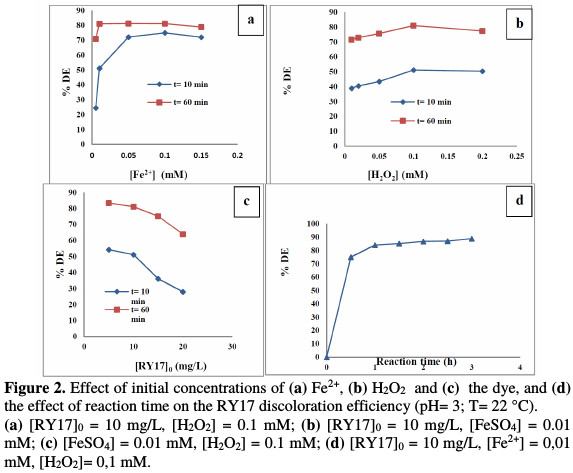
    <p>The effects of these parameters have been studied, and optimum operational
conditions of these processes were found (<a href="#f2">Fig. 2</a>).</p>


    <p>&nbsp;</p>
<a name="f2">
<img src="/img/revistas/pea/v36n3/36n3a02f2.jpg">
    
<p>&nbsp;</p>


    <p>Maximum decolorization (90%) efficiencies were achieved for 0.1 mM of H2O2,
0.01 mM of Fe<sup>2+</sup> and 10 mg/L of dye concentration, after 3h of reaction time
[14].</p>

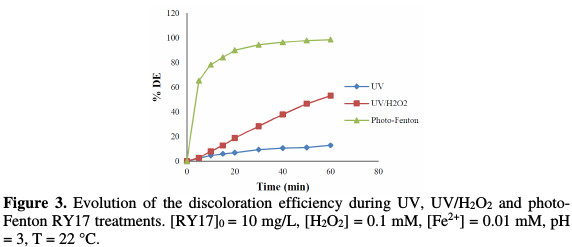
    <p>RY17 degradation by direct photolysis, the combination of UV-radiation with
H2O2 (UV/H2O2), and the photo-Fenton process (UV/Fe<sup>2+</sup>/H2O2) were realized at
the optimal reagent concentration established by the Fenton process, that is,
[Fe<sup>2+</sup>] = 0.01 mM, [H2O2] = 0.1 mM, [RY17] = 10 mg/L, pH = 3, and T = 25 &deg;C.
Results (<a href="#f3">Fig. 3</a>) showed that the use of the UV treatment alone (direct photolysis)
was not sufficient in RY17 degradation, because the degradation efficiency after
60 min of treatment was only 15%.</p>


    <p>&nbsp;</p>
<a name="f3">
<img src="/img/revistas/pea/v36n3/36n3a02f3.jpg">
    
]]></body>
<body><![CDATA[<p>&nbsp;</p>


    <p>The combined action of UV and H2O2 caused 65% degradation in 60 min.
Regarding the photo-Fenton process, 98% degradation was obtained at 60 min.
The UV/H2O2 system is an indirect photochemical process based on the H2O2
photolysis by UV light (UV &leq; 300 nm), to yield hydroxyl radicals [15]; adding
Fe<sup>2+</sup> to this system enhanced the dye oxidation rate, by the generation of
hydroxyl radicals in the aqueous medium, through the Fenton process main
reaction between iron (II) and hydrogen peroxide.</p>


    <p><i><b>RY17 degradation by electrochemical advanced oxidation processes</b></i></p>

    <p><i>Electro-Fenton process</i></p>

    <p>The degradation of reactive yellow 17 (RY17) was investigated using electro-
Fenton system. A 24 factorial design, considering the initial Fe<sup>2+</sup> and dye
concentrations, the applied current and the electrolysis time as variable
independents, was used to analyze the process by response surface methodology.
The maximum decolorization efficiency attained 99.94%, in the response of
variations in the experimental conditions, which confirms the electro-Fenton
process ability, and also the importance of process modeling. ANOVA analysis
confirmed that all variables have had significant influence on the model
response, and showed a high determination value coefficient (R2 = 0.9938).
Graphical response surface and contour plots were used to locate the optimum
point. Optimum values of process variables for the maximum decolorization
efficiency (100%) were: Fe<sup>2+</sup> concentration = 0.04 mM, applied current = 100
mA, RY17 concentration = 5 mg/L and electrolysis time = 30 min [16].</p>

    <p>Under the experimental conditions thus determined, RY17 disappearance and
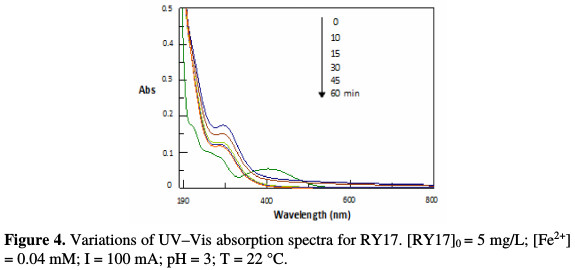
discoloration were followed by HPLC and UV-visible. <a href="#f4">Fig. 4</a> shows the
monitoring of the RY17 aqueous solution evolution during electrolysis by UV-
visible spectroscopy.</p>


    <p>&nbsp;</p>
<a name="f4">
<img src="/img/revistas/pea/v36n3/36n3a02f4.jpg">
    
<p>&nbsp;</p>


    <p>This figure shows that the disappearance of this color by
the electro-Fenton process is fast. The absorbance peak at &lambda; = 408 nm gradually
decreases, and then completely disappears after 30 min. This significant peak
reduction can be likened to the cleavage of the bond -N = N-, the most active site
for hydroxyl radicals oxidative attack.</p>

    <p>Furthermore, the UV spectrum shows that the starting dye disappearance,
following the hydroxyl radicals oxidizing action, is accompanied by the
formation of intermediate aromatic compounds, which absorb about 230 and 294
nm. These latter, in turn, suffer the hydroxyl radicals degrading action.
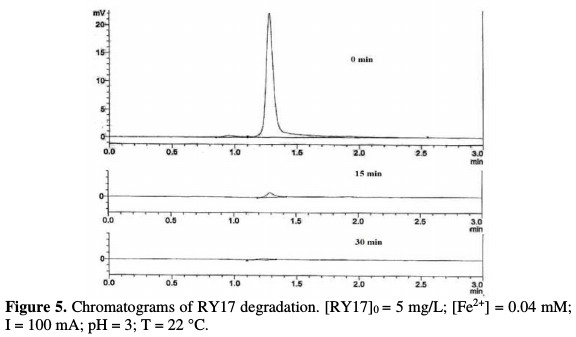
The treated solutions HPLC analysis has also enabled to follow this colorant
kinetics disappearance. As shown in <a href="#f5">Fig. 5</a>, RY17 peak (tr = 1.28 min) gradually
decreases during electrolysis, and then completely disappears after 30 min
treatment.</p>


    ]]></body>
<body><![CDATA[<p>&nbsp;</p>
<a name="f5">
<img src="/img/revistas/pea/v36n3/36n3a02f5.jpg">
    
<p>&nbsp;</p>


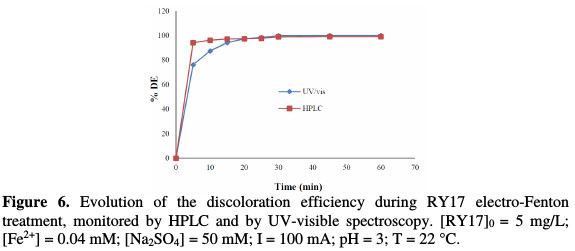
    <p>A comparison of the dye RY17 kinetics disappearance monitoring between
HPLC and UV/vis was performed. <a href="#f6">Fig. 6</a> shows that RY17 disappearance is
much faster than its discoloration, which suggests the presence of other colored
intermediate molecules [17].</p>


    <p>&nbsp;</p>
<a name="f6">
<img src="/img/revistas/pea/v36n3/36n3a02f6.jpg">
    
<p>&nbsp;</p>


    <p>Indeed, RY17 has completely disappeared after 30
min electrolysis for HPLC-UV and UV/vis curves.</p>


    <p><i><b>Anodic oxidation process</b></i></p>

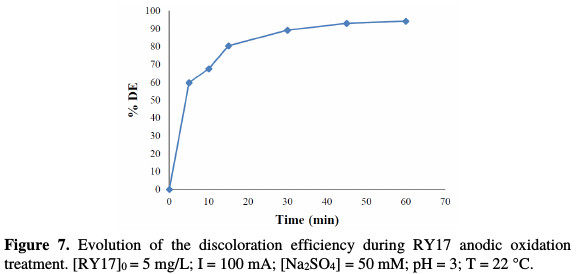
    <p>We have studied the degradation of an RY17 aqueous solution by anodic
oxidation under the previously determined experimental conditions (Electro-
Fenton process), in the catalyst absence ([Na2SO4] = 50 mM, pH = 3, C0 = 5
mg/L, V = 500 mL, I = 100 mA). <a href="#f7">Fig. 7</a> shows the discoloration efficiency of the
pollutant (RY17), in terms of the electrolysis time for anodic oxidation process.</p>


    <p>&nbsp;</p>
<a name="f7">
<img src="/img/revistas/pea/v36n3/36n3a02f7.jpg">
    
<p>&nbsp;</p>


    ]]></body>
<body><![CDATA[<p><i><b>RY17 degradation by heterogeneous photocatalysis</b></i></p>

    <p><i>Effect of the initial dye concentration</i></p>

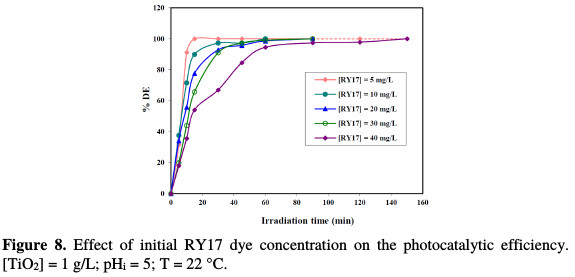
    <p>The effect of the initial dye concentration was investigated by varying RY17
concentration from 5 to 40 mg/L. <a href="#f8">Fig. 8</a> shows the change of the dye
discoloration efficiency during the irradiation time, for the various RY17 initial
concentrations.</p>


    <p>&nbsp;</p>
<a name="f8">
<img src="/img/revistas/pea/v36n3/36n3a02f8.jpg">
    
<p>&nbsp;</p>


    <p>Increasing the initial dye concentration, in the range between 5 and 40 mg/L,
decreases the photocatalytic degradation efficiency. The opposite effect is
observed at low concentrations. Similar results were reported by other authors
[18, 19]. At high dye concentrations, the colored solution becomes compact and
forms a screen, which makes the solution less transparent to UV light.</p>

    <p>Additionally, the dye's molecules can absorb a significant amount of UV light; as
this latter does not reach the catalyst, the &bull;OH radical formation is reduced. For
low concentrations of the colored solution, this becomes easy to cross by the
radial field, thus increasing the number of photons absorbed by the semi-
conductor and, consequently, its activity [20, 21].</p>


    <p><i>Effect of pH</i></p>

    <p>The pH is an important operating variable in the wastewater. In the
photocatalytic degradation systems, the pH value is also one of the factors that
influence the percentage degradation. In a general way, when a compound is
partially ionized, or the bearer of charged functions, it is necessary to consider
the electrostatic interactions that can take place between the TiO2, or between its
support and this compound. They depend on the pH of the solution that is going
to be treated, on the adsorbent material's point of zero charge (PZC), and on the
pKa of the compound that is going to be adsorbed [22].</p>

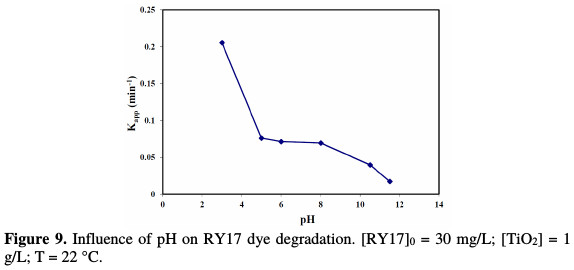
    <p>The results of the experiments during the dye photocatalytic degradation at
different pH values (3, 5, 6, 8, 10.5 and 11.5) are shown in <a href="#f9">Fig. 9</a>.</p>


    ]]></body>
<body><![CDATA[<p>&nbsp;</p>
<a name="f9">
<img src="/img/revistas/pea/v36n3/36n3a02f9.jpg">
    
<p>&nbsp;</p>


    <p>It illustrates the variation in the apparent rate constant (Kapp) as a function of pH.
The TiO2 charge depends on the solution's pH. It is known that the metal oxide
particles in water readily react with the dye through a mechanism that can be
described by the following chemical equilibria [23-25]:</p>


    <p>&nbsp;</p>
<a name="e16">
<img src="/img/revistas/pea/v36n3/36n3a02e16.jpg">
    
<p>&nbsp;</p>
<a name="e17">
<img src="/img/revistas/pea/v36n3/36n3a02e17.jpg">
    
<p>&nbsp;</p>


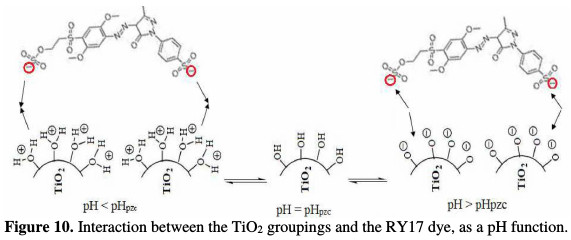
    <p>The pH at the zero charge point (pHPZC) for this kind of TiO2 has been reported
to be about 6.3 in value [26]. Thus, the surface of titanium dioxide is positively
charged in an acidic medium, and it is negatively charged in a basic medium.
It appears from these results that the photodegradation is more important to an
acidic pH. This can be attributed to the electrostatic interactions between the
catalyst surface and the dye's anionic groups at different pH values (<a href="#f10">Fig. 10</a>).</p>


    <p>&nbsp;</p>
<a name="f10">
<img src="/img/revistas/pea/v36n3/36n3a02f10.jpg">
    
<p>&nbsp;</p>


    <p>In an acidic medium, the anionic dye's groupings are strongly adsorbed on the
surface of the positively charged catalyst, which leads to a better degradation.
Whereas, with the pH increase, there will be a coulombic repulsion between the
negatively charged support surface and the partial charges of the dye's anionic
groups, and also with the hydroxyl ions, which prevents the formation of &bull;OH
hydroxyl radicals; consequently, the photocatalytic degradation efficiency
decreases [27-29].</p>


    ]]></body>
<body><![CDATA[<p><i>Effect of H2O2 addition</i></p>

    <p>To highlight the hydroxyl radicals (&bull;OH) role in the dye degradation, we have
realized photocatalytic tests in the presence of hydrogen peroxide, considered an
important generation source of these radicals [30].</p>

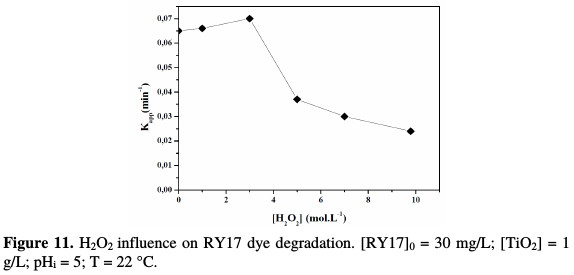
    <p>The influence of the H2O2 concentration on the photocatalytic activity of TiO2 for
the RY17 photodegradation was studied by varying the H2O2 concentration. <a href="#f11">Fig. 11</a>
shows the evolution of the initial dye disappearance rate.</p>


    <p>&nbsp;</p>
<a name="f11">
<img src="/img/revistas/pea/v36n3/36n3a02f11.jpg">
    
<p>&nbsp;</p>


    <p>The H2O2 addition accelerates the initial rate of the dye degradation, which
reached a maximum for a hydrogen peroxide concentration equal to 3 mol/L.
This increase in rate can be attributed to an increase in the &bull;OH radicals
concentration on the TiO2 surface, according to the following equation:</p>


    <p>&nbsp;</p>
<a name="e18">
<img src="/img/revistas/pea/v36n3/36n3a02e18.jpg">
    
<p>&nbsp;</p>


    <p>In contrast, when the H2O2 concentration exceeds this maximum, for hydrogen
peroxide large concentrations, the following reactions occur [31]:</p>


    <p>&nbsp;</p>
<a name="e19">
<img src="/img/revistas/pea/v36n3/36n3a02e19.jpg">
    
]]></body>
<body><![CDATA[<p>&nbsp;</p>
<a name="e20">
<img src="/img/revistas/pea/v36n3/36n3a02e20.jpg">
    
<p>&nbsp;</p>


    <p>From these two reactions, it appears that a high concentration in H2O2 inhibits the
photodegradation kinetics, because it consumes hydroxyl radicals (&bull;OH) and
hydroperoxyles (HO2&bull;) necessary for the organic molecules photodegradation.</p>


    <p><i>Comparison between Fenton, photo-Fenton, electro-Fenton, anodic oxidation
and heterogeneous photocatalysis processes</i></p>

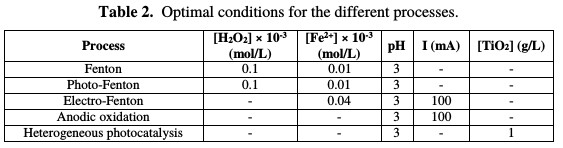
    <p>To compare the performance of different advanced oxidation processes (Fenton,
photo-Fenton, electro-Fenton, anodic oxidation and heterogeneous
photocatalysis), a RY17 solution of 10 mg/L was treated in the optimal
conditions for each process (<a href="#t2">Table 2</a>).</p>


    <p>&nbsp;</p>
<a name="t2">
<img src="/img/revistas/pea/v36n3/36n3a02t2.jpg">
    
<p>&nbsp;</p>


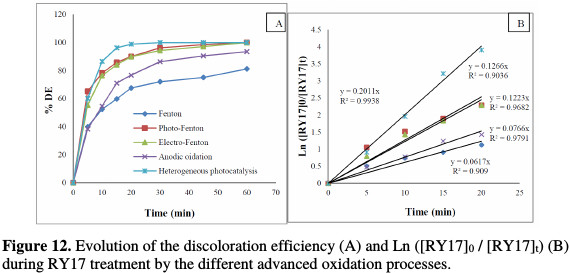
    <p><a href="#f12">Fig. 12</a> shows the efficiency discoloration of the pollutant (RY17) and the
evolution of Ln ([RY17]0 / [RY17]t), in terms of the electrolysis time for
different advanced oxidation processes.</p>


    <p>&nbsp;</p>
<a name="f12">
<img src="/img/revistas/pea/v36n3/36n3a02f12.jpg">
    
<p>&nbsp;</p>


    ]]></body>
<body><![CDATA[<p>It is clear from <a href="#f12">Fig. 12(A)</a> that, during
the application of heterogeneous photocatalysis treatment, RY17 disappeared to
non-detectable levels after 30 min treatment, while it took up to 60 min with
photo-Fenton and electro-Fenton processes. However, the discoloration
efficiency obtained via Fenton and anodic oxidation processes in 60 min,
respectively, is of the order of 81.1 and 93.5 %. The relative efficiencies of all
these processes are in the following order: heterogeneous photocatalysis &gt; photo-
Fenton = electro-Fenton &gt; anodic oxidation &gt; Fenton.</p>

    <p><a href="#f12">Fig. 12(B)</a> indicates that RY17 degradation with these different advanced
oxidation processes followed pseudo first- order kinetics (R2 &geq; 0.91). The
experimental results revealed that the pollutant was most rapidly degraded by the
heterogeneous photocatalysis process (Kapp = 0.2 min<sup>-1</sup>), followed by photo-
Fenton (kapp = 0.126 min<sup>-1</sup>), electro-Fenton (kapp = 0.122 min<sup>-1</sup>), anodic oxidation
(kapp = 0.076 min<sup>-1</sup>) and Fenton (kapp = 0.061 min<sup>-1</sup>) processes.</p>

    <p>The enhancement of RY17 removal rate in the heterogeneous photocatalysis
process was most probably caused by the significant generation of &bull;HO via the
use of TiO2 semiconductor as a catalyst, since it presents a favorable
photocatalytic activity in dyes treatment and, in particular, in its anatase form
[32, 33]. Thus, it is related to the better RY17 dye adsorption onto this catalyst in
an acidic medium (pH = 3), which is probably due to the electrostatic attraction
of TiO2 positive charge and the dye negative charge [26-28]. However, the
photo-Fenton process is the fastest at the treatment start. This phenomenon can
be explained by the introduction of H2O2 and Fe<sup>2+</sup> at the treatment beginning, and
by the irradiation through UV radiation. These two factors can significantly
influence radicals &bull;OH production [34].</p>

    <p>The RY17 removal by the Fenton's reagent was due to the formation of &bull;OH via
<a href="#e7">Eq. (7)</a>. Moreover, Fe<sup>3+</sup> in the solution was able to regenerate inside the reactor,
when electric discharge and UV irradiation were used, allowing numerous Fe<sup>2+</sup>
react with H2O2 to generate &bull;OH. Ferrous ions are not depleted during the
oxidation reaction, as shown in <a href="#e8">Eqs. (8)</a>, <a href="#e9">(9)</a> and <a href="#e12">(12)</a>. Therefore, the electro-
Fenton process and the photo-Fenton process can enhance RY17 oxidation rate
[35].</p>

    <p>The electro-Fenton process is more efficient than the anodic oxidation process.
This is due to the production of hydroxyl radicals both by the Fenton reaction in
a homogeneous medium and by water oxidation on the anode BDD surface,
which is a high oxygen overvoltage electrode (<a href="#e7">Eqs. (7)</a>, <a href="#e10">(10)</a>). For the anodic
oxidation method, the hydroxyl radicals are only formed at the anode surface
(<a href="#e10">Eq. (10)</a>) [36].</p>


    <p>&nbsp;</p>
    <p><b>Conclusion</b></p>

    <p>In this work, RY17 dye degradation has been investigated by using several
advanced oxidation processes: heterogeneous photocatalysis, Fenton, photo-
Fenton, electro-Fenton, and anodic oxidation. Among all applied processes,
heterogeneous photocatalysis process was found to be the most effective method.
In this process, the oxidation efficiency was influenced by many factors, such as
pH, initial dye concentration and H2O2 addition. The optimal pH obtained for the
best degradation was about 3.0 for the heterogeneous photocatalytic process. The
complete RY17 dye degradation has been observed following 30 min treatment.
Photo- Fenton and electro-Fenton processes were also effective in RY17 dye
degradation, and the complete discoloration was achieved within the same time
period (60 min).</p>

    <p>Fenton process cannot completely degrade RY17 dye. However, we have found
that UV light and electrons current (photo-Fenton and electro-Fenton) improved
the degradation efficiency of the Fenton process.</p>

    <p>The anodic oxidation process is a powerful method to the production of hydroxyl
radical by the anode, but the electro-Fenton is the most effective process in RY17
degradation.</p>

    ]]></body>
<body><![CDATA[<p>From the kinetic analysis, the reaction order for the five processes was found to
be from the first order. The rate constant values at optimum operating conditions
were found to be 0.061, 0.076, 0.122, 0.126 and 0.2 min<sup>-1</sup> for Fenton, anodic
oxidation, electro-Fenton, photo-Fenton and heterogeneous photocatalysis
processes, respectively.</p>


    <p>&nbsp;</p>
    <p><b>References</b></p>

    <!-- ref --><p>1. Pandey A, Singhand P, Iyengar L. Int Biodeterior Biodegrad. 2007;59:73.    &nbsp;&nbsp;&nbsp;&nbsp;&nbsp;&nbsp;&nbsp;&nbsp;[&#160;<a href="javascript:void(0);" onclick="javascript: window.open('/scielo.php?script=sci_nlinks&ref=433105&pid=S0872-1904201800030000200001&lng=','','width=640,height=500,resizable=yes,scrollbars=1,menubar=yes,');">Links</a>&#160;]<!-- end-ref --></p>

    <!-- ref --><p>2. Bafana A, Chakrabarti T, Devi S. Appl Microbiol Biotechnol. 2008;77:1139.    &nbsp;&nbsp;&nbsp;&nbsp;&nbsp;&nbsp;&nbsp;&nbsp;[&#160;<a href="javascript:void(0);" onclick="javascript: window.open('/scielo.php?script=sci_nlinks&ref=433107&pid=S0872-1904201800030000200002&lng=','','width=640,height=500,resizable=yes,scrollbars=1,menubar=yes,');">Links</a>&#160;]<!-- end-ref --></p>

    <!-- ref --><p>3. Kusic H, Koprivanac N, Srsan L. J Photochem Photobiol A. 2006;181:195.    &nbsp;&nbsp;&nbsp;&nbsp;&nbsp;&nbsp;&nbsp;&nbsp;[&#160;<a href="javascript:void(0);" onclick="javascript: window.open('/scielo.php?script=sci_nlinks&ref=433109&pid=S0872-1904201800030000200003&lng=','','width=640,height=500,resizable=yes,scrollbars=1,menubar=yes,');">Links</a>&#160;]<!-- end-ref --></p>

    <!-- ref --><p>4. Dukkanc M, Vinatoru M, Mason TJ. Ultrason Sonochem. 2014;21:846.    &nbsp;&nbsp;&nbsp;&nbsp;&nbsp;&nbsp;&nbsp;&nbsp;[&#160;<a href="javascript:void(0);" onclick="javascript: window.open('/scielo.php?script=sci_nlinks&ref=433111&pid=S0872-1904201800030000200004&lng=','','width=640,height=500,resizable=yes,scrollbars=1,menubar=yes,');">Links</a>&#160;]<!-- end-ref --></p>

    <!-- ref --><p>5. Garcia-Segura, Garrido JA, Rodriguez RM, et al. Water Res. 2012;46:2067.    &nbsp;&nbsp;&nbsp;&nbsp;&nbsp;&nbsp;&nbsp;&nbsp;[&#160;<a href="javascript:void(0);" onclick="javascript: window.open('/scielo.php?script=sci_nlinks&ref=433113&pid=S0872-1904201800030000200005&lng=','','width=640,height=500,resizable=yes,scrollbars=1,menubar=yes,');">Links</a>&#160;]<!-- end-ref --></p>

    <!-- ref --><p>6. Khataee AR, Aleboyeh H, Aleboyeh A. J Exp Nanosci. 2009;4:121.    &nbsp;&nbsp;&nbsp;&nbsp;&nbsp;&nbsp;&nbsp;&nbsp;[&#160;<a href="javascript:void(0);" onclick="javascript: window.open('/scielo.php?script=sci_nlinks&ref=433115&pid=S0872-1904201800030000200006&lng=','','width=640,height=500,resizable=yes,scrollbars=1,menubar=yes,');">Links</a>&#160;]<!-- end-ref --></p>

    <!-- ref --><p>7. Chebli D, Fourcade F, Brosillon S, et al. Environ Technol. 2011;32:507.    &nbsp;&nbsp;&nbsp;&nbsp;&nbsp;&nbsp;&nbsp;&nbsp;[&#160;<a href="javascript:void(0);" onclick="javascript: window.open('/scielo.php?script=sci_nlinks&ref=433117&pid=S0872-1904201800030000200007&lng=','','width=640,height=500,resizable=yes,scrollbars=1,menubar=yes,');">Links</a>&#160;]<!-- end-ref --></p>

    <!-- ref --><p>8. Chia-Chi S, An-Tzu C, Bellotindos LM, et al. Sep Purif Technol. 2012;99:8.    &nbsp;&nbsp;&nbsp;&nbsp;&nbsp;&nbsp;&nbsp;&nbsp;[&#160;<a href="javascript:void(0);" onclick="javascript: window.open('/scielo.php?script=sci_nlinks&ref=433119&pid=S0872-1904201800030000200008&lng=','','width=640,height=500,resizable=yes,scrollbars=1,menubar=yes,');">Links</a>&#160;]<!-- end-ref --></p>

    <!-- ref --><p>9. Navarro RR, Ichikawa H, Tatsumi K. Chemosphere. 2010;80:404.    &nbsp;&nbsp;&nbsp;&nbsp;&nbsp;&nbsp;&nbsp;&nbsp;[&#160;<a href="javascript:void(0);" onclick="javascript: window.open('/scielo.php?script=sci_nlinks&ref=433121&pid=S0872-1904201800030000200009&lng=','','width=640,height=500,resizable=yes,scrollbars=1,menubar=yes,');">Links</a>&#160;]<!-- end-ref --></p>

    <!-- ref --><p>10. Bellakhal N, Dachraoui M, Oturan N, et al. J Soc Chim Tunisie. 2006;8:223.    &nbsp;&nbsp;&nbsp;&nbsp;&nbsp;&nbsp;&nbsp;&nbsp;[&#160;<a href="javascript:void(0);" onclick="javascript: window.open('/scielo.php?script=sci_nlinks&ref=433123&pid=S0872-1904201800030000200010&lng=','','width=640,height=500,resizable=yes,scrollbars=1,menubar=yes,');">Links</a>&#160;]<!-- end-ref --></p>

    <!-- ref --><p>11. Brillas E, Banos MA, Skoumal M, et al. Chemosphere. 2007;68:199.    &nbsp;&nbsp;&nbsp;&nbsp;&nbsp;&nbsp;&nbsp;&nbsp;[&#160;<a href="javascript:void(0);" onclick="javascript: window.open('/scielo.php?script=sci_nlinks&ref=433125&pid=S0872-1904201800030000200011&lng=','','width=640,height=500,resizable=yes,scrollbars=1,menubar=yes,');">Links</a>&#160;]<!-- end-ref --></p>

    <!-- ref --><p>12. Abdessalem AK, Bellakhal N, Oturan N, et al. Desalination. 2010;250:450.    &nbsp;&nbsp;&nbsp;&nbsp;&nbsp;&nbsp;&nbsp;&nbsp;[&#160;<a href="javascript:void(0);" onclick="javascript: window.open('/scielo.php?script=sci_nlinks&ref=433127&pid=S0872-1904201800030000200012&lng=','','width=640,height=500,resizable=yes,scrollbars=1,menubar=yes,');">Links</a>&#160;]<!-- end-ref --></p>

    <!-- ref --><p>13. Jacob RA. Nutr Res. 1995;15:755.    &nbsp;&nbsp;&nbsp;&nbsp;&nbsp;&nbsp;&nbsp;&nbsp;[&#160;<a href="javascript:void(0);" onclick="javascript: window.open('/scielo.php?script=sci_nlinks&ref=433129&pid=S0872-1904201800030000200013&lng=','','width=640,height=500,resizable=yes,scrollbars=1,menubar=yes,');">Links</a>&#160;]<!-- end-ref --></p>

    <!-- ref --><p>14. Sennaoui A, Sakr F, Dinne M, et al. J Mater Environ Sci. 2014;5:1406.    &nbsp;&nbsp;&nbsp;&nbsp;&nbsp;&nbsp;&nbsp;&nbsp;[&#160;<a href="javascript:void(0);" onclick="javascript: window.open('/scielo.php?script=sci_nlinks&ref=433131&pid=S0872-1904201800030000200014&lng=','','width=640,height=500,resizable=yes,scrollbars=1,menubar=yes,');">Links</a>&#160;]<!-- end-ref --></p>

    <!-- ref --><p>15. Venkatadri R, Peters RW. Hazard Waste Hazard Mater. 1993;10:107.    &nbsp;&nbsp;&nbsp;&nbsp;&nbsp;&nbsp;&nbsp;&nbsp;[&#160;<a href="javascript:void(0);" onclick="javascript: window.open('/scielo.php?script=sci_nlinks&ref=433133&pid=S0872-1904201800030000200015&lng=','','width=640,height=500,resizable=yes,scrollbars=1,menubar=yes,');">Links</a>&#160;]<!-- end-ref --></p>

    <!-- ref --><p>16. Sennaoui A, Sakr F, Alahiane S, et al. Int J Mater Chem Phys. 2015;1:67.    &nbsp;&nbsp;&nbsp;&nbsp;&nbsp;&nbsp;&nbsp;&nbsp;[&#160;<a href="javascript:void(0);" onclick="javascript: window.open('/scielo.php?script=sci_nlinks&ref=433135&pid=S0872-1904201800030000200016&lng=','','width=640,height=500,resizable=yes,scrollbars=1,menubar=yes,');">Links</a>&#160;]<!-- end-ref --></p>

    <!-- ref --><p>17. Karkmaz M, Puzenat E, Guillard C, et al. Appl Catal B: Environ. 2004;51:183.    &nbsp;&nbsp;&nbsp;&nbsp;&nbsp;&nbsp;&nbsp;&nbsp;[&#160;<a href="javascript:void(0);" onclick="javascript: window.open('/scielo.php?script=sci_nlinks&ref=433137&pid=S0872-1904201800030000200017&lng=','','width=640,height=500,resizable=yes,scrollbars=1,menubar=yes,');">Links</a>&#160;]<!-- end-ref --></p>

    <!-- ref --><p>18. Davis RJ, Gainer JL, Neal GO, et al. Water Environ Res. 1994;66:50.    &nbsp;&nbsp;&nbsp;&nbsp;&nbsp;&nbsp;&nbsp;&nbsp;[&#160;<a href="javascript:void(0);" onclick="javascript: window.open('/scielo.php?script=sci_nlinks&ref=433139&pid=S0872-1904201800030000200018&lng=','','width=640,height=500,resizable=yes,scrollbars=1,menubar=yes,');">Links</a>&#160;]<!-- end-ref --></p>

    <!-- ref --><p>19. Galindo C, Jacques P, Kalt A, Chemosphere. 2001;45:997.    &nbsp;&nbsp;&nbsp;&nbsp;&nbsp;&nbsp;&nbsp;&nbsp;[&#160;<a href="javascript:void(0);" onclick="javascript: window.open('/scielo.php?script=sci_nlinks&ref=433141&pid=S0872-1904201800030000200019&lng=','','width=640,height=500,resizable=yes,scrollbars=1,menubar=yes,');">Links</a>&#160;]<!-- end-ref --></p>

    <!-- ref --><p>20. So CM, Cheng MY, Yu JC, et al. Chemosphere. 2002;46:905.    &nbsp;&nbsp;&nbsp;&nbsp;&nbsp;&nbsp;&nbsp;&nbsp;[&#160;<a href="javascript:void(0);" onclick="javascript: window.open('/scielo.php?script=sci_nlinks&ref=433143&pid=S0872-1904201800030000200020&lng=','','width=640,height=500,resizable=yes,scrollbars=1,menubar=yes,');">Links</a>&#160;]<!-- end-ref --></p>

    <!-- ref --><p>21. Daneshvar N, Salari D, Khataee A R. J Photoch Photobio A. 2003;157:111.    &nbsp;&nbsp;&nbsp;&nbsp;&nbsp;&nbsp;&nbsp;&nbsp;[&#160;<a href="javascript:void(0);" onclick="javascript: window.open('/scielo.php?script=sci_nlinks&ref=433145&pid=S0872-1904201800030000200021&lng=','','width=640,height=500,resizable=yes,scrollbars=1,menubar=yes,');">Links</a>&#160;]<!-- end-ref --></p>

    <!-- ref --><p>22. Zhao H, Xu S, Zhong J, et al. Catal Today. 2004;93-95:857.    &nbsp;&nbsp;&nbsp;&nbsp;&nbsp;&nbsp;&nbsp;&nbsp;[&#160;<a href="javascript:void(0);" onclick="javascript: window.open('/scielo.php?script=sci_nlinks&ref=433147&pid=S0872-1904201800030000200022&lng=','','width=640,height=500,resizable=yes,scrollbars=1,menubar=yes,');">Links</a>&#160;]<!-- end-ref --></p>

    <!-- ref --><p>23. Kiriakidou F, Kondarides DI, Verykios XE. Catal Today. 1999;54:119.    &nbsp;&nbsp;&nbsp;&nbsp;&nbsp;&nbsp;&nbsp;&nbsp;[&#160;<a href="javascript:void(0);" onclick="javascript: window.open('/scielo.php?script=sci_nlinks&ref=433149&pid=S0872-1904201800030000200023&lng=','','width=640,height=500,resizable=yes,scrollbars=1,menubar=yes,');">Links</a>&#160;]<!-- end-ref --></p>

    <!-- ref --><p>24. Lachheb H, Puzenat E, Houas A, et al. Appl Catal B: Environ. 2002;39:75.    &nbsp;&nbsp;&nbsp;&nbsp;&nbsp;&nbsp;&nbsp;&nbsp;[&#160;<a href="javascript:void(0);" onclick="javascript: window.open('/scielo.php?script=sci_nlinks&ref=433151&pid=S0872-1904201800030000200024&lng=','','width=640,height=500,resizable=yes,scrollbars=1,menubar=yes,');">Links</a>&#160;]<!-- end-ref --></p>

    <!-- ref --><p>25. Toor AP, Verma A, Jotshi CK, et al. Dyes Pigm. 2006;68:53.    &nbsp;&nbsp;&nbsp;&nbsp;&nbsp;&nbsp;&nbsp;&nbsp;[&#160;<a href="javascript:void(0);" onclick="javascript: window.open('/scielo.php?script=sci_nlinks&ref=433153&pid=S0872-1904201800030000200025&lng=','','width=640,height=500,resizable=yes,scrollbars=1,menubar=yes,');">Links</a>&#160;]<!-- end-ref --></p>

    <!-- ref --><p>26. Sun J, Qiao L, Sun S, et al. J Hazard Mater. 2008;155:312.    &nbsp;&nbsp;&nbsp;&nbsp;&nbsp;&nbsp;&nbsp;&nbsp;[&#160;<a href="javascript:void(0);" onclick="javascript: window.open('/scielo.php?script=sci_nlinks&ref=433155&pid=S0872-1904201800030000200026&lng=','','width=640,height=500,resizable=yes,scrollbars=1,menubar=yes,');">Links</a>&#160;]<!-- end-ref --></p>

    <!-- ref --><p>27. Kansal SK, Kaur N, Singh S. Nanoscale Res Lett. 2009;4:709.    &nbsp;&nbsp;&nbsp;&nbsp;&nbsp;&nbsp;&nbsp;&nbsp;[&#160;<a href="javascript:void(0);" onclick="javascript: window.open('/scielo.php?script=sci_nlinks&ref=433157&pid=S0872-1904201800030000200027&lng=','','width=640,height=500,resizable=yes,scrollbars=1,menubar=yes,');">Links</a>&#160;]<!-- end-ref --></p>

    <!-- ref --><p>28. Barka N, Qourzal S, Assabbane A, et al. Arab J Chem. 2010;3:279.    &nbsp;&nbsp;&nbsp;&nbsp;&nbsp;&nbsp;&nbsp;&nbsp;[&#160;<a href="javascript:void(0);" onclick="javascript: window.open('/scielo.php?script=sci_nlinks&ref=433159&pid=S0872-1904201800030000200028&lng=','','width=640,height=500,resizable=yes,scrollbars=1,menubar=yes,');">Links</a>&#160;]<!-- end-ref --></p>

    <!-- ref --><p>29. Barka N, Assabbane A, Nounah A, et al. J Hazard Mater. 2008;152:1054.    &nbsp;&nbsp;&nbsp;&nbsp;&nbsp;&nbsp;&nbsp;&nbsp;[&#160;<a href="javascript:void(0);" onclick="javascript: window.open('/scielo.php?script=sci_nlinks&ref=433161&pid=S0872-1904201800030000200029&lng=','','width=640,height=500,resizable=yes,scrollbars=1,menubar=yes,');">Links</a>&#160;]<!-- end-ref --></p>

    <!-- ref --><p>30. Borello R, Minero C, Pramauro E, et al. Environ Toxicol Chem. 1989;8:997.    &nbsp;&nbsp;&nbsp;&nbsp;&nbsp;&nbsp;&nbsp;&nbsp;[&#160;<a href="javascript:void(0);" onclick="javascript: window.open('/scielo.php?script=sci_nlinks&ref=433163&pid=S0872-1904201800030000200030&lng=','','width=640,height=500,resizable=yes,scrollbars=1,menubar=yes,');">Links</a>&#160;]<!-- end-ref --></p>

    <!-- ref --><p>31. Qourzal S, Tamimi M, Assabbane A, et al. C R Chim. 2007;10:1187.    &nbsp;&nbsp;&nbsp;&nbsp;&nbsp;&nbsp;&nbsp;&nbsp;[&#160;<a href="javascript:void(0);" onclick="javascript: window.open('/scielo.php?script=sci_nlinks&ref=433165&pid=S0872-1904201800030000200031&lng=','','width=640,height=500,resizable=yes,scrollbars=1,menubar=yes,');">Links</a>&#160;]<!-- end-ref --></p>

    <!-- ref --><p>32. Bessekhouad Y, Robert D, Weber JV. J Photochem Photobiol A. 2003;157:47.    &nbsp;&nbsp;&nbsp;&nbsp;&nbsp;&nbsp;&nbsp;&nbsp;[&#160;<a href="javascript:void(0);" onclick="javascript: window.open('/scielo.php?script=sci_nlinks&ref=433167&pid=S0872-1904201800030000200032&lng=','','width=640,height=500,resizable=yes,scrollbars=1,menubar=yes,');">Links</a>&#160;]<!-- end-ref --></p>

    <!-- ref --><p>33. Le Roux H, Glasser L. J Mater Chem. 1997;7:843.    &nbsp;&nbsp;&nbsp;&nbsp;&nbsp;&nbsp;&nbsp;&nbsp;[&#160;<a href="javascript:void(0);" onclick="javascript: window.open('/scielo.php?script=sci_nlinks&ref=433169&pid=S0872-1904201800030000200033&lng=','','width=640,height=500,resizable=yes,scrollbars=1,menubar=yes,');">Links</a>&#160;]<!-- end-ref --></p>

    <!-- ref --><p>34. Tamimi M, Qourzal S, Barka N, et al. Sep Purif Technol. 2008;61:103.    &nbsp;&nbsp;&nbsp;&nbsp;&nbsp;&nbsp;&nbsp;&nbsp;[&#160;<a href="javascript:void(0);" onclick="javascript: window.open('/scielo.php?script=sci_nlinks&ref=433171&pid=S0872-1904201800030000200034&lng=','','width=640,height=500,resizable=yes,scrollbars=1,menubar=yes,');">Links</a>&#160;]<!-- end-ref --></p>

    <!-- ref --><p>35. Anotai J, Singhadech S, Chia-Chi Su, et al. J Hazard Mater. 2011;196:395.    &nbsp;&nbsp;&nbsp;&nbsp;&nbsp;&nbsp;&nbsp;&nbsp;[&#160;<a href="javascript:void(0);" onclick="javascript: window.open('/scielo.php?script=sci_nlinks&ref=433173&pid=S0872-1904201800030000200035&lng=','','width=640,height=500,resizable=yes,scrollbars=1,menubar=yes,');">Links</a>&#160;]<!-- end-ref --></p>

    <!-- ref --><p>36. Oturan MA, Brillas E. Port Electrochim Acta. 2007;25:872-1904.    &nbsp;&nbsp;&nbsp;&nbsp;&nbsp;&nbsp;&nbsp;&nbsp;[&#160;<a href="javascript:void(0);" onclick="javascript: window.open('/scielo.php?script=sci_nlinks&ref=433175&pid=S0872-1904201800030000200036&lng=','','width=640,height=500,resizable=yes,scrollbars=1,menubar=yes,');">Links</a>&#160;]<!-- end-ref --></p>


    <p>&nbsp;</p>
    <p><a name=0></a><sup><a href="#top">*</a></sup>Corresponding author. E-mail address: <a href="mailto:aassabbane@yahoo.fr">aassabbane@yahoo.fr</a></p>

    <p>Received January 16, 2017; accepted August 1, 2017</p>

    <p><a href="http://www.peacta.org" target="_blank">www.peacta.org</a> </p>


     ]]></body><back>
<ref-list>
<ref id="B1">
<label>1</label><nlm-citation citation-type="journal">
<person-group person-group-type="author">
<name>
<surname><![CDATA[Pandey]]></surname>
<given-names><![CDATA[A]]></given-names>
</name>
<name>
<surname><![CDATA[Singhand]]></surname>
<given-names><![CDATA[P]]></given-names>
</name>
<name>
<surname><![CDATA[Iyengar]]></surname>
<given-names><![CDATA[L]]></given-names>
</name>
</person-group>
<source><![CDATA[Int Biodeterior Biodegrad]]></source>
<year>2007</year>
<volume>59</volume>
<page-range>73</page-range></nlm-citation>
</ref>
<ref id="B2">
<label>2</label><nlm-citation citation-type="journal">
<person-group person-group-type="author">
<name>
<surname><![CDATA[Bafana]]></surname>
<given-names><![CDATA[A]]></given-names>
</name>
<name>
<surname><![CDATA[Chakrabarti]]></surname>
<given-names><![CDATA[T]]></given-names>
</name>
<name>
<surname><![CDATA[Devi]]></surname>
<given-names><![CDATA[S]]></given-names>
</name>
</person-group>
<source><![CDATA[Appl Microbiol Biotechnol]]></source>
<year>2008</year>
<volume>77</volume>
<page-range>1139</page-range></nlm-citation>
</ref>
<ref id="B3">
<label>3</label><nlm-citation citation-type="journal">
<person-group person-group-type="author">
<name>
<surname><![CDATA[Kusic]]></surname>
<given-names><![CDATA[H]]></given-names>
</name>
<name>
<surname><![CDATA[Koprivanac]]></surname>
<given-names><![CDATA[N]]></given-names>
</name>
<name>
<surname><![CDATA[Srsan]]></surname>
<given-names><![CDATA[L]]></given-names>
</name>
</person-group>
<source><![CDATA[J Photochem Photobiol A]]></source>
<year>2006</year>
<volume>181</volume>
<page-range>195</page-range></nlm-citation>
</ref>
<ref id="B4">
<label>4</label><nlm-citation citation-type="journal">
<person-group person-group-type="author">
<name>
<surname><![CDATA[Dukkanc]]></surname>
<given-names><![CDATA[M]]></given-names>
</name>
<name>
<surname><![CDATA[Vinatoru]]></surname>
<given-names><![CDATA[M]]></given-names>
</name>
<name>
<surname><![CDATA[Mason]]></surname>
<given-names><![CDATA[T J]]></given-names>
</name>
</person-group>
<source><![CDATA[Ultrason Sonochem]]></source>
<year>2014</year>
<volume>21</volume>
<page-range>846</page-range></nlm-citation>
</ref>
<ref id="B5">
<label>5</label><nlm-citation citation-type="journal">
<person-group person-group-type="author">
<name>
<surname><![CDATA[Garcia-Segura]]></surname>
</name>
<name>
<surname><![CDATA[Garrido]]></surname>
<given-names><![CDATA[J A]]></given-names>
</name>
<name>
<surname><![CDATA[Rodriguez]]></surname>
<given-names><![CDATA[R M]]></given-names>
</name>
</person-group>
<source><![CDATA[Water Res]]></source>
<year>2012</year>
<volume>46</volume>
<page-range>2067</page-range></nlm-citation>
</ref>
<ref id="B6">
<label>6</label><nlm-citation citation-type="journal">
<person-group person-group-type="author">
<name>
<surname><![CDATA[Khataee]]></surname>
<given-names><![CDATA[A R]]></given-names>
</name>
<name>
<surname><![CDATA[Aleboyeh]]></surname>
<given-names><![CDATA[H]]></given-names>
</name>
<name>
<surname><![CDATA[Aleboyeh]]></surname>
<given-names><![CDATA[A]]></given-names>
</name>
</person-group>
<source><![CDATA[J Exp Nanosci]]></source>
<year>2009</year>
<volume>4</volume>
<page-range>121</page-range></nlm-citation>
</ref>
<ref id="B7">
<label>7</label><nlm-citation citation-type="journal">
<person-group person-group-type="author">
<name>
<surname><![CDATA[Chebli]]></surname>
<given-names><![CDATA[D]]></given-names>
</name>
<name>
<surname><![CDATA[Fourcade]]></surname>
<given-names><![CDATA[F]]></given-names>
</name>
<name>
<surname><![CDATA[Brosillon]]></surname>
<given-names><![CDATA[S]]></given-names>
</name>
</person-group>
<source><![CDATA[Environ Technol]]></source>
<year>2011</year>
<volume>32</volume>
<page-range>507</page-range></nlm-citation>
</ref>
<ref id="B8">
<label>8</label><nlm-citation citation-type="journal">
<person-group person-group-type="author">
<name>
<surname><![CDATA[Chia-Chi]]></surname>
<given-names><![CDATA[S]]></given-names>
</name>
<name>
<surname><![CDATA[An-Tzu]]></surname>
<given-names><![CDATA[C]]></given-names>
</name>
<name>
<surname><![CDATA[Bellotindos]]></surname>
<given-names><![CDATA[L M]]></given-names>
</name>
</person-group>
<source><![CDATA[Sep Purif Technol]]></source>
<year>2012</year>
<volume>99</volume>
<page-range>8</page-range></nlm-citation>
</ref>
<ref id="B9">
<label>9</label><nlm-citation citation-type="journal">
<person-group person-group-type="author">
<name>
<surname><![CDATA[Navarro]]></surname>
<given-names><![CDATA[R R]]></given-names>
</name>
<name>
<surname><![CDATA[Ichikawa]]></surname>
<given-names><![CDATA[H]]></given-names>
</name>
<name>
<surname><![CDATA[Tatsumi]]></surname>
<given-names><![CDATA[K]]></given-names>
</name>
</person-group>
<source><![CDATA[Chemosphere]]></source>
<year>2010</year>
<volume>80</volume>
<page-range>404</page-range></nlm-citation>
</ref>
<ref id="B10">
<label>10</label><nlm-citation citation-type="journal">
<person-group person-group-type="author">
<name>
<surname><![CDATA[Bellakhal]]></surname>
<given-names><![CDATA[N]]></given-names>
</name>
<name>
<surname><![CDATA[Dachraoui]]></surname>
<given-names><![CDATA[M]]></given-names>
</name>
<name>
<surname><![CDATA[Oturan]]></surname>
<given-names><![CDATA[N]]></given-names>
</name>
</person-group>
<source><![CDATA[J Soc Chim Tunisie]]></source>
<year>2006</year>
<volume>8</volume>
<page-range>223</page-range></nlm-citation>
</ref>
<ref id="B11">
<label>11</label><nlm-citation citation-type="journal">
<person-group person-group-type="author">
<name>
<surname><![CDATA[Brillas]]></surname>
<given-names><![CDATA[E]]></given-names>
</name>
<name>
<surname><![CDATA[Banos]]></surname>
<given-names><![CDATA[M A]]></given-names>
</name>
<name>
<surname><![CDATA[Skoumal]]></surname>
<given-names><![CDATA[M]]></given-names>
</name>
</person-group>
<source><![CDATA[Chemosphere]]></source>
<year>2007</year>
<volume>68</volume>
<page-range>199</page-range></nlm-citation>
</ref>
<ref id="B12">
<label>12</label><nlm-citation citation-type="journal">
<person-group person-group-type="author">
<name>
<surname><![CDATA[Abdessalem]]></surname>
<given-names><![CDATA[A K]]></given-names>
</name>
<name>
<surname><![CDATA[Bellakhal]]></surname>
<given-names><![CDATA[N]]></given-names>
</name>
<name>
<surname><![CDATA[Oturan]]></surname>
<given-names><![CDATA[N]]></given-names>
</name>
</person-group>
<source><![CDATA[Desalination]]></source>
<year>2010</year>
<volume>250</volume>
<page-range>450</page-range></nlm-citation>
</ref>
<ref id="B13">
<label>13</label><nlm-citation citation-type="journal">
<person-group person-group-type="author">
<name>
<surname><![CDATA[Jacob]]></surname>
<given-names><![CDATA[R A]]></given-names>
</name>
</person-group>
<source><![CDATA[Nutr Res]]></source>
<year>1995</year>
<volume>15</volume>
<page-range>755</page-range></nlm-citation>
</ref>
<ref id="B14">
<label>14</label><nlm-citation citation-type="journal">
<person-group person-group-type="author">
<name>
<surname><![CDATA[Sennaoui]]></surname>
<given-names><![CDATA[A]]></given-names>
</name>
<name>
<surname><![CDATA[Sakr]]></surname>
<given-names><![CDATA[F]]></given-names>
</name>
<name>
<surname><![CDATA[Dinne]]></surname>
<given-names><![CDATA[M]]></given-names>
</name>
</person-group>
<source><![CDATA[J Mater Environ Sci]]></source>
<year>2014</year>
<volume>5</volume>
<page-range>1406</page-range></nlm-citation>
</ref>
<ref id="B15">
<label>15</label><nlm-citation citation-type="journal">
<person-group person-group-type="author">
<name>
<surname><![CDATA[Venkatadri]]></surname>
<given-names><![CDATA[R]]></given-names>
</name>
<name>
<surname><![CDATA[Peters]]></surname>
<given-names><![CDATA[R W]]></given-names>
</name>
</person-group>
<source><![CDATA[Hazard Waste Hazard Mater]]></source>
<year>1993</year>
<volume>10</volume>
<page-range>107</page-range></nlm-citation>
</ref>
<ref id="B16">
<label>16</label><nlm-citation citation-type="journal">
<person-group person-group-type="author">
<name>
<surname><![CDATA[Sennaoui]]></surname>
<given-names><![CDATA[A]]></given-names>
</name>
<name>
<surname><![CDATA[Sakr]]></surname>
<given-names><![CDATA[F]]></given-names>
</name>
<name>
<surname><![CDATA[Alahiane]]></surname>
<given-names><![CDATA[S]]></given-names>
</name>
</person-group>
<source><![CDATA[Int J Mater Chem Phys]]></source>
<year>2015</year>
<volume>1</volume>
<page-range>67</page-range></nlm-citation>
</ref>
<ref id="B17">
<label>17</label><nlm-citation citation-type="journal">
<person-group person-group-type="author">
<name>
<surname><![CDATA[Karkmaz]]></surname>
<given-names><![CDATA[M]]></given-names>
</name>
<name>
<surname><![CDATA[Puzenat]]></surname>
<given-names><![CDATA[E]]></given-names>
</name>
<name>
<surname><![CDATA[Guillard]]></surname>
<given-names><![CDATA[C]]></given-names>
</name>
</person-group>
<source><![CDATA[Appl Catal B: Environ]]></source>
<year>2004</year>
<volume>51</volume>
<page-range>183</page-range></nlm-citation>
</ref>
<ref id="B18">
<label>18</label><nlm-citation citation-type="journal">
<person-group person-group-type="author">
<name>
<surname><![CDATA[Davis]]></surname>
<given-names><![CDATA[R J]]></given-names>
</name>
<name>
<surname><![CDATA[Gainer]]></surname>
<given-names><![CDATA[J L]]></given-names>
</name>
<name>
<surname><![CDATA[Neal]]></surname>
<given-names><![CDATA[G O]]></given-names>
</name>
</person-group>
<source><![CDATA[Water Environ Res]]></source>
<year>1994</year>
<volume>66</volume>
<page-range>50</page-range></nlm-citation>
</ref>
<ref id="B19">
<label>19</label><nlm-citation citation-type="journal">
<person-group person-group-type="author">
<name>
<surname><![CDATA[Galindo]]></surname>
<given-names><![CDATA[C]]></given-names>
</name>
<name>
<surname><![CDATA[Jacques]]></surname>
<given-names><![CDATA[P]]></given-names>
</name>
<name>
<surname><![CDATA[Kalt]]></surname>
<given-names><![CDATA[A]]></given-names>
</name>
</person-group>
<source><![CDATA[Chemosphere]]></source>
<year>2001</year>
<volume>45</volume>
<page-range>997</page-range></nlm-citation>
</ref>
<ref id="B20">
<label>20</label><nlm-citation citation-type="journal">
<person-group person-group-type="author">
<name>
<surname><![CDATA[So]]></surname>
<given-names><![CDATA[C M]]></given-names>
</name>
<name>
<surname><![CDATA[Cheng]]></surname>
<given-names><![CDATA[M Y]]></given-names>
</name>
<name>
<surname><![CDATA[Yu]]></surname>
<given-names><![CDATA[J C]]></given-names>
</name>
</person-group>
<source><![CDATA[Chemosphere]]></source>
<year>2002</year>
<volume>46</volume>
<page-range>905</page-range></nlm-citation>
</ref>
<ref id="B21">
<label>21</label><nlm-citation citation-type="journal">
<person-group person-group-type="author">
<name>
<surname><![CDATA[Daneshvar]]></surname>
<given-names><![CDATA[N]]></given-names>
</name>
<name>
<surname><![CDATA[Salari]]></surname>
<given-names><![CDATA[D]]></given-names>
</name>
<name>
<surname><![CDATA[Khataee]]></surname>
<given-names><![CDATA[A R]]></given-names>
</name>
</person-group>
<source><![CDATA[J Photoch Photobio A]]></source>
<year>2003</year>
<volume>157</volume>
<page-range>111</page-range></nlm-citation>
</ref>
<ref id="B22">
<label>22</label><nlm-citation citation-type="journal">
<person-group person-group-type="author">
<name>
<surname><![CDATA[Zhao]]></surname>
<given-names><![CDATA[H]]></given-names>
</name>
<name>
<surname><![CDATA[Xu]]></surname>
<given-names><![CDATA[S]]></given-names>
</name>
<name>
<surname><![CDATA[Zhong]]></surname>
<given-names><![CDATA[J]]></given-names>
</name>
</person-group>
<source><![CDATA[Catal Today]]></source>
<year>2004</year>
<volume>93-95</volume>
<page-range>857</page-range></nlm-citation>
</ref>
<ref id="B23">
<label>23</label><nlm-citation citation-type="journal">
<person-group person-group-type="author">
<name>
<surname><![CDATA[Kiriakidou]]></surname>
<given-names><![CDATA[F]]></given-names>
</name>
<name>
<surname><![CDATA[Kondarides]]></surname>
<given-names><![CDATA[D I]]></given-names>
</name>
<name>
<surname><![CDATA[Verykios]]></surname>
<given-names><![CDATA[X E]]></given-names>
</name>
</person-group>
<source><![CDATA[Catal Today]]></source>
<year>1999</year>
<volume>54</volume>
<page-range>119</page-range></nlm-citation>
</ref>
<ref id="B24">
<label>24</label><nlm-citation citation-type="journal">
<person-group person-group-type="author">
<name>
<surname><![CDATA[Lachheb]]></surname>
<given-names><![CDATA[H]]></given-names>
</name>
<name>
<surname><![CDATA[Puzenat]]></surname>
<given-names><![CDATA[E]]></given-names>
</name>
<name>
<surname><![CDATA[Houas]]></surname>
<given-names><![CDATA[A]]></given-names>
</name>
</person-group>
<source><![CDATA[Appl Catal B: Environ]]></source>
<year>2002</year>
<volume>39</volume>
<page-range>75</page-range></nlm-citation>
</ref>
<ref id="B25">
<label>25</label><nlm-citation citation-type="journal">
<person-group person-group-type="author">
<name>
<surname><![CDATA[Toor]]></surname>
<given-names><![CDATA[A P]]></given-names>
</name>
<name>
<surname><![CDATA[Verma]]></surname>
<given-names><![CDATA[A]]></given-names>
</name>
<name>
<surname><![CDATA[Jotshi]]></surname>
<given-names><![CDATA[C K]]></given-names>
</name>
</person-group>
<source><![CDATA[Dyes Pigm]]></source>
<year>2006</year>
<volume>68</volume>
<page-range>53</page-range></nlm-citation>
</ref>
<ref id="B26">
<label>26</label><nlm-citation citation-type="journal">
<person-group person-group-type="author">
<name>
<surname><![CDATA[Sun]]></surname>
<given-names><![CDATA[J]]></given-names>
</name>
<name>
<surname><![CDATA[Qiao]]></surname>
<given-names><![CDATA[L]]></given-names>
</name>
<name>
<surname><![CDATA[Sun]]></surname>
<given-names><![CDATA[S]]></given-names>
</name>
</person-group>
<source><![CDATA[J Hazard Mater]]></source>
<year>2008</year>
<volume>155</volume>
<page-range>312</page-range></nlm-citation>
</ref>
<ref id="B27">
<label>27</label><nlm-citation citation-type="journal">
<person-group person-group-type="author">
<name>
<surname><![CDATA[Kansal]]></surname>
<given-names><![CDATA[S K]]></given-names>
</name>
<name>
<surname><![CDATA[Kaur]]></surname>
<given-names><![CDATA[N]]></given-names>
</name>
<name>
<surname><![CDATA[Singh]]></surname>
<given-names><![CDATA[S]]></given-names>
</name>
</person-group>
<source><![CDATA[Nanoscale Res Lett]]></source>
<year>2009</year>
<volume>4</volume>
<page-range>709</page-range></nlm-citation>
</ref>
<ref id="B28">
<label>28</label><nlm-citation citation-type="journal">
<person-group person-group-type="author">
<name>
<surname><![CDATA[Barka]]></surname>
<given-names><![CDATA[N]]></given-names>
</name>
<name>
<surname><![CDATA[Qourzal]]></surname>
<given-names><![CDATA[S]]></given-names>
</name>
<name>
<surname><![CDATA[Assabbane]]></surname>
<given-names><![CDATA[A]]></given-names>
</name>
</person-group>
<source><![CDATA[Arab J Chem]]></source>
<year>2010</year>
<volume>3</volume>
<page-range>279</page-range></nlm-citation>
</ref>
<ref id="B29">
<label>29</label><nlm-citation citation-type="journal">
<person-group person-group-type="author">
<name>
<surname><![CDATA[Barka]]></surname>
<given-names><![CDATA[N]]></given-names>
</name>
<name>
<surname><![CDATA[Assabbane]]></surname>
<given-names><![CDATA[A]]></given-names>
</name>
<name>
<surname><![CDATA[Nounah]]></surname>
<given-names><![CDATA[A]]></given-names>
</name>
</person-group>
<source><![CDATA[J Hazard Mater]]></source>
<year>2008</year>
<volume>152</volume>
<page-range>1054</page-range></nlm-citation>
</ref>
<ref id="B30">
<label>30</label><nlm-citation citation-type="journal">
<person-group person-group-type="author">
<name>
<surname><![CDATA[Borello]]></surname>
<given-names><![CDATA[R]]></given-names>
</name>
<name>
<surname><![CDATA[Minero]]></surname>
<given-names><![CDATA[C]]></given-names>
</name>
<name>
<surname><![CDATA[Pramauro]]></surname>
<given-names><![CDATA[E]]></given-names>
</name>
</person-group>
<source><![CDATA[Environ Toxicol Chem]]></source>
<year>1989</year>
<volume>8</volume>
<page-range>997</page-range></nlm-citation>
</ref>
<ref id="B31">
<label>31</label><nlm-citation citation-type="journal">
<person-group person-group-type="author">
<name>
<surname><![CDATA[Qourzal]]></surname>
<given-names><![CDATA[S]]></given-names>
</name>
<name>
<surname><![CDATA[Tamimi]]></surname>
<given-names><![CDATA[M]]></given-names>
</name>
<name>
<surname><![CDATA[Assabbane]]></surname>
<given-names><![CDATA[A]]></given-names>
</name>
</person-group>
<source><![CDATA[C R Chim]]></source>
<year>2007</year>
<volume>10</volume>
<page-range>1187</page-range></nlm-citation>
</ref>
<ref id="B32">
<label>32</label><nlm-citation citation-type="journal">
<person-group person-group-type="author">
<name>
<surname><![CDATA[Bessekhouad]]></surname>
<given-names><![CDATA[Y]]></given-names>
</name>
<name>
<surname><![CDATA[Robert]]></surname>
<given-names><![CDATA[D]]></given-names>
</name>
<name>
<surname><![CDATA[Weber]]></surname>
<given-names><![CDATA[J V]]></given-names>
</name>
</person-group>
<source><![CDATA[J Photochem Photobiol A]]></source>
<year>2003</year>
<volume>157</volume>
<page-range>47</page-range></nlm-citation>
</ref>
<ref id="B33">
<label>33</label><nlm-citation citation-type="journal">
<person-group person-group-type="author">
<name>
<surname><![CDATA[Le Roux]]></surname>
<given-names><![CDATA[H]]></given-names>
</name>
<name>
<surname><![CDATA[Glasser]]></surname>
<given-names><![CDATA[L]]></given-names>
</name>
</person-group>
<source><![CDATA[J Mater Chem]]></source>
<year>1997</year>
<volume>7</volume>
<page-range>843</page-range></nlm-citation>
</ref>
<ref id="B34">
<label>34</label><nlm-citation citation-type="journal">
<person-group person-group-type="author">
<name>
<surname><![CDATA[Tamimi]]></surname>
<given-names><![CDATA[M]]></given-names>
</name>
<name>
<surname><![CDATA[Qourzal]]></surname>
<given-names><![CDATA[S]]></given-names>
</name>
<name>
<surname><![CDATA[Barka]]></surname>
<given-names><![CDATA[N]]></given-names>
</name>
</person-group>
<source><![CDATA[Sep Purif Technol]]></source>
<year>2008</year>
<volume>61</volume>
<page-range>103</page-range></nlm-citation>
</ref>
<ref id="B35">
<label>35</label><nlm-citation citation-type="journal">
<person-group person-group-type="author">
<name>
<surname><![CDATA[Anotai]]></surname>
<given-names><![CDATA[J]]></given-names>
</name>
<name>
<surname><![CDATA[Singhadech]]></surname>
<given-names><![CDATA[S]]></given-names>
</name>
<name>
<surname><![CDATA[Chia-Chi]]></surname>
<given-names><![CDATA[Su]]></given-names>
</name>
</person-group>
<source><![CDATA[J Hazard Mater]]></source>
<year>2011</year>
<volume>196</volume>
<page-range>395</page-range></nlm-citation>
</ref>
<ref id="B36">
<label>36</label><nlm-citation citation-type="journal">
<person-group person-group-type="author">
<name>
<surname><![CDATA[Oturan]]></surname>
<given-names><![CDATA[M A]]></given-names>
</name>
<name>
<surname><![CDATA[Brillas]]></surname>
<given-names><![CDATA[E]]></given-names>
</name>
</person-group>
<source><![CDATA[Port Electrochim Acta]]></source>
<year>2007</year>
<volume>25</volume>
<page-range>872</page-range></nlm-citation>
</ref>
</ref-list>
</back>
</article>