<?xml version="1.0" encoding="ISO-8859-1"?><article xmlns:mml="http://www.w3.org/1998/Math/MathML" xmlns:xlink="http://www.w3.org/1999/xlink" xmlns:xsi="http://www.w3.org/2001/XMLSchema-instance">
<front>
<journal-meta>
<journal-id>0872-1904</journal-id>
<journal-title><![CDATA[Portugaliae Electrochimica Acta]]></journal-title>
<abbrev-journal-title><![CDATA[Port. Electrochim. Acta]]></abbrev-journal-title>
<issn>0872-1904</issn>
<publisher>
<publisher-name><![CDATA[Sociedade Portuguesa de Electroquímica]]></publisher-name>
</publisher>
</journal-meta>
<article-meta>
<article-id>S0872-19042018000300003</article-id>
<article-id pub-id-type="doi">10.4152/pea.201803179</article-id>
<title-group>
<article-title xml:lang="en"><![CDATA[Inhibiting Effect of a Green Corrosion Inhibitor Containing Jatropha Curcas Seeds Oil for Iron in an Acidic Medium]]></article-title>
</title-group>
<contrib-group>
<contrib contrib-type="author">
<name>
<surname><![CDATA[Zouarhi]]></surname>
<given-names><![CDATA[M.]]></given-names>
</name>
<xref ref-type="aff" rid="A01"/>
</contrib>
<contrib contrib-type="author">
<name>
<surname><![CDATA[Chellouli]]></surname>
<given-names><![CDATA[M.]]></given-names>
</name>
<xref ref-type="aff" rid="A01"/>
</contrib>
<contrib contrib-type="author">
<name>
<surname><![CDATA[Abbout]]></surname>
<given-names><![CDATA[S.]]></given-names>
</name>
<xref ref-type="aff" rid="A01"/>
</contrib>
<contrib contrib-type="author">
<name>
<surname><![CDATA[Hammouch]]></surname>
<given-names><![CDATA[H.]]></given-names>
</name>
<xref ref-type="aff" rid="A01"/>
</contrib>
<contrib contrib-type="author">
<name>
<surname><![CDATA[Dermaj]]></surname>
<given-names><![CDATA[A.]]></given-names>
</name>
<xref ref-type="aff" rid="A01"/>
</contrib>
<contrib contrib-type="author">
<name>
<surname><![CDATA[Said Hassane]]></surname>
<given-names><![CDATA[S. O.]]></given-names>
</name>
<xref ref-type="aff" rid="A02"/>
</contrib>
<contrib contrib-type="author">
<name>
<surname><![CDATA[Decaro]]></surname>
<given-names><![CDATA[P.]]></given-names>
</name>
<xref ref-type="aff" rid="A03"/>
</contrib>
<contrib contrib-type="author">
<name>
<surname><![CDATA[Bettach]]></surname>
<given-names><![CDATA[N.]]></given-names>
</name>
<xref ref-type="aff" rid="A01"/>
</contrib>
<contrib contrib-type="author">
<name>
<surname><![CDATA[Hajjaji]]></surname>
<given-names><![CDATA[N.]]></given-names>
</name>
<xref ref-type="aff" rid="A01"/>
</contrib>
<contrib contrib-type="author">
<name>
<surname><![CDATA[Srhiri]]></surname>
<given-names><![CDATA[A.]]></given-names>
</name>
<xref ref-type="aff" rid="A04"/>
</contrib>
</contrib-group>
<aff id="A01">
<institution><![CDATA[,University Ibn Tofail Faculty of Sciences Department of Chemistry]]></institution>
<addr-line><![CDATA[Kenitra ]]></addr-line>
<country>Morocco</country>
</aff>
<aff id="A02">
<institution><![CDATA[,University of the Comoros Technology and Faculty of Science ]]></institution>
<addr-line><![CDATA[Moroni ]]></addr-line>
<country>Comoros</country>
</aff>
<aff id="A03">
<institution><![CDATA[,National School of Engineers in Chemical and Technological Arts Department of Process Engineering Laboratory of Organic Synthesis]]></institution>
<addr-line><![CDATA[Toulouse ]]></addr-line>
<country>France</country>
</aff>
<aff id="A04">
<institution><![CDATA[,Servichim Company  ]]></institution>
<addr-line><![CDATA[Kenitra ]]></addr-line>
<country>Morocco</country>
</aff>
<pub-date pub-type="pub">
<day>00</day>
<month>05</month>
<year>2018</year>
</pub-date>
<pub-date pub-type="epub">
<day>00</day>
<month>05</month>
<year>2018</year>
</pub-date>
<volume>36</volume>
<numero>3</numero>
<fpage>179</fpage>
<lpage>195</lpage>
<copyright-statement/>
<copyright-year/>
<self-uri xlink:href="http://scielo.pt/scielo.php?script=sci_arttext&amp;pid=S0872-19042018000300003&amp;lng=en&amp;nrm=iso"></self-uri><self-uri xlink:href="http://scielo.pt/scielo.php?script=sci_abstract&amp;pid=S0872-19042018000300003&amp;lng=en&amp;nrm=iso"></self-uri><self-uri xlink:href="http://scielo.pt/scielo.php?script=sci_pdf&amp;pid=S0872-19042018000300003&amp;lng=en&amp;nrm=iso"></self-uri><abstract abstract-type="short" xml:lang="en"><p><![CDATA[The chemical composition of Jatropha curcas seeds oil was determined using chromatography gas (GC/MS) analysis after the esterification of fatty acids to methyl ester (FAME). The obtained results show that the average yield of Jatropha curcas seeds oil reached a maximum value of 50%. The seeds oil fatty acids carbon chain was composed of palmitic, oleic and linoleic acids. The percentage of unsaturated fatty acids reached a value of 77%.The new developed formulation containing Jatropha curcas seeds oil (labeled as JAC) was tested as a friendly iron corrosion inhibitor in an acidic medium by potentiodynamic polarization and Electrochemical Impedance Spectroscopy (EIS) techniques. The surface analysis was performed using Scanning Electron Microscopy (SEM). The electrochemical measurements show that the JAC formulation is a mixed type inhibitor. The obtained inhibition efficiency results increase with higher inhibitor concentrations, to attain a maximum value of 97% at 250 ppm. Furthermore, the protective effect is reinforced by increasing the immersion time and the rotation speed of the working electrode.]]></p></abstract>
<kwd-group>
<kwd lng="en"><![CDATA[corrosion]]></kwd>
<kwd lng="en"><![CDATA[iron]]></kwd>
<kwd lng="en"><![CDATA[Jatropha curcas oil]]></kwd>
<kwd lng="en"><![CDATA[JAC formulation]]></kwd>
<kwd lng="en"><![CDATA[acidic medium]]></kwd>
</kwd-group>
</article-meta>
</front><body><![CDATA[ 

<!--     <p>&nbsp;</p>
    <p>doi: 10.4152/pea.201803179</p> -->

    <p><b>Inhibiting Effect of a Green Corrosion Inhibitor Containing Jatropha Curcas Seeds Oil for Iron in an Acidic Medium</b></p>

    <p>
<b>M. Zouarhi</b><sup><i>a</i></sup>
, <b>M. Chellouli</b><sup><i>a</i>,<a href="#0">*</a><a name="top0"></a></sup>
, <b>S. Abbout</b><sup><i>a</i></sup>
, <b>H. Hammouch</b><sup><i>a</i></sup>
, <b>A. Dermaj</b><sup><i>a</i></sup>
, <b>S. O. Said Hassane</b><sup><i>b</i></sup>
, <b>P. Decaro</b><sup><i>c</i></sup>
, <b>N. Bettach</b><sup><i>a</i></sup>
, <b>N. Hajjaji</b><sup><i>a</i></sup>
 and <b>A. Srhiri</b><sup><i>d</i></sup>
</p>

    <p><i><sup>a</sup> Laboratory of Materials Electrochemistry and Environment (LMEE), Department of
  Chemistry, Faculty of Sciences, University Ibn Tofail, P.O. Box 133, 14000, Kenitra, Morocco</i></p>

    <p><i><sup>b</sup> Technology and Faculty of Science, University of the Comoros, P.O. Box 2585 Moroni, Comoros</i></p>

    <p><i><sup>c</sup> Laboratory of Organic Synthesis, Department of Process Engineering, National School of Engineers in Chemical and Technological Arts (ENSIACET-INP), Toulouse, France</i></p>

    <p><i><sup>d</sup> Servichim Company, SARL, 1400 Kenitra, Morocco</i></p>


    <p>&nbsp;</p>
    ]]></body>
<body><![CDATA[<p><b>ABSTRACT</b></p>

    <p>The chemical composition of Jatropha curcas seeds oil was determined using
chromatography gas (GC/MS) analysis after the esterification of fatty acids to methyl
ester (FAME). The obtained results show that the average yield of Jatropha curcas
seeds oil reached a maximum value of 50%. The seeds oil fatty acids carbon chain was
composed of palmitic, oleic and linoleic acids. The percentage of unsaturated fatty acids
reached a value of 77%.The new developed formulation containing Jatropha curcas
seeds oil (labeled as JAC) was tested as a friendly iron corrosion inhibitor in an acidic
medium by potentiodynamic polarization and Electrochemical Impedance Spectroscopy
(EIS) techniques. The surface analysis was performed using Scanning Electron
Microscopy (SEM). The electrochemical measurements show that the JAC formulation
is a mixed type inhibitor. The obtained inhibition efficiency results increase with higher
inhibitor concentrations, to attain a maximum value of 97% at 250 ppm. Furthermore,
the protective effect is reinforced by increasing the immersion time and the rotation
speed of the working electrode.</p>

    <p><b><i>Keywords:</i></b> corrosion, iron, Jatropha curcas oil, JAC formulation and acidic medium.</p>


    <p>&nbsp;</p>
    <p><b>Introduction</b></p>

    <p>Iron is the most abundant metal in the globe, long used in metallurgy such as
weapons manufacture or jewelry, industries construction, and transports [1].
Nowadays, iron is the most commonly used metallic material in all industrial
processes, due to its low cost.</p>

    <p>However, it is subject to corrosion phenomena that become critical, particularly
in acidic media [2]. For this reason, many authors have proposed different steel
corrosion mechanisms and techniques to study this phenomenon, and to develop
protection systems against it [3,4].</p>

    <p>The use of corrosion inhibitors is one of the most profitable methods. Several
scientific researchers are devoted to use natural products extracted from some
aromatic herbs and medicinal plants as corrosion inhibitors; these natural
products are called ''environmental friendly corrosion inhibitors''[5], because
they have effective ecological properties.</p>

    <p>Jatropha curcas plant originates from Central America continent. It is a drought-
resistant, perennial plant living up to 50 years, which has the capability to grow
on marginal soils, and requires little irrigation, thus being a more sustainable
choice than other vegetable oils [6-9].</p>

    <p>J. c. seeds are composed of a kernel and a shell with an average ratio of 62.2 /
37.7. The kernel has higher crude protein (22-28%) and oil contents (54-58%)
[10,11].</p>

    ]]></body>
<body><![CDATA[<p>The seeds oil residues can be used for soap production in cosmetics industry, and
for supplying oils for biofuel [12]. J. c. produces renewable energy in the form of
biodiesel, which emits 80% less CO2, 100% less SO2, and has a higher flash point
than fossil diesel fuel [13].</p>

    <p>The aim of this study is to develop a new corrosion inhibitor formulation based
on J. c. seeds oil to protect iron artifacts, which have a composition similar to
archaeological iron in acidic solutions.</p>

    <p>At first, we extracted the oil from J. c. seeds to determinate its fatty acids
composition. Then, we investigated the preparation of a special formulation
containing the extracted oil, and we studied the corrosion inhibition effect of this
product by electrochemical tests and surface analysis techniques.</p>

    <p>The inhibition efficiency was evaluated by stationary and transitory
electrochemical measurements. In order to confirm our results, we carried out the
surface analysis using SEM.</p>


    <p>&nbsp;</p>
    <p><b>Material and methods</b></p>

    <p><i><b>Oil extraction</b></i></p>

    <p>J. c. seeds used in the present study come from the Comoros islands. The
collected seeds were cleaned, separated from their hulls, and dried in ambient
temperature, and then crushed to obtain the seeds powder, which later was dried
in a drying oven at 50 &deg;C during 24 hours, to eliminate any trace of water.
The obtained oil was extracted for 6 hours by a Soxhlet extractor apparatus using
cyclohexane solvent, and it was purified by a rotary evaporator, then filtered and
stored at 4 &deg;C.</p>


    <p><i><b>Fatty acid analysis</b></i></p>

    <p>Fatty acids were trans-esterified into methyl esters (FAME) [14], identified by
gas chromatography (GC3900), CP-Select CB for FAME fused silica WCOT
(50 m &times; 0.25 mm &times; 0.25 &mu;m film thickness), and equipped with a flame
ionization detector (FID). The flow rate of the carrier gas helium was 1.2
mL/min. The injector and FID temperatures were set at 250 &deg;C. The initial
column temperature was programmed from 140 &deg;C, at 5 &deg;C/min, to 180 &deg;C, being
kept for 5 min at 180 &deg;C, and then from 45 &deg;C/min until 250 &deg;C, being kept for
10 min at 250 &deg;C. Peaks were identified by comparing retention times with those
of standard fatty acid methyl esters.</p>


    ]]></body>
<body><![CDATA[<p><i><b>Electrochemical measurements</b></i></p>

    <p><i>Corrosive medium</i></p>

    <p>The corrosive solution was a simulated solution of acid rainwater (AR), prepared
by the addition of 0.2 g/L Na2SO4, 0.2 g/L NaHCO3 and 0.2 g/L NaCl in
distilled water, and maintained at pH = 3.6, by adding a few drops of sulfuric
acid. This solution may correspond to acid rainwater in urban areas near the
seaside, with a high degree of pollution (industrial atmosphere) [5, 15].</p>


    <p><i>Material</i></p>

    <p>The iron samples used in this study have the composition indicated in <a href="#t1">Table 1</a>.</p>


    <p>&nbsp;</p>
<a name="t1">
<img src="/img/revistas/pea/v36n3/36n3a03t1.jpg">
    
<p>&nbsp;</p>


    <p><i>Corrosion inhibitor</i></p>

    <p>The corrosion inhibitor contained J. c. seeds oil, prepared according to the
formulation already patented in our laboratory [17], and was based on its fatty
acids. To perform electrochemical measurements, a stock solution of 250 ppm
inhibitor concentration was prepared, and then diluted to different
concentrations: 200, 150,100 and 50 ppm.</p>


    <p><i>Electrochemical methods</i></p>

    ]]></body>
<body><![CDATA[<p>For electrochemical measurements, we used a traditional cell with three
electrodes: a saturated calomel (SCE) as reference electrode, a large platinum
surface as counter electrode and, as working electrode, a cylindrical form coated
in an impermeable resin, with a 1 cm<sup>2</sup> contact surface with the corrosive medium.
We used the rotating disk electrode (CTV 101) for the rotation speed tests.
Before each experiment, the working electrode surface was polished with
abrasive paper until 2000, rinsed with distilled water, degreased with acetone,
and finally dried with hot propelled air.</p>

    <p>Potentiodynamic and electrochemical impedance spectroscopy measurements
were carried out by using a Bio-Logic (SP-200) apparatus connected to a
computer, with a sweeping speed of 1 mV/s, and 10 mV of amplitude.
In the electrochemical impedance tests, the frequency spectrum range was
extended from 100 KHz to 10 mHz at the open circuit potential (OCP). The
electrolyte solution volume was 80 mL.</p>


    <p><i>Surface analysis</i></p>

    <p>The surface morphology was investigated by Scanning Electron Microscopy
(SEM) using a Leica Stereoscan 440 electron microscope. SEM images were
recorded after samples immersion for 24 hours in the AR solution, in the absence
and presence of 250 ppm of the JAC formulation.</p>


    <p>&nbsp;</p>
    <p><b>Results and discussion</b></p>

    <p><i><b>Characterization of fatty acid composition</b></i></p>

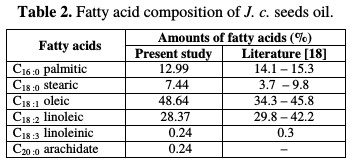
    <p>The J. c. seeds used in this study contained 49.54% of oil. Oleic and linoleic
acids were the principal fatty acids found in the oleaginous seeds. The fatty acids
composition of J. c. oil is summarized and compared with results reported in
literature.</p>

    <p><a href="#t2">Table 2</a> shows that J. c. seeds oil contains high quantities of mono-unsaturated
acids (oleic acid), and a moderate quantity of polyunsaturated acids (linoleic and
linoleinic acids).</p>


    <p>&nbsp;</p>
<a name="t2">
<img src="/img/revistas/pea/v36n3/36n3a03t2.jpg">
    
]]></body>
<body><![CDATA[<p>&nbsp;</p>


    <p>The total of unsaturated fatty acids was around 77%. This
prevalence indicates that the oil is rich in unsaturated fatty acids.</p>


    <p><i><b>Electrochemical measurements</b></i></p>

    <p><i>Concentration effect of JAC inhibitor</i></p>

    <p><u>Potentiodynamic polarization</u></p>

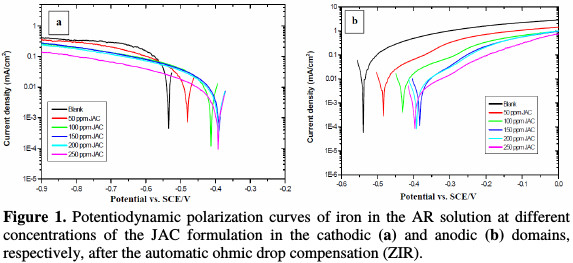
    <p>The cathodic and anodic polarization curves of the iron substrate in the AR
solution at pH = 3.6, without and with various concentrations of the JAC
formulation, are presented in <a href="#f1">Fig. 1</a>.</p>


    <p>&nbsp;</p>
<a name="f1">
<img src="/img/revistas/pea/v36n3/36n3a03f1.jpg">
    
<p>&nbsp;</p>


    <p>Then, the cathodic and anodic polarization
curves are separately plotted in <a href="#f1">Fig. 1a</a> and <a href="#f1">Fig. 1b</a>, respectively. The range of
concentrations investigated in this work was from 50 ppm to 250 ppm. All of
these curves have been obtained after 30 min of immersion time in the corrosive
medium, at corrosion potential, Ecorr, and after performing the automatic ohmic
drop compensation (ZIR).</p>

    <p>The initial potential was stated at a slightly more positive potential of Ecorr for the
cathodic scans, and conversely, it was set at a slightly more negative value of
Ecorr for the anodic scans.</p>

    ]]></body>
<body><![CDATA[<p>As shown in <a href="#f1">Fig. 1a</a>, the shape of the cathodic curves obtained without inhibitor
showed a current plateau attributed to the oxygen diffusion process [19],
indicating that the mass transport is an important factor which must be
considered in the cathodic process [20], according to the following reaction [21]:</p>


    <p>&nbsp;</p>
<a name="e0">
<img src="/img/revistas/pea/v36n3/36n3a03e0.jpg">
    
<p>&nbsp;</p>


    <p>We noted that the corrosion potential, Ecorr, value was -538 mV/SCE, in the
inhibitor absence. However, in the inhibitor presence, the corrosion potential,
value shifted towards a positive potential direction.</p>

    <p>At 250 ppm of the JAC formulation, the corrosion potential value became around
-396 mV/SCE. This potential corresponds well to iron corrosion in the passive
state, which may indicate that the JAC inhibitor has an anodic effect.</p>

    <p>JAC addition was accompanied by a decrease in cathodic current density values,
with the disappearance of the diffusion plateau obtained in the cathodic domain
in the case of the blank essay. This is because the inhibitor addition leads to a
change in the cathodic mechanism [20].</p>

    <p>As shown in <a href="#f1">Fig. 1b</a>, in the anodic domain, we observe that the anodic current
density value, in JAC absence, significantly increased at the vicinity of corrosion
potential. Furthermore, in the high anodic overvoltage, the anodic current density
value slightly increased in the studied domain.</p>

    <p>In contrast, JAC addition to the AR solution was accompanied by a decrease in
the anodic current density values.</p>

    <p>In the anodic overvoltage, and for all JAC concentrations, we noted that the
corrosion potential became more anodic and, also, that the current density
increased compared to the blank essay.</p>

    <p>This increase in the anodic current density was more pronounced over -300
mV/SCE of the corrosion potential value. This evolution may be explained by the
destruction of the inhibitor film formed at the corrosion potential, which can be
due to the protection offered by the water oxidation reaction, that causes a local
destruction of the film, and, consequently, the start of pitting corrosion.
Nevertheless, the presence of this film hinders pitting propagation; thus, the
current density remains relatively low compared to that observed in the inhibitor
absence [5].</p>

    ]]></body>
<body><![CDATA[<p>The corrosion current density was determined by the EC-lab software, after
diffusion correction, by using the following relation [22, 23]:</p>


    <p>&nbsp;</p>
<a name="e1">
<img src="/img/revistas/pea/v36n3/36n3a03e1.jpg">
    
<p>&nbsp;</p>


    <p>where I = current density at mixed process, I* = corrected current density and IL
= limited current density.</p>

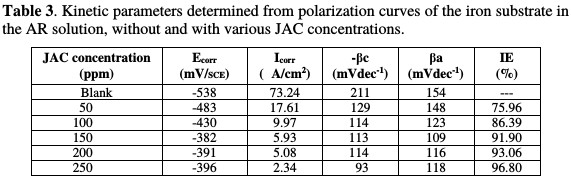
    <p>The kinetic parameters of the iron electrode corrosion are summarized in <a href="#t3">Table 3</a>.</p>


    <p>&nbsp;</p>
<a name="t3">
<img src="/img/revistas/pea/v36n3/36n3a03t3.jpg">
    
<p>&nbsp;</p>


    <p>As it is shown in <a href="#t3">Table 3</a>, the current density value decreased with increased
inhibitor concentrations, and simultaneously, the inhibition efficiency increased
with higher JAC concentrations, reaching a value of 97% at 250 ppm.</p>

    <p>By analyzing the polarization curves and kinetic parameters, we can conclude
that the JAC formulation is a mixed type inhibitor, which affects both cathodic
and anodic behaviors. This good inhibiting effect of the JAC formulation may be
attributed to its adsorption onto the electrode surface, which can form a film that
acts as a barrier layer on the iron surface, minimizing the contact area with the
corrosive medium, and hindering metal oxidation.</p>


    <p><u>Electrochemical impedance spectroscopy</u></p>

    ]]></body>
<body><![CDATA[<p>Electrochemical impedance spectroscopy (EIS) is a useful and non-destructive
experimental technique, which can simulate the real electrochemical behavior in
the electrode/solution interface, and precisely determine the kinetic parameters of
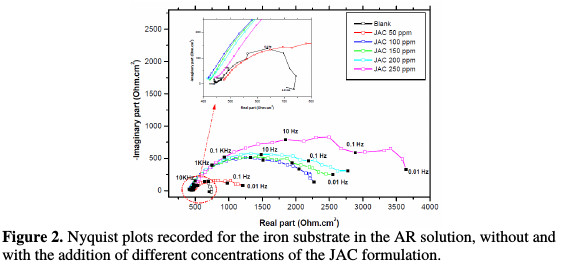
the studied system [24, 25]. <a href="#f2">Fig. 2</a> gives the EIS diagrams in the Nyquist plots of
the iron substrate.</p>


    <p>&nbsp;</p>
<a name="f2">
<img src="/img/revistas/pea/v36n3/36n3a03f2.jpg">
    
<p>&nbsp;</p>


    <p>The impedance spectra were started after 30 min of immersion time, in the AR
solution, without and with the JAC inhibitor, to avoid significant changes in the
open circuit potential (OCP).</p>

    <p>The impedance spectra in the JAC formulation absence displayed two capacity
loops: (RHF, CHF) in the high frequencies, and (RLF, CLF) in the beginning of the
inductive loop in the low frequencies [26], comparatively to a study already
published [20].</p>

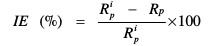
    <p>The inhibition efficiency (IE %) was calculated using the following equation:</p>


    <p>&nbsp;</p>
<a name="e2">
<img src="/img/revistas/pea/v36n3/36n3a03e2.jpg">
    
<p>&nbsp;</p>


    <p>where Rip and Rp are the polarization resistance values, in the inhibitor presence
and absence, respectively.</p>

    <p>The JAC formulation addition at various concentrations has removed the
inductive behavior of the iron substrate in the AR solution.
On the one hand, we noted a change in the loops shape and size; on the other
hand, as it can be observed from <a href="#f2">Fig. 2</a>, the impedance modulus notably
increased in the JAC formulation presence.</p>

    ]]></body>
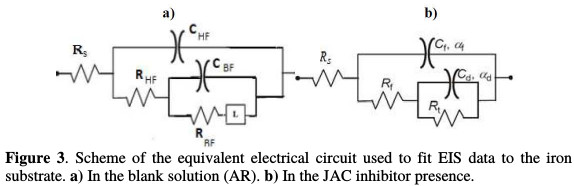
<body><![CDATA[<p>In the studied frequency range, the system could be described by the
corresponding structural model of the interface, without and with the JAC
inhibitor, as shown in <a href="#f3">Fig. 3</a>.</p>


    <p>&nbsp;</p>
<a name="f3">
<img src="/img/revistas/pea/v36n3/36n3a03f3.jpg">
    
<p>&nbsp;</p>


    <p>In the equivalent electrical circuit (EEC), according to the impedance spectrum
in the inhibitor absence, the solution resistance is Rs; the resistances in the high
and low frequencies are RHF and RRF, respectively, and the inductance is L (see
<a href="#f3">Fig. 3a</a>). However, in the JAC inhibitor presence, the EEC showed the absence of
the inductive element in the impedance spectrum. While Rf refers to the film
resistance, due to the ionic conduction through the inhibitor layer, Rt is the
charge transfer resistance, and (Cf - Cdl) present the film capacitance due to the
electronic insulating property, and the double layer capacitance at the metal
electrolyte interface, respectively (see <a href="#f3">Fig. 3b</a>).</p>

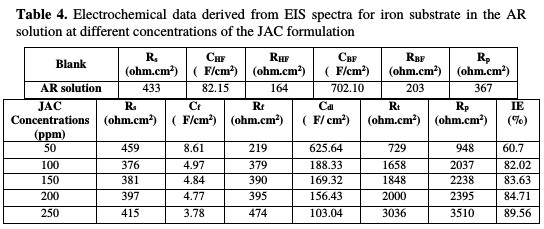
    <p>Electrochemical parameters derived from the EIS diagrams associated to <a href="#f3">Fig. 3</a>
are shown in <a href="#t4">Table 4</a>.</p>


    <p>&nbsp;</p>
<a name="t4">
<img src="/img/revistas/pea/v36n3/36n3a03t4.jpg">
    
<p>&nbsp;</p>


    <p>From <a href="#t4">Table 4</a> it is found that the transfer resistance, Rt, values increased with an
increase in the JAC formulation concentrations, whereas the double layer capacitance, Cdl, 
values decreased; this decrease was due to the adsorption of the
 JAC inhibitor onto the metal surface [5].</p>

    <p>The film capacitance, Cf, has also decreased with an increase in the JAC
 formulation concentration (Cf&lt;10 &mu;F/cm<sup>2</sup>) [20, 27, 28, 29], which was probably
 due to the formation of a protective layer on the electrode surface [20, 5]; then,
 the inhibition efficiency reached a value of 90% at 250 ppm, after 30 minutes
 immersion time.</p>

    <p><i>    ]]></body>
<body><![CDATA[<p>Rotating disc effect of the iron electrode</i></p>

    <p><u>Case of the blank solution</u></p>

    <p>The use of the rotating disc electrode is one of the essential methods to determine
 the mechanism controlling the electrolyte/metal interface process.</p>

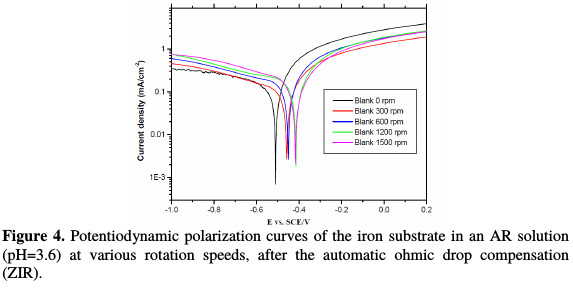
    <p>The cathodic and anodic polarization curves of the iron substrate in the AR
 solution at pH=3.6, after 30 min of immersion time, at different rotation speeds,
 are reported in <a href="#f4">Fig. 4</a>.</p>


    <p>&nbsp;</p>
<a name="f4">
<img src="/img/revistas/pea/v36n3/36n3a03f4.jpg">
    
<p>&nbsp;</p>


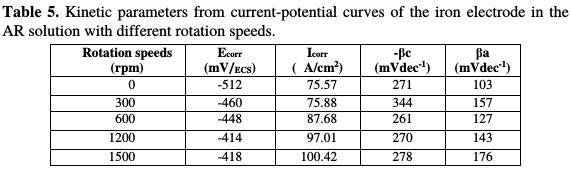
    <p>As shown in <a href="#f4">Fig. 4</a>, the increase in the rotation speed led to a displacement of the
corrosion potential, in the positive direction. The increase in the current density
value, Icorr, from 75.57 &mu;A/cm<sup>2</sup> at 0 rpm, to a value of 100.42 &mu;A/cm<sup>2</sup> at 1500
rpm, can be explained by the increase in the amount of dissolved oxygen on the
electrode surface [30].</p>

    <p>In the one hand, in the cathodic domain, we observed an increase in the bearing
height current density with an increased rotation speed of the working electrode.
This result is in accordance with the diffusion control of the dissolved oxygen
reduction [31 and 32]. In the other hand, we noticed that, in the anodic domain,
the kinetics reaction corresponds to the metal dissolution [33]. Furthermore, the
polarization curves are relatively parallel for all rotation speeds.
At the potential 0 mV/SCE, we noted that the current density value decreased two
times when we passed from 0 rpm to 300 rpm.</p>

    <p>These results indicate that the formation of a prohibitive layer substantially
depends on the rotating electrode speeds, and it is limited by the hydrodynamic
conditions [31].</p>

    <p>The derived parameters obtained from the potentiodynamic polarization curves
are summarized in <a href="#t5">Table 5</a>.</p>


    ]]></body>
<body><![CDATA[<p>&nbsp;</p>
<a name="t5">
<img src="/img/revistas/pea/v36n3/36n3a03t5.jpg">
    
<p>&nbsp;</p>


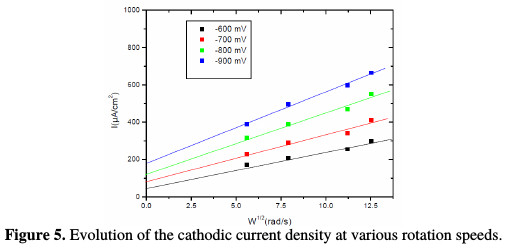
    <p>For better understanding the nature of the diffusion process, we have plotted the
current density values variation as a function of the square root of the electrode
rotation speeds (I = f (w1/2)) [32]. The obtained results at different cathodic
potential values (-600, -700, -800 and -900 mV/SCE) are shown in <a href="#f5">Fig. 5</a>.</p>


    <p>&nbsp;</p>
<a name="f5">
<img src="/img/revistas/pea/v36n3/36n3a03f5.jpg">
    
<p>&nbsp;</p>


    <p>As shown in <a href="#f5">Fig. 5</a>, we can observe that the current density values linearly
increase with the rotation speed square root. This result indicates that the cathode
kinetics in the potential range is only controlled by the transport process in the
interface electrode/solution [32 and 33].</p>

    <p>The difference in the current density values observed in the studied potential
areas at different rotational speeds can be explained by the presence of an
oxidation products layer [34] on the electrode surface, which blocks a few
cathode active sites and minimizes the contact surface between metal and
solution. However, this oxide layer is brittle, and destructible.</p>

    <p>We also noted that the fitting plots were not passed on the origin of the axis. This
confirms the existence of two components in the global current density: Id is the
diffusional component and A is the non-diffusional component, evaluated in the
ordinate at the origin of the axis, according to the following relationship.</p>


    <p>&nbsp;</p>
<a name="e3">
<img src="/img/revistas/pea/v36n3/36n3a03e3.jpg">
    
<p>&nbsp;</p>


    ]]></body>
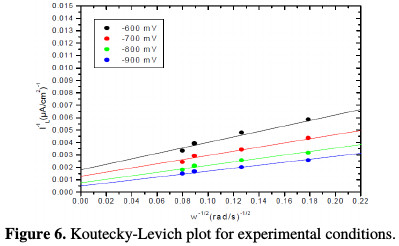
<body><![CDATA[<p>This relationship indicates that the interfacial reaction is governed by two
different processes. This behavior leads to several hypotheses [35], which can be
confirmed by the plot trace (IL-1 =f(w-1/2), where IL is the limit diffusion current
density, given by the Levich relationship [36]:</p>


    <p>&nbsp;</p>
<a name="e4">
<img src="/img/revistas/pea/v36n3/36n3a03e4.jpg">
    
<p>&nbsp;</p>


    <p>where n is the number of electrons (n= 4), F is the Faraday constant (F=96 485 C
/mol), S is the electrode surface area (1 cm<sup>2</sup>), CO2 is the oxygen concentration in
the bulk, which is usually taken as 0.2 mol/m3 [37], DO2 is the oxygen diffusion
coefficient, &nu; is the kinematic viscosity (0.82 &times; 10<sup>-6</sup> m2/ s) and w1â„2 is the square
root of the rotation speed (rad/s).</p>

    <p>The fitting plots obtained in <a href="#f6">Fig. 6</a> are straight lines which are not passed on the
origin of the axis; therefore, we confirmed the mixed activation-diffusion kinetics
[33].</p>


    <p>&nbsp;</p>
<a name="f6">
<img src="/img/revistas/pea/v36n3/36n3a03f6.jpg">
    
<p>&nbsp;</p>


    <p>These results show that the cathodic current density controlled by the oxygen
reduction at the interface electrode/solution [38] confirms a Koutecky-Levich
relationship [33].</p>

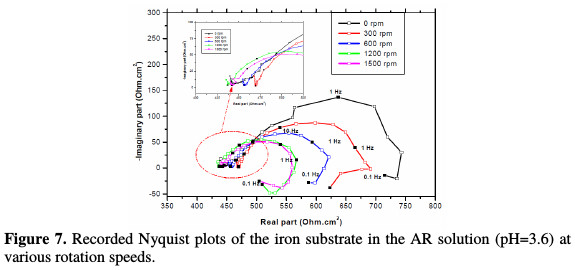
    <p>The impedance diagrams of the iron substrate in the AR solution (pH = 3.6) at
different rotation speeds are given in <a href="#f7">Fig. 7</a>.</p>


    <p>&nbsp;</p>
<a name="f7">
<img src="/img/revistas/pea/v36n3/36n3a03f7.jpg">
    
]]></body>
<body><![CDATA[<p>&nbsp;</p>


    <p>As shown in <a href="#f7">Fig. 7</a>, the loop size was reduced when the rotation speeds were
raised from 0 rpm to 1500 rpm. This result reveals that the diffusion occurs in the
interfacial process at the corrosion potential.</p>

    <p>In the low frequencies, the inductive loops become more marked; this inductive
effect may be due to the desorption of H+ ions and salts ions present in the
solution [23 and 39], or to the re-dissolution of the passivity surface [40].</p>


    <p><u>Case in the JAC formulation presence</u></p>

    <p>The inhibiting effect of the JAC inhibitor was evaluated at different rotation
speeds of the iron electrode in the same experimental conditions without
inhibitor.</p>

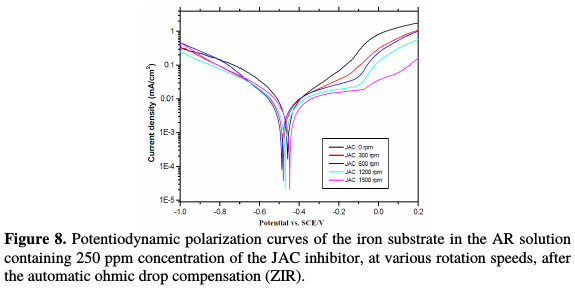
    <p>The cathodic and anodic polarization curves of the iron substrate in the AR
solution containing 250 ppm of the JAC formulation, at different rotation speeds
after 30 min of immersion time at the corrosion potential, are given in <a href="#f8">Fig. 8</a>.</p>


    <p>&nbsp;</p>
<a name="f8">
<img src="/img/revistas/pea/v36n3/36n3a03f8.jpg">
    
<p>&nbsp;</p>


    <p>As shown in this figure, the polarization curves in the cathodic part have the
same shapes at all rotation speeds. We also noted that, in the cathodic domain,
the polarization curves were not affected by the rotation speeds, taking into
account the sensitivity limits of the apparatus, and the experimental margin of
error. Moreover, in the anodic domain, we observed that the passivation bearing
became more marked with the increase in the rotation speeds.</p>

    <p>Additionally, the current density significantly increased at a potential value of -
80 mV/SCE. This can be attributed to the desorption of the protector layer formed
by the inhibitor.</p>

    ]]></body>
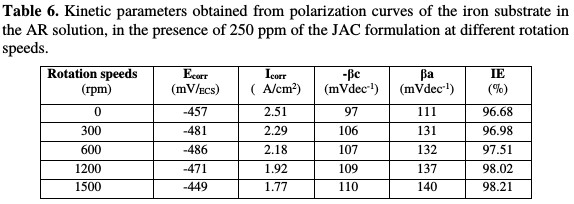
<body><![CDATA[<p>The electrochemical parameters derived from these curves were determined by
the EC- lab program. The obtained results are summarized in <a href="#t6">Table 6</a>.</p>


    <p>&nbsp;</p>
<a name="t6">
<img src="/img/revistas/pea/v36n3/36n3a03t6.jpg">
    
<p>&nbsp;</p>


    <p>As reported in <a href="#t6">Table 6</a>, we noted that the current density values decreased with an
increase in the rotation speeds at 250 ppm concentration of the JAC inhibitor,
improving its inhibition efficiency, which also happened in the blank solution
(pH=3.6).</p>

    <p>From the inhibition efficiency values, we noted an insignificant change, even
lesser when doubling the rotation speeds, reaching 98% at 1500 rpm.</p>

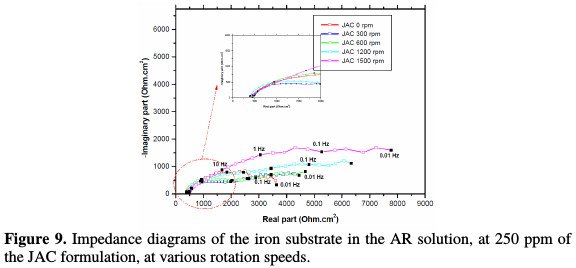
    <p>For better understanding the involved reaction mechanisms, <a href="#f9">Fig. 9</a> represents the
rotation speeds effect on the impedance spectra at the potential corrosion, at 250
ppm concentration of the JAC formulation.</p>


    <p>&nbsp;</p>
<a name="f9">
<img src="/img/revistas/pea/v36n3/36n3a03f9.jpg">
    
<p>&nbsp;</p>


    <p>From the electrochemical impedance spectra, we can distinguish two capacitive
loops. In the low frequencies, the capacitive loop can be attributed to the film
formation. The former became more distinct by the increase in the rotation
speeds; at rotation speed values higher than 600 rpm, we noticed an overlap of
the two capacitive loops, which then became less distinct.</p>

    <p>Furthermore, the size of the capacitive loops increased with higher rotation
speeds, and we noted a significant increase in the polarization resistance value,
Rp.</p>

    ]]></body>
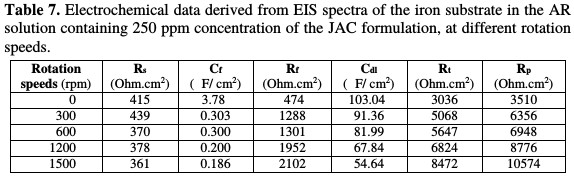
<body><![CDATA[<p>The electrochemical parameters associated to the EIS diagrams, by using the
experimental fitting Ec-Lab program, are given in <a href="#t7">Table 7</a>.</p>


    <p>&nbsp;</p>
<a name="t7">
<img src="/img/revistas/pea/v36n3/36n3a03t7.jpg">
    
<p>&nbsp;</p>


    <p>From <a href="#t7">Table 7</a>, we can observe that the value of the capacitance film, Cf,
decreased with higher rotation speeds. This may be due to the enhancement of
the protector layer formed by the JAC inhibitor on the electrode surface.</p>


    <p><i>Immersion time effect</i></p>

    <p>The evolution of the impedance diagrams in the AR medium containing 250 ppm
of the JAC inhibitor, measured at corrosion potential, and recorded for different
immersion times, is reported in <a href="#f10">Fig. 10</a>.</p>


    <p>&nbsp;</p>
<a name="f10">
<img src="/img/revistas/pea/v36n3/36n3a03f10.jpg">
    
<p>&nbsp;</p>


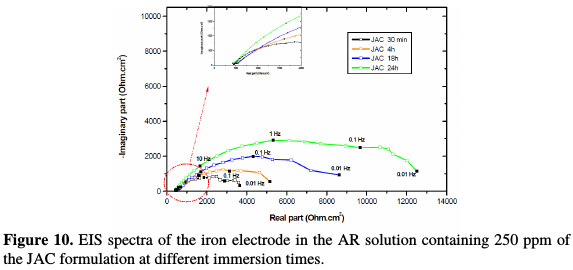
    <p>As it can be seen in <a href="#f10">Fig. 10</a>, at the impedance diagrams in the Nyquist plot, the
loops become larger with the immersion time; in addition, the capacitive loops
maintained the same shape after 30 min of immersion time. The polarization
resistance, Rp, considerably increased with higher immersion times.</p>

    <p>In the one hand, the initial value of the polarization resistance is 3.61 k&Omega;.cm<sup>2</sup>
after 30 min of immersion time; it increased up to 5.17, 9.01 and 12.51 k&Omega;.cm<sup>2</sup>
after 4, 18 and 24 hours of immersion time, respectively. On the other hand, the
film capacitance, Cf, decreases with the immersion time, and this evolution can
be explained by the blocking ions on the electrode surface.</p>

    ]]></body>
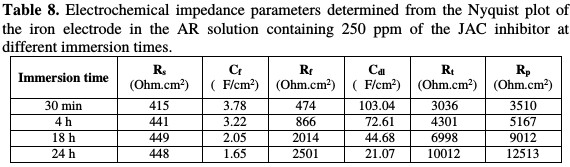
<body><![CDATA[<p>The electrochemical impedance parameters derived from these investigations are
given in <a href="#t8">Table 8</a>.</p>


    <p>&nbsp;</p>
<a name="t8">
<img src="/img/revistas/pea/v36n3/36n3a03t8.jpg">
    
<p>&nbsp;</p>


    <p>The results presented in <a href="#t8">Table 8</a> reveal that the JAC inhibitor acts as a good
protecting barrier for the iron substrate in the AR medium, and its effect is
enhanced by the immersion time.</p>


    <p><i><b>Surface analysis (SEM)</b></i></p>

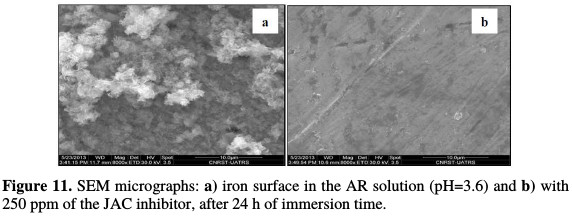
    <p>The evaluation of the iron surface with the best inhibitor concentration is
obtained by SEM analysis. The micrographs carried out in the JAC formulation
absence and presence are given in <a href="#f11">Fig. 11</a>.</p>


    <p>&nbsp;</p>
<a name="f11">
<img src="/img/revistas/pea/v36n3/36n3a03f11.jpg">
    
<p>&nbsp;</p>


    <p>In the inhibitor absence (see <a href="#f11">Fig. 11a</a>), the metal surface is heavily corroded,
becoming rough and uneven. Moreover, we can observe the corrosion products
deposit.</p>

    <p>However, in the inhibitor presence (see <a href="#f11">Fig. 11b</a>), the metal surface becomes
more uniform and smooth, probably due to the adsorption of the JAC formulation
molecules onto the iron surface, forming a protective layer.</p>


    ]]></body>
<body><![CDATA[<p>&nbsp;</p>
    <p><b>Conclusion</b></p>

    <p>The JAC formulation based on the extracted oil from Jatropha curcas seeds has a
good protective effect against the iron substrate corrosion in the acidic rainwater
(AR) medium. The protective effect was confirmed by stationary and transitory
electrochemical measurements. Both approaches indicate that the JAC inhibitor
adsorption onto the iron metal surface leads to the formation of a protective layer
on the latter.</p>

    <p>Potentiodynamic polarization showed that the JAC formulation acts as a mixed
type inhibitor. The best inhibition efficiency reached a value of 97% at 250 ppm
concentration.</p>

    <p>The protective effect of the JAC formulation is reinforced by higher rotation
speeds and immersion times, leading to a decrease in the capacitance film value,
and to an increase in the polarization resistance values. These results were
confirmed by the SEM micrographs.</p>

    <p>These first promising results encourage us to apply our JAC formulation in the
conservation of iron archaeological objects exposed in museums.</p>


    <p>&nbsp;</p>
    <p><b>References</b></p>

    <!-- ref --><p>1. Hollner S. Developpement de nouveaux traitements de protection a base d'acide carboxylique pour la conservation d'objets en fer du patrimoine culturel. these de l'UHP Nancy I. Nancy; 2009.    &nbsp;&nbsp;&nbsp;&nbsp;&nbsp;&nbsp;&nbsp;&nbsp;[&#160;<a href="javascript:void(0);" onclick="javascript: window.open('/scielo.php?script=sci_nlinks&ref=433973&pid=S0872-1904201800030000300001&lng=','','width=640,height=500,resizable=yes,scrollbars=1,menubar=yes,');">Links</a>&#160;]<!-- end-ref --></p>

    ]]></body>
<body><![CDATA[<p>2. Hamdy A, El-Gendy NSh. Egyptian J Petrol. 2013;22:17.</p>

    <!-- ref --><p>3. Roberge PR. Handbook of Corrosion Engineering. New York: Mc Graw-Hill; 2000.    &nbsp;&nbsp;&nbsp;&nbsp;&nbsp;&nbsp;&nbsp;&nbsp;[&#160;<a href="javascript:void(0);" onclick="javascript: window.open('/scielo.php?script=sci_nlinks&ref=433976&pid=S0872-1904201800030000300003&lng=','','width=640,height=500,resizable=yes,scrollbars=1,menubar=yes,');">Links</a>&#160;]<!-- end-ref --></p>

    <p>4. Rani BEA, Basu BBJ. Int J Corros. 2012;2012: Article ID 380217.</p>

    <!-- ref --><p>5. Hammouch H, Dermaj A, Chebabe D, et al. Anal Bioanal Electrochem. 2013;5:236.    &nbsp;&nbsp;&nbsp;&nbsp;&nbsp;&nbsp;&nbsp;&nbsp;[&#160;<a href="javascript:void(0);" onclick="javascript: window.open('/scielo.php?script=sci_nlinks&ref=433979&pid=S0872-1904201800030000300005&lng=','','width=640,height=500,resizable=yes,scrollbars=1,menubar=yes,');">Links</a>&#160;]<!-- end-ref --></p>

    <!-- ref --><p>6. National Oilseeds & Vegetable Oils Development (NOVOD) Board 2007, Jatropha. An alternate source for biodiesel. Available from 
<a href="http://www.novodboard.com" target="_blank">http://www.novodboard.com</a>.    &nbsp;&nbsp;&nbsp;&nbsp;&nbsp;&nbsp;&nbsp;&nbsp;[&#160;<a href="javascript:void(0);" onclick="javascript: window.open('/scielo.php?script=sci_nlinks&ref=433981&pid=S0872-1904201800030000300006&lng=','','width=640,height=500,resizable=yes,scrollbars=1,menubar=yes,');">Links</a>&#160;]<!-- end-ref --></p>

    <!-- ref --><p>7. National Oil seeds & Vegetable Oils Development (NOVOD) Board. 2008. 3rd R&amp; D report on tree borne oil seeds 2007-2008. 
<a href="http://www.novodboard.com" target="_blank">http://www.novodboard.com</a>.    &nbsp;&nbsp;&nbsp;&nbsp;&nbsp;&nbsp;&nbsp;&nbsp;[&#160;<a href="javascript:void(0);" onclick="javascript: window.open('/scielo.php?script=sci_nlinks&ref=433983&pid=S0872-1904201800030000300007&lng=','','width=640,height=500,resizable=yes,scrollbars=1,menubar=yes,');">Links</a>&#160;]<!-- end-ref --></p>

    ]]></body>
<body><![CDATA[<!-- ref --><p>8. Altenburg T, Dietz H, Hahl M, et al. Biodiesel in India. Value chain organisation and policy options for rural development. Bonn: German     Development Institute; 2009.    &nbsp;&nbsp;&nbsp;&nbsp;&nbsp;&nbsp;&nbsp;&nbsp;[&#160;<a href="javascript:void(0);" onclick="javascript: window.open('/scielo.php?script=sci_nlinks&ref=433985&pid=S0872-1904201800030000300008&lng=','','width=640,height=500,resizable=yes,scrollbars=1,menubar=yes,');">Links</a>&#160;]<!-- end-ref --></p>

    <!-- ref --><p>9. Reubens B, Achten WMJ, Maes WH, et al. J Arid Environ. 2011;75:201.    &nbsp;&nbsp;&nbsp;&nbsp;&nbsp;&nbsp;&nbsp;&nbsp;[&#160;<a href="javascript:void(0);" onclick="javascript: window.open('/scielo.php?script=sci_nlinks&ref=433987&pid=S0872-1904201800030000300009&lng=','','width=640,height=500,resizable=yes,scrollbars=1,menubar=yes,');">Links</a>&#160;]<!-- end-ref --></p>

    <!-- ref --><p>10. Makkar HPS, Aderibigbe AO, Becker K. Food Chem. 1998;62:207.    &nbsp;&nbsp;&nbsp;&nbsp;&nbsp;&nbsp;&nbsp;&nbsp;[&#160;<a href="javascript:void(0);" onclick="javascript: window.open('/scielo.php?script=sci_nlinks&ref=433989&pid=S0872-1904201800030000300010&lng=','','width=640,height=500,resizable=yes,scrollbars=1,menubar=yes,');">Links</a>&#160;]<!-- end-ref --></p>

    <p>11. Carels N, Sujatha M, Bahadur B, editors. Jatropha, Challenges for a New Energy Crop. Volume 1: Farming, Economics and Biofuel. New York: Springer; 2012.</p>

    <!-- ref --><p>12. Poteet MD. Biodiesel Crop Implementation in Hawaii. The State of Hawaii Department of Agriculture, Contract Number. HDOA-2006-2. pp 41-54.    &nbsp;&nbsp;&nbsp;&nbsp;&nbsp;&nbsp;&nbsp;&nbsp;[&#160;<a href="javascript:void(0);" onclick="javascript: window.open('/scielo.php?script=sci_nlinks&ref=433992&pid=S0872-1904201800030000300012&lng=','','width=640,height=500,resizable=yes,scrollbars=1,menubar=yes,');">Links</a>&#160;]<!-- end-ref --></p>

    <!-- ref --><p>13. Tiwari AK, Kumar A, Raheman H. Biomass Bio-energy. 2007;31:569.    &nbsp;&nbsp;&nbsp;&nbsp;&nbsp;&nbsp;&nbsp;&nbsp;[&#160;<a href="javascript:void(0);" onclick="javascript: window.open('/scielo.php?script=sci_nlinks&ref=433994&pid=S0872-1904201800030000300013&lng=','','width=640,height=500,resizable=yes,scrollbars=1,menubar=yes,');">Links</a>&#160;]<!-- end-ref --></p>

    <!-- ref --><p>14. Karleskind A. Manuel des corps gras. 2 ed. Technique and Documentation-Lavoisier; 1992.    &nbsp;&nbsp;&nbsp;&nbsp;&nbsp;&nbsp;&nbsp;&nbsp;[&#160;<a href="javascript:void(0);" onclick="javascript: window.open('/scielo.php?script=sci_nlinks&ref=433996&pid=S0872-1904201800030000300014&lng=','','width=640,height=500,resizable=yes,scrollbars=1,menubar=yes,');">Links</a>&#160;]<!-- end-ref --></p>

    <!-- ref --><p>15. Rahmouni K, Joiret S, Robbiola L, et al. Impedance Comm online. 2004;2:5.    &nbsp;&nbsp;&nbsp;&nbsp;&nbsp;&nbsp;&nbsp;&nbsp;[&#160;<a href="javascript:void(0);" onclick="javascript: window.open('/scielo.php?script=sci_nlinks&ref=433998&pid=S0872-1904201800030000300015&lng=','','width=640,height=500,resizable=yes,scrollbars=1,menubar=yes,');">Links</a>&#160;]<!-- end-ref --></p>

    <!-- ref --><p>16. Degrigny C, Argyropoulos V, Pouli P, et al. The methodological approach for the PROMET project to develop/test new non-toxic corrosion inhibitors and coatings for iron and copper alloy objects housed in mediterranean museums. Proceedings of METAL 2007. Protection of Metal Artifacts. 2007.    &nbsp;&nbsp;&nbsp;&nbsp;&nbsp;&nbsp;&nbsp;&nbsp;[&#160;<a href="javascript:void(0);" onclick="javascript: window.open('/scielo.php?script=sci_nlinks&ref=434000&pid=S0872-1904201800030000300016&lng=','','width=640,height=500,resizable=yes,scrollbars=1,menubar=yes,');">Links</a>&#160;]<!-- end-ref --></p>

    <!-- ref --><p>17. Hajjaji N, Bettach N, Hammouch H, et al. OMPIC Casablanca. Morocco patent 3069/10.2011. 2011.    &nbsp;&nbsp;&nbsp;&nbsp;&nbsp;&nbsp;&nbsp;&nbsp;[&#160;<a href="javascript:void(0);" onclick="javascript: window.open('/scielo.php?script=sci_nlinks&ref=434002&pid=S0872-1904201800030000300017&lng=','','width=640,height=500,resizable=yes,scrollbars=1,menubar=yes,');">Links</a>&#160;]<!-- end-ref --></p>

    <!-- ref --><p>18. Rodrigues J, Miranda I, Gominho J, et al. IndCrops Prod. 2013;50:828.    &nbsp;&nbsp;&nbsp;&nbsp;&nbsp;&nbsp;&nbsp;&nbsp;[&#160;<a href="javascript:void(0);" onclick="javascript: window.open('/scielo.php?script=sci_nlinks&ref=434004&pid=S0872-1904201800030000300018&lng=','','width=640,height=500,resizable=yes,scrollbars=1,menubar=yes,');">Links</a>&#160;]<!-- end-ref --></p>

    <!-- ref --><p>19. Sfaira M, Srhiri A, Keddam M, et al. Electrochim Acta. 1999;44:4395.    &nbsp;&nbsp;&nbsp;&nbsp;&nbsp;&nbsp;&nbsp;&nbsp;[&#160;<a href="javascript:void(0);" onclick="javascript: window.open('/scielo.php?script=sci_nlinks&ref=434006&pid=S0872-1904201800030000300019&lng=','','width=640,height=500,resizable=yes,scrollbars=1,menubar=yes,');">Links</a>&#160;]<!-- end-ref --></p>

    <!-- ref --><p>20. Chellouli M, Chebabe D, Dermaj A, et al. Electrochim Acta. 2016;204:50.    &nbsp;&nbsp;&nbsp;&nbsp;&nbsp;&nbsp;&nbsp;&nbsp;[&#160;<a href="javascript:void(0);" onclick="javascript: window.open('/scielo.php?script=sci_nlinks&ref=434008&pid=S0872-1904201800030000300020&lng=','','width=640,height=500,resizable=yes,scrollbars=1,menubar=yes,');">Links</a>&#160;]<!-- end-ref --></p>

    <!-- ref --><p>21. Ochoa N, Moran F, Pebere N. J Appl Electrochem. 2004;34:487.    &nbsp;&nbsp;&nbsp;&nbsp;&nbsp;&nbsp;&nbsp;&nbsp;[&#160;<a href="javascript:void(0);" onclick="javascript: window.open('/scielo.php?script=sci_nlinks&ref=434010&pid=S0872-1904201800030000300021&lng=','','width=640,height=500,resizable=yes,scrollbars=1,menubar=yes,');">Links</a>&#160;]<!-- end-ref --></p>

    <!-- ref --><p>22. Dupart M, Dabosi F, Moran F, et al. Corrosion-NACE. 1981;37:262.    &nbsp;&nbsp;&nbsp;&nbsp;&nbsp;&nbsp;&nbsp;&nbsp;[&#160;<a href="javascript:void(0);" onclick="javascript: window.open('/scielo.php?script=sci_nlinks&ref=434012&pid=S0872-1904201800030000300022&lng=','','width=640,height=500,resizable=yes,scrollbars=1,menubar=yes,');">Links</a>&#160;]<!-- end-ref --></p>

    <!-- ref --><p>23. Bonnel A, Dabosi F, Deslouis C. et al. J Electrochem Soc. 1983;130:753.    &nbsp;&nbsp;&nbsp;&nbsp;&nbsp;&nbsp;&nbsp;&nbsp;[&#160;<a href="javascript:void(0);" onclick="javascript: window.open('/scielo.php?script=sci_nlinks&ref=434014&pid=S0872-1904201800030000300023&lng=','','width=640,height=500,resizable=yes,scrollbars=1,menubar=yes,');">Links</a>&#160;]<!-- end-ref --></p>

    <!-- ref --><p>24. Cesiulis H, Tsyntsaru N, Ramanavicius A, et al. Nano-Science and Technology Book. Switzerland: Springer Int Publ; 2016.    &nbsp;&nbsp;&nbsp;&nbsp;&nbsp;&nbsp;&nbsp;&nbsp;[&#160;<a href="javascript:void(0);" onclick="javascript: window.open('/scielo.php?script=sci_nlinks&ref=434016&pid=S0872-1904201800030000300024&lng=','','width=640,height=500,resizable=yes,scrollbars=1,menubar=yes,');">Links</a>&#160;]<!-- end-ref --></p>

    <!-- ref --><p>25. Barsoukov E, Macdonald JR. Impedance Spectroscopy: Theory, Experiment, and Applications. 2nd ed. New York: Wiley Online Library; 2005.    &nbsp;&nbsp;&nbsp;&nbsp;&nbsp;&nbsp;&nbsp;&nbsp;[&#160;<a href="javascript:void(0);" onclick="javascript: window.open('/scielo.php?script=sci_nlinks&ref=434018&pid=S0872-1904201800030000300025&lng=','','width=640,height=500,resizable=yes,scrollbars=1,menubar=yes,');">Links</a>&#160;]<!-- end-ref --></p>

    <p>26. Hoerle S, Mazaudier F, Dillmann Ph, et al. Corros Sci. 2004;46:1431.</p>

    <!-- ref --><p>27. Cao S, Liu D, Zhang P, et al. Sci Rep. 2017;18:8773.    &nbsp;&nbsp;&nbsp;&nbsp;&nbsp;&nbsp;&nbsp;&nbsp;[&#160;<a href="javascript:void(0);" onclick="javascript: window.open('/scielo.php?script=sci_nlinks&ref=434021&pid=S0872-1904201800030000300027&lng=','','width=640,height=500,resizable=yes,scrollbars=1,menubar=yes,');">Links</a>&#160;]<!-- end-ref --></p>

    <!-- ref --><p>28. Klassen RD, Hyatt CV, Roberge PR. Canadian J Metallurgy Mater Sci. 2013;39:235.    &nbsp;&nbsp;&nbsp;&nbsp;&nbsp;&nbsp;&nbsp;&nbsp;[&#160;<a href="javascript:void(0);" onclick="javascript: window.open('/scielo.php?script=sci_nlinks&ref=434023&pid=S0872-1904201800030000300028&lng=','','width=640,height=500,resizable=yes,scrollbars=1,menubar=yes,');">Links</a>&#160;]<!-- end-ref --></p>

    ]]></body>
<body><![CDATA[<!-- ref --><p>29. Lakhrissi L, Lakhrissi B, Touir R, et al. Arabian J Chem. 2013;10:S3142.    &nbsp;&nbsp;&nbsp;&nbsp;&nbsp;&nbsp;&nbsp;&nbsp;[&#160;<a href="javascript:void(0);" onclick="javascript: window.open('/scielo.php?script=sci_nlinks&ref=434025&pid=S0872-1904201800030000300029&lng=','','width=640,height=500,resizable=yes,scrollbars=1,menubar=yes,');">Links</a>&#160;]<!-- end-ref --></p>

    <!-- ref --><p>30. Amin MA, El-Rehim SSA, El-Sherbini EEF, et al. Electrochim Acta. 2007;52:3588.    &nbsp;&nbsp;&nbsp;&nbsp;&nbsp;&nbsp;&nbsp;&nbsp;[&#160;<a href="javascript:void(0);" onclick="javascript: window.open('/scielo.php?script=sci_nlinks&ref=434027&pid=S0872-1904201800030000300030&lng=','','width=640,height=500,resizable=yes,scrollbars=1,menubar=yes,');">Links</a>&#160;]<!-- end-ref --></p>

    <!-- ref --><p>31. Doubi M, Dermaj A, Erramli H, et al. Science Lib. 2013;5:130110.    &nbsp;&nbsp;&nbsp;&nbsp;&nbsp;&nbsp;&nbsp;&nbsp;[&#160;<a href="javascript:void(0);" onclick="javascript: window.open('/scielo.php?script=sci_nlinks&ref=434029&pid=S0872-1904201800030000300031&lng=','','width=640,height=500,resizable=yes,scrollbars=1,menubar=yes,');">Links</a>&#160;]<!-- end-ref --></p>

    <!-- ref --><p>32. Es-Salah K, Keddam M, Rahmouni K, et al. Electrochim Acta. 2004;49:2771.    &nbsp;&nbsp;&nbsp;&nbsp;&nbsp;&nbsp;&nbsp;&nbsp;[&#160;<a href="javascript:void(0);" onclick="javascript: window.open('/scielo.php?script=sci_nlinks&ref=434031&pid=S0872-1904201800030000300032&lng=','','width=640,height=500,resizable=yes,scrollbars=1,menubar=yes,');">Links</a>&#160;]<!-- end-ref --></p>

    <!-- ref --><p>33. Dobrzeniecka A, Zeradjanin A, Masa J, et al. Catalysis Today. 2013;202:55.    &nbsp;&nbsp;&nbsp;&nbsp;&nbsp;&nbsp;&nbsp;&nbsp;[&#160;<a href="javascript:void(0);" onclick="javascript: window.open('/scielo.php?script=sci_nlinks&ref=434033&pid=S0872-1904201800030000300033&lng=','','width=640,height=500,resizable=yes,scrollbars=1,menubar=yes,');">Links</a>&#160;]<!-- end-ref --></p>

    ]]></body>
<body><![CDATA[<!-- ref --><p>34. Grygar T. Collect Czech Chem Commun. 1995;60:1261.    &nbsp;&nbsp;&nbsp;&nbsp;&nbsp;&nbsp;&nbsp;&nbsp;[&#160;<a href="javascript:void(0);" onclick="javascript: window.open('/scielo.php?script=sci_nlinks&ref=434035&pid=S0872-1904201800030000300034&lng=','','width=640,height=500,resizable=yes,scrollbars=1,menubar=yes,');">Links</a>&#160;]<!-- end-ref --></p>

    <!-- ref --><p>35. Doubi M. Qualite physico-chimique des eaux naturelles et impact sur la degradation des equipements hydromecaniques. Doctoral thesis. Kenitra, Morocco: Ibn Tofail University; 2016.    &nbsp;&nbsp;&nbsp;&nbsp;&nbsp;&nbsp;&nbsp;&nbsp;[&#160;<a href="javascript:void(0);" onclick="javascript: window.open('/scielo.php?script=sci_nlinks&ref=434037&pid=S0872-1904201800030000300035&lng=','','width=640,height=500,resizable=yes,scrollbars=1,menubar=yes,');">Links</a>&#160;]<!-- end-ref --></p>

    <!-- ref --><p>36. Ochoaa N, Moranb F, Peberea N, et al. Corros Sci. 2005;47:593.    &nbsp;&nbsp;&nbsp;&nbsp;&nbsp;&nbsp;&nbsp;&nbsp;[&#160;<a href="javascript:void(0);" onclick="javascript: window.open('/scielo.php?script=sci_nlinks&ref=434039&pid=S0872-1904201800030000300036&lng=','','width=640,height=500,resizable=yes,scrollbars=1,menubar=yes,');">Links</a>&#160;]<!-- end-ref --></p>

    <!-- ref --><p>37. Duprat M, Lafont M-C, Dabosi F. Electrochim Acta. 1985;30:353.    &nbsp;&nbsp;&nbsp;&nbsp;&nbsp;&nbsp;&nbsp;&nbsp;[&#160;<a href="javascript:void(0);" onclick="javascript: window.open('/scielo.php?script=sci_nlinks&ref=434041&pid=S0872-1904201800030000300037&lng=','','width=640,height=500,resizable=yes,scrollbars=1,menubar=yes,');">Links</a>&#160;]<!-- end-ref --></p>

    <!-- ref --><p>38. Bouzidi D, Chetouani A, Hammouti B, et al. Int J Electrochem Sci. 2012;7:2334.    &nbsp;&nbsp;&nbsp;&nbsp;&nbsp;&nbsp;&nbsp;&nbsp;[&#160;<a href="javascript:void(0);" onclick="javascript: window.open('/scielo.php?script=sci_nlinks&ref=434043&pid=S0872-1904201800030000300038&lng=','','width=640,height=500,resizable=yes,scrollbars=1,menubar=yes,');">Links</a>&#160;]<!-- end-ref --></p>

    ]]></body>
<body><![CDATA[<!-- ref --><p>39. Deslouis C, Lafont MC, Pebere N, et al. Corros Sci. 1993;34:1567.    &nbsp;&nbsp;&nbsp;&nbsp;&nbsp;&nbsp;&nbsp;&nbsp;[&#160;<a href="javascript:void(0);" onclick="javascript: window.open('/scielo.php?script=sci_nlinks&ref=434045&pid=S0872-1904201800030000300039&lng=','','width=640,height=500,resizable=yes,scrollbars=1,menubar=yes,');">Links</a>&#160;]<!-- end-ref --></p>

    <p>40. Veloz MA, I. Gonzalez I. Electrochim Acta. 2002;48:135.</p>


    <p>&nbsp;</p>
    <p><b>Acknowledgements</b></p>

    <p>We are so grateful for the effective support of the Servichim Kenitra Company,
Morocco, and the collaboration of the Laboratory of Organic Synthesis,
Department of Process Engineering, National School of Engineers in Chemical
and Technological Techniques (ENSIACET-INP), Toulouse, France.</p>


    <p>&nbsp;</p>
    <p><sup><a href="#top0">*</a><a name="0"></a></sup>Corresponding author. E-mail address: <a href="mailto:mchellouli@gmail.com">mchellouli@gmail.com</a></p>

    <p>Received January 23, 2017; accepted August 7, 201</p>

    <p><a href="http://www.peacta.org" target="_blank">www.peacta.org</a> </p>


    ]]></body>
<body><![CDATA[ ]]></body><back>
<ref-list>
<ref id="B1">
<label>1</label><nlm-citation citation-type="">
<person-group person-group-type="author">
<name>
<surname><![CDATA[Hollner]]></surname>
<given-names><![CDATA[S]]></given-names>
</name>
</person-group>
<source><![CDATA[Developpement de nouveaux traitements de protection a base d'acide carboxylique pour la conservation d'objets en fer du patrimoine culturel]]></source>
<year></year>
</nlm-citation>
</ref>
<ref id="B2">
<label>2</label><nlm-citation citation-type="journal">
<person-group person-group-type="author">
<name>
<surname><![CDATA[Hamdy]]></surname>
<given-names><![CDATA[A]]></given-names>
</name>
<name>
<surname><![CDATA[El-Gendy]]></surname>
<given-names><![CDATA[N S]]></given-names>
</name>
</person-group>
<source><![CDATA[Egyptian J Petrol]]></source>
<year>2013</year>
<volume>22</volume>
<page-range>17</page-range></nlm-citation>
</ref>
<ref id="B3">
<label>3</label><nlm-citation citation-type="book">
<person-group person-group-type="author">
<name>
<surname><![CDATA[Roberge]]></surname>
<given-names><![CDATA[P R]]></given-names>
</name>
</person-group>
<source><![CDATA[Handbook of Corrosion Engineering]]></source>
<year>2000</year>
<publisher-loc><![CDATA[New York ]]></publisher-loc>
<publisher-name><![CDATA[Mc Graw-Hill]]></publisher-name>
</nlm-citation>
</ref>
<ref id="B4">
<label>4</label><nlm-citation citation-type="journal">
<person-group person-group-type="author">
<name>
<surname><![CDATA[Rani]]></surname>
<given-names><![CDATA[B E A]]></given-names>
</name>
<name>
<surname><![CDATA[Basu]]></surname>
<given-names><![CDATA[B B J]]></given-names>
</name>
</person-group>
<source><![CDATA[Int J Corros]]></source>
<year>2012</year>
<page-range>380217</page-range></nlm-citation>
</ref>
<ref id="B5">
<label>5</label><nlm-citation citation-type="journal">
<person-group person-group-type="author">
<name>
<surname><![CDATA[Hammouch]]></surname>
<given-names><![CDATA[H]]></given-names>
</name>
<name>
<surname><![CDATA[Dermaj]]></surname>
<given-names><![CDATA[A]]></given-names>
</name>
<name>
<surname><![CDATA[Chebabe]]></surname>
<given-names><![CDATA[D]]></given-names>
</name>
</person-group>
<source><![CDATA[Anal Bioanal Electrochem]]></source>
<year>2013</year>
<volume>5</volume>
<page-range>236</page-range></nlm-citation>
</ref>
<ref id="B6">
<label>6</label><nlm-citation citation-type="">
<source><![CDATA[An alternate source for biodiesel]]></source>
<year>2007</year>
<publisher-loc><![CDATA[Jatropha ]]></publisher-loc>
</nlm-citation>
</ref>
<ref id="B7">
<label>7</label><nlm-citation citation-type="">
<source><![CDATA[3rd R& D report on tree borne oil seeds 2007-2008]]></source>
<year>2008</year>
</nlm-citation>
</ref>
<ref id="B8">
<label>8</label><nlm-citation citation-type="book">
<person-group person-group-type="author">
<name>
<surname><![CDATA[Altenburg]]></surname>
<given-names><![CDATA[T]]></given-names>
</name>
<name>
<surname><![CDATA[Dietz]]></surname>
<given-names><![CDATA[H]]></given-names>
</name>
<name>
<surname><![CDATA[Hahl]]></surname>
<given-names><![CDATA[M]]></given-names>
</name>
</person-group>
<source><![CDATA[Biodiesel in India: Value chain organisation and policy options for rural development]]></source>
<year>2009</year>
<publisher-loc><![CDATA[Bonn ]]></publisher-loc>
<publisher-name><![CDATA[German Development Institute]]></publisher-name>
</nlm-citation>
</ref>
<ref id="B9">
<label>9</label><nlm-citation citation-type="journal">
<person-group person-group-type="author">
<name>
<surname><![CDATA[Reubens]]></surname>
<given-names><![CDATA[B]]></given-names>
</name>
<name>
<surname><![CDATA[Achten]]></surname>
<given-names><![CDATA[W M J]]></given-names>
</name>
<name>
<surname><![CDATA[Maes]]></surname>
<given-names><![CDATA[W H]]></given-names>
</name>
</person-group>
<source><![CDATA[J Arid Environ]]></source>
<year>2011</year>
<volume>75</volume>
<page-range>201</page-range></nlm-citation>
</ref>
<ref id="B10">
<label>10</label><nlm-citation citation-type="journal">
<person-group person-group-type="author">
<name>
<surname><![CDATA[Makkar]]></surname>
<given-names><![CDATA[H P S]]></given-names>
</name>
<name>
<surname><![CDATA[Aderibigbe]]></surname>
<given-names><![CDATA[A O]]></given-names>
</name>
<name>
<surname><![CDATA[Becker]]></surname>
<given-names><![CDATA[K]]></given-names>
</name>
</person-group>
<source><![CDATA[Food Chem]]></source>
<year>1998</year>
<volume>62</volume>
<page-range>207</page-range></nlm-citation>
</ref>
<ref id="B11">
<label>11</label><nlm-citation citation-type="book">
<person-group person-group-type="author">
<name>
<surname><![CDATA[Carels]]></surname>
<given-names><![CDATA[N]]></given-names>
</name>
<name>
<surname><![CDATA[Sujatha]]></surname>
<given-names><![CDATA[M]]></given-names>
</name>
<name>
<surname><![CDATA[Bahadur]]></surname>
<given-names><![CDATA[B]]></given-names>
</name>
</person-group>
<source><![CDATA[Farming, Economics and Biofuel]]></source>
<year>2012</year>
<volume>Volume 1</volume>
<publisher-loc><![CDATA[New York ]]></publisher-loc>
<publisher-name><![CDATA[Springer]]></publisher-name>
</nlm-citation>
</ref>
<ref id="B12">
<label>12</label><nlm-citation citation-type="book">
<person-group person-group-type="author">
<name>
<surname><![CDATA[Poteet]]></surname>
<given-names><![CDATA[M D]]></given-names>
</name>
</person-group>
<source><![CDATA[Biodiesel Crop Implementation in Hawaii]]></source>
<year></year>
<page-range>41-54</page-range><publisher-name><![CDATA[The State of Hawaii Department of Agriculture]]></publisher-name>
</nlm-citation>
</ref>
<ref id="B13">
<label>13</label><nlm-citation citation-type="journal">
<person-group person-group-type="author">
<name>
<surname><![CDATA[Tiwari]]></surname>
<given-names><![CDATA[A K]]></given-names>
</name>
<name>
<surname><![CDATA[Kumar]]></surname>
<given-names><![CDATA[A]]></given-names>
</name>
<name>
<surname><![CDATA[Raheman]]></surname>
<given-names><![CDATA[H]]></given-names>
</name>
</person-group>
<source><![CDATA[Biomass Bio-energy]]></source>
<year>2007</year>
<volume>31</volume>
<page-range>569</page-range></nlm-citation>
</ref>
<ref id="B14">
<label>14</label><nlm-citation citation-type="">
<person-group person-group-type="author">
<name>
<surname><![CDATA[Karleskind]]></surname>
<given-names><![CDATA[A]]></given-names>
</name>
</person-group>
<source><![CDATA[Manuel des corps gras]]></source>
<year>1992</year>
<edition>2 ed</edition>
</nlm-citation>
</ref>
<ref id="B15">
<label>15</label><nlm-citation citation-type="journal">
<person-group person-group-type="author">
<name>
<surname><![CDATA[Rahmouni]]></surname>
<given-names><![CDATA[K]]></given-names>
</name>
<name>
<surname><![CDATA[Joiret]]></surname>
<given-names><![CDATA[S]]></given-names>
</name>
<name>
<surname><![CDATA[Robbiola]]></surname>
<given-names><![CDATA[L]]></given-names>
</name>
</person-group>
<source><![CDATA[Impedance Comm online]]></source>
<year>2004</year>
<volume>2</volume>
<page-range>5</page-range></nlm-citation>
</ref>
<ref id="B16">
<label>16</label><nlm-citation citation-type="">
<person-group person-group-type="author">
<name>
<surname><![CDATA[Degrigny]]></surname>
<given-names><![CDATA[C]]></given-names>
</name>
<name>
<surname><![CDATA[Argyropoulos]]></surname>
<given-names><![CDATA[V]]></given-names>
</name>
<name>
<surname><![CDATA[Pouli]]></surname>
<given-names><![CDATA[P]]></given-names>
</name>
</person-group>
<source><![CDATA[The methodological approach for the PROMET project to develop/test new non-toxic corrosion inhibitors and coatings for iron and copper alloy objects housed in mediterranean museums]]></source>
<year>2007</year>
</nlm-citation>
</ref>
<ref id="B17">
<label>17</label><nlm-citation citation-type="book">
<person-group person-group-type="author">
<name>
<surname><![CDATA[Hajjaji]]></surname>
<given-names><![CDATA[N]]></given-names>
</name>
<name>
<surname><![CDATA[Bettach]]></surname>
<given-names><![CDATA[N]]></given-names>
</name>
<name>
<surname><![CDATA[Hammouch]]></surname>
<given-names><![CDATA[H]]></given-names>
</name>
</person-group>
<source><![CDATA[]]></source>
<year>2011</year>
<publisher-name><![CDATA[OMPIC Casablanca]]></publisher-name>
</nlm-citation>
</ref>
<ref id="B18">
<label>18</label><nlm-citation citation-type="journal">
<person-group person-group-type="author">
<name>
<surname><![CDATA[Rodrigues]]></surname>
<given-names><![CDATA[J]]></given-names>
</name>
<name>
<surname><![CDATA[Miranda]]></surname>
<given-names><![CDATA[I]]></given-names>
</name>
<name>
<surname><![CDATA[Gominho]]></surname>
<given-names><![CDATA[J]]></given-names>
</name>
</person-group>
<source><![CDATA[Ind Crops Prod]]></source>
<year>2013</year>
<volume>50</volume>
<page-range>828</page-range></nlm-citation>
</ref>
<ref id="B19">
<label>19</label><nlm-citation citation-type="journal">
<person-group person-group-type="author">
<name>
<surname><![CDATA[Sfaira]]></surname>
<given-names><![CDATA[M]]></given-names>
</name>
<name>
<surname><![CDATA[Srhiri]]></surname>
<given-names><![CDATA[A]]></given-names>
</name>
<name>
<surname><![CDATA[Keddam]]></surname>
<given-names><![CDATA[M]]></given-names>
</name>
</person-group>
<source><![CDATA[Electrochim Acta]]></source>
<year>1999</year>
<volume>44</volume>
<page-range>4395</page-range></nlm-citation>
</ref>
<ref id="B20">
<label>20</label><nlm-citation citation-type="journal">
<person-group person-group-type="author">
<name>
<surname><![CDATA[Chellouli]]></surname>
<given-names><![CDATA[M]]></given-names>
</name>
<name>
<surname><![CDATA[Chebabe]]></surname>
<given-names><![CDATA[D]]></given-names>
</name>
<name>
<surname><![CDATA[Dermaj]]></surname>
<given-names><![CDATA[A]]></given-names>
</name>
</person-group>
<source><![CDATA[Electrochim Acta]]></source>
<year>2016</year>
<volume>204</volume>
<page-range>50</page-range></nlm-citation>
</ref>
<ref id="B21">
<label>21</label><nlm-citation citation-type="journal">
<person-group person-group-type="author">
<name>
<surname><![CDATA[Ochoa]]></surname>
<given-names><![CDATA[N]]></given-names>
</name>
<name>
<surname><![CDATA[Moran]]></surname>
<given-names><![CDATA[F]]></given-names>
</name>
<name>
<surname><![CDATA[Pebere]]></surname>
<given-names><![CDATA[N]]></given-names>
</name>
</person-group>
<source><![CDATA[J Appl Electrochem]]></source>
<year>2004</year>
<volume>34</volume>
<page-range>487</page-range></nlm-citation>
</ref>
<ref id="B22">
<label>22</label><nlm-citation citation-type="journal">
<person-group person-group-type="author">
<name>
<surname><![CDATA[Dupart]]></surname>
<given-names><![CDATA[M]]></given-names>
</name>
<name>
<surname><![CDATA[Dabosi]]></surname>
<given-names><![CDATA[F]]></given-names>
</name>
<name>
<surname><![CDATA[Moran]]></surname>
<given-names><![CDATA[F]]></given-names>
</name>
</person-group>
<source><![CDATA[Corrosion-NACE]]></source>
<year>1981</year>
<volume>37</volume>
<page-range>262</page-range></nlm-citation>
</ref>
<ref id="B23">
<label>23</label><nlm-citation citation-type="journal">
<person-group person-group-type="author">
<name>
<surname><![CDATA[Bonnel]]></surname>
<given-names><![CDATA[A]]></given-names>
</name>
<name>
<surname><![CDATA[Dabosi]]></surname>
<given-names><![CDATA[F]]></given-names>
</name>
<name>
<surname><![CDATA[Deslouis]]></surname>
<given-names><![CDATA[C]]></given-names>
</name>
</person-group>
<source><![CDATA[J Electrochem Soc]]></source>
<year>1983</year>
<volume>130</volume>
<page-range>753</page-range></nlm-citation>
</ref>
<ref id="B24">
<label>24</label><nlm-citation citation-type="book">
<person-group person-group-type="author">
<name>
<surname><![CDATA[Cesiulis]]></surname>
<given-names><![CDATA[H]]></given-names>
</name>
<name>
<surname><![CDATA[Tsyntsaru]]></surname>
<given-names><![CDATA[N]]></given-names>
</name>
<name>
<surname><![CDATA[Ramanavicius]]></surname>
<given-names><![CDATA[A]]></given-names>
</name>
</person-group>
<source><![CDATA[Nano-Science and Technology Book]]></source>
<year>2016</year>
<publisher-name><![CDATA[Springer Int Publ]]></publisher-name>
</nlm-citation>
</ref>
<ref id="B25">
<label>25</label><nlm-citation citation-type="book">
<person-group person-group-type="author">
<name>
<surname><![CDATA[Barsoukov]]></surname>
<given-names><![CDATA[E]]></given-names>
</name>
<name>
<surname><![CDATA[MacDonald]]></surname>
<given-names><![CDATA[J R]]></given-names>
</name>
</person-group>
<source><![CDATA[Impedance Spectroscopy: Theory, Experiment, and Applications]]></source>
<year>2005</year>
<edition>2nd ed</edition>
<publisher-loc><![CDATA[New York ]]></publisher-loc>
<publisher-name><![CDATA[Wiley Online Library]]></publisher-name>
</nlm-citation>
</ref>
<ref id="B26">
<label>26</label><nlm-citation citation-type="journal">
<person-group person-group-type="author">
<name>
<surname><![CDATA[Hoerle]]></surname>
<given-names><![CDATA[S]]></given-names>
</name>
<name>
<surname><![CDATA[Mazaudier]]></surname>
<given-names><![CDATA[F]]></given-names>
</name>
<name>
<surname><![CDATA[Dillmann]]></surname>
<given-names><![CDATA[P]]></given-names>
</name>
</person-group>
<source><![CDATA[Corros Sci]]></source>
<year>2004</year>
<volume>46</volume>
<page-range>1431</page-range></nlm-citation>
</ref>
<ref id="B27">
<label>27</label><nlm-citation citation-type="journal">
<person-group person-group-type="author">
<name>
<surname><![CDATA[Cao]]></surname>
<given-names><![CDATA[S]]></given-names>
</name>
<name>
<surname><![CDATA[Liu]]></surname>
<given-names><![CDATA[D]]></given-names>
</name>
<name>
<surname><![CDATA[Zhang]]></surname>
<given-names><![CDATA[P]]></given-names>
</name>
</person-group>
<source><![CDATA[Sci Rep]]></source>
<year>2017</year>
<volume>18</volume>
<page-range>8773</page-range></nlm-citation>
</ref>
<ref id="B28">
<label>28</label><nlm-citation citation-type="journal">
<person-group person-group-type="author">
<name>
<surname><![CDATA[Klassen]]></surname>
<given-names><![CDATA[R D]]></given-names>
</name>
<name>
<surname><![CDATA[Hyatt]]></surname>
<given-names><![CDATA[C V]]></given-names>
</name>
<name>
<surname><![CDATA[Roberge]]></surname>
<given-names><![CDATA[P R]]></given-names>
</name>
</person-group>
<source><![CDATA[Canadian J Metallurgy Mater Sci]]></source>
<year>2013</year>
<volume>39</volume>
<page-range>235</page-range></nlm-citation>
</ref>
<ref id="B29">
<label>29</label><nlm-citation citation-type="journal">
<person-group person-group-type="author">
<name>
<surname><![CDATA[Lakhrissi]]></surname>
<given-names><![CDATA[L]]></given-names>
</name>
<name>
<surname><![CDATA[Lakhrissi]]></surname>
<given-names><![CDATA[B]]></given-names>
</name>
<name>
<surname><![CDATA[Touir]]></surname>
<given-names><![CDATA[R]]></given-names>
</name>
</person-group>
<source><![CDATA[Arabian J Chem]]></source>
<year>2013</year>
<volume>10</volume>
<page-range>S3142</page-range></nlm-citation>
</ref>
<ref id="B30">
<label>30</label><nlm-citation citation-type="journal">
<person-group person-group-type="author">
<name>
<surname><![CDATA[Amin]]></surname>
<given-names><![CDATA[M A]]></given-names>
</name>
<name>
<surname><![CDATA[El-Rehim]]></surname>
<given-names><![CDATA[S S A]]></given-names>
</name>
<name>
<surname><![CDATA[El-Sherbini]]></surname>
<given-names><![CDATA[E E F]]></given-names>
</name>
</person-group>
<source><![CDATA[Electrochim Acta]]></source>
<year>2007</year>
<volume>52</volume>
<page-range>3588</page-range></nlm-citation>
</ref>
<ref id="B31">
<label>31</label><nlm-citation citation-type="journal">
<person-group person-group-type="author">
<name>
<surname><![CDATA[Doubi]]></surname>
<given-names><![CDATA[M]]></given-names>
</name>
<name>
<surname><![CDATA[Dermaj]]></surname>
<given-names><![CDATA[A]]></given-names>
</name>
<name>
<surname><![CDATA[Erramli]]></surname>
<given-names><![CDATA[H]]></given-names>
</name>
</person-group>
<source><![CDATA[Science Lib]]></source>
<year>2013</year>
<volume>5</volume>
<page-range>130110</page-range></nlm-citation>
</ref>
<ref id="B32">
<label>32</label><nlm-citation citation-type="journal">
<person-group person-group-type="author">
<name>
<surname><![CDATA[Es-Salah]]></surname>
<given-names><![CDATA[K]]></given-names>
</name>
<name>
<surname><![CDATA[Keddam]]></surname>
<given-names><![CDATA[M]]></given-names>
</name>
<name>
<surname><![CDATA[Rahmouni]]></surname>
<given-names><![CDATA[K]]></given-names>
</name>
</person-group>
<source><![CDATA[Electrochim Acta]]></source>
<year>2004</year>
<volume>49</volume>
<page-range>2771</page-range></nlm-citation>
</ref>
<ref id="B33">
<label>33</label><nlm-citation citation-type="journal">
<person-group person-group-type="author">
<name>
<surname><![CDATA[Dobrzeniecka]]></surname>
<given-names><![CDATA[A]]></given-names>
</name>
<name>
<surname><![CDATA[Zeradjanin]]></surname>
<given-names><![CDATA[A]]></given-names>
</name>
<name>
<surname><![CDATA[Masa]]></surname>
<given-names><![CDATA[J]]></given-names>
</name>
</person-group>
<source><![CDATA[Catalysis Today]]></source>
<year>2013</year>
<volume>202</volume>
<page-range>55</page-range></nlm-citation>
</ref>
<ref id="B34">
<label>34</label><nlm-citation citation-type="journal">
<person-group person-group-type="author">
<name>
<surname><![CDATA[Grygar]]></surname>
<given-names><![CDATA[T]]></given-names>
</name>
</person-group>
<source><![CDATA[Collect Czech Chem Commun]]></source>
<year>1995</year>
<volume>60</volume>
<page-range>1261</page-range></nlm-citation>
</ref>
<ref id="B35">
<label>35</label><nlm-citation citation-type="">
<person-group person-group-type="author">
<name>
<surname><![CDATA[Doubi]]></surname>
<given-names><![CDATA[M]]></given-names>
</name>
</person-group>
<source><![CDATA[Qualite physico-chimique des eaux naturelles et impact sur la degradation des equipements hydromecaniques]]></source>
<year></year>
</nlm-citation>
</ref>
<ref id="B36">
<label>36</label><nlm-citation citation-type="journal">
<person-group person-group-type="author">
<name>
<surname><![CDATA[Ochoaa]]></surname>
<given-names><![CDATA[N]]></given-names>
</name>
<name>
<surname><![CDATA[Moranb]]></surname>
<given-names><![CDATA[F]]></given-names>
</name>
<name>
<surname><![CDATA[Peberea]]></surname>
<given-names><![CDATA[N]]></given-names>
</name>
</person-group>
<source><![CDATA[Corros Sci]]></source>
<year>2005</year>
<volume>47</volume>
<page-range>593</page-range></nlm-citation>
</ref>
<ref id="B37">
<label>37</label><nlm-citation citation-type="journal">
<person-group person-group-type="author">
<name>
<surname><![CDATA[Duprat]]></surname>
<given-names><![CDATA[M]]></given-names>
</name>
<name>
<surname><![CDATA[Lafont]]></surname>
<given-names><![CDATA[M-C]]></given-names>
</name>
<name>
<surname><![CDATA[Dabosi]]></surname>
<given-names><![CDATA[F]]></given-names>
</name>
</person-group>
<source><![CDATA[Electrochim Acta]]></source>
<year>1985</year>
<volume>30</volume>
<page-range>353</page-range></nlm-citation>
</ref>
<ref id="B38">
<label>38</label><nlm-citation citation-type="journal">
<person-group person-group-type="author">
<name>
<surname><![CDATA[Bouzidi]]></surname>
<given-names><![CDATA[D]]></given-names>
</name>
<name>
<surname><![CDATA[Chetouani]]></surname>
<given-names><![CDATA[A]]></given-names>
</name>
<name>
<surname><![CDATA[Hammouti]]></surname>
<given-names><![CDATA[B]]></given-names>
</name>
</person-group>
<source><![CDATA[Int J Electrochem Sci]]></source>
<year>2012</year>
<volume>7</volume>
<page-range>2334</page-range></nlm-citation>
</ref>
<ref id="B39">
<label>39</label><nlm-citation citation-type="journal">
<person-group person-group-type="author">
<name>
<surname><![CDATA[Deslouis]]></surname>
<given-names><![CDATA[C]]></given-names>
</name>
<name>
<surname><![CDATA[Lafont]]></surname>
<given-names><![CDATA[M C]]></given-names>
</name>
<name>
<surname><![CDATA[Pebere]]></surname>
<given-names><![CDATA[N]]></given-names>
</name>
</person-group>
<source><![CDATA[Corros Sci]]></source>
<year>1993</year>
<volume>34</volume>
<page-range>1567</page-range></nlm-citation>
</ref>
<ref id="B40">
<label>40</label><nlm-citation citation-type="journal">
<person-group person-group-type="author">
<name>
<surname><![CDATA[Veloz]]></surname>
<given-names><![CDATA[M A]]></given-names>
</name>
<name>
<surname><![CDATA[Gonzalez]]></surname>
<given-names><![CDATA[I]]></given-names>
</name>
</person-group>
<source><![CDATA[Electrochim Acta]]></source>
<year>2002</year>
<volume>48</volume>
<page-range>135</page-range></nlm-citation>
</ref>
</ref-list>
</back>
</article>