<?xml version="1.0" encoding="ISO-8859-1"?><article xmlns:mml="http://www.w3.org/1998/Math/MathML" xmlns:xlink="http://www.w3.org/1999/xlink" xmlns:xsi="http://www.w3.org/2001/XMLSchema-instance">
<front>
<journal-meta>
<journal-id>0872-1904</journal-id>
<journal-title><![CDATA[Portugaliae Electrochimica Acta]]></journal-title>
<abbrev-journal-title><![CDATA[Port. Electrochim. Acta]]></abbrev-journal-title>
<issn>0872-1904</issn>
<publisher>
<publisher-name><![CDATA[Sociedade Portuguesa de Electroquímica]]></publisher-name>
</publisher>
</journal-meta>
<article-meta>
<article-id>S0872-19042018000300004</article-id>
<article-id pub-id-type="doi">10.4152/pea.201803197</article-id>
<title-group>
<article-title xml:lang="en"><![CDATA[Adsorption and Corrosion Inhibition Effect of 2-Mercaptobenzimidazole (Surfactant) on a Carbon Steel Surface in an Acidic Medium: Experimental and Monte Carlo Simulations]]></article-title>
</title-group>
<contrib-group>
<contrib contrib-type="author">
<name>
<surname><![CDATA[El-Hajjaji]]></surname>
<given-names><![CDATA[F.]]></given-names>
</name>
<xref ref-type="aff" rid="A01"/>
</contrib>
<contrib contrib-type="author">
<name>
<surname><![CDATA[Belghiti]]></surname>
<given-names><![CDATA[M. E.]]></given-names>
</name>
<xref ref-type="aff" rid="A02"/>
</contrib>
<contrib contrib-type="author">
<name>
<surname><![CDATA[Hammouti]]></surname>
<given-names><![CDATA[B.]]></given-names>
</name>
<xref ref-type="aff" rid="A02"/>
</contrib>
<contrib contrib-type="author">
<name>
<surname><![CDATA[Jodeh]]></surname>
<given-names><![CDATA[S.]]></given-names>
</name>
<xref ref-type="aff" rid="A03"/>
</contrib>
<contrib contrib-type="author">
<name>
<surname><![CDATA[Hamed]]></surname>
<given-names><![CDATA[O.]]></given-names>
</name>
<xref ref-type="aff" rid="A03"/>
</contrib>
<contrib contrib-type="author">
<name>
<surname><![CDATA[Lgaz]]></surname>
<given-names><![CDATA[H.]]></given-names>
</name>
<xref ref-type="aff" rid="A04"/>
<xref ref-type="aff" rid="A05"/>
</contrib>
<contrib contrib-type="author">
<name>
<surname><![CDATA[Salghi]]></surname>
<given-names><![CDATA[R.]]></given-names>
</name>
<xref ref-type="aff" rid="A04"/>
</contrib>
</contrib-group>
<aff id="A01">
<institution><![CDATA[,University Sidi Mohammed Ben Abdellah Faculty of Science Laboratory of Electrochemistry Engineering, Modelling and Environment]]></institution>
<addr-line><![CDATA[Fes ]]></addr-line>
<country>Morocco</country>
</aff>
<aff id="A02">
<institution><![CDATA[,COSTE Faculty of Science Laboratory of Applied Chemistry, Materials and Environment]]></institution>
<addr-line><![CDATA[Oujda ]]></addr-line>
<country>Morocco</country>
</aff>
<aff id="A03">
<institution><![CDATA[,An-Najah National University Department of Chemistry ]]></institution>
<addr-line><![CDATA[Nablus ]]></addr-line>
<country>Palestine</country>
</aff>
<aff id="A04">
<institution><![CDATA[,Ibn Zohr University Laboratory of Applied Chemistry and Environment ]]></institution>
<addr-line><![CDATA[Agadir ]]></addr-line>
<country>Morocco</country>
</aff>
<aff id="A05">
<institution><![CDATA[,Ibn Tofail University Faculty of Science Laboratory of Separation Processes]]></institution>
<addr-line><![CDATA[Kenitra ]]></addr-line>
<country>Morocco</country>
</aff>
<pub-date pub-type="pub">
<day>00</day>
<month>05</month>
<year>2018</year>
</pub-date>
<pub-date pub-type="epub">
<day>00</day>
<month>05</month>
<year>2018</year>
</pub-date>
<volume>36</volume>
<numero>3</numero>
<fpage>197</fpage>
<lpage>212</lpage>
<copyright-statement/>
<copyright-year/>
<self-uri xlink:href="http://scielo.pt/scielo.php?script=sci_arttext&amp;pid=S0872-19042018000300004&amp;lng=en&amp;nrm=iso"></self-uri><self-uri xlink:href="http://scielo.pt/scielo.php?script=sci_abstract&amp;pid=S0872-19042018000300004&amp;lng=en&amp;nrm=iso"></self-uri><self-uri xlink:href="http://scielo.pt/scielo.php?script=sci_pdf&amp;pid=S0872-19042018000300004&amp;lng=en&amp;nrm=iso"></self-uri><abstract abstract-type="short" xml:lang="en"><p><![CDATA[Experimental electrochemical methods, combined with Monte Carlo simulations, have been employed to investigate the possibility of using 1-decyl-2-(decylthio)-1H- benzimidazole (T2) as corrosion inhibitor for mild steel in a 1 M HCl medium. This inhibitor was found to be of the mixed type. The results derived from EIS indicate that the charge transfer resistance has increased with the increase in the inhibitor concentration. The inhibitory mechanism was explored by the potential of zero charge (Epzc) measurement at the solution/metal interface. The inhibitor adsorption has followed Langmuir adsorption isotherm. Surface morphology results showed the compound adsorbed film on a mild steel surface. The molecule interactions with the mild steel surface were simulated based on Monte Carlo simulation approach using Fe(111) crystal surface as a representative metallic surface.]]></p></abstract>
<kwd-group>
<kwd lng="en"><![CDATA[C-steel]]></kwd>
<kwd lng="en"><![CDATA[HCl]]></kwd>
<kwd lng="en"><![CDATA[corrosion inhibitor]]></kwd>
<kwd lng="en"><![CDATA[EIS]]></kwd>
<kwd lng="en"><![CDATA[benzimidazole]]></kwd>
<kwd lng="en"><![CDATA[Monte Carlo simulation]]></kwd>
</kwd-group>
</article-meta>
</front><body><![CDATA[ 

<!--     <p>&nbsp;</p>
    <p>doi: 10.4152/pea.201803197</p> -->

    <p><b>Adsorption and Corrosion Inhibition Effect of  2-Mercaptobenzimidazole (Surfactant) on a Carbon Steel Surface in an Acidic Medium: Experimental and Monte Carlo Simulations</b></p>

    <p>
<b>F. El-Hajjaji</b><sup><i>a</i></sup>
, <b>M.E. Belghiti</b><sup><i>b</i></sup>
, <b>B. Hammouti</b><sup><i>b</i></sup>
, <b>S. Jodeh</b><sup><i>c</i>,<a href="#0">*</a></sup>
, <b>O. Hamed</b><sup><i>c</i></sup>
, <b>H. Lgaz</b><sup><i>d,e</i></sup>
 and <b>R. Salghi</b><sup><i>d</i></sup>
</p>

    <p><i><sup>a</sup> Laboratory of Electrochemistry Engineering, Modelling and Environment (LIEME), Faculty of Science/University Sidi Mohammed Ben Abdellah, Fes, Morocco</i></p>

    <p><i><sup>b</sup> Laboratory of Applied Chemistry, Materials and Environment (LC2AME), COSTE, Faculty of Science, Oujda, Morocco</i></p>

    <p><i><sup>c</sup> Department of Chemistry, An-Najah National University, P.O. Box 7, Nablus, Palestine</i></p>

    <p><i><sup>d</sup> Laboratory of Applied Chemistry and Environment, ENSA, Ibn Zohr University, P.O. Box 1136, 80000 Agadir, Morocco</i></p>

    <p><i><sup>e</sup> Laboratory of Separation Processes, Faculty of Science, Ibn Tofail University, P.O. Box 242, Kenitra, Morocco</i></p>


    ]]></body>
<body><![CDATA[<p>&nbsp;</p>
    <p><b>ABSTRACT</b></p>

    <p>Experimental electrochemical methods, combined with Monte Carlo simulations, have
   been employed to investigate the possibility of using 1-decyl-2-(decylthio)-1H-
   benzimidazole (T2) as corrosion inhibitor for mild steel in a 1 M HCl medium. This
   inhibitor was found to be of the mixed type. The results derived from EIS indicate that
   the charge transfer resistance has increased with the increase in the inhibitor
   concentration. The inhibitory mechanism was explored by the potential of zero charge
   (Epzc) measurement at the solution/metal interface. The inhibitor adsorption has
   followed Langmuir adsorption isotherm. Surface morphology results showed the
   compound adsorbed film on a mild steel surface. The molecule interactions with the
   mild steel surface were simulated based on Monte Carlo simulation approach using
   Fe(111) crystal surface as a representative metallic surface.</p>

    <p><b><i>Keywords:</i></b> C-steel; HCl; corrosion inhibitor; EIS; benzimidazole; Monte Carlo simulation.</p>


    <p>&nbsp;</p>
    <p><b>Introduction</b></p>

    <p>Corrosion is an electrochemical interaction between metals and the environment.
 It is an undesirable phenomenon, as it can cause severe harm to metals and alloy
structures, and economic significances in terms of damaged products
replacement. Among metals, steel is most widely used in industries, and it suffers
from a certain type of corrosion within some environments. For instance,
hydrochloric acid is one of the most aggressive industrial acids, and only
few materials, such as glass, can withstand it. It is widely used as a solution for
removing undesirable flaking and rusting at several industrial processes [5-7].
So, the industries that involve hydrochloric acid have to search for methods to
insulate the steel and prevent it from getting onto a direct contact with HCl. As a
result, several approaches were developed for steel protection against corrosion
[1-4]. One of the most acceptable approaches is the use of chemical inhibitors.
The inhibitors function as an insulator for steel, preventing it from getting into
contact with aggressive chemicals. Examples of chemical inhibitors are N-
containing organic compounds, which have been widely used as corrosion
inhibitors for different metals in distinct corroding media [8-10]. Surfactants
have been also used for the same reason; they are composed of hydrophobic
moiety and a hydrophilic head. The hydrophilic moiety of the surfactants adsorbs
onto the metal surface, while the hydrophobic moiety extends into the solution
phase.</p>

    <p>Surfactant inhibitors are attractive, since they are available at reduced prices,
have low toxicity, and some of them have showed high corrosion inhibition
efficiency [1-3, 5, 18].</p>

    <p>The adsorption onto the metal surface can be interpreted in two ways: (I)
chemical adsorption takes place through charge transfer amidst certain
delocalized &pi;-electrons of the molecule and the empty d-orbital of the iron area
atom; (II) physical adsorption is carried out viaxthe forces of Van der Waals or
electrostatic attraction [11-15]. The combination of the azole ring with the
surfactant compounds reinforces the inhibition process, which is interpreted by
the intermolecular synergistic effect of various groups of the inhibitor [16-18].
The promising results obtained by a new surfactant called 1-tetradecyl-2-
(tetradecylthio)-1H-benzimidazole [19] have led us to prepare another one, 1-
decyl-2-(decylthio)-1H-benzimidazole (T2), in which the carbon chain was
reduced from 13 to 9; this is the aim of the present study. Potentiodynamic
polarization and EIS measurements, as well as SEMxinvestigation and dynamic
simulation, were used to explain the inhibitory action at the iron surface.</p>


    <p>&nbsp;</p>
    ]]></body>
<body><![CDATA[<p><b>Experimental details</b></p>

    <p><i><b>Synthesis of inhibitors</b></i></p>

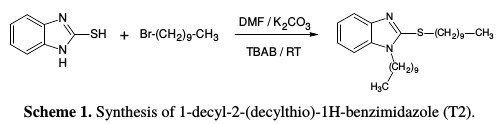
    <p>To a solution of 2 g (133&times;10<sup>-4</sup> mol) of 2-mercaptobenzimidazole and 80 mL of
N,N-dimethylformamide, 3.67 g (266&times;10<sup>-4</sup> mol) of potassium carbonate, (133&times;10<sup>-4</sup>
mol) of tetra-n-butylammonium bromide and 8.8 g (399&times;10<sup>-4</sup> mol) of 1-
bromodecane were added. The reaction mixture was stirred at room temperature
for 24 hours. After rearward filtration, the solvent was removed under reduced
pressure. The residue was taken up in dichloromethane and filtered, and the
solvent was evaporated under reduced pressure (<a href="#s1">Scheme 1</a>).</p>

    <p>&nbsp;</p>
<a name="s1">
<img src="/img/revistas/pea/v36n3/36n3a04s1.jpg">
    
<p>&nbsp;</p>


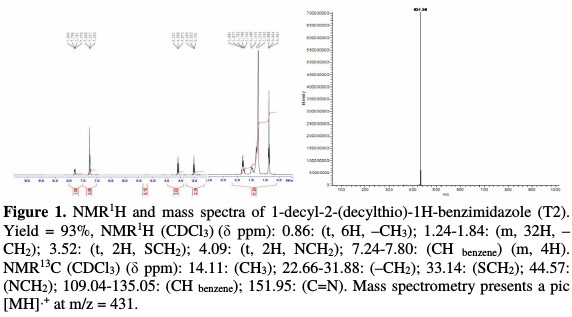
    <p>This product was characterized by interpreting 1H NMR, 13C NMR and mass
spectral data (<a href="#f1">Fig. 1</a>).</p>

    <p>&nbsp;</p>
<a name="f1">
<img src="/img/revistas/pea/v36n3/36n3a04f1.jpg">
    
<p>&nbsp;</p>


    <p>Thus, the 1H-NMR spectrum taken in CDCl3 showed a
multiple between 7.24 ppm and 7.80 ppm for the aromatic protons, triplet at 4.09
ppm for NCH2 and at 3.52 ppm for SCH2, a multiple between 1.24 ppm and 1.84
ppm, corresponding to the protons carried by the methylene groups of the
hydrocarbon chain, and a triplet at 0.86 ppm for CH3.</p>

    <p>Inversely, the 13C NMR spectrum taken in CDCl3 presents a signal at 151.95 ppm
for the carbon bonded to the sulfur atom, signals between 31.88 ppm and 22.66
ppm corresponding to the carbon of the methylene groups, and signals at 14.11
ppm for CH3. The mass spectrum shows a molecular pic [MH]&bull;+ at m / z = 431.</p>


    ]]></body>
<body><![CDATA[<p><i><b>Electrochemical experiments</b></i></p>

    <p>A set of three-electrode cells containing C-steel coupons with a surface of 1 cm<sup>2</sup>
was incorporated in the specimen holder as working electrode (WE); a large area
platinum mesh was used as counter electrode (CE), and saturated calomel as
reference electrode (RE) . Electrochemical experiments were conducted at room
temperature (308 &pm; 2 K) using 100 mL of 1 M HCl electrolyte in a stationary
state. Before each potentiodynamic polarization (Tafel) and electrochemical
impedance spectroscopy (EIS) experiments, the electrode was allowed to freely
corrode, and its open-circuit potential (OCP) was written down as ax function of
time, for periods smaller than 30 min, but for this time, there was a steady-state
OCP, corresponding to the corrosion potential (E) of the working electrode that
was obtained. The potentiodynamic Tafel measurements were initiated from the
cathodic to the anodic mean, between -800 mV and -200 mV, with a scan rate of
0.6 mV/s. The above procedures were repeated for each T2 concentration.
Electrochemical impedance spectroscopy (EIS) measurements were carried out
using ac signals of 10 mV peak to peak amplitude, in the frequency range
of 100 KHz -10 MHz.</p>


    <p><i><b>Simulation details</b></i></p>

    <p>Monte Carlo (MC) simulations have been carried out using adsorption locator
modules executed in the BIOVIA Material Studio 8.0 software, commercialized
by Accelrys Inc. USA [20, 21]. Geometrical optimization of all compounds has
been performed using a DMol3 module in the said software. The involved
methodology and course of action using MC simulations can be found elsewhere
[22-23]. The simulation of the interaction between the single inhibitor molecule
(T2) in the neutral form and the iron (111) surface in an acidic medium was
carried out in a simulation box (3.517 &times; 3.537 &times; 4.026 nm<sup>3</sup>) with periodic
boundary conditions, to model a general case when the interface has any arbitrary
boundary effects. The iron surface Fe(111) was first built and relaxed by
minimizing its energy using molecular mechanics; then, it was increased, and its
periodicity was changed by constructing a super cell (7&times;7 nm) and, afterwards, a
vacuum slab with 30 &Aring; thicknesses [24]. The whole simulation procedure has
used COMPASS Force-Field [25-26], which is an ab-initio force field that makes
accurate and simultaneous predictions of gas-phase and condensed-phase
properties for a broad range of organic molecules; metal was used for all systems
geometrical optimization [25]. The liquid phase, composed of 50 water
molecules and 10 HCl molecules, was added to simulate the impact of a solvent,
since corrosion takes place in the solution.</p>


    <p>&nbsp;</p>
    <p><b>Results and discussion</b></p>

    <p><i><b>Potentiodynamic polarization</b></i></p>

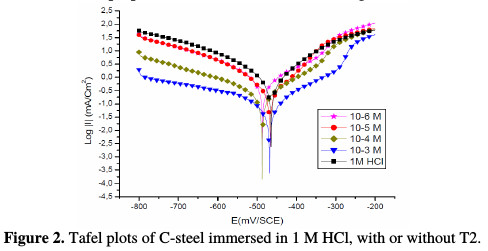
    <p>Both anodic and cathodic polarization curves of C-steel in 1 M HCl, for different
concentrations of the prepared surfactant, are shown in <a href="#f2">Fig. 2</a>.</p>

    <p>&nbsp;</p>
<a name="f2">
<img src="/img/revistas/pea/v36n3/36n3a04f2.jpg">
    
<p>&nbsp;</p>


    ]]></body>
<body><![CDATA[<p>It is clear that the inhibitor presence causes a distinguished decrease in the
corrosion rate, that is, decreases the anodic and cathodic curves to lower current
densities. This may be due to the inhibitor adsorption onto the corroded surface
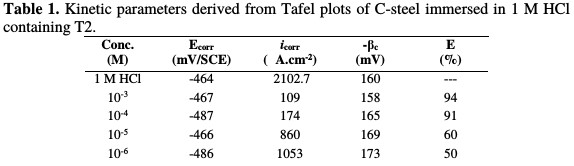
[26]. The values of the corrosion current densities (icorr), corrosion potentials
(Ecorr) and cathodic Tafel slopes (&beta;c) were calculated from <a href="#f2">Fig. 2</a>, and are
depicted in <a href="#t1">Table 1</a>.</p>

    <p>&nbsp;</p>
<a name="t1">
<img src="/img/revistas/pea/v36n3/36n3a04t1.jpg">
    
<p>&nbsp;</p>


    <p>From these results, it is clear that the corrosion current
decreases with an increase in the inhibitor concentration. The anodic and
cathodic branches change with the increase in the inhibitor concentration. For
that reason, the prepared surfactant can be classified as a mixed-type inhibitor in
1 M HCl.</p>

    <p>The inhibition efficiency (E %) was calculated by the following expression:</p>

    <p>&nbsp;</p>
<a name="e1">
<img src="/img/revistas/pea/v36n3/36n3a04e1.jpg">
    
<p>&nbsp;</p>


    <p>where i corr and icorr/inh are the corrosion current density of C-steel, with and
without T2, respectively.</p>

    <p>The cathodic Tafel lines were almost parallel upon the increase in inhibitor
concentrations, indicating that the hydrogen reduction in the metal surface is
activation controlled, and that the mechanism is not impacted by the inhibitor
presence [27]. The anodic and cathodic current densities are decreased in the
inhibitor presence, while the corrosion potential is almost constant, and the
change in Ecorr value is around 20 mV/ SCE, indicating that the inhibitor acts as a
mixed-type inhibitor.</p>

    <p>Examination of <a href="#t1">Table 1</a> reveals that the cathodic Tafel slope (&beta;c) shows slight
changes with T2 addition, which suggests that the inhibiting action has occurred
by simple blocking of the available cathodic sites on the metal surface, which has
led to a decrease in the exposed area, necessary for hydrogen evolution. In
addition, the inhibitory action increases with an increased inhibitor concentration.
At a concentration of 10-3 M or more, T2 acts as a good inhibitor in a
hydrochloric acid solution, with an inhibition efficiency of about 94%.</p>


    ]]></body>
<body><![CDATA[<p><i><b>Electrochemical impedance spectroscopy (EIS)</b></i></p>

    <p>The effect of each acid additive on the performance of T2 as a corrosion inhibitor
for C-steel immersed in molar acid concentration was investigated by EIS
experiment. The data obtained by EIS measurements are graphically represented
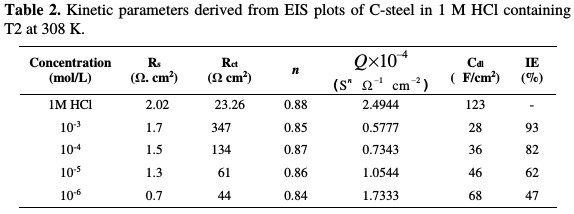
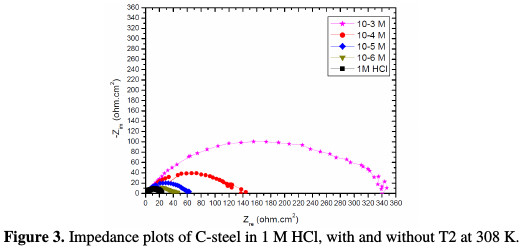
by the Nyquist plot (<a href="#f3">Fig. 3</a>) and the impedance parameters of each solution, such
as polarization resistance (Rp), double layer capacitance (Cdl), and inhibition
efficiency (IE %)) are given in <a href="#t2">Table 2</a>.</p>

    <p>&nbsp;</p>
<a name="f3">
<img src="/img/revistas/pea/v36n3/36n3a04f3.jpg">
    
<p>&nbsp;</p>
<a name="t2">
<img src="/img/revistas/pea/v36n3/36n3a04t2.jpg">
    
<p>&nbsp;</p>


    <p>The Nyquist impedance semicircles
increase with an increased content of T2, indicating an increase in the diameter
of the capacitive loop. T2 acts by adsorption, to cover the metal surface, and then
retard the corrosion phenomenon [28].</p>

    <p>The impedance diagrams are semicircles, due to the frequency dispersion [29-31]
caused by the roughness and inhomogeneity of the electrode surface. The
increase in T2 concentration leads to the increase of transfer resistance, as well as
to the decrease of capacitance, as a result of the change in the dielectric
properties and the thickness of the barrier-adsorbed film [32-34]. Impedance
parameters such as the charge transfer, Rt, and the double layer capacitance, Cdl,
are derived from Nyquist plots, and are gathered in <a href="#t2">Table 2</a>, for C-steel in an
hydrochloric acid solution, in the presence and absence of T2. The decreased
values of double layer capacitance, Cdl, can be due to water molecules that are
substituted by organic inhibitor molecules at the electrode interface of lower
dielectric constant through adsorption [35].</p>

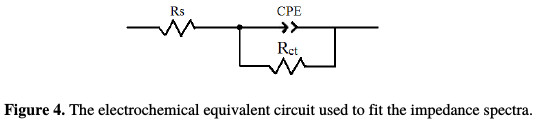
    <p>The equivalent circuit model shown in <a href="#f4">Fig. 4</a> was used to analyse the EIS
experiments.</p>

    <p>&nbsp;</p>
<a name="f4">
<img src="/img/revistas/pea/v36n3/36n3a04f4.jpg">
    
<p>&nbsp;</p>


    ]]></body>
<body><![CDATA[<p>The parameters are collected in <a href="#t2">Table 2</a>, while the double layer
capacitance values are calculated using the <a href="#e2">Eq. (2)</a>:</p>

    <p>&nbsp;</p>
<a name="e2">
<img src="/img/revistas/pea/v36n3/36n3a04e2.jpg">
    
<p>&nbsp;</p>


    <p>where Q is the CPE constant and n is a coefficient that can be used as a measure
of surface inhomogeneity [27]. The inhibition efficiency was calculated using the
charge-transfer resistance values in the following equation:</p>

    <p>&nbsp;</p>
<a name="e3">
<img src="/img/revistas/pea/v36n3/36n3a04e3.jpg">
    
<p>&nbsp;</p>


    <p>where Rt and R't are the charge-transfer resistance values, without and with
inhibitor, respectively.</p>

    <p>It is clear from the <a href="#t2">Table 2</a> data that Rt increases with T2 concentration, which
causes an increase in the corrosion inhibition efficiency (E%). Double layer
capacitance values are also brought down to the maximum extent in the
inhibitors presence. The decrease in Cdl is due to the adsorption of this compound
onto the metal surface, leading to the formation of a film from the acidic solution
[36-38].</p>

    <p>The potential of zero charge and the inhibition mechanism
Corrosion inhibition mechanisms are interpreted by adsorption phenomena,
which depend on the metal surface charge, the charge or dipole moment of the
inhibitor ions/molecules, and the other ions that are specifically adsorbed onto
the metal surface [39]. The metal surface charge is defined by the open circuit
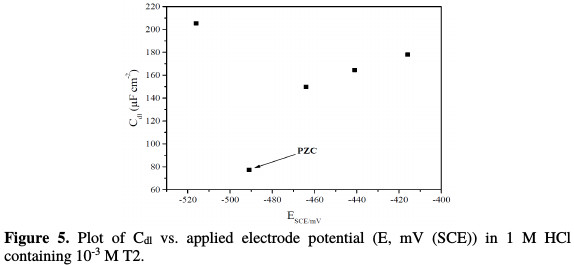
potential position, with respect to PZC [40]. The double layer capacitance value
depends on the applied DC potential, which is graphically denoted in <a href="#f5">Fig. 5</a>.</p>

    <p>&nbsp;</p>
<a name="f5">
<img src="/img/revistas/pea/v36n3/36n3a04f5.jpg">
    
]]></body>
<body><![CDATA[<p>&nbsp;</p>


    <p>It can be determined, according to Antropov et al. [41], by comparing the potential
of zero charge (PZC) and the corrosion potential of the metal in the electrolytic
medium. As PZC corresponds to a state where the surface is free from charges -
the stationary (corrosion) potential state -, the metal area will be positively or
negatively charged. Hence, it is essential to have reliable data about PZC.
When carbon steel is immersed in an acidic solution containing T2, three kinds
of species can be adsorbed onto its surface, as described below: (1) if the metal
surface is positively charged with respect to PZC, at first, the chloride ions will
be adsorbed onto the metal surface. Then, after this adsorption step, the steel
surface will become negatively charged. Hence, the positively charged derived 2-
mercaptobenzimidazole cationic forms will form an electrostatic bond with the
Cl- ions already adsorbed onto steel. Moreover, the excess positive charge on the
electrode surface, &Phi; (&Phi; = EPZC - Ecorr) increases as more inhibitor molecules are
adsorbed onto it [42]; (2) if the metal surface is negatively charged with respect
to PZC, the protonated water molecules and derivedx2-mercaptobenzimidazole
cationic forms will be directly adsorbed onto the metal surface. Increasing
negative charges on the metal surface leads to an increased adsorption of derived
2-mercaptobenzimidazole molecules, hence, its concentration in the solution
should decrease; (3) when the metal obtains the potential at which the surface
charge becomes zero, none of the ions (neither cations nor anions) adsorb onto
the surface through their ionic center. However, a few indole molecules may be
physically adsorbed through their planar &pi; orbitals onto the metal surface (with
vacant &pi; orbitals).</p>

    <p>In this study, EPZC = -491 mV and Ecorr = -460 mV, for C-steel with the addition
of 10-3 M of T2. It can be said that &Phi; (&Phi; = EPZC - Ecorr) potential is positive in
this case. From the above result, it follows that anions (Cl- ions) in an aqueous
hydrochloric acid solution will be first adsorbed onto the C-steel surface. After
this first adsorption step, the C-steel surface will become negatively charged.
Hence, the positively charged 2-mercaptobenzimidazole derivative cationic
forms will form an electrostatic bond with the Cl- ions already adsorbed onto the
steel surface.</p>


    <p><i><b>Adsorption isotherm and adsorption parameters</b></i></p>

    <p>The adsorption isotherms provide basic information about the interaction
between the inhibitor and the C-steel surface. Attempts were made to fit the
experimental data to various isotherms, including Langmuir, Frumkin, Temkin,
etc. It has-been found that the experimental results for T2 in this study fit with
Langmuir isotherm and the organic compound adsorption. The isotherm mostly
used in biosensor research is the Langmuir isotherm, which is based on the
following hypotheses: (i)-the surface supposed to be defined by a number of
adsorption sites given by the surface concentration is totally covered; (ii)-there is
an equilibrium between adsorbed and bulk target species and; (iii) there are no
lateral interactions between the adsorbed target species [43].</p>

    <p>Generally, the adsorption of an inhibitor occurs by two means: physisorption
and/or chemisorption. The first one involves a weak undirected interaction, due
to electrostatic attraction between inhibiting organic ions or dipoles and the
electrically charged metal surface. The latter one occurs by sharing or charge
transfer from the adsorbate to metal surface atoms, in order to form a coordinated
bond; this interaction is known as chemical adsorption or chemisorption [44-46].</p>

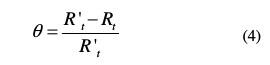
    <p>In order to obtain the adsorption isotherm, the degree of surface coverage (&theta;) for
various inhibitor concentrations was calculated using the equation below, listed
in <a href="#t3">Table 3</a>.</p>


    <p>&nbsp;</p>
<a name="e4">
<img src="/img/revistas/pea/v36n3/36n3a04e4.jpg">
    
<p>&nbsp;</p>
<a name="t3">
<img src="/img/revistas/pea/v36n3/36n3a04t3.jpg">
    
<p>&nbsp;</p>


    ]]></body>
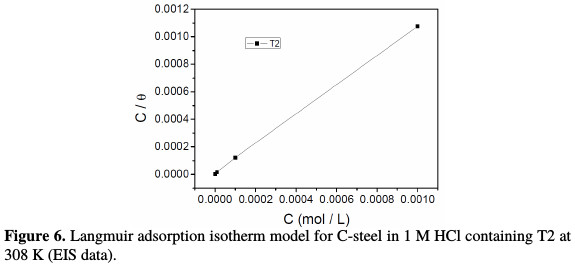
<body><![CDATA[<p>Langmuir adsorption isotherm was tested for its fit (<a href="#f6">Fig. 6</a>) to the experimental
data, and it is given by the following equation:</p>

    <p>&nbsp;</p>
<a name="f6">
<img src="/img/revistas/pea/v36n3/36n3a04f6.jpg">
    
<p>&nbsp;</p>
<a name="e5">
<img src="/img/revistas/pea/v36n3/36n3a04e5.jpg">
    
<p>&nbsp;</p>


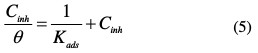
    <p>where Cinh is the inhibitor concentration, Kads the adsorptive equilibrium constant,
and &theta; represents the degree of adsorption.</p>

    <p>The equilibrium constant for the adsorption process was related to the standard
free energy of adsorption by the expression</p>

    <p>&nbsp;</p>
<a name="e6">
<img src="/img/revistas/pea/v36n3/36n3a04e6.jpg">
    
<p>&nbsp;</p>


    <p>where R is the gas constant, T is the experiment absolute temperature, and the
constant value of 55.5 is the concentration of water in a solution in mol L<sup>-1</sup>.
The plot of the (Cinh /&theta;) vs. Cinh that fitted the experimental data follows well the
Langmuir adsorption isotherm. The plot gives a straight line with a slope of 1.06
to close unity. The intercept that has obtained 6.8877 &times; 10-6 is the reciprocal of
Kads. This shows that the experimental data fit the isotherm. The values of Kads
and &Delta;Goads calculated from the isotherm model are listed in <a href="#t3">Table 3</a>.</p>

    <p>Generally, the energy values of -20 kJ moL<sup>-1</sup> or less are associated with an
electrostatic interaction between charged molecules and charged metal surface,
i.e., physisorption; but those with energy values of -40 kJ moL<sup>-1</sup> or less involve
charge sharing or charge transferring from the inhibitor molecules to the metal
surface, to form a coordinate covalent bond, i.e., chemisorption [47-49]. The
value of &Delta;Gads is equal to -40.72 kJ moL<sup>-1</sup>. The large value of &Delta;Gads and its
negative sign is usually characteristic of a strong interaction and a highly
efficient adsorption [50]. The high value of &Delta;Gads shows that, in the presence of 1
M HCl, T2 chemisorption may occur. The possible conception mechanisms can
be attributed to the donation of &pi;-electrons in the aromatic rings; the presence of
two nitrogen atoms and one sulfur atom in an inhibitor molecule, as reactive
centers, is an electrostatic adsorption of the protonated inhibitor compound in an
acidic solution, onto the metal surface.</p>

    ]]></body>
<body><![CDATA[<p>The results indicate that the increase in the inhibitor efficiency (IE%) with an
increased concentration may be attributed to the formation of a barrier film,
which prevents the acidic medium from attacking the metal surface, due to the
inhibitor adsorption (T2) onto the C-steel surface, involving interactions between
the &pi;-electrons of the benzimidazole and phenyl rings heterocyclic structure, as
well as (-S-, =N) between heteroatoms and iron surface atoms vacant orbitals
(3d). We clearly assist to the intermolecular synergistic effect of various T2
adsorption centers [51].</p>


    <p><i><b>SEM investigation</b></i></p>

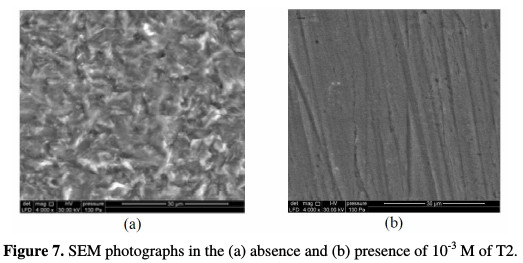
    <p>SEM photographs obtained from C-steel surface, after the specimen immersion
in HCI (1 M) solution for 6 h, in the absence and presence of 10-3 M of T2, are
shown in <a href="#f7">Fig. 7(a)</a> and <a href="#f7">(b)</a>.</p>

    <p>&nbsp;</p>
<a name="f7">
<img src="/img/revistas/pea/v36n3/36n3a04f7.jpg">
    
<p>&nbsp;</p>


    <p><a href="#f7">Fig. 7(a)</a> shows that the C-steel surface was strongly damaged in hydrochloric
acid, in the absence of T2 inhibitor; <a href="#f7">Fig. 7(b)</a> shows that there is a good
protective film against corrosion, adsorbed onto the C-steel surface, with 10-3 M
of T2.</p>


    <p><i><b>Monte Carlo simulations</b></i></p>

    <p>MC simulation has emerged as a modern tool to investigate the adsorption
behavior of a single inhibitor in the neutral form, on an iron surface in an acidic
medium [21, 22]. MC simulation can reasonably predict the most favorable
configuration of the adsorbed inhibitor molecule on the iron surface. The
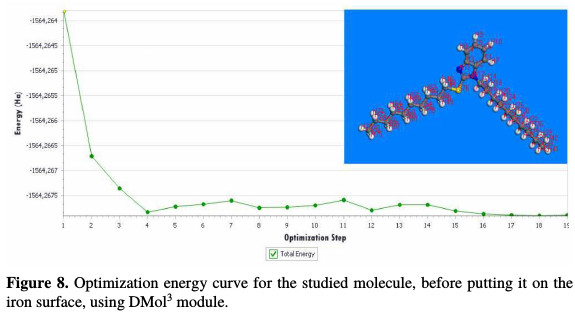
geometry optimization process is carried out using an iterative process, in which
the atomic coordinates are adjusted until the total energy of a structure is
minimized, i.e., it corresponds to a local minimum in the potential energy
surface. The optimization energy curve of the inhibitor (T2), before putting it on
the iron surface, is calculated by DMol3 module at m-GGA-M11-L/ DNP+ basis
set, as presented in <a href="#f8">Fig. 8</a>.</p>

    <p>&nbsp;</p>
<a name="f8">
<img src="/img/revistas/pea/v36n3/36n3a04f8.jpg">
    
<p>&nbsp;</p>


    ]]></body>
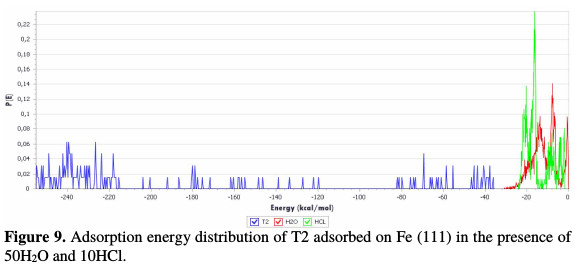
<body><![CDATA[<p>T2 optimization energy curve in the neutral form was done using adsorption
locator module. The adsorption energy distribution of T2 adsorbed on Fe (111) in
the presence of 50H2O and 10HCl, using adsorption locator module, is depicted
in <a href="#f9">Fig. 9</a>.</p>

    <p>&nbsp;</p>
<a name="f9">
<img src="/img/revistas/pea/v36n3/36n3a04f9.jpg">
    
<p>&nbsp;</p>


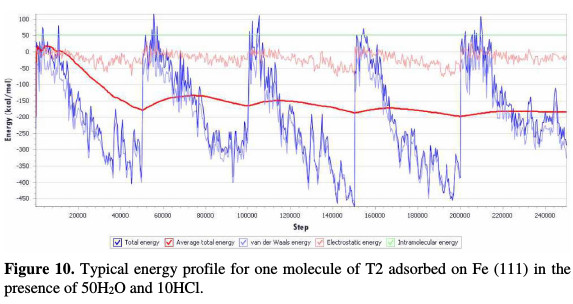
    <p>The selected inhibitor molecule (T2) was placed on the iron surface in a
hydrochloric acid solution, optimized, and then run under quench molecular
dynamics. A typical adsorption energy distribution of T2 adsorbed on Fe (111) in
the presence of 50H2O and 10HCl consisting of the total energy, average total
energy, Van der Waals energy, electrostatic energy and intermolecular energy,
using Monte Carlo simulations, is depicted in <a href="#f10">Fig. 10</a>.</p>

    <p>&nbsp;</p>
<a name="f10">
<img src="/img/revistas/pea/v36n3/36n3a04f10.jpg">
    
<p>&nbsp;</p>


    <p>The Metropolis Monte Carlo method in adsorption locator calculation provides
four step types for a canonical ensemble: conformer, rotation, translation and
regrowth [52]. <a href="#f10">Fig. 10</a> shows the most suitable inhibitor molecule conformation
adsorbed onto the substrate (111), obtained by adsorption locator module
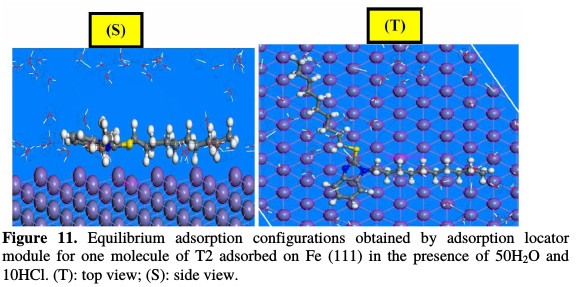
(COMPASS Force Field) [25]. Side and top views of stable adsorption
configurations of T2 adsorbed on Fe (111) in the presence of 50H2O and 10HCl
using adsorption locator is given in <a href="#f11">Fig. 11</a>.</p>

    <p>&nbsp;</p>
<a name="f11">
<img src="/img/revistas/pea/v36n3/36n3a04f11.jpg">
    
<p>&nbsp;</p>


    <p>The equilibrium configuration of T2 adsorbed on Fe (111) in the presence of
50H2O and 10HCl as well as the close contact of the Fe-inhibitor complex, are
depicted in <a href="#f11">Fig. 11</a>. T2 is adsorbed onto the Fe(111) surface in a hydrochloric
acid solution, with almost parallel or flat dispositions. This flat orientation is
possibly due to the formation of coordination and back bonding for the Fe-
inhibitor (T2) complex. It is also herein evident that unoccupied iron orbitals (3d)
will prefer to accept electrons from the adsorbed T2. T2 has a lone pair of
electrons on the active centres (=N11-, =N12, -S76-), as well as &pi;-electrons in the
benzimidazole ring. Those iron atoms and electrons (&pi;) cloud in the aromatic
rings provide sufficient electronic charge to the vacant orbitals (3d) of Fe,
forming stable coordination bonds (chemisorption). The measured shortest bond
distance between the closest heteroatoms (=N11-, =N12, -S76-) of the neutral form
of T2 inhibitor and iron surface (111), in a hydrochloric acid solution at
equilibrium, was as follows: Fe-inhibitor (T2) interaction: (dFe-S76-=3.294&Aring;, dFe-
N12=3.28&Aring; and dFe-N11=3.38&Aring;). All the shortest bond distances were less than
3.55AÂ°, indicating a strong chemical bond formation between T2 and Fe (111)
surface. However, vdW interactions were also involved in the adsorption process
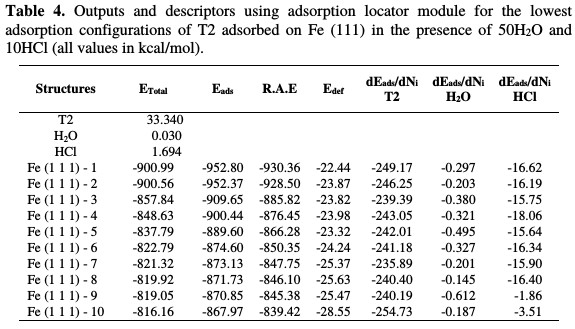
of the inhibitor with Fe (111). The outputs and descriptors using adsorption
locator module, such as total adsorption, adsorption energy, rigid adsorption and
deformation energies, are listed in <a href="#t4">Table 4</a>.</p>


    ]]></body>
<body><![CDATA[<p>&nbsp;</p>
<a name="t4">
<img src="/img/revistas/pea/v36n3/36n3a04t4.jpg">
    
<p>&nbsp;</p>


    <p>The parameters presented in <a href="#t4">Table 4</a> include total energy of T2 adsorbed on
Fe (111) in the presence of 50H2O and 10HCl, which is defined as the sum of the
T2 inhibitor energies, the rigid adsorption energy (RAE), and the deformation
energy (Edef). The substrate energy (iron (111) surface) is taken as zero. In
addition, adsorption energy (Eads) reports energy in Kcal/mol, released (or
required) when the relaxed inhibitor, HCl and water molecules are adsorbed on
the iron (111) surface. The adsorption energy is defined as the sum of the rigid
adsorption energy and the deformation energy for T2 inhibitor. The rigid 
adsorption energy reports the energy in kcal/ mol, released (or required) when the
unrelaxed inhibitor and water molecules (i.e., before the geometry optimization
step) are adsorbed onto the iron surface. The deformation energy reports the
energy in kcal/mol, released when the adsorbed molecules are relaxed on the
substrate surface. <a href="#t4">Table 4</a> also shows (&Delta;Eads/dNi), which reports the energy in
kcal/mol, of inhibitor/iron surface configurations, where one of the inhibitors has
been removed.</p>

    <p>It is quite clear from <a href="#t4">Table 4</a> that the value of adsorption energy is negative,
which denotes that the adsorption could spontaneously occur. The largest
negative adsorption energies value is -871.73 kcal/mol, indicating the system
with the most stable and stronger adsorption [53]. In all cases, the inhibitor
adsorption energies are far higher than those of water molecules. This indicates
the possibility of gradual substitution of H2O and HCl molecules from the iron
surface, resulting in the formation of a stable layer, which can protect the iron
from aqueous corrosion (chemical adsorption).</p>


    <p>&nbsp;</p>
    <p><b>Conclusion</b></p>

    <p>In this work, we have synthesized a new compound derivative of 2-
mercaptobenzimidazole, susceptive to present interesting surfactant properties.
We have shown that the compound presents a good inhibition property for the
corrosion of C-steel in a hydrochloric acid solution; polarization curves have
indicated that the inhibitor mainly behaves as a mixed-type inhibitor. EIS has
showed that the charge transferring controls the corrosion inhibition process in
the uninhibited and inhibited solutions. Different inhibition mechanisms were
proposed for T2 molecules, based on their PZC value in the studied conditions.
The adsorption of T2 has followed Langmuir adsorption isotherm model.
Dynamic simulation confirms the displacement of water molecules by the
organic inhibitor.</p>


    <p>&nbsp;</p>
    <p><b>References</b></p>

    <!-- ref --><p>1. Hegazy M. J Mol Liq. 2015;208:227.    &nbsp;&nbsp;&nbsp;&nbsp;&nbsp;&nbsp;&nbsp;&nbsp;[&#160;<a href="javascript:void(0);" onclick="javascript: window.open('/scielo.php?script=sci_nlinks&ref=434218&pid=S0872-1904201800030000400001&lng=','','width=640,height=500,resizable=yes,scrollbars=1,menubar=yes,');">Links</a>&#160;]<!-- end-ref --></p>

    <!-- ref --><p>2. Qing W, Xuemei M, Haiyan S, et al. J Chin Soc Corros Prot 2015;35:49.    &nbsp;&nbsp;&nbsp;&nbsp;&nbsp;&nbsp;&nbsp;&nbsp;[&#160;<a href="javascript:void(0);" onclick="javascript: window.open('/scielo.php?script=sci_nlinks&ref=434220&pid=S0872-1904201800030000400002&lng=','','width=640,height=500,resizable=yes,scrollbars=1,menubar=yes,');">Links</a>&#160;]<!-- end-ref --></p>

    <!-- ref --><p>3. Qiu L-G, Xie A-J, Shen Y-H. Mater Chem Phys. 2005;91:269.    &nbsp;&nbsp;&nbsp;&nbsp;&nbsp;&nbsp;&nbsp;&nbsp;[&#160;<a href="javascript:void(0);" onclick="javascript: window.open('/scielo.php?script=sci_nlinks&ref=434222&pid=S0872-1904201800030000400003&lng=','','width=640,height=500,resizable=yes,scrollbars=1,menubar=yes,');">Links</a>&#160;]<!-- end-ref --></p>

    <!-- ref --><p>4. Maayta A, Bitar M, Al-Abdallah M. Br Corros J. 2001;36:133.    &nbsp;&nbsp;&nbsp;&nbsp;&nbsp;&nbsp;&nbsp;&nbsp;[&#160;<a href="javascript:void(0);" onclick="javascript: window.open('/scielo.php?script=sci_nlinks&ref=434224&pid=S0872-1904201800030000400004&lng=','','width=640,height=500,resizable=yes,scrollbars=1,menubar=yes,');">Links</a>&#160;]<!-- end-ref --></p>

    <!-- ref --><p>5. Villamil RF, Corio P, Agostinho SM, et al. J Electroanal Chem. 1999;472:112.    &nbsp;&nbsp;&nbsp;&nbsp;&nbsp;&nbsp;&nbsp;&nbsp;[&#160;<a href="javascript:void(0);" onclick="javascript: window.open('/scielo.php?script=sci_nlinks&ref=434226&pid=S0872-1904201800030000400005&lng=','','width=640,height=500,resizable=yes,scrollbars=1,menubar=yes,');">Links</a>&#160;]<!-- end-ref --></p>

    <!-- ref --><p>6. Branzoi V, Golgovici F, Branzoi F. Mater Chem Phys. 2003;78:122.    &nbsp;&nbsp;&nbsp;&nbsp;&nbsp;&nbsp;&nbsp;&nbsp;[&#160;<a href="javascript:void(0);" onclick="javascript: window.open('/scielo.php?script=sci_nlinks&ref=434228&pid=S0872-1904201800030000400006&lng=','','width=640,height=500,resizable=yes,scrollbars=1,menubar=yes,');">Links</a>&#160;]<!-- end-ref --></p>

    <!-- ref --><p>7. El Aal EA, El Wanees SA, Farouk A, et al. Corros Sci 2013;68:14.    &nbsp;&nbsp;&nbsp;&nbsp;&nbsp;&nbsp;&nbsp;&nbsp;[&#160;<a href="javascript:void(0);" onclick="javascript: window.open('/scielo.php?script=sci_nlinks&ref=434230&pid=S0872-1904201800030000400007&lng=','','width=640,height=500,resizable=yes,scrollbars=1,menubar=yes,');">Links</a>&#160;]<!-- end-ref --></p>

    <!-- ref --><p>8. Serreau L, Beauvais M, Heitz C, et al. J Colloid Interface Sci. 2009;332:382.    &nbsp;&nbsp;&nbsp;&nbsp;&nbsp;&nbsp;&nbsp;&nbsp;[&#160;<a href="javascript:void(0);" onclick="javascript: window.open('/scielo.php?script=sci_nlinks&ref=434232&pid=S0872-1904201800030000400008&lng=','','width=640,height=500,resizable=yes,scrollbars=1,menubar=yes,');">Links</a>&#160;]<!-- end-ref --></p>

    <!-- ref --><p>9. Gaysinski M, Le Forestier J, Cambon A, et al. J Fluor Chem. 1997;83:175.    &nbsp;&nbsp;&nbsp;&nbsp;&nbsp;&nbsp;&nbsp;&nbsp;[&#160;<a href="javascript:void(0);" onclick="javascript: window.open('/scielo.php?script=sci_nlinks&ref=434234&pid=S0872-1904201800030000400009&lng=','','width=640,height=500,resizable=yes,scrollbars=1,menubar=yes,');">Links</a>&#160;]<!-- end-ref --></p>

    <!-- ref --><p>10. Hosseini M, Mertens SF, Arshadi MR. Corros Sci. 2003; 45:1473.    &nbsp;&nbsp;&nbsp;&nbsp;&nbsp;&nbsp;&nbsp;&nbsp;[&#160;<a href="javascript:void(0);" onclick="javascript: window.open('/scielo.php?script=sci_nlinks&ref=434236&pid=S0872-1904201800030000400010&lng=','','width=640,height=500,resizable=yes,scrollbars=1,menubar=yes,');">Links</a>&#160;]<!-- end-ref --></p>

    <!-- ref --><p>11. Mu G, Zhao T, Liu M, et al. Corrosion. 1996; 52:853.    &nbsp;&nbsp;&nbsp;&nbsp;&nbsp;&nbsp;&nbsp;&nbsp;[&#160;<a href="javascript:void(0);" onclick="javascript: window.open('/scielo.php?script=sci_nlinks&ref=434238&pid=S0872-1904201800030000400011&lng=','','width=640,height=500,resizable=yes,scrollbars=1,menubar=yes,');">Links</a>&#160;]<!-- end-ref --></p>

    <!-- ref --><p>12. Elachouri M, Hajji MS, Salem M, et al. Corrosion. 1996;52:103.    &nbsp;&nbsp;&nbsp;&nbsp;&nbsp;&nbsp;&nbsp;&nbsp;[&#160;<a href="javascript:void(0);" onclick="javascript: window.open('/scielo.php?script=sci_nlinks&ref=434240&pid=S0872-1904201800030000400012&lng=','','width=640,height=500,resizable=yes,scrollbars=1,menubar=yes,');">Links</a>&#160;]<!-- end-ref --></p>

    <!-- ref --><p>13. Zarrouk A, Zarrok H, Salghi R, et al. J Mater Env Sci. 2013;4:177.    &nbsp;&nbsp;&nbsp;&nbsp;&nbsp;&nbsp;&nbsp;&nbsp;[&#160;<a href="javascript:void(0);" onclick="javascript: window.open('/scielo.php?script=sci_nlinks&ref=434242&pid=S0872-1904201800030000400013&lng=','','width=640,height=500,resizable=yes,scrollbars=1,menubar=yes,');">Links</a>&#160;]<!-- end-ref --></p>

    <!-- ref --><p>14. Manssouri M, El Ouadi Y, Znini M, et al. J Mater Env Sci. 2015;6:631.    &nbsp;&nbsp;&nbsp;&nbsp;&nbsp;&nbsp;&nbsp;&nbsp;[&#160;<a href="javascript:void(0);" onclick="javascript: window.open('/scielo.php?script=sci_nlinks&ref=434244&pid=S0872-1904201800030000400014&lng=','','width=640,height=500,resizable=yes,scrollbars=1,menubar=yes,');">Links</a>&#160;]<!-- end-ref --></p>

    <!-- ref --><p>15. Fouda A, Shalabi K, Ezzat R. J Mater Environ Sci. 2015;6:1022.    &nbsp;&nbsp;&nbsp;&nbsp;&nbsp;&nbsp;&nbsp;&nbsp;[&#160;<a href="javascript:void(0);" onclick="javascript: window.open('/scielo.php?script=sci_nlinks&ref=434246&pid=S0872-1904201800030000400015&lng=','','width=640,height=500,resizable=yes,scrollbars=1,menubar=yes,');">Links</a>&#160;]<!-- end-ref --></p>

    <!-- ref --><p>16. Abdel-Azim A, Milad R, El-Ghazawy R, et al. Egypt J Pet. 2014;23:15.    &nbsp;&nbsp;&nbsp;&nbsp;&nbsp;&nbsp;&nbsp;&nbsp;[&#160;<a href="javascript:void(0);" onclick="javascript: window.open('/scielo.php?script=sci_nlinks&ref=434248&pid=S0872-1904201800030000400016&lng=','','width=640,height=500,resizable=yes,scrollbars=1,menubar=yes,');">Links</a>&#160;]<!-- end-ref --></p>

    <!-- ref --><p>17. Benabdellah M, Tounsi A, Khaled K, et al. Arab J Chem. 2011;4:17.    &nbsp;&nbsp;&nbsp;&nbsp;&nbsp;&nbsp;&nbsp;&nbsp;[&#160;<a href="javascript:void(0);" onclick="javascript: window.open('/scielo.php?script=sci_nlinks&ref=434250&pid=S0872-1904201800030000400017&lng=','','width=640,height=500,resizable=yes,scrollbars=1,menubar=yes,');">Links</a>&#160;]<!-- end-ref --></p>

    <!-- ref --><p>18. Alaoui KI, El Hajjaji F, Azaroual M, et al. J Chem Pharm Res. 2014;6:63.    &nbsp;&nbsp;&nbsp;&nbsp;&nbsp;&nbsp;&nbsp;&nbsp;[&#160;<a href="javascript:void(0);" onclick="javascript: window.open('/scielo.php?script=sci_nlinks&ref=434252&pid=S0872-1904201800030000400018&lng=','','width=640,height=500,resizable=yes,scrollbars=1,menubar=yes,');">Links</a>&#160;]<!-- end-ref --></p>

    <!-- ref --><p>19. Chakib I, Elmsellem H, Sebbar N, et al. J Mater Env Sci. 2016;7:1866.    &nbsp;&nbsp;&nbsp;&nbsp;&nbsp;&nbsp;&nbsp;&nbsp;[&#160;<a href="javascript:void(0);" onclick="javascript: window.open('/scielo.php?script=sci_nlinks&ref=434254&pid=S0872-1904201800030000400019&lng=','','width=640,height=500,resizable=yes,scrollbars=1,menubar=yes,');">Links</a>&#160;]<!-- end-ref --></p>

    <!-- ref --><p>20. Metropolis N, Rosenbluth AW, Rosenbluth MN, et al. J Chem Phys. 1953;21:1087.    &nbsp;&nbsp;&nbsp;&nbsp;&nbsp;&nbsp;&nbsp;&nbsp;[&#160;<a href="javascript:void(0);" onclick="javascript: window.open('/scielo.php?script=sci_nlinks&ref=434256&pid=S0872-1904201800030000400020&lng=','','width=640,height=500,resizable=yes,scrollbars=1,menubar=yes,');">Links</a>&#160;]<!-- end-ref --></p>

    <!-- ref --><p>21. Accelrys Inc. san Diego: Materials Studio, Revision 6.0; 2013.    &nbsp;&nbsp;&nbsp;&nbsp;&nbsp;&nbsp;&nbsp;&nbsp;[&#160;<a href="javascript:void(0);" onclick="javascript: window.open('/scielo.php?script=sci_nlinks&ref=434258&pid=S0872-1904201800030000400021&lng=','','width=640,height=500,resizable=yes,scrollbars=1,menubar=yes,');">Links</a>&#160;]<!-- end-ref --></p>

    <!-- ref --><p>22. Belghiti ME, Karzazi Y, Tighadouini S, et al. J Mater Env Sci. 2016;7:956.    &nbsp;&nbsp;&nbsp;&nbsp;&nbsp;&nbsp;&nbsp;&nbsp;[&#160;<a href="javascript:void(0);" onclick="javascript: window.open('/scielo.php?script=sci_nlinks&ref=434260&pid=S0872-1904201800030000400022&lng=','','width=640,height=500,resizable=yes,scrollbars=1,menubar=yes,');">Links</a>&#160;]<!-- end-ref --></p>

    <!-- ref --><p>23. Belghiti ME, Karzazi Y, Dafali A, et al. J Mol Liq. 2016;216:874.    &nbsp;&nbsp;&nbsp;&nbsp;&nbsp;&nbsp;&nbsp;&nbsp;[&#160;<a href="javascript:void(0);" onclick="javascript: window.open('/scielo.php?script=sci_nlinks&ref=434262&pid=S0872-1904201800030000400023&lng=','','width=640,height=500,resizable=yes,scrollbars=1,menubar=yes,');">Links</a>&#160;]<!-- end-ref --></p>

    <!-- ref --><p>24. Karzazi Y, Belghiti M, El-Hajjaji F, et al. Environ. Sci. 2016;7:3916.    &nbsp;&nbsp;&nbsp;&nbsp;&nbsp;&nbsp;&nbsp;&nbsp;[&#160;<a href="javascript:void(0);" onclick="javascript: window.open('/scielo.php?script=sci_nlinks&ref=434264&pid=S0872-1904201800030000400024&lng=','','width=640,height=500,resizable=yes,scrollbars=1,menubar=yes,');">Links</a>&#160;]<!-- end-ref --></p>

    <p>. Sun H, Ren P, Fried J. Comput Theor Polym Sci. 1998;8:229.</p>

    <!-- ref --><p>26. Sun H. J Phys Chem B. 1998;102:7338.    &nbsp;&nbsp;&nbsp;&nbsp;&nbsp;&nbsp;&nbsp;&nbsp;[&#160;<a href="javascript:void(0);" onclick="javascript: window.open('/scielo.php?script=sci_nlinks&ref=434267&pid=S0872-1904201800030000400026&lng=','','width=640,height=500,resizable=yes,scrollbars=1,menubar=yes,');">Links</a>&#160;]<!-- end-ref --></p>

    ]]></body>
<body><![CDATA[<!-- ref --><p>27. Lgaz H, Bhat KS, Salghi R, et al. J Mol Liq. 2017;238:71.    &nbsp;&nbsp;&nbsp;&nbsp;&nbsp;&nbsp;&nbsp;&nbsp;[&#160;<a href="javascript:void(0);" onclick="javascript: window.open('/scielo.php?script=sci_nlinks&ref=434269&pid=S0872-1904201800030000400027&lng=','','width=640,height=500,resizable=yes,scrollbars=1,menubar=yes,');">Links</a>&#160;]<!-- end-ref --></p>

    <!-- ref --><p>28. Enumula S, Pangal A, Gazge M, et al. Res J Chem Sci. 2014;4:78.    &nbsp;&nbsp;&nbsp;&nbsp;&nbsp;&nbsp;&nbsp;&nbsp;[&#160;<a href="javascript:void(0);" onclick="javascript: window.open('/scielo.php?script=sci_nlinks&ref=434271&pid=S0872-1904201800030000400028&lng=','','width=640,height=500,resizable=yes,scrollbars=1,menubar=yes,');">Links</a>&#160;]<!-- end-ref --></p>

    <!-- ref --><p>29. El-Hajjaji F, Greche H, Taleb M, et al. J Mater Env Sci. 2016;7:566.    &nbsp;&nbsp;&nbsp;&nbsp;&nbsp;&nbsp;&nbsp;&nbsp;[&#160;<a href="javascript:void(0);" onclick="javascript: window.open('/scielo.php?script=sci_nlinks&ref=434273&pid=S0872-1904201800030000400029&lng=','','width=640,height=500,resizable=yes,scrollbars=1,menubar=yes,');">Links</a>&#160;]<!-- end-ref --></p>

    <!-- ref --><p>30. Retzmann N, Maatz G, Ritter H. Beilstein J Org Chem. 2014;10:2480.    &nbsp;&nbsp;&nbsp;&nbsp;&nbsp;&nbsp;&nbsp;&nbsp;[&#160;<a href="javascript:void(0);" onclick="javascript: window.open('/scielo.php?script=sci_nlinks&ref=434275&pid=S0872-1904201800030000400030&lng=','','width=640,height=500,resizable=yes,scrollbars=1,menubar=yes,');">Links</a>&#160;]<!-- end-ref --></p>

    <!-- ref --><p>31. El-Hajjaji F, Belkhmima R, Zerga B, et al. Int J Electrochem Sci. 2014;9:4721.    &nbsp;&nbsp;&nbsp;&nbsp;&nbsp;&nbsp;&nbsp;&nbsp;[&#160;<a href="javascript:void(0);" onclick="javascript: window.open('/scielo.php?script=sci_nlinks&ref=434277&pid=S0872-1904201800030000400031&lng=','','width=640,height=500,resizable=yes,scrollbars=1,menubar=yes,');">Links</a>&#160;]<!-- end-ref --></p>

    ]]></body>
<body><![CDATA[<!-- ref --><p>32. Zouitini, Rodi YK, Elmsellem H, et al. Der Pharm Chemica. 2016;8:23.    &nbsp;&nbsp;&nbsp;&nbsp;&nbsp;&nbsp;&nbsp;&nbsp;[&#160;<a href="javascript:void(0);" onclick="javascript: window.open('/scielo.php?script=sci_nlinks&ref=434279&pid=S0872-1904201800030000400032&lng=','','width=640,height=500,resizable=yes,scrollbars=1,menubar=yes,');">Links</a>&#160;]<!-- end-ref --></p>

    <!-- ref --><p>33. Baba YF, Elmsellem H, Rodi YK, et al. Der Pharm Lettre. 2016;8:128.    &nbsp;&nbsp;&nbsp;&nbsp;&nbsp;&nbsp;&nbsp;&nbsp;[&#160;<a href="javascript:void(0);" onclick="javascript: window.open('/scielo.php?script=sci_nlinks&ref=434281&pid=S0872-1904201800030000400033&lng=','','width=640,height=500,resizable=yes,scrollbars=1,menubar=yes,');">Links</a>&#160;]<!-- end-ref --></p>

    <!-- ref --><p>34. El Ouasif L, Merimi I, Zarrok H. et al. J Mater Env Sci. 2016;7:2718.    &nbsp;&nbsp;&nbsp;&nbsp;&nbsp;&nbsp;&nbsp;&nbsp;[&#160;<a href="javascript:void(0);" onclick="javascript: window.open('/scielo.php?script=sci_nlinks&ref=434283&pid=S0872-1904201800030000400034&lng=','','width=640,height=500,resizable=yes,scrollbars=1,menubar=yes,');">Links</a>&#160;]<!-- end-ref --></p>

    <!-- ref --><p>35. Bourichi S., Rodi YK, Elmsellem H, et al. Der Pharm Chemica. 2016;8:179.    &nbsp;&nbsp;&nbsp;&nbsp;&nbsp;&nbsp;&nbsp;&nbsp;[&#160;<a href="javascript:void(0);" onclick="javascript: window.open('/scielo.php?script=sci_nlinks&ref=434285&pid=S0872-1904201800030000400035&lng=','','width=640,height=500,resizable=yes,scrollbars=1,menubar=yes,');">Links</a>&#160;]<!-- end-ref --></p>

    <!-- ref --><p>36. El-Hajjaji F, Belkhmima R, Zerga B, et al. J Mater Environ Sci. 2014;5:263.    &nbsp;&nbsp;&nbsp;&nbsp;&nbsp;&nbsp;&nbsp;&nbsp;[&#160;<a href="javascript:void(0);" onclick="javascript: window.open('/scielo.php?script=sci_nlinks&ref=434287&pid=S0872-1904201800030000400036&lng=','','width=640,height=500,resizable=yes,scrollbars=1,menubar=yes,');">Links</a>&#160;]<!-- end-ref --></p>

    ]]></body>
<body><![CDATA[<!-- ref --><p>37. Salim R, Ech-chihbi E, Oudda H, et al. Der Pharm Chemica. 2016;8:200.    &nbsp;&nbsp;&nbsp;&nbsp;&nbsp;&nbsp;&nbsp;&nbsp;[&#160;<a href="javascript:void(0);" onclick="javascript: window.open('/scielo.php?script=sci_nlinks&ref=434289&pid=S0872-1904201800030000400037&lng=','','width=640,height=500,resizable=yes,scrollbars=1,menubar=yes,');">Links</a>&#160;]<!-- end-ref --></p>

    <!-- ref --><p>38. Ech-chihbi E, Salim R, Oudda H, et al. Der Pharm Chemica. 2016;8:214.    &nbsp;&nbsp;&nbsp;&nbsp;&nbsp;&nbsp;&nbsp;&nbsp;[&#160;<a href="javascript:void(0);" onclick="javascript: window.open('/scielo.php?script=sci_nlinks&ref=434291&pid=S0872-1904201800030000400038&lng=','','width=640,height=500,resizable=yes,scrollbars=1,menubar=yes,');">Links</a>&#160;]<!-- end-ref --></p>

    <!-- ref --><p>39. Aoufir Y, Lgaz H, Bourazmi H, et al. J Mater Env Sci. 2016; 7:4330.    &nbsp;&nbsp;&nbsp;&nbsp;&nbsp;&nbsp;&nbsp;&nbsp;[&#160;<a href="javascript:void(0);" onclick="javascript: window.open('/scielo.php?script=sci_nlinks&ref=434293&pid=S0872-1904201800030000400039&lng=','','width=640,height=500,resizable=yes,scrollbars=1,menubar=yes,');">Links</a>&#160;]<!-- end-ref --></p>

    <!-- ref --><p>40. Karzazi Y, Belghiti ME, El-Hajjaji F, et al. J Mater Environ Sci. 2016;7:4011.    &nbsp;&nbsp;&nbsp;&nbsp;&nbsp;&nbsp;&nbsp;&nbsp;[&#160;<a href="javascript:void(0);" onclick="javascript: window.open('/scielo.php?script=sci_nlinks&ref=434295&pid=S0872-1904201800030000400040&lng=','','width=640,height=500,resizable=yes,scrollbars=1,menubar=yes,');">Links</a>&#160;]<!-- end-ref --></p>

    <!-- ref --><p>41. Shawali AS, Abdallah MA, Mosselhi MA, et al. Z Fur Naturforschung B. 2002;57:552.    &nbsp;&nbsp;&nbsp;&nbsp;&nbsp;&nbsp;&nbsp;&nbsp;[&#160;<a href="javascript:void(0);" onclick="javascript: window.open('/scielo.php?script=sci_nlinks&ref=434297&pid=S0872-1904201800030000400041&lng=','','width=640,height=500,resizable=yes,scrollbars=1,menubar=yes,');">Links</a>&#160;]<!-- end-ref --></p>

    ]]></body>
<body><![CDATA[<!-- ref --><p>42. Khadraoui A, Khelifa A, Hamitouche H, et al. Res Chem Intermed. 2014;40:961.    &nbsp;&nbsp;&nbsp;&nbsp;&nbsp;&nbsp;&nbsp;&nbsp;[&#160;<a href="javascript:void(0);" onclick="javascript: window.open('/scielo.php?script=sci_nlinks&ref=434299&pid=S0872-1904201800030000400042&lng=','','width=640,height=500,resizable=yes,scrollbars=1,menubar=yes,');">Links</a>&#160;]<!-- end-ref --></p>

    <!-- ref --><p>43. Ghazoui A, Benchat N, El-Hajjaji F, et al. J Alloys Compd. 2017;693:510.    &nbsp;&nbsp;&nbsp;&nbsp;&nbsp;&nbsp;&nbsp;&nbsp;[&#160;<a href="javascript:void(0);" onclick="javascript: window.open('/scielo.php?script=sci_nlinks&ref=434301&pid=S0872-1904201800030000400043&lng=','','width=640,height=500,resizable=yes,scrollbars=1,menubar=yes,');">Links</a>&#160;]<!-- end-ref --></p>

    <!-- ref --><p>44. Al Mamari K, Elmsellem H, Sebbar N, et al. J Mater Environ Sci. 2016;7:3286.    &nbsp;&nbsp;&nbsp;&nbsp;&nbsp;&nbsp;&nbsp;&nbsp;[&#160;<a href="javascript:void(0);" onclick="javascript: window.open('/scielo.php?script=sci_nlinks&ref=434303&pid=S0872-1904201800030000400044&lng=','','width=640,height=500,resizable=yes,scrollbars=1,menubar=yes,');">Links</a>&#160;]<!-- end-ref --></p>

    <!-- ref --><p>45. Khamis E. Corrosion. 1990;46:476.    &nbsp;&nbsp;&nbsp;&nbsp;&nbsp;&nbsp;&nbsp;&nbsp;[&#160;<a href="javascript:void(0);" onclick="javascript: window.open('/scielo.php?script=sci_nlinks&ref=434305&pid=S0872-1904201800030000400045&lng=','','width=640,height=500,resizable=yes,scrollbars=1,menubar=yes,');">Links</a>&#160;]<!-- end-ref --></p>

    <!-- ref --><p>46. El-Rehim SA, Ibrahim MA, Khaled K. J Appl Electrochem. 1999;29:593.    &nbsp;&nbsp;&nbsp;&nbsp;&nbsp;&nbsp;&nbsp;&nbsp;[&#160;<a href="javascript:void(0);" onclick="javascript: window.open('/scielo.php?script=sci_nlinks&ref=434307&pid=S0872-1904201800030000400046&lng=','','width=640,height=500,resizable=yes,scrollbars=1,menubar=yes,');">Links</a>&#160;]<!-- end-ref --></p>

    ]]></body>
<body><![CDATA[<!-- ref --><p>47. Moretti G, Quartarone G, Tassan A, et al. Mater Corros. 1994;45:641.    &nbsp;&nbsp;&nbsp;&nbsp;&nbsp;&nbsp;&nbsp;&nbsp;[&#160;<a href="javascript:void(0);" onclick="javascript: window.open('/scielo.php?script=sci_nlinks&ref=434309&pid=S0872-1904201800030000400047&lng=','','width=640,height=500,resizable=yes,scrollbars=1,menubar=yes,');">Links</a>&#160;]<!-- end-ref --></p>

    <!-- ref --><p>48. Obot I, Obi-Egbedi N, Umoren S. Int J Electrochem Sci. 2009;4:863.    &nbsp;&nbsp;&nbsp;&nbsp;&nbsp;&nbsp;&nbsp;&nbsp;[&#160;<a href="javascript:void(0);" onclick="javascript: window.open('/scielo.php?script=sci_nlinks&ref=434311&pid=S0872-1904201800030000400048&lng=','','width=640,height=500,resizable=yes,scrollbars=1,menubar=yes,');">Links</a>&#160;]<!-- end-ref --></p>

    <!-- ref --><p>49. Singh AK, Quraishi M. Corros Sci. 2011;53:1288.    &nbsp;&nbsp;&nbsp;&nbsp;&nbsp;&nbsp;&nbsp;&nbsp;[&#160;<a href="javascript:void(0);" onclick="javascript: window.open('/scielo.php?script=sci_nlinks&ref=434313&pid=S0872-1904201800030000400049&lng=','','width=640,height=500,resizable=yes,scrollbars=1,menubar=yes,');">Links</a>&#160;]<!-- end-ref --></p>

    <!-- ref --><p>50. Donahue FM, Nobe K. J Electrochem Soc. 1965;112:886.    &nbsp;&nbsp;&nbsp;&nbsp;&nbsp;&nbsp;&nbsp;&nbsp;[&#160;<a href="javascript:void(0);" onclick="javascript: window.open('/scielo.php?script=sci_nlinks&ref=434315&pid=S0872-1904201800030000400050&lng=','','width=640,height=500,resizable=yes,scrollbars=1,menubar=yes,');">Links</a>&#160;]<!-- end-ref --></p>

    <!-- ref --><p>51. Khamis E, Bellucci F, Latanision RM, et al. Corrosion. 1991;47:677.    &nbsp;&nbsp;&nbsp;&nbsp;&nbsp;&nbsp;&nbsp;&nbsp;[&#160;<a href="javascript:void(0);" onclick="javascript: window.open('/scielo.php?script=sci_nlinks&ref=434317&pid=S0872-1904201800030000400051&lng=','','width=640,height=500,resizable=yes,scrollbars=1,menubar=yes,');">Links</a>&#160;]<!-- end-ref --></p>

    ]]></body>
<body><![CDATA[<!-- ref --><p>52. Ebenso EE, Kabanda MM, Arslan T, et al. Int J Electrochem Sci. 2012;7:5643.    &nbsp;&nbsp;&nbsp;&nbsp;&nbsp;&nbsp;&nbsp;&nbsp;[&#160;<a href="javascript:void(0);" onclick="javascript: window.open('/scielo.php?script=sci_nlinks&ref=434319&pid=S0872-1904201800030000400052&lng=','','width=640,height=500,resizable=yes,scrollbars=1,menubar=yes,');">Links</a>&#160;]<!-- end-ref --></p>

    <!-- ref --><p>53. Bousskri A, Lgaz H, Jodeh S, et al. Appl J Environ Eng Sci. 2016;2:1.    &nbsp;&nbsp;&nbsp;&nbsp;&nbsp;&nbsp;&nbsp;&nbsp;[&#160;<a href="javascript:void(0);" onclick="javascript: window.open('/scielo.php?script=sci_nlinks&ref=434321&pid=S0872-1904201800030000400053&lng=','','width=640,height=500,resizable=yes,scrollbars=1,menubar=yes,');">Links</a>&#160;]<!-- end-ref --></p>


    <p>&nbsp;</p>
    <p><a name=0></a><sup><a href="#top">*</a></sup>Corresponding author. E-mail address: <a href="mailto:sjodeh@hotmail.com">sjodeh@hotmail.com</a></p>

    <p>Received June 12, 2017; accepted September 08, 2017</p>

    <p><a href="http://www.peacta.org" target="_blank">www.peacta.org</a> </p>


     ]]></body><back>
<ref-list>
<ref id="B1">
<label>1</label><nlm-citation citation-type="journal">
<person-group person-group-type="author">
<name>
<surname><![CDATA[Hegazy]]></surname>
<given-names><![CDATA[M]]></given-names>
</name>
</person-group>
<source><![CDATA[J Mol Liq]]></source>
<year>2015</year>
<volume>208</volume>
<page-range>227</page-range></nlm-citation>
</ref>
<ref id="B2">
<label>2</label><nlm-citation citation-type="journal">
<person-group person-group-type="author">
<name>
<surname><![CDATA[Qing]]></surname>
<given-names><![CDATA[W]]></given-names>
</name>
<name>
<surname><![CDATA[Xuemei]]></surname>
<given-names><![CDATA[M]]></given-names>
</name>
<name>
<surname><![CDATA[Haiyan]]></surname>
<given-names><![CDATA[S]]></given-names>
</name>
</person-group>
<source><![CDATA[J Chin Soc Corros Prot]]></source>
<year>2015</year>
<volume>35</volume>
<page-range>49</page-range></nlm-citation>
</ref>
<ref id="B3">
<label>3</label><nlm-citation citation-type="journal">
<person-group person-group-type="author">
<name>
<surname><![CDATA[Qiu]]></surname>
<given-names><![CDATA[L-G]]></given-names>
</name>
<name>
<surname><![CDATA[Xie]]></surname>
<given-names><![CDATA[A-J]]></given-names>
</name>
<name>
<surname><![CDATA[Shen]]></surname>
<given-names><![CDATA[Y-H]]></given-names>
</name>
</person-group>
<source><![CDATA[Mater Chem Phys]]></source>
<year>2005</year>
<volume>91</volume>
<page-range>269</page-range></nlm-citation>
</ref>
<ref id="B4">
<label>4</label><nlm-citation citation-type="journal">
<person-group person-group-type="author">
<name>
<surname><![CDATA[Maayta]]></surname>
<given-names><![CDATA[A]]></given-names>
</name>
<name>
<surname><![CDATA[Bitar]]></surname>
<given-names><![CDATA[M]]></given-names>
</name>
<name>
<surname><![CDATA[Al-Abdallah]]></surname>
<given-names><![CDATA[M]]></given-names>
</name>
</person-group>
<source><![CDATA[Br Corros J]]></source>
<year>2001</year>
<volume>36</volume>
<page-range>133</page-range></nlm-citation>
</ref>
<ref id="B5">
<label>5</label><nlm-citation citation-type="journal">
<person-group person-group-type="author">
<name>
<surname><![CDATA[Villamil]]></surname>
<given-names><![CDATA[R F]]></given-names>
</name>
<name>
<surname><![CDATA[Corio]]></surname>
<given-names><![CDATA[P]]></given-names>
</name>
<name>
<surname><![CDATA[Agostinho]]></surname>
<given-names><![CDATA[S M]]></given-names>
</name>
</person-group>
<source><![CDATA[J Electroanal Chem]]></source>
<year>1999</year>
<volume>472</volume>
<page-range>112</page-range></nlm-citation>
</ref>
<ref id="B6">
<label>6</label><nlm-citation citation-type="journal">
<person-group person-group-type="author">
<name>
<surname><![CDATA[Branzoi]]></surname>
<given-names><![CDATA[V]]></given-names>
</name>
<name>
<surname><![CDATA[Golgovici]]></surname>
<given-names><![CDATA[F]]></given-names>
</name>
<name>
<surname><![CDATA[Branzoi]]></surname>
<given-names><![CDATA[F]]></given-names>
</name>
</person-group>
<source><![CDATA[Mater Chem Phys]]></source>
<year>2003</year>
<volume>78</volume>
<page-range>122</page-range></nlm-citation>
</ref>
<ref id="B7">
<label>7</label><nlm-citation citation-type="journal">
<person-group person-group-type="author">
<name>
<surname><![CDATA[El Aal]]></surname>
<given-names><![CDATA[E A]]></given-names>
</name>
<name>
<surname><![CDATA[El Wanees]]></surname>
<given-names><![CDATA[S A]]></given-names>
</name>
<name>
<surname><![CDATA[Farouk]]></surname>
<given-names><![CDATA[A]]></given-names>
</name>
</person-group>
<source><![CDATA[Corros Sci]]></source>
<year>2013</year>
<volume>68</volume>
<page-range>14</page-range></nlm-citation>
</ref>
<ref id="B8">
<label>8</label><nlm-citation citation-type="journal">
<person-group person-group-type="author">
<name>
<surname><![CDATA[Serreau]]></surname>
<given-names><![CDATA[L]]></given-names>
</name>
<name>
<surname><![CDATA[Beauvais]]></surname>
<given-names><![CDATA[M]]></given-names>
</name>
<name>
<surname><![CDATA[Heitz]]></surname>
<given-names><![CDATA[C]]></given-names>
</name>
</person-group>
<source><![CDATA[J Colloid Interface Sci]]></source>
<year>2009</year>
<volume>332</volume>
<page-range>382</page-range></nlm-citation>
</ref>
<ref id="B9">
<label>9</label><nlm-citation citation-type="journal">
<person-group person-group-type="author">
<name>
<surname><![CDATA[Gaysinski]]></surname>
<given-names><![CDATA[M]]></given-names>
</name>
<name>
<surname><![CDATA[Le Forestier]]></surname>
<given-names><![CDATA[J]]></given-names>
</name>
<name>
<surname><![CDATA[Cambon]]></surname>
<given-names><![CDATA[A]]></given-names>
</name>
</person-group>
<source><![CDATA[J Fluor Chem]]></source>
<year>1997</year>
<volume>83</volume>
<page-range>175</page-range></nlm-citation>
</ref>
<ref id="B10">
<label>10</label><nlm-citation citation-type="journal">
<person-group person-group-type="author">
<name>
<surname><![CDATA[Hosseini]]></surname>
<given-names><![CDATA[M]]></given-names>
</name>
<name>
<surname><![CDATA[Mertens]]></surname>
<given-names><![CDATA[S F]]></given-names>
</name>
<name>
<surname><![CDATA[Arshadi]]></surname>
<given-names><![CDATA[M R]]></given-names>
</name>
</person-group>
<source><![CDATA[Corros Sci]]></source>
<year>2003</year>
<volume>45</volume>
<page-range>1473</page-range></nlm-citation>
</ref>
<ref id="B11">
<label>11</label><nlm-citation citation-type="journal">
<person-group person-group-type="author">
<name>
<surname><![CDATA[Mu]]></surname>
<given-names><![CDATA[G]]></given-names>
</name>
<name>
<surname><![CDATA[Zhao]]></surname>
<given-names><![CDATA[T]]></given-names>
</name>
<name>
<surname><![CDATA[Liu]]></surname>
<given-names><![CDATA[M]]></given-names>
</name>
</person-group>
<source><![CDATA[Corrosion]]></source>
<year>1996</year>
<volume>52</volume>
<page-range>853</page-range></nlm-citation>
</ref>
<ref id="B12">
<label>12</label><nlm-citation citation-type="journal">
<person-group person-group-type="author">
<name>
<surname><![CDATA[Elachouri]]></surname>
<given-names><![CDATA[M]]></given-names>
</name>
<name>
<surname><![CDATA[Hajji]]></surname>
<given-names><![CDATA[M S]]></given-names>
</name>
<name>
<surname><![CDATA[Salem]]></surname>
<given-names><![CDATA[M]]></given-names>
</name>
</person-group>
<source><![CDATA[Corrosion]]></source>
<year>1996</year>
<volume>52</volume>
<page-range>103</page-range></nlm-citation>
</ref>
<ref id="B13">
<label>13</label><nlm-citation citation-type="journal">
<person-group person-group-type="author">
<name>
<surname><![CDATA[Zarrouk]]></surname>
<given-names><![CDATA[A]]></given-names>
</name>
<name>
<surname><![CDATA[Zarrok]]></surname>
<given-names><![CDATA[H]]></given-names>
</name>
<name>
<surname><![CDATA[Salghi]]></surname>
<given-names><![CDATA[R]]></given-names>
</name>
</person-group>
<source><![CDATA[J Mater Env Sci]]></source>
<year>2013</year>
<volume>4</volume>
<page-range>177</page-range></nlm-citation>
</ref>
<ref id="B14">
<label>14</label><nlm-citation citation-type="journal">
<person-group person-group-type="author">
<name>
<surname><![CDATA[Manssouri]]></surname>
<given-names><![CDATA[M]]></given-names>
</name>
<name>
<surname><![CDATA[El Ouadi]]></surname>
<given-names><![CDATA[Y]]></given-names>
</name>
<name>
<surname><![CDATA[Znini]]></surname>
<given-names><![CDATA[M]]></given-names>
</name>
</person-group>
<source><![CDATA[J Mater Env Sci]]></source>
<year>2015</year>
<volume>6</volume>
<page-range>631</page-range></nlm-citation>
</ref>
<ref id="B15">
<label>15</label><nlm-citation citation-type="journal">
<person-group person-group-type="author">
<name>
<surname><![CDATA[Fouda]]></surname>
<given-names><![CDATA[A]]></given-names>
</name>
<name>
<surname><![CDATA[Shalabi]]></surname>
<given-names><![CDATA[K]]></given-names>
</name>
<name>
<surname><![CDATA[Ezzat]]></surname>
<given-names><![CDATA[R]]></given-names>
</name>
</person-group>
<source><![CDATA[J Mater Environ Sci]]></source>
<year>2015</year>
<volume>6</volume>
<page-range>1022</page-range></nlm-citation>
</ref>
<ref id="B16">
<label>16</label><nlm-citation citation-type="journal">
<person-group person-group-type="author">
<name>
<surname><![CDATA[Abdel-Azim]]></surname>
<given-names><![CDATA[A]]></given-names>
</name>
<name>
<surname><![CDATA[Milad]]></surname>
<given-names><![CDATA[R]]></given-names>
</name>
<name>
<surname><![CDATA[El-Ghazawy]]></surname>
<given-names><![CDATA[R]]></given-names>
</name>
</person-group>
<source><![CDATA[Egypt J Pet]]></source>
<year>2014</year>
<volume>23</volume>
<page-range>15</page-range></nlm-citation>
</ref>
<ref id="B17">
<label>17</label><nlm-citation citation-type="journal">
<person-group person-group-type="author">
<name>
<surname><![CDATA[Benabdellah]]></surname>
<given-names><![CDATA[M]]></given-names>
</name>
<name>
<surname><![CDATA[Tounsi]]></surname>
<given-names><![CDATA[A]]></given-names>
</name>
<name>
<surname><![CDATA[Khaled]]></surname>
<given-names><![CDATA[K]]></given-names>
</name>
</person-group>
<source><![CDATA[Arab J Chem]]></source>
<year>2011</year>
<volume>4</volume>
<page-range>17</page-range></nlm-citation>
</ref>
<ref id="B18">
<label>18</label><nlm-citation citation-type="journal">
<person-group person-group-type="author">
<name>
<surname><![CDATA[Alaoui]]></surname>
<given-names><![CDATA[K I]]></given-names>
</name>
<name>
<surname><![CDATA[El Hajjaji]]></surname>
<given-names><![CDATA[F]]></given-names>
</name>
<name>
<surname><![CDATA[Azaroual]]></surname>
<given-names><![CDATA[M]]></given-names>
</name>
</person-group>
<source><![CDATA[J Chem Pharm Res]]></source>
<year>2014</year>
<volume>6</volume>
<page-range>63</page-range></nlm-citation>
</ref>
<ref id="B19">
<label>19</label><nlm-citation citation-type="journal">
<person-group person-group-type="author">
<name>
<surname><![CDATA[Chakib]]></surname>
<given-names><![CDATA[I]]></given-names>
</name>
<name>
<surname><![CDATA[Elmsellem]]></surname>
<given-names><![CDATA[H]]></given-names>
</name>
<name>
<surname><![CDATA[Sebbar]]></surname>
<given-names><![CDATA[N]]></given-names>
</name>
</person-group>
<source><![CDATA[J Mater Env Sci]]></source>
<year>2016</year>
<volume>7</volume>
<page-range>1866</page-range></nlm-citation>
</ref>
<ref id="B20">
<label>20</label><nlm-citation citation-type="journal">
<person-group person-group-type="author">
<name>
<surname><![CDATA[Metropolis]]></surname>
<given-names><![CDATA[N]]></given-names>
</name>
<name>
<surname><![CDATA[Rosenbluth]]></surname>
<given-names><![CDATA[AW]]></given-names>
</name>
<name>
<surname><![CDATA[Rosenbluth]]></surname>
<given-names><![CDATA[M N]]></given-names>
</name>
</person-group>
<source><![CDATA[J Chem Phys]]></source>
<year>1953</year>
<volume>21</volume>
<page-range>1087</page-range></nlm-citation>
</ref>
<ref id="B21">
<label>21</label><nlm-citation citation-type="">
<collab>Accelrys Inc</collab>
<source><![CDATA[Materials Studio, Revision 6.0]]></source>
<year>2013</year>
<publisher-loc><![CDATA[San Diego ]]></publisher-loc>
</nlm-citation>
</ref>
<ref id="B22">
<label>22</label><nlm-citation citation-type="journal">
<person-group person-group-type="author">
<name>
<surname><![CDATA[Belghiti]]></surname>
<given-names><![CDATA[M E]]></given-names>
</name>
<name>
<surname><![CDATA[Karzazi]]></surname>
<given-names><![CDATA[Y]]></given-names>
</name>
<name>
<surname><![CDATA[Tighadouini]]></surname>
<given-names><![CDATA[S]]></given-names>
</name>
</person-group>
<source><![CDATA[J Mater Env Sci]]></source>
<year>2016</year>
<volume>7</volume>
<page-range>956</page-range></nlm-citation>
</ref>
<ref id="B23">
<label>23</label><nlm-citation citation-type="journal">
<person-group person-group-type="author">
<name>
<surname><![CDATA[Belghiti]]></surname>
<given-names><![CDATA[M E]]></given-names>
</name>
<name>
<surname><![CDATA[Karzazi]]></surname>
<given-names><![CDATA[Y]]></given-names>
</name>
<name>
<surname><![CDATA[Dafali]]></surname>
<given-names><![CDATA[A]]></given-names>
</name>
</person-group>
<source><![CDATA[J Mol Liq]]></source>
<year>2016</year>
<volume>216</volume>
<page-range>874</page-range></nlm-citation>
</ref>
<ref id="B24">
<label>24</label><nlm-citation citation-type="journal">
<person-group person-group-type="author">
<name>
<surname><![CDATA[Karzazi]]></surname>
<given-names><![CDATA[Y]]></given-names>
</name>
<name>
<surname><![CDATA[Belghiti]]></surname>
<given-names><![CDATA[M]]></given-names>
</name>
<name>
<surname><![CDATA[El-Hajjaji]]></surname>
<given-names><![CDATA[F]]></given-names>
</name>
</person-group>
<source><![CDATA[Environ. Sci]]></source>
<year>2016</year>
<volume>7</volume>
<page-range>3916</page-range></nlm-citation>
</ref>
<ref id="B25">
<label>25</label><nlm-citation citation-type="journal">
<person-group person-group-type="author">
<name>
<surname><![CDATA[Sun]]></surname>
<given-names><![CDATA[H]]></given-names>
</name>
<name>
<surname><![CDATA[Ren]]></surname>
<given-names><![CDATA[P]]></given-names>
</name>
<name>
<surname><![CDATA[Fried]]></surname>
<given-names><![CDATA[J]]></given-names>
</name>
</person-group>
<source><![CDATA[Comput Theor Polym Sci]]></source>
<year>1998</year>
<volume>8</volume>
<page-range>229</page-range></nlm-citation>
</ref>
<ref id="B26">
<label>26</label><nlm-citation citation-type="journal">
<person-group person-group-type="author">
<name>
<surname><![CDATA[Sun]]></surname>
<given-names><![CDATA[H]]></given-names>
</name>
</person-group>
<source><![CDATA[J Phys Chem B]]></source>
<year>1998</year>
<volume>102</volume>
<page-range>7338</page-range></nlm-citation>
</ref>
<ref id="B27">
<label>27</label><nlm-citation citation-type="journal">
<person-group person-group-type="author">
<name>
<surname><![CDATA[Lgaz]]></surname>
<given-names><![CDATA[H]]></given-names>
</name>
<name>
<surname><![CDATA[Bhat]]></surname>
<given-names><![CDATA[K S]]></given-names>
</name>
<name>
<surname><![CDATA[Salghi]]></surname>
<given-names><![CDATA[R]]></given-names>
</name>
</person-group>
<source><![CDATA[J Mol Liq]]></source>
<year>2017</year>
<volume>238</volume>
<page-range>71</page-range></nlm-citation>
</ref>
<ref id="B28">
<label>28</label><nlm-citation citation-type="journal">
<person-group person-group-type="author">
<name>
<surname><![CDATA[Enumula]]></surname>
<given-names><![CDATA[S]]></given-names>
</name>
<name>
<surname><![CDATA[Pangal]]></surname>
<given-names><![CDATA[A]]></given-names>
</name>
<name>
<surname><![CDATA[Gazge]]></surname>
<given-names><![CDATA[M]]></given-names>
</name>
</person-group>
<source><![CDATA[Res J Chem Sci]]></source>
<year>2014</year>
<volume>4</volume>
<page-range>78</page-range></nlm-citation>
</ref>
<ref id="B29">
<label>29</label><nlm-citation citation-type="journal">
<person-group person-group-type="author">
<name>
<surname><![CDATA[El-Hajjaji]]></surname>
<given-names><![CDATA[F]]></given-names>
</name>
<name>
<surname><![CDATA[Greche]]></surname>
<given-names><![CDATA[H]]></given-names>
</name>
<name>
<surname><![CDATA[Taleb]]></surname>
<given-names><![CDATA[M]]></given-names>
</name>
</person-group>
<source><![CDATA[J Mater Env Sci]]></source>
<year>2016</year>
<volume>7</volume>
<page-range>566</page-range></nlm-citation>
</ref>
<ref id="B30">
<label>30</label><nlm-citation citation-type="journal">
<person-group person-group-type="author">
<name>
<surname><![CDATA[Retzmann]]></surname>
<given-names><![CDATA[N]]></given-names>
</name>
<name>
<surname><![CDATA[Maatz]]></surname>
<given-names><![CDATA[G]]></given-names>
</name>
<name>
<surname><![CDATA[Ritter]]></surname>
<given-names><![CDATA[H]]></given-names>
</name>
</person-group>
<source><![CDATA[Beilstein J Org Chem]]></source>
<year>2014</year>
<volume>10</volume>
<page-range>2480</page-range></nlm-citation>
</ref>
<ref id="B31">
<label>31</label><nlm-citation citation-type="journal">
<person-group person-group-type="author">
<name>
<surname><![CDATA[El-Hajjaji]]></surname>
<given-names><![CDATA[F]]></given-names>
</name>
<name>
<surname><![CDATA[Belkhmima]]></surname>
<given-names><![CDATA[R]]></given-names>
</name>
<name>
<surname><![CDATA[Zerga]]></surname>
<given-names><![CDATA[B]]></given-names>
</name>
</person-group>
<source><![CDATA[Int J Electrochem Sci]]></source>
<year>2014</year>
<volume>9</volume>
<page-range>4721</page-range></nlm-citation>
</ref>
<ref id="B32">
<label>32</label><nlm-citation citation-type="journal">
<person-group person-group-type="author">
<name>
<surname><![CDATA[Zouitini]]></surname>
</name>
<name>
<surname><![CDATA[Rodi]]></surname>
<given-names><![CDATA[Y K]]></given-names>
</name>
<name>
<surname><![CDATA[Elmsellem]]></surname>
<given-names><![CDATA[H]]></given-names>
</name>
</person-group>
<source><![CDATA[Der Pharm Chemica]]></source>
<year>2016</year>
<volume>8</volume>
<page-range>23</page-range></nlm-citation>
</ref>
<ref id="B33">
<label>33</label><nlm-citation citation-type="journal">
<person-group person-group-type="author">
<name>
<surname><![CDATA[Baba]]></surname>
<given-names><![CDATA[Y F]]></given-names>
</name>
<name>
<surname><![CDATA[Elmsellem]]></surname>
<given-names><![CDATA[H]]></given-names>
</name>
<name>
<surname><![CDATA[Rodi]]></surname>
<given-names><![CDATA[Y K]]></given-names>
</name>
</person-group>
<source><![CDATA[Der Pharm Lettre]]></source>
<year>2016</year>
<volume>8</volume>
<page-range>128</page-range></nlm-citation>
</ref>
<ref id="B34">
<label>34</label><nlm-citation citation-type="journal">
<person-group person-group-type="author">
<name>
<surname><![CDATA[El Ouasif]]></surname>
<given-names><![CDATA[L]]></given-names>
</name>
<name>
<surname><![CDATA[Merimi]]></surname>
<given-names><![CDATA[I]]></given-names>
</name>
<name>
<surname><![CDATA[Zarrok]]></surname>
<given-names><![CDATA[H]]></given-names>
</name>
</person-group>
<source><![CDATA[J Mater Env Sci]]></source>
<year>2016</year>
<volume>7</volume>
<page-range>2718</page-range></nlm-citation>
</ref>
<ref id="B35">
<label>35</label><nlm-citation citation-type="journal">
<person-group person-group-type="author">
<name>
<surname><![CDATA[Bourichi]]></surname>
<given-names><![CDATA[S]]></given-names>
</name>
<name>
<surname><![CDATA[Rodi]]></surname>
<given-names><![CDATA[Y K]]></given-names>
</name>
<name>
<surname><![CDATA[Elmsellem]]></surname>
<given-names><![CDATA[H]]></given-names>
</name>
</person-group>
<source><![CDATA[Der Pharm Chemica]]></source>
<year>2016</year>
<volume>8</volume>
<page-range>179</page-range></nlm-citation>
</ref>
<ref id="B36">
<label>36</label><nlm-citation citation-type="journal">
<person-group person-group-type="author">
<name>
<surname><![CDATA[El-Hajjaji]]></surname>
<given-names><![CDATA[F]]></given-names>
</name>
<name>
<surname><![CDATA[Belkhmima]]></surname>
<given-names><![CDATA[R]]></given-names>
</name>
<name>
<surname><![CDATA[Zerga]]></surname>
<given-names><![CDATA[B]]></given-names>
</name>
</person-group>
<source><![CDATA[J Mater Environ Sci]]></source>
<year>2014</year>
<volume>5</volume>
<page-range>263</page-range></nlm-citation>
</ref>
<ref id="B37">
<label>37</label><nlm-citation citation-type="journal">
<person-group person-group-type="author">
<name>
<surname><![CDATA[Salim]]></surname>
<given-names><![CDATA[R]]></given-names>
</name>
<name>
<surname><![CDATA[Ech-chihbi]]></surname>
<given-names><![CDATA[E]]></given-names>
</name>
<name>
<surname><![CDATA[Oudda]]></surname>
<given-names><![CDATA[H]]></given-names>
</name>
</person-group>
<source><![CDATA[Der Pharm Chemica]]></source>
<year>2016</year>
<volume>8</volume>
<page-range>200</page-range></nlm-citation>
</ref>
<ref id="B38">
<label>38</label><nlm-citation citation-type="journal">
<person-group person-group-type="author">
<name>
<surname><![CDATA[Ech-chihbi]]></surname>
<given-names><![CDATA[E]]></given-names>
</name>
<name>
<surname><![CDATA[Salim]]></surname>
<given-names><![CDATA[R]]></given-names>
</name>
<name>
<surname><![CDATA[Oudda]]></surname>
<given-names><![CDATA[H]]></given-names>
</name>
</person-group>
<source><![CDATA[Der Pharm Chemica]]></source>
<year>2016</year>
<volume>8</volume>
<page-range>214</page-range></nlm-citation>
</ref>
<ref id="B39">
<label>39</label><nlm-citation citation-type="journal">
<person-group person-group-type="author">
<name>
<surname><![CDATA[Aoufir]]></surname>
<given-names><![CDATA[Y]]></given-names>
</name>
<name>
<surname><![CDATA[Lgaz]]></surname>
<given-names><![CDATA[H]]></given-names>
</name>
<name>
<surname><![CDATA[Bourazmi]]></surname>
<given-names><![CDATA[H]]></given-names>
</name>
</person-group>
<source><![CDATA[J Mater Env Sci]]></source>
<year>2016</year>
<volume>7</volume>
<page-range>4330</page-range></nlm-citation>
</ref>
<ref id="B40">
<label>40</label><nlm-citation citation-type="journal">
<person-group person-group-type="author">
<name>
<surname><![CDATA[Karzazi]]></surname>
<given-names><![CDATA[Y]]></given-names>
</name>
<name>
<surname><![CDATA[Belghiti]]></surname>
<given-names><![CDATA[M E]]></given-names>
</name>
<name>
<surname><![CDATA[El-Hajjaji]]></surname>
<given-names><![CDATA[F]]></given-names>
</name>
</person-group>
<source><![CDATA[J Mater Environ Sci]]></source>
<year>2016</year>
<volume>7</volume>
<page-range>4011</page-range></nlm-citation>
</ref>
<ref id="B41">
<label>41</label><nlm-citation citation-type="journal">
<person-group person-group-type="author">
<name>
<surname><![CDATA[Shawali]]></surname>
<given-names><![CDATA[A S]]></given-names>
</name>
<name>
<surname><![CDATA[Abdallah]]></surname>
<given-names><![CDATA[M A]]></given-names>
</name>
<name>
<surname><![CDATA[Mosselhi]]></surname>
<given-names><![CDATA[M A]]></given-names>
</name>
</person-group>
<source><![CDATA[Z Fur Naturforschung B]]></source>
<year>2002</year>
<volume>57</volume>
<page-range>552</page-range></nlm-citation>
</ref>
<ref id="B42">
<label>42</label><nlm-citation citation-type="journal">
<person-group person-group-type="author">
<name>
<surname><![CDATA[Khadraoui]]></surname>
<given-names><![CDATA[A]]></given-names>
</name>
<name>
<surname><![CDATA[Khelifa]]></surname>
<given-names><![CDATA[A]]></given-names>
</name>
<name>
<surname><![CDATA[Hamitouche]]></surname>
<given-names><![CDATA[H]]></given-names>
</name>
</person-group>
<source><![CDATA[Res Chem Intermed]]></source>
<year>2014</year>
<volume>40</volume>
<page-range>961</page-range></nlm-citation>
</ref>
<ref id="B43">
<label>43</label><nlm-citation citation-type="journal">
<person-group person-group-type="author">
<name>
<surname><![CDATA[Ghazoui]]></surname>
<given-names><![CDATA[A]]></given-names>
</name>
<name>
<surname><![CDATA[Benchat]]></surname>
<given-names><![CDATA[N]]></given-names>
</name>
<name>
<surname><![CDATA[El-Hajjaji]]></surname>
<given-names><![CDATA[F]]></given-names>
</name>
</person-group>
<source><![CDATA[J Alloys Compd]]></source>
<year>2017</year>
<volume>693</volume>
<page-range>510</page-range></nlm-citation>
</ref>
<ref id="B44">
<label>44</label><nlm-citation citation-type="journal">
<person-group person-group-type="author">
<name>
<surname><![CDATA[Al Mamari]]></surname>
<given-names><![CDATA[K]]></given-names>
</name>
<name>
<surname><![CDATA[Elmsellem]]></surname>
<given-names><![CDATA[H]]></given-names>
</name>
<name>
<surname><![CDATA[Sebbar]]></surname>
<given-names><![CDATA[N]]></given-names>
</name>
</person-group>
<source><![CDATA[J Mater Environ Sci]]></source>
<year>2016</year>
<volume>7</volume>
<page-range>3286</page-range></nlm-citation>
</ref>
<ref id="B45">
<label>45</label><nlm-citation citation-type="journal">
<person-group person-group-type="author">
<name>
<surname><![CDATA[Khamis]]></surname>
<given-names><![CDATA[E]]></given-names>
</name>
</person-group>
<source><![CDATA[Corrosion]]></source>
<year>1990</year>
<volume>46</volume>
<page-range>476</page-range></nlm-citation>
</ref>
<ref id="B46">
<label>46</label><nlm-citation citation-type="journal">
<person-group person-group-type="author">
<name>
<surname><![CDATA[El-Rehim]]></surname>
<given-names><![CDATA[S A]]></given-names>
</name>
<name>
<surname><![CDATA[Ibrahim]]></surname>
<given-names><![CDATA[M A]]></given-names>
</name>
<name>
<surname><![CDATA[Khaled]]></surname>
<given-names><![CDATA[K]]></given-names>
</name>
</person-group>
<source><![CDATA[J Appl Electrochem]]></source>
<year>1999</year>
<volume>29</volume>
<page-range>593</page-range></nlm-citation>
</ref>
<ref id="B47">
<label>47</label><nlm-citation citation-type="journal">
<person-group person-group-type="author">
<name>
<surname><![CDATA[Moretti]]></surname>
<given-names><![CDATA[G]]></given-names>
</name>
<name>
<surname><![CDATA[Quartarone]]></surname>
<given-names><![CDATA[G]]></given-names>
</name>
<name>
<surname><![CDATA[Tassan]]></surname>
<given-names><![CDATA[A]]></given-names>
</name>
</person-group>
<source><![CDATA[Mater Corros]]></source>
<year>1994</year>
<volume>45</volume>
<page-range>641</page-range></nlm-citation>
</ref>
<ref id="B48">
<label>48</label><nlm-citation citation-type="journal">
<person-group person-group-type="author">
<name>
<surname><![CDATA[Obot]]></surname>
<given-names><![CDATA[I]]></given-names>
</name>
<name>
<surname><![CDATA[Obi-Egbedi]]></surname>
<given-names><![CDATA[N]]></given-names>
</name>
<name>
<surname><![CDATA[Umoren]]></surname>
<given-names><![CDATA[S]]></given-names>
</name>
</person-group>
<source><![CDATA[Int J Electrochem Sci]]></source>
<year>2009</year>
<volume>4</volume>
<page-range>863</page-range></nlm-citation>
</ref>
<ref id="B49">
<label>49</label><nlm-citation citation-type="journal">
<person-group person-group-type="author">
<name>
<surname><![CDATA[Singh]]></surname>
<given-names><![CDATA[A K]]></given-names>
</name>
<name>
<surname><![CDATA[Quraishi]]></surname>
<given-names><![CDATA[M]]></given-names>
</name>
</person-group>
<source><![CDATA[Corros Sci]]></source>
<year>2011</year>
<volume>53</volume>
<page-range>1288</page-range></nlm-citation>
</ref>
<ref id="B50">
<label>50</label><nlm-citation citation-type="journal">
<person-group person-group-type="author">
<name>
<surname><![CDATA[Donahue]]></surname>
<given-names><![CDATA[F M]]></given-names>
</name>
<name>
<surname><![CDATA[Nobe]]></surname>
<given-names><![CDATA[K]]></given-names>
</name>
</person-group>
<source><![CDATA[J Electrochem Soc]]></source>
<year>1965</year>
<volume>112</volume>
<page-range>886</page-range></nlm-citation>
</ref>
<ref id="B51">
<label>51</label><nlm-citation citation-type="journal">
<person-group person-group-type="author">
<name>
<surname><![CDATA[Khamis]]></surname>
<given-names><![CDATA[E]]></given-names>
</name>
<name>
<surname><![CDATA[Bellucci]]></surname>
<given-names><![CDATA[F]]></given-names>
</name>
<name>
<surname><![CDATA[Latanision]]></surname>
<given-names><![CDATA[R M]]></given-names>
</name>
</person-group>
<source><![CDATA[Corrosion]]></source>
<year>1991</year>
<volume>47</volume>
<page-range>677</page-range></nlm-citation>
</ref>
<ref id="B52">
<label>52</label><nlm-citation citation-type="journal">
<person-group person-group-type="author">
<name>
<surname><![CDATA[Ebenso]]></surname>
<given-names><![CDATA[E E]]></given-names>
</name>
<name>
<surname><![CDATA[Kabanda]]></surname>
<given-names><![CDATA[M M]]></given-names>
</name>
<name>
<surname><![CDATA[Arslan]]></surname>
<given-names><![CDATA[T]]></given-names>
</name>
</person-group>
<source><![CDATA[Int J Electrochem Sci]]></source>
<year>2012</year>
<volume>7</volume>
<page-range>5643</page-range></nlm-citation>
</ref>
<ref id="B53">
<label>53</label><nlm-citation citation-type="journal">
<person-group person-group-type="author">
<name>
<surname><![CDATA[Bousskri]]></surname>
<given-names><![CDATA[A]]></given-names>
</name>
<name>
<surname><![CDATA[Lgaz]]></surname>
<given-names><![CDATA[H]]></given-names>
</name>
<name>
<surname><![CDATA[Jodeh]]></surname>
<given-names><![CDATA[S]]></given-names>
</name>
</person-group>
<source><![CDATA[Appl J Environ Eng Sci]]></source>
<year>2016</year>
<volume>2</volume>
<page-range>1</page-range></nlm-citation>
</ref>
</ref-list>
</back>
</article>