<?xml version="1.0" encoding="ISO-8859-1"?><article xmlns:mml="http://www.w3.org/1998/Math/MathML" xmlns:xlink="http://www.w3.org/1999/xlink" xmlns:xsi="http://www.w3.org/2001/XMLSchema-instance">
<front>
<journal-meta>
<journal-id>0872-1904</journal-id>
<journal-title><![CDATA[Portugaliae Electrochimica Acta]]></journal-title>
<abbrev-journal-title><![CDATA[Port. Electrochim. Acta]]></abbrev-journal-title>
<issn>0872-1904</issn>
<publisher>
<publisher-name><![CDATA[Sociedade Portuguesa de Electroquímica]]></publisher-name>
</publisher>
</journal-meta>
<article-meta>
<article-id>S0872-19042018000300005</article-id>
<article-id pub-id-type="doi">10.4152/pea.201803213</article-id>
<title-group>
<article-title xml:lang="en"><![CDATA[Corrosion Inhibition Activity of an Expired Antibacterial Drug in Acidic Media amid Elucidate DFT and MD Simulations]]></article-title>
</title-group>
<contrib-group>
<contrib contrib-type="author">
<name>
<surname><![CDATA[Dahiya]]></surname>
<given-names><![CDATA[Shefali]]></given-names>
</name>
<xref ref-type="aff" rid="A01"/>
</contrib>
<contrib contrib-type="author">
<name>
<surname><![CDATA[Saini]]></surname>
<given-names><![CDATA[Nisha]]></given-names>
</name>
<xref ref-type="aff" rid="A01"/>
</contrib>
<contrib contrib-type="author">
<name>
<surname><![CDATA[Dahiya]]></surname>
<given-names><![CDATA[Naveen]]></given-names>
</name>
<xref ref-type="aff" rid="A02"/>
</contrib>
<contrib contrib-type="author">
<name>
<surname><![CDATA[Lgaz]]></surname>
<given-names><![CDATA[Hassane]]></given-names>
</name>
<xref ref-type="aff" rid="A03"/>
<xref ref-type="aff" rid="A04"/>
</contrib>
<contrib contrib-type="author">
<name>
<surname><![CDATA[Salghi]]></surname>
<given-names><![CDATA[Rachid]]></given-names>
</name>
<xref ref-type="aff" rid="A04"/>
</contrib>
<contrib contrib-type="author">
<name>
<surname><![CDATA[Jodeh]]></surname>
<given-names><![CDATA[Shehdeh]]></given-names>
</name>
<xref ref-type="aff" rid="A01"/>
</contrib>
<contrib contrib-type="author">
<name>
<surname><![CDATA[Lata]]></surname>
<given-names><![CDATA[Suman]]></given-names>
</name>
<xref ref-type="aff" rid="A01"/>
</contrib>
</contrib-group>
<aff id="A01">
<institution><![CDATA[,Deenbandhu Chhotu Ram University of Science and Technology  ]]></institution>
<addr-line><![CDATA[Murthal Haryana]]></addr-line>
<country>India</country>
</aff>
<aff id="A02">
<institution><![CDATA[,Maharaja SurajMal Institutes of Technology  ]]></institution>
<addr-line><![CDATA[New Delhi ]]></addr-line>
<country>India</country>
</aff>
<aff id="A03">
<institution><![CDATA[,University Ibn Tofail Faculty of Science Laboratory of separation processes]]></institution>
<addr-line><![CDATA[Kenitra ]]></addr-line>
<country>Morocco</country>
</aff>
<aff id="A04">
<institution><![CDATA[,Ibn Zohr University Laboratory of Applied Chemistry and Environment ]]></institution>
<addr-line><![CDATA[Agadir ]]></addr-line>
<country>Morocco</country>
</aff>
<aff id="A05">
<institution><![CDATA[,An-Najah National University Department of Chemistry ]]></institution>
<addr-line><![CDATA[Nablus ]]></addr-line>
<country>Palestine</country>
</aff>
<pub-date pub-type="pub">
<day>00</day>
<month>05</month>
<year>2018</year>
</pub-date>
<pub-date pub-type="epub">
<day>00</day>
<month>05</month>
<year>2018</year>
</pub-date>
<volume>36</volume>
<numero>3</numero>
<fpage>213</fpage>
<lpage>230</lpage>
<copyright-statement/>
<copyright-year/>
<self-uri xlink:href="http://scielo.pt/scielo.php?script=sci_arttext&amp;pid=S0872-19042018000300005&amp;lng=en&amp;nrm=iso"></self-uri><self-uri xlink:href="http://scielo.pt/scielo.php?script=sci_abstract&amp;pid=S0872-19042018000300005&amp;lng=en&amp;nrm=iso"></self-uri><self-uri xlink:href="http://scielo.pt/scielo.php?script=sci_pdf&amp;pid=S0872-19042018000300005&amp;lng=en&amp;nrm=iso"></self-uri><abstract abstract-type="short" xml:lang="en"><p><![CDATA[An expired drug with non-toxic characteristics has been evaluated as a corrosion inhibitor for mild steel alloy. The corrosion inhibition efficiency of the expired ethambutol drug in a 0.5 M HCl solution has been studied using weight loss, electrochemical impedance spectroscopy (EIS), electrochemical polarization, scanning electron microscopy (SEM) and molecular dynamics (MD) techniques. The results showed that the drug provides appreciable inhibition efficiency, more than 95% at the higher concentration, i.e., 1000 ppm. The Tafel polarization plots have shown that the expired drug acted as a mixed type inhibitor. Langmuir adsorption isotherm, along with physiochemical mode of interaction, has proved that the corrosion inhibition process accords with the isotherm. The outcomes obtained from all the experimental techniques and theoretically obtained information are in good correlation. MD simulations reveal that the studied compound adsorbs onto the surface of mild steel in the planar orientation.]]></p></abstract>
<kwd-group>
<kwd lng="en"><![CDATA[drug]]></kwd>
<kwd lng="en"><![CDATA[adsorption]]></kwd>
<kwd lng="en"><![CDATA[corrosion]]></kwd>
<kwd lng="en"><![CDATA[molecular dynamics]]></kwd>
</kwd-group>
</article-meta>
</front><body><![CDATA[ 

<!--     <p>&nbsp;</p>
    <p>doi: 10.4152/pea.201803213</p> -->

    <p><b>Corrosion Inhibition Activity of an Expired Antibacterial Drug in Acidic Media amid Elucidate DFT and MD Simulations</b></p>

    <p>
<b>Shefali Dahiya</b><sup><i>a</i></sup>
, <b>Nisha Saini</b><sup><i>a</i></sup>
, <b>Naveen Dahiya</b><sup><i>b</i></sup>
, <b>Hassane Lgaz</b><sup><i>c,d</i></sup>
, <b>Rachid Salghi</b><sup><i>d</i></sup>
, <b>Shehdeh Jodeh</b><sup><i>e</i></sup>
 and <b>Suman Lata</b><sup><i>a</i>,<a href="#0">*</a></sup>
</p>

    <p><i><sup>a</sup> Deenbandhu Chhotu Ram University of Science and Technology, Murthal, Sonepat, Haryana, India</i></p>

    <p><i><sup>b</sup> Maharaja SurajMal Institutes of Technology, C4 Janak Puri, New Delhi, India</i></p>

    <p><i><sup>c</sup> Laboratory of separation processes, Faculty of Science, University Ibn Tofail, P.O. Box 242, Kenitra, Morocco</i></p>

    <p><i><sup>d</sup> Laboratory of Applied Chemistry and Environment, ENSA, Ibn Zohr University, P.O. Box 1136, 80000 Agadir, Morocco</i></p>

    <p><i><sup>e</sup> Department of Chemistry, An-Najah National University, P.O. Box 7, Nablus, Palestine</i></p>


    ]]></body>
<body><![CDATA[<p>&nbsp;</p>
    <p><b>ABSTRACT</b></p>

    <p>An expired drug with non-toxic characteristics has been evaluated as a corrosion
inhibitor for mild steel alloy. The corrosion inhibition efficiency of the expired
ethambutol drug in a 0.5 M HCl solution has been studied using weight loss,
electrochemical impedance spectroscopy (EIS), electrochemical polarization, scanning
electron microscopy (SEM) and molecular dynamics (MD) techniques. The results
showed that the drug provides appreciable inhibition efficiency, more than 95% at the
higher concentration, i.e., 1000 ppm. The Tafel polarization plots have shown that the
expired drug acted as a mixed type inhibitor. Langmuir adsorption isotherm, along with
physiochemical mode of interaction, has proved that the corrosion inhibition process
accords with the isotherm. The outcomes obtained from all the experimental techniques
and theoretically obtained information are in good correlation. MD simulations reveal
that the studied compound adsorbs onto the surface of mild steel in the planar
orientation.</p>

    <p><b><i>Keywords:</i></b> drug; adsorption; corrosion; molecular dynamics.</p>


    <p>&nbsp;</p>
    <p><b>Introduction</b></p>

    <p>Due to the enormous applicability and continuous exposure to different kind of
environments, mild steel (MS) comes across problems like scaling, oxidized film
formation and rusting. Rusting is the corrosion of iron and its alloys, which
deteriorates the metals, silently affecting the major part of economy worldwide.
The use of corrosion inhibitors as a protective measure is the best suited option
for preventing mild steel from rusting. The most effective, eco-friendly and
efficient corrosion inhibitors are the organic compounds which are either
synthesized or naturally occurring. Among them, drugs (chemical medicines)
seem to be ideal corrosion inhibitors to replace conventional and harmful
compounds, because they sufficiently fall in the category of non-toxic,
biodegradable, and environment friendly inhibitors [1-5].</p>

    <p>As low-cost and effective compounds, expired drugs are attractive to the present
corrosion chemists, and can be a better substitute for expensive drugs and other
organic compounds [6-7]. More than 90 % of the drugs have retained their
stability, even a long time after the expiry dates, with infinitesimal degradation of
their active constituents [4]. Two expired drugs, carbamazepine and paracetamol,
have also been tested by Nicolae, as corrosion inhibitors for carbon steel in acidic
media, and have obtained 95 and 85 % efficiency, respectively [6]. Furthermore,
the use of expired drugs (due to their bio-degradability) also minimizes
environmental pollution, as well as their disposal cost [4-7]. Structurally, the
choice of some of the drugs used as corrosion inhibitors is based upon the
following facts [8-11]:</p>

    <p>&bull; the molecules with &pi; bonds, hetero atoms (P, S, N, and O) and aromatic rings
   even substitute benzene rings, and are very frequent. In turn, heterocycles,
   such as pyridines, furans, thiophenes, imidazoles, isoxazoles and others, are
   active centers;</p>

    <p>&bull; they are reportedly very important in biological reactions (i.e., not hazardous
   and environmentally friendly);</p>

    ]]></body>
<body><![CDATA[<p>&bull; and they can be easily produced and purified.</p>

    <p>The present paper clings to the application of drugs as corrosion inhibitors. The
drug herein used is an expired chemical, and of no further clinical usage; it is
medical waste, but the components present still are chemical substances, retain
their activity and, hence, protect the materials against corrosion [4, 6, 11]. To
further prove the activity of this expired drug as an inhibitor, all the practical and
theoretical techniques, i.e., weight loss method, electrochemical impedance
spectroscopy (EIS), electrochemical polarization, scanning electron microscopy
(SEM) and molecular dynamics (MD), were employed in this study.</p>


    <p>&nbsp;</p>
    <p><b>Materials and methods</b></p>

    <p>The used material was mild steel with the composition w/w % 0.14 C, 0.03 Si,
0.032 Mn, 0.05 S, 0.20 P, 0.01 Ni, 0.01 Cu, 0.01 Cr and balanced Fe. The
specimens of 3 cm &times; 1.5 cm &times; 0.028 cm size were cut from the sheet, whereas for
electrochemical investigations, the exposed surface area of the specimen was 1.0
cm<sup>2</sup>. All the specimens were mechanically polished with the help of emery
papers of grades 400, 600, 800, 1000 and 1200, thoroughly washed with double
distilled water and acetone, and thereafter, dried and preserved in desiccators,
until the experimental work was carried out.</p>

    <p>The used HCl was of AR grade from Sigma Aldrich, and the solutions were
prepared using double distilled water to make a 0.5 M HCl solution as the
aggressive medium for the experimental setup. The used inhibitor is an expired
drug, which was added in varying concentrations from 200 ppm to 1000 ppm.
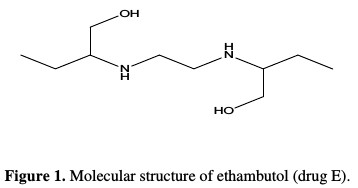
The commercially available drug is named Ethambutol (E), with IUPAC
nomenclature as (2S,2'S)-2,2'-(Ethane-1,2-diyldiimino)dibutan-1-ol. The
molecular formula of the drug is C10H24N2O2, with a molecular weight of 204.31
g/mol. <a href="#f1">Fig. 1</a> shows the molecular structure of the expired drug.</p>


    <p>&nbsp;</p>
<a name="f1">
<img src="/img/revistas/pea/v36n3/36n3a05f1.jpg">
    
<p>&nbsp;</p>


    <p>The white crystalline solid drug partially soluble in cold water is primarily used for the
treatment of tuberculosis. It is on the World Health Organization's list of the
most important medication needed in a basic health system [8, 9]. The drug is
herein experimented as a corrosion inhibitor, due to the presence of heteroatoms
in its molecular structure, and for being a medical waste.</p>


    <p><i><b>Weight loss (gravimetric) technique</b></i></p>

    ]]></body>
<body><![CDATA[<p>After recording the initial weights of mild steel coupons, they were immersed in
a tilted position in 250 mL conical flasks with the test solution (0.5 M HCl) as a
corroding medium, in the absence and presence of the inhibitor, for 4 hours.
Experiments were carried out in an electronically controlled thermostat at 303 K,
313 K, 323 K and 333 K, with an accuracy of &pm;2 K. After exposing the
specimens for 4 hours at the above mentioned temperatures, the coupons were
taken out from the flasks, and initially washed under running tap water.
Following that, the coupons were rubbed with rubber cork to loosely remove
adhered corrosion products, thoroughly washed with double distilled water,
dried, and weighed thereafter [1, 3]. After scouring off, these coupons showed a
drop in their corresponding initial weights, which depicts the mass loss due to
corrosion. From these obtained weight loss data, corrosion rates and percentage
inhibition efficiencies at different conditions were computed. All the weight loss
investigation was carried out in triplicate, with standard deviation of the order of
0.01 for only a sample.</p>


    <p><i><b>Electrochemical polarization technique</b></i></p>

    <p>In the present study, electrochemical polarization technique was carried out in a
500 mL glass cell having a three electrode system assembly. Potentiostatic
polarization of the working electrode was carried out by using an Autolab
Potentiostat / Galvanostat PGSTAT 204T (Netherlands). The working electrode
was mild steel (MS), with a 1.0 cm<sup>2</sup> area exposed to the corrosive medium during
all the experimental set up, and carbon (graphite) electrode was used as counter
(auxiliary) electrode [1, 9]. All the potentials were measured against a pencil type
saturated Ag/AgCl electrode as reference electrode. A Luggin capillary filled
with the test solution was used to connect the reference electrode with the cell.
The tip of the Luggin capillary was kept very close to the working area of the
electrode, but without touching it, in order to minimize the ohmic drop. The
specimen was introduced in the acidic solution, until a constant open circuit
potential (OCP) was attained.</p>

    <p>After maintaining the constant OCP, linear polarization resistance measurements
were potentiostatically carried out by scanning, through a potential range of -0.25
V to +0.25 V, with respect to the OCP value at the scan rate of 1 mV.
Experiments were carried out in the inhibitor absence and presence at 200 ppm,
400 ppm, 800 ppm and 1000 ppm concentrations, and at 303 K, 313 K, 323 K
and 333 K temperatures.</p>


    <p><i><b>Electrochemical impedance spectroscopy (EIS)</b></i></p>

    <p>In the present study, electrochemical polarization technique was carried out in a
500 mL glass cell having a three electrodes system assembly. A typical
electrochemical impedance experimental setup consists of an electrochemical cell
(the stem under investigation), a potentiostat/galvanostat, and a frequency
response analyzer (FRA). The FRA applies the sine wave and analyses the
response of the system to determine its impedance. Impedance spectroscopy was
performed to the same setup of the polarization technique. The parameters were
observed on the analyzer in a frequency range of 1.0&times;10<sup>5</sup>- 1.0 Hz, with the
peak-to-peak AC signal of 5 mV at open circuit potential, stabilized at 303 K &pm; 1
K for 4 hrs. The main parameter inferred from the Nyquist diagram analysis is
the charge transfer resistance, Rct (diameter of high frequency loop), then
calculated to give the double layer capacitance, Cdl. The Nyquist plots for MS in
acidic media are not perfect semicircles, due to the non-homogeneity of the
surface and roughness of the metal [1, 9].</p>


    <p><i><b>Scanning electron microscopy (SEM)</b></i></p>

    <p>The mild steel coupons, thoroughly polished and dried, were exposed to their
respective acidic media, for four hours, at 303 K. Polishing was performed using
SiC papers from 400, 800, 1000 and 2000, washed with double distilled water
and dried in acetone. These coupons were immersed in 0.5 M HCl in the absence
and presence of 1000 ppm of the drug used as inhibitor [1]. After immersion,
these coupons were scorned off to remove the corrosion product formed over the
surface, washed and dried for imaging under Model Zeiss Ultra 55 at 3 kV for
FESEM technique at X500 magnification.</p>


    <p><i><b>Molecular modeling detail</b></i></p>

    <p>Geometry optimization, quantum chemical parameters and Fukui functions
indices calculations were performed using a reliable DMol3 method implemented
in the high-performance software (Materials Studio version 6.0) [12, 13]. The
GGA was the gradient-corrected functional method used with a double numeric
plus polarization (DNP) basis set, and a functional Becke One Parameter (BOP).</p>

    ]]></body>
<body><![CDATA[<p>The solvation effects (aqueous phase) were included in DMol3 calculations by
COSMO [14] controls. Molecular dynamic (MD) simulations of the tested
inhibitor were carried out in a simulation box with periodic boundary conditions,
using Materials Studio 6.0 (from Accelrys Inc.). The iron crystal was imported
and cleaved along a (1 1 0) plane, and a slab of 5 &Aring; was employed. The Fe (1 1
0) surface was relaxed, by minimizing its energy using a smart minimizer
method, and enlarged to a (10 &times; 10) supercell, to provide a large surface for the
inhibitor interaction. A vacuum slab with zero thickness was built. A supercell
with a size of a = b = 24.82 &Aring; and c = 25.14 &Aring; contained 500 H2O molecules,
and a molecule of the tested inhibitor was created. The simulation was carried
out in a simulation box (24.82 &times; 24.82 &times; 35.69 &Aring;<sup>3</sup>) using a discover module with
a time step of 1 fs, and simulation time of 500 ps, performed at 298 K, with NVT
ensemble, and COMPASS force field [15]. In the simulation system, the
interactions between the inhibitor and Fe (1 1 0) can be understood by adsorption
and binding energies, calculated using <a href="#e1">Equation (1)</a> and <a href="#e2">(2)</a> [16]:</p>


    <p>&nbsp;</p>
<a name="e1">
<img src="/img/revistas/pea/v36n3/36n3a05e1.jpg">
    
<p>&nbsp;</p>
<a name="e2">
<img src="/img/revistas/pea/v36n3/36n3a05e2.jpg">
    
<p>&nbsp;</p>


    <p>where Etotal is the total energy of the entire system, Esurface + solution refer to the total
energy of the Fe (1 1 0) surface and the solution without the inhibitor, Einhibitor +
solution represent the total energy of the inhibitor and the solution, and Esolution is the
total energy of the H2O molecules.</p>


    <p>&nbsp;</p>
    <p><b>Results and discussion</b></p>

    <p>The studied drug is expired ethambutol, used for corrosion inhibition purposes,
up to a concentration of 1000 ppm, using different techniques. The value of 1000
ppm is the highest concentration of the drug providing maximized inhibition
capability, as depicted in the present study. The same drug has also been applied
as a new inhibitor by Kumar and Bashir [11], according to whom it reaches its
optimization level at 1000 ppm and, afterwards, its performance goes down. The
employed techniques are below discussed under the sub-heads.</p>


    <p><i><b>Gravimetric technique</b></i></p>

    <p>The weight loss of a rectangular specimen of size 3 cm x 1.5 cm x 0.028 cm in
0.5 M HCl, in the absence and presence of inhibitors, was determined after a 4 h
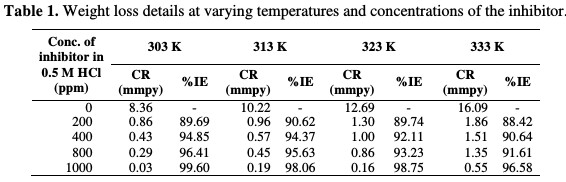
period of immersion at different temperatures. The corrosion rate (CR) shown in
<a href="#t1">Table 1</a> in mmpy was calculated from the following equation:</p>


    ]]></body>
<body><![CDATA[<p>&nbsp;</p>
<a name="t1">
<img src="/img/revistas/pea/v36n3/36n3a05t1.jpg">
    
<p>&nbsp;</p>
<a name="e3">
<img src="/img/revistas/pea/v36n3/36n3a05e3.jpg">
    
<p>&nbsp;</p>


    <p>where W is the average weight loss of mild steel specimens (mg), A is the total
area of one MS specimen in cm<sup>2</sup>, t is the immersion time (4h) and D is the
density of mild steel (7.86 gcm<sup>-3</sup>) [1, 9].</p>

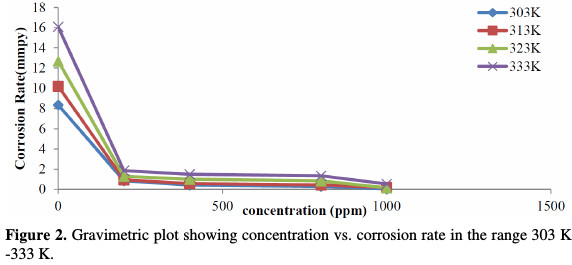
    <p>The inhibition efficiency of the drug is found to increase with its increasing
concentration in the acidic medium, and decreases with the increasing range of
temperature. <a href="#f2">Fig. 2</a> shows the plot of corrosion rate (mmpy) against the inhibitor
concentration (ppm) for the corrosion of mild steel in 0.5 M HCl, with increasing
temperatures in the range of 303 K to 333 K.</p>


    <p>&nbsp;</p>
<a name="f2">
<img src="/img/revistas/pea/v36n3/36n3a05f2.jpg">
    
<p>&nbsp;</p>


    <p>The corrosion rate, for instance, was found to be 8.35 mmpy for an uninhibited
MS coupon, and 0.03 mmpy for the inhibited coupon at 303 K temperature, and
1000 ppm of the drug had standard deviation of the order of 0.01 for a sample,
but not for the population. The inhibition efficiency (IE %) of the inhibitor on the
corrosion of MS was calculated [17] as follows (<a href="#e4">equation 4</a>):</p>


    <p>&nbsp;</p>
<a name="e4">
<img src="/img/revistas/pea/v36n3/36n3a05e4.jpg">
    
<p>&nbsp;</p>


    ]]></body>
<body><![CDATA[<p>where W and Winh are the weight loss of mild steel in the absence and presence
of the inhibitor, respectively.</p>

    <p><a href="#f2">Fig. 2</a> showed that the corrosion rate, calculated from <a href="#e1">equation 1</a>, goes down as
the concentration of the inhibitor increases, and it increases with increasing
temperatures. The weight loss experiments were performed in triplicate, and an
average reading was considered for further estimates. The technique is roughly
considered as an average inhibition technique [17], because the corrosion process
intended through this phenomenon has a four hours interval, and the variation
corresponding to the time coverage is not considered.</p>


    <p><i><b>Electrochemical polarization measurements</b></i></p>

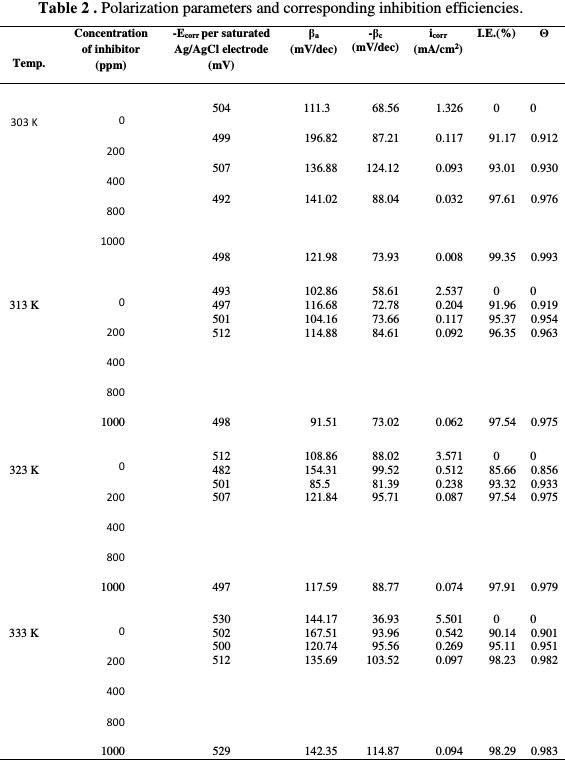
    <p>Inspection of the data reveals that the inhibition efficiency increases with
increasing inhibitor concentrations (<a href="#t2">Table 2</a>).</p>


    <p>&nbsp;</p>
<a name="t2">
<img src="/img/revistas/pea/v36n3/36n3a05t2.jpg">
    
<p>&nbsp;</p>


    <p>This behavior can be attributed to
the increased adsorption and coverage of inhibitors onto the mild steel surface
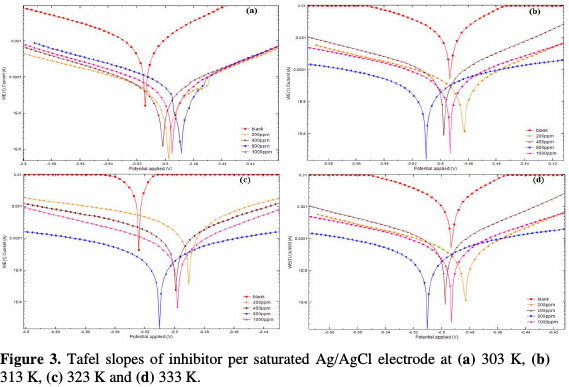
with increasing inhibitor concentrations. Since the Ecorr values with the inhibiting
drug do not show any significant deviation from those of Ecorr blank values (<a href="#f3">Fig. 3</a>) 
and the polarization curves of both halves, the anodic and cathodic half
reactions are not equally affected by the drug addition.</p>


    <p>&nbsp;</p>
<a name="f3">
<img src="/img/revistas/pea/v36n3/36n3a05f3.jpg">
    
<p>&nbsp;</p>


    <p>The polarization curves
with small deviations depict the inhibitor as from the mixed type [1, 17].</p>


    ]]></body>
<body><![CDATA[<p>&nbsp;</p>
<a name="e5">
<img src="/img/revistas/pea/v36n3/36n3a05e5.jpg">
    
<p>&nbsp;</p>


    <p><i><b>Electrochemical impedance spectroscopy</b></i></p>

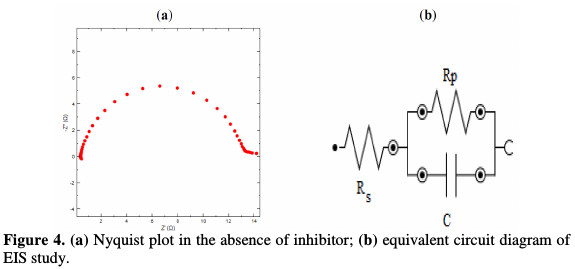
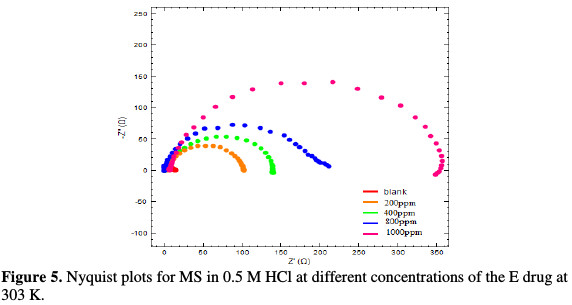
    <p>The Nyquist plots contain a depressed semi-circle, with the center below the real
X-axis, when increasing the inhibitor concentration, which indicated that
corrosion was mainly a charge transfer process [18,19]. The depressed semi-
circle is a characteristic of solid electrodes, and often refers to the dispersion
frequency which arises due to the roughness and homogeneities of the surface
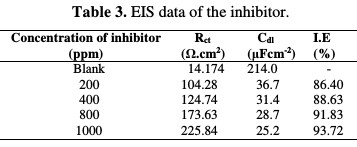
[17-19]. The impedance parameters derived from these plots are given in 
<a href="#t3">Table 3</a>, which were computed using <a href="#e6">equation 6</a>:</p>


    <p>&nbsp;</p>
<a name="e6">
<img src="/img/revistas/pea/v36n3/36n3a05e6.jpg">
    
<p>&nbsp;</p>
<a name="t3">
<img src="/img/revistas/pea/v36n3/36n3a05t3.jpg">
    
<p>&nbsp;</p>


    <p>The Rct values of the inhibited substrate are increased as the concentration of the
inhibitor increases. On the other hand, the values of Cdl are decreased as the
concentration of the inhibitor gets enhanced, which probably happened due to the
decrease in local dielectric constant and/or to the increase in thickness of the
electrical double layer. The Nyquist plots are given in the absence and presence
of the inhibitor, individually from <a href="#f4">Fig. 4(a)</a> and <a href="#f5">Fig. 5</a>, 
whereas <a href="#f4">Fig. 4(b)</a> gives
an equivalent circuit diagram of the EIS study, respectively, with Rs, Rp or Rct
and Cdl values. It is clear that the impedance response of MS was significantly
changed after the drug addition.</p>


    <p>&nbsp;</p>
<a name="f4">
<img src="/img/revistas/pea/v36n3/36n3a05f4.jpg">
    
<p>&nbsp;</p>
<a name="f5">
<img src="/img/revistas/pea/v36n3/36n3a05f5.jpg">
    
]]></body>
<body><![CDATA[<p>&nbsp;</p>


    <p><i><b>Scanning electron microscopy</b></i></p>

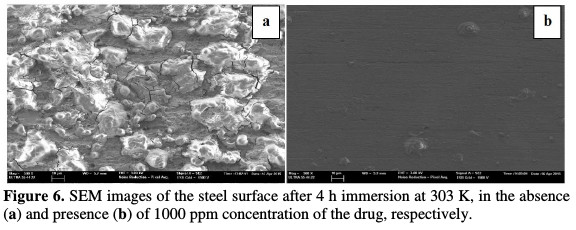
    <p>The scanning electron micrographs (<a href="#f6">Fig. 6</a>), of the uninhibited sample, give
evidence of the damage caused to the surface by the acid, and of the inhibited
sample, with the formation of a protective layer by the inhibitor at &times;500
magnification.</p>


    <p>&nbsp;</p>
<a name="f6">
<img src="/img/revistas/pea/v36n3/36n3a05f6.jpg">
    
<p>&nbsp;</p>


    <p>The surface morphology of the inhibited metal surface is
smoother than that of the uninhibited surface, representing a protective layer of
the adsorbed inhibitor that prevents corrosion caused by the acid attack on the
mild steel surface. The smoothness of the MS surface in the inhibitor presence is
due to the barrier of the protective film over the metal surface.</p>


    <p><i><b>DFT calculations</b></i></p>

    <p><i>Global reactivity descriptors</i></p>

    <p>The interaction of corrosion inhibitors and metal surfaces depends on the
molecular properties of the inhibitor. These molecular properties are associated
with the presence of particular groups on organic molecules, including the
presence of heteroatoms, &pi;-bond, aromatic systems and electron density. It is
reported that the molecules with these functional groups highly tend to act as
corrosion inhibitors [20, 21]. Highest occupied molecular orbital (HOMO) and
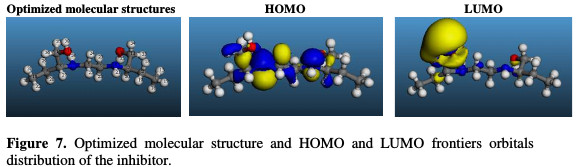
lowest unoccupied molecular orbital (LUMO) (<a href="#f7">Fig. 7</a>) play an important role in
the reactivity of inhibitors with the metal surface.</p>


    <p>&nbsp;</p>
<a name="f7">
<img src="/img/revistas/pea/v36n3/36n3a05f7.jpg">
    
]]></body>
<body><![CDATA[<p>&nbsp;</p>


    <p>HOMO is referred to as the
orbital that could act as an electron donor, because it is the outermost (highest
energy) orbital with electrons, while LUMO is the orbital that could act as the
electron acceptor, because it is the innermost (lowest energy) orbital having the
capability to accept electrons [22, 23].</p>

    <p>The optimized structure of the studied compound and the corresponding atom
numbering are shown in <a href="#f7">Fig. 7</a>.</p>

    <p>It is interesting to mention here the type of
functional groups present on the inhibitor molecule, since the adsorption onto the
metal surface depends on them. Ethambutol has two nitrogen atoms and two
hydroxyl group atoms; some of their most interesting features to consider are the
location of the highest occupied molecular orbital (HOMO) and the lowest
unoccupied molecular orbital (LUMO). In the current study, the HOMO orbital is
largely distributed in all heteroatoms, while the LUMO orbital is distributed,
especially in the hydroxyl group, due to its capability to protonate, and
consequently accept electrons from the metal surface through electrostatic
interactions.</p>

    <p>The quantum chemical calculations parameters such as EHOMO, ELUMO, &Delta;E and
&Delta;N are represented in <a href="#t4">Table 4</a>.</p>


    <p>&nbsp;</p>
<a name="t4">
<img src="/img/revistas/pea/v36n3/36n3a05t4.jpg">
    
<p>&nbsp;</p>


    <p>The electron affinity (EA) and ionization potential
(IP) are deduced from EHOMO and ELUMO by the <a href="#e7">Equations (7)</a> and <a href="#e8">(8)</a> [23]:</p>


    <p>&nbsp;</p>
<a name="e7">
<img src="/img/revistas/pea/v36n3/36n3a05e7.jpg">
    
<p>&nbsp;</p>
<a name="e8">
<img src="/img/revistas/pea/v36n3/36n3a05e8.jpg">
    
]]></body>
<body><![CDATA[<p>&nbsp;</p>


    <p>Mulliken electronegativity (&chi;) and absolute hardness (&eta;) can be approximated
using [24, 25]:</p>


    <p>&nbsp;</p>
<a name="e9">
<img src="/img/revistas/pea/v36n3/36n3a05e9.jpg">
    
<p>&nbsp;</p>
<a name="e10">
<img src="/img/revistas/pea/v36n3/36n3a05e10.jpg">
    
<p>&nbsp;</p>


    <p>The number of transferred electrons (&Delta;N) is calculated by application of the
Pearson method using the following equation [26]:</p>


    <p>&nbsp;</p>
<a name="e11">
<img src="/img/revistas/pea/v36n3/36n3a05e11.jpg">
    
<p>&nbsp;</p>


    <p>where is the work function of the iron surface with the value of 4.82 eV for Fe
(1 1 0) [27, 28], &chi;inh is the absolute electronegativity associated to the inhibitor
molecule, &eta;Fe= 0, and &eta;inh is the absolute hardness of metal and the inhibitor
molecule, respectively [29, 30]. EHOMO gives information about the tendency of
the molecule to donate electrons to an electron poor species [21]. The molecule
with the highest EHOMO is considered to have the highest tendency to donate
electrons to an electron poor species. ELUMO, on the other hand, shows the
tendency of a molecule to accept electrons, and the lower is the EHOMO value, the
greater is the tendency of that particular system to accept electrons [31]. EHOMO
and ELUMO for the study compound are reported in <a href="#t4">Table 4</a>. The energy difference
between HOMO and LUMO (denoted as &Delta;E) provides important information on
the reactivity of inhibitor molecules. The smaller is &Delta;E value, the greater is the
reactivity of a molecule [32]. High reactivity means that the molecule has a
greater chance to interact with the metal surface. It was also reported that the &Delta;N
value measures the ability of a chemical compound to transfer its electrons to the
metal, if &Delta;N &gt; 0, and vice versa, if &Delta;N &lt; 0 [33, 34]. In this study, the positive
value of &Delta;N represented in <a href="#t4">Table 4</a> suggests the high capability of the tested
inhibitor to donate electrons to the mild steel surface.</p>


    <p><i>Local reactivity: Fukui indices</i></p>

    ]]></body>
<body><![CDATA[<p>The Fukui functions provide information about the centers in a molecule, in
which nucleophilic and electrophilic reactions are mostly likely to occur [35].
The local reactivity indices also define the most reactive regions in a molecule.
The Fukui indices are calculated using the following Equations [36, 37]:</p>


    <p>&nbsp;</p>
<a name="e12">
<img src="/img/revistas/pea/v36n3/36n3a05e12.jpg">
    
<p>&nbsp;</p>
<a name="e13">
<img src="/img/revistas/pea/v36n3/36n3a05e13.jpg">
    
<p>&nbsp;</p>


    <p>In the above equations, qk(N), qk(N+1) and qk(N+1) are the atomic charges
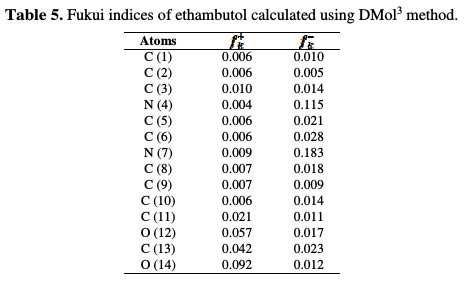
of the systems with N, N+1 and N-1 electrons, respectively [38]. <a href="#t5">Table 5</a> reports
the estimated condensed Fukui indices for the non-hydrogen atoms of the studied
compound.</p>


    <p>&nbsp;</p>
<a name="t5">
<img src="/img/revistas/pea/v36n3/36n3a05t5.jpg">
    
<p>&nbsp;</p>


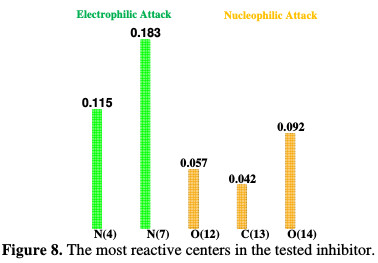
    <p>The preferred site for a nucleophilic attack (shown by the highest value of fk+) is
on O (12), C (13) and O (14). The results obtained from these regions are in
agreement with the analysis from LUMO, because the same predictions from the
site are mostly electron deficient. The highest values of fk- are on N (4) and N
(7). There is a correlation between atoms with an electrophilic attack and those
obtained in HOMO (i.e., N (4) and N (7)). The results obtained for these regions
in nucleophilic and electrophilic attacks support the high capability of the tested
compound to react with the metal surface through donor-acceptor interactions
among most reactive sites of our inhibitor (<a href="#f8">Fig. 8</a>) and the mild steel surface.</p>


    <p>&nbsp;</p>
<a name="f8">
<img src="/img/revistas/pea/v36n3/36n3a05f8.jpg">
    
<p>&nbsp;</p>


    ]]></body>
<body><![CDATA[<p>Additionally, the tested inhibitor has a greater capacity to share the electrons with
the metal surface than to accept them. These results appear as a good explanation
of the physio-chemisorption mode discussed in the adsorption isotherm section.</p>


    <p><i><b>Molecular dynamic (MD) simulations</b></i></p>

    <p>In recent years, modeling methods based on computer simulations have become a
useful tool in solving many scientific and engineering problems [39, 40].
Moreover, with the introduction of powerful workstations, the impact of
computer simulations applications is expected to enormously increase in the next
few years. In this case, molecular dynamic simulations have been gaining great
importance in recent years [41]. This reliable method plays a vital role in
explaning the corrosion inhibition process, and in further giving insight into the
inhibition action of chemical species used as inhibitors. In this paper, MD
simulations of the tested inhibitor were carried out. The system reaches
equilibrium only if both energy and temperature achieve a balance [21]. It is
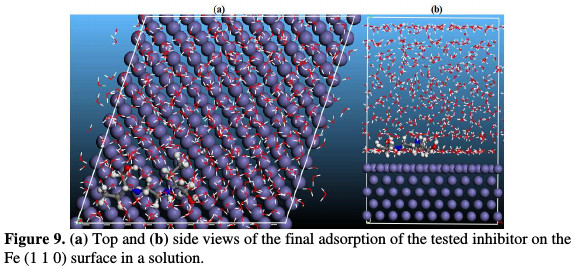
evident from <a href="#f9">Fig. 9</a> that ethambutol nearly adsorbs in a parallel way to the Fe (1
1 0) surface.</p>


    <p>&nbsp;</p>
<a name="f9">
<img src="/img/revistas/pea/v36n3/36n3a05f9.jpg">
    
<p>&nbsp;</p>


    <p><a href="#t6">Table 6</a> shows both interaction energy and binding energy of the tested inhibitor.</p>


    <p>&nbsp;</p>
<a name="t6">
<img src="/img/revistas/pea/v36n3/36n3a05t6.jpg">
    
<p>&nbsp;</p>


    <p>What is interesting in this data is that the negative value of interaction energy
indicates attractive interactions, while the high magnitude of binding energy
suggests a better and stable adsorption system [42]. These results are in good
agreement with experimental studies, which have shown that the tested drug acts
as good corrosion inhibitor of mild steel.</p>


    <p><i><b>Adsorption isotherm</b></i></p>

    ]]></body>
<body><![CDATA[<p>The organic inhibitors act through an adsorption phenomenon and hence,
decrease the corrosion rate. The inhibitor gets adsorbed onto the metal surface, in
the region known as interphase between the MS surface and the medium. The
basic information about the interaction between the surface and the studied drug
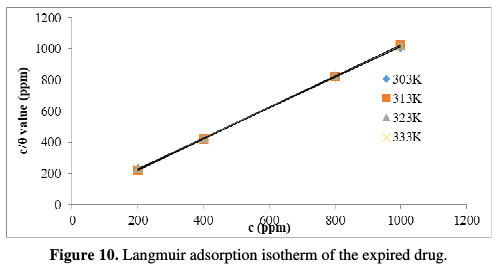
can be determined by adsorption isotherms. The plot of C/&theta; versus C (<a href="#f10">Fig. 10</a>) [1,
17] yields a straight line with the correlation coefficient (R2) &gt; 0.99, indicating
that the adsorption of each drug obeys the Langmuir adsorption isotherm
presented in the following equation:</p>


    <p>&nbsp;</p>
<a name="f10">
<img src="/img/revistas/pea/v36n3/36n3a05f10.jpg">
    
<p>&nbsp;</p>
<a name="e14">
<img src="/img/revistas/pea/v36n3/36n3a05e14.jpg">
    
<p>&nbsp;</p>


    <p>where C is the inhibitor concentration, &theta; is the degree of surface coverage, and
Kads is the equilibrium constant for the adsorption-desorption process.</p>

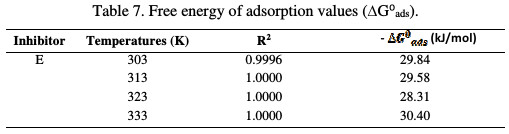
    <p>The value of the equilibrium constant, Kads, was calculated from the reciprocal of
the intercept of the isotherm plot. Kads values can be calculated from the
intercepts of the straight lines, which are related to the standard free energy of
adsorption, &Delta;G<sup>0</sup>ads, with the following equations [25, 26]:</p>


    <p>&nbsp;</p>
<a name="e15">
<img src="/img/revistas/pea/v36n3/36n3a05e15.jpg">
    
<p>&nbsp;</p>
<a name="e16">
<img src="/img/revistas/pea/v36n3/36n3a05e16.jpg">
    
<p>&nbsp;</p>


    <p>where Kads is the rate constant graphically obtained, R is a universal gas constant
and T is temperature in Kelvin. &Delta;G<sup>0</sup>ads was calculated and tabulated in <a href="#t7">Table 7</a>.</p>


    ]]></body>
<body><![CDATA[<p>&nbsp;</p>
<a name="t7">
<img src="/img/revistas/pea/v36n3/36n3a05t7.jpg">
    
<p>&nbsp;</p>


    <p>The negative values indicate the spontaneity of the adsorption process of the
adsorbed layer on the MS surface [17, 18].</p>


    <p>&nbsp;</p>
    <p><b>Conclusion</b></p>

    <p>The studied compound, i.e., ethambutol, is a good inhibitor against corrosion of
mild steel in an acidic medium (0.5 M HCl), with considerable inhibition
efficiency. Further, the inhibition efficiency values of the inhibitor go uphill with
an increase in its concentration, and downhill at elevated temperatures. The Tafel
polarization plots have shown that the expired drug acted as a mixed type
inhibitor. The results of the gravimetric analysis, electrochemical polarization
and EIS were in very good agreement. The adsorption study showed that the
inhibition mechanism obeys Langmuir adsorption isotherm along with the
physiochemical mode of interaction, which is also strengthened by the free
energy values. A good correlation has been found between quantum chemical
calculations and the results experimentally obtained. Furthermore, MD
simulations reveal that the studied compound adsorbs onto the surface of mild
steel in the planar orientation.</p>

    <p>The use of expired drugs can solve two major environmental and economic
problems: limitation of environmental pollution with pharmaceutically active
compounds, and reduction of the disposal costs of expired drugs. It is reported
that the active constituents of drugs degrades only infinitesimally. More than 90
% of the drugs have maintained stability long time after their expiry dates [15].
Nicolae has tested two expired drugs, carbamazepine and paracetamol, as
corrosion inhibitors on carbon steel corrosion in H2SO4 and CH3COOH, and has
obtained 95% and 85 % efficiency, respectively [16]. Some of the azosulfamide
and antimalarial drugs have been reported as good corrosion inhibitors [17-19].</p>


    <p>&nbsp;</p>
    <p><b>References</b></p>

    <!-- ref --><p>1. Dahiya S, Lata S, Kumar R, et al. J Mol Liq. 2016;221:124.    &nbsp;&nbsp;&nbsp;&nbsp;&nbsp;&nbsp;&nbsp;&nbsp;[&#160;<a href="javascript:void(0);" onclick="javascript: window.open('/scielo.php?script=sci_nlinks&ref=434533&pid=S0872-1904201800030000500001&lng=','','width=640,height=500,resizable=yes,scrollbars=1,menubar=yes,');">Links</a>&#160;]<!-- end-ref --></p>

    <!-- ref --><p>2. Sethi T, Chaturvedi A, Upadhyay R, et al. J Chil Chem Soc. 2007;52:1206.    &nbsp;&nbsp;&nbsp;&nbsp;&nbsp;&nbsp;&nbsp;&nbsp;[&#160;<a href="javascript:void(0);" onclick="javascript: window.open('/scielo.php?script=sci_nlinks&ref=434535&pid=S0872-1904201800030000500002&lng=','','width=640,height=500,resizable=yes,scrollbars=1,menubar=yes,');">Links</a>&#160;]<!-- end-ref --></p>

    <!-- ref --><p>3. Dehri I, Ozcan M. Mater Chem Phys. 2006;98:316.    &nbsp;&nbsp;&nbsp;&nbsp;&nbsp;&nbsp;&nbsp;&nbsp;[&#160;<a href="javascript:void(0);" onclick="javascript: window.open('/scielo.php?script=sci_nlinks&ref=434537&pid=S0872-1904201800030000500003&lng=','','width=640,height=500,resizable=yes,scrollbars=1,menubar=yes,');">Links</a>&#160;]<!-- end-ref --></p>

    <!-- ref --><p>4. Gebhart F. Drug Topics. <a href="http://drugtopics.modernmedicine.com/drugtopics/article/articleDetail.jsp?" target="_blank">http://drugtopics.modernmedicine.com/drugtopics/article/articleDetail.jsp?</a>. Accessed 17 Feb 2012.    &nbsp;&nbsp;&nbsp;&nbsp;&nbsp;&nbsp;&nbsp;&nbsp;[&#160;<a href="javascript:void(0);" onclick="javascript: window.open('/scielo.php?script=sci_nlinks&ref=434539&pid=S0872-1904201800030000500004&lng=','','width=640,height=500,resizable=yes,scrollbars=1,menubar=yes,');">Links</a>&#160;]<!-- end-ref --></p>

    <!-- ref --><p>5. Struck S, Schmidt U, Gruening B, et al. Genome Inform. 2008;20:231.    &nbsp;&nbsp;&nbsp;&nbsp;&nbsp;&nbsp;&nbsp;&nbsp;[&#160;<a href="javascript:void(0);" onclick="javascript: window.open('/scielo.php?script=sci_nlinks&ref=434541&pid=S0872-1904201800030000500005&lng=','','width=640,height=500,resizable=yes,scrollbars=1,menubar=yes,');">Links</a>&#160;]<!-- end-ref --></p>

    <!-- ref --><p>6. Vaszilcsin N, Ordodi V, Borza A. Int J Pharm. 2012;431:241.    &nbsp;&nbsp;&nbsp;&nbsp;&nbsp;&nbsp;&nbsp;&nbsp;[&#160;<a href="javascript:void(0);" onclick="javascript: window.open('/scielo.php?script=sci_nlinks&ref=434543&pid=S0872-1904201800030000500006&lng=','','width=640,height=500,resizable=yes,scrollbars=1,menubar=yes,');">Links</a>&#160;]<!-- end-ref --></p>

    <!-- ref --><p>7. Samide A, Tutunaru B, Negrila C. Chem Biochem Eng Q. 2011;25:299.    &nbsp;&nbsp;&nbsp;&nbsp;&nbsp;&nbsp;&nbsp;&nbsp;[&#160;<a href="javascript:void(0);" onclick="javascript: window.open('/scielo.php?script=sci_nlinks&ref=434545&pid=S0872-1904201800030000500007&lng=','','width=640,height=500,resizable=yes,scrollbars=1,menubar=yes,');">Links</a>&#160;]<!-- end-ref --></p>

    <!-- ref --><p>8. Gece G. Corros Sci. 2011;53:3873.    &nbsp;&nbsp;&nbsp;&nbsp;&nbsp;&nbsp;&nbsp;&nbsp;[&#160;<a href="javascript:void(0);" onclick="javascript: window.open('/scielo.php?script=sci_nlinks&ref=434547&pid=S0872-1904201800030000500008&lng=','','width=640,height=500,resizable=yes,scrollbars=1,menubar=yes,');">Links</a>&#160;]<!-- end-ref --></p>

    <!-- ref --><p>9. Patrick GL. An introduction to medicinal chemistry. Oxford: Oxford Univ Press; 2013.    &nbsp;&nbsp;&nbsp;&nbsp;&nbsp;&nbsp;&nbsp;&nbsp;[&#160;<a href="javascript:void(0);" onclick="javascript: window.open('/scielo.php?script=sci_nlinks&ref=434549&pid=S0872-1904201800030000500009&lng=','','width=640,height=500,resizable=yes,scrollbars=1,menubar=yes,');">Links</a>&#160;]<!-- end-ref --></p>

    <!-- ref --><p>10. Sangeetha M, Rajendran S, Muthumegala T, et al. Zastita Mater. 2011;52:3.    &nbsp;&nbsp;&nbsp;&nbsp;&nbsp;&nbsp;&nbsp;&nbsp;[&#160;<a href="javascript:void(0);" onclick="javascript: window.open('/scielo.php?script=sci_nlinks&ref=434551&pid=S0872-1904201800030000500010&lng=','','width=640,height=500,resizable=yes,scrollbars=1,menubar=yes,');">Links</a>&#160;]<!-- end-ref --></p>

    <!-- ref --><p>11. Kumar A, Bashir S. Russ J Appl Chem. 2016;89:1158.    &nbsp;&nbsp;&nbsp;&nbsp;&nbsp;&nbsp;&nbsp;&nbsp;[&#160;<a href="javascript:void(0);" onclick="javascript: window.open('/scielo.php?script=sci_nlinks&ref=434553&pid=S0872-1904201800030000500011&lng=','','width=640,height=500,resizable=yes,scrollbars=1,menubar=yes,');">Links</a>&#160;]<!-- end-ref --></p>

    <!-- ref --><p>12. Delley B. J Chem Phys. 2000;113:7756.    &nbsp;&nbsp;&nbsp;&nbsp;&nbsp;&nbsp;&nbsp;&nbsp;[&#160;<a href="javascript:void(0);" onclick="javascript: window.open('/scielo.php?script=sci_nlinks&ref=434555&pid=S0872-1904201800030000500012&lng=','','width=640,height=500,resizable=yes,scrollbars=1,menubar=yes,');">Links</a>&#160;]<!-- end-ref --></p>

    <!-- ref --><p>13. Materials Studio. Revision 6.0, Accelrys Inc., San Diego, USA, 2013.    &nbsp;&nbsp;&nbsp;&nbsp;&nbsp;&nbsp;&nbsp;&nbsp;[&#160;<a href="javascript:void(0);" onclick="javascript: window.open('/scielo.php?script=sci_nlinks&ref=434557&pid=S0872-1904201800030000500013&lng=','','width=640,height=500,resizable=yes,scrollbars=1,menubar=yes,');">Links</a>&#160;]<!-- end-ref --></p>

    <!-- ref --><p>14. Mulliken RS. I. J Chem Phys. 1955;23:1833.    &nbsp;&nbsp;&nbsp;&nbsp;&nbsp;&nbsp;&nbsp;&nbsp;[&#160;<a href="javascript:void(0);" onclick="javascript: window.open('/scielo.php?script=sci_nlinks&ref=434559&pid=S0872-1904201800030000500014&lng=','','width=640,height=500,resizable=yes,scrollbars=1,menubar=yes,');">Links</a>&#160;]<!-- end-ref --></p>

    <!-- ref --><p>15. Sun H. J Phys Chem B. 1998;102:7338.    &nbsp;&nbsp;&nbsp;&nbsp;&nbsp;&nbsp;&nbsp;&nbsp;[&#160;<a href="javascript:void(0);" onclick="javascript: window.open('/scielo.php?script=sci_nlinks&ref=434561&pid=S0872-1904201800030000500015&lng=','','width=640,height=500,resizable=yes,scrollbars=1,menubar=yes,');">Links</a>&#160;]<!-- end-ref --></p>

    <!-- ref --><p>16. Zhang Z, Tian NC, Huang XD, et al. RSC Adv. 2016;6:22250.    &nbsp;&nbsp;&nbsp;&nbsp;&nbsp;&nbsp;&nbsp;&nbsp;[&#160;<a href="javascript:void(0);" onclick="javascript: window.open('/scielo.php?script=sci_nlinks&ref=434563&pid=S0872-1904201800030000500016&lng=','','width=640,height=500,resizable=yes,scrollbars=1,menubar=yes,');">Links</a>&#160;]<!-- end-ref --></p>

    <!-- ref --><p>17. Dahiya S, Lata S, Kumar P, et al. Corros Rev. 2016;34:241.    &nbsp;&nbsp;&nbsp;&nbsp;&nbsp;&nbsp;&nbsp;&nbsp;[&#160;<a href="javascript:void(0);" onclick="javascript: window.open('/scielo.php?script=sci_nlinks&ref=434565&pid=S0872-1904201800030000500017&lng=','','width=640,height=500,resizable=yes,scrollbars=1,menubar=yes,');">Links</a>&#160;]<!-- end-ref --></p>

    <!-- ref --><p>18. Singh AK, Quraishi M. J Appl Electrochem. 2011;41:7.    &nbsp;&nbsp;&nbsp;&nbsp;&nbsp;&nbsp;&nbsp;&nbsp;[&#160;<a href="javascript:void(0);" onclick="javascript: window.open('/scielo.php?script=sci_nlinks&ref=434567&pid=S0872-1904201800030000500018&lng=','','width=640,height=500,resizable=yes,scrollbars=1,menubar=yes,');">Links</a>&#160;]<!-- end-ref --></p>

    <!-- ref --><p>19. Eddy N, Odoemelam S, Ekwumemgbo P. Sci Res Essays. 2009;4:33.    &nbsp;&nbsp;&nbsp;&nbsp;&nbsp;&nbsp;&nbsp;&nbsp;[&#160;<a href="javascript:void(0);" onclick="javascript: window.open('/scielo.php?script=sci_nlinks&ref=434569&pid=S0872-1904201800030000500019&lng=','','width=640,height=500,resizable=yes,scrollbars=1,menubar=yes,');">Links</a>&#160;]<!-- end-ref --></p>

    <!-- ref --><p>20. El Makrini B, Toumiat K, Lgaz H, et al. Res J Pharm Biol Chem Sci. 2016;7:2286.    &nbsp;&nbsp;&nbsp;&nbsp;&nbsp;&nbsp;&nbsp;&nbsp;[&#160;<a href="javascript:void(0);" onclick="javascript: window.open('/scielo.php?script=sci_nlinks&ref=434571&pid=S0872-1904201800030000500020&lng=','','width=640,height=500,resizable=yes,scrollbars=1,menubar=yes,');">Links</a>&#160;]<!-- end-ref --></p>

    <!-- ref --><p>21. Lgaz H, Salghi R, Jodeh S, et al. J Mol Liq. 2017;225:271.    &nbsp;&nbsp;&nbsp;&nbsp;&nbsp;&nbsp;&nbsp;&nbsp;[&#160;<a href="javascript:void(0);" onclick="javascript: window.open('/scielo.php?script=sci_nlinks&ref=434573&pid=S0872-1904201800030000500021&lng=','','width=640,height=500,resizable=yes,scrollbars=1,menubar=yes,');">Links</a>&#160;]<!-- end-ref --></p>

    <!-- ref --><p>22. Singh RN, Kumar A, Tiwari RK, et al. Spectrochim Acta A. Mol Biomol Spectrosc. 2013;112:182.    &nbsp;&nbsp;&nbsp;&nbsp;&nbsp;&nbsp;&nbsp;&nbsp;[&#160;<a href="javascript:void(0);" onclick="javascript: window.open('/scielo.php?script=sci_nlinks&ref=434575&pid=S0872-1904201800030000500022&lng=','','width=640,height=500,resizable=yes,scrollbars=1,menubar=yes,');">Links</a>&#160;]<!-- end-ref --></p>

    <!-- ref --><p>23. Jafari H, Danaee I, Eskandari H, et al. J Mater Sci Technol. 2014;30:239.    &nbsp;&nbsp;&nbsp;&nbsp;&nbsp;&nbsp;&nbsp;&nbsp;[&#160;<a href="javascript:void(0);" onclick="javascript: window.open('/scielo.php?script=sci_nlinks&ref=434577&pid=S0872-1904201800030000500023&lng=','','width=640,height=500,resizable=yes,scrollbars=1,menubar=yes,');">Links</a>&#160;]<!-- end-ref --></p>

    <!-- ref --><p>24. Pearson RG. Inorg Chem. 1988;27:734.    &nbsp;&nbsp;&nbsp;&nbsp;&nbsp;&nbsp;&nbsp;&nbsp;[&#160;<a href="javascript:void(0);" onclick="javascript: window.open('/scielo.php?script=sci_nlinks&ref=434579&pid=S0872-1904201800030000500024&lng=','','width=640,height=500,resizable=yes,scrollbars=1,menubar=yes,');">Links</a>&#160;]<!-- end-ref --></p>

    <!-- ref --><p>25. Sastri V. Perumareddi J. Corrosion. 1997;53:617.    &nbsp;&nbsp;&nbsp;&nbsp;&nbsp;&nbsp;&nbsp;&nbsp;[&#160;<a href="javascript:void(0);" onclick="javascript: window.open('/scielo.php?script=sci_nlinks&ref=434581&pid=S0872-1904201800030000500025&lng=','','width=640,height=500,resizable=yes,scrollbars=1,menubar=yes,');">Links</a>&#160;]<!-- end-ref --></p>

    <!-- ref --><p>26. Martinez S. Mater. Chem. Phys. 2003;77:97.    &nbsp;&nbsp;&nbsp;&nbsp;&nbsp;&nbsp;&nbsp;&nbsp;[&#160;<a href="javascript:void(0);" onclick="javascript: window.open('/scielo.php?script=sci_nlinks&ref=434583&pid=S0872-1904201800030000500026&lng=','','width=640,height=500,resizable=yes,scrollbars=1,menubar=yes,');">Links</a>&#160;]<!-- end-ref --></p>

    <!-- ref --><p>27. Lukovits I, Kalman E, Zucchi F. Corrosion. 2001;57:3.    &nbsp;&nbsp;&nbsp;&nbsp;&nbsp;&nbsp;&nbsp;&nbsp;[&#160;<a href="javascript:void(0);" onclick="javascript: window.open('/scielo.php?script=sci_nlinks&ref=434585&pid=S0872-1904201800030000500027&lng=','','width=640,height=500,resizable=yes,scrollbars=1,menubar=yes,');">Links</a>&#160;]<!-- end-ref --></p>

    <!-- ref --><p>28. Pearson RG. Inorg Chem. 1988;27:734.    &nbsp;&nbsp;&nbsp;&nbsp;&nbsp;&nbsp;&nbsp;&nbsp;[&#160;<a href="javascript:void(0);" onclick="javascript: window.open('/scielo.php?script=sci_nlinks&ref=434587&pid=S0872-1904201800030000500028&lng=','','width=640,height=500,resizable=yes,scrollbars=1,menubar=yes,');">Links</a>&#160;]<!-- end-ref --></p>

    <!-- ref --><p>29. Cao Z, Tang Y, Cang H, et al. Corros Sci. 2014;83:292.    &nbsp;&nbsp;&nbsp;&nbsp;&nbsp;&nbsp;&nbsp;&nbsp;[&#160;<a href="javascript:void(0);" onclick="javascript: window.open('/scielo.php?script=sci_nlinks&ref=434589&pid=S0872-1904201800030000500029&lng=','','width=640,height=500,resizable=yes,scrollbars=1,menubar=yes,');">Links</a>&#160;]<!-- end-ref --></p>

    <!-- ref --><p>30. Kokalj A. Chem Phys. 2012;393:1.    &nbsp;&nbsp;&nbsp;&nbsp;&nbsp;&nbsp;&nbsp;&nbsp;[&#160;<a href="javascript:void(0);" onclick="javascript: window.open('/scielo.php?script=sci_nlinks&ref=434591&pid=S0872-1904201800030000500030&lng=','','width=640,height=500,resizable=yes,scrollbars=1,menubar=yes,');">Links</a>&#160;]<!-- end-ref --></p>

    <!-- ref --><p>31. Saadouni M, Larouj M, Salghi R, et al. Pharm Lett. 2016;8:65.    &nbsp;&nbsp;&nbsp;&nbsp;&nbsp;&nbsp;&nbsp;&nbsp;[&#160;<a href="javascript:void(0);" onclick="javascript: window.open('/scielo.php?script=sci_nlinks&ref=434593&pid=S0872-1904201800030000500031&lng=','','width=640,height=500,resizable=yes,scrollbars=1,menubar=yes,');">Links</a>&#160;]<!-- end-ref --></p>

    <!-- ref --><p>32. Wazzan NA. J Ind Eng Chem. 2015;26:291.    &nbsp;&nbsp;&nbsp;&nbsp;&nbsp;&nbsp;&nbsp;&nbsp;[&#160;<a href="javascript:void(0);" onclick="javascript: window.open('/scielo.php?script=sci_nlinks&ref=434595&pid=S0872-1904201800030000500032&lng=','','width=640,height=500,resizable=yes,scrollbars=1,menubar=yes,');">Links</a>&#160;]<!-- end-ref --></p>

    <p>33. Kokalj A. IElectrochim Acta. 2010;56:745.</p>

    <!-- ref --><p>34. Kovacevic N, Kokalj A. Corros Sci. 2011;53:909.    &nbsp;&nbsp;&nbsp;&nbsp;&nbsp;&nbsp;&nbsp;&nbsp;[&#160;<a href="javascript:void(0);" onclick="javascript: window.open('/scielo.php?script=sci_nlinks&ref=434598&pid=S0872-1904201800030000500034&lng=','','width=640,height=500,resizable=yes,scrollbars=1,menubar=yes,');">Links</a>&#160;]<!-- end-ref --></p>

    <!-- ref --><p>35. Lgaz H, Benali O, Salghi R, et al. Pharma Chem. 2016;8:172.    &nbsp;&nbsp;&nbsp;&nbsp;&nbsp;&nbsp;&nbsp;&nbsp;[&#160;<a href="javascript:void(0);" onclick="javascript: window.open('/scielo.php?script=sci_nlinks&ref=434600&pid=S0872-1904201800030000500035&lng=','','width=640,height=500,resizable=yes,scrollbars=1,menubar=yes,');">Links</a>&#160;]<!-- end-ref --></p>

    <!-- ref --><p>36. El Adnani Z, Mcharfi M, Sfaira M, et al. Corros Sci. 2013;68:223.    &nbsp;&nbsp;&nbsp;&nbsp;&nbsp;&nbsp;&nbsp;&nbsp;[&#160;<a href="javascript:void(0);" onclick="javascript: window.open('/scielo.php?script=sci_nlinks&ref=434602&pid=S0872-1904201800030000500036&lng=','','width=640,height=500,resizable=yes,scrollbars=1,menubar=yes,');">Links</a>&#160;]<!-- end-ref --></p>

    ]]></body>
<body><![CDATA[<!-- ref --><p>37. Mi H, Xiao G, Chen X. Comput Theor. Chem. 2015;1072:7.    &nbsp;&nbsp;&nbsp;&nbsp;&nbsp;&nbsp;&nbsp;&nbsp;[&#160;<a href="javascript:void(0);" onclick="javascript: window.open('/scielo.php?script=sci_nlinks&ref=434604&pid=S0872-1904201800030000500037&lng=','','width=640,height=500,resizable=yes,scrollbars=1,menubar=yes,');">Links</a>&#160;]<!-- end-ref --></p>

    <!-- ref --><p>38. Saha SK, Ghosh P, Hens A, et al. Phys. E Low-Dimens Syst Nanostructures. 2015;66:332.    &nbsp;&nbsp;&nbsp;&nbsp;&nbsp;&nbsp;&nbsp;&nbsp;[&#160;<a href="javascript:void(0);" onclick="javascript: window.open('/scielo.php?script=sci_nlinks&ref=434606&pid=S0872-1904201800030000500038&lng=','','width=640,height=500,resizable=yes,scrollbars=1,menubar=yes,');">Links</a>&#160;]<!-- end-ref --></p>

    <!-- ref --><p>39. Kaya S, Kaya C, Guo L, et al. J Mol Liq. 2016;219:497.    &nbsp;&nbsp;&nbsp;&nbsp;&nbsp;&nbsp;&nbsp;&nbsp;[&#160;<a href="javascript:void(0);" onclick="javascript: window.open('/scielo.php?script=sci_nlinks&ref=434608&pid=S0872-1904201800030000500039&lng=','','width=640,height=500,resizable=yes,scrollbars=1,menubar=yes,');">Links</a>&#160;]<!-- end-ref --></p>

    <!-- ref --><p>40. Obot IB, Macdonald DD, Gasem ZM. Corros Sci. 2015;99:1.    &nbsp;&nbsp;&nbsp;&nbsp;&nbsp;&nbsp;&nbsp;&nbsp;[&#160;<a href="javascript:void(0);" onclick="javascript: window.open('/scielo.php?script=sci_nlinks&ref=434610&pid=S0872-1904201800030000500040&lng=','','width=640,height=500,resizable=yes,scrollbars=1,menubar=yes,');">Links</a>&#160;]<!-- end-ref --></p>

    <!-- ref --><p>41. Zhang Z, Tian N, Li X, et al. Appl Surf Sci. 2015;357:845.    &nbsp;&nbsp;&nbsp;&nbsp;&nbsp;&nbsp;&nbsp;&nbsp;[&#160;<a href="javascript:void(0);" onclick="javascript: window.open('/scielo.php?script=sci_nlinks&ref=434612&pid=S0872-1904201800030000500041&lng=','','width=640,height=500,resizable=yes,scrollbars=1,menubar=yes,');">Links</a>&#160;]<!-- end-ref --></p>

    ]]></body>
<body><![CDATA[<!-- ref --><p>42. Xu B, Ji Y, Zhang X, et al. RSC Adv. 2015;5:56049.    &nbsp;&nbsp;&nbsp;&nbsp;&nbsp;&nbsp;&nbsp;&nbsp;[&#160;<a href="javascript:void(0);" onclick="javascript: window.open('/scielo.php?script=sci_nlinks&ref=434614&pid=S0872-1904201800030000500042&lng=','','width=640,height=500,resizable=yes,scrollbars=1,menubar=yes,');">Links</a>&#160;]<!-- end-ref --></p>


    <p>&nbsp;</p>
    <p><b>Acknowledgements</b></p>

    <p>The authors are grateful to the Dept. of Chemistry, Deenbandhu Chottu Ram
University of Science and Technology, Murthal, Sonepat, Haryana, for providing
the necessary facilities and encouragement.</p>


    <p>&nbsp;</p>
    <p><a name=0></a><sup><a href="#top">*</a></sup>Corresponding author. E-mail address: <a href="mailto:sumanjakhar.chem@dcrustm.org">sumanjakhar.chem@dcrustm.org</a></p>

    <p>Received March 30, 2017; accepted September 20, 2017</p>

    <p><a href="http://www.peacta.org" target="_blank">www.peacta.org</a> </p>


     ]]></body><back>
<ref-list>
<ref id="B1">
<label>1</label><nlm-citation citation-type="journal">
<person-group person-group-type="author">
<name>
<surname><![CDATA[Dahiya]]></surname>
<given-names><![CDATA[S]]></given-names>
</name>
<name>
<surname><![CDATA[Lata]]></surname>
<given-names><![CDATA[S]]></given-names>
</name>
<name>
<surname><![CDATA[Kumar]]></surname>
<given-names><![CDATA[R]]></given-names>
</name>
</person-group>
<source><![CDATA[J Mol Liq]]></source>
<year>2016</year>
<volume>221</volume>
<page-range>124</page-range></nlm-citation>
</ref>
<ref id="B2">
<label>2</label><nlm-citation citation-type="journal">
<person-group person-group-type="author">
<name>
<surname><![CDATA[Sethi]]></surname>
<given-names><![CDATA[T]]></given-names>
</name>
<name>
<surname><![CDATA[Chaturvedi]]></surname>
<given-names><![CDATA[A]]></given-names>
</name>
<name>
<surname><![CDATA[Upadhyay]]></surname>
<given-names><![CDATA[R]]></given-names>
</name>
</person-group>
<source><![CDATA[J Chil Chem Soc]]></source>
<year>2007</year>
<volume>52</volume>
<page-range>1206</page-range></nlm-citation>
</ref>
<ref id="B3">
<label>3</label><nlm-citation citation-type="journal">
<person-group person-group-type="author">
<name>
<surname><![CDATA[Dehri]]></surname>
<given-names><![CDATA[I]]></given-names>
</name>
<name>
<surname><![CDATA[Ozcan]]></surname>
<given-names><![CDATA[M]]></given-names>
</name>
</person-group>
<source><![CDATA[Mater Chem Phys]]></source>
<year>2006</year>
<volume>98</volume>
<page-range>316</page-range></nlm-citation>
</ref>
<ref id="B4">
<label>4</label><nlm-citation citation-type="">
<person-group person-group-type="author">
<name>
<surname><![CDATA[Gebhart]]></surname>
<given-names><![CDATA[F]]></given-names>
</name>
</person-group>
<source><![CDATA[Drug Topics]]></source>
<year></year>
</nlm-citation>
</ref>
<ref id="B5">
<label>5</label><nlm-citation citation-type="journal">
<person-group person-group-type="author">
<name>
<surname><![CDATA[Struck]]></surname>
<given-names><![CDATA[S]]></given-names>
</name>
<name>
<surname><![CDATA[Schmidt]]></surname>
<given-names><![CDATA[U]]></given-names>
</name>
<name>
<surname><![CDATA[Gruening]]></surname>
<given-names><![CDATA[B]]></given-names>
</name>
</person-group>
<source><![CDATA[Genome Inform]]></source>
<year>2008</year>
<volume>20</volume>
<page-range>231</page-range></nlm-citation>
</ref>
<ref id="B6">
<label>6</label><nlm-citation citation-type="journal">
<person-group person-group-type="author">
<name>
<surname><![CDATA[Vaszilcsin]]></surname>
<given-names><![CDATA[N]]></given-names>
</name>
<name>
<surname><![CDATA[Ordodi]]></surname>
<given-names><![CDATA[V]]></given-names>
</name>
<name>
<surname><![CDATA[Borza]]></surname>
<given-names><![CDATA[A]]></given-names>
</name>
</person-group>
<source><![CDATA[Int J Pharm]]></source>
<year>2012</year>
<volume>431</volume>
<page-range>241</page-range></nlm-citation>
</ref>
<ref id="B7">
<label>7</label><nlm-citation citation-type="journal">
<person-group person-group-type="author">
<name>
<surname><![CDATA[Samide]]></surname>
<given-names><![CDATA[A]]></given-names>
</name>
<name>
<surname><![CDATA[Tutunaru]]></surname>
<given-names><![CDATA[B]]></given-names>
</name>
<name>
<surname><![CDATA[Negrila]]></surname>
<given-names><![CDATA[C]]></given-names>
</name>
</person-group>
<source><![CDATA[Chem Biochem Eng Q]]></source>
<year>2011</year>
<volume>25</volume>
<page-range>299</page-range></nlm-citation>
</ref>
<ref id="B8">
<label>8</label><nlm-citation citation-type="journal">
<person-group person-group-type="author">
<name>
<surname><![CDATA[Gece]]></surname>
<given-names><![CDATA[G]]></given-names>
</name>
</person-group>
<source><![CDATA[Corros Sci]]></source>
<year>2011</year>
<volume>53</volume>
<page-range>3873</page-range></nlm-citation>
</ref>
<ref id="B9">
<label>9</label><nlm-citation citation-type="book">
<person-group person-group-type="author">
<name>
<surname><![CDATA[Patrick]]></surname>
<given-names><![CDATA[G L]]></given-names>
</name>
</person-group>
<source><![CDATA[An introduction to medicinal chemistry]]></source>
<year>2013</year>
<publisher-loc><![CDATA[Oxford ]]></publisher-loc>
<publisher-name><![CDATA[Oxford Univ Press]]></publisher-name>
</nlm-citation>
</ref>
<ref id="B10">
<label>10</label><nlm-citation citation-type="journal">
<person-group person-group-type="author">
<name>
<surname><![CDATA[Sangeetha]]></surname>
<given-names><![CDATA[M]]></given-names>
</name>
<name>
<surname><![CDATA[Rajendran]]></surname>
<given-names><![CDATA[S]]></given-names>
</name>
<name>
<surname><![CDATA[Muthumegala]]></surname>
<given-names><![CDATA[T]]></given-names>
</name>
</person-group>
<source><![CDATA[Zastita Mater]]></source>
<year>2011</year>
<volume>52</volume>
<page-range>3</page-range></nlm-citation>
</ref>
<ref id="B11">
<label>11</label><nlm-citation citation-type="journal">
<person-group person-group-type="author">
<name>
<surname><![CDATA[Kumar]]></surname>
<given-names><![CDATA[A]]></given-names>
</name>
<name>
<surname><![CDATA[Bashir]]></surname>
<given-names><![CDATA[S]]></given-names>
</name>
</person-group>
<source><![CDATA[Russ J Appl Chem]]></source>
<year>2016</year>
<volume>89</volume>
<page-range>1158</page-range></nlm-citation>
</ref>
<ref id="B12">
<label>12</label><nlm-citation citation-type="journal">
<person-group person-group-type="author">
<name>
<surname><![CDATA[Delley]]></surname>
<given-names><![CDATA[B]]></given-names>
</name>
</person-group>
<source><![CDATA[J Chem Phys]]></source>
<year>2000</year>
<volume>113</volume>
<page-range>7756</page-range></nlm-citation>
</ref>
<ref id="B13">
<label>13</label><nlm-citation citation-type="book">
<source><![CDATA[Materials Studio: Revision 6.0]]></source>
<year>2013</year>
<publisher-loc><![CDATA[San Diego ]]></publisher-loc>
<publisher-name><![CDATA[Accelrys Inc.]]></publisher-name>
</nlm-citation>
</ref>
<ref id="B14">
<label>14</label><nlm-citation citation-type="journal">
<person-group person-group-type="author">
<name>
<surname><![CDATA[Mulliken]]></surname>
<given-names><![CDATA[R S]]></given-names>
</name>
</person-group>
<source><![CDATA[I J Chem Phys]]></source>
<year>1955</year>
<volume>23</volume>
<page-range>1833</page-range></nlm-citation>
</ref>
<ref id="B15">
<label>15</label><nlm-citation citation-type="journal">
<person-group person-group-type="author">
<name>
<surname><![CDATA[Sun]]></surname>
<given-names><![CDATA[H]]></given-names>
</name>
</person-group>
<source><![CDATA[J Phys Chem B]]></source>
<year>1998</year>
<volume>102</volume>
<page-range>7338</page-range></nlm-citation>
</ref>
<ref id="B16">
<label>16</label><nlm-citation citation-type="journal">
<person-group person-group-type="author">
<name>
<surname><![CDATA[Zhang]]></surname>
<given-names><![CDATA[Z]]></given-names>
</name>
<name>
<surname><![CDATA[Tian]]></surname>
<given-names><![CDATA[N C]]></given-names>
</name>
<name>
<surname><![CDATA[Huang]]></surname>
<given-names><![CDATA[X D]]></given-names>
</name>
</person-group>
<source><![CDATA[RSC Adv]]></source>
<year>2016</year>
<volume>6</volume>
<page-range>22250</page-range></nlm-citation>
</ref>
<ref id="B17">
<label>17</label><nlm-citation citation-type="journal">
<person-group person-group-type="author">
<name>
<surname><![CDATA[Dahiya]]></surname>
<given-names><![CDATA[S]]></given-names>
</name>
<name>
<surname><![CDATA[Lata]]></surname>
<given-names><![CDATA[S]]></given-names>
</name>
<name>
<surname><![CDATA[Kumar]]></surname>
<given-names><![CDATA[P]]></given-names>
</name>
</person-group>
<source><![CDATA[Corros Rev]]></source>
<year>2016</year>
<volume>34</volume>
<page-range>241</page-range></nlm-citation>
</ref>
<ref id="B18">
<label>18</label><nlm-citation citation-type="journal">
<person-group person-group-type="author">
<name>
<surname><![CDATA[Singh]]></surname>
<given-names><![CDATA[A K]]></given-names>
</name>
<name>
<surname><![CDATA[Quraishi]]></surname>
<given-names><![CDATA[M]]></given-names>
</name>
</person-group>
<source><![CDATA[J Appl Electrochem]]></source>
<year>2011</year>
<volume>41</volume>
<page-range>7</page-range></nlm-citation>
</ref>
<ref id="B19">
<label>19</label><nlm-citation citation-type="journal">
<person-group person-group-type="author">
<name>
<surname><![CDATA[Eddy]]></surname>
<given-names><![CDATA[N]]></given-names>
</name>
<name>
<surname><![CDATA[Odoemelam]]></surname>
<given-names><![CDATA[S]]></given-names>
</name>
<name>
<surname><![CDATA[Ekwumemgbo]]></surname>
<given-names><![CDATA[P]]></given-names>
</name>
</person-group>
<source><![CDATA[Sci Res Essays]]></source>
<year>2009</year>
<volume>4</volume>
<page-range>33</page-range></nlm-citation>
</ref>
<ref id="B20">
<label>20</label><nlm-citation citation-type="journal">
<person-group person-group-type="author">
<name>
<surname><![CDATA[El Makrini]]></surname>
<given-names><![CDATA[B]]></given-names>
</name>
<name>
<surname><![CDATA[Toumiat]]></surname>
<given-names><![CDATA[K]]></given-names>
</name>
<name>
<surname><![CDATA[Lgaz]]></surname>
<given-names><![CDATA[H]]></given-names>
</name>
</person-group>
<source><![CDATA[Res J Pharm Biol Chem Sci]]></source>
<year>2016</year>
<volume>7</volume>
<page-range>2286</page-range></nlm-citation>
</ref>
<ref id="B21">
<label>21</label><nlm-citation citation-type="journal">
<person-group person-group-type="author">
<name>
<surname><![CDATA[Lgaz]]></surname>
<given-names><![CDATA[H]]></given-names>
</name>
<name>
<surname><![CDATA[Salghi]]></surname>
<given-names><![CDATA[R]]></given-names>
</name>
<name>
<surname><![CDATA[Jodeh]]></surname>
<given-names><![CDATA[S]]></given-names>
</name>
</person-group>
<source><![CDATA[J Mol Liq]]></source>
<year>2017</year>
<volume>225</volume>
<page-range>271</page-range></nlm-citation>
</ref>
<ref id="B22">
<label>22</label><nlm-citation citation-type="journal">
<person-group person-group-type="author">
<name>
<surname><![CDATA[Singh]]></surname>
<given-names><![CDATA[R N]]></given-names>
</name>
<name>
<surname><![CDATA[Kumar]]></surname>
<given-names><![CDATA[A]]></given-names>
</name>
<name>
<surname><![CDATA[Tiwari]]></surname>
<given-names><![CDATA[R K]]></given-names>
</name>
</person-group>
<source><![CDATA[Spectrochim Acta A. Mol Biomol Spectrosc]]></source>
<year>2013</year>
<volume>112</volume>
<page-range>182</page-range></nlm-citation>
</ref>
<ref id="B23">
<label>23</label><nlm-citation citation-type="journal">
<person-group person-group-type="author">
<name>
<surname><![CDATA[Jafari]]></surname>
<given-names><![CDATA[H]]></given-names>
</name>
<name>
<surname><![CDATA[Danaee]]></surname>
<given-names><![CDATA[I]]></given-names>
</name>
<name>
<surname><![CDATA[Eskandari]]></surname>
<given-names><![CDATA[H]]></given-names>
</name>
</person-group>
<source><![CDATA[J Mater Sci Technol]]></source>
<year>2014</year>
<volume>30</volume>
<page-range>239</page-range></nlm-citation>
</ref>
<ref id="B24">
<label>24</label><nlm-citation citation-type="journal">
<person-group person-group-type="author">
<name>
<surname><![CDATA[Pearson]]></surname>
<given-names><![CDATA[R G]]></given-names>
</name>
</person-group>
<source><![CDATA[Inorg Chem]]></source>
<year>1988</year>
<volume>27</volume>
<page-range>734</page-range></nlm-citation>
</ref>
<ref id="B25">
<label>25</label><nlm-citation citation-type="journal">
<person-group person-group-type="author">
<name>
<surname><![CDATA[Sastri]]></surname>
<given-names><![CDATA[V]]></given-names>
</name>
<name>
<surname><![CDATA[Perumareddi]]></surname>
<given-names><![CDATA[J]]></given-names>
</name>
</person-group>
<source><![CDATA[Corrosion]]></source>
<year>1997</year>
<volume>53</volume>
<page-range>617</page-range></nlm-citation>
</ref>
<ref id="B26">
<label>26</label><nlm-citation citation-type="journal">
<person-group person-group-type="author">
<name>
<surname><![CDATA[Martinez]]></surname>
<given-names><![CDATA[S]]></given-names>
</name>
</person-group>
<source><![CDATA[Mater. Chem. Phys]]></source>
<year>2003</year>
<volume>77</volume>
<page-range>97</page-range></nlm-citation>
</ref>
<ref id="B27">
<label>27</label><nlm-citation citation-type="journal">
<person-group person-group-type="author">
<name>
<surname><![CDATA[Lukovits]]></surname>
<given-names><![CDATA[I]]></given-names>
</name>
<name>
<surname><![CDATA[Kalman]]></surname>
<given-names><![CDATA[E]]></given-names>
</name>
<name>
<surname><![CDATA[Zucchi]]></surname>
<given-names><![CDATA[F]]></given-names>
</name>
</person-group>
<source><![CDATA[Corrosion]]></source>
<year>2001</year>
<volume>57</volume>
<page-range>3</page-range></nlm-citation>
</ref>
<ref id="B28">
<label>28</label><nlm-citation citation-type="journal">
<person-group person-group-type="author">
<name>
<surname><![CDATA[Pearson]]></surname>
<given-names><![CDATA[R G]]></given-names>
</name>
</person-group>
<source><![CDATA[Inorg Chem]]></source>
<year>1988</year>
<volume>27</volume>
<page-range>734</page-range></nlm-citation>
</ref>
<ref id="B29">
<label>29</label><nlm-citation citation-type="journal">
<person-group person-group-type="author">
<name>
<surname><![CDATA[Cao]]></surname>
<given-names><![CDATA[Z]]></given-names>
</name>
<name>
<surname><![CDATA[Tang]]></surname>
<given-names><![CDATA[Y]]></given-names>
</name>
<name>
<surname><![CDATA[Cang]]></surname>
<given-names><![CDATA[H]]></given-names>
</name>
</person-group>
<source><![CDATA[Corros Sci]]></source>
<year>2014</year>
<volume>83</volume>
<page-range>292</page-range></nlm-citation>
</ref>
<ref id="B30">
<label>30</label><nlm-citation citation-type="journal">
<person-group person-group-type="author">
<name>
<surname><![CDATA[Kokalj]]></surname>
<given-names><![CDATA[A]]></given-names>
</name>
</person-group>
<source><![CDATA[Chem Phys]]></source>
<year>2012</year>
<volume>393</volume>
<page-range>1</page-range></nlm-citation>
</ref>
<ref id="B31">
<label>31</label><nlm-citation citation-type="journal">
<person-group person-group-type="author">
<name>
<surname><![CDATA[Saadouni]]></surname>
<given-names><![CDATA[M]]></given-names>
</name>
<name>
<surname><![CDATA[Larouj]]></surname>
<given-names><![CDATA[M]]></given-names>
</name>
<name>
<surname><![CDATA[Salghi]]></surname>
<given-names><![CDATA[R]]></given-names>
</name>
</person-group>
<source><![CDATA[Pharm Lett]]></source>
<year>2016</year>
<volume>8</volume>
<page-range>65</page-range></nlm-citation>
</ref>
<ref id="B32">
<label>32</label><nlm-citation citation-type="journal">
<person-group person-group-type="author">
<name>
<surname><![CDATA[Wazzan]]></surname>
<given-names><![CDATA[N A]]></given-names>
</name>
</person-group>
<source><![CDATA[J Ind Eng Chem]]></source>
<year>2015</year>
<volume>26</volume>
<page-range>291</page-range></nlm-citation>
</ref>
<ref id="B33">
<label>33</label><nlm-citation citation-type="journal">
<person-group person-group-type="author">
<name>
<surname><![CDATA[Kokalj]]></surname>
<given-names><![CDATA[A]]></given-names>
</name>
</person-group>
<source><![CDATA[Electrochim Acta]]></source>
<year>2010</year>
<volume>56</volume>
<page-range>745</page-range></nlm-citation>
</ref>
<ref id="B34">
<label>34</label><nlm-citation citation-type="journal">
<person-group person-group-type="author">
<name>
<surname><![CDATA[Kovacevic]]></surname>
<given-names><![CDATA[N]]></given-names>
</name>
<name>
<surname><![CDATA[Kokalj]]></surname>
<given-names><![CDATA[A]]></given-names>
</name>
</person-group>
<source><![CDATA[Corros Sci]]></source>
<year>2011</year>
<volume>53</volume>
<page-range>909</page-range></nlm-citation>
</ref>
<ref id="B35">
<label>35</label><nlm-citation citation-type="journal">
<person-group person-group-type="author">
<name>
<surname><![CDATA[Lgaz]]></surname>
<given-names><![CDATA[H]]></given-names>
</name>
<name>
<surname><![CDATA[Benali]]></surname>
<given-names><![CDATA[O]]></given-names>
</name>
<name>
<surname><![CDATA[Salghi]]></surname>
<given-names><![CDATA[R]]></given-names>
</name>
</person-group>
<source><![CDATA[Pharma Chem]]></source>
<year>2016</year>
<volume>8</volume>
<page-range>172</page-range></nlm-citation>
</ref>
<ref id="B36">
<label>36</label><nlm-citation citation-type="journal">
<person-group person-group-type="author">
<name>
<surname><![CDATA[El Adnani]]></surname>
<given-names><![CDATA[Z]]></given-names>
</name>
<name>
<surname><![CDATA[Mcharfi]]></surname>
<given-names><![CDATA[M]]></given-names>
</name>
<name>
<surname><![CDATA[Sfaira]]></surname>
<given-names><![CDATA[M]]></given-names>
</name>
</person-group>
<source><![CDATA[Corros Sci]]></source>
<year>2013</year>
<volume>68</volume>
<page-range>223</page-range></nlm-citation>
</ref>
<ref id="B37">
<label>37</label><nlm-citation citation-type="journal">
<person-group person-group-type="author">
<name>
<surname><![CDATA[Mi]]></surname>
<given-names><![CDATA[H]]></given-names>
</name>
<name>
<surname><![CDATA[Xiao]]></surname>
<given-names><![CDATA[G]]></given-names>
</name>
<name>
<surname><![CDATA[Chen]]></surname>
<given-names><![CDATA[X]]></given-names>
</name>
</person-group>
<source><![CDATA[Comput Theor. Chem]]></source>
<year>2015</year>
<volume>1072</volume>
<page-range>7</page-range></nlm-citation>
</ref>
<ref id="B38">
<label>38</label><nlm-citation citation-type="journal">
<person-group person-group-type="author">
<name>
<surname><![CDATA[Saha]]></surname>
<given-names><![CDATA[S K]]></given-names>
</name>
<name>
<surname><![CDATA[Ghosh]]></surname>
<given-names><![CDATA[P]]></given-names>
</name>
<name>
<surname><![CDATA[Hens]]></surname>
<given-names><![CDATA[A]]></given-names>
</name>
</person-group>
<source><![CDATA[Phys. E Low-Dimens Syst Nanostructures]]></source>
<year>2015</year>
<volume>66</volume>
<page-range>332</page-range></nlm-citation>
</ref>
<ref id="B39">
<label>39</label><nlm-citation citation-type="journal">
<person-group person-group-type="author">
<name>
<surname><![CDATA[Kaya]]></surname>
<given-names><![CDATA[S]]></given-names>
</name>
<name>
<surname><![CDATA[Kaya]]></surname>
<given-names><![CDATA[C]]></given-names>
</name>
<name>
<surname><![CDATA[Guo]]></surname>
<given-names><![CDATA[L]]></given-names>
</name>
</person-group>
<source><![CDATA[J Mol Liq]]></source>
<year>2016</year>
<volume>219</volume>
<page-range>497</page-range></nlm-citation>
</ref>
<ref id="B40">
<label>40</label><nlm-citation citation-type="journal">
<person-group person-group-type="author">
<name>
<surname><![CDATA[Obot]]></surname>
<given-names><![CDATA[I B]]></given-names>
</name>
<name>
<surname><![CDATA[MacDonald]]></surname>
<given-names><![CDATA[D D]]></given-names>
</name>
<name>
<surname><![CDATA[Gasem]]></surname>
<given-names><![CDATA[Z M]]></given-names>
</name>
</person-group>
<source><![CDATA[Corros Sci]]></source>
<year>2015</year>
<volume>99</volume>
<page-range>1</page-range></nlm-citation>
</ref>
<ref id="B41">
<label>41</label><nlm-citation citation-type="journal">
<person-group person-group-type="author">
<name>
<surname><![CDATA[Zhang]]></surname>
<given-names><![CDATA[Z]]></given-names>
</name>
<name>
<surname><![CDATA[Tian]]></surname>
<given-names><![CDATA[N]]></given-names>
</name>
<name>
<surname><![CDATA[Li]]></surname>
<given-names><![CDATA[X]]></given-names>
</name>
</person-group>
<source><![CDATA[Appl Surf Sci]]></source>
<year>2015</year>
<volume>357</volume>
<page-range>845</page-range></nlm-citation>
</ref>
<ref id="B42">
<label>42</label><nlm-citation citation-type="journal">
<person-group person-group-type="author">
<name>
<surname><![CDATA[Xu]]></surname>
<given-names><![CDATA[B]]></given-names>
</name>
<name>
<surname><![CDATA[Ji]]></surname>
<given-names><![CDATA[Y]]></given-names>
</name>
<name>
<surname><![CDATA[Zhang]]></surname>
<given-names><![CDATA[X]]></given-names>
</name>
</person-group>
<source><![CDATA[RSC Adv]]></source>
<year>2015</year>
<volume>5</volume>
<page-range>56049</page-range></nlm-citation>
</ref>
</ref-list>
</back>
</article>