<?xml version="1.0" encoding="ISO-8859-1"?><article xmlns:mml="http://www.w3.org/1998/Math/MathML" xmlns:xlink="http://www.w3.org/1999/xlink" xmlns:xsi="http://www.w3.org/2001/XMLSchema-instance">
<front>
<journal-meta>
<journal-id>0872-1904</journal-id>
<journal-title><![CDATA[Portugaliae Electrochimica Acta]]></journal-title>
<abbrev-journal-title><![CDATA[Port. Electrochim. Acta]]></abbrev-journal-title>
<issn>0872-1904</issn>
<publisher>
<publisher-name><![CDATA[Sociedade Portuguesa de Electroquímica]]></publisher-name>
</publisher>
</journal-meta>
<article-meta>
<article-id>S0872-19042018000500001</article-id>
<article-id pub-id-type="doi">10.4152/pea.201805293</article-id>
<title-group>
<article-title xml:lang="en"><![CDATA[Electrochemical Development of Ni-Cu Electrodes by Direct and Pulse Current Coating in Ethanol Electro-oxidation for DEFC]]></article-title>
</title-group>
<contrib-group>
<contrib contrib-type="author">
<name>
<surname><![CDATA[Guchhait]]></surname>
<given-names><![CDATA[Sujit Kumar]]></given-names>
</name>
<xref ref-type="aff" rid="A01"/>
</contrib>
<contrib contrib-type="author">
<name>
<surname><![CDATA[Paul]]></surname>
<given-names><![CDATA[Subir]]></given-names>
</name>
<xref ref-type="aff" rid="A01"/>
</contrib>
</contrib-group>
<aff id="A01">
<institution><![CDATA[,Jadavpur University Metallurgical and Material Engineering Department and Centre of Excellence TEQIP-II]]></institution>
<addr-line><![CDATA[Kolkata ]]></addr-line>
<country>India</country>
</aff>
<pub-date pub-type="pub">
<day>00</day>
<month>09</month>
<year>2018</year>
</pub-date>
<pub-date pub-type="epub">
<day>00</day>
<month>09</month>
<year>2018</year>
</pub-date>
<volume>36</volume>
<numero>5</numero>
<fpage>293</fpage>
<lpage>307</lpage>
<copyright-statement/>
<copyright-year/>
<self-uri xlink:href="http://scielo.pt/scielo.php?script=sci_arttext&amp;pid=S0872-19042018000500001&amp;lng=en&amp;nrm=iso"></self-uri><self-uri xlink:href="http://scielo.pt/scielo.php?script=sci_abstract&amp;pid=S0872-19042018000500001&amp;lng=en&amp;nrm=iso"></self-uri><self-uri xlink:href="http://scielo.pt/scielo.php?script=sci_pdf&amp;pid=S0872-19042018000500001&amp;lng=en&amp;nrm=iso"></self-uri><abstract abstract-type="short" xml:lang="en"><p><![CDATA[The electrocatalytic property of electrode materials is the key for getting high cell current and low overvoltage of a fuel cell from fuels electro-oxidation. The bridge between laboratory scale fuel cell development and its fully commercialization is the development of inexpensive but energetic electrode materials. The catalytic actions of an electrode substrate are strongly influenced by the morphology and the grain fineness of the deposited materials. The present investigation aims at finding the effect of electrode deposition mode viz. direct current and pulse current coating, to produce an electrodeposited substrate that can deliver the highest current in a direct ethanol fuel cell. Nickel (Ni) is one of such non precious materials which has been produced through electro synthesis by both pulse current (PC) and direct current (DC) coating. It has been found that the morphology of the deposited is highly influenced by the current density, duty cycle, electrolyte chemistry and right selection of deposition potential on the cathodic polarization curve around the Tafel lines. Electrochemical characterization has been done by cyclic voltammetry (CV), chronoamperometry (CA) and potentiodynamic polarization (PD) studies. The substrate of the electrodeposited material has also been characterized by X-Ray Diffraction analysis (XRD), Energy Dispersive X-Ray Analysis (EDXA) and Scanning Electron Microscope (SEM). It has also been found that the electro synthesis by pulse current coating at pre-selected deposition potential, right at the end of Tafel region, at 40 oC temperature and 150 second deposition time, gives the highest delivering current of ethanol fuel oxidation.]]></p></abstract>
<kwd-group>
<kwd lng="en"><![CDATA[Direct ethanol fuel cell]]></kwd>
<kwd lng="en"><![CDATA[inexpensive Ni-electrode]]></kwd>
<kwd lng="en"><![CDATA[direct and pulse current coating]]></kwd>
<kwd lng="en"><![CDATA[cyclic voltammetry]]></kwd>
<kwd lng="en"><![CDATA[XRD]]></kwd>
<kwd lng="en"><![CDATA[EDXA]]></kwd>
<kwd lng="en"><![CDATA[SEM]]></kwd>
</kwd-group>
</article-meta>
</front><body><![CDATA[ 

<!--     <p>&nbsp;</p>
    <p>doi: 10.4152/pea.201805293</p> -->

    <p><b>Electrochemical Development of Ni-Cu Electrodes by Direct and Pulse Current Coating in Ethanol Electro-oxidation for DEFC</b></p>

    <p>
<b>Sujit Kumar Guchhait</b><sup><a href="#0">*</a></sup>
 and <b>Subir Paul</b>
</p>

    <p><i> Metallurgical and Material Engineering Department and Centre of Excellence, TEQIP-II, Jadavpur University, Kolkata-700032, India</i></p>


    <p>&nbsp;</p>
    <p><b>Abstract</b></p>

    <p>The electrocatalytic property of electrode materials is the key for getting high cell
 current and low overvoltage of a fuel cell from fuels electro-oxidation. The bridge
 between laboratory scale fuel cell development and its fully commercialization is the
 development of inexpensive but energetic electrode materials. The catalytic actions of
 an electrode substrate are strongly influenced by the morphology and the grain fineness
 of the deposited materials. The present investigation aims at finding the effect of
 electrode deposition mode viz. direct current and pulse current coating, to produce an
 electrodeposited substrate that can deliver the highest current in a direct ethanol fuel
 cell. Nickel (Ni) is one of such non precious materials which has been produced through
 electro synthesis by both pulse current (PC) and direct current (DC) coating. It has been
 found that the morphology of the deposited is highly influenced by the current density,
 duty cycle, electrolyte chemistry and right selection of deposition potential on the
 cathodic polarization curve around the Tafel lines. Electrochemical characterization has
 been done by cyclic voltammetry (CV), chronoamperometry (CA) and potentiodynamic
 polarization (PD) studies. The substrate of the electrodeposited material has also been
 characterized by X-Ray Diffraction analysis (XRD), Energy Dispersive X-Ray Analysis
 (EDXA) and Scanning Electron Microscope (SEM). It has also been found that the
 electro synthesis by pulse current coating at pre-selected deposition potential, right at
 the end of Tafel region, at 40 oC temperature and 150 second deposition time, gives the
 highest delivering current of ethanol fuel oxidation.</p>

    <p><b><i>Keywords:</i></b> Direct ethanol fuel cell, inexpensive Ni-electrode, direct and pulse current
 coating, cyclic voltammetry, XRD, EDXA, SEM.</p>


    ]]></body>
<body><![CDATA[<p>&nbsp;</p>
    <p><b>Introduction</b></p>

    <p>The demand for energy is growing every day, due to fast urbanization,
fulfillment of our daily needs and the progress of world economy. The energy
demand has been mostly fulfilled by conventional energy resources, such as coal,
natural gases, etc.</p>

    <p>However, the energy harvesting from this resources creates a lot of polluting
gases, hazardous substances which have a very harmful impact on global
environment, leading to health hazardous problems, not acceptable to the
governments of developed and developing nations. So, the production of
pollution free renewable energy at an economically viable price is a huge
challenge to researchers and scientists. A fuel cell, operated with renewable
fuels, is such a kind of alternative technology, to produce clean renewable energy
[1]. In the fuel cell, fuel is electrochemically oxidized at the electro catalytic
anode surface, knocking the electrons from the fuel, and transferring them in the
form of current through the electrode and current collector to the external circuit.
The energy conversion efficiency, by this route of thermal to mechanical energy,
is not limited by the Carnot cycle heat engine, and hence, is very high. Direct
Ethanol Fuel Cell (DEFC) is one of the most promising electrical energy
producing units from clean renewable energy technology [2-6]. In DEFC, liquid
fuel ethanol has certain advantages over other biofuels, such as methanol.
Ethanol is nontoxic, has low vapor pressure, is easily transported, and can be
effortlessly produced in great quantities by fermentation of sugar-containing
agricultural materials [7-10]. Moreover, electrochemically oxidation of ethanol
by an anode material produces carbon dioxide (CO2), releasing 12 electrons,
according to the following reactions [6]:</p>


    <p>&nbsp;</p>
<a name="r1">
<img src="/img/revistas/pea/v36n5/36n5a01r1.jpg">
    
<p>&nbsp;</p>
<a name="r2">
<img src="/img/revistas/pea/v36n5/36n5a01r2.jpg">
    
<p>&nbsp;</p>
<a name="r3">
<img src="/img/revistas/pea/v36n5/36n5a01r3.jpg">
    
<p>&nbsp;</p>


    <p>Pt or Pt base electrodes with high electrocatalytic activities are generally used for
the ethanol electro oxidation, but this is a restricted process, due to its high cost
and low availability [11-15]. Various works have been done to incorporate some
non-Pt based metal oxides viz. CeO2, Co3O4, Mn3O4 [16-18]. Authors have been
also working on developing non Pt based electrode materials for fuel cell
electrodes. It was found that inexpensive ZnO-Al2O3, MnO2, MnO2-C and CeO2
can act as good electrocatalytic electrode materials for fuel oxidation [8, 9, 19-21].
Nickel is an inexpensive and valuable electrocatalytic material for the oxidation
of organic compounds, such as carbohydrates, and alcohols, such as ethanol,
methanol, etc. [22-27]. Ethanol electro-oxidation using nickel or its alloys has
been widely accepted in fuel cell development. A nickel redox couple, i.e., nickel
hydroxide (Ni(OH)2) and nickel oxyhydroxide (NiOOH), was involved in
alcohol oxidation at nickel electrodes in alkaline media [5, 12, 22]. It was found
that Ni addition to Pd or Pt as Ni(OH)2/NiOOH improves the apparent electro
catalytic activity of the electrode in ethanol.</p>

    <p>There are many technologies for the development of nickel electrodes for ethanol
oxidation in DEFC, such as chemical vapor deposition (CVD), sol-gel method,
template method, hydrothermal method and electrochemical deposition method,
etc. Among these methods, electrochemical deposition is far superior, due to the
fact that the deposit morphology, size and shape can be precisely controlled by
the variation of potential, current density, electrolyte composition, pH and
temperature [21, 28]. The electro synthesis process normally occurs at low
temperatures (below 100 &deg;C), not requiring sophisticated high budget equipment.
Nano deposition and thin film crystalline structure can be obtained [21, 29-31].
Metals or metal oxides can be electrodeposited at anode or cathode from their
ions, at the right deposition potential and control of current. The deposition
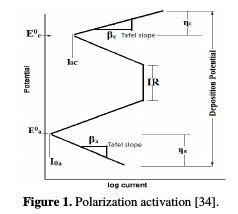
potential is expressed by the following equation (see also <a href="#f1">Fig. 1</a>).</p>


    ]]></body>
<body><![CDATA[<p>&nbsp;</p>
<a name="e1">
<img src="/img/revistas/pea/v36n5/36n5a01e1.jpg">
    
<p>&nbsp;</p>
<a name="f1">
<img src="/img/revistas/pea/v36n5/36n5a01f1.jpg">
    
<p>&nbsp;</p>


    <p>where Eeq is the equilibrium potential, &eta;act is the overvoltage due to the electrode
polarization, &eta;conc is the overvoltage due to concentration polarization or mass
transfer process by diffusion through the electrolyte, and IR is the current and the
resistance, respectively, due to the electrolyte resistance.</p>

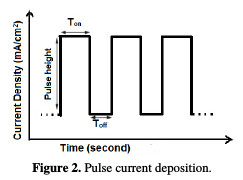
    <p>In the pulse current electrodeposition process, there are two important parameters
present, i.e., relaxation time (Toff) and pulse time (Ton), of which values can be
effectively optimized (<a href="#f2">Fig. 2</a>).</p>


    <p>&nbsp;</p>
<a name="f2">
<img src="/img/revistas/pea/v36n5/36n5a01f2.jpg">
    
<p>&nbsp;</p>


    <p>Each pulse consists of Ton, during which the
potential or the current is applied, and of Toff, during which the zero current is
applied. Hence, duty cycle may be expressed as: Ton/(Ton + Toff) = f.Ton, where f is the
pulse frequency [32, 33].</p>

    <p>The electrocatalytic activity and the surface morphology of the electrodeposited
nickel depend on several factors, such as electrolyte bath composition, deposition
potential, current density, time, temperature, additive, pH, etc. [28, 35-38].
Different electrolytic solutions, such as sulphate, chloride, boric acid, etc., are
used for nickel electrodeposition. Nickel sulphate increases the solution
conductivity, and determines the limiting cathode current density for producing a
fine nickel deposit. Nickel chloride enhances the solution conductivity, throwing
power and coating uniformity, whereas boric acid is used for buffer purposes, to
maintain the electrolyte's pH. The solution's pH was found to play an important
role on the crystallite size. A pH in the range of 4.6 to 5.0 has been established to
result in the finest crystallite size [30, 37]. Ebrahimi F. et al. [35], and Mustapha
Boubatra et al. [36] have reported that the deposit's grain size increases, due to a
reduction in the nucleation rate at a high pH. The higher is the nucleation rate
during deposition, the finer are the deposits' crystal grains.</p>

    <p>In the present paper, nickel was electro-chemically deposited on the copper foil
using direct current (DC) and pulse current (PC), varying depositing potential,
time, and temperature in acidic media. Nickel sulphate, nickel chloride and boric
acid solutions were used as electrolytes. The presence of electro deposited nickel
was confirmed by XRD, EDXA, and the coating surface morphology was
revealed by scanning electron microscope (SEM). Electrocatalytic activities of
the developed materials towards ethanol electro oxidation were characterized by
cyclic voltammetry (CV), chronoamperometry (CA), and potentiodynamic
polarization tests.</p>


    ]]></body>
<body><![CDATA[<p>&nbsp;</p>
    <p><b>Experimental</b></p>

    <p>A Cu-foil with the surface area of 1 &times;1 cm<sup>2</sup> was polished by emery papers,
degreased by acetone, washed in distilled water and dried. Electro depositions of
nickel (Ni) on copper were carried out by a DY 2300 potentiostat, using direct
current (DC) and pulse current (PC). For the nickel coating, the electrolyte
solution was 0.5 M NiCl2.6H2O, 0.25 M NiSO4.6H2O, and 0.5 M H3BO3. A pre-
selection of different coating potentials was done by a potentiodynamic test in
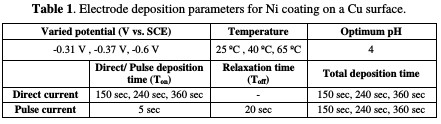
the depositing solution. The parameters for each test are shown in <a href="#t1">Table 1</a>.</p>


    <p>&nbsp;</p>
<a name="t1">
<img src="/img/revistas/pea/v36n5/36n5a01t1.jpg">
    
<p>&nbsp;</p>


    <p>The X-ray diffraction technique was carried out using Rigaku Ultima III X-ray
diffraction to map the crystalline structure and crystalline phase in each coated
surface. The test was done with the monochromatic Cu K&alpha; radiation at room
temperature, at a scan rate of 2 &deg;/ min. The crystallographic planes of X-ray
diffraction were obtained from the inbuilt software of the X-ray machine. The
surface morphology and particle distribution of the electrodeposited composite
coatings were performed by using a Scanning Electron Microscope (SEM)
(JEOL -JSM 6360). The presence of electrodeposited Ni particles was evaluated
by using EDXA fitted with a Scanning Electron Microscope (JEOL -JSM 6360).</p>


    <p><i>Electrochemical characterization</i></p>

    <p>The performance of the developed electro catalytic Ni-Cu coated sample by DC
and PC was done in 1 M KOH + 1 M ethanol solution, pH 13.1, by cyclic
voltammetry, chronoamperometry, and potentiodynamic polarization tests.
Cyclic voltammetry of the electroplated sample was performed in a computer
controlled electrochemical system machine, DY 2300 potentiostat, with a three-
electrode system. Potential was scanned from -1.3 V vs. SCE to 0.3 vs. SCE,
with a scan rate of 50 mV/second to find out Imax (current amplitude). Here,
graphite rod was taken as counter electrode, saturated calomel electrode as
reference electrode, and the test sample as working electrode.</p>

    <p>Chronoamperometry (I vs. t) was tested in the same machine with different
software. The experiment was carried out at different fixed potentials selected
around the ethanol oxidation potential, as shown in the <a href="#e1">equation (1)</a>. The current
(I) was monitored as a function of time (t), to find out for how long current was
delivered from the cell. The potentiodynamic polarization test was conducted
with a three-electrode system, as stated above, and the electro kinetic parameter,
exchange current density (I0), was determined from the polarization curve. The
potential was scanned between -1 V and 0.5 V vs. SCE, at a scan rate of 1
mV/second.</p>


    <p>&nbsp;</p>
    ]]></body>
<body><![CDATA[<p><b>Results and discussion</b></p>

    <p>The present investigation is aimed at developing high electrocatalytic Ni-Cu
electrodes by nickel electrodeposition from Ni-salt on Cu. The morphology of
the electrodeposited material is very important, as it decides the charge-discharge
reaction rate on fuel oxidation over the electrocatalytic material. The electro-
synthesized substrate morphology is strongly influenced by the deposition
potential and the current, along with the electrolyte chemistry. To understand and
find the electrodeposition potential effect on the electro catalytic properties, a
polarization experiment has been conducted using a Cu substrate in a Ni+2
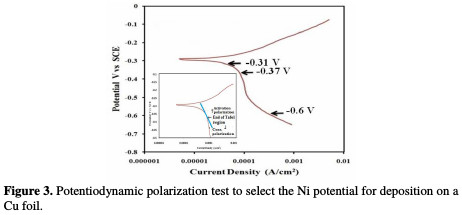
solution. Nickel is deposited in the curve's cathodic polarization region, as
shown in <a href="#f3">Fig. 3</a>.</p>


    <p>&nbsp;</p>
<a name="f3">
<img src="/img/revistas/pea/v36n5/36n5a01f3.jpg">
    
<p>&nbsp;</p>


    <p>Three preselected deposition potentials were: (i) before the start
of Tafel region, i.e., -0.31 V vs. SCE; (ii) at the end of Tafel region, i.e., -0.37 V
vs. SCE; and (iii) in the polarization concentration region or mass control
process, i.e., -0.6 V vs. SCE. The Tafel region has been magnified and shown
inside <a href="#f3">Fig. 3</a>. It is to be noted that the potential -0.31 V to -0.37 V is the charge
transfer process region (valid Tafel law), and the third potential (i.e., -0.6 V vs.
SCE) is the potential controlled by mass transfer. The electrodeposition has been
carried out by two techniques: direct current (DC) and pulse current (PC)
coating. During the direct current coating, if the process is mass controlled, then
the deposition may slow down, whenever the metal ions are not available in the
electrode surface vicinity. Thus, in pulse current coating technique, a time off
(Toff) is given, when the metal ions in the bulk take some time to diffuse through
the solution and reach the electrode surface. During Ton, the current is passed,
and the deposition is carried out; during Toff, the current is off, so that species
take more time to reach the electrode surface for deposition.</p>

    <p>Performance of electro-synthesized Ni-Cu by electrochemical techniques
Once the electrode has been synthesized by deposition techniques, it needs to be
electrochemically characterized in a fuel solution such as ethanol, to find how
well the Ni-Cu electro-catalytic material has been developed. The
electrochemical characterizations are done by cyclic voltammetry (CV),
chronoamperometry (CA) and potentiodynamic (PD) polarization tests, which
are discussed in the following section.</p>


    <p><i><b>Cyclic voltammetry study</b></i></p>

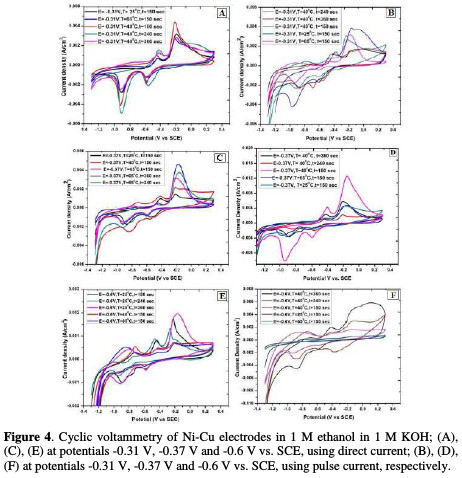
    <p>The cyclic voltammetry studies are shown in <a href="#f4">Fig. 4(A)</a> and <a href="#f4">4(B)</a>, for DC and PC
coating at potential of -0.31 V vs. SCE (see <a href="#f3">Fig. 3</a>), respectively.</p>


    <p>&nbsp;</p>
<a name="f4">
<img src="/img/revistas/pea/v36n5/36n5a01f4.jpg">
    
<p>&nbsp;</p>


    ]]></body>
<body><![CDATA[<p>The other variations are deposition time and temperature at the electrolyte fixed
chemistry. It is seen that, for the entire curve, there are current peaks around
some fixed potentials. However, the third current peak has been considered to be
due to fuel electro oxidation. The other peaks are due to the intermediate state of
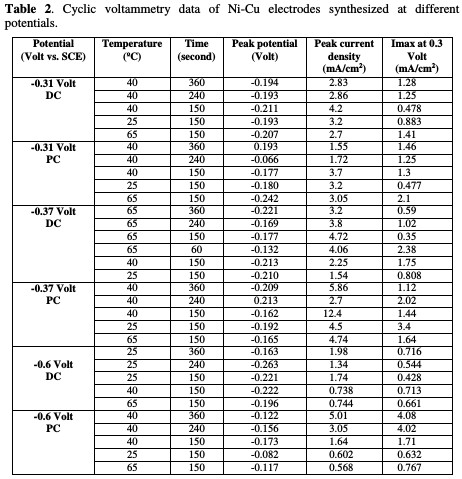
fuel electro oxidation. The values of current peaks under the electrodeposition
condition are shown in <a href="#t2">Table 2</a>.</p>


    <p>&nbsp;</p>
<a name="t2">
<img src="/img/revistas/pea/v36n5/36n5a01t2.jpg">
    
<p>&nbsp;</p>


    <p>Similar figures are given in 
<a href="#f4">4(C)</a>, <a href="#f4">4(D)</a>, <a href="#f4">4(E)</a> and <a href="#f4">4(F)</a> 
for the samples synthesized at the potentials of -0.37 V, -0.6 V vs. SCE,
using direct and pulse current coating, respectively. It is to be noted that there is a
strong deposition potential effect.</p>

    <p>It is seen that the potential of -0.37 V vs. SCE, which is right at the end of Tafel
region, has produced an electrodeposited Ni-Cu substrate that gives the highest
current density, keeping the temperature and deposition time fixed (<a href="#t2">Table 2</a>).</p>

    <p>This <a href="#t2">Table 2</a> shows that the sample electro synthesized at the end of Tafel region
potential (charge transfer oxidation) produces an electrocatalytic material of
superior quality, with the highest current density on the ethanol electro oxidation.
Of the two modes, direct and pulse current coating at the same potential, i.e.,
-0.37 V vs. SCE, it is seen that the electrode material produced by pulse coating
has given a much higher current of about 12.4 mA/cm<sup>2</sup>, compared to that of 2.25
mA/cm<sup>2</sup> in DC mode. Thus, as it produces a high energetic electrocatalytic
material, the pulse coating is stronger, and the deposition potential should be
preselected from the polarization curve at the end of Tafel region, in the
deposition solution.</p>

    <p>The temperature effect was found to be intermediate, when the current produced
by ethanol electrochemical oxidation was the highest. For example, at -0.31 V
vs. SCE, a sample deposited at 40 &deg;C gives much higher current than the samples
produced at higher or lower temperatures. The higher is the temperature, the
greater is the convective mass transfer that makes more M+ ions available at the
electrode surface. Secondly, at higher temperatures, the electrolyte conductivity
is high, so the polarization resistivity to deposition is low. However, at higher
temperatures, solids' electronic conductivity is low. Due to this, there may be
some decrease in electron charge density on the electrode surface, due to the
temperature rise.</p>


    <p><i><b>Chronoamperometry study</b></i></p>

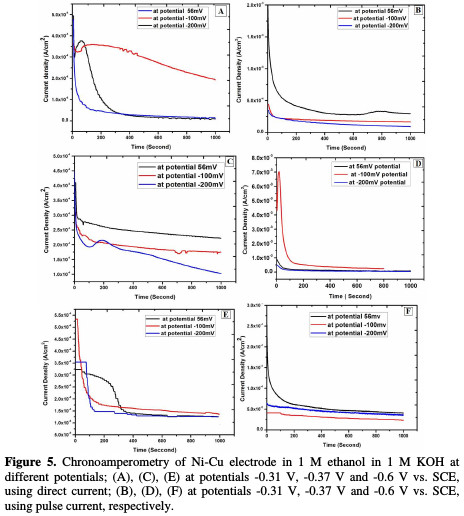
    <p>The variation of current with time (I vs. t), at a fixed potential on ethanol electro
oxidation, over that developed Ni-Cu electrode at three pre-selected electro
synthesized potentials (<a href="#f4">Fig. 4</a>), is shown in <a href="#f5">Fig. 5 (A-F)</a>.</p>


    <p>&nbsp;</p>
<a name="f5">
<img src="/img/revistas/pea/v36n5/36n5a01f5.jpg">
    
]]></body>
<body><![CDATA[<p>&nbsp;</p>


    <p>The studies were made
at different fixed potentials, i.e., 56 mV, -100 mV and -200 mV, which are near
the region of fuel oxidation potentials, as found by cyclic voltammetry. It is seen
that, in most of the curves, there is an initial drop of some current, after which a
steady state current is obtained. <a href="#f5">Fig. 5(A)</a>, <a href="#f5">5(C)</a> 
and <a href="#f5">5(E)</a> shows the electrodes produced
by direct current coating, whereas <a href="#f5">Fig. 5(B)</a>, <a href="#f5">5(D)</a> 
and <a href="#f5">5(F)</a> shows the ones produced
by pulse current at potentials -0.31 V, -0.37 V and -0.6 V, respectively.</p>

    <p>The steady state current obtained on the electrode surface produced by pulse current
has been found to be higher than the steady state current from the electrode
surface produced by direct current coating. For example, at -100 mV potential,
the steady state current is about 1 mA/cm<sup>2</sup> for pulse coated material at -0.37 V
vs. SCE, whereas for direct current coating, it is about 0.25 mA/cm<sup>2</sup> under
similar conditions. So, the chronoamperometry study also shows that electrodes
produced by pulse current have better electrocatalytic properties than the ones
produced by simple direct current coating.</p>


    <p><i><b>Potentiodynamic polarization study</b></i></p>

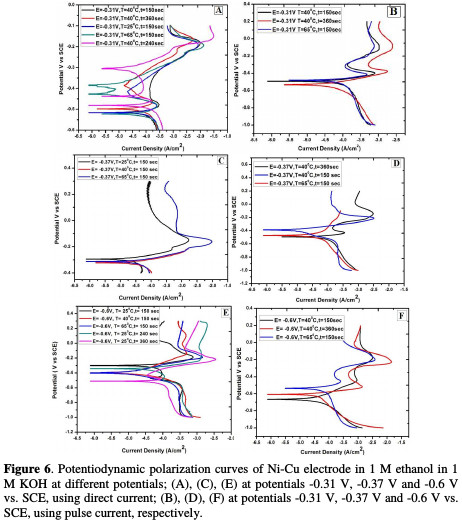
    <p>Potentiodynamic polarizations tests were also carried out for better understanding
the electrocatalytic properties of the produced electrode. These are shown in 
<a href="#f6">Fig. 6(A)</a>, <a href="#f6">6(C)</a> and <a href="#f6">6(E)</a> 
for direct current coating, and <a href="#f6">Fig. 6(B)</a>, <a href="#f6">6(D)</a> 
and <a href="#f6">6(F)</a> for pulse coated electrode
at potentials -0.31 V, -0.37 V and -0.6 V, respectively.</p>
    <p>&nbsp;</p>
<a name="f6">
<img src="/img/revistas/pea/v36n5/36n5a01f6.jpg">
    
<p>&nbsp;</p>
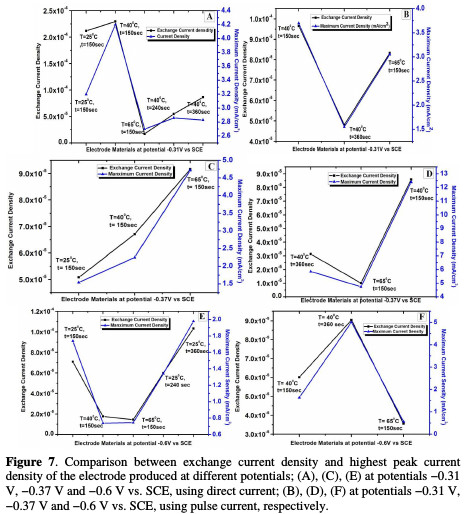
    <p>The computed electrokinetic data, such as exchange current density, which is
highly influenced by the morphology of the electrocatalytic substrate, are
illustrated in <a href="#f7">Fig. 7 (A-F)</a>.</p>


    <p>&nbsp;</p>
<a name="f7">
<img src="/img/revistas/pea/v36n5/36n5a01f7.jpg">
    
<p>&nbsp;</p>


    ]]></body>
<body><![CDATA[<p>From <a href="#f7">Fig. 7 (A-F)</a>, it is found that there is a direct
relation between exchange current density and maximum current density. It is
seen that the polarization data also support the results of cyclic voltammetry and
chronoamperometry studies. The highest exchange current density has been
obtained (<a href="#f7">Fig. 7 (D)</a>) for the electrode produced by pulse current electrode
potential at pre-selected -0.37 V vs. SCE.</p>

    <p>So, it can be concluded that the electrode surface morphology produced by
electrode deposition technique is influenced by the coating mode, direct current
or pulse current, as well as by the deposition potential. The best electrocatalytic
material can be produced by selecting a deposition potential on the cathodic
polarization curve of the material, to be electrodeposited in the solution, at a
point right at the end of the Tafel region.</p>


    <p><i><b>Material characterization</b></i></p>

    <p>For better understanding the effect of electrodeposition parameters, as studied in
the previous sections, the electrode materials were characterized by XRD,
EDXA, and the surface morphology was visualized under scanning electron
microscope (SEM).</p>

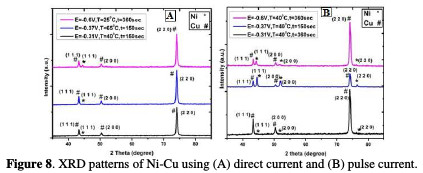
    <p><a href="#f8">Fig. 8 (A-B)</a> shows the XRD patterns of the electrodeposited Ni-Cu electrode,
using direct and pulse current coating.</p>


    <p>&nbsp;</p>
<a name="f8">
<img src="/img/revistas/pea/v36n5/36n5a01f8.jpg">
    
<p>&nbsp;</p>


    <p>It shows the presence of Cu and Ni in both
the figures. Cu acts as substrate, as well as electrode, and Ni purely acts as
electrode. That is why peak intensity for Cu is always higher than for Ni. The
effect of electrodeposition potentials' change from -0.31 V to -0.6 V vs. SCE is
clearly visible in XRD. According to Scherrer formula, the width of the peak is
inversely proportional to the grain size of the coated material. It is found that the
width of the Ni deposited in the pulse current coating is wider than in the direct
current.</p>


    <p><i><b>EDXA study</b></i></p>

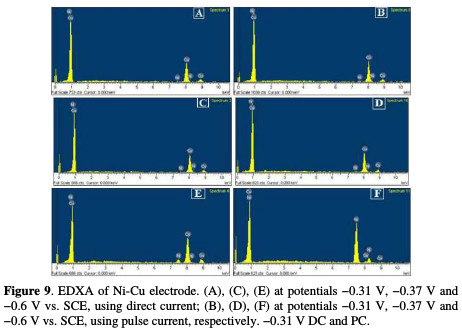
    <p><a href="#f9">Fig. 9 (A-F)</a> shows the EDXA of direct and pulse coated materials which exhibit
both the presence of Ni and Cu.</p>


    ]]></body>
<body><![CDATA[<p>&nbsp;</p>
<a name="f9">
<img src="/img/revistas/pea/v36n5/36n5a01f9.jpg">
    
<p>&nbsp;</p>


    <p>This suggests that Cu not only acts as current
collector, but also as electrode with Ni, in all the studies.</p>


    <p><i><b>SEM micrographs</b></i></p>

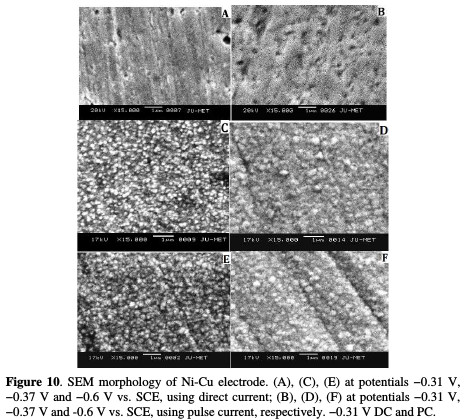
    <p>It is to be noted from SEM images (<a href="#f10">Fig. 10 (A-F)</a>) that the globular form of the
precipitation, which increases the effective surface area for electro oxidation, has
been enhanced with an increase in the coating deposition potential.</p>


    <p>&nbsp;</p>
<a name="f10">
<img src="/img/revistas/pea/v36n5/36n5a01f10.jpg">
    
<p>&nbsp;</p>


    <p>If the
morphologies of the coating deposited by direct coating and pulse coating are
compared, it is found that there are channels and recesses in between the grains
on the surface of the coated material deposited by pulse current coating, whereas
overall grain size of the direct current coating is somewhat smaller than to that
deposited by pulse coating. The current produced by ethanol electro oxidation on
the electro deposited electrode is strongly influenced by the amount of real
surface available at the atomic level. The more fine is the deposited grain, the
wider is the surface area for the charge-discharge reaction. At the same time, the
greater is the number of channels and inter-channels and recesses within the
grains, the higher is the area for the charge-discharge reaction, leading to higher
current delivery. It is thought that an increase in surface area, due to the
generation of channels and inter-channels in 3D, is much greater than the
increase in the area due to finer grain size. This may be the reason for obtaining a
higher current during ethanol electrochemical oxidation on the electrode surface,
produced by pulse current coating, than that produced by direct current coating.</p>


    <p>&nbsp;</p>
    <p><b>Conclusion</b></p>

    ]]></body>
<body><![CDATA[<p>From the foregoing results and discussion, it is found that Ni-Cu electrodes have
been successfully synthesized by direct and pulse current coating techniques for
ethanol electro oxidation. The surface morphology and electrocatalytic activity of
this electrode material are strongly influenced by the right selection of deposition
potential, as well as by the deposition mode, i.e., pulse current or direct current
coating and temperature. The current delivered by ethanol oxidation is much
higher over the electrodes, which is synthesized by pulse current at the
preselected deposition potential, just at the end of the Tafel region, compared to
the current produced over the electrodes by DC coating, under similar conditions.
Cu-Ni electrodeposited material synthesized by the pulse current technique has
produced a high energetic electrocatalytic material with high exchange current
density and the highest cell current.</p>


    <p>&nbsp;</p>
    <p><b>References</b></p>

    <!-- ref --><p>1. Parson Inc. Fuel cell handbook. West Virginia: US Dept Energy; 2000.    &nbsp;&nbsp;&nbsp;&nbsp;&nbsp;&nbsp;&nbsp;&nbsp;[&#160;<a href="javascript:void(0);" onclick="javascript: window.open('/scielo.php?script=sci_nlinks&ref=435719&pid=S0872-1904201800050000100001&lng=','','width=640,height=500,resizable=yes,scrollbars=1,menubar=yes,');">Links</a>&#160;]<!-- end-ref --></p>

    <!-- ref --><p>2. Xu C, Shen PK, Liu Y. J Power Sources. 2007;164:527.    &nbsp;&nbsp;&nbsp;&nbsp;&nbsp;&nbsp;&nbsp;&nbsp;[&#160;<a href="javascript:void(0);" onclick="javascript: window.open('/scielo.php?script=sci_nlinks&ref=435721&pid=S0872-1904201800050000100002&lng=','','width=640,height=500,resizable=yes,scrollbars=1,menubar=yes,');">Links</a>&#160;]<!-- end-ref --></p>

    <!-- ref --><p>3. Andreadis G, Song SQ, Tsiakaras P. J Power Sources. 2006;157:657.    &nbsp;&nbsp;&nbsp;&nbsp;&nbsp;&nbsp;&nbsp;&nbsp;[&#160;<a href="javascript:void(0);" onclick="javascript: window.open('/scielo.php?script=sci_nlinks&ref=435723&pid=S0872-1904201800050000100003&lng=','','width=640,height=500,resizable=yes,scrollbars=1,menubar=yes,');">Links</a>&#160;]<!-- end-ref --></p>

    <!-- ref --><p>4. Rousseau S, Coutanceau C, Lamy C, et al. J Power Sources. 2006;158:18.    &nbsp;&nbsp;&nbsp;&nbsp;&nbsp;&nbsp;&nbsp;&nbsp;[&#160;<a href="javascript:void(0);" onclick="javascript: window.open('/scielo.php?script=sci_nlinks&ref=435725&pid=S0872-1904201800050000100004&lng=','','width=640,height=500,resizable=yes,scrollbars=1,menubar=yes,');">Links</a>&#160;]<!-- end-ref --></p>

    <!-- ref --><p>5. Wang ZB, Yin GP, Zhang J, et al. J. Power Sources. 2006;160:37.    &nbsp;&nbsp;&nbsp;&nbsp;&nbsp;&nbsp;&nbsp;&nbsp;[&#160;<a href="javascript:void(0);" onclick="javascript: window.open('/scielo.php?script=sci_nlinks&ref=435727&pid=S0872-1904201800050000100005&lng=','','width=640,height=500,resizable=yes,scrollbars=1,menubar=yes,');">Links</a>&#160;]<!-- end-ref --></p>

    <!-- ref --><p>6. Song SQ, Tsiakaras T. Appl Catalysis B: Environ. 2006;63:187.    &nbsp;&nbsp;&nbsp;&nbsp;&nbsp;&nbsp;&nbsp;&nbsp;[&#160;<a href="javascript:void(0);" onclick="javascript: window.open('/scielo.php?script=sci_nlinks&ref=435729&pid=S0872-1904201800050000100006&lng=','','width=640,height=500,resizable=yes,scrollbars=1,menubar=yes,');">Links</a>&#160;]<!-- end-ref --></p>

    <!-- ref --><p>7. Paul S. J Fuel Cell Sci. Technol. 2012;9:021013.    &nbsp;&nbsp;&nbsp;&nbsp;&nbsp;&nbsp;&nbsp;&nbsp;[&#160;<a href="javascript:void(0);" onclick="javascript: window.open('/scielo.php?script=sci_nlinks&ref=435731&pid=S0872-1904201800050000100007&lng=','','width=640,height=500,resizable=yes,scrollbars=1,menubar=yes,');">Links</a>&#160;]<!-- end-ref --></p>

    <!-- ref --><p>8. Guchhait SK, Paul S. Int J Renew Energy Research. 2016;6:723.    &nbsp;&nbsp;&nbsp;&nbsp;&nbsp;&nbsp;&nbsp;&nbsp;[&#160;<a href="javascript:void(0);" onclick="javascript: window.open('/scielo.php?script=sci_nlinks&ref=435733&pid=S0872-1904201800050000100008&lng=','','width=640,height=500,resizable=yes,scrollbars=1,menubar=yes,');">Links</a>&#160;]<!-- end-ref --></p>

    <!-- ref --><p>9. Guchhait SK, Paul S. J Electrochem Sci Technol. 2016;7:190.    &nbsp;&nbsp;&nbsp;&nbsp;&nbsp;&nbsp;&nbsp;&nbsp;[&#160;<a href="javascript:void(0);" onclick="javascript: window.open('/scielo.php?script=sci_nlinks&ref=435735&pid=S0872-1904201800050000100009&lng=','','width=640,height=500,resizable=yes,scrollbars=1,menubar=yes,');">Links</a>&#160;]<!-- end-ref --></p>

    <!-- ref --><p>10. Hu F, Chen C, Wang Z, et al. Electrochem Acta. 2006;52:1087.    &nbsp;&nbsp;&nbsp;&nbsp;&nbsp;&nbsp;&nbsp;&nbsp;[&#160;<a href="javascript:void(0);" onclick="javascript: window.open('/scielo.php?script=sci_nlinks&ref=435737&pid=S0872-1904201800050000100010&lng=','','width=640,height=500,resizable=yes,scrollbars=1,menubar=yes,');">Links</a>&#160;]<!-- end-ref --></p>

    <!-- ref --><p>11. Shen SY, Zhao TS, Xu JB, et al. J Power Sources. 2010;195:1001.    &nbsp;&nbsp;&nbsp;&nbsp;&nbsp;&nbsp;&nbsp;&nbsp;[&#160;<a href="javascript:void(0);" onclick="javascript: window.open('/scielo.php?script=sci_nlinks&ref=435739&pid=S0872-1904201800050000100011&lng=','','width=640,height=500,resizable=yes,scrollbars=1,menubar=yes,');">Links</a>&#160;]<!-- end-ref --></p>

    <!-- ref --><p>12. Paul S. Nanomater Energy. 2015;4:80.    &nbsp;&nbsp;&nbsp;&nbsp;&nbsp;&nbsp;&nbsp;&nbsp;[&#160;<a href="javascript:void(0);" onclick="javascript: window.open('/scielo.php?script=sci_nlinks&ref=435741&pid=S0872-1904201800050000100012&lng=','','width=640,height=500,resizable=yes,scrollbars=1,menubar=yes,');">Links</a>&#160;]<!-- end-ref --></p>

    <!-- ref --><p>13. Huang J-J, Hwang W-S, Weng Y-C, et al. 2009;50:1139.    &nbsp;&nbsp;&nbsp;&nbsp;&nbsp;&nbsp;&nbsp;&nbsp;[&#160;<a href="javascript:void(0);" onclick="javascript: window.open('/scielo.php?script=sci_nlinks&ref=435743&pid=S0872-1904201800050000100013&lng=','','width=640,height=500,resizable=yes,scrollbars=1,menubar=yes,');">Links</a>&#160;]<!-- end-ref --></p>

    <!-- ref --><p>14. Scibioh MA, Kim S-K, Cho EA, et al. Appl Catalysis B: Environ. 2008;84:773.    &nbsp;&nbsp;&nbsp;&nbsp;&nbsp;&nbsp;&nbsp;&nbsp;[&#160;<a href="javascript:void(0);" onclick="javascript: window.open('/scielo.php?script=sci_nlinks&ref=435745&pid=S0872-1904201800050000100014&lng=','','width=640,height=500,resizable=yes,scrollbars=1,menubar=yes,');">Links</a>&#160;]<!-- end-ref --></p>

    <!-- ref --><p>15. Wang X-Y, Zhang J-C, Cao X-D, et al. Int J Minerals, Metallurgy Mater. 2011;18:594.    &nbsp;&nbsp;&nbsp;&nbsp;&nbsp;&nbsp;&nbsp;&nbsp;[&#160;<a href="javascript:void(0);" onclick="javascript: window.open('/scielo.php?script=sci_nlinks&ref=435747&pid=S0872-1904201800050000100015&lng=','','width=640,height=500,resizable=yes,scrollbars=1,menubar=yes,');">Links</a>&#160;]<!-- end-ref --></p>

    <!-- ref --><p>16. Paul S, Naimuddin SK. J Fuel Chem Technol. 2015;12:011007.    &nbsp;&nbsp;&nbsp;&nbsp;&nbsp;&nbsp;&nbsp;&nbsp;[&#160;<a href="javascript:void(0);" onclick="javascript: window.open('/scielo.php?script=sci_nlinks&ref=435749&pid=S0872-1904201800050000100016&lng=','','width=640,height=500,resizable=yes,scrollbars=1,menubar=yes,');">Links</a>&#160;]<!-- end-ref --></p>

    <!-- ref --><p>17. Singh RN, Singh A, Anindita. Carbon. 2009;47:271.    &nbsp;&nbsp;&nbsp;&nbsp;&nbsp;&nbsp;&nbsp;&nbsp;[&#160;<a href="javascript:void(0);" onclick="javascript: window.open('/scielo.php?script=sci_nlinks&ref=435751&pid=S0872-1904201800050000100017&lng=','','width=640,height=500,resizable=yes,scrollbars=1,menubar=yes,');">Links</a>&#160;]<!-- end-ref --></p>

    <!-- ref --><p>18. Lamy C, Lima A, Rhun VL, et al. J. Power Sources. 2002;105:283.    &nbsp;&nbsp;&nbsp;&nbsp;&nbsp;&nbsp;&nbsp;&nbsp;[&#160;<a href="javascript:void(0);" onclick="javascript: window.open('/scielo.php?script=sci_nlinks&ref=435753&pid=S0872-1904201800050000100018&lng=','','width=640,height=500,resizable=yes,scrollbars=1,menubar=yes,');">Links</a>&#160;]<!-- end-ref --></p>

    <!-- ref --><p>19. Guchhait SK, Paul S. J Fuel Chem Technol. 2015;43:1004.    &nbsp;&nbsp;&nbsp;&nbsp;&nbsp;&nbsp;&nbsp;&nbsp;[&#160;<a href="javascript:void(0);" onclick="javascript: window.open('/scielo.php?script=sci_nlinks&ref=435755&pid=S0872-1904201800050000100019&lng=','','width=640,height=500,resizable=yes,scrollbars=1,menubar=yes,');">Links</a>&#160;]<!-- end-ref --></p>

    <!-- ref --><p>20. Paul S, Ghosh A. J Fuel Chem Technol. 2015;43:344.    &nbsp;&nbsp;&nbsp;&nbsp;&nbsp;&nbsp;&nbsp;&nbsp;[&#160;<a href="javascript:void(0);" onclick="javascript: window.open('/scielo.php?script=sci_nlinks&ref=435757&pid=S0872-1904201800050000100020&lng=','','width=640,height=500,resizable=yes,scrollbars=1,menubar=yes,');">Links</a>&#160;]<!-- end-ref --></p>

    <!-- ref --><p>21. Paul S, Chatterjee R. Namomater Energy. 2015;3:1.    &nbsp;&nbsp;&nbsp;&nbsp;&nbsp;&nbsp;&nbsp;&nbsp;[&#160;<a href="javascript:void(0);" onclick="javascript: window.open('/scielo.php?script=sci_nlinks&ref=435759&pid=S0872-1904201800050000100021&lng=','','width=640,height=500,resizable=yes,scrollbars=1,menubar=yes,');">Links</a>&#160;]<!-- end-ref --></p>

    <!-- ref --><p>22. Hamdan MS, Nordin N, Amir SFM, et al. Sains Malaysiana. 2011;40:1421.    &nbsp;&nbsp;&nbsp;&nbsp;&nbsp;&nbsp;&nbsp;&nbsp;[&#160;<a href="javascript:void(0);" onclick="javascript: window.open('/scielo.php?script=sci_nlinks&ref=435761&pid=S0872-1904201800050000100022&lng=','','width=640,height=500,resizable=yes,scrollbars=1,menubar=yes,');">Links</a>&#160;]<!-- end-ref --></p>

    <!-- ref --><p>23. Jafarian M, Mahjani MG, Heli H, et al. Electrochem Comm. 2003;5:184.    &nbsp;&nbsp;&nbsp;&nbsp;&nbsp;&nbsp;&nbsp;&nbsp;[&#160;<a href="javascript:void(0);" onclick="javascript: window.open('/scielo.php?script=sci_nlinks&ref=435763&pid=S0872-1904201800050000100023&lng=','','width=640,height=500,resizable=yes,scrollbars=1,menubar=yes,');">Links</a>&#160;]<!-- end-ref --></p>

    <!-- ref --><p>24. Yi Q, Zhang J, Huang W, Liu X. Catalysis Comm. 2007;8:1017.    &nbsp;&nbsp;&nbsp;&nbsp;&nbsp;&nbsp;&nbsp;&nbsp;[&#160;<a href="javascript:void(0);" onclick="javascript: window.open('/scielo.php?script=sci_nlinks&ref=435765&pid=S0872-1904201800050000100024&lng=','','width=640,height=500,resizable=yes,scrollbars=1,menubar=yes,');">Links</a>&#160;]<!-- end-ref --></p>

    <!-- ref --><p>25. Mikolajczyk T, Turemko M, Pierozynski B. Polish J Chem Technol. 2015;17:47.    &nbsp;&nbsp;&nbsp;&nbsp;&nbsp;&nbsp;&nbsp;&nbsp;[&#160;<a href="javascript:void(0);" onclick="javascript: window.open('/scielo.php?script=sci_nlinks&ref=435767&pid=S0872-1904201800050000100025&lng=','','width=640,height=500,resizable=yes,scrollbars=1,menubar=yes,');">Links</a>&#160;]<!-- end-ref --></p>

    <!-- ref --><p>26. Riyanto, Othman MR, Salimon J. ASEAN J Sci Technol Develop. 2008;25:363.    &nbsp;&nbsp;&nbsp;&nbsp;&nbsp;&nbsp;&nbsp;&nbsp;[&#160;<a href="javascript:void(0);" onclick="javascript: window.open('/scielo.php?script=sci_nlinks&ref=435769&pid=S0872-1904201800050000100026&lng=','','width=640,height=500,resizable=yes,scrollbars=1,menubar=yes,');">Links</a>&#160;]<!-- end-ref --></p>

    <!-- ref --><p>27. Fleishmann M, Korinek K, Pletcher KD. J Electroanal Chem. 1971;31:39.    &nbsp;&nbsp;&nbsp;&nbsp;&nbsp;&nbsp;&nbsp;&nbsp;[&#160;<a href="javascript:void(0);" onclick="javascript: window.open('/scielo.php?script=sci_nlinks&ref=435771&pid=S0872-1904201800050000100027&lng=','','width=640,height=500,resizable=yes,scrollbars=1,menubar=yes,');">Links</a>&#160;]<!-- end-ref --></p>

    <!-- ref --><p>28. Sadiku-Agboola O, Sadiku ER, Ojo OI, et al. Port Electrochim Acta. 2011;29:91.    &nbsp;&nbsp;&nbsp;&nbsp;&nbsp;&nbsp;&nbsp;&nbsp;[&#160;<a href="javascript:void(0);" onclick="javascript: window.open('/scielo.php?script=sci_nlinks&ref=435773&pid=S0872-1904201800050000100028&lng=','','width=640,height=500,resizable=yes,scrollbars=1,menubar=yes,');">Links</a>&#160;]<!-- end-ref --></p>

    <!-- ref --><p>29. Aperador Chaparro WA, Lopez EV. Revista MatÃ©ria. 2007;12:583.    &nbsp;&nbsp;&nbsp;&nbsp;&nbsp;&nbsp;&nbsp;&nbsp;[&#160;<a href="javascript:void(0);" onclick="javascript: window.open('/scielo.php?script=sci_nlinks&ref=435775&pid=S0872-1904201800050000100029&lng=','','width=640,height=500,resizable=yes,scrollbars=1,menubar=yes,');">Links</a>&#160;]<!-- end-ref --></p>

    <!-- ref --><p>30. Glenn MO. J Electrochem. 1997;45:136.    &nbsp;&nbsp;&nbsp;&nbsp;&nbsp;&nbsp;&nbsp;&nbsp;[&#160;<a href="javascript:void(0);" onclick="javascript: window.open('/scielo.php?script=sci_nlinks&ref=435777&pid=S0872-1904201800050000100030&lng=','','width=640,height=500,resizable=yes,scrollbars=1,menubar=yes,');">Links</a>&#160;]<!-- end-ref --></p>

    <!-- ref --><p>31. Jelena BB. J Univ Belgrade. 2002;2:32.    &nbsp;&nbsp;&nbsp;&nbsp;&nbsp;&nbsp;&nbsp;&nbsp;[&#160;<a href="javascript:void(0);" onclick="javascript: window.open('/scielo.php?script=sci_nlinks&ref=435779&pid=S0872-1904201800050000100031&lng=','','width=640,height=500,resizable=yes,scrollbars=1,menubar=yes,');">Links</a>&#160;]<!-- end-ref --></p>

    <!-- ref --><p>32. Jegan A, Venkatesan R. Int J Minerals, Metallurgy, Mater. 2013;20:479.    &nbsp;&nbsp;&nbsp;&nbsp;&nbsp;&nbsp;&nbsp;&nbsp;[&#160;<a href="javascript:void(0);" onclick="javascript: window.open('/scielo.php?script=sci_nlinks&ref=435781&pid=S0872-1904201800050000100032&lng=','','width=640,height=500,resizable=yes,scrollbars=1,menubar=yes,');">Links</a>&#160;]<!-- end-ref --></p>

    <!-- ref --><p>33. Chandrasekar MS, Pushpavanam M. Electrochim Acta. 2008;53:3313.    &nbsp;&nbsp;&nbsp;&nbsp;&nbsp;&nbsp;&nbsp;&nbsp;[&#160;<a href="javascript:void(0);" onclick="javascript: window.open('/scielo.php?script=sci_nlinks&ref=435783&pid=S0872-1904201800050000100033&lng=','','width=640,height=500,resizable=yes,scrollbars=1,menubar=yes,');">Links</a>&#160;]<!-- end-ref --></p>

    <!-- ref --><p>34. Paul S. Electrochemical energy synthesis and storage in battery and fuel cell. kindle publication; 2016.    &nbsp;&nbsp;&nbsp;&nbsp;&nbsp;&nbsp;&nbsp;&nbsp;[&#160;<a href="javascript:void(0);" onclick="javascript: window.open('/scielo.php?script=sci_nlinks&ref=435785&pid=S0872-1904201800050000100034&lng=','','width=640,height=500,resizable=yes,scrollbars=1,menubar=yes,');">Links</a>&#160;]<!-- end-ref --></p>

    <!-- ref --><p>35. Ebrahimi F, Ahmed Z. J Appl Electrochem. 2003;33:733.    &nbsp;&nbsp;&nbsp;&nbsp;&nbsp;&nbsp;&nbsp;&nbsp;[&#160;<a href="javascript:void(0);" onclick="javascript: window.open('/scielo.php?script=sci_nlinks&ref=435787&pid=S0872-1904201800050000100035&lng=','','width=640,height=500,resizable=yes,scrollbars=1,menubar=yes,');">Links</a>&#160;]<!-- end-ref --></p>

    <!-- ref --><p>36. Boubatra M, Azizi A, Schmerber G, et al. Ionics. 2012;18:425.    &nbsp;&nbsp;&nbsp;&nbsp;&nbsp;&nbsp;&nbsp;&nbsp;[&#160;<a href="javascript:void(0);" onclick="javascript: window.open('/scielo.php?script=sci_nlinks&ref=435789&pid=S0872-1904201800050000100036&lng=','','width=640,height=500,resizable=yes,scrollbars=1,menubar=yes,');">Links</a>&#160;]<!-- end-ref --></p>

    <!-- ref --><p>37. Rashidi AM, Amadeh A. J Mater Sci Technol. 2010;26:82.    &nbsp;&nbsp;&nbsp;&nbsp;&nbsp;&nbsp;&nbsp;&nbsp;[&#160;<a href="javascript:void(0);" onclick="javascript: window.open('/scielo.php?script=sci_nlinks&ref=435791&pid=S0872-1904201800050000100037&lng=','','width=640,height=500,resizable=yes,scrollbars=1,menubar=yes,');">Links</a>&#160;]<!-- end-ref --></p>

    <!-- ref --><p>38. Erb U. Nanostructured Mater. 1995;6:533-538.    &nbsp;&nbsp;&nbsp;&nbsp;&nbsp;&nbsp;&nbsp;&nbsp;[&#160;<a href="javascript:void(0);" onclick="javascript: window.open('/scielo.php?script=sci_nlinks&ref=435793&pid=S0872-1904201800050000100038&lng=','','width=640,height=500,resizable=yes,scrollbars=1,menubar=yes,');">Links</a>&#160;]<!-- end-ref --></p>


    <p>&nbsp;</p>
    ]]></body>
<body><![CDATA[<p><b>Acknowledgements</b></p>

    <p>The authors would like to acknowledge ''TEQIP, COE Phase II'', in Jadavpur
University, for supporting this work.</p>


    <p>&nbsp;</p>
    <p><a name=0></a><sup><a href="#top">*</a></sup>Corresponding author. E-mail address: <a href="mailto:sujitguchhait.chem@gmail.com">sujitguchhait.chem@gmail.com</a></p>

    <p>Received February 22, 2017; accepted September 2, 2017</p>

    <p><a href="http://www.peacta.org" target="_blank">www.peacta.org</a> </p>


     ]]></body><back>
<ref-list>
<ref id="B1">
<label>1</label><nlm-citation citation-type="book">
<collab>Parson Inc</collab>
<source><![CDATA[Fuel cell handbook]]></source>
<year>2000</year>
<publisher-loc><![CDATA[West Virginia ]]></publisher-loc>
<publisher-name><![CDATA[US Dept Energy]]></publisher-name>
</nlm-citation>
</ref>
<ref id="B2">
<label>2</label><nlm-citation citation-type="journal">
<person-group person-group-type="author">
<name>
<surname><![CDATA[Xu]]></surname>
<given-names><![CDATA[C]]></given-names>
</name>
<name>
<surname><![CDATA[Shen]]></surname>
<given-names><![CDATA[P K]]></given-names>
</name>
<name>
<surname><![CDATA[Liu]]></surname>
<given-names><![CDATA[Y]]></given-names>
</name>
</person-group>
<source><![CDATA[J Power Sources]]></source>
<year>2007</year>
<volume>164</volume>
<page-range>527</page-range></nlm-citation>
</ref>
<ref id="B3">
<label>3</label><nlm-citation citation-type="journal">
<person-group person-group-type="author">
<name>
<surname><![CDATA[Andreadis]]></surname>
<given-names><![CDATA[G]]></given-names>
</name>
<name>
<surname><![CDATA[Song]]></surname>
<given-names><![CDATA[S Q]]></given-names>
</name>
<name>
<surname><![CDATA[Tsiakaras]]></surname>
<given-names><![CDATA[P]]></given-names>
</name>
</person-group>
<source><![CDATA[J Power Sources]]></source>
<year>2006</year>
<volume>157</volume>
<page-range>657</page-range></nlm-citation>
</ref>
<ref id="B4">
<label>4</label><nlm-citation citation-type="journal">
<person-group person-group-type="author">
<name>
<surname><![CDATA[Rousseau]]></surname>
<given-names><![CDATA[S]]></given-names>
</name>
<name>
<surname><![CDATA[Coutanceau]]></surname>
<given-names><![CDATA[C]]></given-names>
</name>
<name>
<surname><![CDATA[Lamy]]></surname>
<given-names><![CDATA[C]]></given-names>
</name>
</person-group>
<source><![CDATA[J Power Sources]]></source>
<year>2006</year>
<volume>158</volume>
<page-range>18</page-range></nlm-citation>
</ref>
<ref id="B5">
<label>5</label><nlm-citation citation-type="journal">
<person-group person-group-type="author">
<name>
<surname><![CDATA[Wang]]></surname>
<given-names><![CDATA[Z B]]></given-names>
</name>
<name>
<surname><![CDATA[Yin]]></surname>
<given-names><![CDATA[G P]]></given-names>
</name>
<name>
<surname><![CDATA[Zhang]]></surname>
<given-names><![CDATA[J]]></given-names>
</name>
</person-group>
<source><![CDATA[J. Power Sources]]></source>
<year>2006</year>
<volume>160</volume>
<page-range>37</page-range></nlm-citation>
</ref>
<ref id="B6">
<label>6</label><nlm-citation citation-type="journal">
<person-group person-group-type="author">
<name>
<surname><![CDATA[Song]]></surname>
<given-names><![CDATA[S Q]]></given-names>
</name>
<name>
<surname><![CDATA[Tsiakaras]]></surname>
<given-names><![CDATA[T]]></given-names>
</name>
</person-group>
<source><![CDATA[Appl Catalysis B: Environ]]></source>
<year>2006</year>
<volume>63</volume>
<page-range>187</page-range></nlm-citation>
</ref>
<ref id="B7">
<label>7</label><nlm-citation citation-type="journal">
<person-group person-group-type="author">
<name>
<surname><![CDATA[Paul]]></surname>
<given-names><![CDATA[S]]></given-names>
</name>
</person-group>
<source><![CDATA[J Fuel Cell Sci. Technol]]></source>
<year>2012</year>
</nlm-citation>
</ref>
<ref id="B8">
<label>8</label><nlm-citation citation-type="journal">
<person-group person-group-type="author">
<name>
<surname><![CDATA[Guchhait]]></surname>
<given-names><![CDATA[S K]]></given-names>
</name>
<name>
<surname><![CDATA[Paul]]></surname>
<given-names><![CDATA[S]]></given-names>
</name>
</person-group>
<source><![CDATA[Int J Renew Energy Research]]></source>
<year>2016</year>
<volume>6</volume>
<page-range>723</page-range></nlm-citation>
</ref>
<ref id="B9">
<label>9</label><nlm-citation citation-type="journal">
<person-group person-group-type="author">
<name>
<surname><![CDATA[Guchhait]]></surname>
<given-names><![CDATA[S K]]></given-names>
</name>
<name>
<surname><![CDATA[Paul]]></surname>
<given-names><![CDATA[S]]></given-names>
</name>
</person-group>
<source><![CDATA[J Electrochem Sci Technol]]></source>
<year>2016</year>
<volume>7</volume>
<page-range>190</page-range></nlm-citation>
</ref>
<ref id="B10">
<label>10</label><nlm-citation citation-type="journal">
<person-group person-group-type="author">
<name>
<surname><![CDATA[Hu]]></surname>
<given-names><![CDATA[F]]></given-names>
</name>
<name>
<surname><![CDATA[Chen]]></surname>
<given-names><![CDATA[C]]></given-names>
</name>
<name>
<surname><![CDATA[Wang]]></surname>
<given-names><![CDATA[Z]]></given-names>
</name>
</person-group>
<source><![CDATA[Electrochem Acta]]></source>
<year>2006</year>
<volume>52</volume>
<page-range>1087</page-range></nlm-citation>
</ref>
<ref id="B11">
<label>11</label><nlm-citation citation-type="journal">
<person-group person-group-type="author">
<name>
<surname><![CDATA[Shen]]></surname>
<given-names><![CDATA[S Y]]></given-names>
</name>
<name>
<surname><![CDATA[Zhao]]></surname>
<given-names><![CDATA[T S]]></given-names>
</name>
<name>
<surname><![CDATA[Xu]]></surname>
<given-names><![CDATA[J B]]></given-names>
</name>
</person-group>
<source><![CDATA[J Power Sources]]></source>
<year>2010</year>
<volume>195</volume>
<page-range>1001</page-range></nlm-citation>
</ref>
<ref id="B12">
<label>12</label><nlm-citation citation-type="journal">
<person-group person-group-type="author">
<name>
<surname><![CDATA[Paul]]></surname>
<given-names><![CDATA[S]]></given-names>
</name>
</person-group>
<source><![CDATA[Nanomater Energy]]></source>
<year>2015</year>
<volume>4</volume>
<page-range>80</page-range></nlm-citation>
</ref>
<ref id="B13">
<label>13</label><nlm-citation citation-type="">
<person-group person-group-type="author">
<name>
<surname><![CDATA[Huang]]></surname>
<given-names><![CDATA[J-J]]></given-names>
</name>
<name>
<surname><![CDATA[Hwang]]></surname>
<given-names><![CDATA[W-S]]></given-names>
</name>
<name>
<surname><![CDATA[Weng]]></surname>
<given-names><![CDATA[Y-C]]></given-names>
</name>
</person-group>
<source><![CDATA[]]></source>
<year>2009</year>
<volume>50</volume>
<page-range>1139</page-range></nlm-citation>
</ref>
<ref id="B14">
<label>14</label><nlm-citation citation-type="journal">
<person-group person-group-type="author">
<name>
<surname><![CDATA[Scibioh]]></surname>
<given-names><![CDATA[M A]]></given-names>
</name>
<name>
<surname><![CDATA[Kim]]></surname>
<given-names><![CDATA[S-K]]></given-names>
</name>
<name>
<surname><![CDATA[Cho]]></surname>
<given-names><![CDATA[E A]]></given-names>
</name>
</person-group>
<source><![CDATA[Appl Catalysis B: Environ]]></source>
<year>2008</year>
<volume>84</volume>
<page-range>773</page-range></nlm-citation>
</ref>
<ref id="B15">
<label>15</label><nlm-citation citation-type="journal">
<person-group person-group-type="author">
<name>
<surname><![CDATA[Wang]]></surname>
<given-names><![CDATA[X-Y]]></given-names>
</name>
<name>
<surname><![CDATA[Zhang]]></surname>
<given-names><![CDATA[J-C]]></given-names>
</name>
<name>
<surname><![CDATA[Cao]]></surname>
<given-names><![CDATA[X-D]]></given-names>
</name>
</person-group>
<source><![CDATA[Int J Minerals, Metallurgy Mater]]></source>
<year>2011</year>
<volume>18</volume>
<page-range>594</page-range></nlm-citation>
</ref>
<ref id="B16">
<label>16</label><nlm-citation citation-type="journal">
<person-group person-group-type="author">
<name>
<surname><![CDATA[Paul]]></surname>
<given-names><![CDATA[S]]></given-names>
</name>
<name>
<surname><![CDATA[Naimuddin]]></surname>
<given-names><![CDATA[S K]]></given-names>
</name>
</person-group>
<source><![CDATA[J Fuel Chem Techno]]></source>
<year>2015</year>
<volume>12</volume>
<page-range>011007</page-range></nlm-citation>
</ref>
<ref id="B17">
<label>17</label><nlm-citation citation-type="journal">
<person-group person-group-type="author">
<name>
<surname><![CDATA[Singh]]></surname>
<given-names><![CDATA[R N]]></given-names>
</name>
<name>
<surname><![CDATA[Singh]]></surname>
<given-names><![CDATA[A]]></given-names>
</name>
<name>
<surname><![CDATA[Anindita]]></surname>
</name>
</person-group>
<source><![CDATA[Carbon]]></source>
<year>2009</year>
<volume>47</volume>
<page-range>271</page-range></nlm-citation>
</ref>
<ref id="B18">
<label>18</label><nlm-citation citation-type="journal">
<person-group person-group-type="author">
<name>
<surname><![CDATA[Lamy]]></surname>
<given-names><![CDATA[C]]></given-names>
</name>
<name>
<surname><![CDATA[Lima]]></surname>
<given-names><![CDATA[A]]></given-names>
</name>
<name>
<surname><![CDATA[Rhun]]></surname>
<given-names><![CDATA[V L]]></given-names>
</name>
</person-group>
<source><![CDATA[J. Power Sources]]></source>
<year>2002</year>
<volume>105</volume>
<page-range>283</page-range></nlm-citation>
</ref>
<ref id="B19">
<label>19</label><nlm-citation citation-type="journal">
<person-group person-group-type="author">
<name>
<surname><![CDATA[Guchhait]]></surname>
<given-names><![CDATA[S K]]></given-names>
</name>
<name>
<surname><![CDATA[Paul]]></surname>
<given-names><![CDATA[S]]></given-names>
</name>
</person-group>
<source><![CDATA[J Fuel Chem Technol]]></source>
<year>2015</year>
<volume>43</volume>
<page-range>1004</page-range></nlm-citation>
</ref>
<ref id="B20">
<label>20</label><nlm-citation citation-type="journal">
<person-group person-group-type="author">
<name>
<surname><![CDATA[Paul]]></surname>
<given-names><![CDATA[S]]></given-names>
</name>
<name>
<surname><![CDATA[Ghosh]]></surname>
<given-names><![CDATA[A]]></given-names>
</name>
</person-group>
<source><![CDATA[J Fuel Chem Technol]]></source>
<year>2015</year>
<volume>43</volume>
<page-range>344</page-range></nlm-citation>
</ref>
<ref id="B21">
<label>21</label><nlm-citation citation-type="journal">
<person-group person-group-type="author">
<name>
<surname><![CDATA[Paul]]></surname>
<given-names><![CDATA[S]]></given-names>
</name>
<name>
<surname><![CDATA[Chatterjee]]></surname>
<given-names><![CDATA[R]]></given-names>
</name>
</person-group>
<source><![CDATA[Namomater Energy]]></source>
<year>2015</year>
<volume>3</volume>
<page-range>1</page-range></nlm-citation>
</ref>
<ref id="B22">
<label>22</label><nlm-citation citation-type="journal">
<person-group person-group-type="author">
<name>
<surname><![CDATA[Hamdan]]></surname>
<given-names><![CDATA[M S]]></given-names>
</name>
<name>
<surname><![CDATA[Nordin]]></surname>
<given-names><![CDATA[N]]></given-names>
</name>
<name>
<surname><![CDATA[Amir]]></surname>
<given-names><![CDATA[S F M]]></given-names>
</name>
</person-group>
<source><![CDATA[Sains Malaysiana]]></source>
<year>2011</year>
<volume>40</volume>
<page-range>1421</page-range></nlm-citation>
</ref>
<ref id="B23">
<label>23</label><nlm-citation citation-type="journal">
<person-group person-group-type="author">
<name>
<surname><![CDATA[Jafarian]]></surname>
<given-names><![CDATA[M]]></given-names>
</name>
<name>
<surname><![CDATA[Mahjani]]></surname>
<given-names><![CDATA[M G]]></given-names>
</name>
<name>
<surname><![CDATA[Heli]]></surname>
<given-names><![CDATA[H]]></given-names>
</name>
</person-group>
<source><![CDATA[Electrochem Comm]]></source>
<year>2003</year>
<volume>5</volume>
<page-range>184</page-range></nlm-citation>
</ref>
<ref id="B24">
<label>24</label><nlm-citation citation-type="journal">
<person-group person-group-type="author">
<name>
<surname><![CDATA[Yi]]></surname>
<given-names><![CDATA[Q]]></given-names>
</name>
<name>
<surname><![CDATA[Zhang]]></surname>
<given-names><![CDATA[J]]></given-names>
</name>
<name>
<surname><![CDATA[Huang]]></surname>
<given-names><![CDATA[W]]></given-names>
</name>
<name>
<surname><![CDATA[Liu]]></surname>
<given-names><![CDATA[X]]></given-names>
</name>
</person-group>
<source><![CDATA[Catalysis Comm]]></source>
<year>2007</year>
<volume>8</volume>
<page-range>1017</page-range></nlm-citation>
</ref>
<ref id="B25">
<label>25</label><nlm-citation citation-type="journal">
<person-group person-group-type="author">
<name>
<surname><![CDATA[Mikolajczyk]]></surname>
<given-names><![CDATA[T]]></given-names>
</name>
<name>
<surname><![CDATA[Turemko]]></surname>
<given-names><![CDATA[M]]></given-names>
</name>
<name>
<surname><![CDATA[Pierozynski]]></surname>
<given-names><![CDATA[B]]></given-names>
</name>
</person-group>
<source><![CDATA[Polish J Chem Technol]]></source>
<year>2015</year>
<volume>17</volume>
<page-range>47</page-range></nlm-citation>
</ref>
<ref id="B26">
<label>26</label><nlm-citation citation-type="journal">
<person-group person-group-type="author">
<name>
<surname><![CDATA[Riyanto]]></surname>
</name>
<name>
<surname><![CDATA[Othman]]></surname>
<given-names><![CDATA[M R]]></given-names>
</name>
<name>
<surname><![CDATA[Salimon]]></surname>
<given-names><![CDATA[J]]></given-names>
</name>
</person-group>
<source><![CDATA[ASEAN J Sci Technol Develop]]></source>
<year>2008</year>
<volume>25</volume>
<page-range>363</page-range></nlm-citation>
</ref>
<ref id="B27">
<label>27</label><nlm-citation citation-type="journal">
<person-group person-group-type="author">
<name>
<surname><![CDATA[Fleishmann]]></surname>
<given-names><![CDATA[M]]></given-names>
</name>
<name>
<surname><![CDATA[Korinek]]></surname>
<given-names><![CDATA[K]]></given-names>
</name>
<name>
<surname><![CDATA[Pletcher]]></surname>
<given-names><![CDATA[K D]]></given-names>
</name>
</person-group>
<source><![CDATA[J Electroanal Chem]]></source>
<year>1971</year>
<volume>31</volume>
<page-range>39</page-range></nlm-citation>
</ref>
<ref id="B28">
<label>28</label><nlm-citation citation-type="journal">
<person-group person-group-type="author">
<name>
<surname><![CDATA[Sadiku-Agboola]]></surname>
<given-names><![CDATA[O]]></given-names>
</name>
<name>
<surname><![CDATA[Sadiku]]></surname>
<given-names><![CDATA[E R]]></given-names>
</name>
<name>
<surname><![CDATA[Ojo]]></surname>
<given-names><![CDATA[O I]]></given-names>
</name>
</person-group>
<source><![CDATA[Port Electrochim Acta]]></source>
<year>2011</year>
<volume>29</volume>
<page-range>91</page-range></nlm-citation>
</ref>
<ref id="B29">
<label>29</label><nlm-citation citation-type="journal">
<person-group person-group-type="author">
<name>
<surname><![CDATA[Aperador Chaparro]]></surname>
<given-names><![CDATA[W A]]></given-names>
</name>
<name>
<surname><![CDATA[Lopez]]></surname>
<given-names><![CDATA[E V]]></given-names>
</name>
</person-group>
<source><![CDATA[Revista MatÃ©ria]]></source>
<year>2007</year>
<volume>12</volume>
<page-range>583</page-range></nlm-citation>
</ref>
<ref id="B30">
<label>30</label><nlm-citation citation-type="journal">
<person-group person-group-type="author">
<name>
<surname><![CDATA[Glenn]]></surname>
<given-names><![CDATA[M O]]></given-names>
</name>
</person-group>
<source><![CDATA[J Electrochem]]></source>
<year>1997</year>
<volume>45</volume>
<page-range>136</page-range></nlm-citation>
</ref>
<ref id="B31">
<label>31</label><nlm-citation citation-type="journal">
<person-group person-group-type="author">
<name>
<surname><![CDATA[Jelena]]></surname>
<given-names><![CDATA[B B]]></given-names>
</name>
</person-group>
<source><![CDATA[J Univ Belgrade]]></source>
<year>2002</year>
<volume>2</volume>
<page-range>32</page-range></nlm-citation>
</ref>
<ref id="B32">
<label>32</label><nlm-citation citation-type="journal">
<person-group person-group-type="author">
<name>
<surname><![CDATA[Jegan]]></surname>
<given-names><![CDATA[A]]></given-names>
</name>
<name>
<surname><![CDATA[Venkatesan]]></surname>
<given-names><![CDATA[R]]></given-names>
</name>
</person-group>
<source><![CDATA[Int J Minerals, Metallurgy, Mater]]></source>
<year>2013</year>
<volume>20</volume>
<page-range>479</page-range></nlm-citation>
</ref>
<ref id="B33">
<label>33</label><nlm-citation citation-type="journal">
<person-group person-group-type="author">
<name>
<surname><![CDATA[Chandrasekar]]></surname>
<given-names><![CDATA[M S]]></given-names>
</name>
<name>
<surname><![CDATA[Pushpavanam]]></surname>
<given-names><![CDATA[M]]></given-names>
</name>
</person-group>
<source><![CDATA[Electrochim Acta]]></source>
<year>2008</year>
<volume>53</volume>
<page-range>3313</page-range></nlm-citation>
</ref>
<ref id="B34">
<label>34</label><nlm-citation citation-type="">
<person-group person-group-type="author">
<name>
<surname><![CDATA[Paul]]></surname>
<given-names><![CDATA[S]]></given-names>
</name>
</person-group>
<source><![CDATA[Electrochemical energy synthesis and storage in battery and fuel cell]]></source>
<year>2016</year>
<edition>kindle publication</edition>
</nlm-citation>
</ref>
<ref id="B35">
<label>35</label><nlm-citation citation-type="journal">
<person-group person-group-type="author">
<name>
<surname><![CDATA[Ebrahimi]]></surname>
<given-names><![CDATA[F]]></given-names>
</name>
<name>
<surname><![CDATA[Ahmed]]></surname>
<given-names><![CDATA[Z]]></given-names>
</name>
</person-group>
<source><![CDATA[J Appl Electrochem]]></source>
<year>2003</year>
<volume>33</volume>
<page-range>733</page-range></nlm-citation>
</ref>
<ref id="B36">
<label>36</label><nlm-citation citation-type="journal">
<person-group person-group-type="author">
<name>
<surname><![CDATA[Boubatra]]></surname>
<given-names><![CDATA[M]]></given-names>
</name>
<name>
<surname><![CDATA[Azizi]]></surname>
<given-names><![CDATA[A]]></given-names>
</name>
<name>
<surname><![CDATA[Schmerber]]></surname>
<given-names><![CDATA[G]]></given-names>
</name>
</person-group>
<source><![CDATA[Ionics]]></source>
<year>2012</year>
<volume>18</volume>
<page-range>425</page-range></nlm-citation>
</ref>
<ref id="B37">
<label>37</label><nlm-citation citation-type="journal">
<person-group person-group-type="author">
<name>
<surname><![CDATA[Rashidi]]></surname>
<given-names><![CDATA[A M]]></given-names>
</name>
<name>
<surname><![CDATA[Amadeh]]></surname>
<given-names><![CDATA[A]]></given-names>
</name>
</person-group>
<source><![CDATA[J Mater Sci Technol]]></source>
<year>2010</year>
<volume>26</volume>
<page-range>82</page-range></nlm-citation>
</ref>
<ref id="B38">
<label>38</label><nlm-citation citation-type="journal">
<person-group person-group-type="author">
<name>
<surname><![CDATA[Erb]]></surname>
<given-names><![CDATA[U]]></given-names>
</name>
</person-group>
<source><![CDATA[Nanostructured Mater]]></source>
<year>1995</year>
<volume>6</volume>
<page-range>533</page-range></nlm-citation>
</ref>
</ref-list>
</back>
</article>