<?xml version="1.0" encoding="ISO-8859-1"?><article xmlns:mml="http://www.w3.org/1998/Math/MathML" xmlns:xlink="http://www.w3.org/1999/xlink" xmlns:xsi="http://www.w3.org/2001/XMLSchema-instance">
<front>
<journal-meta>
<journal-id>0872-1904</journal-id>
<journal-title><![CDATA[Portugaliae Electrochimica Acta]]></journal-title>
<abbrev-journal-title><![CDATA[Port. Electrochim. Acta]]></abbrev-journal-title>
<issn>0872-1904</issn>
<publisher>
<publisher-name><![CDATA[Sociedade Portuguesa de Electroquímica]]></publisher-name>
</publisher>
</journal-meta>
<article-meta>
<article-id>S0872-19042018000500002</article-id>
<article-id pub-id-type="doi">10.4152/pea.201805309</article-id>
<title-group>
<article-title xml:lang="en"><![CDATA[Corrosion Inhibition of Zn in a 0.5 M HCl Solution by Ailanthus Altissima Extract]]></article-title>
</title-group>
<contrib-group>
<contrib contrib-type="author">
<name>
<surname><![CDATA[Fouda]]></surname>
<given-names><![CDATA[A. S.]]></given-names>
</name>
<xref ref-type="aff" rid="A01"/>
</contrib>
<contrib contrib-type="author">
<name>
<surname><![CDATA[Rashwan]]></surname>
<given-names><![CDATA[S. M.]]></given-names>
</name>
<xref ref-type="aff" rid="A02"/>
</contrib>
<contrib contrib-type="author">
<name>
<surname><![CDATA[Darwish]]></surname>
<given-names><![CDATA[M. M. K.]]></given-names>
</name>
<xref ref-type="aff" rid="A02"/>
</contrib>
<contrib contrib-type="author">
<name>
<surname><![CDATA[Arman]]></surname>
<given-names><![CDATA[N. M.]]></given-names>
</name>
<xref ref-type="aff" rid="A01"/>
</contrib>
</contrib-group>
<aff id="A01">
<institution><![CDATA[,El-Mansoura University Faculty of Science Department of Chemistry]]></institution>
<addr-line><![CDATA[El-Mansoura ]]></addr-line>
<country>Egypt</country>
</aff>
<aff id="A02">
<institution><![CDATA[,Suez Canal University Faculty of Science Department of Chemistry]]></institution>
<addr-line><![CDATA[Ismailia ]]></addr-line>
<country>Egypt</country>
</aff>
<pub-date pub-type="pub">
<day>00</day>
<month>09</month>
<year>2018</year>
</pub-date>
<pub-date pub-type="epub">
<day>00</day>
<month>09</month>
<year>2018</year>
</pub-date>
<volume>36</volume>
<numero>5</numero>
<fpage>309</fpage>
<lpage>323</lpage>
<copyright-statement/>
<copyright-year/>
<self-uri xlink:href="http://scielo.pt/scielo.php?script=sci_arttext&amp;pid=S0872-19042018000500002&amp;lng=en&amp;nrm=iso"></self-uri><self-uri xlink:href="http://scielo.pt/scielo.php?script=sci_abstract&amp;pid=S0872-19042018000500002&amp;lng=en&amp;nrm=iso"></self-uri><self-uri xlink:href="http://scielo.pt/scielo.php?script=sci_pdf&amp;pid=S0872-19042018000500002&amp;lng=en&amp;nrm=iso"></self-uri><abstract abstract-type="short" xml:lang="en"><p><![CDATA[The inhibiting effect of Ailanthus altissima aqueous extract, as a corrosion inhibitor for Zn in a 0.5 M HCl solution, has been evaluated by weight loss (WL), hydrogen evolution (HE), potentiodynamic polarization (PP), electrochemical impedance spectroscopy (EIS) and electrochemical frequency modulation (EFM) techniques. Obtained results showed that this extract offered good protection against Zn corrosion, and exhibited high inhibition efficiencies. The IE was found to increase with an increasing extract dose. Results revealed that this extract acted as a mixed-type inhibitor, and adsorbed onto the Zn surface following Temkin isotherm. Obtained results were justified from the study of surface morphology.]]></p></abstract>
<kwd-group>
<kwd lng="en"><![CDATA[ailanthus altissima extract]]></kwd>
<kwd lng="en"><![CDATA[HCl]]></kwd>
<kwd lng="en"><![CDATA[Zn]]></kwd>
<kwd lng="en"><![CDATA[corrosion inhibition]]></kwd>
<kwd lng="en"><![CDATA[WL]]></kwd>
<kwd lng="en"><![CDATA[HE]]></kwd>
<kwd lng="en"><![CDATA[PP]]></kwd>
<kwd lng="en"><![CDATA[EIS]]></kwd>
<kwd lng="en"><![CDATA[EFM]]></kwd>
<kwd lng="en"><![CDATA[surface morphology]]></kwd>
</kwd-group>
</article-meta>
</front><body><![CDATA[ 

<!--     <p>&nbsp;</p>
    <p>doi: 10.4152/pea.201805309</p> -->

    <p><b>Corrosion Inhibition of Zn in a 0.5 M HCl Solution by Ailanthus Altissima Extract</b></p>

    <p>
<b>A. S. Fouda</b><sup><i>a</i>,<a href="#0">*</a></sup>
, <b>S.M. Rashwan</b><sup><i>b</i></sup>
, <b>M.M.K. Darwish</b><sup><i>b</i></sup>
 and <b>N.M. Arman</b><sup><i>a</i></sup>
</p>

    <p><i><sup>a</sup> Department of Chemistry, Faculty of Science, El-Mansoura University, El-Mansoura, Egypt</i></p>

    <p><i><sup>b</sup> Department of Chemistry, Faculty of Science, Suez Canal University, Ismailia, Egypt</i></p>


    <p>&nbsp;</p>
    <p><b>Abstract</b></p>

    <p>The inhibiting effect of Ailanthus altissima aqueous extract, as a corrosion inhibitor for
Zn in a 0.5 M HCl solution, has been evaluated by weight loss (WL), hydrogen
evolution (HE), potentiodynamic polarization (PP), electrochemical impedance
spectroscopy (EIS) and electrochemical frequency modulation (EFM) techniques.
Obtained results showed that this extract offered good protection against Zn corrosion,
and exhibited high inhibition efficiencies. The IE was found to increase with an
increasing extract dose. Results revealed that this extract acted as a mixed-type
inhibitor, and adsorbed onto the Zn surface following Temkin isotherm. Obtained
results were justified from the study of surface morphology.</p>

    ]]></body>
<body><![CDATA[<p><b><i>Keywords:</i></b> ailanthus altissima extract; HCl; Zn, corrosion inhibition, WL, HE, PP, EIS,
EFM and surface morphology.</p>


    <p>&nbsp;</p>
    <p><b>Introduction</b></p>

    <p>A corrosion inhibitor is a chemical that interacts well with a metal surface, by an
adsorption process, to form a thin film/layer that protects the metal surface
reducing the movement/diffusion of ions to the latter, or increasing its electrical
resistance [1-2]. Zn is one of the most important non-ferrous metals, which finds
extensive use in metallic coating. Zn corrodes in a solution with a pH lower than
6 and higher than 12.5, but, within this range, the corrosion is very slow [3].
Under aggressive conditions, Zn metal undergoes corrosion, gaining white
colored rust [4, 5]. Normally, white rust is observed in galvanized materials, and
its occurrence remains a serious commercial problem. In controlling or slowing
down the formation of white rust, the search for new inhibitors is essential [6]. A
significant method to protect the metals from corrosion is the addition of species
to the solution in contact with the surface, in order to inhibit the corrosion
reaction and reduce the corrosion rate. To this end, the use of organic compounds
containing nitrogen, oxygen, and/or sulfur, in a conjugated system as inhibitors
to reduce corrosion attack, has received detailed attention [7-11]. Recently, a new
type of corrosion inhibitors is being developed to comply with the environmental
regulations on industrial consumption and development; thus, natural products,
pharmaceutical ingredients and environment-friendly products have gained much
attention as substances for green corrosion inhibitors that have high inhibition
efficiencies [12, 13]. Plant extracts and organic species have therefore become
important as an environmentally acceptable, readily available, and renewable
source for a wide range of inhibitors [14-21]. They are the rich sources of
ingredients which have very high inhibition efficiencies and are hence termed
'Green Inhibitors' [22]. Green corrosion inhibitors are biodegradable and do not
contain heavy metals nor other toxic compounds [23].</p>

    <p>The successful use of naturally occurring substances to inhibit the corrosion of
metals in acidic and alkaline environments has been reported by some research
groups [24-30], to mention but a few. Organic substances or biodegradable
organic materials to be used as effective corrosion inhibitors for a wide number
of metals have been one of the key subjects in our research group [31]. An
example of green inhibitors is Ailanthus altissima, which has exhibited various
biological properties, such as anti-proliferative, cytotoxic, anti-plasmodial, anti-
malarial, anti-viral, antibacterial, anti-fungal, and analgesic activities [32].
Previous phytochemical investigations of A. altissima revealed the presence of
alkaloids, terpenoids, steroids, and flavonoids [33]. Among these compounds,
quassinoids and indole and &beta;-carboline alkaloids are common major constituents
of A. altissima [34-36]. Alkaloids from A. altissima are reported for their anti-
herpes [37] and anti-mycotic properties [38], and for their action on the rate of
intestinal blood flow in rabbits [39]. Indole and &beta;-carboline alkaloids have shown
inhibitory activity on cyclic adenosine monophosphate (CAMP) phosphor
diesters [40]. Further studies on the basic components of the leaves of A.
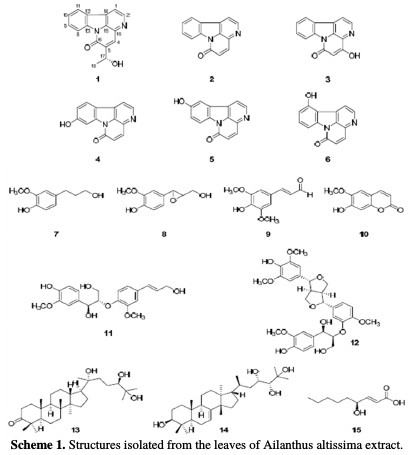
altissima have been carried out. Altissima was isolated into a new canthinone-
type alkaloid (1), and includes 15 known compounds (<a href="#s1">Scheme (1)</a>).</p>


    <p>&nbsp;</p>
<a name="s1">
<img src="/img/revistas/pea/v36n5/36n5a02s1.jpg">
    
<p>&nbsp;</p>


    <p>This research aims to study the effects of adsorption and corrosion inhibition of
A. altissima leaves extract on a Zn metal surface in a 0.5 M HCl environment.</p>


    <p>&nbsp;</p>
    <p><b>Experimental</b></p>

    ]]></body>
<body><![CDATA[<p><i><b>Preparation of specimens</b></i></p>

    <p>The Zn metal specimens have the following composition: 1.03% Pb, 0.04% Cd,
0.001% Fe, 0.003% Cu and the remainder being Zn. Samples with the size of 2
cm &times; 2 cm were used for WL and electrochemical studies. Zn metal specimens
were polished with a series of emery papers of various grades from 400 to 1200,
degreased with absolute ethanol and dried.</p>

    <p>Preparation of Ailanthus altissima extract and of the aggressive solution
An aqueous extract of A. altissima was prepared by grinding 100 g of its dried
leaves, with distilled water, filtering the suspending impurities, and making up to
1000 mL. The extract was used as a corrosion inhibitor in the present study. The
corrosion medium was 0.5 M HCl, prepared from A.R. grade HCl (37%), with
bidistilled water. Its concentration was checked using a Na2CO3 standard
solution.</p>


    <p><i><b>Measuring methods</b></i></p>


    <p><u>WL measurements</u></p>

    <p>The pre-weighed Zn metal specimens were suspended in a 100 mL beaker with a
0.5 M HCl solution for 180 min. Then, the metal specimens were removed from
the corrosive solution, washed with bidistilled water, cleaned, dried and
reweighed. From this, the metal WL was determined as the difference between
the initial weight and the weight after 180 min immersion in the acidic solutions.
The experiments were repeated with both acids, in the absence and presence of
different inhibitor doses. Each experiment was repeated thrice, and the average of
the three values was taken as the final value. The % of inhibition efficiency (IE)
and the degree of surface coverage (&theta;) were calculated using <a href="#e1">equation (1)</a>.</p>


    <p>&nbsp;</p>
<a name="e1">
<img src="/img/revistas/pea/v36n5/36n5a02e1.jpg">
    
<p>&nbsp;</p>


    <p>where Wo and Wi are the WL per unit area in the absence and presence of the
extract.</p>


    <p><u>Electrochemical measurements</u></p>

    ]]></body>
<body><![CDATA[<p>Zn electrodes were cut from Zn sheets with 0.08 mm thickness. The electrodes
had the dimensions of 10 x 10 mm; they were weld from one side to a copper
wire used for electric connection, and mounted in epoxy resin, to expose
geometrical surface areas of 1 cm<sup>2</sup>. Prior to these measurements, the exposed
surface was pretreated in the same manner as for WL experiments.</p>


    <p><u>PP measurement</u></p>

    <p>The electrochemical experiments were carried out in a three electrode
electrochemical cylindrical Pyrex glass cell with a platinum counter electrode
and a saturated calomel electrode (SCE) as reference. The working electrode had
the form of a square cut from Zn sheet (1 cm<sup>2</sup>). The exposed area was treated as
before. A duration time of 30 min was given for the system to attain a steady
state, and the open circuit potential (OCP) was noted. Both cathodic and anodic
polarization curves were potentiodynamically recorded by changing the electrode
potential between -0.5 V and -2 V, at the scan rate of 1 mVs-1; the % of inhibition
efficiency (IE) and the degree of surface coverage (&theta;) were calculated from the
electrochemical measurements by <a href="#e2">equation (2)</a>:</p>


    <p>&nbsp;</p>
<a name="e2">
<img src="/img/revistas/pea/v36n5/36n5a02e2.jpg">
    
<p>&nbsp;</p>


    <p>where iinh = corrosion current in the extract presence, and ifree = corrosion current
in the extract absence.</p>


    <p><u>EIS and EFM measurements</u></p>

    <p>Experiments for EIS measurements were conducted in the frequency range of
100 kHz to 10 mHz at open circuit potential (OCP). The amplitude was 5 mV.
Experiments for EFM measurements were carried out using two frequencies: 2
and 5 Hz. The base frequency was 1 Hz with 32 cycles, so the waveform
repeated after 1 s. A perturbation signal with amplitude of 10 mV was used.
The electrochemical measurements were carried out using a potentiostat/
galvanostat/zera analyzer (Gamry PCI 300/4). This includes Gamry framework
system based on the ESA400, and a personal computer with DC 105 software for
potentiodynamic polarization, EIS 300 software for EIS, and EFM 140 software
for EFM measurements. Echem Analyst 5.58 software was used for plotting,
graphing and fitting data.</p>


    <p>&nbsp;</p>
    <p><b>Results and discussion</b></p>

    ]]></body>
<body><![CDATA[<p><i><b>WL method</b></i></p>

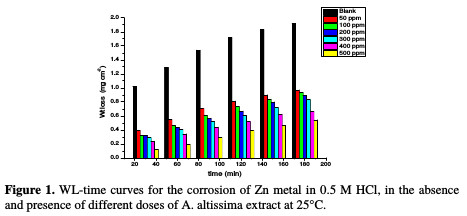
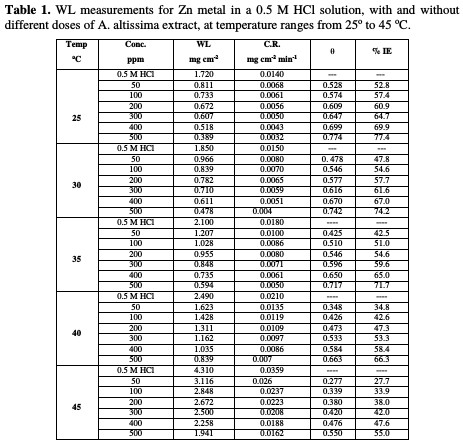
    <p>The WL-time curves of Zn specimens in a 0.5 M HCl solution, with and without
different doses from A. altissima extract, were determined after 180 min of
immersion at 25 &deg;C, as shown in <a href="#f1">Fig. 1</a>.</p>


    <p>&nbsp;</p>
<a name="f1">
<img src="/img/revistas/pea/v36n5/36n5a02f1.jpg">
    
<p>&nbsp;</p>


    <p>From the plot, WL for systems
containing A. altissima extract was found to be lower compared to the blank,
indicating that different doses of extract actually inhibited the corrosion of Zn
metal in 0.5 M HCl to an appreciable extent.</p>

    <p><a href="#t1">Table 1</a> and <a href="#f1">Fig. 1</a> show that the corrosion IE increased with higher extract doses
and temperatures, due to the inhibitor adsorption onto the Zn surface.</p>


    <p>&nbsp;</p>
<a name="t1">
<img src="/img/revistas/pea/v36n5/36n5a02t1.jpg">
    
<p>&nbsp;</p>


    <p><i><b>Adsorption isotherms and thermodynamics parameters</b></i></p>

    <p>The interaction mechanism between the extract and the metal surface can be
explained using adsorption isotherms. &theta; was computed for the different doses of
the extract from WL measurements, as follows: % IE = &theta; &times; 100, assuming a
direct relationship between &theta; and IE. The obtained &theta; values were applied to
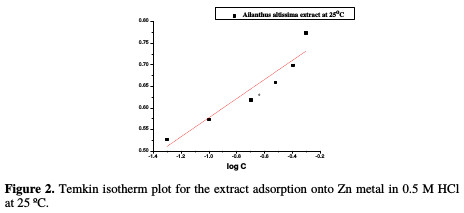
various adsorption isotherm models. By far, the best fit was found to obey
Temkin adsorption isotherm (<a href="#f2">Fig. 2</a>), which may be formulated as in <a href="#e3">equation (3)</a>:</p>


    ]]></body>
<body><![CDATA[<p>&nbsp;</p>
<a name="f2">
<img src="/img/revistas/pea/v36n5/36n5a02f2.jpg">
    
<p>&nbsp;</p>
<a name="e3">
<img src="/img/revistas/pea/v36n5/36n5a02e3.jpg">
    
<p>&nbsp;</p>


    <p>where a is a molecular interaction parameter depending upon molecular
interactions in the adsorption layer and the degree of surface heterogeneity, Kads
is the binding constant of adsorption reaction, and C is the extract dose.</p>

    <p>The relation between log C and &theta; at 25 &deg;C in 0.5 M of HCl with various doses of
A. altissima extract is shown in <a href="#f3">Fig. 3</a>.</p>


    <p>&nbsp;</p>
<a name="f3">
<img src="/img/revistas/pea/v36n5/36n5a02f3.jpg">
    
<p>&nbsp;</p>


    <p>This figure revealed that a straight line
was obtained with the slope close to unity, indicating that the inhibitor obeys
Temkin adsorption isotherm.</p>

    <p>The relation between the binding constant, Kads and the standard free energy
adsorption change, &Delta;G&deg;ads, can be obtained from <a href="#e4">equation (4)</a>:</p>


    <p>&nbsp;</p>
<a name="e4">
<img src="/img/revistas/pea/v36n5/36n5a02e4.jpg">
    
]]></body>
<body><![CDATA[<p>&nbsp;</p>


    <p>where R is the universal gas constant, T is the absolute temperature, and the
value 55.5 is the concentration of water in the solution. <a href="#f3">Fig. 3</a> also shows a
straight line curve for the Temkin adsorption isotherm plot at 25 &deg;C, with a
correlation coefficient of 0.891 being about unity.</p>

    <p>The values of obtained &Delta;Goads
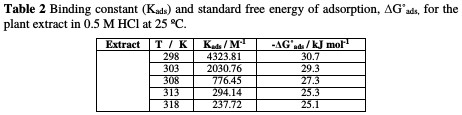
are recorded in <a href="#t2">Table 2</a>, which suggested mixed adsorption (physical and
chemical adsorption) of A. altissima extract onto the Zn surface in HCl acid.</p>


    <p>&nbsp;</p>
<a name="t2">
<img src="/img/revistas/pea/v36n5/36n5a02t2.jpg">
    
<p>&nbsp;</p>


    <p>The negative sign indicates that the adsorption of A. altissima extract molecules onto
the Zn surface is stable and a spontaneous process [41].</p>


    <p><i><b>Effect of temperature</b></i></p>

    <p>The effect of temperature (25-45 &deg;C) on the corrosion of Zn metal in 0.5 M
HCl, in the presence of different plant extract doses, was studied using mass-
loss measurements. As the temperature is higher, the rate of corrosion increases
and, hence, the additives inhibition efficiency decreases. This is because
desorption is aided by an increased temperature. This behavior proves that the
action of the inhibitors on the Zn surface occurs through physical adsorption. The
apparent activation energies (E*a) for the corrosion process in the absence and
presence of the plant extract were evaluated from <a href="#e5">Arrhenius equation</a>:</p>


    <p>&nbsp;</p>
<a name="e5">
<img src="/img/revistas/pea/v36n5/36n5a02e5.jpg">
    
<p>&nbsp;</p>


    ]]></body>
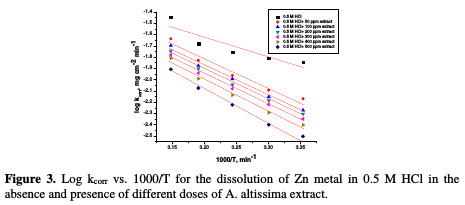
<body><![CDATA[<p>where kcorr is the corrosion rate (mg cm<sup>-2</sup> min<sup>-1</sup>), A is the constant frequency
factor, E*a is the apparent activation energy, R is the gas constant (8.314 J mol<sup>-1</sup>
K<sup>-1</sup>) and T is the absolute temperature. Plotting of the logarithm of Zn corrosion
rate in HCl acid, in the absence and presence of the investigated extract, was
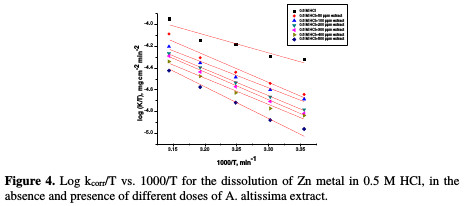
made. <a href="#f3">Fig. 3</a> represents a plot of log k (corrosion rate) against 1/T (absolute
temperature) for Zn in a 0.5 M HCl solution, in the absence and presence of
different plant extract doses.</p>

    <p>Straight lines were obtained with the slope of -E*a/2.303R. &Delta;H* is the activation
enthalpy and &Delta;S* is the activation entropy that can be calculated using a
transition state-type equation:</p>


    <p>&nbsp;</p>
<a name="e6">
<img src="/img/revistas/pea/v36n5/36n5a02e6.jpg">
    
<p>&nbsp;</p>


    <p>where k is the rate of metal dissolution and N is Avogadro's number. A plot of
log k/T versus 1/T for the Zn electrode in a 0.5 M HCl solution, with and without
different plant extract doses, gives a straight line with a slope of [(-&Delta;H*/R] and
an intercept of [log(R/Nh) + (&Delta;S* 2.303R)], represented in <a href="#f4">Fig. 4</a>.</p>


    <p>&nbsp;</p>
<a name="f4">
<img src="/img/revistas/pea/v36n5/36n5a02f4.jpg">
    
<p>&nbsp;</p>


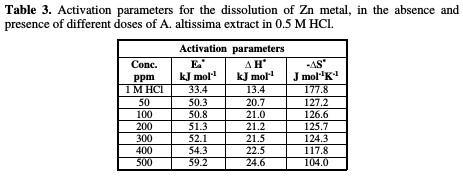
    <p>The values of activation parameters are listed in <a href="#t3">Table 3</a>.</p>


    <p>&nbsp;</p>
<a name="t3">
<img src="/img/revistas/pea/v36n5/36n5a02t3.jpg">
    
<p>&nbsp;</p>


    ]]></body>
<body><![CDATA[<p><i><b>HE measurements</b></i></p>

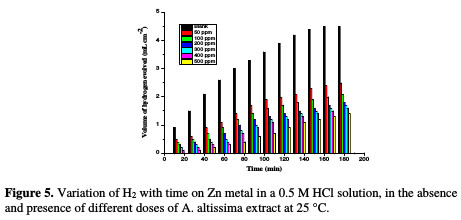
    <p>The dissolution reaction of Zn in 0.5 M HCl, with and without different extract
doses, was studied using HE method. The relationship between the volume of
hydrogen evolved during the corrosion reaction and time is represented in <a href="#f5">Fig. 5</a>.</p>


    <p>&nbsp;</p>
<a name="f5">
<img src="/img/revistas/pea/v36n5/36n5a02f5.jpg">
    
<p>&nbsp;</p>


    <p>There is a linear relation between hydrogen volume and time. The rate of HE is
small at the beginning of the reaction, and then increases with time. The rate of
reaction is small in the initial time interval, which is called the incubation period.
During this period, the breakdown of the pre-immersed oxide film on the metal
surface takes place before the start of the attack on the metal.</p>

    <p>Since Zn is readily soluble in aqueous acidic solutions with the liberation of
hydrogen, the rate of the latter corresponds to Zn corrosion rate. So, the slopes of
the straight portions of the curves, after the incubation period, were taken as a
measure of the corrosion rates of Zn in free and inhibited acid solutions. The
curve of <a href="#f5">Fig. 5</a> reveals that the addition of A. altissima extract reduces the rate of
hydrogen evolution as the inhibitor concentration is increased. The IE values of
different doses of A. altissima are given in <a href="#t4">Table 4</a>.</p>


    <p>&nbsp;</p>
<a name="t4">
<img src="/img/revistas/pea/v36n5/36n5a02t4.jpg">
    
<p>&nbsp;</p>


    <p><i><b>Open circuit potential (OCP)</b></i></p>

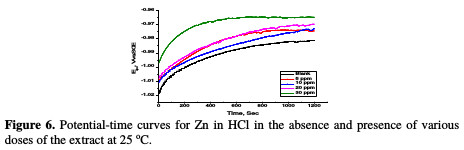
    <p>The variation of open circuit potential (OCP) of Zn with time in a 0.5 M HCl
solution, in the absence and presence of different doses of A. altissima extract at
25 &deg;C was followed until attainment of quasi steady states (<a href="#f6">Fig. 6</a>).</p>


    ]]></body>
<body><![CDATA[<p>&nbsp;</p>
<a name="f6">
<img src="/img/revistas/pea/v36n5/36n5a02f6.jpg">
    
<p>&nbsp;</p>


    <p>The figure
displays a common trend in OCP. The OCP values first increased into the
positive direction of potential, followed by semi-stabilization characterized by a
small change in potential. This trend indicates that the corrosion reaction
quickly starts off as the sample is immersed in the electrolyte (the mirror-like
sample surface appeared blurred, once the sample was dipped into the solution),
slows down with time, and then reaches a quasi-steady state within the time
interval investigated; the shift to less negative values implies increased corrosion.
The OCP plateau increased to more positive values with higher A. altissima
extract concentration in the electrolyte. This is indicative of the adsorption of
extract components onto the Zn surface, which in turn influenced anodic
corrosion reaction. As reported before [42], it is feasible to classify corrosion
inhibitors as anodic or cathodic, if OCP in the inhibitor presence shifts at least
+85 mV or -85 mV, respectively, relatively to OCP in the inhibitor absence.
However, the negative and the positive shift to OCP in the highest studied dose
(30 ppm) of the extract in HCl is about 24 mV relatively to its blank solution.</p>

    <p>This value is lower than 85 mV, indicating that the extract functions as a mixed-
type corrosion inhibitor, that is, both dissolution of Zn at the anode and the
hydrogen evolution at the cathode were affected by the extract inhibitor.</p>


    <p><i><b>Potentiodynamic polarization measurements</b></i></p>

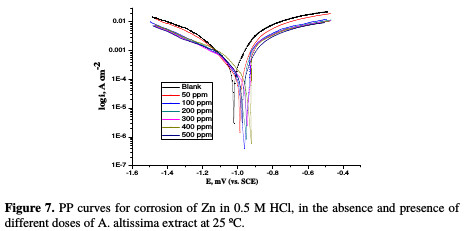
    <p>PP curves for Zn metal in uninhibited and inhibited acidic solutions containing
different doses of A. altissima are shown in <a href="#f7">Fig. 7</a>.</p>


    <p>&nbsp;</p>
<a name="f7">
<img src="/img/revistas/pea/v36n5/36n5a02f7.jpg">
    
<p>&nbsp;</p>


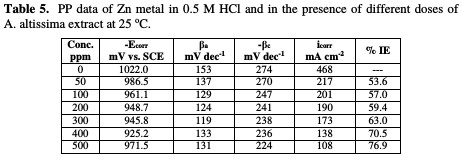
    <p>The values of IE increase with increasing extract doses, indicating that a higher
surface coverage was obtained in a solution with an enhanced extract dose, as
shown in <a href="#t5">Table 5</a>.</p>


    <p>&nbsp;</p>
<a name="t5">
<img src="/img/revistas/pea/v36n5/36n5a02t5.jpg">
    
]]></body>
<body><![CDATA[<p>&nbsp;</p>


    <p><i><b>EIS measurements</b></i></p>

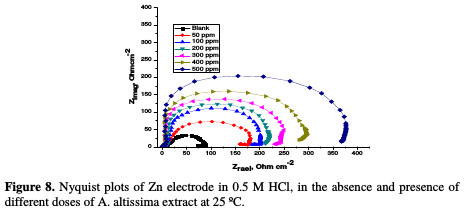
    <p>The corrosion of Zn electrode in 0.5 M HCl, in the absence and presence of A.
altissima extract, was investigated by EIS method at 25 &deg;C. <a href="#f8">Fig. 8</a> shows the
Nyquist plots for Zn electrode in a 0.5 M HCl solution, in the absence and
presence of different doses of extract at 25 &deg;C.</p>


    <p>&nbsp;</p>
<a name="f8">
<img src="/img/revistas/pea/v36n5/36n5a02f8.jpg">
    
<p>&nbsp;</p>


    <p>The impedance spectra of the
Nyquist plots were analyzed by fitting the experimental data to a simple
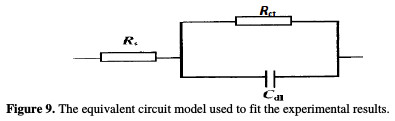
equivalent circuit model (<a href="#f9">Fig. 9</a>), which includes the solution resistance, Rs, and
the double layer capacitance, Cdl, which is placed in parallel to the charge
transfer.</p>


    <p>&nbsp;</p>
<a name="f9">
<img src="/img/revistas/pea/v36n5/36n5a02f9.jpg">
    
<p>&nbsp;</p>


    <p>The impedance diagram shows the same trend (one capacitive loop), in the
absence and presence of different extract doses; however, the diameter of this
capacitive loop increases with increasing concentrations. The main parameters
deduced from the analysis of the Nyquist diagram are the charge transfer
resistance, Rct, (diameter of the high frequency loop) and the capacity of double
layer, Cdl, which is defined as:</p>


    <p>&nbsp;</p>
<a name="e7">
<img src="/img/revistas/pea/v36n5/36n5a02e7.jpg">
    
]]></body>
<body><![CDATA[<p>&nbsp;</p>


    <p>The inhibition efficiencies obtained from the impedance measurements are
defined by the following relations:</p>


    <p>&nbsp;</p>
<a name="e8">
<img src="/img/revistas/pea/v36n5/36n5a02e8.jpg">
    
<p>&nbsp;</p>


    <p>where Roct and Rct are the charge transfer resistance in the extract absence and
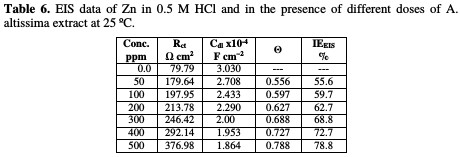
presence, respectively. The parameters given from EIS diagram are given in
<a href="#t6">Table 6</a>.</p>


    <p>&nbsp;</p>
<a name="t6">
<img src="/img/revistas/pea/v36n5/36n5a02t6.jpg">
    
<p>&nbsp;</p>


    <p>From <a href="#t6">Table 6</a>, we conclude that the values of Rct increase with an increase in the
extract dose, indicating the formation of a protective film on the metal-solution
interface. The impedance diagram obtained has a semicircle appearance. This
indicates that the corrosion of Zn in 0.5 M HCl is mainly controlled by a charge
transfer process. The value of Cdl decreases with increasing extract
concentrations, due to the decrease in local dielectric constant, and/or to the
increase in the thickness of the electrical double layer.</p>


    <p><i><b>EFM method</b></i></p>

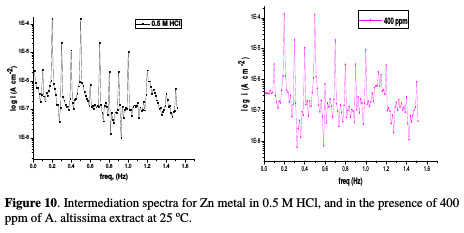
    <p>Results of EFM experiments are a spectrum of current response as a function of
frequency. The spectrum is called the ''inter modulation spectrum'', and an
example is shown in <a href="#f10">Fig. 10</a>.</p>


    ]]></body>
<body><![CDATA[<p>&nbsp;</p>
<a name="f10">
<img src="/img/revistas/pea/v36n5/36n5a02f10.jpg">
    
<p>&nbsp;</p>


    <p>It indicated the corresponding current response in
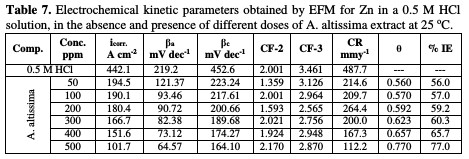
the inter modulation spectrum. The calculated corrosion kinetic parameters, at
different doses of A. altissima extract in 0.5 M HCl at 25 &deg;C (icorr, &beta;a, &beta;c, CF-2,
CF-3 and % IE), are given in <a href="#t7">Table 7</a>.</p>


    <p>&nbsp;</p>
<a name="t7">
<img src="/img/revistas/pea/v36n5/36n5a02t7.jpg">
    
<p>&nbsp;</p>


    <p>From the table, the corrosion current
densities decreased by increasing concentrations of A. altissima extract, and the
inhibition efficiency increased by increasing extract concentrations. The causality
factor was calculated from the frequency spectrum of the current response. If the
causality factors are approximately equal to the predicted values of 2 and 3, there
is a causal relationship between the perturbation signal and the response signal.
Then, the data are assumed to be reliable. When CF-2 and CF-3 are in the range
of 0-2 and 0-3, respectively, then the EFM data are valid. The deviation of
causality factors from their ideal values might be due to the fact that the
perturbation amplitude is too small, or that the resolution of the frequency
spectrum is not high enough; also, another possible explanation is that the
inhibitor is not performing very well.</p>


    <p><i><b>Inhibition mechanism</b></i></p>

    <p>The initial mechanism in any corrosion inhibition reaction is the inhibitor
adsorption onto the metal surface. This adsorption may be occurred by the
transfer of electrons to the metal surface (chemisorption), or by the charge
transfer from the charged inhibitor to the charged metal surface (physisorption).</p>

    <p>Several researches carried out on the adsorption of a corrosion inhibitor onto the
surface of a metal have shown that the presence of hetero atoms (N, S, O or P) in
an aromatic system or long carbon chain, as well as &pi;-electrons, will facilitate
the adsorption of the inhibitor onto the metal surface. The inhibitive action of
naturally occurring A. altissima extract towards the corrosion of zinc metal could
be attributed to the adsorption of its components onto the metal surface. The
adsorbed layer acts as a barrier between the metal surface and the acidic solution,
leading to a decrease in the corrosion rate. From the inspection of the chemical
composition of A. altissima extract, it appears that this extract is available from
many natural organic components, as above mentioned. These components are
chemical organic compounds, with hetero atoms and carbonyl groups that are
rich in electrons, serving as a good adsorption site onto the metal. The adsorption
of these compounds led to a decrease in the reaction between zinc metal and acid
media (HCl), and, then, to a decrease in the corrosion rate.</p>


    <p>&nbsp;</p>
    ]]></body>
<body><![CDATA[<p><b>Conclusions</b></p>

    <p>The investigated A. altissima extract was found to act as a good corrosion
inhibitor for Zn in a 0.5 M HCl solution. The chemical and electrochemical
measurements confirm the inhibitive nature of A. altissima extract. IE increases
with increasing extract doses, and decreases with rising temperatures, reaching
its maximum value, 77.5 %, at 500 ppm. The adsorption of the extract molecules
onto the metal surface obeyed Temkin adsorption isotherm. The extract behaves
as a mixed type inhibitor.</p>


    <p>&nbsp;</p>
    <p><b>References</b></p>

    <!-- ref --><p>1. Thomas S, Birbilis N, Venkatraman MS, et al. Corrosion. 2012;68:9.    &nbsp;&nbsp;&nbsp;&nbsp;&nbsp;&nbsp;&nbsp;&nbsp;[&#160;<a href="javascript:void(0);" onclick="javascript: window.open('/scielo.php?script=sci_nlinks&ref=435978&pid=S0872-1904201800050000200001&lng=','','width=640,height=500,resizable=yes,scrollbars=1,menubar=yes,');">Links</a>&#160;]<!-- end-ref --></p>

    <!-- ref --><p>2. Yousif E, Win Y, Al-Hamadani AH, et al. Int J Electrochem Sci. 2015;10:1708.    &nbsp;&nbsp;&nbsp;&nbsp;&nbsp;&nbsp;&nbsp;&nbsp;[&#160;<a href="javascript:void(0);" onclick="javascript: window.open('/scielo.php?script=sci_nlinks&ref=435980&pid=S0872-1904201800050000200002&lng=','','width=640,height=500,resizable=yes,scrollbars=1,menubar=yes,');">Links</a>&#160;]<!-- end-ref --></p>

    <!-- ref --><p>3. Vashi RT, Desai K. Der Pharma Chemica. 2012;4:2117.    &nbsp;&nbsp;&nbsp;&nbsp;&nbsp;&nbsp;&nbsp;&nbsp;[&#160;<a href="javascript:void(0);" onclick="javascript: window.open('/scielo.php?script=sci_nlinks&ref=435982&pid=S0872-1904201800050000200003&lng=','','width=640,height=500,resizable=yes,scrollbars=1,menubar=yes,');">Links</a>&#160;]<!-- end-ref --></p>

    ]]></body>
<body><![CDATA[<!-- ref --><p>4. Fouda AS, Abdel Nazeer A, Saber A. J Korean Chem Soc. 2014;58:160.    &nbsp;&nbsp;&nbsp;&nbsp;&nbsp;&nbsp;&nbsp;&nbsp;[&#160;<a href="javascript:void(0);" onclick="javascript: window.open('/scielo.php?script=sci_nlinks&ref=435984&pid=S0872-1904201800050000200004&lng=','','width=640,height=500,resizable=yes,scrollbars=1,menubar=yes,');">Links</a>&#160;]<!-- end-ref --></p>

    <!-- ref --><p>5. Praveen BM, Venkatesha TV. J Alloys Compounds. 2009;482:53.    &nbsp;&nbsp;&nbsp;&nbsp;&nbsp;&nbsp;&nbsp;&nbsp;[&#160;<a href="javascript:void(0);" onclick="javascript: window.open('/scielo.php?script=sci_nlinks&ref=435986&pid=S0872-1904201800050000200005&lng=','','width=640,height=500,resizable=yes,scrollbars=1,menubar=yes,');">Links</a>&#160;]<!-- end-ref --></p>

    <!-- ref --><p>6. Shanbhag A, Venkatesha T, Prabhu R, et al. Bull Mater Sci. 2011;34:571.    &nbsp;&nbsp;&nbsp;&nbsp;&nbsp;&nbsp;&nbsp;&nbsp;[&#160;<a href="javascript:void(0);" onclick="javascript: window.open('/scielo.php?script=sci_nlinks&ref=435988&pid=S0872-1904201800050000200006&lng=','','width=640,height=500,resizable=yes,scrollbars=1,menubar=yes,');">Links</a>&#160;]<!-- end-ref --></p>

    <!-- ref --><p>7. Abdallah M, Zaafarany IA, Al-Jahdaly BA. J Mater Environ Sci. 2016;7:1107.    &nbsp;&nbsp;&nbsp;&nbsp;&nbsp;&nbsp;&nbsp;&nbsp;[&#160;<a href="javascript:void(0);" onclick="javascript: window.open('/scielo.php?script=sci_nlinks&ref=435990&pid=S0872-1904201800050000200007&lng=','','width=640,height=500,resizable=yes,scrollbars=1,menubar=yes,');">Links</a>&#160;]<!-- end-ref --></p>

    <!-- ref --><p>8. Pavithra MK, Venkatesha TV, Kumar MKP, et al. Corros Sci. 2012;60:104.    &nbsp;&nbsp;&nbsp;&nbsp;&nbsp;&nbsp;&nbsp;&nbsp;[&#160;<a href="javascript:void(0);" onclick="javascript: window.open('/scielo.php?script=sci_nlinks&ref=435992&pid=S0872-1904201800050000200008&lng=','','width=640,height=500,resizable=yes,scrollbars=1,menubar=yes,');">Links</a>&#160;]<!-- end-ref --></p>

    ]]></body>
<body><![CDATA[<!-- ref --><p>9. Junaedi S, Al-Amiery A, Kadihum A, Kadhum A, Mohamad A. Int J Mol Sci. 2013;14:1915.    &nbsp;&nbsp;&nbsp;&nbsp;&nbsp;&nbsp;&nbsp;&nbsp;[&#160;<a href="javascript:void(0);" onclick="javascript: window.open('/scielo.php?script=sci_nlinks&ref=435994&pid=S0872-1904201800050000200009&lng=','','width=640,height=500,resizable=yes,scrollbars=1,menubar=yes,');">Links</a>&#160;]<!-- end-ref --></p>

    <!-- ref --><p>10. Kadhum A, Mohamad A, Hammed L, et al. Materials. 2014;7:4335.    &nbsp;&nbsp;&nbsp;&nbsp;&nbsp;&nbsp;&nbsp;&nbsp;[&#160;<a href="javascript:void(0);" onclick="javascript: window.open('/scielo.php?script=sci_nlinks&ref=435996&pid=S0872-1904201800050000200010&lng=','','width=640,height=500,resizable=yes,scrollbars=1,menubar=yes,');">Links</a>&#160;]<!-- end-ref --></p>

    <!-- ref --><p>11. Fouda AS, Abdallah M, Atwa ST, et al. Modern Appl Sci Canda. 2010;4:41.    &nbsp;&nbsp;&nbsp;&nbsp;&nbsp;&nbsp;&nbsp;&nbsp;[&#160;<a href="javascript:void(0);" onclick="javascript: window.open('/scielo.php?script=sci_nlinks&ref=435998&pid=S0872-1904201800050000200011&lng=','','width=640,height=500,resizable=yes,scrollbars=1,menubar=yes,');">Links</a>&#160;]<!-- end-ref --></p>

    <!-- ref --><p>12. Abdallah M, Zaafarany I, Al-Fahemi JH, et al. Int J Electrochem Soc. 2012;7:6622.    &nbsp;&nbsp;&nbsp;&nbsp;&nbsp;&nbsp;&nbsp;&nbsp;[&#160;<a href="javascript:void(0);" onclick="javascript: window.open('/scielo.php?script=sci_nlinks&ref=436000&pid=S0872-1904201800050000200012&lng=','','width=640,height=500,resizable=yes,scrollbars=1,menubar=yes,');">Links</a>&#160;]<!-- end-ref --></p>

    <!-- ref --><p>13. Shylesha B, Venkatesha TV, Praveen BM. J Chem Pharm Res. 2011;3:501.    &nbsp;&nbsp;&nbsp;&nbsp;&nbsp;&nbsp;&nbsp;&nbsp;[&#160;<a href="javascript:void(0);" onclick="javascript: window.open('/scielo.php?script=sci_nlinks&ref=436002&pid=S0872-1904201800050000200013&lng=','','width=640,height=500,resizable=yes,scrollbars=1,menubar=yes,');">Links</a>&#160;]<!-- end-ref --></p>

    ]]></body>
<body><![CDATA[<!-- ref --><p>14. Belkhaouda M, Bammou L, Zarrouk A, et al. Int J Electrochem Sci. 2013;8:7425.    &nbsp;&nbsp;&nbsp;&nbsp;&nbsp;&nbsp;&nbsp;&nbsp;[&#160;<a href="javascript:void(0);" onclick="javascript: window.open('/scielo.php?script=sci_nlinks&ref=436004&pid=S0872-1904201800050000200014&lng=','','width=640,height=500,resizable=yes,scrollbars=1,menubar=yes,');">Links</a>&#160;]<!-- end-ref --></p>

    <!-- ref --><p>15. Sirbharathy V, Rajendran S. Chem Sci Rev Letters. 2012;1:25.    &nbsp;&nbsp;&nbsp;&nbsp;&nbsp;&nbsp;&nbsp;&nbsp;[&#160;<a href="javascript:void(0);" onclick="javascript: window.open('/scielo.php?script=sci_nlinks&ref=436006&pid=S0872-1904201800050000200015&lng=','','width=640,height=500,resizable=yes,scrollbars=1,menubar=yes,');">Links</a>&#160;]<!-- end-ref --></p>

    <!-- ref --><p>16. Sirbharathy V, Rajendran S, Sathyabama J. Int J Chem Sci Technol. 2011;1:108.    &nbsp;&nbsp;&nbsp;&nbsp;&nbsp;&nbsp;&nbsp;&nbsp;[&#160;<a href="javascript:void(0);" onclick="javascript: window.open('/scielo.php?script=sci_nlinks&ref=436008&pid=S0872-1904201800050000200016&lng=','','width=640,height=500,resizable=yes,scrollbars=1,menubar=yes,');">Links</a>&#160;]<!-- end-ref --></p>

    <!-- ref --><p>17. Sangeetha M, Rajendran S, Megala TSM, et al. Zastita Materijala. 2011;52:35.    &nbsp;&nbsp;&nbsp;&nbsp;&nbsp;&nbsp;&nbsp;&nbsp;[&#160;<a href="javascript:void(0);" onclick="javascript: window.open('/scielo.php?script=sci_nlinks&ref=436010&pid=S0872-1904201800050000200017&lng=','','width=640,height=500,resizable=yes,scrollbars=1,menubar=yes,');">Links</a>&#160;]<!-- end-ref --></p>

    <!-- ref --><p>18. Rajendran S, Sumithra P, Devi BS, et al. Zastita Materijala. 2009;5:223.    &nbsp;&nbsp;&nbsp;&nbsp;&nbsp;&nbsp;&nbsp;&nbsp;[&#160;<a href="javascript:void(0);" onclick="javascript: window.open('/scielo.php?script=sci_nlinks&ref=436012&pid=S0872-1904201800050000200018&lng=','','width=640,height=500,resizable=yes,scrollbars=1,menubar=yes,');">Links</a>&#160;]<!-- end-ref --></p>

    ]]></body>
<body><![CDATA[<!-- ref --><p>19. Olusegun KA, James AO. Corros Sci. 2010;52:661.    &nbsp;&nbsp;&nbsp;&nbsp;&nbsp;&nbsp;&nbsp;&nbsp;[&#160;<a href="javascript:void(0);" onclick="javascript: window.open('/scielo.php?script=sci_nlinks&ref=436014&pid=S0872-1904201800050000200019&lng=','','width=640,height=500,resizable=yes,scrollbars=1,menubar=yes,');">Links</a>&#160;]<!-- end-ref --></p>

    <!-- ref --><p>20. Abdulwahab M, Kasim A, Fayomi OSI, et al. J Mater Environ Sci. 2012;3:1177.    &nbsp;&nbsp;&nbsp;&nbsp;&nbsp;&nbsp;&nbsp;&nbsp;[&#160;<a href="javascript:void(0);" onclick="javascript: window.open('/scielo.php?script=sci_nlinks&ref=436016&pid=S0872-1904201800050000200020&lng=','','width=640,height=500,resizable=yes,scrollbars=1,menubar=yes,');">Links</a>&#160;]<!-- end-ref --></p>

    <!-- ref --><p>21. Refaey SAM, Abd El-Malak AM, Taha F, et al. Int J Electrochem Sci. 2008;3:167.    &nbsp;&nbsp;&nbsp;&nbsp;&nbsp;&nbsp;&nbsp;&nbsp;[&#160;<a href="javascript:void(0);" onclick="javascript: window.open('/scielo.php?script=sci_nlinks&ref=436018&pid=S0872-1904201800050000200021&lng=','','width=640,height=500,resizable=yes,scrollbars=1,menubar=yes,');">Links</a>&#160;]<!-- end-ref --></p>

    <!-- ref --><p>22. Kamal C, Sethuraman MG. Arab J Chem. 2012;5:155.    &nbsp;&nbsp;&nbsp;&nbsp;&nbsp;&nbsp;&nbsp;&nbsp;[&#160;<a href="javascript:void(0);" onclick="javascript: window.open('/scielo.php?script=sci_nlinks&ref=436020&pid=S0872-1904201800050000200022&lng=','','width=640,height=500,resizable=yes,scrollbars=1,menubar=yes,');">Links</a>&#160;]<!-- end-ref --></p>

    <!-- ref --><p>23. Sharma SK, Mudhoo A, Khamis E. J Corros Sci Eng. 2009;11:1.    &nbsp;&nbsp;&nbsp;&nbsp;&nbsp;&nbsp;&nbsp;&nbsp;[&#160;<a href="javascript:void(0);" onclick="javascript: window.open('/scielo.php?script=sci_nlinks&ref=436022&pid=S0872-1904201800050000200023&lng=','','width=640,height=500,resizable=yes,scrollbars=1,menubar=yes,');">Links</a>&#160;]<!-- end-ref --></p>

    ]]></body>
<body><![CDATA[<!-- ref --><p>24. Abdel-Gaber AM, Khamis E, Abo-Eldahab H, et al. Mater Chem Phys. 2008;109:297.    &nbsp;&nbsp;&nbsp;&nbsp;&nbsp;&nbsp;&nbsp;&nbsp;[&#160;<a href="javascript:void(0);" onclick="javascript: window.open('/scielo.php?script=sci_nlinks&ref=436024&pid=S0872-1904201800050000200024&lng=','','width=640,height=500,resizable=yes,scrollbars=1,menubar=yes,');">Links</a>&#160;]<!-- end-ref --></p>

    <!-- ref --><p>25. Umoren SA, Ebenso EE. Pig Res Technol. 2008;37:173.    &nbsp;&nbsp;&nbsp;&nbsp;&nbsp;&nbsp;&nbsp;&nbsp;[&#160;<a href="javascript:void(0);" onclick="javascript: window.open('/scielo.php?script=sci_nlinks&ref=436026&pid=S0872-1904201800050000200025&lng=','','width=640,height=500,resizable=yes,scrollbars=1,menubar=yes,');">Links</a>&#160;]<!-- end-ref --></p>

    <!-- ref --><p>26. Fouda AS, Morsi M, Mosallam HA. Zastita Materijala. 2016;57:33.    &nbsp;&nbsp;&nbsp;&nbsp;&nbsp;&nbsp;&nbsp;&nbsp;[&#160;<a href="javascript:void(0);" onclick="javascript: window.open('/scielo.php?script=sci_nlinks&ref=436028&pid=S0872-1904201800050000200026&lng=','','width=640,height=500,resizable=yes,scrollbars=1,menubar=yes,');">Links</a>&#160;]<!-- end-ref --></p>

    <!-- ref --><p>27. Okafor PC, Ebenso EE. Pig Res Technol. 2016;36:134.    &nbsp;&nbsp;&nbsp;&nbsp;&nbsp;&nbsp;&nbsp;&nbsp;[&#160;<a href="javascript:void(0);" onclick="javascript: window.open('/scielo.php?script=sci_nlinks&ref=436030&pid=S0872-1904201800050000200027&lng=','','width=640,height=500,resizable=yes,scrollbars=1,menubar=yes,');">Links</a>&#160;]<!-- end-ref --></p>

    <!-- ref --><p>28. El-Etre AY. Appl Surf Sci. 2006;252:8521.    &nbsp;&nbsp;&nbsp;&nbsp;&nbsp;&nbsp;&nbsp;&nbsp;[&#160;<a href="javascript:void(0);" onclick="javascript: window.open('/scielo.php?script=sci_nlinks&ref=436032&pid=S0872-1904201800050000200028&lng=','','width=640,height=500,resizable=yes,scrollbars=1,menubar=yes,');">Links</a>&#160;]<!-- end-ref --></p>

    ]]></body>
<body><![CDATA[<!-- ref --><p>29. Bright A, Maragatham SMR, Vizhi IM, et al Int J Recent Sci Res. 2015;6:3594.    &nbsp;&nbsp;&nbsp;&nbsp;&nbsp;&nbsp;&nbsp;&nbsp;[&#160;<a href="javascript:void(0);" onclick="javascript: window.open('/scielo.php?script=sci_nlinks&ref=436034&pid=S0872-1904201800050000200029&lng=','','width=640,height=500,resizable=yes,scrollbars=1,menubar=yes,');">Links</a>&#160;]<!-- end-ref --></p>

    <!-- ref --><p>30. Selvi JA, Rajendran S, Ganga Sri V, et al. Port Electrochim Acta 2009;27:1.    &nbsp;&nbsp;&nbsp;&nbsp;&nbsp;&nbsp;&nbsp;&nbsp;[&#160;<a href="javascript:void(0);" onclick="javascript: window.open('/scielo.php?script=sci_nlinks&ref=436036&pid=S0872-1904201800050000200030&lng=','','width=640,height=500,resizable=yes,scrollbars=1,menubar=yes,');">Links</a>&#160;]<!-- end-ref --></p>

    <!-- ref --><p>31. Sharma SK, Mudhoo A, Jain G, et al. Green Chem Letters Rev. 2010;3:7.    &nbsp;&nbsp;&nbsp;&nbsp;&nbsp;&nbsp;&nbsp;&nbsp;[&#160;<a href="javascript:void(0);" onclick="javascript: window.open('/scielo.php?script=sci_nlinks&ref=436038&pid=S0872-1904201800050000200031&lng=','','width=640,height=500,resizable=yes,scrollbars=1,menubar=yes,');">Links</a>&#160;]<!-- end-ref --></p>

    <!-- ref --><p>32. Kowarik I, Saumel I. Perspect Plant Ecol. 2007;8:207.    &nbsp;&nbsp;&nbsp;&nbsp;&nbsp;&nbsp;&nbsp;&nbsp;[&#160;<a href="javascript:void(0);" onclick="javascript: window.open('/scielo.php?script=sci_nlinks&ref=436040&pid=S0872-1904201800050000200032&lng=','','width=640,height=500,resizable=yes,scrollbars=1,menubar=yes,');">Links</a>&#160;]<!-- end-ref --></p>

    <!-- ref --><p>33. Sladonja B, Susek M, Guillermic J. J Environ Manag. 2015;56:1009.    &nbsp;&nbsp;&nbsp;&nbsp;&nbsp;&nbsp;&nbsp;&nbsp;[&#160;<a href="javascript:void(0);" onclick="javascript: window.open('/scielo.php?script=sci_nlinks&ref=436042&pid=S0872-1904201800050000200033&lng=','','width=640,height=500,resizable=yes,scrollbars=1,menubar=yes,');">Links</a>&#160;]<!-- end-ref --></p>

    ]]></body>
<body><![CDATA[<!-- ref --><p>34. Kubota K, Fukamiya N, Hamada T, et al. J Nat Prod. 1996;59:683.    &nbsp;&nbsp;&nbsp;&nbsp;&nbsp;&nbsp;&nbsp;&nbsp;[&#160;<a href="javascript:void(0);" onclick="javascript: window.open('/scielo.php?script=sci_nlinks&ref=436044&pid=S0872-1904201800050000200034&lng=','','width=640,height=500,resizable=yes,scrollbars=1,menubar=yes,');">Links</a>&#160;]<!-- end-ref --></p>

    <!-- ref --><p>35. Ohmoto T, Koike K. Chem Pharm Bull. 1984;32:170.    &nbsp;&nbsp;&nbsp;&nbsp;&nbsp;&nbsp;&nbsp;&nbsp;[&#160;<a href="javascript:void(0);" onclick="javascript: window.open('/scielo.php?script=sci_nlinks&ref=436046&pid=S0872-1904201800050000200035&lng=','','width=640,height=500,resizable=yes,scrollbars=1,menubar=yes,');">Links</a>&#160;]<!-- end-ref --></p>

    <!-- ref --><p>36. Souleles C, Waigh R. J Nat Prod. 1984;47:741.    &nbsp;&nbsp;&nbsp;&nbsp;&nbsp;&nbsp;&nbsp;&nbsp;[&#160;<a href="javascript:void(0);" onclick="javascript: window.open('/scielo.php?script=sci_nlinks&ref=436048&pid=S0872-1904201800050000200036&lng=','','width=640,height=500,resizable=yes,scrollbars=1,menubar=yes,');">Links</a>&#160;]<!-- end-ref --></p>

    <!-- ref --><p>37. Ohmoto T, Koike K. Shoyakugaku Zasshi. 1988;42:160.    &nbsp;&nbsp;&nbsp;&nbsp;&nbsp;&nbsp;&nbsp;&nbsp;[&#160;<a href="javascript:void(0);" onclick="javascript: window.open('/scielo.php?script=sci_nlinks&ref=436050&pid=S0872-1904201800050000200037&lng=','','width=640,height=500,resizable=yes,scrollbars=1,menubar=yes,');">Links</a>&#160;]<!-- end-ref --></p>

    <!-- ref --><p>38. Ohmoto T, Sung YI. Shoyakugaku Zasshi. 1982;36:307.    &nbsp;&nbsp;&nbsp;&nbsp;&nbsp;&nbsp;&nbsp;&nbsp;[&#160;<a href="javascript:void(0);" onclick="javascript: window.open('/scielo.php?script=sci_nlinks&ref=436052&pid=S0872-1904201800050000200038&lng=','','width=640,height=500,resizable=yes,scrollbars=1,menubar=yes,');">Links</a>&#160;]<!-- end-ref --></p>

    ]]></body>
<body><![CDATA[<!-- ref --><p>39. Ohmoto T, Sung YI, Koike K, et al. Shoyakugaku Zasshi. 1985;39:28.    &nbsp;&nbsp;&nbsp;&nbsp;&nbsp;&nbsp;&nbsp;&nbsp;[&#160;<a href="javascript:void(0);" onclick="javascript: window.open('/scielo.php?script=sci_nlinks&ref=436054&pid=S0872-1904201800050000200039&lng=','','width=640,height=500,resizable=yes,scrollbars=1,menubar=yes,');">Links</a>&#160;]<!-- end-ref --></p>

    <!-- ref --><p>40. Ohmoto T, Nikaido T, Koike K, et al. Chem Pharm Bull. 1988;36:4588.    &nbsp;&nbsp;&nbsp;&nbsp;&nbsp;&nbsp;&nbsp;&nbsp;[&#160;<a href="javascript:void(0);" onclick="javascript: window.open('/scielo.php?script=sci_nlinks&ref=436056&pid=S0872-1904201800050000200040&lng=','','width=640,height=500,resizable=yes,scrollbars=1,menubar=yes,');">Links</a>&#160;]<!-- end-ref --></p>

    <!-- ref --><p>41. Popova A, Sokolova E, Raicheva S, et al. Corros Sci. 2003;45:33.    &nbsp;&nbsp;&nbsp;&nbsp;&nbsp;&nbsp;&nbsp;&nbsp;[&#160;<a href="javascript:void(0);" onclick="javascript: window.open('/scielo.php?script=sci_nlinks&ref=436058&pid=S0872-1904201800050000200041&lng=','','width=640,height=500,resizable=yes,scrollbars=1,menubar=yes,');">Links</a>&#160;]<!-- end-ref --></p>

    <!-- ref --><p>42. Oguzie EE, Li Y, Wang FH. Electrochim Acta. 2007;53:909.    &nbsp;&nbsp;&nbsp;&nbsp;&nbsp;&nbsp;&nbsp;&nbsp;[&#160;<a href="javascript:void(0);" onclick="javascript: window.open('/scielo.php?script=sci_nlinks&ref=436060&pid=S0872-1904201800050000200042&lng=','','width=640,height=500,resizable=yes,scrollbars=1,menubar=yes,');">Links</a>&#160;]<!-- end-ref --></p>


    <p>&nbsp;</p>
    <p><a name=0></a><sup><a href="#top">*</a></sup>Corresponding author. E-mail address: <a href="mailto:asfouda@hotmail.com">asfouda@hotmail.com</a></p>

    ]]></body>
<body><![CDATA[<p>Received June 6, 2017; accepted October 20, 2017</p>

    <p><a href="http://www.peacta.org" target="_blank">www.peacta.org</a> </p>


     ]]></body><back>
<ref-list>
<ref id="B1">
<label>1</label><nlm-citation citation-type="journal">
<person-group person-group-type="author">
<name>
<surname><![CDATA[Thomas]]></surname>
<given-names><![CDATA[S]]></given-names>
</name>
<name>
<surname><![CDATA[Birbilis]]></surname>
<given-names><![CDATA[N]]></given-names>
</name>
<name>
<surname><![CDATA[Venkatraman]]></surname>
<given-names><![CDATA[M S]]></given-names>
</name>
</person-group>
<source><![CDATA[Corrosion]]></source>
<year>2012</year>
<volume>68</volume>
<page-range>9</page-range></nlm-citation>
</ref>
<ref id="B2">
<label>2</label><nlm-citation citation-type="journal">
<person-group person-group-type="author">
<name>
<surname><![CDATA[Yousif]]></surname>
<given-names><![CDATA[E]]></given-names>
</name>
<name>
<surname><![CDATA[Win]]></surname>
<given-names><![CDATA[Y]]></given-names>
</name>
<name>
<surname><![CDATA[Al-Hamadani]]></surname>
<given-names><![CDATA[A H]]></given-names>
</name>
</person-group>
<source><![CDATA[Int J Electrochem Sci]]></source>
<year>2015</year>
<volume>10</volume>
<page-range>1708</page-range></nlm-citation>
</ref>
<ref id="B3">
<label>3</label><nlm-citation citation-type="journal">
<person-group person-group-type="author">
<name>
<surname><![CDATA[Vashi]]></surname>
<given-names><![CDATA[R T]]></given-names>
</name>
<name>
<surname><![CDATA[Desai]]></surname>
<given-names><![CDATA[K]]></given-names>
</name>
</person-group>
<source><![CDATA[Der Pharma Chemica]]></source>
<year>2012</year>
<volume>4</volume>
<page-range>2117</page-range></nlm-citation>
</ref>
<ref id="B4">
<label>4</label><nlm-citation citation-type="journal">
<person-group person-group-type="author">
<name>
<surname><![CDATA[Fouda]]></surname>
<given-names><![CDATA[A S]]></given-names>
</name>
<name>
<surname><![CDATA[Abdel Nazeer]]></surname>
<given-names><![CDATA[A]]></given-names>
</name>
<name>
<surname><![CDATA[Saber]]></surname>
<given-names><![CDATA[A]]></given-names>
</name>
</person-group>
<source><![CDATA[J Korean Chem Soc]]></source>
<year>2014</year>
<volume>58</volume>
<page-range>160</page-range></nlm-citation>
</ref>
<ref id="B5">
<label>5</label><nlm-citation citation-type="journal">
<person-group person-group-type="author">
<name>
<surname><![CDATA[Praveen]]></surname>
<given-names><![CDATA[B M]]></given-names>
</name>
<name>
<surname><![CDATA[Venkatesha]]></surname>
<given-names><![CDATA[T V]]></given-names>
</name>
</person-group>
<source><![CDATA[J Alloys Compounds]]></source>
<year>2009</year>
<volume>482</volume>
<page-range>53</page-range></nlm-citation>
</ref>
<ref id="B6">
<label>6</label><nlm-citation citation-type="journal">
<person-group person-group-type="author">
<name>
<surname><![CDATA[Shanbhag]]></surname>
<given-names><![CDATA[A]]></given-names>
</name>
<name>
<surname><![CDATA[Venkatesha]]></surname>
<given-names><![CDATA[T]]></given-names>
</name>
<name>
<surname><![CDATA[Prabhu]]></surname>
<given-names><![CDATA[R]]></given-names>
</name>
</person-group>
<source><![CDATA[Bull Mater Sci]]></source>
<year>2011</year>
<volume>34</volume>
<page-range>571</page-range></nlm-citation>
</ref>
<ref id="B7">
<label>7</label><nlm-citation citation-type="journal">
<person-group person-group-type="author">
<name>
<surname><![CDATA[Abdallah]]></surname>
<given-names><![CDATA[M]]></given-names>
</name>
<name>
<surname><![CDATA[Zaafarany]]></surname>
<given-names><![CDATA[I A]]></given-names>
</name>
<name>
<surname><![CDATA[Al-Jahdaly]]></surname>
<given-names><![CDATA[B A]]></given-names>
</name>
</person-group>
<source><![CDATA[J Mater Environ Sci]]></source>
<year>2016</year>
<volume>7</volume>
<page-range>1107</page-range></nlm-citation>
</ref>
<ref id="B8">
<label>8</label><nlm-citation citation-type="journal">
<person-group person-group-type="author">
<name>
<surname><![CDATA[Pavithra]]></surname>
<given-names><![CDATA[M K]]></given-names>
</name>
<name>
<surname><![CDATA[Venkatesha]]></surname>
<given-names><![CDATA[T V]]></given-names>
</name>
<name>
<surname><![CDATA[Kumar]]></surname>
<given-names><![CDATA[M K P]]></given-names>
</name>
</person-group>
<source><![CDATA[Corros Sci]]></source>
<year>2012</year>
<volume>60</volume>
<page-range>104</page-range></nlm-citation>
</ref>
<ref id="B9">
<label>9</label><nlm-citation citation-type="journal">
<person-group person-group-type="author">
<name>
<surname><![CDATA[Junaedi]]></surname>
<given-names><![CDATA[S]]></given-names>
</name>
<name>
<surname><![CDATA[Al-Amiery]]></surname>
<given-names><![CDATA[A]]></given-names>
</name>
<name>
<surname><![CDATA[Kadihum]]></surname>
<given-names><![CDATA[A]]></given-names>
</name>
<name>
<surname><![CDATA[Kadhum]]></surname>
<given-names><![CDATA[A]]></given-names>
</name>
<name>
<surname><![CDATA[Mohamad]]></surname>
<given-names><![CDATA[A]]></given-names>
</name>
</person-group>
<source><![CDATA[Int J Mol Sci]]></source>
<year>2013</year>
<volume>14</volume>
<page-range>1915</page-range></nlm-citation>
</ref>
<ref id="B10">
<label>10</label><nlm-citation citation-type="journal">
<person-group person-group-type="author">
<name>
<surname><![CDATA[Kadhum]]></surname>
<given-names><![CDATA[A]]></given-names>
</name>
<name>
<surname><![CDATA[Mohamad]]></surname>
<given-names><![CDATA[A]]></given-names>
</name>
<name>
<surname><![CDATA[Hammed]]></surname>
<given-names><![CDATA[L]]></given-names>
</name>
</person-group>
<source><![CDATA[Materials]]></source>
<year>2014</year>
<volume>7</volume>
<page-range>4335</page-range></nlm-citation>
</ref>
<ref id="B11">
<label>11</label><nlm-citation citation-type="journal">
<person-group person-group-type="author">
<name>
<surname><![CDATA[Fouda]]></surname>
<given-names><![CDATA[A S]]></given-names>
</name>
<name>
<surname><![CDATA[Abdallah]]></surname>
<given-names><![CDATA[M]]></given-names>
</name>
<name>
<surname><![CDATA[Atwa]]></surname>
<given-names><![CDATA[S T]]></given-names>
</name>
</person-group>
<source><![CDATA[Modern Appl Sci Canda]]></source>
<year>2010</year>
<volume>4</volume>
<page-range>41</page-range></nlm-citation>
</ref>
<ref id="B12">
<label>12</label><nlm-citation citation-type="journal">
<person-group person-group-type="author">
<name>
<surname><![CDATA[Abdallah]]></surname>
<given-names><![CDATA[M]]></given-names>
</name>
<name>
<surname><![CDATA[Zaafarany]]></surname>
<given-names><![CDATA[I]]></given-names>
</name>
<name>
<surname><![CDATA[Al-Fahemi]]></surname>
<given-names><![CDATA[J H]]></given-names>
</name>
</person-group>
<source><![CDATA[Int J Electrochem Soc]]></source>
<year>2012</year>
<volume>7</volume>
<page-range>6622</page-range></nlm-citation>
</ref>
<ref id="B13">
<label>13</label><nlm-citation citation-type="journal">
<person-group person-group-type="author">
<name>
<surname><![CDATA[Shylesha]]></surname>
<given-names><![CDATA[B]]></given-names>
</name>
<name>
<surname><![CDATA[Venkatesha]]></surname>
<given-names><![CDATA[T V]]></given-names>
</name>
<name>
<surname><![CDATA[Praveen]]></surname>
<given-names><![CDATA[B M]]></given-names>
</name>
</person-group>
<source><![CDATA[J Chem Pharm Res]]></source>
<year>2011</year>
<volume>3</volume>
<page-range>501</page-range></nlm-citation>
</ref>
<ref id="B14">
<label>14</label><nlm-citation citation-type="journal">
<person-group person-group-type="author">
<name>
<surname><![CDATA[Belkhaouda]]></surname>
<given-names><![CDATA[M]]></given-names>
</name>
<name>
<surname><![CDATA[Bammou]]></surname>
<given-names><![CDATA[L]]></given-names>
</name>
<name>
<surname><![CDATA[Zarrouk]]></surname>
<given-names><![CDATA[A]]></given-names>
</name>
</person-group>
<source><![CDATA[Int J Electrochem Sci]]></source>
<year>2013</year>
<volume>8</volume>
<page-range>7425</page-range></nlm-citation>
</ref>
<ref id="B15">
<label>15</label><nlm-citation citation-type="journal">
<person-group person-group-type="author">
<name>
<surname><![CDATA[Sirbharathy]]></surname>
<given-names><![CDATA[V]]></given-names>
</name>
<name>
<surname><![CDATA[Rajendran]]></surname>
<given-names><![CDATA[S]]></given-names>
</name>
</person-group>
<source><![CDATA[Chem Sci Rev Letters]]></source>
<year>2012</year>
<volume>1</volume>
<page-range>25</page-range></nlm-citation>
</ref>
<ref id="B16">
<label>16</label><nlm-citation citation-type="journal">
<person-group person-group-type="author">
<name>
<surname><![CDATA[Sirbharathy]]></surname>
<given-names><![CDATA[V]]></given-names>
</name>
<name>
<surname><![CDATA[Rajendran]]></surname>
<given-names><![CDATA[S]]></given-names>
</name>
<name>
<surname><![CDATA[Sathyabama]]></surname>
<given-names><![CDATA[J]]></given-names>
</name>
</person-group>
<source><![CDATA[Int J Chem Sci Technol]]></source>
<year>2011</year>
<volume>1</volume>
<page-range>108</page-range></nlm-citation>
</ref>
<ref id="B17">
<label>17</label><nlm-citation citation-type="journal">
<person-group person-group-type="author">
<name>
<surname><![CDATA[Sangeetha]]></surname>
<given-names><![CDATA[M]]></given-names>
</name>
<name>
<surname><![CDATA[Rajendran]]></surname>
<given-names><![CDATA[S]]></given-names>
</name>
<name>
<surname><![CDATA[Megala]]></surname>
<given-names><![CDATA[T S M]]></given-names>
</name>
</person-group>
<source><![CDATA[Zastita Materijala]]></source>
<year>2011</year>
<volume>52</volume>
<page-range>35</page-range></nlm-citation>
</ref>
<ref id="B18">
<label>18</label><nlm-citation citation-type="journal">
<person-group person-group-type="author">
<name>
<surname><![CDATA[Rajendran]]></surname>
<given-names><![CDATA[S]]></given-names>
</name>
<name>
<surname><![CDATA[Sumithra]]></surname>
<given-names><![CDATA[P]]></given-names>
</name>
<name>
<surname><![CDATA[Devi]]></surname>
<given-names><![CDATA[B S]]></given-names>
</name>
</person-group>
<source><![CDATA[Zastita Materijala]]></source>
<year>2009</year>
<volume>5</volume>
<page-range>223</page-range></nlm-citation>
</ref>
<ref id="B19">
<label>19</label><nlm-citation citation-type="journal">
<person-group person-group-type="author">
<name>
<surname><![CDATA[Olusegun]]></surname>
<given-names><![CDATA[K A]]></given-names>
</name>
<name>
<surname><![CDATA[James]]></surname>
<given-names><![CDATA[A O]]></given-names>
</name>
</person-group>
<source><![CDATA[Corros Sci]]></source>
<year>2010</year>
<volume>52</volume>
<page-range>661</page-range></nlm-citation>
</ref>
<ref id="B20">
<label>20</label><nlm-citation citation-type="journal">
<person-group person-group-type="author">
<name>
<surname><![CDATA[Abdulwahab]]></surname>
<given-names><![CDATA[M]]></given-names>
</name>
<name>
<surname><![CDATA[Kasim]]></surname>
<given-names><![CDATA[A]]></given-names>
</name>
<name>
<surname><![CDATA[Fayomi]]></surname>
<given-names><![CDATA[O S I]]></given-names>
</name>
</person-group>
<source><![CDATA[J Mater Environ Sci]]></source>
<year>2012</year>
<volume>3</volume>
<page-range>1177</page-range></nlm-citation>
</ref>
<ref id="B21">
<label>21</label><nlm-citation citation-type="journal">
<person-group person-group-type="author">
<name>
<surname><![CDATA[Refaey]]></surname>
<given-names><![CDATA[S A M]]></given-names>
</name>
<name>
<surname><![CDATA[Abd El-Malak]]></surname>
</name>
</person-group>
<source><![CDATA[Int J Electrochem Sci]]></source>
<year>2008</year>
<volume>3</volume>
<page-range>167</page-range></nlm-citation>
</ref>
<ref id="B22">
<label>22</label><nlm-citation citation-type="journal">
<person-group person-group-type="author">
<name>
<surname><![CDATA[Kamal]]></surname>
<given-names><![CDATA[C]]></given-names>
</name>
<name>
<surname><![CDATA[Sethuraman]]></surname>
<given-names><![CDATA[M G]]></given-names>
</name>
</person-group>
<source><![CDATA[Arab J Chem]]></source>
<year>2012</year>
<volume>5</volume>
<page-range>155</page-range></nlm-citation>
</ref>
<ref id="B23">
<label>23</label><nlm-citation citation-type="journal">
<person-group person-group-type="author">
<name>
<surname><![CDATA[Sharma]]></surname>
<given-names><![CDATA[S K]]></given-names>
</name>
<name>
<surname><![CDATA[Mudhoo]]></surname>
<given-names><![CDATA[A]]></given-names>
</name>
<name>
<surname><![CDATA[Khamis]]></surname>
<given-names><![CDATA[E]]></given-names>
</name>
</person-group>
<source><![CDATA[J Corros Sci Eng]]></source>
<year>2009</year>
<volume>11</volume>
<page-range>1</page-range></nlm-citation>
</ref>
<ref id="B24">
<label>24</label><nlm-citation citation-type="journal">
<person-group person-group-type="author">
<name>
<surname><![CDATA[Abdel-Gaber]]></surname>
<given-names><![CDATA[A M]]></given-names>
</name>
<name>
<surname><![CDATA[Khamis]]></surname>
<given-names><![CDATA[E]]></given-names>
</name>
<name>
<surname><![CDATA[Abo-Eldahab]]></surname>
<given-names><![CDATA[H]]></given-names>
</name>
</person-group>
<source><![CDATA[Mater Chem Phys]]></source>
<year>2008</year>
<volume>109</volume>
<page-range>297</page-range></nlm-citation>
</ref>
<ref id="B25">
<label>25</label><nlm-citation citation-type="journal">
<person-group person-group-type="author">
<name>
<surname><![CDATA[Umoren]]></surname>
<given-names><![CDATA[S A]]></given-names>
</name>
<name>
<surname><![CDATA[Ebenso]]></surname>
<given-names><![CDATA[E E]]></given-names>
</name>
</person-group>
<source><![CDATA[Pig Res Technol]]></source>
<year>2008</year>
<volume>37</volume>
<page-range>173</page-range></nlm-citation>
</ref>
<ref id="B26">
<label>26</label><nlm-citation citation-type="journal">
<person-group person-group-type="author">
<name>
<surname><![CDATA[Fouda]]></surname>
<given-names><![CDATA[A S]]></given-names>
</name>
<name>
<surname><![CDATA[Morsi]]></surname>
<given-names><![CDATA[M]]></given-names>
</name>
<name>
<surname><![CDATA[Mosallam]]></surname>
<given-names><![CDATA[H A]]></given-names>
</name>
</person-group>
<source><![CDATA[Zastita Materijala]]></source>
<year>2016</year>
<volume>57</volume>
<page-range>33</page-range></nlm-citation>
</ref>
<ref id="B27">
<label>27</label><nlm-citation citation-type="journal">
<person-group person-group-type="author">
<name>
<surname><![CDATA[Okafor]]></surname>
<given-names><![CDATA[PC]]></given-names>
</name>
<name>
<surname><![CDATA[Ebenso]]></surname>
<given-names><![CDATA[E E]]></given-names>
</name>
</person-group>
<source><![CDATA[Pig Res Technol]]></source>
<year>2016</year>
<volume>36</volume>
<page-range>134</page-range></nlm-citation>
</ref>
<ref id="B28">
<label>28</label><nlm-citation citation-type="journal">
<person-group person-group-type="author">
<name>
<surname><![CDATA[El-Etre]]></surname>
<given-names><![CDATA[A Y]]></given-names>
</name>
</person-group>
<source><![CDATA[Appl Surf Sci]]></source>
<year>2006</year>
<volume>252</volume>
<page-range>8521</page-range></nlm-citation>
</ref>
<ref id="B29">
<label>29</label><nlm-citation citation-type="journal">
<person-group person-group-type="author">
<name>
<surname><![CDATA[Bright]]></surname>
<given-names><![CDATA[A]]></given-names>
</name>
<name>
<surname><![CDATA[Maragatham]]></surname>
<given-names><![CDATA[S M R]]></given-names>
</name>
<name>
<surname><![CDATA[Vizhi]]></surname>
<given-names><![CDATA[I M]]></given-names>
</name>
</person-group>
<source><![CDATA[Int J Recent Sci Res]]></source>
<year>2015</year>
<volume>6</volume>
<page-range>3594</page-range></nlm-citation>
</ref>
<ref id="B30">
<label>30</label><nlm-citation citation-type="journal">
<person-group person-group-type="author">
<name>
<surname><![CDATA[Selvi]]></surname>
<given-names><![CDATA[J A]]></given-names>
</name>
<name>
<surname><![CDATA[Rajendran]]></surname>
<given-names><![CDATA[S]]></given-names>
</name>
<name>
<surname><![CDATA[Ganga Sri]]></surname>
<given-names><![CDATA[V]]></given-names>
</name>
</person-group>
<source><![CDATA[Port Electrochim Acta]]></source>
<year>2009</year>
<volume>27</volume>
<page-range>1</page-range></nlm-citation>
</ref>
<ref id="B31">
<label>31</label><nlm-citation citation-type="journal">
<person-group person-group-type="author">
<name>
<surname><![CDATA[Sharma]]></surname>
<given-names><![CDATA[S K]]></given-names>
</name>
<name>
<surname><![CDATA[Mudhoo]]></surname>
<given-names><![CDATA[A]]></given-names>
</name>
<name>
<surname><![CDATA[Jain]]></surname>
<given-names><![CDATA[G]]></given-names>
</name>
</person-group>
<source><![CDATA[Green Chem Letters Rev]]></source>
<year>2010</year>
<volume>3</volume>
<page-range>7</page-range></nlm-citation>
</ref>
<ref id="B32">
<label>32</label><nlm-citation citation-type="journal">
<person-group person-group-type="author">
<name>
<surname><![CDATA[Kowarik]]></surname>
<given-names><![CDATA[I]]></given-names>
</name>
<name>
<surname><![CDATA[Saumel]]></surname>
<given-names><![CDATA[I]]></given-names>
</name>
</person-group>
<source><![CDATA[Perspect Plant Ecol]]></source>
<year>2007</year>
<volume>8</volume>
<page-range>207</page-range></nlm-citation>
</ref>
<ref id="B33">
<label>33</label><nlm-citation citation-type="journal">
<person-group person-group-type="author">
<name>
<surname><![CDATA[Sladonja]]></surname>
<given-names><![CDATA[B]]></given-names>
</name>
<name>
<surname><![CDATA[Susek]]></surname>
<given-names><![CDATA[M]]></given-names>
</name>
<name>
<surname><![CDATA[Guillermic]]></surname>
<given-names><![CDATA[J]]></given-names>
</name>
</person-group>
<source><![CDATA[J Environ Manag]]></source>
<year>2015</year>
<volume>56</volume>
<page-range>1009</page-range></nlm-citation>
</ref>
<ref id="B34">
<label>34</label><nlm-citation citation-type="journal">
<person-group person-group-type="author">
<name>
<surname><![CDATA[Kubota]]></surname>
<given-names><![CDATA[K]]></given-names>
</name>
<name>
<surname><![CDATA[Fukamiya]]></surname>
<given-names><![CDATA[N]]></given-names>
</name>
<name>
<surname><![CDATA[Hamada]]></surname>
<given-names><![CDATA[T]]></given-names>
</name>
</person-group>
<source><![CDATA[J Nat Prod]]></source>
<year>1996</year>
<volume>59</volume>
<page-range>683</page-range></nlm-citation>
</ref>
<ref id="B35">
<label>35</label><nlm-citation citation-type="journal">
<person-group person-group-type="author">
<name>
<surname><![CDATA[Ohmoto]]></surname>
<given-names><![CDATA[T]]></given-names>
</name>
<name>
<surname><![CDATA[Koike]]></surname>
<given-names><![CDATA[K]]></given-names>
</name>
</person-group>
<source><![CDATA[Chem Pharm Bull]]></source>
<year>1984</year>
<volume>32</volume>
<page-range>170</page-range></nlm-citation>
</ref>
<ref id="B36">
<label>36</label><nlm-citation citation-type="journal">
<person-group person-group-type="author">
<name>
<surname><![CDATA[Souleles]]></surname>
<given-names><![CDATA[C]]></given-names>
</name>
<name>
<surname><![CDATA[Waigh]]></surname>
<given-names><![CDATA[R]]></given-names>
</name>
</person-group>
<source><![CDATA[J Nat Prod]]></source>
<year>1984</year>
<volume>47</volume>
<page-range>741</page-range></nlm-citation>
</ref>
<ref id="B37">
<label>37</label><nlm-citation citation-type="journal">
<person-group person-group-type="author">
<name>
<surname><![CDATA[Ohmoto]]></surname>
<given-names><![CDATA[T]]></given-names>
</name>
<name>
<surname><![CDATA[Koike]]></surname>
<given-names><![CDATA[K]]></given-names>
</name>
</person-group>
<source><![CDATA[Shoyakugaku Zasshi]]></source>
<year>1988</year>
<volume>42</volume>
<page-range>160</page-range></nlm-citation>
</ref>
<ref id="B38">
<label>38</label><nlm-citation citation-type="journal">
<person-group person-group-type="author">
<name>
<surname><![CDATA[Ohmoto]]></surname>
<given-names><![CDATA[T]]></given-names>
</name>
<name>
<surname><![CDATA[Sung]]></surname>
<given-names><![CDATA[Y I]]></given-names>
</name>
</person-group>
<source><![CDATA[Shoyakugaku Zasshi]]></source>
<year>1982</year>
<volume>36</volume>
<page-range>307</page-range></nlm-citation>
</ref>
<ref id="B39">
<label>39</label><nlm-citation citation-type="journal">
<person-group person-group-type="author">
<name>
<surname><![CDATA[Ohmoto]]></surname>
<given-names><![CDATA[T]]></given-names>
</name>
<name>
<surname><![CDATA[Sung]]></surname>
<given-names><![CDATA[Y I]]></given-names>
</name>
<name>
<surname><![CDATA[Koike]]></surname>
<given-names><![CDATA[K]]></given-names>
</name>
</person-group>
<source><![CDATA[Shoyakugaku Zasshi]]></source>
<year>1985</year>
<volume>39</volume>
<page-range>28</page-range></nlm-citation>
</ref>
<ref id="B40">
<label>40</label><nlm-citation citation-type="journal">
<person-group person-group-type="author">
<name>
<surname><![CDATA[Ohmoto]]></surname>
<given-names><![CDATA[T]]></given-names>
</name>
<name>
<surname><![CDATA[Nikaido]]></surname>
<given-names><![CDATA[T]]></given-names>
</name>
<name>
<surname><![CDATA[Koike]]></surname>
<given-names><![CDATA[K]]></given-names>
</name>
</person-group>
<source><![CDATA[Chem Pharm Bull]]></source>
<year>1988</year>
<volume>36</volume>
<page-range>4588</page-range></nlm-citation>
</ref>
<ref id="B41">
<label>41</label><nlm-citation citation-type="journal">
<person-group person-group-type="author">
<name>
<surname><![CDATA[Popova]]></surname>
<given-names><![CDATA[A]]></given-names>
</name>
<name>
<surname><![CDATA[Sokolova]]></surname>
<given-names><![CDATA[E]]></given-names>
</name>
<name>
<surname><![CDATA[Raicheva]]></surname>
<given-names><![CDATA[S]]></given-names>
</name>
</person-group>
<source><![CDATA[Corros Sci]]></source>
<year>2003</year>
<volume>45</volume>
<page-range>33</page-range></nlm-citation>
</ref>
<ref id="B42">
<label>42</label><nlm-citation citation-type="journal">
<person-group person-group-type="author">
<name>
<surname><![CDATA[Oguzie]]></surname>
<given-names><![CDATA[E E]]></given-names>
</name>
<name>
<surname><![CDATA[Li]]></surname>
<given-names><![CDATA[Y]]></given-names>
</name>
<name>
<surname><![CDATA[Wang]]></surname>
<given-names><![CDATA[F H]]></given-names>
</name>
</person-group>
<source><![CDATA[Electrochim Acta]]></source>
<year>2007</year>
<volume>53</volume>
<page-range>909</page-range></nlm-citation>
</ref>
</ref-list>
</back>
</article>