<?xml version="1.0" encoding="ISO-8859-1"?><article xmlns:mml="http://www.w3.org/1998/Math/MathML" xmlns:xlink="http://www.w3.org/1999/xlink" xmlns:xsi="http://www.w3.org/2001/XMLSchema-instance">
<front>
<journal-meta>
<journal-id>0872-1904</journal-id>
<journal-title><![CDATA[Portugaliae Electrochimica Acta]]></journal-title>
<abbrev-journal-title><![CDATA[Port. Electrochim. Acta]]></abbrev-journal-title>
<issn>0872-1904</issn>
<publisher>
<publisher-name><![CDATA[Sociedade Portuguesa de Electroquímica]]></publisher-name>
</publisher>
</journal-meta>
<article-meta>
<article-id>S0872-19042018000500003</article-id>
<article-id pub-id-type="doi">10.4152/pea.201805325</article-id>
<title-group>
<article-title xml:lang="en"><![CDATA[A Kinetic Study of Oxalic Acid Electrochemical Oxidation on a Manganese Dioxide Rotating Cylinder Anode]]></article-title>
</title-group>
<contrib-group>
<contrib contrib-type="author">
<name>
<surname><![CDATA[Abbar]]></surname>
<given-names><![CDATA[Ali H.]]></given-names>
</name>
<xref ref-type="aff" rid="A01"/>
</contrib>
<contrib contrib-type="author">
<name>
<surname><![CDATA[Abbas]]></surname>
<given-names><![CDATA[Ammar S.]]></given-names>
</name>
<xref ref-type="aff" rid="A02"/>
</contrib>
</contrib-group>
<aff id="A01">
<institution><![CDATA[,University of Al-Qadisiyah Chemical Engineering Department ]]></institution>
<addr-line><![CDATA[ ]]></addr-line>
<country>Iraq</country>
</aff>
<aff id="A02">
<institution><![CDATA[,University of Baghdad Chemical Engineering Department ]]></institution>
<addr-line><![CDATA[ ]]></addr-line>
<country>Iraq</country>
</aff>
<pub-date pub-type="pub">
<day>00</day>
<month>09</month>
<year>2018</year>
</pub-date>
<pub-date pub-type="epub">
<day>00</day>
<month>09</month>
<year>2018</year>
</pub-date>
<volume>36</volume>
<numero>5</numero>
<fpage>325</fpage>
<lpage>337</lpage>
<copyright-statement/>
<copyright-year/>
<self-uri xlink:href="http://scielo.pt/scielo.php?script=sci_arttext&amp;pid=S0872-19042018000500003&amp;lng=en&amp;nrm=iso"></self-uri><self-uri xlink:href="http://scielo.pt/scielo.php?script=sci_abstract&amp;pid=S0872-19042018000500003&amp;lng=en&amp;nrm=iso"></self-uri><self-uri xlink:href="http://scielo.pt/scielo.php?script=sci_pdf&amp;pid=S0872-19042018000500003&amp;lng=en&amp;nrm=iso"></self-uri><abstract abstract-type="short" xml:lang="en"><p><![CDATA[This paper deals with the theory and kinetics of oxalic acid electrochemical oxidation, in an acidic solution containing sodium chloride, using a manganese dioxide rotating cylinder anode. Voltammetric and galvanostatic electrolysis techniques were used. The voltametric study shows a higher anodic wave corresponding to chlorine oxidation on the MnO2 electrode, prevailing oxalic acid indirect oxidation. Galvanostatic electrolysis studies confirmed that the rate constant is affected by chloride concentration, current density, agitation and temperature. Electrochemical oxidation rate was found to be a pseudo-first order kinetic process. A strongly linear relationship between the rate constant and chloride concentration was observed, while polynomial relations, with respect to current density and temperature, were found. The activation energy was found to be 14.541 kJ/mol, which suggests a diffusion control kinetic step in oxalic acid degradation. The findings of the present research validate that oxalic acid incineration can be successfully carried out on a MnO2 anode, in NaCl presence.]]></p></abstract>
<kwd-group>
<kwd lng="en"><![CDATA[electrochemical incineration]]></kwd>
<kwd lng="en"><![CDATA[oxalic acid]]></kwd>
<kwd lng="en"><![CDATA[manganese dioxide]]></kwd>
<kwd lng="en"><![CDATA[sodium chloride]]></kwd>
<kwd lng="en"><![CDATA[pseudo-kinetics]]></kwd>
<kwd lng="en"><![CDATA[activation energy]]></kwd>
</kwd-group>
</article-meta>
</front><body><![CDATA[ 

<!--     <p>&nbsp;</p>
    <p>doi: 10.4152/pea.201805325</p> -->

    <p><b>A Kinetic Study of Oxalic Acid Electrochemical Oxidation on a Manganese Dioxide Rotating Cylinder Anode</b></p>

    <p>
<b>Ali H. Abbar</b><sup><i>a</i></sup>
 and <b>Ammar S. Abbas</b><sup><i>b</i>,<a href="#0">*</a></sup>
</p>

    <p><i><sup>a</sup> Chemical Engineering Department, University of Al-Qadisiyah, Iraq</i></p>

    <p><i><sup>b</sup> Chemical Engineering Department, University of Baghdad, Iraq</i></p>


    <p>&nbsp;</p>
    <p><b>Abstract</b></p>

    <p>This paper deals with the theory and kinetics of oxalic acid electrochemical oxidation,
in an acidic solution containing sodium chloride, using a manganese dioxide rotating
cylinder anode. Voltammetric and galvanostatic electrolysis techniques were used. The
voltametric study shows a higher anodic wave corresponding to chlorine oxidation on
the MnO2 electrode, prevailing oxalic acid indirect oxidation. Galvanostatic electrolysis
studies confirmed that the rate constant is affected by chloride concentration, current
density, agitation and temperature. Electrochemical oxidation rate was found to be a
pseudo-first order kinetic process. A strongly linear relationship between the rate
constant and chloride concentration was observed, while polynomial relations, with
respect to current density and temperature, were found. The activation energy was found
to be 14.541 kJ/mol, which suggests a diffusion control kinetic step in oxalic acid
degradation. The findings of the present research validate that oxalic acid incineration
can be successfully carried out on a MnO2 anode, in NaCl presence.</p>

    ]]></body>
<body><![CDATA[<p><b><i>Keywords:</i></b> electrochemical incineration; oxalic acid; manganese dioxide; sodium
chloride; pseudo-kinetics and activation energy.</p>


    <p>&nbsp;</p>
    <p><b>Introduction</b></p>

    <p>Oxalic acid (OA) is one of the most toxic organic compounds. OA has several
manufacturing and industrial uses, including: printing and dyeing fabrics; straw
hats bleaching; paint removing; varnish; rust or ink stains; and wood cleaning.
After these industrial processes, this compound is discharged in the water
effluents. OA also is the main and final intermediate for the catalytic and
electrochemical oxidation of several other organic compounds [1]. Therefore,
OA incineration should be done before effluents are discharged into the
environment.</p>

    <p>Electrochemical technology has shown to be a promising method for the
incineration of organic pollutants, such as OA, existing in wastewater [2]. The
main reagent here are electrons, which are a clean reagent; consequently, there is
no need for adding an extra reagent. Also, the electrochemical process high
selectivity prevents the production of unwanted by-products. The reaction is
usually carried out at room temperature and at a normal pressure [3].</p>

    <p>Several anodic materials have been tested, but most of them presented substantial
disadvantages, such as rapid loss of activity (graphite), high cost (Si-boron-
doped diamond (BDD)), release of toxic ions (PbO2), limited service life (SnO2)
and an incomplete oxidation (IrO2) [4, 5]. Therefore, a considerable effort is
devoted to investigate cheaper anode materials with comparable performances, to
be used in the treatment of wastewater containing organic compounds. Among
these, manganese oxides (MnOx) materials represent an attractive family for
electrodes manufacture, and they have been successfully used in wastewater
treatments and other applications [6-9]. These oxides display excellent
electrocatalytic properties, low cost, availability, environmental compatibility
and chemical stability [6, 7]. Electrodes based on manganese oxide thin films
may be obtained by different methods, such as sol-gel [10], physical vapor
deposition [11], electrostatic spray deposition [12], electrochemical deposition
[13], and chemical bath deposition [14, 15]. The low costs of equipment and the
accurate control of the deposited thickness make the electrodeposition method
very widely used in manganese dioxide synthesis [13].</p>

    <p>In the electrochemical process, pollutants are destroyed by either a direct or
indirect oxidation process. It has been generally observed that the direct
oxidation of organic compounds at the electrode surface is very difficult, and that
the rate of reaction is too slow [4, 16]. Bonfatti et al. [16] showed that OA
electrochemical oxidation could be carried out with higher current efficiency at
Pt, in the presence of suitable amounts of NaCl. A higher chemical oxygen
demand (COD) removal rate was observed when NaCl was added at a
concentration of 1 g/L in OA electrochemical incineration, using a rotating MnO2
anode [7]. Furthermore, pseudo-first-order reaction kinetics was reported for the
degradation of various organic compounds, with chloride as a supporting
electrolyte [17, 18].</p>


    <p><i><b>Electrochemical oxidation mechanism</b></i></p>

    <p>For both direct and indirect carboxylic acids electrochemical oxidation on metal
oxide anodes, a generalized degradation mechanism has been proposed by
Comminilles [19]. During electrolysis, water molecules dissociate to form an OH
radical with the loss of an electron, and the radical is simultaneously adsorbed
onto the metal oxide.</p>


    <p>&nbsp;</p>
<a name="e1">
<img src="/img/revistas/pea/v36n5/36n5a03e1.jpg">
    
]]></body>
<body><![CDATA[<p>&nbsp;</p>


    <p>This is termed as physisorbed active oxygen. In the second step, the adsorbed
hydroxide radicals react with the oxygen already present in the metal oxide
anode, causing the transition of oxygen from the adsorbed hydroxyl radical to the
lattice of the oxide anode, to form a higher oxide.</p>


    <p>&nbsp;</p>
<a name="e2">
<img src="/img/revistas/pea/v36n5/36n5a03e2.jpg">
    
<p>&nbsp;</p>


    <p>This is called as chemisorbed active oxygen, which reacts with carboxylic acids
and converts them into CO2 and other intermediate products. The formed
products undergo further oxidation in a similar way; thereby, complete oxidation
takes place. Comminilles [19] also reported that chemisorbed active oxygen
(MOx+1) is involved in the formation of particular oxidation products. If there is
no oxidizable organic compound present in the medium, active oxygen on the
oxide anode of both physisorbed and chemisorbed will liberate dioxygen,
according to <a href="#e3">equations (3)</a> and <a href="#e4">(4)</a>.</p>


    <p>&nbsp;</p>
<a name="e3">
<img src="/img/revistas/pea/v36n5/36n5a03e3.jpg">
    
<p>&nbsp;</p>
<a name="e4">
<img src="/img/revistas/pea/v36n5/36n5a03e4.jpg">
    
<p>&nbsp;</p>


    <p>In the same way, an indirect oxidation mechanism has been proposed for the
oxide anode, with chloride as a supporting electrolyte for the removal of organic
pollutants from waste water [20]:</p>


    <p>&nbsp;</p>
<a name="e5">
<img src="/img/revistas/pea/v36n5/36n5a03e5.jpg">
    
]]></body>
<body><![CDATA[<p>&nbsp;</p>
<a name="e6">
<img src="/img/revistas/pea/v36n5/36n5a03e6.jpg">
    
<p>&nbsp;</p>
<a name="e7">
<img src="/img/revistas/pea/v36n5/36n5a03e7.jpg">
    
<p>&nbsp;</p>
<a name="e8">
<img src="/img/revistas/pea/v36n5/36n5a03e8.jpg">
    
<p>&nbsp;</p>
<a name="e9">
<img src="/img/revistas/pea/v36n5/36n5a03e9.jpg">
    
<p>&nbsp;</p>
<a name="e10">
<img src="/img/revistas/pea/v36n5/36n5a03e10.jpg">
    
<p>&nbsp;</p>


    <p>Physisorbed &bull;OCl radicals and chemisorbed active oxygen participate in the
organic compound degradation.</p>

    <p>According to <a href="#e9">equations (9)</a> and <a href="#e10">(10)</a>, in the absence of any oxidizable organics,
the active oxidative species produce dioxygen and chloride ions. In acidic
conditions, chlorine is the main oxidative agent for organic matter oxidation. In
alkaline solutions, OCl-, ClO3- and free hydroxyl radicals are efficient oxidative
agents [21]. The direct oxidation of organic compounds and its attack by the
hydroxyl radical are negligible, in comparison with the attack by chlorine
radicals.</p>

    <p>Although some works are available for OA electrochemical oxidation using
different anodic materials [7, 22], research on OA kinetic incineration using a
MnO2 anode is not available. In the present work, a study of OA incineration
kinetics by indirect electrochemical oxidation with a MnO2 electrode is reported.</p>


    <p>&nbsp;</p>
    ]]></body>
<body><![CDATA[<p><b>Material and methods</b></p>

    <p>All chemicals used in the experiments were of reagent grade, and there was no
need for further purification. MnSO4.H2O (Thomas Baker), H2SO4 (Riedel-
deHaĂ«n), OA (LOBA Chemie), NaCl (Thomas Baker) and distilled water were
used in the preparation of all aqueous solutions.</p>

    <p>Manganese dioxide was electroplated on a graphite rod of 1.98 cm diameter and
a 32.3 cm<sup>2</sup> active surface area, by anodic deposition on an acidified sulfate bath
(100 g/L MnSO4- 90 g/L H2SO4). Details of experimental and used apparatus
were described in a previous work [7].</p>

    <p>Cyclic voltammetries were performed in a conventional three-electrode cell
(PyrexÂ® glass) at room temperature. A manganese dioxide rotating cylinder
electrode, with a submerged area of 12.3 cm<sup>2</sup> rotated at 200 rpm, was used as
working electrode. A platinum plate (0.35 cm<sup>2</sup>) and a saturated calomel electrode
were used as counter and reference electrode, respectively. Electrochemical
experiments were controlled with a potentiostat PGSTAT30 (Autolab) at a scan
rate of 100 mV/s. Potential values referred to a saturated calomel electrode
(SCE).</p>

    <p>OA bulk oxidation was performed in a single-body, thermostated Pyrex glass cell
of 0.75 liter; the anode was a MnO2 rotating cylinder electrode, with a submerged
area of 32.3 cm<sup>2</sup>, and the supporting electrolyte was 0.5 M Na2SO4 containing 0.1
M OA. The final pH value was 2, adjusted by adding a 1 M NaOH or H2SO4
solution. The pH was kept constant at this value during electrolysis. The total
volume of the electrolyte was 0.6 liter at each run. A hollow nickel cylinder with
an inside diameter of 8 cm and length of 12 cm was used as counter electrode.
The galvanostatic experiments of OA electro-oxidation were performed using a
DC power supply (UNI-T: UTP3315TF-L). The effect of NaCl concentration in
the range of 1 to 5g/L was investigated at a constant current density of 30
mA/cm<sup>2</sup>, while current densities in the range of 10 to 60 mA/cm<sup>2</sup> were applied
for studying the effect of current density (I) on the reaction rate constant. The
effect of electrode rotation speed (Ď‰) was investigated in the range of 0 to 400
rpm using an electrical gearbox stirrer (Heidolph) with an electronic tachometer.
Furthermore, temperature effect (T) was investigated in the range from 25 to 60
&deg;C. During the electrolysis, OA residual content was determined using a
conventional titration method with KMnO4 [22].</p>


    <p>&nbsp;</p>
    <p><b>Results and discussion</b></p>

    <p><i><b>Anode cyclic voltammograms performance</b></i></p>

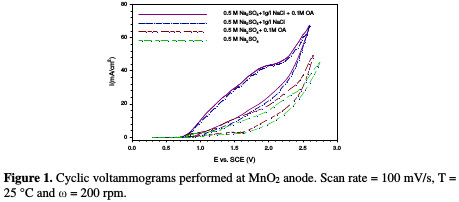
    <p>In order to have some preliminary information on the reactivity of active chlorine
with oxalic acid, some cyclic voltammograms were recorded with and without
NaCl and OA addition at the MnO2 anode in acidic conditions. As shown in <a href="#f1">Fig. 1</a>, 
the addition of NaCl to a water solution produces a higher anodic wave.</p>


    <p>&nbsp;</p>
<a name="f1">
<img src="/img/revistas/pea/v36n5/36n5a03f1.jpg">
    
]]></body>
<body><![CDATA[<p>&nbsp;</p>


    <p>According to literature, such behavior can be attributed to the oxidation of Cl
ions to Cl2 [23]. The same cyclic voltammetry behavior was obtained by
Scialdone et al. [24], when OA, at a concentration of 5 mM, was incinerated on
an IrO2-Ta2O5 anode; however, the anodic wave in the present work was higher,
due to the used OA higher concentration.</p>

    <p>Results of the previous work [7] showed that NaCl addition led to an increase in
COD removal percentage from 26.40 %, in the case of free NaCl, to 79.50 %,
with the addition of 1 g/L of NaCl. This increase in COD removal is an
indication of the effective role of NaCl during OA indirect oxidation, when the
MnO2 anode was used, as a result of chlorine overpotential on this electrode,
which enables more chlorine molecules to attack OA.</p>


    <p><i><b>Indirect electrochemical oxidation kinetics</b></i></p>

    <p>In indirect electrochemical oxidation, OA removal rate is proportional to OA
concentration, and also to chlorine/hypochlorite concentration, since the latter
mediated indirect oxidation. OA removal rate can be written as:</p>


    <p>&nbsp;</p>
<a name="e11">
<img src="/img/revistas/pea/v36n5/36n5a03e11.jpg">
    
<p>&nbsp;</p>


    <p>Electrochemical treatment involves the application of an electric current to the
effluent, to convert chloride to chlorine and hypochlorite. Chlorine and
hypochlorite will oxidize OA, and be reduced to a chloride ion. The process is
then repeated in a cyclic way. Chlorine/hypochlorite concentration during
electrolysis is assumed to be constant, and so, equation (11) can be written as a
pseudo-first order kinetics equation.</p>


    <p>&nbsp;</p>
<a name="e12">
<img src="/img/revistas/pea/v36n5/36n5a03e12.jpg">
    
<p>&nbsp;</p>


    ]]></body>
<body><![CDATA[<p>The integration of <a href="#e12">equation (12)</a> leads to a natural logarithmic relation between
OA concentration and time, as follows,</p>


    <p>&nbsp;</p>
<a name="e13">
<img src="/img/revistas/pea/v36n5/36n5a03e13.jpg">
    
<p>&nbsp;</p>


    <p>which could be written as an exponential decay function:</p>


    <p>&nbsp;</p>
<a name="e14">
<img src="/img/revistas/pea/v36n5/36n5a03e14.jpg">
    
<p>&nbsp;</p>


    <p>By using non-linear least squared fittings (exponential decay) of the
 untransformed original equation (<a href="#e14">Eq. (14)</a>), the observed rate constant kobs (min-1)
 value can be estimated [25].</p>

    <p><i><b>Effect of NaCl concentration on OA removal</b></i></p>

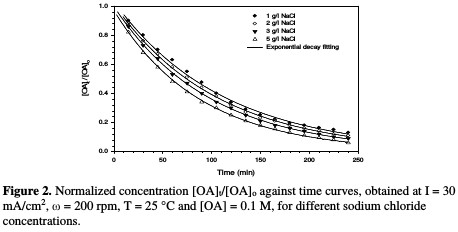
    <p><a href="#f2">Fig. 2</a> illustrates the decrease in normalized OA concentration, [OA]t/[OA]o,
 plotted against electrolysis time, with their exponential decay fitting, using
 different NaCl concentrations.</p>


    <p>&nbsp;</p>
<a name="f2">
<img src="/img/revistas/pea/v36n5/36n5a03f2.jpg">
    
]]></body>
<body><![CDATA[<p>&nbsp;</p>


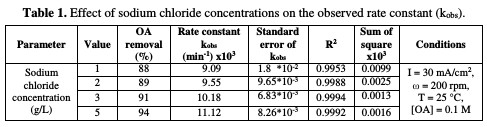
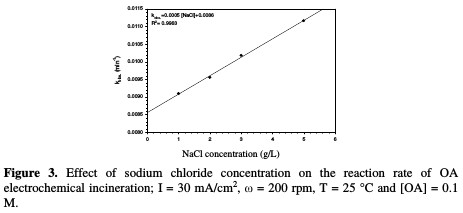
    <p><a href="#t1">Table 1</a> and <a href="#f3">Fig. 3</a> show the rate constant against
 chloride concentration.</p>


    <p>&nbsp;</p>
<a name="t1">
<img src="/img/revistas/pea/v36n5/36n5a03t1.jpg">
    
<p>&nbsp;</p>
<a name="f3">
<img src="/img/revistas/pea/v36n5/36n5a03f3.jpg">
    
<p>&nbsp;</p>


    <p>The increase in chloride concentration in the electrolytic
 solution leads to a higher reaction rate. A previous study [26] showed that an
 increase in chloride concentration reduced the overpotential required for chloride
 anodic oxidation, resulting in a higher production of hypochlorite. It is clear that
 there is a strong linearity between the rate constant and chloride concentration.
 The rate constant reported in <a href="#t1">Table 1</a> increased from 0.0091 to 0.011 min-1; when
 NaCl concentration rose from 1 to 5 g/L, the values of R2 varied between 0.9953
 and 0.9994 for different chloride concentrations. Huang et al. [27] found the
 same linear relationship between the rate constant and chloride concentration
 when OA degraded, using a Ti-DAS net anode. OA removal efficiency increased
 from 88 to 94 %, as NaCl concentration increased from 1 to 5 g/L (<a href="#t1">Table 1</a>).
 However, using a NaCl concentration higher than 3 g/L is not recommended,
 because the halogenated organic compound can generate more toxic materials
 than those of OA [24].</p>


    <p><i><b>Effect of current density on OA removal</b></i></p>

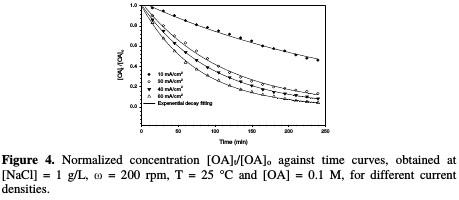
    <p><a href="#f4">Fig. 4</a> shows the decrease in normalized OA concentration, [OA]t/[OA]o, plotted
against electrolysis time, with their exponential decay fitting at different current
densities.</p>


    <p>&nbsp;</p>
<a name="f4">
<img src="/img/revistas/pea/v36n5/36n5a03f4.jpg">
    
<p>&nbsp;</p>


    ]]></body>
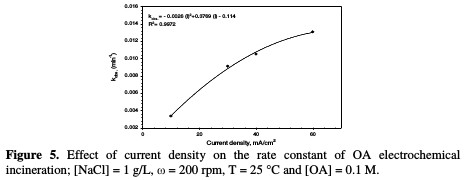
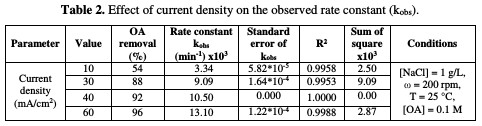
<body><![CDATA[<p>The rate constant against the current density is shown in <a href="#f5">Fig. 5</a> and <a href="#t2">Table 2</a>.</p>


    <p>&nbsp;</p>
<a name="f5">
<img src="/img/revistas/pea/v36n5/36n5a03f5.jpg">
    
<p>&nbsp;</p>
<a name="t2">
<img src="/img/revistas/pea/v36n5/36n5a03t2.jpg">
    
<p>&nbsp;</p>


    <p>In this study, when the current density increases from 10 to 60 mA/cm<sup>2</sup>, the rate
constant increases from 0.0033 to 0.0131 min-1. The relation between current
density and the rate constant was fitted to be a polynomial. The enhancing effect
of current density is attributed to the improvement of chlorine/hypochlorite
production rate that enhances the indirect oxidation effect during electrolysis.</p>

    <p>Huang et al. [26] found a linear relationship between the rate constant and the
current density when OA degraded, using a Ti-DAS net anode in NaCl presence.
According to data in <a href="#t2">Table 2</a>, OA removal percentage increased from 54 to 96 %,
as the current density increased from 10 to 60 mA/cm<sup>2</sup>. This result is an
indication that the current density is the most important factor in OA incineration
in the presence of chloride ions.</p>


    <p><i><b>Effect of rotation speed on OA removal</b></i></p>

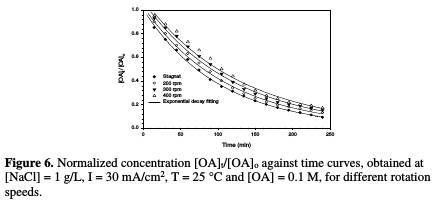
    <p>The decrease in normalized OA concentration, [OA]t/[OA]o, plotted against
electrolysis time, with their exponential decay fitting at different rotation speed,
is presented in <a href="#f6">Fig. 6</a>.</p>


    <p>&nbsp;</p>
<a name="f6">
<img src="/img/revistas/pea/v36n5/36n5a03f6.jpg">
    
<p>&nbsp;</p>


    ]]></body>
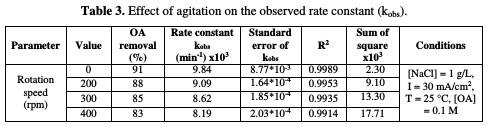
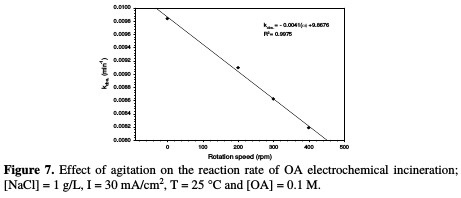
<body><![CDATA[<p>The relation between the rate constant and agitation is depicted in <a href="#t3">Table 3</a> and <a href="#f7">Fig. 7</a>.</p>


    <p>&nbsp;</p>
<a name="t3">
<img src="/img/revistas/pea/v36n5/36n5a03t3.jpg">
    
<p>&nbsp;</p>
<a name="f7">
<img src="/img/revistas/pea/v36n5/36n5a03f7.jpg">
    
<p>&nbsp;</p>


    <p>It is interesting to note that the absence of agitation gives higher rate constants,
 while increasing rotation speed more than 200 rpm leads to a drastic drop in the
 reaction rate. These behaviors may be interrupted, as higher electrode rotation
 velocities would not enable the reaction of chlorine with OA, and a part of the
 formed chlorine would be liberated to escape outside the cell; hence, a lower
 reaction rate takes place. It is observed that there is a substantial inverse linearity
 between the rate constant and agitation.</p>

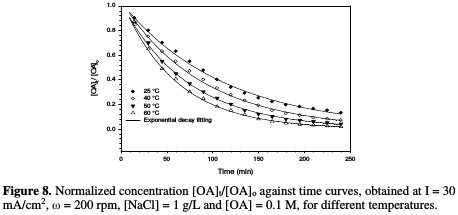
    <p>Effect of temperature on OA removal and reaction kinetics
 The decrease in normalized OA concentration, [OA]t/[OA]o, plotted against
 electrolysis time, with their exponential decay fitting at different temperatures, is
 shown in <a href="#f8">Fig. 8</a>.</p>


    <p>&nbsp;</p>
<a name="f8">
<img src="/img/revistas/pea/v36n5/36n5a03f8.jpg">
    
<p>&nbsp;</p>


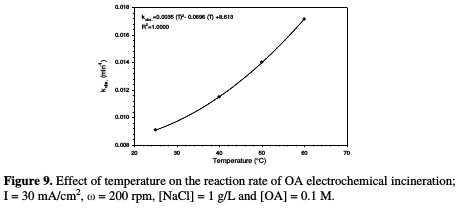
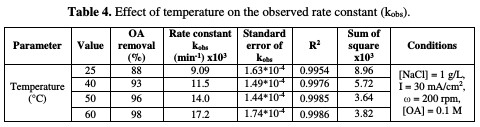
    <p>The relation between the rate constant and temperature is illustrated in <a href="#f9">Fig. 9</a> and
 <a href="#t4">Table 4</a>.</p>


    <p>&nbsp;</p>
<a name="f9">
<img src="/img/revistas/pea/v36n5/36n5a03f9.jpg">
    
]]></body>
<body><![CDATA[<p>&nbsp;</p>
<a name="t4">
<img src="/img/revistas/pea/v36n5/36n5a03t4.jpg">
    
<p>&nbsp;</p>


    <p>A polynomial relationship between the rate constant and temperature
 was observed. The effect of temperature on OA anodic incineration was widely
 investigated by the group of De Battisti [22], in the presence of several anodes,
 Scialdone et al. [28], for the case of DSA-O2 anodes, and Canizares et al. [29],
 for BDD. According to literature data, the temperature effect on OA degradation
 strongly depends on the anodic material nature. With BDD, a temperature
 increase gave rise to a slight change in OA abatement [22, 29], while a drastic
 increase at IrO2 based anodes was observed [22, 28]. In the present system, a
drastic increase in OA abatement was observed in the presence of NaCl.
Therefore, MnO2 has a catalytic activity towards OA, which increased with
higher temperatures.</p>

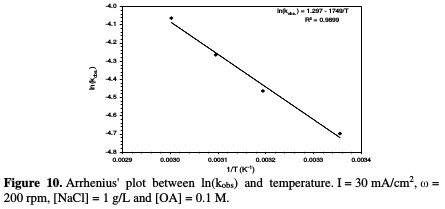
    <p>The activation energy was calculated from the study of the temperature effect on
the rate constant (Arrhenius' law), considering that the activation energy range of
a typical diffusion-controlled process is less than 20 kJ/mol [30]. <a href="#f10">Fig. 10</a> shows
the relation between ln kabs and the reciprocal of temperature (Arrhenius' plot).</p>


    <p>&nbsp;</p>
<a name="f10">
<img src="/img/revistas/pea/v36n5/36n5a03f10.jpg">
    
<p>&nbsp;</p>


    <p>The data allowed estimating an activation energy of 14.541 kJ/mol, which
confirms that the present system is limited by mass transfer [31].</p>


    <p>&nbsp;</p>
    <p><b>Conclusion</b></p>

    <p>The present research confirmed that the rate constant of OA degradation reaction
is directly proportional to the increase in NaCl concentration, current density, and
temperature, while it is inversely proportional to the increase in the anode
rotation speed. Two important points are worthy of attention: firstly, current
density has a significant role on OA incineration in the present research, where a
higher reaction rate can be achieved; secondly, temperatureâ€™s influence shows a
positive behavior, according to Arrheniusâ€™ law, in the current work, while an
adverse effect was observed with other organic compounds, such as glucose [32],
or no significant effect, in the case of anodes such as BDD [29]. This discrepancy
between the present work and previous works may be attributed to the role of
active chlorine in the electrochemical incineration, and to the catalytic activity of
the MnO2 anode. Results of activation energy suggested that the reaction is
controlled by the species diffusion towards the anode surface, and by their
reaction with the active chlorine, while direct OA oxidation at the electrode
surface is insignificant.</p>


    ]]></body>
<body><![CDATA[<p>&nbsp;</p>
    <p><b>References</b></p>

    <!-- ref --><p>1. Chollier MJ, Epron F, Lamy-Pitara E, et al. Catalysis Today. 1999;18:291.    &nbsp;&nbsp;&nbsp;&nbsp;&nbsp;&nbsp;&nbsp;&nbsp;[&#160;<a href="javascript:void(0);" onclick="javascript: window.open('/scielo.php?script=sci_nlinks&ref=436224&pid=S0872-1904201800050000300001&lng=','','width=640,height=500,resizable=yes,scrollbars=1,menubar=yes,');">Links</a>&#160;]<!-- end-ref --></p>

    <!-- ref --><p>2. Xiong Y, Karlsson H. Adv Environ Res. 2002;7:139.    &nbsp;&nbsp;&nbsp;&nbsp;&nbsp;&nbsp;&nbsp;&nbsp;[&#160;<a href="javascript:void(0);" onclick="javascript: window.open('/scielo.php?script=sci_nlinks&ref=436226&pid=S0872-1904201800050000300002&lng=','','width=640,height=500,resizable=yes,scrollbars=1,menubar=yes,');">Links</a>&#160;]<!-- end-ref --></p>

    <!-- ref --><p>3. Raijeshwar K, Ibanez JG, Swain GM. J Appl Electrochem. 1994;24:1077.    &nbsp;&nbsp;&nbsp;&nbsp;&nbsp;&nbsp;&nbsp;&nbsp;[&#160;<a href="javascript:void(0);" onclick="javascript: window.open('/scielo.php?script=sci_nlinks&ref=436228&pid=S0872-1904201800050000300003&lng=','','width=640,height=500,resizable=yes,scrollbars=1,menubar=yes,');">Links</a>&#160;]<!-- end-ref --></p>

    <!-- ref --><p>4. Martinez-Huitle CA, Ferro S. Chem Soc Rev. 2006;35:1324.    &nbsp;&nbsp;&nbsp;&nbsp;&nbsp;&nbsp;&nbsp;&nbsp;[&#160;<a href="javascript:void(0);" onclick="javascript: window.open('/scielo.php?script=sci_nlinks&ref=436230&pid=S0872-1904201800050000300004&lng=','','width=640,height=500,resizable=yes,scrollbars=1,menubar=yes,');">Links</a>&#160;]<!-- end-ref --></p>

    ]]></body>
<body><![CDATA[<!-- ref --><p>5. Panizza M, Cerisola G. Electrochim Acta. 2005;51:191.    &nbsp;&nbsp;&nbsp;&nbsp;&nbsp;&nbsp;&nbsp;&nbsp;[&#160;<a href="javascript:void(0);" onclick="javascript: window.open('/scielo.php?script=sci_nlinks&ref=436232&pid=S0872-1904201800050000300005&lng=','','width=640,height=500,resizable=yes,scrollbars=1,menubar=yes,');">Links</a>&#160;]<!-- end-ref --></p>

    <p>6. Sotgiua G, FoderĂ b M, Marrab F, et al. Chem Eng Trans. 2014;41:115.</p>

    <!-- ref --><p>7. Abbar AH, Salman RH, Abbas AS. J Electrochem Soc. 2016;163:E333.    &nbsp;&nbsp;&nbsp;&nbsp;&nbsp;&nbsp;&nbsp;&nbsp;[&#160;<a href="javascript:void(0);" onclick="javascript: window.open('/scielo.php?script=sci_nlinks&ref=436235&pid=S0872-1904201800050000300007&lng=','','width=640,height=500,resizable=yes,scrollbars=1,menubar=yes,');">Links</a>&#160;]<!-- end-ref --></p>

    <!-- ref --><p>8. Fergus JW. J Power Sources. 2010;195:939.    &nbsp;&nbsp;&nbsp;&nbsp;&nbsp;&nbsp;&nbsp;&nbsp;[&#160;<a href="javascript:void(0);" onclick="javascript: window.open('/scielo.php?script=sci_nlinks&ref=436237&pid=S0872-1904201800050000300008&lng=','','width=640,height=500,resizable=yes,scrollbars=1,menubar=yes,');">Links</a>&#160;]<!-- end-ref --></p>

    <!-- ref --><p>9. Wei W, Cui X, Chen W, et al. Chem Soc Rev. 2011;40:1697.    &nbsp;&nbsp;&nbsp;&nbsp;&nbsp;&nbsp;&nbsp;&nbsp;[&#160;<a href="javascript:void(0);" onclick="javascript: window.open('/scielo.php?script=sci_nlinks&ref=436239&pid=S0872-1904201800050000300009&lng=','','width=640,height=500,resizable=yes,scrollbars=1,menubar=yes,');">Links</a>&#160;]<!-- end-ref --></p>

    <!-- ref --><p>10. Chen CY, Wang SC, Tien YH, et al. Thin Solid Films. 2009;518:1557.    &nbsp;&nbsp;&nbsp;&nbsp;&nbsp;&nbsp;&nbsp;&nbsp;[&#160;<a href="javascript:void(0);" onclick="javascript: window.open('/scielo.php?script=sci_nlinks&ref=436241&pid=S0872-1904201800050000300010&lng=','','width=640,height=500,resizable=yes,scrollbars=1,menubar=yes,');">Links</a>&#160;]<!-- end-ref --></p>

    <!-- ref --><p>11. Djurfors B, Broughton JN, Brett MJ, et al. Acta Mater. 2005;53:957.    &nbsp;&nbsp;&nbsp;&nbsp;&nbsp;&nbsp;&nbsp;&nbsp;[&#160;<a href="javascript:void(0);" onclick="javascript: window.open('/scielo.php?script=sci_nlinks&ref=436243&pid=S0872-1904201800050000300011&lng=','','width=640,height=500,resizable=yes,scrollbars=1,menubar=yes,');">Links</a>&#160;]<!-- end-ref --></p>

    <!-- ref --><p>12. Nam KW, Kim KB. J Electrochem Soc. 2006;153:A81.    &nbsp;&nbsp;&nbsp;&nbsp;&nbsp;&nbsp;&nbsp;&nbsp;[&#160;<a href="javascript:void(0);" onclick="javascript: window.open('/scielo.php?script=sci_nlinks&ref=436245&pid=S0872-1904201800050000300012&lng=','','width=640,height=500,resizable=yes,scrollbars=1,menubar=yes,');">Links</a>&#160;]<!-- end-ref --></p>

    <!-- ref --><p>13. Chou SL, Cheng FY, Chen J. J Power Sources. 2006;162:727.    &nbsp;&nbsp;&nbsp;&nbsp;&nbsp;&nbsp;&nbsp;&nbsp;[&#160;<a href="javascript:void(0);" onclick="javascript: window.open('/scielo.php?script=sci_nlinks&ref=436247&pid=S0872-1904201800050000300013&lng=','','width=640,height=500,resizable=yes,scrollbars=1,menubar=yes,');">Links</a>&#160;]<!-- end-ref --></p>

    <!-- ref --><p>14. Xia H, Xiao W, Lai MO, et al. Nanoscale Res Lett. 2009;4:1035.    &nbsp;&nbsp;&nbsp;&nbsp;&nbsp;&nbsp;&nbsp;&nbsp;[&#160;<a href="javascript:void(0);" onclick="javascript: window.open('/scielo.php?script=sci_nlinks&ref=436249&pid=S0872-1904201800050000300014&lng=','','width=640,height=500,resizable=yes,scrollbars=1,menubar=yes,');">Links</a>&#160;]<!-- end-ref --></p>

    <!-- ref --><p>15. Xia H, Lai MO, Lu L. JOM. 2011;63:49.    &nbsp;&nbsp;&nbsp;&nbsp;&nbsp;&nbsp;&nbsp;&nbsp;[&#160;<a href="javascript:void(0);" onclick="javascript: window.open('/scielo.php?script=sci_nlinks&ref=436251&pid=S0872-1904201800050000300015&lng=','','width=640,height=500,resizable=yes,scrollbars=1,menubar=yes,');">Links</a>&#160;]<!-- end-ref --></p>

    <!-- ref --><p>16. Bonfatti F, Battisti A, Ferro S, et al. Electrochem Acta. 2000;46:305.    &nbsp;&nbsp;&nbsp;&nbsp;&nbsp;&nbsp;&nbsp;&nbsp;[&#160;<a href="javascript:void(0);" onclick="javascript: window.open('/scielo.php?script=sci_nlinks&ref=436253&pid=S0872-1904201800050000300016&lng=','','width=640,height=500,resizable=yes,scrollbars=1,menubar=yes,');">Links</a>&#160;]<!-- end-ref --></p>

    <!-- ref --><p>17. Rajkurnae D, Palanivelu K, Mohan N. Ind J Chem Technol. 2003;10:396.    &nbsp;&nbsp;&nbsp;&nbsp;&nbsp;&nbsp;&nbsp;&nbsp;[&#160;<a href="javascript:void(0);" onclick="javascript: window.open('/scielo.php?script=sci_nlinks&ref=436255&pid=S0872-1904201800050000300017&lng=','','width=640,height=500,resizable=yes,scrollbars=1,menubar=yes,');">Links</a>&#160;]<!-- end-ref --></p>

    <!-- ref --><p>18. Szpyrkowiez L, Juzzolino C, Kaul SN, et al. Ind Eng Chem Res. 2000;39:3241.    &nbsp;&nbsp;&nbsp;&nbsp;&nbsp;&nbsp;&nbsp;&nbsp;[&#160;<a href="javascript:void(0);" onclick="javascript: window.open('/scielo.php?script=sci_nlinks&ref=436257&pid=S0872-1904201800050000300018&lng=','','width=640,height=500,resizable=yes,scrollbars=1,menubar=yes,');">Links</a>&#160;]<!-- end-ref --></p>

    <!-- ref --><p>19. Cominiellis C. Electrochem Acta. 1994;39:1857.    &nbsp;&nbsp;&nbsp;&nbsp;&nbsp;&nbsp;&nbsp;&nbsp;[&#160;<a href="javascript:void(0);" onclick="javascript: window.open('/scielo.php?script=sci_nlinks&ref=436259&pid=S0872-1904201800050000300019&lng=','','width=640,height=500,resizable=yes,scrollbars=1,menubar=yes,');">Links</a>&#160;]<!-- end-ref --></p>

    <!-- ref --><p>20. Buso A, Balbo L, Giomo M, et al. Ind Eng Chem Res. 2000;39:494.    &nbsp;&nbsp;&nbsp;&nbsp;&nbsp;&nbsp;&nbsp;&nbsp;[&#160;<a href="javascript:void(0);" onclick="javascript: window.open('/scielo.php?script=sci_nlinks&ref=436261&pid=S0872-1904201800050000300020&lng=','','width=640,height=500,resizable=yes,scrollbars=1,menubar=yes,');">Links</a>&#160;]<!-- end-ref --></p>

    <!-- ref --><p>21. Deborde M, Von Gunten U. Water Res. 2008;42:13.    &nbsp;&nbsp;&nbsp;&nbsp;&nbsp;&nbsp;&nbsp;&nbsp;[&#160;<a href="javascript:void(0);" onclick="javascript: window.open('/scielo.php?script=sci_nlinks&ref=436263&pid=S0872-1904201800050000300021&lng=','','width=640,height=500,resizable=yes,scrollbars=1,menubar=yes,');">Links</a>&#160;]<!-- end-ref --></p>

    <!-- ref --><p>22. Martinez-Huitle CA, Ferro S, De Battisti A. Eletrochim Acta. 2004;49:4027.    &nbsp;&nbsp;&nbsp;&nbsp;&nbsp;&nbsp;&nbsp;&nbsp;[&#160;<a href="javascript:void(0);" onclick="javascript: window.open('/scielo.php?script=sci_nlinks&ref=436265&pid=S0872-1904201800050000300022&lng=','','width=640,height=500,resizable=yes,scrollbars=1,menubar=yes,');">Links</a>&#160;]<!-- end-ref --></p>

    <!-- ref --><p>23. Szpyrkowicz L, Radaelli M, Daniele S. Catalysis Today. 2005;100:425.    &nbsp;&nbsp;&nbsp;&nbsp;&nbsp;&nbsp;&nbsp;&nbsp;[&#160;<a href="javascript:void(0);" onclick="javascript: window.open('/scielo.php?script=sci_nlinks&ref=436267&pid=S0872-1904201800050000300023&lng=','','width=640,height=500,resizable=yes,scrollbars=1,menubar=yes,');">Links</a>&#160;]<!-- end-ref --></p>

    <!-- ref --><p>24. Scialdone O, Randazzo S, Galia A, Silvestri G. Water Res. 2009;43:2260.    &nbsp;&nbsp;&nbsp;&nbsp;&nbsp;&nbsp;&nbsp;&nbsp;[&#160;<a href="javascript:void(0);" onclick="javascript: window.open('/scielo.php?script=sci_nlinks&ref=436269&pid=S0872-1904201800050000300024&lng=','','width=640,height=500,resizable=yes,scrollbars=1,menubar=yes,');">Links</a>&#160;]<!-- end-ref --></p>

    <!-- ref --><p>25. Lente G. Deterministic Kinetics in Chemistry and Systems Biology. London: Springer; 2015.    &nbsp;&nbsp;&nbsp;&nbsp;&nbsp;&nbsp;&nbsp;&nbsp;[&#160;<a href="javascript:void(0);" onclick="javascript: window.open('/scielo.php?script=sci_nlinks&ref=436271&pid=S0872-1904201800050000300025&lng=','','width=640,height=500,resizable=yes,scrollbars=1,menubar=yes,');">Links</a>&#160;]<!-- end-ref --></p>

    <!-- ref --><p>26. Mohan N. Studies on electrochemical oxidation of acid dye effluent (PhD thesis). Chennai: Anna University; 2000.    &nbsp;&nbsp;&nbsp;&nbsp;&nbsp;&nbsp;&nbsp;&nbsp;[&#160;<a href="javascript:void(0);" onclick="javascript: window.open('/scielo.php?script=sci_nlinks&ref=436273&pid=S0872-1904201800050000300026&lng=','','width=640,height=500,resizable=yes,scrollbars=1,menubar=yes,');">Links</a>&#160;]<!-- end-ref --></p>

    <!-- ref --><p>27. Huang Y-H, Shih Y-J, Liu C-H. J Hazard Mater. 2011;188:188.    &nbsp;&nbsp;&nbsp;&nbsp;&nbsp;&nbsp;&nbsp;&nbsp;[&#160;<a href="javascript:void(0);" onclick="javascript: window.open('/scielo.php?script=sci_nlinks&ref=436275&pid=S0872-1904201800050000300027&lng=','','width=640,height=500,resizable=yes,scrollbars=1,menubar=yes,');">Links</a>&#160;]<!-- end-ref --></p>

    <!-- ref --><p>28. Scialdone O, Randazzo S, Galia A, et al. Electrochim Acta. 2009;54:1210.    &nbsp;&nbsp;&nbsp;&nbsp;&nbsp;&nbsp;&nbsp;&nbsp;[&#160;<a href="javascript:void(0);" onclick="javascript: window.open('/scielo.php?script=sci_nlinks&ref=436277&pid=S0872-1904201800050000300028&lng=','','width=640,height=500,resizable=yes,scrollbars=1,menubar=yes,');">Links</a>&#160;]<!-- end-ref --></p>

    <!-- ref --><p>29. Canizares P, Garcia-Gomez J, Lobato J, et al. Ind Eng Chem Res. 2003;42:956.    &nbsp;&nbsp;&nbsp;&nbsp;&nbsp;&nbsp;&nbsp;&nbsp;[&#160;<a href="javascript:void(0);" onclick="javascript: window.open('/scielo.php?script=sci_nlinks&ref=436279&pid=S0872-1904201800050000300029&lng=','','width=640,height=500,resizable=yes,scrollbars=1,menubar=yes,');">Links</a>&#160;]<!-- end-ref --></p>

    <!-- ref --><p>30. Ferreira M, Pinto MF, Soares OSGP, et al. Electrochim Acta. 2012;60:278.    &nbsp;&nbsp;&nbsp;&nbsp;&nbsp;&nbsp;&nbsp;&nbsp;[&#160;<a href="javascript:void(0);" onclick="javascript: window.open('/scielo.php?script=sci_nlinks&ref=436281&pid=S0872-1904201800050000300030&lng=','','width=640,height=500,resizable=yes,scrollbars=1,menubar=yes,');">Links</a>&#160;]<!-- end-ref --></p>

    <!-- ref --><p>31. Benson SW. The Foundations of Chemical Kinetics. New York: McGraw-Hill; 1960.    &nbsp;&nbsp;&nbsp;&nbsp;&nbsp;&nbsp;&nbsp;&nbsp;[&#160;<a href="javascript:void(0);" onclick="javascript: window.open('/scielo.php?script=sci_nlinks&ref=436283&pid=S0872-1904201800050000300031&lng=','','width=640,height=500,resizable=yes,scrollbars=1,menubar=yes,');">Links</a>&#160;]<!-- end-ref --></p>

    <!-- ref --><p>32. Bonfatti F, Ferro S, Lavezzo F, et al. J Electrochem Soc. 2000;147:592.    &nbsp;&nbsp;&nbsp;&nbsp;&nbsp;&nbsp;&nbsp;&nbsp;[&#160;<a href="javascript:void(0);" onclick="javascript: window.open('/scielo.php?script=sci_nlinks&ref=436285&pid=S0872-1904201800050000300032&lng=','','width=640,height=500,resizable=yes,scrollbars=1,menubar=yes,');">Links</a>&#160;]<!-- end-ref --></p>


    <p>&nbsp;</p>
    <p><b>Acknowledgements</b></p>

    <p>The authors wish to acknowledge the helpful suggestions and gracious technical
assistance from the staff of the Chemical Engineering Department, College of
Engineering, University of Baghdad, Iraq.</p>


    <p>&nbsp;</p>
    <p><a name=0></a><sup><a href="#top">*</a></sup>Corresponding author. E-mail address: <a href="mailto:ali.abbar@qu.edu.iq">ali.abbar@qu.edu.iq</a></p>

    ]]></body>
<body><![CDATA[<p>Received February 17, 2017; accepted November 10, 2017</p>

    <p><a href="http://www.peacta.org" target="_blank">www.peacta.org</a> </p>


     ]]></body><back>
<ref-list>
<ref id="B1">
<label>1</label><nlm-citation citation-type="journal">
<person-group person-group-type="author">
<name>
<surname><![CDATA[Chollier]]></surname>
<given-names><![CDATA[M J]]></given-names>
</name>
<name>
<surname><![CDATA[Epron]]></surname>
<given-names><![CDATA[F]]></given-names>
</name>
<name>
<surname><![CDATA[Lamy-Pitara]]></surname>
<given-names><![CDATA[E]]></given-names>
</name>
</person-group>
<source><![CDATA[Catalysis Today]]></source>
<year>1999</year>
<volume>18</volume>
<page-range>291</page-range></nlm-citation>
</ref>
<ref id="B2">
<label>2</label><nlm-citation citation-type="journal">
<person-group person-group-type="author">
<name>
<surname><![CDATA[Xiong]]></surname>
<given-names><![CDATA[Y]]></given-names>
</name>
<name>
<surname><![CDATA[Karlsson]]></surname>
<given-names><![CDATA[H]]></given-names>
</name>
</person-group>
<source><![CDATA[Adv Environ Res]]></source>
<year>2002</year>
<volume>7</volume>
<page-range>139</page-range></nlm-citation>
</ref>
<ref id="B3">
<label>3</label><nlm-citation citation-type="journal">
<person-group person-group-type="author">
<name>
<surname><![CDATA[Raijeshwar]]></surname>
<given-names><![CDATA[K]]></given-names>
</name>
<name>
<surname><![CDATA[Ibanez]]></surname>
<given-names><![CDATA[J G]]></given-names>
</name>
<name>
<surname><![CDATA[Swain]]></surname>
<given-names><![CDATA[G M]]></given-names>
</name>
</person-group>
<source><![CDATA[J Appl Electrochem]]></source>
<year>1994</year>
<volume>24</volume>
<page-range>1077</page-range></nlm-citation>
</ref>
<ref id="B4">
<label>4</label><nlm-citation citation-type="journal">
<person-group person-group-type="author">
<name>
<surname><![CDATA[Martinez-Huitle]]></surname>
<given-names><![CDATA[C A]]></given-names>
</name>
</person-group>
<source><![CDATA[Ferro S. Chem Soc Rev]]></source>
<year>2006</year>
<volume>35</volume>
<page-range>1324</page-range></nlm-citation>
</ref>
<ref id="B5">
<label>5</label><nlm-citation citation-type="journal">
<person-group person-group-type="author">
<name>
<surname><![CDATA[Panizza]]></surname>
<given-names><![CDATA[M]]></given-names>
</name>
<name>
<surname><![CDATA[Cerisola]]></surname>
<given-names><![CDATA[G]]></given-names>
</name>
</person-group>
<source><![CDATA[Electrochim Acta]]></source>
<year>2005</year>
<volume>51</volume>
<page-range>191</page-range></nlm-citation>
</ref>
<ref id="B6">
<label>6</label><nlm-citation citation-type="journal">
<person-group person-group-type="author">
<name>
<surname><![CDATA[Sotgiua]]></surname>
<given-names><![CDATA[G]]></given-names>
</name>
<name>
<surname><![CDATA[Fodera]]></surname>
<given-names><![CDATA[B M]]></given-names>
</name>
<name>
<surname><![CDATA[Marrab]]></surname>
<given-names><![CDATA[F]]></given-names>
</name>
</person-group>
<source><![CDATA[Chem Eng Trans]]></source>
<year>2014</year>
<volume>41</volume>
<page-range>115</page-range></nlm-citation>
</ref>
<ref id="B7">
<label>7</label><nlm-citation citation-type="journal">
<person-group person-group-type="author">
<name>
<surname><![CDATA[Abbar]]></surname>
<given-names><![CDATA[A H]]></given-names>
</name>
<name>
<surname><![CDATA[Salman]]></surname>
<given-names><![CDATA[R H]]></given-names>
</name>
<name>
<surname><![CDATA[Abbas]]></surname>
<given-names><![CDATA[AS]]></given-names>
</name>
</person-group>
<source><![CDATA[J Electrochem Soc]]></source>
<year>2016</year>
<volume>163</volume>
<page-range>E333</page-range></nlm-citation>
</ref>
<ref id="B8">
<label>8</label><nlm-citation citation-type="journal">
<person-group person-group-type="author">
<name>
<surname><![CDATA[Fergus]]></surname>
<given-names><![CDATA[J W]]></given-names>
</name>
</person-group>
<source><![CDATA[J Power Sources]]></source>
<year>2010</year>
<volume>195</volume>
<page-range>939</page-range></nlm-citation>
</ref>
<ref id="B9">
<label>9</label><nlm-citation citation-type="journal">
<person-group person-group-type="author">
<name>
<surname><![CDATA[Wei]]></surname>
<given-names><![CDATA[W]]></given-names>
</name>
<name>
<surname><![CDATA[Cui]]></surname>
<given-names><![CDATA[X]]></given-names>
</name>
<name>
<surname><![CDATA[Chen]]></surname>
<given-names><![CDATA[W]]></given-names>
</name>
</person-group>
<source><![CDATA[Chem Soc Rev]]></source>
<year>2011</year>
<volume>40</volume>
<page-range>1697</page-range></nlm-citation>
</ref>
<ref id="B10">
<label>10</label><nlm-citation citation-type="journal">
<person-group person-group-type="author">
<name>
<surname><![CDATA[Chen]]></surname>
<given-names><![CDATA[C Y]]></given-names>
</name>
<name>
<surname><![CDATA[Wang]]></surname>
<given-names><![CDATA[S C]]></given-names>
</name>
<name>
<surname><![CDATA[Tien]]></surname>
<given-names><![CDATA[Y H]]></given-names>
</name>
</person-group>
<source><![CDATA[Thin Solid Films]]></source>
<year>2009</year>
<volume>518</volume>
<page-range>1557</page-range></nlm-citation>
</ref>
<ref id="B11">
<label>11</label><nlm-citation citation-type="journal">
<person-group person-group-type="author">
<name>
<surname><![CDATA[Djurfors]]></surname>
<given-names><![CDATA[B]]></given-names>
</name>
<name>
<surname><![CDATA[Broughton]]></surname>
<given-names><![CDATA[J N]]></given-names>
</name>
<name>
<surname><![CDATA[Brett]]></surname>
<given-names><![CDATA[M J]]></given-names>
</name>
</person-group>
<source><![CDATA[Acta Mater]]></source>
<year>2005</year>
<volume>53</volume>
<page-range>957</page-range></nlm-citation>
</ref>
<ref id="B12">
<label>12</label><nlm-citation citation-type="journal">
<person-group person-group-type="author">
<name>
<surname><![CDATA[Nam]]></surname>
<given-names><![CDATA[K W]]></given-names>
</name>
<name>
<surname><![CDATA[Kim]]></surname>
<given-names><![CDATA[K B]]></given-names>
</name>
</person-group>
<source><![CDATA[J Electrochem Soc]]></source>
<year>2006</year>
<volume>153</volume>
<page-range>A81</page-range></nlm-citation>
</ref>
<ref id="B13">
<label>13</label><nlm-citation citation-type="journal">
<person-group person-group-type="author">
<name>
<surname><![CDATA[Chou]]></surname>
<given-names><![CDATA[S L]]></given-names>
</name>
<name>
<surname><![CDATA[Cheng]]></surname>
<given-names><![CDATA[F Y]]></given-names>
</name>
<name>
<surname><![CDATA[Chen]]></surname>
<given-names><![CDATA[J]]></given-names>
</name>
</person-group>
<source><![CDATA[J Power Sources]]></source>
<year>2006</year>
<volume>162</volume>
<page-range>727</page-range></nlm-citation>
</ref>
<ref id="B14">
<label>14</label><nlm-citation citation-type="journal">
<person-group person-group-type="author">
<name>
<surname><![CDATA[Xia]]></surname>
<given-names><![CDATA[H]]></given-names>
</name>
<name>
<surname><![CDATA[Xiao]]></surname>
<given-names><![CDATA[W]]></given-names>
</name>
<name>
<surname><![CDATA[Lai]]></surname>
<given-names><![CDATA[M O]]></given-names>
</name>
</person-group>
<source><![CDATA[Nanoscale Res Lett]]></source>
<year>2009</year>
<volume>4</volume>
<page-range>1035</page-range></nlm-citation>
</ref>
<ref id="B15">
<label>15</label><nlm-citation citation-type="journal">
<person-group person-group-type="author">
<name>
<surname><![CDATA[Xia]]></surname>
<given-names><![CDATA[H]]></given-names>
</name>
<name>
<surname><![CDATA[Lai]]></surname>
<given-names><![CDATA[M O]]></given-names>
</name>
<name>
<surname><![CDATA[Lu]]></surname>
<given-names><![CDATA[L]]></given-names>
</name>
</person-group>
<source><![CDATA[JOM]]></source>
<year>2011</year>
<volume>63</volume>
<page-range>49</page-range></nlm-citation>
</ref>
<ref id="B16">
<label>16</label><nlm-citation citation-type="journal">
<person-group person-group-type="author">
<name>
<surname><![CDATA[Bonfatti]]></surname>
<given-names><![CDATA[F]]></given-names>
</name>
<name>
<surname><![CDATA[Battisti]]></surname>
<given-names><![CDATA[A]]></given-names>
</name>
<name>
<surname><![CDATA[Ferro]]></surname>
<given-names><![CDATA[S]]></given-names>
</name>
</person-group>
<source><![CDATA[Electrochem Acta]]></source>
<year>2000</year>
<volume>46</volume>
<page-range>305</page-range></nlm-citation>
</ref>
<ref id="B17">
<label>17</label><nlm-citation citation-type="journal">
<person-group person-group-type="author">
<name>
<surname><![CDATA[Rajkurnae]]></surname>
<given-names><![CDATA[D]]></given-names>
</name>
<name>
<surname><![CDATA[Palanivelu]]></surname>
<given-names><![CDATA[K]]></given-names>
</name>
<name>
<surname><![CDATA[Mohan]]></surname>
<given-names><![CDATA[N]]></given-names>
</name>
</person-group>
<source><![CDATA[Ind J Chem Technol]]></source>
<year>2003</year>
<volume>10</volume>
<page-range>396</page-range></nlm-citation>
</ref>
<ref id="B18">
<label>18</label><nlm-citation citation-type="journal">
<person-group person-group-type="author">
<name>
<surname><![CDATA[Szpyrkowiez]]></surname>
<given-names><![CDATA[L]]></given-names>
</name>
<name>
<surname><![CDATA[Juzzolino]]></surname>
<given-names><![CDATA[C]]></given-names>
</name>
<name>
<surname><![CDATA[Kaul]]></surname>
<given-names><![CDATA[S N]]></given-names>
</name>
</person-group>
<source><![CDATA[Ind Eng Chem Res]]></source>
<year>2000</year>
<volume>39</volume>
<page-range>3241</page-range></nlm-citation>
</ref>
<ref id="B19">
<label>19</label><nlm-citation citation-type="journal">
<person-group person-group-type="author">
<name>
<surname><![CDATA[Cominiellis]]></surname>
<given-names><![CDATA[C]]></given-names>
</name>
</person-group>
<source><![CDATA[Electrochem Acta]]></source>
<year>1994</year>
<volume>39</volume>
<page-range>1857</page-range></nlm-citation>
</ref>
<ref id="B20">
<label>20</label><nlm-citation citation-type="journal">
<person-group person-group-type="author">
<name>
<surname><![CDATA[Buso]]></surname>
<given-names><![CDATA[A]]></given-names>
</name>
<name>
<surname><![CDATA[Balbo]]></surname>
<given-names><![CDATA[L]]></given-names>
</name>
<name>
<surname><![CDATA[Giomo]]></surname>
<given-names><![CDATA[M]]></given-names>
</name>
</person-group>
<source><![CDATA[Ind Eng Chem Res]]></source>
<year>2000</year>
<volume>39</volume>
<page-range>494</page-range></nlm-citation>
</ref>
<ref id="B21">
<label>21</label><nlm-citation citation-type="journal">
<person-group person-group-type="author">
<name>
<surname><![CDATA[Deborde]]></surname>
<given-names><![CDATA[M]]></given-names>
</name>
<name>
<surname><![CDATA[Von Gunten]]></surname>
<given-names><![CDATA[U]]></given-names>
</name>
</person-group>
<source><![CDATA[Water Res]]></source>
<year>2008</year>
<volume>42</volume>
<page-range>13</page-range></nlm-citation>
</ref>
<ref id="B22">
<label>22</label><nlm-citation citation-type="journal">
<person-group person-group-type="author">
<name>
<surname><![CDATA[Martinez-Huitle]]></surname>
<given-names><![CDATA[C A]]></given-names>
</name>
<name>
<surname><![CDATA[Ferro]]></surname>
<given-names><![CDATA[S]]></given-names>
</name>
<name>
<surname><![CDATA[De Battisti]]></surname>
<given-names><![CDATA[A]]></given-names>
</name>
</person-group>
<source><![CDATA[Eletrochim Acta]]></source>
<year>2004</year>
<volume>49</volume>
<page-range>4027</page-range></nlm-citation>
</ref>
<ref id="B23">
<label>23</label><nlm-citation citation-type="journal">
<person-group person-group-type="author">
<name>
<surname><![CDATA[Szpyrkowicz]]></surname>
<given-names><![CDATA[L]]></given-names>
</name>
<name>
<surname><![CDATA[Radaelli]]></surname>
<given-names><![CDATA[M]]></given-names>
</name>
<name>
<surname><![CDATA[Daniele]]></surname>
<given-names><![CDATA[S]]></given-names>
</name>
</person-group>
<source><![CDATA[Catalysis Today]]></source>
<year>2005</year>
<volume>100</volume>
<page-range>425</page-range></nlm-citation>
</ref>
<ref id="B24">
<label>24</label><nlm-citation citation-type="journal">
<person-group person-group-type="author">
<name>
<surname><![CDATA[Scialdone]]></surname>
<given-names><![CDATA[O]]></given-names>
</name>
<name>
<surname><![CDATA[Randazzo]]></surname>
<given-names><![CDATA[S]]></given-names>
</name>
<name>
<surname><![CDATA[Galia]]></surname>
<given-names><![CDATA[A]]></given-names>
</name>
<name>
<surname><![CDATA[Silvestri]]></surname>
<given-names><![CDATA[G]]></given-names>
</name>
</person-group>
<source><![CDATA[Water Res]]></source>
<year>2009</year>
<volume>43</volume>
<page-range>2260</page-range></nlm-citation>
</ref>
<ref id="B25">
<label>25</label><nlm-citation citation-type="book">
<person-group person-group-type="author">
<name>
<surname><![CDATA[Lente]]></surname>
<given-names><![CDATA[G]]></given-names>
</name>
</person-group>
<source><![CDATA[Deterministic Kinetics in Chemistry and Systems Biology]]></source>
<year>2015</year>
<publisher-loc><![CDATA[London ]]></publisher-loc>
<publisher-name><![CDATA[Springer]]></publisher-name>
</nlm-citation>
</ref>
<ref id="B26">
<label>26</label><nlm-citation citation-type="book">
<person-group person-group-type="author">
<name>
<surname><![CDATA[Mohan]]></surname>
<given-names><![CDATA[N]]></given-names>
</name>
</person-group>
<source><![CDATA[Studies on electrochemical oxidation of acid dye effluent (PhD thesis)]]></source>
<year>2000</year>
<publisher-name><![CDATA[Chennai]]></publisher-name>
</nlm-citation>
</ref>
<ref id="B27">
<label>27</label><nlm-citation citation-type="journal">
<person-group person-group-type="author">
<name>
<surname><![CDATA[Huang]]></surname>
<given-names><![CDATA[Y-H]]></given-names>
</name>
<name>
<surname><![CDATA[Shih]]></surname>
<given-names><![CDATA[Y-J]]></given-names>
</name>
<name>
<surname><![CDATA[Liu]]></surname>
<given-names><![CDATA[C-H]]></given-names>
</name>
</person-group>
<source><![CDATA[J Hazard Mater]]></source>
<year>2011</year>
<volume>188</volume>
<page-range>188</page-range></nlm-citation>
</ref>
<ref id="B28">
<label>28</label><nlm-citation citation-type="journal">
<person-group person-group-type="author">
<name>
<surname><![CDATA[Scialdone]]></surname>
<given-names><![CDATA[O]]></given-names>
</name>
<name>
<surname><![CDATA[Randazzo]]></surname>
<given-names><![CDATA[S]]></given-names>
</name>
<name>
<surname><![CDATA[Galia]]></surname>
<given-names><![CDATA[A]]></given-names>
</name>
</person-group>
<source><![CDATA[Electrochim Acta]]></source>
<year>2009</year>
<volume>54</volume>
<page-range>1210</page-range></nlm-citation>
</ref>
<ref id="B29">
<label>29</label><nlm-citation citation-type="journal">
<person-group person-group-type="author">
<name>
<surname><![CDATA[Canizares]]></surname>
<given-names><![CDATA[P]]></given-names>
</name>
<name>
<surname><![CDATA[Garcia-Gomez]]></surname>
<given-names><![CDATA[J]]></given-names>
</name>
<name>
<surname><![CDATA[Lobato]]></surname>
<given-names><![CDATA[J]]></given-names>
</name>
</person-group>
<source><![CDATA[Ind Eng Chem Res]]></source>
<year>2003</year>
<volume>42</volume>
<page-range>956</page-range></nlm-citation>
</ref>
<ref id="B30">
<label>30</label><nlm-citation citation-type="journal">
<person-group person-group-type="author">
<name>
<surname><![CDATA[Ferreira]]></surname>
<given-names><![CDATA[M]]></given-names>
</name>
<name>
<surname><![CDATA[Pinto]]></surname>
<given-names><![CDATA[M F]]></given-names>
</name>
<name>
<surname><![CDATA[Soares]]></surname>
<given-names><![CDATA[O S G P]]></given-names>
</name>
</person-group>
<source><![CDATA[Electrochim Acta]]></source>
<year>2012</year>
<volume>60</volume>
<page-range>278</page-range></nlm-citation>
</ref>
<ref id="B31">
<label>31</label><nlm-citation citation-type="book">
<person-group person-group-type="author">
<name>
<surname><![CDATA[Benson]]></surname>
<given-names><![CDATA[SW]]></given-names>
</name>
</person-group>
<source><![CDATA[The Foundations of Chemical Kinetics]]></source>
<year>1960</year>
<publisher-loc><![CDATA[New York ]]></publisher-loc>
<publisher-name><![CDATA[McGraw-Hill]]></publisher-name>
</nlm-citation>
</ref>
<ref id="B32">
<label>32</label><nlm-citation citation-type="journal">
<person-group person-group-type="author">
<name>
<surname><![CDATA[Bonfatti]]></surname>
<given-names><![CDATA[F]]></given-names>
</name>
<name>
<surname><![CDATA[Ferro]]></surname>
<given-names><![CDATA[S]]></given-names>
</name>
<name>
<surname><![CDATA[Lavezzo]]></surname>
<given-names><![CDATA[F]]></given-names>
</name>
</person-group>
<source><![CDATA[J Electrochem Soc]]></source>
<year>2000</year>
<volume>147</volume>
<page-range>592</page-range></nlm-citation>
</ref>
</ref-list>
</back>
</article>