<?xml version="1.0" encoding="ISO-8859-1"?><article xmlns:mml="http://www.w3.org/1998/Math/MathML" xmlns:xlink="http://www.w3.org/1999/xlink" xmlns:xsi="http://www.w3.org/2001/XMLSchema-instance">
<front>
<journal-meta>
<journal-id>0872-1904</journal-id>
<journal-title><![CDATA[Portugaliae Electrochimica Acta]]></journal-title>
<abbrev-journal-title><![CDATA[Port. Electrochim. Acta]]></abbrev-journal-title>
<issn>0872-1904</issn>
<publisher>
<publisher-name><![CDATA[Sociedade Portuguesa de Electroquímica]]></publisher-name>
</publisher>
</journal-meta>
<article-meta>
<article-id>S0872-19042018000500005</article-id>
<article-id pub-id-type="doi">10.4152/pea.201805365</article-id>
<title-group>
<article-title xml:lang="en"><![CDATA[Conducting Polypyrrole Coated Rebar in a Carbonated Concrete Pore Solution: Electrochemical Investigations]]></article-title>
</title-group>
<contrib-group>
<contrib contrib-type="author">
<name>
<surname><![CDATA[Munot]]></surname>
<given-names><![CDATA[H.]]></given-names>
</name>
<xref ref-type="aff" rid="A01"/>
</contrib>
<contrib contrib-type="author">
<name>
<surname><![CDATA[Deshpande]]></surname>
<given-names><![CDATA[P.]]></given-names>
</name>
<xref ref-type="aff" rid="A01"/>
</contrib>
<contrib contrib-type="author">
<name>
<surname><![CDATA[Modhera]]></surname>
<given-names><![CDATA[C.]]></given-names>
</name>
<xref ref-type="aff" rid="A02"/>
</contrib>
</contrib-group>
<aff id="A01">
<institution><![CDATA[,College of Engineering  ]]></institution>
<addr-line><![CDATA[Pune ]]></addr-line>
<country>India</country>
</aff>
<aff id="A02">
<institution><![CDATA[,Sardar Vallabhbhai National Institute of Technology  ]]></institution>
<addr-line><![CDATA[Surat Gujarat]]></addr-line>
<country>India</country>
</aff>
<pub-date pub-type="pub">
<day>00</day>
<month>09</month>
<year>2018</year>
</pub-date>
<pub-date pub-type="epub">
<day>00</day>
<month>09</month>
<year>2018</year>
</pub-date>
<volume>36</volume>
<numero>5</numero>
<fpage>365</fpage>
<lpage>375</lpage>
<copyright-statement/>
<copyright-year/>
<self-uri xlink:href="http://scielo.pt/scielo.php?script=sci_arttext&amp;pid=S0872-19042018000500005&amp;lng=en&amp;nrm=iso"></self-uri><self-uri xlink:href="http://scielo.pt/scielo.php?script=sci_abstract&amp;pid=S0872-19042018000500005&amp;lng=en&amp;nrm=iso"></self-uri><self-uri xlink:href="http://scielo.pt/scielo.php?script=sci_pdf&amp;pid=S0872-19042018000500005&amp;lng=en&amp;nrm=iso"></self-uri><abstract abstract-type="short" xml:lang="en"><p><![CDATA[Conducting polypyrrole was synthesized, and applied with a paint coating on a low carbon steel sample. By using linear polarization technique, the corrosion rates of uncoated and painted low carbon steel samples, in 3.5 wt% NaCl, were determined, and found to be 5 mpy and 0.1 mpy, respectively. The uncoated and conducting polypyrrole coated steel samples were immersed in a simulated carbonated concrete pore solution, and electrochemical studies were carried out. The shift of corrosion potential in the positive direction implies that the polypyrrole coating gives corrosion protection to low carbon steel, in the anodic direction. As compared to uncoated low carbon samples, polypyrrole coated low carbon steel samples exhibited higher impedance values, but their corrosion resistance decreased with increasing chloride ions in a carbonated pore solution.]]></p></abstract>
<kwd-group>
<kwd lng="en"><![CDATA[corrosion]]></kwd>
<kwd lng="en"><![CDATA[carbonated concrete pore solution]]></kwd>
<kwd lng="en"><![CDATA[rebar]]></kwd>
<kwd lng="en"><![CDATA[conducting polypyrrole]]></kwd>
</kwd-group>
</article-meta>
</front><body><![CDATA[ 

<!--     <p>&nbsp;</p>
    <p>doi: 10.4152/pea.201805365</p> -->

    <p><b>Conducting Polypyrrole Coated Rebar in a Carbonated Concrete Pore Solution: Electrochemical Investigations</b></p>

    <p>
<b>H. Munot</b><sup><i>a</i></sup>
, <b>P. Deshpande</b><sup><i>a</i>,<a href="#0">*</a></sup>
 and <b>C. Modhera</b><sup><i>b</i></sup>
</p>

    <p><i><sup>a</sup> College of Engineering, Pune, 411005, India</i></p>

    <p><i><sup>b</sup> Sardar Vallabhbhai National Institute of Technology, Surat, Gujarat, 395007, India</i></p>


    <p>&nbsp;</p>
    <p><b>Abstract</b></p>

    <p>Conducting polypyrrole was synthesized, and applied with a paint coating on a low
carbon steel sample. By using linear polarization technique, the corrosion rates of
uncoated and painted low carbon steel samples, in 3.5 wt% NaCl, were determined, and
found to be 5 mpy and 0.1 mpy, respectively. The uncoated and conducting polypyrrole
coated steel samples were immersed in a simulated carbonated concrete pore solution, and
electrochemical studies were carried out. The shift of corrosion potential in the positive
direction implies that the polypyrrole coating gives corrosion protection to low carbon
steel, in the anodic direction. As compared to uncoated low carbon samples, polypyrrole
coated low carbon steel samples exhibited higher impedance values, but their corrosion
resistance decreased with increasing chloride ions in a carbonated pore solution.</p>

    ]]></body>
<body><![CDATA[<p><b><i>Keywords:</i></b> corrosion, carbonated concrete pore solution, rebar and conducting
polypyrrole.</p>


    <p>&nbsp;</p>
    <p><b>Introduction</b></p>

    <p>Hardened concrete is a composite material composed of coarse and fine
aggregates embedded in a matrix of hydrated cement. When cement comes in
contact with water, its initial hydration proceeds both inward and outward, in
such a manner that the hydrated part gets deposited on the outer periphery, and
the dehydrated nucleus of cement gradually diminishes in volume. Consequently,
the hardened cement paste has a porous structure which stores a solution
containing mainly alkali ions, such as potassium, sodium and hydroxide ions,
along with smaller concentrations of calcium and sulphate ions, and others [1-2].
The large hydroxide concentration in the concrete pore solution makes it alkaline
(pH &sim;13), forming a protective passive film on the rebar. During final hydration,
some of these ions may leave the pore space by leaching, and other ions such as
chloride, sulphate and ammonium may penetrate. In addition, carbon dioxide,
either dissolved in water, or as gas from the environment, may penetrate into the
pore space [3]. Carbon dioxide reacts with calcium hydroxide in the cement
matrix, leading to calcite (CaCO3) formation, through the following chemical
reactions [4-5]:</p>


    <p>&nbsp;</p>
<a name="e1">
<img src="/img/revistas/pea/v36n5/36n5a05e1.jpg">
    
<p>&nbsp;</p>
<a name="e2">
<img src="/img/revistas/pea/v36n5/36n5a05e2.jpg">
    
<p>&nbsp;</p>


    <p>The consumption of hydroxyl ions lowers the pore solution's pH from higher
than 12.5 to lower than 9. Subsequently, the passive layer becomes unstable, and
the protective passive film on the rebar also gets destroyed due to chloride attack,
phenomenon known as chloride induced corrosion. Shin-ichi Miyazato et al.
demonstrated that, in the case of chloride induced corrosion, an increase in the
water-cement ratio, to approx 0.7, increased the activity of microcell prominent
corrosion. The research team also experienced that a decrease in the water-
cement ratio, to approx. 0.3, increased the activity of macrocell prominent
corrosion. Therefore, they concluded that, in the presence of defects, a high
corrosion rate might be promoted, even at a low water-cement ratio.
In the case of carbonation induced corrosion, although macrocell prominent
corrosion occurred regardless of the water-cement ratio, the lower was the latter,
the lower was the corrosion rate. In this work, it was stated that the corrosion rate
induced by chloride was higher than that induced by carbonation [6]. Vladimir
Zivica found that initial carbonation intensifies the effect of subsequent chloride
attack. In this research, the intensification of a chloride attack due to initial
carbonation was attributed to the decreased alkalinity of the concrete pore
solution However, initial exposure to chlorides, followed by exposure to the
carbonate solution, reduced the corrosion intensity [7]. M. Moreno et al. observed
that high levels of carbonate and bicarbonates in the pore solution improved the
rebar resistance to localised corrosion. However, pitting corrosion occurred in case
of a chloride concentration higher than the critical value [8]. Comprehensive
reviews on various methods applied for rebars corrosion protection have been
published [9-10]. These methods include cathodic protection, rebar surface
treatments, epoxy coating, galvanizing, copper cladding, protective rust growth,
surface oxidation, sand blasting, along with the use of admixtures and surface
coatings on concrete, high performance concrete, re-alkalization, low
water/cement ratio, optimum thickness of concrete cover, and the use of corrosion
inhibitors, etc. However, each protection method has its own advantages and
limitations. For example, epoxy/zinc duplex coated bars were found to protect
steel rebars better than a mixed enamel coating, due to their denser microstructures
with isolated pores [11]. But coated rebars are prone to mechanical damage during
handling and installation, and to subsequent corrosion. Recently, conducting
polymers such as polyaniline and polypyrrole have emerged as non toxic and anti-
corrosive pigments [12]. The novelty of the conducting polymer based coating is
that, in case of damage, the protective film regenerates on the metallic surface, due
to redox action. To the best of our knowledge, there are no reports in the
literature regarding the use of conducting polypyrrole based paint coatings for the
protection of reinforced concrete bars. This inspired us to examine the
electrochemical behavior of conducting polypyrrole coated steel against chloride
ions attack in a carbonated pore solution. The testing results of the coated steel
immersed in carbonated pore solutions just after immersion, after 72 hours, 168 hours
and 240 hours of immersion are reported in this paper.</p>


    <p>&nbsp;</p>
    <p><b>Experimental procedure</b></p>

    ]]></body>
<body><![CDATA[<p><i><b>Preparation of conducting polypyrrole based paint</b></i></p>

    <p>Conducting polypyrrole was synthesized by the method adapted by V. Truong et
al. [13]. Conducting polypyrrole based paints were prepared by the method
described by P. Deshpande et al. [14], and elaborated as follows: 2 g of conducting
polypyrrole as a pigment, 12 g of xylene, 8 g of titanium dioxide (TiO2) and 8 g
of bis-(2-ethylhexyl) phthalate (dioctyl phthalate: DOP) were added to 70 g of
the epoxy resin solution (Araldite GY 250 supplied by Huntsman Advanced
Materials Pvt Ltd. Andheri (East), Mumbai- 400 093, India). Araldite GY 250 is
a universal purpose unmodified medium viscous epoxy resin based on Bisphenol
A. Its density is 1.17 g/ cm3, with the epoxy index and epoxy equivalent in the
range of 5.30 - 5.54 eq/kg and 183-189 g/ eq., respectively. Araldite GY 250
imparts good chemical resistance to the coating, and exhibits excellent
mechanical properties. The purpose of adding titanium dioxide and dioctyl
phthalate to the epoxy resin was to improve viscosity and elastic properties of the
paint. Xylene was used as a solvent for the paint formulation. The mixture was
ball milled for 16 h (Ball mill supplied by Indo German Industries, Daman, India.
Drive motor: Crompton Make - 2HP, 1440 rpm, 415 V, 50 Hz). The paint was
filtered through fine cotton, and applied on the low carbon steel samples (AISI
1015 supplied by Rajasthan steels, Pune, India) by a film applicator, to keep
paint thickness (60 &mu;m) uniform on the entire surface. Finally, the painted low
carbon steel samples were cured in air at ambient temperature for 24 hours.</p>


    <p><i><b>Preparation of carbonated pore solution</b></i></p>

    <p>The electrolyte used for immersion should be an exact representative of the
concrete pore solution with Ca+, K+, and Na+ ions addition. In order to study the
carbonation effect, a fixed amount of NaHCO3 (0.2 M) was added to each solution
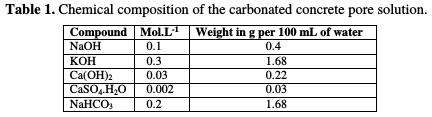
[8]. The chemical composition of the simulated concrete pore solution, therefore,
is designed as shown in <a href="#t1">Table 1</a> [15].</p>


    <p>&nbsp;</p>
<a name="t1">
<img src="/img/revistas/pea/v36n5/36n5a05t1.jpg">
    
<p>&nbsp;</p>


    <p>One solution without chloride content, and
three separate solutions containing an increasing chloride content (0.25 M NaCl, 0.5
M NaCl and 1 M NaCl), were prepared.</p>


    <p><i><b>Corrosion studies</b></i></p>

    <p>A corrosion cell having three electrode geometry of paint coated samples as
working electrode (8 cm<sup>2</sup>), platinum as counter electrode and a saturated calomel
(SCE: pH Products, Hyderabad, India) as reference electrode, was used. The cell
was coupled with Gamry reference system 1000 (Wilmington, USA) for linear
polarization resistance and electrochemical impedance measurements. All
measurements were carried out five times to obtain good reproducibility of the
results.</p>


    <p>&nbsp;</p>
    ]]></body>
<body><![CDATA[<p><b>Results and discussion</b></p>

    <p><i><b>Linear polarization resistance</b></i></p>

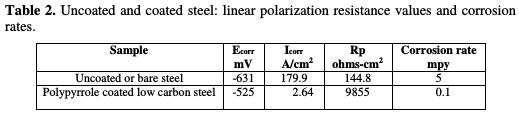
    <p>The samples were polarized, in a 3.5 wt% NaCl solution, at about 10 mV from
open circuit potential. Scan rate was 0.125 mV/s, as final potential. The corrosion
rate was found out using Echem Analyst software (ASTM G 59 -97 reapproved
2003: standard test method for conducting potentiodynamic polarization
resistance measurements). Results are recorded in <a href="#t2">Table 2</a>.</p>


    <p>&nbsp;</p>
<a name="t2">
<img src="/img/revistas/pea/v36n5/36n5a05t2.jpg">
    
<p>&nbsp;</p>


    <p>The corrosion potential increased from -631 mV, for the uncoated low carbon
steel, to -525 mV, for the conducting polypyrrole coated steel sample. The
polarization resistance was found to increase from 144.8 ohms-cm<sup>2</sup>, in the case of
bare steel, to 9855 ohms-cm<sup>2</sup>, in the case of polypyrrole coated steel. The
corrosion rate was significantly reduced, due to a decrease in the current density
from 179.9 &mu;A/cm<sup>2</sup> to 2.64 &mu;A/cm<sup>2</sup>. The corrosion rate of the conducting
polypyrrole coated low carbon steel was found to be 0.1 mpy, which is about 50
times lower than that of unpainted low carbon steel. A shift of 106 mV in the
value of the corrosion potential in the positive direction indicates that the coating
imparts corrosion protection to low carbon steel in a 3.5 wt% NaCl solution, by
preventing cathodic reduction processes, i.e., by anodic protection.
Electrochemical impedance
Electrochemical impedance measurements were carried out for uncoated and
polypyrrole coated low carbon steel samples immersed in a carbonated chloride
free concrete pore solution, and in a carbonated concrete pore solution containing
fixed amounts of chlorides. The results of these studies are herein reported in terms
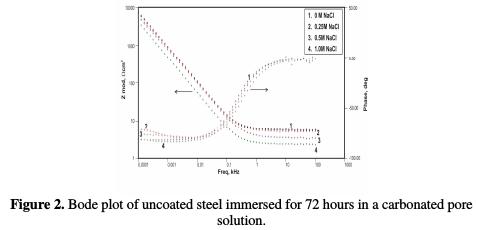
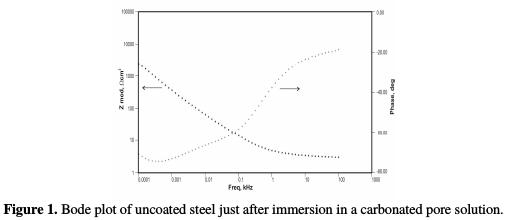
of Bode plots. <a href="#f1">Figs. 1</a> and <a href="#f2">2</a> show, respectively, the Bode plot of the uncoated low
carbon steel sample just after immersion in a carbonated pore solution, and after 72
hours of immersion in a pore solution, as a function of NaCl concentrations.</p>


    <p>&nbsp;</p>
<a name="f1">
<img src="/img/revistas/pea/v36n5/36n5a05f1.jpg">
    
<p>&nbsp;</p>
<a name="f2">
<img src="/img/revistas/pea/v36n5/36n5a05f2.jpg">
    
<p>&nbsp;</p>


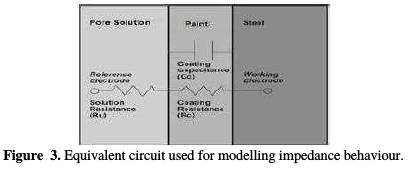
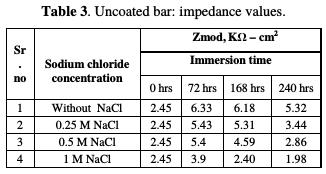
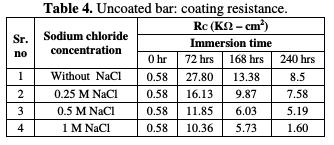
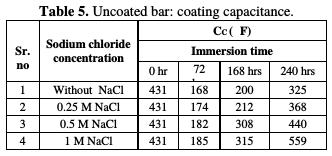
    <p>These plots are analyzed using the equivalent circuit shown in <a href="#f3">Fig. 3</a>; the
corresponding impedance (Zmod), coating resistance (RC) and coating capacitance
(CC) values, except solution resistance (RU), obtained by modelling these figures,
are recorded in <a href="#t3">Tables 3</a>, <a href="#t4">4</a> and <a href="#t5">5</a>.</p>


    ]]></body>
<body><![CDATA[<p>&nbsp;</p>
<a name="f3">
<img src="/img/revistas/pea/v36n5/36n5a05f3.jpg">
    
<p>&nbsp;</p>
<a name="t3">
<img src="/img/revistas/pea/v36n5/36n5a05t3.jpg">
    
<p>&nbsp;</p>
<a name="t4">
<img src="/img/revistas/pea/v36n5/36n5a05t4.jpg">
    
<p>&nbsp;</p>
<a name="t5">
<img src="/img/revistas/pea/v36n5/36n5a05t5.jpg">
    
<p>&nbsp;</p>


    <p>The equivalent circuit shown in <a href="#f3">Fig. 3</a> is Randles circuit.</p>
    <p>Randles circuit, a
combination of resistor and capacitor, not only can be used to model non coated
metals, but also coated metals. When this circuit is used to model
electrochemical processes in the case of non-coated steel, the resistance of the
metal to polarization and the capacitance associated with the formation of a
double layer are expressed in terms of polarization resistance (Rp) and double
layer capacitance(Cdl), respectively. In the case of coated steel, which was
modeled using the same circuit, these terms are replaced by coating resistance
(Rc) and coating capacitance (Cc ), respectively.

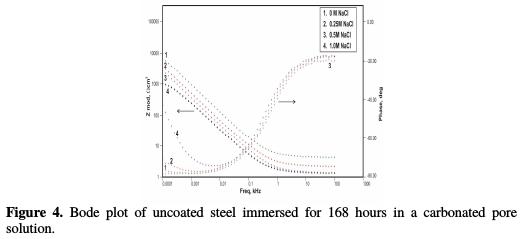
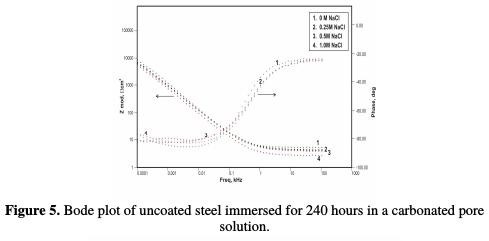
<a href="#f4">Figs. 4</a> and <a href="#f5">5</a> show Bode plots of the uncoated sample for, respectively, 168 hours
and 240 hours of immersion in a pore solution, as a function of NaCl
concentration.</p>


    <p>&nbsp;</p>
<a name="f4">
<img src="/img/revistas/pea/v36n5/36n5a05f4.jpg">
    
<p>&nbsp;</p>
<a name="f5">
<img src="/img/revistas/pea/v36n5/36n5a05f5.jpg">
    
<p>&nbsp;</p>


    ]]></body>
<body><![CDATA[<p>In the uncoated steel sample case, the impedance (Zmod) increased from 2.45 K&Omega;-
cm<sup>2</sup> to 6.33 K&Omega;-cm<sup>2</sup>, from just after immersion, to the end of 72 hours of
immersion, in a pore solution without NaCl.</p>

    <p>The relevant phase angle - log frequency diagram - was found to increase at
minimum frequency region. This can be assigned to initial passive film formation
on the rebar. These results are in good agreement with recent work [16].
However, the phase angle value decreased to 6.18 K&Omega;-cm<sup>2</sup> and 5.32 K&Omega;-cm<sup>2</sup>, at
the end of 168 hours and 240 hours of immersion, respectively, at minimum
frequency region. This can be attributed to the passive film damage in
carbonation, due to NaHCO3 addition. It has been noted that the impedance
values decreased from 6.33 K&Omega;-cm<sup>2</sup> to 5.43 K&Omega;-cm<sup>2</sup>, 5.4 K&Omega;-cm<sup>2</sup>, and 3.9 K&Omega;-
cm<sup>2</sup>, in a pore solution with increasing chloride contents from 0.25 M NaCl to 1 M
NaCl, respectively, at the end of 72 hours of immersion.</p>

    <p>The impedance, after 168 hours of immersion in the pore solution, decreased from
6.18 K&Omega;-cm<sup>2</sup> up to 5.31 K&Omega;-cm<sup>2</sup>, 4.59 K&Omega;-cm<sup>2</sup> and 2.40 K&Omega;-cm<sup>2</sup>, with increasing
chloride contents from 0.25 M NaCl to 1 M NaCl, respectively. By the end of 240
hours of immersion, the impedance decreased from 5.32 K&Omega;-cm<sup>2</sup> to 3.44 K&Omega;-cm<sup>2</sup>,
2.86 K&Omega;-cm<sup>2</sup> and 1.98 K&Omega;-cm<sup>2</sup>, respectively, with increasing chloride contents
from 0.25 M NaCl to 1 M NaCl, respectively.
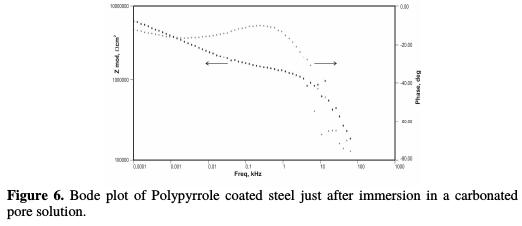
The Bode plots for the polypyrrole coated steel sample, just after immersion in the
pore solution, after 72 hours, 168 hours and 240 hours of immersion are shown in
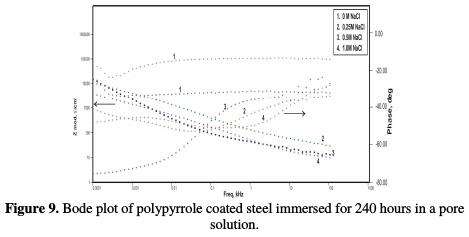
<a href="#f6">Figs. 6</a> to <a href="#f9">9</a>, respectively.</p>


    <p>&nbsp;</p>
<a name="f6">
<img src="/img/revistas/pea/v36n5/36n5a05f6.jpg">
    
<p>&nbsp;</p>
<a name="f7">
<img src="/img/revistas/pea/v36n5/36n5a05f7.jpg">
    
<p>&nbsp;</p>
<a name="f8">
<img src="/img/revistas/pea/v36n5/36n5a05f8.jpg">
    
<p>&nbsp;</p>
<a name="f9">
<img src="/img/revistas/pea/v36n5/36n5a05f9.jpg">
    
<p>&nbsp;</p>


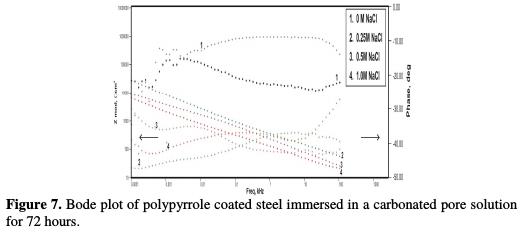
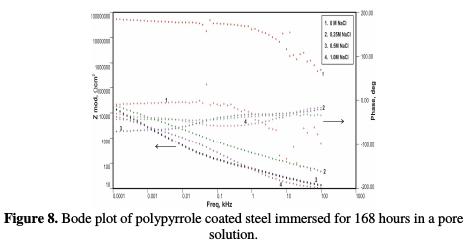
    <p><a href="#f7">Fig. 7</a> shows impedance values of the coated steel sample after 72 hours of
immersion in the pore solution, as a function of NaCl concentrations. <a href="#f8">Figs. 8</a> 
and <a href="#f9">9</a> show the impedance values of the coated sample with 168 and 240
hours of immersion time, as functions of NaCl concentrations, respectively.</p>

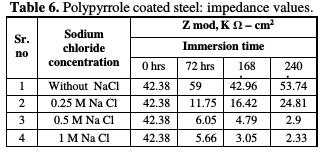
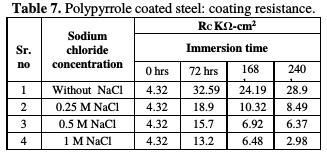
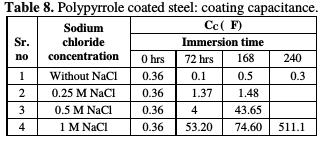
    <p>The impedance values (Zmod), coating resistance (RC) and coating capacitance (CC)
are obtained by using the equivalent electrical circuit shown in <a href="#f5">Fig. 5</a>, and recorded
in <a href="#t6">Tables 6</a>, <a href="#t7">7</a> and <a href="#t8">8</a>, respectively.</p>


    ]]></body>
<body><![CDATA[<p>&nbsp;</p>
<a name="t6">
<img src="/img/revistas/pea/v36n5/36n5a05t6.jpg">
    
<p>&nbsp;</p>
<a name="t7">
<img src="/img/revistas/pea/v36n5/36n5a05t7.jpg">
    
<p>&nbsp;</p>
<a name="t8">
<img src="/img/revistas/pea/v36n5/36n5a05t8.jpg">
    
<p>&nbsp;</p>


    <p>As compared to the uncoated low carbon steel sample, polypyrrole coated low
carbon steel sample exhibited higher impedance (Zmod), ~42.38 &Omega;-cm<sup>2</sup>, higher
coating resistance (RC), ~4.32 K&Omega;-cm<sup>2</sup>, and lower capacitance (CC), ~0.36 &mu;F,
just after immersion. By the end of 72 hours of immersion, it was seen a
significant increase in impedance (Zmod), ~ 59 &Omega;-cm<sup>2</sup>, and coating resistance
(RC), ~32.59 K&Omega;-cm<sup>2</sup>, and a reduction in capacitance (CC), ~0.1 &mu;F. Higher
impedance, coating resistance, and lower coating capacitance values can be
attributed to the protective nature of conducting polypyrrole as a pigment [12]. In
the relevant phase angle - log frequency diagram, the phase angle value was
found to increase at minimum frequency region, which can be attributed to the
protection offered by the conducting polypyrrole based epoxy coating. Water
molecules and chloride ion species penetrate into the coating as a function of
immersion time. This is reflected in the lowering of impedance and coating
resistance values, with an associated increase in the coating capacitance, as a
function of time during immersion in a pore solution up to 168 hours. In the
corresponding phase angle log frequency                    diagram, the phase angle value
showed a tendency to decrease at minimum frequency region, due to the loss of
corrosion protection. Subsequently, impedance (Zmod) and coating resistance (RC)
increased to the level of ~53.74 K&Omega;-cm<sup>2</sup> and 28.9 K&Omega;-cm<sup>2</sup>, respectively, by the
end of 240 hours of immersion, and the phase angle value was again found to
increase. This can be assigned to the self healing effect of conducting polypyrrole
as a pigment [12,17]. However, it must be noted that the impedance (Zmod) and
coating resistance (RC) values decreased, and coating capacitance (CC) increased
with higher chloride contents up to 1 M NaCl. By the end of 240 hours of
immersion, polypyrrole coated steel exhibited the lowest impedance (Zmod),
~2.33 &Omega;-cm<sup>2</sup>, the lowest coating resistance (RC), ~2.98 K&Omega;-cm<sup>2</sup>, and the highest
capacitance (CC), ~511.1 &mu;F values. Thus, it can be said that the corrosion
resistance of polypyrrole coated steel decreased with increasing chloride contents
in a carbonated pore solution.</p>


    <p>&nbsp;</p>
    <p><b>Conclusions</b></p>

    <p>The corrosion rate of conducting polypyrrole coated low carbon steel was found
to be 0.1 mpy, which is about 50 times lower than that of unpainted low carbon
steel. A shift of 106 mV in the value of the corrosion potential in the positive
direction indicates that the coating imparts corrosion protection to low carbon
steel in a 3.5 wt% NaCl solution by anodic protection. The passive film formed
on an uncoated rebar gets damaged due to the addition of NaHCO3, after 72
hours of immersion. Higher impedance values, higher coating resistance and
lower coating capacitance, in the case of conducting polypyrrole coated low
carbon steel, can be attributed to the protective nature of that polymer. An initial
lowering of impedance values, with an associated increase in the coating
capacitance up to 168 hours, followed by an increase in those values, with a
decrease in the coating capacitance, by the end of 240 hours of immersion, can
be assigned to the self healing effect of conducting polypyrrole. However,
corrosion resistance of polypyrrole coated steel decreased with increasing chloride
contents in a carbonated pore solution.</p>


    <p>&nbsp;</p>
    <p><b>References</b></p>

    ]]></body>
<body><![CDATA[<!-- ref --><p>1. Gambhir ML. Concrete Technology. Tata McGraw Hill; 2004.    &nbsp;&nbsp;&nbsp;&nbsp;&nbsp;&nbsp;&nbsp;&nbsp;[&#160;<a href="javascript:void(0);" onclick="javascript: window.open('/scielo.php?script=sci_nlinks&ref=436804&pid=S0872-1904201800050000500001&lng=','','width=640,height=500,resizable=yes,scrollbars=1,menubar=yes,');">Links</a>&#160;]<!-- end-ref --></p>

    <!-- ref --><p>2. Mehata PK, Monteiro PJM. Concrete Microstructure, properties and materials. New York: McGraw-Hill; 2014.    &nbsp;&nbsp;&nbsp;&nbsp;&nbsp;&nbsp;&nbsp;&nbsp;[&#160;<a href="javascript:void(0);" onclick="javascript: window.open('/scielo.php?script=sci_nlinks&ref=436806&pid=S0872-1904201800050000500002&lng=','','width=640,height=500,resizable=yes,scrollbars=1,menubar=yes,');">Links</a>&#160;]<!-- end-ref --></p>

    <!-- ref --><p>3. Wan X, Wittmann FH, Zhao T, et al. Appl Phys Eng. 2013;14:71.    &nbsp;&nbsp;&nbsp;&nbsp;&nbsp;&nbsp;&nbsp;&nbsp;[&#160;<a href="javascript:void(0);" onclick="javascript: window.open('/scielo.php?script=sci_nlinks&ref=436808&pid=S0872-1904201800050000500003&lng=','','width=640,height=500,resizable=yes,scrollbars=1,menubar=yes,');">Links</a>&#160;]<!-- end-ref --></p>

    <!-- ref --><p>4. Zhou Y, Gencturk B, Willam K, et al. J Mater Civil Eng. 2014;28:1943.    &nbsp;&nbsp;&nbsp;&nbsp;&nbsp;&nbsp;&nbsp;&nbsp;[&#160;<a href="javascript:void(0);" onclick="javascript: window.open('/scielo.php?script=sci_nlinks&ref=436810&pid=S0872-1904201800050000500004&lng=','','width=640,height=500,resizable=yes,scrollbars=1,menubar=yes,');">Links</a>&#160;]<!-- end-ref --></p>

    <!-- ref --><p>5. Suba U, Srinivasan P, Sakthieswaran N. Int J Res Appl Sci Eng Tech. 2016;4:647.    &nbsp;&nbsp;&nbsp;&nbsp;&nbsp;&nbsp;&nbsp;&nbsp;[&#160;<a href="javascript:void(0);" onclick="javascript: window.open('/scielo.php?script=sci_nlinks&ref=436812&pid=S0872-1904201800050000500005&lng=','','width=640,height=500,resizable=yes,scrollbars=1,menubar=yes,');">Links</a>&#160;]<!-- end-ref --></p>

    ]]></body>
<body><![CDATA[<!-- ref --><p>6. Miyazato S, Otsuki N. J Adv Concrete Technol. 2010;8:135.    &nbsp;&nbsp;&nbsp;&nbsp;&nbsp;&nbsp;&nbsp;&nbsp;[&#160;<a href="javascript:void(0);" onclick="javascript: window.open('/scielo.php?script=sci_nlinks&ref=436814&pid=S0872-1904201800050000500006&lng=','','width=640,height=500,resizable=yes,scrollbars=1,menubar=yes,');">Links</a>&#160;]<!-- end-ref --></p>

    <!-- ref --><p>7. Zivica V. Bull. Mater Sci. 2003;26:605.    &nbsp;&nbsp;&nbsp;&nbsp;&nbsp;&nbsp;&nbsp;&nbsp;[&#160;<a href="javascript:void(0);" onclick="javascript: window.open('/scielo.php?script=sci_nlinks&ref=436816&pid=S0872-1904201800050000500007&lng=','','width=640,height=500,resizable=yes,scrollbars=1,menubar=yes,');">Links</a>&#160;]<!-- end-ref --></p>

    <!-- ref --><p>8. Moreno M, Morris W, Alvarez MG, et al. Corrosion Sci. 2004;46:2699.    &nbsp;&nbsp;&nbsp;&nbsp;&nbsp;&nbsp;&nbsp;&nbsp;[&#160;<a href="javascript:void(0);" onclick="javascript: window.open('/scielo.php?script=sci_nlinks&ref=436818&pid=S0872-1904201800050000500008&lng=','','width=640,height=500,resizable=yes,scrollbars=1,menubar=yes,');">Links</a>&#160;]<!-- end-ref --></p>

    <!-- ref --><p>9. Chung DDL. J Mater Eng Perform. 2000;9:585.    &nbsp;&nbsp;&nbsp;&nbsp;&nbsp;&nbsp;&nbsp;&nbsp;[&#160;<a href="javascript:void(0);" onclick="javascript: window.open('/scielo.php?script=sci_nlinks&ref=436820&pid=S0872-1904201800050000500009&lng=','','width=640,height=500,resizable=yes,scrollbars=1,menubar=yes,');">Links</a>&#160;]<!-- end-ref --></p>

    <!-- ref --><p>10. Kumar V. Corros Rev. 1998;16:317.    &nbsp;&nbsp;&nbsp;&nbsp;&nbsp;&nbsp;&nbsp;&nbsp;[&#160;<a href="javascript:void(0);" onclick="javascript: window.open('/scielo.php?script=sci_nlinks&ref=436822&pid=S0872-1904201800050000500010&lng=','','width=640,height=500,resizable=yes,scrollbars=1,menubar=yes,');">Links</a>&#160;]<!-- end-ref --></p>

    ]]></body>
<body><![CDATA[<!-- ref --><p>11 Tang F, Chen G, Brow RK, et al. Corros Sci. 2012;59:157.    &nbsp;&nbsp;&nbsp;&nbsp;&nbsp;&nbsp;&nbsp;&nbsp;[&#160;<a href="javascript:void(0);" onclick="javascript: window.open('/scielo.php?script=sci_nlinks&ref=436824&pid=S0872-1904201800050000500011&lng=','','width=640,height=500,resizable=yes,scrollbars=1,menubar=yes,');">Links</a>&#160;]<!-- end-ref --></p>

    <!-- ref --><p>12. Deshpande P, Sazou D. Corrosion Protection of Metals by Intrinsically Conducting Polymers. Boca Raton: CRC Press; 2015.    &nbsp;&nbsp;&nbsp;&nbsp;&nbsp;&nbsp;&nbsp;&nbsp;[&#160;<a href="javascript:void(0);" onclick="javascript: window.open('/scielo.php?script=sci_nlinks&ref=436826&pid=S0872-1904201800050000500012&lng=','','width=640,height=500,resizable=yes,scrollbars=1,menubar=yes,');">Links</a>&#160;]<!-- end-ref --></p>

    <!-- ref --><p>13. Truong V, Lai P, Moore B, et al. Synthetic Metals. 2000;110:7.    &nbsp;&nbsp;&nbsp;&nbsp;&nbsp;&nbsp;&nbsp;&nbsp;[&#160;<a href="javascript:void(0);" onclick="javascript: window.open('/scielo.php?script=sci_nlinks&ref=436828&pid=S0872-1904201800050000500013&lng=','','width=640,height=500,resizable=yes,scrollbars=1,menubar=yes,');">Links</a>&#160;]<!-- end-ref --></p>

    <!-- ref --><p>14. Deshpande P, Vagge S, Jagtap S, et al. Protect Metals Phys Chem Surf. 2012;48:356.    &nbsp;&nbsp;&nbsp;&nbsp;&nbsp;&nbsp;&nbsp;&nbsp;[&#160;<a href="javascript:void(0);" onclick="javascript: window.open('/scielo.php?script=sci_nlinks&ref=436830&pid=S0872-1904201800050000500014&lng=','','width=640,height=500,resizable=yes,scrollbars=1,menubar=yes,');">Links</a>&#160;]<!-- end-ref --></p>

    <!-- ref --><p>15. Poursaee A. Concrete Res Lett. 2010;1:90.    &nbsp;&nbsp;&nbsp;&nbsp;&nbsp;&nbsp;&nbsp;&nbsp;[&#160;<a href="javascript:void(0);" onclick="javascript: window.open('/scielo.php?script=sci_nlinks&ref=436832&pid=S0872-1904201800050000500015&lng=','','width=640,height=500,resizable=yes,scrollbars=1,menubar=yes,');">Links</a>&#160;]<!-- end-ref --></p>

    ]]></body>
<body><![CDATA[<!-- ref --><p>16. Williamson J, Isgor OB. Corros Sci. 2016;106:82.    &nbsp;&nbsp;&nbsp;&nbsp;&nbsp;&nbsp;&nbsp;&nbsp;[&#160;<a href="javascript:void(0);" onclick="javascript: window.open('/scielo.php?script=sci_nlinks&ref=436834&pid=S0872-1904201800050000500016&lng=','','width=640,height=500,resizable=yes,scrollbars=1,menubar=yes,');">Links</a>&#160;]<!-- end-ref --></p>

    <!-- ref --><p>17. Ohsuka T. Int J Corros. 2012;4:915090.    &nbsp;&nbsp;&nbsp;&nbsp;&nbsp;&nbsp;&nbsp;&nbsp;[&#160;<a href="javascript:void(0);" onclick="javascript: window.open('/scielo.php?script=sci_nlinks&ref=436836&pid=S0872-1904201800050000500017&lng=','','width=640,height=500,resizable=yes,scrollbars=1,menubar=yes,');">Links</a>&#160;]<!-- end-ref --></p>


    <p>&nbsp;</p>
    <p><b>Acknowledgements</b></p>

    <p>The authors thank Prof. N.B. Dhokey, Head, Department of Metallurgy and
Materials Science, College of Engineering, Pune (M.S.), India, for providing
facilities, and Prof. B. B. Ahuja, Director, College of Engineering, Pune (M.S.),
India, for his encouragement.</p>


    <p>&nbsp;</p>
    <p><a name=0></a><sup><a href="#top">*</a></sup>Corresponding author. E-mail address: <a href="mailto:pravinpd@hotmail.com">pravinpd@hotmail.com</a></p>

    <p>Received May 8, 2017; accepted December 8, 2017</p>

    ]]></body>
<body><![CDATA[<p><a href="http://www.peacta.org" target="_blank">www.peacta.org</a> </p>


     ]]></body><back>
<ref-list>
<ref id="B1">
<label>1</label><nlm-citation citation-type="book">
<person-group person-group-type="author">
<name>
<surname><![CDATA[Gambhir]]></surname>
<given-names><![CDATA[M L]]></given-names>
</name>
</person-group>
<source><![CDATA[Concrete Technology]]></source>
<year>2004</year>
<publisher-name><![CDATA[Tata McGraw Hill]]></publisher-name>
</nlm-citation>
</ref>
<ref id="B2">
<label>2</label><nlm-citation citation-type="book">
<person-group person-group-type="author">
<name>
<surname><![CDATA[Mehata]]></surname>
<given-names><![CDATA[P K]]></given-names>
</name>
<name>
<surname><![CDATA[Monteiro]]></surname>
<given-names><![CDATA[P J M]]></given-names>
</name>
</person-group>
<source><![CDATA[Concrete Microstructure, properties and materials]]></source>
<year>2014</year>
<publisher-loc><![CDATA[New York ]]></publisher-loc>
<publisher-name><![CDATA[McGraw-Hill]]></publisher-name>
</nlm-citation>
</ref>
<ref id="B3">
<label>3</label><nlm-citation citation-type="journal">
<person-group person-group-type="author">
<name>
<surname><![CDATA[Wan]]></surname>
<given-names><![CDATA[X]]></given-names>
</name>
<name>
<surname><![CDATA[Wittmann]]></surname>
<given-names><![CDATA[F H]]></given-names>
</name>
<name>
<surname><![CDATA[Zhao]]></surname>
<given-names><![CDATA[T]]></given-names>
</name>
</person-group>
<source><![CDATA[Appl Phys Eng]]></source>
<year>2013</year>
<volume>14</volume>
<page-range>71</page-range></nlm-citation>
</ref>
<ref id="B4">
<label>4</label><nlm-citation citation-type="journal">
<person-group person-group-type="author">
<name>
<surname><![CDATA[Zhou]]></surname>
<given-names><![CDATA[Y]]></given-names>
</name>
<name>
<surname><![CDATA[Gencturk]]></surname>
<given-names><![CDATA[B]]></given-names>
</name>
<name>
<surname><![CDATA[Willam]]></surname>
<given-names><![CDATA[K]]></given-names>
</name>
</person-group>
<source><![CDATA[J Mater Civil Eng]]></source>
<year>2014</year>
<volume>28</volume>
<page-range>1943</page-range></nlm-citation>
</ref>
<ref id="B5">
<label>5</label><nlm-citation citation-type="journal">
<person-group person-group-type="author">
<name>
<surname><![CDATA[Suba]]></surname>
<given-names><![CDATA[U]]></given-names>
</name>
<name>
<surname><![CDATA[Srinivasan]]></surname>
<given-names><![CDATA[P]]></given-names>
</name>
<name>
<surname><![CDATA[Sakthieswaran]]></surname>
<given-names><![CDATA[N]]></given-names>
</name>
</person-group>
<source><![CDATA[Int J Res Appl Sci Eng Tech]]></source>
<year>2016</year>
<volume>4</volume>
<page-range>647</page-range></nlm-citation>
</ref>
<ref id="B6">
<label>6</label><nlm-citation citation-type="journal">
<person-group person-group-type="author">
<name>
<surname><![CDATA[Miyazato]]></surname>
<given-names><![CDATA[S]]></given-names>
</name>
<name>
<surname><![CDATA[Otsuki]]></surname>
<given-names><![CDATA[N]]></given-names>
</name>
</person-group>
<source><![CDATA[J Adv Concrete Technol]]></source>
<year>2010</year>
<volume>8</volume>
<page-range>135</page-range></nlm-citation>
</ref>
<ref id="B7">
<label>7</label><nlm-citation citation-type="journal">
<person-group person-group-type="author">
<name>
<surname><![CDATA[Zivica]]></surname>
<given-names><![CDATA[V. Bull]]></given-names>
</name>
</person-group>
<source><![CDATA[Mater Sci]]></source>
<year>2003</year>
<volume>26</volume>
<page-range>605</page-range></nlm-citation>
</ref>
<ref id="B8">
<label>8</label><nlm-citation citation-type="journal">
<person-group person-group-type="author">
<name>
<surname><![CDATA[Moreno]]></surname>
<given-names><![CDATA[M]]></given-names>
</name>
<name>
<surname><![CDATA[Morris]]></surname>
<given-names><![CDATA[W]]></given-names>
</name>
<name>
<surname><![CDATA[Alvarez]]></surname>
<given-names><![CDATA[M G]]></given-names>
</name>
</person-group>
<source><![CDATA[Corrosion Sci]]></source>
<year>2004</year>
<volume>46</volume>
<page-range>2699</page-range></nlm-citation>
</ref>
<ref id="B9">
<label>9</label><nlm-citation citation-type="journal">
<person-group person-group-type="author">
<name>
<surname><![CDATA[Chung]]></surname>
<given-names><![CDATA[D D L]]></given-names>
</name>
</person-group>
<source><![CDATA[J Mater Eng Perform]]></source>
<year>2000</year>
<volume>9</volume>
<page-range>585</page-range></nlm-citation>
</ref>
<ref id="B10">
<label>10</label><nlm-citation citation-type="journal">
<person-group person-group-type="author">
<name>
<surname><![CDATA[Kumar]]></surname>
<given-names><![CDATA[V]]></given-names>
</name>
</person-group>
<source><![CDATA[Corros Rev]]></source>
<year>1998</year>
<volume>16</volume>
<page-range>317</page-range></nlm-citation>
</ref>
<ref id="B11">
<label>11</label><nlm-citation citation-type="journal">
<person-group person-group-type="author">
<name>
<surname><![CDATA[Tang]]></surname>
<given-names><![CDATA[F]]></given-names>
</name>
<name>
<surname><![CDATA[Chen]]></surname>
<given-names><![CDATA[G]]></given-names>
</name>
<name>
<surname><![CDATA[Brow]]></surname>
<given-names><![CDATA[R K]]></given-names>
</name>
</person-group>
<source><![CDATA[Corros Sci]]></source>
<year>2012</year>
<volume>59</volume>
<page-range>157</page-range></nlm-citation>
</ref>
<ref id="B12">
<label>12</label><nlm-citation citation-type="book">
<person-group person-group-type="author">
<name>
<surname><![CDATA[Deshpande]]></surname>
<given-names><![CDATA[P]]></given-names>
</name>
<name>
<surname><![CDATA[Sazou]]></surname>
<given-names><![CDATA[D]]></given-names>
</name>
</person-group>
<source><![CDATA[Corrosion Protection of Metals by Intrinsically Conducting Polymers]]></source>
<year>2015</year>
<publisher-loc><![CDATA[Boca Raton ]]></publisher-loc>
<publisher-name><![CDATA[CRC Press]]></publisher-name>
</nlm-citation>
</ref>
<ref id="B13">
<label>13</label><nlm-citation citation-type="journal">
<person-group person-group-type="author">
<name>
<surname><![CDATA[Truong]]></surname>
<given-names><![CDATA[V]]></given-names>
</name>
<name>
<surname><![CDATA[Lai]]></surname>
<given-names><![CDATA[P]]></given-names>
</name>
<name>
<surname><![CDATA[Moore]]></surname>
<given-names><![CDATA[B]]></given-names>
</name>
</person-group>
<source><![CDATA[Synthetic Metals]]></source>
<year>2000</year>
<volume>110</volume>
<page-range>7</page-range></nlm-citation>
</ref>
<ref id="B14">
<label>14</label><nlm-citation citation-type="journal">
<person-group person-group-type="author">
<name>
<surname><![CDATA[Deshpande]]></surname>
<given-names><![CDATA[P]]></given-names>
</name>
<name>
<surname><![CDATA[Vagge]]></surname>
<given-names><![CDATA[S]]></given-names>
</name>
<name>
<surname><![CDATA[Jagtap]]></surname>
<given-names><![CDATA[S]]></given-names>
</name>
</person-group>
<source><![CDATA[Protect Metals Phys Chem Surf]]></source>
<year>2012</year>
<volume>48</volume>
<page-range>356</page-range></nlm-citation>
</ref>
<ref id="B15">
<label>15</label><nlm-citation citation-type="journal">
<person-group person-group-type="author">
<name>
<surname><![CDATA[Poursaee]]></surname>
<given-names><![CDATA[A]]></given-names>
</name>
</person-group>
<source><![CDATA[Concrete Res Lett]]></source>
<year>2010</year>
<volume>1</volume>
<page-range>90</page-range></nlm-citation>
</ref>
<ref id="B16">
<label>16</label><nlm-citation citation-type="journal">
<person-group person-group-type="author">
<name>
<surname><![CDATA[Williamson]]></surname>
<given-names><![CDATA[J]]></given-names>
</name>
<name>
<surname><![CDATA[Isgor]]></surname>
<given-names><![CDATA[O B]]></given-names>
</name>
</person-group>
<source><![CDATA[Corros Sci]]></source>
<year>2016</year>
<volume>106</volume>
<page-range>82</page-range></nlm-citation>
</ref>
<ref id="B17">
<label>17</label><nlm-citation citation-type="journal">
<person-group person-group-type="author">
<name>
<surname><![CDATA[Ohsuka]]></surname>
<given-names><![CDATA[T]]></given-names>
</name>
</person-group>
<source><![CDATA[Int J Corros]]></source>
<year>2012</year>
<volume>4</volume>
</nlm-citation>
</ref>
</ref-list>
</back>
</article>